I-80 Road Dust Yields Ore-Grade Platinum From Catalytic Converters
Precious Metal Refining & Recovery, Episode 10: Platinum From the Road — Cody'sLab

Cody'sLab

Exhaust wear from highway traffic deposits recoverable precious metals along road shoulders, creating fine dust that assays at a commercially viable 6.7 grams of platinum per metric ton.

AI-assisted summary of Precious Metal Refining & Recovery, Episode 10: Platinum From the Road — original source. Check the original for full context.

Source published:

Key ideas

  • Roadside dust sampled along Interstate 80 was fire-assayed and verified to contain recoverable platinum group metals shed by automotive catalytic converters. (0:00)
  • The refined bead resisted melting in a 2,000°F furnace due to platinum's 1,768°C melting point, requiring an oxy-MAPP gas torch to drive off residual lead and pool the metal. (4:02)
  • Wet chemical analysis via aqua regia and selective precipitation confirmed distinct fractions of platinum (yellow ammonium hexachloroplatinate) and palladium (red ammonium hexachloropalladate). (6:47)
  • Extrapolating the recovered platinum mass against a 146-gram fine dust sample yielded an estimated grade of 6.7 grams of platinum per metric ton. (6:47)

Detailed notes

## Background This video was published on YouTube by the channel Cody'sLab on May 29, 2016, as Episode 10 of the "Precious Metal Refining & Recovery" series. According to the page description, Cody collects a sample of debris from the side of the road to extract precious metals from it.

## TL;DR Cody and his friend Arthur harvest roadside dust and debris along Interstate 80 to test whether platinum shed by automobile catalytic converters accumulates in recoverable amounts. After screening out gravel, trash, and rubber, Cody subjects a 146-gram sample of fine dust to a fire assay using sodium carbonate, borax, litharge, and flour as flux. He oxidizes the resulting lead button in a bone ash cupel and finishes refining it with an oxy-MAPP torch to isolate a microscopic precious metal prill. By dissolving the bead in aqua regia and selectively precipitating yellow ammonium hexachloroplatinate and red palladium salts, Cody confirms the presence of platinum group metals, calculating an ore grade equivalent to 6.7 grams of platinum per metric ton of fine roadside dust.

## Atmosphere & style The video carries an authentic, hands-on DIY science vibe, beginning with the gritty, slightly clandestine feeling of sweeping highway shoulders with brooms at three in the morning. Cody's delivery is grounded, methodical, and matter-of-fact as he navigates the high-heat crucible smelting and delicate wet chemistry benchwork in his workshop. The narrative tension centers on whether such an unpromising pile of concrete dust and road grit will yield anything at all, culminating in genuine satisfaction when vivid yellow and red chemical precipitates distinctly confirm the presence of platinum and palladium.

## Bulletin - [00:00](https://www.youtube.com/watch?v=v5GPWJPLcHg&t=0s) Roadside dust sampled along Interstate 80 was fire-assayed and verified to contain recoverable platinum group metals shed by automotive catalytic converters. - [04:02](https://www.youtube.com/watch?v=v5GPWJPLcHg&t=242s) The refined bead resisted melting in a 2,000°F furnace due to platinum's 1,768°C melting point, requiring an oxy-MAPP gas torch to drive off residual lead and pool the metal. - [06:47](https://www.youtube.com/watch?v=v5GPWJPLcHg&t=407s) Wet chemical analysis via aqua regia and selective precipitation confirmed distinct fractions of platinum (yellow ammonium hexachloroplatinate) and palladium (red ammonium hexachloropalladate). - [06:47](https://www.youtube.com/watch?v=v5GPWJPLcHg&t=407s) Extrapolating the recovered platinum mass against a 146-gram fine dust sample yielded an estimated grade of 6.7 grams of platinum per metric ton.

## Key takeaways - [00:00](https://www.youtube.com/watch?v=v5GPWJPLcHg&t=0s) Catalytic converters shed significant amounts of precious metals during high-mileage vehicle operation, depositing microscopic particles along highway shoulders. - [00:00](https://www.youtube.com/watch?v=v5GPWJPLcHg&t=0s) Coarse screening is safe because platinum particles are microscopic or near-atomic, meaning mechanical gravity separation methods like panning are ineffective. - [02:06](https://www.youtube.com/watch?v=v5GPWJPLcHg&t=126s) Highway traffic volume calculations suggest that up to an ounce of platinum per mile could theoretically accumulate along busy highway corridors each year. - [02:06](https://www.youtube.com/watch?v=v5GPWJPLcHg&t=126s) A standard fire assay flux charge of sodium carbonate, borax, litharge (lead oxide), and flour successfully dissolves silicate concrete dust and forms a collector lead button. - [04:02](https://www.youtube.com/watch?v=v5GPWJPLcHg&t=242s) Standard cupellation furnace temperatures (~2,000°F) are insufficient to fully melt platinum, which melts at 1,768°C (3,214°F), leaving a dull grey, unmelted alloy bead. - [04:02](https://www.youtube.com/watch?v=v5GPWJPLcHg&t=242s) An oxy-MAPP torch provides the localized high heat necessary to scorify residual lead into the cupel and melt the refractory platinum prill. - [06:47](https://www.youtube.com/watch?v=v5GPWJPLcHg&t=407s) Rapid dissolution of the metal bead into a reddish-orange solution in aqua regia eliminates pure silver as the primary constituent. - [06:47](https://www.youtube.com/watch?v=v5GPWJPLcHg&t=407s) An insoluble residue remaining after aqua regia digestion likely consists of silver chloride or rarer platinum-group metals like iridium or ruthenium. - [06:47](https://www.youtube.com/watch?v=v5GPWJPLcHg&t=407s) Selective precipitation with ammonium chloride confirms platinum through the formation of canary-yellow ammonium hexachloroplatinate. - [06:47](https://www.youtube.com/watch?v=v5GPWJPLcHg&t=407s) Addition of sodium chlorate oxidizes the remaining solution to precipitate palladium as a distinctive red salt. - [06:47](https://www.youtube.com/watch?v=v5GPWJPLcHg&t=407s) The resulting concentration of approximately 6.7 grams of platinum per metric ton in fine roadside dust rivals commercial ore grades mined underground.

## Detailed walkthrough ### [00:00](https://www.youtube.com/watch?v=v5GPWJPLcHg&t=0s) Sampling Roadside Dirt Along Interstate 80

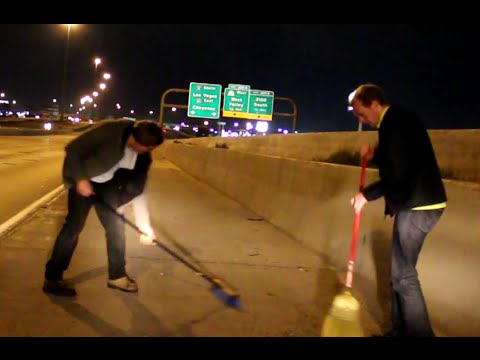
Cody introduces the experiment alongside his friend Arthur while standing alongside Interstate 80 at three o'clock in the morning. Armed with brooms and dustpans, they gather dust and debris accumulating directly off the highway shoulder. Cody explains the hypothesis behind their unusual harvest: “Platinum is lost through catalytic converters and we can recover that platinum because it is gonna be on the side of the road here.” Sweeping up the roadside material, Cody notes that while the haul initially appears to be mostly gravel, he is confident it holds recoverable traces of precious metal.

Back at his workshop with bags of roadside dirt, Cody begins cleaning and classifying the bulk material. The raw sample is contaminated with highway junk, including gravel chunks, cigarette butts, and tire rubber. He uses screens to sift out the largest debris, reasoned by the physical nature of the metal:

> “I don't think I'll lose very much platinum by taking these large chunks out of there 'cause ultimately the platinum particles are going to be incredibly small, possibly even just a few atoms in size.”

Because the platinum particles are near-atomic or microscopic, he notes they would simply wash away in water currents just like ordinary mud, rendering traditional gravity separation techniques useless. Cody identifies the sifted matrix as mostly ground-up highway concrete mixed with tire rubber crumbs. To isolate the finest fraction, he runs the material through a repurpose coffee filter cone until it is reduced to a uniform, ultra-fine dust.

```mermaid flowchart TD accTitle: Roadside Dirt Processing Flow accDescr: Step-by-step workflow of collecting roadside debris and preparing it for fire assay. subgraph Collection["Field Collection"] A["I-80 Roadside Dirt"] --> B["Coarse Screening"] end subgraph Preparation["Laboratory Sifting"] B -->|"Remove gravel, butts, rubber"| C["Coffee Filter Screen"] C --> D["Fine Dust Sample (146 g)"] end subgraph FireAssayPrep["Fire Assay Mixing"] D --> E["Crucible Charge"] F["Flux: Na2CO3 + Borax + PbO + Flour"] --> E end ```

[02:06](https://www.youtube.com/watch?v=v5GPWJPLcHg&t=126s) Fire Assay Smelting and Roadside Platinum Math

Cody weighs out a 146-gram sample of the fine roadside dust, explaining that his assay crucibles can handle roughly up to 150 grams. Clarifying the scope of the project, he states: “In this video, I'm not going to be processing massive amounts of platinum, I'm just going to be taking a sample and seeing if there's platinum there, or not.” To prepare the fire assay charge, he mixes a flux inside a clean, brand-new crucible to ensure no background contamination from prior melts:

- **Sodium carbonate ($\text{Na}_2\text{CO}_3$):** Acts as the primary base solvent to dissolve the silicate rock and concrete dust. - **Borax:** Thins the slag to ensure high fluidity at elevated temperatures. - **Lead oxide (litharge, $\text{PbO}$):** The distinctive orange compound providing the collector metal. - **Flour:** The small lumps of organic flour act as a reducing agent, pulling oxygen away from the lead oxide to generate molten lead droplets that sink through the charge and scavenge precious metals.

While the loaded crucible heats in the furnace, Cody walks through the back-of-the-envelope calculations that inspired the experiment. In previous teardowns of catalytic converters, he found that units with 100,000 miles of highway driving had shed roughly half their original precious metal loading. On this stretch of I-80, traffic runs at approximately 10,000 vehicles per day. Over a single mile, 10,000 cars accumulate 100,000 vehicle-miles every 10 days, depositing the equivalent of half a converter's platinum payload along that stretch. Given that typical catalytic converters contain between 2 to 3 grams of platinum, Cody estimates that up to an ounce of platinum per mile could theoretically accumulate along the highway corridor each year, even if atmospheric wind and runoff disperse much of it into the surrounding environment.

[04:02](https://www.youtube.com/watch?v=v5GPWJPLcHg&t=242s) Cupellation and Oxy-MAPP Gas Refining

Once the crucible reaches peak fluidity, Cody pulls it from the furnace and pours the melt into an iron mold. The separated glassy slag is cleanly broken away to reveal the lead collector button sitting at the base. To separate the collected precious metals from the lead, Cody places the button into a bone ash cupel and returns it to the oxidizing atmosphere of the furnace. In the cupel, lead oxidizes into lead oxide, which soaks directly into the porous bone ash matrix while noble metals resist oxidation and pool together.

Upon pulling the cupel from the furnace, a bead appears on the bone ash surface, but Cody immediately notices something unusual about its texture. A bead of pure gold or silver would freeze into a mirror-bright sphere, but this bead remains dull grey. Because the 2,000°F (~1,093°C) furnace could not reach the extreme melting point of platinum (1,768°C / 3,214°F), the bead remained trapped as an unmelted, stubborn lead-platinum alloy. Cody turns to an oxy-MAPP gas torch to drive the temperature high enough to liquefy the bead, burn off the remaining traces of lead into the cupel, and leave behind a clean, reflective metallic prill.

He retrieves the pancake-shaped bead and checks its dimensions with dial calipers across both its widest and narrowest axes. However, when placing the tiny speck onto his precision scale, the display fails to register any weight at all, showing that the mass falls below the scale's minimum readability threshold.

[06:47](https://www.youtube.com/watch?v=v5GPWJPLcHg&t=407s) Chemical Separation of Platinum and Palladium

To definitively identify the metals in the bead, Cody places it inside a test tube immersed in a warm water bath beneath a magnifying lens. He pipettes in a few drops of freshly mixed aqua regia. The bead rapidly reacts, turning the liquid into an intense reddish-orange solution:

> “This right there proves that its not silver because silver does not react like this in aqua regia. Silver would just turn white and not dissolve.”

A minute, insoluble speck remains at the bottom of the tube after digestion, which Cody suspects is silver (as insoluble silver chloride), possibly accompanied by other insoluble platinum-group metals such as iridium or ruthenium.

```mermaid flowchart TD accTitle: Chemical Separation of Platinum and Palladium accDescr: Aqua regia dissolution and selective precipitation of platinum group metals. A["Metallic Bead"] -->|"Aqua Regia (HCl + HNO3)"| B["Dissolved Red Solution"] A -->|"Insoluble Residue"| C["Silver Chloride / Ir / Ru"] B -->|"Evaporate HNO3, reconstitute"| D["Denitrated Solution"] D -->|"Add Ammonium Chloride (NH4Cl)"| E["Ammonium Hexachloroplatinate (Yellow Ppt)"] D -->|"Add Sodium Chlorate (NaClO3) to filtrate"| F["Palladium Hexachloroplatinate Complex (Red Ppt)"] ```

Cody draws off the pregnant solution using a pipette, leaving the insoluble residue behind. He gently evaporates the solution down to dryness to drive off excess nitric acid, then reconstitutes the salts in water. To selectively drop the platinum, he introduces a few crystals of ammonium chloride ($\text{NH}_4\text{Cl}$). After standing, a canary-yellow precipitate of ammonium hexachloroplatinate settles along the vial bottom and floats on the meniscus, confirming platinum.

After siphoning off the supernatant liquid into a secondary vial, Cody tests for palladium by adding a small crystal of sodium chlorate ($\text{NaClO}_3$). The reagent oxidizes the palladium species, precipitating out fine red flakes of ammonium hexachloropalladate. Displaying the vials side by side, he shows: - The insoluble silver/iridium/ruthenium grain - The yellow ammonium chloroplatinate precipitate - The red palladium precipitate

Assessing the overall recovery, Cody estimates the initial bead was approximately half platinum. Extrapolating the collected metal mass back across his 146-gram fine dust sample yields an assay grade of 6.7 grams of platinum per metric ton of fine sifted roadside dust. Acknowledging that the unsifted bulk gravel shoulder would assay lower, Cody concludes: “That's pretty impressive, considering that that's just laying on the side of the road, but that would be considered a valuable ore, actually.” He directs viewers to Arthur's companion video covering catalytic converter chemistry to close out the episode.

## Notable quotes > [00:00](https://www.youtube.com/watch?v=v5GPWJPLcHg&t=0s) Platinum is lost through catalytic converters and we can recover that platinum because it is gonna be on the side of the road here. — Cody

## Mentioned Cody'sLab, Arthur, Interstate 80

## Video description We get a sample from the side of the road and extract precious metal from it.

Arthur's video: https://www.youtube.com/watch?v=DKGLXCXzDVU Neat little article on how to separate platinum and palladium: http://www.infomine.com/library/publications/docs/PlatinumPalladiumSeparationMethod.pdf Help me make videos by donating here: https://www.patreon.com/CodysLab

[Source](https://www.youtube.com/watch?v=v5GPWJPLcHg)

中文简报

80号州际公路路尘提炼出催化转化器来源的矿石级铂 高速公路交通的废气磨损在路肩沉积了可回收的贵金属,形成的微尘化验出达到商业可行级别的每公吨6.7克铂。 Cody和他的朋友Arthur在80号州际公路沿线收集路边粉尘与碎屑,以测试汽车催化转化器脱落的铂是否积聚到了可回收的数量。在筛除砾石、垃圾和橡胶后,Cody使用碳酸钠、硼砂、密陀僧和面粉作为熔剂,对一份146克的微尘样本进行了火法试金。他在骨灰灰皿中将生成的铅扣氧化,并使用氧-MAPP喷枪完成精炼,从而分离出一颗微小的贵金属珠。通过将金属珠溶解在王水中,并选择性沉淀出黄色的氯铂酸铵和红色的钯盐,Cody证实了铂族金属的存在,并计算出其矿石品位相当于每公吨路边微尘含6.7克铂。 在80号州际公路沿线采样的路边粉尘经过火法试金,证实含有汽车催化转化器脱落的可回收铂族金属。 (0:00) 由于铂的熔点高达1,768°C,精炼出的金属珠在2,000°F的炉子中难以熔化,需要使用氧-MAPP气体喷枪驱除残留的铅并将金属熔聚。 (4:02) 通过王水和选择性沉淀进行的湿法化学分析证实了铂(黄色六氯合铂酸铵)和钯(红色六氯合钯酸铵)的不同馏分。 (6:47) 将回收的铂质量与146克微尘样本进行对比外推,得出估计品位为每公吨6.7克铂。 (6:47)

Reading summary

Cody tests whether micro-particulate platinum shed by vehicle catalytic converters can be gathered from highway shoulders, successfully recovering platinum and palladium from Interstate 80 sweepings. Using fire assay smelting and selective chemical precipitation, he confirms that fine roadside dust contains precious metals at concentrations comparable to commercial ore grades. Highway Traffic and Theoretical Platinum Deposition (2:06) Cody bases his roadside collection on previous catalytic converter teardowns, where units with 100,000 miles of highway driving had shed roughly half of their initial 2- to 3-gram precious metal charge. Along a highway corridor like Interstate 80 carrying approximately 10,000 vehicles per day, passing traffic accumulates 100,000 vehicle-miles every 10 days along any single-mile stretch, shedding the equivalent of half a converter's precious metal loading. From these figures, Cody calculates that up to one ounce of platinum per mile could theoretically settle beside the roadway each year. While wind currents and rainwater runoff disperse a significant fraction into surrounding terrain, he hypothesizes that a detectable quantity remains trapped in roadside shoulder debris. Debris Classification and Collector Smelting (0:00) To test the concept, Cody sweeps debris from the Interstate 80 shoulder and screens out coarse highway waste, including gravel chunks, cigarette butts, and tire fragments. He notes that platinum particles shed in vehicle exhaust are microscopic or near-atomic in size, meaning screening out large debris causes minimal precious metal loss. Because such fine particles wash away in water currents like ordinary mud, traditional gravity panning is ineffective. Using a repurposed coffee filter cone, Cody isolates a 146-gram sample of fine dust comprised primarily of pulverized concrete and tire rubber. He loads this dust into a clean crucible with a fire assay flux consisting of sodium carbonate to dissolve silicates, borax to thin the slag, lead oxide (litharge) as the collector metal, and flour as a reducing agent. Heated in a furnace, the flour strips oxygen from the litharge to form molten lead droplets, which scavenge precious metals as they settle through the charge. High-Temperature Cupellation and Torch Refining (4:02) Pouring the melt yields a lead collector button cleanly separated from the glassy slag. Cody places this button into a bone ash cupel to oxidize and absorb the lead within the furnace. However, because the 2,000°F (~1,093°C) furnace cannot reach platinum's melting point of 1,768°C (3,214°F), the bead emerges as a dull grey, unmelted lead-platinum alloy rather than the bright sphere seen with gold or silver. To drive off the remaining lead, Cody heats the alloy directly with an oxy-MAPP gas torch until it liquefies and leaves behind a clean, reflective prill. When placed on a precision scale, the pancake-shaped bead is too small to register a reading, falling below the instrument's minimum detection threshold. Selective Chemical Separation and Ore Grade (6:47) To identify the metals, Cody digests the prill in warm aqua regia. The rapid reaction forms a reddish-orange solution, ruling out silver as the primary constituent and leaving only an insoluble speck that Cody suspects is silver chloride or insoluble platinum-group metals such as iridium or ruthenium. After siphoning off the solution and evaporating excess nitric acid, he introduces ammonium chloride, which precipitates a canary-yellow solid of ammonium hexachloroplatinate to confirm platinum. Adding sodium chlorate to the remaining liquid oxidizes dissolved palladium, precipitating red flakes of ammonium hexachloropalladate. Estimating that the initial prill was roughly half platinum, Cody calculates that the 146-gram fine dust sample represents an assay grade of 6.7 grams of platinum per metric ton. Cody concludes that sifted roadside dust meets the grade threshold of valuable commercial ore, though he acknowledges that unsifted bulk shoulder material would assay lower due to gravel dilution. While demonstrating the technical feasibility of extracting exhaust-deposited platinum-group metals, practical recovery remains subject to environmental dispersion and the demands of high-temperature flux smelting.

精炼阅读摘要

创作者 Cody 通过对 80 号州际公路路边尘土进行火法试金与湿法化学分离,证实车辆催化转化器损耗掉落的微粒使路侧细粉中富集了可观浓度的铂与钯。 路侧尾气沉积假设与微粒筛选 (0:00) Cody 与友人 Arthur 凌晨在 80 号州际公路(I-80)路肩收集尘土与碎屑。根据 Cody 的理论推导,汽车催化转化器在行驶过程中会损耗贵金属,这些脱落成分将累积在公路两侧。由于收集到的原始路肩混合物夹杂大量粗砾石、烟头和轮胎橡胶碎片,且剥落的铂微粒极度微小(甚至可能接近原子级尺寸),重力淘洗极易导致其随水流流失,因此他采用筛网和改制咖啡滤网进行纯物理干法分级,分离出主要由混凝土碎粉与橡胶微粒构成的 146 克超细粉末样本。 车流量估算与火法试金熔炼 (2:06) 基于过往对报废催化转化器的拆解经验,Cody 指出车辆行驶 10 万英里后通常会损失约半数催化剂装载量(单个转化器约含 2 至 3 克铂)。以该路段每日约 10,000 辆车的通行量计算,每 10 天即可累积 100,000 车辆英里,理论上每英里公路每年可沉积高达 1 盎司的铂,尽管相当一部分会被风雨分散至周边环境。为了验证这一假设,他将 146 克细粉置入全新坩埚,按标准火法试金配方加入碳酸钠(溶解硅酸盐)、硼砂(稀释熔渣)、氧化铅(密陀僧,提供捕集铅液)及面粉(有机还原剂),经高温熔炼后浇铸成型,将包裹贵金属的铅扣与玻璃质熔渣分离。 灰吹分离与氧-MAPP高温精炼 (4:02) 在骨灰灰皿中进行灰吹时,炉内氧化气氛使铅氧化为氧化铅并渗入多孔骨灰基质,贵金属则富集成金属微珠。然而,炉温达到约 2,000°F(约 1,093°C)时生成的微珠表面呈现暗灰色而非金银的镜面光泽;Cody 解释称这是因为炉温远低于铂的熔点(1,768°C / 3,214°F),导致高熔点的铂铅合金未能完全熔化。随后他改用氧-MAPP(oxy-MAPP)燃气喷枪提供超高温加热,彻底熔化合金并驱除残留铅,最终获得一颗扁平的金属光泽微珠;但由于其质量极小,未达到精密天平的最小读数阈值。 王水溶解与铂钯选择性沉淀 (6:47) 为确定微珠的元素组成,Cody 将其置于温水浴中的试管内并滴入王水。微珠迅速反应并形成鲜艳红橙色溶液,排除了遇王水生成白色不溶物的纯银可能,管底仅余微量不溶残留物(推测为氯化银或铱、钌等难溶铂族元素)。在分离不溶物并蒸发赶除过量硝酸后,他加入氯化铵(NH₄Cl),析出金黄色六氯合铂酸铵沉淀,证实了铂的存在;随后在分离所得滤液中加入氯酸钠(NaClO₃)氧化钯,进一步生成了红色的六氯合钯酸铵沉淀絮状物。 Cody 估算提取出的金属微珠约有一半为铂,经折算该筛后细粉的铂品位约为 6.7 克/吨。尽管未经筛分的粗砂石路肩整体品位偏低,但他指出 6.7 克/吨在工业开采标准中已相当于极具商业价值的富矿等级。

Detailed notes — zh

## Background 该视频由 Cody'sLab 频道于 2016 年 5 月 29 日发布在 YouTube 平台上。视频简介说明,作者从路边采集了样本,并从中成功提取出了贵金属。 ## TL;DR Cody 与好友凌晨在 80 号州际公路路肩采集尘土碎屑,试图验证汽车三元催化器磨损脱落的铂族金属是否会在路边富集。通过多道筛分获取超细粉末后,他采用火法试金、骨灰皿灰吹以及氧-MAPP 喷枪高温灼烧,成功提炼出一颗亚毫米级的贵金属小珠。随后,他利用王水溶解配合氯化铵和氯酸钠的分步沉淀实验,确证了金属珠中铂和钯的存在。经体积与密度推算,该过筛尘土样品的贵金属品位高达约 6.7 克/吨,足以媲美工业级高品位矿石。 ## Atmosphere & style 整部视频洋溢着硬核极客特有的探索欲与野趣,开篇凌晨三点在高速路旁扫垃圾的场景既接地气又带着一丝幽默。随后的实验过程严谨而专注,从火花飞溅的高温熔炼到微观试管中的精细显色,展现了教科书般的手工化学魅力。看到显微镜下析出黄色与红色沉淀时,观众能真切感受到理论推导被现实印证的惊喜与满足感。 ## Bulletin - [00:00](https://www.youtube.com/watch?v=v5GPWJPLcHg&t=0s) 基于汽车三元催化器磨损脱落贵金属的假设,Cody在州际公路路肩采集尘土,成功提取并分离出了铂和钯。 - [09:23](https://www.youtube.com/watch?v=v5GPWJPLcHg&t=563s) 经筛分后的超细路尘通过火法试金富集,测得铂族金属品位高达约 6.7 克/吨,足以媲美工业级贵金属原矿品位。 - [03:14](https://www.youtube.com/watch?v=v5GPWJPLcHg&t=194s) 理论推算表明,一条日车流量 10,000 辆的公路,每年每英里周边散落的铂族金属理论上可达近 1 盎司。 - [06:47](https://www.youtube.com/watch?v=v5GPWJPLcHg&t=407s) 通过王水溶解并依次加入氯化铵与氯酸钠,实验直观证实了所得金属珠中分别含有黄色氯铂酸铵沉淀(铂)与红色钯沉淀。 ## Key takeaways - [00:00](https://www.youtube.com/watch?v=v5GPWJPLcHg&t=0s) 实验理论核心在于汽车尾气催化转化器在长期高温高速气流冲刷下,催化涂层中的铂族金属会发生物理磨损并散落路边。 - [01:09](https://www.youtube.com/watch?v=v5GPWJPLcHg&t=69s) 脱落的催化剂铂颗粒极度微小,因此常规重选淘洗法会因颗粒悬浮流失而失效,必须依靠分级筛分获得超细粉末。 - [01:09](https://www.youtube.com/watch?v=v5GPWJPLcHg&t=69s) 火法试金采用碳酸钠溶解硅酸盐、硼砂降低熔渣黏度、一氧化铅作为捕集源,并以面粉作为有机还原剂夺氧生成金属铅液滴以捕集贵金属。 - [03:14](https://www.youtube.com/watch?v=v5GPWJPLcHg&t=194s) 车辆行驶约 100,000 英里催化器通常损耗近半铂金,结合车流量推算,每英里繁忙公路一年理论散落多达 1 盎司铂金。 - [04:02](https://www.youtube.com/watch?v=v5GPWJPLcHg&t=242s) 经骨灰皿灰吹氧化脱铅后获得灰暗扁平纽扣状小珠,表明样品熔点极高,在 2000 华氏度常规炉温下未能完全熔化。 - [04:02](https://www.youtube.com/watch?v=v5GPWJPLcHg&t=242s) 使用氧-MAPP 喷枪的高温火焰进行局部二次灼烧,彻底蒸发氧化残留微量铅,金属珠瞬间液化收缩并展现明亮金属光泽。 - [06:47](https://www.youtube.com/watch?v=v5GPWJPLcHg&t=407s) 最终富集出的金属珠最大尺寸仅约 0.6 毫米且重量低于分析天平检测下限,但在王水中迅速剧烈溶解并显深红色,排除了以银为主的可能。 - [06:47](https://www.youtube.com/watch?v=v5GPWJPLcHg&t=407s) 加入氯化铵析出特征性的黄色氯铂酸铵沉淀,随后向母液加入氯酸钠析出红色钯络合物,完成了铂与钯的分步化学鉴定与分离。 - [06:47](https://www.youtube.com/watch?v=v5GPWJPLcHg&t=407s) 王水溶解后的不溶性深色微量残渣被推测含有铱或钌等极耐腐蚀的铂族伴生催化剂金属。 - [09:23](https://www.youtube.com/watch?v=v5GPWJPLcHg&t=563s) 经几何体积与纯度保守折算,过筛精细粉尘中铂族金属品位达到约 6.7 克/吨,从品位角度看路边粉尘已达到高品位矿石标准。 ## Detailed walkthrough ### [00:00](https://www.youtube.com/watch?v=v5GPWJPLcHg&t=0s) 凌晨三点的路边“淘金”与样本采集 Cody 与他的朋友 Arthur 在凌晨三点来到 80 号州际公路(I-80)的路旁,开展一项极具极客色彩的实验:从公路旁散落的灰尘垃圾中开采贵金属铂金。他们的核心假设基于汽车尾气催化转化器(三元催化器)的物理磨损——随着车辆长期行驶,催化转化器内部的铂族金属会发生微量脱落并被排出,最终积聚在高速公路的路肩与排水沟中。 两人全副武装拿上扫把和簸箕,在路肩仔细扫取路面的沙石碎屑。收集上来的原始物料看起来大部分只是普通的碎石粒、沥青碎渣、烟头和磨损脱落的轮胎橡胶碎块。Cody 把收集到的泥土样品装进袋子里带回了实验室,准备通过分级筛分和火法试金来验证路边粉尘中是否真的含有可以提取的铂。 - 采样地点:80 号州际公路(I-80)路旁,采样时间为凌晨 3:00。 - 理论基础:汽车催化转化器在长期高温高速气流冲刷下磨损脱落铂金微粒。 - 原始样品组成:路面混凝土碎末、沥青砂石、烟蒂、轮胎橡胶碎屑及环境尘土。 --- ### [01:09](https://www.youtube.com/watch?v=v5GPWJPLcHg&t=69s) 筛分粉尘与火法试金配料 回到实验室后,Cody 首先需要对粗样品进行处理,剔除大块杂质。他使用分级筛网依次滤去粗石块、烟头和橡胶颗粒。Cody 解释说,脱落的催化剂铂颗粒极度微小,“甚至可能只有几个原子大小”,因此筛除粗颗粒几乎不会损失有效金属。这也意味着常规的重力淘洗(重选法)完全失效,因为这些纳米/微米级的微粒会像泥浆一样悬浮在水中流失。 ```mermaid flowchart TD accTitle: 路边尘土提取铂族金属流程图 accDescr: 展示从路边粉尘筛分、火法试金灰吹到湿法化学分离铂与钯的完整工艺流程。 subgraph S1["前期处理与火法富集"] A["路边收集的原始样品"] --> B["多重筛分与滤网过滤"] B --> C["获得 146 克超细粉末"] C --> D["加入助熔剂与黄丹 PbO 混合"] D --> E["高温熔融生成铅扣并富集 PGM"] end subgraph S2["灰吹与火炬精炼"] E --> F["骨灰皿灰吹氧化脱铅"] F --> G["氧-MAPP 喷枪高温灼烧"] G --> H["获得高熔点金属小珠"] end subgraph S3["湿法分离与鉴定"] H --> I["王水加热溶解 (残留不溶物)"] I --> J["蒸发赶硝并复溶"] J --> K["加入氯化铵 -> 沉淀铂"] K --> L["加入氯酸钠 -> 沉淀钯"] end ``` 经过细筛以及一个简易咖啡过滤装置的反复处理,Cody 将物料筛选成了极细的粉末。他称取了 146 克的细粉样品(试金坩埚的最大处理容量通常约为 150 克),准备进行火法试金(Fire Assay)。随后他配制了熔炼助熔剂(Flux):以碳酸钠(苏打)作为主溶剂来熔解岩石硅酸盐粉末;加入硼砂以降低熔渣黏滞度、增加流动性;亮橙色的成分是一氧化铅(密陀僧/黄丹),并掺入了少量面粉作为还原剂。面粉在高温下夺取氧化铅中的氧将其还原为金属铅液滴,下沉的熔融铅液会像海绵一样将微量铂金捕集并汇聚到坩埚底部。Cody 特意强调:“顺便提一下,这是一个全新的干净坩埚,所以除了我们样品里的成分,绝对没有任何外来金属污染。” - 试金样品称重:146 克超细过滤粉末。 - 助熔剂主要配方:碳酸钠(溶解硅酸盐岩粉)、硼砂(助熔降黏)、一氧化铅(铅捕集剂来源)、面粉(有机还原剂,使氧化铅还原为金属铅)。 --- ### [03:14](https://www.youtube.com/watch?v=v5GPWJPLcHg&t=194s) 理论推导:路边的铂金从何而来 在炉子升温焙烧样品的等待间隙,Cody 对公路富集铂金的可能性进行了详细的数学估算与原理解释。他此前拆解并测试过多种催化转化器,发现旧转化器中的铂含量明显少于新件。 根据经验数据,车辆行驶约 100,000 英里后,催化转化器内催化涂层的铂金损失可高达一半。以当前这段公路为例,每天的车流量大约有 10,000 辆车通过。这意味着在长 1 英里的路段上,仅需 10 天时间,所有通行车辆累计行驶的里程就相当于 100,000 英里,即理论上有相当于“半个催化转化器”磨损脱落的铂金被抛洒在这 1 英里的路段周围。新催化器中通常含有 2 到 3 克铂金,Cody 据此推论道:“由于催化转化器含有 2 到 3 克铂,经过大约一年的时间,每英里公路旁边累积多达一盎司铂金似乎是合情合理的。”尽管大部分微粒会被雨水冲刷或被疾驰的气流吹散到更远的荒野中,但在路肩沉降并被收集到的部分仍然相当可观。 - 关键推算参数: - 车辆催化器损耗:行驶 100,000 英里损失约 50% 的铂。 - 单车催化器含铂量:约 2 至 3 克。 - 路段日车流量:约 10,000 辆/天。 - 累计里程速度:1 英里路段在 10 天内累积车辆行驶里程达 100,000 英里。 - 理论年沉积潜力:每英里公路周边理论上可散落近 1 盎司(约 28.35 克)的铂族金属。 --- ### [04:02](https://www.youtube.com/watch?v=v5GPWJPLcHg&t=242s) 熔炼与灰吹提纯金属珠 待电炉加热充分后,坩埚内的混合物已彻底熔融为流动性极佳的红热液体。Cody 将熔融物倾倒入铁质锥形模具中冷却。冷却后,上层色彩斑斓的玻璃质硅酸盐熔渣被敲碎剥离,露出了底部富集了贵金属的高密度金属铅扣。 接下来是灰吹阶段(Cupellation)。Cody 将铅扣放入由骨灰压制而成的多孔灰吹皿(骨灰皿)中,送入高温炉内。在氧气气氛下,失去了助熔剂保护的金属铅重新被氧化为一氧化铅,并被具有毛细吸附作用的骨灰皿完全吸收;而金、银、铂等贵金属在高温下不被氧化,最终会在灰吹皿表面收缩汇聚为一颗小金属珠。在经历了闪烁放热(Blicking)瞬间后,灰吹皿中央显露出一颗金属小珠。 然而这颗小珠并非像金或银那样呈现光亮的镜面,而是表现为灰暗无光的扁平小纽扣状。Cody 指出,这表明该金属具有极高的熔点,在 2000 华氏度(约 1093 摄氏度)的炉温下甚至未能完全熔化,目前仍是铅与高熔点铂族金属的未熔合金。为了彻底赶除残余的铅并让金属熔透,Cody 取出氧-MAPP 气体焊枪对其进行二次局部强力加热。随着喷枪超高温蓝色火焰的灼烧,最后一丝铅被彻底蒸发或氧化,金属小珠瞬间液化收缩,冷却后呈现出明亮耀眼的金属光泽。 经卡尺测量,这颗略呈扁平饼状的金属珠最大轴向尺寸约 0.6 毫米,最小轴向仅 0.3 毫米左右。将其放到实验室分析天平上称重时,天平读数显示为零,说明其重量已经低于该台天平的检测下限。 --- ### [06:47](https://www.youtube.com/watch?v=v5GPWJPLcHg&t=407s) 王水溶解与分步沉淀分离铂与钯 为了对这个极微小的金属珠进行确证与分步分离,Cody 将它装入试管,置于温水烧杯中,并在放大镜下进行显微观察操作。他向试管中滴加了几滴新鲜配制的王水(Aqua Regia)。 小珠迅速与王水发生剧烈反应,无色酸液转变为深红色,这直观地排除了该珠子主要是银的可能性,因为银在王水中会生成不溶性的白色氯化银沉淀保护层而阻断反应。反应完成后,试管底部残留了极其微量的深色不溶性残渣。Cody 用微量吸管将红色的贵金属氯化物溶液吸出,将其加热蒸发浓缩以彻底驱赶残留的硝酸(赶硝),随后用微量蒸馏水复溶。 在确证铂的存在时,Cody 向溶液中投入了几粒氯化铵(Ammonium Chloride)晶体。静置一段时间后,红黄色液体逐渐变淡黄色,试管底部及液面边缘析出了特征性的黄色氯铂酸铵沉淀($(NH_4)_2[PtCl_6]$),有力证实了铂的存在。 分离并抽取出沉淀后的上清母液至另一试管中,Cody 向其中加入了一颗氯酸钠(Sodium Chlorate)晶体。强氧化性的氯酸根将二价钯氧化并发生络合沉淀反应,溶液呈现红棕色,并肉眼可见地生成了微细的红色沉淀物,证明了钯(Palladium)的存在。 最后,Cody 在显微视野下向观众对比展示了三个试管:右侧是黄色的氯铂酸铵沉淀,左侧是红色的钯沉淀物,以及最初不溶于王水的一小点残渣。Cody 推测这些不溶残渣除微量氯化银外,极有可能还含有催化剂中常用的铱(Iridium)或钌(Ruthenium)等极耐腐蚀的铂族伴生金属。 --- ### [09:23](https://www.youtube.com/watch?v=v5GPWJPLcHg&t=563s) 品位测算与最终结论 Cody 对本次实验的数据进行了复盘分析。虽然这颗金属珠并非纯铂——目测大约有一半是铂,其余为钯和微量不溶杂质——但他仍按照纯铂金属珠的体积及理论密度(基于实测长短轴尺寸)进行了保守折算。 根据计算,每 146 克超细筛分物料中提取出的贵金属量,折合成该精细粉尘的品位达到了令人惊讶的 6.7 克/吨(6.7 g/t)。Cody 总结指出,如果按路面未经筛分的原始大宗泥沙杂质总量来算,实际品位可能会大幅稀释,但 6.7 克/吨的数据依然非常惊人。正如 Cody 所评价的那样:“但那相当令人印象深刻,考虑到那仅仅是散落在路边的东西;事实上,这已经算得上是高品位的贵重矿石了。” - 测算品位结果:精细过筛粉末中的铂族金属品位约为 6.7 克/吨(g/t)。 - 矿业对比意义:在常规硬岩采矿工业中,数克每吨的贵金属矿石已经完全达到了具备开采经济价值的原矿品位标准。 - 视频结尾:Cody 建议观众前往朋友 Arthur 的频道,观看 Arthur 针对汽车催化转化器化学反应机理所制作的专题科普视频。 ## Notable quotes > [03:14](https://www.youtube.com/watch?v=v5GPWJPLcHg&t=194s) 由于催化转化器含有 2 到 3 克铂,经过大约一年的时间,每英里公路旁边累积多达一盎司铂金似乎是合情合理的。 — Cody ## Mentioned Cody'sLab, Cody, Arthur, 80 号州际公路, 三元催化器, 火法试金, 王水 ## Video description We get a sample from the side of the road and extract precious metal from it. Arthur's video: https://www.youtube.com/watch?v=DKGLXCXzDVU Neat little article on how to separate platinum and palladium: http://www.infomine.com/library/publications/docs/PlatinumPalladiumSeparationMethod.pdf Help me make videos by donating here: https://www.patreon.com/CodysLab [Source](https://www.youtube.com/watch?v=v5GPWJPLcHg)

Source quotes

[3:14] Cody: 由于催化转化器含有 2 到 3 克铂,经过大约一年的时间,每英里公路旁边累积多达一盎司铂金似乎是合情合理的。

Source quotes

[0:00] Cody: Platinum is lost through catalytic converters and we can recover that platinum because it is gonna be on the side of the road here.

Original transcript

[0:00] [Intro Music] [0:05] Alright everyone, welcome back to Cody's Lab [0:06] So I got my friend Arthur here and we're standing on the side of I-80 at 3 o'clock in the morning [0:12] and we're going to be mining some platinum from the side of the road. [0:15] Got our brooms and we're going to scoop up some dust, [0:17] because the idea [0:21] is that Platinum is lost through catalytic converters [0:23] and we can recover that platinum because it is gonna be on the side of the road here. [0:28] So we're gonna get us a sample and I am gonna process it and see if we can actually do it. [0:32] Ready for this? [0:33] Let's get going! [0:34] Alright [0:52] Looks like it's mostly gravel and stuff, but I am sure there's definitely some platinum there. [0:57] Hopefully I'll be able to recover it. [0:59] Okay, so I've made it home with the bags of dirt [1:02] Now, all I've gotta do is process this to remove the pieces of gravel, [1:07] the cigarette butts and the tire pieces. [1:09] So, the first thing I'm going to do is remove all the large pieces by sifting it down [1:14] I don't think I'll lose very much platinum by taking these large chunks out of there [1:19] 'Cause ultimately the platinum particles are going to be incredibly small [1:24] Possibly even just a few atoms in size [1:27] That also means I really can't use gravity methods to separate them 'cause they're gonna flow basically just as same as any mud particle would. [1:34] This material here appears to be primarily ground up concrete from the freeway, [1:39] And there's a lot of little bits of rubber strewn throughout it, probably coming from tires [1:45] So I have been screening this material down even further using this coffee filter thing that I found [1:51] and it works to get this incredibly fine, it is basically dust by the time it's done with it [1:55] And I think what I'm gonna to do is I'm gonna take a sample [2:00] And, uh, just do a fire assay on it. [2:06] 146 grams [2:09] You know what? That's about right. [2:11] I think these can do up to 150 grams a sample. [2:14] In this video, I'm not going to be processing massive amounts of platinum, [2:17] I'm just going to be taking a sample and seeing if there's platinum there, or not. [2:20] Perhaps I'll do another video sometime where I process much more material and see if I can actually get a valuable bead going. [2:27] Anyway, lets mix up the flux. [2:28] This primarily Sodium Carbonate, [2:31] And that'll act as a solvent which will actually dissolve the rock dust. [2:35] There's also some Borax to help thin out the liquid, [2:38] And, the Orange that you can see, is actually some Lead Oxide. [2:41] Lead Oxide will react with a little bit of flour, that I've got in there, [2:45] Which is actually those little lumps you see there [2:47] And the flour will take the oxygen from the Lead Oxide forming Lead metal [2:51] Which will then dissolve the Platinum and then bring the Platinum down to the bottom. [2:55] Lets add this flux! [2:57] Looks like I might need a little bit more. [2:59] This is a fresh, clean crucible, by the way, [3:02] So there's no contaminant's of any foreign metals, [3:05] Other than, what was actually in our sample. [3:08] Time to load the sample into the furnace. [3:14] So while that's cooking, I thought I'd talk to you guys about why I think that there would be Platinum on the side of the road. [3:19] You see I've done some work on catalytic converters, and I noticed that new ones have way more Platinum than old ones. [3:25] In fact, I figure that after about 100,000 miles, the catalytic converter loses about half of its Platinum. [3:30] Along this particular section of road, [3:32] There's roughly 10,000 cars that go by per day [3:35] That means that over a one mile stretch of road, in ten days, [3:38] There's been 100,000 miles driven. [3:41] Which means there would be half the amount of Platinum in a catalytic converter [3:44] Dumped onto the side of the road. [3:46] Since catalytic converters contain 2-3 grams of Platinum, [3:49] It seems reasonable that after about a year, [3:52] That there could be up to a, ounce of Platinum per mile of road. [3:55] Now of course, most of that Platinum probably doesn't actually stay on the road [3:59] But, I'm certain that I'm able to accumulate some of it. [4:02] Alright, lets see if its ready. [4:06] Looks hot enough. [4:13] Seems to be fluid. [4:15] Let's dump this out. [4:21] Okay. [4:24] There we go. [4:26] There's the lead. [4:28] The slag was rather pretty, but its the lead that's [4:31] going to contain the platinum now. So lets break [4:32] this out of there [4:35] and then put this into a couple, [4:37] and burn away the lead. [4:38] Now that the flux is no longer coating it, [4:40] the lead will now oxidize in the furnace. [4:42] and this bone ash pot here, [4:44] will absorb the lead oxide. [4:46] The precious metals however, will not oxidize, [4:49] and so they will remain as a metalic bead [4:51] sitting right in the middle of this. [4:52] At least that's the idea. [4:54] It's now the moment of truth, [4:55] lets see if we've got anything here. [4:58] Alright, its very hot. [5:01] I see a bead. [5:08] There we go. [5:09] Just flashed over. [5:11] Now just looking at this I can tell you right now [5:14] That that is a bead of a very high melting point metal. [5:18] That obviously does not oxidize. [5:21] Which means we've actually got some [5:22] platinum group metals here. [5:24] There's not a very big bead though. [5:25] I know that the bead is a platinum group metal [5:27] because silver or gold would've formed [5:30] a very shiny bead, where as this one is a [5:32] dull grey colour. [5:33] This tells me that the bead of metal didn't [5:35] actually melt in the 2000 degree fahrenheit furnace. [5:38] and so its still an alloy of lead, and platinum. [5:42] So, I need to heat it up a little bit hotter. [5:44] Imma use this oxy-map gas torch here to do it [5:47] and hopefully if i'm able to reach the temperature [5:49] that platinum melts at [5:50] I'll be able to expel the last of the lead [5:53] and I'll be left with a pure shiny bead of metal. [6:00] There we go. [6:01] Now this flame will be able to get much hotter than the furnace got. [6:11] Now that we've gotten rid of the last of the lead, the bead [6:14] is now shiny [6:14] Okay, so I've got the bead in the calipers, you can [6:17] see the size there on its [6:19] largest axis [6:21] 'Cause the bead is kinda pancake shaped. [6:24] So lets see if I can measure the other dimension now. [6:27] There's its smallest dimension there. [6:30] Let's see if this scale is accurate [6:32] enough to weigh this little bead. [6:35] Okay, its on there. [6:41] Yeah, you know what [6:42] as accurate as this scale is [6:45] its not measuring anything. [6:47] So, I know have the bead inside of a test [6:49] tube sitting in a beaker full of warm water [6:53] To make it so we can see it better at a magnifying lens here. [6:59] Should be able to see a slightly zoomed [7:00] in version of this. [7:02] So you can see it a little bit better. [7:04] Now im going to put in a [7:05] couple drops of aqua regia. [7:10] Just a couple of drops of this. [7:12] See if it starts reacting with it. [7:15] Yep, its dissolving it. [7:16] See it turning red? [7:22] I think it's working. [7:25] Its not very much metal in there to dissolve though. [7:29] This right there proves that its not silver [7:31] because silver does not react like this in aqua regia. [7:34] Silver would just turn white and not dissolve. [7:36] So now that it's done reacting I've pulled the solution up in this pipette [7:40] so that I can remove it, [7:41] but there's a little bit of residue right here, I think that's actually my silver there. [7:45] I'm gonna take this solution out of there, I'm gonna evaporate it down to remove the nitric [7:51] and then I'm gonna see if I can precipitate the platinum out of it. [7:54] Now that I've removed the nitric acid I've reconstituted the solution [7:57] and put it back in a vial, and now I'm gonna drop in a few grains of Ammonium Chloride. [8:07] There... [8:10] Now this should precipitate out the Platinum. [8:13] So, after sitting for a while, the solution has turned a more yellow color, and as you can see [8:18] There's a little bit of a yellow-ish precipitant on the bottom of the jar [8:22] And also floating on the top of the liquid, so I've confirmed the presence of Platinum. [8:28] Excellent. [8:29] After letting it settle for a little while, I siphoned off the fluid [8:32] And I've separeted the yellow precipitant, wich you can see in this vial, from the liquid which i've placed in another vial, here. [8:40] Now I'm gonna add a crystal of Sodium Chlorate to this. [8:45] The Sodium Chlorate should react with any Palladium present [8:50] And drop the Palladium out of solution. [8:54] You can see that it's gained a little bit of red color [8:57] And if you look carefully, you can see some little red specks. [9:01] I think that's my Palladium there. [9:03] Here's the two side by side, you can see over there on the right is the [9:07] Platinum precipitate [9:09] And over here on the left is the Palladium. [9:13] Over here is the speck of material that wouldn't dissolve in the Acqua Regia. [9:17] My guess is that it's primarily silver, but it could also contain Iridium and Ruthenium, as well. [9:23] Now, it wasn't pure Platinum, but I think that bead was probably roughly half Platinum [9:28] But I went through the calculations assuming that it was pure Platinum [9:32] You guys can check my work, but I came up with a value for 6.7 grams per ton of the fine sifted stuff. [9:41] The , uh, bulk material might be significantly less [9:44] But that's pretty impressive, considering that that's just laying on the side of the road [9:48] But that would be considered a valuable ore, actually. [9:53] Anyway, hope you guys enjoyed, I'll see you next time. [9:57] Arthur made a quick video about the chemistry of catalytic converters. [10:00] I'll post a link here and in the description, so you guys go check it out. [10:03] [music]