Embers, Not Wildfire Flames, Destroy Homes, NFPA Researcher Finds
National Fire Protection Association
Wildfires rarely ignite houses through direct flame contact, meaning owners can prevent structure loss simply by removing combustible debris within five feet of the building to stop ember ignitions.
AI-assisted summary of Your Home Can Survive a Wildfire — original source. Check the original for full context.
Source published:
Key ideas
- Over three decades of fire science research show that homes are rarely destroyed by direct thermal radiation from distant wildfires; instead, destruction is driven by windblown embers (firebrands) that ignite debris on or adjacent to the structure. (2:18)
- High-intensity flames located beyond 100 feet from a home lack the radiant thermal energy needed to ignite standard building materials, making the immediate 100-foot zone around the house the decisive area for survival. (2:18)
- Establishing a noncombustible buffer of just 5 feet around the foundation is sufficient to prevent creeping surface fires from reaching the siding envelope. (10:07)
- Living green shrubs planted adjacent to a foundation do not necessarily require removal, provided dead wood within the inner canopy and accumulated needle litter underneath are cleared. (10:07)
Detailed notes
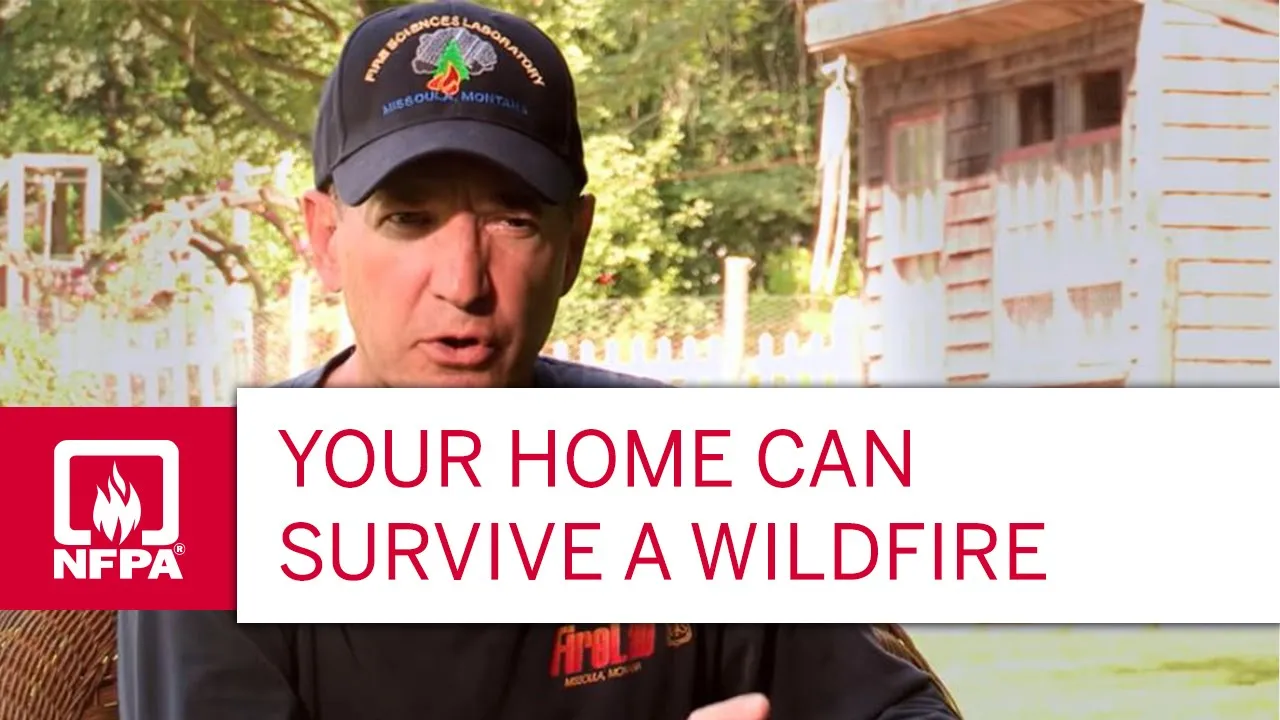
## Background Published on YouTube by the National Fire Protection Association (NFPA) on November 9, 2015, this educational video features fire science researcher Dr. Jack Cohen explaining how fireproofing and landscaping can protect homes from wildfires. The description emphasizes that homes are primarily threatened by hot embers ("firebrands") rather than high-intensity flames, pointing viewers to resources at Firewise, NFPA, and the Insurance Institute for Business & Home Safety.
## TL;DR Drawing on thirty years of research and full-scale testing, Dr. Jack Cohen demonstrates that wildfire home destruction is overwhelmingly caused by windblown burning embers rather than massive walls of flame. Because radiant heat from fires over 100 feet away rarely ignites standard construction directly, home survival depends on breaking the local chain of ignition. By eliminating combustible debris from roofs, rain gutters, vents, decks, and foundation perimeters, homeowners can prevent low-intensity surface fires from contacting structures. Routine, seasonal maintenance—such as clearing dry needles, pruning dead material from foundation shrubs, and moving firewood piles—empowers residents to safeguard their properties long before wildfire smoke appears.
## Atmosphere & style The presentation carries an authoritative, pragmatic, and reassuring tone that strips away the panic often surrounding catastrophic wildfires. Dr. Cohen's clear, field-based explanations transform what seems like an overwhelming force of nature into an understandable, solvable physical problem. Reinforced by practical perspectives from homeowners who have faced wildfire threats, the video feels less like an alarmist warning and more like an empowering, methodical masterclass in everyday property risk mitigation.
## Bulletin - [02:18](https://www.youtube.com/watch?v=vL_syp1ZScM&t=138s) Over three decades of fire science research show that homes are rarely destroyed by direct thermal radiation from distant wildfires; instead, destruction is driven by windblown embers (firebrands) that ignite debris on or adjacent to the structure. - [02:18](https://www.youtube.com/watch?v=vL_syp1ZScM&t=138s) High-intensity flames located beyond 100 feet from a home lack the radiant thermal energy needed to ignite standard building materials, making the immediate 100-foot zone around the house the decisive area for survival. - [10:07](https://www.youtube.com/watch?v=vL_syp1ZScM&t=607s) Establishing a noncombustible buffer of just 5 feet around the foundation is sufficient to prevent creeping surface fires from reaching the siding envelope. - [10:07](https://www.youtube.com/watch?v=vL_syp1ZScM&t=607s) Living green shrubs planted adjacent to a foundation do not necessarily require removal, provided dead wood within the inner canopy and accumulated needle litter underneath are cleared.
## Key takeaways - [00:11](https://www.youtube.com/watch?v=vL_syp1ZScM&t=11s) Wildfires are an inevitable natural landscape phenomenon, but the catastrophic ignition and loss of homes during interface disasters is largely preventable. - [00:11](https://www.youtube.com/watch?v=vL_syp1ZScM&t=11s) Surviving a wildfire depends on modifying the immediate physical structure and surrounding fuels of a property, rather than attempting to control or suppress the regional forest fire. - [02:18](https://www.youtube.com/watch?v=vL_syp1ZScM&t=138s) Radiant heat from high-intensity fire fronts situated more than 100 feet away is generally insufficient to ignite a home directly. - [02:18](https://www.youtube.com/watch?v=vL_syp1ZScM&t=138s) The primary cause of home destruction in wildland-urban interface fires is a 'brand blizzard' of lofted embers that fit in the palm of a hand and land on receptive fuel beds. - [04:14](https://www.youtube.com/watch?v=vL_syp1ZScM&t=254s) Locations where wind naturally deposits pine needles and dry leaves—such as roof junctions, foundation bases, and rain gutters—are the exact spots where embers accumulate and burn with direct flame contact. - [04:14](https://www.youtube.com/watch?v=vL_syp1ZScM&t=254s) Gable and exterior attic vents serve as dangerous entryways for windblown embers and require fine-gauge metal screening to prevent internal attic fires. - [04:14](https://www.youtube.com/watch?v=vL_syp1ZScM&t=254s) Composition shingle roofs generally resist firebrand ignition on their own, but junction points where roofs meet vertical wood-sided walls become critical fire traps when debris collects. - [04:14](https://www.youtube.com/watch?v=vL_syp1ZScM&t=254s) Detached outbuildings like sheds and coops can act as intense fuel sources that bridge flames directly to the primary residence if left unchecked. - [08:10](https://www.youtube.com/watch?v=vL_syp1ZScM&t=490s) Everyday outdoor clutter, including deck furniture cushions, brooms, and door mats, can ignite from embers and spread fire directly into wooden structural components. - [08:10](https://www.youtube.com/watch?v=vL_syp1ZScM&t=490s) Firewood piles must never be stored against siding or atop wooden decks during fire season. - [08:10](https://www.youtube.com/watch?v=vL_syp1ZScM&t=490s) A noncombustible perimeter buffer, such as crushed rock extending 3 to 5 feet from the foundation, halts creeping surface fires from contacting walls. - [10:07](https://www.youtube.com/watch?v=vL_syp1ZScM&t=607s) Pruning dead twigs from inside shrub canopies and raking away dry litter beneath foundation plants neutralizes them as ignition hazards without requiring complete removal. - [11:21](https://www.youtube.com/watch?v=vL_syp1ZScM&t=681s) Flammable wood shake roofs are the single most dangerous design feature on a home and represent the greatest risk for firebrand-induced destruction. - [11:21](https://www.youtube.com/watch?v=vL_syp1ZScM&t=681s) Property assessments and fuel-clearing chores must be performed routinely before fire season begins, before smoke is ever visible in the sky.
## Detailed walkthrough ### [00:11](https://www.youtube.com/watch?v=vL_syp1ZScM&t=11s) The Myth of Inevitability: Wildfires vs. Home Ignitions
Extreme, uncontrolled wildfires are an inevitable feature of the landscape, and they create the very conditions under which wildland-urban interface (WUI) disasters occur, resulting in hundreds or even thousands of destroyed structures. However, fire science researcher Dr. Jack Cohen explains that this does not mean the loss of homes is equally inevitable. Many homeowners hold the paralyzing perception that massive, landscape-scale fires are completely beyond individual control, wondering how an ordinary resident could possibly save a home when well-equipped, massive firefighting agencies cannot halt the fire front.
Dr. Cohen reframes the entire issue away from trying to suppress the uncontrollable wildfire itself, pointing out that survival comes down to changing the physical conditions of the home and its immediate surroundings. By making focused adjustments to the small vulnerabilities around the structure, homeowners can effectively decouple their residence from the surrounding forest fire. As Dr. Cohen explains, “We don't have to rely on the control of the extreme wildfire in order to keep our house from burning down.” Conducted before fire season begins—when conditions turn hot and dry but smoke is not yet in the air—a deliberate property assessment empowers owners to eliminate the low-intensity ignition risks that actually claim houses.
```mermaid flowchart TD accTitle: Wildfire to Structure Ignition Pathways accDescr: Diagram showing how wildfires produce distant flame radiation and lofted firebrands, leading to direct home ignition or fuel bed ignition. subgraph WildfireSource["Wildfire Threat"] WF["High-Intensity Wildfire"] Flames["Direct Flames & Radiant Heat<br/>(Over 100 ft away)"] Embers["Lofted Firebrands / Embers<br/>('Brand Blizzard')"] end
subgraph IgnitionMechanisms["Ignition Vectors"] DirectIgnition["Direct Impact on House<br/>(Roof, Siding, Vents)"] FuelBed["Immediate Surroundings & Debris<br/>(Needles, Mulch, Furniture, Outbuildings)"] end
subgraph HomeOutcome["Result"] HomeDestruction["Structure Ignition & Total Loss"] Survival["House Survives"] end
WF -->|"Low direct capability"| Flames WF -->|"Primary hazard"| Embers
Flames -.->|"Rarely reaches home directly"| HomeDestruction Embers --> DirectIgnition Embers --> FuelBed
DirectIgnition --> HomeDestruction FuelBed -->|"Spreads flame contact"| HomeDestruction FuelBed -->|"Mitigated by 5 ft buffer & clearing"| Survival ```
[02:18](https://www.youtube.com/watch?v=vL_syp1ZScM&t=138s) The Science of Firebrands: 30 Years of Research
Over three decades, Dr. Cohen and his research colleagues conducted a series of laboratory experiments, outdoor field experiments, and detailed post-disaster investigations to measure and define the precise physical relationship between an advancing wildfire and a destroyed home. Their findings consistently overturned prevailing assumptions: high-intensity flames situated more than 100 feet away from a structure are largely incapable of directly igniting the house through thermal radiation. Instead, structures are systematically destroyed by small, lofted burning embers, known technically as firebrands.
To demonstrate this mechanism, the researchers engineered a specialized ember generator capable of launching a dense "brand blizzard" at a full-scale test home outfitted with bark mulch, pine needles in the rain gutters, and pine needles across the roof. The experiment proved that destruction is rarely driven by massive walls of flame; instead, as Dr. Cohen emphasizes, “It's not 100 foot flames, it's a pile of firebrands that would fit in the palm of our hand.” For these airborne embers to destroy a home, they must either find a way to ignite the structure directly or ignite combustible debris adjacent to the building that then spreads flames to the structure.
- High-intensity flames over 100 feet away lack the radiant thermal energy needed to directly ignite standard home materials. - Destruction during interface fires is overwhelmingly caused by burning embers (firebrands) lofted out of the main fire front into communities. - Embers collect on flammable fuels directly on or immediately surrounding the building.
[04:14](https://www.youtube.com/watch?v=vL_syp1ZScM&t=254s) Vulnerability Assessment: Debris, Vents, Roofs, and Outbuildings
Conducting an exterior assessment requires shifting perspective to look at a property strictly through the lens of fuel and ignition vulnerabilities. Dr. Cohen demonstrates that wherever wind patterns cause dead leaves and dry pine needles to pile up—against foundation walls, atop wooden steps, or beneath wood siding lath—is precisely where airborne firebrands will also accumulate during a firestorm. While accumulating needles burn with relatively low intensity, they maintain direct flame contact on wooden components, making them the critical factor that triggers a home’s total loss. Similarly, pine needles collecting inside rain gutters bring flames directly against the eave line, threatening to ignite the roof edge and penetrate the attic space.
Vents represent another primary entryway for embers. Gable vents, which are among the most directly exposed openings on an exterior wall, can allow embers to blow straight inside during a brand blizzard and ignite dry materials stored in the attic. While metal mesh screens help repel large embers, standard coarse screening is inadequate, and homeowners should install finer-gauge mesh across all vent cavities. Roof materials also dictate survivability; Dr. Cohen dispels the misconception that only a metal roof can endure a firestorm. Tests demonstrate that composition shingle roofs covered in needles do not represent a significant ignition threat on their own, as any roof that resists ignition and flame spread can survive an ember blizzard. However, critical vulnerabilities arise at wall intersections, such as where an upper wood-sided dormer wall meets a lower roof plane: accumulated needles at that junction will ignite, placing persistent flame contact directly against the vertical wood wall. Finally, the perimeter evaluation must encompass detached outbuildings, including storage sheds and chicken coops, because an ignited outbuilding can easily burn long enough and hot enough to spread flames directly to the main house.
[08:10](https://www.youtube.com/watch?v=vL_syp1ZScM&t=490s) The Homeowner’s Experience and Everyday Hazards
A homeowner who experienced wildfire threats firsthand recounts undertaking extensive structural and landscaping modifications to maximize the odds of survival. Guided by strict preparation checklists, they audited their entire perimeter: eliminating firewood stacks against the walls, purchasing fire-rated patio furniture, and creating a three-foot barrier of noncombustible crushed rock surrounding the home's perimeter to stop creeping ground fires. The homeowner emphasizes that when visiting fire-ravaged neighborhoods, survival often hinged on minute oversights: “All it took was one thing, a firewood stacked in the wrong place or lawn furniture caught fire on their porch.” In their view, survival is not strictly an issue of money, but one of knowledge applied ahead of time.
Dr. Cohen mirrors this insight by cataloging everyday domestic items that become fatal hazards during an ember shower. Mundane objects left outside—such as a common broom leaned against a wall, or flammable cushions on wooden deck furniture—readily ignite from burning embers. Once cushions catch fire, they ignite the deck railing, which in turn introduces flames directly to the structural framing of the home.
- Everyday combustible porch clutter, like brooms and door mats, can serve as ember traps. - Patio cushions ignite rapidly, transferring flames into wooden deck boards and railings connected to the residence. - A 3-foot perimeter band of noncombustible crushed rock around the foundation halts surface fires from reaching the siding. - Firewood piles must never be stored on decks or directly against the walls of the home.
[10:07](https://www.youtube.com/watch?v=vL_syp1ZScM&t=607s) Defensible Space and Shrub Maintenance
Preventing flame contact against the building envelope is the primary objective of defensible space design. Dr. Cohen explains that surface fires should never be allowed to burn across continuous beds of pine needle litter straight into direct contact with the siding or foundation. Fortunately, maintaining a noncombustible buffer of just five feet around the perimeter of the home is sufficient to keep low-intensity creeping surface flames from contacting the structure.
This standard does not require stripping away all ornamental greenery. Pointing to large green shrubs situated right against a wood wall, Dr. Cohen addresses the common dilemma of whether all foundation vegetation must be removed. Living, succulent green foliage without dead material does not present an immediate threat. However, shrubs frequently harbor pockets of dead twigs and dry leaf litter trapped inside their internal canopy, as well as beds of dead needles deposited directly underneath against the wood siding. Rather than uprooting the shrubs, homeowners can make them safe simply by pruning out all dead wood from within the canopy and clearing away all accumulated debris from underneath the branches.
[11:21](https://www.youtube.com/watch?v=vL_syp1ZScM&t=681s) Seasonal Maintenance: Breaking the Chain of Ignition
Protecting a community does not demand eliminating every trace of fire across the entire landscape or extinguishing every neighborhood flare-up; it requires ensuring that high-intensity fires cannot burn within 100 feet of a house and that surface fires cannot creep into contact with the structure. Flammable wood roofs are highlighted as the single most dangerous design feature, representing the surface most susceptible to firebrand ignitions, and should never be used.
For typical properties, safety relies on routine, seasonal home maintenance chores completed well before fire conditions arise: - Cleaning accumulated needles and leaf litter away from the base of the foundation and out of the rain gutters. - Sweeping all decks and walkways clear of pine needle debris, dry leaves, and blown dust. - Relocating firewood piles off wooden decks and away from exterior walls. - Cutting lawn grass short and eliminating continuous patches of dry ground cover leading up to the house. - Inspecting outbuildings to ensure they do not establish a continuous fuel chain to the primary residence.
Because every property features unique topography, vegetation, and architecture, homeowners must actively inspect their own parcels for specific ignition points. Dr. Cohen concludes with a fundamental physical rule of fire science: “Remember, if your home doesn't ignite, it doesn't burn.” Homeowners must take action on those seemingly small vulnerabilities long before smoke ever appears in the sky.
## Notable quotes > [02:18](https://www.youtube.com/watch?v=vL_syp1ZScM&t=138s) It's not 100 foot flames, it's a pile of firebrands that would fit in the palm of our hand. — Dr. Jack Cohen
> [00:11](https://www.youtube.com/watch?v=vL_syp1ZScM&t=11s) We don't have to rely on the control of the extreme wildfire in order to keep our house from burning down. — Dr. Jack Cohen
> [11:21](https://www.youtube.com/watch?v=vL_syp1ZScM&t=681s) Remember, if your home doesn't ignite, it doesn't burn. — Dr. Jack Cohen
## Mentioned National Fire Protection Association, Dr. Jack Cohen, Firewise
## Video description Dr. Jack Cohen, a highly respected expert on wildfire behavior and fire science research, explains how fireproofing your home can help protect it from wildfire. A high intensity flame from a wildfire is less likely to ignite the home than “fire brands”—the hot embers that are spit from the intense flames and then deposited on flammable materials on or surrounding the home. That’s why it’s recommended you use landscaping as one of the defensive methods against wildfire.
Jack shows how leaves, pine needles, and other debris from wooded areas can become easy fuel for fire brands. Fire-resistant furniture and home building materials can also help protect your home from being destroyed by a wildfire.
Learn more about wildfire prevention and mitigation at www.firewise.org and www.nfpa.org/wildfire. Also visit www.disastersafety.org/wildfire for additional resources.
© 2015 National Fire Protection Association® (NFPA®). All rights reserved.
[Source](https://www.youtube.com/watch?v=vL_syp1ZScM)