Anthropic's Cherny Automates Entire Coding Process with Claude Agents
Sequoia Capital
Software development will democratize rapidly as domain expertise replaces manual coding, rendering traditional engineering pipelines and rigid safety guardrails obsolete.
## Background
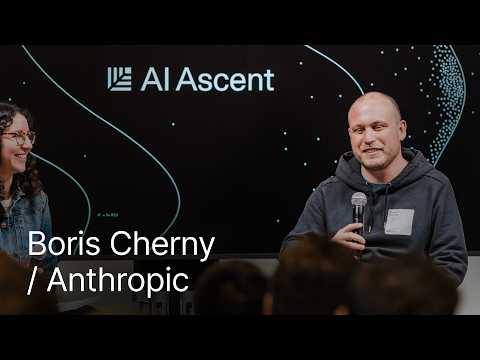
Published by Sequoia Capital on YouTube on May 4, 2026, this video features Anthropic's Boris Cherny in conversation with Sequoia partner Lauren Reeder at AI Ascent 2026. The discussion centers on the creation of Claude Code, why traditional software development is effectively solved for his workflows, and how advancements like autonomous loops and the democratization of software mirror historic shifts like the invention of the printing press.
## TL;DR
Anthropic's Boris Cherny outlines how AI models like Claude 4.7 have transformed modern software engineering, enabling him to ship dozens of pull requests daily entirely from his mobile phone using autonomous agent loops. The conversation explores the shifting landscape of engineering teams toward multi-disciplinary generalists and predicts how AI will disrupt traditional SaaS business moats while drastically accelerating startup capabilities. Cherny details Anthropic's highly automated internal workflows and projects how universal protocols like the Model Context Protocol (MCP) and visual 'computer use' will soon abstract away complex technical barriers, democratizing software development for domain experts worldwide.
## Atmosphere & style
The conversation carries an energetic, forward-looking vibe, blending the high-stakes enthusiasm of a cutting-edge tech summit with relaxed, humorous banter between a peerless 'engineer's engineer' and an engaged host. Cherny's tone is pragmatic yet casually disruptive, matching self-deprecating jokes about his middle-school coding guides with bold, paradigm-shifting claims about the end of manual programming. Listening feels like being privy to an insider secret, transitioning from a lighthearted crowd check to a deeply compelling, visionary outlook that leaves the audience feeling both grounded in current technical realities and eager for an imminent, highly automated future.
## Key takeaways
- [00:02](https://www.youtube.com/watch?v=SlGRN8jh2RI&t=2s) Boris Cherny, creator of Claude Code, notes that despite writing textbooks like Programming TypeScript, he has barely written a line of code by hand in 2026.
- [02:39](https://www.youtube.com/watch?v=SlGRN8jh2RI&t=159s) Claude Code began accidentally in late 2024 at Anthropic Labs to exploit a 'product overhang' where models were capable of far more than simple tab-completion.
- [02:39](https://www.youtube.com/watch?v=SlGRN8jh2RI&t=159s) The team deliberately built for future model capabilities, achieving a major inflection point and product-market fit only after the release of Opus 4 in May.
- [05:04](https://www.youtube.com/watch?v=SlGRN8jh2RI&t=304s) Cherny considers coding 100% solved for his workflow, routinely shipping dozens of PRs daily from his phone and reaching a record of 150 PRs in one day.
- [06:50](https://www.youtube.com/watch?v=SlGRN8jh2RI&t=410s) Cherny's mobile setup utilizes a hierarchy of hundreds of active daytime agents and several thousand running deeper tasks overnight via the Claude app.
- [06:50](https://www.youtube.com/watch?v=SlGRN8jh2RI&t=410s) The core of Cherny's automated workflow relies on the `/loop` command and cron to handle continuous integration failures, flaky tests, and user feedback scraping.
- [08:50](https://www.youtube.com/watch?v=SlGRN8jh2RI&t=530s) Engineering teams are shifting toward cross-disciplinary generalists where every member—including PMs, designers, and finance leads—actively writes code using AI tools.
- [10:23](https://www.youtube.com/watch?v=SlGRN8jh2RI&t=623s) In a predicted 'SaaS apocalypse,' AI will erode business moats like switching costs and process power, while network effects and scale economies remain durable.
- [10:23](https://www.youtube.com/watch?v=SlGRN8jh2RI&t=623s) Startups have a 10x advantage over large enterprises because they can build natively around AI processes from day one without facing internal institutional resistance.
- [12:58](https://www.youtube.com/watch?v=SlGRN8jh2RI&t=778s) As models continuously improve, the complex product 'harness' built around them becomes less critical, shifting focus to advancing agentic patterns like loops.
- [14:26](https://www.youtube.com/watch?v=SlGRN8jh2RI&t=866s) Rigid safety architectures, prompt injection defenses, and strict permission modes will become obsolete as future models become inherently better aligned.
- [15:01](https://www.youtube.com/watch?v=SlGRN8jh2RI&t=901s) Software development is becoming a universal skill, shifting the bottleneck from coding proficiency to deep industry domain expertise.
- [15:01](https://www.youtube.com/watch?v=SlGRN8jh2RI&t=901s) The democratization of software mirrors the 1400s printing press explosion, which caused a 100x drop in book costs and a massive long-term rise in global literacy.
- [17:22](https://www.youtube.com/watch?v=SlGRN8jh2RI&t=1042s) Anthropic internal workflows have completely phased out manual coding and SQL, relying entirely on autonomous agent loops that communicate with each other over Slack.
- [19:12](https://www.youtube.com/watch?v=SlGRN8jh2RI&t=1152s) Advanced models like Claude 4.7 naturally parallelize work and manage loops on their own, removing the product burden of teaching users tool management.
- [20:41](https://www.youtube.com/watch?v=SlGRN8jh2RI&t=1241s) The debate between local and cloud-based AI agents is irrelevant to developers, as the primary model will autonomously decide where to delegate sub-tasks.
- [21:57](https://www.youtube.com/watch?v=SlGRN8jh2RI&t=1317s) The Model Context Protocol (MCP) acts as a universal connector for cloud tools like Salesforce and Google Docs across Claude interfaces.
- [21:57](https://www.youtube.com/watch?v=SlGRN8jh2RI&t=1317s) For legacy systems lacking APIs, Claude 4.7 utilizes visual computer use capabilities, treating every on-screen interaction simply as tokens.
- [23:35](https://www.youtube.com/watch?v=SlGRN8jh2RI&t=1415s) The next wave of product overhang advancements will focus heavily on Claude Design, massive parallelization features, and faster visual computer use.
## Detailed walkthrough
### [00:02](https://www.youtube.com/watch?v=SlGRN8jh2RI&t=2s) Introduction and the Origins of Claude Code
The session begins with an introduction of Boris Cherny, whom the host jokingly calls "the father of Claude Code." Cherny has had a front-row seat to the reinvention of modern software development. The host, Lauren Reader, notes that Cherny is an "engineer's engineer" who has spent his career writing code and textbooks—including *Programming TypeScript*—yet has barely written a single line of code by hand in 2026. Cherny humorously recalls that his very first coding guide, written in middle school about programming BASIC for TI-83 Plus calculators, is still embarrassingly discoverable on the internet.
Cherny explains that Claude Code started "kind of accidentally" in late 2024 within an incubator at Anthropic called Anthropic Labs. The small innovation team built Claude Code, the Model Context Protocol (MCP), and the desktop app before disbanding. The team has recently reunited for "round two" under the leadership of Mike Krieger, Anthropic's Chief Product Officer and co-founder of Instagram.
The initial motivation for the project was a "product overhang." In late 2024, the state of the art in AI coding was simple tab-completion (type-ahead) enabled by Claude 3.5 Sonnet. The team realized the model was capable of much more, aiming to skip type-ahead entirely and let an agent write all the code. However, the product did not work well for the first six months and was barely usable. It was only with the release of Opus 4 in May that exponential growth began, inflecting further with subsequent releases of Opus 4.5, 4.6, and 4.7. They were intentionally building for the capabilities of the next model, knowing they would not have product-market fit (PMF) for the first six months.
[05:04](https://www.youtube.com/watch?v=SlGRN8jh2RI&t=304s) Is Coding Solved?
When asked about his previous public statements that "coding is solved," Cherny polls the audience on how much of their code they write by hand versus using an agent like Claude Code. While the audience is mostly in the middle, Cherny states that for him personally, coding is 100% solved.
The Claude Code codebase itself is written in TypeScript and React. Cherny explains that they chose these technologies early on because they were highly "on distribution" for the model when it was less intelligent. Today, the model can write in almost any language or framework, but back then, staying on distribution was critical. By October or November of the previous year, the model was writing 100% of their code. Cherny now routinely ships dozens of pull requests (PRs) a day, even hitting a personal record of 150 PRs in a single day to test the limits of the system. While he acknowledges that highly complex legacy codebases or obscure languages are not fully solved yet, he notes that the standard solution is simply to "wait for the next model."
[06:50](https://www.youtube.com/watch?v=SlGRN8jh2RI&t=410s) Boris's Personal Setup and the Power of Loops
Cherny describes his personal development setup, which has shifted entirely to his mobile phone. He manages his workflow through the Claude mobile app, where he keeps five to ten active sessions running. These sessions orchestrate a hierarchy of agents, often totaling a few hundred active agents during the day and several thousand running deeper tasks overnight.
The core of his workflow is the `/loop` command, which he describes as "the coolest thing" and "the simplest thing that works." Using this feature, he instructs Claude to use cron to schedule recurring jobs that run at set intervals (e.g., every minute, five minutes, or daily). Cherny runs dozens of these loops simultaneously to automate his development cycle:
- One loop "babysits" his PRs by automatically fixing continuous integration (CI) failures and performing auto-rebases.
- Another loop monitors and fixes flaky tests to keep the CI pipeline healthy.
- A third loop scrapes user feedback from Twitter every 30 minutes and clusters it into actionable insights.
Anthropic recently productized this concept by launching "routines," which run these loops on the server so they continue executing even when a user closes their laptop.
[08:50](https://www.youtube.com/watch?v=SlGRN8jh2RI&t=530s) The Rise of Cross-Disciplinary Generalists
Looking at how engineering teams will evolve, Cherny predicts a massive shift toward cross-disciplinary generalists. Historically, an engineering "generalist" meant someone who could write iOS, web, and server code. In the future, generalists will span entirely different disciplines, combining product engineering with design, data science, or finance.
This shift is already visible on the Claude Code team. Every single team member—including the engineering manager, product manager, designers, data scientist, finance lead, and user researcher—writes code using their tools. While individuals still maintain their core specialties, the barrier to execution has been lowered so significantly that everyone on the team is actively building.
[10:23](https://www.youtube.com/watch?v=SlGRN8jh2RI&t=623s) The "SAS Apocalypse" and the Future of Startups
Addressing the idea of a "SaaS apocalypse" driven by a 10x to 100x reduction in the cost of writing software, Cherny draws on concepts from Hamilton Helmer's book *Seven Powers* (popularized by the *Acquired* podcast, which Cherny recently appeared on). He predicts that AI will fundamentally alter which business moats (or "powers") matter:
- **Switching costs** will become less important because models can easily port data and code from one system to another.
- **Process power** will decline because advanced models like Claude 4.7 are exceptionally good at "hill climbing"—iterating on a target process until it is fully optimized and executed.
- **Network effects, scale economies, and cornered resources** will remain highly durable and unchanged by AI.
Cherny predicts a 10x increase in the number of highly disruptive startups over the next decade. Small, nimble teams can now build products as valuable as those of large enterprises and compete head-to-head. Large companies face massive internal resistance, needing to retrain staff and evolve legacy business processes, whereas startups can build natively with AI from day one. "It's the best time to be a startup," Cherny concludes.
[12:58](https://www.youtube.com/watch?v=SlGRN8jh2RI&t=778s) Audience Q&A: Product vs. Model
During the audience Q&A, Dan asks how much of Claude Code's success is attributable to the underlying model versus specific product decisions. Cherny estimates that six months ago, the split was roughly 50/50.
Reflecting on his time at Y Combinator, Cherny emphasizes the classic startup advice to "build something people love." Even with powerful models, success requires obsessive attention to user experience details so that developers enjoy using the tool all day. However, as the models continue to improve, the necessity of a complex product "harness" decreases. The team's current focus is on evolving this harness to make advanced agentic patterns, like loops, a first-class experience.
[14:26](https://www.youtube.com/watch?v=SlGRN8jh2RI&t=866s) The Future of Agent Alignment and Safety
Looking ahead a year into the future, the speaker predicts a massive shift in how AI agents are managed and secured. Currently, developers rely heavily on complex safety mechanisms, including prompt injection defenses, static verification of commands, strict permission modes, and keeping a human in the loop. However, as models become much better aligned, these guardrails will become increasingly obsolete. "The model will just do the right thing," rendering today's rigid safety architectures far less important.
---
[15:01](https://www.youtube.com/watch?v=SlGRN8jh2RI&t=901s) The Democratization of Software and the Printing Press Parallel
The conversation shifts to the cultural impact of tools like Claude Code, which have begun to democratize software development. People outside the tech industry—such as shop owners building custom tools or programming microcontrollers to control lights when a door opens—are now writing software. The speaker enthusiastically agrees that software development will soon become a universal skill, comparable to knowing how to send a text message or use Microsoft Office.
To put this shift into perspective, the speaker draws a historical parallel to the invention of the printing press in 1400s Europe:
* **Pre-printing press literacy:** Only about 10% of the European population was literate. These individuals were often employed by illiterate kings and lords simply to read and write.
* **The explosion of literature:** Within 50 years of the first printing press, more literature was published in Europe than in the entire thousand years prior, while the cost of books plummeted 100x.
* **Long-term literacy gains:** Over the next few hundred years, global literacy rose to around 70%. Today, reading and writing are basic skills that do not require a specialized degree, though professional writers still exist.
The speaker believes a similar democratization is happening to software, but it will occur much faster than 50 years. This shift will change who builds software; for instance, the best person to write accounting software is a highly skilled accountant who understands the domain deeply, rather than a traditional software engineer, because "coding is the easy part" and domain expertise is the real bottleneck.
---
[17:22](https://www.youtube.com/watch?v=SlGRN8jh2RI&t=1042s) Living in the Future: Anthropic's Internal Workflows
When asked about the gap between Anthropic's internal engineering capabilities and the rest of the world, the speaker clarifies that there is virtually no gap on the model side. Anthropic engineers use the same models available to the public, heavily dog-fooding their own technology. They write most of their code using "Opus 4.7" and experiment with early versions of upcoming models.
However, a massive gap exists in terms of organizational structure and processes. At Anthropic, manual coding and manual SQL writing have been entirely phased out. The company's internal workflows are highly automated:
* **Autonomous agent loops:** Engineers run Claudes in continuous loops to write code.
* **Inter-agent communication:** While running in these loops, one engineer's Claude will autonomously communicate over Slack with another engineer's Claude to resolve unknowns and coordinate tasks.
* **No manual code:** All SQL queries and codebase modifications are generated by models.
The speaker notes that startups have a distinct advantage in adopting these organizational changes because they can build their processes around AI agents from day one, whereas larger enterprises struggle to adapt.
---
[19:12](https://www.youtube.com/watch?v=SlGRN8jh2RI&t=1152s) Multi-Agent Systems and Natural Parallelization
The discussion turns to multi-agent systems, specifically features like `/batch`, `/loop`, sub-teams, and teams. The questioner asks how Anthropic injects priors at the harness level or adjusts the model's objective function to make delegating and parallelizing work more intuitive, rather than forcing users to manually decide when to spin up sub-agents.
The speaker explains that on the product side, this behavior is driven primarily by iterative prompt engineering. However, as models improve, they naturally begin to parallelize and manage loops on their own. For example, with Claude 4.7, a user can ask the model to pull a data query, and the model might autonomously respond: "Hey, I noticed that the data is changing over time. I'll start a loop and I'll give you a report every 30 minutes." It can then seamlessly leverage the Slack Model Context Protocol (MCP) to deliver those reports. The goal is to remove the burden of tool management from the user, as needing to teach users "how to hold the tools better" represents a product design failure.
---
[20:41](https://www.youtube.com/watch?v=SlGRN8jh2RI&t=1241s) Local vs. Cloud-Based AI Agents
Addressing the debate between centralized cloud compute and local AI models, the speaker is asked whether the industry will pivot toward local agents to avoid throttling and improve privacy.
The speaker's fundamental view is that "it doesn't matter" because the transition will be abstracted away from the user. Within a couple of years, the primary model will handle all the high-level engineering, spin up the necessary agents, and configure the environments. If the model decides that utilizing a local model is the most efficient path for a specific sub-task, it will execute that decision automatically. These will no longer be decisions that human engineers have to make.
---
[21:57](https://www.youtube.com/watch?v=SlGRN8jh2RI&t=1317s) Integrating Knowledge Work via MCP and Computer Use
A questioner points out that while Claude Code successfully leverages local developer workflows, general knowledge work is heavily reliant on cloud-based tools. The speaker is asked how Anthropic's "Co-work" initiative plans to access these cloud tools.
The speaker explains that the Model Context Protocol (MCP) is the universal solution. By using the same MCP connectors, users can hook up tools like Salesforce, Google Docs, and Google Calendar directly to Claude AI, Co-work, or the Claude CLI. For legacy systems that lack APIs or MCP integrations, Anthropic relies on its "computer use" capability.
* **Computer Use as a Catchall:** Anthropic is currently "pretty far ahead on computer use." While the process is still relatively slow, Claude 4.7 can successfully navigate and interact with virtually any piece of software on a computer screen.
* **Tokens as the Universal Interface:** Ultimately, the underlying protocol is secondary because to the model, everything—whether accessed via MCP, APIs, or visual computer use—is "just tokens."
---
[23:35](https://www.youtube.com/watch?v=SlGRN8jh2RI&t=1415s) Anticipating the Product Overhang
In the final question, the speaker is asked about the "product overhang"—specifically, what kind of products built today will become exponentially more interesting as models improve over the next six months to a year.
The speaker highlights several areas poised for rapid advancement:
* **Claude Design:** Currently functional, but expected to improve dramatically.
* **Claude Code Updates:** Several unreleased features are "cooking" and scheduled to land in the coming weeks.
* **Massive Parallelization:** Features like loop and batch operations will make running dozens of parallel agents highly practical.
* **Computer Use:** Visual interaction with desktop environments will continue to get faster and more reliable.
## Notable quotes
> [12:58](https://www.youtube.com/watch?v=SlGRN8jh2RI&t=778s) build something people love — Boris Cherny
> [14:26](https://www.youtube.com/watch?v=SlGRN8jh2RI&t=866s) The model will just do the right thing — Boris Cherny
> [15:01](https://www.youtube.com/watch?v=SlGRN8jh2RI&t=901s) coding is the easy part — Boris Cherny
> [10:23](https://www.youtube.com/watch?v=SlGRN8jh2RI&t=623s) It's the best time to be a startup — Boris Cherny
> [06:50](https://www.youtube.com/watch?v=SlGRN8jh2RI&t=410s) the simplest thing that works — Boris Cherny
> [06:50](https://www.youtube.com/watch?v=SlGRN8jh2RI&t=410s) the coolest thing — Boris Cherny
> [05:04](https://www.youtube.com/watch?v=SlGRN8jh2RI&t=304s) wait for the next model — Boris Cherny
> [19:12](https://www.youtube.com/watch?v=SlGRN8jh2RI&t=1152s) Hey, I noticed that the data is changing over time. I'll start a loop and I'll give you a report every 30 minutes. — Claude 4.7
> [19:12](https://www.youtube.com/watch?v=SlGRN8jh2RI&t=1152s) how to hold the tools better — Boris Cherny
> [20:41](https://www.youtube.com/watch?v=SlGRN8jh2RI&t=1241s) it doesn't matter — Boris Cherny
> [21:57](https://www.youtube.com/watch?v=SlGRN8jh2RI&t=1317s) pretty far ahead on computer use — Boris Cherny
> [21:57](https://www.youtube.com/watch?v=SlGRN8jh2RI&t=1317s) just tokens — Boris Cherny
## Mentioned
Boris Cherny, Lauren Reader, Programming TypeScript, BASIC, TI-83 Plus, Claude Code, Anthropic Labs, Anthropic, Model Context Protocol, MCP, Mike Krieger, Instagram, Claude 3.5 Sonnet, Opus 4, Opus 4.5, Opus 4.6, Opus 4.7, TypeScript, React, Twitter, SaaS apocalypse, Hamilton Helmer, Seven Powers, Acquired, Claude 4.7, Dan, Y Combinator, Slack, Salesforce, Google Docs, Google Calendar, Claude AI, Co-work, Claude CLI, Claude Design
Anthropic的Cherny借助Claude智能体实现全流程编程自动化
随着领域专业知识取代手动编码,软件开发将迅速大众化,使传统工程流程与僵化的安全护栏走向过时。
Anthropic的Boris Cherny阐述了像Claude 4.7这样的AI模型如何彻底改变现代软件工程,使他能够完全通过手机并借助自主智能体循环,每天交付数十个PR。本次对话探讨了工程团队向多学科通才转变的格局演进,并预测了AI将如何颠覆传统SaaS的商业护城河,同时大幅加速初创团队的开发能力。Cherny详细介绍了Anthropic高度自动化的内部工作流,并展望了模型上下文协议(MCP)与视觉“计算机使用”(computer use)等通用协议将如何迅速抽象掉复杂的技术壁垒,让全球各领域的专家都能轻松进行软件开发。
Claude Code 于 2024 年底诞生于 Anthropic Labs,团队旨在越过简单的 Tab 代码补全、直接由 Agent 编写全部代码,并在 Opus 4 发布后实现了产品爆发与 PMF。 (2:39)
Boris Cherny 表示编程对其工作流已 100% 解决,他完全通过手机调度数百至数千个 Agent,创下单日提交 150 个 PR 的纪录,核心依赖 /loop 命令实现 CI 修复与测试等全流程自动化。 (5:07)
工程团队正向跨学科通用人才转变,在 Claude Code 团队内部,产品经理、设计师、数据科学家和财务负责人都已直接借助 AI 工具编写代码与构建系统。 (8:50)
面对 AI 引发的“SaaS 大灾难”,Cherny 预测转换成本和流程优势等商业壁垒将被 AI 削弱,而网络效应与规模经济依然稳固,这为原生 AI 初创公司带来了十倍的颠覆机会。 (10:26)
Cherny 将软件普及比作 15 世纪印刷机革命,认为编程正迅速演变为人人皆会的通用技能,未来软件开发的核心瓶颈将不再是编码本身,而是深度的垂直行业知识。 (15:01)
Reading summary
Anthropic's Boris Cherny argues that software engineering has reached an inflection point where artificial intelligence models can fully automate coding, shifting organizational value from manual implementation to domain expertise and autonomous agent management. While this transition accelerates AI-native startups and democratizes software creation, it simultaneously disrupts traditional software business moats and simplifies developer tooling architectures.
Autonomous Agent Workflows and Zero Manual Coding (5:04)
Cherny states that coding is 100% solved for his personal development workflow, reporting that he barely wrote a line of manual code in 2026 and has shipped up to 150 pull requests in a single day. At Anthropic, engineers have phased out manual coding and manual SQL authoring, dog-fooding models such as Opus 4.7. Rather than using AI purely for code completion, engineers orchestrate recurring loops and server-side routines. Under this workflow, agents monitor CI pipelines, fix flaky tests, resolve rebases, and autonomously communicate with other engineers' agents over Slack to coordinate dependencies.
While Cherny acknowledges that legacy codebases and obscure languages are not yet fully solved, he treats these limitations as temporary gaps that will resolve with newer model releases. His workflow is managed entirely from a mobile device, running dozens of recurring loops that orchestrate hundreds to thousands of background agents. In his view, software engineering has shifted from writing syntax to directing autonomous multi-agent execution.
Software Democratization and Cross-Disciplinary Domain Generalists (8:50)
Cherny compares the impact of AI-assisted development to the introduction of the European printing press in the 1400s, which expanded literacy from approximately 10% to 70% and caused literature production to surge while book costs fell 100x. He forecasts that software creation will similarly transform into a universal skill comparable to sending text messages or using office software, unfolding significantly faster than historical literacy gains. Consequently, the primary bottleneck in building software shifts from technical syntax to specialized domain insight; for example, Cherny suggests an experienced accountant is better positioned to build accounting software than a traditional software engineer because domain expertise outweighs the mechanical difficulty of coding.
This structural evolution is reflected in Anthropic's Claude Code team, where technical generalists are no longer defined as engineers spanning web, server, and mobile code, but as cross-disciplinary contributors combining product engineering with disciplines like finance, design, user research, and data science. Team members across non-engineering functions routinely write production code using AI tools, substantially lowering organizational execution barriers.
Erosion of Traditional Moats and Startup Acceleration (10:23)
Drawing on Hamilton Helmer's Seven Powers framework, Cherny evaluates how a 10x to 100x reduction in software development costs reshapes competitive advantage. He argues that customer switching costs will decline because AI models can readily port code and data across competing systems, while process power will diminish as models excel at optimizing and executing operational workflows. Conversely, structural advantages such as network effects, economies of scale, and cornered resources remain durable against AI-driven commoditization.
Because incumbent enterprises face significant organizational friction in retraining personnel and re-architecting legacy processes, Cherny predicts a 10x expansion in highly disruptive startups over the coming decade. Nimble teams built natively around AI agents can launch software as valuable as enterprise offerings without carrying legacy organizational overhead, creating what Cherny considers an optimal environment for new ventures.
Model Evolution Abstracting Infrastructure and Safety Guardrails (14:26)
As model capabilities advance across successive releases, Cherny expects developer harness complexity and manual prompt configurations to decline. He argues that debate over local versus cloud AI agents will become irrelevant to end users, as orchestrator models will automatically determine whether to delegate specific sub-tasks to local environments. Multi-agent coordination—such as detecting data variations and spinning up scheduled reporting loops over Slack—is increasingly handled natively by the model rather than through manual user configuration.
Cherny also forecasts that contemporary agent security architectures will undergo a major shift within a year. Current safeguards depend on static command verification, strict permission modes, prompt injection defenses, and mandatory human-in-the-loop controls. Cherny predicts that enhanced model alignment will render these rigid guardrails largely obsolete as models reliably adhere to intended behaviors. For environments lacking native APIs, Anthropic relies on Model Context Protocol (MCP) connectors and visual computer use, treating all structured and graphical inputs as tokens.
Cherny acknowledges that current multi-agent workflows still rely on iterative prompt engineering, developer harnesses, and transitional safety controls while models adapt to complex legacy systems. Whether future model alignment can fully eliminate the need for deterministic security guardrails without creating novel vulnerabilities remains an unverified forecast.
[12:58] Boris Cherny: build something people love
[14:26] Boris Cherny: The model will just do the right thing
[15:01] Boris Cherny: coding is the easy part
[10:23] Boris Cherny: It's the best time to be a startup
[6:50] Boris Cherny: the simplest thing that works
[6:50] Boris Cherny: the coolest thing
[5:04] Boris Cherny: wait for the next model
[19:12] Claude 4.7: Hey, I noticed that the data is changing over time. I'll start a loop and I'll give you a report every 30 minutes.
[19:12] Boris Cherny: how to hold the tools better
[20:41] Boris Cherny: it doesn't matter
[21:57] Boris Cherny: pretty far ahead on computer use
[21:57] Boris Cherny: just tokens
Original transcript
[0:02] Okay, I'm excited to introduce our next
[0:03] speaker. Show of hands, who here uses
[0:05] Claude code?
[0:07] Okay, show of hands, who here has Claude
[0:09] code psychosis?
[0:11] Come on guys, [clears throat] it's okay.
[0:12] It's okay. Um my my my team lovingly
[0:14] says I have Claude code psychosis, which
[0:16] may or may not be true. Um we are
[0:18] delighted to have Boris Cherny with us
[0:19] today. Uh Boris is the creator, the
[0:22] father of Claude code. Um and uh in the
[0:25] process of doing that has just had a
[0:26] front row seat to to reinventing uh the
[0:29] modern way of of software development.
[0:32] Um and we're we're really grateful to
[0:34] you, Boris, for taking the time to speak
[0:35] with us today. We know that um the
[0:38] entirety of software development kind of
[0:39] rests on your shoulders. So, thank you
[0:41] for taking it out of your time to be
[0:42] with us today. And interviewing Boris is
[0:44] Lauren Reader from our team.
[0:45] Thank you.
[0:48] >> [applause]
[0:52] >> Giving our chairs.
[0:55] Um you took my you took my opening line,
[0:57] Asia. We asked who here uses Claude
[0:58] code. There's a lot of hands. That's
[1:00] awesome.
[1:01] Thank you for joining us, Boris. It's
[1:03] very special to have you here. Um
[1:06] as a roomful of builders, I think you
[1:08] are changing building entirely. And so,
[1:11] I'm very curious to explore how you
[1:13] think about the future of software,
[1:14] coding, and what we should spend all of
[1:17] our free time on. Um but I'll give you a
[1:20] me a tiny bit more background on you so
[1:21] that everyone has a little bit more
[1:22] context. So, beyond creating Claude
[1:24] code, Boris is very much an engineer's
[1:26] engineer. You were writing a lot of code
[1:30] through your whole career, writing
[1:31] textbooks about code, including
[1:33] programming in TypeScript. Um and I
[1:36] think last time we chatted you hadn't
[1:38] written a single line of code in the
[1:39] last year, or at least so far in 2026,
[1:42] which is quite the change. Um There's
[1:45] also a a little known thing back in
[1:47] middle school, I wrote a guide about uh
[1:49] writing BASIC for TI-83 Plus
[1:50] calculators.
[1:52] And I I just I I searched for it, it's
[1:54] actually still on the internet. It's
[1:55] extremely embarrassing, so please don't
[1:56] search it. But it [laughter] exists. We
[1:58] will definitely be finding that. Um so,
[2:01] we're going to do I'm going to start
[2:02] with a few questions here. Maybe we'll
[2:03] start with a little bit of the history
[2:05] of Claude code, how you started it, and
[2:07] then we're going to have a lot of
[2:08] audience Q&A for this one. And so, start
[2:10] thinking about your questions in the
[2:11] back of your head, uh and would love to
[2:13] turn it over to you all soon.
[2:15] Yeah. Um and also real quick, so for
[2:17] people that use Claude code, do people
[2:18] use the CLI mostly? Like okay, majority
[2:21] CLI?
[2:23] Okay. That's a lot. Majority desktop?
[2:26] Okay. Majority VS code or JetBrains IDE?
[2:30] Okay. That's actually not a lot. Okay.
[2:32] Other?
[2:34] I'm like iOS mostly these days. Yeah.
[2:37] >> [laughter]
[2:37] >> Okay. Cool.
[2:39] Um yeah, so I started Claude code kind
[2:41] of accidentally in a in a lot of ways.
[2:44] Um I joined this team back in late 2024.
[2:47] It was a sort of this incubator within
[2:49] Anthropic called Anthropic Labs.
[2:51] And uh the team kind of served its
[2:52] purpose. Um we created Claude code, uh
[2:55] MCP, and the desktop app. It was a team
[2:57] it was just a few of us.
[2:59] So, very much like innovation team.
[3:01] We built the thing that we wanted to
[3:02] build, we disbanded the team. Uh now the
[3:04] team's actually back together for round
[3:06] two. Mike Krieger, who's the you know,
[3:08] like the chief product officer at at
[3:10] Anthropic and used to be one of the
[3:11] founders at Instagram, so he's leading
[3:13] that right now.
[3:14] Um so the kind of the the the the reason
[3:18] that I started to work on coding is we
[3:20] felt like there was this product
[3:22] overhang. And I I'm guessing people here
[3:25] use that word a lot. Uh but we
[3:27] definitely use this word a lot in kind
[3:29] of within the lab.
[3:30] Uh there's this idea that the model can
[3:32] do all the stuff that no product has yet
[3:34] captured. And in late 2024, when we were
[3:37] looking at coding, the way that we did
[3:39] coding, the state of the art at the time
[3:40] was type ahead. It was you open your IDE
[3:42] and you press tab and you can like
[3:43] complete like one line at a time. And
[3:46] that was the thing that Sonnet 3.5
[3:47] enabled for the first time. But the
[3:49] feeling was we could actually go a lot
[3:50] further than that. And the model was
[3:52] almost ready for the next big step. So,
[3:55] we don't have to do type ahead anymore,
[3:56] we can just have the agent write all of
[3:58] the code.
[4:00] And so, I built it, and it just really
[4:04] didn't work for the first 6 months. It
[4:06] was like not very good. It was barely
[4:07] usable. I wrote it from I used it for
[4:09] maybe 10% of my code or something like
[4:11] that. And even after we released Claude
[4:13] code initially, it was not a hit.
[4:16] There's a lot of people that used it,
[4:17] but it did not have this exponential
[4:19] growth that it has today.
[4:21] Um that started with Opus 4 in May. And
[4:24] I I remember that very clearly. That's
[4:25] like when the exponential growth
[4:26] started, and then it kind of inflected
[4:28] with every model release. Uh like it
[4:30] started with Opus 4, then 4.5, then 4.6,
[4:32] now 4.7. It just kind of keeps
[4:34] inflecting.
[4:36] But essentially, we were trying to build
[4:38] this thing that was like pre-PMF, and we
[4:40] knew that it wouldn't have PMF for 6
[4:41] months because we were building for the
[4:43] next model. And that was the idea the
[4:45] pretty much the whole time.
[4:46] And you know, for Anthropic in general,
[4:48] we've always just been very focused.
[4:50] We've always cared about business and
[4:52] enterprise and safety and coding. That's
[4:54] just always been kind of the way that we
[4:56] wanted to build. And so, at some point
[4:57] we kind of knew that we wanted to build
[4:58] a product. We didn't know exactly what
[5:00] we wanted. So, this kind of ended up
[5:01] being the the product bet.
[5:04] It's an incredible story, especially
[5:05] that it was an accident.
[5:07] Um
[5:09] so, you've said on the record that you
[5:10] think coding is solved. Uh if this is
[5:12] one of the three best from Anthropic,
[5:14] can you tell us more about what you mean
[5:15] by that, and what might still not be
[5:17] solved, or what second-order problems
[5:19] might come? All right. I can ask another
[5:21] question for the room. Who writes 100%
[5:23] of their code by hand?
[5:27] Who writes 100% of their code using a
[5:29] agent like Claude code?
[5:32] Okay. Who's like somewhere in between?
[5:35] Okay. So, like 50% solved.
[5:38] >> [laughter]
[5:41] >> I mean, for me it's for me it's like for
[5:42] me it's 100%. Like the the Claude code
[5:44] code base, um you know, it leaked, so
[5:46] you know, people know. Uh it's pretty
[5:48] simple. It's just like TypeScript and
[5:49] it's React. Like there's no big secret.
[5:51] There's there's nothing really
[5:52] complicated. The the reason we picked
[5:54] TypeScript and React is it's very on
[5:56] distribution for the model. So, when we
[5:58] started, you know, building the code
[5:59] base, the model was not as intelligent
[6:01] as it is today, so the language and the
[6:02] framework mattered a lot. Nowadays, you
[6:04] know, it can write whatever, and it can
[6:06] pick up new languages, new frameworks it
[6:07] hasn't seen. But back then, you wanted
[6:09] to use something pretty on distribution.
[6:12] Because of that, I think fairly early we
[6:14] got to the point where the model just
[6:15] wrote 100% of the code. And for us, this
[6:18] happened sometime in October, November
[6:20] last year.
[6:21] And so, for me today, you know, like the
[6:23] model writes 100% of my code. I write
[6:25] somewhere, you know, usually a few dozen
[6:27] PRs every day.
[6:28] Uh there was a day last week I did like
[6:29] 150 PRs in a day. That was like that was
[6:32] a record. I was just trying to kind of
[6:33] push to see how far I can get it.
[6:35] Um but yeah, it's like for me for me
[6:36] it's just solved. Um but this is not the
[6:38] case everywhere. There's very big
[6:40] complicated code bases. There's kind of
[6:42] weird languages the model's not good at
[6:43] yet. Um and you know, as everyone here
[6:45] knows, it's it's getting there. Usually
[6:47] the answer is just wait for the next
[6:48] model.
[6:50] Can you actually tell us about your
[6:51] personal setup? You walked us through it
[6:53] the other day. It is pretty wild.
[6:55] Yeah. Um so, I shared my personal setup
[6:58] like 6 months ago or something on on
[7:01] Twitter. And it it's funny, I actually I
[7:02] shared it I didn't realize that it would
[7:04] be surprising for anyone. That was just
[7:06] like the way that I coded.
[7:07] >> [laughter]
[7:08] >> And it's changed since then. It's
[7:09] changed. Um and so, now actually most of
[7:12] my work I do from my phone.
[7:14] Um and so,
[7:16] I don't know if like you guys won't be
[7:17] able to see this, but I have um
[7:20] so, I have like the Claude app, and if
[7:23] you open the Claude app,
[7:25] on the left-hand side, there's this
[7:26] little code tab,
[7:28] and I just have a bunch of sessions
[7:29] going.
[7:31] Um
[7:32] you you probably can't see it.
[7:33] >> How many sessions?
[7:34] Uh usually have like maybe like five to
[7:36] 10 sessions. Uh and then the sessions
[7:38] usually have a bunch of agents, so I
[7:40] think currently probably like a few
[7:41] hundred agents going.
[7:43] Um usually every night I have like a few
[7:44] thousand that are doing kind of deeper
[7:46] work. There's a few ways to manage it.
[7:48] One is that you ask Claude to use a
[7:50] bunch of sub-agents to do work.
[7:52] Actually, the the thing that I've been
[7:54] finding myself using more and more is
[7:56] the loop. So, this is {slash} loop, and
[7:59] it's just like the coolest thing. It's
[8:00] like the simplest thing that works. All
[8:02] it is is you have Claude use cron to
[8:05] schedule a job for some point in the
[8:07] future, and it's a repeat job.
[8:09] And it can run every every minute, every
[8:11] 5 minutes, every day, kind of however
[8:13] often you want to schedule it.
[8:15] And at [snorts] this point, I have like
[8:16] dozens of loops that are running for
[8:18] stuff. So, I have one that's babysitting
[8:20] my PRs, like fixing CI, auto-rebasing. I
[8:23] have another one that keeps CI healthy.
[8:24] So, like if there's like a flaky test or
[8:26] whatever, it'll it'll go and fix it. Um
[8:28] I have another one that grabs uh
[8:30] feedback from Twitter and kind of
[8:31] clusters it for me every 30 minutes. So,
[8:34] I just have a bunch of these loops
[8:35] running at any time. I sort of feel like
[8:37] loops are the future at this point. If
[8:39] you haven't experimented with it, highly
[8:40] highly recommend it. And we also just
[8:42] launched routines, which is the same
[8:44] thing but kind of on the server. So,
[8:46] even if you close your laptop, it it
[8:48] keeps going.
[8:50] So, that's your personal setup. Tell us
[8:51] about what you think teams will look
[8:53] like in the future. How do you
[8:55] extrapolate from all the work you're
[8:56] doing to keep everyone on the team
[8:58] moving forward, understanding the
[8:59] context, or do you think we need to let
[9:01] go of a lot more to agents to make it
[9:03] work?
[9:04] Um I think so I you know, it's like it's
[9:06] so hard to make predictions, but um
[9:09] I'm here to make predictions, so I'll
[9:10] try to make some.
[9:12] I I I feel like the way that things are
[9:14] going is generally there's going to be a
[9:16] lot more generalists than there are
[9:18] today.
[9:19] And
[9:20] today when we talk about generalists, I
[9:22] think largely we're talking about people
[9:23] that are still engineers. So, they're
[9:25] still writing code, but maybe they're
[9:26] kind of product engineers. So, maybe
[9:28] when we say generalist, it's like a you
[9:29] know, they do iOS and web and server,
[9:31] for example. That's like a generalist in
[9:33] engineering.
[9:35] But I think the thing that we're going
[9:36] to start to see a lot more of is
[9:38] generalists that are cross-disciplinary.
[9:40] So, this is engineers that are really
[9:42] good at product engineering, but also
[9:43] really great at design. Or really great
[9:45] at product and data science and
[9:47] engineering.
[9:48] Um
[9:50] I don't know. It's it's something that
[9:51] we're starting to see on our team. So,
[9:52] actually like a lot of people on the
[9:54] Claude code team
[9:56] are generalists across disciplines.
[9:58] Everyone on our team codes. So, like our
[10:00] engineering manager, our product
[10:02] manager, our designers, our data
[10:05] scientist, our finance guy, our user
[10:07] researcher, every single person on our
[10:09] team writes code.
[10:10] And so, you know, like they're
[10:12] specialist in something, but now also
[10:13] everyone's just coding.
[10:15] And you know,
[10:17] I'm seeing some nods, but I bet also
[10:18] it's actually not that surprising to
[10:20] people in this room cuz I bet you're
[10:21] seeing the same things.
[10:23] Um [clears throat] I'll have one more
[10:24] favorite questions then we'll open up to
[10:25] the audience. So, we talked a bit about
[10:27] what's changing with coding. I'm curious
[10:30] about what you see changing in the world
[10:31] of software or software products.
[10:34] Um
[10:34] I think as we see AI making writing code
[10:36] 10 or 100x cheaper,
[10:39] what happens to the value of the
[10:40] products that are produced with
[10:41] software? Do we have a SAS apocalypse on
[10:43] our hands? How do you think this plays
[10:45] out? And again, you're going to have to
[10:46] make another prediction.
[10:48] The SAS apocalypse question is my
[10:49] favorite question then.
[10:51] Um
[10:55] I think there's two things that are
[10:56] going to happen and I I don't think
[10:57] either of them is the thing that people
[10:59] have been talking about.
[11:01] I think one is Is anyone here an
[11:04] acquired listener? Like the acquired
[11:06] podcast?
[11:08] Yeah, it's like the best podcast.
[11:10] Uh
[11:10] I actually I I got to do a unplugged
[11:12] with them the other week and I I just I
[11:15] I felt like I got to like meet my heroes
[11:16] cuz they're they're just like the hosts
[11:18] are the best.
[11:20] So, they have this idea of uh seven
[11:21] powers and and this is a this is like
[11:23] Hamilton. He kind of wrote he wrote a
[11:24] book about this and this is kind of the
[11:25] seven modes in business. And I think
[11:28] what's going to happen is because of AI,
[11:29] some of these modes are going to get
[11:30] more important and some are going to get
[11:32] less important. And so, like for
[11:34] example, one that gets less important is
[11:36] uh switching costs because you can just
[11:38] use the model and you can kind of port
[11:40] from one thing to a different thing.
[11:41] Another one that gets less important is
[11:43] process power
[11:45] because for companies whose mode is like
[11:47] workflows and process and things like
[11:49] this,
[11:50] Claude is getting really good at
[11:51] figuring out process. And especially
[11:53] with 4.7, it can just hill climb
[11:55] anything. So, if you give it a target
[11:56] and you tell it to iterate until it's
[11:58] done, it will just do it. I think this
[11:59] is the first model like that.
[12:02] So, I think these are going to get less
[12:03] important, but I think the previous
[12:04] modes actually still matter. So, this is
[12:05] like network effects, uh scale
[12:08] economies, cornered resources, things
[12:10] like that. These are not really changing
[12:11] with AI.
[12:13] I think the second thing is if you look
[12:15] at the number of startups today or like
[12:16] maybe in the next you know, the past 10
[12:18] years, I think the number of startups in
[12:19] the next 10 years that are just going to
[12:20] like disrupt everything is going to
[12:22] increase like 10x.
[12:24] Because right now you can be a tiny
[12:26] startup, you could build a thing that's
[12:27] as valuable as a large company and you
[12:30] can actually compete head-to-head
[12:31] because the large company has to evolve
[12:33] their business process, they have to
[12:34] evolve the way they work, they have to
[12:36] retrain everyone to use technology,
[12:37] they're going to face a lot of internal
[12:39] resistance to that.
[12:40] But
[12:41] you know, no one here has that problem.
[12:44] If you're starting fresh, then you can
[12:45] kind of build with AI natively from the
[12:47] ground up.
[12:48] So, I don't know. I I think it's the
[12:50] best time to build. It's the best time
[12:51] to be a startup. It's there's so much
[12:53] disruption coming.
[12:55] So, there is hope for us after all.
[12:56] Thank you, Boris.
[12:58] Um I would love to open up to audience
[12:59] questions if anyone has anything they
[13:00] would like to ask.
[13:03] Dan?
[13:08] I Yeah, I'm curious.
[13:09] Um you said that you built uh
[13:12] 6 months before there was product market
[13:13] fit, but now given that the models are
[13:16] good enough, how much do you attribute
[13:17] the success of Claude code to the model
[13:19] versus like product decisions in the the
[13:22] like
[13:23] field of product?
[13:25] Uh I think it's probably a mix.
[13:27] Yeah, I think it's a mix. I think I
[13:28] think if you asked me maybe a year ago,
[13:29] the ratio was maybe something like
[13:30] 50/50.
[13:32] Um maybe I don't know. If you asked me 6
[13:33] months ago, the mix would be 50/50.
[13:35] >> What about in 2 years?
[13:37] Oh, 2 year I don't know, dude. We plan
[13:38] in like we plan in 1 week out.
[13:40] >> months. Sometime in the future.
[13:41] >> [laughter]
[13:42] >> And by the way, I think the reason it
[13:43] was 50/50 is um
[13:46] you know, I I I like I I did YC back in
[13:49] the day. I was like the first hire at a
[13:51] YC company and like I did a bunch of
[13:52] startups.
[13:53] And in startups like the thing that they
[13:55] drill into you and then especially in YC
[13:56] over and over is build something people
[13:58] love.
[13:59] And so, it it doesn't matter what the
[14:00] product is, it doesn't matter like the
[14:02] model and all this stuff. You still in
[14:03] the end have to build a thing that
[14:04] people love. And I think that's that's
[14:06] why the product matters is we we pay so
[14:08] much attention to the little details so
[14:10] that as you use it all day, it's a
[14:12] really great experience.
[14:14] I think as the model's gotten better,
[14:15] the harness kind of gets less important.
[14:18] And I I think like I think that we're
[14:20] thinking about right now is like how do
[14:21] we evolve the harness? So, like how do
[14:22] we make loops more of a first class
[14:24] thing? How do we make it easier to run a
[14:26] lot of agents? Uh you know, beside you
[14:28] know, like sub agents is one idea.
[14:30] There's a bunch more stuff that we're
[14:31] cooking.
[14:32] But I think in a year, the model will be
[14:34] much better aligned. And so, all the
[14:36] safety mechanisms that we have today
[14:38] around
[14:39] uh prompt injection and kind of static
[14:41] verification of commands and uh
[14:43] permission modes, human in the loop, all
[14:45] this kind of stuff is just going to be
[14:46] less important cuz the model will just
[14:48] do the right thing.
[14:49] Um So, yeah, that's that's my
[14:51] prediction.
[14:52] Thank you.
[14:55] You want to toss the box, Dan?
[14:57] >> [snorts]
[14:59] >> Great.
[15:01] Um To zoom to zoom out a little bit from
[15:03] software, I think Claude code did a
[15:05] cultural change a few months ago where
[15:07] it democratized like building software.
[15:10] You can see uh shop owners building
[15:12] their own
[15:13] um software for themselves or even uh
[15:15] programming microcontrollers to control
[15:17] the light when someone opens the door.
[15:19] Um do you see in the future um
[15:22] building software becoming a skill like
[15:25] uh I know uh Microsoft Office? Um so,
[15:27] it's a thing that ev- everybody can do,
[15:29] not just people in the tech industry? Oh
[15:31] my god, yes. Yes. Yes. I I I think it's
[15:33] going to be even more than that. I think
[15:34] it's going to be I don't know. It's
[15:35] going to be a skill like yeah, like I
[15:36] know how to send a text message.
[15:40] I I I think um
[15:42] you know, like I I read a my my two
[15:43] genres are essentially sci-fi and tech
[15:45] history. This is what I read a lot of.
[15:47] I I think in tech history, there's one
[15:49] thing which I think to me is the
[15:50] clearest parallel for what's happening
[15:52] right now. And this is in the 1400s,
[15:55] the printing press in Europe.
[15:57] And what what happened was before the
[15:59] printing press, essentially 10% of the
[16:01] European population was literate. They
[16:03] knew how to read and write.
[16:05] They were often employed by like kings
[16:07] and lords that were not literate.
[16:09] And their job was to you know, their
[16:11] their job was to read and write and this
[16:12] is not something that everyone knew how
[16:13] to do.
[16:14] >> [snorts]
[16:14] >> The printing press was invented, then
[16:16] there were two more presses and in the
[16:18] 50 years after the first printing press,
[16:20] there was more literature published in
[16:22] Europe than in the thousand years
[16:23] before.
[16:25] And over the same period, the cost of
[16:26] literature, the cost of a book went down
[16:28] like a 100x. And then, you know, it took
[16:30] a couple hundred years cuz you know,
[16:31] learning to read and write is hard. You
[16:33] need education systems and government
[16:35] and everyone can't be working on farms
[16:37] and so on. But over the next few hundred
[16:39] years, literacy globally went up to like
[16:40] 70%. And so, you know, now we can all
[16:43] read and write and you don't need a a
[16:44] degree in reading and writing to know
[16:46] how to read and write. Although still
[16:47] there are professional writers and that
[16:49] is a thing that you can do.
[16:50] So, I I think the thing that's about to
[16:53] happen and it's going to be much faster
[16:54] than 50 years is software will be a
[16:56] thing that is fully democratized, that
[16:58] anyone can do.
[16:59] And you know, there's a lot of
[17:01] corollaries to this. So, for example,
[17:04] let's say you're writing accounting
[17:05] software.
[17:06] The best person to write accounting
[17:08] software, I think maybe even today, is
[17:10] not an engineer, it's a really good
[17:11] accountant because they know the domain
[17:13] really well and coding is the easy part.
[17:15] It's knowing the domain that's the hard
[17:16] part. And I I think this is just
[17:18] obviously the the future.
[17:22] So, uh one of the things Greg said was
[17:24] that you guys are living in the future a
[17:26] little bit cuz you get to have access to
[17:28] the models and the agents. Claude code
[17:30] was an internal tool before you released
[17:31] it. Um is the gap between where you guys
[17:34] are in engineering and the rest of the
[17:35] world, is that a month? Is it 3 months?
[17:38] Is it 6 months? And is that is that gap
[17:40] getting bigger or smaller over time?
[17:44] Yeah, so so internally, we use the same
[17:45] models everyone else does.
[17:47] Um for us, the dog fooding is really
[17:49] really important. So, we use the thing
[17:50] that everyone else here does. Um you
[17:53] know, we use like a little bit of mythos
[17:54] to try it and then we use a lot of Opus
[17:56] 4.7 to to dog food it and to write most
[17:58] of our code.
[17:59] Um I think on the model side, there
[18:01] isn't really a gap. Um you know, it's
[18:02] like it's pretty much mythos and you
[18:04] know, that will become some version of
[18:06] some descendant of that will become
[18:07] available at some point to everyone.
[18:10] I think on the product side, there's
[18:11] probably a far larger gap. And that's
[18:13] just related to us changing all of our
[18:15] processes. Like if you talk to people at
[18:17] Anthropic, we use Claude for literally
[18:19] everything. And our Claudes are talking
[18:21] all day like as as I'm coding, as my
[18:23] Claudes are coding in a loop, they will
[18:25] communicate over Slack to talk to other
[18:26] people's Claudes that are also running
[18:28] in a loop to kind of figure out
[18:29] unknowns.
[18:30] We have no more manually written code
[18:32] anywhere at the company. All of the SQL
[18:34] is written by uh by models. Everything
[18:36] is just built by the models. So, I I I
[18:38] think actually the place that we're
[18:39] ahead is not the technology cuz the same
[18:41] technology available to us is available
[18:43] to everyone here because fundamentally,
[18:45] we are building a platform. And so, for
[18:47] us, it's really important that
[18:49] developers can use the same thing that
[18:50] we're using and that we we dog food
[18:52] everything that we put out there.
[18:54] But I think there's actually a far
[18:55] bigger weed in kind of the
[18:56] organizational structure and
[18:57] organizational process. And this is a
[18:59] place where you know, hopefully we can
[19:01] talk about it in places like this and uh
[19:03] everyone can kind of learn from it and
[19:05] and also evolve.
[19:06] Yeah, and I think that's one of the
[19:07] advantages startups have. It's so much
[19:09] easier to start there.
[19:10] Jared?
[19:12] Yeah, um last time we talked, I think I
[19:14] think you'd mentioned we talked a little
[19:15] bit about multi-agent and it was very in
[19:17] code at the time at a prior Sequoia
[19:18] event and you mentioned that there were
[19:20] some things going down the pipeline and
[19:21] thing you're talking you're thinking
[19:22] about. Now obviously there's slash
[19:24] batch, there's slash loop, there's sub
[19:26] teams, there's teams. Can you speak some
[19:27] to either at the model level and at the
[19:30] harness level, how you're injecting
[19:32] priors in the harness level, how the
[19:33] objective function is changing the model
[19:35] level to kind of make this experience
[19:36] around delegating work, spinning up
[19:38] agents better? Cuz so much of the work
[19:39] is parallelizable. You can do so many
[19:41] things so much faster and I feel like I
[19:43] have to overlay my own intuition for
[19:45] when to parallelize things rather than
[19:46] the model kind of understanding that you
[19:48] can spin up 10 sub agents for something.
[19:50] Yeah, I mean on on the product side, it
[19:52] really just comes down to prompting.
[19:53] That's That's how it is. And so, you
[19:54] know, we we tweak prompts to kind of
[19:56] help the model do stuff in parallel
[19:57] more.
[19:59] But also, honestly, as the model gets
[20:01] better, it just naturally does this. And
[20:03] so, something like loop, I found
[20:04] actually 4.7, it just starts doing. Uh
[20:07] which is really cool. It's like it does
[20:08] something like uh you know, I'll I'll
[20:10] I'll tell it, "Go uh
[20:12] pull this data query." And it's like,
[20:14] "Hey, I noticed that the data is
[20:15] changing over time. I'll start a loop
[20:17] and I'll give you a report every 30
[20:18] minutes." And I'm like, "Great. Can you
[20:20] send it to me over Slack?" And then it
[20:21] uses the Slack MCP to do that. So, so I
[20:24] think actually over time, it's not on
[20:25] users to figure out how to hold the
[20:27] tools better. And if that's the case,
[20:29] it's actually a product design problem
[20:30] and like I'm not doing a good job.
[20:32] It's really on the model to do this
[20:34] stuff better and on us kind of prompting
[20:36] it so it naturally does this.
[20:41] Um so, right now it seems like a lot of
[20:43] us use um like Claude or Codex or these
[20:48] uh tools in the cloud to do a lot of our
[20:50] computing. But then, there are some very
[20:51] vocal advocates of uh having your AI be
[20:54] local. And I could imagine over time as
[20:57] um open way models and other things
[20:59] catch up that this could be more of a
[21:01] possibility for people get really
[21:02] high-quality coding assistance. So, I'm
[21:04] curious your vision of say over the next
[21:06] like
[21:08] years or something like that. Do you see
[21:10] the trajectory of everyone still really
[21:11] relying on the like cloud centralized
[21:14] compute or uh is there a pivot to oh, we
[21:17] all just have our local agents that we
[21:19] can rely on and they don't get throttled
[21:21] and other benefits?
[21:23] Yeah, I think it um
[21:26] I don't know. There's maybe a few ways
[21:28] to answer that. I think maybe like kind
[21:29] of the the most fundamental way to
[21:30] answer that is it doesn't matter.
[21:32] Cuz Cuz I think now we're getting to the
[21:34] point where the model is just able to
[21:35] figure it out. So, I think like by a
[21:37] couple years from now, the model is just
[21:38] going to be doing all the code. It's
[21:39] going to be starting the agents. It's
[21:40] going to be building the environments.
[21:42] And so, like if it decides like actually
[21:43] I'll use like local models to do this,
[21:44] then you know, that's what it'll do.
[21:46] These I I don't think these will be
[21:47] decisions that we are making as
[21:49] engineers anymore.
[21:51] We have time for a couple more
[21:52] questions, so I can toss this out.
[21:55] Jamie.
[21:57] Nester. Thank you.
[21:59] It feels like one of the great uh
[22:01] decisions with Claude Code was making
[22:03] use of the fact that a lot of
[22:04] developers' tools and workflows are
[22:06] local.
[22:07] But um that isn't necessarily always the
[22:09] case for sort of general knowledge work
[22:10] with, you know, cloud tools. I'm curious
[22:13] how you're thinking about this with
[22:14] Co-work of how do you give Co-work
[22:16] enough access to the tools that we use
[22:18] to be powerful the same way that Claude
[22:20] Code is for developers?
[22:22] Yeah, it's That's a really great
[22:23] question. Um I know I know when I was uh
[22:26] when I was at a big company, we took
[22:27] like 5 years moving all the environments
[22:29] to remote. It's just like so much work,
[22:32] especially at a big scale.
[22:33] Um but for knowledge work, largely, it's
[22:35] there already with like Salesforce and
[22:37] Docs and things like that.
[22:39] Um for us, it's always just the simplest
[22:41] answer. It's just MCP.
[22:42] So, the same MCP connector that you have
[22:44] in Claude AI, you hook up like, you
[22:46] know, Salesforce, you hook up Google
[22:47] Docs, Google Calendar. Uh and then
[22:49] Co-work can use that. Claude CLI can use
[22:51] it. Claude Code everywhere can use it.
[22:55] And for the for the systems that don't
[22:56] have MCPs, like do you think that's
[22:58] where computer use is going to be a big
[23:00] opportunity?
[23:02] Yeah, I think computer use is kind of a
[23:03] catchall. Um so, I think currently, for
[23:06] as far as I know, I think Anthropic is
[23:07] like pretty far ahead on computers. And
[23:09] so, like if you use it through Co-work,
[23:11] it's quite good. Um so, it's able to use
[23:13] pretty much any piece of software that
[23:15] you have on your computer. It's very
[23:16] slow, but it does it quite well now,
[23:18] especially with 4.7.
[23:20] Um Yeah, but I think I think otherwise
[23:23] like MCP is is kind of the answer. It's
[23:24] And you know, all this stuff just
[23:25] doesn't matter that much. It could be
[23:27] MCPs, APIs, just some sort of
[23:29] programmatic access cuz the the model
[23:31] doesn't care. It's to mo- To the model,
[23:33] it's just tokens.
[23:35] All right, we have time for one more
[23:36] question.
[23:38] Um Ryan.
[23:41] Sean, do you want to toss the Thank you.
[23:45] Um you've kind of alluded to this, but
[23:47] if like sometime ago you saw the
[23:48] probabil- the product overhang and
[23:51] thought to build a product that would
[23:52] then become more interesting once models
[23:54] got better,
[23:55] could you just talk even in vague terms
[23:57] about the shape of a product you'd build
[23:58] today that you think could becomes a
[23:59] much more interesting as models get
[24:01] better in 6 months to a year?
[24:03] Yeah, Claude design I I think is a
[24:05] really good example. It's uh it's pretty
[24:06] good today. It's going to get a lot
[24:08] better.
[24:08] Um there's also a few things that we're
[24:10] cooking up for Claude Code uh that are
[24:11] going to be landing over the coming
[24:13] weeks. So, you'll see those.
[24:15] Um and then I think uh I think loop and
[24:17] batch and things like this around like
[24:19] massively parallelizing agents, that's
[24:20] going to get better.
[24:22] And computer use is another good one.
[24:25] All right, Boris. Thank you so much for
[24:27] joining us. I think we'll be here for a
[24:28] little longer if anyone has questions.
[24:30] >> [applause]
[24:32] >> Thanks, guys.