Tesla Beats Ford by Six Hours in 1,000-Mile EV Endurance Test
Marques Brownlee
Tesla dominated the 1,000-mile route because integrated charger telemetry and reliable Superchargers avoided the broken third-party infrastructure that cost Ford six hours in delays.
AI-assisted summary of Driving 1000 Miles in 3 Cars: Gas vs Electric! — original source. Check the original for full context.
Source published:
Key ideas
- In a 1,000-mile road trip comparison, the Tesla Model S Plaid finished only 1 hour and 32 minutes behind a gas-powered Audi Q5, while the Ford Mustang Mach-E lagged by 7 hours and 32 minutes. (9:29)
- The massive delay for the Mustang Mach-E stemmed largely from first-day charging infrastructure failures and misleading native navigation, which routed the car to offline or broken third-party chargers. (4:55)
- Tesla's dashboard range proved overly optimistic with a 15% discrepancy on the first leg, whereas Ford under-promised and over-delivered with conservative, reliable real-world battery estimates. (10:49)
- Public DC fast charging cost $66.35 for the Tesla and $61.25 for the Mach-E versus $84.79 in gasoline for the Audi Q5, showing moderate savings that are far narrower than home overnight charging. (17:23)
Detailed notes
## Background Published on YouTube on September 9, 2021, by Marques Brownlee, this video documents a 1,000-mile road trip challenge comparing a Tesla Model S Plaid, a Ford Mustang Mach-E, and a gas-powered Audi Q5 to see which vehicle completes a set route fastest. The video description explains that the team completed the loop to evaluate real-world travel results between electric and combustion vehicles, noting that the Mach-E was provided by Ford for the comparison.
## TL;DR To evaluate the real-world practicality of long-distance electric travel, Marques Brownlee and his team ran a simultaneous 1,000-mile road trip pitting a Tesla Model S Plaid and a Ford Mustang Mach-E against an internal combustion Audi Q5 control. The gas-powered Audi completed the route with minimal downtime, while the Tesla trailed by only 1 hour and 32 minutes thanks to seamless Supercharger telemetry and reliability. In contrast, the Mustang Mach-E finished 7 hours and 32 minutes behind the gas baseline after suffering from broken third-party CCS chargers and misleading in-car navigation. The test concluded that while public fast charging yields moderate fuel cost savings over gas, software integration and network reliability are the decisive factors in EV road-tripping, alongside distinct differences between Tesla's optimistic range estimates and Ford's conservative ratings.
## Atmosphere & style The presentation blends Marques's trademark analytical polish with the genuine fatigue and unpredictable suspense of an endurance road trip. Viewers experience contrasting rhythms: the effortless, predictable cruising of the gas car stands against nail-biting EV moments, such as the Tesla crawling to a mountaintop Supercharger with only one mile of range and the Mach-E crew battling stranded midnight detours. Marques delivers his breakdown with calm, tech-oriented pragmatism, using clear analogies to make real-world logistical headaches feel both engaging and deeply informative.
## Bulletin - [09:29](https://www.youtube.com/watch?v=vXzuFprlyrw&t=569s) In a 1,000-mile road trip comparison, the Tesla Model S Plaid finished only 1 hour and 32 minutes behind a gas-powered Audi Q5, while the Ford Mustang Mach-E lagged by 7 hours and 32 minutes. - [04:55](https://www.youtube.com/watch?v=vXzuFprlyrw&t=295s) The massive delay for the Mustang Mach-E stemmed largely from first-day charging infrastructure failures and misleading native navigation, which routed the car to offline or broken third-party chargers. - [10:49](https://www.youtube.com/watch?v=vXzuFprlyrw&t=649s) Tesla's dashboard range proved overly optimistic with a 15% discrepancy on the first leg, whereas Ford under-promised and over-delivered with conservative, reliable real-world battery estimates. - [17:23](https://www.youtube.com/watch?v=vXzuFprlyrw&t=1043s) Public DC fast charging cost $66.35 for the Tesla and $61.25 for the Mach-E versus $84.79 in gasoline for the Audi Q5, showing moderate savings that are far narrower than home overnight charging.
## Key takeaways - [00:00](https://www.youtube.com/watch?v=vXzuFprlyrw&t=0s) The 1,000-mile road trip was designed as a controlled loop comparing an Audi Q5 gas car, a Tesla Model S Plaid, and a Ford Mustang Mach-E under identical speed limits. - [03:40](https://www.youtube.com/watch?v=vXzuFprlyrw&t=220s) The gas-powered Audi Q5 established a baseline pace with minimal downtime, requiring only brief fuel and meal stops to finish Day One in 11 hours and 8 minutes. - [03:40](https://www.youtube.com/watch?v=vXzuFprlyrw&t=220s) Marques pushed the Tesla to Lake Placid on a single charge, arriving with just 1 mile of range left before completing Day One less than an hour behind the gas car. - [04:55](https://www.youtube.com/watch?v=vXzuFprlyrw&t=295s) The Mustang Mach-E suffered cascading delays due to out-of-order chargers, a detour into Vermont, and malfunctioning stalls, ending Day One over five hours behind schedule. - [06:55](https://www.youtube.com/watch?v=vXzuFprlyrw&t=415s) Switching to third-party phone apps and prioritizing Electrify America hardware allowed the Mach-E to perform competitively on Day Two, finishing within an hour of the Tesla. - [09:29](https://www.youtube.com/watch?v=vXzuFprlyrw&t=569s) Over the full 1,000 miles, the Tesla added 1 hour and 32 minutes over gas, while the Mach-E added 7 hours and 32 minutes, mostly due to day one infrastructure bottlenecks. - [09:29](https://www.youtube.com/watch?v=vXzuFprlyrw&t=569s) The primary advantage for Tesla on long trips is not merely battery capacity, but the accuracy, integration, and real-time reliability of its charging telemetry. - [10:49](https://www.youtube.com/watch?v=vXzuFprlyrw&t=649s) Tesla range displays reflect maximum EPA highway estimates, meaning real-world highway driving often falls short—demonstrated by the Plaid draining to 1 mile across a 293-mile run. - [10:49](https://www.youtube.com/watch?v=vXzuFprlyrw&t=649s) Legacy automakers like Ford and Porsche employ an 'under promise, over deliver' strategy, resulting in dashboard range figures that closely match or exceed actual miles covered. - [13:45](https://www.youtube.com/watch?v=vXzuFprlyrw&t=825s) Tesla's proprietary Supercharger network mirrors Apple's vertically integrated Lightning standard, providing reliable real-time stall availability and hardware uptime. - [13:45](https://www.youtube.com/watch?v=vXzuFprlyrw&t=825s) The FordPass network functions like an open USB-C standard, aggregating disparate third-party CCS chargers that suffer from communication lags and frequent hardware defects. - [17:23](https://www.youtube.com/watch?v=vXzuFprlyrw&t=1043s) Public DC fast charging averaged 30 to 35 cents per kWh, yielding modest fuel cost savings over gasoline rather than the dramatic savings typical of residential charging. - [17:23](https://www.youtube.com/watch?v=vXzuFprlyrw&t=1043s) EV road trip viability depends heavily on use case: daily garage charging renders highway network deficits irrelevant, but long-distance travelers remain heavily reliant on robust fast-charging networks.
## Detailed walkthrough ### [00:00](https://www.youtube.com/watch?v=vXzuFprlyrw&t=0s) The 1,000-Mile Road Trip Experiment Setup
Marques introduces the core question of the video: in 2021, how much longer does a long road trip actually take in an electric vehicle compared to an internal combustion engine vehicle, and does the specific EV platform make a significant difference? Rather than relying solely on manufacturer spec sheets or idealized map-based charging routes, the team organized a 1,000-mile, loop-style road trip running three distinct vehicles simultaneously under controlled conditions.
To keep the comparison fair, the team laid down strict ground rules: no speeding, an identical hard cap speed limit applied across all vehicles, and mandatory photo waypoints along the route that every car had to reach. The planned route forms a large loop covering Lake Placid, Niagara Falls, Ithaca, and Scranton before heading back to the studio. To avoid extreme driver fatigue, an overnight break was scheduled at a hotel in Niagara Falls. To maintain accurate time deltas, the rules dictated that vehicles retain whatever state of charge they arrived with when waking up for the second leg. Marques teases the audience to guess the outcome, noting that while the finishing order might be easy to predict, the scale of the time gaps would likely surprise people.
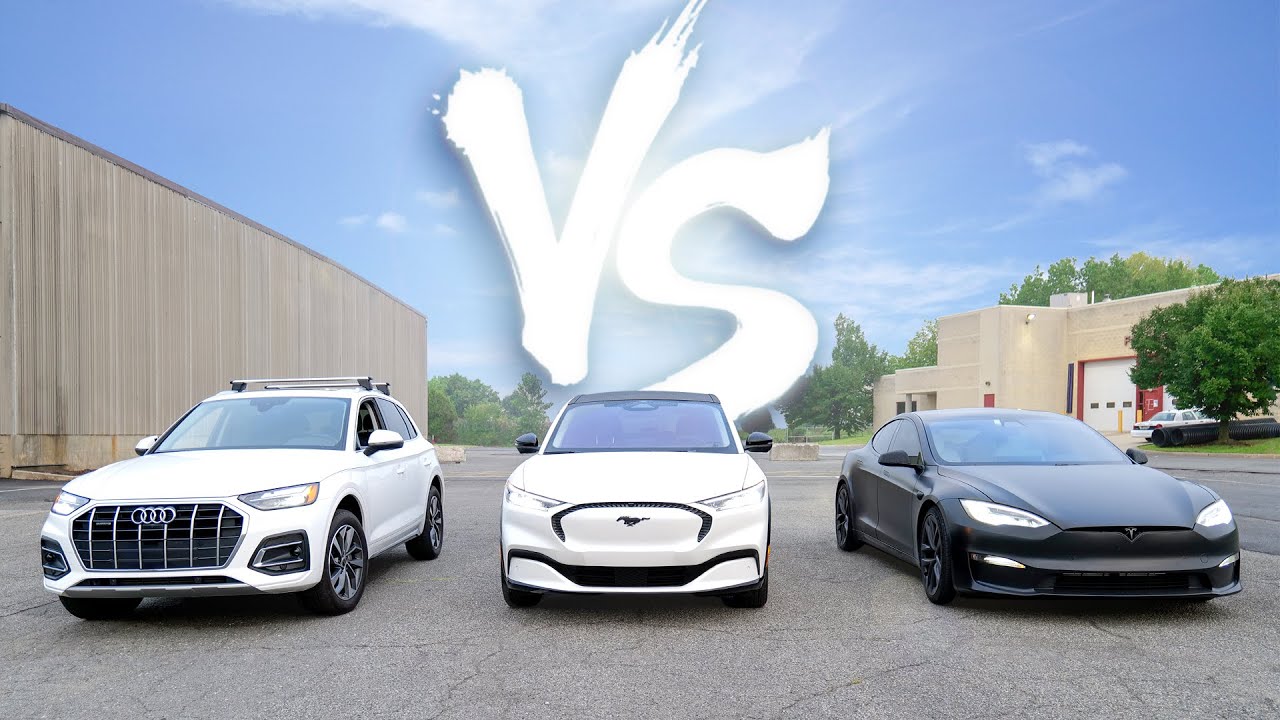
The three test vehicles represent three distinct categories: - **Tesla Model S Plaid:** Equipped with 21-inch wheels, delivering an estimated full battery range of 350 miles and relying on Tesla's proprietary Supercharger network. - **Ford Mustang Mach-E (California Route 1 edition):** Offering roughly 305 miles of range on a 100% charge, primarily targeting third-party CCS DC fast-charging networks like Electrify America. - **Audi Q5 (Gasoline Control):** A conventional gas-powered SUV providing roughly 460 miles of range per full tank.
All three vehicles initiated the challenge simultaneously from a single starting location near the studio that featured a gas station, a Tesla Supercharger station, and an Electrify America station side-by-side, leaving with full tanks and 100% states of charge.
```mermaid flowchart TD accTitle: 1000-Mile Road Trip Vehicle Lineup and Route accDescr: Diagram showing the three competing vehicle types and the two-day waypoint circuit.
subgraph Vehicles["Competing Vehicles"] V1["Tesla Model S Plaid<br/>(350 mi range / Supercharger)"] V2["Ford Mustang Mach-E CR1<br/>(305 mi range / CCS / Electrify America)"] V3["Audi Q5 Gas SUV<br/>(460 mi range / Petrol Control)"] end
subgraph Day1["Day 1: ~650 Miles"] Start["Start: Studio Hub"] --> WP1["Waypoint: Lake Placid, NY"] WP1 --> StopOver["Overnight Stop: Niagara Falls, NY"] end
subgraph Day2["Day 2: ~350 Miles"] StopOver --> WP2["Waypoint: Cornell Clocktower (Ithaca, NY)"] WP2 --> WP3["Waypoint: Paper Building (Scranton, PA)"] WP3 --> Finish["Finish: Studio Hub"] end
Vehicles --> Start ```
[03:40](https://www.youtube.com/watch?v=vXzuFprlyrw&t=220s) Day One: Smooth Sailing for Gas, High-Stakes EV Routing
The first leg stretched roughly 650 miles toward Niagara Falls. The gas-powered Audi Q5 ran a straightforward, highly predictable schedule. It completed the run to Lake Placid in 4 hours and 49 minutes with just one five-minute gas-and-stretch stop. Continuing toward Niagara Falls, the gas crew stopped only twice more: 20 minutes for a sit-down meal and 10 minutes for fuel and a restroom break, pulling into the hotel after 11 hours and 8 minutes on the road.
Marques, piloting the Tesla Model S Plaid, opted for a high-risk strategy on the initial leg by attempting to push all the way from the start straight up into the mountains of Lake Placid on a single charge. The team bypassed the Lake Placid welcome sign without stopping for photos because the remaining battery was dropping precariously low. They made it to the summit Supercharger with just 1 mile of range left on the dash. After a 30-minute charging and snack break (during which the Audi passed them), they doubled back briefly to capture the required sign photograph. On the westward stretch to Niagara Falls, the Tesla stopped twice more to charge: a 46-minute session bringing the pack to full, followed by a conservative 8-minute top-up to guard against arriving empty. The Tesla reached Niagara Falls in almost exactly 12 hours with roughly 70 miles of remaining range—trailing the gas car by under an hour.
[04:55](https://www.youtube.com/watch?v=vXzuFprlyrw&t=295s) The Mach-E's Day One Charging Nightmare
While the Tesla managed its tight margin, the Ford Mustang Mach-E experienced a series of infrastructure failures that derailed its schedule. With the shortest total range among the trio, the Mach-E was forced to peel off for power earlier than the others. The vehicle’s onboard navigation routed the crew to an Evolve NY station that was entirely out of order. Stranded with only 36 miles of range remaining, the drivers could not proceed along the planned course and had to drive east in the wrong direction into Vermont to reach an operational charger, where they were forced to sit for nearly two hours to bank enough range.
Because of this detour, the Mach-E fell significantly behind schedule and made the tactical choice to skip the Lake Placid waypoint entirely to reach the hotel before dawn. Cruising westward, they completed a 41-minute fast charge that replenished the battery to near 80%. However, their troubles resurfaced at 9:30 PM when they reached a designated charging location that was completely broken. They diverted an additional 30 minutes to locate an alternative plug, only to connect to a malfunctioning charger that functioned at a trickle rate, adding a meager 2% over extended dwell time. Down to 5% battery, they made an anxious half-hour drive to an Electrify America location that worked correctly, charging for 46 minutes. The Mach-E finally pulled into the Niagara Falls hotel at 12:40 AM after 16 hours and 40 minutes on the road—roughly five hours behind the gas control.
Reflecting on how drastically real-world infrastructure failures amplify travel fatigue, Marques emphasizes: > “We've seen that online in the past, but now that it's happening to this team, as we're doing it, it's a whole nother thing to actually live through it.”
[06:55](https://www.youtube.com/watch?v=vXzuFprlyrw&t=415s) Day Two: Adaptation, Recovery, and the Electrify America Reality
On the second morning, all three vehicles departed Niagara Falls simultaneously with their overnight arrival battery states intact. Recognizing that the factory system was unreliable, the Mach-E team adapted their operational rules. Marques explained their revised plan: > “Team Mach-E would now operate under their newfound knowledge that the in-car navigation on the Ford could not be trusted.”
The Mach-E team discarded the native Ford navigation and approved stops, opting instead to scout manually via third-party smartphone apps to hunt exclusively for dedicated Electrify America hardware.
The Audi Q5 once again completed an uneventful run, driving directly to the Cornell clocktower in Ithaca, taking a 10-minute gas stop, adding a 10-minute food-only stop an hour later, photographing the paper building in Scranton, and rolling into the finish line in 7 hours and 51 minutes.
Because the Tesla arrived in Niagara Falls with only 70 miles of range, it opened Day Two with an immediate 15-minute Supercharger stop in Cheektowaga, followed by a 25-minute top-off in Ithaca to complete the clocktower photo stop. After photographing the Scranton landmark, the Plaid took one final combined charging and lunch stop in Bartonsville, completing Day Two in 8 hours flat—less than 10 minutes slower than the gas Audi on that leg.
The Mustang Mach-E experienced a much smoother Day Two under manual app routing, though hardware reliability issues persisted: - **Waterloo stop:** The first charger plugged into failed to initiate; switching to a second stall worked, yielding a 32-minute charge before the Ithaca waypoint. - **Scranton stop:** After a brief coffee stop en route, the team stopped at a four-stall Electrify America station where three of the four units were completely broken. The final operational stall worked, allowing a 32-minute charge. - **Day Two Finish:** The Mach-E reached the studio in 8 hours and 49 minutes, finishing only about 49 minutes behind the Tesla on the second leg, demonstrating that avoiding broken infrastructure narrowed the EV-to-EV performance gap considerably.
[09:29](https://www.youtube.com/watch?v=vXzuFprlyrw&t=569s) The Road Trip Results and Time Deltas
Marques introduces the final travel times for the 1,000-mile loop while acknowledging several real-world variables that affected each vehicle. Factors like wheel sizes, traffic conditions, navigation route choices, driver habits, and the time spent taking photos at designated waypoints introduced natural variations, leading Marques to assign a general plus-or-minus 10% delta to the overall journey durations. Despite those variables, the baseline comparison reveals a massive difference in how the two electric vehicles kept pace with a traditional combustion vehicle.
Over the course of the 1,000 miles, the Tesla Model S Plaid added only 1 hour and 32 minutes relative to the gas car, a delay Marques considers quite reasonable for an electric road trip. By contrast, the Ford Mustang Mach-E added a staggering 7 hours and 32 minutes over the gas baseline. Notably, 6.5 hours of that delay occurred entirely on the first day, followed by a modest 1 hour and 3 minutes added on day two. As Marques puts it: “So I think it's safe to say that if you do a lot of road trips, the Tesla road trip experience is currently pretty far ahead of any other electric car, especially here where we did the test in the US.”
However, Marques emphasizes that the underlying reason for Tesla's dominance is not simply what viewers might assume. While the car's slightly longer battery range and the proprietary Supercharger network certainly played their parts, the single most decisive factor across the entire experiment was the sheer accuracy and reliability of the data displayed on the dashboard.
- **Tesla total added time:** 1 hour, 32 minutes over the gas car - **Mustang Mach-E total added time:** 7 hours, 32 minutes over the gas car (6.5 hours lost on day one; 1 hour, 3 minutes lost on day two) - **Margin of error allowance:** ±10% delta due to traffic, photo stops, routes, and wheel setups
---
[10:49](https://www.youtube.com/watch?v=vXzuFprlyrw&t=649s) Quoted Range vs. Reality: Tesla Optimism vs. Ford Conservatism
Marques dives into how automakers calculate and report official range figures, contrasting Tesla's aggressive estimates against legacy manufacturers' conservative ratings. Tesla vehicles display numbers based on the absolute maximum EPA rating, which assumes ideal highway conditions. In real-world driving, reaching that figure requires near-impossible perfection in weather, outside temperature, road gradients, traffic flow, and vehicle speed. On the 21-inch wheels fitted to the test Model S Plaid, the car carries an official rating of 345 miles—placing it directly between a Long Range Model 3 and a Long Range Model Y.
Yet, Marques stresses that trusting that full 345-mile estimate in the wild is unrealistic. On the very first leg from the studio up to Lake Placid—a route measuring only 293 miles—the Plaid depleted its battery from 100% all the way down to a harrowing 1 mile of remaining range (0.3% state of charge). That represented a 15% discrepancy between quoted paper specs and real-world performance. Marques observes: “Like, if your car says you have 40 miles left, you better get to a charger in the next 30 miles or so.” He points out that even with modern heat pumps, cold temperatures force Tesla owners to mentally calibrate for extra battery drain to keep the pack conditioned.
The Mustang Mach-E operates on the exact opposite design philosophy. Its dashboard display proved exceptionally consistent with actual miles covered, often slightly beating its own projections. Marques compares this to the Porsche Taycan, which routinely outperforms its EPA rating by substantial margins, as well as the upcoming Ford F-150 Lightning, whose quoted range includes a 1,000-pound payload in the bed. Summarizing this divergence in corporate approach, Marques notes: “But I think the general philosophy you're seeing with the Fords and Porsches of the world is under promise over deliver.” In practice, despite the Model S Plaid claiming 345 miles on paper and the Mach-E California Route 1 claiming 305 miles, Marques expects both vehicles to cover roughly the same physical distance on a full charge.
```mermaid flowchart TD accTitle: Quoted vs Real-World EV Range accDescr: Comparison of how Tesla and Ford calculate, quote, and deliver battery range on long highway road trips.
subgraph Tesla["Tesla Model S Plaid"] T_Quote["Quoted EPA: 345 Miles<br>(Max Highway Calculation)"] T_Real["Real Drive: 293 Miles to Lake Placid<br>Arrived with 1 Mile (0.3% Battery)"] T_Result["15% Deficit Under Ideal Rating<br>Requires Driver Recalibration"] T_Quote --> T_Real --> T_Result end
subgraph Ford["Ford Mustang Mach-E (CA Route 1)"] F_Quote["Quoted EPA: 305 Miles<br>(Conservative Calculation)"] F_Real["Real Drive: Matches or Exceeds Display<br>Similar Philosophy to Taycan & Lightning"] F_Result["Consistent Real-World Delivery<br>Plaid and Mach-E Cover Roughly Same Distance"] F_Quote --> F_Real --> F_Result end ```
- **Tesla Model S Plaid (21" wheels):** 345 miles quoted range - **Mustang Mach-E California Route 1:** 305 miles quoted range - **Studio to Lake Placid test leg:** 293 miles driven; Plaid dropped from 345 miles to 1 mile (15% range deficit) - **Legacy EV engineering approach:** Under-promise and over-deliver to eliminate customer range anxiety
---
[13:45](https://www.youtube.com/watch?v=vXzuFprlyrw&t=825s) Charging Infrastructure and Software: The Lightning vs. USB-C Dilemma
For drivers who rarely embark on long trips, daily home charging makes highway infrastructure irrelevant, but Marques argues that robust fast-charging networks are everything when traveling long distance. Here, the structural differences between closed and open ecosystems become glaringly evident. Tesla operates approximately 1,100 Supercharger stations across the United States, placing them strategically along major interstate corridors, rest plazas, and shopping mall lots with walkable dining options. The hardware and vehicles are built by the same company to identical specifications, resulting in a cohesive, predictable charging experience.
Ford relies on the FordPass charging network, which aggregates diverse third-party public networks into a unified billing account. While Ford advertises it as North America's largest automaker-provided public network, Marques calls out the marketing spin: Ford did not build these chargers, nor does it maintain them. The umbrella covers roughly 600 ultra-fast Electrify America stalls (capable of up to 350 kW), but also ropes in unreliable, slow, or broken third-party stations. Because Ford lacks end-to-end integration, the car’s navigation system suffers from an information lag:
> “And because these chargers aren't built by Ford, they aren't managed directly by Ford. There's a bit of a communication gap between when one of them might go down and that information actually showing up to the driver in the car.”
This communication gap proved catastrophic during the road trip when the Mach-E navigated its crew straight to a bank of offline chargers undergoing maintenance. Had the Ford team arrived on empty, they would have been stranded. By contrast, Tesla’s in-car software actively routes around bottlenecks, displaying real-time stall availability, charging speeds, out-of-order plugs, and exact occupancy counts. Marques compares this dynamic to consumer technology standards: Tesla’s Supercharger network is like Apple's Lightning connector—proprietary, tightly controlled, vertically integrated, and seamless—whereas the third-party CCS public network is like USB-C: open and widely adopted, but plagued by inconsistent speeds, mixed build quality, and fragmentation.
| Charging Ecosystem Aspect | Tesla Supercharger Network | FordPass / CCS Public Network | |:--- |:--- |:--- | | **Hardware & Management** | Built, owned, and serviced directly by Tesla | Aggregates third parties (Electrify America, etc.) | | **Network Scale** | ~1,100 high-speed dedicated stations in the US | ~600 Electrify America DC fast chargers plus varied third parties | | **Real-Time Dash Telemetry** | Stalls available, active car counts, dead stalls, live charge speed | General station listings; often unaware of outages until arrival | | **Tech Industry Analogy** | Apple Lightning (vertically integrated, proprietary, consistent) | USB-C (open standard, fragmented quality and charging speeds) |
---
[17:23](https://www.youtube.com/watch?v=vXzuFprlyrw&t=1043s) Cost Comparisons, Future EV Tech, and Closing Thoughts
To answer frequent viewer questions, Marques provides an exact accounting of fuel and energy expenses for the 1,000-mile journey, starting with all three vehicles topped off to roughly 100%. The internal combustion support vehicle ran up $84.79 in gasoline costs. While both electric vehicles utilized promotional manufacturer charging credits, Marques calculated the actual retail dollar equivalent of the electricity consumed: the Tesla Supercharger sessions would have cost $66.35, while the Mustang Mach-E pulled $61.25 worth of energy across its FordPass sessions. On average, public fast-charging electricity prices hovered between 30 and 35 cents per kilowatt-hour, illustrating that while road-tripping an EV is cheaper than paying for gasoline, public DC fast charging does not yield the massive savings seen when charging at home overnight.
Marques reflects on how individual use cases dictate whether any of these limitations matter. Owners who use an EV primarily for daily commuting start every morning with a full battery from their garage, rendering public charging station headaches moot. However, for drivers who take regular long-distance highway trips, vehicle range and software-guided charging reliability remain paramount. The electric vehicle landscape is progressing rapidly, with charging hubs multiplying, charger speeds climbing, vehicle ranges expanding, and next-generation battery architectures like Tesla’s 4680 cells looming on the horizon. Marques hints that running this exact 1,000-mile endurance challenge again in a year or two might produce radically different outcomes, and directs viewers to The Studio channel to watch the cinematic, behind-the-scenes travel vlog of the road trip itself.
- **Gas car total fuel cost:** $84.79 - **Tesla Model S Plaid charging cost:** $66.35 (calculated equivalent) - **Mustang Mach-E charging cost:** $61.25 (billed through FordPass credit) - **Average DC fast-charging rate:** 30¢ to 35¢ per kWh
[18:58](https://www.youtube.com/watch?v=vXzuFprlyrw&t=1138s) Final Question to Viewers and Sign-Off
Marques Brownlee wraps up the 1,000-mile road trip experiment by turning directly to the audience with a question about their future vehicle plans. Curious about how consumer sentiment is shifting between powertrains, he prompts viewers to think about their upcoming decisions, asking: “Do you think it will be a gas car or an electric car?” Marques proposes using the video’s comment section as an informal community poll where people can weigh in on their choice. He encourages viewers to share the underlying reasons behind their decision, whether they lean toward internal combustion or battery electric power whenever that next purchase ultimately takes place.
With the prompt laid out for the audience, Marques concludes the journey. He thanks the audience for following along with the cross-car test, delivering his signature outro: “Thanks for watching this experiment. Talk to you guys in the next one. Peace.”
- Marques polls the audience on whether their next vehicle purchase will be a gas car or an electric car. - Viewers are invited to utilize the comment section as a voting forum and explain the rationale behind their preference.
## Notable quotes > [09:29](https://www.youtube.com/watch?v=vXzuFprlyrw&t=569s) I think it's safe to say that if you do a lot of road trips, the Tesla road trip experience is currently pretty far ahead of any other electric car, especially here where we did the test in the US. — Marques Brownlee
> [10:49](https://www.youtube.com/watch?v=vXzuFprlyrw&t=649s) I think the general philosophy you're seeing with the Fords and Porsches of the world is under promise over deliver. — Marques Brownlee
## Mentioned Marques Brownlee, Tesla Model S Plaid, Ford Mustang Mach-E, Audi Q5, Porsche Taycan, Ford F-150 Lightning, Tesla Supercharger, Electrify America, FordPass, Evolve NY, Apple, The Studio
## Video description We drove a Tesla, a Mustang Mach-E and a gas car 1000 miles in a loop to see which was fastest. This was our road trip results! Studio channel: http://youtube.com/TheStudio
MKBHD Merch: http://shop.MKBHD.com
Tech I'm using right now: https://www.amazon.com/shop/MKBHD
Intro Track: http://youtube.com/20syl Playlist of MKBHD Intro music: https://goo.gl/B3AWV5
Mach-E provided by Ford for the video.
~ http://twitter.com/MKBHD http://instagram.com/MKBHD http://facebook.com/MKBHD
[Source](https://www.youtube.com/watch?v=vXzuFprlyrw)