Airbrushed Warm-White LEDs Replicate Vintage Glow, Cut Power Waste
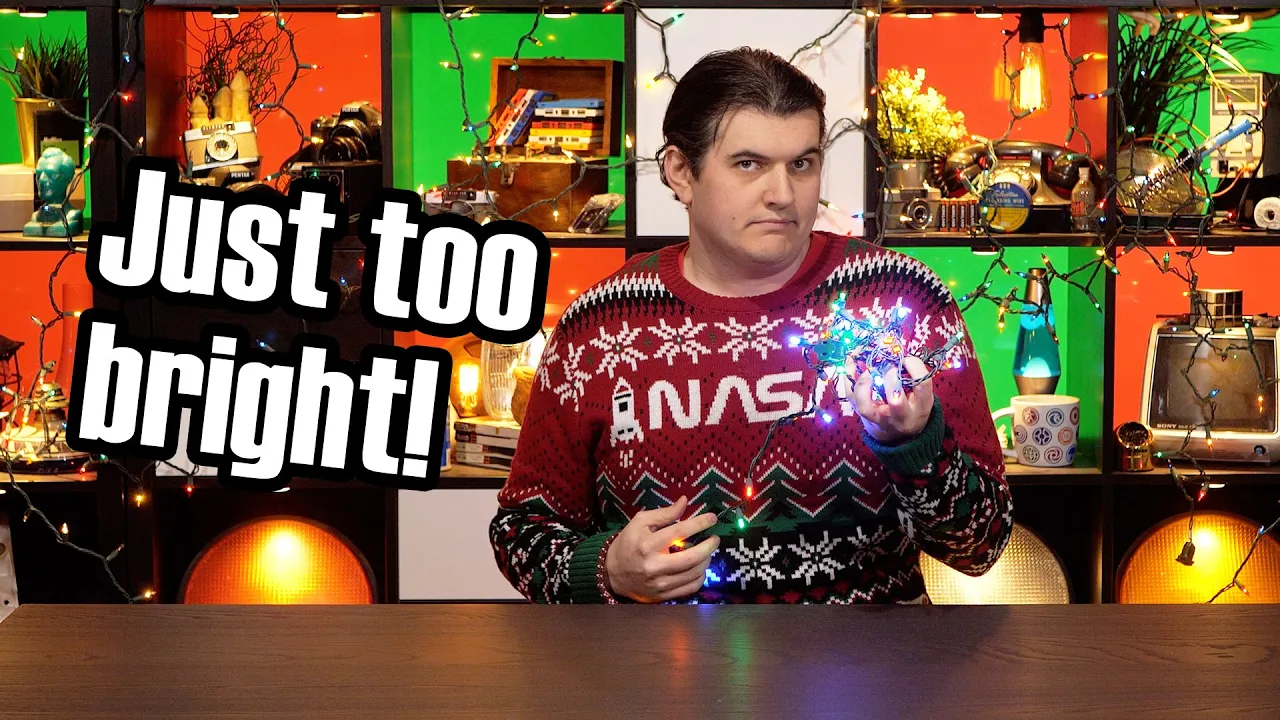
LED Christmas lights still annoy me. Let's try some more fixes. — Technology Connections

Technology Connections

Applying transparent airbrush paint over warm-white LEDs successfully mimics the soft spectrum of vintage holiday lights while avoiding the heavy power consumption of traditional tungsten strands.

AI-assisted summary of LED Christmas lights still annoy me. Let's try some more fixes. — original source. Check the original for full context.

Source published:

Key ideas

  • Standard commercial multicolored LED holiday lights rely on monochromatic diodes that emit pure, harsh wavelengths—particularly in greens and blues—clashing sharply with the broad-spectrum, subtractive warmth of traditional incandescent bulbs. (1:59)
  • After experiments with dyed epoxy resin and PVA glue mixtures failed due to running, uneven optical density, and cracking, airbrushing transparent acrylic colors onto warm-white LED strands emerged as an effective DIY alternative. (11:18)
  • Incandescent holiday lighting remains an enormous energy drain; running two strands of C9 bulbs and six twinkling sets for eight hours a night doubled the host's December electricity bill. (16:07)
  • Commercially produced UK light strands prove that pairing phosphor-converted warm-white LEDs with tinted translucent caps is technically feasible, presenting a blueprint for North American manufacturers to replace harsh monochromatic sets. (16:45)

Detailed notes

## Background Published on November 30, 2023, by Alec on the YouTube channel Technology Connections, this video continues his recurring seasonal series on holiday lighting. With a weary "(sigh) here we go again" in the description, the video links back to his past experiments, custom lamp-frosting techniques, and vintage-style bulb maker Tru-Tone as he resumes his quest to fix the harsh aesthetic flaws of modern LED Christmas lights.

## TL;DR Frustrated by the glaring, hyper-saturated hues of standard monochromatic LED holiday lights—which he likens to an exploded gaming PC—Alec sets out to replicate the soft, warm look of vintage incandescent strands using energy-efficient LEDs. After reviewing the physics behind broad-spectrum tungsten filtering and assessing the current retail landscape, he tests and eliminates two-part epoxy resin and PVA-craft-paint mixtures due to sagging and shrinkage issues. He discovers a clean, highly effective solution in spraying transparent airbrush paint onto warm-white LEDs mounted in a custom cardboard jig, adhering strictly to a classic four-color palette. Highlighting both the severe power waste of real incandescent bulbs and proof from a UK viewer that colored-cap warm LEDs can be manufactured, he urges lighting companies to finally bring proper retro-style mini lights to store shelves.

## Atmosphere & style The presentation is a classic Technology Connections mix of deadpan curmudgeon humor, obsessive DIY pedantry, and genuine holiday nostalgia. It feels like spending an afternoon in a cozy workshop with an articulate friend who is fully aware that his crusade against 'tacky storefront neon' and 'Easter colors in Christmas lights' is ridiculous, yet commits to the bit with scientific rigor. Tangled wires, minor overspray mishaps, and candid outtakes give the technical breakdown a relaxed, charmingly self-deprecating warmth.

## Bulletin - [01:59](https://www.youtube.com/watch?v=va1rzP2xIx4&t=119s) Standard commercial multicolored LED holiday lights rely on monochromatic diodes that emit pure, harsh wavelengths—particularly in greens and blues—clashing sharply with the broad-spectrum, subtractive warmth of traditional incandescent bulbs. - [11:18](https://www.youtube.com/watch?v=va1rzP2xIx4&t=678s) After experiments with dyed epoxy resin and PVA glue mixtures failed due to running, uneven optical density, and cracking, airbrushing transparent acrylic colors onto warm-white LED strands emerged as an effective DIY alternative. - [16:07](https://www.youtube.com/watch?v=va1rzP2xIx4&t=967s) Incandescent holiday lighting remains an enormous energy drain; running two strands of C9 bulbs and six twinkling sets for eight hours a night doubled the host's December electricity bill. - [16:45](https://www.youtube.com/watch?v=va1rzP2xIx4&t=1005s) Commercially produced UK light strands prove that pairing phosphor-converted warm-white LEDs with tinted translucent caps is technically feasible, presenting a blueprint for North American manufacturers to replace harsh monochromatic sets.

## Key takeaways - [00:00](https://www.youtube.com/watch?v=va1rzP2xIx4&t=0s) Boutique manufacturers like Tru-Tone have successfully replicated incandescent warmth in larger C7 and C9 screw-in LEDs, but miniature string lights remain unaddressed by quality-focused commercial brands. - [01:59](https://www.youtube.com/watch?v=va1rzP2xIx4&t=119s) Incandescent holiday lights produce warm, composite color through broad-spectrum tungsten emission filtered by subtractive glass coatings, whereas typical LEDs emit intensely saturated, monochromatic single wavelengths. - [03:04](https://www.youtube.com/watch?v=va1rzP2xIx4&t=184s) Tungsten filaments naturally emit fewer blue and green wavelengths before melting, making vintage cool colors soft and dim, while modern green and blue LEDs run at overwhelming visual intensities. - [04:38](https://www.youtube.com/watch?v=va1rzP2xIx4&t=278s) Modern retail holiday lights are increasingly shifting toward safe low-voltage wall-wart adapters and permanently sealed non-replaceable bulbs to eliminate corroded wire leads. - [07:07](https://www.youtube.com/watch?v=va1rzP2xIx4&t=427s) Past DIY coloring techniques such as Sharpies, spray paint, and Rit dye failed due to UV fading, chipping, complete opacity, or melting the plastic shells. - [08:13](https://www.youtube.com/watch?v=va1rzP2xIx4&t=493s) Dipping warm-white bulbs into dye-saturated epoxy resin failed because achieving authentic incandescent optical density without sagging or losing light output proved virtually impossible. - [10:05](https://www.youtube.com/watch?v=va1rzP2xIx4&t=605s) Adapting a PVA glue and craft paint mixture that worked on IKEA glass lamps failed on holiday lights due to film shrinkage, running, and severe cracking as it dried on plastic. - [11:18](https://www.youtube.com/watch?v=va1rzP2xIx4&t=678s) Airbrushing transparent acrylic craft paint onto warm-white LEDs provided a smooth, factory-like glossy finish with far less application friction than manual brush painting. - [12:37](https://www.youtube.com/watch?v=va1rzP2xIx4&t=757s) A strict traditional four-color holiday palette is defined as red, yellow (or amber/orange), green, and blue, while pinks, purples, and teals are dismissed as Easter colors. - [13:21](https://www.youtube.com/watch?v=va1rzP2xIx4&t=801s) Airbrushing a 100-bulb strand required building a 25-hole cardboard jig with paper shields to spray every fourth bulb without overspraying the harness. - [14:50](https://www.youtube.com/watch?v=va1rzP2xIx4&t=890s) Commercial transparent red paints often suffer from unwanted opacity, while transparent yellow can look artificially neon unless toned with a drop of red. - [16:07](https://www.youtube.com/watch?v=va1rzP2xIx4&t=967s) The environmental and financial burden of traditional incandescent holiday lighting justifies DIY efforts, as high wattage rapidly spikes seasonal electric bills. - [16:45](https://www.youtube.com/watch?v=va1rzP2xIx4&t=1005s) Photographic evidence from the UK demonstrates that manufacturers can achieve vintage aesthetic warmth simply by enclosing warm-white diodes in tinted plastic caps.

## Detailed walkthrough ### [00:00](https://www.youtube.com/watch?v=va1rzP2xIx4&t=0s) The Modern LED Dilemma and the Tru-Tone Triumph

As late November arrives, the irresistible seasonal urge to cover railings, shrubbery, windows, and trees with hundreds of tiny glowing bulbs takes over. Yet for all the undeniable technological marvel of the light-emitting diode, standard commercial multicolored LED Christmas lights introduce a glaring aesthetic grievance. Rather than projecting warmth and cheer, these sets display harsh, hyper-saturated hues that clash violently outdoors. As Alec describes it, “Rather than look festive and cheery and bright, modern LED Christmas light sets usually make it look like a gaming PC exploded on your front lawn.” While anyone drawn to that aesthetic is free to enjoy it, purists have spent years chasing after the gentle, nostalgic ambiance of vintage incandescent strings.

Fortunately, some progress has been made on larger bulb form factors. A company called Tru-Tone took up the challenge and engineered vintage-styled LED replacements for traditional screw-in C7 and C9 lamps. These reproductions capture the authentic spectral warmth and look of classic incandescent bulbs without burning through massive amounts of electrical power. Alec notes, “They are virtually indistinguishable from their energy-sucking incandescent counterparts and if that’s something you’re looking for, you should check them out.” However, because Tru-Tone has not yet expanded into mini-lights, the pursuit of an incandescent-looking miniature light strand remains an unsolved do-it-yourself battle.

[01:59](https://www.youtube.com/watch?v=va1rzP2xIx4&t=119s) Tungsten Physics vs. Monochromatic LEDs

The fundamental reason vintage incandescents look so distinct from modern LEDs comes down to emission physics. Traditional incandescence relies on heating a microscopic filament of tungsten wire until it glows hot enough to emit a broad spectrum of wavelengths that combine into white light. Crafting colored bulbs simply involved coating the glass in a subtractive filter that stripped away all unwanted wavelengths, leaving a rich, slightly softened composite color. Conversely, standard LEDs emit monochromatic light dictated by their semiconductor bandgap materials. Describing the result, Alec points out, “That monochromatic light has an incredibly intense color because it is literally pure as can be - it’s like the color wheel picker on your image editing app.”

```mermaid flowchart TD accTitle: Light Generation and Color Filtering Comparison accDescr: Flowchart contrasting incandescent broad-spectrum filtering, raw monochromatic LEDs, and phosphor-converted filtered LEDs.

subgraph INC["Incandescent Bulb Method"] I1["Hot Tungsten Filament"] -->|"Broad-band white light"| I2["Subtractive Glass Coating"] I2 -->|"Filtered spectrum"| I3["Soft, Warm Glow"] end

subgraph MONO["Standard Modern LED"] M1["Semiconductor Diode"] -->|"Specific bandgap material"| M2["Single Pure Wavelength"] M2 -->|"Monochromatic light"| M3["Harsh, Neon Appearance"] end

subgraph IDEAL["Proposed Ideal LED"] P1["Blue/UV Diode + Phosphors"] -->|"Broad-spectrum warm white"| P2["Colored Filter Cap"] P2 -->|"Subtractive filtering"| P3["Vintage Balanced Glow"] end ```

This purity becomes especially grating with blue and green diodes. In a hot tungsten bulb, cooler wavelengths are naturally scarce because driving the filament hot enough to produce intense blues and greens would liquefy the metal, meaning un-melted incandescents produce blues and greens that are naturally dim compared to radiant yellows, oranges, and reds. Monochromatic blue and green LEDs, on the other hand, scream at maximum visual intensity. Alec laments, “Especially greens and blues - that is not a warm and fuzzy looking festive display, it’s a tacky storefront with those chasing LED strips around the windows letting you know they have CBD oil.” While semiconductor physics and differing forward voltages make leveling these ratios tricky, a straightforward alternative already exists: using inexpensive, phosphor-converted broad-spectrum white LEDs covered by subtractive tinted caps.

[04:38](https://www.youtube.com/watch?v=va1rzP2xIx4&t=278s) Big Box Reconnaissance: Low Voltage, Rice Lights, and Sealed Sets

Hoping the commercial market might have quietly adopted filtered white LEDs, a trip to the local big box retail stores revealed an evolving retail landscape instead. European design influences have begun transforming American shelves. Traditionally, American incandescent mini-lights bypassed power supplies entirely by plugging straight into 120V mains voltage, running two parallel series circuits of 50 bulbs (each rated around 2.5 volts). C7 and C9 strands supplied line voltage directly to parallel sockets, explaining why their plugs were polarized while standard mini-light plugs were non-polarized.

Modern store shelves, however, increasingly feature strings paired with external wall-wart power adapters that output safe, low-voltage electricity. Novel form factors have proliferated alongside them: - **Rice lights:** Ultra-compact diodes built into slender wires, frequently bundled with pulsing and chasing modes. - **Ribbon lights:** An adaptation of flat LED adhesive tape, enclosing emitters in flexible plastic beads, though durability outdoors remains doubtful. - **Permanently sealed traditional strands:** Sets abandoning user-replaceable push-in bulbs in favor of completely hard-wired, sealed enclosures.

Although non-replaceable bulbs might seem like anti-consumer cost-cutting at first glance, the change solves a notorious failure point. Traditional push-in LED minis relied on uninsulated wire leads bent around plastic wedges—an exact clone of incandescent designs. Alec reflects, “Corrosion was a major problem there, plus the bulbs could sometimes end up falling out which would kill the whole strand, so sealing the whole thing up is likely going to make the set more durable in the long-run.” Unfortunately, despite these architectural shifts, retail color choices remain trapped between flat warm-white and blinding, neon multicolored monstrosities.

[07:07](https://www.youtube.com/watch?v=va1rzP2xIx4&t=427s) Past Experiments and the New Contenders

With manufacturers offering no satisfactory off-the-shelf alternatives, modifying existing warm-white light strands requires reviewing past experiments to see what failed and what showed promise: - **Sharpie markers:** Produced vivid, appealing colors immediately, but quickly degraded and washed out under UV sunlight and rain. - **Spray paint and standard acrylic craft paint:** Failed completely due to poor coverage, chipping, or total opacity. - **Transparent acrylic craft paint:** Performed surprisingly well optically, but went untested for long-term weather resistance. - **Nail polish:** Provided simple application and good initial color, but durability testing was also left unfinished. - **Rit dye baths:** Failed completely to take to the plastic housings. Describing the mishap, Alec notes, “The heat from the dying process made the lights get all bendy, too.”

To push the quest forward, three new experimental candidates were selected for testing: dyed two-part epoxy resin, a glue-and-water modified acrylic craft paint recipe, and an unannounced mystery compound.

[08:13](https://www.youtube.com/watch?v=va1rzP2xIx4&t=493s) Testing Epoxy Resin: The Hunt for Optical Density

The first new trial involved two-part epoxy resin mixed with concentrated alcohol-based resin dyes, starting with blue. Blue provides the ultimate litmus test because creating an incandescent-style deep royal blue requires high optical saturation without turning black. The immediate obstacle proved to be pigment density. When spread out in a sheer skim coat over a miniature bulb, the mixture yielded almost no perceptible color.

Casual DIY suggestions often overlook the sheer optical density required to mimic vintage bulbs. Stained-glass coatings or colored heat-shrink sleeves let far too much light pass through; the unlit shell of an authentic colored incandescent bulb is so heavily saturated that it looks practically opaque and black at rest. Overcoming this meant dumping massive quantities of dye into the resin cup until the liquid turned jet-black. When test-dipping warm-white bulbs, the window of success proved impossibly narrow: - Dipping too thin left the illuminated bulb looking pale, pastel, and weak. - Dipping slightly too thick blocked nearly all lumen output. - The resin mix remained thin and runny, continually sagging and dripping off the smooth bulb tips even after an hour of curing on the bench.

Because the liquid would not maintain a uniform, clingy film thickness, epoxy resin was ruled out entirely.

[10:05](https://www.youtube.com/watch?v=va1rzP2xIx4&t=605s) Adapting the PVA Glue and Craft Paint Technique

The second experiment looked back at a prior lighting hack originally developed for frosted IKEA table lamps. When trying to eliminate harsh glare from exposed clear bulbs, a homemade "milk glass" mixture composed of equal parts by weight of tap water, white acrylic craft paint, and standard PVA glue had yielded a smooth, durable, factory-grade opaque finish that never peeled or yellowed.

Transferring that exact logic to Christmas lights, the white acrylic paint was replaced with colored craft paint to form a tinted dip coating. The initial dunk appeared remarkably promising while still wet, but the results deteriorated as the mixture cured. The water made the paint run down the bulb, and during the drying process the film contracted aggressively against the plastic shell. Alec explains, “Yeah, not sure if it’s because it was on plastic or what but the coating shrank and cracked and generally didn’t hold up.” A subsequent variation eliminating the water (using a strict 50/50 blend of craft paint and PVA glue) dried equally poorly, scratching off the second candidate from the list.

[11:18](https://www.youtube.com/watch?v=va1rzP2xIx4&t=678s) Turning to an Airbrush for a Less Fiddly Fix

After the first two coating techniques failed, Technology Connections promptly abandoned them. Even if dipping had worked, it produced a frosted finish rather than the crisp, glossy look he wanted. Transparent craft paint had yielded his best historical results, but brush application was notoriously tedious and frustrating. Acknowledging that the entire project was borderline absurd, he quipped, “I am a ridiculous person who is committed to the bit, but if I’m gonna keep doing this I want something just a little bit easier.”

The breakthrough came when he noticed an old yellow bottle on his workshop shelf—untouched for roughly two years—labeled "Airbrush colors." Despite never having used an airbrush before, he immediately ordered a generic kit from Amazon. Knowing how to use it was not a prerequisite; solving the lighting issue was what mattered. The next hurdle was constructing a jig to safely hold and organize the light strand while spraying.

```mermaid flowchart LR accTitle: Airbrush Preparation Process accDescr: Steps taken to prepare the light strand for airbrushing using a cardboard jig. subgraph Prep["Preparation"] A["Amazon Cardboard Box"] --> B["Punch 26 Holes Along Edge"] B --> C["Cover Extra Hole with Tape"] end subgraph Rigging["Rigging & Protection"] C --> D["Insert Every 4th Bulb"] D --> E["Tape Paper Shields Against Overspray"] end subgraph Painting["Application"] E --> F["Spray Transparent Airbrush Paint"] end ```

[12:37](https://www.youtube.com/watch?v=va1rzP2xIx4&t=757s) The Objectively Correct Four-Color Palette

Color selection is a matter of strict principle. Modern retail sets tend to feature non-traditional holiday hues that Technology Connections firmly rejects. His standard is an uncompromising four-color configuration consisting solely of red, green, blue, and yellow (with amber or orange being a grudgingly acceptable substitute for yellow). Purples, teals, and pinks are dismissed outright:

> “I will accept amber or orange in place of yellow, but teals and purples and pinks are completely unacceptable because those are Easter colors and that comes later. Those colors do not belong in Christmas light sets! Capiche?”

Fortunately, an airbrush set contained the exact four colors needed. He purchased fresh bottles because the two-year-old yellow paint had already separated long ago. To tackle a standard 100-light strand of warm white mini LEDs, he punched 26 holes with a handheld hole punch into a scrap piece of Amazon cardboard, taped over one extra hole to leave exactly 25, and threaded every fourth bulb through the slots. Scrap printer paper was taped around the edges to shield the rest of the tangled wire harness from overspray.

- Palette rules: Red, yellow, green, and blue only. - Substitute policy: Amber or orange is permitted if yellow is unavailable. - Banned colors: Pink, purple, and teal (reserved exclusively for Easter). - Paint flexibility: The primary transparent colors can easily be mixed if adjustments are required.

[14:02](https://www.youtube.com/watch?v=va1rzP2xIx4&t=842s) Spraying the Bulbs and Evaluating the Results

Using a gravity-fed airbrush from the kit, he filled the reservoir with blue paint and sprayed the first batch of 25 bulbs. The application was virtually effortless compared to past manual attempts, resulting in an even, vivid coat after just a couple of passes. Once dry, the airbrush was flushed out, the 25 blue bulbs were removed, and the next 25 unpainted bulbs were threaded into the jig for the following color.

While vastly superior to brushing, the setup still suffered from a notable "fiddle factor"—specifically wrestling, uncoiling, and re-tangling the heavy wire harness while swapping bulbs in and out of the cardboard holder. He mused that a larger piece of wood or cardboard pre-drilled with a drill press might allow spraying several strands simultaneously. The finished bulbs also displayed minor cosmetic quirks: the yellow leaned toward an artificial "highlighter yellow" and needed a drop of red to warm it up, while the transparent red paint suffered from slight opacity—a flaw he had noticed across multiple brands, indicating an inherent challenge in red pigment formulation. Furthermore, although the paint instructions suggested heat curing, he refused to risk melting the plastic bulb caps.

- Airbrush type used: Gravity-fed cup style. - Strand specifications: 100-count warm white LED mini lights, painted in batches of 25. - Durability testing: Installed outdoors facing south to endure direct winter sunlight and harsh Midwest weather, with updates promised for his second channel and YouTube Community tab.

[16:07](https://www.youtube.com/watch?v=va1rzP2xIx4&t=967s) The Motivation, Incandescent Power Waste, and the UK Discovery

Anticipating that viewers might question why anyone would go to such obsessive lengths, Technology Connections outlined the heavy financial and environmental cost of running classic incandescent lights. During the previous holiday season, his household electric bill doubled in December simply from running two strands of C9 bulbs and six runs of twinkling lights for eight hours each night—a jarring power spike, especially for someone who drives an electric vehicle. Conversely, he refuses to tolerate existing commercial LED strands:

> “Broadly, I just want to show that this can be done! Yes, maybe I’m just a curmudgeon who’s out of touch, but I really would like to use LED multicolored lighting ‘round the holidays because incandescent light sets use a stupid amount of power!”

He bluntly describes off-the-shelf LED sets as looking like “gamer vomit.” Hope arrived via a UK viewer who mailed in photos of an overseas light set matching his ideal design: warm-white diodes enclosed inside thick, richly tinted plastic bulb caps that replicate the warm glow of dyed glass. While the UK set skewed slightly pastel, it proved that manufacturers can easily produce aesthetically pleasing sets if they choose to. He called upon retail buyers and boutique manufacturers like Tru-Tone to bring warm-white, colored-cap LED strands to store shelves, warning his audience that if a company finally manufactures them, they had better buy them so retail shelves aren't permanently surrendered to harsh, blue-green laser-like lights.

[18:10](https://www.youtube.com/watch?v=va1rzP2xIx4&t=1090s) Outtakes and Discontinued Twinkle Lights

The video concludes with a festive jazz rendition of "We Wish You A Merry Christmas" alongside outtakes of Technology Connections fumbling lines, clearing his throat, and untangling rebellious light cords from his studio furniture. Looking over his backdrop of traditional incandescent twinkling lights, he remarks with genuine sadness that Menards appears to have discontinued them, admitting with a grin that he no longer feels guilty about having hoarded spare boxes over the past few years.

## Notable quotes > [00:00](https://www.youtube.com/watch?v=va1rzP2xIx4&t=0s) Rather than look festive and cheery and bright, modern LED Christmas light sets usually make it look like a gaming PC exploded on your front lawn. — Alec

> [12:37](https://www.youtube.com/watch?v=va1rzP2xIx4&t=757s) I will accept amber or orange in place of yellow, but teals and purples and pinks are completely unacceptable because those are Easter colors and that comes later. Those colors do not belong in Christmas light sets! — Alec

## Mentioned Technology Connections, Alec, Tru-Tone, IKEA, Sharpie, Rit dye, Amazon, Menards

## Video description (sigh) here we go again Links! If you're interested in checking on Tru-Tone: https://tru-tone.com/ That one where I made those IKEA lamps better: https://www.youtube.com/watch?v=ed8QTKtLxKs

Videos from years past: https://youtu.be/cQgcTkXacAc https://youtu.be/ebkD6DzZDlA https://youtu.be/PBFPJ3_6ZWs

Oh right, I did one on neon flicker flame lamps, too https://youtu.be/nyYjnV99wfM And bubble lights! https://youtu.be/5un4DdKQZvs

Technology Connections on Mastodon: https://mas.to/@TechConnectify

(I'm also trying out BlueSky on the same handle, if you've managed to get invited there)

This channel is supported through viewer contributions on Patreon. Thanks to the generous support of people like you, Technology Connections has remained independent and possible. If you'd like to join the amazing people who've pledged their support, check out the link below. Thank you for your consideration! https://www.patreon.com/technologyconnections

[Source](https://www.youtube.com/watch?v=va1rzP2xIx4)

中文简报

喷涂暖白LED重现复古光芒,降低电能浪费 在暖白光LED上喷涂透明喷笔漆,既成功模拟了复古节日彩灯的柔和光谱,又避免了传统钨丝灯串的高耗电问题。 鉴于标准单色LED节日彩灯刺眼且过度饱和的色彩(他将其比作炸开的游戏PC主机),Alec决定利用节能LED来复刻复古白炽灯串柔和温暖的视觉效果。在回顾了广谱钨丝灯滤光的物理原理并评估了当前零售市场后,他测试了双组分环氧树脂以及PVA手工颜料混合物,但因流淌和收缩问题而将其淘汰。最终,他发现了一种干净高效的解决方案:将暖白光LED固定在自制硬纸板夹具上,严格按照经典的四色方案喷涂透明喷笔颜料。他指出了传统白炽灯泡严重的电力浪费,并结合一位英国观众提供的证明(即带彩色灯帽的暖白LED完全可实现量产),敦促照明企业尽快将真正的复古风微型彩灯推向市场。 市售标准多色LED节日彩灯依赖于发射纯净、刺眼波长的单色发光二极管(尤其是绿光和蓝光),与传统白炽灯泡基于减色法的广谱暖光形成强烈反差。 (1:59) 在尝试染色环氧树脂和PVA胶水混合物因流淌、光学浓度不均以及开裂而失败后,在暖白光LED灯串上喷涂透明丙烯颜料被证明是一种有效的DIY替代方案。 (11:18) 白炽节日灯饰依然极其耗电;每晚点亮两串C9灯泡和六组闪烁灯具8小时,让博主12月的电费账单直接翻倍。 (16:07) 英国商业化量产的灯串证明,将荧光粉转换的暖白LED与着色半透明灯帽结合在技术上完全可行,为北美制造商淘汰刺眼的单色灯串提供了范本。 (16:45)

Reading summary

Technology Connections argues that commercial multicolored LED Christmas lights remain aesthetically harsh due to monochromatic semiconductor physics, leading him to develop a DIY airbrushing technique on warm-white LED strands to replicate vintage incandescent warmth without the associated high power draw. Emission Physics: Incandescent Glow Versus Monochromatic LEDs (1:59) The stark visual contrast between classic incandescent lights and standard LED sets stems from how each produces illumination. Incandescent bulbs heat a tungsten filament until it emits broad-spectrum white light, which is then shaped by subtractive glass coatings that yield softened, warm colors. Because heating tungsten enough to generate intense cool wavelengths would melt the filament, vintage incandescent blues and greens are naturally muted compared to vibrant reds and ambers. Conversely, standard modern LEDs emit monochromatic light determined by semiconductor bandgaps, yielding intensely saturated, neon-like hues that Alec criticizes as overly harsh—particularly with piercing green and blue diodes. The Evolution of Commercial Hardware and Color Gaps (4:38) While boutique makers like Tru-Tone have successfully engineered vintage-style warm replacements for large screw-in C7 and C9 lamps, the retail mini-light market remains largely bifurcated between single-tone warm white and jarring multicolors. Retail shelves have steadily modernized with low-voltage wall adapters, ultra-compact rice lights, flexible ribbon lights, and permanently sealed wire sets. Although abandoning push-in bulbs eliminates traditional corrosion and loose-connection failure points, commercial manufacturers have still largely failed to offer mini-strands using phosphor-converted warm-white diodes fitted with subtractively tinted caps. Testing Liquid Coatings and Optical Density Hurdles (8:13) Achieving the appearance of vintage mini-lights requires exceptional optical density so the unlit bulb shell looks deeply tinted rather than pale. Prior DIY attempts using Sharpie markers, spray paint, craft paints, nail polish, and Rit dye baths encountered severe issues with fading, chipping, heat damage, or poor coverage. Subsequent experiments with dyed two-part epoxy resin failed because the sheer coating either left the lit bulb looking washed out or completely blocked the light, while the fluid continued to drip and run off smooth plastic surfaces even after an hour. Adapting a PVA glue and acrylic paint dip also collapsed, as the water-based mixture shrank, cracked, and detached from the plastic bulbs during drying. Airbrush Application on a Strict Four-Color Palette (11:18) The DIY breakthrough came from adapting a gravity-fed airbrush and transparent acrylic airbrush colors to coat a standard 100-count strand of warm-white LED mini-lights. Building a cardboard jig with 25 punched holes allowed spraying every fourth bulb while shielding the electrical wiring with paper. Rejecting non-traditional holiday colors like pink, purple, and teal, Alec adhered strictly to red, yellow, green, and blue (with orange or amber as acceptable yellow variants). The airbrush provided an even, glossy finish in only a couple of passes, though it retained a handling hurdle in repeatedly threading and untangling the wire harness between batches. Operating traditional incandescents carries a substantial energy penalty, as evidenced by Alec's electric bill doubling during a previous holiday season from running C9 and twinkle sets. While viewer evidence from the United Kingdom demonstrates that commercial manufacturers can produce warm-white diodes with richly tinted caps, long-term outdoor weather and UV resistance for the airbrushed DIY alternative remain to be proven.

精炼阅读摘要

Technology Connections 指出,现代市售多色 LED 圣诞灯因直接采用单色二极管而色彩刺眼且缺乏怀旧感,但传统白炽灯耗电量又过高;通过使用喷笔为暖白光 LED 灯串均匀喷涂透明颜料,个人可以低成本自制出兼具节能与传统柔和质感的节日灯串。 光谱发光物理学与白炽灯的视觉美感 (1:59) 传统白炽灯与现代彩色 LED 之间的美学差异根植于底层发光物理学。传统白炽灯通过加热微小的钨丝发出连续的宽光谱白光,彩色灯泡仅需在外壳镀上一层减色滤光涂层,滤除多余波长即可呈现柔和、丰富的复合光色。由于钨丝在不熔化的情况下无法达到产生高强度蓝绿光所需的极高温度,因此传统白炽灯串中的冷色调自然偏向暗淡,与温暖的红黄色调形成舒适平衡。 相比之下,市售标准多色 LED 由半导体材料的禁带宽度直接决定发光波长,释放出纯度极高的单色光。Alec 批评这种单色光如同在图像编辑软件的色轮上直接取色,高饱和度的蓝光与绿光呈现出类似于商铺霓虹招牌或电竞主机的生硬观感,彻底破坏了节日的温馨氛围。解决这一问题的理想方案是采用涂覆荧光粉的宽光谱暖白光 LED,再配合减色滤光罩,从而在物理层面复刻白炽灯的光谱平衡。 零售市场技术迭代与大灯泡方案的局限 (4:38) 在大型灯泡规格(如螺口式 C7 与 C9 灯泡)上,市场已出现有效解决方案。Tru-Tone 公司成功开发出复古造型的 LED 替代灯泡,不仅能够精准还原白炽灯的光谱暖意,还大幅降低了能耗,其外观效果与耗电巨大的传统灯泡几乎无法区分。然而,Tru-Tone 尚未涉足小型迷你灯串领域,导致消费级迷你灯串依然缺乏高质感的成熟产品。 在传统零售市场中,货架形态正在发生显著变化。受欧洲设计影响,传统美国无极性插头、120V 市电直驱的 50 颗串联双回路结构正在减少,取而代之的是配备外置低压适配器的灯串、微型米粒灯、软质胶带式灯带,以及将灯泡完全注塑密封的灯串。虽然完全密封的设计剥夺了用户更换单个灯泡的自由,但它彻底消除了传统插入式灯泡因金属引脚暴露而导致的锈蚀脱落故障,大幅提升了户外耐用性。不过在色彩表现上,零售市场依旧停留在平淡的暖白光或刺眼的霓虹多色两种极端之间。 手工染色实验与涂层附着力缺陷 (7:07) 为改造现有暖白光迷你灯串,Alec 回顾并测试了多种改色方案。早期的马克笔涂抹虽能产生明亮色彩,但在日光紫外线和雨水冲刷下会迅速褪色;普通喷漆和不透明丙烯颜料会导致完全遮光或剥落;指甲油未完成长期耐候测试;而织物染料水浴不仅无法让塑料灯罩上色,染浴的高温甚至导致灯串塑料严重变形。 随后的新尝试重点关注光学密度与涂层均匀性。在使用环氧树脂混合酒精浓缩染料的测试中,因薄涂层无法达到白炽灯深色外壳所需的遮光深度,一旦大量增加染料,树脂便会在光滑的灯泡表面出现流挂和滴落,无法形成厚薄均一的光学薄膜。另一项借鉴自台灯改造的配方(等比例水、白胶与彩色丙烯颜料)在干燥过程中发生严重收缩和开裂,即使去除水分仅采用 50/50 的丙烯与白胶混合物,涂层在塑料表面依然无法稳定成型且呈现磨砂质感,无法满足晶莹透亮的视觉要求。 喷笔方案实现与传统四色阵列 (14:02) 在放弃繁琐的笔刷涂抹后,Alec 采购了重力供料式喷笔套件以及水性透明喷笔颜料。在色彩标准上,他坚持严格的四色节日配置——仅保留红、绿、蓝、黄(或勉强接受琥珀色/橙色代替黄色),明确排斥粉红、蓝绿和紫色等非传统节日色调。为了对 100 颗灯珠的暖白光灯串进行批量作业,他利用硬纸板打孔制作了容纳 25 颗灯泡的固定模具,并加装纸张护板以阻挡飞漆,按每隔三颗灯珠的间距分批次喷涂。 重力喷笔展现出优异的施工效率,仅需数次走枪即可形成均匀、鲜艳且通透的着色层。实际操作中主要的技术妥协在于红墨水自身存在的轻微浑浊感,以及黄色偏向荧光笔黄、需加入微量红色微调暖度。此外,尽管颜料说明书建议进行加热固化,但为避免塑料灯壳受热变形,灯串均采用常温自干。尽管在模具中理线和装卸灯串仍需耗费一定的人工整理时间,但该工艺已证明是目前自制复古灯串最可行的技术路径。 自制改装的主要动力源于白炽灯高昂的运行成本;Alec 指出,去年仅运行两条 C9 灯串和六条频闪灯串,便导致其 12 月电费账单翻倍。一名英国观众寄来的市售成品照片证明,厂商完全有能力直接使用厚重彩色滤光罩搭配暖白光 LED 生产出高水准产品。目前,Alec 已将自制喷涂灯串挂置于室外朝南向阳处进行严苛的冬季耐候性测试,长期涂层耐久度仍有待后续观察。

Source quotes

[0:00] Alec: Rather than look festive and cheery and bright, modern LED Christmas light sets usually make it look like a gaming PC exploded on your front lawn. [12:37] Alec: I will accept amber or orange in place of yellow, but teals and purples and pinks are completely unacceptable because those are Easter colors and that comes later. Those colors do not belong in Christmas light sets!

Original transcript

[0:00] As we reach the end of November, [0:02] many of us  get out the decorations and fa la la la la and whatnot. [0:06] I’m certainly no exception,  especially when it comes to lighting. [0:10] Why exactly do we litter our homes with light  bulbs ‘round Christmas time? [0:14] Don’t know, but it’s probably marketing. [0:17] By golly it worked on me, though, [0:19] and as a lighting enthusiast generally the  opportunity to put hundreds of little light bulbs [0:23] on railings and windows and shrubs and trees and stuff is just impossible to pass up. [0:28] But as you may very well know, I have a problem with the Christmas lighting industry. [0:34] And that problem is LEDs. [0:37] Don’t get me wrong, I love LEDs! [0:39] The light emitting diode is one of the most important inventions of the last however many years. [0:44] And some LED Christmas lights are great! [0:48] But multi-colored LED Christmas lights usually aren’t. [0:53] Rather than look festive and cheery and bright, [0:56] modern LED Christmas light sets usually make it look like a gaming PC exploded on your front lawn. [1:03] If that aesthetic tickles your fancy, [1:06] I will judge you but I won’t get in your way. [1:08] Have fun. [1:09] But for the past several years I have been on a foolish quest to determine the best way to make modern LED Christmas lights [1:17] look like old-fashioned incandescent Christmas lights. [1:20] Luckily, some much-more-commited-than-me folks started up Tru-Tone [1:25] and now manufacture incredibly excellent LED versions of C7 and C9 bulbs. [1:31] They are virtually indistinguishable from their energy-sucking incandescent counterparts [1:36] and if that’s something you’re looking for, you should check them out. [1:39] They’re not paying me to say that, I bought these with my own money [1:43] but they are exactly what I’ve been hoping somebody would do [1:46] and if you live in North America (and are the same kind of weirdo I am)  I think you’ll be more than pleased with them. [1:53] However, Tru-Tone has not yet made inroads on  tackling the mini-light problem. [1:58] So here we go again. [2:00] To explain what my problem is, [2:02] in ye-olden days we made light happen by making tiny bits of tungsten wire very very hot. [2:08] Hot things produce light through incandescence, [2:11] and when it’s hot enough a whole bunch of wavelengths of light will be emitted which together look white. [2:17] When we wanted to make that look a color other-than-white, [2:20] we’d add a coating to the glass of the light bulb which acted to filter out most wavelengths aside from our target color. [2:28] The result was a sort of blend of wavelengths that produced a pleasing (if reduced in brightness) appearance. [2:35] LEDs, on the other hand, only emit a single wavelength of light [2:38] which depends on the materials used to create it. [2:42] That monochromatic light has an incredibly intense color because it is literally pure as can be - [2:50] it’s like the color wheel picker on your image editing app. [2:53] A perfectly pure hue. [2:56] Some of you may like this. [2:57] Even I like it at times. [3:00] But for Christmas lights? [3:01] It’s just wrong. [3:03] Especially greens and blues - that is not a warm and fuzzy looking festive display, [3:08] it’s a tacky storefront with those chasing LED strips around the windows letting you know they have CBD oil. [3:13] I’m sorry, that’s just the truth! [3:16] If the blue and the green could be toned down a bit, [3:20] I’d probably be a little less grumpy about this. [3:23] A large part of why LED multicolored sets and incandescent multi-colored sets look so starkly different [3:30] is that the filament in an incandescent light doesn’t produce a whole lot of the green-to-blue wavelengths [3:35] (that would require getting tungsten into melty temperatures and those bulbs wouldn’t last long at all). [3:41] So, through pure physics reasons the blue and green will appear quite a lot darker than reds, oranges, and especially yellows. [3:49] A multi-colored LED set that just mimicked those relative  brightness ratios would be a huge improvement. [3:57] There are reasons that’s difficult, though. [4:00] Something something voltage drop, gallium nitride, et cetera. [4:03] But there’s another way: [4:05] through lots of innovation involving phosphor coatings excited by blue to near-UV diodes, [4:11] we’ve made extremely good and reasonably broad-band white LEDs that are quite cheap. [4:18] So, why don’t we just make a whole bunch of white diodes and put a colored cap over them a la the way we used to do it? [4:24] Then we could have the best of both worlds! [4:27] Just to make sure that hasn’t happened yet and, side note, [4:30] somebody please just do it so I can end this! [4:34] I went to a couple of big box stores to see what their big boxes had in store. [4:38] The first thing of note: [4:40] Europe is invading! [4:42] Traditionally, light sets over here just have raw mains voltage going through them. [4:47] A set of 100 mini-lights will actually have two runs of 50 bulbs wired in series. [4:53] The bulbs are rated for somewhere near 2.5 volts and with them all in series that adds up to 125 volts [5:00] (the bulbs actually fail as a short circuit which keeps the rest of the strand lit… [5:04] usually… so they build some margin in for that). [5:08] C9 and C7 sets supply straight line voltage to each bulb socket which, fun fact, [5:14] is why those sets have polarized plugs and mini-light sets don’t. [5:19] This is a note to editor me, make sure you put that little asterisk in there about how some older C7 and C9 sets were also in series. [5:27] Did you do it? [5:28] Good! [5:29] Now, though, LED light strands that come with little power adapters that make some flavor of not-line-voltage are starting to become available. [5:38] And new form factors, too! [5:40] Most LED sets have been mimicking the shape of incandescent lights but now we have so-called “rice lights” - [5:47] and these have some built-in chasing functions to make things interesting. [5:51] And then there’s these “ribbon lights” which seem to be a play on LED tape light but with diodes in little blobs. [5:58] Both of these are intriguing, [6:00] though I must say that ribbon light doesn’t look too durable, [6:04] but sadly the multi-colored sets still look like  something a unicorn threw up so I had to pass. [6:10] Also interesting, some of the “traditional” LED sets for sale are starting to come with non-replaceable bulbs. [6:17] To be honest, this annoyed me at first. [6:20] But I’ve come around to this probably being better. [6:24] Until this year, every one of these sets I’ve seen has technically had replaceable bulbs [6:29] but they were made just like the incandescent sets of the past. [6:34] In fact, it was often the legs of the LED bent around the bulb holder just like the tiny wire leads of the incandescent mini-lights. [6:42] Corrosion was a major problem there, plus the bulbs could sometimes end up falling out which would kill the whole strand, [6:49] so sealing the whole thing up is likely going  to make the set more durable in the long-run. [6:55] Alas, when it came to the colors, [6:57] everything was either “decent warm white” or “shield your eyes multi-colored” [7:01] so it’s time yet again to try my luck at figuring out how to make these less awful. [7:07] Here’s a summary of things I’ve tried in the past. [7:10] Sharpies: worked great but quickly faded in the sun and/or rain. [7:15] Spray paint: didn’t work at all. [7:17] Acrylic craft paint: didn’t work at all. [7:20] Transparent acrylic craft paint: worked surprisingly well! [7:25] Durability testing didn’t happen, though, because I forgot. [7:28] Nail polish: another surprise hit! [7:31] Probably the easiest of all and durability was probably decent but again actual testing didn’t happen because I forgot. [7:37] But that’s all I’ve tried so far. [7:39] At least I think. [7:40] Wait - I forgot about the Rit dye: [7:43] That also didn’t work. [7:44] The heat from the dying process made the lights get all bendy, too. [7:49] Surely there’s something better out there. [7:51] And for your viewing pleasure and my sense of ennui, [7:54] it’s time to once again test some light bulb painting techniques. [7:59] On the docket today are epoxy resin and dyes for said epoxy resin, [8:03] then we have a twist on acrylic craft paint involving some water and glue, [8:08] and finally we have a mystery third thing. [8:11] Stay tuned for that one. It worked pretty good! [8:13] I started this year’s shenanigans with epoxy resin. [8:17] I ordered some and some dyes for it and thought “this might work OK.” [8:21] But a thought is not the same as an experiment, [8:23] and I don’t have room for thought experiments. [8:26] Anyway so I mixed some up, added some dye to it, and hoped for the best. [8:30] I started with blue because this is the trickiest color - I want a nice deep blue, so it needs to have quite a lot of dye. [8:37] But go too far and it might be black. [8:41] Turns out that wasn’t a problem here. [8:43] Despite adding quite a lot of dye to the resin, the mixture added hardly any color in the thin skim-coating that I knew I’d need. [8:52] And this is something that I need to touch on - [8:54] in all my attempts here, people are (quite helpfully) suggesting things I should try [8:59] but a lot of the suggestions I’ve received turn out to have nowhere near as much color as I need. [9:05] Things like stained glass paint or colored heat shrink tubing just aren’t dark enough - [9:10] the glass of an unlit incandescent set looks nearly black on all colors but yellow or amber. [9:17] So if this was gonna work, I’d need way more dye. [9:22] After adding way more dye, [9:24] I was starting to get worried that there would be too much dye for the resin to cure properly. [9:29] But there was only one way to find out. [9:31] After making the concoction so dark as to appear black, things looked promising at first but then quickly became the opposite of that. [9:39] Test-dunks revealed just how tricky the balance is here between too dark and not dark enough - [9:45] the light goes from hardly visible to  just right to too pale in a matter of moments. [9:51] Add to this the general difficulty of getting the coating thickness I wanted [9:55] (this resin was extremely runny and even after waiting over  an hour, despite thickening quite a bit, it would still run off eventually) [10:02] and epoxy was ruled out completely. [10:05] My next trick was to try the milk glass coating  I stumbled upon through sheer dumb luck. [10:11] I got these table lamps from the Swedish meatball place last year and while they are pretty cool looking, [10:17] having bare light bulbs in your peripheral vision kind of sucks [10:21] so I wanted to frost the glass. [10:24] But not frost it like the translucent kind of frosting, but the opaque white kind of frosting, [10:29] and there weren’t any good guides on how to do this so I just tried equal parts (by weight) water, white craft paint, and PVA glue [10:37] and by golly it worked perfectly! [10:40] The lamps still look great, no cracking or yellowing, [10:43] and if you’re interested in learning more about this  process you can check out the video on Connextras. [10:48] I thought I would try this technique for Christmas lights but using colored paint instead of just white. [10:54] So I mixed some up, dunked the bulbs, and thought that perhaps I had cracked it! [10:59] But then the coating cracked. [11:02] Yeah, not sure if it’s because it was on plastic or what  but the coating shrank and cracked and generally didn’t hold up. [11:09] I also tried just half glue and half paint [11:12] (the water made the mixture a little runnier than I think I wanted) [11:15] but this also didn’t dry well. [11:18] Again, I started with blue and since both of those two techniques didn’t work I promptly gave up. [11:23] Even if this had worked well, it still had that frosted look which I would have accepted [11:28] but wasn’t exactly what I was going for. [11:31] So, back to the drawing board. [11:34] The absolute best end-result I have gotten so far came from transparent craft paint. [11:40] But, it was fiddly and annoying to apply. [11:44] I mean, let’s be real, this whole endeavor is objectively ridiculous. [11:48] I am a ridiculous person who is committed to the bit, but if I’m gonna keep doing this I want something just a little bit easier. [11:56] But then I noticed that one of my bottles of paint - the yellow one that’s been sitting on the shelves behind me for what, two years now? - [12:03] says “Airbrush colors” on it. [12:06] Now, I’ve never had a need for an airbrush [12:09] (usually I use a comb) [12:10] but if that’s what it’s designed for maybe an airbrush would help. [12:15] So I got one! [12:16] Did I just search on Amazon for “airbrush kit” and buy the most obvious one? [12:21] Yep! [12:23] Do I really know how to use an airbrush? [12:25] Nope! [12:26] Did that stop me? [12:28] Nope! [12:29] But having the airbrush is only one part of the problem. [12:32] The other was how to hold the lights to make airbrushing possible. [12:37] Now, as I’ve discussed previously, [12:39] I really don’t care for many of the color combinations on offer today. [12:43] My preference is a simple four-color palette of red, green, blue, and yellow. [12:49] I will accept amber or orange in place of yellow, [12:52] but teals and purples and pinks are completely unacceptable because those are Easter colors and that comes later. [13:00] Those colors do not belong in Christmas light sets! [13:04] Capiche? [13:05] As luck would have it, the very four colors I wanted were available in a set of transparent airbrush paint. [13:12] I bought new paint just in case the old paint was going bad, and that yellow bottle was already separating two years ago so it’s much worse now. [13:21] And if for whatever reason I were to change my mind about color preferences, [13:26] different colors could be made by mixing these primary colors together. [13:30] Just ask your kindergarten teacher! [13:32] So, knowing that I’d be spraying a strand of one hundred mini lights [13:36] in my objectively correct preference of red, yellow, green, and blue, [13:41] I took a spare piece of cardboard from one of those Amazon boxes [13:44] and used a single hole punch to make 26 holes along its edge. [13:49] Then I taped over one of them because I only needed 25. [13:52] And I meticulously poked every fourth light through those holes [13:56] and then taped some printer paper to the edges of the piece of cardboard to protect the rest of the set from overspray. [14:02] Then I picked this gravity-fed airbrush from my airbrush kit because that would probably work, [14:07] shook up the blue paint bottle, put some paint in the cup, [14:10] and went at it. [14:11] And by golly, it worked! [14:14] It worked greatly! [14:15] The blue paint was actually a perfect color, [14:18] the airbrush made applying it nearly effortless, [14:21] and after a couple of coats it was exactly what I was looking for. [14:25] Of course the only thing left to do was let it dry, [14:28] clean out the airbrush, [14:30] then pull out all the now blue bulbs and shove another quarter of them through the holes to prepare for the next color. [14:36] Then repeat. [14:37] This was still a pretty fiddly process, [14:40] but it’s definitely the least fiddly of any I’ve tried. [14:43] In fact the primary fiddle factor was dealing with the light-holding rig while untangling and wrangling and retangling the rest of the strand. [14:51] If I were to do this again, [14:53] I would try to find a better way to hold them. [14:56] Maybe a large piece of cardboard with holes made by a drill press or something could tackle five strands at a time - [15:02] though how to keep them organized would be quite the question. [15:06] And the end results, while pretty great,  still reveal a few flaws. [15:11] For one, I had forgotten that the last time I used these paints  the yellow was very much a highlighter yellow [15:18] and it benefitted from adding a bit of red to warm it up. [15:22] I should have done that again. [15:24] This red is also not quite transparent - interestingly I  found the same thing last time with this different brand of transparent model paint [15:32] so my guess is it’s an inherent issue with red pigmenting. [15:36] Another thing to consider is that apparently this paint benefits from heat treatment. [15:41] Whether that can be safely done without melting the plastic caps I don’t know. [15:46] I didn’t try and I’m not going to. [15:49] This year, I am going to actually put this strand outside where it will be exposed both to the Southern sun and the [15:56] just lovely weather we get around here. [15:59] I’ll report back on its durability on the second channel - so maybe subscribe there if you haven’t. [16:04] I’ll try to do one of those community posts too. [16:07] Now, you might ask, [16:09] “why are you doing this to yourself?” and my response would be [16:12] “that’s an excellent question.” [16:15] Broadly, I just want to show that this can be done! [16:18] Yes, maybe I’m just a curmudgeon who’s out of touch, [16:21] but I really would like to use LED multicolored lighting ‘round the holidays because incandescent light sets use a stupid amount of power! [16:29] Last year my power bill doubled for the month of December  merely because I had two C9 sets [16:36] and I wanna say six runs of twinkling lights running for 8 hours  a night. [16:41] That’s ridiculous, especially considering I have an electric car! [16:46] But all the multicolored strands on the market today still look like gamer vomit [16:51] and that’s just not something I want all over my home at any time but especially not the holidays! [16:56] And there’s good news out of the UK! [16:59] A viewer got in touch and sent me pictures of a light strand that is EXACTLY what I’m asking for. [17:04] It’s a set very much like this one but where the diodes are all a nice warm white [17:09] and its coloring comes from the plastic caps that define the shape of the pseudo-bulb. [17:15] In this case, I think the coloring might not be quite as strong as I’d like - [17:19] I worry this is more of a pastel color theme than the rich colors I’m looking for. [17:23] But it shows somebody could make this if they just tried. [17:28] So, one of you in charge of ordering all those lights from whatever factories overseas make them, [17:33] maybe try and steer things in this direction. [17:36] And to the folks at Tru-Tone - you could be those people! [17:40] I will be incredibly happy if I can just... buy these [17:44] and not go through this nonsense just to get some semblance of the things I’m looking for. [17:49] And if somebody finally manages to make this a thing I can get in stores with all the other holiday stuff... [17:56] you all had better buy them! Ok? [17:58] I don’t want to find out that the gross blue-green laser beam lights are actually what you people want! [18:04] I will be so disappointed and you’ll never hear the end of it, I promise. [18:08] Happy holidays! [18:10] ♫ Unexpectedly Christmas Jazz ♫ [18:15] But, multicolored [ ] LED [18:18] I should have them ready to demonstrate. [18:23] Modern LED christmas light sets usually make it… [18:27] what happened there? [18:28] What did you get caught on, you terrible thing? [18:31] …mimicked the relative brightness ratios would be… [18:35] crap. [18:37] I changed the tense of something for no reason [clears throat] [18:41] Different colors could be made by mixing these primary colors together. [18:44] Justk ask your [ppfttah!] [18:46] Different colors could be made by mixing these primary colors together. [18:50] Just ask your tche… [18:52] why am I struggling with that? [18:55] [a jazz rendition of We Wish You A Merry Christmas fades back in] [18:59] Now look at all those pretty twinkling lights. [19:02] Devastatingly, I think Menards has discontinued them. [19:06] Now I don't feel so bad about hoarding them these last few years.