Sanders Rebuffs Open Borders as Corporate Scheme to Depress US Wages
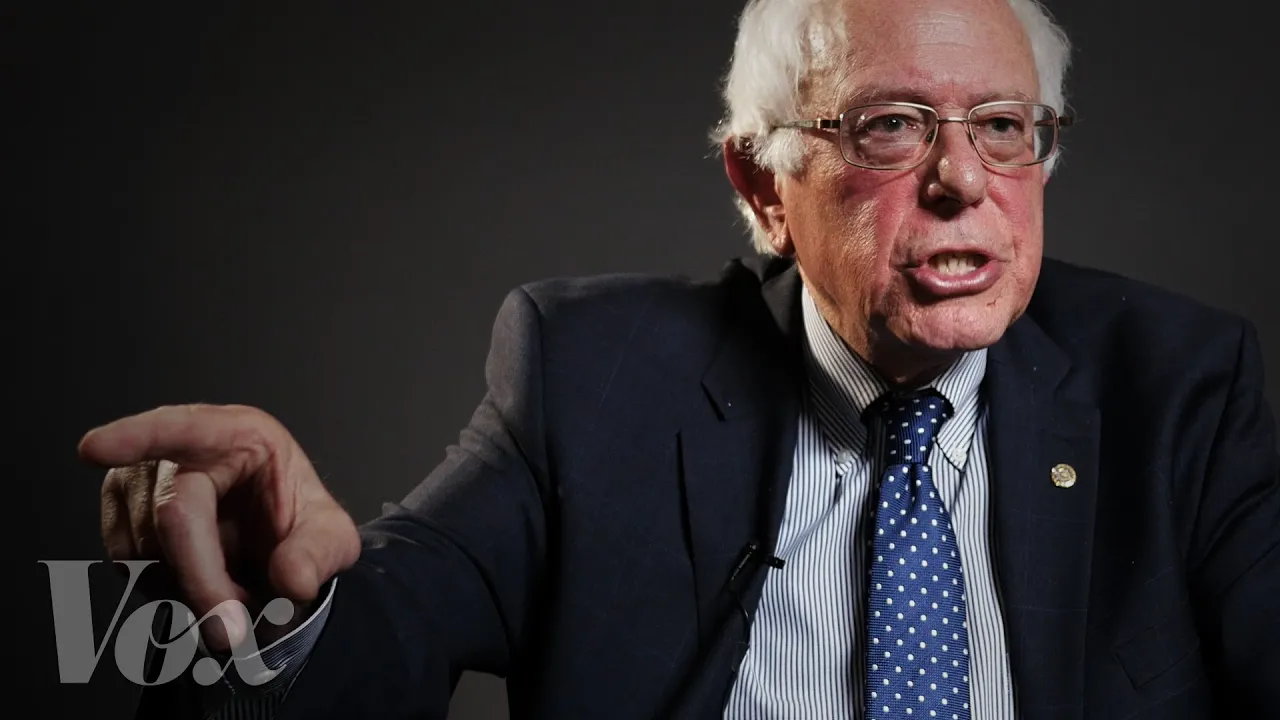
Vox
Opening borders would dissolve the nation-state and impoverish American workers by flooding the labor market with cheap labor rather than solving global poverty abroad, Sanders says.
AI-assisted summary of Bernie Sanders: "Open borders? That's a Koch brothers proposal" — original source. Check the original for full context.
Source published:
Key ideas
- Bernie Sanders rejects open borders as a right-wing policy favored by the Koch brothers that would dissolve the nation-state and depress wages for American workers. (0:03)
- Sanders highlights stark domestic youth unemployment—51% among African American, 36% Hispanic, and 33% white high school graduates—to argue against importing low-wage labor. (0:03)
- Sanders argues that assisting the global poor must happen via international reforms through bodies like the IMF, not by lowering living standards for domestic workers. (1:42)
- Sanders's domestic priorities focus on tuition-free public higher education, infrastructure investment, raising the minimum wage to $15 an hour, and taxing the wealthy. (1:42)
Detailed notes
## Background Published on YouTube by Vox on July 29, 2015, this video excerpt captures an interview between Vox Editor-in-chief Ezra Klein and Senator Bernie Sanders discussing global poverty and immigration policy.
## TL;DR When Ezra Klein asks whether an internationalist democratic socialist perspective might support drastic immigration increases or open borders to combat global poverty, Bernie Sanders firmly rejects the idea as a Koch brothers proposal that would dismantle the nation-state and suppress American wages. Sanders highlights high domestic youth unemployment and maintains that sovereign governments possess an essential duty to protect their own working class. While acknowledging a moral obligation to tackle extreme global inequality, Sanders argues the solution is to elevate living conditions, healthcare, and wages abroad through international institutions rather than degrading the standard of living for workers at home.
## Atmosphere & style The discussion carries a sharp, intense, and intellectually charged atmosphere as Klein's calm, utilitarian questioning collides with Sanders's vigorous labor-focused pushback. Sanders reacts with visible disbelief and impassioned conviction, rejecting cosmopolitan economic theories in favor of direct, protective solidarity with domestic workers. The dynamic feels like a brisk, focused ideological clash between intellectual internationalism and traditional working-class populism.
## Bulletin - [00:03](https://www.youtube.com/watch?v=vf-k6qOfXz0&t=3s) Bernie Sanders rejects open borders as a right-wing policy favored by the Koch brothers that would dissolve the nation-state and depress wages for American workers. - [00:03](https://www.youtube.com/watch?v=vf-k6qOfXz0&t=3s) Sanders highlights stark domestic youth unemployment—51% among African American, 36% Hispanic, and 33% white high school graduates—to argue against importing low-wage labor. - [01:42](https://www.youtube.com/watch?v=vf-k6qOfXz0&t=102s) Sanders argues that assisting the global poor must happen via international reforms through bodies like the IMF, not by lowering living standards for domestic workers. - [01:42](https://www.youtube.com/watch?v=vf-k6qOfXz0&t=102s) Sanders's domestic priorities focus on tuition-free public higher education, infrastructure investment, raising the minimum wage to $15 an hour, and taxing the wealthy.
## Key takeaways - [00:03](https://www.youtube.com/watch?v=vf-k6qOfXz0&t=3s) Sanders rejects the idea that a democratic socialist stance entails supporting open borders, calling the concept a 'Koch brothers proposal.' - [00:03](https://www.youtube.com/watch?v=vf-k6qOfXz0&t=3s) According to Sanders, open borders would effectively dismantle the nation-state, a concept no country in the world supports. - [00:03](https://www.youtube.com/watch?v=vf-k6qOfXz0&t=3s) Sanders asserts that business and conservative interests push for open borders to flood the market with cheap labor earning two to three dollars an hour. - [00:03](https://www.youtube.com/watch?v=vf-k6qOfXz0&t=3s) Sovereign nations such as the United States, Denmark, and the UK have a fundamental obligation to look out for their own poor. - [00:03](https://www.youtube.com/watch?v=vf-k6qOfXz0&t=3s) Sanders points to high youth unemployment rates—including 51% for African American high school graduates—as evidence that domestic youth need job opportunities first. - [00:03](https://www.youtube.com/watch?v=vf-k6qOfXz0&t=3s) Addressing global poverty through international collaboration is a moral obligation, but Sanders argues it must never come at the expense of American workers. - [01:42](https://www.youtube.com/watch?v=vf-k6qOfXz0&t=102s) Sanders states that an elected leader's primary duty remains anchored to representing their domestic constituents. - [01:42](https://www.youtube.com/watch?v=vf-k6qOfXz0&t=102s) To address domestic poverty, Sanders advocates for free public college tuition, infrastructure jobs, and a $15 federal minimum wage. - [01:42](https://www.youtube.com/watch?v=vf-k6qOfXz0&t=102s) Sanders condemns the fact that approximately 20 percent of American children live in poverty despite the country's vast overall wealth. - [01:42](https://www.youtube.com/watch?v=vf-k6qOfXz0&t=102s) The erosion of the American middle class is framed as the result of a 30-year wealth transfer to the top one-tenth of one percent. - [01:42](https://www.youtube.com/watch?v=vf-k6qOfXz0&t=102s) Global economic inequality has escalated to the point where the top 1 percent will soon hold more wealth than the bottom 99 percent combined. - [01:42](https://www.youtube.com/watch?v=vf-k6qOfXz0&t=102s) Sanders calls for using institutions like the IMF to foster sustainable jobs, healthcare, and education within developing nations rather than depressing wages in wealthy countries.
## Detailed walkthrough ### [00:03](https://www.youtube.com/watch?v=vf-k6qOfXz0&t=3s) Open Borders and the Nation-State Debate
Ezra Klein prompts Bernie Sanders by noting that identifying as a democratic socialist implies a broader, international perspective. Klein observes that taking global poverty seriously can push policymakers toward stances typically considered out of bounds in mainstream American politics, such as drastically increasing immigration levels or even embracing open borders. Sanders reacts with immediate disbelief and pushback, cutting in to challenge the premise: “Open borders? No, that's a Koch brothers proposal.” When Klein responds with surprise, Sanders insists that open borders is fundamentally a right-wing scheme built on the premise that the nation-state should cease to exist.
Klein attempts to argue that open borders would enrich the global poor, but Sanders firmly rejects the trade-off, contending that such an approach would devastate working Americans. Sanders argues that any sovereign nation—whether the United States, Denmark, or the United Kingdom—has a fundamental duty to protect its own poor. In his view, conservative interests push for completely open borders specifically to flood the labor market with low-wage labor earning two or three dollars an hour. Pointing to severe domestic youth unemployment, Sanders asks why anyone would import low-wage competition rather than focus on putting American kids to work. While acknowledging an international moral responsibility to address global poverty in cooperation with other industrialized countries, he insists that doing so must never come at the expense of American workers. As Bernie Sanders states: “It would make everybody in America poorer, you're doing away with the concept of a nation state and I don't think there's any country in the world which believes in that.”
- **Youth unemployment rates cited by Sanders:** - White high school graduates: 33% - Hispanic high school graduates: 36% - African American high school graduates: 51%
[01:42](https://www.youtube.com/watch?v=vf-k6qOfXz0&t=102s) Domestic Priorities versus Global Moral Obligations
Klein concedes that political reality requires working within the nation-state, but presses Sanders on the philosophical dilemma: given that someone living in poverty by American standards is relatively well-off compared to someone in a country like Malaysia, how should a leader weigh foreign aid and international poverty against domestic needs? Sanders replies that his core duty remains anchored to the people he represents. He outlines a direct domestic agenda: making public colleges and universities tuition-free, rebuilding crumbling infrastructure to create millions of jobs, raising the federal minimum wage to at least $15 an hour, and asking the wealthiest Americans to pay their fair share of taxes to eliminate the disgrace of roughly 20 percent of American children living in poverty.
Sanders frames this domestic crisis as the outcome of a massive 30-year redistribution of wealth from the middle class to the top one-tenth of one percent. At the same time, he recognizes that global wealth inequality has reached an equally staggering scale, noting that the top 1 percent would soon own more wealth than the bottom 99 percent combined. To solve this, Sanders argues for transforming the global economy through institutions like the International Monetary Fund (IMF), fostering living-wage jobs, education, healthcare, and nutrition directly inside developing nations. He rejects the notion that the only way to help poorer nations is by further eroding the domestic standard of living: “That is a moral responsibility, but you don't do that as some would suggest, by lowering the standard of American workers which has already gone down very significantly.”
## Notable quotes > [00:03](https://www.youtube.com/watch?v=vf-k6qOfXz0&t=3s) Open borders? No, that's a Koch brothers proposal. — Bernie Sanders
## Mentioned Bernie Sanders, Ezra Klein, Dylan Matthews, Koch brothers, Vox, International Monetary Fund (IMF), Denmark, United Kingdom, Malaysia
## Video description Bernie Sanders speaks with Vox Editor-in-chief Ezra Klein about global poverty. For the rest of the conversation: https://www.youtube.com/watch?v=S5vOKKMipSA And for Vox's Dylan Matthews' take on this section of the interview: http://www.vox.com/2015/7/29/9048401/bernie-sanders-open-borders
Subscribe to our channel! http://goo.gl/0bsAjO
Vox.com is a news website that helps you cut through the noise and understand what's really driving the events in the headlines. Check out http://www.vox.com to get up to speed on everything from Kurdistan to the Kim Kardashian app.
Check out our full video catalog: http://goo.gl/IZONyE Follow Vox on Twitter: http://goo.gl/XFrZ5H Or on Facebook: http://goo.gl/U2g06o
[Source](https://www.youtube.com/watch?v=vf-k6qOfXz0)