Sir Arnold Rejects Political Drive to Act as Flawed Syllogism
TrabiRobert
Sir Arnold argues that political pressure compels officials to execute flawed measures merely to appear active, concluding that doing anything is worse than doing nothing.
AI-assisted summary of A politicians logic — original source. Check the original for full context.
Source published:
Key ideas
- Sir Arnold illustrates political decision-making through a classic formal fallacy: 'All cats have four legs, my dog has four legs, therefore my dog is a cat.' (0:00)
- 'Politicians' logic' is formulated as a flawed syllogism: 'Something must be done, this is something, therefore we must do it.' (0:00)
- The compulsive need for visible activity leads officials to endorse inappropriate interventions simply because they constitute action rather than inaction. (0:00)
- The civil service perspective takes skepticism of intervention to an extreme, asserting that doing anything at all is worse than doing nothing. (0:00)
Detailed notes
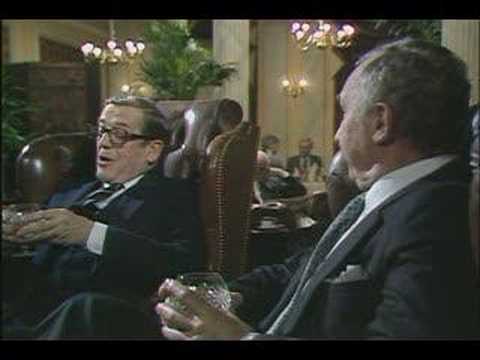
## Background Published on YouTube by channel TrabiRobert on March 15, 2008, this brief clip captures a classic exchange from the British political satire Yes, Minister/Yes, Prime Minister. According to the description, the scene features senior civil servants Sir Arnold and Sir Humphrey discussing logic.
## TL;DR Sir Arnold breaks down the flawed reasoning that frequently guides government decision-makers by comparing it to an elementary logical fallacy about cats and dogs. He diagnoses this as 'politician's logic,' where the premise that 'something must be done' and 'this is something' inevitably leads to the conclusion that 'we must do it.' The conversation ultimately subverts the political urge for constant activity, culminating in the bureaucratic conviction that doing anything is often worse than doing nothing at all.
## Atmosphere & style The scene exudes dry, razor-sharp British wit and urbane administrative cynicism. Watching the exchange feels like listening to two seasoned mandarins coolly dissect political absurdity with effortless intellectual superiority and deadpan precision. The brief dialogue transitions smoothly from mock-philosophical analysis to a delightfully subversive critique of proactive governance.
## Bulletin - [00:00](https://www.youtube.com/watch?v=vidzkYnaf6Y&t=0s) Sir Arnold illustrates political decision-making through a classic formal fallacy: 'All cats have four legs, my dog has four legs, therefore my dog is a cat.' - [00:00](https://www.youtube.com/watch?v=vidzkYnaf6Y&t=0s) 'Politicians' logic' is formulated as a flawed syllogism: 'Something must be done, this is something, therefore we must do it.' - [00:00](https://www.youtube.com/watch?v=vidzkYnaf6Y&t=0s) The compulsive need for visible activity leads officials to endorse inappropriate interventions simply because they constitute action rather than inaction. - [00:00](https://www.youtube.com/watch?v=vidzkYnaf6Y&t=0s) The civil service perspective takes skepticism of intervention to an extreme, asserting that doing anything at all is worse than doing nothing.
## Key takeaways - [00:00](https://www.youtube.com/watch?v=vidzkYnaf6Y&t=0s) Sir Arnold diagnoses political decision-making as frequently driven by an elementary formal fallacy. - [00:00](https://www.youtube.com/watch?v=vidzkYnaf6Y&t=0s) The classic syllogism cited is: all cats have four legs, my dog has four legs, therefore my dog is a cat. - [00:00](https://www.youtube.com/watch?v=vidzkYnaf6Y&t=0s) The reasoning demonstrates the fallacy of the undistributed middle by equating two disparate things based on a shared general property. - [00:00](https://www.youtube.com/watch?v=vidzkYnaf6Y&t=0s) Sir Arnold terms this flawed pattern of governance thinking 'politicians' logic.' - [00:00](https://www.youtube.com/watch?v=vidzkYnaf6Y&t=0s) The political syllogism begins with the broad imperative that 'something must be done.' - [00:00](https://www.youtube.com/watch?v=vidzkYnaf6Y&t=0s) The minor premise merely establishes that a given proposal qualifies as 'something.' - [00:00](https://www.youtube.com/watch?v=vidzkYnaf6Y&t=0s) The flawed political conclusion asserts that the proposed action must therefore be implemented. - [00:00](https://www.youtube.com/watch?v=vidzkYnaf6Y&t=0s) This reasoning erroneously equates any available intervention with the appropriate solution. - [00:00](https://www.youtube.com/watch?v=vidzkYnaf6Y&t=0s) A compulsive desire for action displaces deliberation, prompting officials to back completely inappropriate measures. - [00:00](https://www.youtube.com/watch?v=vidzkYnaf6Y&t=0s) A standard caution against this mindset notes that doing the wrong thing is worse than doing nothing. - [00:00](https://www.youtube.com/watch?v=vidzkYnaf6Y&t=0s) Sir Humphrey and Sir Arnold advance a more cynical administrative maxim: 'doing anything is worse than doing nothing.' - [00:00](https://www.youtube.com/watch?v=vidzkYnaf6Y&t=0s) The exchange underscores entrenched civil service skepticism toward reactive political problem-solving.
## Detailed walkthrough ### [00:00](https://www.youtube.com/watch?v=vidzkYnaf6Y&t=0s) Politician’s Logic and the Syllogism of Action
Sir Arnold and Sir Humphrey dissect the flawed reasoning that frequently drives political decision-making, comparing it directly to an elementary formal fallacy. Sir Arnold lays out the classic erroneous syllogism to illustrate how political thinking goes astray: “It's the old logical fallacy: all cats have four legs, my dog has four legs, therefore my dog is a cat.”
He explains that this exact brand of reasoning underpins what he diagnoses as a common political ailment: “He's suffering from politicians' logic: something must be done, this is something, therefore we must do it.” This compulsive need for activity over deliberation leads officials to champion completely inappropriate measures simply because they constitute action. When the counterargument is raised that “doing the wrong thing is worse than doing nothing,” the civil service perspective takes the skepticism even further, delivering the sharp conclusion that “doing anything is worse than doing nothing.”
```mermaid flowchart TD accTitle: The Politician's Logic Syllogism accDescr: Diagram illustrating the parallel between the classic four-legged animal fallacy and the politician's logic syllogism.
subgraph CatFallacy["Logical Fallacy"] A1["Premise 1: All cats have four legs"] A2["Premise 2: My dog has four legs"] A3["Conclusion: Therefore, my dog is a cat"] A1 --> A3 A2 --> A3 end
subgraph PoliticianLogic["Politician's Logic"] B1["Premise 1: Something must be done"] B2["Premise 2: This is something"] B3["Conclusion: Therefore, we must do it"] B1 --> B3 B2 --> B3 end ```
- **The Fallacy of the Undistributed Middle**: Equating a specific course of action with an obligatory solution merely because both belong to the broad category of "doing something." - **Administrative Cynicism**: The civil service view that rushed political interventions do more harm than good, culminating in the maxim that doing anything at all is worse than remaining inactive.
## Notable quotes > [00:00](https://www.youtube.com/watch?v=vidzkYnaf6Y&t=0s) He's suffering from politicians' logic: something must be done, this is something, therefore we must do it. — Sir Arnold
## Mentioned Sir Arnold, Sir Humphrey
## Video description Sir Arnold and Sir Humphrey discuss logic.
[Source](https://www.youtube.com/watch?v=vidzkYnaf6Y)