Cordyceps Fungus Drugs Insect Brains to Annihilate Ant Colonies
National Geographic
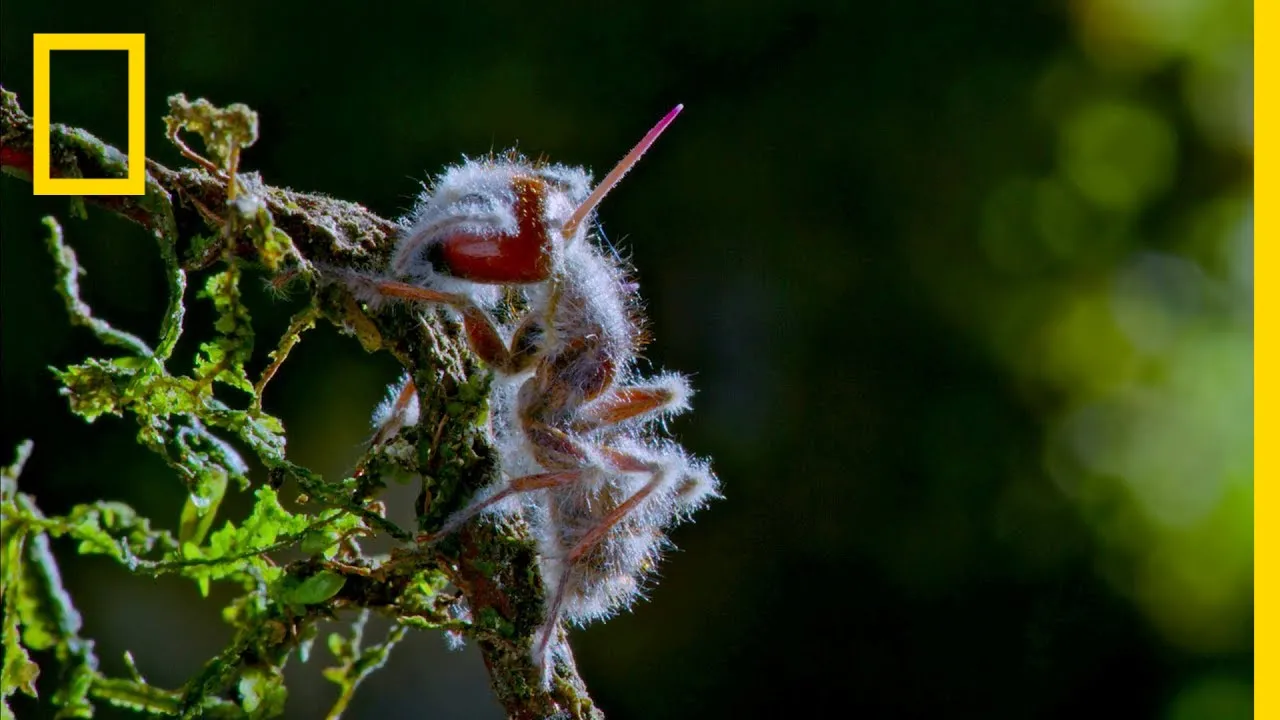
The parasitic fungus overrides host nervous systems with behavior-altering chemicals to compel a terminal death bite, creating fruiting platforms that can eradicate entire nests.
AI-assisted summary of 'Zombie' Parasite Cordyceps Fungus Takes Over Insects Through Mind Control | National Geographic — original source. Check the original for full context.
Source published:
Key ideas
- Cordyceps fungi infect living insects by infiltrating muscle tissue and releasing behavior-altering chemicals into the brain to commandeer the host's central nervous system. (0:01)
- Infected ants are chemically driven to specific microclimates with optimal sunlight and humidity before executing an inescapable terminal 'death bite' onto vegetation. (0:01)
- Following a three-week growth period inside the host, a fruiting fungal structure erupts through the carcass to release airborne spores capable of wiping out entire ant colonies. (2:09)
- Over 600 distinct species of Cordyceps have been cataloged globally, primarily concentrated in tropical jungles and adapted to prey on diverse arthropod hosts. (2:09)
Detailed notes
## Background Published on YouTube by National Geographic on April 30, 2019, this short documentary clip highlights the harrowing lifecycle of the parasitic cordyceps fungus. According to the video description, the specialized parasite infects ants and other insects in the Amazon jungle to reproduce and propagate.
## TL;DR While most forest fungi scavenge decaying organic matter, the parasitic cordyceps fungus targets living prey by landing spores directly onto healthy insects like ants. The fungus invades the host's muscle tissue and floods its central nervous system with chemicals, compelling the drugged ant to find an ideal microclimate of humidity and light before locking its jaws into a fatal 'death bite.' Over the course of three weeks, the fungus digests the insect from the inside out and sprouts a fruiting body to shower new spores onto the surrounding area. With over 600 cataloged species worldwide, particularly in tropical rainforests, cordyceps poses an existential threat capable of annihilating entire insect colonies.
## Atmosphere & style The presentation evokes the chilling, uncanny horror of a science-fiction thriller grounded entirely in natural biology. With deliberate, ominous narration detailing chemical hijacking and inescapable physical doom, the video cultivates an atmosphere of quiet dread. Watching the ant lose all autonomy and clamp down in its final death grip feels intensely macabre, underscored by the compounding horror of fruiting bodies bursting through insect corpses.
## Bulletin - [00:01](https://www.youtube.com/watch?v=vijGdWn5-h8&t=1s) Cordyceps fungi infect living insects by infiltrating muscle tissue and releasing behavior-altering chemicals into the brain to commandeer the host's central nervous system. - [00:01](https://www.youtube.com/watch?v=vijGdWn5-h8&t=1s) Infected ants are chemically driven to specific microclimates with optimal sunlight and humidity before executing an inescapable terminal 'death bite' onto vegetation. - [02:09](https://www.youtube.com/watch?v=vijGdWn5-h8&t=129s) Following a three-week growth period inside the host, a fruiting fungal structure erupts through the carcass to release airborne spores capable of wiping out entire ant colonies. - [02:09](https://www.youtube.com/watch?v=vijGdWn5-h8&t=129s) Over 600 distinct species of Cordyceps have been cataloged globally, primarily concentrated in tropical jungles and adapted to prey on diverse arthropod hosts.
## Key takeaways - [00:01](https://www.youtube.com/watch?v=vijGdWn5-h8&t=1s) Forest floor fungi and slime molds operate at extreme reproductive speeds, with some species discharging up to 30,000 spores per second. - [00:01](https://www.youtube.com/watch?v=vijGdWn5-h8&t=1s) While most fungi function strictly as scavengers breaking down decaying matter, Cordyceps targets living hosts. - [00:01](https://www.youtube.com/watch?v=vijGdWn5-h8&t=1s) Infection begins with a single microscopic spore landing on an insect's exterior. - [00:01](https://www.youtube.com/watch?v=vijGdWn5-h8&t=1s) Cordyceps develops an extensive root network that penetrates directly into the host ant's muscle tissue. - [00:01](https://www.youtube.com/watch?v=vijGdWn5-h8&t=1s) The parasite overrides the insect's central nervous system by flooding its brain with behavior-altering chemicals. - [00:01](https://www.youtube.com/watch?v=vijGdWn5-h8&t=1s) Mind control forces the host to navigate away from normal routines toward microclimates with precise light and moisture levels suited for fungal development. - [00:01](https://www.youtube.com/watch?v=vijGdWn5-h8&t=1s) The final stage of host manipulation compels the ant to clamp down on vegetation in a permanent death bite. - [02:09](https://www.youtube.com/watch?v=vijGdWn5-h8&t=129s) Once the host is immobilized, the fungus digests the insect internally over an incubation period lasting roughly three weeks. - [02:09](https://www.youtube.com/watch?v=vijGdWn5-h8&t=129s) A mature fruiting body bursts out of the dead insect to disperse infectious spores downward onto the forest floor. - [02:09](https://www.youtube.com/watch?v=vijGdWn5-h8&t=129s) Due to the crowded social nature of ant colonies, Cordyceps outbreaks can spread aggressively and exterminate entire populations. - [02:09](https://www.youtube.com/watch?v=vijGdWn5-h8&t=129s) Scientists have cataloged over 600 unique species of Cordyceps adapted to different insect and arthropod hosts worldwide. - [02:09](https://www.youtube.com/watch?v=vijGdWn5-h8&t=129s) Tropical rainforests and jungles host the highest biodiversity and concentration of mind-controlling Cordyceps species.
## Detailed walkthrough ### [00:01](https://www.youtube.com/watch?v=vijGdWn5-h8&t=1s) Spores of the Forest Floor and the Takeover of an Ant
Across the forest floor, fungi and slime molds wage a relentless race to break down decaying organic matter. Many of these organisms propagate through explosive spore dispersal, capable of launching up to thirty thousand spores every single second. Under the right conditions, a solitary spore needs only to find the proper landing spot and take root to colonize an entirely new stretch of terrain. However, while most fungi serve the ecosystem as scavengers feeding strictly on the dead, others pursue living prey through sinister biological adaptations.
The nightmare begins inconspicuously when a microscopic spore lands on a healthy ant. Days later, the insect begins exhibiting erratic, unusual behavior as the parasite establishes dominance. Rather than remaining on the surface, a dense network of fungal roots penetrates deep into the ant's muscle tissue, while the invader—identified as *Cordyceps*, a specialized parasitic fungus—hijacks the host's central nervous system. Flooding the insect's brain with behavior-altering chemicals, the fungus essentially drugs its victim, stripping the ant of its autonomy and compelling it to navigate toward a microclimate specifically tailored to fungal growth, marked by exact levels of sunlight and humidity. Once positioned precisely where the parasite can thrive, the fungus commands a final, fatal action: the ant is driven to lock its mandibles onto vegetation in an inescapable grip. As the narrator observes, “It forces her to clamp down in a death bite.”
```mermaid flowchart TD accTitle: Cordyceps Infection and Manipulation Cycle accDescr: Step-by-step process of Cordyceps fungus taking over an ant host from spore landing to death bite and propagation. subgraph Takeover["Infiltration & Control"] A["Spore Lands on Ant"] --> B["Fungal Roots Infiltrate Muscles"] B --> C["Chemicals Flood Brain & Hijack Behavior"] end subgraph Manipulation["Microclimate Seeking & Death"] C --> D["Host Driven to Ideal Light & Humidity"] D --> E["Ant Executes Terminal 'Death Bite'"] end subgraph Propagation["Fruiting & Dispersal"] E --> F["Three Weeks of Fungal Growth"] F --> G["Spore Body Erupts & Releases Spores"] G -->|"Infects Neighboring Insects"| A end ```
- Fungal organisms on the forest floor can discharge as many as 30,000 spores per second. - The parasitic *Cordyceps* infiltrates the host's muscle tissue with root networks while chemically overriding its brain. - The host is guided to precise environmental parameters—specifically calibrated light and moisture—before locking its jaws into a terminal death grip.
---
[02:09](https://www.youtube.com/watch?v=vijGdWn5-h8&t=129s) The Gruesome Bloom and Global Reach of Cordyceps
With the ant immobilized in its death bite, the true horror of *Cordyceps* unfolds. The fungus consumes the host from the inside out, using the carcass as both an anchor and a nutrient reservoir. After roughly three weeks of uninterrupted development, the fungus punches through the dead insect's body to produce a fruiting structure capable of casting a new cloud of infectious spores downward. The narrator emphasizes the rapid, compounding horror of this reproductive cycle: “Infecting more ants. Releasing more spores. Infecting more ants.”
Because ants live in densely populated, highly social societies, an outbreak of this airborne pathogen can be devastating. As the narrator warns, “Cordyceps can wipe out entire ant colonies.” Yet ants are far from the only victims vulnerable to this specialized family of parasites. Scientists have cataloged over six hundred distinct species of *Cordyceps* distributed across the globe. Concentrated most heavily in tropical rainforests and jungles, these specialized fungi have diversified to prey upon a staggering variety of insects and other arthropods, turning the jungle canopy into a high-stakes gauntlet of mind-controlling parasites.
- Fruiting bodies mature over an incubation period of approximately three weeks before discharging infectious spores onto the surrounding area. - Unchecked transmission has the potential to completely annihilate entire ant colonies due to high nestmate proximity. - More than 600 species of *Cordyceps* exist worldwide, with the vast majority inhabiting tropical jungles where they exploit distinct arthropod hosts.
## Notable quotes > [02:09](https://www.youtube.com/watch?v=vijGdWn5-h8&t=129s) Cordyceps can wipe out entire ant colonies. — Narrator
## Mentioned National Geographic, Hostile Planet, Cordyceps, Amazon jungle
## Video description Deep in the Amazon jungle, a parasitic fungus called cordyceps infect ants and other insects in order to reproduce. ➡ Subscribe: https://on.natgeo.com/4p5A0D6
#NationalGeographic #Zombies #Cordyceps
About National Geographic: National Geographic is the world's premium destination for science, exploration, and adventure. Through their world-class scientists, photographers, journalists, and filmmakers, Nat Geo gets you closer to the stories that matter and past the edge of what's possible.
Get More National Geographic: Official Site: https://nationalgeographic.com Instagram: https://instagram.com/natgeo Facebook: https://facebook.com/natgeo Threads: https://threads.com/@natgeo X: https://x.com/NatGeo LinkedIn: https://linkedin.com/company/national-geographic TikTok: https://tiktok.com/@natgeo Reddit: https://reddit.com/user/nationalgeographic Pinterest: https://pinterest.com/natgeo
Visit our planet's most extreme environments and get an up-close look at the animals that survive there. Watch Hostile Planet on National Geographic.
Read more in "How a parasitic fungus turns ants into 'zombies'" https://on.natgeo.com/2IFsAEU
'Zombie' Parasite Takes Over Insects Through Mind Control | National Geographic https://youtu.be/vijGdWn5-h8
National Geographic https://www.youtube.com/natgeo
[Source](https://www.youtube.com/watch?v=vijGdWn5-h8)