UK Tests Direct-Dial Mobile Handset as Spectrum Row Stalls Domestic Use
BBC
Regulatory deadlock between the Post Office and the Home Office over radio spectrum risks forcing Britain's pioneering direct-dial mobile phone technology abroad before domestic users can benefit.
AI-assisted summary of Tomorrow's World: Mobile Phone 13 September 1979 - BBC — original source. Check the original for full context.
Source published:
Key ideas
- In 1979, BBC's Tomorrow's World demonstrated a British cordless prototype capable of direct dialing without routing through a Post Office operator. (1:07)
- The prototype utilized digital packet bursts with warning headers to transmit dialed digits reliably over radio despite vehicle ignition and power line interference. (2:51)
- To conserve scarce radio spectrum, the mobile unit incorporated an automated 20-second dialing timeout and a hard 3-minute call cutoff. (2:51)
- Regulatory deadlock between the Post Office and the Home Office over spectrum allocation stalled domestic adoption, threatening to push British innovation strictly to export markets. (2:51)
Detailed notes
## Background Published on YouTube by the BBC channel on January 7, 2010, from the Tomorrow's World archives (originally broadcast September 13, 1979), this video showcases presenter Michael Rodd testing a British prototype for an experimental cordless mobile phone. The program explores direct-dial mobile technology allowing calls from anywhere, concluding with an archival outtake where Rodd accidentally dials a real subscriber's number.
## TL;DR Presenter Michael Rodd demonstrates an experimental British mobile telephone prototype capable of direct dialing into the public network without needing an intermediary Post Office operator. Broadcasting from Danbury Park, Rodd connects a live seven-mile call directly to an office in Chelmsford to show off the system's digital pulse signaling and clear-down capabilities. He explains how packeted data bursts and tight transmission gating prevent interference from vehicle ignitions and power lines while enforcing strict spectrum conservation limits. Despite the technological milestone, Rodd highlights an administrative deadlock between the Home Office and the Post Office over spectrum allocation that threatens UK commercialization, before the segment concludes with lighthearted outtakes featuring an accidental wrong number.
## Atmosphere & style The presentation embodies the crisp, theatrical charm of classic late-1970s British science broadcasting, opening with an elaborate deadpan sketch before pivoting to an earnest outdoor field demonstration. Rodd exudes calm authority and palpable enthusiasm as he operates the bulky handset, creating a sense of wonder around an everyday act that felt miraculous at the time. A subtle undercurrent of journalistic frustration surfaces when discussing bureaucratic inertia, which softens into warm, self-effacing humor during the candid outtakes.
## Bulletin - [01:07](https://www.youtube.com/watch?v=vix6TMnj9vY&t=67s) In 1979, BBC's Tomorrow's World demonstrated a British cordless prototype capable of direct dialing without routing through a Post Office operator. - [02:51](https://www.youtube.com/watch?v=vix6TMnj9vY&t=171s) The prototype utilized digital packet bursts with warning headers to transmit dialed digits reliably over radio despite vehicle ignition and power line interference. - [02:51](https://www.youtube.com/watch?v=vix6TMnj9vY&t=171s) To conserve scarce radio spectrum, the mobile unit incorporated an automated 20-second dialing timeout and a hard 3-minute call cutoff. - [02:51](https://www.youtube.com/watch?v=vix6TMnj9vY&t=171s) Regulatory deadlock between the Post Office and the Home Office over spectrum allocation stalled domestic adoption, threatening to push British innovation strictly to export markets.
## Key takeaways - [00:01](https://www.youtube.com/watch?v=vix6TMnj9vY&t=1s) Michael Rodd demonstrated an experimental cordless handset prototype interfaced directly with a standard telephone network. - [01:07](https://www.youtube.com/watch?v=vix6TMnj9vY&t=67s) Approved UK mobile communications in 1979 were limited to two-way radio transmitter-receivers dependent on manual Post Office switchboard operators. - [01:07](https://www.youtube.com/watch?v=vix6TMnj9vY&t=67s) The prototype allowed direct dialing, giving users an immediate dial tone to key destination numbers autonomously. - [01:07](https://www.youtube.com/watch?v=vix6TMnj9vY&t=67s) A live field test established a clear connection between Danbury Park and a research institute office in Chelmsford roughly seven miles away. - [01:07](https://www.youtube.com/watch?v=vix6TMnj9vY&t=67s) Broadcasting precise digital pulses across radio frequencies presented far greater engineering hurdles than transmitting analogue voice. - [02:51](https://www.youtube.com/watch?v=vix6TMnj9vY&t=171s) The handset emitted a distinct clear-down tone upon hanging up to inform the base network that transmission had ceased. - [02:51](https://www.youtube.com/watch?v=vix6TMnj9vY&t=171s) Dialed digits were packaged into discrete data bursts preceded by digital warning headers to shield against corruption. - [02:51](https://www.youtube.com/watch?v=vix6TMnj9vY&t=171s) Rapid gating of transmission bandwidth protected the telephone exchange from electrical interference produced by car ignitions and overhead power lines. - [02:51](https://www.youtube.com/watch?v=vix6TMnj9vY&t=171s) The system featured automated error detection, signaling callers to hang up and redial if interference garbled the digits. - [02:51](https://www.youtube.com/watch?v=vix6TMnj9vY&t=171s) Strict transmission limits were enforced to preserve airwaves, including a 20-second dialing limit and an automatic 3-minute call termination. - [02:51](https://www.youtube.com/watch?v=vix6TMnj9vY&t=171s) A regulatory standoff between the Home Office and the Post Office over spectrum allocation hindered domestic deployment. - [02:51](https://www.youtube.com/watch?v=vix6TMnj9vY&t=171s) Presenter Michael Rodd warned that foreign export markets would likely reap the benefits of British cordless mobile tech before local consumers. - [05:09](https://www.youtube.com/watch?v=vix6TMnj9vY&t=309s) Archival outtakes documented an inadvertent connection to a live subscriber, capturing one of the earliest accidental wrong numbers on a mobile prototype.
## Detailed walkthrough ### [00:01](https://www.youtube.com/watch?v=vix6TMnj9vY&t=1s) The Puzzling Search for Missing Papers
The presentation opens with a rambling monologue as Michael Rodd appears to pace around an office in the middle of a phone conversation. Speaking into the handset, he thanks the party on the line for their patience while he rummages around attempting to track down an elusive set of documents. He suggests they might be across the other side of the room, or perhaps borrowed by a colleague down the corridor who had shown interest in a prior discussion. Conceding that neither spot holds the files, he speculates they are probably sitting outside in his vehicle, asking his interlocutor to hold on while he steps out to check.
Eventually acknowledging defeat, he admits the papers are nowhere to be found and must have been lost somewhere between his home and the workplace. He asks, “So where does all that leave us?” before breaking the illusion to reveal that viewers have been listening to a recording of an experimental direct linkup between a standard telephone line and an advanced cordless handset prototype.
[01:07](https://www.youtube.com/watch?v=vix6TMnj9vY&t=67s) Direct Dialing from Danbury Park to Chelmsford
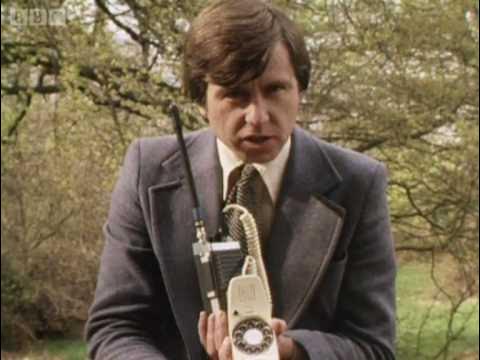
Stepping out from behind the pre-recorded demonstration, Michael Rodd explains that this experimental mobile unit is far removed from the radio phones available to the British public in 1979. He notes that under the strict supervision of Home Office regulations, approved UK mobile equipment is essentially limited to transmitter-receivers requiring an intermediary: “At the moment in the UK, approved mobile phones are really little more than transmitter receivers, which put the caller in touch with a post office operator who dials up the number you want and then connects your remote radio extension with the rest of the telephone network.”
By contrast, the prototype in his hand allows the user to obtain a dial tone and key in the destination number directly. Emphasizing how difficult it is to transmit accurate digital pulses over radio compared to voice, Rodd demonstrates the device live on location at Danbury Park. He keys an extension at a research institute based in Chelmsford that helped perfect the technique.
A staff member named Liz answers directly from her office on campus. Rodd checks the distance, and she confirms he is calling from roughly seven miles away. Rodd emphasizes that the exchange is being broadcast live rather than staged, noting, “We didn't cheat this one, did we?” to which Liz confirms, “Certainly not.” Upon concluding the call, Rodd hangs up, producing a clear audible tone signaling that the transmission has dropped.
```mermaid flowchart LR accTitle: Cordless Phone Prototype Call Flow accDescr: Flow diagram showing direct dialing transmission from handset across radio link to exchange and final campus receiver.
subgraph Field["Danbury Park"] A["Mobile Handset<br>(Direct Keypad Dial)"] B["Digital Signal<br>Packet Generator"] end
subgraph Wireless["Radio Transmission Link"] C["Gated RF Bandwidth<br>(7-Mile Path)"] end
subgraph Network["Chelmsford Infrastructure"] D["Base Receiver /<br>Telephone Exchange"] E["Research Institute Office<br>(Liz Charnley)"] end
A --> B B -->|"Digital pulses & header"| C C -->|"Minimizes interference"| D D -->|"Cleardown & voice path"| E ```
[02:51](https://www.youtube.com/watch?v=vix6TMnj9vY&t=171s) Packet Transmission and Regulatory Impasse
Rodd explains that the tone at the end of the call is a clear-down signal informing the network that the handset has gone off the air, a feature impossible with traditional analogue radio transmitters. To prevent radio crackle from corrupting numbers, the handset wraps each dialed digit into a burst:
- **Digital Header & Packets:** Every pulse is preceded by a digital warning signal indicating incoming data; the system opens and closes the transmission bandwidth just long enough for each discrete information packet to pass through. - **Interference Rejection:** This rapid gating shields the exchange from being misled by extraneous electrical noise, such as crackle from high-voltage overhead pylons or ignition interference from passing cars. - **Error Detection:** If dialed information is scrambled, an error tone prompts the caller to clear the line and restart. - **Spectrum Conservation Timeouts:** The unit enforces a strict 20-second dialing timeout and automatically severs any call exceeding three minutes to preserve precious airwaves.
Despite the technical breakthrough, Rodd reveals that the project faces an administrative stalemate. While the Home Office permitted field testing, the Post Office remains reluctant to adopt or support private developments unless dedicated spectrum is guaranteed. The Home Office has refused to allocate those frequencies, prompting Rodd to warn: “So though British technology exists here and now for a true walkabout phone, the chances are very strong that it'll be our export customers who benefit long before we do.”
[05:09](https://www.youtube.com/watch?v=vix6TMnj9vY&t=309s) Outtakes: The First Mobile Wrong Number
The report closes with archival outtakes from the shoot. The first clip captures a humorous alternate take of Rodd’s phone search routine, where he answers an unexpected call, nervously stumbling over his lack of notes and deadpanning whether he can manage the conversation without the missing sheet of paper.
A second outtake—labeled "Slate 16, Take 5"—shows Rodd testing the dialing mechanism live in the field. After pressing digits into the keypad, he is visibly startled when a genuine subscriber answers on the line. Rodd remarks in surprise to the crew, “I've actually got somebody,” before politely clearing the air with the bewildered recipient: “Thank you for your help. This is a test on the radio network. I apologize for interrupting you. Over and out.” Chuckling at the mistake, he remarks, “Poor man. We'll try again,” immortalizing what may have been one of the earliest accidental wrong numbers dialed on a mobile prototype.
## Notable quotes > [02:51](https://www.youtube.com/watch?v=vix6TMnj9vY&t=171s) So though British technology exists here and now for a true walkabout phone, the chances are very strong that it'll be our export customers who benefit long before we do. — Michael Rodd
## Mentioned BBC, Tomorrow's World, Michael Rodd, Danbury Park, Chelmsford, Liz Charnley, Home Office, Post Office
## Video description Subscribe and 🔔 to the BBC 👉 https://bit.ly/BBCYouTubeSub Watch the BBC first on iPlayer 👉 https://bbc.in/iPlayer-Home From the BBC Archive 'Tomorrow's World' collection: http://www.bbc.co.uk/archive/tomorrowsworld/index.shtml Michael Rodd makes a call with an experimental cordless mobile phone. It's 1979 and time for the telephone to go mobile. In this report from a longer programme, Michael Rodd (pictured above) examines a British prototype for a cordless telephone that allows the user to make calls from anywhere. Also included at the end of this item is a rather nice out-take as Rodd also experiences the first mobile wrong number.
#bbc
[Source](https://www.youtube.com/watch?v=vix6TMnj9vY)