D'Andrea Flies Damaged Drones on Two Propellers Using Control Models
TED
Mathematical modeling and high-rate trajectory re-planning allow mechanically minimal drones to execute athletic maneuvers and survive catastrophic physical damage without redundant hardware.
AI-assisted summary of The astounding athletic power of quadcopters | Raffaello D'Andrea — original source. Check the original for full context.
Source published:
Key ideas
- Model-based control enables quadcopters to execute dynamic athletic tasks, including balancing inverted poles and carrying unconstrained glasses of water without spilling due to apparent gravity alignment. (4:37)
- Mathematical re-analysis demonstrates graceful degradation under catastrophic failure, allowing a quadcopter to hover stably on only two propellers by deliberately sacrificing yaw control and spinning continuously. (6:14)
- Maneuvers exceeding sensor feedback latency, such as a high-speed triple flip, can be mastered using iterative learning algorithms that update feedforward commands based on terminal error across successive trials. (7:52)
- High-rate trajectory re-planning running at 50 Hz allows multi-drone teams to coordinate complex cooperative tasks, such as catching and launching balls using an elastic net at extreme accelerations. (10:10)
Detailed notes
## Background Published on June 12, 2013, by the TED channel on YouTube, this talk features roboticist Raffaello D'Andrea presenting at TEDGlobal. According to the video description, D'Andrea demonstrates his flying quadcopters—autonomous robots designed to think like athletes by solving complex physical challenges through learning algorithms, interactive gesture control, and cooperative decision-making.
## TL;DR D'Andrea showcases the principles of machine athleticism through a series of live demonstrations using autonomous quadcopters in an indoor flight arena. Relying on mathematical differential equations, control theory, and high-speed motion capture rather than manual trial-and-error, the quads balance inverted poles, carry unspilled glasses of water, recover from catastrophic motor loss, and juggle balls with attached rackets. The presentation also highlights multi-drone cooperation via a shared elastic net and real-time physical and gestural interaction with humans. Concluding the talk, D'Andrea reflects on how playful, sports-inspired experimentation pushes machines to their physical limits and stresses that guiding the future societal impact of autonomous technology is a social responsibility rather than a technical choice.
## Atmosphere & style The presentation carries the electrifying energy of a live high-wire act, where cutting-edge robotics and mathematical rigor collide with physical theater. D'Andrea speaks with calm, academic clarity and infectious curiosity, steadily building anticipation as he unleashes acrobatic maneuvers that seem to defy intuition. Moments of gasping tension—such as disabling two propellers mid-air or frantically swatting at falling drones during an escalating gravity game—dissolve into audience laughter and awe, creating an inspiring and thought-provoking blend of rigorous control engineering, playful spectacle, and philosophical reflection on the human future of automation.
## Bulletin - [04:37](https://www.youtube.com/watch?v=w2itwFJCgFQ&t=277s) Model-based control enables quadcopters to execute dynamic athletic tasks, including balancing inverted poles and carrying unconstrained glasses of water without spilling due to apparent gravity alignment. - [06:14](https://www.youtube.com/watch?v=w2itwFJCgFQ&t=374s) Mathematical re-analysis demonstrates graceful degradation under catastrophic failure, allowing a quadcopter to hover stably on only two propellers by deliberately sacrificing yaw control and spinning continuously. - [07:52](https://www.youtube.com/watch?v=w2itwFJCgFQ&t=472s) Maneuvers exceeding sensor feedback latency, such as a high-speed triple flip, can be mastered using iterative learning algorithms that update feedforward commands based on terminal error across successive trials. - [10:10](https://www.youtube.com/watch?v=w2itwFJCgFQ&t=610s) High-rate trajectory re-planning running at 50 Hz allows multi-drone teams to coordinate complex cooperative tasks, such as catching and launching balls using an elastic net at extreme accelerations.
## Key takeaways - [00:23](https://www.youtube.com/watch?v=w2itwFJCgFQ&t=23s) Quadcopters achieve full directional agility and four degrees of control solely by modulating the rotation speeds of four fixed propellers, rendering them mechanically minimal but fundamentally reliant on continuous feedback control. - [00:23](https://www.youtube.com/watch?v=w2itwFJCgFQ&t=23s) Instead of trial-and-error tuning, model-based design captures physical flight dynamics through differential equations, enabling control theory to synthesize precise stabilization routines. - [02:29](https://www.youtube.com/watch?v=w2itwFJCgFQ&t=149s) A quadcopter can balance an inverted pole in mid-air and follow position wands simply by appending inverted pendulum dynamics to its existing mathematical flight model. - [04:37](https://www.youtube.com/watch?v=w2itwFJCgFQ&t=277s) Carrying an unconstrained glass of water without spilling requires zero software modifications because propeller thrust naturally aligns with the combined vector of gravity and lateral acceleration. - [06:14](https://www.youtube.com/watch?v=w2itwFJCgFQ&t=374s) Deep mathematical modeling permits graceful hardware degradation, proving that a quadcopter missing two opposing propellers can maintain roll, pitch, and altitude authority by spinning continuously along its vertical axis. - [07:52](https://www.youtube.com/watch?v=w2itwFJCgFQ&t=472s) High-speed aerobatic flips outpace localization feedback latency, requiring open-loop bursts combined with iterative learning algorithms that calibrate subsequent attempts from terminal position errors. - [08:51](https://www.youtube.com/watch?v=w2itwFJCgFQ&t=531s) Striking an incoming ball with a drone-mounted tennis racket relies on high-rate trajectory re-planning at 50 Hz, constantly updating interception plans every 20 milliseconds. - [10:10](https://www.youtube.com/watch?v=w2itwFJCgFQ&t=610s) Multi-agent coordination enables three quads to operate an elastic net cooperatively, catching and launching projectiles with peak accelerations roughly five times greater than a human bungee jumper rebound. - [11:16](https://www.youtube.com/watch?v=w2itwFJCgFQ&t=676s) Skeletal gesture tracking bridges human intent and machine athleticism, translating intuitive arm gestures directly into reference trajectories for flight controllers. - [12:36](https://www.youtube.com/watch?v=w2itwFJCgFQ&t=756s) Estimating external physical forces in real time enables synthetic physics, allowing drones to respond to human touch compliantly as if immersed in viscous fluid. - [13:36](https://www.youtube.com/watch?v=w2itwFJCgFQ&t=816s) Simulated games, such as altering artificial gravity parameters, mirror the biological role of play by providing a structured framework to stress-test algorithms at the vehicle's physical limits. - [15:13](https://www.youtube.com/watch?v=w2itwFJCgFQ&t=913s) Steering whether autonomous machine agility benefits humanity or is misused is fundamentally a societal and ethical choice rather than a technical one.
## Detailed walkthrough ### [00:23](https://www.youtube.com/watch?v=w2itwFJCgFQ&t=23s) Machine Athleticism and Model-Based Design
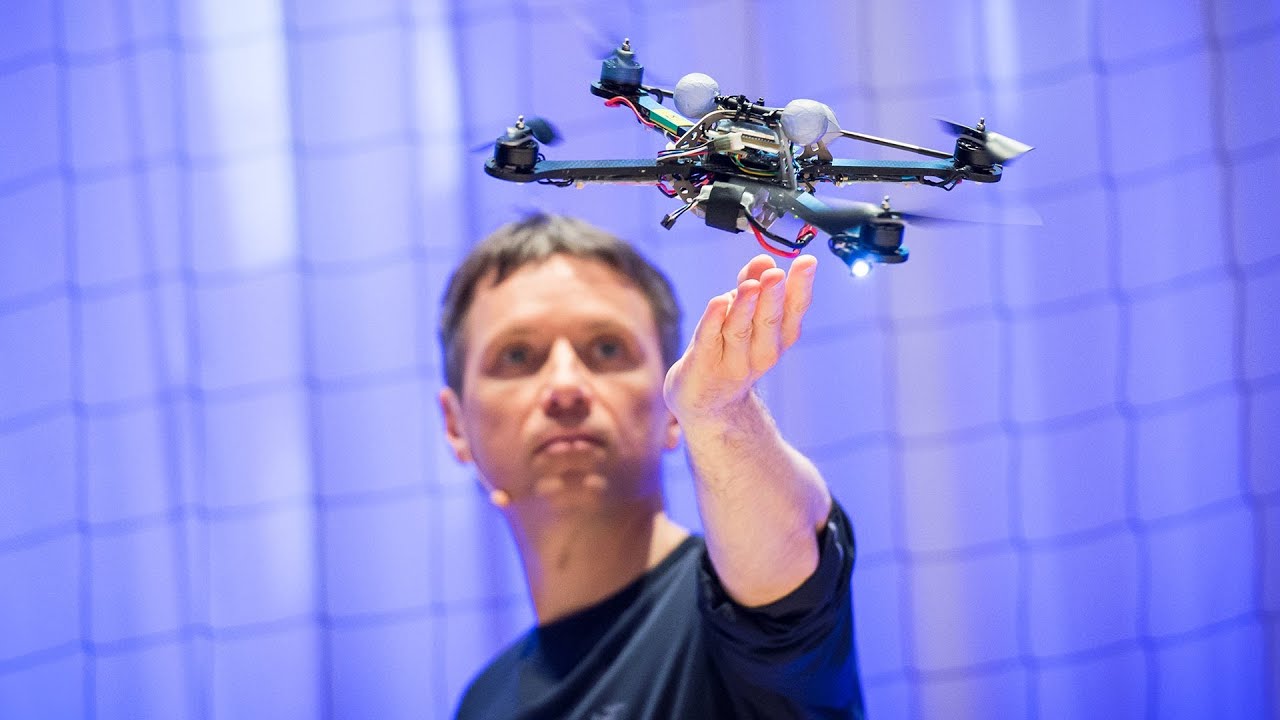
Raffaello D'Andrea introduces the flying quadrocopters—or “quads” for short—to explore what it truly means for a machine to exhibit athleticism. Although quadcopters have been around for a long time, their contemporary surge in popularity stems from their extreme mechanical simplicity: by merely adjusting the rotation speeds of four fixed propellers, the vehicles can roll, pitch, yaw, and accelerate along their orientation. Packed onto each frame are a battery, an onboard computer, wireless communication radios, and a suite of sensors. Yet this mechanical minimalism and high agility introduce a critical drawback: quadcopters are inherently unstable and cannot fly without continuous automatic feedback control.
To create an indoor equivalent of a global positioning system, D'Andrea's team installs overhead cameras connected to a laptop, tracking reflective markers attached to the quads and other objects across the flight arena. This spatial localization stream feeds into another computer running estimation and control algorithms, which wirelessly relays flight commands down to the quadcopter, which itself executes onboard estimation and control routines. For D'Andrea, the software architecture is the true core of the achievement: “The bulk of our research is algorithms.” He describes this computational layer as “the magic that brings these machines to life.”
To craft these athletic behaviors, the team relies on model-based design. Rather than guessing or relying on trial-and-error tuning, researchers first capture the physical dynamics of the craft using differential equations. They then apply control theory to analyze the system and synthesize stabilization routines. This mathematical foundation is what enables the machine to achieve even basic stationary hovering:
```mermaid flowchart TD accTitle: Indoor GPS and Quadcopter Control Architecture accDescr: Diagram illustrating the closed-loop tracking and control pipeline between overhead cameras, offboard laptops, and the quadcopter.
subgraph Sensing ["Vision & Localization"] A["Overhead Cameras"] --> B["Indoor GPS Laptop"] end
subgraph Computation ["Command & Control"] B -->|"Marker coordinates"| C["Estimation & Control Laptop"] C -->|"Radio control commands"| D["Onboard Flight Computer"] end
subgraph Execution ["Physical System"] D -->|"Motor speed adjustments"| E["Propellers & Frame"] E -.->|"Reflective markers tracked"| A end ```
- Quadcopters achieve four degrees of control—roll, pitch, yaw, and directional acceleration—solely by modulating the independent speeds of four fixed propellers. - Flight dynamics are represented mathematically through systems of differential equations before being manipulated via control theory.
[02:29](https://www.youtube.com/watch?v=w2itwFJCgFQ&t=149s) The Balancing Pole Demonstration
To demonstrate the power of model-based design, D'Andrea challenges a quadcopter to balance an inverted pole while hovering in mid-air. He points out that while a human can accomplish this with practice by leveraging two feet firmly planted on the ground and two versatile hands, the task becomes noticeably tougher on one foot without using hands. The quadcopter has neither feet nor hands, and it must balance the stick while sustaining its own flight. A single reflective marker on the tip of the pole allows the overhead camera system to track its position in 3D space.
When released, the quad rapidly executes minute horizontal adjustments underneath the pole, keeping it perfectly upright to the amazement of the audience. D'Andrea explains that designing the algorithm did not require starting from scratch; the engineers simply appended the mathematical model of the inverted pendulum to the existing model of the quadcopter. With the unified quad-pole dynamics formulated, control theory readily yielded stabilizing algorithms. The resulting system is remarkably robust: even when D'Andrea repeatedly swats the pole, the quad swiftly darts back underneath to restore equilibrium.
Extending the system's mathematics further, D'Andrea incorporates a target spatial coordinate into the model. Holding a wand equipped with reflective markers, he gestures across the stage, directing the quadcopter to maintain a fixed offset from the wand while balancing the stick. As he points around the stage, the machine smoothly tracks his movements without dropping the pole. Summarizing the core takeaway, D'Andrea emphasizes: “The key to these acrobatic maneuvers is algorithms, designed with the help of mathematical models and control theory.”
[04:37](https://www.youtube.com/watch?v=w2itwFJCgFQ&t=277s) Physical Insight: Carrying a Glass of Water
D'Andrea brings the quadcopter back, lets the pole fall away, and sets up a contrasting experiment to demonstrate why understanding physical principles is just as vital as mathematical modeling. He places a glass filled with water directly on top of the quadcopter's frame. The drone visibly drops a few inches in altitude under the added weight, yet unlike the balancing pole demo, D'Andrea reveals that he never modeled the glass or the liquid inside it. The flight software has no knowledge that the glass even exists.
Using his marker wand, D'Andrea directs the quad into rapid, sweeping maneuvers through the air. Despite sharp accelerations, not a single drop spills. He explains the straightforward physics at play: first, gravitational acceleration acts uniformly on every object; second, the quad's propellers produce thrust in the exact same upward direction perpendicular to the frame. Because the craft must tilt its entire body to accelerate laterally, the net apparent force vector remains directed straight down through the base of the glass, leaving horizontal shear forces dominated almost entirely by negligible aerodynamic drag.
The demonstration highlights a fundamental engineering distinction between apparent difficulty and physical reality. “The lesson here is that some high-performance tasks are easier than others, and that understanding the physics of the problem tells you which ones are easy and which ones are hard,” D'Andrea remarks, adding that while balancing an inverted pole requires complex modeling and rapid active feedback, carrying an unconstrained glass of water requires no special software at all.
[06:14](https://www.youtube.com/watch?v=w2itwFJCgFQ&t=374s) Graceful Degradation and Flying on Two Propellers
D'Andrea turns to the athletic ability to perform through physical injury, asking whether an aerial robot can continue operating after catastrophic damage. Conventional drone engineering dictates that a vehicle requires at least four fixed propeller-motor pairs to maintain four independent degrees of freedom: roll, pitch, yaw, and collective thrust acceleration. While hexacopters and octocopters provide mechanical redundancy through extra hardware, quadcopters are widely favored precisely because they represent the theoretical minimum configuration of four actuators.
To challenge this assumption, D'Andrea demonstrates a quadcopter that has had two opposing propellers disabled, prompting an audible reaction from the audience. Standard flight theory would declare the vehicle uncontrollable. However, by thoroughly re-analyzing the mathematical model of the damaged system, the researchers discovered an unconventional flight mode: by deliberately sacrificing yaw control and allowing the vehicle to spin continuously about its vertical axis, the remaining two propellers can still generate sufficient authority to control roll, pitch, and net vertical acceleration.
The spinning craft hovers stably in place, executing controlled motion without tumbling out of the sky. D'Andrea underscores the broader architectural lesson of this discovery: “Mathematical models tell us exactly when and why this is possible.” Rather than burdening vehicles with redundant motors, structural weight, and extra batteries, deep mathematical analysis allows engineers to write clever recovery algorithms that gracefully absorb hardware failures, mirroring the resilience of human athletes.
[07:52](https://www.youtube.com/watch?v=w2itwFJCgFQ&t=472s) Iterative Learning: The High-Speed Triple Flip
Drawing parallels to elite sports, D'Andrea describes the tension of watching an Olympic diver perform somersaults into the pool aiming for a rip entry, or a gymnast vaulting through the air hoping to stick the landing. When a quadcopter is tasked with executing an explosive triple flip and returning to its exact starting coordinate, the maneuver transpires far too quickly for traditional feedback loops. Because latency in position estimation prevents real-time trajectory adjustments mid-maneuver, the drone cannot rely on continuous indoor GPS updates during execution.
Instead, the quad executes the sequence blind, treating each attempt as an open-loop burst. Upon finishing the rotation, the system measures its terminal error—how far it drifted from the intended recovery position—and uses that error data to adjust the control parameters for subsequent attempts. D'Andrea notes: “Similar to the diver and the vaulter, it is only through repeated practice that the maneuver can be learned and executed to the highest standard.”
- High-speed aerobatic flips exceed the sensor-to-actuator feedback latency limit, making closed-loop positioning impossible during the rotation. - Iterative learning algorithms update feedforward motor commands across successive trials based purely on the terminal state of the previous run.
[08:51](https://www.youtube.com/watch?v=w2itwFJCgFQ&t=531s) High-Rate Trajectory Re-Planning: Racket and Ball
Striking a fast-moving ball is a core skill across many human sports that athletes execute with apparent ease. D'Andrea mounts an ordinary tennis racket to the top of a quadcopter, pointing out that its functional sweet spot is relatively small—roughly the diameter of an apple. When a ball is tossed toward the hovering craft, the drone lunges dynamically upward and outward, striking the ball cleanly back into the thrower's hands.
This maneuver relies on rapid algorithmic re-planning running at 50 Hz, or once every 20 milliseconds:
1. The vision system extrapolates the ball's incoming ballistic trajectory. 2. The control system calculates the required impact velocity and racket orientation to reflect the ball back to the tosser. 3. An optimization routine generates an intercept trajectory moving the quad from its current kinematic state to the collision point. 4. The quad executes only the first 20 milliseconds of that plan before discarding the rest. 5. The entire computational cycle repeats every 20 milliseconds until racket impact occurs.
Reflecting on the challenge of mimicking human coordination, D'Andrea poses the central question: “How do we make a machine do what an athlete does seemingly without effort?” The answer lies in replacing human muscle memory and instinct with high-frequency predictive mathematics.
[10:10](https://www.youtube.com/watch?v=w2itwFJCgFQ&t=610s) Cooperative Athletics: The Sky Net
Dynamic agility is not limited to isolated machines; quads can also coordinate as a synchronized team. D'Andrea introduces three quadcopters tethered to the corners of an elastic net, dubbed the “sky net.” When a ball is tossed high into the arena, the three drones maneuver in unison to position the mesh beneath the falling projectile. Once the ball lands in the net, the drones coordinate a rapid collective slingshot maneuver, pulling the net taut and rocketing vertically upward to hurl the ball back across the stage.
At the moment of maximum acceleration, the quads orient themselves completely vertical. D'Andrea notes that the peak g-force experienced by the airframes during the launch is roughly five times greater than what a human bungee jumper feels at the bottom of a drop. The software orchestrating this multi-agent maneuver relies on the same mathematical foundation used for the single-drone racket demonstration: “Mathematical models are used to continuously re-plan a cooperative strategy 50 times per second.”
- Three quadcopters collectively handle load-bearing, ball catching, and ballistic launching using a shared flexible net. - The acceleration at peak launch extension subjects the craft to loads approximately five times more intense than the bottom rebound of a human bungee jump.
[11:16](https://www.youtube.com/watch?v=w2itwFJCgFQ&t=676s) Human-Machine Gestural Interaction
Shifting the focus from autonomous capability to collaborative interaction, D'Andrea examines what happens when machine athleticism is paired with human movement. Positioning himself before a commercial gaming gesture sensor capable of tracking skeletal body parts in real time, he connects his physical body to the quadcopter flight arena. Much like the marker pointer used earlier, the camera's joint-tracking output feeds reference commands directly into the quadcopter's flight control algorithms.
Standing on stage, D'Andrea manipulates the quadcopter through air gestures alone, guiding its position, causing it to dart across the flight volume, and controlling its dynamic orientation purely with his arms and hands. He observes: “We now have a natural way of interacting with the raw athleticism of these quads with my gestures.” The demonstration highlights how high-speed algorithmic stabilization bridges the gap between imprecise human gestures and sharp machine execution.
[12:36](https://www.youtube.com/watch?v=w2itwFJCgFQ&t=756s) Synthetic Physics and Physical Interaction
Interaction with athletic machines can also be tactile rather than visual. D'Andrea approaches a quadcopter hovering motionless in space and grabs its carbon-fiber frame. Under default programming, the quad aggressively resists displacement, fighting against his hand to stay anchored to its target coordinates. However, by using mathematical models to infer the exact external force applied by the human hand, the control system can invert that dynamic.
“Once we know this force, we can also change the laws of physics, as far as the quad is concerned, of course,” D'Andrea explains. By reprogramming the response, he makes the drone behave as though it were submerged in a dense, viscous fluid. When pushed, it yields smoothly and glides in the direction of the force before gently coasting to a stop without snapping back. D'Andrea takes advantage of this compliant mode to manually grab an auxiliary camera drone and position it in the air like a studio tripod, setting it up to record the final stage performance.
[13:36](https://www.youtube.com/watch?v=w2itwFJCgFQ&t=816s) The Variable Gravity Game and the Purpose of Play
To conclude the demonstrations, D'Andrea showcases an interactive game that exploits the system's ability to manipulate apparent physics. A group of quadcopters is programmed to simulate artificial planetary environments: they initially float as though operating under the microgravity of Pluto. As the game progresses, the algorithmic gravity parameter steadily scales up toward Earth's standard acceleration, requiring D'Andrea and his team to frantically bat the drones upward to keep them airborne. The stage turns into energetic slapstick as the researchers scramble to keep the falling quads afloat before gravity overwhelms them.
Catching his breath as the audience laughs and applauds, D'Andrea addresses the seemingly playful nature of the entire research program. While spectators might assume the lab is simply indulging in entertainment, he reflects on the deeper biological and evolutionary significance of play:
> “Some conjecture that the role of play in the animal kingdom is to hone skills and develop capabilities. Others think that it has more of a social role, that it's used to bind the group. Similarly, we use the analogy of sports and athleticism to create new algorithms for machines to push them to their limits.”
[15:13](https://www.youtube.com/watch?v=w2itwFJCgFQ&t=913s) The Social Choice of Autonomous Technology and the Team Behind the Arena
Reflecting on the breathtaking speed and agility demonstrated by the autonomous quadcopters, Raffaello D'Andrea steps back to address the broader societal implications of such rapid technological advancement. He prompts the audience to consider the ultimate trajectory of these systems, asking, “What impact will the speed of machines have on our way of life?” He emphasizes that this dilemma is not fundamentally new, noting that throughout human history, every creation and innovation carries a dual nature: “Like all our past creations and innovations, they may be used to improve the human condition or they may be misused and abused.” For D'Andrea, steering that outcome is not an engineering challenge to be solved in the laboratory, but an ethical responsibility shared by society at large.
He urges the audience to take an intentional path forward, declaring, “This is not a technical choice we are faced with; it's a social one.” Drawing a final parallel to human athletics, he makes a passionate plea: “Let's make the right choice, the choice that brings out the best in the future of machines, just like athleticism in sports can bring out the best in us.”
To close the presentation, D'Andrea directs the spotlight away from the flying robots and toward the human minds responsible for making the live demonstration possible. Inviting the audience to meet “the wizards behind the green curtain,” he presents the current members of the Flying Machine Arena research team, giving credit to each researcher by name as the crowd breaks into enthusiastic applause. Praising their talent and vision, he leaves the audience with a final endorsement: “Look out for them. They're destined for great things.”
- **Flying Machine Arena research team members recognized on stage:** - Federico Augugliaro - Dario Brescianini - Markus Hehn - Sergei Lupashin - Mark Muller - Robin Ritz
## Notable quotes > [04:37](https://www.youtube.com/watch?v=w2itwFJCgFQ&t=277s) The lesson here is that some high-performance tasks are easier than others, and that understanding the physics of the problem tells you which ones are easy and which ones are hard — Raffaello D'Andrea
> [15:13](https://www.youtube.com/watch?v=w2itwFJCgFQ&t=913s) Let's make the right choice, the choice that brings out the best in the future of machines, just like athleticism in sports can bring out the best in us. — Raffaello D'Andrea
## Mentioned Raffaello D'Andrea, Flying Machine Arena, TEDGlobal, Kinect, Federico Augugliaro, Dario Brescianini, Markus Hehn, Sergei Lupashin, Mark Muller, Robin Ritz
## Video description Visit http://TED.com to get our entire library of TED Talks, transcripts, translations, personalized Talk recommendations and more.
In a robot lab at TEDGlobal, Raffaello D'Andrea demos his flying quadcopters: robots that think like athletes, solving physical problems with algorithms that help them learn. In a series of nifty demos, D'Andrea show drones that play catch, balance and make decisions together -- and watch out for an I-want-this-now demo of Kinect-controlled quads.
The TED Talks channel features the best talks and performances from the TED Conference, where the world's leading thinkers and doers give the talk of their lives in 18 minutes (or less). Look for talks on Technology, Entertainment and Design -- plus science, business, global issues, the arts and more. You're welcome to link to or embed these videos, forward them to others and share these ideas with people you know.
Follow TED on Twitter: http://twitter.com/TEDTalks Like TED on Facebook: http://facebook.com/TED Subscribe to our channel: http://youtube.com/TED
TED's videos may be used for non-commercial purposes under a Creative Commons License, Attribution–Non Commercial–No Derivatives (or the CC BY – NC – ND 4.0 International) and in accordance with our TED Talks Usage Policy (https://www.ted.com/about/our-organization/our-policies-terms/ted-talks-usage-policy). For more information on using TED for commercial purposes (e.g. employee learning, in a film or online course), please submit a Media Request at https://media-requests.ted.com
[Source](https://www.youtube.com/watch?v=w2itwFJCgFQ)