Lenski's 33-Year Bacteria Study Proves Adaptation Never Plateaus
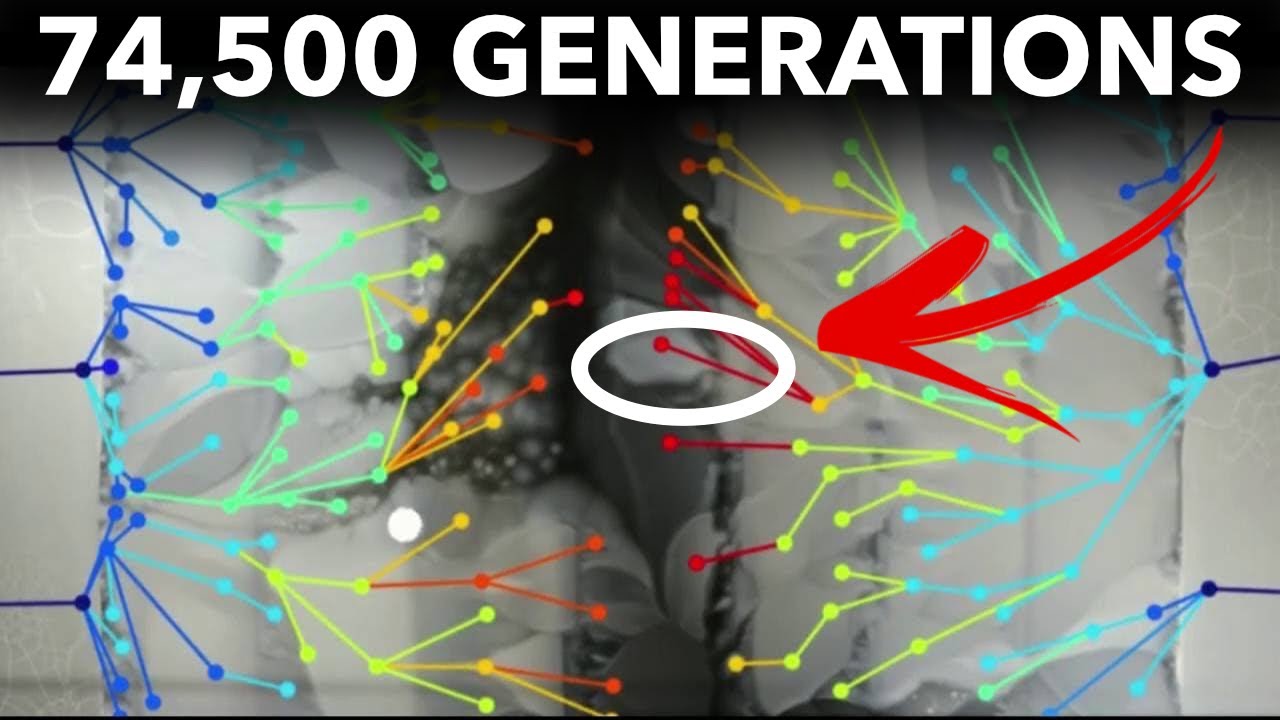
Veritasium
Data from 74,500 generations of E. coli demonstrate that natural selection in an unchanging environment follows an open-ended power law, continuously generating fitness gains without ever reaching an evolutionary ceiling.
AI-assisted summary of The Longest-Running Evolution Experiment — original source. Check the original for full context.
Source published:
Key ideas
- Richard Lenski's Long-Term Evolution Experiment (LTEE) has tracked twelve isolated lineages of E. coli since 1988, reaching over 74,500 generations—equivalent to roughly 1.5 million years of human evolution. (1:11)
- After tens of thousands of generations, one lineage evolved the rare ability to metabolize citrate in an oxic environment, a breakthrough driven by both historical contingency and an intricate genetic rearrangement. (10:31)
- Long-term fitness gains do not plateau as an asymptote; instead, they follow an open-ended power law model where adaptation slows progressively but never ceases, even in an unchanging environment. (13:14)
- A daily 100-fold serial dilution discards 99% of bacterial cultures to prevent runaway growth that would mathematically exceed the volume of the observable universe within 42 days. (3:08)
Detailed notes
## Background Published on YouTube by Veritasium on June 16, 2021, this video examines the predictability and repeatability of natural selection by asking what would happen if life's tape were rewound and replayed. It highlights Prof. Richard Lenski's Long-Term Evolution Experiment (LTEE) with Escherichia coli alongside a sponsored kitchen demonstration investigating microbial contamination.
## TL;DR Derek Muller visits Richard Lenski's laboratory to explore the Long-Term Evolution Experiment, which has tracked twelve isolated lineages of E. coli over 33 years and more than 74,500 generations. By conducting daily serial dilutions and freezing viable generational 'fossils,' the researchers revealed how compounding beneficial mutations drove sustained fitness gains and enabled direct time-travel competition trials. The study's crowning discovery came when one population evolved the ability to metabolize citrate under oxic conditions, demonstrating how rare innovations depend on historical contingency and prior genetic architecture. Ultimately, the experiment overturned assumptions of an evolutionary plateau, proving that adaptation continues indefinitely along an open-ended power law even in an unchanging environment.
## Atmosphere & style The presentation blends playful, curious science communication with deep reverence for long-horizon academic dedication. Muller's dynamic hosting is grounded by Richard Lenski's thoughtful, modest reflections, turning the repetitive daily grind of pipetting and autoclaving into an epic narrative spanning the equivalent of 1.5 million years of evolution. Bookended by a lighthearted domestic demonstration using fluorescent dye, the viewing experience feels both casually engaging and philosophically profound as it contemplates chance, fate, and the boundless adaptability of life.
## Bulletin - [01:11](https://www.youtube.com/watch?v=w4sLAQvEH-M&t=71s) Richard Lenski's Long-Term Evolution Experiment (LTEE) has tracked twelve isolated lineages of E. coli since 1988, reaching over 74,500 generations—equivalent to roughly 1.5 million years of human evolution. - [10:31](https://www.youtube.com/watch?v=w4sLAQvEH-M&t=631s) After tens of thousands of generations, one lineage evolved the rare ability to metabolize citrate in an oxic environment, a breakthrough driven by both historical contingency and an intricate genetic rearrangement. - [13:14](https://www.youtube.com/watch?v=w4sLAQvEH-M&t=794s) Long-term fitness gains do not plateau as an asymptote; instead, they follow an open-ended power law model where adaptation slows progressively but never ceases, even in an unchanging environment. - [03:08](https://www.youtube.com/watch?v=w4sLAQvEH-M&t=188s) A daily 100-fold serial dilution discards 99% of bacterial cultures to prevent runaway growth that would mathematically exceed the volume of the observable universe within 42 days.
## Key takeaways - [00:00](https://www.youtube.com/watch?v=w4sLAQvEH-M&t=0s) In a petri dish gradient, bacteria evolve resistance to a 1,000-fold antibiotic concentration in just 11 days through stepwise spontaneous mutations. - [01:11](https://www.youtube.com/watch?v=w4sLAQvEH-M&t=71s) The Long-Term Evolution Experiment isolates twelve distinct E. coli lineages from a single common ancestor to guarantee that shared outcomes represent true independent evolution rather than preexisting genetic variation. - [01:11](https://www.youtube.com/watch?v=w4sLAQvEH-M&t=71s) Rapid bacterial reproduction allows six to seven generations per day, accumulating vast evolutionary progress compared to slower-cycling species like corn. - [03:08](https://www.youtube.com/watch?v=w4sLAQvEH-M&t=188s) Daily serial transfers keep populations sustainable by transferring exactly 1% of the broth to fresh minimal glucose medium while sterilizing the remaining 99%. - [05:26](https://www.youtube.com/watch?v=w4sLAQvEH-M&t=326s) Despite a low per-cell mutation rate, a flask with approximately one billion bacteria generates around one million new genetic mutations daily. - [05:26](https://www.youtube.com/watch?v=w4sLAQvEH-M&t=326s) Advantageous mutations can compound exponentially across transfers even after surviving the daily 99% culling process. - [07:36](https://www.youtube.com/watch?v=w4sLAQvEH-M&t=456s) By freezing living samples every 500 generations, researchers create a physical fossil record enabling direct competition experiments between evolved strains and their ancestors. - [07:36](https://www.youtube.com/watch?v=w4sLAQvEH-M&t=456s) Neutral red and white genetic markers allow direct visual counting to determine which bacterial generation outcompetes the other for limited resources. - [09:57](https://www.youtube.com/watch?v=w4sLAQvEH-M&t=597s) Early fitness gains show an explosive adaptive phase followed by deceleration, initially leading scientists to expect a complete plateau in improvement. - [10:31](https://www.youtube.com/watch?v=w4sLAQvEH-M&t=631s) In 2003, one lineage unexpectedly evolved the capacity to consume citrate, a compound wild E. coli cannot utilize under oxygenated conditions. - [11:48](https://www.youtube.com/watch?v=w4sLAQvEH-M&t=708s) Replaying evolution from revived ancestral clones demonstrated that citrate utilization depended on potentiating background mutations as well as a specific, rare rearrangement. - [13:14](https://www.youtube.com/watch?v=w4sLAQvEH-M&t=794s) Across decades, bacterial cell sizes increased significantly while overall population numbers per flask declined. - [13:14](https://www.youtube.com/watch?v=w4sLAQvEH-M&t=794s) Several lineages evolved defective DNA repair systems that increased mutation rates a hundredfold before secondary mutations tempered the excessive mutational load. - [13:14](https://www.youtube.com/watch?v=w4sLAQvEH-M&t=794s) Fitness data refutes the bounded rectangular hyperbola hypothesis, proving that adaptation in a constant environment fits an unbounded power law model. - [16:18](https://www.youtube.com/watch?v=w4sLAQvEH-M&t=978s) A fluorescent household test demonstrates that reusable dishcloths rapidly cross-contaminate high-touch kitchen surfaces like sink faucets and appliance handles.
## Detailed walkthrough ### [00:00](https://www.youtube.com/watch?v=w4sLAQvEH-M&t=0s) Evolution in Action and an Unsuspecting Household Test
A dish of bacteria encounters progressively higher concentrations of antibiotics. At first, the bacteria stop dead in their tracks upon reaching the initial antibiotic barrier. Soon, however, a spontaneous mutant emerges that can survive the dose. Another mutation follows, allowing the bacteria to tolerate 10 times the original concentration, then 100 times, until after just 11 days of rapid evolution, the surviving strain withstands an antibiotic concentration 1,000 times stronger than the dose that would have wiped them out at the start.
Noting that bacteria thrive everywhere—especially in damp environments like kitchen dishcloths—Derek Muller sets up a stealth experiment sponsored by Bounty paper towels. Without alerting anyone in his household, he coats a common dishcloth with fluorescent powder mimicking bacterial spread to see where the contamination eventually travels. Leaving that domestic petri dish behind, he flies out to Michigan to investigate the world’s longest-running laboratory evolution experiment.
[01:11](https://www.youtube.com/watch?v=w4sLAQvEH-M&t=71s) The Long-Term Evolution Experiment: Twelve Isolated Lines
In 1988, evolutionary biologist Prof. Richard Lenski began an ambitious endeavor with twelve separate populations of live *Escherichia coli*, all derived from a single common ancestor. Over the past 33 years, Lenski and a dedicated team of researchers have kept the experiment running continuously, tending to the flasks every single day, including weekends.
```mermaid flowchart TD accTitle: Starting the Long-Term Evolution Experiment accDescr: Diagram showing how a single ancestor colony was diluted and split into twelve independent bacterial lineages. subgraph Isolation["Initial Plating & Isolation"] A["Single Common Ancestral Population"] --> B["Diluted onto Petri Dish"] B --> C["Individual Colonies Form"] end subgraph TwelveLines["Twelve Replicate Populations"] C --> D["6 Arabinose-Negative Lines (Red Marker)"] C --> E["6 Arabinose-Positive Lines (White Marker)"] end TwelveLines --> F["Continuous Independent Evolution (1988–Present)"] ```
While other evolutionary studies exist—such as the University of Illinois corn-breeding experiment running since 1896—corn produces only one generation per year. In contrast, Lenski’s *E. coli* cycle through six or seven generations every day, reaching generation 74,500 over 33 years. Scaled to human reproductive timescales, that corresponds to roughly 1.5 million years of hominid evolution. Lenski explains that each of the 12 lines began from an individual colony on a plate so that no shared variation was present from the outset.
> “And that's important because it means if we see the same thing happening in replicate populations, it's not because they started out with the same genetic variants and natural selection just fished out the same thing over and over.” — Richard Lenski
- Corn breeding experiment at the University of Illinois: ongoing since 1896 (1 generation per year). - Lenski's Long-Term Evolution Experiment (LTEE): started in 1988, spanning 33 years and over 74,500 generations. - Equivalent human timeframe: 1.5 million years of evolution.
[03:08](https://www.youtube.com/watch?v=w4sLAQvEH-M&t=188s) The Daily Regimen, Exponential Growth, and the Autoclave Room
The artificial habitat designed for the bacteria is vastly simpler than the natural world. Kept strictly at 37 degrees Celsius with no competing species, they reside in a minimal liquid broth containing potassium phosphate, citrate, and a strictly limited amount of glucose as their sole carbon source. The evolutionary pressure is unambiguous.
> “Above all else, consuming that glucose and converting it to offspring, replicating as fast as possible has been essentially what we seem to be selecting for.” — Richard Lenski
Each day, the bacteria consume the available glucose, divide six to seven times, and multiply their population a hundredfold. To keep the cycle going indefinitely, the team performs a daily serial transfer: 0.1 milliliters (exactly 1% of the flask’s volume) is pipetted into a sterile flask of fresh medium. This dilutes the bacteria 100-fold, resetting their space and nutrients so they can expand again.
```mermaid flowchart LR accTitle: Daily Serial Transfer Cycle accDescr: The 24-hour cycle of dilution, exponential growth, and disposal in the LTEE. A["Flask at Full Density (After 6–7 Divisions)"] -->|"0.1 mL (1%)"| B["Fresh Medium Flask"] A -->|"9.9 mL (99%)"| C["The Autoclave Room ('Bacterial Crematorium')"] B -->|"24 Hours Growth at 37°C"| A ```
The remaining 99% of the culture heads straight to the autoclave room, an unceremonious sterilizing facility Derek humorously dubs a "bacterial crematorium." This daily purge is mathematically mandatory. If the researchers had accommodated the daily hundredfold expansion by increasing the broth volume rather than culling it, the culture would require one cubic meter of solution by day two, exceed 10 times the volume of the Earth by day 13, and outgrow the observable universe by day 42.
[05:26](https://www.youtube.com/watch?v=w4sLAQvEH-M&t=326s) The Power of Numbers: How Rare Mutations Drive Natural Selection
Derek raises a fundamental paradox: if genetics is geared toward stability and replication fidelity, how does evolutionary novelty occur so readily in the lab? Lenski points out that per-cell mutation rates in bacteria are indeed conservative. Only about one in 100 to one in 1,000 bacterial cells carries a single mutation, whereas human offspring typically inherit 10, 20, or 50 new mutations. However, sheer population size turns that low rate into massive genetic variation.
With roughly a billion individual bacteria growing in a single flask, a one-in-a-thousand error rate generates approximately one million new mutations every single day. Lenski breaks down the fate of those daily million variants: - **Neutral mutations (~50%):** Many have no discernible impact on growth in minimal glucose broth, often affecting genes suited for the wild that are unexpressed in the lab. - **Deleterious mutations (~50%):** Flaws that make the cell an inferior competitor, dooming it to extinction. - **Beneficial mutations (10 to 1,000):** Rare variants that improve metabolic efficiency or reproduction rates compared to their parent cells.
Even if an advantageous cell divides 10% faster, it still faces the daily 99% cull. But once a favorable mutation makes it into the transferred 1%, that 10% edge compounds exponentially across subsequent flasks.
> “So the mutations, y'know, are really rare when they first occur and many of them are lost, but once they get common if they have that competitive advantage, they'll just sweep through the population.” — Richard Lenski
[07:36](https://www.youtube.com/watch?v=w4sLAQvEH-M&t=456s) The Frozen Fossil Record and Bacterial "Fight Club"
Evaluating whether bacteria are truly improving over time relies on an extraordinary biological feature: *E. coli* can be frozen in suspended animation and revived decades later with full viability. Every 500 generations—roughly every 75 days—the team freezes representative samples of all 12 lines, creating a physical "frozen fossil record."
This setup allows Lenski to run direct "time travel" head-to-head competitions, matching generation 70,000 against its distant ancestors in a bacterial fight club. To track who wins, the experiment uses a neutral genetic color marker embedded from day one: - Six populations carry an arabinose-utilization trait that turns colonies **red** on indicator agar plates. - Six populations carry an alternative allele that turns colonies **white**.
By pitting a red evolved lineage against a white ancestor (or vice versa), researchers seed them together at an equal ratio in a single flask, let them compete for glucose over a 24-hour cycle, and then plate out the mixture. Counting the red and white colonies by hand reveals which strain divided faster and utilized the limited sugar more effectively. In head-to-head trials, the evolved lineages drastically outcompete their ancestral forebears.
[09:57](https://www.youtube.com/watch?v=w4sLAQvEH-M&t=597s) Early Discoveries: Darwinian Adaptation and the Plateau Question
When asked about the earliest major findings from the long-term lines, Lenski notes that the data provided an unambiguous confirmation of natural selection in real time.
> “The first thing we found, not that there was any doubt about it, but it's one of the most direct demonstrations of Darwinian adaptation by natural selection, you can imagine.” — Richard Lenski
Early on, the bacterial fitness curves mimicked typical evolutionary trends: when introduced to a novel environment, adaptation starts with a dramatic, rapid surge in competitive fitness, followed by a noticeable deceleration as the easiest improvements are exhausted. Watching the adaptation rate slow down, Lenski initially expected the populations to eventually flatline entirely, even wondering early in the project whether it was time to bring the experiment to an end.
[10:31](https://www.youtube.com/watch?v=w4sLAQvEH-M&t=631s) The Citrate Breakthrough: A "Lemony Dessert"
Richard Lenski had initially wondered when to wrap up the project, but he received wise counsel from colleagues and his wife, Madeline, who urged him to keep the experiment going. It was a fortuitous choice. In 2003, after tens of thousands of generations, one of the twelve populations began doing something extraordinary: it started consuming citrate. Citrate had been in the Davis minimal growth medium from day one as a chelating agent to bind trace metals, but wild *E. coli* is defined species-wide by its inability to transport and metabolize citrate under oxic conditions.
When researchers noticed that one of the culture flasks had developed an unexpected, dense turbidity, Lenski’s initial reaction was skepticism. He assumed foreign bacteria had contaminated the vessel. To verify the lineage, the team went back to the frozen fossil record to restart evolution and ran genetic checks on the unusually cloudy culture. The tests confirmed that the microbes were not contaminants; they were authentic descendants of the ancestral *E. coli* strain.
As Richard Lenski described the discovery: “It was very clear that one of our bacteria lineages had essentially I like to say sort of woken up one day, eaten the glucose, and unlike any of the other lineages discovered that there was this nice lemony dessert, and they'd begun consuming that and getting a second source of carbon and energy.”
[11:48](https://www.youtube.com/watch?v=w4sLAQvEH-M&t=708s) Rewinding Life's Tape: Historical Contingency
The citrate innovation raised fundamental evolutionary questions: why did it take tens of thousands of generations to appear, and why did it happen in only one of the twelve flasks? Researcher Zachary Blount set out to test how this adaptation arose by pulling ancestral clones of that specific lineage out of the deep freeze at various generational time-points and attempting to re-evolve the trait. Lenski analogized the approach to rewinding a film to minute five, minute ten, or minute twenty to see whether the movie would end the same way if allowed to play forward again.
Two competing hypotheses had emerged to explain the extreme rarity of citrate utilization. The first held that the innovation required an exceedingly rare, intricate single mutation—such as a specific DNA inversion requiring precise genomic breakpoints—that could theoretically happen at any time but simply had astronomical odds. The second hypothesis argued for historical contingency: a stepwise series of background mutations that made an otherwise unremarkable mutation functional only after the genetic architecture had already changed.
When the replay experiments were completed, the findings bridged both schools of thought. As Richard Lenski summarized: “To make a long story short, it turns out it's such a difficult trait to evolve because both of those hypotheses are true.” The population required potentiating mutations that built the foundation, followed by a rare rearrangement event that finally unlocked the transport of citrate.
```mermaid flowchart TD accTitle: Rewinding the Tape of Evolution accDescr: Flowchart showing how Zachary Blount tested historical contingency by replaying evolution from frozen bacterial clones. subgraph Ancestry["Frozen Fossil Record"] A["Ancestral Clones<br/>(Minute 5, 10, 20)"] end subgraph Hypotheses["Competing Explanations"] H1["Hypothesis 1:<br/>Ultra-rare specific mutation"] H2["Hypothesis 2:<br/>Contingent series of mutations"] end subgraph Outcome["Experimental Conclusion"] R["Citrate Utilization (Cit+)"] end A --> H1 A --> H2 H1 -->|"Requires rare breakpoint"| R H2 -->|"Requires prior genetic changes"| R ```
[13:14](https://www.youtube.com/watch?v=w4sLAQvEH-M&t=794s) Cell Size, Hypermutability, and the Power Law of Fitness
Beyond citrate utilization, the Long-Term Evolution Experiment revealed several surprising evolutionary dynamics:
- **Bacterial cell size vs. population size**: Instead of packing into higher cell counts over time, the bacteria actually decreased in total population count within the flasks while individual cells became significantly larger. - **Hypermutation and recovery**: Six of the twelve lineages evolved defective DNA repair systems, causing hypermutability where mutation rates spiked to one hundred times their ancestral level. However, because excessively high mutation loads produce deleterious mutations, several lines subsequently acquired secondary mutations that dialed their mutation rates back down.
The most profound realization concerned the trajectory of evolutionary fitness. Lenski had long assumed the bacteria would eventually hit an adaptive plateau, modeled as a rectangular hyperbola that climbs steeply before reaching a hard asymptote.
```mermaid flowchart LR accTitle: Comparison of Fitness Models accDescr: Diagram comparing the bounded rectangular hyperbola model with the open-ended power law model. subgraph Hyperbola["Rectangular Hyperbola"] H_Early["Rapid Initial Gains"] --> H_Late["Hard Asymptote<br/>(Plateau/Flatline)"] end subgraph PowerLaw["Power Law Model"] P_Early["Rapid Initial Gains"] --> P_Late["Ever-Slowing Improvement<br/>(No Upper Limit)"] end ```
That assumption proved wrong. As Richard Lenski admitted: “This view I had that they were flat lining turned out to be quite false.” A two-parameter power law model—where improvements decelerate continuously but never encounter an upper ceiling—matched the empirical data far better. When fed only the first 5,000 generations of data, the hyperbolic model predicted an asymptote that the bacteria subsequently blew past. In contrast, the power law model trained on just one-tenth of the early experimental history accurately projected fitness all the way out to 50,000 and 60,000 generations.
This result offers an unexpected conclusion about adaptation. Scientists often attribute continuous evolution to dynamic environments, red-queen races against pathogens, or mass extinction events. Yet Lenski's bacteria prove that even in a strictly uniform, unchanging flask of broth, evolution never truly stops. As Lenski reflected: “But what our experiment suggests is that even in the absence of environmental change, there are so many opportunities of smaller and smaller magnitude to continue to make progress that, in fact, progress probably would never stop even in a constant environment.”
[16:18](https://www.youtube.com/watch?v=w4sLAQvEH-M&t=978s) Kitchen Experiment Conclusion
The scene returns to Derek Muller's home demonstration, where he had applied fluorescent powder to see how bacteria can be transferred around living spaces. Turning off the room lights and switching on a handheld ultraviolet torch, the glowing tracer dye reveals widespread contamination across the kitchen surfaces.
Bright streaks glow heavily inside the sink basin, across the faucet neck, and over the tap handles where someone had wiped down the fixtures with a shared dishcloth. Fluorescent traces and clear finger marks appear all over the handle and front panel of the dishwasher, illustrating how easily reusable dishcloths spread microbes to high-touch household surfaces. Emphasizing the challenge of keeping a house clean with young children, Derek concludes with a sponsorship message: “As a dad, I encounter lots of big messes and sticky hands and slimy faces.” He recommends using Bounty paper towels to clean spills before thanking the sponsor and viewers.
## Notable quotes > [13:14](https://www.youtube.com/watch?v=w4sLAQvEH-M&t=794s) what our experiment suggests is that even in the absence of environmental change, there are so many opportunities of smaller and smaller magnitude to continue to make progress that, in fact, progress probably would never stop even in a constant environment. — Richard Lenski
## Mentioned Derek Muller, Richard Lenski, Zachary Blount, Nkrumah Grant, Devin Lake, Kate Bellgowan, Minako Izutsu, Madeline Lenski, Escherichia coli, Long-Term Evolution Experiment, University of Illinois, Bounty, Veritasium
## Video description If you ran evolution all over again, would you get humans? How repeatable is #evolution? This video is sponsored by @BountyBrand. #biology #science #QPU #HygieneBeginswithBounty #BountyPartner
Special thanks to Prof. Richard Lenski and team for showing me around the lab — it is an honor to be able to witness and document such a historic science experiment. Thanks to Dr Zachary Blount for the help with research and setting up the competition time-lapse, Dr Nkrumah Grant for microscope images of the long-term line cells @NkrumahGrant Devin Lake, Kate Bellgowan, and Dr. Minako Izutsu for being part of this video. Long Live the LTEE!
LTEE website — http://myxo.css.msu.edu/ecoli/index.html Intro footage courtesy of the Kishony Lab — https://kishony.technion.ac.il ▀▀▀▀▀▀▀▀▀▀▀▀▀▀▀▀▀▀▀▀▀▀▀▀▀▀ References: Lenski, R. E., & Travisano, M. (1994). Dynamics of adaptation and diversification: a 10,000-generation experiment with bacterial populations. Proceedings of the National Academy of Sciences, 91(15), 6808-6814. — https://ve42.co/Lenski1994
Lenski, R. E., Rose, M. R., Simpson, S. C., & Tadler, S. C. (1991). Long-term experimental evolution in Escherichia coli. I. Adaptation and divergence during 2,000 generations. The American Naturalist, 138(6), 1315-1341. — https://ve42.co/Lenski1991
Good, B. H., McDonald, M. J., Barrick, J. E., Lenski, R. E., & Desai, M. M. (2017). The dynamics of molecular evolution over 60,000 generations. Nature, 551(7678), 45-50. — https://ve42.co/Good2017
Blount, Z. D., Borland, C. Z., & Lenski, R. E. (2008). Historical contingency and the evolution of a key innovation in an experimental population of Escherichia coli. Proceedings of the National Academy of Sciences, 105(23), 7899-7906. — https://ve42.co/Blount2008
Blount, Z. D., Lenski, R. E., & Losos, J. B. (2018). Contingency and determinism in evolution: Replaying life’s tape. Science, 362(6415). — https://ve42.co/Blount2018
Wiser, M. J., Ribeck, N., & Lenski, R. E. (2013). Long-term dynamics of adaptation in asexual populations. Science, 342(6164), 1364-1367. — https://ve42.co/Wiser2013
N, Scharping. (2019). How a 30-Year Experiment Has Fundamentally Changed Our View of How Evolution Works. Discover — https://ve42.co/Scharping
▀▀▀▀▀▀▀▀▀▀▀▀▀▀▀▀▀▀▀▀▀▀▀▀▀▀ Special thanks to Patreon supporters: Mike Tung, Evgeny Skvortsov, Meekay, Ismail Öncü Usta, Paul Peijzel, Crated Comments, Anna, Mac Malkawi, Michael Schneider, Oleksii Leonov, Jim Osmun, Tyson McDowell, Ludovic Robillard, Jim buckmaster, fanime96, Juan Benet, Ruslan Khroma, Robert Blum, Richard Sundvall, Lee Redden, Vincent, Marinus Kuivenhoven, Alfred Wallace, Arjun Chakroborty, Joar Wandborg, Clayton Greenwell, Pindex, Michael Krugman, Cy 'kkm' K'Nelson, Sam Lutfi, Ron Neal
▀▀▀▀▀▀▀▀▀▀▀▀▀▀▀▀▀▀▀▀▀▀▀▀▀▀ Research and Writing by by Derek Muller, Petr Lebedev and Casey Rentz Animation by Ivy Tello Filmed by Derek Muller, Emily Zhang and Raquel Nuno Edited by Derek Muller Music by Jonny Hyman and from Epidemic Sound https://epidemicsound.com Additional video supplied by Getty Images Thumbnail image courtesy of the Kishony Lab Produced by Casey Rentz ▀▀▀▀▀▀▀▀▀▀▀▀▀▀▀▀▀▀▀▀▀▀▀▀▀▀
[Source](https://www.youtube.com/watch?v=w4sLAQvEH-M)