Physicists Solve Microwave Grape Mystery to Boost Chip Lithography
Veritasium
Touching grapes ignite plasma because their high refractive index compresses microwaves into resonant standing waves that concentrate peak electric fields at the contact point, disproving the long-held skin-bridge theory.
AI-assisted summary of Microwaving Grapes Makes Plasma — original source. Check the original for full context.
Source published:
Key ideas
- Researchers published a paper in PNAS resolving the long-standing mystery of why microwaved grapes create plasma, proving that dielectric trapping and electromagnetic field coupling cause the phenomenon rather than an intact skin bridge. (0:00)
- Because water has a refractive index of approximately 10 at 2.45 GHz, standard 12-centimeter microwaves contract to roughly 1.2 centimeters inside a grape, trapping standing waves via total internal reflection. (1:28)
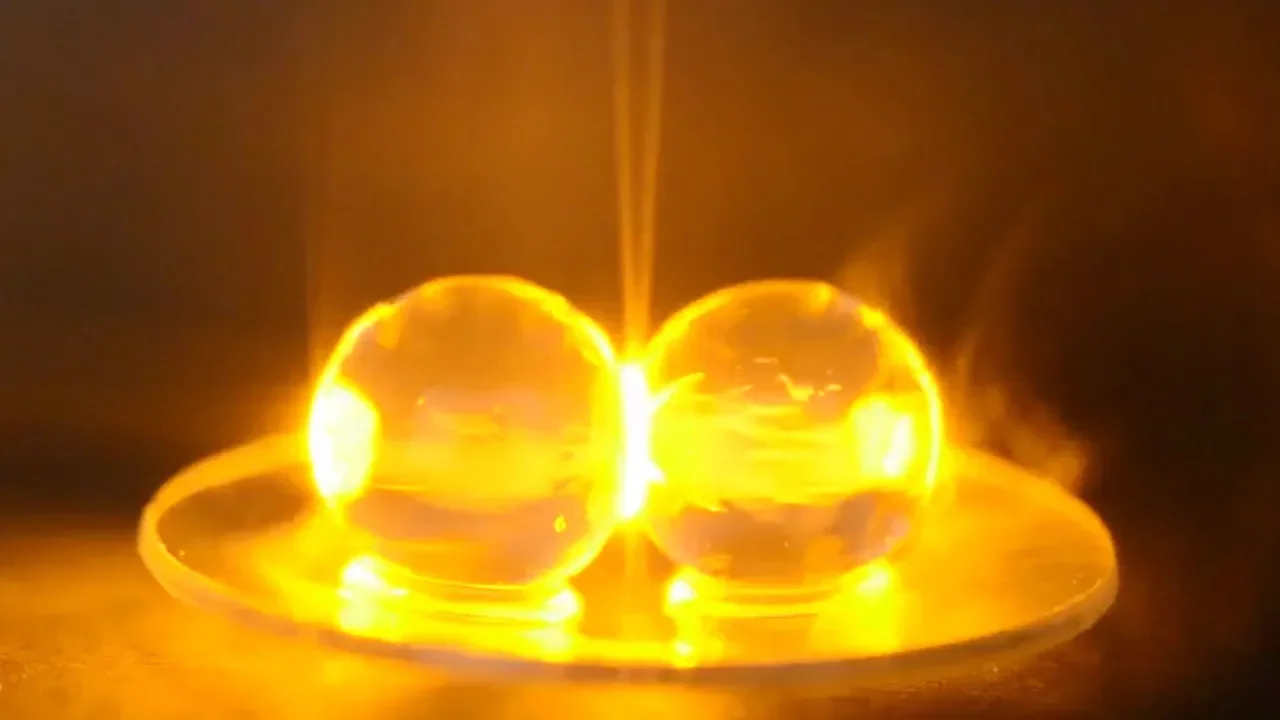
- When two grapes touch, their coupled internal fields create an intense electromagnetic hotspot at the contact point that ionizes air into a plasma flare pulsing at 120 Hz. (3:54)
- The physics of focusing 12 cm waves down to a 1 mm hotspot across dielectric spheres could inspire nanoscale optical lithography techniques to focus laser light down to 2 nanometers for semiconductor manufacturing. (5:50)
Detailed notes
## Background Published on YouTube by Veritasium on February 18, 2019, this video investigates the physics behind why microwaving bisected grapes creates sparks and plasma. According to the description, grapes have the ideal refractive index and size to trap microwaves inside them, focusing electromagnetic energy at the point where two grapes touch to ignite and sustain a plasma plume.
## TL;DR Revisiting an eight-year-old mystery from his early channel days, Derek Muller connects with researchers who published a PNAS paper solving why microwaving grapes generates plasma. Because water's refractive index is roughly 10 in the microwave regime, 12-centimeter microwaves contract to 1.2 centimeters inside the fruit, causing each grape to act as a dielectric resonator that traps standing waves via internal reflection. When two grapes touch, their electromagnetic fields couple to produce a concentrated hotspot at the contact bridge, ionizing the air and vaporizing sodium and potassium into a pulsing plasma flame. Furthermore, dielectric losses from water broaden the resonance curve so grapes of imperfect sizes still ignite, illustrating a sub-wavelength focusing mechanism that could help nanoscale photolithography advance microchip manufacturing.
## Atmosphere & style The presentation is intellectually satisfying, curious, and upbeat, opening with Derek humorously contrasting his modern self against his younger, beardless appearance in the original 2011 experiment. His video-call interviews with the researchers lend a collaborative, conversational dynamic that grounds complex electrodynamics in approachable dialogue. Watching it feels like following an engaging scientific detective case that successfully transforms a viral kitchen novelty into serious, cutting-edge optical physics.
## Bulletin - [00:00](https://www.youtube.com/watch?v=wCrtk-pyP0I&t=0s) Researchers published a paper in PNAS resolving the long-standing mystery of why microwaved grapes create plasma, proving that dielectric trapping and electromagnetic field coupling cause the phenomenon rather than an intact skin bridge. - [01:28](https://www.youtube.com/watch?v=wCrtk-pyP0I&t=88s) Because water has a refractive index of approximately 10 at 2.45 GHz, standard 12-centimeter microwaves contract to roughly 1.2 centimeters inside a grape, trapping standing waves via total internal reflection. - [03:54](https://www.youtube.com/watch?v=wCrtk-pyP0I&t=234s) When two grapes touch, their coupled internal fields create an intense electromagnetic hotspot at the contact point that ionizes air into a plasma flare pulsing at 120 Hz. - [05:50](https://www.youtube.com/watch?v=wCrtk-pyP0I&t=350s) The physics of focusing 12 cm waves down to a 1 mm hotspot across dielectric spheres could inspire nanoscale optical lithography techniques to focus laser light down to 2 nanometers for semiconductor manufacturing.
## Key takeaways - [00:00](https://www.youtube.com/watch?v=wCrtk-pyP0I&t=0s) Early explanations attributing grape plasma to an intact skin bridge acting as a short-circuiting fuse were scientifically inaccurate. - [00:55](https://www.youtube.com/watch?v=wCrtk-pyP0I&t=55s) The phenomenon does not require an actual grape; synthetic hydrogel water beads replicate identical plasma formation in a microwave. - [01:28](https://www.youtube.com/watch?v=wCrtk-pyP0I&t=88s) Standard microwave radiation has a wavelength of 12 cm in air at 2.45 GHz, which is normally too large to interact strongly with a grape. - [01:50](https://www.youtube.com/watch?v=wCrtk-pyP0I&t=110s) In the microwave spectrum, water's refractive index is around 10, compressing the wavelength inside the grape to roughly 1.2 cm. - [02:18](https://www.youtube.com/watch?v=wCrtk-pyP0I&t=138s) Matching the diameter of the grape to the compressed wavelength allows the grape to function as a dielectric resonator, trapping energy via internal reflection. - [03:15](https://www.youtube.com/watch?v=wCrtk-pyP0I&t=195s) A solitary whole grape traps standing electromagnetic waves that concentrate field intensity at its core, causing it to heat from the inside out. - [03:54](https://www.youtube.com/watch?v=wCrtk-pyP0I&t=234s) Placing two grapes in contact couples their internal fields, shifting the peak electromagnetic intensity from their cores directly to the contact point between them. - [04:18](https://www.youtube.com/watch?v=wCrtk-pyP0I&t=258s) Plasma ignition does not require a bisected grape skin; two separate whole grapes touching will generate plasma equally well. - [04:38](https://www.youtube.com/watch?v=wCrtk-pyP0I&t=278s) The concentrated electric field at the junction exceeds the dielectric breakdown threshold of air, ionizing local atoms into sparks. - [04:50](https://www.youtube.com/watch?v=wCrtk-pyP0I&t=290s) Initial sparks are sustained into a bright plasma flare as ambient microwaves directly feed energy into the liberated ions. - [05:05](https://www.youtube.com/watch?v=wCrtk-pyP0I&t=305s) High-speed footage reveals the plasma pulses at 120 Hz, matching the twice-per-cycle power peaks of 60 Hz AC electrical mains. - [05:20](https://www.youtube.com/watch?v=wCrtk-pyP0I&t=320s) Emission spectroscopy indicates that potassium and sodium electrolytes within the grape vaporize into the glowing plasma cloud. - [05:50](https://www.youtube.com/watch?v=wCrtk-pyP0I&t=350s) Dielectric absorption by water dampens the resonance, broadening the resonance curve and allowing grapes of various shapes and sizes to ignite plasma. - [06:55](https://www.youtube.com/watch?v=wCrtk-pyP0I&t=415s) Sub-wavelength dielectric focusing observed in grapes offers theoretical insights for advancing photolithography by concentrating light beyond conventional limits.
## Detailed walkthrough ### [00:00](https://www.youtube.com/watch?v=wCrtk-pyP0I&t=0s) Reinvestigating a Classic Microwave Mystery
Derek Muller reflects on a video he released almost eight years earlier, when the Veritasium channel was brand new, before he had gray hairs in his beard—and before he even had a beard at all. In that classic demonstration, he showed that slicing a grape nearly in half and placing it in a microwave oven generates a dazzling plume of plasma. However, looking back, he acknowledges that the scientific explanation presented back then alongside his friend and fellow physicist Dr. Stephen Bosi was deeply lacking: “to be honest nobody really knew how this effect worked that is until now.”
```mermaid flowchart TD accTitle: Grape Plasma Formation Flowchart accDescr: Step-by-step process showing how microwaves become trapped in grapes, focus energy at the contact point, and ignite plasma.
subgraph S1["1. Trapping Energy"] A["2.45 GHz Microwaves<br>(12 cm in air)"] --> B["Grape Entry<br>(n ≈ 10, λ ≈ 1.2 cm)"] B --> C["Total Internal Reflection<br>& Resonant Standing Waves"] end
subgraph S2["2. Field Concentration"] C --> D["Center Heating<br>(Inside-out for 1 grape)"] D --> E["Two Grapes Touching<br>(Fields couple across gap)"] E --> F["Extreme Field Hotspot<br>at Point of Contact"] end
subgraph S3["3. Plasma Ignition"] F --> G["Dielectric Breakdown<br>& Ionization of Air"] G --> H["Potassium & Sodium Vaporized<br>(Plasma pulses at 120 Hz)"] end ```
The long-standing mystery was finally solved when three researchers published a paper in the *Proceedings of the National Academy of Sciences* (PNAS). By analyzing the phenomenon with high-speed cameras, thermal imaging, and electromagnetic simulations, they provided a thorough explanation of the physics involved. Derek connects via video call with the researchers, one of whom reveals: “yeah actually saw your video before that your videos before joining the grape project.” The team demonstrated that the grape itself is not strictly necessary; the exact same plasma generation can be replicated using hydrogel water beads—superabsorbent polymer beads that expand roughly 100 times in volume when submerged in water.
[01:28](https://www.youtube.com/watch?v=wCrtk-pyP0I&t=88s) Microwaves, Refraction, and Trapping Resonance
Understanding why the grape sparks requires looking at standard microwave oven physics. A typical household microwave emits electromagnetic radiation at a frequency of 2.45 GHz, corresponding to a wavelength of roughly 12 centimeters in air. Normally, electromagnetic wave interactions become pronounced when an object matches the scale of the radiation's wavelength, yet an ordinary grape is far smaller than 12 centimeters. The critical factor is not the wavelength in open air, but the wavelength inside the dielectric material of the grape. While the refractive index of water-rich fruit material is roughly 1.33 at visible wavelengths, Derek notes: “but in the microwave regime the index of refraction is a almost 10 so you have a much higher index of refraction.”
Because the refractive index ($n$) is close to 10, microwaves travel nearly ten times slower inside the grape than through air. Consequently, the wavelength shrinks by a factor of ten, contracting from 12 centimeters down to approximately 1.2 centimeters—almost perfectly matching the physical diameter of a grape. When a single whole grape is placed in the cavity, it acts as a dielectric resonator. As the researcher explains: “turns out that when you have like a ball where approximately the diameter is roughly the same as the wavelength of the microwaves in the material. It actually turns out that it can be trapped in there so that it interacts its kind... it's kind of it bounces at the borders of the of the ball and it can't get out.” Derek asks if this is analogous to total internal reflection, and the researcher confirms: “yes pretty much.” Trapped inside, the radiation forms standing resonant modes with the peak electromagnetic field focused at the grape's core, causing it to heat from the inside out rather than from the surface inward.
[03:54](https://www.youtube.com/watch?v=wCrtk-pyP0I&t=234s) Electromagnetic Coupling and Plasma Ignition
When two whole grapes are placed side by side within less than a wavelength of each other, their internal electromagnetic fields begin to couple. If the two grapes are physically touching, the geometry causes the maximum electromagnetic field to shift away from their individual centers directly to the tiny contact bridge between them. This localized hotspot produces an intensely oscillating electromagnetic field, generating extreme heat at the junction.
- **No skin bridge needed:** Contrary to the popular belief that an intact strip of grape skin acts like an electrical fuse, cutting the grape is unnecessary; two separate whole grapes will ignite plasma as long as they maintain contact. - **Role of the watch glass:** Experiments often use a curved watch glass solely to prevent the round grapes or hydrogel beads from rolling apart. - **Air breakdown:** The concentrated electric field at the contact point reaches dielectric breakdown threshold, stripping electrons to ionize the surrounding air and generating electrical sparks. - **Direct microwave feeding:** Once initial sparks form, the free ions absorb energy directly from ambient microwaves, fueling a sustained plasma flare. - **120 Hz modulation:** High-speed video shows the plasma ball pulsing at 120 Hz—exactly double the 60 Hz AC mains power frequency—because the microwave amplitude peaks twice per cycle. - **Chemical signature:** Spectroscopy of the grape plasma shows prominent emission lines for potassium and sodium, confirming that these abundant grape electrolytes are vaporized into the glowing cloud.
[05:50](https://www.youtube.com/watch?v=wCrtk-pyP0I&t=350s) The Damping Role of Water and Nanoscale Applications
A natural question is why this reaction works across various grape shapes and sizes rather than demanding sub-millimeter precision. Modeling reveals that if grapes were made of a lossless, non-absorbing dielectric, resonant field amplification would only occur at extraordinarily sharp, isolated size peaks. However, liquid water naturally absorbs microwaves. This dielectric loss dampens the resonance, which lowers the maximum field amplification but substantially broadens the resonance curve. Because the resonance peak is broadened, grapes of varying dimensions can still trap and focus microwave energy sufficiently to spark.
Beyond the entertaining kitchen spectacle, the underlying physics holds potential implications for advanced nanofabrication and semiconductor manufacturing. As the researcher points out, photolithography is the central bottleneck in shrinking microchip features: “the main limit in fabricating microchips right now and going smaller and smaller is the lithography so how to make these very small features.” This experiment shows that two dielectric spheres can compress 12-centimeter electromagnetic radiation down to a hotspot roughly one millimeter wide. Scaling this sub-wavelength dielectric focusing mechanism to optical frequencies could focus laser light onto tiny spots roughly two nanometers across, helping extend Moore's law by printing significantly finer features onto microchips. Derek wraps up the video by inviting viewers' thoughts in the comments, pointing them toward his previous upload, and jokingly reminiscing about his original grape plasma experiment from eight years prior.
## Notable quotes > [05:50](https://www.youtube.com/watch?v=wCrtk-pyP0I&t=350s) the main limit in fabricating microchips right now and going smaller and smaller is the lithography so how to make these very small features. — Pablo Bianucci
## Mentioned Derek Muller, Stephen Bosi, Hamza Khattak, Pablo Bianucci, Aaron Slepkov, Alan Chamberlain, Proceedings of the National Academy of Sciences, Veritasium
## Video description A bisected grape in the microwave makes plasma. But how does it work? A grape is the right size and refractive index to trap microwaves inside it. When you place two (or two halves) close together the fields interact with each other creating a maximum of electromagnetic energy where they touch. This creates heating, sparks, and plasma, which is further fed with energy directly by the microwaves.
Huge thanks to Hamza Khattak, Prof. Pablo Bianucci and Prof. Aaron Slepkov (unavailable for the call) for chatting to me and helping me understand the physics of this cool phenomenon.
Linking plasma formation in grapes to microwave resonances of aqueous dimers https://www.pnas.org/cgi/doi/10.1073/pnas.1818350116
Special thanks to Patreon supporters: Donal Botkin, James M Nicholson, Michael Krugman, Nathan Hansen, Ron Neal, Stan Presolski, Terrance Shepherd
Thanks also to Steve Bosi, my original plasma collaborator.
Animations by Alan Chamberlain
Music from http://epidemicsound.com "Seaweed"
[Source](https://www.youtube.com/watch?v=wCrtk-pyP0I)