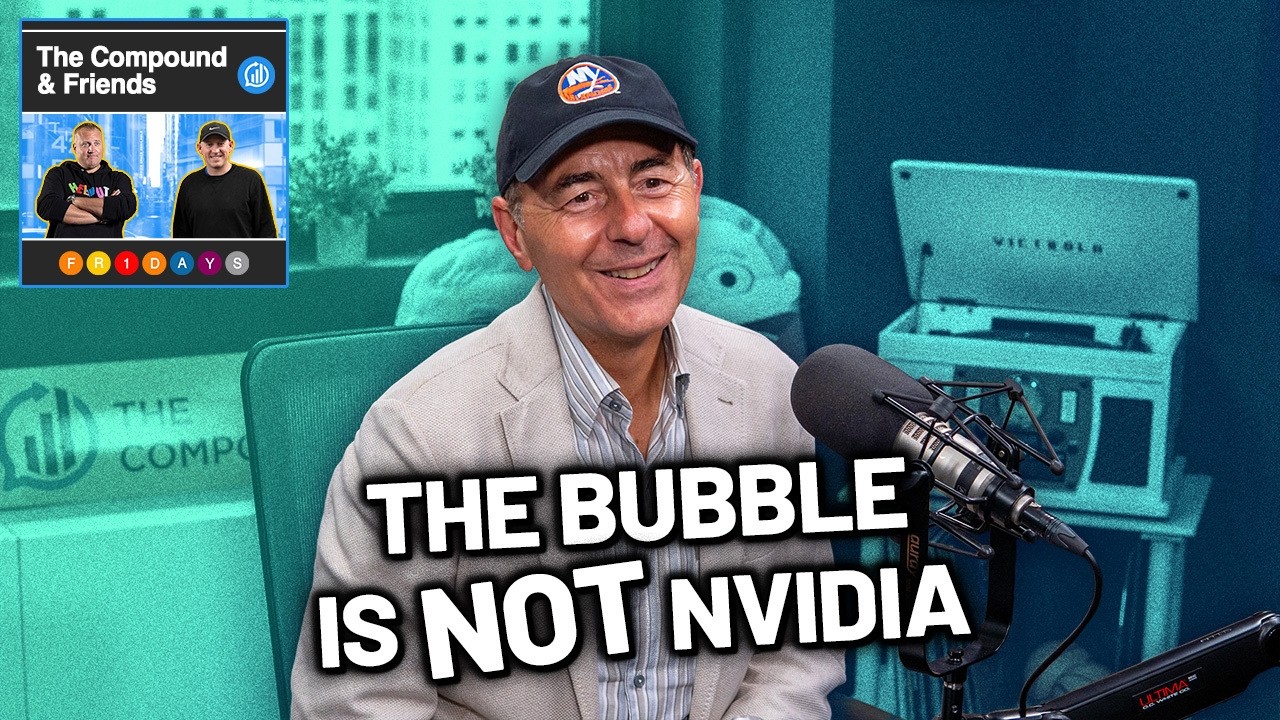
VanEck's Jan van Eck Says Nvidia Hardware Ecosystem Beats Memory Chips
The Compound
Nvidia maintains a durable moat through its CUDA software ecosystem, whereas memory chipmakers remain exposed to commoditization and volatile price cycles.
## Background
The Compound on YouTube published "Why Memory Is a Bubble but Nvidia Isn’t | TCAF 243" on May 22, 2026. Hosts Michael Batnick and Downtown Josh Brown are joined by VanEck CEO Jan van Eck to discuss the trajectory of AI, semiconductor market dynamics, sovereign debt risks, Federal Reserve policy, and private wealth creation. The episode explores whether Nvidia is evolving into a true blue-chip stock, the origins and structure of the SMH ETF, rising interest rates, philanthropy, and the broader social impact of technology.
## TL;DR
In this episode, VanEck CEO Jan van Eck joins Michael Batnick and Josh Brown to break down major macroeconomic trends, market structure, and the artificial intelligence boom. Van Eck presents his thesis on why memory chipmakers operate in cyclical, commodity-driven bubbles, whereas Nvidia's proprietary CUDA ecosystem establishes a durable, blue-chip moat. The conversation covers the origins and cap-weighting mechanics of the SMH ETF, the geopolitical and market threats posed by ballooning U.S. national debt, and incoming Fed Chair Kevin Warsh. Additionally, the panel debates the economic impacts of agentic AI, enterprise technology adoption, UBI, historical philanthropy, and the cultural counterwave against digital screen addiction.
## Atmosphere & style
The podcast maintains an energetic, conversational, and collegial atmosphere, blending lighthearted banter with sophisticated financial analysis. The dynamic between Josh Brown, Michael Batnick, and Jan van Eck is warm and quick-witted, moving effortlessly from humorous personal anecdotes—such as a 14-year-old Knicks playoff story—to serious debates on federal debt, rate regimes, and market concentration. The discussion feels intellectually rigorous yet accessible, grounded in real-world market experience and enriched by historical, philosophical, and cultural observations.
## Key takeaways
- [09:10](https://www.youtube.com/watch?v=y7JBe_WuCnQ&t=550s) The VanEck Semiconductor ETF (SMH) was originally created as a Merrill Lynch HOLDRs trust without management fees to generate broker commission volume before being restructured into a modern ETF.
- [12:50](https://www.youtube.com/watch?v=y7JBe_WuCnQ&t=770s) SMH's weighting methodology allows up to a 20% cap on its top holding, Nvidia, which enabled the fund to capture the AI boom far better than equal-weighted chip benchmarks.
- [15:55](https://www.youtube.com/watch?v=y7JBe_WuCnQ&t=955s) Jan van Eck argues that modern tech mega-caps possess unprecedented capital moats and network effects that protect them from traditional competitive disruption.
- [22:06](https://www.youtube.com/watch?v=y7JBe_WuCnQ&t=1326s) Rising U.S. federal budget deficits and massive Treasury debt issuance represent a major systemic macro risk, even if equity markets have temporarily ignored rising interest rates.
- [27:15](https://www.youtube.com/watch?v=y7JBe_WuCnQ&t=1635s) The S&P 500 has effectively turned into a giant AI momentum index as hundreds of S&P companies contribute to building out massive AI infrastructure.
- [31:33](https://www.youtube.com/watch?v=y7JBe_WuCnQ&t=1893s) SpaceX's anticipated public listing uses a tightly controlled initial float (around 3% to 3.5%) to manage market impact and rapid index inclusion.
- [35:21](https://www.youtube.com/watch?v=y7JBe_WuCnQ&t=2121s) Voting consensus inside the Federal Reserve has broken down, leading to an increase in dissenting views regarding the future path of interest rates.
- [41:07](https://www.youtube.com/watch?v=y7JBe_WuCnQ&t=2467s) Global annual spending on AI infrastructure is projected to reach $3 trillion to $4 trillion by 2030, driven by hyperscaler capital expenditures.
- [49:25](https://www.youtube.com/watch?v=y7JBe_WuCnQ&t=2965s) Strict data security and regulatory compliance keep Wall Street firms cautious, delaying full adoption of always-on agentic AI workflows for core operations.
- [52:04](https://www.youtube.com/watch?v=y7JBe_WuCnQ&t=3124s) Software and SaaS companies face long-term valuation reratings and margin compression if they lack proprietary data moats that AI models depend on.
- [54:42](https://www.youtube.com/watch?v=y7JBe_WuCnQ&t=3282s) Commodity memory chipmakers lack long-term competitive moats and remain subject to cyclical boom-and-bust price swings during supply crunches.
- [57:23](https://www.youtube.com/watch?v=y7JBe_WuCnQ&t=3443s) Nvidia's proprietary CUDA software ecosystem provides a massive developer lock-in, transitioning the company from a hyper-growth stock into a durable blue chip.
- [01:05:35](https://www.youtube.com/watch?v=y7JBe_WuCnQ&t=3935s) Record S&P 500 corporate profit margins occurring alongside workforce layoffs risk fueling social inequality and political backlash against corporate capitalism.
- [01:09:47](https://www.youtube.com/watch?v=y7JBe_WuCnQ&t=4187s) True long-term fulfillment stems from personal growth and meaningful work rather than unearned windfalls or passive wealth.
- [01:22:28](https://www.youtube.com/watch?v=y7JBe_WuCnQ&t=4948s) Schools and families are seeing positive behavioral results by restricting smartphones during school hours and using physical tools to curb screen addiction.
## Detailed walkthrough
### [00:00](https://www.youtube.com/watch?v=y7JBe_WuCnQ&t=0s) Cold Open: The Annual Tie and a 14-Year Knicks Playoff Tale
The show opens on a lighthearted note as Michael Batnick and Josh Brown inspect the annual custom tie worn by guest Jan van Eck, CEO of VanEck. The host crew tries to decipher the figures printed on it—ranging from Alexander Hamilton to Franklin D. Roosevelt and a symbol representing stablecoins (USDC). Josh quips that because of Jan's subtle dress-code guidance at a prior formal event ("please don't wear a t-shirt"), he now wears blazers regularly.
```
┌──────────────────────────────────────────────┐
│ Jan van Eck's Custom Tie Icons │
├──────────────────────┬───────────────────────┤
│ Historical / Economic│ Alexander Hamilton │
│ Figures │ Franklin D. Roosevelt │
├──────────────────────┼───────────────────────┤
│ Modern Financial │ USDC (Stablecoin) │
│ Innovation │ │
└──────────────────────┴───────────────────────┘
```
This leads into a deeply personal flashback from Michael about how he first met Josh in May 2012 during Game 3 of the Knicks-Heat playoff series. At a low point in his life—unemployed for a year and facing his mother's declining health—Michael left Madison Square Garden early when Mario Chalmers hit a corner three to put the Knicks down by 21 at the end of the third quarter. Heading home at 11:45 PM, he ran into Josh on the train platform. Fast-forwarding 14 years, Michael recounts leaving a recent Knicks game early when they fell behind by 22 points, only to miss an historic, 20-point six-minute postseason comeback—an outcome where teams leading by 20 with six minutes left were previously 643–0. Josh roasts Michael relentlessly for leaving such an iconic game early, while Michael defends his decision as a sacrifice that "changed the whole juju of the arena".
* Game 3 of the 2012 Knicks vs. Heat playoff series marked the night Michael and Josh first met on a train platform at 11:45 PM.
* NBA teams leading by 20 points with under six minutes remaining held an all-time record of 643–0 prior to the Knicks' miraculous comeback.
* Floor-seat playoff tickets for Madison Square Garden command upwards of $1,100 to over $10,000 during high-stakes series.
---
[07:46](https://www.youtube.com/watch?v=y7JBe_WuCnQ&t=466s) Intro and the Origins of SMH
After an sponsor message for Tema ETFs highlighting thematic funds across aerospace, power infrastructure, and reshoring trends, Josh formally introduces Jan van Eck, President and CEO of VanEck. The firm manages $199 billion in assets as of March 31, 2026, including the flagship VanEck Semiconductor ETF (SMH), which has delivered a staggering 29% annualized return since its inception format in 2011.
<Image alt="Nvidia Logo" caption="Nvidia serves as a core driver of SMH performance." src="[https://upload.wikimedia.org/wikipedia/commons/](https://upload.wikimedia.org/wikipedia/commons/) thumb/8/8d/NVIDIA_logo.svg/1200px-NVIDIA_logo.svg.png"/>
Jan breaks down the fascinating origins of SMH, explaining that it was originally a Merrill Lynch "HOLDRs" (Holding Company Depositary Receipts) trust product. Merrill Lynch introduced HOLDRs not for management fees—which were zero—but to generate trading commissions on a fixed basket of 25 highly liquid stocks. Because HOLDRs were legally structured as unmanaged trusts, they could never rebalance or replace acquired companies, leading to weird distortions over time (such as Regional Bank HOLDRs holding major money-center banks after acquisitions). When Merrill exited asset management following the 2008 financial crisis, VanEck acquired and restructured the vehicle into a modern, 40 Act-compliant ETF.
* **Firm Assets under Management:** VanEck manages $199 billion globally as of Q1 2026.
* **SMH Performance:** Has generated a ~29% annualized return since its 2011 index conversion/inception.
* **Structural Origin:** Originally built as Merrill Lynch HOLDRs with 0% management fees, designed purely for broker commission volume.
---
[12:50](https://www.youtube.com/watch?v=y7JBe_WuCnQ&t=770s) ETF Construction, Weighting Strategies, and Global Growth
The conversation turns to how SMH grew into the premier semiconductor gauge, effectively replacing legacy benchmarks like the Philadelphia Semiconductor Index (SOX) in day-to-day market commentary. Jan attributes SMH's exceptional outperformance to its specific weighting methodology: unlike equal-weighted funds, SMH allows its top holding—Nvidia—to reach up to a 20% portfolio concentration. This concentrated exposure caught the full brunt of the artificial intelligence boom, whereas broader or equal-weighted semiconductor funds were dragged down by mid-cap chip companies navigating highly cyclical, competitive headwinds.
```
SMH Weighting Architecture
┌──────────────────────────────────────────────────────────────────┐
│ Nvidia (Top Weight) Max Cap: Up to 20% │
├──────────────────────────────────────────────────────────────────┤
│ Broadcom & Tier-1 Mega Caps High-Cap Weighted Core │
├──────────────────────────────────────────────────────────────────┤
│ Rest of Semi Basket (25 Stocks) Strict Inclusion Criteria │
└──────────────────────────────────────────────────────────────────┘
```
Josh questions why equal-weighting remains popular in sector ETFs, arguing that capping winners at 1% or 2% cuts off momentum right when major structural shifts occur. Jan and Michael note that equal-weighting or small-cap weighting (like XBI in biotech or GDXJ in junior gold miners) is designed to capture higher beta and speculative upside during broad-based rallies. Jan also highlights VanEck's rapid international expansion, noting their European business grew from $11 billion to $45 billion in a single year, boosted by heavy demand for defense ETFs as European nations ramped up military spending.
* VanEck's European asset base expanded from $11 billion to $45 billion in 12 months, driven by European defense and security ETFs.
* SMH limits its single largest position (Nvidia) to a 20% cap, balancing mega-cap momentum with basic diversification rules.
* The original Philadelphia Stock Exchange (PHLX), created in 1790, was the oldest stock exchange in the United States, predating the formal setup of the New York Stock Exchange.
<FollowUp label="Want to dive into the next part of the transcript covering the Bond Market, Federal Reserve policies, and Nvidia vs. Memory chips?" query="Yes, please provide the detailed walkthrough for Part 2 of this transcript covering the Bond Market, Kevin Warsh, and why Memory is a bubble while Nvidia isn't."/>
[15:55](https://www.youtube.com/watch?v=y7JBe_WuCnQ&t=955s) Market Cap vs. Equal Weighting and the Durability of Mega-Cap Moats
The conversation picks up mid-debate over market structure, weighting methodologies, and whether the dominance of mega-cap stocks is a temporary phenomenon or a permanent structural shift. Josh Brown and Michael Batnick challenge the notion that market-cap weighting is inherently superior, pointing out that over the long arc of market history, equal-weight approaches and small-cap outperformance have dominated entire decades. They cite classic research—such as Ned Davis’s historical comparison—showing that historically, blindly investing in the single largest weighted stock in the S&P 500 was a terrible strategy, right up until Apple broke the mold around 2013. In previous eras, market-cap weighting essentially defaulted to a momentum strategy that eventually meant buying overvalued giants right before their downfall.
Jan Van Eck counters that the current era represents a permanent structural shift rather than a brief historical anomaly. The sheer volume of capital required to compete in high-tech industries—compounded by unprecedented global network effects—has constructed moats far more durable than those of the 1950s or 1970s. Josh expands on this, highlighting two key catalysts: the scale of modern internet-driven network effects where bigger automatically translates to more profitable, and a quarter-century of lax antitrust enforcement across both major political parties. Without the regulatory threat of corporate trust-busting, tech giants have successfully expanded horizontally across dozens of adjacent sectors. As Josh quips regarding grocery retail: *"Amazon literally could give groceries away for free so long as people are paying the Prime fee... There's no world in which for any reason that's just going to flip itself."*
* Historical outperformance of small caps relied heavily on their ability to generate faster earnings growth, whereas today's mega-cap giants are comfortably lapping the rest of the market in earnings expansion.
* Meta’s Instagram Reels has achieved a $50 billion annual revenue run rate shortly after starting monetization around 2022–2023, surpassing the total overall revenue of Netflix.
* Cable and broadband utility stocks are "crashing through the floor" as disruptors like SpaceX's Starlink re-architect satellite telecommunications infrastructure.
* While giant tech firms rarely fear small startups, they engage in brutal "battle royals" against one another—such as Waymo vs. Tesla vs. Uber in autonomous mobility, or Amazon Prime vs. Netflix vs. Apple TV in streaming content.
---
[22:06](https://www.youtube.com/watch?v=y7JBe_WuCnQ&t=1326s) Sovereign Debt Risks, Rising Bond Yields, and Macro Deficits
The hosts pivot to the bond market, recalling an iconic past appearance where Jan Van Eck sounded the alarm on global negative-yielding sovereign debt. Moving from that era into 2026, the global interest rate regime has inverted dramatically. Jan articulates his long-term 10-year macro thesis: wildly bullish on AI and India, but deeply alarmed by spiraling U.S. national debt levels. He compares the looming Treasury debt problem to the precursor of the 2008 subprime housing crisis—it is an undeniable systemic risk where the timing of the eventual crash remains notoriously unpredictable.
The group explores the puzzling dynamic where the 30-year U.S. Treasury yield recently touched heights not seen since 2007, yet the equity market barely wobbled. Jan attributes his own difficulty with timing the bond market to the fact that investors simply refuse to care about fiscal deficits until a breaking point occurs. With the U.S. government running persistent budget deficits in the 5% to 6.5% range and borrowing over $1 trillion annually, the Fed holds very little actual control over the long end of the curve. Jan warns that if the 10-year yield crosses 5% or 5.25%, panic will finally take hold, pointing out that long-duration bond yields in the UK and Japan are already spiking as global investors demand higher nominal compensation.
```
U.S. FISCAL REALITY
┌──────────────────────────────────────────────────────┐
│ • Annual Borrowing: > $1 Trillion │
│ • Budget Deficits: 5.0% - 6.5% GDP │
│ • 10-Yr / 30-Yr Yields: Reaching multi-decade highs │
└──────────────────────────┬───────────────────────────┘
│
▼
MARKET INTERPRETATIONS
┌──────────────────────────┴───────────────────────────┐
│ │
[BEAR / DEFICIT CASE] [BULL / GROWTH CASE]
• Escalating defense/war spending • S&P sales growth projected at 18%
• Geopolitical vulnerability (China/Iran) • Corresponds to ~12.4% nominal GDP
• Threat of runaway inflation prints • High yields reflect a surging economy
```
* **The Bear Case on Yields:** Higher-than-expected CPI and PPI prints force inflation expectations higher, while runaway defense spending (which could balloon by another $500 billion) risks a total fiscal budget blowout.
* **Geopolitical Weakness:** Jan argues that massive national debt serves as America's primary geopolitical "Achilles' heel," noting that foreign adversaries like China view U.S. debt levels as a structural vulnerability while stockpiling physical gold.
* **The Bull/Growth Case:** Quoting market strategist Warren Pies, Batnick notes that projected 18% S&P 500 forward sales growth over a 24-month horizon historically aligns with strong 12.4% nominal GDP growth (around 6% annualized), suggesting elevated yields simply reflect an economy running hot.
---
[27:15](https://www.youtube.com/watch?v=y7JBe_WuCnQ&t=1635s) The AI Capex Monolith and Private Wealth Creation
Josh delivers a stark assessment of the current U.S. economy, asserting that outside of the AI infrastructure boom and wealth management, virtually every other sector is struggling. Existing home sales are locked up, auto and utility bill delinquencies are ticking upward, and the bottom third of the population is pinched by inflation. Yet, none of this depresses the broad stock indices because, as strategist Adam Parker notes, 263 companies in the S&P 500 are actively engaged in building out AI infrastructure. From heavy equipment makers like Caterpillar to data center REITs and power utilities, the S&P 500 has effectively transformed into a giant AI momentum ETF.
This dynamic feeds a highly reflexive loop between public market gains and private market wealth creation. The hosts discuss the impending liquidity events for private titans like SpaceX and Anthropic, noting how the influx of capital into tech hubs like Northern California is driving real estate bidding wars—such as homes in San Francisco's Noe Valley fetching extra million-dollar cash offers within a week. Rather than being tied up in traditional six-month lockup periods, modern mega-IPOs like SpaceX are implementing rolling liquidity windows where employees and early investors can monetize portions of their holdings within weeks.
* **SpaceX IPO Scale:** Even a partial 10% float unlock on a rumored $2 trillion valuation unleashes $200 billion in direct cash liquidity into the private ecosystem.
* **The Wealth Flywheel:** This capital flows directly into luxury consumption, real estate construction, new venture creation, and wealth management fees, reinforcing the broader economic expansion.
* **Market Friction Point:** The section closes on a critical liquidity question raised by Tom Lee: for private wealth creation of this unprecedented scale to be realized, tens of billions in institutional cash must be drawn out of existing funds and ETFs to absorb these massive public offerings on the open market.
---
<ElicitationsGroup message="Where would you like to take this transcript walkthrough next?">
<Elicitation label="Continue to Part 3 of the transcript" query="Please provide the next detailed walkthrough section for Part 3 of this transcript."/>
<Elicitation label="Analyze the AI infrastructure capex argument" query="Can you break down the S&P 500 AI infrastructure exposure argument made by Josh Brown and Adam Parker?"/>
</ElicitationsGroup>
[31:33](https://www.youtube.com/watch?v=y7JBe_WuCnQ&t=1893s) SpaceX, Index Inclusion, and the Sovereign Debt Risk
Jan van Eck explains how index provider rules and ETF mechanics have evolved to accommodate giant private companies coming public like SpaceX. Traditionally, ETFs operated under strict rebalancing schedules—often waiting six months to a year after an IPO before adding a new listing to their portfolios. To manage the market impact, SpaceX is tightly controlling its initial float, rumored to be just 3% to 3.5%. Josh Brown highlights two contrasting market perspectives on this strategy: on one hand, it makes perfect sense to include the fifth-largest publicly traded company in indices like the NASDAQ within 10 days rather than waiting for it to double again; on the other hand, critics argue that Elon Musk is effectively forcing index-tracking retail investors to act as liquidity for insiders looking to sell. Jan and Josh draw a direct comparison to Tesla, which took roughly eight years too long to enter major indices, causing passive index fund shareholders to miss out on "90% of the move."
When asked what risks remain for the broader bull market if the financial system successfully absorbs massive mega-cap IPOs like OpenAI and Anthropic, Jan points squarely at mounting U.S. federal deficits, rising 10-year Treasury yields, and government debt. He argues that while previous panics like the 2008 global financial crisis originated in the banking system from private sector leverage, the next major blowup will occur in Washington, D.C. While Michael Batnick pushes back, contending that lawmakers will inevitably find funding through taxes before Social Security payments face projected 20% cuts in the early 2030s, Jan emphasizes that structural entitlement programs cannot be fixed three years before insolvency. Josh injects humor into the macro debate, deadpanning that retirement might become irrelevant anyway once AI productivity generates a universal "citizen dividend" for a workforce that no longer needs to work.
- SpaceX's initial public float is expected to be tightly managed at roughly 3% to 3.5%, with subsequent unlocks eventually bringing floated shares toward 10%.
- Delayed index inclusion for Tesla meant passive index investors missed out on roughly 90% of the stock's gains during its primary growth run.
- Social Security trust fund reserves are projected to run out in the early 2030s, triggering potential automatic benefit cuts of roughly 20% without legislative intervention.
- Jan van Eck argues that post-2008 corporate and household balance sheets hold minimal debt leverage compared to the balance sheet of the U.S. government.
[35:21](https://www.youtube.com/watch?v=y7JBe_WuCnQ&t=2121s) Kevin Warsh, Fed Dissents, and Monetary Policy Dynamics
The conversation shifts to central banking and incoming Federal Reserve Chair Kevin Warsh, appointed by Donald Trump following public friction with Jerome Powell. The hosts review a Wall Street Journal chart illustrating a sharp breakdown in Fed harmony: from 2018 through 2024, Fed governors and regional bank presidents exhibited almost unbroken voting consensus, but dissenting opinions have recently surged over the trajectory of interest rates. While market expectations abruptly swung from pricing in multiple rate cuts to entertaining rate hikes, Jan notes that market figures like Scott Bessent previously leveled scathing critiques at Powell's Fed, claiming its consensus was merely an out-of-touch echo chamber that got transitory inflation "massively wrong." Jan anticipates Warsh will adopt a lighter touch, adhering to a philosophy that the Fed should intervene less and say less, particularly given that central banks cannot control commodity shocks like oil prices.
Josh expresses strong frustration with the modern Fed's incessant media presence, questioning why 12 different regional Fed presidents give speeches across the country every month even when no interest rate decisions are pending. Drawing comparisons across eras, Josh calls the Janet Yellen Fed the worst offender of constant "cacophony," notes that Powell struggled to stop talking or making 180-degree policy pivots, and fondly recalls the Alan Greenspan era when the Fed Chair emerged "twice a year like Santa Claus." However, Michael defends Powell by pointing out that managing rates near zero during unprecedented economic shocks required far more active communication than operating at a normalized neutral rate. Jan cautions that Powell's aggressive rate-hiking cycle directly triggered the collapse of Silicon Valley Bank and forced major lenders like Bank of America to absorb massive unrealized paper losses on fixed-income portfolios.
- A Wall Street Journal analysis shows a marked increase in dissenting votes among Fed governors and regional bank presidents compared to the unanimous consensus maintained between 2018 and 2024.
- Bank of America held approximately $120 billion in unrealized paper losses within its long-term mortgage bond portfolio during the Fed's rapid rate-hiking cycle.
- The panel notes that historical market patterns consistently "test" incoming Fed chairs during their initial months in office.
[41:07](https://www.youtube.com/watch?v=y7JBe_WuCnQ&t=2467s) Nvidia’s $4 Trillion Forecast, AI Myths, and Corporate Token Usage
Turning to semiconductors and artificial intelligence, Michael highlights Nvidia’s recent blowout earnings report. He cites CFO Colette Kress's staggering statement that "with analysts now forecasting hyperscaler capex to exceed $1 trillion in 2027 and generative AI beginning to proliferate all industries, AI infrastructure spending is on track to reach three to four trillion dollars annually by the end of this decade." Jan agrees with this trajectory, emphasizing that an unprecedented compute shortage is driving corporate America to fund massive infrastructure buildouts. He praises Nvidia for breaking out data center revenue, observing that large corporations insist on running dedicated, private AI instances to prevent proprietary data from intermingling with competitors in multi-tenant cloud setups like AWS. Josh adds that several market myths have blown up over recent weeks: hyperscaler capex shows no signs of slowing down, cybersecurity stocks have ripped back to all-time highs, and software companies remain resilient despite fears that vibe coding and Claude would render existing software obsolete.
Jan shares internal token usage data from VanEck showing the firm's monthly consumption on Anthropic's Claude since February. The chart reveals that VanEck doubled its token usage within three to four months while transitioning workloads away from OpenAI's ChatGPT. Jan highlights a key operational difference: Anthropic provides transparent, granular token consumption reporting directly to client CTOs, whereas OpenAI keeps token metrics obscured. Surprisingly to Jan, the adoption curve at VanEck remains less steep than he hoped, illustrating a broader reality across corporate America: while enterprise revenue for AI firms like Anthropic is scaling toward a $40 billion annual run rate, integrating AI into daily corporate workflows takes time as employees gradually adjust to new workflows.
- Nvidia CFO Colette Kress projected that annual global AI infrastructure spending could reach $3 trillion to $4 trillion by 2030, supported by hyperscaler capex topping $1 trillion in 2027.
- Anthropic's revenue expanded to a $40 billion annual run rate, jumping from $4 billion after doubling to $10.9 billion in second-quarter figures reported by the Wall Street Journal.
- VanEck doubled its enterprise token usage on Anthropic's Claude within four months of onboarding in February, shifting workload share away from ChatGPT.
- Hyperscaler cloud platforms are increasingly adapting to enterprise security requirements as corporations demand isolated AI compute instances rather than shared data center pools.
[47:14](https://www.youtube.com/watch?v=y7JBe_WuCnQ&t=2834s) Enterprise AI Usage and Workflow Automation
The conversation kicks off with a look at how companies are funding internal AI experimentation. Jan Van Eck explains that VanEck does not set a hard budget cap on employees using AI tools, preferring to give them total creative freedom to optimize their workflows. Right now, VanEck is spending roughly $750,000 annually across AI platforms. Given the sheer expense of hiring top-tier investment professionals, Jan views this expenditure as having an overwhelmingly positive return on investment (ROI). Michael Batnick notes how quickly these bills ramp up, pointing out that OpenAI already has thousands of enterprise customers paying upwards of $1 million a year, while retail users constantly run into token rate limits.
```
"I'm not smart enough to think through every workflow application. So, I want them to be as creative as possible... If you think about that and what investment people cost, there's a positive payback."
```
Michael shares his own frustration with token limits after trying to summarize a 40-page section of an S-1 filing, only to be cut off mid-task. Josh Brown jokes that Michael should just head over to VanEck's office to use their uncapped access. The group then pivots to how financial professionals are leveraging AI agents. Michael brings up a recent interview with Gavin Baker on Patrick O'Shaughnessy's podcast (*Invest Like the Best*), where Baker described using autonomous agents to transcribe and synthesize market-moving executive podcast appearances that lack official transcripts.
* **VanEck's AI Budget:** Approximately $750,000 per year with no upper limit for employee innovation.
* **OpenAI Enterprise Adoption:** Thousands of corporate clients paying $1 million+ annually.
* **Gavin Baker's Use Case:** Running agentic workflows to extract hidden gems from executive audio interviews.
---
[49:25](https://www.youtube.com/watch?v=y7JBe_WuCnQ&t=2965s) Agentic AI vs. Regulated Financial Services
Josh asks Jan whether VanEck differentiates between standard, interactive web prompts and always-on "agentic" AI workflows that run silently in the background for 24 hours at a time. Jan notes that while basic web prompting is widespread, agentic AI—where autonomous systems complete end-to-end tasks without human intervention—is still in its infancy at VanEck. Due to immense compliance and data security risks, these autonomous tools are strictly confined to isolated sandboxes or employee home machines to prevent proprietary firm data from leaking.
Josh points out Google's recent announcements around persistent AI agents at their I/O conference, but questions whether financial institutions can realistically roll them out for core operations anytime soon. Given the strictly regulated nature of handling client wealth, Josh argues that Wall Street will likely be at the tail end of the AI innovation wave rather than the leading edge. While fin-tech founders brag on LinkedIn about rapid adoption, risking client data by uploading it to cloud LLMs is a line Josh refuses to cross at Ritholtz Wealth Management.
```
"I know a lot of the fintech guys are running around on LinkedIn talking about all this, but in reality, I actually don't think there are going to be big innovations that are initiated in financial services... We're going to be more toward the end than toward the beginning."
```
* **Data Governance Risks:** Financial firms face severe regulatory penalties if proprietary client data is fed into public models.
* **Current Enterprise Reality:** Full operational automation via AI agents remains rare in financial services compared to simpler prompt-based workflows.
---
[52:04](https://www.youtube.com/watch?v=y7JBe_WuCnQ&t=3124s) AI Productivity, Jobs, and the Software/SaaS Rerating
Turning to the broader macroeconomic impact of AI, Josh asks Jan whether the coming productivity boom will act as a net positive for the stock market or if automation-driven job losses pose a major threat. Jan identifies as a "glass half full" bull, citing historical precedents. He notes that while secretarial jobs declined by 75% over two decades due to earlier waves of office automation, the transition was gradual enough for the labor market to adapt. Similarly, when 40 million women entered the U.S. workforce after World War II, overall employment absorbed the shift smoothly because entirely new industries were created.
Jan highlights that VanEck's internal IT staff, who feared for their jobs when ChatGPT first arrived, are now five times more productive and more vital to the firm than ever. However, when asked about the software industry—where UBS compared SaaS vendors to dying 1990s newspaper companies—Jan acknowledges that software models are facing a fundamental repricing. Because AI models require organized data to deliver value, SaaS platforms that merely store data without adding unique analytical capabilities are losing pricing power. Jan shares that VanEck recently shortened its corporate Salesforce contract down to just two years to retain flexibility.
```
"Secretarial jobs are down 75% in two decades, but it took two decades for that change to happen... The IT guys at Van who literally last year thought, 'Oh my god, my job is in danger'... are now 5x more productive and they're as needed as they were."
```
* **Labor Market Adaptation:** Technological displacement traditionally happens over decades, giving the economy time to create new job categories.
* **SaaS Margin Compression:** Software firms without proprietary data moats face valuation reratings as clients demand lower contract prices and shorter terms.
---
[54:42](https://www.youtube.com/watch?v=y7JBe_WuCnQ&t=3282s) The Semiconductor Craze: Bubble vs. Moat
Michael guides the discussion toward the eye-popping rallies in semiconductor stocks, asking Jan to evaluate the sector's sustainability on a scale of 1 to 10. Pointing to wall-street forward earnings per share (EPS) estimates, Michael notes astounding projections: Micron's forward EPS jumping from $9 to $85, and SanDisk moving from $2 to $99. He asks Jan directly whether memory chips are in a massive speculative bubble.
Jan draws a sharp distinction between commodity memory manufacturers and Nvidia:
```
"I don't think these memory companies have a competitive moat... Nvidia went from a single commodity GPU provider to being the mainframe of AI... Jensen is giving you much more compute. He's like the Walmart of compute."
```
Jan argues that memory chipmakers operate in a cyclical oligopoly where recent earnings explosions are driven almost entirely by aggressive price increases during shortages, rather than structural value creation or defensible intellectual property. In contrast, Jensen Huang's strategy at Nvidia focuses on continuously lowering the cost per unit of compute, making Nvidia's ecosystem nearly impossible to displace even if competitors gave their hardware away for free.
[57:23](https://www.youtube.com/watch?v=y7JBe_WuCnQ&t=3443s) Why Nvidia is Evolving into a True Blue Chip
Jan outlines his core investment thesis on Nvidia, explaining why he views the company as a durable "blue chip survivor" rather than a temporary bubble. The key to Nvidia's structural dominance is not just its graphics chips, but **CUDA**—its proprietary parallel computing software platform. Because virtually every serious AI researcher and software engineer is trained and certified on CUDA, it serves as the foundational software layer for the entire AI industry. Jan draws a historical comparison to IBM, which survived across decades by pivoting from hardware into software and services while remaining deeply entrenched with its end customers.
```
"Nvidia is a blue chip survivor because of CUDA... There's nothing more motivated than a founder who used to be in a commodity business... Now I can control an ecosystem."
```
The hosts discuss Nvidia's latest jaw-dropping earnings report, which featured 125% earnings growth, an 80% revenue surge, 75% gross margins, and a $4 billion revenue guidance raise above consensus. Despite these staggering numbers, the stock barely moved, trading slightly down the following morning. Jan explains this muted reaction as a healthy shift in Nvidia's shareholder base. As aggressive hedge funds and venture players like SoftBank sell to lock in early gains, Nvidia is transitioning into a classic blue-chip stock owned by long-term institutional investors who value its massive cash flow, dividend growth, and share buybacks.
* **CUDA Software Moat:** Deep developer lock-in makes switching costs prohibitively high for AI labs.
* **Shareholder Rotation:** Long-term institutional "blue chip" capital is replacing early-stage hyper-growth speculators.
* **Capital Return Program:** Nvidia expanded its share repurchase authorization from $39 billion up to $80 billion.
---
[01:02:08](https://www.youtube.com/watch?v=y7JBe_WuCnQ&t=3728s) Market Concentration and the Top 5 Earnings Drivers
The conversation shifts to the extreme concentration of the S&P 500. Michael brings up a striking chart from Bank of America showing that a quarter of the entire S&P 500's earnings outlook is generated by just five companies: Nvidia, Alphabet (Google), Microsoft, Apple, and Micron. Michael expresses shock that Micron managed to join the top five earnings drivers alongside the mega-cap tech giants, underscoring just how dramatically the memory price surge has distorted broader corporate earnings.
```
"The top five is a quarter of the index earnings... Nvidia, Google, Microsoft, Apple, and then Micron. You could have given me 30 guesses, I don't think I would have said Micron."
```
Josh and Jan discuss how this historic concentration makes cap-weighted indices exceptionally heavy, requiring immense capital flows just to nudge the market higher. As the segment concludes, Michael sets up a dramatic question for the panel regarding which of these top earning giants might be vulnerable to disruption over the next decade.
[01:02:49](https://www.youtube.com/watch?v=y7JBe_WuCnQ&t=3769s) Physical AI and the "Anti-Bubble" Thesis
Josh Brown pushes back hard against the prevailing narrative that artificial intelligence stocks are in an unsustainable bubble. He argues that calling a market top today is premature when AI has barely begun to transition into physical applications—such as humanoid robotics and self-driving vehicles—which are only just starting to hit the roads. Brown points out that major technological plays like SpaceX, Tesla, and Nvidia are building towards physical AI, suggesting that compute demand remains insanely high while supply is still constrained.
Jan van Eck echoes this perspective, emphasizing that until the market reaches supply-demand efficiency, major structural trends remain intact. However, he notes that internal sector rotation and severe drawdowns will still occur within the ecosystem. He highlights how even high-flying AI players face volatility, pointing out that Oracle experienced a 50% drawdown and OpenAI briefly appeared to be getting lapped by competitors like Anthropic.
* **Micron & Memory Chips:** The hosts discuss Micron Technology and major South Korean memory manufacturers (such as Samsung and SK Hynix). Van Eck highlights an eye-opening stat: tax payments from top memory chipmakers are so massive that they rival the total tax revenues of entire nation-states.
* **Nvidia’s Long-Term Role:** Josh stresses that Nvidia will be just as foundational to robotics and physical automation over the next 5 to 10 years as it is to large language models (LLMs) and conversational AI today.
[01:05:35](https://www.youtube.com/watch?v=y7JBe_WuCnQ&t=3935s) S&P 500 Margins, Political Friction, and Universal Basic Income
Michael Batnick brings up a chart from Peter Berezin illustrating that forward and trailing S&P 500 profit margins are reaching record highs. He warns that soaring corporate profit margins arriving alongside corporate layoffs create a "dangerous cocktail" for society, bound to fuel political outrage and economic dissatisfaction.
```
+-----------------------------------------------------------------------+
| THE DANGEROUS COCKTAIL |
+-----------------------------------------------------------------------+
| Record S&P 500 Profit Margins + Corporate Layoffs & Inequality |
| |
| --> Backlash against corporate capitalism |
| --> Political volatility & calls for intervention |
+-----------------------------------------------------------------------+
```
Josh takes a counter view on political fears, arguing that shifts in congressional power after midterm elections rarely alter underlying monetary or fiscal realities. He pivots to discuss the lessons from his book chapter, titled *"You Weren't Supposed to See That,"* which analyzed the pandemic-era stimulus.
Josh argues that 2021 was an unintentional experiment in Universal Basic Income (UBI), where trillions of dollars in government payouts gave people enough financial runway to quit jobs, delay working, or switch careers. Rather than creating harmony, he asserts that it distorted the labor market, fueled social unrest, and broke economic incentives—proving that society relies on people remaining hungry enough to show up to work.
> "It's so pitch black to say it out loud... We reordered society by virtue of doing a version of UBI... The country broke, and we can't do it again."
[01:09:47](https://www.youtube.com/watch?v=y7JBe_WuCnQ&t=4187s) Happiness, Materialism, and the Nature of Wealth
Jan van Eck reframes the discussion around human motivation, arguing that true happiness does not stem from passive income or excess money, but from personal growth, family, and meaningful work. He warns that unearned or sudden wealth can be deeply corrosive, making individuals lazy and amplifying bad habits.
The group debates the culture of wealth across different communities:
* **Capitalism vs. Materialism:** Jan explicitly differentiates between the two, noting, "Capitalism is good; materialism is bad." He believes kids should be taught to appreciate capitalism for enabling high employment and technological progress, rather than viewing it through a negative lens.
* **Earned vs. Inherited Wealth:** Josh notes that in his own community, the wealthiest people are also those who work the most grueling hours. In contrast, inherited wealth or sudden windfalls (like winning the lottery or liquidating a startup) often isolate individuals from their peers and create dysfunction.
* **Jan van Eck’s Firm History:** Jan shares a candid personal story about taking over VanEck alongside his brother in 2010 after joining post-law school in 1993. Contrary to inheriting a cash cow, he notes the firm was losing money at the time, forcing them to lay off 40% of the firm's staff to turn the business around.
[01:13:52](https://www.youtube.com/watch?v=y7JBe_WuCnQ&t=4432s) Modern Tech Barons vs. Gilded Age Philanthropy
Josh brings up a philosophical comparison between today's modern mega-billionaires and the Gilded Age "robber barons" (such as Andrew Carnegie, John D. Rockefeller, and J.P. Morgan). He notes that while 19th-century industrial tycoons amassed wealth in brutal industries, they returned immense civic value to the public by constructing enduring institutions—such as public libraries, opera houses, nature preserves, and cultural landmarks like the Metropolitan Museum of Art in Manhattan's Lenox Hill neighborhood.
```
+-----------------------------------------------------------------------+
| PHILANTHROPY: THEN VS. NOW |
+-----------------------------------------------------------------------+
| Gilded Age Tycoons --> Public Institutions (Museums, Parks, Libraries)|
| Modern Tech Barons --> Corporate Job Creation, Moonshots, Political |
| Donations, & Private Foundations |
+-----------------------------------------------------------------------+
```
Josh questions whether today’s trillion-dollar tech founders are doing enough in terms of direct civic payback, arguing that boasting about "job creation" isn't enough for everyday citizens who don't work for those corporations. Michael and Jan discuss the counter-arguments:
* **Inefficient Local Governments:** Michael points out that today's city governments are often plagued by inefficiency and friction, making direct civic investment difficult. He cites how public pushback famously drove Amazon's HQ2 away from New York City.
* **Differing Philanthropic Visions:** The group contrasts Bill Gates' structured institutional philanthropy with Elon Musk's multi-planetary vision, noting that Musk views building technology to colonize Mars as his primary contribution to humanity's survival.
* **Direct Educational Giving:** Jan mentions that his personal philanthropic focus centers primarily on backing educational institutions, while Josh highlights major direct pledges like Michael Dell giving billions to individual accounts.
<FollowUp label="Want to explore the next part of the podcast transcript?" query="Please continue with part 6 of the walkthrough for TCAF 243."/>
[01:18:12](https://www.youtube.com/watch?v=y7JBe_WuCnQ&t=4692s) Philanthropy, Wealth Inequality, and American Traditions
The conversation kicks off with a critique of how public perception around wealth creation and corporate investment is often warped. The hosts lament instances like Congresswoman Alexandria Ocasio-Cortez opposing and effectively driving out Amazon’s HQ2 project in Queens, New York, which would have brought thousands of high-paying jobs to her own constituents. They question whether ultra-wealthy individuals today suffer from a branding issue, failing to communicate their philanthropic contributions effectively compared to historical titans of industry.
Jan van Eck steps in with historical context, reflecting on how earlier eras featured legendary philanthropists like the Rockefeller family—whose contributions transformed New York City, the nation, and the world—alongside ruthless robber barons who hoarded wealth inside private banks. Josh Brown points to New York’s long tradition of grand civic patronage, citing the enduring legacies of Cornelius Vanderbilt and Andrew Carnegie, alongside modern-day figures like Home Depot co-founder Ken Langone. Langone famously made New York University’s Grossman School of Medicine tuition-free for all students, asking only that graduates take their skills into communities in need. Additionally, Barry Diller’s funding of Little Island park shows that hands-on, high-impact philanthropy is still alive, even if it feels far less common today.
- Ken Langone transformed NYU Medical School by making it 100% tuition-free for every medical student.
- Barry Diller spearheaded and funded the construction of Little Island park in Hudson River Park, New York.
- Historically, figures like John D. Rockefeller, Cornelius Vanderbilt, and Andrew Carnegie set the standard for transformative American philanthropy.
---
[01:20:19](https://www.youtube.com/watch?v=y7JBe_WuCnQ&t=4819s) Reclaiming Capitalism and the Cultural Counterwave
Michael Batnick raises a core cultural concern, asking whether society can reverse the growing wave of anti-capitalism among younger generations who seem permanently disenchanted with free-market principles. Jan van Eck responds optimistically, distinguishing between pure *materialism*—which nobody should worship—and *capitalism* as an engine that has lifted human well-being and created unprecedented societal prosperity. He notes that academia is starting to find a more balanced equilibrium, and that society naturally self-corrects over time. Rather than embracing mindless consumerism, many young people are actually pushing back against digital excesses through "dumb phones," disconnecting from social media, and reconnecting with community and faith.
Josh Brown highlights how this cultural pendulum is swinging back toward raw, physical experiences. He notes the resurgence of live rock music among young people as a direct rejection of the hyper-polished, algorithmic, and sterile online world. Unlike a pre-sequenced DJ set at a Las Vegas day club, a live band in a Brooklyn venue is imperfect—guitarists hit wrong chords and singers lose their voices—making every performance a genuine, non-reproducible human connection.
> "Our system is really good... I make the distinction between materialism and capitalism. Nobody's worshiping materialism, but think about the system and what it's done."
---
[01:22:28](https://www.youtube.com/watch?v=y7JBe_WuCnQ&t=4948s) Pushing Back on Social Media and Screen Addiction
The group delves into the severe social and psychological fallout of mobile technology and social media. Jan van Eck points to Jonathan Haidt’s work (author of *The Anxious Generation*), emphasizing that removing smartphones from schools should have happened a decade ago. Both Jan and Josh share relief that their children's high schools recently banned smartphones during the school day, noting that the kids adapted seamlessly without missing a beat.
Josh candidly admits his own struggle with screen addiction, revealing that he began using a physical hardware device called "Brick" to lock himself out of social media apps when returning home, preventing screen time from interfering with his family life. They praise broader cultural measures, such as comedy clubs placing phones into sealed Yondr pouches so performers and audiences can engage authentically without the anxiety of being recorded. The hosts observe that while algorithm-driven echo chambers continue to poison political discourse and trap people on ideological extremes, the organic pushback against pervasive screen usage is a vital and overdue development.
- Josh uses a hardware tool called "Brick" to lock social media apps when at home with his children.
- Jonathan Haidt's research highlights how delaying smartphone and social media access in schools drastically improves youth mental health.
- Venues and comedy clubs increasingly utilize Yondr pouches to create phone-free environments.
---
[01:24:25](https://www.youtube.com/watch?v=y7JBe_WuCnQ&t=5065s) Book Recommendations and Historical Insights
To wrap up the episode, Josh and Michael thank Jan van Eck for his appearance and insights, calling VanEck an exceptional asset management firm. As a tradition, Jan brought along physical books as gifts for the hosts, offering a curated selection of history recommendations:
Jan presents *Founding Brothers: The Revolutionary Generation* by Joseph J. Ellis as the ultimate single-volume introduction to American history. Rather than focusing strictly on military battles or a single founding figure, Ellis presents an ensemble portrait of the political philosophies, personal conflicts, and key figures who established the United States.
Jan’s second recommendation is *How the Scots Invented the Modern World* by Arthur Herman. He outlines how Scottish thinkers, inventors, traders, and fighters played an outsized role in shaping global commerce, governance, and the British Empire, from settling places like Hong Kong and Australia to providing the roots for at least seven U.S. presidents (including Andrew Jackson). Finally, they touch briefly on Thomas Cahill's classic *How the Irish Saved Civilization*, which details how Irish monks preserved Western literature and Christian texts during the Dark Ages. Josh settles on reading the book on Scottish history for his upcoming vacation, capping off a wide-ranging conversation spanning market cycles, artificial intelligence, and historic statecraft.
- **Book 1:** *Founding Brothers: The Revolutionary Generation* by Joseph J. Ellis (a deep dive into the personalities and political friction of early American leaders).
- **Book 2:** *How the Scots Invented the Modern World* by Arthur Herman (exploring the global influence of Scottish thinkers, investors, and pioneers).
- **Book 3:** *How the Irish Saved Civilization* by Thomas Cahill (how Irish scribes preserved Western literacy and historical manuscripts).
<ElicitationsGroup message="Explore related topics from this episode:">
<Elicitation label="Summarize earlier sections on AI and Nvidia" query="Give me a comprehensive summary of the earlier sections of TCAF episode 243 focusing on AI, Nvidia, and semiconductor ETFs."/>
<Elicitation label="Break down the arguments on bond markets and national debt" query="What were Jan van Eck's core arguments regarding the bond market, rising interest rates, and US national debt in TCAF 243?"/>
</ElicitationsGroup>
## Notable quotes
> [15:55](https://www.youtube.com/watch?v=y7JBe_WuCnQ&t=955s) Amazon literally could give groceries away for free so long as people are paying the Prime fee... There's no world in which for any reason that's just going to flip itself. — Josh Brown
> [47:14](https://www.youtube.com/watch?v=y7JBe_WuCnQ&t=2834s) I'm not smart enough to think through every workflow application. So, I want them to be as creative as possible... If you think about that and what investment people cost, there's a positive payback. — Jan van Eck
> [49:25](https://www.youtube.com/watch?v=y7JBe_WuCnQ&t=2965s) I know a lot of the fintech guys are running around on LinkedIn talking about all this, but in reality, I actually don't think there are going to be big innovations that are initiated in financial services... We're going to be more toward the end than toward the beginning. — Josh Brown
> [52:04](https://www.youtube.com/watch?v=y7JBe_WuCnQ&t=3124s) Secretarial jobs are down 75% in two decades, but it took two decades for that change to happen... The IT guys at Van who literally last year thought, 'Oh my god, my job is in danger'... are now 5x more productive and they're as needed as they were. — Jan van Eck
> [54:42](https://www.youtube.com/watch?v=y7JBe_WuCnQ&t=3282s) I don't think these memory companies have a competitive moat... Nvidia went from a single commodity GPU provider to being the mainframe of AI... Jensen is giving you much more compute. He's like the Walmart of compute. — Jan van Eck
> [57:23](https://www.youtube.com/watch?v=y7JBe_WuCnQ&t=3443s) Nvidia is a blue chip survivor because of CUDA... There's nothing more motivated than a founder who used to be in a commodity business... Now I can control an ecosystem. — Jan van Eck
> [01:02:08](https://www.youtube.com/watch?v=y7JBe_WuCnQ&t=3728s) The top five is a quarter of the index earnings... Nvidia, Google, Microsoft, Apple, and then Micron. You could have given me 30 guesses, I don't think I would have said Micron. — Michael Batnick
> [01:05:35](https://www.youtube.com/watch?v=y7JBe_WuCnQ&t=3935s) It's so pitch black to say it out loud... We reordered society by virtue of doing a version of UBI... The country broke, and we can't do it again. — Josh Brown
> [01:20:19](https://www.youtube.com/watch?v=y7JBe_WuCnQ&t=4819s) Our system is really good... I make the distinction between materialism and capitalism. Nobody's worshiping materialism, but think about the system and what it's done. — Jan van Eck
## Mentioned
Michael Batnick, Josh Brown, Jan van Eck, VanEck, VanEck Semiconductor ETF (SMH), Nvidia, Tema ETFs, Merrill Lynch, HOLDRs, Philadelphia Semiconductor Index (SOX), Broadcom, Apple, Meta, Instagram Reels, Netflix, Amazon, SpaceX, Starlink, Waymo, Tesla, Uber, OpenAI, Anthropic, Caterpillar, Tom Lee, Kevin Warsh, Jerome Powell, Scott Bessent, Janet Yellen, Alan Greenspan, Silicon Valley Bank, Bank of America, Colette Kress, Claude, ChatGPT, AWS, Gavin Baker, Patrick O'Shaughnessy, Salesforce, UBS, Micron, SanDisk, Samsung, SK Hynix, Oracle, Peter Berezin, Andrew Carnegie, John D. Rockefeller, J.P. Morgan, Metropolitan Museum of Art, Bill Gates, Elon Musk, Michael Dell, Alexandria Ocasio-Cortez, Ken Langone, NYU Grossman School of Medicine, Barry Diller, Jonathan Haidt, Joseph J. Ellis, Arthur Herman, Thomas Cahill
VanEck首席执行官:英伟达硬件生态优于存储芯片
英伟达凭借CUDA软件生态构建了持久护城河,而存储芯片制造商仍受困于大宗商品化与剧烈的价格周期波动。
在本期节目中,VanEck首席执行官Jan van Eck与Michael Batnick及Josh Brown深入分析了重大宏观经济趋势、市场结构以及人工智能热潮。Van Eck阐述了他的核心论点,指出存储芯片制造商受困于周期性、大宗商品驱动的泡沫,而英伟达专有的CUDA生态系统则构筑了持久的蓝筹护城河。对话还涵盖了SMH ETF的起源与市值加权机制、美国国债持续膨胀带来的地缘政治与市场威胁,以及即将上任的美联储主席Kevin Warsh。此外,嘉宾们还就代理型AI(agentic AI)的经济影响、企业技术应用、全民基本收入(UBI)、历史慈善事业,以及对抗数字屏幕成瘾的文化反思浪潮展开了探讨。
VanEck 半导体 ETF(SMH)最初由美林证券零管理费的 HOLDRs 信托重组演化而来,其加权机制允许第一大持仓 Nvidia 权重最高达 20%,使其在捕获 AI 繁荣行情方面显著优于等权重芯片基准。 (12:50)
Jan van Eck 警告称,美国持续处于 5% 至 6.5% 的财政赤字率与庞大的国债借贷构成了潜在的系统性宏观风险,若 10 年期美债收益率突破 5% 至 5.25%,市场或将迎来恐慌性转折点。 (22:06)
SpaceX 预计在公开上市中将初始流通股比例严格限制在 3% 至 3.5% 左右,以便在降低市场冲击的同时推动其在挂牌后数日内迅速被纳入纳斯达克等主要股票指数。 (31:33)
英伟达预计全球 AI 基础设施年支出到 2030 年将达到 3 万亿至 4 万亿美元;Jan van Eck 指出存储芯片制造商高度周期化且缺乏核心护城河,而英伟达则凭借持续压低单位算力成本成为 AI 时代不可或缺的基础计算架构。 (54:42)
Reading summary
VanEck CEO Jan van Eck argues that explosive memory-chip earnings reflect a cyclical, price-driven bubble lacking structural moats, whereas Nvidia operates as an enduring full-stack compute platform anchored by software lock-in.
Commodity Memory Chips Versus Nvidia's Compute Platform (54:42)
Jan van Eck draws a sharp distinction between commodity memory suppliers such as Micron and SanDisk and full-stack compute provider Nvidia. Michael Batnick notes Wall Street projections modeling Micron forward EPS jumping from $9 to $85 and SanDisk from $2 to $99, placing Micron alongside mega-caps among the top five S&P 500 earnings contributors. Van Eck characterizes this as an unsustainable cyclical surge driven by supply crunches and price hikes rather than defensible intellectual property, exposing memory makers to eventual model-efficiency gains and Chinese export competition.
In contrast, van Eck views Nvidia as an emerging blue chip rather than a speculative bubble. He likens CEO Jensen Huang's strategy to a 'Walmart of compute,' relentlessly reducing per-unit compute costs while entrenching enterprise lock-in through its proprietary CUDA parallel programming platform. Despite posting 125% earnings growth, 80% revenue expansion, and a raised $80 billion share repurchase plan, Nvidia's muted stock reaction indicates a stabilizing transition from speculative hedge-fund ownership toward long-term institutional capital. Josh Brown adds that calling an AI market peak overlooks the early stage of physical automation, including robotics and autonomous driving.
Index Mechanics, ETF Concentration, and Mega-Cap Resilience (12:50)
Discussing the VanEck Semiconductor ETF (SMH)—which manages assets under VanEck's $199 billion global umbrella and delivered roughly 29% annualized returns since its 2011 restructure—van Eck explains that permitting top-holding concentration up to 20% allowed the fund to outpace equal-weighted peers by fully capturing mega-cap momentum. The vehicle originally evolved from an unmanaged, fee-free Merrill Lynch HOLDRs trust that was structurally incapable of rebalancing or substituting acquired companies.
While market history favored small-cap and equal-weight strategies across prior decades, van Eck and Brown argue modern tech giants possess durable operational moats fueled by deep network effects, self-funding cash flow flywheels, and twenty-five years of minimal antitrust intervention. These structural advantages allow incumbents to monetize adjacent sectors rapidly—evidenced by Meta's Instagram Reels attaining a $50 billion annual revenue run rate, surpassing Netflix's total top line—while broad-market benchmarks transform increasingly into concentrated AI momentum plays.
Enterprise AI Deployment and SaaS Repricing (41:07)
Enterprise AI integration is progressing steadily rather than instantaneously. Michael Batnick cites Nvidia CFO Colette Kress's forecast that hyperscaler capex could exceed $1 trillion in 2027, lifting annual global AI infrastructure outlays toward $3 trillion to $4 trillion by 2030. Within corporate environments, van Eck reports that VanEck expends around $750,000 annually on uncapped AI experimentation and doubled token usage on Anthropic's Claude within four months. However, broader workflow transformation requires extensive operational adaptation, and regulated financial institutions remain cautious regarding autonomous background agentic software due to strict data governance obligations.
Van Eck notes that early workforce displacement fears have shifted toward productivity gains, pointing out that VanEck's IT staff became roughly five times more productive using automation tools. Conversely, traditional software-as-a-service models face structural margin compression. SaaS vendors that merely act as data repositories without proprietary analytical models are losing pricing power, prompting clients such as VanEck to compress multi-year vendor contract lengths.
Macro Deficits, Bond Market Fragility, and Private Liquidity (22:06)
Van Eck identifies spiraling U.S. sovereign debt—rather than corporate leverage—as the primary structural vulnerability facing markets. With annual borrowing exceeding $1 trillion and federal deficits persisting between 5% and 6.5% of GDP, van Eck warns that if 10-year Treasury yields cross 5% to 5.25%, market participants will face severe stress. While strategists like Warren Pies note that forward S&P sales growth projections around 18% equate to robust nominal GDP expansion of roughly 12.4%, van Eck argues the Federal Reserve exercises little control over long-duration borrowing costs driven by fiscal expansion.
Simultaneously, the hosts examine liquidity frictions as mega-cap private firms like SpaceX and Anthropic near public markets. A partial 10% float unlock on a $2 trillion valuation would inject $200 billion into private wealth ecosystems, yet demands substantial institutional market capital to absorb without depressing existing index components. Furthermore, incoming Federal Reserve leadership under Kevin Warsh arrives amid fractured voting consensus among Fed governors and bank presidents, testing monetary policy at a time when commercial lenders already bear major paper losses on long-term bond holdings.
While physical AI deployment and sustained capex outlays support core compute infrastructure, markets remain exposed to fiscal deficits and long-end Treasury yield spikes that monetary policy cannot easily mitigate.
## Background
本期节目由财经媒体频道 The Compound 于 2026 年 6 月 13 日在 YouTube 平台发布(节目编号 TCAF 243)。节目由主持人迈克尔·巴特尼克(Michael Batnick)和乔什·布朗(Josh Brown)主持,特邀范埃克(VanEck)首席执行官扬·范·埃克(Jan Van Eck)作为嘉宾,深入探讨英伟达与半导体产业、AI 算力基础设施支出、美债利率攀升风险、SpaceX 等超级独角兽 IPO 带来的财富效应以及现代资本主义与数字断联等前沿议题。
## TL;DR
节目围绕当前美股极端的结构性分化展开深度剖析。扬·范·埃克与主持人们指出,英伟达凭借 CUDA 开发者生态与极致的单位算力性价比已蜕变为不可动摇的“算力大型机”,迈向真正的蓝筹股;相比之下,美光等存储芯片巨头的盈利暴增主要源于短期涨价周期,缺乏底层护城河而蕴含巨大泡沫。对谈同时警示了美国政府债务高企与长端利率失控对金融体系的潜在系统性风险,并分享了企业实际落地 AI 工具的经验。在节目后半段,嘉宾与主持人们延伸探讨了全民发钱的负面后遗症、两代富豪的慈善担当差异,以及反思算法控制、倡导现实生活物理断联与历史文化反哺的人文思考。
## Atmosphere & style
整场对谈兼具老友插科打诨的市井幽默与顶尖资管巨头的深刻洞见。开篇以迈克尔在尼克斯季后赛提早退场的惨痛“黑历史”轻松破冰,笑点密集、唇枪舌剑;随着深入半导体财报与宏观债务困局,对话迅速切换为锋利严谨的硬核推演,充斥着华尔街交易台特有的现实主义与辛辣嘲讽。尾声部分则从冰冷的金融资本转向对社交媒体成瘾、真实人生意义与历史经典的沉思,在轻松自嘲与人文关怀的交织中自然收尾,带给听众一种既酣畅淋漓又发人深省的收听体验。
## Bulletin
- [41:07](https://www.youtube.com/watch?v=y7JBe_WuCnQ&t=2467s) 大型云服务商(Hyperscalers)资本支出预计在2027年突破1万亿美元,到2030年代末全球AI基础设施年支出有望达3万亿至4万亿美元,企业对专有数据隔离与自主智能体(Agentic AI)的需求是核心驱动力。
- [54:42](https://www.youtube.com/watch?v=y7JBe_WuCnQ&t=3282s) 存储芯片盈利暴增本质源于大宗商品短缺下的单方面提价,缺乏技术壁垒,未来极易受供给释放或算法优化冲击;英伟达则依托CUDA生态和单位算力极致性价比,正在从超高成长股演化为企业级“算力大型机”蓝筹。
- [26:15](https://www.youtube.com/watch?v=y7JBe_WuCnQ&t=1575s) 标普500指数中超过半数公司(263家)已深度参与AI基建Capex,前五大巨头贡献全市场25%的利润,美股的“AI动量化”繁荣与底层入不敷出的传统实体经济呈现极端的K型分化。
- [22:06](https://www.youtube.com/watch?v=y7JBe_WuCnQ&t=1326s) 美国当前系统性金融风险的策源地已从私人银行部门转移至联邦政府债务:万亿级财政赤字、飙升的长端美债收益率以及2030年代初社保基金枯竭风险,构成了未来十年的核心宏观隐患。
## Key takeaways
- [12:06](https://www.youtube.com/watch?v=y7JBe_WuCnQ&t=726s) VanEck旗舰半导体ETF(SMH)脱胎于美林免佣金HOLDRs产品,其允许单一重仓股达20%顶格权重的编制规则,使其充分享受了英伟达等头部赢家的超额动量收益。
- [14:11](https://www.youtube.com/watch?v=y7JBe_WuCnQ&t=851s) 在AI巨额Capex壁垒与前所未有的网络效应加持下,科技巨头跨界横向扩张,打破了历史上“小盘股或均值回归长期跑赢”的经验规律,市值加权持续碾压等权重策略。
- [26:15](https://www.youtube.com/watch?v=y7JBe_WuCnQ&t=1575s) 美国经济呈现严峻的“双轨制”割裂:底层三分之一群体面临公用事业账单与车贷违约上升、二手房交易冻结,而标普500却被大厂AI资本开支供应链直接托举冲高。
- [29:59](https://www.youtube.com/watch?v=y7JBe_WuCnQ&t=1799s) SpaceX等巨型独角兽尝试打破传统禁售期规则采用“滚动式解禁”,ETF也修改纳入规则以迅速买入,但天量限售股解禁在二级市场的承接资金来源成为华尔街新课题。
- [33:57](https://www.youtube.com/watch?v=y7JBe_WuCnQ&t=2037s) 不同于2008年次贷危机源于银行和居民过度杠杆,当前潜在系统性爆雷风险集中于华盛顿的联邦财政赤字、10年期美债利率失控以及社保信托基金潜在缩减危机。
- [35:18](https://www.youtube.com/watch?v=y7JBe_WuCnQ&t=2118s) 市场对鲍威尔时代频繁公开发言及剧烈政策摇摆产生审美疲劳;候任美联储主席凯文·沃什倾向于更少干预供给驱动的通胀,但上任初期将面临平息内部派系分歧与缩表考验。
- [42:39](https://www.youtube.com/watch?v=y7JBe_WuCnQ&t=2559s) 空头预期的“Capex见顶”被巨头不断排满的客户算力订单粉碎;同时网络安全等核心SaaS板块股价重回历史高位,破除了“大模型瞬间颠覆一切软件业”的悲观论调。
- [45:07](https://www.youtube.com/watch?v=y7JBe_WuCnQ&t=2707s) VanEck内部接入Claude后Token消耗在数月内翻倍,但从日常手打Prompt跃迁到24小时全自动运行的Agent仍需跨越合规、数据泄漏风险与员工使用习惯的漫长周期。
- [53:28](https://www.youtube.com/watch?v=y7JBe_WuCnQ&t=3208s) 企业级软件正在面临估值体系重塑:缺乏独家专有数据绑定的纯界面中介软件正失去溢价,客户倾向于压缩合同周期并将底层数据湖彻底解耦。
- [54:42](https://www.youtube.com/watch?v=y7JBe_WuCnQ&t=3282s) 存储芯片当前的盈利爆发主要受周期性短缺提价驱动,缺乏技术独占护城河;英伟达则扮演“算力界的沃尔玛”,通过软硬件垂直整合不断压低单位Token产出成本。
- [58:40](https://www.youtube.com/watch?v=y7JBe_WuCnQ&t=3520s) 英伟达在超强财报后股价进入平台期,反映出其正在经历由激进成长型资本向传统蓝筹分红型资金的股东结构大换手,800亿美元回购进一步巩固了其蓝筹防御特质。
- [01:01:20](https://www.youtube.com/watch?v=y7JBe_WuCnQ&t=3680s) 标普500利润高度集中于前五强(英伟达、谷歌、微软、苹果、美光),美光虽阶段性创收巨大,但因其大宗商品周期宿命,被专业人士公认为未来数年最先掉队的成分股。
- [01:03:26](https://www.youtube.com/watch?v=y7JBe_WuCnQ&t=3806s) 物理AI、人形机器人和自动驾驶出租车(Robotaxi)才刚拉开商用大幕,在真实世界的算力需求瓶颈彻底解决之前,过早断言AI整体进入泡沫阶段属于因噎废食。
- [01:06:51](https://www.youtube.com/watch?v=y7JBe_WuCnQ&t=4011s) 2020至2021年疫情期美国全民救济演练虽然消除了生计压力,却引发了用工荒、供应链瘫痪与社会动荡,揭示出社会必须依靠劳动与奋斗激励来维持良性运转。
- [01:15:04](https://www.youtube.com/watch?v=y7JBe_WuCnQ&t=4504s) 对比镀金时代大亨出资修建博物馆、图书馆等实体纪念碑式地标,现代科技新贵的财富积累更迅速但社会反哺更分散,公共部门的官僚与低效也增加了现代公共投资阻力。
- [01:21:43](https://www.youtube.com/watch?v=y7JBe_WuCnQ&t=4903s) 面对算法社会的数字化焦虑与心理内耗,社会正在掀起模拟体验反弹,通过校园禁止手机、物理锁机工具以及拥抱粗粝真实的线下摇滚乐来寻求真实的面对面连接。
## Detailed walkthrough
### [00:00](https://www.youtube.com/watch?v=y7JBe_WuCnQ&t=0s) 领带上的金融史:汉密尔顿、罗斯福与稳定币
节目在演播室轻松幽默的寒暄中开场。乔什·布朗(Josh Brown)一眼注意到了嘉宾扬·范·埃克(Jan Van Eck)戴着的一条设计独特的年度定制领带,忍不住上前仔细端详,试图猜出今年的印花主题。两人在领带图案前一阵端详与瞎猜:从老鹰图腾猜到“CCL”,乔什打趣问是不是嘉年华邮轮(Carnival Cruise Lines),又疑惑是不是罗马数字里的 250,甚至把领带上的头像错认成了基辛格(Kissinger)或华盛顿。扬揭晓了谜底——这条领带呈现的是美国金融史上的三大划时代支柱:奠定美国现代金融制度基础的亚历山大·汉密尔顿(Alexander Hamilton)、在大萧条时期拯救并整顿银行业的富兰克林·罗斯福(FDR),以及首次让科技金融公司具备直接与传统银行平起平坐竞争能力的现代数字稳定币(上面印的是 USDC 的标志;扬开玩笑表示自己可不敢印 Tether)。
这场关于着装的插曲还引出了一段老朋友间的趣味往事。乔什笑称自己如今之所以出席正式场合会规规矩矩穿西装外套(blazer),全拜扬当年所赐。早年扬邀请乔什参加一场高端金融活动,乔什欣然应允后,扬特意发邮件委婉提醒:“无意冒犯,但请千万别只穿一件 T 恤来,其他人可都是西装革履。”结果乔什最后采取了折中方案——在西装外套里面套了一件 T 恤。乔什当场把领带递给制作人尼克,笑称下次上电视节目非得系上不可。
---
### [01:42](https://www.youtube.com/watch?v=y7JBe_WuCnQ&t=102s) 2011年麦迪逊广场花园:一段在人生低谷与提前退场中开启的友情
话题随后转到了迈克尔·巴特尼克(Michael Batnick)与乔什·布朗当年初次相识的荒诞而温情的往事。2011 年是迈克尔人生中极度灰暗的一段低谷期:他已经失业整整一年,母亲病重濒临离世,那是他真正意义上的“至暗时刻”(rock bottom)。当时他把全部希望寄托在最后一份还算体面的工作面试上。就在他走进麦迪逊广场花园(Madison Square Garden)观看尼克斯对阵迈阿密热火的季后赛第三场(Knicks vs. Heat Game 3)时,球队因勒布朗·詹姆斯(LeBron James)的强势发挥已经大比分 0-2 落后。
就在迈克尔坐下的那一刹那,手机收到了一封来自那家公司首席财务官(CFO)的拒信。迈克尔回忆说,那一瞬间感觉自己的“灵魂直接离开了躯体”,所有寄托被击得粉碎。比赛第三节末,热火后卫马里奥·查尔莫斯(Mario Chalmers)底角命中一记三分,将尼克斯的分差拉大到 21 分。心灰意冷的迈克尔再也无法承受赛场内外的双重折磨,起身对同行的朋友说:“我得回家了,完全没有心情呆在这儿。”迈克尔半开玩笑说如果现在见到查尔莫斯真想亲他一口——因为正是由于他提前退场,才在当晚 11 点 45 分左右的返程火车站台与同样独自等车的乔什·布朗偶遇并结识。如果查尔莫斯投丢了那个三分球,迈克尔很可能会留在场馆里,两人的人生轨迹或许就不会在此刻交汇。
```mermaid
flowchart TD
accTitle: 迈克尔与乔什2011年初遇因果图
accDescr: 展示迈克尔在2011年人生低谷期提早离开尼克斯季后赛并意外与乔什相遇的历程
subgraph LowPoint["人生至暗时刻"]
A["失业一年 & 母亲病危"] --> B["最后一份工作申请收到CFO拒信"]
end
subgraph MSGGame["麦迪逊花园 G3 溃败"]
C["尼克斯大比分落后热火"] --> D["查尔莫斯底角三分命中落后21分"]
B -.-> E["精神崩溃提早离场"]
D --> E
end
subgraph FatefulMeeting["火车站台相遇"]
E --> F["夜间 11:45 抵达长岛火车站台"]
G["深夜独行的乔什·布朗"] --> H["两人站台相识,开启十余年合作"]
F --> H
end
```
---
### [03:32](https://www.youtube.com/watch?v=y7JBe_WuCnQ&t=212s) 历史性大逆转与“提早离场”的代价:迈克尔再遭无情吐槽
时光飞逝 14 年,迈克尔“提早离场”的宿命毛病却一点没改。去年季后赛第一场,尼克斯在最后仅剩一分钟左右还领先 12 分,迈克尔为了躲避散场人流提前去赶火车,从而庆幸地躲过了步行者球星哈利伯顿(Tyrese Haliburton)那记令人心碎的致命绝杀。迈克尔以为“提前离场”是自己的护身符,然而本周二晚上的比赛却给了他一次刻骨铭心的教训:当时克利夫兰骑士队的迪恩·韦德(Dean Wade)打成 3+1 让尼克斯落后 19 分,紧接着多诺万·米切尔(Donovan Mitchell)又飙中三分将分差扩大到 22 分。迈克尔绝望地认为大局已定,再次起身离场去赶火车。
然而,迈克尔刚刚走出球馆,尼克斯就掀起了一场载入史册的绝地大反击。在 NBA 季后赛历史上,在比赛还剩 6 分钟且落后 20 分以上的情况下,领先球队的历史战绩是 643 胜 0 负——从未有任何球队翻盘过。迈克尔在宾夕法尼亚车站(Penn Station)的 Rose's 披萨店里,捧着手机眼睁睁看着尼克斯完成这桩五十年不遇的历史级大逆转。
- **乔什的致命毒舌:** 乔什毫不留情地开启全方位嘲讽,指出转播画面里满场球迷无一离开,麦迪逊广场花园全员起立呐喊,哪怕肯达尔·詹娜(Kendall Jenner)都没提前退场,唯独迈克尔在最谷底割肉跑路。
- **高昂的门票代价:** 乔什痛批这两张季后赛门票市价高达 1,100 美元一张,迈克尔不仅错过了人生难得一遇的神迹,更是“剥夺了一位真正尼克斯球迷见证奇迹的终生机会”。
- **迈克尔的心理建设:** 迈克尔一边郁闷承认自己看过 300 多场球赛却错过了最伟大的一场,一边嘴硬辩解是自己离场彻底改变了球馆的气场与运势("changed the whole juju")。迈克尔最后发誓,今晚再去现场观赛,“哪怕尼克斯落后 30 分我也绝不提前退场!”
---
### [06:58](https://www.youtube.com/watch?v=y7JBe_WuCnQ&t=418s) 节目赞助与嘉宾登场:欢迎范埃克资产管理公司 CEO 扬·范·埃克
嬉笑怒骂告一段落后,节目正式进入赞助商推介与嘉宾介绍环节。本期节目由 Tema ETFs 赞助播出。随着全球宏观与科技格局的剧烈演变,市场叙事更迭极快,而 Tema 专注于围绕具有跨越经济周期生命力的结构性大趋势构建主题 ETF,而非追逐短线投机热点。这些长期趋势包括:
1. **太空经济的崛起:** 商业航天与轨道基础设施的扩张;
2. **AI 与数据中心带来的电力激增:** 人工智能算力负荷将电网推向极限,重塑公用事业与电力设备需求;
3. **美国本土制造业回归:** 供应链脱钩与地缘政治冲突推动的再工业化浪潮。
乔什随后隆重请出了本期嘉宾——老牌资产管理巨头 VanEck 的首席执行官扬·范·埃克(Jan Van Eck)。乔什感慨道,当下的金融市场正处于一个极其罕见、甚至从未见过的极端结构性分化时期,部分行业的狂飙突进最终将演变为巨大的成功还是巨大的灾难,所有人都将共同见证。
---
### [08:48](https://www.youtube.com/watch?v=y7JBe_WuCnQ&t=528s) 传奇半导体 ETF “SMH” 的离奇身世:从美林免佣工具到年化 29% 的造富神话
乔什向听众正式介绍了扬·范·埃克及其掌舵的范埃克机构背景:扬于 1991 年加入其父亲创立的家族投资管理公司,自 2010 年起全面执掌 VanEck。截至今年一季度末(3 月 31 日),VanEck 全球资产管理规模(AUM)已达到约 1,990 亿美元。在其旗舰产品矩阵中,最具传奇色彩的莫过于半导体行业指数 ETF——VanEck Semiconductor ETF(代码:SMH)。这只基金自 2011 年成立以来,年化复合回报率高达惊人的 29%,成为整个美股市场上创造财富效率最高的行业工具之一。
在正式深入半导体基本面讨论之前,迈克尔抛出了一个关于 SMH 起源的业内幕后故事:SMH 并不是 VanEck 从零构建的新基金,其前身实际上是美林证券(Merrill Lynch)著名的 HOLDRs 系列产品之一。在 2008 年全球金融危机爆发后,陷入困境的美林证券决定彻底剥离并退出资产管理业务,VanEck 随后承接并收购了这批资产。扬向听众揭示了鲜为人知的内情:
- **无管理费的交易工具:** 美林当年设立该产品时,其商业模式根本不是为了收取传统的管理费(Management Fee 为零),而是为了在美林的经纪业务中赚取高频交易带来的佣金收入。
- **高集中度与极致流动性:** 产品最初的设计逻辑就是为了追求极致的流动性与高换手率,因此仅仅精选了流动性最强、成交最活跃的 25 只半导体核心个股,而非追踪宽泛费城半导体指数(SOX),为日后英伟达、台积电等芯片霸主的权重集中与超级牛市埋下了伏笔。
### [09:47](https://www.youtube.com/watch?v=y7JBe_WuCnQ&t=587s) 从 HOLDRs 结构的缺陷到费城证券交易所的历史冷知识
谈到半导体投资工具的演进,主持人指出市场历来最关注的是费城半导体指数(SOX),但 VanEck 旗下的知名半导体 ETF(SMH)最初并非直接基于该指数构建。Jan Van Eck 深入回顾了 SMH 的前身——美林证券打造的 HOLDRs(Holding Company Depository Receipts,持股信托收据)结构。HOLDRs 当时最大的机制痛点在于投资组合具有“不可变更性”:一旦创建了一篮子股票,底层资产便彻底固定,无法剔除或调整。更荒唐的是,由于该结构不收取常规管理费且无需遵守《1940年投资公司法》(Investment Company Act of 1940)的多元化分散投资规则,导致资产失真极为严重。
Jan 举了一个令人啼笑皆非的例子:当时的区域性银行持股信托(Regional Bank HOLDRs)。随着美国大型中心城市银行不断并购地方性银行,投资者收到了被收购后母公司的股票却无法卖出调仓,最终所谓的“区域性银行产品”里装的全是美国银行(Bank of America)和花旗集团(Citigroup)等巨无霸,根本名不副实。
聊到费城半导体指数时,Josh Brown 开玩笑说自己问了 Claude 为什么半导体指数会在费城,“难道是本杰明·富兰克林发明了半导体吗?”众人随即展开了一场关于美国金融史的闲聊探讨:
- **费城股票交易所(PHLX)的历史地位**:它是美国最早成立的证券交易所,半导体公司早年便在此上市交易。
- **梧桐树协议与纽交所(NYSE)**:Josh 提及当天带客人去纽交所见到的 1792 年 24 位经纪人签署的《梧桐树协议》(Buttonwood Agreement)创始文件,认为正式交易所的建立以此为准。
- **汉密尔顿与国债交易**:Jan 指出,费城早期的街头交易主要是美国第一任财政部长亚历山大·汉密尔顿建立的美国第一银行(Bank of the United States)股票以及美国政府债券,在金融危机时汉密尔顿甚至曾通过在街头散布国债回购传闻来干预市场。
```mermaid
flowchart TD
accTitle: HOLDRs 机制缺陷与资产失真示意图
accDescr: 展示固定股票篮子在发生企业并购后,导致底层持仓彻底偏离原始投资目标的逻辑链路。
subgraph Problem["HOLDRs 结构机制限制"]
A["固定股票组合不可调仓"]
B["不遵循《1940年投资公司法》分散要求"]
end
subgraph Impact["并购传导机制"]
C["大银行收购区域小银行"]
D["持有人被动接收大银行母公司股票"]
end
subgraph Result["投资组合严重扭曲"]
E["区域银行产品演变为由美国银行、花旗主导"]
end
A --> C
B --> C
C --> D
D --> E
```
---
### [12:06](https://www.youtube.com/watch?v=y7JBe_WuCnQ&t=726s) SMH 的百亿规模秘诀与 VanEck 的独立公募定位
对话转向 SMH 当前的商业地位。SMH 目前的资产规模已突破 600 亿美元,不仅稳坐全市场最大单一行业/主题半导体 ETF 的宝座,更已彻底取代昔日的 SOX 指数,成为华尔街交易员交流芯片行情时的核心代名词(类似已无人再提的 KBW 银行指数)。作为一家非银行系、非贝莱德(BlackRock)或道富(State Street)那样的巨无霸,Jan 确认 VanEck 依然定位于“最大的独立资产管理机构(Indie)”之一,尽管旗下坐拥 GDX(金矿 ETF)和 SMH 这样的现象级产品。
Jan 透露,VanEck 欧洲业务在过去一年迎来了爆炸式增长,总资产从 110 亿美元狂飙至 450 亿美元。其背后的主要推手是一只防务军工类 ETF(Defense ETF)以及相关衍生产品,Jan 更是调侃唐纳德·特朗普(Donald Trump)对欧洲防务开支施加的言论压力简直成了该基金在欧洲的“头号销售员”。
针对 SMH 为何能在众多同类产品中业绩一骑绝尘,Jan 解构了指数编制规则的核心差异:
- 市场上虽有数十只冠以“半导体”之名的 ETF,但权重大多被分散。
- SMH 的编制规则允许单一最大持仓权重上限达到 **20%**,而这个顶格持仓正是英伟达(NVIDIA)。
- 绝大多数竞品对头寸进行了更严格的平抑,且配置了大量竞争惨烈、股价常年横盘的中小型半导体公司,导致超额收益被严重稀释。
---
### [14:11](https://www.youtube.com/watch?v=y7JBe_WuCnQ&t=851s) 等权重 vs 市值加权:动量神话与小盘股的破灭
SMH 的极高集中度引发了 Josh Brown 与 Michael Batnick 之间的激烈争论。Josh 提出疑问:为什么很多行业 ETF 如此推崇等权重(Equal Weight)策略?以生物科技领域的 XBI(等权重)与 IBB(市值加权)为例,XBI 将 100 多只成分股各自分配约 1% 的权重,这在 Josh 看来完全是在“惩罚赢家、砍掉动量”。他直言不讳地质疑:“既然某个板块迎来了风口,为什么不让走势最强、规模最大的头部龙头在投资组合中占据支配地位?”
Michael 反驳称,投资者持有 XBI 是为了博取小盘高贝塔(High Beta)的弹性与进攻性。过去 15 年大市值股票持续碾压市场,导致很多人产生了一种错觉,以为“市值越大等于表现越好”,但放眼更长的美股百年历史,市值加权并不总是胜出:
- **学术界历史实证**:尤金·法玛(Eugene Fama)等学者的经典理论长期印证了“小市值溢价”与“价值因子”的长期超额表现。
- **Ned Davis Research 数据**:历史研究显示,在 2013 年苹果公司(Apple)打破规律之前,长期投资当时标普 500 权重最大的那只单一股票往往是一项极度糟糕的策略。
然而,Jan 和 Josh 坚信商业环境已经发生了不可逆的结构性巨变。过去“70 年代的前十大公司活不到 80、90 年代”的均值回归规律,在当前环境下可能彻底失效:
1. **资本壁垒深不可测**:在 AI 大算力时代,极少数科技巨头拥有每年砸下数百上千亿美元研发与基础设施的财力,这是中小企业根本无法翻越的护城河。
2. **前所未有的网络效应(Network Effects)**:借助互联网深度渗透,头部平台的网络效应形成了自发强化闭环,规模越大,利润率反而越高。
3. **反垄断监管执法的长期缺位**:过去 25 年美国两党政府在反垄断上均执行不力,放任超级巨头完成横向跨界扩张,单一企业能够同时称霸 10 至 12 个细分领域。
Josh 总结认为,在网络效应与无边际资本垄断的双重加持下,除非发生漫长深度的熊市让低估值小盘股因为“跌无可跌”而相对抗跌,否则在当下时代,中小盘股根本不存在任何能够维持持久领先优势的底层逻辑。
### [19:02](https://www.youtube.com/watch?v=y7JBe_WuCnQ&t=1142s) 超级科技巨头的护城河与巨头间的内斗
当下美股的市场结构本质上完全由盈利驱动,科技巨头在盈利增速上正在将其他所有公司远远甩在身后。主持人拿等权重策略举例:如果想等权重配置超市零售业务,投资者买入的克罗格(Kroger)份额会和亚马逊(Amazon)一样多。然而,只要消费者还在支付 Prime 会员费,亚马逊甚至有底气把生鲜杂货免费赠送,传统超市在互联网维度的降维打击面前根本毫无还手之力。这种巨头垄断的故事在过去十年里似乎一次次被认为走到了尽头,但跑道却不断延伸。以垂直短视频为例,Instagram Reels 的年化营收运转率(run rate)已达到 500 亿美元,尽管它在 2022 或 2023 年才刚开始商业化变现,如今仅 Reels 一项业务的收入就已经全面超越了奈飞(Netflix)全公司的营收规模。与此同时,SpaceX 旗下的星链(Starlink)正在对传统宽带有线电视运营商造成毁灭性冲击,相关老牌公司的股价几乎全部跌穿地板。
面对这种巨无霸对传统行业的碾压,反垄断的传统自由放任派辩称,像埃隆·马斯克(Elon Musk)这样的颠覆者总会凭空杀出并实现跨越式竞争。但在实际市场体感中,新玩家从底层颠覆现有科技巨头的概率正变得越来越低。如今的市场生态并非巨头欺凌小微企业,而是超级巨头之间彼此争夺注意力与赛道:
- 过去史蒂夫·乔布斯(Steve Jobs)曾坐在谷歌董事会上,而今天巨头们已全面正面交锋;
- 流媒体与注意力战场上,Amazon Prime、Netflix、Apple TV 与 YouTube 展开全球厮杀;
- 自动驾驶与未来出行领域,Waymo、特斯拉(Tesla)与 Uber 正酝酿未来十年的惨烈乱斗;
- 即便像 OpenAI 这样凭空崛起并斩获数亿用户的黑马,依然需要在变现能力与巨头包围网中艰难求生。
### [22:06](https://www.youtube.com/watch?v=y7JBe_WuCnQ&t=1326s) 债券市场警报:长端利率飙升与美国债务隐患
谈及宏观周期,嘉宾回顾了以往在全球主权债券大面积呈现负利率时对债券市场缺乏买家的警告,而如今市场环境已彻底翻天覆地。扬·范·埃克(Jan Van Eck)给出了自己未来十年的宏观核心视角:“看好 AI,看好印度,但对美国自身的债务水平极度担忧。”这就像当年的次贷危机一样,系统性风险必定会在某个时刻爆发,唯一的未知数是具体时间节点。美国目前每年借款高达 1 万亿美元,财政赤字率曾高达 6.5%,即便回落至 5% 左右,一旦未来在国防等领域继续大肆扩张支出,赤字率随时会重返 6% 以上。届时一旦资本市场对财政丧失信心,美联储将对 10 年期国债利率彻底失去控制权。
海外债市的长端利率已经在发出信号,英国长端国债和日本国债收益率均出现剧烈异动,而美国 30 年期国债收益率更是在近期触及了自 2007 年以来的最高水平。令人费解的是,美股大盘对此近乎毫无反应,除了房地产建筑类股票稍有动摇外,标普指数依然沉浸在 AI 资本开支的热潮中。长端利率走高背后存在两大推手:
1. **通胀数据反弹**:糟糕的 CPI 和 PPI 数据引发通胀担忧,投资者要求更高的名义收益率来抵消实际利率的贬值;
2. **财政财政赤字失控**:旷日持久的海外冲突带来巨额军费开销,若未来再增加 5000 亿美元的国防预算,财政将彻底“爆表”(blowout)。
嘉宾指出,连年飙升的债务是美国在地缘政治博弈中最大的阿喀琉斯之踵。如果 10 年期美债收益率突破 5% 或 5.25%,市场将陷入极度恐慌。中国深知美国的这一财政软肋,在经历过 2008 年金融危机后,正在凭借充足的黄金储备、具竞争力的军事力量以及逐步追赶的科技实力,等待美国金融系统露出破绽。
### [26:15](https://www.youtube.com/watch?v=y7JBe_WuCnQ&t=1575s) 冰火两重天:疲软的实体经济与被 AI 基建托举的美股
对于美债利率的持续攀升,主持人提出了一种相对乐观的“半杯水”解释视角:
根据市场策略师沃伦·派斯(Warren Pies)追踪的数据,标普 500 指数未来 24 个月的远期销售额增速预计达 18%,从历史规律看,这大致对应 12.4% 的名义 GDP 增速(折合年化约 6%)。如果整体经济和销售增长如此强劲,10 年期美债收益率自然不可能继续停留在 3% 的低位,利率上升本身也是经济过热的正向投影。
然而,这掩盖了实体经济与金融市场之间极度割裂的冷酷现实。当前美国宏观经济呈现出显著的“双轨制”特征:
```mermaid
flowchart TD
accTitle: 实体经济疲软与AI基建狂潮对比
accDescr: 图表展示美国底层民生与传统地产的全面承压,以及标普500靠AI基建拉动的极端分化景象。
subgraph MacroPains["实体民生与传统经济(全面承压)"]
A["底层三分之一人群入不敷出"] --> B["通信与公用事业账单违约蔓延"]
C["汽车贷款违约率低位反弹"] --> D["成屋销售陷入极度冻结"]
end
subgraph SP500Engine["标普 500 核心驱动力(繁荣繁盛)"]
E["AI Capex 基础设施投资狂潮"]
E --> F["重型机械制造(如 Caterpillar)"]
E --> G["数字数据中心 REITs"]
E --> H["公用事业电力及设备供应商"]
end
```
在真实世界中,底层三分之一的人群深陷财务泥潭,无力支付手机话费和公用事业水电账单,汽车贷款违约率走出底部缓慢攀升,成屋销售市场几乎彻底冻结。然而,实体层面的重重阴霾对标普 500 指数几乎毫无影响。正如亚当·帕克(Adam Parker)的研究所示,标普 500 指数中有 263 家公司直接参与了 AI 基础设施的建设——占据了整个指数半数以上的席位。不论是卡特彼勒(Caterpillar)这样的重型工程机械、数字地产信托(Data Center REITs),还是公用事业电力巨头及其设备供应商,当前美国经济中所有亮眼的正向动能,几乎全被 AI 的资本支出(Capex)狂潮所统摄。
### [28:19](https://www.youtube.com/watch?v=y7JBe_WuCnQ&t=1699s) 财富管理行业的繁荣与美股的“AI 动量 ETF”化
讨论延续了关于市场集中度的争议。嘉宾与主持人们谈到,如今市场上似乎只有两类公司能获得资本青睐:要么是研发 AI 的核心科技巨头,要么是正在向客户推销 AI 概念的周边企业;凡是脱离 AI 主题的股票几乎全部停滞不前,企业也缺乏招聘与扩张的动力。有人援引分析师 Adam 的观点直言:“整个标普 500 指数实际上已经演变成了一只由 AI 驱动的动量 ETF(AI momentum ETF)。”对此,Jan Van Eck 提出了另一个视角:除了 AI,当前还有一个同样处于极度繁荣中的行业,那就是财富管理业(wealth industry)。
主持人也承认,财富管理行业的繁荣本身就与这波 AI 浪潮“紧紧绑在了一起”。股市在巨头推动下狂飙,直接催生了庞大的资产管理规模(AUM)和丰厚的管理费收入。同时,巨额财富效应呈现出强烈的“反身性”(reflexivity)与循环递归特征(recursive cycle)。不仅二级市场股价飙升,一级市场即将迎来如 SpaceX 和 Anthropic 等超级巨头的 IPO,这也将释放前所未有的流动性。Josh Brown 分享了一个真实案例:他在旧金山诺伊谷(Noe Valley)的一位朋友刚买下一栋房子,仅仅一周之后,就有人直接加价 100 万美元想要抢购。只要科技从业人员没有离开北加州,由股权变现带来的“现金海啸”(tsunami of cash)就会源源不断地砸向房地产与实体经济,这种财富扩张规模已经彻底超出了以往任何时期的历史经验。
```mermaid
flowchart TD
accTitle: AI 与财富管理的正反馈闭环
accDescr: 展示 AI 概念推动资产增值,通过 IPO 和二级市场溢出至财富管理、实体消费及再投资的正反馈循环
subgraph CapitalEngine["资本与技术引擎"]
AI["AI 龙头企业 & 超级科技独角兽\n(SpaceX, OpenAI, Anthropic)"]
Market["美股指数与估值飙升\n(S&P 500 AI 动量化)"]
end
subgraph WealthCreation["财富释放与变现"]
IPO["新型 IPO 与滚动解禁机制\n(释放数百亿至数万亿现金)"]
WealthMgmt["财富管理行业爆发\n(AUM 暴增 / 管理费激增)"]
end
subgraph RealEconomy["外溢效应与再循环"]
Consumption["高端消费与房产\n(豪宅、跑车、名表)"]
Reinvest["新创企业风险投资 & 股市再买入"]
end
AI --> Market
Market --> IPO
IPO --> WealthMgmt
WealthMgmt --> Consumption
IPO --> Consumption
Consumption --> Reinvest
Reinvest --> AI
```
---
### [29:59](https://www.youtube.com/watch?v=y7JBe_WuCnQ&t=1799s) SpaceX 超级 IPO:解禁机制革新与 ETF 指数纳入博弈
谈及即将到来的超级巨头上市,主持人们深入剖析了 SpaceX 这类体量高达 2 万亿美元级别的 IPO 对流动性的冲击。传统 IPO 通常要求员工和早期投资者遵守 6 到 9 个月的严格禁售期(lockup period),但据传 SpaceX 正在打破常规,采用分批解禁的“滚动式禁售”(rolling lockup),允许首批减持在上市后短短 5 周左右即可执行。即便早期仅允许套现总股本的 10%,在 2 万亿美元的体量下也是数千亿美元的真金白银。这笔天量现金不仅会流向豪宅、法拉利跑车和劳力士手表,更会大规模涌入股票市场和财富管理机构,甚至孵化出一批新的初创公司。但华尔街著名策略师 Tom Lee 提出过一个尖锐问题:谁来在二级市场上接盘?为承接 SpaceX、OpenAI 和 Anthropic 上市所需的数百上千亿美元公开市场资金究竟从何而来?
针对流动性与指数纳入的问题,Jan Van Eck 从资管公司的专业实操角度进行了解读:
- **初始流通盘控制**:传言 SpaceX 的初始流通盘比例仅为 3% 至 3.5% 左右,体量极小。在传统规则下,过小的流通盘容易引发暴涨暴跌,根本达不到纳入主流指数的标准。
- **指数与 ETF 规则的革新**:以往指数型 ETF 通常有每季度、半年甚至一年一次的固定再平衡周期,导致新股往往要上市很久后才能被买入。但包括 VanEck 在内的 ETF 发行商和指数公司已经主动修改了规则,使 ETF 能够在标的挂牌后几天内就迅速买入建仓。
- **汲取特斯拉纳入标普的教训**:特斯拉(Tesla)当年从符合标准到最终被纳入标普 500 指数足足推迟了数年,导致被动指数基金持有人白白错过了该股 90% 以上的主升浪涨幅。行业不希望在 SpaceX 身上重蹈覆辙。
- **两种针锋相对的舆论**:一种观点认为,作为全球市值排名前列的巨头,若上市后被排除在纳斯达克等主流指数之外整整一年是荒谬的;另一种批评声音则认为,这相当于“世界首富通过改写市场规则,让被动 ETF 持有人充当接盘侠,以便让内部股东迅速高位变现”。
---
### [33:57](https://www.youtube.com/watch?v=y7JBe_WuCnQ&t=2037s) 宏观利空何在?主权债务赤字与私人部门杠杆的错位
面对美股在科技与财富正循环下不断走高的现状,主持人们抛出疑问:如果市场能够顺利消化这些超级巨头的上市潮而没有崩盘,空头手里究竟还剩下什么王牌?Jan Van Eck 斩钉截铁地回答:“政府财政赤字,以及 10 年期美债收益率。”
Jan Van Eck 详细区分了历史上的金融危机与当前潜在风险的本质区别:
- **风险策源地的转移**:纵观历史,几乎所有金融危机都源自银行体系过度加杠杆后爆仓。然而在 2008 年次贷危机后,私人部门、美国家庭和企业资产负债表的问题得到了极大修补,当前企业端大部分融资来自股权和风险投资(VC),全系统内部的杠杆率并不高。
- **真正的定时炸弹在华盛顿**:这次的系统性爆雷风险不再来自于私营机构,而是来自于美国联邦政府的债务与财政赤字。
- **严峻的社保危机(Social Security Trust Fund)**:Jan Van Eck 分享了他的“试金石测验”——当他询问客户“美国政府能否在未来 10 年全额履行其各项偿付义务”时,90% 的客户都会自信满满地回答“当然可以”。但他尖锐指出,美国社保信托基金正面临枯竭,预计在 2030 年代初将被迫削减 20% 的养老金支付。
- **政治与税收困局**:没有任何一届政府有能力在退休金体系即将破产前的短短两三年内扭转乾坤,最终唯一的买单方式只能是大规模加税。现场主持人甚至用黑色幽默调侃道:“或许到时候我们根本不需要养老金了,因为大家都被 AI 替代不再工作,全民只需要靠 AI 生产力带来的‘公民分红’(citizen dividend)过活。”
---
### [35:18](https://www.youtube.com/watch?v=y7JBe_WuCnQ&t=2118s) 新任美联储主席凯文·沃什(Kevin Warsh)的政策考量与现实挑战
话题随后转向白宫任命的新一任美联储主席凯文·沃什(Kevin Warsh)以及他所面临的宏观经济困局。《华尔街日报》近期刊文指出,“沃什接手的经济局势并非他所期望的理想状态”。在鲍威尔(Jerome Powell)执掌美联储的大部分时间里(特别是 2018 年至 2024 年间),美联储理事与各地方联储主席之间保持了高度一致的共识,异议投票极少。然而当下,内部对利率路径的争论空前激烈,原本市场定价的多轮降息预期瞬间反转,甚至开始将“加息”重新纳入定价考量。
Jan Van Eck 对此进行了深度剖析与评述:
- **历史周期的考验**:华尔街历史规律表明,金融市场总会在新任美联储主席走马上任初期对其进行极限施压与测试,沃什显然也将面临这一严峻洗礼。
- **对鲍威尔遗产的反思**:候任财政部长贝森特(Scott Bessent)此前对鲍威尔的抨击十分尖锐。鲍威尔时期的美联储虽然内部团结一致,但在现实中却曾深陷“通胀只是暂时性的”(transitory inflation)这一严重脱离实际的误判之中,导致加息节奏严重滞后。Jan 认为,尽管鲍威尔沟通清晰、举止稳健且极具责任感,但历史终将重新审视其政绩。
- **沃什的央行哲学**:沃什属于倡导“美联储不应干预过多”的阵营("Fed shouldn't do so much")。Jan 提出了一个核心命题:如果通胀抬头仅仅是由原油价格等外部供给冲击推高,而美联储对油价根本毫无调控能力,那么盲目频繁加息并无意义。因此,沃什时代的联储本能更倾向于“少做、少说”,尽量减少对经济的主观干预,但他究竟能否平息联储内部各方派系的激烈分歧,仍是巨大的未知数。
### [37:40](https://www.youtube.com/watch?v=y7JBe_WuCnQ&t=2260s) 吐槽美联储:鲍威尔的“反复拧龙头”与市场预期
对谈开篇,Jan van Eck 重申了自己过去六个月的观点:预计年内货币政策不会发生剧烈变动,而政策保持稳定对市场来说是件好事。Josh Brown 对此极为赞同,并尖锐地吐槽美联储官员毫无节制的公开发言:“为什么一个月里会有12个不同的人在不同城市代表美联储讲话,哪怕当月根本没有利率决议?我整天听到这些人的名字到底是为了什么?”他认为珍妮特·耶伦(Janet Yellen)时期这种“噪音杂音”(cacophony)最为严重,尽管耶伦任期内利率几乎毫无波澜。谈及现任主席杰罗姆·鲍威尔(Jerome Powell),Josh 认为他虽是个严肃的决策者,但同样管不住嘴,并且在政策转向时经常上演“180度大变脸”——这个月还在坚称离中性水平遥遥万里,下个月就突然暗示要降息三次,令人无所适从,“要么彻底下定决心,要么就闭嘴(shush)”。
谈及潜在的美联储主席候选人凯文·沃什(Kevin Warsh),Jan 提到沃什是所有候选人中最强硬的一位。外界此前高度担忧沃什上台后是否会大力缩减美联储资产负债表,从而重创债券市场。不过 Jan 透露自己的个人观点并不那么悲观,他认为沃什可能只是不会那么频繁地对市场风吹草动做出反应,尽管缩表的收缩效应确实是潜在风险。Josh 用了一个生动的洗澡比喻来讽刺鲍威尔时期的政策风格:有些人洗澡水温只要差不多就能凑合洗完,而鲍威尔美联储就像一个不停在冷热水旋钮之间来回折腾的人,总想调出完美温度,结果反而在左右摇摆中放大了波动。他直言怀念艾伦·格林斯潘(Alan Greenspan)时代:“一年就像圣诞老人一样只出来两次,这就足够了。”
针对迈克尔·巴特尼克(Michael Batnick)为鲍威尔辩护——认为在接近零利率的极端环境下确实比在中性利率时更难按兵不动——Josh 与 Jan 随即提到了激进加息带来的恶果:正是美联储在自己监管辖区内急刹车式连续加息13次,直接引爆了硅谷银行(Silicon Valley Bank),而此前数个季度其实减记风险已清晰可见;类似的情况还包括美国银行(Bank of America)投资组合中高达1200亿美元浮亏的抵押贷款证券(MBS),监管层在暴击利率之前本应心知肚明。
### [41:07](https://www.youtube.com/watch?v=y7JBe_WuCnQ&t=2467s) 英伟达财报震撼弹:算力饥渴与万亿资本开支神话
讨论转入半导体与英伟达(Nvidia)最新公布的重磅财报。首席财务官科莱特·克雷斯(Colette Kress)在业绩电话会上抛出了惊人展望:分析师预计大型云服务商(Hyperscalers)的资本支出(Capex)将在2027年突破1万亿美元;随着自主智能体 AI(Agentic AI)向各行业加速渗透,到2030年代末,全球 AI 基础设施的年度支出有望达到每年3万亿至4万亿美元。面对这一天文数字,Michael 不禁惊呼出声,而 Jan 则淡定地表示这完全合乎逻辑——算力供应极度匮乏,各界对 AI 的强劲需求就在眼前,“10年后再回头看,我们甚至会觉得现在的怀疑很可笑”。
更深层的变化在于,美国企业界正切实掏出真金白银为这轮算力扩张买单。英伟达在此次财报中单独拆分出数据中心业务营收与非数据中心营收,受到了主持人们的高度赞赏。针对大型企业的算力部署形态,Jan 与 Josh 展开了深入探讨:大公司出于核心商业机密与数据安全的考量,绝不希望将敏感数据与外界混杂在共享公有云中,“谁也不想 AWS 的某位员工不小心输错一行指令,就导致自家的绝密数据被暴露”,因此财力雄厚的企业更倾向于搭建专属的私有 AI 算力实例(Private Instance)。
```mermaid
flowchart TD
accTitle: Hyperscaler and Enterprise AI Infrastructure Spending Flow
accDescr: Diagram illustrating the drivers of multi-trillion dollar AI capex from enterprise demand to data centers.
subgraph Demand["需求驱动端"]
Corp["企业级 AI 与安全需求<br/>(拒绝共享公有云/数据隔离)"]
Agentic["自主智能体 (Agentic AI)<br/>向全行业渗透"]
end
subgraph Hyperscalers["巨头云厂商压力"]
Cloud["微软 / 谷歌 / Meta / 亚马逊<br/>客户算力需求迫使其加码投资"]
end
subgraph Infrastructure["万亿级基础设施落地"]
NVDA["英伟达 GPU / 专用数据中心"]
Target["2027年云厂商资本支出 > 1万亿美元<br/>2030年末年基础设施投资达 3-4万亿美元"]
end
Corp --> Cloud
Agentic --> Cloud
Cloud --> NVDA
NVDA --> Target
```
- **资本支出预期**:云巨头(Hyperscalers)资本支出预计于2027年超1万亿美元;到本世纪20年代末,全球 AI 基础设施年度支出将达3万亿至4万亿美元。
- **客户倒逼逻辑**:云巨头的疯狂采购并非源于萨提亚·纳德拉(Satya Nadella)等高管的个人狂妄,而是客户算力订单排满;任何一家巨头只要放缓开支,工作负载就会立刻流失到竞争对手的云平台。
### [42:39](https://www.youtube.com/watch?v=y7JBe_WuCnQ&t=2559s) 破除市场四大迷思:软件未死与重资产化现实
Josh 梳理了过去六周内被市场现实彻底粉碎的若干悲观论调与“AI 伪命题”:
1. **开支见顶论(Capex Slowdown)破产**:曾有空头断言会有哪家科技巨头扛不住资本压力率先眨眼并削减支出,但实际上不仅无人退缩,巨大的客户需求甚至让巨头们根本没有减速的退路;曾经热议的“AI 循环融资借鸡生蛋(Circular Financing)”论调如今已逐渐失声。
2. **“软件即死”(Software is Dead)神话破灭**:此前市场恐慌 Anthropic 的 Claude 或代码生成模型会瞬间让所有软件公司失去价值,然而事实证明,网络安全(Cybersecurity)等关键板块的股票几乎全线反弹并创出历史新高。只要软件公司提供的价值足够核心,企业就绝不会把命运押注在粗制滥造的随手拼凑代码(vibe-coded versions)上。
3. **商业模式变轨的估值宽容**:以往华尔街最钟爱的是轻资产、高利润率的科技巨头,如今云服务商纷纷沦为资金密集型的“重工业”玩家(例如甲骨文不得不依赖表外融资来买卡),但除个别公司外,市场并未对这种高 Capex 施加严厉惩罚。尽管微软与 Meta 距离历史最高点仍有距离,但自研大模型的 Alphabet 与几乎对 AI 绝口不提的苹果(Apple)却已强势创下新高。
### [45:07](https://www.youtube.com/watch?v=y7JBe_WuCnQ&t=2707s) VanEck 的真实写照:从 ChatGPT 到 Claude 的 Token 跃升
为了客观展示企业对 AI 工具的实际吸纳程度,Jan 分享了一张展示 VanEck 内部调用 Claude 的 Token 使用量图表(Chart 9)。在讨论这组数据前,主持人援引《华尔街日报》的数据指出,大模型独角兽 Anthropic 即将上市之际,其单季度营收预计翻番至109亿美元,折合年化营收运行率(Annual Run Rate)已高达约400亿美元,增长斜率史无前例。
Jan 结合 VanEck 内部的真实落地过程进行了详细剖析:
- **企业部署历程**:VanEck 去年首先采购了企业版 ChatGPT,并在今年2月正式接入 Anthropic 的 Claude 模型。
- **Token 消耗激增**:在短短3到4个月内,公司的 Token 使用量翻了一倍。这不仅源于整体使用频率的提升,也伴随着大量工作流从 ChatGPT 迁移至 Claude。
- **厂商透明度差异**:Jan 指出,Anthropic 的后台能清晰展示企业实际消耗的 Token 数量(因此图表上标注为“Actual”),而 OpenAI 却没有向企业首席技术官(CTO)开放明确的调用数据统计,使得企业使用量如同黑盒。
- **企业落地任重道远**:令人意外的是,作为 CEO 的 Jan 反而觉得这张图表上的增长斜率“还不够陡峭”。他坦言,由于员工尚未完全将 AI 深度融入日常工作流中,企业级 AI 的普及过程远比外界想象得漫长,这也直接印证了当前企业级部署需要耗费数年的主流市场判断。
### [47:12](https://www.youtube.com/watch?v=y7JBe_WuCnQ&t=2832s) 企业级 AI 采纳与代币额度痛点:从日常 Prompt 到全天候 Agent
Jan Van Eck 透露,VanEck 内部并没有给员工探索人工智能设立预算上限,管理层鼓励所有人尽可能发挥创造力寻找提效方案,因为他自己“没有聪明到能想出每一个具体业务流程的 AI 落地方式”。目前 VanEck 每年在主流 AI 工具上的支出约为 75 万美元。Jan 强调,考虑到专业资管从业人员高昂的薪资成本,这笔技术投入带来的投资回报率(ROI)显然是极高的。随着各大科技公司透露已有数千家企业支付上百万美元级别的企业服务费,资管行业的 AI 采纳正迅速上行。
这引发了主持人们关于算力额度与使用场景的热烈吐槽。Michael Batnick 抱怨自己在个人/小微层面上每月支付约 100 美元订阅,却频繁被限制速率和消耗光代币(Tokens)。前一天晚上,他尝试让 AI 总结 SpaceX 提交的 S-1 文件核心亮点,结果 AI 回复称由于触碰到代币上限,它实际上只读完了前 40 页,这让 Batnick 忍不住爆出粗口“son of a biscuit”(真见鬼)。Josh Brown 随即打趣,Batnick 应该直接去 VanEck 蹭号,毕竟“他们那里没有预算上限”,随后又调侃道:“为什么 Barry Ritholtz 就不肯给我们律所买企业版呢?”
讨论随后转向资产管理与投研的实际工作流变革。对冲基金经理 Gavin Baker 此前在播客中提到,许多能撼动市场的核心高管常在不同播客中分享观点,分析师根本听不过来,但其中又隐藏着正式财报中没有的“真金白银”。Baker 便利用自主型 AI Agent(智能体)自动抓取、转录并提炼所有音频中的核心逻辑。Jan 指出,日常员工在网页端手打 Prompt 进行单次交互,与让“全自动运转的 Agent 24 小时不断旋转齿轮”处理复杂任务截然不同。出于对专有投研数据泄漏的极高风险顾虑,VanEck 目前仅允许极少数分析师在沙盒环境或个人设备上小心翼翼地实验全自动 Agent,整体仍处于非常初期的阶段。
---
### [50:41](https://www.youtube.com/watch?v=y7JBe_WuCnQ&t=3041s) 金融服务业的合规底线与自动化时代的“玻璃半满”论
尽管诸如 Google I/O 上展示的自动化智能体让人眼花缭乱,Josh Brown 明确指出,财富管理和金融服务本质上是一个受到强监管、关乎客户私密资产数据的行业。尽管 LinkedIn 上许多金融科技(Fintech)从业者吹嘘得天花乱坠,但金融业不会是 AI 创新的先行者,反而由于合规与风险约束会落在浪潮的后半程。Josh 强调公司的底线绝不会妥协:绝不能为了获取洞察,而将客户数据随手上传到公有云中导致泄露风险。Jan 对此深表认同,但也补充道,只要避开客户隐私,后台繁重的纯机械工作仍有巨大提效空间——例如 VanEck 旗下某只对冲基金的内部会计核算以往竟然需要运转 47 张繁杂的 Excel 表格,将这些环节自动化就能省下实打实的人力。
关于 AI 驱动的生产力繁荣是否会导致大规模失业、进而冲击资本市场与社会的经典辩题,Jan Van Eck 坚定地持“玻璃半满”(乐观)态度。他援引经济史数据说明,技术替代并不会在朝夕之间瓦解就业生态:
- **历史周期的缓冲器**:过去 20 年间,虽然打字员与秘书类岗位缩减了约 75%,但这一变迁平摊在长达二十年的跨度里,并非断崖式休克。
- **二战后劳动力涌入的历史例证**:二战结束后有约 4000 万女性走入劳动力市场,但在长期的就业率宏观图表上,甚至找不出哪怕一个向下的异常波动点,因为市场同步创造出了前所未见的新工种。
- **VanEck 内部技术团队现状**:去年 VanEck 的 IT 人员还在恐慌 AI 会砸了自己的饭碗,而如今借助 AI 工具,他们的产出效率提升了整整 5 倍(5x),岗位不仅没有消失,反而变得同样甚至更加不可或缺。
---
### [53:28](https://www.youtube.com/watch?v=y7JBe_WuCnQ&t=3208s) SaaS 软件的重新定价:缺乏独家数据的中介正失去溢价
话题进一步深入到企业级软件市场的估值体系重塑。瑞银(UBS)近期发布研报,尖锐地将当前的 SaaS 软件公司比作 1990 年代互联网浪潮冲击下的报业纸媒——最终整个生态极度萎缩,仅剩一两家巨头苟延残喘。
Jan 认为这一警告绝非空穴来风,其核心逻辑在于:“没有数据就没有 AI(There's no AI without data)。”如果一家软件公司仅仅充当操作界面,而无法帮客户高阶组织核心专有数据,其价值就会被大幅削弱。以 VanEck 重度使用的 Salesforce 为例,Jan 直言如果它们只是简单提供通用组织功能,企业愿意支付的单价必须下调。事实上,VanEck 已经将 Salesforce 的合约期主动压缩至仅有两年,并将底层数据湖(Data Lake)彻底解耦独立。SaaS 板块原有的高估值倍数确实应当面临市场重估(Rerating)。
---
### [54:42](https://www.youtube.com/watch?v=y7JBe_WuCnQ&t=3282s) 存储芯片的投机泡沫 vs 英伟达的“算力沃尔玛”护城河
访谈随后切入半导体板块令人咋舌的涨势。Josh Brown 抛出数据质疑:诸如英特尔(Intel)年内涨幅翻倍,而存储芯片概念更是陷入癫狂——美光科技(Micron)的远期每股收益(Forward EPS)预期从 2025 年 3 月的 9 美元被狂推至 85 美元,闪迪(SanDisk)更是从 2 美元飙升至 99 美元。市场究竟是在追逐真实的产业升级,还是在吹大一场巨大的周期泡沫?
```mermaid
flowchart TD
accTitle: 存储芯片与英伟达商业模式对比
accDescr: 对比存储芯片以提价为导向的周期商品属性与英伟达以高性价比算力为核心的系统护城河
subgraph Memory["存储芯片 (Micron / 周期双寡头)"]
M1["大宗商品芯片属性"] --> M2["缺乏技术独占护城河"]
M2 --> M3["EPS 暴增主要源于纯粹涨价"]
M3 --> M4["潜在脆弱点:中国厂商出口 / 模型内存效率优化"]
end
subgraph Nvidia["英伟达 (Nvidia / Jensen Huang)"]
N1["从独立 GPU 进化为 AI 算力大型机"] --> N2["软硬件垂直整合的全栈生态"]
N2 --> N3["'算力界的沃尔玛':提供极具性价比的单位算力爆发"]
N3 --> N4["为客户创造真实附加值,形成长期深厚壁垒"]
end
```
Jan 毫不客气地指出,用十年的长周期眼光审视竞争壁垒(Competitive Moats),这些存储芯片公司与英伟达完全处于不同维度:
- **存储芯片的周期提价本质**:虽然存储领域呈现双寡头格局,但其产品在本质上仍属于没有根本性技术壁垒的大宗商品。美光等公司暴增的盈利预期,压倒性的动能并非源自“出货量的大幅跃升”,而是由于供应紧张带来的“坐地起价(Price Gouging)”——厂商借需求紧缺单方面上调报价,并没有为终端客户输出更高维度的附加价值。
- **英伟达的真正护城河**:英伟达已经从昔日的单一大宗商品 GPU 供应商,彻底蜕变为整个人工智能时代的“算力大型机(Mainframe of AI)”。黄仁勋(Jensen Huang)扮演的角色就像是“算力界的沃尔玛”——并非简单粗暴地涨价,而是在每一代架构中为市场输出数量级膨胀的单位算力,用极其极致的性价比和全栈架构满足产业对算力的无底洞需求。
- **破局泡沫的变量**:支撑存储芯片疯狂溢价的逻辑极其脆弱。这种依赖价格上涨的增长神话很容易被打破——无论是未来中国存储芯片制造商的出海供给释放,还是 AI 算法模型架构本身向更轻量、更高内存利用效率的方向演进,都可能迅速戳破这一轮商品溢价周期。
### [56:43](https://www.youtube.com/watch?v=y7JBe_WuCnQ&t=3403s) 算力演化、CUDA 护城河与英伟达的“IBM 式进化”
随着生成式 AI 的生态系统迅速迭代,从预训练、推理计算到底层内存架构,整条产业链都在经历残酷的竞争与重构。Jan Van Eck 指出,即便是他们自己的公司内部,首席技术官(CTO)也在想方设法提升编程效率以压缩算力开销——比如管理层会直接要求“别再在算力上烧 300 万美元了”,CTO 便通过减少 API 请求调用来优化成本。在 Jan 看来,这正是技术生态快速成熟的标志。对于市场上“十年后谁还能存活”的争论,Jan 坚信英伟达(Nvidia)将是笑到最后的真正蓝筹股。这背后的核心在于软件生态 CUDA:黄仁勋经历过当年只给 PC 游戏玩家卖图形显卡的“大宗商品化”苦日子,没有任何人比一个曾身处死拼硬件参数的创业者更渴望掌控整个软件生态。
为了保住绝对统治力,英伟达在推理及周边生态领域无处不在地展开布局。Jan 将英伟达类比为当年的 IBM:IBM 之所以能历经数十年基业长青,正是因为其深度绑定终端企业客户,成功从纯硬件巨头蜕变为软件巨头,再进一步转型为企业级服务巨头。如今英伟达凭借 CUDA 平台,构筑了牢不可破的开发者壁垒。当下所有从事 AI 的核心工程师不仅精通 CUDA 编程,市面上几乎所有的行业认证与专业培训也都基于此展开。虽然谷歌自研了 TPU 等芯片,其他芯片厂商也在奋力追赶,但英伟达致力于成为这个生态系统中的“沃尔玛”(Walmart)——不计一切代价压低每个 Token 的单位输出成本与最终结果的获取成本。正如黄仁勋所放出的豪言:“即便竞争对手将芯片白送,它们极其低下的运行效率也会被我们彻底击垮。”
```mermaid
flowchart TD
accTitle: 英伟达的商业模式进化与生态壁垒
accDescr: 展示英伟达从硬件代工思维到平台软件与极致每Token性价比的演进路径
subgraph HardwareEra["初创与硬件阶段"]
A["游戏 GPU 显卡销售<br/>(高度周期性 / 硬件大宗商品)"]
end
subgraph SoftwareMoat["CUDA 与开发者平台"]
B["CUDA 软件与开发工具链"]
C["AI 专业认证与全球开发者绑定"]
end
subgraph BlueChipEcosystem["类 IBM 式企业级生态"]
D["全栈推理与物理 AI 合作"]
E["极致压低单位 Token 算力成本<br/>('生态界的沃尔玛')"]
F["高黏性企业服务与稳固蓝筹护城河"]
end
A --> B
B --> C
C --> D
D --> E
E --> F
```
### [58:40](https://www.youtube.com/watch?v=y7JBe_WuCnQ&t=3520s) 炸裂财报后的盘整:从超高成长股迈向真正“蓝筹”的股东更迭
在节目录制前夜,英伟达交出了一份被 Josh Brown 形容为“商业史上最夸张的胜利巡游之一”的炸裂季报:单季度净利润同比暴增 125%,营收增长约 80%,毛利率高达惊人的 75%,并且对全年的业绩指引更是直接高出华尔街预期 40 亿美元。然而,在财报公布前夕累计上涨 15% 的股价却在发布后微跌了 1.5% 左右。面对这种“完美业绩却无法刺激股价大涨”的困惑,Jan 给出了自己的解释:英伟达在过去大半年甚至近一年的时间里,实际上股价处于相对宽幅震荡的平台期,这背后的核心力量是“股东结构的彻底洗牌”。
Jan 观察到,软银(SoftBank)等在英伟达身上狂赚巨额利润的早期机构投资者早在前一年便开始套现离场,转而将资金配置到风险更高、弹性更大的标的上去。这与互联网泡沫破裂后亚马逊等领头羊的演进历程如出一辙——公司需要耗费数年时间,才能完成从“追逐极端爆发力的超高成长型资本”向“传统大型蓝筹投资者”的换手。如今的英伟达不仅手握极其充沛的自由现金流和高毛利,还开始稳步派发现金股息、实施大规模股份回购,其底层基因已然具备了标杆蓝筹的所有特质。对于长期投资者而言,虽然未来短期内很难再重现过去那种翻倍狂飙的暴利,但持有一家前瞻市盈率不断被扎实业绩消化、能让人“夜夜安枕”的核心资产,本身就是一种极具确定性的投资。
- **季度财务亮点**:净利润同比增长 125%,营收增长约 80%,毛利率达到 75%,远期业绩指引超出市场共识 40 亿美元。
- **股东换手周期**:激进风险资本(如软银)获利了结,蓝筹股利与价值型机构接盘,形成估值中枢筑底。
### [01:01:20](https://www.youtube.com/watch?v=y7JBe_WuCnQ&t=3680s) 800 亿美元回购与标普五巨头:为什么美光注定是那个掉队的?
针对英伟达在前夜宣布将此前剩余的 390 亿美元股票回购额度直接加码至 800 亿美元的举动,Josh 谈到了自己在 CNBC《Halftime Report》交易台上的见闻:当他询问交易员们这笔巨额回购是否足以直接拉升股价时,大家一致认为影响有限。因为面对高达数万亿美元的体量,英伟达就像一头庞大无比的大象,800 亿美元虽然绝对值巨大,但主要作用仅在于吸收因获利疲乏而离场的零星抛压,根本无法靠回购就轻松推动这样一头巨兽起舞。
随后,迈克尔·巴特尼克(Michael Batnick)展示了来自美银(Bank of America)的第 17 号图表,该图表揭示了美股历史上罕见的盈利集中度:标普 500 指数中排名前五的超级巨头,竟然贡献了整个指数整整四分之一(25%)的总利润。而这前五家公司分别是:英伟达、谷歌(Alphabet)、微软(Microsoft)、苹果(Apple)以及令人大跌眼镜的**美光科技(Micron)**。这一名单让现场主持人大为震惊。当大家讨论“哪家公司在未来 24 个月乃至 5 年内最有可能从前五中掉队”时,所有人都异口同声指向了美光。内存芯片本质上依旧无法彻底摆脱周期性大宗商品的宿命,尽管当下美光以及韩国的海力士、三星等存储巨头赚得盆满钵满、缴纳的税款甚至能媲美一些国家的年度税收总额,但其盈利模式在技术迭代和周期下行时的脆弱性,注定其无法拥有与平台型巨头比肩的稳定性。
| 标普 500 盈利贡献前五强 | 商业护城河特征 | 5 年内前五席位稳定性预期 |
|:--- |:--- |:--- |
| **英伟达 (Nvidia)** | 全球 AI 算力底座、CUDA 平台、系统级解决方案 | 极高(AI 与自动化时代刚起步) |
| **谷歌 (Alphabet)** | 全球搜索垄断、TPU 矩阵、前沿大模型与生态 | 极高(软硬件与应用端闭环) |
| **微软 (Microsoft)** | 企业级云服务基础设施、Office/Windows 垄断生态 | 极高(企业 IT 预算刚性支出) |
| **苹果 (Apple)** | 全球高端消费电子终端生态、服务收入飞轮 | 极高(庞大活跃硬件装机量) |
| **美光 (Micron)** | 内存/存储硬件制造(受供需周期深度影响) | **极低(公认在未来 2-5 年最先掉队)** |
### [01:03:26](https://www.youtube.com/watch?v=y7JBe_WuCnQ&t=3806s) 具身智能前夕谈何泡沫?ETF 命名黑话与创纪录的利润率
面对市场上关于“AI 已经见顶形成巨大泡沫”的悲观论调,Josh Brown 予以了强烈反驳。他指出,真正的革命性应用才刚刚拉开序幕:物理世界的人形机器人(Humanoid Robots)还未真正走出实验室或走进日常生活,自动驾驶出租车(Robotaxi)也才在过去半年里刚刚进入实际道路运营阶段,绝大多数普通消费者甚至从未坐过一次自动驾驶汽车。“你现在就要在机器人给你端上第一杯马提尼酒之前高喊这是个‘大泡沫’吗?”从 SpaceX 的太空探索,到特斯拉的自动驾驶,再到黄仁勋全力倡导的“物理 AI”(Physical AI),算力在自动化与机器人领域的渗透才刚刚起跑。当前算力市场的核心矛盾依然是极其真实、高昂的需求远超供给上限,在供需关系彻底回归平稳之前,断言行业见顶完全是因噎废食。
Jan 赞同这一长期判断,但他同时提醒,AI 生态内部必然伴随着局部的剧烈波动与洗牌——例如甲骨文(Oracle)曾遭遇 50% 的剧烈回调,OpenAI 也会阶段性被 Anthropic 等对手反超,产业链各环节的强弱转换极其频繁。随后三人由机器人话题打趣起 ETF 行业的严格监管合规。Josh 询问 VanEck 是否有机器人相关的 ETF,Jan 透露其代码为 **IBOT**,并自嘲金融监管对推介 ETF 的严苛规则让人啼笑皆非,仿佛“必须像都市传说里那样连喊三声糖果人(Candyman)才算合规”,或是“必须把代码写在纸条装进漂流瓶扔进大海让人捡到才行”。紧接着,Michael 切入来自 Peter Berezin 的宏观图表,开始深入剖析标普 500 指数那令人惊叹、逆势冲破天际的整体利润率表现。
### [01:05:48](https://www.youtube.com/watch?v=y7JBe_WuCnQ&t=3948s) 标普 500 利润率飙升与社会撕裂的政治隐忧
Michael Batnick 指出,标普 500 指数的前瞻和历史利润率双双创下历史新高,这背后隐藏着令人警惕的社会风险。当企业在持续推进裁员的同时,股票价格和利润率却处于前所未有的高位,这种反差对社会而言是一杯极其危险的毒鸡尾酒。
```mermaid
flowchart TD
accTitle: 利润率创新高与裁员并存带来的社会撕裂机制
accDescr: 展示企业高利润与裁员加剧社会贫富分化及政治僵局的传导链路。
subgraph 企业与市场
A["标普 500 利润率创新高"] --> C["裁员潮持续推进"]
B["股市估值处于历史高位"] --> C
end
subgraph 社会与政治
C --> D["财富不均进一步加剧"]
D --> E["两极分化与阶层撕裂"]
E --> F["政治表演与政策僵局<br/>(货币/财政政策无法实质调整)"]
end
```
针对这种担忧,Josh Brown 表现得更为现实甚至冷峻。他追问即将到来的中期选举:即便共和党失去众议院,货币政策或财政政策就会发生改变吗?显然不会。国会能做的最多只是对特朗普再弹劾几次,这些都沦为了政治表演,根本无法在未来一年内解决美国的贫富分化问题。从人类历史的长河来看,从来没有任何一个社会实现过绝对平均的财富分配。
### [01:06:51](https://www.youtube.com/watch?v=y7JBe_WuCnQ&t=4011s) "全民发钱"的后遗症与 UBI 的致命缺陷
Michael 顺势提起 Josh 即将由 Harriman House 出版平装版的著作《You Weren't Supposed to See That》(你不该看到这些)。Josh 详细回顾了书中第二章探讨的疯狂实验:2020 至 2021 年疫情期间,美国实际上进行了一场全民基本收入(UBI)的演练。全美发放了高达约 20 万亿美元的各类救济金与援助款,从百老汇、小型餐馆到体育赛事,政府向所有人大把撒钱,只求大家待在家里“不要闹事”。
那段时期,每个人账户里都有足够的钱不去工作——大家忙着在家烤酸酵母面包、自主创业、搬家换州,或者对 Wendy's 的轮班工作爱搭不理。然而,这种“全员不用为生计发愁”的短暂乌托邦带来了极其黑暗的社会后果:
- **劳动力短缺与商业瘫痪**:快餐店因招不到员工而无法开门营业,服务业供应链彻底停摆。
- **社会秩序失控**:伴随大规模街头游行、打砸抢烧商店以及种族骚乱,社会凝聚力被撕碎。
- **阶层奋斗动力的丧失**:Josh 直言不讳地指出,这听起来可能极其残酷,但一个社会切实需要人们保持对生存的“饥饿感”,促使他们起床去奋斗、去履行岗位职责。靠分发企业利润来养活全体国民的想法根本行不通。
### [01:09:47](https://www.youtube.com/watch?v=y7JBe_WuCnQ&t=4187s) 财富的腐蚀性、奋斗意义与社区生态
Jan Van Eck 借此提出了更深层的哲学观点:幸福感来自于个人的成长、家庭以及从工作中获得的意义感,而单纯的财富往往会成为这种意义的敌人。财富容易滋生懒惰并放大恶习。他强调:“资本主义是好的,但极端唯物主义(Materialism)和无节制的消费主义是有害的。”人生的价值不能仅仅建立在物质消费上,还需要宗教、家庭、工作以及社区的寄托。
大家随即对比了不同富裕社区的真实生态:
- **西彻斯特(Westchester)与私家飞机文化**:Jan 谈到自己居住的社区时感叹,动辄乘坐私人飞机的浮夸生活方式与自己成长的时代大相径庭,甚至小孩去学校都会发现同学全家出行都是搭乘私人飞机。
- **长岛南岸(Josh 与 Michael 所在地)**:属于自食其力的拼搏型社区,镇上最富有的人往往也是工作时间最长、片刻不停歇的人。这里几乎没有躺平吃利息的“继承型富二代”(Nepo babies)。
- **长岛北岸(如 Barry Ritholtz 居住的区域)**:充满祖传财富、私人酒窖和不事生产的悠闲阶层。
Michael 与 Josh 一致认为,继承而来的暴富或中彩票式的“一夜暴富”最容易产生让人难以忍受的痛苦灵魂。如果一个在普通社区生活的人突然获得了一亿美元,他反而会被街坊邻里排斥与怀疑,连邻居都不愿意让自家孩子靠近这样的家庭。不过 Jan 也补充,资本主义和新技术为国家带来了高就业与时代红利,学校应当向年轻人传授对这一体系的客观认同,而非一味将其妖魔化。
### [01:13:52](https://www.youtube.com/watch?v=y7JBe_WuCnQ&t=4432s) 家族企业的传承与老一代强盗大亨的慈善遗泽
在谈及财富继承时,Michael 问到 Jan 接手家族公司 VanEck 的经历。Jan 澄清道,虽然自己在 1993 年法学院毕业后就加入了公司并在 2010 年正式接棒,但他们接手的绝非无忧无虑的提款机——当时公司处于亏损状态,他和兄弟接管后不得不痛下决心裁员 40% 以扭转颓势。
随后,Josh 提出了一个耐人寻味的对比:在他们财富管理公司内部,各种资产配置策略都以曼哈顿的社区命名,其中一个名为“莱诺克斯山”(Lenox Hill)。该区域涵盖了从第五大道到麦迪逊大道、从 70 街到 80 街的黄金地段,坐落着大都会艺术博物馆(The Met)以及整排宏伟的石灰岩豪宅。Josh 感慨,百年前那些从事钢铁、航运、铜矿等“肮脏粗暴”行业的所谓强盗大亨(Robber Barons),在积累了巨额财富后,却倾注巨资为公众修建了歌剧院、博物馆、图书馆,并设立了像中央公园这样的自然保护区。他们当时获取暴利后反哺社会的举措,与当下的科技新贵形成了鲜明对比。
### [01:15:04](https://www.youtube.com/watch?v=y7JBe_WuCnQ&t=4504s) 现代巨富的公共回馈:镀金时代大亨与科技新贵的慈善对比
Josh Brown 提出了一个关于现代财富积累与社会回馈的尖锐问题:历史上像 J.P. Morgan 或 John D. Rockefeller 这样的大亨,尽管在商场上手段凶狠、寸步不让,但他们最终将积累的惊人财富投入到公共设施和城市建设中,让普通市民随处可见其回馈。反观如今在科技浪潮中诞生的万亿级新富阶层,尽管有 Michael Bloomberg 或 Michael Dell 这样的特例,但整体上人们很难感受到同等规模的公共责任回馈。科技巨头们如今最常挂在嘴边的辩词是“我创造了就业”,但对于普通市民而言,如果你不在那家公司工作,“我才不在乎你创造了多少就业;看看我生活的破败城市,既然你赚了这么多钱,为什么不重新投资到大家生活的社区里?”
面对这一观点,嘉宾们展开了不同视角的讨论。对比极其鲜明:Bill Gates 在积累巨富后,极其深思熟虑地将资金长期投入到全球健康、扶贫和技术慈善中;而 Elon Musk 则坚信自己通过推进航天、把人类送上月球和火星是在“拯救全人类”,然而现代活着的普通人几乎无法直接享受到其现实红利。Michael Batnick 则指出问题的另一面:如今许多城市与地方政府在执行效率上极其低下且充满腐败与阻力。例如 Amazon 当年选址第二总部(HQ2)时,纽约部分政客和活动家却将其妖魔化并直接撵走。政府公共机构的低效和敌意,也让很多富豪在进行大规模公共建设投资时感到束手无策。
Jan Van Eck 认为对此需要给予一定的宽容,因为当前科技巨头的大部分财富都是在过去一二十年内刚刚被创造出来的,这些新贵究竟最终会如何处置财富,现在下定论还为时尚早。此外,向何处捐款并非显而易见的选择;很多人选择投资教育,但像 Vanderbilt、Carnegie 或 Rockefeller 家族那样将名字刻在纽约每座宏伟建筑上的历史遗产,确实给现代社会树立了极高的标杆。
- **慈善形态的演变**:从镀金时代具有纪念碑色彩的实体地标(博物馆、音乐厅、图书馆),转变为现代更分散的基金会资助、直接账户补贴(如 Michael Dell 资助的教育与储蓄账户)或探索前沿科技。
- **政商撕裂案例**:以 Alexandria Ocasio-Cortez (AOC) 等政客赶走 Amazon 皇后区总部为例,反映出现代公共部门与大企业投资之间的复杂张力。
- **榜样力量**:Josh 特别盛赞 Home Depot 联合创始人 Ken Langone 的义举——他资助纽约大学医学院(NYU Grossman School of Medicine)实现全员免学费,唯一要求是学生学成后去救治病患;Barry Diller 则在哈德逊河上出资建造了公共公园(Little Island)。这些案例不仅是单纯“开支票”,更亲力亲为提振了整个机构的精神面貌。
---
### [01:20:19](https://www.youtube.com/watch?v=y7JBe_WuCnQ&t=4819s) 反资本主义浪潮、物质主义与美国建国250周年
Josh Brown 随后将话题引向更广泛的社会思潮:面对越来越严重的贫富差距,年轻一代中正在掀起一股强烈的“反资本主义”浪潮;许多二十多岁的年轻人似乎长期站在资本主义的对立面,如果这种心态持续蔓延,对年轻人自身和国家未来的发展都极为不利。对此,是否有办法扭转这一思潮?是否需要某种宏大的社会行动,还是只能留给时间来慢慢消化?
Jan Van Eck 对此保持了审慎乐观的态度。他表示自己非常期待即将到来的美国建国 250 周年纪念,这正是重新审视和理解这套体制核心价值的绝佳契机。他强调,必须严格区分“物质主义”(Materialism)与“资本主义”(Capitalism):资本主义体制本身的生产力和激励机制极其卓越,年轻人往往是因为痛恨少数炫耀财富的富豪、或是出于嫉妒心态,从而将对物质主义的反感错误地转嫁到了资本主义制度本身。“没有人要求你去崇拜物质主义”,只要厘清这一概念,随着学术界逐渐恢复更多理性的平衡,社会能够进行自我纠偏。
- **观念区分**:资本主义是一种激发创新、提高生产力与财富创造的制度框架;物质主义则是对财富消费与炫耀的过度崇拜。
- **年轻一代的潜意识抵抗**:在经历了去中心化投机和“堕落赌徒经济”(Degen economy)的喧嚣后,年轻人中其实已经悄然出现了反向趋势,例如使用功能机(Dumb phones)、主动断网(Unplugged)以及重新回归宗教寻求精神寄托。
---
### [01:21:43](https://www.youtube.com/watch?v=y7JBe_WuCnQ&t=4903s) 走出算法黑盒:模拟体验回归与对社交媒体的断联抵抗
面对高度数字化的现代生活,社会正在自发掀起一场对抗“虚假完美”的逆向文化运动。Josh 分享了一个鲜活的观察:摇滚乐(Rock & Roll)在年轻人中重新抬头,正是因为它现场体验中的“不完美”——吉他手偶尔会弹错一个和弦,主唱可能会破音。这与年轻人在网络上经历的冰冷、塑料感、被算法精准操控的世界截然不同。在布鲁克林看一场带电吉他和音箱的粗粝摇滚演出,每次体验都独一无二,比起在拉斯维加斯日间俱乐部里看着 DJ 盯着笔记本电脑打碟,具有无可替代的真实感。
```mermaid
flowchart TD
accTitle: 现代人从数字沉迷到模拟真实的反抗路径
accDescr: 展示了从算法沉迷与社交媒体负面影响,逐步演变为线下模拟体验与物理断联的社会反思过程。
subgraph Problem["算法社会的异化与代价"]
A["高度数字化的线上生活<br/>(虚假完美、无瑕疵)"] --> B["算法操控与回音室效应<br/>(政治极化、精神内耗)"]
B --> C["青少年心理危机与屏幕成瘾"]
end
subgraph Pushback["逆向文化觉醒与物理干预"]
C --> D["文化审美反弹<br/>(粗粝真实的摇滚乐、功能机)"]
C --> E["制度性限制<br/>(学校全面禁手机、脱口秀袋封手机)"]
C --> F["个人行为管控<br/>(物理锁机工具如 Brick、居家断网)"]
end
```
这种对科技反噬的反思正在各个层面落地。Jan Van Eck 提及 Jonathan Haidt 在其著作中所揭示的真相:社交媒体作为一项新技术带来了巨大的社会负面影响,极化了政治生态,将无数人困在无法自拔的信息茧房里。社会的制度性反应慢了整整十年,直到现在才终于开始在中小学校园内禁止手机。这种“物理断联”的成效立竿见影:
- **校园禁令成效**:Josh 和 Jan 共同证实,当自己孩子的所在高中禁止使用手机后,学生们“完全没有感到不适,状态反而好得多”,找回了面对面交流的常态。
- **个人物理干预**:Josh 坦言自己同样深受手机成瘾之害,过去七八年间经常在陪孩子躺在床上时忍不住刷手机;两个月前他购置了名为“Brick”的物理锁机设备,一回到家就彻底锁死社交媒体应用。
- **公共娱乐脱敏**:现在的脱口秀喜剧俱乐部(Comedy Clubs)也普遍要求观众在入场时将手机锁入专用收纳袋;彻底杜绝现场干扰,“哪怕担心保姆有急事来电,也得学会忍受这一个半小时的纯粹离线体验”。
### [01:24:00](https://www.youtube.com/watch?v=y7JBe_WuCnQ&t=5040s) 放下手机与节目录制尾声的幽默互动
节目临近尾声,主持人们延续着前文关于远离手机和社交媒体的讨论。大家一致认为,在很多社交场合,人们应该能够自由地畅所欲言,而不必时时刻刻担心有人举着镜头对准自己的脸。这并不意味着要在所有地方彻底禁用手机,而是说“在合适的场合,应当把手机放下,去体验一些不一样的东西”。然而,大家也承认,这种倡议往往是“说起来容易做起来难”。
这番对话引来了现场轻松的打趣。主持人们笑称,用呼吁大家“放下手机”来作为一档播客节目的结尾显得有点古怪和自相矛盾,随即机智地补充提醒听众:“不过各位先生女士们,当这一期节目上线更新的时候,可千万别把手机放下了!”接着,主持人向现场的技术和制作团队致谢,感谢他们出色的幕后支持,并正式准备进入最后的嘉宾答谢与收尾环节。
### [01:24:25](https://www.youtube.com/watch?v=y7JBe_WuCnQ&t=5065s) Jan van Eck 的历史书单推荐与文明演进探讨
主持人向嘉宾、VanEck 首席执行官 Jan van Eck 表达了极高的敬意与感谢。主持人提到,VanEck 是一家令人钦佩的资产管理机构,无论是在电视上看到 Jan 接受采访还是聆听他的观点,每次都能让人学到新的知识。这一次来录制节目,Jan 还特意为两位主持人带了几本历史书籍作为礼物。主持人表示自己下周度假时正打算至少读完其中一本,并邀请 Jan 向听众详细介绍他推荐的书目及理由。
Jan 首先推荐了约瑟夫·J·埃利斯(Joseph J. Ellis)的著作《奠基者:独立者神话》(*Founding Brothers: The Revolutionary Generation*)。Jan 回忆说,自己在十年前对美国建国史也知之甚少;当被银行的朋友问到“如果要给一个对历史一无所知的人推荐一本入门书该选什么”时,他想到的正是这一本。尽管这本书不是那种快节奏的情节小说(page-turner),但它极为出色地勾勒了美国开国元勋群像,深入剖析了他们各自的政治哲学、性格特质与理念碰撞。它不是枯燥的军事战史,也不单单局限于某一位建国元勋,而是一部真正以人为核心的群像之作,为理解美国早期的建国理念奠定了非常扎实的基础。
紧接着,Jan 推荐了风格截然不同的另一本书——《苏格兰人如何发明现代世界》(*How the Scots Invented the Modern World*)。当主持人开玩笑地反问“除了 iPhone 之外,他们还发明了什么”时,Jan 深入阐述了苏格兰人在世界历史上扮演的极其强悍和关键的角色。他们不仅是大英帝国版图开拓中最勇猛的战士,足迹踏遍香港、澳大利亚等世界各地,在大英帝国的扩张与定居过程中更是主力军。不仅如此,苏格兰人还在商业和金融投资领域占据举足轻重的地位。主持人们随后补充交流了自己对苏格兰与爱尔兰历史的认知,探讨了苏格兰裔和爱尔兰裔对文明进程被低估的贡献,并顺带提到了另一本名作《爱尔兰人如何拯救文明》(*How the Irish Saved Civilization*)中关于抄写修道院文献、保存早期基督教文化火种的故事。
最终,主持人决定在即将到来的假期中优先阅读这本关于苏格兰人的书,因为相较于已经读过不少的美国建国史,苏格兰人重塑现代世界的视角更加新颖、引人入胜。节目在对 Jan van Eck 的诚挚感谢以及对全网听众和观众的告别祝福中圆满落幕。
- **《奠基者:独立者神话》(*Founding Brothers*)**:作者为约瑟夫·J·埃利斯(Joseph Ellis),以群像视角生动记录了美国建国元勋各自的政治理念与性格碰撞,是了解美国早期建国史的扎实基石。
- **《苏格兰人如何发明现代世界》(*How the Scots Invented the Modern World*)**:展现了苏格兰人作为大英帝国中最凶悍的战斗力量、殖民拓荒者(如开辟香港、澳大利亚)以及早期重要金融投资者的传奇历史。
- **历史人物渊源**:书中提到美国历史上有多达七位总统具有苏格兰-爱尔兰(Scots-Irish)血统,其中最具代表性的便是安德鲁·杰克逊(Andrew Jackson)。
- **《爱尔兰人如何拯救文明》(*How the Irish Saved Civilization*)**:讲述了早期爱尔兰修道士在欧洲战火与浩劫蔓延之际,通过手抄复制基督教经典典籍,使西方书面文明薪火得以保留的非凡历史。
## Notable quotes
> [00:00](https://www.youtube.com/watch?v=y7JBe_WuCnQ&t=0s) 无意冒犯,但请千万别只穿一件 T 恤来,其他人可都是西装革履。 — 扬·范·埃克(Jan Van Eck)
> [22:06](https://www.youtube.com/watch?v=y7JBe_WuCnQ&t=1326s) 看好 AI,看好印度,但对美国自身的债务水平极度担忧。 — 扬·范·埃克(Jan Van Eck)
> [28:19](https://www.youtube.com/watch?v=y7JBe_WuCnQ&t=1699s) 整个标普 500 指数实际上已经演变成了一只由 AI 驱动的动量 ETF。 — 迈克尔·巴特尼克(Michael Batnick)引述
> [37:40](https://www.youtube.com/watch?v=y7JBe_WuCnQ&t=2260s) 要么彻底下定决心,要么就闭嘴。 — 乔什·布朗(Josh Brown)
> [37:40](https://www.youtube.com/watch?v=y7JBe_WuCnQ&t=2260s) 一年就像圣诞老人一样只出来两次,这就足够了。 — 乔什·布朗(Josh Brown)
> [41:07](https://www.youtube.com/watch?v=y7JBe_WuCnQ&t=2467s) 10年后再回头看,我们甚至会觉得现在的怀疑很可笑。 — 扬·范·埃克(Jan Van Eck)
> [53:28](https://www.youtube.com/watch?v=y7JBe_WuCnQ&t=3208s) 没有数据就没有 AI。 — 扬·范·埃克(Jan Van Eck)
> [56:43](https://www.youtube.com/watch?v=y7JBe_WuCnQ&t=3403s) 即便竞争对手将芯片白送,它们极其低下的运行效率也会被我们彻底击垮。 — 黄仁勋(Jensen Huang)引述
> [01:03:26](https://www.youtube.com/watch?v=y7JBe_WuCnQ&t=3806s) 你现在就要在机器人给你端上第一杯马提尼酒之前高喊这是个‘大泡沫’吗? — 乔什·布朗(Josh Brown)
> [01:09:47](https://www.youtube.com/watch?v=y7JBe_WuCnQ&t=4187s) 资本主义是好的,但极端唯物主义和无节制的消费主义是有害的。 — 扬·范·埃克(Jan Van Eck)
> [01:15:04](https://www.youtube.com/watch?v=y7JBe_WuCnQ&t=4504s) 我才不在乎你创造了多少就业;看看我生活的破败城市,既然你赚了这么多钱,为什么不重新投资到大家生活的社区里? — 乔什·布朗(Josh Brown)
> [01:24:00](https://www.youtube.com/watch?v=y7JBe_WuCnQ&t=5040s) 不过各位先生女士们,当这一期节目上线更新的时候,可千万别把手机放下了! — 乔什·布朗(Josh Brown)
## Mentioned
Jan Van Eck, Josh Brown, Michael Batnick, VanEck, SMH, Nvidia, Micron, SpaceX, OpenAI, Anthropic, Claude, ChatGPT, Jerome Powell, Kevin Warsh, Alexander Hamilton, Franklin D. Roosevelt, USDC, Tema ETFs, Merrill Lynch, HOLDRs, SOX, GDX, Apple, Microsoft, Alphabet, Amazon, Meta, Tesla, Netflix, Salesforce, SanDisk, Caterpillar, SoftBank, CUDA, IBOT, You Weren't Supposed to See That, Founding Brothers: The Revolutionary Generation, How the Scots Invented the Modern World, How the Irish Saved Civilization, Joseph J. Ellis, Jonathan Haidt, Ken Langone, Barry Diller, Brick
## Video description
On episode 243 of The Compound and Friends, Michael Batnick and Downtown Josh Brown are joined by VanEck CEO Jan Van Eck to discuss: AI, Nvidia, semiconductors, SpaceX, the bond market, and the future of capitalism. They discuss whether the AI boom is just getting started, why Nvidia may be evolving from a hyper-growth stock into a true blue chip, how SMH became one of the most important semiconductor ETFs in the market, and what rising long-term interest rates could mean for stocks. They also break down mega-cap dominance, private-market wealth creation from companies like SpaceX, the risks of U.S. debt, corporate AI adoption, philanthropy, social media, and why the biggest companies may be harder to disrupt than ever. Plus, Josh and Michael open the show with a hilarious Knicks playoff story you do not want to miss.
This episode is sponsored by Tema ETFs. Learn more about their ETF lineup at https://temaetfs.com/
►00:00 - Cold Open
►07:46 - Intro
►09:14 - Origins of SMH
►12:50 - ETF Discussion and Uses
►22:06 - The Bond Market, Rates, and Debt
►26:15 - The Market Today
►29:22 - IPO Wealth Creation
►35:18 - The New Fed Chair, Kevin Warsh
►41:07 - Why Memory is a Bubble but Nvidia isn't
►01:05:35 - "You Weren't Supposed To See That"
►01:09:47 - Real Happiness
►01:13:52 - Philanthropy
►01:24:25 - Book Recs
👕 Check out The Compound shop: https://www.idontshop.com
🎙️Listen to our podcasts:
TCAF: https://podcasts.thecompoundnews.com/show/TCAF/
Animal Spirits: https://podcasts.thecompoundnews.com/show/animalspirits/
Ask The Compound: https://podcasts.thecompoundnews.com/show/ATC/
The Compound Newsletter: https://www.thecompoundnews.com/subscribe
Linkedin: https://www.linkedin.com/company/the-compound-media/
Instagram: https://instagram.com/thecompoundnews
Twitter: https://twitter.com/thecompoundnews
Tik Tok: https://www.tiktok.com/@thecompoundnews
Investing involves the risk of loss. This podcast is for informational purposes only and should not be or regarded as personalized investment advice or relied upon for investment decisions. Josh Brown and Michael Batnick are employees of Ritholtz Wealth Management and may maintain positions in the securities discussed in this video. All opinions expressed by them are solely their own opinion and do not reflect the opinion of Ritholtz Wealth Management. See our disclosures here:
https://ritholtzwealth.com/podcast-youtube-disclosures/
The Compound Media, Incorporated, an affiliate of Ritholtz Wealth Management, receives payment from various entities for advertisements in affiliated podcasts, blogs and emails. Inclusion of such advertisements does not constitute or imply endorsement, sponsorship or recommendation thereof, or any affiliation therewith, by the Content Creator or by Ritholtz Wealth Management or any of its employees. For additional advertisement disclaimers see here https://ritholtzwealth.com/advertising-disclaimers.
#Investing #StockMarket #AI #Nvidia #ETFs
[Source](https://www.youtube.com/watch?v=y7JBe_WuCnQ)
Source quotes
[0:00] 扬·范·埃克(Jan Van Eck): 无意冒犯,但请千万别只穿一件 T 恤来,其他人可都是西装革履。
[22:06] 扬·范·埃克(Jan Van Eck): 看好 AI,看好印度,但对美国自身的债务水平极度担忧。
[28:19] 迈克尔·巴特尼克(Michael Batnick)引述: 整个标普 500 指数实际上已经演变成了一只由 AI 驱动的动量 ETF。
[37:40] 乔什·布朗(Josh Brown): 要么彻底下定决心,要么就闭嘴。
[37:40] 乔什·布朗(Josh Brown): 一年就像圣诞老人一样只出来两次,这就足够了。
[41:07] 扬·范·埃克(Jan Van Eck): 10年后再回头看,我们甚至会觉得现在的怀疑很可笑。
[53:28] 扬·范·埃克(Jan Van Eck): 没有数据就没有 AI。
[56:43] 黄仁勋(Jensen Huang)引述: 即便竞争对手将芯片白送,它们极其低下的运行效率也会被我们彻底击垮。
[63:26] 乔什·布朗(Josh Brown): 你现在就要在机器人给你端上第一杯马提尼酒之前高喊这是个‘大泡沫’吗?
[69:47] 扬·范·埃克(Jan Van Eck): 资本主义是好的,但极端唯物主义和无节制的消费主义是有害的。
[75:04] 乔什·布朗(Josh Brown): 我才不在乎你创造了多少就业;看看我生活的破败城市,既然你赚了这么多钱,为什么不重新投资到大家生活的社区里?
[84:00] 乔什·布朗(Josh Brown): 不过各位先生女士们,当这一期节目上线更新的时候,可千万别把手机放下了!
Source quotes
[15:55] Josh Brown: Amazon literally could give groceries away for free so long as people are paying the Prime fee... There's no world in which for any reason that's just going to flip itself.
[47:14] Jan van Eck: I'm not smart enough to think through every workflow application. So, I want them to be as creative as possible... If you think about that and what investment people cost, there's a positive payback.
[49:25] Josh Brown: I know a lot of the fintech guys are running around on LinkedIn talking about all this, but in reality, I actually don't think there are going to be big innovations that are initiated in financial services... We're going to be more toward the end than toward the beginning.
[52:04] Jan van Eck: Secretarial jobs are down 75% in two decades, but it took two decades for that change to happen... The IT guys at Van who literally last year thought, 'Oh my god, my job is in danger'... are now 5x more productive and they're as needed as they were.
[54:42] Jan van Eck: I don't think these memory companies have a competitive moat... Nvidia went from a single commodity GPU provider to being the mainframe of AI... Jensen is giving you much more compute. He's like the Walmart of compute.
[57:23] Jan van Eck: Nvidia is a blue chip survivor because of CUDA... There's nothing more motivated than a founder who used to be in a commodity business... Now I can control an ecosystem.
[62:08] Michael Batnick: The top five is a quarter of the index earnings... Nvidia, Google, Microsoft, Apple, and then Micron. You could have given me 30 guesses, I don't think I would have said Micron.
[65:35] Josh Brown: It's so pitch black to say it out loud... We reordered society by virtue of doing a version of UBI... The country broke, and we can't do it again.
[80:19] Jan van Eck: Our system is really good... I make the distinction between materialism and capitalism. Nobody's worshiping materialism, but think about the system and what it's done.
Original transcript
[0:00] Here's our annual tie.
[0:01] >> I love it. Wait, what's the theme this
[0:03] year?
[0:03] >> See if you can figure it out.
[0:04] >> It's got to be Worsh. No.
[0:06] >> No.
[0:06] >> Hamilton.
[0:08] >> Hold on. Hold on. Look at the Eagle.
[0:11] What's CCL?
[0:13] >> Carnival Cruise lines.
[0:17] >> Carnival is a good one. Oh, I love pink.
[0:20] >> Yeah. What? No. Who is this?
[0:22] >> What is CCL?
[0:24] >> Is that
[0:25] >> Dude, I'm walking out of here. You have
[0:27] a backup.
[0:29] Is that um Oh my god.
[0:30] >> What's the C in Latin? What? What does a
[0:32] C stand
[0:35] >> 250?
[0:36] >> Oh my god.
[0:37] >> Is that George Washington?
[0:38] >> Cereabus.
[0:39] >> Cabus.
[0:41] >> Who's the other guy?
[0:43] >> Cre. Who is that?
[0:44] >> Is it Cre three most important things in
[0:46] financial history?
[0:49] >> Hamilton, the founding of the system.
[0:51] FDR bailed out the banks.
[0:53] >> Stable coin. A tight shot on this. First
[0:55] time that financial uh company can
[0:59] compete against banks.
[1:00] >> Is this Kissinger?
[1:02] >> Who is it? It looks like him.
[1:04] >> It's Hamilton, FDR, and stable coins.
[1:08] >> That's FDR.
[1:09] >> I missed the stable coin.
[1:11] >> That does not
[1:12] >> Next to mine.
[1:12] >> Oh, where?
[1:13] >> Over here. Next to mine. Next.
[1:14] >> I thought it I thought that was like
[1:16] just,
[1:16] >> you know, it's it's USDC. That's a
[1:18] symbol. Well, I couldn't put
[1:20] >> I couldn't put tether cuz of course
[1:21] tether is like
[1:22] >> So, thanks to Yan, I wear blazers now
[1:24] cuz Yan invited me to an event and he
[1:26] said uh I said, "Yeah, right. Yeah, of
[1:27] course. I'd love to come. Thank you."
[1:28] And he goes, he emailed me back. He
[1:29] goes, "Not to be a dick, but please
[1:31] don't wear
[1:32] >> Everyone else is wearing suits.
[1:33] >> Don't wear a t-shirt. T-shirt."
[1:36] >> I wore a t-shirt and a blazer.
[1:38] >> Wait, uh Nick, put this on my desk. I'm
[1:40] gonna wear that. I'm gonna wear that on
[1:41] TV.
[1:42] >> So, the first time I met Josh
[1:45] >> was in 2011.
[1:50] I was in a dark place in my life. My
[1:52] mother was about to pass away. I had
[1:55] just gotten the last like quasi
[1:58] legitimate job opportunity.
[2:01] I'm sitting down for game three in
[2:04] Madison Square Garden. Knicks Heat. We
[2:07] were down 2 because you know LeBron. And
[2:10] as I sit down, I remember it's like a
[2:11] flashb memory for me
[2:13] >> because as I sit down like my body, my
[2:15] soul left my body. I was like prepared
[2:17] to go home and like
[2:18] >> get the email at the game.
[2:19] >> Literally as I'm sitting down from the
[2:20] CFO of a company
[2:21] >> and you think you're going to get this
[2:23] job.
[2:23] >> It was just it was the last hope in the
[2:26] planet and I was already unemployed for
[2:28] like a year. Like I was such it was such
[2:30] a rock bottom time in my life.
[2:32] >> Yeah.
[2:32] >> So it was game three. Mario Chmer who I
[2:35] would kiss him if I saw him for this. He
[2:37] hit a corner three put the Knicks down
[2:38] like 21 at the end of the third and I
[2:40] said I'm leaving. And my friend goes
[2:43] what do you where are you going? I said,
[2:45] "I I I got to go home." I was like, "Not
[2:47] in the mood."
[2:47] >> You can't enjoy a basketball game
[2:50] unemployed for a year.
[2:51] >> It was it was it was not great. Um so
[2:54] that was the first time I left the
[2:56] playoff game early and I met this guy
[2:58] that night and if
[3:00] >> we met on the we met on the train
[3:01] platform back in
[3:02] >> at like 11:45 and literally if Chomers
[3:05] missed that shot, I probably would have
[3:06] stayed.
[3:07] >> All right, fast forward.
[3:08] >> Now, what was I doing that night? Was I
[3:10] in Venus?
[3:11] >> You were drinking.
[3:12] >> Well, definitely. But why was I getting
[3:14] off a train alone?
[3:15] >> It was a Friday night. It was a Friday
[3:17] night.
[3:17] >> It was a different era. So it's a
[3:19] different era. You were a young man.
[3:20] >> Hold on.
[3:21] >> Married though. What was I doing? I
[3:23] would never.
[3:23] >> You were a young man.
[3:24] >> I would never come home at/4 to 12. Now
[3:27] >> what are you talking about?
[3:28] >> Now because
[3:29] >> Yeah. Never. All right. So fast forward
[3:30] fast forward fast forward 14 years. So
[3:33] that's how I met Josh. Leaving a playoff
[3:34] game early. Fast forward 14 years last
[3:37] year. Game one of the Garden. We were up
[3:39] by 12 with like legitimately like a
[3:42] minute left. whatever it was and I said,
[3:45] "All right, I'm going to go catch a
[3:46] train." I like beat the crowd and I
[3:48] escaped. Thank god I escaped the
[3:51] Hallebertton shot. I would have I might
[3:54] have I might have been crying.
[3:55] >> Dagger.
[3:56] >> I might have been crying if I was in my
[3:57] seats.
[3:57] >> All time dagger.
[3:58] >> So on Monday night or whatever it was on
[4:01] Monday night, Tuesday night, on Tuesday
[4:03] night, um Dean Weight hit a three and
[4:06] one, put us down 19. Next trip, Donovan
[4:10] Mitchell hit a three, put us down 22.
[4:11] So, I said, "All right, I'm leaving. I
[4:12] just I don't want to be here anymore.
[4:13] Like, the game's over. I'll see you."
[4:15] Uh, and so, you know what? We all know
[4:17] what happened. I feel like the market
[4:19] basketball god,
[4:20] >> for the people that don't listen to
[4:21] basketball, it might have been a top 10
[4:24] alltime postseason comeback.
[4:26] >> Not might have. This is five decades.
[4:28] >> There was a number like uh teams up 20
[4:31] were 643 and0 up 20 with six minutes to
[4:36] go.
[4:37] No one has ever ever so I missed now the
[4:42] basketball gods. I feel like I'm even. I
[4:43] avoided two catastroph I avoided a
[4:44] catastrophe with Hallebertton. I met
[4:46] thising guy um and I feel like I'm good
[4:48] now. I'm even. However, the yesterday
[4:51] morning or Wednesday morning. Yeah.
[4:52] Yesterday morning I got so many emails
[4:55] including from Adam um saying I can't.
[4:58] You must have had the time of your life.
[4:59] And so I am I am simultaneously that
[5:02] way. I'm happy that we won, but
[5:04] genuinely I was feeling
[5:05] >> Were you watching it on your phone?
[5:06] >> Yeah, I watched the end of the game in
[5:08] Roses in the Guard in Penn Station.
[5:11] >> You deserve to be roasted though for the
[5:13] following reasons.
[5:13] >> No, I'm I am I'm genuinely a little bit
[5:15] depressed. Like I missed the I've been
[5:16] to 300 basketball games of my life. I
[5:19] will never see that again.
[5:20] >> But it's not just that.
[5:22] >> It's not that's not the reason why he
[5:23] deserves to be roasted. These are the
[5:25] reasons. First things first, if you
[5:27] watch the game on TV, you know nobody
[5:29] left. That garden was fuller than any
[5:33] other arena would be for any other team.
[5:35] The
[5:35] >> crowd was great. I I don't really
[5:36] >> The crowd was on their like they were
[5:38] quiet, but they jumped to their feet the
[5:41] minute we started to score.
[5:43] >> I left at the bottom. I left at the
[5:45] bottom.
[5:46] >> Okay, that's one. Two.
[5:47] >> I deserve credit. I changed the whole
[5:49] juju of the arena.
[5:50] >> Even Kendall Jenner hadn't left by the
[5:51] time you left. Two. And this is like
[5:53] >> she wasn't there.
[5:54] >> Those were Do you send Are these $10,000
[5:57] tickets now?
[5:58] >> Stop. Stop. Stop. How much could you
[5:59] have sold that ticket for?
[6:00] >> Uh $1,100. That's not That has nothing
[6:03] to do with anything.
[6:03] >> No, but you have two of them.
[6:05] >> Yeah, I split it with a friend. But that
[6:06] that has absolutely nothing to do with
[6:07] anything.
[6:08] >> I understand, but I'm making the point.
[6:09] Somebody else would have loved to have
[6:11] paid that much money to have sat through
[6:14] the whole game.
[6:14] >> Totally erroneous. Next.
[6:15] >> Why is it erroneous?
[6:16] >> How what does that have to do with
[6:17] anything?
[6:19] >> You deprived the real Knicks fan. You
[6:21] deprived a real Knicks fan of the
[6:23] opportunity of life. That That's too
[6:25] much.
[6:25] >> Yeah.
[6:25] >> Too much. Where's Duncan? Duncan would
[6:27] be laughing. All right. Is there
[6:28] anything else?
[6:30] >> I love you.
[6:31] >> I'm sorry that happened.
[6:32] >> Well, I'm going tonight. I'm sorry.
[6:33] >> And I am not leaving.
[6:35] >> I'm not leaving.
[6:36] >> They could be down 30. You're not You're
[6:37] not leaving.
[6:38] >> I'm not leaving.
[6:38] >> All right. I love
[6:39] >> So, shall we pod?
[6:41] >> Yeah.
[6:44] >> And friends episode.
[6:45] >> Oh my god. It's my favorite show.
[6:58] This episode is brought to you by Tema
[7:00] ETFs. You've heard us talk on the show
[7:03] about how fast markets are shifting.
[7:05] Tema builds thematic ETFs around
[7:07] structural trends they believe have
[7:09] staying power. The kinds that are
[7:11] durable across market cycles, not just
[7:14] driven by headlines. The growth of the
[7:16] space economy. The surge in electricity
[7:18] demand as AI and data centers push the
[7:21] grid to its limits. The shift back to US
[7:24] manufacturing as stretched supply chains
[7:27] and geopolitical tensions complicate
[7:29] trade. Tema has nine institutional
[7:32] quality funds tracking these themes and
[7:35] more. Learn more about their lineup,
[7:37] read their insights, and stay uptodate
[7:39] at temaetsf.com.
[7:42] That's teaetsf.com.
[7:47] Oh, stop.
[7:49] Really? Come on out of France, you guys.
[7:52] In
[7:55] Oh man, what a treat. What an absolute
[7:57] treat we have for uh for everybody
[8:00] listening. I have to tell you guys, this
[8:03] is an amazing time in the markets.
[8:06] It's an incredible time in certain se
[8:08] sectors of the markets. You may be
[8:11] witnessing something that we've never
[8:12] seen before,
[8:14] I have to say. And that could turn out
[8:16] really good or really bad. We're all
[8:18] going to find out together. We have a
[8:21] fan favorite returning champion with us
[8:23] today, Mr. Yan Van. Mound of applause.
[8:30] >> There was a 0% chance. Yeah.
[8:32] >> 99.9
[8:34] 99.9.
[8:35] >> With me as always, my co-host, Michael
[8:37] Batman.
[8:38] >> Yeah. Hi.
[8:39] >> My name is Downtown Josh Brown.
[8:43] >> First time listeners, last time
[8:45] listeners. We appreciate you. Jan is the
[8:48] president and CEO of Van, a global
[8:50] investment management firm. He has led
[8:52] since 2010, having joined the family
[8:54] founded firm in 1991.
[8:57] VAC currently manages 199 billion as of
[9:01] 331, including the legendary SMH ETF,
[9:06] which has annualized at 29% a year since
[9:10] inceptional in 2011. Holy cow.
[9:14] >> Before we get into the show, can I ask
[9:16] you an SMH question? I know the answer
[9:19] for the audience. The origin story of
[9:21] that product is a little bit wild. It
[9:23] was a Meil Lynch
[9:25] vehicle. Yep.
[9:26] >> And you guys acquired it. Why did they
[9:29] sell it? They got out of the ETF
[9:30] business wholesale.
[9:31] >> Well, they got out of asset management,
[9:32] right, during the financial crisis. And
[9:34] this was a product that made no fees.
[9:36] They created it actually for the
[9:37] commission revenue because it was a very
[9:39] tradable only 25 stocks. It's super
[9:41] liquid and uh Yeah.
[9:43] >> Was it based on the socks?
[9:45] >> No. No.
[9:46] >> So that's interesting. is there the
[9:47] Philadelphia semiconductor exchange like
[9:50] we everyone calls it the socks but like
[9:52] that had been a long-standing thing that
[9:54] people paid attention to but that wasn't
[9:56] what SMH was built on.
[9:58] >> So the problem with the trusts besides
[10:00] no fees which is not good for anything
[10:02] in life is they would create a basket of
[10:05] stocks and you literally couldn't change
[10:08] it. So for example, the the funniest
[10:10] one, sorry, for me was the regional
[10:12] holders. Regional bank holders.
[10:14] >> That's what the H stands for holders. H
[10:17] O L D RS.
[10:19] >> Correct.
[10:20] >> Okay.
[10:20] >> And the regional bank holders, what
[10:21] happened? All these central banks, uh,
[10:24] big money center banks were buying the
[10:25] regional banks. So what was in that
[10:27] thing? BFA, you know, City Bank, like so
[10:30] the regional banks wasn't even a
[10:32] regional bank because once it was
[10:34] purchased, you had to keep, you could
[10:35] not parent company.
[10:37] >> Yeah. You got stock in the parent. you
[10:38] couldn't trade it. So these things were
[10:40] really distorted and they didn't have to
[10:42] follow 40 act law, you know, rules of
[10:44] diversification, all that kind of stuff.
[10:46] So it it was they're they're better than
[10:48] >> I asked Claude this week about the
[10:50] Philadelphia stock uh semiconductor
[10:52] index cuz I thought where the h why
[10:54] Philadelphia? What does that did Ben
[10:55] Franklin find, you know, invent these
[10:57] semiconductors? That's where they were
[10:59] listed back in the day. Yeah.
[11:00] >> I didn't even know there was a
[11:01] Philadelphia stock exchange. That's the
[11:02] oldest stock exchange. I'm sure you know
[11:04] that.
[11:04] >> Not the in the United States. In the
[11:06] United States. Don't think it's the
[11:07] oldest
[11:07] >> according to Claude.
[11:09] >> Don't think Claude is right. The
[11:10] Buttonwood tree was 1700s. I don't think
[11:13] anything predated the Buttonwood
[11:14] >> stock exchange that was literally there
[11:16] is a document in the new I just looked
[11:18] at it. I brought a guest to the New York
[11:20] Stock Exchange today. They have the
[11:22] actual founding document that the 19
[11:25] original dealers signed incorporating
[11:28] themselves as uh an exchange. I think
[11:30] the first trading was in Philadelphia
[11:32] but wasn't an exchange because they were
[11:34] trading government bonds and
[11:35] >> cheese stakes.
[11:36] >> Government bonds that was the big thing
[11:38] though and stock in the in the US bank
[11:41] of the United States which was our first
[11:43] central bank and Hamilton when he was
[11:45] treasury secretary actually uh you know
[11:47] he created the bond system to begin with
[11:50] um US government bonds but basically
[11:52] there was a a crisis and he intervened
[11:54] in the market. He did whisper rumors
[11:56] that the US government was going to buy.
[11:58] He did some purchases and there were
[12:00] people outside to your point in
[12:02] Philadelphia in the streets trading.
[12:04] >> So, but I don't think it was an exchange
[12:05] per se.
[12:06] >> How big is the SMH?
[12:09] >> It's big.
[12:10] >> Are you allowed to say
[12:10] >> it's like over 60 billion or something?
[12:13] >> Is it the most successful in those terms
[12:16] uh sector ETF in the market?
[12:18] >> It's got to be
[12:19] >> not sector industry cuz like sector is
[12:21] like
[12:22] >> certainly the biggest semi by by a mind.
[12:24] Do you do you guys consider yourself
[12:26] like the big an indie? Are you the
[12:28] biggest indie? Are you like or or are
[12:29] you like so far past indie?
[12:31] >> How do you consider yourself like Vanic
[12:33] Asset Management?
[12:35] >> Yeah. Indie.
[12:36] >> So you're But you got to be the biggest
[12:38] cuz you're not you're not State Street,
[12:39] you're not a bank,
[12:40] >> right?
[12:41] >> Right. And you're not Black Rockck, but
[12:42] you but you're
[12:43] >> Wisdom Tree. We're Yeah,
[12:46] >> you're that's
[12:47] >> right now. Right now we're pretty big,
[12:48] but we're relying on SMH and some other
[12:50] things, but yeah. and and we've actually
[12:52] had a big European business. So our
[12:54] European assets last year went from like
[12:56] 11 billion to 45 billion.
[12:58] >> Why?
[12:59] >> We had a defense ETF and then a bunch of
[13:01] other things. And you know Trump is like
[13:03] sell you know he's our top salesperson
[13:05] for a defense ETF in Europe.
[13:07] >> That's what I think when I think about
[13:08] you guys have some of the most iconic I
[13:11] don't want to call thematic because
[13:12] they're indexes but you have GDX
[13:16] >> SMH. Every trader on earth knows what
[13:20] these things are. And in the case of
[13:23] SMH, I almost think it's become
[13:24] shorthand for the sector nobody talks
[13:27] about the Phil the socks anymore. It's
[13:29] almost like talking about the KBW bank
[13:32] index which nobody does.
[13:33] >> Yeah. The the reason SMH has performed
[13:36] so well as only we've been around,
[13:38] >> right? But it
[13:39] >> second worst performer though we we
[13:41] spoke about.
[13:41] >> Yeah. But for people that are listening,
[13:43] it's how you construct. You can call it
[13:45] you I'm sure 20 ETFs called
[13:47] semiconductor but what are the rules of
[13:49] inclusion and the cap the big meaning
[13:53] the biggest holding in our ETF can be up
[13:55] to 20%. And that's Nvidia and so the the
[13:58] main differential on performance is
[13:59] because of Nvidia. The other the other
[14:01] ETFs have smaller weight plus they own
[14:04] all those midsize companies that really
[14:06] it's a viciously competitive industry
[14:09] and they all kind of went sideways.
[14:11] >> It's an interesting point. I I don't
[14:13] know why equal waiting is so popular for
[14:17] sector or industry group ETFs. I don't
[14:20] understand. Do they hate momentum?
[14:23] Because why wouldn't you want broadcom
[14:24] and Nvidia to become outsized positions?
[14:28] And the reason I'm asking that is I
[14:30] think about like biotech
[14:33] uh XBI versus IBB. XBI owns I don't know
[14:38] 1% of 100 biotech stocks or whatever it
[14:40] is. Why do you want Why does anyone want
[14:42] that? Why wouldn't you want when the
[14:44] sector's in favor, you want the biggest
[14:46] biotechs that are going up the most to
[14:49] be the biggest part of the portfolio?
[14:51] >> I own XBI.
[14:52] >> But why do you
[14:54] >> Cuz it's the Cuz it's high beta.
[14:56] >> No, no, no. Stop. Stop. Stop. Right. Cuz
[14:59] it's higher beta. Because like if you
[15:00] talk small cap gold miner,
[15:02] >> you're you're taking winners and cutting
[15:05] them down.
[15:05] >> Yeah. Am I right? I want the juice.
[15:07] >> Tell him he's wrong. I'm not buying and
[15:08] holding this forever. We live in this
[15:10] era where it's been all momentum all
[15:12] large caps in every sector like that has
[15:15] driven performance emerging market like
[15:17] top top to bottom. But in the old days
[15:20] you wanted the smaller companies like
[15:22] small caps like small cap gold miners
[15:25] used to be GDXJ used to trade much more
[15:28] volatile and much more on the upside
[15:30] than GDX.
[15:31] >> Yeah.
[15:31] >> But that that's the reason sometimes
[15:33] manufacturers just create these things
[15:35] to create them though. Josh.
[15:36] >> Yeah. Okay. I so for me if I think a
[15:39] sector is going to be in favor and I
[15:41] want to be long the sector it seems you
[15:44] would almost have to have brain damage
[15:45] to say but I don't want the winners to
[15:48] be more than 2% of the portfolio.
[15:49] >> No no no you're conflating things. You
[15:51] think you think that bigger market caps
[15:53] are automatically the winners. They have
[15:55] been. That's not
[15:56] >> they have been for 100 years. No they
[15:59] haven't 15 years.
[16:01] >> Waiting by market cap and waiting by
[16:02] momentum. I mean we just built
[16:04] courthouse. It's not the same thing. The
[16:06] S&P 500 allocates by market cap waiting
[16:08] and market cap waiting is not always. It
[16:10] has been the last 15 years. Those are
[16:12] not always
[16:12] >> true or false for either of you guys.
[16:14] True or false? Periods in which market
[16:18] cap waiting outperforms
[16:20] uh excuse me, periods in which equal
[16:22] weight out or small caps would be the
[16:25] other way to phrase that outperforms
[16:27] large caps are
[16:30] sporadic and short duration. in the last
[16:34] era of 15 years or whatever.
[16:36] >> Are is are there entire decades?
[16:38] >> Yes.
[16:39] >> There are entire decades where an equal
[16:41] weight approach is
[16:41] >> remember all the academic literature
[16:43] remember like you know there's whole
[16:45] firms based on this. You want value and
[16:47] you want small cap right?
[16:49] >> Yeah.
[16:50] >> Yeah. You've seen this this chart as
[16:52] soon as they published that research
[16:53] right?
[16:54] >> That's how you lose clients. naum
[16:56] >> you you know the chart from Ned Davis
[16:58] that showed if you invested a dollar in
[17:00] the S&P versus a dollar in the largest
[17:02] weighted stock at the time investing the
[17:05] largest stocks at the time up until
[17:06] Apple in 2013 when it broke the mold was
[17:09] a terrible strategy it's been in the
[17:11] last era the last 15 years where the
[17:13] largest have also happened to have the
[17:15] best momentum the best earnings growth
[17:17] etc etc but it's not permanent it's not
[17:19] always
[17:19] >> no I mean I want to talk about you know
[17:21] we'll talk about semis and Nvidia maybe
[17:23] in this pod but like that that's the
[17:25] question it's like oh the biggest
[17:26] companies they always fail. You always
[17:28] look back and go to the top 10 in the
[17:30] 70s they never make it to the 80s and
[17:32] 90s. I do think that era is it's a
[17:35] structural permanent shift in my opinion
[17:37] because the amount of money that it
[17:40] takes to compete these days not just
[17:42] with AI and the computer and all that
[17:44] stuff although that's a big part of it
[17:45] the moes are more durable I think than
[17:48] they have been in the past obviously not
[17:50] with everything we're learn into in it
[17:52] is down 23% today like obviously you
[17:54] know things change and stuff but the
[17:56] moes with capital are different than I
[17:58] think they were in the 50s I
[17:59] >> think there's two other things um we
[18:02] never had network effects businesses on
[18:04] the scale that we have them now.
[18:06] >> That's it.
[18:06] >> Um, so that's number one.
[18:07] >> The internet, the internet, right?
[18:09] >> So that's the internet. Number two, uh,
[18:11] we stopped enforcing antitrust 25 years
[18:13] ago. Both parties are guilty to some
[18:15] extent. We just allowed companies to not
[18:18] only dominate one industry, but to
[18:20] spread out horizontally and dominate 12
[18:22] industries. I don't see any real
[18:25] political momentum to reverse that. And
[18:27] so in that environment where you have
[18:30] network effects businesses where the
[18:31] bigger they are, the more profitable
[18:33] they become and no wherewithal
[18:35] whatsoever to trust bust. Why would you
[18:38] think that there's going to be any sort
[18:40] of durable advantage to small caps? It's
[18:43] you like what is the story? But the only
[18:46] thing I can come up with is a bare
[18:48] market and the small caps have less to
[18:51] fall because they were already at a
[18:52] lower multiple. I I can't come up with
[18:55] why that would be a durable advantage to
[18:57] be smaller in the year 2026. So I I mean
[19:01] I could be wrong.
[19:02] >> It's today's market structure. I agree.
[19:04] It's all about earnings. And if you look
[19:06] at earnings, right, the tech giants, it
[19:08] just
[19:08] >> Yeah,
[19:09] >> they're lapping. They're lapping
[19:10] everyone else on earnings growth. If you
[19:12] could have small companies that used to
[19:14] grow faster earnings wise, that's a
[19:17] great story. But Michael and I have a
[19:19] response.
[19:19] >> Kroger is Kroger is a publicly traded
[19:21] company. If you wanted to equal weight
[19:24] companies that are involved in the
[19:25] supermarket business, you would get an
[19:28] equal amount of Kroger as you would uh
[19:31] Amazon. Amazon literally could give
[19:34] groceries away for free so long as
[19:36] people are paying the Prime fee. Like it
[19:38] almost wouldn't even matter. There's no
[19:41] world in which for any reason that's
[19:43] just going to flip itself on the
[19:45] internet.
[19:45] >> No, it feels like we've been at the end
[19:47] of the runway for the story for the last
[19:49] 10 years and it just keeps extending
[19:50] even prior to AI. So, um, I was
[19:52] listening to a podcast by Matt Bellamy
[19:54] about like vertical video is now the
[19:56] next big thing. So, Reals is monetizing
[19:59] such an incredible amount. They're at a
[20:02] $50 billion annual run rate. And Reals
[20:05] just started monetizing in like 2022 or
[20:07] 2023. Reals has now surpassed Netflix.
[20:12] All of Netflix, just Reals does more
[20:14] revenue than Netflix. And if you think
[20:15] about what we just saw this week with
[20:17] Star with SpaceX's uh S1 and what
[20:20] Starlink is doing, have you seen what's
[20:22] happening to the broadband cable
[20:24] companies? They are they are literally
[20:27] crashing through the floor. All of them.
[20:30] It's unbelievable. So it just keeps
[20:32] getting bigger and bigger and bigger.
[20:34] >> But that's the genius of Elon,
[20:37] right? Creating this whole, you know,
[20:39] satellite phone network. Like who
[20:41] thought? I mean, who thought, right? And
[20:43] that's the argument against the
[20:45] antitrust policy or for the the less a
[20:47] fair antitrust policy is someone will
[20:50] come along and they'll compete and
[20:52] they'll leaprog you. That still is
[20:54] possible.
[20:55] >> It's you could still come it's hard but
[20:57] it's possible.
[20:57] >> You could still come out of nowhere but
[20:59] it just the likelihood of it seems less.
[21:02] May that may not be true. A lot of this
[21:04] is like anecdotal or a feel thing, but
[21:06] like the likelihood just seems less that
[21:09] the businesses that we talk about every
[21:10] day are disruptible in any way. Um the
[21:14] good news is they all compete with each
[21:15] other. There was a time when like um I
[21:19] think Steve Jobs sat on Google's board
[21:21] like stuff like that. Um they're they're
[21:24] all amazing competitors and they do
[21:27] compete. They just don't compete with
[21:29] small companies. They compete against
[21:31] each other.
[21:31] >> Yeah. Amazon Prime competes with Netflix
[21:33] every day
[21:34] >> and Apple TV.
[21:35] >> YouTube compete, YouTube is competing
[21:37] with uh you know like they're all
[21:39] competing for attention in a macro sense
[21:42] and then on a micro level every one of
[21:44] them has a business going up against
[21:45] another one.
[21:46] >> Just think like what Whimo versus Tesla
[21:49] versus Uber like that'll be a battle
[21:51] royal for the next 10 years.
[21:52] >> And Open AI came out of nowhere, right?
[21:55] And suddenly have hundreds of millions
[21:56] of users now whether they can monetize
[21:58] it, you know, but but still, right? So,
[22:01] it's possible. And AI, we weren't even
[22:03] talking about AI 5 years ago, right?
[22:05] >> So, five years ago when you were here,
[22:07] or it wasn't 5 years ago, but one of my
[22:08] favorite appearances that you made on
[22:11] the show was when you were screaming
[22:13] about the bond market
[22:15] >> and how there's no buyers. And that was
[22:17] a long bond market ago. We are not in
[22:19] Kansas anymore. How much of the
[22:23] sovereign debt around the world was
[22:25] negative yielding? I can't remember what
[22:26] it was, but it was a lot. All right. I
[22:28] assume I know you weren't happy about
[22:30] that. I assume you're not happy about
[22:32] the current yields today either.
[22:35] >> Meaning, listen, I I
[22:38] in my 10-year macro view, bullish AI,
[22:41] bullish India, really worried about our
[22:44] debt levels in the United States. It's a
[22:47] timing thing in the markets. Like, it's
[22:49] like the housing crisis. It's going to
[22:51] hit at some point. We just don't know
[22:53] when. So, I'm the most sensitive. I'm
[22:55] freaking out. And everyone's like,
[22:57] "Yeah,
[22:57] >> what's gonna hit?"
[22:59] >> We're borrowing a trillion dollars a
[23:01] year, right? Our budget deficit was six
[23:04] and a half percent, it's now shrunk to
[23:05] the low fives. If Trump spends all this
[23:07] money on defense, it's going to go have
[23:08] a six handle again. When the when the
[23:11] markets lose confidence, the Fed has no
[23:14] control over the 10-year. Yeah.
[23:15] >> So, right now, everyone's not even
[23:17] paying attention. I don't know when this
[23:18] is going to be. The one thing I do point
[23:20] out is the UK bond on the long end. UK
[23:23] bond yields are going up. Japan, they're
[23:25] way off. Um, you know,
[23:27] >> 30-year bonds.
[23:28] >> 30-year bond, long duration bonds.
[23:29] >> Can you explain what you think went on
[23:31] in the last week where all of a sudden
[23:33] the 30-year Treasury hit a high it
[23:35] hadn't been at since 2007. And the
[23:37] market, the stock market did not even
[23:41] blink. We were so caught up in this AI
[23:44] cap. And maybe that's part of why the
[23:46] 30-year bond is doing that. I'd love to
[23:48] hear what you think.
[23:49] >> Yeah. No, it's it's an interesting
[23:50] question. Why didn't equities react more
[23:53] to the back up in rates? I guess if you
[23:55] want to put it that way. They did a
[23:56] little bit. They wobbled.
[23:58] >> Housing stocks did.
[23:59] >> Yeah, they wobbled, but they didn't
[24:00] really fall over. And I think that's why
[24:02] I am bad on timing on this thing because
[24:05] I just don't think it's a worry right
[24:06] now.
[24:08] >> Why are rates doing that?
[24:09] >> Why are rates going up? Well, we had a
[24:11] bad
[24:11] >> oil.
[24:12] >> Well, no, we had a bad inflation print,
[24:14] right?
[24:14] >> I know, but because
[24:15] >> I think that's it. I look, I think it's
[24:16] two things happening at the same time
[24:18] and you can't prove it. That's a
[24:19] wonderful thing about finance. It's the
[24:21] bad CPI and PPI numbers, right? So,
[24:24] people are worried about inflation and
[24:25] they're just worried about you need
[24:27] higher nominal yields, the higher
[24:29] interest rates in a higher inflation
[24:31] environment, right? Otherwise, real
[24:33] rates go down. Okay?
[24:35] >> At the same time, we're this war seems
[24:38] to last forever and we're spending a lot
[24:40] of money. If we spend another half a
[24:42] trillion dollars on defense next year,
[24:44] it's a blowout. It's a budget blowout.
[24:47] >> But what do you think go when this goes
[24:48] bad? When something Just to be clear,
[24:51] the markets they may may not price it in
[24:53] for another decade, but I'm just saying
[24:55] it's something our
[24:56] >> You say it's a blowout. $500 billion to
[24:58] fight Iran for a year. Okay. It's not
[25:01] >> we don't have that. We don't have that's
[25:03] the hidden secret. Like he can go over
[25:05] to China and talk to Xi Jinping. We
[25:07] don't have that money. That's our big
[25:09] Achilles heel. The United States. The
[25:11] markets are not paying attention at all.
[25:13] I'm with you. They're well behaved, I
[25:15] would argue. But, you know, when the
[25:17] tenure goes over, I don't know, five or
[25:19] five and a quarter, I'm going to be
[25:21] freaking out.
[25:21] >> Is that why the is that why the Iranians
[25:23] are able to hold out?
[25:26] >> I don't think they think about that.
[25:27] >> You don't think they think about the
[25:28] financial situation of the country that
[25:30] they're go cuz we think of nothing but
[25:33] blockading them and harming them
[25:35] financially. You don't think it's
[25:36] crossed their mind?
[25:37] >> I think I think it's
[25:40] >> really expensive America.
[25:41] >> I think it's very much in China's mind.
[25:43] I think they think we're really weak
[25:45] because of that. ultimately and they're
[25:47] going to catch up on the technology
[25:48] front. Um, and one day they're going to
[25:50] wake up and they're going to say we have
[25:52] more gold than the United States and
[25:54] we've got, you know, we've got a
[25:56] military that's competitive and and your
[25:58] your financial system, you know, we blew
[26:01] up right during the financial crisis.
[26:02] They were fine.
[26:03] >> Wow. So, some would argue they swept
[26:06] some things under the rug like they did
[26:07] during COVID, but we could
[26:10] >> I'm not I'm not extoing China. I'm just
[26:11] saying it's a it's a it's a from a
[26:13] geopolitical perspective, it's a
[26:15] weakness for the United but I don't
[26:16] think Iran cares about that.
[26:18] >> Let me paint an alternate possibility of
[26:21] what's happening in the market. So
[26:23] friend of the show frequent guest Warren
[26:25] Pies tweeted this great chart chart
[26:28] three Daniel he said S&P 500 forward
[26:31] sales growth is projected at 18% over
[26:33] the next 24 months. Historically
[26:36] this corresponds to 12.4% 4% nominal GDP
[26:39] growth about 6% annualized. Something to
[26:42] consider as yields and the Fed look for
[26:44] a new equilibrium. This is pretty that's
[26:46] pretty tight. Not 100 but it's pretty
[26:48] directionally it's pretty good.
[26:49] >> Yeah.
[26:50] >> So this is this is the glass half full
[26:53] view of what's happening. It's like
[26:54] listen sales growth is really strong.
[26:57] Economic growth is really strong. Why
[26:58] would 10ear be at 3%. That wouldn't make
[27:01] sense either,
[27:02] >> right? No, that's sorry that's really
[27:04] you're right. That's the third point
[27:05] that might be explaining higher yields
[27:07] which is our economy is heating up
[27:09] >> which is great.
[27:11] >> So uh
[27:13] anything good happening in the economy
[27:15] is either directly or indirectly related
[27:17] to AI. There's nothing my opinion
[27:20] there's nothing else good in the
[27:21] economy. The housing market's terrible.
[27:24] The bottom third of the country can't
[27:25] pay their bills. Um delinquencies are
[27:28] starting to edge up very slowly. Uh in a
[27:31] lot of areas, people are having trouble
[27:33] with cell phone bills. They're had
[27:34] trouble with utility bills over the last
[27:36] six months. Um
[27:39] uh auto delinquencies starting to come
[27:41] off the bottom. Uh ex existing home
[27:44] sales, you literally can't buy or sell
[27:46] anything. Nobody else is. There's a lot
[27:48] of negatives in the economy. None of
[27:50] that [ __ ] matters to the S&P 500. We
[27:53] have I read Adam Parker today. He
[27:56] basically says there's 263 companies in
[27:58] the S&P that are involved in building
[27:59] the AI infrastructure. It's like more
[28:02] than half the market whether it's
[28:04] Caterpillar or a a digital REIT or uh a
[28:09] utility or companies selling equipment
[28:11] to a utility doesn't matter. Almost
[28:14] everything happening that's positive is
[28:16] directly related to AI capex buildout um
[28:19] or selling AI something to people. I
[28:22] don't see that changing. I could be an
[28:24] idiot. I could be wrong. And I'm not
[28:26] even saying it's a negative for
[28:27] investors, but like anything that's away
[28:31] from the AI theme, stocks aren't
[28:33] working, the the companies aren't hiring
[28:36] people, like it just it really seems to
[28:39] be getting into a place where the entire
[28:41] Adam says the entire S&P has become an
[28:44] AI momentum ETF. How is that too extreme
[28:47] for your taste or what what are your
[28:49] thoughts on that concept? I think
[28:51] there's another industry besides AI and
[28:53] it's you talk about this. It's the
[28:55] wealth industry. It's the industry that
[28:56] we're in.
[28:57] >> We're part of this AI boom though.
[28:59] >> We're part right. Well, okay. So, we're
[29:01] definitely related. We're we're at the
[29:02] hip. But I'm just saying our our
[29:04] businesses are booming.
[29:06] >> But driving stock market is driving the
[29:08] wealth.
[29:08] >> Why? But wait. Right. Uh IPOs,
[29:12] >> wealth creation on a massive scale and
[29:14] stock prices which drive AUM uh fees.
[29:18] That's what's going on. the same trade.
[29:20] >> It's very reflexive and it's all based
[29:22] on one thing and and and and the wealth
[29:25] that's going to happen from these SpaceX
[29:26] and anthropic IPOs. Like I I was at
[29:29] dinner uh with someone who bought a
[29:31] house in Noi Valley in San Francisco. A
[29:33] week later, someone bid another million
[29:35] dollars for the same house. The amount
[29:37] of cash that's going to be hitting
[29:39] Northern California for the people who
[29:41] haven't left.
[29:41] >> Tsunami of cash.
[29:42] >> It's insane. It's the amount of wealth
[29:45] in this country is beyond my experience.
[29:49] >> Reflexive.
[29:50] >> So the risk
[29:51] >> I think I think it's recursive.
[29:53] >> I think it's a it's a circle. It's it's
[29:56] around and around we go because like
[29:58] hear me out.
[29:59] >> The person that's a SpaceX early
[30:02] shareholder. Maybe they're employee.
[30:03] Maybe they're an investor. So the first
[30:07] um window to sell for this deal I think
[30:09] is five weeks. Like it's very different.
[30:12] It's a six-month lock up.
[30:13] >> No, it's not. You're wrong. They're
[30:15] they're changing the way they do this
[30:16] specifically for SpaceX.
[30:18] >> They're having a roll up rolling lock up
[30:20] period.
[30:21] >> And I think like within a few weeks, the
[30:24] first sales can be made. You can't dump
[30:26] your whole position. But I think the
[30:28] liquidity coming from these wealth
[30:29] creation events will be very different
[30:31] than prior IPOs where they made you wait
[30:34] 6 months, 9 months. You're talking about
[30:36] a $2 trillion IPO.
[30:39] Even if you allow 10% of of shares to be
[30:43] sold, think about how much new cash that
[30:45] is. What does that cash do? It finances
[30:49] the construction of new McMansion,
[30:51] probably Ferrari, more Rolexes, tons of
[30:55] stock market activity, tons of wealth
[30:57] management activity, fee related stuff,
[31:00] maybe starting new companies with that
[31:02] money. Like it's just it's so it's
[31:04] recursive. It's and I don't know what
[31:07] breaks the cycle. Obviously, a stock
[31:08] market crash would do it. Barring that,
[31:11] I I just don't know where it ends, but
[31:13] this could break the cycle. So, Tom Lee
[31:14] was talking about this. He said the
[31:16] amount of same thing, the amount of
[31:17] wealth that's going to be created is
[31:18] going to be staggering. Guess what? The
[31:19] amount of wealth has to also come from
[31:21] somewhere because who is going to
[31:23] finance these purchases of SpaceX and
[31:26] and Open AI and anthropic on the open
[31:28] market? Where does the $80 billion in
[31:30] cash come from? And what is that going
[31:31] to do to the
[31:32] >> funds, ETFs?
[31:33] >> So, is there enough money to support it?
[31:35] That's I think that's they're smart.
[31:38] SpaceX is smart in in two two senses.
[31:40] They know they've changed the rules of a
[31:42] lot of indices so that ETFs like some of
[31:45] ours. We've changed our rules or created
[31:47] them that way. We can buy pretty much
[31:49] right after it lists. Normally an ETF
[31:51] would have a rule of depending on how
[31:54] you know how much they rebalance or how
[31:55] frequently they rebalance you know six
[31:57] months later or even a year later for
[31:59] some uh for some ETFs. So they're
[32:02] managing the initial float. I heard
[32:04] there's only going to be like three or
[32:05] three and a half% which is teeny.
[32:07] >> You normally wouldn't get included in an
[32:09] index with that little float because it
[32:12] can whip around so much. So I think
[32:13] they're really managing this
[32:15] intelligently but it's going to be a lot
[32:17] of shares to unlock. Like it's going to
[32:19] be like 10%. It's going to be it's a lot
[32:21] of cash have to come into
[32:23] >> I've heard some people say this is great
[32:26] that SpaceX will be in the NASDAQ. It'll
[32:29] be in the index in 10 days because
[32:32] how stupid would it be to have the fifth
[32:35] largest publicly traded company outside
[32:37] of the index that's meant to represent
[32:39] the stock market. What are they going to
[32:40] wait for it to go up another 100% at it?
[32:42] So I heard that version.
[32:44] >> Yeah.
[32:44] >> And then I heard the other version which
[32:46] is so basically the world's richest man
[32:48] says to the stock market here. here's
[32:51] how things work now because I need my
[32:53] shareholders to be able to sell and you
[32:56] need to provide suckers in the form of
[32:58] ETF shareholders. So, I don't feel
[33:01] strongly in either direction. I
[33:03] understand both arguments. What What are
[33:05] your thoughts as an asset management uh
[33:08] uh executive?
[33:09] >> It should be in the indices, right? I
[33:10] mean, the basics like I think that's
[33:12] that's right. And and it's just
[33:13] interesting that the our industry, the
[33:16] ETF industry is learning because it used
[33:18] because the market's changing, right?
[33:20] And these we've never seen anything like
[33:22] this. Uh
[33:22] >> Tesla coming in the market took about
[33:25] eight years too long.
[33:26] >> Yeah.
[33:26] >> Right. It was so big and they pushed it
[33:29] off as long as they could
[33:31] >> and then by the time they added it
[33:33] >> the index fund shareholders missed like
[33:35] 90% of the the move. Right. Yeah.
[33:38] >> So they don't want to repeat that.
[33:39] >> Yeah.
[33:40] >> Which I think is good.
[33:41] >> If we can swallow these companies coming
[33:43] public, I don't know when OpenAI and
[33:45] Anthropic are going to. Obviously they
[33:47] seem primed. But if but if we can get
[33:49] past this without the market just
[33:51] cratering what's left for the bears
[33:57] >> deficits.
[33:58] >> I told you.
[33:59] >> Yeah. 10 year 10ear rates.
[34:00] >> No, but come on.
[34:01] >> No, I'm serious. Like like you you guys
[34:04] are really good at history, right?
[34:06] Always the his the risk, you know,
[34:08] financial crisis have come from bank the
[34:10] banking system, right? Banks have done
[34:11] stupid stuff and they've blown up. This
[34:13] time the blow up will be in DC.
[34:15] >> Yeah. But there's a difference between
[34:16] government debt and the amount of
[34:18] leverage that is in the system at the
[34:20] corporate and house.
[34:20] >> There's not a lot of leverage in the
[34:22] system. There's not. It's all equity.
[34:23] It's VC. It's like it's not. We're after
[34:26] the financial crisis, we solved the
[34:28] private sector's debt issues, right? So,
[34:31] we just got to keep our eye on the
[34:32] government. But look, I'll give you my
[34:34] acid test. When I meet with clients, I'm
[34:36] like, is the US government going to meet
[34:38] all its obligation in the next 10 years?
[34:40] 90% of them say, "Of course they are.
[34:42] That's ridiculous. No way. We are not
[34:44] fixing the social security trust fund.
[34:46] That will run out of money. Sorry. No,
[34:48] it will not.
[34:48] >> Payments will be cut 20% in in the early
[34:53] 30.
[34:53] >> Where are you going to get the money
[34:54] from?
[34:55] >> We'll find it. Tax taxes.
[34:56] >> Yeah.
[34:57] >> It's going to cost That's going that
[34:58] that's my trigger.
[34:59] >> Under whose administration?
[35:01] >> You can't fix a retirement system three
[35:03] years before it goes bankrupt.
[35:05] >> Hear me out.
[35:06] >> You can't
[35:06] >> hear me out. No need for retirement
[35:08] because no one's going to be working.
[35:11] >> Just saying. This is something that I'm
[35:13] hearing.
[35:14] >> I'm hearing no more work. No, nobody
[35:16] needs to work. It'll just be a uh
[35:18] citizen dividend from AI productivity.
[35:21] >> Let's talk about the incoming uh new Fed
[35:24] chairman. So, this is a Donald Trump
[35:27] appointee, Kevin Walsh, uh expected to
[35:30] lower rates. Obviously, the president
[35:31] was pressuring Jerome Powell, calling
[35:34] him all sorts of names. And the Wall
[35:36] Street Journal wrote an article
[35:37] recently. The economy Kevin Walsh is
[35:39] inheriting is not the one that he
[35:41] wanted. So the previous Fed for the most
[35:47] part, let's go to chart two. There was
[35:48] consensus. Everybody was on the same
[35:51] page in terms of when it's time to raise
[35:53] rates, when it's time to cut rates. For
[35:55] the most part, this is a this is from
[35:56] the Wall Street Journal showing Fed
[35:58] governors and regional banks and how
[36:00] many members were dissenting. And from
[36:02] 19 from 18 to 24, everybody was on the
[36:05] same page.
[36:06] >> And all of a sudden, there was a lot of
[36:09] there was a lot of different opinions
[36:11] about what the Federal Reserve and what
[36:13] the chairman should do about the
[36:15] direction of interest rates. And the
[36:17] market was pricing in a couple of rate
[36:19] cuts and all of the sudden it's pricing
[36:21] in a rate hike. And I thought that idea
[36:22] was ridiculous. I don't think it's that
[36:23] ridiculous as I did six months ago. this
[36:26] is and they always say I don't know if
[36:27] they're like what the data shows that
[36:29] they always uh test the market always
[36:31] tests a new Fed chairman looks like
[36:33] we're setting up for that again uh could
[36:35] be it's a different environment right I
[36:37] think coming into the year like Bessant
[36:40] was scathing about pal right the
[36:43] critique was you know yeah you had
[36:46] consensus in the Fed and those people
[36:47] were out of their minds and out of touch
[36:49] with reality this you know the temporary
[36:52] inflation they were all they were all
[36:54] they all agreed agreed with each other.
[36:56] They were all wrong and massively wrong,
[36:58] right? Too late, pal. And I think as we
[37:00] get away from him and he was very
[37:02] articulate and communicative and and
[37:04] obviously, you know, a responsible
[37:06] public official, but I think he he won't
[37:09] look so great in retrospect. I don't
[37:11] know if we'll hear that much from WS,
[37:13] right? He is kind of the the Fed
[37:16] shouldn't do so much camp,
[37:18] >> right? and and and like do you think if
[37:22] inflation is up because of oil prices,
[37:25] do you think the Fed should the Fed has
[37:27] no control over oil prices so my I think
[37:30] their instinct is to do nothing and to
[37:32] say less
[37:33] >> and so I think that's kind of where
[37:35] we're at and but I you know I don't know
[37:36] how he deals with all the different
[37:37] voices at the table but that that's kind
[37:40] of I I I I've penciled in you know for
[37:42] the last six months already kind of not
[37:44] a lot of change in monetary policy this
[37:46] year. I don't think that's a risk to the
[37:47] market. Um I think it's good to stable
[37:50] policy.
[37:51] >> I think I I think that's a thing that we
[37:53] all agree on. Like I've been saying I
[37:56] don't understand why there are 12
[37:58] different people speaking on behalf of
[38:00] the Fed in different cities throughout
[38:02] the course of the month even when
[38:04] there's no rate decision. Why am I
[38:06] hearing these people's names all day?
[38:08] I'm not saying don't give speeches. Um I
[38:11] think the Janet Yellen Fed was the worst
[38:14] example of this. It was just a cacophony
[38:17] day after day after day. And when you
[38:20] actually look at rates during her term,
[38:23] almost nothing happened.
[38:25] Like there was no re there was really no
[38:27] there's nothing to do with her. There
[38:28] was no reason for there to be a ton of
[38:30] rate stuff. And then Trump, you know,
[38:32] he's got to get rid of her. She doesn't
[38:34] uh she's not central casting. She
[38:35] doesn't look the part. Fine. I'm not
[38:37] saying I I like the decision. I don't
[38:39] like this. I'm just saying he he puts
[38:41] his guy in. And Powell to his credit I
[38:44] think he's serious but he also another
[38:47] one could not stop talking could not
[38:49] stop doing things also like changing
[38:52] direction making a 180 from one month to
[38:55] another this month we're nowhere near
[38:57] normal next month hey we're going to cut
[38:59] three more times make up your mind or or
[39:03] shush
[39:04] >> shush
[39:04] >> we I mean we put a lot of thought no
[39:07] question Warsh was the most um kind of
[39:09] hardcore of the nominees and we thought
[39:12] a lot about like is he going to like
[39:14] shrink the balance sheet and really
[39:15] upset the bond market and I like my
[39:18] personal view is not our house view is
[39:20] I'm not that worried. Um, I just think
[39:23] he's not going to react as much. But
[39:25] that's really a concern, right? If he
[39:26] starts really shrinking the balance
[39:28] sheet, that might have an effect, a
[39:30] retra, you know, contraction.
[39:31] >> So, when you get in the shower, let's
[39:33] say the temperature is not perfect. Do
[39:35] you just get in and let your body get
[39:36] used to whatever it is? Or are you
[39:39] twiddling the cold, twiddling the hot,
[39:41] like trying to find the perfect
[39:43] temperature? I'm the first thing. Like,
[39:45] whatever the shower is within reason,
[39:47] it's enough for me. It's fine. I'm I'm
[39:49] here to take a shower and get out.
[39:52] I feel like the the Powell Fed is
[39:54] characterized by this idea that they
[39:56] have to constantly be turning the knobs
[39:58] left and right and I hate it and I don't
[40:01] think it helped in the end. Um there
[40:03] were times to do things, times not to.
[40:05] It's very hard to know. We all get that.
[40:08] But the constant talking about it and
[40:11] mind changing like I hope we we get an
[40:13] era where we almost never hear from
[40:15] Marsh. I like that better. I like that
[40:17] about the Greenspan era. Came out twice
[40:19] a year like Santa Claus and it was
[40:22] enough.
[40:22] >> But also it's it in Powell's defense,
[40:25] look at where the Fed funds rates were
[40:27] during his tenure. It's a lot easier to
[40:29] sort of do nothing when we're at a more
[40:31] normal neutral rate or close to a
[40:34] neutral rate than when we're at 1%.
[40:38] >> Don't get me started.
[40:39] >> Let's talk let's talk.
[40:40] >> I mean, he blew up Silicon Valley Bank,
[40:42] right? And you know, he he raised he
[40:44] raised rates so quickly and he that was
[40:46] in his jurisdiction. He's a regulator.
[40:49] It could have been way worse, but like
[40:50] he shouldn't have blown them up in the
[40:51] first place. That was so obvious that it
[40:54] was coming. Quarter after quarter they
[40:56] were having to write down.
[40:56] >> Remember Bank of America had 120 billion
[40:59] in mortgage bonds they were upside down
[41:00] in or something on their portfolio?
[41:03] >> Yeah.
[41:05] Should somebody be aware of that before
[41:06] we jack interest rates up 13 times?
[41:09] >> All right, let's let's talk Nvidia and
[41:10] semis. Um, so they reported last night,
[41:13] uh, business as usual. Colette Crest,
[41:16] uh, CFO said, "With analysts now
[41:17] forecasting hyperscaler capex to exceed
[41:20] $1 trillion in 2027 and enic AI
[41:23] beginning to proliferate all industries,
[41:25] AI infrastructure spending is on track
[41:28] to reach three to four trillion dollar
[41:32] annually by the end of this decade."
[41:35] Holy [ __ ]
[41:37] >> Makes sense. I mean, supply is here.
[41:40] demand for AI is here. We have such a
[41:43] compute shortage, it's impossible for us
[41:45] to get our minds around it. That's where
[41:46] we're at. In 10 years, we're going to
[41:48] look back and go, "Oh my goodness, that
[41:49] was so silly. How could we have missed
[41:51] this?" Whether it's a trillion a year or
[41:54] two trillion a year, whatever it is, the
[41:55] demand and the and the other news of
[41:58] this year, right, that I find so
[42:00] interesting is corporate America is
[42:02] willing to pay for this buildout, right?
[42:05] They're paying money for anthropic. And
[42:07] I love that Nvidia broke out data
[42:09] center. That's cool.
[42:10] >> revenue from non-data center revenue
[42:12] because to me, you know, corporate
[42:14] America, if I were running a huge
[42:16] corporation, I'd want my own instance of
[42:18] AI because of security concerns. And
[42:21] who's mixing my data with other people?
[42:23] >> You don't want to be intermingled in a
[42:25] in a data center if if you're a large
[42:27] corporation, you need your own
[42:29] situation.
[42:30] >> Totally. I don't want some some guy at
[42:31] AWS or woman miskeying something and
[42:34] suddenly like my data is exposed, right?
[42:36] That's that's and and that's a huge
[42:38] risk. Here are some of the myths that
[42:39] have been blown up in the last 6 weeks
[42:42] since liberation day. Um the the fir the
[42:46] first myth is that uh like there was
[42:50] going to be some capex slowdown because
[42:53] one of the hyperscalers was going to
[42:54] blink. No, nobody's blinking. And at
[42:58] this point they probably couldn't even
[43:01] if they wanted to. Like the customer
[43:03] demand is what's fueling this. not the
[43:07] not the uh the hubris of Sacha Nadella.
[43:11] It's what the customers are that we need
[43:13] more compute. So it's not like one man's
[43:16] whim I want to keep spending,
[43:18] >> right?
[43:19] >> They're being told that they need to
[43:20] keep spending or those workloads are
[43:22] going to go to someone else's cloud.
[43:24] >> I mean that's isn't that isn't that
[43:26] simple?
[43:26] >> Yeah.
[43:27] >> Okay. I don't really hear the capex
[43:28] bearsers anymore. They kind of have gone
[43:31] away. They're coming up with their new
[43:32] story, right? the circular financing
[43:36] like the whole thing is uh spinning
[43:38] plates or whatever. I I'm not hearing a
[43:40] ton of that. Um the AI
[43:44] the the uh the cyber security stocks
[43:49] I think all almost all of them are back
[43:51] at all-time highs ripping
[43:53] >> another myth blown up that every type of
[43:57] software would be instantly worthless
[43:59] thanks to uh Claude
[44:02] obvious it seems obvious now in
[44:03] hindsight it does show there's a path
[44:06] forward for software companies if they
[44:08] do something that's important enough
[44:10] that people won't screw around with um
[44:12] vibecoded versions. What do you think
[44:14] about that idea?
[44:15] >> I mean to your first point, it is kind
[44:16] of amazing that hyperscalers have gone
[44:18] from very capital light, high margin
[44:20] businesses to capital intensive
[44:22] businesses and the stock market's kind
[44:24] of not carry too much unless your name
[44:26] is Oracle, right? Which certainly
[44:28] because they're going to have to start
[44:30] borrowing money. Uh right, I mean
[44:32] they're kind of doing it a little weird
[44:34] off balance sheet now. And usually the
[44:36] stock market would kind of punish
[44:37] companies like that. like they were the
[44:39] perfect company, high margin, low cap
[44:42] capital needs. And now they've kind of
[44:44] changed and I'm I'm a little surprised.
[44:45] >> They haven't been punished though.
[44:48] >> Microsoft and Meta are not on the new
[44:49] high list. The only one that is is al
[44:52] Alphabet
[44:53] >> because it has its own LLM.
[44:56] >> Yeah, but they're still spending money
[44:57] on it.
[44:58] >> Apple's an alltime high today.
[44:59] >> Yeah. Apple not involved in AI at all.
[45:01] They don't they don't even acknowledge
[45:04] >> that that AI exists yet. Yan, you gave
[45:07] us a cool chart showing how you guys are
[45:08] using it. Um, so an so the journal
[45:11] reported this as everybody's getting
[45:13] ready to come public. Anthropic's
[45:14] revenue is set to more than double to
[45:16] 10.9 billion in the second quarter. I'm
[45:17] pretty sure that's like quarter over
[45:18] quarter. I don't think that's
[45:19] year-over-year, but then they were at $4
[45:20] billion. So they're now at a $40 billion
[45:23] annual run rate. Um, you know, nothing.
[45:26] We haven't seen anything like this. We
[45:27] keep talking about it. You shared a
[45:29] chart with us, chart 9, VANX token usage
[45:32] at Claude. So walk us through this. like
[45:35] what how are you guys using them and
[45:37] these what is this a lot of tokens are
[45:39] you guys is this a lot of money that you
[45:41] guys are spending with these with these
[45:42] uh LLMs
[45:44] >> what's the left axis that's number of
[45:46] tokens
[45:46] >> that's number of tokens right so uh
[45:49] contextually we we use chat we got an
[45:52] enterprise chat last year and then we
[45:54] added claude so this is only like a
[45:56] snapshot I just picked one of the charts
[45:58] um and we started it only in February of
[46:00] this year and just kind of eyeballing it
[46:02] we've doubled our token usage
[46:04] in three or four months. But part of
[46:06] it's moving away from chat. What's it?
[46:08] There a couple of interesting things.
[46:10] Claude will actually tell you how many
[46:11] tokens you're using. Open AAI doesn't.
[46:14] >> Sorry. Moving from chat GPT to claude.
[46:17] >> Yeah, but I'm saying there anthropic
[46:19] claude tells you how many tokens you're
[46:22] actually using. That's why I say actual
[46:24] at the top. Whereas open AI, you don't
[46:26] really know how many tokens you're
[46:28] using. It's really weird. you know, you
[46:30] do the queries, but they just don't
[46:32] report that information to our CTO. Um,
[46:35] the other thing about this, actually, it
[46:37] surprised me that it's not steeper. And
[46:40] I think that goes to everyone else's
[46:42] narrative, which is that corporations
[46:43] are going to take years to deploy AI
[46:47] >> just because they're constrained. They
[46:49] you can't get more.
[46:50] >> No, it's just people need Yeah. Well,
[46:52] no, it's just also not enough people at
[46:54] Van Heck are deploying AI in their
[46:57] dayto-day. I mean, it's it's growing.
[46:59] >> That's the problem. Okay. People aren't
[47:01] using enough tokens.
[47:02] >> To me, I look at that, I wish it were
[47:04] steeper,
[47:05] >> right?
[47:05] >> But do you know what you want them to be
[47:07] doing? Like, do you have ideas for what
[47:09] they should be doing and they're not
[47:10] doing them or
[47:12] >> do you want like many companies, you
[47:14] want your employees to play
[47:16] >> and come up with ways to make themselves
[47:18] more efficient?
[47:18] >> Yeah, I'm not smart enough to think
[47:20] through through every workflow
[47:21] application. So, I want them to be as
[47:22] creative as possible. That's why we
[47:24] don't have any budget for this. They can
[47:26] do it as much as they want. Um, I think
[47:28] to put a number on it, we spend 750,000
[47:31] a year right now on, you know, on both
[47:34] of these. If you think about that and
[47:36] what investment people cost, like
[47:38] there's a positive payback.
[47:39] >> So, right,
[47:41] >> you'll be at a million dollars in a
[47:42] second. And I think they reported they
[47:44] have a thousand enterprises and it's
[47:46] probably 2,000 at this point that are
[47:47] paying a million dollars. And people
[47:49] that are not at the enterprise level,
[47:50] like I'm I'm paying whatever hundred
[47:52] bucks a month, whatever it is, and I'm
[47:53] running out of tokens. So this is like
[47:55] in a micro level but you're rate
[47:56] limiting us.
[47:57] >> So last night I asked it to summarize
[48:00] give me the best points of the S1 for
[48:01] SpaceX and it took a minute and I you
[48:04] know I'm just curious like wow that was
[48:05] really awesome. How many pages how many
[48:07] words were in the S1 and it said like
[48:10] actually we only were able to go through
[48:12] the first 40 pages because you hit your
[48:13] limit. And I was like son of a biscuit.
[48:16] >> Yeah. Well that's you should have
[48:18] stopped by Van and used one of the he
[48:20] said he said there's no budget. just
[48:22] come on in and and start uh claing
[48:24] yourself whatever you want.
[48:25] >> How come Barry's not paying for an
[48:26] enterprise version here?
[48:27] >> It's we're working with it.
[48:30] >> We're we're talking with the enterprise
[48:31] folks at a lot of AI place to be to be
[48:34] determined.
[48:35] >> Okay. But in terms of how it's impacting
[48:37] like workflows for financial
[48:38] professionals, Gavin Baker was on
[48:40] Patrick's podcast yesterday and he was
[48:42] saying there are so many podcasts where
[48:47] material exe market moving executives
[48:50] are speaking and I can't listen to seven
[48:52] of them in a day but I need to know what
[48:54] they're saying because oftentimes they
[48:56] are saying things that are not in the
[48:57] transcripts that are golden nuggets and
[49:00] I am using the agentic agents. Yeah. to
[49:03] transcribe all of them and to feed them
[49:05] to me,
[49:05] >> right?
[49:06] >> Are you are when you when you look at
[49:08] that token usage, are you delineating
[49:10] between what Michael's talking about
[49:12] like an always on agentic thing that
[49:14] might be running for 24 hours
[49:18] and versus somebody at their desk that
[49:20] has an idea and wants to follow a mental
[49:22] thread toward a possible solution to a
[49:24] problem.
[49:25] >> No, we don't we don't do that. Right.
[49:28] So, we
[49:28] >> would you be interested to know the two
[49:30] different versions of
[49:30] >> token? One of my colleagues corrected me
[49:32] on this, right? So, a lot of this usage
[49:35] is kind of prompt into their website and
[49:38] have them run a task and then obviously
[49:40] now you can build up memory and and that
[49:43] requires a little bit less compute and
[49:45] all that kind of stuff. That's very
[49:46] different than the open claw agentic AI
[49:49] where they are doing the whole task and
[49:52] you don't need to intervene. You don't
[49:54] need to ask them.
[49:55] >> The hamster wheel is just turning
[49:56] >> and that is we're very early days at
[49:58] Van. We've only allowed, you know, some
[50:00] of our analysts to go do that on their
[50:02] home computer, you know, sort of or in a
[50:05] sandbox. It's it's because the risk is
[50:08] unbelievable with our proprietary data,
[50:10] right?
[50:10] >> This is what Gemini Spark uh what they
[50:13] announced this week at the IO conference
[50:16] is like
[50:17] >> just imagine Gemini just always running
[50:20] and doing things on a regular basis
[50:22] without the prompt. And that's that's
[50:24] the agentic part that we're you're
[50:26] right. It's like people are talking
[50:28] about it, but I don't know that there
[50:30] are any companies coming out and saying
[50:32] we're agentically running this whole
[50:34] revenue operation inside our business.
[50:36] Then we might get there by the end of
[50:38] the year. So, we're in a different world
[50:41] though. We're in a world of client data.
[50:43] >> Yeah.
[50:44] >> Like you are, we are. It's we're in a
[50:46] heavy regulated heavily regulated
[50:48] business. I I know a lot of the um
[50:52] fintech guys are running around on
[50:53] LinkedIn talking about all this [ __ ]
[50:55] but in reality, I actually don't think
[50:57] there are going to be big innovations
[50:59] that are initiated in financial
[51:01] services. I think like most innovate in
[51:04] innovation waves, we're going to be more
[51:07] toward the end than toward the beginning
[51:09] just given the nature of how little you
[51:11] can really experiment when you have
[51:13] people's personal data. Yeah. So, that's
[51:15] just my my gut. I still think we should
[51:18] try And I still think that we should be
[51:20] experimenting or asking questions and
[51:22] trying to answer them with this new
[51:24] technology. I don't think we should be
[51:26] taking customer information and
[51:28] uploading it into a cloud and hoping
[51:31] that it'll spit back critical insights
[51:33] while simultaneously potentially
[51:36] compromising the people that were
[51:37] responsible to. That's a that's a
[51:40] corporate policy here. We're not we're
[51:42] not going there. So, I know a lot of
[51:44] firms want to, but it won't be us.
[51:46] >> It kind of depends on what you're doing.
[51:47] We have we have some tasks that are just
[51:49] like someone told me like 47
[51:51] spreadsheets to run the accounting for
[51:54] one of our hedge funds.
[51:56] >> Well, that's right. That's crazy.
[51:58] >> That's obvious. Yeah. Yeah. No, but so
[52:00] you add enough of those things, you're
[52:02] saving bodies,
[52:03] >> right?
[52:04] >> Um do you think do you think the
[52:06] productivity boom has a positive
[52:09] externality in the stock market
[52:12] that outruns the threat of automation
[52:16] driven job loss? Like are you a glass
[52:18] half full or a glass half empty or
[52:20] undecided?
[52:21] >> I'm a glass half full.
[52:22] >> Okay. But I think a lot of Oh yeah,
[52:25] totally unbiased that way. But I do
[52:27] think uh I think history, you know,
[52:29] supports that. If you look at um and
[52:32] I've if you look at charts of how
[52:35] automation has affected different jobs.
[52:37] Sure, secretarial jobs are down 75% in
[52:40] two decades, but it took two decades,
[52:43] you know, for that for that change to
[52:45] happen. Um, maybe AI accelerates things,
[52:47] but people are slow to change in
[52:49] general. 40 million women entered the
[52:52] job force after World War II. If you
[52:54] look at an employment chart, you can't
[52:56] see a blip,
[52:57] >> right? Because because that's not how
[52:59] employment works.
[53:00] >> New jobs were created.
[53:01] >> And I see, you know, the the AI the
[53:03] sorry, the IT guys at Van who literally
[53:06] last year thought, "Oh my god, my job is
[53:08] in danger because AI is going to take my
[53:10] job." They are now 5x more productive
[53:13] and they're more needed. not more
[53:15] needed, but as needed as they were. So,
[53:18] I I I just I but I do think it's a huge
[53:20] concern for a lot of people because
[53:22] they're technophobic. People are
[53:24] concerned about their jobs. Like, that
[53:25] is completely legitimate.
[53:28] >> Somebody uh at UBS
[53:30] put out sort of like their own model of
[53:33] what this looks like and they compared
[53:35] SAS software companies to newspapers in
[53:38] the '90s. Do you think it it could be
[53:40] that dire for a lot of software
[53:43] businesses?
[53:44] um at like we basically ended up with
[53:47] one new two two newspaper companies
[53:50] probably left. I
[53:51] >> I think there's no AI without data. So
[53:55] if you can add value by organizing data
[53:58] that and that's where a lot of this AI
[54:00] activity right now is. It's better
[54:02] organizing data because you realize
[54:04] you've got this great tool but if you
[54:06] don't have data to process internally
[54:08] that's valuable and some some things are
[54:09] obvious but some things aren't. um that
[54:12] that's really where the the value is.
[54:14] And so I look at if Salesforce, we're a
[54:17] big Salesforce user, if they can
[54:19] efficiently organize our data, okay,
[54:21] maybe there's some value, but I would
[54:23] pay less for it. We shortened our
[54:24] Salesforce contract, you know, to to
[54:27] only two years. Um and and
[54:29] >> so what you see happening data lake is
[54:31] separate and you know, it it's
[54:34] competitive. It's it it deserves a re a
[54:36] rerating.
[54:37] >> Okay. So you think that's it's an you
[54:39] got it's appropriate. Um, can we talk
[54:42] about chips a little bit?
[54:44] >> Sure.
[54:44] >> Okay.
[54:46] >> How outrageous is this on the scale of 1
[54:48] to 10? What we've seen go on. Not I'm
[54:50] not saying like talk down the SMH, but
[54:52] like some of the moves uh I think
[54:55] Intel's up 100% this year, Daniel Chart
[54:57] or more some some of the moves, not for
[55:00] you to comment individually on the
[55:01] stocks, but like this seems sort of
[55:03] unsustainable. Yeah. You think we're
[55:05] looking at Micron and Sandisk? The EPS
[55:08] went from $9 in March 2025 to 85 bucks
[55:12] for Micron. Sandis went from $2 to $99.
[55:15] This is the forward EPS. You think that
[55:17] this is a bubble or what exactly do you
[55:20] think?
[55:20] >> So, I look at, you know, I take my
[55:22] 10-year perspective are looking back. Do
[55:24] these companies have competitive modes?
[55:27] That's how I look at this kind of stuff.
[55:28] >> Yeah. Any answers?
[55:29] >> And and so I have a thesis on Nvidia.
[55:32] Maybe we can get to that. I don't think
[55:33] these memory companies have a
[55:35] competitive mode.
[55:36] >> Okay.
[55:37] >> Because memory, you know, chips became,
[55:39] you know, Nvidia went from a single
[55:41] commodity GPU provider to being the
[55:44] mainframe of AI. Um, love to talk about
[55:47] that more, right? These companies are
[55:50] they they are using they don't really
[55:52] have competitive technology. Sure,
[55:54] there's only two. It's a duopoly, you
[55:56] know, for the most part for the for the
[55:57] memory, but they're vulnerable and most
[56:00] of their profits are coming because
[56:02] they're like, "Oh, you need my stuff?
[56:03] I'm going to raise my prices." It's not
[56:05] really value added. Jensen is giving you
[56:08] much more compute. He's like the Walmart
[56:10] of compute, right? He's just giving you
[56:12] better value and more quantity. And
[56:14] that's ultimately what everyone wants.
[56:16] This stuff, they're just raising their
[56:17] prices.
[56:18] >> When you see this earnings expectation,
[56:19] let's just take Micron $9 to 85. The
[56:23] majority of the growth is not
[56:26] >> selling more units.
[56:27] >> It's price.
[56:27] >> It's price.
[56:28] >> Yes.
[56:29] >> What disrupts that? You're not going to
[56:31] get a new memory chip company spring up,
[56:33] are you?
[56:33] >> Yeah. I we don't know. But Chinese
[56:36] memory memory manufacturers could
[56:39] definitely export. Um
[56:41] >> what if the models get more efficient at
[56:43] the utilization of memory?
[56:44] >> Well, that'll happen too.
[56:45] >> That'll definitely happen.
[56:46] >> Whole ecosystem. And that's why I love
[56:48] to say who's going to be around in 10
[56:51] years because this whole ecosystem is
[56:52] going to change, right? It's it's
[56:54] pre-learning, it's it's inference, every
[56:57] part. It's memory. It's every single
[56:59] part. There's vicious competition,
[57:01] right? And and and and it's changing,
[57:04] right? At some point, our CTO is going
[57:05] to say, "Stop spending $3 million."
[57:07] Well, I'm going to tell him, "Stop
[57:08] spending $3 million on compute." And
[57:11] he's going to say, "Okay, I'll do four
[57:13] fewer API, you know, requests and all
[57:15] this kind of stuff." Right? So he'll
[57:17] change his programming to make it more
[57:19] efficient. That's or actually we're
[57:20] already doing that. So it's a changing
[57:23] evolving system. My thesis is if is that
[57:26] Nvidia is a blue chip survivor because
[57:30] of CUDA because of the software they are
[57:33] there's nothing more motivated than a
[57:36] founder who used to be in a commodity
[57:38] business which he was when he was just
[57:39] selling GPUs to you know game players
[57:42] right then wow now I can control an
[57:45] ecosystem right so he did a deal on
[57:47] inference he's doing a deal everywhere
[57:49] in the universe to be and and you know
[57:52] the analogy I look at is IB BM, right?
[57:54] IBM has survived for many, many decades
[57:56] because it was super close to the end
[57:58] customer and they pivoted from being
[58:00] hardware to software and then software
[58:04] to services
[58:05] >> and they survived. So, you have to be
[58:07] able to pivot as a as a company. But if
[58:09] you're in that position, it's kind of in
[58:11] a way I I'm more optimistic than than my
[58:13] colleagues, but I think it's Nvidia's
[58:15] game to lose at least as being one of
[58:18] the blue chip providers. Every serious
[58:19] person working in AI is fluent in the
[58:22] code uh the CUDA software platform and
[58:26] how to use it and all the certifications
[58:28] in the AI space all the training
[58:32] it has it's the bedrock of AI. You don't
[58:35] see that as being shakable anytime in
[58:37] the next few years. That's the key to
[58:39] selling more chips.
[58:40] >> They'll get competition. Google has its
[58:42] own chips like there's other chip makers
[58:44] platform
[58:45] >> but but their ecosystem it'll be it the
[58:49] ecosystem has to be the cheapest per
[58:51] token at the end of the day cheapest per
[58:54] result that you want and so that's why I
[58:56] I you know I'm a bull on Nvidia because
[58:58] he's like like I call him the Walmart uh
[59:01] of this ecosystem. He's always trying to
[59:04] drive costs down. That's why he said
[59:06] like my comp you know I could my
[59:08] competitors could give their chips away.
[59:09] It doesn't matter. They're so
[59:10] inefficient. I will kill him.
[59:11] >> Last night, uh, they reported like yet
[59:15] again one of the most insane victory
[59:18] laps of a quarter we've ever seen from
[59:20] any company ever. Um, earnings were up
[59:24] 125%. Revenue was up like 80 or
[59:27] something. Um, they guided higher by 4
[59:30] billion than expectations for the rest
[59:32] of the year. They did uh gross margin
[59:35] 75. Like they did everything that
[59:37] everyone wanted and more. Um, the stock
[59:42] I know it rallied 15% into the news but
[59:45] fell three.
[59:45] >> It's down one and a half%.
[59:46] >> Down one and a half% today. Uh, can I
[59:49] give you my theory on this?
[59:50] >> Yeah. What the?
[59:51] >> Okay. Nvidia has been I'm going to call
[59:53] it flat, right, for nine months or a
[59:55] year. And so what what was interesting
[59:57] to me is Soft Bank sold, right? So
[60:01] someone who had made a ton of money
[60:02] said, "Okay, I like to take higher risk
[60:05] and I'm going to redeploy my capital."
[60:07] So, um, I love what people are talking
[60:09] about after the internet bubble and how
[60:12] there had to be a rotation in these
[60:13] stocks like Amazon, all these people. It
[60:16] took years to kind of grind through a
[60:19] different shareholder base. And that's
[60:21] kind of I think what's happening, right?
[60:23] Nvidia is going from hyperrowth to kind
[60:25] of more blue chip investor base.
[60:27] >> Hyperrowth, but I get your point.
[60:29] >> No. And and and so they're looking and
[60:31] it's got but it's got all the DNA of a
[60:33] great blue chip stock. They're starting
[60:35] to, you know, pay out dividends. They're
[60:37] doing stock buybacks. They've got great
[60:39] margins and their cash flow is
[60:41] phenomenal, right? So, you know, that's
[60:44] that's what I I think that's what
[60:46] explains why the stock they, you know,
[60:48] the forward earnings have come down, but
[60:50] it's sort of like, can I sleep at night
[60:52] owning this stock? I'm like, absolutely.
[60:54] That's that's me. I may not make as much
[60:57] money as the next guy. Uh, you know,
[60:58] >> when when did Soft Bank sell?
[61:01] >> Sometime last year. And you think that
[61:03] was the pressure on the stock that kept
[61:05] it in a
[61:06] >> No, no, not that per se, but it
[61:08] triggered my thinking, Josh, that all
[61:10] these people that have made so much
[61:12] money in the stock, they're just
[61:13] rotating through it. I get it. Like I
[61:16] get it. That's all I'm saying. It's like
[61:18] you need you just that's what's
[61:19] happening in my
[61:20] >> What do you think about this? I I asked
[61:22] uh the I asked the people on the trading
[61:24] desk on halftime report today.
[61:26] >> Uh the existing buyback left on the
[61:29] previous authorization was $39 billion.
[61:32] jacked it up.
[61:32] >> They took it to 80 last night. I said,
[61:35] >> "Does anyone think that this is
[61:36] meaningful for like the share price?"
[61:38] >> They were all like, "No, it's not." I
[61:41] understand it's a $5 trillion market cap
[61:43] and 80 billion, but still, it's a lot.
[61:46] >> It's another person sucking up stock
[61:48] when somebody else gets bored with it
[61:50] and wants to sell. Do you Well, you
[61:51] know, what do you think?
[61:52] >> I think the the answer is why the stock
[61:53] isn't moving the way that you would
[61:55] expect a company to when it reports it
[61:56] way. It's a gigantic stock and it takes
[61:58] a lot of buying pressure to it's a it's
[62:00] it's an elephant is not enough.
[62:01] >> It's like you and me trying to move an
[62:02] elephant like it's it's just it's a lot
[62:04] of weight. But getting back to our
[62:05] conversation, I don't think I mean no
[62:06] it's it's meaningful. Getting back to
[62:08] the conversation about equal weight
[62:09] versus cap weight.
[62:10] >> This this blew my face off. So uh Bank
[62:13] of America put out a chart chart 17. The
[62:16] earnings outlook is more dependent on a
[62:18] few stocks than ever before. Um and this
[62:20] is not new news, but this in particular
[62:22] the top five is a quarter of the index
[62:24] earnings. And there's one name in here
[62:26] that I said, "Holy [ __ ] Nvidia, Google,
[62:30] Micros, Microsoft, Apple, and then
[62:32] Micron." You could have given me a 100.
[62:35] Well, I probably after 100 would have
[62:36] guessed. You could have made Give me 30
[62:38] guesses. I don't think I would have said
[62:39] Micron.
[62:40] >> So again, it's Nvidia, Google,
[62:42] Microsoft, Apple, and Micron are a
[62:44] quarter of the earnings of the index.
[62:47] >> What if I said which one of these won't
[62:49] be on here in 24 months? Micron. very
[62:53] obviously micron
[62:54] >> five years 10 years micron
[62:57] >> okay five year okay
[62:59] just by process elimination like which
[63:01] you know
[63:03] um Nvidia
[63:05] >> it's so insane how much they're paying
[63:07] in taxes
[63:08] >> micron like and these and these Korean
[63:11] memory chip makers like someone gave me
[63:13] the statistic I can't remember it this
[63:15] week but they're like those two
[63:16] companies are like equal to the entire
[63:19] prior year's tax revenue for the country
[63:21] >> they'll solve the deficit for the
[63:22] country.
[63:23] >> You talk about 10
[63:24] >> we should move them here. You're right.
[63:26] >> You talk about 10ear macro forecasts.
[63:28] Nvidia is going to be as important to
[63:32] automation and robotics as it is right
[63:34] now for large language models and chat,
[63:37] right? Like stipulated like they're
[63:39] they're planning to play heavily in
[63:41] robots, cars.
[63:44] Um isn't that the reason not to be
[63:47] shouting stock bubble right now? Like we
[63:50] haven't even gotten the humanoid robots.
[63:53] The self-driving cars just hit the road
[63:55] in the last six months. Almost no one's
[63:57] been in one yet. Like for for because we
[63:59] were talking about like all right fine.
[64:01] Eventually this will be a bubble. But
[64:02] like you want to say bubble now before
[64:05] the first time a robot brings you a
[64:07] martini in a bar. Like today you want to
[64:09] say bubble. I I just I'm mystified. I
[64:12] look at what SpaceX is coming to the
[64:15] table with and Tesla and all the stuff
[64:17] Jensen's talking about now, which is
[64:20] physical AI, and I just feel like, yeah,
[64:23] I get it. Stock prices will rise and
[64:25] fall, but like we want to say this is
[64:27] the top before the robots are even here.
[64:31] >> It's not only that. Again, compute
[64:32] demand is here and supply is here.
[64:35] >> That's that's the big
[64:36] >> So, until they get to an efficient
[64:38] market, like what are we talking about?
[64:39] we're going to look back and go like
[64:41] what were what you know what was the who
[64:43] was missing the big trend I don't think
[64:45] we're missing the big trend you guys are
[64:46] all over it I'm just saying
[64:48] >> now having said that Josh
[64:51] within the ecosystem there are
[64:53] corrections like Oracle was down 50%
[64:56] right open AI
[64:58] >> that's a salt brother
[64:58] >> open I looked like it was being lapped
[65:00] by and anthropic right and so there are
[65:03] pieces of this ecosystem that will go up
[65:05] and down
[65:05] >> do you guys have a robotics ETF you must
[65:07] yeah what is it I could ask you I'm
[65:09] asking I bought.
[65:09] >> Tell me.
[65:10] >> I bought.
[65:10] >> I bought. Okay.
[65:11] >> I'm not that shy.
[65:12] >> It's No, it's crazy though. Like the
[65:14] rules for talking about ET. We're
[65:16] learning this cuz we have We have ETFs
[65:18] now.
[65:19] >> No, I can't say what they're called.
[65:21] Unless
[65:21] >> What's your What's your ETF? I think the
[65:24] rule is you have to say Candyman three
[65:26] times.
[65:26] >> You can put it in a in a bottle and
[65:28] throw it into the ocean if somebody
[65:30] finds it.
[65:31] >> Here's why. Here's why. Here's the
[65:32] anti-bubble. I can give you a riddle and
[65:35] if you solve it, I could tell you
[65:37] >> we could do Wordle for our ETF. So,
[65:40] Daniel chart 18. Um, all right. S&P 500
[65:44] margins going through the roof. This is
[65:46] from uh Peter Barrison. We're looking at
[65:48] the S&P 500 profit margin forward
[65:51] trailing. This is remarkable. I mean,
[65:53] this and this is almost kind of scary
[65:55] because there are political
[65:56] ramifications coming. I mean, they're
[65:57] here today, but they're definitely
[65:58] coming. When we see more layoffs and you
[66:01] see S&P 500 prices and margins at
[66:03] all-time highs, that is for society,
[66:06] that is that is a dangerous cocktail.
[66:08] >> He's not worried. He's not as worried
[66:10] about it. We I mean,
[66:12] >> listen, let's just articulate exactly
[66:14] what we're talking about. Let's
[66:15] reiterate,
[66:15] >> right? We got the midterm elections,
[66:18] right? Let's say that the Republicans
[66:20] lose the House. Okay? Are you are we
[66:22] going to change monetary policy? No. Are
[66:25] we going to change fiscal policy? No.
[66:28] Right. So, what they'll impeach Trump a
[66:30] couple of more times, right? Nothing
[66:31] will happen. It'll be that'll just be
[66:33] performance, right? Are we going to
[66:36] solve inequality in America in the next
[66:38] 12 months? No.
[66:40] >> You know, I mean, there's no there's no
[66:43] anyway, not to get on my soap box,
[66:45] there's no never been a society where
[66:48] you've had egalitarian wealth, period,
[66:50] in the history of the world.
[66:51] >> Well, Josh has a paperback book coming
[66:52] out where he wrote about that.
[66:55] >> Yeah. Uh I So thank you, Michael. What a
[66:59] what what what an assist. So, uh I I
[67:03] have this is contractually obligated. Uh
[67:05] Haramman House would like for me to
[67:06] mention there's a paperback edition of
[67:08] my book coming out this summer. But to
[67:10] Michael's point,
[67:11] >> that does look good,
[67:13] >> but we tried that.
[67:15] >> So to Michael's point, I think it's I
[67:17] should probably know this.
[67:18] >> What was the name of the block?
[67:19] >> Chapter Chapter two.
[67:21] >> Um you weren't supposed to see that the
[67:23] >> name of the book. We named the book
[67:24] after it. But like it was this thing
[67:27] where we had a moment where everybody
[67:30] had enough money to not work and it was
[67:33] co and it was 2021
[67:36] and everyone could just start a business
[67:39] or starting baking sourdough loaves or
[67:43] maybe show up at Wendy's for their
[67:45] shift. Maybe not. Maybe work from home
[67:47] or pretend to work. uh people could just
[67:50] like switch careers, switch states they
[67:53] lived in, and everyone had enough money
[67:55] in the bank that like like for a moment
[67:58] it didn't last long. And what I wrote
[68:01] about is how it literally tore society
[68:04] apart. We ended up with people marching
[68:06] in the streets, burning stores down, um
[68:10] race riots, fast food companies that
[68:13] couldn't open the doors because nobody
[68:15] would show up to work. Like it's maybe
[68:17] the worst possible thing for everyone to
[68:20] have enough money all at once. It's so
[68:24] pitch black to say it out loud. And I
[68:27] went through all of the aid that was
[68:29] paid out and I came up with
[68:31] >> and I did this in a pre- AI, by the way,
[68:34] this myself. I came up with like $20
[68:36] trillion worth of just giveaways and
[68:39] money raised and um Broadway and small
[68:43] businesses and restaurants and sporting
[68:45] events and just like all of the here
[68:48] don't worry sh please just don't riot.
[68:51] Um we broke society like Powell is
[68:56] Powell at having rates too low is the
[68:58] least of it. We kind of reordered
[69:00] society by virtue of doing a version of
[69:04] uh of UBI. Like here, you're good. Your
[69:08] your bank account's full. Your bills are
[69:09] paid. Any other problems? No. That's
[69:11] great. I'm going to go fly a kite. Now,
[69:13] the country broke and we can't do it
[69:16] again. So, like I guess the the bigger
[69:19] point is we actually need people who are
[69:22] hungry enough to strive and show up to
[69:25] their jobs. We c so I don't know that
[69:27] there is some future where it's like oh
[69:29] don't worry corporate profit margins are
[69:31] so high we'll just distribute the money.
[69:34] It's we can't do it. It it it's
[69:37] >> I I think I put it even you know.
[69:40] >> Yeah. I guess I would just say I feel
[69:42] like wealth can be very corrosive.
[69:45] >> This is not even wealth though. This is
[69:46] >> I know I know that's not what you're
[69:47] talking about but I'm also talking about
[69:49] wealth.
[69:49] >> Don't worry about going to work.
[69:50] >> What do you mean?
[69:51] >> Happiness comes from growth.
[69:52] >> You get you get happiness from your
[69:54] family. You get happiness from working,
[69:56] from having meaning in your life. And
[69:58] and wealth is an enemy of that. Wealth
[70:01] makes can make you lazy. It can lead to
[70:03] bad habits. It can amplify bad habits.
[70:06] So I I I no one I think thinks that
[70:10] Look, I think capitalism is good.
[70:12] Materialism is bad, right?
[70:15] >> I don't I'm from Long Island. I don't
[70:16] know if I agree with that statement.
[70:18] >> Look, materialism is bad. material uh
[70:21] over it can't be it can't consumerism
[70:24] that can't be your only value in life
[70:26] your point is
[70:27] >> and whether it's religion or family or
[70:29] work like we all need our communities we
[70:31] need satisfaction from something else is
[70:33] my point I'm really kind of making the
[70:35] same point that you are and I all I'm
[70:38] saying is some of the wealth and some of
[70:40] the pockets and maybe it's because I
[70:41] live in Westchester or whatever but I
[70:43] like it's it's just it's very it's
[70:45] jarring to me compared to the era that I
[70:47] grew up
[70:48] >> you have a lot of like Um, do you have a
[70:50] lot of wealth non-working wealthy people
[70:53] in the community?
[70:54] >> It's not that. It's just like the
[70:56] concept of a private jet. Like I I mean
[70:59] obviously fly private, right? So it it
[71:02] it's just weird, right? And kids your
[71:04] kids go to other go to school with kids
[71:07] that fly private,
[71:08] >> right? That's just weird.
[71:10] >> I watch your life on TV. It's called
[71:11] Your Friends and Neighbors.
[71:13] >> That is literally my neighborhood. Where
[71:15] I live, the wealthiest people are the
[71:18] people who work the most hours. Like we
[71:21] I don't live in a place where that
[71:23] linkage is broken. The people who are
[71:26] the Would you agree with that? The most
[71:27] prosperous people in my town. I'm a
[71:30] micro. It's a micro example, but like
[71:32] the most prosperous people financially
[71:35] are also the people who do not stop
[71:37] working.
[71:38] >> We don't have inherited wealth in our
[71:39] town.
[71:39] >> We right. Nobody who inherits money
[71:41] would live where we live
[71:42] >> or not. or like Nepal babies. They live
[71:44] on the North Shore like not not near us.
[71:46] >> Yeah.
[71:46] >> Right. So I So it's like I always think
[71:48] of materialism
[71:50] it's like Yeah. But they earned it like
[71:52] they cuz we don't have anybody who's
[71:55] just like laying around cashing checks.
[71:56] >> You're talking about Michael's new set
[71:58] of clothing.
[71:58] >> No. Now where where Barry lives on the
[72:00] Northshore, it's a whole other story.
[72:02] >> Um
[72:03] >> with the wine cell.
[72:04] >> I actually don't Right. I actually don't
[72:06] know a lot of people who who live there
[72:07] that actually work.
[72:09] >> So it's it's a whole different
[72:10] >> But that type of wealth is corrosive.
[72:12] >> Yeah. that the inherited wealth and the
[72:14] overnight success. That's why the most
[72:16] miserable pricks on the planet are the
[72:17] people that won like the lottery of
[72:19] finan of finance. Whether it's an
[72:21] overnight literal lottery winners or
[72:23] people that sold a business and you're
[72:24] also ostracized from your community when
[72:26] you have that much money and you live in
[72:28] a normal neighborhood like if Josh and I
[72:29] had $100 million in our town people like
[72:32] get what are you hid
[72:34] or why are you here, right?
[72:36] >> Yeah. Yeah. Yeah. people don't want
[72:38] their kids necessarily to even be around
[72:42] like a a household that's like that
[72:44] where everybody
[72:45] >> I agree. I think that's that's ne and
[72:47] I'm not saying inherited wealth is
[72:48] necessarily bad um because they it can
[72:51] allow people to buy houses for their
[72:53] kids and stuff like that. So I'm I'm not
[72:55] I'm not on soap box but I'm just trying
[72:57] to make that distinction because I think
[73:00] you know capitalism is something that
[73:03] kids should learn to appreciate in
[73:04] school. what a great system we live in
[73:07] and what wealth and new technology
[73:09] enables for our generation, you know,
[73:11] for this country. It's amazing, you
[73:13] know, we have full employment and we
[73:14] live in a great free country, relatively
[73:16] speaking. And that that capitalism
[73:18] narrative can be very negative and
[73:20] corrosive what kids are taught. That's
[73:22] my differentiation.
[73:23] >> And of course, there is nothing wrong
[73:26] with being born into wealth and having
[73:27] successful parents
[73:29] >> burying into it.
[73:30] >> Well, that's even better. But your when
[73:32] did you take over your company?
[73:34] uh
[73:36] you know yeah 2010 but I was there in
[73:38] the 90g I was I joined after law school
[73:41] in 93
[73:42] >> right so
[73:43] >> oh and we were losing money so let's be
[73:45] clear no we were
[73:46] >> he inherit he inherited debt
[73:47] >> when my brother and I took over we had
[73:49] to fire 40% of the firm
[73:51] >> so I wanted to ask you about I wanted to
[73:53] ask you about like your opinion on this
[73:57] we we had a project where we um we have
[74:00] all these different investment
[74:01] strategies inside the firm different
[74:03] allocation s and they have names and one
[74:06] of the names for one of the strategies
[74:08] is Lennox Hill. Uh they're all
[74:11] neighborhoods in Manhattan. So Lennox
[74:14] Hill is the 70s, let's say from Fifth
[74:18] Avenue to maybe Madison or the Park,
[74:22] right? So like 70th up to 80th. It's a
[74:25] micro neighborhood of New York, but it
[74:27] has the Metropolitan Museum of Art. It
[74:29] has all those limestone buildings on
[74:31] Fifth Avenue. And one of the things
[74:33] about that is that's from a hundred
[74:36] years ago. The quote unquote robber
[74:38] barons,
[74:39] >> they created all this wealth. But what
[74:41] they did with their wealth is they built
[74:44] these institutions for the public. They
[74:47] built opera houses and museums and they
[74:50] set aside nature preserves, things like
[74:53] Central Park, not just in New York, but
[74:55] all over. There was something about
[74:58] making money in a filthy business like
[74:59] steel or shipping or um copper mining or
[75:04] even JP Morgan in in banking, cutting
[75:06] people's throats all day, uh being John
[75:09] D. Rockefeller, being like relentlessly
[75:12] aggressive, but then turning around with
[75:14] all of that accumulated wealth and
[75:16] building things for the public. I'm not
[75:19] saying we don't have philanthropists.
[75:21] I'm aware of Michael Dell and Michael
[75:23] Bloomberg. I understand that. But it
[75:26] does feel to people that we don't have
[75:29] that same civic payback from people that
[75:33] are now creating themselves as
[75:36] trillionaires. Do you do you think
[75:37] that's too harsh? Um or do you think
[75:40] like the modern-day robber barons are
[75:43] doing enough in in a civic setting so
[75:46] people walk by these institutions and
[75:48] say, "Yeah, I understand. I got this
[75:50] back from the people who built Palunteer
[75:53] and Tesla and like what do what do you
[75:55] think about that idea? Because all they
[75:57] brag about now is I create jobs. But
[76:00] like if you don't work for the company,
[76:02] I don't give a [ __ ] that you create
[76:03] jobs.
[76:04] >> Yeah. It's sort of Gates versus
[76:06] >> Look at this [ __ ] whole city I live in.
[76:08] I don't care that you created jobs for
[76:09] people that I don't know. Like look at
[76:12] this massive wealth you've accumulated.
[76:14] Why aren't you re reinvesting in the in
[76:17] the places that people live? Yeah, it's
[76:19] Bill Gates, right, who made a lot of
[76:20] money and then very thoughtfully
[76:23] invested in a lot of different
[76:24] technologies and philanthrop
[76:26] philanthropies.
[76:28] >> Uh versus Elon Musk who's like, I'm
[76:30] going to make as much money and create
[76:31] as much wealth and then
[76:32] >> well, he thinks he's saving humanity by
[76:34] enabling us to get to the moon. And he
[76:36] might be right, but none of us who are
[76:37] alive today will experience the benefit
[76:39] of that. But yeah, don't you don't you
[76:41] think that's part of the problem
[76:44] with doing what Josh is suggesting is
[76:47] that the cities and the governments that
[76:50] run the cities are so shitty at
[76:53] distributing and executing and there's
[76:55] so much corruption like Amazon search
[76:57] for a new headquarters or one of the
[76:59] projects that they tried to come here
[77:01] and we villainized them and we we drove
[77:02] them out like I think a lot of these
[77:04] people and they are doing there's a lot
[77:06] of people that are incredibly
[77:07] philanthropic that's like sort of Why? I
[77:09] mean, that's more your than ours, of
[77:11] course, but there's people that are
[77:13] doing that, but at the public
[77:14] institutional level, it's hard.
[77:18] >> Yeah. Yep. The I I think it's a great
[77:20] question. I think we don't really know
[77:22] because a lot of the wealth has been
[77:24] created in the last decade or two, and
[77:26] so we don't know what they're really
[77:27] going to do. I want to give them a
[77:28] break.
[77:29] >> And also, I'm not sure it's so obvious
[77:31] to give money to.
[77:33] >> Um, you know, I to I give it to
[77:36] educational institutions. um primarily
[77:40] uh that's kind of my
[77:40] >> Oh, Michael Dell, I forget the number.
[77:43] Is it 50 billion 10 billion dollars or$2
[77:45] billion to um all of the Trump accounts,
[77:49] >> right?
[77:49] >> Just like I'm adding to your accounts
[77:52] personally. So, it's not a museum with
[77:54] columns. I understand. And maybe most of
[77:58] the recipients don't even know where it
[77:59] came from. I understand that, too. But
[78:02] like it's a bold example of somebody
[78:05] who's been philanthropic his whole life
[78:07] seeing a need and saying,"You know what?
[78:10] I believe in that cause and here I'm
[78:12] going to turn on the afterburner for
[78:13] what those accounts could grow into." I
[78:15] think that's amazing. I just don't think
[78:17] there maybe is enough of it and that's
[78:20] why we have people like AOC
[78:23] literally voting down and chasing out an
[78:26] Amazon project that would have employed
[78:28] people who live in her district. Uh it
[78:30] almost seems insane, but but maybe
[78:33] that's part of the problem is they don't
[78:35] come off as philanthropic as they as
[78:37] they are.
[78:39] >> You know, I think also I'm just kind of
[78:41] going back to the history books here.
[78:43] There were some amazing philanthropists
[78:45] like the Rockefeller family is just
[78:47] insane. I mean, like, you know, we could
[78:50] spend an hour just listing all the
[78:52] things that they did just in New York,
[78:53] much less around the country in the
[78:55] world. Um, but you know, probably there
[78:58] were a lot of Robert Baron people that
[78:59] made a lot of money that just created
[79:01] started their own private banks and
[79:03] managed their money and didn't do a lot
[79:04] with it.
[79:05] >> Um, and and so I bet there's probably
[79:07] both types in both eras if we were going
[79:09] to be fair about it here in New York.
[79:11] >> But I do think it's an issue for our
[79:12] society now, right? This wealth
[79:14] inequality is is bothers a lot of
[79:16] people. And you're right, they have a
[79:19] they're very public figures.
[79:21] >> Yeah. Here in New York, we have this
[79:23] incredible tradition of like the
[79:26] fabulously wealthy doing real I mean
[79:30] Vanderbilt's name is still on everything
[79:32] and Carneg's name is on a ton of stuff
[79:34] and we have modern day Ken Langon I
[79:37] think is like one of the greatest men
[79:39] who's ever lived. He basically said to
[79:41] the NYU medical school from here on out
[79:45] every student is tuition free. All that
[79:48] I ask is you take your education, go
[79:51] back to the place you came from or go
[79:53] somewhere new and treat people and like
[79:56] we I wish there were 10 or 20 of those,
[79:58] but there's like one of those.
[79:59] >> Barry Dillard at the park down there.
[80:01] >> Yeah.
[80:01] >> Yeah. So,
[80:02] >> yeah. So, people have done stuff, right?
[80:03] You're right. Ken Langon's a giant. I
[80:05] mean, he's a giant giant. I agree.
[80:07] >> And he's also hands-on, right? I mean,
[80:09] he he will call he's he really
[80:11] transformed NYU Medical Facility, but he
[80:13] really was he was he didn't just write a
[80:15] check is my point. He really really
[80:17] helped the morale of the place.
[80:19] >> Do you think we can turn this anti-
[80:21] capitalism wave around? And if so, does
[80:25] it require some sort of like grand
[80:28] gesture or is it just like time? Because
[80:30] right now I think we do have a lot of
[80:33] people in their 20s who might like
[80:35] permanently be anti- capitalist and I
[80:39] think hurting themselves, but it's also
[80:41] like not great for the continuation of
[80:44] America if if it persists.
[80:47] >> Well, I'm I'm really into celebrating
[80:49] our 250th and understanding what it what
[80:52] it was all about. Um, and so yeah, I
[80:55] think academia is kind of becoming a
[80:58] little bit more balanced over time. And
[81:00] uh, you know, I think there's so yeah, I
[81:03] think that's fixable. And I and that's
[81:05] the distinction I made between
[81:06] materialism and capitalism, right? Our
[81:08] system is really good. And I think
[81:10] sometimes they confuse it just with, oh,
[81:12] there's rich people that I hate them or
[81:14] I'm envious of them and that kind of
[81:15] stuff. And it's like, well, yeah, but
[81:17] think about the system and what it's
[81:19] done. And then you don't have to, no
[81:21] one's worshiping materialism, I guess,
[81:23] is that that's my point. And and the
[81:26] very younger generation, we should talk
[81:27] to to Howard Linden about this, is not
[81:30] that, you know, the DGEN economy, but
[81:32] there's like a a a push back, right, for
[81:34] dumb phones and being unplugged and more
[81:37] people getting involved in religion, you
[81:40] know, so we'll see that, you know,
[81:42] society always kind of adjusts.
[81:43] >> Funny you bring that up. They're
[81:44] bringing back rock and roll music
[81:46] because of how imperfect it is to
[81:49] experience in person. Guitarist plays
[81:51] the wrong chord every once in a while.
[81:53] The singer loses their voice. And it's
[81:56] so different from the world that kids
[81:58] live in online where there are no
[82:00] imperfections and everything is very
[82:02] plastic and sterile and you know they
[82:05] manage you through an algorithm exactly
[82:07] where they want to get you. You go to a
[82:09] rock show somewhere in Brooklyn and
[82:11] every night's a different experience and
[82:13] uh it's kind of cool to see analog
[82:16] things plugging an instrument into an
[82:18] amp versus aing laptop at a day club in
[82:21] Las Vegas. So I like that there's a
[82:23] counterculture sort of uh ground swell
[82:26] of that amongst young people. I think
[82:28] social media was a a technology that had
[82:31] a lot of negative social implications
[82:34] and I know a lot of people talk about it
[82:36] but I think that's not the it's the not
[82:38] the diagnosis it's kind of the push back
[82:40] on what are the behaviors and I think a
[82:42] lot of our institutions were super slow
[82:45] like John hate wrote this book about the
[82:47] what I just mentioned and he's like take
[82:49] phones out of schools make kids talk to
[82:51] each other like we should have done that
[82:53] a decade ago like really it's happening
[82:57] now But that but that's one of the
[82:58] biggest misses in my lifetime is like
[83:01] wow this created a lot of weird behavior
[83:02] and it still affects politics. I still
[83:05] know like probably you have friends too
[83:06] that are totally caught on the right or
[83:09] the left and they just they have no
[83:11] perspective because they're in the echo
[83:12] chain.
[83:12] >> I can't talk to those any people anymore
[83:14] >> but but they are in our society like and
[83:16] they just don't you know they don't shut
[83:17] up.
[83:17] >> Yeah. I have I have a physical device.
[83:20] It's called a brick where I lock my
[83:23] social media when I get home because I
[83:26] am addicted like everybody else and I
[83:27] don't want to be scrolling when I'm in
[83:29] bed with my kids which I have been for
[83:31] the lasting seven nine years of their
[83:32] life.
[83:34] >> So when did you do that?
[83:35] >> Uh two months ago. They took the phones
[83:37] out of my kids high school this year.
[83:39] >> Yeah. Same.
[83:41] >> It was like they didn't miss a beat. The
[83:42] kids are fine.
[83:43] >> It's so much better.
[83:44] >> They don't need it. They don't need it.
[83:45] Right.
[83:46] >> Well, they don't need poison. Yeah, they
[83:48] took um uh comedy clubs. They're putting
[83:50] the phones in pouches. Get over it. It's
[83:52] an hour and a half. The what if the
[83:54] babysitter calls? Okay, you stay home
[83:56] then.
[83:57] >> Everybody else wants to hear the comic,
[84:00] say what they're going to say without
[84:02] the fear of seeing a camera in their
[84:03] face. Like I I feel like I I'm not
[84:06] saying like no phones anywhere. I'm
[84:08] saying where appropriate. Yeah. Put the
[84:10] phone down, do something different. So,
[84:13] easier said than done for most people.
[84:15] >> Weird way to end the show.
[84:16] >> Yeah. Anyway,
[84:17] >> but don't put the phone down when we
[84:19] drop this episode, ladies and gentlemen.
[84:21] >> John, great job today. Daniel, thank
[84:23] you. Did you have fun on the show today?
[84:25] Awesome. Love you guys. All right.
[84:27] >> Uh, shout out to Yan Van. I want to tell
[84:29] people, uh, you guys are an incredible
[84:31] asset management firm. We think the
[84:33] world of you. Um, I every time I see you
[84:37] on TV or I hear you saying something, I
[84:39] know I'm going to learn something. And,
[84:41] uh, you brought us some history books.
[84:42] So, tell tell the audience which books
[84:44] you handed to us. And uh I'm probably
[84:47] going to read one of them at least on
[84:49] vacation next week.
[84:50] >> Uh so 1776
[84:53] uh I kind of What's the one book I was
[84:55] talking to someone at a bank who didn't
[84:57] know anything about history and frankly
[84:58] I didn't know a lot 10 years ago. What's
[85:00] the one book you want to give someone?
[85:02] Founding brothers by Joseph Ellis.
[85:04] >> Founding Brothers.
[85:05] >> Founding brothers. Okay. And uh it it's
[85:08] not a page turner, but it explains who
[85:11] all the founders were, their different
[85:12] political philosophies and their
[85:14] personalities and and so it's a good
[85:16] grounding. Um it's not military history
[85:20] like who cares? It's not focused just on
[85:22] one founder.
[85:23] >> It's the people.
[85:24] >> It's it's it's ensemble. It's a one
[85:26] book, I guess. Um and and I reread a
[85:28] bunch for that.
[85:29] >> And then uh the other book is totally
[85:31] different. It's how the Scots invented
[85:32] the modern world. And it's just uh it's
[85:36] just
[85:36] >> besides for the iPhone, what what did
[85:37] they invent?
[85:39] >> They're so fierce. And like all over the
[85:41] world like H they settled Hong Kong,
[85:43] right? They they settled Australia.
[85:46] They
[85:46] >> settled Hong Kong.
[85:47] >> The Scots were the fighters in the
[85:50] British Empire. They were look look at
[85:52] the mix m you know blah blah blah all
[85:54] over the place, right? They are the they
[85:56] were the fighters. I think seven
[85:58] presidents were ScotsI-Irish
[86:00] >> like
[86:00] >> Huh. like Andrew Jackson, like all these
[86:03] people, they were really the And it's a
[86:05] really fascinating story.
[86:06] >> Oh, what's the what's the
[86:08] >> And obviously they were big investors,
[86:10] right? It was the Scots, the Dutch, and
[86:12] and you know
[86:13] >> what? Okay. And then um there's another
[86:16] book that I read a million years ago,
[86:18] how the Irish saved civilization. So the
[86:21] Scots and the Irish were more important
[86:23] than we than we think. Yeah, that's a
[86:25] more narrow story, I would say, about
[86:26] how they saved like some some Christian
[86:29] documents,
[86:29] >> copying uh the written cannon of
[86:31] Christianity before it was burned
[86:33] everywhere else or whatever. Okay.
[86:34] >> Exactly.
[86:35] >> All right.
[86:36] >> So, we're going to So, I'm going to I
[86:37] think I'm going to read the I think I'm
[86:38] going to read the Scots one just because
[86:41] I've read a lot about American history
[86:42] already, but I've never heard that
[86:44] story. So, all right. Y we think we
[86:46] think the world of you. Thank you so
[86:47] much for joining us on the show. We
[86:49] appreciate you guys. Thank you for
[86:51] listening. Thank you for watching.
[86:54] We'll see you soon. Have a great week.
[86:56] Thanks again.