Thurston Corrugations Turn Sphere Inside Out Without Sharp Creases
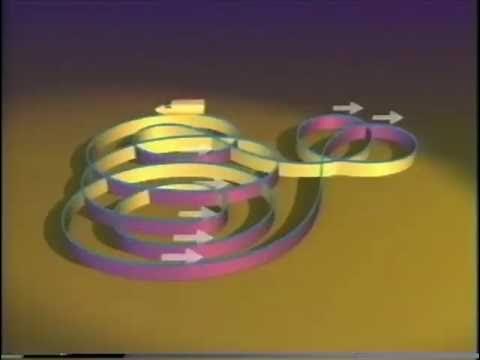
ssgelm
A sphere can smoothly invert without pinching because saddle points cancel dome and bowl curvature, while wavy corrugated strips absorb the geometric deformation that makes inverting a circle impossible.
AI-assisted summary of Outside In — original source. Check the original for full context.
Source published:
Key ideas
- Mathematically turning a sphere inside out without puncturing, tearing, creasing, or pinching it is provably possible in three dimensions, despite being strictly impossible for a two-dimensional circle. (0:05)
- A circle cannot be turned inside out under smooth planar transformations because its topological turning number—measured by smiles minus frowns—is an invariant that evaluates to +1 right-side out and -1 inside out. (3:41)
- Surfaces in 3D bypass planar topological restrictions because saddle points carry a negative sign, allowing domes and bowls (+1) to cancel with saddles (-1) while maintaining a constant topological invariant of 1. (7:21)
- William Thurston's 1974 corrugation method provides the geometric mechanism for eversion by adding wavy accordion ripples that absorb deformation slack and prevent sharp corners during cap translation and twisting. (9:13)
Detailed notes
## Background Published on YouTube by channel ssgelm on April 23, 2011, this educational video is titled "Outside In." The page description succinctly summarizes the project simply as: "This is a sphere turning inside out."
## TL;DR The video explores the classic topological problem of sphere eversion: turning a sphere inside out under strict mathematical rules allowing self-intersection and stretching, but forbidding tears, punctures, or sharp creases. After demonstrating why turning a circle inside out is provably impossible in two dimensions due to the turning number invariant (measured via smiles and frowns), the guide explains how 3D surfaces escape this restriction because saddle points can cancel out domes and bowls. The presentation then breaks down William Thurston's 1974 corrugation method, using rigid guide strips, belt-like twisting mechanics, and flexible accordion-like waves to smoothly evert the entire sphere without forming corners.
## Atmosphere & style The presentation adopts an engaging Socratic dialogue between an authoritative guide and a skeptical, relatable learner whose persistent objections mirror the audience's natural geometric intuitions. The tone is delightfully playful and mathematically rigorous, demystifying abstract topology with grounded analogies like monorail tracks, smiling curves, and twisted leather belts. Watching it feels like unlocking an intricate visual puzzle, building from disorientation and disbelief into genuine mathematical wonder, finally capped off by a triumphant, orchestral full-speed animation.
## Bulletin - [00:05](https://www.youtube.com/watch?v=wO61D9x6lNY&t=5s) Mathematically turning a sphere inside out without puncturing, tearing, creasing, or pinching it is provably possible in three dimensions, despite being strictly impossible for a two-dimensional circle. - [03:41](https://www.youtube.com/watch?v=wO61D9x6lNY&t=221s) A circle cannot be turned inside out under smooth planar transformations because its topological turning number—measured by smiles minus frowns—is an invariant that evaluates to +1 right-side out and -1 inside out. - [07:21](https://www.youtube.com/watch?v=wO61D9x6lNY&t=441s) Surfaces in 3D bypass planar topological restrictions because saddle points carry a negative sign, allowing domes and bowls (+1) to cancel with saddles (-1) while maintaining a constant topological invariant of 1. - [09:13](https://www.youtube.com/watch?v=wO61D9x6lNY&t=553s) William Thurston's 1974 corrugation method provides the geometric mechanism for eversion by adding wavy accordion ripples that absorb deformation slack and prevent sharp corners during cap translation and twisting.
## Key takeaways - [00:05](https://www.youtube.com/watch?v=wO61D9x6lNY&t=5s) Sphere eversion permits elastic stretching, bending, and smooth self-intersections, but strictly forbids tearing, puncturing, creasing, or pinching infinitely tight. - [00:05](https://www.youtube.com/watch?v=wO61D9x6lNY&t=5s) Pushing the northern and southern hemispheres directly through each other fails because it creates an illegal sharp crease along the equator. - [01:48](https://www.youtube.com/watch?v=wO61D9x6lNY&t=108s) In two dimensions, a circle cannot be turned inside out because straight-line motions form sharp corners and shrinking loops create illegal corners in disguise. - [03:41](https://www.youtube.com/watch?v=wO61D9x6lNY&t=221s) The turning number of a closed planar curve equals the count of eastward smiles minus eastward frowns, representing net full 360-degree rotations. - [03:41](https://www.youtube.com/watch?v=wO61D9x6lNY&t=221s) Because smooth deformations can only create or destroy smiles and frowns in matched pairs, turning number is an invariant that prevents a +1 circle from morphing into a -1 circle. - [07:21](https://www.youtube.com/watch?v=wO61D9x6lNY&t=441s) On 2D surfaces in 3D space, horizontal tangent points include saddles alongside domes and bowls; the surface invariant is calculated as (Domes + Bowls) - Saddles. - [07:21](https://www.youtube.com/watch?v=wO61D9x6lNY&t=441s) Both a standard sphere and an inside-out sphere have a surface invariant of 1, meaning 3D topology does not obstruct eversion. - [09:13](https://www.youtube.com/watch?v=wO61D9x6lNY&t=553s) Stephen Smale first proved the theoretical existence of sphere eversion in 1957, with practical geometric constructions later developed by Shapiro, Morin, and Thurston. - [09:13](https://www.youtube.com/watch?v=wO61D9x6lNY&t=553s) The Whitney–Graustein theorem guarantees that any closed planar curve can smoothly deform into another curve that shares the same turning number. - [09:13](https://www.youtube.com/watch?v=wO61D9x6lNY&t=553s) Thurston's corrugation technique decomposes curves and surfaces into rigid guide segments connected by wavy ripples that absorb rotation and translation without creasing. - [13:36](https://www.youtube.com/watch?v=wO61D9x6lNY&t=816s) Translating the polar caps past each other forms a central loop in the guide strips, which is transferred into twists near the ends by rotating the caps in opposite directions, analogous to straightening a looped belt. - [15:20](https://www.youtube.com/watch?v=wO61D9x6lNY&t=920s) The full sphere's eversion geometry is constructed from sixteen rotated copies of a single fundamental building block consisting of two adjacent guides and an undulating strip. - [16:31](https://www.youtube.com/watch?v=wO61D9x6lNY&t=991s) Horizontal ribbons near the equator appear to turn inside out like the forbidden 2D circle, but succeed because 3D ribbon strips are free to twist out of the vertical plane. - [17:53](https://www.youtube.com/watch?v=wO61D9x6lNY&t=1073s) The final sphere eversion follows a five-stage sequence: corrugating the surface, passing the polar caps through each other, counter-twisting the caps, pushing the equator through the center, and smoothing out the ripples.
## Detailed walkthrough ### [00:05](https://www.youtube.com/watch?v=wO61D9x6lNY&t=5s) The Rules of the Game: Turning a Sphere Inside Out
A curious observer opens with a rumor from the mathematical world: mathematicians claim they can turn a sphere inside out. When asked what the big deal is—suggesting one could simply poke a hole in the surface and pull it through—the guide clarifies that the entire premise requires doing it without puncturing the surface. Realizing this would be impossible with everyday objects like a basketball, the narrator establishes the strict mathematical rules governing the problem. The sphere is treated as being made of an abstract elastic material capable of stretching, bending, and passing directly through itself via self-intersections.
```mermaid flowchart TD accTitle: Rules for Sphere Eversion accDescr: Flowchart illustrating what operations are allowed versus forbidden when turning a sphere inside out. subgraph Allowed["Allowed Operations"] A1["Stretch & Bend"] A2["Self-intersections (Pass through itself)"] end subgraph Forbidden["Forbidden Operations"] F1["Puncturing or Tearing"] F2["Creasing or Sharp Bends"] F3["Pinching Infinitely Tight"] end ```
The novice assumes that allowing the surface to intersect itself makes the task trivial, attempting to shove the northern and southern hemispheres straight through one another. The guide immediately halts the attempt, pointing out the equatorial ring where a catastrophic crease or infinitely tight pinch occurs. Pushed to admit defeat, the learner protests that turning it inside out without pinching seems geometrically impossible, only to be shown a mesmerizing, complex animation of a successful sphere eversion. As the guide asks, “That wasn't easy to follow, was it?”, the challenge shifts to finding a simpler model to understand the underlying mechanics.
- The material can stretch, bend, and pass through itself. - Tearing, puncturing, creasing, and infinitely tight pinching are strictly forbidden.
[01:48](https://www.youtube.com/watch?v=wO61D9x6lNY&t=108s) Simplifying to 2D: The Impossibility of Everting a Circle
To dissect what makes sphere eversion work, the guide pivots down a dimension to examine a circle. To distinguish inside from outside in two dimensions, a vertical wall is erected along the perimeter, painted purple on one side and gold on the other. The challenge is posed: can this circle be smoothly transformed so that the purple and gold sides are reversed without introducing any sharp corners? The participant glibly compares it to flipping a rubber band, but the rules dictate that the wall must remain strictly vertical and smooth while staying in the plane, even though it may pass through itself.
```mermaid flowchart LR accTitle: Direct Linear Interpolation Fails accDescr: Shows why straight line motion fails on curves by causing sharp corners. A["Initial Smooth Curve"] -->|"Straight-line point motion"| B["Intermediate State"] B -->|"Forms sharp corner"| C["Illegal Sharp Bend"] ```
When the participant tries to reverse the circle, a sharp bend instantly appears. The guide notes that if sharp bends were allowed, any curve could trivially morph into any other by moving each point in a straight line toward its target destination. The participant then attempts to eliminate corners by shrinking an extra loop down smaller and smaller until it vanishes. The guide rejects this as well, explaining: “It's like having a corner in disguise. So it's against the rules.” Realizing that neither corners nor pulled-tight loops are permitted, the participant concludes that turning a circle inside out is flatly impossible. This triggers immediate bewilderment: how could an eversion be possible for a three-dimensional sphere, yet provably impossible for a simple two-dimensional circle?
- The vertical wall allows distinguishing sides: purple on one face, gold on the other. - The wall must stay strictly vertical and cannot crease, though self-intersection is permitted. - Shrinking a loop to a point creates an illegal singularity (a corner in disguise).
[03:41](https://www.youtube.com/watch?v=wO61D9x6lNY&t=221s) Monorails, Smiles, and Frowns: The Turning Number
To explain why a circle cannot be turned inside out, the guide introduces a fundamental topological invariant called the turning number. Viewers are asked to imagine a monorail car driving along the top of the wall, adhering to two strict traffic laws: it can only travel forward, and it must keep the purple side of the wall on its right. By tracking the car's orientation on a compass-style direction gauge, one observes that on a standard counterclockwise circle, the car turns left continuously, completing one full 360-degree turn to the left after a full circuit. On winding tracks, the car might turn left at some stretches and right at others, but the net amount of full rotations upon returning to the start is always an integer.
```mermaid flowchart TD accTitle: Computing Turning Number via Smiles and Frowns accDescr: How eastward tangent points (smiles vs frowns) determine the turning number. subgraph Tangents["Facing Due East (Looking North)"] S["Track curves away: 'Smile' (+1 Left Turn)"] F["Track curves toward: 'Frown' (-1 Right Turn)"] end S --> TN["Turning Number = Smiles - Frowns"] F --> TN ```
Because tracking continuous net rotation along an intricate track can be disorienting, the guide reveals an elegant counting shortcut. Looking from the south toward the north, an observer identifies every point along the track where the monorail travels due east (to the viewer's right, showing the purple wall face-on): - **Smiles**: Places where the track curves away from the viewer (concave up), meaning the car turns left. Each smile adds $+1$ to the turning count. - **Frowns**: Places where the track curves toward the viewer (concave down), meaning the car turns right. Each frown subtracts $1$ (adds $-1$).
By tallying these points across a complicated winding track (accumulating counts through $0 \to 1 \to 2 \to 3 \to 4 \to 3 \to 2 \to 3$), the net turning number is revealed: “The turning number is the number of smiles minus the number of frowns.” The observer quips that the turning number simply “measures happiness.” Crucially, while continuous smooth deformations can create or destroy smiles and frowns, they can only ever do so in matched smile-frown pairs. Thus, the quantity $(\text{Smiles} - \text{Frowns})$ is an invariant that never changes under legal motions: - A standard circle with purple outside has 1 smile and 0 frowns $\implies \text{Turning Number} = +1$. - An everted circle with gold outside has 0 smiles and 1 frown $\implies \text{Turning Number} = -1$.
Because $+1 \neq -1$, the circle can never be turned inside out under smooth regular deformations.
[07:21](https://www.youtube.com/watch?v=wO61D9x6lNY&t=441s) Domes, Bowls, and Saddles: Why Surfaces are Different
The participant quickly tries to apply this same reasoning to the 3D sphere, arguing that a regular sphere has a three-dimensional smile (a bowl) while the inverted sphere has a three-dimensional frown (a dome), which should prevent eversion. The guide explains why this analogy breaks down: on a two-dimensional surface embedded in 3D, horizontal tangent points are not limited to local minima (bowls) and local maxima (domes). There exists a third feature: saddle points, which curve up like a smile in one direction and down like a frown in another.
| Surface Feature | Horizontal Contour Shape | Curvature Behavior | Topological Sign | |:--- |:--- |:--- |:--- | | **Bowl** | Concentric rings | Curves upward in all directions | $+1$ | | **Dome** | Concentric rings | Curves downward in all directions | $+1$ | | **Saddle** | Figure-X intersection | Curves up in one direction, down in another | $-1$ |
Unlike curves in the plane, where smiles and frowns cancel each other out, on a 2D surface a dome can collide with a saddle and cancel out, or a bowl can collide with a saddle and cancel out. Bowls and domes cannot annihilate each other directly—behaving like electrical charges of the same sign—so the invariant formula for surfaces sums domes and bowls together and subtracts saddles: $$\text{Invariant} = (\text{Domes} + \text{Bowls}) - \text{Saddles}$$ For an ordinary sphere, whether right-side out (one bowl, zero domes, zero saddles) or inside out (one dome, zero bowls, zero saddles), this invariant evaluates to exactly $1$. Thus, the topological obstruction that traps the 1D circle does not forbid turning a 2D sphere inside out.
[09:13](https://www.youtube.com/watch?v=wO61D9x6lNY&t=553s) History of Eversion and Thurston's Corrugations
Even though topology allows sphere eversion, finding a concrete geometric sequence of moves baffled mathematicians for decades: - **1957**: Stephen Smale proved mathematically that sphere eversion was possible in theory, an unexpected existence proof that shocked the mathematics community. - **1964**: Arnold Shapiro devised the first practical, constructible method to achieve it (taking seven years after Smale's proof). - **Subsequent methods**: Bernard Morin (who was blind) and others developed further geometric visualizations. - **1974**: William Thurston invented a method based on corrugations, which forms the core of the video's visualization.
To explain Thurston’s approach, the guide returns to curves. While turning numbers prevent crossing between different classes, the **Whitney–Graustein theorem** establishes that any closed planar curve can be smoothly transformed into any other closed curve having the exact same turning number. The participant easily untangles simple loops of turning number 1 by hand, but dealing with arbitrary complex loops demands an algorithmic technique.
```mermaid flowchart LR accTitle: Thurston's Corrugation Method on Curves accDescr: Step-by-step pipeline showing how rigid guide segments and flexible wavy corrugations avoid sharp corners. subgraph Thurston["Thurston's Guide & Wave Pipeline"] G1["Divide curve into Guide Segments"] G2["Translate Centers straight to target without rotation"] G3["Rotate Guides to align with target tangents"] G4["Connect Guides with Wavy Corrugations to absorb slack"] end G1 --> G2 --> G3 --> G4 ```
Thurston's method solves the problem of straight-line transformations (which normally create illegal sharp corners) by adding "springiness": 1. Small guide segments are marked along the source curve. 2. The midpoints of these guides are translated in straight lines directly toward their target positions on the destination curve without rotating. 3. The guides are then smoothly rotated to align tangentially with the target curve. 4. The regions between the guides are deformed into wavy, accordion-like corrugations.
These ripples allow adjacent guides to rotate and move freely past one another while staying locally parallel, absorbing the deformation without ever pinching or forming a sharp corner: “The original curve in blue develops sharp corners, but the wavy curve is springy enough to remain smooth throughout.” This alignment is mathematically guaranteed to work smoothly if and only if both curves share the same turning number (failing if one tries to turn a figure-8, which has turning number 0, into a circle of turning number 1).
The guide bridges this back to 3D: a sphere can be modeled as a vertical stack of circles deformed into a barrel shape and capped at the top and bottom. By decomposing the barrel into vertical guide strips alternating with wavy corrugated strips, Thurston's wave technique provides the flexible geometric slack needed to turn the entire sphere inside out without pinching or creasing.
[13:36](https://www.youtube.com/watch?v=wO61D9x6lNY&t=816s) Guide Strips and the Belt Analogy
The narrator points out that the waviness dies out toward the top and bottom so it can smoothly match the rigid polar caps. As the viewer worries aloud that the construction is getting too complicated, the narrator simplifies the picture by isolating a single guide strip connecting the two polar caps. To initiate the movement, the caps are pushed past each other. When the viewer notes that pushing the poles straight through previously caused an illegal crease, the narrator instructs: “Stop before the crease when the guide has a loop in the middle.”
```mermaid flowchart TD accTitle: Guide Strip Motion and Belt Twist Analogy accDescr: Sequence showing how pushing polar caps creates a loop, which is resolved by twisting ends in opposite directions. subgraph CapsPush["Step 1: Cap Translation"] A["Push polar caps past each other"] --> B["Stop before crease forms loop in center"] end subgraph TwistPhase["Step 2: Cap Rotation"] B --> C["Turn caps in opposite directions"] C --> D["Convert central loop into end twists"] end subgraph Finish["Step 3: Central Eversion"] D --> E["Push middle of guide strip through center"] E --> F["Gold exterior turns inward"] end ```
The narrator explains that turning the two caps in opposite directions converts the loop in the middle into twisting at the ends. The viewer immediately connects this mechanic to a familiar object: “It's like a belt. If you put a loop in the middle and pull the ends tight, the loop turns into twisting, right? Then you can straighten out the belt by turning each end half a turn in opposite directions.” To complete the eversion on the strip, the middle of the guide strip is simply pushed back through the center of the sphere. Adding a second guide strip illustrates how they interact: they intersect at two points near the central axis, and their gold surfaces, which originally pointed outward, are now safely facing inward. When all the guide strips are displayed together, the viewer realizes why the polar caps do not require any springiness—they only move straight up and down and then rotate into position.
- Pushing the polar caps straight through would cause a sharp crease, so motion pauses right when a rounded loop forms in the guide strip. - Rotating the two caps in opposite directions transfers the central loop's curl into twists distributed near the ends. - The belt analogy explains how opposite half-turns eliminate the middle loop without violating topological rules. - During the crossing of two guide strips, two self-intersection regions occur near the central axis without pinching.
---
[15:20](https://www.youtube.com/watch?v=wO61D9x6lNY&t=920s) Corrugation and the Fundamental Building Block
Focusing closely on two neighboring guides and the undulating surface between them from a pole down to the equator reveals the core structure of the entire transformation. The narrator emphasizes that this section serves as the fundamental building block of the eversion, noting that the complete sphere is constructed from sixteen rotated copies of this single piece. Although the viewer finds the surface intricate and intimidating, the narrator clarifies that the corrugated surface is merely tracking the twisting motion of the guide strips seen moments earlier.
When shown the corrugated chunk spanning all the way from pole to pole, the mechanical purpose of the waves becomes clear. The narrator explains: “Yes, the corrugation provides flexibility between the guides so that their motion does not create any pinches or creases just like the waves in the curve that we saw before.” The complete motion follows a distinct, repeatable choreography: 1. The connecting strips between the guides are corrugated. 2. The polar caps are pushed past each other. 3. The caps are twisted in opposite directions to undo the loops formed at the center. 4. The equator is pushed across the center of the sphere. 5. The corrugations are smoothed away, leaving the sphere inside out.
---
[16:31](https://www.youtube.com/watch?v=wO61D9x6lNY&t=991s) Analyzing Horizontal Ribbons
Even with the overall sequence laid out, the viewer still struggles to grasp the spatial mechanics, prompting the narrator to offer an alternative cross-sectional view: slicing the sphere into thin, horizontal ribbons and inspecting them individually. As the north pole pushes down into the south, ribbons situated near the poles behave quite gently; their guide segments preserve their relative positions, and their corrugation folds stay relatively shallow.
Moving closer toward the equator, the ribbon behavior becomes substantially wilder. To make sense of the motion, the presentation shifts to a split-screen perspective: - **Left screen (Side view):** Displays the ribbon's actual 3D elevation and position in space as it travels. - **Right screen (Overhead tracking camera):** Tracks directly from above and scales so the ribbon's apparent size remains constant, revealing rotational and cross-sectional symmetries obscured in the side view.
Right at the equator, the ribbon twists completely without shifting up or down at all. This movement triggers a sudden objection from the viewer, who recognizes the looping profile from an earlier counterexample: “Wait a minute. This ribbon looks just like the wall under the Montreal, and it's turning inside out. You had finally convinced me that that was impossible.” The narrator replays the clip to resolve the paradox, clarifying that the earlier walls represented abstract 2D circles constrained to remain strictly vertical, whereas these ribbons exist in three dimensions: “Remember that our walls represented circles and had to stay vertical. But here, the ribbon can twist around in space because it's part of a sphere.”
---
[17:53](https://www.youtube.com/watch?v=wO61D9x6lNY&t=1073s) Progressive Surface Stages and Full Eversion
To cement the full picture before the finale, the narrator reviews the entire transformation by progressively building up the sphere's surface across its primary structural milestones: - **Corrugation phase:** Longitudinal waves ripple out across the surface between the guide tracks. - **Cap pass-through:** The polar caps push straight through one another without creasing. - **Mid-twisting phase:** Complex, swirling motion develops along the equator as the caps turn oppositely. - **End of twisting:** The equatorial corrugations fold so tightly that they nearly form figure-eight loops. - **Horizontal pass-through:** The equatorial bulge pushes horizontally through the sphere's center. - **Uncorrugation phase:** The surface ripples flatten completely out, exposing an entirely purple sphere where the gold exterior used to be.
The presentation then launches into a smooth, unobstructed, full-speed animation of the entire eversion accompanied by orchestral music. Having witnessed the complete, seamless unfolding of the surface from every angle, the viewer is entirely won over, enthusiastically concluding: “You were right. You can turn a sphere inside out without poking holes or creasing it, even though you can't do it for a circle. This is great. Somebody should make a movie about this stuff.” The film concludes with extended closing credits and celebratory musical themes set against visual recaps of the eversion models.
## Notable quotes > [17:53](https://www.youtube.com/watch?v=wO61D9x6lNY&t=1073s) You can turn a sphere inside out without poking holes or creasing it, even though you can't do it for a circle. — The viewer
## Mentioned Stephen Smale, Arnold Shapiro, Bernard Morin, William Thurston, Whitney–Graustein theorem, Outside In
## Video description This is a sphere turning inside out.
[Source](https://www.youtube.com/watch?v=wO61D9x6lNY)