Jobs, Gates Bury Platform War, Bet on Rich Clients Over Web Browsers
BrioWeb Agenzia di marketing e comunicazione
Apple survived by abandoning the zero-sum premise that Microsoft had to lose, while both founders agree that future consumer innovation requires pairing rich local client computing with cloud services rather than relying on browser-only terminals.
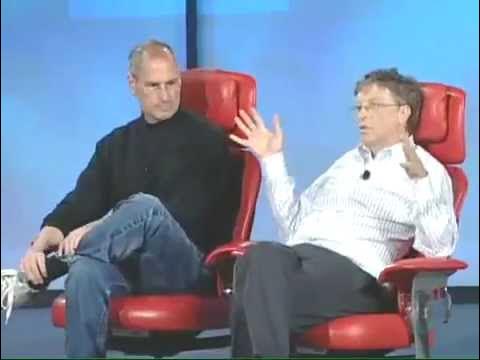
Steve Jobs and Bill Gates appeared together at D5 in 2007, reflecting on over three decades of collaboration and competition since Microsoft wrote floating-point BASIC for the Apple II and developed launch software for the original 1983 Macintosh. (7:09)
Jobs explained that abandoning the zero-sum narrative where Apple had to beat Microsoft was critical to Apple's 1997 turnaround, allowing the company to preserve its core developer relationships. (22:44)
Both leaders defended rich client architecture over thin cloud browsers, arguing that native processing power is essential for responsive interfaces, local offline caching, speech recognition, and computer vision. (37:11)
Gates predicted that within five years, consumers would primarily rely on two distinct form factors: a pocket-sized mobile computer and a full-screen tablet PC for reading and writing. (42:14)
Detailed notes
## Background
Published on YouTube by BrioWeb Agenzia di marketing e comunicazione on March 29, 2013, this video captures the historic joint stage appearance of Steve Jobs and Bill Gates at the D5 conference in 2007. The channel's description highlights the interview as one of the pivotal moments in computing history, offering profound insights for followers of both Apple and Microsoft.
## TL;DR
Appearing together at the D5 Conference, Steve Jobs and Bill Gates reflect on more than three decades of shared computing history, beginning with early Apple II BASIC agreements and Macintosh software development up through ending their zero-sum platform rivalry in 1997. Moderated by Walt Mossberg and Kara Swisher, the two tech titans contrast Apple's vertically integrated product philosophy against Microsoft's broad platform and licensing models. They examine the emerging post-PC era, discussing rich native clients versus browser-based cloud architectures, mobile hardware constraints, and natural user interfaces like touch and computer vision. The conversation concludes with audience Q&A covering education reform, corporate culture, executive hiring, and mutual reflections on their careers shaping modern personal computing.
## Atmosphere & style
The session carries an extraordinarily rare blend of warmth, nostalgic camaraderie, and quiet gravitas as two legendary rivals converse as seasoned elder statesmen of an industry they helped create. Guided by playful yet probing moderation from Walt Mossberg and Kara Swisher, Jobs and Gates trade self-deprecating quips about secret marriages and television ads while expressing sincere mutual admiration for each other's distinct strengths. The dialogue balances rigorous technical debate with genuine emotional resonance, peaking when the duo reflect on being the oldest hands in the room with memories longer than the road ahead.
## Bulletin
- [07:09](https://www.youtube.com/watch?v=wvhW8cp15tk&t=429s) Steve Jobs and Bill Gates appeared together at D5 in 2007, reflecting on over three decades of collaboration and competition since Microsoft wrote floating-point BASIC for the Apple II and developed launch software for the original 1983 Macintosh.
- [22:44](https://www.youtube.com/watch?v=wvhW8cp15tk&t=1364s) Jobs explained that abandoning the zero-sum narrative where Apple had to beat Microsoft was critical to Apple's 1997 turnaround, allowing the company to preserve its core developer relationships.
- [37:11](https://www.youtube.com/watch?v=wvhW8cp15tk&t=2231s) Both leaders defended rich client architecture over thin cloud browsers, arguing that native processing power is essential for responsive interfaces, local offline caching, speech recognition, and computer vision.
- [42:14](https://www.youtube.com/watch?v=wvhW8cp15tk&t=2534s) Gates predicted that within five years, consumers would primarily rely on two distinct form factors: a pocket-sized mobile computer and a full-screen tablet PC for reading and writing.
## Key takeaways
- [08:49](https://www.youtube.com/watch?v=wvhW8cp15tk&t=529s) Bill Gates pioneered software as an autonomous commercial business long before hardware manufacturers recognized its independent value.
- [09:53](https://www.youtube.com/watch?v=wvhW8cp15tk&t=593s) Apple took immense hardware and financial risks on the Apple II and the original Macintosh, executing one of computing's greatest turnarounds after Steve Jobs returned in 1997.
- [16:01](https://www.youtube.com/watch?v=wvhW8cp15tk&t=961s) Microsoft's early commitment to the Mac GUI was driven by the reality that character-mode DOS productivity software was already locked down by Lotus 1-2-3, WordPerfect, and dBASE.
- [22:44](https://www.youtube.com/watch?v=wvhW8cp15tk&t=1364s) Viewing platform competition as a zero-sum game would have doomed Apple; survival required keeping Microsoft engaged as the primary Mac application developer.
- [28:12](https://www.youtube.com/watch?v=wvhW8cp15tk&t=1692s) Steve Jobs defined Apple fundamentally as a software company, viewing hardware devices like the Mac, iPod, and iPhone as software wrapped in beautiful industrial enclosures.
- [30:01](https://www.youtube.com/watch?v=wvhW8cp15tk&t=1801s) Aside from Windows on personal computers, decoupled software and hardware ecosystems have struggled to succeed in mainstream consumer markets compared to vertically integrated designs.
- [37:11](https://www.youtube.com/watch?v=wvhW8cp15tk&t=2231s) Heavy local client computing power remains indispensable alongside cloud services because advanced touch, speech, and vision interfaces require massive local processing.
- [39:18](https://www.youtube.com/watch?v=wvhW8cp15tk&t=2358s) Native applications like the iPhone's Google Maps client demonstrate that rich client integration with backend cloud APIs substantially outperforms generic in-browser web apps.
- [48:26](https://www.youtube.com/watch?v=wvhW8cp15tk&t=2906s) Physical screen size constraints permanently divide devices, meaning pocket hardware cannot replace full-sized displays required for sustained reading, writing, and editing.
- [01:05:16](https://www.youtube.com/watch?v=wvhW8cp15tk&t=3916s) Post-PC devices offer a clean slate for radical user interface innovation because they are unencumbered by decades of legacy application and desktop operating system backward compatibility.
- [01:22:55](https://www.youtube.com/watch?v=wvhW8cp15tk&t=4975s) Bill Gates admitted he would give a great deal to possess Steve Jobs's intuitive aesthetic taste and talent evaluation, contrasting Jobs's sensory product decisions with pure engineering logic.
- Building Apple around 'the whole banana' vertically integrated stack initially crippled its ability to form industry partnerships, an area Microsoft mastered early on.
- [01:27:40](https://www.youtube.com/watch?v=wvhW8cp15tk&t=5260s) Bill Gates predicted that short of physical teleportation, most core science-fiction concepts—including virtual presence and spatial motion interaction—would materialize within a decade.
## Detailed walkthrough
### [00:08](https://www.youtube.com/watch?v=wvhW8cp15tk&t=8s) The 1983 Macintosh Software Dating Game
The session opens with archival video footage from the 1983 Apple sales meeting, styled as a parody of *The Dating Game*. Steve Jobs plays the host, introducing a panel of three industry leaders vying for Apple's affections as software partners for the upcoming Macintosh computer. Sitting on the panel are Fred Gibbons, president of Software Publishing Corporation; Mitch Kapor, president of Lotus Development Corporation (known for Lotus 1-2-3); and a youthful Bill Gates, chairman of Microsoft. Gates makes a striking financial declaration during his introduction:
> “My name is Bill Gates. I'm chairman of Microsoft. And during 1984, Microsoft expects to get half of its revenues from Macintosh software.”
When questioned as “software magnate number three” about his first date with the Macintosh, Gates recounts that Microsoft had already been working with the Mac for nearly two years and had assigned some of its best talent to the project. Asked whether the machine would establish itself as the third major industry standard, Gates enthusiastically endorses Apple’s vision: “Well, to create a new standard, it takes something that's not just a little bit different. It takes something that's really new and really captures people's imagination. And the Macintosh of all the machines I've ever seen is the only one that meets that standard.” Asked about his ideal business relationship, Gates emphasizes the need for rapid hardware deployment, noting that Microsoft planned to sell software independently and needed Apple to get large numbers of consistent machines to market. When time runs out, Jobs delivers his punchline verdict in verse to the cheering audience: “Apples are red, IBM's blue. If Mac's going to be the third milestone, I need all of you.”
[03:32](https://www.youtube.com/watch?v=wvhW8cp15tk&t=212s) Macworld 1997: Ending the Apple–Microsoft Rivalry
The video reel shifts forward fourteen years to August 1997 at Macworld Boston. Steve Jobs, having recently returned to lead an embattled Apple, takes the stage to address the necessity of constructive partnerships. Apple, he explains, lives within an ecosystem and cannot survive in destructive relationships. He reveals that Apple and Microsoft had spent several weeks settling outstanding patent disputes in a professional manner, choosing reconciliation over prolonged litigation. Jobs then surprises the audience by bringing in Bill Gates via a giant satellite downlink screen towering over the auditorium.
On the screen, Gates highlights Microsoft's long history of Macintosh development, citing milestones from the original launch to Mac Excel, and announces upcoming releases: Mac Office 98 and a Mac-tailored version of Internet Explorer. Gates emphasizes that Mac Office 98 would set a new performance benchmark that was “in many ways it's more advanced than what we've done on the Windows platform,” while clarifying that Internet Explorer was written specifically for the Mac rather than treated as a lazy Windows port. Jobs concludes the historic clip by directly challenging the conventional wisdom of a zero-sum platform war:
> “The era of setting this up as a competition between Apple and Microsoft is over. As far as I'm concerned, this is about getting Apple healthy and this is about Apple being able to make incredibly great contributions to the industry to get healthy and prosper again.”
[07:09](https://www.youtube.com/watch?v=wvhW8cp15tk&t=429s) Taking the Stage and Acknowledging the Pioneers
Back in the present day at the D5 Conference in 2007, Steve Jobs and Bill Gates walk out together under warm applause, working out where to sit on the stage chairs alongside hosts Walt Mossberg and Kara Swisher. Before diving into the interview, Mossberg pauses to recognize early microcomputer pioneers seated in the room who had appeared in the opening reel. He asks Lotus founder Mitch Kapor, a regular attendee of the D conference, to stand up, followed by Software Publishing Corporation's Fred Gibbons, who was attending the conference for the first time.
Mossberg also scans the audience to acknowledge *Fortune* journalist Brent Schlender, who had conducted the last joint interview between Jobs and Gates for the magazine prior to this public stage appearance. Swisher then frames the discussion, acknowledging the intense press speculation and online chatter framing their meeting as a bitter “mano-a-mano catfight.” She sets aside the rivalry narrative by asking each man to reflect honestly on what the other had contributed to the personal computer and technology industry.
[08:49](https://www.youtube.com/watch?v=wvhW8cp15tk&t=529s) Steve Jobs on Bill Gates's Foundational Contribution
Steve Jobs begins by praising Bill Gates for pioneering the entire software industry before anyone else grasped that software could exist as an autonomous business. In Jobs's view, Gates realized that software was the critical element long before hardware companies or the market understood its value, creating a viable commercial software model that ended up defining the computing landscape.
Beyond commercial foresight, Jobs reflects on the immense personal and managerial stamina required to build and sustain an enduring enterprise. He notes that founding and running a company demands exceptional persuasive ability to recruit top-tier talent and inspire them to produce their life's best work over decades. Jobs observes:
> “So I think but the the biggest thing was Bill was really focused on software before almost anybody else had a clue that that it was really the software.”
- Gates created the first commercial software company before the industry even understood the concept.
- Microsoft established the dominant software business model that powered the PC revolution.
- Gates maintained the focus and persuasive power needed to attract, retain, and motivate elite engineering teams over several decades.
[09:53](https://www.youtube.com/watch?v=wvhW8cp15tk&t=593s) Bill Gates on Steve Jobs's Taste, Audacity, and Turnaround
Gates begins his response with a self-deprecating quip, remarking, “First I want to clarify I'm not Fake Steve Jobs,” drawing widespread laughter from the audience in reference to the popular satirical blog of the era. He then turns serious, praising the audacity of Apple's historical bets, starting in 1977 with the Apple II, which championed the vision of personal computing as a mass-market, empowering phenomenon when other companies only saw niche utility.
Gates recalls the sheer risk involved in developing the original Macintosh after the commercial disappointment of the Apple Lisa. Apple essentially “bet the company” on the Mac, pushing hardware limits with components like the 128K memory configuration and the notorious Twiggy floppy disk drive. Gates highlights Jobs's guiding philosophy that great products come from building tools one personally desires to use, a mindset driven by unmatched aesthetic taste:
> “Steve gave a speech once which is one of my favorites where he talked about in a certain sense we build the products that we want to use ourselves. Uh and you know so he's really pursued that with incredible taste and elegance that has had a a huge impact on the industry.”
Gates points out that Apple was literally failing when Jobs returned in 1997, and that Jobs single-handedly reinfused the company with the innovation and risk-taking needed to stage one of the greatest corporate turnarounds in history. Both Jobs and Gates add that neither company could have succeeded without brilliant co-founders and extraordinary engineering teams, agreeing that the two men on stage serve merely as stand-ins for the thousands of talented people who actually built the products.
[12:23](https://www.youtube.com/watch?v=wvhW8cp15tk&t=743s) Reflections on 1977 and Early Advertising Quirks
Walt Mossberg steers the conversation back thirty years to 1977, the milestone year when microcomputers began expanding outward from hobbyists to general consumers. Mossberg recalls examining an early 1978 Apple print advertisement that proudly proclaimed “thousands of people have discovered the Apple computer,” and urged readers to buy a real, programmable computer rather than cartridge-based systems like Atari.
Jobs laughs as he remembers the awkward marketing experiments of personal computing's infancy. He describes an early Apple print ad set in a kitchen, where a woman depicted as a housewife typed cooking recipes into an Apple II while her husband stood in the background looking on with paternal approval. The discussion touches upon the exact founding timeline of both firms, with Mossberg noting Apple was founded in 1976, while Gates clarifies that Microsoft's origins date back to 1975.
[13:49](https://www.youtube.com/watch?v=wvhW8cp15tk&t=829s) The $31,000 Floating-Point BASIC Deal
The discussion turns to the early days of personal computing in the late 1970s. While Microsoft had shipped its Altair BASIC in 1975 and worked with several early microcomputer makers, 1977 brought the landmark trio of personal computers: the Commodore PET, the Tandy TRS-80, and the Apple II. Many people do not realize that Apple relied on Microsoft software for the Apple II. Steve Wozniak had created Apple’s original Integer BASIC entirely by hand on paper without an assembler. Jobs praises Wozniak’s original BASIC as the best on the planet because it checked for syntax errors as code was typed in rather than waiting until runtime. However, it was strictly fixed-point, and Apple faced overwhelming customer demand for floating-point math.
Jobs humorously recalls begging Wozniak to add floating-point support: when asked who "we" was, Jobs quips, "Well, me." Despite Jobs's pleas, Wozniak never got around to making the change, leaving it as one of the "mysteries of life." Faced with this limitation, Apple turned to Microsoft, which had an established, high-quality floating-point BASIC. Bill Gates flew down to Apple and spent two days writing and debugging the cassette tape routines, which were then the primary medium for data storage. In exchange for the software, Apple paid Microsoft $31,000.
- In 1977, Microsoft software was present across the major early personal computers: Commodore PET, TRS-80, and Apple II.
- Apple paid Microsoft $31,000 for its floating-point BASIC to replace Wozniak's Integer BASIC.
- Bill Gates personally spent two days at Apple getting the cassette storage interface running.
[16:01](https://www.youtube.com/watch?v=wvhW8cp15tk&t=961s) Partnering on the Macintosh and Betting on the GUI
Gates and Jobs recount their close collaboration during the development of the original Macintosh. Apple assembled a passionate, highly focused team under Jobs, and Microsoft matched it with an equally dedicated team led by Jeff Harbers. Microsoft placed a massive company bet on the Macintosh, believing that graphical user interfaces would define the future of computing. At the time, Microsoft had very little presence in application software. Mitch Kapor's Lotus 1-2-3 dominated the spreadsheet market on the IBM PC, WordPerfect led in word processing, and Ashton-Tate’s dBASE dominated databases. To break into business software, Microsoft needed an architectural paradigm shift.
Developing software for the original Mac was constrained by extreme hardware limits: the machine possessed only 128 KB of RAM. A 22 KB chunk was dedicated entirely to the screen buffer, and another 14 KB to 20-odd KB was reserved for the core operating system runtime. Because Microsoft had early prototypes in Seattle, they flew engineers back and forth to Cupertino to build flagship productivity programs like Word and Multiplan (the precursor to Excel). While Apple built internal apps like MacPaint and MacDraw, Microsoft served as the primary external application developer.
```mermaid
flowchart LR
accTitle: Transition from DOS Character-Mode to GUI Applications
accDescr: Diagram showing DOS market leaders and Microsoft pivoting to the Macintosh platform.
> “The team that was assembled there to do the Macintosh was a very committed team and there was an equivalent team on our side that just got totally focused on this activity.” — Bill Gates
[19:17](https://www.youtube.com/watch?v=wvhW8cp15tk&t=1157s) Gil Amelio and the Sinking Ship
Following Jobs's departure from Apple in 1985, the company struggled to maintain its momentum. Gates notes that Apple failed to differentiate its hardware and operating system effectively against the high-volume PC ecosystem. Although Gates and Jobs jointly introduced Excel in New York City to great success, Apple’s hardware evolution stalled after the Macintosh 512K. Meanwhile, the advent of the Intel 386 processor, cheaper memory, and mature development tools proved the graphical interface bet right, leading to the massive success of Windows 95, which ended the debate between character-mode and GUI environments.
By the mid-1990s, Apple's financial health was precarious. Gates was in active weekend negotiations with Apple’s then-CEO, Gil Amelio, regarding a strategic investment and product commitments. Those talks ended abruptly when Jobs re-entered Apple management, called Gates directly, and told him that Amelio was out of the picture. Jobs brought up Amelio's infamous metaphor for the company to roast his leadership:
> “Gil was a nice guy, but he had a saying. He said, 'Apple is like a ship with a hole in the bottom leaking water, and my job is to get the ship pointed in the right direction.'” — Steve Jobs
- Excel was introduced jointly by Jobs and Gates at an event in New York City.
- Windows 95 legitimized GUI computing for the mass market, rendering character-mode interfaces obsolete.
- Bill Gates was actively negotiating a rescue/partnership deal directly with Gil Amelio until Jobs regained power and phoned Gates to take over the talks personally.
[22:44](https://www.youtube.com/watch?v=wvhW8cp15tk&t=1364s) Ending the Zero-Sum Game
Addressing his famous appearance at Macworld Boston in 1997, Jobs explains the tactical philosophy that saved Apple. At the time of his return, both Apple’s staff and its loyal customer base were trapped in an adversarial mindset fueled by resentment over Microsoft's commercial dominance with Windows. Jobs recognized that treating the industry as a binary fight meant certain death for Apple. Microsoft was already the largest third-party developer for the Mac, and keeping its applications on the platform was critical to Apple's survival. Jobs moved swiftly to dismantle that destructive rivalry.
> “And what was really clear was that if the game was a zero-sum game where for Apple to win Microsoft had to lose, then Apple was going to lose.” — Steve Jobs
> “Apple didn't have to beat Microsoft. Apple had to remember who Apple was because it had forgotten who Apple was.” — Steve Jobs
[24:15](https://www.youtube.com/watch?v=wvhW8cp15tk&t=1455s) The Mac Business and the "Get a Mac" Commercials
Steve Jobs reflects on calling Bill Gates when Apple was at its weakest in 1997 to patch things up, initiating an enduring partnership. Gates notes that ever since, Microsoft has maintained a dedicated team developing Mac applications, granted a unique status within Microsoft to preserve a special relationship with Apple. Gates calls it a great business for Microsoft, and Jobs concurs, emphasizing: “And it's actually the relationship between the Mac development team at Microsoft and Apple is a great relationship. It's one of our best developer relationships.”
When the interviewers ask how the two executives view each other as competitors in the evolving tech landscape—pointing out that the public watches their commercials and assumes persistent annoyance—Gates jokingly confesses his affection for the "Get a Mac" campaign's antagonist: “I have to confess I like PC guy better.” Jobs agrees that the character played by John Hodgman makes the campaign succeed, clarifying the creative intention behind the ads: “The art of those commercials is not to be mean, but it's actually for the guys to like each other.” Gates quips that PC guy has a big heart and that “his mother loves him,” while Jobs insists that PC guy is precisely what makes the dynamic work.
[25:52](https://www.youtube.com/watch?v=wvhW8cp15tk&t=1552s) Microsoft's View of Apple and the Xbox 360 Irony
Asked how frequently Apple appears on Microsoft’s radar compared to rivals like Google, Linux in the enterprise, or Sony in gaming, Gates explains that Apple is viewed primarily as an opportunity, though teams like the Zune division view Apple directly as a competitor. Gates points out that the Zune team loved that Apple built a gigantic digital music market for them to enter, adding with a smile: “And we love them because they're all customers.”
The discussion turns to an anecdote confirmed by J Allard: Microsoft had used Apple Mac towers to develop early software for the Xbox 360, reportedly placing one of the largest corporate orders for Mac hardware at the time. Gates confirms the historical irony: Microsoft adopted the PowerPC architecture for the Xbox 360 console just as Apple was abandoning it to switch to Intel. Gates explains that the move was pragmatic, as the console did not require the battery efficiency lacking in the PowerPC roadmap. Jobs deadpans about Apple's marketing discipline: “And we never ran an ad on that.” The audience laughs as the hosts tease Jobs for his uncharacteristic restraint.
[28:12](https://www.youtube.com/watch?v=wvhW8cp15tk&t=1692s) Apple as a Software Company in Beautiful Boxes
Turning to Apple's perspective on Microsoft and the PC competition, Jobs explains that Apple’s expansion into consumer products stems from a core software advantage. He observes that the great Japanese consumer electronics companies had invented and dominated portable music for decades, yet lost to the iPod because they could not conceive of or implement the necessary software. An iPod, Jobs explains, is fundamentally software on the device, software on the computer, and software in the cloud for the iTunes Store—merely packaged in a beautiful enclosure. The Mac is simply OS X in an enclosure, and the upcoming iPhone is software as well.
Jobs dispels the idea that Apple is primarily a hardware manufacturer: “And so the big secret about Apple, of course, not so big secret maybe, is that Apple views itself as a software company.” Because so few pure software companies remain, Jobs considers Microsoft a fellow traveler in that space. He notes that Apple does not obsess over total market domination: “We don't have a belief that the Mac is going to take over 80% of the PC market. You know, we're really happy when our market share goes up a point.”
```mermaid
flowchart TD
accTitle: Apple Software Centric Product Model
accDescr: Diagram illustrating Steve Jobs's framing of Apple products as software wrapped in industrial design and connected by cloud services.
subgraph Core["Core Identity"]
SW["Apple Software Engineering"]
end
subgraph Products["Hardware Expressions ('Beautiful Boxes')"]
Mac["Mac<br/>(OS X)"]
iPod["iPod<br/>(Embedded OS)"]
iPhone["iPhone<br/>(Mobile OS)"]
end
subgraph Services["Ecosystem Glue"]
iTunes["iTunes Desktop & Cloud Services"]
end
SW --> Mac
SW --> iPod
SW --> iPhone
Mac <--> iTunes
iPod <--> iTunes
iPhone <--> iTunes
```
[30:01](https://www.youtube.com/watch?v=wvhW8cp15tk&t=1801s) Integrated Hardware vs. Broad Hardware Ecosystems
The conversation shifts to the core philosophical divide between the two companies: hardware-software integration versus horizontal software licensing. Jobs cites computer scientist Alan Kay's classic 1970s maxim: “People that love software want to do their own hardware.” Gates counters that while building both together is invaluable during the prototyping stage, Microsoft champions ecosystem variety in categories like PCs, mobile phones, and robotics. Gates points out that Windows Mobile runs across 140 different hardware devices, and Microsoft's robotics platform powers over 140 experimental robots spanning medical tools, security devices, and toys. Gates notes, however, that Microsoft takes on full hardware and financial risk for select products like the Xbox 360, Zune, Surface computing, and the RoundTable 360-degree meeting room system.
Jobs challenges whether the decoupled model works well for everyday consumers: “And in the consumer market at least, I think one can make a pretty strong case that outside of Windows on PCs, it's hard to see other examples of the software and hardware being decoupled working super well yet.” Jobs argues that tight coupling remains the most proven model in consumer electronics, though Gates emphasizes that both models should be tested, noting the PC market's massive market share advantage over integrated designs. When asked whether he regrets choices made during his first stint at Apple that could have given the Mac a larger share, Jobs acknowledges mistakes were made, but maintains that the industry is still discovering which paradigm will prevail across emerging device categories.
- **Microsoft Mobile footprint:** Windows software deployed across approximately 140 distinct phone hardware designs.
- **Robotics initiative:** Over 140 low-volume robotics systems utilizing Microsoft software across medical, security, and toy segments.
- **Microsoft-designed hardware exceptions:** Xbox 360, Zune, Microsoft Surface, and the Microsoft RoundTable 360-degree video conferencing camera.
[34:42](https://www.youtube.com/watch?v=wvhW8cp15tk&t=2082s) Inventing Tomorrow: Donating Apple's Past to Stanford
Reflecting on the missteps Apple took during his absence, Steve Jobs dismisses the value of dwelling on regret or rehashing the company’s history. When he returned to Apple in 1997, he took decisive action to sever emotional ties with the past by giving Apple’s historical archives, museum artifacts, papers, and vintage machines directly to Stanford University. For Jobs, clearing out those physical and psychological cobwebs was necessary to orient the entire company toward future creation rather than nostalgic wallowing or second-guessing his firing in 1985. As Steve Jobs put it: “It doesn’t matter, and so let’s go invent tomorrow rather than worrying about what happened yesterday.”
- Steve Jobs gave Apple’s corporate museum, historical papers, and old machines to Stanford University to eliminate backward-looking distractions within the company.
- He emphasized that ruminating on past executive mistakes or personal grievances like getting fired serves no constructive purpose.
---
[35:19](https://www.youtube.com/watch?v=wvhW8cp15tk&t=2119s) The Industry Landscape and a Healthy Period of Risk
When asked how they view the tech landscape and the rise of powerful internet-era companies, both Steve Jobs and Bill Gates describe the current environment as remarkably vibrant and inventive. Jobs observes that a new generation of young entrepreneurs is building substantial businesses intended to endure, rather than creating quick features designed merely to be flipped to tech giants. He notes that the market is full of high-risk ventures where the path forward is untrodden, admitting with a grin that he is pursuing one such risky concept himself, though he cannot disclose it publicly.
Bill Gates echoes Jobs's optimism, characterizing the era as one of the great historical periods of technological invention. He highlights the convergence of novel hardware form factors, natural user interfaces, and the emergence of cloud infrastructure acting in concert with local hardware. The mixture of energetic startups and established corporations investing heavily in basic research makes the period unusually dynamic, with both speakers agreeing that genuine market risk is the clearest indicator of meaningful upcoming breakthroughs.
- Steve Jobs noted that young founders want to build real companies instead of just selling out to the incumbent giants.
- Bill Gates identified natural user interfaces, cloud computing, and novel form factors as driving forces behind this wave of innovation.
---
[37:11](https://www.youtube.com/watch?v=wvhW8cp15tk&t=2231s) The "Dinosaur" Debate: Rich Clients vs. Cloud Computing
The interviewers challenge the pair by suggesting that, while they participate in the internet through services like iTunes and web products, their core legacy is tied to the traditional personal computer, thick operating systems, and heavy local clients. With the tech industry increasingly enamored by the idea that computing will migrate entirely to the cloud and reduce physical hardware to thin terminals, the moderators tease whether Jobs and Gates might simply be perceived as two "dinosaurs" whose five-year relevance is in jeopardy.
Gates immediately swats the premise away, pointing out that general-purpose computing and rich local environments have faced repeated predictions of obsolescence for years. He recalls previous industry fads, such as the push for the stripped-down network computer or single-function appliances, which claimed the PC would vanish within five years. Gates explains that as interface technologies expand to include speech and computer vision, rich local compute capability becomes more necessary rather than less. As Bill Gates stated: “The thing that people don't realize is that you're going to have rich local functionality.” He stresses that while lightweight hardware might suffice for basic connections like a car dashboard or television set, heavy productivity, document editing, and content creation demand deep local responsiveness.
```mermaid
flowchart TD
accTitle: Rich Client versus Thin Browser Architectures
accDescr: Diagram contrasting how thin cloud browsers handle data versus a rich client app model like the iPhone.
subgraph ThinClient["Thin Client / Pure Browser Model"]
CloudA["Cloud Backend Server"] -->|"Raw data & rendering"| Latency["Bandwidth Latency / Browser"]
Latency --> ScreenA["Limited UI & Interaction"]
end
subgraph RichHybrid["Rich Hybrid Client Model"]
CloudB["Cloud Backend Data & APIs"] -->|"Raw data stream"| LocalEngine["Rich Client OS & App Engine"]
LocalEngine -->|"Instant rendering, speech, touch"| ScreenB["Fluid, Zero-Latency Experience"]
end
```
---
[39:18](https://www.youtube.com/watch?v=wvhW8cp15tk&t=2358s) Native Power: iPhone, Google Maps, and the Hybrid Model
Steve Jobs illustrates the enduring superiority of rich client software using Apple’s development of Google Maps for the original iPhone. Google already offered a web-based browser interface and had experimented with limited Java client applications on basic cell phones. Apple partnered with Google, consuming their backend mapping APIs while engineering a custom, native client application inside iPhone OS. The resulting native experience was so fluid and responsive that it vastly outperformed the desktop web browser and astonished Google’s own engineers.
Jobs explains that pure web browsers cannot yet match the fluidity, persistent local caching, and offline capabilities of dedicated native software, making progress in browser-only technology comparatively slow. At the same time, rapid advances in silicon allow complex client environments to operate efficiently on lower-cost, low-power mobile chips. Gates reinforces this architectural point, arguing that whether a screen measures 5 inches or 20 inches, reliance solely on cloud streaming introduces unacceptable latency and bandwidth bottlenecks. As Steve Jobs summarized: “What I’m trying to say is I think the marriage of some really great client apps with some really great cloud services is incredibly powerful and right now can be way more powerful than just having a browser on the client.”
- Apple wrote the iPhone Google Maps client entirely in-house using Google’s backend APIs, delivering an experience far superior to mobile Java applets or desktop browsers.
- Browser evolution toward managing persistent local state and running offline applications remains slow compared to native development.
- Silicon efficiency improvements allow full desktop-class client architectures to run on pocketable, low-power handheld devices.
---
[42:14](https://www.youtube.com/watch?v=wvhW8cp15tk&t=2534s) The Five-Year Vision: Tablet PCs, Pocket Devices, and Screen Sizes
The discussion shifts to what personal hardware people will carry five years into the future. The interviewers note that Palm founder Jeff Hawkins recently demonstrated the Palm Foleo at the conference—a small Linux-based "phone companion" designed to pair with smartphones, a concept Kara Swisher jokingly calls "a little naughty." The moderators point out that Gates historically champions the Tablet PC, despite it not having conquered the market, while Jobs travels with a MacBook Pro and his new iPhone. Gates jokes about his early advocacy, comparing his steadfast support to his early push for Windows: "This is like Windows 1992. I think that is I'm unrepentant on my belief in it."
Looking ahead five years, Gates rejects the idea that users will consolidate down to a single universal device. Instead, he envisions people carrying a primary full-screen device suited for reading, drawing with digital ink, taking voice input, and attaching a hardware keyboard when necessary, alongside a dedicated pocket device. Gates notes that although hardware advances allow manufacturers to pack navigation, media playback, and telephone communications into a single pocket computer, device makers must carefully balance cramming features together against fine-tuning devices for clear user scenarios.
- Bill Gates reaffirmed his long-term faith in the tablet form factor, viewing speech, ink input, and full-screen digital reading as vital future workflows.
- The panel referenced Jeff Hawkins's newly announced Palm Foleo mobile companion device.
- Jobs pulled out his iPhone, which he carried alongside his laptop, highlighting the coexistence of pocket devices and full-screen computers.
[44:15](https://www.youtube.com/watch?v=wvhW8cp15tk&t=2655s) Living Rooms, Workspaces, and the Five-Year Outlook
Bill Gates envisions a future where pocket-sized devices and portable machines experience complimentary, high-volume evolution: owning one naturally drives ownership of the other. Turning to the home environment, Gates describes the living room as a "10-foot experience" tied directly to the internet for entertainment and gaming, an area currently seeing rapid experimentation around content presentation. In the den or home workspace, he expects a setup resembling an office desk, predicting that eventually every horizontal and vertical surface will feature projection capabilities, turning a desktop into an interactive surface where a person can sit and directly manipulate information.
Walt Mossberg interjects with a touch of humor, asking if he can please have at least one room in his house that lacks a screen and a projector. Gates quickly jokes back, "The bathroom," prompting Mossberg to reply that the bathroom might actually be the ideal place for one. Mossberg then turns the question to Steve Jobs, asking for his five-year outlook on portable and carried devices.
[45:20](https://www.youtube.com/watch?v=wvhW8cp15tk&t=2720s) The Evolution of the PC and the Rise of Post-PC Devices
Steve Jobs begins by emphasizing the remarkable resilience of the personal computer, noting that the death of the PC has been prematurely predicted every few years. Clarifying that he refers to personal computing generally rather than solely Windows PCs, Jobs outlines the major eras of PC evolution:
```mermaid
flowchart LR
accTitle: The Evolution of the Personal Computer
accDescr: A flow illustrating the eras of personal computing from productivity through internet connectivity to the digital hub and post-PC devices.
subgraph CorePC["PC Evolution"]
P["Productivity Era<br/>(Spreadsheets & Docs)"] --> I["Internet Era<br/>(Browsers & Bandwidth)"]
I --> DH["Digital Hub Era<br/>(Cameras, Video & Music)"]
DH --> M["Mobile & Connected PC<br/>(Tablets, Laptops & Cloud)"]
end
CorePC -.-> PPC["Post-PC Devices<br/>(iPod, iPhone, Zune)"]
```
Following the initial productivity age of word processors and spreadsheets, the industry plateaued until the mid-1990s internet boom forced computers to become more powerful to run web browsers. After another period of innovation slowdown, Apple conceived the concept of the PC as the "digital hub"—the multimedia center of the household connecting camcorders, digital cameras, and music players. Jobs observes that another transition is underway, where mobile personal computers (laptops, tablets, or large curved desktop screens) are ever more tightly bound to back-end cloud services.
Simultaneously, Jobs highlights the explosive emergence of specialized "post-PC devices." When Mossberg playfully warns him that people write angry letters to the editor whenever the term "post-PC" is used, Jobs chuckles and defends the distinction. He explains that these devices focus on dedicated consumer experiences rather than general-purpose computing:
> “It doesn't matter. It's what is it? How do you use it? You know, how does the consumer approach it? And so who cares what's inside it anymore?” — Steve Jobs
- General-purpose PCs will continue to morph into notebooks, tablets, and curved desktop displays, remaining central fixtures in modern households.
- Post-PC devices prioritize specific functions—such as phones, iPods, and Microsoft's Zune—over general desktop utility.
- Whether a pocket device is technically an architecture running computer internals is irrelevant to consumers; value is defined entirely by the interface and user experience.
[48:26](https://www.youtube.com/watch?v=wvhW8cp15tk&t=2906s) The Converging Pocket Device and Display Limitations
Mossberg asks both leaders to define the core functions of the pocket device—the hardware formerly known as the cell phone—over the next five years. Gates explains that while devices like digital cameras, video recorders, navigation units, cell phones, and digital wallets are rapidly merging into a single piece of hardware, display limitations will always create boundaries. A pocket-sized screen will never be suitable for comfortably reading books, editing long homework assignments, or cutting movies. Gates muses that only a radical breakthrough, like a flexible display that rolls out like an ancient parchment scroll, could ever create a single device that truly does everything.
When Kara Swisher and Mossberg recall that E Ink demonstrated early flexible prototypes at the very first D: All Things Digital conference five years prior, Gates points out that commercially viable rollable displays remain perpetually out of reach:
> “The there's some advances in projection technology that are more likely deliberate, I think, than the flexible material guys, but it's not even on the horizon, no matter which of the two approaches are pursuing.” — Bill Gates
When pressed for his own five-year prediction for handhelds, Jobs admits that projecting the future is nearly impossible because unexpected software innovations rapidly reshape expectations:
> “I don't know. And the reason I don't know is because I wouldn't have thought that there would have been maps on it five years ago. But something comes along, gets really popular, people love it, get used to it, you want it on there.” — Steve Jobs
Jobs notes that the true craft of designing mobile hardware lies in the editorial discipline of choosing what to leave out, concluding that while entertainment will play a strong role, carried pocket hardware will remain fundamentally anchored in human communication.
[50:41](https://www.youtube.com/watch?v=wvhW8cp15tk&t=3041s) Internet Services and the Challenge of Agility
Kara Swisher pivots the discussion to the broader internet landscape, asking what trends outside core computing—such as wikis and social networking—excite them most. Jobs remarks that Apple is working on confidential projects he cannot discuss. When Swisher teases him about being secretive, Jobs quotes an old Apple corporate quip about executive leaks: “Isn't it funny, a ship that leaks from the top.” Mossberg quips that the expression sounds like the riddle "a sweater without sleeves is a vest," to which Jobs laughs and recalls, “That was what they used to say about me when I was in my 20s.”
Turning serious, Jobs observes that the most compelling web developments are focused services that solve tangible daily friction:
> “And I think, you know, it's really great when you show somebody something and you don't have to convince them they have a problem that this solves. They know they have a problem. You can show them something they go, ‘Oh my god, I need this.’” — Steve Jobs
Mossberg presses both executives on whether their large companies have lost their competitive nimbleness to scrappy internet startups. He notes that while Apple built a massive retail and media ecosystem with iTunes and the Apple Store, its connected subscription offering,.Mac, languished without significant innovation. Jobs frankly concedes the criticism: “I couldn't agree with you more and we'll make up for lost time in the near future.” Mossberg then turns to Gates, observing that while Microsoft boasts hundreds of millions of users across web properties like Hotmail and Windows Messenger (which Gates jokes counts for "a gazillion"), the company trails rivals in search and core web innovations—asking if either giant fears being outmaneuvered by small teams of ten engineers like they had in 1977.
[53:44](https://www.youtube.com/watch?v=wvhW8cp15tk&t=3224s) Contrasting Philosophies: Upstream Participation vs. Focused Consumer Experiences
Bill Gates reflects on Microsoft's approach to upstream inventions, noting that the company positions itself to benefit from broader technical innovations that drive demand for personal computers and Windows. He mentions Microsoft's ongoing ambition in web search, quipping that he hopes Steve Ballmer already communicated their intent to compete there more aggressively than in the present. Gates points out that while many niche applications fall outside Microsoft's core focus, emerging capabilities like mainstream video and rich interaction tools are creating an inflection point for education. Gates recalls that the ideal of empowerment stretches back to the industry's origins: “We're just at the threshold where some of those things can happen. And yes, our companies can contribute to that. But as a whole, it's the ecosystem jumping on and building on each other where you can finally say finally technology did something for education.”
```mermaid
flowchart TD
accTitle: Comparison of Microsoft and Apple Strategy
accDescr: Visualizing the strategic differences between Microsoft's ecosystem focus and Apple's consumer integration.
subgraph MSFT["Microsoft Approach"]
direction TB
M1["Horizontal Platform & OS"] --> M2["Drive Windows Demand"]
M2 --> M3["Selective Upstream Bets<br>(e.g., Search, Enterprise)"]
M3 --> M4["Rely on Ecosystem for Vertical Apps"]
end
subgraph AAPL["Apple Approach"]
direction TB
A1["Integrated Hardware & Software"] --> A2["Curated Consumer Experience"]
A2 --> A3["Build In-House Only When Needed<br>(e.g., iTunes)"]
A3 --> A4["Partner for Deep Backend Tech<br>(e.g., Search, Maps)"]
end
```
Steve Jobs presents a sharply contrasting view of corporate strategy. Apple does not attempt to tackle everything, preferring to recognize its own limitations and partner with industry leaders for capabilities outside its domain. Jobs explains that while Apple does not try to build a search engine or manage map backend infrastructure, it focuses on building the best client software in the world to deliver a unified, intuitive user interface: “We don't think one company can do everything. So, you've got to partner with people that are really good at stuff.” He contrasts this with instances like the launch of the iTunes Music Store, where Apple was forced to build the complete service from scratch because no viable digital music delivery mechanism existed at the time.
- Gates acknowledges Microsoft's intention to increase its market share and participation in search.
- Jobs states that Apple is content delivering consumer devices with coherent user interfaces while partnering for back-end mapping and search engines.
---
[56:02](https://www.youtube.com/watch?v=wvhW8cp15tk&t=3362s) Digital Entertainment, IPTV, and Hollywood's Business Model Transition
Walt Mossberg and Kara Swisher turn the discussion to digital entertainment, asking how Apple and Microsoft fit into the shifting media landscape marked by YouTube and changing studio dynamics. Gates argues that the true milestone is the internet becoming the primary delivery platform, combining rich media with interactive community features. He points to Xbox Live as an early template for modern television, where users watch programming together, locate friends, and discuss broadcasts in real time across genres like sports, politics, and education. Gates notes that Microsoft remains fundamentally a platform company rather than an entertainment studio—aside from major gaming franchises like *Halo*—stressing that fundamental software investments such as IPTV, graphics engines, and speech recognition often require a decade of development before widespread adoption by partners like AT&T.
Jobs addresses Apple's philosophy following demonstrations of Apple TV pulling YouTube content onto the living room screen. He emphasizes that consumer demand for ubiquity is what inevitably drives entertainment disruption: “I think people want to enjoy their entertainment when they want it and how they want it on the device that they want it on.” Jobs analyzes the missteps and struggles of the music industry during its shift to digital downloads, pointing out that bandwidth improved before legal alternatives existed, which left record labels vulnerable to widespread piracy. He observes that while Hollywood studios are still navigating the transition, they have learned valuable lessons from music and are actively exploring new distribution windows and licensing models.
- Microsoft emphasizes Xbox Live and IPTV infrastructure investments, noting AT&T's commitment to deploying its software stack.
- Jobs highlights how consumer-driven consumption preferences are forcing content owners to rethink rigid legacy release schedules.
---
[59:44](https://www.youtube.com/watch?v=wvhW8cp15tk&t=3584s) The Evolution of the Desktop UI: 3D Spaces, Multitouch, and Computer Vision
Mossberg questions both leaders on whether the desktop computing paradigm—still largely rooted in the desktop, folder icons, and drop-down menus pioneered at Xerox PARC—will undergo a foundational shift over the next five years, despite recent updates in Windows Vista and Mac OS X Leopard. Gates suggests that 3D interfaces are finally becoming viable due to advances in graphics processing and network bandwidth, moving past early clumsy experiments into useful visual models, such as browsing a virtual bookstore arranged like a physical shelf. He also predicts that personal computers will absorb communications tasks, replacing legacy enterprise PBX telephone hardware.
```mermaid
flowchart LR
accTitle: Evolution of User Interfaces
accDescr: Progression from Xerox PARC graphical UI to natural input interfaces.
A["Classic GUI<br>(Desktops, Folders, Drop-down Menus)"] --> B["Enhanced 3D Interfaces<br>& Spatial Data Navigation"]
B --> C["Direct Manipulation<br>(Multitouch: iPhone, Surface)"]
C --> D["Computer Vision & Natural Input<br>(Camera Tracking, Gestures)"]
```
The conversation shifts to natural input methods, referencing Apple's multitouch iPhone, Microsoft's newly demonstrated Surface computing table, and display hardware shown by HP. When Mossberg asks whether direct manipulation with fingers will enter mainstream laptops, Gates broadens the scope to include computer vision and camera recognition. When Mossberg compares this to motion-sensing game controllers where a user swings an accessory, Gates interjects to clarify that true vision-based recognition requires no handheld accessories at all: “No, no, that's not it. You can't pick up your tennis racket and swing it... That's a 3D positional device. This is video recognition. This is a camera seeing what's going on.” Gates explains that intelligent camera tracking will revolutionize collaboration by recognizing who is speaking in video conferences and tracking natural body movements without hardware tethering.
- Gates expects 3D organizational models to gain traction for rich media navigation and online retail experiences.
- Discussion covers the divergence between sensor-based handheld controllers and pure video recognition using optical camera tracking.
[01:03:15](https://www.youtube.com/watch?v=wvhW8cp15tk&t=3795s) Natural Interfaces and the Evolution of the PC
Bill Gates expands on his vision of ubiquitous sensing, pointing out that software can perform computer vision very inexpensively. The challenge will not be technical feasibility, but rather ensuring that user privacy is handled appropriately as cameras move beyond laptop lids and become ambient features of meeting rooms and living rooms. An interviewer pushes back on this trajectory, observing that whether booting up Windows Vista or Mac OS X, the basic laptop experience—clicking icons with a mouse, moving windows around—feels remarkably similar to what it was a decade earlier, despite sharper graphics. The interviewer asks whether that core paradigm, established as a huge gamble with the Mac in 1984 and later Windows, will ever undergo a radical transformation.
Gates pushes back against the premise, cautioning against underestimating the cumulative power of gradual evolution. “Touch, ink, speech, vision, uh those things come in, but they don't come in as a radical substitute,” Gates explains. He suggests that if someone had been sent away for ten years and returned, they would be astonished by how central search paradigms and metadata tagging have become for finding information. He acknowledges that even thoughtful evolutionary redesigns encounter friction—citing the Ribbon interface introduced in Microsoft Office, where users had to spend time adjusting to the new layout. Nevertheless, Gates maintains that natural user interfaces (NUI) combined with 3D environments represent the true revolution, even if they augment rather than wipe away existing habits overnight.
```mermaid
flowchart TD
accTitle: Evolution of User Interfaces
accDescr: Diagram showing how legacy PC paradigms transition into post-PC devices and natural interfaces.
[01:05:16](https://www.youtube.com/watch?v=wvhW8cp15tk&t=3916s) Post-PC Devices vs. Legacy Constraints
When the interviewers turn to Steve Jobs, teasing him that Gates freely shares long-term visions while Jobs keeps his upcoming projects secret, Jobs reframes the broader strategic dilemma facing the technology sector. He frames it as a fundamental choice about where radical innovation can realistically land:
> “I think the question the question is a very simple one which is how much of the really revolutionary things people are going to do in the next five years are done on the PCs or how much of it is really focused on the post-PC devices and there's a real temptation to focus it on the post-PC devices because it's a clean slate and because uh there are more focused devices and because they don't have the you know they don't have the legacy of these zillions of apps that have to run in zillions of markets...”
Jobs notes that while Apple is working on remarkable things for the computer, any changes to the PC must be tempered by installed-base reality. Whether dealing with tens of millions of users in Apple's ecosystem or hundreds of millions in Microsoft's, people expect core conventions to persist. Using an automotive analogy, Jobs remarks that people do not want a car with six wheels or a joystick; they want four wheels and a familiar steering wheel. Consequently, while existing desktop operating systems must be augmented carefully without alienating everyday users, the truly radical rethinking of human-computer interaction will take root on purpose-built post-PC devices.
---
[01:06:56](https://www.youtube.com/watch?v=wvhW8cp15tk&t=4016s) The Secret Marriage and a Shared History
Turning toward personal reflections before opening the floor to the audience, the interviewers ask what the greatest public misunderstanding is regarding Jobs and Gates's legendary, decades-long relationship—specifically addressing the media trope of an ongoing, bitter catfight. Jobs immediately defuses the seriousness with deadpan humor, cracking, “We've kept our marriage secret for over a decade now,” prompting huge laughter and applause from the crowd, followed by an aside about a trip to Canada.
Gates reflects warmly on their shared past, noting that neither of them has reason to complain. He looks back at the early risk-taking surrounding the original Macintosh project as an incredible and fun time, joking about how young they appeared in archival footage shown earlier in the evening. Gates emphasizes how much he values longevity in an industry characterized by high turnover:
> “It's nice to have people who've seen the waves and waves of that and yet been willing when it counted to take the risk uh to bring in something new.”
Jobs returns to the question with a more contemplative tone. He recalls that when they first met and collaborated, he and Gates—Jobs being just six months older—were almost always the youngest people in the room. Now, leading their respective companies, Jobs observes that he is typically the oldest person in the room. He reflects on their parallel paths through a poetic lyric:
> “I think of most things in life as either a Bob Dylan or a Beatles song. But there's that that one line in that one Beatles song uh uh 'you and I have memories longer than the road that stretches out ahead.' And that's that's clearly true here.”
The nostalgic quote brings a visibly emotional pause to the room. The interviewers momentarily propose ending the session right there on that sentimental high note, and the entire auditorium rises for an extended standing ovation.
---
[01:11:01](https://www.youtube.com/watch?v=wvhW8cp15tk&t=4261s) Audience Q&A: National Challenges, Education, and Energy
Following the standing ovation, the floor lights come up for audience questions. Roger McNamee of Elevation Partners steps to the microphone, praising the conversation and asking the two tech titans about the upcoming 2008 U.S. presidential election. McNamee asks what shared, vital issues Silicon Valley should unite around and communicate to the next president of the United States.
Gates instantly singles out education as his highest national priority. When asked whether technology alone offers the solution, Gates clarifies:
> “Technology is going to be helpful and more and more, but the way that teachers are measured and and made excellence, the way that the high schools are designed, the expectations they have, it's it's not just a pure technology thing. It's more an institutional uh practice...”
Jobs takes a broader, sober view, stating that the nation faces massive problems that dwarf whatever immediate contributions Silicon Valley can offer. He emphasizes a condition tech leaders rarely acknowledge:
> “I also think we underestimate how much all of our industry depends on stability. Uh we've enjoyed a you know long period of stability and we've we've been able to focus on on technology and growing our businesses and stuff and and and I think we take that for granted sometimes.”
Jobs highlights energy dependence as a pressing crisis affecting everyone. He notes the surge of venture capital flowing into clean and alternative energy technologies, hoping that Silicon Valley might play a role in producing breakthroughs. When an interviewer asks if they are personally investing in alternative energy, Gates admits to investing “some,” which prompts knowing laughs from the crowd that a billionaire's “some” represents massive capital. Jobs, by contrast, quips that his own participation in green tech goes no further than driving a Toyota Prius.
[01:13:28](https://www.youtube.com/watch?v=wvhW8cp15tk&t=4408s) Diversity vs. Standards and the Prospect of Convergence Devices
Don Eklund from Sony Pictures steps up to the microphone to ask whether the industry is reaching a tipping point where too much diversity threatens future consumer technology. Noting that microprocessors and memory are now low-cost and software is ubiquitous, Eklund highlights how standards—such as coding and networking standards—have significantly improved tech development. He asks whether proliferation in platforms will prevent the creation of grand “convergence devices” that simplify and enrich lives, wondering aloud if tech might end up like healthcare or mass transit, where fragmentation becomes irreversible.
Steve Jobs responds with a quick deadpan quip about Apple and Microsoft: “Well, I think Bill and I would agree that we can get it down to two.” Shifting into a serious answer, Jobs explains that diversity is the inevitable price of progress. As Jobs puts it: “We put up with a little bit of aggravation to get the innovation.” He points out that the marketplace is remarkably efficient at tolerating diversity when needed, flushing it out when it is not, and occasionally letting it re-emerge.
Bill Gates seconds this view, dismissing fears that standards fragmentation will derail convergence devices. Gates cites how powerful internet and video standards have been, noting that while there are currently competing wireless standards, that competition represents a healthy phase of development. A few dominant solutions will overlap and eliminate inferior ones, as the tech industry has a solid track record of standardizing areas where innovation has plateaued while competing vigorously where the best path forward remains unsettled.
[01:15:52](https://www.youtube.com/watch?v=wvhW8cp15tk&t=4552s) Legacies: Philanthropy, Obsession, and Loving the Work
Jesse Kornbluth of HeadButler.com brings up the topic of aging and legacy, asking both tech pioneers how they view their life's work. Kornbluth addresses Gates first, pointing out that his world-changing philanthropic work could potentially eclipse his Microsoft achievements in a dramatic “second act.” Turning to Jobs, Kornbluth asks if he ever looks at Gates and envies him for having built an institution so deep in talent that he did not have to show up every single day to run it. Jobs jokingly brushes off the premise: “So your question was uh about whether I wish I didn't have to go into Apple every day.”
Gates answers first, reflecting that regardless of his philanthropic foundation's future achievements, personal computing will always remain his defining accomplishment. He recalls how thoroughly consuming those early decades were: “That's what I grew up, you know, my teens, my 20s, my 30s. Uh, you know, I even knew not to get married because I was so until later because I was so obsessed with it. That's my life's work.” He counts himself blessed that the skills and resources he built through software can now be directed toward global health and underserved populations, though he notes that at his core, his brain will always be wired for software.
Jobs follows by praising Gates’s move into giving, observing with a grin: “I think the world's a better place because Bill realized that his goal isn't to be the richest guy in the cemetery, right?” Jobs explains that having grown up lower-middle class, he never worked for money; Apple's meteoric early success meant he never had to worry about finances as an adult. Emphasizing that he does not dwell on legacy, Jobs remarks that both he and Gates are among the luckiest individuals alive:
> “And so, I've been able to focus on work and then later on my family. And uh I I sort of look at us as two of the luckiest guys on the planet because we found what we loved to do and we were at at the right place at the right time. Uh and we've gotten to go to work every day with super bright people for 30 years and and do what we love doing. And so uh it's hard to be happier than that.”
[01:19:40](https://www.youtube.com/watch?v=wvhW8cp15tk&t=4780s) Advice on Building Value: Passion and Talent Scouting
Rob Kelly asks the duo for the single most valuable piece of advice they could give to his 100-person internet media company attempting to build lasting value. Gates starts by emphasizing that neither Apple nor Microsoft set out with economic value as the primary motivator. He recalls how Microsoft adopted its 1975 mission statement of putting “a computer on every desk and in every home” without realizing it would require a corporate behemoth. In the early days, Gates admits, every time Microsoft doubled in size, he worried whether management was even feasible or if the work would stop being fun, thinking to himself after each phase, “Okay, this is the last one.” He concludes that learning to unite people with diverse skill sets was his biggest challenge and the area where he made the most mistakes.
Jobs underscores that without passion, building an enduring company is practically impossible because of the sheer friction and relentless pressure involved:
> “People say you you have to have a lot of passion for what you're doing and it's totally true. And the reason is uh is because it's so hard that if you don't, any rational person would give up.”
Jobs explains that the successful founders society celebrates were simply the ones who loved the work enough to persevere through brutal periods, whereas sane, rational people who lacked that intrinsic love understandably walked away. Beyond raw passion, Jobs stresses that hiring ability is decisive. Founders must hone their intuition to assess talent rapidly and accurately, as assembling exceptional teams is the only way to build an enduring organization that can eventually run itself.
```mermaid
flowchart TD
accTitle: Two Pillars of Building a Company
accDescr: Steve Jobs's principles for sustaining a long-term enterprise through passion and hiring.
subgraph Mindset["Core Driver"]
P["Unconditional Passion"] --> S["Perseverance Through Hardship"]
P --> R["Sanity Defense: Rational People Quit"]
end
subgraph Execution["Organizational Engine"]
T["Talent Scouting"] --> J["Rapid & Accurate Intuition"]
J --> E["Assemble Exceptional Teams"]
E --> A["Self-Sustaining Organization"]
end
```
[01:22:55](https://www.youtube.com/watch?v=wvhW8cp15tk&t=4975s) What Gates Learned from Jobs: Intuitive Taste
Journalist Liz Beyer asks an introspective question on historical learning: since both men took radically different business paths toward personal computing, what did each wish they had learned or adopted sooner from watching the other?
Gates answers without hesitation, offering high praise for his counterpart's design sensibility: “Oh, I'd give a lot to have Steve's taste.” Clarifying that his response is entirely earnest, Gates explains that Jobs possesses an innate, intuitive taste for both products and people that is distinct from traditional technical analysis. Gates recounts sitting inside Macintosh product reviews and watching engineering and software trade-offs unfold: where Gates naturally framed problems through pure engineering logic, Jobs would make design and functional choices guided by an inexplicable, deeply attuned feel for how humans interact with technology.
[01:23:49](https://www.youtube.com/watch?v=wvhW8cp15tk&t=5029s) Partnering in the Tech Industry and Company DNA
Steve Jobs reflects on Apple's founding culture and its historical approach to partnerships. Looking back at the company's origins, Jobs explains that because he and Steve Wozniak built Apple around the philosophy of creating the complete end-to-end system—"the whole banana"—collaborating effectively with other companies was never an innate organizational strength. He points out that Microsoft stood out as one of the very few entities with whom Apple formed an enduring and mutually beneficial partnership.
Jobs contrasts this with Microsoft's early development under Bill Gates. Because Microsoft initially chose not to build the full vertical stack of hardware and software, the company was forced to master the art of industry alliances and ecosystem building very early on. Jobs candidly admits Apple’s limitations in this area, noting that Apple did not cultivate a collaborative mindset until several decades into its existence.
> “And I think if Apple could have had that a little more of that in its DNA, it would have served it extremely well.” — Steve Jobs
- Apple was initially structured to control the complete stack (hardware, software, system), which hindered external collaborations.
- Microsoft learned broad partner management out of necessity because it did not build entire machines in its initial phase.
- Jobs identifies Microsoft as one of the rare external partnerships that genuinely worked out for both parties over the long run.
---
[01:24:46](https://www.youtube.com/watch?v=wvhW8cp15tk&t=5086s) Designing Technology for Seniors and Baby Boomers
Charlie Brenner from Fidelity Investments raises an audience question regarding the aging population. He notes that the financial services sector is heavily focused on retiring baby boomers, while the tech sector appears predominantly fixated on younger demographics. Before Brenner finishes, Jobs jokes to laughter: “We’re not that old.” Brenner clarifies that he is curious whether Apple and Microsoft are addressing this massive generational shift.
```mermaid
flowchart TD
accTitle: Tech Accessibility Initiatives for Older Generations
accDescr: Visual breakdown of hardware, UI, and retail training programs adapted for seniors.
subgraph Apple["Apple Initiatives"]
A1["Built-in iSight Cameras"] --> A2["Video calling (iChat) with grandchildren"]
A3["One to One Retail Training"] --> A4["$99/year personalized hour-long sessions"]
end
subgraph Microsoft["Microsoft Initiatives"]
M1["Natural User Interface (NUI)"] --> M2["Surface computer touch navigation"]
M3["Photo management without keyboard friction"]
end
```
Jobs strongly disputes the idea that computer innovation neglects older users, pointing to Apple's integration of built-in video cameras (iSight) across its Mac line over the previous few years. He explains that senior adoption surpassed expectations: older adults bought Macs not only for themselves but also for their children and grandchildren to video chat regularly, showing higher video calling engagement than younger cohorts. He also highlights Apple’s retail presence, with nearly 200 stores running the “One to One” personal training program for $99 a year. Reaching a run rate of one million one-hour sessions annually, the program frequently serves older adults coming in to master video calling, office software, and basic computer navigation.
Gates concurs on the market potential and highlights how Natural User Interfaces (NUI) eliminate barriers for older demographics. Gates argues that while individuals who grew up on classic typewriters and PCs are "warped" into feeling at home on physical keyboards, direct manipulation is far more intuitive. He recalls demonstrating Microsoft's Surface tabletop computing technology in private meetings with corporate executives, where non-technical senior leaders were astounded at how effortlessly they could sort digital photo albums using simple physical gestures on the display.
> “So, we started building in video cameras into almost all our computers a few years ago. And the response by people of all ages, but in particular seniors has been off the charts because they’re buying these things now.” — Steve Jobs
- Apple’s One to One program achieved an annual run rate of 1,000,000 one-hour sessions within roughly a year of launch.
- One to One membership was priced at $99 per year, allowing customers to schedule hands-on coaching across applications like Microsoft Office and iChat.
- Gates argued keyboards feel natural only to those conditioned by early computing, making touch and vision-based interfaces critical for wider adoption.
---
[01:27:40](https://www.youtube.com/watch?v=wvhW8cp15tk&t=5260s) Visions of the Sci-Fi Future: Holodecks, Metaverses, and the Next Decade
An attendee closes out the session by asking about the future of remote interaction. Referencing science fiction staples like the Matrix, the metaverse, and *Star Trek* holodecks, the questioner asks what steps the industry will take over the next five to ten years to move beyond basic multi-window video chats (like iChat) toward true virtual presence.
Gates jokes that Jobs probably is not ready to announce Apple's transporter quite yet, while Jobs quips back: “I want Star Trek. Just give me Star Trek.” Gates then offers an optimistic outlook, asserting that apart from actual physical matter teleportation, the majority of science-fiction concepts are poised to materialize within the coming decade. He points to deep industry R&D investments in spatial interaction, motion tracking, and rich virtual environments that simultaneously mirror real-world actions and represent virtual social spaces.
Jobs takes a more open-ended stance. Rather than predicting exact features or technologies ten years out, he emphasizes that the fundamental unpredictability of the computing landscape is precisely what motivates him each morning. With the rapid acceleration of hardware, software, and connected services in 2007, both industry pioneers wrap up the joint appearance to widespread applause from the audience.
> “No, I think short of the transporter, most things you see in science fiction are in the next decade the kinds of things you’ll see: the virtual presence, the virtual world that both represents what’s going on in the real world and represents whatever people are interested in, this movement in space as a way of interacting with the machine.” — Bill Gates
> “I don’t know. And that’s what makes it exciting to go into work every day because there’s, as we talked about earlier, this is an extraordinarily exciting time in the industry and lots of new stuff happening.” — Steve Jobs
## Notable quotes
> [22:44](https://www.youtube.com/watch?v=wvhW8cp15tk&t=1364s) Apple didn't have to beat Microsoft. Apple had to remember who Apple was because it had forgotten who Apple was. — Steve Jobs
> [22:44](https://www.youtube.com/watch?v=wvhW8cp15tk&t=1364s) And what was really clear was that if the game was a zero-sum game where for Apple to win Microsoft had to lose, then Apple was going to lose. — Steve Jobs
> [39:18](https://www.youtube.com/watch?v=wvhW8cp15tk&t=2358s) I think the marriage of some really great client apps with some really great cloud services is incredibly powerful and right now can be way more powerful than just having a browser on the client. — Steve Jobs
> [30:01](https://www.youtube.com/watch?v=wvhW8cp15tk&t=1801s) And in the consumer market at least, I think one can make a pretty strong case that outside of Windows on PCs, it's hard to see other examples of the software and hardware being decoupled working super well yet. — Steve Jobs
> [56:02](https://www.youtube.com/watch?v=wvhW8cp15tk&t=3362s) I think people want to enjoy their entertainment when they want it and how they want it on the device that they want it on. — Steve Jobs
## Mentioned
Steve Jobs, Bill Gates, Walt Mossberg, Kara Swisher, Fred Gibbons, Mitch Kapor, Brent Schlender, Steve Wozniak, Jeff Harbers, Gil Amelio, John Hodgman, J Allard, Alan Kay, Jeff Hawkins, Roger McNamee, Don Eklund, Jesse Kornbluth, Rob Kelly, Liz Beyer, Steve Ballmer, Charlie Brenner, Apple, Microsoft, IBM, Software Publishing Corporation, Lotus Development Corporation, Commodore, Tandy, Sony, Google, Palm, Stanford University, Sony Pictures, AT&T, Elevation Partners, HeadButler.com, E Ink, HP, Xerox PARC, Fidelity Investments, Macintosh, Apple II, Apple Lisa, Altair BASIC, Integer BASIC, Lotus 1-2-3, WordPerfect, dBASE, Microsoft Word, Multiplan, Microsoft Excel, MacPaint, MacDraw, Windows 95, Mac Office 98, Internet Explorer, Get a Mac campaign, Xbox 360, Zune, PowerPC, Intel, iPod, iTunes Store, iPhone, OS X, Windows Mobile, Microsoft Surface, Microsoft RoundTable, Tablet PC, Palm Foleo, MacBook Pro, Google Maps, Windows Vista, Mac OS X Leopard, Microsoft Office, Apple TV, .Mac, Xbox Live, Halo, Hotmail, Windows Messenger, YouTube, Toyota Prius, Bob Dylan, The Beatles, iSight, iChat, One to One, Star Trek, Matrix
## Video description
The interview with Steve Jobs and Bill Gates, one of the most important moments in the recent history of computing. A great teaching for people who love Apple and people who love Microsoft.
BrioWeb Agenzia di comunicazione web - Venezia - Riviera del Brenta - Padova - Web Sites - Web Mobile - E-commerce - Web Marketing - Seo, realizza progetti di comunicazione attraverso il web. Titolare Dott. Francesco Russo - Web Architect
BrioWeb - L'infinita emozione di comunicare con il web
Web: http://www.brioweb.eu/
E-mail: info@brioweb.eu
## Background
本内容由 BrioWeb Agenzia di marketing e comunicazione 于 2013 年 3 月 29 日发布在 YouTube 平台上。页面简介指出,这段史蒂夫·乔布斯与比尔·盖茨的联合访谈是近代计算史上最重要的历史时刻之一,对热爱苹果与微软的人们而言都是一堂极具启发意义的大师课。
## TL;DR
在 2007 年的 D5 峰会上,史蒂夫·乔布斯与比尔·盖茨罕见同台,深情回顾了自 1970 年代末个人电脑破晓期以来的三十年竞合历程。两人不仅剖析了早期 Apple II 浮点 BASIC 合作、初代 Macintosh 的图形界面豪赌,以及 1997 年打破零和博弈的历史性和解,还就软硬件整合与开放生态的分野、胖客户端与云端架构、自然人机界面等技术前沿展开了高维交锋。此外,两位科技领袖还就创业热情、识人哲学、老年数字鸿沟以及人生的历史遗产等议题分享了深刻感悟。
## Atmosphere & style
整场对谈弥漫着一种历经惊涛骇浪后的从容、温情与历史厚重感,台下时而爆发出会心的欢笑,时而陷入沉静的肃穆。昔日被外界媒体渲染为宿敌的两位巨头并肩而坐,不仅频繁展现出互相捧哏与调侃的默契机智,更毫不掩饰对彼此工程造诣与直觉品味的由衷敬意。当乔布斯动情地引用披头士歌词形容两人“记忆远比前路漫长”时,全场气氛达到情感顶峰并爆发出长达数分钟的起立鼓掌,展现出科技黄金时代缔造者之间深沉而优雅的史诗级和解。
## Bulletin
- [06:53](https://www.youtube.com/watch?v=wvhW8cp15tk&t=413s) 乔布斯与盖茨于 2007 年 D5 峰会实现历史性同台,两人彻底打破外界渲染的对抗叙事,回顾了从 1977 年微机破晓、Macintosh 早期合作到 1997 年波士顿和解的三十年复杂纽带。
- [28:12](https://www.youtube.com/watch?v=wvhW8cp15tk&t=1692s) 关于软硬件生态模式之争,乔布斯强调苹果本质上是软件公司并推崇软硬件端到端垂直整合,而盖茨则坚持横向解耦的开放生态在多样性与规模化上具有不可替代的长期价值。
- [39:18](https://www.youtube.com/watch?v=wvhW8cp15tk&t=2358s) 针对云端与本地计算架构,两位领袖一致反驳“PC 恐龙论”,乔布斯以 iPhone 版 Google Maps 为例指出顶尖本地客户端与云端服务的深度结合远胜单纯的网页浏览器体验。
- [22:11](https://www.youtube.com/watch?v=wvhW8cp15tk&t=1331s) 在商业与创业哲学上,乔布斯坦言若当年坚持“苹果赢则微软必输”的零和思维苹果早已破产,并与盖茨共同指出狂热的热爱与卓越的识人组织能力是穿越周期的关键。
## Key takeaways
- [13:49](https://www.youtube.com/watch?v=wvhW8cp15tk&t=829s) 微软与苹果的合作始于 1977 年,由于沃兹尼亚克的 Integer BASIC 不支持浮点运算,苹果最终以 3.1 万美元向微软采购浮点 BASIC,盖茨亲自赴苹果支援磁带载入调试。
- [16:01](https://www.youtube.com/watch?v=wvhW8cp15tk&t=961s) 在 1980 年代 DOS 市场被 Lotus 1-2-3、WordPerfect 和 dBase 瓜分的背景下,微软全力豪赌 Macintosh 图形界面,借此成功开启了应用软件统治时代。
- [22:11](https://www.youtube.com/watch?v=wvhW8cp15tk&t=1331s) 1997 年乔布斯重返破产边缘的苹果后促成世纪和解,彻底终结了“苹果要赢微软就必须输”的零和博弈思维,让苹果重新聚焦于产品与自我繁荣。
- [28:12](https://www.youtube.com/watch?v=wvhW8cp15tk&t=1692s) 乔布斯披露苹果的核心身份认知是一家软件公司,强调 iPod 与 iPhone 的灵魂均在于软件,漂亮的工业设计只是包裹软件的外壳。
- [28:12](https://www.youtube.com/watch?v=wvhW8cp15tk&t=1692s) 盖茨与乔布斯就生态架构展开交锋:盖茨为多设备适配的开放生态模式辩护,乔布斯则引用艾伦·凯名言强调严肃对待软件的人应当自研硬件。
- [37:11](https://www.youtube.com/watch?v=wvhW8cp15tk&t=2231s) 两人驳斥单纯依赖轻量终端与浏览器的云端假说,坚信本地强劲算力与云端服务的深度融合才能克服网络延迟并带来极致的用户交互响应。
- [47:02](https://www.youtube.com/watch?v=wvhW8cp15tk&t=2822s) 乔布斯提出“后 PC 设备”(Post-PC devices)概念,指出专用聚焦设备是一张崭新的白纸,相比背负庞大兼容包袱的传统 PC 更容易产生激进式的颠覆创新。
- [50:41](https://www.youtube.com/watch?v=wvhW8cp15tk&t=3041s) 乔布斯当场坦承苹果在.Mac 互联网云端服务上进展滞后,微软也在搜索领域面临 Google 等对手的巨大压力,巨头们均需直面大公司敏捷性挑战。
- [53:44](https://www.youtube.com/watch?v=wvhW8cp15tk&t=3224s) 乔布斯指出苹果绝不会面面俱到,搜索和地图后端必须交由专业伙伴,苹果的核心是打造全世界最出色的设备入口与用户交互界面。
- [59:44](https://www.youtube.com/watch?v=wvhW8cp15tk&t=3584s) 盖茨预言自然用户界面(触控、语音、手写)与计算机视觉的结合将重构交互,而乔布斯强调 PC 端受制于用户使用习惯只能渐进改良。
- [01:06:56](https://www.youtube.com/watch?v=wvhW8cp15tk&t=4016s) 乔布斯动情引用披头士歌词“你我拥有的回忆,远比前方延伸的道路更加漫长”,感慨横跨三十年的行业羁绊与老友同袍之谊,引发现场起立鼓掌。
- [01:15:52](https://www.youtube.com/watch?v=wvhW8cp15tk&t=4552s) 在谈及历史遗产时,盖茨表示自己内心永远装满对软件的魔力与信仰,乔布斯则赞许盖茨投身慈善、不以成为“墓地里最富有的人”为目标的通透人生观。
- [01:19:40](https://www.youtube.com/watch?v=wvhW8cp15tk&t=4780s) 乔布斯与盖茨剖析创业核心法则:创业过程极其残酷,唯有近乎非理性的极度热爱才能熬过绝望,同时创业者必须具备精准敏锐的伯乐识人眼光。
- [01:22:55](https://www.youtube.com/watch?v=wvhW8cp15tk&t=4975s) 在互评环节中,盖茨真诚感叹愿意付出巨大代价来换取乔布斯对产品与直觉审美的非凡品味,乔布斯则反思苹果早年缺乏微软卓越的生态合作基因。
## Detailed walkthrough
### [00:01](https://www.youtube.com/watch?v=wvhW8cp15tk&t=1s) 1984 年 Macintosh 软件“相亲会”与第三行业标准
伴随着轻快而充满年代感的复古综艺配乐,现场大屏幕播放了一段珍贵的历史影像:1984 年苹果 Macintosh 发布前后的“Macintosh 软件相亲会”(Macintosh Software Dating Game)。当时的史蒂夫·乔布斯(Steve Jobs)身着西装,以主持人姿态邀请了三位软件产业的重量级人物登台自我介绍。第一位是软件出版公司(Software Publishing Corporation)总裁弗雷德·吉本斯(Fred Gibbons);第二位是开发出轰动业界 1-2-3 电子表格的 Lotus 总裁米奇·卡普尔(Mitch Kapor);而第三位则是年仅二十多岁、留着蓬松短发的微软董事长比尔·盖茨(Bill Gates)。盖茨一开口便语惊四座:“我是比尔·盖茨,微软董事长。在 1984 年,微软预计将有半数营收来自 Macintosh 软件。”
在随后的模拟问答中,乔布斯扮演的相亲提问者向“3号软件巨头”盖茨发问,询问微软与 Mac 的“初次约会”始于何时、Mac 能否成为继 Apple II 和 IBM PC 之后的第三个行业标准。盖茨认真回顾道,微软的精英团队已经为 Mac 秘密研发了近两年。面对行业标准的提问,盖茨斩获了全场掌声:
> “要创造一个新标准,需要的不仅是与众不同一点点,它必须是真正全新、且能真正抓住人们想象力的东西。而在我见过的所有机器中,Macintosh 是唯一达到这一标准的。”
当被问及对苹果的理想期待时,盖茨直言微软将独立销售软件,因此最核心的诉求就是苹果能迅速向市场交付大量稳定、标准的硬件。倒计时结束后,乔布斯在挑选“获胜者”时幽默地念了一首押韵打油诗:“苹果是红的,IBM 是蓝的。如果 Mac 要成为第三个里程碑,我需要你们所有人。”
```mermaid
flowchart LR
accTitle: 1984 Macintosh Software Dating Game
accDescr: 1984 年 Mac 软件生态中三位关键 CEO 与乔布斯的合作关系架构
subgraph S1["软件先驱团队"]
FG["Fred Gibbons<br/>Software Publishing Corp."]
MK["Mitch Kapor<br/>Lotus 1-2-3"]
BG["Bill Gates<br/>Microsoft"]
end
subgraph S2["核心平台与生态目标"]
SJ["Steve Jobs<br/>Macintosh 平台"]
Goal["确立个人电脑<br/>'第三行业标准'"]
end
FG -->|"商业软件支持"| SJ
MK -->|"表格与生产力软件"| SJ
BG -->|"投入顶尖团队研发两年<br/>贡献 50% 预期营收"| SJ
SJ --> Goal
```
---
### [03:32](https://www.youtube.com/watch?v=wvhW8cp15tk&t=212s) 1997 年波士顿结盟:打破毁灭性对抗与微软救援
大屏幕画面随后跳转到了现代计算历史上最富戏剧性的一幕——1997 年波士顿 Macworld 大会。当时乔布斯刚刚重返处于破产边缘的苹果,正在舞台上阐述严肃的商业生存哲学。他直言不讳地指出,苹果身处一个由众多伙伴构成的生态系统中,需要彼此扶持,而在当时那种局面下,“破坏性的合作关系对这个行业的任何人都毫无益处”。乔布斯向台下观众透露,过去数周两家公司就悬而未决的专利纠纷进行了沟通,苹果没有选择重蹈覆辙诉诸对抗,而是极其专业地达成了历史性和解。
紧接着,比尔·盖茨通过巨大的卫星连线屏幕出现在乔布斯身后的主屏幕上。这幅宛如奥威尔小说《1984》“老大哥”降临的视觉对比震撼了全场。屏幕中的盖茨平和地回顾了两人过往的合作历程,从最初的 Mac 诞生到革命性的 Mac Excel,并宣布微软将为苹果生态全力打造全新的 Mac Office 98。盖茨特别强调该产品绝非 Windows 版的草率移植,而是由加州的专用团队针对 Mac 独占特性进行了深度性能优化,甚至在诸多方面比 Windows 版本更加先进;同时,微软还将把专为 Mac 打造的 Internet Explorer 引入平台。盖茨发言完毕后,面对台下部分忠实果粉的不安与嘘声,乔布斯讲出了那段彻底改写科技商业史的定调名言:
> “在我看来,把这件事看作苹果与微软之间竞争的时代已经结束了。现在的核心是让苹果恢复健康,让苹果能够重新繁荣,并为整个行业做出无与伦比的伟大贡献。”
---
### [06:53](https://www.youtube.com/watch?v=wvhW8cp15tk&t=413s) D5 历史性同台与先驱致敬
录像播放完毕,全场掌声雷动,乔布斯与盖茨并肩走上 D5 峰会的舞台。两人身着标志性的休闲装扮,互相打趣着挑选座椅并安然落座。主持人沃尔特·莫斯伯格(Walt Mossberg)和卡拉·斯威瑟(Kara Swisher)在正式发问前,特别向现场的几位行业拓荒者致敬。莫斯伯格指出,刚才开场视频中出现的两位先驱今晚恰好都在观众席中:一位是 D 峰会的常客米奇·卡普尔,另一位是首次莅临现场的弗雷德·吉本斯。两位科技元老相继起立接受了台下的热烈鼓掌。
莫斯伯格随后又在人群中寻找《财富》(Fortune)杂志的著名资深记者布伦特·施兰德(Brent Schlender)。施兰德在此之前曾促成并撰写了盖茨与乔布斯唯一一次非舞台形式的杂志封面联合深度访谈。伴随着对后方座席中施兰德的致意,莫斯伯格将话题引向这场被科技媒体和博客圈热炒已久的世纪会面,并试图打破外界所渲染的“针锋相对”(mano-a-mano)或“双雄肉搏猫斗”的戏剧化叙事,以一个宏大而深刻的问题作为开场:抛开竞争不谈,两位究竟如何看待对方对整个计算机和科技行业所做出的真正贡献?
---
### [08:28](https://www.youtube.com/watch?v=wvhW8cp15tk&t=508s) 乔布斯论盖茨:开创软件产业与卓越的持久领导力
乔布斯首先回答了这一问题。他没有罗列细碎的技术成就,而是将盖茨的贡献提升到了行业开创者的高度。乔布斯指出,比尔建立的是全行业第一家真正意义上的纯软件公司,而且是在行业内根本没人知道“软件公司”究竟为何物的时候就敢为人先。乔布斯感慨,在当时所有人都还一头雾水时,盖茨就无比坚定地抓住了软件这一核心命脉,微软所探索出的独立软件商业模式最终被证明是推动整个计算机产业爆发的最优解。
乔布斯将这一敏锐的商业与战略洞察称为“最高有效位”(the high order bit)。除了宏观层面的战略眼光,乔布斯更由衷赞叹了盖茨作为企业统帅的长久毅力与领导艺术。他坦承,建立一家卓越的企业是无比艰难的,这需要创始人运用极强的说服力去招募全行业最顶尖的人才,留住他们,并持续激励他们在公司里挥洒才华、做出人生中最伟大的作品。而比尔·盖茨在数十年惊涛骇浪的行业演变中始终坚守并维持了这种顶尖战斗力,这种定力令乔布斯深表钦佩。
> “在业内几乎所有人对软件都毫无概念之前,比尔就真正全身心专注于软件了,这是最重要的核心认知。”
---
### [09:53](https://www.youtube.com/watch?v=wvhW8cp15tk&t=593s) 盖茨论乔布斯:Apple II 的远见、Mac 的豪赌与极致品味
轮到盖茨发言时,他先是冷幽默地调侃了一句当时网络上著名的恶搞博客:“首先我想澄清一下,我可不是那个‘假冒史蒂夫·乔布斯’(Fake Steve Jobs)。”全场随即爆发出会心的笑声。笑声过后,盖茨严肃而详尽地拆解了乔布斯的非凡历史贡献。盖茨将时间线拉回到 1977 年,强调正是乔布斯与苹果对 Apple II 孤注一掷的押注,才真正确立了计算机可以成为面向大众市场的“赋能工具”这一划时代的信念。
盖茨随后动情地谈到了研发 Macintosh 时的往事,称那是自己职业生涯中最富乐趣的时光之一。但他提醒大家不要忘记背后的惊人风险:在 Apple Lisa 市场遇冷之后,外界普遍对图形化界面的计算路径产生动摇,但乔布斯却在苹果内部组建了一支极具凝聚力的精英队伍,押上了整家公司的身家性命。当时硬件条件极度严苛,甚至配备了性能并不成熟的“Twiggy”软驱和仅 128KB 的内存,超前时代的尝试充满了痛苦与妥协。盖茨指出,乔布斯曾发表过一段令他记忆犹新的演讲,核心思想是“在某种意义上,我们做的是我们自己渴望使用的产品”。
> “他在追求这种理念时所展现出的不可思议的品味与优雅,对整个行业产生了无可估量的深远影响。”
盖茨总结道,乔布斯总能在关键时刻看清科技产业下一张赌桌的筹码该押向何处。当苹果在 1990 年代濒临破产崩溃边缘时,正是乔布斯的回归重新注入了大胆冒险与创新的血液,力挽狂澜拯救了公司,整个科技行业都因此受益匪浅。
```mermaid
flowchart TD
accTitle: Bill Gates' Perspective on Steve Jobs' Key Contributions
accDescr: 比尔·盖茨眼中的史蒂夫·乔布斯三大历史贡献阶段
subgraph G1["1977:个人计算觉醒"]
A2["Apple II 个人电脑"] --> A2Impact["坚信电脑能够赋能大众市场<br/>确立微机走向家庭与个人"]
end
subgraph G2["1984:图形界面豪赌"]
Mac["Macintosh 研发"] --> MacRisk["在 Lisa 失败阴影下押上整家公司<br/>以极致品味与优雅打造自己想用的产品"]
end
subgraph G3["1997:回归拯救与重生"]
Revival["重返苹果挽救危局"] --> RevImpact["重新注入创新与冒险精神<br/>敏锐预判产业下一个技术押注"]
end
A2Impact --> Mac
MacRisk --> Revival
```
---
### [11:53](https://www.youtube.com/watch?v=wvhW8cp15tk&t=713s) 台前的“替身”、1977 个人电脑记忆与荒诞广告
面对盖茨的高度评价,乔布斯随后谦逊地补充道,他们两人之所以能取得今天的成就,最幸运的事情莫过于在创业初期就找到了出色的联合创始人,并且长年以来吸引了极其卓越的团队。乔布斯指出,无论微软还是苹果所达成的一切伟大飞跃,归根结底都是由无数杰出人才共同创造的,那些真正做出这些成就的人并没有坐在今天的舞台上。主持人顺着这一感慨打趣道,那台上的两位其实就像是代表所有幕后功臣领受荣誉的“替身”,乔布斯对此坦然赞同。
紧接着,莫斯伯格将话题重新拉回 1977 年那个个人电脑破晓的时代。30 年前,计算机开始尝试让普通大众也能上手使用,尽管以现代眼光来看,当时的机器对真正毫无技术背景的普通人而言依然门槛极高。莫斯伯格回忆起自己读过的一则 1978 年苹果古董平面广告,上面写着“成千上万的人已经发现了 Apple 计算机”,并且傲慢地宣称“你绝不会想要买那些插入游戏卡带的电脑(暗讽雅达利 Atari 等设备),你想要的是一台能让你自己编写程序的电脑”。
乔布斯笑着接过了话茬,开始当场“自黑”苹果早年间那些笨拙而奇怪的营销尝试。他回忆说,当年苹果曾做过一幅极其离奇的家庭场景广告:画面设在厨房里,一位典型的家庭主妇正坐在电脑前认真地敲入菜谱,而丈夫则端着姿态在背后投以赞许的目光。主持人追问这种滑稽的家庭定位当年效果如何,乔布斯笑着摇头直言效果很糟。对话最后,两人核对了彼此创业的时间起点:苹果成立于 1976 年,而盖茨与保罗·艾伦(Paul Allen)创立微软的时间则要更早,始于 1975 年。
- **1984 年 Mac 软件相亲会阵容**:Fred Gibbons(Software Publishing Corporation)、Mitch Kapor(Lotus 1-2-3)、Bill Gates(Microsoft)。
- **盖茨 1984 年的核心预期**:微软当年 50% 的收入预计将来自于 Macintosh 平台的软件销售。
- **1997 年合作关键成果**:化解双方长期专利纠纷;微软承诺为 Mac 开发 Office 98 和专用版 Internet Explorer。
- **1984 年初代 Mac 的硬件极限**:搭载不稳定的 Twiggy 磁盘驱动器与仅 128KB 的微小内存。
- **两家科技巨头的创立年份厘清**:微软成立于 1975 年,苹果成立于 1976 年。
### [13:49](https://www.youtube.com/watch?v=wvhW8cp15tk&t=829s) 苹果与微软的最初交集:Apple II 的浮点 BASIC
主持人提到大多数人可能并不知道,早期的 Apple II 电脑里其实运行着微软编写的软件。比尔·盖茨(Bill Gates)回顾道,在 Altair 之后,1977 年市场上涌现了“三巨头”机器:Commodore PET、TRS-80 以及 Apple II。Apple II 最初自带的“Integer BASIC”(整型 BASIC)完全是由苹果自己研发的,微软并未参与;但随后机器需要支持浮点运算的 BASIC 时,盖茨便开始与斯蒂夫·沃兹尼亚克(Steve Wozniak,人称“Woz”)展开对接。
史蒂夫·乔布斯(Steve Jobs)打断并绘声绘色地讲起了这段往事。他盛赞自己的联合创始人沃兹尼亚克是个绝顶天才,手写的 BASIC 堪称当时全星球最优秀的代码,具备诸多前所未见的功能——甚至不需要运行程序,打字输入时就会自动报错。但这套软件有一个致命缺陷:它是定点数的,不支持浮点数。来自市场的反馈强烈要求苹果提供浮点 BASIC,乔布斯苦苦哀求沃兹开发。当主持人好奇地问当时苹果团队有多少人时,乔布斯幽默地坦白:“好吧,其实就我一个人。”他回忆沃兹甚至没有汇编器,全靠在纸上手写代码再打进机器里,但不知何故,沃兹就是迟迟抽不出空把浮点功能做出来,这成了乔布斯口中“人生的不解之谜之一”。
无奈之下,苹果只得向微软求助。微软当时拥有一款极受欢迎且成熟的浮点 BASIC。盖茨透露,苹果最终以 31,000 美元的价格买下了该授权。盖茨亲自飞到苹果公司待了两天,协助调试将软件写入磁带存储中——因为在当时,卡式录音带是普通用户最主要的程序存储介质。
- 1977 年个人电脑三巨头:Apple II、Commodore PET、TRS-80
- 沃兹尼亚克手写的 Integer BASIC 支持输入即时语法检查,但仅支持定点运算
- 苹果以 31,000 美元向微软采购浮点 BASIC
- 比尔·盖茨亲自前往苹果公司支援两天的磁带载入调试
---
### [16:01](https://www.youtube.com/watch?v=wvhW8cp15tk&t=961s) 豪赌图形界面:Macintosh 与微软应用软件的诞生
谈及两家公司后续的合作,盖茨和乔布斯都认为共同打造 Macintosh 的岁月是最具激情的时期。盖茨指出,苹果内部为 Mac 组建了一支极其投入、才华横溢的核心队伍;而微软也在杰夫·哈伯斯(Jeff Harbers)等人的带领下建立了一支对等团队全力以赴。盖茨强调,微软当时是将自己的未来彻底押注在 Macintosh 的成功上,希望 Mac 能率先普及图形用户界面(GUI)。乔布斯最初承诺这台机器会非常廉价,虽然后来实际售价远高于预期,但微软依然义无反顾。
```mermaid
flowchart TD
accTitle: 1980年代初DOS软件格局与微软向GUI的转型策略
accDescr: 展示了DOS时代三大品类的霸主地位,以及微软如何借由Macintosh切入图形界面应用并打破垄断。
subgraph DOS_Dominance["DOS 时代的霸主(文本模式)"]
Lotus["电子表格<br>Lotus 1-2-3"]
WordPerfect["文字处理<br>WordPerfect"]
dBase["数据库<br>dBase"]
end
subgraph Paradigm_Shift["范式转移(GUI 赌局)"]
Mac["Apple Macintosh<br>(128K 内存)"]
MS_Apps["微软全新图形应用<br>(Excel / Word for Mac)"]
end
DOS_Dominance -->|"寻找破局机会"| Paradigm_Shift
Mac -->|"提供平台"| MS_Apps
MS_Apps -->|"押注未来"| WindowsEra["90年代 Windows 95 的全面爆发"]
```
乔布斯特别强调,外界如今常常遗忘微软早年并不是一家应用软件巨头。在 DOS 平台,Lotus 凭借 Lotus 1-2-3 统治了电子表格,WordPerfect 占据了文字处理领域的绝对王座,数据库则由 dBase 牢牢掌控;微软虽然有 Multiplan 和早期 Word,但在 DOS 文本模式下难以打破这种格局。面对既有巨头的垄断,盖茨寻找的是能够打破格局的全新范式——图形界面。
为了让图形应用在仅有 128KB 内存的原始 Mac 上跑起来,双方在极端受限的硬件条件下榨取性能。盖茨回忆,当时仅屏幕缓冲区就要吃掉 22KB 内存,而乔布斯插话回忆最初的操作系统只占用 14KB 左右(后修正实际常驻在 20KB 左右)。除苹果自主开发的 MacPaint、MacDraw 等工具外,盖茨的团队成为了 Mac 平台上不可或缺的核心主力应用开发者,也正是借由 Macintosh,微软正式开启了其在应用软件市场的统治地位。
- DOS 时代应用格局:Lotus 1-2-3(表格)、WordPerfect(字处理)、dBase(数据库)
- 原版 Macintosh 内存规格:仅 128KB,其中屏幕缓冲区占 22KB
- 合作模式:苹果自研 Mac 硬件与 MacPaint、MacDraw 等工具;微软重金研发图形界面第三方应用
---
### [19:17](https://www.youtube.com/watch?v=wvhW8cp15tk&t=1157s) 乔布斯离职后的苹果迷失与吉尔·阿梅里奥的谈判
乔布斯离开苹果后,苹果的命运急转直下。微软虽然继续为 Mac 开发软件(乔布斯与盖茨曾在纽约同台发布 Excel 并大获成功),但盖茨指出,在 512K 版本的 Mac 之后,苹果的产品线进化陷入了停滞,未能与正在放量起飞的 PC 阵营拉开足够的技术与体验壁垒。
盖茨解释,个人电脑产业早期的大辩论根本不是“Mac 对决 Windows”,而是“字符模式对决图形模式”。直到 386 处理器的普及带来充沛的内存、运行速度以及成熟的开发工具,早期对图形界面的激进押注才真正迎来回报。到了 1995 年 Windows 95 登场,图形界面彻底成为主流共识,昔日对 GUI 性能低下的嘲笑烟消云散。
在此期间,微软原本正在与时任苹果 CEO 吉尔·阿梅里奥(Gil Amelio)进行投资与商业承诺的艰难谈判。盖茨苦笑着回忆,自己曾在周末频繁致电阿梅里奥,气氛焦灼。结果谈判中途,乔布斯突然给盖茨打来了电话:
> “Don’t worry about that negotiation with Gil Amelio. You can just talk to me now.”
(“别再操心和吉尔·阿梅里奥的谈判了。现在你只需要跟我谈。”)
盖茨在台上直言当时震惊地回了一句:“哇(Wow)。”现场爆发阵阵笑声,乔布斯一边护短笑着让大家别对阿梅里奥太苛刻,一边却又毫不客气地讲出了阿梅里奥当年的“名言”:阿梅里奥曾说“苹果就像一艘底部漏水的船,而我的任务是让这艘船航行在正确的方向上”。乔布斯辛辣的反讽再次引来全场哄堂大笑。
---
### [22:11](https://www.youtube.com/watch?v=wvhW8cp15tk&t=1331s) 终结零和博弈:苹果的生存哲学与 1997 年世纪和解
随着 Windows 95 的空前成功,图形用户界面普及至千家万户。主持人将话题引向 1997 年波士顿 Macworld 大会上震撼业界的“苹果微软世纪和解”,询问乔布斯这除了“想当个好人”之外,背后有着怎样的战略考量。
乔布斯坦诚地承认,当时重回苹果的他面对的是一个濒临倒闭的烂摊子。在苹果内部以及许多狂热的忠实拥趸心目中,一直深植着一种根深蒂固的敌视与傲慢心态:苹果认为图形界面与现代个人电脑是自己发明的,却眼睁睁看着微软赚得盆满钵满而苹果一败涂地,嫉妒与不甘滋生出了一种病态的偏执。
乔布斯在现场给出了震耳发聩的洞察:
> “If the game was a zero-sum game where for Apple to win Microsoft had to lose, then Apple was going to lose.”
(“如果这场博弈是一场‘苹果要赢,微软就必须输’的零和游戏,那么输掉的一定是苹果。”)
乔布斯认为,苹果根本没有必要去打赢微软,也没有胜算去消灭微软。真正关键的是打破这种零和思维,让苹果重新找回自我存在的价值——“苹果必须记起自己到底是谁,因为它已经遗忘了自我”。况且从现实角度而言,微软是除了苹果自身之外 Mac 平台上最大的第三方软件开发商,继续在舆论与商业上将最大盟友视作死敌简直是愚不可及的疯狂行为。通过促成盖茨向苹果注资 1.5 亿美元并承诺持续更新 Office for Mac,乔布斯亲手终结了这场长达十余年的消耗战,为苹果的绝地反击赢得了宝贵生机。
### [24:15](https://www.youtube.com/watch?v=wvhW8cp15tk&t=1455s) 微软与苹果的合作关系与“Get a Mac”广告趣谈
在苹果经历低谷期时,史蒂夫·乔布斯致电比尔·盖茨寻求修复关系。自那时起,微软内部便设立了一支专门开发 Mac 应用程序的独立团队。盖茨指出,这支团队享有相当特殊的地位,得以与苹果保持紧密协作,并且取得了商业上的巨大成功;每隔两三年,微软就能在 Mac 平台上推出全新成果。乔布斯也完全赞同盖茨的看法,称赞道:“微软的 Mac 开发团队与苹果之间的关系非常融洽,它是我们最好的开发者合作关系之一。”(“And it's actually the relationship between the Mac development team at Microsoft and Apple is a great relationship. It's one of our best developer relationships.”)
谈及两家公司在演进格局中的竞争对手关系,主持人提到大众日常都会看电视上针锋相对的商业广告。盖茨对此打趣道,他必须坦白,自己其实更喜欢苹果著名的“Get a Mac”广告里的那个“PC 胖大叔”(PC Guy,由演员 John Hodgman 饰演)。乔布斯随即笑着附和解释:“那些广告的精髓不是为了表现刻薄,而是为了让两个角色彼此喜欢对方。”(“The art of those commercials is not to be mean, but it's actually for the guys to like each other.”)盖茨夸赞 PC 大叔有一颗善良的心、深受母亲喜爱,乔布斯也笑着回应,正是 PC 大叔让整个广告系列生动有效。
- **Mac 专属开发团队**:微软在公司内部保留了专门针对 Mac 生态的软件研发团队,长期为 Mac 提供 Office 等核心产品支持。
- **“Get a Mac”广告艺术**:乔布斯强调该广告的核心并不是贬低对方,而是塑造两个彼此喜爱的角色关系,其中 PC 形象的憨厚与温情让盖茨本人也深感喜欢。
---
### [25:52](https://www.youtube.com/watch?v=wvhW8cp15tk&t=1552s) 微软视角下的竞争版图与 Xbox 360 的 Mac 渊源
主持人向比尔·盖茨发问:微软作为一家体量更庞大、业务横跨多个市场的企业,平日里除了考虑 Google、企业端 Linux 和游戏领域的索尼之外,苹果在多大程度上会出现在微软的战略雷达上?盖茨回答称,苹果在他们眼中首先是一个巨大的商业机遇;只有在极少数业务上——比如 Zune 播放器部门——团队才真正将苹果视为直接竞争对手。微软非常钦佩苹果开创了一个庞大的数字音乐市场,而 Zune 正努力切入并做出自己的贡献。乔布斯在一旁幽默地插话补刀:“我们爱他们,因为他们全都是(我们的)客户。”(“And we love them because they're all customers.”)引来全场观众大笑与鼓掌。
乔布斯随后分享了一个极具讽刺意味的行业秘闻:Xbox 负责人 J Allard 曾亲口告诉他,由于处理架构的缘故,微软开发 Xbox 360 核心软件所使用的开发平台居然就是苹果的 Mac 电脑(Power Mac G5)。微软一度成为该款 Mac 塔式工作站的最大采购客户之一。盖茨对此坦然证实,两款设备在本质上采用了同构处理器,这确实是科技史上的一大讽刺——当苹果正准备脱离 IBM PowerPC 架构转投英特尔时,微软的 Xbox 360 游戏机却反向选用了该芯片。盖茨解释道,微软选择该芯片是出于务实考量,因为游戏主机不需要像笔记本电脑那样受限于功耗与移动端路线图。乔布斯则打趣称,苹果展现了“令人钦佩的克制”,压根没有拿“微软用几百台 Mac 开发 Xbox 360”这件事做过任何宣传广告。
```mermaid
flowchart LR
accTitle: Xbox 360 与 Mac 架构的务实交错
accDescr: 展示苹果与微软在 PowerPC 芯片架构选择上的戏剧性交汇
subgraph AppleRoute["苹果技术路线"]
A["PowerPC 架构"] -->|"受限于功耗与路线图"| B["转向 Intel 架构"]
end
subgraph MSFTRoute["微软 Xbox 路线"]
C["采购 Power Mac G5"] -->|"作为主力开发机"| D["开发 Xbox 360 软件"]
D --> E["Xbox 360 正式采用 PowerPC"]
end
```
---
### [28:12](https://www.youtube.com/watch?v=wvhW8cp15tk&t=1692s) 苹果的本质是软件公司:软硬件整合与开放生态的理念交锋
面对苹果如何看待微软的问题,乔布斯揭示了苹果的核心身份认知。他指出,索尼等日本消费电子巨头曾经发明并统治了便携式音乐播放器市场,但它们最终在数字时代败北,原因就在于缺乏构思并实现相应软件的能力。乔布斯剖析道,无论是 iPod、Mac 还是即将问世的 iPhone,其核心灵魂全都是软件;外表虽然包裹着漂亮的工业设计外壳,但本质依然是软件。乔布斯强调:“关于苹果的大秘密(或许也不是什么大秘密)就是:苹果将自己视为一家软件公司,而当今世界上剩下的纯粹软件公司已经不多了,微软也是其中之一。”(“And so the the big secret about Apple, of course, not so big secret maybe, is that Apple views itself as a software company. And there aren't very many software companies left and Microsoft is a software company.”)
主持人随后提及两家公司的理念分歧:苹果以高度整合软硬件闻名,而微软最近也在 Xbox、Zune、Surface Computing 和 RoundTable 会议设备上迈向软硬件一体化。乔布斯引用计算机先驱艾伦·凯(Alan Kay)在 20 世纪 70 年代的名言——“真正热爱软件的人,应该自己制作硬件”(People who are really serious about software should make their own hardware)。盖茨则对此提出了不同见解,阐述了横向生态与纵向整合的取舍:
- **生态多样性与横向扩展**:盖茨辩护称,除了早期原型设计需要软硬件高度耦合之外,在成熟市场中,软硬件解耦能带来巨大的创新和多样性。例如在手机领域,微软 Windows Mobile 运行在 140 多种不同硬件上;在刚刚起步的机器人(Robotics)领域,也有超过 140 种形态各异的机器人采用微软平台。盖茨认为构建宽广的生态系统具有长期价值。
- **纵向整合的特殊场景**:盖茨承认在 Xbox 360、Zune 以及配备 360 度摄像头的 RoundTable 视频会议系统上,微软承担了全套硬件研发、盈亏与供应链风险,这是为了特定体验所做的务实自研。
- **消费级市场的解耦困境**:乔布斯进一步反驳道,在消费级市场,除了 PC 上的 Windows 之外,几乎很难再找到软硬件解耦能够大获成功的典型案例。在手机等消费领域,硬件与软件高度结合往往表现得更为出色,未来两者孰优孰劣仍待时间检验。盖茨则回应指出,在音乐播放器领域软硬一体设计(iPod)占据了统治地位,但在个人电脑市场上,支持多样化设计的开放模式(Windows PC)显然拥有极高的市场份额。
### [034:42] 告别过去,立足当下:创新的黄金时代
史蒂夫·乔布斯(Steve Jobs)谈到他重返苹果公司时的心境。他坦言,当年离开苹果之后,公司走过的许多弯路在他看来都是错误的抉择,但他认为纠结于此毫无意义,必须彻底放下。十年前重返苹果时,他所做的第一件事就是把公司的历史档案、文件和老机器通通捐赠给斯坦福大学(Stanford University),彻底扫清历史的蛛丝蛛网。他强调沉溺于“要是我当初没被解雇就好了”这类假设毫无用处,正如他所总结的:“And so, let's go invent tomorrow rather than worrying about what happened yesterday.”(所以,与其担忧昨天发生了什么,不如去创造明天吧。)
主持随后将话题引向当下:在互联网与科技巨头层出不穷的新格局下,两位业界元老如何看待当今的行业生态?乔布斯给予了极高的评价,他认为当下的环境“极其健康”(super healthy),许多年轻人充满创业雄心,不仅是想把项目做出来卖给大公司套现,而是真正渴望打造独立的企业。比尔·盖茨(Bill Gates)对此表示完全赞同。他指出,随着新形态硬件、自然用户界面以及云端与本地体验互补协作的发展,未来回顾这段历史时,人们一定会将其视为最伟大的发明时代之一。
乔布斯补充说,当前行业里存在许多高风险的项目,但这恰恰是绝佳的信号——即便有尚未走通的风险期,但你能望见彼岸那巨大的潜能。当被追问手头是否有具体例子时,乔布斯幽默而神秘地回答自己确实有,但眼下还不能公开,正是这种对未知的兴奋感让人每天早晨满怀期待地醒来去工作。
### [037:11] 胖客户端对决云端:PC 是行将就木的恐龙吗?
主持人将话题切入一个尖锐的行业论战:盖茨与乔布斯几十年来一直代表着“胖客户端”(rich client)、个人电脑以及大型操作系统的阵营。然而,当时行业内普遍存在一种观点,认为一切计算都在向云端迁移,未来用户只需要极其轻量级、低成本的终端硬件即可。主持人半开玩笑地抛出疑问:在台下一些人眼里,你们两位是不是代表旧时代的“恐龙”(dinosaurs)?再过五年,PC 还会是整个计算架构的核心支柱吗?
盖茨从容地回顾了历史上的类似质疑。他指出早在五年前,业界就预言网络计算机(Network Computer)会彻底取代 PC,甚至有人断言通用计算机是愚蠢的想法,但主流形态历来都会受到挑战。盖茨的核心判断在于,用户永远需要丰富的本地计算能力(rich local functionality):
```mermaid
flowchart TD
accTitle: 本地与云端协同架构
accDescr: 展示本地富客户端能力与云端服务优势互补的协同计算流程
subgraph CloudSide["云端基础设施 (Cloud Services)"]
A["后台大规模数据与服务\n(Google Maps API / 云存储)"]
end
subgraph ClientSide["本地富客户端 (Rich Client Device)"]
B["高响应度本地交互\n(语音 / 视觉 / 触控渲染)"]
C["低延迟、突破带宽瓶颈的流畅体验"]
end
A <-->|"API 交互与持续状态同步"| B
B --> C
```
盖茨认为,随着语音识别、计算机视觉和更自然的设备形态出现,真正的胜负手在于如何将本地的强劲体验与云端的丰富资源完美结合;无论连接电视还是汽车的轻量级设备如何发展,在涉及全屏编辑、创造内容等重度任务时,本地计算的潜力仍远未挖掘充分。
- 行业内每隔数年就会出现“通用计算机即将消亡”的论调,但每一次本地算力的演进都击碎了这一假说。
- 语音交互、计算机视觉与自然界面对本地算力提出了更高的要求,单纯依赖浏览器难以满足实时性。
### [039:18] iPhone 上的 Google Maps:软件与服务的深度结合
为了证明胖客户端不可替代的价值,乔布斯举了一个极为具体的开发实例:在打造初代 iPhone 时,团队希望将 Google Maps 引入移动端。当时 Google 内部仅有一些基于 Java 的手机客户端原型,并提供基础的 API 接口。苹果随后借助自身强大的应用开发能力,基于 Google 的 API 开发了一款全新的专属客户端,而 Google 仅负责提供后台数据服务。
最终的成果呈现出了颠覆性的效果。乔布斯指出,尽管底层使用的是完全相同的服务端数据,但 iPhone 客户端所展现出的交互流畅度与用户体验,不仅彻底碾压了以往手机上的应用,甚至比电脑浏览器版更加惊艳,连 Google 团队看到演示时也大为震撼。乔布斯直言,这种无缝体验在浏览器里是根本做不出来的。虽然浏览器技术在离线状态、本地存储和运行环境上不断演进,但推进速度较慢。与此相对,硬件技术突飞猛进,使得低功耗、低成本设备也能运行精巧的胖客户端。
乔布斯总结了他的核心论点:“I think the marriage of some really great client apps with some really great cloud services is incredibly powerful and right now can be way more powerful than just having a browser on the client.”(我认为,顶尖的客户端应用与顶尖的云端服务的结合具有无比强大的力量,就目前而言,这远比在客户端上单纯挂一个浏览器要强大得多。)盖茨从架构层面补充道,无论手机还是大屏,纯浏览器方案始终无法克服延迟和带宽限制,而本地的即时交互响应(responsiveness)才是平衡体验的核心。
### [042:14] 展望未来五年:随身携带的核心设备
主持人提到当天早些时候杰夫·霍金斯(Jeff Hawkins)展示的一款基于 Linux 的小型“智能手机伴侣”(phone companion)设备,借此询问盖茨与乔布斯:五年之后,每个人随身最依赖的核心设备会是什么形态?主持人调侃盖茨一直携带平板电脑(Tablet PC)——尽管该形态在市场上尚未大获成功,盖茨自嘲这就像是“1992 年的 Windows”时期,但他坚称自己对平板电脑信念不改(unrepentant);而乔布斯身边则带着 MacBook Pro 和即将发售的 iPhone。
盖茨预测,未来人们绝不会只依赖单一设备。用户会拥有一款便于随身携带的全屏幕设备,人们在上面的阅读量会呈现爆发式增长;该设备将融合手写笔(ink)、语音识别,并可搭配实体键盘使用。同时,口袋中还会有高度集成的袖珍设备,在导航、多媒体和通信功能之间寻找最佳平衡。
- 盖茨预言五年内不会出现“万物归一”的单一设备,大屏随身平板与口袋便携设备将各自扮演不可替代的角色。
- 便携设备的关键挑战在于功能整合的克制与调优,使复杂的多媒体、通信与导航功能依然保持直观易用。
### [44:15](https://www.youtube.com/watch?v=wvhW8cp15tk&t=2655s) 家庭与移动设备的多形态演进与“数字中枢”理论
Bill Gates 谈到未来设备生态时指出,口袋尺寸设备(Pocket-size device)目前存在大量实验性探索,但便携电脑与手机的发展形态非常自然,二者都将演变成极高出货量且高度互补的产品,“如果你拥有一部,你就更有可能拥有另一部”。在家庭场景中,客厅代表着“10 英尺体验”(10-foot experience),连接互联网并承载游戏与娱乐,业界正在积极探索这种形态下的内容表现方式;而在书房,人们将拥有类似办公室桌面的体验。Gates 描绘了一个极富前瞻性的愿景:“每个水平和垂直表面都将配备投影仪,你的书桌本身就是一个可供操作信息的交互表面(Surface)。” 主持人开玩笑请求家里能不能留一间没有屏幕和投影的房间,Gates 顺水推舟幽默回应:“当然可以,卫生间。” 主持人随即调侃卫生间其实才是装屏幕最完美的地方。
随后主持人向 Steve Jobs 询问未来五年的随身设备形态。Jobs 回顾了个人电脑(PC)的发展史,指出 PC 展现出了极其强大的生命力,因为正如 Gates 先前提到的,“每隔几年就会有人预言 PC 的消亡”。Jobs 解释这里的 PC 指的是广义上的个人电脑(Personal Computer),而非专指 Windows PC。他将 PC 历史划分为几个阶段:最初是电子表格和字处理软件推动的“生产力时代”(Age of Productivity),该阶段触及瓶颈后,互联网浪潮兴起,浏览器带来了访问网络的需求,用户需要更强大的硬件支持;而在若干年前 PC 创新再次陷入平台期时,Apple 提出了“数字中枢”(Digital Hub)概念,PC 转变为连接数码相机、摄像机等设备的家庭多媒体中心与资产库,作为“数字生活的中枢”重获新生。
```mermaid
flowchart TD
accTitle: 个人电脑(PC)演进历程
accDescr: 展现从生产力工具到互联网入口、数字中枢,最终走向移动互联与后PC设备共存的演进轨迹。
subgraph Evolution["PC 的演化历程"]
P1["生产力时代<br/>(电子表格 / 文字处理)"] --> P2["互联网时代<br/>(浏览器 / 网络接入)"]
P2 --> P3["数字中枢时代<br/>(数码相机 / 摄像机 / 媒体中枢)"]
P3 --> P4["现代互联阶段<br/>(后端网络服务紧密耦合 + 极致移动化)"]
end
subgraph Split["形态分化"]
P4 --> PC["通用计算设备 (PC)<br/>笔记本 / 平板 / 曲面桌面"]
P4 --> PostPC["后 PC 设备 (Post-PC)<br/>iPod / 智能手机 / 专用硬件"]
end
```
- **通用计算设备的延续**:Jobs 坚信通用个人电脑将继续陪伴人类演进,不论其最终形态表现为平板电脑(Tablet)、笔记本还是大型曲面桌面电脑。
- **设备形态本质的争辩**:当被问及 iPhone 及智能手机是否只是换了外壳的电脑时,Jobs 一针见血地回应道:“它里面是不是内置了一台电脑并不重要,关键在于它是什么、你怎么去使用它、消费者如何看待它。谁还在乎里面装了什么?”
---
### [47:02](https://www.youtube.com/watch?v=wvhW8cp15tk&t=2822s) “后 PC 设备”的界定与口袋设备的未来五年前景
Jobs 提出当前正经历“后 PC 设备”(Post-PC devices)的爆发式增长(如 iPod 和各类手机),主持人随即打趣提醒 Jobs 用这个词可能会惹麻烦,因为读者会写信投诉抗议“PC 还没死”。Jobs 澄清自己的定义:后 PC 设备并非要完全取代 PC,而是指那些不再追求通用计算、更加专注于特定功能的设备类别,例如手机、iPod 或微软的 Zune。
关于未来五年口袋设备(即“前身为手机的设备”)的核心功能,Gates 认为专业导航设备、数字钱包、手机、相机与摄像机正在加速融合,未来技术完全可以在微型设备中整合所有功能;但受限于物理尺寸,用户绝不会愿意在那么小的屏幕上修改家庭作业或剪辑电影,因此仍需要其他显示设备用于阅读和精细编辑。Gates 畅想,如果能制造出像卷轴一样展开的柔性屏幕,或许真能实现一机包揽一切,但目前来看微型投影技术比柔性材料更有希望,然而无论哪种方案,至少在未来五年内都难以走向成熟。
面对同样的五年预测,Jobs 坦率承认自己无法断言未来:“我不知道。原因在于,如果五年前问我,我绝不会想到手机里能装下地图。” 他认为创新的核心在于取舍与编辑的艺术:
> “人们在不断发明新事物,我认为其中的艺术就在于权衡什么是该放上去的、什么是不该放上去的,也就是它的编辑功能。” —— Steve Jobs
Jobs 强调,无论附加功能如何增加,随身携带的口袋设备核心始终是“通信工具”,娱乐虽是重要补充,但通信属性永远居于主导地位。
- **多功能集成趋势**:手机正吞噬独立 GPS 导航仪、卡片相机、数码摄像机和钱包功能。
- **物理尺寸与屏幕限制**:微型屏幕不适合深度文字排版和视频剪辑等重度生产力任务。
- **技术突破时间线**:微软研究院在柔性屏与投影技术上均有投入,但五年内均难成大众市场的主流方案。
---
### [50:41](https://www.youtube.com/watch?v=wvhW8cp15tk&t=3041s) 互联网服务探索与大公司的敏捷性挑战
当被问及计算硬件之外、互联网领域的创新热点(如当时兴起的社交网络与 Wiki)时,Jobs 故作神秘地表示 Apple 正在开发一些无可奉告的项目。主持人调侃 Apple 过去曾有“漏水的船往往从船顶开始漏”(指高管自己向外泄密)的说法,Jobs 笑着接梗说那是他二十多岁时的旧闻。随后 Jobs 认真指出,互联网上最吸引他的是那些能切实帮助用户提升生活效率的全新服务:
> “最棒的体验莫过于:你向别人展示一件产品,你根本不需要说服他们‘你有一个问题需要解决’;他们心里清楚自己有问题,一看到产品就会惊呼:‘天哪,我太需要这个了!’” —— Steve Jobs
主持人随即指出两家公司在互联网业务上的现状与软肋:Apple 凭借 iTunes 和在线商店构建了庞大的电商生态,早在多年前就尝试通过“.Mac”推出硬件绑定的网络后端服务,但在外界看来后续进展迟缓。Jobs 罕见地当场全盘认同主持人的批评:
> “我完全同意你的看法,我们在不久的将来会把失去的时间补回来。” —— Steve Jobs
主持人接着转向 Gates,指出微软拥有用户量巨大的 Hotmail 和 Windows Live Messenger,但正如 Steve Ballmer 在当天大会早些时候所承认的,微软在搜索引擎等互联网关键战场落后于竞争对手。面对主持人的尖锐提问——作为与 PC 紧密绑定的行业巨头,相比于只有 10 名员工的初创公司,Apple 和微软是否因体量庞大而失去了敏捷性?Gates 坦然承认,市场上永远会有伟大的全新事物由其他新兴团队开创出来。
- **.Mac 服务的滞后与转折**:Jobs 当场承认.Mac 服务的不足,为后续 Apple 互联网云端服务(后升级为 MobileMe 及 iCloud)的变革埋下伏笔。
- **微软互联网两极分化**:拥有 Hotmail、Messenger 等数亿级用户的通信资产,但在网络搜索(Search)领域面临来自 Google 等先发对手的巨大压力。
- **大企业敏捷性焦虑**:面对外界关于“大公司病”和初创团队敏捷度的质疑,巨头们不得不正视自身在互联网核心服务转型上的挑战。
### [53:44](https://www.youtube.com/watch?v=wvhW8cp15tk&t=3224s) 平台战略与专精合作的分野:搜索、地图与教育
比尔·盖茨谈及微软与外部创新公司的关系,指出微软希望处于能从生态中受益的位置,让这些创新带动对 Windows 和个人电脑的需求。微软自身也会参与部分上游业务,盖茨提到希望未来能在搜索领域扮演更重要的角色。不过对于教育等专业领域,随着视频与富交互工具的普及,盖茨十分兴奋。他回顾道:“赋能的概念可以追溯到我们行业的最初阶段,那些希望学生使用它、或者教师能通过这些新方式互相学习并变得更好的梦想,我们现在才刚刚迈过能让其中一些梦想实现的门槛。”他强调,技术最终能否真正改变教育,依赖于整个生态系统的相互借力与共建。
史蒂夫·乔布斯则提出了截然不同的视角。他直言苹果不会试图面面俱到:“我们对这事的看法有点不同,那就是——我们并不打算去做很多这类事情,因为这不是我们的专长。我们不认为一家公司能够把所有事情都包揽下来。”乔布斯分析道,微软或许擅长搜索,但苹果不打算做搜索,因此苹果选择与擅长搜索的公司合作;苹果在后端地图服务上一无所知,但苹果懂得如何打造全世界最好的地图客户端,所以后端必须交由专业伙伴来做。苹果的核心追求是成为消费者的设备入口,以出色的用户界面和协调统一的产品,为用户包装并传递各类信息体验。对于 iTunes,乔布斯解释称那是因为当时市场上根本没有任何好用的音乐分发服务,苹果才被迫亲自动手。
```mermaid
flowchart TD
accTitle: 微软与苹果商业模式对比
accDescr: 微软平台生态模式与苹果端到端整合模式的对比图
subgraph MSFT["微软:平台驱动模式"]
M1["操作系统与平台 (Windows / PC)"]
M2["垂直软件与上游业务 (搜索 / IPTV)"]
M3["依托广泛生态系统推进赋能 (如教育科技)"]
M1 --- M2
M1 --- M3
end
subgraph AAPL["苹果:体验整合模式"]
A1["一流消费级终端与 UI 体验 (iPhone / Mac)"]
A2["专精后端伙伴 (搜索 / 地图后端)"]
A3["必要时自建关键短板 (iTunes 音乐分发)"]
A2 -->|"API 与数据接入"| A1
A3 -->|"深度整合"| A1
end
```
### [56:02](https://www.youtube.com/watch?v=wvhW8cp15tk&t=3362s) 互联网时代的娱乐重构:客厅、社区与好莱坞的转型
主持人将话题引向娱乐产业,询问在 YouTube 兴起、好莱坞求变的背景下,两家公司扮演何种角色。盖茨指出,真正的里程碑在于交付平台完全转移到了互联网上,这带来了前所未有的丰富度与交互性。他认为未来电视的雏形可以从类似 Xbox Live 的社区形态中窥见:用户相互交流、结识好友、一同观看并展开讨论,这种模式随后会映射到教育节目、体育赛事、奥运会或大选直播中。盖茨明确表示:“我们不是一家娱乐公司。是的,我们制作了《光环》(Halo)这样的大型视频游戏,但总的来说,我们是一个平台。”微软攻关的是语音、墨迹书写、底层图形等需要十年研发的艰难软件,比如 IPTV 的底层架构耗时十年才开花结果,如今已得到 AT&T 等电信巨头的押注。
针对主持人提及当天展示的 Apple TV 直播 YouTube 内容功能,乔布斯阐述了苹果对娱乐消费本质的看法。他指出消费者核心诉求是在自己选择的时间、地点以及设备上享受内容,这种趋势正倒逼内容公司探索各类全新的商业模式。回顾音乐行业的教训,网速提升使得歌曲下载变得轻而易举,但起初缺乏合法的在线替代渠道,唱片工业在应对盗版冲击时做出了很多糟糕决策。乔布斯分析称,好莱坞一直在密切观察音乐行业的兴衰与教训,如今正在努力摸索转型路径,内容所有者唯有拥抱实验与变革,给予用户在观看方式和时间上充分的自由,才能迎来最好的结果。
- 盖茨指出 Xbox Live 展示了电视与视频观看的社交化雏形,涵盖好友互动与实时交流。
- 微软在 IPTV 底层架构上投入了整整十年,AT&T 将其网络电视转型押注在微软技术上。
- 乔布斯指出音乐工业的困境源于带宽提速时缺乏合法的分发方案,导致盗版肆虐。
- 好莱坞正处于商业模式实验期,试图平衡传统发行渠道与数字点播自由度。
### [59:44](https://www.youtube.com/watch?v=wvhW8cp15tk&t=3584s) 人机界面的演进:3D、多点触控与计算机视觉
主持人提到了刚发布的 Windows Vista 以及苹果即将推出的 Mac OS X Leopard,质疑 PC 界面历经多年演进,虽然增加了桌面小工具(Gadgets / Widgets),但核心依然沿袭了施乐帕洛阿尔托研究中心(Xerox PARC)时代的文件、图标与下拉菜单体系,并询问未来四到五年内个人电脑是否会出现全新的交互范式。盖茨回应称,3D 化组织方式是一项长期期待的技术,早期网络 3D 虚拟空间因速度和丰富度不足而受挫,但随着图形工具和地图技术的提升,3D 现实还原正逐步落地——例如在线书店能逼真模拟实体书架陈列。同时,PC 正在取代企业传统的 PBX 电话交换机,成为通信的核心中枢,这也将带来自然的输入方式变革。
主持人随后追问多点触控(Multi-touch)与直接手势操控的前景,提到乔布斯在 iPhone 上的演示、史蒂夫·鲍尔默展示的 Surface 桌面设备,以及惠普在会场外展出的多点触控屏幕。盖茨对此展开延伸,指出计算机视觉(Computer Vision)正在掀起更深层次的变革。他描绘了一个全新的场景:“想象一台游戏机,你只需要拿起球棒或网球拍直接挥动即可。”当主持人插话反问这是否就像任天堂的游戏手柄时,盖茨立刻纠正:“不,不,那不一样。你不能直接拿起你自己的网球拍挥舞。你无法和朋友坐在那里做那些自然的事情。那是三维空间定位设备,而这是视频图像识别,是用摄像头来直接观察现实中正在发生的一切。”盖茨进一步提到,这种视觉识别应用在视频会议等场景中,能够直接判断究竟是哪一位参会人员正在发言,从而消除沟通障碍。
### [01:03:15](https://www.youtube.com/watch?v=wvhW8cp15tk&t=3795s) 渐进式演进与激进变革:PC 界面与“后 PC”设备
Bill Gates 谈到未来视觉技术将极度廉价且无处不在,从会议室到客厅都会融入其中,但这自然需要妥善处理人们对隐私的顾虑。主持人 Walt Mossberg 提出质疑:无论现在打开 Windows Vista 还是 Mac 笔记本,虽然图形性能大幅提升,但其底层的“鼠标、图标、窗口”交互方式自 1984 年 Mac 问世及 Windows 跟随以来,在本质上依然和十年前没有太大差别,这种根本性的交互模式是否会发生剧烈变革?
Bill Gates 解释称,触控(Touch)、手写(Ink)、语音(Speech)和计算机视觉(Vision)正在逐步融入系统,但它们并不是作为“激进的替代品”出现。他指出人们往往低估了技术持续演进的幅度:如果一个人离开十年后再回来看,就会发现搜索范式和标签机制已经变成了内容检索的核心。他还以微软 Office 引入功能区(Ribbon)为例,说明哪怕是渐进式的界面改良,也必须在推陈出新与避免用户重新学习成本之间取得平衡。Bill Gates 明确强调:“这些自然界面技术才是革命性的变革,它们将与我之前谈到的 3D 技术结合在一起,带来极为革命性的改变。”
```mermaid
flowchart TD
accTitle: PC与后PC设备交互演进对比
accDescr: 对比传统PC设备的渐进改良约束与后PC设备所具备的激进创新优势。
subgraph PC["传统 PC 生态"]
A["历史包袱: 数千万/数亿既有用户习惯"]
B["庞大生态: 海量旧应用兼容"]
C["演进方式: 渐进式改良 / 补充增强"]
A --> C
B --> C
end
subgraph PostPC["后 PC 设备 (Post-PC Devices)"]
D["崭新起跑线 (Clean Slate)"]
E["功能高度聚焦 (专用场景)"]
F["演进方式: 激进重构 / 自然交互革新"]
D --> F
E --> F
end
```
随后主持人将目光转向 Steve Jobs,追问苹果正在秘密研发的产品(即即将上市的 iPhone)。Steve Jobs 指出,真正的核心问题在于:未来五年的颠覆性创新究竟会发生在传统 PC 上,还是集中在后 PC 设备(Post-PC Devices)上?他认为将创新重点放在后 PC 设备上具有极强的吸引力,因为那是一张“崭新的白纸(Clean Slate)”,设备更聚焦,也没有背负必须在无数细分市场运行无数旧应用的包袱。
谈到 PC 的局限与用户的接受度时,Steve Jobs 形象地打了个比方:“他们不想要一辆有六个轮子的车,他们喜欢四个轮子的车;他们不想用操纵杆来开车,他们喜欢方向盘。”因此在 PC 端,苹果和微软都必须照顾数千万乃至数亿现有用户的既有习惯,许多改动只能是渐进式的补充;而在后 PC 设备上,才能真正实现全面的激进重塑。
---
### [01:06:56](https://www.youtube.com/watch?v=wvhW8cp15tk&t=4016s) 彼此关系的最大误解与“记忆长于前路”
在进入现场观众提问环节前,Kara Swisher 提出一个更具个人色彩的问题,追问两人之间最大的误解是什么,外界所渲染的“死对头互撕(catfight)”是否属实。Steve Jobs 随即幽默地插科打诨:“十多年来,我们一直对外界隐瞒我们的婚姻”,现场爆发一阵笑声与掌声,主持人也跟着调侃起那次“加拿大之旅”。
回归正题后,Bill Gates 回忆起从早期 Mac 项目开始并肩承担风险的岁月,感慨当年视频里的彼此看起来极为年轻。他表示在瞬息万变、人来人往的科技行业里,非常珍视能够长久留下来、共同见证无数行业浪潮与起落的同行伙伴。
Steve Jobs 随后分享了两人共事几十年最深切的感受。他回忆道,早期自己与 Bill Gates 无论是各自开会还是一起碰头,几乎总是全场最年轻的两个人(Jobs 仅比 Gates 年长约六个月);而如今在各自公司开会时,他们往往成了全场年纪最大的人。最后,Steve Jobs 引用了披头士乐队(The Beatles)的一句歌词来总结这段横跨数十年的复杂纽带:“正如披头士那首歌里唱的,‘你我拥有的回忆,远比前方延伸的道路更加漫长’(You and I have memories longer than the road that stretches out ahead)。在这里显然就是如此。”这番动情的话语引得全场动容,主持人感慨甚至差点落泪,全场观众随即起立报以热烈的掌声(Standing Ovation)。
---
### [01:10:59](https://www.youtube.com/watch?v=wvhW8cp15tk&t=4259s) 观众提问:对下届总统与美国大选的诉求
在起立鼓掌结束后,现场进入观众问答环节。来自 Elevation Partners 的 Roger McNamee 率先提问:鉴于来年将迎来美国总统大选,硅谷是否存在某种共同关切的核心议题,应当有效传达给下一任潜在的美国总统?
Bill Gates 毫不犹豫地指出教育是重中之重:“教育毫无疑问是我放在首位的一项。”被问及这是否可以通过技术直接解决时,Gates 澄清道,技术固然会越来越有帮助,但教育的核心问题在于教师评价与卓越教学标准的建立、高中的架构设计以及教学期望的设定,这本质上是一套制度与实践层面的问题,而非单纯依靠技术就能解决。
Steve Jobs 则表示,国家当前面临着许多沉重的挑战,其中大部分都远远超出了硅谷当下的解决能力。他提醒行业不要把长期享有的外部环境视为理所当然:“我认为我们低估了整个行业对稳定环境的依赖程度。我们享受了长期的稳定,才能专注于技术和业务的发展,有时我们会把它当成理所当然。”谈及具体切入点时,Jobs 指出能源依赖问题对所有人都有深远影响,尽管目前还不确定实际成效几何,但硅谷已有大量资金正投入替代能源(Alternative Energy)领域,科技界或许能在其中贡献微薄之力。当现场记者追问他们个人是否有投资新能源时,Bill Gates 含蓄表示有“一些”(现场记者调侃可能动辄“几十亿美元”),而 Steve Jobs 则简洁打趣回答:“没有,我就开一辆普锐斯(Prius)。”
### [01:13:28](https://www.youtube.com/watch?v=wvhW8cp15tk&t=4408s) 技术多样性与统一标准的权衡
索尼影视(Sony Pictures)的唐·埃克兰德(Don Eklund)向两位提问:在微处理器与内存成本极为低廉、软件无处不在的今天,市场是否存在“技术多样性过度”的风险?他指出,编码标准与网络标准极大地改善了人们的生活,但如今碎片化与多样性愈演愈烈,是否会阻碍那种能简化并丰富大众生活的“大融合设备”(grand convergence devices)的诞生,甚至演变成像医疗或公共交通那样一旦失控就无法收拾的局面。
面对这一问题,史蒂夫·乔布斯幽默地开场:“Well, I think Bill and I would agree that we can get it down to two.”(我想比尔和我都会同意,我们可以把选择缩减到只剩两个。)台下随即爆发笑声。乔布斯接着认真分析道,人类的想象力与创新是很难被限制的,市场上总会源源不断地涌现出精彩的新事物;为了获得创新,人们必须容忍一点点麻烦与折腾。他强调,自由市场机制在调节多样性方面表现得非常出色,该允许百花齐放时就会包容多样性,到了该收敛时就会将其淘汰,有时甚至还会让某些形态重新回归。
比尔·盖茨对此表示赞同。他指出,互联网标准和视频格式等统一规范已经展现出强大的威力,因此他并不认为多样性会真正阻碍融合设备的发展。以当下的无线通信技术为例,虽然存在各种各样的方案,但这种竞争态势十分健康,各类技术各有千秋,最终部分方案会重叠并淘汰其余对手。盖茨认为整个行业在处理这类问题上一向表现良好:在不再具有创新空间的基础领域迅速确立标准,并将全部精力聚焦在尚未分出最佳路线的创新前沿上。
### [01:15:52](https://www.youtube.com/watch?v=wvhW8cp15tk&t=4552s) 历史遗产与人生的“第二幕”
来自 HeadButler.com 的杰西·科恩布鲁斯(Jesse Kornbluth)提出了关于“个人遗产”(Legacy)的提问。他向盖茨指出,即便是盖茨最严厉的批评者也不得不承认,他的慈善事业具有震撼全球的非凡意义,若将其作为人生的“第二幕”,其成就甚至可能盖过他在微软的作为,那么盖茨会如何选择自己的历史遗产?随后,提问者又转向乔布斯,半开玩笑地问他是否会羡慕盖茨拥有一个人才济济的公司,以至于盖茨不必每天亲自到公司力挽狂澜,而乔布斯是否也希望自己能有这样的“第二幕”。
盖茨率先回应,明确表示无论自己未来从事什么,个人电脑始终是他生命中最核心的事业。从十几岁、二十岁到三十岁,他的整个青春与精力都奉献给了计算机,甚至为了这项工作推迟了结婚。他认为自己非常幸运,能够将当年在个人电脑领域积累的技能和资源——尤其是解决问题的技能——应用到慈善领域,帮助那些从未享受过现代科技与医疗福祉的人们。尽管投身慈善是巨大的福气,但盖茨坦言自己的内心世界始终属于软件:“If you look inside my brain, it's filled with software and you know the magic of software and a belief in software.”(如果你看看我的大脑内部,里面装满了软件,装满了软件的魔力以及对软件的信仰。)这种信念永远不会改变。
面对提问者关于是否羡慕盖茨的追问,乔布斯给予了真诚的回应与赞许:“I think the world's a better place because Bill realized that his goal isn't to be the richest guy in the cemetery, right?”(我认为世界变得更美好了,因为比尔意识到自己的目标并不是成为墓地里最富有的人,对吧?)乔布斯回顾了自己的成长经历,表示自己成长于普通的工薪/中下阶层家庭,从未把金钱放在首位。由于苹果在早期就取得了巨大的商业成功,他在年轻时就摆脱了金钱的困扰,从而能够全心全意专注于工作,并在日后专注于家庭。乔布斯感慨道,他和盖茨可以说是这颗星球上最幸运的两个人:在对的时间遇到了对的机遇,找到了自己毕生热爱的事业,并且整整三十年里每天都能和极其聪明的一群人共事。对他而言,每天清晨醒来能与这群优秀的人在一起,努力创造出自己与大众都真心喜爱的产品,就已经是人生的极致追求,因此他根本不会去过多思考所谓的“历史遗产”。
### [01:19:40](https://www.youtube.com/watch?v=wvhW8cp15tk&t=4780s) 创业的核心法则:极度热爱与识人之智
现场一位拥有 100 人规模互联网媒体公司的创业者罗布·凯利(Rob Kelly)提问:如果想创造出像微软和苹果那样巨大的商业价值,两位能给出的最宝贵的一条建议是什么?
盖茨首先阐述道,无论是微软还是苹果,在创立之初驱动他们的根本不是巨大的经济回报。1975 年微软确立“让每个家庭、每张办公桌上都有一台电脑”的愿景时,团队完全没有意识到这需要把公司做成一个庞然大物。盖茨坦言,早期公司规模每翻一倍,他都会感到焦虑,担忧能否管理好这么多人、工作是否还能保持乐趣,每一次扩张都像是在经历“最后一次翻倍”。他认为真正的动力在于身处技术前沿去开创新事物,并将形形色色、拥有广泛技能的优秀人才凝聚在一起。盖茨承认,如何让背景各异的人才高效协作是他经历过的最大挑战之一,他在这一领域犯过的错误或许比任何地方都多,但最终打造出默契配合的团队才是最关键的。
乔布斯随后接过了话茬,给出了极其深刻的剖析。他指出人们常说的“必须对所做之事抱有极大热情”是一句绝对的真理,其背后的根本逻辑在于创业实在是太艰难了:
> “People say you have to have a lot of passion for what you're doing and it's totally true. And the reason is because it's so hard that if you don't, any rational person would give up.” —— 史蒂夫·乔布斯
乔布斯进一步解释,创业不仅艰难,而且需要漫长岁月的持续坚守。如果一个人不是发自内心地热爱它、享受其中的乐趣,理性的正常人都会选择放弃。现实中绝大多数创业者之所以退出,正是因为他们拥有正常人的理智;而那些最终获得所谓成功的人,恰恰是因为狂热的热爱支撑着他们熬过了所有绝望与艰难的时刻。
除了这种执着的热情之外,乔布斯指出了成功的第二个核心要素(第二高有效位):必须成为一名极具眼光的“伯乐”(talent scout)。因为单凭个人的聪明才智绝不可能成事,创业者必须迅速组建顶级团队,学会在短时间内快速识人、在信息有限的情况下果断做出雇佣决策,并在这个过程中不断磨砺自己的直觉,最终打造出一个能够自我驱动、自我壮大的优秀组织。
```mermaid
flowchart TD
accTitle: 创业成功双核心模型
accDescr: 乔布斯阐述的创业成功两大核心驱动力,包含长期热情与识人组织能力。
subgraph CorePillars["创业成功的核心基石"]
P["持久的狂热热爱<br/>(Extreme Passion)"]
T["卓越的识人眼光<br/>(Talent Scouting)"]
end
subgraph Outcomes["对应成效与组织进化"]
P -->|"熬过艰难岁月<br/>理性人往往放弃"| R["坚韧不拔与长期坚守<br/>(Perseverance)"]
T -->|"快速甄别与果断雇佣<br/>不断校准直觉"| O["自我演进的卓越团队<br/>(Self-Building Organization)"]
end
R --> S["创造持久价值与突破"]
O --> S
```
### [01:22:55](https://www.youtube.com/watch?v=wvhW8cp15tk&t=4975s) 互相欣赏:工程思维与审美直觉的碰撞
提问者利兹·拜尔(Liz Byer)从历史角度提出了一个趣味问题:面对个人计算的历史机遇,两位采取了截然不同的商业与产品路径;那么在观察对方执掌企业的过程当中,有什么经验是自己希望能够更早想到或领悟到的?
盖茨毫不犹豫地回答,引得全场会心一笑又肃然起敬:“Oh, I'd give a lot to have Steve's taste.”(噢,为了拥有史蒂夫的品味,我愿意付出巨大的代价。)盖茨极其认真地强调,这绝非一句玩笑话。他指出乔布斯在对人选和产品形态的直觉品味上有着一种与生俱来的天赋。盖茨回忆道,当年他们一起参加初代 Macintosh 的产品评审会时,面对软件架构与交互设计的抉择,盖茨的思维方式完全是一个典型的工程师,将其视为纯粹的工程问题;而乔布斯做决策的依据,却是一种根植于对人性、对产品极度敏锐且难以言喻的直觉审美感知。盖茨由衷地感叹,乔布斯看待和处理事物的方式就是如此与众不同。
### [01:23:49](https://www.youtube.com/watch?v=wvhW8cp15tk&t=5029s) 苹果与微软的合作基因反思
史蒂夫·乔布斯回顾了苹果与微软两家公司在基因上的根本差异。他谈到,当年他和史蒂夫·沃兹尼亚克创办苹果时,坚持的是端到端的整合模式(“doing the whole banana”),因此苹果在历史上并不擅长与外部公司结成合作伙伴关系。富有戏剧性的是,微软反而是极少数能够与苹果合作且双方都能从中获益的公司之一。
与之形成鲜明对比的是,比尔·盖茨和微软在创立早期并不负责硬件和整个软硬件链条,因此很早就学会了如何与各类外部伙伴展开卓越的合作。乔布斯坦诚地总结道:“And I think if Apple could have had that a little more of that in its DNA, it would have served it extremely well. And I don't think Apple learned that until, you know, several a few decades later.” 他承认,如果苹果能够更早将这种合作基因融入自身,发展将会顺畅得多,而苹果直到数十年后才真正领会这一门功课。
### [01:24:43](https://www.youtube.com/watch?v=wvhW8cp15tk&t=5083s) 银发族市场与老年人的科技需求
来自富达投资(Fidelity Investments)的查理·布伦纳(Charlie Brener)提问,指出金融业正在高度关注婴儿潮一代的退休与老龄化趋势,但科技与互联网行业的产品似乎普遍面向年轻受众,他询问两家公司是否有针对这一人口代际变迁的具体规划。乔布斯当场打趣说“我们还没那么老”,随后驳斥了科技创新只属于年轻人的观点。他以苹果的产品为例,指出苹果几年前开始在几乎所有电脑中内置摄像头(iSight),老年用户的反响完全出乎意料——他们不仅自己积极购买,还给子女和孙辈添置,通过视频通话保持联系,其视频通话的使用频率甚至超过了年轻人。这种硬件创新让独居老年人能够随时与庞大的家庭网络维系紧密纽带。
盖茨赞同老年人是一个庞大且不可忽视的市场,并指出自然用户界面(Natural User Interface, NUI)在适老化领域尤为关键。传统键盘虽然对伴随电脑长大的人来说十分自然,但对没有计算机基础的老年人却构成了巨大的操作门槛。盖茨提到微软近期展示的 Surface 桌面交互计算机(Microsoft Surface):他在几周前私下向一批企业首席执行官演示该产品时,CEO 们的震撼程度令他吃惊,因为在自然触摸和直观界面的辅助下,老年人可以极其轻松地用手整理相册,这消除了复杂的菜单操作,为他们带来了远超普通人的情绪价值与便利。
乔布斯紧接着补充了苹果在线下零售店推进的适老化实践:苹果当时拥有近 200 家零售店,并推行名为“One to One”的个人培训计划。该服务开展约一年时间,年化培训量已达到 100 万场(每场长达 1 小时)。许多老年人只需支付每年 99 美元,就可以在一年内不限次数预约培训,由专人指导他们如何使用微软 Office 软件或进行视频通话。这项服务在帮助老年人跨越数字鸿沟方面取得了巨大成功。
- **苹果内置摄像头反响**:不仅年轻人使用,独立生活的老年人为了与孙辈面对面沟通,成为视频会议极高频的使用群体。
- **微软 Surface 交互**:自然用户界面取代传统键盘鼠标操作,大幅降低年长用户的技术门槛。
- **Apple Store “One to One” 培训**:年费 99 美元,提供一小时一对一专人教学,年化服务量已达 100 万人次。
### [01:27:40](https://www.youtube.com/watch?v=wvhW8cp15tk&t=5260s) 从《星际迷航》科幻到未来十年的虚拟世界
现场最后一位观众提出,人们从小就共享着对《科幻世界》(如《黑客帝国》、元宇宙或《星际迷航》中的全息甲板 Holodeck)的想象,并感谢乔布斯与盖茨为公众提供了当下最优秀的沟通平台,但目前的体验与科幻相去甚远;观众询问未来五到十年内,两家公司能带来哪些超越“三窗口 iChat”的交互体验。盖茨风趣地调侃道:“Well, I don't think Steve's going to announce his transporter.” 乔布斯也笑着回应:“I want Star Trek. Just give me Star Trek.”
谈到未来十年的严肃预测,盖茨指出,除了真正把人体分解传输的传送机(Transporter)之外,科幻作品中描绘的绝大部分体验在未来十年内都将逐步成真。其中包括高度拟真的虚拟在场(Virtual Presence)、能够映射真实世界与个人兴趣的虚拟世界,以及通过身体在空间中的移动来直接与计算机互动。盖茨强调,科技产业在研发层面长年投入的巨额资金将在未来十年迎来实质性爆发。
当被问及对未来的设想时,乔布斯则给出了富有禅意且坦率的回答:“I don't know. And that's what makes it exciting to go into work every day because there's as as we talked about earlier, this is an extraordinarily exciting time in the industry and lots of new stuff happening.” 他表示正是由于未来的不可预测性,才让每一天去上班都充满令人兴奋的期待。在乔布斯充满诗意的感言中,全场报以热烈的掌声,这场载入科技史册的 D5 巅峰对谈正式画下句点。
## Notable quotes
> [00:01](https://www.youtube.com/watch?v=wvhW8cp15tk&t=1s) 要创造一个新标准,需要的不仅是与众不同一点点,它必须是真正全新、且能真正抓住人们想象力的东西。而在我见过的所有机器中,Macintosh 是唯一达到这一标准的。 — 比尔·盖茨
> [08:28](https://www.youtube.com/watch?v=wvhW8cp15tk&t=508s) 在业内几乎所有人对软件都毫无概念之前,比尔就真正全身心专注于软件了,这是最重要的核心认知。 — 史蒂夫·乔布斯
## Mentioned
Steve Jobs, Bill Gates, Apple, Microsoft, Macintosh, Apple II, Steve Wozniak, Fred Gibbons, Mitch Kapor, Lotus 1-2-3, Brent Schlender, Walt Mossberg, Kara Swisher, Gil Amelio, Jeff Harbers, J Allard, John Hodgman, Alan Kay, Jeff Hawkins, Steve Ballmer, Roger McNamee, Don Eklund, Jesse Kornbluth, Rob Kelly, Liz Byer, Charlie Brener, Paul Allen, Altair, Commodore PET, TRS-80, WordPerfect, dBase, Multiplan, MacPaint, MacDraw, Windows, Windows 95, Windows Vista, Windows Mobile, Office for Mac, Internet Explorer, Xbox 360, Xbox Live, Zune, Surface Computing, RoundTable, iPhone, iPod, Apple TV, Google, Google Maps, Sony, YouTube, Hotmail, Windows Live Messenger, AT&T, Stanford University, Elevation Partners, Sony Pictures, Fidelity Investments, The Beatles, Prius
## Video description
The interview with Steve Jobs and Bill Gates, one of the most important moments in the recent history of computing. A great teaching for people who love Apple and people who love Microsoft.
BrioWeb Agenzia di comunicazione web - Venezia - Riviera del Brenta - Padova - Web Sites - Web Mobile - E-commerce - Web Marketing - Seo, realizza progetti di comunicazione attraverso il web. Titolare Dott. Francesco Russo - Web Architect
BrioWeb - L'infinita emozione di comunicare con il web
Web: http://www.brioweb.eu/
E-mail: info@brioweb.eu
[Source](https://www.youtube.com/watch?v=wvhW8cp15tk)
[22:44] Steve Jobs: Apple didn't have to beat Microsoft. Apple had to remember who Apple was because it had forgotten who Apple was.
[22:44] Steve Jobs: And what was really clear was that if the game was a zero-sum game where for Apple to win Microsoft had to lose, then Apple was going to lose.
[39:18] Steve Jobs: I think the marriage of some really great client apps with some really great cloud services is incredibly powerful and right now can be way more powerful than just having a browser on the client.
[30:01] Steve Jobs: And in the consumer market at least, I think one can make a pretty strong case that outside of Windows on PCs, it's hard to see other examples of the software and hardware being decoupled working super well yet.
[56:02] Steve Jobs: I think people want to enjoy their entertainment when they want it and how they want it on the device that they want it on.
Original transcript
[0:01] [Music]
[0:08] I have invited here today three industry
[0:11] experts to have a panel discussion on
[0:15] software.
[0:17] [Music]
[0:21] And now, ladies and gentlemen, the
[0:22] Macintosh software dating game.
[0:29] [Music]
[0:36] Welcome to the Macintosh software dating
[0:38] game.
[0:40] Software CEOs, could I please ask you to
[0:42] introduce yourselves?
[0:43] Hi, Fred Gibbons, president of Software
[0:45] Publishing Corporation.
[0:52] Hi, I'm Mitch Kapor, president of Lotus.
[0:54] We do a product called 123.
[0:57] [Applause]
[0:59] My name is Bill Gates. I'm chairman of
[1:01] Microsoft. And during 1984, Microsoft
[1:06] expects to get half of its revenues from
[1:08] Macintosh software.
[1:10] [Applause]
[1:19] [Applause]
[1:27] soft software magnate number three.
[1:31] When when was your first date with
[1:32] Macintosh?
[1:34] We've been working with the Mac uh for
[1:36] almost two years now and we put some of
[1:39] our our really good people on it.
[1:41] Software CEO number three. Will
[1:43] Macintosh be the third industry
[1:45] standard?
[1:47] Well, to create a new standard, it takes
[1:49] something that's not just a little bit
[1:51] different. It takes something that's
[1:52] really new and really captures people's
[1:55] imagination. And the Macintosh of all
[1:58] the machines I've ever seen is the only
[2:00] one that meets that standard.
[2:03] [Applause]
[2:09] Software CEO number three, describe your
[2:12] ideal relationship with Apple.
[2:16] Well, we'll be selling our software
[2:18] independently. So, the key thing is that
[2:20] Apple gets a lot of consistent standard
[2:22] machines out there quickly.
[2:25] Well, sorry, Steve. Time's up. We'd like
[2:27] to give Steve a few moments to decide
[2:29] today's winner.
[2:31] [Music]
[2:46] Okay, Steve, who's the winner? Apples
[2:49] are red, IBM's blue. If Mac's going to
[2:53] be the third milestone, I need all of
[2:55] you.
[2:56] [Applause]
[3:04] [Music]
[3:15] [Music]
[3:26] [Music]
[3:32] Now, I'd like to talk about meaningful
[3:34] partners. Apple lives in an ecosystem
[3:40] and
[3:43] it needs help from other partners.
[3:46] It needs to help other partners and
[3:49] relationships that uh that are
[3:52] destructive don't help anybody in this
[3:55] industry as it is today.
[3:58] So
[4:00] during the last several weeks we have
[4:02] looked at some of the relationships and
[4:05] uh one has stood out uh as a
[4:08] relationship that uh hasn't been going
[4:10] so well but had the potential I think to
[4:13] be great for both companies. The
[4:15] discussions actually began
[4:18] uh because there were some uh patent
[4:21] disputes and uh rather than uh I know
[4:29] Rather than uh repeating history, I'm
[4:31] extremely proud of both companies that
[4:34] they have resolved these differences in
[4:36] a very very professional way. And I
[4:39] happen to have a special guest with me
[4:40] today uh via satellite down link. And uh
[4:43] if we could uh get him up on the stage
[4:45] right now,
[4:54] some of the most
[4:56] exciting work that I've done in my
[4:58] career has been the work that I've done
[5:01] uh with Steve on the Macintosh. Uh
[5:04] whether it's the first introduction uh
[5:07] or doing products like Mac Excel, uh
[5:10] these have been major milestones. Uh
[5:12] we're very excited about the new release
[5:15] we're building. This is called Mac
[5:16] Office 98. Uh we do expect to get it out
[5:20] by the end of this year. Uh, and I think
[5:22] it's going to really uh set a new
[5:24] benchmark for doing a good job with
[5:26] performance and exploiting unique Mac
[5:29] features. Uh, in many ways it's more
[5:31] advanced than what we've done on the
[5:34] Windows platform. We're also excited
[5:36] about uh, Internet Explorer and we've
[5:40] got a a very dedicated team that's down
[5:42] in California that works on that
[5:43] product. Uh, and the code is really
[5:46] specially developed for the Macintosh.
[5:48] It's not just a port of what we've done
[5:51] in the Windows environment. Uh we look
[5:53] forward to the feedback from all of you
[5:55] as we move forward doing uh more
[5:57] Macintosh software. Thanks.
[6:06] The era of of setting this up as a as a
[6:09] competition between Apple and Microsoft
[6:11] is over. As far as I'm concerned, this
[6:13] is about getting Apple healthy and this
[6:15] is about Apple being able to make
[6:18] incredibly great contributions to the
[6:19] industry to get healthy and prosper
[6:21] again.
[6:23] So, thank you all for coming. I look
[6:25] forward to hearing the grilling in the
[6:28] chair tonight and in the days to follow.
[6:37] [Applause]
[6:44] [Music]
[6:53] Heat.
[6:56] [Music]
[6:59] [Applause]
[7:04] Heat.
[7:09] Uh why don't you sit here? Phil can sit
[7:11] here.
[7:11] Okay.
[7:14] [Applause]
[7:16] Well, thank you.
[7:17] Uh before we get started, I I think uh
[7:19] you know, there were some pioneers, of
[7:21] course,
[7:22] uh we have the pioneers here on stage,
[7:26] but there were some other really
[7:27] important pioneers in the video we just
[7:29] saw, and a couple of them are here in
[7:31] the audience. So, uh, Mitch Capor, who
[7:33] is a regular D, could you just stand up?
[7:35] And
[7:36] wherever you are, there he is.
[7:47] And and Fred Gibbons, who has not come
[7:50] to DB4, but is here tonight. Fred,
[7:54] there's Fred
[7:57] right there.
[8:01] And I don't know if he's in the room,
[8:02] but I do want to recognize uh our fellow
[8:06] journalist Brent Schlender from Fortune
[8:08] who did the last, to my knowledge, the
[8:10] last joint interview these guys did, it
[8:11] was not on a stage, but it was a Fortune
[8:14] magazine interview. Brent, I I don't
[8:15] know if you're in the room. If you are,
[8:17] can you stand? Maybe he's
[8:19] way back there.
[8:20] Way over there.
[8:25] So, um
[8:28] so let's get started. Um, I wanted to
[8:30] ask uh there's been a lot of like mono
[8:33] mono catfight kind of thing in a lot of
[8:35] the blogs and the press and stuff like
[8:37] that and we wanted to the first question
[8:38] I was interested in asking is what you
[8:40] think each has contributed to the
[8:42] computer and technology industry
[8:44] starting with you Steve for Bill and
[8:47] vice versa.
[8:49] Um,
[8:52] well, you know, Bill built the first
[8:54] software company in the industry. And,
[8:57] uh,
[8:59] I think he built the first software
[9:00] company before anybody really in our
[9:03] industry knew what a software company
[9:04] was, except for these guys. And that was
[9:08] huge. That was really huge. And the
[9:11] business model that they ended up
[9:12] pursuing turned out to be the one that
[9:14] worked really well, you know, for the
[9:15] industry. So I think but the the biggest
[9:18] thing was Bill was really focused on
[9:20] software before almost anybody else had
[9:24] a clue that that it was really the
[9:25] software.
[9:27] That's what I see. I mean, a lot of
[9:28] other things you could say, but that's
[9:29] the high order bit. And I think building
[9:31] a company is really hard. And and it
[9:35] requires it requires your greatest
[9:38] persuasive abilities to hire the best
[9:40] people you can and keep them keep them
[9:42] keep them at your company and keep them
[9:44] working, you know, doing the best work
[9:46] of their lives hopefully. And uh Bill's
[9:49] been able to stay with it for all these
[9:51] years. So
[9:53] Bill, how about the contribution of
[9:55] Stephen Apple? Well, first I want to
[9:57] clarify I'm not fake Steve Jobs. Uh,
[10:02] [Laughter]
[10:06] you know what what Steve's done is quite
[10:08] phenomenal. You know, if you look back
[10:10] to 1977,
[10:12] that Apple 2 computer, the idea that it
[10:15] would be a mass market machine, uh, you
[10:18] know, the bet that was made there by
[10:20] Apple uniquely, there were other people
[10:21] with products, but the idea that this
[10:24] could be an incredible empowering
[10:26] phenomena,
[10:27] Apple pursued that dream. uh you know
[10:30] then uh one of the most fun things we
[10:32] did there was the Macintosh and that was
[10:34] so risky and people may not remember
[10:36] that Apple really bet the company
[10:40] Lisa hadn't done that well and uh you
[10:42] know some people were saying okay that
[10:44] general approach wasn't good but the
[10:46] team that Steve built even within the
[10:48] company to pursue that uh even some days
[10:53] it felt a little ahead of its time uh I
[10:56] don't remember that twiggy disc drive
[10:58] 128k Okay.
[10:59] Yeah. Uh and
[11:02] uh the Twiggy disc drive. Yes.
[11:06] Steve gave a speech once which is one of
[11:08] my favorites where he talked about in a
[11:10] certain sense we build the products that
[11:11] we want to use ourselves. Uh and you
[11:16] know so he's really pursued that with
[11:17] incredible taste and elegance that has
[11:20] had a a huge impact on the industry. uh
[11:23] and his ability to always come around
[11:27] and figure out where that next bet
[11:29] should be uh has been phenomenal. You
[11:31] know, Apple literally was failing when
[11:34] Steve went back and uh reinfused the uh
[11:38] innovation and risktaking that have uh
[11:41] been phenomenal. So, the industry's
[11:42] benefited immensely uh from his his
[11:45] work. We've both been lucky to be part
[11:47] of it, but
[11:49] uh you know, I'd say he's contributed as
[11:51] much as anyone. Um, well, we've also
[11:53] we've also both been incredibly lucky to
[11:56] have had great partners that we started
[11:59] the companies with and we've attracted
[12:01] great people. I mean, so everything
[12:04] that's been done at Microsoft and at
[12:06] Apple's has been done by just remarkable
[12:08] people. Uh, none of which are sitting up
[12:11] here, you know, today. Not us.
[12:13] Well, you're sort of the not us.
[12:16] You're sort of you're So, you're in a
[12:18] way you're the standins for all those
[12:19] all those other people.
[12:20] In a way, we are.
[12:22] um in a
[12:22] very tangible way.
[12:23] So, Bill mentioned the Apple 2 and and
[12:26] 1977 and 30 years ago, and there were a
[12:30] couple of other computers with uh which
[12:33] were uh aimed at the idea that
[12:36] average people might be able to use
[12:38] them. And looking back on it, an really
[12:40] average average person might not have
[12:42] been able to use them by today's
[12:43] standards, but it certainly broadened
[12:45] the base of who could use computers. I
[12:47] actually looked at a uh at an Apple ad
[12:51] from 1978. It was a print ad that shows
[12:53] you how ancient it was. And uh and it
[12:56] said thousands of people have discovered
[12:59] the Apple computer. Thousands of people.
[13:01] Uh and it also said you don't want to
[13:05] buy one of these computers where you put
[13:06] a cartridge in. I think that was a a
[13:09] reference to one of the Atari or
[13:11] something. You want a computer you can
[13:13] write your own programs on. And so the
[13:16] world and obviously people
[13:17] we had some we had some very strange ads
[13:19] back then. We had one where it was in a
[13:21] kitchen and there was a a a woman that
[13:24] looked like the wife and she was typing
[13:26] in recipes on the computer with the
[13:28] husband looking on approvingly in the
[13:30] back. Yeah.
[13:31] Stuff like that.
[13:32] How did that work for you? I
[13:34] I don't think Well,
[13:36] so um but but just think back to I I I
[13:40] know that you started Microsoft prior to
[13:41] 1977. you I think Apple started the year
[13:44] before in 76 Microsoft in
[13:46] 74 was when we started 75
[13:49] and then yeah then we did the BA shipped
[13:51] the basic in 75
[13:52] okay um most people uh some people here
[13:57] but I don't think most people know that
[13:58] there was actually a some Microsoft
[14:00] software in that Apple 2 computer do you
[14:02] want to talk about what happened there
[14:04] how that how that occurred
[14:06] yeah the uh the there had been the Alter
[14:10] and a few other companies actually about
[14:12] 24 that had done various machines, but
[14:15] the 77 group included the PAT uh TRS80
[14:20] and the Commodore PET
[14:22] uh TRS80 and the Apple 2. The original
[14:24] Apple 2 basic, the integer basic uh we
[14:27] had nothing to do with but then there
[14:29] was a floating point one uh where uh and
[14:32] I mostly worked with W on that uh I made
[14:36] let me tell this story. So W
[14:41] was my partner we started out with this
[14:44] guy named Steve Waznjak. Brilliant
[14:45] brilliant guy. He writes this basic that
[14:47] is like the best basic on the planet. It
[14:50] does stuff that no other basic ever
[14:51] done. You don't have to run it to find
[14:52] your error messages. It finds them when
[14:54] you type it in and stuff. It's perfect
[14:55] in every way except for one thing which
[14:58] is it's it's just fixed point, right?
[14:59] It's not it's not floating point. And so
[15:02] we're getting a lot of input that people
[15:04] want this basic to be floating point.
[15:06] And like we're begging W, please, please
[15:08] make this floating point.
[15:09] Who's we? How many people are in Apple?
[15:11] Well, me.
[15:13] We're begging W to make this floating
[15:15] point and he he just never does it, you
[15:17] know. And he wrote it by hand on paper.
[15:18] I mean, you know, he didn't we he didn't
[15:20] have an assembler or anything to write
[15:21] it with. It was all just written on
[15:22] paper and he'd type it in. He just never
[15:24] got around to making a floating point.
[15:26] Well, this is one of the mysteries of
[15:28] life. I don't know. But he never did.
[15:30] And so, you know, Microsoft had this
[15:33] very popular, really good floatingoint
[15:35] basic that we ended up going to them and
[15:37] saying, "Help."
[15:38] And and how much was the I think you
[15:40] were telling us earlier.
[15:41] Oh, it was $31,000
[15:42] that Apple paid you for
[15:43] for the floating point basic. And I flew
[15:45] out to Apple. I spent two days there
[15:47] getting the cassette the cassette tapes
[15:48] were the main ways that people stored
[15:50] things at the time, right?
[15:51] Uh and you know, that was fun. I think
[15:55] the most fun uh is is later uh when we
[16:00] worked together.
[16:01] What was the most fun? Tell tell the
[16:02] story about the most fun that was later
[16:04] and maybe later not the most fun.
[16:07] Let him let him talk. I'm
[16:08] teasing. I'm teasing.
[16:10] Well, Steve can probably uh start it
[16:13] better. the the team that was assembled
[16:15] there to do the Macintosh was a very
[16:17] committed team and there was an
[16:20] equivalent team on our side that just
[16:22] got totally focused on this activity.
[16:24] Jeff Harbors, a lot of uh incredible
[16:27] people and we really had bet our future
[16:31] um because we on the Macintosh being
[16:34] successful and then hopefully graphics
[16:36] interface in general being successful
[16:37] but first and foremost the thing that
[16:39] would popularize that being the
[16:40] Macintosh. And so we were working
[16:44] together. The schedules were uncertain.
[16:46] The quality was uncertain. The price.
[16:49] When Steve first came up, it was going
[16:51] to be a lot cheaper computer uh than it
[16:54] ended up being, but that was fine. Uh
[16:57] [Laughter]
[16:59] so you worked in both places in both.
[17:01] Well, we we were in Seattle and we fly
[17:03] down there. But Microsoft, if I remember
[17:05] correctly, from what I read, uh, wasn't
[17:08] Microsoft one of the few companies that
[17:10] were allowed to even have a prototype of
[17:12] the Mac at the time?
[17:13] What's interesting, what what what's
[17:14] hard to remember now is that Microsoft
[17:17] wasn't in the applications business
[17:18] then. The MA they took a big bet on the
[17:21] Mac because they this is how they got
[17:22] into the apps business. I mean, Lotus
[17:25] dominated the apps business on the PC
[17:26] back then,
[17:27] right? We had done just multilan which
[17:29] was a hit on the Apple 2
[17:31] and then Mitch did an incredible job
[17:34] betting on the IBM PC and one 123 came
[17:36] in and you know ruled that that part of
[17:40] the business. So the question was what
[17:41] was the next paradigm shift that would
[17:43] allow for an entry. Word perfect we had
[17:45] word but word perfect was by far the
[17:47] strongest word processing dbase and
[17:49] database
[17:49] and word was that was a kind of a doss
[17:52] text. All of the all of these products
[17:54] I'm saying were DOSs based, right,
[17:55] products because Windows wasn't in the
[17:58] picture at the time, right? That's more
[17:59] in the early 90s that that we get to
[18:02] that.
[18:02] And so we made this bet that the parent
[18:04] shift would be uh graphics interface in
[18:07] particular that the Macintosh would make
[18:09] that happen with 128K of memory. 22K of
[18:13] which was for the screen buffer. Uh 14K
[18:16] was for the operating system. So it was
[18:18] uh
[18:18] 14K.
[18:19] Yeah. 14K. Yeah. The original Mac
[18:22] operating system was 14K.
[18:24] 14K that we had to have loaded when our
[18:27] software ran.
[18:28] So when the shell would come up, it had
[18:30] all the 128K.
[18:32] The OS was the OS was bigger than 14K.
[18:34] It was in the 20s somewhere. I see. So
[18:38] when we ship these No, we ship these
[18:39] computers now with, you know, a
[18:40] gigabyte, 2 GB of memory and and nobody
[18:43] remembers 128K.
[18:46] I remember that. I remember I remember
[18:48] paying a lot of money for computers with
[18:50] 128K in those days. So, um the two
[18:53] companies worked closely on the on the
[18:55] Mac project because because you were
[18:57] maybe not the only but the principal or
[18:59] one of the principal software creators
[19:02] for it, right? Is that right?
[19:03] Well, Apple did the Mac itself, but we
[19:06] got we got Bill and his team involved to
[19:08] write these applications. And we were
[19:09] doing a few apps ourselves. We did Mac
[19:11] Paint and Mac Draw and stuff like that,
[19:13] but uh Bill and his team did some great
[19:15] work.
[19:17] Now, in terms of going moving forward
[19:19] when be after you left and your company
[19:21] grew more and more strong, how did you
[19:24] what did you think was going to happen
[19:25] to Apple after sort of the disasters
[19:27] that occurred after Steve left?
[19:30] Well, Apple's fate hung in the balance.
[19:33] Uh we continued to do Macintosh software
[19:36] and uh you know, Excel, which Steve and
[19:40] I introduced together in New York City.
[19:42] Uh uh that was kind of a a fun event
[19:44] that went on and did very well. Um but
[19:48] then you know ma Apple just wasn't
[19:50] differentiating itself well enough from
[19:54] uh the higher volume platform and
[19:58] meaning Windows right I mean
[20:00] DOSS and Windows okay but especially
[20:02] Windows in the '9s began to take off
[20:05] by 1995 Windows became popular. The big
[20:08] debate wasn't sort of Mac versus
[20:10] Windows. big debate was character mode
[20:11] interface versus graphics mode
[20:13] interface. And when the 386 came and we
[20:16] got more memory and the speed was
[20:18] adequate and some development tools came
[20:20] along, that paradigm bet on guey paid
[20:24] off for everybody who'd gotten in early
[20:26] and said, you know, this is the way
[20:28] that's going to go. Uh, and
[20:30] but Apple wasn't able to leverage its
[20:32] they weren't you they after the 512K Mac
[20:36] was done, the product line just didn't
[20:39] evolve. uh as fast uh Steve wasn't there
[20:44] uh uh as it needed to. And we were
[20:46] actually negotiating a deal to invest
[20:49] and and make some commitments and things
[20:51] with Gil Alio.
[20:53] Uh and
[20:55] no, seriously. And we
[20:57] Don't be mean. Don't be mean to him.
[20:58] I'm sorry.
[20:59] Just saying the word Gilio. You can see
[21:00] him just
[21:01] uh and so I was calling him up on the
[21:04] weekend and all this stuff. And next
[21:06] thing I knew, Steve called me up and
[21:08] said, "Don't worry about that
[21:10] negotiation with Gil Amelio. Uh uh you
[21:14] can just talk to me now." And I said,
[21:15] "Wow."
[21:19] Gil Gil was a nice guy, but he had a
[21:21] saying. He said, "Um, Apple is like a
[21:24] ship with a hole in the bottom leaking
[21:27] water, and my job is to get the ship
[21:31] pointed in the right direction.
[21:37] Uh-huh. Uhhuh.
[21:44] Okay.
[21:45] So,
[21:47] and meanwhile uh through all this I mean
[21:51] I want to get back to the thing we saw
[21:53] in 1997 at Mac World there but uh uh
[21:58] Windows was just going great guns. I
[22:00] mean uh uh Windows 95 to whatever extent
[22:03] earlier versions of Windows had not had
[22:05] all the features all the gooey stuff
[22:07] that the Mac had. Windows 95 really was
[22:09] an enormous enormous leap.
[22:11] Yeah. Windows 95 is when graphics
[22:13] interface became mainstream and when the
[22:15] software industry realized wow this is
[22:18] the way applications are going to be
[22:20] done and and it was amazing that it was
[22:22] ridiculed sort of in 9394 it was not
[22:25] mainstream and then in 95 the debate was
[22:27] over. uh it was kind of just a common
[22:30] sense thing and it was a combination of
[22:32] hardware and software uh maturity
[22:36] getting to a a point that people could
[22:40] see it. Um so I don't want to go through
[22:44] every detail the whole history of how
[22:46] you came back but
[22:47] thank you.
[22:47] You had
[22:49] but you in that video we all saw you
[22:51] said you had decided to that it was
[22:53] destructive to have this competition
[22:54] with Microsoft. Now obviously Apple was
[22:57] in a lot of trouble and I presume that
[22:58] there was some uh tactical or strategic
[23:01] reason for that as well as just wanting
[23:03] to be a nice guy, right? I mean,
[23:04] you know, Apple was in in very serious
[23:07] trouble and um what was really clear was
[23:11] that if the game was a zero- sum game
[23:14] where for Apple to win Microsoft had to
[23:17] lose, then Apple was going to lose. But
[23:19] that's a lot of people's heads were
[23:21] still in that place.
[23:22] Why was that from your perspective?
[23:24] Well, a lot of people's heads were in
[23:25] that place at Apple uh and and even in
[23:29] the customer base because, you know,
[23:30] Apple had invented a lot of this stuff
[23:32] and Microsoft was being successful and
[23:34] Apple wasn't and there was jealousy and
[23:36] this and that. There was just a lot of
[23:37] reasons for it that don't matter. But
[23:39] the net result of it was was there were
[23:42] too many people at Apple and in the
[23:43] Apple ecosystem playing the game of for
[23:46] Apple to win, Microsoft has to lose. And
[23:49] it was clear that you didn't have to
[23:50] play that game because Apple wasn't
[23:52] going to beat Microsoft. Apple didn't
[23:54] have to beat Microsoft. Apple had to
[23:56] remember who Apple was because it had
[23:58] forgotten who Apple was. And uh so to me
[24:01] it was pretty essential to break that
[24:03] paradigm. And it was it was also
[24:05] important that you know Microsoft was
[24:07] was the biggest software developer
[24:08] outside of Apple developing for the Mac.
[24:11] And and so you know that was it was just
[24:13] crazy what was happening at that time.
[24:15] and Apple was very weak and uh so I
[24:18] called Bill up and we tried to patch
[24:20] things up.
[24:21] Yeah. And since that time we've had a
[24:23] team that's fairly dedicated to doing
[24:24] the Mac applications and they've always
[24:26] been treated kind of in a unique way so
[24:28] that they can have uh pretty special
[24:31] relationship with Apple and that's
[24:33] worked out very well. In fact, every
[24:35] couple years or so, there's been
[24:36] something new that we've been able to do
[24:38] on the Mac. And uh it's a great business
[24:41] for us. And uh
[24:42] and it's actually the relationship
[24:44] between the Mac development team at at
[24:46] Microsoft and Apple is a great
[24:47] relationship. It's one of our best
[24:48] developer relationships.
[24:50] And do you look at yourself as rivals
[24:51] now today as as this landscape has
[24:53] evolved? And we'll talk about the
[24:54] internet landscape and everything else
[24:55] and other companies that have come
[24:57] forward, but how do you look at
[24:58] yourselves in this landscape today?
[25:00] because you I mean you you are
[25:02] competitors uh in certain ways which
[25:04] American way watch the commercials
[25:06] and you get annoyed at each other from
[25:08] time to time.
[25:08] I have to confess I like PC guy better.
[25:11] Yeah, he's great.
[25:11] I like him.
[25:13] The art of the art of those commercials
[25:15] is not to be mean,
[25:17] but it's actually for the guys to like
[25:19] each other.
[25:24] Thanks.
[25:27] PC guy is PC guy is great. I I like
[25:29] he's got a big heart.
[25:34] His mother loves him.
[25:35] His mother loves loves him.
[25:37] I like I like PC guy totally much
[25:40] better.
[25:40] Wow.
[25:41] I do. I don't know why. He's endearing.
[25:43] The other guys
[25:43] PC guy is what makes it all work.
[25:46] Actually, all right.
[25:49] It's worth thinking about.
[25:52] So, how do you look at Let me just ask
[25:55] you, Bill. uh you obviously Microsoft is
[25:58] a much larger company. You're in many
[26:00] more markets, many more types of
[26:02] products than than Apple is. Um
[26:07] you know, when you were uh running the
[26:08] company or when Steve Balmer uh is
[26:10] running the company, uh you think
[26:13] obviously about Google, you think about,
[26:15] I don't know, Linux in the in the uh in
[26:17] the enterprise, you think about lots of
[26:19] uh I mean Sony with in in the game uh
[26:22] area. Um,
[26:25] how often is Apple on your radar screen
[26:27] at Microsoft in a business sense?
[26:31] Well, they're they're on the radar
[26:32] screen as an opportunity and in in a few
[26:35] cases like the Zoom that if you go over
[26:37] to that group, they think of Apple as a
[26:38] competitor. They love the fact that
[26:40] Apple's created a gigantic market and
[26:43] they're going to try and come in and
[26:45] contribute something to that that uh and
[26:50] and we love them because they're all
[26:51] customers.
[26:56] [Applause]
[26:57] I I I have to tell you, I was actually
[26:59] told by Jay Allard, and I'm serious,
[27:02] that
[27:04] because of the nature of the processor,
[27:06] the development platform they used to
[27:08] develop a lot of the software for the
[27:09] Xbox 360 was Max. And he claimed that at
[27:12] one point they had like placed the
[27:14] biggest order for whatever the Mac Tower
[27:17] was at the time of anybody. And it was
[27:19] Microsoft. I don't know if it was the
[27:20] biggest, but yeah, we had a the same
[27:22] processor essentially that the Mac had.
[27:26] This is one of those great ironies is uh
[27:28] they were switching away from that
[27:30] processor while the Xbox 360 was
[27:32] adopting it, but for good reasons
[27:33] actually in both cases uh because we're
[27:35] not in a portable application and that
[27:37] was one of the things that that
[27:39] processor roadmap didn't have. But yes,
[27:41] we did it chose pragmatism but uh we we
[27:46] try and uh and do things that way. Uh,
[27:49] so that was the development system for
[27:51] the early people getting their software
[27:53] ready for the introduction of of Xbox
[27:56] 360.
[27:57] And we never ran an ad on that.
[27:59] I see.
[28:01] Admirable restraint. Wonderful.
[28:03] There were hundreds of them.
[28:04] Steve is so known for his restraint.
[28:11] Um,
[28:12] how do you look at at Microsoft from an
[28:14] Apple perspective? I mean, you compete
[28:15] in computers and
[28:16] I mean, you could say you don't compete.
[28:18] you know, the era of destructive
[28:19] whatever that whatever you said in 1997,
[28:22] but you think you're you're consciously
[28:25] aware of what they're doing with with
[28:27] you followed Vista closely. I think you
[28:29] what's what's really interesting is um
[28:32] and and we talked about this earlier
[28:33] today. If you if you look at the reason
[28:37] that um the iPod exists and that Apple's
[28:41] in that marketplace,
[28:43] um it's because these really great
[28:46] Japanese consumer electronics companies
[28:48] who kind of own the portable music
[28:49] market uh for a long long invented it
[28:52] and owned it uh couldn't write couldn't
[28:56] do the appropriate software couldn't
[28:58] conceive of and implement the
[28:59] appropriate software because an iPod's
[29:01] really just software. It's software in
[29:03] the iPod itself. It's software on the PC
[29:04] or the Mac and it's software in the
[29:06] cloud for the store. And it's in a
[29:07] beautiful box, but it's software. Um, if
[29:10] you look at what a Mac is, uh, it's it's
[29:14] OS 10, right? It's in a beautiful box,
[29:16] but it's it's OS 10. And if you look at
[29:18] what an iPhone will hopefully be, it's
[29:21] software. And so the the the big secret
[29:25] about Apple, of course, not so big
[29:27] secret maybe, is that Apple views itself
[29:29] as a software company. And there aren't
[29:32] very many software companies left and
[29:35] Microsoft is a software company. And so,
[29:37] you know, we we look at what they do and
[29:39] and and we think some of it's really
[29:40] great. We think some of it's a little
[29:42] bit of it's competitive and most of it's
[29:43] not. You know, we we don't have a belief
[29:47] that the Mac is going to take over 80%
[29:49] of the PC market. You know, we we're
[29:51] really happy when our market share goes
[29:52] up a point. Uh and we love that and we
[29:55] work real hard at it. But Apple's
[29:57] fundamentally a software company and
[29:59] there's not a lot of us left. and
[30:00] Microsoft's one.
[30:01] But you you may be fundamentally a
[30:02] software company, but you've been known
[30:04] at least to your customers and to most
[30:06] journalists as the company that kind of
[30:09] pays a lot of attention integrating
[30:10] software and hardware.
[30:12] You know, Alan,
[30:12] Microsoft has made some recent moves to
[30:15] be a little more like that. Obviously,
[30:17] not in your core biggest businesses, but
[30:19] with Xbox and Zoom. And you know, the
[30:21] Surface Computing uh device we saw today
[30:24] is another example. These aren't markets
[30:26] that hold up in size to Windows or
[30:29] Office, but there are some of your more
[30:31] recent initiatives. Are are the
[30:34] companies approaches to this?
[30:37] Alan K hading a little or
[30:39] Alan K had a great quote back in the
[30:41] 70s. I think he said uh people that love
[30:45] software want to do their own hardware,
[30:48] you know.
[30:49] Well, Bill loves software.
[30:50] Well, I can resist that.
[30:53] The question is are there markets where
[30:56] the innovation and variety you get is a
[31:00] net positive. The negative is that in
[31:03] the early stage you really want to do
[31:05] the two together. So you want to do
[31:06] prototyping and things like that. Uh you
[31:09] know really is one thing and then take
[31:12] the phone market. Uh we think we're on
[31:15] 140 different kinds of hardware. We
[31:17] think it's beneficial to us that even if
[31:20] we did a few ourselves, it wouldn't give
[31:22] us what we have through those
[31:24] partnerships. Likewise, if you take the
[31:25] robotics market, very undeveloped, we
[31:28] have over 140 all tiny volume robots
[31:32] using Microsoft software and the
[31:33] creativity building toys, security
[31:36] things, medical things. We love the
[31:38] innovation and the ecosystem that's
[31:41] going to grow up. Who knows when, but
[31:42] we're patient around that and we'll have
[31:45] a a great asset with this robotic
[31:47] software platform. So, there are things
[31:49] like PC, phone, and robot where I the
[31:54] Microsoft choice uh is to go for the
[31:57] variety. It's Apple's it's great.
[32:00] They're you know for them they do what
[32:03] works super well for them. And there's a
[32:05] few markets like Xbox 360, Zoom and this
[32:08] year we have two new ones, the Surface
[32:09] thing and this round table which is the
[32:12] meeting room thing where we'll actually
[32:14] uh through subcontractors but it's our
[32:17] the P&L on the risk and all that for the
[32:20] hardware the design is is completely a
[32:21] Microsoft thing.
[32:22] The the the round table is that
[32:24] something you've announced or were you
[32:25] just
[32:25] uh we've shown prototypes of it. It's
[32:27] that's the thing where it's got the 360
[32:30] degree and all those.
[32:32] It's like Cisco has something in that
[32:33] market and HP too, right? Or
[32:35] Well, HP has a very high-end thing uh
[32:38] that's a tiny bit like it, but anyway.
[32:41] All right.
[32:43] Do you ever regret?
[32:46] Was there something you might have
[32:48] wanted to do differently? And maybe this
[32:49] all you feel like this happened after
[32:51] you left Apple. uh uh something you
[32:55] might have done differently that were
[32:56] where where you could have had a much
[32:58] bigger market share for the Mac? Uh
[33:01] well, before I answer that, let me make
[33:04] a comment on Bill's answer there, which
[33:05] is it's very interesting in the consumer
[33:09] market um
[33:12] and the enterprise market, they're
[33:13] they're very different spaces. And in
[33:16] the consumer market at least, I think
[33:18] one can make a pretty strong case that
[33:23] outside of Windows
[33:26] uh on PCs, it's hard to see other
[33:31] examples of of of the software and
[33:35] hardware being decoupled working super
[33:37] well yet. It might in the phone space
[33:39] over time. It might um but it's not
[33:43] clear. it's not clear. Uh you can see a
[33:47] lot more examples of the hardware
[33:49] software coupling working well. And so I
[33:52] think this is this is one of the reasons
[33:54] we all you know come to work every day
[33:55] is because nobody knows the answer to
[33:56] some of these questions and we'll find
[33:58] out over the coming years. Maybe both
[33:59] will work fine.
[34:00] Yeah. And maybe they won't.
[34:01] Yeah. It's good in the it's good to try
[34:03] both approaches. In some product
[34:04] categories take music players this the
[34:07] solo design worked better in the PC
[34:10] market. uh the the variety of designs uh
[34:14] this stage has a higher share.
[34:17] It has a higher share. Yeah, it has a
[34:18] lot higher share.
[34:19] Well, it's not that much different music
[34:20] players the other way around.
[34:24] Um is there some moment you feel like I
[34:28] should have done this or Apple should
[34:29] have done that and we could have had
[34:31] you this idea of these hardware software
[34:33] integration and it's working very well
[34:35] now. There's a lot of things that
[34:36] happened that I'm sure I could have done
[34:38] better when I was at Apple the first
[34:40] time and a lot of things that happened
[34:42] after I left that I thought were wrong
[34:44] turns but it doesn't matter. It really
[34:46] doesn't matter and you kind of got to
[34:47] let go of that stuff and uh you know we
[34:50] are where we are. So we tend to look
[34:52] forward and you know one of the things I
[34:53] did when I got back to Appleton years
[34:55] ago was I I I gave the museum to
[34:58] Stanford and all the papers and all the
[34:59] old machines and kind of cleared out the
[35:01] cobwebs and said let's stop looking
[35:03] backwards here. It's all about what
[35:05] happens tomorrow. And and because you
[35:08] can't you can't look back and say,
[35:09] "Well, gosh, you know, I wish I hadn't
[35:11] gotten fired. I wish I was there. I wish
[35:13] this. I wish that." It doesn't matter.
[35:15] And so, let's go invent tomorrow rather
[35:17] than worrying about what happened
[35:19] yesterday.
[35:19] Let's talk about, we're going to talk a
[35:20] little bit about tomorrow, but let's
[35:21] talk about today, the landscape of how
[35:22] you see the different players in the
[35:25] market and how you you look at what's
[35:27] developing now. What has surprised both
[35:29] of you since having been around for so
[35:31] long and still very active in
[35:33] everything? I mean, your companies are
[35:34] still critically key companies, but
[35:36] there are many, many companies that are
[35:38] becoming quite powerful. How do you look
[35:39] at the landscape at this moment and
[35:42] what's happening, especially in the
[35:43] internet space?
[35:45] I think it's super healthy right now. I
[35:48] think there's a lot of a lot of uh young
[35:50] people out there building some great
[35:51] companies who want to build companies
[35:53] who aren't just interested in starting
[35:54] something and selling it to one of the
[35:56] big guys, but who want to build
[35:57] companies. And I think there's some some
[36:00] really exciting companies getting built
[36:01] out there, some next generation of stuff
[36:03] that that uh you know, some of us play
[36:06] catch-up with and and you know, some of
[36:08] us find ways to partner with and things
[36:10] like that. But there's a lot of activity
[36:11] out there now, wouldn't you say?
[36:12] Yeah, I'd say it's a healthy period. the
[36:16] the notion of what the new form factors
[36:19] look like uh what natural interface can
[36:22] do the ability to use the cloud the
[36:25] internet to do part of the task uh in a
[36:28] complimentary way to the the local
[36:30] experience there's a lot of invention
[36:33] that uh the whole approach of startups
[36:38] the existing companies who do research
[36:41] uh it it will look back at this as one
[36:44] of the the great periods of invention.
[36:46] I think so too. There's a lot of things
[36:48] that that that are that are risky right
[36:50] now, which is always a good sign, you
[36:52] know, and you can see through them. You
[36:53] can see to the other side and go, "Yes,
[36:54] this could be huge, but there's a period
[36:56] of risk that, you know, nobody's ever
[36:58] done it before."
[36:58] Have an example that what for is
[37:00] I do, but I can't say. Okay. And so, but
[37:03] but I can say when you feel like that,
[37:05] that's a great thing, right?
[37:06] That's what keeps you coming to work in
[37:07] the morning, and it's an and it tells
[37:08] you there's something exciting around
[37:10] the next corner.
[37:11] Okay. But so the two of you have uh
[37:14] certainly uh you're you're involved
[37:16] every day with the internet. You have
[37:17] internet products. You have a whole slew
[37:19] of stuff on the internet. Uh you have
[37:22] iTunes and Mac and and and all of that.
[37:26] But on another level, you're the guys
[37:28] who represent the rich client, the
[37:31] personal computer, the you know big uh
[37:36] uh operating system and all that. And
[37:38] there is a certain school of thought and
[37:39] I'm sure it's shared by some people in
[37:41] the room that this is all migrating to
[37:43] the cloud and you'll need a fairly light
[37:45] piece of hardware uh that won't have to
[37:48] have all that investment. All the kind
[37:50] of stuff you guys have done throughout
[37:52] your careers. Um so as much as people
[37:54] might think of you as rivals, one way to
[37:56] think of you is the two guys.
[37:57] They're both dinosaurs.
[37:59] They were both dinosaurs.
[38:00] Dinosaurs or whatever. I I I can talk
[38:02] about that. No. Um seriously. Um,
[38:05] is there in five years in five years is
[38:09] the personal computer still going to be
[38:10] the lynch pin of all this stuff?
[38:13] Well, you can say that it'll be
[38:14] predicted that it won't be uh you know
[38:17] the network computer uh took us over
[38:20] about what five years ago we
[38:22] disappeared. Uh remember the single
[38:24] function computer there was somebody who
[38:26] said that the these general purpose
[38:27] things are kind of a dumb idea. Uh so
[38:30] that goes over
[38:31] the mainstream is always under attack.
[38:34] The thing that people don't realize is
[38:36] that you're going to have rich local
[38:39] functionality. I mean, at least our bet
[38:42] as you get things like speech and
[38:44] vision, as you get more natural form
[38:46] factors, it's a question of using that
[38:49] local richness together with uh the
[38:52] richness that's that's elsewhere. And as
[38:56] as you look at the device say that's
[38:58] connecting to the TV set or connecting
[39:00] in the car there are lighterw weight
[39:03] hardware uh internet connections but
[39:06] when you come to the full screen rich
[39:09] you know edit the document create things
[39:12] uh you know I think we're nowhere near
[39:14] where we can be on making that stronger.
[39:18] I'll give you a concrete example. Um, I
[39:21] love Google Maps. Use it on my computer,
[39:24] you know, in a browser. Uh, but when we
[39:26] were doing the iPhone, we thought,
[39:28] wouldn't it be great to have maps on the
[39:29] iPhone?
[39:30] And so, uh, we called up Google and uh,
[39:33] they had some they' done a few client
[39:35] apps in Java on some phones and they had
[39:38] an API that we worked with them a little
[39:39] on
[39:40] and uh, we ended up writing a client app
[39:44] for those APIs. they would provide the
[39:46] back-end service and the app we were
[39:48] able to write since we're pretty
[39:50] reasonable at writing apps uh blows away
[39:53] any Google Maps client just blows it
[39:56] away. Same set of data coming off the
[39:57] server, but the experience you have
[39:59] using it is unbelievable. It's way
[40:01] better than the computer and uh and just
[40:04] in a completely different league than
[40:05] what they'd put on phones before. And
[40:07] you know that client is is the result of
[40:08] a lot of technology on the client, that
[40:10] client application. So when we show it
[40:12] to them, they're they're just blown away
[40:15] by how good it is. And you can't do that
[40:18] stuff in a browser. So people are
[40:21] figuring out how to do more in a
[40:22] browser, how to get persistent state of
[40:24] things when you're disconnected from a
[40:25] browser, how do you actually run apps
[40:27] locally using, you know, apps written in
[40:29] those technologies so they can be pretty
[40:31] transparent whether you're connected or
[40:32] not. But it's happening fairly slowly
[40:35] and there's still a lot you can do with
[40:38] a a a rich client environment. At the
[40:41] same time, the hardware is progressing
[40:43] to where you can run a rich client
[40:45] environment on lower and lower cost
[40:47] devices on lower and lower power
[40:50] devices. And so, uh, there's some pretty
[40:52] cool things you can do with clients.
[40:54] So, are okay. So, you're saying rich
[40:56] clients still matter, but maybe I
[40:59] misunderstood you, but your example was
[41:01] about a rich client that is not a
[41:03] personal computer as we have thought of
[41:04] a personal What I'm trying to say is I
[41:06] think the marriage of some really great
[41:09] client apps with some really great cloud
[41:12] services is incredibly powerful and
[41:15] right now can be way more powerful than
[41:18] just having a browser on the client.
[41:20] You're talking about a software company
[41:22] being a software and services company
[41:24] rather than a
[41:25] I'm saying the marriage of these
[41:26] services plus a more sophisticated
[41:28] client is a very powerful marriage. Bill
[41:31] architecturally the qu the question is
[41:33] do you run just in the cloud and all you
[41:35] have down locally is the browser and it
[41:38] that is the same question for the phone
[41:40] as it is for the full screen device.
[41:42] They'll always be different screen sizes
[41:44] because these are you know the eight the
[41:46] the 5-in screen does not really compete
[41:49] with the 20-in screen does not compete
[41:51] with the big living room screen. Those
[41:53] are uh things that there'll be some type
[41:55] of computing behind all of those things
[41:57] all connected to the internet. But the
[41:59] idea that locally you have the
[42:01] responsiveness
[42:02] of immediate interaction without the
[42:04] latency or bandwidth limitations that
[42:07] you get if you try and do it all uh all
[42:09] behind. Uh you know that that's what
[42:12] leads to the the right balance.
[42:14] What does that device look like in five
[42:15] years? What would you be your principal
[42:17] device? Is there one or
[42:20] is it is it a I think you use I could be
[42:22] wrong. I think you carry a tablet,
[42:24] right?
[42:25] Which has not necessarily stormed the
[42:28] world yet.
[42:28] Yeah. This is like Windows 1992. Uh I
[42:32] think uh that is I'm un unrepentant on
[42:37] uh my belief in uh
[42:39] but to go back to Cara's point, what
[42:41] would you each imagine that you would
[42:43] carry as your principal, let's say,
[42:44] thing to do?
[42:45] I mean, Jeff Hawkins showed a very
[42:46] lightweight and all that kind of stuff.
[42:48] you I don't know if you guys saw but
[42:50] Jeff Hawkins showed a Linux-based very
[42:52] small uh kind he called I think he
[42:55] called it a companion to a smartphone
[42:57] today
[42:57] a phone companion which sounded a little
[42:59] naughty frankly it
[43:00] it doesn't matter you weren't there but
[43:03] um what would you think you got each
[43:06] would be I assume you carry uh you carry
[43:09] a tablet PC I don't know what brand it
[43:11] is maybe you change them up I I don't
[43:13] know you obviously carry a MacBook Pro I
[43:16] would guess or a Mac
[43:18] well and an iPhone
[43:19] and an iPhone.
[43:20] You have one?
[43:21] I do.
[43:21] Right here.
[43:22] Yes.
[43:23] Well, he has one. He took it out before.
[43:25] Um, what
[43:28] really flashed his iPhone earlier today?
[43:31] Anyway, go ahead. So, what is your
[43:32] device? What do you
[43:33] What's your device five years that you
[43:35] rely on the most?
[43:38] I don't think you'll have one device. I
[43:40] think you'll have a full screen device
[43:41] that you can carry around and you'll do
[43:44] dramatically more reading off of that.
[43:46] Uh, yeah. I mean, I believe in the
[43:48] tablet form factor. I think you'll have
[43:50] voice. I think you'll have ink. You'll
[43:52] have some way of having a hardware
[43:53] keyboard and some settings for that. And
[43:56] then you'll have the device that fits in
[43:57] your pocket, which the whole notion of
[44:01] how much function, how much function
[44:02] should you combine in there? You know,
[44:04] there's navigation computers,
[44:07] there's media, there's phone. Uh
[44:10] technology is letting us put more things
[44:12] in there, but then again, you really
[44:13] want to tune it so people know what they
[44:15] expect. So there's quite a bit of
[44:16] experimentation in that pocket-size
[44:19] device. But I think those are natural
[44:20] form factors and that will have the
[44:23] evolution of the portable machine and
[44:25] the evolution of the phone will both be
[44:27] extremely high volume complimentary.
[44:30] That is if you own one, you're more
[44:31] likely to own the other.
[44:33] And then at home, you'd have a a setup
[44:35] that they all plug into.
[44:36] Well, at home you'll have your living
[44:38] room, which is your 10-foot experience,
[44:41] and that's connected up to the internet.
[44:43] Uh, and there you'll have gaming and
[44:45] entertainment and there's a lot of
[44:47] experimentation in terms of what content
[44:50] looks like in that world. Um, and then
[44:52] in your den you'll have something a lot
[44:54] like you have at your desk at work. You
[44:56] know, the view is that every horizontal
[44:58] and vertical surface will have a
[44:59] projector. Uh, so you can put
[45:02] information. You know, your desk can be
[45:04] a surface that you can sit and
[45:06] manipulate things.
[45:06] Can I please have a room in my house
[45:08] that doesn't have a screen and a
[45:09] projector in it?
[45:10] You bet.
[45:11] Thanks.
[45:11] The bathroom.
[45:14] Well,
[45:15] that's the perfect place for it,
[45:16] actually.
[45:17] So, what's your five-year outlook at the
[45:19] devices you'll carry?
[45:20] You know, it's interesting. The PC has
[45:23] proved to be very resilient because, as
[45:25] Bill said earlier, I mean, the death of
[45:26] the PC has been predicted every few
[45:29] years.
[45:29] And here, when you're saying PC, you
[45:31] mean personal computer in general, not
[45:33] just Windows PCs.
[45:34] I mean personal computer in general. and
[45:36] and uh you know there was the age of
[45:38] productivity if you will you know the
[45:40] spreadsheets and word processors and
[45:42] that kind of got the whole industry
[45:43] moving and it it kind of plateaued for a
[45:46] while was getting a little stale and
[45:48] then the internet came along right and
[45:50] uh everybody needed more powerful
[45:52] computers to get on the internet
[45:53] browsers came along and it was this
[45:54] whole internet age that came along
[45:56] access to the internet and and then some
[45:59] number of years ago you could start to
[46:01] see that the PC that was taken for
[46:03] granted things had kind of plateaued a
[46:05] little bit and innovation wise at least.
[46:08] And then I I think this whole notion of
[46:10] the PC, we called it the digital hub,
[46:12] but you call it anything you want, sort
[46:14] of the multimedia center of the house,
[46:16] started to take off with digital cameras
[46:17] and digital camcorders and sharing
[46:19] things over the internet and kind of
[46:20] needing a repository for all that stuff.
[46:23] And it was reborn again as sort of the
[46:25] hub of your digital life. And you can
[46:29] sort of see that there's something
[46:30] starting again. It's not clear exactly
[46:32] what it is, but it will be the PC maybe
[46:36] used a little more tightly coupled with
[46:38] some back-end internet services and some
[46:40] things like that. And of course, PCs are
[46:42] going mobile in an ever greater degree.
[46:44] So, I think the PC is going to continue,
[46:45] this general purpose device is going to
[46:48] continue to be with us and morph with
[46:50] us, whether it's a tablet or a notebook
[46:52] or a, you know, big curved desktop that
[46:54] you have at your house or whatever it
[46:55] might be. So I think that'll be
[46:56] something that most people have at least
[46:58] in this society and others maybe not but
[47:00] certainly in this one. But then there's
[47:02] an explosion
[47:04] uh that's starting to happen in these
[47:06] what you call post PC devices right and
[47:09] you call the iPod one of them. Uh
[47:12] there's a lot of things that are not
[47:14] get into trouble for using that term. I
[47:16] want you to know that.
[47:17] What?
[47:17] I'm kidding. Post PC devices.
[47:19] Why?
[47:21] People write letters to the editor. They
[47:23] complain about it. Anyway, go ahead.
[47:24] Okay. Well, anyway, I think there's just
[47:27] a category of devices that aren't as
[47:29] general purpose, uh, that aren't that
[47:32] that are they're really more focused on
[47:34] specific functions, whether they're
[47:35] phones or iPods or Zooms or what have
[47:38] you. And I think th that category of
[47:40] devices is starting is going to continue
[47:43] to to be very innovative and we're going
[47:45] to see lots of them.
[47:46] Give me an an example of what it would
[47:48] that would be.
[47:49] Well, an iPod was a post PC device. A
[47:50] phone is a post PC device. the is the
[47:53] iPhone and are some of these other
[47:55] smartphones and I know you make you
[47:57] believe that the iPhone is much better
[47:59] than these other smartphones at the
[48:00] moment, but is the are these things
[48:03] aren't they really just computers in a
[48:05] different form factor? I mean, when you
[48:06] say we use a phone, it sounds like
[48:09] we're getting to the point where
[48:10] everything's a computer in a different
[48:11] form factor. So, so what? Right. So,
[48:15] what if it's built with a computer
[48:16] inside it?
[48:18] It doesn't matter. It's what is it? How
[48:20] do you use it? you know, how does the
[48:22] consumer approach it? And uh and so who
[48:25] cares what's inside it anymore?
[48:26] So, what are the core functions of the
[48:28] device formerly known as the cell phone,
[48:30] whatever we want to call it, the pocket
[48:31] device? What would you say the core
[48:33] functions like five years out? What are
[48:36] the core functions of that pocket
[48:37] device?
[48:38] How quickly all these things that have
[48:42] been somewhat specialized, the
[48:44] navigation device, the digital wallet,
[48:47] the the phone, the camera, the video
[48:50] camera, how quickly those all come
[48:52] together, it's hard to chart out, but
[48:54] eventually you'll be able to make
[48:57] something that has the capability to do
[48:59] every one of those things. And yet,
[49:02] given the small size, you still won't
[49:04] want to edit your homework or edit a
[49:08] movie on the screen of that size. Uh,
[49:11] and so you'll have something else that
[49:14] lets you do the reading and editing and
[49:16] and those things. Now, if we could ever
[49:18] get a screen that would just roll out
[49:20] like a scroll, you know, then uh you
[49:23] might be able to have the device that
[49:25] did everything.
[49:26] You know, in the very first DC
[49:28] conference, we had these guys from E in
[49:30] here. Yeah, I'm
[49:30] sure you've both talked to them. Uh they
[49:33] were talking about that. That was 5
[49:34] years ago. It's always 5 years out. Do
[49:36] you do you
[49:37] Yes, we can't. The There's some advances
[49:39] in projection technology that are more
[49:42] likely deliberate, I think, than the
[49:43] flexible material guys, but it's not
[49:45] even on the horizon, no matter which of
[49:48] the two approaches uh are pursuing. We
[49:51] have some Microsoft research people who
[49:52] work on that. There's there's a lot of
[49:54] investment, but it's at least in the
[49:56] fiveyear time frame.
[49:58] you five years from now, what's going to
[50:00] be on that pocket device?
[50:03] I don't know. Um, and the reason I don't
[50:07] know is because
[50:09] I wouldn't have thought that there would
[50:11] have been maps on it five years ago. But
[50:14] something comes along, gets really
[50:16] popular, people love it, get used to it,
[50:18] you want it on there. Uh, so people are
[50:21] inventing things constantly and I think
[50:23] the art of it is is is is balancing
[50:26] what's on there and what's not on there
[50:27] is the editing function and um clearly
[50:31] most things you carry with you are
[50:32] communications devices. You want to do
[50:34] some entertainment with them as well,
[50:36] but they're primarily communications
[50:38] devices and they're going to that's what
[50:40] they're going to be. Outside of the
[50:41] computing area, what are the exciting
[50:43] areas in the internet space at all that
[50:45] you're looking at that you find that's
[50:47] interesting to each of your companies
[50:48] and in general for for you? Any kind
[50:52] social networking, any kind of the
[50:54] wikis, those kind of things, things
[50:56] we've talked about past couple today.
[50:59] Essentially,
[51:06] you know, we're working on some things
[51:08] that I can't talk about, but again
[51:10] again. Yeah, but there used to be very
[51:12] beautiful.
[51:13] There used to be a saying, isn't it at
[51:15] blow us away though when you can't tell?
[51:16] Wow, it's great.
[51:17] There used to be a saying at Apple,
[51:18] isn't it funny a ship that leaks from
[51:20] the top.
[51:23] So, uh
[51:26] the uh
[51:27] that's kind of like a sweater without
[51:28] sleeves is a vest. I don't get that.
[51:31] That was what they used to say about me
[51:33] when I was in my 20s.
[51:35] Okay. Uh the um
[51:39] there's a zillion interesting things
[51:41] going on on the internet. The the most
[51:43] interesting things to me are these
[51:45] incredible new services that people are
[51:47] bringing up
[51:48] and um
[51:49] surrounding entertainment or
[51:51] uh
[51:53] there's a lot of them surrounding
[51:55] entertainment, but there's a lot of them
[51:57] that have to do with just
[51:59] sort of figuring out how to navigate
[52:01] through life a little more efficiently.
[52:03] And I think, you know, it's really great
[52:05] when you show somebody something and you
[52:08] don't have to convince them they have a
[52:09] problem that this solves. They know they
[52:11] have a problem. You can show them
[52:12] something they go, "Oh my god, I need
[52:14] this." And I think you're going to see a
[52:15] lot of things like that happen over the
[52:16] next year or two. Do you uh you
[52:19] obviously have a very large internet
[52:21] business with iTunes and and you sell a
[52:24] lot of stuff on the uh in the Apple
[52:26] store, but you know you were early with
[52:29] this idea that when you bought a a
[52:31] computer from Apple, you had this kind
[52:33] of internet service backend and it was
[52:35] called Mac and I think a lot of people
[52:38] feel it you haven't developed it very
[52:40] much. I couldn't agree with you more and
[52:41] we'll make up for lost time in the near
[52:44] future.
[52:45] And and in your case, you obviously have
[52:46] huge things like uh like Hotmail for
[52:49] instance, which is uh I guess and and
[52:51] and Windows Messenger, which are both
[52:54] uh widely used and I don't even know how
[52:56] many users, but
[52:57] a gazillion
[52:58] huge numbers. But on the other hand, you
[53:00] haven't uh as as Steve Balmer was
[53:02] talking about today, you know, you have
[53:04] other people have much stronger
[53:06] positions in things like search and uh
[53:09] uh other parts of the uh of the
[53:11] internet. So are you guys because you
[53:14] are
[53:15] uh the personal computer companies that
[53:18] that are best uh you know best
[53:20] associated with that not as nimble as
[53:22] some of these competitors at this point?
[53:25] Do you worry about not being as nimble
[53:26] both of you? I mean, obviously
[53:28] Microsoft's a much bigger company, but
[53:29] you're a big company. Uh, Steve, Apple
[53:31] is. Do do you worry about not being as
[53:33] nimble as somebody sitting out there
[53:35] with, you know, the kind of 10 employees
[53:37] that you guys had in 1977?
[53:40] Well, there's always going to be great
[53:42] new things that come out of other
[53:44] companies and you want to be in a
[53:45] position to benefit from those to have
[53:47] those inventions drive demand for
[53:51] Windows and personal computers. And then
[53:53] some of those upstream things you want
[53:54] to participate in. Uh I hope Steve
[53:56] mentioned we are going to participate in
[53:58] search hopefully to a higher degree in
[54:00] the future.
[54:00] He did mention that
[54:02] than at present. So we'll we'll see what
[54:04] we can do there. A lot of the
[54:06] applications are more specialized. So
[54:08] they're not areas we'll go into. You
[54:10] know take what can happen with education
[54:13] now that video is mainstream and all
[54:16] these tools that let you do rich
[54:18] interactions are very mainstream. I'm
[54:20] very excited about that. You know, the
[54:22] idea of empowerment goes back to the
[54:25] very beginning of our industry and some
[54:26] of those dreams that this would be used
[54:29] by students or that teachers could get
[54:31] better and learn from each other in
[54:33] these new ways. We've ju we're just at
[54:35] the threshold where some of those things
[54:37] can happen. And yes, our companies uh
[54:41] can contribute to that. But as a whole,
[54:43] it's the ecosystem jumping on and
[54:45] building on each other where you can
[54:48] finally say finally technology did
[54:51] something for education.
[54:54] See, I I I look at this a little bit
[54:55] differently, which is uh we're not
[54:58] trying to do a lot of this stuff because
[55:01] it's not what we do. We don't think one
[55:02] company can do everything. So, you've
[55:05] got to partner with people that are
[55:06] really good at stuff. Like, we're not I
[55:08] mean, maybe Microsoft is is great at
[55:10] search. We're not we're not trying to be
[55:12] great at search. So, we partner with
[55:14] people that are great at search and uh
[55:17] we don't know how to do maps on the back
[55:18] end. We know how to do a great the best
[55:20] maps client in the world, but we don't
[55:22] know how to do the back end. So, we
[55:23] partner with people that know how to do
[55:24] the back end. And what we want to do is
[55:26] be that uh that consumer's device and
[55:30] that consumer's experience wrapped
[55:32] around all this information and and and
[55:34] things we can deliver to them in a
[55:36] wonderful user interface in a coherent
[55:38] product. And so in some cases, you know,
[55:40] we have to do more work than others. You
[55:42] know, in the case of of of iTunes, there
[55:44] wasn't a music delivery service that was
[55:46] any good and we had to do one. So we'll
[55:48] do one. But in other cases, there's
[55:50] companies doing a way better job because
[55:51] we're not as as good at this stuff as
[55:53] other people are. and we'd love to
[55:54] partner with them and so you know we
[55:56] selectively do that and um I think it's
[56:00] it's really hard for one company to do
[56:02] everything.
[56:02] Let's talk about entertainment. You're
[56:04] both in entertain in the entertain
[56:05] world. Entertainment is important to
[56:07] both your companies for yours of music
[56:09] right now and as you get into Apple TV
[56:11] Microsoft is been within the Hollywood
[56:14] area. Where do you see that going in the
[56:16] era of YouTube? We've had a couple of
[56:18] network people here um talking about
[56:20] changes that are happening in Hollywood
[56:22] and everything else. What is happening
[56:24] now to entertainment delivery and where
[56:25] do you all play because you'll be the
[56:27] delivery mechanism in one way or the
[56:29] other for most people?
[56:32] Well, the big the big milestone is where
[56:35] the delivery platform is the internet
[56:38] and so you bring the richness and the
[56:40] interactivity. I think you can get a
[56:42] little bit of a glimpse of the future of
[56:44] TV more from looking at community type
[56:47] things like Xbox Live where people are
[56:50] talking to each other, finding friends,
[56:52] you know, watching things together,
[56:54] talking about those things that as you
[56:57] map that on to genres like uh
[57:00] educational shows or sports shows or
[57:03] watching the Olympics or the elections,
[57:06] uh that ability to navigate becomes very
[57:08] very powerful. And we're not an
[57:11] entertainment company. Yes, we do Halo,
[57:13] which is this big video game, but by and
[57:16] large, we're a platform. And so it's the
[57:19] it's the tough software things, whether
[57:22] it's the speech or the ink or the deep
[57:24] graphics, that's where things take 10
[57:28] years to get done, the IPV stuff, the
[57:30] foundation there, you know, it took 10
[57:32] years to get it done. Now it's finally
[57:35] uh coming to fruition. And we have
[57:36] people like uh AT&T betting uh their
[57:40] company on uh putting that together. So
[57:42] we're just at the start of having a a
[57:46] scale
[57:48] uh entertainment delivery vehicle uh
[57:51] through both through PCs unfortunately
[57:53] not connected up to the TV set in most
[57:55] cases but uh that's a point of
[57:57] innovation and now things uh like IP TV
[58:00] and and Xbox that are connected up in
[58:02] the living room.
[58:04] Steve, you were today uh Bill, you
[58:06] weren't here, but Steve showed a uh a
[58:08] new function of Apple TV that brings
[58:10] YouTube directly to the TV. Uh is there
[58:14] going to be more of that from you? Do
[58:15] you do you see yourself the way Bill
[58:17] says as an enabler of entertainment or
[58:19] Well, I mean, putting aside your Disney
[58:21] role, but your Apple
[58:22] I mean, I think I think people want to
[58:24] enjoy their entertainment when they want
[58:26] it and how they want it on the device
[58:29] that they want it on. So ultimately, uh,
[58:33] that's going to drive the entertainment
[58:35] companies into all sorts of different
[58:37] business models, and that's a good
[58:39] thing. I mean, if you're a content
[58:41] company, that's a great thing. More
[58:43] people wanting to, you know, enjoy your
[58:45] content more often in more different
[58:46] ways. That's that's why you're in
[58:48] business. But the transitions are hard
[58:50] sometimes. And, you know, the music
[58:52] industry, it turned out that the
[58:54] internet got fast enough to download
[58:55] songs pretty easily. There was no legal
[58:57] alternatives. and and maybe they made
[58:59] some bad choices and how they reacted to
[59:01] that, but you know, they're still trying
[59:04] to make the transition to a a a very
[59:07] different way of doing business or ways
[59:09] of doing business while they're under
[59:10] attack from piracy. And we can all
[59:12] highlight some of the mistakes that have
[59:14] been made, but you know, still it's a
[59:15] tough job. And uh Hollywood, I think,
[59:19] uh, you know, has watched what's
[59:20] happened in music, learned some things
[59:21] to do, some things not to do, but you
[59:23] know, they're still trying to map this
[59:25] out. How do they make some of these
[59:26] transitions? some new business models,
[59:29] different platforms, allowing their
[59:31] their customers way more freedom on when
[59:34] they want to watch stuff and how they
[59:35] want to watch it. And I think there's a
[59:37] tremendous amount of experimentation and
[59:39] thought going on that's going to be
[59:40] good. That's going to be really good if
[59:42] you're a content owner.
[59:44] Can I ask about uh the user interface of
[59:47] the personal computer for a minute? Um,
[59:50] uh, Vista has just come out, uh, which
[59:53] is your best version of Windows, uh,
[59:56] you've done, has some UI, uh,
[59:59] improvements in it. Uh, you're about to
[60:01] do yet another version of, uh, the Mac
[60:03] OS called Leopard in the in the fall,
[60:06] which from what you've shown publicly,
[60:08] at least so far, has a has some
[60:10] improvements, but fundamentally, these
[60:12] are still the kind of file icon, folder
[60:16] icon, drop-own menu. I know I'm
[60:19] minimizing. There's a lot of other
[60:20] things. There's gadgets and widgets and
[60:23] all kinds of other cool things in there
[60:25] now. But it, you know, there you can see
[60:27] that it's still all built on what you
[60:30] started with, what Xerox did research
[60:33] on. Is there a in the offing in the next
[60:37] four or five years, is it possible
[60:38] there's a new paradigm for organizing
[60:42] the user interface of the personal
[60:44] computer? Let's leave cell phones and
[60:45] things out for a minute, but just the
[60:47] personal computer. Uh, Bill,
[60:49] one of the things that's been
[60:50] anticipated for a long time is when 3D
[60:54] comes into that interface and there was
[60:57] a lot of experimentation sites on the
[60:59] internet where you kind of walk around
[61:00] and meet people, but in fact, the
[61:02] richness, the speed, it just didn't
[61:04] sustain itself. Now, we're starting to
[61:06] see with some of the mapping stuff, a
[61:08] few of the sites that the quality of
[61:10] that graphics, the tools and things are
[61:12] getting to the point where 3D can really
[61:14] come in. So, I definitely say that when
[61:16] you go to a store uh bookstore, you'll
[61:19] be able to see the books lined up, you
[61:22] know, the way you might be interested in
[61:23] or lined up the way they are in the real
[61:24] store. So 3D is a way of organizing
[61:27] things, particularly as we're getting
[61:30] much more uh media information on the
[61:32] computer, a lot more choices, a lot more
[61:35] navigation than we've ever had before.
[61:37] We can take that into this
[61:38] communications world where the PC is
[61:41] playing a much more central role kind of
[61:43] taking over what was the PBX sort of one
[61:45] of the last mainframes in the business
[61:48] environment. Uh that'll be a big change
[61:51] that'll come to it and as we get natural
[61:53] input uh that'll cause a change.
[61:55] And what about this multi-touch stuff?
[61:57] It's really interesting.
[61:59] Uh obviously Steve showed some of it on
[62:01] the on the iPhone when he introduced the
[62:03] iPhone. Steve Balmer today showed a
[62:06] bunch of it with the Surface Computing
[62:08] device. It happens, although it's not
[62:11] part of our program, that HP, which is a
[62:13] sponsor of this conference, has a
[62:15] multi-touch
[62:16] sort of display uh over here uh out in
[62:20] the foyer. Um is this will this make its
[62:24] way
[62:25] this kind of thing?
[62:26] Yeah. Will this make its way into maybe
[62:28] you call it direct manipulation of
[62:30] objects with your hands and your
[62:32] fingers. Will this make its way into
[62:34] mainstream let's say laptop computers as
[62:36] a new UI or an additional part of the UI
[62:39] or is that just a
[62:40] well go specialized devices
[62:43] vision software is doing vision
[62:46] and so you know imagine a game machine
[62:48] where you just can pick up the bat and
[62:50] swing it or the tennis racket and swing
[62:52] it one of those
[62:53] no no that's that's not it. You can't
[62:56] pick up your tennis racket I see what
[62:58] you mean and swing it. You can't sit
[62:59] there with your friends and do those
[63:01] natural things. That's a 3D positional
[63:03] device. This is video recognition. This
[63:06] is a camera seeing what's going on. And
[63:09] you know in a meeting like you're on a
[63:11] video uh video conference, you don't
[63:13] know who's speaking when they're audio
[63:15] only things like that. The camera will
[63:18] be ubiquitous. Now of course we have to
[63:20] design a way that people's expectations
[63:22] about privacy are handled appropriately.
[63:24] But software can do vision and it can do
[63:26] it very very inexpensively.
[63:29] And that means this stuff becomes
[63:31] pervasive. You don't just talk about it
[63:33] being in a laptop device. You talk about
[63:35] it being part of the meeting room or the
[63:38] living room or but on the laptop the way
[63:41] that and and you know maybe I'm wrong.
[63:44] Maybe this is what we have is great and
[63:46] we don't need any new big radical
[63:48] change. But when I turn on my laptop,
[63:51] whether it's my Vista laptop or my Mac
[63:54] laptop, um, you know, it's it's kind
[63:57] there have been improvements, but it's a
[63:59] lot like it was 10 years ago. It's much
[64:02] better. The graphics are better and all
[64:03] that.
[64:04] You talked about that radical change.
[64:05] You know, you have the mouse for both
[64:06] your icons, you move around, you have
[64:08] the I mean, and you talked about what a
[64:10] big gamble it was in ' 84 to do that and
[64:13] then follow on with with Windows. We
[64:16] still essentially have that approach.
[64:18] And I'm just wondering is that going to
[64:20] change?
[64:20] Touch, ink, speech, vision, uh those
[64:25] things come in, but they don't come in
[64:27] as a radical substitute. I think you're
[64:28] also underestimating the degree of
[64:30] evolution. Uh because you've lived with
[64:32] it yearbyear. You know, say we'd sent
[64:34] you away for 10 years and you came back
[64:36] and you said, "Wow, there's a search
[64:38] paradigm and that's more at the center
[64:39] of how you find these things. There's
[64:41] tagging that's more at the center of how
[64:43] how you find these things." uh there's
[64:47] you know the evolution is a very good
[64:48] thing. In fact, even in that evolution,
[64:51] the stuff we did with Office, you
[64:53] there's this balance you strike where
[64:56] when you make a change, in this that
[64:58] case, the ribbon, you're going to have
[64:59] some users who feel like, oh geez, I
[65:01] have to spend a little bit time to be
[65:03] brought along uh to that uh you know, as
[65:07] but there has been good evolution. But
[65:08] these natural interface things are the
[65:10] revolutionary change and they'll be very
[65:13] revolutionary that together with the 3D
[65:15] that I talked about.
[65:16] Steve, I know you're working on
[65:18] something. I think it's going to be
[65:19] beautiful. We'll see it soon.
[65:20] Yeah, you know, you can't talk about it.
[65:21] But
[65:22] the um
[65:25] Bill discusses all his secret plans. You
[65:27] don't discuss any.
[65:28] I know it's not fair. But it's um
[65:32] I think the question the question is a
[65:35] very simple one which is
[65:39] how much of the really revolutionary
[65:41] things people are going to do in the
[65:43] next five years are done on the PCs or
[65:46] how much of it is really focused on the
[65:49] post PC devices
[65:51] and there's a real temptation to focus
[65:54] it on the post PC devices because it's a
[65:56] clean slate and because uh there are
[66:00] more focused devices and because they
[66:01] don't have the you know they don't have
[66:02] the legacy of these zillions of apps
[66:04] that have to run in zillions of markets
[66:07] uh and so I think there's going to be
[66:09] tremendous revolution in the in the you
[66:11] know in the experiences of the post PC
[66:13] devices and the question is how much to
[66:16] do in the PCs and I think I'm sure
[66:17] Microsoft is we're working on some
[66:19] really cool stuff but
[66:22] some of it has to be tempered a little
[66:24] bit because you do have you know these
[66:27] tens of millions in our case or hundreds
[66:29] of millions in Bill's case, users that
[66:31] are familiar with something that, you
[66:33] know, they don't want a car with six
[66:35] wheels. They like a car with four
[66:37] wheels. They don't want to drive with a
[66:39] with a with a with a joystick. They like
[66:41] the steering wheel. And so, you know,
[66:43] you have to, as Bill was saying, in some
[66:45] cases, you have to augment what exists
[66:47] there, and in some cases, you can
[66:48] replace things. Um, but I think the
[66:52] radical rethinking of things is going to
[66:54] happen in a lot of these postBC devices.
[66:56] Can I I'm going to ask a more personal
[66:58] question. You we have a just a minute
[67:00] before we were gonna open up for
[67:01] questions. What's the greatest I'm not
[67:03] going to call this the Barbara Walters
[67:04] moment and ask you what tree you'd like
[67:05] to be. But um
[67:07] you would love to be Barbara Walters.
[67:09] Let me just tell you.
[67:10] No, I would not. Um what's the greatest
[67:13] misunderstanding? Dang. Right. But thank
[67:16] you, Steve. Um
[67:18] about your relationship? I mean, you're
[67:20] obviously going to go down in history as
[67:22] history books already set kind of thing.
[67:24] But what's the greatest misunderstanding
[67:25] between your in your relationship and
[67:27] about each other? What would you say
[67:30] would be
[67:32] this idea of catfight? This idea of what
[67:34] which one of the many?
[67:37] We've kept our marriage secret for over
[67:38] a decade now
[67:41] [Applause]
[67:43] Canada. that trip to Canada
[67:47] [Laughter]
[67:53] was was there
[67:55] I don't I don't think either of us have
[67:57] anything to complain about uh in general
[68:01] and I know that the the projects like
[68:04] the Mac project you know was just an
[68:07] incredible thing a fun thing uh where we
[68:10] were taking a risk uh we did look a lot
[68:13] younger in that video. Uh,
[68:16] you look 12 in the first one.
[68:19] That's how I try and look.
[68:20] I was 12.
[68:23] But,
[68:24] you know, it's been fun to work
[68:25] together. Uh, I actually kind of miss
[68:28] some of the people aren't around
[68:29] anymore. You know, people come and go in
[68:31] this industry. It's nice when somebody
[68:33] sticks around and uh you have some
[68:36] context of all the things that have
[68:37] worked and not worked and the industry
[68:40] gets all work all crazy about some new
[68:43] thing you know like you know the the
[68:45] there's always this paradigm of the
[68:47] company that's successful is going to go
[68:49] away and stuff like that. It's nice to
[68:50] have people who've seen the waves and
[68:52] waves of that and yet been willing when
[68:55] it when it counted to take the risk uh
[68:57] to bring in something new.
[68:59] Has it been important? One last question
[69:01] and then we'll uh we'll go to the
[69:03] audience.
[69:03] He didn't he didn't answer us because he
[69:05] just said I haven't answered.
[69:06] He talked about his secret gay marriage.
[69:08] So
[69:08] I thought that was your answer.
[69:09] That wasn't my answer. You know,
[69:12] when Bill and I first met each other and
[69:15] worked together in the early days, uh
[69:19] generally we were both the youngest guys
[69:22] in the room, right? Individually or
[69:24] together. I'm about six months older
[69:26] than he is, but roughly the same age.
[69:28] And now when we're working at our
[69:30] respective companies, I don't know about
[69:31] you, but I'm the oldest guy in the room
[69:33] most of the time. And um that's why I
[69:35] love being here. And
[69:39] and
[69:42] so
[69:42] happy to oblige. Happy to oblige.
[69:45] And uh
[69:47] you know, I think of I think of most
[69:48] things in life as either a Bob Dylan or
[69:50] a Beatles song. But there's that that
[69:52] one line in that one Beatles song uh uh
[69:55] you and I have memories longer than the
[69:56] road that stretches out ahead. And
[69:58] that's that's clearly true here.
[70:02] Well, you know what? I think we should
[70:03] end it there. Let's just end it there.
[70:05] I'm going have a little tear right here.
[70:08] Thank you. Thank you very much.
[70:10] Thank you so much.
[70:11] Thank you.
[70:18] ask you questions
[70:20] down.
[70:24] Oh, standing O.
[70:26] Thanks.
[70:28] Have you ever had a standing O?
[70:30] No.
[70:30] I don't know.
[70:31] The toilet.
[70:33] No.
[70:46] Good.
[70:50] Handle this pretty well. There we go.
[70:53] Great. Wow.
[70:59] Okay, so some audience questions.
[71:01] Questions. Can we have the lights?
[71:04] Roger M from Elevation Partners. Hey
[71:06] guys, that was that was incredible.
[71:08] Thank you very much. We've got a big
[71:11] election coming up next year. I'm
[71:13] curious if there are any issues that you
[71:15] see in Silicon Valley uh that we all
[71:18] ought to be focused on communicating
[71:21] effectively to the next potential
[71:23] president of the United States. That is
[71:25] any common ground that we share because
[71:27] it's weird. You don't actually hear any
[71:30] issues that people are talking about
[71:31] right now. And I'm curious if you guys
[71:32] have any in mind.
[71:35] Well, certainly education is one that uh
[71:39] I'd put at the top of the list. uh you
[71:42] know is
[71:42] are there technological solutions right
[71:44] now that they could do something about
[71:46] or is that just sort of like the
[71:47] No, the the pro the educ technology
[71:51] is going to be helpful and more and more
[71:54] but the way that teachers are measured
[71:59] and and made excellence uh the way that
[72:01] the high schools are designed the
[72:03] expectations they have it's it's not
[72:06] just a pure technology thing. It's more
[72:07] an institutional uh practice uh where
[72:11] the opportunity is and you know there
[72:13] should be a lot of debate about the
[72:15] different ways of of doing that. Steve
[72:19] boy we've got some pretty big problems
[72:21] and uh I think
[72:25] most of them are much bigger than
[72:26] anything Silicon Valley can contribute
[72:28] right now to solve. So hopefully some of
[72:30] those will get solved. I also think we
[72:32] underestimate how much all of our
[72:34] industry depends on stability.
[72:37] uh we've enjoyed a you know long period
[72:39] of stability and we've we've been able
[72:42] to focus on on technology and growing
[72:45] our businesses and stuff and and and I
[72:47] think we take that for granted
[72:48] sometimes. One of the more interesting
[72:50] areas that we all suffer from of course
[72:53] is is is in the area of energy
[72:55] dependence and there's a lot of work
[72:56] going on I know a lot of investing going
[72:59] on anyway I don't know if the results
[73:01] are there but a lot of investing going
[73:02] on in in alternative energy and maybe
[73:05] maybe Silicon Valley can play a small
[73:07] role in some of that stuff
[73:08] are you guys investing in that area
[73:10] personally or
[73:13] some
[73:15] which might be a lot you
[73:17] exactly
[73:20] a billion here or there.
[73:25] Are you investing in that area?
[73:26] No,
[73:26] we're just a Prius.
[73:28] Yeah, just appreciating it
[73:29] over there.
[73:30] Hi, Don Eklland, Sony Pictures. Um, my
[73:34] question is really at what point is
[73:36] there too much diversity?
[73:39] uh it was talked about a few times in
[73:41] the discussion the fact that now uh
[73:43] microprocessors are very low cost,
[73:45] memory is low cost, software is is
[73:48] ubiquitous but uh you know my life has
[73:51] been uh made better by standards like uh
[73:54] coding standards uh network standards
[73:57] and it seems like we're reaching a point
[73:59] where uh diversity is starting to to
[74:02] take hold to a point where we're not
[74:04] going to be able to have the kinds of
[74:05] convergence devices that I think
[74:07] everyone would really be able to
[74:09] appreciate. And uh I'm wondering, you
[74:12] know, is this going to be like like
[74:13] health care or mass transit where you
[74:16] just can never put it back in the bottle
[74:17] again? And uh I'd like to get your
[74:20] perspective on that if there's still an
[74:21] opportunity to have some grand
[74:23] convergence devices that uh can really
[74:26] simplify people's lives and uh and
[74:29] enrich their lives.
[74:31] Steve,
[74:32] well, I think Bill and I would agree
[74:33] that we can get it down to two.
[74:38] No, I think there's a it's hard to it's
[74:41] hard to limit imagination and
[74:43] innovation. I think there's always going
[74:44] to be a bunch of new great things, but
[74:47] and I think that's part of what we put
[74:49] up with to get the innovation. We put up
[74:51] with a little bit of aggravation to get
[74:53] the innovation.
[74:54] And I think the marketplace is awfully
[74:56] good at allowing diversity when it
[74:59] should and then getting rid of it when
[75:01] it shouldn't. I mean,
[75:02] and then letting it come back sometimes.
[75:04] Yeah.
[75:07] Well, not yeah. Uh,
[75:11] I mean, in terms of standards and and
[75:13] things, you know, you there's a the
[75:15] internet standards have been incredibly
[75:18] powerful. You know, video formats,
[75:20] things like this. Uh, and so I I don't
[75:23] see things that are going to really hold
[75:24] back a convergence device. Uh, you know,
[75:27] sure there's a lot of wireless
[75:30] approaches, but that's pretty healthy
[75:31] right now. They each have various
[75:33] merits. a few of them will end up
[75:34] overlapping the other ones and kill the
[75:36] other ones out. But but I think the
[75:37] industry's done very well at uh latching
[75:41] on to standards for the things that
[75:43] there were no longer any innovation in
[75:45] and then focusing on uh the places where
[75:48] the it wasn't clear which approach was
[75:50] was best.
[75:52] Uh Jesse,
[75:53] hi. I'm Jesse Kornith headbutler.com.
[75:56] Uh because you're not the youngest guys
[75:58] in the room anymore, it's perhaps
[76:00] appropriate to ask you a question about
[76:02] legacy. Each of you, uh Bill, even your
[76:05] harshest critic would have to admit that
[76:08] your philanthropy work is, you know,
[76:10] planet shaking, incredible, and uh could
[76:14] could be if you make it a second act so
[76:17] amazing that it would dwarf what you've
[76:19] actually done at Microsoft. Um,
[76:33] if you had to choose a legacy, what
[76:35] would it be? And Steve, do you look at
[76:37] Bill and you think, gee, that guy is so
[76:39] lucky he had a company so rich with
[76:42] talent that he didn't have to
[76:44] personally, you know, come in every day
[76:46] and and save it. And you know, I wish I
[76:49] had the opportunity.
[76:53] Okay, he's not going to answer that one.
[76:55] No.
[76:57] Well, the most important work I got a
[76:59] chance to be involved in, uh, no matter
[77:02] what I do is the personal computer. You
[77:06] know, that's what I grew up, you know,
[77:07] my teens, my 20s, my 30s. Uh, you know,
[77:11] I even knew not to get married because I
[77:12] was so until later because I was so
[77:15] obsessed with it. That's my life's work.
[77:17] And I it's lucky for me that some of the
[77:22] skill skills and resources uh but I put
[77:25] skills first that I I was able to
[77:29] develop through those experiences can be
[77:32] applied uh to the benefit
[77:35] of uh the the people who haven't had
[77:40] technology including uh medicine working
[77:43] for them. So it's an incredible blessing
[77:44] to have two things like that. But the
[77:46] thing that all you know my if you look
[77:48] inside my brain it's filled with
[77:50] software and you know the magic of
[77:52] software and a belief in software. Uh
[77:56] and you know that that's not going to
[77:58] change.
[77:59] Okay.
[78:00] So your question was uh about whether I
[78:05] wish I didn't have to go into Apple
[78:06] every day.
[78:09] No. If you if if you envy Bill a bit,
[78:12] this second act that he has.
[78:15] Oh, no. I think it's I think the world
[78:17] do anything else.
[78:17] I think the world's a better place
[78:19] because Bill realized that his goal
[78:21] isn't to be the richest guy in the
[78:22] cemetery,
[78:23] right? That's a good thing. And so he's
[78:26] doing a lot of good with the the money
[78:28] that he made. You know,
[78:31] I'm I'm sure Bill was was like me in
[78:34] this way. I mean, I I grew up fairly
[78:38] middle class, lower middle class, and
[78:40] and uh and I never really cared much
[78:43] about money, and Apple was so successful
[78:46] early on in life that I I was very lucky
[78:50] that I didn't have to care about money
[78:51] then. And so, I've been able to focus on
[78:53] work and then later on my family. And uh
[78:58] I I sort of look at us as two of the
[79:00] luckiest guys on the planet because we
[79:02] found what we loved to do and we were at
[79:06] at the right place at the right time. Uh
[79:08] and we've gotten to go to work every day
[79:11] with super bright people for 30 years
[79:14] and and do what we love doing. And so uh
[79:18] it's hard to be happier than that. You
[79:20] know, your family and that what more can
[79:23] you ask for? And so I don't think about
[79:25] legacy much. Uh I just think about being
[79:28] able to get up every day and go in and
[79:30] hang around these great people and
[79:32] hopefully create something that other
[79:33] people will love as much as we do. And
[79:35] if we can do that, that's that's great.
[79:39] I think the middle
[79:40] Yeah. Thanks, Stephen. Bill, uh Rob
[79:43] Kelly, I'm here with my business
[79:44] partner. We've got a 100 person uh
[79:47] internet media business. I'm wondering
[79:49] what would be the single most valuable
[79:51] piece of advice you'd give us to even
[79:54] attempt to create some of the value that
[79:56] you guys have done in both your very
[79:58] impressive companies.
[80:03] I think actually maybe in both cases,
[80:05] correct me if I'm wrong, the the
[80:08] excitement wasn't really seen the
[80:12] economic value. uh you know even when we
[80:16] wrote down at Microsoft in 1975 a
[80:18] computer on every desk and at every home
[80:20] we didn't realize oh and we'll have to
[80:22] be a big company uh
[80:27] every time I thought oh god can we
[80:29] double in size gez can you manage that
[80:32] many people will that feel fun still you
[80:35] know and so every doubling was like okay
[80:36] this is the last one uh and so the
[80:39] economic thing wasn't for at the
[80:41] forefront the the idea of being at the
[80:44] forefront and seeing new things and
[80:46] things we wanted to do and bringing in
[80:48] being able to bring in different uh
[80:51] people who are fun to work with
[80:52] eventually with a pretty broad set of
[80:54] skills and figuring out how to get those
[80:57] people those broad skills to work well
[80:59] together has been one of the greatest
[81:02] challenges. Uh you know I've made more
[81:05] of my mistakes in that area maybe than
[81:08] than any anywhere. uh but uh you know
[81:12] eventually getting uh some of th those
[81:14] teams to work very well together. So
[81:16] it's you know I think it's a lot about
[81:17] the people and the the passion. Uh and
[81:20] it's amazing that the business worked
[81:22] out the the way that it did.
[81:25] Yeah. People say you you have to have a
[81:28] lot of passion for what you're doing and
[81:30] it's totally true. And the reason is uh
[81:34] is because it's so hard that if you
[81:36] don't, any rational person would give
[81:38] up. It's really hard and you have to do
[81:41] it over a sustained period of time. So
[81:43] if you don't love it, if you're not
[81:45] having fun doing it, you don't really
[81:46] love it, uh you're going to give up. And
[81:49] that's what happens to most people
[81:50] actually. If you really look at at at at
[81:52] the ones that uh ended up, you know,
[81:54] being successful, unquote, in the eyes
[81:56] of society and the ones that didn't,
[81:57] often times it it's the ones that are
[82:00] successful loved what they did so they
[82:01] could persevere when, you know, when it
[82:03] got really tough and and the ones that
[82:05] that didn't love it quit because they're
[82:08] sane, right? Who would want to put up
[82:10] with this stuff if you don't love it?
[82:12] So, it's a lot of hard work and and it's
[82:14] a lot of worrying constantly and uh um
[82:18] if you don't love it, you're going to
[82:21] fail. So, you got to love it. You got to
[82:22] have passion. And I think that's the
[82:24] high order bit. Second thing is um
[82:27] you've got to be you've got to be a
[82:29] really good talent scout because no
[82:31] matter how smart you are, uh you need a
[82:34] team of great people. And you've got to
[82:36] figure out how to how to size people up
[82:39] fairly quickly, make decisions without
[82:41] knowing people too well and hire them
[82:43] and, you know, see how you do and refine
[82:45] your intuition and be able to to help,
[82:48] you know, build an organization that can
[82:49] eventually just, you know, build itself.
[82:52] Um because you need great people around
[82:53] you.
[82:55] Liz, Liz,
[82:56] Liz Byer, a question. I guess it's
[82:58] historical curiosity. You approached the
[83:01] same opportunity so very differently.
[83:03] What did you learn about running your
[83:05] own business that you wished you had
[83:07] thought of sooner or thought of first by
[83:08] watching the other guy?
[83:14] Oh, I'd give a lot to have Steve's
[83:15] taste. Uh, he
[83:19] he has natural not a joke at all. I I
[83:22] think in terms of intuitive taste both
[83:24] for people and products, you know, we we
[83:27] sat in Mac product reviews where there
[83:30] were questions about software choices,
[83:32] how things would be done that I viewed
[83:33] as an engineering question, you know,
[83:35] and uh and you know, that's just how my
[83:37] mind works. And I'd see Steve make the
[83:40] decision based on a sense of people and
[83:43] product that, you know, is even hard for
[83:45] me to explain. He the way he does
[83:47] things, it's just different. Uh and, you
[83:49] know, I think it's it's magical. Uh and
[83:52] in that case, wow,
[83:55] you know,
[83:59] because W and I started the company
[84:02] based on doing the whole banana,
[84:05] we weren't so good at partnering with
[84:07] people. And you know, actually the funny
[84:09] thing is Microsoft's one of the few
[84:11] companies we were able to partner with
[84:14] that actually worked for both companies.
[84:16] And uh we weren't so good at that as
[84:18] where as where Bill and Microsoft were
[84:21] really good at it because they they
[84:22] didn't make the whole thing in the early
[84:24] days and they they they they learned how
[84:26] to partner with people really well. And
[84:28] I think if Apple could have had that a
[84:30] little more of that in its DNA, it would
[84:32] have served it extremely well. And uh
[84:35] and and I don't think Apple learned that
[84:36] until, you know,
[84:39] several a few decades later.
[84:43] Last question.
[84:44] Oh. Oh, is there over here?
[84:45] I'm sorry. over here.
[84:46] Yeah. Hi, uh Charlie Brener from
[84:48] Fidelity Investments. Um in our
[84:51] financial services industry, we are
[84:53] focusing very strongly on aging and
[84:56] retiring baby boomers. A huge
[84:58] demographic.
[84:59] We're not that old.
[85:00] No, I wasn't.
[85:05] The question is different from what it
[85:06] sounds like it's going to be. But um
[85:09] most of the innovation that we see
[85:11] coming from computer and internet
[85:14] companies is kind of youthoriented and
[85:16] I'm just wondering if there are
[85:18] activities going on in your companies
[85:20] acknowledging what's going to be
[85:22] happening generationally.
[85:23] Not not true. I'll give you one example.
[85:26] So, we started building in video cameras
[85:28] into almost all our computers a few
[85:30] years ago. And the response uh by people
[85:34] of all ages, but in particular seniors
[85:35] has been off the charts because they're
[85:38] buying these things now. And they're
[85:39] buying them for their grand their
[85:41] grandkids, their their sons and
[85:42] daughters with their grandkids so they
[85:44] can stay in touch with their grandkids
[85:45] and they're video conferencing more than
[85:47] than younger people are. And it's it's
[85:50] incredible what this has done. So that's
[85:51] just one simple example, but there's
[85:53] like dozens of them that have clicked
[85:55] with, you know, seniors that are living
[85:57] independently that want to stay in touch
[85:58] with extended families and do other
[86:00] things like that.
[86:01] Yeah, I think that it's a very good
[86:03] point when you look at the size of the
[86:05] market. Uh and that's partly why it's
[86:07] great that there are all these companies
[86:10] uh out there who can see, okay, what
[86:12] would you do for seniors? I think
[86:14] natural user interface is particularly
[86:16] applicable here because the keyboard,
[86:19] you know, we're sort of warped in that
[86:21] we grew up using the keyboard and so
[86:23] it's extremely natural to us. But things
[86:26] like and and that's partly why when we
[86:28] showed the Surface computer, uh I showed
[86:30] it privately to a bunch of CEOs a couple
[86:33] weeks ago. I was kind of stunned by how
[86:35] blown away they were. Uh but the their
[86:39] ease of navigation is just not the same.
[86:43] And when they saw that, the idea that
[86:45] they could organize their photo album to
[86:47] them to it meant more to them than it
[86:49] did to me. Uh I I'll give you another
[86:52] example. We've got uh a little shy of
[86:55] 200 retail stores now. And uh one of the
[86:58] things the stores are doing is personal
[87:00] training now. It's called onetoone. And
[87:03] we are up to now a run rate of a million
[87:06] personal training sessions. They last an
[87:08] hour per year. A million per year. You
[87:12] only started a little while ago, right?
[87:13] Yeah, we started about a year ago. And
[87:16] uh we're up to a million training
[87:18] sessions a year run right now. And a lot
[87:20] of those folks, some of them anyway,
[87:22] many of them are seniors and they're
[87:24] coming in and they're spending an hour
[87:26] learning how to use Office and they're
[87:27] spending an hour learning how to video
[87:28] conference and they can basically come
[87:30] in as much as they want. They can
[87:31] schedule these things throughout a year
[87:33] and they pay $99 I think a year for it
[87:36] and uh it's been great.
[87:39] Interesting.
[87:40] Last question. Now the last question
[87:41] over there.
[87:42] We all share a common science fiction
[87:45] experience of you know the metaverse or
[87:48] the matrix where we all could
[87:50] communicate without being in the same
[87:52] place. And by the way, thank you both
[87:54] for providing us the best platform so
[87:56] far to go to chat rooms or to all go to
[88:00] a MySpace. It's a far cry from these
[88:02] things that we see on Star Trek at the
[88:05] holiday. What kinds of things can you
[88:07] imagine that are partway there that
[88:10] could be much better than the three
[88:12] window eye chat that we might see in the
[88:14] next five or 10 years?
[88:17] Well, I don't I don't think Steve's
[88:18] going to announce his transporter. Uh
[88:23] I want Star Trek. Just give me Star
[88:26] Trek.
[88:29] No, I think short of the transporter,
[88:32] most things you see in science fiction
[88:35] uh are in the next decade the kinds of
[88:38] things you'll you'll see the the virtual
[88:41] presence the the virtual world that both
[88:44] represents what's going on in the real
[88:46] world and represents whatever people are
[88:48] interested in this you know movement in
[88:51] space as a way of interacting with the
[88:53] machine. Uh I think the deep investments
[88:57] that have been made at the research
[88:59] level will pay off with these things in
[89:02] in the next 10 years. Steve,
[89:06] I don't know. And that's what makes it
[89:08] exciting to go into work every day
[89:10] because there's as as we talked about
[89:12] earlier, this is an extraordinarily
[89:14] exciting time in the industry and uh
[89:17] lots of new stuff happening. So it you
[89:19] know, I can't even begin to think of
[89:20] what it's going to be like 10 years from
[89:21] now.
[89:23] Great. Thank you so much.
[89:24] Thank you so much.
[89:28] Thank you so much. Great.