IBM Drags Individual Atoms to Cut Magnetic Bit Size to 12 Atoms
IBM
Controlling individual molecules on chilled crystal surfaces demonstrates that stable data storage requires only 12 atoms per bit compared to the one million used in conventional media.
AI-assisted summary of Moving Atoms: Making The World's Smallest Movie — original source. Check the original for full context.
Source published:
Key ideas
- IBM researchers created the world's smallest stop-motion film, "A Boy and His Atom," by positioning carbon monoxide molecules frame by frame on a crystal surface. (0:03)
- The underlying research demonstrated that a stable magnetic bit can be created with just 12 atoms, down from the approximately one million atoms required in conventional storage media. (2:12)
- Atom manipulation was executed using scanning tunneling microscopes operated below −260 °C, where operators used real-time audio feedback to track individual lattice movements. (2:57)
- Beyond pushing the boundaries of nanoscale computation and storage density, the project served as an exercise in curiosity-driven fundamental science and public outreach. (3:59)
Detailed notes
## Background Published by IBM on YouTube on April 30, 2013, this short behind-the-scenes documentary explores how IBM researchers manipulated individual atoms to create the world's smallest stop-motion movie. According to the page description, the video takes viewers inside the laboratory to meet the scientists and learn about their pioneering research in atomic memory and nanoscale data storage.
## TL;DR IBM scientists utilized scanning tunneling microscopes (STMs) operated at cryogenic temperatures below −260 degrees Celsius to position carbon monoxide molecules across a flat crystal surface, creating the animated film 'A Boy and His Atom.' Moving thousands of individual atoms one by one, operators relied on microscopic interactions and distinct audio feedback to reposition molecules frame by frame. The technical feat directly connects to fundamental data storage research, where IBM discovered that stable magnetic bits can be created using just 12 atoms rather than the million atoms needed in conventional storage. Ultimately, the project demonstrates how curiosity-driven research can both advance nanoscale computing limits and engage the public by turning hard science into playful art.
## Atmosphere & style The video strikes an engaging balance between playful curiosity and meticulous, cutting-edge science. The researchers speak with genuine warmth and enthusiasm, candidly admitting the initial idea sounded 'crazy' before describing the addictive thrill of listening to the scratchy audio feedback of dragging individual molecules across a surface. Watching the piece feels like an inspiring peek into an ultra-clean lab environment where monumental patience and childlike imagination collide to humanize complex physics.
## Bulletin - [00:03](https://www.youtube.com/watch?v=xA4QWwaweWA&t=3s) IBM researchers created the world's smallest stop-motion film, "A Boy and His Atom," by positioning carbon monoxide molecules frame by frame on a crystal surface. - [02:12](https://www.youtube.com/watch?v=xA4QWwaweWA&t=132s) The underlying research demonstrated that a stable magnetic bit can be created with just 12 atoms, down from the approximately one million atoms required in conventional storage media. - [02:57](https://www.youtube.com/watch?v=xA4QWwaweWA&t=177s) Atom manipulation was executed using scanning tunneling microscopes operated below −260 °C, where operators used real-time audio feedback to track individual lattice movements. - [03:59](https://www.youtube.com/watch?v=xA4QWwaweWA&t=239s) Beyond pushing the boundaries of nanoscale computation and storage density, the project served as an exercise in curiosity-driven fundamental science and public outreach.
## Key takeaways - [00:03](https://www.youtube.com/watch?v=xA4QWwaweWA&t=3s) IBM researchers demonstrated unprecedented control over matter at the atomic scale by creating a stop-motion animated film one atom at a time. - [00:03](https://www.youtube.com/watch?v=xA4QWwaweWA&t=3s) The animation characters and environments were constructed using carbon monoxide molecules precisely dragged across a flat crystal surface. - [00:03](https://www.youtube.com/watch?v=xA4QWwaweWA&t=3s) Making the movie required moving roughly 5,000 individual atoms and systematically shoving extraneous molecules outside the frame area. - [00:03](https://www.youtube.com/watch?v=xA4QWwaweWA&t=3s) The scale is magnified 100 million times; scaling an atom to the size of an orange would make a real orange the size of planet Earth. - [02:12](https://www.youtube.com/watch?v=xA4QWwaweWA&t=132s) As traditional silicon transistor miniaturization approaches physical limits, researchers are studying the fundamental magnetic behaviors of individual surface atoms. - [02:12](https://www.youtube.com/watch?v=xA4QWwaweWA&t=132s) While standard storage relies on about one million atoms per bit, IBM proved a stable magnetic bit could be engineered using only 12 atoms. - [02:12](https://www.youtube.com/watch?v=xA4QWwaweWA&t=132s) A 12-atom memory density would theoretically allow a portable device to store virtually all movies produced in human history. - [02:57](https://www.youtube.com/watch?v=xA4QWwaweWA&t=177s) The experiment operated using two scanning tunneling microscopes (STMs) switching between an imaging mode and a close-proximity manipulation mode. - [02:57](https://www.youtube.com/watch?v=xA4QWwaweWA&t=177s) Moving an atom relies on chemical interactions between the microscope's needle tip and the atom, allowing the operator to drag it along the substrate. - [02:57](https://www.youtube.com/watch?v=xA4QWwaweWA&t=177s) Experiments were conducted at cryogenic temperatures below −260 °C to eliminate thermal hopping and hold molecules firmly in place. - [02:57](https://www.youtube.com/watch?v=xA4QWwaweWA&t=177s) Researchers relied on scratchy acoustic feedback generated during STM movement to count the exact number of lattice steps an atom traveled. - [03:59](https://www.youtube.com/watch?v=xA4QWwaweWA&t=239s) The film "A Boy and His Atom" aimed to demystify complex nanoscience and inspire students to pursue careers in scientific research. - [03:59](https://www.youtube.com/watch?v=xA4QWwaweWA&t=239s) The project illustrates the essential role of open-ended, curiosity-driven science in laying the groundwork for future computational breakthroughs.
## Detailed walkthrough ### [00:03](https://www.youtube.com/watch?v=xA4QWwaweWA&t=3s) Peering into the Small and the Concept of Atomic Stop-Motion
Just as astronomers gaze into telescopes at nebulas, stars, and distant galaxies to admire the cosmic patterns formed by the universe, scientists can peer in the opposite direction down into the submicroscopic realm. Looking toward the infinitesimally small reveals equally strange, exciting patterns sculpted from the fundamental building blocks of matter. At IBM Research, the team set out to push this boundary by creating a stop-motion animated movie made entirely of atoms. While the underlying concept sounds deceptively straightforward, the physical execution demands meticulous focus because every single atom has to be positioned into an exact spot on a surface to build microscopic structures one atom at a time. The overarching scientific mission explores how placing and manipulating atoms on surfaces can be leveraged for advanced computation and data storage.
When the idea was first proposed in the lab, it sounded nearly impossible to pull off. As one researcher recounted with a laugh: “I thought when I first heard that they're gonna make a movie out of atoms, I thought that's crazy.” Concerns immediately arose over the sheer volume of labor required to position so many individual particles. However, once the initial frames were laid out, the researchers found the process mesmerizing and surprisingly addictive. The entire action of the film—starring a little character constructed out of carbon monoxide molecules—unfolds right on top of a flat crystal surface.
To create each frame of animation, the team manually drags molecules across the substrate to render a single picture, records that image, and then rearranges the layout for the next frame to tell an evolving story. Achieving this represented an unprecedented technical challenge. As the team observed: “This is a very challenging task because nobody, as far as we know, including ourselves, has ever moved 5,000 atoms.” The frames often required tedious cleanup work, where excess molecules had to be shoved out of the frame area so that the figure of the man and his surrounding scene could stand out cleanly.
- **Microscopic Scale Analogy**: Under the microscope, images are magnified roughly 100 million times. To illustrate this scale, if an individual atom were scaled up to the size of an ordinary orange, a real orange would scale up to the size of the entire planet Earth.
---
[02:12](https://www.youtube.com/watch?v=xA4QWwaweWA&t=132s) Scaling Laws: From Silicon Transistors to 12-Atom Magnetic Memory
For the past 40 years, the electronics industry has driven computing power forward by progressively shrinking the silicon transistor, packing more and more transistors onto the same footprint of a computer chip. Looking beyond traditional silicon scaling, IBM researchers began investigating the fundamental magnetic properties of individual atoms anchored to surfaces. Their research aimed to answer an essential question: how small can a magnet physically be while still remaining stable enough to store data?
Conventional storage media require roughly one million atoms to store a single bit of information reliably. In contrast, the IBM team discovered that with the specific materials they developed in the lab, only 12 atoms are needed to build a stable magnetic bit. This reduction in the physical footprint of data storage opens up staggering possibilities for future devices. With that level of storage density, a portable device wouldn't just hold a couple of movies like a typical smartphone of the era; a user could carry around virtually every movie ever produced in human history.
---
[02:57](https://www.youtube.com/watch?v=xA4QWwaweWA&t=177s) Inside the STM Lab: Dragging Molecules and Listening to Atoms Move
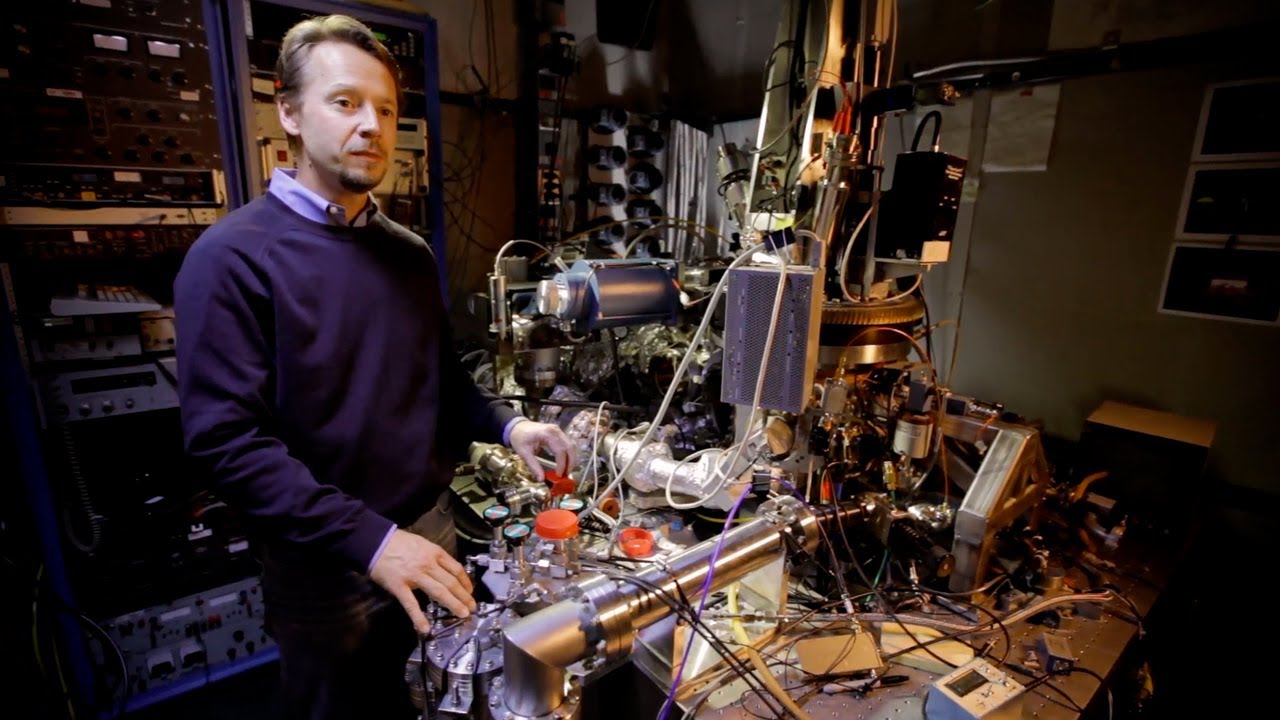
To construct the film, the researchers operated two scanning tunneling microscopes (STMs). The microscope operates via a razor-sharp needle probe that alternates between two distinct modes: an imaging mode and an atom-manipulation mode. In imaging mode, the tip hovers relatively far from the sample to survey the surface and pinpoint where the atoms reside. To move an atom, the tip is lowered into very close proximity. At this microscopic distance, the atom on the surface chemically interacts with the tip, allowing the microscope operator to drag the atom along the crystal substrate and drop it into a chosen coordinate.
```mermaid flowchart LR accTitle: Scanning Tunneling Microscope Operation Modes accDescr: Flow diagram showing switching between STM imaging mode and moving mode to manipulate atoms. subgraph STM["Scanning Tunneling Microscope (STM)"] IM["Imaging Mode<br/>Tip stays relatively far away"] MM["Moving Mode<br/>Tip lowers into close proximity"] end SURF["Surface Survey<br/>Identify atom locations"] --> IM IM -->|"Lower tip"| MM MM -->|"Chemical interaction"| DRAG["Drag Atom<br/>Molecule follows tip along surface"] DRAG -->|"Auditory feedback"| POS["Reposition Atom<br/>Count steps via scratchy sound"] ```
The physical STM instruments reside in a specialized microscope room, which houses the ultra-sharp tip and the sample where all the physical manipulation takes place. To prevent the atoms from thermal hopping and to ensure they remain fixed in place, the instrument operates in extreme cryogenic conditions at temperatures below −260 degrees Celsius.
During the manipulation process, the motion is translated into an audible signal. As a molecule follows the tip across the surface, it produces a distinct, scratchy audio feedback:
> “For us, hearing this scratchy sound is important feedback because we can count how many positions have you actually moved. You go [grick, grick, grick] and you can say all right, this was 3 locations.”
---
[03:59](https://www.youtube.com/watch?v=xA4QWwaweWA&t=239s) "A Boy and His Atom" and the Value of Curiosity-Driven Research
While the laboratory typically designs nanoscale systems targeted at atomic computation and high-density memory, this experimental project channeled the same nanotechnology into a playful artistic narrative: a short story about a boy named Adam who falls in love with an atom, playing and dancing together.
For the researchers, the project offered a rare chance to bridge complex nanoscience with public outreach and wonder. One researcher emphasized the educational impact of such demonstrations: “If I can do this by making a movie and I can get 1,000 kids to join science rather than go into law school, I would be super happy.”
Beyond public engagement, the video underscores the vital importance of open-ended, curiosity-driven exploration in fundamental science. Giving scientists the leeway to pursue questions simply because they find them intriguing is often how breakthrough innovations are born. While it is impossible to predict the exact form future technologies will take, experiments like moving individual atoms lay the foundational scientific groundwork, firing the imagination and giving researchers a head start in navigating uncharted domains of physics and engineering.
## Notable quotes > [03:59](https://www.youtube.com/watch?v=xA4QWwaweWA&t=239s) If I can do this by making a movie and I can get 1,000 kids to join science rather than go into law school, I would be super happy. — IBM researcher
## Mentioned IBM, IBM Research, Scanning Tunneling Microscope (STM), A Boy and His Atom, Carbon monoxide
## Video description How did IBM researchers move all those atoms to make the world's smallest movie? This short behind-the-scenes documentary takes you inside the lab. Meet the scientists, see how they made a movie with atoms, and find out more about their research in the field of atomic memory and data storage. See the world's smallest movie at http://youtu.be/oSCX78-8-q0. Learn more about atomic memory, data storage and big data at http://www.ibm.com/madewithatoms
[Source](https://www.youtube.com/watch?v=xA4QWwaweWA)