YouTube's Wojcicki Defends Speech Balance via Four-Part Moderation
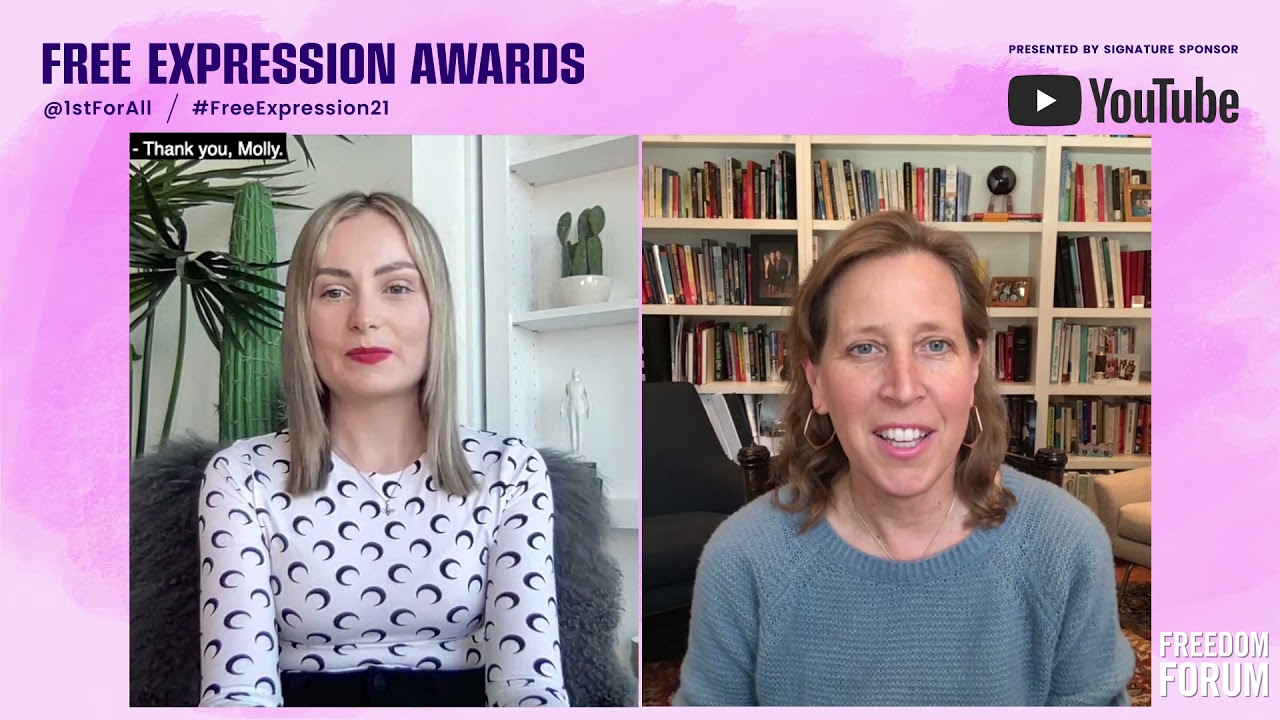
Freedom Forum
YouTube curbs borderline content and removes millions of policy-breaking videos to preserve open expression without inviting platform-killing censorship.
AI-assisted summary of 2021 Free Expression Awards Highlight: Susan Wojcicki — original source. Check the original for full context.
Source published:
Key ideas
- YouTube manages platform safety and expression across 100 countries and 80 languages through its structured 'Four Rs of Responsibility' framework: Remove, Raise, Reduce, and Reward. (5:30)
- Automated machine-learning systems detected more than 90% of the 9 million violative videos YouTube removed within a single quarter. (5:30)
- During the COVID-19 pandemic, YouTube served hundreds of billions of impressions to elevate authoritative health information from organizations like the CDC. (5:30)
- Susan Wojcicki attributes her commitment to free expression to her family's background fleeing religious and political persecution behind the Iron Curtain. (3:30)
Detailed notes
## Background Published by Freedom Forum on YouTube on April 16, 2021, this video highlights Susan Wojcicki receiving an honor at the 2021 Free Expression Awards. According to the description, the awards support the educational mission of the Freedom Forum Institute by recognizing individuals for courageous acts of free and fearless expression.
## TL;DR YouTube CEO Susan Wojcicki receives the Free Expression Award, introduced by creator and advocate Molly Burke who shares how the platform gave her a voice after losing her vision. Accepting the honor, Wojcicki explains how her family's background fleeing political and religious persecution behind the Iron Curtain shaped her deep commitment to free speech. She outlines YouTube's content governance strategy through the 'Four Rs of Responsibility'—Remove, Raise, Reduce, and Reward—to balance open expression with user safety. Concluding the dialogue, Wojcicki contrasts the millions of independent channels on YouTube with legacy television, emphasizing the power of democratized media to elevate diverse global perspectives.
## Atmosphere & style The presentation carries a polished, celebratory, and earnest tone, blending personal storytelling with corporate responsibility. Molly Burke's heartfelt introduction grounds the event in real-world human impact, establishing an atmosphere of warmth and mutual respect. As Wojcicki speaks, the mood turns reflective and solemn when discussing her family's lived experiences under authoritarian surveillance, before transitioning into a measured, pragmatic explanation of global platform governance.
## Bulletin - [05:30](https://www.youtube.com/watch?v=xDcvPf78g1k&t=330s) YouTube manages platform safety and expression across 100 countries and 80 languages through its structured 'Four Rs of Responsibility' framework: Remove, Raise, Reduce, and Reward. - [05:30](https://www.youtube.com/watch?v=xDcvPf78g1k&t=330s) Automated machine-learning systems detected more than 90% of the 9 million violative videos YouTube removed within a single quarter. - [05:30](https://www.youtube.com/watch?v=xDcvPf78g1k&t=330s) During the COVID-19 pandemic, YouTube served hundreds of billions of impressions to elevate authoritative health information from organizations like the CDC. - [03:30](https://www.youtube.com/watch?v=xDcvPf78g1k&t=210s) Susan Wojcicki attributes her commitment to free expression to her family's background fleeing religious and political persecution behind the Iron Curtain.
## Key takeaways - [00:00](https://www.youtube.com/watch?v=xDcvPf78g1k&t=0s) Operating localized platforms across 100 countries and 80 languages requires continuous navigation between preserving open expression and maintaining community safety. - [00:00](https://www.youtube.com/watch?v=xDcvPf78g1k&t=0s) Creator Molly Burke highlights how open digital platforms empower marginalized creators, noting how community support after losing her vision at 14 led to her career as an accessibility advocate. - [00:00](https://www.youtube.com/watch?v=xDcvPf78g1k&t=0s) Susan Wojcicki emphasized increasing the representation of women in tech so they have a direct voice in shaping major modern economic and social shifts. - [00:00](https://www.youtube.com/watch?v=xDcvPf78g1k&t=0s) YouTube approaches moderation cautiously to prevent responsibility efforts from overreaching into unwarranted censorship. - [03:30](https://www.youtube.com/watch?v=xDcvPf78g1k&t=210s) Wojcicki's personal advocacy for free speech is grounded in her father escaping post-WWII political persecution in Poland and her mother's family fleeing religious persecution. - [03:30](https://www.youtube.com/watch?v=xDcvPf78g1k&t=210s) Witnessing the surveillance, fear, and self-censorship experienced by relatives behind the Iron Curtain reinforced Wojcicki's belief that free speech is fragile and must be actively defended. - [05:30](https://www.youtube.com/watch?v=xDcvPf78g1k&t=330s) YouTube's content governance operational system relies on the 'Four Rs': Remove violative content, Raise authoritative voices, Reduce borderline content, and Reward eligible creators. - [05:30](https://www.youtube.com/watch?v=xDcvPf78g1k&t=330s) Under the 'Remove' pillar, YouTube took down 9 million videos in one quarter, with machine-learning algorithms detecting over 90% before widespread viewership. - [05:30](https://www.youtube.com/watch?v=xDcvPf78g1k&t=330s) Under the 'Raise' pillar, YouTube delivered hundreds of billions of impressions promoting credible medical and health entities like the CDC during the COVID-19 pandemic. - [05:30](https://www.youtube.com/watch?v=xDcvPf78g1k&t=330s) The 'Reduce' pillar suppresses the algorithmic reach of borderline content that nears policy limits without directly violating community guidelines, avoiding outright bans. - [05:30](https://www.youtube.com/watch?v=xDcvPf78g1k&t=330s) The 'Reward' pillar sets high eligibility requirements for ad monetization, protecting advertisers from inappropriate adjacency and creators from broader advertising boycotts. - [09:22](https://www.youtube.com/watch?v=xDcvPf78g1k&t=562s) Digital platforms dismantled traditional media gatekeeping, expanding the historic limit of a few hundred cable channels to millions of creator channels worldwide. - [10:15](https://www.youtube.com/watch?v=xDcvPf78g1k&t=615s) The Freedom Forum awarded Susan Wojcicki the 2021 Free Expression Award in recognition of her leadership in supporting open dialogue and diverse global perspectives.
## Detailed walkthrough ### [00:00](https://www.youtube.com/watch?v=xDcvPf78g1k&t=0s) Molly Burke Introduces Susan Wojcicki and the Global Impact of YouTube
Creator and advocate Molly Burke opens the presentation of the Free Expression Award to Susan Wojcicki, framing the immense challenges facing the CEO of YouTube. Managing an ecosystem where billions of people participate every single day across 100 different countries and 80 different languages requires navigating a delicate tension: ensuring every user has a voice while keeping the community safe. For Burke, this platform is personal. She lost the majority of her sight at age 14, a time when she felt her life was collapsing around her. Lacking friends to turn to in real life, she discovered an online community of girls who shared her passion for beauty and fashion. Finding comfort and friendship in these creators inspired her six years prior to launch her own channel, where she shares her story and advocates for global accessibility.
Burke emphasizes that while Wojcicki is widely recognized as one of the most powerful executives in tech and media, creators worldwide know her simply as "Susan." A retrospective video montage highlights Wojcicki’s leadership and philosophy. Under her tenure, YouTube has positioned itself as an engine for the next generation of media companies, allowing people across the globe to distribute content directly. At the same time, the tribute underscores Wojcicki's push to elevate women in tech—noting that if women do not participate, they miss the opportunity to shape the century’s largest economic and social shift. Addressing the platform's content dilemmas in the archival footage, Susan Wojcicki explains: “You can go too far and that can become censorship and so we have been working really hard to figure out what's a right way to balance responsibility with freedom of speech.”
- YouTube operates localized versions in 100 countries and supports 80 different languages. - Molly Burke lost the majority of her vision at age 14 and began creating content on YouTube six years prior to advocate for accessibility. - Under Wojcicki’s leadership, YouTube significantly increased the percentage of women working at the company.
---
[03:30](https://www.youtube.com/watch?v=xDcvPf78g1k&t=210s) Family Heritage Behind the Iron Curtain and the Imperative of Free Speech
Accepting the award from Molly Burke, Susan Wojcicki reflects on how her family’s personal struggles under authoritarian regimes deeply shaped her commitment to fundamental liberties. Both sides of her family fled to the United States to escape persecution. Her father fled political persecution in Poland following World War II, leaving his own father behind the Iron Curtain. Wojcicki recalls growing up observing the chilling reality of life under state surveillance—the constant fear, the extreme difficulty of communicating with her grandfather, and the pervasive anxiety about what could safely be written in a letter or spoken aloud. On her mother’s side, her relatives fled to America to escape religious persecution.
These vivid experiences instilled in Wojcicki a conviction that free expression and diverse representation are fragile achievements rather than guaranteed constants. Having witnessed the heavy toll of state censorship on her own family, she views safeguarding speech as an active responsibility rather than a passive ideal. Describing the perspective gained from her family's background, Susan Wojcicki stresses: “I've just seen the real benefits that freedom of speech has as well as representing all people of all different backgrounds and all different perspectives and that the freedoms we have we really can't take for granted that we really have to make sure that we're protecting them in every way possible.”
- Wojcicki’s father escaped post-WWII political persecution in Poland, while her grandfather remained trapped behind the Iron Curtain. - Her mother’s family immigrated to the United States to escape religious persecution. - Early memories of self-censorship when communicating with her grandfather informed her lifelong commitment to open dialogue.
---
[05:30](https://www.youtube.com/watch?v=xDcvPf78g1k&t=330s) The Four Rs of Content Responsibility
When Burke asks how YouTube balances free expression against the spread of harmful material, Wojcicki details the comprehensive framework the platform developed to manage trust and safety. YouTube has enforced basic community guidelines prohibiting adult content, hate speech, and dangerous material since its earliest days to ensure the platform remained viable. However, as YouTube expanded to a planetary scale, the company established an extensive operational system executed by thousands of employees, structured around the "Four Rs of Responsibility":
```mermaid flowchart TD accTitle: The Four Rs of Responsibility Framework accDescr: Visual breakdown of YouTube's content governance strategy across four actions: Remove, Raise, Reduce, and Reward.
subgraph Enforcement["Direct Policy Action"] R1["Remove Violative Content"] R2["Raise Authoritative Sources"] end
subgraph Distribution["Recommendation & Monetization"] R3["Reduce Borderline Content"] R4["Reward High-Quality Creators"] end
R1 --> R2 R2 --> R3 R3 --> R4 ```
1. **Remove:** Enforcing policies by taking down content that explicitly breaks community guidelines. In the previous quarter alone, YouTube removed nine million videos, with over 90% detected and removed automatically by machine-learning systems before widespread viewing. 2. **Raise:** Actively elevating authoritative voices during high-stakes events. During the COVID-19 pandemic, YouTube served hundreds of billions of impressions pointing users to credible medical guidance from the CDC and international health organizations, alongside verified news sources. 3. **Reduce:** Addressing "borderline content" that skirts the spirit of platform rules without directly violating them. Rather than censoring or removing these videos, the recommendation algorithm dampens their spread by withholding them from recommended feeds. 4. **Reward:** Enforcing stringent eligibility requirements for monetization. Setting a higher bar for advertising spend safeguards advertisers from appearing beside inappropriate material while shielding reliable creators from catastrophic ad boycotts.
Highlighting the scale of this effort, Susan Wojcicki reflects: “It involves literally thousands of people and a large amount of work across the entire company but uh but uh if i summoned into these four different r's the first one would be remove which is that we're always updating our policies and when content is violative of any of the policies unfortunately we need to remove it.”
- YouTube removed 9 million videos in the preceding quarter. - More than 90% of those removals were identified automatically by automated machine systems. - Hundreds of billions of impressions were directed to authoritative health entities like the CDC during the pandemic.
---
[09:22](https://www.youtube.com/watch?v=xDcvPf78g1k&t=562s) How Free Expression Catalyzes Creativity Beyond Legacy Media
Burke shifts the discussion to the intersection of free speech and artistic creativity, asking how open platforms alter the media landscape. Wojcicki observes that opening distribution to anyone with an internet connection fundamentally democratized storytelling, empowering communities that traditional gatekeepers historically ignored. Comparing the modern internet to the media environment of her youth, Wojcicki recalls when television households had access to fewer than 100 channels—expanding to only a couple hundred during her teenage years.
By contrast, YouTube hosts millions of channels, unleashing an unprecedented volume of perspectives, formats, and voices. This structural shift allows independent creators like Burke to build thriving audiences without needing permission from corporate executives. Illustrating this transformation, Susan Wojcicki remarks: “And now with youtube we have millions and millions of channels and that has just unleashed a huge number of voices.”
[10:15](https://www.youtube.com/watch?v=xDcvPf78g1k&t=615s) Concluding Remarks and Award Acceptance
As the conversation draws to a close, Susan Wojcicki highlights the core value of open digital platforms in elevating diverse voices from across the globe, remarking that they enable us to encounter “different views and perspectives and we can hear from people that we never would have heard from beforehand.” The interviewer agrees wholeheartedly, warmly thanking Wojcicki for the discussion and offering congratulations on receiving the honor: “Absolutely thank you Susan for chatting with me and congrats on your very well deserved award.”
Accepting the recognition from the Freedom Forum Institute, Wojcicki shares her appreciation for the organization and reflects on the broader principle at stake. Grateful for the tribute, she closes by underscoring the weight of the moment: “Thank you so much to the Freedom Forum for having me here today and for this award. I recognize the significance of freedom of speech and I'm so honored to be here today to receive this award.”
- Wojcicki stresses the transformative power of platforms that amplify voices and diverse viewpoints that would have otherwise remained unheard. - The Freedom Forum honors Susan Wojcicki at the 2021 Free Expression Awards for her leadership and recognition of free speech.
## Notable quotes > [00:00](https://www.youtube.com/watch?v=xDcvPf78g1k&t=0s) You can go too far and that can become censorship and so we have been working really hard to figure out what's a right way to balance responsibility with freedom of speech. — Susan Wojcicki
## Mentioned Susan Wojcicki, Molly Burke, YouTube, Freedom Forum, Freedom Forum Institute, CDC
## Video description The Free Expression Awards supports the educational work of the Freedom Forum Institute by recognizing individuals for their courageous acts of free and fearless expression.
https://www.freeexpressionawards.org
[Source](https://www.youtube.com/watch?v=xDcvPf78g1k)