Liquid Wrench Beats Kroil, PB Blaster in Rusted Fastener Torque Test
Project Farm
Controlled breakout testing on seized Grade 8 studs shows budget $4 Liquid Wrench and homemade transmission fluid loosen rusted bolts better than $15 specialty penetrant AeroKroil.
AI-assisted summary of Which Penetrating Oil is Best? Let's find out! — original source. Check the original for full context.
Source published:
Key ideas
- In a controlled test of rusted Grade 8 wheel studs torqued to 100 ft-lbs, budget penetrant Liquid Wrench ($4/can) achieved the lowest breakout torque, outperforming all competitors. (8:41)
- A DIY 50/50 mixture of synthetic automatic transmission fluid and acetone secured second place overall, though the host warned it damages paint, dissolves plastics and rubber, and penetrates standard shop gloves. (8:41)
- Premium penetrant AeroKroil ($15/can) finished in last place among chemical treatments, trailing behind standard WD-40 and PB Blaster despite its cult reputation. (8:41)
- Thermal expansion from an open flame torch easily beat every chemical penetrant tested, freeing frozen nuts with minimal torque. (7:47)
Detailed notes
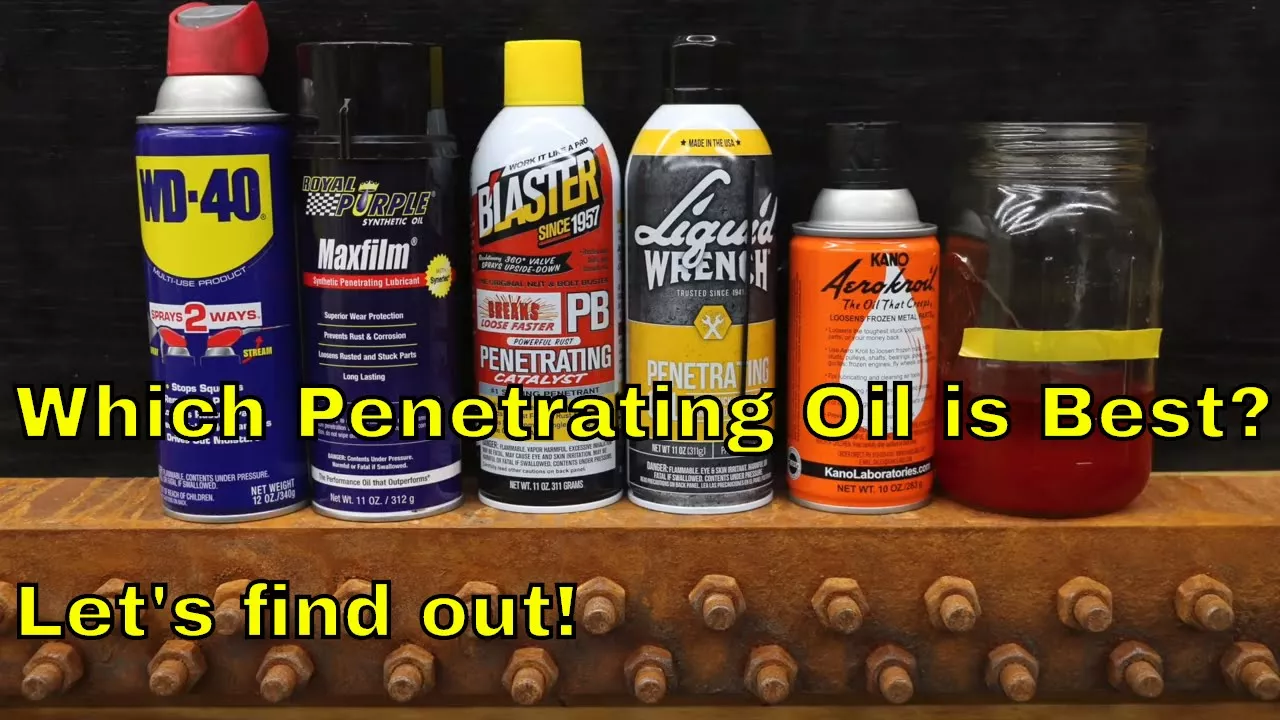
## Background Published on YouTube by the Project Farm channel on April 16, 2018, this video tests whether expensive penetrating fluids justify their higher price tags. The host pits commercial options—including AeroKroil, Liquid Wrench, PB Blaster, Royal Purple, and WD-40—against a homemade ATF and acetone blend to determine which product frees rusted hardware with the least torque.
## TL;DR To evaluate penetrating oils under controlled conditions, the host torqued 30 rusted Grade 8 wheel lug studs to 100 ft-lbs on an angle iron rack. After measuring untreated baseline controls, he applied two rounds of each lubricant over a three-hour soak period before recording the breakout torque needed to free each nut. Budget-friendly Liquid Wrench captured first place, narrowly edging out a DIY 50/50 blend of synthetic automatic transmission fluid and acetone. Royal Purple and WD-40 finished in the middle, while PB Blaster and the premium $15 AeroKroil landed at the bottom of the rankings. An open flame torch easily outperformed every chemical treatment, demonstrating the unmatched efficacy of thermal expansion when safe to use.
## Atmosphere & style The video carries an earnest, methodical, DIY workshop vibe powered by rapid-fire narration and pragmatic skepticism. The host approaches the bench test like an unpretentious garage scientist, letting mechanical measurements and direct visual evidence speak louder than flashy manufacturer claims. Watching the experiment offers the satisfying, tension-building rhythm of hands-on wrenching, culminating in a surprising upset that upends workshop lore and exposes the diminishing returns of premium brand pricing.
## Bulletin - [08:41](https://www.youtube.com/watch?v=xUEob2oAKVs&t=521s) In a controlled test of rusted Grade 8 wheel studs torqued to 100 ft-lbs, budget penetrant Liquid Wrench ($4/can) achieved the lowest breakout torque, outperforming all competitors. - [08:41](https://www.youtube.com/watch?v=xUEob2oAKVs&t=521s) A DIY 50/50 mixture of synthetic automatic transmission fluid and acetone secured second place overall, though the host warned it damages paint, dissolves plastics and rubber, and penetrates standard shop gloves. - [08:41](https://www.youtube.com/watch?v=xUEob2oAKVs&t=521s) Premium penetrant AeroKroil ($15/can) finished in last place among chemical treatments, trailing behind standard WD-40 and PB Blaster despite its cult reputation. - [07:47](https://www.youtube.com/watch?v=xUEob2oAKVs&t=467s) Thermal expansion from an open flame torch easily beat every chemical penetrant tested, freeing frozen nuts with minimal torque.
## Key takeaways - [00:00](https://www.youtube.com/watch?v=xUEob2oAKVs&t=0s) Prior testing showed price does not consistently correlate with performance, prompting a direct test between budget penetrants, premium sprays, and DIY mixes. - [00:00](https://www.youtube.com/watch?v=xUEob2oAKVs&t=0s) To create uniform rust, brand-new 1/2-inch Grade 8 wheel lug studs were stripped of zinc coating with acid and soaked vertically in an oxidizer. - [00:00](https://www.youtube.com/watch?v=xUEob2oAKVs&t=0s) Lug nuts were deliberately threaded with their beveled edges facing down against the angle iron to eliminate friction variables caused by uneven surface rust. - [02:31](https://www.youtube.com/watch?v=xUEob2oAKVs&t=151s) Four unlubricated rusted bolts were initially tested as a control group to measure natural breakout resistance before chemical application. - [02:31](https://www.youtube.com/watch?v=xUEob2oAKVs&t=151s) Six chemical solutions were evaluated: 50/50 synthetic ATF and acetone, AeroKroil ($15), Liquid Wrench ($4), PB Blaster, Royal Purple Maxfilm ($13), and standard WD-40. - [04:43](https://www.youtube.com/watch?v=xUEob2oAKVs&t=283s) One-hour surface inspections showed varying evaporation rates, with PB Blaster drying quickly while WD-40 and the ATF/acetone mix retained noticeable surface films. - [04:43](https://www.youtube.com/watch?v=xUEob2oAKVs&t=283s) Despite advertising claims from brands like Liquid Wrench, none of the penetrating oils visibly dissolved or reduced the iron oxide rust on the studs. - [04:43](https://www.youtube.com/watch?v=xUEob2oAKVs&t=283s) Every penetrant received a second application before being allowed to soak for a total dwell time of three hours prior to torque measurement. - [07:47](https://www.youtube.com/watch?v=xUEob2oAKVs&t=467s) Applying an open flame torch to rusted nuts caused rapid thermal expansion that broke the rust bond far more effectively than any chemical penetrant. - [08:41](https://www.youtube.com/watch?v=xUEob2oAKVs&t=521s) Liquid Wrench won the overall chemical competition, delivering the lowest breakout torque despite being the cheapest commercial spray at $4 per can. - [08:41](https://www.youtube.com/watch?v=xUEob2oAKVs&t=521s) The DIY 50/50 ATF and acetone mix placed second, serving as an effective low-cost penetrant with significant material safety caveats. - [08:41](https://www.youtube.com/watch?v=xUEob2oAKVs&t=521s) WD-40 finished fourth overall, outperforming specialized penetrating formulas like PB Blaster and AeroKroil. - [08:41](https://www.youtube.com/watch?v=xUEob2oAKVs&t=521s) AeroKroil ranked last among all tested chemical penetrants, failing to justify its $15 premium price tag.
## Detailed walkthrough ### [00:00](https://www.youtube.com/watch?v=xUEob2oAKVs&t=0s) Setting Up the Penetrating Fluid Showdown
The host opens by questioning whether premium price tags actually translate to superior performance in the workshop. Reflecting on previous experiments, he notes that super glue testing revealed chemical ingredients mattered significantly, with the least expensive formula outperforming the costliest brands. Conversely, duct tape testing demonstrated a direct correlation where the most expensive rolls easily beat budget options. Penetrating fluids present a similar pricing puzzle: can a $15 specialty spray like AeroKroil genuinely outperform $4 to $5 shelf staples or even a DIY mix of automatic transmission fluid and acetone?
To find out, the host designs a controlled test using thirty 1/2-inch Grade 8 wheel lug studs torqued into angle iron to 100 ft-lbs. Recognizing that natural rusting on used hardware is never uniform, he purchased brand-new studs and lug nuts, stripped their protective zinc coating with a powerful acid, and applied a strong oxidizer with the bolts oriented vertically so the corrosive agent seeped evenly into the thread channels. To minimize erratic friction, he deliberately threaded the nuts with the beveled end facing the steel plate. As the host explains, “I didn't want to put the flat edge down because the rust between the flat edge and the steel could end up causing some extra drag on some bolts than others.”
- Hardware: 1/2-inch Grade 8 wheel lug studs and nuts torqued to 100 ft-lbs. - Preparation: Zinc coating stripped via acid, then treated with oxidizer in a vertical position. - Orientation: Beveled edge of the lug nut placed down to reduce surface area drag. - Home brew mixture: 50/50 ratio consisting of one part synthetic automatic transmission fluid and one part acetone.
[02:31](https://www.youtube.com/watch?v=xUEob2oAKVs&t=151s) Baseline Control and Product Application
The experiment begins by establishing a baseline. The first four untreated, rusted bolts serve as the control group to gauge the raw torque required to break them free without any chemical intervention. After gathering these readings, the angle iron rack is detached and placed vertically so the penetrating oils can be applied and allowed to soak into the threads over several hours. The untreated control bolts are covered to preserve their rust level, providing a visual benchmark to observe whether any chemical actually dissolves rust.
The host methodically introduces each lubricant and its marketing promises as he applies them. First is the homemade ATF and acetone blend, followed by AeroKroil, the most expensive product in the lineup at $15 a can. Kroil boasts a dedicated following and claims to creep into spaces as narrow as one millionth of an inch. Liquid Wrench claims to dissolve rust and cut through heavy grease. PB Blaster markets itself as the number-one selling penetrant, boasting a specialized capillary action to free frozen parts. Royal Purple Maxfilm represents synthetic penetrant technology designed for high wear protection, while classic WD-40 offers water displacement and multi-purpose lubrication. Regarding his choice to test the premium brand, the host states: “This stuff seems to have quite a following. There's a lot of positive comments on it. So, I went ahead and spent the $15 just to test what it's capable of doing.”
- Baseline: Four unlubricated control bolts torqued to measure natural breakout resistance. - Products tested: - 50/50 Synthetic ATF and Acetone mix - AeroKroil ($15/can; claims capillary penetration down to 0.000001 inch) - Liquid Wrench ($4/can; claims to cut grease and dissolve rust) - PB Blaster (capillary action formula for seized parts) - Royal Purple Maxfilm ($13/can; synthetic multipurpose penetrant/lubricant) - WD-40 (standard multi-use water-displacing formula)
[04:43](https://www.youtube.com/watch?v=xUEob2oAKVs&t=283s) One-Hour Observations and the Second Application
After allowing the chemicals to soak for one hour, the host inspects the bolts to evaluate residue, evaporation rates, and visible rust reduction. The ATF and acetone mixture leaves a heavy, oily layer behind, as the volatile acetone evaporates while the transmission fluid continues working into the thread passages. In contrast, both AeroKroil and Liquid Wrench appear mostly dry on the surface, having either evaporated or seeped deep into the threads. Despite Liquid Wrench's marketing claims, the host notes that neither product visibly reduced or dissolved the iron oxide on the bolt faces.
PB Blaster leaves the least residual film of the commercial penetrants, drying out almost completely. Royal Purple Maxfilm retains an oily coating on the threads, while WD-40 shows minimal evaporation, maintaining a wet fluid layer over the entire nut. To give every formula the maximum opportunity to work into the seized threads, a freshly shaken second dose of each penetrant is applied across the rack, and the assembly is left to soak for a total elapsed time of three hours.
```mermaid flowchart TD accTitle: Penetrating Fluid Testing Workflow accDescr: Sequence of steps from bolt preparation and control testing through two rounds of fluid application, soaking, torque measurement, and heat testing.
subgraph Prep["1. Hardware Preparation"] A["Grade 8 Studs Torqued to 100 ft-lbs"] --> B["Acid Strips Zinc Coating"] B --> C["Vertical Oxidizer Bath Induces Rust"] end
subgraph Soaking["2. Lubrication & Dwell Time"] D["Breakout Baseline on 4 Control Bolts"] --> E["First Chemical Application"] E --> F["1-Hour Inspection"] F --> G["Second Chemical Application"] G --> H["3-Hour Total Dwell Time"] end
subgraph Breakout["3. Mechanical Testing"] H --> I["Torque Wrench Breakout on 28 Studs"] I --> J["Oxy/Propane Torch Applied to 2 Spares"] end
Prep --> Soaking Soaking --> Breakout ```
[07:47](https://www.youtube.com/watch?v=xUEob2oAKVs&t=467s) Torque Testing and Torch Heat Comparison
Once the three-hour soak concludes, the angle iron rack is bolted firmly back down to the workstation to begin mechanical breakout testing using a torque wrench across all 28 test studs. As each nut is broken loose, the force needed to overcome the seized threads is recorded.
With two spare studs remaining from the original set of thirty, the host explores whether thermal expansion outperforms chemical soaking. Bringing out a torch, he heats the rusted nut directly before attempting removal. The heat causes the nut to expand away from the stud threads and degrades the rust bond almost instantly. Reflecting on shop experience, the host notes, “In the past, whenever I've ever had a stuck bolt, I always applied the torch and it seems to work really well.” The torch effortlessly frees the nut with significantly less torque than any unheated fastener.
- Heat test: Applied an open flame torch to the two remaining rusted studs. - Mechanism: Thermal expansion broke the mechanical rust lock far more easily than chemical penetration alone.
[08:41](https://www.youtube.com/watch?v=xUEob2oAKVs&t=521s) Final Results, Ranking, and Safety Warnings
The final torque numbers demonstrate that chemical penetrants undeniably assist in breaking loose frozen fasteners. The host admits he had approached the test with healthy skepticism: “Now, I was sort of skeptical because I haven't really seen a whole lot of results from using penetrating fluids in the past, but you never really know until you actually do a study like this and actually see that it works.”
The results reveal an upset: the cheapest commercial option on the table took top honors. Liquid Wrench, priced at only $4 a can, required the lowest average breakout torque, beating out the entire field. The homemade 50/50 mix of automatic transmission fluid and acetone took a close second place, proving to be an exceptionally cost-effective alternative. However, the host issues an important safety warning regarding the DIY brew: acetone is aggressive, poses health risks, will rapidly degrade paint, dissolves certain plastics and rubber components, and penetrates right through standard rubber shop gloves.
Royal Purple Maxfilm finished in third place, offering respectable performance but poor value at $13 a can. WD-40 surprised by taking fourth place, outperforming both PB Blaster (fifth) and AeroKroil (sixth). The poor showing from AeroKroil was particularly striking given its premium $15 price tag and stellar reputation among mechanics. While open-flame torch heat proved superior to all chemical treatments, the host acknowledges that heat is not always safe or feasible around fuel lines, wiring, or tight spaces. He wraps up by thanking viewers for their video suggestions, emphasizing that community feedback directly drives the channel's test lineup.
| Rank | Penetrant / Method | Price Point | Performance Notes | |:--- |:--- |:--- |:--- | | **Top Performer** | **Torch (Heat)** | Minimal fuel cost | Outperformed all chemical penetrants; not suitable near flammable materials | | **1st Place** | **Liquid Wrench** | ~$4.00 / can | Best overall breakout performance; lowest cost commercial product | | **2nd Place** | **ATF / Acetone Mix** | DIY Home brew | Strong 2nd-place finish; harsh on rubber, plastics, paint, and shop gloves | | **3rd Place** | **Royal Purple Maxfilm** | ~$13.00 / can | Solid performance, but poor value given its premium price tag | | **4th Place** | **WD-40** | ~$4.00–$5.00 / can | Respectable middle-of-the-pack finish despite being a multi-use fluid | | **5th Place** | **PB Blaster** | ~$4.00–$5.00 / can | Dried out quickly; outperformed by WD-40 | | **6th Place** | **AeroKroil** | ~$15.00 / can | Lowest chemical rank; failed to justify high price and cult reputation |
## Notable quotes > [08:41](https://www.youtube.com/watch?v=xUEob2oAKVs&t=521s) I was sort of skeptical because I haven't really seen a whole lot of results from using penetrating fluids in the past, but you never really know until you actually do a study like this and actually see that it works. — host
> [07:47](https://www.youtube.com/watch?v=xUEob2oAKVs&t=467s) In the past, whenever I've ever had a stuck bolt, I always applied the torch and it seems to work really well. — host
## Mentioned AeroKroil, Liquid Wrench, PB Blaster, Project Farm, Royal Purple, Royal Purple Maxfilm, WD-40
## Video description This test demonstrated that not all penetrating oils are equal. Also, paying more doesn't result in better performance. In this showdown, ATF/Acetone mix, AeroKroil, Liquid Wrench, PB Blaster, Royal Purple and WD-40 are put to the test. Results: Liquid Wrench came out on top, following by ATF/Acetone, Royal Purple, WD-40, PB Blaster, and AeroKroil.
Products Tested In This Video (in no particular order): AeroKroil: https://amzn.to/3jaWGiJ Liquid Wrench: https://amzn.to/2Z53rOC PB Blaster: https://amzn.to/31igfPW Royal Purple: https://amzn.to/2QfbuA6 WD-40: https://amzn.to/2Eh0BLY
Videography Equipment: Sony DSC-RX10 III Cyber-shot Digital Still Camera: https://amzn.to/2YdXvPw Canon 70D Camera: https://amzn.to/31b5Gy0 Azden Microphone: https://amzn.to/34d3DLE Go Pro Bundle: https://amzn.to/31aince
➡ Thank you very much for supporting the channel: https://www.patreon.com/projectfarm ➡ An easy way to find past videos along with products tested: http://bit.ly/2FCrBpk A big thanks to Jim for putting this together. ➡ Merch: www.Project-Farm.com ➡ Click here if you'd like to subscribe: https://www.youtube.com/channel/UC2rzsm1Qi6N1X-wuOg_p0Ng?sub_confirmation=1 ➡ As an Amazon Associate I earn from qualifying purchases.
This video is only for entertainment purposes. If you rely on the information portrayed in this video, you assume the responsibility for the results. Project Farm LLC
[Source](https://www.youtube.com/watch?v=xUEob2oAKVs)