LockPickingLawyer Bypasses Abus Tamper Seal With Denatured Alcohol
LockPickingLawyer
Denatured alcohol temporarily neutralizes the adhesive bond on frangible tamper-evident stickers without destroying the foil, enabling covert entry and undetectable reapplication.
AI-assisted summary of [1422] Did I Cheat On This Challenge? (Tamper-Sealed Abus) — original source. Check the original for full context.
Source published:
Key ideas
- A viewer challenge to pick an Abus Plus padlock within three minutes under a tamper-evident holographic seal was bypassed by non-destructively lifting the sticker with denatured alcohol. (0:00)
- Denatured alcohol temporarily weakens frangible sticker adhesive without destroying the holographic foil, allowing full reapplication once the solvent evaporates. (1:50)
- LockPickingLawyer demonstrated a bypass technique tensioning directly off disc two instead of disc one, sidestepping the protective butterfly disc in roughly 33% of Abus locks. (3:23)
- A dry peel test following reapplication confirmed the sticker tore and delaminated as intended, proving the seal was genuinely tamper-evident against purely mechanical attacks. (5:43)
Detailed notes
## Background Published on YouTube on February 26, 2022, by the LockPickingLawyer, this video documents an attempt to defeat a viewer-submitted lock sealed with an anti-tamper sticker. The show notes provide a link directing viewers to Covert Instruments.
## TL;DR Addressing a challenge sent by a viewer named Ben from Oakland, the LockPickingLawyer sets out to pick an Abus padlock whose keyway is covered by a fragile, tamper-evident holographic seal. Rather than destroying the seal, he uses denatured alcohol, a scalpel, and tweezers to non-destructively peel off the sticker intact. He then picks the Abus Plus core by tensioning directly off disc two to bypass the front butterfly disc, opening the lock well within Ben's three-minute target. To conclude, he reapplies the intact sticker before tearing it off dry with his fingernails to prove its tamper-evident foil shreds under normal physical attacks.
## Atmosphere & style The presentation carries a playful, slightly conspiratorial charm as the host candidly announces his plan to cheat the challenge while maintaining his signature quiet composure. The mood briefly touches on the eerie reality of internet fame when he recounts discovering a live tracking device in his fan mail, before shifting back into surgical precision with liquid solvent, a scalpel, and custom picks. It feels like watching a calm, clinical masterclass in physical security evasion, ending on a note of wry satisfaction when the exploit succeeds without a hitch.
## Bulletin - [00:00](https://www.youtube.com/watch?v=xUJtqvYDnkg&t=0s) A viewer challenge to pick an Abus Plus padlock within three minutes under a tamper-evident holographic seal was bypassed by non-destructively lifting the sticker with denatured alcohol. - [01:50](https://www.youtube.com/watch?v=xUJtqvYDnkg&t=110s) Denatured alcohol temporarily weakens frangible sticker adhesive without destroying the holographic foil, allowing full reapplication once the solvent evaporates. - [03:23](https://www.youtube.com/watch?v=xUJtqvYDnkg&t=203s) LockPickingLawyer demonstrated a bypass technique tensioning directly off disc two instead of disc one, sidestepping the protective butterfly disc in roughly 33% of Abus locks. - [05:43](https://www.youtube.com/watch?v=xUJtqvYDnkg&t=343s) A dry peel test following reapplication confirmed the sticker tore and delaminated as intended, proving the seal was genuinely tamper-evident against purely mechanical attacks.
## Key takeaways - [00:00](https://www.youtube.com/watch?v=xUJtqvYDnkg&t=0s) LockPickingLawyer explains channel policies against accepting sealed boxes due to a past incident where an overzealous viewer mailed an active tracking device to his P.O. Box. - [00:00](https://www.youtube.com/watch?v=xUJtqvYDnkg&t=0s) Viewer Ben devised a blind challenge by placing an industrial holographic tamper seal directly over the keyhole rather than sealing the parcel. - [00:00](https://www.youtube.com/watch?v=xUJtqvYDnkg&t=0s) The benchmark for the challenge was set at beating three minutes, matching the pick time from LockPickingLawyer's video 1398. - [01:50](https://www.youtube.com/watch?v=xUJtqvYDnkg&t=110s) Denatured alcohol is sufficient to neutralize the pressure-sensitive adhesive on tamper seals without needing harsher chemicals that might dissolve the foil. - [01:50](https://www.youtube.com/watch?v=xUJtqvYDnkg&t=110s) Flooding the peel line with solvent using a syringe while lifting gently with a scalpel and tweezers prevents the frangible sticker from fracturing. - [01:50](https://www.youtube.com/watch?v=xUJtqvYDnkg&t=110s) Letting the solvent evaporate off the removed sticker restores adhesive tack, making clean reapplication possible. - [03:23](https://www.youtube.com/watch?v=xUJtqvYDnkg&t=203s) Traditional Abus Plus picking tensions off disc one, which houses a security-focused butterfly disc designed to impede picking. - [03:23](https://www.youtube.com/watch?v=xUJtqvYDnkg&t=203s) Using extended prongs to tension directly off disc two bypasses the butterfly disc entirely on locks cut with a #0 or #1 depth at that position. - [03:23](https://www.youtube.com/watch?v=xUJtqvYDnkg&t=203s) The disc-two bypass technique works on approximately one-third of Abus Plus cores and offers a much faster open when applicable. - [03:23](https://www.youtube.com/watch?v=xUJtqvYDnkg&t=203s) Picking involved an initial pass placing all discs into any gate, followed by a second pass testing rotational play to distinguish false gates from true gates. - [03:23](https://www.youtube.com/watch?v=xUJtqvYDnkg&t=203s) The picked lock opened well within Ben's three-minute requirement before the seal was put back in place. - [05:43](https://www.youtube.com/watch?v=xUJtqvYDnkg&t=343s) Reapplying the dried sticker showed no visible signs of stress or lifting, simulating an unpicked, untampered unit. - [05:43](https://www.youtube.com/watch?v=xUJtqvYDnkg&t=343s) A subsequent dry peel test caused immediate fragmentation, verifying the sticker's tamper-evident properties when solvent is not used.
## Detailed walkthrough ### [00:00](https://www.youtube.com/watch?v=xUJtqvYDnkg&t=0s) The Challenge from Ben and the Tracking Device Incident
The LockPickingLawyer opens the video with an upfront confession: he intends to cheat on an incoming viewer challenge, explaining that doing so will be entertaining and will allow him to demonstrate a technique he has never shown on camera before. He introduces the challenge by reading a letter sent by a viewer named Ben from Oakland. In the letter, Ben acknowledges past email correspondence regarding the channel's policy against accepting sealed packages. The LockPickingLawyer pauses on this detail to share an unsettling personal anecdote: an overzealous viewer recently mailed an active tracking device to his P.O. Box, though fortunately he discovered it while still inside the post office. Ben’s letter sympathizes with this incident, remarking on the creepy invasion of privacy by referencing Eminem’s song “Stan,” a pop-culture nod the LockPickingLawyer happily confirms he caught.
```mermaid flowchart TD accTitle: Tamper Seal Bypass and Pick Workflow accDescr: Sequence diagram illustrating how the tamper-evident sticker is removed with solvent, the lock is picked via disc two tensioning, and the seal is reapplied and tested.
subgraph Bypass ["Phase 1: Non-Destructive Seal Removal"] A["Apply denatured alcohol around sticker edge"] --> B["Gently pry edge with scalpel"] B --> C["Peel back with tweezers while flooding with solvent"] C --> D["Set sticker aside to let alcohol evaporate & restore tack"] end
subgraph Picking ["Phase 2: Lock Picking"] E["Rotate all discs fully clockwise"] --> F["Tension off disc 2 with extended prongs"] F --> G["Set all discs into gates (true or false)"] G --> H["Differentiate false gates from true gates to open"] end
subgraph Demonstration ["Phase 3: Reapplication & Destructive Test"] I["Reapply original intact sticker over keyhole"] --> J["Peel sticker dry without solvent"] J --> K["Tamper-evident foil shreds and destroys itself"] end
D --> E H --> I ```
To circumvent the ban on mystery-sealed boxes while still creating a verifiable blind challenge, Ben devised an alternative approach: instead of wrapping the entire padlock, he sealed the keyhole itself with a specialized holographic tamper-evident sticker. Ben explains in his note that his workplace uses these exact stickers over assembly screws on hardware because they are designed to fracture and disintegrate if anyone attempts to peel them off. The challenge rule set is simple: the LockPickingLawyer must beat a target time of three minutes—the time it took him to pick an Abus Plus core in video 1398. If he beats the clock, Ben promises to mail the keys; if he fails, the lock must be returned unpicked. Ben candidly adds that he hopes the host fails because the lock was expensive and he wants to put it to use. The LockPickingLawyer clarifies that he already owns this model and plans to return it regardless, remarking wryly: “Then I already have at least one of these, so I'll send it back either way, especially because after this video, I doubt you'll trust the result anyway.”
- Ben's target benchmark: Beat the 3-minute pick time established in LockPickingLawyer video 1398. - Incident report: A tracking device sent by a fan was caught by the LockPickingLawyer inside the post office facility before reaching his home or workshop. - Challenge terms: Keys awarded if opened within 3 minutes; lock returned if the attempt exceeds the limit or fails.
---
[01:50](https://www.youtube.com/watch?v=xUJtqvYDnkg&t=110s) Defeating the Tamper-Evident Holographic Seal
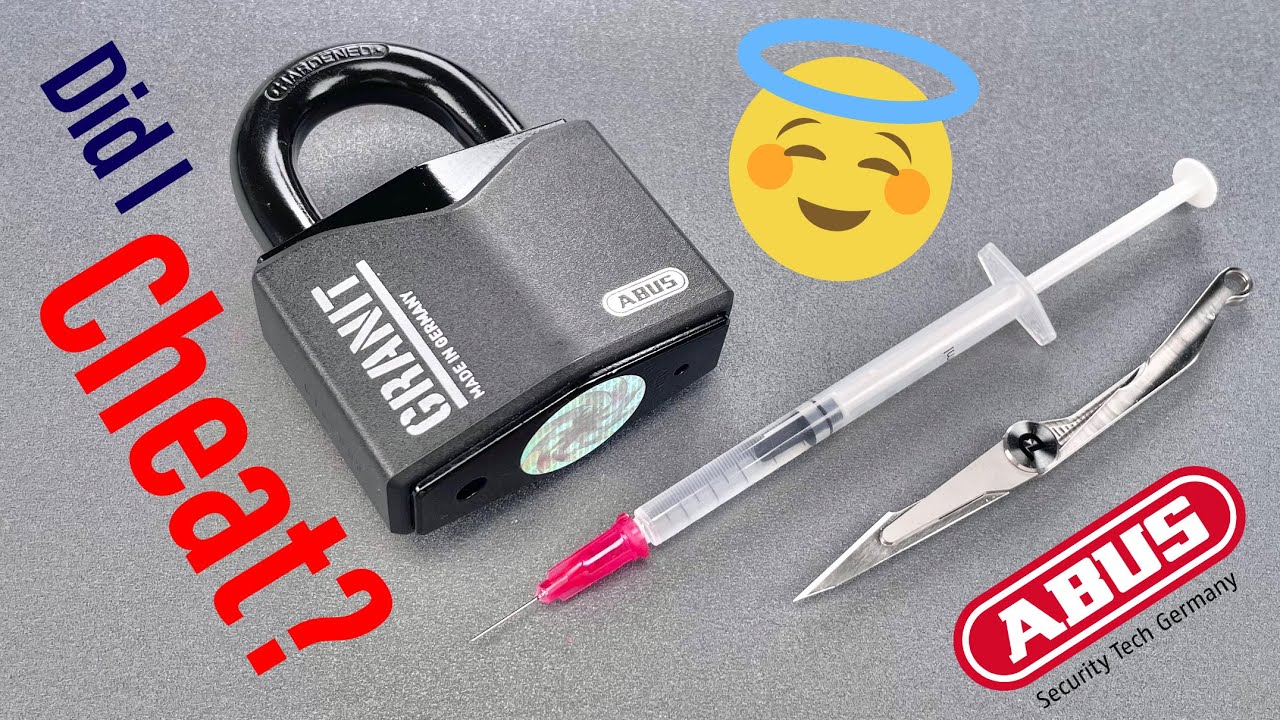
To defeat the anti-tamper mechanism without invalidating the seal, the LockPickingLawyer prepares a dedicated workstation featuring a protective metal plate on his desk to guard against chemical drips, a syringe filled with solvent, a precision scalpel, fine tweezers, and a magnet mounted under the padlock to tilt the keyway toward the camera. His objective is to lift the tamper sticker completely intact, pick the padlock open, and stick the original seal back down over the cylinder as though it was never disturbed.
He dispenses a measured bead of solvent along the border of the holographic sticker to soften the underlying adhesive bond. Once the chemical begins to penetrate, he eases the tip of the scalpel blade underneath one corner. As the sticker begins to separate from the metal face, he floods the interface with additional liquid from the syringe, withdraws the scalpel, and takes hold of the freed foil with tweezers. Pulling back with steady, gentle pressure while continually bathing the underside in liquid prevents the fragile frangible layers from shearing apart. He reveals his chemical of choice during the process: “By the way, the solvent is denatured alcohol, there's no need to use anything more aggressive for stickers like this.” Once peeled off cleanly, the pristine sticker is laid aside so the alcohol can evaporate, which allows the solvent-softened adhesive to regain its natural tackiness for later reapplication.
- Workstation setup: Benchtop metal plate, liquid syringe, fine scalpel, tweezers, and a magnetic base. - Chemical agent: Denatured alcohol, chosen because it dissolves pressure-sensitive adhesive bonds without melting or distorting typical holographic films. - Preservation tactic: Evaporation allows the adhesive layer to return to a tacky state rather than washing it away completely.
---
[03:23](https://www.youtube.com/watch?v=xUJtqvYDnkg&t=203s) Tensioning Disc Two and Picking the Abus Lock
With the keyhole unobstructed, the LockPickingLawyer initiates the picking process by rotating every disc inside the Abus Plus core as far clockwise as possible. Rather than using the traditional method of tensioning off disc number one, he employs a custom picking technique he recently developed. He selects a disc detainer pick equipped with extended tensioning prongs designed to reach past the first slot and tension directly against disc number two. He explains the mechanical theory behind this approach: the first position houses a butterfly disc intended to hamper picking, and tensioning off disc two completely bypasses that security feature. While this bypass only functions on roughly one-third of these locks—specifically those cut with a number 0 or number 1 depth at the second position—it allows an exceptionally rapid open whenever the code complies. If the cut is incompatible, he can simply fall back to conventional tensioning.
Tensioning disc two immediately yields clean mechanical feedback, confirming the lock possesses a compatible cut. The LockPickingLawyer systematically works down the disc stack, initially placing each disc into a gate regardless of whether it is true or false. After an initial pass establishes gate placement with distinct tactile clicks, he returns to the front of the stack to test disc movement and weed out false gates from true gates. Disc three is identified and aligned into a true gate, followed by individual adjustments along the remaining discs. Working back and forth through the stack, he identifies several deep false gates and navigates the discs into their proper true gates until the sidebar drops into place and the core rotates freely to open the lock. Although he did not run an active stopwatch on screen, the pick takes well under the three-minute threshold set by Ben.
- Picking strategy: Bypassing the butterfly disc at position one by tensioning directly off disc two with extended prongs. - Probability of bypass success: Effective on approximately 33% (one-third) of Abus locks, dependent on a #0 or #1 cut at position two. - Picking stages: First pass brings all discs into any gate; second pass isolates true gates from false gates based on rotational play.
---
[05:43](https://www.youtube.com/watch?v=xUJtqvYDnkg&t=343s) Reapplying and Testing the Tamper Seal
With the lock open and the shackle freed, the LockPickingLawyer moves to the final phase of the demonstration: restoring the tamper seal to simulate a completely untouched unit. Having given the denatured alcohol sufficient time to evaporate from the backing, he uses his tweezers to position the intact holographic sticker back over the core. He presses it firmly down against the metal face of the padlock, confirming that the adhesive has dried and re-bonded cleanly with no outward indication of tampering or prying.
To prove the genuine integrity of the sticker’s tamper-evident construction, he attempts to peel it off with his bare fingers now that the solvent is gone. As soon as he gets a fingernail under the edge and pulls dry, the fragile material tears violently, delaminating into shredded, jagged fragments across the face of the lock. The demonstration confirms that the sticker performs exactly as engineered under normal physical attacks, and was only defeated because chemical solvent neutralized the frangible adhesive bond during the initial removal. He wraps up the demonstration pleased with how smoothly the exploit succeeded, declaring: “Okay folks, I could not have asked for this to play out any better.”
- Reapplication result: The solvent-treated sticker adhered smoothly with full optical clarity and no visible stress marks. - Destructive validation: Without solvent, a manual peel attempt caused the holographic seal to fragment instantly, leaving tamper evidence on the lock face. - Outcome: Challenge beaten under time limit, bypass demonstrated, and lock returned to the viewer.
## Mentioned LockPickingLawyer, Ben, Eminem, Stan, Abus, Abus Plus, Covert Instruments
## Video description https://www.covertinstruments.com
[Source](https://www.youtube.com/watch?v=xUJtqvYDnkg)