Gingrich Rejects FBI Crime Data in Favor of Voter Sentiment
Sam & Me Z
Newt Gingrich argues that political candidates must prioritize how voters feel about violent crime over official FBI statistics showing nationwide offenses have declined.
AI-assisted summary of Feelings vs Fact - Newt Gingrich - RNC Topic on Violent Crime - Feelings trump FBI Stats! — original source. Check the original for full context.
Source published:
Key ideas
- Newt Gingrich disputes national violent crime declines by highlighting rising crime in major urban centers such as Chicago, Baltimore, and Washington, D.C. (0:00)
- The interviewer challenges Gingrich's claims by citing official FBI statistics showing nationwide decreases in violent crime and murder rates. (0:00)
- Gingrich argues that everyday public sentiment conflicts with institutional data, asserting that average Americans do not feel safer. (0:00)
- Gingrich frames his political strategy around validating voter emotions and feelings rather than relying on theoretical data or official statistics. (0:00)
Detailed notes
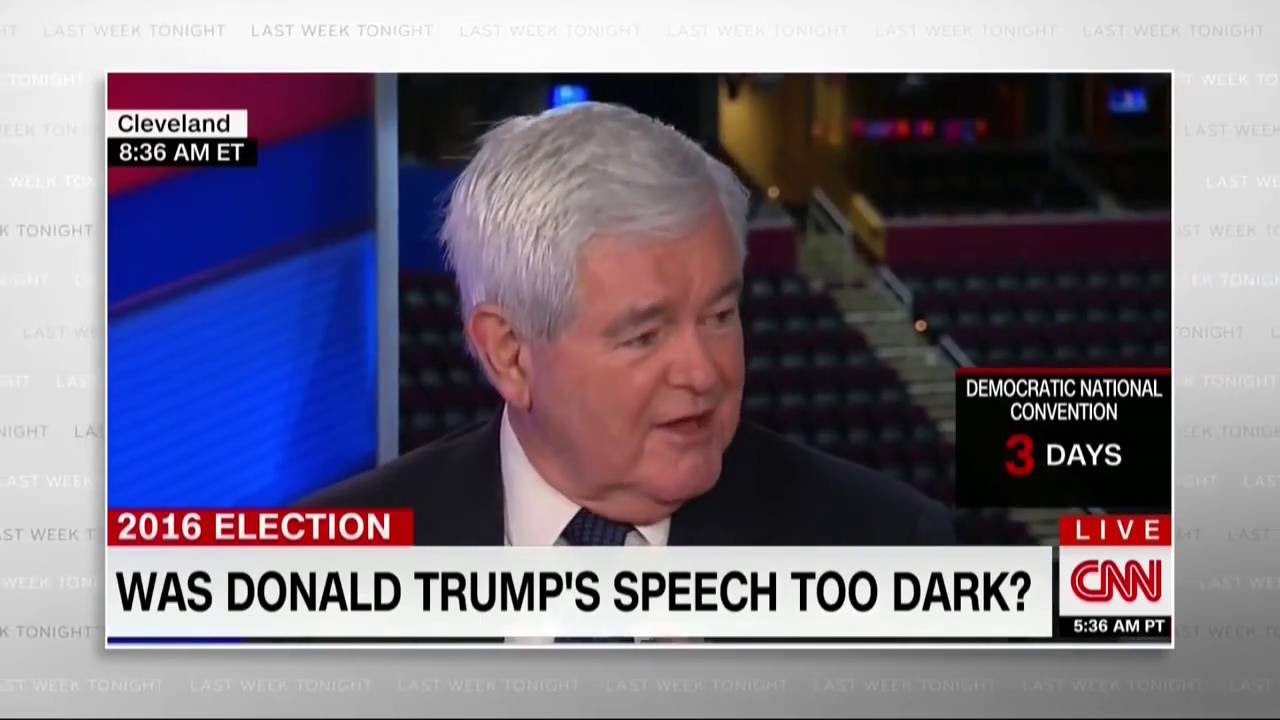
## Background Published on YouTube by Sam & Me Z on July 27, 2016, this video features an exchange regarding violent crime and murder rates at the Republican National Convention. The description notes that Newt Gingrich values public feelings over official FBI statistics, presenting an excerpt originally highlighted on John Oliver's HBO program.
## TL;DR In a heated exchange, an interviewer presses Newt Gingrich on official FBI statistics showing that nationwide violent crime and murder rates have fallen. Gingrich counters by citing specific cities like Chicago and Baltimore, asserting that everyday Americans do not believe crime is decreasing. When the interviewer points out that the FBI is not a liberal organization and that the data is factual, Gingrich dismisses the numbers as theoretical. He ultimately concludes that as a political candidate, he will align with public perception and how people feel rather than statistical data.
## Atmosphere & style Tense, sharp, and revealing, the exchange carries the friction of a direct ideological clash. The interviewer maintains a persistent, matter-of-fact tone grounded in institutional data, while Gingrich exudes unyielding confidence as he unabashedly prioritizes subjective fear over empirical reality. Watching the exchange feels like witnessing a stark, unfiltered collision between objective measurement and political populism.
## Bulletin - [00:00](https://www.youtube.com/watch?v=xnhJWusyj4I&t=0s) Newt Gingrich disputes national violent crime declines by highlighting rising crime in major urban centers such as Chicago, Baltimore, and Washington, D.C. - [00:00](https://www.youtube.com/watch?v=xnhJWusyj4I&t=0s) The interviewer challenges Gingrich's claims by citing official FBI statistics showing nationwide decreases in violent crime and murder rates. - [00:00](https://www.youtube.com/watch?v=xnhJWusyj4I&t=0s) Gingrich argues that everyday public sentiment conflicts with institutional data, asserting that average Americans do not feel safer. - [00:00](https://www.youtube.com/watch?v=xnhJWusyj4I&t=0s) Gingrich frames his political strategy around validating voter emotions and feelings rather than relying on theoretical data or official statistics.
## Key takeaways - [00:00](https://www.youtube.com/watch?v=xnhJWusyj4I&t=0s) The interviewer states that nationwide violent crime and murder rates have fallen across the United States. - [00:00](https://www.youtube.com/watch?v=xnhJWusyj4I&t=0s) Gingrich argues against the national trend by citing visible crime spikes in Chicago, Baltimore, and the nation's capital. - [00:00](https://www.youtube.com/watch?v=xnhJWusyj4I&t=0s) The interviewer concedes that localized pockets have experienced increases, but emphasizes that overall national numbers remain down. - [00:00](https://www.youtube.com/watch?v=xnhJWusyj4I&t=0s) Gingrich contends that average Americans do not believe crime is decreasing, regardless of aggregate figures. - [00:00](https://www.youtube.com/watch?v=xnhJWusyj4I&t=0s) Gingrich characterizes official crime data as liberal statistics that may be theoretically correct but fail to reflect human experience. - [00:00](https://www.youtube.com/watch?v=xnhJWusyj4I&t=0s) The interviewer defends the data's credibility by noting that the statistics originate from the FBI, an organization that is not politically liberal. - [00:00](https://www.youtube.com/watch?v=xnhJWusyj4I&t=0s) Gingrich asserts that public emotional perception holds equal weight to recorded crime statistics in political reality. - [00:00](https://www.youtube.com/watch?v=xnhJWusyj4I&t=0s) Gingrich concludes that as a political candidate, he prioritizes how citizens feel over the analyses of theoreticians.
## Detailed walkthrough ### [00:00](https://www.youtube.com/watch?v=xnhJWusyj4I&t=0s) Debate Over Crime Statistics vs. Public Perception
An interviewer presses Newt Gingrich on the actual trends in national violent crime, stating outright that overall violent crime and murder rates have fallen across the country. Gingrich pushes back immediately, arguing that crime is not declining in the nation's biggest cities and specifically challenging the interviewer with specific locations: "Then how come then? How come it's up in Chicago, up in Baltimore, and up there are pockets where certainly we have your national capital, your third, the third biggest city." While the interviewer acknowledges there are specific pockets seeing increases, she reiterates that violent crime across the country as a whole has decreased.
Gingrich pivots from the nationwide data to public sentiment, asserting that the general public does not believe the country is experiencing a drop in crime: "The average American I will bet you this morning does not think crime is down." When the interviewer insists that citizens are safer and crime is indeed down, Gingrich dismisses it as merely her personal perspective, declaring that what he is describing is also an undeniable reality. He frames the disagreement as a division between academic numbers and everyday experience: "Current view is that liberals have a whole set of statistics which theoretically may be right, but it's not where human beings are."
The interviewer challenges Gingrich's attempt to label the crime metrics as partisan data or "magic math," emphasizing that the numbers originate from official law enforcement agencies rather than political factions: "This is the FBI statistics. They're not a liberal organization." Gingrich stands firm, maintaining that public fear and sentiment carry equal weight to recorded statistics in political reality. He draws a firm line on his approach to politics, concluding: "As a political candidate, I'll go with how people feel and I'll let you go with the theoreticians."
- Gingrich highlights Chicago, Baltimore, and the national capital (Washington, D.C.) as areas where crime has risen. - The interviewer counters by referencing official FBI violent crime statistics showing an overall nationwide decrease. - Gingrich contrasts the emotional perception of threat among ordinary citizens against the theoretical data relied upon by institutions and statisticians.
## Notable quotes > [00:00](https://www.youtube.com/watch?v=xnhJWusyj4I&t=0s) As a political candidate, I'll go with how people feel and I'll let you go with the theoreticians. — Newt Gingrich
> [00:00](https://www.youtube.com/watch?v=xnhJWusyj4I&t=0s) Current view is that liberals have a whole set of statistics which theoretically may be right, but it's not where human beings are. — Newt Gingrich
## Mentioned Newt Gingrich, FBI, Chicago, Baltimore, Washington, D.C., Republican National Convention, John Oliver, HBO
## Video description RNC Topic: Violent Crime & Murder Rates. Newt Gingrich Feels that Feelings are more important than Facts! Not only that, he further demands that his feelings are now fact! Newt, "The FBI is NOT a Liberal Organization." Republican Politics at its Finest! (Part of John Oliver HBO Clip) 7/2016
[Source](https://www.youtube.com/watch?v=xnhJWusyj4I)