Apple Debuts iPhone App Store With 70% Revenue Cut for Developers
gamingandtechnology
Apple establishes an exclusive storefront on every iPhone that bypasses carrier gatekeepers, granting developers a 70% sales split while absorbing all infrastructure costs for free apps.
AI-assisted summary of Steve Jobs introduces the App store - iPhone SDK Keynote — original source. Check the original for full context.
Source published:
Key ideas
- Apple announced the App Store as a pre-installed, platform-wide utility designed to serve as the exclusive distribution channel for native iPhone applications. (0:01)
- Applications can be downloaded directly over the air via Wi-Fi and cellular networks or managed locally through desktop iTunes on Mac and PC. (1:06)
- Under the App Store commercial model, developers retain 70% of gross sales paid monthly, while Apple covers all credit card processing, hosting, and bandwidth costs from its 30% share. (3:14)
- Free applications incur no hosting or bandwidth fees for developers or users, while Apple enforces marketplace guardrails barring malware, privacy-invading apps, and pornography. (3:14)
Detailed notes
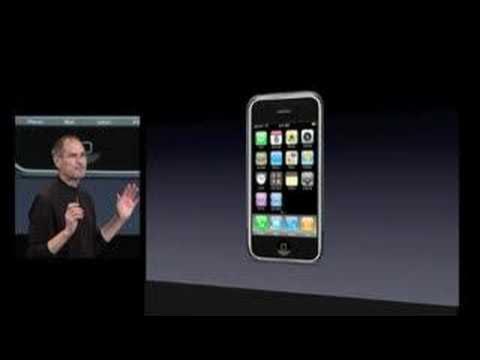
## Background Published on YouTube by gamingandtechnology on March 14, 2008, this video captures Steve Jobs presenting at the Apple iPhone SDK keynote. The description notes that Jobs is announcing the iTunes App Store for the iPhone and iPod touch ahead of its June 2008 release, outlining a 70-30 revenue split for sold applications and free hosting for no-cost software.
## TL;DR Steve Jobs introduces the App Store as Apple's platform-wide mechanism to solve distribution challenges for both independent creators and major software houses by placing their software directly onto every iPhone. He demonstrates the mobile application's interface, highlighting over-the-air installation over cellular or Wi-Fi, category browsing, desktop iTunes syncing, and automated version updates. Jobs then outlines the business model, offering developers a 70/30 revenue split with Apple covering payment processing and server overhead, zero fees for free applications, and clear content guidelines prohibiting malicious, privacy-violating, and adult software.
## Atmosphere & style The presentation carries the polished, visionary confidence characteristic of classic Steve Jobs keynotes, shifting smoothly from an empathetic framing of developer struggles to an effortless, triumphant product reveal. The pacing is crisp and conversational, blending live software demonstrations with clear, authoritative commercial terms. Watching the keynote feels like witnessing a defining milestone in mobile computing, underscored by Jobs's persuasive rhetoric and the quiet excitement of an industry about to undergo a structural shift.
## Bulletin - [00:01](https://www.youtube.com/watch?v=xo9cKe_Fch8&t=1s) Apple announced the App Store as a pre-installed, platform-wide utility designed to serve as the exclusive distribution channel for native iPhone applications. - [01:06](https://www.youtube.com/watch?v=xo9cKe_Fch8&t=66s) Applications can be downloaded directly over the air via Wi-Fi and cellular networks or managed locally through desktop iTunes on Mac and PC. - [03:14](https://www.youtube.com/watch?v=xo9cKe_Fch8&t=194s) Under the App Store commercial model, developers retain 70% of gross sales paid monthly, while Apple covers all credit card processing, hosting, and bandwidth costs from its 30% share. - [03:14](https://www.youtube.com/watch?v=xo9cKe_Fch8&t=194s) Free applications incur no hosting or bandwidth fees for developers or users, while Apple enforces marketplace guardrails barring malware, privacy-invading apps, and pornography.
## Key takeaways - [00:01](https://www.youtube.com/watch?v=xo9cKe_Fch8&t=1s) Fragmented carrier relationships, server costs, and marketing barriers previously made widespread mobile software distribution nearly impossible for smaller developers. - [00:01](https://www.youtube.com/watch?v=xo9cKe_Fch8&t=1s) The App Store was engineered as a platform equalizer to give independent developers and major software houses identical access to iPhone owners. - [00:01](https://www.youtube.com/watch?v=xo9cKe_Fch8&t=1s) Apple scheduled the App Store to ship pre-installed with the upcoming iPhone software update, providing instant access to the entire hardware base. - [01:06](https://www.youtube.com/watch?v=xo9cKe_Fch8&t=66s) The App Store was designated as the exclusive channel for distributing native applications to iPhone users. - [01:06](https://www.youtube.com/watch?v=xo9cKe_Fch8&t=66s) The storefront mobile interface was structured around five core tabs: Featured, Categories, Top 50 Downloads, Search, and Updates. - [01:06](https://www.youtube.com/watch?v=xo9cKe_Fch8&t=66s) Users can browse listings, inspect screenshots, and execute immediate over-the-air app installations across both cellular and Wi-Fi networks. - [01:06](https://www.youtube.com/watch?v=xo9cKe_Fch8&t=66s) Desktop iTunes on Mac and Windows provides local downloading and sideloading sync as a desktop alternative to mobile downloads. - [01:06](https://www.youtube.com/watch?v=xo9cKe_Fch8&t=66s) An integrated update engine automates app lifecycle management, delivering update notifications and one-tap in-place software replacement. - [03:14](https://www.youtube.com/watch?v=xo9cKe_Fch8&t=194s) Developers retain full pricing autonomy for their software, receiving 70% of gross revenues on a monthly payout schedule. - [03:14](https://www.youtube.com/watch?v=xo9cKe_Fch8&t=194s) Apple's 30% revenue share covers all ongoing credit card processing fees, server hosting, bandwidth, and customer billing infrastructure. - [03:14](https://www.youtube.com/watch?v=xo9cKe_Fch8&t=194s) Free applications are hosted and distributed worldwide at no charge to either the consumer or the developer. - [03:14](https://www.youtube.com/watch?v=xo9cKe_Fch8&t=194s) Apple established baseline platform restrictions, prohibiting malicious code, privacy violations, and adult content.
## Detailed walkthrough ### [00:01](https://www.youtube.com/watch?v=xo9cKe_Fch8&t=1s) Solving the Developer Distribution Dilemma with the App Store
Steve Jobs sets the scene by putting himself in the shoes of a software creator who has poured passion and long hours into building something fresh. An independent programmer might spend two weeks or considerably longer crafting a breakthrough mobile program, harboring one primary ambition: placing that software in front of every single iPhone customer across the globe so they can fall in love with it and purchase it. However, Jobs emphasizes that achieving widespread distribution in the contemporary mobile landscape is virtually impossible for most creators. Smaller developers lack the marketing budgets, server infrastructure, and carrier relationships needed to scale, and even well-funded industry giants struggle to guarantee placement across an entire hardware platform.
To eliminate this barrier, Apple is stepping in with a platform-wide mechanism designed to level the playing field regardless of company scale. Jobs officially unveils the App Store as an onboard utility engineered specifically to deliver native software to device owners. Apple plans to bundle the storefront directly into the upcoming iPhone software update, installing it on every unit in the field so third-party developers immediately gain direct access to the entire iPhone ecosystem without needing separate publisher agreements or proprietary retail channels.
As Jobs succinctly puts it when outlining the company's ambition to democratize deployment: “Well, we're going to solve that problem for every developer, big to small and the way we're going to do it is what we call the App Store.”
- Target reach includes both independent developers and major software houses. - The App Store application is scheduled to ship pre-installed on every iPhone starting with the upcoming software release.
---
[01:06](https://www.youtube.com/watch?v=xo9cKe_Fch8&t=66s) Navigating the App Store: Over-the-Air Downloads and Automatic Updates
Walking through the mobile user interface, Jobs highlights an intuitive navigation bar with five icons anchored along the bottom edge of the screen. Users can browse a Featured section displaying freshly added software and staff favorites, or explore dedicated subject categories spanning mobile games, enterprise tools, and personal finance software. For shoppers tracking current trends, a top downloads view showcases the top 50 most popular applications on the platform. A built-in search tool enables instant keyword queries; Jobs demonstrates looking up a backgammon title, tapping into its listing to review gameplay screenshots alongside developer descriptions, and hitting the install button on a free release. The application then downloads over the air seamlessly across either a cellular connection or Wi-Fi.
While over-the-air cellular and Wi-Fi downloads serve as the primary mechanism, Apple is also integrating an App Store directory directly into desktop iTunes on both Mac and PC. Users who prefer managing their libraries on a traditional computer can download titles locally and sideload them into their mobile devices during a sync. Jobs notes that while desktop management is fully supported, the vast majority of consumers will likely take advantage of immediate, over-the-air installation. The storefront also manages lifecycle support: whenever a developer publishes a revision or bug fix, the mobile device automatically alerts the user with an update notification, outlines the changelog, and replaces the old binary in place with a single tap.
Jobs emphasizes the centralized nature of this new software channel, stating plainly: “And the App Store is going to be the exclusive way to distribute iPhone applications directly to every iPhone user.”
```mermaid flowchart TD accTitle: iPhone App Store Architecture and Delivery accDescr: Diagram illustrating developer submission, App Store catalog management, user discovery, and delivery channels.
subgraph Management["App Store Platform"] Catalog["Catalog & Rankings\nFeatured, Categories, Top 50"] UpdateEngine["Lifecycle Engine\nAutomatic Version Notifications"] end
subgraph Channels["Distribution Channels"] OTA["Wireless Delivery\nCellular or Wi-Fi"] Desktop["Desktop iTunes\nMac or PC Sync"] end
Dev["Developer"] -->|"Submits App / Update"| Catalog Catalog -->|"Direct Mobile Browse"| OTA Catalog -->|"Desktop Perusal"| Desktop OTA -->|"Instant Install"| Phone["iPhone Device"] Desktop -->|"Sideload Sync"| Phone Phone -.->|"Checks Version"| UpdateEngine UpdateEngine -->|"One-Tap Over-the-Air Replacement"| Phone ```
- Five primary navigation tabs: Featured (Just Added and Staff Favorites), Categories (Games, Business, Finance, etc.), Top Lists (Top 50 Downloads), Search, and Updates. - Network support covers both Wi-Fi and cellular connections for over-the-air installations. - Desktop iTunes synchronizes applications to the iPhone via sideloading on Mac and Windows PCs. - Integrated update mechanism detects newly published releases and automates in-place application replacement.
---
[03:14](https://www.youtube.com/watch?v=xo9cKe_Fch8&t=194s) The Business Deal: Revenue Split, Free Apps, and Content Guidelines
Addressing the inevitable financial questions from the developer community, Jobs breaks down what he terms an unprecedented business arrangement for mobile distribution. Creators retain complete autonomy over product pricing. When a paid purchase occurs, Apple pays out 70% of gross revenues directly to the developer on a monthly cadence, while retaining 30% to finance ongoing storefront hosting, bandwidth, customer billing, and payment processing infrastructure. Developers bear zero burden for credit card processing charges, infrastructure hosting overhead, or storefront marketing expenses.
Jobs notes that many developers will naturally choose to offer their software free of charge. In these scenarios, Apple charges nothing to the end user and nothing to the software developer, absorbing all worldwide hosting and transmission costs out of pocket. He explains that both parties share a unified incentive: maximizing user adoption and distributing as many high-quality applications to iPhone owners as possible. Jobs concludes by noting that while Apple embraces open submissions, practical limits apply. The company will actively prohibit malicious software, privacy-infringing applications, and pornographic material, maintaining a curated, secure marketplace for all device owners.
Affirming the competitive superiority of the commercial model, Jobs insists: “This is the best deal going to distribute applications to mobile platforms.”
- 70/30 revenue split: developers receive 70% of revenues off the top, paid monthly, while Apple retains 30% to operate the App Store. - Zero developer expenses for credit card transaction processing, server hosting, bandwidth, or platform marketing. - 100% free distribution tier: free applications carry no fees for either the developer or the end user, with Apple footing all operational overhead. - Prohibited content categories include pornography, malicious programs, and applications that invade user privacy.
## Notable quotes > [01:06](https://www.youtube.com/watch?v=xo9cKe_Fch8&t=66s) And the App Store is going to be the exclusive way to distribute iPhone applications directly to every iPhone user. — Steve Jobs
## Mentioned Steve Jobs, Apple, App Store, iPhone, iPod touch, iTunes, Mac, PC
## Video description Apple iPhone SDK announcement - Steve Jobs announces the iTunes App store for the iPhone and iPod touch. Coming in June 2008, and developers will get a 70-30 split for apps sold. Free apps are no charge to devs.
[Source](https://www.youtube.com/watch?v=xo9cKe_Fch8)