Tom's Hardware Test Destroys CPUs Without Thermal Protection
AdDiCt Zorz
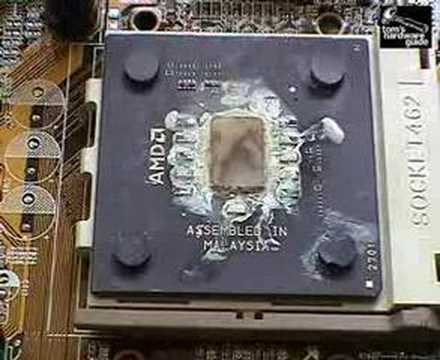
Processors lacking internal thermal safeguards suffer catastrophic heat failure when cooling fans are removed during gaming workloads.
AI-assisted summary of What happens when the CPU cooler is removed? — original source. Check the original for full context.
Source published:
Key ideas
- The footage revisits a classic 2001 Tom's Hardware experiment investigating hardware behavior when CPU heatsinks and fans are removed during active operation. (0:00)
- Testing was conducted under real-world load using Quake III Arena across prominent contemporary processor and motherboard configurations. (0:00)
- The benchmark demonstrates contrasting architectural outcomes, distinguishing platforms equipped with effective thermal protection from those suffering catastrophic burnout. (0:00)
- Rather than relying on technical narration, the demonstration is scored to electronic music accented by applause and a repetitive 'Heat' vocal refrain. (0:00)
Detailed notes
## Background Published on YouTube by AdDiCt Zorz on September 20, 2007, this video showcases a classic 2001 benchmark test originally produced by Tom's Hardware. The description explains that the clip features common motherboard and CPU setups of that era running Quake III Arena before their cooling systems are removed to see which processors survive and which burn.
## TL;DR The video presents an archival thermal stress demonstration investigating what occurs when a processor's heatsink and fan are removed during active operation. Contemporary central processing units and motherboards are pushed under load using Quake III Arena while their cooling assemblies are detached mid-execution. The demonstration highlights the presence—or total absence—of internal thermal protection mechanisms, revealing which CPU architectures safely manage thermal runaway and which succumb to catastrophic hardware failure.
## Atmosphere & style Lacking spoken narration or commentary, the video relies entirely on an energetic electronic soundtrack to set a driving, slightly tense mood. The music is punctuated by sporadic bursts of applause and a rhythmic vocal sample continually repeating the word “Heat.” This creates a clinical yet suspenseful viewing experience that mirrors the escalating physical stakes as processors are pushed to their destructive limits.
## Bulletin - [00:00](https://www.youtube.com/watch?v=y39D4529FM4&t=0s) The footage revisits a classic 2001 Tom's Hardware experiment investigating hardware behavior when CPU heatsinks and fans are removed during active operation. - [00:00](https://www.youtube.com/watch?v=y39D4529FM4&t=0s) Testing was conducted under real-world load using Quake III Arena across prominent contemporary processor and motherboard configurations. - [00:00](https://www.youtube.com/watch?v=y39D4529FM4&t=0s) The benchmark demonstrates contrasting architectural outcomes, distinguishing platforms equipped with effective thermal protection from those suffering catastrophic burnout. - [00:00](https://www.youtube.com/watch?v=y39D4529FM4&t=0s) Rather than relying on technical narration, the demonstration is scored to electronic music accented by applause and a repetitive 'Heat' vocal refrain.
## Key takeaways - [00:00](https://www.youtube.com/watch?v=y39D4529FM4&t=0s) The video presents an archival thermal stress test originally produced by Tom's Hardware around 2001. - [00:00](https://www.youtube.com/watch?v=y39D4529FM4&t=0s) The core experimental procedure entails detaching heatsinks and cooling fans from operating processors mid-task. - [00:00](https://www.youtube.com/watch?v=y39D4529FM4&t=0s) Quake III Arena serves as the primary demanding benchmark to generate heavy CPU workloads during testing. - [00:00](https://www.youtube.com/watch?v=y39D4529FM4&t=0s) Multiple common motherboards and CPU architectures from the early 2000s are comparatively evaluated. - [00:00](https://www.youtube.com/watch?v=y39D4529FM4&t=0s) The trial directly exposes the presence or absence of built-in thermal runaway protections on contemporary chips. - [00:00](https://www.youtube.com/watch?v=y39D4529FM4&t=0s) Processors lacking effective emergency thermal cutoffs or throttling mechanisms succumb to irreversible physical heat damage. - [00:00](https://www.youtube.com/watch?v=y39D4529FM4&t=0s) Architectures with functional thermal management systems manage to survive abrupt cooler removal without fatal failure. - [00:00](https://www.youtube.com/watch?v=y39D4529FM4&t=0s) The presentation omits traditional spoken narration, delivering the hardware test results purely through captured visuals. - [00:00](https://www.youtube.com/watch?v=y39D4529FM4&t=0s) An electronic soundtrack accompanied by recurring audience applause provides the audio backdrop for the demonstration. - [00:00](https://www.youtube.com/watch?v=y39D4529FM4&t=0s) A recurring vocal sample of the word 'Heat' is used rhythmically to emphasize the escalating thermal danger on screen.
## Detailed walkthrough ### [00:00](https://www.youtube.com/watch?v=y39D4529FM4&t=0s) CPU Cooler Removal and Thermal Stress Demonstration
The video showcases the classic 2001 Tom's Hardware experiment designed to observe what happens when a processor's heatsink and cooling fan are suddenly detached during active operation. Running demanding workloads from that era—specifically *Quake III Arena* across various contemporary motherboards and central processing units—the demonstration investigates thermal runaway, testing which hardware architectures feature internal thermal protection mechanisms capable of surviving, and which succumb to catastrophic heat failure.
Throughout the presentation, there is no spoken commentary or technical monologue delivered by a narrator. Instead, the sequence is accompanied by an electronic background music track punctuated by periodic audience applause and a recurring vocal sample repeating “Heat.” As the hardware runs under load, the relentless repetition of “Heat.” marks each phase of the benchmark footage, mirroring the escalating temperatures on screen as cooling solutions are detached.
- **Source Experiment:** Tom's Hardware (circa 2001) thermal benchmark test. - **Test Application:** *Quake III Arena* running on contemporary motherboard and processor platforms. - **Audio Texture:** Fast-paced electronic background music layered with sporadic applause and the rhythmic vocal refrain of “Heat.”
## Mentioned Tom's Hardware, Quake III Arena
## Video description A video from 2001 from Tom's Hardware. They run quake 3 from different mobo/cpu's that were very common in that era and then take the cpu cooler (heatsink and/or fan) off. Its actually quite interesting to see which ones survive and which ones burn.
[Source](https://www.youtube.com/watch?v=y39D4529FM4)