Snowden Urges Universal Web Encryption to Counter NSA Surveillance
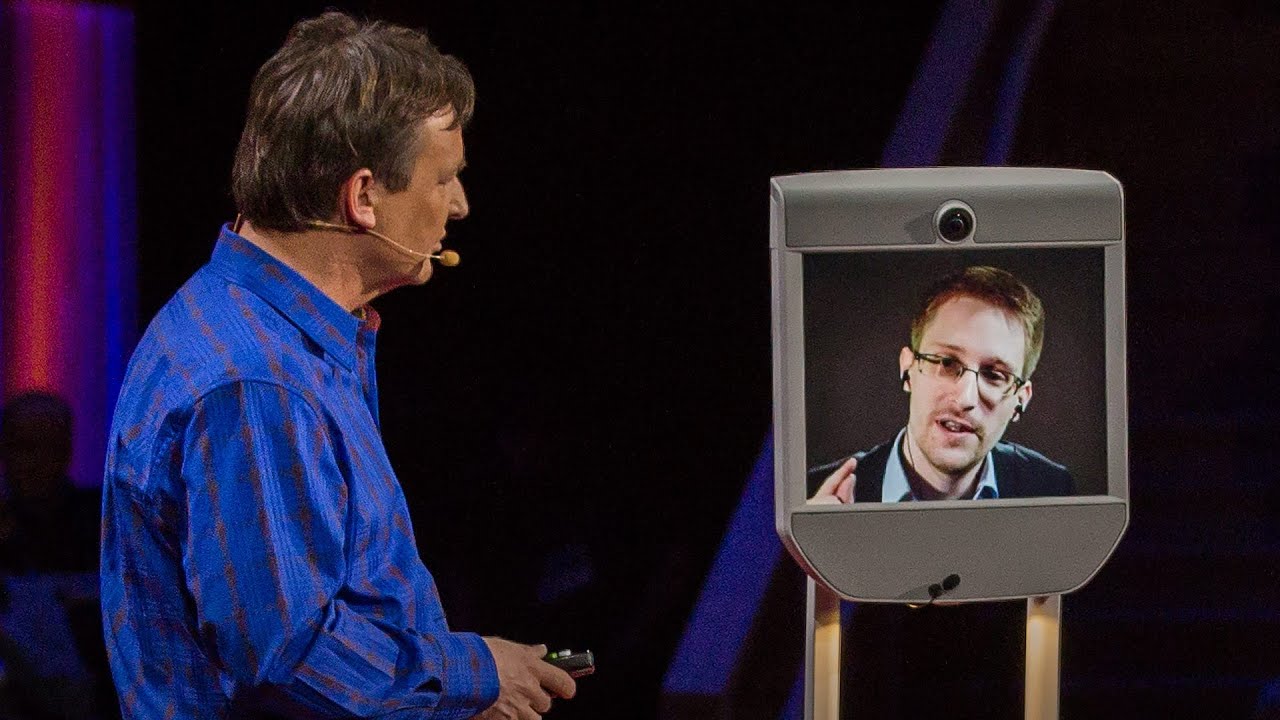
How we take back the internet | Edward Snowden — TED

TED

Mass surveillance programs fail to stop terrorism and instead serve as a cover for state power, requiring citizens and tech companies to encode civil liberties directly into internet architecture.

AI-assisted summary of How we take back the internet | Edward Snowden — original source. Check the original for full context.

Source published:

Key ideas

  • Edward Snowden appeared remotely at TED2014 via a telepresence robot from Russia, defending his disclosures as constitutional whistleblowing and urging a fundamental defense of internet freedom. (0:13)
  • Internal NSA audit documents revealed 2,776 privacy violations in a single year, while the FISA Court rubber-stamped surveillance with only 11 warrant denials out of 34,000 applications over 33 years. (4:46)
  • The NSA's Boundless Informant tool demonstrated that more domestic communications were intercepted within the United States than Russian communications within Russia, refuting intelligence claims made to Congress. (11:28)
  • Two independent White House review panels found that bulk surveillance dragnet programs never stopped a single imminent terrorist attack in the United States, undermining counterterrorism justifications. (19:28)
  • World Wide Web inventor Sir Tim Berners-Lee joined Snowden onstage to endorse a digital 'Magna Carta' aimed at embedding civil liberties and end-to-end encryption directly into the architecture of the web. (26:50)

Detailed notes

## Background Published by TED on YouTube on March 19, 2014, this video features Edward Snowden speaking remotely at the TED2014 conference in Vancouver via a telepresence robot. Interviewed by Chris Anderson with a guest appearance by Sir Tim Berners-Lee, Snowden addresses mass surveillance, internet freedom, and why the right to data privacy requires a fundamental reassessment of digital laws.

## TL;DR Appearing via a remote-controlled telepresence robot from Russia, Edward Snowden details the inner workings of NSA mass surveillance programs like PRISM and Boundless Informant, refuting official claims of strict oversight and counterterrorism utility. He criticizes the subversion of commercial encryption standards under Project Bullrun, arguing that defensive cybersecurity was dangerously sacrificed for offensive spying capabilities. Joined by World Wide Web creator Sir Tim Berners-Lee, Snowden endorses a digital Magna Carta to embed fundamental rights directly into internet architecture. He concludes that privacy is not a partisan issue and that citizens must never surrender basic democratic liberties in exchange for state security.

## Atmosphere & style The session feels surreal and intellectually electrifying, with Snowden's digitized face maneuvering on a mechanical stalk across an auditorium from thousands of miles away in exile. The dynamic between Chris Anderson and Snowden balances high-stakes geopolitical tension with surprising warmth, punctuated by dry humor and spontaneous audience applause. There is an undercurrent of vulnerability and defiance as Snowden discusses threats to his life, contrasting starkly with the hopeful, tech-optimist vision of digital empowerment shared with Sir Tim Berners-Lee.

## Bulletin - [00:13](https://www.youtube.com/watch?v=yVwAodrjZMY&t=13s) Edward Snowden appeared remotely at TED2014 via a telepresence robot from Russia, defending his disclosures as constitutional whistleblowing and urging a fundamental defense of internet freedom. - [04:46](https://www.youtube.com/watch?v=yVwAodrjZMY&t=286s) Internal NSA audit documents revealed 2,776 privacy violations in a single year, while the FISA Court rubber-stamped surveillance with only 11 warrant denials out of 34,000 applications over 33 years. - [11:28](https://www.youtube.com/watch?v=yVwAodrjZMY&t=688s) The NSA's Boundless Informant tool demonstrated that more domestic communications were intercepted within the United States than Russian communications within Russia, refuting intelligence claims made to Congress. - [19:28](https://www.youtube.com/watch?v=yVwAodrjZMY&t=1168s) Two independent White House review panels found that bulk surveillance dragnet programs never stopped a single imminent terrorist attack in the United States, undermining counterterrorism justifications. - [26:50](https://www.youtube.com/watch?v=yVwAodrjZMY&t=1610s) World Wide Web inventor Sir Tim Berners-Lee joined Snowden onstage to endorse a digital 'Magna Carta' aimed at embedding civil liberties and end-to-end encryption directly into the architecture of the web.

## Key takeaways - [00:13](https://www.youtube.com/watch?v=yVwAodrjZMY&t=13s) Snowden deflects personal labels like traitor or hero, stating he acted as an American citizen to prompt debate on the relationship between individuals and the state. - [02:07](https://www.youtube.com/watch?v=yVwAodrjZMY&t=127s) Contractor employees lacked statutory whistleblower protections, prompting Snowden to disclose documents via adversarial journalists to ensure responsible redaction rather than uncontrolled leaks. - [04:46](https://www.youtube.com/watch?v=yVwAodrjZMY&t=286s) Unlike Section 215 metadata collection, the PRISM program compels major American tech companies to hand over actual message content under secret court orders. - [04:46](https://www.youtube.com/watch?v=yVwAodrjZMY&t=286s) The Foreign Intelligence Surveillance Court (FISC) functions as a structural rubber stamp, rejecting only 11 of 34,000 executive warrant applications across 33 years. - [07:10](https://www.youtube.com/watch?v=yVwAodrjZMY&t=430s) The NSA intercepted data directly between Google and Yahoo data center backbones, prompting Snowden to call for universal default SSL/HTTPS encryption across all websites. - [10:13](https://www.youtube.com/watch?v=yVwAodrjZMY&t=613s) The NSA's Boundless Informant tool tracked domestic intercept volumes that agency officials falsely testified were technically impossible to measure. - [11:28](https://www.youtube.com/watch?v=yVwAodrjZMY&t=688s) An internal compliance report documented 2,776 annual privacy violations, including the accidental recording of all phone calls across Washington, D.C. - [13:21](https://www.youtube.com/watch?v=yVwAodrjZMY&t=801s) Snowden dismisses the 'nothing to hide' argument, asserting that privacy protections exist because individuals never know when they will need their rights against state abuse. - [14:56](https://www.youtube.com/watch?v=yVwAodrjZMY&t=896s) Official warnings of catastrophic national security damage reflect a pattern of exaggeration where institutional preservation is conflated with genuine public safety. - [17:42](https://www.youtube.com/watch?v=yVwAodrjZMY&t=1062s) Project Bullrun and GCHQ's Edgehill intentionally subverted commercial encryption standards, introducing backdoors that exposed global financial and communications infrastructure to foreign adversaries. - [19:28](https://www.youtube.com/watch?v=yVwAodrjZMY&t=1168s) Prioritizing offensive hacking over defensive cybersecurity endangers domestic intellectual property, while counterterrorism rhetoric functions primarily as a convenient cover for unilateral intelligence overreach. - [23:04](https://www.youtube.com/watch?v=yVwAodrjZMY&t=1384s) Snowden refuses any negotiated deal that would require compromising journalists, emphasizing that he accepts severe personal risks to resist the criminalization of whistleblowing. - [24:33](https://www.youtube.com/watch?v=yVwAodrjZMY&t=1473s) Digital rights and open network architecture are generational and universal human concerns rather than partisan political disputes. - [26:50](https://www.youtube.com/watch?v=yVwAodrjZMY&t=1610s) Sir Tim Berners-Lee labeled Snowden a hero and partnered in calling for a digital Magna Carta to encode constitutional and human values directly into internet protocols. - [30:07](https://www.youtube.com/watch?v=yVwAodrjZMY&t=1807s) The Bankston-Soltani Principle demonstrates that privacy erodes when surveillance costs drop by orders of magnitude without corresponding legal safeguards, yet individual technologists retain asymmetric leverage to challenge states. - [32:21](https://www.youtube.com/watch?v=yVwAodrjZMY&t=1941s) Societies do not need to sacrifice privacy or civil liberties to achieve effective government and national security.

## Detailed walkthrough ### [00:13](https://www.youtube.com/watch?v=yVwAodrjZMY&t=13s) An American and a Citizen: Appearing from Russia

Chris Anderson opens the session by addressing fundamental issues around citizens' rights and the future of the Internet before introducing Edward Snowden. Appearing remotely from an undisclosed location in Russia, Snowden maneuvers onto the TED stage via a telepresence robot controlled directly from his laptop, allowing him to see the audience through its onboard camera. When Anderson asks him what he sees, Snowden remarks with a laugh, “Ha, I can see everyone. This is amazing.” Anderson promptly turns to the fierce global debate that erupted following the leaks, noting that observers have labeled him everything from a whistleblower and a traitor to a hero, and asks Snowden what words he uses to describe himself.

Snowden deflects the focus from his personal identity to the broader systemic stakes. He explains that while commentators and participants in the debate obsess over his character and personality, that fixation misses the entire point of the revelations. If people think he is the worst person in the world, he notes, they are free to hate him and move forward; what truly matters is the kind of government society desires, the future structure of the Internet, and the relationship between individuals and the state. Rejecting loaded ideological labels, Snowden explains his self-perception simply: “I'd say I'm an American and I'm a citizen, just like everyone else.”

[02:07](https://www.youtube.com/watch?v=yVwAodrjZMY&t=127s) Conscience, Contractors, and the First Amendment

Anderson contextualizes the timeline for the audience: one year earlier, Snowden was stationed in Hawaii working as a systems administrator and consultant to the National Security Agency (NSA). With broad administrative access to intelligence systems, he began transferring classified files to selected investigative journalists, triggering the revelations that broke in June 2013. Asked what compelled him to take such extraordinary action, Snowden acknowledges that while the intelligence community performs necessary, positive work that protects the public, he observed programs that crossed constitutional lines. Decisions of immense consequence were being made behind closed doors without the knowledge or consent of citizens, and without the awareness of elected representatives in Congress.

Facing this reality, Snowden evaluated how to disclose the overreach responsibly by maximizing public benefit while minimizing danger to national security. Going through internal channels or directly to Congress offered no viable recourse; as a private intelligence contractor, he enjoyed no statutory whistleblower protections, creating a severe risk that both he and the evidence would be silenced without public awareness. He turned instead to the First Amendment, which protects an adversarial free press designed to interrogate power while maintaining dialogue with authorities about sensitive national security matters. Entrusting the documents to journalists rather than determining disclosures unilaterally resulted in an informed public debate. He emphasizes that the catastrophic harms predicted by government officials never came to pass: “We've never seen any evidence of even a single instance of specific harm, and because of that, I'm comfortable with the decisions that I made.”

- Snowden served as an NSA contractor and systems administrator in Hawaii, where he observed programs hidden from congressional oversight. - Private contractor employees lacked the legal whistleblower protections afforded to standard federal employees. - The disclosure model relied on independent journalists to evaluate and redact material in consultation with the government rather than dumping unredacted caches directly onto the web.

[04:46](https://www.youtube.com/watch?v=yVwAodrjZMY&t=286s) PRISM: Deputizing Corporate America for Content Collection

Anderson directs Snowden’s attention to a slide displaying an internal document describing PRISM, asking him to explain the program to the audience. Snowden begins by distinguishing PRISM from the controversial surveillance authorities that had dominated early public discussion in the United States. While debate had focused on Section 215 of the USA PATRIOT Act—which officials defended as collecting "just metadata" such as call participants, timestamps, and locations—PRISM targets actual content. Snowden explains that the program functions as a legal mechanism compelling major American corporations to perform surveillance tasks directly on behalf of the intelligence apparatus.

```mermaid flowchart TD accTitle: PRISM vs Section 215 Surveillance Scope accDescr: Diagram contrasting Section 215 bulk metadata collection with PRISM content acquisition through the Foreign Intelligence Surveillance Court.

subgraph MetadataSurv["Section 215 Patriot Act"] M1["Telephony Providers"] -->|"Bulk Records"| M2["NSA Databases"] M2 --> M3["Metadata: Who, When, Where<br/>(No message body)"] end

subgraph ContentSurv["PRISM Program"] C1["Secret FISA Court<br/>(Only 11 rejections in 33 yrs)"] -->|"Compelled Legal Orders"| C2["Tech & Internet Giants"] C2 -->|"Direct Server Content"| C3["NSA Analysts"] C3 --> C4["Stored Emails, Chats, Video, Documents"] end ```

Snowden describes how tech companies that resisted these directives, including Yahoo, were compelled into compliance after losing appeals behind closed doors in the Foreign Intelligence Surveillance Court (FISC). Addressing the standard government defense that 15 federal judges repeatedly sanctioned these surveillance activities, Snowden reveals the institutional bias of this secret oversight mechanism. Over a 33-year period, the secret court reviewed 34,000 warrant applications submitted by the executive branch, rejecting only 11 of them. Critical of relying on such opaque oversight, Snowden warns: “These aren't the people that we want deciding what the role of corporate America in a free and open Internet should be.”

- **Section 215:** Governs bulk collection of telephony metadata (call times, durations, phone numbers, and travel locations). - **PRISM:** Governs interception and retention of actual communications content directly from US Internet companies. - **FISA Court Track Record:** Reviewed 34,000 government warrant requests across 33 years, denying only 11.

[07:10](https://www.youtube.com/watch?v=yVwAodrjZMY&t=430s) Direct Access, Broken Backbones, and Universal Encryption

When Anderson notes that the PRISM slide lists specific dates when major tech giants allegedly joined the program despite their public denials of collaboration, Snowden clarifies the technical meaning of the term "direct access." To an intelligence analyst, direct access does not signify corporate executives conspiring in smoky back rooms to hand over consumer data voluntarily; rather, it means the retrieved intelligence originates straight from the companies' production servers under compelled legal processes. While companies pushed for formal warrants and legal frameworks before turning over information, government collection did not stop there. Referencing reporting from *The Washington Post*, Snowden explains that the NSA also broke directly into the unencrypted private communications links connecting Google’s and Yahoo’s internal data centers worldwide.

```mermaid flowchart LR accTitle: NSA Data Acquisition Vectors accDescr: Flowchart illustrating the dual paths of PRISM legal compulsion and physical data link interception.

subgraph CorporateInfrastructure["Corporate Infrastructure"] S1["User Requests"] --> S2["Front-End Servers"] S2 <-->|"Private Data Center Links"| S3["Internal Data Centers"] end

subgraph NSAIngestion["NSA Collection"] S2 -->|"Compelled PRISM Orders<br/>(Direct Server Access)"| N1["NSA Analyst Database"] S3 -.->|"Intercepted in Transit<br/>(Post Reporting / Backbone Tap)"| N1 end ```

Because state intelligence agencies will bypass corporate resistance whenever technically feasible, Anderson asks what technology companies can do immediately to safeguard the public. Snowden responds that Internet companies can make a monumental difference without waiting for legal consultation: “The biggest thing that an Internet company in America can do today, right now, without consulting with lawyers, to protect the rights of users worldwide, is to enable SSL web encryption on every page you visit.” To illustrate how vulnerable unencrypted traffic is, Snowden points to browsing Amazon:

> “The reason this matters is today, if you go to look at a copy of '1984' on Amazon.com, the NSA can see a record of that, the Russian intelligence service can see a record of that, the Chinese service can see a record of that, the French service, the German service, the services of Andorra. They can all see it because it's unencrypted.”

He emphasizes that Amazon, functioning as the modern world's library, failed to implement HTTPS by default and offered users no option to encrypt their book browsing. He urges every online platform to adopt end-to-end encrypted browsing habits by default for all visitors so that basic civil liberties and personal reading habits remain shielded from global surveillance.

[10:13](https://www.youtube.com/watch?v=yVwAodrjZMY&t=613s) Boundless Informant: The Map the NSA Claimed Did Not Exist

Anderson guides Snowden's telepresence robot to another area of the stage to examine a slide titled "Boundless Informant." Applauding the intelligence community's unusual candor in naming this particular tool, Snowden calls it one of his favorite NSA cryptonyms. Boundless Informant is a data-visualization and cataloging tool developed internally by the NSA, designed to measure the volume of records intercepted across global communication backbones.

Snowden recounts that when congressional oversight committees previously pressed intelligence officials to state how many American communications were swept up into agency systems, NSA leadership claimed it was technically impossible to provide even a ballpark estimate. Agency officials went so far as to argue that calculating the volume of domestic communications intercepted would itself constitute a violation of American privacy rights. The leaked documentation revealed that this defense was false: the NSA's internal systems were already formatted to tag and monitor both metadata endpoints of intercepted traffic. Boundless Informant gave the agency real-time capabilities to identify communications originating from within the United States, proving the agency had the exact domestic statistics it withheld from Congress.

[11:28](https://www.youtube.com/watch?v=yVwAodrjZMY&t=688s) Boundless Informant and Domestic Intelligence Overreach

Edward Snowden points out a startling reality revealed by the internal NSA data visualization tool, Boundless Informant: more communications are being intercepted inside the United States about American citizens than are being intercepted inside Russia about Russian citizens. Remarking wryly on this imbalance, he notes, “I'm not sure that's what an intelligence agency should be aiming for.” Chris Anderson shifts the conversation to an investigative story published by *The Washington Post*—based on Snowden’s leaked documents—bearing the headline, "NSA broke privacy rules thousands of times per year."

Snowden contrasts this report with the sworn congressional testimony delivered by top intelligence officials just the year prior. For someone coming directly from inside the NSA who had read the internal files firsthand, witnessing agency leaders testify under oath that there were no abuses or rule violations was astonishing, particularly because internal personnel knew the truth would eventually surface.

```mermaid flowchart TD accTitle: Internal Intelligence Oversight Failure accDescr: Diagram showing how NSA rule-breaking reached the public via the Washington Post while bypassing Senate oversight. subgraph Agency["National Security Agency"] A["2,776 Privacy Violations / Year"] --> B["Major Incidents<br/>(Single event: 3,000+ people;<br/>D.C. call intercept)"] end subgraph Media["Public Disclosure"] B -.->|"Internal Document Leak"| C["Washington Post Report"] end subgraph Oversight["Congressional Oversight"] C -->|"Requests Comment"| D["Senate Intelligence Chair<br/>(Dianne Feinstein)"] D -->|"Requests Copy"| Agency end ```

The scale of noncompliance documented in the leaked audit was massive, detailing 2,776 privacy violations in a single year. These were not minor technicalities: one single incident swept up the communications of more than 3,000 individuals, while another error resulted in the accidental interception of all telephone calls across the entirety of Washington, D.C. The breakdown of oversight was underscored by the fact that Senator Dianne Feinstein, chairwoman of the Senate Intelligence Committee, had never seen this internal compliance report until *The Washington Post* contacted her office seeking comment. She was forced to request a copy from the agency after the journalists reached out. Snowden challenges the audience: what does it say about the state of American oversight when the head of the Senate committee charged with keeping intelligence agencies accountable remains completely blind to thousands of annual violations?

- Boundless Informant records prove domestic intercepts on Americans exceed Russian intercepts on Russians. - The NSA logged 2,776 rule and law violations within a single twelve-month reporting period. - A single logged error collected communications on more than 3,000 people at once. - Another documented malfunction mistakenly recorded every phone call made within Washington, D.C.

---

[13:21](https://www.youtube.com/watch?v=yVwAodrjZMY&t=801s) The Fallacy of "Nothing to Hide"

Anderson raises a common defense of broad surveillance: the belief that ordinary citizens who have done nothing wrong have nothing to fear, asking Snowden to explain what is flawed with that logic. Snowden responds that this argument requires people to preemptively surrender their civil liberties out of a blind, naive faith in authorities. When citizens dismiss privacy protections because they currently do not need them, they are wagering their future safety on the assumption that power will never be abused. “Your rights matter because you never know when you're going to need them,” Snowden declares.

He frames privacy as an essential pillar of democratic identity, shared across Western nations and free societies around the globe. Ordinary people must have the freedom to call family, text loved ones, purchase a book online, board a train, or buy an airline ticket without constantly calculating how those mundane activities might look years later in the eyes of a government analyst—or even an operative from a foreign government. When routine actions are permanently cataloged, innocent intentions are vulnerable to malicious misinterpretation. Democratic legal systems specifically established Fourth Amendment search warrants, individualized suspicion, and probable cause because history proved that handing any centralized authority unmonitored access to the entirety of human communication creates an irresistible temptation toward overreach.

---

[14:56](https://www.youtube.com/watch?v=yVwAodrjZMY&t=896s) Dick Cheney, National Security, and the "Lion" Analogy

Anderson confronts Snowden with the sharp hostility his disclosures provoked among former government leaders. He cites former Vice President Dick Cheney, who claimed that while Julian Assange was a mere flea bite, Edward Snowden was “the lion that bit the head off the dog,” accusing him of committing one of the worst acts of betrayal in American history. Anderson asks how Snowden answers critics who view him as a traitor.

Snowden draws laughs from the audience by quipping, “Dick Cheney's really something else.” He highlights Cheney’s shifting hyperbole: when Julian Assange and WikiLeaks were publishing documents, Cheney warned that the leaks would ignite the skies, boil the oceans, and destroy governments worldwide, yet he now minimizes that exact episode as a flea bite. Snowden cautions that the public should view current apocalyptic warnings about damaged national security through that same lens of official exaggeration.

Taking Cheney's stated convictions seriously for the sake of argument, Snowden argues that figures like Cheney operate under a dangerously narrow definition of security. Preserving official secrecy and state power does not equate to protecting the public, because the public interest often diverges from the perceived institutional interests of the state. Dragging the nation into conflicts against parties that pose no genuine threat weakens safety, whether that aggression takes place in Iraq or across the digital landscape. The internet, the modern global economy, and international businesses are interconnected parts of human society linked by ties of fraternity. Undermining technical standards and global norms damages the fundamental trust that binds the world together. When Anderson asks if more revelations are coming from the estimated 1.7 million files he acquired, Snowden confirms without hesitation: “There are absolutely more revelations to come.”

---

[17:42](https://www.youtube.com/watch?v=yVwAodrjZMY&t=1062s) Project Bullrun and the Subversion of Encryption

Directing the telepresence robot toward the presentation screen, Anderson introduces a program that he calls the most shocking revelation for the technologists in the room: an NSA effort codenamed "Bullrun." Snowden notes the telling military nomenclature chosen by the agencies. Bullrun is named after a major American Civil War battle, while its British counterpart, run by GCHQ, is named "Edgehill" after a battle in the English Civil War. In his view, these names acknowledge that the agencies are actively targeting their own domestic infrastructure.

Through Bullrun, the NSA covertly intervened in the development of commercial encryption standards. Intelligence officials actively misled corporate partners, professing a desire to assist companies in securing their products while deliberately advising them to implement weakened standards. By introducing intentional vulnerabilities and backdoors, the NSA made services easier for its own analysts to penetrate. However, building backdoors into fundamental protocols means that any adversary with enough time, funding, and computational resources can find and exploit those same flaws. Compromising ubiquitous protocols like Secure Sockets Layer (SSL) leaves global society vulnerable, making it unsafe for everyday citizens to access online banking or conduct secure commerce without the threat of unauthorized surveillance and manipulation.

---

[19:28](https://www.youtube.com/watch?v=yVwAodrjZMY&t=1168s) Offensive Exploits vs. Defensive Cybersecurity

Anderson asks whether crippling commercial security standards leaves the United States open to foreign cyberattacks. Snowden answers that it directly endangers the country. Historically, the NSA handled two opposing missions: offensive foreign hacking and defensive security for domestic networks. Prior to September 11, 2001, the agency maintained a doctrine that prioritized defense over offense. The core strategic calculation was simple: American secrets are inherently more valuable to defend than foreign secrets are to steal. Hacking a competitor in Berlin or Beijing yields far less value than preventing foreign powers from raiding American communications and intellectual property, which forms the bedrock of the U.S. economy. By breaking cryptographic security to facilitate offensive spying, the NSA jeopardized the very economic foundations it was meant to protect.

```mermaid flowchart LR accTitle: Dual NSA Missions and the Post-9/11 Shift accDescr: The historical balance between offensive hacking and defensive security, and how post-9/11 operations reversed priorities. subgraph Historical["Pre-9/11 Priority: Defense"] D1["Defensive Operations<br/>(Protect US secrets & commerce)"] -->|"Prioritized Over"| O1["Offensive Exploits<br/>(Foreign hacking)"] end subgraph Post911["Post-9/11 Priority: Offense (Bullrun)"] O2["Offensive Access / Backdoors"] -->|"Compromises"| D2["Commercial Encryption (SSL)<br/>Leaves IP & banking vulnerable"] end ```

When Anderson asks whether these compromises were justified as a necessary tradeoff in the war on terrorism, Snowden dismisses the claim as factually baseless. The public need not rely on his word alone: the first federal judge outside the secret FISA court system to evaluate the programs denounced them as Orwellian and likely unconstitutional. Furthermore, two independent White House review panels granted full access to classified evidence concluded that these dragnet surveillance programs had never stopped a single imminent terrorist attack in the United States. Snowden points out that all three branches of the federal government have repudiated the utility of these programs:

> “So is it really terrorism that we're stopping? Do these programs have any value at all? I say no, and all three branches of the American government say no as well.”

When Anderson asks if a deeper motive exists beneath the counterterrorism rhetoric, Snowden explains that terrorism serves as a convenient justification: “The bottom line is that terrorism has always been what we in the intelligence world would call a cover for action.” In the 1990s, the NSA and FBI openly petitioned Congress for the authority to mandate backdoors in communications technology, but Congress and the American public flatly rejected the proposal as an unacceptable economic and social risk. Following 9/11, intelligence officials bypassed the democratic process entirely, exploiting state secrecy and the emotional specter of terrorism to unilaterally construct the surveillance apparatus behind closed doors.

[23:04](https://www.youtube.com/watch?v=yVwAodrjZMY&t=1384s) Facing Fear, Threats, and Due Process in Russia

Chris Anderson transitions the conversation to a more personal inquiry, reminding Edward Snowden that most people would find his current predicament in Russia utterly terrifying. He brings up the punitive treatment endured by Chelsea Manning (formerly Bradley Manning) and cites a BuzzFeed report revealing that individuals within the U.S. intelligence community openly expressed a desire to see Snowden dead. Anderson asks how he copes with this reality and navigates that level of fear.

Snowden responds candidly, acknowledging that it is no secret certain governments want him dead, but he maintains that personal fear does not dictate his actions. He explains that he wakes up and goes to sleep every morning thinking exclusively about what he can do to serve the American public, insisting that his aim is not to harm his government, but rather to help it return to constitutional values. What deeply troubles him is a state apparatus willing to bypass due process entirely and proclaim an individual guilty without ever affording them a fair trial. He argues that civil society must actively push back against efforts to intimidate whistleblowers or treat independent reporting as criminal behavior, stating that he willingly accepts the personal risks involved to fight that trend.

“We shouldn’t be threatening dissidents,” Snowden insists. “We shouldn’t be criminalizing journalism. And whatever part I can do to see that end, I’m happy to do despite the risks.”

[24:33](https://www.youtube.com/watch?v=yVwAodrjZMY&t=1473s) Reckless or Heroic: The Generational Divide and Internet Liberty

Seeking the pulse of the room, Anderson puts a direct choice to the TED audience: do they view Snowden’s leaks fundamentally as a reckless act that endangered America, or as a heroic act that will serve the long-term good of the nation and the world? Anderson asks for a show of hands for the "reckless" option, noting that a few hands rise across the auditorium. Anderson quips that it is intimidating to vote against the man while he is standing right in front of them, prompting Snowden to joke back, “I can see you,” drawing laughter from the crowd. When Anderson asks who views the disclosures as fundamentally heroic, the room erupts with enthusiastic cheers and loud applause.

Anderson observes that many attendees refrained from raising their hands altogether, reflecting an ongoing internal debate that defies traditional political binaries like left versus right or libertarian versus statist. He suggests that the controversy is largely generational: Snowden belongs to a demographic that grew up inside the internet and experiences an almost visceral offense whenever policies threaten the medium’s core architecture. Snowden agrees completely, emphasizing that digital rights and civil liberties are universal rather than partisan concerns. He warns that unless citizens actively safeguard the open network they inherited, future generations will be deprived of that freedom.

“This is not a left or right issue,” Snowden states. “Our basic freedoms, and when I say our, I don't just mean Americans, I mean people around the world, it's not a partisan issue.”

```mermaid flowchart TD accTitle: Generational Perception of Digital Rights accDescr: Diagram illustrating how the internet freedom debate transcends left-right politics to become a universal defense of an open web.

subgraph Perceptions["Public Perception"] A["Audience Divide"] -->|"Reckless Act"| B["Endangered National Security"] A -->|"Heroic Act"| C["Served Long-Term Public Good"] end

subgraph CoreValues["The Core Debate"] D["Beyond Left vs. Right Politics"] --> E["Generational Connection to the Internet"] E --> F["Visceral Defense of Open Network"] F --> G["Preserving Liberty for Future Generations"] end

C -.-> D ```

[26:50](https://www.youtube.com/watch?v=yVwAodrjZMY&t=1610s) Sir Tim Berners-Lee and a Magna Carta for the Web

Anderson points out that Sir Tim Berners-Lee, the inventor of the World Wide Web, has voiced remarkably similar concerns, and invites him up to the stage. When Berners-Lee joins Anderson beside the telepresence robot, Anderson asks him to declare his stance: traitor or hero? Berners-Lee smiles and answers that although he has provided much longer analyses elsewhere, he firmly chooses “hero” if forced to decide between the two. Anderson then asks Snowden for his thoughts on Berners-Lee’s recent proposal calling for a digital Magna Carta to take back the web.

Snowden embraces the concept wholeheartedly, remarking on the poetry of a “son of the internet” returning in the form of a robotic telepresence avatar to defend the network. In the middle of the exchange, the video feed briefly flickers and freezes. Berners-Lee jokingly attributes the hiccup to someone interfering with the wiretap on Snowden's line, and Snowden quips back that it is just “a little bit of an NSA problem.” Berners-Lee then asks Snowden what the best possible outcome could be after 25 years of web evolution and current debates about the "web we want." Snowden answers that the future of the internet is limited only by what global users are willing to invest into it, calling on everyday users—not just technical experts—to assert ownership over the tools they rely on daily.

“We need to encode our values not just in writing but in the structure of the Internet, and it's something that I hope, I invite everyone in the audience, not just here in Vancouver but around the world, to join and participate in,” Snowden tells Berners-Lee.

- Berners-Lee unequivocally sides with the "hero" label when asked to choose between traitor and hero. - Snowden advocates baking human rights directly into technical protocols rather than relying solely on legal texts. - Snowden emphasizes that ordinary users—people posting on social media or checking the daily weather—must champion the web alongside technologists.

[30:07](https://www.youtube.com/watch?v=yVwAodrjZMY&t=1807s) Big Brother, The Bankston-Soltani Principle, and Asymmetric Power

Anderson reflects on TED’s founding in 1984, noting that for three decades, techno-optimists argued George Orwell got it wrong: instead of Big Brother watching citizens, transparent digital networks would enable citizens to watch Big Brother. Snowden’s disclosures of mass surveillance appeared to strike a fatal blow to that optimism. Snowden concedes that state surveillance powers have expanded dramatically, citing a recent Yale Law School paper outlining the "Bankston-Soltani Principle." This legal principle posits that public privacy expectations are breached whenever surveillance technology becomes cheaper by an order of magnitude without a corresponding legal rebalancing of privacy safeguards. Because surveillance capabilities have grown exponentially cheaper across multiple orders of magnitude without statutory updates, systemic privacy violations became inevitable.

Nevertheless, Snowden insists that digital tools also grant unprecedented leverage to individuals. He holds up his own situation as living proof that a single person, armed with technical capability and moral resolve, can successfully challenge the most powerful intelligence agencies in the world. As the segment concludes, Anderson gestures toward the robot's mechanical arm, joking about how to shake hands with a telepresence bot, while Berners-Lee quips that such functionality will arrive soon before exiting the stage to applause.

“I am living proof that an individual can go head to head against the most powerful adversaries and the most powerful intelligence agencies around the world and win, and I think that's something that we need to take hope from, and we need to build on to make it accessible not just to technical experts but to ordinary citizens around the world,” Snowden declares.

```mermaid flowchart LR accTitle: The Bankston-Soltani Principle Dynamic accDescr: Flowchart showing how exponential decreases in surveillance costs erode privacy unless matched by legal updates, counterbalanced by individual empowerment.

subgraph Problem["The Surveillance Imbalance"] A["Surveillance Tech Becomes Cheaper<br>by Orders of Magnitude"] --> B["Government Surveillance Expands Exponentially"] B --> C{"Statutory Safeguards Updated?"} C -->|"No"| D["Expectation of Privacy Violated<br>(Bankston-Soltani Principle)"] end

subgraph Solution["The Asymmetric Counterweight"] E["Individual Empowerment via Technology"] --> F["Whistleblowing & Transparency"] F --> G["Public Accountability & Structural Reform"] end

D -.-> E ```

[32:21](https://www.youtube.com/watch?v=yVwAodrjZMY&t=1941s) Amnesty, Refusing Compromise, and an Idea Worth Spreading

Anderson brings up a recent editorial by *The New York Times* advocating clemency or amnesty for Snowden, asking if he would welcome an opportunity to return home to the United States. Snowden confirms without hesitation that he would love to return, emphasizing that everything he undertook was done in service of the public interest and the traditions of a free press. He observes that while widespread media support is a powerful validation of his disclosures, the final judgment belongs to the American public. He also reveals that government representatives have dropped hints about negotiating a deal, provided he turn on or compromise the journalists he has collaborated with. Snowden rejects any such bargain outright, declaring that personal comfort was never his goal and that he will not compromise public-interest journalism to secure his own safe passage home.

Turning to the physical reality of the moment, Anderson notes that although Snowden cannot return to the United States, telepresence technology has brought him across the border into Canada. When asked how it feels to be in Vancouver via the machine, Snowden jokes that Canada is much warmer than he expected. Anderson then asks him for the single "idea worth spreading" he wants the global audience to take away. Snowden concludes with a passionate appeal for democratic self-determination, insisting that societies need not sacrifice basic human liberty in exchange for safety.

“I would say the last year has been a reminder that democracy may die behind closed doors, but we as individuals are born behind those same closed doors, and we don't have to give up our privacy to have good government,” Snowden concludes to sustained applause from the TED audience. “We don't have to give up our liberty to have security.”

## Notable quotes > [13:21](https://www.youtube.com/watch?v=yVwAodrjZMY&t=801s) Your rights matter because you never know when you're going to need them. — Edward Snowden

> [26:50](https://www.youtube.com/watch?v=yVwAodrjZMY&t=1610s) We need to encode our values not just in writing but in the structure of the Internet — Edward Snowden

> [07:10](https://www.youtube.com/watch?v=yVwAodrjZMY&t=430s) The biggest thing that an Internet company in America can do today, right now, without consulting with lawyers, to protect the rights of users worldwide, is to enable SSL web encryption on every page you visit. — Edward Snowden

> [32:21](https://www.youtube.com/watch?v=yVwAodrjZMY&t=1941s) We don't have to give up our liberty to have security. — Edward Snowden

## Mentioned Amazon, Bankston-Soltani Principle, Boundless Informant, Chelsea Manning, Chris Anderson, Dick Cheney, Dianne Feinstein, Edward Snowden, FISA Court, First Amendment, Foreign Intelligence Surveillance Court (FISC), Fourth Amendment, GCHQ, Google, Julian Assange, National Security Agency (NSA), PRISM, Project Bullrun, Section 215 of the USA PATRIOT Act, The New York Times, The Washington Post, Tim Berners-Lee, WikiLeaks, Yahoo

## Video description Appearing by telepresence robot, Edward Snowden speaks at TED2014 about surveillance and Internet freedom. The right to data privacy, he suggests, is not a partisan issue, but requires a fundamental rethink of the role of the internet in our lives — and the laws that protect it. "Your rights matter," he say, "because you never know when you're going to need them." Chris Anderson interviews, with special guest Tim Berners-Lee.

TEDTalks is a daily video podcast of the best talks and performances from the TED Conference, where the world's leading thinkers and doers give the talk of their lives in 18 minutes (or less). Look for talks on Technology, Entertainment and Design -- plus science, business, global issues, the arts and much more. Find closed captions and translated subtitles in many languages at http://www.ted.com/translate

Follow TED news on Twitter: http://www.twitter.com/tednews Like TED on Facebook: https://www.facebook.com/TED

Subscribe to our channel: http://www.youtube.com/user/TEDtalksDirector

[Source](https://www.youtube.com/watch?v=yVwAodrjZMY)

中文简报

斯诺登呼吁普及全网加密以抵御美国国家安全局监控 大规模监控项目未能阻止恐怖主义,反倒沦为国家权力的遮羞布,亟需公民与科技公司将公民自由直接写入互联网架构之中。 爱德华·斯诺登身处俄罗斯,通过遥控临场机器人亮相,详细披露了包括“棱镜”(PRISM)和“无边界情报员”(Boundless Informant)在内的美国国家安全局大规模监控项目的内部运作机制,驳斥了官方关于严格监管与反恐成效的说法。他批评“奔牛”(Project Bullrun)项目破坏商业加密标准,认为这是为了获取进攻性间谍能力而极其危险地牺牲了防御性网络安全。在万维网创始人蒂姆·伯纳斯-李爵士的共同参与下,斯诺登支持制定一份数字《大宪章》,将基本权利直接融入互联网架构之中。他总结道,隐私并非党派议题,公民绝不能为了国家安全而放弃基本的民主自由。 爱德华·斯诺登身处俄罗斯,通过临场机器人远程亮相TED2014大会,为自己的泄密行为辩护,称其为符合宪法精神的吹哨行为,并敦促从根本上捍卫互联网自由。 (0:13) 美国国家安全局内部审计文件显示,仅在一年内就发生了2,776起侵犯隐私事件,而外国情报监视法院(FISA Court)几乎成了“橡皮图章”,在33年间处理的34,000份申请中仅驳回了11次搜查令。 (4:46) 美国国家安全局的“无边界情报员”工具显示,在美国本土截获的国内通信数量超过了在俄罗斯境内截获的俄罗斯通信数量,推翻了该情报机构向国会作出的声明。 (11:28) 白宫的两个独立审查小组发现,大规模监控拉网项目从未在美国本土阻止过哪怕一起迫在眉睫的恐怖袭击,这动摇了以反恐为名的合理借口。 (19:28) 万维网发明者蒂姆·伯纳斯-李爵士与斯诺登同台亮相,共同支持一份数字《大宪章》,旨在将公民自由与端到端加密直接融入网络架构之中。 (26:50)

Reading summary

Edward Snowden argues that mass surveillance programs conducted in secret by the intelligence community violate democratic consent and weaken global cybersecurity, urging technologists and citizens to encode constitutional rights directly into the internet's architecture. Dragnet Content Interception and Oversight Breakdown (4:46) Snowden distinguishes bulk metadata collection under Section 215 from the PRISM program, which legally compels major American internet companies to turn over actual communications content, including emails, chats, and videos, directly from production servers. While officials defend these programs by citing oversight from the Foreign Intelligence Surveillance Court (FISC), Snowden highlights that across a 33-year period, the secret court approved 34,000 government warrant applications while rejecting only 11. In addition to legal compulsion, reports revealed that the NSA physically intercepted data in transit by hacking into unencrypted links between internal corporate data centers. Internal documentation also exposed widespread domestic tracking that intelligence leaders had denied to Congress. The NSA visualization tool Boundless Informant demonstrated that the agency intercepted more communications about American citizens inside the United States than about Russian citizens inside Russia. Furthermore, a leaked internal audit cataloged 2,776 privacy violations in a single year—including an operational glitch that captured every phone call in Washington, D.C.—details that Senate Intelligence Committee Chair Dianne Feinstein was unaware of until journalists contacted her office. Subverting Encryption and Compromising Cybersecurity (17:42) Through Project Bullrun (and the British equivalent, Edgehill), the NSA actively intervened in commercial cryptography standards, covertly advising technology vendors to implement weakened protocols and backdoors to ease state interception. Snowden warns that compromising ubiquitous encryption standards like Secure Sockets Layer (SSL) creates universal vulnerabilities that any sophisticated adversary can eventually exploit, putting online banking, commercial infrastructure, and intellectual property at risk. Historically, the NSA prioritized network defense over offensive exploitation on the strategic principle that protecting domestic intellectual property and communication was vastly more valuable than stealing foreign intelligence. Post-9/11 operations reversed this balance. While officials justify dragnet surveillance as necessary to counter terrorism, Snowden notes that two independent White House review panels and a federal judge concluded the mass surveillance apparatus had never thwarted a single imminent terrorist attack in the United States, characterizing the terrorism rationale as a cover for unauthorized administrative expansion. The Privacy Fallacy and Technological Asymmetry (13:21) Snowden rejects the claim that citizens who have done nothing wrong have nothing to fear from state surveillance, describing it as a naive surrender of rights that gambles safety on the assumption that power will never be abused. Because everyday activities—such as reading a book, buying an airline ticket, or messaging family—can be permanently cataloged and retroactively misinterpreted by government analysts, Western legal traditions explicitly established Fourth Amendment warrants and probable cause to constrain centralized authority. Snowden links this vulnerability to the Bankston-Soltani Principle, which posits that public privacy expectations are breached whenever surveillance capabilities become cheaper by an order of magnitude without a corresponding legal update to privacy safeguards. Because digital monitoring costs dropped exponentially across multiple orders of magnitude without statutory rebalancing, systemic surveillance outpaced existing protections. Universal Encryption and a Digital Magna Carta (26:50) To counteract mass interception, Snowden urges internet companies to immediately adopt default, end-to-end SSL encryption on every webpage, ensuring that reading habits and basic communications are shielded from global intelligence agencies. He endorses World Wide Web inventor Sir Tim Berners-Lee’s proposal for a digital Magna Carta, arguing that civil liberties must be encoded directly into technical protocols rather than entrusted exclusively to statutory promises or government goodwill. Snowden describes digital tools as an asymmetric equalizer, arguing that individuals can successfully hold large intelligence apparatuses accountable through technical capability and moral resolve. Although facing death threats and living in exile in Russia, Snowden states he refuses any negotiated return to the United States that would require implicating or compromising the journalists who reported his disclosures. Snowden concludes that societies need not sacrifice basic human liberty to obtain security, maintaining that the future of an open internet depends on democratic transparency, universal protocol-level encryption, and active public defense of civil liberties.

精炼阅读摘要

前美国国家安全局(NSA)承包商雇员Edward Snowden指出,美英情报机构推行的无差别大众监控在技术与制度层面逾越了宪政界限,却未能有效阻止恐怖袭击;他主张全球公众与科技企业必须通过普及全网加密与重塑网络底层架构,以夺回对开放互联网的控制权并捍卫公民隐私。 秘密监控网络与制度性监管失效 (4:46) PRISM项目与搜集电话元数据的《爱国者法案》第215条截然不同,该项目依托秘密外国情报监视法院(FISC)签发的强制法律指令,直接从美国主要互联网科技公司的生产服务器中提取电子邮件、即时通讯、视频和文件等实质通讯内容。根据Snowden披露,FISC在长达33年间审理了34000份政府监控申请,仅仅驳回了11次,实质上失去了独立司法审查的制衡作用。除通过法律令状直接调取数据外,NSA还被曝光直接渗透并拦截了Google和Yahoo全球数据中心之间未加密的内部私有物理链路。 情报系统内部的数据可视化工具Boundless Informant更证实,NSA在本土对美国公民截获的通讯数量甚至超过了其在俄罗斯境内对俄罗斯人截获的数量,直接推翻了情报界高层此前在国会听证会上宣称的技术上无法统计国内监控数据的誓词。此外,《华盛顿邮报》披露的内部合规审计显示,NSA在单一年份内就记录了2776次违反隐私规则与法律的事件,包括单次误录3000余人的通信以及系统故障误录整个华盛顿特区的通话。参议院情报委员会主席Dianne Feinstein直到媒体调查质询前对此毫不知情,凸显出代议制监督的严重脱节。 反恐借口与加密标准的蓄意削弱 (17:42) 针对“无辜者无需担忧监控”的流行辩解,Snowden反驳称,这种思维预设了对权力的盲目信任,而放弃隐私将剥夺公民在权力遭滥用时的基本防御手段。前副总统Dick Cheney等官员指控其泄密属于叛国行为,Snowden回应称官方长期通过言过其实的言辞制造恐慌,所谓反恐在情报界本质上只是行动掩护。两个独立的白宫审查小组以及首位审理该项目的联邦法官均认定,此类大规模拖网监控从未在美国本土阻止过哪怕一起迫在眉睫的恐怖袭击,其必要性在司法、行政与立法部门均遭到实质否定。 在技术层面上,代号为“Bullrun”(英国对应代号为“Edgehill”)的行动对全球数字安全构成了系统性破坏。NSA通过介入商业加密标准的制定,故意误导科技企业并植入后门以削弱SSL等主流协议,从而方便自身情报人员渗透。Snowden指出,在9/11事件前,NSA的历史战略原则一贯是防御优先于进攻,因为捍卫美国自身的知识产权与关键网络远比窃取外国情报更具经济与安全价值;而情报机构战后对进攻性破坏能力的过度倾斜,反倒使全球银行、商业和基础设施普遍暴露于各类潜在敌手的攻击风险之下。 端到端加密与互联网大宪章的技术重构 (7:10) 面对国家情报部门绕过法律与企业防御的技术手段,Snowden主张互联网公司无需等待漫长的法律咨询,应当立即采取行动:在所有网页上默认开启SSL端到端加密。以当时的Amazon为例,由于缺乏默认的HTTPS加密保护,任何普通用户在线浏览《1984》等书籍的记录,都会被NSA、俄罗斯、法国乃至安道尔的情报机构清晰窥探。只有普及底层全网加密,才能显著推高国家机构实施全量监控的经济与算力成本。 万维网发明者Tim Berners-Lee登台对话时明确将Snowden视为“英雄”,并倡导制定旨在夺回网络主权的“数字大宪章”(Magna Carta for the Web)。Snowden对此表示全力支持,并强调保护人权不能仅依赖纸面法律,必须将自由与隐私的价值直接编码进互联网的底层技术协议与架构中。他呼吁不仅是技术极客,所有日常浏览资讯、使用社交平台的普通网民,都应积极介入并共同主导网络基础设施的未来走向。 不对称权力、告密伦理与班克斯顿原则 (30:07) 在探讨个体抗争的现实机制时,Snowden援引耶鲁大学法学院提出的“班克斯顿-索尔塔尼原则”(Bankston-Soltani Principle)指出,当监控技术成本以数量级剧烈下降,而相应的法定隐私保护未能同步更新时,公众的隐私预期必然遭到系统性侵害。作为缺乏正式法定告密者保护的私营承包商雇员,他选择绕过无效的内部层级,借助宪法第一修正案保障的独立媒体审查并披露过度扩张的监控项目,事实表明官方此前警告的“灾难性危害”并未成为现实。 尽管身处俄罗斯且面临来自美国情报界个别人员的人身威胁,Snowden明确表示拒绝以出卖合作记者为筹码来换取赦免或安全回国。他强调,现代数字技术赋予了个体前所未有的杠杆力量,证明单凭专业技能与道德决断同样能够对抗最强大的情报机关;公众绝不能以牺牲基本自由为代价来换取安全,民主不应在密室中走向消亡。 Snowden强调以技术协议与大众参与作为制衡国家监控的核心路径,主张无须为了安全而妥协自由。但该主张也面临现实挑战:如何在以商业利益为主导的科技巨头生态中普遍推进无死角的技术防御,以及在跨国地缘政治对抗加剧的背景下,个体行动与密码学工具能否彻底扭转国家机器对数字公域的渗透,依然是全球互联网治理悬而未决的根本议题。

Source quotes

[13:21] Edward Snowden: Your rights matter because you never know when you're going to need them. [26:50] Edward Snowden: We need to encode our values not just in writing but in the structure of the Internet [7:10] Edward Snowden: The biggest thing that an Internet company in America can do today, right now, without consulting with lawyers, to protect the rights of users worldwide, is to enable SSL web encryption on every page you visit. [32:21] Edward Snowden: We don't have to give up our liberty to have security.

Original transcript

[0:13] Chris Anderson: The rights of citizens, [0:15] the future of the Internet. [0:17] So I would like to welcome to the TED stage [0:20] the man behind those revelations, [0:23] Ed Snowden. [0:25] (Applause) [0:29] Ed is in a remote location somewhere in Russia [0:33] controlling this bot from his laptop, [0:36] so he can see what the bot can see. [0:40] Ed, welcome to the TED stage. [0:42] What can you see, as a matter of fact? [0:45] Edward Snowden: Ha, I can see everyone. [0:47] This is amazing. [0:49] (Laughter) [0:53] CA: Ed, some questions for you. [0:56] You've been called many things [0:57] in the last few months. [0:59] You've been called a whistleblower, a traitor, [1:04] a hero. [1:05] What words would you describe yourself with? [1:09] ES: You know, everybody who is involved [1:12] with this debate [1:13] has been struggling over me and my personality [1:16] and how to describe me. [1:19] But when I think about it, [1:21] this isn't the question that we should be struggling with. [1:24] Who I am really doesn't matter at all. [1:28] If I'm the worst person in the world, [1:30] you can hate me and move on. [1:32] What really matters here are the issues. [1:35] What really matters here is the kind of government we want, [1:38] the kind of Internet we want, [1:39] the kind of relationship between people [1:42] and societies. [1:43] And that's what I'm hoping the debate will move towards, [1:46] and we've seen that increasing over time. [1:48] If I had to describe myself, [1:50] I wouldn't use words like "hero." [1:52] I wouldn't use "patriot," and I wouldn't use "traitor." [1:54] I'd say I'm an American and I'm a citizen, [1:57] just like everyone else. [1:59] CA: So just to give some context [2:01] for those who don't know the whole story -- [2:03] (Applause) — [2:07] this time a year ago, you were stationed in Hawaii [2:11] working as a consultant to the NSA. [2:14] As a sysadmin, you had access [2:16] to their systems, [2:18] and you began revealing certain classified documents [2:23] to some handpicked journalists [2:26] leading the way to June's revelations. [2:27] Now, what propelled you to do this? [2:33] ES: You know, [2:36] when I was sitting in Hawaii, [2:38] and the years before, when I was working in the intelligence community, [2:40] I saw a lot of things that had disturbed me. [2:44] We do a lot of good things in the intelligence community, [2:47] things that need to be done, [2:49] and things that help everyone. [2:51] But there are also things that go too far. [2:53] There are things that shouldn't be done, [2:55] and decisions that were being made in secret [2:58] without the public's awareness, [2:59] without the public's consent, [3:01] and without even our representatives in government [3:04] having knowledge of these programs. [3:08] When I really came to struggle with these issues, [3:12] I thought to myself, [3:14] how can I do this in the most responsible way, [3:17] that maximizes the public benefit [3:20] while minimizing the risks? [3:23] And out of all the solutions that I could come up with, [3:26] out of going to Congress, [3:28] when there were no laws, [3:29] there were no legal protections [3:31] for a private employee, [3:33] a contractor in intelligence like myself, [3:36] there was a risk that I would be buried along with the information [3:40] and the public would never find out. [3:42] But the First Amendment of the United States Constitution [3:45] guarantees us a free press for a reason, [3:48] and that's to enable an adversarial press, [3:52] to challenge the government, [3:53] but also to work together with the government, [3:56] to have a dialogue and debate about how we can [3:58] inform the public about matters of vital importance [4:04] without putting our national security at risk. [4:07] And by working with journalists, [4:09] by giving all of my information [4:11] back to the American people, [4:13] rather than trusting myself to make [4:15] the decisions about publication, [4:18] we've had a robust debate [4:20] with a deep investment by the government [4:23] that I think has resulted in a benefit for everyone. [4:28] And the risks that have been threatened, [4:32] the risks that have been played up [4:34] by the government [4:36] have never materialized. [4:37] We've never seen any evidence [4:39] of even a single instance of specific harm, [4:43] and because of that, [4:44] I'm comfortable with the decisions that I made. [4:46] CA: So let me show the audience [4:49] a couple of examples of what you revealed. [4:51] If we could have a slide up, and Ed, [4:53] I don't know whether you can see, [4:55] the slides are here. [4:56] This is a slide of the PRISM program, [4:58] and maybe you could tell the audience [5:01] what that was that was revealed. [5:03] ES: The best way to understand PRISM, [5:06] because there's been a little bit of controversy, [5:07] is to first talk about what PRISM isn't. [5:11] Much of the debate in the U.S. has been about metadata. [5:14] They've said it's just metadata, it's just metadata, [5:16] and they're talking about a specific legal authority [5:19] called Section 215 of the Patriot Act. [5:22] That allows sort of a warrantless wiretapping, [5:25] mass surveillance of the entire country's [5:27] phone records, things like that -- [5:30] who you're talking to, [5:31] when you're talking to them, [5:33] where you traveled. [5:34] These are all metadata events. [5:37] PRISM is about content. [5:40] It's a program through which the government could [5:42] compel corporate America, [5:44] it could deputize corporate America [5:48] to do its dirty work for the NSA. [5:51] And even though some of these companies did resist, [5:54] even though some of them -- [5:56] I believe Yahoo was one of them — [5:57] challenged them in court, they all lost, [6:00] because it was never tried by an open court. [6:03] They were only tried by a secret court. [6:06] And something that we've seen, [6:07] something about the PRISM program that's very concerning to me is, [6:10] there's been a talking point in the U.S. government [6:12] where they've said 15 federal judges [6:16] have reviewed these programs and found them to be lawful, [6:18] but what they don't tell you [6:21] is those are secret judges [6:24] in a secret court [6:26] based on secret interpretations of law [6:29] that's considered 34,000 warrant requests [6:33] over 33 years, [6:35] and in 33 years only rejected [6:38] 11 government requests. [6:41] These aren't the people that we want deciding [6:43] what the role of corporate America [6:45] in a free and open Internet should be. [6:48] CA: Now, this slide that we're showing here [6:50] shows the dates in which [6:52] different technology companies, Internet companies, [6:55] are alleged to have joined the program, [6:57] and where data collection began from them. [7:00] Now, they have denied collaborating with the NSA. [7:05] How was that data collected by the NSA? [7:10] ES: Right. So the NSA's own slides [7:13] refer to it as direct access. [7:16] What that means to an actual NSA analyst, [7:19] someone like me who was working as an intelligence analyst [7:22] targeting, Chinese cyber-hackers, [7:24] things like that, in Hawaii, [7:26] is the provenance of that data [7:28] is directly from their servers. [7:30] It doesn't mean [7:32] that there's a group of company representatives [7:35] sitting in a smoky room with the NSA [7:38] palling around and making back-room deals [7:40] about how they're going to give this stuff away. [7:42] Now each company handles it different ways. [7:44] Some are responsible. [7:46] Some are somewhat less responsible. [7:48] But the bottom line is, when we talk about [7:49] how this information is given, [7:53] it's coming from the companies themselves. [7:55] It's not stolen from the lines. [7:58] But there's an important thing to remember here: [8:00] even though companies pushed back, [8:02] even though companies demanded, [8:04] hey, let's do this through a warrant process, [8:06] let's do this [8:08] where we actually have some sort of legal review, [8:11] some sort of basis for handing over [8:13] these users' data, [8:15] we saw stories in the Washington Post last year [8:17] that weren't as well reported as the PRISM story [8:20] that said the NSA broke in [8:23] to the data center communications [8:25] between Google to itself [8:27] and Yahoo to itself. [8:29] So even these companies that are cooperating [8:31] in at least a compelled but hopefully lawful manner [8:34] with the NSA, [8:36] the NSA isn't satisfied with that, [8:39] and because of that, we need our companies [8:41] to work very hard [8:44] to guarantee that they're going to represent [8:47] the interests of the user, and also advocate [8:49] for the rights of the users. [8:51] And I think over the last year, [8:52] we've seen the companies that are named [8:54] on the PRISM slides [8:55] take great strides to do that, [8:57] and I encourage them to continue. [9:00] CA: What more should they do? [9:02] ES: The biggest thing that an Internet company [9:06] in America can do today, right now, [9:09] without consulting with lawyers, [9:10] to protect the rights of users worldwide, [9:14] is to enable SSL web encryption [9:19] on every page you visit. [9:21] The reason this matters is today, [9:24] if you go to look at a copy of "1984" on Amazon.com, [9:29] the NSA can see a record of that, [9:32] the Russian intelligence service can see a record of that, [9:34] the Chinese service can see a record of that, [9:37] the French service, the German service, [9:39] the services of Andorra. [9:40] They can all see it because it's unencrypted. [9:43] The world's library is Amazon.com, [9:47] but not only do they not support encryption by default, [9:49] you cannot choose to use encryption [9:52] when browsing through books. [9:53] This is something that we need to change, [9:55] not just for Amazon, I don't mean to single them out, [9:57] but they're a great example. [9:58] All companies need to move [10:00] to an encrypted browsing habit by default [10:03] for all users who haven't taken any action [10:06] or picked any special methods on their own. [10:08] That'll increase the privacy and the rights [10:10] that people enjoy worldwide. [10:13] CA: Ed, come with me to this part of the stage. [10:16] I want to show you the next slide here. (Applause) [10:19] This is a program called Boundless Informant. [10:21] What is that? [10:23] ES: So, I've got to give credit to the NSA [10:25] for using appropriate names on this. [10:28] This is one of my favorite NSA cryptonyms. [10:31] Boundless Informant [10:33] is a program that the NSA hid from Congress. [10:36] The NSA was previously asked by Congress, [10:38] was there any ability that they had [10:40] to even give a rough ballpark estimate [10:44] of the amount of American communications [10:46] that were being intercepted. [10:49] They said no. They said, we don't track those stats, [10:52] and we can't track those stats. [10:53] We can't tell you how many communications [10:56] we're intercepting around the world, [10:58] because to tell you that would be [10:59] to invade your privacy. [11:02] Now, I really appreciate that sentiment from them, [11:05] but the reality, when you look at this slide is, [11:07] not only do they have the capability, [11:08] the capability already exists. [11:11] It's already in place. [11:13] The NSA has its own internal data format [11:16] that tracks both ends of a communication, [11:20] and if it says, [11:21] this communication came from America, [11:23] they can tell Congress how many of those communications [11:26] they have today, right now. [11:28] And what Boundless Informant tells us [11:31] is more communications are being intercepted [11:34] in America about Americans [11:37] than there are in Russia about Russians. [11:40] I'm not sure that's what an intelligence agency [11:42] should be aiming for. [11:45] CA: Ed, there was a story broken in the Washington Post, [11:47] again from your data. [11:49] The headline says, [11:50] "NSA broke privacy rules [11:52] thousands of times per year." [11:54] Tell us about that. [11:55] ES: We also heard in Congressional testimony last year, [11:58] it was an amazing thing for someone like me [12:00] who came from the NSA [12:02] and who's seen the actual internal documents, [12:04] knows what's in them, [12:07] to see officials testifying under oath [12:09] that there had been no abuses, [12:11] that there had been no violations of the NSA's rules, [12:15] when we knew this story was coming. [12:18] But what's especially interesting about this, [12:20] about the fact that the NSA has violated [12:22] their own rules, their own laws [12:24] thousands of times in a single year, [12:27] including one event by itself, [12:30] one event out of those 2,776, [12:35] that affected more than 3,000 people. [12:37] In another event, they intercepted [12:39] all the calls in Washington, D.C., by accident. [12:43] What's amazing about this, [12:45] this report, that didn't get that much attention, [12:47] is the fact that not only were there 2,776 abuses, [12:52] the chairman of the Senate Intelligence Committee, [12:54] Dianne Feinstein, had not seen this report [12:58] until the Washington Post contacted her [13:02] asking for comment on the report. [13:04] And she then requested a copy from the NSA [13:06] and received it, [13:08] but had never seen this before that. [13:10] What does that say about the state of oversight [13:12] in American intelligence [13:14] when the chairman of the Senate Intelligence Committee [13:16] has no idea that the rules are being broken [13:19] thousands of times every year? [13:21] CA: Ed, one response to this whole debate is this: [13:24] Why should we care about [13:27] all this surveillance, honestly? [13:29] I mean, look, if you've done nothing wrong, [13:31] you've got nothing to worry about. [13:34] What's wrong with that point of view? [13:36] ES: Well, so the first thing is, [13:38] you're giving up your rights. [13:39] You're saying hey, you know, [13:41] I don't think I'm going to need them, [13:43] so I'm just going to trust that, you know, [13:45] let's get rid of them, it doesn't really matter, [13:48] these guys are going to do the right thing. [13:50] Your rights matter [13:51] because you never know when you're going to need them. [13:54] Beyond that, it's a part of our cultural identity, [13:57] not just in America, [13:59] but in Western societies [14:00] and in democratic societies around the world. [14:03] People should be able to pick up the phone [14:06] and to call their family, [14:07] people should be able to send a text message [14:09] to their loved ones, [14:10] people should be able to buy a book online, [14:13] they should be able to travel by train, [14:14] they should be able to buy an airline ticket [14:17] without wondering about how these events [14:18] are going to look to an agent of the government, [14:22] possibly not even your government [14:25] years in the future, [14:26] how they're going to be misinterpreted [14:28] and what they're going to think your intentions were. [14:31] We have a right to privacy. [14:33] We require warrants to be based on probable cause [14:37] or some kind of individualized suspicion [14:39] because we recognize that trusting anybody, [14:44] any government authority, [14:45] with the entirety of human communications [14:48] in secret and without oversight [14:51] is simply too great a temptation to be ignored. [14:56] CA: Some people are furious at what you've done. [14:58] I heard a quote recently from Dick Cheney [15:01] who said that Julian Assange was a flea bite, [15:07] Edward Snowden is the lion that bit the head off the dog. [15:10] He thinks you've committed [15:12] one of the worst acts of betrayal [15:14] in American history. [15:16] What would you say to people who think that? [15:22] ES: Dick Cheney's really something else. [15:25] (Laughter) (Applause) [15:32] Thank you. (Laughter) [15:37] I think it's amazing, because at the time [15:39] Julian Assange was doing some of his greatest work, [15:43] Dick Cheney was saying [15:45] he was going to end governments worldwide, [15:47] the skies were going to ignite [15:50] and the seas were going to boil off, [15:52] and now he's saying it's a flea bite. [15:54] So we should be suspicious about the same sort of [15:57] overblown claims of damage to national security [16:01] from these kind of officials. [16:03] But let's assume that these people really believe this. [16:09] I would argue that they have kind of [16:12] a narrow conception of national security. [16:16] The prerogatives of people like Dick Cheney [16:19] do not keep the nation safe. [16:22] The public interest is not always the same [16:26] as the national interest. [16:29] Going to war with people who are not our enemy [16:33] in places that are not a threat [16:35] doesn't make us safe, [16:37] and that applies whether it's in Iraq [16:39] or on the Internet. [16:41] The Internet is not the enemy. [16:42] Our economy is not the enemy. [16:44] American businesses, Chinese businesses, [16:47] and any other company out there [16:51] is a part of our society. [16:54] It's a part of our interconnected world. [16:56] There are ties of fraternity that bond us together, [17:00] and if we destroy these bonds [17:03] by undermining the standards, the security, [17:06] the manner of behavior, [17:09] that nations and citizens all around the world [17:12] expect us to abide by. [17:14] CA: But it's alleged that you've stolen [17:18] 1.7 million documents. [17:20] It seems only a few hundred of them [17:22] have been shared with journalists so far. [17:25] Are there more revelations to come? [17:28] ES: There are absolutely more revelations to come. [17:30] I don't think there's any question [17:33] that some of the most important reporting [17:37] to be done is yet to come. [17:42] CA: Come here, because I want to ask you [17:44] about this particular revelation. [17:46] Come and take a look at this. [17:49] I mean, this is a story which I think for a lot of the techies in this room [17:52] is the single most shocking thing [17:54] that they have heard in the last few months. [17:56] It's about a program called "Bullrun." [17:59] Can you explain what that is? [18:02] ES: So Bullrun, and this is again [18:04] where we've got to thank the NSA for their candor, [18:11] this is a program named after a Civil War battle. [18:16] The British counterpart is called Edgehill, [18:17] which is a U.K. civil war battle. [18:19] And the reason that I believe they're named this way [18:21] is because they target our own infrastructure. [18:25] They're programs through which the NSA [18:27] intentionally misleads corporate partners. [18:31] They tell corporate partners that these [18:33] are safe standards. [18:35] They say hey, we need to work with you [18:37] to secure your systems, [18:41] but in reality, they're giving bad advice [18:44] to these companies that makes them [18:45] degrade the security of their services. [18:47] They're building in backdoors that not only [18:50] the NSA can exploit, [18:52] but anyone else who has time and money [18:55] to research and find it [18:57] can then use to let themselves in [18:59] to the world's communications. [19:01] And this is really dangerous, [19:03] because if we lose a single standard, [19:07] if we lose the trust of something like SSL, [19:10] which was specifically targeted [19:11] by the Bullrun program, [19:13] we will live a less safe world overall. [19:16] We won't be able to access our banks [19:18] and we won't be able to access commerce [19:23] without worrying about people monitoring those communications [19:26] or subverting them for their own ends. [19:28] CA: And do those same decisions also potentially [19:32] open America up to cyberattacks [19:35] from other sources? [19:39] ES: Absolutely. [19:41] One of the problems, [19:43] one of the dangerous legacies [19:46] that we've seen in the post-9/11 era, [19:49] is that the NSA has traditionally worn two hats. [19:54] They've been in charge of offensive operations, [19:56] that is hacking, [19:57] but they've also been in charge of defensive operations, [19:59] and traditionally they've always prioritized [20:02] defense over offense [20:03] based on the principle [20:05] that American secrets are simply worth more. [20:07] If we hack a Chinese business [20:10] and steal their secrets, [20:11] if we hack a government office in Berlin [20:13] and steal their secrets, [20:15] that has less value to the American people [20:19] than making sure that the Chinese [20:21] can't get access to our secrets. [20:24] So by reducing the security of our communications, [20:28] they're not only putting the world at risk, [20:30] they're putting America at risk in a fundamental way, [20:32] because intellectual property is the basis, [20:35] the foundation of our economy, [20:37] and if we put that at risk through weak security, [20:39] we're going to be paying for it for years. [20:41] CA: But they've made a calculation [20:42] that it was worth doing this [20:44] as part of America's defense against terrorism. [20:48] Surely that makes it a price worth paying. [20:51] ES: Well, when you look at the results [20:55] of these programs in stopping terrorism, [20:58] you will see that that's unfounded, [21:01] and you don't have to take my word for it, [21:03] because we've had the first open court, [21:07] the first federal court that's reviewed this, [21:09] outside the secrecy arrangement, [21:12] called these programs Orwellian [21:14] and likely unconstitutional. [21:16] Congress, who has access [21:19] to be briefed on these things, [21:21] and now has the desire to be, [21:23] has produced bills to reform it, [21:26] and two independent White House panels [21:29] who reviewed all of the classified evidence [21:31] said these programs have never stopped [21:34] a single terrorist attack [21:35] that was imminent in the United States. [21:39] So is it really terrorism that we're stopping? [21:42] Do these programs have any value at all? [21:44] I say no, and all three branches [21:47] of the American government say no as well. [21:49] CA: I mean, do you think there's a deeper motivation [21:51] for them than the war against terrorism? [21:54] ES: I'm sorry, I couldn't hear you, say again? [21:56] CA: Sorry. Do you think there's a deeper motivation [21:59] for them other than the war against terrorism? [22:02] ES: Yeah. The bottom line is that terrorism [22:05] has always been what we in the intelligence world [22:07] would call a cover for action. [22:11] Terrorism is something that provokes [22:13] an emotional response that allows people [22:15] to rationalize authorizing powers and programs [22:19] that they wouldn't give otherwise. [22:22] The Bullrun and Edgehill-type programs, [22:24] the NSA asked for these authorities [22:26] back in the 1990s. [22:28] They asked the FBI to go to Congress and make the case. [22:31] The FBI went to Congress and did make the case. [22:33] But Congress and the American people said no. [22:35] They said, it's not worth the risk to our economy. [22:38] They said it's worth too much damage [22:40] to our society to justify the gains. [22:43] But what we saw is, in the post-9/11 era, [22:47] they used secrecy and they used the justification of terrorism [22:50] to start these programs in secret [22:52] without asking Congress, [22:54] without asking the American people, [22:56] and it's that kind of government behind closed doors [22:59] that we need to guard ourselves against, [23:01] because it makes us less safe, [23:03] and it offers no value. [23:04] CA: Okay, come with me here for a sec, [23:06] because I've got a more personal question for you. [23:08] Speaking of terror, [23:11] most people would find the situation you're in right now [23:15] in Russia pretty terrifying. [23:19] You obviously heard what happened, [23:22] what the treatment that Bradley Manning got, [23:24] Chelsea Manning as now is, [23:27] and there was a story in Buzzfeed saying that [23:29] there are people in the intelligence community [23:31] who want you dead. [23:33] How are you coping with this? [23:35] How are you coping with the fear? [23:37] ES: It's no mystery [23:40] that there are governments out there that want to see me dead. [23:46] I've made clear again and again and again [23:49] that I go to sleep every morning [23:52] thinking about what I can do for the American people. [23:57] I don't want to harm my government. [24:00] I want to help my government, [24:03] but the fact that they are willing to [24:07] completely ignore due process, [24:09] they're willing to declare guilt [24:12] without ever seeing a trial, [24:15] these are things that we need to work against [24:18] as a society, and say hey, this is not appropriate. [24:21] We shouldn't be threatening dissidents. [24:23] We shouldn't be criminalizing journalism. [24:26] And whatever part I can do to see that end, [24:30] I'm happy to do despite the risks. [24:33] CA: So I'd actually like to get some feedback [24:34] from the audience here, [24:35] because I know there's widely differing reactions [24:38] to Edward Snowden. [24:39] Suppose you had the following two choices, right? [24:42] You could view what he did [24:45] as fundamentally a reckless act [24:46] that has endangered America [24:50] or you could view it as fundamentally a heroic act [24:53] that will work towards America and the world's [24:57] long-term good? [24:58] Those are the two choices I'll give you. [25:01] I'm curious to see who's willing to vote with [25:04] the first of those, [25:05] that this was a reckless act? [25:08] There are some hands going up. [25:10] Some hands going up. [25:11] It's hard to put your hand up [25:13] when the man is standing right here, [25:15] but I see them. [25:16] ES: I can see you. (Laughter) [25:19] CA: And who goes with the second choice, [25:21] the fundamentally heroic act? [25:23] (Applause) (Cheers) [25:26] And I think it's true to say that there are a lot of people [25:28] who didn't show a hand and I think [25:31] are still thinking this through, [25:32] because it seems to me that the debate around you [25:36] doesn't split along traditional political lines. [25:39] It's not left or right, it's not really about [25:41] pro-government, libertarian, or not just that. [25:45] Part of it is almost a generational issue. [25:48] You're part of a generation that grew up [25:50] with the Internet, and it seems as if [25:53] you become offended at almost a visceral level [25:56] when you see something done [25:57] that you think will harm the Internet. [25:59] Is there some truth to that? [26:03] ES: It is. I think it's very true. [26:08] This is not a left or right issue. [26:11] Our basic freedoms, and when I say our, [26:13] I don't just mean Americans, [26:15] I mean people around the world, [26:17] it's not a partisan issue. [26:19] These are things that all people believe, [26:21] and it's up to all of us to protect them, [26:24] and to people who have seen and enjoyed [26:27] a free and open Internet, [26:28] it's up to us to preserve that liberty [26:32] for the next generation to enjoy, [26:34] and if we don't change things, [26:35] if we don't stand up to make the changes [26:39] we need to do to keep the Internet safe, [26:42] not just for us but for everyone, [26:45] we're going to lose that, [26:46] and that would be a tremendous loss, [26:47] not just for us, but for the world. [26:50] CA: Well, I have heard similar language recently [26:52] from the founder of the world wide web, [26:54] who I actually think is with us, Sir Tim Berners-Lee. [26:58] Tim, actually, would you like to come up and say, [27:01] do we have a microphone for Tim? [27:03] (Applause) [27:05] Tim, good to see you. Come up there. [27:12] Which camp are you in, by the way, [27:15] traitor, hero? I have a theory on this, but -- [27:18] Tim Berners-Lee: I've given much longer [27:21] answers to that question, but hero, [27:24] if I have to make the choice between the two. [27:27] CA: And Ed, I think you've read [27:31] the proposal that Sir Tim has talked about [27:33] about a new Magna Carta to take back the Internet. [27:36] Is that something that makes sense? [27:38] ES: Absolutely. I mean, my generation, I grew up [27:41] not just thinking about the Internet, [27:43] but I grew up in the Internet, [27:46] and although I never expected to have the chance [27:50] to defend it in such a direct and practical manner [27:56] and to embody it in this unusual, [28:00] almost avatar manner, [28:02] I think there's something poetic about the fact that [28:05] one of the sons of the Internet [28:07] has actually become close to the Internet [28:10] as a result of their political expression. [28:12] And I believe that a Magna Carta for the Internet [28:16] is exactly what we need. [28:18] We need to encode our values [28:21] not just in writing but in the structure of the Internet, [28:25] and it's something that I hope, [28:27] I invite everyone in the audience, [28:29] not just here in Vancouver but around the world, [28:33] to join and participate in. [28:35] CA: Do you have a question for Ed? [28:37] TBL: Well, two questions, [28:39] a general question — [28:40] CA: Ed, can you still hear us? [28:42] ES: Yes, I can hear you. CA: Oh, he's back. [28:46] TBL: The wiretap on your line [28:47] got a little interfered with for a moment. [28:49] (Laughter) [28:51] ES: It's a little bit of an NSA problem. [28:53] TBL: So, from the 25 years, [28:57] stepping back and thinking, [29:00] what would you think would be [29:02] the best that we could achieve [29:04] from all the discussions that we have [29:06] about the web we want? [29:09] ES: When we think about [29:12] in terms of how far we can go, [29:15] I think that's a question that's really only limited [29:18] by what we're willing to put into it. [29:20] I think the Internet that we've enjoyed in the past [29:23] has been exactly what we as not just a nation [29:29] but as a people around the world need, [29:32] and by cooperating, by engaging not just [29:36] the technical parts of society, [29:38] but as you said, the users, [29:40] the people around the world who contribute [29:43] through the Internet, through social media, [29:45] who just check the weather, [29:47] who rely on it every day as a part of their life, [29:49] to champion that. [29:52] We'll get not just the Internet we've had, [29:55] but a better Internet, a better now, [29:58] something that we can use to build a future [30:02] that'll be better not just than what we hoped for [30:05] but anything that we could have imagined. [30:07] CA: It's 30 years ago that TED was founded, 1984. [30:13] A lot of the conversation since then has been [30:15] along the lines that [30:17] actually George Orwell got it wrong. [30:18] It's not Big Brother watching us. [30:20] We, through the power of the web, [30:22] and transparency, are now watching Big Brother. [30:24] Your revelations kind of drove a stake [30:26] through the heart of that rather optimistic view, [30:30] but you still believe there's a way of doing something [30:34] about that. [30:35] And you do too. [30:37] ES: Right, so there is an argument to be made [30:43] that the powers of Big Brother have increased enormously. [30:47] There was a recent legal article at Yale [30:51] that established something called the Bankston-Soltani Principle, [30:55] which is that our expectation of privacy is violated [31:00] when the capabilities of government surveillance [31:02] have become cheaper by an order of magnitude, [31:05] and each time that occurs, we need to revisit [31:08] and rebalance our privacy rights. [31:11] Now, that hasn't happened since [31:13] the government's surveillance powers [31:15] have increased by several orders of magnitude, [31:18] and that's why we're in the problem that we're in today, [31:21] but there is still hope, [31:25] because the power of individuals [31:27] have also been increased by technology. [31:30] I am living proof [31:32] that an individual can go head to head [31:34] against the most powerful adversaries [31:36] and the most powerful intelligence agencies [31:38] around the world and win, [31:42] and I think that's something [31:44] that we need to take hope from, [31:46] and we need to build on [31:47] to make it accessible not just to technical experts [31:50] but to ordinary citizens around the world. [31:52] Journalism is not a crime, [31:54] communication is not a crime, [31:56] and we should not be monitored in our everyday activities. [31:59] CA: I'm not quite sure how you shake the hand of a bot, [32:01] but I imagine it's, this is the hand right here. TBL: That'll come very soon. [32:07] ES: Nice to meet you, [32:08] and I hope my beam looks as nice [32:10] as my view of you guys does. [32:13] CA: Thank you, Tim. [32:16] (Applause) [32:21] I mean, The New York Times recently called for an amnesty for you. [32:25] Would you welcome the chance to come back to America? [32:30] ES: Absolutely. There's really no question, [32:33] the principles that have been the foundation [32:36] of this project [32:38] have been the public interest [32:43] and the principles that underly [32:45] the journalistic establishment in the United States [32:49] and around the world, [32:51] and I think if the press is now saying, [32:56] we support this, [32:58] this is something that needed to happen, [33:00] that's a powerful argument, but it's not the final argument, [33:03] and I think that's something that public should decide. [33:06] But at the same time, [33:07] the government has hinted that they want [33:09] some kind of deal, [33:11] that they want me to compromise [33:13] the journalists with which I've been working, [33:15] to come back, [33:16] and I want to make it very clear [33:19] that I did not do this to be safe. [33:22] I did this to do what was right, [33:24] and I'm not going to stop my work [33:26] in the public interest [33:28] just to benefit myself. [33:30] (Applause) [33:36] CA: In the meantime, [33:38] courtesy of the Internet and this technology, [33:42] you're here, back in North America, [33:44] not quite the U.S., Canada, in this form. [33:48] I'm curious, how does that feel? [33:52] ES: Canada is different than what I expected. [33:55] It's a lot warmer. [33:57] (Laughter) [34:02] CA: At TED, the mission is "ideas worth spreading." [34:06] If you could encapsulate it in a single idea, [34:08] what is your idea worth spreading [34:10] right now at this moment? [34:14] ES: I would say the last year has been a reminder [34:18] that democracy may die behind closed doors, [34:21] but we as individuals are born [34:23] behind those same closed doors, [34:26] and we don't have to give up [34:28] our privacy to have good government. [34:32] We don't have to give up our liberty [34:34] to have security. [34:35] And I think by working together [34:38] we can have both open government [34:41] and private lives, [34:42] and I look forward to working with everyone [34:44] around the world to see that happen. [34:47] Thank you very much. [34:48] CA: Ed, thank you. [34:50] (Applause)