## Background
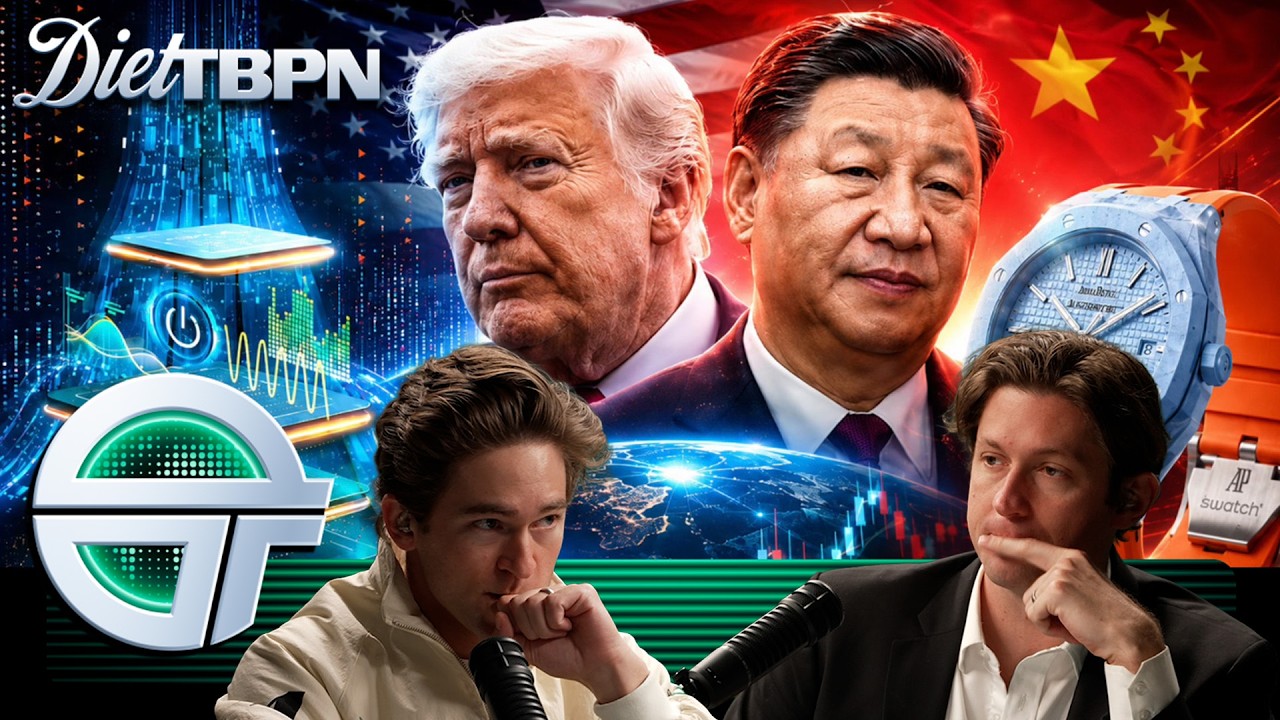
This content was published by the channel TBPN on YouTube on May 12, 2026. The episode, titled "Diet TBPN," delivers a condensed 30-minute highlight reel of their daily live tech talk show hosted by John Coogan and Jordi Hays, covering major headlines in tech, markets, and current events.
## TL;DR
The hosts break down key market and geopolitical stories, starting with Audemars Piguet's controversial "Royal Pop" collaboration with Swatch and luxury watch resale trends. They analyze EV maker BYD hiring Daniel Craig for its European expansion and Cerebras' massive upsized IPO pricing driven by overwhelming demand for its wafer-scale inference hardware. Finally, they discuss President Trump's high-stakes Beijing summit with Chinese leader Xi Jinping alongside top US CEOs, closing with lighthearted commentary on Palmer Luckey's proposal to ban postal junk mail.
## Atmosphere & style
The show carries a fast-paced, banter-filled, and irreverent energy driven by the casual chemistry between hosts John Coogan and Jordi Hays. Combining sharp insider market commentary with deadpan humor and sarcastic tangents—such as jokes about grandfathers and AI-generated CGI—the discussion feels like a relaxed, witty conversation between tech-savvy friends. The dynamic moves effortlessly between analytical breakdowns of corporate IPOs and high-stakes diplomacy to playful reactions toward viral internet trends.
## Key takeaways
- [00:02](https://www.youtube.com/watch?v=l4Yg8lNxWrc&t=2s) Audemars Piguet collaborated with Swatch to launch the "Royal Pop," an official budget release styled after the iconic Royal Oak.
- [00:02](https://www.youtube.com/watch?v=l4Yg8lNxWrc&t=2s) AP's strategic move to partner with Swatch follows lost design trademark battles in Japan and the US, as well as secondary market Royal Oak prices surpassing $30,000.
- [00:02](https://www.youtube.com/watch?v=l4Yg8lNxWrc&t=2s) The "Royal Pop" is anticipated to retail around $400 as a limited, in-store-only release, with predicted resale markups ranging from 5x to 12x.
- [05:30](https://www.youtube.com/watch?v=l4Yg8lNxWrc&t=330s) Flashy luxury watch mashups remain popular, including an 18k gold Chrome Hearts Rolex Daytona listed with a starting offer of $370,000.
- [05:30](https://www.youtube.com/watch?v=l4Yg8lNxWrc&t=330s) Users are leveraging large language models (LLMs) on raw Whoop health data for DIY medical diagnostics, such as detecting sleep apnea.
- [10:52](https://www.youtube.com/watch?v=l4Yg8lNxWrc&t=652s) Chinese EV maker BYD hired Daniel Craig to star in a cinematic European commercial for its luxury Denza line to expand beyond low-cost brand perceptions.
- [10:52](https://www.youtube.com/watch?v=l4Yg8lNxWrc&t=652s) Top-spec BYD Denza models reach price points up to €134,000 in European markets.
- [14:20](https://www.youtube.com/watch?v=l4Yg8lNxWrc&t=860s) AI chipmaker Cerebras updated its IPO prospectus, raising its target price band to $150–$160 per share and projected capital raise to $4.8 billion amid massive investor demand.
- [14:20](https://www.youtube.com/watch?v=l4Yg8lNxWrc&t=860s) The order book for Cerebras' IPO was oversubscribed by 20x, indicating approximately $100 billion in total institutional demand.
- [16:22](https://www.youtube.com/watch?v=l4Yg8lNxWrc&t=982s) Predictive markets project Cerebras (ticker CBRS) to reach a market cap above $50 billion on its first trading day, double its earlier target valuation.
- [16:22](https://www.youtube.com/watch?v=l4Yg8lNxWrc&t=982s) Cerebras utilizes an entire continuous 300mm silicon wafer for a single chip with 4 trillion transistors and 900,000 AI compute cores, providing instantaneous inference output.
- [20:41](https://www.youtube.com/watch?v=l4Yg8lNxWrc&t=1241s) U.S. President Donald Trump traveled to Beijing alongside major corporate executives for a high-stakes summit with Chinese leader Xi Jinping.
- [20:41](https://www.youtube.com/watch?v=l4Yg8lNxWrc&t=1241s) The geopolitical summit is heavily focused on GPU export restrictions, trade, supply chains, and resolving Middle East conflict affecting the Strait of Hormuz.
- [24:45](https://www.youtube.com/watch?v=l4Yg8lNxWrc&t=1485s) Palmer Luckey proposed a viral policy initiative calling for the USPS to ban physical junk mail to reduce economic waste and paper destruction.
## Detailed walkthrough
Here is a detailed, faithful walkthrough of the transcript section.
---
[00:02](https://www.youtube.com/watch?v=l4Yg8lNxWrc&t=2s) AP x Swatch Collaboration: The "Royal Pop" Controversy
The hosts open the show hyping up a stacked two-hour lineup featuring guests like Match Group CEO Spencer Rascoff, Alex Tubman of Long Lake Management, and Quade from Bezel. The headline story centers on a surprise collaboration between Audemars Piguet (AP) and Swatch to launch a new watch that resembles AP's flagship Royal Oak. While some call it a "knockoff," the hosts clarify it is an official release, meaning AP is essentially knocking off its own iconic design.
They review the official Swatch launch video, debating whether it was created using AI or CGI before concluding it is "precision handmade CGI," joking that it contains "not a transformer in sight, the way my grandfather used to like it." The watch itself remains unrevealed outside of realistic-looking promotional artwork. The hosts compare this move to the wildly successful "MoonSwatch"—a collab between Swatch and Omega (an upper-tier brand alongside Rolex) that served as an accessible entry point to the classic Speedmaster Moonwatch. They discuss watch manufacturing economics and the high margins on luxury timepieces, noting that even cheap mechanical movements require intricate componentry that costs more than a "Happy Meal toy."
The hosts discuss market dynamics, noting how high-end replica watches from platforms like Alibaba offer detailed components for a few hundred dollars. They highlight a video by watch reviewer Nico Leonard on *The Ice Coffee Hour* with Graham Stephan, where Leonard successfully spotted all three fakes out of six highly convincing luxury replica watches. Addressing public outrage over the Swatch partnership—where panicked collectors claim AP is ruined and telling people to sell their watches—the hosts argue that AP has long made provocative choices through celebrity partnerships. With fake watches flooding the global market, leaning into an affordable official version makes strategic sense. Because secondary market prices for a real Royal Oak have skyrocketed past $\$30,000$ and outpaced median income growth, AP lacked an accessible entry-level watch into its ecosystem.
- Secondary market prices for the Royal Oak have pushed entry-level pricing to roughly $\$30,000$, while the AP Code 11.59 sells in the low-to-mid $\$20,000\text{s}$.
- Commentary from "Aero Grevner" notes that after AP lost trademark battles over its octagonal bezel and dial designs in Japan (2024) and the US (2025), licensing the design to Swatch for the "Royal Pop" serves as strategic IP damage control.
- Watch flippers ("gem changer") predict the "Royal Pop" will drop on Saturday, May 16th, retailing around $\$400$ as an in-store-only release limited to one piece per customer per day.
- Resale predictions for the "Royal Pop" range from $5\times$ to $12\times$ retail, with advice for flippers to skip high-traffic stores in Soho, Times Square, London, or Singapore, and target secondary market cities like Troy (Michigan), King of Prussia, Canoga Park, or Honolulu.
---
[05:30](https://www.youtube.com/watch?v=l4Yg8lNxWrc&t=330s) Luxury Watch Trends, Chrome Hearts Rolex, and Fitness Trackers
The discussion turns to other flashy watch mashups, including an 18-karat gold Chrome Hearts Rolex Daytona listed with a starting offer of $\$370,000$. The host jokes about online comments confusing his humor about Chrome Hearts with actual fandom, referencing community jokes about being forced to buy an AP Code 11.59 before being allowed to purchase top-tier collabs. The hosts note that the Code 11.59 has struggled to capture the hype of the Royal Oak or compete with hits like the Rolex Land Dweller due to its less distinct silhouette.
They also react to a viral Reddit post showing an Omega watch attached to the same wrist as a Whoop fitness tracker using a single strap—placing the Whoop sensor on the inside of the wrist and the Omega face on the outside. While calling the setup "unnatural" and "odd," they acknowledge the growing popularity of Whoop devices. One host shares an anecdote about a user feeding their raw Whoop data into a Large Language Model (LLM) to successfully self-diagnose sleep apnea—a feature Whoop itself might be slow to roll out officially due to health regulatory hurdles. They joke about alternative places to wear unobtrusive trackers, suggesting the Oura Ring or jokingly calling ankle-worn fitness trackers the "Boston Fitbit."
- The 18-karat gold Chrome Hearts Rolex Daytona featured in the video carries a starting bid of $\$370,000$, though its dial is suspected to be aftermarket.
- The AP Code 11.59 trails in popularity compared to Rolex's Land Dweller line.
- Alternative health tracking trends include using LLMs on raw Whoop data for DIY health diagnostics like sleep apnea detection.
---
[10:52](https://www.youtube.com/watch?v=l4Yg8lNxWrc&t=652s) BYD Hires Daniel Craig for Euro Expansion
Shifting focus to international business news out of China, EV manufacturer BYD (Build Your Dreams) launched a cinematic European commercial for its luxury Denza EV line starring former James Bond actor Daniel Craig. The hosts react to the ad, which features dramatic music, reflections on identity shifts, and Craig driving the vehicle with his signature suave demeanor and comedic timing post-Bond.
During the commercial payback, the hosts pause to point out synthetic internal combustion engine sounds being played through the car's interior speakers—a feature designed to simulate traditional sports car driving. They praise Craig’s post-Bond career moves, referencing his iconic work in *Layer Cake* and his performance as Benoit Blanc in *Knives Out*, noting how his screen presence allows him to command premium endorsement deals for luxury automotive brands.
- The Denza Z model is estimated to price between $\$60,000$ and $\$140,000$, while the broader Denza lineup retails in the $\$40,000$ to $\$60,000$ range.
- The European price tag for top-spec Denza models reaches up to $€134,000$, moving BYD beyond its reputation for low-cost "Camry price, Ferrari performance" EVs.
The hosts pivot to semiconductor news, discussing AI chipmaker Cerebras ahead of its upcoming public listing. Following an updated filing reported by Reuters, Cerebras set its target IPO date for Thursday, May 14th. The filing shows massive investor demand, prompting the company to raise both its share count and its projected price band significantly.
Reflecting on Ben Thompson’s *Stratechery* piece titled "The Inference Shift," the hosts observe that "being a chip company in May 2026 is hard to beat." They discuss Cerebras' long journey out of stealth mode, detailing the multi-year process required to design, tape out, and manufacture massive wafer-scale chips, as well as the early challenge of transitioning from a single primary customer to broader market adoption.
- Cerebras increased its IPO offering size from 28 million to 30 million shares.
- The target price range was raised from $\$115\text{–}\$125$ up to $\$150\text{–}\$160$ per share.
- Total expected capital raised jumped from $\$3.5\text{ billion}$ to $\$4.8\text{ billion}$.
- The IPO order book is reportedly oversubscribed by $20\times$, representing approximately $\$100\text{ billion}$ in total institutional demand.
[16:22](https://www.youtube.com/watch?v=l4Yg8lNxWrc&t=982s) Cerebras IPO Momentum and Wafer-Scale Tech
The conversation kicks off with a breakdown of Cerebras Systems' staggering trajectory following its upsized IPO pricing. The hosts revisit early skepticism around the company: many believed Cerebras was overly optimized for transformer architectures, raising concerns about what might happen if AI researchers developed a viable alternative to the "Attention Is All You Need" paradigm. However, that shift never materialized—transformers remain dominant, and in the era of AI agents, inference speed and cost are paramount. As a result, demand for Cerebras hardware is multiplying roughly tenfold every few months.
To demonstrate the real-world performance of these chips, the hosts highlight how users can test them directly using Codex Desktop by selecting the GPT-5.3 Spark model from the drop-down menu. Unlike typical long-wait AI tasks, Cerebras delivers instantaneous, full-page responses with high-level intelligence—whether writing code or explaining the history of the Roman Empire. This near-instantaneous output represents a massive leap forward from standard workflows where users fire off a prompt and wait minutes or hours for results. Given these speed gains, the hosts anticipate widespread adoption across frontier labs like Cursor, Anthropic, Meta, and Google.
- **Market Cap & Pricing:** Polymarket projects Cerebras (ticker: `CBRS` on Nasdaq) to close above a \$50 billion market cap on its first trading day—roughly 100% above its previously reported \$26 billion target valuation.
- **Investor Demand:** According to Reuters, the upsized IPO drew orders for more than 20 times the available shares. Customers listed in filings include Amazon (via AWS) and OpenAI.
- **Venture Returns:** Benchmark still holds over 20% of Cerebras, putting them on track for historic venture returns that could yield the single highest-performing fund in VC history.
- **Architecture Highlights:** Unlike traditional manufacturing that cuts a 300 mm silicon wafer into hundreds of small chips, Cerebras uses the entire wafer as a single unit featuring 4 trillion transistors, 900,000 AI compute cores, and petabits-per-second internal bandwidth.
- **Industry Humor:** The hosts recount a popular joke from Quant comparing Cerebras' massive L3 cache design to a non-technical manager asking, *"Why can't you just put 50 gigs of L3 cache on this chip?"* and the engineer replying, *"I guess you could."*
---
[20:41](https://www.youtube.com/watch?v=l4Yg8lNxWrc&t=1241s) Trump's Beijing Summit and High-Stakes Geopolitics
The narrative shifts to geopolitical developments as U.S. President Donald Trump travels to Beijing for a high-stakes summit with Chinese leader Xi Jinping. Joined by an elite delegation of corporate leaders—including Tim Cook, Larry Fink, Stephen Schwarzman, Jane Fraser (Citi), Chuck Robbins (Cisco), David Solomon (Goldman Sachs), and reportedly Elon Musk—the trip is being dubbed a corporate "field trip." While the technology sector hopes to tackle trade, GPU export restrictions, AI supply chain dependencies, and rare earth minerals, the agenda is heavily dominated by the ongoing war involving the U.S., Israel, and Iran, which has shuttered the Strait of Hormuz.
The ongoing Middle East conflict has thrown global energy markets into turmoil, restricting China's low-cost oil supply and sapping domestic political capital in the U.S. Both leaders have strong incentives to reach a resolution: Xi aims to cement his role as a global peacemaker, while Trump seeks to stabilize energy prices and protect the roughly one-fifth of global oil flows passing through the strait. Despite recent back-and-forth negotiations—where Trump rejected Iran's latest response and declared the peace deal on "major life support"—he warned that the U.S. could resume "Project Freedom" maritime escorts backed by undisclosed additional measures.
> "As of this morning, the peace deal was, according to Trump, on major life support... Is that good? It's better than it being dead."
- **Trade & Economic Focus:** Beyond security issues, the summit addresses Chinese commitments to purchase U.S. agriculture, energy, and aerospace products, alongside specialized investment mechanisms.
- **AI Governance Dynamics:** The hosts note recent regulatory shifts by CAISI (China AI Safety Institute) and mock the idea of China requesting early access to top U.S. AI models like "Mythos 2" under the guise of safety testing, joking that China would ask: *"Send us the weights... We'll inspect it and make sure it's okay for the Chinese population."*
---
[24:45](https://www.youtube.com/watch?v=l4Yg8lNxWrc&t=1485s) Ban Junk Mail, Real Estate Hacks, and Show Outro
In the closing segment, the hosts unpack a viral policy proposal from Palmer Luckey advocating for the United States Postal Service to ban physical junk mail. Drawing comparisons to existing digital regulations—such as FCC rules against unsolicited spam calls and the CAN-SPAM Act of 2003 regulating email—Luckey argues it is absurd that a quasi-governmental monopoly floods American homes with unwanted mail, destroying 100 million trees annually and creating unnecessary economic waste.
The episode ends on a humorous note, featuring tech culture anecdotes and practical banter:
* **Physical Mail Automation:** The hosts discuss virtual mailbox services like Earth Class Mail, joking that people should use AI agents (like OpenClaw) to automatically filter physical mail scans before human review.
* **Real Estate Hype Strategy:** A trending joke service offers to artificially inflate San Francisco home values by attending open houses decked out in OpenAI or Anthropic merchandise for a 5% commission—tricking rival buyers into submitting higher offers out of FOMO.
* **University Investment Lore:** The hosts discuss historical venture wins, referencing the University of Michigan's early \$20 million investment into AI before the launch of ChatGPT or Microsoft's \$1 billion investment round.
* **Tech Illiteracy Tangent:** A viral story is shared about a mother who tried to Google *"what is in an energy drink"* and accidentally registered her residential home as a public business on Google Maps named *"what is in the box."* The hosts quip: *"And people think AI will diffuse quickly. Debatable."*
## Notable quotes
> [00:02](https://www.youtube.com/watch?v=l4Yg8lNxWrc&t=2s) not a transformer in sight, the way my grandfather used to like it.
> [14:20](https://www.youtube.com/watch?v=l4Yg8lNxWrc&t=860s) The Inference Shift — Ben Thompson
> [14:20](https://www.youtube.com/watch?v=l4Yg8lNxWrc&t=860s) being a chip company in May 2026 is hard to beat.
> [16:22](https://www.youtube.com/watch?v=l4Yg8lNxWrc&t=982s) Attention Is All You Need
> [16:22](https://www.youtube.com/watch?v=l4Yg8lNxWrc&t=982s) Why can't you just put 50 gigs of L3 cache on this chip? — Non-technical manager
> [16:22](https://www.youtube.com/watch?v=l4Yg8lNxWrc&t=982s) I guess you could. — Engineer
> [20:41](https://www.youtube.com/watch?v=l4Yg8lNxWrc&t=1241s) As of this morning, the peace deal was, according to Trump, on major life support... Is that good? It's better than it being dead. — Donald Trump
> [20:41](https://www.youtube.com/watch?v=l4Yg8lNxWrc&t=1241s) Project Freedom — Donald Trump
> [20:41](https://www.youtube.com/watch?v=l4Yg8lNxWrc&t=1241s) Send us the weights... We'll inspect it and make sure it's okay for the Chinese population.
> [24:45](https://www.youtube.com/watch?v=l4Yg8lNxWrc&t=1485s) what is in an energy drink
> [24:45](https://www.youtube.com/watch?v=l4Yg8lNxWrc&t=1485s) what is in the box
> [24:45](https://www.youtube.com/watch?v=l4Yg8lNxWrc&t=1485s) And people think AI will diffuse quickly. Debatable.
## Mentioned
Alex Tubman, Alibaba, Amazon, Anthropic, Audemars Piguet, AWS, Benoit Blanc, Benchmark, Ben Thompson, Bezel, Build Your Dreams (BYD), CAISI, CAN-SPAM Act of 2003, Cerebras, Chrome Hearts, Chuck Robbins, Cisco, Citi, Codex Desktop, Cursor, Daniel Craig, David Solomon, Denza, Denza Z, Diet TBPN, Donald Trump, Earth Class Mail, Elon Musk, FCC, Goldman Sachs, Google, Google Maps, Graham Stephan, GPT-5.3 Spark, James Bond, Jane Fraser, John Coogan, Jordi Hays, King of Prussia, Knives Out, Larry Fink, Layer Cake, Long Lake Management, Mark Cuban, Mark Zuckerberg, Match Group, Meta, Microsoft, MoonSwatch, Mythos 2, Nico Leonard, Omega, OpenAI, OpenClaw, Oura Ring, Palmer Luckey, Polymarket, Quade, Reddit, Reuters, Rolex, Rolex Daytona, Rolex Land Dweller, Royal Oak, Royal Pop, Sam Altman, Satya Nadella, Silicon Valley, Spencer Rascoff, Stephen Schwarzman, Stratechery, Swatch, TBPN, The Ice Coffee Hour, The New York Times, Tim Cook, United States Postal Service, University of Michigan, Whoop, Xi Jinping
TBPN explores shifting commercial and geopolitical boundaries, highlighted by Audemars Piguet's controversial Swatch collaboration, Cerebras Systems' surging public market debut, and high-stakes U.S.-China diplomatic talks.
Audemars Piguet Downmarkets With Swatch (0:02)
Audemars Piguet partnered with Swatch to release the "Royal Pop," an accessible adaptation of the iconic Royal Oak that mirrors the strategy of the Omega MoonSwatch. The hosts argue that with Royal Oak secondary market prices reaching approximately $30,000—and the Code 11.59 struggling to capture equivalent interest in the low-to-mid $20,000 range—AP lacked an entry point into its brand ecosystem amidst a flood of convincing replicas. Aero Grevner noted that licensing the design serves as intellectual property damage control after AP lost trademark fights over its octagonal bezel and dial in Japan in 2024 and the U.S. in 2025. Resellers anticipate an in-store drop retailing near $400, with secondary markups forecasted between 5x and 12x.
BYD Targets European Luxury Market (10:52)
Chinese electric vehicle maker BYD recruited Daniel Craig to front a European advertising campaign for its high-end Denza brand. The Denza lineup retails between $40,000 and $60,000, but top-spec Denza Z configurations reach up to €134,000 (roughly $60,000 to $140,000). The hosts observe that the commercial incorporates synthesized internal combustion engine audio, underscoring BYD's strategic push to shed its legacy reputation for low-cost commuter cars and compete directly with incumbent European luxury automakers.
Cerebras Upsizes IPO Amid Inference Demand (14:20)
Ahead of its Nasdaq listing under ticker CBRS, chipmaker Cerebras expanded its offering size from 28 million to 30 million shares and raised its price target to $150–$160 per share, aiming to raise $4.8 billion. Supported by sustained transformer architecture dominance and the demands of AI agents, Reuters reported an order book oversubscribed by 20x, indicating roughly $100 billion in institutional demand from clients such as Amazon's AWS and OpenAI. Polymarket forecasted the company's valuation to clear $50 billion on day one, positioning early backer Benchmark—which retains an ownership stake above 20%—for a historic venture return on Cerebras' single-wafer hardware design.
Trump Summit Tackles Middle East Energy Crisis (20:41)
President Donald Trump traveled to Beijing accompanied by a delegation of prominent U.S. business leaders, including Tim Cook, Larry Fink, Stephen Schwarzman, and Jane Fraser. Although tech executives pushed to discuss GPU export rules, rare earth supplies, and AI governance—such as Chinese testing requirements through CAISI—talks were overshadowed by the U.S.-Israel-Iran conflict that closed the Strait of Hormuz. Because the passage handles roughly one-fifth of global crude flows, both administrations face strong economic incentives to ease energy market disruptions, even as Trump cautioned that an existing peace proposal remained on "major life support."
Across consumer luxury, high-performance computing, and cross-border diplomacy, legacy operators are being forced to adapt to disruptive market pressures, though ongoing geopolitical conflicts around critical transit routes like the Strait of Hormuz threaten to complicate macroeconomic stabilization.
[0:02] not a transformer in sight, the way my grandfather used to like it.
[14:20] Ben Thompson: The Inference Shift
[14:20] being a chip company in May 2026 is hard to beat.
[16:22] Attention Is All You Need
[16:22] Non-technical manager: Why can't you just put 50 gigs of L3 cache on this chip?
[16:22] Engineer: I guess you could.
[20:41] Donald Trump: As of this morning, the peace deal was, according to Trump, on major life support... Is that good? It's better than it being dead.
[20:41] Donald Trump: Project Freedom
[20:41] Send us the weights... We'll inspect it and make sure it's okay for the Chinese population.
[24:45] what is in an energy drink
[24:45] what is in the box
[24:45] And people think AI will diffuse quickly. Debatable.
Original transcript
[0:02] We got a banger show for you today,
[0:03] folks. We got a lot of guests coming on.
[0:05] We got 2 hours of back-to-back
[0:07] interviews with everyone from Spencer
[0:09] Rascoff, the CEO of Match Group, to Alex
[0:12] Tubman of Long Lake Management. Quade's
[0:14] coming on from Bezel. He's going to take
[0:16] us deeper on our first story, which is,
[0:19] of course, Audemars Piguet AP is
[0:22] partnering with Swatch to launch a watch
[0:25] that's
[0:26] uh you could call it a knockoff of the
[0:28] Royal Oak. It's certainly
[0:30] >> It's not a knockoff cuz it's official.
[0:31] It's from the actual They knocked
[0:33] themselves off. And there's a bunch of
[0:34] interesting business implications of why
[0:36] they did this, what it means, what will
[0:38] happen. Uh let's pull up the video of
[0:40] the launch first. And you got to tell
[0:43] me, do you think this is AI or CGI?
[0:46] Because it's a launch video, and in
[0:48] 2026, it's hard to tell the difference.
[0:50] So, we're going to play the
[0:52] This is from the official Swatch
[0:54] account. This is something that looked
[0:55] like uh like a fake clickbait video, but
[0:58] it's real. Here it is. What do you
[1:00] think?
[1:01] AI or CGI?
[1:05] >> CGI. Precision handmade CGI. Just like
[1:09] >> Yes. Yes.
[1:10] >> watches.
[1:10] >> Not a transformer in sight, the way my
[1:13] grandfather used to like it.
[1:15] Uh there will be interesting pushbacks.
[1:17] They're like, "Oh, this this movie is
[1:19] awesome. It only used CGI.
[1:21] No AI involved whatsoever." Wait, it's
[1:23] So, is it a manual watch? Is it a
[1:26] >> I think it's unclear. Right. So, what
[1:28] what there's been a massive amount of of
[1:31] uh everyone has basically created
[1:33] somewhat realistic-looking posters for
[1:36] these. And the actual watch has not been
[1:38] revealed at all.
[1:38] >> And that's the only thing that's been
[1:39] Just based off of the fact that Swatch
[1:42] did a collaboration with a luxury watch
[1:45] brand, the MoonSwatch, which was based
[1:48] on the Moonwatch, right?
[1:50] >> Oh, yeah. I forgot about that.
[1:51] >> Yeah. And so, the MoonSwatch was
[1:53] successful and was a uh a more
[1:55] accessible entry point to the Moonwatch,
[1:58] which is from Omega, which is sort of in
[2:00] that like Rolex tier. And I don't know
[2:04] if the MoonSwatch what how they saved
[2:07] costs because there's a certain amount
[2:09] of cost that just goes into making a
[2:12] a movement a mechanical movement. It's a
[2:14] lot of small pieces. Sure, you can put
[2:16] it on a manufacturing line and press
[2:18] them and stuff.
[2:19] >> John learning that couple hundred bucks
[2:21] watches have egregious profit margin.
[2:24] >> I know they have egregious profit
[2:25] margins, but still like like the
[2:28] the work to put together all the gears
[2:30] and manufacturing it like I would be
[2:32] surprised if if if it's a mechanical
[2:34] watch is it really going to be like $5?
[2:37] No, it's not a happy meal toy.
[2:38] >> So there's there's the fake Chinese
[2:42] version of all of these popular watches
[2:44] Nautilus APs etc. You can get them like
[2:47] you could go on Alibaba get them for in
[2:50] the low hundreds of dollars, right? And
[2:52] so it is totally possible to put
[2:54] together a watch that has a lot of the
[2:56] same componentry.
[2:58] >> Yeah, I saw Nico Leonard on who's a
[3:00] great YouTube watch reviewer fun very
[3:02] fun creator on the Ice Coffee Hour with
[3:04] Graham Stephan and they gave him is it a
[3:07] fun little
[3:08] game that they they're getting really
[3:09] good at playing games with their guests
[3:11] on this podcast. So they give him six
[3:13] watches and they tell him that three of
[3:15] them are knockoffs and three of them are
[3:19] are authentic and he has to guess and he
[3:21] nails it. He gets all of them correct.
[3:23] >> Yeah.
[3:23] >> Even though some of them were very
[3:25] convincing fakes especially of Patek.
[3:28] >> So a lot of people are saying this is
[3:30] bad.
[3:31] >> It's over. They're saying sell
[3:33] everything freak out sell everything
[3:35] sell all your APs for $500. Rest in
[3:37] peace.
[3:37] >> AP has
[3:39] you know consistently done things over
[3:41] the last few years to that were
[3:43] provocative, right? Some of the various
[3:45] partnerships they've had with talent,
[3:48] right? Celebrities etc. have been
[3:50] somewhat provocative. Uh but overall I
[3:54] the brand seems healthy, right? It's not
[3:56] going to be for everyone. I think in
[3:57] some ways this decision could be seen
[4:00] and again I'm no watch expert, but
[4:01] >> Yep.
[4:02] >> uh fakes are flooding the market
[4:04] globally
[4:05] >> Mhm.
[4:05] >> and why not just lean into that
[4:08] basically? And uh the other thing is
[4:10] they don't have any entry level like the
[4:12] gap between, you know, what I'm sure
[4:15] this this um this Swatch AP will end up
[4:18] retailing for far more or sorry not
[4:21] retail, but secondary will be far more
[4:22] than than whatever it goes out at. But
[4:25] the gap even then between that and a
[4:27] real Royal Oak will be immense, right?
[4:30] >> And the gap has been growing because the
[4:31] aftermarket prices have been increasing
[4:33] >> And they
[4:34] >> faster than incomes.
[4:35] >> They basically were like, oh, this is
[4:37] what our watches are worth aftermarket.
[4:39] We should price there, right? So
[4:41] >> And so you quickly wound up with like it
[4:42] to get in the game you're in you're at
[4:44] 30k. And that's just a lot and there's
[4:46] not as much of a like a walk crawl run
[4:49] to get into the ecosystem that some
[4:50] brands have. AP certainly has not had
[4:52] that. Now this is
[4:54] >> with the code. You go with the code.
[4:56] >> Aren't those like 60 now?
[4:57] >> Oh, they are?
[4:58] >> I think they're really expensive. No,
[4:59] no, I think they're really pricey. I
[5:01] don't know.
[5:01] Um
[5:02] but uh yeah, maybe they'll bring down
[5:03] the price on that. Live Monitor says lit
[5:05] spend half a million dollars or $500 and
[5:08] you get something that looks pretty
[5:10] similar. Of course very different
[5:11] materials, very
[5:12] >> You can get a
[5:13] uh Code 11.59 for low to mid 20s.
[5:16] >> 20s, okay. But there's another watch
[5:19] collab that I want your reaction to. You
[5:21] got to see this. This one's going to fly
[5:24] off the shelves, potentially selling
[5:25] more units than the Swatch AP collab.
[5:28] It's the
[5:30] Rolex collab. We can pull this up.
[5:32] >> Something you've never seen before and
[5:34] you won't see again. A Chrome Hearts
[5:37] Rolex Daytona 18 karat gold. Starting
[5:41] offer 370,000,
[5:45] okay? If you want it, there's only one
[5:47] way to get it. I've never seen this
[5:49] watch before, neither have you. That's
[5:51] why I'm showing it to you.
[5:53] This is the first time I've ever seen
[5:56] this watch before. Official Rolex over
[5:57] here telling me that the dial might be
[6:00] after market.
[6:01] I don't know, you figure that out.
[6:02] >> know. I don't I don't follow it. It's
[6:04] funny
[6:06] somebody on X over the weekend was
[6:10] assuming that I was into Chrome Hearts
[6:11] because I joked a lot about Chrome
[6:13] Hearts, but no, I'm not enough of an
[6:15] expert
[6:16] to
[6:17] >> No, that's Dylan.
[6:19] Dennis is playing off of your joke
[6:21] saying I tried to buy the Swatch AP
[6:23] Royal Pop collab, but they told me I had
[6:25] to buy this collab first and it's the
[6:27] Code 11:59. If you're not familiar with
[6:29] the Code 11:59, it's
[6:30] newest watch from AP, but it has a less
[6:34] distinct silhouette than the Royal Oak
[6:36] and has been not loved by the biggest
[6:39] fans of AP broadly and so it has been
[6:42] under selling probably relative to the
[6:45] the new Rolex.
[6:46] >> Which which one's the new Rolex? The
[6:48] Land Dweller, which has been I think
[6:51] selling very well and
[6:53] it this one has been the Code 11:59 has
[6:55] not been doing as well.
[6:56] >> Let's head head over to Reddit and check
[6:58] out what they're doing there.
[6:59] >> What are they doing there?
[7:00] >> Somebody has figured this out ages ago.
[7:03] I want your reaction, John. Omega on one
[7:05] side, but the Omega is strapped to the
[7:08] wrist with a Whoop band.
[7:09] >> Yeah, Whoop on the inside, Omega on the
[7:12] outside. It just doesn't feel right. It
[7:14] feels a little unnatural to me, but I
[7:16] did I have seen a lot of people wearing
[7:17] the Whoop bands lately and I think that
[7:19] there's some remarkable data. I was
[7:20] talking to someone who connected their
[7:23] their Whoop data and and found out that
[7:26] they had sleep apnea by analyzing it
[7:29] with an LLM and
[7:31] which is something you would expect
[7:32] Whoop to be doing on their side, but for
[7:34] regulatory reasons, it might be slower
[7:36] for Whoop to roll out that feature of
[7:38] like health monitoring and so So a lot
[7:40] of like DIY science that comes from it.
[7:42] So I don't know. It's weird no matter
[7:44] what because if you have a Whoop on one
[7:45] end and then on one hand and then a
[7:48] watch on the other, that's an odd
[7:49] choice. I feel like isn't there an
[7:52] opportunity to put the Whoop band
[7:53] somewhere more discreet? Like even like
[7:55] a chest monitor would be less weird.
[7:58] >> you can.
[7:58] >> The Aura ring is not very intrusive, but
[8:01] they should really make the
[8:02] What do they call it? The
[8:04] the Boston Fitbit? It's the ankle
[8:06] monitor.
[8:09] I can say I can say whatever I want.
[8:11] But there was some debate over AP's
[8:13] motivations. Aero Grevner says, "As an
[8:15] IP nerd, I love this. AP's trademark
[8:18] loss means they lost the moat around
[8:20] their octagonal bezel and their dial. So
[8:23] what do they do? They lounge they
[8:25] license its crown jewels that to Swatch
[8:28] for a flood of legit affordable royal
[8:31] pop pieces, a masterclass in damage
[8:34] control." This is on this news that AP
[8:36] lost a trademark fight in Japan in 2024
[8:40] and in the US in 2025. The courts ruled
[8:43] that the bezel and the dial aren't
[8:45] distinctive enough to legally own, but
[8:48] there's some pushback in the community.
[8:49] No.
[8:49] >> Here's the thing, they they have managed
[8:52] I think maintain a trademark around the
[8:54] octagon.
[8:55] >> Yeah, well there's a trade dress, so you
[8:57] can never do a full
[8:58] a full knockoff of a direct product, but
[9:01] they couldn't lock down the idea of an
[9:04] an octagon. That was like simply too
[9:06] much. I don't know how much of this was
[9:07] was damage control around the
[9:09] intellectual property, but it's
[9:11] certainly certainly an interesting
[9:12] thing. And there's also some people
[9:14] thinking that this is a way to make
[9:15] money. You see this gem changer said,
[9:17] "Every unemployed guy with a group chat
[9:19] of equally unemployed friends, this post
[9:21] is for you. The
[9:24] royal pop drops Saturday, May 16th."
[9:26] They're coming out with this quickly,
[9:27] just one week teaser and then it's out.
[9:29] >> Smart.
[9:30] >> He says, "This is the easiest
[9:31] four-figure week you'll have all year if
[9:33] you're willing to do something that
[9:34] resembles work resembles work for 14
[9:37] hours if you're willing.
[9:39] Uh let me lay out exactly what to do.
[9:41] Retail is in the $400 range. It's in
[9:44] store only. There's no online sales.
[9:46] They're limiting it to one person one
[9:48] piece per person per store per day, not
[9:51] two. So, your hustle is per warm body,
[9:54] not per pair. And then uh there he
[9:57] shares some uh some expect some
[9:59] expectation about where this might
[10:01] trade, maybe uh 12x retail, maybe 5x
[10:04] retail. And so, if you go and you wait
[10:06] in line and you buy this and then you
[10:09] sell it online, you might be able to
[10:11] make a pretty penny pretty quickly, but
[10:12] you'll need a bunch of friends. And he
[10:13] gives a bunch of advice on where you
[10:15] should go. Avoid Soho, Times Square,
[10:17] London, Singapore. You got to go to
[10:20] secondary cities, Troy, Michigan, King
[10:22] of Prussia, uh Canoga Park, Honolulu.
[10:26] Going to Honolulu just for this. Um
[10:29] >> I think this is I think this is going to
[10:30] be a hit. I think the haters are wrong.
[10:32] People love G-Shocks. Sort of a
[10:34] combination.
[10:35] >> I think so, too. It'll do well. It just
[10:36] seems like a fun a fun watch. And I and
[10:38] I do think it's a nice entry point for
[10:40] someone who's getting into watches. Like
[10:41] start with this and then get something
[10:43] else. It's like a striver, like, you
[10:44] know, uh
[10:46] uh it's a point along a curve, which I
[10:48] think will be popular. And it's also
[10:49] just like a lot of fun and and it'll
[10:51] look good. Anyway,
[10:52] >> Head over to China.
[10:53] >> What are they doing over in China?
[10:54] They're
[10:55] >> BYD
[10:56] >> BYD
[10:56] >> got Daniel Craig as the new face.
[10:59] >> Build your dreams. They're building
[11:00] their dreams for the Denza luxury EV.
[11:04] James Wood says it's an amazing ad.
[11:08] And Adam Thomas says China uses James
[11:10] Bond for a Euro push. The world is
[11:12] changing. Let's play this advertisement
[11:14] from BYD.
[11:15] >> A world with the capacity to find
[11:17] change.
[11:18] But just as spring follows a harsh
[11:20] winter and
[11:21] summer looks back on a routine spring,
[11:25] old selves, past identities, they shift.
[11:28] They have to.
[11:30] It's so exciting. Do you think?
[11:34] And it doesn't life ask us to step out
[11:36] of the shadows and embrace the new?
[11:38] >> Are there car seats for dogs?
[11:42] >> I don't think so. I think it gets pretty
[11:44] dangerous. Although that dog looks like
[11:45] it's wearing some sort of harness that
[11:47] could be
[11:48] tied in.
[11:51] See, post James Bond he has a lot more
[11:54] comedic timing. He's done SNL a few
[11:56] times. He He's done a couple comedies.
[11:59] There's a lot more to it, but
[12:01] he will still just never not be James
[12:03] Bond because he had such a successful
[12:06] run
[12:07] of James Bond performances. This is He's
[12:09] really driving this car.
[12:11] >> You can hear but but pause pause pause
[12:14] pause.
[12:14] Rewind 10 seconds.
[12:16] >> Okay. What are we listening for?
[12:18] >> Listen cuz there's some uh
[12:27] Doesn't that Doesn't that sound like a
[12:30] internal combustion engine for a second
[12:31] there?
[12:32] >> Yeah. So they're larping. It's played
[12:33] through the speakers while you're
[12:35] driving. Is that an option?
[12:36] >> Maybe.
[12:36] >> I feel like it has to be an option if
[12:38] they're advertising it like that.
[12:39] >> Yeah.
[12:41] >> But who knows? You never know with these
[12:43] with these BYDs if there's actually an
[12:46] internal combustion engine in there
[12:48] somewhere that can activate at a certain
[12:50] point. Like everything feels like a
[12:51] hybrid these days. But I mean it says
[12:52] luxury EVs. What a great partnership and
[12:54] what a great run from Daniel Craig to be
[12:56] able to just like cash in on the the
[12:59] aura of being James Bond forever even
[13:02] after the franchise ends and he has to
[13:04] move on to other things. It really is
[13:06] remarkable
[13:07] if you're Daniel Craig. And it also
[13:09] helped that Do you ever see Layer Cake?
[13:11] No one's seen Layer Cake here? Oh, such
[13:14] a good movie. And he plays He plays like
[13:16] sort of a someone involved in like the
[13:18] drug trade in Europe. But it's a very
[13:21] James Bond-esque character. And so even
[13:24] throughout his portfolio of movies when
[13:26] he's And then And then he plays Benoit
[13:28] Blanc from Knives Out. And even that
[13:32] character, even though it has a
[13:33] different even though he has a different
[13:34] accent, it still feels like he carries
[13:36] the authority of a James Bond-like
[13:39] figure. And so, he's always had this
[13:41] same demeanor and aura around him that's
[13:44] been built through his entire cinematic
[13:45] portfolio that he can continue to cash
[13:47] in on. And we when you're thinking about
[13:49] advertising a particular car like an
[13:51] Aston Martin, like this luxury BYD, your
[13:54] mind goes to him before anyone else,
[13:56] really.
[13:57] >> European price tag is 134.
[13:59] >> Ooh, okay. They're actually getting
[14:00] pricey. Usually, like when you see these
[14:02] BYD numbers, it's always like it's the
[14:05] performance of a Ferrari for the price
[14:06] of a Camry.
[14:07] >> Well, so there's the Denza Z, which is
[14:10] six The The The estimated price is 60 to
[14:12] 140. And then but a lot of the other
[14:15] Denza's are in the 40 to 60K range.
[14:18] >> Okay. Okay. Not too bad. Not too bad.
[14:20] Well, uh you know where I'd like to see
[14:22] Daniel Craig do his next endorsement?
[14:25] Cerebras. I would love to see a Super
[14:26] Bowl ad where
[14:28] >> he's lamenting the
[14:30] slow speed of AI inference. And he
[14:34] >> solves his problem in this Super Bowl ad
[14:37] by partnering with Cerebras, firing up
[14:40] some Cerebras chips. Uh the IPO is
[14:43] looking like it's going very, very well.
[14:44] So, Cerebras updated their filing,
[14:46] according to Reuters. The IPO date will
[14:49] be Thursday, May 14th. I heard maybe
[14:52] Wednesday, but any day now. And they're
[14:55] offering 30 million shares. That's up
[14:57] from 28 million. So, they're they're
[14:58] offering more shares than they were
[15:00] expecting to. And they also increased
[15:02] their price range from 115 to 125 up to
[15:06] 150, 160. And so, they're going to
[15:09] raise, instead of 3.5 billion, they'll
[15:11] be raising 4.8 billion. And allegedly,
[15:14] the the round is massively
[15:16] oversubscribed to the tune of 20X demand
[15:19] for that for billion. So,
[15:23] uh something like
[15:24] wait, 100 billion of demand for that 5
[15:27] billion, which is remarkable at that
[15:29] price. Now, does that mean it's going to
[15:31] 10x on day one? No, but it's certainly a
[15:33] good sign going into this this IPO. And
[15:36] so, that's why I called it like a
[15:37] potential $50 IPO just to sort of have
[15:40] some some parallelism with the $500
[15:42] watch and the 50 trillion of IP of GDP
[15:45] meeting in China that we'll talk about
[15:46] later.
[15:47] So, there was a bunch of fun around
[15:49] >> says if you were looking for an ID the
[15:51] ideal time to IPO being a chip company
[15:54] in May 2026 is hard to beat.
[15:56] >> It really is. It really is. He had a
[15:58] great piece called the inference shift
[15:59] today on Stratechery. Go check it out.
[16:01] There has been a bunch of fun about
[16:02] Cerebras. I mean, for a long time they
[16:04] were just sort of like building in
[16:06] stealth. They're talking about the idea.
[16:08] It takes a really long time to
[16:10] design these chips, tape them out, and
[16:11] then actually produce them. And then the
[16:13] first version is less flexible, less
[16:16] designed collaboratively with the
[16:17] companies that are using them. So, there
[16:19] was like one customer that was buying
[16:21] them, and there was a lot of customer
[16:22] concentration. Now, the chips have
[16:25] actually been deployed. And there was
[16:26] this big narrative about like okay,
[16:28] well, they're maybe overly optimizing
[16:30] for the transformer architecture. What
[16:32] happens if the AI researchers come out
[16:34] with like attention is all you actually
[16:37] don't need that much. Attention is nice
[16:39] and useful, but we have a new thing
[16:40] that's better. And that didn't happen.
[16:42] And so, attention and transformer-based
[16:44] architectures are still dominant, and
[16:46] inference costs are extremely important
[16:48] in the age of AI agents. And and speed
[16:51] is is so so important. And so, demand
[16:53] is, you know, 10x-ing every few months
[16:55] at this point. And there's a very very
[16:57] clear business story. Tyler, do you have
[16:58] anything else on Cerebras?
[16:59] >> Uh yeah, I mean, just like if you use
[17:01] the Cerebras chips, like you can use it
[17:02] GPT-5.3 Spark in Codex. It's like insane
[17:06] how fast
[17:06] >> It's crazy. It's crazy.
[17:08] Yeah, if you want to give it a try and
[17:09] actually demo it, which I think is
[17:11] important with these like
[17:13] with these these these like
[17:15] semiconductor companies, if they're like
[17:16] abstract and you're like I don't know if
[17:17] it's like a real company or something.
[17:19] Like, you can actually just go down,
[17:20] download Codex Desktop, pick from the
[17:22] down from the drop down 5.3 Spark, and
[17:25] then you can you don't even have to get
[17:27] it to do code. You can ask it history of
[17:29] the Roman Empire, and it will just
[17:31] instantly tell you a full page of
[17:33] exactly the response with 5.3 level
[17:35] intelligence, which is pretty good.
[17:37] And it's a pretty remarkable experience,
[17:40] and you can imagine this coming to every
[17:43] LLM interface, every AI experience,
[17:45] which has normally been like for any
[17:47] meaningful work, fired off, come back 5
[17:49] minutes later, sometimes 2 hours later,
[17:52] will cut all of that in in, you know, in
[17:55] half or by 10, and that's where this is
[17:58] going. So, you can see, you know,
[18:00] significant demand even though there's
[18:01] this like customer concentration thing.
[18:03] I don't know why there wouldn't be a lot
[18:05] of different customers lining up. Every
[18:08] every lab that has exploding demand,
[18:11] Cursor, Anthropic,
[18:14] Meta, and Google, like
[18:16] unless they have like a direct answer to
[18:18] this, I I would see them being a buyer
[18:19] in the near term. So, the Cerebras
[18:22] upsized its IPO and topped the new
[18:24] range. Reuters says the IPO drew orders
[18:27] for more than 20 x the shares available.
[18:29] Cerebras makes AI inference chips and
[18:31] lists Amazon and OpenAI among customers.
[18:34] So,
[18:35] there was there was a question about
[18:36] like was it all OpenAI, and I guess
[18:38] Amazon has jumped on.
[18:40] Very flexible with regard to the chips
[18:42] that they rack over at AWS. Uh Poll
[18:44] market is projecting Cerebras to close
[18:46] above 50 billion market cap by the end
[18:49] of day one. That would be about 100%
[18:51] above the target valuation of 26 billion
[18:53] that was previously reported. So,
[18:55] preparing for an IPO on the Nasdaq next
[18:57] week under the ticker CBRS.
[19:00] And traditional semiconductor
[19:01] manufacturing works like this. A silicon
[19:03] wafer is fabricated. The wafer is cut
[19:05] into hundreds of smaller chips. The
[19:06] chips are packaged individually and
[19:08] connected together in systems. Cerebras
[19:10] took a completely different approach.
[19:12] They use the entire 300 mm wafer, 4
[19:15] trillion transistors, 900,000 AI
[19:18] AI oriented compute cores, and the big
[19:21] thing is the petabits per second of
[19:23] internal bandwidth. So, better memory
[19:26] bandwidth for
[19:27] KB caches and everything that you need
[19:28] to do in AI, I think, something like
[19:30] that. Benchmark is going to be
[19:33] absolutely cleaning up. They still own
[19:34] over 20% of Cerebrus, apparently.
[19:37] If it trades at even half of how Shang
[19:40] High priced more threads in Camber Con,
[19:42] it will be over 500 billion in less than
[19:46] 2 years. Okay, that's a big step.
[19:49] It will break the venture model if they
[19:51] hold. Has a shot to deliver the number
[19:53] one fund in VC history. Benchmark on an
[19:56] absolute tear. Quant again says,
[19:58] "Cerebrus is pretty funny because you
[20:00] can just imagine the origin story being
[20:02] some boomer non-technical manager going,
[20:05] 'Okay, but why can't you just put 50
[20:08] gigs of of L3 cache on this chip?' And
[20:11] the engineer being put on the spot and
[20:13] going, 'I guess you could.'"
[20:15] And uh
[20:17] said,
[20:18] "Someone else in the comments here
[20:19] chiming in, I I random history major had
[20:22] a much less important version of this
[20:23] conversation with my college roommate
[20:25] fancy engineer during computer vision
[20:26] stuff one time and still feel really
[20:28] good about it. I think it helped. Just
[20:30] we weld the thing that does that onto
[20:32] the other thing. Have you considered
[20:34] building the entire plane out of the
[20:35] black box? But it works and the plane
[20:37] goes Mach 10." That's exactly what
[20:39] happened. Well, let's move over to
[20:41] China. Donald Trump is meeting with uh
[20:44] Xi Jinping this week and you were you
[20:47] were sharing some info on how many
[20:50] journalists are going over there.
[20:51] >> They're calling it a field trip.
[20:52] >> field trip.
[20:53] >> They're calling it a field trip because
[20:55] Tim Cook is going, Larry Fink, Stephen
[20:57] >> Oh, okay. I thought it was journalists,
[20:59] but I guess it's tech people.
[21:00] >> Jane from City, Chuck Robbins is headed
[21:03] over there from from Cisco, David
[21:05] Solomon.
[21:06] >> Interesting.
[21:07] >> And a whole bunch of others. I guess
[21:10] Elon is supposedly on the trip as well.
[21:12] >> Mhm.
[21:13] >> And uh
[21:13] >> they can get a word in edgewise because
[21:16] the the the vast majority of the
[21:18] discussions will obviously center around
[21:19] the war in Iran. This is from the Wall
[21:21] Street Journal as the heads of the
[21:23] world's two superpowers meet in Beijing
[21:25] this week. President Trump and Chinese
[21:27] leader Xi Jinping will have another
[21:29] nation looming over their summit, Iran.
[21:31] The long-anticipated meeting has been
[21:33] delayed once due to the US and Israel's
[21:36] war against Iran, which has led to the
[21:38] closure of the Strait of Hormuz. Trump
[21:40] is eager to move on from the Middle East
[21:41] war that is sapping his domestic power
[21:43] and straining the global economy. The
[21:46] >> As of this morning, the peace deal was,
[21:48] according to Trump, on major life
[21:50] support.
[21:50] >> On major life support. Is that good?
[21:53] It's better than it being dead. So,
[21:55] hopefully we get a peace deal because if
[21:57] you're on life support, sometimes you
[21:58] can have a miraculous comeback. I don't
[22:00] know. That's what I'm pulling for. He
[22:01] will land in Beijing prepared to push
[22:03] China, which relies on Iran for low-cost
[22:06] oil in their transactional relationship,
[22:07] to help broker an agreement that ends
[22:09] the conflict. Uh Xi Jinping also wants
[22:11] the fighting to stop as Middle East
[22:13] turmoil restricts China's oil supply and
[22:15] shrinks countries' ability to buy
[22:18] Chinese goods. Finding a resolution
[22:21] could raise Xi Jinping's stature as a
[22:23] global statesman who swooped in at the
[22:25] precipice of a possible military
[22:27] escalation. Trump on Friday threatened
[22:29] to resume Project Freedom, the US-led
[22:31] operation helped ships navigate the
[22:33] strait safely, adding this time that the
[22:36] operation would include quote other
[22:37] things. Very ominous. So, I think uh
[22:41] there's a few different things. So, uh
[22:42] Trump uh the the deal's on life support,
[22:45] but most recently he rejected Iran's
[22:47] latest response to a US peace proposal.
[22:50] They're going back and forth. Oil prices
[22:52] have climbed amid fears of a prolonged
[22:55] disruption through a choke point that
[22:57] carries roughly 1/5 of global oil flows.
[23:00] And the summit is focused heavily on
[23:03] Iran, but also uh trade deals,
[23:05] specifically Chinese purchases of
[23:07] American agriculture, energy, aerospace
[23:09] products, and some other related
[23:11] investment mechanisms. But, the tech
[23:13] industry is obviously hoping to like
[23:15] wind down the conflict peacefully and
[23:17] quickly and then move on to discussions
[23:19] of export restrictions, GPUs, the AI
[23:21] supply chain, rare earths, all the
[23:23] different things that go into
[23:25] what the tech industry needs to
[23:27] flourish.
[23:28] But, I was thinking we wouldn't get that
[23:30] much movement or that many sound bites
[23:32] from this trip based on how large Iran
[23:36] is looming, but with all of those tech
[23:37] CEOs there, you would imagine that
[23:39] there's some conversation that happens
[23:41] there.
[23:41] >> might be clip farming?
[23:42] >> Potentially. Potentially or farming.
[23:44] Potentially frame mugging each other.
[23:46] You never know. Tyler, what do you
[23:47] think?
[23:47] >> Uh yeah, I think it it would be
[23:48] interesting if it's also, you know, at a
[23:50] higher level than just the supply chain.
[23:51] Cuz like last week there's all the news
[23:53] about CAAISI, right, doing the new
[23:57] AI regulation, right? Like what's going
[23:58] to happen? Like what what are we going
[24:00] to you do much test before the models
[24:01] come out? It seems like they're kind of
[24:02] moving away from that, like less kind of
[24:04] safety focused.
[24:06] >> China should be like, "Send us mythos,
[24:08] too. Give us unfettered access. Ideally
[24:10] like enough to distill it really
[24:11] quickly, and then we will also say
[24:14] whether or not it can be released in
[24:15] China."
[24:16] >> Well, why not why stop there? Why not
[24:18] just send the weights?
[24:19] >> Yeah, just send the weights. That's a
[24:20] that's actually way more efficient.
[24:21] >> it.
[24:21] >> Yeah, way more efficient. We'll inspect
[24:23] it. We'll make sure that it's okay for
[24:24] the Chinese population.
[24:25] >> Yeah, but you know, like the we we've
[24:27] talked about this a little bit on the
[24:28] show.
[24:28] >> Actually send send all the GPUs I need
[24:29] to write that, too.
[24:31] Sorry.
[24:32] >> We we've talked about this a little bit,
[24:33] but like there are people in China who
[24:34] are actually worried about like the the,
[24:35] you know, very like safety pill.
[24:37] But, it seems like people going over
[24:38] there are like Tim Cook,
[24:39] >> Yeah, I mean there's a Chinese
[24:40] restaurant called Elon.
[24:41] >> These people are not going to be arguing
[24:42] in favor of like safety. No.
[24:45] >> Palmer brings up an important point.
[24:47] It's time for the United States Postal
[24:49] Service to ban junk mail.
[24:51] Unsolicited spam calls are already
[24:53] prohibited by the FCC. Emails are
[24:55] heavily regulated by the CAN-SPAM Act of
[24:59] 2003. Junk mail is the majority of mail.
[25:01] 100 million trees per year. Enough. It
[25:04] really is way too much.
[25:07] >> This is very interesting. I have I I I
[25:09] thought I put all of the the blame or I
[25:12] I guess the credit I gave all the credit
[25:13] to Google with the fact that like I
[25:15] don't get spam emails. I get emails if I
[25:19] buy something online and I forget to
[25:21] uncheck the box and that's kind of on me
[25:23] or if I'm subscribed to a newsletter and
[25:25] it gets boring and I'm like ah this is
[25:27] junk. I'll need to deal with that. But
[25:29] like very rarely do I just get a true
[25:32] spam email. Just like truly slob junk
[25:35] like just complete nonsense. It's pretty
[25:38] pretty rare. Uh and I think some of
[25:40] that's the filtering but also the
[25:41] CAN-SPAM Act seems to be somewhat
[25:44] effective. I wind up getting a lot more
[25:45] spam phone calls and a lot more spam
[25:48] text messages these days than spam
[25:49] emails in terms of like cold outreach
[25:52] that's completely undirected. And so
[25:54] yeah, maybe they need to expand the
[25:56] CAN-SPAM Act. Shouldn't it be the
[25:58] CAN'T-SPAM Act? I don't know why they
[26:00] call it CAN but uh it has been
[26:02] successful at least in email. But I
[26:04] agree with this. This is good. Uh Palmer
[26:06] says it's insane that America has given
[26:08] a monopoly on letter delivery to a
[26:11] quasi-governmental agency that then uses
[26:14] it to flood our homes with useless
[26:16] garbage against our will. America would
[26:18] never allow FedEx, UPS, DHL, or anyone
[26:21] else to force this on us even ignoring
[26:24] the wasted tax payer money, insane moral
[26:26] hazards, and ecological impact. The lost
[26:29] time and productivity is inexcusable. I
[26:31] agree. If the average American spends
[26:33] only 30 seconds sorting their mostly
[26:36] spam mail each day looking for the real
[26:38] stuff, that's over a billion dollars.
[26:40] Well, Earth Class Mail, Palmer, I think
[26:42] you need a PO box that scans the emails
[26:45] or scans the physical mail and delivers
[26:47] it to an email inbox. Throw Open Claw in
[26:49] front of it and have it decide what's
[26:52] what's what makes it through. New
[26:53] service for SF retailers and home
[26:55] buyers. I will show up to your open
[26:57] houses wearing open AI or Anthropic
[27:00] merch. I charge 5% commission. Just to
[27:03] just to fully pump up the price. Uh it's
[27:05] called chandelier real estate.
[27:06] >> will that actually help though? Because
[27:09] I think some people
[27:11] would just be like I'm not even going to
[27:12] bid.
[27:12] >> But I think some some people at the open
[27:14] house tour might see oh there's an open
[27:16] AI or Anthropic person. I should make my
[27:18] offer particularly strong if I want this
[27:21] even if there even if there isn't that
[27:23] much
[27:24] uh that much demand. I love the founder
[27:26] railway. It's great. Um what else is
[27:28] going on here? Uh
[27:30] new before chat GPT release before
[27:32] Microsoft's $1 billion bet and long
[27:35] before plans for an IPO there was the
[27:37] University of Michigan putting 20
[27:39] million into AI.
[27:41] >> Pull up Tyler. Pull up Tyler.
[27:43] >> What what happened here? Like how did
[27:45] this actually happen?
[27:47] There we go.
[27:50] There you go. Nailed it.
[27:51] >> Tyler, your homework learn how to get
[27:53] that more dialed because I hit that
[27:55] pretty often for you and every time you
[27:57] go the wrong something to work on.
[27:58] That's just some constructive feedback.
[28:00] I believe that you could be better at
[28:02] this at this task. Thanks.
[28:07] >> This this feels like the University of
[28:08] Michigan was considering donating and
[28:10] then at some point it just became they
[28:13] just became aware of like oh well like
[28:14] you could also participate in the
[28:15] for-profit and they're like oh that
[28:16] sounds better maybe. Like let's let's
[28:19] put this in. My mom is so bad with
[28:21] technology. She literally tried to
[28:24] search up info about energy drinks and
[28:27] accidentally set up set our house up as
[28:30] a business.
[28:38] What is an energy drinks?
[28:40] Can you imagine? Like starting with a
[28:43] Google search and ending up like
[28:45] creating a business on Google Maps for
[28:48] your exact address under the name what
[28:51] is in the box.
[28:53] And and people think AI will diffuse
[28:55] quickly. Debatable.
[28:57] Debatable. Leave us five stars on Apple
[28:59] podcast and Spotify. Sign up for our
[29:01] newsletter to bpn.com. Goodbye.