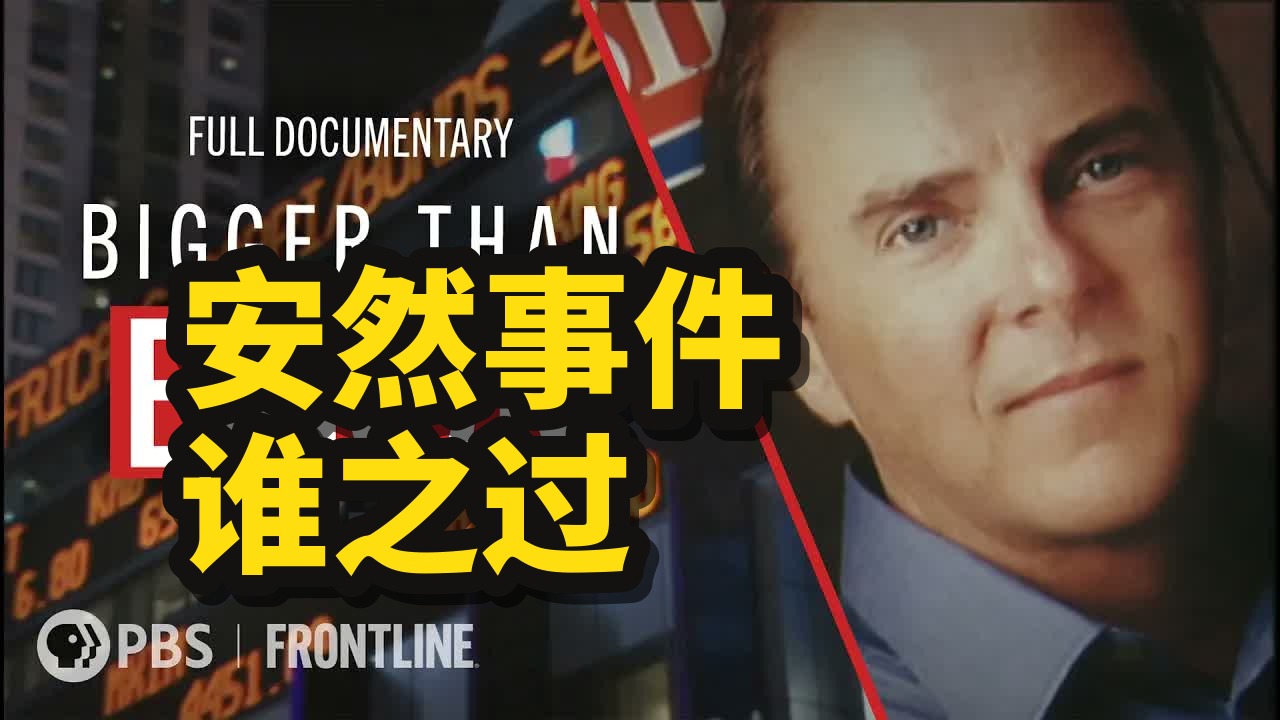
## Detailed walkthrough
### [00:00](https://www.bilibili.com/video/BV1drxE67EhN?t=0s) Corporate Chernobyl: The Collapse of Enron and the Watchdogs
The meteoric rise and catastrophic implosion of Enron was not merely an isolated failure of a single American energy giant; it exposed a systemic rot across the financial landscape. As correspondent Hedrick Smith investigates in this *Frontline* report, titled *Bigger Than Enron*, Enron stood as the climax of an entire avalanche of corporate deceptions that collectively cost investors upwards of $200 billion. The disaster prompted industry observers to liken the collapse to an industrial catastrophe of historic proportions:
> “Enron is a corporate Chernobyl.”
The roots of the catastrophe reached deep into Wall Street and Washington, D.C. Rather than acting as independent gatekeepers, financial watchdogs—including auditing firms, equity research analysts, corporate attorneys, investment bankers, and the Securities and Exchange Commission (SEC)—systematically deferred to corporate management. At the same time, Congress actively dismantled key investor protections and tied the hands of regulatory bodies, clearing a path for aggressive corporations to aggressively bend the rules.
Former SEC Chairman Arthur Levitt recalled that corporate America had succumbed to an obsessive imperative to beat quarterly earnings projections year after year:
> “When I was at the SEC, I referred to this as a culture of gamesmanship. A gamesmanship that says it's okay to bend the rules, to tweak the numbers, and let obvious and important discrepancies slide. A gamesmanship where companies bend to the desires and pressures of Wall Street analysts, rather than to the reality of the numbers.”
Auditors by law serve as the investing public's primary buffer against fraud. Yet the premier firm Arthur Andersen, which audited Enron’s financial statements, failed completely in its duty. Founded ninety years prior on principles of unbending integrity, the firm’s original motto had demanded that accountants must "think straight, talk straight, and dig beneath the numbers to get the truth." Former Andersen partners remembered joining the firm because of that very ethos, viewing themselves as “keepers of the Holy Grail.” But during the booming 1990s, that legacy was dismantled under the intense pressure of Wall Street expectations and corporate greed.
```mermaid
flowchart TD
accTitle: Breakdown of Capital Market Watchdogs
accDescr: Diagram illustrating how corporate earnings pressure compromised Wall Street watchdogs, leading to Enron's collapse and massive investor losses.
subgraph Pressure ["Market Pressures"]
A["Wall Street Quarterly Expectations"] --> B["Culture of Gamesmanship & Aggressive Accounting"]
end
subgraph Watchdogs ["Compromised Watchdogs"]
B --> C["Independent Auditors (Arthur Andersen)"]
B --> D["Securities Regulators & Congress"]
C -->|"Failed Oversight"| E["Enron & Corporate Fraud"]
D -->|"Weakened Protections"| E
end
subgraph Impact ["Market Consequences"]
E --> F["$200 Billion Investor Losses"]
E --> G["Erosion of Public Trust in Markets"]
end
```
- Enron's deceptive financial engineering stood at the center of an industry-wide practice that wiped out roughly $200 billion in investor wealth.
- Arthur Andersen had spent decades marketing its reputation for rock-ribbed integrity before its commercial incentives eclipsed professional ethics in the 1990s.
---
[05:00](https://www.bilibili.com/video/BV1drxE67EhN?t=300s) The Stock Option Bonanza and the Fight Over Accounting Honesty
During the market boom of the 1990s, corporate incentives became heavily skewed by the widespread adoption of executive stock option grants. Executives measured these incentive packages not in tens of thousands of dollars, but in millions—and sometimes tens of millions—of underlying shares. This setup created an overwhelming temptation to inflate corporate financial results. By driving up the stock price just long enough to cash in, corporate insiders could generate generational personal fortunes through legal market transactions based on manipulated fundamentals:
> “When an executive has a portfolio of a hundred million stock options, they can make far more money by getting the stock to move a few dollars in response to false information than anybody could do in most insider trading cases.”
Despite representing massive economic compensation, stock options were completely invisible on corporate income statements. Because companies were not required to deduct option grants as operating expenses, ordinary shareholders could not see the massive dilution awaiting their equity holdings. To close this loophole, the standard-setter for U.S. accounting, the Financial Accounting Standards Board (FASB) based in Norwalk, Connecticut, proposed a mandatory rule in 1993 requiring companies to expense stock options directly against earnings.
Jim Leisenring, then a member of the FASB, explained the board's rationale for challenging corporate America's accounting practices:
> “The costs are fairly significant, and we think that this is a credibility issue, that in fact financial statements are omitting compensation expense for some companies very material amounts of compensation expense. So we thought and still believe that it's a matter of the marketplace deserves that information.”
```mermaid
flowchart LR
accTitle: Stock Option Accounting Loophole Mechanism
accDescr: Diagram showing how hidden stock options inflate perceived profits and dilute shareholder value.
subgraph InGantry ["Option Issuance (Pre-1993 FASB)"]
O1["Massive Stock Option Grants to Executives"] --> O2["Zero Expense Recorded on Income Statement"]
end
subgraph Distortion ["Financial Market Distortion"]
O2 --> O3["Artificially High Paper Profits"]
O3 --> O4["Executive Incentive to Pump Stock Prices"]
end
- High executive option holdings created enormous structural pressure to report inflated figures to satisfy Wall Street forecasts.
- Standard financial reports omitted stock-based compensation entirely, preventing public investors from accurately calculating production costs and long-term dilution.
---
[07:20](https://www.bilibili.com/video/BV1drxE67EhN?t=440s) The Political Firestorm: Silicon Valley, Corporate Titans, and Capitol Hill
FASB’s proposal to mandate option expensing ignited an unprecedented backlash across corporate America. The epicenter of resistance was Silicon Valley, where technology and dot-com firms relied on option grants to compensate software engineers and retain executive talent without burning through operational cash. High-tech workers and corporate executives staged massive public rallies in Northern California, handing out T-shirts displaying red stop signs reading "Stop FASB" and circulating petitions to the White House. Software lobbyist Mark Nebergall noted that employees were genuinely terrified that federal accounting bureaucrats would eliminate their primary wealth-building tool.
Corporate opposition was rooted in bottom-line mathematics. A study conducted by researchers at the University of Maryland revealed that forcing technology firms to treat options as compensation would have slashed profits among leading high-tech firms by an average of 60%. At internet giant Cisco Systems, for instance, an annual reported profit of $2.6 billion would have been cut almost in half had options been properly expensed.
While high-tech companies framed the issue as an existential fight for American innovation and competitiveness, traditional industrial giants such as General Electric and General Motors joined the lobbying campaign with equal ferocity:
> “It was one of the most impressive lobbying efforts on earth. It was protecting CEOs' pay packages.... There's nothing in CEO salaries that compares to the numbers in CEO stock options.”
Corporate leaders descended on Washington in droves to enlist congressional allies. Influential lawmakers, including Senator Joe Lieberman of Connecticut, took up their cause, arguing that stock options were vital to keeping innovative companies competitive against established global rivals:
> “Silicon Valley companies came to me at that time and said, we need to use these stock options to lure the brilliant minds from the big companies that are paying them the kinds of salaries we can't pay them because we're going to give them a stake in the company.”
However, incoming SEC Chairman Arthur Levitt, a seasoned Wall Street veteran appointed by President Bill Clinton, remained entirely unconvinced by the corporate rhetoric, dismissing the claim that honest accounting would cripple the American workforce.
- A University of Maryland study determined that deducting stock options from reported earnings would cut top high-tech companies' profits by an average of 60%.
- Cisco's $2.6 billion net income would have been cut by nearly 50% under FASB's proposed accounting standard.
- The lobbying coalition unified both Silicon Valley startups and corporate conglomerates, including General Electric and General Motors, to defend executive compensation.
太阳神公司(Sunbeam Products)的股价从巅峰跌落至仅仅几美分,其惨状与后来的安然事件如出一辙。谈及两者的平行之处,系统内部的制衡机制完全崩溃:外部审计师没有尽到审计之责,外部法律顾问没有把关,董事会也形同虚设。美国证券交易委员会(SEC)指出,安达信(Arthur Andersen)的高级合伙人兼资深审计师菲利普·哈洛(Philip Harlow)连续两年为阿尔·邓拉普(Al Dunlap)粉饰的虚假账目背书。SEC 对此指控哈洛构成欺诈,一名监管官员明确指出:“We charged the auditor with fraud that he knowingly or recklessly made false and misleading statements. This wasn't an accident.” 面对指控,哈洛通过律师拒绝接受采访并极力抗辩,此时针对他与太阳神高管的诉讼仍在进行中。
```mermaid
flowchart TD
accTitle: Checks and Balances Failure at Sunbeam
accDescr: Diagram illustrating the breakdown of gatekeepers leading to Sunbeam's collapse and Arthur Andersen's document destruction.
subgraph Gatekeepers["失灵的防线"]
A["外部审计师<br/>(安达信/哈洛)"]
B["外部法律顾问"]
C["董事会"]
end
subgraph Actions["违规与纵容行为"]
D["为虚假账簿背书 2 年"]
E["调查期间销毁 2 箱审计工作底稿"]
end
华尔街空头投资者吉姆·查诺斯(Jim Chanos)直言不讳地指出,管理层之所以能肆意妄为,是因为他们买通了市场的所有看门狗:“The auditors are paid by the corporations. The bond rating agencies, are paid, in many cases, by the issuing corporations. Analysts are paid often on the basis of their investment banking fees that their firms bring in for the companies they are either recommending to buy or sell. So we have all kinds of conflicts of interest that revolve around who is paying whom.”
投资者权益倡导者莎拉·特斯利克(Sarah Teslik)用极其生动的比喻揭露了这种扭曲的关系:“We all know that if fifth graders hired their teachers, teachers would give all A's. That's exactly the situation we currently have. Managers hire auditors to bless the books. Auditors bless the books.” 当被问及事情演变至此是否纯属必然时,她直言人们总是为了自身利益行动,事情根本不可能朝其他方向发展。在保护公众利益方面,SEC 虽有心作为,却陷入严重的资源匮乏困境——人手严重不足,在财力、人力和装备上被华尔街巨头彻底压制,根本无力对抗。
后来在安然案爆发时担任安达信掌门人的资深合伙人约瑟夫·贝拉尔迪诺(Joseph Berardino)回顾道,行业多年来始终在谋求侵权改革,正是因为被储贷危机的天价赔偿吓破了胆,必须给诉讼责任设定上限,防止会计师事务所直接破产。1991 年,会计行业推选著名证券律师哈维·皮特(Harvey Pitt)作为向国会陈词的排头兵。皮特代理过众多大财团和包括安达信在内的顶级会计行,他将矛头对准滥诉现象:“The sole thing the bill was aimed at curtailing were frivolous lawsuits.”
在游说者口中,任何诉讼都是无理取闹,而他们真正的头号公敌,是圣地亚哥著名集体诉讼律师比尔·勒拉克(Bill Lerach)。勒拉克代表股民向造假公司发起数十起集体诉讼,个人赚取了数千万美元,硅谷科技公司对他闻风丧胆。一名观察人士评论道:“Bill Lerach was the guy whose picture had the target on it. When you thought of securities litigation reform, you thought of trying to put Bill Lerach out of business. He was... he was the antichrist, if you will.”
随后发生的事情却令所有人目瞪口呆。时任民主党全国委员会(DNC)主席、来自康涅狄格州的资深民主党参议员克里斯·多德(Chris Dodd)公开倒戈,带头推动国会推翻克林顿的否决:“It is with a deep sense of regret that I'm on the opposite side of my president on this issue.” 多德不仅是民主党党首,更是会计行业在参议院的最强代言人,一名评论员尖锐地讽刺道:“Chris Dodd might as well have been on the accounting industry's payroll. He couldn't have helped them any more than he did as a U.S. senator.” 作为回报,会计行业在多德当时根本没有连任竞选压力的情况下,向其提供了将近 25 万美元的政治献金。
[30:00](https://www.bilibili.com/video/BV1drxE67EhN?t=1800s) The Waste Management Gimmick: Depreciation Tricks and a Six-Year Cover-Up
In the 1980s, Waste Management was hailed as the "Microsoft of the '80s," building a massive trash-collecting empire by buying up hundreds and then thousands of local garbage haulers. Year after year, sales and revenues climbed relentlessly. The company's stock soared, and top executives cashed in tens of millions of dollars in lucrative stock options. Eventually, however, the roll-up strategy slammed into a wall: there simply were not enough independent garbage companies left to acquire. With the engine of their high-flying growth extinguished, executives pivoted to accounting manipulations to convince Wall Street that the company was still expanding at a rapid clip.
One seemingly mundane accounting gimmick involved altering the depreciation schedules on core physical assets—landfills, garbage trucks, and the giant steel dumpsters placed behind commercial buildings. By arbitrarily lengthening the estimated useful lifespan of their one million heavy steel containers from 12 years to 18 years, the company dramatically lowered its annual depreciation expense, boosting reported operating profits by over $100 million. When large outside investors forced a board shakeup, former Republican SEC Chairman Roderick Hills stepped in to investigate, uncovering that Waste Management had overstated its cumulative earnings by a staggering $1.7 billion. When the truth emerged and the stock collapsed, shareholders absorbed catastrophic losses.
```mermaid
flowchart TD
accTitle: Waste Management Accounting Scheme and Cover-up
accDescr: Diagram showing how growth limits led to depreciation manipulation, a signed cover-up treaty, and systemic auditor failure.
subgraph GrowthEngine["1. Growth Hits a Wall"]
A["Roll-up strategy exhausts targets"] --> B["Depreciation gimmick on 1M steel containers"]
B --> C["Useful life extended: 12 yrs to 18 yrs"]
C --> D["Over $100M artificial earnings boost"]
end
subgraph CoverUp["2. The Six-Year 'Treaty'"]
E["Arthur Andersen uncovers accounting errors"] --> F["Signs secret pact with management"]
F --> G["Company promises future adjustments"]
G --> H["Adjustments never made for 6+ years"]
end
subgraph BoardBlindspot["3. Structural Breakdown"]
I["Board & Audit Committee kept in dark"]
H -.-> I
I --> J["Earnings overstated by $1.7 Billion"]
J --> K["Shareholder collapse & $7M SEC civil fine"]
end
```
The subsequent investigation exposed deep complicity on the part of the independent auditor, Arthur Andersen. Reviewing his own firm's audit work, Arthur Andersen senior partner James Houghton admitted: “It was wrong. Flat out, easy, clear, wrong.” Rather than blowing the whistle or issuing a qualified opinion, Arthur Andersen had signed an extraordinary secret agreement with management: Andersen permitted the company to publish flawed financial reports under the condition that management would gradually correct the underlying errors over time. For at least six continuous years, the company never made the adjustments, and neither management nor the auditors ever alerted the board's audit committee.
- Waste Management artificially increased earnings by more than $100 million simply by stretching container depreciation schedules from 12 to 18 years.
- The total magnitude of earnings exaggeration uncovered by the restructured board reached $1.7 billion.
- Arthur Andersen signed off on flawed financial statements for at least six years based on unfulfilled promises of future corrections.
---
[32:50](https://www.bilibili.com/video/BV1drxE67EhN?t=1970s) The Structural Breakdown of the Audit Partner and the Absence of Criminal Deterrence
The failure at Waste Management underscored a fundamental flaw in the corporate governance architecture. Roderick Hills observed that when board members or audit committees remain in the dark, audit partners are placed under intolerable commercial pressure to preserve their accounts. Over a 30-year corporate career, Hills recounted having to participate in the dismissal of nine different chief executive officers; in every single case, once the CEO was out the door, the auditors revealed serious financial misstatements they had previously hidden from the board because management pressured them to stay quiet. As Hills explained: “If you are the audit partner in charge of a large account, you need to keep that account. And if you're not protected by the outside audit committee on that board, you will yield on the margin to something management wants you to do that in your heart you think you shouldn't do.”
Despite the massive fraud, no individuals faced prison sentences. Waste Management and Arthur Andersen resolved stockholder lawsuits with substantial civil settlements, and the SEC assessed a $7 million fine against Arthur Andersen alongside a promise to obey securities laws in the future. Observers noted that civil fines are completely inadequate to deter misconduct when millions of dollars can be pocketed through deceit: “We certainly have seen in the securities markets the clear lesson that when people stand to make millions and millions of dollars from breaking the law, that the risk of simply getting a civil judgment is not enough to defer the conduct. And so a realistic criminal deterrent is part of a healthy system. People have to understand that if you knowingly allow millions of people to be cheated, you can end up in jail.” For Arthur Andersen, the SEC sanction carried little internal weight: “It would appear from the outside that Andersen took the Waste Management injunction and the whole process as not much more seriously than you or I might take getting a ticket for going 35 in a 25 mile an hour zone.” Consequently, the firm failed to overhaul its culture, leaving it vulnerable to the even larger collapse already underway at Enron.
- Roderick Hills noted that across nine separate CEO firings over 30 years, auditors only disclosed hidden financial statement issues after the CEO had departed.
- The SEC fined Arthur Andersen $7 million for its role in the Waste Management cover-up.
- The sanction was treated inside the firm as negligible—akin to a minor traffic ticket—failing to serve as a wake-up call to change auditing practices before Enron unfolded.
---
[35:00](https://www.bilibili.com/video/BV1drxE67EhN?t=2100s) The Consulting Goldmine and the Erosion of Audit Independence
By the late 1990s, corporate clients had aggressively squeezed traditional auditing fees, treating auditing as an undifferentiated commodity. In response, the major accounting partnerships expanded aggressively into lucrative non-audit consulting lines—advising corporate clients on tax strategies, corporate restructurings, financial engineering, and large-scale IT implementations. Consulting operations, such as Andersen Consulting, rapidly became the primary profit center for these partnerships, far eclipsing the income generated by statutory audit engagements.
This structural shift set off alarm bells at the Securities and Exchange Commission. SEC Chairman Arthur Levitt identified an irreconcilable conflict of interest: audit partners, terrified of jeopardizing multi-million-dollar consulting contracts with corporate executives, were losing the backbone required to conduct adversarial, independent audits. As Levitt put it: “They clearly had a conflict of interest, and some of them abused the public that they were supposed to protect.” Early in 2000, Levitt floated a reform proposal designed to eliminate this conflict by barring major accounting firms from peddling lucrative consulting services to the very corporate clients whose books they were legally tasked to audit.
The accounting industry’s reaction to Levitt's proposal was immediate and furious. Accounting executives viewed consulting as their financial lifeblood and fought fiercely against any regulatory wall separating the businesses. When Levitt presented his proposal directly to industry leaders, their message was unyielding: “They told me, 'We are not with you, Arthur. This is going to be war. We're going to fight you all the way. We'll fight you in the Congress, and we'll fight you in the courts.'” Leading accountants, such as Arthur Andersen managing partner Joe Berardino, insisted that no conflict of interest existed and argued that market forces, rather than government mandates, should dictate how professional firms operate: “I do believe the market is a better place than the government in deciding how the market should be formed.”
---
[37:25](https://www.bilibili.com/video/BV1drxE67EhN?t=2245s) Congressional Extortion: Defunding Threats and Levitt’s Retreat
To halt the SEC's audit independence rule, the accounting industry mobilized its deep financial and political influence on Capitol Hill. Over the course of the battle, accounting firms and their trade associations pumped roughly $23 million into congressional campaign contributions and lobbying campaigns. They found eager allies among high-ranking lawmakers, including Louisiana Republican Congressman Billy Tauzin, who held critical oversight and budgetary authority over the SEC and had received nearly $300,000 in industry contributions since 1989.
Together with influential Republican representatives Thomas Bliley and Michael Oxley, Tauzin fired off a stern warning letter instructing Levitt to back off. Describing the letter, Levitt remarked: “This is a letter from the congressional committee that oversees the SEC, that has a chokehold on the existence of the SEC, directing me to go slow on this issue.” When asked how he interpreted the correspondence, Levitt replied without hesitation that it was “a shot across your bow, without a question.” Soon after, the SEC was inundated with nearly identical letters from obscure lawmakers, mirroring the precise phrasing, syntax, and talking points drafted by accounting lobbyists.
```mermaid
flowchart TD
accTitle: Political War on Auditor Independence Reform
accDescr: Flowchart illustrating the lobbying and congressional pressure campaign that forced SEC Chairman Arthur Levitt to abandon full structural separation.
subgraph IndustryPressure["Accounting Industry Mobilization"]
A["SEC Levitt proposes ban on consulting for audit clients"] --> B["$23 Million spent on lobbying & campaign donations"]
B --> C["Allies engaged: Reps. Billy Tauzin, Thomas Bliley, Michael Oxley"]
end
subgraph CongressionalCoercion["Capitol Hill Counterattack"]
C --> D["Tauzin committee sends warning letters to SEC"]
D --> E["Floods SEC with lobbyist-drafted congressional letters"]
E --> F["Ultimatum: Defund SEC via appropriations rider"]
end
subgraph SECCompromise["The Retraction"]
F --> G["Levitt surrenders full structural ban"]
G --> H["Compromise: Disclose consulting fees to audit committees only"]
end
```
As the congressional legislative session neared its conclusion, the pressure escalated into outright budgetary blackmail. Multiple lawmakers delivered a blunt ultimatum to Levitt: if the SEC moved forward with the auditor independence rule, an appropriations rider would be attached to defund the agency entirely. Confronted with the prospect of financial shutdown, Levitt was forced into a major retreat. Instead of barring firms from providing consulting work to audit clients, the SEC watered down the rule to require merely that audit firms inform corporate audit committees of their non-audit fees. Looking back on the capitulation, Levitt expressed deep remorse for having compromised, noting that the profession had abandoned its public calling for private profit: “I saw a group of entities that I think had forgotten their public responsibilities. The accounting profession is the only profession, private profession, with public responsibilities. And I saw them fight tooth and nail to, instead of accentuating and emphasizing the public responsibilities, they said our business model is about consulting.”
- The accounting industry spent approximately $23 million on congressional lobbying and political contributions to derail Levitt's auditor independence proposal.
- Representative Billy Tauzin, who held direct budget and oversight leverage over the SEC, had received nearly $300,000 from the accounting industry since 1989.
- Congressional opponents threatened to defund the SEC by attaching an appropriations rider halting the agency’s operating budget if Levitt enacted the ban.
- The SEC conceded, settling for disclosure of consulting relationships to audit committees rather than enforcing a clean structural separation.
subgraph Conflict["审计独立性瓦解"]
A["安然业务价值:5800万美元/年<br/>超100名安达信员工常驻"] --> B["设计表外合伙企业<br/>(隐藏巨额债务)"]
B --> C["技术合伙人卡尔·巴斯提出质疑"]
end
subgraph Demise["妥协与覆灭"]
C --> D["安然抗议其态度<br/>安达信将巴斯撤职"]
D --> E["14位合伙人开会预估业务达1亿美元<br/>决定继续留用安然"]
E --> F["谢隆·沃特金斯内部预警<br/>安达信包庇失败,大卫·邓肯销毁文件"]
end
```
莱维特指出,肯·雷当时极力维护两家公司的同盟:“Ken Lay wrote me a letter during the debate over the issue of auditor independence, urging me not to proceed with this rule making, because his relationship with his accountant, Arthur Andersen, had been such that consulting was terribly important to the well-being of Enron.”事实上,安达信指派了100多名员工服务安然这一年创收5800万美元的超级客户,安达信已深度介入并协助搭建了安然那些备受争议的表外合伙企业(off-balance-sheet partnerships),目的只有一个——替安然剥离资产负债表上的巨额债务,让公司在财务报表上看起来无比健康。
危机在2001年8月走向爆发。曾任安达信会计师的安然副总裁谢隆·沃特金斯(Sherron Watkins)给首席执行官肯·雷写下震撼警告信,直言公司即将在一波财务造假丑闻中崩溃。随后国会听证会上,沃特金斯公开指证安达信的合谋失职,直截了当地向议员证实安达信对不该签字的关联交易签了字:“They sure should have known what they were signing off on.”尽管沃特金斯在8月也警示了安达信,但安然直到两个月后才被迫更正账目,重述报表导致安然净资产瞬间缩水12亿美元,公司股价雪崩。
紧接着,SEC正式介入调查,而安达信负责安然审计的首席合伙人大卫·邓肯(David Duncan)却指示下属大量销毁审计文件。丑闻败露后,安达信CEO贝拉尔迪诺迅速将邓肯解雇,试图将责任完全推给个人。然而休斯顿办公室涉及销毁文件的员工多达80人,外界对“毫无总部指示”的说辞嗤之以鼻。昔日被奉为会计界最高诚信典范的安达信顷刻间分崩离析,底层员工流着泪向公众乞求信任。贝拉尔迪诺在面对记者问及是否悔恨没早点听取卡尔·巴斯的意见时,借用一句黑色幽默苦涩回应:“People would always ask me, 'How do you sleep at night?' And I say, 'I sleep like a baby. I wake up every two hours and cry.'”
> “In my prior life, we actually had a retainer arrangement with each of the major Wall Street investment banking firms, under which we would help them financially engineer or structure hypothetical transactions for finding financing, keeping an off-balance sheet, making companies look better than, quite frankly, they really were.”
安然崩盘震动了国会。前SEC主席阿瑟·莱维特重新登上公众焦点,大声疾呼必须重建多年来因企业文化腐化而严重侵蚀的财务制衡机制:“We've got to begin to reinvigorate the financial checks and balances that over the years have been, as a result of nothing less than a cultural change, has eroded in America.”然而,当时执掌SEC的是小布什总统任命的哈维·皮特(Harvey Pitt)。皮特曾长期代表会计行业游说,他的立场与会计行业利益高度一致,极力敦促国会不要采取激进手段,坚决反对禁止会计师事务所向客户同时提供咨询服务的全面禁令,并反对重启股票期权费用化的讨论。
```mermaid
flowchart LR
accTitle: 哈维·皮特改革方案与批评者的分歧
accDescr: 展现哈维·皮特提出的自律方案与其面临的批评者质疑。
subgraph Criticism["市场与投资者批评"]
C1["让狐狸看管鸡舍<br/>(Fox in the henhouse)"]
C2["实质迎合大事务所利益"]
C3["无法打破根本利益冲突"]
end
PittPlan -.->|"被批力度不足"| Criticism
```
在面对记者专访时,皮特否认自己在拖延改革,但其观点依然坚持维护现有商业模式:“I don't think that the non-expensing of options caused what happened in Enron.”相比于建立更加严厉的联邦政府管制,皮特提议建立一个吸纳会计师本人参与的民间自律监督委员会(private sector oversight board),若发现事务所审计质量不达标,该委员会有权要求客户更换审计机构。
这种由业内人士监管业内人士的妥协方案遭到了主流投资机构和《华尔街日报》的猛烈抨击,指责皮特是“让狐狸去看管鸡舍(putting the fox in the henhouse)”,在面对造假丑闻时依然缩手缩脚。当记者质问“难道现在不是动真格、亮明底线的时候吗”,皮特依然坚信自己的自律委员会能够维护投资者权益:“That's why the proposal that we have will achieve that result, and it's going to be done to the benefit of investors and be done the right way. I hope you're right. I know I am.”
## Notable quotes
> [21:20](https://www.bilibili.com/video/BV1drxE67EhN?t=1280s) We all know that if fifth graders hired their teachers, teachers would give all A's. That's exactly the situation we currently have. Managers hire auditors to bless the books. Auditors bless the books. — Sarah Teslik
> [05:00](https://www.bilibili.com/video/BV1drxE67EhN?t=300s) When an executive has a portfolio of a hundred million stock options, they can make far more money by getting the stock to move a few dollars in response to false information than anybody could do in most insider trading cases.
> [32:50](https://www.bilibili.com/video/BV1drxE67EhN?t=1970s) People have to understand that if you knowingly allow millions of people to be cheated, you can end up in jail.
> [10:00](https://www.bilibili.com/video/BV1drxE67EhN?t=600s) 这是会计准则第一次受到商业利益和政治利益的极其深重的影响。 — James Hooten
> [35:00](https://www.bilibili.com/video/BV1drxE67EhN?t=2100s) I do believe the market is a better place than the government in deciding how the market should be formed. — Joe Berardino
[21:20] Sarah Teslik: We all know that if fifth graders hired their teachers, teachers would give all A's. That's exactly the situation we currently have. Managers hire auditors to bless the books. Auditors bless the books.
[5:00] When an executive has a portfolio of a hundred million stock options, they can make far more money by getting the stock to move a few dollars in response to false information than anybody could do in most insider trading cases.
[15:00] 你在概念上透支未来,但如果不进行恰当披露,你就是在误导大众,你就是在进行欺诈。
[32:50] People have to understand that if you knowingly allow millions of people to be cheated, you can end up in jail.
[10:00] James Hooten: 这是会计准则第一次受到商业利益和政治利益的极其深重的影响。
[35:00] Joe Berardino: I do believe the market is a better place than the government in deciding how the market should be formed.
Original transcript
[0:00] It was a meteoric rise. We will become the world's leading company. And a devastating collapse. Enron is a corporate Chernobyl. You have the entire system playing fast and loose. It is not just Enron, it's an industry problem. It is real, real damage to the country. Why didn't anyone sound an alarm? The watchdogs work for executives and Wall Street. They don't work to protect shareholders. Correspondent Hendrick Smith. Investigates how greed and politics undercut America's financial watchdogs. Is anyone protecting the public? Tonight on Frontline, bigger than Enron. Corporate support for Frontline was provided by... So that's our pitch. But if AI can't explain itself, who's liable when it's wrong? Well, of course. The legal agreement is... We're in unparalleled territory. Humans have less and less understanding of what is actually different. Recognize that everyone has a different piece of the puzzle. I think what Michael's trying to say is support provided by the economist newspaper limited Everything about Enron seemed larger than life. From its glittering Houston headquarters reaching to the skies, to its spectacular downfalls. But Enron's collapse was more than the shattering of one American success story. it was a warning of a far wider malaise in the marketplace. Enron was the climax of an avalanche of American companies that cost investors as much as $200 billion by issuing deceptive financial reports. The roots of the Enron debacle stretch to Wall Street, where the accountants and other watchdogs were supposed to keep score on corporate America, and make sure the market is honest. I'm going to go. The trail leads also to Washington. where Congress weakened the protections. and tied the hands of regulators. making it easier for aggressive companies like Enron to push the envelope. Enron's collapse did not occur in a vacuum. Its backdrop is an obsessive zeal by too many American companies to project greater earnings from year to year. When I was at the SEC, I referred to this as a culture of gamesmanship. A gamesmanship that says it's okay to bend the rules, to tweak the numbers, and let obvious and important discrepancies slide. A gamesmanship where companies bend to the desires and pressures of Wall Street analysts, rather than to the reality of the numbers. But where were the watchdogs who were supposed to warn us when companies were playing fast and loose with their books? The stock analysts, lawyers, bankers, Securities and Exchange Commission. Above all, where were the accountants? By law, auditors have the official responsibility to ensure that corporate financial reports are honest. They're the first line of defense. But in the booming 90s, the big accounting firms like Arthur Anderson, which audited Enron's books, failed to protect us. illustrates the wider story of how our watchdog system broke down. Institutions are built on beliefs. Arthur Anderson was a man of unwavering beliefs that found marvelous new expressions over the years. Ninety years ago, Arthur Anderson founded his firm on old-fashioned virtues. Accountants, he insisted, must think straight, talk straight, and dig beneath the numbers to get the truth. His firm was built on these beliefs. Over the decades, the firm built a global business on its reputation for rock-ribbed integrity. true to our clients and true to our founder. I've put 35 years of my life in Arthur Anderson. One of, if not the only reason I chose Anderson over the other firms was this this idea that Anderson had a a sense of integrity about it that, was undeniable, at least to me as a young person. and that notion of integrity, of being keepers of the Holy Grail. That was Arthur Anderson. what we did. But the go-go 90s put unprecedented stress on the integrity of the old safeguards. American capitalism went into overdrive. The stock market skyrocketed. Every CEO was out to boost his company's stock by beating Wall Street's expectations.
[5:00] So companies pushed their numbers to the limit and some beyond. The incentives were astronomical. High executives for getting massive grants of stock options. A special perk that let corporate insiders pick their moment to buy low, sell high, and cash in big on company stock. You have executives in many companies who have measured their option packages in millions of shares and sometimes tens of millions of shares. And with that, of course, grows a pressure to make the stock perform at higher levels. At Enron, the executives had the ability by jacking up the stock price to take hundreds of millions of dollars out of the company and keep them. through the vehicle of stock options. And the lure of enormous personal fortunes tempted some corporate executives to cook the books. when an executive has a portfolio of a hundred million stock options uh... they can make far more money by getting the stock to move a few dollars in response to false information than anybody could do in most insider trading cases. But options were a hidden cost that never showed up in a company's balance sheet. and that made it harder for ordinary investors. to gauge corporate performance. Stock options should be charged to earnings. They're often a massive cost of production, and they need to show up in the financials in a very clear way, so that someone investing in the company today doesn't miss the fact that a couple years down the line, their stock is suddenly going to be diluted massively and be much less valuable. So it's honesty and accounting. It's honesty and accounting. To help investors and clean up the books, the accounting industry's standard setter an obscure entity in Norwalk, Connecticut known as FASB. the Financial Accounting Standards Board, decided in 1993 to close the options loophole. Jim Leisenring was then a FASB commissioner. The costs are... fairly significant. and we think that this is a credibility issue, that in fact financial statements are omitting. compensation expense for some companies very material amounts of compensation expense. So we thought and still believe that it's a matter of the marketplace deserves that information. Keep our stock options alive! That touched off a firestorm in corporate America. Ground Zero was Silicon Valley, where dot-com staged a giant demonstration. We're here for one reason. to stop FASB from raining on our parade. People had on You know, T-shirts with a big stop sign on the front that said Stop Fasby that they were passing out. Software lobbyist Mark Nebergal was there. People were signing petitions to the president saying, you know, please don't let him do this. Don't take away my stock options. Well, people were hot under the collar. Corporate America was livid because making options of business expense would be devastating to the bottom line of many companies. At Internet Dynamo Cisco, for example, a $2.6 billion profit one year. would have been cut nearly in half. A Maryland study found that expensing options would have slashed profits among leading high-tech companies by an average of 60%. FASB's just got to get out of this. They can go argue the technical side all they want, but stay out of our stock options. The more emotional arguments came from the so-called new economy companies, but there was strong opposition from traditional big companies we all know of, General Electric, General Motors. They were opposed as well. From all over the country, CEOs descended on Washington to beat back FASB. It was one of the most impressive lobbying efforts on earth. It was protecting CEOs' pay packages. It was what? Protecting CEOs' pay packages. So that's why it generates such enormous heat. I mean, there's nothing in CEO salaries that compares to the numbers in CEO stock options. It was protecting CEO's pay package. They were out in force. What's on the line here... really-- is the future of jobs in this country. Corporate America turned to friends on Capitol Hill like Senator Joe Lieberman of Connecticut. Silicon Valley companies came to me at that time and said, we need to use these stock options to lure the brilliant minds from the big companies that are paying them the kinds of salaries we can't pay them because we're going to give them a stake in the market. in the company. I don't buy that argument one single bit. Arthur Levitt, President Clinton's new chairman of the SEC, was a Wall Street veteran and
[10:00] head of the American Stock Exchange. If it takes a stock option to induce an employee or an executive to come to a company, and that stock option has to be represented as a cost on the balance sheet, in my judgment, America's executives are going to pay that price. Stock options are a remarkable and uniquely American device. Senator Lieberman, echoing the accountants, also contended that the cost of options was impossible to calculate. The concern that I had back in 93 and 94 that I still have is how do you accurately value an option on the day it's granted? Companies don't have any trouble figuring out how much options cost them when they list them on their tax returns to reduce their taxes. Well, you know, that's a separate question, which is an important question. usually that's done and it's done more and more effectively at the time they're exercised. Why would Lieberman of Connecticut be so desperately interested in this to take the lead? Well the insurance companies in Connecticut and the accountants are heavily based in Connecticut FASB is in Connecticut Both Senator Lieberman and Senator Dodd have historically been very protective of accountants and very protective of executives even though they talk a good liberal democratic line If you look at the votes and you look at the actions, it's not there. Led by Senator Lieberman, the Senate passed a non-binding resolution in May 1994, condemning the FASB proposal by a lopsided 88 to 9 vote. It wasn't an accounting debate. We switched talking from about rather have we accurately measured the option to things like Western civilization will not exist without stock options or that there won't be jobs anymore for people without stock options. People tried to take the argument away from the accounting and over to be just plainly a political argument. Why is the Senate voting 88 to 9 or something like that? There was no question campaign contributions played the determinative role in that Senate activity, and the Congress was responsive to that. In fact since 1990 the accounting industry has given over million to candidates for Congress including nearly million in 1994 during the battle over stock options When Republicans took over the House with a pro-business agenda that fall, threats to FASB escalated. Was the congressional pressure, in effect, a threat to the independents and even the financials? No, I'd say it was a threat to the existence of the FASB. The threats were to our existence. My concern was that if Congress put through a law that muzzled FASB, that would kill independent standards setting. So I went to FASB at that time, and I urged them not to go ahead with the rule proposal. Levitt and FASB retreated. FASB passed a rule that the cost of stock options should be disclosed, but only in the small print footnotes of corporate reports. It was probably the single biggest mistake I made in my years at the SEC. That integrity is a bond, a promise between client and firm, between clients and their customers. The options battle had tested the loyalty of accountants. In the end Arthur Anderson and the other big accounting firms sided with corporate America against their own industry standard setter James Hooten then chief of Anderson worldwide auditing feared the consequences It was the first time that accounting principles had become very, very much influenced by commercial interest and political interest. Congress got involved in that debate. Certainly every company in the United States with a commercial interest got involved in that debate. Was that good or bad? It was bad. If you move accounting and accounting standards into the political environment, then you've lost control over whether those standards are the best standards. If you move it into a commercial environment, you've lost control over whether those standards are the best standards. And what did that decision say? That decision moved who's in control away from the principles and the professional standards and more to the commercial side. the client side of the business, the presenting a transaction, the best way to present it to show the company side of the story as opposed to the profession side. In the battle for stricter accounting, the options fight was a watershed moment, a signal to accountants of looser standards and a great
[15:00] - Green light for corporations to issue, options by the truckload. I've never seen the company stronger, I've never seen a better position. So the size of the stock packages create a temptation for economic gain that is very corrosive. and will lead some people to be willing to lie, to cook up false income, to not tell the truth about negative factors, and in Emron's case, to create an entire picture of a company that didn't exist. Thank you. As a new sunbeam shining on a right sunny day, what could be better? And painting a picture that didn't exist was going on at lots of American companies in the 90s. Thank you. That's what happened at Sun Me. which, like Enron, was a client of Arthur Anderson. Back in 1998, I profiled Sunbeam's controversial CEO, Al Dunlop, for PBS. Dunlop was an aggressive corporate turnaround artist brought in by Sunbeam's main owner. to make it look good for a corporate takeover and a big financial killing. I believe the shareholders own the corporation. We work for you. Dunlop comes in, and all of a sudden, Wall Street goes gaga. The stock price went from $12.50 to a peak of $53 a share with a pay packet that included more than 7 million shares and options. Dunlop stood to make over $200 million personally if he could keep Sunbeam's stock price flying. playing to Wall Street Dunlop promised totally unprecedented gains for a home appliance maker. You look at the layoffs that took place, He touted the formula of mass layoffs and cost cutting that had earned him the nickname "Chainsaw Al." We've gone from 26 factories to 8. We've sold all the businesses that don't make sense. We've cut 225 million of costs. But Dunlop was hiding a secret. It wasn't only his hard-nosed tactics that were driving up the stock. He was using simple accounting tricks okayed by the auditor for Arthur Anderson. It began when Dunlop arrived. He took a bigger financial write-off than he needed to restructure Sunbeam. That gave him two advantages. It made things look dismal when he arrived. And he had a huge slush fund to use later to make it look as though he was generating new profits. At Sunbeam, the company initially established reserves. We called them cookie jar reserves. you can borrow from the reserve and have a little jolt to income. That's exactly what I asked Dunlop about. You said the company lost $230 million in 1996, but the write-off was $337 million. If they lost $230 million, that means without the write-off, they would have made $100 million. so it was a profitable year in 1996 except for the write-off. No, it wouldn't have been. The losses would have been substantially more than that. Remember, I arrived in July. We instantly made enormous changes to the company. This company was headed downhill. What Al is doing is creating the steps that he needs to create the illusion of a turnaround. The worse it looks coming in, the better it looks going out. Over here we have a total new line of grills. Dunlop had other gimmicks. In the winter of 1997, he booked millions of dollars of sales of summer products, like outdoor grills. But this is a prototype. In fact, Sunbeam wasn't shipping them out, and retailers were not paying for them. They were paper transactions that made Dunlop look great in the short run, but put the future at risk. You stuff the sales channels. You sell products so far out into the future that when the future comes, you've sold too much product in past times, and it's not likely that you're actually going to be able to maintain that level of sales. There's nothing wrong with that in concept, but if it's not properly disclosed, then you've misled people and you've committed a fraud. happened in Sunbeam. In the spring of 1998, Dunlop and his team ran out of accounting tricks. The general counsel of the company met privately with several board members and said, Al didn't tell you the truth. The quarter is coming in horribly. The numbers are a disgrace. new products that have no sales, inventory issues. accounting issues. and the board decides to fire both Al and the Chief Financial Officer. With the plot exposed, Sunbeam corrected its books, declared bankruptcy, and the stock price plunged from $53,000
[20:00] at its peak to just pennies today. What are the parallels between Sunbeam and Enron? The checks and balances at both places fail miserably. The auditors at both these companies didn't do their jobs. The external lawyers at both these companies didn't do their jobs. the board of directors, in one way or another, didn't really do their jobs. For two years, the SEC said, this man, Anderson's senior auditor, Philip Harlow, blessed Dunlop's bad books. We charged the auditor with fraud that he knowingly or recklessly made false and misleading statements. This wasn't an accident. Harlow is fighting the charges. but with an SEC lawsuit still pending against him and senior Sunbeam officials. Harlow's lawyers wouldn't let him talk to us. At Sunbeam, the SEC uncovered another more ominous harbinger of the Enron scandal. Anderson accounting documents were destroyed. With an SEC investigation underway, Harlow got orders from Anderson to get rid of certain work documents. and two boxes of papers that should have been kept were destroyed. Harlow claimed by mistake. No criminal case was filed. And even though Anderson later admitted that there were significant mistakes in the Sunbeam books endorsed by Harlow, The firm kept him on as managing partner of his Fort Lauderdale office. To critics like Wall Street investment manager Jim Chanos, the reason managements get their way is simple. They've bought off the watchdogs. The auditors are paid by the corporations. The bond rating agencies, are paid, in many cases, by the issuing corporations. Analysts are paid often on the basis of their investment banking fees that their firms bring in for the companies they are either recommending to buy or sell. So we have all kinds of conflicts of interest that revolve around who is paying whom. Investor advocate Sarah Tesliuk puts it even more starkly. We all know that if fifth graders hired their teachers, teachers would give all A's. That's exactly the situation we currently have. Managers hire auditors to bless the books. Auditors bless the books. So what you're saying is we shouldn't be surprised that things go awry. They can't go any other way. People invariably act in their self-interest. Is anyone protecting the public? You know, I I think the SEC is trying to, but I think that the SEC is... basically out of it as well because They're understaffed. It's a major problem. So the SEC is outgunned, outspent. Outmanned? Completely. Doesn't have a chance. Four years later, the SEC is still tied up in court pursuing Sunbeam. So far, the only real penalty has come through private litigation. Well, Anderson ended up settling one key lawsuit for $110 million. Al Dunlop has settled three separate suits having to pay $15 million out of his own pocket. But even the deterrent of private lawsuits has been blunted by special interest legislation. It is my great privilege to introduce the next speaker, of the people's house. Newt Gingrich! In the mid-1990s, Newt Gingrich and the Republicans staged a political revolution. Hey! high on their pro-business agenda when they took over the House of Representatives, tort reform. including a law to curb shareholder lawsuits against companies and their accountants. . For accountants, it was the climax of years of struggle. They'd paid out a billion dollars in stockholder settlements after the savings and loan scandals in the 1980s. I talked about those lawsuits with Joseph Beradino. a longtime partner at Arthur Anderson, who would later head the company as the Enron scandal broke. Tort reform was something that the profession had talked about for years and frankly got spooked by the savings loan problems. What were you trying to do? What did you want tort reform to do for you? Tort reform was an attempt to at least rein in or limit the debt. damages so accounting firms wouldn't go out of business. As the point man to make their case to Congress in 1991, the accounting industry chose a prominent securities lawyer, Harvey Pitt. Pitt's clientele included corporations and big accounting firms like Arthur Anderson. There have been cases that were filed that I thought recognized
[25:00] ...frivolous issues and in which companies were in effect blackmailed into settling or else required to spend extraordinary amounts of time and energy getting rid of. The sole thing the bill was aimed at curtailing were frivolous lawsuits. All these people got together to say, "We don't like being sued. for falsehoods and misbehavior. But they said it was to stop frivolous lawsuits, that there were lawsuits that were insubstantial, there were too many of them being brought. Yeah. Was there something to that? Any lawsuit in their lexicon was frivolous. Any lawsuit brought by San Diego attorney Bill Larac was what the accountants and their business allies wanted to stop. This fraud could not have been accomplished. by a few corporate executives. LORAC had become the despised poster boy for the tort reform cause, earning tens of millions of dollars personally from filing class action suits against corporations. Bill Lerac was the guy whose picture had the target on it. When you thought of securities litigation reform, you thought of trying to put Bill Lerack out of business. He was... he was the antichrist, if you will. And this complaint now names additional parties Among L'Raq's favorite targets were Silicon Valley high-tech firms. Virtually any company in Silicon Valley was scared to death of the guy. They all knew who he was. Pressed by the high-tech and accounting industries, the House and Senate passed the bill by large majorities. But President Clinton vetoed it. asserting that it would close the courthouse door on investors with legitimate claims. Some Senate Democrats rallied behind their president. But it's safe to say that crooks will be emboldened, investor confidence in our markets will go down, and defrauded investors will not be compensated But what happened next stunned observers. But I believe that the override is the proper course to follow here. Senator Chris Dodd of Connecticut, then head of the Democratic National Committee, led the effort to overturn Clinton's veto. It is with a deep sense of regret that I'm on the opposite side of my president on this issue. Chris Dodd, here he is as chairman of the Democratic Party, but he's also the leading advocate in the U.S. Senate on behalf of the accounting industry. and he helps overturn the veto of his own president who installed him as Democratic chairman. Chris Dodd might as well have been on the accounting industry's payroll. He couldn't have helped them any more than he did as a U.S. senator. By way of thanks, the accounting industry gave Senator Dodd nearly one quarter of a million dollars in political donations, even though at the time Dodd was not up for re-election. Thank you. The accountants were the big winners with the Litigation Reform Act. The law imposed a proportionate liability standard, which means that if the accountants only contribute to, say, 20 percent of the loss, then they would only be responsible for 20 percent of the amount that would have to be paid. Thank you. Less risk for accountants, among others, critics said, would mean less of a deterrent to wrongdoing. But after the bell, a round of high-profile warnings. And the late 90s brought an explosion in major accounting failures. Dollar General has fired Deloitte and Touche as its auditor. Ernst & Young had signed off on this company. Audit information from Lucent's outside accounting firm, PricewaterhouseCoopers. Corporate financial restatements skyrocketed to levels never seen before. just three in 1981, up to 156 in 2000. All the big accounting firms were implicated. PricewaterhouseCoopers. Anderson. KPMG, Deloitte & Touche. Ernst & Young During the 90s, more than 700 U.S. companies had to correct financial reports that were just plain wrong. for the last half dozen years. Investors had lost probably close to $100 billion suffered those type of losses from these situations like Sendent, Waste Management, Sunbeam, MicroStrategy, Rite Aid, Lucent, Xerox. Then along comes Enron. Phenomenal. We add on now, every day, Global Crossing. Investors are now looking at losses, probably coming close to $200 billion. It is real. real damage to the country. Finally, the SEC had had enough. On the next case, in fact, the biggest case until Enron, it went after Arthur Anderson. The first time in 20 years the SEC had sued a major accounting firm. It charged Anderson with helping to cover up what the agency called a massive financial fraud motivated by greed.
[30:00] It involved a trash collecting empire, waste management. Waste Management. was the Microsoft of the '80s. They bought hundreds and then thousands of garbage companies. and they increase their sales and their profits year after year after year. There were obvious parallels to Sunbeam and Enron. Anderson was the auditor. The company's stock price had soared and its top managers had made tens of millions of dollars on stock options. but then waste management hit a wall. They couldn't buy thousands of garbage companies anymore. There weren't that many left. So the strategy, this growth strategy that propelled them as a high-flying stock was gone. So they turned to accounting tricks to make Wall Street think the company was still growing. One gimmick simply involved stretching out depreciation on company assets: garbage dumps, trucks, giant metal trash bins, They changed the earnings of the company by... quite a bit of money, more than $100 million. Wait a second. You can change the earnings picture of waste management by more than $100 million simply by changing the lifespan of a garbage container? Of an adversary. Well, he had a million of them. These were these huge, big steel containers. And so if you're depreciating them over... Twelve years... it's a lot more expensive than if you depreciate them over 18 years. Former Republican SEC Chairman Rod Hills joined the board of directors in a shakeup forced by big outside investors. The new team found that the company had exaggerated its earnings by $1.7 billion. a gambit that would cost investors a fortune when the stock plummeted. Arthur Anderson senior auditing partner James Houghton reviewed his own firm's work. It was wrong. Flat out, easy, clear, wrong. Not all things easy, clear. Not all things easy, clear. Some were easy, clear, wrong. I won't. I won't duck that somewhere easy, clear, wrong. Others were more difficult. The SEC discovered a long-running cover-up, not just by waste management. but by Arthur Anderson as well. Arthur Anderson allowed the company to publish its financials, knowing that there were mistakes in the financials, with a promise that the company would, in the future, make whatever changes and adjustments were necessary to correct the failures of the past. Unfortunately, the company never did what they were supposed to do. It was actually a treaty. They all signed it. The auditor signed it, the management signed it, and said, "We will do this." Did they do it? No, they did not do it. For how many years? At least six. How can this go on for six years and neither the board nor the auditors blow the whistle? The board doesn't know about it. At least the audit committee does not know. Audit committee, the board does not know of it. And management doesn't want to tell them. And the auditors don't want to tell them. I mean, that's a breakdown in the system, isn't it? You bet it is. You bet it is. It absolutely tells you that the weaknesses that you see in Enron and waste management can be seen in many other companies. I've had to participate in the firing of nine chief executive officers over 30 years. In each case, the auditors, after we asked the CEO to leave, told us the problems that were in these statements that they had not brought to the attention of the board. because because the management didn't want them to. It's the pressures You cannot possibly understand the fear. If you are the audit partner in charge of a large account, You need to keep that account. And if you're not protected by the outside audit committee on that board, you will yield on the margin to something management wants you to do that in your heart you think you shouldn't do. Anderson and Waste Management paid a steep price in stockholder settlements. But no one went to jail. We certainly have seen in the securities markets the clear lesson that when people stand to make millions and millions of dollars from breaking the law, that the risk of simply getting a civil judgment is not enough to defer the conduct. And so a realistic criminal deterrent is part of a healthy system. People have to understand that if you knowingly allow millions of people to be cheated, you can end up in jail. The SEC fined Anderson $7 million. Anderson promised never to do it again. but they were already enmeshed in new trouble at Enron. It would appear from the outside that Anderson took the waste management injunction and the whole process is not much more seriously than you or I might take getting a ticket for going 35 in a 25 mile an hour zone. They just didn't use that as the wake up call to say, my God, how could this happen in our firm and we need to do that.
[35:00] We need to make changes to never let this happen again. That inventiveness isn't just a goal, it's the way we do business. By the late 90s, corporations had put the squeeze on auditing fees. And that the product of our inventiveness should be real. So accountants had to find a new way to cash in on the boom economy. In fact, we created most of the 43 service lines we're now in, including Anderson Consulting. consulting. Once a small fraction of their business, consulting on finance, partnerships, computer programs, taxes, had become the main profit center. At the SEC, Arthur Levitt saw that as a conflict of interest. Accountants fearing to lose rich consulting deals with a corporate client as a result of a tough audit. They clearly had a conflict of interest, and some of them abused the public that they were supposed to protect. Levitt had a fix. Get the big accounting firms to stop doing major consulting jobs for their audit clients. In early 2000, he floated the idea to the accounting industry. They told me, "We are not with you, Arthur. This is going to be war. We're going to fight you all the way. We'll fight you in the Congress. and we'll fight you in the courts. Well, you're taking the bread and butter away from large accounting firms when you make a proposal that would take away their largest growth opportunity. So, understandably, there was quite a very strong, violent reaction. Leading accountants like Anderson's Joe Berardino claimed there was no conflict of interest and bristled at regulation by the SEC. Among other things I disagreed with at the time. is that the government was forcing the whole profession to a certain model. I do believe the market is a better place than the government. in deciding how the market should be formed. It was decided. It sounds like both of you talked about it and decided it together. To block Levitt, the accounting industry turned to friends on Capitol Hill like Louisiana's Billy Tozan, a powerful House Republican. Tozan had received nearly $300,000 from the accounting industry since 1989. Billy Tozan seems to have been especially important in that process. Why? He had an oversight responsibility and budget and otherwise for the SEC, so he had a special interest. So he could get Arthur Levitt's attention in a way almost nobody else could? and Tozan took the cue. along with fellow Republicans Thomas Bliley and Michael Oxley. Tozan sent a clear message to Arthur Levitt. This is a letter from the Congressional Committee. that oversees the SEC, that has a chokehold on the existence of the SEC. directing me to go slow on this issue. How do you interpret that? That was a threat. Shot across your bow. Without a question. In their war against Levitt, the accountant spent 23 million dollars in campaign contributions and lobbying. Their efforts set loose a flood of mail from Congress, pressuring Levitt to back off. We were getting letters from people we'd never heard from, and the types of letters we were getting from them were very similar in terms of tone and phrases and words. And what's that say to you? Well, it says to me that the accounting lobbyists were writing their letters. Levitt refused to back down, and Congress turned up the heat. As we got down toward the end of the congressional session, The threats were made. Arthur? If you go ahead with this proposal, it is likely that a rider will be placed upon your appropriations bill. which says that the SEC will not be funded if they proceed with the issue of auditor independence. Who made that threat? A variety of members of Congress told me that they weren't going to do it but they knew others who were going to do it. Finally, Levitt gave in. He let audit firms keep their consulting work. All they had to do was inform corporate audit committees. As a result of this pressure, we modified the rule, and that was a compromise that I would not make today that I agreed to at the time. When you look back on this whole episode, what's the lesson to you? I saw a group of entities that I think had forgotten their public responsibilities. The accounting profession is the only profession, private profession, with public responsibilities. and I saw them fight tooth and nail. to instead of accentuating and emphasizing the public responsibilities, They said our business model is about consulting. and
[40:00] Once and for all we're going to let you know that you can't mess with us. And they did that through the force of money. And those who got the most money from accountants like Billy Tozan... ...you're trying to tell me that wasn't an extraordinarily limited review... ...are today among the most vocal critics of Enron on Capitol Hill. Many of the people complaining loudest about how shocked they are that there's a problem with this industry not being closely regulated... the two peas in a pod close with the industry themselves helping the industry get deregulated throughout the 90s. Billy Tozan Chris Dodd, Senator Lieberman from Connecticut. And when journalists try to talk to them now about their flip-flop, many of them are just not available for comment. Thank you very much for your time. Senator Lieberman had talked to us. But both Senator Dodd and Chairman Tozan refused our repeated requests for interviews. By the end of the 90s, accountants were so intertwined with their corporate clients, the line between them was often blurred. In fact, when the SEC tried to break them apart to re-establish auditor independence, Levitt received this very revealing letter from one Kenneth Lay, CEO of Enron. Ken Lay wrote me a letter during the debate over the issue of auditor independence, urging me not to proceed with this rule making. because his relationship with his accountant Arthur Anderson. had been such, that consulting was terribly important to the well-being of Enron. So Ken Lay didn't want that broken up, that relationship with Anderson? No, he did not. According to Lay's letter, Arthur Anderson, with more than 100 people working on the $58 million Enron account, had become an integral part of the Enron team. In fact, According to an investigation for Enron's board, Anderson was closely involved in structuring Enron's controversial off-book partnerships. Why does a company like Enron, which is going gangbusters, Create. Hundreds of these off-balance book partnerships. What's the point? To get debt off the balance sheet, to make the company look more stable financially than it really is. Enron's accounting practices became so aggressive that several Anderson audit experts, like partner Carl Bass, began to object. Bass was part of an elite group at Anderson, protecting the quality of audits. So Kyle Bass in the technical group would have been one of those who was keeping the rules pure. He was a member of that group that kept the rules pure. the keepers of the Holy Grail, They're the experts. They're the best that your firm has to offer. For two years, Bass fired off memos. challenging Enron's accounting. Eventually, Enron got so angry at what it called Bass's cynicism, that it demanded that he be taken off the account. and Anderson complied. Why would you remove the technical guy who's the protector of your integrity at the request of a client. Well, it's very unusual that we remove somebody. The client wants to feel Thank you. that you're understanding their business problem you're understanding what they're trying to accomplish with their accounting for business transaction and if you have people that either don't have the bedside manner, don't have the capability, don't have the expertise to get in the client's shoes to understand it, clients react negatively. Okay? Then we've got to make a judgment call as to whether they're Objecting to that service for the right reason or the wrong reasons and uh... You know, it's very rare that we remove somebody. And obviously this is one of those rare situations. But other Anderson partners were also growing uneasy. In a conference call between Houston and Chicago in February 2001, Ten months before Enron went bust, 14 Anderson partners debated whether to keep Enron as a client. But they projected that the Enron account would soon be worth $100 million a year to Anderson and decided to stick with Enron. Even inside Enron, people were sensing imminent disaster. Last August, Enron Vice President Sharon Watkins, herself a former Anderson accountant, warned CEO Ken Lay that Enron was about to collapse. in a wave of accounting scandals. Later to Congress, Watkins implicated Anderson. Is it possible that Arthur Anderson has some culpability here because they signed off on it? I think so because they're charged with auditing I
[45:00] Results in a sensitive related party transaction should get a lot of scrutiny. So, Arthur Anderson, in your opinion... signed off on something they shouldn't have. Yes. Do you think they knew... what they were signing off on? They sure should have known what they were signing off on. Okay, okay. In August, Watkins had also warned Anderson. But it took two more months before Enron's books were corrected. restating and reducing Enron's net worth by 1.2 billion dollars and sending Enron's stock into a tailspin. I suggest you fasten your seatbelt. By then, Anderson was in big trouble. The SEC was investigating. Will you please come forward? Would you please rise and raise your right hand? And David Duncan, its lead partner on the Enron account, had his staff shredding documents. On Anderson's orders, he later testified. But Anderson CEO Joseph Berardino blamed Duncan and fired him. I wanted to give a message because at the time everyone was looking at me and at us that this was not a culture that withstand that kind of behavior. Something like 80 people in that office were involved. If this had been something that had really been against Anderson policy, Wouldn't some of those people? picked up the phone or written an email to headquarters and say, "Hey, we're destroying 20 boxes of of Enron material? Should we be doing this? Thank you. All I know is that that... Those activities were taken under David's direction. There was absolutely no cover-up or direction to go destroy documents, but documents were destroyed. Suddenly, the firm once considered the gold standard of accounting was drowning. But we will stay together regardless of what happens. its employees reduced to pleading for public faith in their integrity. We're dedicated to serving our clients and we're dedicated to each other. Do you regret maybe not having listened to Carl Bass? earlier? You know, there's been so much pain that's coming out of this end, Ron. Uh... situation, stockholders, their employees, now our employees. People would always ask me, "How do you sleep at night?" And I say, "I sleep like a baby. I wake up every two hours and cry." Anderson's demise didn't solve the broader problem of the cozy collaboration between auditors and their corporate clients. In the 90s, all the big accounting firms worked hand in glove with companies in Wall Street. to find loopholes in the accounting rules. What are you talking about? Lynn Turner worked that game as a former Wall Street partner at the accounting firm of Coopers & Librand. before becoming the SEC's chief accountant. In my prior life, we actually had a retainer arrangement with each of the major Wall Street investment banking firms, under which we would help them financially engineer or structure hypothetical transactions for finding financing, keeping an off-balance sheet, making companies look better than, quite frankly, they really were. You mean doing the kinds of things that Enron and Anderson did? Yes, exactly. So there's a whole system that does this? that turns around and does it. Every one of the big accounting firms have such a group. And all the big investment banks have that. Yes, the investment banking groups, in fact, they make good money trying to figure out how to structure these transactions. So we haven't, in Enron, just stumbled into something that may have happened. This is way off an oddball thing. we've run into something that is a fairly common practice. This is day-to-day business operations in the accounting firms and on Wall Street. There is nothing extraordinary, nothing unusual in that respect, with respect to Re-En-Run. Give us some guidance as we begin But Enron's collapse galvanized Congress. Arthur Levitt returned to center stage, urging major reforms. We've got to begin to reinvigorate the financial checks and balances that over the years have been. as a result of nothing less than a cultural change, has eroded in America. But Levitt is no longer in charge. Now it's up to President Bush's SEC chairman, Harvey Pitt. Like his former clients, the accounting industry, Pitt is cautioning Congress to go slow. We are opposed to those... who say that accounting firms as a whole should be restricted to providing only audit services. whether on auditor independence or reversing the tort reform, we strongly urge you to refrain from making any changes in that legislation.
[50:00] Pitt favors the status quo. Do you agree with them? Having gone through this exercise, I would be exceedingly reluctant to reopen the issue. I don't think... that the non-expensing of options caused what happened in Enron. Your basic message seems to be go slow. Don't be too radical and hasty on reform. Why do you say go slow? I don't say go slow. There are people who want you to believe that that's what we're saying. that is not what we're saying we're saying it's not a question of more regulation I mean it sounds as though you're saying very much with the accounting industry itself wants and not what investors want. investors' representatives are asking for. We are in the process of forging an incredible new system for the benefit of individual investors, something that should have been done five, ten years ago, but was allowed to lie dormant. Pitt is pursuing vigorous enforcement, and rather than stronger government controls, he proposes a new private sector oversight board, including accountants among the members. They would have the power if they found that a firm was not doing the highest quality audit work. to dictate that the client pick another auditor. So the stakes would be exceedingly high for the audit firms to come up with high-quality controls and make sure they're performing at the highest level. but critics, including major investor groups in the Wall Street Journal. have questioned whether Pitt is genuinely prepared to cross the accounting industry. People are talking about your reforms as putting the fox in the henhouse, pulling your punches. Isn't it time to get tough and be clear? Absolutely. That's why the proposal that we have will achieve that result, and it's going to be done to the benefit of investors and be done the right way. I hope you're right. I know I am. Here in Washington, strong reforms have been watered down by accounting lobbyists. and Congress is likely to fall short of doing what's needed. In Houston, Arthur Anderson was found guilty of obstructing justice, a fatal blow to the firm, and a dark legacy for the industry. On Wall Street, with investors still uncertain whether they can trust anyone, come warnings that without much stronger protections, more Enrons lie ahead. Thank you. Next time on Frontline, the last decade in the Middle East has seen an endless cycle of the promise of peace and the despair of violence. We are talking here about the more sensitive issues. My heart aches because I know you are so close. Can Israelis and Palestinians ever make peace? Watch Shattered Dreams of Peace next time on Frontline. To obtain a VHS copy of Bigger Than Enron, call PBS Home Video at 1-800-PLAY-PBS. . Frontline is made possible by the annual financial support of PBS viewers like you. Corporate support for Frontline was provided by The Economist. .