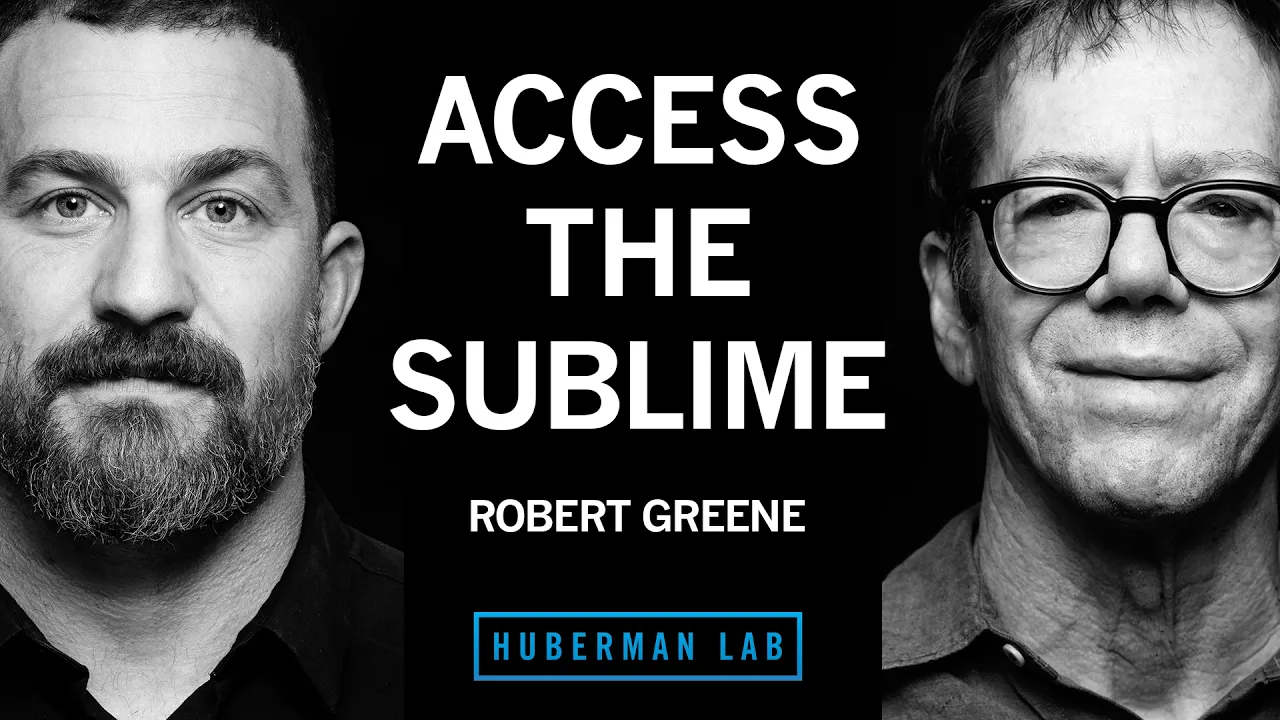
Robert Greene Links Modern Madness to Lost Awe, Urges Daily Slowness
Andrew Huberman
Greene argues that commercial platforms splinter human attention and secular culture has stripped away spirituality, making deliberate sensory slowness and transcendent awe biological necessities as critical to survival as food and shelter.
Robert Greene operationalizes the concept of the sublime into concrete daily practices, defining it as an evolutionary and psychological necessity rooted in the tension between the discomfort of leaving one's comfort zone and the awe of novel perception. (1:14)
Following a major right-hemisphere stroke that partially paralyzed his left hand, Greene shifted from analytical detachment to somatic resonance, drafting his entire manuscript by hand across more than 100 notebooks to engage the deep neural link between manual friction and language processing. (55:04)
Human temporal perception is elastic rather than rigid: near-death experiences and deliberate cross-species observation (such as studying marine life or plants) allow individuals to escape uniform digital space-time loops and experience non-human scales. (41:30)
The modern breakdown of transcendent frameworks has fueled cultural disorientation and cynicism, but intentional practices like deliberate slowness, deep sensory immersion, and vulnerability in love can serve as portals back to transcendent consciousness. (107:16)
Detailed notes
## Background
Published by Andrew Huberman on YouTube on November 2, 2026, this episode features bestselling author Robert Greene discussing the themes behind his work, particularly The Law of the Sublime. According to the page description, Greene explores how to access transcendent awareness through daily observation, creative expression, and relationships, opening into an expansive conversation on human consciousness and maximizing lived experience.
## TL;DR
Robert Greene explores the sublime as a psychological and sensory threshold combining the discomfort of the unfamiliar with the exhilarating pleasure of awe. Drawing heavily from his recovery following a serious stroke, Greene explains how physical limitations taught him to locate transcendence in everyday objects, bodily healing, and deliberate deceleration rather than exotic travel. Across the dialogue, Huberman and Greene examine the neuroscience of attention, elastic temporal scales in nature and near-death experiences, and the creative discipline of handwriting with fountain pens. Ultimately, Greene argues that cultivating slowness, pursuing childhood vocational inclinations, and embracing radical emotional vulnerability in romantic love serve as vital counterweights to modern digital distraction and cultural cynicism.
## Atmosphere & style
The conversation carries an intimate, reverent, and unhurried tone, balancing Huberman's grounded scientific curiosity with Greene's reflective existential wisdom. Greene speaks with raw, moving vulnerability about his post-stroke physical constraints and newfound somatic emotional depth, while Huberman openly acknowledges Greene's profound influence on his own life and career. Listening feels like sitting in on a quiet, high-trust dialogue between master thinkers, where the patient rhythm of the exchange directly embodies the stillness and presence they champion.
## Bulletin
- [01:14](https://www.youtube.com/watch?v=y-fRFiTrrg4&t=74s) Robert Greene operationalizes the concept of the sublime into concrete daily practices, defining it as an evolutionary and psychological necessity rooted in the tension between the discomfort of leaving one's comfort zone and the awe of novel perception.
- [55:04](https://www.youtube.com/watch?v=y-fRFiTrrg4&t=3304s) Following a major right-hemisphere stroke that partially paralyzed his left hand, Greene shifted from analytical detachment to somatic resonance, drafting his entire manuscript by hand across more than 100 notebooks to engage the deep neural link between manual friction and language processing.
- [41:30](https://www.youtube.com/watch?v=y-fRFiTrrg4&t=2490s) Human temporal perception is elastic rather than rigid: near-death experiences and deliberate cross-species observation (such as studying marine life or plants) allow individuals to escape uniform digital space-time loops and experience non-human scales.
- [01:47:16](https://www.youtube.com/watch?v=y-fRFiTrrg4&t=6436s) The modern breakdown of transcendent frameworks has fueled cultural disorientation and cynicism, but intentional practices like deliberate slowness, deep sensory immersion, and vulnerability in love can serve as portals back to transcendent consciousness.
## Key takeaways
- [03:49](https://www.youtube.com/watch?v=y-fRFiTrrg4&t=229s) The sublime derives from the Latin 'sub limen' (up to the threshold), representing an experience that blends the discomfort of transcending familiar boundaries with the intense pleasure of novelty and awe.
- [10:18](https://www.youtube.com/watch?v=y-fRFiTrrg4&t=618s) Everyday objects and biological processes harbor quasi-miraculous qualities once stripped of functional utility, revealing the nervous system's roughly 800 million years of evolutionary sophistication.
- [20:32](https://www.youtube.com/watch?v=y-fRFiTrrg4&t=1232s) Ordinary adult consciousness operates like waking sleep, but intentional practices such as Gurdjieff's 'self-remembering' and deep meditation can alter neurological baseline states without pharmacological interventions.
- [23:06](https://www.youtube.com/watch?v=y-fRFiTrrg4&t=1386s) The brain naturally functions as a reducing valve that prunes sensory throughput for biological survival; deliberate shifts across spatial and temporal scales help restore access to unfiltered reality.
- [41:30](https://www.youtube.com/watch?v=y-fRFiTrrg4&t=2490s) Subjective time is highly malleable: near-death experiences demonstrate how extreme moments can stretch brief physical seconds into perceived years of internal memory review.
- [44:06](https://www.youtube.com/watch?v=y-fRFiTrrg4&t=2646s) Interacting closely with non-human species possessing different lifespans, such as octopuses or cuttlefish, disrupts predictive brain loops and entrains human awareness to foreign temporal reference frames.
- [50:13](https://www.youtube.com/watch?v=y-fRFiTrrg4&t=3013s) Digital platforms intentionally fracture human attention spans for monetization, making deliberate cognitive slowness an essential counter-strategy for creative mastery and independent thought.
- [01:07:31](https://www.youtube.com/watch?v=y-fRFiTrrg4&t=4051s) Physical handwriting introduces cognitive friction that deepens thought, directly engaging brain areas where cortical representations of the hand are intertwined with speech and language circuits.
- [01:16:32](https://www.youtube.com/watch?v=y-fRFiTrrg4&t=4592s) Discovering one's life task requires an archaeological excavation of innate childhood inclinations that were subsequently suppressed by conventional schooling and parental expectations.
- [01:16:31](https://www.youtube.com/watch?v=y-fRFiTrrg4&t=4591s) Frustration and visceral aversion toward conventional environments serve as critical diagnostic signals, allowing individuals to uncover their vocational path through active negation.
- [01:33:04](https://www.youtube.com/watch?v=y-fRFiTrrg4&t=5584s) Mastery and creative flow require dissolving the boundaries of the ego, facilitating breakthrough epiphanies that feel external and inspired in the literal sense of being 'breathed into.'
- [01:37:02](https://www.youtube.com/watch?v=y-fRFiTrrg4&t=5822s) The 'love sublime' bridges raw physical biology with transcendent spirituality, treating the beloved not as an external object of conquest but as an internal subject whose consciousness is directly felt.
- [01:47:16](https://www.youtube.com/watch?v=y-fRFiTrrg4&t=6436s) The erosion of sacred and transcendent frameworks since the Enlightenment and Industrial Revolution has produced widespread modern disorientation, which can be grounded anew through cosmic scientific awe.
- [02:04:36](https://www.youtube.com/watch?v=y-fRFiTrrg4&t=7476s) Human sensory intelligence atrophies under repetitive modern urban stimuli, but remains dormant and capable of being revived through raw immersion in nature and ecological literacy.
## Detailed walkthrough
### [00:00](https://www.youtube.com/watch?v=y-fRFiTrrg4&t=0s) Uncovering the Life’s Task and Childhood Sparks
Robert Greene reflects on a recurring dilemma posed by readers in their twenties who struggle to identify their true calling. Despite reading about historical exemplars like Leonardo da Vinci in *Mastery*, many people feel utterly detached from their purpose. Greene points out that every person experienced primal inclinations in early childhood—whether an innate pull toward kicking a ball, an obsession with sports, or a fascination with particular objects.
Over time, this innate connection erodes because external voices drown it out. Parents impose their expectations of what their children should love or pursue, rigid schooling forces subjects like mathematics onto disinclined minds, and teachers label specific proficiencies, funneling a child’s brain into narrow, conventional career tracks. To rediscover genuine vocational energy, one must systematically silence these societal impositions and trace memory back to the source.
As Greene explains:
> “We literally had to go back into their childhood to uncover those moments where something sparked and they were excited. Not because their parents told them, but because it was them.”
---
[01:14](https://www.youtube.com/watch?v=y-fRFiTrrg4&t=74s) Introduction to Robert Greene and The Law of the Sublime
Andrew Huberman introduces Robert Greene, the author of widely read titles including *The 48 Laws of Power*, *The Art of Seduction*, *The Laws of Human Nature*, and *Mastery*—a book Huberman considers one of his personal favorites, regularly gifting and recommending it to students, laboratory trainees, friends, and family. Huberman stresses that while Greene’s historical and strategic works are celebrated worldwide, the core focus of Greene's newest work, *The Law of the Sublime*, addresses the most vital dimension of the human condition: how to access rich, transcendent awareness in everyday living.
Huberman emphasizes that while the sublime might seem like an abstract aesthetic or philosophical concept, Greene operationalizes it into concrete tools. Accessing the sublime alters one’s relationship to work, interpersonal dynamics, self-awareness, animals, and the natural cosmos. Following his standard disclosure regarding his academic roles at Stanford University School of Medicine and his commitment to zero-cost science communication, Huberman invites Greene to outline how this project diverges from his previous books.
---
[03:49](https://www.youtube.com/watch?v=y-fRFiTrrg4&t=229s) The Circle of Consciousness and the Threshold of the Sublime
Huberman frames Greene’s trajectory across his major works: *The 48 Laws of Power* mapped how the external world operates and how power is negotiated; *Mastery* explored mentorship, deliberate practice, and individual potential; and *The Laws of Human Nature* dissected human behavior through psychological principles. Greene responds that *The Law of the Sublime* departs from ambition, social strategy, and career success altogether. Instead, it addresses subjective raw experience—how it actually feels to be alive day to day, and how one opens oneself to the profound strangeness of the universe rather than passively moving through programmed emotional defaults.
```mermaid
flowchart TD
accTitle: The Circle of Consciousness and the Sublime Threshold
accDescr: A diagram illustrating how ordinary consciousness shrinks into routine, and how sublime doorways lead past the threshold into expanded reality.
subgraph Inside ["The Circle of Ordinary Consciousness"]
A["Familiar Routines & Habits"] --> B["Programmed Thoughts & Emotions"]
B --> C["Constricted Adult Reality"]
end
subgraph Doorway ["The Threshold (Sub Limen)"]
D["Sublime Encounters"]
D --> E["Pain: Discomfort & Unfamiliarity"]
D --> F["Pleasure: Novelty & Awe"]
end
C -->|"Pushes through threshold"| D
E & F --> G
G --> H
```
Greene models human awareness as a mental circle. While consciousness technically has no absolute boundaries, ordinary human thought, emotion, and perception operate within tight, repetitive perimeters. In childhood, this circle is vast and expansive because the environment feels novel and full of wonder. As individuals mature, familiarity and routine constrict this space into a flat, deadened state where even vacations or mountain hikes fade into fleeting memories without leaving a lasting mark. The sublime represents that which sits entirely outside this domestic perimeter. Derived from the Latin root *sub limen* (meaning "up to the threshold of a doorway"), the sublime signifies standing at the edge of habitual reality and gazing into an unsettling, vast exterior.
Greene highlights the distinct affective paradox that defines these threshold experiences:
> “The sublime is a mix of pain and pleasure. The pain is it's outside my comfort zone. It's not what I'm familiar with, but the pleasure is the newness of it, the novelty, the excitement that it generates.”
To ensure the book remains an active, transformative manual rather than an academic treatise on neuroscience and aesthetics, Greene concludes every chapter with practical exercises designed to inject these perceptual breakthroughs directly into mundane life.
- **Consciousness as a circle**: Daily adult awareness shrinks into predictable behavioral loops, whereas a young child's circle is vast, driven by imagination that animates the external world.
- **Etymology of the sublime**: From the Latin *sub limen*, meaning "up to the threshold of an entrance or door."
- **Dual emotional valence**: The sublime combines a shock of discomfort (being pulled beyond familiar reference points) with intense pleasure (wonder, awe, and perceptual freshness).
- **Structure of the work**: Each chapter functions as a specific doorway beyond the circle, paired with direct exercises for daily application.
---
[07:39](https://www.youtube.com/watch?v=y-fRFiTrrg4&t=459s) From Psychedelic Journeys to Surviving a Stroke
Huberman references Aldous Huxley’s *The Doors of Perception*—which documented early experimentation with mescaline and LSD—to ask whether touching the sublime requires radical, disruptive catalysts or whether it can be cultivated through incremental daily micro-practices. Greene confirms that both avenues are legitimate, recalling how psychedelic explorations during his late teens and early twenties permanently recalibrated his worldview. He vividly remembers a formative peyote trip taken in Mendocino on the Northern California coast, an episode that permanently altered his appreciation for the strangeness embedded in the simplest everyday objects.
When Greene first conceived of writing a book on the sublime twenty years earlier, he envisioned an itinerary packed with high-intensity adventures: drinking ayahuasca in the Amazon basin, diving alongside wild dolphins, and tracking chimpanzees in Gombe National Park. However, this trajectory was radically altered when Greene suffered a serious stroke. The resulting physical limitations left him with poor balance, mobility challenges, and an inability to safely embark on intense travel or take psychotropic substances.
Confronted with the physical confines of his office, Greene had to discover how to write about transcendent awe without exotic expeditions. He traced the answer back to his immediate post-stroke recovery in the hospital: lying in bed the day after the event, looking through the window at the sky, he felt stripped of his habitual conditioning. The world appeared entirely alien, brilliant, and new, mirroring the perspective of a newborn infant.
As Greene notes regarding this pivotal realization:
> “And so my stroke made it so that my near-death experience kind of brought the sublime back to me in a very real sense.”
[10:18](https://www.youtube.com/watch?v=y-fRFiTrrg4&t=618s) The Sublime in Everyday Objects and the Human Body
Reflecting on the aftermath of his stroke, Robert Greene describes sitting at home, watching clouds pass, birds darting through the air, and trees swaying in the wind, overwhelmed by an unexpected realization: the world possessed an incandescent, terrifying beauty he had previously taken for granted. Although that initial acute sensation faded as the immediate shadow of death receded, Greene found himself searching for a way to re-access the sublime so he could explore it in his writing. Sitting in his modest backyard, he realized an observer does not need to journey to the Amazon or the plains of Africa to encounter wonder; a suburban yard is teeming with an entire miniature cosmos of insects, flowers, and trees. He concluded that the sublime is not reserved for monumental catastrophes or distant wonders, but exists embedded directly within ordinary everyday life.
Greene illustrates this shift in perspective using a simple coffee cup sitting on the table. In normal utilitarian consciousness, human beings register the object solely by its functional utility—something to drink out of. However, through altered states like near-death encounters, childhood wonder, or substances like cannabis, the mind strips away the object's "use value." Stripped of utility, the cup becomes an astonishing, almost living object possessing an odd geometry, unique coloration, and physical materiality.
Beyond external objects, Greene argues that our physical bodies are walking embodiments of the sublime. The human nervous system, tracing its lineage back through eight hundred million years of evolution to the first eyes and optic nerves formed during the Cambrian explosion, operates with staggering automated complexity. To demonstrate this everyday miracle, Greene shares a recent personal medical trauma: he had a cancerous melanoma cut out from his eye, requiring a violent surgical excision where skin was harvested from his ear to reconstruct the area. Just ten days later, the graft was seamlessly growing back into place. As Greene observes of these ordinary physical processes: “So the sublime doesn't have to be these extraordinary things. Just your day-to-day life is filled with these quasi miracles.”
- **The Everyday Object Shift**: Moving from functional utility ("What does this do for me?") to pure aesthetic contemplation ("What is this shape, color, and texture in itself?").
- **Deep Evolutionary Time**: Human bodies encapsulate eight hundred million years of biological development, running complex life-support systems entirely automatically.
- **Healing as a Miracle**: Greene's eye surgery reconstruction healed within ten days, serving as immediate proof of the body's latent wonders.
---
[13:11](https://www.youtube.com/watch?v=y-fRFiTrrg4&t=791s) Sponsors: David & Eight Sleep
Andrew Huberman steps in with an endorsement for David protein bars, highlighting their Bronze Bar formulation containing 20 grams of protein, zero grams of sugar, and 150 calories. He notes that despite eating a standard diet rich in whole foods like meat, fish, eggs, and vegetables, he uses one or two bars a day as a snack to comfortably reach his intake target of one gram of protein per pound of body weight without consuming excess calories. He mentions flavors like cookie dough, caramel chocolate, double chocolate, and peanut butter chocolate, praising their marshmallow base and chocolate coating.
Huberman also presents Eight Sleep and their smart mattress cover technology, specifically the Pod 6 sleep system. He explains that falling and staying asleep requires core body temperature to decrease by 1 to 3 degrees Fahrenheit, while waking up refreshed requires temperature to gently rise during the final hours of sleep. The Pod 6 features dynamic cooling and heating that adjusts through the night, boasting half the physical profile of previous units, 20% faster temperature adjustments, and nine times more biometric sensors to optimize deep sleep and REM architecture.
---
[15:43](https://www.youtube.com/watch?v=y-fRFiTrrg4&t=943s) Altered Perception: Michael Murphy, Artists, and the Portal to the Sublime
Huberman connects Greene's experience to a recent visit he made to the Esalen Institute in Big Sur, California, where he spoke with co-founder Michael Murphy, now 96 years old. Murphy recently experienced a blackout and fall, and described how the event fundamentally reorganized his visual perception of the environment. Murphy found that the "pixelation" of his visual field altered dramatically, allowing him to perceive entirely new palettes of color and structure in surroundings he had inhabited for decades. Huberman compares this to legendary artists whose optical idiosyncrasies transformed their craft, such as Chuck Close working across unique spatial scales, and Greene brings up the Spanish Renaissance painter El Greco, whose elongated, distorted figures suggest he viewed the world through an optical distortion akin to looking into a concave mirror.
This observation prompts Huberman to raise a fundamental question about how everyday people can access these states without suffering brain trauma or resorting to mind-altering substances. He notes that while human sensory systems are biologically constrained, they still afford a vast range of inputs: “Is there a portal to the sublime through just thinking about our current perception sans drugs, sans brain events, just differently, just to decide, 'I'm going to look at this mug differently,' and it will have some meaningful output?” Huberman asks whether mental reframing alone suffices, or whether one must systematically change their baseline perceptual apparatus.
---
[18:11](https://www.youtube.com/watch?v=y-fRFiTrrg4&t=1091s) The Neuro-Sublime, Gurdjieff, and the Practice of Self-Remembering
Greene answers affirmatively, pointing to a chapter in his book dedicated to what he terms the "neuro-sublime"—the neural mechanisms through which the brain constructs our subjective reality. Referencing the transformative stroke documented by neuroanatomist Dr. Jill Bolte Taylor, Greene introduces the philosophy of early 20th-century Armenian mystic George Gurdjieff. Gurdjieff traveled extensively throughout the Middle East and Central Asia to study esoteric schools before their traditions vanished, ultimately concluding that human attention is our defining evolutionary superpower. While animals possess attention closely anchored to survival, food, and the immediate visual field in front of them, humans have the capacity to wonder about distant mountain ranges or gaze into the open sky.
```mermaid
flowchart TD
accTitle: The Shift from Sleepwalking to Self-Remembering
accDescr: A flow diagram showing how Gurdjieff's technique of self-remembering transforms unconscious routine perception into active conscious attention.
subgraph Default["Default Mode of Consciousness"]
A["Sleepwalking Routine"] -->|"Automated Reaction"| B["Instrumental Use Perception"]
B -->|"Absence of Attention"| C["Forgotten Past & Anesthesia"]
end
subgraph Sublime["Awakened Consciousness"]
D["Active Decision to Attend"] -->|"Self-Remembering Exercise"| E["Neurochemical Shift"]
E -->|"Detachment from Utility"| F["Perception of the Sublime"]
end
C -.->|"Intentional Shock"| D
```
Greene highlights Gurdjieff's radical critique of normal social life: ordinary human beings are effectively "sleepwalking" through their days in an unawakened state. Gurdjieff went so far as to argue that if humanity were truly conscious of what it was doing, wars, violence, and institutional cruelty would disappear overnight. Because people are emotionally and perceptually asleep, days blur together, leaving someone incapable of recalling what happened on a random afternoon three years prior unless they experienced a rare emotional shock. To counteract this perpetual trance, Gurdjieff developed the discipline of "self-remembering." In this practice, an individual pauses during ordinary daily events, brings rigorous, undivided awareness to the present sensory environment, and actively tells themselves, "I am going to remember this." By consciously forcing the brain to register the moment, the individual snaps awake, altering their internal brain chemistry and discovering the sublime hidden within everyday reality.
- **The Animal vs. Human Distinction**: Animals remain tethered to immediate biological cues and immediate survival goals, whereas human attention can deliberately decouple from utility to contemplate abstract horizons and deep time.
- **The Tragedy of Unconscious Living**: As Greene summarizes Gurdjieff's core diagnosis: “He said if a human being were truly awake, there would not be wars. We would not be killing each other.”
- **Self-Remembering Mechanism**: A deliberate cognitive interrupt where one directs intense focus onto an ordinary scene and mentally registers: "I am experiencing and remembering this right now."
[20:32](https://www.youtube.com/watch?v=y-fRFiTrrg4&t=1232s) Self-Remembering, Ouspensky, and Waking from the Normal Sleep
Robert Greene continues detailing the discipline of “self-remembering” taught by the mystic George Gurdjieff to his pupil P. D. Ouspensky. Ouspensky, who was deeply depressed and suicidal when he became Gurdjieff’s disciple, practiced fixing his undivided attention on ordinary objects, such as a vase of flowers in his room. He would command himself to experience the moment fully, telling himself that he was looking at it today and stamping it into his memory so vividly that he would recall it three years later. Initially, his mind wandered within thirty seconds, but with sustained effort over a minute, the flower began to look fundamentally different. After months of practicing this focused observation on everyday items, Ouspensky walked out into the streets of Moscow or St. Petersburg and found that the buildings seemed almost alive and intensely vivid.
While walking in that hyper-focused state, Ouspensky suddenly snapped out of a reverie to find himself on the other side of the city inside a tobacconist buying cigarettes. He realized that during his walk, his awareness had lapsed; he had “fallen asleep” to the moment, and three hours had passed completely unremembered. This jarring gap exposed the baseline state of ordinary human consciousness: people spend their normal lives asleep without realizing it because they lack the contrast of being fully awake. Greene stresses that this kind of sustained focus can alter human neurology and shift perception without the need for pharmacological aids. While drugs served as an effective gateway for thinkers like Aldous Huxley, practices within Tibetan Buddhism, Zen Buddhism, and daily morning meditation similarly reshape neural wiring through thought and disciplined presence alone. As Greene emphasizes: “We don't realize how asleep we are because we don't have that contrast to what it's like to be fully awake.”
```mermaid
flowchart TD
accTitle: The Spectrum of Perception and Awakening
accDescr: A flow illustrating the movement from everyday filtered perception to the sublime through self-remembering practices.
subgraph Baseline ["Everyday Consciousness"]
A["External Reality: 'Mind at Large'"] --> B["Sensory Funnel & Neural Filters"]
B --> C["Habituated / 'Asleep' State"]
end
subgraph Practice ["Deliberate Attentional Practice"]
C -->|"Sustained Focus & Self-Remembering"| D["Ouspensky's Floral Exercise"]
D -->|"Disrupting Habituation"| E["Heightened State of Wakefulness"]
end
subgraph Sublime ["Unfiltered Perception"]
E --> F["Seeing Objects as They Truly Are"]
F --> G["The Sublime: Cézanne's Living Landscape"]
end
```
[23:06](https://www.youtube.com/watch?v=y-fRFiTrrg4&t=1386s) Visual Neuroscience, Habituation, and the Problem of the Trivial
Andrew Huberman connects Greene’s account to visual neuroscience experiments on ocular stability and perception. In laboratory settings where subjects' eye muscles are reversibly paralyzed to halt natural saccades, the visual field rapidly fades from perception because the nervous system is tuned to detect change rather than constancy—a sensory adaptation analogous to olfactory habituation in a scented room. Furthermore, when subjects are made to stare continuously at an unchanging location, the perceptual abstraction generated by the brain shifts substantially despite the incoming photons remaining identical. Huberman points out that Ouspensky’s practice demonstrated an extraordinary capacity to maintain that altered perceptual state and integrate it into memory.
However, Huberman raises a cautionary counterpoint regarding the malleability of human perception. While a mug, vase, or flower holds aesthetic value, elevating ordinary objects through intense narrative construction carries risks. On empathogens like MDMA or other psychedelics, a person can become entranced by a single song for four consecutive hours, falling in love with their own love for the song and assigning profound meaning to something trivial. Huberman questions where genuine meaning ends and eccentricity begins, noting that people fear crossing into the sublime because they dread becoming the person obsessively marveling at ants crawling up a curb: “None of us want to be the crazy person who's who's creating meaning out of the trivial.”
[26:26](https://www.youtube.com/watch?v=y-fRFiTrrg4&t=1586s) The Mind at Large, Cézanne, and Seeing Beyond the Brain's Filters
Greene pushes back against the fear of triviality, explaining that accessing the sublime is not about fabricating delusions or projecting arbitrary meaning. Citing Aldous Huxley’s *The Doors of Perception*, Greene explains that the nervous system normally acts as a reducing valve or funnel, pruning away the chaotic richness of the universe—the “mind at large”—to keep the individual functional. Awakening to the sublime is an act of seeing the world as it actually is once the brain's habituated filters are stripped away.
To illustrate this, Greene references the French post-impressionist painter Paul Cézanne, who was obsessed with the nature of visual perception and believed that human consciousness exists to awaken the landscape. Cézanne famously viewed mountains as living, breathing entities and spent hours outside his home gazing at an apricot tree, watching the fruit swell and sweeten under the sun as if engaged in an erotic communion with the light. While modern rationalists might dismiss such a view as irrational, Greene argues that our culture has become excessively constricted by logic. He points out the irony of contemporary scientists who rigorously analyze reality yet instinctively anthropomorphize artificial intelligence machines that possess no consciousness at all. In contrast, recognizing the strangeness of cut flowers sustained artificially in water, or feeling an emotional resonance with nature, restores our innate capacity to observe truth directly:
> “So, I'm talking the sublime not as something crazy, not as like, oh, there's all this could be a bunch of ants. I'm actually this is how the world actually is. You're awakening to how things actually are outside of the pruning of your brain.”
[29:57](https://www.youtube.com/watch?v=y-fRFiTrrg4&t=1797s) Finding the Sublime in Everyday Landscapes and Fence Lines
Huberman affirms Greene’s perspective, agreeing that deliberately altering one’s mode of observation is an essential tool for drawing deeper meaning out of ordinary existence. Reflecting on his 51 years of living in California, Huberman describes regular drives along Interstate 280 and Highway 101 between Northern and Southern California. Pulling over onto the roadside to take a break, he often finds himself captivated by the raw, undeveloped fields and weathered barbed-wire fence lines.
Greene asks what draws him so specifically to fence lines, and Huberman explains that it is the quiet, overlooked craftsmanship and the textural interplay between the rusted metal wire and the aging wood. Even an abandoned, decaying cabin that nobody has bothered to clear away carries an arresting depth when examined closely. Rather than just seeing a barrier or a ruined structure, pausing to inspect the specific interface where wire bites into weathered post reveals an extraordinary wealth of visual detail that drivers routinely miss while speeding down the highway.
[31:14](https://www.youtube.com/watch?v=y-fRFiTrrg4&t=1874s) Spatial Scales, Frame Rates, and the Space-Time Filter
Andrew Huberman reflects on how everyday experience can be parsed across infinite scales. While humans can fixate on a fence line all day or move on, perception is governed by both spatial and temporal boundaries. Spatially, shifting scales is intuitive: one can examine the tiny texture of an object or zoom out to take in a panoramic vista. Citing the work of UC Berkeley psychologist Dacher Keltner, Huberman explains that the neurological feeling of awe often arises precisely when an individual undergoes a rapid shift between small and large spatial perspectives—such as emerging from a dense tree line into a sweeping mountain overlook in Yosemite.
```mermaid
flowchart LR
accTitle: Triggers of Awe Across Spatial Scales
accDescr: Visual transition showing how a rapid jump from narrow to wide spatial scale generates awe.
subgraph SmallScale["Micro Scale"]
A["Focus on Local Texture / Forest Path"]
end
subgraph LargeScale["Macro Scale"]
B["Sudden Vast Vista / Mountain Peak"]
end
A -->|"Rapid Shift"| B
B -.->|"Evokes"| C["Experience of Awe"]
```
The temporal domain, however, operates on its own set of rules. Beyond the fixed boundaries of the circadian rhythm, Huberman notes that humans tend to navigate life at a static perceptual “frame rate.” Moving at an automatic pace while making coffee flattens the world, yet a person can deliberately alter that frame rate—slowing down to observe an espresso pour with high temporal granularity, or lying on the grass to watch clouds drift in wide, slow snapshots:
> “And then there are an infinite number of temporal scales that we can look at things and experience things.” — Andrew Huberman
Huberman illustrates this through a poignant memory of his graduate adviser, a remarkable scientist and mother of two daughters who was dying of cancer at age fifty. In their final conversation about a week before she passed, she described how the realization of impending death had dramatically altered her temporal frame rate. Without anxiety or urgency, her attention hyper-focused on the smallest sensory movements—such as watching the red curls of her daughter’s hair bounce as she entered the room.
[34:39](https://www.youtube.com/watch?v=y-fRFiTrrg4&t=2079s) Childhood Time and the Space Between Thoughts
Robert Greene connects Huberman’s observation of altered frame rates to the mechanics of childhood consciousness. Greene argues that the intensity and vividness of childhood memories come from an internal cadence where empty space existed between thoughts. In modern adult life—especially within an attention-shattering digital ecosystem—the stream of consciousness is splintered into continuous, rapid fragments, jumping in seconds from a current conversational partner to one's cat.
> “When you were a child, there was like this space. You would think something, then there would be this kind of emptiness. There would be like a minute would go by, there wouldn't be another thought, then there would be another one. And that space in between thoughts created a different rhythm of life.” — Robert Greene
Greene contrasts modern attention fragmentation with this expansive, slower baseline:
- **Adult Attention Fragmentation:** Thoughts follow one another with zero latency, splitting focus into millions of splinters and generating an unnaturally fast, frantic rhythm.
- **Childhood Cognitive Spacing:** Thoughts are separated by broad pauses and quiet emptiness, transforming how duration is perceived.
- **The Modern Instagram Model:** Constant sensory jumps enforce an artificial cadence that Greene insists is “just not how life should be.”
[35:57](https://www.youtube.com/watch?v=y-fRFiTrrg4&t=2157s) Nabokov, the River of Time, and Meditative Presence
To illustrate how time operates inside childhood, Greene highlights the novelist Vladimir Nabokov and his memoir *Speak, Memory*. Nabokov enjoyed an idyllic, aristocratic childhood in Russia, exploring the countryside and studying butterflies, before the Russian Revolution upended his world:
- His wealthy father was murdered.
- His mother died in a Berlin apartment after they fled Russia.
- His brother died in a Nazi concentration camp.
- Nabokov was forced to flee to New York with his Jewish wife, unable to return to his homeland under Joseph Stalin.
Stripped of physical mementos, photographs, or surviving family, Nabokov dedicated himself to recovering the raw texture of how childhood felt, rather than dry biographical facts. Greene utilizes Nabokov’s insight to frame time as a river:
> “When you’re a child, time is something that’s inside of you. Our concept of time is something outside. It’s abstract, right? The minutes are passing. So the image I use, it’s of like time is like a river. It’s a flow. And when you’re a child, you’re in the river and you’re feeling the flow and moments are passing by. It’s living inside of you. When you’re an adult, you’re on the shoreline and you’re looking at time passing by...” — Robert Greene
Greene relates this directly to his personal daily practice of 40-minute meditations. During meditation, time ceases to be an external metric measured by the clock and becomes a visceral, physical sensation experienced from within the present moment. Stepping into that “river” allows an individual to participate in the sublime reality of shared human existence.
[39:08](https://www.youtube.com/watch?v=y-fRFiTrrg4&t=2348s) The Death Sublime and Egoless Awareness
Returning to the final days of Huberman’s mentor, Huberman emphasizes that her heightened perception was not the confused wandering of an individual drifting into unconsciousness. She remained completely lucid, yet her sensory apparatus seemed to absorb an avalanche of rich, high-resolution information at an almost infinite frame rate.
Greene connects her lucidity to what he terms the "death sublime" and the biology of near-death experiences. As the brain shuts down, its artificial filters and constructs begin to dissolve:
- Abstract concepts of chronological time break down.
- Visual filtering shifts, widening sensory throughput.
- Social expectations, status concerns, and cultural conditioning fall away.
- The ego and the rigid sense of self unravel entirely.
Greene references studies indicating that approximately 85% of near-death experiences are overwhelmingly positive and marked by profound elation—though terrifying or "hellish" experiences do occur in the remaining minority. For those whose experience is peaceful, the dissolution of the ego and the unraveling of abstract time feel like pure liberation. Rather than being a rigid, unyielding cage, human time perception reveals itself in the end to be completely plastic.
[41:30](https://www.youtube.com/watch?v=y-fRFiTrrg4&t=2490s) Near-Death Experiences and the Elasticity of Time
Robert Greene explains that human temporal perception is far less rigid and rational than standard waking consciousness suggests. To illustrate this, he points to the nineteenth-century Swiss geologist and alpine climber Albert Heim, who became the first person to formally study near-death experiences. When Heim was roughly twenty-one years old, he suffered a terrifying hundred-foot fall while climbing in the Alps. Convinced he was about to die, Heim watched his entire life flash before his eyes in vivid detail as he plunged downward. When he survived and analyzed the event, he realized that in a fall lasting merely fifteen seconds, he had experienced the subjective equivalent of years of memories and reflections, describing an insane level of mental condensation.
Heim went on to publish an article detailing his experience, which immediately triggered an influx of hundreds of corroborating reports from fellow mountaineers who had survived similar catastrophic falls. Greene notes that this psychological phenomenon also appears among the rare survivors of suicide attempts at the Golden Gate Bridge. As they plummet toward the water, their sense of time stretches radically; in a ten-second plunge, survivors report feeling as though they lived through four or five years of subjective time. This proves that human time perception is fundamentally malleable and responsive to internal mental states and existential crises. As Greene emphasizes: “So our sense of time is not so logical and rational as we think it is and we can alter our perception of time literally by how we think and how we experience life.”
[42:53](https://www.youtube.com/watch?v=y-fRFiTrrg4&t=2573s) Sponsor: AG1 Pro
Andrew Huberman steps in for a sponsor message announcing the release of AG1 Pro, an enhanced formulation built on AG1’s core blend of vitamins, minerals, probiotics, and adaptogens. The updated product introduces three clinically studied compounds: five grams of creatine monohydrate per serving to enhance muscular strength, athletic performance, and cognitive health; calcium HMB to accelerate muscle recovery and minimize breakdown; and zinc carnosine to strengthen the integrity of the gut lining. Huberman notes that he has consumed AG1 daily for nearly fourteen years, well before beginning his podcast, and shares a promotional offer at drinkag1.com/huberman that includes a complimentary bottle of omega-3 with coenzyme Q10 upon starting a new subscription.
[44:06](https://www.youtube.com/watch?v=y-fRFiTrrg4&t=2646s) Unpredictability, Aquaria, and Living in Animal Time
Huberman connects the concept of altered perception to his lifelong fascination with fish tanks and aquaria. Whenever one observes marine life or gazes out across an open ocean scene, the brain slips into an unusual state because the environment defies immediate human anticipation. When observing a fish swimming to the left, the brain instinctively predicts that it will continue in that trajectory; the instant that prediction forms, the animal darts in an entirely unforeseen direction. Facing movements that cannot be predicted or controlled forces the brain's internal predictive models to release their grip. Huberman describes this as an unlatching of the mental expectation machinery, which quiets standard analytical processing and opens up a richer, more expansive perceptual field.
```mermaid
flowchart LR
accTitle: Unlatching Anticipation in Aquatic Observation
accDescr: Flowchart showing how observing marine life disrupts predictable human mental models and expands perception.
subgraph Perception ["Observation"]
A["Watch Marine Life / Ocean"] --> B["Attempt Trajectory Prediction"]
end
subgraph Shift ["Neural Release"]
B --> C["Sudden Unpredictable Movement"]
C --> D["Expectation Machinery Unlatches"]
end
subgraph Outcome ["Altered State"]
D --> E["Expanded Perceptual Field & Receptivity"]
end
```
Greene builds on this theme by recounting the story of filmmaker Craig Foster and the documentary *My Octopus Teacher*. Foster spent months cold-water free-diving through the towering kelp forests off the coast of South Africa, navigating an alien underwater world filled with unusual creatures. There, he developed an extraordinarily intimate, almost erotic bond with a wild common octopus. Over the course of six to eight months, the creature would rest its suckers on his skin, embrace his arm, and eventually rise toward the water's surface held against his chest.
When the octopus reached the end of its life after mating and laying eggs, Foster was left heartbroken, but the relationship had fundamentally transformed his relationship to time. Because an octopus lives for at most three years, its lifespan is densely packed with existential drama: surviving shark attacks, losing and regenerating limbs, hunting, and reproducing. By embedding himself in her world every day, Foster felt his internal clock decouple from human conventions and sync with her brief, high-intensity lifecycle. Greene points out that since different species—such as insects that live for only a month—occupy vastly different lifespans, engaging deeply with non-human life allows humans to step outside their own temporal frame and experience reality through entirely foreign rhythms.
[47:57](https://www.youtube.com/watch?v=y-fRFiTrrg4&t=2877s) Cross-Species Entrainment, Cuttlefish, and Plant Time
Huberman responds with immense enthusiasm, noting that living alongside animals naturally prompts physiological and behavioral entrainment. Pet owners experience this rhythm directly with dogs: mandatory daily walks, feeding routines, and play schedules establish a mutual cadence that synchronizes energy, expectation, and focus alongside the hardwired 24-hour circadian cycle. Huberman highlights how entering another creature's perceptual world offers a transformative shift in consciousness: “The idea that we can access different time perception references, time domains through interactions with other species is like absolutely thrilling to me.”
Huberman recalls his past neurobiology research in San Diego, where his laboratory housed around forty cuttlefish. He describes these cephalopods as extraordinarily intelligent “underwater monkeys” capable of complex camouflage, shifting their skin color and textures instantly, and even running split-body patterns where one side displays a courtship pattern toward a mate while the other presents a deceptive signal to competitors. In the wild, smaller males will disguise themselves as females to slip past dominant rival males and access a clutch of females—a phenomenon biologists jokingly label "sneaky" behavior. Huberman adds lighthearted banter about the quirks of evolutionary biologists, joking that they often hyphenate their last names regardless of marital status and love embedding coarse language into peer-reviewed research papers. He notes that shifting into alternative time scales is not limited to animals; his mother spends hours tending to tomato plants in her garden, proving that slowing down to commune with plant life offers another powerful portal into non-human time.
- **Cephalopod behavior:** Cuttlefish can camouflage half of their body independently to deceive rivals while simultaneously courting a potential mate.
- **Entrainment dynamics:** Interspecies relationships force humans to step outside rigid internal schedules and match the biological rhythms of another living organism.
- **Botanical time scales:** Engaging patiently with plants and gardening provides a natural method to step outside frantic human temporal pacing.
[50:13](https://www.youtube.com/watch?v=y-fRFiTrrg4&t=3013s) The Splintered Mind: Digital Programming and Fractured Attention
The conversation shifts from the expansive richness of natural rhythms to the narrowing effects of modern digital culture. Huberman observes that modern society increasingly locks people into a single, uniform space-time loop governed by constant demands for novel stimuli and immediate dopamine replenishment. Simple behavioral interruptions—such as spending a weekend completely away from a smartphone, keeping the phone outside the bedroom overnight, or refusing to look at a screen during the first thirty minutes after waking—dramatically reset mood, presence, and focus for the remainder of the day.
Greene affirms Huberman's concerns, warning that this continuous technological tethering amounts to an intentional conditioning of human attention. He challenges listeners to ask whose economic and social interests this programming serves, arguing that commercial platforms deliberately fracture human attention spans into disjointed seconds to keep users hooked and monetizable. Greene warns that when an individual’s focus is systematically broken, their critical thinking deteriorates, leaving them far more suggestible: “Because if people's attention spans are kind of constantly being splintered this way, it's harder to focus.” This pervasive splintering of attention makes deliberate, sustained thought nearly impossible and strips away the mental stillness required to access the sublime.
[51:38](https://www.youtube.com/watch?v=y-fRFiTrrg4&t=3098s) Slowness, Mastery, and Internal Speed
Robert Greene warns that when people lose the ability to focus deeply and think independently, they become defenseless against external programming: “You’re not able to focus deeply enough and think independently. So there’s that danger, and then on the level of mastery in which I’m talking about how the human brain functions and what it wants and what it needs as nourishment is it needs slowness.” Learning step-by-step gradually alters the brain’s architecture and carves out new neural pathways, giving a person genuine agency over their inner mental landscape. When someone allows external media to dictate their rhythm instead, that landscape turns into an arid desert where no creative connections can form, leaving them entirely vulnerable to advertisements, gimmicks, and social manipulation.
Andrew Huberman connects this to an interview he watched with Olympic gold medalist freestyle skier Eileen Gu, an undergraduate at Stanford. When asked how she trains her mind to be so articulate and sharp, her answer centered entirely on deliberate slowness rather than speed. She explained that she spends extensive time in her own head examining her own thinking and pressure-testing her beliefs, taking advantage of neuroplasticity while she is young to intentionally shape who she wants to become. Huberman notes that her explosive speed and sharpness in competition and speech are paradoxically the direct outcome of slowing down her internal process.
```mermaid
flowchart TD
accTitle: Relationship Between Slowness, Brain Architecture, and Mastery
accDescr: Diagram showing how slowness builds mastery while rushed external programming causes vulnerability.
subgraph DisciplinedPath["The Slow Path to Mastery"]
A["Slowness & Deliberate Focus"] --> B["Step-by-step Learning"]
B --> C["Neuroplastic Rewiring"]
C --> D["Internal Stillness & Hyper-Clarity"]
D --> E["Peak Performance (e.g., Elway, Gu)"]
end
subgraph ReactivePath["The Fast / Externally Driven Path"]
F["Constant Distraction & Fast Pace"] --> G["Shallow Processing"]
G --> H["Barren Neural Landscape ('Desert')"]
H --> I["Vulnerability to Ads & Influence"]
end
```
Greene illustrates this same phenomenon using Hall of Fame Denver Broncos quarterback John Elway. When asked about the secret behind his ability to perform under chaotic conditions, Elway explained that while the action around him unfolded at hyper-speed, his subjective perception of the game slowed down completely. Greene explains: “He says, ‘I got to a level where everything was just slowing down and I could see exactly where things were moving.’ So his brain, through mastering a process, which is what I describe in that book, is able to literally slow things down and see things that other people couldn’t see.”
[55:04](https://www.youtube.com/watch?v=y-fRFiTrrg4&t=3304s) Experience vs. Reporting: The Discipline of Handwriting
Huberman raises the dilemma of experience versus the impulse to report it. Modern culture encourages people to pull out their camera phones during transformative events—such as concerts or backpacking treks through Yosemite and the Amazon—preoccupying their minds with how they will package and broadcast the moment to others rather than fully inhabiting it. He contrasts this with long-form endeavors like filmmaking and Greene's books, where processing takes place over years, and asks Greene what value he derived from the long, agonizing timeline of creating his latest book.
Greene reveals that physical adversity forced an even more radical slowness upon him: because a stroke left his left hand partially paralyzed and unable to type, he had to write the entire manuscript by hand. Setting up two bookstands side-by-side, he drafted stories into a notebook with a single pen, then edited by meticulously recopying the text by hand onto fresh pages, repeating the process over and over to swap words and refine ideas. This physical limitation transformed his cognition:
> “When you’re handwriting, your thinking really has to slow down. You have to focus very deeply because you can’t like quickly change things, right? So it created for me a different kind of book, I think, that slowness factor.”
- Handwriting requires deliberate forethought because manual revisions cannot be erased and replaced with the instantaneous keystrokes of a computer.
- The physical friction of pen on paper forces a deeper layer of cognitive processing and sustained attention.
- Modern smartphone reporting fractures immersive attention by placing the subject into the role of a performer broadcasting to an audience rather than a direct participant.
[58:03](https://www.youtube.com/watch?v=y-fRFiTrrg4&t=3483s) Transcending the Human Realm and the Seduction of Nature
Greene argues that the heart of the sublime involves stepping entirely outside the human social bubble. Modern life traps individuals inside artificial, man-made environments where even a visit to the wilderness is filtered through GPS screens and social media updates. In contrast, ancient and indigenous ancestors lived in awe of non-human phenomena: plants pushing up from the dirt, shifting weather patterns, and towering animals like mastodons and giant prehistoric bears. Greene points out: “Part of being human is this obsession with what isn't human. What transcends us as a species—fascinations with just the elements, with the clouds, with the sky, with everything around us that isn't just the social world.”
Mountain climbing serves as a premier example of this non-human encounter. A climber ascends geological formations millions of years old that predate human history, entering an environment of thinning oxygen where every move holds the potential for fatal falls. Greene emphasizes:
> “Mountain climbers have reported some of the most sublime experiences because at every moment, particularly rock climbing, they could die, right? And the intensity of life and death, it just makes it an addiction. Okay? But if you’re climbing the mountain and you’re like filming it and looking at it and navigating through it, you’re not experiencing the mountain itself.”
Greene clarifies that technology is not inherently bad; it becomes destructive only when tied to ego, social validation, and personal influence. Highlighting deep-space imagery from NASA and ground-based facilities like the Vera C. Rubin Observatory, he notes that telescopes grant humans access to cosmic wonders that cannot be witnessed with the naked eye. When technology is approached as an instrument of pure discovery rather than a vehicle for social broadcast, it still holds the power to invoke genuine awe. Huberman concludes the exchange by observing that trying to experience life at the exact speed at which one intends to report it strips the event of its essential meaning.
[01:02:10](https://www.youtube.com/watch?v=y-fRFiTrrg4&t=3730s) Scientific Observation vs. Reporting, and Rick Rubin’s Advice
Andrew Huberman reflects on his years running a laboratory before closing it around 2023–2024 after his postdocs moved on and his podcast took center stage. During those research years, he spent countless hours peering down a microscope, gathering data, and observing phenomena firsthand. The scientist's mandate is ultimately to translate those observations into photomicrographs, write formal papers, and present findings at academic seminars for peer review. Yet, Huberman emphasizes that the initial act of discovery operates at an entirely distinct velocity and spatial scale from the eventual delivery: “The adventure was down the microscope. The report of the adventure was in papers and at meetings.” While actively engaged in microscopic work, he never considered the future papers or conferences; doing so would have engaged completely different neural circuits.
Connecting this split to artistic creation, Huberman brings up their mutual friend Rick Rubin, who advises artists to purge all concern about audience perception while creating. By shedding the self-conscious “delivery mode,” creators produce work that paradoxically ends up being perceived in the highest light. Attempting to film oneself at an event like a concert while ostensibly participating in it causes a destructive collision of brain circuits, ultimately gutting the immediacy of the encounter.
[01:03:33](https://www.youtube.com/watch?v=y-fRFiTrrg4&t=3813s) Thinking Musically and Entering the Flow of Scarlatti
Robert Greene recounts an experience from the previous day while being driven home in a chauffeured car from Topeka. Listening to a recording of Domenico Scarlatti played by the legendary pianist Vladimir Horowitz, Greene deliberately attempted to inhabit each individual note and surrender to the movement of the music. Though his attention repeatedly wandered, sinking into the composition altered his internal perception of time, revealing latent emotional architectures across the cascading rhythms and melodic drops. By tracking the progression from the inside, Greene felt he was reconstructing the composer's original psychological state, directly experiencing the creative intent behind the score.
Greene argues that music provides an unmatched gateway to the sublime because it bypasses discursive thought and taps into humanity's preverbal evolutionary origins. Just as birds vocalize, human language likely evolved out of musicality, leaving wordless instrumental compositions to mirror the purest structures of human consciousness. To cultivate this state, Greene outlines an exercise in which one trains the mind to “think musically” by following the formal logic, architecture, and transitions of a piece. He compares this focused immersion to attending Grateful Dead concerts as a college student in the 1970s, where he would lose himself in extended instrumental jams with that same Scarlatti-like depth. He contrasts this internal state with the modern impulse to experience culture from the outside—using performances or films as superficial stimulants or mere content to broadcast:
> “There’s a way of experiencing things where you’re inside them and not outside.”
Huberman agrees, pointing out the absurdity of attending a live performance only to focus on broadcasting it to absent spectators: “In a perhaps overly simplistic way, going to a concert and choosing to not merge with the performers, but rather merge with people who aren’t there means that you are in many ways not there.”
```mermaid
flowchart TD
accTitle: Sublime Experience vs Distracted Reporting
accDescr: A comparison showing how internal presence leads to the sublime while external broadcasting fragments awareness.
subgraph SUB["The Sublime Approach (Inside the Work)"]
A["Primary Immersion<br/>(Looking down microscope / Hearing notes)"] --> B["Suspension of Audience Awareness<br/>(Rick Rubin principle)"]
B --> C["Temporal Shift & Cognitive Resonance<br/>(Merging with composer / artist)"]
end
subgraph FRAG["The Fractionated Approach (Outside the Work)"]
D["Live Experience<br/>(Concert / Storm / Event)"] --> E["Instant Delivery Mode<br/>(Filming, posting, reporting)"]
E --> F["Cognitive Collision<br/>(Presence lost to absent viewers)"]
end
```
[01:07:31](https://www.youtube.com/watch?v=y-fRFiTrrg4&t=4051s) Handwriting, Neural Circuits, and Fountain Pen Inks
Huberman notes that immediate reporting fragments the human psyche through technology, drawing a comparison to a field reporter standing in a hurricane who focuses on broadcasting rather than absorbing the physical reality of the storm. This leads him to ask why Greene insisted on writing his latest book by hand across more than a hundred notebooks rather than using audio dictation. Greene explains that he amassed over one hundred handwritten notebooks in his garage before feeding refined drafts into Whisper speech-to-text software, printing out the transcription, manually marking it up with ink, and repeating that cycle. Dictating preliminary drafts felt completely sterile because removing the hands severed the physical connection between mind and page.
Greene highlights the evolutionary link between manual manipulation and cerebral development, noting that human intellect blossomed alongside the fine motor control required to craft and use tools: “The relationship between the brain and the hand is a very, very powerful one. It has very ancient roots.” Handwriting forces an intentional, reflective tempo that typing and dictation completely bypass. Additionally, speech-to-text transcription frequently garbles nuances, omits punctuation, and strips out depth, because an author working thoughtfully is not an ancient bard reciting an improvised epic poem like Homer.
For Greene, writing also became an intensely sensual, tactile ritual centered on fountain pens and artisanal inks:
- He frequently writes with fine pens made by the Italian manufacturer Visconti, singling out the Homo Sapiens model as his personal favorite.
- He rotates through several bottled ink shades to influence his daily mindset, favoring a rich sepia—which he characterizes as a captivating yellowish brown—alongside standard black, vibrant turquoise, bold red, and an occasionally used green.
[01:11:47](https://www.youtube.com/watch?v=y-fRFiTrrg4&t=4307s) Sepia Ink and the Neural Link Between Hands and Speech
Robert Greene reflects on his writing habits, noting that while he occasionally feels like experimenting with different ink colors, such as writing in red, he inevitably gravitates back to sepia because of his affinity for that particular tone. Andrew Huberman remarks that this preference feels cosmically connected to their earlier discussion, pointing out that sepia ink originates from the cuttlefish. Having worked with *Sepia bandensis* (the dwarf cuttlefish), Huberman explains that the Latin taxonomic name for the creature is literally *Sepia*, as its defense ink provided the historical pigment source, varying slightly depending on the animal’s lighting and aquatic environment.
Huberman links the concept of handwriting back to the neurobiology of the hand. Citing his close friend Dr. Edward Chang, chair of neurosurgery at UCSF and an expert on the neural mechanisms of speech and language, Huberman reveals that the cortical representation of the hand is not merely situated near language areas in the brain—it is nested directly inside them. This neural reality becomes immediately evident in human behavior, such as the expressive gesticulation common among Italians. Huberman discovered this firsthand while recording his first audiobook: whenever he restrained his hands from moving, he found it significantly more difficult to enunciate his words cleanly. When he mentioned this to Chang, the neurosurgeon confirmed that extensive bidirectional feedback loops link hand movement to verbal processing. When individuals deliberately pause to punctuate and structure their thoughts, their hands often freeze, but as soon as they access a verbal flow state, their hands spontaneously animate.
```mermaid
flowchart TD
accTitle: Neural Link Between Hand Movement and Speech
accDescr: Diagram illustrating how hand movement areas are nested in language centers and affect vocal expression.
subgraph BrainArchitecture["Cortical Architecture"]
LangCenter["Language & Speech Areas"]
HandRep["Hand Motor Representation<br/>(Nested Inside Language Areas)"]
LangCenter --- HandRep
end
subgraph BehavioralOutcomes["Observable Behavior"]
FlowState["Verbal Flow State<br/>Spontaneous Gesturing"]
Formulating["Syntactic Structuring<br/>Hands Fall Still"]
end
Greene agrees wholeheartedly, pointing out how everyday idioms mirror this physical architecture: people regularly say “I grasp an idea,” drawing upon a lexicon of cognition that is deeply tied to the tactile mechanics of the hand. Greene observes that human consciousness itself is framed and constricted by grammatical conventions—such as subjects acting upon objects, implying linear causation, and tenses dividing experience into past, present, and future:
> “So I have the the thought experiment in my head of an alien form of life and an alien form of intelligence and consciousness that had a different structure of grammar that wasn't based. so much on the hand and these these kind of abstract concepts, what would their language be like?”
Beyond manual metaphors, human concepts of understanding rely equally heavily on sight, regularly relying on phrases like “I see what you mean” to communicate abstract comprehension without literal vision.
Huberman takes a brief break to highlight the episode's sponsor, LMNT, an electrolyte drink mix containing sodium, potassium, and magnesium in optimal ratios without any sugar. He underscores that even mild dehydration impairs both cognitive performance and physical output, as electrolytes are critical for the cellular functioning of neurons throughout the nervous system. Huberman shares his daily hydration habit: because his mornings begin rapidly with demanding work or intense physical training, he drinks 16 to 32 ounces of water blended with an LMNT packet immediately upon waking, and continues consuming it during workouts to replace fluids and electrolytes lost through sweat. He notes his favorite flavors, including watermelon, raspberry, citrus, and lemonade, and directs listeners to `drinkelement.com/huberman` to claim a free sample pack with their order.
---
[01:16:32](https://www.youtube.com/watch?v=y-fRFiTrrg4&t=4592s) Childhood Seeds and Archaeological Excavation of the Life’s Task
Huberman circles the conversation back to childhood, recalling a transformative concept from Greene’s book *Mastery*: the premise that an early seed event in childhood portends a person's ultimate vocation, imparting a singular curiosity, capacity, or hunger that sets them apart from everyone else. Huberman asks how individuals in their twenties or beyond who feel entirely disconnected from their calling can identify that defining childhood origin. Greene explains that his personal calling was straightforward because he was possessed by words from early boyhood:
> “I remember I think I was in the third grade, my teacher put up the word carpenter and she said, ‘Now try and see how many words you can form out of those letters.’ And for some reason that just excited me so much that with these little individual letters you could create all these different words, right?”
This irrational, magical excitement around the sound, texture, and meaning of language locked in his conviction that he was meant to write. Following the release of *Mastery*, however, Greene was approached by countless twenty-somethings who felt distressed because, unlike historical prodigies such as Leonardo da Vinci, they had no conscious sense of what their life's task was.
To help them, Greene realized he had to step out of his own innate certainty and approach the problem with pedagogical empathy. Drawing on the work of Abraham Maslow and Howard Gardner's frames of intelligence, Greene concluded that people lose their orientation because authentic inclinations get silenced by the surrounding social world:
- **Parental and Educational Funnels:** Well-meaning parents and teachers impose their preferences, pushing children toward safe career tracks, forcing subjects like mathematics, and asserting what the child is supposedly good or bad at.
- **Suppression of Impulse Voices:** The noise of societal expectations drowns out what Abraham Maslow called "impulse voices"—the natural, physiological inclinations within the self toward specific sensory joys, whether sports, mechanics, or auditory patterns.
- **Archaeological Digging:** Greene approaches vocational discovery like an archaeological excavation, working backward with individuals to strip away external opinions and unearth forgotten childhood memories, looking for early emotional fossils where authentic excitement and fascination first sparked.
[01:21:22](https://www.youtube.com/watch?v=y-fRFiTrrg4&t=4882s) Discovering Life's Task Through What You Hate
Robert Greene explains that many people completely lose touch with what their bodies, instincts, and desires are telling them, often because they have spent years listening to parental expectations instead of their internal compass. To help people reconnect with their authentic path, Greene uses a process of negation, particularly for those in their twenties: examining what they hate, what repels them, and what feels fundamentally wrong. Greene shares his own visceral aversion to conventional employment, laying it out plainly: he despised working for other people, loathed organizational politics and fragile egos, and could not stand environments where advancement depended on charming the boss rather than producing actual results. Consequently, he never lasted more than eleven months at any single job in his entire life, leading him to realize that writing books was virtually the only profession where he could operate without a master.
Greene highlights personal frustration not as an annoyance to be buried, but as a critical diagnostic indicator. When an activity feels jarring or deeply uncomfortable, it is the inner voice signaling a misalignment with one’s core nature. He often spends days or weeks guiding people through this introspective work, which requires rigorous journaling, deep reflection on childhood memories, and isolating the early inclinations that existed before external societal influences took over. As Robert Greene emphasizes: “Listen to that voice because it's it's it's part of that that life's task that that inner voice that's talking to you saying this isn't you. This doesn't fit you.”
```mermaid
flowchart TD
accTitle: Identifying the Life's Task Through Negation
accDescr: A flowchart illustrating Robert Greene's method of identifying one's true vocation by observing visceral aversion and childhood memories.
subgraph Signals ["Negative Diagnostics"]
A["External Demands & Social Noise"] --> B["Felt Frustration & Repulsion"]
B --> C["Workplace Friction<br>(Egos, Politics, Bosses)"]
end
subgraph Internal ["Uncovering the Core"]
C --> D["Journaling & Deep Memory Work"]
D --> E["Pre-Socialized Childhood Inclinations"]
E --> F["Identification of Life's Task"]
end
```
- Greene never stayed longer than 11 months at any conventional job throughout his entire working life.
- Frustration is reframed as a positive navigational compass indicating that an individual has strayed down the wrong path.
- Recovering one’s direction requires revisiting childhood memories formed before parental or peer expectations shaped behavior.
---
[01:23:31](https://www.youtube.com/watch?v=y-fRFiTrrg4&t=5011s) Stroke, Right-Brain Emotion, and Thinking in Sensations
Andrew Huberman contrasts two classic modalities of creative insight—relentless grinding and lathing away at a problem versus spontaneous epiphanies arriving in the shower or during a run—and asks Greene whether his creative process shifted after surviving a major stroke. Greene reveals that the physical damage, which primarily affected the right hemisphere of his brain, dramatically altered his emotional architecture. He experienced an abrupt loss of emotional suppression, frequently finding himself overwhelmed by spontaneous weeping without an identifiable trigger or swept up in sudden waves of ecstasy.
This neurological shift forced Greene out of an exclusively analytical mindset and into a somatic, sensory way of perceiving reality. Finding profound resonance in John Keats’s famous line, *“Oh, to have a life of sensations instead of thoughts,”* Greene realized that thinking through sensations and empathy constitutes a distinct cognitive mode. He found himself deeply moved by the sight of other people with physical handicaps or in wheelchairs, feeling their vulnerability on a visceral level. This fundamentally changed how he authored his work on the sublime: rather than treating it as an abstract, academic thesis as he might have done two decades prior, the work had to resonate internally as a felt, bodily truth. As Robert Greene reflects: “The sublime was no longer an intellectual thing like it would have been 20 years ago. It was a feeling inside of me.”
- Post-stroke neurological changes caused Greene to oscillate between unprovoked tears and waves of ecstasy.
- The stroke’s impact on the right hemisphere diminished Greene's reliance on pure left-brain logic and language, unlocking deeper sensory and empathetic cognition.
- Creative drafts that felt overly intellectual were discarded in favor of narratives that produced a direct somatic resonance.
---
[01:26:47](https://www.youtube.com/watch?v=y-fRFiTrrg4&t=5207s) The Bird in a Cage: Democratizing the Sublime
Huberman asks whether the stroke effectively dismantled Greene’s internal self-censorship, allowing insights to emerge that he previously might have edited out. Greene admits that while it sounds esoteric, he came to believe the stroke occurred for a distinct purpose. He concluded that interpreting the event as a curse would inevitably turn him into a bitter, shriveled person, whereas choosing to treat it as a blessing reframed his entire creative challenge. Confined to his home and office, Greene felt like a bird that had once flown freely and was suddenly locked in a cage, forced to figure out how to sing from within confinement.
This physical restriction reshaped the core premise of his book. Recognizing that ordinary people cannot simply drop their responsibilities to trek across the Gobi Desert or swim with wild dolphins, Greene made it his mission to locate the sublime within the smallest mundane details of domestic life. He insists that transcendent experiences are not a luxury reserved for the wealthy or mobile, but an evolutionary human requirement. As Robert Greene declares: “The point of the book is that the need for a transcendent experiences which what the sublime is about in many ways is as important a need to humans as clothing as shelter as companionship as anything else.”
- Greene consciously adopted an attitude of blessing over curse to prevent personal bitterness and emotional atrophy.
- The experience of physical limitation directly shaped his writing to ensure the sublime remained accessible to people living in ordinary rooms and apartments.
- Greene asserts that transcendence is a core biological and psychological necessity on par with food, clothing, and shelter.
---
[01:28:55](https://www.youtube.com/watch?v=y-fRFiTrrg4&t=5335s) High-Intensity Lives and the Concentrated Flame of Energy
Huberman bridges Greene’s earlier examinations of power, seduction, and historical masters with the concept of the sublime. Drawing on podcast discussions with mitochondrial expert Martin Picard about how cellular energy is directed through focus to construct a person’s reality, Huberman asks about historical figures and cultural icons who burn with extraordinary, concentrated intensity. Charismatic leaders, artists, and performers often focus their life force like an intense beam, creating monumental achievements while frequently dying young or burning out rapidly, in stark contrast to a slow, measured life.
Greene affirms the connection, observing that the sublime is fundamentally an encounter with concentrated intensity, akin to a flame burning at its absolute peak. Huberman points to figures like 50 Cent (Curtis Jackson), whom Greene collaborated with on *The 50th Law*, as living examples of hyper-focused human energy. Greene notes that 50 Cent’s ferocious drive and psychological fearlessness were forged by a near-death experience in which he survived being shot nine times. While the public primarily views 50 Cent through the lens of a combative entrepreneur, hip-hop artist, and public combatant with endless rivalries, Greene explains that confronting death fundamentally reorganized Jackson's relationship to fear, reality, and intensity. As Robert Greene observes: “The sublime is often like an experience of intensity.”
- Huberman connects mitochondrial focus and metabolic energy distribution to historical charisma and early mortality.
- The sublime manifests not only through slow oceanic contemplation but also through acute, highly concentrated moments of intensity.
- 50 Cent’s near-death experience served as a permanent catalyst for his fearlessness, driving the intense focus that defines his public career and business maneuvers.
[01:31:41](https://www.youtube.com/watch?v=y-fRFiTrrg4&t=5501s) Near-Death Energy, Deep Immersions, and the Fields of Flow
Reflecting on individuals who tap into unusual reserves of intensity, Robert Greene brings up his time collaborating with the rapper 50 Cent. While street grit or hip-hop might seem like the opposite of sublimity to an outside observer, Greene’s firsthand experience told a different story: “I know 50. I was with him. I spent six months by his side. I studied him deeply and his closeness to death altered him and he actually has great access to that kind of energy that came from his near-death experience.” Greene contrasts that rare psychological charge with individuals whose entire conception of power revolves strictly around social maneuvering; for the latter, no genuine sense of the sublime ever takes root.
```mermaid
flowchart TD
accTitle: Flow and the Transcendence of Ego
accDescr: Chart illustrating how deep immersion breaks through the ego prison into inspiration and sublime flow.
subgraph EgoState ["The Ego Prison"]
A["Narrow, Limited Self-Focus"]
end
subgraph MasteryProcess ["Intense Immersion"]
B["Chess, Painting, Theoretical Physics"]
C["Total Boundary Dissolution: Creator & Work Unify"]
end
When Greene mentions figures like Albert Einstein—who made monumental breakthroughs without dying young—Huberman points out that biologists usually enjoy long, productive careers, whereas mathematicians tend to have far briefer peaks. Greene agrees, observing that major mathematical breakthroughs overwhelmingly occur in a thinker's twenties or early thirties before creative energy seemingly dries up. Huberman notes that the Fields Medal enforces an age limit of forty and under, emphasizing that while biology is a cumulative discipline built steadily over decades, mathematics represents a "quick burn." Huberman adds that he has always been intrigued by the pattern seen in child prodigies whose peers eventually catch up to them over time.
- Greene notes that pure social power players, such as Otto von Bismarck or Cesare Borgia, lack access to the sublime because their worldview never escapes the tactical human social game.
- In his book on the sublime, Greene explores the existence of a "dark side of the sublime"—a recognition of forces that are sublimely evil or terrifying in scale.
- Out of all his prior works, Greene considers *Mastery* to be the closest cousin to the concepts explored in his writings on the sublime.
[01:33:04](https://www.youtube.com/watch?v=y-fRFiTrrg4&t=5584s) Transcending the Ego: Inspiration and the Experience of Mastery
For Greene, the core link between mastery and sublimity is the absolute state of flow. Entering the sublime requires escaping the prison of the ego, slipping beyond the borders of one's tiny personal sphere to engage with a grander scale of reality. Whether an individual is navigating deep positional chess, formulating the theory of relativity, or applying paint to a canvas, deep practice yields moments where the boundary separating the creator from the medium vanishes completely, mimicking an out-of-body state.
Greene points out that historical descriptions of creative breakthroughs frequently frame ideas as arriving from an external source: “Ideas seem to be coming to you from the outside. You can't explain why this epiphany happened. There's no logic, there's no order to it. It's almost as if somebody is breathing inside of you, which is the origin of the word inspired—to breathe into something.” Deep immersion strips away self-conscious analysis. Sitting at a piano where player and keys become a single entity, or facing a chessboard where one’s consciousness merges with the pieces, constitutes a profound, lived encounter with the sublime.
[01:35:24](https://www.youtube.com/watch?v=y-fRFiTrrg4&t=5724s) Sponsor: Function
Huberman introduces the episode's sponsor, Function, a service offering more than 160 advanced lab tests to provide a granular portrait of bodily health. These tests analyze heart health, hormone levels, autoimmune markers, and nutrient availability, and the platform has expanded to include access to advanced CT and MRI scans. Rather than leaving members to decipher confusing data on their own, the service interprets the results alongside explicit clinical recommendations from medical experts.
Huberman shares his own experience using Function: after discovering through testing that his blood lipids were slightly elevated, he began supplementing with nattokinase to help lower his LDL cholesterol, and follow-up lab work verified that the intervention succeeded. He reflects that obtaining thorough annual blood panels previously cost thousands of dollars out of pocket, involved messy logistics, and yielded substandard information. He frames the membership—costing $365 per year, or one dollar a day—as an investment that saves money over time by identifying hidden vulnerabilities early. Viewers can visit `functionhealth.com/huberman` and apply the code `huberman` for a $50 credit toward their membership.
[01:37:02](https://www.youtube.com/watch?v=y-fRFiTrrg4&t=5822s) The Love Sublime: Merging the Physical and Spiritual
Addressing Greene’s recurring point that the sublime involves stepping outside the purely human domain to connect with non-human scales, Huberman asks whether two people can ever reach the sublime solely through human-to-human interaction. Greene answers affirmatively, directing attention to a chapter titled "The Love Sublime: Escape the Prison of the Ego." Clarifying that this work is fundamentally distinct from *The Art of Seduction*, Greene remarks: “Love is an area where you can combine the physical and the spiritual into something very, very, very profound. And I say it's kind of the ultimate human experience that we can have because your physical attraction to someone turns into something spiritual.”
```mermaid
flowchart TD
accTitle: Dynamics of the Love Sublime
accDescr: Diagram contrasting defensive withdrawal with full mutual vulnerability in romantic love.
subgraph DefenseMechanism ["The Defensive Trap"]
V1["Vulnerability Surface"] --> F1["Primal Fear of Abandonment"]
F1 --> W1["Guards Go Up & Fall Stops"]
W1 --> M1["Partner Senses Guard & Retreats"]
end
subgraph SublimeUnion ["The Love Sublime"]
V2["Unconditional Surrender"] --> S2["Rebellion Against Cultural Cynicism"]
S2 --> J2["Partner Falls in Tandem"]
J2 --> O2["Beloved Shifts from Object to Subject"]
end
```
Greene highlights that human beings embody two concurrent dimensions: the physical, biological animal, and a higher, spiritual reality. Relationships that center exclusively on sexual appetite provide fleeting bodily gratification alongside emotional emptiness. Conversely, abstract spirituality or religious devotion devoid of physicality fails to engage the complete human animal. Intense romantic love reconciles these halves: sexual longing deepens into spiritual intimacy, and the partner shifts from an impenetrable external object into a living internal subject whose inner world is directly felt.
- The shift from experiencing a lover as an external object to an internal subject represents the psychological core of relational sublimity.
- Purely physical sexuality leaves an emotional void, whereas purely spiritual contemplation ignores humanity's primal biological nature.
[01:39:05](https://www.youtube.com/watch?v=y-fRFiTrrg4&t=5945s) The Fear of Falling and Radical Vulnerability as Rebellion
Examining the idiom "falling in love," Greene stresses that the verb is an accurate description of a terrifying loss of footing. Genuine love is not a safe, sentimental domain defined by greeting cards, Valentine's bouquets, and boxes of chocolates; it demands abandoning protective boundaries. Like an animal voluntarily rolling onto its back to expose its throat and stomach, opening up to another person invites genuine danger. At the edge of that plunge, unconscious dread often takes hold: “I'm becoming vulnerable. And if I become vulnerable, this isn't conscious, it's unconsciously, they can hurt me. They could abandon me. And the feeling of abandonment is like perhaps the most primal horrible emotion for a human to have.”
When that terror flares, an individual instinctively halts their fall and retreats behind emotional walls. Because human beings register emotional hesitation at an instinctual level, the partner detects the withdrawal and immediately pulls back their own feelings in response. Greene argues that modern society reinforces these self-protective instincts, fostering a cynical, narcissistic culture that mocks profound romantic devotion as dated, naive sentimentality. Overcoming that defense requires courage: “The act of loving a person and letting go of all your defenses is a form of rebellion against the ugliness in this world.” Surrendering personal armor to fall without reservation invites the other person to leap as well, creating an opening to transcend self-absorption.
[01:41:15](https://www.youtube.com/watch?v=y-fRFiTrrg4&t=6075s) Courtly Love, Vulnerability, and the Culture of Cynicism
Robert Greene argues that falling deeply in love with an individual requires actively rejecting the closed-off, guarded posture of modern society. He wants to revive an older model of romance:
> “I’m going to fall in love with a single individual and it’s going to be an incredible transcendent sublime experience.”
Tracing the cultural roots of Western romance, Robert points to the 13th century and the tradition of courtly love popularized by the troubadours. In that era, love was conceptualized simultaneously as a physical and a spiritual experience. Because the Church held that only Christ should be the subject of spiritual devotion, elevating romantic love between humans into a spiritual phenomenon was seen as near-sacrilegious and deeply rebellious. Robert hopes to restore that romantic ideal, observing that contemporary culture has made people intensely protective of themselves. Young people, in particular, dread vulnerability and heartbreak, yet Robert emphasizes that rejection and grief are indispensable to personal maturation:
> “Rejection and feeling hurt is actually an experience that will grow you in a way. And never allowing that falling process to occur is, I don’t know, you’re going to miss something very deep in life.”
Andrew Huberman agrees that people have retreated into extreme self-protection, suggesting that much of this guardedness comes from the compulsion to broadcast every life experience on social media. Love, once private, is now treated as content to be posted, curated, and judged. To illustrate an alternative, Andrew shares an anecdote about a public-facing acquaintance who quietly married in total secrecy:
> “And the reason I think it’s awesome is because it means it was just for them.”
[01:43:31](https://www.youtube.com/watch?v=y-fRFiTrrg4&t=6211s) The Demon of Mistrust, Modern Gender Polarization, and the Inner Opposite
Robert describes an internal saboteur—what he terms an inner demon—that continuously whispers suspicion about one's partner, warning that something is amiss or that total commitment is a mistake. This paranoia is amplified by peer groups and broader social expectations that equate emotional devotion with gullibility or weakness. Friends caution against getting overly attached, urging one to stay detached, cool, and detachedly promiscuous. Robert sees this pervasive hardness and cynicism as antithetical to the sublime:
> “The sublime is kind of letting go of things. And it’s almost like softening yourself to the world and letting the world enter into you and kind of transport you.”
Andrew points out how this distrust has hardened politically and socially into full-blown cultural hostility, citing the rise of the incel movement alongside an equivalent, growing detachment among women, leaving romantic love dismissed as the “idiot’s path.” Robert addresses figures like Andrew Tate and the pervasive hostility directed at the opposite sex, explaining that viewing men or women as the enemy is ultimately an act of self-hatred. Because our foundational bond in infancy is with our mother, every man internalizes female energy, vocal resonance, and emotional patterning long before memory forms, reinforced biologically by the presence of estrogen. In parallel, women possess an internal masculine side:
> “When you split it off and the—and women are the enemy, men are the enemy, you’re actually—you are the enemy of yourself. You are actually denying something deep about your own nature.”
Robert explains that bringing together the feminine and masculine within oneself and connecting deeply with a partner allows for true integration, whereas misogyny or misandry reflects a terrified disavowal of one's own inner architecture.
```mermaid
flowchart TD
accTitle: Psychological Roots of Hostility vs. Sublime Union
accDescr: Flowchart illustrating how cultural cynicism leads to self-division, whereas vulnerability enables integration and the love sublime.
subgraph DefenseMechanism ["Defensive Stance"]
Cynicism["Cultural Cynicism & Peer Voices<br/>('Don't be gullible / stay detached')"]
Demon["Inner Demon of Mistrust<br/>(Doubt & fear of vulnerability)"]
Splitting["Externalizing the Enemy<br/>(Alienation & gender resentment)"]
InnerConflict["Self-Denial & Inner War<br/>(Rejecting internal masculine/feminine)"]
end
subgraph SublimeUnion ["The Love Sublime"]
Surrender["Softening & Emotional Surrender<br/>(Risking pain and rejection)"]
Integration["Internal Integration<br/>(Acknowledging maternal imprint & inner opposite)"]
Union["Transcendent Spiritual Bond<br/>(Courtly love ideal & wholeness)"]
end
Surrender --> Integration
Integration --> Union
```
[01:47:16](https://www.youtube.com/watch?v=y-fRFiTrrg4&t=6436s) Religion, Awareness of Death, and the Historical Emergence of the Sublime
Turning to the connection between spirituality, religion, and the sublime, Andrew asks Robert to clarify where institutional faith and personal conceptions of God fit into his philosophy, particularly given that for millions of believers, a personal relationship with the divine is their primary conduit to transcendent awe. While acknowledging that traditions vary—such as Buddhism, which does not posit an external deity but views Buddha as an internal state of mind—Robert traces human spirituality back to early pagan and indigenous practices, subjects he explores directly in his book.
Robert argues that the impulse toward the divine stems directly from our unique existential predicament:
> “Why do we have this need for belief in something higher than ourselves? It’s because we’re aware of our death. We’re aware of our mortality unlike any other animal that we know of.”
While animals sense death only in the final moments, humans carry an ongoing consciousness of mortality that can threaten to render all effort meaningless, provoking the question of why one should write books or strive if oblivion awaits. Historically, religion preserved psychological sanity by embedding everyday existence within a larger sacred structure. Robert notes that in 14th-century Western civilization, the presence of God was thoroughly woven into every meal, thought, and deed.
Beginning in the 18th-century Enlightenment with the rise of empirical science and accelerating into the 19th-century Industrial Revolution, that ambient sacredness receded from everyday life. In reaction to the mechanization of existence, the Romantic movement emerged as an artistic and philosophical rebellion, directly introducing the concept and language of the "sublime" to reclaim a profound, non-mechanized connection to the universe.
- Early religions and pagan spiritualities addressed human mortality by anchoring human effort within a transcendent cosmic order.
- The 18th-century Enlightenment, scientific rationalism, and subsequent industrialization eroded the omnipresent spiritual reality experienced by pre-modern societies.
- The 19th-century Romantic movement emerged as a rebellion against industrial reductionism, elevating the concept of the sublime into everyday discourse as an alternative route to transcendence.
[01:51:17](https://www.youtube.com/watch?v=y-fRFiTrrg4&t=6677s) The Loss of the Religious Anchor and Modern Madness
Robert Greene explains that romantic poets and philosophers popularized the concept of the sublime as an alternative way to access the transcendent. While many people still identify as religious, the authentic, deep sense of spirituality—the internal conviction that one belongs to and is guided by something far larger than oneself—has largely dissipated. Historically, religion served as a psychic anchor for humanity, and its decline has left a vacuum. Greene emphasizes that he is observing this sociologically rather than preaching belief, diagnosing our current cultural climate: “And I feel like the loss of religion, the loss of a sense of something transcended is what is partially making us insane right now.”
Greene views the modern world as a madhouse where individuals are frantic, disoriented, and profoundly disconnected from their physical bodies, their lives, and the surrounding natural world. The historical death of God and the erosion of organized religion inflicted deep, lingering trauma on the human psyche. Reclaiming a direct relationship with the sublime is an elemental human need that can counteract this collective madness. Greene argues that this recovery does not require returning to organized dogma; instead, modern scientific exploration can fulfill the exact same spiritual function. Studying the human brain, contemplating cosmic scales, and understanding the Big Bang evoke awe just as powerfully as traditional theology, showing humans that they are woven into a vast, unfolding reality.
```mermaid
flowchart TD
accTitle: The Loss of Religion and the Scientific Path to the Sublime
accDescr: Flowchart contrasting the historical loss of religion leading to modern madness against the recovery of awe through science and the sublime.
subgraph HistoricalLoss["The Loss of Meaning"]
A["Loss of Religion & Spiritual Anchor"] --> B["Disconnection from Body & World"]
B --> C["Modern Madness & Frantic Polarization"]
end
subgraph ReconnectionPath["Reclaiming the Transcendent"]
D["The Sublime / Scientific Wonder"] --> E["Studying the Brain & Cosmos"]
E --> F["Sense of Belonging to a Larger Whole"]
end
C -.->|"Antidote"| D
```
[01:53:32](https://www.youtube.com/watch?v=y-fRFiTrrg4&t=6812s) Pasolini's Gospel, Loving the Outsider, and Perverted Ideals
Andrew Huberman asks whether Greene consciously envisioned *The Law of the Sublime* as a macro-level antidote to this escalating cultural madness during the seven years he spent writing it. Greene admits that although he resists grandiosity, the thought lived continuously in the back of his mind. He illustrates his fascination with spiritual source material by recounting his experience watching *The Gospel According to St. Matthew* by Italian filmmaker Pier Paolo Pasolini. Pasolini—an openly gay Marxist and atheist immersed in Italian Catholic culture—developed an intense reverence for Jesus Christ and filmed the Gospel of Matthew verbatim, casting non-professional actors, including a nineteen-year-old Spanish mathematics student as Christ.
The resulting film felt starkly authentic and transcendent. Greene, who was raised Jewish, was prompted by the movie to re-read the Gospel of Matthew, struck by its poetic and moral beauty. He highlights the radical command of Christ regarding love: “Anybody can love your neighbor. What you need to love is the person who's not your neighbor. You need to love the person furthest away from your experience, the marginalized, the people that normally are hated.” Greene expresses deep bewilderment over how a foundational text championing love for the reviled outsider could be contorted over centuries into an instrument of tribalism, polarization, and grievance. Huberman suggests that humans routinely ruin sublime ideas by dragging non-human truths down into human manipulation, creating a counterfeit, weaponized spirituality.
[01:56:50](https://www.youtube.com/watch?v=y-fRFiTrrg4&t=7010s) Scientific Revelations as Portals to the Sublime
Greene explores whether our current psychological unraveling stems from excessive hyper-fixation on other humans. We consume human drama relentlessly, blinding ourselves to non-human wonders. To illustrate what humans ought to be paying attention to, Greene shares two articles he read that morning in the newspaper:
* **Exoplanets and Evolutionary Paradigms:** Astronomers are reconsidering where extraterrestrial life might emerge, examining planets orbiting stars larger and slower-burning than our sun. These worlds are smooth, free of Earth's heavy cratering, perfectly positioned in the habitable zone to harbor liquid water, and potentially offer a stable "paradise of evolution." Greene notes that while it took nearly 4 billion years to produce intelligent life on Earth's precarious stage, these older, undisturbed planets could host ancient civilizations.
* **The Origins of Avian Flight:** A newly unearthed fossil in China represents the best-preserved early bird from the dinosaur era, illuminating the distinct evolutionary paths taken by avian dinosaurs versus flying pterosaurs (reptiles that achieved flight independently).
Greene reflects that headlines like these should stop people in their tracks with wonder. Contemplating the delicate, 4-billion-year fluke of terrestrial biology instantly recontextualizes our tiny conflicts. Moreover, Greene clarifies that escaping human self-absorption is not an exercise in misanthropy. Science itself is a collective human masterpiece constructed from hundreds of thousands of researchers meticulously parsing obscure details: “Humans are this insane creature that is able to uncover the secrets of the universe.” Because we alone decode cosmic and biological mysteries, humanity itself possesses a sublime, miraculous dimension.
[02:00:54](https://www.youtube.com/watch?v=y-fRFiTrrg4&t=7254s) The Double-Edged Sword of Human Invention
Greene draws a parallel between scientific capability and technological ambition, contrasting the sublime potential of our inventions with their eventual degradation. He recalls the early 2000s internet as an open, borderless frontier of intellectual freedom. Back then, he could strike up an impromptu, illuminating conversation with a stranger in Thailand who shared his simultaneous obsessions with Friedrich Nietzsche and John Coltrane, using technology as an expansive, unified human nervous system.
Technology originally appeared capable of ushering in a creative paradise. Yet, just as sublime religious insights degenerated into dogmatic hatred, the digital realm was gradually transformed by human impulses into something dark, toxic, and shallow. Humans hold the rare capacity to touch the sublime through art, science, and global connection, but they perpetually risk corrupting those achievements whenever their baser instincts take control.
[02:01:46](https://www.youtube.com/watch?v=y-fRFiTrrg4&t=7306s) Walking the Tightrope Between Drama and Numbness
Andrew Huberman reflects on what he identifies as a core vulnerability of human psychology: the persistent pull to get absorbed by interpersonal drama on one side, or to numb out on the other. He shares his personal morning mental practice, which he pairs with a brief meditation and getting natural sunlight. In his mind, he visualizes walking along a precarious tightrope. On either side lies a steep slide: one side plunges down into drama, while the other descends into emotional and cognitive numbness. Huberman observes that once he navigates a certain distance forward, the tightrope widens into a stable, flat surface where he can rest. However, those early waking hours demand strict internal discipline because contemporary algorithms and environmental triggers are constantly poised to yank attention off-balance.
Huberman synthesizes a primary theme from Robert Greene's work: accessing the sublime—and connecting with both the best of humanity and the nonhuman world—requires an intentional deceleration. Rather than reflexively adopting the hurried tempo or rhythms of surrounding culture, one must deliberately slow down. Even when an individual possesses ample material resources, the modern challenge remains resisting the constant drag toward reactive drama or passive numbness. When Huberman asks Greene about practical behaviors to maintain sensitivity, including whether he removes his phone while working or relating to others, Greene confesses his own vulnerability. Greene admits he feels the modern pull of addiction, noting that while he actively places his phone inside a drawer to work, he recognizes the ever-present temptation and works continuously to avoid hypocrisy.
[02:04:36](https://www.youtube.com/watch?v=y-fRFiTrrg4&t=7476s) Sensory Sensitivity and the Story of Dersu Uzala
```mermaid
flowchart TD
accTitle: Sensory Intelligence and Awakening the Sublime
accDescr: Chart contrasting sensory atrophy in urban life with heightened sensory intelligence and methods to awaken it.
subgraph Trap["Modern Sensory Atrophy"]
A["Repetitive Urban Environments"] --> B["Diminished Senses: Sight, Sound, Smell"]
B --> C["Constricted Thoughts and Mental Enclosure"]
end
subgraph Awakening["Awakening the Senses"]
D["Immersion in Nature: Desert, Ocean, Backyard"] --> E["Environmental Feedback and Active Observation"]
F["Consciousness Shifts: Meditation or Psychedelics"] --> E
E --> G["Heightened Sensitivity to the World"]
G --> H["Access to the Sublime"]
end
```
Greene explains that experiencing the sublime is directly linked to an individual's sensory openness. Human senses evolved to deliver continuous, real-time feedback from the environment to preserve life and tether organisms to external reality. To illustrate how modernized human habits have compromised this biological inheritance, Greene recounts the historical relationship between Russian geographer and explorer Vladimir Arsenyev and his indigenous guide, Dersu Uzala, in the Siberian taiga at the turn of the 20th century (the subject of Arsenyev's memoir and Akira Kurosawa's film adaptation). Uzala, a lone hunter and trapper from the Goldi (Nanai) people—a culture then on the brink of extinction—possessed an environmental attunement that dwarfed the scientist's academic intellect. Uzala read shifts in the sky, tracked weather systems before they arrived, and interpreted bird behavior with absolute precision.
The disparity in their perception was laid bare during an encounter with a Siberian tiger in dense brush. Paralyzed by panic, the Russian officer reflexively reached for his rifle to shoot. Uzala shouted at him, “Put that rifle down,” stepped directly toward the growling predator, and addressed the animal: “Amba, calm down. We don't—we're not here to hurt you. We understand you. This is your forest. We respect you. We will not harm you.” De-escalated by Uzala's presence and posture, the tiger simply turned and walked away into the forest. Later, after Uzala was tragically murdered by thieves seeking his supplies, Arsenyev reflected on the immense tragedy of modern civilizational loss. As Greene emphasizes Arsenyev's realization:
> “If only we could keep our scientific culture, which he is a scientist, but also have these powers of our senses, we would be another animal.”
Greene argues that human intelligence is modeled directly on the physical senses rather than pure abstract cognition. Because contemporary town and city living confines perception to homogenous, repetitive stimuli, the modern intellect atrophies within a self-constructed mental citadel. Yet this sensory capacity is dormant rather than dead. It can be systematically reactivated by placing oneself in intense natural settings—such as absorbing the stillness and emptiness of a desert, ascending a mountain, swimming in the sea, or simply observing one's own backyard closely. Greene notes that even an urban stockbroker with fully deadened senses would experience an immediate, radical re-opening of sensory reality if administered a compound like LSD or peyote, proving that the underlying neural architecture for the sublime remains intact, waiting to be engaged.
- **Dersu Uzala**: Indigenous Goldi (Nanai) hunter whose extraordinary ecological literacy demonstrated that sensory attunement functions as a superior survival intelligence.
- **Amba**: The regional indigenous term of deep spiritual respect used by Uzala to address the Siberian tiger, de-escalating a lethal confrontation without firearms.
- **Sensory Atrophy vs. Reactivation**: The human brain constricts its creative capacity when sensory inputs remain identical day after day, but reawakens rapidly through natural immersion, disciplined awareness, or pharmacology.
[02:09:06](https://www.youtube.com/watch?v=y-fRFiTrrg4&t=7746s) Choosing Attention and Looking Ahead to the Next Book
Huberman highlights an essential mechanism of human neurobiology: focused attention is inherently exclusionary. When attention locks onto interpersonal conflict, petty drama, or compulsive numbing, all other perceptual possibilities are locked out. Conversely, actively directing attention toward curiosity, intense sensory exploration, and the sublime crowds out destructive behaviors. Huberman praises Greene for analyzing concepts that are frequently distorted—such as power, sensuality, and the erotic—through a generous, benevolent, and constructive framework. He expresses deep optimism for Greene's volume *The Law of the Sublime*, expecting it to transform how readers perceive and interact with reality.
Turning toward the future, Huberman asks Greene what he calls the "meanest question" possible to an author who has spent seven grueling years handwriting a magnum opus: what comes next, and has the seed of another book begun to sprout? Greene laughs and confesses that his physical realities dictate a different approach going forward:
> “I know I can't do another book like that because—like this—because I'm in heading into my late 60s and I don't have the energy.”
Having survived a serious stroke and confronting the reality of aging in his late 60s, Greene explains that he cannot subject his body to another seven-year cycle of exhaustive research and manual production. While Huberman encourages him and expresses conviction that Greene has many vital years ahead of him, Greene maintains clear-eyed realism about stroke recovery statistics and the preciousness of his remaining time, noting that whatever project he embarks on next must honor those physical limitations.
[02:11:41](https://www.youtube.com/watch?v=y-fRFiTrrg4&t=7901s) Future Writing Projects: The Invisible and Tech Overlords in Fiction
Robert Greene addresses the realities of his health and life expectancy following his stroke, noting that having experienced it at his age makes him prone to further health complications unless he remains extremely cautious. Because of this, he acknowledges that he cannot take on another massive, exhaustive project. Instead, he finds himself obsessed with a concept that is difficult to describe verbally: the power of the invisible forces that shape our lives. He explains that humans are constantly influenced by phenomena they cannot directly perceive. For instance, while no one can see the future, subtle micro-trends are occurring in the immediate present that will ultimately crystallize into tomorrow's reality. Historical figures who demonstrated an uncanny ability to anticipate what was coming fascinate him because they seemed to exist outside their own era. Humans habitually inhabit abstract, symbolic realms without recognizing their unseen weight. Greene envisions this next project as a shorter book dedicated to negative space—learning to observe what is missing in the picture rather than focusing solely on what is visibly present.
```mermaid
flowchart TD
accTitle: Robert Greene's Prospective Writing Projects
accDescr: Diagram illustrating Robert Greene's two planned writing directions based on health constraints and thematic focus.
A["Post-Stroke Constraints<br/>(Cannot take on another massive project)"] --> B["Project 1: Non-Fiction on 'The Invisible'"]
A --> C["Project 2: Fiction on 'Tech Psychology'"]
subgraph P1 ["Negative Space & Prediction"]
B --> B1["Invisible forces shaping daily life"]
B --> B2["Present micro-trends forming the future"]
B --> B3["Shorter book format focusing on what is missing"]
end
subgraph P2 ["Tech Overlords & Modern Alienation"]
C --> C1["Deep psychological exploration of tech figures"]
C --> C2["Origins of dangerous modes of thought"]
C --> C3["Fictional narrative to explore inner consciousness"]
end
```
Simultaneously, Greene is toying with the radical idea of writing fiction, an endeavor he describes as an insane challenge that would activate an entirely different part of his brain. His creative focus centers on the tech world, which he perceives as deeply misguided, and the psychological roots that have driven humanity toward a monstrous future. Having met several prominent tech figures, he feels compelled to dissect their mindset and trace the roots of modern alienation. Greene believes this subject cannot be adequately addressed through standard non-fiction because fiction grants the unique license to inhabit character consciousness. As Robert Greene explains, “So I find what I want to express about this dangerous world we're headed to is more suited for fiction than non-fiction.”
- Greene has already begun mapping out examples of negative space and invisible influences using pen and paper.
- His fiction concept aims to capture the deep alienation being birthed through modern technology and the minds of Silicon Valley leaders.
- He hopes his health and lifespan allow him enough time to bring both prospective works to completion.
[02:14:54](https://www.youtube.com/watch?v=y-fRFiTrrg4&t=8094s) Mentorship, Shared Admiration, and Parting Thoughts
Andrew Huberman expresses deep gratitude to Greene for being candid about his creative deliberations, expressing high confidence that Greene will remain active and productive for a long time given his sharp intellect and deliberate health habits. Huberman shares a personal revelation about how much Greene’s writing has influenced his trajectory, recalling the transformative impact of reading *Mastery*. He notes that finding someone just a few years older who can serve as an authentic life and career model has been invaluable to him. When Huberman admits, “Well, you didn't know it, but I apprenticed myself to you without asking your permission,” Greene responds with genuine humility, emphasizing that he views Huberman as an intellectual giant in his own right.
The conversation wraps up on an affectionate, personal note. Huberman warmly proposes getting together soon off the air—perhaps to embark on a shared psychedelic journey. Greene enthusiastically agrees, asking playfully whether anyone will ever hear about it, to which Huberman reassures him that the experience will remain strictly private and unstreamed. Huberman thanks Greene for being an exceptionally powerful and thoughtful writer, urging him to keep pushing forward, while Greene expresses his sincere appreciation for the platform and the conversation.
[02:16:26](https://www.youtube.com/watch?v=y-fRFiTrrg4&t=8186s) Zero-Cost Ways to Support the Huberman Lab Podcast
Huberman transitions to the closing notes, reminding listeners of the available resources connected to the episode. He directs the audience to the show notes caption for links to Robert Greene's work, including his book *The Law of the Sublime*. He outlines several simple, zero-cost actions that listeners can take to support the show:
- **Subscribe and Follow**: Subscribe to the Huberman Lab YouTube channel, and follow the podcast on Spotify and Apple Podcasts.
- **Leave Reviews**: Listeners can leave up to a 5-star rating on both Apple Podcasts and Spotify, as well as post feedback in the comment sections of both audio platforms and YouTube.
- **Sponsors**: Checking out the episode sponsors remains the most impactful way to financially support the production.
- **Social Media**: Follow `@hubermanlab` on Instagram, X, Threads, Facebook, and LinkedIn, where Huberman shares distinct, science-backed protocols and educational material.
- **Neural Network Newsletter**: A free monthly newsletter providing episode summaries and 1–3 page actionable protocol PDFs on topics such as sleep optimization, deliberate cold exposure, dopamine regulation, and cardiovascular/resistance training. It can be accessed at hubermanlab.com by entering an email address, with Huberman giving explicit assurance that subscriber data is never shared.
## Notable quotes
> [03:49](https://www.youtube.com/watch?v=y-fRFiTrrg4&t=229s) The sublime is a mix of pain and pleasure. The pain is it's outside my comfort zone. It's not what I'm familiar with, but the pleasure is the newness of it, the novelty, the excitement that it generates. — Robert Greene
> [01:26:47](https://www.youtube.com/watch?v=y-fRFiTrrg4&t=5207s) The point of the book is that the need for a transcendent experiences which what the sublime is about in many ways is as important a need to humans as clothing as shelter as companionship as anything else. — Robert Greene
> [01:39:05](https://www.youtube.com/watch?v=y-fRFiTrrg4&t=5945s) The act of loving a person and letting go of all your defenses is a form of rebellion against the ugliness in this world. — Robert Greene
> [01:47:16](https://www.youtube.com/watch?v=y-fRFiTrrg4&t=6436s) Why do we have this need for belief in something higher than ourselves? It’s because we’re aware of our death. We’re aware of our mortality unlike any other animal that we know of. — Robert Greene
> [01:51:17](https://www.youtube.com/watch?v=y-fRFiTrrg4&t=6677s) And I feel like the loss of religion, the loss of a sense of something transcended is what is partially making us insane right now. — Robert Greene
> [41:30](https://www.youtube.com/watch?v=y-fRFiTrrg4&t=2490s) So our sense of time is not so logical and rational as we think it is and we can alter our perception of time literally by how we think and how we experience life. — Robert Greene
> [01:43:31](https://www.youtube.com/watch?v=y-fRFiTrrg4&t=6211s) When you split it off and the—and women are the enemy, men are the enemy, you’re actually—you are the enemy of yourself. You are actually denying something deep about your own nature. — Robert Greene
> [01:53:32](https://www.youtube.com/watch?v=y-fRFiTrrg4&t=6812s) Anybody can love your neighbor. What you need to love is the person who's not your neighbor. You need to love the person furthest away from your experience, the marginalized, the people that normally are hated. — Robert Greene
## Mentioned
50 Cent (Curtis Jackson), Abraham Maslow, AG1 Pro, Akira Kurosawa, Albert Einstein, Albert Heim, Aldous Huxley, Andrew Huberman, Andrew Tate, Cesare Borgia, Chuck Close, Craig Foster, Dacher Keltner, David, Dersu Uzala, Domenico Scarlatti, Dr. Edward Chang, Dr. Jill Bolte Taylor, Eight Sleep, Eileen Gu, El Greco, Esalen Institute, Fields Medal, Friedrich Nietzsche, Function, George Gurdjieff, Grateful Dead, Howard Gardner, Instagram, John Coltrane, John Elway, John Keats, Joseph Stalin, Leonardo da Vinci, LMNT, Martin Picard, Mastery, Michael Murphy, My Octopus Teacher, NASA, Neural Network Newsletter, Otto von Bismarck, P. D. Ouspensky, Paul Cézanne, Pier Paolo Pasolini, Rick Rubin, Robert Greene, Silicon Valley, Speak, Memory, Stanford University School of Medicine, The 48 Laws of Power, The 50th Law, The Art of Seduction, The Doors of Perception, The Gospel According to St. Matthew, The Law of the Sublime, The Laws of Human Nature, UCSF, Vera C. Rubin Observatory, Visconti, Vladimir Arsenyev, Vladimir Horowitz, Vladimir Nabokov, Whisper
## Video description
Robert Greene is a bestselling author on human nature, individual expression and growth. He explains the sublime and how to access it: in relationships, work, through observation, expression and more. What emerges is a larger conversation about human consciousness perception and ensuring your life is lived and experienced to the fullest.
Show notes: https://www.hubermanlab.com/episode/access-the-sublime-and-live-your-best-life-robert-greene
Thank you to our sponsors
AG1: https://drinkag1.com/huberman
David: https://davidprotein.com/huberman
Eight Sleep: https://eightsleep.com/huberman
Function: https://functionhealth.com/huberman
LMNT: https://drinklmnt.com/huberman
Robert Greene
Website: https://powerseductionandwar.com
The Law of the Sublime (book): https://link.amazon/B01ncDXdt
Books: https://link.amazon/B085QMOpl
Blog: https://powerseductionandwar.com/blog/
The Robert Greene podcast: https://creators.spotify.com/pod/profile/robert-greene169
X: https://x.com/RobertGreene
YouTube: https://www.youtube.com/RobertGreeneOfficial
Instagram: https://www.instagram.com/robertgreeneofficial
Threads: https://www.threads.com/@robertgreeneofficial
TikTok: https://www.tiktok.com/@robertgreene
Facebook: https://www.facebook.com/48LawsofPowerbook
LinkedIn: https://www.linkedin.com/in/robert-greene-0294962
Timestamps
00:00:00 Robert Greene
00:02:47 The Law of The Sublime
00:07:40 Accessing the Sublime in Everyday Life, Drugs, Stroke
00:13:11 Sponsors: David & Eight Sleep
00:15:43 Attention, Neuro-Sublime, Tools: Self-Remembering, Meditation
00:23:06 Perception of the World, Emotion
00:29:57 Spatial & Temporal Scales, Childhood, Time as a River
00:39:08 Death Sublime, Near-Death Experiences
00:42:52 Sponsor: AG1
00:44:06 Octopus, Changing Our Time Perception & Animal Species
00:50:13 Attention, Phone & Vulnerable to Influence, Tool: Slowness
00:55:03 Slowness, Getting Outside of Human Social World, Tool: Mountain Climbing
01:01:53 Experiencing the World Beyond Us, Tool: Think Musically
01:07:57 Slowness in Writing, Tool: Handwriting; Cuttlefish, Hand Gestures
01:15:11 Sponsor: LMNT
01:16:31 Childhood, Tool: Uncovering Your Life’s Task
01:23:31 Stroke & Insight; Finding Sublime in Daily Experiences
01:28:55 Flow & Transcendent Experiences, Prodigies
01:35:24 Sponsor: Function
01:37:02 Love Sublime, Vulnerability & Falling in Love
01:42:33 Love, Trust; Opposites as False Enemies, Embracing Masculine & Feminine
01:47:16 Religion, Awareness of Death, Loss of Spirituality
01:56:28 Best & Worst of Being Human
02:02:49 Accessing the Best of Humanity, Tools: Slowness, Creativity & Senses
02:10:42 Next Book, Invisible, Fiction
02:16:26 Zero-Cost Support, YouTube, Spotify & Apple Follow, Reviews & Feedback, Sponsors, Social Media, Neural Network Newsletter
[3:49] Robert Greene: The sublime is a mix of pain and pleasure. The pain is it's outside my comfort zone. It's not what I'm familiar with, but the pleasure is the newness of it, the novelty, the excitement that it generates.
[86:47] Robert Greene: The point of the book is that the need for a transcendent experiences which what the sublime is about in many ways is as important a need to humans as clothing as shelter as companionship as anything else.
[99:05] Robert Greene: The act of loving a person and letting go of all your defenses is a form of rebellion against the ugliness in this world.
[107:16] Robert Greene: Why do we have this need for belief in something higher than ourselves? It’s because we’re aware of our death. We’re aware of our mortality unlike any other animal that we know of.
[111:17] Robert Greene: And I feel like the loss of religion, the loss of a sense of something transcended is what is partially making us insane right now.
[41:30] Robert Greene: So our sense of time is not so logical and rational as we think it is and we can alter our perception of time literally by how we think and how we experience life.
[103:31] Robert Greene: When you split it off and the—and women are the enemy, men are the enemy, you’re actually—you are the enemy of yourself. You are actually denying something deep about your own nature.
[113:32] Robert Greene: Anybody can love your neighbor. What you need to love is the person who's not your neighbor. You need to love the person furthest away from your experience, the marginalized, the people that normally are hated.
Original transcript
[0:00] People would come to me and they would
[0:01] say, "But Robert, I don't know what my
[0:03] life's task is. I'm in my 20s. You write
[0:06] about it. You write about Da Vinci. You
[0:08] write about all these other people. I
[0:09] have no idea." So, I had to go like,
[0:12] "Why wouldn't they know it?" Because if
[0:15] you think about your early childhood,
[0:17] you had those moments. You knew that you
[0:20] would love this. You love kicking a
[0:22] ball. I had I love sports. But thinking
[0:25] deeply about their experience, I came to
[0:27] realize that first of all, they've lost
[0:29] a deep connection to those childhood
[0:32] experience, to those moments. They
[0:33] forgotten about them. Why have they
[0:36] forgotten about them? All these other
[0:38] voices intervened. Their parents told
[0:41] them what they should love, what they
[0:42] shouldn't love. They had to learn math
[0:44] and they didn't want to learn math. The
[0:46] teachers told them what they were good
[0:47] at, which kind of constrains your brain
[0:50] into a certain career path. We have to
[0:52] cut out all of those voices. We
[0:54] literally had to go back into their
[0:56] childhood to uncover those moments where
[0:58] something sparked and they were excited.
[1:01] Not because their parents told them, but
[1:04] because it was them. Welcome to the
[1:06] Hubberman Lab podcast, where we discuss
[1:08] [music] science and science-based tools
[1:10] for everyday life.
[1:14] I'm Andrew Huberman, and I'm a professor
[1:16] of neurobiology and opthalmology at
[1:19] Stanford School of Medicine. My guest
[1:20] today is Robert Green. Robert Green is a
[1:23] renowned author of books such as The
[1:25] Laws of Human Nature, The 48 Laws of
[1:28] Power, and The Art of Seduction. Another
[1:30] one of his books entitled Mastery
[1:32] remains one of my all-time favorite
[1:34] books and is one that I have recommended
[1:36] to the students I've taught in classes,
[1:38] in my laboratory, and to my friends and
[1:39] family and acquaintances for years. But
[1:42] with all of that said, I do believe that
[1:44] the topics Robert discusses today are
[1:46] the most important of all. And I don't
[1:48] say that lightly. Today we talk about
[1:50] the sublime and how to access the
[1:52] sublime. For many of us, we hear the
[1:54] sublime and it sounds abstract, but
[1:57] today Robert explains that accessing the
[1:59] sublime in your daily life is not only
[2:01] possible but is truly the key to a great
[2:04] life. One full of rich experiences in
[2:06] your work, your relationships, your
[2:08] relationship to yourself, to animals,
[2:10] and even to the galaxies. And
[2:12] importantly, today, Robert provides
[2:14] tools and examples for how to access the
[2:16] sublime in daily life. So, it's probably
[2:18] obvious by now that I'm a huge fan of
[2:20] Robert Green as the person and his books
[2:22] and his teaching, including his
[2:24] teachings in today's conversation.
[2:25] You're in for a real gift with this one.
[2:27] So, enjoy. Before we begin, I'd like to
[2:30] emphasize that this podcast is separate
[2:32] from my teaching and research roles at
[2:33] Stanford. It is, however, part of my
[2:35] desire and effort to bring zero cost to
[2:37] consumer information about science and
[2:39] science related tools to the general
[2:40] public. In keeping with that theme,
[2:42] today's episode does include sponsors.
[2:45] And now for my discussion with Robert
[2:47] Green. The Robert Green. Welcome back,
[2:49] >> Andrew Huberman. Well, thank you.
[2:52] >> I'm not shy about my adoration of your
[2:55] book, Mastery.
[2:56] >> Oh, thank you. Thank you.
[2:57] >> Long before I had a podcast, I
[2:59] recommended it to students in my courses
[3:01] related to biology and neuroscience when
[3:05] they would ask for book recommendations.
[3:07] Um, I have a signed copy, thanks to you,
[3:09] on my shelf. I return to it often and
[3:12] I'm thrilled you've written this new
[3:14] book, The Law of the Sublime. Um, I'm so
[3:19] excited. I haven't read it yet because I
[3:20] just got it from you today, but my
[3:23] question is pretty straightforward. So,
[3:25] if 48 Laws of Power was about how the
[3:29] world is constructed and how to navigate
[3:31] it and mastery was about mentorship and
[3:34] how to realize our unique gifts and
[3:36] potential.
[3:37] >> Yeah. and laws of human nature. You've
[3:40] written a lot of books, my friend, is
[3:43] how we understand ourselves and others
[3:45] in the context of general principles.
[3:49] The law of the sublime is about it's
[3:52] about experience. It's about how you
[3:54] experience your day-to-day life. Not in
[3:57] terms of success or power or dealing
[4:01] with other people, but just your sense
[4:03] of how you experience being alive and
[4:07] how you kind of open yourself up to the
[4:10] strangeness of this world that we
[4:12] inhabit. So, I think a lot of our
[4:15] experience now, how we process our our
[4:18] thoughts and emotions is being kind of
[4:21] programmed and controlled in ways we're
[4:23] not aware of. Mh.
[4:25] >> So I like to think of consciousness as
[4:29] this kind of mental space that we
[4:31] inhabit. I envision it in this book as a
[4:34] kind of a circle, right? Although
[4:36] there's really no limits to our
[4:38] consciousness, but this is a circle in
[4:41] which our thoughts kind of move around
[4:43] within sort of certain limits, our
[4:46] behavior, our emotions, what we think of
[4:48] the world, what we think of as reality,
[4:51] right? And within that circle, our
[4:54] experience of life can be kind of
[4:55] constricted. It can be kind of the
[4:57] sameness. Everything seems sort of
[4:59] familiar. Yes, you'll have kind of
[5:02] experiences that might stand out, but
[5:05] they're all still sort of similar. And
[5:07] then you you go on a vacation, you climb
[5:09] a mountain, you come back to your daily
[5:11] routines, it doesn't really stick in
[5:13] you, you know, like when Maslo describes
[5:16] like peak experiences that kind of
[5:18] change you. And so I'm interested in
[5:21] that level of experience that shakes you
[5:23] up, that gets you out of that circle,
[5:25] that makes you aware that there is
[5:28] another reality out there. So I have a
[5:30] chapter in the book about how the brain
[5:33] constructs what we consider as reality.
[5:35] It con it constructs how we perceive the
[5:37] world. It constructs of an ego, a self,
[5:40] and all these other things. But there's
[5:43] something else out there. There's
[5:44] another way of experiencing the world.
[5:46] And so the sublime is something that
[5:48] lies outside that circle, right? There
[5:51] these points. I compare them to
[5:53] doorways. So the word sublime
[5:56] in Latin means up to the threshold of a
[5:59] door. Sublim limon meaning a threshold,
[6:02] right? And so in these doorways to
[6:05] something outside the circle, you're
[6:07] moving closer to it and you're peering
[6:09] through it and you're realizing there's
[6:10] something else. There's something else
[6:12] out there that's not part of your daily
[6:14] experience. And it shakes you up. It
[6:16] gives you a kind of shock. The sublime
[6:18] is a mix of pain and pleasure. The pain
[6:21] is it's outside my comfort zone. It's
[6:25] not what I'm familiar with, but the
[6:27] pleasure is the newness of it, the
[6:29] novelty, the excitement that it
[6:31] generates. And so each of those doorways
[6:35] that I mention are are are chapters in
[6:37] this book. But I'm trying to get you
[6:41] outside of this. So the circle could be
[6:44] rather small. When you were a child,
[6:46] when you were born, that circle was
[6:48] rather large because the world was so
[6:50] new and fresh and unfamiliar and you
[6:53] were excited about everything and your
[6:55] imagination was animating everything
[6:57] around you. And then as you get older,
[6:59] it kind of gets smaller and smaller and
[7:01] gets constricted and flat and you're not
[7:04] using your imagination. Everything is
[7:05] gets kind of dead to you. And so I'm
[7:08] trying to enliven alter your experience
[7:10] of life itself at its roots at it at the
[7:13] very roots of your consciousness. And
[7:15] unlike any of my other books, each
[7:18] chapter ends with exercises that you can
[7:20] use to kind of bring these ideas that
[7:23] I've introduced to you in this specific
[7:25] chapter into your daily experience.
[7:27] Because I don't want this to be an
[7:30] academic book about the sublime and the
[7:33] brain and all these other things. I want
[7:35] it to be something that you incorporate
[7:37] into your daily life.
[7:39] >> Do you march through these sorts of um I
[7:44] want to say doors to perception, but
[7:45] that was
[7:46] >> No, that was Huxley.
[7:47] >> That was Huxley, right? And he um
[7:49] championed the use of LSD to get access
[7:52] to and go through some of those doors um
[7:54] >> and masculine. He was heavily into
[7:56] masculine. Maybe we'll talk a little bit
[7:57] about psychedelics and altering
[7:59] perceptual windows, but I think most
[8:02] people are very familiar with the fact
[8:04] that their daily life and their
[8:06] perceptions are very heavily
[8:08] constrained.
[8:08] >> Yeah.
[8:09] >> Is certainly once we reach adulthood,
[8:12] our experiences might not be mundane,
[8:14] but they're certainly repetitive.
[8:17] >> Yes.
[8:18] >> In the book and and just in general, are
[8:20] you a fan of accessing what you refer to
[8:23] as the sublime on a regular basis? Is
[8:26] this something that we can do like daily
[8:28] through micro practices or is there real
[8:30] value also in things that really take
[8:34] that sphere of everyday experiences and
[8:37] really turn it into a a completely
[8:39] different shaped object.
[8:41] >> I think both. So what happened to me I I
[8:44] did a lot of uh drugs when I was in my
[8:48] early 20s in my late teens and they had
[8:51] a lasting effect on me. I can remember
[8:54] taking one particular trip on Peyote in
[8:56] the town of Mendescino up on the coast
[8:59] in Northern California and I'll never
[9:02] forget the experience and how it altered
[9:04] how I look at just life itself, right?
[9:06] The simplest things. And so when I had
[9:09] the original concept for this book 20
[9:11] years ago, I was going to have things
[9:13] like that. I was going to take drugs
[9:15] like that. I was going to do Iawasa. I
[9:18] was going to go to the Amazon. I was
[9:20] going to do all these adventures
[9:22] swimming with dolphins, seeing champ
[9:24] chimpanzees in in the in Gobi National
[9:27] Forest. Then I had my stroke, right? And
[9:31] so my stroke made it so that my
[9:34] near-death experience kind of brought
[9:36] the sublime back to me in a very real
[9:38] sense. I want to write this book, but I
[9:42] can't travel. I can't do any of these
[9:44] things that I thought I could do. I
[9:46] could take the drugs, but I it' be a
[9:48] little bit dangerous considering I can't
[9:50] walk very well and my balance is bad.
[9:52] So, sitting there in my office, how do I
[9:55] write this book without those kinds of
[9:57] experiences?
[9:59] And I recalled when I just after my
[10:01] stroke, I'm sitting in the hospital bed
[10:04] the first day after kind of trying to
[10:06] process what had happened to me. And I'm
[10:09] looking out the window and everything
[10:11] looks so different to me. It's as if I
[10:14] had just been born. Everything looks
[10:16] strange, isn't it? The sky is blue. It's
[10:18] weird. Clouds are passing. I'm seeing
[10:20] birds in there. I'm seeing trees swaying
[10:22] in the wind. Go. God damn. This world is
[10:25] insane. It is so beautiful. It is so
[10:28] marvelous. I've never noticed it before.
[10:31] It has this incandesence to it. Right.
[10:34] And then it faded. That feeling faded
[10:37] because it was the the shadow of death
[10:39] that had come over me. And it kind of
[10:41] death can create that kind of effect on
[10:43] you. Then I'm home
[10:46] and it's kind of missing and I'm
[10:48] wondering how am I going to able to get
[10:49] the sublime experience it in order to
[10:51] write about it. I start looking out my
[10:54] window again and sort of the feelings
[10:56] start coming back and then I sit out in
[10:58] my backyard which is not very large and
[11:01] I'm seeing like there's this whole world
[11:04] in the backyard. It's it's not the
[11:05] Amazon. It's not Africa, but it's filled
[11:08] with all these insects, all this life,
[11:10] their flowers, their trees. So, my point
[11:13] is the feeling starts coming over me
[11:16] that the sublime is part of our everyday
[11:19] life. It's everywhere around us, right?
[11:22] You could look at this cup here that's
[11:24] in front of us. Normally, we just see a
[11:27] cup that we use to drink out of. But in
[11:31] the sublime and sometimes on drugs and
[11:33] sometimes after death, you look at it's
[11:35] this weird shape. It's this funny color,
[11:39] this handle. It's got it maybe even
[11:41] seems to be alive in some ways. It's got
[11:44] this material aspect to it. Nothing to
[11:46] do with its use value. when you take
[11:49] drugs, you know, even on cannabis that
[11:52] something goes off in your brain where
[11:54] you're looking at things as they are and
[11:56] not as their uses and their functions
[11:59] and the colors and the shapes and the
[12:01] materials strike you just for what they
[12:04] are. And they did when you were a child.
[12:07] So my point is
[12:09] it's all around you. Your body is the
[12:13] product of 800 million years of
[12:16] evolution. Your nervous system was like
[12:19] the first eyes in in in the Cambrian
[12:22] explosion when they first evolved eyes
[12:24] and optic nerves and and a nervous
[12:26] system, right? It's inside of your body.
[12:30] You are a product of all these of
[12:32] evolution. Your body is utterly weird
[12:35] and sublime that it operates with
[12:37] automatically.
[12:39] You know, I just had surgery on my eye
[12:42] because I had a a little sort of
[12:44] cancerous melanoma there. He the doc the
[12:47] surgeon cut into it. He cut in, you
[12:49] know, it's pretty violent. He had to
[12:51] take skin from my ear and replace it
[12:54] there. It's only 10 days later and the
[12:56] skin is growing back. It's insane. It's
[13:00] miraculous. But the body can do. So the
[13:02] sublime doesn't have to be these
[13:04] extraordinary things. Just your
[13:06] day-to-day life is filled with these
[13:09] quasi miracles.
[13:11] >> I'd like to take a quick break to
[13:13] acknowledge one of our sponsors, David.
[13:15] David makes protein bars unlike any
[13:18] other. Their newest bar, the Bronze Bar,
[13:20] has 20 grams of protein, only 150
[13:23] calories, and zero grams of sugar. I
[13:25] have to say, these are the best tasting
[13:27] protein bars I've ever had, and I've
[13:30] tried a lot of protein bars over the
[13:32] years. These New David bars have a
[13:33] marshmallow base and they're covered in
[13:35] chocolate coating and they're absolutely
[13:38] incredible. I of course eat regular
[13:40] whole foods. I eat meat, chicken, fish,
[13:42] eggs, fruits, vegetables, etc. But I
[13:44] also make it a point to eat one or two
[13:46] David bars per day as a snack, which
[13:48] makes it easy to hit my protein goal of
[13:50] 1 gram of protein per pound of body
[13:51] weight. And that allows me to take in
[13:53] the protein I need without consuming
[13:55] excess calories. I love all the David
[13:57] Bronze Bar flavors, including cookie
[13:59] dough, caramel chocolate, double
[14:01] chocolate, peanut butter chocolate. They
[14:03] all actually taste like candy bars.
[14:05] Again, they're amazing. But again, they
[14:07] have no sugar and they have 20 gram of
[14:08] protein with just 150 calories. If you'd
[14:12] like to try David, you can go to
[14:13] davidproin.com/huberman.
[14:16] Right now, David is offering a deal
[14:17] where if you buy four cartons, you get
[14:19] the fifth carton for free. Today's
[14:21] episode is also brought to us by
[14:23] EightLe. Eightle makes smart mattress
[14:25] covers with cooling, heating, and sleep
[14:27] tracking capacity. Eightlee just
[14:28] launched the Pod 6, which is their most
[14:31] advanced sleep system. The Pod 6 is half
[14:33] the size of their previous models. It's
[14:35] 20% faster with its cooling and heating,
[14:38] and it has nine times as many sensors
[14:40] for tracking your sleep. The reason why
[14:42] eight is so effective at improving your
[14:44] sleep quality and duration is because it
[14:46] helps control your core body
[14:48] temperature. And the reason for that is
[14:50] that in order to fall and stay deeply
[14:51] asleep, your core body temperature has
[14:53] to drop by about 1 to 3°. And to wake up
[14:56] feeling completely refreshed and
[14:58] energized, you actually want your body
[15:00] temperature to be increasing in the
[15:02] final hours of your sleep. Eight
[15:04] automatically regulates the temperature
[15:05] of your bed throughout the night and is
[15:08] monitoring your sleep and dynamically
[15:10] adjusting the temperature of your sleep
[15:11] environment so you get the maximum
[15:13] amount of deep sleep and rapid eye
[15:15] movement sleep. I've been sleeping on an
[15:17] eightle mattress cover for nearly 5
[15:19] years now and with each new iteration of
[15:21] eight it gets better and better at
[15:23] figuring out what my body needs in order
[15:25] to get the best possible night's sleep.
[15:27] If you would like to try eight, go to
[15:29] eightsleep.com/huberman
[15:31] to get up to $200 off their new pod 6. 8
[15:34] ships to many countries worldwide,
[15:36] including Mexico and the UAE. Again,
[15:39] that's eight.com/huberman
[15:41] to save up to $200. Two weekends ago, I
[15:44] was up at the Eselin Institute in Big
[15:46] Su, and I love it. Love that.
[15:48] >> Amazingly beautiful place. I hope
[15:49] everyone gets the opportunity to visit
[15:51] at least once. It's a spectacular place.
[15:54] One of the founders, Michael Murphy, is
[15:55] now 96. Yeah.
[15:57] >> And he was describing what we don't know
[15:59] if it was a stroke or it was some other
[16:01] event, but he had sort of a blackout and
[16:03] fall recently. He's very clear-headed
[16:05] and fortunately still still mobile. He
[16:08] was talking about the aftermath of that
[16:12] experience and how um his sort of
[16:15] pixelation of the world was altered in
[16:18] some way that
[16:19] >> has now allowed him to appreciate all
[16:21] these different colors and shapes in the
[16:24] same environment that he's spent so much
[16:26] time. So it matches very well what you
[16:29] described. Yeah.
[16:30] >> And artists like Chuck Close who had
[16:33] visual quote unquote deficits that
[16:35] allowed them to do incredible art at a
[16:37] different kind of spatial scale.
[16:39] >> The famous example is the painter El
[16:41] Greco
[16:42] >> with, you know, his odd shapes and how
[16:44] he figures the human uh body. It's so
[16:46] weird. It's like looking through a
[16:48] concave mirror or something. He had some
[16:50] kind of eye problem, right? There's lots
[16:53] of examples of artists like that.
[16:55] >> Yeah. So it raises this question for me
[16:57] uh which is to access the sublime
[17:02] is it sufficient for us to just think
[17:06] about our current perceptions
[17:08] differently like we so taking away drugs
[17:12] taking away strokes and the level of
[17:16] perception that I have now my perceptual
[17:18] abilities to hear music a certain way
[17:21] and see the world a certain way feel
[17:22] touch a certain way they're constrained
[17:25] But they're pretty vast. This is true
[17:27] for everybody. But I do have the option
[17:29] to think about them differently. Is that
[17:32] one portal into the sublime? Or do we
[17:34] actually need to change our perception,
[17:36] our default perception? Because what you
[17:38] described for you or [clears throat]
[17:39] what Michael Murphy described for him
[17:41] was forced upon them right
[17:43] >> on you and you turned it into gifts. Not
[17:47] the least of which is components of of
[17:49] the book. But for most people and drugs
[17:52] will do this too, right? But is it is
[17:55] there a portal to the sublime through
[17:57] just thinking about our current
[17:59] perception sans's drug sans's brain uh
[18:03] events just differently just to decide
[18:06] I'm going to look at this mug
[18:08] differently and it will have some
[18:10] >> meaningful output.
[18:11] >> Yes. Um, so I talk in the book, there's
[18:15] a chapter what I call the neuros sublime
[18:17] where I'm talking about how the brain
[18:18] constructs the world around us and I
[18:21] discuss I don't know if you've ever had
[18:23] Dr. Jill Bolty Taylor on your on your
[18:25] show.
[18:25] >> I have not.
[18:26] >> But I discuss her stroke and what it did
[18:29] for her. But then there's this Armenian
[18:32] mystic named Gerfv, right? Amazing man.
[18:36] It was the turn of the 20th century and
[18:38] he visited all of the uh most esoteric
[18:43] cults in the Middle East and the Far
[18:45] East because he had this idea that they
[18:47] were about to disappear and he wanted to
[18:50] glean all of their secrets and create
[18:52] this new kind of philosophy that would
[18:54] alter human consciousness.
[18:57] And he had this experiment that he said
[19:00] what makes a human being human is our
[19:02] attention.
[19:04] So, an animal, and God bless, I love
[19:06] animals, but their attention is
[19:08] generally somewhat limited to what's in
[19:11] front of them, to their needs to
[19:12] survive, they're not looking up at the
[19:15] sky and wondering about what's going on,
[19:17] right? They're not thinking about what's
[19:19] on the other side of that mountain and
[19:20] what's happening. So, we have the
[19:23] ability of this incredible attention.
[19:26] And we when we pay attention to
[19:27] something and we focus on it, we kind of
[19:30] alter our brain chemistry and something
[19:32] magical can happen. And he had this
[19:35] notion that people are just sleepwalking
[19:37] through life that they're not awake. He
[19:40] said if a human being were truly awake,
[19:42] there would not be wars. We would not be
[19:44] killing each other. Would not be all
[19:45] this misery that we inflict on fellow
[19:48] humans, right? We're asleep. We're not
[19:50] we're not aware of what we're doing. He
[19:53] had this exercise. He calls it
[19:55] self-remembering. I talk about it in the
[19:57] book and he says you have an experience
[20:01] and a moment in life and you focus on it
[20:03] deeply and you tell yourself you're
[20:05] remembering it. You're going to remember
[20:07] it because what happens is what happened
[20:10] 3 years ago on a day in July. You'll
[20:13] never remember what happened there cuz
[20:15] you were asleep. You weren't paying
[20:17] attention. There are moments in life
[20:19] where you're paying attention where you
[20:21] get some kind of shock and you remember
[20:22] it. He wants you to have that kind of
[20:24] focus every day. So he has this exercise
[20:28] where you look at things deeply and just
[20:31] focus on them. I'm remembering. I'm
[20:32] remembering. I'm I'm experiencing it in
[20:34] the moment.
[20:37] And he had this pupil named Uspensky, a
[20:39] very famous mystic, Russian mystic who
[20:42] was deeply depressed, who was suicidal,
[20:44] and he became a a a pupil, a disciple of
[20:47] Gerv. He starts practicing this. He
[20:50] looks at a vase of flowers in his room,
[20:53] focusing and attending it. I'm
[20:55] remembering it. I'm seeing it. I'm here
[20:57] today. I'm looking at it.
[20:59] After 30 seconds, your mind wanders. He
[21:02] can't do it. But then after a minute, he
[21:04] notices that that flower starts looking
[21:07] different and the degree of his focus
[21:10] and attention on it just as it is. As
[21:12] he's telling himself, I'm going to
[21:13] remember it in three years. It'll be
[21:16] stamped in my memory. He gets better at
[21:19] it and then he walks outside after he
[21:22] gets after months of practicing this
[21:24] just looking at things, simple objects
[21:27] and suddenly the houses look different
[21:30] to him. They look like they're almost
[21:31] like alive. Everything is intense. He's
[21:34] walking outside and he's got this
[21:36] attention, this focus. The world is
[21:38] altering. And then suddenly he finds
[21:43] himself in a tobaconist
[21:45] on completely on the other side of
[21:47] Moscow or St. Petersburg but I don't
[21:49] remember which city cuz what happened he
[21:52] realized that he a moment he fell asleep
[21:56] and he wasn't remembering things and 3
[21:58] hours later he was on the other side of
[21:59] town in a tobacus buying cigarettes.
[22:01] Wow. And what he realized is
[22:04] he had this intense focus remembering
[22:07] where he's awake and now it made him
[22:10] realize that normally in life you are
[22:12] asleep.
[22:14] We don't realize how asleep we are
[22:16] because we don't have that contrast to
[22:18] what it's like to be fully awake. So my
[22:22] point is it's an exercise that can
[22:24] literally alter your neurology in some
[22:27] way. It can alter how you perceive
[22:29] things. It doesn't require drugs. it
[22:31] requires this kind of intense focus and
[22:34] meditation can have the same effect. I
[22:37] do meditation every morning.
[22:39] They've proven that meditation literally
[22:42] alters your brain. There's literally
[22:44] something your thoughts can alter the
[22:46] matter of your the wiring of your brain.
[22:49] So you don't need drugs. Drugs are a
[22:52] wonderful gateway and Huxley describes
[22:53] it beautifully. But there are practices
[22:56] among Tibetan Buddhists, Zen Buddhists
[22:59] where they get similar kind of effects
[23:01] through meditation, right? Or through
[23:03] some of these practices that I
[23:05] mentioned.
[23:06] >> There's this wild finding in
[23:08] neuroscience, visual neuroscience that
[23:10] comes to mind uh that I'll just briefly
[23:12] share with you if you want to reflect on
[23:14] great. And if not, then uh certainly
[23:17] just tell us. So, we assume that when we
[23:20] look at something that our perception of
[23:22] it is pretty stable, but there's this
[23:26] really cool set of experiments where
[23:28] they paralyze the eyes of people.
[23:32] >> Yeah.
[23:32] >> In a reversible way. And and you quickly
[23:36] find that if you look at something, they
[23:38] can perceive it and then it disappears
[23:40] because our nervous system has our eyes
[23:43] move. these sacads as you know but it's
[23:45] all about change in the same way that
[23:47] you walk in a room it smells really good
[23:48] and then the smell disappears but it
[23:50] didn't disappear you got this
[23:51] habituation
[23:52] >> right
[23:52] >> this happens everywhere in the nervous
[23:54] system
[23:54] >> then there's this wild finding that if
[23:57] you continue to have people look at the
[24:00] same location
[24:02] >> the percept of what was there changes in
[24:06] in a significant way [snorts] and of
[24:09] course the physical attributes of the
[24:10] thing didn't change but the but the the
[24:13] perception that the the conversion of
[24:14] those photons into what we perceive the
[24:17] abstraction of what's out there changes.
[24:19] I think it matches precisely with what
[24:21] you're describing. What's so incredible
[24:24] in the example you gave is that the
[24:27] person was able to sort of maintain that
[24:30] shifted perception for long periods of
[24:32] time. It's almost like it enters the
[24:33] memory system. We can get back to the to
[24:35] the perception but also the state that
[24:37] we were in of being quote unquote awake.
[24:40] I find that remarkable. Yeah.
[24:42] >> Because the the the mug, the the vase,
[24:45] the flower, they're beautiful, certainly
[24:48] flowers, but in some sense they're
[24:50] trivial, too, right? Like there's
[24:51] nothing inherently interesting about a
[24:53] mug until I start creating a story about
[24:56] it. Like people designed this, it's got
[24:58] all these wonderful, but you really have
[25:00] to go down that rabbit hole. So the
[25:02] question I have is given how malleable
[25:05] our perceptions are, what
[25:09] quality of meaning is actually
[25:13] meaningful because like on drugs and
[25:17] this is one of the problems with
[25:18] psychedelics or MDMA for instance,
[25:21] >> one has to be very careful certainly on
[25:24] MDMA which this is an pathogenic drug
[25:26] right because you can hear a song and
[25:29] you can fall in love with your love for
[25:32] that song on repeat for four full hours
[25:35] which is perhaps interesting. There
[25:37] might be an insight or few there but in
[25:40] some sense it's not like one could say
[25:43] well that's trivial. you you assigned a
[25:45] meaning to something that's trivial. And
[25:47] I think that's where people get scared
[25:49] that if they start to go through these
[25:51] uh portals to to the sublime that
[25:55] they're going to end up kind of weird,
[25:57] that they're going to be the person
[25:58] that's like, "Did you see how many ants
[26:03] are crawling up that curb?" And you're
[26:06] like, "Yeah, it's cool." But you know,
[26:07] like if you Yeah, if you go down there,
[26:09] I'm sure it's pretty cool, right? But no
[26:11] one, most people don't want to be that
[26:13] guy or that lady all the time because we
[26:17] have a name for that and it's not kind.
[26:20] None of us want to be the crazy person
[26:22] who's who's creating meaning out of the
[26:24] trivial. So, how do we cope with that?
[26:26] Because the way I'm looking at it is
[26:29] you're actually seeing things as they
[26:31] are because your brain is filtering down
[26:34] things for you and creating this
[26:36] familiarity and this sameness so that
[26:39] your mind isn't overwhelmed with chaos
[26:42] >> so that you can get through the you know
[26:44] um Aldos Huxley in in doors of
[26:47] perception was calling the mind at large
[26:50] that if you didn't have this filtering
[26:51] all you would be seeing all of these
[26:53] incredible things but the mind is like
[26:56] this little funnel that just kind of
[26:57] filters and prunes everything that you
[26:59] see.
[27:00] >> So, I'm talking the sublime not as
[27:02] something crazy, not as like, oh,
[27:04] there's all this could be a bunch of
[27:05] ants. I'm actually this is how the world
[27:08] actually is. You're awakening to how
[27:11] things actually are outside of the
[27:13] pruning of your brain. So I talk in the
[27:17] book about the artist Caesan
[27:20] who was obsessed with vision and the
[27:23] visual uh arena and how he could alter
[27:25] his vision by focusing on things right
[27:29] and so his expression was
[27:33] we humans are given consciousness so
[27:35] that we can spread consciousness
[27:36] everywhere. So his his his saying was I
[27:41] am the consciousness of the landscape. I
[27:44] am making the landscape come to life and
[27:47] think and be alive. Right? So he had
[27:49] this idea
[27:51] that mountains are actually living
[27:53] breathing things and that his mind is is
[27:56] giving it life. And he looked at trees
[27:58] like that and he would fall in he would
[28:01] stare at one tree outside of his house.
[28:03] It was like an apricot tree and he would
[28:06] just just every he trying to focus on
[28:08] what what it was, what it actually is.
[28:11] We don't look at things like that
[28:13] anymore. We just see the word tree. We
[28:15] see the category tree. He was seeing the
[28:18] apricots on it. And he was seeing the
[28:20] apricots getting larger as this sun was
[28:22] hitting them, right? Getting sweeter and
[28:25] sweeter and and kind of to him it was
[28:27] like an erotic relationship between the
[28:29] apricot and the sun. Now you might say
[28:31] that's insane. I don't think so. I think
[28:34] it's actually beautiful. I think our
[28:35] minds are allowed. We're not just
[28:38] rational creatures. We are creating
[28:40] emotions through everything we see. And
[28:43] so I get I get a little bit frustrated
[28:46] with how rational our culture has
[28:48] become. So for example, AI,
[28:52] which is the talk everyone's talking
[28:54] about now. People are continually
[28:56] anthropomorphizing AI. It is a machine.
[29:00] It's not conscious. It is a machine that
[29:02] we have programmed. And yet even these
[29:05] very rational scientists are talking
[29:06] about it as if it's conscious. They're
[29:08] anthropomorphizing it. We are creatures
[29:11] that are constantly putting emotions
[29:13] into things. I don't think it's
[29:16] irrational because I think science has
[29:18] that has that basis in it as well. I'm
[29:21] just saying that our thoughts have
[29:22] become so limited and constricted that
[29:25] the ability to see a vase of flowers and
[29:28] see it as this intense strange
[29:31] miraculous thing to actually focus on
[29:33] its colors and the life that it has and
[29:36] how in cutting it and putting it in in
[29:40] this in this water, you're keeping it
[29:41] alive, but it's it's actually cut. So,
[29:44] it's not really living. It's just
[29:46] strange. So, it's not your imagination
[29:50] putting it's actually seeing things as
[29:52] they are, which we don't do.
[29:55] Am I Am I crazy?
[29:57] >> You're definitely not crazy. And I'm And
[29:58] by the way, I'm totally on board. Uh
[30:01] this notion and and the practice of
[30:05] looking at things differently in order
[30:07] to experience life differently, to
[30:10] extract more mean, real meaning from
[30:12] from life. Many times growing up in
[30:14] California, I've been here 51 years. I
[30:16] can remember driving along Highway 101
[30:19] >> and and I would stop and you know and
[30:22] I'd like pee on the side of the road and
[30:25] I would see some like beautiful fence
[30:26] lines. I love fence lines and I would
[30:28] think oh these this fence line looks so
[30:30] old with barbed wire.
[30:31] >> What if you're just in fence lines? I'm
[30:33] curious about that.
[30:34] >> I don't know. I I don't know. I just
[30:35] think they're beautiful and they're a
[30:37] lot of old fence lines along 280 um and
[30:40] along 101 when you drive from Southern
[30:41] to Northern California and just big
[30:45] fields, you know, still undeveloped um
[30:47] to this day. And occasionally you'll see
[30:50] like an old what looks like a cabin
[30:51] that's like no one's bothered to
[30:53] >> take away. It's like falling over and I
[30:55] would
[30:56] >> need to get someplace. So I would get
[30:58] back in my car and drive away. But
[31:00] inevitably when I get out, you know, and
[31:03] pee and then I'd like look at the fence
[31:05] line and I think there's so much
[31:07] interesting detail just in this little
[31:09] um interface between the barbed wire and
[31:12] the wood on the fence line. And I used
[31:14] and I still have this thought. I'm like
[31:15] I could spend all day there.
[31:17] >> Yeah.
[31:17] >> But I have to go someplace else, you
[31:19] know. And then I realize and there there
[31:22] are an infinite number of spatial scales
[31:24] that we can look at things.
[31:25] >> Yeah.
[31:26] >> I I think we can agree that's true. And
[31:28] then there are an infinite number of
[31:30] temporal scales that we can look at
[31:32] things and experience things. And this
[31:33] is the thing I' I'd like to get your
[31:34] your thoughts on.
[31:36] >> So the spatial scale is pretty
[31:38] straightforward for most people to
[31:40] digest. So you say, okay, well, I can
[31:42] look at something very small in my
[31:44] environment, the texture of something or
[31:47] I can look at the whole environment. And
[31:49] we had Der Kelner on the podcast. He's a
[31:51] Berkeley scientist who studies awe. And
[31:53] he said that the experience of awe comes
[31:55] about when we transition quickly from
[31:58] focusing on small spatial scales to big
[32:00] spatial scales. Like walking through a
[32:02] forest and suddenly there's a huge
[32:03] vista.
[32:04] >> Oh wow.
[32:04] >> You know um you're in Neoseity and
[32:06] you're like all of a sudden you reach a
[32:07] peak and it's like you know and vice
[32:09] versa. Big spatial scales to small
[32:11] spatial scales. But most people
[32:12] experience going from small spatial
[32:14] scale to big. Okay.
[32:15] >> So that makes sense. But the time domain
[32:19] is one that is very intriguing to me
[32:22] because
[32:22] >> Oh, so
[32:23] >> on a daily basis, like we're constrained
[32:26] by the circadian rhythm when we're
[32:27] awake, when we're asleep. Okay, no
[32:29] escaping that.
[32:30] >> But we tend to move through life, I
[32:32] realize realized a couple of years ago
[32:35] on the with the same kind of snapshot
[32:38] speed, the same frame rate. You make
[32:40] your coffee, you do your thing, you
[32:42] know, but you can slow this down by
[32:44] taking a higher frame. You can stop and
[32:46] watch your espresso pour with immense
[32:49] amounts of temporal detail. So, you're
[32:51] collecting more information.
[32:52] >> You can't do that all day. He won't do
[32:54] anything else.
[32:55] >> But we can also slow things down, like
[32:57] lie in the yard and look at the clouds
[32:58] pass and start taking
[33:00] >> bigger snapshots. And this to me feels
[33:03] like a critical piece of this
[33:06] perception,
[33:08] you know, accessing the sublime because
[33:10] >> what your story about this gentleman who
[33:12] realized he was in a dream tells us
[33:15] >> is that the space-time filter,
[33:18] >> we're talking about physics but not the
[33:19] cosmos, but the the space-time filter,
[33:21] like how we move through life, the speed
[33:24] of our camera,
[33:25] >> Yeah.
[33:25] >> and the pixel density of our camera, the
[33:27] resolution of our camera
[33:29] >> is everything. So if you're and forgive
[33:33] me for going long here, my audience is
[33:35] probably already saying like let your
[33:36] guest speak. But but there's there the
[33:38] best example I have is my graduate
[33:40] adviser was uh who died at 50, a
[33:42] remarkable woman was dying of cancer and
[33:45] there was two girls and married to a
[33:46] scientist. I was very very close with
[33:47] her family and I will never forget our
[33:49] final conversation and she was telling
[33:51] me about some of the goodness she had
[33:53] experienced recently and she did share
[33:55] with me that
[33:57] she had started in the realization that
[34:00] she was going to be dead soon to think
[34:02] about the tiniest things in the space
[34:06] and time domain like they're all
[34:08] redheads in that family, bright red
[34:10] hair, like like the curls of her
[34:12] daughter's hair moving when she walked
[34:14] into the room to see her.
[34:15] >> Uhhuh. Uhhuh. her frame rate was
[34:17] changing,
[34:18] >> right?
[34:18] >> And I find this to be moving and also in
[34:22] some way that I don't yet understand
[34:24] informative.
[34:25] >> Uhhuh.
[34:25] >> For those of us that hopefully,
[34:28] fortunately, are not close to the end or
[34:31] who are. So, what is your thought about
[34:34] the time domain, this temporal parsing
[34:36] of of experience? I had this thought a
[34:39] while ago that what made childhood so
[34:43] interesting and weird and why we
[34:45] remember it the way it was and why it
[34:47] was so intense was that there was this
[34:50] space between thoughts
[34:52] and that had a big um play on our
[34:55] conception of time.
[34:57] >> Right? So now our stream of
[34:59] consciousness is like broken up into a
[35:02] million different fragments. I'm
[35:03] thinking of you right now. in 2 seconds
[35:05] I'll be thinking of my cat. You know,
[35:07] it'll bounce back and forth between the
[35:09] thoughts are just continual. But when
[35:12] you were a child, there was like this
[35:14] space. You would think something, then
[35:17] there would be this kind of emptiness.
[35:18] There would be like a minute would go
[35:20] by, there wouldn't be another thought,
[35:22] then there would be another one. And
[35:24] that space in between thoughts
[35:27] created a different rhythm of life. So
[35:29] when you're living, particularly
[35:31] nowadays with the Instagram model where
[35:34] you're just your attention is broken up
[35:36] into millions of little splinters, time
[35:39] has this rhythm that's just not life.
[35:42] It's just not how life should be. It's
[35:44] just way too fast. It's way too broken
[35:46] up. But that sense of there's a space
[35:50] between my two thoughts. There's like
[35:51] this emptiness creates this kind of flow
[35:54] of time that's much different.
[35:57] So I talk in the book about the
[35:59] childhood experience of time which kind
[36:01] of fascinates me. And so I have the
[36:05] example in there of this writer Nabacov
[36:07] the the famous novelist who was obsessed
[36:10] with his childhood. And the reason he
[36:12] was obsessed with it was he had this
[36:14] kind of magical childhood growing up in
[36:16] Russia. His father was wealthy. They had
[36:19] this amazing villa out in the country.
[36:22] His life was just full of all these
[36:24] adventures and he studied butterflies
[36:26] intensely. And then the Russian
[36:29] revolution breaks out. His father is
[36:31] murdered as as someone who's wealthy.
[36:34] They have to leave uh Russia. His mother
[36:38] dies in an apartment in Berlin. He has
[36:41] to flee with his Jewish wife to New York
[36:43] because the Nazis are there. His brother
[36:45] dies in a concentration camp. His whole
[36:48] family is gone. He can never return to
[36:51] Russia because Stalin is now in power,
[36:53] right? He has no photographs, no
[36:56] memorabilia, no family left. But he has
[36:59] this memory of this magical childhood.
[37:02] And so his experiment, he wrote a book
[37:03] called Speak Memory in which he tries to
[37:06] recreate the experience of his childhood
[37:10] in the adult mind, remembering it, not
[37:12] remembering facts, but remembering the
[37:14] experience. And so he talks a lot about
[37:17] time. And so the image is that when
[37:21] you're a child, time is something that's
[37:23] inside of you. Our concept of time is
[37:27] something outside. It's abstract, right?
[37:30] The minutes are passing. So the image I
[37:33] use, it's of like time is like a river.
[37:36] It's a flow. And when you're a child,
[37:38] you're in in the river and you're
[37:40] feeling the flow and moments are passing
[37:43] by. It's living inside of you. When
[37:46] you're an adult, you're on the shoreline
[37:47] and you're looking at time passing by
[37:49] and you have this. You can look at the
[37:51] past, the future, wherever your mind
[37:53] takes you. And time has this different
[37:54] rhythm. But when you're a child, it's
[37:57] inside of you're part of that flow. And
[37:59] he remembers that he was thinking at
[38:02] times like, "My god, we're all alive at
[38:05] the same time. All these we're all these
[38:07] humans bathing in this river at the same
[38:10] time. We're alive. We feel it." I don't
[38:13] know if this concept is is too abstract
[38:15] to for you to understand but in my
[38:18] meditations as I'm thinking about the
[38:21] passage of time because what will happen
[38:22] when you meditate
[38:24] you meditate for 40 I meditate for 40
[38:26] minutes and sometimes it like passes by
[38:29] and you don't even you're not even aware
[38:31] your concept of time is altered by the
[38:34] slowness of this process right and I
[38:37] will feel that time is inside of me that
[38:40] I have this flow it's a physical
[38:41] sensation of time passing. I'm alive
[38:45] moment to moment. I'm inside the present
[38:47] moment. Time has this different rhythm
[38:50] and that is a sublime experience of
[38:53] time. And I take readers through that
[38:55] exercise of the actual river and
[38:57] actually feeling yourself inside the
[39:00] river and feeling the flow of time. It
[39:02] has a much different consciousness
[39:04] effect on our consciousness when you go
[39:07] through this process.
[39:08] I have an absolute obsession of about
[39:11] this uh time perception thing in no
[39:13] small part because if as a younger
[39:16] person I realize I could look at the
[39:19] fence line in great detail or keep
[39:21] moving on
[39:22] >> at this conversation with Barbara it was
[39:24] the our last conversation before she
[39:26] passed. I went on to realize it's not
[39:28] uncommon that as people get closer and
[39:30] closer to the end, provided they are
[39:32] lucid, and she was, it's as if there was
[39:35] an avalanche of new and beautiful
[39:38] information pouring in. And I should
[39:41] point out this was not the the report of
[39:43] somebody who was like kind of drifting
[39:46] away. I mean, that was part of the
[39:47] sadness of it all. She was very present
[39:49] but in that presence she was able to
[39:51] extract what seemed like many many years
[39:55] of experience
[39:56] >> and in a non she was a very calm person
[39:59] always and in a very non anxious or
[40:02] urgent way it's as if the end was coming
[40:04] and instead of freaking out her her
[40:08] perception the camera onto the world
[40:11] just became super high resolution
[40:14] >> right
[40:15] >> and at you know near infinity frame
[40:18] Right. And she was just reporting these
[40:20] things.
[40:20] >> This is as she's dying.
[40:22] >> Well, she was about a week out at that
[40:24] point.
[40:24] >> Yeah.
[40:25] >> So close. Yeah.
[40:26] >> I have a whole chapter on death and the
[40:28] death sublime and near-death
[40:30] experiences.
[40:32] And what often happens in the death
[40:34] process is the brain is dying as well,
[40:38] right? And as the brain dies, some of
[40:41] the things the constructions of the
[40:43] brain such as time, right? and such as
[40:46] vision and such as the self start
[40:49] breaking down, start dissolving.
[40:52] Near-death experiencers have this sense
[40:54] sometimes of ecstasy as they're dying.
[40:57] Now, not all of them, and the studies of
[40:59] near-death experiences,
[41:01] about 85%, I'm just throwing out that
[41:04] number, are positive, but then there's
[41:05] the hellish near-death experience. So
[41:07] they're not all angels and beauty and
[41:10] stuff, but a lot of people are dying and
[41:13] they feel the ego dissolving and they
[41:15] feel the sense of abstract time
[41:16] dissolving. They feel all the social
[41:19] pressures of life dissolving and they're
[41:21] ecstatic. They're elated. It's like a
[41:23] liberation, right? It's the sense that
[41:26] time is actually much more plastic than
[41:30] we think it is. The first person to
[41:32] study near-death experiences was in the
[41:34] 19th century was this man named Albert
[41:35] Heheim. He was a Swiss man. He was an
[41:38] alpine climber when he was very young.
[41:40] And when he was like 21, he fell as he
[41:44] was climbing. He was going to die. It
[41:45] was like a 100 foot fall. And as he's
[41:48] falling, suddenly he remembers his whole
[41:51] life, right? All these things he starts
[41:54] revisiting it. And then later he starts
[41:57] to wants to analyze it and he goes
[42:00] in 15 seconds of a fall I had
[42:03] experienced like years of things
[42:06] happening right the condensation was
[42:08] insane. He wrote an article about it and
[42:12] suddenly hundreds of other articles
[42:14] start coming to him of people who had
[42:16] near-death who fell in climbing uh
[42:19] accidents and had the same experience
[42:22] and people who like jump off Golden Gate
[42:25] Bridge. The few who survive and there
[42:27] are some people who survive speak of the
[42:29] same thing. their experience of time as
[42:31] they're falling and as they're about to
[42:33] die is completely altered and in just
[42:36] those 10 seconds it's as if they lived
[42:38] like 5 years or something. So our sense
[42:42] of time is not so logical and rational
[42:45] as we think it is and we can alter our
[42:47] perception of time literally by how we
[42:50] think and how we experience life.
[42:53] >> I'd like to take a quick break and
[42:54] acknowledge our sponsor AG1. I'm excited
[42:57] to share that AG1 has just launched
[42:59] their newest formulation, AG1 Pro. AG1
[43:02] Pro takes the clinically backed AG1
[43:04] formula, which is a blend of vitamins,
[43:06] minerals, probiotics, and adaptogens,
[43:08] and adds three important new
[43:09] ingredients: creatine monohydrate,
[43:12] calcium HMBB, and zinc carnosine. Each
[43:14] serving has 5 grams of creatine
[43:16] monohydrate to support muscle strength
[43:18] and performance, as well as brain
[43:19] health. calcium HMBB to support muscle
[43:21] recovery and reduce muscle breakdown and
[43:23] zinc carnosine to support and improve
[43:25] the lining of your gut. All three of
[43:27] these ingredients have compelling
[43:28] science to support them and therefore I
[43:31] love seeing them added to the existing
[43:32] AG1 formula. As most of you know, I've
[43:35] been taking AG1 every day for nearly 14
[43:37] years now. I started taking it long
[43:39] before I even knew what a podcast was.
[43:41] It's a great product and it's now made
[43:43] even better with the new AG1 Pro
[43:45] formula. If you would like to try AG1
[43:47] Pro, you can go to
[43:48] drinkaga1.com/huberman
[43:51] to get a special offer. AG1 is giving
[43:53] away a free bottle of omega-3 co-enzyme
[43:55] Q10 with your first subscription. Again,
[43:58] go to drinka1.com/huberman
[44:01] to get a free bottle of omega-3
[44:02] co-enzyme Q10 with your first AG1
[44:05] subscription. One of the reasons I love
[44:07] aquaria and I have so many fish tanks is
[44:09] that whether there's one fish or octopus
[44:12] or many when you look at a fish tank or
[44:16] an ocean scene of any kind, the mind
[44:18] enters this weird state because you
[44:22] can't control nor you can nor can you
[44:24] predict what's going to happen next. If
[44:25] a fish is swimming leftward, you sort of
[44:27] predict it will continue to swim
[44:28] leftward but then as soon as you predict
[44:30] that it gen it moves. And so there's
[44:32] this you sort of have to let go of your
[44:34] anticipation of what's going to happen
[44:36] next. There's some constraints,
[44:38] >> but it puts my mind into this like it's
[44:43] almost like a it releases something.
[44:46] It's the the expectation component is
[44:48] just has to unlatch
[44:50] >> and in that I think you get additional
[44:52] perception.
[44:52] >> That's interesting. It
[44:53] >> just unlatches. I mean there's nothing
[44:56] you can do. I think looking at the shore
[44:57] at the ocean is the same. the waves roll
[44:59] in generally, you know, objects fall
[45:01] down as opposed to up. We we know this,
[45:03] but I think it's the the presence of of
[45:07] unpredictable things. We we just accept
[45:09] it and then the brain just goes
[45:10] someplace new and and I think useful.
[45:13] >> This is slightly off a little bit off
[45:15] what you're saying, but there's a story
[45:16] in there about a man who had a
[45:18] relationship with an octopus. So, I
[45:20] think you can relate to that. He wrote
[45:21] he did that famous movie, My Friend the
[45:23] Octop, right? Right. Mhm.
[45:25] >> But he actually has a story about he
[45:27] wrote a book about it and he essentially
[45:31] decides that he's going to cold dive off
[45:34] the coasts of South Africa where he grew
[45:36] up. Incredibly cold temperatures.
[45:38] There's a kelp forest, which is a kind
[45:41] of a strange concept, right? It's a
[45:44] forest underwater of all this
[45:45] magnificent kelp and the weirdest
[45:48] creatures live in there, including
[45:49] octopus. And he he's not going there
[45:52] looking for octopus. He's he's free
[45:54] diving in this very cold water exploring
[45:57] this insane landscape and he comes upon
[46:00] an octopus
[46:02] and they slowly become friends and they
[46:05] have a slightly erotic relationship.
[46:08] It's clear the way he describes it that
[46:09] there was like this love interest and
[46:11] this sort of eroticism because at one
[46:13] point the octopus, you know, grabs his
[46:17] arm and he can feel it and it's like
[46:20] it's pretty intense and then at one
[46:22] moment the octopus has grabbed him and
[46:24] they float together to the top and it
[46:26] was like this this love thing going on
[46:28] between them, right? And then of course,
[46:30] as you know, the octopus dies, right?
[46:33] and he's he's heartbroken about and
[46:35] that's when he decides he's going to do
[46:37] this. Well, he's been he's been filming
[46:39] the whole thing and he's going to create
[46:40] this film. But my point is in the six or
[46:45] eight months that he had this
[46:46] relationship quote unquote with this
[46:48] octopus, his whole concept of time was
[46:51] altered because he was living in her
[46:54] time. It was a female obviously laid
[46:56] eggs and died.
[46:59] Imagine an octopus lives for 3 years at
[47:02] most. And he saw all these intense
[47:04] experiences. It got attacked by a shark.
[47:06] It lost some of its limbs. The limbs
[47:08] grew back.
[47:11] This three years, what is its sense of
[47:13] time compressed in those three years is
[47:16] just all of these incredible
[47:17] experiences. And he felt in being close
[47:21] to this octopus, he was like living in
[47:24] her time period. Time was passing at a
[47:26] diff much different rhythm as he was
[47:28] living in her world. And so the idea is
[47:32] that there are animal insects that live
[47:34] for like a month, right? And so our
[47:38] experience of time is relative to our
[47:40] time span as well. And in these kind of
[47:43] encounters
[47:45] with other species, we can kind of some
[47:48] ways alter our concept of time. If you
[47:50] try to experiment that with your dog,
[47:52] you might find something similar. How
[47:54] does your dog experience time? I I feel
[47:57] like uh this conversation was like
[47:58] designed to enchant me. So I'm just
[48:01] thank you. Yeah. You know that having
[48:04] had dogs and now another puppy, you I'm
[48:07] familiar with the rhythm. You entrain to
[48:09] their rhythm and they to you.
[48:10] >> This is a big part of the relationship.
[48:12] Like the daily walk becomes a
[48:14] prerequisite. It's not a it's not an
[48:16] option. The dog needs it and and and you
[48:18] learn to love everything about it. And
[48:20] that word feels really relevant here.
[48:22] Entrainment. You know, we're we're bound
[48:23] to this circadian rhythm, this 24-hour
[48:25] rhythm. As I mentioned earlier, nobody
[48:27] escapes it. Some people need more sleep
[48:29] than others, but nobody escapes it. But
[48:32] everything else, we're sort of entrained
[48:33] to a particular schedule, and our body
[48:36] learns to anticipate things and adjust
[48:38] our perception, our energy levels to
[48:40] when we exercise, when we work, when we
[48:42] see our um significant other and or dog
[48:45] or both. The idea that we can access
[48:49] different time perception references,
[48:52] time domains through interactions with
[48:54] other species is like absolutely
[48:56] thrilling to me. Absolutely thrilling.
[48:58] And I will say, having had several
[49:00] octopuses now and cuttlefish prior to
[49:02] that that um I had Oh, yeah. I had many
[49:05] cuttlefish in my lab in San Diego. Wow.
[49:07] >> I think we had 40 cuttlefish at one
[49:09] point. And they're like little
[49:10] underwater Hufflepod monkeys. They're
[49:13] also incredibly intelligent and do all
[49:15] sorts of wild stuff
[49:16] >> and they cam changing colors.
[49:18] >> Beautiful camouflage ability and and
[49:19] they can camouflage half their body. The
[49:21] males will sometimes in the wild will um
[49:24] camouflage as females and then enter a
[49:26] clutch of females and then mate with
[49:28] them. You know, uh a separate podcast
[49:31] could discuss the ethics or lack thereof
[49:33] of of that. But in any case, I think
[49:35] they're referred to in the scientific
[49:37] literature as sneaky [laughter]
[49:40] >> Doesn't sound very scientific to me.
[49:41] Yeah, you know, well, evolutionary
[49:43] biologists is sort of like two rules is
[49:45] the joke. They tend to hyphenate their
[49:47] names even if they aren't married. It's
[49:49] a sort of a weird quirk of evolution
[49:51] biologists some. And the other is that
[49:54] they love to insert cursing into their
[49:57] scientific papers. It's like it's like a
[49:59] thing.
[50:00] >> I have no idea.
[50:01] >> In any case, my mom's an avid gardener
[50:03] and and she spends time with her tomato
[50:06] plants and her plants. I think I think
[50:08] that we can access these different time
[50:09] portals through interactions with
[50:11] plants.
[50:12] >> Sure. Of course,
[50:13] >> what you're describing is and and the
[50:15] reason I'm enchanted is is that it's
[50:17] really like the richness of life is
[50:19] available to us when we let go of our
[50:22] kind of mostly humanmade things. And I
[50:25] don't [clears throat] want to focus on
[50:26] the negative, but because there are
[50:29] certainly positive attributes of
[50:30] technology, but I'm concerned that
[50:34] something about excessive use of social
[50:37] media is that you said earlier that
[50:40] we're programmed, but that we're like
[50:43] with each passing year, we're becoming
[50:45] more and more locked to one time
[50:48] space-time relationship,
[50:50] >> right? and an expectation of dopamine
[50:54] updating and novelty, etc.,
[50:57] >> and going away for a weekend without the
[50:59] phone, um, or getting a a total night's
[51:02] sleep without the phone in the room.
[51:04] >> Yeah.
[51:04] >> Um, not looking at it for the first 30
[51:06] minutes of the day. I think anyone who's
[51:08] done those things will say that it
[51:10] significantly alters and improves one's
[51:13] experience of the rest of the day.
[51:15] >> Right. Right.
[51:16] >> So maybe we are being programmed, not to
[51:18] sound paranoid,
[51:19] >> well, we are. And it it's it's whose
[51:22] interest are we being programmed for? I
[51:25] mean, um, is it is it just to to make
[51:28] money? Because if people's attention
[51:31] spans are kind of con constantly being
[51:32] splintered this way, it's harder to
[51:35] focus. It's much more you're much more
[51:38] vulnerable to influence,
[51:40] >> right?
[51:41] to advertisements to to all kinds of
[51:44] gimmicks and things that are being
[51:46] implanted in your brain because you're
[51:48] not able to focus deeply enough and
[51:50] think independently. So there's that
[51:53] danger and then on the level of mastery
[51:57] in which I'm talking about how the human
[51:58] brain functions and what it wants and
[52:01] what what it needs as nourishment is it
[52:04] needs slowness. It needs the slow pace
[52:07] of learning bit by bit by bit by bit
[52:11] progressing and then the brain alters as
[52:14] new pathways are created. And so you are
[52:17] literally in charge of your brain and
[52:20] how you the landscape of your brain. And
[52:23] when it's like this other rhythm that
[52:25] people are programming for you, it's a
[52:27] landscape. It's like a desert. There's
[52:29] no life coming up in it. there's no
[52:31] connections that are happening and
[52:33] you're such so much more vulnerable to
[52:36] people's influence, right? And that's to
[52:39] me the scary part. Yeah. One of the most
[52:41] impressive things I saw in the last year
[52:43] or so is this um gold medalist at the
[52:46] Olympics, a freestyle skier from um this
[52:49] woman who's at Stanford, I think her
[52:51] name is Ailen Goo. There's a press
[52:53] conference uh where somebody asks her,
[52:56] "What do you do to like train your mind?
[52:57] you seem so articulate and and so sharp
[53:00] and um and in my mind I'm thinking you
[53:03] know uh
[53:04] >> lean is clearly uh you know you know far
[53:07] to the the right of average on on many
[53:10] many things right but at Stanford and
[53:12] elsewhere but I will say often at
[53:14] Stanford you encounter this phenotype
[53:16] >> like extremely articulate and very fast
[53:20] and very present yeah it's like a thing
[53:22] and again not just at Stanford but there
[53:24] are a lot of them among the
[53:26] undergraduates especially
[53:28] So her answer is is incredible. Her
[53:31] answer was about slowness, not about
[53:33] speed.
[53:34] >> Her answer was that she spends a lot of
[53:36] time in her head thinking about her
[53:38] thinking, pressure testing her beliefs
[53:40] and understanding. And from that she
[53:43] realized she can shape her thoughts
[53:45] through neuroplasticity and become the
[53:47] person she wants to be. Wow. And then
[53:49] and then in a very um delightful way she
[53:51] she throws in that she's young and
[53:53] therefore she also still has plasticity.
[53:54] So she's not done, she's still going. So
[53:56] the but the the interesting part about
[53:58] it there are many interesting things
[53:59] about her but the the interesting part
[54:01] of that was that the speed that she can
[54:06] access is the reflection of the slowness
[54:09] >> uhhu
[54:10] >> the the the
[54:12] slowing down rather uh of her process to
[54:15] get there and I think it's a wonderful
[54:16] example because we only see the end
[54:18] product and we think she skis and she's
[54:20] brilliant and she's articulate and
[54:22] everything for her must just go you know
[54:23] fire off at you know 12 cylinders all
[54:25] the Well, I know I read a quote a long
[54:27] time ago from the quarterback John
[54:29] Elway, the great Denver Broncos
[54:31] quarterback, and he said the secret to
[54:34] his incredible success was that
[54:37] everything slowed down on the football
[54:39] field cuz normally things are happening
[54:41] in hyper speeds, right? You wonder how
[54:44] can how can anybody function on He says,
[54:46] I got to a level where everything was
[54:48] just slowing down and I could see
[54:50] exactly where things were moving. So his
[54:54] brain through mastering a process, which
[54:56] is what I describe in that book, is able
[54:59] to literally slow things down and see
[55:01] things that other people couldn't see.
[55:04] I'd love your thoughts on
[55:06] experience
[55:08] versus report of experience and
[55:11] different ways to report experience.
[55:13] Here's my motivation for this question.
[55:17] I think people are experiencing things,
[55:20] but a lot of times they're recording it
[55:22] now as they do it.
[55:24] >> Yeah.
[55:24] >> In order to share it with other people.
[55:26] And the the motivation for that is
[55:29] entirely understandable. But you look at
[55:30] a concert, everyone's filming the
[55:32] concert and they're sharing it with the
[55:33] people who can't be there. So there's a
[55:35] really nice component to it. But if
[55:37] somebody, let's say, goes on a big
[55:39] adventure, a long backpacking trip trip
[55:41] trip in Yoseite or down to the Amazon,
[55:43] some people are doing that and not
[55:46] reporting it to anyone. But I think now
[55:48] because of camera phones and social
[55:50] media, most people are thinking about if
[55:53] and how they will report the experience
[55:55] they're having, if not in real time,
[55:58] later.
[55:59] >> Yeah. And you on the other hand,
[56:02] although there are clips of you on
[56:03] podcasts and so forth on social media,
[56:06] we're all grateful for that. You've
[56:07] chosen to do the long time scale
[56:11] reporting of your adventures and
[56:14] experiences.
[56:15] >> Yeah. Yeah.
[56:15] >> And movies are like that, too. Couple
[56:18] hours, but still long form compared to
[56:19] social media. And you
[56:21] >> beautifully described this thing about
[56:23] entering the time scale of the octopus's
[56:26] life or the dog's daily experience.
[56:29] And I I was thinking to myself, well,
[56:31] kind of like movies I've fallen in love
[56:33] with, um, concerts that transformed me,
[56:36] you know, they required that I actually
[56:38] just be there and not think about the
[56:41] export of that experience at all.
[56:43] >> Yeah. Yeah.
[56:44] >> So, once again, I'm wondering, are we
[56:47] limiting ourselves? Are we getting
[56:48] locked into the technology that is
[56:52] really limiting our experience? And what
[56:54] was the value for you in doing a
[56:57] long-term writing of this book?
[56:59] >> Well, it was more than long-term writing
[57:01] because I couldn't type. So, my left
[57:05] hand is still kind of frozen. And so, I
[57:07] had to handw write the entire book. You
[57:11] We're talking about slowness. I had a
[57:14] system of two bookstands, one next to
[57:17] each other, a notebook. I would write a
[57:20] story in the notebook by hand.
[57:23] I would then edit it by hand, recopying
[57:26] what I had written and occasionally
[57:29] changing a word and then going back and
[57:32] doing the same thing there and then
[57:33] going back and doing it again. So I had
[57:36] to like my it altered my thought
[57:39] processes because I was used to typing
[57:41] very fast, right? This was a whole
[57:43] different layer of thinking that I had
[57:45] to go through because when you're
[57:47] handwriting, your thinking really has to
[57:49] slow down. you have to focus very deeply
[57:51] because you can't like quickly change
[57:54] things right so it it created for me a
[57:57] different kind of book I think that
[57:59] slowness factor but part of the sublime
[58:03] is getting outside the human the human
[58:06] realm right
[58:08] >> okay so we live in this period where we
[58:12] never interact with anything that's not
[58:14] human right so even if you're in the
[58:17] wild you're in yuseite or thing. You're
[58:20] still with your phone. You're still
[58:21] navigating with your phone. You're still
[58:24] recording it so people can see you.
[58:26] You're immersed in the social human
[58:29] world, right? And it's this little
[58:31] bubble that you live in. But life is
[58:33] much greater than the human. There's a
[58:35] universe. There's a cosmos. There's
[58:37] animals. There's landscapes. There's the
[58:40] weirdness of being alive. There's time.
[58:42] All these things that can you can
[58:44] explore and you can alter. But if you're
[58:46] so locked into the human social world,
[58:48] you cannot access the sublime. Right?
[58:51] And in ancient cultures, there's a lot
[58:54] of things in there about our indigenous
[58:56] and our ancient ancestors, cuz I'm
[58:58] obsessed with that as I am with
[58:59] childhood.
[59:01] And for them, they they look at the
[59:04] world and they see like plants coming up
[59:07] out of the ground. They see enormous
[59:10] mastadons and bears that are twice the
[59:12] size of what bears are now. And they're
[59:14] going they are obsessed with what isn't
[59:17] human and that's where religion start
[59:19] from and that's where spirituality
[59:20] starts from is all these things that
[59:23] transcend the human and how insane it is
[59:26] that life dies and then reemerges out of
[59:28] the ground that these large animals are
[59:30] created. Okay. So part of being human is
[59:34] this obsession with what isn't human.
[59:37] What transcends us as a species.
[59:39] fascinations with just the elements,
[59:42] with the clouds, with the sky, with
[59:44] everything around us that isn't just the
[59:47] social world. And so when you're so
[59:49] locked in and you have to climb a
[59:51] mountain, I have a lot of things in
[59:54] there about climbing mountains, which
[59:55] can be an incredibly sublime experience
[59:58] because if you think about it, you're
[60:01] literally climbing up the the the the
[60:03] side of something that's millions of
[60:05] years old that predates humans, right?
[60:08] that emerged out of the ground out of
[60:10] this incredible process. You're climbing
[60:12] into the sky. You're there. You're like
[60:15] almost like a bird, right? You're you're
[60:17] leaving the oxygen levels are changing.
[60:20] Your brain is changing. Climbing a
[60:22] mountain can be an incredibly sublime
[60:24] experience. And mountain climbers
[60:27] have some of the have reported some of
[60:28] the most sublime experiences
[60:30] because at every moment, particularly
[60:33] rock climbing, they could die, right?
[60:35] and the intensity of life and death, it
[60:37] just makes it an addiction. Okay? But if
[60:40] you're climbing the mountain and you're
[60:41] like filming it and looking at it and
[60:44] look and navigating through it, you're
[60:45] not you're not experiencing the mountain
[60:48] itself. So the technology is actually a
[60:52] major roadblock to experiencing the
[60:54] sublime. It doesn't have to be. It
[60:57] doesn't have to be. You could use it as
[60:59] a tool and an instrument. So I I looked
[61:02] online for like things that are going on
[61:05] with space and the new telescopes that
[61:08] they have launched and the images from
[61:09] NASA about our universe that is utterly
[61:13] sublime and I can't access that
[61:15] directly. I can't climb into the sky and
[61:18] see these things. So I'm not totally
[61:20] against technology. You can use it to
[61:22] sort of mind these incredible things
[61:25] that science is uncovering, but it's not
[61:28] about my reporting it back to other
[61:30] people. It's not about the social aspect
[61:33] of the Hubble of the Ver Rubin telescope
[61:35] and and you know what it means to me and
[61:37] my ego and how my influ
[61:41] can follow that. It's just about the
[61:43] experience itself, right? So technology
[61:46] can be used for the sublime if it's not
[61:49] about your influencing and about the the
[61:52] social element. Is it fair to say that
[61:55] when we try to experience
[61:59] life at the same speed that we're going
[62:02] to report those experiences, something
[62:04] crucial is lost.
[62:07] >> Yeah. Because one of the great joys for
[62:10] me in doing laboratory science which I
[62:13] haven't done in a few years we shut my
[62:15] lab basically in 2023 24 because my
[62:18] posttos moved on and I was doing this
[62:21] other podcast thing was I would spend
[62:23] years looking at things down the
[62:25] microscope
[62:26] >> collecting data observing things and of
[62:29] course the job of a scientist is to then
[62:31] take those
[62:33] >> observations and then put them into
[62:36] photo microraph form and put them out
[62:37] into the world for evaluation and
[62:39] sharing.
[62:40] >> Yeah.
[62:40] >> But
[62:41] >> the process of writing a paper is a
[62:44] whole different biz going to seminars
[62:46] and talking about the work. It's it's at
[62:48] a completely different speed or a
[62:49] completely different spatial scale. But
[62:51] >> the adventure was down the microscope.
[62:53] The report of the adventure was in
[62:55] papers and at meetings.
[62:56] >> Yeah. Yeah.
[62:56] >> I never thought about the meetings or
[62:58] the paper as I was doing the work. It
[63:00] was like a is a totally different set of
[63:02] brain circuits. And that's sort of a bit
[63:04] of what you're describing here. And I
[63:06] wonder, you know, our mutual friend Rick
[63:08] Ruben Hill, he talks a lot about how he
[63:10] encourages artists to forget about how
[63:11] they're going to be perceived in order
[63:13] to do their best work, which then of
[63:15] course is perceived in the best way.
[63:17] >> Yeah.
[63:18] >> That but you have to get out of the the
[63:21] delivery mode.
[63:22] >> And so going to a concert and filming
[63:24] yourself for the rest of the world
[63:26] there, it's it's like a collision of of
[63:29] brain circuits and and it's almost like
[63:31] detracts from the experience. Yesterday
[63:33] I was driving back from Topeka. I was
[63:36] being in a in a limo chauffeered back to
[63:38] my house and I'm listening to music
[63:40] and I'm listening to this um recording
[63:43] of of Scarati, this composer by by
[63:46] Horowitz, the famous pianist. And I'm
[63:49] trying to like get inside of each note
[63:53] and follow the music as it flows. And
[63:55] it's very difficult. My mind was
[63:56] continually wandering. But as I'm going
[63:59] inside the flow of the music, which
[64:02] alters your experience of time, by the
[64:04] way, I'm starting to see things in the
[64:07] music itself and I'm thinking the
[64:09] rhythms and the patterns and certain
[64:12] falling of notes has this emotional
[64:14] effect that's very interesting. And so
[64:17] I'm thinking along with the music and
[64:20] I'm inside the notes and I'm inside the
[64:22] progression and I'm inside the
[64:24] composer's mind who composed it. I'm
[64:26] reliving his experience as he composed
[64:28] the music. And so the music has this
[64:32] level of experience, this level of being
[64:35] inside of it that can be very powerful
[64:38] because music
[64:40] is utterly sublime. I have a lot of
[64:42] things in there about music because
[64:45] music takes us back to our preverbal
[64:48] roots. Birds sing. Language probably
[64:52] evolved from music itself, right?
[64:55] And music itself, instrumental music
[64:58] doesn't have words, but it feels like
[65:00] the essence of our emotions of our
[65:02] consciousness. Right? So when you're
[65:05] able to enter into music and and I have
[65:07] a ch an exercise where you think
[65:09] musically and you follow the notes and
[65:12] you follow the logic and the
[65:13] progression, it's a very sublime
[65:15] experience. But if you're at a concert,
[65:18] first of all, it's a little harder at a
[65:19] concert because the music is of a
[65:20] different order, but you can still do
[65:22] that. I remember I'm going to date
[65:25] myself and people are going to be
[65:26] laughing at me, but I would go to
[65:27] Grateful Dead concerts in the 70s when I
[65:30] was in college and you could still have
[65:32] that that what I'm doing with Scarlotti
[65:34] I would do with some of their long
[65:37] instrumental pieces which were quite
[65:39] sublime.
[65:40] So when you're doing that, you're not
[65:42] inside the music. You're you're like
[65:44] recording it. You're just it's just like
[65:46] this it's just like entertainment or
[65:49] something to like stimulate you on this
[65:51] base level. There's a way of
[65:53] experiencing things where you're inside
[65:56] them and not outside. And movies are the
[65:59] same way. I like when I watch a movie
[66:03] particularly of of a different period of
[66:06] time or from the past I like to feel
[66:09] like I'm inside the actual movie itself
[66:11] that I'm actually can experience it as
[66:14] if I am there. So when you're so
[66:17] immersed in how other people are looking
[66:19] at you and that your only way of of
[66:23] thinking about it is in terms of how
[66:24] other people are seeing it. You're not
[66:26] experiencing the actual cultural moment.
[66:29] And culture can and should be sublime if
[66:32] you if you experience it differently.
[66:35] >> And it seems that our best experiences
[66:37] will always come about from being really
[66:40] present to that work and experiences. I
[66:42] mean, in a perhaps overly simplistic
[66:45] way, going to a concert and choosing to
[66:48] not merge with the performers, but
[66:50] rather merge with people who aren't
[66:52] there means that you are in many ways
[66:54] not there.
[66:55] >> Yeah. Again, I get the motivation of
[66:57] people wanting to share, but it's a bit
[66:59] of a gimmick and a and a heck of a trap
[67:02] because ultimately like the sum total of
[67:05] your life is these like experiences that
[67:08] are mundane, but you can, as you point
[67:11] out, you can convert those into sublime
[67:13] experiences and the big stuff, the peak
[67:15] experiences. I mean, those are awesome,
[67:16] too.
[67:17] >> And there's no reason to not report
[67:19] things. But I do think that the speed of
[67:21] the reporting
[67:23] and the fact that it happened separate
[67:25] from the experience seems very very
[67:28] important. I think about a like a news
[67:31] anchor.
[67:32] >> I'm here at the storm and the storm is
[67:33] so they're experiencing the storm but
[67:35] they're also just trying to get the
[67:36] message out, right? And so you can
[67:38] convey something about the storm but
[67:39] they're not really in the experience.
[67:40] They're in the experience of reporting
[67:42] it, right? But if they were to film
[67:44] themselves walking through it and
[67:45] getting blown around, right? And then
[67:47] [clears throat]
[67:48] later you you would think about how that
[67:50] would that would be transmitted like
[67:53] there there's like this way in which we
[67:54] fractionate ourselves
[67:56] >> through technology
[67:57] >> which raises a question. I was thinking
[67:59] this before you opted to write the book
[68:01] by hand as opposed to using audio
[68:05] recordings. Why was that? Because you
[68:07] could have easily just sat with hands
[68:09] still and and done that.
[68:10] >> So in the end I filled over a hundred
[68:13] notebooks with my handwritten things.
[68:15] Literally you I can show you in my
[68:17] garage. But at the very end when I
[68:19] thought things were good enough, I would
[68:21] use whisper transcription. Okay. And
[68:24] then I would print it out and hand and
[68:27] edit with hand again. And then finally
[68:31] dictate it again one final time and edit
[68:33] it with one hand. Okay. So the slowness
[68:36] was was intense. But
[68:41] you know this as as as a neuroscientist,
[68:43] the relationship between the brain and
[68:45] the hand is a very very powerful one. It
[68:48] has very ancient roots. So many of the
[68:51] neural pathways involve the hand and the
[68:53] brain because that's where our
[68:56] intelligence involved picking up things
[68:58] and manipulating them and creating
[69:00] tools. The relationship between the
[69:02] brain and the hand is very very
[69:03] powerful.
[69:05] So when you handwrite, you're using the
[69:09] brain differently than when you type and
[69:10] look at a screen. It's a different flow
[69:12] of time. Okay? And then if you just
[69:15] dictate into the computer, it's even
[69:18] kind of even more alienating in a way
[69:21] because your hands aren't involved at
[69:22] all. At least in typing, you are. And so
[69:25] to me, I tried to immediately dictate
[69:28] it. Something was lost. I didn't feel
[69:31] like I was expressing something deep
[69:33] because my hand literally has to be
[69:36] involved in the creation of it. And I
[69:38] would find first of all the
[69:40] transcription things, you know, AI is so
[69:43] sophisticated, but the transcription
[69:45] things are actually quite primitive.
[69:47] They don't do punctuation.
[69:49] They don't exactly hear what you're
[69:51] saying. So, you have to you'll have to
[69:52] go back over a lot of it. It can be very
[69:54] frustrating. It's not like I'm creating
[69:57] oral literature. I'm not Homer. I'm not
[69:59] remembering not singing about a ballad
[70:01] of people that I've memorized. And so
[70:04] it's like this immediate thing that's
[70:06] coming out of you. Whereas writing by
[70:08] hand, you have to think. You have to sit
[70:11] there and ponder each movement of your
[70:13] hand and the ink. I also got heavily
[70:17] into ink, I have to say. So it's I'm a
[70:19] fetishist because handwriting is a very
[70:22] sensual experience where this isn't. And
[70:25] so I I got all these fountain pens and I
[70:27] buy all these different colored inks
[70:30] from this company in Italy. And the
[70:33] different the inks had this beautiful
[70:35] kind of flow to it and a feel to it to
[70:37] actually see ink on a page. So
[70:40] handwriting is a kind of a sensual
[70:41] experience if you go through it, right?
[70:43] Like calligraphy can be a very sensual
[70:45] experience.
[70:47] So people would say, "Why don't you just
[70:49] dictate your book, Robert? It's so
[70:50] easy." But I couldn't find I couldn't.
[70:52] It wasn't me. it wasn't like natural to
[70:55] me and so I had to go recourse to the
[70:57] handwriting aspect.
[70:59] >> I have a a question and a and a perhaps
[71:03] interesting tidbit to share about the
[71:05] hands and handwriting. What color ink
[71:07] are you? A black a blue black or a blue?
[71:09] >> I had different colors. So there's this
[71:13] company called Viscanti Italian company.
[71:15] They make wonderful fountain pens
[71:18] >> and they have this one hound fountain
[71:21] called Homo sapiens which is my favorite
[71:23] and they have these beautiful bottles of
[71:26] ink and I have sepia which I love is a
[71:29] beautiful color sepia. It's this weird
[71:31] brown yellow brown for an ink. It's
[71:33] magnificent. I have black. I have
[71:37] turquoise
[71:38] and I have red and then I also have
[71:40] green but I don't use the green very
[71:42] much. So I would mix up the colors
[71:44] because that would each day it said look
[71:47] what color do I feel like today? Oh I
[71:49] feel like writing in red you know but
[71:51] then I'd always end up kind of going
[71:52] back to sepia because I love that sepia
[71:54] color.
[71:55] >> This is uh clearly being communicated
[71:58] through the universe to us. Um you know
[72:00] the origins of sepia is from the ink of
[72:03] the cuttlefish.
[72:05] >> So we worked on or had as I prefer to
[72:08] say it sepia bendensis which is the
[72:10] dwarf cuttlefish. So the Latin name of
[72:12] the cuttlefish is actually sepia and
[72:15] their ink was the original source.
[72:17] >> Is the ink that color that comes out of
[72:19] them? It is.
[72:20] >> I mean depending on the the water
[72:22] environment they're in and the lighting
[72:24] under
[72:26] the origin the hand. Um you may or may
[72:29] not know. I learned this from my good
[72:30] friend Eddie Chang that we were
[72:31] discussing earlier, the chair of
[72:32] neurosurgery at UCSF, one of the leading
[72:34] expert neuroscientists on speech and
[72:36] language and epilepsy and a a true
[72:38] savant of all things. uh neuro and more.
[72:43] He told me that the hand representation
[72:46] in the brain isn't just close to but is
[72:49] nested inside the language areas.
[72:51] >> Ah
[72:52] >> the Italians
[72:54] >> tell us this right away. They move their
[72:56] hands as they speak. And in recently
[72:58] when recording my audio book, it's the
[73:00] first book I've ever written and then
[73:01] recording the audio book. I found that
[73:02] if I didn't allow myself to move my
[73:04] hands
[73:05] >> and justiculate with my hands, it was
[73:07] harder to inunciate properly.
[73:09] Interesting. So he said, "Oh, of course,
[73:11] because there's all these feedback
[73:12] loops."
[73:13] >> Um, and
[73:16] you start to look at this across
[73:17] cultures and you start to see that when
[73:19] or even individuals and you see that
[73:21] when people are are trying to formulate
[73:23] their sentences very carefully and
[73:25] punctuate them in their mind as they
[73:27] speak them, their hands tend to go still
[73:29] and then when they hit a sort of verbal
[73:31] flow, their hands spontaneously start to
[73:33] move.
[73:34] >> So there's a direct linkage there.
[73:36] There's no question. Also our language
[73:38] reflects that I grasp an idea. There's
[73:42] people have analyzed the number of words
[73:44] for thinking and knowledge that have to
[73:46] do with the actual grasping and the use
[73:48] of the hand.
[73:49] >> Amazing.
[73:49] >> So I often think about this. Our
[73:52] particular consciousness
[73:54] has a pattern to it that is very much
[73:58] constricted by language and grammar.
[74:00] Right? So we have a subject and an
[74:03] object, right? And most languages have
[74:06] that although some don't. The subject
[74:09] and the object which makes us think of
[74:11] cause and effect right we think of past,
[74:14] present and future.
[74:17] We have those tenses. So we always are
[74:19] thinking in terms of sequences. So I
[74:21] have the the thought experiment in my
[74:24] head of an alien form of life and an
[74:27] alien form of intelligence and
[74:28] consciousness
[74:30] that had a different structure of
[74:32] grammar that wasn't based. so much on
[74:35] the hand and these these kind of
[74:38] abstract concepts, what would their
[74:40] language be like? It would be very
[74:42] different from our own. But it makes you
[74:44] realize that our language kind of
[74:47] sometimes can restrict what we think and
[74:49] we're always within those parameters.
[74:51] But the relationship of thinking and the
[74:55] hand and also vision because so many of
[74:58] uh our thoughts about knowledge have to
[75:01] do with seeing. Oh, I see your I I see
[75:03] what you mean kind of thing. You don't
[75:05] literally see, but we use visual uh
[75:08] metaphors all the time and hand
[75:10] metaphors. I'd like to take a quick
[75:12] break and acknowledge one of our
[75:14] sponsors, Element. Element is an
[75:16] electrolyte drink that has everything
[75:17] you need and nothing you don't. That
[75:20] means the electrolytes, sodium,
[75:21] magnesium, and potassium, all in the
[75:23] correct ratios, but no sugar. Proper
[75:25] hydration is critical for brain and body
[75:28] function. Even a slight degree of
[75:30] dehydration can diminish your cognitive
[75:31] and physical performance. It's also
[75:34] important that you get adequate
[75:35] electrolytes. The electrolytes, sodium,
[75:37] magnesium, and potassium are vital for
[75:39] the functioning of all cells in your
[75:41] body, especially your neurons or your
[75:43] nerve cells. Drinking element makes it
[75:45] very easy to ensure that you're getting
[75:46] adequate hydration and adequate
[75:48] electrolytes. My days tend to start
[75:50] really fast, meaning I have to jump
[75:52] right into work or right into exercise.
[75:54] So, to make sure that I'm hydrated and I
[75:56] have sufficient electrolytes, when I
[75:58] first wake up in the morning, I drink 16
[76:00] to 32 ounces of water with an element
[76:02] packet dissolved in it. I also drink
[76:04] Element dissolved in water during any
[76:06] kind of physical exercise that I'm
[76:07] doing, especially on hot days when I'm
[76:09] sweating a lot and losing water and
[76:11] electrolytes. Element has a bunch of
[76:13] great tasting flavors. In fact, I love
[76:15] them all. I love the watermelon, the
[76:16] raspberry, the citrus, and I really love
[76:18] the lemonade flavor. So, if you'd like
[76:20] to try Element, you can go to
[76:21] drinkelement.com/huberman
[76:24] to claim a free element sample pack with
[76:26] any purchase. Again, that's
[76:27] drinkelement.com/huberman
[76:30] to claim a free sample pack.
[76:32] >> I'd like to talk a little bit more about
[76:33] childhood. Okay? And um I know I've
[76:35] asked you this in a previous meeting,
[76:37] but long ago in when I read mastery, I
[76:41] was just, you know, like clubbed over
[76:43] the head uh in the best possible sense
[76:46] of the phrase with the
[76:50] the statement that you made um that some
[76:55] event early in life for each of us kind
[77:00] of portends what we should or ought to
[77:03] explore later in life like there's some
[77:06] unique event that places some unique
[77:08] capacity, curiosity,
[77:11] hunger in us to go do something that is
[77:14] uniquely us. No other person had that
[77:17] experience and the experiences that
[77:19] follow that would allow them to do that
[77:22] thing. What is your suggestion for
[77:24] people who want to think about what that
[77:25] seed event might have been if they don't
[77:27] know like like how do we know what that
[77:30] thing was for us if we're like 12 years
[77:33] or older? I was always clear for myself
[77:35] about what that was because I was
[77:37] obsessed from a very early age with
[77:39] words. I just thought words themselves
[77:42] are very strange and very weird that we
[77:45] have these words that mean things. And I
[77:47] remember I think I was in the third
[77:50] grade, my teacher put up the word
[77:53] carpenter and she said, "Now try and see
[77:56] how many words you can form out of those
[77:58] letters."
[78:00] And for some reason that just excited me
[78:03] so much that with these little
[78:06] individual letters you could create all
[78:08] these different words, right? I don't
[78:10] know why. I can't explain it. It's
[78:12] there's no logic behind it.
[78:15] But it seemed like letters and words
[78:17] were magical and that always attracted
[78:19] me. I always felt a connection to knew I
[78:23] had to be a writer because I had that
[78:25] that weird connection to words
[78:28] themselves. Not just what they meant but
[78:30] the sounds of them, right? Obsessed me.
[78:34] But after writing mastery, a lot of
[78:36] people would come to me because it's I
[78:38] talk [clears throat] about your life's
[78:38] task and I also have a chapter in the
[78:40] new book about this concept. Um, and
[78:43] they would say, "But Robert, I don't
[78:45] know what my life's task is. I'm in my
[78:48] 20s. you write about it. You write about
[78:49] Da Vinci, you write about all these
[78:51] other people and stuff. I have no idea.
[78:54] And I had to go across this barrier
[78:57] because I never had that experience. I
[78:59] always knew that it had to be writing.
[79:01] So I had to try and understand their
[79:04] perspective, which is in teaching.
[79:08] Good teachers know that they know more
[79:10] than their students, but they have to
[79:12] put their minds in the minds of the
[79:13] students who don't know enough. So you
[79:16] have to kind of lower yourself into
[79:17] their way of not lower but inside their
[79:20] less knowledgeable experience. So I had
[79:24] to go like why wouldn't they know it?
[79:27] Why would they have because if you think
[79:30] about your early childhood, you had
[79:32] those moments, right? You knew that you
[79:36] would love this. You loved kicking a
[79:38] ball. I had I loved sports, right? You
[79:41] knew that I loved music and sounds. I
[79:44] talk a lot about how Howard Gardner and
[79:46] his five frames of intelligence. You had
[79:48] one of them.
[79:50] But thinking deeply about their
[79:52] experience, I came to realize that first
[79:55] of all, they've lost a deep connection
[79:58] to those childhood experience, to those
[80:00] moments they forgotten about them. Why
[80:02] have they forgotten about them? Maybe
[80:04] they weren't as intense as mine was. But
[80:07] also what happened was
[80:10] all these other voices intervened,
[80:12] right? Their parents told them what they
[80:15] should love, what they shouldn't love.
[80:16] They had to learn math and they didn't
[80:18] want to learn math. The teachers told
[80:20] them what they were good at. They get
[80:21] funneled through this system which kind
[80:24] of constrains your brain into a certain
[80:26] career path. This is what you have to
[80:28] learn, right? And they hear a thousand
[80:31] different voices in their head and they
[80:33] have no connection to what they really
[80:36] love. to what Abraham Maslo calls your
[80:38] impulse voices. Voices inside of you
[80:41] that you're that are natural, that are
[80:43] physiological inside of you. They don't
[80:46] hear it anymore. And so I had to kind of
[80:48] realize that we have to cut out all of
[80:51] those voices. And I would go through
[80:53] this process and I compared it to like
[80:56] archaeology. We were digging and digging
[80:58] and digging into their childhood for
[81:00] little fossils of information. I would
[81:03] kind of go through a process of can you
[81:06] remember certain moments in your early
[81:08] what's what are your earliest childhood
[81:10] memories? What are memories of things
[81:12] that were very exciting to you? We
[81:14] literally had to go back into their
[81:16] childhood to uncover those moments where
[81:19] something sparked and they were excited
[81:22] not because their parents told them but
[81:24] because it was them. And for me, it's a
[81:27] hard concept to understand because I
[81:28] always had that. But people lose touch
[81:31] with what they act, what their own
[81:33] bodies, what their own impulses, their
[81:35] own desires are telling them. And so we
[81:38] would cut through all of the other
[81:39] noise.
[81:41] I would also go through this process of
[81:44] you're in your 20s. What is it that you
[81:48] hate? What repels you? What repulses
[81:51] you? For me,
[81:54] I hated working for other people. I'll
[81:57] just lay it out straight. I hated the
[81:59] egos. I hated the political games. I had
[82:01] people wasn't about results. It was
[82:04] about currying up to the boss and how
[82:07] good you were with the charming stuff. I
[82:09] hated it. I never lasted more than 11
[82:11] months at any single job in my entire
[82:13] life. So, knowing that I could not work
[82:17] for other people, the only thing I could
[82:19] do was write books. It's the only
[82:21] profession for me where I had didn't
[82:24] have a boss essentially. I mean, you
[82:26] kind of have a boss, but anyway, what is
[82:29] it that you hate? What are the things
[82:30] that you can't do that when you do they
[82:32] just feel wrong? And a lot of it is
[82:37] when you were frustrated.
[82:40] That's the that's a key moment in your
[82:42] life. What is frustrating to you? Listen
[82:45] to that voice because it's it's it's
[82:47] part of that that life's task that that
[82:50] inner voice that's talking to you saying
[82:52] this isn't you. This doesn't fit you.
[82:55] Listen to it and don't just see
[82:57] frustration. See something positive.
[83:00] It's telling you something about what
[83:02] you're about how you've taken a wrong
[83:04] path in life. It's not easy. And I
[83:08] sometimes spend days with these people
[83:10] and and weeks trying to help them. But
[83:12] I've had had some success.
[83:14] But it takes time. You know, you have to
[83:17] be willing to commit to the time and you
[83:19] have to journal and you have to write
[83:21] about yourself and you have to go deep
[83:23] into your memories. You have to think
[83:24] about your childhood and you have to go
[83:26] back into those moments that had nothing
[83:28] to do with what other people were
[83:30] telling you.
[83:31] >> I think um I've heard two different
[83:33] notions about how great ideas and
[83:35] insights come to us. Uh one is in the
[83:38] doing. you know, we're drilling,
[83:40] drilling, lathing, lathing away at ideas
[83:42] or a physical thing. And
[83:44] >> and the other is that they come to us
[83:46] spontaneously
[83:48] >> away from the attempt to like get to an
[83:50] answer you like in the shower
[83:52] >> or while running or doing something. And
[83:54] I I wonder for you uh has that process
[83:57] of insight and epiphany changed as when
[84:01] comparing before as to um after your
[84:04] stroke? I mean, you're still fairly
[84:05] mobile. You're clearly very articulate,
[84:08] but I wonder are your are your ideas
[84:10] coming in at a different rate or in
[84:12] different places because of the changes
[84:15] in your physical life?
[84:16] >> I'll tell you what happened and it's
[84:18] very interesting. I noticed after my
[84:21] stroke that I was more emotional.
[84:24] I had less control over my emotions. I
[84:27] would suddenly start crying and I don't
[84:28] really know why I was crying. I would
[84:30] suddenly feel mo kind of a wave of
[84:33] ecstasy. Why is it happening to me? And
[84:36] then I did a little bit of research and
[84:38] you would know more about this, but
[84:40] stroke the right side of the brain
[84:42] affecting the right side of the brain
[84:43] often has that effect on stroke victims.
[84:46] The left side is language and logic and
[84:49] and reasoning powers. The right side and
[84:52] these there's a lot of cliches involved
[84:54] in the left right things and I
[84:56] understand that but the right is is a
[84:58] more kind of holistic and more kind of
[85:00] emotional part of the brain. And so I
[85:05] was feeling on a deeper level. I was
[85:08] also feeling
[85:10] like so much more empathy for people,
[85:13] right? Like I would see other people who
[85:16] were handicapped who were still in a
[85:18] wheelchair and I would like almost want
[85:19] to cry and I would almost like damn it,
[85:21] I understand your weakness. I understand
[85:24] the [snorts] feeling of helplessness.
[85:26] So my brain shifted into something more
[85:30] emotional. I saw a quote from the poet
[85:33] John Keats, one of my favorite poets,
[85:35] and it said, "Oh, to have a life of
[85:37] sensations instead of thoughts." And so
[85:41] you can think emotionally, you can think
[85:44] through sensations, you can empathize,
[85:46] you can feel your way into things. And
[85:48] it's a different form of thinking.
[85:51] And it made me realize how much your
[85:54] brain and the structure of it alters how
[85:57] you think and how you relate to the
[85:59] world. So something I had no control
[86:02] over, a stroke, altered me in this weird
[86:05] way. It made me more emotional. So it
[86:08] makes you realize how the brain so much
[86:10] controls who you are and how you
[86:12] experience life. And so I had this much
[86:15] more kind of intuitive feel for the
[86:18] subject. The sublime was no longer an
[86:21] intellectual thing like it would have
[86:22] been 20 years ago. It was a feeling
[86:25] inside of me. And when I wrote a a
[86:27] story, it would resonate inside of me
[86:30] and I knew that it was right. And if it
[86:31] felt too intellectual, I said, "This
[86:34] isn't working for me." So would you say
[86:37] your stroke sort of freed you up to some
[86:39] extent to allow certain things to come
[86:42] out that like, you know, maybe before
[86:45] you would have self-edited?
[86:47] >> I think so. And I think um
[86:52] I don't know. Uh it's going to sound woo
[86:54] woo. It's going to sound like I've I've
[86:56] gone off the deep edge, but it felt like
[87:00] um the stroke happened for a purpose,
[87:03] >> right?
[87:04] And to me, the way I look at it is if I
[87:08] see it as a curse, I become a bitter
[87:12] person and I just shrivel up. But if I
[87:14] see it as a blessing, it's a much
[87:17] different experience. And the blessing
[87:19] was that I had to find the sublime in
[87:23] the smallest details.
[87:25] readers aren't going to be able to trek
[87:28] through the Gobi Desert. They're not
[87:29] going to be able, a lot of them swim
[87:31] with dolphins. They can't have these
[87:33] adventures. But everyone lives in a
[87:36] house in a room. We all feel kind of
[87:38] constricted. I could now make bring the
[87:40] sublime to the level of your daily
[87:42] experience because I compared myself the
[87:47] image that came to me when I sat in my
[87:48] little office trying to write the book
[87:50] was that I was a bird in a cage, right?
[87:53] I used to be flying around and having
[87:56] all this fun and now I was in a cage and
[87:58] I had to accommodate myself to a cage
[88:00] and I had to kind of find a way to sing
[88:03] inside my cage. And so a lot of people
[88:06] are like that. They don't have access.
[88:09] They don't live in mansions. They don't
[88:11] have magnificent gardens. They live in
[88:14] small apartments.
[88:16] And I don't want to give this feeling
[88:18] like the sublime is some elite
[88:20] experience that that only rich people
[88:22] can have. The point of the book is that
[88:26] the need for a transcendent experiences
[88:28] which what the sublime is about in many
[88:30] ways is as important a need to humans as
[88:34] clothing as shelter as companionship as
[88:36] anything else. It's deeply deeply
[88:38] embedded in our nature. Right? So I
[88:41] wanted to feel like everybody can have
[88:43] access to it. So, if a stroke victim
[88:47] whose life is so limited can find their
[88:49] way to the sublime, then that means that
[88:51] anybody can find their way. And that's
[88:53] how I wanted to write the book.
[88:55] >> What I'm about to ask is somewhat of a
[88:56] merge between some of your prior books,
[88:58] >> Sure.
[88:59] >> about power, about personalities,
[89:02] about performers,
[89:04] >> and
[89:05] >> the newest book coming out soon about
[89:07] the sublime.
[89:09] >> And
[89:11] in order to try and make this succinct,
[89:13] I'll just do this in bullet points.
[89:14] Yeah, we've had a lot of discussions on
[89:16] this podcast about mitochondria,
[89:19] which are the powerhouse of the cell and
[89:21] energy and so forth. And one guest in
[89:23] particular, Martin Bard, who's an expert
[89:25] in mitochondria, talked about directing
[89:28] mitochondrial energy toward particular
[89:30] endeavors. Focus is what creates our
[89:33] lives and us. Yeah. People's experience
[89:36] of us and our experiences.
[89:40] >> There are these people throughout
[89:41] history who seem to have
[89:44] so much energy and to ex focus that
[89:47] energy so intensely
[89:50] and do incredible things in art and you
[89:54] know oration you know like we might call
[89:57] this like charisma.
[89:58] >> Yeah.
[89:59] >> And they often died early.
[90:01] >> Yeah.
[90:01] >> And I' I've been really intrigued by
[90:03] this. like maybe they their energy was
[90:05] packed in space and time and and focus
[90:08] into such a like a dense beam that they
[90:12] couldn't go on a long time, right? Uh
[90:15] and I don't this is really woo what I'm
[90:17] about to ask but in researching this and
[90:20] writing uh the law of the sublime
[90:23] >> did you ever think about like what was
[90:26] the experience of some of the people
[90:27] that you had written about earlier
[90:30] >> like the intense life of somebody like
[90:32] 50 Cent the intense life of some of the
[90:34] people you wrote about in um the laws of
[90:36] seduction who are these extreme examples
[90:39] of life energy
[90:41] >> funneled through a particular
[90:43] personality and style.
[90:44] And many of whom I mean 50 is still
[90:47] around but many of whom are
[90:50] >> they die early.
[90:51] >> Yeah.
[90:52] >> Did that ever come to you as as an idea
[90:54] like this isn't the slowpaced life.
[90:57] These are people that
[90:58] >> I see
[90:59] >> burn hot make huge contributions
[91:02] and flame goes out.
[91:05] >> The sublime is often like an experience
[91:07] of intensity.
[91:09] >> Right? So concentrated in a particular
[91:12] moment is a very intense experience like
[91:14] a candle that's kind of burning. 50
[91:17] himself, he had a near-death experience
[91:21] and in the last chapter of the book I do
[91:23] I talked with I did with him I call it
[91:26] the sublime and his sort of I feel like
[91:29] his near-death experiences completely
[91:32] altered him and although we see this
[91:34] figure of this entrepreneur
[91:37] and this kind of thug and this guy with
[91:39] beefs and he's always putting people
[91:41] down that'd be the last thing you'd
[91:43] think of as sublime but I know 50 I was
[91:46] with him. I spent six months by his
[91:49] side. I studied him deeply and his
[91:52] closeness to death altered him and is he
[91:56] actually has great access to that kind
[91:58] of energy that came from his near-death
[92:00] experience.
[92:02] Now, other people whose sense of power
[92:06] is only about the social, I don't really
[92:10] feel like a sense of the sublime. But if
[92:14] you're like a great writer or you're a
[92:15] scientist like Albert Einstein, he
[92:17] didn't die young. I don't think he did.
[92:19] >> No. And biologists on average tend to
[92:22] have good long careers. Mathematicians
[92:24] have briefer careers.
[92:26] >> Well, the mathematicians are interesting
[92:28] because it's a known fact that the
[92:30] greatest math discoveries are in your
[92:32] 20s and early 30s and then it just kind
[92:34] of dries up.
[92:35] >> Yeah. I think the Fields Medal can only
[92:36] be given to people I think it's 40 years
[92:38] and younger.
[92:39] >> Yeah. Biology is a more cumulative type
[92:42] career. Yeah. You have long careers that
[92:45] that are successful along the way and
[92:46] and accumulate a rich amount of
[92:49] knowledge. Yeah. Math is is uh it's a
[92:52] quick burn. I
[92:52] >> I wonder why. It's very weird like that.
[92:55] >> I don't know. I mean, I'm intrigued by
[92:56] the fact that um child prodigies
[92:59] >> Yeah.
[92:59] >> their peers eventually catch up to them.
[93:01] >> Uhhuh.
[93:02] >> People catch up. Like with mastery,
[93:04] people who go deep, deep into a field
[93:06] and then burn themselves out. The
[93:08] sublimity is in the sense of flow that
[93:10] they have. So the sublime, as I say, is
[93:14] kind of a transcendent experience.
[93:16] You're getting outside of your ego.
[93:17] You're getting outside the narrowness of
[93:19] your own little limited world and you're
[93:22] experience something wider. Right? When
[93:25] you study chess deeply or or Einstein
[93:29] with the theory of relativity or or
[93:31] whatever the field is, painting or
[93:33] whatever, you have these moments of
[93:35] intense flow where you and the thing
[93:38] that you're creating are one. You're
[93:40] outside of yourself. It's almost like an
[93:42] outer body experience, right? And I talk
[93:45] in the book about the feeling of
[93:46] inspiration,
[93:48] which is something that goes back
[93:50] thousands of years and people report it
[93:52] and I've experienced it myself where
[93:54] ideas seem to be coming to you from the
[93:56] outside. You can't explain why this
[93:58] epiphany happened. There's no logic,
[94:01] there's no order to it. It's almost as
[94:03] if somebody is breathing inside of you,
[94:05] which is the origin of the word inspired
[94:07] to breathe into something. Okay? So
[94:11] when you're so deeply immersed in a
[94:13] subject,
[94:15] you're kind of having this kind of
[94:17] moment of flow and this kind of
[94:18] transcendent experience and ideas are
[94:20] coming to you from the outside and you
[94:22] don't even know why or how and it is
[94:25] utterly sublime. So that is a connection
[94:28] between some of my earlier work and the
[94:30] later work. But a lot of these kind of
[94:34] master manipulators like an autobismark
[94:37] or like some of the chazari bora
[94:42] I can't really find anything sublime in
[94:44] their experience. I try to write about
[94:47] the dark side of human nature in the
[94:49] sublime book and how we can see
[94:52] something sublime in it but kind of the
[94:55] dark side of the sublime. There's
[94:57] something sublimely evil in the world,
[95:00] right? But that's that's really kind of
[95:03] another story. But the feeling when
[95:06] you're playing the piano and you feel
[95:09] like you and the keyboard are one or
[95:11] you're playing chess and you and the
[95:14] chessboard are one is a is a totally
[95:16] sublime moment. Totally sublime
[95:18] experience. So mastery of all my books
[95:21] is the one that's closest to the
[95:23] sublime. I'd like to take a quick break
[95:25] and acknowledge our sponsor function.
[95:28] Function provides over 160 advanced lab
[95:31] tests to give you a clear snapshot of
[95:33] your bodily health. This snapshot gives
[95:35] you insights into your heart health,
[95:36] your hormone health, autoimmune
[95:38] function, nutrient levels, and much
[95:40] more. They've also recently added access
[95:42] to advanced MRI and CT scans. Function
[95:46] not only provides testing of over 160
[95:48] biomarkers key to your physical and
[95:49] mental health, it also analyzes these
[95:52] results and provides recommendations for
[95:54] improving your health from top doctors.
[95:56] For example, in a recent test with
[95:58] function, I learned that some of my
[95:59] blood lipids were slightly out of range.
[96:02] As a result, I decided to start
[96:03] supplementing with nattokinise, which
[96:05] can naturally help reduce LDL
[96:07] cholesterol, and it did. In a follow-up
[96:09] test, I could confirm that this strategy
[96:11] worked. My blood lipids are now back
[96:13] exactly where I want them. Comprehensive
[96:15] lab testing of the sort that function
[96:17] offers is just so important for health.
[96:19] I mean, how else are you going to know
[96:20] what's going on under the hood? And
[96:22] while I've been doing blood work for
[96:23] years, it used to be timeconuming,
[96:25] complicated, and expensive. In fact, I
[96:27] used to spend thousands of dollars per
[96:29] year trying to get this kind of data.
[96:31] And the data, frankly, were not all that
[96:33] good. But now with Function, it's
[96:35] extremely easy and affordable. A
[96:37] Function membership is only a dollar a
[96:39] day, $365 a year. And if you think about
[96:42] the information it provides and the
[96:43] health challenges it helps you avoid and
[96:45] the proactive things that it can do for
[96:47] you to enhance your health, I truly look
[96:49] at it as a savings. To learn more, visit
[96:52] functionhealth.com/huberman
[96:54] and use the code hubbererman for a $50
[96:56] credit towards your membership. Again,
[96:58] that's functionhealth.com/huberman.
[97:02] Several times you've said that accessing
[97:04] the sublime is about relating as a human
[97:07] to things that are not human.
[97:10] >> Yeah. Is there any way to access the
[97:12] sublime through human human interaction?
[97:14] >> Yes, most definitely. So I have a
[97:16] chapter called the love sublime and it's
[97:19] not the art of seduction and people are
[97:20] going Robert have you changed and I go
[97:22] well no seduction is a book in itself
[97:25] but love is something different and so I
[97:29] talk about the sense of falling so
[97:32] deeply in love with another human being
[97:35] that you lose a sense of your own ego.
[97:38] And the chapter is called escape the
[97:40] prison of the ego, the love sublime.
[97:44] And the idea is the human being is two
[97:47] sides to us. We're physical. We have an
[97:49] animal side, but we have something else.
[97:52] And I would I would hate to use the
[97:53] word, but I would say it's spiritual,
[97:55] right? And so if the only interest in in
[97:59] the other person is about sex,
[98:02] there's some level of satisfaction to
[98:03] it, but there's also an emptiness that
[98:05] goes with it, right? But if it's just
[98:08] about religion and about, you know,
[98:10] going to church or whatever, there's
[98:13] nothing physical in it and it doesn't
[98:15] feel so deeply human. It's just the
[98:17] spiritual. But I'm a human being. I have
[98:18] a body. I have sexual desires. I have
[98:21] all these other things going on inside
[98:23] of me that religion has nothing to do
[98:24] with. Love is an area where you can
[98:28] combine the physical and the spiritual
[98:30] into something very, very, very
[98:32] profound. And I say it's kind of the
[98:35] ultimate human experience that we can
[98:38] have because your physical attraction to
[98:41] someone turns into something spiritual.
[98:45] People are objects that we cannot see
[98:48] inside of them. But in love that object
[98:51] becomes a subject. They become something
[98:53] that's inside of them. You can feel
[98:55] their experience. They become a part of
[98:56] you. Now you people were wondering well
[98:59] that how often does that ever happen?
[99:01] You know that doesn't sound like my
[99:02] experience. What I try to explain is the
[99:05] metaphor we use is falling in love. And
[99:08] it's very eloquent. So it's literally a
[99:11] sense of falling.
[99:13] And falling has an element of fear,
[99:15] right? That's what you have to
[99:17] understand. Love isn't about comfort and
[99:19] security and and Russell Stover
[99:22] chocolates and and handing out red roses
[99:24] and Valentine's. There's something dark
[99:27] and terrifying about it because you're
[99:29] falling. You're letting go of your
[99:31] defenses and you're being vulnerable
[99:34] like an animal that's exposing its
[99:36] belly. And that's a frightening
[99:37] experience. And what happens to people
[99:39] is as you start falling, you stop and
[99:41] you go, I don't completely trust this
[99:44] person. I'm becoming vulnerable. And if
[99:48] I become vulnerable, this isn't
[99:49] conscious, it's unconsciously, they can
[99:51] hurt me. They could abandon me. And the
[99:55] feeling of abandonment is like perhaps
[99:56] the most primal horrible emotion for a
[99:59] human to have. It goes back to our early
[100:01] early childhood experiences, right? And
[100:04] so we stop falling and we start going,
[100:07] I'm not so sure about that. Maybe they
[100:09] don't love me as much or maybe I can't
[100:10] trust them. And as you go through that
[100:13] process, the other person senses it in a
[100:15] very primal way as well and they stop
[100:18] falling because they can feel that
[100:20] you're not following along with them. If
[100:22] you fell completely and you lost your
[100:24] defenses, the other person would be
[100:26] invited to fall along with you. And so
[100:29] the reason you've never experienced in
[100:31] your life is you don't want to be
[100:33] vulnerable. And that's very natural in
[100:36] the modern world because our life is
[100:39] harsh and there's so many intrusive
[100:41] things going on. You want to defend
[100:43] yourself. I'm trying to tell young
[100:45] people in particular that you live in a
[100:48] culture that does not want you to be in
[100:51] love with someone.
[100:52] >> They demean love. They demean the aspect
[100:55] of it. They think of it sentimental and
[100:57] old-fashioned. The concept of love that
[100:59] I'm bringing out right now. And I want
[101:01] to tell you that the act of loving a
[101:04] person and letting go of all your
[101:05] defenses is a form of rebellion against
[101:08] the ugliness in this world. You're
[101:10] you're doing something different. You're
[101:12] rebelling against all the narcissism and
[101:15] all the defensiveness and all the closed
[101:17] off elements in our culture and you're
[101:20] saying you to that culture. I'm
[101:21] going to fall in love with a single
[101:23] individual and it's going to be an
[101:25] incredible transcendent sublime
[101:28] experience. I want to bring that back
[101:30] into the culture because
[101:33] in the 13th century we had this uh this
[101:37] new thing called courtly love, right?
[101:40] And it's where our whole notions of
[101:42] western love came from. Right? Trouidor
[101:45] is writing about it. And the sense of
[101:48] love was a physical and a spiritual
[101:50] experience. And it was kind of
[101:52] sacrilegious because only Christ should
[101:54] be a spiritual experience. So there was
[101:56] something very kind of rebellious about
[101:58] this idea that loving a man or a woman
[102:02] could actually be a spiritual
[102:04] experience.
[102:05] I'm hoping in that chapter to bring back
[102:07] that value particularly among young
[102:09] people because they're so afraid of
[102:12] being vulnerable. They're so afraid of
[102:14] being hurt. And being heard is okay.
[102:17] It's a very important human emotion to
[102:19] go through. Rejection and feeling hurt
[102:22] is actually an experience that will grow
[102:24] you in a way. And never allowing that
[102:27] falling process to occur
[102:29] is I don't know you're going to miss
[102:31] something very deep in life. It does
[102:34] seem that people are in a very
[102:35] self-protective mode these days. Part of
[102:38] me wants to say it's because of the need
[102:41] for every experience including love to
[102:44] be reported on
[102:46] >> you go back to that but I think it's
[102:47] true.
[102:48] >> Yeah. You know like that people are
[102:49] going to have to post it and it's going
[102:51] to have to be shared. Actually, I found
[102:52] recently a a friend got married. Uh
[102:55] we're not real close, but um in a really
[102:58] stealth way, just like it, you know, and
[103:00] I wasn't close enough to them to be
[103:02] invited. And I was like, that's pretty
[103:06] awesome.
[103:07] >> They just like went and got married with
[103:08] the closest people.
[103:10] >> Yeah.
[103:10] >> Completely stealth.
[103:11] >> Yeah.
[103:12] >> This is a public facing person. Nobody
[103:14] knows it.
[103:14] >> Yeah.
[103:15] >> And the reason I think it's awesome is
[103:17] because it means it was just for them.
[103:20] >> Yeah. Yeah. and uh you know, and they're
[103:22] early in the relationship, but like
[103:24] that's that's pretty darn cool as
[103:26] opposed to the need to project it out to
[103:28] the world and tell everybody. And uh
[103:30] like that's
[103:31] >> I have this I call it the this demon.
[103:34] It's inside of you. It's a voice that's
[103:36] constantly telling you to mistrust the
[103:39] other person
[103:40] >> and to feel like something is wrong in
[103:42] the relationship. It's a demon inside of
[103:44] you that's speaking to you. And a lot of
[103:46] it is social. your friends will tell you
[103:49] will fill you with doubts about the
[103:50] other person. It's not cool to be so
[103:53] involved with another person. You're
[103:55] being egotistical. You're cutting
[103:56] yourself off.
[103:58] >> You're going to hear these voices. And
[103:59] that's what I meant about the culture is
[104:01] kind of against this whole thing. And so
[104:04] the social element is actually playing a
[104:07] very large part in the fact that you
[104:09] don't want to make a fool of yourself.
[104:11] for instance, you want people to think
[104:13] that you're cool, that you know, you you
[104:16] can sleep with many different women,
[104:17] that you're that you're not such a a
[104:19] soop, you know, you don't you're not
[104:21] gullible kind of thing. And so, it's a
[104:23] kind of a cynicism and a hardness that I
[104:27] I find very dangerous because
[104:30] the sublime is kind of letting go of
[104:32] things. And it's almost like softening
[104:34] yourself to the world and letting the
[104:36] world enter into you and kind of
[104:40] transport you. And that's what this kind
[104:42] of love sublime is inviting you into.
[104:45] Well, and the incel movement is the
[104:47] ultimate extreme of of this. Although
[104:50] now large part because of recent events,
[104:52] we're also seeing something kind of
[104:55] analogous to the incel movement on the
[104:58] female side.
[104:59] >> For sure.
[104:59] >> A lot a lot of
[105:00] >> they have a name for it. I can't
[105:02] remember what it is, but yeah.
[105:03] >> Yeah. Yeah. This uh I don't want to go
[105:06] down the socopolitical uh rabbit hole,
[105:09] but so there's a big divide right now
[105:11] that is really about lack of trust.
[105:13] >> Yeah.
[105:14] >> Love is been kind of relegated to the
[105:17] the uh idiots path.
[105:19] >> Yeah. Yeah.
[105:19] >> I don't believe that, but that's
[105:21] certainly what it seems like out there.
[105:23] just addressing the Andrew Tate kind of
[105:27] experience of the world and and sort of
[105:30] the alienation from the opposite sex and
[105:32] seeing them as kind of the enemy
[105:35] is is a very troubling thing. And what
[105:38] it is is it's like a fear of your own
[105:41] self because every man has a feminine
[105:45] side to him unavoidably. And why?
[105:49] Because our closest relationship as a
[105:52] baby was with our mother, a female,
[105:55] right? And we internalize her voice. We
[105:59] internalize her energy very deeply in a
[106:01] way you can't even remember. And our
[106:04] attractions to women are very much
[106:06] impressed upon us by our relationship to
[106:08] our mother. We were helpless for God's
[106:10] sake. And a woman was dominating our
[106:13] lives. We were depended on her. Right?
[106:17] So imprinted in you besides the fact
[106:18] that you as a man have a fair amount of
[106:21] estrogen in you as well. There is a
[106:24] female component to your psyche and
[106:27] women have the same thing. There's a
[106:28] masculine side to their psyche. And when
[106:31] you split it off and the and women are
[106:34] the enemy, men are the enemy. You're
[106:36] actually you are the enemy of yourself.
[106:39] You are actually denying something of
[106:41] deep about your own nature. I'm not
[106:44] trying to say anything against
[106:46] homosexual relationships, please don't
[106:47] get me wrong. But the idea of a man and
[106:51] a woman, you're bringing together your
[106:54] feminine side and their masculine side
[106:56] and you're merging it. And there's
[106:58] something kind of complete and and
[107:01] wondrous about it. It is this kind of
[107:03] you're opening yourself to your own
[107:05] nature. And when you're angry at the
[107:08] other sex, you're actually angry at
[107:10] yourself in a deep way. are afraid of
[107:13] the feminine that is deeply embedded
[107:15] inside of you.
[107:17] >> You've sort of touched on um
[107:20] spirituality and religion and notions of
[107:22] God. I think any conversation about the
[107:24] sublime
[107:26] at least this conversation I feel like
[107:29] would be incomplete if we didn't sort of
[107:32] uh address that. that for many people,
[107:34] not all, but for many people, a literal
[107:39] love relationship where they love God
[107:42] and they feel that God loves them is a
[107:44] is a profoundly important part of their
[107:47] life experience. It's not just
[107:49] consoling, but it it really gives them
[107:51] access to um levels of perception and
[107:54] experience that are irreplaceable by
[107:57] humans. So, I'll just say it directly. I
[107:58] don't get the sense that you're a
[107:59] religious person. And you can correct me
[108:00] if that's wrong, but everything you
[108:02] said, you know, accessing the sublime is
[108:04] about the relationship to the non-human.
[108:07] Even the pain and pleasure piece like
[108:09] the, you know, the depictions of Christ
[108:10] on the cross is a that, you know, is a
[108:13] painful image, but then there are these
[108:14] loving images of that's Christianity.
[108:17] But you get the idea. So where does the
[108:20] concept and for you the experience of
[108:22] spirituality,
[108:24] religion, and God match up with the
[108:27] sublime? Where does it not square with
[108:29] your own experience?
[108:31] >> I don't know. I it's it's it's it's a
[108:34] very complex issue. Um so there are
[108:37] different forms of religion. In
[108:40] Buddhism, there really isn't a concept
[108:42] of a higher being. It's that you
[108:44] yourself are are Buddha. Buddha is mind
[108:48] and mind is Buddhist. So it's inside of
[108:50] you kind of thing. And there's some
[108:52] elements of Christianity that way. But
[108:56] when I look at the earliest religions,
[108:59] indigenous religions and spirituality in
[109:02] the pagan world, because I have a
[109:03] chapter on pagan religion in in the
[109:05] book,
[109:07] I say that this need to feel transcended
[109:11] to feel connected to something higher
[109:13] than the individual life is deeply
[109:17] deeply sublime. It's a deep human need.
[109:20] Okay? And so why do we have this need
[109:25] for belief in something higher than
[109:27] ourselves? It's because we're aware of
[109:29] our death. We're aware of our mortality
[109:33] unlike any other animal that we know of.
[109:35] Animals intuit it the moment that
[109:37] they're going to die, but they don't
[109:39] think about it. We have the ability to
[109:41] think about our death, and it cripples
[109:43] us. If I'm going to die, why write a
[109:46] book? Why bo why spend all these years
[109:49] doing things? it's going to cancel
[109:51] everything out. There's no meaning or
[109:52] purpose to my life.
[109:55] So, our awareness of death makes us go
[109:57] search of something higher, of something
[109:59] a deeper and deeper need inside of us.
[110:02] And religion
[110:05] for centuries played a huge huge role in
[110:08] satisfying that need. And it was a very
[110:11] important need and it kept to some
[110:14] degree a level of sanity among humans.
[110:17] And then in the 18th century
[110:21] it was that we can pretty much pinpoint
[110:23] it is when religion really started to
[110:25] fade in western experience at least
[110:27] right with the enlightenment and and
[110:31] certain philosophers and the birth of
[110:33] science and then the industrial
[110:34] revolution and the sense of God faded
[110:38] from our experience. People are still
[110:40] religious today. But this sense of it
[110:42] being a living presence that was with
[110:44] you every if you study western
[110:47] civilization in the 14th century, God
[110:49] was a part of everything that you
[110:50] thought and did. Everything you saw,
[110:53] every food that you ate, every element
[110:54] of life was embedded in the sacred.
[110:57] Right? We humans lost that. And then in
[111:00] the 19th century, the industrial
[111:03] revolution happened. science. The world
[111:06] is changing and people started to rebel
[111:09] against that. They were a frightened of
[111:11] it and there was like the romantic
[111:13] movement and that is when the word
[111:15] sublime came into our language and
[111:17] became very popular. The romantic poets
[111:20] popular and philosophers popularized the
[111:22] world sublime. So my point is is that
[111:26] we've reached this point where I believe
[111:29] although there are a lot of religious
[111:31] people the really deep sense of
[111:33] spirituality the really deep sense of
[111:35] something larger than you that you lives
[111:39] inside of you that you are a part of and
[111:41] that is guiding your life is lost and
[111:44] with it a very very important part of
[111:46] our life is lost. Religion was an anchor
[111:50] in our lives and now it's gone. Now, I'm
[111:53] not saying that I'm a believer. I'm just
[111:55] saying I'm just noting this phenomenon.
[111:58] And I feel like the loss of religion,
[112:01] the loss of a sense of something
[112:03] transcended is what is partially making
[112:05] us insane right now.
[112:08] I look at the world and I feel like it's
[112:10] a mad house. People are just going
[112:12] berserk. They're so disconnected from
[112:15] their bodies, from their lives, from
[112:17] from everything, from their environment.
[112:20] And so the loss of God, the death of
[112:23] God, the death of religion was a very
[112:27] very painful moment in our history and
[112:29] in our psyche.
[112:31] And in some ways getting back to a kind
[112:35] of a transcendent experience is is in
[112:37] some ways can can solve this can help us
[112:40] can get us back to something very a very
[112:43] elemental need in us. And in an odd way,
[112:47] I find that the discoveries of science
[112:51] have a very deep kind of spiritual
[112:53] component that we're learning about the
[112:55] human brain is insane. What the, you
[112:59] know, I I'm not saying it was a creator
[113:02] about it, but there's something
[113:04] absolutely transcendent about studying
[113:06] the human brain. Learning about the
[113:08] cosmos, learning about the big bang
[113:11] is to me a it's like a spiritual
[113:14] experience. And so we can recover some
[113:17] of that in the modern world. We don't
[113:19] necessarily have to go back to organized
[113:22] religion, but a sense of feeling like we
[113:24] are part of something much larger than
[113:26] our individual lives is an actual
[113:29] critical component to our experience.
[113:32] I really appreciate those thoughts and
[113:34] insights. I I was thinking about your
[113:37] book, The Law of the Sublime, as a
[113:39] portal into richer experience. I I
[113:41] wasn't thinking about the macro there.
[113:44] Were you thinking about the sort of
[113:46] macro offering and hope for the book to
[113:48] have that impact as you wrote it or is
[113:50] that cuz you wrote it across many years,
[113:53] seven years you said, and so it sort of
[113:55] happened in parallel with with the uh
[113:57] with the the maddening of madness taking
[114:00] over the world.
[114:01] >> It was always in the back of my mind,
[114:02] but it's a grandiose ambition. And so I
[114:04] don't want to be grandiose
[114:06] but I tell you recently I saw a film
[114:10] that I love by this director Pelolini
[114:13] Italian director and it was called the
[114:15] gospel according to St. Matthew and
[114:18] literally Pasolini who was a homosexual
[114:21] Marxist and was pretty much an atheist.
[114:24] He grew up in Italian Catholic culture.
[114:28] He kind of fell in love with the idea of
[114:30] Christ and he did a film
[114:34] literally recreating the gospel
[114:36] according to Matthew, the book of
[114:38] Matthew in the New Testament. He uses
[114:40] all of the words from that chapter and
[114:43] he use and he chronologically goes
[114:44] through all of the experiences of Christ
[114:47] and he uses non-professional actors. The
[114:49] guy who plays Christ is like a
[114:52] 19-year-old Spanish student of
[114:53] mathematics. He just plucked him out,
[114:55] right? And the movie is is actually a
[114:59] very spiritual experience because it
[115:01] literally feels like you're there and
[115:04] you can literally understand where it
[115:06] comes from. I was raised Jewish, but
[115:09] when you read the New Testament, it's
[115:11] beautiful and the ideas in it are
[115:14] beautiful. So, I went back and I reread
[115:17] the book of Matthew.
[115:19] And I'm going, how can a a philosophy
[115:22] that is so much about love? And there's
[115:24] an expressions in there where somebody
[115:27] asks, well, um, should I love my
[115:30] neighbor? And Christ says, "Anybody can
[115:32] love your neighbor. What you need to
[115:34] love is the person who's not your
[115:35] neighbor. You need to love the person
[115:37] furthest away from your experience, the
[115:39] marginalized, the people that normally
[115:41] are hated." How can a religion that
[115:43] expresses that end up now being this
[115:46] kind of philosophy of division and
[115:49] hatred and marginalizing and
[115:51] polarization and and victimization?
[115:55] How is it that we take something and
[115:56] turn it into its opposite is something
[115:59] maybe I'll write about in another book
[116:01] because it's a phenomenon that
[116:03] fascinates me. I don't claim to know the
[116:07] answer deeply, but my reflexive response
[116:10] is by taking something that's not of
[116:12] humans and humans contorting it,
[116:16] perverting it into something that's of
[116:18] them.
[116:18] >> Yeah.
[116:19] >> Right. You know, and I think perverted
[116:21] is the operative word there, right? You
[116:23] know, it's I think
[116:25] >> stolen spirituality. It's manipulated.
[116:28] in it. Is it fair to say that one of the
[116:30] major barriers to the sublime is
[116:34] focusing on things that are of humans
[116:37] too much? I mean, humans do incredible
[116:39] things, but
[116:41] >> um and is it then fair to say that maybe
[116:44] the world's losing its mind because we
[116:47] have too much awareness of what other
[116:48] humans are doing all the time?
[116:50] >> Yeah.
[116:50] >> And it's blocking our awareness of all
[116:52] the other stuff around us. I was reading
[116:55] the newspaper this morning um which I do
[116:57] every morning and there was two articles
[116:59] in there. One was
[117:02] they're beginning to alter their idea of
[117:04] where alien life could could evolve.
[117:07] There are these planets out there that
[117:09] are wrote that are uh I think they call
[117:11] it K7 or something. I don't know.
[117:14] They're um around a star that is much
[117:17] larger than our sun and that therefore
[117:20] burns rather more slowly
[117:23] and they're perfectly round. They're not
[117:26] they're not marked by all these um
[117:29] meteors that would have hit planet
[117:30] Earth. And because they're a perfect
[117:33] distance from the sun, they probably
[117:35] have water and probably life forms could
[117:38] evolve on these planets. And they were
[117:39] calling it it would be like a paradise
[117:42] of evolution.
[117:43] I I can't remember the specifics of why
[117:45] they say that, but it would be an
[117:48] environment much more conducive to life
[117:51] than planet Earth. And it was
[117:52] speculating
[117:54] it took us almost 4 billion years to
[117:57] evolve intelligent life on planet Earth.
[117:59] And that's probably why we haven't
[118:01] encountered other alien intelligent life
[118:03] forms because it takes so long to
[118:05] develop, right? But these planets, their
[118:08] star won't burn out. They've probably
[118:10] been around much longer. they probably
[118:11] could be intelligent life, right? I'm
[118:14] thinking that's one article in the
[118:16] paper. People should be like exploding
[118:19] over that thought because not what it
[118:21] does is it makes you realize our own
[118:24] planet and how weird it is that life
[118:27] evolved on it and it was a very
[118:28] precarious experiment. It almost never
[118:30] happened. So, it makes you realize how
[118:34] precarious life is on planet Earth. The
[118:37] Arthur article I read was about
[118:39] dinosaurs and this fossil that was
[118:41] discovered in China of an early bird.
[118:44] It's the most preserved fossil of a of a
[118:47] bird in the dinosaur era because what is
[118:50] the relation? Birds are evolved from
[118:52] dinosaurs. We know that. But there were
[118:55] also flying terasaurs. There were flying
[118:58] reptiles that weren't that didn't evolve
[119:01] that weren't dinosaurs. Right? And I'm
[119:04] thinking they were explaining how
[119:06] beautiful the the fly, how they took to
[119:09] flight and the different forms of flight
[119:11] that occurred. Thinking, my god, on our
[119:14] planet,
[119:16] just imagine what that life was like
[119:18] back then. How insane it was that there
[119:20] were dinosaurs. How insane it was. My
[119:23] point is, we could be immersing
[119:26] ourselves in all of these insane things
[119:28] that science is revealing to us. It
[119:30] could literally alter our minds and our
[119:33] relationship to people, to life. When
[119:35] you realize that life was this thin
[119:38] experiment that almost never happened.
[119:41] It alters how you look at things, right?
[119:44] So
[119:45] yeah, we have to get outside the human,
[119:48] but scientists are the ones who are
[119:49] uncovering it. Humans are this insane
[119:54] creature that is able to uncover the
[119:57] secrets of the universe. Right? So in
[120:00] essence I try and say in the book we are
[120:02] sublime that we can do that that we can
[120:04] undercover what is not human and the
[120:07] laws of the universe and things going
[120:09] on. So it's not like the human is this
[120:12] ugly thing. If you think of science it's
[120:15] built up of
[120:17] hundreds of thousands of individual work
[120:19] research papers people immersing
[120:21] themselves in details and then
[120:23] uncovering these fantastic things.
[120:25] Right? So to me, science is a sublime
[120:29] phenomenon and it's humans uncovering
[120:33] these insane stories. It's not like I'm
[120:37] saying I hate humans and you guys have
[120:40] to immerse yourself. It's actually the
[120:43] opposite. We have uncovered this these
[120:47] in phenomenal stories. We are the
[120:49] creators of what is sublime. And so that
[120:52] to me is is
[120:54] I can remember the early days of the
[120:56] internet back in the early 2000s where
[120:59] it wasn't what the internet is now. It
[121:02] was actually a realm of kind of freedom.
[121:04] I could I could connect to somebody in
[121:07] Thailand who was interested in Nietze,
[121:10] who I am, and was interested in John
[121:12] Cold Train, who I am, and we could talk
[121:15] and we could connect and we could see,
[121:17] yes, you come from a very different
[121:18] culture. Why are you interested in these
[121:20] things? And it would be very
[121:21] fascinating. It was this realm of of
[121:23] freedom. It was like a giant human
[121:25] brain.
[121:27] So technology could be sublime. It could
[121:30] lead to a paradise. Humans have a
[121:33] sublime quality. But we also have the
[121:35] capacity for something much different.
[121:38] And look at what the internet has
[121:39] become. It's become something that is
[121:41] not like it was in the early 2000s.
[121:43] Turned into something very ugly and very
[121:45] dark.
[121:46] >> Yeah. I have thought for a while now
[121:48] that the the real problem with humans is
[121:52] our propensity to get absorbed by drama.
[121:58] >> Yeah.
[121:58] >> And by numbing out.
[122:01] >> Oh god. Yeah. Uh in in fact my mental
[122:04] practice in the morning I do a short
[122:07] meditation very brief and do the
[122:09] sunlight thing and the rest but I have
[122:10] this um imagery that I implant in my
[122:13] head of like a thin almost like a
[122:17] tightroppe that I have to walk
[122:19] >> and on either side is like a slide down
[122:22] to the not to the death but in one side
[122:24] is drama and the other side is numbing
[122:26] out.
[122:27] >> I see. And I do realize that you have to
[122:29] get a certain distance and then and then
[122:30] that tight that tight rope turns into
[122:32] more of a of a flat surface that you can
[122:35] rest on and stay. But those early hours
[122:38] like
[122:38] >> wow I I need to do that because
[122:41] otherwise that there are too many things
[122:43] algorithms and so forth that can just
[122:44] yank me down the
[122:46] >> the either side of that tightroppe and
[122:48] it's not good. I realize that you put
[122:50] actionable tools in in the book, but I'm
[122:53] pulling from what we've discussed so
[122:55] far. I'm hearing that an important
[122:58] component to accessing the best of what
[122:59] is human, but also the nonhuman in order
[123:02] to enrich one's life and access to the
[123:05] sublime is a slowing down. So that means
[123:10] intentionally not leaping onto the the
[123:14] time scale, the rhythm of just anyone.
[123:18] >> Yeah.
[123:19] >> Uh to be very deliberate about that or
[123:21] just anything.
[123:21] >> Yeah. And I do hear you loud and clear
[123:24] saying that, you know, humans have a
[123:26] tremendous amount of value to offer our
[123:28] lives.
[123:29] >> And and not just in in love, although
[123:31] certainly there as you described,
[123:33] >> but it does seem that it's getting
[123:36] harder and harder to have a great life,
[123:41] even with resources,
[123:44] the the challenge becomes not getting
[123:46] yanked down the sides of the of this uh
[123:50] you know, imagery numbers. Yeah.
[123:52] >> So I think we can easily see the
[123:53] barriers to a good life to the sublime.
[123:56] Are the if you want to just toss out a
[123:58] couple other like tools or ways to
[124:01] access the better version of ourselves
[124:03] so that we can get to the sublime. You
[124:05] mentioned meditation, writing by hand.
[124:08] These might seem, you know, simple, but
[124:10] they're very profound ways to to get
[124:12] there. Do you keep your phone out of the
[124:14] room when you work, when you relate uh
[124:16] to other people? I do, but of course I'm
[124:19] human and it tempts me and I understand
[124:21] the addiction. So I've uh I don't want
[124:24] to there's a slight hypocritical side to
[124:26] me because I can feel it and I do have
[124:28] to take the phone and put it in the
[124:30] drawer and I'm getting better and better
[124:32] at it. But you talked about numbness. I
[124:36] think a lot of the sublime is a function
[124:39] of your sensitivity to the world.
[124:42] So
[124:44] you were born with these senses like any
[124:47] creature that are open that are
[124:49] constantly giving you feedback from the
[124:52] environment, right? That's what senses
[124:55] are for. That's what they're designed
[124:56] for. So you don't die so you see there's
[124:58] a tiger over there and it doesn't kill
[125:00] you. Your senses are there to connect
[125:02] you to your environment, to connect you
[125:04] to the outside world. I have a story in
[125:07] the book about this Russian scientist at
[125:10] the turn of the 20th century who's a
[125:12] geographer who's sent to Siberia
[125:15] to kind of discover to map give a map of
[125:18] of Siberia the the the forest there
[125:20] called the Taigga and he encounters in
[125:24] in the middle of this an indigenous
[125:26] hunter named Dur Duula famous book and
[125:30] then and a movie was made of it. He's
[125:32] part of this indigenous culture called
[125:34] the Gold, which is on the brink of
[125:36] extinction. And he's a lone hunter and
[125:39] trapper.
[125:40] And the Russian scientist invites him to
[125:43] join their expedition as a scout because
[125:45] he's intrigued by this man. He slowly
[125:48] realizes that this man has an
[125:52] intelligence and a sensitivity to the
[125:53] environment that is far superior to
[125:56] anything that he possesses. He can read
[125:58] the sky and the climate and he knows the
[126:00] weather that's coming. You can see the
[126:02] birds and know what it indicates. At one
[126:05] point they encounter a tiger. They hear
[126:07] a tiger growling through some bushes.
[126:09] And a Siberian tiger is not something
[126:11] you want to mess with, right? And so the
[126:14] Russian guy gets frightened. He's he's
[126:16] frightened. He's got a frightened exper
[126:17] uh reaction. He picks up his rifle and
[126:20] Darus says, "Put that rifle down." He
[126:22] like screams at him. He goes walks up to
[126:24] the tiger, which he calls Ama, and he
[126:26] goes, "Ama, calm down. We don't we're
[126:29] not here to hurt you. We understand you.
[126:30] this is your forest. We respect you. We
[126:33] will not harm you. And the Russian guy's
[126:36] freaking out and the tiger walks away.
[126:39] And at the end of the story, Deru ends
[126:42] up getting murdered by some people who
[126:43] were stealing his whatever he his
[126:46] trappings. He goes, "We humans have lost
[126:50] something. If only we could keep our
[126:52] scientific culture, which he is a
[126:54] scientist, but also have these powers of
[126:58] our senses, we would be another animal.
[127:01] We would be insane. We'd be insanely
[127:03] powerful and we wouldn't be so
[127:05] destructive. We have powers that come
[127:07] through the senses. It's a form of
[127:10] intelligence, right? And when our
[127:12] sensory experience is so limited, as it
[127:16] is as we live in towns and cities, it's
[127:18] so same. It's not we're not really we're
[127:21] not really listening to sounds. We're
[127:23] not really smelling things. We're not
[127:24] really looking. Our thoughts become
[127:27] constricted. We think we're just
[127:30] intelligent animals, but we're physical
[127:32] creatures. Our intelligence is modeled
[127:34] after our senses. And if we only see the
[127:38] same things, our minds kind of atrophy.
[127:41] And our creativity and our inventiveness
[127:44] came from being in these environments
[127:46] that were dangerous. and we had to see
[127:48] and think and feel our way into things
[127:50] into the into the world. Right? So a lot
[127:53] of the sublime is a function of your
[127:55] sensitivity.
[127:57] You can recover that. It's not like your
[128:00] atrophied senses are forever like that.
[128:04] You can put yourself in these
[128:05] environments. You can go to the desert
[128:07] and you can walk through the desert and
[128:09] you can feel the emptiness and the
[128:11] silence and the lack of vegetation and
[128:14] and let the environment inhabit you and
[128:16] your senses will awaken. You can go to a
[128:18] mountain. You can swim in the ocean. You
[128:20] can sit in your goddamn backyard and
[128:22] encounter it like I did with my sublime
[128:24] book. Your senses are waiting to be
[128:27] awakened. If we took somebody who was
[128:31] like a stock broker on Wall Street with
[128:33] the most atrophied senses you can
[128:35] imagine and we gave him a shot of LSD or
[128:39] peyote, suddenly it would all open up.
[128:42] He would have these experiences as well.
[128:44] So the point is it's not dead. It's
[128:46] there. It's wanting to be awakened like
[128:49] that guy who I said had his
[128:51] self-remembering experiences. It
[128:53] awakened him. It can happen at any
[128:55] moment, but it's a function of your
[128:56] sensitivity to the world and how you use
[128:59] your senses to let the world inside of
[129:01] you and enclose yourself in this little
[129:03] kind of citadel. What I'm gathering is
[129:06] that our ability to be sensitive,
[129:10] to feel things with a lot of intensity
[129:13] and to really be explorers, like curious
[129:17] explorers are key portals to the this
[129:21] thing that you're calling the sublime.
[129:23] And we could spend all day thinking
[129:25] about the barriers to the sublime. But
[129:27] one thing that I do appreciate about the
[129:29] way human brains are wired. It's one of
[129:31] the great gifts of the human brain is
[129:34] that whatever we focus on tends to
[129:37] exclude other options. So if we go
[129:40] toward drama and numbing out, it
[129:42] excludes other options for some period
[129:44] of time. if we move toward what we're
[129:46] curious about and heightening our
[129:48] sensitivity, um those exclude the the
[129:52] bad options. And one thing that I I love
[129:55] about you so much, man, is that you you
[129:58] talk about power, sensitivity,
[130:01] um but in particular power through this
[130:04] like really benevolent lens. like it's
[130:07] like a a really, you know, these days
[130:09] that word is so loaded and there's
[130:11] clearly awful forms of power, but um
[130:14] even the and the way you describe the
[130:15] sensual and the erotic, right? These are
[130:17] also loaded terms now, unfortunately,
[130:19] because because of the way the world is
[130:21] and where, you know, we currently are.
[130:23] But um I have great hope for uh for this
[130:27] book to not just educate people, but to
[130:29] to transform them and to transform the
[130:33] way they interact with the world and
[130:35] each other. I haven't read it yet, so
[130:37] that's quite quite a statement. Um, but
[130:39] [clears throat] based on everything you
[130:40] you've told us,
[130:42] >> if you would, I'd like to ask you one
[130:45] final question, and it's the meanest
[130:47] question I could possibly ask.
[130:49] >> Good. I look forward to it.
[130:50] >> Yeah. I had a feeling you would.
[130:52] >> Okay.
[130:52] >> You know, as somebody who just finished
[130:53] a book
[130:54] >> Oh, yeah. by hand after seven years and
[130:58] really grinding it out and God bless you
[131:00] for doing it and have written all these
[131:02] other amazing books that I have read and
[131:04] that I do love.
[131:05] >> What's the next book?
[131:07] >> Oh sh
[131:08] >> or is there a seed of something in your
[131:10] mind that you're willing to share? And
[131:12] no is a perfectly good answer obviously.
[131:14] >> Well, I have two strains. I know I can't
[131:16] do another book like that because like
[131:19] this because I'm in heading into my late
[131:21] 60s and I don't have the energy. I had a
[131:24] stroke and I just can't put myself
[131:27] through it. I can't wait seven years
[131:29] because I don't know how much life I
[131:30] have left.
[131:30] >> Now, you're going to be around a while,
[131:31] man.
[131:32] >> All right. I hope
[131:32] >> you're doing all the right things.
[131:34] >> Okay, I'm trying. But you never know
[131:35] because people with who are survivors of
[131:38] strokes often don't have a long life
[131:41] expectancy. It happens particularly when
[131:44] the age that happened to me because
[131:46] you're you're prone to other things
[131:48] happening unless you're very careful.
[131:50] So, I can't do another big project, but
[131:54] I'm kind of obsessed with something
[131:56] that's very hard for me to to describe
[131:59] verbally, but it has to do with the
[132:01] invisible. How many things affect our
[132:04] lives that you cannot actually see and
[132:08] that are very powerful, but that if you
[132:10] could see, it would alter your it would
[132:13] alter your experience. So, to give you
[132:15] an example, we can't see the future. We
[132:19] have no knowledge of the future. But
[132:21] things are happening right now in each
[132:23] in our present moment. Little trends
[132:25] that are going to create the future. And
[132:28] if we could somehow see them, if we
[132:30] could kind of crystallize them into some
[132:33] form, we would have this kind of
[132:35] knowledge of where we're headed and it
[132:37] would be very powerful. And there are
[132:39] people in history who demonstrated a
[132:42] high ability to predict what was coming.
[132:45] And they fascinate me. They like to live
[132:47] outside of their time.
[132:49] But we live in these abstract spaces
[132:53] where we everything is is symbolic to
[132:55] us. We just live in these abstract
[132:57] worlds and they're invisible and we're
[133:00] not aware of their influence on them.
[133:02] And I want to kind of make visible all
[133:04] of these things that you don't think
[133:05] about are affecting your life. It's a
[133:08] weird concept in my hand and I've kind
[133:10] of detailed on pen and paper some
[133:12] examples and things but it's going to be
[133:15] a shorter book and it's going to be
[133:17] about negative space about seeing what's
[133:21] not there as opposed to what's there
[133:24] what's missing in the picture. Okay. The
[133:27] other thing is I'm toying with the idea
[133:29] of writing fiction because it would be
[133:31] an insane challenge for me. you'd be
[133:33] using a different part of my brain. But
[133:36] I'm kind of fascinated
[133:38] with the tech world and how it's so
[133:42] misguided and where did it come from and
[133:45] where is it about humans that have
[133:46] created this kind of slightly monstrous
[133:49] future that we're headed towards. And
[133:52] I've known some of these tech overlords.
[133:55] I've met them and I'm kind of interested
[133:58] in their psychology and where it came
[134:00] from and what is the origin of this form
[134:04] of thinking that is I find very very
[134:07] dangerous right and so it's very in
[134:11] coate it's very much uh nebulous but I'm
[134:14] toying with these characters and I'm
[134:16] researching about I'm going deep into
[134:19] the origins of this deep levels of
[134:22] alienation that are that are being
[134:24] birthed in this present moment through
[134:27] art technology and fiction will give me
[134:31] the ability to kind of go inside their
[134:33] minds in a way that's I can't really do
[134:36] with non-fiction. Right? So I find what
[134:39] I want to express about this dangerous
[134:41] world we're headed to is more suited for
[134:44] fiction than non-fiction. So I'll see
[134:46] those are two ideas I'm toying with and
[134:48] hopefully my life goes on long enough to
[134:51] try and create them. I really appreciate
[134:54] you sharing where your deliberation
[134:57] um is around that. I have great
[135:00] confidence you'll be around a while now.
[135:03] You're doing all the right things.
[135:05] You're exceedingly sharp and exceedingly
[135:07] kind in taking the time to come talk
[135:10] about the book and share these ideas
[135:12] with us. Um again, I'm super excited to
[135:14] read it. You're a real role model to me
[135:16] and have been for a long time.
[135:18] >> You really are. I mean, ever since I
[135:20] read Mastery, I was like, "Oh man.
[135:22] this book, this guy, like you know, and
[135:24] you're a few years older than me, not
[135:26] not terribly much older. And so that's
[135:28] always been a a goal of mine is to, you
[135:30] know, identify people for whom I I could
[135:33] really model some components of of my my
[135:36] life and career after um even if the the
[135:39] the specifics are different. And it's
[135:41] it's uh been great thus far. So, I
[135:43] appreciate you've been
[135:44] >> I'm very humbled by those words.
[135:46] >> Yeah. Well, you didn't know it, but I
[135:47] apprenticed myself to you without asking
[135:50] your permission. You're like a giant in
[135:51] in this world and I'm I feel very
[135:53] humbled by that.
[135:54] >> You were truly uh in your light. Uh
[135:58] thank you [clears throat] so much,
[135:59] Robert, for coming here. Let's get
[136:01] together soon.
[136:02] >> Yeah. Yeah.
[136:03] >> Maybe we do that psychedelic journey
[136:04] together.
[136:04] >> Oh my god. I I'd love it. I love it.
[136:06] >> We won't live stream it. We're just
[136:08] going to have the experience.
[136:09] >> No one's going to be here about it,
[136:11] right?
[136:12] >> Just thank you. Thanks for being you.
[136:13] Thanks for being such a an incredibly
[136:15] powerful and thoughtful writer and keep
[136:18] going.
[136:18] >> Thank you so much, Andrew. I really
[136:20] appreciate it. Thank you so much for the
[136:21] opportunity. I really appreciate it.
[136:23] >> We'll do it again.
[136:24] >> Okay. I I look forward to it.
[136:26] >> Thank you for joining me for today's
[136:28] discussion with Robert Green. To learn
[136:30] more about his work and to find links to
[136:32] his various books, including his new
[136:33] book, The Art of the Sublime, please see
[136:35] the links in the show notes caption. If
[136:37] you're learning from and or enjoying
[136:39] this podcast, please subscribe to our
[136:40] YouTube channel. That's a terrific
[136:42] zerocost way to support us. In addition,
[136:44] please follow the podcast by clicking
[136:46] the follow button on both Spotify and
[136:48] Apple. And on both Spotify and Apple,
[136:50] you can leave us up to a fivestar
[136:52] review. And you can now leave us
[136:53] comments at both Spotify and Apple.
[136:56] Please also check out the sponsors
[136:57] mentioned at the beginning and
[136:58] throughout today's episode. That's the
[137:00] best way to support this podcast. If you
[137:02] have questions for me or comments about
[137:04] the podcast or guests or topics that
[137:06] you'd like me to consider for the
[137:07] Huberman Lab podcast, please put those
[137:09] in the comment section on YouTube. I do
[137:11] read all the comments. And if you're not
[137:13] already following me on social media, I
[137:15] am Huberman Lab on all social media
[137:17] platforms. So that's Instagram, X,
[137:19] Threads, Facebook, and LinkedIn. And on
[137:22] all those platforms, I discuss science
[137:23] and science related tools, some of which
[137:25] overlaps with the content of the
[137:26] Huberman Lab podcast, but much of which
[137:28] is distinct from the information on the
[137:30] Hubberman Lab podcast. Again, it's
[137:32] Hubberman Lab on all social media
[137:34] platforms. And if you haven't already,
[137:35] subscribe to our neural network
[137:37] newsletter. The neural network
[137:38] newsletter is a zerorost monthly
[137:40] newsletter that includes podcast
[137:42] summaries as well as what we call
[137:43] protocols in the form of one to
[137:45] three-page PDFs that cover everything
[137:47] from how to optimize your sleep, how to
[137:49] optimize dopamine, deliberate cold
[137:50] exposure. We have a foundational fitness
[137:53] protocol that covers cardiovascular
[137:54] training and resistance training. All of
[137:56] that is available completely zero cost.
[137:59] You simply go to hubmanlab.com, go to
[138:01] the menu tab in the top right corner,
[138:02] scroll down to newsletter, and enter
[138:04] your email. And I should emphasize that
[138:06] we do not share your email with anybody.
[138:08] Thank you once again for joining me for
[138:10] today's discussion with Robert Green.
[138:12] And last, but certainly not least,
[138:14] [music] thank you for your interest in
[138:16] science.
[138:20] [music]