Ethiopia’s Aggressive Bet on Electric Cars | Bloomberg Primer
Bloomberg Originals
AI-assisted summary of Ethiopia’s Aggressive Bet on Electric Cars | Bloomberg Primer — original source. Check the original for full context.
Source published:
Key ideas
- In 2024, Ethiopia enacted a total ban on importing new petrol and diesel passenger vehicles, driven primarily by macroeconomic survival rather than climate policy after fuel imports consumed $5 billion annually and contributed to a sovereign debt default. (1:26)
- By 2025, electric vehicles accounted for 6% of Ethiopia's total operational fleet—surpassing the 4% global average—and made up over 60% of new passenger vehicle registrations in Addis Ababa. (1:26)
- Ethiopia powers its EV pivot with surplus domestic hydropower from the Grand Ethiopian Renaissance Dam (GERD), keeping electricity prices near 10 cents per kilowatt-hour, but roughly 45% of the 130 million population still lacks grid access. (4:53)
- The government created a tiered tariff system—charging 15% on fully built imports but 0% on completely knocked-down kits—spurring domestic assembly partnerships like BKG Manufacturing's electric minibus operations with China's Nanjing Golden Dragon. (7:58)
Detailed notes
## Background Published by Bloomberg Originals on YouTube on November 2, 2026, this Bloomberg Primer explores how Ethiopia became the first nation to ban imports of new gasoline-powered vehicles in 2024. The program examines how a devastating debt crisis, crippling fuel import bills, and cheap hydropower from Africa's largest dam propelled an unprecedented electric vehicle transition despite substantial infrastructure and economic hurdles.
## TL;DR Faced with a sovereign debt default and an unsustainable $5 billion annual fuel import bill, Ethiopia took the radical step in 2024 of completely banning the import of new internal combustion engine passenger cars. The country capitalized on surplus domestic clean power generated by the Grand Ethiopian Renaissance Dam (GERD) and instituted tiered tariffs to spur local assembly of flat-pack Chinese electric vehicles and minibuses. By 2025, EVs represented 6% of the national fleet, surpassing the global average despite an underdeveloped charging network, spotty grid transmission, and high vehicle sticker prices relative to average incomes. While the nation aims for 500,000 EVs by 2033 ahead of hosting the 2027 UN Climate Summit, renewed regional conflict and low domestic purchasing power remain critical challenges to sustaining this rapid leap.
## Atmosphere & style The video carries an analytical, fast-paced, and incisive documentary tone characteristic of Bloomberg's investigative primers. It balances macroeconomic urgency with vivid ground-level reality, contrasting gleaming Chinese EV assembly lines and bustling Addis Ababa streets against the stark backdrop of fuel lines and rolling blackouts. The narrative arc moves from initial disbelief at a developing nation outpacing wealthy Western economies to a pragmatic appreciation of how raw financial survival can accelerate green transitions far faster than gradual policy debates.
## Bulletin - [01:26](https://www.youtube.com/watch?v=aa2VfXs3qY0&t=86s) In 2024, Ethiopia enacted a total ban on importing new petrol and diesel passenger vehicles, driven primarily by macroeconomic survival rather than climate policy after fuel imports consumed $5 billion annually and contributed to a sovereign debt default. - [01:26](https://www.youtube.com/watch?v=aa2VfXs3qY0&t=86s) By 2025, electric vehicles accounted for 6% of Ethiopia's total operational fleet—surpassing the 4% global average—and made up over 60% of new passenger vehicle registrations in Addis Ababa. - [04:53](https://www.youtube.com/watch?v=aa2VfXs3qY0&t=293s) Ethiopia powers its EV pivot with surplus domestic hydropower from the Grand Ethiopian Renaissance Dam (GERD), keeping electricity prices near 10 cents per kilowatt-hour, but roughly 45% of the 130 million population still lacks grid access. - [07:58](https://www.youtube.com/watch?v=aa2VfXs3qY0&t=478s) The government created a tiered tariff system—charging 15% on fully built imports but 0% on completely knocked-down kits—spurring domestic assembly partnerships like BKG Manufacturing's electric minibus operations with China's Nanjing Golden Dragon.
## Key takeaways - [00:00](https://www.youtube.com/watch?v=aa2VfXs3qY0&t=0s) Ethiopia became the first country to enact an immediate, outright ban on the importation of new petrol and diesel passenger cars in 2024. - [01:26](https://www.youtube.com/watch?v=aa2VfXs3qY0&t=86s) The import ban was motivated by a critical shortage of foreign currency and crippling annual fuel import costs of up to $5 billion rather than environmental targets. - [01:26](https://www.youtube.com/watch?v=aa2VfXs3qY0&t=86s) After defaulting on a sovereign Eurobond payment in late 2023, Ethiopia secured a $3.4 billion IMF bailout and moved aggressively to halt fuel-driven balance-of-payments deficits. - [01:26](https://www.youtube.com/watch?v=aa2VfXs3qY0&t=86s) Operating an EV provides immediate financial relief to local drivers, with Addis Ababa taxi operators saving an estimated $150 per month compared to petrol. - [04:53](https://www.youtube.com/watch?v=aa2VfXs3qY0&t=293s) The country's EV transition is enabled by ultra-cheap domestic hydropower, which provides over 96% of grid electricity at roughly 10 cents per kilowatt-hour. - [04:53](https://www.youtube.com/watch?v=aa2VfXs3qY0&t=293s) Power generation from the 5,000 MW Grand Ethiopian Renaissance Dam has created an energy surplus for export, even as local transmission lines remain underdeveloped and subject to rolling blackouts. - [06:36](https://www.youtube.com/watch?v=aa2VfXs3qY0&t=396s) Ethiopia inverted the traditional Western transition timeline by banning internal combustion imports prior to building out a public high-speed charging network. - [07:58](https://www.youtube.com/watch?v=aa2VfXs3qY0&t=478s) To develop a domestic automotive base, the government introduced a 0% tariff on completely knocked-down kits versus 15% on fully assembled imported vehicles. - [07:58](https://www.youtube.com/watch?v=aa2VfXs3qY0&t=478s) BKG Manufacturing partnered with China's Nanjing Golden Dragon Bus Company to assemble electric minibuses outside Addis Ababa, shifting technical plant management to local workers. - [10:42](https://www.youtube.com/watch?v=aa2VfXs3qY0&t=642s) Public transit electrification is prioritized over private vehicle ownership because the majority of urban commuters depend on shared 15-passenger minibuses and municipal buses. - [11:56](https://www.youtube.com/watch?v=aa2VfXs3qY0&t=716s) Vehicle acquisition costs remain prohibitive for average citizens, with an entry-level EV like the BYD Seagull priced at $23,000 against a per capita annual income below $1,000. - [11:56](https://www.youtube.com/watch?v=aa2VfXs3qY0&t=716s) Regional geopolitical friction over Nile water rights and renewed domestic armed conflict in Tigray pose ongoing risks to national stability and infrastructure investment. - [11:56](https://www.youtube.com/watch?v=aa2VfXs3qY0&t=716s) Spikes in international oil prices driven by Middle Eastern geopolitical instability have validated Ethiopia's aggressive policy to eliminate oil dependency. - [14:53](https://www.youtube.com/watch?v=aa2VfXs3qY0&t=893s) Ethiopia aims to demonstrate its rapid developing-world electrification model globally when Addis Ababa hosts the UN Climate Summit in 2027.
## Detailed walkthrough ### [00:00](https://www.youtube.com/watch?v=aa2VfXs3qY0&t=0s) A Radical Shift in the Global EV Landscape
While the future of electric vehicles is typically associated with affluent markets like Norway, China, or California, the country adopting EVs faster than almost anywhere else is neither wealthy nor traditionally recognized for automotive manufacturing. In Ethiopia, roughly half the population lacks reliable electricity, yet the nation has embarked on an unprecedented transition. In 2024, the Ethiopian government implemented an outright ban on the importation of new petrol and diesel passenger vehicles, a policy move far more drastic than anything enacted in wealthier economies.
Dealership lots across the capital quickly cleared out internal combustion engine vehicles in favor of fully electric fleets. The transition was prompted not primarily by environmental altruism, but by severe macroeconomic necessity. As one observer summarized the audacity of the initiative: “Suddenly, Ethiopia, one of the poorest countries in the world, decided it's just going to go ahead and do what none of the richest countries have done.”
[01:26](https://www.youtube.com/watch?v=aa2VfXs3qY0&t=86s) The Economics Behind the Gas Car Ban
The policy did not confiscate existing internal combustion vehicles; every petrol- or diesel-powered car already registered in Ethiopia remained legal to drive. However, no new internal combustion vehicles were permitted entry starting in 2024. While nations such as the United Kingdom, Canada, and various European Union members have announced gradual phaseouts stretching across decades—many of which have been delayed or quietly rolled back—Ethiopia executed its ban almost overnight.
The driving force was simple fiscal survival. Ethiopia faced a chronic trade imbalance, importing substantially more than it exported. Fuel imports alone consumed up to $5 billion annually in foreign exchange reserves. For years, the government subsidized consumer fuel with funds it could not sustainably provide. By late 2023, Ethiopia failed to make an interest payment on its sovereign bond, becoming the latest African nation to enter default. To prevent total financial collapse, officials negotiated a $3.4 billion bailout from the International Monetary Fund. On the ground in Addis Ababa, gasoline shortages created agonizing fuel lines where motorists waited hours or even days at filling stations.
```mermaid flowchart TD accTitle: Ethiopia Macroeconomic Fuel Crisis to EV Policy accDescr: Diagram illustrating how high fuel import costs and currency shortages led to debt default and the subsequent ban on gas car imports. subgraph BalanceOfPayments["Macroeconomic Pressure"] A["$5B Annual Fuel Imports"] --> B["Severe Foreign Exchange Deficit"] B --> C["Sovereign Debt Default (2023)"] end subgraph PolicyResponse["Emergency Interventions"] C --> D["$3.4B IMF Bailout"] D --> E["Total Ban on Gas/Diesel Car Imports (2024)"] end subgraph MarketImpact["Domestic Transition"] E --> F["EV Import Influx"] F --> G["Rapid Fleet Electrification"] end ```
For working drivers, the math flipped instantly. Natanel Taddesse, an Addis Ababa taxi driver, saved approximately $150 per month on running costs compared to petrol—a substantial sum against his total monthly earnings of roughly $480. Consequently, adoption surged dramatically:
- In 2024, electric cars accounted for more than 60% of newly registered passenger vehicles in Addis Ababa. - Official government figures report the total count of EVs on Ethiopian roads surged from 7,000 in 2022 to over 100,000 by 2025 (though independent baseline estimates from the US International Trade Administration placed the pre-ban tally at approximately 30,000). - Prior to the 2024 import ban, EV penetration stood at or below 1%; by 2025, EVs represented 6% of the country's entire active vehicle fleet, eclipsing the global average of 4%.
[04:53](https://www.youtube.com/watch?v=aa2VfXs3qY0&t=293s) Hydropower and the Grid Dilemma
Ethiopia’s leap forward rests on remarkably cheap, domestically generated clean energy. While the country cannot afford imported crude oil, it offers some of the lowest retail electricity rates globally. Ethiopian electricity averages roughly 10 cents per kilowatt-hour, compared to 18 cents per kilowatt-hour in the United States and approximately 40 cents in the United Kingdom.
The backbone of this energy abundance is the Grand Ethiopian Renaissance Dam (GERD), a massive concrete installation on the Blue Nile. Built over 14 years at a cost of roughly $5 billion amid sustained geopolitical disputes with downstream nations, the GERD added about 5,000 megawatts of generating capacity. Over 99% of Ethiopia’s power grid runs on clean energy—96% from hydroelectricity alone. The system generates surplus power, enabling electricity exports to neighboring regional economies including Kenya, Tanzania, and Djibouti.
However, power generation has outpaced transmission infrastructure. Ethiopia has a population of approximately 130 million, but only around 55% have direct access to the electric grid, and rolling blackouts remain frequent.
[06:36](https://www.youtube.com/watch?v=aa2VfXs3qY0&t=396s) Solving the Charger Conundrum
When the ban was enacted, public charging infrastructure was practically nonexistent. In Western markets, banning combustion vehicles without a comprehensive high-speed charging network would have triggered political outrage. Ethiopia reversed the standard infrastructure sequence:
> “In the West, it would be a shock and horror if you brought in a ban on fossil fuel cars and you did not have a fast charger.”
Rather than waiting for charging networks to develop before adopting vehicles, buyers adapted by charging overnight at residential hookups. As sales accelerated, basic charging hardware followed in response to existing market demand. By 2025, the national network expanded to approximately 200 public charging stations, gradually branching outward from Addis Ababa into secondary urban centers like Adama and Hawassa.
[07:58](https://www.youtube.com/watch?v=aa2VfXs3qY0&t=478s) Flat-Pack Kits and Domestic Assembly
Ethiopia has no historic legacy of commercial car manufacturing. Car dealerships in Addis Ababa quickly filled up with Chinese battery-electric vehicles, capitalizing on China's surge as the world's leading automotive exporter outshipping Germany and Japan. To retain economic value locally rather than simply trading one import deficit for another, the Ethiopian government introduced a tiered tariff schedule designed to stimulate domestic manufacturing:
| Vehicle Import Configuration | Tariff Rate | |:--- |:--- | | **Fully Built-Up (CBU)** (Fully assembled vehicle) | ~15% | | **Semi-Knocked-Down (SKD)** (Partially assembled component kit) | 5% | | **Completely Knocked-Down (CKD)** (Complete flat-pack parts kit) | 0% |
Importers quickly shifted from finished models to boxed kits. Although the government issued EV assembly licenses to roughly 17 enterprises, initial production centralized under BKG Manufacturing, an automotive subsidiary of the Belayneh Kindie Group. Founded in 1991 as a basic trading company, the conglomerate expanded across agriculture, hospitality, and construction before entering automotive assembly in 2018.
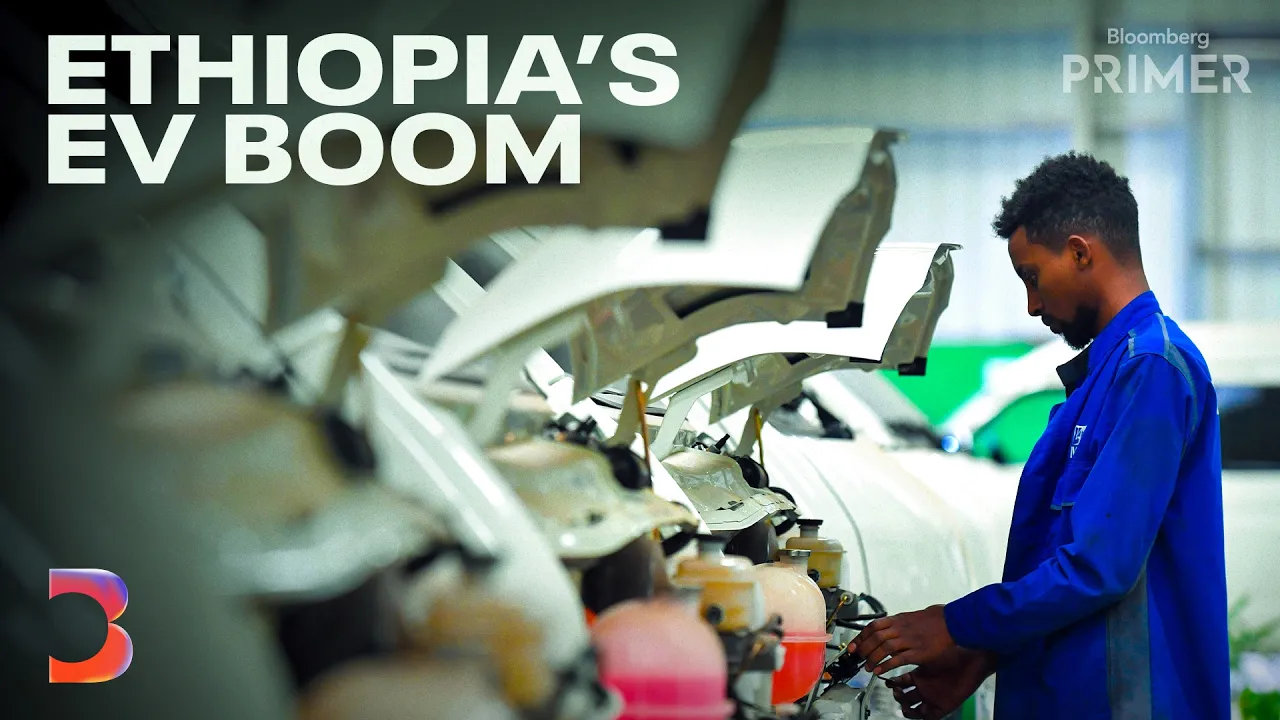
At its assembly plant located 30 kilometers outside Addis Ababa, BKG processes flat-pack kits supplied by the Chinese manufacturer Nanjing Golden Dragon Bus Company. While Chinese technical teams originally managed plant floor operations directly alongside local hires, the knowledge transfer was rapid: Ethiopian technicians soon ran assembly lines independently.
```mermaid flowchart LR accTitle: BKG Electric Bus Assembly Model accDescr: Flowchart showing parts supplied from China assembled in Ethiopia by BKG and distributed to municipal and commercial buyers. subgraph Supply["Kit Manufacturing"] A["Nanjing Golden Dragon Bus Co. (China)"] -->|"CKD Flat-Pack Kits"| B["0% Import Tariff"] end subgraph Assembly["Domestic Factory"] B --> C["BKG Manufacturing (30 km outside Addis)"] C --> D["Local Assembly by Ethiopian Workforce"] end subgraph Delivery["End Users"] D --> E["Addis Ababa Municipal Fleet"] D --> F["Private Minibus Owner-Operators"] end ```
[10:42](https://www.youtube.com/watch?v=aa2VfXs3qY0&t=642s) Electrifying Mass Transit
Because broad private vehicle ownership remains out of reach for the majority of the population, urban mobility relies heavily on public transportation. Commuters depend on high-capacity buses owned by municipal transit agencies, supplemented by vast fleets of 15-passenger minibuses operated by private individuals as shared taxis.
BKG geared its initial flat-pack production toward electric minibuses to match this transit profile. The primary commercial purchaser of these locally assembled electric minibuses is the Addis Ababa city administration itself, alongside private drivers and small transport companies aiming to escape elevated pump prices.
[11:56](https://www.youtube.com/watch?v=aa2VfXs3qY0&t=716s) Ambitions, Structural Hurdles, and Geopolitics
Ethiopia's 2025 national climate targets set a benchmark of reaching 500,000 registered electric vehicles and over 2,000 public charging stations by 2033. Yet substantial structural roadblocks remain. The primary constraint for mainstream consumers is purchase price:
> “The real sticking point for most Ethiopians to still buy electric vehicles is the sticker price. Electric vehicles are still many, many times more than the average salary of an Ethiopian.”
A compact entry-level imported EV such as the BYD Seagull retails for around $23,000, while Ethiopia's average annual per capita income sits below $1,000. Consequently, Ethiopia pairs one of the world's highest proportional rates of EV market adoption with one of the lowest absolute rates of vehicle ownership: only 13 out of every 1,000 Ethiopians own an automobile, compared to an average of 73 per 1,000 across the broader African continent.
Supply capacity also constrains the transition. The BKG minibus facility produces roughly one completed vehicle per day, though the group broke ground on an additional assembly facility scheduled for 2027 to assemble consumer passenger cars.
External and regional instability presents even greater disruption:
- In September 2026, armed clashes erupted anew in Ethiopia's northern Tigray region, jeopardizing the delicate peace agreement struck four years earlier between the federal government and the Tigray People's Liberation Front (TPLF). - Diplomatic relations with Egypt and Sudan remained strained over Nile water management rights tied to the GERD, alongside tensions over Ethiopian aspirations to secure dedicated Sovereign access to the Red Sea near the Eritrean port of Assab. - Concurrently, international conflict near the Strait of Hormuz drove global crude oil prices up 40% to 50%, touching levels not seen since 2023.
This persistent volatility in international oil markets reinforced Ethiopia’s policy trajectory: exposure to global fossil fuel inflation only strengthened the government's resolve to replace oil consumption with domestic electric power.
[14:53](https://www.youtube.com/watch?v=aa2VfXs3qY0&t=893s) Ethiopia’s Leap Forward and Global Lessons
Ethiopia's push into clean energy is far from over. Another major hydropower plant is already under construction and scheduled to come online by the end of the decade, further bolstering the country's electricity generation. Looking ahead, Ethiopia is preparing to take the global stage when Addis Ababa hosts the UN Climate Summit in 2027. For the nation's leadership, the gathering represents an unprecedented showcase for their ambitious green experiment. As one speaker highlights, “The government is excited to show to the world what an electric vehicle transition can look like from the perspective of a developing country.”
Yet, analysts recognize that Ethiopia’s aggressive model cannot simply be copied and pasted anywhere else in the world. Very few nations possess a natural powerhouse like the Nile to generate immense amounts of cheap renewable energy, combined with an automotive market small enough to pivot on a dime, alongside a foreign currency and fuel crisis severe enough to make immediate, drastic intervention mandatory. Nevertheless, Ethiopia's rapid adoption proves what is possible when policy urgency takes precedence over gradualism. As the narrator observes, “The question was never really whether a country could do this fast, it was whether one would.” While wealthier nations have spent over two decades drafting endless transition plans for a future they continually delay, Ethiopia was in a position where it simply could not afford to wait—so it took the leap.
```mermaid flowchart LR accTitle: Ethiopia EV Transition Drivers accDescr: Diagram illustrating the unique factors driving Ethiopia's rapid electric vehicle transition. subgraph Drivers["Unique Converging Drivers"] A["Abundant Hydropower<br/>(Nile River)"] B["Crippling Fuel Import Costs<br/>& Debt Crisis"] C["Relatively Small Vehicle Fleet"] end subgraph Impact["Resulting Impact"] D["Aggressive EV Pivot<br/>& Gas Car Ban"] E["Global Showcase<br/>(2027 UN Climate Summit)"] end Drivers --> Impact ```
- **Upcoming Hydropower:** A new hydroelectric plant is under construction and scheduled for completion by the end of the decade. - **2027 UN Climate Summit:** Set to be hosted in Addis Ababa, offering Ethiopia an international platform to display its EV adoption model. - **The Core Paradox:** Wealthier industrialized nations have debated and postponed electric vehicle deadlines for twenty years, whereas Ethiopia's economic necessity forced an immediate, complete overhaul.
## Notable quotes > [00:00](https://www.youtube.com/watch?v=aa2VfXs3qY0&t=0s) Suddenly, Ethiopia, one of the poorest countries in the world, decided it's just going to go ahead and do what none of the richest countries have done.
> [06:36](https://www.youtube.com/watch?v=aa2VfXs3qY0&t=396s) In the West, it would be a shock and horror if you brought in a ban on fossil fuel cars and you did not have a fast charger.
> [11:56](https://www.youtube.com/watch?v=aa2VfXs3qY0&t=716s) The real sticking point for most Ethiopians to still buy electric vehicles is the sticker price. Electric vehicles are still many, many times more than the average salary of an Ethiopian.
## Mentioned Addis Ababa, Belayneh Kindie Group, BKG Manufacturing, BYD Seagull, Grand Ethiopian Renaissance Dam (GERD), International Monetary Fund, Nanjing Golden Dragon Bus Company, Natanel Taddesse, Tigray People's Liberation Front (TPLF), UN Climate Summit, US International Trade Administration
## Video description In 2024, Ethiopia became the first country to ban imports of new gasoline-powered cars, and the main reason wasn't global warming. Ethiopia was spending billions of dollars every year on imported fuel it couldn’t afford, and subsequently defaulted on its debt. Cheap hydropower from Africa’s largest dam made electric vehicles a practical alternative, and Chinese-made EVs — some assembled locally — quickly filled dealership lots. Today, Ethiopia’s EV share outpaces the global average. But sticker prices are too high for most, the grid remains patchy and armed conflict is flaring in the country and across the region. Can Ethiopia make its unprecedented bet on EVs pay off?
00:00 - 01:19 — Introduction 01:19 - 04:53 — Ethiopia’s Gas Car Ban 04:53 - 06:36 — Cheap Electricity In Ethiopia 06:36 - 07:55 — Chargers 07:58 - 10:42 — Flat-Pack Car Factory 10:42 - 11:56 — Mini buses 11:56 - 14:48 — Ethiopia’s Ambitions 14:48 - 15:44 — Conclusion 15:44 - 16:04 — End Credits
Ethiopia’s Improbable Leap to Electric Vehicles: https://www.bloomberg.com/news/articles/2026-11-02/ethiopia-s-improbable-leap-to-electric-vehicles
Charging infrastructure is anemic, the grid is spotty and renewed conflict could upend everything, but a major transformation is nevertheless underway.
Watch more: https://www.youtube.com/show/VLPLqq4LnWs3olWuFFpsiq0cFkGs7WMb6MtA?sbp=QAE%3D
#Ethiopia #EVs #Electricity
-------- Like this video? Subscribe: http://www.youtube.com/Bloomberg?sub_confirmation=1
Get unlimited access to Bloomberg.com for just $1.99 your first month: https://www.bloomberg.com/subscriptions?in_source=YoutubeOriginals Bloomberg Originals offers bold takes for curious minds on today’s biggest topics. Hosted by experts covering stories you haven’t seen and viewpoints you haven’t heard, you’ll discover cinematic, data-led shows that investigate the intersection of business and culture. Exploring every angle of climate change, technology, finance, sports and beyond, Bloomberg Originals is business as you’ve never seen it.
Subscribe for business news, but not as you've known it: exclusive interviews, fascinating profiles, data-driven analysis, and the latest in tech innovation from around the world.
Visit our partner channel Bloomberg News for global news and insight in an instant.
[Source](https://www.youtube.com/watch?v=aa2VfXs3qY0)