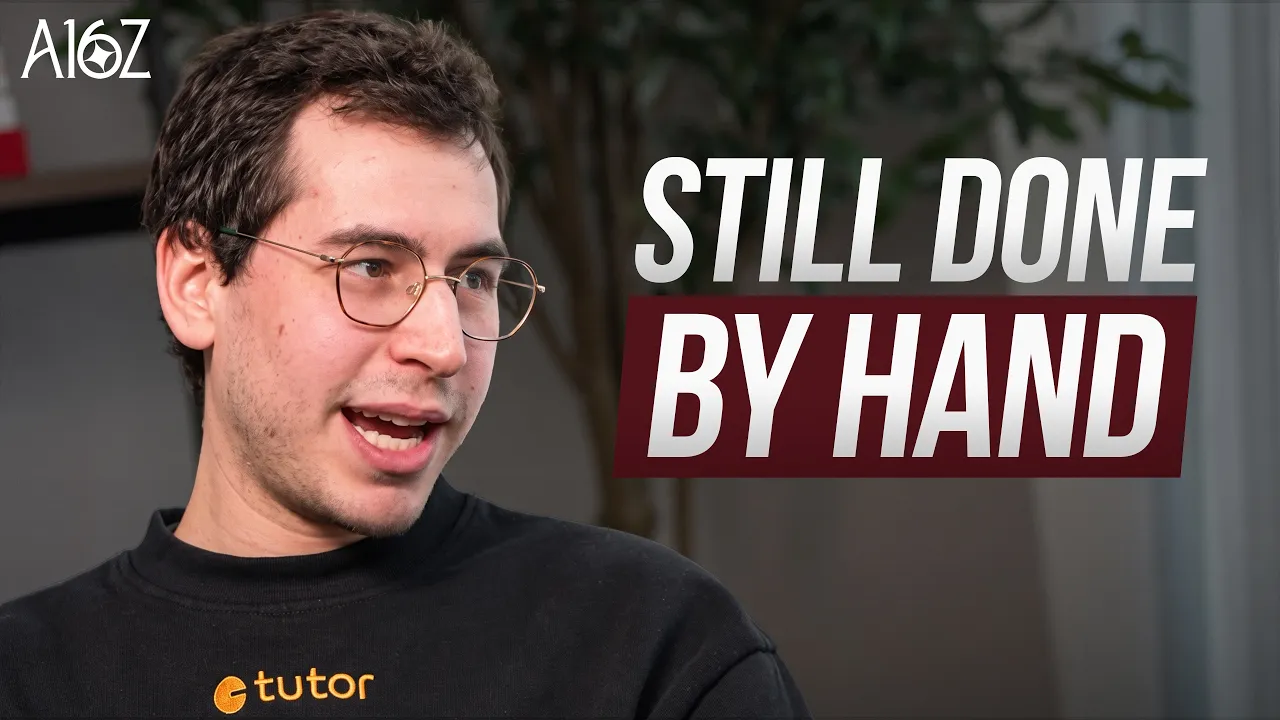
Tutor Deploys $16-an-Hour Robots to Leapfrog Legacy Factory Automation
a16z
Deploying vertically integrated robots directly into paying factory workflows generates the real-world reinforcement learning data needed to scale general physical AI and bypass rigid legacy automation lines.
Tutor Intelligence vertically integrates hardware and software, offering flexible industrial robotic labor starting at roughly $16 per hour to tap into predominantly greenfield American manufacturing and warehousing facilities. (23:17)
By coupling deployed robots with on-demand human teleoperators ('tutors'), Tutor generates economically funded real-world training data that addresses the physical exhaust data gap lacking in physical labor. (9:08)
The company produces two primary robot morphologies—Cassie (a single-arm case and pallet handler) and Sunny (a bimanual semi-humanoid)—manufactured in Watertown, Massachusetts, alongside operating a 100-robot data factory in Boston for real-world reinforcement learning. (18:42)
Tutor intentionally targets small and mid-sized businesses rather than Fortune 50 innovation accounts, achieving 40 to 60-day sales cycles and same-day commissioning without upfront CapEx. (29:05)
Detailed notes
## Background
Published by the a16z YouTube channel on November 2, 2026, this episode features Tutor Intelligence CEO Josh Gruenstein in conversation with a16z General Partners Martin Casado and Raghu Raghuram. According to the show description, the discussion explores Tutor's full-stack approach to deploying robots into real-world factories and warehouses, utilizing human tutors to generate training data, building in-house hardware platforms like Cassie and Sonny, and lowering labor costs to revitalize American manufacturing.
## TL;DR
Tutor Intelligence CEO Josh Gruenstein explains why successful robotics requires treating automation as an end-to-end systems problem that integrates frontier AI, in-house hardware manufacturing, and real factory-floor operations. By targeting greenfield small- and mid-sized businesses with an operational expenditure model starting around $16 an hour, Tutor deploys practical robots (single-arm Cassie and bimanual Sonny) backed by human teleoperators who handle edge cases. This deployment model not only delivers immediate labor savings to manufacturers but also captures the physical real-world data exhaust needed to train foundation models and run reinforcement learning at fleet scale. Gruenstein and the hosts discuss how flexible robotic labor can overcome aging workforce constraints, reshape global supply chains, and enable the United States to leapfrog legacy, rigid industrial automation.
## Atmosphere & style
The conversation carries a pragmatic, grounded energy, sharply contrasting the typical theoretical hype of artificial intelligence with gritty, shop-floor unit economics. Casado and Raghuram engage as curious, analytically minded investors, while Gruenstein speaks with the fast-paced, unpretentious clarity of an engineer who divides his time between high-level model whiteboards and greasy assembly lines. The mood is dynamic and forward-looking, blending deep technical systems thinking with hands-on industrial realism—conveying the palpable excitement of watching physical labor transition into software-like velocity.
## Bulletin
- [23:17](https://www.youtube.com/watch?v=lXkjXSul6yg&t=1397s) Tutor Intelligence vertically integrates hardware and software, offering flexible industrial robotic labor starting at roughly $16 per hour to tap into predominantly greenfield American manufacturing and warehousing facilities.
- [09:08](https://www.youtube.com/watch?v=lXkjXSul6yg&t=548s) By coupling deployed robots with on-demand human teleoperators ('tutors'), Tutor generates economically funded real-world training data that addresses the physical exhaust data gap lacking in physical labor.
- [18:42](https://www.youtube.com/watch?v=lXkjXSul6yg&t=1122s) The company produces two primary robot morphologies—Cassie (a single-arm case and pallet handler) and Sunny (a bimanual semi-humanoid)—manufactured in Watertown, Massachusetts, alongside operating a 100-robot data factory in Boston for real-world reinforcement learning.
- [29:05](https://www.youtube.com/watch?v=lXkjXSul6yg&t=1745s) Tutor intentionally targets small and mid-sized businesses rather than Fortune 50 innovation accounts, achieving 40 to 60-day sales cycles and same-day commissioning without upfront CapEx.
## Key takeaways
- [00:00](https://www.youtube.com/watch?v=lXkjXSul6yg&t=0s) Most robotics pitches fail because they lead with models rather than the physical task, ignoring that prospective customers are greenfield buyers who have never purchased automated systems before.
- [04:32](https://www.youtube.com/watch?v=lXkjXSul6yg&t=272s) Robotics is the ultimate systems problem; focusing on any single layer of the stack discards roughly 90% of the available trade-off space across AI, hardware, unit economics, and operations.
- [06:46](https://www.youtube.com/watch?v=lXkjXSul6yg&t=406s) Humanoids and generalized robotic form factors represent the physical equivalent of the CPU, providing clean general abstractions that can handle the vast majority of physical workloads.
- [09:08](https://www.youtube.com/watch?v=lXkjXSul6yg&t=548s) Unlike the digital world where human text and code created free training exhaust for LLMs, physical tasks leave behind no recorded data, making instrumented deployment essential to capture training traces.
- [11:37](https://www.youtube.com/watch?v=lXkjXSul6yg&t=697s) Human teleoperators are budgeted as a specialized compute resource, where keeping a human 'tutor' in the loop is balanced directly against the inference cost and engineering effort of solving edge cases.
- [14:54](https://www.youtube.com/watch?v=lXkjXSul6yg&t=894s) Commercial advancements by frontier AI labs in 3D spatial models and CAD grounding act as external accelerants for physical robotics action diffusion heads.
- [17:07](https://www.youtube.com/watch?v=lXkjXSul6yg&t=1027s) Existing industrial robotics supply chains from legacy vendors like FANUC and ABB are undersized and poorly matched to co-design requirements for frontier models, forcing vertical integration.
- [18:42](https://www.youtube.com/watch?v=lXkjXSul6yg&t=1122s) Roughly 80% to 90% of industrial tasks can be captured by two form factors: Cassie (palletizing and box handling) and Sunny (wheeled, collaborative bimanual assembly).
- [20:58](https://www.youtube.com/watch?v=lXkjXSul6yg&t=1258s) Popular media portrays factories as fully automated, but 99.99% of American manufacturing relies on an aging human workforce performing repetitive assembly and packaging by hand.
- [29:05](https://www.youtube.com/watch?v=lXkjXSul6yg&t=1745s) Targeting small and mid-sized businesses acts as a forcing function to build general, repeatable robot products rather than becoming bespoke engineering consultancies for single enterprise giants.
- [25:59](https://www.youtube.com/watch?v=lXkjXSul6yg&t=1559s) Applying Human-Robot Interaction principles—such as allowing line workers to name incoming robots—builds psychological ownership and emotional attachment on factory floors.
- [36:14](https://www.youtube.com/watch?v=lXkjXSul6yg&t=2174s) Physical robotics cost drivers have flipped from 10-year CapEx depreciation to ongoing operating costs like cloud inference and teleoperation.
- [38:19](https://www.youtube.com/watch?v=lXkjXSul6yg&t=2299s) Flexible robotic labor could equalize international manufacturing, enabling the US to bypass legacy rigid automation while nations with fixed automated infrastructure face costly tear-downs.
- [42:04](https://www.youtube.com/watch?v=lXkjXSul6yg&t=2524s) Reinforcement learning requires large fleet scale and statistical batch diversity to advance beyond imitation learning, which Tutor powers via its 100-robot 'Data Factory 1' in Boston.
## Detailed walkthrough
### [00:00](https://www.youtube.com/watch?v=lXkjXSul6yg&t=0s) The State of Global Supply Chains and Robotics Pitches
The conversation opens against the geopolitical backdrop of 2026, where the United States and China operate in an interconnected, interdependent supply chain while racing to expand sovereign industrial capacity. Most robotic pitches circulating through venture capital fail to address the core end-state: what the machine will actually do once built. Almost the entire market for robotics remains greenfield, with prospective customers having never purchased an automated system before.
```mermaid
flowchart TD
accTitle: Tutor Intelligence Operating Model
accDescr: Flow diagram showing how physical deployment into supply chains feeds data back into frontier AI models to expand industrial capacity.
subgraph Ground["Physical Economy"]
A["Greenfield Customers<br/>(Mom & Pops to Fortune 50)"] -->|"Deploy Robots"| B["Factory & Warehouse Operations"]
B -->|"250M+ Products Shipped"| C["End Consumers"]
end
subgraph Platform["Full-Stack Engine"]
B -->|"Teleoperation & Supervised Work"| D["Proprietary Labeled Datasets"]
D -->|"Train Models"| E["Frontier Robot AI"]
E -->|"System Optimization"| F["Hardware & Supply Chain Scale"]
F -->|"Next-Gen Deployment"| A
end
```
Martin Casado introduces Josh Gruenstein, CEO and co-founder of Tutor Intelligence. Tutor Intelligence operates as a full-stack robotics enterprise:
- **Headquarters and Team:** Approximately 160 employees, based primarily in Boston.
- **Scale of Operation:** Deploying robots across American supply chains, ranging from small local operations to Fortune 50 and Fortune 100 enterprise accounts.
- **Consumer Footprint:** Claude estimated on the eve of the interview that Tutor robots have manufactured and shipped over a quarter of a billion products to consumers, meaning the majority of American households likely interact downstream with products touched by Tutor machines.
- **Core Stance:** Josh highlights the gap in the industry, explaining that “almost everybody we're selling a robot to has never purchased a robot before.”
---
[02:49](https://www.youtube.com/watch?v=lXkjXSul6yg&t=169s) Reversing the Pitch: Starting from the Job Instead of the Model
Raghu Raghuram observes that 99% of robotics founders launch pitches anchored purely on model architectures or proprietary data shapes, leaving the actual physical task as an afterthought. Tutor Intelligence inverted this playbook by starting directly with the work that needed execution.
Gruenstein explains the origin of this insight through a foundational thought experiment: Earth holds eight billion people who already possess baseline physical intelligence. If a theoretical software layer could bridge any human operator to any physical robotic chassis, society would possess unlimited embodied intelligence on paper.
Yet even with infinite intelligence granted by assumption, the problem remains unsolved in practice:
- The machines still have to be manufactured at commercial volume rather than built as boutique prototypes.
- Robotics remains a mere cottage industry in the United States, representing a statistical rounding error even within automated logistics and manufacturing.
- Without custom hardware, specialized control software, and distribution, theoretical models cannot complete economically viable work.
Evaluating this disconnect, Josh summarizes the requirement to avoid single-layer traps: “Robotics is not, I think, any one layer of the stack. It's not just about intelligence, it's not just about hardware, it's not just about the customer. It's about kind of figuring out how to put all these three pieces together and it's the combination of all three that actually lets you build a, in my view, a successful platform at any one of those layers.”
---
[04:32](https://www.youtube.com/watch?v=lXkjXSul6yg&t=272s) Robotics as the Ultimate Systems Problem
Martin Casado points out the contrast between Josh Gruenstein’s background—deep MIT-trained robotics expertise—and his current identity, which sounds more like a seasoned operations, unit economics, supply chain, and go-to-market executive. When asked whether the operational layer is harder than the technical one, Gruenstein clarifies that the challenge is not one over the other, but the non-negotiable requirement to operate across every layer at once.
Historically, Gruenstein’s approach relied on being an end-to-end engineer willing to navigate hardware, manufacturing, FPGAs, and ASICs:
- If a robotics company discards any single technical or business layer, it discards roughly 90% of its available trade-off space to solve problems.
- Startups have consistently failed to achieve massive economic success because they either lacked real cognitive adaptability—relying on brittle, 60-year-old custom machine automation—or suffered from extreme market fragmentation where disconnected vendors attempt to integrate disparate systems without unified ownership.
Addressing the structural nature of the problem, Josh notes: “If you view robotics in the same way that I do that it's this like ultimate systems problem the only way you can make forward progress is by figuring out all of the clever trade-offs across as many layers of the stack as you can.”
---
[06:46](https://www.youtube.com/watch?v=lXkjXSul6yg&t=406s) The Horizontal vs. Vertical Paradox in Physical Tech
Casado observes a historical pattern across the industry: robotics startups consistently enter the market with horizontal ambitions—announcing an intelligence layer or a foundational model—only to vertically integrate into manufacturing, chassis design, and 3D printing once reality sets in. Casado questions whether this verticalization is merely a transient stage of an immature market (comparable to early automobile builders manufacturing their own carriage bodies and fuels) or an intrinsic, permanent law of physics and spatial movement.
Gruenstein argues that this dynamic mirrors early computing:
- Modern software founders build multi-billion dollar applications without needing to design microprocessor instruction sets or silicon architectures, because computing stabilized on clean horizontal abstractions like the CPU.
- The robotics industry has not yet achieved that maturity; narrow point solutions fail because they lack the underlying full-stack platform needed to deliver an end-to-end outcome.
- Josh asserts that humanoids and generalized robotic forms represent the physical equivalent of the CPU—a versatile, albeit not always specialized, abstraction machine capable of executing the vast majority of physical workloads: “The beauty of something like a humanoid is it's the same if that clean abstraction, right? You think about like what is a CPU? And it's this general computing machine, and it's not perfectly optimized for every use cases, right? But it's general enough that you can run most computing workloads.”
[08:35](https://www.youtube.com/watch?v=lXkjXSul6yg&t=515s) The Hardware Spectrum: From Specialization to General Purpose
The evolution of robotic form factors parallels the historical progression of computing architectures. Just as computing relies on an evolving mix of CPUs, GPUs, and custom ASICs depending on workloads and market maturity, robotics follows an equivalent trajectory. Early markets demand specialized, custom-tailored machines because narrow economic utility is the only thing the industry can reliably support. Over time, maturity drives the field toward general-purpose embodiments like humanoids before eventually cycling back to re-specialization once the overall market achieves sufficient scale.
As Josh Gruenstein explains, market maturity dictates the balance between generalized and purpose-built designs:
> “You track the maturity of the market, and you start in this world of specialization, custom machines, cause that’s the only thing the market can support. You move towards general purpose, and in robotics this is going to look like humanoids and similar form factors, and then eventually you kind of break past to, you know, that re-specialization as the market is big enough.”
[09:08](https://www.youtube.com/watch?v=lXkjXSul6yg&t=548s) The Origin of Tutor Intelligence and the Physical Data Gap
The founding thesis of Tutor Intelligence rests on a fundamental disparity between the digital and physical worlds. Large language models and frontier digital AI blossomed because humanity naturally left behind an “internet of human intelligence” across emails, code repositories, and social media posts. That exhaust data provided the training sets required to build general-purpose models. In the physical realm, human labor creates no such byproduct: when someone picks up a coffee cup, the tactile forces, finger pressures, and 3D spatial poses vanish unrecorded.
```mermaid
flowchart TD
accTitle: The Tutor Data Flywheel
accDescr: Diagram showing how deploying robots with human tutors generates training data that improves automated models and reduces costs.
subgraph ValueCreation["Economic & Data Output"]
Goods["Cheaper Physical Goods"]
D["High-Quality Physical Data Stream"]
end
subgraph LearningLoop["Model Improvement"]
Train["Post-Training & Action Diffusion Heads"]
Sim["Simulation & 3D Spatial Priors"]
end
R -->|"fallback on edge cases"| T
T -->|"teaches novel tasks"| R
R -->|"delivers customer work"| Goods
R -->|"captures poses & tactile inputs"| D
D --> Train
Sim --> Train
Train -->|"improves autonomous policy"| R
```
Rather than trying to invent an intelligence algorithm out of thin air with zero data—an approach that failed historically in computer vision and natural language processing—Tutor Intelligence couples real-world robots with human teleoperators called “tutors.” These tutors guide robots through unfamiliar or complex tasks, simultaneously executing customer jobs and generating the internet of robot training data. Raghu Raghuram notes that when inspecting customers prior to investing, clients neither knew nor cared whether a task was being driven by an autonomous policy or a human tutor; they only cared that the system worked reliably. Josh highlights that the true benchmark of robotic success is economic rather than aesthetic:
> “You want the feedback to be like, ‘My shampoo that I’m manufacturing at volume is now 5 cents cheaper than it was.’ If the feedback is like, ‘The robot is pretty,’ it’s like, ‘Ah, that’s probably a really bad robot.’”
- **Company origins**: Founded in 2021 around the thesis of turning physical teleoperation into an economic flywheel.
- **The data gap**: Physical interactions leave no natural digital exhaust unless instrumented machines are deliberately embedded into customer workflows.
- **Economic alignment**: Delivering cheaper end-product manufacturing funds the collection of frontier robotic training data without requiring non-productive capital outlays.
[11:37](https://www.youtube.com/watch?v=lXkjXSul6yg&t=697s) Unit Economics of Human Tutors vs. Full Autonomy
The long-term role of tutors is evaluated through pragmatism and unit economics rather than philosophical purity around full autonomy. Just as infrastructure engineers calculate the cost to serve model inferences against the duty cycle, utilization, and depreciation of an Nvidia H200 GPU, robotic operators evaluate human intelligence as a specialized, heterogeneous compute profile. The central challenge is weighing the engineering cost required to squeeze the “last nine” of autonomous reliability out of a neural network against the operational cost of keeping an on-demand tutor in the loop.
Martin Casado points out that while generative AI enjoyed a smooth alignment between its training distribution (web text and images) and customer demand, physical robotics faces a high-dimensional solution space where an edge-case task might fall just outside the model's known distribution. In response, Gruenstein stresses that deploying robots directly inside paying businesses acts as an invisible market filter to guarantee data relevance:
> “If you have robots in real customer sites that customers are paying for for those robots to do that task, you know for sure that that data is economically valuable.”
- **The GPU analogy**: Human teleoperators are budgeted and balanced against machine inference costs just like server clusters.
- **Data purity vs. reality**: Rather than relying exclusively on real-world teleoperation or purely on synthetic data, Tutor blends real-world intervention traces with simulation and internet-scale foundation models.
- **Dimensionality trade-offs**: If closing the final 10% of corner cases demands an exorbitant volume of data, relying on a human tutor remains economically viable while the autonomous pipeline matures.
[14:54](https://www.youtube.com/watch?v=lXkjXSul6yg&t=894s) Frontier Models and 3D Spatial Reasoning
Frontier artificial intelligence labs have triggered an acceleration in robotics by post-training large models on 3D spatial data, computer-aided design (CAD) files, and spatial representations. Historically, large language models possessed an encyclopedic semantic understanding of the physical world but lacked the spatial grounding necessary to translate that knowledge into motor control. Once frontier labs recognized commercial incentives for 3D modeling, their outputs bridged the gap between high-level reasoning and physical action heads, such as action diffusion transformers.
Because robotics is fundamentally an end-to-end systems challenge, these external frontier breakthroughs act as an accelerant rather than a competitive threat. Having launched Tutor Intelligence in 2021 using basic convolutional neural networks (CNNs), the team has weathered successive shifts in model architectures, concluding that durable enterprise value resides in the underlying data flywheel rather than any single model implementation.
Josh Gruenstein underscores how external model breakthroughs reinforce their core operational loops:
> “The thing that is always valuable is the flow of data. Right? And the flow of data is always the thing that uniquely you can do, and it’s like, yeah, the million architectural tricks, like do them if it helps you accelerate the flywheel.”
- **Architectural evolution**: Shifted from 2021-era convolutional neural networks to modern action diffusion transformer heads.
- **The CAD and 3D unlock**: Frontier labs commercializing spatial models gave robotics systems the spatial reasoning required to link high-level semantic plans to physical trajectories.
- **Moat durability**: Transient architectural tricks come and go; real defensibility stems from the operational loop connecting customer deployments, real-time data capture, and task execution.
[17:07](https://www.youtube.com/watch?v=lXkjXSul6yg&t=1027s) Why Tutor Builds Its Own Hardware in Watertown
Industrial robotics in the United States remains surprisingly small in absolute volume. In 2025, the U.S. deployed roughly 38,000 industrial robot work cells—a number that pales in comparison to the approximately one million deployed globally, and almost entirely comprised of traditional legacy machines from vendors like FANUC and ABB. New humanoid hardware like Unitree had virtually zero industrial footprint in those numbers. The underlying issue is that the existing supply chain is both undersized and poorly matched to modern AI. Traditional machines from FANUC and ABB are engineered for fast, repetitive motions integrated into static systems by systems integrators; they are not co-designed around the trade-offs required to work alongside frontier AI models.
To overcome these constraints, Tutor Intelligence chose to vertically integrate by designing and manufacturing its own hardware platform from scratch. While Tutor does not build low-level commodities like raw actuators or cameras—sourcing those instead from high-volume OEMs—the complete integrated robot, including the mobile base, manipulator arms, and control systems, is built at scale in Watertown, Massachusetts. As Josh Gruenstein explains:
> “The supply chain that exists for robots is both too small and as you called out wrong, right? Like the robots that Fanuc and ABB are building... they are not cut from the set of tradeoffs that you would want to co-design with frontier models.”
```mermaid
flowchart LR
accTitle: Hardware Sourcing and Manufacturing Architecture
accDescr: Sourced OEM components combine with in-house integration to deploy custom robots.
subgraph Sourced["OEM Tier"]
A["Actuators"]
B["Cameras & Sensors"]
end
subgraph Assembly["Watertown, MA Facility"]
C["Co-Designed Hardware Platforms"]
D["Mobile Bases & Arm Integration"]
end
subgraph Fleet["Deployed Robots"]
E["Cassie: Single-arm brute"]
F["Sunny: Bimanual semi-humanoid"]
end
A --> C
B --> C
C --> D
D --> E
D --> F
```
[18:42](https://www.youtube.com/watch?v=lXkjXSul6yg&t=1122s) The Two Robot Morphologies: Cassie and Sunny
Tutor addresses industrial labor with two distinct robot morphologies, each tailored to specific physical tasks and commercial realities:
* **Cassie**: A heavy-duty, single-arm robot equipped with suction grippers, powered by foundation models in the 200 to 400 million parameter range. Cassie grew out of Tutor’s origins in 2021, focusing on using foundation models to predict task affordances and grasp points. Cassie is designed around a fundamental reality of the physical economy: almost everything transported across the supply chain moves on pallets or in corrugated cardboard boxes. Because moving those boxes and pallets typically demands exhausting manual labor, Cassie is mass-manufactured to lift and transfer cases and build pallets across diverse logistics and manufacturing facilities.
* **Sunny**: An industrial "semi-humanoid" designed for dexterous bimanual manipulation over an operational lifespan of 3 to 10 years at human reliability and speed. Unlike legged research prototypes, Sunny uses a wheeled base because indoor manufacturing floors are almost universally flat, polished concrete. Sunny features higher payload capacity, high-speed motion, and industrial collaborative safety standards that allow it to operate safely directly alongside human workers. Tutor maintains an internal fleet of 100 Sunnys running in a dedicated Boston "data factory" to generate teleoperation and execution data for AI research, while a growing fleet of Sunnys is deployed into commercial customer sites handling complex, two-handed assembly and packaging.
Gruenstein estimates that within manufacturing and logistics, these two form factors alone can capture the vast majority of physical tasks:
> “If you want to just live inside of manufacturing logistics, Sunny and Cassie today can probably do 80% to 90% of the work, right? These are designed for those cuts.”
[20:58](https://www.youtube.com/watch?v=lXkjXSul6yg&t=1258s) The Reality of American Manufacturing vs. "How It's Made"
Popular perception of manufacturing is warped by television depictions. Shows like *How It's Made* showcase hyper-automated, Rube Goldberg-style machinery without a single human in sight. Gruenstein points out that those fully automated operations represent only the top 0.01% of American manufacturing and logistics. Inside ordinary million-square-foot facilities across the country, operations consist of dozens of human workers lined up along conveyor belts and folding tables performing repetitive manual operations.
This human-dependent reality creates acute operational challenges. Manual handling jobs suffer from intense three-month turnover rates, and the average worker performing heavy lifting is roughly 55 years old and nearing retirement. Dexterous handling is equally manual: virtually every product sold in a box—even high-end consumer electronics like iPhones—is packaged and assembled by human hands at the end of the line.
When asked about expanding beyond Cassie and Sunny, Gruenstein notes that the key boundaries are physical environments:
- **Outdoor industrial settings**: Tasks like construction and material reclamation from landfills require legged locomotion to traverse uneven terrain and gravel where wheels fail.
- **Domestic environments**: The current form factors are far too industrial, heavy, and intimidating for consumer homes.
As Gruenstein summarizes the contrast between perception and reality on factory floors:
> “Anything that requires any degree of assembly, right? Like even, you know, iPhones, you know, it you would assume it's a robot, you know, putting that packaging together. No, it's a person even at the highest level of scale.”
[23:17](https://www.youtube.com/watch?v=lXkjXSul6yg&t=1397s) Go-to-Market Velocity: Selling Robotic Labor at $16 an Hour
Because roughly nine out of ten U.S. factories and warehouses have never operated an industrial robot, almost the entire addressable market is greenfield. Most facility managers assume automation is too brittle, complex, or expensive based on their knowledge of legacy robotic systems. Tutor bypasses technical pitches about machine learning models or remote tutors, leading instead with a direct, disruptive economic proposition: offering robotic labor starting at roughly $16 an hour.
This economic alignment eliminates upfront capital risk and accelerates sales and deployment cycles far beyond standard industrial automation norms:
- **Sales cycle**: 40 to 60 days from the initial outreach call to a signed contract.
- **Fulfillment time**: Approximately 40 days from contract execution to having the hardware delivered to the customer's facility.
- **On-site commissioning**: The robot is fully stood up and running production workloads within a day, often within the first two hours of arrival, because it requires no bespoke mechanical re-engineering.
Once installed, operations teams quickly expand adoption because the return on investment is immediately visible. As Gruenstein remarks regarding plant managers' practical mindset:
> “The operations community is really, really fantastic cuz they see a thing work and it's like, I it works. They're like, that's it, right? It's it's like, yeah, I I can see obviously it does the job. I know all the places where this job needs to be done. Let's go put it in all those places.”
This operational clarity has allowed Tutor to expand rapidly from an initial single-unit trial into fleets of a dozen or more robots operating across multiple sites for both mid-sized businesses and large supply chain enterprises.
[25:59](https://www.youtube.com/watch?v=lXkjXSul6yg&t=1559s) Human-Robot Interaction and Naming Rituals on the Factory Floor
Martin Casado poses a fundamental question about how workers perceive deployed robots: given Josh Gruenstein's extensive experience putting robots into real facilities, do people treat them like cold pieces of industrial equipment, or do they start looking at them as beings and coworkers? Josh brings up a fitting line he saw online: “A robot is a robot unless it works, in which case it's a machine.” While plant managers and COOs might view them purely as machines, robotics presents a unique dynamic because the economic buyer is not the actual day-to-day user. The buyer signs the contract, but line workers spend their entire shifts shoulder-to-shoulder with the machines. Because Tutor Intelligence automates specific tasks rather than 100% of an entire warehouse or factory, cultivating an empathetic working relationship between line workers and robots is essential.
Josh leans directly on the academic discipline of Human-Robot Interaction (HRI) to guide how robots are integrated into the workforce. One proven mechanism is giving every single robot a personal name. In Tutor's operational model, the internal manufacturing technicians give each robot its initial name, but when a client signs a repeat order or expands their fleet, the customer earns the right to name the incoming units. Raghu Raghuram notes that naming grants workers an immediate psychological sense of ownership. Workers frequently name units after their own children, favorite football players, or pop stars. Line staff form genuine emotional attachments because the robots take over physically punishing, backbreaking labor, allowing workers to get elevated into higher-responsibility roles at facilities that are chronically understaffed.
```mermaid
flowchart LR
accTitle: Robot Naming and Deployment Progression
accDescr: Diagram showing how a robot is named by technicians upon initial deployment, and later renamed by customer staff upon expansion.
subgraph Initial ["Initial Deployment"]
A["Technicians Build Unit"] --> B["Tutor Techs Assign Name"]
B --> C["Deployed to Factory Floor"]
end
subgraph Expansion ["Fleet Expansion"]
C --> D["Customer Places Repeat Order"]
D --> E["Line Workers Name New Robots"]
E --> F["Deeper Attachment & Ownership"]
end
```
- Tutor originally used a hurricane-style alphabetical naming convention (e.g., naming units sequentially through the alphabet, where a name like Britney represented a specific index modulo 26), but they cycled through the alphabet too many times and abandoned it.
- Technicians on the US-based manufacturing floor now simply pick names that bring them personal joy.
---
[29:05](https://www.youtube.com/watch?v=lXkjXSul6yg&t=1745s) Why Tutor Targets Mid-Market SMBs Over Fortune 50 Giants
Raghu points out that most robotics startups chase Fortune 50 enterprise accounts with massive experimental innovation budgets, whereas Tutor intentionally targets local, mid-market businesses. Josh explains that small and mid-sized businesses represent the overwhelming majority of the United States manufacturing and logistics landscape. Furthermore, Tutor was founded after watching wave after wave of academically oriented supply chain robotics startups fail. Josh diagnoses the fatal flaw of those earlier ventures: they operated as bespoke engineering consultancies rather than real product companies. A startup would chase a single enterprise giant, spend two years building a complex, custom Rube Goldberg machine around one narrow problem, and inevitably stumble during deployment because hardware and software require continuous iteration. Even if the system miraculously functioned, enterprise needs would shift, leaving the startup stranded with no repeatable business.
To prevent that fate, Josh established a strict product discipline: “Working with a diverse range of customers is this beautiful forcing function for building the right shape of product, which to us is a general robot.” Instead of tailoring bespoke hardware for one industrial behemoth, Tutor manufactures generally capable robot bodies paired with general-purpose foundation models that can be dropped into an SMB environment. If Tutor can execute a contract in two weeks with a mid-market customer and have the robot running immediately on arrival across completely different operating conditions, it proves the core product is scalable and robust.
---
[31:22](https://www.youtube.com/watch?v=lXkjXSul6yg&t=1882s) Macroeconomic Discontinuities and Expanding the Physical Substrate
Looking at the broader economic convergence of robotics, Josh argues that driving down the cost and speed of physical tasks will spark massive non-linear shifts across the economy. Many industries sit right on the edge of major economic discontinuities. For example, Josh mentions speaking with an assembly worker at a modular housing factory in Wisconsin. Constructing homes inside that factory is currently roughly 5% more expensive than erecting traditional, on-site stick-built housing. However, if automated factory labor could make those modular homes just 1% cheaper than traditional on-site construction, developer demand would flip overnight entirely to modular factory production. Similar latent tipping points exist in sorting and reclaiming raw materials from landfills.
By providing a flexible, cost-effective robotic labor substrate, Tutor aims to help businesses transform these cost curves across the physical economy. When asked whether Tutor would consider deploying into consumer homes, Josh expresses openness in principle but notes that consumer environments present unfavorable near-term economics and extreme edge-case complexity. In industrial environments, the measurable business value generated per hour justifies deployment immediately. Tutor’s strategy remains rooted in accepting necessary pragmatic trade-offs across the software and hardware stack today to secure a market foothold, steadily eliminating those trade-offs as the core platform matures.
- Modular factory homes are currently ~5% more expensive than on-site builds; reaching a threshold of just 1% cheaper would trigger an immediate mass migration of developer demand.
- Industrial deployments offer immediate, quantifiable ROI, making them far more viable than residential deployments for establishing an early labor platform.
---
[33:27](https://www.youtube.com/watch?v=lXkjXSul6yg&t=2007s) The Rhythm of Hardware and Software Product Velocity
Raghu observes that while most robotics companies struggle for years on their initial prototype hardware, Tutor is already running multiple generations of robots (Cassie and Sonny) and rapidly iterating. Josh explains that Tutor consciously models its physical product development after rapid software cycles. Because Tutor manufactures its own robots in-house, the engineering team directly controls the factory floor and pushes physical manufacturing alterations as frequently as every two weeks. On the software side, Tutor ships code daily, complemented by major software releases rolled out across the active fleet every two weeks, backed by heavy test automation infrastructure.
Organizationally, Tutor breaks down traditional company silos. The core product design function sits shoulder-to-shoulder with customer success and deployment operations, functioning as a single integrated unit that lives as close to customer realities as possible. Concurrently, an internal research team stays immersed in customer workflow data—identifying distinct data levers from real factory operations—while simultaneously pursuing moonshots on core AI modeling architectures.
[34:41](https://www.youtube.com/watch?v=lXkjXSul6yg&t=2081s) Customer Onboarding and the Math Behind Robotic Labor
When a warehouse or factory operator wants to explore working with Tutor Intelligence, the onboarding process starts directly on the company’s website. Rather than demanding upfront capital expenditure or locking clients into multi-year custom engineering roadmaps, the platform offers pricing calculators. Potential buyers input their current operational data to see immediate cost projections. Josh Gruenstein explains that a facility could start with an initial deployment of two robots and quickly see whether they would save $100,000, $1 million, or even $100 million a year—with meaningful savings kicking in as soon as two months from deployment without requiring CapEx.
```mermaid
flowchart LR
accTitle: Customer Value Framework for Deploying Robots
accDescr: Simple formula showing how robot value is calculated from total work output divided by total cost.
subgraph Inputs["Operational Metrics"]
W["Total Physical Work Delivered"]
C["Total Cost (CapEx Amortization + Ongoing Inference & Teleop)"]
end
subgraph Formula["Value Calculation"]
Calc["Work ÷ Cost"]
end
subgraph Outcome["Market Impact"]
Out["Compete in Liquid Physical Labor Markets"]
end
W --> Calc
C --> Calc
Calc --> Out
```
Gruenstein emphasizes that customer interest is massive, but it does not stem from a generic fascination with sci-fi technology or robots for their own sake. Most buyers do not even realize this class of flexible robot exists or that it can execute their specific industrial tasks. Instead, demand is dictated strictly by unit economics:
> “Everything else is is commentary. And so, if we're able to compete in these highly liquid labor markets that exist across American physical economy, uh and we can offer something that delivers greater equivalent capability at a lower cost, the market for that is the whole market, right? It's all physical work done.” — Josh Gruenstein
- **Speed to ROI:** Clients can realize significant annual savings roughly two months after signing, bypassing the multi-year engineering cycles typical of legacy automation.
- **The Core Equation:** Gruenstein defines the fundamental value metric of robotics simply as total work delivered divided by its total cost.
- **No Upfront CapEx:** Tutor operates on an operational expenditure model, eliminating the large capital barrier for manufacturing clients.
---
[36:14](https://www.youtube.com/watch?v=lXkjXSul6yg&t=2174s) The Shift from CapEx to Ongoing Inference and Strategic Planning
When Martin Casado asks whether the primary cost driver is amortized upfront hardware or ongoing operational expenses, Gruenstein points out an industry shift: ongoing operating costs—such as cloud inference and teleoperation—now outweigh the upfront hardware cost. While this surprised many observers who view robotics through the traditional lens of large 10-year capital depreciation schedules, Casado jokes that it makes sense because robots are competing with human workers, which run on food: “you're really competing with like something that you feed rice to and it's very, very efficient, right? And like the the human body.” Gruenstein notes that Tutor continually drives down both capital and operational costs over time.
Customer adoption is also not driven by sudden seasonal spikes like Black Friday, but by deep structural challenges. Industrial businesses are confronting an aging workforce alongside rising operational fulfillment costs. Unlike high-margin enterprise software companies, physical goods producers—whether manufacturing deodorant or crayons—operate on tight gross margins where cost increases can make or break the enterprise:
> “Because, you know, these are not software businesses that have these, you know, huge gross margins that you can you can play with and can compress a little bit, and it's like, 'It's fine.' It's like, 'No, the business either works or it doesn't.'” — Josh Gruenstein
Consequently, customers seek long-term robotics partners. A company specializing in deodorant manufacturing wants to focus entirely on deodorant production and operational excellence, relying on Tutor as the dedicated partner handling the robotic workforce.
---
[38:19](https://www.youtube.com/watch?v=lXkjXSul6yg&t=2299s) Geopolitics, Automation Regimes, and the Future of Manufacturing
The conversation expands into how flexible, general-purpose robotics will disrupt factory placement, industrial towns, and global supply chains. Gruenstein predicts that robotics will act as a major equalizer between the United States and countries like China. China invested heavily in the previous generation of rigid industrial automation, which drove past economic success but could become a liability:
> “In China they're going to have to tear down, right? We're not going to have to do that in the United States in the same way.” — Josh Gruenstein
Gruenstein compares the coming wave of physical automation to the software revolution: just as cloud computing and developer tooling dramatically lowered barriers to launching software businesses, an infinite, flexible labor substrate will allow anyone to start, run, and scale a manufacturing business in the physical world. This shift will multiply the overall number of operating factories rather than concentrating production in massive industrial centers.
- **Greenfield Advantage:** The US can bypass legacy, rigid automation hardware by deploying flexible, generally capable robotic fleets directly into facilities.
- **Democratized Physical Industry:** Flexible robotic labor lowers barriers to entry, enabling entrepreneurs to build physical manufacturing businesses with the ease of starting a cloud software startup.
- **Legacy Tear-Downs:** Nations heavily committed to single-purpose, hard-to-modify industrial automation lines face expensive retrofits to compete with adaptive robotics.
---
[39:48](https://www.youtube.com/watch?v=lXkjXSul6yg&t=2388s) Supply Chain Interdependence and Vertical Integration in the US
Martin Casado notes that China remains central to robotics supply chains and asks how Tutor manages geopolitical risk and component dependencies. Gruenstein acknowledges that as of 2026, the world remains deeply interconnected, with cross-border investments occurring between the US and China as both nations race to build industrial capacity. However, as Tutor’s deployment scale expands, its relationship with hardware original equipment manufacturers (OEMs) changes dramatically.
Because robotics historically operated as a boutique cottage industry, purchasing high component volumes quickly turns former OEMs into contract manufacturers. This shift forces Tutor to reconsider whether to buy through third-party vendors or bring manufacturing in-house:
> “And we're in this position where, because we are so much of the demand for that supply chain, I think it's both our obligation and an opportunity to invest very, very, very heavily to building this capacity in the United States, and that's why we built robots in Watertown, Massachusetts.” — Josh Gruenstein
By building robots in Watertown and verticalizing subcomponent manufacturing, Tutor aims to seed and mature a self-sufficient robotics supply chain within the United States.
---
[42:04](https://www.youtube.com/watch?v=lXkjXSul6yg&t=2524s) Real-World Reinforcement Learning and Data Factory 1
The discussion shifts to research models and how Tutor approaches the challenge of robotic learning. Paralleling the evolution of large language models, Gruenstein observes that while many heterogeneous data sources exist, real-world data remains unmatched:
> “And I think one thing that clearly has been very very important in LLMs is there are lots of heterogeneous sources of data, but ultimately there's a top of the data period which is real-world reinforcement learning traces doing the thing you want to be able to do.” — Josh Gruenstein
To capture these high-value traces, Tutor established “Data Factory 1” in Boston. Composed of a 100-robot fleet, the installation operates as an active research testbed for executing real-world reinforcement learning at scale, serving as the largest semi-humanoid data collection site in the United States.
- **Data Pyramid:** Tutor places real-world reinforcement learning traces at the peak of its model training hierarchy, prioritizing hands-on execution data over simulated or synthetic inputs.
- **Data Factory 1:** A dedicated 100-robot facility located in Boston, engineered specifically to gather continuous real-world operational traces and scale robot learning.
[43:15](https://www.youtube.com/watch?v=lXkjXSul6yg&t=2595s) Real-World Reinforcement Learning at Fleet Scale
Josh Gruenstein explains that taking robotics beyond standard imitation learning into advanced reinforcement learning requires sheer physical volume. Because reinforcement learning as an algorithmic family fails when constrained to small batch sizes, working on it meaningfully requires an expansive, active fleet deployed in messy, production-grade environments. Having dozens or hundreds of robots operating every day generates the statistical diversity and trial data necessary to test real-world policy updates that traditional research environments simply cannot access.
Josh emphasizes that this operational scale creates an unfair research advantage over conventional labs: “Um and so if you have a very large fleet out in the real world, you can start to play with these methods which I think people haven't been able to play with either in academia or in industry.” Operating live customer fleets bridges the gap between simulated benchmarks and physical execution, unlocking algorithmic experiments that were previously impossible without sufficient fleet scale.
[43:33](https://www.youtube.com/watch?v=lXkjXSul6yg&t=2613s) Building a Full-Stack Team Across the United States
When asked how building a company like Tutor Intelligence differs from a standard AI lab and who they need to hire, Josh responds with zero hesitation: “We're looking to hire everybody.” Because the company builds its own hardware, manages remote human oversight, and trains custom foundation models, there is no boundary where software stops and physical reality begins. The recruitment mandate covers AI researchers, software engineers, mechanical designers, electrical engineers, materials scientists, and assembly technicians who put physical robots together.
Josh highlights that robotics offers no luxury of abstraction: “hardware, materials, electronics, like there yeah, there's nowhere that you can abdicate responsibility, right?” He points out that physical dynamics will impose themselves regardless: “You're going to engage with it whether you want to or not. The question is whether you understand it.” This creates an exceptionally rare engineering culture where team members oscillate between cutting-edge theory and the gritty reality of manufacturing floors within hours. Geographically, while engineering and prototyping take place in core hubs, the team spans the entire United States, with field technicians and go-to-market teams situated nationwide near the distributed small- and mid-sized manufacturing facilities they serve.
- Josh summarizes the unique day-to-day workflow of the team: “I think it's one of the only places in the universe where you can be on a whiteboard talking about model architecture in the morning and the afternoon like you know, looking at a factory line and seeing how a robot is doing”.
- Roles actively recruited span every tier: AI researchers, full-stack software engineers, electrical and materials engineers, robot assembly technicians, and distributed go-to-market and field support staff.
- The company operates with a nationwide footprint to support industrial customers distributed across disparate manufacturing corridors throughout the United States.
## Notable quotes
> [29:05](https://www.youtube.com/watch?v=lXkjXSul6yg&t=1745s) Working with a diverse range of customers is this beautiful forcing function for building the right shape of product, which to us is a general robot. — Josh Gruenstein
> [11:37](https://www.youtube.com/watch?v=lXkjXSul6yg&t=697s) If you have robots in real customer sites that customers are paying for for those robots to do that task, you know for sure that that data is economically valuable. — Josh Gruenstein
> [17:07](https://www.youtube.com/watch?v=lXkjXSul6yg&t=1027s) The robots that Fanuc and ABB are building... they are not cut from the set of tradeoffs that you would want to co-design with frontier models. — Josh Gruenstein
## Mentioned
Josh Gruenstein, Martin Casado, Raghu Raghuram, Tutor Intelligence, Cassie, Sunny, Data Factory 1, FANUC, ABB, Unitree, Apple, iPhone, Nvidia, Claude
## Video description
What does it take to build robots that can actually work in factories and warehouses? Tutor Intelligence CEO Josh Gruenstein argues robotics is a systems problem spanning AI, hardware, manufacturing, and the work itself.
Josh joins a16z General Partners Martin Casado and Raghu Raghuram to explain Tutor’s approach: deploy robots into real businesses, use human “tutors” when needed, and turn that work into training data that makes the robots more capable.
They discuss Tutor’s 100-robot data factory, robots starting at roughly $16 an hour, advances in spatial reasoning, and what flexible robotic labor could mean for American manufacturing and the physical economy.
Timestamps:
00:00 Intro
00:49 Tutor Intelligence at a glance
02:49 Start with the job, not the model
04:32 Robotics as the ultimate systems problem
09:08 Why it’s called Tutor, and whether tutors go away
14:54 How frontier models are accelerating robotics
16:57 Building robots in-house: Cassie and Sonny
23:17 Selling to first-time robot buyers
29:04 Why small and mid-sized businesses
38:19 Factories, China and the US supply chain
42:04 Real-world reinforcement learning at scale
Resources:
Follow Josh Gruenstein on X: https://x.com/joshgruenstein
Follow Martin Casado on X: https://x.com/martin_casado
Follow Raghu Raghuram on X: https://x.com/RaghuRaghuram
Learn more about Tutor Intelligence:https://tutorintelligence.com/
Stay Updated:
If you enjoyed this episode, be sure to like, subscribe, and share with your friends!
Find a16z on X: https://twitter.com/a16z
Find a16z on LinkedIn: https://www.linkedin.com/company/a16z
Listen to the a16z Show on Spotify: https://open.spotify.com/show/5bC65RDvs3oxnLyqqvkUYX
Listen to the a16z Show on Apple Podcasts: https://podcasts.apple.com/us/podcast/a16z-podcast/id842818711
Follow our host: https://x.com/eriktorenberg
Please note that the content here is for informational purposes only; should NOT be taken as legal, business, tax, or investment advice or be used to evaluate any investment or security; and is not directed at any investors or potential investors in any a16z fund. a16z and its affiliates may maintain investments in the companies discussed. For more details please see http://a16z.com/disclosures.
## Background
该视频由 a16z 频道于 2026 年 11 月 2 日发布在 YouTube 上。节目简介指出,Tutor Intelligence 联合创始人兼 CEO Josh Gruenstein 与 a16z 普通合伙人 Martin Casado 和 Raghu Raghuram 展开深入对话,探讨如何将机器人真正部署进真实工厂与仓库,以及软硬件协同、人类“导师”数据飞轮与灵活机器劳动力对实体经济的重塑。
## TL;DR
Josh Gruenstein 深入剖析了机器人产业作为“终极系统工程”的底层逻辑,批判了脱离实际任务的纯算法自嗨,并展示了 Tutor Intelligence 的全栈突围路径。公司通过部署重型单臂 Cassie 与工业半人形双臂 Sunny 两款机器人,以“每小时 16 美元”的亲民 RaaS 模式直切美国中小型制造与仓储企业,并利用远程人类“导师”无缝介入兜底。这一闭环不仅让客户直接获益并协助交付了超 2.5 亿件商品,更通过波士顿拥有百台机器人的“Data Factory 1”沉淀出极其珍贵的高价值真实物理数据,驱动端到端大模型与强化学习算法的持续进化。
## Atmosphere & style
对谈整体洋溢着硅谷顶尖科技资本与硬核工业制造碰撞出的务实与极客气息。Josh Gruenstein 展现出兼具 MIT 机器人学术功底与产线拧螺丝式接地气的双重气质,言辞犀利、直戳传统机器人演示花架子的痛点,引人入胜。两位主持人则凭借敏锐的商业视角频频抛出尖锐质询,现场互动节奏紧凑、思想火花四溅,让听众仿佛置身于白板架构设计与嘈杂工厂车间交融的最前线。
## Bulletin
- [18:29](https://www.youtube.com/watch?v=lXkjXSul6yg&t=1109s) Tutor Intelligence 采用全栈垂直整合路径,自研制造并在马萨诸塞州量产两款工业机器人 Cassie 和 Sunny,已协助交付超 2.5 亿件商品,覆盖制造物流领域 80% 至 90% 的工作负载。
- [23:17](https://www.youtube.com/watch?v=lXkjXSul6yg&t=1397s) 公司通过每小时 16 美元的 RaaS 模式和零 CapEx 策略切入未被自动化的美国中小制造企业,将签约和现场上线周期分别压缩至 40-60 天与 1 天之内。
- [42:04](https://www.youtube.com/watch?v=lXkjXSul6yg&t=2524s) Tutor 在波士顿建立了部署 100 台半人形机器人的研发基地 Data Factory 1,利用付费生产中产生的副产品数据探索真实世界大规模强化学习。
- [38:19](https://www.youtube.com/watch?v=lXkjXSul6yg&t=2299s) 创始人 Josh Gruenstein 认为通用灵活的机器人劳动力将成为工业竞争的均衡器,使美国能够直接开展绿地建厂,规避传统专用自动化的沉没成本与技术债务。
## Key takeaways
- [17:07](https://www.youtube.com/watch?v=lXkjXSul6yg&t=1027s) 美国工业现场仍处于绿地阶段,2025 年全美仅部署约 3.8 万个工业机器人工作单元,绝大多数工厂仍依赖高流动性的人工重体力装配。
- [04:32](https://www.youtube.com/watch?v=lXkjXSul6yg&t=272s) 机器人本质上是一个跨越芯片、硬件制造、AI 算法及现场运营的终极系统工程,人为放弃任何一个层级都会剥夺 90% 的工程权衡空间。
- [06:46](https://www.youtube.com/watch?v=lXkjXSul6yg&t=406s) 人形或半人形形态充当了物理世界的通用 CPU,虽然针对单一任务未必最优,但能提供跨越复杂物理交互的通用抽象标准。
- [09:08](https://www.youtube.com/watch?v=lXkjXSul6yg&t=548s) 物理智能缺乏互联网级的被动沉淀数据,Tutor 通过真实工况下的人类“导师”(远程操作员)介入,将工业作业直接转化为具备经济价值的高质量训练资产。
- [17:07](https://www.youtube.com/watch?v=lXkjXSul6yg&t=1027s) 传统工业机器人硬件是为系统集成商的高速刚性重复动作设计的,无法适配与前沿基础模型协同设计(co-design)的需求,迫使团队必须全栈自研整机架构。
- [18:29](https://www.youtube.com/watch?v=lXkjXSul6yg&t=1109s) 重型单臂机器人 Cassie 专攻托盘与瓦楞纸箱搬运,双臂半人形机器人 Sunny 采用轮式底盘适应抛光地面,两者组合即可满足绝大多数工厂需求。
- [34:41](https://www.youtube.com/watch?v=lXkjXSul6yg&t=2081s) 机器人销售的核心公式是“完成工作量除以成本”,采用每小时 16 美元的低门槛服务能迅速打消首购客户顾虑并实现两周以内的敏捷部署验证。
- [25:59](https://www.youtube.com/watch?v=lXkjXSul6yg&t=1559s) 人机交互(HRI)中赋予产线一线工人为机器人命名的权力,能有效建立工人的心理归属感,将机器人的定位从潜在威胁转化为协助分担苦力的伙伴。
- [29:05](https://www.youtube.com/watch?v=lXkjXSul6yg&t=1745s) 避开《财富》50 强定制化 PoC 泥潭并深耕中小企业(SMB),是倒逼机器人软硬件走向通用标准化产品、避免沦为工程外包商的关键商业抉择。
- [36:14](https://www.youtube.com/watch?v=lXkjXSul6yg&t=2174s) 现代智能机器人的显性成本结构正在倒置,推理算力与远程接管等持续性日常运营开销已经逐步超过长周期的硬件折旧摊销。
- [14:54](https://www.youtube.com/watch?v=lXkjXSul6yg&t=894s) 前沿基础模型在 3D CAD 等商业领域的后训练空间推理能力,直接补齐了端到端动作扩散头(Action Diffusion Head)执行物理操作的技术底座。
- [42:04](https://www.youtube.com/watch?v=lXkjXSul6yg&t=2524s) Data Factory 1 通过百台机队运转突破强化学习在小批次样本下难以生效的瓶颈,直接获取处于数据金字塔尖顶的真实世界任务强化学习轨迹。
## Detailed walkthrough
### [00:00](https://www.youtube.com/watch?v=lXkjXSul6yg&t=0s) 全球供应链现实与大规模机器人部署的空白
开场探讨了当前全球制造业与供应链的宏观格局:无论外界言论如何,全球供应链高度互联且相互依赖,中美两国的企业都在深度布局长期战略以建设自身工业产能。然而放眼整个机器人行业,大多数团队都在兜售技术概念,几乎没有人认真思考机器人最终到底要去替客户完成什么工作。由于市场上绝大多数潜在买家此前从未买过机器人,整个行业几乎完全处于“绿地”(greenfield)阶段。
要打破这种局面,唯一的途径是打造一个贯穿全链路的平台(Full Stack Platform)。Josh Gruenstein 创立的 Tutor Intelligence(以下简称 Tutor)正在践行这一路径:
- 团队规模约 160 人,总部主要位于波士顿。
- 业务涵盖训练前沿机器人 AI 模型、规模化制造机器人硬件,以及直接将其部署到供应链中最大规模的企业中。
- Tutor 的机器人已经协助制造并向美国消费者交付了超过 2.5 亿件商品。这意味着几乎绝大多数美国消费者在不知不觉中,都已经是 Tutor 下游两到三层的间接终端用户。
```mermaid
flowchart LR
accTitle: 传统机器人方案与 Tutor 落地模式对比
accDescr: 对比传统只做单点模型的机器人方案与 Tutor 从制造、模型到实际部署的全栈飞轮。
subgraph Traditional["传统机器人创业路线"]
A["聚焦模型/算法"] --> B["缺少实际落地场景"]
B --> C["停留在演示与单点研发"]
end
subgraph TutorWay["Tutor 落地飞轮"]
D["直接部署进真实工厂"] --> E["协助制造交付 2.5 亿+商品"]
E --> F["产生真实物理标注数据"]
F --> G["训练前沿具身 AI 模型"]
G --> D
end
```
---
### [02:49](https://www.youtube.com/watch?v=lXkjXSul6yg&t=169s) 从最终工作反推,而非从模型出发:人类“导师”的思想实验
Raghu Raghuram 指出,行业里 99% 的机器人商业推介(pitch)都是从底层模型或数据形态的洞见切入,极少有人从“机器人到底要做什么”往回倒推。而 Tutor 的名字本身就来源于一种完全逆向的思路——让人类成为机器人的“导师”(Tutor)。
Josh Gruenstein 解释了这一构想的思想实验雏形:地球上有 80 亿人,每个人都天生具备机器人梦寐以求的基础物理智能。假设我们有一套无限强大的软件,能够将地球上任意一个人连接到任意一台机器人,瞬间赋予其智能,这就像戏剧中的“机械降神”(deus ex machina),看似解决了智能问题。但随后你必须面对真正的现实障碍:
> “Let’s say you take that for granted. Now what? Right? You know, the problem isn’t actually solved, right? You still need to actually manufacture robots at scale, right?” —— Josh Gruenstein
即使智能问题解决了,现实世界中依然没有机器:美国的机器人行业至今仍是作坊式的手工业(cottage industry),即便在自动化程度最高的制造和物流行业,机器人渗透率也只是一个微不足道的误差(rounding error)。此外,相关的底层软件不存在,愿意买单的客户体系也不存在,因为机器人根本还无法完成客户实际需要的任务。
---
### [04:32](https://www.youtube.com/watch?v=lXkjXSul6yg&t=272s) 机器人是终极系统工程:全栈权衡与跨层整合
Martin Casado 评价 Josh 拥有深厚的技术背景(麻省理工学院 MIT 机器人方向),但在交流时却极度接地气,像一位精通单位经济效益(Unit Economics)、现场运营和供应链的 GTM 负责人。Martin 由此发问:做机器人最难的部分,难道其实是运营与商业落地吗?
Josh 明确表示并非如此,但关键在于“你必须把所有事情都做了”。机器人是一个终极系统问题(Ultimate Systems Problem),其破局之道在于跨越所有层级进行极其巧妙的权衡(trade-offs)。如果一家公司人为划定边界,放弃硬件、底层芯片或供应链中的某一层,就等于抹杀了 90% 的权衡空间:
> “And if you throw out one of the layers of the stack and you’re like, ‘Well, we’re not going to touch that.’ you’ve eliminated 90% of your trade-off space to make progress.” —— Josh Gruenstein
过去机器人初创公司鲜有获得大规模商业成功的根本原因在于两点:
1. **核心基元缺失**:过去缺乏真正的通用物理智能,导致无法把系统的单位经济效益拉到合格线以下,过去 60 年机器人都陷在无法规模化的非标定制工程(custom engineered machines)泥潭里。
2. **市场高度割裂**:供应链被无数零散玩家切碎,各方都在尝试互相整合,但在机器人领域,必须具备贯穿全栈的自主权衡能力才能形成合力。
```mermaid
flowchart TD
accTitle: 机器人终极系统全栈构成
accDescr: 展示从底层硬件算力到商业闭环的全栈六层体系。
subgraph DeepTech["深度工程技术栈"]
L1["芯片与硬件架构 (ASIC / FPGA / 传感器)"]
L2["自研硬件本体与规模制造"]
L3["前沿机器人 AI 算法与软件"]
end
subgraph Commercial["商业与落地闭环"]
L4["真实业务流交互与人类介入数据"]
L5["客户履约与现场运营部署"]
L6["端到端商业模式与单位经济效益"]
end
DeepTech <--> Commercial
```
---
### [06:46](https://www.youtube.com/watch?v=lXkjXSul6yg&t=406s) 早期计算的历史重演:人形机器人作为物理世界的通用 CPU
Martin Casado 提出了一个敏锐的行业观察:大多数机器人公司都宣称自己做横向平台(Horizontal),但最终无一例外全部走向了垂直整合(Vertical),不得不自己下场买 3D 打印机做硬件。这究竟是因为市场尚处极早期(如同早期汽车产业),还是因为物理世界的运动规律本身就排斥数字世界那种清晰的抽象层?
Josh 认为这完全是市场不成熟所致,类比了早期计算设备(Computing)的发展史。今天顶尖的纯软件公司管理者完全不需要理解芯片架构,正是因为底层形成了通用的横向计算平台。对于物理世界是否无法形成类似抽象的疑问,Josh 提出了人形(Humanoid)机器人的核心价值定位:
> “I think the beauty of something like a humanoid is it’s the same if that clean abstraction, right? You think about like what is a CPU? And it’s this general computing machine, and it’s not perfectly optimized for every use cases, right? But it’s general enough that you can run most computing workloads.” —— Josh Gruenstein
就像 CPU 并非针对每种特定任务都达到极致最优,但其通用性足以承载绝大多数计算负载;人形机器人正是物理世界中应对复杂通用物理交互的最优抽象载体。而要建立起这种让后人无需关心底层硬件即可创新的平台,当前唯一的路径就是先亲自把全栈跑通,用一个个具有实际商业收益的业务单元来验证底层平台的可行性。
### [08:35](https://www.youtube.com/watch?v=lXkjXSul6yg&t=515s) 机器人的专用化、通用化与再次专业化演进
在探讨人形机器人与其他形态(如无人机)是否共享“大脑”或底层组件时,Josh Gruenstein 借助计算机体系结构的演进给出了类比:正如计算架构经历了 CPU、GPU 到专用集成电路(ASIC)的发展历程,机器人产业的发展也完全遵循市场成熟度的曲线。市场起步阶段由于规模有限,行业只能依靠定制化、高度专用的设备来满足特定需求;随后产业会迈向通用形态,如人形机器人及类似外观;而当整体市场规模足够庞大时,行业又会重新走向专用化(Re-specialization)。
这种演进逻辑决定了当前机器人公司在技术与硬件路线上的权衡。与其过早押注某一种终极通用形态,不如跟随市场需求与供应链成本的演进节奏,在不同发展阶段动态调整专用与通用的边界。
---
### [09:08](https://www.youtube.com/watch?v=lXkjXSul6yg&t=548s) 命名由来:构建物理世界的“导师智能”网络
谈到公司为何取名为“Tutor Intelligence”,Josh Gruenstein 阐述了其创立的核心假设:互联网本质上是一个联网的人类智能体网络。人类在社交媒体发帖、撰写电子邮件,这种无意识中留下的数字痕迹,天然构成了训练大语言模型(LLM)和数字世界模型的庞大数据集。然而,人类在物理世界中的日常交互并未被类似网络所记录。正如 Josh 所举的例子:“我拿起咖啡杯,没有任何人知晓,没有人记录我的指尖压力以及关节点的三维位姿,因此我们根本没有训练物理智能所需的现成数据资产。”
```mermaid
flowchart LR
accTitle: 数据资产与飞轮闭环机制
accDescr: 对比数字世界被动产生的数据与物理世界通过导师网络主动回收数据的正向经济循环。
subgraph Digital["数字世界数据链路"]
D1["人类在线行为<br/>(社交媒体/代码/邮件)"] --> D2["互联网被动沉淀数据"]
D2 --> D3["大语言模型与多模态模型"]
end
subgraph Physical["物理世界 Tutor 链路"]
P1["现场机器人执行实际业务"] --> P2["遇到阻碍 / 新任务"]
P2 --> P3["远程导师 (Tutors) 接管示范"]
P3 --> P4["收集高质量经济价值数据"]
P4 --> P5["训练模型并反哺机器人能力"]
P5 --> P1
end
```
Tutor 团队没有选择在零数据的前提下从算法底层生搬硬造智能系统,而是决定在真实世界中直接部署机器人,并将其与远程人类操作员(即“导师”Tutors)相连接。当机器人面对新任务或发生异常时,导师介入演示,教导机器人完成操作。与耗资巨大的纯资本开销项目不同,这种模式在采集数据的同时直接为客户创造了经济价值(例如直接降低实体产品的制造成本),形成了高度正和的经济闭环。因此公司的核心不是纯粹的人工智能(AI),而是由人类导师与模型协同驱动的“导师智能”(Tutor Intelligence)。
投资人 Martin Casado 与 Raghu Raghuram 补充道,他们在尽职调查阶段走访 Tutor 的客户时,许多客户甚至根本不知道也不在乎何时是远程导师在操作、何时是学习模型在自主控制,整个切换体验极其平滑。Josh 对此表示高度赞同,认为实用价值才是评判机器人的唯一标准:
> “如果反馈是:‘我大规模生产的洗发水现在比以前每瓶便宜了 5 美分。’那就是机器人优秀的信号。如果反馈是:‘这台机器人真漂亮。’那它大概率是一台糟糕的机器人。”—— Josh Gruenstein
---
### [11:37](https://www.youtube.com/watch?v=lXkjXSul6yg&t=697s) 导师系统的经济学与单元经济模型
针对未来是否要彻底淘汰人类导师的问题,Josh Gruenstein 指出这并非纯粹的算法理想主义,而是一个务实的商业运营与单元经济学问题。这完全可以类比于大模型推理基础设施的成本优化:计算一片 Nvidia H200 的服务成本、负载周期(Duty Cycle)与利用率,然后以同样的数学视角审视人类智能的调配成本。系统需要在“投入大量工程资源去死磕模型自主率的最后几个 9”与“直接引入人类导师介入兜底”之间做出现实的权衡。
围绕物理数据与生成式 AI(Generative AI)的差异,Martin Casado 提出了关键质疑:生成式 AI 的经济奇迹在于“数据输入与商业需求的分布是一致的”(用图像训练,人们恰好消费图像;用文本训练,人们恰好消费文本)。但在机器人领域,训练数据的分布与现场实际需求往往存在微小但致命的偏移(Out-of-Distribution)。
Josh 回应称,数据的来源渠道直接决定了其经济有效性。如果像某些公司那样给印尼的采集人员头上绑上摄像头到处走动采集数据,根本无法确保采集内容具备商业价值;而在 Tutor 的飞轮中,数据完全是付费工业生产中的“副产品”:
> “如果你在真实客户的现场部署了机器人,而且客户正在为这些机器人执行的任务付费,你就百分之百可以确定那些数据具有直接的经济价值。”—— Josh Gruenstein
针对长尾任务与高维解空间的挑战,团队也并不固执于单一纯粹的真机数据,而是积极结合仿真模拟(Simulation)与互联网级多模态数据来扩展数据分布的边界。
---
### [14:54](https://www.youtube.com/watch?v=lXkjXSul6yg&t=894s) 前沿基础模型对机器人学的催化与数据飞轮
Raghu Raghuram 谈及 Astra 等模型对机器人行业的拉动效应。Josh Gruenstein 坦言前沿基础模型的进展带来了真正的“剧变”(Sea Change)。长期以来,行业内普遍清楚前沿模型内部蕴藏着海量的物理世界通用常识,但由于缺乏空间推理(Spatial Reasoning)的“最后一公里”,这些知识无法转化为机器人末端执行器(Action Diffusion Transformer Head)能够调用的运动指令。
当前顶级前沿实验室为了满足 3D 建模、CAD 领域的直接商业变现需求,开始利用 3D 空间数据对大模型进行后训练(Post-training)。这种原本为软件和设计市场开发的空间推理能力,恰好补齐了机器人模型最欠缺的能力底座,使得机器人行业直接向前跃迁了数年。
Josh 强调,虽然 Tutor 从 2021 年成立至今历经了从卷积神经网络(CNN)到现代扩散模型(Diffusion)与变换器架构(Transformers)的多次算法迭代,但公司的护城河从来不是某一个具体的网络结构,而是持续流动的真实数据流:
> “各种各样精妙的架构技巧,如果能帮你加速飞轮——帮你部署更多机器人、收集更多数据、以更大规模制造并完成更多任务——那就值得去做;但归根结底,我们认为在一家企业中能够沉淀为代际长期价值的,永远是飞轮和闭环本身。”—— Josh Gruenstein
- **演进历程**:Tutor 业务始于 2021 年,最初底层视觉感知与控制大量依赖卷积神经网络(CNN),随后全面拥抱基于 Transformer 的动作扩散架构。
- **核心算子**:将互联网规模的前沿多模态智能与机器人底层的动作扩散头(Action Diffusion Transformer Head)相打通,核心瓶颈在于端到端的三维空间推理能力。
### [17:07](https://www.youtube.com/watch?v=lXkjXSul6yg&t=1027s) 美国工业机器人的供应链断层与自研硬件抉择
Josh Gruenstein 指出,要理解当前的机器人行业,首先要看一组触目惊心的数据:在 2025 年,全美仅部署了大约 38,000 个工业机器人工作单元(work cells),而全球范围的总量大概在一百万左右。即便把像发那科(Fanuc)这样的传统工业巨头算进去,美国的部署量依然微乎其微;至于宇树(Unitree)这类新兴人形或四足机器人,在美国工业现场的实际部署量几乎为零。
面对这种现状,Josh 强调,现存的机器人供应链不仅规模过小,而且“方向彻底错了”。发那科和 ABB 等传统厂商生产的设备,主要是为了系统集成商(system integrators)服务,追求的是高度固定、超高速率的重复性刚性运动。这些硬件在设计权衡上,根本不是为了与前沿基础模型(frontier models)协同设计而生的。
为了能真正实现规模化落地,Tutor Intelligence 被迫走向了全栈自研硬件的道路:
- **采购成熟零部件**:公司并不重复造轮子去自研底层执行器(actuators)或工业相机,而是直接从上游成熟的大规模 OEM 厂商处采购这些标准化层级的硬件。
- **全栈自研整机架构**:从机器人的移动底盘、机械臂整合到执行各类复杂任务的本体,全部由 Tutor 在马萨诸塞州沃特敦(Watertown, Massachusetts)的工厂自主制造与组装。
> “The supply chain that exists for robots is both too small and as you called out wrong, right? Like the robots that Fanuc and ABB are building they're mostly not building them in the United States, but even when they are building them in the United States, they're building these objects that are designed for systems integrators, that are designed for fast repetitive motions. They are not cut from the set of tradeoffs that you would want to co-design with frontier models.” —— Josh Gruenstein
---
### [18:29](https://www.youtube.com/watch?v=lXkjXSul6yg&t=1109s) 两大形态矩阵:强力型单臂 Cassie 与双臂轮式 Sunny
当 Martin Casado 询问 Tutor 机器人的具体形态与外观结构时,Josh 介绍了公司目前规模化量产的两款核心形态机器:**Cassie** 与 **Sunny**。这两款机器人的设计完全是由底层模型能力、工业真实痛点以及可制造性三者协同设计驱动的。
```mermaid
flowchart TD
accTitle: Tutor Intelligence 机器人产品形态架构
accDescr: 展示重型单臂 Cassie 与协作双臂 Sunny 的设计取向与分工
subgraph Cassie["重型单臂机器人 Cassie"]
C1["形态:单臂 + 多重工业吸盘"]
C2["模型:2-4 亿参数专有基础模型"]
C3["核心能力:预测几何可操作性 (Affordance) 与抓取"]
C4["主打场景:托盘 (Pallet) 搬运、重箱码垛、恶劣体力工序"]
C1 --> C2 --> C3 --> C4
end
subgraph Sunny["工业半人形机器人 Sunny"]
S1["形态:双臂协作半人形 + 轮式驱动底盘"]
S2["底盘考量:室内抛光环氧树脂地面,更稳更快更长寿命"]
S3["设计寿命:工厂环境下稳定工作 3 至 10 年"]
S4["主打场景:装配、产品装盒 (Packaging)、精细双臂操作"]
S1 --> S2 --> S3 --> S4
end
```
- **Cassie(重型单臂力士)**:
Cassie 被设计为一个专干重活的“大力士”,配备单根机械臂与密集排列的工业级吸盘阵列。其大脑运行着大约 2 亿至 4 亿参数规模的基础模型,专门用于快速预测物体的“可操作性”(affordance)并计算抓取路径。在美国实体经济中,几乎所有物资流通都要依赖托盘(pallet)和瓦楞纸箱(cardboard box),其中包含着难以想象的繁重手工搬运工作。Cassie 就是为了承接这些耗费人力的码垛与箱体搬运而设计的。
- **Sunny(工业半人形双臂机器人)**:
Sunny 的定位是“工业级半人形”(industrial semi-humanoid)。Josh 提到,如果拿着宇树这类产品去思考“如何让它在工业厂房里以人类的节拍和工业级可靠性连续工作 3 到 10 年”,就会做出截然不同的工程决策。Sunny 放弃了双足而采用轮式底盘,因为绝大多数室内工厂都是光滑的抛光地面(polished ground floors);轮式不仅有效荷载(payload)更高、移动速度更快,而且完全符合工业协作安全标准,能安全地与工人并肩作业。目前,Tutor 在波士顿的自有数据工厂中运行着 100 台 Sunny 专门收集数据并推进模型研究,同时已有大量 Sunny 机队进驻真实客户工厂进行双臂精细操作(bimanual manipulation)。
Josh 指出,仅凭 Cassie 和 Sunny 这两款形态,目前就已经可以覆盖制造与仓储物流行业 **80% 到 90%** 的工作负载。
---
### [20:55](https://www.youtube.com/watch?v=lXkjXSul6yg&t=1255s) 真实的美国制造现场与机器人的适用边界
现场讨论到大部分人对美国制造业的认知偏差。Josh 笑着提到,很多人对工厂的印象完全来自科普电视节目《造物小百科》(*How It’s Made*)——镜头里全是鲁布·戈德堡(Rube Goldberg)式的机械杠杆和全自动化传送带,连一个人影都看不到。但 Josh 直言:“那只是全美制造与物流行业中最顶尖的 0.01%。”
在其余 99.99% 的厂房里,走进上百万平方英尺的巨型设施,现实往往令人震惊:成群的工人正围在输送带或折叠桌前,纯靠双手进行机械分拣、拼装或装箱。这些岗位是真正的“摧残性重体力活”(backbreaking work):
- **用工困境**:招聘极难,员工入职后通常 3 个月内就会离职(three-month turnover)。
- **人口老龄化**:现场干重活的工人平均年龄已达 55 岁,正面临退休潮。
- **手工装配常态**:不仅普通商品如此,甚至连 iPhone 包装盒的组装,绝大多数大众以为是全自动化,实际上背后也依赖巨量的人工手工折盒与包装。
在谈到当前形态的局限性时,Josh 坦言 Cassie 和 Sunny 目前无法进入户外环境。这不是运动控制算法的问题,而是底盘与硬件特性的限制——轮式结构带有微调铰接后腿,但无法在建筑工地或垃圾填埋场的碎石堆(gravel)上行驶。未来如果涉足建筑施工或垃圾分类回收,带有足式腿部的机器人本体才会加入产品线。此外,当前的工业风外观对于家庭场景而言显得过分笨重硬核,“看起来甚至有点吓人”,暂时不适合消费级家用环境。
> “Basically anything you ever bought that came in a box, a human had to put that in a box, which is a crazy revelation for most people. Anything that requires any degree of assembly, right? Like even, you know, iPhones, you know, it you would assume it's a robot, you know, putting that packaging together. No, it's a person even at the highest level of scale.” —— Josh Gruenstein
---
### [23:17](https://www.youtube.com/watch?v=lXkjXSul6yg&t=1397s) 商业破局:每小时 16 美元切入“绿地市场”与光速部署
在商业落地方面,Tutor 面临的独特挑战在于:几乎所有潜在买家以前从来没有买过任何机器人。全美 90% 的工厂和仓库根本没有任何自动化机器人进驻,市场完全处于“绿地”(greenfield)状态。传统客户一听到“机器人”,就会联想到过去那种动辄投入数百万美元、调试耗时数年的老一代自动化集成方案,默认自己的业务不适用。
Tutor 撕开市场的利刃并不是向客户兜售前沿 AI、大模型或 Tutor 概念,而是用最朴素直接的商业语言直接切入:打通电话,问对方一句:“你有没有考虑过用一个每小时只要 16 美元的机器人?”
这一极具穿透力的定价和 RaaS(机器人即服务)商业模式,将 Tutor 与客户的利益完全绑定,彻底消除了客户的资本支出与经济风险,从而实现了远超传统自动化行业的极高销售与交付效率:
- **签约周期**:从最初的第一通销售电话到正式签约,平均只需 **40 到 60 天**。
- **交付入场**:合同签署完成后,机器人平均在 **40 天左右** 即可送达客户现场开始工作。
- **现场调试上线**:机器人进厂后,通常在 **1 天之内(甚至最初几小时内)** 就能直接在生产线上投入实际生产。
现场运营人员的反馈十分直观干脆:“运营团队太棒了,因为他们只要看到机器跑起来,就会说‘它确实能干活’,这就够了。”一旦在一个工位证明有效,客户便会迅速意识到全厂乃至整个供应链中所有需要这种操作的类似节点。Tutor 由此实现了从单工厂部署单台设备,迅速向多网点规模化铺开十几台甚至更多机队的快速扩张。
> “We call them up and we're saying, ‘Hey, have you ever considered a robot for 16 bucks an hour?’ And they haven't, right? That's a new proposition for them, right? So, you can book a meeting and then you can kind of explain to them this thing that we're doing and get people interested and involved.” —— Josh Gruenstein
### [25:59](https://www.youtube.com/watch?v=lXkjXSul6yg&t=1559s) 机器还是同事?人机交互(HRI)与给机器人起名的艺术
Martin Casado 提出一个核心疑问:作为目前实际部署机器人经验最丰富的人之一,Josh Gruenstein 看到的客户到底是将机器人看作冷冰冰的“设备”,还是开始把它们当成“同事”甚至是“生命体”?Josh 分享了一条他在推特上看到的讽刺段子:“只要机器人能正常工作,它就不叫机器人,而叫机器。”(“a robot is a robot unless it works, in which case it's a machine.”)他指出,在工厂管理层(如 COO 或厂长)的眼中,机器人确实就是生产设备;然而机器人行业的一大独特之处在于“买单的人并不是最终的使用者”——出资的是高管,但每天在流水线上与机器人朝夕相处的,是一线的流水线工人。因为目前的自动化并非替换整座工厂,而是取代部分岗位,因此建立工人和机器人之间的融洽关系至关重要。
在被问及是否有系统性的哲学来处理人机关系时,Josh 提到了学术界专门的“人机交互”(HRI, Human-Robot Interaction)领域。Tutor 团队运用了许多 HRI 的经典技巧,其中最核心的一条是:每台机器人都有专属的名字。名字让工人和机器人之间产生情感纽带。起初由制造技师命名,而一旦客户增购或复购,客户就会获得给新机器人命名的特权。这种做法带来了极强的心理归属感:
- 有的工人会用自己孩子的名字给机器人命名。
- 有的人则以喜欢的橄榄球球星或流行歌星来为机器人命名。
- 工人们往往对机器人产生很深的感情,因为机器人真正分担了高负荷、伤身劳损的苦力活,让一线工人有机会晋升到更高级的管理或质检岗位,同时也解决了工厂招工难的困境。
- 在命名规则上,Josh 透露他们最早曾用大西洋飓风的命名法(按字母 A-Z 顺序轮换),结果机器人出货速度太快,26 个字母循环了太多遍,彻底乱了套,后来干脆放权让美国本土工厂的装配技师随心所欲挑选带来快乐的名字。
```mermaid
flowchart LR
accTitle: HRI and Robot Naming Dynamics
accDescr: Diagram illustrating the buyer vs user dynamic and how the naming ritual fosters worker ownership.
subgraph Stakeholders ["利益相关方与感知"]
Buyer["买家 (COO / 厂长)<br/>视其为生产设备/ROI工具"]
User["一线工人 (每日协同工作)<br/>视其为分担苦力的伙伴"]
end
subgraph HRIMechanism ["HRI 心理机制"]
Naming["复购命名权<br/>(以孩子/球星/歌星命名)"]
Relief["接管繁重体力劳动<br/>工人岗位升级"]
end
Buyer -->|"采购投资"| Naming
User -->|"深度绑定"| Naming
Naming --> Relief
Relief -->|"产生强烈归属感"| User
```
### [29:05](https://www.youtube.com/watch?v=lXkjXSul6yg&t=1745s) 避开巨头陷阱:为何专注服务中小企业(SMB)
Raghu Raghuram 观察到,绝大多数机器人初创公司在一开始都会奔着《财富》50 强(Fortune 50)这样的巨无霸企业去,因为这些跨国巨头拥有挥霍不尽的研发和概念验证(PoC)预算;然而 Tutor Intelligence 绝大部分客户反而是美国各地的本地中小型制造与物流企业。Josh 直言,这是一个深思熟虑后的商业策略选择。首先,美国制造与物流业的绝大多数组成部分本来就是中小企业和中端市场,若想做大,就必须直面这个最广阔的真实市场。
更关键的是,Josh 汲取了前几波学院派供应链机器人公司相继倒闭的惨痛教训。他尖锐地指出,许多机器人初创公司根本没有产品意识,往往沦为大客户的定制外包工:
“大家知道做产品需要不断迭代,做不到一蹴而就;但就算真做成了,谁能保证两年后那个大客户还有这个需求?于是砰的一声,这家创业公司就完蛋了。”(“Chances are it won't work cuz like anybody who's built products knows that you can't just one-and-done a product, right? Doing product requires iteration. And then even if it does work, who's to say that customer still has that problem? And so, boom, the company's done.”)
Josh 目睹这种悲剧连续上演了 5 到 10 次,因此 Tutor 坚决拒绝为某一家特定工业巨头量身打造复杂的“鲁布·戈德堡机械”(Rube Goldberg machine)。多样的中小企业客户群体构成了绝佳的“倒逼机制”,迫使他们打造真正通用的平台——即通用的机械本体配合通用的操作模型。如果公司能与中端市场客户在短短两周内敲定合同,且部署后机器人立刻就能上手干活,这便证明公司在打造真正的标准化产品,而非脆弱的定制工程。
### [31:22](https://www.youtube.com/watch?v=lXkjXSul6yg&t=1882s) 物理经济的断层与终极愿景
谈及若公司持续取得成功整个行业的终局走向时,Josh 指出,不仅是效率提升和成本下降,更重要的是消除物理世界的“经济断层”。在许多实体行业中,微小的成本变动就会触发整个产业格局的彻底重塑:
- Josh 援引了威斯康星州一家预制装配式建筑工厂(Housing Factory)产线工人的案例:在工厂流水线上造房子,目前比在工地现场进行传统施工还要贵大约 5%。
- 但只要工厂模块化建房的成本能比现场施工便宜哪怕仅仅 1%,所有地产开发商的庞大需求就会在一夜之间全部转移到工厂化生产方式上。
- 类似的情况还存在于垃圾填埋场的材料分选回收等大宗实体产业中。
Josh 阐述道:“我们希望如果能够取得真正的成功,我们可以提供一种机器人底层基座、一种通用的劳动力队伍,让其他企业能够用它来改造整个物理经济,最终让这个世界变成一个生活成本更低、更美好的地方。”(“So I think our hope is like if we're really successful, we can provide this robot substrate, this this labor force that other businesses can use to transform the physical economy and make the world ultimately a cheaper and better place to live in.”)当被问及未来是否会走入家庭场景时,Josh 坦言目前完全不设限,但家庭场景在现阶段缺乏像工厂那样直接明晰的商业回报(ROI),很难算得过来账。Tutor 的核心哲学是在系统栈的各个层面上权衡取舍以切入市场立足,并随着底层平台逐渐成熟,未来需要妥协的地方就会越来越少。
### [33:27](https://www.youtube.com/watch?v=lXkjXSul6yg&t=2007s) 硬件与软件同频:两周一次的工业迭代飞轮
针对硬件机器人如何进行敏捷产品创新的问题,Josh 表示 Tutor 正在极力打破硬件开发缓慢的陈规,努力让机器人的迭代速度向纯软件看齐。多数机器人公司长期停留在 V1 阶段,而 Tutor 已经迭代出多代版本并保持极快的演进速度。这套高频迭代体系依赖于几个关键维度的紧密耦合:
- **自建制造能力**:公司自己生产制造机器人本体,从而牢牢掌控生产流程,能够做到每两周就向硬件制造工艺中推送一次变更。
- **高频软件发布**:软件团队每天都会向产线上的机器人推送代码,每两周就会进行一次重大版本发布,并为此搭建了强大的工程基础设施。
- **合并产品与实施职能**:在组织架构上,Tutor 的产品团队与客户成功(CS)及现场交付实施团队完全坐在一起,整合成一个大团队运作。这种架构让产品经理最大程度贴近客户的一线作业场景。
- **双轨制的研究团队**:AI 研究团队一方面深度扎根于实际客户的业务场景中,能够随时调动前线资源抓取特定的真实操作数据;另一方面依然保有探索前沿登月计划(Moonshots)的自由度,一旦核心算法模型取得质的突破,就能立刻下沉到量产机队中进行实战验证。
### [34:41](https://www.youtube.com/watch?v=lXkjXSul6yg&t=2081s) 零 CapEx 部署与真实市场需求
Josh Gruenstein 解释说,随着新型硬件与模型让机器人能够处理前所未见的新任务形态,Tutor Intelligence 具备了其他公司罕见的协同设计能力——将算法与产品紧密结合并以极快的速度推向现场。当主持人询问一个普通的仓储业主该如何采购机器人时,Josh 表示流程极为直接:用户访问官网并输入邮箱即可。网站上甚至提供了一个价格计算器,客户只需输入工厂或仓库当前的运营数据,就能直观看到预估收益。系统会算出:“部署最初的两台机器人,你每年能节省 10 万美元、100 万美元甚至 1 亿美元。”最关键的是,这绝非需要 5 年定制工程才能实现的远期路线图,而是在两个月内即可落地见效,且完全不需要前期资本支出(CapEx)。
这种低门槛商业模式引出了一个疑问:机器人对许多人来说依旧像科幻概念,市场上是否真的存在实质需求?Josh 的回答斩截有力:“需求极其旺盛。”他指出,客户往往并不清楚具体存在哪种形态的机器人,甚至不知道机器人能胜任这项工作,因此市场需求本质上不是在求购“机器人”,而是在寻求更低成本的劳动力。Josh 提出了一个核心公式:“机器人的价值等于它能完成的工作量除以它的成本;除此以外的一切都只是注解。”美国实体经济中存在着流动性极高的劳动力市场,只要 Tutor 能以更低的成本提供等效或更强的工作能力,其潜在市场就是所有实体劳作的整体规模。
- **快速部署周期**:无需巨额 CapEx,客户在 2 个月内即可实现节省百万美元级运营成本的部署方案。
- **价值公式**:$\text{机器人的价值} = \frac{\text{工作量}}{\text{成本}}$(Josh 强调:“Everything else is commentary.”)。
- **完全对齐实体经济**:竞争直接瞄准高流动性的基础劳动力市场,替代传统低效的人力劳作。
### [36:14](https://www.youtube.com/watch?v=lXkjXSul6yg&t=2174s) 成本结构逆转与战略性劳动力规划
在深入拆解机器人的成本(COGS)时,Josh 透露了一个出人意料的产业趋势:与传统工业机器人高昂硬件成本(CapEx)、依靠十年周期折旧摊销的旧逻辑完全不同,如今机器人的显性成本正在倒向持续性的日常运营开销,例如运行推理(inference)与远程介入(teleoperation)。当被追问硬件折旧与持续成本究竟谁占主导时,Josh 明确指出目前持续性成本所占比例更高,这一结论甚至令不少业内人士感到惊讶。现场主持人打趣道,这并不意外,因为机器人实际上是在与“只需要吃米饭就能高效运作的人体”同台竞争。
针对客户的采购动机,对话探讨了企业究竟是将机器人用于应对黑五等短促爆发的高峰期,还是将其作为常态化的劳动力规划。Josh 指出,客户的决策完全是出于深层的“战略考量”。实体制造企业的利润率通常非常微薄,无法像软件公司那样在毛利受挤压时依然从容生存,“业务要么能跑通,要么就得关门”。这些企业目睹了员工队伍的老龄化,同时面对由于宏观趋势导致的需求激增与不断攀升的人力成本,深感传统用工模式不可持续。如果一家客户的核心业务是生产除臭剂或蜡笔,他们的专业壁垒在于制造工艺本身,因此迫切需要一个像 Tutor 这样长期可靠的外部专家来承包机器人的运营。
> “我们必须有一种长期的合作伙伴来接管机器人,因为如果我们的客户是制造除臭剂的,他们擅长的是除臭剂业务……而他们需要一个在机器人领域精通的伙伴。” —— Josh Gruenstein
### [38:19](https://www.youtube.com/watch?v=lXkjXSul6yg&t=2299s) 机器人重塑全球地缘产业格局
随着通用的灵活劳动力出现,未来的工厂布局与地理分布将经历剧烈颠覆。Josh 认为,新一代通用型机器人将成为中美工业竞争格局的“大平衡器”(great equalizer)。中国此前对上一代专用工业自动化进行了巨大投资,这在过去成就了其制造霸权,但从后见之明来看,未来可能会成为沉重包袱。美国正在借助具备通用能力的机器人,对工业产能进行全新的绿地开发(greenfield builds),不必背负旧产线的技术债务;而中国未来若想转向通用形态,则不得不面临推倒重来的拆除成本。此外,如同云计算和软件开发工具爆发催生了海量互联网小微企业一样,无限且弹性的物理劳动力将让现实世界中的实体建厂门槛大幅降低,任何人都能够轻松启动并扩大实体制造业规模。
```mermaid
flowchart TD
accTitle: 工业自动化代际演进与制造形态对比
accDescr: 对比传统专机自动化模式与通用机器人模式在资产投入、灵活性及工厂分布上的核心差异。
subgraph Legacy["上一代工业自动化模式(如中国既有产能)"]
L1["专用刚性产线"] --> L2["高额固定资产沉没"]
L2 --> L3["面临更新换代的拆除重造成本"]
end
subgraph Greenfield["新一代通用机器人模式(Tutor 路线)"]
G1["绿地开发通用底座"] --> G2["弹性算力与推理替代定制硬件"]
G2 --> G3["实体经济云化:随时建厂与极速扩产"]
end
```
谈及硬件供应链对中国的依赖,Josh 坦承,尽管当今地缘政治复杂,2026 年的全球供应链依然高度互联共生。然而随着 Tutor 的部署规模迅速扩大,企业与上游 OEM 的关系发生了根本质变:当采购量达到 OEM 整体出货的显著份额时,这些供应商实际上已经变成了代工厂(contract manufacturers)。作为美国本土最大的机器人部署方之一,Tutor 认为自己既有义务也有商业机会建立美国本土的成熟机器人供应链。正因如此,Tutor 坚持在马萨诸塞州的沃特敦(Watertown)自主建造机器人,并坚定推进垂直整合,将越来越多的核心硬件组件制造逐步收归美国本土掌控。
> “在某种程度上这让他们非常成功,而在另一种程度上,事后看来这可能会成为一个巨大的失误。因为在美国,我们正在利用具备通用能力的机器人对工业产能进行‘绿地开发’……而在中国,他们将不得不进行拆除重构。” —— Josh Gruenstein
### [42:04](https://www.youtube.com/watch?v=lXkjXSul6yg&t=2524s) Data Factory 1:规模化真实世界强化学习
在技术演进与学术研究的路径选择上,Josh 类比了大语言模型(LLM)的发展轨迹。他指出,大模型的研究经验表明,尽管数据来源极其庞杂异构,但位于“数据金字塔尖顶”的绝对是执行目标任务时所产生的高质量真实世界强化学习轨迹(real-world reinforcement learning traces)。许多团队沉溺于仿真环境或合成数据,但 Tutor 坚信最有价值的学习素材来源于物理世界中真刀真枪的作业反馈。
为了获取这种金字塔顶端的数据,Tutor Intelligence 在波士顿打造了一处名为“Data Factory 1”的研发测试基地。该基地配备了 100 台机器人,是目前全美已知规模最大的半人形(semi-humanoid)数据采集农场。这个庞大的物理集群成为了 Tutor 的核心科研试验场,专门用于探索如何利用海量机器人实体,在真实世界场景下大规模开展强化学习训练,从而实现算法性能与通用泛化能力的飞跃。
- **数据金字塔顶层**:真实环境下的闭环强化学习轨迹,其价值远超合成数据与异构泛化数据。
- **Data Factory 1 规模**:部署在波士顿,拥有 100 台机器人,是全美最大的半人形机器人数据采集基地。
- **研发核心范式**:依托百台机器人在受控高强度环境下的运转,验证大规模真实世界强化学习(RL)算法。
### [43:15](https://www.youtube.com/watch?v=lXkjXSul6yg&t=2595s) 真实世界大规模强化学习与工程团队构建
Josh Gruenstein 强调了强化学习(Reinforcement Learning, RL)在实际物理系统落地时所面临的独特算力与数据门槛。强化学习属于一种在小批次样本(small batch sizes)下很难发挥效果的技术流派,必须依赖极大规模的试错与交互。过去,无论是在学术界还是在工业界的研究实验室中,由于缺乏足够大的物理测试环境,研究人员很难真正上手验证这些方法。而 Tutor Intelligence 依托部署在现实世界中的庞大机器人车队,终于能够开始实践并探索这些前沿的强化学习方法。
```mermaid
flowchart TD
accTitle: 大规模机器人车队与强化学习飞轮
accDescr: 展示现实机器人车队通过大规模交互数据驱动强化学习模型训练并反哺产线运行的闭环系统
subgraph PhysicalWorld["物理现场部署"]
A["大规模真实机器人车队"] --> B["海量产线交互数据"]
end
subgraph AIStack["全栈技术迭代"]
B --> C["大批次强化学习训练 (RL)"]
C --> D["白板模型架构优化"]
end
D -->|"更新模型并下发"| A
```
谈及支撑这样一套复杂系统所需的团队结构时,Martin Casado 指出这与传统的纯算法实验室完全不同,并询问 Josh Gruenstein 目前需要招聘哪些样貌的人才。Josh Gruenstein 坦率而热烈地回应道:“We're looking to hire everybody.” 他解释说,Tutor Intelligence 正在跨技术栈的每一个层级招募研究员与工程师,同时也积极招揽能够亲手组装制造机器人的技术工人(technicians)。
针对技术栈的广度,Josh Gruenstein 进一步厘清,这绝不仅限于纯软件开发,而是涵盖了硬件、材料以及电子工程等所有物理底座。在机器人这样一个终极系统工程里,任何技术层面的盲区都无法被掩盖或回避。谈及这种对全局理解的要求时,Josh Gruenstein 说道:“You're going to engage with it whether you want to or not. The question is whether you understand it.”
团队的跨学科协作文化构成了 Tutor Intelligence 极具辨识度的研发日常。Josh Gruenstein 生动地描绘道,这可能是全宇宙极少数能够让你“上午还在白板前热烈探讨模型架构,下午就站在工厂流水线旁观察机器人实际作业表现”的地方。在地理分布上,除了核心技术研发外,由于客户遍布全美各地,公司的 Go-to-Market(市场拓展)团队以及实地部署的技术人员同样分布在全美各州,共同维系着整个闭环生态的高效运转。
- **强化学习现实落地瓶颈**:小批次数据下难以生效,唯有依赖部署在产线上的超大规模真实机器人车队,才能解锁学术界与传统工业界未曾触及的训练范式。
- **全栈人才需求覆盖**:从最前沿的 AI 算法研究员、底层软件工程师,到硬件设计、材料科学、电子工程专家,乃至亲手装配调试机器人的产线技师。
- **研发现场工作体验**:打破算法与物理世界的壁垒,将前沿理论建模(Whiteboard sessions)与工厂实地调试(Factory floor engagement)高度融合。
- **团队地域分布**:业务覆盖全美制造网络,市场推广与现场运维团队广泛派驻于各地客户工厂一线。
## Notable quotes
> [04:32](https://www.youtube.com/watch?v=lXkjXSul6yg&t=272s) And if you throw out one of the layers of the stack and you’re like, ‘Well, we’re not going to touch that.’ you’ve eliminated 90% of your trade-off space to make progress. — Josh Gruenstein
> [11:37](https://www.youtube.com/watch?v=lXkjXSul6yg&t=697s) 如果你在真实客户的现场部署了机器人,而且客户正在为这些机器人执行的任务付费,你就百分之百可以确定那些数据具有直接的经济价值。 — Josh Gruenstein
> [09:08](https://www.youtube.com/watch?v=lXkjXSul6yg&t=548s) 如果反馈是:‘我大规模生产的洗发水现在比以前每瓶便宜了 5 美分。’那就是机器人优秀的信号。如果反馈是:‘这台机器人真漂亮。’那它大概率是一台糟糕的机器人。 — Josh Gruenstein
> [14:54](https://www.youtube.com/watch?v=lXkjXSul6yg&t=894s) 各种各样精妙的架构技巧,如果能帮你加速飞轮——帮你部署更多机器人、收集更多数据、以更大规模制造并完成更多任务——那就值得去做;但归根结底,我们认为在一家企业中能够沉淀为代际长期价值的,永远是飞轮和闭环本身。 — Josh Gruenstein
> [06:46](https://www.youtube.com/watch?v=lXkjXSul6yg&t=406s) You think about like what is a CPU? And it’s this general computing machine, and it’s not perfectly optimized for every use cases, right? But it’s general enough that you can run most computing workloads. — Josh Gruenstein
> [38:19](https://www.youtube.com/watch?v=lXkjXSul6yg&t=2299s) 在某种程度上这让他们非常成功,而在另一种程度上,事后看来这可能会成为一个巨大的失误。因为在美国,我们正在利用具备通用能力的机器人对工业产能进行‘绿地开发’……而在中国,他们将不得不进行拆除重构。 — Josh Gruenstein
> [43:15](https://www.youtube.com/watch?v=lXkjXSul6yg&t=2595s) You're going to engage with it whether you want to or not. The question is whether you understand it. — Josh Gruenstein
## Mentioned
Tutor Intelligence, Josh Gruenstein, Martin Casado, Raghu Raghuram, Cassie, Sunny, Data Factory 1, Fanuc, ABB, Unitree, Nvidia, iPhone, How It's Made
## Video description
What does it take to build robots that can actually work in factories and warehouses? Tutor Intelligence CEO Josh Gruenstein argues robotics is a systems problem spanning AI, hardware, manufacturing, and the work itself.
Josh joins a16z General Partners Martin Casado and Raghu Raghuram to explain Tutor’s approach: deploy robots into real businesses, use human “tutors” when needed, and turn that work into training data that makes the robots more capable.
They discuss Tutor’s 100-robot data factory, robots starting at roughly $16 an hour, advances in spatial reasoning, and what flexible robotic labor could mean for American manufacturing and the physical economy.
Timestamps:
00:00 Intro
00:49 Tutor Intelligence at a glance
02:49 Start with the job, not the model
04:32 Robotics as the ultimate systems problem
09:08 Why it’s called Tutor, and whether tutors go away
14:54 How frontier models are accelerating robotics
16:57 Building robots in-house: Cassie and Sonny
23:17 Selling to first-time robot buyers
29:04 Why small and mid-sized businesses
38:19 Factories, China and the US supply chain
42:04 Real-world reinforcement learning at scale
Resources:
Follow Josh Gruenstein on X: https://x.com/joshgruenstein
Follow Martin Casado on X: https://x.com/martin_casado
Follow Raghu Raghuram on X: https://x.com/RaghuRaghuram
Learn more about Tutor Intelligence:https://tutorintelligence.com/
Stay Updated:
If you enjoyed this episode, be sure to like, subscribe, and share with your friends!
Find a16z on X: https://twitter.com/a16z
Find a16z on LinkedIn: https://www.linkedin.com/company/a16z
Listen to the a16z Show on Spotify: https://open.spotify.com/show/5bC65RDvs3oxnLyqqvkUYX
Listen to the a16z Show on Apple Podcasts: https://podcasts.apple.com/us/podcast/a16z-podcast/id842818711
Follow our host: https://x.com/eriktorenberg
Please note that the content here is for informational purposes only; should NOT be taken as legal, business, tax, or investment advice or be used to evaluate any investment or security; and is not directed at any investors or potential investors in any a16z fund. a16z and its affiliates may maintain investments in the companies discussed. For more details please see http://a16z.com/disclosures.
[Source](https://www.youtube.com/watch?v=lXkjXSul6yg)
Source quotes
[4:32] Josh Gruenstein: And if you throw out one of the layers of the stack and you’re like, ‘Well, we’re not going to touch that.’ you’ve eliminated 90% of your trade-off space to make progress.
[11:37] Josh Gruenstein: 如果你在真实客户的现场部署了机器人,而且客户正在为这些机器人执行的任务付费,你就百分之百可以确定那些数据具有直接的经济价值。
[9:08] Josh Gruenstein: 如果反馈是:‘我大规模生产的洗发水现在比以前每瓶便宜了 5 美分。’那就是机器人优秀的信号。如果反馈是:‘这台机器人真漂亮。’那它大概率是一台糟糕的机器人。
[14:54] Josh Gruenstein: 各种各样精妙的架构技巧,如果能帮你加速飞轮——帮你部署更多机器人、收集更多数据、以更大规模制造并完成更多任务——那就值得去做;但归根结底,我们认为在一家企业中能够沉淀为代际长期价值的,永远是飞轮和闭环本身。
[6:46] Josh Gruenstein: You think about like what is a CPU? And it’s this general computing machine, and it’s not perfectly optimized for every use cases, right? But it’s general enough that you can run most computing workloads.
[38:19] Josh Gruenstein: 在某种程度上这让他们非常成功,而在另一种程度上,事后看来这可能会成为一个巨大的失误。因为在美国,我们正在利用具备通用能力的机器人对工业产能进行‘绿地开发’……而在中国,他们将不得不进行拆除重构。
[43:15] Josh Gruenstein: You're going to engage with it whether you want to or not. The question is whether you understand it.
Source quotes
[29:05] Josh Gruenstein: Working with a diverse range of customers is this beautiful forcing function for building the right shape of product, which to us is a general robot.
[11:37] Josh Gruenstein: If you have robots in real customer sites that customers are paying for for those robots to do that task, you know for sure that that data is economically valuable.
[17:07] Josh Gruenstein: The robots that Fanuc and ABB are building... they are not cut from the set of tradeoffs that you would want to co-design with frontier models.
Original transcript
[0:00] No matter what anybody says, today in
[0:01] 2026 we have a highly interconnected,
[0:04] interdependent global supply chain. Both
[0:06] US companies and Chinese companies are
[0:08] thinking very hard about what is the
[0:10] long-term strategy of [music] this look
[0:11] like, and ultimately everybody trying to
[0:13] build their industrial capacity.
[0:14] >> We see a lot of robot pitches. Very few
[0:16] people thinking about what the robot is
[0:18] supposed to do at the end of all of
[0:19] this.
[0:19] >> Almost everybody we're selling a robot
[0:21] to has never purchased a robot before.
[0:23] Almost all [music] of the market is
[0:24] greenfield. The reality is you need to
[0:25] build a full stack platform. Tutor
[0:27] robots have manufactured and shipped
[0:28] over a quarter of a billion products to
[0:30] American consumers. We're training
[0:31] frontier robot AI models, manufacturing
[0:34] robots at scale [music], and directly
[0:35] deploying into the largest businesses in
[0:37] the supply chain.
[0:38] >> How does product innovation work in
[0:40] robotics? Most companies are just on V1,
[0:42] but as you have got two versions of the
[0:44] robot and you continue to iterate really
[0:46] fast.
[0:46] >> So,
[0:49] >> Josh, thanks for for joining us. So,
[0:52] we're with Josh Gruenstein, who is the
[0:54] CEO and founder, co-founder
[0:57] of Tutor Intelligence.
[0:59] >> And we're going to be talking about
[1:00] robots today. And so maybe before we
[1:02] jump in, just give a quick background
[1:05] maybe of yourself and then the company.
[1:07] >> Yeah, so I'm Josh. I started Tutor about
[1:11] 5 and 1/2 years ago
[1:13] with the core thesis that, if you could
[1:16] just start deploying robots out into the
[1:17] world into all the places in the
[1:19] physical economy where robots are needed
[1:20] the most you could start to build the
[1:23] data sets, the models, and the supply
[1:25] chain that's needed to proliferate
[1:27] robots
[1:28] throughout the physical economy. We're
[1:30] about 160 people, based primarily in
[1:32] Boston, and we're training frontier
[1:34] robot AI models, manufacturing robots at
[1:36] scale, and directly deploying into the
[1:39] largest businesses in the supply chain.
[1:41] >> I can maybe talk a little bit about
[1:42] like, you know, we see a lot of pitches.
[1:45] There's a lot of companies that talk
[1:47] about doing robotics but don't actually
[1:48] deploy robots or have not yet. And
[1:50] you're one of the few companies that's
[1:51] actually deployed robotics at scale. So,
[1:53] maybe just talk about like the state of
[1:54] the business.
[1:55] >> Yeah, we have robots deployed across the
[1:58] United States, everywhere from small mom
[2:01] and pop businesses to Fortune 50,
[2:03] Fortune 100 businesses. Claude told me
[2:05] last night that it estimates two to
[2:07] robots have helped manufacturing ship
[2:09] over a quarter of a billion products to
[2:11] American consumers. So, like, presumably
[2:13] most American consumers have
[2:15] are a Tutor customer a couple layers
[2:18] down. Um,
[2:19] I think this comes from kind of
[2:23] the origin story of the business, which
[2:25] is us looking at the state of robot
[2:28] learning. It was obvious to us that
[2:30] robot intelligence and robot software
[2:31] was this bottleneck, right? Robots for
[2:32] 60 years has been this custom engineered
[2:34] machines that can't scale. Um, yeah, so
[2:38] we we started the company with this
[2:39] thesis that if we could just start
[2:40] deploying robots, we could build uh, the
[2:43] label data sets that help us train these
[2:45] models and deliver this value to the
[2:48] American consumer.
[2:49] >> We see a lot of robot pitches.
[2:52] 99%of them start with some insights
[2:56] about the model
[2:58] and how you going to build a model or
[3:00] some insight about the data,
[3:02] uh, shape of the data that is.
[3:05] And [snorts] very few people thinking
[3:06] about the
[3:08] what the robot is supposed to do at the
[3:09] end of all of this.
[3:11] You started from the reverse.
[3:13] And you had the insight that
[3:16] you could actually
[3:17] tutor the robot, so to speak. That's the
[3:19] name of your company.
[3:21] Where did that insight come from?
[3:24] >> Uh, it came from kind of the start
[3:25] experiment where, yeah, we had this
[3:27] insight that, "Hey, there are 8 billion
[3:28] people on Earth who all have this
[3:30] baseline physical intelligence that we
[3:31] want our robots to have." And so,
[3:33] imagine you had infinitely powerful
[3:35] software that could connect any human
[3:37] being on Earth to any robot and kind of
[3:39] embody that robot with intelligence.
[3:42] That's kind of like this deus ex machina
[3:44] of like suddenly you have unlimited
[3:45] infinite robot intelligence.
[3:47] Let's say you take that for granted. Now
[3:49] what? Right? You know, the problem isn't
[3:51] actually solved, right? You still need
[3:53] to actually manufacture robots at scale,
[3:56] right? Robots are this cottage industry
[3:58] today in the United States. Robots are a
[4:00] rounding error even in the most
[4:01] automated industries like manufacturing
[4:03] logistics. So, that doesn't exist.
[4:05] Certainly none of the software exists
[4:06] and none of the customers exist because,
[4:08] you know, again, the robots can't do any
[4:11] of the jobs that customers want robots
[4:12] to do. So, robotics is not, I think, any
[4:15] one layer of the stack. It's not just
[4:17] about intelligence, it's not just about
[4:19] hardware, it's not just about the
[4:20] customer. It's about kind of figuring
[4:23] out how to put all these three pieces
[4:25] together and it's the combination of all
[4:27] three that actually lets you build a, in
[4:28] my view, a successful platform at any
[4:31] one of those layers.
[4:32] >> Yeah, I mean, totally if you talk about
[4:33] robotics being the ultimate systems
[4:35] company.
[4:36] >> Yeah.
[4:36] >> As opposed to being one one of the
[4:38] other.
[4:39] >> But, you know what's funny about this
[4:40] though, which is um
[4:41] you know, the question I wanted to ask
[4:43] you is uh I mean, you've got a pretty
[4:44] deep technical background, right? You
[4:46] know, and like
[4:48] uh I mean, MIT robotics, is that that
[4:50] fair? Um but, whenever I talk to you, I
[4:52] feel like I'm talking to an operations
[4:54] guy that talks about like [laughter]
[4:55] >> Yeah.
[4:56] >> They're talking about unit economics and
[4:57] operations and supply chain.
[4:59] I mean,
[5:00] >> And even a go-to-market guy.
[5:01] >> Go-to-market [laughter]
[5:02] guy. So, it's kind of you've done this
[5:03] like the transformation is complete and
[5:05] so like may-maybe this is kind of an
[5:07] open-ended question, but like I've
[5:09] always wondered like is the harder
[5:10] problem here actually that stuff?
[5:13] >> No.
[5:15] But, but I think you have to do all of
[5:16] it is kind of the thing. And like I when
[5:18] I was just a roboticist, right? And only
[5:21] working on the technology side of this
[5:22] problem, I think my strength as a
[5:24] roboticist was that I was very full
[5:25] stack, and I was willing to think about
[5:27] the manufacturing, the hardware. I was
[5:29] willing to think about FPGAs and ASICs,
[5:31] and like,
[5:32] if you view robotics in the same way
[5:34] that I do that it's this like ultimate
[5:36] systems problem the only way you can
[5:38] make forward progress is by figuring out
[5:40] all of the clever trade-offs across as
[5:42] many layers of the stack as you can. And
[5:44] if you throw out one of the layers of
[5:46] the stack and you're like, "Well, we're
[5:47] not going to touch that." you've
[5:49] eliminated 90%of your trade-off space to
[5:51] make progress.
[5:52] >> Interesting.
[5:52] >> And then starting a business, it became
[5:54] really clear to me that like, "Oh, okay.
[5:55] Robotics is not actually full stack like
[5:58] model, hardware, software. It's full
[6:00] stack like model, hardware, software,
[6:02] supply chain, customers, product, right?
[6:05] It's like
[6:06] >> yeah.
[6:06] >> Exactly. And similarly, like
[6:07] >> business model
[6:08] >> you ask the question, like why hasn't
[6:10] robotics worked, right? There's been a
[6:12] lot of robot startups. I would argue no
[6:14] robot startup has been like really
[6:16] massively economically successful.
[6:18] Um
[6:19] why is that? And I
[6:24] I think it's because one, you don't have
[6:26] this core primitive, which is
[6:28] intelligence, and that lets you kind of
[6:29] bring
[6:30] the the um
[6:32] unit economics of the system to a
[6:34] certain level.
[6:35] Um but two is that it's the super sort
[6:37] of disaggregated market. And you have
[6:39] infinite players, and they're all trying
[6:41] to work with each other. And the reality
[6:42] of what we need in robotics is to be
[6:43] able to make tradeoffs across the full
[6:45] stack.
[6:46] >> You know, it's interesting. So, this is
[6:47] an observation that we have had, and
[6:49] it's it's interesting to articulate it
[6:50] this way, which is
[6:52] most robot companies start horizontal,
[6:55] and they all go vertical. Yeah, every
[6:57] one of them. Like, they literally start
[6:58] like,"We have a model,"or whatever, and
[7:00] then, you know, they start like buying
[7:01] 3D printers. And
[7:03] do you think that that is kind of
[7:06] because the market is so immature, like
[7:09] you had to do in the early days of cars,
[7:11] or like you think it's actually inherent
[7:13] in this domain? Like, like even in 20
[7:16] years, you will have to verticalize just
[7:18] because the economy of movement or
[7:20] something requires that.
[7:21] >> No, I think it's immaturity in the
[7:23] market, and you can see similar things
[7:24] in like the early computing market. And
[7:26] so, to us the question then becomes,
[7:28] okay, how do you build kind of the
[7:29] general platforms that let people build
[7:32] businesses that aren't robotics
[7:33] businesses, right? We have all these
[7:34] incredible software businesses today,
[7:36] and the people who run them don't have
[7:38] to think about chip architectures,
[7:40] right? Um how do we make that possible
[7:42] in the physical world with robotics, and
[7:44] how you go about building that platform?
[7:46] And I agree with you, people have tried
[7:47] to solve that problem by thinking about
[7:49] very narrow layers of the stack. And in
[7:51] our view, the reality is you need to
[7:53] build a full stack platform. And the
[7:54] only way to know that that full stack
[7:56] platform really works is to actually
[7:57] have successful business units operating
[7:59] on top of it.
[8:00] >> I mean, I mean, are you open to like
[8:03] it being the case that actually the
[8:05] physical world is different than the
[8:07] digital world, and the reason we
[8:08] horizontalized compute is because you
[8:11] have clean abstractions that are
[8:12] generally applied, and that's not the
[8:14] case for like navigating
[8:16] you know, physical space or
[8:17] >> I think the beauty of something like a
[8:19] humanoid is it's the same if that clean
[8:21] abstraction, right? You think about like
[8:23] what is a CPU? And it's this general
[8:24] computing machine, and it's not
[8:26] perfectly optimized for every use cases,
[8:28] right? But it's general enough that you
[8:30] can run most computing workloads.
[8:32] >> Oh, but that's so that's your horizontal
[8:33] component would be in the human. But for
[8:35] example, would you use the same
[8:38] you know, brain or, you know, like
[8:41] subcomponents to make a humanoid as you
[8:42] would to like make a drone or to make
[8:44] some other form factor?
[8:45] >> No, but you can make that same analogy
[8:46] in compute, right? We have CPUs, we have
[8:48] GPUs, we have ASICs, right? So I think
[8:50] you track the maturity of the market,
[8:52] and you as start in this world of
[8:54] specialization custom machines cuz
[8:56] that's the only thing the market can
[8:57] support. You move towards general
[8:58] purpose, and then robotics this is going
[9:00] to look like humanoids and similar form
[9:01] factors, and then eventually you kind of
[9:04] break past to
[9:06] you know, that re-specialization as the
[9:07] market is big enough.
[9:08] >> Why is this thing called Tutor
[9:10] >> Yeah.
[9:10] >> Intelligence?
[9:11] >> So Tutor was founded
[9:13] kind of with this thesis that there is a
[9:16] whole internet of human intelligence
[9:19] that is networked, right? That is
[9:20] posting on social media, that's writing
[9:22] emails, and that network of human
[9:26] intelligence for LLMs and other kind of
[9:28] digital world models
[9:30] by natural emission has created this
[9:32] beautiful data set that we can use to
[9:34] train general purpose models. And the
[9:36] issue is our work in the physical world
[9:38] is not similarly networked, right? Like
[9:41] I pick up my coffee cup, and nobody
[9:42] knows, right? Like nobody recorded all
[9:44] of the pressures of of my fingertips and
[9:46] where they were in the poses, and so we
[9:48] don't have this asset.
[9:50] Um
[9:52] and the core idea behind Tutor is what
[9:54] if instead of trying to fill find kind
[9:56] of this algorithm where from no data
[9:59] we could build our own intelligence of
[10:01] rust where like yeah, that that seems
[10:02] like a problem that's rigged against us,
[10:03] right? That's not how this worked in
[10:04] computer vision, it's not how this
[10:06] worked in NLP. What if we could build
[10:08] this network of robots out in the real
[10:10] world, we could connect them with human
[10:12] teleoperators, which we call tutors,
[10:15] that teach the robots how to do new
[10:16] tasks. And in the same way the internet
[10:18] kind of by omission created this data
[10:20] set to train these frontier models, we
[10:22] can do the same with robots, and we can
[10:23] build this internet of robot training
[10:25] data. And there are all these beautiful
[10:26] kind of emergent properties where like,
[10:28] okay, suddenly it's not this massive
[10:30] capital project. It It is to go build
[10:32] this network, but also you're creating
[10:34] incredible economic value as you're
[10:35] doing it, right? You're making
[10:36] everybody's goods cheaper as you deploy
[10:39] these robots and collect this data. And
[10:41] so it's very positive sum, I think in
[10:43] this very unique way. Um and so when we
[10:45] thought about, okay, what are we going
[10:46] to name this business, um
[10:50] you know, it's not strictly artificial
[10:52] intelligence. There's some artificial
[10:54] intelligence, but it's ultimately like
[10:55] this tutor intelligence that we're
[10:57] building that was connecting and
[10:58] controlling these robots.
[11:00] >> Yeah, that's an amazing insight. And the
[11:03] funny thing is when we talked to your
[11:05] customers before we invested,
[11:08] most of them
[11:09] didn't seem to know or didn't even seem
[11:11] to care
[11:12] >> Yeah.
[11:12] >> that there was a tutor or when the tutor
[11:15] was operating and when the your learning
[11:16] model was operating.
[11:18] And that
[11:19] credit to you guys that you made this
[11:21] very very seamless, too.
[11:23] >> Yeah, this is to me a signal that you
[11:25] know the robots are good, right? You
[11:26] want the feedback to be like,"My shampoo
[11:29] is that I'm manufacturing at volume is
[11:31] now 5 cents cheaper than it was."If the
[11:32] feedback is like,"The robot is pretty."
[11:34] It's like,"Ah, that's probably a really
[11:35] bad robot [laughter]."
[11:37] >> Is the goal to not have tutors in the
[11:39] future? Or does it matter?
[11:42] >> We think of it like at a very pragmatic
[11:44] level of like, what is the operational
[11:46] complexity of tutors? What is the
[11:47] economic impact of tutors, right? Like
[11:49] think about what is the cost to serve
[11:51] models with an H200, right? And you can
[11:54] math that out. And what's the duty cycle
[11:55] and utilization of that H200? And you
[11:57] can think very similarly about human
[12:00] intelligence, right? What is sort of the
[12:02] heterogeneous profile of intelligence
[12:04] that you really want from humans that
[12:06] you can't get yet from your models. Um
[12:08] and then it becomes a unit economics
[12:09] question, right? Like how much
[12:11] engineering do you have to do to get
[12:12] that last nine, uh,
[12:14] out of your models versus using tutors?
[12:17] And really, you know, going back to what
[12:19] we're talking about, you want to be able
[12:20] to make as many trade-offs here as you
[12:21] possibly can to make a business like
[12:23] this work.
[12:24] >> I mean, that you know, um
[12:26] it's tempting to say that like the
[12:27] economic marvel that happened with
[12:29] generative AI can also happen here. And
[12:31] the the kind of the the marvel that
[12:33] happened with generative AI is
[12:35] like you you train these, you know,
[12:38] these models with, you know, some
[12:39] distribution of data and it turns out
[12:41] basically the same distribution is
[12:42] economically viable. Right? It's like
[12:44] you train it on images and people want
[12:45] images. You train it on text and people
[12:46] want you know, it's the kind of
[12:47] distribution in distribution out.
[12:49] It's not clear that this is actually the
[12:51] case with with these robots, right? You
[12:54] could train it on like, you know, a
[12:56] distribution of data, but then like
[12:57] actually what you need is just slightly
[12:59] out of that distribution. So, like how I
[13:01] don't know, you probably have the best
[13:02] visibility into how this scales and what
[13:04] the convergence is and whether you can
[13:06] actually remove tutors. Like what is
[13:07] your intuition on on that?
[13:10] >> I think this is one of the big questions
[13:12] and I think really it ultimately comes
[13:13] down to like what is the data and where
[13:15] you're getting it from. And the magic of
[13:17] the internet, right, is like if you are
[13:19] um a a company and you provide at the
[13:22] application layer tools for software
[13:24] engineers to accelerate their software
[13:25] development, you are naturally in flow
[13:28] of all of this really, really, really
[13:31] economically valuable work, right? If
[13:32] you can make money as a business,
[13:35] um
[13:35] then you're probably also making data as
[13:37] a business, right? Those like economic
[13:39] incentives are aligned. And similarly
[13:41] for robots, if you're like, okay, we're
[13:42] just going to strap cameras on
[13:43] everybody's heads and send them
[13:45] throughout Indonesia to collect data
[13:46] doing X, Y, and Z, you have no
[13:48] guarantee. Right? You can guess, um
[13:51] but there's no, you know, invisible hand
[13:54] of the market that's guiding you to
[13:55] ensure that that data is actually
[13:57] economically valuable.
[13:58] But if it's actually this like kind of
[14:00] emission byproduct, if you have robots
[14:02] in real customer sites that customers
[14:05] are paying for for those robots to do
[14:08] that task,
[14:09] you know for sure that that data is
[14:11] economically valuable.
[14:12] >> Doesn't it kind of depend on also the
[14:14] dimensionality of the solution set
[14:16] though. Like it could, it could be the
[14:17] case that, like, the economically
[14:19] valuable stuff is so high dimensional
[14:21] that you could, like, you could solve
[14:23] 90%of it, but the last 10%,
[14:25] you know, you'll you'll need a human
[14:27] being to do for a while, just because,
[14:28] like, getting that data set is just
[14:30] going to require too many tutors over
[14:31] two period of time like that.
[14:33] >> Yeah. And that might be fun, right? You
[14:34] might be willing to accept that on the
[14:35] economics. That also might be a place
[14:37] where other forms of data matter. I
[14:39] think we're not purists. Uh again, we're
[14:41] willing to take any trade-off, right? We
[14:43] love using simulation to kind of widen
[14:46] these data distributions. We love using
[14:48] like internet scale data to widen these
[14:49] distributions. So, we've a lot of tools
[14:51] in our toolbox other than that real
[14:53] world robot data.
[14:54] >> And
[14:55] talk a little bit more about the
[14:56] simulations and these other tools
[14:59] and the impact uh models like Astra are
[15:01] having on that.
[15:02] >> Yeah.
[15:02] >> That seems to be another cottage
[15:04] industry of excitement for the robotics
[15:05] >> Yeah.
[15:06] >> world, right? How are you
[15:08] using that?
[15:10] >> It's it's a sea change, right? I think
[15:12] we lived in this world for a while where
[15:14] everybody knew that all of this general
[15:16] knowledge about the world was baked into
[15:18] these models, but they couldn't really
[15:20] express it, right? They didn't have that
[15:22] last mile of spatial reasoning to
[15:24] connect the dots from the stuff that
[15:25] like uh you know, a GPT model knows to
[15:29] something that an action diffusion
[15:31] transformer head can know. Um and that's
[15:35] changed, right? The labs are now post
[15:37] training
[15:38] their models on 3D spatial data like CAD
[15:42] and
[15:44] like 3D modeling, which by the way
[15:45] they're doing because there's this
[15:46] direct economic incentive because
[15:47] there's a real market for it. Um so,
[15:49] they can immediately monetize it.
[15:51] And it turns out that's the exact
[15:53] spatial reasoning that our models need.
[15:55] So, I think we've been catapulted many
[15:57] years ahead in the future cuz we're
[15:58] starting to be able to use all of that
[16:00] general intelligence that lives in these
[16:03] big frontier models for robotics.
[16:05] >> And because it's a systems problem,
[16:08] the net effect for you is acceleratory
[16:10] >> Yeah.
[16:10] >> as opposed to slowing you down or saying
[16:13] somebody's going to come and eat your
[16:14] lunch.
[16:15] >> Yeah. No, we uh and we've seen a couple
[16:17] of these uh happen, right? We started
[16:19] this business in 2021. We were doing
[16:21] this initially with convolutional neural
[16:22] networks, right? So like we've we've
[16:25] gone through every sea change and and
[16:27] the thing that is always valuable is the
[16:30] flow of data.
[16:31] >> Yeah.
[16:31] >> Right? And the flow of data is is always
[16:34] the thing that uniquely you can do and
[16:36] it's like, yeah, those like the million
[16:37] architectural tricks like do them if it
[16:39] helps you accelerate the flywheel,
[16:40] right? If it helps you deploy more
[16:41] robots, collect more data, manufacture
[16:44] at a bigger scale, do more tasks like
[16:46] they're worth doing. Um
[16:48] but but ultimately we think the thing
[16:50] that has kind of the long-standing
[16:52] generational value in a business
[16:54] is the flywheel and loops themselves.
[16:57] >> Can Can you talk a little bit about what
[16:58] you mean when you say you build robots?
[16:59] Like I think on one end of the continuum
[17:01] it's like yes, you buy a unitree.
[17:03] >> Yeah.
[17:04] >> You know, and you like prompt it. And
[17:06] the other end, you know, like whatever
[17:07] you're like machining parts. Like where
[17:08] are you in this?
[17:09] >> Yeah. So um
[17:12] for context for everybody in 2025, the
[17:14] United States deployed uh 38,000
[17:17] industrial robot work cells,
[17:19] which is tiny compared to roughly a
[17:21] million
[17:21] >> counting the Fanucs and the old ones.
[17:23] >> The Fanucs, right? But but that's it,
[17:24] right? Nobody Nobody deployed any
[17:25] unitrees in the United States into any
[17:27] They would have shown up in those
[17:28] numbers, but they were probably zero. Um
[17:31] and so the supply chain that exists for
[17:35] robots is both too small
[17:37] and as you called out wrong, right? Like
[17:39] the robots that Fanuc and ABB are
[17:41] building
[17:43] they're mostly not building them in the
[17:44] United States, but but even when they
[17:45] are building them in the United States,
[17:46] they're building these objects that are
[17:49] designed for systems integrators, that
[17:50] are designed for fast repetitive
[17:52] motions. They are not cut from the set
[17:54] of tradeoffs that you would want to
[17:55] co-design with frontier models. Um and
[17:58] so we're kind of starting from scratch
[18:00] on the hardware side. Um so Tutor, in
[18:02] order to deploy robots at scale, has
[18:05] actually been forced to design and
[18:06] manufacture our own hardware. For us
[18:08] today, like we're not building
[18:10] actuators, right? So we're not building
[18:12] cameras. There's a whole layer of stuff
[18:13] that we're sourcing from OEMs where
[18:15] they're manufacturing at a much larger
[18:17] scale. But the actual robot itself of,
[18:19] you know, the thing that drives around
[18:21] and has the arm on it and can do all the
[18:23] tasks. We actually are building at scale
[18:27] in Watertown, Massachusetts.
[18:29] >> Can you talk about the morphology of the
[18:30] robot? Is that what do you Is that
[18:31] called morphology? Anatomy?
[18:32] >> You you can use whatever word you want.
[18:35] >> What do they look like?
[18:36] >> What do they look like? We make two.
[18:38] Um so, one robot we make
[18:40] >> Look at his website, Machine.
[18:41] >> Yeah, go ahead.
[18:42] >> Uh so, Cassie
[18:45] Cassie is
[18:47] kind of uh
[18:49] a brute, right? Cassie is designed to do
[18:51] heavy-duty work. It has a single arm
[18:55] and a lot of suction cups, and it's
[18:57] powered by foundation models in like the
[18:59] 200 to 400 million parameter range. And
[19:02] kind of came out of this world that
[19:04] Tutor was started out of in 2021 of
[19:05] like, what can foundation models do for
[19:07] robots? They can predict kind of
[19:09] affordances, grasps that you can go then
[19:11] execute. Um so, it's this co-design of
[19:15] the hardware that you can manufacture at
[19:16] scale, what your models can actually do,
[19:18] and actually a big market need where in
[19:21] the United States anything in the
[19:23] physical economy has to be transported
[19:25] on a pallet or in a cardboard box. So,
[19:27] there ends up being an enormous amount
[19:29] of physical human hand work of
[19:31] transporting pallets, cases um
[19:35] by hand. And so, Cassie's kind of the
[19:37] result of that co-design, and we
[19:38] manufacture it at a very large scale,
[19:39] and we deploy it to a big diversity of
[19:41] businesses across manufacturing
[19:42] logistics.
[19:43] Our second robot is called Sunny.
[19:45] And Sunny is kind of an industrial
[19:47] semi-humanoid, as if you
[19:49] said you were looking at a unit tree and
[19:51] you were like, I need this robot to run
[19:53] for 3 to 10 years in a factory at human
[19:56] rates and reliability. And so, you end
[19:57] up with a slightly different set of
[19:59] design decisions. Sunny is wheeled, not
[20:01] legged, because most indoor industrial
[20:04] settings have polished ground floors. Um
[20:06] it has a much higher payload capacity
[20:08] and can move much faster, and has
[20:10] industrial collaborative safety
[20:11] standards that enable it to operate
[20:13] around humans. And so, we have 100
[20:16] Sunnys operating in Boston in our data
[20:19] factory collecting data for internal use
[20:21] and advancing our research agenda. And
[20:23] then, we also now have a growing fleet
[20:25] of Sunnys out of the real world doing
[20:27] more dexterous bimanual manipulation.
[20:30] >> And do you see
[20:32] how broad do you see this product line
[20:34] of different robot form factors?
[20:36] Is it Can you capture
[20:39] >> Yeah.
[20:39] >> a big chunk of the useful market with
[20:41] three of them or you need 30 of them?
[20:42] >> Depends how you define the useful
[20:43] market. Where do you want to go? If you
[20:45] want to just live inside of
[20:47] manufacturing logistics, Sunny and
[20:49] Cassie today can probably do 80%to 90%
[20:52] of the work, right? These are designed
[20:53] for those cuts.
[20:55] Uh
[20:55] >> Well, maybe just describe what that work
[20:58] is.
[20:58] >> Yeah.
[20:59] >> Because
[21:00] yeah, I'm not sure it's probably
[21:01] understood.
[21:01] >> Yeah, so most people have this mental
[21:04] picture of what sort of the industrial
[21:06] base or manufacturing logistics in the
[21:08] United States, which comes from
[21:09] the TV show How It's Made. I don't know
[21:11] if either of you have seen this.
[21:12] >> Yes, of course. Yeah, of course. Yeah.
[21:13] >> And you see these like Rube Goldbergian
[21:15] machines of levers and it's like, yeah,
[21:17] you don't see any humans in those
[21:19] pictures, right? It's somebody built the
[21:21] machine that is the factory.
[21:22] >> Yeah.
[21:22] >> And that does exist. Uh and if it
[21:25] exists, they probably filmed it and put
[21:26] it on How It's Made, right? Because
[21:28] that's the top 0.01%of American
[21:31] manufacturing logistics. Um
[21:33] and so what's below that? And you walk
[21:34] into these million square foot
[21:36] facilities and you see a bunch of people
[21:39] uh standing around on conveyor belts or
[21:40] folding tables doing things by hand. And
[21:43] it's kind of shocking for anybody who
[21:45] doesn't come from this industry and
[21:47] community. Um and so you look at a robot
[21:50] like Cassie and it's like
[21:51] you know, a huge amount of work which is
[21:55] backbreaking work that's really hard to
[21:56] hire for, that has a three-month
[21:58] turnover where your average age of the
[22:00] worker doing that work is 55 years old
[22:02] and about to retire. And it's like,
[22:03] okay, we we could use a Cassie to do
[22:05] that backbreaking work. And similarly,
[22:07] Sunny is like basically anything you
[22:09] ever bought that came in a box, a human
[22:11] had to put that in a box, which is a
[22:13] crazy revelation for most people.
[22:15] Anything that requires any degree of
[22:17] assembly, right? Like even, you know,
[22:19] iPhones, you know, it you would assume
[22:22] it's a robot, you know, putting that
[22:23] packaging together. No, it's a person
[22:25] even at the highest level of scale.
[22:27] >> Then then to his question, which is so
[22:28] like you have like the single arm with
[22:30] the sucker, you've got the two-armed
[22:32] humanoid.
[22:33] >> Yeah, what can't they do?
[22:34] >> Yeah, what can't they do and where do
[22:35] you go from there? Yeah.
[22:36] >> So, they can't go outside. And outside
[22:38] is really really interesting.
[22:39] >> that just like a locomotion issue? It's
[22:41] >> It's not locomotion, it's the hardware,
[22:42] right? These these robots have wheels
[22:45] and they have like a little bit of
[22:46] traction, you know, uh they have like
[22:48] these articulating hind legs, but uh
[22:51] they can't drive over gravel, right?
[22:53] There's huge opportunities of robots in
[22:56] construction, robots reclaiming
[22:57] materials from landfills. Um
[23:01] we you know, we need robots with legs uh
[23:04] for that. So, I think that'll eventually
[23:06] be part of our pantheon of embodiments.
[23:08] And then similarly, robots in the home,
[23:10] you probably don't want to Cassie or
[23:12] Sunny in your home just in
[23:13] uh it's a little bit too industrial of a
[23:15] device.
[23:15] >> Yeah, they look scary.
[23:17] >> Yeah.
[23:17] >> Yeah. Let's talk about the
[23:19] customer adoption side. How's How is
[23:21] that being obviously not strictly from a
[23:24] I don't have people, so I'll take
[23:26] whatever I can get.
[23:27] >> Yeah.
[23:27] >> To once they have it in their
[23:30] assembly line or whatever it is,
[23:32] how does adoption go
[23:34] uh in terms of their mindset?
[23:36] >> Yeah. It's an interesting challenge cuz
[23:38] almost everybody we're selling a robot
[23:39] to has never purchased a robot before.
[23:42] Um and that kind of comes out of these
[23:43] stats, right? If the United States is
[23:44] only deploying 38,000 robots a year, if
[23:46] nine out of 10 US factories and
[23:47] warehouses don't have any robots, then
[23:49] almost all of the market is greenfield.
[23:51] And these people, you know, understand
[23:53] what this old guard of automation looks
[23:55] like and they assume a robot doesn't
[23:57] work for them.
[23:58] And so, the way we break through that
[23:59] actually isn't by talking about AI or
[24:01] models or tutors or anything like that.
[24:03] We call them up and we're saying,"Hey,
[24:04] have you ever considered a robot for 16
[24:06] bucks an hour?"
[24:07] And they haven't, right? That's that's a
[24:09] new proposition for them, right? So, you
[24:11] can book a meeting and then you can kind
[24:12] of explain to them this thing that we're
[24:13] doing and get people interested and
[24:15] involved. Um
[24:17] and kind of buy
[24:20] creating that business model where there
[24:22] is that true incentive alignment between
[24:24] us as the robot vendor and the customer,
[24:26] we're able to run distribution of robots
[24:29] at velocities that, you know, are many
[24:31] orders of magnitude faster than
[24:33] traditional industrial automation
[24:35] industry. We have an average time
[24:38] um
[24:39] from
[24:40] uh that first call to a robot signing
[24:42] contract of 40 to 60 days. We have an
[24:44] average time from that signed contract
[24:47] to robots actually in the customer site
[24:49] of about 40 days doing work. Uh we stand
[24:52] up robots in production within a day, uh
[24:54] often within the first couple of hours
[24:56] that a robot is on site. So, we're able
[24:58] to move very, very, very quickly because
[25:00] not only is the robot this generally
[25:02] intelligent, generally capable machine
[25:04] that we're not customizing we're just,
[25:06] you know, shipping directly from the
[25:07] factory to the customer, um but we're
[25:09] not putting any sort of economic risk on
[25:11] the customer. So, we're able to get them
[25:12] on board.
[25:14] >> And once they're deployed,
[25:17] how do their attitudes about labor
[25:19] versus machines change?
[25:21] >> The operations community is really,
[25:22] really fantastic cuz they see a thing
[25:24] work and it's like, I it works.
[25:27] [laughter]
[25:28] They're like, that's it, right? It's
[25:29] it's like, yeah, I I can see obviously
[25:32] it does the job. I know all the places
[25:34] where this job needs to be done. Let's
[25:35] go put it in all those places. So, we've
[25:37] been able to scale up very, very quickly
[25:39] both with small businesses um
[25:42] and to some of the large companies in
[25:44] the supply chain from, you know, one
[25:46] robot in one site to, you know, a dozen
[25:48] plus robots across many sites.
[25:51] >> It It is interesting though cuz like a
[25:52] lot of gen I I was like
[25:55] there's a social element where like
[25:57] people get very attached to their models
[25:59] and like it's hard to swap models and so
[26:01] I mean listen, you probably have more
[26:03] experience deploying robots than most
[26:05] people alive at this point. Like, are
[26:07] you saying the same thing? Like, is it
[26:08] are they viewed like equipment or like
[26:09] they're starting to be a viewed like
[26:11] beings and co-workers?
[26:12] >> Yeah, so I saw a very funny tweet which
[26:14] was um a robot is a robot unless it
[26:17] works, in which case it's a machine.
[26:20] [laughter]
[26:21] I got to figure out the attribution.
[26:22] >> this it, Neil? I guess it
[26:23] >> It's It's pretty real.
[26:25] >> that what it is? Like it just feels like
[26:26] a piece of equipment once it works.
[26:28] >> Certainly at like the factory manager
[26:30] level, yes. I think there's still the
[26:32] layer of like interestingly in robotics,
[26:34] your buyer is not your user, right? Your
[26:36] buyer is like the COO or the general
[26:38] manager, and the user is like a factory
[26:41] worker, right? Who's working with the
[26:42] robot all day long, and there you
[26:43] actually do need to cultivate the
[26:45] relationship between those workers and
[26:46] the robots because you know, we don't
[26:49] fully automate 100%of a factory, we we
[26:51] automate some jobs in a factory or
[26:52] warehouse.
[26:53] >> Do you have a philosophy on like how you
[26:55] even approach this? Like do you like try
[26:56] to make them look friendly? Do you like
[26:57] make them look more like co-workers or
[26:59] less like co-workers? Do you make it
[27:00] them talk? Like like how do you kind of
[27:01] view this philosophically?
[27:03] >> Yeah, so very very luckily there is a
[27:05] whole school of academic research called
[27:07] HRI, human robot interaction.
[27:09] >> No idea.
[27:10] >> go.
[27:10] >> Yeah, a lot of people have spent a lot
[27:12] of time thinking about this
[27:14] including a bunch of people from from my
[27:16] academic background,
[27:17] and there are a whole bunch of tricks.
[27:18] So one trick is every robot has a name.
[27:22] And so that lets us actually build
[27:25] relationship with the robots. It also
[27:27] Mostly our manufacturing technicians.
[27:30] >> So so you name it, not the It's not like
[27:32] a dog is when you get a new dog you can
[27:33] rename it.
[27:34] >> So when a customer expands with Tutor,
[27:36] when they when they do a repeat order,
[27:38] then they're allowed to name the robots.
[27:39] >> Oh, cuz like you're not supposed to like
[27:41] rename a boat because that has bad luck.
[27:43] So you got to keep the boat name, but
[27:44] you can rename a dog. So what like
[27:46] >> Yeah, so the new robots get to be get to
[27:48] be named. That solves it. And we got
[27:49] customers
[27:50] >> they they have higher sense of ownership
[27:51] now they've named it.
[27:52] >> Exactly, right? And we get like really
[27:55] strong signals. Like we had
[27:58] people name the robots after their kids.
[28:00] >> Woah.
[28:00] >> Right? People name the robots after
[28:02] their favorite football player, their
[28:04] favorite pop star.
[28:07] People get very attached cuz the robot
[28:09] ultimately helps, right? It makes their
[28:10] jobs easier. If you're a line worker in
[28:12] the facility, you're not doing
[28:13] backbreaking work as much, you're able
[28:15] to be elevated into a higher position,
[28:16] and none of these places can hire. And
[28:18] then if you're a factory manager, your
[28:20] job is just a thousand times easier.
[28:22] >> What naming scheme do you use from when
[28:24] you
[28:25] >> We started off doing hurricane naming.
[28:27] And then we kind of
[28:28] >> Oh, that's not
[28:30] Yeah. You didn't read the HRI books
[28:32] clearly.
[28:33] Well, it's I don't know. It's
[28:35] The The customer doesn't know that
[28:37] Britney is, you know, N mod 26 or
[28:40] whatever equals two. It's um
[28:43] It's
[28:44] uh but we actually stopped cuz we kind
[28:45] of went through the hurricane. We went
[28:47] through the alphabet too many times to
[28:48] be able to keep track of it.
[28:49] >> Okay. So, what are you using now?
[28:51] >> Uh I think the technicians just just
[28:54] pick whatever brings them joy. We We
[28:55] have a really wonderful and privileged
[28:58] to employ a a big staff of people in the
[29:00] United States who are public to build
[29:01] these robots [snorts] and they are also
[29:03] naming them.
[29:03] >> Awesome. Huh.
[29:05] The other thing that surprised me when
[29:06] we first did the work before investing
[29:11] most of the time when we talk to
[29:13] robotics companies, they're going after
[29:14] these humongous companies, right? The
[29:17] big Fortune 50 type companies that seem
[29:19] to have ex-the budget for lots of
[29:21] experiments, etc.
[29:22] >> Yeah.
[29:23] >> Whereas I think a significant majority
[29:25] of your customers
[29:27] are all these local businesses almost.
[29:29] >> Yeah.
[29:31] >> And what does that I mean, is there a
[29:33] message in there or
[29:35] or was it a conscious strategy or
[29:38] >> Yeah, it's a lot of things. One is
[29:39] that's most of the market, right? The
[29:41] vast majority of US businesses in
[29:42] manufacturing logistics are small
[29:44] businesses or mid-market businesses. Um
[29:47] so, if you want to serve the market,
[29:48] that's what it takes to serve them. I
[29:50] think we also started this company um
[29:52] at a time we're seeing kind of all of
[29:54] these very academic supply chain
[29:57] oriented robotic startups kind of get
[29:59] started and then not really succeed. Um
[30:02] and we we had the opportunity of being
[30:04] like, okay, what went wrong here? And
[30:06] one of the big things I think that
[30:07] robotics companies get wrong is they're
[30:10] not actually really product companies.
[30:11] They're like, okay, some really big
[30:13] company has a very specific problem.
[30:15] They're willing to write us a shiny
[30:16] piece of paper that says they're going
[30:18] to expand with it. We're going to spend
[30:19] two years building a very custom system
[30:22] to solve their problem. We'll deploy it.
[30:24] Chances are it won't work cuz like
[30:25] anybody who's built products knows that
[30:27] you can't just one-and-done a product,
[30:29] right? Doing product requires iteration.
[30:31] And then even if it does work, who's to
[30:32] say that customer still has that
[30:33] problem? And so, boom, the company's
[30:35] done.
[30:36] And I feel like I saw this happen like
[30:38] five to 10 times in a row to the point
[30:40] of like oh my god if this happened to
[30:41] us, like that would just be
[30:42] embarrassing.
[30:44] Um and so I think working with a diverse
[30:46] range of customers is this beautiful
[30:48] forcing function for building the right
[30:50] shape of product, which to us is a
[30:52] general robot. Right? We don't want to
[30:54] build a Rube Goldberg machine that works
[30:56] really well for big industrial customer
[30:59] A or B, we want to build a platform that
[31:02] is generally capable robot bodies
[31:04] running generally capable robot models
[31:06] that can immediately get to work. Um and
[31:08] if you can, you know, sign a contract in
[31:11] two weeks with a mid-market customer and
[31:13] have a robot running immediately after
[31:15] that, and that's a totally different
[31:17] type of product and business than your
[31:18] other customers,
[31:20] you know you're being successful.
[31:22] >> How how do you think in the limit, um
[31:24] what the industry looks like assuming
[31:26] you continue to be successful? Is it
[31:27] just that um
[31:30] you know, this work gets cheaper,
[31:33] faster, or does like somehow quality go
[31:36] up, or can they do more things, or like
[31:37] can they like what what is like the
[31:39] economic convergence to the productive
[31:41] convergence?
[31:42] >> Yeah, I think everything gets better. So
[31:44] there's a whole set of goods that um
[31:47] if they are cheaper, we will buy more of
[31:49] them, and if you believe those goods are
[31:50] valuable, that's good for everybody.
[31:52] There are also a bunch of
[31:53] discontinuities in the world. Like I was
[31:54] talking with somebody um the other day
[31:56] who worked on the line in a housing
[32:00] factory in I think Wisconsin. They were
[32:03] describing how the houses that they're
[32:04] building are about 5%more expensive uh
[32:07] to build them in a factory than to do
[32:09] traditional construction on site. But if
[32:11] these houses were even just 1%cheaper
[32:15] than kind of the equivalent quality of
[32:17] house manufactured or constructed on
[32:19] site in the traditional way, all of the
[32:21] demand from developers would immediately
[32:23] go to that
[32:25] other shape of building these homes in a
[32:27] factory. And the same thing could be
[32:29] said about like reclaiming materials in
[32:30] landfills and a whole bunch of other
[32:31] markets. So I think our hope is like if
[32:33] Figure is really successful, we can
[32:35] provide this robot substrate, this this
[32:39] labor force that other businesses can
[32:42] use to transform the physical economy
[32:44] and make the world ultimately
[32:46] a cheaper and better place to live in.
[32:48] >> Will you ever go in the home?
[32:49] >> Um
[32:50] Yeah, we're we're not opinionated. We'll
[32:52] go anywhere.
[32:52] >> Yeah,
[32:53] I mean but I I would have imagined that
[32:55] would be kind of a much tougher
[32:56] technical problem just from like
[32:59] I don't know, complexity of task and
[33:01] safety and
[33:02] >> And the economics of it, right? Like how
[33:04] many What is the economic value to the
[33:06] robot delivers
[33:07] uh in a factory and how many consumers
[33:10] are willing
[33:11] to pay for that in their home. And it
[33:13] doesn't quite work out. Um but again,
[33:15] that that comes back to our our overall
[33:17] philosophy is take trade-offs across as
[33:19] many layers of the stack as possible to
[33:20] get a foothold, start building the
[33:22] platform, and as you build the platform
[33:24] you have to take fewer and fewer
[33:25] trade-offs over time.
[33:27] >> How does product innovation work
[33:29] in
[33:31] robotics? I mean, most companies are
[33:32] just on V1, whereas you're got two
[33:35] versions of the robot and you continue
[33:37] to iterate really fast.
[33:39] What What is it different How is it
[33:40] different than like
[33:42] digital product innovation or other
[33:44] categories?
[33:44] >> We're trying to make it as similar as
[33:46] possible. So, we're manufacturing our
[33:49] own robots. This gives us the ability to
[33:51] own that manufacturing process and
[33:52] figure out how do we push changes to the
[33:54] manufacturing process every 2 weeks. We
[33:57] are shipping code to robots either every
[33:59] day or major releases every 2 weeks and
[34:01] have built a huge amount of
[34:02] infrastructure to support that level of
[34:04] iteration. We've built a think I have a
[34:06] really unique shape of product function
[34:08] where our product function in our
[34:10] organization actually sits right next to
[34:12] our customer success and implementation
[34:14] functions Mhm. And operate actually as
[34:16] one big team. So, they're as close to
[34:17] the customer as humanly possible, which
[34:20] I think has been really successful for
[34:21] us. And then we also have a research
[34:23] team, which is able to be both on the
[34:25] one hand deeply embedded in kind of the
[34:28] customer problem space and we're able to
[34:30] pull all sorts of levers to get specific
[34:31] types of data from customers,
[34:33] um but also able to take these
[34:35] moonshots. And you know, if we have a
[34:39] breakthrough on our modeling side that
[34:41] lets robots do a whole new shape of
[34:42] thing, we can kind of co-design a
[34:45] product around that in a way that I
[34:48] think most companies couldn't and get
[34:50] that out into the field much quicker.
[34:52] >> If I if I'm uh listening to this and I
[34:54] have a warehouse,
[34:55] >> Yes.
[34:56] >> and I want to get a robot, do I just go
[34:59] to the website and I put in my email?
[35:01] >> That's
[35:02] >> How does this work?
[35:03] >> You can go to our website, you can put
[35:04] an email at you. We actually have cool
[35:05] pricing calculators where you can
[35:06] actually put in some operational data
[35:08] about how your warehouse or factory runs
[35:10] today, and you can get an estimate of:
[35:12] "Hey, with an initial deployment of two
[35:14] to robots, we could be saving $100,000 a
[35:16] year, a million dollars a year, $100
[35:18] million dollars a year."
[35:20] Um and that's not like,"Okay, this is a
[35:22] road map over 5 years of custom
[35:24] engineering."It's like,"No, you could
[35:25] save that a million dollars a year
[35:27] 2 months from today uh without putting
[35:30] CapEx down."
[35:31] >> And have you found that there is like
[35:32] demand for I mean, it's just such a
[35:34] sci-fi thing. Like, is there demand out
[35:37] there?
[35:37] >> There is so much demand. And it's not
[35:40] even demand for robots cuz again, like
[35:42] people don't know that the shape of
[35:44] robot exists or that it works or that it
[35:46] could do this job. So, it's it's
[35:47] ultimately like,
[35:49] you know, we have this framework of the
[35:51] value of a robot is you take how much
[35:53] work a robot can do, and you divide it
[35:55] by its cost. And that's it. Right?
[35:57] Everything else is is commentary. And
[35:59] so, if we're able to compete in these
[36:01] highly liquid labor markets that exist
[36:03] across American physical economy, uh and
[36:05] we can offer something that delivers
[36:07] greater equivalent capability at a lower
[36:09] cost, the market for that is the whole
[36:12] market, right? It's all physical work
[36:14] done.
[36:14] >> And what just one quick wonky question
[36:16] on this, which is how much when you say
[36:18] cost do you mean amortizing the upfront
[36:21] cost versus like the ongoing cost to
[36:23] operate?
[36:24] >> It's both, which is very interesting and
[36:25] different, right? Traditionally, we've
[36:26] thought about robotics as ROI, right?
[36:29] Big CapEx expense and then 10 years to
[36:31] make it back. And now it's actually
[36:33] like, no, more and more of the cost is
[36:35] going into ongoing uh inference
[36:38] teleoperation.
[36:39] >> But does that also include like
[36:40] maintenance and all of that stuff? And
[36:41] then and all of that stuff. And then And
[36:44] what is the dominant cost? Or are they
[36:46] are they roughly equal?
[36:47] >> Uh we drive down all of them over time.
[36:49] >> No, no, I'm just saying like from your
[36:51] standpoint, when you like pencil out
[36:53] your COGS, how much of it is the upfront
[36:54] cost versus the ongoing?
[36:56] >> Yeah, it is more ongoing at this point.
[36:58] And that surprises a lot of people.
[36:59] >> Interesting.
[37:00] >> Oh, why?
[37:01] >> Yeah. Not surprising to me. I mean,
[37:02] you're really competing with like
[37:04] something that you feed rice to and it's
[37:05] very, very efficient, right? And like
[37:07] the the human body.
[37:08] >> Yeah.
[37:09] So,
[37:11] the when you get colored thieves
[37:13] customers,
[37:15] is it because
[37:16] Black Friday or something is coming up
[37:18] and they need a bunch of units done in a
[37:20] really short time or
[37:21] is this actually now part of their
[37:24] actual labor planning cycle?
[37:26] >> No, it's strategic. Right? It's um
[37:29] these, businesses, I think are faced
[37:31] with a really hard choice, which is:
[37:33] they know the age of their workforce,
[37:36] they know that demand is ramping up due
[37:38] to all these secular trends, and the
[37:40] cost basis of fulfilling that work is
[37:42] going up, and they're like,"How does our
[37:44] business pencil out?"Because, you know,
[37:47] these are not software businesses that
[37:48] have these, you know, huge gross margins
[37:51] that you can you can play with and can
[37:53] compress a little bit, and it's like,
[37:54] "It's fine."It's like,"No, the business
[37:55] either works or it doesn't."Um
[37:58] and so, I think our customers are
[38:01] ultimately looking for a long-term
[38:03] partner that can do the robots, right?
[38:05] If one of our customers is manufacturing
[38:07] deodorant, they're doing the deodorant,
[38:09] right? And they're going to be
[38:10] operational experts in deodorant or
[38:11] operational experts in crayons or
[38:14] whatever the thing they manufacture is,
[38:16] and they need a partner who's
[38:18] the expert on robots.
[38:19] >> Another question on the the nature of
[38:22] factories and
[38:24] I mean, you can ship a robot to
[38:26] anybody anytime. Not today because of
[38:28] your shortages, but at some point in the
[38:29] future, right? [sighs and gasps] And if
[38:32] your robots become more and more general
[38:34] purpose over time,
[38:36] what does it mean for where factories
[38:38] are located and how people organize
[38:40] around
[38:41] >> Yeah.
[38:42] >> these factories and
[38:44] and you know, these one-town factories
[38:45] and one-town one-down town, whatever the
[38:47] expression is. Yeah. All of that
[38:49] fundamentally changes now, right?
[38:50] >> Yeah. Uh I think a lot changes. Right,
[38:53] there's a lot of geopolitics in this. I
[38:55] think one big thing is this is going to
[38:57] be a great equalizer between the United
[38:58] States and other company or excuse me,
[39:01] other countries like China invested in
[39:04] the previous regime of industrial
[39:05] automation.
[39:06] And in some ways that made them very
[39:07] successful and in other ways I think in
[39:09] hindsight that might end up being an
[39:11] enormous mistake. Because in the United
[39:13] States we just discussed we're doing
[39:15] this greenfield builds of automating our
[39:17] industrial capacity using generally
[39:19] capable robots.
[39:21] In China they're going to have to tear
[39:22] down, right? We're not going to have to
[39:24] do that in the United States in the same
[39:25] way.
[39:26] I think another thing that's going to
[39:27] shift which is going to be really
[39:28] interesting is we're just going to have
[39:30] way more factories in the same way that
[39:32] we have way more businesses because kind
[39:35] of the cloud and all of the software
[39:36] tooling let people build new businesses.
[39:39] Anybody will be able to start a business
[39:41] in the physical world. Anybody will be
[39:42] able to scale a business in the physical
[39:44] world if we kind of have this infinite
[39:46] flexible labor substrate.
[39:48] >> You you brought up China or you know
[39:50] uh you know we actually we actually
[39:52] published a report on the supply chain
[39:54] and robotics and it seemed to be that
[39:56] that China was so central to it. So, can
[39:59] you talk a little bit about your
[40:00] dependency on it and then how that
[40:02] evolves over time and how much of there
[40:04] is there risk in China to the supply
[40:06] chain?
[40:07] >> Yeah. Uh
[40:09] I think ultimately no matter what
[40:10] anybody says today in 2026 we have a
[40:13] highly interconnected interdependent
[40:16] global supply chain and this is one of
[40:17] many examples of this. And I think both
[40:20] US companies and Chinese companies are
[40:22] thinking very hard about
[40:24] kind of what does the long-term strategy
[40:26] of this look like and it's Chinese
[40:28] companies investing in the United
[40:29] States, it's United States companies
[40:30] investing China and ultimately everybody
[40:33] trying to build their industrial
[40:34] capacity.
[40:35] >> Yeah.
[40:37] I've I've noticed that you know you've
[40:38] gotten as far as I can
[40:40] um tell you've um verticalized more. Is
[40:43] that right? Like you're taking more
[40:44] in-house and do you continue do you plan
[40:46] to continue to do so?
[40:47] >> Yeah. Well, there's this tough thing in
[40:48] supply chain where and again because
[40:50] robotics is such a cottage industry is
[40:53] you might start
[40:55] in a world where subcomponents are
[40:56] coming from OEMs and then you grow your
[40:58] volume to the point of they're not OEMs
[41:00] anymore. They're they're glorified
[41:01] contract manufacturers, right? Once
[41:03] you're doing a material percentage of
[41:04] their volume and at that point just the
[41:06] relationship and the dynamics change,
[41:07] right? It's like is that the right
[41:09] command for that thing? Do I want to be
[41:10] using a command or do I want to be
[41:12] manufacturing it in house?
[41:13] >> Yeah, I mean Tutor must be one of the
[41:15] largest employers of robots in the
[41:17] United States and you know as a result
[41:19] you must be like one of the largest
[41:20] customers for some of these OEMs.
[41:22] You know, as a result I would imagine
[41:24] over time like you just continue to like
[41:26] drive, you know, these components
[41:28] yourselves.
[41:29] >> I think that's right.
[41:30] >> Does that mean taking it in house or
[41:31] just telling them what to do? I mean is
[41:32] it just are they still suppliers?
[41:33] >> Some combination, I guess.
[41:34] >> Is it
[41:35] >> Some combination. I think, ultimately,
[41:37] for Tutor to be successful, we will need
[41:39] a mature robotic supply chain in the
[41:41] United States. And we're in this
[41:42] position where,
[41:44] because we are so much of the demand for
[41:47] that supply chain, I think it's both our
[41:49] obligation and an opportunity to invest
[41:51] very, very, very heavily to building
[41:53] this capacity in the United States, and
[41:54] that's why we built robots in Watertown,
[41:56] Massachusetts. It's why we expect to
[41:58] continue to verticalize and build more
[42:00] and more of our robot componentry in the
[42:02] United States.
[42:04] >> Like I going back to when we first
[42:05] started talking
[42:06] I don't remember it was probably the
[42:07] second meeting when we actually started
[42:08] about the research, right? Mostly the
[42:11] meeting because you've got such a great
[42:12] business.
[42:13] But that's
[42:15] a big strength of yours, right? And
[42:18] talk about how you approach data and
[42:20] there's all sorts of theories about
[42:21] which robotic learning models will win
[42:23] and so on so forth.
[42:25] How how are you approaching the robotic
[42:27] learning bet?
[42:28] >> Yeah.
[42:29] >> In research.
[42:30] >> I think we're thinking about how this
[42:31] played out in LLMs and what's similar
[42:32] and what's different. And I think one
[42:35] thing that
[42:36] clearly has been very very important in
[42:39] LLMs is there are lots of heterogeneous
[42:40] sources of data, but ultimately there's
[42:42] a top of the data period which is
[42:44] real-world reinforcement learning traces
[42:47] doing the thing you want to be able to
[42:48] do. And so we've built our research
[42:50] program in such a way where
[42:52] we are thinking about how do we get the
[42:54] most out of robot experience out in the
[42:56] real world. Um and so we built
[42:59] this a 100 robot fleet called Data
[43:01] Factory 1 in Boston. This is to our
[43:03] knowledge the largest sort of
[43:05] semi-humanoid data collection farm in
[43:06] the United States
[43:07] and we're able to use this as kind of
[43:09] this research testbed of how do we do
[43:12] real-world reinforcement learning at
[43:13] scale with robots? Um you know,
[43:15] reinforcement learning is a technique
[43:18] family where
[43:20] uh it doesn't really work at small batch
[43:22] sizes. Um and so if you have a very
[43:24] large fleet out in the real world, you
[43:27] can start to play with these methods
[43:28] which I think people haven't been able
[43:30] to play with either in academia or in
[43:32] industry.
[43:33] >> So I I I presume like building a a team
[43:35] for this is quite different, right? Then
[43:36] like you know, labs and maybe talk about
[43:38] kind of like the construction of the
[43:39] team and maybe if there's anybody you're
[43:41] looking to to hire.
[43:42] >> We're looking to hire everybody.
[43:44] >> Everybody.
[43:44] >> So we're looking to hire researchers and
[43:46] engineers and that's across to every
[43:47] single layer of the stack.
[43:48] >> Wow.
[43:48] >> Uh we are also looking to hire uh
[43:52] technicians to build robots.
[43:53] >> way, every layer of the stack you mean
[43:54] like software
[43:56] >> hardware, materials, electronics, like
[43:59] there yeah, there's nowhere that you
[44:02] can abdicate responsibility, right?
[44:04] >> It's robotic.
[44:04] >> You're going to engage with it whether
[44:06] you want to or not. The question is
[44:07] whether you understand it. Um
[44:10] so so we're we're building that team and
[44:12] I think that's a really unique shape of
[44:13] team not only because it's so
[44:15] interdisciplinary and collaborative
[44:16] across all those layers of the technical
[44:18] stack
[44:18] >> Yeah.
[44:19] >> but because it's I think it's one of the
[44:20] only places in the universe where you
[44:21] can be on a whiteboard talking about
[44:22] model architecture in the morning and
[44:24] the afternoon like
[44:26] you know, looking at a factory line and
[44:28] seeing how a robot is doing and
[44:29] >> Is this primarily in Massachusetts or
[44:31] >> So we have a team across the United
[44:32] States. Um we have especially folks on
[44:34] the go-to-market and technicians who are
[44:36] kind of engaging, you know, our
[44:38] customers are everywhere across the
[44:39] United States.
[44:40] >> That's great.
[44:41] All right.
[44:41] >> Awesome. Thank you.