## Background
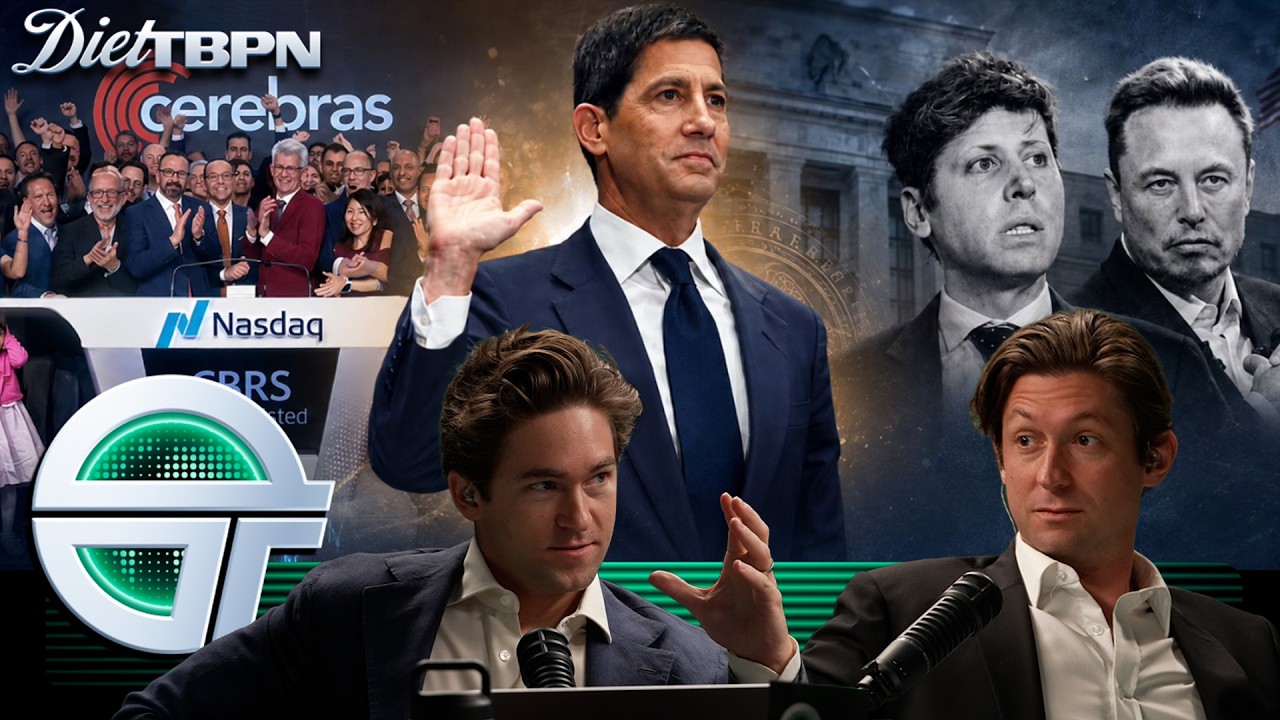
This video was published on YouTube by the channel TBPN on May 15, 2026. Diet TBPN is a condensed 30-minute version of the daily live tech talk show hosted by John Coogan and Jordi Hays, covering major tech, venture capital, and business stories.
## TL;DR
The episode breaks down Cerebras' massive IPO, which valuation-doubled to $64 billion while validating market demand for ultra-fast AI inference and wafer-scale chips despite underlying memory constraints. The hosts also cover Kevin Warsh's Senate confirmation as the 17th Federal Reserve Chair, public skepticism surrounding the autonomy of Figure's Helix 2 robot livestream, and the closing arguments in Elon Musk's $150 billion lawsuit against OpenAI and Microsoft. The broadcast wraps up with a lighthearted look at venture capitalist Tim Draper's 52-minute extreme cold plunge.
## Atmosphere & style
The show carries a fast-paced, banter-filled, and banter-heavy Silicon Valley insider vibe that blends sharp financial analysis with satirical comedy. Hosts John Coogan and Jordi Hays bounce effortlessly between technical AI deep dives and witty observations—joking about fake NYSE bell-ringing sets for course creators, VR-headset-wearing primates teleoperating robots, and Tim Draper's 'prison-style' cold plunge. The mood is conversational, lighthearted, and energetic, making complex market shifts and high-stakes courtroom drama feel accessible and highly entertaining.
## Key takeaways
- [00:03](https://www.youtube.com/watch?v=QPk38R7UaMc&t=3s) Cerebras debuted publicly at a $64B market capitalization, shattering prediction market estimates and doubling its pre-listing expectations.
- [03:53](https://www.youtube.com/watch?v=QPk38R7UaMc&t=233s) Cerebras overcame early doubts regarding manufacturing yields for wafer-scale chips by engineering redundant cores directly into the silicon.
- [03:53](https://www.youtube.com/watch?v=QPk38R7UaMc&t=233s) Real-world AI deployment shows enterprise clients willingly paying steep premiums for lower inference latency over absolute model intelligence.
- [10:03](https://www.youtube.com/watch?v=QPk38R7UaMc&t=603s) SRAM memory scaling limitations present long-term technical headwinds for Cerebras as AI models demand larger context windows.
- [10:03](https://www.youtube.com/watch?v=QPk38R7UaMc&t=603s) The AI ecosystem is projected to evolve into an 'orchestration age' where frontier reasoning models delegate ultra-fast execution tasks to rapid-fire hardware.
- [13:13](https://www.youtube.com/watch?v=QPk38R7UaMc&t=793s) Venture capitalist Pierre Lamond's early backing of Cerebras highlights the impact of individual conviction over firm brand names.
- [15:19](https://www.youtube.com/watch?v=QPk38R7UaMc&t=919s) Kevin Warsh was confirmed as the 17th Federal Reserve Chair in a tight 54–45 Senate vote, entering office amid complex stagflation pressures.
- [15:19](https://www.youtube.com/watch?v=QPk38R7UaMc&t=919s) Unlike previous crises managed by past Fed Chairs, Jerome Powell's tenure benefited from a structurally resilient baseline economy.
- [20:05](https://www.youtube.com/watch?v=QPk38R7UaMc&t=1205s) Figure sparked online skepticism over whether its Helix 2-powered autonomous humanoid robots were operating fully autonomously during an 8-hour shift.
- [23:43](https://www.youtube.com/watch?v=QPk38R7UaMc&t=1423s) Closing arguments wrapped up in Musk v. OpenAI, where Musk demanded over $150B in damages and a halt to OpenAI's for-profit conversion.
- [23:43](https://www.youtube.com/watch?v=QPk38R7UaMc&t=1423s) OpenAI's defense emphasized the lack of any formal, binding written contract governing Musk's early non-profit donations.
- [30:29](https://www.youtube.com/watch?v=QPk38R7UaMc&t=1829s) Venture capitalist Tim Draper generated online buzz with an intense 52-minute cold plunge for Draper University survival training.
## Detailed walkthrough
### [00:03](https://www.youtube.com/watch?v=QPk38R7UaMc&t=3s) Cerebras IPO Soars Past Expectations
The show opens with major news in the tech space regarding Cerebras, the chip design company famous for creating massive wafer-scale chips rather than cutting wafers down into smaller components. Their IPO went spectacularly well, effectively doubling the company's valuation overnight. Going into the public listing, expectations were far more modest—$50 billion was considered an optimistic prediction, and prediction markets didn't even have categories above $50 billion. However, Cerebras shattered those estimates, opening on its first day of trading at $350 per share before settling around $300, which pushed its market capitalization to a staggering $64 billion.
This explosive public debut capped off a relentless upward price trajectory in the days leading up to the listing. Early in the week, the expected price range was set between $115 and $125, before jumping to $150–$160 on Monday, and eventually soaring to $300+ upon trading. The hosts joke about the celebration culture surrounding modern tech milestones, suggesting someone should build a fake, studio-set version of the New York Stock Exchange bell-ringing station in Los Angeles—similar to the fake private jet sets used by influencers—where course-creators and mastermind gurus could hit a fake hammer with confetti flying everywhere before stepping out to their Lamborghini. This leads into a tangent about the evolution of experiential venues, specifically the Museum of Ice Cream, which went from a trendy, Instagram-bait concept with sprinkle ball pits to a global brand with seven locations.
- **Market Cap:** $64 billion at launch (settling around $300/share after hitting $350).
- **IPO Price Trajectory:**
- Initial range: $115–$125
- Revised range: $150–$160
- Trading day: $300–$350
- **Allocation:** Top 25 investors took 60% of the book (major institutional funds like Fidelity and State Street), leaving 1/3 of bidder order books completely empty.
---
[03:53](https://www.youtube.com/watch?v=QPk38R7UaMc&t=233s) Validating Wafer-Scale Chips and the Demand for Speed
Beyond the immediate market hype, the hosts dive into the fundamental business and architecture of Cerebras. Early in the company's lifecycle, there was significant FUD (fear, uncertainty, and doubt) surrounding wafer-scale engine (WSE) chips. Critics questioned whether the architecture would become obsolete if AI shifted away from transformers, and many believed manufacturing yields would be disastrous. On a traditional wafer cut into 64 chips, a single defect only ruins one chip; on a full-wafer chip, one defect could ruin the entire wafer. Cerebras overcame this by engineering redundant cores into the silicon, allowing them to bypass defective areas without sacrificing the whole wafer.
The market relevance of Cerebras is now proven, with their hardware powering models like OpenAI's Codex 5.3 Spark (via a major 750 MW deployment deal). Citing analysis from SemiAnalysis, the discussion shifts to user behavior in the AI economy: consumers and businesses have demonstrated a clear "revealed preference" and a willingness to pay a premium for inference speed and interactivity over raw intelligence. Using Anthropic’s Opus 4.6 Fast mode as an benchmark, users were willing to pay six times the price for less than double or triple the speed boost. While AI researchers like Andrej Karpathy have argued they would prefer smarter models running overnight, real-world enterprise adoption favors lightning-fast, zero-latency execution.
> "Opus 4.6 fast mode... famously charges six times the price for two and a half times the interactivity... You're paying six times the price for two times the speed... but companies are paying disproportionately more for faster inference."
- **OpenAI Deal:** 750 MW power/capacity deal utilizing Cerebras hardware to run models like GPT-5.3 Spark in Codex.
- **Latency Paradigm:** The host draws a parallel to the classic e-commerce metric where "every 100 milliseconds of latency costs Amazon 1% in sales," noting that slow AI streaming causes users to get distracted and abandon tasks.
---
[10:03](https://www.youtube.com/watch?v=QPk38R7UaMc&t=603s) Technical Bottlenecks: Memory Constraints and the Agentic Future
Despite Cerebras' success, SemiAnalysis highlights notable technical headwinds the company must address to remain competitive in long-term AI hardware. Cerebras chips currently face memory limitations, making it difficult to host massive parameters or network chips together in the same manner as Nvidia's NVL72 racks. Furthermore, modern AI workloads are demanding ever-larger context windows (far beyond 128K) to support complex agentic pipelines.
Because Cerebras relies on on-chip Static Random Access Memory (SRAM) rather than off-chip DRAM or HBM, scaling memory is difficult. SRAM is no longer scaling down efficiently with newer semiconductor nodes:
* **WSE-2:** 40 GB of SRAM memory.
* **WSE-3:** 44 GB of SRAM memory (only a 10% gain despite a full process node step).
To gain more memory on a single wafer, Cerebras would have to sacrifice compute area. However, the hosts predict a shift from the current "agentic age" to an "orchestration age." In this hybrid paradigm, massive, ultra-intelligent models (acting like a "senior vice president") will delegate fast, modular micro-tasks to rapid-fire hardware like Cerebras, much like web searches or database queries are handled today.
---
[13:13](https://www.youtube.com/watch?v=QPk38R7UaMc&t=793s) Venture History and the Confirmation of Kevin Warsh
The Cerebras narrative concludes with a look at its venture funding journey and investor dynamics. Venture capitalist Honam pointed out that the IPO highlights the power of individual partners over institutional firm brands: legendary investor Pierre Lamond (born in 1930, the same year as Warren Buffett) joined Eclipse at age 84 after stints at Sequoia and Khosla, backing Cerebras early and multiple times when other premier firms passed.
**Cerebras Valuation Progression over Time:**
- **2016 (Series A):** $100M valuation (backed by Benchmark and Eclipse).
- **2016 (Series B):** Led by Coatue.
- **2017 (Series C):** Led by Vy Capital.
- **2018:** $1.6B valuation.
- **2019:** $2.4B valuation.
- **2021:** $4.0B valuation.
- **2025:** $8.0B valuation (Andreessen Horowitz and Fidelity) -> $23B (Tiger Global).
- **May 2026 (IPO):** Listed at a $48.8B starting valuation before surging past $60B+.
The conversation then transitions to political and macroeconomic news: Kevin Warsh has been officially confirmed as the new Chair of the Federal Reserve. The hosts joke about Warsh's media legacy, specifically remembering his viral CNBC interview with Palantir CEO Alex Karp, where Karp famously popped a nicotine pouch and casually spun a notebook on his finger while discussing finance.
Here is the detailed, faithful walkthrough of the provided transcript section.
---
[15:19](https://www.youtube.com/watch?v=QPk38R7UaMc&t=919s) Kevin Warsh Confirmed as 17th Federal Reserve Chair
The hosts open by reflecting on a clip featuring Kevin Warsh visiting Alex Karp's office at Palantir. The hosts tease how Warsh keeps spinning his background, noting how funny it was when Karp yelled that "Kevin looks like the guy from IBM" before bringing up strict financial controls and product distribution. Turning to official news, the Senate confirmed Kevin Warsh as the 17th Federal Reserve Chair in a 54–45 party-line vote. This narrow margin highlights the immense political friction surrounding his appointment, particularly as he faces a Fed committee hesitant to pull off the aggressive rate cuts demanded by the White House.
The conversation shifts to economic theory and the complex nightmare of stagflation. The hosts point out that cutting interest rates heading into rising inflation and potential economic stagnation breaks traditional monetary policy playbook rules:
* **Standard Stagnation (Low Inflation):** Easy to fix by cutting interest rates to ignite the economy, taking on a little mild inflation as an acceptable trade-off.
* **Overheating Economy (High Growth & High Inflation):** Easily curbed by raising interest rates to cool down both GDP growth and inflation simultaneously.
* **Stagflation (Stagnant Growth & High Inflation):** The absolute worst case for a Fed Chairman, as lowering rates risks driving inflation out of control while raising rates further crushes economic activity.
Looking back at historic Fed Chairs, the hosts debate where Jerome Powell stands among all-time legends like Paul Volcker and Ben Bernanke. Powell was a rare bi-partisan "fan favorite," locking down over 80 Senate votes for each of his two terms. While Powell had high approval ratings, the hosts debate whether he truly deserves "GOAT" status. One host argues Powell never truly faced a structural existential threat like the 2008 Great Recession, the dot-com crash, or Black Monday. Though he steered the economy through the 2020 pandemic, the baseline US economy in 2019 was structurally sound with low debt and strong consumer balance sheets—meaning there was no hidden financial "bomb" waiting to detonate. The fallout from the Zero Interest Rate Policy (ZIRP) era mostly impacted Silicon Valley tech companies with long cash-flow horizons rather than causing systemic collapses. Conversely, producer Tyler argues that Powell’s flawless handling prevented a massive COVID-driven market crash, making his quiet competence look easy.
* **Senate Confirmation Vote:** Kevin Warsh confirmed 54 to 45 as Fed Chair.
* **Jerome Powell Senate History:** Received over 80 votes in favor during both of his Senate confirmation terms.
* **Historical Benchmark:** Ben Bernanke and Paul Volcker highlighted as gold-standard benchmark Fed Chairs due to the severity of the crises they managed.
---
[20:05](https://www.youtube.com/watch?v=QPk38R7UaMc&t=1205s) Jensen Huang in China and Figure's Helix 2 Autonomous Robot Controversy
The hosts take a brief detour to discuss Jensen Huang's trip to China, mocking a photo shared by Jason Calacanis showing Huang hauling two giant boxes of GeForce RTX 5090 graphics cards, which was actually taken from an old trip to Alaska. The hosts note that the shifting dynamics around NVIDIA H100 and Blackwell GPU sales remain in flux as the high-stakes US-China summit plays out on the front pages of the Wall Street Journal.
The main discussion pivots to a viral video posted by Figure founder Bret Adcock showing a team of humanoid robots running an 8-hour shift at human performance levels, running on their fully autonomous "Helix 2" neural network architecture. The 24-hour livestream blew up online, amassing over 3.4 million views. While the speed and dexterity were undeniably impressive, eagle-eyed viewers questioned whether the robots were truly autonomous or secretly teleoperated by human operators.
Specific odd behaviors sparked skepticism online:
* The robot occasionally missed targets by an inch.
* The robot reached up and touched its own head mid-task—an action that seemed to lack a logical explanation.
Bret Adcock defended the head-touching behavior, explaining that when the robot reaches across its body, it raises its hand upward to keep its limb out of its head-mounted camera sensor's field of view so it can scan the next package clearly. The hosts joke about a "third option" for teleoperation that technical reviewers might technically class as having "no human in the loop"—a giant orangutan or chimpanzee wearing a VR headset and puppeteering the robot via teleoperation, technically fulfilling the definition of non-human control.
* **Livestream Reach:** Figure's 24-hour robot livestream reached over 3.4 million views.
* **Neural Network Model:** Figure's Helix 2 runs as an in-house neural network operating entirely on board the hardware.
---
[23:43](https://www.youtube.com/watch?v=QPk38R7UaMc&t=1423s) Closing Arguments in Musk v. OpenAI & Microsoft Trial
The landmark legal battle between Elon Musk and OpenAI (with Microsoft dragged along) has reached its final day. Originally scheduled for four weeks, the high-stakes trial was cut down to just three weeks as closing arguments began. Prediction market Kalshi reflected the rapid shift: probability of Musk winning peaked at 58% on the 28th before dropping down to a 30% chance as closing arguments wrapped up.
Journalist Mike Isaac (humorously dubbed "the rat king" by the hosts) provided live commentary on the courtroom scene, calling out everything from poor audio/visual equipment failures to the visual battles over executive headshots. Musk's legal team displayed a mugshot-style photo of Sam Altman to paint him as an untrustworthy liar, while showing a polished Met Gala-ready portrait of Elon Musk. Conversely, OpenAI's legal team presented all their executives using bright, flattering "Olan Mills" style portraits.
```
+-----------------------------------------------------------------------------------+
| CLOSING ARGUMENTS SUMMARY |
+----------------------------------------------------+------------------------------+
| PLAINTIFF (Elon Musk's Legal Team) | DEFENDANT (OpenAI & Sam |
| | Altman's Legal Team) |
+----------------------------------------------------+------------------------------+
| • Paints Sam Altman & Greg Brockman as untruthful | • Musk's story isn't backed |
| executives getting rich off a charity. | by employees or family. |
| • Uses Larry Page as a foil who doesn't care about | • No binding, formal written |
| humanity versus "noble" Musk. | contract ever existed. |
| • Demands $150B+ in damages, Altman's removal from | • Claims Musk has no case |
| board, and a halt to for-profit conversion. | without explicit donation |
| | spending restrictions. |
+----------------------------------------------------+------------------------------+
```
OpenAI's lead counsel Sarah Eddy and William Savitt countered that Musk could not produce a single piece of evidence showing a binding agreement. No co-founder, employee, or witness—not even the mother of Musk's children—corroborated Musk's claim of an enforceable contract dictating how his original donations had to be spent.
The hosts also highlight the absurd technical difficulties inside the courtroom reported by Wired's Max Zeff:
* Musk's legal team brought a massive 36-inch monitor into the courtroom for their closing presentation.
* OpenAI's legal team asked to use the monitor, which Musk's team initially refused until the judge ordered them to share it.
* A comical standoff ensued when OpenAI realized they didn't have the right display adapters, prompting a crowd of 15 lawyers to huddle around trying to figure out how to plug in a laptop dongle.
* **Financial Damages Demanded:** Elon Musk is asking for over $150 billion in damages.
* **Governance Demands:** Legal action seeks to remove Sam Altman from OpenAI's board and stop the company's transition into a for-profit entity.
* **Trial Timeline:** Concluded after 3 weeks instead of the expected 4-week trial schedule.
* **Recurring Trial Running Joke:** OpenAI's early technical milestone beating professional teams in *Dota* (Defense of the Ancients) was mentioned almost every single day throughout the trial.
---
[30:22](https://www.youtube.com/watch?v=QPk38R7UaMc&t=1822s) Tim Draper Sets Pitching Speed Record
The segment finishes with a brief mention of legendary venture capitalist Tim Draper, who claimed on social media that he broke a personal record by taking 52 startup pitches in a single session.
[30:29](https://www.youtube.com/watch?v=QPk38R7UaMc&t=1829s) Tim Draper's Extreme Cold Plunge and the Setup Debates
The hosts react to a viral image and video featuring venture capitalist Tim Draper undertaking an intense cold plunge, claiming to stay in a tank for 52 minutes at temperatures below 40°F ($4.4^\circ\text{C}$) as part of Draper University "survival training." Discussing their own experiences with cold exposure, the hosts question the true difficulty and temperature of standard ice baths, noting that water below 45°F ($7.2^\circ\text{C}$) can be incredibly painful even when wearing a wetsuit while surfing. They compare Draper's extreme feat to podcaster Joe Rogan, whom they label "the final boss" and the "top of the mountain when it comes to ice baths" for allegedly plunging at 34°F ($1.1^\circ\text{C}$).
Examining the imagery, the hosts initially mistook the visual for an AI-generated image before realizing it was authentic. They express amusement at the remarkably gritty, improvised aesthetic of the setup, comparing it to a "prison ice bath" surrounded by piping, raw walls, and random trash bags. They joke about the stark contrast between this DIY rig and the lavish, palatial estates being acquired by billionaire tech figures like Mark Zuckerberg, marveling that a prominent billionaire investor like Draper chose to whip up an ice tank the old-fashioned way himself.
* **Tim Draper's Cold Plunge Record:** Spent 52 minutes in water below 40°F ($4.4^\circ\text{C}$) for Draper University survival training.
* **Joe Rogan Benchmark:** Cited as plunging at temperatures as low as 34°F ($1.1^\circ\text{C}$).
* **Perceived Aesthetic:** Described as looking like a "prison ice bath" surrounded by trash bags and piping rather than a luxury facility.
[32:12](https://www.youtube.com/watch?v=QPk38R7UaMc&t=1932s) Show Sign-Off and Call to Action
Wrapping up the daily broadcast, the hosts deliver their standard closing sign-off. They urge their audience to support the show by leaving five-star reviews on Apple Podcasts and Spotify and encouraging viewers to sign up for their newsletter at tbpn.com. They remind viewers that the live show streams weekdays at 11:00 a.m. Pacific Time before bidding everyone a good day.
* **Newsletter Sign-up:** Available at `tbpn.com`.
* **Streaming Schedule:** Live weekdays at 11:00 a.m. Pacific Time.
## Notable quotes
> [03:53](https://www.youtube.com/watch?v=QPk38R7UaMc&t=233s) Opus 4.6 fast mode... famously charges six times the price for two and a half times the interactivity... You're paying six times the price for two times the speed... but companies are paying disproportionately more for faster inference.
> [15:19](https://www.youtube.com/watch?v=QPk38R7UaMc&t=919s) Kevin looks like the guy from IBM — Alex Karp
## Mentioned
Cerebras, OpenAI, SemiAnalysis, Andre показа graph, Andrej Karpathy, Honam, Pierre Lamond, Eclipse, Sequoia, Khosla, Benchmark, Coatue, Vy Capital, Andreessen Horowitz, Fidelity, Tiger Global, Kevin Warsh, Alex Karp, Palantir, Federal Reserve, Jerome Powell, Paul Volcker, Ben Bernanke, Jensen Huang, NVIDIA, Jason Calacanis, Figure, Bret Adcock, Elon Musk, Microsoft, Sam Altman, Kalshi, Mike Isaac, Sarah Eddy, William Savitt, Max Zeff, Tim Draper, Draper University, Joe Rogan, Mark Zuckerberg, John Coogan, Jordi Hays, TBPN, Codex 5.3 Spark, Opus 4.6 Fast, WSE-2, WSE-3, Helix 2, GeForce RTX 5090, H100, Blackwell, Dota
Cerebras achieved a landmark $64 billion public listing powered by high enterprise demand for rapid inference hardware, while broader industry headlines were shaped by Kevin Warsh's contested confirmation as Federal Reserve Chair and closing arguments in Elon Musk's multi-billion-dollar lawsuit against OpenAI.
Cerebras Public Debut and Valuation Growth (0:03)
Cerebras surpassed public market projections during its initial public offering, opening trading at $350 per share before stabilizing near $300, delivering a $64 billion market capitalization. Pre-IPO expectations had placed an optimistic ceiling at $50 billion. The final pricing completed an aggressive upward revision schedule, rising from an initial range of $115–$125 to $150–$160 on Monday before surging at launch. Institutional demand was tightly concentrated: the top 25 institutional accounts, including Fidelity and State Street, captured 60% of the share allocation, leaving one-third of bidder order books entirely unfilled.
The public offering concluded a venture-funding arc that began in 2016 with a $100 million Series A round backed by Benchmark and Eclipse. Veteran investor Pierre Lamond joined Eclipse at age 84 to champion the firm's early and repeated rounds when other premier firms declined. Cerebras subsequently secured capital from Coatue and Vy Capital, reaching valuations of $1.6 billion in 2018, $4.0 billion in 2021, and rising from $8.0 billion to $23 billion in 2025 before listing at a $48.8 billion baseline in May 2026.
Inference Speed Economics and Memory Bottlenecks (3:53)
Cerebras validated its wafer-scale engine architecture by overcoming early manufacturing yield skepticism, utilizing redundant silicon cores to bypass localized defects across the wafer. Commercial traction is anchored by an expansive 750 MW computing deployment with OpenAI to run models like Codex 5.3 Spark. Citing findings from SemiAnalysis, enterprise adoption patterns reveal that customers place a massive premium on real-time inference speed over incremental gains in reasoning. Anthropic's Opus 4.6 Fast mode, for example, successfully charged six times standard pricing for a 2.5-fold increase in interactivity. While researchers like Andrej Karpathy advocate running slower, more deliberative models overnight, enterprise environments prioritize lower latency to avoid workflow abandonment.
Despite this momentum, Cerebras faces structural constraints in memory scaling. The architecture relies on on-chip Static Random Access Memory (SRAM) rather than off-chip DRAM or High Bandwidth Memory (HBM) setups like Nvidia's NVL72. Because SRAM density no longer scales efficiently with smaller process nodes, memory capacity grew only 10% between the WSE-2 (40 GB) and the WSE-3 (44 GB). Adding memory would require sacrificing compute real estate, pointing to an operational transition toward an 'orchestration age' where high-capacity frontier models delegate discrete, latency-sensitive sub-tasks to specialized hardware clusters.
Kevin Warsh Confirmed Amid Policy Friction (15:19)
The United States Senate confirmed Kevin Warsh as the 17th Chair of the Federal Reserve in a narrow 54–45 party-line vote. The divided confirmation highlights looming friction between monetary leadership and White House demands for aggressive interest rate cuts, particularly amid the policy trap of stagflation. In an environment of stagnant growth paired with high inflation, traditional monetary tools present severe trade-offs: easing rates risks compounding inflation, while raising rates threatens to depress economic output further.
The hosts contrasted Warsh's contentious confirmation with Jerome Powell, who secured over 80 bipartisan Senate votes across both of his terms. While historical chairs like Paul Volcker and Ben Bernanke were tested by systemic structural collapses, the hosts debated Powell's legacy. One perspective noted that the structural baseline of the US economy in 2019 was well capitalized, limiting post-pandemic rate shock primarily to Silicon Valley valuations rather than broader institutions. Conversely, producer Tyler credited Powell's decisive monetary interventions with quietly preventing an existential market catastrophe.
Musk-OpenAI Litigation and Robotics Scrutiny (23:43)
Closing arguments concluded in the legal battle pitting Elon Musk against OpenAI and Microsoft, wrapping up in three weeks rather than the anticipated four. Musk's counsel demanded over $150 billion in damages, the removal of Sam Altman from the board, and an injunction against converting OpenAI into a for-profit corporate entity, alleging that leadership enriched themselves using non-profit donations. OpenAI's defense team argued that Musk failed to demonstrate an enforceable, formal written contract or produce witnesses corroborating restrictions on his early contributions. Prediction market Kalshi showed Musk's implied win probability falling from a 58% peak down to 30% by the trial's close.
In concurrent robotics developments, Figure founder Bret Adcock showcased an eight-hour continuous shift featuring humanoid units running on its proprietary Helix 2 neural network, generating 3.4 million views. Viewers raised questions over potential human teleoperation after observing occasional target misses and robots touching their own heads during tasks. Adcock clarified that the head gesture was deliberate autonomy logic, ensuring robotic arms do not obstruct onboard camera sensors while scanning incoming items.
The broader technology landscape continues to navigate acute operational and regulatory tensions, seen in the hardware trade-offs between SRAM density and latency, the shifting probabilities in OpenAI's governance litigation, and the political pressures confronting monetary policy under a newly confirmed Federal Reserve Chair.
[0:06] Brandon Gorrell: literally up only
[8:52] 每增加 100 毫秒的延迟,亚马逊就会损失 1% 的销售额
[18:09] Tyler: 只要对手全场没有得分,观众就看不到惊险刺激的救球防守,因为他从一开始就把对方彻底防死了
[20:04] Jason Calacanis: never stop selling
[23:43] OpenAI 辩护律师: 甚至连为他工作的员工,乃至他孩子的母亲都无法为他的说法作证
[23:43] 马斯克代理律师: 这帮 OpenAI 高管富得流油且满嘴谎话
[23:43] OpenAI 辩护律师: 这些全都是博眼球的场外闹剧,马斯克提出的诉求根本没有任何现行法律依据支撑
[30:22] Tim Draper: 我在低于 40 华氏度的温度下,在 52 分钟内听完了 52 场创业推介。欢迎来到我的办公室。
Source quotes
[3:53] Opus 4.6 fast mode... famously charges six times the price for two and a half times the interactivity... You're paying six times the price for two times the speed... but companies are paying disproportionately more for faster inference.
[15:19] Alex Karp: Kevin looks like the guy from IBM
Original transcript
[0:03] [laughter]
[0:06] >> Uh there's a ton of news. Let's start
[0:08] with Cerebras. The IPO has gone
[0:10] spectacularly well. Cerebras doubled
[0:13] their valuation basically overnight.
[0:15] Brandon Gorrell had the
[0:17] good fortune of writing up some of the
[0:19] details of the Cerebras news in the
[0:22] newsletter today, tbpn.com. You can go
[0:24] sign up.
[0:24] >> Yeah, and right now it's sitting at a 64
[0:28] billion-dollar market cap. And a lot of
[0:31] the prediction markets, they didn't even
[0:32] have a category above 50, right? A lot
[0:34] of people were just kind of
[0:36] trading or or betting.
[0:38] >> And when I wrote the newsletter Friday,
[0:40] Monday, I I said a $50 billion IPO was
[0:43] sort of being optimistic and it beat
[0:46] those expectations, which is great news.
[0:48] Chip design company Cerebras, if you
[0:49] don't if you're not familiar, they make
[0:51] a big big chip, big chip company instead
[0:53] of
[0:53] >> The biggest chip.
[0:54] >> Instead of taking the wafer, putting a
[0:55] bunch of chips on it, cutting it up into
[0:57] a smaller chips, they use the whole
[0:58] wafer. It's genius idea. It's one of
[1:00] those simple ideas taken deadly
[1:02] seriously in some ways.
[1:05] But it's trading at $350 a share on its
[1:08] first day of public trading, which
[1:10] values the company much higher.
[1:11] >> Three 300 now.
[1:13] >> 300.
[1:14] >> Yeah.
[1:14] >> $300. Okay. The price in this IPO has
[1:16] been literally up only. On Monday, the
[1:18] price range was 150 to 160. Then they
[1:21] raised it That was up from 115 to 125.
[1:24] And today we're seeing, you know, much
[1:27] higher prices.
[1:27] >> to that picture. Someone should make a
[1:30] set in LA. You know they have those like
[1:32] fake private jet sets that
[1:34] >> [laughter]
[1:34] >> entrepreneurs
[1:35] Imagine if entrepreneurs could have
[1:36] [clears throat] a set where they put
[1:37] their logo in the background, like
[1:39] they're hitting it with a hammer and
[1:40] there's confetti going everywhere.
[1:42] >> Yeah, yeah, but it's for your course.
[1:43] >> Yeah.
[1:43] >> Yeah,
[1:45] and and you walk right from there
[1:47] to to the Lambo.
[1:48] >> 1,000 students in your mastermind.
[1:51] >> Yeah. No, I had this I had this idea
[1:53] back in the day when Do you remember the
[1:54] ice cream the ice cream museum, this
[1:57] whole thing?
[1:57] >> Oh, yeah.
[1:58] >> So, there were there there was this tre
[1:59] I mean, really bad news for the museum
[2:01] industry, but they're getting eaten
[2:02] alive. And so, some entrepreneurs, I
[2:04] think they did very well, started at
[2:06] something called the ice cream museum,
[2:07] which uh was not really a museum in the
[2:11] sense of like a presidential library or
[2:14] uh
[2:14] >> [snorts]
[2:14] >> you know, the the Norton Simon or the
[2:16] Getty or the you know, natural history
[2:19] museum. It was more of like an
[2:20] experiential place to go and hang out,
[2:23] good for first dates, good for you know,
[2:26] taking kids maybe. and they would maybe
[2:28] give you some ice cream, but most of the
[2:30] most of the museum was just like very
[2:33] Instagrammable things. So, there would
[2:35] be like a ball pit or a bunch of raining
[2:38] confetti and stuff. And uh huge a huge
[2:41] fabricated statue of ice cream that was
[2:43] not a piece of art that would be sold.
[2:45] Sprinkle ball pit. There you go. That
[2:47] sounds real. I don't know if that's is
[2:49] real, but it sounds very believable.
[2:50] >> No, they have
[2:51] >> They have that. Okay, yeah. And and
[2:53] there were a number of other kind of
[2:54] copycats that were trying to jump on and
[2:57] do like, "Oh, we'll do like the waffle
[2:58] museum or something or the pancake
[3:00] museum." You know, cuz they just wanted
[3:01] to cash in. And my idea was just the
[3:03] museum of Instagrammable objects. And
[3:06] so, it would have all of those. So,
[3:07] there would be a private jet set and
[3:08] then there would be a Lamborghini set.
[3:10] And this one would fit right in. So,
[3:12] it's just they have a big pink wall. So,
[3:14] you can go take the pink wall photo. And
[3:16] then there's a beach. And then there was
[3:17] a gym with fake weights. So, you could
[3:20] go and look like you're maxing out and
[3:21] benching 500 lb. And so, it just says,
[3:24] "Bring these clothes or we'll have them
[3:25] for you." And then you move from room to
[3:27] room taking the ideal dating profile
[3:30] photo. And
[3:31] Yeah, exactly exactly. Oh, you had kids?
[3:33] Here, you in the hospital. You can live
[3:35] an entire life through this fictional
[3:37] museum of Instagrammable objects. Uh
[3:40] more of a meme than a real business
[3:42] idea, but
[3:43] >> You know, John, the museum of ice cream
[3:46] now has uh seven locations.
[3:48] >> Okay, so they're cooking.
[3:49] >> They're global.
[3:49] >> They're global. They're They're doing
[3:51] well. Anyway, let's go back to the
[3:53] serious stuff. Cerebras, uh it's a
[3:55] complicated uh company because they are
[3:57] so deep in the AI supply chain, but
[3:59] we'll break it all down for you. So,
[4:00] there's a bunch of interesting
[4:01] takeaways, some really solid positives.
[4:03] Uh Cerebras chips work, which was
[4:05] something people were not expecting for
[4:07] a while. There was a lot of fud around
[4:08] this company, just the idea of like,
[4:10] "Oh, that'll never work. What if the
[4:11] architecture changes? What if we go away
[4:13] from transformers or something? What if
[4:15] we need something quote completely
[4:16] different?" Or maybe like the yields
[4:18] will never work because there was this
[4:19] idea that if you're using the entire
[4:21] wafer, typically as you're etching the
[4:24] chips onto the wafer, sometimes there's
[4:26] little defects. And it's not a problem
[4:28] if you're going to break up a wafer into
[4:29] like 64 chips cuz you just throw away
[4:31] one. But if there's one defect on
[4:33] basically every wafer, well, then your
[4:35] yield is going to be super low. We
[4:37] talked to Andrew about how he solved
[4:39] that by uh
[4:40] creating redundant cores, and they don't
[4:42] actually activate all the cores, and so
[4:44] they sort of built in that redundancy
[4:45] and got through that. But that was an
[4:46] early critique of the strategy.
[4:49] >> Uh so, they can use
[4:51] >> You can use it.
[4:51] >> use Cerebras chips today as
[4:54] >> In Codex, 5.3, Spark. Uh and so, they
[4:57] are very fast, and I think the most
[4:59] important thing that SemiAnalysis points
[5:01] out is that token consumers, customers,
[5:03] businesses have shown this revealed
[5:06] preference for and and a willingness to
[5:08] pay for speed. And they sort of
[5:09] contextualize it, and they quantify it
[5:11] based on their own usage and their
[5:13] experience with Anthropic's Opus models.
[5:15] So, Opus 4.6 fast mode famously I like
[5:19] that they use famously cuz it's like
[5:21] famous to like 100,000 people. But uh
[5:24] famously charges six times the price for
[5:28] two and a half times the interactivity,
[5:30] although it's now under two x faster.
[5:32] So, effectively, you're you're you're
[5:34] paying six times the price for two times
[5:36] the speed. That's uh that that's
[5:38] disproportionately more money for what
[5:41] you're getting. You would think you'd
[5:42] pay six times the price for six times
[5:44] the speed, potentially. Um but there
[5:46] were a lot of questions about would
[5:47] people really pay for more that much
[5:50] more for faster models, faster
[5:52] inference? And Andrej Karpathy, Sam
[5:54] Altman was was was saying like, "Do you
[5:55] want faster models or smarter models?"
[5:58] And uh he was like, "I think And Sam's
[6:01] point was sort of like the these models
[6:03] are very intelligent, but using them
[6:05] faster is
[6:07] sort of more of a magical superpower."
[6:09] And Sam was I I felt like Sam was sort
[6:11] of leading it towards like speed is
[6:12] really important as the next leg up on
[6:14] productivity. And Andrej Karpathy was
[6:16] like, "No, I just want smarter. I'll
[6:17] just let it run overnight. I don't mind
[6:19] that." But that's not what everyone is
[6:21] feeling. Some people, especially the
[6:23] semi-analysis team, leaned more towards
[6:25] interactivity or speed over raw
[6:28] intelligence power.
[6:29] >> Well, yeah, and then there's the
[6:31] other aspect, which is just capability.
[6:33] Capability, speed, and intelligence.
[6:36] That's like the question people have had
[6:38] is like, "Okay, what is Is there a 250
[6:42] IQ model, or is there just a much more
[6:44] capable model?"
[6:45] >> Yeah, the unhobbled one.
[6:46] >> tools more efficiently and is really
[6:48] quick?
[6:48] >> Yeah. And that's actually important to
[6:50] Cerebras. Semi-analysis was spending 80%
[6:52] of their AI spend on Opus 4.6 fast, and
[6:56] so they were willing to pay that 6x,
[6:58] like 80% of their spend,
[7:00] disproportionately more, even though
[7:03] when their sort of expectation as they
[7:05] put it was that they would always want
[7:06] the smartest model. They would
[7:08] they would they would be very
[7:09] cost-conscious. They were in reality
[7:12] saying, "I'm going to hammer fast mode.
[7:13] I want to spend on fast mode." And then
[7:15] I think the price was significant, and
[7:17] so there's probably sort of a
[7:18] renegotiation about when is the right
[7:20] time to use fast versus when do you want
[7:22] to leave something running overnight?
[7:23] But OpenAI is clearly very peeled on
[7:26] Cerebras. Cerebras has a big 750 MW deal
[7:29] with OpenAI, and the chips are already
[7:30] serving GPT 5.3 in Codex under the name
[7:33] Spark, as we mentioned. And I've used
[7:35] it, you should use it. It's a very
[7:37] interesting experience because I think a
[7:39] lot of people have interacted with LLMs
[7:40] and chatbots, and they're sort of used
[7:42] to this token streaming in. It's sort of
[7:44] cute because the phone vibrates, and it
[7:46] and it feels like you're talking to
[7:48] someone who's typing, but it's way
[7:50] better when you just land on a Wikipedia
[7:51] page, the whole thing loads, and you can
[7:52] just scroll however you much you want.
[7:54] And that's the experience that I think
[7:55] people want and will demand across
[7:57] everything, especially if they're firing
[7:59] off a coding task. They just want the
[8:00] code immediately. You can also just go
[8:02] talk to the model like it's ChatGPT. You
[8:04] don't need to use Codex 5.3 Spark in a
[8:06] coding context. You can ask it whatever
[8:08] you want, and it will act like a normal
[8:11] LLM. I personally think there will be
[8:13] huge demand for faster inference across
[8:15] all parts of the AI economy. There's
[8:17] this old
[8:18] >> Yeah, another another way to think about
[8:20] it is like if you have two employees
[8:22] with the same skill set, the same
[8:24] capability, but one is just five times
[8:27] faster, right? That person can create
[8:30] way more value in the organization,
[8:32] right?
[8:33] >> And for a lot of things, if they're if
[8:34] they're two times faster, they do
[8:37] command six times the price. A sales rep
[8:38] that that that sells twice as much, or
[8:42] someone who's twice as effective as
[8:43] their job, might actually command a
[8:45] salary that's five times, six times
[8:47] the the actual price. And so, there's
[8:49] lots of other contexts across different
[8:52] business lines that you could draw to.
[8:54] There's also this old adage or saying
[8:57] about e-commerce that might may or may
[8:59] not be real, but it's probably been
[9:00] transposed so many times in think
[9:02] pieces. I don't know the real quote, but
[9:03] it goes something like every 100
[9:05] milliseconds of latency costs Amazon 1%
[9:09] in sales. I don't know if that's the
[9:11] right the way to think about it, but
[9:12] basically as Amazon was scaling, they
[9:14] realized that there were a bunch of
[9:16] things that they could do on the UI
[9:17] side, a bunch of things they could do on
[9:18] the layout side. Where does the buy
[9:20] button go? Where does certain
[9:22] information go? The price, the discount,
[9:24] all of this stuff, the images. They they
[9:26] were tweaking the front end, but as they
[9:27] did that, they added bloat, and the
[9:29] pages would slow down. And what they
[9:30] noticed was that the slower the page
[9:33] was, the lower the conversion rate
[9:34] because people were waiting for
[9:36] amazon.com to load, click on the page,
[9:38] it takes a second, they get distracted,
[9:40] they go somewhere else. And I think that
[9:42] that's happening in LLM use cases all
[9:44] over the place. People fire off a query
[9:46] and they're like, "Ah, it's taking too
[9:47] long. I'll go scroll Instagram Reels."
[9:48] There's always an Instagram Reel. And
[9:50] they'll be like, "Ah, I for- kind of
[9:51] forgot about what I was asking about. I
[9:53] didn't get my answer." And that's
[9:54] certainly true in business context as
[9:56] well. This is currently playing out in
[9:57] AI inference. Uh companies are paying
[9:59] disproportionately more for faster
[10:00] inference, and this is good for
[10:01] Cerebras. But SemiAnalysis does point
[10:04] out a number of potential headwinds and
[10:06] problems that the team at Cerebras will
[10:08] have to solve or contend with over the
[10:10] next few years. Uh mainly, Cerebras
[10:13] chips are not currently as capable of
[10:16] holding larger models in the limited
[10:19] memory that they have or networking
[10:20] multiple chips together to serve larger
[10:23] models. We've heard about the NVL72
[10:25] racks that wire a whole bunch of Nvidia
[10:27] chips together can serve these really
[10:29] large models. Uh that has potentially be
[10:32] been a challenge. So, SemiAnalysis says,
[10:34] "Moreover, the industry is tending
[10:36] trending towards larger context windows
[10:40] ad infinitum. 128K context will
[10:43] certainly not be acceptable for long,
[10:45] especially with the prevalence of
[10:47] agentic workloads. And it doesn't look
[10:49] like there's a simple solution of just
[10:51] scaling the wafer size larger because
[10:52] TSMC is set up with a standard wafer
[10:54] size or adding more memory to the
[10:56] existing architecture because Cerebras'
[10:59] whole design depends on a lot of SRAM,
[11:03] static random access memory, directly on
[11:05] the on the wafer. But SRAM is no longer
[11:07] shrinking as much with each new
[11:09] semiconductor node. So, the last version
[11:12] of the Cerebras chip, they've done WSE1,
[11:14] 2, and 3. They're on 3 now. But WSE2 had
[11:18] 40 gigs of memory. WSE3,
[11:21] you would expect, "Oh, we want a
[11:22] doubling, right? We want a we want a 10x
[11:24] or something." Uh it got 44. So, a 10%
[11:27] increase over one process node, one
[11:30] iteration. Is there an easy way to
[11:33] double this? Is there question like how
[11:35] will this scale as the models get bigger
[11:38] to add more SRAM? You might have to
[11:39] sacrifice compute area because
[11:41] everything is being done on one wafer.
[11:43] If you want computation or memory,
[11:46] there's a direct trade-off because you
[11:47] only have so much space on the actual
[11:48] wafer. But in an agentic workflow, I
[11:52] think it's
[11:53] entirely possible that you want like the
[11:54] biggest, most powerful model, like the
[11:57] vice president delegating things that
[12:00] you want the vice president to handle
[12:01] >> Senior or junior?
[12:02] >> Senior vice president. Uh maybe just the
[12:04] president uh handling the critical work.
[12:08] Uh so future models might not And that
[12:09] might not be on Cerebras, that might be
[12:11] on NVL-72 or TPUs or something. But uh I
[12:15] imagine that we will quickly jump from
[12:17] the agentic age where you're firing the
[12:19] best, smartest model at the full
[12:21] workload to the orchestration age where
[12:24] and there will be hybrid approaches. So
[12:26] the biggest and best models will
[12:27] delegate certain tasks to smaller,
[12:29] faster models, just like they go and do
[12:31] database queries these days. Or they go
[12:33] and search the web these days and that's
[12:34] CPU bound. There will be certain
[12:37] workloads that the larger, smarter agent
[12:40] model, like the boss model, can sort of
[12:42] delegate to the Cerebras speed workers,
[12:45] the faster workers. A year or two ago
[12:47] when uh Daniel Gross wrote AGI bets and
[12:50] was sort of like is Nvidia underpriced.
[12:52] I don't know if Nvidia He's managed to
[12:53] say that on on on Stratechery, but you
[12:56] know, we we entered the AI age and
[12:57] everyone was like, "Oh, GPUs are the
[12:59] future. Nvidia is the company." But then
[13:01] it was like Nvidia GPUs are good and
[13:03] then also CPUs are good. And and Arm is
[13:06] getting into it and Intel's doing very
[13:08] well. And it it worked out that
[13:10] >> big computers.
[13:11] >> Big computers. Big computers, for sure.
[13:13] Honam says, "This IPO illustrates the
[13:15] power of an individual partner over the
[13:17] brand name of the firm. Pierre Lamond
[13:19] was a partner at both Sequoia and
[13:21] Khosla, but instead of those firm
[13:22] backing Cerebras, it was Eclipse, the
[13:24] firm he joined at the age of 84, that
[13:28] this little known chip company multiple
[13:29] times in the early days. What a way to
[13:31] wrap up a career. He was born in 1930,
[13:33] the same year as Warren Buffett.
[13:35] >> Wow.
[13:36] >> That is an awesome story. I love that.
[13:38] 1/3 of the order book, the folks that
[13:41] said I want shares in the Cerebras IPO,
[13:44] 1/3 of the book got zero. I guess the
[13:46] top 25 investors took 60%. That's
[13:48] probably the big investment funds, the
[13:51] Fidelity's, the State Street's, the
[13:53] >> They have done quite well today.
[13:56] This picture looks wildly different than
[13:59] the Klarna IPO last year in which only a
[14:03] handful of the team at Klarna popped
[14:05] over, hit the NYSE IPO'd, went back back
[14:08] home.
[14:09] >> Yeah, it was very much just like another
[14:11] day at the office for the team.
[14:14] Yeah, that's definitely what I was
[14:15] contrasting it to. The Cerebras
[14:16] valuation every round, series A in 2016,
[14:19] $100 foundation, Benchmark and Eclipse.
[14:22] Coatue led the series B in 2016. VY
[14:25] Capital led the series C in 2017. Then
[14:29] 1.6 billion valuation in 2018, 2.4 in
[14:33] 2019, 4 billion in 2021. That was like
[14:36] maybe a little bit of a slump, but then
[14:38] 2025, Andreessen Horowitz and Fidelity
[14:39] come in at 8 billion. Then Tiger
[14:41] >> comes in at 23 billion dollars.
[14:45] >> Then in May of 2026, they IPO
[14:49] 48.8 billion. Let's run through
[14:53] the Kevin Warsh news because he has been
[14:56] confirmed as the Fed chair. Kevin Warsh
[14:59] who is most famous for interviewing Alex
[15:03] Karp on CNBC
[15:06] while Alex Karp appeared to have popped
[15:08] a nicotine pouch and then spun a
[15:10] notebook on his finger. Did you ever
[15:13] find that clip, Tyler? Is that in the
[15:14] >> Yeah, it should be
[15:15] >> Okay.
[15:16] Let's
[15:17] >> Yeah, we have the the video here from
[15:19] >> really put Kevin Warsh on the map.
[15:22] >> I remember I showed up in your office
[15:23] once. I was dressed like this and I
[15:25] think you screamed at one of the guys.
[15:26] You said, "Kevin's here. He looks like
[15:28] the guy from IBM." And I was talking
[15:30] about, well, you know, we need like
[15:31] really finance controls and you know,
[15:34] how you're going to sell the product and
[15:36] all this stuff.
[15:37] >> Okay.
[15:37] >> But I would say you certainly built that
[15:40] as
[15:40] >> He's really spinning it. I didn't
[15:41] realize he goes back to it like four
[15:43] times and he keeps spinning it.
[15:45] He's really good at this.
[15:46] >> But somehow you grafted that on to the
[15:48] to to the strange company that can
[15:50] produce these products. How's that
[15:51] transition been if I've got it right?
[15:53] >> I have so many questions.
[15:55] >> [laughter]
[15:55] >> First, we have to get him to recreate
[15:57] that for sure. Second,
[15:59] I I thought Tyler, I thought we were
[16:01] talking about that being on CNBC, but
[16:02] that looks like just a podcast. Like
[16:04] that doesn't have any Chiron or
[16:05] >> Yeah, no. I I don't think it was
[16:06] actually on. I think it was from
[16:07] Palantir. Like that was a Palantir
[16:09] >> Oh, okay. So, it was just like a random
[16:10] podcast. And then and then I when I've
[16:12] seen it on CNBC, they were playing the
[16:14] clip. Got it. Okay.
[16:16] >> I think so, yeah.
[16:16] >> The vote was 54 to 45 in the Senate. The
[16:20] divided vote signals challenges ahead
[16:22] for Warsh who faces a Fed committee
[16:24] skeptical of rate cuts that Trump has
[16:27] demanded. And of course, we talked about
[16:28] the inflation news. Typically, you don't
[16:31] cut interest rates going into inflation
[16:33] and potentially economic stagnation.
[16:36] You definitely don't cut rates in That's
[16:39] why stagflation is so difficult because
[16:41] if you have stagnation and low
[16:44] inflation, you can cut rates very
[16:45] easily. Maybe the economy starts
[16:48] overheating a little bit. You get a
[16:48] little bit of inflation, but then you
[16:49] can pull back. That's what we've done
[16:51] historically. Vice versa, if the
[16:53] economy's running hot, you're seeing
[16:54] high GDP growth and high inflation.
[16:57] Well, if you raise rates, you're going
[16:59] to pull back on both of those. But in
[17:00] stagflation, you're seeing both
[17:02] inflation and
[17:03] economic stagnation, harder to deal with
[17:06] as a Fed chairman, which is potentially
[17:08] the task he will be faced with. So,
[17:10] the Senate confirmed Kevin Warsh as the
[17:12] Federal Reserve's 17th chair Wednesday
[17:15] in a largely party line vote that
[17:17] require that reflected the how tensions
[17:19] with the White House have dragged the
[17:20] Fed deeper into the political fray. I
[17:23] was looking back at the old Fed chairs.
[17:25] There's some absolutely legends in there
[17:28] cuz some of them have really long runs.
[17:29] So very quickly you get back to the
[17:31] black and white portrait and the
[17:32] painting as you go back in time.
[17:34] >> Who's your favorite Fed chair?
[17:35] >> Mhm.
[17:36] >> Volcker?
[17:37] >> Yeah, Volcker is pretty good. And
[17:39] Bernanke is pretty good.
[17:40] >> dog.
[17:41] >> Yeah, I don't know. Hard to pick. Hard
[17:42] to pick. Chair Jerome Powell, whose
[17:44] leadership tenure whose leadership
[17:46] tenure ends Friday captured at least 80
[17:49] votes in Senate confirmations for each
[17:51] of his two terms at top of the Fed. Wow,
[17:53] Jerome Powell just fan favorite of both
[17:57] teams. 80 votes in the Senate. That's
[17:59] pretty significant. I'm putting him in
[18:01] the conversation Jordyn, but I'm not
[18:03] giving him the goat trophy. Uh
[18:05] >> Yeah, I'm not saying I'm not saying
[18:06] that.
[18:07] >> the the challenges faced he wasn't
[18:09] confronted with a great recession, a
[18:11] dot-com bubble bursting, a
[18:14] uh a Black Friday. Uh he like he he like
[18:17] the economy from 2018 to today
[18:20] >> Global pandemic doesn't you don't you
[18:22] don't count a shutdown of
[18:24] >> No, because No, no, no. I I I I actually
[18:27] don't because the economy was pretty
[18:30] strong in 2019 and it went into it went
[18:33] into 2020 with uh pretty strong consumer
[18:36] balance sheets, low debt. There wasn't a
[18:39] shadow banking economy. There was no
[18:41] bomb in the US economy waiting to
[18:43] explode. And so although we saw high
[18:47] unemployment briefly and we did have to
[18:49] stimulate the economy, that's not his
[18:51] job. His job was to set rates. There was
[18:53] a little bit of like the I mean maybe
[18:55] you put the inflation, you know, this
[18:58] the end the ZIRP era and the end of the
[19:00] ZIRP era and all of those gyrations on
[19:02] him, but those the problems that were
[19:04] downstream of both the ZIRP era and the
[19:06] end of the ZIRP era were suffered mostly
[19:10] and benefited mostly on like tech
[19:12] companies and Silicon Valley companies
[19:13] that had really long cash flow horizons.
[19:16] And so there was not a moment where it
[19:18] was a dire situation that the Fed had to
[19:22] intervene in a meaningful way and like
[19:24] save the economy like in 2008. It it
[19:27] it's a big deal. He did great job, but
[19:29] he didn't he wasn't faced with the same
[19:31] challenges of a Bernanke, for example.
[19:34] That's what I would say. Tyler, what do
[19:35] you think?
[19:36] >> Yeah, I think that
[19:37] that's reasonable, but also like if
[19:39] Powell was worse at his job and he saw
[19:40] some crazy crash because of COVID and
[19:42] then he brought it back. Like then it'd
[19:44] be like, oh yeah, he did face this
[19:45] massive thing. But because he did, you
[19:47] know, such a good job, maybe you didn't
[19:49] see any like massive crash. Nothing
[19:51] super bad happening is evidence that he
[19:52] was really good as a Fed chairman.
[19:54] >> Uh yeah, yeah, maybe. He's a defensive
[19:57] back. Uh you you know, if they don't
[19:59] score, you there's no great plays cuz
[20:01] he's just shut down shut down
[20:03] cornerback. Anyway, Jensen Huang is over
[20:05] in China. Jason Calacanis has a photo
[20:08] that looks
[20:09] uh extremely real, zero AI detected, but
[20:12] he's bringing two huge boxes of GeForce
[20:14] RTX 5090s, which are
[20:15] >> This is a picture from when he was in
[20:16] Alaska, too.
[20:18] >> [laughter]
[20:19] >> Uh Jason says never stop selling. I I
[20:22] agree. Uh there is some news, which we
[20:24] will cover later uh in the week around
[20:27] uh the dynamics around H100 sales uh and
[20:30] Blackwell's what's actually happening.
[20:31] It's all in flux as the Trump China
[20:34] summit uh plays out on the front page of
[20:38] the Wall Street Journal every day this
[20:39] week cuz it is headline news.
[20:41] High-stakes US-China summit kicks off.
[20:44] Watch a team of humanoid robots running
[20:47] a full 8-hour shift at human performance
[20:50] levels. And Bret Adcock said this is
[20:52] fully autonomous running Helix 2.
[20:55] >> All right, pull up pull up this post
[20:58] from Pete.
[20:59] >> Yes. And the the stream did
[21:01] fantastically. It was 24 hours, it got
[21:03] 3.4 million views. But at a certain
[21:06] point during the stream, there was some
[21:09] questions about whether or not the
[21:11] humanoid robot was in fact
[21:13] >> to the beginning. Back to the beginning.
[21:15] >> Okay. Let's play this.
[21:17] >> All right. So, it's cooking. I mean, the
[21:18] speed is actually insane.
[21:19] >> were extremely impressed by this. This
[21:21] was remarkable. Remarkable.
[21:22] >> Even if it's teleoperated, it's
[21:24] extremely impressive.
[21:25] >> Yeah. Yeah. Yeah. Like, the robot's
[21:26] clearly working. This is very very
[21:28] >> But, they're saying that it's not
[21:29] teleop.
[21:29] >> Okay. So, then the robot starts missing
[21:31] things, being a little bit like an inch
[21:33] off, and then reaches up and touches the
[21:35] robot's head. The robot, which is
[21:38] something that wouldn't normally be
[21:39] necessary. It doesn't have like a
[21:40] logical explanation or conclusion. And
[21:43] so, a lot of people are asking
[21:44] >> It does have a semi-logical conclusion,
[21:47] which is that Brett is claiming when it
[21:49] reaches across its body to go to the
[21:52] right that it puts its hand up here to
[21:54] get the hand out of the way.
[21:55] >> That's what I was thinking, was that if
[21:56] the hand is is halfway up,
[21:59] >> To go back to the beginning.
[22:00] >> the sensor, the camera sensor. And so,
[22:03] even though you like you might the robot
[22:04] might reach the hand up further to move
[22:07] out of the view, so that the robot can
[22:09] look at the next package. So, that's one
[22:13] possible explanation. But, a lot of
[22:15] people are asking even harder questions,
[22:19] saying that potentially was there a
[22:21] human in the loop? Was this
[22:23] teleoperated, which is something Brett
[22:26] has said it's fully autonomous. I feel
[22:28] like that means no humans in the loop,
[22:30] but TORC Robotics has an artist's
[22:33] representation of Helix 2 figures
[22:35] in-house neural network running entirely
[22:37] on board. And it, of course, is a human
[22:41] in a VR headset. Very
[22:44] very debatable. We'll let We'll We'll
[22:46] see where you stand. But, there is There
[22:48] is a third option, which I have shared,
[22:51] which is potentially no humans involved.
[22:55] I don't know if you'd call it
[22:56] autonomous, but you would call it no
[22:58] humans in the loop.
[23:00] >> Because you have
[23:01] >> Well, it is an autonomous system, right?
[23:03] It just sort of runs.
[23:04] >> Yeah, I would I would consider this
[23:06] autonomous. It's the It's the image that
[23:08] I shared in the production chat. It's
[23:10] not of a human, and it's not quite
[23:12] robotic, but there's no human in the
[23:14] loop. And so, this could explain the
[23:16] system is running with no humans in the
[23:18] loop. If you make that claim, and you
[23:20] follow this,
[23:21] I think this qualifies as no humans in
[23:23] the loop. If you have a giant orangutan
[23:25] in a VR headset puppeteering the robot
[23:28] via teleoperation, you could say that
[23:30] this system is does not have a human in
[23:33] the loop, and you could make that claim.
[23:34] >> And I could make the argument that it's
[23:36] autonomous. The chimpanzee is running
[23:38] its own It has somewhat of a neural
[23:40] almost like a neural network. [laughter]
[23:43] >> The OpenAI Elon Musk trial is in its
[23:46] final day. The trial is ending. People
[23:49] expected 4 weeks of trial. We only got
[23:51] three. They're cutting it short. Uh what
[23:54] are the prediction markets saying about
[23:56] who's going to win? I want to know that,
[23:58] and I want to go to Mike Isaac, the rat
[24:00] king, because he has a breakdown of
[24:02] what's going on. He says, "Good morning.
[24:04] Closing arguments of Musk versus OpenAI
[24:06] with special guest Microsoft are
[24:09] happening today.
[24:10] >> The Cal sheet, will Elon win his case
[24:12] against OpenAI? It peaked at a 58%
[24:16] chance.
[24:16] >> Okay.
[24:16] >> On the 28th, it's now sitting at 30%
[24:19] chance.
[24:19] >> 30% chance. Okay. Uh so, right now, the
[24:22] judge is instructing the jury on the
[24:23] criteria by which they should be judging
[24:26] the outcome of the case. Important,
[24:27] because if the jury listens and carries
[24:29] this out, it is a very, very specific
[24:30] lens through which they view all the
[24:32] evidence. Ostensibly, it's where theater
[24:34] ends. Listening to this and being read
[24:36] out in court in the for last 23 30
[24:38] minutes is very helpful, because it's
[24:39] clarifying on how high the bar is for
[24:42] the plaintiff's side of proving some of
[24:44] these claims.
[24:45] Uh sort of feel bad for the AV guy
[24:47] during this trial. There's been
[24:48] feedback, been mic drops, but not in the
[24:51] good way. The mics have been dropping
[24:52] out, vonky video feeds. They need to
[24:54] revamp this place, says Mike Isaac.
[24:56] LMAO, the first joke of the tweet storm.
[24:59] He says Musk counsel is going after
[25:01] OpenAI execs, Altman and Brockman, and
[25:03] has the mugshot style photo of Altman on
[25:06] the screen again. Battle of Photoshops
[25:09] of executives in this trial has been
[25:10] entertaining to watch. You want to
[25:12] depict your opponent in and the worst
[25:15] possible light. Musk counsel going back
[25:17] and forth hammering the point they made
[25:18] over and over. The argument essentially
[25:21] painting a picture Sam Altman, liar.
[25:23] Chipping away at witness credibility has
[25:24] been core strategy for the plaintiff
[25:26] side. And we're back [snorts] to
[25:27] everyone hates Google again. Molo is
[25:30] using Larry Page who they claim doesn't
[25:32] care about humanity as a foil to the
[25:34] noble Musk who only who's only care with
[25:37] respect to AI is the future of humanity.
[25:39] Musk counsel is painting the don't don't
[25:41] trust Sam picture in a bit more detail
[25:43] for the jury. Also Musk's side has a
[25:46] picture of Elon and Altman on the screen
[25:47] now. Sam's looks like he's about to be
[25:49] processed by a US Marshall. Musk's
[25:51] looked like he's getting ready for the
[25:52] Met Gala. LOL. Lots of Musk closing side
[25:55] arguments semi-populist track of
[25:57] pointing open pointing at OpenAI and
[25:58] saying these billionaires are making
[25:59] gobs of cash while running a charity for
[26:01] the supposed good of the world. I'm
[26:03] curious if jury can register this
[26:05] argument even if it comes from Elon
[26:06] Musk, the world's richest man. Ouch.
[26:08] OpenAI counsel begins closing argument
[26:10] with a broadside against Musk. Every
[26:12] even the people who work for him, even
[26:13] the mother of his children can't back
[26:15] his story. Oh yeah, back to the war of
[26:18] the Photoshops. OpenAI closing remarks
[26:20] now in in the digital displays in the
[26:22] monitors for exhibits, all the OpenAI
[26:24] executives look like Olan Mills
[26:26] photoshoots. Do you know who Olan is he
[26:28] says it's complimentary. I need to get
[26:30] up to speed on my photographers. Olan
[26:33] Mills
[26:33] >> Olan Mills is a portrait offers portrait
[26:36] photography.
[26:37] >> Ooh, it does look very nice if you pull
[26:39] up the the Google images on Olan Mills.
[26:42] Anyway, short summary of the closing.
[26:43] Musk camp, all these OpenAI executives
[26:45] are rich as hell and lying all the time.
[26:47] OpenAI camp, all of that is a side show
[26:49] and literally all the claims Musk is
[26:51] bringing cannot be stood up by actual
[26:53] law, the Microsoft camp disappears into
[26:55] bushes. Dota got mentioned again.
[26:58] >> [laughter]
[26:58] >> They love mentioning Defense of the
[27:00] Ancients. Incredible Photoshop from the
[27:02] OpenAI camp of a calendar of events
[27:04] complete with little characters and a
[27:06] timeline of events. I wonder if they're
[27:07] using ImageGen too.
[27:09] Or if they're doing it the old-fashioned
[27:10] way. I can't wait until it's entered
[27:12] into evidence this afternoon so he can
[27:14] show us.
[27:15] Sort of want to buy this meme guitar,
[27:18] but I also have two telecast is that a
[27:20] completely side side note.
[27:22] Gamer has entered the blog. The Dota
[27:25] moment has been mentioned [laughter]
[27:26] nearly every single day during this
[27:28] three-week trial. AI researcher, we got
[27:30] to have Mike back on the show. So good.
[27:33] So it was a true breakthrough in the
[27:34] technology.
[27:35] >> What what is the timeline for the jury
[27:38] to meet?
[27:38] >> Okay.
[27:39] >> Are they Is this
[27:40] something they're doing today?
[27:42] >> a 30-minute recess, most they've had in
[27:44] a month. I might actually be able to go
[27:46] outside and get real food. There's a
[27:47] Popeyes across the street. Is it a bad
[27:50] idea to get a bucket of red beans and
[27:51] rice? That's what he's thinking about
[27:52] doing. So [laughter] not much news on
[27:56] when this will close. It is 1:10 Pacific
[27:59] time. I imagine that they will wrap up
[28:02] by What did he say? 3:00 p.m.? 4:00
[28:04] p.m.? So 30-minute break, that happened
[28:07] 40 minutes ago.
[28:08] So I imagine that and
[28:10] >> But they've been taking Fridays off is
[28:12] kind of what I'm getting at.
[28:13] >> Oh, yeah.
[28:14] >> Because this could very
[28:15] >> this happens on Monday. This is just
[28:17] closing arguments, not necessarily the
[28:18] end of the trial.
[28:20] >> Or the jury
[28:21] >> might get the results.
[28:21] >> Or the jury might might make a quick
[28:24] call, but
[28:25] >> Well, there was an update
[28:26] >> unlikely.
[28:27] >> 11 minutes ago. A lawyer for OpenAI on
[28:29] Thursday defended the company's chief
[28:30] executive Sam Altman from withering
[28:31] character attacks by Elon Musk's legal
[28:33] team as both sides delivered their
[28:34] closing arguments in a trial with
[28:36] potentially seismic implications. The
[28:38] stakes are high. Mr. Musk, who was not
[28:41] in the courtroom on Thursday because he
[28:43] was in China with President Trump, is
[28:45] asking for more than $150 billion in
[28:47] damages. He is also asking the court to
[28:49] remove Mr. Altman from the startup's
[28:51] board and to stop a shift the company
[28:53] made last year to operate as a
[28:54] for-profit company. They pushed back.
[28:56] Sarah Eddy, member of OpenAI legal team,
[28:58] tried to in her closing argument to dull
[29:00] the attacks on Altman's credibility and
[29:02] to argue that there was never a firm
[29:04] agreement among the founders that could
[29:05] have been breached, not one in this case
[29:07] other than Elon Musk has testified to
[29:10] any commitments or promises that Sam
[29:12] Altman or Greg Brockman or OpenAI made
[29:14] to Mr. Musk is what she's saying. After
[29:16] the recess, William Savitt, OpenAI's
[29:18] lead counsel, told the jury that Musk
[29:20] does not have a claim against the
[29:21] startup unless there was a specific
[29:23] agreement between Musk and OpenAI
[29:26] describing how his donations to the
[29:28] nonprofit should be spent. That
[29:30] agreement does not exist, Savitt said.
[29:33] So, that's where, I guess, OpenAI is
[29:34] leaving it for now.
[29:36] We will continue to cover the story as
[29:38] it evolves.
[29:39] >> the jury allowed to use Codex {slash}
[29:41] gold in
[29:42] >> [laughter]
[29:43] >> 1 and 1/2 hours?"
[29:44] >> There's other tech problems going on.
[29:46] Max Zeff over at Wired has been covering
[29:48] the story as well and says Musk's lawyer
[29:51] brought a big monitor, maybe 36 inches
[29:54] into the courtroom. OpenAI's lawyers
[29:56] asked to use it. Musk's lawyer said,
[29:58] "No." The judge told Musk's lawyers that
[30:01] they have to let OpenAI use it. Then
[30:04] OpenAI said it might not be possible to
[30:06] connect their laptops [laughter] to it.
[30:08] AGI is here, but we'll still need a
[30:10] dongle, I suppose. A dongle has entered
[30:12] the courtroom, Max Zeff says.
[30:14] There's about 50 15 lawyers standing in
[30:17] the middle of the room right now talking
[30:18] how to use talking about how to use this
[30:20] big monitor.
[30:21] This is wild.
[30:22] >> In other news, Tim Draper says, "I think
[30:26] I broke a record. I took 52 pitches in
[30:29] 52 minutes at below 40°.
[30:32] Welcome to my office. #DraperUniversity,
[30:35] #SurvivalTraining.
[30:38] What do we think about going in the ice
[30:41] tank?"
[30:42] >> How cold are ice baths typically? You
[30:44] you you
[30:45] done ice ice baths. I feel like I did
[30:47] one and it wasn't as
[30:51] insanely difficult as people said, but
[30:52] then I checked the temperature and I
[30:53] don't think it was 40. I think it was
[30:55] closer to 50.
[30:57] >> can totally get closer to I I I put um
[31:00] >> Cuz there's a couple companies that sell
[31:02] ice baths.
[31:02] >> when when if you're going surfing and
[31:05] the water is below 45°, it can just be
[31:08] very painful.
[31:09] >> Okay. Yeah, yeah.
[31:10] >> So even in a wet suit and anywhere
[31:13] that's not covered, a lot of people are
[31:14] putting gloves on
[31:16] or booties.
[31:16] >> think, Tyler?
[31:17] >> So apparently Joe Rogan's at like 34.
[31:19] >> 34?
[31:21] >> Yeah.
[31:21] >> Wow.
[31:22] >> like the cold plunge, you know.
[31:23] >> But he's
[31:24] he's the top of the mountain when it
[31:25] comes to ice baths.
[31:26] >> He's the final boss.
[31:28] >> Uh that's what I was going
[31:29] >> yeah, this this is just a crazy picture.
[31:31] I did think it was I did think it was
[31:33] AI, but turns out it's real. It's just
[31:35] funny because it looks like like what is
[31:37] this set What is this set up?
[31:39] >> What are all the trash bags there? And
[31:42] the wall is like sort [clears throat] of
[31:43] like
[31:44] >> And there's piping in there. It looks
[31:45] like kind of like a prison ice bath.
[31:47] >> Yeah, this is not what you'd expect from
[31:49] I mean, isn't he a billionaire investor?
[31:52] You'd expect some sort of palatial, you
[31:54] know, you see the the the the the the
[31:56] properties that Mark Zuckerberg's
[31:58] acquiring, the big investors are
[31:59] acquiring. You would expect something
[32:01] that would be
[32:03] much more regal,
[32:04] but he's doing it the old-fashioned way.
[32:06] Whipped this up himself, bought some
[32:08] trash bags,
[32:09] >> [laughter]
[32:10] >> and took some pictures.
[32:12] Uh yeah, that's our show, folks. Leave
[32:14] us five stars on Apple Podcasts and
[32:17] Spotify.
[32:18] >> Another one.
[32:19] >> Sign up for our newsletter at tbpm.com.
[32:21] See you tomorrow at 11:00 a.m. Pacific
[32:24] time and have a great rest of your day.
[32:26] Goodbye.