Michigan mobilized approximately 90,000 soldiers out of an 1860 population of 750,000, suffering between 14,000 and 15,000 fatalities—representing a loss of one out of every six enlistees. (31:32)
The state formed a bedrock for anti-slavery politics, underpinned by the Northwest Ordinance of 1787, the July 1854 founding of the Republican Party in Jackson, and the progressive wartime policies of Governor Austin Blair. (8:41)
Michigan troops saw action across all major theaters, highlighted by George Armstrong Custer's Michigan Cavalry Brigade at Gettysburg and the 4th Michigan Cavalry's capture of Confederate President Jefferson Davis in May 1865. (44:49)
The 102nd United States Colored Troops engaged in heavy Deep South combat, including the Battle of Honey Hill, enduring extraordinary danger due to Confederate refusal to grant Black soldiers prisoner-of-war protections. (78:03)
Detailed notes
## Background
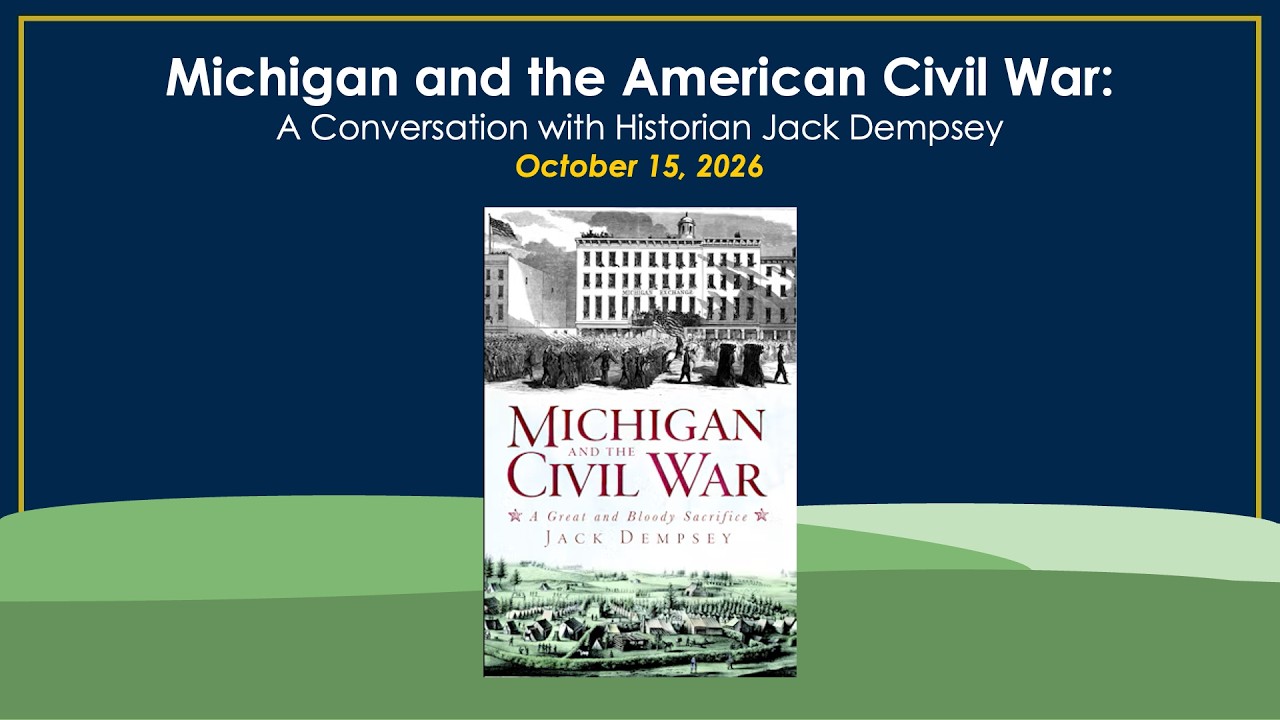
Published on YouTube by the University of Michigan on November 2, 2026, this video features a presentation from the 'Making Michigan' lecture series recorded at the Judy & Stanley Frankel Detroit Observatory. The session highlights historian and author Jack Dempsey in a conversation detailing Michigan's multifaceted contributions and pivotal role during the American Civil War.
## TL;DR
Historian Jack Dempsey explores Michigan's pivotal role in preserving the Union and abolishing slavery, tracing its path from the founding of the Republican Party in Jackson through battlefield service across all major Civil War theaters. He highlights crucial contributions from units like the 102nd United States Colored Troops, the Michigan Cavalry Brigade under George Armstrong Custer, and the 4th Michigan Cavalry's capture of Jefferson Davis. Dempsey also examines the essential work of the home front, the radical politics of wartime Governor Austin Blair, and the enduring legacy of wartime monuments and veteran advocacy in shaping modern Michigan.
## Atmosphere & style
The presentation carries the warm, engaging tone of an intimate academic salon, balancing scholarly rigor with folksy wit and regional pride. Dempsey speaks in an approachable, conversational style, trading playful banter with moderator Andrew Rutledge and peppering serious historical analysis with self-deprecating humor. Beneath the lighthearted anecdotes lies a deep reverence for the human costs of the war, creating an atmosphere that feels both intellectually stimulating and grounded in moral gravity.
## Bulletin
- [31:32](https://www.youtube.com/watch?v=oldd7RwvGoY&t=1892s) Michigan mobilized approximately 90,000 soldiers out of an 1860 population of 750,000, suffering between 14,000 and 15,000 fatalities—representing a loss of one out of every six enlistees.
- [08:41](https://www.youtube.com/watch?v=oldd7RwvGoY&t=521s) The state formed a bedrock for anti-slavery politics, underpinned by the Northwest Ordinance of 1787, the July 1854 founding of the Republican Party in Jackson, and the progressive wartime policies of Governor Austin Blair.
- [44:49](https://www.youtube.com/watch?v=oldd7RwvGoY&t=2689s) Michigan troops saw action across all major theaters, highlighted by George Armstrong Custer's Michigan Cavalry Brigade at Gettysburg and the 4th Michigan Cavalry's capture of Confederate President Jefferson Davis in May 1865.
- [01:18:03](https://www.youtube.com/watch?v=oldd7RwvGoY&t=4683s) The 102nd United States Colored Troops engaged in heavy Deep South combat, including the Battle of Honey Hill, enduring extraordinary danger due to Confederate refusal to grant Black soldiers prisoner-of-war protections.
## Key takeaways
- [02:58](https://www.youtube.com/watch?v=oldd7RwvGoY&t=178s) Historian Jack Dempsey contends the Battle of Antietam was the Civil War's decisive turning point because it provided Abraham Lincoln the political leverage to issue the preliminary Emancipation Proclamation.
- [05:22](https://www.youtube.com/watch?v=oldd7RwvGoY&t=322s) Preserving national unity prevented recurring territorial fragmentation, validated the Declaration of Independence's premise of human equality, and built the unified industrial base later required in World War II.
- [08:41](https://www.youtube.com/watch?v=oldd7RwvGoY&t=521s) Disparate anti-slavery factions convened in Jackson, Michigan, in July 1854 to officially establish the Republican Party in direct reaction to the expansion of slavery under the Kansas-Nebraska Act.
- [13:33](https://www.youtube.com/watch?v=oldd7RwvGoY&t=813s) Spurred by the Erie Canal and the anti-slavery protections of the Northwest Ordinance of 1787, Michigan's population increased twenty-five-fold between 1830 and 1860.
- [16:16](https://www.youtube.com/watch?v=oldd7RwvGoY&t=976s) The Upper Peninsula's copper and iron mining expanded swiftly during the conflict, supplying essential industrial material transported exclusively over Great Lakes maritime channels.
- [19:20](https://www.youtube.com/watch?v=oldd7RwvGoY&t=1160s) Michigan functioned as a critical terminal corridor for the Underground Railroad through Washtenaw County and Detroit into Windsor, Canada, aided by local conductors such as William Dollarson.
- [27:43](https://www.youtube.com/watch?v=oldd7RwvGoY&t=1663s) Wartime Governor Austin Blair championed Black suffrage, women's voting rights, and the abolition of capital punishment, draining his private finances during his tenure.
- [31:32](https://www.youtube.com/watch?v=oldd7RwvGoY&t=1892s) Out of 750,000 residents, roughly 90,000 Michiganders enlisted in the armed services, sustaining between 14,000 and 15,000 fatalities, a rate proportional to 150,000 deaths today.
- [35:23](https://www.youtube.com/watch?v=oldd7RwvGoY&t=2123s) Despite localized anti-draft unrest, the overwhelming majority of Michigan troops enlisted voluntarily, incentivized by municipal, county, and state financial bounties.
- [41:41](https://www.youtube.com/watch?v=oldd7RwvGoY&t=2501s) At 23 years of age, George Armstrong Custer led the four regiments of the Michigan Cavalry Brigade in critical mounted clashes against J.E.B. Stuart and Wade Hampton at Gettysburg.
- [44:49](https://www.youtube.com/watch?v=oldd7RwvGoY&t=2689s) The 4th Michigan Cavalry, commanded in the field by former University of Michigan student Benjamin Pritchard, tracked down and captured Confederate President Jefferson Davis in Georgia.
- [48:20](https://www.youtube.com/watch?v=oldd7RwvGoY&t=2900s) With tens of thousands of men deployed, Michigan women managed family finances, conducted farm labor, and entered the civilian workforce, while some served as wartime correspondents.
- [52:08](https://www.youtube.com/watch?v=oldd7RwvGoY&t=3128s) Michigan strongly aligned with Radical Reconstruction, ratifying the Reconstruction Amendments and electing Austin Blair to Congress, where he voted to impeach President Andrew Johnson.
- [57:15](https://www.youtube.com/watch?v=oldd7RwvGoY&t=3435s) Union veterans emerged as an influential Republican political bloc advocating for military pensions, though hundreds of returning Michigan prisoners of war perished in the Sultana steamboat disaster.
- [01:01:18](https://www.youtube.com/watch?v=oldd7RwvGoY&t=3678s) Dempsey advocates preserving historical monuments while adding contextual educational markers, rather than tearing them down, to teach the full complexity of historical figures.
- [01:18:03](https://www.youtube.com/watch?v=oldd7RwvGoY&t=4683s) Black soldiers in the 102nd USCT faced heightened peril on Southern battlefields because Confederate authorities systematically refused to treat captured Black troops as legitimate prisoners of war.
- [01:27:48](https://www.youtube.com/watch?v=oldd7RwvGoY&t=5268s) Indigenous Michiganders enlisted in the Union Army, most notably serving in Company K of the 1st Michigan Sharpshooters, despite being denied United States citizenship at the time.
## Detailed walkthrough
### [00:00](https://www.youtube.com/watch?v=oldd7RwvGoY&t=0s) Welcome to "Making Michigan" and Introducing Jack Dempsey
Andrew Rutledge, in-house historian at the Bentley Historical Library, opens the evening at the historic Judy and Stanley Frankel Detroit Observatory. The lecture is part of the "Making Michigan" series exploring the history of the University of Michigan, co-sponsored by the U of M Alumni Association’s Lifelong Learning program and supported by the university's U.S. at 250 initiative. Rutledge notes that as the nation approaches the 250th anniversary of the Declaration of Independence, the existential question famously framed by Abraham Lincoln—whether the nation could permanently endure half-slave and half-free—was settled definitively through four years of devastating conflict. Rutledge emphasizes that the young state of Michigan played a pivotal role both on and off the battlefield, and its legacies continue to reverberate socially, politically, and economically.
Rutledge then introduces guest historian Jack Dempsey, an award-winning author of 11 books, former president of both the Michigan Historical Commission and the Michigan Civil War Association, and holder of a political science degree from Michigan State University alongside a law degree from George Washington University. Dempsey and Rutledge exchange banter over the collegiate rivalry, with Rutledge joking that Michigan doesn't play MSU in football for another month so the Spartan degree will be excused. Dempsey fires back by noting his deep Maize and Blue family ties: both of his parents attended Michigan (one earning a PhD), his son holds two degrees from the institution, and he has personally spent far more money on Ann Arbor tuition than he ever did in East Lansing.
- **Event Host**: Andrew Rutledge, Bentley Historical Library in-house historian
- **Venue**: Judy and Stanley Frankel Detroit Observatory, Ann Arbor, Michigan
- **Guest**: Jack Dempsey, author of 11 books, past president of the Michigan Historical Commission and the Michigan Civil War Association
- **Sponsors**: U of M Alumni Association Lifelong Learning program and the U.S. at 250 initiative
[02:58](https://www.youtube.com/watch?v=oldd7RwvGoY&t=178s) The Michigan Civil War Association and Rectifying History at Antietam
When asked about the Michigan Civil War Association, Dempsey explains that it was incorporated as a 501(c)(3) nonprofit in 2013 during the Civil War sesquicentennial. The project grew directly out of a request directed to the Michigan Historical Commission to commemorate Michigan's contribution at the Battle of Antietam (fought on September 17, 1862, near Sharpsburg in western Maryland). Dempsey observes that while Gettysburg historically captures the lion's share of public attention, Antietam was the true turning point of the conflict:
> “Gettysburg gets all the attention, but Antietam is the battle that really changed the course of the war, because five days after the battle, President Lincoln issued the preliminary Emancipation Proclamation, and that declared that people who were enslaved on and after January 1 would be thence forever freed.”
Dempsey draws an unbroken, direct causal line from the tactical Union victory at Sharpsburg to the issuance of the preliminary proclamation, pointing out that without a military win, Lincoln had neither the justification nor the political ground to release it. Despite the vital battlefield actions of Michigan regiments at Antietam, the battlefield had no state monument honoring their sacrifice, in stark contrast to Gettysburg and other national military parks. This glaring omission prompted several self-described “Civil War nut cases” to organize, mount a sustained campaign, and fundraise to erect an enduring monument to Michigan’s soldiers on the Maryland field, cementing the memory of a fight that broadened the war's purpose from simply reuniting the states to ending human enslavement.
[05:22](https://www.youtube.com/watch?v=oldd7RwvGoY&t=322s) Why the Civil War Still Matters: National Survival and Foundational Ideals
Addressing Rutledge’s query about why the Civil War remains vital to commemorate today, Dempsey frames the Union victory as the prerequisite for modern American democracy and global history. He argues that the preserved Union forged the unified industrial power that prevailed in the two-ocean struggle of World War II; had the country shattered into rival fragments, modern world history would look bleakly different. Furthermore, tolerating secession would have established a catastrophic precedent of continuous fragmentation:
> “Because if you validate the ability of one part of the country to partition itself, secede from the Union, why can't others?”
Dempsey playfully quips that residents of Michigan's Upper Peninsula (the U.P.) have talked about seceding for decades—“with justification, I might add”—drawing laughter from the crowd, though he stresses his desire for "one Michigan." Beyond geopolitics, Dempsey emphasizes that the war redeemed the foundational promise of the Declaration of Independence: that all people are created equal and possess inalienable rights granted not by monarchs or states, but inherent to humanity, with government existing solely to protect them. Without that "second American Revolution," the continent might have devolved into multiple bickering nations or a society practicing racial subjugation akin to South African apartheid. For Dempsey, who has been captivated by the era since the third grade, remembering the conflict is an obligation of gratitude toward those who sacrificed to secure contemporary liberty.
[08:41](https://www.youtube.com/watch?v=oldd7RwvGoY&t=521s) The Fracturing Decade: The Kansas-Nebraska Act and the Rise of the Republican Party
Transitioning to the origins of the war, Rutledge observes that the conflict did not materialize out of thin air in 1861, but escalated dramatically during the 1850s. Dempsey explains that for decades, national cohesion had relied on an uneasy duality—admitting states in paired free-and-slave combinations to maintain an exact balance of power in the Senate, under the assumption that slavery would remain restricted below established geographical boundaries. In 1854, however, this balance was shattered by legislation introducing territorial popular sovereignty, dictating that territorial inhabitants would decide the question themselves with binding authority on Congress.
```mermaid
flowchart TD
accTitle: Escalation toward Civil War in the 1850s
accDescr: Flowchart illustrating the breakdown of the dual-state compromise leading up to the Civil War.
subgraph Political_Shift["Political Rupture (1854)"]
A["Traditional Duality & Latitudinal Limits"] -->|"Overturned by 1854 Legislation"| B["Popular Sovereignty in Territories"]
B --> C["Backlash from Anti-Slavery Coalitions"]
end
subgraph Party_Formation["Birth of the GOP"]
C --> D["July 1854: Fusion Meeting in Jackson, MI"]
D --> E["Republican Party Formed to Halt Slavery Extension"]
end
subgraph Escalating_Violence["Descent into Armed Conflict"]
E --> F["'Bleeding Kansas' Border Violence"]
F --> G["Violent Clashes on Floor of U.S. Congress"]
G --> H["1859: John Brown's Raid at Harpers Ferry"]
end
```
The abolition of the long-standing geographic compromise infuriated those who had previously tolerated slavery's existing footprint. In response, diverse anti-extension political factions gathered in Jackson, Michigan, in the summer of 1854 to form a new fusion coalition: the Republican Party. Dempsey jokingly brushes off rival claims:
> “So Wisconsin claims that it was the birthplace, but we know what cheeseheads are all about, so we clearly know it originated here.”
This newly formed party stood explicitly against any expansion of slavery into the western territories, including Kansas. This ideological stance triggered violent border warfare as armed pro-slavery factions poured into Kansas to manipulate territorial votes, quickly devolving into brutal physical conflict. Dempsey details how this hostility spilled onto the floor of Congress itself through violent assaults between legislators, culminating in 1859 when militant abolitionist John Brown launched his raid on the federal arsenal at Harpers Ferry, Virginia, hoping to trigger an armed uprising of the enslaved before being quickly captured.
[11:48](https://www.youtube.com/watch?v=oldd7RwvGoY&t=708s) John Brown, the Election of 1860, and Secession
Following the raid on Harpers Ferry, John Brown was convicted and executed for treason against the Commonwealth of Virginia. Historian Jack Dempsey points out the odd legal reality that Brown was not even a citizen of Virginia, a fact Andrew Rutledge affirms, yet his conviction and execution became a potent rallying cry across the nation. That heightened friction propelled the presidential contest of 1860, introducing Abraham Lincoln as the first truly viable Republican nominee. Facing a split Democratic Party whose supporters divided among three distinct candidates, Lincoln secured the presidency.
Historically, American elections followed an orderly transition: the general vote took place, the Electoral College met to tally the ballots, and the president was sworn into office. In 1860, that precedent shattered. The moment Lincoln's victory was announced, South Carolina called a secession convention. Its leaders resolved that they would no longer remain in the Union, operating on what Dempsey describes as a "huge jump" in logic—the presumption that Lincoln would instantly abolish slavery upon taking office, despite having no clear constitutional power to do so. South Carolina seceded, setting off a chain reaction across the Deep South. By the time Lincoln took the oath of office in March 1861, several states had formed the Confederacy as a separate nation explicitly designed to preserve and protect chattel slavery. Dempsey emphasizes that Michigan stood squarely on the opposite side of that divide. In response, Rutledge quips with an old historical quip about South Carolina, remarking that someone once famously described the state as being “too small to be a nation, too large to be an insane asylum.”
[13:33](https://www.youtube.com/watch?v=oldd7RwvGoY&t=813s) The Birth of the Republican Party in Jackson and Michigan's Free Soil Roots
Rutledge rewinds the chronology slightly to ask why the Republican Party was founded in Jackson, Michigan, in 1854. Dempsey explains that this development was particularly surprising because Michigan had historically been a reliable Democratic state. Its dominant political figure was Lewis Cass, whom Dempsey calls “the most famous Michigander, really.” Dempsey notes with pride that Abraham Lincoln himself coined the moniker "Michigander" to mock Cass as a silly goose or gander figure, adding, “I love that term though, because it's Lincolnian. So I am a Michigander.” Cass had championed the doctrine of popular sovereignty, proposing that residents of individual territories should vote on whether to permit or prohibit slavery.
By around 1850, widespread disaffection with Cass and the Democratic Party's tolerance for slavery began to boil over. Whigs, Free Soilers, and independent anti-slavery groups converged in Jackson to establish a unified political party. This anti-slavery stance was grounded in the territory's origins: under the Northwest Ordinance of 1787, involuntary servitude had been barred from the start. Although early Michigan had practiced some slavery under French and British colonial rule, the state's very foundation and its original constitution firmly outlawed it.
```mermaid
flowchart TD
accTitle: Evolution of Michigan Anti-Slavery Politics
accDescr: Flowchart tracing the shift from early territorial governance under the Northwest Ordinance to the founding of the Republican Party in Jackson in 1854.
subgraph Shift ["Mid-Century Backlash"]
B --> C["Lewis Cass & Democrats<br/>Promote Popular Sovereignty"]
C --> D["Public Disaffection with<br/>Toleration of Slavery"]
end
subgraph Party ["Political Realignment (1854)"]
D --> E["Free Soilers & Whigs Converge"]
E --> F["Founding of Republican Party<br/>(Under the Oaks in Jackson)"]
end
```
The anti-slavery sentiment deepened as waves of settlers arrived from other free states, largely aided by the opening of the Erie Canal. Dempsey highlights the explosive demographic growth of the state leading up to the war:
- The population of Michigan surged from roughly 30,000 in 1830 to approximately 750,000 by 1860.
- This massive increase was driven primarily by rapid domestic immigration rather than natural birth rates.
- Settlers and leaders migrated specifically because Michigan provided an environment where they could safely articulate abolitionist views and aid freedom seekers escaping north.
[16:16](https://www.youtube.com/watch?v=oldd7RwvGoY&t=976s) Social and Economic Landscape of 1850s Michigan
Addressing the social and economic conditions of Michigan in the 1850s, Dempsey notes that the state was overwhelmingly rural and agrarian, with the bulk of its inhabitants settled along the southern tier of counties. Communities north of Lansing remained extremely sparse. The Upper Peninsula's vast mineral resources had not yet been fully realized, but the Civil War rapidly accelerated copper and iron mining to fuel the Union war effort, providing the UP with its first real economic foothold.
Across the state, the population was balanced fairly evenly between men and women, with civic institutions like the University of Michigan gradually taking shape. Detroit was modest in scale, hovering at around 50,000 residents by 1860. Rutledge notes the contrast to modern times by pointing out that the entire municipal population of Detroit back then would barely fill half of Michigan Stadium. Those who eventually enlisted were primarily farmers, agricultural laborers, and clerks rather than industrial factory hands, since the era long predated the automobile industry. Beyond supplying soldiers, Michigan functioned as a vital agricultural breadbasket, growing the crops and provisions required to sustain Union field armies.
Between statehood and the onset of the war, Michigan steadily climbed in state population rankings from 20th out of 26 or 27 states up to 16th and then 13th, eventually entering the top 10 by 1900. Dempsey attributes this sustained growth to the fundamental promise of opportunity and human dignity: “And this is because, I would argue, this heritage of freedom, of liberty. You can come here, you can buy land, you can launch a career, you can find opportunities.”
[19:20](https://www.youtube.com/watch?v=oldd7RwvGoY&t=1160s) The Underground Railroad and the Journey of William Dollarson
Dempsey elaborates on Michigan’s historical role as an Underground Railroad sanctuary, sustained in modern times by state commemorative efforts. Documenting safe houses—including preserved sites in Ann Arbor—remains historically challenging because assisting self-emancipated individuals was a serious federal crime. Abolitionists could not publicly advertise their activities without inviting federal prosecution or drawing slave catchers straight to their doorsteps. Michigan’s geography made it a critical gateway: escape routes crisscrossed the southern counties, moving through Washtenaw County, Plymouth, and into Detroit. Once freedom seekers reached the Detroit River, crossing into Windsor, Canada, meant absolute legal security, as Canadian authorities refused to extradite formerly enslaved individuals back to the United States.
Dempsey highlights this network through the biographical journey of William Dollarson, an extraordinary figure he has researched:
- Enslaved originally in Virginia, Dollarson was sold down to New Orleans and placed on an extraordinarily brutal plantation in Natchez, Mississippi.
- He escaped by traveling up the Mississippi River, ultimately reaching Detroit.
- Once established in Detroit, Dollarson served as a dedicated conductor on the Underground Railroad, ferrying self-emancipated people across the river into Windsor.
- When the Civil War broke out, he joined the war effort on a Union general’s military staff, returning south to Virginia without an official uniform.
- Recognizing the immense peril he faced—where capture would mean re-enslavement or death rather than placement in a standard prisoner-of-war camp—comrades urged him to return to Detroit, where he lived out the remainder of his life.
[21:56](https://www.youtube.com/watch?v=oldd7RwvGoY&t=1316s) Black Troops, Battlefield Sacrifices, and the USCT Legacy
Turning to the demographic presence of African Americans in Michigan during the 1850s and 1860s, Dempsey explains that the community was relatively small, comprising free-born Black citizens, escaped freedom seekers living in close-knit rural settlements, and an enclave inside Detroit. The community faced intense local prejudice; during the middle of the war, racial tensions boiled over into a violent riot in Detroit, stoked by individuals who blamed Black people for the ongoing conflict and the draft.
Once the federal government authorized Black men to enlist in uniform, Michigan recruited a full regiment of Black soldiers—the 102nd United States Colored Troops (USCT)—who deployed directly into the Deep South. Dempsey reflects on their extraordinary courage, noting that they marched into hostile Confederate territory far from any possible route back to safety, enduring combat operations as well as devastating camp diseases.
Dempsey closes on a poignant personal reflection regarding visiting military burial grounds like the Beaufort National Cemetery in South Carolina, where fallen soldiers from Michigan rest under USCT headstones. Contemplating their ultimate sacrifice, Dempsey connects their service to modern civil rights and his own life, remarking: “And to think that these men fought, died for me, for me today, for me born in 1952, so that I could have the same freedom.”
[23:46](https://www.youtube.com/watch?v=oldd7RwvGoY&t=1426s) Michigan’s Vote in the Elections of 1860 and 1864
Reflecting on the legacy of African Americans fighting for their own liberty, Jack Dempsey notes that simply discussing it sends chills down his spine, emphasizing that this heritage is an indispensable chapter of the state's Civil War history. Shifting the conversation chronologically, moderator Andrew Rutledge asks about the political tipping point of the 1860 presidential election and how Michigan voted. Dempsey explains that Abraham Lincoln carried the state decisively against northern Democratic candidate Stephen A. Douglas—famously nicknamed "The Little Giant"—securing 57% of the vote compared to Douglas's 42%. Michigan had already transitioned into a solidly Republican state at the local level, holding both the governorship and the state legislature, but 1860 marked only the second time it had cast its electoral votes for a Republican presidential candidate.
Four years later, in the election of 1864, Michigan reaffirmed its commitment to the Lincoln administration and the Union cause, delivering 56.6% of the vote to Lincoln despite years of grueling warfare, mounting casualties, and trauma. Dempsey highlights that the 1864 election presented voters with a stark moral choice between embracing the Republican emancipation platform or reverting to the status quo advocated by Lincoln’s Democratic opponent, whose platform urged restoring the Union as it previously existed. Dempsey takes particular pride in the fact that the state stood firm for abolition and national unity, remarking: “We didn't vote for secession, dissolution of the Union.”
- **1860 Presidential Election in Michigan**: Abraham Lincoln defeated Stephen A. Douglas by a margin of 57% to 42%.
- **1864 Presidential Election in Michigan**: Lincoln maintained majority support at 56.6%, signaling sustained backing for both military victory and federal emancipation.
---
[26:00](https://www.youtube.com/watch?v=oldd7RwvGoY&t=1560s) Fort Sumter and the Call for Volunteers
When Rutledge asks how the people of Michigan reacted when South Carolina seceded from the Union, Dempsey explains that opinion was initially fractured. Some citizens proposed letting the "errant sister states" leave in peace without armed confrontation, while others insisted that democratic governance requires minority submission to election outcomes. As Dempsey summarizes the nationalist viewpoint: “When there's a vote in a democracy, the majority wins. The minority doesn't get to take their ball and go home.”
```mermaid
flowchart TD
accTitle: Response to Fort Sumter in Michigan
accDescr: Sequence showing initial public debate shifting to overwhelming mobilization after the bombardment of Fort Sumter.
subgraph Debate ["Initial Debate"]
D1["'Let them go in peace'"]
D2["'Majority rule must prevail'"]
end
Sumter["Confederate attack on Fort Sumter<br/>(Charleston Harbor, April 1861)"]
LincolnCall["Lincoln's call for volunteers<br/>(Michigan quota: 1 regiment)"]
subgraph Reaction ["Michigan Response"]
Enlist["Overwhelming volunteer surplus"]
ExtraReg["Additional regiments organized"]
OutState["Men enlist in Illinois & New York"]
end
Any domestic ambivalence evaporated in April 1861 when Confederate batteries opened fire on federal forces at Fort Sumter in Charleston Harbor, South Carolina. The act of Americans firing upon the national banner galvanised the state regardless of prior political views or stances on abolition. Following the fort's surrender, President Lincoln issued a proclamation calling for 75,000 volunteers to suppress the rebellion. Michigan was initially requested to furnish only a single regiment, but an overwhelming rush of eager enlistees created an immediate surplus. Communities organized additional regiments hoping they would be mustered into federal service, while other impatient Michiganders crossed state lines to enlist directly in Illinois or New York regiments rather than wait for bureaucratic approvals.
---
[27:43](https://www.youtube.com/watch?v=oldd7RwvGoY&t=1663s) Governor Austin Blair: Michigan’s “Radical of Radicals”
The conversation turns to Austin Blair, Michigan's wartime governor whose bronze statue stands directly before the state capitol building in Lansing, looking down Michigan Avenue toward Ann Arbor. Elected as a Republican, Blair earned the enduring moniker the "War Governor of Michigan" because of his uncompromising commitment to crushing secession, upholding the federal Constitution, and utilizing the war to eradicate human chattel slavery once and for all. Dempsey points out that the historical association he represents publishes an annual volume every September on the anniversary of the Battle of Antietam; the last two volumes gathered Blair's speeches, public remarks, and personal correspondence. These papers reveal Blair as a principled leader of immense moral courage who spent down his personal wealth while serving in office. As Dempsey observes: “He left office in 1865 less well-off financially than he was when he got elected.”
Addressing Rutledge’s question about whether Blair held radical abolitionist beliefs before the war began—at a time when the 1860 Republican national platform disclaimed intentions of interfering with slavery where it already existed—Dempsey confirms that Blair was an ardent reformer across the board. In addition to being an outright abolitionist and human rights champion, Blair had been a primary legislative leader in Michigan's landmark abolition of capital punishment. He advocated consistently for universal public education, black suffrage, and women's voting rights, earning him a reputation among contemporaries as an extremist. His ideological stance served as the basis for the title of the association's first volume on him, *Radical of Radicals*:
> “He's kind of the epitome of a radical politician, because he's so far out on the equal rights spectrum that many thought he was too far out.”
---
[31:32](https://www.youtube.com/watch?v=oldd7RwvGoY&t=1892s) Mobilization, Casualties, and the Human Cost of the War
Rutledge asks for the total figures regarding Michigan’s mobilization during the four-year war. Dempsey reports that roughly 90,000 soldiers enlisted out of a statewide population of only 750,000—representing a massive share of the eligible male population. Although regulations strictly forbade female enlistment, several Michigan women successfully disguised themselves, took up arms in uniform, and later documented their combat records to secure military pensions. Michigan's commitment also included companies of Black soldiers.
The human toll on the state was staggering: approximately one out of every six Michigan soldiers who went to war never returned. Dempsey estimates total fatalities between 14,000 and 15,000 men, lost to combat wounds, battlefield deaths, or devastating camp diseases. To convey the emotional weight of this loss to a contemporary audience, Dempsey draws a parallel to Michigan Stadium: if filled to its approximate 100,000 capacity, clearing out one-sixth of the entire stadium would represent Michigan's war dead. Scaled to Michigan’s modern population of 10 million residents, a proportional mobilization would place 1 million citizens in military uniform, resulting in 140,000 to 150,000 deaths.
Dempsey stresses that nineteenth-century recordkeeping was imprecise, meaning that official casualty figures almost certainly understate the true scope of loss:
- Soldiers marked missing on morning roll calls might have been lost in action, captured by Confederate forces, temporarily scattered, or in hiding.
- Captured soldiers frequently escaped within days to rejoin their units without clear paperwork trails.
- Wounded soldiers often lingered for weeks in field hospitals before dying away from the front lines.
- To illustrate tracking complications, Dempsey cites Michigan Major General Israel Richardson, who was mortally wounded by an artillery round at the Battle of Antietam on September 17, 1862. Richardson was removed to a nearby farmhouse where his wife traveled from Michigan to nurse him, yet he succumbed to his injuries weeks later, raising persistent questions about whether such cases were accurately factored into aggregate state fatality tallies.
---
[35:23](https://www.youtube.com/watch?v=oldd7RwvGoY&t=2123s) Commemorating Michigan’s Civil War Leaders in Bronze
Because Civil War losses touched every village, town, and farming community across Michigan, the immense sacrifice formed the cornerstone of postwar remembrance and monumentation throughout the state. Dempsey directs the audience's attention to slides displaying historical monuments erected to preserve this legacy. In addition to the statue of Lewis Cass located in the National Statuary Hall Collection inside the United States Capitol, and the outdoor monument to Governor Austin Blair in Lansing, Dempsey highlights the equestrian statue of Detroit native and Union general Alpheus S. Williams.
Dempsey injects some levity into the somber recounting of the war by noting that General Williams famously rode a horse nicknamed "Plug Ugly." Looking at the refined, stately horse depicted in the bronze sculpture, Dempsey quips to laughter from the audience: “One of his horses was named Plug Ugly. But that horse looks pretty nice. So it's probably not Plug Ugly.” Rutledge humorously replies that the sculptor likely exercised artistic license to elevate the mount's dignity in bronze.
[35:54](https://www.youtube.com/watch?v=oldd7RwvGoY&t=2154s) Alpheus Williams, Civil War Memory, and the Draft
Alpheus Williams stood as Michigan's preeminent military leader at the outbreak of the war. Despite being relatively old, he stepped forward to volunteer, earned a general’s commission, and compiled an extraordinary record across four years of combat. His service spanned major eastern clashes such as Antietam and Gettysburg, extended to the Western theater, and carried through General William Tecumseh Sherman’s March to the Sea in Georgia and up through the Carolinas. Dempsey—joking about his own penchant for “shameless self promotion moments”—noted that he wrote a book about Williams. A prominent statue dedicated to Williams stands on Belle Isle in the Detroit River, unveiled exactly 105 years prior to the talk on October 15, 1921. Addressing why Michigan would dedicate a monument to a Civil War commander in the wake of the First World War, Dempsey explained that the state was reflecting on its core values, rooted in the Declaration of Independence and the Northwest Ordinance. Williams himself was a former Whig turned Democrat who went on to serve in the U.S. Congress, where he collapsed and died in the halls of the Capitol, echoing the fate of John Quincy Adams.
When Andrew Rutledge asked whether all 90,000 Michiganders who served were volunteers, Dempsey pointed out that a draft was indeed instituted, accompanied by riots among citizens resisting conscription, balanced by local and state enlistment bounties. Nevertheless, the overwhelming majority of Michigan soldiers enlisted voluntarily, with men signing up even in late 1864 and early 1865 as the conflict drew to a close. Dempsey underlined that these sacrifices laid the groundwork for modern American democracy:
> “These are people that we, today, our lives have been built on their service, their sacrifice, that foundation.”
- Alpheus Williams's Belle Isle equestrian statue was unveiled on October 15, 1921.
- Although conscription and draft resistance took place, most of Michigan's 90,000 soldiers enlisted willingly.
- State and municipal bounties were deployed throughout Michigan to encourage voluntary enlistment and meet military quotas.
---
[38:51](https://www.youtube.com/watch?v=oldd7RwvGoY&t=2331s) The 1863 Detroit Riot and the 102nd U.S. Colored Troops
Turning to internal strife on the home front, Rutledge prompted Dempsey to discuss racial violence in Detroit during the war. Dempsey recounted the anti-Black riot that erupted on Detroit’s East Side in early 1863, following Lincoln's issuance of the Emancipation Proclamation. The unrest was sparked by false accusations leveled against a Black man concerning a white woman, resulting in targeted violence and suffering within Detroit’s African American community. Rather than dampening enthusiasm for the Union cause, the violence catalyzed Black enlistment. A recruitment expedition operated along the Michigan Central Railroad, traveling across the state's southern tier of counties and into southwestern Michigan. This campaign successfully mustered more than 1,400 men.
Initially formed as the 1st Michigan Colored Infantry, the regiment was subsequently federalized into the United States Colored Troops as the 102nd USCT. Dempsey noted that while the 54th Massachusetts gained national fame through the movie *Glory*—and drew recruits from Michigan as well—the 102nd represented the state’s direct federal contribution of Black soldiers. Veterans of the unit are buried across the country in national cemeteries, as well as in Detroit's historic Elmwood Cemetery, where a non-segregated Civil War section stands as a physical testament to the war's ultimate aim. Emphasizing the broader lessons of that integration, Dempsey observed:
> “And I think that epitomizes what the outcome of the war was. It's not going to end up with two separate societies, at least that was the idea.”
```mermaid
flowchart TD
accTitle: Formation of the 102nd USCT
accDescr: Flowchart showing the response of Black Michiganders to the 1863 Detroit riot leading to the formation of the 102nd USCT.
A["1863 Detroit Race Riot<br/>(East Side)"] --> B["Surge in Black Civic Resolve<br/>& Enlistment Drives"]
B --> C["Recruitment across Southern Tier<br/>via Michigan Central Railroad"]
C --> D["Mustering of 1,400+ Men:<br/>1st Michigan Colored Infantry"]
D --> E["Federalized as 102nd USCT<br/>(Fought in Deep South)"]
```
---
[41:41](https://www.youtube.com/watch?v=oldd7RwvGoY&t=2501s) Michigan Regiments Across the Theaters: Custer and the Cavalry Brigade
When asked where Michigan troops served, Dempsey outlined a sprawling statewide commitment that deployed men to every major theater: East of the Appalachians, the Western theater between the mountains and the Mississippi, and the Trans-Mississippi West. The state fielded 30 infantry regiments of roughly 1,000 men each, alongside numerous artillery and specialty units. The 1st Michigan Infantry answered the initial 90-day call in 1861, fought at the First Battle of Bull Run, and immediately reorganized as a three-year unit that endured from the war's opening days straight through to the surrender at Appomattox.
Because 1860s Michigan was an agrarian society where horsemanship was part of daily life, the state contributed substantial horseflesh and 13 cavalry regiments to the federal effort. Four of these regiments formed the Michigan Cavalry Brigade, an outfit Dempsey and other historians identify as the foremost Union mounted force of the war. On the eve of the Battle of Gettysburg, 23-year-old George Armstrong Custer was vaulted from captain to brigadier general to take command of this unit. Custer and his Wolverines clashed with and turned back Confederate cavalry chieftains J.E.B. Stuart and Wade Hampton at Gettysburg, remaining a spearhead of the cavalry corps through the Appomattox campaign. Recognizing the brigade's unmatched combat record while playfully setting aside Custer’s subsequent post-war downfall in the West, Dempsey maintained:
> “His Civil War service is not equaled by any cavalry officer.”
- Michigan raised 30 infantry regiments and 13 cavalry regiments during the war.
- The 1st Michigan Infantry served from the initial fighting at First Bull Run through the final surrender at Appomattox Court House.
- The Michigan Cavalry Brigade, composed of four state regiments, formed under George Armstrong Custer and routed Stuart and Hampton at Gettysburg.
---
[44:49](https://www.youtube.com/watch?v=oldd7RwvGoY&t=2689s) The Capture of Jefferson Davis and Specialized Units
The Western theater featured equally consequential service by Michigan cavalrymen. Dempsey highlighted the 4th Michigan Cavalry, which pursued Confederate President Jefferson Davis as he fled south from Richmond, Virginia, hoping to sustain the Confederate government from Georgia. Guided by tips from formerly enslaved individuals, the 4th Michigan tracked Davis down and captured him near Irwinville, Georgia, in May 1865, forestalling any resurgence of the rebel cause. Dempsey highlighted that the officer commanding the detachment, Benjamin Pritchard, had been a University of Michigan student, a point of school pride that brought laughter from the audience.
Beyond standard line regiments, Michigan supplied specialized outfits, including a sharpshooter regiment that participated in the siege operations and final combat against Robert E. Lee's Army of Northern Virginia. The state also provided the Michigan Engineers and Mechanics, which Dempsey described as a direct nineteenth-century precursor to the construction battalions (Seabees) of World War II, responsible for building critical bridges, roads, and fortifications. Dempsey closed by previewing his forthcoming book, which examines the central, overlooked role Michigan units played during the closing weeks in Virginia leading to Appomattox, stating:
> “Did Michigan play a role in Lee's surrender in the end of the Confederacy? Yes, it did, a major role, and we outlined that in the book that will come out next September.”
[48:20](https://www.youtube.com/watch?v=oldd7RwvGoY&t=2900s) The Home Front: How Michigan Women Sustained the Union
Shifting focus away from distant battlefields back to Michigan itself, Andrew Rutledge asks about the domestic impact of the conflict. With the Upper Peninsula beginning its resource development and a massive fraction of the state's male population deployed, everyday life underwent a dramatic transformation. Jack Dempsey reflects on who stepped in to manage everyday survival:
> “So with so many soldiers gone, who picks up the burden? Who picks up the reins of the horse or the mule plowing? Who takes control of the family fortune, ensuring that the budgets met, kids are fed and taken care of? It's women, by and large.”
Dempsey quips that without women there would have been no Civil War, before refining his point: women played an indispensable role on every level. While a handful disguised themselves to fight and others accompanied their husbands to the front—including officers' wives who stayed in military camps during non-battle intervals—the vast majority remained home. They assumed traditional male roles as heads of household and entered occupations previously closed to women, staffing offices, shops, and agricultural fields. Dempsey points out that this war experience delivered society’s first real taste of why women should not be confined solely to domestic spheres. While an uneasy period of adjustment followed when surviving soldiers returned and attempted a return to "normalcy," the wartime shift left an indelible mark on Michigan society.
Dempsey notes that women also shaped the public narrative. One Michigan woman served as a Washington war correspondent, sending regular dispatches home about the federal government and troop movements (her collected columns were later published as a book). Memoirs were written by women who served or fought at the front, but the private correspondence preserved between husbands and wives reveals the deepest human dimension of the era. Dempsey recounts his experience editing the wartime letters between a soldier in the Michigan Engineers and Mechanics Regiment and his wife. The correspondence displays an amusing, modern dynamic: while the soldier was away, his wife managed their household finances so astutely that she ended up with more money than he earned on his soldier's pay. When she decided to buy a house and rent out another piece of property, her husband wrote back cautioning against it—only to learn she had already closed the deal, forcing him to sheepishly write back conceding it had been a brilliant move.
- **Wartime Female Occupations**: Agricultural field plowing, family financial management, shopkeeping, and office clerical work.
- **Wartime Reporting & Literature**: Michigan women produced wartime memoirs, served as military nurses, and worked as syndicated Washington press correspondents.
- **Engineers and Mechanics Correspondence**: Letters illustrate financial independence, with soldiers' wives buying real estate and managing rental assets independently.
---
[52:08](https://www.youtube.com/watch?v=oldd7RwvGoY&t=3128s) The Assassination of Lincoln and the Constitutional Clash of Reconstruction
Turning to the close of the war, Rutledge notes that Michigan backed Abraham Lincoln’s re-election in the autumn of 1864—though by slightly narrower margins than in 1860—before Robert E. Lee surrendered in April 1865 and Lincoln was assassinated days later. When asked how Michiganders took the news of Lincoln's murder, Dempsey answers directly:
> “Horror, horrified, deep grief and lamentation.”
Although Lincoln’s funeral train did not traverse Michigan directly because the state lay outside the main rail corridor to Springfield, Illinois, solemn observances and memorial services were organized across Ann Arbor, Detroit, and other communities. Notably, the battle-tested 24th Michigan Infantry—a core regiment of the famous Iron Brigade that had suffered catastrophic casualties at Gettysburg—was selected to serve as the official military honor guard at Lincoln’s burial in Oak Ridge Cemetery in Springfield. Dempsey also highlights the lasting local affection for Lincoln, pointing out a recent campaign in Kalamazoo that erected a statue commemorating Lincoln's sole public speech in Michigan during John C. Fremont’s 1856 Republican presidential run. Dempsey remarks that while monuments are being removed elsewhere across the nation, Kalamazoo chose to erect one to preserve Michigan's connection to Lincoln.
```mermaid
flowchart TD
accTitle: Reconstruction Conflict Flowchart
accDescr: Diagram showing the clash between President Andrew Johnson and the Radical Republican Congress over Reconstruction policy.
subgraph Executive ["Executive Branch"]
AJ["President Andrew Johnson<br>(Lenient Restoration, Vetoes, Opposed Black Civil Rights)"]
end
subgraph Congress ["Radical Republican Congress"]
RC["Radical Reconstruction Coalition"]
AB["Rep. Austin Blair (MI)<br>& MI Delegation"]
RC --- AB
end
AJ -->|"Executive Action & Vetoes"| Clash{"Constitutional Crisis"}
Congress -->|"Civil Rights Amendments & Impeachment"| Clash
Clash --> A13["13th Amendment: Abolished Slavery"]
Clash --> A14["14th Amendment: Equal Protection"]
Clash --> A15["15th Amendment: Black Male Suffrage"]
Clash --> IMP["1868 Impeachment of Andrew Johnson<br>(Supported by Austin Blair)"]
```
The political climate darkened swiftly once Vice President Andrew Johnson assumed the presidency. Dempsey pulls no punches in characterizing Johnson:
> “He is not an abolitionist, and he's a racist, pure and simple.”
A major constitutional crisis unfolded between an overwhelmingly Republican Congress and an executive determined to readmit Confederate states into the Union without guaranteeing civil rights or legal protections for the formerly enslaved. Michigan’s congressional delegation took an uncompromising stance on the side of Radical Reconstruction, spearheading the passage of the Reconstruction Amendments:
- **13th Amendment**: Formally abolishing slavery.
- **14th Amendment**: Enshrining birthright citizenship and equal protection under the law.
- **15th Amendment**: Guaranteeing the right to vote regardless of race or former servitude.
Former Michigan Governor Austin Blair, who stepped down from the governorship in January 1865 after failing to secure a U.S. Senate seat, won election to the U.S. House of Representatives from Jackson, Michigan. In the House, Blair emerged as a leading champion of the 15th Amendment and cast his vote to impeach Andrew Johnson during the nation's first presidential impeachment crisis, firmly convinced that Johnson stood on the wrong side of history.
---
[57:15](https://www.youtube.com/watch?v=oldd7RwvGoY&t=3435s) Postwar Michigan: Veteran Politics, Commemoration, and Industrial Ascent
Returning to the domestic scene following the conflict, Rutledge asks about the societal impact of tens of thousands of Union soldiers demobilizing and coming home. Dempsey explains that returning Union veterans organized into an influential, heavily Republican voting constituency that lobbied aggressively for comprehensive military pensions:
> “The veterans become a very powerful political force. They want to see pensions for those who were wounded or maimed or who served, because there's a sense that their service impacted them, whether you could see it or not.”
This veteran advocacy was paired with a statewide push for memorialization. Displaying photographic slides, Dempsey points out two contrasting monuments:
1. **The Michigan Soldiers' and Sailors' Monument in Detroit**: Situated in Campus Martius, this towering public memorial honors the soldiers and sailors who preserved the Union and continues to serve as a civic gathering place.
2. **The Michigan Monument at Andersonville**: Erected on the grounds of the notorious Confederate prisoner-of-war stockade in Georgia, this evocative sculpture depicts Michigan weeping for her sons who starved and perished inside the prison camp.
Dempsey adds that Michigan's prisoner-of-war losses were compounded at war's end by the *Sultana* steamboat disaster on the Mississippi River. Overcrowded with paroled Union POWs—including many Michigan soldiers who had just survived Confederate camps—the vessel's boiler exploded, causing hundreds of paroled troops to drown.
In tandem with its growing veteran clout, Michigan's economy expanded rapidly in the late 19th century. The state grew in population ranking, transitioning from a resource-extraction frontier to an industrial and manufacturing powerhouse. Long before Henry Ford and the automotive boom defined the early 20th century, Detroit was known as a national capital for stove manufacturing and commercial seed distribution through D.M. Ferry & Co. seeds.
Addressing why virtually every town square across Michigan features Civil War memorials, Dempsey explains that communities felt a profound obligation to remember that generational sacrifice. Beyond grand urban installations like Detroit's, commercial foundries produced affordable, standardized cast-metal and stone soldier monuments that small villages and rural communities—such as Williamston, Michigan—purchased to preserve the memory of their local volunteers.
[01:01:18](https://www.youtube.com/watch?v=oldd7RwvGoY&t=3678s) Civil War Monuments, Memory, and the Debate Over Statues
Civil War monuments across Michigan—such as the soldiers and sailors monument in Detroit—owe their existence not just to veterans, but to dedicated political leadership. Governor Austin Blair served as a tireless champion for veterans' rights and historical remembrance, speaking at numerous dedications. Blair shared a deep, reciprocal bond with returning troops because he had poured everything he had into the Union effort alongside them. Remembering the sacrifices of neighbors who wore the uniform is essential: warfare was exceptionally traumatic, maiming bodies and leaving deep emotional wounds. Yet that immense trauma also forced rapid advancements in surgical and medical knowledge. Rather than relying on patent medicines or crude "hack and whack sawbones," wartime doctors fostered rigorous, scientific medical practices, a standard of care later exemplified in Ann Arbor.
Physical artifacts of the war remain scattered across the state, such as naval cannons preserved in small town squares like Petoskey. Some of these cannons saw historic combat, including passing Confederate shore batteries at New Orleans and Mobile Bay under David Farragut’s famous command to “Damn the torpedoes!” Dempsey argues that these relics and statues serve a vital educational purpose, tying modern daily freedoms back to the bloodshed required to secure them. Because Michigan fought for the Union, it is untroubled by Confederate monuments or Lost Cause symbolism.
Addressing controversial monuments like the George Armstrong Custer equestrian statue in Monroe, Dempsey stresses the importance of context. The monument was funded and erected by veterans of the Michigan Cavalry Brigade to commemorate Custer's Civil War leadership in preserving the Union and ending slavery, not his subsequent actions during the 1876 Indian Wars. Tearing down statues for later federal policies sets a precedent where even President Ulysses S. Grant's monuments would fall due to his presidency during the Battle of the Little Bighorn. Instead of leaving empty pedestals, Dempsey advocates using monuments—supplemented by informational plaques—to provide complete, rigorous historical context.
> “Pretty soon, what have we got left? Just a bunch of feet, stumps, where the monuments were. Because no one's perfect. But let's educate. Let's use them to teach and teach the whole story. That's my humble opinion.” — Jack Dempsey
- Detroit’s soldiers and sailors monument was backed by both veterans and state leadership like Governor Austin Blair.
- Civil War weaponry caused catastrophic physical and psychological trauma, accelerating medical and surgical innovations.
- Relic cannons in public spaces, such as Petoskey's naval gun from New Orleans and Mobile Bay, link local Michigan communities to major naval actions.
- Michigan holds no monuments to the Confederacy or the pro-slavery cause.
- The Monroe monument honors Custer's role leading the Michigan Cavalry Brigade, funded by the very troops he commanded.
---
[01:06:43](https://www.youtube.com/watch?v=oldd7RwvGoY&t=4003s) Civil War Decorations, the Medal of Honor, and Brevet Ranks
Turning to audience questions, an attendee asked about military awards during the Civil War, noting that George Armstrong Custer's younger brother, Tom Custer, was a recipient. Dempsey and the audience member noted that modern decorations—such as the Purple Heart, Silver Star, Bronze Star, or Good Conduct Medal—did not exist at the time. Early in the conflict, some unit-level decorations emerged, such as the Kearny Cross, but the war ultimately established the Medal of Honor (the precursor to the modern Congressional Medal of Honor) as the primary recognition for extraordinary valor in combat.
Tom Custer distinguished himself by earning two Medals of Honor within three days of each other. During the war, capturing an enemy battle flag was one of the most concrete, prized demonstrations of combat courage, and Michigan cavalrymen captured numerous Confederate flags in the war's final weeks. Outside of the Medal of Honor, the military recognized meritorious service and conspicuous gallantry through honorary brevet promotions. A colonel could receive a brevet commission as a brigadier general for prolonged honorable duty or specific battlefield heroics, establishing the operational lineage for today's system of military commendations.
> “So something ran in that Custer family in terms of cowardice under fire— or cowardice—courage under fire. [Laughter] Boy, that was a mental slip. Courage under fire.” — Jack Dempsey
- The Civil War marks the formal origin of the Medal of Honor.
- Tom Custer earned two Medals of Honor in a three-day span.
- Capturing enemy standards was the most common benchmark for valor earning the Medal of Honor.
- Brevet promotions served in lieu of modern medals to reward senior field commanders for distinguished battlefield service.
---
[01:09:56](https://www.youtube.com/watch?v=oldd7RwvGoY&t=4196s) University of Michigan's Wartime Service and Kidd’s Memoirs
When asked about the role of the University of Michigan, Dempsey highlighted the institution’s deep involvement, pointing to the Detroit Observatory's newly opened Civil War exhibit. University President Henry Philip Tappan strongly backed the Union cause and urged students to answer the call of duty. Campus enthusiasm ran high from the opening days of hostilities, with students organizing militia companies in Ann Arbor before departing for the front lines.
Among notable campus figures were Benjamin D. Pritchard of the 4th Michigan Cavalry (instrumental in Jefferson Davis's capture) and James Harvey Kidd. Kidd left the university in 1862, rose through the ranks to become a brevet brigadier general, and fought closely alongside George Armstrong Custer. Kidd became one of Custer’s staunchest admirers and most articulate chroniclers, recording firsthand accounts of Custer’s aggressive forward leadership. Dempsey urged visitors to explore the campus exhibit to honor the many Wolverine students and alumni who served and died.
> “He saw him in action. He saw his courage. He saw his bravery. He saw his willingness to lead, not just order troops into battle. And Kidd wrote about this.” — Jack Dempsey
```mermaid
flowchart TD
accTitle: University of Michigan Civil War Mobilization
accDescr: Diagram illustrating campus mobilization under President Tappan and notable alumni paths during the Civil War.
subgraph Campus Mobilization
A["President Henry Philip Tappan"] -->|"Urges student enlistment"| B["Student Volunteers"]
B -->|"Form campus militias"| C["Service in Union Armies"]
end
subgraph Notable Figures
C --> D["Benjamin D. Pritchard (4th MI Cavalry)"]
C --> E["James Harvey Kidd (6th MI Cavalry)"]
E -->|"Observes combat leadership"| F["George Armstrong Custer"]
E -->|"Authored wartime memoirs"| G["Postwar Historical Record"]
end
```
- President Henry Philip Tappan mobilized student sentiment and military recruitment on the Ann Arbor campus.
- Students formed voluntary militia drills on campus grounds as early as 1861.
- James Harvey Kidd departed U of M in 1862, attained the rank of brevet brigadier general, and documented Custer’s frontline cavalry tactics.
---
[01:12:31](https://www.youtube.com/watch?v=oldd7RwvGoY&t=4351s) The Threat of War on the Home Front: The Great Lakes Plot
In response to a question regarding Civil War skirmishes or border clashes near Michigan and Ohio, Dempsey explained that no actual pitched battles occurred in the region due to its distance from the primary southern theaters—joking that the most prominent local bloodshed remained the earlier Toledo War, where someone had merely been scratched by a knife.
However, the war came remarkably close to Southeast Michigan via Confederate covert operations on Lake Erie. In 1864, Confederate sympathizers hijacked a passenger vessel in the Detroit area. The conspirators intended to steer the ship toward the Cedar Point/Sandusky area to raid the Union military prison camp on Johnson's Island and liberate captured Confederate officers. Although Union authorities thwarted the plot before the prison could be attacked, it highlighted the direct wartime danger facing the Great Lakes border.
> “No, we had the Toledo War, as you well know, where there was all kinds of bloodletting. [Laughter] I think somebody got cut by a knife. I think that's what happened. But no, there were no battles in Michigan because we were so far from the front.” — Jack Dempsey
- Michigan’s land borders remained free of ground combat operations throughout the Civil War.
- In 1864, Confederate agents seized a commercial vessel near Detroit in an attempt to attack the Union prison depot at Johnson's Island off Sandusky, Ohio.
- The Great Lakes conspiracy represented the closest the physical conflict came to civilian populations in Southeast Michigan.
[01:13:34](https://www.youtube.com/watch?v=oldd7RwvGoY&t=4414s) Confederate Prisoners at Mackinac and Great Lakes Maritime Logistics
Jack Dempsey notes that while the war reached Michigan in unusual ways—such as housing a handful of Confederate prisoners on Mackinac Island—the state thankfully saw no military actions, battles, or skirmishes due to its distance from the front lines. Andrew Rutledge quips that “Mackinac Island is a long way from Mississippi.” Dempsey adds that there had been anxieties that operatives might cross over from Windsor, Canada, to stage hostile actions, though nothing violent ever materialized.
An audience member who recently relocated to Depot Town in Ypsilanti asks about the area's rich Civil War and Underground Railroad history, citing local landmarks such as the Norris Block (where soldiers camped, including Michigan's Black regiment), Elijah McCoy, and the downtown Harriet Tubman statue. The questioner also inquires about the broader strategic role played by Michigan’s Great Lakes waterways during the conflict.
Dempsey addresses the maritime question first, pointing out that President Abraham Lincoln's funeral train bypassed Michigan because the state sat along the Great Lakes rather than on the direct southern rail corridor through Indiana, Ohio, and Illinois. However, water transport was central to moving troops and resources. Crossing Lake Erie from Detroit to Buffalo was significantly faster and easier by boat than navigating early rail systems, meaning many regiments traveled to and from the front via that water route. Furthermore, Michigan's vital iron and copper deposits extracted from the Upper Peninsula moved entirely over water:
> “There weren't roads. There was no Mackinac Bridge in 1860. It came by waterway.”
[01:15:54](https://www.youtube.com/watch?v=oldd7RwvGoY&t=4554s) Ypsilanti's Depot Town and the "Stonewall Regiment"
Turning to Ypsilanti, Dempsey points to a building on the northeast corner right across from Depot Town that was once slated for demolition but has since been preserved. The site features a state historical marker commemorating the 17th Michigan Infantry Regiment, famously nicknamed the "Stonewall Regiment." Dempsey jokes about his own childhood connection to Confederate General Thomas "Stonewall" Jackson, recalling a family photograph where he sat as a two-year-old at the feet of Jackson's statue: “I don't know why my parents would risk my safety by putting me up there.”
Clarifying the origin of the Michigan unit's moniker, Dempsey explains that the 17th Michigan earned the name on September 14, 1862, at the Battle of South Mountain, fought just days before Antietam. Charging uphill into direct hostile fire, the regiment overran Confederate forces entrenched behind a literal stone wall:
> “So right across from Depot Town is where this regiment mustered, organized, and is another example of how right around the corner from many of us is something that should electrify us.”
Dempsey underscores that these 800 to 1,000 volunteers went into battle fully aware of the horrific carnage, maiming, and death awaiting them, having seen injured veterans return home. He adds with a grin that he prefers this Stonewall nickname far better than the one applied to “the other guy who fought for the wrong side.”
[01:18:03](https://www.youtube.com/watch?v=oldd7RwvGoY&t=4683s) The 1st Michigan Colored Regiment and Combat in the Deep South
Gregory Parker announces an upcoming November 22 bus and walking tour organized with the African-American Cultural and Historical Museum of Washtenaw County, focusing on local Civil War sites across Ann Arbor and Ypsilanti. He then presents a question from the online audience asking about Michigan's connection to the United States Colored Troops (USCT) and whether any USCT regiments fought at the Battle of Gettysburg.
Dempsey answers definitively that no USCT units were at Gettysburg in July 1863 because they were still being actively recruited and had not yet been mustered into service. Moreover, deep racial prejudices persisted within the military establishment:
> “And I have to say that at that point in the war, there's still a question in the minds of some—are these men actually going to perform like white troops?”
Consequently, many Black soldiers were initially relegated to guard duty or support behind the lines. However, the First Michigan Colored Regiment (reorganized as the 102nd United States Colored Infantry) was deployed directly into the hostile Deep South—serving in South Carolina, Georgia, and Florida. They saw heavy combat at the Battle of Honey Hill in South Carolina, an engagement Dempsey notes took place on land long held as private property that is now transitioning into public access near Hilton Head.
Dempsey emphasizes that these Black soldiers faced mortal risks far beyond those of white troops. The Confederacy did not recognize them as legitimate combatants and maintained an official policy refusing to treat captured Black troops as prisoners of war:
> “The Confederate policy was—we don't have to treat them as POWs and treat them like we would other soldiers in blue uniforms. So they did a lot. They risked a lot. And that extent of heroism is something that really distinguishes them uniquely from other soldiers.”
Asked by Andrew Rutledge if a monument exists for the regiment, Dempsey mentions a state historical marker situated on a school property in Detroit where the men trained, though he cautions that the marker has suffered from poor physical condition. He encourages the audience to consult state and national historical marker databases to explore these sites.
[01:21:56](https://www.youtube.com/watch?v=oldd7RwvGoY&t=4916s) Defining the "Front" in the Civil War
An audience member who grew up in Europe contrasts the American Civil War with World War I, asking how one could define "the front" across such an enormous continent when there was no single continuous, static trench line holding for four years. Dempsey explains that the nature of the front differed radically between theaters:
```mermaid
flowchart TD
accTitle: The Two Theaters of the American Civil War Front
accDescr: A flowchart contrasting the Eastern Theater trench-line dynamics with the Western Theater maneuver and waterway warfare.
subgraph EasternTheater["Eastern Theater (Virginia)"]
E1["1861–1864: Fluid front between Washington, D.C. & Richmond"] --> E2["1864–1865: Siege of Petersburg & Richmond"]
E2 --> E3["Static WWI-style trench lines; Grant flanks southwest until breakthrough"]
end
subgraph WesternTheater["Western Theater (Vast Interior)"]
W1["River networks serve as Union invasion corridors"] --> W2["Capture of New Orleans (1862) & Mobile (1864)"]
W2 --> W3["Tennessee occupied (1864); Sherman takes Atlanta & reaches Savannah"]
end
```
- **The Eastern Theater:** Between 1861 and early 1864, a shifting front oscillated between Washington, D.C., and Richmond. When Ulysses S. Grant came east, he pinned Robert E. Lee into fixed fortifications around Richmond and Petersburg. This phase closely mirrored World War I trench warfare, as Grant kept stretching the lines southwestward until the Union achieved a breakthrough in the spring of 1865, ending the war within days.
- **The Western Theater:** In contrast to the East, the Western Theater was an immense territorial expanse. Union forces utilized interior river systems as strategic invasion corridors to push south. This stretched supply lines across captured regions: New Orleans fell in 1862, Kentucky remained in Union hands, Tennessee was largely occupied by 1864, and Mobile fell in 1864.
- **Sherman’s March and Southern Morale:** The Western front expanded all the way to the Atlantic coast when William Tecumseh Sherman captured Atlanta and marched to Savannah. Dempsey observes that controlling such vast spaces ultimately depended on breaking the Confederacy's will to resist; as Confederate leaders like Jefferson Davis later acknowledged, civilian and military morale steadily flagged, leaving the South unable to sustain the zeal it had exhibited in 1861.
As the session nears its conclusion, an audience member raises a question about Michigan's domestic climate, asking what specific factors made the state fertile ground for supporting expanded suffrage, absorbing a massive influx of migrants, and sacrificing lives to preserve the Union.
[01:26:02](https://www.youtube.com/watch?v=oldd7RwvGoY&t=5162s) The Toledo War, Statehood, and Michigan’s “Us Against Everybody” Mentality
Historian Jack Dempsey tackles an audience question regarding what put Michigan citizens into their distinct wartime mindset, admitting it is a complicated question with deep roots in early state history. He explains that Michigan met all requirements to become a state and approved its first constitution in 1835, yet official admission was delayed until 1837 due to the Toledo War. Michigan ardently wanted the Toledo strip and refused to accept statehood until Congress established the southern boundary below Toledo—which Dempsey jokes would have made the Toledo Mud Hens (humorously first called the Mud Cats) another Michigan baseball team. However, Ohio was already seated in Congress with political leverage and pushed its boundary north. In exchange for conceding Toledo, Michigan received the Upper Peninsula, which Dempsey notes turned out to be an incredible deal.
```mermaid
flowchart LR
accTitle: Michigan Path to Statehood
accDescr: Diagram illustrating Michigan's delay from constitutional qualification in 1835 to admission in 1837 via the Toledo dispute.
subgraph Standoff["Toledo Conflict (1835–1837)"]
A["1835: MI Constitution Approved"] --> B["Toledo War Dispute with Ohio"]
end
subgraph Resolution["Compromise & Admission"]
B --> C["Ohio Retains Toledo"]
B --> D["MI Gains Upper Peninsula"]
C & D --> E["1837: Official Statehood"]
end
```
This contentious entry shaped the character of early Michiganders. They felt an early sense of exclusion, compounded by widespread early dismissals of the territory as an undesirable swampland across its southern tier. As settlers arrived, discovered the land was actually fertile and rich, and simultaneously experienced being denied timely admission into the Union, they developed an enduring collective chip on their shoulder. As Dempsey summarizes the resulting regional identity: “And so we have this sort of perverse pride that, fine, it's us against everybody.”
- Michigan approved its first constitution in 1835 but was not admitted into the Union until 1837 because of the Toledo War boundary dispute.
- Ohio used its existing representation in Congress to protect its claim to Toledo, leading Michigan to acquire the resource-rich Upper Peninsula as a trade-off.
- Early surveys misleadingly depicted southern Michigan as uninhabitable swampland, reinforcing the feeling among early settlers that they had to fight both perception and Congress to secure their standing.
[01:27:48](https://www.youtube.com/watch?v=oldd7RwvGoY&t=5268s) Settlement, Native Soldiers, and Inclusive Communities
Dempsey elaborates on the cultural waves reshaping the state in the mid-19th century. A massive influx of New Englanders migrated west, bringing traditions of town hall democracy. Unable to purchase property in the East where two centuries of established society had already claimed available land, they arrived in Michigan, where vast tracts were opening—lands historically occupied by Indigenous peoples. Dempsey highlights the extraordinary, often overlooked service of Native Americans in Michigan regiments during the Civil War: “A very famous Company K of Native Americans, not citizens, who fought for us, those who were citizens.”
Coupled with federal legislation such as the Morrill Land-Grant Act supporting new universities and the Homestead Act enabling cheap property ownership, Michigan evolved into a vibrant landscape for individuals starting new futures. Dempsey points to Covert, Michigan, on the state's western side, as a profound example of this social experiment: an integrated community where Black and white residents lived side by side in harmony for 150 years. Concluding his answer, Dempsey modestly remarks: “So bad answer to a great question, but maybe I've touched the hem of the garment there.”
- Company K of the 1st Michigan Sharpshooters was composed of Native Americans who enlisted and fought for the Union despite being denied U.S. citizenship.
- Federal policies, including the Morrill Land-Grant Acts and the Homestead Act, fueled migration, higher education, and agricultural development across the state.
- The town of Covert, Michigan, developed into an early, racially integrated community with a multi-generational legacy of racial harmony.
[01:29:38](https://www.youtube.com/watch?v=oldd7RwvGoY&t=5378s) Closing Remarks and Upcoming Observatory Events
Host Andrew Rutledge steps in to bring the evening to a close as the event hits its time limit. Rutledge thanks the audience, gives special credit to Detroit Observatory Director Greg Parker for handling the livestream, and commends the Michigan Media team for the recording and broadcast. He notes that the recorded talk will be uploaded to YouTube in approximately one week and emailed to all in-person and virtual attendees.
Rutledge announces that the "Making Michigan" series will resume on November 12, featuring Greg Dooley for an exploration of the University of Michigan’s complicated past with the NCAA—an entity Rutledge jokingly compares to the Union Army: “We will be back here at 'Making Michigan' on November 12, when Greg Dooley will be joining us to discuss the history of a very different organization than the Union Army—the National Collegiate Athletic Association, better known as the NCAA, and the University of Michigan's long and shall we say, tangled history with them.” Before adjourning, Rutledge invites the in-person audience to tour the historic 1854 Detroit Observatory upstairs and visit the temporary exhibition, "Fill the Ranks: The Civil War and the University of Michigan," open until 8:00 PM and staffed by student docents, before thanking Dempsey for an exceptional discussion.
- Event recording will be available online via YouTube within about a week and sent to all registrants.
- Next lecture: November 12, featuring Greg Dooley on the history and relationship between the University of Michigan and the NCAA.
- The exhibition "Fill the Ranks: The Civil War and the University of Michigan" remained open for attendees upstairs in the Detroit Observatory until 8:00 PM following the talk.
## Notable quotes
> [26:00](https://www.youtube.com/watch?v=oldd7RwvGoY&t=1560s) When there's a vote in a democracy, the majority wins. The minority doesn't get to take their ball and go home. — Jack Dempsey
> [02:58](https://www.youtube.com/watch?v=oldd7RwvGoY&t=178s) Gettysburg gets all the attention, but Antietam is the battle that really changed the course of the war, because five days after the battle, President Lincoln issued the preliminary Emancipation Proclamation. — Jack Dempsey
## Mentioned
Andrew Johnson, Andrew Rutledge, Austin Blair, Belle Isle, Bentley Historical Library, Benjamin D. Pritchard, Covert, Michigan, David Farragut, Detroit Observatory, D.M. Ferry & Co., Elmwood Cemetery, George Armstrong Custer, George Washington University, Greg Dooley, Greg Parker, Harriet Tubman, Henry Philip Tappan, Homestead Act, Israel Richardson, Jack Dempsey, James Harvey Kidd, Jefferson Davis, John Brown, John C. Fremont, John Quincy Adams, J.E.B. Stuart, Judy & Stanley Frankel Detroit Observatory, Kansas-Nebraska Act, Lewis Cass, Michigan Cavalry Brigade, Michigan Civil War Association, Michigan Engineers and Mechanics, Michigan Historical Commission, Michigan Soldiers' and Sailors' Monument, Michigan State University, Morrill Land-Grant Act, NCAA, Northwest Ordinance of 1787, Oak Ridge Cemetery, Robert E. Lee, Stephen A. Douglas, Sultana, Thomas 'Stonewall' Jackson, Toledo Mud Hens, Tom Custer, Ulysses S. Grant, University of Michigan, Wade Hampton, William Dollarson, William Tecumseh Sherman, 1st Michigan Colored Infantry (102nd USCT), 1st Michigan Infantry, 1st Michigan Sharpshooters, 4th Michigan Cavalry, 17th Michigan Infantry Regiment, 24th Michigan Infantry, 54th Massachusetts
## Video description
Making Michigan lecture series
Michigan and the American Civil War: A Conversation with Historian Jack Dempsey
October 15, 2026
Judy & Stanley Frankel Detroit Observatory
A version of this video with audio descriptions is available here:
https://www.youtube.com/watch?v=xXz4c5RSIO0
Historian Jack Dempsey argues that Michigan's political, ideological, and military contributions to the American Civil War proved essential to preserving the Union and reshaping national ideals of equality. Rooted in the Northwest Ordinance and anti-slavery politics, the state mobilized massive volunteer regiments and critical resources that altered the course and meaning of the conflict.
Political Foundations and the Antislavery Vanguard (8:41)
Michigan's stance during the Civil War reflected its foundational prohibition of involuntary servitude under the Northwest Ordinance of 1787. Although the state had previously leaned Democratic under Lewis Cass and his popular sovereignty doctrine, the passage of the Kansas-Nebraska Act in 1854 disrupted the national balance of power. In response, a coalition of Whigs, Free Soilers, and independent anti-slavery factions convened in Jackson, Michigan, in July 1854 to establish the Republican Party.
By 1860, the state transitioned into a solid Republican stronghold, electing Lincoln with 57% of the vote and repeating its support with 56.6% in 1864. This political resolve was mirrored by wartime leaders such as Governor Austin Blair, dubbed Michigan's 'War Governor' and a self-described radical. Blair exhausted personal resources while advocating for total abolition, Black suffrage, women's voting rights, and the abolition of capital punishment, framing the conflict not merely as a fight to restore national borders, but to fulfill the Declaration of Independence's promise of equal human rights.
Military Mobilization and Battlefield Impact (31:32)
When hostilities erupted at Fort Sumter in April 1861, initial domestic ambivalence dissolved into an overwhelming volunteer response. Out of a population of roughly 750,000, approximately 90,000 Michiganders served across every theater of the war, fielding 30 infantry and 13 cavalry regiments. The human toll was severe: an estimated 14,000 to 15,000 soldiers died from combat and camp diseases, representing approximately one out of every six who served.
Michigan units played key operational roles across both theaters. Under Brigadier General George Armstrong Custer, the Michigan Cavalry Brigade turned back Confederate cavalry at Gettysburg and fought through the Appomattox campaign. In the West, the 4th Michigan Cavalry captured fleeing Confederate President Jefferson Davis in Georgia in May 1865. Specialized outfits such as the 17th Michigan Infantry—dubbed the 'Stonewall Regiment' at South Mountain—and the Michigan Engineers and Mechanics provided critical combat power and logistics, while University of Michigan alumni and faculty took up commands and militia roles.
Black Soldiers and Diverse Wartime Mobilization (21:56)
Before the war, Michigan served as a critical terminal for the Underground Railroad, ferrying self-emancipated individuals across the Detroit River into Canadian safety, illustrated by figures like William Dollarson. Despite facing local racial hostility—including a violent anti-Black riot in Detroit in 1863—Michigan’s African American population mobilized over 1,400 men to form the 1st Michigan Colored Infantry, later designated the 102nd United States Colored Troops (USCT).
Deploying directly into combat in South Carolina, Georgia, and Florida, the 102nd USCT faced intense combat at engagements like the Battle of Honey Hill under the threat of Confederate non-POW retaliation. Michigan's diversity in uniform also extended to Company K of the 1st Michigan Sharpshooters, composed of Native Americans who served despite lacking recognized citizenship, as well as several women who secretly enlisted in uniform to take up arms.
The Home Front and Waterway Logistics (48:20)
With a large share of the eligible male population deployed, Michigan women stepped into essential roles managing farms, family finances, and municipal work, challenging traditional domestic restrictions and providing reporting from Washington. Michigan’s agrarian output functioned as a vital breadbasket sustaining Union field armies, while its Upper Peninsula supplied essential iron and copper deposits mined for ordnance and armaments.
Because the state lacked adequate road networks and bridges in the 1860s, Great Lakes waterways served as vital transit corridors to transport troops and raw materials toward Buffalo and eastern rail systems. The northern border also drew Confederate covert operations, culminating in an 1864 hijack plot on Lake Erie designed to raid the Union military prison camp at Johnson's Island off Sandusky, Ohio, which Union authorities thwarted before prisoners could be liberated.
Commemoration and Postwar Impact (2:58)
Following the surrender at Appomattox and Abraham Lincoln's assassination, returning Union veterans emerged as a powerful, organized voting constituency that successfully lobbied for comprehensive disability and service pensions. This political energy was matched by public memorialization, including the Michigan Soldiers' and Sailors' Monument in Detroit, statues dedicated to leaders like Governor Blair and General Alpheus S. Williams, and the monument at the Andersonville prison stockade honoring troops who starved in captivity.
Dempsey notes that while battles such as Gettysburg capture popular attention, the tactical victory at Antietam served as the critical turning point that enabled Lincoln's preliminary Emancipation Proclamation. This led the Michigan Civil War Association to rectify historic omissions by funding and erecting a permanent state monument at the Antietam battlefield, cementing Michigan's legacy in transforming the war into an enduring fight for universal liberty.
Dempsey concludes that Michigan's Civil War sacrifices established the foundational strength and democratic precedent of the modern United States, preventing fragmentation and establishing that minority factions cannot dissolve democratic governance after losing an election.
[26:00] Jack Dempsey: When there's a vote in a democracy, the majority wins. The minority doesn't get to take their ball and go home.
[2:58] Jack Dempsey: Gettysburg gets all the attention, but Antietam is the battle that really changed the course of the war, because five days after the battle, President Lincoln issued the preliminary Emancipation Proclamation.
Original transcript
[0:00] ANDREW RUTLEDGE: Welcome
to "Making Michigan,"
[0:02] the Bentley Historical
Library series on the history
[0:05] of the University of Michigan.
[0:07] I'm Andrew Rutledge, the
Bentley's in-house historian,
[0:10] and I'm very pleased to welcome
you all this evening, either
[0:13] in person or virtually, to
the historic Judy and Stanley
[0:16] Frankel Detroit Observatory,
a division of the Bentley.
[0:20] I'd also like to extend a
special welcome this evening
[0:22] to all of the U of M
alumni who have joined us
[0:25] and want to thank the Alumni
Association of the University
[0:27] of Michigan's Lifelong
Learning program
[0:29] for co-sponsoring this program.
[0:32] I'd also like to
thank the University
[0:33] of Michigan's US
at 250 initiative
[0:39] for also supporting
tonight's event.
[0:41] Thank you all for joining
us on what's really not
[0:43] the nicest Thursday evening.
[0:46] But this evening, I think we
really have a very interesting
[0:48] and exciting conversation,
because this year,
[0:51] the United States is celebrating
2 and 1/2 centuries since it
[0:55] declared its independence
and became an independent new
[0:57] nation.
[0:59] But that nature of that
nation, and in particular,
[1:01] that vital question,
to steal directly
[1:03] from Abraham Lincoln, of
whether such a nation could
[1:06] endure permanently
half-slave and half-free,
[1:09] remained undecided.
[1:11] And the answer to that
question, thankfully,
[1:13] was definitively no, it
could not long remain.
[1:16] But it required four years
of terrible bloodshed
[1:19] to decide just
what sort of nation
[1:21] the United States would be.
[1:23] And that Civil War
not only ended slavery
[1:25] in the United States,
but fundamentally changed
[1:28] America in innumerable ways
that still echo today socially,
[1:32] politically, economically,
culturally, and probably
[1:35] a bunch of other ways.
[1:37] And the young state of
Michigan played a vital role
[1:40] in the Union's
victory in that war,
[1:42] both on and off the battlefield.
[1:44] And the memories
of that conflict
[1:45] echoed long after
the guns fell silent.
[1:49] Here this evening
to talk with us
[1:50] about that conflict and its
many legacies in Michigan
[1:53] is historian Jack Dempsey.
[1:55] Jack is an
award-winning author who
[1:56] has written 11 books,
uncountable articles,
[2:00] and innumerable talks to
academic and general audiences,
[2:03] as well as serving as president
of the Michigan Historical
[2:06] Commission and the Michigan
Civil War Association.
[2:08] He has a Bachelor of Arts
degree in political science
[2:10] from Michigan State
University, which is OK,
[2:13] we'll allow that, and a law
degree from George Washington
[2:16] University.
[2:17] Please join me in
welcoming Jack Dempsey.
[2:20] JACK DEMPSEY: Thanks.
[2:21] [APPLAUSE]
[2:24] Thanks for that
introduction, I think.
[2:27] [LAUGHTER]
[2:28] ANDREW RUTLEDGE: We don't play
Michigan State in football
[2:30] for a month or
something, so it's fine.
[2:32] JACK DEMPSEY: Well, I have to
answer this because my parents,
[2:35] as you know, both graduated
from Michigan, one with a PhD
[2:39] and the other one with a
degree that she then forfeited
[2:42] when I was born.
[2:45] And then my son graduated
from here with two degrees.
[2:48] So actually, I say I
spent more money here
[2:50] in Ann Arbor for college tuition
than I did at Michigan State.
[2:55] ANDREW RUTLEDGE:
Well, welcome back.
[2:57] JACK DEMPSEY: Thank you.
[2:58] ANDREW RUTLEDGE: So
I want to just open
[2:59] asking, what is the Michigan
Civil War Association?
[3:05] JACK DEMPSEY: It is a nonprofit,
501(c)3 founded in 2013,
[3:11] so in the middle of the
sesquicentennial of the Civil
[3:15] War, to do further
work to establish,
[3:21] educate people about the legacy
of Michigan in the Civil War
[3:25] and around the Civil War.
[3:27] It originated from us being
asked at the Michigan Historical
[3:32] Commission to do a
commemoration of Michigan's role
[3:36] at the Battle of Antietam
in September of 1862,
[3:42] a battle that for many
years has been overlooked.
[3:45] Gettysburg gets
all the attention,
[3:48] but Antietam is the
battle that really changed
[3:52] the course of the war, because
five days after the battle,
[3:56] President Lincoln issued
the preliminary Emancipation
[3:59] Proclamation, and that
declared that people who
[4:04] were enslaved on
and after January 1
[4:08] would be thence forever freed.
[4:14] And so without
that proclamation,
[4:16] we wouldn't have had
emancipation on January 1.
[4:19] Without the victory of the Union
forces at Antietam on September
[4:23] 17 of 1862, there would not
have been a reason to issue it
[4:28] or a basis for its issuance.
[4:30] So you can draw a direct line
from the battle, the outcome,
[4:34] to emancipation.
[4:36] And Michigan played
a key role there.
[4:38] But unlike Gettysburg
and other battlefields
[4:41] and other locations, there's
nothing that commemorates
[4:45] Michigan's role there.
[4:46] There's no monument.
[4:48] So several of us Civil
War nut cases decided,
[4:55] let's see if we can
try to rectify that.
[4:58] And so it's been a long
effort, and we're still
[5:00] working on erecting a
monument to Michigan's role
[5:04] there in Sharpsburg,
Maryland, Western Maryland,
[5:07] to this really seminal victory
on the part of Union forces
[5:11] that changed the
war from merely one
[5:13] to restore the Union,
which was a great purpose,
[5:16] but also to end
slavery in America.
[5:22] ANDREW RUTLEDGE: So I
want to talk a little more
[5:24] about Antietam later.
[5:24] But the question I have is,
you talked about the 150th
[5:29] anniversary, creating
a Memorial at Antietam,
[5:32] but that leads to
a larger question--
[5:36] why study, why commemorate
the Civil War now?
[5:40] JACK DEMPSEY: So I understood
your question, Andrew,
[5:43] because you asked
it to me in English.
[5:46] But for an America that
emerged from the Civil War
[5:50] and became an
industrial powerhouse,
[5:53] became an international
force that
[5:56] was the real winner of the
two-ocean war between 1941
[6:01] and 1945, without America's
role in World War II,
[6:06] we'd probably be speaking
a romance language
[6:08] or some other language because
it was that united nation that
[6:14] then emerged as, as I
said, the powerhouse that
[6:18] was able to effectuate
victory in World War II.
[6:22] If we ended up with
two different nations
[6:25] at the end of the Civil War,
and perhaps more after that--
[6:28] because if you validate
the ability of one
[6:32] part of the country to partition
itself, secede from the Union,
[6:36] why can't others?
[6:38] Here in Michigan,
people up in the UP
[6:39] have talked about seceding for
many years-- with justification,
[6:44] I might add.
[6:44] [LAUGHTER]
[6:46] But I don't want them
to secede succeed.
[6:48] I want this to be one Michigan.
[6:50] And also this idea about
liberation and emancipation
[6:55] and fulfilling the great
language, the great message,
[7:02] the great theme of the
Declaration of Independence--
[7:04] all men, all people are created
equal, endowed by their creator
[7:08] with inalienable rights.
[7:11] These are rights that
cannot be taken away.
[7:13] They're not given
to you by a king.
[7:15] They're not given to
you by a government.
[7:17] It's just the other way around.
[7:18] Government is created
to protect those rights.
[7:21] So that's what the Union,
the United States of America,
[7:24] the Constitution was all about.
[7:27] And so if that had
been jettisoned
[7:31] as a result of the
outcome of the war,
[7:33] what would America
be like today?
[7:35] Would there be one America?
[7:36] Would there be
multiple Americas?
[7:38] Or would there be a society
that still had many parts of it,
[7:44] like South Africa had just in
the near past with apartheid,
[7:49] and so forth?
[7:50] So I think without
the Civil War,
[7:52] the second American
Revolution, so to speak,
[7:55] we would not be sitting here
today talking like we are.
[7:59] And that's why we have
to venerate, I believe,
[8:03] those who made those sacrifices
for us so that we could
[8:06] sit here, we could talk about
this in freedom, with liberty.
[8:10] And that's why I've been
interested in this whole thing
[8:13] since I was a wee
lad, literally,
[8:18] before, certainly
in the third grade.
[8:21] I've been interested
in it ever since.
[8:25] ANDREW RUTLEDGE: It's really
hard to argue with any of that.
[8:28] JACK DEMPSEY: [LAUGHS]
See, I was a lawyer once,
[8:30] and I have conclusive arguments.
[8:32] Thank you for coming.
[8:33] [LAUGHTER]
[8:34] ANDREW RUTLEDGE: I've been very
much told no lawyer questions,
[8:37] so we'll not talk about legal
issues during the war too much.
[8:41] But understanding
the Civil War you
[8:45] have to understand
how it came about.
[8:47] And so I want to talk about,
it did not just start in 1861.
[8:52] It was very clearly
being built up
[8:55] since the Declaration of
Independence, if not before.
[8:58] But events really seemed
to escalate in the 1850s.
[9:02] Could you talk a little about
what happened in that decade,
[9:05] and then maybe we could turn
to Michigan in that period?
[9:09] JACK DEMPSEY: Yes.
[9:09] So there was the issue of when
a community, a potential state,
[9:17] applied for admission
into the Union,
[9:19] would that state
come into the Union
[9:21] as a free state
or a slave state?
[9:25] And because there was a
balance of power dating back
[9:28] to the origin of the country,
it became the practice, really,
[9:32] to admit a duality so that there
would not be an imbalance, so
[9:37] that the free states could
not overpower the slave states
[9:40] and vice versa.
[9:42] But in 1854, a
proposal was offered
[9:47] to allow each territory
to decide that,
[9:50] and that would be
conclusive on Congress.
[9:52] So no more would
there be this duality.
[9:56] Plus, there was kind of
an unspoken principle
[10:01] that a state above a certain
latitude or longitude
[10:05] would not be
amenable to slavery.
[10:08] So that threw everything
out the window.
[10:10] And those who were against
slavery but were tolerating it,
[10:15] really got angry and
swung into action.
[10:21] So in 1854, here
in Jackson, a group
[10:26] of people from different
political parties
[10:29] got together and
formed a fusion party,
[10:32] and they called it
the Republican Party.
[10:35] So Wisconsin claims that
it was the birthplace,
[10:37] but we know what
cheeseheads are all about,
[10:41] so we clearly know
it originated here.
[10:44] We have markers, and if you
see a state historical marker,
[10:47] you know it must be true.
[10:48] But that's really what happened,
is it was a quiescent issue,
[10:52] it was tolerated more or less.
[10:55] But in the middle of the
1850s it came to the fore.
[10:58] And now you had a party
dedicated to the proposition
[11:01] that slavery should
not be extended,
[11:04] it should not go into the
territories west of Mississippi,
[11:08] like Kansas.
[11:10] Kansas should be a free state.
[11:12] Well, that resulted in violence
because pro-slavery advocates
[11:16] went into that state
to try to control
[11:18] the outcome of its admission.
[11:20] And then violence broke out.
[11:22] And so things really
went downhill.
[11:25] There was violence in
Congress between members
[11:27] who disagreed on this.
[11:29] And then John Brown famously
led a revolt or insurrection
[11:34] that captured a federal property
in Harper's Ferry, Virginia,
[11:38] to try to motivate
those who were enslaved
[11:42] to fight for their freedom.
[11:44] It didn't go anywhere.
[11:45] He was captured with
his followers right away
[11:48] and executed for treason to
Virginia, which is interesting.
[11:52] I don't think he was a citizen.
[11:53] ANDREW RUTLEDGE: He was
not a citizen from there.
[11:54] JACK DEMPSEY: No, he was
not a citizen of Virginia,
[11:56] but he was convicted of that.
[11:58] So that was kind
of a rallying cry.
[12:00] And out of that came the
presidential contest in 1860,
[12:05] where you had the
first real, I would
[12:07] say, viable Republican
candidate for president--
[12:10] Abraham Lincoln.
[12:12] And the Democrats split.
[12:14] They had three
different candidates.
[12:15] So they split their own
supporters into groups,
[12:19] and Lincoln won.
[12:21] So what had happened ever since
the founding of the country
[12:24] was-- the election happens, the
electoral college meets, there's
[12:29] a tally, and then the
president gets sworn in, right?
[12:35] Well, as soon as the election
results were announced,
[12:38] South Carolina
held a convention,
[12:41] and a number of
leaders there decided
[12:44] we're not going to be
part of the Union anymore.
[12:46] We know what's going to happen.
[12:47] Lincoln's going to
come into office,
[12:49] slavery is going to be
done, which was a huge jump,
[12:53] because it's not clear
how he could do that
[12:55] under the Constitution.
[12:57] But they seceded.
[12:59] Other states followed.
[13:00] And so by the inauguration
of Lincoln in March of '61,
[13:04] you have a number
of states forming
[13:07] a Confederacy of
slave states designed
[13:10] to protect slavery and
have their own nation.
[13:14] That's where Michigan is on
the other side of the fence.
[13:19] ANDREW RUTLEDGE:
I read somewhere--
[13:20] and I really feel bad I
can't remember who said it--
[13:22] who described South Carolina as
too small to be a nation, too
[13:26] large to be an insane asylum.
[13:27] [LAUGHTER]
[13:28] JACK DEMPSEY: Yes.
[13:29] ANDREW RUTLEDGE: But
if we can backtrack
[13:31] just a little chronologically.
[13:33] So you said the Republican
Party was founded here
[13:36] in Michigan in Jackson in 1854.
[13:39] Why Michigan?
[13:40] Why did they meet here?
[13:41] JACK DEMPSEY: Well,
that's a good question,
[13:43] because historically it was
more or less a Democratic Party
[13:48] state.
[13:48] And the leader of
that was Lewis Cass.
[13:52] He was the most--
[13:53] there you go-- the most
famous Michigander, really.
[13:56] In fact, "Michigander" was a
term that Abraham Lincoln coined
[14:00] with regard to Cass kind
of to denigrate him as some
[14:03] goose/gander figure.
[14:07] I love that term though,
because it's Lincolnian.
[14:09] So I am a Michigander.
[14:11] And Cass also really
was the founder
[14:13] of this popular
sovereignty doctrine,
[14:16] that let's let the
territories decide if they
[14:18] want to be slave or free.
[14:19] So, Cass, the Democrats
really run Michigan up
[14:22] until about 1850
or so, and then you
[14:26] have this disaffection
with him, the idea
[14:31] that slavery is permissible
in this country, this nation.
[14:35] And so people from different
groups, Free Soilers,
[14:39] Whigs come together and
they found this new party.
[14:44] And that is related
to the Underground
[14:46] Railroad and this whole
heritage of freedom in Michigan.
[14:50] Because of the 1787
Northwest Ordinance
[14:54] under which Michigan
got organized
[14:56] as a territory, as
did Ohio and so forth,
[15:00] there was a prohibition
on involuntary servitude
[15:03] in our founding and then in
our original Constitution.
[15:08] So from the start,
even though we
[15:10] did have slavery
in Michigan because
[15:12] of French and
British antecedents,
[15:16] this was a state
founded on the principle
[15:19] that there will not be slavery
authorized in this state.
[15:24] So that Free Soil heritage
really grew and grew.
[15:27] And as more people came
into Michigan in the 1830s,
[15:32] '40s, and '50s from
other free states,
[15:35] that heritage grew
and blossomed.
[15:38] The Erie Canal had a
lot to do with that,
[15:40] so that's something
we might mention.
[15:42] The population of Michigan in
1830, I believe it was 30,000.
[15:48] And by 1860, it's 750,000.
[15:53] So that's not all generated
out of natural birth.
[15:55] That's a lot of
immigration, [LAUGHS]
[15:58] and that whole heritage.
[15:59] And people and leaders
came from other states
[16:02] to Michigan, because
this was a place
[16:04] they could be
assured to announce
[16:06] their views against slavery
and to help escapees
[16:10] from slavery through the
Underground Railroad.
[16:12] ANDREW RUTLEDGE: OK, well,
you gave me a great opening
[16:15] to my next question, then.
[16:16] So what was Michigan socially,
economically in the 1850s?
[16:22] So it sounds like
it's really growing.
[16:24] But this is, of course, way
before the automobile Industrial
[16:27] Revolution.
[16:28] So what was Michigan
like in that period?
[16:30] JACK DEMPSEY: It was very rural
mostly, very farm agrarian,
[16:34] mostly, population, mostly
down here in the southern tier
[16:38] of counties.
[16:39] If you went north to, say,
Lansing-- very sparsely
[16:43] populated.
[16:44] The Upper Peninsula not
yet really widely known
[16:48] for its natural
resources, but that's
[16:51] something that's
developed during the war,
[16:53] as copper and iron become very
important to a war effort.
[16:58] So you could almost
look to the Civil War
[17:01] as the reason why the UP first
gains its economic strength,
[17:07] such as it has been.
[17:08] So it's agrarian.
[17:10] It's split pretty equally
between men and women.
[17:14] We do have some institutions
like the university here.
[17:17] But by and large, it's
still in development.
[17:20] And Detroit itself
is a very small city.
[17:24] By 1860, I believe
it's less than 50,000,
[17:29] or 50,000 approximately,
if I remember right.
[17:31] And then most of the people
that end up enlisting in the war
[17:36] are not autoworkers.
[17:39] They're not working on a line.
[17:41] They're from farms.
[17:42] They're from occupations that
are not urban, so to speak.
[17:50] There are office
workers and so forth,
[17:51] but it's mostly
an agrarian place.
[17:54] And Michigan does become
part of the feeding apparatus
[17:59] to sustain the armies
by growing crops
[18:02] and sending them to
soldiers at the front.
[18:06] I hope that helps.
[18:07] ANDREW RUTLEDGE: No, it does.
[18:08] And I always find
myself when anybody's
[18:10] talking about populations,
comparing that
[18:12] to Michigan Stadium.
[18:14] So it's kind of crazy to think
that the entire population
[18:17] of Detroit would barely fill
half of Michigan's football
[18:20] stadium.
[18:22] It's not a big place.
[18:23] JACK DEMPSEY: It's
not a big place.
[18:25] And in 1860, if I
recall correctly,
[18:29] it's been moving from 20th
of the 26 or 27 states,
[18:35] up to 16th to 13th.
[18:36] ANDREW RUTLEDGE: In population?
[18:38] JACK DEMPSEY: Population
of the states.
[18:40] And so it's growing, and
growing a little faster
[18:43] than some other states,
which is understandable.
[18:45] Delaware-- obviously a very
geographically limited state.
[18:49] But it continues to grow.
[18:50] And I think by 1900, it's in
the top 10 states in the Union.
[18:55] And this is because, I would
argue, this heritage of freedom,
[19:00] of liberty.
[19:01] You can come here, you can buy
land, you can launch a career,
[19:07] you can find opportunities.
[19:10] And it's all because of
this heritage of liberty
[19:13] that dates way back
to the same year
[19:16] that the Constitution is
being drafted in Philadelphia.
[19:18] ANDREW RUTLEDGE:
Building on that theme,
[19:20] you mentioned the Underground
Railroad in Michigan.
[19:24] Can you talk a little
more about that?
[19:26] JACK DEMPSEY: Yes.
[19:28] We are an Underground
Railroad heritage state.
[19:31] We've had a commission
to try to commemorate
[19:34] that for a number of years.
[19:37] We have sites.
[19:37] There's a site
here in Ann Arbor.
[19:39] And it's hard to document
these sites because these
[19:41] are where people who were
helping the self-emancipated who
[19:48] were putting themselves at risk.
[19:50] This is a crime, federal
crime, typically.
[19:54] And so you didn't really want to
hang a shingle out front saying,
[19:58] "Underground Railroad haven."
[20:01] And it also would, I
suppose, lead slave catchers
[20:04] right to the door of where
someone's trying to escape.
[20:08] So there were routes
through Michigan,
[20:10] and largely because of Detroit
being on the border with Canada,
[20:13] with the river.
[20:14] All you have to do
is cross that river,
[20:16] if you can figure
out how to do it,
[20:17] and you're in another country.
[20:19] And Canada did not extradite
previously enslaved people back
[20:24] to the US.
[20:25] So great opportunity to
make your way to freedom
[20:29] through Michigan
with people helping
[20:31] all along the southern
tier of counties
[20:33] and here in Washtenaw
County as well, and all
[20:36] the way to Plymouth, where
I live, and then to Detroit.
[20:39] And one of the people
I've written about
[20:41] is an amazing individual.
[20:42] His name is William Dollarson.
[20:44] He was a slave in Virginia.
[20:47] He was sold down to
New Orleans, then put
[20:50] on a horrendous plantation
in Natchez, Mississippi,
[20:54] escaped up the Mississippi
River, ended up in Detroit,
[20:58] and became a conductor on
the Underground Railroad,
[21:01] helping people who
got to his locale
[21:06] to escape over to Windsor.
[21:09] And he's an
individual who served
[21:12] in the military in the
Civil War, not in a uniform,
[21:16] but as part of a
general's staff.
[21:19] And so he came full
circle, through Michigan,
[21:22] to the battlefront, until
some of his comrades said,
[21:27] "What are you doing?
[21:29] You're here in Virginia.
[21:30] If you're captured
in the next battle,
[21:33] you won't go to a prison camp.
[21:35] You'll either be enslaved
again or--" so he came back
[21:38] to Detroit.
[21:39] And it's a great story.
[21:41] And it kind of,
I think, typifies
[21:42] the environment, the
locale that Detroit
[21:47] was, that Michigan was in
terms of helping people
[21:50] to the same level of
liberty that the rest of us
[21:53] had who were not
enslaved at that time.
[21:56] ANDREW RUTLEDGE:
Was there much of
[21:57] an African-American population
in the state in that period?
[22:00] JACK DEMPSEY: No, there wasn't.
[22:03] And there were some
who were born free,
[22:06] and some who had escaped here,
and some communities that
[22:09] were harmonious, and
then in Detroit, just
[22:13] like for many years afterwards,
an enclave of African heritage
[22:19] folks who ended up in
the middle of the war
[22:22] in the midst of a riot because
of people who blamed them
[22:26] for the war.
[22:28] Well, they then were
allowed to actually serve
[22:31] for the first time officially
in a US Army uniform.
[22:36] And so we did have a large
regiment of Black troops
[22:41] that were recruited
here in Michigan
[22:43] that went off to the front.
[22:45] In fact, they went
to the Deep South.
[22:47] And if that isn't
bravery, I don't know
[22:49] what is, because that's the--
[22:53] I don't know-- the breadbasket
of slavery or something,
[22:56] where it's so far away, it's
hard to make your way back
[22:58] to freedom.
[23:00] And they fought in actions
against Confederates.
[23:03] And some were killed in battle.
[23:05] Many died of disease, sacrificed
just like other Americans.
[23:11] And it's quite an experience
to go to a national battlefield
[23:15] cemetery in, say
Beaufort, South Carolina,
[23:19] and walk among the tombstones,
and see people, men,
[23:25] from Michigan, who are buried
there under a United States
[23:29] Colored Troops marker.
[23:32] And to think that
these men fought,
[23:38] died for me, for me today,
for me born in 1952,
[23:43] so that I could have
the same freedom.
[23:46] I mean, it just sends tingles
up the back of my spine
[23:49] just talking about it right now.
[23:51] So this heritage of Blacks
fighting for freedom
[23:55] is part of Michigan's history,
and one that really we
[23:58] should appreciate, just like any
other aspect of the Civil War
[24:02] story.
[24:03] ANDREW RUTLEDGE: OK.
[24:04] Well, I definitely want
to come back to that.
[24:06] But I'm just trying to think
of this chronologically.
[24:09] So the election of 1860 is
the big sort of tipping point,
[24:13] it seems like.
[24:14] Let me ask you this.
[24:15] Who did Michigan vote for?
[24:17] JACK DEMPSEY: Michigan
voted for Abraham Lincoln,
[24:20] and I have the
statistics, 57% to 42%.
[24:24] So that's a pretty
significant margin of victory.
[24:27] And the 42% went to
Stephen A. Douglas,
[24:31] who was a very prominent
Democrat from Illinois,
[24:34] "The Little Giant,"
so-called, his nickname.
[24:37] And so he was the Democratic
candidate for the North.
[24:41] There were others for other
aspects of the election.
[24:45] So that's a very
significant vote.
[24:47] And Michigan had become
a Republican state
[24:51] at the state level for
governor and state legislature.
[24:54] But this is the second time it
went for a Republican candidate,
[24:57] but overwhelmingly,
and therefore cast
[25:00] its electoral votes
for Lincoln to enable
[25:03] him to become president.
[25:06] Four years later,
he also was voted--
[25:08] ANDREW RUTLEDGE: I
was going to ask.
[25:09] JACK DEMPSEY: --in the majority.
[25:11] Less so-- it was 56.6%.
[25:14] But still, you see despite the
war and all of the casualties
[25:18] and all of the trauma,
Michigan continued
[25:21] to be a state that
voted for union,
[25:26] and in 1864 had a choice--
do I vote for emancipation
[25:30] or do I vote for the old way?
[25:33] Do I vote for the opponent
of Lincoln, whose campaign
[25:36] platform really was--
[25:38] let's restore the
Union as it was?
[25:41] And Michigan cast
their electoral votes
[25:45] for Lincoln and the Republican
emancipation program.
[25:51] So something also to
think of as, I think,
[25:54] as a matter of pride.
[25:55] We didn't vote for secession,
dissolution of the Union.
[26:00] ANDREW RUTLEDGE: Well,
we didn't vote for it.
[26:02] But how did
Michiganders react when
[26:05] South Carolina sort of stomped
their feet and stormed out?
[26:10] JACK DEMPSEY: Well,
there was initially
[26:12] a difference of opinion.
[26:13] Some said, let's let them go in
peace, our errant sister states.
[26:19] Others said, no, this
is a national issue.
[26:24] When there's a vote in a
democracy, the majority wins.
[26:28] The minority doesn't get to
take their ball and go home.
[26:33] But everything was
changed when there
[26:36] was an assault, an attack on
a federal fort in Charleston
[26:40] Harbor, South Carolina, in April
of '61, when Americans shoot
[26:49] at the American flag to capture
a fort that that banner is
[26:55] flying over.
[26:56] For most Michiganders,
regardless of their views
[26:59] on slavery, that was the end.
[27:00] That was the tipping point.
[27:03] And so the response to
the call for volunteers
[27:06] to put down this rebellion
was very enthusiastic
[27:09] on the part of
many Michiganders.
[27:10] ANDREW RUTLEDGE:
Called in from Lincoln?
[27:11] JACK DEMPSEY:
Lincoln called right
[27:13] after the surrender of
Fort Sumter in April,
[27:16] called for volunteers.
[27:18] And Michigan overwhelmingly
supported that effort.
[27:22] We were only asked to
raise one regiment,
[27:26] and there was a
surplus of people that
[27:28] wanted to volunteer right away.
[27:30] So additional
regiments were raised,
[27:33] hoping that they might be
accepted into federal service.
[27:36] And other people didn't wait.
[27:38] They went to Illinois,
or they went to New York,
[27:40] or they went to some
other place to enlist.
[27:43] And so what you see up there on
the screen on the left-hand side
[27:48] is Austin Blair, the monument
to him in front of the state
[27:51] capital in Lansing.
[27:53] He was the governor
at that point.
[27:55] ANDREW RUTLEDGE: Republican?
[27:56] JACK DEMPSEY:
Republican Governor.
[27:57] And he was nicknamed ever after
as the War Governor of Michigan.
[28:03] Because his activity
was 100% for union,
[28:08] for preservation of
the Constitution,
[28:10] for putting down the secession,
keeping the country united,
[28:15] and as a part of that,
then, to eliminate slavery.
[28:18] This was the opportunity
once and for all
[28:21] to put to rest this issue of
whether involuntary servitude
[28:26] could be maintained as
an American institution.
[28:30] And the war answered that
question emphatically no.
[28:33] So Blair was an instrumental
person, great leader, orator.
[28:38] And the association that
you asked me about earlier,
[28:41] we've published five books.
[28:44] It's an annual series, comes
out every September coincident
[28:47] with Antietam.
[28:48] And the last two have been
Blair's speeches, remarks,
[28:52] letters, public statements.
[28:55] And they show the depth
of his leadership,
[28:59] his courage, his willingness
to sacrifice his own fortune.
[29:04] He left office in
1865 less well-off
[29:07] financially than he was
when he got elected.
[29:10] ANDREW RUTLEDGE: I'm not
going to comment on that.
[29:12] JACK DEMPSEY: Yeah.
[29:13] Wow, what a concept.
[29:14] [LAUGHTER]
[29:16] So he gave everything
for the cause,
[29:18] for Michigan, for the
Union, and hence his statue
[29:22] is appropriate for right
in front of the capital,
[29:25] looking down Michigan
Avenue towards Ann Arbor,
[29:29] and is a great individual that
I think in this election year,
[29:32] we can look to as a model
of the kind of leader
[29:35] that we hopefully
could elect this fall
[29:40] and in future elections.
[29:42] ANDREW RUTLEDGE: So
thinking about Austin Blair,
[29:45] you mentioned that the
Republican platform of the 1860
[29:49] election, it was not
to abolish slavery.
[29:52] JACK DEMPSEY: Right.
[29:53] ANDREW RUTLEDGE: Was
Blair an abolitionist--
[29:54] JACK DEMPSEY: He was.
[29:55] ANDREW RUTLEDGE: --going
into the conflict?
[29:57] JACK DEMPSEY: He was most
definitely an abolitionist.
[29:59] He was a human rights advocate.
[30:02] He was helpful, a leader in
the elimination of capital
[30:07] punishment in Michigan.
[30:09] So you could say he was
a advocate of eliminating
[30:18] every kind of
ultimate punishment,
[30:23] whether that be
death, whether that
[30:25] be incarceration in the form
of enslavement, slavery.
[30:31] He was for equal rights, voting
rights for Blacks, for women.
[30:35] He was for public education.
[30:37] He was really a radical
individual, radical statesman.
[30:41] And that's, in fact, the
name of the first book
[30:43] that we came out with about
him, Radical of Radicals.
[30:47] He's kind of the epitome
of a radical politician,
[30:51] because he's so far out on
the equal rights spectrum
[30:55] that many thought
he was too far out.
[30:58] But when he was done
with his career,
[31:00] he saw many of these things come
into being-- not necessarily
[31:04] the national vote for women,
which is hard to believe.
[31:07] We were talking
about this earlier.
[31:08] It was only in 1920.
[31:11] It seems crazy that it was
just almost a century ago
[31:14] that women got that vote.
[31:15] But he advocated
for these things
[31:17] as part of his
liberty-advocating mindset.
[31:25] ANDREW RUTLEDGE: Interesting.
[31:26] I have to read that book.
[31:27] I haven't read that one.
[31:28] JACK DEMPSEY: Yeah, you
should get that book.
[31:30] So should everybody.
[31:31] [LAUGHTER]
[31:32] ANDREW RUTLEDGE: So he
was obviously very--
[31:34] maybe enthusiastic is the wrong
word-- but strongly in support
[31:37] of putting down
the war that began.
[31:38] JACK DEMPSEY: Yes.
[31:39] ANDREW RUTLEDGE: And it sounds
like a lot of Michiganders were.
[31:41] How many Michiganders enlisted
or served during the conflict?
[31:45] JACK DEMPSEY: We had
approximately 90,000 soldiers.
[31:47] ANDREW RUTLEDGE: Out of, what
did you say it was, 750,000?
[31:50] JACK DEMPSEY:
750,000 population,
[31:53] so a large proportion of the
military-age, eligible people,
[31:58] males.
[31:59] There were a few women who
managed to get into uniform.
[32:02] They weren't allowed to,
but they managed to do that,
[32:05] and documented
their service such
[32:07] that they ended up getting
a pension after the war.
[32:11] So that was amazing.
[32:12] Black troops, as I said.
[32:15] And of the 90,000, it's
interesting to think how many
[32:20] would come home.
[32:22] A full 1/6th of those
never came back.
[32:26] So roughly 14,000 to 15,000
individuals died from disease
[32:33] or from being killed outright
in battle or from wounds
[32:36] afterwards.
[32:37] So one way of
thinking of that is,
[32:39] back to the Michigan
Stadium idea,
[32:42] so let's just round
up to 100,000.
[32:45] Michigan Stadium is full, and
you section off 1/6th of it
[32:51] and empty that.
[32:53] That's the number of people
that did not come back
[32:56] from military service.
[32:58] Another way to look at it is, if
we have 10 million Michiganders
[33:01] today and 90,000 to 750,000
served, that's about 1/9th.
[33:11] But let's round it off again.
[33:13] Let's say a million Michiganders
are in uniform today.
[33:17] That would be astonishing
to think what it would do
[33:19] to our society, our population.
[33:22] And of those million, a 1/6th
or a 1/7th would not come home.
[33:27] 140,000, 150,000 people would
die fighting for their country,
[33:32] for their state.
[33:34] As you said earlier,
it's a bloody war.
[33:36] It's a costly war.
[33:38] And these numbers are
approximate because we did not
[33:42] have the same kind of
accurate tracking system
[33:45] then that we do today.
[33:47] So soldiers are
recorded as missing.
[33:51] They may just be not
there the next morning
[33:54] when roll is called.
[33:56] Maybe they're off in another
part of the battlefield.
[33:59] Maybe they're hiding
from the enemy.
[34:00] Maybe they're captured.
[34:02] Captured soldiers escaped
right away sometimes,
[34:07] or within a few days, and
came back to the unit.
[34:09] And then what about the
soldier who's wounded?
[34:11] He's in a hospital.
[34:13] He's in a hospital for
days and then dies.
[34:16] Is he counted in these figures?
[34:18] So at Antietam, there was a
Major General from Michigan,
[34:23] Israel Richardson, he was
wounded on September 17
[34:28] in the battle by
an artillery round.
[34:32] He's taken to a house.
[34:33] He recuperates.
[34:34] His wife comes from Michigan
to help him recuperate,
[34:38] but he ends up
dying weeks later.
[34:41] So is he counted in this total
number of dead from Michigan
[34:45] of 14,000 or so?
[34:47] It's difficult to track.
[34:49] So we always have to understand
that the numbers we're
[34:52] working with are approximate and
probably understate the cost,
[34:56] even as horrendous
as these numbers are.
[34:59] So it's a war that is
very costly to Michigan.
[35:05] And that is something
that I think
[35:07] forms the basis for the memory
afterwards, as we look back,
[35:12] as Michiganders look back.
[35:13] It's not just a few of
us went, a few of us
[35:16] died, but every
community is affected
[35:19] by what happens during
these four years in the war.
[35:23] So I think also up there
is another monument.
[35:27] We've seen three monuments to
Lewis Cass, which, by the way,
[35:30] that's in the US
Capitol, Statuary Hall.
[35:35] Blair in front of the
Capitol in Lansing,
[35:37] and then Alpheus
Williams riding a horse.
[35:42] One of his horses
was named Plug Ugly.
[35:45] [LAUGHTER]
[35:46] But that horse
looks pretty nice.
[35:48] So it's probably not Plug Ugly.
[35:50] ANDREW RUTLEDGE: Or
artistic license.
[35:51] JACK DEMPSEY: Or
artistic license, yes.
[35:54] Williams served through
the four years of the war
[36:00] and was the preeminent leader,
from a military standpoint,
[36:06] going into the war.
[36:08] But he's pretty old.
[36:09] He still volunteers.
[36:11] He becomes a general.
[36:12] He fights at battles like
Antietam and Gettysburg
[36:16] in the West, all the way
with Sherman in the march
[36:19] through Georgia to Savannah and
then up through the Carolinas.
[36:23] So his service is amazing.
[36:25] By the way, I also
wrote a book about him,
[36:28] so you might want
to pick that up.
[36:30] I'm full of shameless
self promotion moments.
[36:33] But he's someone that
again, we should look to.
[36:36] His statue is on Belle Isle
in the Detroit River, Alpheus
[36:40] Williams.
[36:42] And it's amazing to think that
to this day, this date 105
[36:48] years ago, October 15,
that statue was dedicated.
[36:51] That's the unveiling of that
statue to Alpheus Williams.
[36:55] So again, memory-- why
in 1921, would Michigan
[37:03] be erecting statues
to Civil War figures?
[37:06] Because we had just
fought World War I.
[37:09] We're still thinking about
what this state's all about.
[37:13] It's about these
principles that date
[37:17] from the Declaration of
Independence and the Northwest
[37:19] Ordinance.
[37:20] So we venerate people like
Alpheus Williams-- by the way,
[37:25] a Democrat, a former Whig who
ran for Congress as a Democrat,
[37:30] served in the
Congress, and died,
[37:35] was stricken in the
halls of Congress,
[37:38] just like John Quincy
Adams was stricken.
[37:41] So these are stories that
I think, I don't know,
[37:43] I like them.
[37:45] That's why I like
talking about them.
[37:46] But they're meaningful, they're
not just fun to talk about.
[37:49] These are people that
we, today, our lives
[37:53] have been built on their
service, their sacrifice,
[37:56] that foundation.
[37:58] ANDREW RUTLEDGE: And
were these 90,000,
[38:01] were they all volunteers?
[38:03] JACK DEMPSEY: Not all.
[38:04] No, there was a draft.
[38:07] And to offset that
draft, bounties
[38:09] were offered both at the
state and local level.
[38:12] But by and large, most of
the 90,000 were volunteers.
[38:17] And people volunteered even
in late '64 and early '65,
[38:22] as the war was maybe coming
to a close as it did.
[38:25] So even in the last
days of the war,
[38:27] people were still
volunteering to try
[38:30] to go fight to be
part of this effort
[38:34] to unite the country on the
basis of liberty and rights
[38:40] for all.
[38:40] So there was a draft.
[38:42] There were riots because people
didn't want to be drafted.
[38:48] That's part of the story and
needs to be told just as well.
[38:51] ANDREW RUTLEDGE:
Speaking of riots,
[38:52] you said there was violence
aimed at African-Americans
[38:57] in Detroit during the war.
[38:58] Could you tell us a
little more about that?
[39:00] JACK DEMPSEY: Well, there was a
riot on the East side of Detroit
[39:05] in early '63 after the
Emancipation Proclamation
[39:11] was issued by the president.
[39:14] And there was an idea that
something unfortunate had
[39:20] happened on the part of a Black
person against a white woman--
[39:23] typical--
[39:24] which was not true.
[39:25] And so this riot occurred
and Blacks suffered.
[39:32] We've also published that
story in our third book.
[39:36] So we're trying to tell all
aspects of the Civil War story,
[39:39] not just, say, the "salute
the flag" kind of stories.
[39:44] But that did not demotivate
Blacks in Detroit.
[39:47] It motivated them
to want to serve.
[39:49] And then there was a
recruitment drive all the way
[39:52] through the southern
tier of counties.
[39:55] The Michigan Central
Railroad took this regiment
[40:01] on a recruiting drive down
into the southwestern part
[40:05] of the state, and they ended up
raising over 1,400 men to serve
[40:10] in that unit-- some
from other states,
[40:12] but mostly from Michigan.
[40:13] So that's two sides
of the coin, I
[40:16] think, tell a great story
for how Michigan reacted.
[40:23] ANDREW RUTLEDGE: And that,
from my understanding,
[40:25] is the 102nd Regiment?
[40:27] They were called United States
Colored Troops, is that right?
[40:29] JACK DEMPSEY: Right.
[40:30] So they were raised as the
first Michigan Colored Infantry
[40:33] Regiment.
[40:34] But then these regiments were
drawn into federal service
[40:39] directly.
[40:40] They were federalized,
I guess you would say.
[40:42] So they were part of the United
States Colored Troops regiments.
[40:47] They were given
the number 102nd.
[40:50] The most famous Black regiment
is the 54th Massachusetts.
[40:56] And we had Michiganders
who volunteered
[40:59] to be part of that regiment,
which was featured in the movie
[41:01] Glory.
[41:03] So you had state designations
and federal designations,
[41:07] and we have markers to
both here in Michigan,
[41:10] and we have soldiers
in national cemeteries
[41:13] in other states from that
regiment, as well as in Detroit
[41:17] and other cemeteries,
Historic Elmwood.
[41:21] And I need to mention that
because in Elmwood, there's
[41:23] a non-segregated section
of Civil War graves.
[41:27] And I think that epitomizes
what the outcome of the war was.
[41:31] It's not going to end up with
two separate societies, at least
[41:34] that was the idea.
[41:38] ANDREW RUTLEDGE:
That was the idea.
[41:39] JACK DEMPSEY: That was the idea.
[41:41] ANDREW RUTLEDGE: Well,
I'm also curious.
[41:44] You talked about how these
African-American troops
[41:47] went to the Deep South.
[41:49] You mentioned Michiganders
played a key role at Antietam
[41:52] in Maryland.
[41:54] Did Michigan troops end up all
over the place, it sounds like?
[41:58] Or can you tell a
little about where
[42:00] they ended up during the war?
[42:02] JACK DEMPSEY: Yeah, so
how much time do we have?
[42:04] ANDREW RUTLEDGE: We
got plenty of time.
[42:05] JACK DEMPSEY: OK.
[42:06] It's hard to do a fair
job, but I'll try.
[42:11] So the first regiment
is raised for 90 days.
[42:14] ANDREW RUTLEDGE:
This is the 1861?
[42:16] JACK DEMPSEY: 1861.
[42:17] They go down and fight at
the first battle of Bull Run,
[42:22] and then their term
of enlistment ends.
[42:26] So many of them reenlist in
the First Michigan infantry
[42:30] three-year regiment.
[42:32] And that regiment
goes all the way
[42:35] through the war, all the way
to the surrender at Appomattox.
[42:40] So kind of from Genesis to
Revelation, or soup to nuts,
[42:46] or whatever analogy you want.
[42:49] You have 30 infantry regiments.
[42:53] A regiment's about
1,000 nominally.
[42:56] We have, I believe it's
13 cavalry regiments.
[43:00] So this goes back
to your question--
[43:02] what is Michigan like?
[43:03] Do people ride
horses in Michigan
[43:05] or are they riding
horseless carriages?
[43:08] It's a very agrarian state
with people riding horses.
[43:12] Even in Detroit, you have
cities, you have buggies.
[43:17] People are familiar with horses.
[43:18] And Michigan furnishes
horses to the Union Army
[43:21] as well as cavalry soldiers.
[43:25] So we have very famous
cavalry units, four of which
[43:29] came together into a brigade.
[43:32] And a brigade is a
collection of regiments.
[43:35] The Michigan Cavalry Brigade
consisted of four Michigan horse
[43:40] soldier regiments.
[43:41] And they really, I
would argue, and I
[43:44] think other historians
have said this,
[43:46] is the preeminent Union
cavalry force in the war.
[43:52] They fight at Gettysburg
under somebody--
[43:55] I don't know if you've ever
heard of George Armstrong
[43:57] Custer.
[43:58] ANDREW RUTLEDGE: The
name rings a bell.
[43:59] JACK DEMPSEY: It does?
[44:00] OK, that's good.
[44:01] His Civil War service is not
equaled by any cavalry officer.
[44:07] He has this thing after the war
out there in the Great Plains.
[44:11] But we don't have to talk
about that because this
[44:13] is about Civil War.
[44:14] ANDREW RUTLEDGE:
That's not in Michigan.
[44:14] JACK DEMPSEY: That's not in
Michigan or about the Civil War.
[44:17] But he's a fearless leader.
[44:19] He becomes a boy general.
[44:20] He's elevated from
captain to general
[44:23] on the eve of Gettysburg.
[44:24] And he leads this brigade into
action against J.E.B. Stuart,
[44:29] the Cavalier of the South,
and Wade Hampton, who's
[44:33] equally famous,
and defeats them,
[44:36] is part of defeating
them at Gettysburg,
[44:38] and goes on all the way again
to Appomattox, both Custer,
[44:43] his brother Tom,
and this brigade.
[44:46] And so that's part
of our heritage.
[44:49] The Fourth Michigan Cavalry
Regiment fights in the West.
[44:55] So you have the Eastern
theater, which is really East
[44:57] of the Appalachians, and the
so-called Western theater,
[45:01] which is really between,
say, the Mississippi
[45:03] and the Appalachians.
[45:06] Then you have the
trans-Mississippi theater,
[45:08] which is the other side
of the Mississippi River.
[45:10] ANDREW RUTLEDGE: It
was a big country.
[45:11] JACK DEMPSEY: It
was a big country.
[45:12] And we had units
out there as well.
[45:14] But the Fourth is
very interesting
[45:16] because they're the unit that
captures Confederate President
[45:22] Jefferson Davis when he's
fleeing at the end of the war.
[45:28] Lee surrenders at
Appomattox in Virginia.
[45:31] But Davis, who flees the
Confederate capital in Richmond,
[45:35] makes it all the way
to Georgia to try
[45:38] to keep the Confederate
government going.
[45:41] He's not going to give up.
[45:43] Lee recognizes it's
over, but Davis does not.
[45:49] And maybe he's the
opposite of Blair.
[45:52] He's the Confederate
of Confederates.
[45:56] So during his flight, his
whereabouts are made known by--
[46:05] I think the story is-- by former
slaves telling Union troops
[46:11] where his party is.
[46:12] And so the Fourth Michigan,
along with another regiment,
[46:16] captures Davis,
making sure there's
[46:18] not going to be like Napoleon
coming back for a second time
[46:23] to be emperor of France.
[46:26] They get a reward from the
federal government for capturing
[46:30] Davis, and their
leader is actually
[46:33] a U of M student, former
student, Benjamin Pritchard,
[46:36] if I remember correctly.
[46:37] So there's a direct
connection here,
[46:40] all you alums, to the
capture of Jefferson Davis.
[46:44] Good job, you all.
[46:46] [LAUGHTER]
[46:48] And really that's the
end of the Confederacy.
[46:52] Once the head is gone,
he's in federal custody,
[46:57] there's not going to be any way
that you can resurrect this.
[47:01] So that's another aspect of it.
[47:03] We had artillery units.
[47:05] We had specialized units.
[47:06] And one was the
Michigan Regiment
[47:08] of Engineers and Mechanics, the
forerunner to the construction
[47:13] battalion units that
were in World War II,
[47:18] and a regiment of sharpshooters
who were raised really
[47:23] to try to do that, be
marksmen in battle,
[47:27] but ended up kind of becoming
more or less a regular service
[47:32] unit and were in on the final
days of Lee's army in Virginia.
[47:38] And that's, by the way, what our
next book's going to be about.
[47:41] ANDREW RUTLEDGE: I swear, I'm
not asking these questions
[47:44] on purpose.
[47:44] JACK DEMPSEY: No, but I figured
out how I could weave them in.
[47:47] Thank you.
[47:48] [LAUGHTER]
[47:48] Anyway, it's going to be
about the Michigan role
[47:51] in that final
campaign in Virginia
[47:53] leading up to the
surrender at Appomattox.
[47:56] And really, when
we're compiling these,
[47:58] we don't really
know the dimensions.
[48:00] I mean, we're learning these
stories as well as everybody.
[48:05] Our goal is to
educate, is to surface
[48:07] these untold or
little-known stories, like,
[48:10] did Michigan play a
role in Lee's surrender
[48:13] in the end of the Confederacy?
[48:15] Yes, it did, a
major role, and we
[48:17] outlined that in the book that
will come out next September.
[48:20] So, yeah, a preview
of coming attractions.
[48:22] ANDREW RUTLEDGE: I
really appreciate that.
[48:24] JACK DEMPSEY: [LAUGHS]
[48:25] ANDREW RUTLEDGE: But
leaving the battlefields
[48:27] and coming back to
the state itself,
[48:31] can you talk a little about
what the impact of the war was?
[48:34] You talked earlier about the
UP being developed, starting
[48:36] to be developed, and
just the sheer absence
[48:39] of such a huge fraction
of the population.
[48:42] What was life like in the
state during the conflict?
[48:45] JACK DEMPSEY:
During the conflict?
[48:47] ANDREW RUTLEDGE: Yeah.
[48:49] JACK DEMPSEY: So
with so many soldiers
[48:51] gone, who picks up the burden?
[48:55] Who picks up the reins of the
horse or the mule plowing?
[49:00] Who takes control of
the family fortune,
[49:03] ensuring that the budgets met,
kids are fed and taken care of?
[49:10] It's women, by and large.
[49:12] And so one way of looking at
it is, without women, there
[49:18] would have been no Civil War.
[49:20] That's not really the
right way to say it.
[49:22] [LAUGHTER]
[49:25] But women played a key role.
[49:27] A few, as I said,
went off to fight.
[49:29] Others went to the front
to support their husband,
[49:32] to be close by.
[49:34] Wives of officers sometimes
were in camp with them
[49:38] during non-battle times.
[49:43] But for those who
stayed behind, they
[49:45] ended up serving in
the man's role, who
[49:50] was the father, the
husband, whatever, but also
[49:53] in occupations that were
not typically female.
[49:57] So maybe they supplied some
kind of labor in an office
[50:04] or in a shop or something.
[50:05] So I think that's the first real
taste of how the role of women
[50:12] should not be just limited
to the kitchen or the farm,
[50:17] but they play an important
role in sustaining this effort
[50:21] to sustain the Union.
[50:24] And so there is a
societal change.
[50:26] And when soldiers
come back, there's
[50:28] kind of a period of adjustment
of things going back
[50:32] to so-called normalcy.
[50:34] And we have women who
played other roles.
[50:36] We have a woman who became
a reporter in Washington
[50:41] and sent dispatches back,
talking about what was happening
[50:44] in Washington and with the war.
[50:47] And there's a book that's been
accumulated of her columns.
[50:50] And there were memoirs
written by some of the women
[50:54] who fought at the front,
or said they did, or served
[50:57] in some other capacity.
[50:59] So there's a rich heritage
there to be further looked at.
[51:03] And letters back and forth
between soldiers and the home
[51:09] front are a real treasure trove.
[51:13] I was privileged to be an
editor for some correspondence
[51:17] between a soldier who was in
this Engineers and Mechanics
[51:21] Regiment, and his wife.
[51:23] And it's really
interesting counterplay
[51:27] between the two of them.
[51:30] She ends up with more money
than he does with his soldier's
[51:36] salary, because she's so capable
of managing things, including
[51:40] buying a house and renting
out a piece of property.
[51:44] And he's writing her saying, I
don't think you should do that.
[51:47] She's already done it.
[51:48] Then he has to write and say,
that was a really good idea.
[51:52] So we see some things that maybe
are more modern, in a sense,
[51:57] in the 1860s, as people have to
adjust to these different roles.
[52:02] And that's another
aspect of this heritage
[52:05] that I think is fascinating.
[52:08] ANDREW RUTLEDGE: Now,
the war starts in 1861.
[52:12] You have multiple bloody years.
[52:14] But there is a presidential
election in 1864.
[52:18] Michigan still goes for Lincoln
and the continuation of the war,
[52:22] though in slightly smaller
numbers, it sounds like.
[52:25] And then you have April 1865,
Robert E. Lee surrenders,
[52:30] the war seems to be
coming to an end,
[52:32] and Abraham Lincoln is shot.
[52:34] What was the reaction in
Michigan to the news of that?
[52:38] JACK DEMPSEY: Horror, horrified,
deep grief and lamentation.
[52:44] And there were events coincident
with the funeral train that
[52:52] brought his remains back
to Springfield, Illinois,
[52:54] here in Michigan.
[52:54] ANDREW RUTLEDGE: Did
that go through Michigan?
[52:55] JACK DEMPSEY: It did
not go through Michigan.
[52:58] We were not on the
main railroad route.
[53:01] But coincident with that, there
were events held in, I believe,
[53:06] in Ann Arbor and Detroit
and other places,
[53:09] and the 24th Michigan
Regiment of Infantry,
[53:13] which had fought at
Gettysburg and was decimated
[53:18] because of that, they formed an
honor guard for Lincoln at his
[53:23] burial in Springfield.
[53:24] So in a way, Michigan was
part of this funeral effort.
[53:30] I ought to mention, put
in a plug for the fact
[53:32] that just recently, a group
of people in Kalamazoo
[53:36] have formed an
enterprise to commemorate
[53:40] the memory of Lincoln in
Michigan-- his one appearance
[53:44] during the campaign
of 1856, I believe,
[53:49] the John C. Fremont candidacy
for president as a Republican.
[53:53] So there's a statue
of Lincoln that's
[53:55] been erected in Kalamazoo
within the last decade.
[53:59] Monuments are going down
in some places in America,
[54:02] and we won't necessarily say why
or whether that's good or bad.
[54:07] That could be a whole
other hour and a half talk.
[54:10] But here in Michigan,
we've just recently raised
[54:15] a monument to
Lincoln in Kalamazoo
[54:18] because that's where he spoke.
[54:20] So we do have a Lincoln heritage
here that's still being boosted,
[54:27] I guess you would say.
[54:28] So Lincoln's killed, and
things changed dramatically
[54:32] because his successor,
Andrew Johnson,
[54:34] is nothing like Lincoln.
[54:36] He is not an abolitionist, and
he's a racist, pure and simple.
[54:42] So we get into a
political problem
[54:44] because we have a Congress
that's Republican.
[54:47] We have a president who doesn't
agree with their viewpoint, who
[54:51] wants the nation to be put
back together quickly, even
[54:54] if the South doesn't recognize
the rights of the formerly
[54:58] enslaved.
[54:59] So we have a constitutional
struggle in which Michigan
[55:04] leaders in Congress play a big
role in terms of propounding
[55:09] the 13th Amendment against
eliminating slavery, the 14th,
[55:13] equal rights, and the 15th,
voting rights for Black men.
[55:17] So Michiganders in
Congress play a key role
[55:20] in doing that, including
Austin Blair, who
[55:21] becomes a Congressman.
[55:22] ANDREW RUTLEDGE: He stepped
down as governor, I assume.
[55:25] JACK DEMPSEY: He stepped down
as governor in January of '65,
[55:30] would like to have
become senator,
[55:32] but he was not of that
group of people who
[55:37] supported the existing senator.
[55:38] So he ran for Congress from
Jackson and won and was part
[55:42] of propounding the
15th Amendment.
[55:44] ANDREW RUTLEDGE: What was
the crisis you mentioned?
[55:48] Was it just those
amendments that Michiganders
[55:50] were playing a key part of?
[55:52] JACK DEMPSEY: Well,
Johnson wanted
[55:55] to restore the states
of the Confederacy back
[55:58] into full participation
in political affairs.
[56:03] Lincoln wanted to do that
rapidly as well, as rapidly as
[56:07] made sense.
[56:08] But he still was not
going to tolerate
[56:12] the reinstitution of slavery.
[56:14] He was an equal rights advocate,
more than Johnson, for sure.
[56:20] So Johnson attempts
through executive action
[56:23] and through vetoes of
congressional bills to Institute
[56:26] his program.
[56:28] The Republicans,
radical Republicans,
[56:31] want to reconstruct the
country in a different way.
[56:35] And Michigan comes down on the
side of the Congressional form
[56:41] of reconstruction, not
the Johnsonian form
[56:45] of reconstruction.
[56:46] So there's the first impeachment
of a president in national
[56:51] history in the 1860s.
[56:54] And Austin Blair
votes for impeachment.
[56:58] So it's interesting
to think about how
[57:01] he had that decision to make.
[57:03] And he believed that Johnson was
on the wrong side of history.
[57:10] ANDREW RUTLEDGE: Probably a lot
of people would agree with that.
[57:13] JACK DEMPSEY: [LAUGHS]
[57:15] ANDREW RUTLEDGE: So
leaving Washington
[57:17] with its crises and
important issues,
[57:20] coming back to
Michigan yet again,
[57:23] what was the
aftermath of the war,
[57:26] when you have tens of
thousands of soldiers
[57:30] returning to the state?
[57:32] You mentioned the roles of women
during the conflict and then
[57:38] quote/unquote, "going back
to normal" afterwards.
[57:41] Can you tell us a
little more about that?
[57:44] JACK DEMPSEY: Michigan does
become a growing state,
[57:46] as we said.
[57:48] It rises in terms of the
ranking among the states.
[57:51] The veterans become a very
powerful political force.
[57:55] They want to see pensions for
those who were wounded or maimed
[58:04] or who served, because
there's a sense
[58:08] that their service impacted
them, whether you could see it
[58:12] or not.
[58:13] And what we have here is,
on the left, the Soldiers'
[58:19] and Sailors'
Monument in Detroit,
[58:22] which is in Campus Martius.
[58:23] It's been moved around a little
bit, but it's still there.
[58:26] And that's dedicated
to the memory
[58:28] of those who fought
on land and sea
[58:31] to preserve the Union, a
magnificent monument, and still
[58:36] a place where people gather to
I think, remember what happened
[58:40] and why we're still able
to be the country we are.
[58:45] And on the right-hand side is
one of the Michigan monuments
[58:51] that were erected
after the war--
[58:53] and this is at Andersonville
Prison site in Georgia--
[58:57] a beautiful, evocative monument
representing Michigan lamenting
[59:03] the loss of those who
were in the stockade,
[59:07] inside the stockade who died.
[59:09] And there was many thousands
who suffered and died there,
[59:13] and some who were
released and then
[59:16] boarded a steamship on the
Mississippi River, which blew up
[59:21] when its boiler exploded
because it was overloaded
[59:24] and were drowned in
the Mississippi River.
[59:27] Some Michigan
veterans died there.
[59:30] So again, there's another
monument to that sacrifice.
[59:34] So veterans become
a powerful force.
[59:37] They are predominantly
Republican,
[59:39] and so they support that agenda.
[59:41] And it's not until later in
the 1800s that there's more
[59:45] of an equilibrium
between the two parties.
[59:48] And Michigan grows in
terms of its industrial
[59:51] and manufacturing prowess.
[59:55] And it's no secret that at
the turn of the century,
[59:59] we've got people like Henry
Ford developing products that
[60:03] put Michigan really on the map.
[60:05] Detroit's a stove
manufacturing hub.
[60:08] It's a ferry.
[60:09] It's a seed headquarters,
ferry seeds,
[60:15] but becomes an auto capital
in the early 20th century.
[60:19] But in that interim,
it's growing
[60:21] in power, might, economy,
and strength politically.
[60:26] ANDREW RUTLEDGE: We only have
a few minutes before I want
[60:28] to open it up to the audience.
[60:29] But I do want to talk,
not for an hour and a half
[60:33] because unfortunately, I
don't have it, but a little
[60:35] about monuments and memorials.
[60:37] We have the images, we've
got all of these memorials.
[60:44] Why were these being
built in Michigan?
[60:48] JACK DEMPSEY: Well, to
commemorate, to honor,
[60:54] to help people
remember what happened.
[60:58] You'll find in many small towns
and villages a monument to Civil
[61:03] War service.
[61:06] There was a standard
monument that
[61:07] was sold that was affordable
for many small communities.
[61:11] So you'll find those
in, say, Williamston,
[61:16] or other cities and
small towns like that.
[61:18] Detroit has this
magnificent monument.
[61:23] It wasn't just veterans
who supported that.
[61:25] It was leadership.
[61:26] And Austin Blair was a great
advocate for veterans' rights
[61:31] and memory.
[61:32] He spoke at many dedications.
[61:34] And he and they had a bond
because he gave everything
[61:38] just as they did.
[61:39] So it's a patriotic thing to
remember what your neighbor did
[61:48] for you in a military uniform.
[61:52] And unless you've been
part of a military family,
[61:55] maybe you don't quite
have that familiarity,
[61:57] but you can imagine it.
[61:59] You can imagine what it's like
for someone's husband to go off
[62:03] or someone's wife to go off
and serve, maybe lose a limb,
[62:08] maybe come back with the
emotional trauma from warfare.
[62:14] And this warfare was traumatic.
[62:16] I mean, these were weapons
that killed and maimed,
[62:20] that left men disfigured,
soldiers disfigured.
[62:25] And it was a time when
medical knowledge was advanced
[62:33] by surgeons, by doctors.
[62:36] I think that helped
carry forward
[62:39] a better standard of
care after the war,
[62:41] in terms of, it's not just
patent medicine that's
[62:44] going to service the
population, but scientific,
[62:49] well-studied, well-learned,
well-taught medical practice
[62:53] here.
[62:54] Ann Arbor is obviously
a great model of that.
[62:57] So you had medical doctors who
were not just hack and whack
[63:01] sawbones, but actually
looked for the welfare
[63:04] of their patients.
[63:06] So these monuments, there are
Civil War cannons in Michigan
[63:11] that were actually
on famous ships
[63:14] that you walk through a little
town square like Petoskey,
[63:18] and here's a cannon
and you think, well, I
[63:20] wonder what that's from?
[63:21] Well, it's from the vessel
that passed the batteries
[63:28] at New Orleans and Mobile.
[63:30] "Damn the torpedoes!"
[63:31] That's one of those cannons.
[63:33] So these help us remember.
[63:36] And unless we remember the
past, the famous statement
[63:41] is, we're doomed to repeat it.
[63:42] But it's not just that
negative sort of connotation.
[63:47] This is really part of the
fabric of our life, our society,
[63:54] what people have
done, how they've
[63:56] fought for these great
principles-- life, liberty,
[63:59] and the pursuit of happiness.
[64:01] And so if you take
that for granted--
[64:04] and we have a lot to take for
granted, because we have so much
[64:07] to be grateful for.
[64:08] And so I think every time
you see one of these,
[64:11] maybe you don't have to
go up and worship at it
[64:15] or even read the plaque, but it
can cause you to think about,
[64:19] hmm, today I'm able to do
this because they did that.
[64:23] So these are things not to be
torn down here in Michigan.
[64:27] We don't have any
monuments to Confederates.
[64:29] We don't have any monuments,
that I'm aware of,
[64:31] to the pro-slavery viewpoint.
[64:35] There's this whole
lost cause idea,
[64:40] which I don't want
to necessarily get
[64:42] too much into the weeds, but
because we fought for the Union,
[64:46] we don't have to
deal with that issue.
[64:48] We don't have to worry
about certain monuments.
[64:51] Now, there is a monument
to Custer in Monroe,
[64:54] and there are people
who say, well, look
[64:57] what he did in the Indian Wars.
[64:59] So maybe that monument
should not exist.
[65:02] But it doesn't commemorate
his service in 1876.
[65:08] It commemorates what he did
as the leader of the Michigan
[65:11] Cavalry Brigade.
[65:12] And those veterans
of that brigade
[65:15] were instrumental
in getting it funded
[65:18] and erected to his
memory, because he
[65:22] was instrumental in winning
this war to put the Union back
[65:26] together and eliminate slavery.
[65:29] So from that
perspective, if you want
[65:32] to put up another plaque that
talks about his post-Civil War
[65:35] service, that's good because
that would educate people,
[65:39] but to tear it down because
of something that he did later
[65:43] as an instrument
of federal policy?
[65:45] Well, let's tear
down other monuments,
[65:48] like to General Grant,
President Grant,
[65:52] because he was the president
when the Battle of Little
[65:54] Bighorn went down.
[65:56] So let's tear his
monuments down.
[65:58] Pretty soon, what
have we got left?
[66:00] Just a bunch of feet, stumps,
where the monuments were.
[66:04] Because no one's perfect.
[66:07] But let's educate.
[66:08] Let's use them to teach
and teach the whole story.
[66:11] That's my humble opinion.
[66:15] [LAUGHS] And you agree with it.
[66:20] ANDREW RUTLEDGE: I think I do.
[66:21] I think I do.
[66:22] JACK DEMPSEY: Again, that
lawyer persuasion power.
[66:24] Thank you.
[66:25] ANDREW RUTLEDGE: I mean, it's
that Michigan State education.
[66:28] JACK DEMPSEY: Right.
[66:28] ANDREW RUTLEDGE: But
I think on that note,
[66:30] we'll open it up to
questions from the audience.
[66:32] Please raise your hand and
give one of our docents
[66:35] a chance to bring
you a microphone.
[66:37] So that way our
online audience will
[66:38] be able to hear what you say.
[66:40] Thank you.
[66:43] AUDIENCE: Jack,
thanks very much.
[66:45] Could you talk a little
bit about military awards
[66:51] in the Civil War?
[66:52] I bring this up because you
mentioned George Armstrong
[66:57] Custer's younger brother, Tom.
[67:00] And people perhaps aren't aware
of medals that could be received
[67:07] or that hadn't even existed
during the Civil War
[67:10] for military and naval service.
[67:14] JACK DEMPSEY: There
were several awards.
[67:16] One was the Kearny
Cross early in the war.
[67:19] But this is the first war,
really, where the Medal of Honor
[67:23] is instituted.
[67:25] That's different from the
Congressional Medal of Honor,
[67:28] but it is the same lineage for
an extraordinary feat, something
[67:35] done in a battle, in
an armed conflict.
[67:39] And George Armstrong's
younger brother, Tom,
[67:43] is awarded two, I
believe, for the same--
[67:46] AUDIENCE: Three days apart.
[67:48] JACK DEMPSEY: Three days apart.
[67:49] So something ran in that Custer
family in terms of cowardice
[67:54] under fire-- or cowardice--
courage under fire.
[67:56] [LAUGHTER]
[67:57] Boy, that was a mental slip.
[68:00] Courage under fire.
[68:01] By the way, I love that
movie, Courage Under Fire.
[68:03] So it was awarded a lot
for people, soldiers
[68:08] who captured an enemy flag.
[68:12] That was something
that's tangible.
[68:15] You can come back to
your side, your unit
[68:20] with a flag of the enemy.
[68:23] And at the end of the
war, Michigan troops
[68:26] were capturing many
Confederate flags.
[68:28] And that was a great
part of their heroism.
[68:34] So the Medal of Honor was given
to a number of soldiers all up
[68:37] and down the line for
some kind of heroic deed
[68:41] and became really the foundation
for the Congressional Medal
[68:45] of Honor.
[68:45] AUDIENCE: And there
was no Purple Heart.
[68:48] There was no Good Conduct Medal.
[68:51] There was no Silver
Star, Bronze star.
[68:54] It was the Medal of Honor.
[68:56] Or as you mentioned, there
were individual unit medals
[69:00] that a commander might
construct himself
[69:04] but were not given on behalf
of the army or the navy.
[69:07] JACK DEMPSEY: That's right.
[69:08] And to some extent, this
idea of giving someone
[69:11] an honorary promotion,
so-called brevet commission,
[69:19] was a way of honoring
their service.
[69:22] So frequently, someone who
was, say, a colonel was
[69:25] made a brevet general for either
consistently honorable service
[69:33] during the war or
because of something
[69:35] that he did in a battle.
[69:37] So in a way, that
was also, I guess
[69:39] you'd say, a commendation that
forms the basis for today's
[69:43] military honors.
[69:45] Thanks.
[69:45] Good question.
[69:56] AUDIENCE: Were there any
individuals specifically
[69:58] from the University of Michigan
that played significant roles
[70:02] in the Civil War?
[70:04] JACK DEMPSEY: There were.
[70:05] And maybe this should
be answered by Andrew,
[70:08] but there's a great exhibit
here that's just been opened--
[70:10] ANDREW RUTLEDGE: That's great.
[70:12] You're plugging the exhibit
now, not just the books.
[70:15] JACK DEMPSEY: --that tells
the story of the university
[70:18] and its response.
[70:19] The president,
President Tappen, was
[70:21] very much in favor of
fighting for the Union.
[70:25] And he helped I think,
motivate students
[70:28] to go into military service.
[70:31] So there's even an image
here of three students who,
[70:37] as soon as I think
there's a threat of war,
[70:41] are volunteering to
serve in militia,
[70:44] forming companies of militia
here on campus or in Ann Arbor
[70:48] to begin to prepare for war.
[70:50] So students, they were
ready, willing, and able
[70:55] to fight for their country,
the United States of America.
[70:58] There were some
significant people
[71:00] affiliated like
Pritchard, as I mentioned,
[71:02] the Fourth Michigan,
and also a guy
[71:04] whose name is James Kidd,
who was a student when
[71:10] the war began, left the
university, I think, in 1862,
[71:15] and became a brevet brigadier
general, fought with Custer
[71:21] and idolized Custer.
[71:22] He may be the number-one
member of the Custer fan
[71:26] club in the Civil War.
[71:29] Because he watched
Custer, he followed him.
[71:33] He saw him in action.
[71:34] He saw his courage.
[71:35] He saw his bravery.
[71:37] He saw his willingness to
lead, not just order troops
[71:40] into battle.
[71:41] And Kidd wrote about this.
[71:43] And so he's a great
example, I think,
[71:45] of someone who was there, who
carried those memories with him,
[71:51] who wrote about
it, and University
[71:54] of Michigan, a Wolverine.
[71:55] So yes, there were a number
of Michigan soldiers,
[72:01] students who became prominent,
and a number who died in action.
[72:06] So that's all laid out
here in this great exhibit,
[72:09] which I was absolutely
mesmerized by.
[72:12] So I encourage you to look
at those and other people
[72:15] to come see it.
[72:16] This is a magnificent
place, this observatory.
[72:18] So it's really something to
be proud of whether you're
[72:22] a Michigan grad or not.
[72:23] [LAUGHS]
[72:31] AUDIENCE: I was
wondering if there
[72:33] were any battles or
skirmishes in Michigan
[72:36] or on the border of Ohio?
[72:39] JACK DEMPSEY: There were--
well, in the Civil War?
[72:42] No.
[72:43] No, we had the Toledo
War, as you well know,
[72:46] where there was all
kinds of bloodletting.
[72:49] [LAUGHTER]
[72:51] I think somebody
got cut by a knife.
[72:52] I think that's what happened.
[72:53] But no, there were no
battles in Michigan
[72:56] because we were so
far from the front.
[72:59] But there was a vessel on the
Great Lakes in the Detroit
[73:07] area that was captured by
Confederate sympathizers
[73:14] and was going to be taken
down to the Cedar Point area,
[73:19] not to ride rides, but
to free prisoners who
[73:22] were in a prison camp there.
[73:24] And that was interrupted
and it was unsuccessful.
[73:27] But in a sense, that's really,
the war came very close to here
[73:32] in Southeast Michigan.
[73:34] There were Confederate prisoners
who were on Mackinac Island,
[73:37] just a handful, but
prisoners put there.
[73:41] So the war came here in a way,
but there were no actions,
[73:45] no battles, no skirmishes.
[73:48] Too far from the
front, thankfully.
[73:51] And there was some thought that
maybe people would come over
[73:53] from Windsor and do
something, but that
[73:55] never happened violently.
[74:01] In the back.
[74:04] ANDREW RUTLEDGE: Mackinac Island
is a long way from Mississippi.
[74:06] JACK DEMPSEY: [LAUGHS]
[74:07] AUDIENCE: Thank you
so much for this talk.
[74:09] It's just been really wonderful.
[74:11] I've been so glad to
learn about Austin Blair.
[74:15] I recently moved to
Depot Town in Ypsilanti,
[74:18] and I was just really struck
by the number of Civil War
[74:24] monuments and just history
in terms of the Norris Block,
[74:28] where I understand that
folks camped, including
[74:31] the Black Michigan regiment that
you mentioned, Elijah McCoy.
[74:35] JACK DEMPSEY: Yes.
[74:36] AUDIENCE: Harriet
Tubman statue downtown.
[74:38] And so I was just
wondering-- and also
[74:40] the Underground Railroad
history there as well, too.
[74:42] I live in a house
that's from that era,
[74:45] so I'm curious if you have
any history about Ypsilanti
[74:48] in particular or Depot Town
in relation to the Civil War?
[74:52] And then also, if there's
not much to dig with that,
[74:54] I was also just really curious
about the role of Michigan's
[74:57] waterways, the lakes in general
as well, during the Civil War.
[75:00] JACK DEMPSEY: Yes.
[75:01] AUDIENCE: Thanks.
[75:02] JACK DEMPSEY: So let me
answer that second part first.
[75:05] So the Lincoln
funeral train did not
[75:07] come through Michigan because
we were on the Great Lakes.
[75:11] We weren't down in
Indiana, Ohio, Illinois.
[75:15] But interesting that from
say, Buffalo to Detroit
[75:21] was an easier ride on
Lake Erie and quicker
[75:25] than using a railroad.
[75:27] So many troops went to the
front from Detroit to Buffalo
[75:32] or vice versa when
they came back.
[75:33] So it's very interesting to
think about that about that.
[75:35] And of course, when iron and
copper was extracted in the UP,
[75:40] it made its way over water.
[75:42] There weren't roads.
[75:44] There was no Mackinac
Bridge in 1860.
[75:48] It came by waterway.
[75:50] So that's part of the Great
Lakes maritime heritage.
[75:54] Ypsilanti, right
across from Depot Town,
[75:58] there's a building that was
almost going to be torn down.
[76:03] It's been rescued.
[76:04] It's on the northeast
corner, I believe it is.
[76:06] And that's got a monument,
a state historical marker,
[76:10] to the 17th Michigan
Regiment, which was nicknamed
[76:14] the Stonewall Regiment.
[76:16] Now, we've all heard
of Stonewall Jackson.
[76:19] In fact, I have a
photograph of myself
[76:23] when I was on that statue
sitting at his feet
[76:27] as a two-year-old.
[76:29] I don't know how I
climbed up there.
[76:32] Actually, I don't know why my
parents would risk my safety
[76:35] by putting me up there.
[76:36] [LAUGHTER]
[76:37] But anyway, back to the point.
[76:39] So the Stonewall Regiment got
its nickname at a battle right
[76:44] before Antietam,
when they climbed up
[76:47] a hillside, a mountainside, and
attacked a Confederate force
[76:52] that was on the other
side of a stone wall,
[76:55] so going uphill in the
face of hostile fire
[77:00] and captured that position--
[77:02] again, great heroism
on September 14, 1862.
[77:07] So without that
action, perhaps we
[77:11] would not have had Antietam the
same way or Antietam at all.
[77:14] So right across from Depot Town
is where this regiment mustered,
[77:19] organized, and is
another example of how
[77:23] right around the
corner from many of us
[77:25] is something that
should electrify us.
[77:29] Because we think about these
people who, even though they
[77:34] knew how awful this
was going to be,
[77:37] how dangerous-- they'd seen
soldiers come back maimed,
[77:41] they'd heard about they
read about people dying,
[77:43] yet they went off.
[77:45] And those 1,000, 800 men of that
regiment went into the teeth
[77:49] of fire on September 14, '62,
and got this immortal nickname.
[77:55] And I like that one a lot
better than the other guy who
[77:58] fought for the wrong side.
[78:03] GREGORY PARKER:
We have a question
[78:05] from the online
audience, but I also
[78:07] wanted to put in a plug for
a November 22 event we're
[78:11] doing here, in conjunction with
the African-American Cultural
[78:15] and Historical Museum of
Washtenaw County, which
[78:17] is a motor coach or bus and
walking tour of back Washtenaw
[78:22] County in the Civil War,
which will go to various sites
[78:26] in Ann Arbor, Ypsilanti.
[78:28] And we'll explore that history.
[78:29] So in again, reference
to the last question,
[78:33] I wanted to mention that.
[78:34] I also wanted to ask
an online question
[78:35] from one of our online guests.
[78:41] The questioner asked,
what is the relationship
[78:44] to Michigan and the
US Colored Troops,
[78:45] which we've kind of
talked about a bit?
[78:47] But also, did any of
the US Colored Troops
[78:50] regiments participate in
the Battle of Gettysburg?
[78:54] JACK DEMPSEY: The answer
to that question is no,
[78:56] because they weren't even
organized and mustered
[78:59] into service in July of 1863.
[79:02] They were still being recruited.
[79:05] And I have to say that
at that point in the war,
[79:08] there's still a question
in the minds of some--
[79:11] are these men actually going
to perform like white troops?
[79:20] And so in some cases, they only
do guard duty or they do "away
[79:25] from the front lines" duty.
[79:27] But the First Michigan
Colored Regiment
[79:30] is sent down to South
Carolina, and they
[79:34] do fight some battles, including
the Battle of Honey Hill, which
[79:39] is a site that has been off
limits, private property, that
[79:43] now is coming, I believe,
into public access.
[79:48] So if any of you
drive down or fly down
[79:51] or get in the neighborhood of
Hilton Head, you can, I think,
[79:55] go see this spot.
[79:57] And it's a great story
of them fighting,
[80:01] again heroically, like the
Stonewall Regiment troops,
[80:04] hostile fire, in the open,
exposed, demonstrating
[80:09] their personal courage.
[80:11] And just the fact, again,
that these soldiers
[80:14] went down to South Carolina
and Georgia and Florida.
[80:19] This unit, this
regiment put their necks
[80:22] on the line in an area
that was extremely hostile,
[80:27] just looking at their
physical appearance,
[80:32] and did not recognize them as
soldiers, as regular soldiers.
[80:39] The Confederate policy was-- we
don't have to treat them as POWs
[80:42] and treat them like we would
other soldiers in blue uniforms.
[80:47] So they did a lot.
[80:48] They risked a lot.
[80:49] And that extent of
heroism is something
[80:52] that really distinguishes them
uniquely from other soldiers.
[80:56] So no, not at Gettysburg,
but other battles.
[80:59] And you can again, it's
exciting that these things
[81:03] are being developed in the sense
of access is being provided.
[81:08] You can go see the ground, the
holy ground, the sacred ground,
[81:12] the hallowed ground
where they fought for us.
[81:14] ANDREW RUTLEDGE: Is there
a monument to the regiment
[81:16] anywhere that you know of?
[81:18] JACK DEMPSEY: Well, there's
a state historical marker
[81:21] on a school property in
Detroit where they trained.
[81:27] Unfortunately, that marker
has been in bad condition.
[81:31] I don't know its
current condition.
[81:34] But as part of the state, you
can go look at all the state
[81:38] historical markers online.
[81:40] There's also a database of
historical markers online
[81:45] that you can go look up
those kinds of markers.
[81:47] So there are a few
and it'd be great
[81:49] if there were more
to tell that story.
[81:56] ANDREW RUTLEDGE:
Any other questions?
[81:57] We have time for maybe one more.
[82:02] AUDIENCE: This isn't
specifically about Michigan,
[82:04] but you keep talking
about the front.
[82:09] I have difficulty conceiving
of where the front was.
[82:13] Because I grew up in Europe,
as you could tell by my accent.
[82:17] And when we had a front
in the First World War,
[82:20] it sat there for
four years and moved
[82:22] about 100 yards either way,
but you could define it.
[82:26] I've never seen a defined
front for the Civil War.
[82:29] It strikes me that
the place was so huge,
[82:31] you couldn't really
have just one.
[82:34] What defined the front?
[82:36] JACK DEMPSEY: That's a
really good question.
[82:40] So let me try to
answer it this way.
[82:42] In the eastern
theater, there was
[82:45] a front between Washington,
DC, and Richmond, Virginia.
[82:52] And that front kind of moved
up and back and forth from 1861
[82:58] into the spring of 1864.
[83:01] So, in a way, three years,
there was this moveable front.
[83:06] When Grant, U.S. Grant
came east after he
[83:10] was very successful in
the western theater,
[83:12] he changed that dynamic.
[83:14] The front moved around
Richmond and Petersburg,
[83:17] and Lee was trapped
in those trenches.
[83:21] And so there was kind of a World
War I trench line on both sides.
[83:27] And Grant kept extending
that line to the southwest.
[83:31] And Lee had to
keep extending his.
[83:33] And finally, there
was a breakthrough
[83:36] that both sides wanted in World
War I. And the end of the war
[83:42] came within a matter of days.
[83:44] So there was some
similarity, I guess.
[83:47] Out west it was
quite different--
[83:49] a vast territory and rivers
that were alleyways, I guess,
[83:57] for Union forces to move South.
[84:01] But as they move South,
their supply lines, of course
[84:03] got longer and longer.
[84:05] And ultimately the Union
captured New Orleans
[84:11] in 1862, Mobile in '64.
[84:15] Kentucky stayed in the Union.
[84:17] Tennessee became mostly
Union occupied by '64.
[84:22] And then when Sherman captured
Atlanta and moved down
[84:27] to Savannah, in a way, the
front moved all the way
[84:30] to the Atlantic Coast.
[84:32] So that's a very good question.
[84:34] And I think in the west
it was very different.
[84:36] You had this vast territory of
land that, how do you occupy it
[84:44] and how do you prevent
Confederate interests
[84:47] from resurrecting themselves?
[84:50] Well, ultimately, through
what happened in World War
[84:54] I, at some point, on some
basis-- morale, the morale
[85:00] of people in the South.
[85:03] And this has been admitted by
people like Davis, flagged.
[85:10] And so they did not support
the war like they had in '61.
[85:14] That's an interesting
parallel, so I appreciate
[85:16] you bringing that up.
[85:18] ANDREW RUTLEDGE:
OK, we have time
[85:20] for maybe one more question.
[85:28] AUDIENCE: Could you say a
little more about the conditions
[85:32] in Michigan that led
to people supporting
[85:36] expanding suffrage, tolerating
a huge influx of out-of-staters,
[85:44] and supporting putting their
lives on the line for the cause
[85:49] of keeping the Union together?
[85:51] It seems like it's
a fertile ground,
[85:56] like there must have been
something going on that
[86:02] put people in this mindset.
[86:05] JACK DEMPSEY: Yes, it's a
complicated answer, I think.
[86:09] So part of it is, Michigan
qualifies to be a state in 1835.
[86:15] Our first Constitution
was approved in 1835.
[86:20] But if you look
at our state flag
[86:22] and you look at when we were
admitted, it was in 1837.
[86:25] So what happened
in those two years?
[86:27] The Toledo War.
[86:28] We wanted Toledo bad.
[86:31] And so we were not going to
accept statehood until Congress
[86:35] drew the boundary, the Michigan
boundary, south of Toledo.
[86:39] So we'd have Toledo, Michigan,
and the Toledo Mud Cats
[86:42] would be another
Michigan baseball team--
[86:45] Mud Hens.
[86:48] But Ohio was already
in the Congress.
[86:52] It was able to say, we're going
to keep our boundary north.
[86:56] So we ended up taking the
UP in return, which was
[87:00] really a good deal, actually.
[87:02] But I think there's that
heritage of, boy, we
[87:05] had to fight our
way into the Union.
[87:08] We weren't just
granted admission.
[87:11] And then that kind of is
also based on the fact
[87:14] that Michigan was painted
as a bad place to live.
[87:19] The southern tier of
counties were swamp land.
[87:23] So you really didn't
want to go to Michigan.
[87:25] But as people came here and
they found that's not true
[87:28] and then were denied
admission initially,
[87:31] I think we get a
chip on our shoulder.
[87:33] And so we have this
sort of perverse pride
[87:36] that, fine, it's us
against everybody.
[87:41] Oh, boy, I should have--
[87:42] [LAUGHTER]
[87:44] I should have
patented that idea.
[87:48] So, and a lot of
easterners come,
[87:49] and they come with the
ideas of the town hall
[87:54] meeting, democracy.
[87:57] They aren't able to buy property
because 200 years of society
[88:03] has already taken
up all the land.
[88:05] Well, here in Michigan,
there's a lot of land.
[88:07] It used to be occupied
by the inhabitants who
[88:10] have been here for many years.
[88:12] By the way, I should
mention that's another part
[88:15] of the story.
[88:16] We have non-citizen
people, Native Americans,
[88:22] who fought for the United States
of America in the Civil War
[88:26] from Michigan.
[88:27] A very famous Company
K of Native Americans,
[88:33] not citizens, who fought for
us, those who were citizens.
[88:37] So it's another amazing story.
[88:39] But I think that's
part of the aspect,
[88:41] is this sort of influx
from New England, this chip
[88:43] on our shoulder, this
great natural resources,
[88:46] farmland is rich.
[88:48] The Land Grant Act
forms new colleges.
[88:54] The Homestead Act enables
people to buy property cheaply.
[88:59] And so this is a fertile
place to begin a new life,
[89:04] begin a new future.
[89:06] And then you go out to a
place like Covert, Michigan
[89:09] on the west side of the state.
[89:11] And you've got a community
of whites and Blacks
[89:14] who have lived together
in harmony for 150 years,
[89:18] and that's bred into their DNA.
[89:21] And if that were only the
case statewide, nationwide.
[89:27] But that's a great
story to think about.
[89:29] So bad answer to
a great question,
[89:33] but maybe I've touched the
hem of the garment there.
[89:37] Thanks.
[89:38] ANDREW RUTLEDGE: I think on
that note, we're just about
[89:40] out of time.
[89:41] So let me say, thank you all
for joining us this evening.
[89:44] Thanks as well to
Greg Parker, who's
[89:46] hiding in the corner over there,
the Director of the Detroit
[89:49] observatory for monitoring
our live stream,
[89:51] and also the wonderful
Michigan Media
[89:53] Team who's recording and
broadcasting this talk.
[89:57] Tonight's session will be
available online on YouTube
[90:00] in about a week.
[90:01] It will be shared through email
with everybody who registered,
[90:04] both virtually and in person.
[90:06] And we will be back here
at "Making Michigan"
[90:09] on November 12, when Greg Dooley
will be joining us to discuss
[90:12] the history of a very different
organization than the Union
[90:15] Army--
[90:15] the National Collegiate
Athletic Association--
[90:18] [LAUGHTER]
[90:19] --better known as the NCAA, and
the University of Michigan's
[90:22] long and shall we say,
tangled history with them.
[90:25] But for those of
you who are here
[90:26] in the observatory this evening,
the original observatory
[90:30] upstairs and the exhibit,
which we absolutely
[90:32] did not ask him to
plug, are both available
[90:35] and will be open until about
8 o'clock this evening.
[90:38] The exhibit is called
"Fill the Ranks--
[90:40] the Civil War and the
University of Michigan."
[90:42] And I will also agree,
it's really cool.
[90:44] So if you have a
chance, please visit it.
[90:48] We have an incredible
set of student docents
[90:50] who can lead tours, who can
answer all the questions I
[90:52] would just be lying about.
[90:54] It's really great.
[90:55] And if you're not
with us in person,
[90:56] I hope you can join us
in person sometime soon.
[91:00] Otherwise, have a
wonderful evening.
[91:01] Thank you so much.
[91:02] [APPLAUSE]
[91:03] JACK DEMPSEY: Thanks, Andrew.
[91:04] ANDREW RUTLEDGE:
That was amazing.
[91:05] You did a great job.
[91:06] JACK DEMPSEY: Thank you.