At The Motley Fool, AI orchestration and algorithmic rubrics now handle roughly 60% of equity research, allowing a single analyst to scale coverage from 30 to upwards of 200–400 public companies. (15:14)
Tom Gardner projects that AI leverage will soon produce six-person startups acquired for $10 billion, while 24-person teams can duplicate the intellectual property of 1,500-person legacy incumbents. (36:03)
Traditional hiring pipelines collapsed under an influx of synthetic AI resumes, prompting The Motley Fool to adopt active algorithmic sourcing and 4- to 8-week paid trial contracts to evaluate engineers. (7:19)
To uphold a longstanding no-layoff pledge while enforcing aggressive technical adaptation, The Motley Fool made AI adoption a mandatory performance standard and offered voluntary buyouts to resistant employees. (40:18)
Detailed notes
## Background
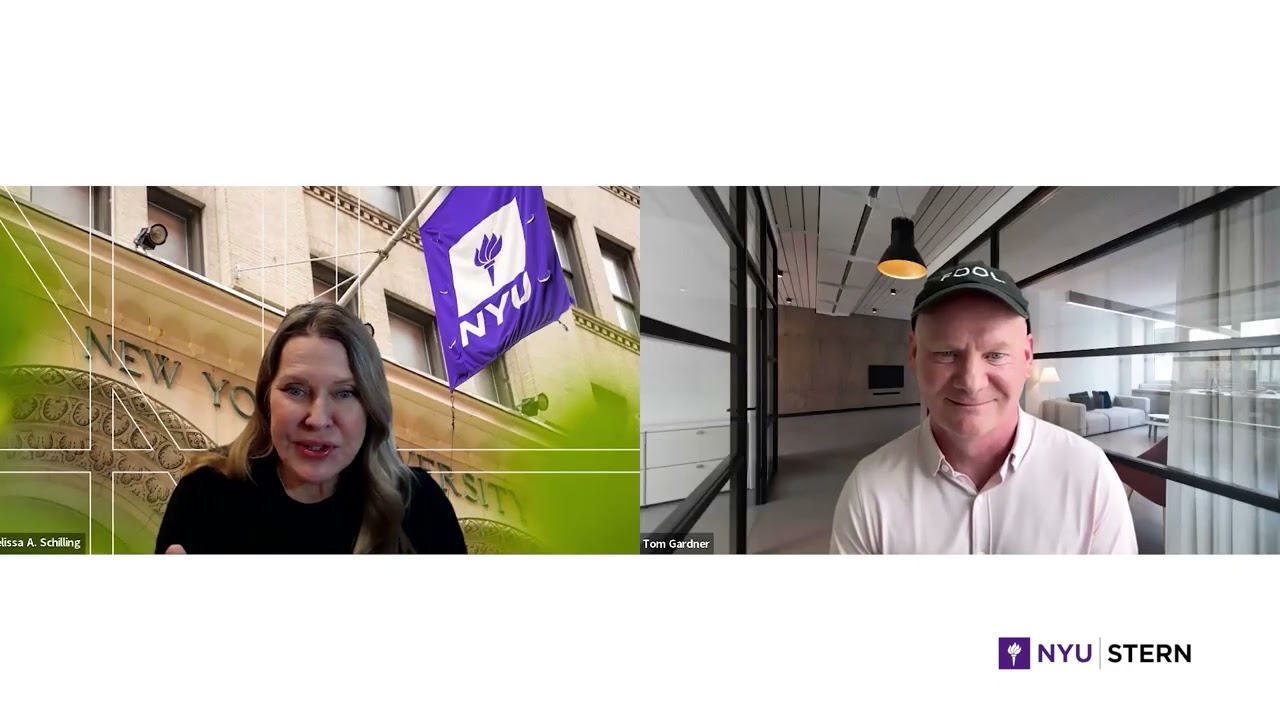
Published by NYU Stern on YouTube on November 2, 2026, this video features the inaugural session of the virtual fireside chat series 'The AI Playbook,' moderated by Fubon Innovation Director Melissa Schilling. The event, recorded on September 23, 2026, showcases Tom Gardner, CEO and co-founder of The Motley Fool, discussing practical strategies, organizational risks, workforce shifts, and leadership lessons learned from integrating artificial intelligence across the financial research firm.
## TL;DR
Tom Gardner explores how The Motley Fool adapted its thirty-year financial media and equity research business around rapid AI deployment, transitioning from manual coverage models to autonomous, engineer-assisted workflows where a single analyst can scrutinize hundreds of equities. He explains how the firm shifted toward global remote hiring, established mandatory AI standards backed by voluntary buyout packages rather than traditional layoffs, and benchmarks evolving frontier models across shortened decision-making cycles. Gardner also analyzes macro-market dynamics, arguing that hyper-lean startups will disrupt massive incumbents, infrastructure spending will drive secondary supply-chain windfalls, and AI pattern recognition will persistently chase pricing inefficiencies rather than create a monolithic consensus.
## Atmosphere & style
The conversation carries a frank, reflective, and intellectually rigorous tone, shaped by the transparent rapport between long-time collaborators Gardner and Schilling, who also serves on The Motley Fool's board. Gardner combines candid self-critique about organizational inertia and rollout delays with genuine executive urgency, contrasting the creative insomnia driven by technical breakthroughs against the threat of corporate extinction. It feels like an authentic insider debrief rather than corporate cheerleading, pairing tactical nuts-and-bolts workflows with sobering assessments of workforce contractions and market volatility.
## Bulletin
- [15:14](https://www.youtube.com/watch?v=HzwPc510Ci0&t=914s) At The Motley Fool, AI orchestration and algorithmic rubrics now handle roughly 60% of equity research, allowing a single analyst to scale coverage from 30 to upwards of 200–400 public companies.
- [36:03](https://www.youtube.com/watch?v=HzwPc510Ci0&t=2163s) Tom Gardner projects that AI leverage will soon produce six-person startups acquired for $10 billion, while 24-person teams can duplicate the intellectual property of 1,500-person legacy incumbents.
- [07:19](https://www.youtube.com/watch?v=HzwPc510Ci0&t=439s) Traditional hiring pipelines collapsed under an influx of synthetic AI resumes, prompting The Motley Fool to adopt active algorithmic sourcing and 4- to 8-week paid trial contracts to evaluate engineers.
- [40:18](https://www.youtube.com/watch?v=HzwPc510Ci0&t=2418s) To uphold a longstanding no-layoff pledge while enforcing aggressive technical adaptation, The Motley Fool made AI adoption a mandatory performance standard and offered voluntary buyouts to resistant employees.
## Key takeaways
- [02:06](https://www.youtube.com/watch?v=HzwPc510Ci0&t=126s) Financial services is an immediate AI disruption zone because market participants relentlessly seek informational asymmetry and competitive speed advantages.
- [04:33](https://www.youtube.com/watch?v=HzwPc510Ci0&t=273s) Shifting to a fully remote operating model allowed The Motley Fool to source specialized machine learning and software talent globally across Bucharest, Milan, and the Dominican Republic.
- [07:19](https://www.youtube.com/watch?v=HzwPc510Ci0&t=439s) Synthetic AI-generated resumes rendered traditional inbound job boards obsolete, driving firms toward active algorithmic candidate sourcing and hands-on trial contracts.
- [07:19](https://www.youtube.com/watch?v=HzwPc510Ci0&t=439s) Frontier models exhibit narrow performance deltas, requiring agile engineering teams to benchmark updates within six-hour evaluation windows and remain model-agnostic.
- [15:14](https://www.youtube.com/watch?v=HzwPc510Ci0&t=914s) Equity research at The Motley Fool has evolved to a 60/40 ratio of automated algorithmic scoring to human synthesis, enabling analysts to monitor SEC disclosures across hundreds of firms.
- [25:32](https://www.youtube.com/watch?v=HzwPc510Ci0&t=1532s) AI infrastructure spending of an estimated $7 trillion is creating compounding second-order windfalls for secondary power grid and electrical equipment providers.
- [30:33](https://www.youtube.com/watch?v=HzwPc510Ci0&t=1833s) AI will not consolidate public markets into an efficient, monolithic pricing consensus because divergent analytical models and trading time horizons continue to generate underlying volatility.
- [33:01](https://www.youtube.com/watch?v=HzwPc510Ci0&t=1981s) Hyper-lean, AI-native startups require far less venture capital and can remain private longer, locking everyday retail investors out of early-stage enterprise wealth creation.
- [42:37](https://www.youtube.com/watch?v=HzwPc510Ci0&t=2557s) A lean startup composed of 12 AI engineers and 12 domain specialists can now replicate the proprietary software and output of legacy incumbents employing 1,500 to 1,800 people.
- [42:37](https://www.youtube.com/watch?v=HzwPc510Ci0&t=2557s) Gardner cited gradual, comfortable AI rollouts as a significant managerial misstep, arguing that leaders should have established firm, mandatory AI standards as early as 2023.
- [46:39](https://www.youtube.com/watch?v=HzwPc510Ci0&t=2799s) While AI pattern recognition effectively flags governance anomalies and shell company director overlap, its financial payoff is skewed toward finding long compounders rather than capped-upside short targets.
- [53:01](https://www.youtube.com/watch?v=HzwPc510Ci0&t=3181s) Cloud vendor subsidies and equity warrants tied to hardware sales indicate weakening revenue quality, warning of possible near-term market pullbacks despite high long-term ROIC.
- [56:42](https://www.youtube.com/watch?v=HzwPc510Ci0&t=3402s) The most significant casualties of the AI revolution will be legacy incumbents crippled by cultural inertia and failure to overhaul day-to-day workflows, rather than speculative failed startups.
- [01:00:02](https://www.youtube.com/watch?v=HzwPc510Ci0&t=3602s) Agentic workflows can synthesize deep domain expertise, such as querying models primed with Warren Buffett's complete writings to audit and rank cohorts of niche insurance companies.
## Detailed walkthrough
### [00:07](https://www.youtube.com/watch?v=HzwPc510Ci0&t=7s) Welcome and Introduction to The Motley Fool & Tom Gardner
Melissa Schilling opens the first session of the AI Playbook series, explaining that the series brings together managers from various industries to discuss how they leverage artificial intelligence, the operational opportunities and pitfalls they face, and the real-world lessons gathered along the way. She introduces Tom Gardner, CEO and co-founder of The Motley Fool, a private financial and investing advice firm established in the early 1990s that offers stock analysis, market news, and premium subscription recommendations for retail investors. Beyond co-authoring best-selling finance books such as *The Motley Fool Investment Guide*, *You Have More Than You Think*, and *Rule Breakers, Rule Makers*, Gardner has been a vocal proponent of Wall Street transparency and has testified before the United States Congress on industry reform.
Before the conversation gets underway, Gardner interjects with a playful check on disclosure: “Mutually enthusiastic and don't you need to, in the name of transparency, identify that you are a board director of our company?” Schilling readily confirms that she sits on The Motley Fool’s board of directors, noting that her governance role gave her a front-row seat to their technical initiatives and provided the leverage needed to secure Gardner for the inaugural talk despite his demanding schedule.
- **Foundational Books Authored by Tom Gardner**: *The Motley Fool Investment Guide*, *You Have More Than You Think*, and *Rule Breakers, Rule Makers*.
- **The Motley Fool's Core Mission**: To make members and the investing world “smarter, happier, and richer.”
---
[02:06](https://www.youtube.com/watch?v=HzwPc510Ci0&t=126s) The Motley Fool's Origins and Financial Services as an AI Disruption Zone
Gardner recounts the company's genesis in 1993, when it began as a humble print newsletter circulated among friends and family before rapidly migrating to early digital platforms like America Online (AOL), Prodigy, CompuServe, and Usenet newsgroups. In those nascent internet days, online stock discussions were shrouded in anonymity, and mainstream media frequently questioned whether digital financial forums were simply elaborate frauds. Over the intervening three decades, through entrepreneurial booms and busts, the organization expanded into an international retail investing powerhouse.
```mermaid
flowchart LR
accTitle: The Motley Fool Platform Evolution
accDescr: Progression of The Motley Fool distribution models from 1993 print newsletters to modern AI integration.
subgraph EarlyEra["Early Distribution"]
A["1993: Print Newsletter"] --> B["AOL, Prodigy & CompuServe"]
B --> C["Web Publishing & Subscriptions"]
end
subgraph ModernEra["Tech Transformation"]
C --> D["AWS Cloud Migration"]
D --> E["Global Remote AI Deployment"]
end
```
Gardner emphasizes that the rapid acceleration of artificial intelligence over the past 18 months represents an existential shift for the financial sector. Because market participants constantly hunt for information asymmetry, finance is naturally among the earliest domains to be thoroughly transformed by machine intelligence:
> “It doesn't take a lot of deeper thought to realize that financial services will be the first category or one of the first categories disrupted by any new technology as everyone tries to figure out, how can I get an edge?”
Whether analyzing balance sheets or processing real-time geopolitical dynamics, institutions that harness frontier models faster will fundamentally outpace their peers.
---
[04:33](https://www.youtube.com/watch?v=HzwPc510Ci0&t=273s) From Cloud Migration to a Remote, Global Talent Strategy
Reflecting on Schilling’s observation that many veteran founders hesitate when faced with disruptive technologies, Gardner acknowledges that The Motley Fool was historically late to modernize its infrastructure, specifically regarding its migration to Amazon Web Services (AWS). Once that transition occurred—guided in part by Schilling’s advisory input—leadership recognized that the organization lacked the internal technical skill sets required for modern computational workloads. Moving past its legacy identity as an Alexandria, Virginia–centric print and digital publisher, the company instituted a fundamental cultural pivot.
Following the COVID-19 pandemic, The Motley Fool decided against issuing a return-to-office mandate, choosing instead to lean fully into remote collaboration via Slack and Zoom. Gardner argues that physical offices inherently introduce an imbalance between in-person participants and remote attendees, whereas remote work flattens the hierarchy by placing everyone in the “same size digital square.” This operational posture enabled the company to build a distributed engineering roster across global tech hubs, tapping specialized AI talent in locations such as Bucharest, Milan, and the Dominican Republic. In this new paradigm, traditional employee tenure matters far less than raw capability:
> “And we know that in technology companies, you start to look a little bit more like an NBA team, let's say, you need the top elite players.”
- **HQ Shift**: Moved from a concentrated office culture in Alexandria, Virginia, to an asynchronous, 24/7 global talent network.
- **Talent Centers**: Sourcing specialized software and machine-learning engineers across Europe and the Americas, including Romania, Italy, and the Dominican Republic.
- **Organizational Change**: Experienced more structural and cultural evolution in the past two years than in the previous two decades.
---
[07:19](https://www.youtube.com/watch?v=HzwPc510Ci0&t=439s) Reimagining Recruiting and Assembling Elite AI Engineers
When Schilling asks how the company identifies and vets top-tier AI personnel worldwide, Gardner explains that traditional job postings have become obsolete due to inbound applicant volume being flooded with synthetic, AI-generated resumes. Instead, the firm shifted to proactive headhunting, deploying an internal proprietary tool built by contractor Jonathan Wilder that scores candidates against synthetic job descriptions across targeted domains. Gardner notes that the true differentiator among elite practitioners—especially those with advanced academic backgrounds in machine learning who were probing generative models long before ChatGPT's debut—comes down to seasoned judgment regarding model strengths and limitations.
```mermaid
flowchart TD
accTitle: AI Talent Acquisition and Model Evaluation Workflow
accDescr: Workflow showing automated sourcing of engineers followed by rapid trial contracts and real-time model benchmarking.
subgraph HiringPipeline["Sourcing & Onboarding"]
H1["Generate Synthetic Job Descriptions"] --> H2["Proprietary AI Headhunting Tool"]
H2 --> H3["Screen & Score Candidates"]
H3 --> H4["4- to 8-Week Trial Contract"]
end
subgraph Operations["Frontier Model Evaluation"]
O1["Frontier Upgrades: Claude, GPT, Grok, Gemini"] --> O2["6-Hour Slack Evaluation Window"]
O2 --> O3["Retain, Tweak, or Deprecate Models"]
end
H4 --> Operations
```
This engineering group acts as a rapid-response unit evaluating frontier models such as Claude, GPT, Grok, and Gemini. When a provider releases an update, the team assesses the model on Slack within the first six hours, frequently finding that subtle changes or degraded computational benefits mean a newly released version must be removed from company-scoring pipelines. To test fit, The Motley Fool brings candidates on board for four- to eight-week trial contracts. Many recruits come directly from academic theory into applied corporate problem-solving, drawn by a retail-focused mission that democratizes investment insights rather than locking them away in a closed-door hedge fund:
> “All of a sudden, you start to realize that there is a massive gap in capabilities between somebody who's been deploying these models in as many ways as possible to analyze information, but also who is now sitting on the pace of upgrades across Claude and GPT and Grok and Gemini, and realizing that each of those upgrades in the first six hours with a team, in our case, on Slack, real-time saying, we're going to have to remove this one because the computational benefits have actually diminished a little bit, and it's not going to be as strong for us in scoring companies.”
- **Evaluation Window**: New frontier updates are benchmarked within a strict 6-hour evaluation window to adjust proprietary company-scoring algorithms.
- **Contract-to-Hire Framework**: Practical trial engagements spanning 4, 6, or 8 weeks to assess real-world execution.
- **Talent Profile**: Academics and machine learning specialists shifting from abstract research to applied retail finance workflows.
[10:05](https://www.youtube.com/watch?v=HzwPc510Ci0&t=605s) The "Pull" Hiring Model and Passion-Driven Burnout
Tom Gardner observes that employees using advanced AI tools are working harder than ever, driven not by managerial deadlines, but by sheer excitement. This intensity creates a real risk of burnout fueled by enthusiasm rather than corporate pressure—characterized by team members losing sleep because the breakthroughs within their grasp are unprecedented. For Gardner, this current wave of generative tooling mirrors the electrifying atmosphere inside The Motley Fool during the late 1990s.
Melissa Schilling reflects back on Gardner’s description of their talent acquisition process, noting that The Motley Fool has transitioned from a traditional "push" model—posting job requisitions and passively sifting through submitted resumes—to a proactive "pull" model where proprietary algorithmic tools scour external networks to find candidates who precisely match their needs. She asks how aspiring job seekers can position themselves to be discovered by these automated search systems across industries.
> “In fact, there's a lot of risk of burnout from enthusiasm, not from pressure, not like, hey, you need this by Tuesday at four, but like, I couldn't sleep last night because the breakthroughs that are available right now are so brand new and so exciting to me.” — Tom Gardner
[11:26](https://www.youtube.com/watch?v=HzwPc510Ci0&t=686s) Talent Flows, the Invisible Competitor, and Tearing Down Legacy Workflows
Addressing how individuals can stand out to automated sourcing tools, Gardner recalls a conversation with a former CEO of LinkedIn, who noted that internal talent migration patterns—such as a wave of elite engineers departing an established enterprise software giant to join a Series C data infrastructure startup—serve as a remarkably predictive leading indicator of public market value creation. Gardner stresses that professionals must realize they are competing against an "invisible competitor": artificial intelligence with escalating sophistication entering domain after domain. Rather than assuming current day-to-day job descriptions will endure, workers must envision what their roles will demand three to five years out and acquire those forward-looking skills immediately so automated scrapers can identify them.
To illustrate the mortal danger of clinging to existing workflows during platform shifts, Gardner points to media titans of the late 1990s and early 2000s such as *People Magazine* and MTV. Despite commanding unrivaled cultural influence and access, both brands saw their relevance collapse because they failed to dismantle their core operations—MTV could have evolved into Spotify, and *People* could have become Instagram. Surviving such inflection points requires radical internal disruption, a dynamic chronicled in Andy Grove's classic business book *Only the Paranoid Survive*, which documented Intel's agonizing pivot from memory chips to microprocessors when longtime colleagues found themselves split across strategic battle lines.
```mermaid
flowchart TD
accTitle: Organizational Adaptation to Technological Inflection Points
accDescr: A diagram contrasting legacy workflow inertia with proactive adaptation to AI disruption.
subgraph LegacyInertia["Legacy Inertia (1990s Giants)"]
direction TB
A["Dominant Cultural Brands<br/>(MTV, People Magazine)"] --> B["Reluctance to Dismantle<br/>Established Workflows"]
B --> C["Displaced by Native Platforms<br/>(Spotify, Instagram)"]
end
subgraph ProactiveAdaptation["Proactive Adaptation (AI Paradigm)"]
direction TB
D["Emerging Shift<br/>('Invisible Competitor')"] --> E["Anticipate Role Requirements<br/>3 to 5 Years Forward"]
E --> F["Rebuild Capabilities & Tooling<br/>(Grove's Intel Playbook)"]
end
```
> “And MTV could have, it's easy to play 2020 hindsight, but could have become Spotify. And People Magazine could have become Instagram.” — Tom Gardner
> “So I think when we look at what's happening in today's work environment, it's really important to use the tools to generate what your job is gonna look like three years from five years from now, and to begin building those skills as quickly as possible.” — Tom Gardner
- Predictive talent tracking: Watching senior engineering cohorts leave incumbents for venture-backed startups often forecasts structural shifts in enterprise value before public markets price them in.
- The Andy Grove blueprint: Intel's transition away from its original memory business proved that institutional survival frequently requires tearing down legacy lines of business, even when it pits collaborative teams against one another.
- Career positioning: Candidates must skate to where the puck is going by acquiring AI-augmented workflows and making those competencies visible on platforms like LinkedIn to be indexed by talent search engines.
[15:14](https://www.youtube.com/watch?v=HzwPc510Ci0&t=914s) Reinventing Stock Analysis: From 30 Companies to 400 with AI Scoring Systems
When Schilling turns the conversation toward operational changes inside The Motley Fool, Gardner first clarifies what remains untouched: their underlying subscription business model, their mission to help everyday investors build diversified portfolios of stocks and ETFs, and the philosophy that every adult must view themselves as the "CEO of their financial life." However, the core mechanics of investment research and equity analysis have experienced a fundamental transformation.
Two decades ago, academic research and Wall Street practice held that an individual analyst could effectively cover only about 30 companies within a dedicated sector. In the early 1990s, analysts relied on physical S&P Stock Guides, Value Line sheets, and mailed paper 10-K filings. Today, pairing an analyst with AI engineering support allows that single investor to cover 200 to 400 companies far more thoroughly than someone previously covered 30. Rather than manual skimming, automated systems can programmatically ingest SEC filings across hundreds of companies, scoring accounting footnotes, analyzing revenue quality, and flagging balance sheet anomalies. Gardner recalls how Enron and WorldCom carried complex hidden liabilities—such as debt triggers tied to share prices—that were buried in dense disclosures; AI tools can now surface such structural hazards instantaneously.
```mermaid
flowchart LR
accTitle: Shift in Stock Research Coverage and Workflow
accDescr: Flowchart comparing the manual 30-company analyst model with the modern 400-company AI-orchestrated model.
subgraph ModernModel["AI-Augmented Research Architecture"]
direction TB
M1["Analyst Domain IP & Sourcing Rules"] --> M2["AI Engineers & Orchestrators<br/>(Data Cleaning & Red Teaming)"]
M2 --> M3["Algorithmic Scoring Engines<br/>(Footnote Quality & Revenue Quality)"]
M3 --> M4["Coverage: 200 to 400 Companies<br/>(60% Scoring / 40% Human Synthesis)"]
end
```
Gardner emphasizes that executing this shift requires dedicated AI engineering teams who clean data, run prompt systems, and perform "red teaming" to validate outputs. In modern equity research at The Motley Fool, roughly 60% of the analytical lifting comes from automated quantitative and qualitative scoring frameworks, while the remaining 40% relies on nuanced human judgment that has not yet been formalized into prompts.
> “So now it's the ability to process information differently. So I'm going to take the person who says, I will deliver for you excellent analysis of 400 companies with these tools and with orchestrators that are capable of the technical work that I'm not capable of to help me. I will cover 400 companies rather than I will manually cover 30.” — Tom Gardner
> “Now, to me, it is much more, it is more sort of 60% about the scoring system you're building. And then the other 40% does trail down into manual work where you're still using that expertise you have that you haven't been able to put into a prompt system yet, let's say, but that's a long-winded way of saying just in the core of stock analysis now, I would say that the gap between the productivity of one person covering 30 businesses and another person with AI engineering support downloading all of their IP knowledge to build the scoring system, let's say, is allowing you to cover many, many more companies.” — Tom Gardner
- Coverage scale: Analyst coverage capacity expands from an industry baseline of 30 companies up to 200–400 companies when paired with technical orchestration.
- Systematic fraud detection: Automated footnote extraction and accounting checks rapidly detect red flags—such as Enron-style stock price-contingent debt covenants—that previously required exhaustive investigative work.
- Research division of labor: The modern analytical pipeline rests on an approximate 60/40 ratio, with 60% driven by algorithmic scoring rubrics and 40% driven by human domain expertise and discretionary oversight.
[20:29](https://www.youtube.com/watch?v=HzwPc510Ci0&t=1229s) Narrowing Time Horizons and the Shrinking Analyst Workforce
Melissa Schilling opens by asking Tom Gardner whether the rise of AI tools means the financial sector will see fewer analysts overall, or if the research itself will simply become deeper, wider, and better. Gardner responds that it will be a mixed outcome rolling out in stages. He reflects on his own experience leading The Motley Fool, observing how the rapid pace of technological change compresses strategic forecasting:
> “So it's an interesting dynamic on every level in terms of how to manage a business, how to evaluate other companies, how to make investment decisions. Information is coming so quickly, breakthroughs are coming so rapidly that it's not entirely clear to me what investing will look like four years from now relative today.”
Turning directly to the workforce, Gardner predicts that there will be fewer financial analysts on average, but immense opportunity will remain for those who become obsessed with leveraging modern AI tooling. The impact, however, is highly uneven across industries. A company manufacturing basic goods like shoes and shoelaces can derive operational efficiencies from AI, but it is not facing an existential “intelligence explosion.” By contrast, Gardner has been directing significant investment capital into drug discovery because the entire sector is immediately positioned to go on offense using these tools.
Software companies, meanwhile, face a more troubling reality. Many are discovering that the intellectual property value of their software is rapidly declining toward zero. Although multi-year enterprise contracts and entrenched sales teams offer temporary protection, Gardner observes that “the ice cube is melting for them.” Looking across corporate America, he anticipates a major shift toward smaller core teams that lean heavily on contract workforces. Managing this transition creates an acute organizational challenge: companies must figure out how to structure contracts, build institutional trust, and maintain a healthy culture when roles and job descriptions are in constant flux.
[23:25](https://www.youtube.com/watch?v=HzwPc510Ci0&t=1405s) Frontier Model Overlap and the 400-Meter High Hurdles
Gardner notes that because smaller teams can now generate immense output, businesses will face a proliferation of overlapping competitors. To illustrate this dynamic, he turns the question back to Schilling, asking whether she has a personal preference among the frontier models: Grok, Gemini, ChatGPT, or Claude. Schilling explains that her usage depends on the specific use case: she relies on Claude for certain tasks because her community recommends it, turns to Perplexity for morning coffee chats and academic literature reviews due to its strong sourcing capabilities, and occasionally uses ChatGPT for deeper research projects.
Gardner points out that Schilling’s multi-tool workflow mirrors what is playing out inside major enterprises, where teams license and test multiple platforms simultaneously because the performance gaps between frontier models are razor-thin:
> “And when you watch the European championships and you see that the winner wins by 0.12, they got their notes right at the last second over the finish line. I think there's so much overlap in these frontier models.”
This tight race at the frontier serves as an early indicator for the rest of the knowledge economy. In all intellectual property businesses, sustainable competitive advantages will become increasingly difficult to maintain. Gardner argues that success will hinge on organizational speed, an appetite for relentless experimentation, the total elimination of workforce complacency, and a willingness to overhaul legacy habits. Companies that enthusiastically adapt each time a model updates—whether every two weeks, every week, or eventually every two days—will pull away from their competitors.
```mermaid
flowchart TD
accTitle: Generative AI and Corporate Disruption Flow
accDescr: A flowchart showing how advancing frontier models compress strategic planning, divide industries into offensive and melting-cube categories, and force organizations toward smaller teams.
subgraph Frontier["Rapid AI Advancements"]
A["Frontier Model Race<br>(Claude, GPT, Gemini, Grok)"] --> B["Narrowing Strategic Horizon<br>(Unclear vision beyond 4 years)"]
end
subgraph Impact["Uneven Industry Impact"]
B --> C["Offensive Adopters<br>(e.g., Drug Discovery)"]
B --> D["Melting Ice Cubes<br>(Software IP eroding to zero)"]
B --> E["Basic Manufacturing<br>(Shoes: Efficiency only)"]
end
subgraph Outcome["Organizational Shift"]
C --> F["Smaller High-Output Teams"]
D --> F
F --> G["Contract Workforces & Rapidly Shifting Roles"]
end
```
[25:32](https://www.youtube.com/watch?v=HzwPc510Ci0&t=1532s) Concentric Circles of Analysis and Near-Term Market Volatility
Prompted by Gardner's description of granular AI analysis, Schilling asks whether deeper scrutiny of financial footnotes and corporate disclosures will make markets more accurate, potentially preventing accounting scandals like Enron or curbing speculative asset bubbles. Gardner pushes back against the idea of imminent stability, predicting that the market will experience heightened volatility and uncertainty in the short term. The analytical challenge is expanding rather than simplifying, because analysts can no longer look at a public company in isolation:
> “I think what's gonna happen is the winners are gonna realize that they wanna get a holistic view of every individual business with scoring and all those elements. But the moment in time from here to getting to that view is a lot of experimentation, a lot of different weighting of scores, different uses of the tools and different time horizons.”
To illustrate how The Motley Fool uses AI to uncover asymmetric opportunities, Gardner shares an internal modeling project started two years earlier. Engineers mapped out an expected multi-trillion-dollar AI infrastructure expenditure (such as $7 trillion over five years) and traced where those capital flows would trickle down into secondary sectors:
- A small electrical equipment or power grid company with only $106 million in annual sales might capture a tiny fraction of that spending.
- That small allocation can lift the company's revenue from $106 million to $170 million, generating 70% annual revenue growth over three years.
- A business trading at a modest share price with a $300 million market capitalization could surge to a $4.6 billion valuation within four years.
Understanding such opportunities requires expanding outward in concentric circles of information. It starts with reading every footnote in a company's 10-K over three years to spot newly acknowledged risks or buried disclosures. From there, analysts must evaluate industry-level headwinds, tailwinds, and crosswinds, moving far beyond traditional metrics like price-to-earnings ratios, quarterly reports, and executive rosters. Furthermore, analysts must factor in macro market systems, recognizing that public companies in the United States benefit from strict regulatory standards that do not exist in emerging markets like Vietnam.
Because market participants apply AI with radically divergent strategies and time horizons—ranging from long-term fundamental investors to quantitative high-frequency trading firms like Jane Street, Point72, D. E. Shaw, and Citadel, which trade over 30-second intervals without necessarily knowing what a company makes—Gardner expects elevated stock market volatility to persist until shared patterns and mature systems bring stability.
[30:33](https://www.youtube.com/watch?v=HzwPc510Ci0&t=1833s) Market Volatility, Valuations, and the Illusion of a Single AI Market
While headline market indexes might appear placid, Tom Gardner points out that beneath the surface of the ten largest technology companies, stock volatility in the United States is running exceptionally high. Enterprise software darling Atlassian serves as a glaring case study: its stock collapsed from $400 down to $50, only to rocket back up to $190 in just a matter of months. Gardner emphasizes that new analytical AI tools are introducing fresh information into the market, but the immediate result is not an orderly equilibrium. Instead, it is a volatile, chaotic process of exploration where market participants are actively feeling their way through the dark.
Melissa Schilling pauses to remind the audience to submit their questions in the Q&A box before turning the discussion back to valuation fundamentals. In her corporate strategy courses, she frequently highlights how distant public market capitalizations are from the traditional net present value (NPV) of a firm’s expected cash flows, driven instead by consumer sentiment and momentum. She asks Gardner whether AI-driven, granular analysis might close that valuation gap—elevating undervalued companies, devaluing overhyped ones, and causing a near-term valuation reset that could explain the current turbulence.
Gardner agrees that more accessible, rapidly assessed information should theoretically dampen volatility and prevent bubbles over the long run. He firmly pushes back, however, against the popular techno-deterministic theory that all AI models will eventually aggregate into a single monolithic intelligence that eliminates market pricing inefficiencies entirely. As Tom Gardner states: “I think that the systems will always be chasing a new insight forever.”
- **Atlassian's Price Rollercoaster:** The stock tumbled from $400 to $50 before rebounding to $190 over just a few months, illustrating the wild swings occurring just below the mega-cap tech layer.
- **Valuation Reset:** Schilling notes that market caps rarely mirror discounted future cash flows, questioning whether AI will force prices to converge toward fundamental NPV.
- **The Monolithic Market Myth:** Gardner rejects the idea that unified algorithmic consensus will extinguish financial markets, arguing that models and humans will eternally compete to identify the next informational edge.
---
[33:01](https://www.youtube.com/watch?v=HzwPc510Ci0&t=1981s) Early Discovery: From Lithuanian Basketball Prodigies to Tiny Billion-Dollar Startups
To illustrate how the quest for informational edge behaves, Gardner draws an analogy to basketball talent scouting. While he identifies more as a college basketball fan than an NBA follower, he marvels at how recruitment horizons have relentlessly expanded earlier in time and broader across geography. Decades ago, scouting focused on high school seniors or college graduates, but today scouts evaluate eleven-year-old prodigies showcased in YouTube highlights and summer camp leagues, scouring talent pools as far away as Lithuania. In investing, algorithmic models are driving the exact same pattern: market players are racing to discover a company's durable competitive advantages earlier and determine how long those moats will persist.
```mermaid
flowchart TD
accTitle: The Shifting Capital and Information Race
accDescr: Diagram illustrating how earlier algorithmic identification leads to ultra-lean private companies staying private longer, locking out retail investors.
subgraph Discovery ["Algorithmic Discovery Race"]
A["Hyper-Early Signal Detection"] --> B["Identify Moats & Advantage Lifespans"]
end
subgraph Corporate ["Lean Enterprise Structure"]
B --> C["Massive Tech Leverage & AI Tooling"]
C --> D["Minimal Capital & Headcount Needs"]
end
subgraph Markets ["Market Structural Shift"]
D --> E["Extended Private Valuation Cycles"]
E --> F["Extreme Wealth Concentration Outside Public Reach"]
end
```
This dynamic fuels a trend that Gardner finds deeply concerning: companies are staying private much longer. Powered by sophisticated cloud and AI architectures, startups require far less human labor and capital to scale. When Instagram was acquired for $1 billion, it had only 13 employees; Gardner predicts the market will soon see six-person enterprises bought for $10 billion. Because these massive valuation gains unfold inside private markets, everyday retail investors are completely shut out, concentrating unprecedented wealth in private hands. While increased public data and potential shifts between semi-annual and quarterly reporting could bring greater stability once companies finally list, the unending race to catch early signals—much like detecting cancer at its earliest stage—means volatility driven by unknown variables will never vanish. As Tom Gardner observes: “And we've already said, and we've already seen, you're gonna see six person companies bought for $10 billion.”
- **Scouting Parallels:** Just as NBA and NCAA scouting moved from graduating seniors to global recruiting in Lithuania and eleven-year-olds on YouTube, financial algorithms hunt for alpha at the earliest inception of competitive advantage.
- **Hyper-Lean Unicorns:** Instagram set an early benchmark with 13 employees at its $1 billion acquisition; Gardner anticipates six-person startups achieving $10 billion exits.
- **Retail Investor Lockout:** Because capital-efficient firms delay initial public offerings, immense wealth creation accrues exclusively to private venture markets rather than individual public investors.
---
[36:03](https://www.youtube.com/watch?v=HzwPc510Ci0&t=2163s) The Corporate Canary: Workforce Sizing, Cloud Migration, and the No-Layoffs Pledge
Turning to organizational pain points, Schilling asks Gardner what hard lessons, missteps, or managerial warnings have emerged while integrating AI at The Motley Fool. Gardner frames the mega-cap tech giants as the canary in the coal mine. Despite boasting the strongest balance sheets and free cash flows in history, these dominant players are aggressively reducing their workforces. Historically, corporate layoffs signaled internal weakness and spooked institutional investors. Today, tech giants initiate layoffs opportunistically because their scaled AI adoption exposes operational redundancy. Anthropic, for instance, constructed a near-trillion-dollar enterprise in under six years with an astonishingly small marketing footprint.
Gardner notes that financial services sits right behind information technology as the sector most vulnerable to AI disruption, forcing The Motley Fool to scrutinize its own staffing and skill mix. He recalls a past moment when Schilling candidly told him that The Motley Fool had waited too long to upskill its staff during its migration to Amazon Web Services (AWS). While Gardner agreed with her assessment, the pressing threat of a security breach involving member data forced the company to recruit external talent immediately rather than wait for internal upskilling. That urgency collided with the company's deeply held employment philosophy. After being forced to enact painful layoffs to survive the dot-com crash in 2001—an agonizing experience where an employee called his home phone ninety minutes after being let go to apologize for getting emotional—Gardner vowed after becoming CEO in 2007 that The Motley Fool would reject the traditional layoff model. Having bought out its venture capital investors to remain private, the company prizes cultural stability and avoids treating dedicated employees as disposable line items. As Tom Gardner reflects: “I basically made the statement because a layoff to me means surprise, you're doing a great job.”
- **Opportunistic Tech Downsizing:** Massive tech monopolies are conducting layoffs not out of financial distress, but because early access to AI tools proves large traditional teams—such as legacy marketing departments—are unnecessary.
- **Anthropic's Lean Footprint:** Gardner highlights Anthropic's meteoric valuation trajectory within six years using a fraction of the marketing headcounts historically required for hyper-growth.
- **The AWS Upskilling Dilemma:** While Schilling had advised upskilling internal teams earlier, critical member security needs during the cloud migration forced the Fool to make rapid external hires rather than lean on slow internal retraining.
- **The 2001 Dot-Com Trauma:** The painful post-bubble layoffs in 2001 led Gardner and his leadership team to commit to being a no-layoff organization upon taking over as CEO in 2007, leveraging their private ownership structure to absorb economic cycles without sudden staff cuts.
[40:18](https://www.youtube.com/watch?v=HzwPc510Ci0&t=2418s) Buyouts, Performance Standards, and the Resistance to New Tools
At the onset of the rapid wave of artificial intelligence developments, The Motley Fool operated as a dedicated no-layoff company with 640 employees. Facing an influx of rapid tool releases and natural internal resistance, leadership had to reconcile company culture with fiduciary duty. Tom Gardner acknowledges that pushback is understandable, observing that many younger people dislike what is happening in the technology landscape and actively refuse to adopt generative tools. While Gardner personally embraces cultural throwbacks—drawing a comparison to vinyl records and expressing appreciation for varied markets where people are not forced to march in lockstep—he stresses that a business allocating capital cannot afford that luxury. When members depend on financial services and stock research, the obligation to supply the fastest, most rigorous intelligence takes precedence over internal sentimentality, just as ensuring data security during a migration to Amazon Web Services (AWS) is non-negotiable.
```mermaid
flowchart TD
accTitle: The Motley Fool AI Talent and Performance Transition
accDescr: Workflow showing how The Motley Fool shifts its workforce from legacy expectations to AI performance standards using voluntary buyout offers.
subgraph Standards["1. Setting the Bar"]
A["640-Employee Base"] --> B["Establish AI Adoption as Core Performance Factor"]
end
subgraph Pathways["2. Employee Choice"]
B --> C{"Employee Decision"}
C -->|"Embrace AI tooling"| D["Commit to Advanced Models (e.g. Claude Opus)"]
C -->|"Decline / Resist change"| E["Voluntary Exit / Buyout Packages"]
end
subgraph Outcome["3. Delivery"]
D --> F["Rigorous Member Guidance & Competitive Parity"]
end
```
To bridge this divide without outright layoffs, the company turned to voluntary exit packages and buyout offers. Leadership drew a firm line by turning the adoption of these new tools into mandatory performance standards: employees could choose to adopt them to remain competitive, or accept a structured buyout package. Gardner remarks that navigating these conversations has been the most painful operational challenge of his career because it pits the deep affection leadership feels for long-tenured employees against the existential need to deliver world-class advice to members. Missing a risk factor in a stock analysis simply because an analyst refused to utilize the latest model upgrade, such as a hypothetical Opus 5.5 release, compromises their fiduciary mission. As Tom Gardner puts it: “We have to be the world leader in AI for investors competitively and also to serve our members.”
- The Motley Fool had approximately 640 employees when the current wave of advanced AI capabilities accelerated.
- AI adoption transitioned from an optional exploration into explicit organizational standards and core performance metrics.
- The company utilized voluntary exit offers and buyout packages to allow resistant staff to depart on agreed-upon terms rather than resorting to standard layoffs.
---
[42:37](https://www.youtube.com/watch?v=HzwPc510Ci0&t=2557s) The Regret of Moving Too Slowly and the Threat of Agile Startups
Reflecting on past missteps, Gardner admits that his greatest mistake was moving too slowly and taking a gradual, phased approach instead of issuing a firm, demanding wake-up call as early as 2023. Even though executive conversations with leading industry figures corroborated the speed of change, leadership hesitated out of concern for employee comfort. Gardner worries that this staged hesitation ultimately disadvantaged some employees in the broader job market. He shares an emotional anecdote about a resistant employee who departed in 2024, struggled for three to six months to find traction, and then secured a role at a top-tier AI practitioner after finally realizing the necessity of adapting. This underscored for Gardner that a business harms its people by creating a cozy environment where AI adoption feels optional.
```mermaid
flowchart LR
accTitle: Incumbent vs AI-Native Startup Efficiency
accDescr: Comparison of traditional mid-cap software workforce scale versus AI-native micro-teams replicating identical IP.
subgraph Legacy["Traditional Incumbent Model"]
L1["1,500 to 1,800 Employees"] --> L2["Mid-Cap Software / Research IP"]
end
subgraph Modern["AI-Native Competitor Model"]
M1["12 AI Engineers + 12 Domain Experts<br>(24 Team Members)"] --> M2["$100M Capital Raise"]
M2 --> L2
end
```
The urgency to enforce these standards is driven by the structural threat posed by lean, AI-native competitors emerging from private markets. A new venture comprised of 12 AI engineers and 12 deep domain experts, armed with $100 million in venture capital, can duplicate the intellectual property of a mid-cap software firm or research service that historically required 1,500 to 1,800 employees. Furthermore, foundational model providers like Anthropic (with Claude) have demonstrated that lean teams can drive category-killing product capability and aggressive marketing. Melissa Schilling notes the takeaway: moving aggressively early on is actually a favor to workers rather than a cruelty. Tom Gardner agreed with this framing, asserting: “The mistake is not to have been firmer earlier on because actually if somebody gets the wake-up call in 2023 that you are seeing and you're talking to, everything's being confirmed for you in your conversations with people who have made this the focus of their professional life and you're seeing it, but you think that the right thing to do is to be gradual rather than more demanding and firm right away because we probably disadvantaged some people in the market for employment by not getting an earlier wake-up call that's more substantial to realize.”
- Legacy mid-cap operations with 1,500 to 1,800 workers can face direct disruption from lean startups staffed by roughly 24 specialists (12 engineers and 12 domain experts).
- Claude and frontier models have demonstrated that intelligence and marketing scale can be achieved with remarkably lean internal headcount.
- Leaders risk hurting their workforce's long-term employability when they cultivate an environment where staff can casually or relaxedly learn AI tools.
---
[46:39](https://www.youtube.com/watch?v=HzwPc510Ci0&t=2799s) Q&A: Regulatory Advisory Networks and Detecting Enron-Style Fraud
During the audience Q&A session, Melissa Schilling relays a question regarding how leaders can integrate regulators and legal counsel as early partners rather than reactive blockers. Gardner points to The Motley Fool’s hybrid workforce strategy, which supplements full-time and contract talent with an extensive roster of external advisors. Thanks to the company’s 30-year brand recognition, many active and retired executives from legal, regulatory, and technology disciplines readily agree to two-hour consultative calls. Rather than pursuing massive, complex corporate overhauls, Gardner advises companies to dissect discrete challenges and bring in specialized legal and regulatory advisors to solve specific technical and compliance hurdles incrementally.
Schilling next presents a question from an attendee named Vincent asking whether AI could uncover hidden corporate fraud and intentional obfuscation comparable to the Enron scandal, where management conspired with auditors to withhold material facts. Gardner notes that while AI will never catch every instance of fraud with 100% accuracy, it significantly enhances an analyst's ability to cross-reference data and detect subtle patterns. He recalls a money manager essay from 25 years ago that tracked board member networks across firms to predict corporate governance behavior. AI can easily flag patterns among executives, board directors, and auditors moving between dubious, highly promotional shell firms capitalized under $100 million where insiders siphon salaries without operating futures. However, Gardner cautions that investors should primarily use these pattern-recognition tools to spot the opposite of Enron—exceptional companies positioned to compound value—because short selling offers limited upside (capped at 100%) and penny stocks are rarely shortable. Addressing the investigative limit, Tom Gardner explains: “I would say if that question is about whether 100% of the time it can hit it perfectly, then we'll both agree immediately, no chance.”
- The Motley Fool leverages short two-hour advisory sessions with seasoned legal, compliance, and technology executives to evaluate discrete regulatory challenges.
- AI pattern recognition excels at identifying governance red flags, such as serial executives and directors moving across promotional penny stocks capitalized under $100 million.
- From an investor’s standpoint, the highest return on AI pattern analysis lies in uncovering high-quality growth businesses ("the opposite of Enron") rather than searching for short-selling targets where total upside is mathematically capped at 100%.
[50:23](https://www.youtube.com/watch?v=HzwPc510Ci0&t=3023s) Model Reliance, Human Checks, and Cybersecurity Blind Spots
Responding to an audience question about whether he fears an over-reliance on AI models for strategic insights, Tom Gardner draws a clear boundary between human judgment and automated systems. He acknowledges that it is too simplistic to give a blanket answer, using a stark metaphor to clarify his stance: “I wouldn't get on an airplane flown by GPT-3, right?” Handing over organizational analysis and high-stakes decision-making to an artificial intelligence without robust human checks is an approach he rejects entirely across nearly every industry. While autonomous systems like Waymo prove that humans are gradually willing to entrust their physical lives to machines after tens of millions of automated miles, Gardner stresses that operating at that scale requires an enormous lattice of checks and balances. Within The Motley Fool, he favors their current balance, though he emphasizes that the organization must adopt AI models further to deliver insights with greater scale and depth.
Turning to security concerns, Gardner expresses deep unease about nearly every facet of AI development. While public cybersecurity firms have experienced soaring valuations fueled by high-profile initiatives like Mythos and the Glasswing project—which offer visibility behind the curtain of modern models—he warns that these valuations mask severe vulnerabilities. Even the most reputable firms carry immense systemic risk if breached, noting how CrowdStrike had to navigate its own major upgrade failure. Acknowledging that he approaches the topic not as a technical specialist but as a layperson CEO in constant contact with technical staff, Gardner emphasizes that demand for protection will soar alongside dramatic security failures.
- Autonomous systems like Waymo have successfully logged tens of millions of automated miles, illustrating that scaled automation demands exhaustive system checks before users will entrust their lives to it.
- Rising cybersecurity stock valuations are driven by deeper visibility into advanced models via initiatives like Mythos and the Glasswing project.
- Vendor vulnerabilities remain acute, exemplified by the operational disruption caused by CrowdStrike's upgrade issue.
[53:01](https://www.youtube.com/watch?v=HzwPc510Ci0&t=3181s) Data Center Financing, Debt Quality, and the Long-Term Monetization Curve
Melissa Schilling uses moderator privilege to ask about a recent *New York Times* article drawing parallels between the current financing of AI data centers and leases and the subprime mortgage crisis of 2008–2009, questioning whether a collapse in lease revenue could trigger a broad economic crash. Gardner frames his response by focusing on the overarching long-term trend rather than short-term turbulence. He observes that AI has expanded in power far faster than even seasoned experts anticipated, noting how early language models went from generating errors every ten seconds to making errors perhaps once every 24 hours. Because the tools are improving exponentially, Gardner considers massive commercial monetization inevitable, even if the market experiences sharp corrections whenever the timing of that monetization faces delays.
```mermaid
flowchart TD
accTitle: AI Market Correction vs Structural Trend Flow
accDescr: Flowchart illustrating how CapEx shifts lead to short-term market corrections while high ROIC drives inevitable long-term monetization.
subgraph SpeedBumps["Near-Term Friction & Volatility"]
A["CapEx Adjustments & Lender Scrutiny"] --> B["Diluted Revenue Quality (Warrants & Subsidies)"]
B --> C["Market Pullbacks (11% to 25% Corrections)"]
end
subgraph LongTerm["Structural Secular Trend"]
D["Rapid Model Improvements"] --> E["Inevitable Commercial Monetization"]
E --> F["High Gross & Operating Margins"]
F --> G["Superior Return on Invested Capital (ROIC)"]
end
C -.->|"Speed bumps, not dead ends"| E
```
Looking at financial structures, Gardner points out that the introduction of debt and lender scrutiny introduces friction that did not exist when builds were self-funded purely out of cash flow. He flags deteriorating revenue quality across the tech ecosystem, pointing to deals where vendors offer stock warrants or sweetheart incentives to persuade enterprise clients to adopt their proprietary chip solutions. As Gardner remarks on these distorted economics: “A dollar of revenue growth without incentives is not a dollar of revenue growth with incentives, right? The latter is weaker.” While this dilution could easily cause the broader market to drop 25% on a sudden capital expenditure pause or geopolitical shock, he cautions against mistaking temporary market pullbacks for structural failures, noting that long-term value will ultimately be driven by elevated returns on invested capital and expanded operating margins.
- In the early days of modern generative AI, systems produced errors roughly every 10 seconds; current systems misfire far less frequently, closer to once every 24 hours.
- Market pullbacks triggered by capital expenditure disruptions might knock equities down 11% to 29%, but Gardner regards these declines as speed bumps rather than systemic dead ends.
- Vendor financing tricks—such as pairing hardware sales with equity warrants to lock in enterprise customers—serve as an early warning sign of softening revenue quality.
[56:42](https://www.youtube.com/watch?v=HzwPc510Ci0&t=3402s) The Incumbent Shakeout: Workflow Inertia and the Lessons of Dot-Com
Addressing Schilling’s comparison to the early dot-com bubble—where splashy consumer internet startups like Kozmo.com and Webvan collapsed—Gardner argues that the true casualties of the AI transition will not be the failed startups, but the legacy incumbents that fail to reinvent themselves. He recalls a vivid memory from a Motley Fool member gathering around 1998, where an investor insisted that Kmart was the safest core holding in his portfolio simply because it was an established American brand. Gardner uses this memory to emphasize that legacy scale provides zero safety when structural shifts occur.
The critical determinant of survival comes down to a company's ability to overhaul ingrained organizational habits and day-to-day workflows. Gardner praises Shopify CEO Tobi Lütke for deliberately disrupting employee routines—such as forcing teams to stand throughout meetings for two weeks or mandating that staff move their computer mouse to the opposite side of their keyboard—to build psychological flexibility. Gardner compares legacy corporate resistance to the early internet era, when traditional newspaper, magazine, and television executives dismissed the web, relegating digital operations to junior employees while refusing to alter their core editorial workflows. As Gardner sees it: “So I actually think there will be some fun stories about drcoop.com or pets.com going under, but actually the big long-term stories will be like, damn, there was something like Blockbuster had 10s of thousands of employees, and it just got, so those will be the big long-term tales from this time.”
- Early dot-com failures like Kozmo.com, Webvan, drkoop.com, and Pets.com dominated early headlines, but the permanent economic shifts came from the destruction of giants like Blockbuster and Kmart.
- Shopify CEO Tobi Lütke implemented radical organizational habits—such as forcing staff to switch mouse hands or hold standing-only meetings—to condition teams to embrace constant workflow evolution.
- Schilling adds Barnes & Noble to the list of legacy retail titans that suffered catastrophic losses by failing to adapt to seismic operational shifts in time.
[59:05](https://www.youtube.com/watch?v=HzwPc510Ci0&t=3545s) Wrapping Up and Snatching One Last Question
With the event nearing its scheduled end, Schilling moves to wrap up the fireside chat, thanking Gardner for a discussion that felt like “drinking from the fire hose” and inviting him back for future sessions. She previews the next installment of NYU Stern's *AI Playbook* series on October 22nd, featuring Yindalon Aphinyanaphongs, the head of Applied AI at NYU Langone Health, who will break down practical applications of machine learning in healthcare.
Before the session concludes, Gardner breaks protocol: “Melissa, can I do something that's not advised in any public speaking setting? I wanna take one last question that I see in the queue and just give a very rapid answer, because I love it...” He grabs an incoming question submitted by an attendee named Carlos regarding company coverage, eager to squeeze in one final thought before signing off.
[01:00:02](https://www.youtube.com/watch?v=HzwPc510Ci0&t=3602s) Prompting AI with Warren Buffett as an Analyst Agent
Addressing an audience question from Carlos about specific prompts, methods, and strategies for analyzing hundreds of companies, Tom Gardner offers a concrete, hands-on experiment for working with frontier models. He recommends selecting a cohort of ten insurance companies—particularly smaller, lesser-known operators—and instructing the AI to evaluate them using the entire body of work and investment philosophy of Warren Buffett's professional career. By feeding the actual financial filings of each company into the model, users can effectively deploy Buffett as an autonomous research agent.
As Tom Gardner describes the exercise: “Take 10 insurance companies and ask whichever frontier model you're using to use the body of work of Warren Buffett's professional life to assess those insurance companies and feed the financial filings of each into it and just have Buffett as your agent, the world's foremost expert on insurance ever in human history, and look at through 10 tiny insurers and score them one to 100 and ask it to focus on current data only.” He emphasizes that users will need to iteratively refine their prompting around different angles, but the process rapidly illuminates both the companies themselves and the underlying mechanics of an unfamiliar sector. Gardner advises investors to simply get their “hands in the dirt” by testing batches of ten companies, whether in industries they know nothing about or in sectors they find genuinely exciting.
```mermaid
flowchart LR
accTitle: Warren Buffett AI Persona Workflow
accDescr: Flow diagram showing financial filings and Buffett's body of work ingested by a frontier model to score insurance companies.
subgraph Inputs["Data & Persona Inputs"]
A["10 Insurer Filings<br>(Current Data Only)"]
B["Warren Buffett<br>Body of Work"]
end
subgraph Engine["Frontier Model"]
C["Buffett AI Agent<br>Insurance Evaluation Engine"]
end
subgraph Output["Analysis & Output"]
D["Scoring (1 to 100) &<br>Industry Insights"]
end
A --> C
B --> C
C --> D
```
- **Methodology**: Ingest SEC filings of 10 targeted companies into a frontier LLM alongside the distilled writings, annual shareholder letters, and analytical frameworks of Warren Buffett.
- **Constraints & Scoring**: Prompt the agent to evaluate the businesses strictly against current data and assign an objective rating from 1 to 100.
- **Educational Value**: The workflow allows an individual investor to rapidly demystify specialized sectors like insurance and discover compelling small-cap companies outside mainstream coverage.
[01:01:11](https://www.youtube.com/watch?v=HzwPc510Ci0&t=3671s) Closing Remarks and The Motley Fool's AI Scale
Melissa Schilling concludes the fireside chat by underscoring the scale at which Tom Gardner’s team operates these methodologies. As Melissa Schilling points out: “Yeah, and I'm just gonna remind everybody that The Motley Fool is doing thousands of different permutations of this kind of thing about companies you never heard of.” She suggests that audience members interested in discovering overlooked businesses without running all the manual prompts themselves can turn directly to The Motley Fool's newsletters and research services.
Gardner warmly agrees with Schilling's plug, thanking her for the conversation. Schilling wraps up the inaugural session of NYU Stern's *AI Playbook* series, thanking Gardner for sharing his operational insights and letting the attendees know that an edited recording complete with captions and web links will be emailed out for sharing.
## Notable quotes
> [02:06](https://www.youtube.com/watch?v=HzwPc510Ci0&t=126s) It doesn't take a lot of deeper thought to realize that financial services will be the first category or one of the first categories disrupted by any new technology as everyone tries to figure out, how can I get an edge? — Tom Gardner
> [53:01](https://www.youtube.com/watch?v=HzwPc510Ci0&t=3181s) A dollar of revenue growth without incentives is not a dollar of revenue growth with incentives, right? The latter is weaker. — Tom Gardner
> And we've already said, and we've already seen, you're gonna see six person companies bought for $10 billion. — Tom Gardner
> [04:33](https://www.youtube.com/watch?v=HzwPc510Ci0&t=273s) And we know that in technology companies, you start to look a little bit more like an NBA team, let's say, you need the top elite players. — Tom Gardner
> [20:29](https://www.youtube.com/watch?v=HzwPc510Ci0&t=1229s) Information is coming so quickly, breakthroughs are coming so rapidly that it's not entirely clear to me what investing will look like four years from now relative today. — Tom Gardner
## Mentioned
Tom Gardner, Melissa Schilling, The Motley Fool, The Motley Fool Investment Guide, You Have More Than You Think, Rule Breakers, Rule Makers, United States Congress, America Online (AOL), Prodigy, CompuServe, Usenet, Amazon Web Services (AWS), Slack, Zoom, Jonathan Wilder, Claude, Claude Opus, GPT, GPT-3, Grok, Gemini, LinkedIn, People Magazine, MTV, Spotify, Instagram, Andy Grove, Only the Paranoid Survive, Intel, Enron, WorldCom, Perplexity, Jane Street, Point72, D. E. Shaw, Citadel, Atlassian, Anthropic, Vincent, Carlos, Waymo, Mythos, Glasswing project, CrowdStrike, The New York Times, Kozmo.com, Webvan, drkoop.com, Pets.com, Kmart, Shopify, Tobi Lütke, Blockbuster, Barnes & Noble, Yindalon Aphinyanaphongs, NYU Langone Health, Warren Buffett
## Video description
On September 23rd, 2026, Tom Gardner, CEO and Co-Founder of The Motley Fool, joined Melissa Schilling for the first session of The AI Playbook.
The AI Playbook is a virtual fireside chat series taking place throughout Fall 2026. It features senior executives from across industries sharing how they are responding to, and building with, artificial intelligence. Moderated by Fubon Innovation Director Melissa Schilling, each conversation moves beyond headlines and hype to explore the practical decisions leaders are making: where they are testing AI, how they are managing risk and change, what has worked, and what they would do differently.
Learn more about the series here: https://www.stern.nyu.edu/experience-stern/about/departments-centers-initiatives/fubon-center/events-activities/ai-playbook
In a discussion hosted by NYU Stern, The Motley Fool CEO Tom Gardner argues that artificial intelligence is fundamentally dismantling legacy operating structures across finance and software, shifting the competitive advantage to hyper-lean, AI-orchestrated teams.
Reinventing Equity Research and Analyst Capacity (15:14)
Integrating frontier AI models has fundamentally expanded the scale of equity analysis while shifting the analytical division of labor. Historically, an equity research analyst manually covered around 30 companies using physical filings and stock sheets. By combining an analyst's domain intellectual property with technical orchestrators, that individual can now track 200 to 400 companies. The modernized analytical pipeline operates on an approximate 60/40 model, where automated quantitative scoring systems handle 60% of the extraction and footnote scrutiny, leaving the remaining 40% to discretionary human synthesis.
Disruptive Talent Strategy and Organizational Speed (4:33)
Adapting to AI disruption required abandoning traditional office setups and conventional hiring funnels. The Motley Fool moved away from an Alexandria-centric workforce to an asynchronous, remote model, utilizing proprietary algorithmic tools to actively headhunt specialized machine-learning engineers across global hubs like Bucharest, Milan, and the Dominican Republic. Because inbound hiring pipelines are now flooded with synthetic, AI-generated resumes, the company relies on automated candidate scoring and four- to eight-week trial contracts rather than traditional job postings.
Operational agility hinges on rapid model evaluation. Internal teams evaluate updates across models such as Claude, GPT, Grok, and Gemini within a strict six-hour Slack window to determine whether computational drift or degraded reasoning requires deprecating an engine from their scoring pipelines. Gardner notes that legacy software firms face a 'melting ice cube' as intellectual property value trends toward zero, while lean startups of 24 individuals (12 engineers and 12 domain experts) can duplicate platforms that previously required up to 1,800 employees.
Navigating Cultural Resistance and Buyout Realities (40:18)
Transitioning legacy workforces to mandatory AI workflows presents acute organizational friction. After maintaining a strict no-layoffs pledge originating from the 2001 dot-com crash, The Motley Fool addressed internal resistance among its 640 employees by offering voluntary exit packages and structured buyouts. Leadership made AI adoption a mandatory performance benchmark, concluding that allowing staff to casually opt out of modern tools compromises fiduciary obligations to research subscribers.
Gardner admits his primary managerial misstep was approaching AI integration too gradually during 2023 out of concern for employee comfort. He argues that sheltering employees from aggressive adoption disadvantages their marketability, as the 'invisible competitor' of autonomous intelligence rapidly reshapes corporate job definitions.
Market Volatility, Capital Allocation, and Systemic Risk (25:32)
Rather than instantly producing efficient pricing, expanded AI tooling is heightening near-term market volatility. Market participants apply divergent time horizons, ranging from multi-year fundamental investors to high-frequency quantitative shops like Jane Street and Citadel trading over 30-second windows. While AI pattern recognition helps detect accounting discrepancies and governance red flags—such as serial shell-company promoters—Gardner dismisses the idea that unified algorithmic models will ever eliminate market pricing inefficiencies entirely.
Macro risks are compounded by capital expenditure cycles and shifting corporate financing. Gardner cautions that vendor incentives, such as hardware bundled with equity warrants, soften revenue quality in AI infrastructure buildouts. Although short-term capital expenditure shocks could trigger market pullbacks between 11% and 29%, Gardner views these dips as operational speed bumps along an inevitable secular monetization trend powered by superior return on invested capital.
While AI radically magnifies individual productivity and analytical breadth, it drives capital concentration into private markets where lean startups delay public offerings, locking out retail investors. Sustainable advantage relies on continuous operational reinvention and rigorous human oversight, as over-reliance on unverified models introduces severe governance, cybersecurity, and systemic risks.
[2:06] Tom Gardner: It doesn't take a lot of deeper thought to realize that financial services will be the first category or one of the first categories disrupted by any new technology as everyone tries to figure out, how can I get an edge?
[53:01] Tom Gardner: A dollar of revenue growth without incentives is not a dollar of revenue growth with incentives, right? The latter is weaker.
Tom Gardner: And we've already said, and we've already seen, you're gonna see six person companies bought for $10 billion.
[4:33] Tom Gardner: And we know that in technology companies, you start to look a little bit more like an NBA team, let's say, you need the top elite players.
[20:29] Tom Gardner: Information is coming so quickly, breakthroughs are coming so rapidly that it's not entirely clear to me what investing will look like four years from now relative today.
Original transcript
[0:07] Melissa Schilling: Hello everyone, I hope you can see the video okay.
[0:11] Welcome to our first fireside chat in our brand new AI playbook series.
[0:16] In this series, we're going to meet with managers in a wide range of
[0:19] industries to hear how they are leveraging AI in their businesses,
[0:22] including the challenges and opportunities that entails,
[0:26] and the lessons they've learned along the way.
[0:28] We're going to have time at the end of each of these chats for Q&A,
[0:31] so please drop your questions in
[0:33] the Q&A box at the bottom of the screen.
[0:36] If you don't see it automatically at the bottom of your screen,
[0:38] just choose the option for more and you should see it there.
[0:42] Today, we are extremely fortunate to have as our first guest,
[0:45] Tom Gardner, CEO and co-founder of The Motley Fool.
[0:49] I'm so excited about this.
[0:51] The Motley Fool is a private financial and investing advice company
[0:55] that's been around since the early 90s that provides stock market news,
[1:00] analysis, and subscription-based recommendations for individual investors.
[1:04] Tom has authored several books,
[1:06] including The Motley Fool Investment Guide,
[1:08] You Have More Than You Think,
[1:10] and Rule Breakers, Rule Makers.
[1:12] He's also been a major advocate for transparency and reform in
[1:16] the financial services industry and has even testified
[1:18] before US Congress towards that goal.
[1:21] He says the mission of The Motley Fool is to make the world smarter,
[1:25] happier, and richer.
[1:27] So please give a warm welcome to Tom.
[1:30] Tom, I'm so excited to have you here.
[1:34] Tom Gardner: Mutually enthusiastic and don't you need to,
[1:37] in the name of transparency,
[1:40] identify that you are a board director of our company?
[1:43] Melissa Schilling: Yes. In the interest of transparency,
[1:45] I am a board member at The Motley Fool,
[1:47] which is part of how I got to know it and got to
[1:49] see what exciting things you were doing and probably
[1:51] also give me a little edge in getting to have you as a speaker,
[1:54] since you're a pretty senior guy who's pretty busy.
[1:58] Tom Gardner: Well, I'm very happy to be here. Looking forward to this.
[2:00] Melissa Schilling: All right. Cool.
[2:02] So for those people who aren't familiar,
[2:03] will you tell them a little bit about what The Motley Fool does?
[2:06] Tom Gardner: Sure. The Motley Fool started in 1993.
[2:11] We were first a print newsletter,
[2:14] mostly for friends and family,
[2:15] and then we discovered America Online,
[2:17] back then Prodigy, CompuServe,
[2:19] and the Internet News Groups and found an opportunity to
[2:23] share our thinking about long-term investing online.
[2:27] We began to very quickly see the benefits of being able to
[2:30] talk to other people around the country or around the world,
[2:33] share different investing ideas,
[2:36] individual companies, or overall strategies.
[2:38] Of course, at that point, it felt so new.
[2:41] It was very anonymous.
[2:43] A lot of the media interviews that we were brought into
[2:47] were wondering if it was all a fraud,
[2:50] what was happening out online.
[2:51] Instead, 33 years later,
[2:54] we've been through some substantial ups and downs,
[2:56] the ecstasy and the agony of being
[2:58] an entrepreneur and being a privately held company.
[3:02] Today, yes, you named our mission to help the world invest
[3:05] better and to make each of our members and everyone
[3:07] associated with our organization smarter,
[3:09] happier, richer for their time with us.
[3:11] It has certainly been an amazing last 18 months,
[3:17] and I'm looking forward to sharing our journey
[3:19] because it doesn't take a lot of deeper thought
[3:23] to realize that financial services will be
[3:25] the first category or one of the first categories
[3:27] disrupted by any new technology
[3:29] as everyone tries to figure out,
[3:31] how can I get an edge?
[3:32] How can I get better analysis of a company
[3:34] or better information on geopolitical situations?
[3:41] Any dynamics around the world that can affect
[3:43] how I'm investing would be one of the most important
[3:46] breakthrough zones for new technologies,
[3:49] and we've seen that with AI.
[3:51] Melissa Schilling: Yeah, one of the things I've been constantly amazed about
[3:54] by you is how you leap forward into the new things
[3:58] that are happening in the world,
[3:59] whereas a lot of CEOs, especially founders of companies,
[4:03] tend to be a little bit,
[4:04] might be a little bit more on their heels
[4:06] about something like this,
[4:07] which has potential to be quite disruptive
[4:09] and create a lot of change,
[4:10] and change can be costly.
[4:11] That's not your personality at all.
[4:14] Your personality is to say,
[4:15] okay, there's this new thing.
[4:17] We're going to charge forward.
[4:18] So why don't you tell people a little bit about
[4:21] how you are currently leveraging AI at The Motley Fool
[4:25] or maybe how you sort of started
[4:27] and whether there were any stumbling blocks
[4:30] or just tell us about that journey a little bit.
[4:33] Tom Gardner: Well, I'm a big believer in Dr. Schilling's work,
[4:37] and you really helped us when we began our cloud migration,
[4:41] which was late.
[4:42] So I do think we're much more technically
[4:45] at the vanguard today,
[4:46] but it started for us with the cloud migration,
[4:48] realizing we were behind.
[4:50] We're a private company.
[4:51] We're a publishing subscription business for the most part.
[4:55] There weren't necessarily any early breakthroughs for us
[4:59] in some of the technologies
[5:00] after we were online,
[5:01] publishing successfully in a subscription format.
[5:04] Once you move to the cloud,
[5:05] you start to realize,
[5:06] when you're, in our case, on AWS,
[5:08] there are a variety of new skillsets
[5:10] that aren't going to be developed quickly
[5:12] for your internal group
[5:14] if they haven't been upscaling throughout.
[5:16] So that was a big cultural change for us moving on to AWS.
[5:19] But once we landed there,
[5:20] we had brought in a lot of advisors,
[5:22] Alyssa among them,
[5:23] and I was able to get very active advice every day
[5:26] from experts around the world
[5:29] on what will the impact be
[5:31] for the earliest forms of chat GPT in 2022, 2023.
[5:37] How can we use these tools?
[5:39] And I think a big thing for us is that post COVID,
[5:41] we chose not to mandate back to the office.
[5:45] That has some disadvantages,
[5:47] but some of the advantages for us
[5:48] have been contracting talent around the world,
[5:51] everyone being in the same size digital square.
[5:53] So if you're in an office
[5:55] and there are eight of you in the meeting room
[5:56] and one person on the monitor,
[5:58] I mean, eight people have a connection advantage
[6:02] by being in that room.
[6:03] So we really have been bringing expertise
[6:05] in from around the world.
[6:07] And that's probably the most important thing for us
[6:10] is that we're heavily on Zoom and Slack 24 seven.
[6:13] We have great AI engineers in Bucharest,
[6:19] in Milan, in Dominican Republic.
[6:23] So we've become much more of a global talent force.
[6:27] And that also has meant that tenure isn't very important.
[6:31] And we know that in technology companies,
[6:33] you start to look a little bit more like an NBA team,
[6:35] let's say, you need the top elite players.
[6:38] You're gonna take them anywhere you can get them.
[6:40] You're gonna put them in the game
[6:41] to win competitively in the sport.
[6:44] And that's been a transformation to our culture
[6:46] because I'd say for the most part,
[6:48] we were much more single location, Alexandria, Virginia,
[6:52] again, publishing model.
[6:55] And we hadn't had as much change inside of our company
[6:58] as we've seen in the last two years in the last 20.
[7:01] Melissa Schilling: Wow.
[7:02] Okay, wait.
[7:02] So I have several questions from that.
[7:04] But the first thing I wanna know is,
[7:07] how did you locate,
[7:08] you talk about this enabling you to tap
[7:10] a global talent force,
[7:12] finding the best people around the world.
[7:13] But how would you do that?
[7:15] I mean, how'd you even know what you were looking for?
[7:16] And how would you reach those people?
[7:19] Tom Gardner: Well, a shift for us was to move from listing jobs
[7:22] and sort of traditional recruiting
[7:24] to more of a headhunting approach
[7:26] and building AI powered tools to find and score applicants.
[7:30] As we know, anyone who's in recruiting today
[7:33] is getting a lot of fake AI submissions.
[7:36] So I do think that a lot of recruiting
[7:38] has become more finding and selecting
[7:40] versus taking incoming applications.
[7:43] We were relatively early on with that.
[7:45] One of our contractors, Jonathan Wilder,
[7:47] built a tool that helps to score candidates
[7:49] based on synthetic job descriptions in any domain.
[7:52] But our primary focus was,
[7:54] how are we gonna find AI engineers
[7:56] that have multiple years of experience?
[7:58] Because the gap, for example,
[7:59] between somebody with, let's say,
[8:02] PhD level interest in machine learning,
[8:06] in data analytics, who was on GPT,
[8:10] maybe even before ChatGPT arrived,
[8:12] certainly exploring and asking questions,
[8:14] mostly the gains that they've had
[8:16] over the average user of these technologies today
[8:19] are around judgment,
[8:21] the ability to understand what is this tool capable of?
[8:24] And now with the pace of upgrades
[8:26] across the frontier models,
[8:27] having a team of AI engineers,
[8:29] I think it's essential for any company
[8:31] in a category that's being disrupted,
[8:33] not commercial landscaping,
[8:35] not coin-operated laundromat, let's say,
[8:38] but the center of finance
[8:41] where everyone's racing to get the most information
[8:45] analyzed and assessed most effectively,
[8:48] as quickly as possible.
[8:50] All of a sudden, you start to realize
[8:52] that there is a massive gap in capabilities
[8:54] between somebody who's been deploying these models
[8:57] in as many ways as possible to analyze information,
[9:01] but also who is now sitting on the pace of upgrades
[9:05] across Claude and GPT and Grok and Gemini,
[9:10] and realizing that each of those upgrades
[9:11] in the first six hours with a team,
[9:13] in our case, on Slack, real-time saying,
[9:16] we're going to have to remove this one
[9:18] because the computational benefits
[9:21] have actually diminished a little bit,
[9:23] and it's not going to be as strong for us
[9:24] in scoring companies.
[9:25] So for us, finding that group
[9:29] through that recruiting tool that we built,
[9:31] deploying it, bringing people in on contract initially
[9:34] and saying, let's try it out for four weeks,
[9:36] six weeks, eight weeks.
[9:37] In a number of cases, we had academics
[9:39] that weren't really in a business-working
[9:41] corporate environment before and have come in.
[9:43] I think it's been particularly exciting for them
[9:45] because they've been theorizing about what's possible,
[9:49] and now they're able to apply it
[9:50] in a category that needs it.
[9:52] Toward a company, I think,
[9:53] that has a mission that's inspiring in general
[9:56] to the people that come to work at The Motley Fool,
[9:58] the idea that we're not trying to pack this knowledge up
[10:00] into a hedge fund and gain a particular advantage
[10:02] for a narrow expression.
[10:03] We're actually trying to bring it out
[10:05] to the general public as quickly as possible.
[10:07] So we've gotten some pretty remarkable people
[10:10] from those tools, and it's a fascinating,
[10:13] almost what we know, Melissa, we've all read or heard,
[10:16] that those who are utilizing these tools
[10:18] are actually working a lot more.
[10:20] In fact, there's a lot of risk of burnout from enthusiasm,
[10:25] not from pressure, not like,
[10:26] hey, you need this by Tuesday at four,
[10:28] but like, I couldn't sleep last night
[10:30] because the breakthroughs that are available right now
[10:34] are so brand new and so exciting to me.
[10:36] So it does have a late-1990s Motley Fool feel to me,
[10:39] what's happening with all the tools
[10:40] and what they're making available.
[10:42] Melissa Schilling: Wow, wow.
[10:43] Okay, so I just wanna repeat back
[10:44] something I think I heard you say,
[10:45] and that was that you used to have a hiring model
[10:48] where you would post a job listing
[10:49] and then all these applications would come in
[10:51] and you would sift through them.
[10:52] Now you're using a proprietary tool
[10:54] to go out and seek out candidates
[10:56] that fit your criteria.
[10:59] So you've moved from a push model to a pull model.
[11:03] You're going out and searching out the candidates you want.
[11:07] And how would someone who,
[11:09] and I presume other companies are doing the same thing,
[11:11] and how would somebody who wants to get spotted
[11:14] by a tool like that make themselves
[11:16] most likely to get spotted by a tool like that?
[11:19] I feel like it's kind of funny
[11:20] we're skipping straight to the placement implications,
[11:22] but I think people in the audience might wanna know.
[11:26] Tom Gardner: Well, I think the game, let's say,
[11:31] of expressing who you are professionally on LinkedIn,
[11:37] these were search tools that existed
[11:40] years ago within LinkedIn.
[11:42] I remember talking to one of their prior CEOs
[11:44] who told me, as a quick distraction aside,
[11:47] following the talent flows
[11:49] inside of LinkedIn's platform and database
[11:52] is apparently to him quite predictive
[11:56] of value creation in the public markets.
[11:58] When you see a number of technically expert people
[12:02] leaving a large software business
[12:03] and going to a series C emerging data software business,
[12:13] it's kind of telling if that group is very talented.
[12:16] So anyway, that's just an interesting aside.
[12:17] But I would say that certainly the most important thing
[12:21] would be to evaluate your areas of greatest interest
[12:28] because we now have a new competitor,
[12:32] an invisible competitor with a rising level
[12:36] of sophisticated intelligence
[12:38] that will impact domain after domain after domain.
[12:42] Obviously not all at the same time,
[12:44] but to look at what the skills are that are required
[12:46] for the role that I'm interested in now,
[12:49] let's say I wanna be a doctor,
[12:51] what is it gonna be like to be a doctor five years from now?
[12:54] And I think it's hard in these situations
[12:56] when we get into a groove of the passions that we have
[13:01] and we kind of expect that they're gonna persist.
[13:03] We do have a benefit for us at The Motley Fool
[13:05] in terms of transforming our culture
[13:08] because we sat there in the front row
[13:09] and watched MTV and People Magazine,
[13:11] two of the dominant media brands of the 1990s.
[13:15] I mean, I don't know in 2002 or 2003
[13:17] what would be considered more almost guaranteed
[13:21] of their future than the companies like MTV,
[13:24] brands like MTV and People Magazine now.
[13:25] They have basically been rendered insignificant entirely.
[13:30] And MTV could have, it's easy to play 2020 hindsight,
[13:35] but could have become Spotify.
[13:37] And People Magazine could have become Instagram.
[13:39] I mean, every celebrity,
[13:39] everybody, all the agencies
[13:41] and everyone was trying to get you in People Magazine
[13:43] and like trying to get you on MTV,
[13:45] but the shift you would have had to make
[13:47] from those organizations,
[13:48] you would have to essentially tear down
[13:50] all of your workflows.
[13:52] And a wonderful playbook for that,
[13:53] because I think companies are gonna have to do this,
[13:57] is Andy Grove's book, Only the Paranoid Survive,
[13:59] because the move from memory chips to CPUs inside of Intel,
[14:03] I remember one of the lines
[14:04] that friends were turning against each other
[14:06] inside the business that had been partnered
[14:08] and working together for a decade
[14:10] and had many families that were vacationing together
[14:15] and all of a sudden now they're on opposite sides
[14:17] of the transformation and the inflection point is here.
[14:20] So I think when we look at what's happening
[14:23] in today's work environment,
[14:25] it's really important to use the tools
[14:28] to generate what your job is gonna look like
[14:31] three years from five years from now,
[14:32] and to begin building those skills as quickly as possible.
[14:35] Classic cliche, escape where the puck is going,
[14:38] not where it is.
[14:39] And thereby by developing those skills,
[14:41] have those skills articulated on your LinkedIn page.
[14:45] And so that you're searchable by organizations
[14:47] that are trying to push the vanguard of their category
[14:51] with advanced AI.
[14:56] Melissa Schilling: Wow.
[14:57] Wow.
[14:57] Okay.
[14:58] That's a lot.
[15:00] I wanna shift a little bit to talk about
[15:02] how you're actually using AI at The Motley Fool.
[15:06] Like what are some of the things that have changed,
[15:08] the processes that have changed
[15:10] or the products that have changed?
[15:14] Tom Gardner: Some of the things that have not changed,
[15:16] we continue to be a subscription model.
[15:19] So I believe that will persist.
[15:24] We continue to be focused on providing
[15:27] the best investment guidance
[15:29] to find the companies of tomorrow today
[15:32] and to help our members build diversified portfolio
[15:37] of stocks and ETFs.
[15:39] And to overall just be a little bit more active
[15:41] in their financial life
[15:42] and to take a more of an ownership role.
[15:44] I certainly think it would be good in society
[15:46] if everyone's 18th birthday,
[15:48] part of the celebration was,
[15:50] you are the CEO of your financial life.
[15:53] The sooner you realize,
[15:54] obviously everyone's in different situations
[15:56] moving through their teens and 20s.
[15:57] At some point you're gonna wake up and realize
[15:59] you are the CEO of your financial life.
[16:00] You may outsource it to a money manager.
[16:02] You may have a spouse or partner
[16:05] that's gonna take care of most of it.
[16:06] But overall, it would be good for us to realize,
[16:08] hey, we're activated financially now.
[16:09] We need to be thinking through our strategy.
[16:12] So we want to be that partner for our members.
[16:15] Some of the things that have changed.
[16:17] Well, let's just go maybe first to stock analysis.
[16:21] So there was fairly good research.
[16:25] It was really published maybe 20 years ago
[16:27] to say that an individual stock analyst
[16:28] can really only effectively cover 30 companies.
[16:32] So in a lot of cases on Wall Street,
[16:33] you get assigned to an industry.
[16:35] You're following utilities.
[16:37] You're given 30 companies.
[16:38] You're there to assess everything about them.
[16:40] You're contacting management.
[16:41] You're doing everything you can
[16:42] to know those 30 businesses as well as possible.
[16:45] I can talk about some of the problems
[16:47] with that model on its own,
[16:48] but I want to just talk about the technical shift
[16:50] that you're asking about,
[16:50] which is now it is much more possible
[16:53] to follow 200 companies more effectively
[16:58] than you could have covered 30.
[17:00] And I might even go farther to like 400 companies
[17:03] than you could have effectively.
[17:05] So if I had an investor that said,
[17:09] just let me follow these 30 businesses.
[17:12] I'm going to do it in my old school way.
[17:15] You know, that happened there 1993, 94, right?
[17:17] Investors were using the S&P stock guide.
[17:19] They were using the value line printed information.
[17:23] They were getting 10 Ks sent to them in the mail
[17:25] and those workflows were disrupted
[17:28] by the ability to get all that information real time,
[17:30] to talk to other investors and all the other benefits
[17:33] and difficulties that emerged
[17:36] by having connected networked devices
[17:40] and being able to learn together online.
[17:43] So now it's the ability
[17:45] to process information differently.
[17:47] So I'm going to take the person who says,
[17:50] I will deliver for you excellent analysis
[17:54] of 400 companies with these tools
[17:57] and with orchestrators that are capable
[18:00] of the technical work that I'm not capable of to help me.
[18:03] I will cover 400 companies
[18:05] rather than I will manually cover 30.
[18:06] Because once you do that,
[18:07] let's just say across the 400 companies,
[18:10] you can run evaluations of the footnotes,
[18:15] scoring the footnotes,
[18:16] or you can score revenue quality.
[18:18] You can score any aspect of any company
[18:20] and find information that it would have been
[18:25] as hard for you to find across 30 companies.
[18:28] So you think of, there were a lot of institutions
[18:30] that owned shares of Enron, right?
[18:32] There was, right?
[18:33] So of WorldCom, these were widely held businesses
[18:36] that were flourishing,
[18:37] but there were little bits of information
[18:38] that journalists identified,
[18:42] business journalists or analysts
[18:43] or hedge fund managers identified.
[18:46] And in some cases were shouting
[18:47] and trying to say, look at how this,
[18:49] like Enron's debt is tied to the price of their stock.
[18:53] If their stock declines, that debt can be called.
[18:55] They're gonna, this thing could unravel pretty quickly.
[18:58] And so it was harder to even using the internet
[19:02] and connecting with everyone else
[19:03] to be able to find that little bit of information.
[19:05] But now you can find that information very, very quickly.
[19:09] So I would say, for example, the identification of fraud
[19:12] and to go outside the public markets
[19:15] and just say the identification of corruption,
[19:19] it should be and is easier and easier with these tools.
[19:23] But the other thing I would say that has changed
[19:26] is it's essential to have your AI engineering partner
[19:30] or team, because what they're capable of doing,
[19:33] both with the discipline of sourcing the data
[19:37] that's most relevant that you're guiding them perhaps
[19:39] as the subject matter expertise,
[19:40] but then cleaning that data, red teaming,
[19:42] pushing back on the scores.
[19:45] Now, to me, it is much more,
[19:48] it is more sort of 60%
[19:50] about the scoring system you're building.
[19:53] And then the other 40% does trail down into manual work
[19:56] where you're still using that expertise you have
[19:59] that you haven't been able to put into a prompt system yet,
[20:02] let's say, but that's a long-winded way of saying
[20:05] just in the core of stock analysis now,
[20:07] I would say that the gap between the productivity
[20:11] of one person covering 30 businesses
[20:12] and another person with AI engineering support
[20:15] downloading all of their IP knowledge
[20:17] to build the scoring system, let's say,
[20:20] is allowing you to cover many, many more companies.
[20:22] And I think more effectively,
[20:23] to get better returns across 400 stocks
[20:26] than you could get manually across 30.
[20:29] Melissa Schilling: Wow, wow.
[20:31] So do you think, I mean,
[20:34] does this mean that there's gonna be less analysts out there
[20:36] or does it mean that all the analysis
[20:38] is just gonna get better and deeper and wider?
[20:40] And what are your thoughts about that?
[20:43] Tom Gardner: I think that I would say it's a little bit of a mix
[20:46] and it will roll out in stages
[20:48] and I have my own personal visions,
[20:52] but I would say that what I'm beginning to realize
[20:54] is that for whatever visionary contributions
[20:57] I make to our company,
[20:58] the timeline, the range,
[21:03] how far out can I go with that vision is narrowing quickly.
[21:07] So it's an interesting dynamic on every level
[21:11] in terms of how to manage a business,
[21:13] how to evaluate other companies,
[21:15] how to make investment decisions.
[21:18] Information is coming so quickly,
[21:21] breakthroughs are coming so rapidly
[21:22] that it's not entirely clear to me
[21:25] what investing will look like four years from now
[21:29] relative today.
[21:30] But I would say certainly
[21:32] there will be fewer analysts on average.
[21:34] However, there will be more room for analysts
[21:37] that are obsessed with using the new tools.
[21:41] And I said before, certain categories,
[21:43] well, if you're making shoes and shoelaces as a business,
[21:46] you're gonna get efficiencies out of AI,
[21:48] but you're not in an intelligence explosion
[21:53] that's gonna change your business.
[21:54] So I would say, for example, drug discovery,
[21:57] this is a place where as an investor,
[21:59] I've been making a lot of investments
[22:00] because I see this category is immediately
[22:02] going to be inclined to use these tools
[22:04] and to play offense with them.
[22:06] There are a lot of companies that are gonna be reactive,
[22:09] trying to fail.
[22:10] A lot of software companies
[22:11] are watching the intellectual property value
[22:13] of their software decline to zero.
[22:15] They have sales teams,
[22:16] they have contracts that extend many years,
[22:19] like they're not gonna fall apart right away,
[22:21] but the ice cube is melting for them.
[22:23] And the pathway is not as clear for them.
[22:26] So I would say, are there gonna be more analysts?
[22:28] I think there will be fewer analysts.
[22:30] I think there are many disturbing things oncoming
[22:37] that we haven't figured out.
[22:39] We won't go deep into regulation,
[22:42] but there are a lot of unknowns right now.
[22:45] And I do think, for example,
[22:46] that's why I expect to see more companies
[22:48] and more workforce formats being contract.
[22:55] And that needs to,
[22:58] there needs to be a balance struck
[22:59] between those two, right?
[23:01] So how those contracts are written,
[23:02] how you develop your organization and build trust
[23:05] when roles are changing so rapidly
[23:07] is a real challenge for a business's employment reputation
[23:14] or how they build their company culture.
[23:16] But I do think that in general, yes,
[23:18] we will have smaller teams producing much more output.
[23:22] Therefore, we will have many more overlapping competitors.
[23:25] You just think of the frontier models.
[23:26] Which one matters more to you, Melissa?
[23:28] I'm just curious.
[23:29] Grok, Gemini, GPT, or Claude?
[23:32] Do you have a personal preference
[23:34] and do you have an explanation as to why you prefer that one?
[23:37] Melissa Schilling: Well, I use Claude for some things
[23:40] because everybody in my community recommends Claude,
[23:42] but I actually use Perplexity
[23:44] when I'm just having a conversation
[23:46] over a coffee in the morning.
[23:47] Like Perplexity and I chat back and forth.
[23:49] Also, Perplexity is pretty good at gathering up sources
[23:52] and searching if I'm doing like a literature review
[23:54] because mine feels very anchored on research and stuff.
[23:58] But if I were gonna do something maybe more complicated,
[24:01] I'd probably use Claude.
[24:02] I occasionally use ChatGPT 5.0 too
[24:05] if I'm doing a research project.
[24:07] Tom Gardner: And so I think that what you've described
[24:10] is actually happening for a lot of different individuals
[24:13] and then also inside of companies and enterprise licenses
[24:16] and full teams working using these tools
[24:18] is there's a lot of overlap between them.
[24:20] And it's almost like they're in the 400 meter high hurdles.
[24:24] And when you watch the European championships
[24:26] and you see that the winner wins by 0.12,
[24:31] they got their notes right at the last second
[24:33] over the finish line.
[24:34] I think there's so much overlap in these frontier models.
[24:37] It's just a lot that's happening now
[24:39] among the largest technology companies
[24:41] is the canary in the coal mine
[24:42] or is giving us a vision of the future.
[24:44] And there's gonna be a lot of overlapping competition
[24:47] in IP businesses.
[24:48] It's not clear what will be the competitive advantage
[24:51] and how long it will last.
[24:52] Certainly speed, enthusiasm for discovery and exploration,
[24:57] like absolute diminishment of complacency in the workforce,
[25:01] a willingness to change your workflows.
[25:03] And these things are hard,
[25:04] particularly if you have decades of work habits
[25:06] that have formed.
[25:07] So I think the competition is gonna intensify
[25:12] in all intelligence driven businesses
[25:15] and we will see fewer people, more small team companies.
[25:19] And I think there will be a widening advantage
[25:22] for the businesses that are excited to use each new model
[25:26] with each upgrade as it comes every two weeks
[25:28] or every week or someday every two days.
[25:32] Melissa Schilling: You inspired so many questions for me
[25:34] and I have like a list of them.
[25:35] I'm not gonna get to all of them, it's clear.
[25:37] But one thing you said, I was curious about,
[25:40] if we have a lot more people analyzing
[25:43] and there's a lot more competition between the analysts
[25:45] and they're able to go into this fine detail
[25:47] you talked about, like really scrutinize
[25:48] in the footnotes,
[25:50] really looking for indicators of corruption,
[25:52] that it sounds to me like we ought to be more precise
[25:55] and accurate in our evaluation of companies.
[25:58] And does that mean we would be less likely
[26:00] to have bubbles, for example,
[26:02] or to have things slightly, you mentioned Enron before,
[26:05] like for a lot of people, Enron was a huge surprise,
[26:08] a huge bad surprise.
[26:09] Like, are we gonna have less of that
[26:11] because we'll be better at tracking the information
[26:14] all the time?
[26:16] I mean, I don't mean when I say we, I don't mean me,
[26:17] but I mean like the investment community?
[26:21] Tom Gardner: I would guess, I will guess, I am guessing
[26:25] that actually in the short term
[26:26] you'll have more volatility and uncertainty
[26:30] because the challenge of analyzing a single public company
[26:36] will begin to widen as the concentric circles
[26:42] of information expand and you start to realize,
[26:45] wow, I needed to find that little piece of information
[26:48] as early as possible
[26:49] and draw the correct conclusion about it.
[26:52] And that's, so we have some of our AI engineers,
[26:56] the full building models that, for example,
[26:59] estimate what the AI infrastructure spend will be,
[27:03] and we're doing this two years ago,
[27:04] and then they take that multi-trillion dollar spend
[27:06] over the next five years, seven trillion
[27:08] or whatever the number is,
[27:09] and they sprinkle it down across all the relevant categories
[27:13] and end up seeing which are the small companies
[27:16] for whom a scrap off the table of a large tech business
[27:20] is a complete game changer to their business
[27:24] and their revenue model.
[27:26] They may have only 106 million in sales
[27:29] as a tiny public company,
[27:31] but if they're gonna benefit from the demand
[27:35] for electrical equipment or from upgrading the grid
[27:38] in even a small way that's gonna take their sales
[27:40] from 106 million to 170 million,
[27:42] which is nothing in the grand scheme
[27:43] of trillions of dollars being spent,
[27:44] this company all of a sudden
[27:46] might have 70% revenue growth annually
[27:49] for the next three years.
[27:50] And this stock that said whatever per share,
[27:53] but its market cap is 300 million
[27:55] is gonna be 4.6 billion in four years.
[27:58] So I think this is real.
[28:00] We're seeing it as real.
[28:01] Obviously, if we were completely expert,
[28:05] we would just find these one after another.
[28:07] That's the spirit of investing.
[28:08] You're trying to find the best opportunities right now.
[28:10] And so I think the reason I think it'll be volatile
[28:13] is that the use of the models
[28:16] is gonna be very uneven and different.
[28:17] And when I said concentrically,
[28:21] the circles will widen as the information you need,
[28:23] all of a sudden you will start to realize,
[28:25] wow, I don't just need to evaluate this company
[28:27] and get down to the level of its footnotes
[28:29] and its 10K over the last three years
[28:32] to see what has changed in the footnotes.
[28:34] What new disclosure,
[28:35] what risk have they started to identify
[28:37] that they didn't before?
[28:38] Maybe they were hiding it
[28:39] or whatever the conclusions we're drawing.
[28:41] That's going very deep into a single company,
[28:43] but that company exists inside of an industry
[28:45] with a number of trends.
[28:47] Those trends include headwinds, tailwinds, and crosswinds.
[28:51] I have to be able to score what those trends look like.
[28:54] And all of a sudden you start to realize,
[28:55] wow, as we've seen from great investors throughout time,
[28:59] there's more than just the price-earns ratio.
[29:02] There's more than just the last quarterly earnings report.
[29:04] There's more than just the existing product suite.
[29:07] There's more than just this management team
[29:09] or the board of directors
[29:10] or who the institutional shareholders are.
[29:12] There's actually a whole trend,
[29:14] set of trends that they exist in
[29:15] and what are the scores and direction of those trends?
[29:17] And then within those trends, we're in a market system.
[29:20] We benefit in the US from the regulatory standard
[29:23] that we have for public company stocks.
[29:26] That is not the same if you invest in Vietnam.
[29:29] You do not have the same regulatory standards.
[29:31] You still can have great companies.
[29:32] But so I think what's gonna happen is
[29:37] the winners are gonna realize
[29:39] that they wanna get a holistic view
[29:41] of every individual business
[29:43] with scoring and all those elements.
[29:45] But the moment in time from here to getting to that view
[29:49] is a lot of experimentation,
[29:51] a lot of different weighting of scores,
[29:53] different uses of the tools and different time horizons.
[29:56] Remember, there are organizations
[29:56] like Jane Street, Point72, DE Shaw, Citadel.
[30:00] I mean, they're looking for the next 30 seconds.
[30:03] They oftentimes may not even really know
[30:05] what the business does.
[30:06] They're just in using these systems to trade
[30:08] very quickly.
[30:09] So I think it's gonna be more volatile than not
[30:15] until we get to the level of sophistication
[30:19] with the systems where it could begin to bring stability
[30:22] as pattern seeking becomes more commonly shared.
[30:27] This is pretty speculative as to what will happen,
[30:29] but I'll just say I wouldn't be surprised
[30:30] if we continue to see higher levels of stock volatility
[30:33] because the level of stock volatility in the US today
[30:35] is very high.
[30:36] The overall market is pretty relatively normal
[30:40] in volatility, but you go below
[30:41] the largest 10 technology companies
[30:43] and you're having stocks like Atlassian
[30:45] fall from 400 to 50 and up to 190.
[30:50] I mean, the stock has gone from 50 to 190
[30:51] in a matter of a few months.
[30:53] So there's a lot of uncertainty
[30:55] and these tools are bringing new information to bear,
[30:57] but it's more of a chaotic exploration right now
[31:03] than a cool, smooth system that has emerged.
[31:07] Melissa Schilling: Wow, wow.
[31:08] Ruby just reminded me to remind the audience
[31:11] to put your questions in the Q&A.
[31:13] So don't forget to do that.
[31:14] I wanna come back to something.
[31:17] I'm not sure if we, I'm not sure if,
[31:20] well, let me just pose it to you this way.
[31:22] If we look at how companies have historically been valued,
[31:26] a lot of it's kind of consumer sentiment
[31:28] and trends on the stock price.
[31:30] And a lot of times that value,
[31:32] I talk about this a lot in my strategy class,
[31:33] a lot of times the market cap
[31:35] doesn't look anything like a net present value
[31:38] of an income stream we expect
[31:39] to get out of this company, right?
[31:41] It's something else entirely.
[31:46] Will more detailed analysis like this close that gap
[31:50] so that companies that are currently undervalued
[31:53] might see a rise in value
[31:54] and companies that are currently overvalued
[31:56] are gonna see a decline?
[31:57] And is that where some of this short-term volatility
[31:59] is gonna come from,
[32:00] where there's sort of a reset
[32:01] in the valuation of companies?
[32:04] Do you think?
[32:04] Tom Gardner: Well, I think that's a wonderful question.
[32:07] I think I'll say that the more information that we have
[32:12] and the more rapidly we can accurately assess
[32:16] that information,
[32:19] we should see a reduction in volatility.
[32:22] There should be, back to your original point,
[32:25] there should be fewer bubbles.
[32:32] And I mean, maybe a counteracting force is that,
[32:37] because it's understandable when somebody says,
[32:40] well, all the AI systems,
[32:41] they will just all integrate into one
[32:44] and there will be no market anymore.
[32:46] And again, I'm happy to say I'm speculating
[32:50] about what's gonna happen,
[32:51] but I don't believe that.
[32:53] I think that the systems will always be chasing
[32:57] a new insight forever.
[33:01] So again, that new insight to go back to,
[33:04] I'm more of a college basketball fan
[33:06] than an NBA basketball fan,
[33:07] but I'll just say,
[33:08] I don't know at what age recruiting really begins.
[33:10] I'm pretty sure there's some rules about it.
[33:12] I myself don't, but I know that there are these,
[33:14] the summer camp basketball leagues is like,
[33:16] look at this 11-year-old.
[33:17] And this 11-year-old is now on YouTube
[33:21] playing an amazing level of basketball for an 11-year-old.
[33:24] And I'm pretty sure a college coach
[33:25] is talking to them at some point.
[33:27] And I don't know what the path is there,
[33:29] but I certainly know that the NBA would be,
[33:32] there were periods of time
[33:33] where you could not go public,
[33:35] you could not join,
[33:37] you could not go pro, excuse me,
[33:38] until you'd had at least a year,
[33:40] at least a couple,
[33:40] you had to graduate, all these.
[33:42] And then it shrank because the talent pool is so high.
[33:46] And then you could recruit players from Lithuania.
[33:49] It wasn't just,
[33:50] it wasn't local recruiting by a college of incoming freshmen.
[33:54] It was like, hey,
[33:55] how early can we find these players anywhere in the world
[33:58] and bring them in my program
[34:00] so we can continue to be a top 25 college basketball team?
[34:03] Okay, setting basketball aside,
[34:05] similar dynamic in investing.
[34:07] How early can I find the advantages that this business has
[34:12] and determine how long those advantages will persist?
[34:15] And the only other thing I'll say about this
[34:17] is one potentially disappointing development
[34:21] that we're already seeing happening,
[34:23] but the Motley Fool's on the side of the disappointment
[34:25] is companies are staying private longer
[34:28] because they need to raise less capital.
[34:31] They can utilize more technologies.
[34:33] A small team,
[34:34] I think Instagram was bought out for a billion dollars
[34:36] with 13 employees.
[34:38] And we've already said,
[34:39] and we've already seen,
[34:39] you're gonna see six person companies
[34:41] bought for $10 billion.
[34:43] And obviously what that does to wealth concentration,
[34:46] also all of that capital is moving around
[34:48] in the private markets
[34:49] that individual investors don't have access to.
[34:52] So the dynamics of the markets are gonna change.
[34:54] I do think by the time you're public
[34:56] and you have to distribute public information,
[34:59] is it gonna be two times a year or four times a year?
[35:01] We know that that's up for decision here in the near future.
[35:07] But I think that we should see
[35:11] a greater level of market stability.
[35:13] However, I'll say it again,
[35:16] humans and the models,
[35:18] and then the models advancing AI,
[35:22] doing AI R&D and teaching itself
[35:26] will always be in the search for new information
[35:29] and a better way to analyze that information.
[35:31] It will happen until the end of time, I believe.
[35:34] And that will give advantages to people
[35:35] that are able to get the system
[35:37] that finds the crucial bit of information
[35:40] as early as possible.
[35:42] And that delivers the benefit of finding cancer
[35:47] very, very early and treating it.
[35:48] And how early can we find it?
[35:51] And so that race is on and will continue to be on.
[35:53] So I think that there will still always be
[35:56] some volatility in the market
[35:57] because there are unknown factors
[35:58] that the systems are trying to identify and assess.
[36:03] Melissa Schilling: Okay, so thank you.
[36:05] That was amazing, my head is spinning.
[36:08] But have there been any hard parts?
[36:10] Any things you wish you'd done differently
[36:12] or lessons you've learned?
[36:14] What have been some of the challenges
[36:15] and how did you navigate them?
[36:17] Or challenges you would warn other managers about
[36:19] as you bring more AI into your organization?
[36:23] Tom Gardner: Well, I mentioned that the large technology companies
[36:25] are sort of the canary in the coal mine
[36:27] for what's to come.
[36:29] And one of the factors that we've seen
[36:31] is that the companies with the largest amount
[36:34] of cash flow per year
[36:35] and the strongest balance sheets in human history,
[36:39] the most powerful, most dominant,
[36:41] there's no period in time where you can go back
[36:43] and say monopolistically, this handful of companies
[36:47] was beyond what we're looking at today
[36:49] with let's say the top 10 technology businesses.
[36:53] And what you're seeing across those companies
[36:55] has been a reduction in the workforce.
[36:58] So you wouldn't expect to see,
[37:00] I mean, layoffs 15 years ago,
[37:02] you wouldn't be moving forward
[37:03] because reputationally it would signal,
[37:06] let's say to institutional investors,
[37:07] there might be something wrong inside the organization.
[37:09] Now, they're seeing something,
[37:11] management is making these moves
[37:12] because they see problems ahead.
[37:14] But instead the layoffs are happening opportunistically
[37:17] because the large tech companies have the tools
[37:21] before everyone else, they're using them at scale
[37:23] and they're identifying,
[37:25] we don't need a marketing department this large.
[37:27] It's a worthwhile short article to dig around
[37:30] and find of how small Anthropx marketing team was
[37:34] en route to creating essentially a trillion dollar company
[37:37] in less than six years.
[37:38] I mean, all those words in that sentence should jock us.
[37:44] But so that's the first one is,
[37:46] what's the proper size of the workforce
[37:47] for the business that you're in?
[37:48] And financial services generally number two
[37:51] after IT for disruption.
[37:52] So you would then look to the Motley Fool
[37:54] and you would say, wow, do you have too many people?
[37:57] And do you have the right mix of talent
[37:58] for this new toolkit?
[38:00] And again, Melissa, you came in
[38:01] when we were migrating to AWS
[38:03] and gave us some indications,
[38:04] hey, it's gonna be hard
[38:05] and you should have been upscaling earlier.
[38:07] That was a mistake you made.
[38:08] I do remember you saying that.
[38:09] I thank you for saying that and I agree with it.
[38:11] But against that now,
[38:12] unfortunately you're at a time period
[38:13] where you can't go slow
[38:15] because if you have a security breach getting into AWS
[38:18] because you're about your internal culture first,
[38:21] you're gonna lose a lot of member personal information
[38:26] because you didn't advance your security team
[38:28] rapidly enough to be ready through the transition
[38:31] and to properly run your organization on AWS.
[38:35] So that was kind of a crucial moment there
[38:38] when we looked at our security team
[38:40] and said, we're going to AWS.
[38:42] We love our team, but we have to make changes here
[38:45] and it's not gonna be able to happen through upscaling.
[38:48] So from that, I became CEO of our company in 2007.
[38:53] Again, we were founded in 1993.
[38:54] We had significant layoffs to save our company in 2001.
[38:59] We had raised a lot of capital.
[39:00] We weren't a company throwing a lot of parties.
[39:02] There wasn't a lot of reckless behavior.
[39:03] We just didn't have a business model that worked.
[39:05] I won't bore us with what that was,
[39:06] but overall we realized, my gosh, we've got it all wrong.
[39:09] And now to save our company, we have to do this.
[39:11] That was a heartbreaking time.
[39:13] One of the most, it was a beautiful heartbreaking time
[39:14] because out of everyone who lost their job,
[39:16] only one person got upset.
[39:17] And about an hour and a half later
[39:18] called me on my home phone and said,
[39:20] I'm so sorry I reacted that way.
[39:22] And I was like, this is a devastating period for us.
[39:25] So from that, we concluded, we're not gonna do layoffs.
[39:28] We don't wanna be a layoff company.
[39:30] And we studied a lot too
[39:31] because that's a strong statement to make.
[39:33] And we got a lot of advice not to say that.
[39:36] But we basically made the statement
[39:37] because a layoff to me means surprise,
[39:40] you're doing a great job.
[39:41] I'm taking it to the extreme scenario
[39:42] where somebody loses their job as a layoff.
[39:44] I'm not saying this is what all layoffs are about,
[39:46] but surprise, you're doing a great job.
[39:49] The project you're working on is no longer important to us.
[39:52] Your skills are not transferable in the organization.
[39:55] We're laying you off.
[39:56] So we decided that once that happens to one person,
[39:59] then it spreads in the organization.
[40:00] Everyone's like, hey, it's gonna be kind of random,
[40:02] you know, based upon financial metrics
[40:04] or whatever the factors are.
[40:05] It doesn't matter how hard you're trying.
[40:06] It doesn't matter how much you care.
[40:07] It doesn't matter what value you're able to create.
[40:09] It's just like, you're on a project that's closed.
[40:11] So we made a decision that we're private.
[40:14] We bought back all our VCs.
[40:15] We have a lot of ability to kind of buy time
[40:18] and transitions a little bit.
[40:20] And so we're a no layoff company.
[40:22] And that meant, but you know, we've got,
[40:25] at that point we had 640 employees
[40:27] where like these tools are coming fast.
[40:30] The capabilities of using these tools.
[40:31] Also, understandably, there's resistance.
[40:35] We all know, perhaps we all know,
[40:36] there are a lot of young people who are like,
[40:37] I hate what is happening right now
[40:39] and I don't even wanna use the tools.
[40:41] And we'll get a lot of throwback developments in society.
[40:43] And I celebrate that.
[40:45] I celebrate vinyl for people who wanna go for vinyl.
[40:47] I want a varied market.
[40:48] I don't want everyone to feel like
[40:49] they have to force march in one direction.
[40:51] But when you're allocating capital in a business
[40:53] and you have members that are relying
[40:55] on your investment advice and financial services,
[40:57] demands the best information analyzed
[40:59] as quickly as possible, as thoughtfully as possible.
[41:01] All of a sudden that pressure
[41:03] of what it means to your member become,
[41:05] again, the priority of like,
[41:06] don't have a breach as you transition into AWS.
[41:10] Don't miss an analysis of this company
[41:13] because you didn't use the most recent upgrade.
[41:18] You know, you're not using Opus 5.5, right?
[41:20] When it comes out, but if you were,
[41:22] you would have been able to find
[41:23] that company's a little bit more at risk.
[41:24] You would have been able to get that guidance out to members,
[41:26] but you weren't using the most advanced tooling
[41:28] that you could.
[41:29] So for our mission, it is,
[41:31] we're gonna use every tool we possibly can
[41:32] to help our members succeed.
[41:33] We have to be the world leader in AI
[41:35] for investors competitively and also to serve our members.
[41:38] And so a big thing for us has been exit offers
[41:41] and buyout offers.
[41:43] And you know, anytime you're gonna talk about this,
[41:44] there are various legal parameters
[41:46] and not wanting to misfire or say something wrong,
[41:47] but I'll just say that we have basically consistently said,
[41:51] this is the new set of requirements.
[41:55] And I would say maybe one step down from requirement,
[41:59] these are the new standards.
[42:00] This is what we have to work towards.
[42:02] If you don't wanna go for that, here's our offer.
[42:05] If you do wanna go for it, let's do it,
[42:08] but it is now a performance factor.
[42:11] These new tools are.
[42:12] So that dynamic has worked well.
[42:14] I'm not saying everyone has been excited about
[42:16] at every stage that we've gone through,
[42:18] but that has been the hardest thing for us
[42:21] because we have long tenured fools that we love.
[42:25] And we also have the pressure of getting the guidance right
[42:28] for our members.
[42:29] And those two things have collided in the last three years
[42:32] more than any time in our company history by far.
[42:35] And so that's been.
[42:37] And you said, you know,
[42:38] where do you think you made a mistake?
[42:40] I think that the mistake is, it's gonna sound Orwellian.
[42:46] Orwellian.
[42:48] The mistake is not to have been firmer earlier on
[42:52] because actually if somebody gets the wake-up call in 2023
[42:56] that you are seeing and you're talking to,
[42:59] everything's being confirmed for you in your conversations
[43:01] with people who have made this the focus
[43:04] of their professional life and you're seeing it,
[43:08] but you think that the right thing to do is to be gradual
[43:12] rather than more demanding and firm right away
[43:16] because we probably disadvantaged some people
[43:19] in the market for employment
[43:24] by not getting an earlier wake-up call
[43:26] that's more substantial to realize.
[43:27] Like there should be almost,
[43:29] there should be no feeling of vindication
[43:32] or justification for decisions we made
[43:34] because look how it's played out.
[43:36] It's like, damn, look what is happening right now.
[43:39] And people are, end of civilization,
[43:41] all these conversations,
[43:42] we were talking and thinking about this in 2023,
[43:44] but we acted in a more staged way.
[43:47] And I think that some people who exited in 2024
[43:51] have gotten the wake-up.
[43:52] It was a surprise to me.
[43:54] I know I'm going long with no punctuation in this answer.
[43:56] I apologize, but it's an emotional thing for me.
[43:58] It was a surprise to me to have somebody
[44:00] who was relatively resistant to the change,
[44:02] then move and have a stumbling time for let's say
[44:06] three months trying to find a job or six months.
[44:08] And then they went to work
[44:10] for the most advanced AI practitioner in the field.
[44:13] And you were like, oh my God, they woke up.
[44:16] They got it.
[44:16] But now we need to translate that for everyone internally.
[44:20] We can't have this be a cozy place where you feel like,
[44:27] you can kind of relaxedly improve your understanding of AI
[44:31] because that's not what's happening in the market.
[44:33] And the last thing for all these companies is,
[44:35] of course, the newcomers that will be AI, AGI native,
[44:38] let's say, and they're hiring 11 people
[44:42] and replicating everything that a mid-cap software company
[44:46] has from an IP standpoint with just 11 people,
[44:49] what are you going to do with your 1800 person workforce?
[44:51] So I think all the workforce issues and questions
[44:54] and trying to make sure that you're serving your customer
[44:57] and that you're strengthening your business
[45:00] and that you're a true partner to the people
[45:03] that work at your company and that have left your company.
[45:06] Melissa Schilling: Wow.
[45:07] So I think you're saying move faster than you think.
[45:10] Don't move slow at all.
[45:12] And that you're actually doing your workforce a favor
[45:14] if you move earlier versus later.
[45:16] Is that what you're saying?
[45:17] In kind of at a high level?
[45:19] Tom Gardner: That is what I'm saying at a high level,
[45:21] particularly looking back.
[45:23] So, but I assume it actually just applies
[45:25] in the same way today.
[45:27] And it's a bewildering time for employment.
[45:31] And I think it's going to become more so.
[45:34] And most of the people that I've talked to,
[45:36] whether they're at our company or working technically
[45:39] at other companies, do have question marks
[45:42] moving around their head about what level,
[45:44] what sort of dislocation will happen in employment.
[45:46] We're all asking and thinking about these questions,
[45:48] but there's a lot of uncertainty.
[45:53] And, but the biggest threat would be
[45:59] that Claude decides to category kill your offerings
[46:04] or that a startup with 12 expert employees
[46:10] or AI engineers and 12 deep domain experts
[46:14] have just chosen, let's do this with 24 people.
[46:16] What somebody else is doing with 1500 people,
[46:18] let's raise a hundred million dollars.
[46:20] And we can basically replicate
[46:21] their intelligence model entirely
[46:24] and then see how well we can do on the marketing,
[46:26] which Claude proved you can do with a small team.
[46:29] So we're going to see a lot of competitive momentum
[46:36] from the private markets.
[46:39] Melissa Schilling: Okay, we have a bunch of questions.
[46:40] We'll try to get to a couple before we run out of time.
[46:44] The first one I have here is,
[46:46] how do leaders like you, Tom,
[46:48] think regulators and lawyers can be brought in
[46:50] as informed partners early
[46:52] rather than reacting out of fear after the fact?
[47:00] Tom Gardner: Well, I don't know that I'll provide the best answer
[47:03] and I want to be giving a succinct answer to these
[47:06] so we can get through all of them.
[47:09] I would say that I've mentioned
[47:13] our sort of Motley Fool model of full-time
[47:17] and then contract and anywhere in the world.
[47:20] And I talked about contract,
[47:22] but I would say another layer for us
[47:23] is just straight up advisor.
[47:26] And it turns out, it depends on your domain,
[47:30] your company, the business you're in, et cetera.
[47:33] So I can only speak for our business.
[47:34] It turns out there are a lot of people
[47:36] that are willing to get on a call with us for two hours.
[47:39] A lot of people, a lot of executives,
[47:42] retired executives, people in technology departments.
[47:44] I think there's some curiosity about us
[47:45] always because of our brand
[47:47] and our 30-year history and other factors.
[47:49] But I would say I would be looking to bring
[47:53] legal guidance and regulatory guidance in as an advisor
[47:56] as quickly as possible
[47:57] and taking a discrete challenge and laying it out
[48:01] rather than thinking one fell swoop of transformation
[48:05] in that area is the way to go.
[48:06] I don't know if that helps,
[48:07] but that's how we're moving forward.
[48:09] Melissa Schilling: Definitely, and I love how concrete that is.
[48:12] The next question is Enron was a case of fraud
[48:15] or hiding the issues,
[48:16] which was done with collaboration with their auditors.
[48:19] Would AI be able to warn the investors
[48:22] of potential disasters if the data provided
[48:24] were limited and not fully disclosed?
[48:27] So I think they're asking would AI have been able
[48:29] to penetrate that kind of intentional obfuscation
[48:32] that might've happened at Enron
[48:34] and detected the fraud earlier?
[48:38] Tom Gardner: I would say if that question is about
[48:44] whether 100% of the time it can hit it perfectly,
[48:47] then we'll both agree immediately, no chance.
[48:50] Does it move us faster to finding details and patterns,
[48:55] even patterns across auditors?
[48:57] I remember reading a wonderful essay about a money manager,
[49:00] it's to be like 25 years ago,
[49:02] who spent a tremendous amount of their time
[49:04] just following board networks.
[49:06] Who's joining what board?
[49:07] And that you can find a lot of patterns.
[49:10] And once you find,
[49:11] since we're talking about the negative side of this,
[49:12] because really the real joy of it
[49:14] is to find the patterns of directors
[49:15] and institutional investors, let's say,
[49:17] that are surrounding particular companies
[49:19] that are set up to win.
[49:20] And that's how we're gonna make our money.
[49:22] We're not gonna be able to make that much money
[49:24] generally as investors by finding the big losers,
[49:28] because most of us aren't gonna short,
[49:30] and even then you have 100% max gain, right?
[49:32] So really the tools are like,
[49:33] how do we find the opposite of Enron as early as possible?
[49:36] But in the case of Enron-like businesses,
[49:38] I think it will be easier to find certain patterns.
[49:42] As I said, board directors that are moving,
[49:44] people have moved from one low-grade
[49:47] promotional business to the next.
[49:48] I mean, the simplest place to do it
[49:50] would be following some of the movement of talent
[49:53] around small penny stock companies.
[49:56] Again, it's not gonna be a very productive use of time.
[49:58] Nobody can short those companies,
[49:58] but you better believe that there are patterns
[50:01] of people moving through companies
[50:02] capitalized under $100 million,
[50:03] where they're finding ways just to extract salary
[50:06] and wages from shell businesses
[50:09] that have no operating future whatsoever.
[50:11] So I do think it'll be easier and easier to get there.
[50:15] And the one thing I would say to the questioner is,
[50:18] to Vincent is, it actually might come a little slower
[50:22] because of the reason that I shared.
[50:23] You can't really make money by finding the negatives.
[50:26] So most people are out searching for the big wins.
[50:28] That is how bubbles can form.
[50:30] But I do think for teams that wanna point the tools
[50:34] towards problems, you're gonna find them earlier.
[50:37] Melissa Schilling: Wow, cool.
[50:39] That's neat.
[50:40] The next question I see here is,
[50:42] do you worry about an over-reliance
[50:44] on AI models for insights?
[50:46] And do you have any security concerns
[50:48] on its use in your industry?
[50:51] Tom Gardner: I don't have many worries about over-reliance
[50:54] on AI models for insights.
[50:56] I think that, I mean, that's too simple of an answer.
[51:01] I wouldn't get on an airplane flown by GPT-3, right?
[51:06] So if we're gonna put our organization,
[51:09] our analysis, our decision-making
[51:10] all in the hands of a system of intelligence
[51:13] with no human checks, I'm not interested in that at all.
[51:17] Pretty much, I'm not interested in almost any field.
[51:19] But obviously, we'll start to see that change
[51:21] as we already are with self-driving Waymo,
[51:25] tens and tens of millions of miles automated.
[51:28] We're putting it all in the hands of a system,
[51:31] our lives in the backseat of the car.
[51:33] So we're obviously entertaining this in different areas,
[51:38] but to get to that level of scale,
[51:40] you have to have so many checks in the system.
[51:43] So I think I would say that for us right now,
[51:46] I like the balance that we have,
[51:48] but I do believe that we need to advance more
[51:50] with AI models to provide more insights at scale
[51:53] and greater depth, not less.
[51:57] And then do I have security concerns for use in our,
[52:00] I mean, I guess if I were to be succinct,
[52:02] I would say I have security concerns
[52:04] about every aspect of AI advancement,
[52:05] just because right now,
[52:08] the cybersecurity public companies
[52:10] are seeing a significant rise in their valuation
[52:14] because Mythos and the Glasswing project
[52:17] and sort of getting in to see behind the curtain
[52:20] of what's happening and starting to power up
[52:22] U.S. cybersecurity companies with the goods
[52:25] of what's really being developed in these models
[52:26] has strengthened their case.
[52:28] But if you actually scratch one level
[52:30] below the surface of that,
[52:33] these cybersecurity companies, if they have a breach,
[52:36] it could be very, I mean, CrowdStrike got through,
[52:40] it's solved for upgrade problems.
[52:42] So, but I think there's a lot of uncertainty about security
[52:44] and I do have concerns about it.
[52:48] And I'm also not a cybersecurity expert.
[52:49] So I'm just out there as a layperson CEO reading
[52:52] and talking to our technical teams.
[52:53] And I would say that all of us see demand,
[52:56] there will be dramatic and problems will be significant.
[53:00] Melissa Schilling: Wow.
[53:01] Okay, so I'm gonna exert some moderator privilege
[53:03] and ask a question that I have.
[53:05] And feel free to pass on this one
[53:07] if this isn't something you've been following.
[53:09] But I read an article in the New York Times the other day
[53:11] where somebody speculated that there could actually be
[53:16] the funding of the AI data centers and their leases
[53:19] could be creating a situation that is analogous
[53:23] to what happened with mortgages
[53:26] during the 2008, 2009 debacle that we had in that.
[53:31] And that if the leases, if the revenues
[53:32] or the leases collapse,
[53:34] that we could have a really wide crash.
[53:38] Is this anything you're following?
[53:40] What are your thoughts on that?
[53:44] Tom Gardner: Well, I'd say the first thing I look at
[53:47] is what is the major long-term trend?
[53:50] Because that, and I'm not saying that's easy
[53:54] to make final determinations on,
[53:56] but at this stage, I would say
[53:57] we probably are all looking and thinking AI,
[53:59] when most people are looking at AI is much more powerful,
[54:01] much more quickly than I thought it was gonna be.
[54:04] Right, for the most expert mind
[54:05] to even relative newcomers to the tools.
[54:08] Once you use them, of course,
[54:09] there's good reasons to be skeptical,
[54:11] there are misfires, but in the very beginning
[54:13] of chat, GPT was making an error,
[54:15] let's say every 10 seconds.
[54:16] Now it's making an error,
[54:17] I'm gonna exaggerate every 10 days.
[54:18] It's not that far out,
[54:19] but like it's maybe every 24 hours.
[54:22] So we're seeing the significant improvements
[54:25] of these models very rapidly,
[54:27] which would suggest that they're gonna transform
[54:29] and they're gonna be monetized in dramatic ways.
[54:33] But what's the timing of that monetization?
[54:35] So every pause or hiccup on that side,
[54:38] I think stocks will move relatively wildly,
[54:41] but then I do think the market will become wise
[54:43] to the fact that like that's a speed bump,
[54:46] that's not a dead end.
[54:48] And so the speed bump maybe shouldn't take the market
[54:50] down 29%, maybe it should only take it down 11%.
[54:53] And then it'll start to even smooth out more
[54:55] and you'll start to realize,
[54:56] wow, every single successful company in the world
[54:58] effectively is connected to the internet
[55:00] and using it in some way.
[55:01] But we used to call them internet stocks,
[55:03] 28 years ago, but like everything is,
[55:05] we were saying back there,
[55:06] everything's gonna be an internet company.
[55:08] It's not even gonna be a distinction that matters.
[55:10] Same thing will happen here.
[55:11] It'll just happen more quickly
[55:12] because the infrastructure's build out
[55:14] is being funded profitably in many cases.
[55:20] Now, last point, sorry,
[55:21] is that the use of debt that you start seeing,
[55:24] okay, there's gonna be more scrutiny on these spends
[55:29] because there's a lender now.
[55:30] It's not just coming out of the cash flows,
[55:32] there's a lender and customers,
[55:34] you're gonna find situations where you're seeing
[55:36] revenue quality diminishes
[55:38] because the seller is also providing stock warrants
[55:43] or some other incentive for you to buy from them
[55:46] to move into their solution set of chips, let's say.
[55:51] And also you're getting stock warrants
[55:52] to also be a customer.
[55:54] That's not a pure dollar.
[55:55] A dollar of revenue growth without incentives
[55:58] is not a dollar of revenue growth with incentives, right?
[56:01] The latter is weaker.
[56:02] So we're definitely starting to see it weaken.
[56:04] I don't think it's in collapse mode.
[56:05] I think there will be speed bumps though
[56:07] and the markets will probably overreact to them,
[56:10] but I think the long-term trend
[56:11] is just inevitable dramatic monetization,
[56:15] very high operating gross
[56:18] and operating margins at businesses,
[56:20] higher rates of return on invested capital,
[56:22] and a lot of valuation gets attached to capital efficiency
[56:24] when we think it's about revenue growth.
[56:26] So I think for the most part, it'll be overrated,
[56:28] but that doesn't mean the market couldn't go down 25%
[56:32] if there's a CapEx shift
[56:36] for any number of geopolitical reasons.
[56:39] There's all of a sudden a CapEx shift
[56:40] that could hit the market pretty hard.
[56:42] Melissa Schilling: Yeah, I mean, during the internet bubble
[56:45] and then we knew that there were gonna be
[56:47] all these new internet commerce companies
[56:49] and that overall as a whole on average,
[56:52] there was gonna be a ton of growth,
[56:53] but there were a lot of players individually that shook out.
[56:55] And I think like Cosmo.com or Grocery Van
[56:58] or something like that.
[57:00] I'm sure, are you anticipating the same thing here too?
[57:02] Like we're seeing an explosion of AI-based companies,
[57:05] but presumably a bunch of those at some point
[57:07] are gonna start to shake out, right?
[57:08] Tom Gardner: Yes, but the only thing I would say is
[57:11] I think ultimately the big shock
[57:13] is how devastated the incumbents are.
[57:16] So I think we see like a lot of little mini boats
[57:18] go out there, right?
[57:19] But we're not like big battleships dropping
[57:21] because of the U-boat, whatever.
[57:23] I'll try to find a better analogy,
[57:24] but I think that's gonna be the real shock.
[57:27] I remember having a member event
[57:29] where a member came up to us,
[57:31] this would be maybe 1998,
[57:33] and said, you know, one thing's for sure,
[57:35] like I'm gonna keep holding Kmart as my largest position
[57:38] because that's an American brand that's not gonna,
[57:40] you know, I still remember that.
[57:41] There are a lot of cinematic moments
[57:42] looking back 33 years in your life.
[57:44] But so I think the big shock is gonna be
[57:46] the incumbents that didn't transform.
[57:50] And essentially, one of the things I love
[57:52] that Toby Lucas said at Shopify is,
[57:55] they probably still do this,
[57:55] but they used to do things where you have to,
[57:57] like every for two weeks,
[57:59] you're gonna have to,
[57:59] everyone's gonna have to stand in meetings
[58:01] or for these two weeks,
[58:02] you got to move your mouse
[58:03] to the other side of your keyboard
[58:05] or whatever it was,
[58:06] we're gonna shake up the habit that you're in.
[58:09] So the biggest thing for a company
[58:11] is just right down to the level of detail
[58:13] on how workflows change.
[58:15] Because the workflows did not change
[58:17] at a lot of magazines and a lot of newspapers
[58:19] and a lot of cable TV channels.
[58:21] They were resistant to the workflow change.
[58:23] Why am I, why would we get the kids to run the website
[58:25] and just pay them something?
[58:26] But they're not gonna be my boss.
[58:27] I'm sure you have that.
[58:29] They don't have any idea.
[58:30] I have 20 years of history at this organization,
[58:32] but it's the ability to change workflows at scale
[58:36] in detailed and significant ways
[58:39] that's gonna make the big difference.
[58:40] So I actually think there will be some fun stories
[58:43] about drcoop.com or pets.com going under,
[58:47] but actually the big long-term stories will be like,
[58:49] damn, there was something like Blockbuster
[58:51] had 10s of thousands of employees,
[58:53] and it just got,
[58:55] so those will be the big long-term tales from this time.
[58:59] Melissa Schilling: Barnes and Noble, Blockbuster, those guys.
[59:02] Tom Gardner: Yeah.
[59:04] Melissa Schilling: Wow.
[59:05] All right, well, we are basically out of time,
[59:08] but I wanna thank you so much for this.
[59:10] I have so many notes here.
[59:12] It was like drinking from the fire hose talking with you.
[59:15] So I just wanna say thank you so much for joining us,
[59:18] and we would love to have you back sometime.
[59:21] This was really terrific.
[59:23] And I also wanna remind everybody that we have,
[59:26] our next series event is going to be on October 22nd
[59:32] when we talk to Yin Afeyana Fongs,
[59:35] who's the head of Applied AI at NYU Langone Health,
[59:38] and they're gonna talk about
[59:39] how they're applying AI to healthcare.
[59:41] So that's gonna be very exciting too.
[59:43] I hope you'll join us for that.
[59:45] And I hope you'll come back, Tom.
[59:47] That would be really terrific.
[59:49] Tom Gardner: Absolutely.
[59:49] Melissa, can I do something
[59:50] that's not advised in any public speaking setting?
[59:55] I wanna take one last question that I see in the queue
[59:57] and just give a very rapid answer,
[59:59] because I love it, and I think it's,
[60:00] Carlos asks,
[60:01] I like the idea that we can cover
[60:02] 200 companies easier nowadays,
[60:04] but what strategies or prompts or methods
[60:06] or methods would you recommend
[60:08] to actually do this successfully?
[60:10] So I will just say, here's a fun one.
[60:14] Take 10 insurance companies
[60:16] and ask whichever frontier model you're using
[60:21] to use the body of work
[60:23] of Warren Buffett's professional life
[60:25] to assess those insurance companies
[60:27] and feed the financial filings of each into it
[60:29] and just have Buffett as your agent,
[60:33] the world's foremost expert on insurance ever
[60:36] in human history,
[60:37] and look at through 10 tiny insurers
[60:40] and score them one to 100
[60:42] and ask it to focus on current data only.
[60:46] So you're gonna have to keep working
[60:47] around the angles of it,
[60:48] but I think you'll start to see,
[60:50] wow, I just learned a lot about 10 insurance companies
[60:53] I'd never heard of.
[60:53] And even particularly,
[60:55] if you don't know insurance, Carlos,
[60:56] you're like, wow, I didn't even know
[60:57] that's how to think about insurance companies.
[60:59] So that would be a way
[61:00] is just to get your hands in the dirt
[61:01] and start looking at groups of 10 companies
[61:04] in categories you know nothing about
[61:06] or that you're very,
[61:06] usually best to start with the ones
[61:08] you're most interested in,
[61:09] see how much more you can learn.
[61:11] Melissa Schilling: Yeah, and I'm just gonna remind everybody
[61:12] that The Motley Fool is doing thousands
[61:15] of different permutations of this kind of thing
[61:18] about companies you never heard of.
[61:19] So you could also subscribe to their newsletter
[61:21] and learn about stuff there,
[61:23] if that's fair to say.
[61:25] Tom Gardner: Absolutely, Melissa, thank you.
[61:26] Melissa Schilling: All right, thank you again, Tom.
[61:28] It was so great to have you.
[61:30] And thanks to everybody who joined.
[61:33] We'll send out the web link
[61:34] whenever they get the recording,
[61:36] if you wanna share it with people
[61:37] when they get that edited
[61:38] with the captions and everything.
[61:40] And that's it for today.
[61:41] So thank you so much.
[61:47] Bye.
(gentle music)