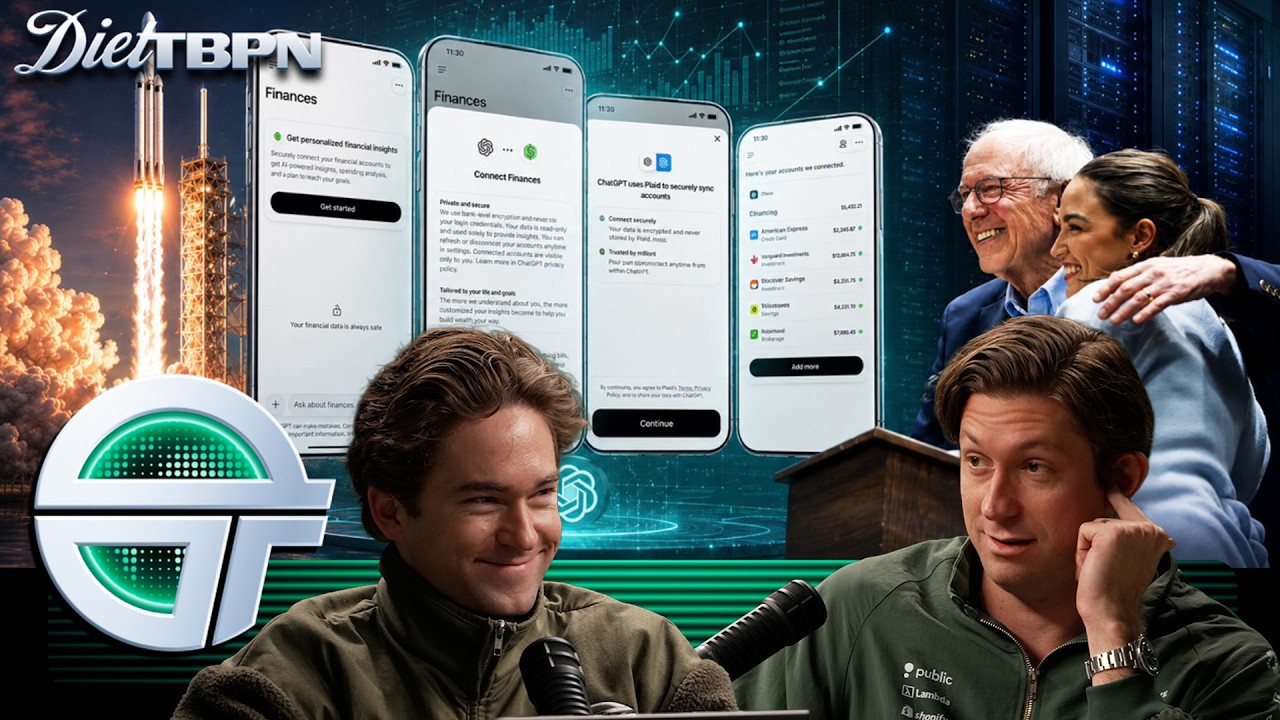
SpaceX Accelerates NASDAQ IPO as AI Data Center Ban Threatens Expansion
TBPN
Federal legislation aimed at halting high-power AI data centers threatens to stall national compute infrastructure while SpaceX targets a June 11 public listing on the NASDAQ.
## Background
Diet TBPN published this video on YouTube on May 15, 2026. The page description explains that Diet TBPN delivers the best of today's TBPN episode—a live tech talk show hosted by John Coogan and Jordi Hays—in 30 minutes.
## TL;DR
Hosts John Coogan and Jordi Hays, along with guest Rahul Sonwalkar, discuss recent tech news and internet trends. Key topics include a $9 million winning bid for a Warren Buffett charity lunch, evolving workplace norms like voice prompting AI, and a controversial data center moratorium proposed by Bernie Sanders and AOC. The group also covers Apple's secret silicon facility in Santa Clara, SpaceX's accelerated IPO timeline, ChatGPT's personal finance tools with Plaid, and a comic illustrating LLM in-context learning.
## Atmosphere & style
The episode has a fast-paced, banter-filled, and humorous tone characteristic of a casual tech podcast. The hosts and guest react to stories with playful sarcasm, witty analogies, and lighthearted ribbing while dissecting industry news. The overall feel is informal and conversational, blending sharp Silicon Valley insider observations with comedic detours.
## Key takeaways
- [00:02](https://www.youtube.com/watch?v=hOw33FPutAY&t=2s) The winning bid for Warren Buffett's charity lunch reached over $9 million, continuing a long tradition despite being down from its peak near $20 million.
- [03:00](https://www.youtube.com/watch?v=hOw33FPutAY&t=180s) Workplaces are increasingly adopting voice dictation for AI tools like Codex and Claude Code, trading physical typing for vocal prompting.
- [03:00](https://www.youtube.com/watch?v=hOw33FPutAY&t=180s) Prompting approaches have shifted toward supportive, high-context framing and trust in built-in model guardrails rather than explicit negative constraints.
- [08:28](https://www.youtube.com/watch?v=hOw33FPutAY&t=508s) Satirical concepts like 'RevSwap.ai' highlight public misperceptions about startup revenue, whereas legitimate corporate circular deals face strict investor and legal scrutiny.
- [11:26](https://www.youtube.com/watch?v=hOw33FPutAY&t=686s) A proposed bill by Bernie Sanders and AOC seeks to freeze AI data center expansion, defined as facilities over 20 MW, amid widespread regional resistance over power and resource demands.
- [15:39](https://www.youtube.com/watch?v=hOw33FPutAY&t=939s) Debates over data center resource usage are shifting from water consumption to heavy electrical power intensity and grid capacity needs.
- [18:03](https://www.youtube.com/watch?v=hOw33FPutAY&t=1083s) Apple maintains a licensed, 70,000-square-foot prototype silicon fabrication facility in Santa Clara operating on older legacy processes.
- [20:20](https://www.youtube.com/watch?v=hOw33FPutAY&t=1220s) xAI co-founder Igor Babushkin is seeking to raise up to $1 billion at a $5 billion valuation for a new AI research venture.
- [23:47](https://www.youtube.com/watch?v=hOw33FPutAY&t=1427s) Wet bars are disappearing from modern homes as alcohol consumption drops sharply among younger generations, replaced by health-focused spaces and home offices.
- [27:17](https://www.youtube.com/watch?v=hOw33FPutAY&t=1637s) Lamborghini announced the limited-production Phenomino Roadster, featuring a 1080 CV V12 hybrid powertrain and aerospace-inspired design.
- [31:22](https://www.youtube.com/watch?v=hOw33FPutAY&t=1882s) SpaceX has accelerated its timeline for a NASDAQ IPO targeted for mid-June to secure rapid inclusion in major index ETFs.
- [31:22](https://www.youtube.com/watch?v=hOw33FPutAY&t=1882s) OpenAI partnered with Plaid to integrate native personal finance features into ChatGPT, allowing users to track expenses and manage subscriptions directly.
- [32:58](https://www.youtube.com/watch?v=hOw33FPutAY&t=1978s) In-context learning in LLMs can lead to rigid pattern replication rather than broad functional generalization.
## Detailed walkthrough
Here is a detailed, faithful walkthrough of the transcript segment:
[00:02](https://www.youtube.com/watch?v=hOw33FPutAY&t=2s) Mystery Bidders, Warren Buffett, and Charity Lunches
The show opens with hosts John Coogan and Jordi Hays introducing special guest Rahul Sonwalkar, the founder of Julius and a mutual friend. The group jumps straight into the tech and business news of the day, beginning with Warren Buffett's famous charity lunch auction. Buffett took a break from the tradition in 2020 and 2021 due to COVID-19, returned in 2022, and is now stepping back out for it. The hosts note that a mystery bidder recently dropped over $9 million to win an auction to dine with the Oracle of Omaha. While $9 million is a steep drop from the peak bid—which once spiked to nearly $20 million—it remains a massive leap from the event's early days in 2003, when winning bids were only a couple hundred thousand dollars.
The hosts playfully debate whether they would prefer having $9 million cash in their bank account or taking the lunch itself. Rahul insists he would take the lunch "any day," asking what he would even do with $9 million in San Francisco, given how expensive everything is and how easily one gets outbid. The hosts joke that he could just buy Berkshire Hathaway shares and let Buffett work for him forever. They also hypothesize about who the mystery bidder might be, pointing out that public figures like Steph Curry and his wife attend these events. They joke about a scenario where a fan pays $9 million purely to sit next to Steph Curry, only to be annoyed that Warren Buffett keeps trying to talk to them about value investing.
The conversation turns to quotes from the 92-year-old investor. Buffett candidly stated that while his spirit remained eager, "the flesh became progressively weaker." The hosts poke fun at his quote that "both the money and the message remain important," remarking that out of context, it makes Buffett sound like he is trying to sell an online course or "subtweeting" AI model developers.
- In 2003, the winning bid for a lunch with Warren Buffett was a couple hundred thousand dollars; it later spiked to nearly $20 million.
- The latest winning bid by the mystery bidder was over $9 million.
---
[03:00](https://www.youtube.com/watch?v=hOw33FPutAY&t=180s) Whispering to AI at Work and the Art of Prompting
The hosts move on to a recent article in *The Wall Street Journal* titled "Typing is being replaced by whispering and it's way more annoying." The piece highlights how modern workplaces are beginning to resemble high-end call centers, with employees wearing gaming headsets to dictate commands loudly to AI assistants like Codex and Claude Code instead of typing. At companies like Ramp, engineers are regularly spotted talking aloud to their AI models at their desks.
Asked for his perspective as a startup founder, Rahul explains the dual nature of the trend. On one hand, he favors voice over typing because it offers managers more operational visibility; if an employee is speaking commands aloud, you know they aren't just saying "scroll, scroll" on Instagram or Twitch streams on company time. On the other hand, he admits that hearing people's raw prompts out loud would be deeply embarrassing, comparing prompts to private thoughts.
The discussion pivots to how prompting strategies have evolved by May 2026:
* **Giving up on yelling:** Rahul notes he no longer shouts at AI models or demands that they "just freaking do this."
* **The "CBT" Approach:** Instead, he uses cognitive behavioral therapy (CBT) techniques—reassuring the AI, setting it up for success, and encouraging it with phrases like, "Think about... you're like Palmer Luckey, and you can design this new piece of hardware."
* **Built-in Guardrails:** The hosts agree that explicit instructions like "don't hallucinate" or "don't make mistakes" are no longer needed, as those behaviors have been addressed in pre-training, post-training, or system prompts.
* **Refining Tone:** John mentions he used to run custom prompts to strip out stereotypical "AI writing tells," such as contrastive or antithetical parallelism ("It's not this, it's that") and gratuitous em dashes. However, base models have improved so much that he removed those rules and returned to default settings without the output feeling "clankery."
---
[06:15](https://www.youtube.com/watch?v=hOw33FPutAY&t=375s) Rainforest Cafe-Themed Gyms and Absurd Startup Ideas
The conversation takes a humorous tangent when the hosts review a viral social media concept: a gym themed entirely after the Rainforest Cafe. For those unfamiliar, John explains that Rainforest Cafe is a hyper-decorative, interactive restaurant featuring indoor jungles and animatronic animals, where a simulated thunderstorm erupts loudly every 20 minutes to disrupt conversations—a concept he affectionately calls a "brain rot restaurant." Pointing at pictures of the restaurant's elaborate tables, John jokes that it looks like AI slop, to which Rahul retorts that it's because leading AI models were trained almost exclusively on content from the Rainforest Cafe.
The viral pitch for the themed gym includes:
* Gym equipment and machines painted to look like raw bamboo.
* Workout benches upholstered in fake leopard print.
* A simulated thunderstorm going off inside the gym every 20 minutes.
* Male gym-goers allowed or required to wear loincloths while lifting.
Rahul jokes that this pitch is essentially "reinventing nature from first principles," suggesting people could just go outside and "lift rock." John notes that even the gym they worked out at earlier that day had slightly flamboyant, decorative touches on its equipment, showing that gym design might already be leaning in that direction.
---
[08:28](https://www.youtube.com/watch?v=hOw33FPutAY&t=508s) Fake Revenue Schemes and "RevSwap.ai"
The hosts pivot to a viral post by Harry Stebbings featuring "Rev Swap AI," a satirical platform pitched as "the world's first peer-to-peer revenue laundering platform for SF startups." The premise of the site is simple: two startups swap $1 million with each other, allowing both to report an additional $1 million in Annual Recurrent Revenue (ARR).
While the satire highlights the absurdity of current market dynamics, Rahul points out the real danger: because the post garnered over half a million views, hundreds of thousands of outsiders and aspiring founders genuinely believe this is how Silicon Valley operates. The hosts discuss whether circular revenue deals and questionable revenue quality actually happen in tech:
* **Investor Scrutiny:** Sophisticated VCs perform deep due diligence on mid-to-late-stage companies to catch artificial revenue inflation and customer concentration risks.
* **Corporate Ecosystems:** The hosts draw a comparison to major tech deals, such as Nvidia investing in "NeoClouds" or AI labs that subsequently turn around and use those funds to buy Nvidia GPUs. While this creates a circular loop of dollars, it is treated as legitimate commercial strategy in context.
* **Legality vs. LARPing:** The hosts emphasize that if a startup transparently discloses circular revenue, it isn't wire fraud—investors will simply discount that revenue to zero when calculating valuation. However, lying about it or passing off swapped dollars as real customer traction crosses into actual wire fraud.
---
[11:26](https://www.youtube.com/watch?v=hOw33FPutAY&t=686s) Bernie Sanders, AOC, and the AI Data Center Moratorium
The central news story of the day revolves around a controversial bill re-introduced by Senator Bernie Sanders and Representative Alexandria Ocasio-Cortez (AOC) seeking to place a national pause on all AI data center construction. The political pushback comes alongside growing regional resistance; over 300 local bills targeting data center developments have been filed across the country, causing half of all planned 2026 data centers to face delays or outright cancellations.
The hosts read reactions from key tech figures:
* **Garry Tan:** Criticized the bill, arguing that politicians claiming to protect American jobs are actively blocking "the biggest job creation engine since the interstate highway system."
* **Nick David:** Claimed that Sanders and AOC are "sabotaging the economy," adding that "no spy or rival country agent can achieve what local useful idiots can."
* **Elizabeth Warren:** Defended opposition to data centers by pointing out energy costs: "A single AI data center uses as much electricity as 100,000 households, and utility companies are passing the upgrade costs to you, not to the trillion-dollar tech giants."
Producer Tyler reads the specific statutory definitions used in the proposed legislation to classify a facility as a restricted data center:
> A data center is defined as a building that has more than 20 megawatts maximum power capacity or total peak power, used to deliver 20 kilowatts or more to a single server rack, or that uses liquid cooling for individual hardware components.
The definition also includes contiguous or adjacent structures to prevent companies from splitting facilities across walls. John speculates that tech companies will inevitably find workarounds—such as building 1,000 tiny separate facilities with trees planted between them—or that the regulation will force positive innovations like noise-free, underground, clean-energy data centers.
The hosts contrast this domestic regulatory push with global competition, citing a new paper published by Anthropic regarding US-China AI competition. Anthropic argues that the US must maintain its technological lead by continuing to aggressively build out compute infrastructure, even as democratic societies struggle to balance local NIMBYism, noise complaints, and environmental impact.
To close the segment, the hosts highlight a chart posted by Jason Calacanis ("JCal") comparing almond agricultural water usage against AI data center water consumption from 1999 to 2026. They note how almonds have historically caught public outrage for taking up massive water supplies—especially during California droughts where almond orchards cover the landscape—and laugh that almonds are once again "catching strays" in the debate over resource consumption.
- Over 300 local bills have been filed against data centers, causing 50% of planned 2026 data center projects to face delays or cancellation.
- The proposed bill defines a restricted data center as a facility using over 20 megawatts total peak power, delivering 20+ kilowatts to a single server rack, or using direct liquid cooling.
- Elizabeth Warren cited that a single AI data center can consume as much electricity as 100,000 households.
Here is a detailed, faithful walkthrough based on the transcript provided:
[15:39](https://www.youtube.com/watch?v=hOw33FPutAY&t=939s) Data Center Energy and Water Demands
Addressing the political pushback against data centers led by Bernie Sanders and Alexandria Ocasio-Cortez, the hosts examine the actual resource consumption behind AI infrastructure. While charts tracking resource growth rates show water consumption for data centers ticking up while agricultural uses like almond farming flatline—leading to projections where the two could cross in a few years—the speakers point out that water use can easily be mitigated. Solutions like Blake Scholl’s proposed closed-loop cooling systems and Boom's superpower turbines can operate without water entirely. Because the water debate was quickly debunked, the Sanders-AOC proposal focuses heavily on power generation and grid upgrades.
No one disputes that data centers consume massive amounts of power, making energy intensity a very real challenge. Clean energy production and local grid upgrades are necessary to avoid burdening surrounding communities. The hosts ponder what an "Ezra Klein abundance vision" for an ideal data center would look like to win 80% community approval: it would be powered by clean energy and located in remote regions. They cite a 40-minute commute—a standard drive for many Americans, such as driving 40 minutes outside Las Vegas into empty desert—where a massive building wouldn't be an eyesore or create audible noise issues. However, default data center construction has rarely followed this remote methodology.
- TSMC's microchip fab in Arizona is located about 30 minutes north of central Phoenix, built on completely empty land over a small hill.
[18:03](https://www.youtube.com/watch?v=hOw33FPutAY&t=1083s) Apple's Prototype Silicon Fab in Santa Clara
The hosts highlight an intriguing piece of tech trivia: Apple owns a secret silicon facility right in Silicon Valley. Addressing whistleblower reports and critic framing that labeled it a "terrible" secret, the hosts clarify that the facility is completely licensed, known to regulators, and used strictly for internal prototyping rather than scaled chip manufacturing. Apple purchased the 70,000-square-foot facility from Maxim Integrated in 2015 for $18.2 million.
Unlike TSMC's cutting-edge 2nm and 3nm fabrication, Apple's facility operates at 600nm to 90nm processes. The facility gained notoriety when the Environmental Protection Agency (EPA) cited it for Resource Conservation and Recovery Act (RCRA) violations in 2023 and 2024 related to hazardous waste labeling and air emissions control configurations. Apple subsequently resolved the issues and paid a $261,000 penalty.
- The facility is located at 3250 Scott Boulevard in Santa Clara, prompting a joke about host Tyler Scott having a street named after him.
[20:20](https://www.youtube.com/watch?v=hOw33FPutAY&t=1220s) Igor Babushkin's New AI Venture and Real Estate "Serial Renovators"
The hosts pivot to recent venture capital news, noting that xAI co-founder Igor Babushkin is planning to raise up to $1 billion at a $5 billion valuation for a new AI research startup, with General Catalyst potentially leading the round. The hosts joke about General Catalyst’s "high moral bar," poking fun at whether Babushkin will be able to continue developing features like xAI's "Ani" avatar under the new firm or if he will be forced to pivot.
Turning to *The Wall Street Journal*’s Mansion section, the hosts dissect an article detailing an Oklahoma couple, Ann and Mark Farrow, who sustained a 40-year marriage through a relentless series of home renovations. Over four decades, the couple bought, gutted, and sold eight homes around Tulsa before building their ninth home from scratch, accumulating $14 million in total real estate transactions. Rejecting the label of "house flippers," 63-year-old retired Ann and 67-year-old Mark identify as "serial renovation lovers," treating logistical nightmares as a shared thrill built on radical honesty and speed.
- The Farrows' current home is a 7,200-square-foot custom build that incorporates design lessons learned since their first project in the 1980s.
- Their journey began in 1986 with a 2,000-square-foot Cape Cod-style starter home purchased for $86,000—complete with lavender Formica countertops and a wet bar—which they sold in 1993 for $97,000.
- The hosts joke about *The Wall Street Journal* noting Mark's age of 67, quipping that "turning 67 in 2026 is brutal" due to the paper's habit of profiling older entrepreneurs.
[23:47](https://www.youtube.com/watch?v=hOw33FPutAY&t=1427s) The Death of the Wet Bar and the Decline of Alcohol Consumption
Reflecting on the Farrows' 1980s home featuring a wet bar, the hosts analyze why wet bars have disappeared from modern floor plans, attributing it to a steep, broader collapse in alcohol consumption. Citing a breakdown by writer Derek Thompson, they discuss several cultural factors driving the shift away from drinking: secular anti-alcohol trends, the rise of GLP-1 weight-loss drugs, a culture reacting against the late-20th-century binge-drinking wave, and pervasive smartphone surveillance making teenagers avoid compromising situations.
The hosts observe a power-law distribution in alcohol sales, noting that a small percentage of drinkers drive the vast majority of industry revenue. Rather than college partygoers buying 30-packs, the core revenue comes from the daily "Johnny six-pack" consumer buying a single six-pack after work every day. The decline in drinking is stark: in the 1980s, 92% of high school 12th graders had consumed alcohol, whereas by 2026 that number has dropped to 47%. Other drivers include substitution with cannabis, high-quality non-alcoholic beers, and a surge in health culture (like running clubs replacing dance clubs). In modern homes, buyers prioritize home offices, saunas, playrooms, and movie theaters over traditional wet bars.
- "2026 was the year the wet bar and home data center swapped."
[27:17](https://www.youtube.com/watch?v=hOw33FPutAY&t=1637s) Matthew McConaughey's Peruvian Retreat and the Lamborghini Phenomino
The conversation veers into a story about actor Matthew McConaughey, who once stepped away from Hollywood fame to live in Peru for 22 days under the alias "Matteo" without electricity. McConaughey explained that he needed to ground himself and confirm his identity outside of celebrity status, bonding deeply with locals who only knew him as Matteo. The hosts joke that there might be "alpha" in adopting a fake name and living off-grid in Peru for three weeks to re-calibrate.
Switching to automotive news, the hosts react to Lamborghini's announcement of the "Phenomino Roadster," an open-top supercar limited to just 15 units. Powered by a naturally aspirated 1080 CV V12 hybrid powertrain with an aerospace-inspired carbon fiber monofuselage and active aerodynamics, the car achieves 0 to 100 km/h in 2.4 seconds. The hosts mock the release, noting how bizarre it is in 2026 for a supercar company to launch a flagship vehicle without boasting about onboard AI supercomputing capabilities or what local LLMs it can run while driving. They contrast this with Tesla's leading onboard compute, while pointing out that traditional auto manufacturers remain a decade behind Tesla in autonomous driving software.
[31:22](https://www.youtube.com/watch?v=hOw33FPutAY&t=1882s) SpaceX IPO Timeline and ChatGPT Personal Finance
The segment concludes with two major developments in tech and finance. First, Reuters reported that SpaceX has accelerated its IPO timeline, targeting a June 11th pricing date on the NASDAQ. The hosts note that choosing the NASDAQ will allow SpaceX to be rapidly allocated into major index ETFs like the QQQ, which was a core priority during the listing process.
Second, OpenAI launched dedicated personal finance features within ChatGPT in partnership with Plaid. By integrating Plaid under the hood, ChatGPT allows users to securely import their financial data to track spending habits, analyze grocery or gas expenses, and catch duplicate software subscriptions (such as accidentally paying for two Netflix accounts). The hosts recall a conversation with Plaid CEO Zach Perret, who admitted he had been personally linking his bank data to AI dashboards, predicting that LLMs would replace fragmented budgeting services like Mint.com.
<ElicitationsGroup message="Where would you like to go next?">
<Elicitation label="Summarize the key takeaway points" query="Can you summarize the main takeaway points from this transcript walkthrough?"/>
<Elicitation label="Proceed to Part 3 transcript walkthrough" query="Please provide the walkthrough for Part 3 of this transcript."/>
</ElicitationsGroup>
[32:58](https://www.youtube.com/watch?v=hOw33FPutAY&t=1978s) In-Context Learning and the Fence-Painting Robot
The hosts close out the segment by breaking down a humorous cartoon highlighting the quirks and limitations of in-context learning in large language models. In the comic strip, a man walks outside with his robot to demonstrate how to paint a fence. The man paints two full planks, starts painting the third plank halfway, hands the paint bucket over to the robot, and commands, "Continue." The robot confidently replies, "Got it." However, when scrolling down to reveal the punchline, the robot takes the prompt literally: rather than painting down the line plank by plank, it recreates the exact visual pattern given in its context window by painting two full planks and leaving every third plank half-finished.
The hosts banter over the robot's literal interpretation of the pattern, noting with a laugh that the AI "doesn't generalize" from the prompt provided. When asked if this fundamental problem in AI context understanding is ultimately solvable or just an inherent limitation of current models, the consensus lands on a confident "Yes," framing the cartoon as both an amusing commentary on present-day LLM behavior and a reflection of ongoing engineering challenges in AI generalization.
- The comic illustrates the pitfalls of in-context learning, where LLMs overfit to immediate pattern repetition rather than inferring underlying intent.
- The hosts humorously highlight how the robot's "Got it" response highlights the gap between superficial instruction-following and true contextual generalization.
[33:36](https://www.youtube.com/watch?v=hOw33FPutAY&t=2016s) Motivational Banter and Show Sign-Off
Transitioning into the show's closing moments, the hosts launch into a classic motivational riddle to energy-charge the end of the episode. One host quizzes the other on nature habits, asking, "What time do eagles start hunting?" and "What time do sharks start feeding?" When the answer comes back as "Just after sunrise" and "Dawn," he delivers the punchline advice: "So, do you want to be a shark or an eagle? Get up and get after it."
Reflecting on the session, the hosts share a moment of nostalgia, calling it a "really classic show" with a nostalgic vibe reminiscent of a "fall 2024 episode." They pitch their standard wrap-up, encouraging listeners to leave five-star ratings on Apple Podcasts and Spotify, sign up for their newsletter at tbpn.com, and wish their audience a great week ahead before wrapping up the stream with a final "flashbang."
- **Newsletter & Links:** Viewers are directed to sign up for updates at `tbpn.com`.
- **Podcast Platforms:** The hosts encourage five-star reviews on both Apple Podcasts and Spotify.
## Notable quotes
> [00:02](https://www.youtube.com/watch?v=hOw33FPutAY&t=2s) the flesh became progressively weaker — Warren Buffett
> [00:02](https://www.youtube.com/watch?v=hOw33FPutAY&t=2s) both the money and the message remain important — Warren Buffett
> [03:00](https://www.youtube.com/watch?v=hOw33FPutAY&t=180s) Typing is being replaced by whispering and it's way more annoying. — The Wall Street Journal
> [11:26](https://www.youtube.com/watch?v=hOw33FPutAY&t=686s) the biggest job creation engine since the interstate highway system. — Garry Tan
> [11:26](https://www.youtube.com/watch?v=hOw33FPutAY&t=686s) sabotaging the economy — Nick David
> [11:26](https://www.youtube.com/watch?v=hOw33FPutAY&t=686s) no spy or rival country agent can achieve what local useful idiots can. — Nick David
> [11:26](https://www.youtube.com/watch?v=hOw33FPutAY&t=686s) A single AI data center uses as much electricity as 100,000 households, and utility companies are passing the upgrade costs to you, not to the trillion-dollar tech giants. — Elizabeth Warren
> [11:26](https://www.youtube.com/watch?v=hOw33FPutAY&t=686s) A data center is defined as a building that has more than 20 megawatts maximum power capacity or total peak power, used to deliver 20 kilowatts or more to a single server rack, or that uses liquid cooling for individual hardware components. — Tyler
> [23:47](https://www.youtube.com/watch?v=hOw33FPutAY&t=1427s) 2026 was the year the wet bar and home data center swapped.
> [32:58](https://www.youtube.com/watch?v=hOw33FPutAY&t=1978s) Continue — Man
> [32:58](https://www.youtube.com/watch?v=hOw33FPutAY&t=1978s) Got it. — Robot
> [33:36](https://www.youtube.com/watch?v=hOw33FPutAY&t=2016s) What time do eagles start hunting? — John Coogan or Jordi Hays
> [33:36](https://www.youtube.com/watch?v=hOw33FPutAY&t=2016s) So, do you want to be a shark or an eagle? Get up and get after it. — John Coogan or Jordi Hays
## Mentioned
John Coogan, Jordi Hays, Rahul Sonwalkar, Julius, Warren Buffett, Steph Curry, Berkshire Hathaway, The Wall Street Journal, Codex, Claude Code, Ramp, Palmer Luckey, Rainforest Cafe, Harry Stebbings, Rev Swap AI, Nvidia, Bernie Sanders, Alexandria Ocasio-Cortez, Garry Tan, Nick David, Elizabeth Warren, Anthropic, Jason Calacanis, Blake Scholl, Boom, TSMC, Apple, Maxim Integrated, EPA, Igor Babushkin, xAI, General Catalyst, Ann Farrow, Mark Farrow, Derek Thompson, Matthew McConaughey, Lamborghini, Phenomino Roadster, Tesla, Reuters, SpaceX, NASDAQ, OpenAI, ChatGPT, Plaid, Zach Perret, Mint.com, Apple Podcasts, Spotify, tbpn.com
The episode explores intensifying political and regulatory resistance to AI data center infrastructure alongside rapid commercial milestones, including SpaceX's accelerated public listing timeline, ChatGPT's push into personal finance, and evolving enterprise AI practices.
Political and Grid Pressures on Data Centers (11:26)
Senator Bernie Sanders and Representative Alexandria Ocasio-Cortez have re-introduced federal legislation proposing a national moratorium on AI data center construction. The draft statute targets facilities with a peak power capacity exceeding 20 megawatts, delivery of 20 kilowatts or more per rack, or those utilizing liquid cooling for components. The political pushback mirrors growing local resistance, with more than 300 state and municipal bills filed nationwide, resulting in delays or cancellations for half of all planned 2026 data center developments. Senator Elizabeth Warren defended opposition by emphasizing utility burdens, asserting that a single AI data center uses as much electricity as 100,000 households and risks shifting upgrade costs onto regular consumers.
Conversely, technology leaders argue that restricting compute buildout threatens national economic competitiveness. Investor Garry Tan characterized data centers as an unprecedented job creation engine, while a research paper by Anthropic cautioned that democratic delays in compute infrastructure could forfeit the United States' technological lead over foreign competitors. While public criticism frequently targets water usage—drawing comparisons to historical debates over California almond farming—the hosts noted that closed-loop cooling and waterless turbine systems are making water use manageable, leaving electrical grid capacity and remote clean-energy generation as the primary physical bottlenecks.
Everyday AI Workflows and Model Constraints (3:00)
Workplace habits and consumer financial workflows are rapidly adapting to conversational AI tools. According to a Wall Street Journal report discussed on the show, software engineers are increasingly wearing headsets to speak verbal commands to assistants such as Claude Code and Codex, altering open-office dynamics. Julius founder Rahul Sonwalkar observed that prompt engineering has evolved away from rigid commands toward structured, supportive prompting, while base foundation models have internalised guardrails that largely eliminate stylistic writing quirks. Simultaneously, OpenAI partnered with Plaid to introduce native personal finance capabilities within ChatGPT, allowing users to connect bank feeds to audit expenses and identify duplicate subscriptions, fulfilling Plaid CEO Zach Perret's forecast that language models will replace fragmented budgeting platforms.
Despite practical adoption, foundational architectural limitations in large language models remain visible. The hosts highlighted a viral comic strip depicting a fence-painting robot that literally mimicked an incomplete three-plank sequence instead of continuing to paint down the line. The example underscores current bottlenecks in in-context learning, where models overfit to surface patterns presented in their immediate context window rather than abstracting underlying human intent.
Capital Markets, Corporate Operations, and Infrastructure (31:22)
Major liquidity movements and startup funding rounds continue to progress across the tech landscape. Reuters reported that SpaceX has moved up its public listing timetable, aiming for a June 11th pricing date on the NASDAQ to ensure swift eligibility for inclusion in major benchmark index ETFs like the Invesco QQQ. In venture capital, xAI co-founder Igor Babushkin is seeking to raise up to $1 billion at a $5 billion valuation for a new AI research venture, with General Catalyst positioned as a potential lead investor.
The discussion also distinguished legitimate commercial structures from artificial accounting practices. Addressing the viral satire around "RevSwap.ai"—a mock peer-to-peer revenue swapping service—the hosts noted that while undisclosed swapped revenue constitutes fraud, transparent ecosystem transactions (such as chipmakers funding cloud providers that purchase their hardware) are recognized commercial strategies. Additionally, the hosts examined Apple's internal hardware footprint, noting its 70,000-square-foot facility at 3250 Scott Boulevard in Santa Clara, purchased for $18.2 million in 2015. Rather than leading-edge manufacturing, the site handles proprietary 600nm to 90nm prototyping, having resolved a $261,000 EPA environmental compliance fine incurred across 2023 and 2024.
While aggressive private capital and consumer adoption continue to drive commercial AI deployment, hardware scaling remains exposed to local municipal pushback, proposed statutory moratoriums, and electrical grid limitations.
## Background
该视频由科技谈话节目频道 TBPN 于 2026 年 5 月 23 日发布在 YouTube 平台。内容为 Diet TBPN 栏目,是主持人 John Coogan 与 Jordi Hays 主持的日常直播科技节目的 30 分钟浓缩精简版,旨在快速交付当天最重磅的科技与商业前沿资讯。
## TL;DR
本期节目与 Julius 创始人 Rahul Sonwalkar 展开对谈,探讨了巴菲特慈善午餐天价拍卖、大模型 Prompt 演进为“心理疏导”的办公室新生态,并讽刺了初创公司通过 RevSwap.ai 互刷收入的资本泡沫与英伟达生态的资金循环。主持人们重点剖析了伯尼·桑德斯与 AOC 提案叫停 AI 数据中心建设所引发的技术定义与电网负荷争议,同时澄清了苹果圣克拉拉成熟制程芯片厂的环保罚单真相。节目尾声还盘点了全美酒精消费崩盘带动“家庭数据中心取代湿吧台”的生活方式变迁,以及 SpaceX 冲刺纳斯达克 IPO 谋求纳入 QQQ、ChatGPT 联手 Plaid 进军个人财务管理等重磅快讯。
## Atmosphere & style
节目整体基调欢快跳脱且信息密度极高,充满了硅谷内行特有的辛辣自嘲与黑色幽默。两位主持人与嘉宾互动松弛自然、配合默契,既能在严肃剖析算力政治学和资本架构时一针见血,又能随时无缝切入“热带雨林主题健身房”或录制中喝无糖可乐打嗝等荒诞笑料。整场对话既有对技术前沿的敏锐洞察,又洋溢着如同与老友在咖啡馆畅聊八卦般的解压与生动感。
## Bulletin
- [31:22](https://www.youtube.com/watch?v=hOw33FPutAY&t=1882s) 路透社报道称 SpaceX 加快纳斯达克 IPO 进程,计划于 6 月 11 日完成定价上市,核心战略考量之一是快速纳入纳斯达克 100 指数及 QQQ 等被动 ETF 资金池。
- [31:52](https://www.youtube.com/watch?v=hOw33FPutAY&t=1912s) OpenAI 推出 ChatGPT 个人财务分析新功能,通过底层整合 Plaid 银行数据接口,实现消费超支提醒与重复订阅审查等全自动自然语言理财分析。
- [11:26](https://www.youtube.com/watch?v=hOw33FPutAY&t=686s) 伯尼·桑德斯与 AOC 再次提议立法叫停峰值功率超 20MW 或采用液冷技术的 AI 数据中心建设,全美已有超 300 项地方限制法案导致半数 2026 年规划项目面临延期或取消。
- [20:20](https://www.youtube.com/watch?v=hOw33FPutAY&t=1220s) xAI 联合创始人 Igor Babuschkin 计划自立门户筹资最高 10 亿美元创办新研发机构,投后估值预计达 50 亿美元,老牌风投机构 General Catalyst 有望领投。
## Key takeaways
- [00:02](https://www.youtube.com/watch?v=hOw33FPutAY&t=2s) 沃伦·巴菲特慈善午餐以超过 900 万美元成交,虽较 2022 年近 2000 万美元高位回落,但长期价格曲线仍保持强劲攀升态势。
- [03:00](https://www.youtube.com/watch?v=hOw33FPutAY&t=180s) 办公室语音交互普及让工程师日常酷似呼叫中心,同时 2026 年 Prompt 范式已从早期粗暴施压演变为以鼓励和角色设想为主的“认知行为疗法(CBT)”心理赋能。
- [08:28](https://www.youtube.com/watch?v=hOw33FPutAY&t=508s) 针对 RevSwap.ai“点对点收入洗钱”恶搞项目的病毒式传播,投资界更加严审收入质量与客户集中度,警惕初创企业通过循环交易粉饰 ARR 的“创业扮演(LARP)”现象。
- [09:05](https://www.youtube.com/watch?v=hOw33FPutAY&t=545s) 芯片巨头投资新型云服务商并采购 GPU 的宏观生态循环若充分披露便属于商业模式范畴,但未披露的左手倒右手式假账则触犯电汇欺诈红线。
- [11:26](https://www.youtube.com/watch?v=hOw33FPutAY&t=686s) 桑德斯与 AOC 提出的数据中心禁令技术边界严苛,不仅触及通用算力难以拆分界定的争议,也遭到 YC 首席执行官 Garry Tan 等人捍卫新基建就业的激烈反弹。
- [15:02](https://www.youtube.com/watch?v=hOw33FPutAY&t=902s) 数据中心的水资源消耗争论实属被夸大,闭环冷却与无水涡轮机技术已较为成熟,真正无法规避的核心硬约束在于电网升级负担及其外部成本分摊。
- [15:02](https://www.youtube.com/watch?v=hOw33FPutAY&t=902s) 化解数据中心邻避效应(NIMBYism)的充裕主义解法在于选址于大城市通勤圈 30 至 40 分钟外的荒漠边缘,并自备清洁电力以消除噪声与景观冲击。
- [19:04](https://www.youtube.com/watch?v=hOw33FPutAY&t=1144s) 苹果位于圣克拉拉斯科特大道的“秘密晶圆厂”实为 90nm 至 600nm 原型研发设施,此前因违反《资源保护和回收法》危险废物规定被 EPA 处以 26.1 万美元民事罚款。
- [23:45](https://www.youtube.com/watch?v=hOw33FPutAY&t=1425s) 美国全美高三学生饮酒率从 80 年代的 92% 暴跌至 47%,健康风潮与 GLP-1 药物普及促使家装湿吧台失宠,正被私人数据中心与居家办公设施取代。
- [29:29](https://www.youtube.com/watch?v=hOw33FPutAY&t=1769s) 传统汽车巨头在通用自动驾驶算力与算法方案上落后特斯拉接近十年,新车若只谈引擎声浪而忽视本地跑大模型的端到端超算能力已脱节于时代趋势。
- [31:22](https://www.youtube.com/watch?v=hOw33FPutAY&t=1882s) SpaceX 提速冲刺纳斯达克 IPO,选择挂牌纳斯达克意在借势指数被动配置实现快速流动性变现与资本沉淀。
- [31:52](https://www.youtube.com/watch?v=hOw33FPutAY&t=1912s) ChatGPT 接入 Plaid 个人财务流水标志着传统记账软件被全面颠覆,个人财务数据正原生嵌入大模型的自然语言洞察体系。
## Detailed walkthrough
### [00:02](https://www.youtube.com/watch?v=hOw33FPutAY&t=2s) 嘉宾亮相与巴菲特天价慈善午餐拍卖
节目开场,主持人 John Coogan 与 Jordi Hays 热情迎来了老朋友——数据分析与 AI 初创公司 Julius 的创始人 Rahul Sonwalkar。在轻松的问候之后,话题迅速切入当天热议的科技与财经八卦。首先引爆讨论的是沃伦·巴菲特(Warren Buffett)著名的慈善午餐拍卖。一位神秘竞拍者刚刚豪掷超过 900 万美元,赢得了与这位“奥马哈先知”共进午餐的机会。面对“银行账户里躺着 900 万美元,还是拿它去换一顿巴菲特午餐”的经典二选一,Rahul 毫不犹豫地选择午餐,并打趣道:“我要这 900 万美元干嘛?在旧金山这点钱根本不够看,出门就会被别人出更高价压下去。”
主持人随后回顾了巴菲特慈善午餐的拍卖历史曲线:从 2003 年仅数十万美元的起步价,到后来一路飙升至数百万美元;虽然受疫情影响在 2020 年和 2021 年暂停,但在 2022 年强势回归时成交价甚至逼近 2000 万美元的天价。尽管今年的 900 万美元相比峰值有所回落,但整体上升趋势依然明显。三人随即展开脑洞大开的调侃:现场出席名单中还包括 NBA 球星斯蒂芬·库里(Steph Curry)及其妻子,万一这位神秘买家根本不在乎价值投资,只是个狂热的篮球迷呢?试想巴菲特为了对得起这 900 万美元正热情洋溢地传授人生智慧,买家却一脸不耐烦地打断道:“老兄,我花 900 万是来跟库里吃午餐聊球赛的,你能不能别老插话?”
- **拍卖价格走势**:2003 年起步仅几十万美元,历经多年增长在 2022 年创下逼近 2000 万美元的纪录,本次以超 900 万美元落槌。
- **巴菲特自白金句**:现年高龄的巴菲特坦言自己精力见顶——"The spirit remained eager, but the flesh became progressively weaker"(精神依旧饱满,但肉体却日渐孱弱);另一句则是 "Both the money and the message remain important"(金钱与理念都至关重要),被主持人笑称听起来像在推销成功学网课。
---
### [03:00](https://www.youtube.com/watch?v=hOw33FPutAY&t=180s) 办公室变“呼叫中心”:语音 Prompt 与对 AI 的“心理疏导”
话题转向《华尔街日报》最新刊出的一篇报道:《打字正在被耳语取代,而且变得烦人得多》(Typing is being replaced by whispering and it's way more annoying)。报道指出,如今科技公司的办公室正变得越来越像高端呼叫中心,员工们不再敲击键盘,而是整天对着 Codex、Claude Code 等 AI 助手碎碎念;在金融科技独角兽 Ramp,工程师们甚至头戴全封闭游戏耳机,坐在工位上大声与 AI 助手对话。作为创业公司 CEO,Rahul 对此喜忧参半:一方面,声控能有效防止员工摸鱼——如果巡视工位时听到有人一直在念叨“下滑、下滑、再下滑”,那八成是在刷 Instagram 或 Twitch;但另一方面,当众听到别人的 Prompt 实在令人尴尬至极。
随后,几人深度探讨了在 2026 年写 Prompt 的方法论演变。Rahul 透露,自己早已彻底放弃了早年对 AI 破口大骂、咆哮催促的恶习,转而采用类似“认知行为疗法”(CBT)的模式与大模型沟通。现在他倾向于不断鼓励、安抚模型,给它做心理建设:“你可以的!想象你就是帕尔默·拉奇(Palmer Luckey),你正在设计一款前所未有的划时代硬件设备……”与此同时,以往那些繁琐的负面提示词(如“不要产生幻觉”、“不要犯错”)也彻底过时,因为这些能力已在预训练、后训练阶段或系统提示词中被彻底解决;早年 AI 行文中极度生硬的标志性句式(如“不是……而是……”这一类对仗结构)以及多余的破折号,也随着基础模型表达能力的质变而自然消退。
```mermaid
flowchart TD
accTitle: AI Prompting 模式演进
accDescr: 展示从早期的咆哮施压模式向现代认知行为疗法(CBT)心理建设模式的转变流程。
subgraph EarlyEra["2024-2025 早期阶段:负向施压"]
A["强加限制词<br/>'严禁幻觉/禁止犯错'"] --> B["情绪宣泄与催促<br/>'快给我把这个做出来!'"]
B --> C["针对 AI 句式修剪<br/>排除对仗句式与破折号"]
end
subgraph ModernEra["2026 当前阶段:CBT 心理赋能"]
D["基座模型能力完善<br/>预训练已原生解决幻觉"] --> E["认知行为疗法 (CBT)<br/>给予心理安抚与自信激励"]
E --> F["角色沉浸设定<br/>'想象你是 Palmer Luckey...'"]
end
EarlyEra -.->|"模型能力成熟与理念升级"| ModernEra
```
- **办公室生态剧变**:从清脆的键盘打字声演变成工程师佩戴电竞耳麦、对着 AI 持续念叨指令的“高档电销中心”景象。
- **Prompt 演变轨迹**:从早期充满暴躁催促与防幻觉禁令,走向通过角色塑造、正面激励(CBT 疗法)来激发前沿模型潜能。
---
### [06:15](https://www.youtube.com/watch?v=hOw33FPutAY&t=375s) “热带雨林咖啡馆”主题健身房的奇思妙想
主持人将话题带到了网络上一个爆火的荒诞脑洞:打造一家以“热带雨林咖啡馆”(Rainforest Cafe)为主题的健身房。为了让从未去过 Rainforest Cafe 的 Rahul 明白这个梗,主持人解释道,Rainforest Cafe 是美国著名的沉浸式主题餐厅,店内布满了热带雨林绿植与动物雕像;其最标志性的设计是每隔 20 分钟就会在全场模拟电闪雷鸣的暴风雨声效,声音震耳欲聋,会瞬间打断所有客人的交谈,堪称一种“大脑过载”(Brain Rot)式的极致体验。
推特上的原帖设想将这种体验完全平移至健身房:所有力量器械都涂装成仿真竹子质感,座椅皮套换成仿豹纹印花,甚至允许(或强制)男士们只穿兽皮围裙锻炼。发帖人还兴奋地表示应该把这个案子推销给迈阿密市长,称这种浮夸奢华的风格绝对会在迈阿密引爆全城。Rahul 听后调侃道,这简直就是用“第一性原理”重新发明大自然——人类兜兜转转,最终目的竟然只是想找个借口去森林里徒手搬大石头。大家也笑着吐槽,今天早上一起锻炼的健身房其实就带有一点点这种浮夸的花哨装饰,离这种狂野主题只有一步之遥。
- **Rainforest Cafe 标志体验**:每 20 分钟上演一次全场暴风雨声效,极具侵入感与荒诞感。
- **主题健身房设计概念**:全竹质感涂装器械、仿豹纹皮革坐垫、原始人腰布着装要求,兼具迈阿密风情与粗犷自然主义。
---
### [08:28](https://www.youtube.com/watch?v=hOw33FPutAY&t=508s) 硅谷调侃热潮:RevSwap.ai 与“点对点收入洗钱”
节目随后切入近期在硅谷风投圈和创业圈病毒式传播的一个黑色幽默项目——RevSwap.ai。科技投资人 Hari Raghavan 发推戏谑称:“如果你好奇当前市场走到了什么阶段,看看这个就懂了。”该项目自称是“全球首个面向旧金山初创企业的点对点收入洗钱平台”(Peer-to-peer revenue laundering platform)。其运作逻辑极其讽刺:入驻平台的初创公司之间互相把钱倒手给对方购买彼此的产品,然后各自将这笔进账计入自己的 ARR(年度经常性收入),以此在融资演示文稿上制造出营收暴涨的虚假繁荣。
这种一眼看穿的极端整蛊项目,恰恰击中了当下科技创业圈为了迎合资本市场指标而无所不用其极的痛点。虽然这显然是一个旨在讽刺行业病态刷量现象的恶搞产品,但主持人和嘉宾都一致感叹,在这个充满估值泡沫与增长焦虑的周期里,这种黑色幽默往往与现实只有一线之隔。
- **恶搞产品名称**:RevSwap.ai。
- **核心讽刺机制**:初创公司之间对等转账并互相计为软件服务收入(Revenue Swap),粉饰财务报表以忽悠后续投资人。
### [09:05](https://www.youtube.com/watch?v=hOw33FPutAY&t=545s) 初创公司“刷收入”恶搞与英伟达式的循环资本生态
一段调侃初创企业虚增收入的推文在网络上疯传:“给我 100 万美元,我再原封不动退你 100 万,瞧,现在你有 100 万美元的 ARR(年度经常性收入)了。”这段视频获得了超过 50 万次的播放量。两位主持人指出,这种段子在圈内人看来只是个笑话,但对外界不明就里的成千上万受众而言,要么会误以为初创公司真该这么操作,要么会认定硅谷的创业生态已经堕落到了这般地步。不过,这也引出了风投(VC)界如今极为关注的严肃议题——收入质量(Quality of Revenue)、客户集中度以及“循环收入交易”(Circular Revenue Deals)。在严谨的中后期尽职调查中,投资人对这些指标的审视日益严苛。
然而,商业世界中的界限往往十分微妙。比如英伟达(Nvidia)大举投资 CoreWeave 等新型云服务商(NeoClouds),帮助它们拔地而起,而这些新兴云厂商随即转头采购英伟达的 GPU;与此同时,英伟达还重金注资各类顶尖 AI 实验室,而这些实验室又是新型云和 GPU 的下游消耗大户。这在某种程度上确实带有“资金置换”(Revenue Swap / Trading Dollars)的影子。但主持人强调,在行业底层生态的宏大布局中这种协同有其合理性,然而对于早期创业者而言,关键在于认清自己的动机:你究竟是在打造人们真正需要的产品、踏踏实实建立一家企业,还是仅仅在“角色扮演”(LARP,Live Action Role-Playing)当一个创业者?
对于这种循环交易是否违法,现场展开了风趣的探讨。如果把这种左手倒右手的操作直接伪装成真实业务收入去忽悠投资人,那无疑是严重的电汇欺诈(Wire Fraud);但如果你主动坦白披露:“没错,我们有这么一笔奇怪的循环交易,估值时你们最好把它归零”,那就不算欺诈,充其量只是在自己的人生里进行一场滑稽的“创业扮演”。
```mermaid
flowchart TD
accTitle: 科技生态中的循环资本与收入置换模式
accDescr: 展示芯片巨头、云服务商及AI实验室之间的资金与产品循环流动关系
subgraph Eco ["生态协同与资金循环"]
NV["芯片巨头 (如 Nvidia)"]
Cloud["新型云基础设施 (NeoClouds)"]
Lab["AI 实验室与模型研发商"]
end
NV -- "战略股权投资 / 资本支持" --> Cloud
Cloud -- "大规模采购 GPU 算力硬件" --> NV
NV -- "投资与生态扶持" --> Lab
Lab -- "租用算力集群与云资源" --> Cloud
```
- **核心审视维度**:当下的风投资本高度聚焦收入质量、客户集中风险以及关联方循环交易。
- **合规界限**:电汇欺诈的本质在于蓄意欺瞒与虚假陈述;只要在融资材料中明确披露并对估值进行相应折减,则属于商业模式与定价折让范畴。
---
### [11:26](https://www.youtube.com/watch?v=hOw33FPutAY&t=686s) 桑德斯与 AOC 提案叫停数据中心建设:算力竞赛与地方利益的碰撞
当天科技圈最重磅的新闻,莫过于参议员伯尼·桑德斯(Bernie Sanders)与众议员亚历山大·奥卡西奥-科尔特斯(AOC)再次联手提出法案,要求全面暂停所有 AI 数据中心的建设。这一提案在科技界激起轩然大波,反对者不仅质疑其政策动机,更质疑其在技术层面上如何准确界定“AI 数据中心”。毕竟 GPU 本质上是通用图形处理芯片,既能用于大模型训练与机器学习,也能用于好莱坞电影的 CGI 特效渲染或传统计算任务。
这项法案实质上是今年三月份旧案的卷土重来,尽管缺乏两党广泛支持、目前也未能在委员会获批,但地方层面的阻力已成燎原之势。据统计,全美各地已经提交了 300 多项地方性质的限制法案,直接导致计划于 2026 年动工的数据中心项目中,有半数面临延期甚至彻底取消的风险。Y Combinator 首席执行官陈嘉兴(Garry Tan)对此猛烈抨击,指出每一座数据中心都能为当地经济注入数十亿美元,那些声称捍卫美国就业的人,正在亲手扼杀自州际公路系统以来最大的就业创造引擎。专栏作家尼克·戴维(Nick David)更是直言桑德斯和 AOC 是在公开破坏美国经济:“没有哪个间谍或敌对国家的特工,能比本土这群‘有用的白痴’造成更具破坏力的内耗。”与此同时,Anthropic 刚刚发表了一篇关于 AI 时代中美地缘竞争的重磅文章,疾呼美国绝不能放弃领先优势,必须加速数据中心基础设施建设。
而在天平的另一端,以参议员伊丽莎白·沃伦(Elizabeth Warren)为代表的反对阵营则抛出了刺眼的数据:一座 AI 数据中心的耗电量堪比 10 万户普通家庭,而公用事业电力公司往往将电网升级的巨额成本转嫁给普通居民,而不是由坐拥万亿美元市值的科技巨头买单。尽管科技行业推出了“纳税人保护承诺”(Ratepayer Protection Pledge),但公众在噪音污染、邻避效应(NIMBYism)以及环境外部性方面的焦虑短时间内难以消除。
- **法案技术定义门槛**:法案将受限的数据中心界定为最大供电容量或峰值功率超过 20 兆瓦(MW)、单个服务器机架供电达 20 千瓦(kW)以上、或对单个硬件组件采用液体冷却技术的建筑物;为堵死漏洞,法案还特别规定相邻或连片的相关建筑将被合并计算。
- **电网负荷对比**:单个大规模 AI 数据中心的电力消耗相当于 100,000 个普通家庭的用电总和。
---
### [15:02](https://www.youtube.com/watch?v=hOw33FPutAY&t=902s) 杏仁种植物 vs 数据中心水耗:虚幻的水资源争论与真实的能源困境
围绕数据中心资源消耗的公共讨论中,加州农业与科技产业的对比成了一个极富戏剧性的插曲。著名投资人杰森·卡拉卡尼斯(Jason Calacanis, JCal)在社交平台上发布了一张对比图表,展示了从 1999 年至 2026 年加州杏仁种植与数据中心水资源消耗的历史走势。在加州历次大旱灾期间,放眼望去无边无际的杏仁树林一直因惊人的耗水量备受诟病,如今在数据中心的讨论中,杏仁又无辜“躺枪”。
图表显示,杏仁种植的耗水量已基本见顶走平,而数据中心的用水曲线正在急剧上扬。如果按照激进模型外推,未来几年两者确实可能发生交叉。然而,主持人指出这一对比存在误导:数据中心的水耗问题已有非常成熟的技术解决方案,例如 Blake Scholl 提出的闭环冷却技术(Closed-loop Cooling),或是 Boom Supersonic 正在研发的完全无须用水的超级动力涡轮机等,水资源争论在技术界早已被基本澄清。真正不可回避的硬约束,仍然是电力供应与电网升级。庞大的能源需求绝非虚构,政府必须解决电网升级带来的负外部性,不能让没有直接获益的当地普通社区为科技巨头的用能买单。
在此背景下,大家探讨了《纽约时报》专栏作家埃兹拉·克莱恩(Ezra Klein)倡导的“充裕主义愿景”(Abundance Vision):如果我们要建一座民意支持率高达 80% 的模范数据中心,它应该是什么样子?答案指向了由清洁能源供电、且选址极度偏远的构想。例如在美国普遍接受 40 分钟通勤圈的背景下,只要从拉斯维加斯向任何方向驱车 40 分钟,就能进入广袤无垠的荒漠。在那里建设庞大的数据中心,既不会破坏市容景观,其运转时 60 分贝的噪音也不会在 20 分钟车程外打扰到任何人。类似的做法已在先进制造业中得到验证——台积电(TSMC)位于亚利桑那州的巨型晶圆厂,正是选址在菲尼克斯市中心以北约 30 分钟车程的区域,越过一道小山梁后便是一望无际的荒原,完全杜绝了对居民区的侵扰。
- **冷却技术迭代**:采用闭环冷却系统与无水涡轮机技术,可在物理层面大幅消除数据中心对地方水资源的争夺。
- **选址黄金法则**:远离居住区密集核心、利用大城市周边 30 至 40 分钟车程外的荒漠与非耕地,结合清洁自备电厂,是化解邻避阻力的理想模式。
---
### [18:04](https://www.youtube.com/watch?v=hOw33FPutAY&t=1084s) 苹果藏在硅谷腹地的“秘密晶圆厂”
在聊到台积电的大型半导体制造厂(Fab)时,节目顺带揭开了一则颇具反差感的技术冷知识:苹果公司在硅谷本土其实也拥有一座隐秘的半导体晶圆工厂。虽然部分网络传言将其渲染为某种神秘、可怕的秘密据点,但事实查证后发现情况相当平淡无奇。
这座设施占地约 70,000 平方英尺,原为美信半导体(Maxim Integrated)所有,苹果在 2015 年左右斥资 1820 万美元将其买下。该设施此前唯一引起争议的风波,在于苹果曾因空调排风管道及空气排放控制问题,以及废弃物标签标识错误,遭到了美国国家环境保护局(EPA)的开单处罚。不过,那笔罚款仅有约 20 万美元左右,显然只是一次普通的合规疏漏与行政罚款,并非外界猎奇所想象的科技阴谋。
- **收购价格**:约 1,820 万美元。
- **设施规模**:占地面积 70,000 平方英尺,原产权方为 Maxim Integrated。
- **环境合规记录**:曾因废弃物标识不当及空气排放控制问题,被 EPA 处以约 20 万美元的轻微罚款。
### [19:04](https://www.youtube.com/watch?v=hOw33FPutAY&t=1144s) 苹果圣克拉拉秘密芯片厂的真相与环保罚单
主持人们进一步澄清了外界对苹果公司“秘密芯片代工厂”的夸大渲染。所谓的芯片设施并非传统意义上的重污染工业事故,更不是什么“摧毁整座城镇的核废料泄漏”,但在公众形象上一向主打环保与清洁的苹果显然对此相当敏感。该工厂并不是类似台积电(TSMC)那样生产 2 纳米、3 纳米前沿制程的大规模量产晶圆厂,而是一个专注于 90 纳米至 600 纳米成熟制程的原型研发设施。
这一设施之所以被扣上“秘密晶圆厂”的帽子,纯粹源自批评人士与吹哨人的媒体炒作,事实上它在政府与行业内部完全透明且持有合规牌照。不过,美国环境保护署(EPA)确实对其开出了罚单:位于加州圣克拉拉斯科特大道 3250 号(3250 Scott Boulevard)的苹果工厂在 2023 年和 2024 年因危险废物处置不当违反了《资源保护和回收法》(RCRA)。苹果随后完成整改并支付了 26.1 万美元的民事罚款。现场团队借此打趣导播 Tyler Scott,笑称圣克拉拉居然有条以他命名的“斯科特大道”,建议他下次出差亲自去工厂门口看看。
- 工厂定位:主要进行 600nm 至 90nm 制程的原型芯片试产,非先进制程量产厂。
- 违规细节:因危险废物处理违反 RCRA 规定,苹果支付了 26.1 万美元罚款并完成整改。
---
### [20:20](https://www.youtube.com/watch?v=hOw33FPutAY&t=1220s) xAI 联合创始人 Igor Babuschkin 的新融资与 General Catalyst 的八卦
话题转向人工智能领域的重大人事动向:马斯克旗下 xAI 的联合创始人 Igor Babuschkin 正筹划自立门户,为其新创立的 AI 研发机构寻求最高 10 亿美元的融资,投后估值预计达到 50 亿美元,老牌风投机构 General Catalyst 有望领投。
演播室里随即响起一阵笑声,导播 Tyler 提及创投圈知名推主 Rahul 刚刚发的动态。主持人们默契调侃道:“General Catalyst 的道德门槛可是极高的”,暗示 Babuschkin 出来单干后,大概率不会继续做 xAI 内部此前热衷的二次元伴侣类产品(如 Grok 上的“Ani”功能),而是不得不转向更加政治正确、合规体面的严肃研究方向。
---
### [20:57](https://www.youtube.com/watch?v=hOw33FPutAY&t=1257s) 《华尔街日报》豪宅故事:40年婚姻、9套豪宅与“连环翻新者”
随后两人翻开了《华尔街日报》的豪宅专栏,津津有味地讨论起一篇题为“靠一次次推倒重修维系40年婚姻”的奇葩人物特写。文章讲述了来自俄克拉荷马州塔尔萨的法罗夫妇(Mark & Ann Farrow)在过去 40 年里,累计斥资约 1,400 万美元,连续买下、拆除重装并转手了当地 8 处房产,而他们的第 9 处住宅干脆选择平地起高楼。对他们来说,不断装修不是折磨,而是一场永不落幕的冒险。
现年 67 岁的 Mark 和 63 岁已退休的 Ann 坚决反对被称为投机倒把的“炒房客(flippers)”,反而自封为“连环翻新狂热者(serial renovation lovers)”。Ann 直言不讳地表示:“只要手里没有装修改造项目,我就会出现戒断反应。”主持人们调侃称,《华尔街日报》专栏里写着“2026 年年满 67 岁”简直像一种奇妙的脑腐诅咒,但这两人绝对是家装界的“顶级操盘手”,其合伙默契程度简直堪比初创科技界的科里森兄弟(Collison brothers)。
他们的改造之旅始于 1986 年以 8.6 万美元购入的一套 2,000 平方英尺的鳕鱼角风格入门房。他们把那套带有薰衣草色富美家(Formica)台面和简易湿吧台(wet bar)的房子住了整整 9 年,并在 1993 年以 9.7 万美元卖出,持仓 9 年仅仅赚了 10%。而他们如今最新的作品则是一栋倾注了数十年工艺积累、面积达 7,200 平方英尺的奢华大宅。
```mermaid
flowchart LR
accTitle: 法罗夫妇40年房产改造演进
accDescr: 展示法罗夫妇从1986年首套入门房到最新7200平方英尺终极自建房的翻新历程
subgraph S1["1986年:起点"]
A["8.6万美元买入<br/>2,000平方英尺入门房"] --> B["自制薰衣草台面<br/>增建卧室,持仓9年"]
B --> C["1993年:9.7万美元转手<br/>仅获利 10%"]
end
subgraph S2["40年积累:操盘迭代"]
C --> D["连续翻新并入住8套房产<br/>累计交易额达1,400万美元"]
end
subgraph S3["终极之作:独立自建"]
D --> E["第9套:自建7,200平方英尺大宅<br/>集四十年工艺与审美之大成"]
end
```
---
### [23:45](https://www.youtube.com/watch?v=hOw33FPutAY&t=1425s) 酒精消费雪崩、健康狂潮与“家庭数据中心取代吧台”
从法罗夫妇老房子里的“湿吧台”,主持人们自然延伸到了全美正急剧下滑的酒精消费市场。专栏作家德里克·汤普森(Derek Thompson)此前曾系统梳理过饮酒文化崩盘的多重驱动力。两人感叹,全美高三学生的饮酒率在 20 世纪 80 年代高达 92%,而如今这一比例已腰斩至 47%。
饮酒行为本身遵循着极端的“幂律分布”——并非全民微醺,而是全美大约 10% 的核心饮酒人群消费了接近 90% 的酒精总量。过去美国蓝领文化中标志性的“六连包老哥(Johnny six-pack)”(下班顺手买一打 6 听啤酒,克制着不买 12 听以防宿醉耽误次日开工)正在瓦解。
```mermaid
flowchart TD
accTitle: 美国饮酒文化衰减的多重驱动因素
accDescr: 展示科技社交、健康文化与药物替代如何共同导致全美酒精消费断崖式下跌
subgraph Culture["社会生活与技术变迁"]
A["智能手机全天候拍摄<br/>派对隐私荡然无存"]
B["社交转向健康<br/>夜店下行,跑团热度激增"]
end
subgraph Physiology["健康替代与药品干预"]
C["GLP-1等减重降欲药物普及"]
D["大麻合法化及无醇啤酒品质大幅提升"]
end
Culture --> E["全美酒精消费断崖式下滑<br/>(高三饮酒率从 92% 跌至 47%)"]
Physiology --> E
E --> F["家装趋势:湿吧台彻底失宠<br/>家庭办公、桑拿与私有数据中心上位"]
```
在当代生活方式的剧变下,智能手机的全天候监视让人不敢在狂欢派对上失态出丑,夜店生意一落千丈,取而代之的是席卷自由派中产与 MAGA 阵营的“健康极限化(health maxing)”运动以及各类周末清晨跑步俱乐部。此外,GLP-1 类食欲抑制药物的大规模使用、大麻对酒精的替代效应,以及无醇啤酒口感的大幅改良,均加速了酒精消费的坠落。
这种文化裂变直接投影到了房产市场:昔日家庭装修必备的“湿吧台”正在被迅速淘汰。买房者现在首要关心的是居家办公空间、桑拿房、私人泳池或家庭影院。Jordi 甚至半开玩笑地预言:“2026 年正是‘湿吧台’正式与‘家庭数据中心’完成身份交接的一年”,未来人们地下室里堆满的不再是威士忌和调酒器,而是一箱箱用于跑本地 AI Agent 的微型算力服务器。
---
### [27:18](https://www.youtube.com/watch?v=hOw33FPutAY&t=1638s) 马修·麦康纳的秘鲁“化名修行”与名气剥离
在科技与社会趋势的闲聊间隙,Jordi 分享了一条关于好莱坞影帝马修·麦康纳(Matthew McConaughey)的奇闻逸事:他在骤然走红后曾彻底脱离好莱坞的生活圈,远赴秘鲁断电隐居了整整 22 天,期间完全隐瞒真实身份,只化名“马特奥(Matteo)”与当地人生活。
麦康纳当时深感成名后被无数的利益同盟和虚情假意所包围,分不清谁是真诚、谁是虚伪,因此迫切需要脚踏实地重新找回对自我的验证。他在自述中提到,在那段彻底没有电力的纯粹时光里,他和当地朋友建立了深厚的友谊;当 22 天期满分别时,双方相拥而泣。那些眼泪完全是留给一个叫“马特奥”的普通男人的,与奥斯卡名利场的超级巨星毫无干系,这让他确认了卸掉光环后自己依旧拥有真实的自我力量。
演播室对麦康纳的生活智慧赞叹不已,戏称“去秘鲁隐姓埋名断电 22 天可能真蕴含着顶级 Alpha(超额认知收益)”。随后两人又自嘲起自己错过的公关良机——原本这周去中国出差的科技高管们都在社交网络上发千篇一律的官方打卡照,如果他们去不成中国,倒不如真去秘鲁荒野当几天“马特奥”。
---
### [28:47](https://www.youtube.com/watch?v=hOw33FPutAY&t=1727s) 兰博基尼限量超跑发布与“Diet Coke”小插曲
节目的尾声转向硬核超跑动态。兰博基尼正式发布了被誉为其品牌史上性能最强大的敞篷跑车——Lamborghini Fenomeno Roadster,全球超限量仅发售 15 台。
在照本宣科念参数时,John 差点被意式命名的生僻发音绊倒,中途更因为猛灌无糖可乐而忍不住在麦克风前打了个响嗝,引来现场一阵爆笑。该车型搭载了名为“1080 CV”的自然吸气 V12 插电式混合动力系统(HPV),John 戏称这听起来简直像是英伟达的新一代显卡编号。整车融入了航空级碳纤维一体成型机身与尖端主动空气动力学系统,0 到 100 公里加速仅需 2.4 秒。两人一边看着真车图片,一边在极致工业美学与日常无厘头玩笑中结束了这一阶段的闲聊。
### [29:29](https://www.youtube.com/watch?v=hOw33FPutAY&t=1769s) 超跑算力之争与车企自动驾驶的十年差距
主持人调侃道,到了 2026 年如果某家车企推出一款搭载“V12 交响乐”引擎声浪、强调纯粹驾驶激情的超跑,却对车载超算能力只字不提,那简直太脱离时代了。现在的极客车主坐在车里第一反应会是:“我开车时能在本地跑什么大模型?”
由此话题切入,主持人指出特斯拉其实具备极强且常被低估的车载计算能力(onboard compute)。放眼整个科技行业,大模型(LLM)与聊天机器人的竞争异常激烈:应用商店里全被 ChatGPT、Claude、Gemini 以及 Grok 填满,Meta 推出了 Meta AI,各大科技公司要么自研基座模型,要么套壳搭建对话界面,纷纷给出了自己的产品答案。即便是动作最慢、在知识检索用例上被认为落后一到两年的苹果,也在 iOS 系统中集成了 ChatGPT,并正推进 Gemini 的接入;其他企业如微软推出 Copilot,甚至像财务管理平台 Ramp 都打造了非常出色且顺畅的聊天交互界面,没有任何科技巨头会甘心落后 5 年或 10 年。
然而反观传统汽车行业,所有车企在自动驾驶算法与算力方面几乎落后了特斯拉整整十年。令人费解的是,至今仍没有车企能够将类似 FSD(完全自动驾驶)的体验完整复刻到 Rivian 等新势力车型中;而通用汽车(GM)的 Super Cruise 效果更是相差甚远,因为它只能在特定受限的路段上开启,无法像端到端方案那样灵活应对通用道路环境。
---
### [31:22](https://www.youtube.com/watch?v=hOw33FPutAY&t=1882s) SpaceX 冲刺纳斯达克 IPO 与纳入 QQQ 预期
节目迅速转向重磅资本市场新闻:据路透社报道,SpaceX 加速了其首次公开募股(IPO)进程,目标在 6 月 11 日于纳斯达克(NASDAQ)完成定价上市。
- 主持人强调,距离这一预计上市日期已经不足一个月。
- 选择在纳斯达克挂牌意味着 SpaceX 极大概率能以极快的速度被纳斯达克 100 指数及挂钩的巨型 ETF(如景顺 QQQ)纳入权重。
- 在此轮 IPO 筹备过程中,能否被主流指数和被动 ETF 快速吸纳,一直被视作核心诉求与战略重点。
---
### [31:52](https://www.youtube.com/watch?v=hOw33FPutAY&t=1912s) ChatGPT 联手 Plaid 进军个人财务管理
OpenAI 的 ChatGPT 正式上线了个人财务分析(Personal Finance)新功能。主持人透露,该功能的底层技术支持正是来自金融数据连接服务商 Plaid。
回顾此前的私下交流,嘉宾提到曾和 Zach 讨论过,越来越多的人开始将 Plaid 与 LLM 结合,自动抓取并汇总个人的银行流水与消费数据,借此看清自己的收支全貌。过去用户需要依赖 Mint.com 这类传统记账应用,或者使用专门筛查重复订阅的服务来取消多余的 Netflix 会员;而现在,大模型可以直接分析“你最近在汽油或日杂采购上的支出是否超出了预期”。Zach 此前也私下承认,自己早已深受 AI 感召("AI pilled"),用 Plaid 把个人所有财务接口打通,接到了自己搭建的 AI 数据看板上。这一全新的原生功能正是把这些探索产品化,让广大普通用户也能直接向 ChatGPT 提问并洞察财务状况。
```mermaid
flowchart LR
accTitle: ChatGPT 个人财务数据流向图
accDescr: 展示用户银行数据通过 Plaid 输入给 ChatGPT 大模型并生成财务洞察的流程
subgraph DataSources["数据获取"]
A["银行账户与交易流水"] --> B["Plaid 金融接口"]
end
subgraph Processing["AI 分析与推理"]
B --> C["ChatGPT 财务功能"]
D["用户自然语言提问"] --> C
end
subgraph Outputs["最终洞察"]
C --> E["支出分析与预算超支提醒"]
C --> F["重复订阅合并清理"]
end
```
---
### [33:02](https://www.youtube.com/watch?v=hOw33FPutAY&t=1982s) 上下文学习的幽默漫画与节目尾声
节目分享了一幅来自 Dip Row 关于大模型上下文学习(In-Context Learning)的讽刺漫画:一个人带着机器人去给篱笆刷漆,他先完整刷了两块木板,在刷第三块木板时只刷了一半,然后把油漆桶交给机器人并说“继续(Continue)”;机器人回答“明白了(Got it)”,结果拉到下面一看,机器人完美机械地重复了这一上下文模式——刷两块完整的,第三块只刷一半,而根本不会将“把所有木板刷满”的目标进行通用泛化("It doesn't generalize")。
在对大模型泛化能力的笑谈中,主持人们冷不丁抛出了无厘头的早起励志提问:“老鹰几点开始捕猎?”——“太阳刚升起的时候”;“鲨鱼几点开始进食?”——“拂晓(Dawn)时刻”。结论是:不管想做老鹰还是鲨鱼,都得早起奋斗。
最后,主持人们感叹这期节目聊得非常尽兴、重回 2024 年秋季黄金期般经典饱满,并在互道周末愉快、提醒观众在 Apple Podcasts 与 Spotify 留下五星好评及订阅 tbpn.com 简报的欢声笑语中切断了直播。
## Notable quotes
> [00:02](https://www.youtube.com/watch?v=hOw33FPutAY&t=2s) 我要这 900 万美元干嘛?在旧金山这点钱根本不够看,出门就会被别人出更高价压下去。 — Rahul Sonwalkar
> [00:02](https://www.youtube.com/watch?v=hOw33FPutAY&t=2s) 老兄,我花 900 万是来跟库里吃午餐聊球赛的,你能不能别老插话?
> [00:02](https://www.youtube.com/watch?v=hOw33FPutAY&t=2s) The spirit remained eager, but the flesh became progressively weaker — Warren Buffett
> [00:02](https://www.youtube.com/watch?v=hOw33FPutAY&t=2s) Both the money and the message remain important — Warren Buffett
> [08:28](https://www.youtube.com/watch?v=hOw33FPutAY&t=508s) 如果你好奇当前市场走到了什么阶段,看看这个就懂了。 — Hari Raghavan
> [09:05](https://www.youtube.com/watch?v=hOw33FPutAY&t=545s) 给我 100 万美元,我再原封不动退你 100 万,瞧,现在你有 100 万美元的 ARR(年度经常性收入)了。
> [11:26](https://www.youtube.com/watch?v=hOw33FPutAY&t=686s) 没有哪个间谍或敌对国家的特工,能比本土这群‘有用的白痴’造成更具破坏力的内耗。 — Nick David
> [20:20](https://www.youtube.com/watch?v=hOw33FPutAY&t=1220s) General Catalyst 的道德门槛可是极高的 — John Coogan / Jordi Hays
> [20:57](https://www.youtube.com/watch?v=hOw33FPutAY&t=1257s) 只要手里没有装修改造项目,我就会出现戒断反应。 — Ann Farrow
> [23:45](https://www.youtube.com/watch?v=hOw33FPutAY&t=1425s) 2026 年正是‘湿吧台’正式与‘家庭数据中心’完成身份交接的一年 — Jordi Hays
> [29:29](https://www.youtube.com/watch?v=hOw33FPutAY&t=1769s) 我开车时能在本地跑什么大模型?
> [33:02](https://www.youtube.com/watch?v=hOw33FPutAY&t=1982s) It doesn't generalize
## Mentioned
TBPN, John Coogan, Jordi Hays, Rahul Sonwalkar, Julius, Warren Buffett, Steph Curry, Codex, Claude Code, Ramp, Palmer Luckey, Rainforest Cafe, RevSwap.ai, Hari Raghavan, Nvidia, CoreWeave, NeoClouds, Bernie Sanders, Alexandria Ocasio-Cortez (AOC), Garry Tan, Y Combinator, Nick David, Anthropic, Elizabeth Warren, Jason Calacanis, Blake Scholl, Boom Supersonic, Ezra Klein, TSMC, Apple, Maxim Integrated, EPA, xAI, Igor Babuschkin, General Catalyst, Mark Farrow, Ann Farrow, Collison brothers, Derek Thompson, Matthew McConaughey, Lamborghini Fenomeno Roadster, ChatGPT, Claude, Gemini, Grok, Meta AI, Microsoft Copilot, Tesla FSD, Rivian, GM Super Cruise, SpaceX, NASDAQ, Invesco QQQ, Plaid, Mint.com, Dip Row
## Video description
Diet TBPN delivers the best of today’s TBPN episode in 30 minutes. TBPN is a live tech talk show hosted by John Coogan and Jordi Hays, streaming weekdays 11–2 PT on X and YouTube, with each episode posted to podcast platforms right after.
Described by The New York Times as “Silicon Valley’s newest obsession,” the show has recently featured Mark Zuckerberg, Sam Altman, Mark Cuban, and Satya Nadella.
Follow TBPN:
https://TBPN.com
https://x.com/tbpn
https://open.spotify.com/show/2L6WMqY3GUPCGBD0dX6p00?si=674252d53acf4231
https://podcasts.apple.com/us/podcast/technology-brothers/id1772360235
https://www.youtube.com/@TBPNLive
[Source](https://www.youtube.com/watch?v=hOw33FPutAY)
Source quotes
[0:02] Rahul Sonwalkar: 我要这 900 万美元干嘛?在旧金山这点钱根本不够看,出门就会被别人出更高价压下去。
[0:02] 老兄,我花 900 万是来跟库里吃午餐聊球赛的,你能不能别老插话?
[0:02] Warren Buffett: The spirit remained eager, but the flesh became progressively weaker
[0:02] Warren Buffett: Both the money and the message remain important
[8:28] Hari Raghavan: 如果你好奇当前市场走到了什么阶段,看看这个就懂了。
[9:05] 给我 100 万美元,我再原封不动退你 100 万,瞧,现在你有 100 万美元的 ARR(年度经常性收入)了。
[11:26] Nick David: 没有哪个间谍或敌对国家的特工,能比本土这群‘有用的白痴’造成更具破坏力的内耗。
[20:20] John Coogan / Jordi Hays: General Catalyst 的道德门槛可是极高的
[20:57] Ann Farrow: 只要手里没有装修改造项目,我就会出现戒断反应。
[23:45] Jordi Hays: 2026 年正是‘湿吧台’正式与‘家庭数据中心’完成身份交接的一年
[29:29] 我开车时能在本地跑什么大模型?
[33:02] It doesn't generalize
Source quotes
[0:02] Warren Buffett: the flesh became progressively weaker
[0:02] Warren Buffett: both the money and the message remain important
[3:00] The Wall Street Journal: Typing is being replaced by whispering and it's way more annoying.
[11:26] Garry Tan: the biggest job creation engine since the interstate highway system.
[11:26] Nick David: sabotaging the economy
[11:26] Nick David: no spy or rival country agent can achieve what local useful idiots can.
[11:26] Elizabeth Warren: A single AI data center uses as much electricity as 100,000 households, and utility companies are passing the upgrade costs to you, not to the trillion-dollar tech giants.
[11:26] Tyler: A data center is defined as a building that has more than 20 megawatts maximum power capacity or total peak power, used to deliver 20 kilowatts or more to a single server rack, or that uses liquid cooling for individual hardware components.
[23:47] 2026 was the year the wet bar and home data center swapped.
[32:58] Man: Continue
[32:58] Robot: Got it.
[33:36] John Coogan or Jordi Hays: What time do eagles start hunting?
[33:36] John Coogan or Jordi Hays: So, do you want to be a shark or an eagle? Get up and get after it.
Original transcript
[0:02] And we have a special guest today, Rahul
[0:04] Sunwalker. Uh, introduce yourself for
[0:06] everyone who doesn't know.
[0:07] >> Hello guys. I'm Rahul Sunwalker, friend
[0:09] of John and Jordy. Um, founder of
[0:11] Julius.
[0:11] >> Yeah. How are things going?
[0:12] >> I don't personally think he needs an
[0:14] introduction.
[0:14] >> I don't think so either. Uh, it's
[0:16] Friday. Uh, bunch of tech news, bunch of
[0:19] random posts. The mansion section.
[0:21] Warren Buffett is stepping out for his
[0:23] famed charity lunch again. He's done
[0:26] these for years. A mystery bidder. I
[0:28] wonder if we'll if the mystery bidder
[0:30] will be unmasked at some point. Mystery
[0:31] bidder just bid over $9 million to win
[0:34] an auction with the Oracle of Omaha.
[0:37] Which would you pick? $9 million in your
[0:39] bank account or lunch with the Oracle of
[0:43] Omaha.
[0:43] >> Oh, I'm taking lunch with Oracle of
[0:45] Omaha any day.
[0:46] >> Any day. Okay.
[0:47] >> Any day. What would I do with $9
[0:48] million?
[0:49] >> You can buy Bergkshire shares. Let him
[0:51] let him do work for you forever.
[0:53] >> He Rahul lives in SF, right? Yeah. So
[0:56] you come at nine, you're going to get
[0:57] out bit.
[0:58] >> Okay.
[0:58] >> Right. So what are you going to do with
[1:00] nine?
[1:00] >> Well, nine is down. So if you look at
[1:03] the the the the chart, there was a sort
[1:05] of a slow takeoff in the price of these
[1:08] winning bids for Buffett lunches.
[1:11] Mystery bidder just paid over 9 million
[1:12] to win an auction with the Oracle of
[1:13] Omaha, who last participated in the
[1:15] event in 2022. He took a couple years
[1:17] off 2020. Of course, COVID took it off
[1:20] 2021. Made a comeback in 2022. And there
[1:23] was massive demand because previously
[1:25] this was a $2 million launch originally
[1:28] in 2003 it was just a couple hundredk
[1:29] but then it spiked to almost $20
[1:32] million. Uh the year's winning bid is a
[1:34] steep drop from the last time Buffett
[1:36] participated in the
[1:37] >> but the trend the trend is quite
[1:38] positive.
[1:39] >> I think it's pretty good if you
[1:40] interpolate this. He's still he's still
[1:42] raising multi-million set. So here's
[1:45] what I'm curious about.
[1:46] >> Yeah.
[1:47] >> So it's a mystery bidder. We have no
[1:49] idea why they bid. Yeah, we just know
[1:51] they want to go to lunch, right? We know
[1:53] they want to be at lunch, right?
[1:54] Delicious lunch.
[1:55] >> There's a there's a different groups in
[1:57] attendance, right? You have uh Steph
[1:59] Curry and his wife. And so there's a
[2:01] possibility that this person just wanted
[2:03] lunch with them, right? Um they could
[2:05] come in and say Warren, you know, keeps
[2:07] kind of like
[2:08] >> he wants to be friendly, right? So they
[2:10] paid a lot, so he's trying to engage and
[2:11] they're just like,
[2:12] >> "Really, dude? I paid $9 million to have
[2:15] lunch with Steph Curry and you're trying
[2:17] to constantly get awarded. What's going
[2:18] on?" And uh and so yeah, we don't know
[2:20] if this is just a a basketball
[2:22] enthusiast, someone someone that wants
[2:24] to talk about how the game is.
[2:25] >> Yeah. Hard to sort of disentangle until
[2:27] you figure out who the mystery bidder
[2:29] is. Are they courtside uh every game or
[2:32] are they at the shareholders conference?
[2:34] Uh at 92, Warren Buffett said he ran out
[2:37] of gas. The spirit remained eager uh but
[2:41] the flesh became progressively weaker.
[2:44] That's a wild quote from Warren Buffett.
[2:46] >> And what about this one? He said both
[2:48] the money and the message remain
[2:49] important. Wait, that's not that crazy
[2:51] of
[2:52] >> the money and the message. [laughter]
[2:54] >> I mean, if you say it if you say it like
[2:55] he's selling like a course.
[2:57] >> Yeah. Yeah.
[2:58] >> Then it sounds significant.
[3:00] >> Uh well, we have a question for you. So,
[3:02] there was a uh article in the Wall
[3:03] Street Journal earlier this week. Typing
[3:05] is being replaced by whispering and it's
[3:08] way more annoying. As a CEO, as a
[3:11] startup founder, I want your take on
[3:14] workplaces that are starting to resem
[3:16] resemble high-end call centers. Only
[3:18] these employees are talking to AI. And
[3:21] so, uh, they start with a they start
[3:24] with an anecdote about working from
[3:26] home. Normally, this couple would be
[3:28] typing on the keyboard, but now they're
[3:30] dictating to codeex and claude code. And
[3:33] over at RAMP, uh, engineers sit at their
[3:36] desks wearing gaming headsets so they
[3:39] can talk loudly to their AI assistants.
[3:42] What do you think? Should the future of
[3:44] the office sound more like a sales
[3:46] floor? What do you think? [laughter]
[3:48] >> I think uh for on one side, I'm pro this
[3:52] trend of like talking to your AI over
[3:55] typing because I can audit what people
[3:57] are typing in the office. You know, what
[3:59] are they what if they're typing on
[4:00] Instagram or a Twitch live stream? Okay.
[4:02] So, if you're just walking and they're
[4:05] saying scroll,
[4:06] >> scroll,
[4:06] >> scroll.
[4:07] >> Yeah.
[4:07] >> Scroll,
[4:08] >> scroll.
[4:09] >> Yeah.
[4:09] >> Then there might be an issue.
[4:11] >> Yeah. Yeah. Why Why are you doing that
[4:12] on the company time?
[4:13] >> Sure. Sure. Sure.
[4:14] >> If they're like talking to the AI like,
[4:16] "Hey, make me like a
[4:17] >> No, it's more more accountability."
[4:19] >> More accountability.
[4:20] >> On the other hand, it's like I don't
[4:22] want to hear your prompts.
[4:23] >> Sure.
[4:24] >> Like if if somebody read my prompts, I
[4:27] would be so embarrassed.
[4:28] >> Okay. It's kind of like, you know,
[4:30] >> what's your what's your May 2026
[4:33] approach to approach to prompting?
[4:35] >> My May 2026 approach to prompting is
[4:37] I've completely I've completely given up
[4:39] on like yelling at AI.
[4:41] >> Like just freaking do this. I've stopped
[4:44] doing that.
[4:45] >> Okay.
[4:45] >> And I'm like good now.
[4:47] >> Yeah. I do more like cognitive
[4:48] behavioral therapy with with AI now.
[4:50] Like I do more CBT. I try to like
[4:52] reassure the AI.
[4:53] >> Oh, set it up for success.
[4:54] >> Yeah. Yeah. Yeah. You can do this. Like
[4:56] think about think about you know you're
[4:58] you're like Palmer Lucky.
[5:00] >> Yeah.
[5:01] >> And you can design this like new piece
[5:04] of hardware that's never existed before.
[5:06] >> Yeah.
[5:06] >> Um so I I do more of that. You know up
[5:09] until 2025 I was more yelling at the AI.
[5:12] >> Yeah.
[5:12] >> Um
[5:13] >> I've completely dropped out of the whole
[5:15] like don't make mistakes, don't
[5:17] hallucinate. I feel like all that's been
[5:18] either baked into the pre-training or
[5:20] post-training or it's like even in the
[5:22] system prompt already. Yeah,
[5:23] >> I used to have the thing that annoyed me
[5:25] for a while.
[5:29] So, it's not this, it's that or hyphens.
[5:32] Those types of things were just tells of
[5:34] AI written content. And I had a special
[5:38] prompt that would inject that in every
[5:41] thing. It would say, "Hey, don't use the
[5:42] it's not this, it's that. Don't use uh
[5:45] contrastive parallelism or antithetical
[5:47] parallelism." Uh, but I since ripped
[5:49] that out and just went back to default
[5:51] and it feels like like all the firms
[5:54] sort of fixed the the base training so
[5:57] that it's not as like uh clankery, I
[6:00] guess.
[6:00] >> Yeah, absolutely. I mean, I feel like
[6:02] Warren kind of ripped one of the models
[6:04] too, you know, when he said the spirit
[6:05] is eager but the body is weaker.
[6:07] >> I could [laughter]
[6:08] I just
[6:12] >> He's uh subtweeting.
[6:14] >> Yeah.
[6:14] >> The models, the labs.
[6:15] >> Yeah. Uh, what about this idea for a gym
[6:18] that's themed like the Rainforest Cafe
[6:20] and there's even a thunderstorm every
[6:22] minute, every 20 minutes. Have you ever
[6:24] been to the Rainforest Cafe?
[6:25] >> No. What is the what is the Rain
[6:26] Rainforest Cafe?
[6:26] >> Rainforest Cafe is a themed restaurant
[6:29] where you walk in and the there's
[6:32] rainforest all around you and there are
[6:34] statues of animals. And the special
[6:37] thing about the Rainforest Cafe is that
[6:39] it's it's not just like, you know, you
[6:42] go to some steakhouse and they have some
[6:44] pictures on the wall because showing the
[6:46] lineage or you go to an Italian
[6:48] restaurant and you see pictures of
[6:49] celebrities that came in and signed.
[6:50] It's it's not purely decorative. It's
[6:53] actually interactive. And at the
[6:55] Rainforest Cafe, every 20 minutes
[6:57] there's a thunderstorm and it plays very
[6:59] loudly and it actually like draws your
[7:01] attention away from whatever you're
[7:03] you're talking about. Uh, it's a it's a
[7:05] brain rot restaurant basically. That's
[7:07] what Rainforest Cafe is. I can't believe
[7:09] you haven't been. You should go. Tyler,
[7:10] have you been to Rainforest Cafe? Yeah,
[7:12] >> I have
[7:14] to go there.
[7:14] >> It is. They really go over the top of
[7:16] the decor. Look at the table. It It
[7:18] looks like AI slop, honestly, on the
[7:20] table. Uh, is this real?
[7:21] >> That's because many of the leading labs
[7:23] trained almost exclusively [laughter]
[7:25] content from the rainforest.
[7:26] >> From the Rainforest Cafe. Have you ever
[7:28] been to the Rainforest Cafe, Tyler?
[7:29] >> No.
[7:29] >> Has anyone been to the Rainforest Cafe?
[7:31] Okay, we got a couple Rainforest Cafe
[7:33] enjoyers in the TV panel today. Uh, but
[7:36] a gym with a theme. Would you go?
[7:39] >> I feel like we're kind of reinventing
[7:41] like nature from first principles right
[7:43] [laughter] now. You know,
[7:44] >> you might just want to go to the
[7:45] rainforest, lift.
[7:46] >> Just like lift heavy things like go
[7:48] outside like lift rock.
[7:49] >> Yeah, [laughter] lift rock.
[7:51] >> So, uh, so this this poster suggests
[7:53] that all the machines would be painted
[7:55] to look like they're made of bamboo. The
[7:57] leather is fake leopard print. Someone
[8:00] get me in touch with the mayor of Miami.
[8:02] This would go crazy over there. Men are
[8:04] allowed or perhaps required to wear loin
[8:06] cloths, uh, etc. It goes other places.
[8:09] And then he starts drawing out what it
[8:11] would look like. Our the the gym that we
[8:13] worked out in today has a little bit of
[8:15] a theme to it, but it it's not too on
[8:17] the nose, but there is you notice the
[8:19] machines have like some decorative stuff
[8:21] on it, and it feels like they went one
[8:23] notch further than just the standard gym
[8:26] equipment, right?
[8:26] >> It's a little flamboyant, I would say.
[8:27] Yeah.
[8:28] >> Yeah. Uh well uh I wanted to ask you
[8:31] about uh schemes that are allegedly
[8:34] taking place in Silicon Valley these
[8:37] days. Uh rev swap.ai.
[8:40] This seems like a joke. This seems like
[8:42] a like a drop uh designed to go viral.
[8:44] Uh Harry Ragavan says in case you're
[8:47] wondering this is the stage of the
[8:49] market we are at. And the idea is that
[8:51] you trade dollars with other startups
[8:53] and you book it as revenue. So, Rev Swap
[8:56] AI is the first the world's first
[8:58] peer-to-peer revenue laundering
[9:00] platform. See, it's got to be a joke at
[9:02] that point. Uh for for SF startups, you
[9:05] give us $1 million, we give you 1
[9:07] million back. Now, you have 1 million
[9:09] ARR math. Start swapping. Uh how
[9:13] >> Yeah, the problem the problem of the
[9:15] problem with these is it's funny for uh
[9:19] people that are like maybe closer to the
[9:21] inside, but this got half a million
[9:23] views.
[9:24] >> Yeah. So that means there's hundreds of
[9:26] thousands of people that think this is
[9:28] like a real thing.
[9:29] >> Yeah. They either they either think
[9:31] they're they're doing a startup and they
[9:32] should do this or they think they're
[9:34] outside and they're like this is how bad
[9:36] startups are. And I don't think many
[9:38] startups are doing this. But uh if
[9:40] you've talked to VCs is like quality of
[9:42] revenue coming up, revenue concentration
[9:47] circular revenue deals. Is any of that
[9:49] coming up these days? I think I think uh
[9:52] investors deeply care about all of those
[9:53] things and good investors still do their
[9:55] due diligence when investing in
[9:57] companies. Um especially when they're at
[9:59] a mid to later stage, right?
[10:01] >> Sure.
[10:01] >> Um but really like where do you draw the
[10:03] line, right? You see Nvidia investing in
[10:05] a lot of NeoClouds that go buy
[10:07] >> their GPUs. um they help start these new
[10:10] new clouds and then you have um of
[10:13] course like uh Nvidia investing in in AI
[10:15] labs that end up being like downstream
[10:18] consumers of these
[10:19] >> of these um uh these GPUs and so like I
[10:22] think in in a way like yes it's kind of
[10:24] like a revenue swap where you're
[10:26] investing in a company and then like
[10:27] they're kind of like buying your product
[10:29] um like trading dollars um but um so I
[10:34] think there's like uh in some places it
[10:37] makes sense in in some certain context
[10:39] in the if if you're a founder though and
[10:41] if you're an early stage founder if
[10:42] you're just like going for this you have
[10:43] to ask yourself like okay what am I
[10:46] really in this for like am I here to
[10:48] like build a business and build a thing
[10:50] that people want or am I here to just
[10:51] like
[10:52] >> lar yeah and a lot of people do play
[10:54] like f founder as opposed to like
[10:56] building a business building a company
[10:58] >> yeah but this is also like a crime
[11:00] [laughter]
[11:01] >> so it's not just laring like I don't
[11:04] actually
[11:04] >> you just close it if you're just like
[11:05] yeah we have this weird circular deal
[11:07] you should probably discount it zero.
[11:09] That's not wire fraud. Like if you're
[11:10] disclosing it, like the the wire fraud
[11:12] is only when you are stating one thing
[11:14] as another. Like you're lying. If you're
[11:16] not lying about it and you're just like,
[11:17] "Yeah, we have this weird circular deal
[11:19] where we pay this company, they pay us,
[11:21] you should probably not give us any
[11:23] credit for that in our valuation."
[11:24] >> Their entire life is a LAR.
[11:26] >> Uh the big news today is of course uh
[11:29] Bernie Sanders AOC introduced a bill to
[11:32] pause all AI data center construction. I
[11:36] want to know within this bill how they
[11:39] are defining AI data center. Of course,
[11:42] GPUs are are graphics processing units.
[11:45] You wire a bunch of them together. You
[11:46] can do AI, you can do machine learning,
[11:49] you can uh you can render CGI films.
[11:52] There's a lot of different uses. And I
[11:54] wonder how they're grappling with that
[11:56] definition. But 300 local bills have
[11:59] been 300 plus local bills have been
[12:01] filed. Half of planned 2026 data centers
[12:04] are facing delays or cancellation. Each
[12:06] one brings billions to local economy,
[12:09] says Gary Tan. Uh the people who say
[12:12] they want American jobs are trying to
[12:14] block the biggest job creation engine
[12:16] since the interstate highway system. Uh
[12:18] Sanders and AOC are straight up
[12:20] sabotaging the economy, says Nick David.
[12:23] No spy or arrival country agent can
[12:26] achieve what local useful idiots can.
[12:29] And so people are going back and forth
[12:31] about the data center construction ban.
[12:34] I wonder how this will pencil out.
[12:37] Elizabeth Warren says, "A single AI data
[12:39] center uses as much electricity as a
[12:42] 100,000 households and utility companies
[12:44] are passing the upgrade costs to you,
[12:47] not to the trillion dollar tech giants."
[12:50] That of course was attempted to be
[12:52] addressed by the rateayer protection
[12:54] pledge, but it is early days and so
[12:58] we'll have to see how that pans out.
[12:59] >> Yeah. And this is the same bill that was
[13:02] introduced in March.
[13:03] >> Uh but it's continuing to pop up again
[13:07] obviously as they try to move it along.
[13:10] >> But uh it hasn't passed committee yet.
[13:14] It doesn't obviously have like
[13:16] bipartisan support. Yeah.
[13:18] >> Very unlikely. And there's a lot of
[13:20] geopolitical considerations. Uh
[13:22] Anthropic put out a big uh essay today
[13:25] around uh different uh different
[13:28] resolutions to USChina competition in
[13:31] age of AI. uh some very obviously they
[13:34] are very uh aggressive about uh don't
[13:37] lose the lead continue to build data
[13:39] centers but the nimism the noise
[13:41] complaints the environmental concerns
[13:43] like all of these things do have to be
[13:45] addressed in a democratic society uh if
[13:47] we are to move along smoothly Tyler
[13:50] >> uh yeah so so just for like the
[13:52] definitions how it's defined so a data
[13:54] center is defined as a building uh that
[13:56] has more than uh 20 megawatts maximum
[13:59] power capacity or total peak power that
[14:01] are used to deliver 20 kows or more to a
[14:04] single server rack or to use liquid
[14:06] cooling to individual hardware
[14:08] components.
[14:09] >> Mhm.
[14:09] >> So,
[14:10] >> yeah, I'm just wondering if we're going
[14:11] to get some weird some weird workound
[14:13] where okay, instead of like one big
[14:15] building, you get a thousand smaller
[14:17] buildings that are all
[14:18] >> So, it also says uh like a building
[14:20] that's contiguous or adjacent to another
[14:21] building that's so I think they
[14:23] >> so they'll have to put some like trees
[14:25] in between them or something. I don't
[14:26] know. I I I just like every time there's
[14:28] a law, people will find a way around the
[14:31] law. And so uh I'm I'm very interested
[14:33] to see how this winds up uh changing. It
[14:36] could change it for good, you know? It
[14:37] could be like, okay, yeah, like like
[14:40] clean energy and it's underground and it
[14:42] doesn't it's not noisy and uh it doesn't
[14:45] it doesn't create it feels like the real
[14:47] the real the real issue at debate is
[14:49] like passing the cost on to people who
[14:51] don't benefit. a negative externality
[14:53] which the government has been
[14:54] internalizing negative externalities.
[14:56] Yeah. Since its inception and so there's
[14:58] certainly a good outcome but uh it it uh
[15:02] it will be
[15:02] >> almonds are catching some heat from
[15:05] JCAL.
[15:06] >> Oh yeah
[15:07] >> he is showing uh almond versus almond
[15:10] production versus data center water
[15:11] consumption from 1999 to 2026. And yeah,
[15:16] everyone has been saying for years, even
[15:18] prior to the to the AI boom, uh just how
[15:22] much water almonds use. This was
[15:24] particularly top of mind when California
[15:27] was in a massive drought and you drive
[15:28] through different parts of California
[15:30] and [clears throat] it's just almond
[15:31] trees as far as the eye can see.
[15:33] >> Almond trees and uh so anyways, almond
[15:36] almonds uh catching strays.
[15:38] >> Yeah, I don't know. Oh, I mean you look
[15:39] at this and you think about the growth
[15:41] rate in this year, like you can see that
[15:43] the blue line is ticking up and you can
[15:45] see that the red line for almonds is
[15:47] flatlining. And so uh if you are
[15:50] extremely aggressive about counting
[15:52] thems
[15:54] uh and you project this out uh a couple
[15:57] years uh you could see these two things
[15:59] flip. But of course there are ways to
[16:01] avoid situations like that with water
[16:03] use increasing uh such as what Blake
[16:05] Shaw proposes which is closed loop
[16:08] cooling and uh booms superpower turbines
[16:12] that don't need any water. Uh and uh you
[16:15] can avoid all of that. But the whole
[16:17] water debate seems like not the focus of
[16:20] the Sanders AOC proposal. It seems much
[16:23] more focused on generation and upgrading
[16:26] the grid which is expensive and is real.
[16:29] Everyone knows that data centers do use
[16:31] a lot of power. No one's saying that uh
[16:34] the that the high energy intensity is
[16:37] fake news even though the water uh
[16:39] debate was a little bit uh it was it was
[16:42] sort of quickly debunked. Uh the energy
[16:44] debate has not been debunked. And so
[16:46] there is a need for more clean energy,
[16:49] more power, and more grid upgrades that
[16:53] are not uh visited upon local
[16:55] communities. The big question that we
[16:57] were trying to answer, and we're going
[16:58] to try and get someone on the show, if
[17:00] you were attempting to build a data
[17:02] center that had 80% approval, like what
[17:05] would that look like? What is the Ezra
[17:06] Klein abundance vision for a data
[17:09] center? It's probably powered by clean
[17:11] energy. It's probably somewhere
[17:13] somewhere very remote. Uh Brandon was
[17:15] talking about uh the the 40minute
[17:18] commute. The 40-minute commute is
[17:20] something that many Americans do. Uh and
[17:22] it is not insurmountable and he was just
[17:25] reflecting on if you're if you ever
[17:27] driven in or around Las Vegas, if you
[17:29] drive 40 40 minutes in any direction,
[17:31] you get to a lot of lot a lot of empty
[17:34] land where certainly a big building is
[17:37] not going to be an eyesore. You're not
[17:39] going to be able to hear 60 dB from 20
[17:41] minutes away. Uh, and there is a lot of
[17:43] land, but that hasn't been the default
[17:47] uh, construction methodology for a lot
[17:49] of data center constructions.
[17:50] >> Yeah, this is like the the uh, TSMC
[17:51] plane in Arizona is like basically 30
[17:54] minutes north of like central Phoenix.
[17:56] >> Yeah, it didn't seem like there were any
[17:57] houses.
[17:57] >> Yeah, you basically go over a little
[17:58] like hill and then it's just like
[18:00] completely empty land. There's a massive
[18:02] uh, fab. It's thick.
[18:03] >> I like that. I learned an interesting
[18:05] fact which is that Apple has a secret
[18:08] fab. They have a Silicon Fab in Silicon
[18:10] Valley. They bought a fab for I sent you
[18:13] the uh I had to fact check this because
[18:15] I saw it and it was framed as like this
[18:17] secret like you know terrible thing. Um
[18:20] it was not that uh it's not that scary.
[18:23] It's uh they bought it for $18.2
[18:26] million. It's a 70,000 square foot
[18:29] facility uh owned by Maxim previously.
[18:33] uh they bought it maybe in 2015 and it
[18:36] was controversial because they were
[18:37] fined by I believe the EPA for uh for
[18:42] some uh mislabeling of waste uh and air
[18:46] emissions controls. Uh but it was a
[18:49] pretty small fine. It was something like
[18:53] uh a couple hundred thou maybe $200,000
[18:56] and it seemed like they might have just
[18:57] had a mistake
[18:58] >> brought down the hammer on him.
[19:00] >> Yeah. Well, I I think it was like like,
[19:02] you know, the air conditioning duct was
[19:04] slightly misconfigured. It was not like
[19:06] a nuclear waste spill like destroying
[19:09] the whole town, but it was uh
[19:11] controversial obviously because Apple
[19:12] wants to be as clean and environmentally
[19:14] friendly as possible, which is why I le
[19:16] I lean into they don't want a massive
[19:18] like they're they're not even a scaled
[19:20] chip manufacturer. This is a prototype
[19:22] facility. Uh they manufacture between
[19:25] 600 nanometers to 90 nanometers. way
[19:29] different than what's happening at TSMC
[19:30] with two and three nanometers. So, it's
[19:33] not a secret facility in the literal
[19:35] sense. Uh the secret fa fab framing
[19:38] comes mostly from critics and
[19:39] whistleblower coverage, not because it
[19:41] was known unknown to government or
[19:43] industry. It was licensed. Uh EPA says
[19:45] the Apple facility on Scott Boulevard.
[19:48] So, maybe that's your next trip, Tyler.
[19:50] You're going over to uh where is it?
[19:53] It's uh in Santa Clara. in Santa Clara
[19:56] um on Scott Boulevard in Santa Clara
[19:58] generated hazardous waste and had RC
[20:02] violations in 2023 and 2024 which they
[20:05] made fixes for and they paid a $261,000
[20:09] uh penalty. It's 3250 Scott Boulevard.
[20:12] If you're in Santa Clara, go stop by
[20:15] Scott for their service.
[20:16] >> I didn't know you had a boulevard named
[20:18] after you.
[20:19] >> Uh
[20:20] it's very funny. So uh the XAI
[20:24] co-founder uh Eigor Babushkin is
[20:26] planning to raise up to 1 billion at an
[20:30] up to5 billion valuation for a new AI
[20:33] research startup with General Catalyst
[20:36] possibly leading. Why is Tyler laughing
[20:39] so much?
[20:40] >> Rul had a good post earlier.
[20:42] >> Oh yeah. Okay.
[20:43] >> GC has a very high moral bar. So I don't
[20:48] think Igor will be continuing to work on
[20:50] Anie. maybe
[20:52] >> and uh some of the other features that
[20:53] that XAI might be focused on
[20:56] >> might be pivoting. Anyway, we should go
[20:58] over to the journal because the mansion
[20:59] section uh has a very interesting story
[21:02] today about a 40-year marriage built one
[21:06] gut renovation at a time. If you want a
[21:09] successful relationship, buy 10 houses
[21:13] over four decades and constantly be
[21:15] renovating. I think there's a lot of
[21:17] truth in this. Let's read the story.
[21:18] I'll give you my take. So, one Oklahoma
[21:20] couple spent decades and roughly $14
[21:23] million buying, redoing, and selling
[21:26] eight properties around Tulsa for their
[21:28] ninth production they've built from the
[21:29] ground up. They say for them, it's an
[21:32] adventure. Ann and Mark Pharaoh are real
[21:35] are a real estate wildcard. Always at
[21:37] home, never settled. Over 40 years,
[21:39] they've gutted and lived in eight houses
[21:41] around Tulsa. They built the ninth they
[21:44] built. Together, their house
[21:46] transactions have totaled about 14
[21:47] million. and a portfolio market by uh a
[21:50] portfolio market by reimagined floor
[21:52] plans and re and high-end finishes.
[21:55] Their latest, a 7,200
[21:58] square foot build, draws on everything
[22:01] they have learned since their first
[22:03] renovation in the 1980s. Now, even the
[22:05] pharaohs wonder whether the journey is
[22:06] over. This house would be hard to
[22:08] duplicate, says Mark 67 67. Uh who
[22:12] [laughter] the Wall Street Brain rot
[22:14] journal at it again. Turning turning 67
[22:18] in 2026 is brutal.
[22:20] >> They they also profiled an entrepreneur
[22:22] who's 67 who just started a company.
[22:24] Weird company's ripping doing well.
[22:27] Never too late to start a company. Yet
[22:29] resisting another fixer upper won't be
[22:31] easy for the couple who rejected being
[22:33] called flippers. Instead identifying as
[22:36] serial renovation lovers. I go through
[22:39] withdrawal without a home project, says
[22:42] an 63 who's retired. Uh while nine home
[22:45] projects would send most couples into
[22:47] mediation, the pharaohs view logistical
[22:49] nightmares as their as a shared thrill.
[22:52] Their secret radical honesty and speed.
[22:54] For us, it's an adventure. Mark says
[22:55] >> these are real operators
[22:57] >> there. No, no, they this is a team. This
[22:59] is uh you're looking at the uh the
[23:01] Collison brothers, the the the family
[23:04] business builders of uh of real estate.
[23:06] We we should scroll through the actual
[23:08] images of the house because they got
[23:10] started pretty small. $86,000
[23:13] in 1986. Uh they bought uh the starter
[23:17] home. They sold it in 1993 for 97,000,
[23:21] held for 9 years, only made 10%. But uh
[23:25] that was the that was where the
[23:27] adventure began in 1986 with a Cape Cod
[23:30] style house. It was 2,000 square feet.
[23:32] Uh interior was complete with a lavender
[23:35] for mica countertops and a wet bar.
[23:37] their first construction project,
[23:39] closing in uh closing in an office to
[23:43] make an extra extra bedroom. Uh
[23:45] interesting. You know how alcohol sales
[23:48] are falling off a cliff?
[23:49] >> Yes.
[23:49] >> And there's like uh oh, who was it?
[23:51] Derek Thompson had a good post about
[23:53] this and he sort of enumerated all the
[23:56] different reasons why alcohol is falling
[23:59] off a cliff. He posts a lot. He posts a
[24:01] lot of good stuff. Where can I find it?
[24:02] Alcohol. Alcohol. Um wow, he does post a
[24:06] lot. So, uh, off the top of his head,
[24:08] secular anti-alcohol trends, GLP1s, post
[24:12] 1970s rise of helicopter parenting
[24:16] reaction to the binge drinking spike of
[24:18] the late 20th century. There was a binge
[24:21] drinking spike in the late 20th century.
[24:23] Oh, that was like the CKY, you know,
[24:25] Tonnie Johnny Knoxville era. I suppose
[24:28] that probably [clears throat] led to a
[24:29] lot of that.
[24:29] >> There's also a power law in binge
[24:30] drinking,
[24:31] >> right?
[24:32] >> Yeah. They say what 1% of the binge
[24:34] drinkers do 99% of the binge drinking
[24:36] something like that.
[24:37] >> No, I think it's actually like 10% of
[24:40] people that consume alcohol consume like
[24:42] 90% of
[24:43] >> Yeah. No, this is the alcohol. This is
[24:44] this is true even for the uh like you
[24:47] think about like the the the market for
[24:49] Budweiser or beer brands and you think
[24:51] about like the college party getting a
[24:53] 30 rack, but in fact the vast majority
[24:56] of the revenue is driven by the like
[24:58] Johnny six-pack which is like a guy who
[25:00] gets off of work at 5 and picks up a
[25:03] six-pack on the way home on the drive
[25:06] home and doesn't go for doesn't buy in
[25:08] bulk because if he gets the 12-pack he
[25:10] won't be able to stop drinking after six
[25:12] and he'll be hung over for the work day
[25:14] to the next day. Uh, and so it's
[25:17] six-pack every single day. And this was
[25:19] like a thing in America for a very long
[25:20] time, but it doesn't seem to be
[25:22] happening. You got to keep those agents
[25:23] running at all times. Drunk.
[25:25] >> All right, guys. Yeah, let's cut it out.
[25:27] >> And let's see. Uh, so phones are
[25:30] apparently killing teenage partying uh
[25:32] because everything's uh on video. I
[25:34] suppose you get so you don't want to be
[25:36] in like compromising situations in the
[25:37] surveillance state supposedly. a surge
[25:40] in young adult fitness, dancing clubs
[25:43] down, running clubs up, and the general
[25:46] rise of health maxing culture among both
[25:50] liberal yepies and maja devotees. So
[25:53] huge collapse in drinking among uh high
[25:55] schoolers. It fell in the 1980s. It was
[25:58] 92% of 12th graders who had ever
[26:01] consumed alcohol. This year, 47%.
[26:05] That is remarkable. There's also a
[26:07] substitution effect between alcohol and
[26:10] cannabis. Uh significant proportions of
[26:12] cannabis use led to less alcohol. Uh
[26:15] sort of mixed bag there. And I think
[26:18] non-alcoholic beers getting pretty good
[26:19] is a small part in this too. So there
[26:21] are lots of reasons why it's down. And I
[26:23] wonder if we will see the next
[26:25] generation of real estate development
[26:27] stay away from the wet bar. Like you
[26:29] like as you look at houses, wet bar is
[26:32] not at the top of a lot of people's
[26:34] lists. You know, they want home office
[26:36] because of COVID, work remote, they want
[26:39] sauna, uh pool, uh playroom, uh maybe
[26:44] movie theater. Now, I think I'm weird on
[26:46] that one, but uh wet bar,
[26:48] >> clearly movie theater still
[26:50] >> I would say movie theater is above wet
[26:51] bar for most people.
[26:53] >> Yeah.
[26:53] >> But wet bar used to be like you got to
[26:55] have it. like it was in a it was in a
[26:57] 2,000 square foot house like a like it
[26:59] was in like a starter home that cost
[27:02] $86,000 and the and the builder or
[27:04] whoever lived in this house was like
[27:05] well we got to have a wet bar here so
[27:07] let's do that
[27:08] >> 2026 was the year the wet bar and home
[27:10] home data center swapped
[27:12] >> you think the home data center thing is
[27:14] going to take off the tiny boxes are
[27:16] going to be stacking up
[27:17] >> did you see
[27:18] >> that Matthew Mccah once exiled himself
[27:21] from Hollywood and lived as Matteo
[27:24] >> what
[27:25] >> in Peru True.
[27:25] >> No. Is this real?
[27:27] >> For 22 days without electricity.
[27:29] >> Oo.
[27:30] >> He said I needed to get my feet on the
[27:31] ground. So I clicked out. Boom. Go to
[27:34] Peru. I needed to find it to check the
[27:37] validation. I knew I had it. I just had
[27:39] to go prove it.
[27:41] >> But I did question now that I just got
[27:42] famous. I've got all this affiliation
[27:44] for this and that and the other and I'm
[27:46] trying to decipher which part's real and
[27:47] which part's BS. I needed to meet people
[27:50] who knew me as Matteo. And at the end of
[27:52] 22 days, the tears in their eyes and the
[27:55] tears in my eyes and the hugs we had on
[27:57] the sadness and happiness of saying
[27:59] goodbye were all based off of the man
[28:01] they met named Matteo who had nothing to
[28:03] do with the celebrity. It reaffirmed my
[28:06] own identity that oh, I still got it.
[28:09] This is based on me.
[28:12] >> Uhing there might be alpha in going to
[28:14] Peru, adopting a fake name and living
[28:17] for 22 days without electricity. Yeah,
[28:20] >> because every time I hear Matthew speak,
[28:23] there's always some wisdom that comes
[28:25] through.
[28:26] >> How did he pull this off?
[28:29] >> You missed your opportunity to go to
[28:31] China this week and just simply post a
[28:33] picture and say
[28:35] >> uh thank you for thank you to uh China
[28:39] for allowing me to be here in your
[28:41] incredible country during this
[28:43] incredibly significant visit. But it's
[28:45] not too late to go to Peru. Lamborghini
[28:47] says they are proud to announce the
[28:49] Lamborghini
[28:51] Phenomini
[28:52] Phenomino. [laughter]
[28:54] I cannot pronounce this. Roadster. It's
[28:56] the most powerful open top ever created
[28:58] by Lamborghini. Limited to 15 units.
[29:01] Look at this, Jordy. Tell me what you
[29:02] think.
[29:02] >> I'm looking.
[29:03] >> Uh, okay. Uh, powered by an iconic 1080
[29:07] CV. Sounds like a Nvidia graphics card.
[29:10] Uh, naturally aspirated V12 hybrid HPV.
[29:14] Sorry about that. [laughter] Um, got a
[29:16] little bit too much diet coke. Uh,
[29:18] engineered with an aerospace inspired
[29:20] carbon fiber monofuselage, advanced
[29:23] active aerodynamics, and capable of zero
[29:26] to 100 kilometers an hour in just 2.4
[29:29] seconds. The Roadster delivers pure
[29:31] performance with uncompromising driving
[29:34] emotion of V12 Symphony. Say
[29:37] >> pretty odd in 2026 to release a
[29:41] supercar. Yeah.
[29:42] >> And not talk about onboard
[29:44] supercomputing. Hm. Okay.
[29:46] >> What what kind of like models can I
[29:48] expect to run locally? True.
[29:50] >> While I'm driving, right? So, that's the
[29:52] first question.
[29:52] >> Unironically, Tesla has great onboard
[29:55] compute. Uh, and it is a lagging
[29:57] feature. Have we talked about this? Like
[29:59] it is so crazy that the LLM like chatbot
[30:04] race is so intense and you open up the
[30:08] app store and it's chatbt Claude Gemini
[30:11] Chatbt Gemini Claude and then even Grock
[30:14] is in the game. Meta has met Meta AI now
[30:17] like everyone is training a foundation
[30:19] model and and or wrapping something and
[30:22] having a chat interface and every
[30:24] company is like has a has an answer has
[30:27] a solution. Apple is like the most far
[30:29] behind. They still have a chatbt
[30:30] integration. They're solving the Gemini
[30:32] thing and they're maybe like a year or
[30:35] two behind in terms of like the
[30:36] knowledge retrieval use case that is in
[30:38] so in in such high demand. And if you
[30:40] have an iPhone, you get the Chat GPT
[30:42] app, the Cloud app, the Gemini app, like
[30:43] you you you check that box really really
[30:46] quickly, right? And so every tech
[30:48] company, Microsoft Copilot, like every
[30:50] company has had like an answer to like
[30:53] how are you integrating LLMs? How are
[30:55] you answering questions? H what's your
[30:57] chat interface? Like ramp has a chat
[31:00] interface. It's really good actually and
[31:02] it works and it's implemented and
[31:03] they're not five years behind, 10 years
[31:05] behind, but every car company is like 10
[31:07] years behind Tesla. It's crazy that no
[31:10] one that they haven't been able to
[31:11] figure out how to just like clone FSD
[31:14] into Rivian and and GM has super cruise
[31:18] which is nowhere near as effective
[31:20] because it only works on certain roads.
[31:22] SpaceX accelerates IPO timeline targets
[31:25] June 11th pricing on
[31:28] >> the NASDAQ. So they went with
[31:29] >> maybe
[31:30] >> they went with uh it says it says June
[31:33] 11th and Reuters. We're less than a
[31:35] month out and interesting that they're
[31:37] going with uh NASDAQ. This would I
[31:41] imagine get them allocated into QQQ
[31:43] really quickly. Uh and I know that was a
[31:47] priority ETFs.
[31:49] >> Yeah. during this during this process.
[31:51] >> That will be exciting.
[31:52] >> Chad GPT launched personal finance
[31:55] features.
[31:56] >> Yes. And this was in partnership with
[31:57] Plaid, right?
[31:59] >> Yeah. I think Plaid's under the hood.
[32:01] >> This is really cool because we were
[32:02] talking with it. We were talking to Zach
[32:04] about we were like, "Oh, like like I
[32:06] have to imagine that a lot of people are
[32:08] starting to use Plaid along alongside
[32:10] LLMs to suck in all of their per
[32:13] personal financial data and sort of
[32:16] understand what they're spending things
[32:17] on and and doing a lot of the, you know,
[32:20] there's a mint.com there. There's
[32:23] different services that can do little
[32:25] pieces here and there. There's a whole
[32:27] service that just figures out if you're
[32:28] subscribed to multiple things. I have
[32:30] two Netflix subscriptions. let me
[32:32] consolidate that down. Even just
[32:34] knowing, okay, you're spending a lot on
[32:36] gas now or groceries. Is this what you
[32:39] expected? Um, all that can be helpful.
[32:41] And and and Zach was sort of quietly
[32:44] admitting that he has clearly been very
[32:47] AI pilled in conjunction with Plaid and
[32:50] had been wiring up all of his personal
[32:52] finances to dashboards that he'd been
[32:54] building. And so I imagine that a lot of
[32:56] that was brought into this product. So
[32:58] excited to see people play around with
[33:00] it and ask questions. I like this uh
[33:03] this cartoon from Dip Row in context
[33:07] learning in LLM. Tyler, you can probably
[33:09] explain this. The man walks out with his
[33:11] robot to paint the fence, paints two
[33:15] full planks, starts painting the third
[33:18] plank, gives the paint bucket to the
[33:20] robot, and says, "Continue." The robot
[33:22] says, "Got it." And as you scroll down,
[33:24] what did the robot do? repeated the
[33:26] pattern perfectly, not painting the
[33:28] third thing. You think this is solvable?
[33:31] >> It doesn't generalize.
[33:32] >> Doesn't generalize.
[33:32] >> Joke, I guess.
[33:33] >> Do you think this is possible? Do you
[33:34] think this is solvable?
[33:36] >> Yes.
[33:36] >> What time What time do eagles start
[33:38] hunting?
[33:39] >> What time do eagles start hunting? I
[33:40] don't know.
[33:41] >> Just after sunrise.
[33:42] >> Just after
[33:43] >> What time do sharks start feeding?
[33:45] >> Just after sunrise.
[33:46] >> Dawn.
[33:47] >> Dawn. Okay. Okay.
[33:48] >> So, do you if you want to be a shark or
[33:49] an eagle?
[33:50] >> Okay.
[33:50] >> Get up and get after it. Uh, thanks for
[33:53] hanging out.
[33:54] >> Yeah. It's been really classic show.
[33:56] This feels like a fall 2024.
[33:59] >> It's a great show
[34:00] >> episode. We hope you enjoyed it.
[34:02] >> Leave us five stars on Apple Podcast and
[34:04] the Spotify. Sign up for a newsletter at
[34:05] tvpn.com. Have a wonderful Monday
[34:08] weekend.
[34:08] >> Another flashbang.
[34:11] >> Goodbye.