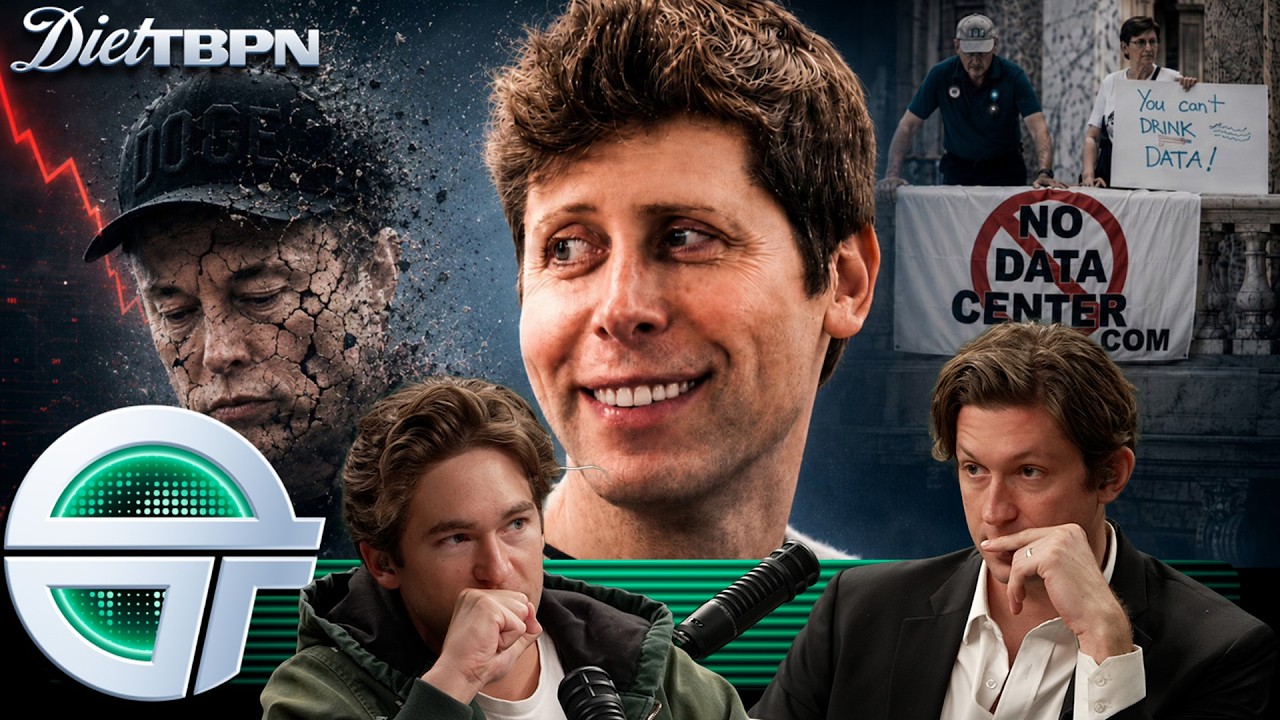
OpenAI Wins Musk Suit as Data Center Backlash Prompts Cash Payout Proposal
TBPN
Data center operators must offer direct annual cash payments to local residents to overcome growing bipartisan opposition and build critical AI infrastructure.
## Background
Published by TBPN on YouTube on May 19, 2026, this video features content from Diet TBPN, a daily 30-minute highlight show cut down from TBPN's live tech talk show hosted by John Coogan and Jordi Hays. According to the page description, the show focuses on major tech news and industry developments, featuring prominent Silicon Valley figures.
## TL;DR
The episode covers major developments in tech, beginning with OpenAI's legal victory over Elon Musk's lawsuit following a swift 90-minute jury deliberation. It dives into the intense speculation surrounding Leopold Aschenbrenner's 13F filing for his Situational Awareness hedge fund, detailing massive macro hedges across semiconductor stocks like Nvidia, SMH, and Intel. The hosts then analyze the mounting bipartisan backlash against AI data centers, examining localized environmental concerns surrounding Kevin O'Leary's massive 9 GW Stratus project in Utah as well as Eric Schmidt getting booed at a university commencement speech. Finally, they review tech analyst Ben Thompson's framework for data center opposition and discuss a radical proposal to overcome NIMBY resistance by paying direct annual cash dividends to local residents.
## Atmosphere & style
The show delivers a fast-paced, banter-filled blend of sharp market analysis and casual humor, shifting effortlessly between high-stakes AI macroeconomics and lighthearted tangents about luxury watch drops and studio lighting. The hosts maintain an engaging, informal dynamic—punctuating serious deep dives into data center infrastructure and financial filings with quick jokes, vivid pop culture references, and candid observations about Silicon Valley's cultural friction.
## Key takeaways
- [00:02](https://www.youtube.com/watch?v=RrOt3w0Ig9I&t=2s) A US jury dismissed Elon Musk's lawsuit against OpenAI and CEO Sam Altman based on the statute of limitations after deliberating for only 90 minutes.
- [05:42](https://www.youtube.com/watch?v=RrOt3w0Ig9I&t=342s) Leopold Aschenbrenner's Situational Awareness 13F filing generated massive market interest, revealing a $2 billion put option against the VanEck Semiconductor ETF alongside long positions in Nvidia.
- [05:42](https://www.youtube.com/watch?v=RrOt3w0Ig9I&t=342s) 13F option positions are reported notionally and represent a stale, single-day snapshot of holdings, making it difficult to infer exact trading strategies or current risk exposures.
- [03:13](https://www.youtube.com/watch?v=RrOt3w0Ig9I&t=193s) The Swatch and Audemars Piguet watch collaboration created massive retail chaos and high secondary market prices, though non-limited supply will likely cause resale values to normalize.
- [08:57](https://www.youtube.com/watch?v=RrOt3w0Ig9I&t=537s) Opposition to AI data centers has become a rare bipartisan issue, driven by job loss and IP concerns on the left, and surveillance fears on the right.
- [11:15](https://www.youtube.com/watch?v=RrOt3w0Ig9I&t=675s) Kevin O'Leary's proposed $100 billion Stratus data center project in Utah aims to use 9 gigawatts of power through dedicated power plants to avoid drawing on the public grid.
- [16:07](https://www.youtube.com/watch?v=RrOt3w0Ig9I&t=967s) Academic critics argue that the thermal impact of massive data centers generates intense localized heat, though developers in Utah chose an uninhabited desert basin to eliminate resident disruption.
- [19:55](https://www.youtube.com/watch?v=RrOt3w0Ig9I&t=1195s) Former Google CEO Eric Schmidt was heavily booed during a commencement speech at the University of Arizona, highlighting widespread public hostility toward AI leaders and fears of job displacement.
- [24:46](https://www.youtube.com/watch?v=RrOt3w0Ig9I&t=1486s) Tech leaders struggle to pitch the societal benefits of AI due to internal beliefs about human job loss, difficulty selling abstract future tech, and a general social disconnect from mainstream public life.
- [27:54](https://www.youtube.com/watch?v=RrOt3w0Ig9I&t=1674s) Analyst Ben Thompson proposes that data center developers pay direct annual cash dividends (such as $10,000 per resident) to local communities to neutralize local political opposition.
The show kicks off with a breakdown of a massive day in tech news, starting with the major verdict in the legal battle between Elon Musk and OpenAI. A US jury found OpenAI CEO Sam Altman not liable to Musk for allegedly straying from the company's original charitable mission. The dismissal came down to a legal technicality: the jury unanimously ruled that Musk simply waited too long to file his claims, missing the statute of limitations. The judge subsequently confirmed the verdict and officially dismissed the lawsuit, marking a decisive conclusion to the high-profile dispute.
The hosts note that the jury's deliberation was incredibly swift, lasting only about 90 minutes. They point out that because the jury doesn't sit on Fridays, the jurors had the entire weekend to process the case before showing up at 9:00 AM on Monday morning, deliberating until 10:30 AM, and delivering the swift verdict. Highlighting the reactions from prominent tech journalists on X, they mention Max Chafkin at Wired reporting that the timeliness issue completely killed the case, while New York Times reporter Mike Isaac, colorfully referred to as "the Rat King," expressed shock at the rapid 90-minute turnaround. The hosts joke about the absolute celebration happening inside OpenAI's internal Slack channels, imagining "W's in the shot" and comparing the vibe to a video of Drake celebrating a big gambling win.
[01:36](https://www.youtube.com/watch?v=RrOt3w0Ig9I&t=96s) The Anticipation and Mystery of Leopold Aschenbrenner's 13F
The conversation shifts to the intense anticipation building over the weekend for the 13F regulatory filing from Leopold Aschenbrenner's Situational Awareness hedge fund. The filing was widely expected to drop on Friday at 5:00 PM, sparking rampant speculation across tech and financial circles when it didn't immediately appear. Some observers theorized that Aschenbrenner had successfully petitioned the SEC to keep his holdings private, while another popular theory suggested the fund was sitting entirely in cash, meaning they had quietly wound down operations after deciding "it's a good run" and "there's no OOMs left to count."
Instead, the reality proved to be quite the opposite. As the chief investment officer of the fund, Aschenbrenner is famous for his core architectural thesis: that frontier AI models will continue to improve by half an order of magnitude ($0.5 \text{ OOMs}$) per year. This aggressive projection drives an investment strategy hyper-focused on the unprecedented demand for compute and the specific hardware bottlenecks that come with it. Amidst discussing this high-stakes market strategy, the hosts pause for a bit of lighthearted studio banter, noting that their bright new studio lighting setup makes them look far less dark on camera, even if one of the hosts admits he severely needs a haircut.
[03:13](https://www.youtube.com/watch?v=RrOt3w0Ig9I&t=193s) The Swatch and Audemars Piguet Watch Hype
Taking a brief detour from AI macroeconomics, the hosts share an anecdote about a weekend gift exchange. One of the team members, Nick, waited in a massive line to pick up a new watch for producer Tyler. The gift prompts a humorous discussion about the global luxury watch market, specifically referencing the chaos surrounding the highly anticipated collaborative release between Swatch and Audemars Piguet (AP).
The hosts discuss how the highly coveted, skeletonized AP Royal Oak collaboration caused literal stampedes and mob scenes in retail locations across the country and internationally. They contrast the chaotic public lines of watch flippers looking to exploit the secondary market with the traditional, ultra-exclusive "highbrow waiting in line" experienced by top-tier AP clients, where buyers are invited into private rooms to drink Diet Coke while being politely told they won't be getting an allocation. They note that while secondary market sellers made out incredibly well in the short term, Swatch's strategy of announcing that these models are not strictly limited editions will likely cause secondary market prices to retrace toward standard retail value over time.
[05:42](https://www.youtube.com/watch?v=RrOt3w0Ig9I&t=342s) Analyzing the 13F Disclosures and Macro Hedges
Returning to Aschenbrenner's infamous 13F, the hosts emphasize that Wall Street and tech circles haven't shown this level of fixation on a hedge fund filing in a very long time, as the discourse has completely spilled out of traditional "FinTwit" and into the broader tech ecosystem on X. The filings revealed that the fund placed massive macro bets across the semiconductor space, including a staggering $2 billion put option against the VanEck Semiconductor ETF (SMH). This suggests a highly pointed, granular thesis—rather than making a generic bet that all semiconductors will thrive, Aschenbrenner appears to be separating the overheated, overvalued segments of the supply chain from the companies that hold genuine, unappreciated value for the next phase of the infrastructure build-out. Notably, the data shows he is going long on Nvidia, signaling a strong belief in their enduring competitive moat.
However, the hosts urge caution when trying to "read the tea leaves too precisely" from a 13F filing. They remind the audience that these documents represent a stale, historical snapshot of holdings as of March 31, 2026. Because 13F filings quote option exposure notionally as if they were a 100 delta position, a reported $1 billion position in a stock like Intel usually just means the fund owns the right to purchase that amount, having actually deployed a fraction of that capital into premiums. They quote a financial commentator, Feijão, who warned that digging into these filings is often a waste of time because they hide strike prices, short positions, and broader hedging structures. Given that March was the height of the geopolitical tensions surrounding the Iran war, these options could have simply been low-cost convexity hedges that look vastly different after the market shifts of April and May.
[08:57](https://www.youtube.com/watch?v=RrOt3w0Ig9I&t=537s) The Bipartisan Backlash Against AI Data Centers
The narrative moves into the mounting political and social backlash confronting AI infrastructure across the United States. The hosts note that the resistance to massive data centers has evolved into a rare bipartisan issue, a trend previously predicted on their show by political commentator Saagar Enjeti. The criticism stems from two entirely different ideological angles, turning data center developments into a lightning rod for cultural tension.
* **Left-Wing Concerns:** Focus heavily on automated job displacement, the uncompensated scraping of artistic intellectual property, and the systematic destruction of human creativity.
* **Right-Wing Concerns:** View the massive facilities with deep libertarian skepticism, increasingly framing them as centralized "surveillance centers" built to spy on the public.
The hosts point out the deep irony embedded in these local movements, where community advocates in hollowed-out, right-leaning coal towns protest incoming data centers because they feel the infrastructure only benefits coastal elites—yet these same protestors are heavily utilizing consumer AI tools to draft their research and generate anti-data-center protest graphics. In response to the negative stigma, they joke about a suggestion from the chat to rebrand these industrial facilities as a "data ranch" to make them sound more appealing to rural communities.
[11:15](https://www.youtube.com/watch?v=RrOt3w0Ig9I&t=675s) Kevin O'Leary's Massive Utah Data Center Project
The final segment dissects a massive public debate surrounding a colossal data center project planned for Box Elder County, Utah. The project is being championed by *Shark Tank* star Kevin O'Leary, aka "Mr. Wonderful." The hosts describe O'Leary as an over-the-top caricature of a television businessman, making him a "soft target" for critics who want to paint large-scale tech infrastructure as an aggressive, elitist cash grab. They laughingly compare O'Leary's ostentatious style—such as attending the Oscars wearing both a Cartier Crash Skeleton and a ruby Rolex Daytona simultaneously while sporting a trading card around his neck—to the "quiet luxury" of previous tech titans like Tim Cook or Eric Schmidt, whose companies quietly built out massive AWS and Google Cloud infrastructure over fifteen years with virtually zero public backlash by leading with clean climate pledges.
Despite O'Leary's supervillain-like presentation, a deep dive into the actual logistics of the Utah development, highlighted by the channel Quick Thoughts, reveals a surprisingly reasonable and self-contained blueprint. Dubbed the Stratus project, the massive $100 billion endeavor spans over 40,000 acres in an uninhabited, remote desert valley, making it poised to become the largest data center in the world.
* **Power Consumption:** The facility is slated to use a massive 9 gigawatts of electricity at full capacity. While the auto-generated transcript hilariously mislabeled this as "gigabytes," the hosts emphasize that the project won't drive up utility costs for everyday citizens because the developers are building their own dedicated power plant rather than drawing from the public grid.
* **Water Rights:** The project avoids drawing water away from local residential communities by directly purchasing existing land and agricultural irrigation water rights from current property owners in the valley, keeping the resource usage localized.
* **Thermal Load Concerns:** The project faces steep academic criticism from local experts. Robert Davies, a physics professor at Utah State University, calculated that the facility will generate an additional 7 to 8 gigawatts of pure waste heat energy. This brings the total thermal load energy to 23 gigawatts, a figure critics sensationalize as the environmental equivalent of "dropping 23 atom bombs in Utah every single day."
Here is a detailed, faithful walkthrough of the transcript section.
---
[16:07](https://www.youtube.com/watch?v=RrOt3w0Ig9I&t=967s) Data Center Thermal Impact and Utah Desert Water Rights
The discussion opens with an analysis of heat generation and resource allocation for massive new data centers. When assessing thermal output, every power generator creates waste heat. The hosts point out that framing energy usage in terms of "atom bombs"—such as claiming a data center emits the equivalent of 23 atom bombs a day in Utah—is largely sensationalized, as states like Texas already see equivalent loads of hundreds of atom bombs daily under that metric. The hosts joke about how comparing ordinary objects to atom bombs makes everything sound dramatically heavier, noting that "your car weighs as much as seven atom bombs." However, the localized heat impact in the Hansel Valley project is tangible: daytime temperatures in the valley could increase by 2 to 5 degrees Fahrenheit, and trapped heat could raise nighttime temperatures by up to 28 degrees Fahrenheit. Crucially, Hansel Valley is an uninhabited desert valley, meaning zero residents are directly impacted by the heat rise.
The hosts argue that the Hansel Valley project effectively addresses the major public concerns surrounding data centers. For power costs, the operators are building their own dedicated power plants. For water usage, they are reallocating agricultural water rights. Addressing where agricultural water comes from in an uninhabited desert, the hosts explain the historical mechanics of Western water rights: landowners historically drilled wells into shared aquifers, prompting the "I drink your milkshake" dynamic where adjacent properties draw from the same groundwater source. Properties in the valley hold official water rights even if they are not actively growing produce; the water may have previously supported cattle, livestock, or failed historic farms, or the rights were leased to neighboring properties.
- **Data center thermal impact:** Daytime temperatures in Hansel Valley are projected to rise by 2–5°F, with nighttime temperatures potentially rising up to 28°F trapped in the valley basin.
- **Resource solutions:** The project builds dedicated power plants to protect the grid and reallocates existing agricultural water rights to cool the facilities.
- **Site choice:** The project consolidates massive computing capacity into a single uninhabited desert valley, preventing data centers from having to be built near populated areas.
---
[19:55](https://www.youtube.com/watch?v=RrOt3w0Ig9I&t=1195s) Eric Schmidt Booed at University Commencement
Despite logical arguments in favor of desert data center placement, the hosts note that AI faces massive, entrenched public hostility. They review a video clip of former Google CEO Eric Schmidt giving a commencement address at the University of Arizona, where he is relentlessly booed on stage by the student body. As Schmidt attempts to speak about the "architects of artificial intelligence" and ask whether students will "help shape artificial intelligence," a continuous, loud chorus of boos drowns out his speech, forcing him to pause and ask the crowd to let him make his point. The hosts joke that any speaker giving a commencement address on AI needs to bring a soundboard to play supportive effects or pivot off-script, remarking that the crowd was so rowdy it almost turned into a riot.
The hosts debate why the audience reacted so aggressively. While telling graduating college students that AI will take their jobs is clearly a failed strategy, the hostility reflects an "ensemble of problems." Consumers feel frustrated that despite non-stop hype around "vibe coding" and productivity, AI has delivered few magical consumer technology moments comparable to the early days of Cloud services, Yelp, Groupon, or Uber. Furthermore, models still exhibit noticeable flaws in writing quality. The hosts joke that students might be booing Eric Schmidt over usage limits, or because they hold "Teelian" grievances about Google hoarding over $100 billion in cash for stock buybacks rather than innovating fast enough. They conclude that while a speech about shaping the future of AI might resonate with Stanford students living at the epicenter of tech, students at public universities feel their preferred career paths are threatened and generally resist disruptive change.
- **Incident details:** Former Google CEO Eric Schmidt was heavily booed during a commencement address at the University of Arizona while speaking about shaping artificial intelligence.
- **Public friction:** Resistance stems from fear of job displacement, lack of tangible consumer-facing AI utility beyond coding, and general resistance to rapid technological change.
- **Historical parallel:** The hosts compare current AI opposition to the historic shutdown of nuclear power buildouts 50 years ago, calling the failure to expand nuclear energy one of humanity's greatest mistakes.
---
[24:46](https://www.youtube.com/watch?v=RrOt3w0Ig9I&t=1486s) Opposition to Infrastructure and Ben Thompson's 3-Part Diagnosis
The conversation shifts to broader public resistance against physical development, comparing data center backlash to community opposition against housing construction. Even when people support housing in the abstract, local homeowners routinely block nearby housing developments, permitting, and home expansions. However, data centers sit at the absolute bottom of public preference because they offer no direct community amenity. Host John Coogan references an analysis by tech analyst Ben Thompson, who outlines three main reasons why tech has failed at messaging:
1. **Internal Job Loss Beliefs:** Leading AI lab insiders genuinely believe most human jobs will be eliminated. They refuse to lie about this outcome because doing so would betray their fanatical devotion to building AI despite spending billions on models that become obsolete in weeks.
2. **Abstract Future Benefits:** It is inherently difficult to sell the public on unmade inventions, undiscovered medical cures, or future economic activity. This mirrors the 1970s nuclear debate, where cheap short-term electricity made people reject nuclear plants, only to suffer expensive electricity decades later.
3. **Disconnection from Society:** Tech founders struggle to relate to normal human desires. Silicon Valley initially misread the appeal of Facebook because the industry is populated by people running away from their friends and family, living in opposition to or denial of standard social life.
The hosts also review Thompson's analysis of platform-driven information dynamics: TikTok's algorithm remains controlled by Chinese interests, Meta avoids censoring data center misinformation to avoid claims of over-policing content, and X (formerly Twitter) has a subtle incentive structure due to SpaceX's plans for orbital space data centers.
- **NIMBY dynamics:** Local communities aggressively oppose data center construction just as homeowners oppose local residential housing developments.
- **Tech disconnect:** Tech leaders struggle to pitch the societal value of AI due to an inability to articulate abstract future benefits and a fundamental social disconnect from mainstream public life.
- **Platform incentives:** Media platforms either avoid moderating anti-data center narratives or, in the case of space tech ventures, benefit from highlighting the friction of terrestrial data centers.
---
[27:54](https://www.youtube.com/watch?v=RrOt3w0Ig9I&t=1674s) A Radical Solution: Direct Cash Payments to Local Residents
To overcome fierce local opposition, Ben Thompson proposes a direct financial solution: instead of promising vague local tax revenues that municipal governments often mismanage, data center operators should make direct cash payments to every resident in the host community. Thompson illustrates this using the example of a defeated 1.6-gigawatt data center proposal in the village of DeForest, Wisconsin:
- **Project Scale:** A 1.6 GW data center generates approximately $3,000,000,000 ($3 billion) in annual revenue for the operator.
- **Community Size:** The village of DeForest has a population of roughly 11,500 residents.
- **Proposed Payout:** Paying every man, woman, and child in the village $10,000 per year in cash would total roughly $115 million annually.
- **Financial Feasibility:** A $115 million annual payout represents just 3.8% of the data center's gross annual revenue—a cost operators could easily pass on to enterprise AI users.
The original community offer by the developer—a one-time $50 million municipal contribution—was pathetic by comparison. The hosts agree that unlike natural resources or consumer services, an everyday citizen gains no immediate backyard benefit from having a massive data center next door. Offering guaranteed, recurring $10,000 annual checks directly to community members would completely transform local voting incentives and likely result in rapid project approvals.
- **Core proposal:** Pay local residents direct annual stipends financed by a small percentage of data center revenues to secure project approval.
- **DeForest, WI case study:** A 3.8% allocation of revenue from a 1.6 GW facility yields $10,000 a year for every resident in an 11,500-person town.
- **Conclusion:** Direct dividend payouts represent the most practical mechanism for overcoming local political friction as infrastructure demands scale.
## Notable quotes
> [01:36](https://www.youtube.com/watch?v=RrOt3w0Ig9I&t=96s) it's a good run
> [01:36](https://www.youtube.com/watch?v=RrOt3w0Ig9I&t=96s) there's no OOMs left to count.
> [00:02](https://www.youtube.com/watch?v=RrOt3w0Ig9I&t=2s) the Rat King
> [00:02](https://www.youtube.com/watch?v=RrOt3w0Ig9I&t=2s) W's in the shot
> [03:13](https://www.youtube.com/watch?v=RrOt3w0Ig9I&t=193s) highbrow waiting in line
> [05:42](https://www.youtube.com/watch?v=RrOt3w0Ig9I&t=342s) read the tea leaves too precisely
> [11:15](https://www.youtube.com/watch?v=RrOt3w0Ig9I&t=675s) dropping 23 atom bombs in Utah every single day. — Robert Davies
> [16:07](https://www.youtube.com/watch?v=RrOt3w0Ig9I&t=967s) your car weighs as much as seven atom bombs.
> [16:07](https://www.youtube.com/watch?v=RrOt3w0Ig9I&t=967s) I drink your milkshake
> [19:55](https://www.youtube.com/watch?v=RrOt3w0Ig9I&t=1195s) architects of artificial intelligence — Eric Schmidt
> [19:55](https://www.youtube.com/watch?v=RrOt3w0Ig9I&t=1195s) help shape artificial intelligence — Eric Schmidt
## Mentioned
OpenAI, Elon Musk, Sam Altman, Max Chafkin, Wired, Mike Isaac, The New York Times, Drake, Leopold Aschenbrenner, Situational Awareness, SEC, Nick, Tyler, Swatch, Audemars Piguet, Diet Coke, VanEck Semiconductor ETF, SMH, Nvidia, Intel, Feijão, Saagar Enjeti, Kevin O'Leary, Tim Cook, Eric Schmidt, AWS, Google Cloud, Quick Thoughts, Stratus project, Robert Davies, Utah State University, University of Arizona, Yelp, Groupon, Uber, Google, Stanford University, John Coogan, Ben Thompson, Silicon Valley, Facebook, TikTok, Meta, X, SpaceX
TBPN reviews mounting legal, financial, and political friction facing artificial intelligence, highlighted by OpenAI's swift courtroom victory over Elon Musk and escalating community resistance to multi-gigawatt data center developments.
OpenAI Legal Victory and Macro Semiconductor Hedges (0:02)
A federal jury unanimously cleared OpenAI CEO Sam Altman of liability in Elon Musk's lawsuit claiming the organization strayed from its founding charitable purpose. After approximately 90 minutes of deliberation, the jury rejected the claims because Musk missed the statute of limitations, prompting the judge to formally dismiss the case. The rapid verdict coincided with heightened attention on hedge fund filings, particularly Leopold Aschenbrenner’s Situational Awareness fund, which bases its strategy on frontier AI models improving by 0.5 orders of magnitude per year.
Aschenbrenner's regulatory 13F filing revealed concentrated exposure, including a long position in Nvidia and a notional $2 billion put option against the VanEck Semiconductor ETF (SMH). Commentators noted that 13F filings reflect historical snapshots—in this case, dated March 31, 2026—and record options notionally at 100 delta without disclosing strike prices or offsetting short positions, meaning the large headline figures may represent low-cost convexity hedges rather than purely directional short bets.
Bipartisan Pushback Against Physical AI Infrastructure (8:57)
Public and political resistance to physical AI infrastructure is consolidating into a rare bipartisan movement. Progressive critics focus on potential automated labor displacement and uncompensated intellectual property scraping, while conservative and libertarian opponents express concern that expanding facilities will function as centralized surveillance centers. This skepticism was visibly demonstrated when former Google CEO Eric Schmidt was repeatedly drowned out by student boos during a commencement address at the University of Arizona after attempting to praise the architects of artificial intelligence.
The hosts note that unlike previous technological transitions—such as cloud platforms and mobile applications that delivered immediate consumer utility—current AI advances have produced few mainstream breakthroughs while stoking widespread career anxieties. This friction mirrors the historical public opposition that halted the expansion of nuclear energy fifty years ago, as communities resist industrial buildouts that offer few visible everyday benefits.
Thermal Loads and Water Allocation in Utah (11:15)
Scrutiny over physical infrastructure is centered on large-scale developments such as the Stratus project in Box Elder County, Utah. Promoted by investor Kevin O'Leary, the planned $100 billion, 40,000-acre project in Hansel Valley is designed to consume 9 gigawatts of power. To insulate the regional power grid and public water supplies, developers plan to construct a dedicated power plant and purchase existing agricultural groundwater rights originally tied to historic livestock operations and basin wells.
Despite these private utility arrangements, academic researchers have raised environmental alarms. Utah State University physics professor Robert Davies calculated that the facility would emit 7 to 8 gigawatts of waste heat, contributing to a total thermal load of 23 gigawatts. Modeling indicates this output could elevate daytime temperatures in the uninhabited desert valley by 2 to 5 degrees Fahrenheit and trap nighttime heat, potentially raising nighttime temperatures by up to 28 degrees Fahrenheit.
Direct Cash Stipends to Offset NIMBYism (27:54)
Analyzing tech industry messaging, analyst Ben Thompson outlines three causes of the backlash: AI researchers openly predicting widespread human job obsolescence, the difficulty of selling voters on abstract future medical or scientific breakthroughs, and tech leaders' social disconnect from ordinary communities. Because data centers provide no direct neighborhood amenities, host municipalities frequently reject development permits despite developer pledges of municipal tax contributions.
To counter local vetoes, Thompson proposes that operators distribute direct, recurring cash payments to nearby residents. In a case study of a rejected 1.6-gigawatt facility in DeForest, Wisconsin—projected to generate $3 billion in annual operator revenue—providing an annual $10,000 stipend to all 11,500 local residents would cost approximately $115 million. Representing 3.8% of annual revenue, this dividend model is framed as a viable mechanism to shift community incentives and secure local approval.
As compute requirements scale from single facilities into multi-gigawatt desert campuses, the tech industry faces a transition where legal victories and capital deployment are increasingly constrained by community resistance, grid limits, and the unresolved challenge of local economic alignment.
[1:36] it's a good run
[1:36] there's no OOMs left to count.
[0:02] the Rat King
[0:02] W's in the shot
[3:13] highbrow waiting in line
[5:42] read the tea leaves too precisely
[8:57] surveillance centers
[8:57] data ranch
[11:15] soft target
[11:15] quiet luxury
[11:15] Robert Davies: dropping 23 atom bombs in Utah every single day.
[16:07] your car weighs as much as seven atom bombs.
[16:07] I drink your milkshake
[19:55] Eric Schmidt: architects of artificial intelligence
[19:55] Eric Schmidt: help shape artificial intelligence
Original transcript
[0:02] Massive day today. Tons of big stories.
[0:05] Five big stories I want to go through.
[0:07] Obviously, the first one is that the US
[0:09] jury finds OpenAI CEO Sam Altman not
[0:12] liable to Elon Musk for straying from
[0:15] charitable mission because Musk waited
[0:17] too long to sue. Weird like
[0:19] technicality, I guess, but
[0:21] good news for OpenAI. Judge confirms
[0:24] verdict and that Musk lawsuit is
[0:27] dismissed.
[0:27] >> Yeah, apparently they deliberated for
[0:30] about 90 minutes.
[0:31] >> 90 minutes.
[0:31] >> And they didn't really make any type of
[0:34] statement other than the statute of
[0:36] limitations.
[0:37] >> And so Max Zaf over at Wired says jury
[0:40] unanimously rules that Musk's claims are
[0:42] dismissed on the timeliness issue. He
[0:44] filed the lawsuit too late. Court
[0:46] affirms it will uphold the jury's
[0:48] decision. It's over. Musk loses the
[0:49] lawsuit against OpenAI. And Mike Isaac,
[0:52] the Rat King, says unanimous verdict in
[0:55] Musk versus OpenAI is in after only 90
[0:57] minutes of deliberation. So, did they
[0:58] deliberate today? They showed up at 9:00
[1:01] and went from 9:00 to 10:30 and then
[1:03] delivered the verdict. Is that what we
[1:05] think happened? Cuz Friday's off in the
[1:06] jury, right? No Fridays.
[1:07] >> Yeah, jury showed up this morning.
[1:09] >> Okay. Talk.
[1:09] >> Talked for 90 minutes.
[1:10] >> So, they got to think about it all
[1:11] weekend and Friday. Interesting.
[1:14] >> Rat King says huge day. Wow. And what
[1:16] did Tyler post? He posted a video of
[1:19] Drake talking about something. What's
[1:21] going on over here? W's in the shot.
[1:25] >> [laughter]
[1:25] >> W's in the shot. Is that the sound of
[1:27] the OpenAI Slack right now?
[1:29] >> that's when he is
[1:30] gambling in front of
[1:33] It is a funny way to pronounce chat, but
[1:36] I enjoy it. The big news that was going
[1:38] on all weekend, actually, there was a
[1:40] lot of anticipation for Leopold
[1:43] Aschenbrenner Situational Awareness
[1:45] hedge fund who dropped the 13F. It was
[1:47] supposed to go out Friday night, 5:00
[1:50] p.m. Everyone was saying, "Oh, if he if
[1:53] he's not Well, people were expecting it
[1:55] throughout the entire day.
[1:56] >> Yeah.
[1:57] They were very excited.
[1:58] >> was some speculation that he'd been able
[2:00] to petition to not have to release it.
[2:03] >> That was one theory.
[2:04] >> That was one theory. The other theory is
[2:05] that he was just entirely in cash.
[2:07] >> Yeah, don't need to report it.
[2:09] I just wind it down. Said it was a good
[2:11] run. It's over.
[2:12] >> Yeah, yeah. He's like, "I counted the
[2:14] ohms and there's none left to count.
[2:15] We're done."
[2:16] Pack it up. No, quite the opposite.
[2:19] Uh Leopold Ascher brothers, the hedge
[2:20] funds' chief investment officer, is
[2:21] known for making extremely successful
[2:23] investments based on his core assumption
[2:26] that Frontier AI will continue to
[2:28] improve at half an order of magnitude,
[2:31] 0.5 ohms per year, which translates into
[2:34] a thesis that AI will create
[2:36] unprecedented demand for compute and its
[2:38] associated bottlenecks. John, they're
[2:40] saying it is blindingly light. It is
[2:44] brighter than the ultra-dark, isn't it?
[2:45] Yeah, I think we got some new lights.
[2:47] We're we're sort of
[2:48] uh you know, tweaking things. I do like
[2:50] that the wide is less dark. There's been
[2:53] a number of times when we've gone to
[2:54] watch videos and we've been very dark in
[2:55] the front. So, we're bringing some light
[2:57] around. We'll see. Maybe we maybe we
[2:59] overdid it. Maybe we'll dial it back. I
[3:01] need to brush my hair. My hair's a
[3:02] little a little scruffy today. I also
[3:04] need a haircut, but we'll get to that
[3:05] some other
[3:06] >> We'll get to that later in the show.
[3:08] John will be getting a haircut live
[3:10] >> Live.
[3:11] Potentially. Uh
[3:13] but before we go any further, I uh Nick
[3:16] over the weekend picked up a little gift
[3:19] for our very own Tyler.
[3:21] >> Let's hold it up.
[3:22] >> you to open open it on on the video. On
[3:26] the video, Nick. Hold it up online. We
[3:29] waited in line. Look at this.
[3:31] >> in line.
[3:31] >> Hey. What do we got for Tyler? Let's
[3:34] see.
[3:34] >> long line just for you, Tyler, because
[3:37] what is it?
[3:39] >> Uh I'm trying to open it. Little
[3:40] anti-climactic.
[3:41] >> Wow, it's a
[3:42] uh What is I don't know how to pronounce
[3:44] this. Am I reading upside down? It's a
[3:45] little little watch. Let's go.
[3:47] [laughter]
[3:48] Another watch for Tyler.
[3:52] Uh It is not.
[3:53] >> know if you thought it might be might
[3:54] have been something else like the Swatch
[3:56] AP collaboration but
[3:58] >> But really like the whole, you know,
[4:00] everything in the Swatch portfolio is
[4:02] fantastic including this. I don't know.
[4:04] Describe what's on there.
[4:06] What is on there? Yeah, Nick, what is
[4:08] it? It has a rotating bezel. That's not
[4:10] Okay.
[4:10] >> He says it has a rotating bezel. Okay,
[4:12] but just to be clear it's not the it's
[4:15] not the Royal Pop.
[4:16] >> Which was completely sold out and uh
[4:19] causing like stampedes all over the
[4:22] country all over the world. I saw
[4:24] footage I think from an international
[4:26] country uh around people really mobbing
[4:29] it. Uh you you were mentioning that you
[4:31] thought it was maybe an oral loss for
[4:33] both companies because of the I think it
[4:36] was Yeah, I just the the Your brain is
[4:38] now associated with chaos. Yeah.
[4:40] >> That's not good.
[4:40] >> Yeah, yeah. Right? Uh and AP although
[4:44] it's although it's exclusive like you
[4:45] have to sort of wait in line. The
[4:47] waiting in line is like here have a have
[4:50] a diet Coke and sit in this private room
[4:52] while I tell you that you will not be
[4:54] getting an allocation in this
[4:55] skeletonized AP Royal Oak or whatever,
[4:59] right? Uh come back soon. And it's a and
[5:01] it's a it's a very highbrow waiting in
[5:03] line. Yeah. And this was for a
[5:05] >> to come out over time and say these are
[5:08] not going to be limited. We're selling
[5:10] them a lot.
[5:10] >> Yeah. Uh and so the the people that wait
[5:12] in line just to sell on the secondary
[5:14] market I think have done pretty well.
[5:16] Oh, really?
[5:16] >> in the short term. But I would expect
[5:18] that over time uh prices will will sort
[5:21] of retrace toward retail. I did see a
[5:24] funny graphic of somebody that was like
[5:26] uh basically saying like uh you know,
[5:28] comparing like getting a job versus
[5:31] waiting in the line to get it and you
[5:33] actually did quite a bit better if you
[5:35] just got a job on Monday instead of
[5:37] getting in the in the line. Yeah, yeah,
[5:38] I saw that. And then over time, you
[5:39] know, your your earnings really ramp
[5:41] out.
[5:42] >> back to Leopold Aschenbrenner and his
[5:43] 13F the infamous 13F. Uh there's a lot
[5:46] of discussion around it on the timeline.
[5:48] Really, like we have not seen this level
[5:50] of attention on a hedge fund's filings
[5:53] in a very long time. Uh it's it's
[5:56] because it it it's breaking out of
[5:58] FinTwit. It's breaking into tech teapot
[6:01] and tech X and all of that. Uh mostly
[6:03] because the a lot of the discussion
[6:05] centers around uh the filing shows he's
[6:07] made some massive puts across the
[6:09] semiconductor sector, uh 2 billion on
[6:11] SMH, the VanEck semiconductor ETF. And
[6:15] so, there's there's it it
[6:17] feels like maybe more more of a pointed
[6:20] thesis, less broad, hey, semiconductors
[6:23] are going to do well, more I actually,
[6:25] me, Leopold in this case, understand
[6:28] where the real value is, what companies
[6:31] within the semiconductor industry are
[6:33] undervalued, which ones are actually
[6:35] going to be useful in the next iteration
[6:38] of the build-out. And a lot of stuff has
[6:40] been priced very hotly. Some stuff is
[6:44] overheated. trade for a while became
[6:47] like crushingly obvious, and then it
[6:49] grew so much that that was not one of
[6:51] his early positions. Now, it is looking
[6:54] like he is going long Nvidia, which is
[6:56] interesting in the backdrop of is Nvidia
[6:58] a card? Do they still have a moat? Well,
[7:00] there might still be something else
[7:01] going on there. You have to dig in
[7:03] through this and understand what's going
[7:04] on. Um
[7:06] but the filing is hard to interpret
[7:07] cleanly because an a 13F is only a
[7:10] snapshot of holdings as of March 31st,
[7:13] 2026. These positions are stale. He
[7:15] might have rotated out of these. 13Fs do
[7:18] disclose put and call options. They
[7:20] don't disclose the strike prices,
[7:22] expirations, premiums paid, hedge
[7:24] ratios, short position swaps, and or
[7:27] whether the options are part of broader
[7:29] structures. So, you have to uh be
[7:31] careful out there if you're trying to uh
[7:33] read the tea leaves too precisely.
[7:36] Um you're
[7:37] you know, you can only uh take away so
[7:39] much from these. So, uh Feijao, I don't
[7:42] know how to pronounce that, says,
[7:44] "Unfathomably bad takes around this
[7:47] morning and a good reminder of why 13F
[7:50] digging is mostly a waste of time."
[7:52] March 31st, uh we were in the heat of
[7:55] the Iran war. It makes sense to put on
[7:56] hedges at the time. Uh options exposure
[8:00] on 13F gets quoted notionally as if it
[8:03] were 100 delta, i.e. all 100 shares per
[8:06] contract. So, when you see something
[8:08] like, "Oh, he owns a billion dollars of
[8:10] Intel." it's usually he owns the right
[8:12] to purchase a billion dollars of Intel,
[8:14] and he has actually deployed far less
[8:16] capital into that position, although it
[8:18] is uh sometimes an important sign of
[8:21] things to come. We have no way of
[8:22] knowing whether these were five delta
[8:23] convexity hedges convexity hedges and
[8:26] represent represented a fraction of what
[8:29] people are saying were billions in puts
[8:31] or whether they were ITM puts in the
[8:32] money puts. Uh further outright shorts
[8:34] don't get reported either. Too much
[8:35] noise associated with the things that
[8:37] happened back in March that aren't
[8:38] relevant now. We have no idea about his
[8:40] turnover in assets and trading
[8:42] frequency. A lot happened in the months
[8:43] of April and May. His positioning could
[8:45] be completely different making
[8:46] investment decisions for 80 vol assets
[8:48] based on data from months ago sounds
[8:50] like a good way to burn money. So, don't
[8:52] idolize people and develop your own
[8:54] thesis for why you own and sell things.
[8:57] That is a good takeaway. Uh anyway, the
[8:59] AI backlash is continuing in a bunch of
[9:01] different ways and one interesting sort
[9:04] of twist on this is that a lot of the AI
[9:08] maxis, the AI bulls were sort of
[9:11] concerned at least that this would all
[9:13] be fossil fuel-based buildout because
[9:16] everything else was too slow. They might
[9:17] be in They may be fans of nuclear. They
[9:19] might be fans of of solar, but it was uh
[9:22] seen as infeasible, seen as
[9:25] being far too long. So, if Leopold is in
[9:28] fact taking a position in T-1 Energy,
[9:30] that sort of leads me to think that
[9:32] there's a little bit of a shorter
[9:33] timeline to at least bringing some solar
[9:36] power to bear
[9:38] during the AI build out that it's not
[9:41] all just sort of hope and a dream that
[9:45] there will be solar power on the grid in
[9:48] any near amount of time. A lot of the
[9:50] nuclear power companies are moving on
[9:52] the backs of the AI build out, but it's
[9:54] still 2032, you know, when we talked to
[9:56] the folk. Even even the optimistic ones.
[9:59] So, there has been big pushback on AI
[10:02] data centers across the board. We've
[10:03] talked about this a bunch. And it's both
[10:05] a left and right-wing issue now. Sagar
[10:08] and Jeti predicted this I think last
[10:09] year when he joined our show.
[10:11] And it's been interesting. Left-wing is
[10:14] worried about job displacement,
[10:17] theft of art, destruction of creativity.
[10:20] Right-wing sees them as surveillance
[10:22] centers. That's the latest term is that
[10:24] they're they're they're they're used to
[10:26] spy on people. So, that's an
[10:27] anti-libertarian, anti-right-wing
[10:29] position. But there are a whole bunch of
[10:31] others. Just this hollowed-out coal town
[10:34] is voting right-wing and then data
[10:36] center comes to town and they see it as,
[10:38] you know, just making their town worse
[10:39] off and benefiting like the coastal
[10:41] elites and like the People have lied to
[10:42] you that both sides are using AI to
[10:45] create graphics to oppose data centers.
[10:48] >> That's true. Yeah, there's all these
[10:49] like deep ironies. There's there's a
[10:51] whole piece on someone who's protesting
[10:53] data centers and using a lot of AI to
[10:55] research how she can push back.
[10:57] >> Gabe says data centers need to be
[10:58] rebranded to data ranch.
[11:00] >> Data ranch. I like a data ranch. That's
[11:02] a good one. Um Ox, we got ox-powered.
[11:05] Oh, interesting. Salty says that Leopold
[11:08] sold Blue Energy in the latest 13F. So,
[11:11] or trimmed. So, if that's if that's the
[11:13] case, then there you go. The latest
[11:15] debate that I saw was over this huge
[11:17] data center in Utah that's being
[11:19] championed by Shark Tank's Mr.
[11:21] Wonderful, Kevin O'Leary. Are you
[11:22] familiar with this whole thing? Yeah,
[11:24] someone dug into like the plan and the
[11:25] plan actually seems pretty reasonable,
[11:27] but
[11:28] Mr. Wonderful, he is a he's sort of an
[11:30] over-the-top caricature of a
[11:33] businessman. Like he plays one on TV. He
[11:36] is a real businessman, but he also plays
[11:38] a businessman on TV. And so he's a bit
[11:40] of a soft target. Like he was recently
[11:43] seen sporting not one, but two expensive
[11:45] watches, not unlike Tyler Cosgrove over
[11:47] there.
[11:48] He went to the Oscars wearing a Cartier
[11:50] crash skeleton and a ruby Rolex or
[11:53] Daytona. And I believe he also had a
[11:56] like a trading card around his neck. So
[11:58] very ostentatious, very over the top, a
[12:01] very soft target if you're looking for
[12:04] someone to target in like a he's doing
[12:06] it for the money, you know?
[12:09] It's pretty pretty easy. And so if you
[12:10] want to paint data center construction
[12:12] as maybe not in the best interest of
[12:14] average Americans, Kevin O'Leary is
[12:16] going to do a lot of that a lot of the
[12:17] heavy lifting for you.
[12:19] >> in the context of developing large-scale
[12:22] infrastructure that people are afraid of
[12:24] sounds like a supervillain, too. Yes,
[12:27] and also like we you can put this in
[12:29] contrast to Eric Schmidt or Tim Cook
[12:33] where
[12:34] the the previous generation like the
[12:36] major hyperscalers like the big tech
[12:38] companies, they've done a pretty good
[12:40] job building a lot of infrastructure,
[12:42] making really really bold climate
[12:44] pledges saying we're going to be net
[12:45] zero by this year. Our data centers are
[12:48] really clean. They built a lot of data
[12:49] centers without really any disruption.
[12:51] There was no backlash to Google Cloud
[12:54] through 15 years or 10 years of building
[12:56] AWS.
[12:57] And and and so now
[12:59] >> of them were rocking dual iced out
[13:02] >> So you're making the case for quiet
[13:03] luxury. The quiet luxury of a of a Tim
[13:06] Cook or an Eric Schmidt.
[13:07] >> Definitely.
[13:07] >> Yeah, I mean in this case it seems like
[13:09] >> Mr. Mr. Wonderful is not not the guy to
[13:12] be the face of.
[13:14] >> Potentially not, but apparently his his
[13:16] actual data center plans are reasonable.
[13:18] It actually seems pretty by the book
[13:20] according to current plans. It's in a
[13:22] remote area. It uses its own power and
[13:25] water. And it doesn't seem to disrupt
[13:27] any local communities. Uh we can pull up
[13:29] this video from Quick Thoughts that has
[13:32] a little bit of a breakdown. million
[13:34] views complaining about a giant data
[13:36] center in Utah. And I'm kind of confused
[13:39] by that because I would think that an
[13:41] uninhabited desert valley in Utah is the
[13:44] perfect place to build a giant data
[13:46] center. I've been following really
[13:47] closely what's happening in Box Elder
[13:49] County, Utah, where Canadian billionaire
[13:52] Kevin O'Leary
[13:52] >> Who's Canadian? That's a big problem.
[13:55] a $100 billion project, okay? This would
[13:59] be the largest data center in the world
[14:01] at over 40,000 acres. And at full
[14:03] capacity, the data center, which is
[14:04] called the Stratus project, is set to
[14:06] use a 9 gigawatts of electricity.
[14:08] >> Gigabytes. You saw that in the double
[14:10] the entire amount of electricity used by
[14:13] Well, she said she said it correctly.
[14:16] She Yeah, yeah, but but but the
[14:18] transcript said gigabytes are just
[14:20] funny.
[14:21] AI fails again. We need another data
[14:23] center to fix that.
[14:24] >> Steve and I shed says TV and studio uses
[14:26] the equivalent of 23 [laughter] atomic
[14:28] bombs of energy daily.
[14:31] That's to produce niche technology
[14:33] content.
[14:34] large is because they are buying water
[14:36] rights of the current property owners.
[14:38] So, the current property owners are
[14:40] using water for agricultural irrigation.
[14:43] The data center project buys that land,
[14:46] buys a huge amount
[14:47] >> makes this sound good, but then it's
[14:48] like, wait, are we going to have less
[14:49] food? That doesn't seem that good. But
[14:50] the point is is that he's not taking it
[14:52] from like someone who is going to be
[14:55] paying water or some local community.
[14:58] It's like there's there's there's
[15:00] already water rights there that are
[15:01] staying in that valley. It's not drawing
[15:04] power from the grid. If we look at
[15:06] electricity consumption by state, we can
[15:08] see that Utah just doesn't use that much
[15:10] electricity compared to other states.
[15:13] There are plenty of states that use
[15:14] double or triple. Tennessee is about
[15:16] triple, Pennsylvania four times,
[15:20] uh Texas is like 10 times, more than 10
[15:23] times what Utah uses. So, if over the
[15:26] course of this project they reach their
[15:28] goal and they double or triple Utah's
[15:30] electricity usage, so why is that bad?
[15:33] It's not incurring more cost to the
[15:35] people of Utah because they're building
[15:37] their own power plant. by Utah as a
[15:40] whole. Robert Davies, a physics
[15:42] professor from Utah State University,
[15:44] says that he actually thinks the project
[15:45] will require an additional 7 to 8
[15:47] gigawatts of waste heat energy, meaning
[15:50] that the project in total will be 23
[15:52] [music]
[15:52] gigawatts of total thermal load energy,
[15:56] which is the equivalent of dropping 23
[15:59] atom bombs in Utah every single day.
[16:03] Also, let's Okay, electricity generation
[16:05] across every state is going to have that
[16:07] same thermal load property. Not every
[16:10] generator is perfectly efficient, so
[16:12] they're going to generate waste heat as
[16:13] well. So, if you say, "Okay, we're going
[16:15] to have 23 atom bombs a day worth of
[16:17] electricity going off in Utah," well,
[16:20] then currently we have 230 atom bombs a
[16:22] day going off in Texas.
[16:24] >> to put everything in hundreds more of
[16:25] atom bomb comparison. Like, your car is
[16:28] like the size of like five atom bombs.
[16:31] Like, an atom bomb is like maybe this
[16:33] big, maybe a little bit bigger. Yeah.
[16:35] >> Your car weighs as much as seven atom
[16:37] bombs. It makes it sound so much more
[16:39] like weighty when you're like comparing
[16:41] everything to atom bombs.
[16:44] by 28 degrees.
[16:46] >> actually pretty crazy. 28 degrees feels
[16:47] like a lot.
[16:48] >> daytime temperature could increase 2 to
[16:50] 5 degrees throughout Hansel Valley, not
[16:53] the state of Utah, the valley where the
[16:55] data center is being built. Same with
[16:58] nighttime temperature could increase up
[17:00] to 28 degrees trapped in the valley.
[17:03] Hansel Valley is an uninhabited desert
[17:07] valley. So, if you build a big power
[17:09] plant here and a big data center here,
[17:12] maybe it'll increase the temperature of
[17:13] this valley by 5 degrees. But, okay,
[17:17] nobody lives there. I think this project
[17:19] solves a lot of people's stated concerns
[17:22] with data centers. You're worried about
[17:24] water usage? They're reallocating
[17:26] agricultural water to cool the data
[17:28] center. Worried about power cost?
[17:30] They're building their own power plants.
[17:31] >> helping.
[17:33] Helping is not
[17:34] >> But I like vegetables.
[17:35] >> [laughter]
[17:36] >> middle of an uninhabited desert valley
[17:38] where it's already hot. And you're
[17:41] worried about this is such a huge
[17:42] project. This is a giant data center or
[17:44] something, world's biggest data center?
[17:46] Well, that's just data centers that
[17:47] don't have to be built in other places
[17:49] that are being built in this uninhabited
[17:51] desert valley. I think the concerns in
[17:53] her video are just fear-mongering for
[17:55] reasons that I hope I've explained here.
[17:57] Thanks for your time. I guess the
[17:58] question is they say that there's water
[18:00] for agricultural usage right now in that
[18:04] valley, but that valley's uninhabited
[18:06] and it seems like a desert. So, it
[18:07] doesn't seem like they're growing food
[18:08] there. So, like where is that water
[18:10] actually going? Because is it just
[18:12] getting piped to some other farm like
[18:15] far away or was it like that they they
[18:17] were planning to farm
[18:18] >> way way back in the day way back in the
[18:19] day you could just have a piece of land,
[18:22] you could drill a well, and you could
[18:23] pull up as much water as you wanted. And
[18:25] then people realized that if you have a
[18:27] property here and there's property here
[18:29] here here here here, they're often times
[18:32] all pulling from the same aquifer. So,
[18:34] you all of a sudden, if you come in, you
[18:37] move in next to me, and you start
[18:38] pumping you know
[18:40] billions of gallons of milkshake. Yeah,
[18:42] you're drinking my milkshake. I drink
[18:45] your milkshake.
[18:49] I DRINK [screaming] IT UP. UH AND SO,
[18:51] IT'S very possible that all these
[18:53] parcels of land, which they collectively
[18:55] bought, they all have their own water
[18:58] rights. That doesn't mean they're being
[18:59] used, right? So, cuz people will sell
[19:01] their water rights to like a neighboring
[19:03] property that is and so
[19:05] >> question is like sounds like they sold
[19:07] the water rights previously or they had
[19:09] some sort of deal to send the water that
[19:12] they were getting out of the desert,
[19:13] which I can't imagine produces that much
[19:15] water, but I guess it does. Uh use it
[19:17] for like agricultural purposes. Like,
[19:19] what were they growing?
[19:20] >> Well, agricultural could mean you have
[19:22] some like you have some cattle. Like,
[19:25] there's a but there's a bunch of
[19:26] different potential meanings for that.
[19:27] It doesn't mean you're growing fresh
[19:30] produce.
[19:30] >> But, were they actively using it or were
[19:32] they just like not
[19:33] >> No, that's the other thing. That's the
[19:34] other thing, too. It could have been
[19:35] agricultural land, but not
[19:38] >> a failed farm, it's not farming anymore,
[19:40] like a former livestock
[19:44] like farm, something like that. But, I
[19:47] don't know. These points, like as you
[19:49] said, I think are going to be hard to
[19:50] break through just because AI is so
[19:52] deeply unpopular for a variety of
[19:54] reasons.
[19:55] And we should watch the video of Eric
[19:57] Schmidt
[19:58] getting booed on stage at University of
[20:02] Arizona. He says, "This is incredible.
[20:04] Artificial intelligence getting booed
[20:05] out of the stadium in any commencement
[20:07] speech it's mentioned in. Maybe telling
[20:09] college students AI was taking their
[20:11] jobs wasn't the best strategy." Let's
[20:13] watch this clip. the architects of
[20:15] artificial intelligence.
[20:17] Interesting.
[20:23] The question is whether you will help
[20:24] shape artificial intelligence.
[20:27] We do not know.
[20:30] We do not know
[20:32] the precise contours of what this
[20:35] If you'd let me make this point, please.
[20:37] Step one, get If you're giving a
[20:38] commencement speech, you got to bring a
[20:39] sound board. You got to be like, "AI,
[20:42] yeah, it's not that bad, but also I hear
[20:45] you."
[20:47] including the perspective of the
[20:49] immigrant
[20:51] who has so often been the person who
[20:53] came to this country
[20:55] >> They're really going crazy. We thought
[20:57] that we were adding stones to a
[21:00] cathedral of knowledge Another
[21:02] >> that
[21:05] Great.
[21:06] There's just a low-level boo the whole
[21:08] time. It's just so rowdy. Like, normally
[21:11] you'd think there'd be like a little bit
[21:12] of boo, and then they just like get
[21:13] quiet down, okay. This is about to turn
[21:16] into a riot. This is crazy. Did he just
[21:19] bail on this thing? No.
[21:24] At this point, I mean, you got to go off
[21:25] script.
[21:26] >> You could you you could
[21:27] >> stay in the script.
[21:29] >> that if you cut it up in the right way,
[21:30] you could make it seem sound like the
[21:32] most people. It's like, you will
[21:34] surrender your agency.
[21:36] >> Yeah. The big thing is like, I don't
[21:37] know that that is like everyone is
[21:40] booing for slightly different reason,
[21:42] but it's like this ensemble of problems
[21:45] and and grievances with AI generally.
[21:48] Like, one thing that I'm that I've been
[21:49] like frustrated about is everyone is
[21:51] vibe coding like 24/7 leaving MacBooks
[21:54] open talking about like productivity.
[21:56] And yet, uh
[21:57] the like the magical moments, the
[21:59] consumer technology, has been like
[22:01] completely left behind. There was a time
[22:03] when we got the cloud you're building a
[22:05] lot of data centers, but every year
[22:07] you'd get like a cool new thing. Like,
[22:09] Yelp would come out, and it was like it
[22:11] wasn't changing the world, but it was
[22:12] like, oh, you could find a cool new
[22:13] restaurant. And maybe like or Groupon.
[22:15] Like, Groupon was like not a great
[22:17] business ultimately, but like for the
[22:19] first couple months of Groupon, you
[22:20] could like go try a restaurant for like
[22:22] half price, and it just felt like
[22:24] magical. Or like Uber, when that came
[22:25] out, it was like, wait, I can go out and
[22:27] call a taxi cab service. Maybe it comes,
[22:29] maybe it doesn't. Stand outside in the
[22:30] cold, try and flag a car. There were all
[22:32] these things.
[22:33] >> they were do you think they were uh like
[22:35] angry at usage nano banana usage limit?
[22:38] >> Probably. Probably.
[22:40] >> Is this whole thing just a
[22:41] misunderstanding?
[22:42] >> they might think we're in a plateau, and
[22:44] they might just be upset with the lack
[22:46] of progress outside of coding domains.
[22:48] Yeah, the writing is just still not that
[22:50] good. I mean, how do you read these
[22:52] models?
[22:52] >> I can clock it.
[22:53] >> Yeah, I it's still clockable.
[22:55] Yeah.
[22:56] >> Yeah, at first I I thought they were mad
[22:57] that like at Google Eric Schmidt was he
[22:59] he was doing too too many, you know,
[23:00] stock buybacks instead of investing in
[23:02] Too
[23:03] and innovation, yeah.
[23:04] >> yeah, having a hundred billion on the
[23:05] balance sheet in cash is just
[23:06] unacceptable. Like, yes, you get Waymo,
[23:08] yes, you get DeepMind.
[23:09] >> Yeah, cuz it just feels they don't know
[23:10] what to do with the money.
[23:11] >> Yeah, yeah, they weren't innovating for
[23:12] a long time and and then that makes a
[23:13] lot of sense why you would boo them.
[23:15] Sort of the Teelian
[23:16] >> [laughter]
[23:17] >> The Teelian boo.
[23:19] Just in those handful of sentences,
[23:22] like, is that that felt like a speech
[23:25] more
[23:26] potentially like oriented towards maybe
[23:28] like the Stanford student body, which is
[23:31] like, how are you going to contribute to
[23:34] AI? That's what I was like That's what
[23:36] was standing out to me, being like,
[23:37] don't be afraid of this thing, like,
[23:39] jump in and help shape it.
[23:42] >> Yeah. And if you're maybe someone at in
[23:45] Stanford Yeah. and you you have the
[23:49] opportunity to go actually be involved
[23:51] and you're at the epicenter of all this
[23:53] progress, maybe that would land. Yeah.
[23:55] But at UVA, where people are hearing
[23:57] like, hey, all the different career
[23:59] paths that I'm I would prefer in terms
[24:02] of commencement speaker, I would prefer
[24:03] someone like a Sam Sulak
[24:05] to give the commencement speech. People
[24:07] don't want other stuff built, generally.
[24:09] Like, there's very There are very, very
[24:10] few things that people are like, yeah,
[24:13] I'd be down for that to be built. People
[24:14] people like the status quo. They're
[24:16] they're they're happy with things as
[24:17] they are and they don't like change. So,
[24:19] um
[24:19] like, any anything new is going to be
[24:21] like somewhat somewhat unpopular as
[24:24] nuclear power was. Uh not building out
[24:26] nuclear power 50 years ago was, of
[24:28] course, one of the greatest mistakes
[24:30] humanity has made and one that
[24:32] contributes directly to data center
[24:33] opposition today given questions about
[24:35] the impact on energy bills. We have to
[24:37] do this another time, but the, you know,
[24:39] did we run out of nuclear scientists?
[24:41] Was that what stopped the buildout? Do
[24:43] we not have enough geniuses? I don't
[24:44] know. Maybe. We'll dig into it.
[24:46] >> People are saying homes in the chat, but
[24:48] then again, people don't really want
[24:50] more homes in their area once they
[24:52] already own a home.
[24:54] >> them all the time. They They it. block
[24:55] home construction all the time. And and
[24:57] also permitting and also uh expansion of
[25:00] existing homes. Like these things I'm
[25:02] not saying I'm not saying that they're
[25:03] like as unpopular as data centers. No
[25:05] way. Data centers are are at the bottom.
[25:07] But uh homes are something maybe in the
[25:10] abstract. But like new housing in
[25:12] communities is like razor's edge, 50/50,
[25:15] 60/40. Like it's there is a lot of
[25:18] opposition to building it just in
[25:19] America probably. Like that's just the
[25:21] nature of our society. Um so, Ben
[25:23] Thompson has some solutions though. What
[25:25] do you got to do to build a data center
[25:27] properly? He says first that sounds
[25:28] obvious but tech needs to fix its
[25:30] messaging problem. The issue and if an
[25:32] answer seems obvious then there surely
[25:34] must be some other problem at play is
[25:36] threefold. First, a good number of
[25:38] people in tech particularly at one of
[25:40] the leading labs genuinely believe most
[25:42] jobs are going away. They could lie more
[25:43] effectively but beyond being dishonest
[25:46] it's also a betrayal of the fanatical
[25:47] fanatical devotion with which they are
[25:49] pursuing AI despite obstacles including
[25:52] the challenge of spending billions and
[25:53] billions of dollars on models that are
[25:55] obsolete in months if not weeks. Second,
[25:58] it is extremely hard to describe the
[26:00] benefits of inventions not yet made.
[26:01] Cures not yet discovered, economic
[26:03] activity not yet engaged in, etc. This
[26:06] is always the burden of those arguing in
[26:08] favor of progress and the sheer
[26:09] potential of AI actually makes the
[26:11] problem even harder. 50 years ago
[26:14] everyone was like electricity isn't that
[26:15] expensive. Why do we need to build
[26:17] nuclear power plants? They're scary. And
[26:18] now electricity's expensive and we're
[26:19] like oh we should have built those.
[26:21] That's the way these things always go.
[26:22] Third, tech is and always has been
[26:25] terrible at understanding and relating
[26:28] to the to the rest of society. I go back
[26:30] to how Silicon Valley was extremely
[26:31] skeptical of Facebook, a company
[26:33] predicated on connecting with friends
[26:35] and family precisely because it it's
[26:37] filled with people running away from
[26:38] their friends and family. You can
[26:40] optimistically say that people in tech
[26:42] live in the future. You can also more
[26:44] cynically say they live in opposition to
[26:47] and denial of humanity for better and in
[26:50] this case for worse. Second, tech could
[26:53] control the misinformation.
[26:55] TikTok is a major point of this. He
[26:57] talks about how the the algorithm is
[27:00] still controlled by the Chinese, and
[27:01] maybe there's misinformation there.
[27:03] Second, in a rather ironic twist, Meta
[27:06] has learned the lesson of trying to
[27:07] control misinformation, doesn't want to
[27:09] overtly censor, but now the company gets
[27:13] no credit for not censoring
[27:14] misinformation about data centers, and
[27:17] so it's like this weird thing. And then
[27:19] third, this was a wild card which I
[27:21] didn't think of, but
[27:23] X is the the the social media platform
[27:26] X, and Twitter, formerly Twitter,
[27:28] is actually incentivized to be anti-data
[27:31] center in a weird way, because X is
[27:33] owned by SpaceX, and a big part of
[27:34] SpaceX's upcoming public offering is the
[27:36] possibility of building data centers in
[27:37] space. This is like total tinfoil hat, I
[27:40] think, but but it's an interesting like,
[27:42] okay. And and he says, to be clear, he
[27:45] hasn't seen any evidence of thumb on the
[27:46] scale or not. I certainly haven't. But,
[27:49] you know, part of the problem though is
[27:50] that we would never know if there were.
[27:52] He goes on to to propose something very
[27:54] very bold, very very bold. He says,
[27:57] "Instead, the most obvious solution is
[27:59] the most crass. Simply start giving
[28:01] people money. Not universal basic income
[28:03] though. If data centers are resource for
[28:05] our AI future, then start paying people
[28:07] for that resource. If that data center
[28:09] up the road weren't sold to my neighbors
[28:11] based on amorphous tax benefits might
[28:13] that my local government may or may not
[28:15] spend appropriately, and I was talking
[28:16] to Tyler about this earlier,
[28:18] but rather were to result in a check in
[28:20] the mailbox every year, I suspect you
[28:22] could get a lot of people on board." So,
[28:23] he put some numbers together, and he
[28:25] says, "For the data center up the road,
[28:26] it was expected to be 1.6 gigawatts,
[28:28] which could generate around $3 billion
[28:30] in annual operator revenue. Deforest,
[28:34] the village it was to be built in, has
[28:37] around 11,500 people. So, you could pay
[28:42] every person in that village $10,000 a
[28:45] year, and it would only equate to 3.8%
[28:49] of annual revenue grossed by the data
[28:52] center. And he says, I bet that that
[28:54] proposal would have been approved and I
[28:55] bet the operator could very easily pass
[28:57] on those costs to actual data center use
[29:00] users. It also highlights how relatively
[29:03] pathetic the original commitment that I
[29:05] think the data center said, "Hey, we'll
[29:06] give you 50 million." Which is like
[29:08] nowhere near what that math works out
[29:11] to. So, you data center's coming to town
[29:14] you get to vote for it, but the data
[29:15] center company says, "Hey, we'd like you
[29:17] to vote for this and we will give you a
[29:19] $10,000 check in the mail every year
[29:22] forever
[29:23] while we're operating this." And that
[29:25] seems like that could actually get
[29:26] people on board. So, this isn't
[29:28] ridiculous.
[29:29] >> goes back to even months ago at this
[29:31] point. We were saying, you know, AI is
[29:34] not a is not like a, you know, natural
[29:37] resource where you benefit from having
[29:39] it in your backyard, right? If you're
[29:41] just an everyday AI user, you do not
[29:44] care where the data center is at all.
[29:47] And so, if someone is coming to put it
[29:49] in your community, it's pretty fair to
[29:52] want to benefit from that in some way.
[29:54] And like a direct payment like that, I
[29:57] think
[29:58] I'm sure that will happen more. And we
[30:00] will see you tomorrow at 11:00 Pacific.
[30:02] >> Goodbye.