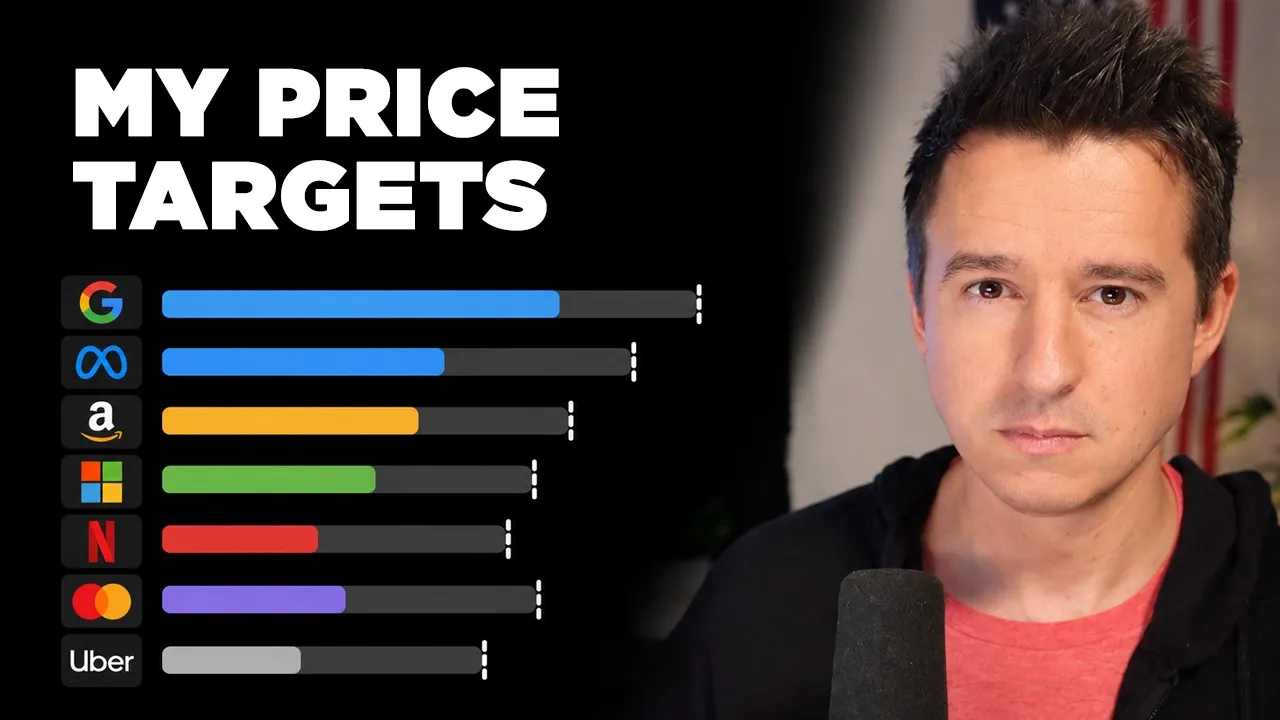
Carlson Sees 40% Amazon Upside, Rejects Eisman AI Deceleration Case
Joseph Carlson After Hours
Heavy artificial intelligence spending is temporarily depressing free cash flow margins much like Amazon's 2021 logistics expansion, setting up mega-cap compounders for outsized operational returns as enterprise cloud migration compounds.
Across his approximately $1.5 million portfolio, Joseph Carlson estimates that his holdings are weighted roughly 17% undervalued against fair value, which would represent an aggregate valuation of about $1.7 million. (22:54)
Amazon posted negative $34 billion in quarterly free cash flow (negative $47 billion trailing twelve months) due to an aggressive AI infrastructure buildout, matching its pandemic trough margin of negative 6% despite tripling capex. (28:10)
AWS delivered 39% year-over-year revenue expansion to $45.9 billion with 38.7% operating margins, with management projecting annual growth to reaccelerate above 40% through 2027 and 2028. (33:13)
Carlson rebutted Steve Eisman's critique of Anthropic's slowing growth, highlighting an enterprise net revenue retention rate exceeding 900% and attributing compressed Q3 margins to a temporary $5 billion short-term compute purchase. (37:05)
Detailed notes
## Background
This video was published on YouTube by the channel Joseph Carlson After Hours on November 2, 2026. In the video, host Joseph Carlson details updated fair value price targets for every stock holding in his portfolio following a volatile post-Halloween earnings week, alongside deep dives into Amazon's earnings, Anthropic's performance, and a lighter "Fail of the Week" segment.
## TL;DR
Carlson reviews his entire ~$1.5 million portfolio, assigning concrete fair value targets to core compounders including Mastercard ($700), Amazon ($350), Alphabet ($350), Meta ($850), ASML ($1,800), and Costco ($800), calculating that the portfolio overall trades at an aggregate 17% discount. He analyzes Amazon's earnings volatility and soaring capital expenditures, arguing that negative free cash flow is a temporary byproduct of securing dominance in enterprise AI and cloud infrastructure through AWS. Carlson also evaluates Anthropic's latest metrics, pushing back against Steve Eisman's deceleration thesis by citing massive net retention and temporary short-term compute outlays, before concluding with a psychological breakdown of a college student missing two consecutive million-dollar field goals.
## Atmosphere & style
The episode strikes a calm, grounded, and analytical tone, serving as a steady counterweight to the immediate panic of post-earnings tech drawdowns. Carlson speaks with conversational transparency and pragmatic self-assurance, balancing mathematical modeling with qualitative business intuition. It feels like an intimate, methodical portfolio review that seamlessly transitions from serious corporate balance sheet breakdowns to wry, relatable humor during the closing segment.
## Bulletin
- [22:54](https://www.youtube.com/watch?v=80cKV5-eGl4&t=1374s) Across his approximately $1.5 million portfolio, Joseph Carlson estimates that his holdings are weighted roughly 17% undervalued against fair value, which would represent an aggregate valuation of about $1.7 million.
- [28:10](https://www.youtube.com/watch?v=80cKV5-eGl4&t=1690s) Amazon posted negative $34 billion in quarterly free cash flow (negative $47 billion trailing twelve months) due to an aggressive AI infrastructure buildout, matching its pandemic trough margin of negative 6% despite tripling capex.
- [33:13](https://www.youtube.com/watch?v=80cKV5-eGl4&t=1993s) AWS delivered 39% year-over-year revenue expansion to $45.9 billion with 38.7% operating margins, with management projecting annual growth to reaccelerate above 40% through 2027 and 2028.
- [37:05](https://www.youtube.com/watch?v=80cKV5-eGl4&t=2225s) Carlson rebutted Steve Eisman's critique of Anthropic's slowing growth, highlighting an enterprise net revenue retention rate exceeding 900% and attributing compressed Q3 margins to a temporary $5 billion short-term compute purchase.
## Key takeaways
- [02:28](https://www.youtube.com/watch?v=80cKV5-eGl4&t=148s) Fair value targets cannot rely solely on mathematical discounted cash flow models; they require qualitative assessments of competitive moats, disruption risks, and management reinvestment.
- [03:33](https://www.youtube.com/watch?v=80cKV5-eGl4&t=213s) Mastercard remains Carlson's largest position at $221,000, boasting a 47% net margin; with a $700 fair value target (~6% upside), it is designated as a hold.
- [06:13](https://www.youtube.com/watch?v=80cKV5-eGl4&t=373s) Amazon's post-earnings 7% drop was completely erased within days, demonstrating that short-term volatility should be ignored in favor of its fundamentals and a $350 fair value target (~40% upside).
- [08:13](https://www.youtube.com/watch?v=80cKV5-eGl4&t=493s) Alphabet's post-earnings 12% drop reflected genuine operational disappointment; while Carlson assigns it the same $350 target as Amazon, its nominal price yields lower upside (~20%+ vs. ~40%).
- [08:41](https://www.youtube.com/watch?v=80cKV5-eGl4&t=521s) Carlson's portfolio is heavily concentrated, with roughly 60% of capital ($900,000 of ~$1.5 million) held across just four or five core compounders, leading him to halt new cash deployments into top holdings.
- [09:52](https://www.youtube.com/watch?v=80cKV5-eGl4&t=592s) Meta carries an $850 fair value target (~40% upside) as Mark Zuckerberg accepts near-term margin headwinds from server farm investments to secure long-term architectural dominance.
- [11:57](https://www.youtube.com/watch?v=80cKV5-eGl4&t=717s) S&P Global trades at 24x forward earnings due to misplaced fears over agentic AI disruption, leaving room for multiple expansion to reach a $550 fair value target.
- [12:39](https://www.youtube.com/watch?v=80cKV5-eGl4&t=759s) Microsoft is valued at $550 per share, offering a narrow 6% to 7% margin of safety and trading much closer to fair value than other mega-cap peers.
- [13:54](https://www.youtube.com/watch?v=80cKV5-eGl4&t=834s) ASML's lithography technology represents an irreproducible scientific moat, justifying an $1,800 fair value target despite mathematical DCFs pointing closer to $1,500.
- [15:28](https://www.youtube.com/watch?v=80cKV5-eGl4&t=928s) Costco is deemed roughly 22% overvalued at $1,000 against an $800 fair value estimate, leaving its 45x P/E vulnerable to multiple compression despite pristine business quality.
- [16:48](https://www.youtube.com/watch?v=80cKV5-eGl4&t=1008s) Netflix offers asymmetric upside toward a $100 price target (~60% upside) after suffering a 50% drawdown from prior highs.
- [17:58](https://www.youtube.com/watch?v=80cKV5-eGl4&t=1078s) Texas Roadhouse has grown average weekly sales per restaurant from under $100,000 to $177,000, managing commodity inflation effectively and sitting near fair value at $200 per share.
- [20:05](https://www.youtube.com/watch?v=80cKV5-eGl4&t=1205s) Moody's has fully closed its valuation gap by reaching $500 per share at 28x forward earnings, halting additional capital additions.
- [20:50](https://www.youtube.com/watch?v=80cKV5-eGl4&t=1250s) Duolingo's fair value was downgraded to $200 due to warning signs around user growth trade-offs against aggressive paywall monetization.
- [22:54](https://www.youtube.com/watch?v=80cKV5-eGl4&t=1374s) DoorDash's planned acquisition of Instacart reflects a classic network land-grab strategy across broad retail delivery that justifies a $250 fair value target.
- [24:46](https://www.youtube.com/watch?v=80cKV5-eGl4&t=1486s) Amazon is pacing to become the first company to reach $1 trillion in trailing twelve-month revenue by late 2028, supported by durable 15%+ consolidated top-line growth.
- [33:13](https://www.youtube.com/watch?v=80cKV5-eGl4&t=1993s) The long-term cloud opportunity for AWS remains anchored in migrating the estimated 85% of global corporate IT workloads that remain housed on-premises.
- [37:05](https://www.youtube.com/watch?v=80cKV5-eGl4&t=2225s) Anthropic's sequential revenue growth deceleration from 147% to 45% reflects natural scaling mathematics rather than the end of enterprise demand for generative AI models.
## Detailed walkthrough
### [00:00](https://www.youtube.com/watch?v=80cKV5-eGl4&t=0s) Market Jitters and the Post-Halloween Selloff
Coming off Halloween weekend, Joseph Carlson reflects on an experience far more terrifying than any holiday fright: watching two of his cornerstone portfolio positions plummet in real time. Following quarterly earnings announcements, Alphabet dropped 12% in after-hours trading, instantly erasing roughly $500 billion—half a trillion dollars—in market capitalization and vaporizing tens of thousands of dollars from his personal holdings. To compound the stress, just as he was releasing an in-depth video breakdown of Google’s results, Amazon posted its own earnings report and immediately shed 7%. Seeing two flagship compounders drop like stones set the stage for an episode dedicated to stepping back from panic and assessing what these businesses are truly worth today.
Across the episode, Carlson plans to assign an updated price target and fair value estimate to every single holding in his portfolio, explaining the exact rationale behind each figure. In addition to reviewing these valuations, the show covers an extensive, chart-packed breakdown of Amazon's quarterly performance and management commentary, examines Anthropic’s third-quarter report alongside Steve Eisman’s critiques regarding artificial intelligence deceleration and capital inefficiency, and closes with a painful "Fail of the Week" involving a college student missing out on a million-dollar field goal by mere feet.
Joseph Carlson captured the raw dread of the mid-week carnage: “The scariest part of last week was watching Google stock drop 12% after hours and watching tens of thousands of dollars vanish into thin air.”
[01:32](https://www.youtube.com/watch?v=80cKV5-eGl4&t=92s) Inside the Qualtrim Platform and Community
Before detailing his portfolio holdings, Carlson highlights Qualtrim, the investment research platform he developed for fundamental stock analysis. Emphasizing that over 70% of trial users convert into long-term subscribers, he explains that the platform is engineered to go far beyond surface-level financial statements. It compiles proprietary key performance indicators (KPIs) tailored to specific business models, helping investors understand underlying operational health rather than relying solely on generic accounting metrics.
Beyond core tools like watchlists, portfolio trackers, advanced charting, and complete earnings call transcripts, the service houses an exclusive media library separate from his public YouTube channel. Recent subscriber-only deep dives include an analysis of nine compelling stock ideas in the current market and an hour-long operational breakdown of Meta's latest quarterly numbers. Members also receive direct access to an active Discord server where thousands of long-term investors analyze companies in real time. The platform is offered at $10 per month, with discounted rates available for annual commitments.
Carlson underscored the value proposition of the tool, noting: “And the reason I want you to try it out is because around 70% of the people that do try it out, they stay with it because they figure out that it's awesome.”
- Platform features: proprietary business-specific KPIs, portfolio tracking, watchlists, charting tools, and earnings transcripts
- Exclusive subscriber library: 1-hour Meta earnings analysis, 9-stock watchlist breakdown
- Pricing structure: $10 monthly subscription with an annual discount and risk-free trial
[02:28](https://www.youtube.com/watch?v=80cKV5-eGl4&t=148s) Defining Price Targets and Estimating Fair Value
Carlson begins by establishing a clear distinction between a company's day-to-day market price and its true intrinsic worth. A stock's trading price is routinely swayed by ephemeral market sentiment, headline panic, automated algorithms, and momentum shifts. In contrast, an investor's fair value represents a sober calculation of the cash flows and fundamental power of the underlying business.
Because investing is not an exact science, fair value targets cannot be derived from a simple spreadsheet formula alone. Carlson uses discounted cash flow (DCF) models as a baseline, but layers qualitative judgment over the raw numbers—weighing economic moats, disruption hazards, management execution, and long-term reinvestment runways.
```mermaid
flowchart TD
accTitle: Valuation Framework
accDescr: Flowchart illustrating how market trading price contrasts with fair value derivation.
subgraph MKT["Short-Term Market Price"]
A["Market Sentiment & Emotion"] --> C["Trading Value / Daily Price"]
B["Algorithms & Momentum"] --> C
end
subgraph VAL["Long-Term Fair Value"]
D["Discounted Cash Flow Model"] --> G["Intrinsic Fair Value Target"]
E["Moat & Competitive Durability"] --> G
F["Disruption & Reinvestment Risk"] --> G
end
C -.->|"Converges Over Time With"| G
```
Joseph Carlson emphasized that mathematical models must be tempered with business analysis: “Part of it is driven by a DCF, which is mathematically built, but then a part of it is simply my judgments on the moat and growth potential of the company long term.”
Mastercard has climbed to the top spot as Carlson's largest overall holding, standing at a market value of $221,000 with $73,000 in cumulative gains, driven primarily by share price appreciation alongside thousands of dollars in accumulated dividends. The stock surged 3.4% on the day to trade around $659 to $660 per share. Year-to-date, Mastercard is up 17%, handily beating both the S&P 500 and the Nasdaq-100 (QQQ), while maintaining an impressive record of multi-year outperformance.
Carlson describes Mastercard as one of the most deceptively "boring" yet financially dominant franchises on earth, matched only by Visa. The company delivers an astonishing 47% net profit margin—a level of bottom-line profitability that rivals the gross margins of capital-intensive retail giants like Amazon. Following a temporary valuation compression in mid-2026, the stock staged a sharp resurgence back toward its historical norms. Trading at a forward price-to-earnings (P/E) multiple of approximately 30, it may look optically rich, but Carlson argues elite compounding machines command premiums over the median global business. Setting his fair value price target at $700 per share, Carlson sees roughly 6% near-term upside and classifies the stock as a firm hold, advising investors to resist the emotional urge to prematurely trim winning compounders just because they have rebounded.
Joseph Carlson stated plainly: “So, at $700 with Mastercard, that leaves a little upside, but for me, it's a hold.”
- Portfolio position size: $221,000 total value ($73,000 in unrealized gains and collected dividends)
- Recent price action: traded up 3.4% to $660; up 17% year-to-date
- Fundamental profitability: net profit margin of 47%
- Valuation multiples: ~30x forward P/E, trading slightly below its historical median multiple
- Target assessment: $700 fair value price target (~6% upside from $659)
[06:13](https://www.youtube.com/watch?v=80cKV5-eGl4&t=373s) Amazon: Post-Earnings Whiplash and a $350 Fair Value
Amazon represents Carlson's second-largest holding, valued at $182,000 with a total unrealized profit of $57,000. Reviewing the trading activity following Amazon's recent earnings print, Carlson highlights the absurdity of short-term market reactions. In the immediate aftermath of the announcement, social media and financial forums spiraled into panic as the stock fell 7% after hours, leading many investors to assume big tech was unraveling.
However, the subsequent trading sessions wiped away the drop entirely: shares gained 3% to 4% the following morning, tacked on another 3% to 4% after that, and ended the five-day stretch practically flat, wavering around -0.06%. For an investor who had unplugged for four days, the violent decline never even registered. Carlson uses this whipsaw as a textbook case of emotional market noise that disciplined investors must ignore. Looking past the volatility, he views Amazon's structural moat, cloud positioning, and retail efficiency as exceptionally robust, finding the prevailing bear cases entirely unconvincing. With strong underlying top- and bottom-line expansion, Carlson establishes an aggressive fair value price target of $350 per share, projecting roughly 40% upside from prevailing levels.
Joseph Carlson dismissed the post-earnings panic: “This is the type of stuff you're supposed to ignore and not factor into your investments.”
- Portfolio position size: $182,000 total value ($57,000 unrealized gain)
- Five-day price movement: 7% after-hours drop followed by consecutive 3%–4% daily rebounds, netting -0.06% overall
- Price target: $350 fair value estimate, representing ~40% upside potential
[08:13](https://www.youtube.com/watch?v=80cKV5-eGl4&t=493s) Alphabet / Google: Weighing Upside Against Amazon
Turning next to Alphabet, Carlson acknowledges that the company's recent earnings report was a genuine disappointment relative to market expectations, triggering the brutal 12% after-hours plunge. While he previously published an episode analyzing the specific headwinds and operational missteps described in the call, evaluating the stock today requires comparing its potential risk-adjusted return against other mega-cap opportunities.
Carlson assigns Alphabet the exact same fair value price target as Amazon: $350 per share. However, because Alphabet trades at a higher nominal price and richer valuation relative to that fair value benchmark, its implied return is meaningfully lower. While Amazon offers an estimated 40% margin of upside to its $350 target, Google offers roughly 20% or slightly higher, altering the capital allocation calculation for investors choosing where to deploy new cash.
Evaluating the recent quarterly print, Joseph Carlson observed: “Google was a genuine disappointment of an earnings report.”
- Valuation benchmark: $350 fair value target (matching Amazon's target)
- Comparative upside: ~20%+ upside for Alphabet versus ~40% upside for Amazon
- Market context: 12% after-hours decline wiped out approximately $500 billion in enterprise value
[08:41](https://www.youtube.com/watch?v=80cKV5-eGl4&t=521s) Portfolio Concentration: Google vs. Amazon
Comparing Google and Amazon, both present great opportunities, though identifying which one will ultimately outperform remains difficult. Google currently faces more hurdles to prove out its narrative because it must show its ad revenue can hold up against the rise of autonomous AI agents, creating a modest damper on its near-term story. Amazon's thesis appears noticeably cleaner, backed by structural dominance, the sheer scale of AWS, and an unmatched logistics network.
```mermaid
flowchart TD
accTitle: Portfolio Concentration Breakdown
accDescr: Visualizing the total portfolio allocation across top holdings versus remaining assets.
subgraph TotalPortfolio["Total Portfolio (~$1.5M)"]
TopHoldings["Top 4–5 Holdings: ~60% (~$900,000)<br>• Amazon & Alphabet ($150k–$200k+ each)<br>• Meta ($167k)<br>• S&P Global ($141k)"]
RemainingHoldings["Remaining Holdings: ~40% (~$600,000)<br>• Microsoft, ASML, Costco, Netflix, and others"]
end
```
Despite both stocks sitting in undervalued territory, no fresh capital is being deployed into them right now. Joseph holds between $150,000 and $200,000-plus in each name, meaning his bullishness is already fully expressed through sheer size. In a total portfolio of roughly $1.5 million, approximately 60% of all invested capital sits heavily concentrated in just four or five companies. Rather than stacking additional dollars onto existing overweight positions, he prefers prudently diversifying into other selective market opportunities.
- **Total Portfolio Size:** Approximately $1.5 million
- **Concentration:** Around 60% of total capital allocated to just 4 or 5 positions
- **Position Sizes (Amazon & Google):** $150,000 to $200,000+ each
- **Core View on Stances:** “How much more do I need to have to show that I'm bullish on them?” — Joseph Carlson
---
[09:52](https://www.youtube.com/watch?v=80cKV5-eGl4&t=592s) Meta: Rollercoaster Volatility and Long-Term Cash Flow
Meta sits as a $167,000 holding and is currently about $18,000 in the red. The position has experienced violent swings: down $40,000 at its lows, rebounding to a $20,000 gain following the launch of its AI agent tool, Muse, before dropping back into negative territory. Despite this wild volatility, the underlying operational strength of the business continues to accelerate, with Meta expanding rapidly and seeing widespread adoption for Muse.
Joseph Carlson assesses Meta’s fair value at $850 per share, representing roughly 40% upside from current levels. While the market remains anxious about aggressive short-term capital expenditures and massive server farm buildouts, Zuckerberg is intentionally taking near-term margin pain to emerge with an unassailable tech giant on the other side. Meta already represents more than an 11% weighting in the portfolio, which explains why no new money is being added.
- **Position Size:** $167,000 (currently down ~$18,000)
- **Portfolio Weighting:** 11%+
- **Price Target / Fair Value:** $850 per share (~40% upside)
- **Forward P/E at Target:** ~26 to 26.5x
- **Key Perspective on Strategy:** “And Mark Zuckerberg is willing to go through a period of pain to have a bigger, stronger company on the other side.” — Joseph Carlson
---
[11:57](https://www.youtube.com/watch?v=80cKV5-eGl4&t=717s) S&P Global: Weathering the Agentic AI Scare
S&P Global is the fifth-largest portfolio holding, standing at $141,000 with $33,000 in unrealized gains. The stock currently trades around $475 on a 24x price-to-earnings multiple. The market has discounted the shares over fears that agentic AI technology could disrupt or displace S&P Global's proprietary financial workflows, ratings, and analytics benchmarks.
Joseph Carlson sets a fair value target of $550 per share, implying around 16% upside. At $550, the multiple would only normalize to a modest forward P/E of 25 to 26x. As broader enterprise and market participants realize that AI will augment rather than destroy S&P Global's financial moat, valuation multiple expansion should naturally follow.
- **Portfolio Rank:** 5th largest position
- **Position Size:** $141,000 (up $33,000)
- **Current Share Price:** ~$475
- **Current P/E:** 24x
- **Fair Value Target:** $550 (~16% upside; 25–26x forward P/E)
- **Primary Driver:** Multiple expansion once fears over agentic disruption dissipate
---
[12:39](https://www.youtube.com/watch?v=80cKV5-eGl4&t=759s) Microsoft: Close to Fair Value
Holding number six is Microsoft, a $110,000 position showing $56,000 in total gains. Joseph Carlson began accumulating shares around the $200 to $220 level years ago, steadily advocating for its investment merits. With the stock now hovering above $500 following a 10% rebound on the year that shook off earlier cloud slowdown and general software sell-off fears, it trades much nearer to fair value than its mega-cap tech peers.
Joseph Carlson pegs fair value at $550 per share, offering a narrower 6% to 7% upside window. Microsoft currently commands a 25x forward P/E with a 1.57% free cash flow yield. While it remains a world-class compounder expected to steadily grow earnings, it does not offer the deep valuation discount seen across other high-conviction holdings.
- **Portfolio Rank:** 6th largest position
- **Position Size:** $110,000 (up $56,000)
- **Historical Purchase Price:** ~$200 to $220
- **Current Valuation:** ~25x forward P/E; 1.57% free cash flow yield; up 10% YTD
- **Price Target / Fair Value:** $550 (~6–7% upside)
- **Core Stance on Valuation:** “At 550, I believe the stock will continue to grow, but I don't believe it's deeply undervalued.” — Joseph Carlson
---
[13:54](https://www.youtube.com/watch?v=80cKV5-eGl4&t=834s) ASML: Deep Moats and Scientific Supremacy
ASML represents an enormous winner, sitting at $110,000 with an impressive $77,000 in pure capital gains generated over a condensed timeframe. Joseph Carlson admits a personal bias toward the Dutch semiconductor equipment manufacturer, characterizing its advanced lithography technology as an impossibly complex, multi-decade science experiment that competitors simply cannot replicate or invade.
The stock hit peak bullish euphoria at $2,000 per share before retreating to the $1,500 level. When shares were changing hands around $1,900, Joseph trimmed 20% of his stake to fund initial positions in DoorDash and Uber while maintaining a sizable core holding. Pure mathematical valuation models price ASML at roughly $1,500 per share, but factoring in the irreplaceable nature of its lithography moat elevates the fair value price target to $1,800.
- **Position Size:** $110,000 (up $77,000)
- **Recent Price Action:** Peaked near $2,000; pulled back to ~$1,500
- **Portfolio Moves:** Trimmed 20% near $1,900 to fund Uber and DoorDash buys
- **Fair Value Target:** $1,800 per share
- **Moat Thesis:** “I think the Dutch have figured out something that nobody else can figure out.” — Joseph Carlson
---
[15:28](https://www.youtube.com/watch?v=80cKV5-eGl4&t=928s) Costco: Rich Multiples and Vulnerability to Pullbacks
Costco has been a bedrock holding in the portfolio for years, currently valued at $89,000 with $55,000 in unrealized profits. Despite its retail dominance, the stock trades at an undeniably rich valuation of around $1,000 per share, carrying an elevated P/E ratio between 45 and 46x.
Joseph Carlson models fair value at $800 per share, leaving the stock about 22% overvalued today. Even at that conservative $800 price target, Costco would still command an expensive high-30s to 40x multiple. While the company operates almost as an indestructible retail institution, any minor stumble or quarter of decelerating growth leaves it exposed to multiple compression. Despite this pricing disparity, Joseph Carlson remains slow to sell long-term winners, though he may harvest gains if shares continue to stretch higher.
- **Position Size:** $89,000 (up $55,000)
- **Current Share Price:** ~$1,000
- **Current P/E:** ~45 to 46x
- **Fair Value Target:** $800 per share (~40x P/E; ~22% overvalued)
- **Perspective on Risk:** “Costco is being treated like it's completely indestructible, which I think it probably is, but no company's perfect.” — Joseph Carlson
---
[16:48](https://www.youtube.com/watch?v=80cKV5-eGl4&t=1008s) Netflix: Historical Volatility and Asymmetric Upside
Netflix stands as the ninth-largest position, retaining roughly $10,000 in total gains and a 29% weighted return despite having fallen roughly 50% from recent highs. Such severe drawdowns are familiar territory for long-time Netflix investors, who have weathered boom-and-bust cycles repeatedly. Joseph Carlson has systematically taken advantage of the sell-off by adding to his position and raising his average cost basis.
Trading around $62 per share, Netflix is pegged at a fair value target of $100, representing nearly 60% potential upside. While critics might balk at a $100 price objective, the stock traded as high as $117 as recently as April. The underlying business continues to execute effectively, making the current pullback an appealing asymmetric opportunity.
- **Portfolio Rank:** 9th largest position
- **Gain / Return:** Up ~$10,000 (+29% return)
- **Current Share Price:** ~$62 (down ~50% from prior highs)
- **Fair Value Target:** $100 (~60% upside)
- **Historical Benchmark:** Traded at $117 earlier in the year (April)
- **Thesis on Valuation:** “I've continued to add to Netflix, so I've risen my cost basis over time because I believe strongly that Netflix is mispriced.” — Joseph Carlson
[17:58](https://www.youtube.com/watch?v=80cKV5-eGl4&t=1078s) Texas Roadhouse: Operational Excellence vs. Beef Inflation
After concluding his thoughts on how rapidly market narratives can flip—noting that if a beaten-down giant strings together a couple of solid quarters, investors will aggressively reprice it back up from a 17 forward P/E to a 25—Joseph Carlson turns to his tenth holding, Texas Roadhouse. He initiated his position based on years of firsthand customer experience: the dining rooms were perpetually packed, the food and service were exceptional, and the customer value proposition was undeniably strong. When shares sold off sharply during the COVID-19 pandemic, he capitalized on the mispricing.
The holding eventually swelled into a massive $100,000 position, prompting him to trim 50% of his shares because he was uncomfortable letting a casual-dining restaurant consume such an outsized portion of his portfolio. Even after harvesting gains, the position sits at roughly $54,000 (up $46,000). While Wall Street frets over soaring beef prices and commodity inflation, Carlson argues that Texas Roadhouse manages supply-chain pressures far better than competitors, preserving foot traffic and driving continuous comp-store gains. Internal KPIs show average weekly sales surging from under $100,000 when he first invested to roughly $177,000 per restaurant today.
“Regardless, Texas Roadhouse is a fantastic company.”
- **Current Share Price:** $186
- **Estimated Fair Value:** ~$200 per share
- **Valuation Spread:** ~5% to 6% undervalued
- **Average Weekly Sales per Store:** ~$177,000 (up from <$100,000 historically)
- **Current Position Value:** ~$54,000 ($46,000 unrealized gain; trimmed from a peak of $100,000)
---
[20:05](https://www.youtube.com/watch?v=80cKV5-eGl4&t=1205s) Moody’s: Fair Value Reached After Multiple Expansion
Moving to his 11th largest holding, Moody’s, Carlson reflects on a stock where the valuation gap has largely vanished. His position stands at $53,000, up $12,000 in the green. Earlier in the year, investors had an opportunity to pick up shares at around $400, where the stock traded at a deep discount to intrinsic value.
Following an aggressive run-up, Moody's now trades near $500 per share against a forward P/E multiple of 28. Because his calculated fair value is also $500, the stock sits within 1% to 2% of fair value. While he emphasizes that reaching fair value does not mean the underlying business will stop performing, it signals that the risk/reward profile no longer justifies aggressive capital allocation. Consequently, he is pausing additional purchases until valuations become more compelling.
“The valuation gap has closed, and I think it's around fair value today.”
[20:50](https://www.youtube.com/watch?v=80cKV5-eGl4&t=1250s) Duolingo: Growth Deceleration and Monetization Trade-offs
Holding number 12 is Duolingo, representing a 2% portfolio weight with a current market value of $33,000, sitting roughly $13,000 in the red. Duolingo trades around $135, and Carlson has revised his fair value estimate downward to approximately $200 per share.
This haircut stems from operational deceleration: while top-of-funnel active user acquisition remains encouraging, management has begun compromising monetization and paywall aggressiveness to juice user numbers. Carlson views a forced trade-off between user growth and monetizing existing traffic as an operational warning sign. Furthermore, with earnings slated for the following day, he cautions that incoming numbers could trigger an immediate revision to his intrinsic value calculation in either direction.
“When a company has to trade off between gaining users or charging money, that's not as good of a situation.”
- **Current Share Price:** $135
- **Revised Fair Value:** $200
- **Portfolio Weight & P&L:** ~2% weighting; $33,000 position ($13,000 in the red)
- **Catalyst Risk:** Earnings report due the following day
---
[21:55](https://www.youtube.com/watch?v=80cKV5-eGl4&t=1315s) Uber: Expanding the Network Ahead of Earnings
Uber constitutes Carlson's 13th holding—a newer allocation of roughly $24,000 (down about $1,800), making up under 2% of total assets. He is hunting for an opportunity to scale the position, but the imminent earnings report complicates timing.
Traders could send the stock soaring on an upbeat release or punish it on near-term headwinds. Although split-buying (entering half before earnings and half after) remains an option, Carlson leans toward the conservative choice of waiting for full financial clarity before committing new cash. With the stock trading around $66 against his $90 fair value, he calculates upside potential of roughly 33%.
“Based off of what I see today, I believe that Uber offers really good value shares in today's market.”
His smallest position is DoorDash, valued at roughly $23,000 with a modest $1,600 unrealized gain. Carlson acknowledges that standard optical valuation metrics like the trailing or forward P/E ratio make DoorDash look prohibitively expensive to casual screeners. However, he argues that looking at near-term earnings misses the operational phase the business is in: management is executing a deliberate, aggressive "land grab" rather than optimizing for near-term operating margins.
The agreement to acquire Instacart demonstrates this strategy, instantly broadening DoorDash’s surface area beyond core restaurant takeaway into multi-category retail delivery. Once scaled, this unified logistics network can be leveraged for high incremental margin expansion. Carlson assigns DoorDash a fair value of $250, translating to about 33% upside.
```mermaid
flowchart LR
accTitle: Platform Land Grab Strategy
accDescr: Progression from aggressive network scale to margin optimization.
subgraph ScalePhase["Phase 1: Scale Network"]
A["Core Delivery"] --> B["Acquisitions & Retail Expansion"]
end
subgraph LeveragePhase["Phase 2: Leverage Network"]
B --> C["Density & Route Efficiency"]
C --> D["Margin Expansion & Cash Flow"]
end
```
Synthesizing all holdings across his portfolio and weighting each position by its dollar size, Carlson calculates that his entire portfolio is roughly 17% undervalued. If every stock moved instantly to its assessed intrinsic target—with discounted compounders rising and overextended names like Costco pulling back—the aggregate portfolio value would stand at approximately $1.7 million.
“These are in land grab mode. They want to get the biggest networks possible.”
- **DoorDash Fair Value:** $250 (~33% upside from current price)
- **Instacart Transaction:** Catalyst to dominate grocery and retail delivery
- **Total Portfolio Value at Fair Value:** ~$1.7 million
- **Weighted Aggregate Portfolio Discount:** ~17% undervalued
---
[24:46](https://www.youtube.com/watch?v=80cKV5-eGl4&t=1486s) Amazon: Massive Scale, AWS Acceleration, and the Road to $1 Trillion
Carlson transitions to Amazon’s recent earnings report. Following the print, the stock tanked 7% in after-hours trading amid market panic, bounced back roughly halfway the following trading session, and fully recovered to flat by the time of recording. Carlson remains convinced that the market fundamentally undervalues Amazon's core operating engine.
Examining top-line quarterly revenue performance over the previous two years reveals a durable reacceleration: after bottoming near 10%–12% in late 2023, year-over-year revenue growth climbed steadily through 13%, 14%, 15%, and 16%, coming in at a remarkable 15.4% in the latest quarter. For an enterprise generating $797 billion in trailing twelve-month revenue, maintaining double-digit top-line velocity driven by AWS adoption is extraordinary.
Analyst projections through the next eight quarters indicate top-line growth will hover around 15.5%, experience a brief dip, and then accelerate up to 17.8% as high-margin AWS revenues capture an ever-larger share of consolidated revenue. Carlson projects that Amazon is on track to become the first company in history to achieve $1 trillion in trailing twelve-month sales by late 2028—barring Elon Musk’s claim that SpaceX might reach that milestone first.
“For a company as big as Amazon, it's still growing above 15%. Like that is crazy.”
- **Latest Quarterly Revenue Growth:** 15.4% year-over-year
- **Projected Mid-Term Revenue Growth:** 15.5% to 17.8%
- **Trailing 12-Month Revenue:** $797 billion (~$800 billion run-rate)
- **Long-Term Projection:** Surpassing $1.0 trillion in TTM revenue by late 2028
[27:03](https://www.youtube.com/watch?v=80cKV5-eGl4&t=1623s) Retail Automation and the Future of Last-Mile Delivery
Joseph Carlson contrasts the trajectories of mega-cap tech giants, noting that while Alphabet is growing at a faster percentage clip, Amazon is expanding from a substantially larger revenue foundation. Amazon's overall retail operations continue to experience operating margin expansion and increasing operational efficiency. Within its fulfillment and logistics centers, Amazon has already deployed over one million robots to automate fulfillment, turning the internal warehouse workflow into a finely tuned operation.
However, the final frontier for margin expansion lies in the costly, labor-heavy last-mile delivery network, which still relies primarily on human couriers. Carlson envisions that over the next decade, autonomous vehicles, package-handling robots, and delivery drones will systematically displace manual delivery methods, driving logistics costs down and lifting margins across Amazon's massive revenue base. Carlson remarks on this impending transformation: “Seems crazy, but that's going to be a real thing within the next 10 years.”
- More than one million robots are currently operating inside Amazon warehouses and fulfillment centers.
- The company's core retail margins continue to trend upward even before full automation of delivery.
- Autonomous last-mile transport, robotics, and drone deliveries are anticipated to become practical realities over the next decade.
---
[28:10](https://www.youtube.com/watch?v=80cKV5-eGl4&t=1690s) The AI Capex Cycle and Free Cash Flow Pressures
Despite strong underlying retail and advertising profits, investor sentiment remains weighed down by Amazon's decision to funnel virtually all incoming operating cash flows into infrastructure. To capture what management views as a once-in-a-lifetime generative artificial intelligence wave, Amazon recorded a negative $34 billion in free cash flow for the quarter, bringing its trailing twelve-month free cash flow to negative $47 billion. Carlson draws a parallel to late 2021 and early 2022, when Amazon doubled its logistics footprint to meet pandemic e-commerce demand. During that prior buildout, free cash flow margins dipped to negative 6% before eventually rebounding to positive 7% to 8% and generating $50 billion in positive cash flow.
While Carlson previously forecasted in early 2023 that Amazon would soon surpass all other corporations by generating upwards of $70 billion to $100 billion in annual free cash flow, the unexpected compute demands of AI forced management to pivot aggressively into data center capital expenditures. Even though total capital expenditure has roughly tripled compared to the 2021 cycle, free cash flow margins have only revisited their prior trough of negative 6%, demonstrating how much stronger Amazon's baseline organic cash generation has become. Defending management's long-term strategy, Carlson explains: “Another way of looking at this is if Amazon was not pursuing this massive opportunity in AI, it'd be one of the most cash flow productive companies in the world.” He also clarifies that reported earnings per share were artificially elevated over the prior year due to paper gains from an investment in Anthropic, which creates a temporary distortion before reverting to core organic growth rates.
- Amazon registered negative $34 billion in quarterly free cash flow and negative $47 billion on a trailing twelve-month basis.
- Free cash flow margin fell back to the late-2021 low of negative 6% despite capital expenditures tripling since that period.
- Historical free cash flow rebounded to positive $50 billion following the post-COVID fulfillment infrastructure expansion.
- Accounting gains tied to the equity stake in Anthropic generated a temporary spike in trailing earnings per share.
---
[33:13](https://www.youtube.com/watch?v=80cKV5-eGl4&t=1993s) AWS Growth Trajectory and the Trillion-Dollar Cloud Horizon
Amazon Web Services remains an exceptional profit engine, posting 39% year-over-year revenue growth to reach $45.9 billion in the quarter, alongside an operating margin of 38.7%. Although Wall Street expectations were slightly higher at 40% to 42%, management projects that AWS will not only sustain this momentum but accelerate to over 40% growth across both 2027 and 2028. On the earnings call, CEO Andy Jassy outlined an ambitious vision, stating that AWS on its own has the potential to reach $1 trillion in annual revenue over the next five to ten years.
```mermaid
flowchart LR
accTitle: Enterprise IT Cloud Migration Opportunity
accDescr: Diagram showing 85 percent of global IT spending on-premises transitioning over 10 to 20 years into cloud infrastructure led by AWS.
subgraph Current["Current Enterprise IT Spend"]
A["85% On-Premises"]
B["15% Cloud-Hosted"]
end
subgraph Migration["10-20 Year Transition"]
C["Shift from Legacy Data Centers"]
end
subgraph Outcome["Target Ecosystem"]
D["AWS captures dominant share (like Visa in digital payments)"]
end
Current --> Migration --> Outcome
```
Carlson stresses that the investment thesis for AWS extends well beyond artificial intelligence workloads. With roughly 85% of worldwide IT spending still locked in legacy on-premises infrastructure, Jassy framed cloud adoption as an enduring secular migration unfolding over 10 to 20 years. Drawing an analogy to payment networks, Carlson emphasizes how Amazon is positioned to capture that transition: “In this case, he believes that AWS is the Visa.”
- AWS generated $45.9 billion in quarterly revenue, reflecting a 39% year-over-year growth rate.
- Segment operating margins for AWS stood at 38.7%.
- Internal projections forecast revenue growth exceeding 40% annually across both 2027 and 2028.
- Approximately 85% of enterprise global IT spending remains on-premises rather than in cloud environments.
---
[35:25](https://www.youtube.com/watch?v=80cKV5-eGl4&t=2125s) Anthropic's Performance and Steve Eisman's Critique
The discussion turns to Anthropic's third-quarter financial updates, which sparked contrasting interpretations across the market. On one hand, the artificial intelligence startup continued its explosive top-line trajectory by posting a 45% quarter-over-quarter growth rate alongside broad customer adoption.
On the other hand, the firm generated substantial losses and slipped deeper into the red during the period, raising questions about unit economics and ongoing operational burn. Prominent investors, including Steve Eisman, voiced skepticism about the sustainability of these metrics. Carlson highlights the bear case being presented by critics: “He says growth is decelerating and the company's becoming less efficient.”
- Anthropic delivered 45% quarter-over-quarter revenue expansion.
- Net operating losses expanded during the third quarter, turning free cash flow further into the red.
- Steve Eisman publicly criticized the company for decelerating top-line rates paired with deteriorating capital efficiency.
[36:05](https://www.youtube.com/watch?v=80cKV5-eGl4&t=2165s) Steve Eisman on Anthropic's Deceleration and Efficiency
The discussion opens with an analysis of Anthropic's latest numbers by investor Steve Eisman, who contends that the generative artificial intelligence boom is hitting a tangible wall. Reviewing Anthropic's prospectus figures, Eisman identifies a sharp deceleration in top-line expansion, pointing out that quarter-over-quarter revenue growth plunged from 147% in the second quarter down to 45% in the third quarter. In Eisman's view, this slowdown directly mirrors enterprise behavior shifting away from experimental over-consumption: “I think it's very very clear that Anthropic's revenue growth has slowed dramatically because of the end of token maxing.”
Beyond headline top-line deceleration, Eisman argues that the company's operational unit economics deteriorated heading into the third quarter. To illustrate the change, he highlights the ratio of Anthropic's revenue divided by its compute and infrastructure expenses. That efficiency multiple had steadily expanded up through the second quarter, topping out at 2.08x, before abruptly dropping to 1.7x in the third quarter. For Eisman, this reversal provides concrete evidence that the initial frenzy of companies indiscriminately hoarding or running through compute tokens has concluded, delivering a noticeable blow to Anthropic's operating leverage.
- **Sequential Revenue Growth**: Decelerated from 147% in Q2 to 45% in Q3.
- **Compute Efficiency Ratio (Revenue / Infrastructure Expense)**: Dropped from 2.08x in Q2 to 1.7x in Q3.
---
[37:05](https://www.youtube.com/watch?v=80cKV5-eGl4&t=2225s) The Case for Anthropic: Net Retention, Enterprise Trust, and Compute Costs
Carlson pushes back firmly against Eisman's core thesis, arguing that the entire concept of "token maxing" was more of an internet meme than an accurate depiction of real corporate spending patterns. Rather than pulling back, enterprises are currently spending more capital on tokens than ever before. Anthropic’s net revenue retention rate stands at over 900%—a staggering figure when juxtaposed with premier enterprise cybersecurity firms that typically target around 130%. While this metric comes off a smaller initial base, it proves that organizations that integrate Anthropic into their workflows consistently expand their usage over time as models become cheaper and unlock broader operational leverage. Furthermore, revenue deceleration from triple-digit rates is an unavoidable mathematical reality rather than a corporate crisis: “Growth can't go up 100% year-over-year forever.” If a company doubled its sales annually for a decade, it would eventually eclipse the entire gross domestic product of planet Earth.
```mermaid
flowchart TD
accTitle: Anthropic Enterprise Adoption and Cost Structure
accDescr: Diagram illustrating how discounted long-term contracts and enterprise trust drive growth despite short-term compute spikes.
subgraph EnterpriseMoat["Enterprise Moat"]
A["Compliant, Trusted Platform\n(Anthropic)"] --> B["Over 900% Net Revenue Retention"]
B --> C["Compounding Business Use Cases"]
end
subgraph ComputeDynamics["Infrastructure Cost Dynamics"]
D["Base Demand: 5+ Year Discounted Contracts"]
E["Surge Demand: $5B Short-Term Compute"]
E -.->|"Depresses headline efficiency"| F["1.7x Ratio (Temporary Distortion)"]
end
C -.-> E
```
Carlson also breaks down the nuance behind Eisman's efficiency ratio critique, explaining that the apparent margin compression was driven by a temporary infrastructure anomaly. Anthropic typically locks in compute infrastructure through five-year discounted partnership contracts. However, when faced with an unexpected influx of customer demand in the third quarter, the company absorbed $5 billion in costly, short-term compute expenses to handle the burst. Adjusting for these transient outlays, underlying operational efficiency remains solid. While Carlson has no intention of chasing Anthropic's eventual initial public offering on day one, he views the company as a durable enterprise standard analogous to Microsoft operating alongside open-source alternatives like Linux:
> “Most big businesses will want to use the proven boring company that follows all the rules that's the go-to industry standard which Anthropic has designated itself as.”
- **Net Revenue Retention (NRR)**: Rose to over 900%, compared to high-end enterprise software benchmarks of ~130%.
- **Short-Term Compute Outlay**: Incurred $5 billion in un-discounted, short-term computing capacity to accommodate immediate demand spikes during Q3.
- **Enterprise Analogy**: Similar to how open-source Linux captured enterprise servers while Microsoft retained vast commercial software dominance, open-weight AI models will pressure pricing without displacing trusted commercial leaders like Anthropic.
---
[41:44](https://www.youtube.com/watch?v=80cKV5-eGl4&t=2504s) Fail of the Week: The $1 Million Field Goal Miss
The show transitions into the "Fail of the Week," spotlighting a viral segment from *The Pat McAfee Show* where a college student was plucked from the audience for an opportunity to kick a field goal for $1,000,000. While the kick was not set at a professional NFL distance, Carlson notes that it was far from an automatic chip shot—requiring genuine leg strength and technique while remaining theoretically achievable for an everyday athlete. The stakes could not have been higher for an ordinary student facing a life-altering sum of money. On the first kick, the ball soared toward the uprights only to push wide by mere feet, leaving the student looking visibly crushed and "dying inside" on national television.
To everyone's surprise, the student was granted an immediate second chance at redemption for the same million-dollar prize. He lined up his approach, made clean contact, and sent the ball sailing toward the crossbar, only to miss again by approximately two feet. Carlson reflects on the uniquely brutal psychology behind the loss: purely from an expected-value and balance-sheet standpoint, the student risked nothing of his own and walked away with the exact same net worth he arrived with. Yet missing a life-changing fortune twice by a combined margin of four feet creates a lingering torment far worse than never participating at all: “He's going to be thinking about this probably for the rest of his life. What would have happened if I made that shot or the second one? Where would I be? What would I have done with that money? You know, that's a type of thought that I feel like can eat you alive if you let it.”
## Notable quotes
> [09:52](https://www.youtube.com/watch?v=80cKV5-eGl4&t=592s) Mark Zuckerberg is willing to go through a period of pain to have a bigger, stronger company on the other side. — Joseph Carlson
> [28:10](https://www.youtube.com/watch?v=80cKV5-eGl4&t=1690s) Another way of looking at this is if Amazon was not pursuing this massive opportunity in AI, it'd be one of the most cash flow productive companies in the world. — Joseph Carlson
> [15:28](https://www.youtube.com/watch?v=80cKV5-eGl4&t=928s) Costco is being treated like it's completely indestructible, which I think it probably is, but no company's perfect. — Joseph Carlson
> [36:05](https://www.youtube.com/watch?v=80cKV5-eGl4&t=2165s) I think it's very very clear that Anthropic's revenue growth has slowed dramatically because of the end of token maxing. — Steve Eisman
> [20:50](https://www.youtube.com/watch?v=80cKV5-eGl4&t=1250s) When a company has to trade off between gaining users or charging money, that's not as good of a situation. — Joseph Carlson
> [37:05](https://www.youtube.com/watch?v=80cKV5-eGl4&t=2225s) Most big businesses will want to use the proven boring company that follows all the rules that's the go-to industry standard which Anthropic has designated itself as. — Joseph Carlson
## Mentioned
Joseph Carlson, Steve Eisman, Mark Zuckerberg, Andy Jassy, Elon Musk, Qualtrim, Mastercard, Amazon, AWS, Alphabet, Google, Meta, Muse, S&P Global, Microsoft, ASML, Costco, Netflix, Texas Roadhouse, Moody's, Duolingo, Uber, DoorDash, Instacart, Anthropic, SpaceX, Visa, The Pat McAfee Show
## Video description
Join Qualtrim, the stock analysis platform I built and use, and join over 13,000 other paying members: https://www.qualtrim.com/
00:00 Introduction
02:03 Qualtrim
03:16 How I Set My Price Targets
04:23 Mastercard
07:27 Amazon
09:27 Alphabet / Google
11:49 Meta
14:18 S&P Global
15:01 Microsoft
16:15 ASML
17:55 Costco
19:17 Netflix
21:55 Texas Roadhouse
23:25 Moody’s
24:13 Duolingo
25:22 Uber
26:25 DoorDash
28:26 Amazon Earnings Breakdown
39:16 Anthropic Results & Steve Eisman
46:01 Fail of the Week: The $1 Million Kick
-Disclaimer
Some of the links below are affiliate links, I can earn money from them at no cost to you.
This content is not a solicitation, is not endorsed by M1, and was not reviewed by M1; the opinions expressed are solely those of the authors and do not reflect M1's views. Information presented is accurate as of the video posting date; for the most up-to-date information, please refer to m1.com. Before making any investment decisions, consult your personal investment, legal, and tax advisors, as this content is for informational purposes only and not intended as investment recommendations.
📚 My favorite Investing Books: https://amzn.to/3KwyIhG
📷 All the tech I use to record videos: https://www.amazon.com/shop/josephcarlson/list/2L5YMP4DFYA8O?ref_=cm_sw_r_cp_ud_aipsflist_aipsfjosephcarlson_FAKKKMYKF486ZR6H2DSQ
SOCIAL MEDIA
▀▀▀▀▀▀▀▀▀▀▀▀▀▀▀▀▀▀▀▀▀▀▀▀▀▀
🎥 More free content: https://www.youtube.com/channel/UCbta0n8i6Rljh0obO7HzG9A
🐦 I post random thoughts on Twitter too: https://twitter.com/joecarlsonshow
DISCLAIMER
▀▀▀▀▀▀▀▀▀▀▀▀▀▀▀▀▀▀▀▀▀▀▀▀▀▀
I am not a professional investor and have never claimed to be. I'm an amateur investor sharing my experience of what I've learned, where I have had success, and where I've had failures. I share my thoughts on investing and performance with transparency. My approach and goal to investing is to buy high-quality long-term investments in world-class businesses that I call "compounders". I view my investments as businesses, not as stocks. Before creating content on YouTube full time I worked as a senior-level programmer for 8 years. Over the years as a programmer, I compounded my knowledge of development. I take the same iterative learning approach to my study of investing. I study investing as a craft in the continual pursuit of being better. I will make mistakes in investment decisions from time to time. Results are not guaranteed. Please do not blindly follow me into any investments, and make sure your portfolio and investments are built around your specific income, risk tolerance, personality, timeline, and overall circumstances.
[9:52] Joseph Carlson: Mark Zuckerberg is willing to go through a period of pain to have a bigger, stronger company on the other side.
[28:10] Joseph Carlson: Another way of looking at this is if Amazon was not pursuing this massive opportunity in AI, it'd be one of the most cash flow productive companies in the world.
[15:28] Joseph Carlson: Costco is being treated like it's completely indestructible, which I think it probably is, but no company's perfect.
[36:05] Steve Eisman: I think it's very very clear that Anthropic's revenue growth has slowed dramatically because of the end of token maxing.
[20:50] Joseph Carlson: When a company has to trade off between gaining users or charging money, that's not as good of a situation.
[37:05] Joseph Carlson: Most big businesses will want to use the proven boring company that follows all the rules that's the go-to industry standard which Anthropic has designated itself as.
Original transcript
[0:00] Welcome back everyone. Today on the
[0:01] Joseph Carlson show, we just got through
[0:03] Halloween weekend. Now, if you're like
[0:05] me, the weekend was not the scariest
[0:07] moment. It wasn't Halloween. The
[0:09] scariest part of last week was watching
[0:10] Google stock drop 12% after hours and
[0:14] watching tens of thousands of dollars
[0:15] vanish into thin air. Google lost around
[0:18] $500 billion of market cap. Half a
[0:20] trillion dollars vanishing. And then on
[0:23] top of that, as I was releasing my video
[0:25] going over Google's earnings, doing
[0:26] analysis on everything that happened,
[0:29] Amazon reported its earnings and dropped
[0:31] 7% at the same time. Two of my biggest
[0:35] companies were dropping like a rock. And
[0:37] today, we're going to be looking at
[0:39] them. In today's episode, I'm going to
[0:40] be going over each company, where they
[0:42] sit now with their current price, and
[0:44] what my price target is for them. The
[0:46] price targets are my fair values for
[0:47] these companies, where I believe they're
[0:49] worth today. So, I'll be going over all
[0:51] of these and explaining my reasoning in
[0:53] this episode. Now, of course, we had
[0:55] Amazon report their earnings as well,
[0:56] and I have to take a look at this. So, I
[0:58] have lots of charts and graphs to go
[0:59] over Amazon, as well as commentary, what
[1:02] they said last quarter. There's a lot of
[1:04] interesting things to review with one of
[1:05] my largest positions. So, we'll be
[1:07] looking at that. We also have Anthropic
[1:09] releasing their earnings report for Q3.
[1:11] This was something new, and we have
[1:13] people like Steve Eisman talking about
[1:14] this earnings report. He says it's clear
[1:17] that Anthropic is decelerating and it's
[1:18] becoming less efficient. But is that the
[1:20] whole story? We're going to be looking
[1:22] at Anthropic and what this means for the
[1:24] larger AI story. And then finally for
[1:25] today's fail of the week, we'll be going
[1:27] over the tragic story of this college
[1:28] student missing out on life-changing
[1:30] money only by a couple feet. Now, before
[1:32] we jump in, just a reminder, if you
[1:34] haven't tried out my membership, which
[1:35] is qualum.com, give it a try. It comes
[1:38] with a risk-free trial. And the reason I
[1:40] want you to try it out is because around
[1:41] 70% of the people that do try it out,
[1:43] they stay with it because they figure
[1:45] out that it's awesome. You get access to
[1:47] a ton of data, including all these
[1:49] proprietary KPIs. We gather these
[1:51] ourselves. We have KPIs that help you
[1:53] understand the business at a better
[1:54] level than just the financials. And of
[1:56] course, we have a watch list, portfolio
[1:58] tracker, advanced charting tools. We
[2:00] have transcripts of earnings calls and
[2:02] much more, including exclusive content,
[2:04] an entire library of investment content
[2:06] that you won't find on YouTube. For
[2:08] example, I had a recent episode where we
[2:10] discussed nine different stocks worth
[2:11] looking at today. Another one was an
[2:13] hour-long update on Meta going in-depth
[2:15] on their most recent quarter. And then
[2:16] on top of that, you get access to a
[2:18] Discord community with thousands of
[2:19] investors. And we discuss stocks all the
[2:21] time. So, if you want to try that out,
[2:23] the price is $10 a month where you even
[2:25] get a discount if you commit to an
[2:27] annual plan. Now, we start things off
[2:28] today by looking at my price targets for
[2:30] each stock that I own. This is every
[2:32] company in my portfolio. And the price
[2:34] target in this case is another way of
[2:36] saying the fair value. the fair value,
[2:38] meaning the intrinsic value of the
[2:39] stock. See, there's the trading value.
[2:42] That's what the stock price is today.
[2:44] And that's driven by, in many cases,
[2:46] sentiment and short-term emotions. It's
[2:49] driven by algorithms, a momentum, and
[2:51] there's lots of things that impact the
[2:53] trading value of a company. So, every
[2:55] investor should have the stock and its
[2:57] trading value today, but then you should
[2:58] have your own estimate of the real worth
[3:00] of the company, your fair value
[3:02] assessment, and that's what we'll be
[3:03] looking at. And as just a warning, these
[3:06] aren't perfect. These are judgment
[3:08] calls. Basically, I'm looking at a
[3:09] company trying to evaluate both the
[3:11] moat, the financial future of it, as
[3:13] well as things like the competitive
[3:15] nature, what type of disruption risks
[3:17] the company has. All of that is blended
[3:20] down into my judgment of fair value. So,
[3:22] there is no mathematical formula that
[3:24] explains all of this. Part of it is
[3:26] driven by a DCF, which is mathematically
[3:28] built, but then a part of it is simply
[3:29] my judgments on the moat and growth
[3:31] potential of the company long term. So,
[3:33] we'll start off with my portfolio. We're
[3:35] looking at the stocks largest to
[3:37] smallest and we have Mastercard, which
[3:38] is now my largest position. Mastercard
[3:41] is a $221,000 position. It has a a total
[3:45] gain of 73,000. That includes mostly
[3:47] capital appreciation and then a few
[3:49] thousand worth of dividends. Now,
[3:51] Mastercard is a company that's done
[3:52] exceptionally well this year and over
[3:55] the past couple of years. Today, the
[3:56] stock is up 3.4% surging up to $660 per
[4:01] share. If we look at the company
[4:02] year-to- date, it's up 17%.
[4:05] Outperforming both the QQQ and the S&P
[4:08] 500. If we look at it over the past 5
[4:10] years, just the same. It's outperformed
[4:11] both indexes by quite a large margin.
[4:14] So, this is a company that I've talked
[4:16] repeatedly about as being one of the
[4:18] most boring companies in the market, but
[4:20] one of the most phenomenal in the
[4:21] market. Most of the financial metrics of
[4:23] Mastercard are truly unbelievable. The
[4:26] only company that really comes close is
[4:27] Visa. For example, we look at the profit
[4:30] margin. This number is just wild. It's
[4:33] 47% profit margins for this company.
[4:37] That's actually close to the gross
[4:39] margins of Amazon. It's crazy. But this
[4:41] isn't a whole review of Mastercard. This
[4:43] is the valuation and what I believe is a
[4:45] fair value today. Right now, the stock
[4:47] trades at $659. And I believe the fair
[4:49] value is around $700 per share. Now,
[4:52] that's only around 6% upside from today.
[4:55] So, Mastercard's actually a company that
[4:57] I don't believe is that undervalued. I
[4:58] think it's trading close to its fair
[5:00] value and I value that off of a few
[5:02] things. First of all, we have the PE
[5:03] ratio on a Ford basis around 30. That
[5:05] seems expensive, but you have to look at
[5:08] the PE ratio in context with the
[5:09] economics of the company. Mastercard is
[5:12] a much better company than 99% of
[5:14] companies in the world. Therefore, it
[5:16] deserves a higher PE ratio. And looking
[5:18] at the trailing valuation of the
[5:19] company, it has recently gone through a
[5:21] big resurgence and it has had a massive
[5:23] price recovery. You can see that it was
[5:25] trading at a very low valuation in mid
[5:28] 2026, but it's since recovered and now
[5:31] it's back up to its normalized PE ratio
[5:33] over time. In fact, it's still slightly
[5:35] below its median historical PE ratio.
[5:37] Now, psychologically, when a company
[5:39] like this resurges back from the lows to
[5:41] the highs, you naturally want to take
[5:43] gains. You want to lock in some of the
[5:45] wins. You're relieved that the company
[5:47] is doing well. And that that natural
[5:49] tendency is just human emotion. But when
[5:52] I look at Mastercard with clear eyes, I
[5:54] see a company that is now back around
[5:56] where it deserves to be. The company's
[5:58] doing great. The last earnings report
[5:59] showed continued strength. The mo I
[6:01] believe is wide as ever. The company's
[6:03] making record profits, and it's now back
[6:05] to its historical normal medium PE
[6:07] ratio. So, at $700 with Mastercard, that
[6:10] leaves a little upside, but for me, it's
[6:12] a hold. Now, next up, we have Amazon.
[6:14] For this stock, it is now my second
[6:16] largest position. It's at $182,000 with
[6:20] $57,000 in the green. Now with Amazon,
[6:22] it went through a roller coaster of a
[6:24] earnings report. And this is something
[6:26] that was really funny because right
[6:27] after Amazon reported their earnings, it
[6:29] fell dramatically. In fact, a lot of
[6:31] investors were like, "Oh my gosh, the
[6:33] stock is down 7%. What am I going to do?
[6:35] Google just fell and now Amazon, the
[6:37] market's getting crushed." But look at
[6:40] what happened over the remaining week.
[6:42] Over the past 5 days, Amazon is flat. In
[6:45] fact, it's up just slightly. So, you can
[6:48] see what happened here on the price
[6:49] chart. They reported their earnings and
[6:51] the stock fell 7%. Then the next
[6:53] morning, the stock went up 3 or 4%, it
[6:56] recovered part of the the loss and then
[6:59] this morning later it went up another 3
[7:00] or 4%. Now it's bouncing between green
[7:04] and the red based on the one week. So it
[7:06] just dipped down into the red 06%.
[7:10] But basically, if you had fallen asleep
[7:12] over the past 4 days, you wouldn't even
[7:14] be able to notice a difference with
[7:15] Amazon's price. It would be just the
[7:17] same. So, all of this emotional roller
[7:19] coaster with the stock dropping and
[7:21] coming back up is exactly what
[7:23] short-term noise looks like. This is the
[7:25] type of stuff you're supposed to ignore
[7:27] and not factor into your investments.
[7:29] Now, when I look at Amazon in
[7:30] particular, I think that this is one of
[7:32] the greatest companies in the world. I
[7:33] think that Amazon is one of the most
[7:35] structurally strong companies in the
[7:36] world, and I really liked the most
[7:38] recent earnings report. In fact, again,
[7:40] later in this episode, I'll be doing a
[7:41] deep dive into that earnings report. But
[7:44] for now, my price target or fair value
[7:46] assessment of Amazon is at 350, meaning
[7:49] from today, I believe there's around 40%
[7:51] upside in this company. It's one of the
[7:53] best stocks in the world. I think it has
[7:55] an incredibly wide mode, and I like the
[7:58] growth. In fact, the growth was very
[7:59] impressive. I didn't understand why
[8:01] Amazon sold off as much as it did. The
[8:03] bare case for it is incredibly weak, and
[8:06] I think the company's future is as
[8:07] bright as ever. So, Amazon I have at
[8:09] 350. I think it's one of the best
[8:11] opportunities today. We look at the next
[8:13] one here, which is Google. Google was a
[8:16] genuine disappointment of an earnings
[8:18] report. Now, I went over it and I tried
[8:20] to explain some context, so you can
[8:21] watch the most recent episode if you
[8:23] want to see that. But when we look at
[8:24] Google, it's going to have the exact
[8:26] same price target as Amazon. My price
[8:29] target and fair value of Google today is
[8:30] 350. That is the same as Amazon, but
[8:33] because the stock is higher, Google has
[8:35] less upside. It has around 20 plus%.
[8:37] Amazon has around 40%. If you're
[8:39] deciding between buying something like
[8:41] Google and Amazon, I think that they're
[8:43] both great opportunities, it's difficult
[8:45] to say which one will outperform the
[8:47] other. But right now, I believe that
[8:49] Google does have a little bit more
[8:51] challenges to prove in terms of the
[8:52] story than Amazon. Google has to prove
[8:54] that its ad revenue can hold up in the
[8:57] face of all these AI agents. And I
[8:59] believe that's going to be a little bit
[9:00] of a damper on the story going forward.
[9:02] Amazon, on the other hand, is so
[9:04] structurally strong. AWS is so big, the
[9:06] logistics network is so massive. I think
[9:09] the story for Amazon's just a bit
[9:10] cleaner. Now, with Amazon being way
[9:12] undervalued and Google being
[9:14] undervalued, you could ask why I'm not
[9:15] buying these companies today. And the
[9:17] reason why is because I already own
[9:19] substantial holdings in these companies.
[9:21] I'm already extremely bullish in my
[9:23] positioning. I have nearly 200,000 or
[9:26] 150,000 plus in these companies. How
[9:28] much more do I need to have to show that
[9:30] I'm bullish on them? Furthermore, in my
[9:32] entire portfolio, which is around 1.5
[9:34] million, around 60% of my entire
[9:38] investments are in around four or five
[9:40] companies. That's already an extreme
[9:41] level of concentration. So, I believe
[9:43] it's better for me to diversify my
[9:45] portfolio a little bit with other
[9:47] opportunities than to continue piling
[9:49] money in the same exact companies. Now,
[9:52] next up, we get to Meta. Currently, Meta
[9:54] is a $167,000
[9:56] position and around $18,000 in the red.
[9:58] So the way that this stock has worked is
[10:00] I bought into the company. It went
[10:02] deeply in the red minus $40,000. Then it
[10:05] jumped up with the release of Mu Muse to
[10:06] around plus $20,000. So I was in the
[10:08] green by a good chunk. Now I'm back in
[10:10] the red by a good chunk. So this company
[10:12] has just been swinging around from the
[10:14] green to the red and now it's currently
[10:16] in the red. But at the same time, all
[10:18] I've seen is a company getting stronger
[10:20] and stronger. Met is growing like a
[10:22] weed. Their adoption of their new agent
[10:24] tool, Muse, is getting widespread
[10:26] adoption. I like management and the
[10:28] decisions. I really like this company. I
[10:31] I think it just has a great future and
[10:33] investors should believe that Meta has a
[10:35] really strong future with the new
[10:36] products they're creating and how
[10:37] they're enhancing their platform. My
[10:39] price target or fair value assessment of
[10:41] Meta is around 850 today, which is
[10:43] around a 40% upside. So, I believe that
[10:45] there is ample upside for this stock
[10:47] today. I think that Meta is deeply
[10:50] undervalued based on its own merits of
[10:52] its strength plus just its cash flow
[10:54] that it will generate over the next 10
[10:56] years. This is one of the most
[10:57] generative cash flow businesses in the
[10:59] world. Investors are so concerned on the
[11:01] cash they're spending on short-term
[11:03] investments in capital expenditures and
[11:05] building out server farms. But that all
[11:06] makes a stronger and better position in
[11:08] the future. And Mark Zuckerberg is
[11:10] willing to go through a period of pain
[11:12] to have a bigger, stronger company on
[11:15] the other side. So at $850, I believe
[11:18] that this is another stock that is
[11:20] deeply undervalued in my portfolio. The
[11:22] reason that I'm not putting more money
[11:23] into it is like I said, it's already a
[11:26] substantial position. An 11% plus
[11:29] weighted position already. I don't want
[11:30] to keep adding to very concentrated
[11:32] positions. Now, even with Meta at $850,
[11:35] that would put the Ford PE ratio around
[11:37] 26 26 1.5, which is not a crazy
[11:40] valuation. Just means that Meta is being
[11:42] valued as a good company, one that has a
[11:44] really prosperous future. Investors have
[11:46] bought back into the story. So, these
[11:48] aren't incredibly aggressive bull cases.
[11:50] I believe it's actually reasonable for
[11:51] Meta to trade in the mid20s based on its
[11:54] incredible growth. It's been growing
[11:55] faster than virtually every big tech
[11:57] company. We also look at S&P Global. S&P
[12:01] Global today is my fifth largest
[12:02] position, $141,000,
[12:05] $33,000 in the green. Right now, it
[12:07] trades at $475. The current PE ratio of
[12:10] the company is 24 PE. And I believe that
[12:13] the fair value of S&P Global is around
[12:15] 550. That's where this stock should be
[12:17] today. That's around 16% upside from
[12:20] today and the company would only trade
[12:22] at around a 25 to 26 Ford PE ratio. So,
[12:25] it still wouldn't be that expensive.
[12:26] Again, these aren't that aggressive, but
[12:28] it shows that these companies have a lot
[12:30] more upside left. And if investors
[12:32] become less concerned about Agentic
[12:33] Technology crushing S&P Global, which I
[12:36] believe they will, we should see the
[12:38] valuation multiple of this company
[12:39] expand. Next up, we have Microsoft. This
[12:41] is holding number six, $110,000, 56,000
[12:45] in the green. This one has been a a
[12:47] really great investment. I wish I had
[12:49] bought more Microsoft early on, but it's
[12:51] always been a company in my portfolio. I
[12:53] remember buying this stock around $200,
[12:55] $220, telling investors I think it's a
[12:58] great deal. And here we are at $500 plus
[13:00] dollars, and I still believe the company
[13:02] is undervalued, but this one I believe
[13:04] is trading a bit closer to its fair
[13:06] value. I put Microsoft's fair value or
[13:08] my price target at 550, meaning it has
[13:11] around 6 7% upside from today. Now
[13:14] again, this isn't a definitive price.
[13:17] It's not like companies reach your fair
[13:19] value and then they stop right there.
[13:20] But it's just an estimate of where I
[13:22] believe this company is mostly worth
[13:24] paying for. When I look at Microsoft, it
[13:26] is no doubt a great company, but it
[13:28] already trades at a 25 Ford PE ratio,
[13:31] 1.57 free cash flow yield. It's had a
[13:34] massive recovery this year as well. So
[13:36] the stock is up 10% on the year. It was
[13:38] going a lot lower with big cloud scare
[13:41] and software scare. It's recovered a
[13:43] lot. So, when I look at this one, I look
[13:45] at the current situation and the
[13:47] valuation, I think we're close to fair
[13:49] value. At 550, I believe the stock will
[13:51] continue to grow, but I don't believe
[13:52] it's deeply undervalued. Now, we have
[13:54] ASML. Massive winner in the portfolio. A
[13:57] $110,000 position. 77,000 of that is
[14:01] gains. Uh, this one has been a big
[14:03] gainer in a short amount of time. I'm a
[14:05] little bit biased with ASML. I think
[14:07] this company is so unbelievably good. I
[14:09] I think the Dutch have figured out
[14:10] something that nobody else can figure
[14:12] out. It's just when you read about this
[14:14] company, it's a science experiment that
[14:16] is unbelievably complex. Like nobody
[14:19] else can really race towards this and
[14:21] close the gap and invade their mode.
[14:23] When I look at the company, it's traded
[14:25] down a bit from its highs. Now, ASML
[14:27] traded up to around $2,000 per share.
[14:30] This is during the peak bullishness.
[14:32] Everything was good. Since then, it's
[14:34] given up a bit of the gains, working its
[14:35] way down to $1,500 per share. Now, when
[14:37] ASML got up to around $1,900 per share,
[14:40] I trimmed 20% of the position. That's
[14:42] what funded Door Dash and Uber. So, I
[14:44] took some off the table, and I still
[14:46] wanted to keep a large position in ASML,
[14:48] and that's where we stand now. Now, when
[14:50] I look at this company, there's the
[14:51] mathematical valuation of it, which puts
[14:54] it around $1,500 per share. But then
[14:57] when I do my fair value assessment and I
[14:59] factor in the strength of the moat and
[15:01] how unique it is, I bump up my fair
[15:03] value a little bit more. So, my fair
[15:05] value, my price target is around $1,800
[15:08] per share. That's where I think the
[15:10] company should trade around fairly
[15:11] today. Given the influx of demand this
[15:14] stock has, the impenetrable moat, the
[15:17] one-of-a-kind nature of it, it's truly a
[15:19] unique company. So, I believe it's a
[15:22] little bit undervalued today. So, I
[15:23] don't believe ASML is a massive deal,
[15:25] but I believe there is still some upside
[15:26] in the stock today. Next up, we have
[15:28] Costco. This is a company that I've
[15:30] owned for a long time in this portfolio.
[15:32] It's one of the OGs. I've owned it for
[15:34] so many years and currently it's an
[15:36] $89,000 position. The majority of that
[15:38] coming from gains. So, it's $55,000 in
[15:40] the green. When I look at Costco, I
[15:43] believe the stock is overvalued to some
[15:45] degree. So, right now, it trades at
[15:47] $1,000 per share. I think it's worth
[15:50] around $800. That's my fair value. Now,
[15:53] at $800 per share, Costco still trades
[15:56] in the high30s, around a 40p ratio
[15:58] instead of the 45 or 46 that it trades
[16:00] at today. So, it's a more reasonable
[16:02] valuation, but it's still expensive and
[16:04] premiumly priced in my fair value
[16:06] assessment at $800 per share. My fair
[16:09] value assessment of the company is that
[16:10] it's around 22% overvalued today. And
[16:14] that overvalued is even with a fair
[16:16] value assessment that is very generous.
[16:19] $800 per share still prices Costco as a
[16:21] premium company that's at a high
[16:23] multiple. So, this is a very premium
[16:26] price. Costco is being treated like it's
[16:28] completely indestructible, which I think
[16:29] it probably is, but no company's
[16:31] perfect. And if Costco does show any
[16:33] weakness in any category, the stock will
[16:35] have a little bit of multiple
[16:37] compression. So, although I believe this
[16:39] one is overvalued by 22%, I'm still very
[16:42] slow to sell it. I may take gains in the
[16:44] future if it continues to march up from
[16:46] a,000. Now, next we have Netflix.
[16:50] Netflix is my ninth largest position.
[16:52] This one used to be a much bigger
[16:54] position in my portfolio, but Netflix
[16:56] stock has fallen massively down around
[16:58] 50%. This is nothing new for a Netflix
[17:01] investor. I've been through massive
[17:03] rises and falls with Netflix multiple
[17:05] times now. So, I have a little bit of
[17:07] history with this one. Regardless, we're
[17:09] still in the green on the company by
[17:10] around $10,000. It's a 29% weight of
[17:13] return in it, but it is getting closer
[17:15] and closer down to my cost basis. I've
[17:18] continued to add to Netflix, so I've
[17:19] risen my cost basis over time because I
[17:21] believe strongly that Netflix is
[17:23] mispriced. Currently, it trades at $62
[17:25] per share. I believe the fair value of
[17:27] the company is around $100, which would
[17:29] be around a 60% increase in its current
[17:32] price. So, based on that, Netflix is
[17:34] dramatically underpriced. But that comes
[17:37] with a caveat here. These price
[17:39] assessments are based on the company
[17:41] being successful. Now, some of you may
[17:42] say that's crazy to have a $100 fair
[17:46] value assessment on Netflix, but keep in
[17:48] mind earlier this year, in fact, just in
[17:51] April, Netflix traded at $17.
[17:54] So, it's not like I'm pulling prices out
[17:56] that this company can never get to or
[17:58] that there's no chance of it ever
[18:00] getting to this price. It's been there
[18:02] multiple times. In fact, just a year
[18:04] ago, it was at $115. What's changed in
[18:07] that time is the narrative behind the
[18:08] company. Narratives can quickly change.
[18:10] If Netflix just has a couple quarters in
[18:12] a row where investors become more
[18:14] confident in their strategy going
[18:16] forward, investors will repric the
[18:18] company. It'll quickly move from a 17
[18:20] Ford PE ratio back to a 25. That could
[18:24] happen in a short amount of time. Now,
[18:26] there's no guarantees. Netflix could
[18:28] also go lower. It could go to $40 per
[18:29] share if they continue to have slowdowns
[18:32] and deceleration. So, a lot of this will
[18:34] count towards the next couple of
[18:35] quarters, but I personally think that
[18:36] this one's a great opportunity. Next up,
[18:38] we have Texas Roadhouse. I bought this
[18:41] company specifically because I went to
[18:43] Texas Roadhouse over the course of
[18:45] years. I noticed it was always packed. I
[18:47] noticed that the food was always
[18:48] fantastic. The staff was always great
[18:51] and the value proposition to the
[18:53] customer is al always really good. So, I
[18:56] used that knowledge as well as an
[18:57] opportunity when the stock sold off
[18:59] during COVID to enter into a position.
[19:01] Now, it's become a very large position.
[19:03] Well, it was a lot bigger, but I trimmed
[19:05] some of it. So, it's now a $54,000
[19:07] position. $46,000 in the green. This is
[19:10] a bit misleading because I trimmed off
[19:12] 50% of this holding. So, it grew to a
[19:14] $100,000 position. I decided that I
[19:17] didn't want a restaurant to make up that
[19:18] much of the portfolio. Regardless, Texas
[19:20] Roadhouse is a fantastic company. It's
[19:23] trading at 186 today. There's concerns
[19:26] about beef pricing and commodity
[19:28] inflation, but I believe that Texas
[19:29] Roadhouse will navigate that better than
[19:31] any of its competitors, which creates
[19:33] that really strong traffic growth in the
[19:35] company. We have KPIs that track this
[19:37] over time and it shows that the weekly
[19:39] average sales for the company continue
[19:41] to rise. They're now making $177,000
[19:44] in sales every week on average. When I
[19:47] was first buying this company, it was
[19:49] less than 100K. So, really impressive
[19:52] growth there. I really like what I see
[19:53] with this company. But in terms of my
[19:55] fair value, I believe it's worth today
[19:57] around $200 per share. So, it's around 5
[20:00] 6% undervalued. I don't currently see a
[20:03] massive disconnect in the price. Next
[20:05] up, we have Moody's. My 11th largest
[20:06] position, $53,000, $12,000 in the green.
[20:10] With Moody's, this is another one that I
[20:12] believe is very close to its fair value.
[20:14] I have it at $500 per share. So, Moody's
[20:17] is like 1 or 2% overvalued based on that
[20:19] estimate. Now, that doesn't mean that
[20:21] the stock won't do well. The fair value
[20:23] in this case is a reference for where I
[20:25] think it's worth paying for and buying
[20:26] more of the stock. Right now, I'm
[20:28] holding off on Moody's because, well,
[20:30] it's at a 28 Ford PE ratio. Even though
[20:32] the company is very strong, it's had a
[20:35] nice recovery recently. You could have
[20:37] bought it earlier this year at $400 per
[20:39] share. It was far more disconnected. So,
[20:41] there's been lots of opportunities to
[20:43] buy this one, but the price has recently
[20:45] spiked up. The valuation gap has closed,
[20:47] and I think it's around fair value
[20:48] today. Next, we have Dualingo. This one
[20:51] is holding number 12, a 2% weighted
[20:54] position. It's $33,000 total holding,
[20:57] $13,000 in the red. Dualingo currently
[21:00] trades at $135.
[21:02] I believe the fair value today is around
[21:04] $200, which is lower than my previous
[21:06] fair values on this company. The reason
[21:08] that it's lower is because, well,
[21:10] Duolingo hasn't performed as well as my
[21:12] expectations. The growth slowed down a
[21:14] little bit steeper than I expected. User
[21:15] growth has been encouraging, but
[21:17] Dualingo is now compromising their
[21:19] monetization to try to get user growth.
[21:21] When a company has to trade off between
[21:23] gaining users or charging money, that's
[21:25] not as good of a situation. So, my fair
[21:28] value of this company had to be notched
[21:29] down a little bit. And I'll give an
[21:31] additional warning. This company's
[21:33] reporting earnings tomorrow. So, it
[21:35] could change. I could look at the
[21:36] earnings report tomorrow and say, "Wow,
[21:38] that looks really terrible. My fair
[21:40] value of the company's going down even
[21:42] more." Or it could look really
[21:44] encouraging. My fair value could be
[21:45] boosted upward. So, this one is right
[21:47] before we get a lot of additional
[21:49] information that's critical in doing the
[21:51] fair value. So, that $200 reference is
[21:53] with a great deal of caution. Uber's
[21:55] another newer position in the portfolio.
[21:58] $24,000 position, 1,800 in the red. It's
[22:02] less than 2%. So, this is one that I'm
[22:04] looking for opportunities to add to, and
[22:06] I've considered adding more to Uber, but
[22:08] they're just about to report earnings
[22:10] this week as well. Uber's earnings could
[22:12] come out really good and the stock could
[22:13] pop, or it could cause investors to even
[22:15] have more concern, which would cause a
[22:17] price decrease. So, if I want to put
[22:19] money in Uber right now, I believe I may
[22:22] do like half before and half after, but
[22:24] the safer move is to just wait until
[22:26] earnings, and that's likely what I'm
[22:28] going to do. So, this is another one
[22:29] where I say it with some level of
[22:30] caution. My fair value of Uber is $90.
[22:34] It currently trades at 66, which means
[22:35] we have around 33% upside in the company
[22:38] based on that fair value. Now, again, I
[22:41] want to wait until the earnings report
[22:42] to give a full assessment. When the
[22:43] earnings report comes out, I'll adjust
[22:45] what I believe the company is worth
[22:47] based on what I'm seeing with its
[22:48] progress. But based off of what I see
[22:50] today, I believe that Uber offers really
[22:52] good value shares in today's market.
[22:54] Lastly, we have Door Dash. Smallest
[22:56] company in my portfolio today, $23,000
[22:59] position, 1,600 in the green. And I have
[23:02] a very similar thought on Door Dash. I
[23:04] think that these companies both have
[23:05] enormously high upside. For example, my
[23:08] fair value of Door Dash is 250. And if
[23:10] you look at the PE ratios and valuation
[23:12] metrics today, it won't look like it
[23:14] makes sense because it's at a super high
[23:16] PE ratio. But you have to know how these
[23:18] companies work. They do not focus on
[23:20] optimizing for earnings today. These are
[23:22] in land grab mode. They want to get the
[23:24] biggest networks possible. So some
[23:27] investors are focused on the short-term
[23:28] next 12 months PE ratios while
[23:30] management doesn't care about that.
[23:32] They're not optimizing for costs or
[23:34] expense and operating margins. They're
[23:35] they're optimizing for growth for land
[23:37] grab. And we can see that with Door
[23:39] Dash. They just recently signed an
[23:41] agreement to buy Instacart. That's a
[23:43] massive agreement. Instacart would give
[23:45] them an avenue to continue growing into
[23:47] retail from restaurant delivery. So,
[23:49] it'd be a massive benefit to Door Dash.
[23:52] And again, this will throw off some of
[23:54] the metrics in the short term, but it
[23:55] will make this a massive network
[23:57] company, which they can then leverage
[23:59] and really drive margins and operation
[24:02] efficiency and all of that. So, when I
[24:04] look at this company, I believe it's
[24:05] worth $250 today. that makes it around
[24:08] 33% upside. Now, overall, when you look
[24:10] at my entire portfolio's fair value
[24:12] assessment for each company and then you
[24:14] weight them by the position size, that
[24:16] means that my portfolio in aggregate is
[24:18] around 17% undervalued today based on my
[24:21] own assessment. So if all of my
[24:23] companies were to go exactly to their
[24:25] fair value assessment, meaning that all
[24:27] the companies that are undervalued went
[24:29] up, the companies like Costco went down,
[24:32] all of them match their fair value
[24:33] assessment perfectly, my portfolio would
[24:35] be at around 1.7 million. Now remember,
[24:37] these are just my price targets. They're
[24:39] not my full valuation. I have other
[24:41] content and I have exclusive content
[24:43] going over my DCFS for each company
[24:45] every single month. Now, moving on, we
[24:46] get to Amazon's earnings report. The
[24:48] stock reported last week and it dropped
[24:51] immediately after its earnings report by
[24:53] 7%. So was down after hours and
[24:55] investors are very concerned. Then the
[24:58] stock recovered about halfway the very
[24:59] next day. And then the next market day
[25:01] after, which is today, the stock is
[25:03] about flat from where it was before the
[25:05] report. Now, Amazon is still a company
[25:07] that I believe is very undervalued. And
[25:09] I want to go over some of the
[25:10] financials. So we're going to be looking
[25:12] at what's been going on with this
[25:14] company. First of all, we look at the
[25:16] revenue. Here's a chart going over the
[25:18] revenue growth over time. And I want to
[25:20] zoom in on some of this to show you. So
[25:22] we have right here where we're at with
[25:24] this most recent quarter. It grew by
[25:26] 15.4%.
[25:28] So this is the growth rate over time. We
[25:30] look at it over the past couple of
[25:32] years. This is September 2023. It went
[25:34] up to 12% down to 10%. And then the
[25:37] growth rate started to increase 12%, 13%
[25:41] 14 15 up to 16% and now at around 15
[25:45] 1.5%. So when I look at this, Amazon's
[25:48] actual growth rate is really good. This
[25:51] last report was great. This company's
[25:53] growing fast. For a company as big as
[25:55] Amazon, it's still growing above 15%.
[25:58] Like that is crazy. And of course, a lot
[26:00] of this is driven by the AWS. Now, when
[26:03] we look at the future analyst estimates,
[26:05] this is going out the next eight
[26:06] quarters, the next two years. We have it
[26:09] stabilizing around the 15.5%
[26:12] mark. It'll dip down in about four
[26:14] quarters, then it will speed back up up
[26:16] to around 17.8%.
[26:19] The reason that it's going to be growing
[26:20] that fast is AWS is growing bigger and
[26:22] bigger. It's making up a bigger portion
[26:24] of the company. Looking at this on a
[26:26] more full timeline, this is what it
[26:27] looks like. We have Amazon's growth
[26:29] going up every single year at an
[26:31] accelerated pace. Amazon just recently
[26:34] did 797 billion over the trailing 12
[26:37] months. So, it's at a run rate of around
[26:40] $800 billion. Amazon will be the first
[26:43] company to have a trillion dollars of
[26:44] trailing 12 months revenue. Unless, of
[26:46] course, SpaceX catches up and surpasses
[26:48] Amazon. That's what Elon Musk says. But
[26:51] Amazon is already very close. By the end
[26:54] of 2028, it'll likely have well over a
[26:56] trillion dollars in trailing 12-month
[26:58] revenue. The run rate of revenue, or if
[27:00] you extrapolate, the last quarter will
[27:02] be much higher. When I look at companies
[27:03] like Amazon and Google, they're both
[27:05] growing very fast. Google's growing
[27:06] obviously faster, but Amazon is working
[27:08] off a much larger base. And then you
[27:10] have the segments of the business, which
[27:11] AWS is growing super fast. So, we look
[27:14] at the revenue and operating margin. One
[27:16] interesting thing about Amazon is the
[27:18] operating margins continue to go
[27:19] upwards. The retail business of Amazon
[27:21] is getting more profitable, higher
[27:23] margin, more efficient over time. It's
[27:26] already a profitable business. It's
[27:27] already very, very good. But right now,
[27:30] they have over a million robots within
[27:32] their warehouses. So, it's highly
[27:34] optimized within the warehouses
[27:35] themselves, the logistics centers.
[27:37] What's not fully optimized is the last
[27:39] mile delivery. We still have a lot of
[27:41] humans doing that, people delivering
[27:43] packages. And I believe the next step
[27:45] that Amazon will do is that last mile
[27:47] delivery. You'll have cars that drive
[27:48] themselves, robots to get out and
[27:50] deliver packages. Seems crazy, but
[27:52] that's going to be a real thing within
[27:53] the next 10 years. We'll have drones
[27:55] that deliver packages as well, and it'll
[27:57] be far more optimized and efficient than
[27:59] their current business. So, even with
[28:00] this massive revenue base, which a lot
[28:03] of it is lower margin, the margins of
[28:05] this will go higher. And any margin step
[28:07] up in a company with this much revenue
[28:09] is substantial. The reason investors are
[28:11] still concerned is because Amazon is
[28:13] taking all the profits from their retail
[28:14] business, all the profits from their
[28:16] advertising business, all the profits
[28:18] from AWS, and they're funneling that
[28:20] into massive capital expenditures. The
[28:23] free cash flow has swung deeply into the
[28:25] negative this last quarter because of
[28:27] how much they're investing in their
[28:29] capex to build all these data centers.
[28:32] They know that this is a one
[28:33] ina-lifetime opportunity. Amazon is
[28:35] investing probably more than anybody at
[28:37] this point, even more of the big tech
[28:38] companies. And their most recent quarter
[28:40] was $34 billion in the red in free cash
[28:44] flow in a single quarter, which is just
[28:46] incredible. It is incredible the amount
[28:48] of money this company's investing. Now,
[28:50] when we look at the history, you can
[28:51] paint a better picture here. Amazon
[28:53] generates negative free cash flows
[28:55] during large investment cycles. The one
[28:57] that they had here in late 2021 and
[29:00] early 2022 was building their massive
[29:03] infrastructure for logistics. Remember
[29:05] when Amazon said, "We have so much
[29:07] demand because of COVID and more people
[29:08] shopping online. We're going to double
[29:10] our logistics network." Well, that's why
[29:13] the cash flow went negative. They made
[29:14] those big investments and that was
[29:17] costly. It also caused the stock to sell
[29:19] off. When investors see the cash flow
[29:21] going negative, it puts a lot of price
[29:22] pressure. But then on the other side,
[29:24] when they came out of that investment
[29:25] cycle, you can see what happened. The
[29:27] free cash flow started to trend back
[29:29] positive up to $50 billion. Now, I
[29:32] thought the free cash flow was going to
[29:34] go to 70 billion and hundred billion. In
[29:37] fact, my predictions at the time in
[29:39] early 2023 was that Amazon was going to
[29:42] produce more free cash flow than any
[29:43] company on planet Earth. But those
[29:45] predictions were wrong because AI became
[29:48] more of a thing a lot faster than most
[29:51] people predicted. AI demands enormous
[29:54] compute. Amazon saw the early
[29:56] indications of demand in their compute
[29:59] business and instead of optimizing for
[30:01] cash flows, they said, "We have another
[30:03] incredible opportunity. We need to
[30:05] change gears. We need to change lanes
[30:07] and we need to go and capture this
[30:08] opportunity." The opportunity was
[30:10] expensive, but that is building AWS into
[30:13] the largest cloud hosting, largest AI
[30:17] provider. So, their cash flows steadily
[30:19] tick down as they ramped up their
[30:20] investment into capex. Once again, uh
[30:22] the calculation throws this way down.
[30:24] Now we have minus $47 billion in free
[30:27] cash flow over the trailing 12 months.
[30:29] To give you a look at the margins of
[30:30] their free cash flow, this is what it
[30:32] looks like during investment cycles. It
[30:34] goes down to -6%.
[30:37] Climbed its way back up to 7 and 8% when
[30:39] they're starting to optimize for
[30:41] profits. But then when they go back into
[30:43] their investment mode, they throw it
[30:44] right back into the negative. We're
[30:46] right down to where it was in late 2021
[30:49] at minus 6%. If we look at the free cash
[30:51] flow margin paired with their capex over
[30:54] time, this shows an interesting picture
[30:56] as well. For example, the green free
[30:57] cash flow margin was actually going up
[30:59] as they were cooling off in their capex.
[31:01] Then when they went through the first
[31:03] capex cycle, that free cash flow margin
[31:05] goes down like crazy. And then it starts
[31:07] to go back up again as they they take
[31:09] their foot off the pedal. But then as
[31:11] they ramp up the capex once again
[31:12] dramatically, even more this time for
[31:15] AI, that free cash flow margin goes
[31:17] down. But one thing that I'll point out
[31:19] here is the amount of money that they're
[31:21] spending on capex has like tripled. So
[31:24] it's gone up dramatically and the free
[31:26] cash flow margin is only close to the
[31:28] lows of where it was late 2021. Which
[31:31] means organically Amazon is a much more
[31:33] cash flow producing company. Another way
[31:35] of looking at this is if Amazon was not
[31:38] pursuing this massive opportunity in AI,
[31:41] it'd be one of the most cash flow
[31:43] productive companies in the world. you
[31:45] could basically take out all this money
[31:46] that they're spending on capex that
[31:48] would be returned to the investor in
[31:49] cash flow. They'd be producing well over
[31:51] hundred billion in free cash flow. So
[31:53] this is all a deliberate decision.
[31:55] Amazon is seizing a massive opportunity
[31:57] where they believe it will be worth it
[31:59] and they believe that it will justify a
[32:00] higher return. Historically, this has
[32:02] always been the case. And historically
[32:04] with Amazon, analysts have always been
[32:06] concerned. Anytime they're they're
[32:08] seizing any big opportunity, they're
[32:10] expanding anything that's expensive,
[32:12] investors are a little bit apprehensive.
[32:14] When we look at the earnings per share,
[32:15] this is where we get to another chart.
[32:17] Like many of the big tech companies, the
[32:19] data itself is accurate, but it's
[32:20] misleading without context. Amazon's
[32:23] earnings per share did go up
[32:24] dramatically over the past year, but a
[32:26] lot of that was because of anthropic.
[32:28] When you factor out anthropic and you
[32:30] look at the Ford estimates, it paints a
[32:32] more fair picture. For example, you have
[32:33] the one-time anthropic gain making the
[32:36] EPS bounce up and then when that works
[32:38] its way out of the estimates, you can
[32:39] see it fall back down to its normal
[32:41] path. So, if you kind of chop off that
[32:43] top part there with Anthropic, you get
[32:45] more of an idea of how much Amazon's
[32:47] actually growing their earnings per
[32:48] share. Overall, when I look at Amazon, I
[32:50] see the story of a company that could be
[32:52] producing massive amounts of cash flow,
[32:53] and indeed it is for its own core
[32:55] business, but instead of directing it
[32:57] towards investors via buybacks and
[32:59] dividends, it's directing it towards
[33:01] massive investments. They believe that
[33:03] AI is an investment worth seizing. And I
[33:05] agree with them. If you don't, then you
[33:07] won't invest in Amazon. It's not the
[33:09] company to hold. But I do agree that
[33:11] this is an opportunity. For example, we
[33:14] look at Amazon's business segments over
[33:15] time. If I filter down to just AWS here,
[33:18] we can see that it grew by 39%. Now, the
[33:21] street was looking for like 40% or 42%.
[33:25] But this is really fast. AWS is massive.
[33:28] And growing by 39% year-over-year is
[33:30] incredible. It did $45.9 billion in
[33:34] revenue. AWS is so massive. It continues
[33:37] to grow at such a fast pace and it will
[33:39] continue to accelerate. While it's
[33:41] growing, the margins are also holding
[33:43] up. So AWS's margins are now at 38.7%.
[33:46] So it's an incredibly fast growing,
[33:48] super profitable business. Amazon knows
[33:50] it and they want to invest more. AWS is
[33:53] such a monster of a business, it's hard
[33:55] to put these numbers in context, but
[33:57] they expect AWS's growth to go from the
[33:59] 39% to more than 40% year-over-year in
[34:02] both 2027 and 2028. So, not just a nice
[34:06] bump up over the next couple of
[34:07] quarters. No, they think it's going to
[34:09] grow above 40% for two years, two full
[34:12] years. And Andy Jasse says on the call
[34:15] that he believes it could become the
[34:17] trillion dollar a trillion dollar
[34:18] revenue business within 5 to 10 years,
[34:21] which is insane. He's not talking about
[34:24] all of Amazon. He's talking about just
[34:26] AWS becoming a trillion dollar revenue
[34:28] business. When he framed this
[34:30] opportunity, he mentions that Amazon is
[34:32] not just an AI business with its AWS. It
[34:35] is around cloud migration. Remember,
[34:38] even prior to AI, Amazon was growing AWS
[34:40] at a fast speed. He notes that roughly
[34:43] 85% of global IT spend remains on
[34:46] premises. So there's more people that
[34:48] could migrate their compute to the
[34:50] cloud. He described 10 to 20 year
[34:52] transitions in which the balance could
[34:54] shift to cloud services. With 85% of
[34:57] global IT still on prem, Andy Jasse
[35:00] believes that the majority of that will
[35:01] shift over to oncloud over time. This is
[35:03] like a big secular trend, similar to the
[35:06] shift of cash payments to digital
[35:08] payments over time for Visa and
[35:09] Mastercard. In this case, he believes
[35:11] that AWS is the Visa. It's the company
[35:14] that people are going to go to when they
[35:16] eventually shift over from on-prem it to
[35:18] cloud because cloud has an enormous
[35:20] amount of benefits that on premise
[35:22] doesn't. Overall, I like the earnings
[35:24] report. I think the Amazon should be
[35:25] higher today. Now, moving on, we get to
[35:27] Anthropic releasing their third quarter
[35:29] numbers. And there's a lot of debate on
[35:31] whether these are good or bad. The good
[35:33] news is Anthropic is still growing very
[35:35] quickly. It grew 45% quarter over
[35:38] quarter. It continued to grow at a super
[35:40] fast rate in terms of even the customers
[35:42] that they gained. Um, but there was some
[35:44] disappointment with Anthropic not making
[35:46] money in the third quarter. In fact, it
[35:48] went into the red. And we have
[35:50] commentary from people like Steve Eisman
[35:52] pointing out why this is a bad thing. He
[35:54] says growth is decelerating and the
[35:56] company's becoming less efficient. Let's
[35:58] listen to Eisman here.
[36:00] >> But there's enough there's enough
[36:03] information about what those third
[36:05] quarter numbers are that I think it's
[36:08] very very clear that Anthropics
[36:11] revenue growth has slowed dramatically
[36:14] because of the end of token maxing.
[36:16] That's what those numbers make extremely
[36:18] clear because in the second quarter
[36:21] which is the numbers that are that are
[36:22] in the perspectus revenue growth
[36:25] sequentially was 147%.
[36:27] >> And revenue growth in the third quarter
[36:29] was 45%. And the company became less
[36:31] efficient.
[36:33] >> So
[36:33] >> when you say the company became le less
[36:35] efficient you mean what?
[36:36] >> If you take the revenue and you divide
[36:38] it by the compute and infrastructure
[36:40] expense the ratio on the second quarter
[36:42] was 2.08 08 times and the ratio in this
[36:45] third quarter was 1.7. It had gone
[36:48] straight up until we got to the third
[36:50] quarter then it came down. So I think
[36:52] the end of token maxing has had a has
[36:54] had a big impact.
[36:55] >> Now I like Steve Eisman a lot but I
[36:57] disagree on a couple things here. One of
[36:59] them is the whole weight that he gives
[37:01] to token maxing. I think there's just
[37:03] too much weight on that. That was like a
[37:05] meme or a trend but companies are
[37:07] spending more today than ever on tokens.
[37:10] So they weren't token maxing six months
[37:12] ago and now every company's like
[37:14] stopping its spending on AI. That's just
[37:16] not happening. The net revenue retention
[37:18] rate, meaning how much the same customer
[37:20] spends on Entropic year-over-year, has
[37:22] risen by over 900%. Now 130% is super
[37:26] good. So like security companies aim for
[37:29] around 130% net revenue retention.
[37:32] Anthropic has 900%. And even though
[37:34] that's starting from a smaller base, it
[37:36] has a lot of growth. It shows that when
[37:38] companies install Anthropic and they use
[37:41] it throughout their services, they find
[37:42] more reason to use it next year than the
[37:44] previous year. And I don't see any
[37:45] indication that they were token maxing
[37:48] and now they're like getting rid of
[37:49] tokens. Uh, every company's going to try
[37:51] to optimize and make the most out of
[37:53] their their usefulness of AI, but I
[37:56] don't see any evidence that they're
[37:57] slowing down their use. I I see it
[37:59] growing every single year. Now, I like
[38:01] Steve Eisman and I agree with some of
[38:03] his general concerns here. Anthroic does
[38:05] face competitors, so the growth will
[38:07] naturally slow. And he mentions that the
[38:09] growth slowed in Q3 compared to Q2.
[38:11] Well, that's true, but also growth
[38:14] growth will always decelerate. Growth
[38:16] can't go up 100% year-over-year forever.
[38:19] Like, anthropic is not going to grow its
[38:21] revenue double every single year for 10
[38:22] years. It would be bigger than the
[38:24] entire GDP of planet Earth if that
[38:26] happened. So, it's kind of a given that
[38:29] it's going to decelerate. And we saw
[38:30] that deceleration happen. But what we
[38:32] see is still incredibly strong growth.
[38:35] Growth in customers, growth in net
[38:37] revenue retention, meaning the same
[38:38] customers are spending more. Growth in
[38:40] the number of customers. So his his
[38:42] thoughts about token maxing like this is
[38:45] some type of trend. People token maxed
[38:47] six months ago and now they're not doing
[38:49] it anymore is really not shown in the
[38:51] numbers. Uh most companies are using
[38:54] anthropic now more than ever. They're
[38:56] not just you using it wastefully. Uh
[38:58] they're using it efficiently with their
[39:00] business. They're trying to optimize
[39:01] costs, but they're using more and more
[39:03] of it. And that shows up in the net
[39:04] retention rate. It shows up in the
[39:06] numbers of Enthropic. Their same
[39:08] customers are paying them more every
[39:09] single month, every single quarter. And
[39:11] I believe they'll continue to because
[39:13] when Enthropic gets into a business, you
[39:15] find more and more use cases for it that
[39:17] are more efficient than the way you were
[39:18] previously doing things. The tokens get
[39:21] further leverage because the models get
[39:22] cheaper, you can do more, which means
[39:24] you want to use it more. The other thing
[39:26] that he points out is that the company
[39:28] became less efficient. and he gives a
[39:30] ratio of how much revenue they made to
[39:32] how much they spent on compute expense.
[39:34] And although that's technically true by
[39:36] the numbers, they were less efficient,
[39:38] it also leaves out a very important
[39:40] piece of detail, which is this most
[39:42] recent quarter from Anthropic, they did
[39:44] $5 billion of short-term computing
[39:46] expense. What that means is that
[39:47] Anthropic typically has like five-year
[39:50] long contracts for computing or longer,
[39:52] meaning they want a partnership. They
[39:54] get a heavily discounted rate because
[39:55] they're agreeing to a long-term
[39:56] contract. if they get an influx of
[39:59] demand, they will in some cases pay for
[40:01] expensive short-term compute. And they
[40:03] did that this last quarter. That was $5
[40:05] billion. So when you factor out these
[40:07] one-time expenses like a a charity
[40:09] expense compute, it makes the number
[40:12] look far more efficient than the
[40:14] headline number. So I think the ratio
[40:16] there is a bit misleading. Now, I'm not
[40:18] investing in Anthropic. I don't plan on
[40:20] buying the IPO immediately. I'll look at
[40:22] it as a potential company, but I do
[40:24] still believe Anthropic is an incredibly
[40:26] strong company. It is going to be harder
[40:28] to swap out Anthropic as an AI provider
[40:30] than other alternatives than people
[40:32] think. Most big businesses will want to
[40:34] use the proven boring company that
[40:36] follows all the rules that's the go-to
[40:39] industry standard which Anthropic has
[40:41] designated itself as. Most companies
[40:44] don't want to go with some type of third
[40:46] option from an open-source AI that they
[40:48] don't really know how it works. It's not
[40:50] as proven. It's not as trusted and it's
[40:52] not as good as the leading ones. There
[40:54] are going to be some instances where
[40:56] that's used, but that won't slow down
[40:57] Anthropic, I believe, to the extent some
[40:59] people think. You can look at it like
[41:01] Linux. Linux took a huge share of
[41:03] servers. Tons of things run on Linux,
[41:06] but lots of people still use Microsoft
[41:08] even though there is Linux available. I
[41:10] view it very similarly to Anthropic.
[41:12] Open weight models will put pressure on
[41:14] pricing and expansion of companies like
[41:16] Anthropic, but I don't believe there'll
[41:18] be a full replacement at all. I think
[41:20] that many of the people super cautious
[41:22] about Anthropic, they're going to watch
[41:24] their revenue decelerate and point to
[41:26] evidence that the AI boom is slowing
[41:28] down. And while that's true, it doesn't
[41:30] mean that Anthropic is overvalued or
[41:31] even a bad company or that it's having
[41:33] problems with competition. Revenue has
[41:36] to decelerate. It's growing too fast to
[41:38] maintain. There's no way it can grow 50
[41:40] to 100% per year. It's just not
[41:42] possible. Now, moving on, we get to the
[41:44] fail of the week, which in this case is
[41:46] a viral clip. This is from Pat McCaffy
[41:48] and it's a competition where he selects
[41:49] one college student to kick a football
[41:52] through this field goal and it's
[41:54] supposed to be like an easier kick. I'm
[41:56] not exactly sure the distance. So I
[41:58] don't know how difficult this actually
[41:59] is. It looks relatively difficult like
[42:02] you actually have to have a good kick
[42:03] but completely doable by a
[42:05] non-professional. Now if he makes the
[42:07] kick he gets $1 million. Now this is a
[42:10] college student. A million dollars is a
[42:12] lot of money for everyone, but a college
[42:15] student having the opportunity to make a
[42:17] million dollars if he just kicks a
[42:19] football through that field goal is
[42:20] crazy. So, let's see what happened.
[42:24] [screaming]
[42:27] He just misses it. Now, after this kick,
[42:29] he just looks so incredibly
[42:32] disappointed. Obviously disappointed,
[42:34] but you can just see him dying inside
[42:36] after missing that kick by only a few
[42:38] feet. Then he's offered a second attempt
[42:40] at making the same shot. So attempt
[42:43] number two, he gets set up and we have
[42:45] the kick.
[42:47] >> He's got it.
[42:49] >> It's another miss by like 2 feet. Now
[42:52] logically, when I think about this, he
[42:54] didn't really lose anything. Like he's
[42:56] not down any money. This wasn't a
[42:57] gamble. There's no real downside to it
[43:00] because he just had the opportunity to
[43:02] kick two two hits and if any of them
[43:04] went in, he won a million dollars. Which
[43:06] it sounds like a great opportunity.
[43:08] sounds like something we would all want
[43:09] to do. But the fact that he missed by
[43:11] such a small margin, it just leaves you
[43:13] with the impression that like he should
[43:15] be close to it or he should get some
[43:16] money and he doesn't get anything. So,
[43:18] he's going to be thinking about this
[43:20] probably for the rest of his life. What
[43:22] would have happened if I made that shot
[43:24] or the second one? Where would I be?
[43:27] What would I have done with that money?
[43:29] You know, that's a type of thought that
[43:30] I feel like can eat you alive if you let
[43:32] it. [snorts] So, this is one of the most
[43:35] oddly positive things. Like, it was only
[43:37] an upside thing. He really didn't lose
[43:39] anything, but at the same time, it it
[43:41] seems like it could be emotionally
[43:43] devastating to some point. And I think
[43:45] overall, it's just a huge fail. It's
[43:47] just hard to watch. I had a difficult
[43:49] time watching this. It seems like an
[43:51] incredible disappointment. That's going
[43:53] to be it for this episode. Hope you
[43:54] enjoy. See you in the next one.