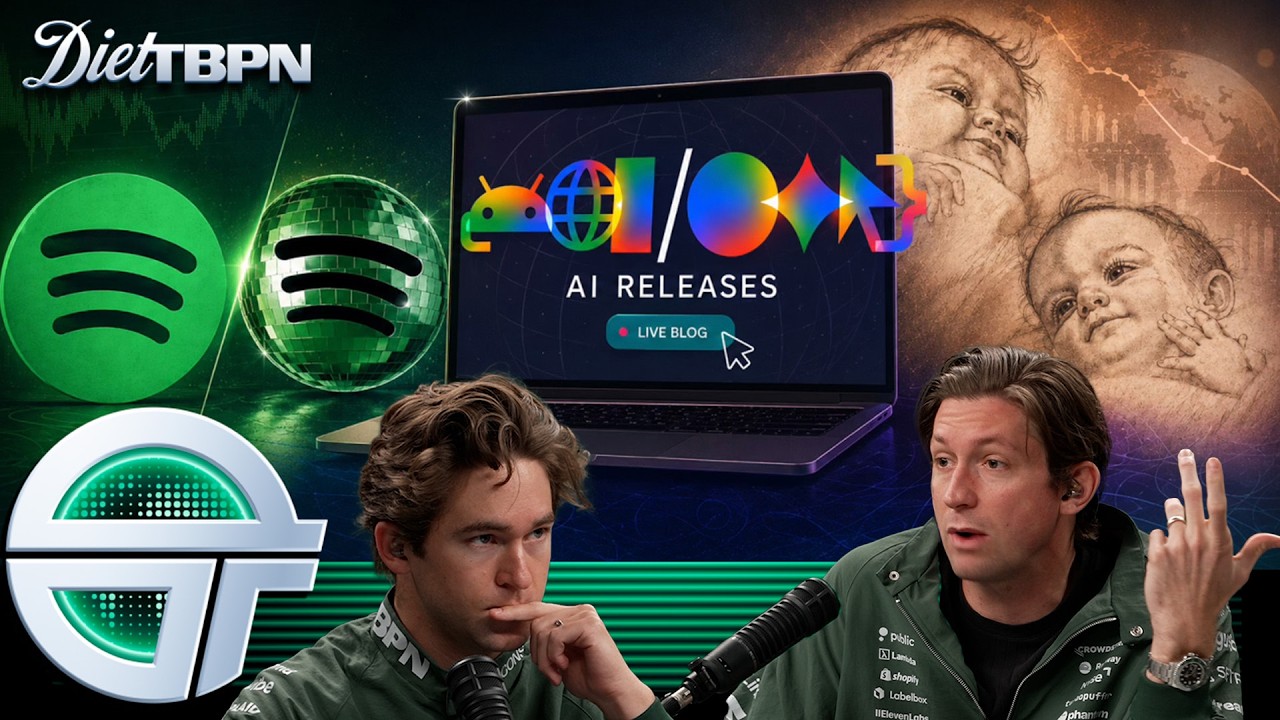
## Background
Published by TBPN on YouTube on May 20, 2026, Diet TBPN provides a condensed 30-minute recap of the daily tech talk show hosted by John Coogan and Jordi Hays. The show covers major industry news and Silicon Valley trends, delivering highlights from their longer daily livestream.
## TL;DR
This episode analyzes major reveals from Google I/O, including Gemini video models, Gemini Omni, Gemini 3.5 Flash, and Google's market rally. The hosts also examine broader AI industry moves like Andre Karpathy joining Anthropic and the SynthID watermarking framework. The discussion shifts to cultural trends, exploring the online drama surrounding Spotify's logo change, smartphone adoption as a catalyst for global fertility decline, and how modern parenting and autonomous driving impact media consumption.
## Atmosphere & style
The episode delivers a fast-paced, conversational, and witty tech commentary driven by the fluid chemistry between co-hosts John Coogan and Jordi Hays. It effortlessly balances sharp market analysis and technical breakdowns with candid personal anecdotes and sharp, humorous observations on internet culture and modern life.
## Key takeaways
- [00:02](https://www.youtube.com/watch?v=LlC_XM7_Hfw&t=2s) Google's strong financial performance and search resiliency continue to position it as a leader in full-stack AI, easing investor anxieties regarding cloud growth and query volumes.
- [03:00](https://www.youtube.com/watch?v=LlC_XM7_Hfw&t=180s) Google's Gemini video generation models threaten to disrupt traditional CGI and explainer video creation on platforms like YouTube by enabling high-fidelity video synthesis.
- [06:00](https://www.youtube.com/watch?v=LlC_XM7_Hfw&t=360s) Gemini Omni introduces dynamic multimodal editing and customized video generation for educational, technical walkthrough, and motion graphic workflows.
- [08:00](https://www.youtube.com/watch?v=LlC_XM7_Hfw&t=480s) Gemini 3.5 Flash delivers high token throughput at lower cost, accelerating enterprise agentic coding adoption despite some benchmark performance debates.
- [10:00](https://www.youtube.com/watch?v=LlC_XM7_Hfw&t=600s) Consumer AI hardware adoption remains bottlenecked by extended development cycles and high capability overhang, while personal AI agents move toward local code-level execution.
- [19:44](https://www.youtube.com/watch?v=LlC_XM7_Hfw&t=1184s) Google and major tech leaders are establishing SynthID as a unified invisible watermarking standard to identify AI-generated content across digital platforms.
- [23:17](https://www.youtube.com/watch?v=LlC_XM7_Hfw&t=1397s) Global birth rates have precipitously declined below replacement levels across most nations, with demographic data strongly correlating the drop with widespread smartphone and mobile network adoption.
- [31:22](https://www.youtube.com/watch?v=LlC_XM7_Hfw&t=1882s) Shifts in parental time commitment and device usage have contributed to the decline of long-form reading, driving higher reliance on podcasts and audio media.
Google I/O kicks off against the backdrop of a massive stock rally. Despite a minor daily dip of 1.3%, Google's stock is up 140% over the past year, bringing the company close to a $5 trillion market cap (standing around $4.6 trillion). Last quarter, Google generated nearly $110 billion in revenue, positioning itself firmly as a full-stack AI winner on Wall Street. Google Cloud Platform (GCP) is currently outstripping both AWS and Azure in growth, easing long-standing investor anxieties regarding search weakness.
Core Google Search continues to demonstrate strong resilience with query volumes reaching all-time highs, as confirmed by CEO Sundar Pichai. The "Search & other" revenue segment rose 19% year-over-year. While tech outlets like *The Verge* cite potential consumer AI fatigue—referencing incidents like former Google CEO Eric Schmidt getting booed off stage during a commencement speech—core Google consumers remain enthusiastic about newly introduced AI features. However, the hosts note that integration user experiences can occasionally feel cluttered rather than ambient.
- **Market Cap:** $4.6 trillion (approaching $5 trillion).
- **1-Year Stock Performance:** Up 140%.
- **Quarterly Revenue:** Just under $110 billion.
- **Search & Other Revenue Growth:** Up 19% year-over-year.
---
[00:03](https://www.youtube.com/watch?v=LlC_XM7_Hfw&t=3s) Gemini Video Models and the Future of YouTube Content
The hosts examine Google's newly unveiled Gemini video generation model, praising its high fidelity, smooth motion, lip-syncing accuracy, and clean audio generation without the classic "hollow" sound artifacts of earlier AI media. The discussion centers on how this technology will disrupt video explainer channels on YouTube—such as those depicting the inner workings of engines, rockets, or firearms—which historically require complex, labor-intensive CGI modeling.
This capability commoditizes video creation, raising fundamental questions about the future of YouTube's content model. The hosts ponder whether YouTube will eventually generate personalized, on-demand video explainers or custom feeds directly from user prompts. However, they note that fully AI-generated feeds could trigger a "creator strike" if YouTube begins directly competing against its own platform creators. In the short term, these tools act as hyper-efficient stock footage and CGI templates for creators.
> "A V8 engine features eight cylinders arranged in a V shape driving a single crankshaft... That's pure mechanical genius at work."
---
[00:06](https://www.youtube.com/watch?v=LlC_XM7_Hfw&t=6s) Gemini Omni: Multimodal AI for Education and Video Editing
Google introduced Gemini Omni, a model capable of generating output across styles and media starting with video—described by Logan Kilpatrick as "like Nano Banana, but for video." Demonstrated use cases include generating customized educational explainers for topics in science and math (such as Rayleigh scattering and photosynthesis) adapted directly to individual student inquiries.
Gemini Omni can process multiple video clips, execute motion graphic transitions without needing external software like After Effects, and style-swap or edit footage to match a chosen audio track. Beyond education and entertainment, the model holds immediate utility for technical troubleshooting—such as generating an exact video walkthrough to fix a specific washing machine model using its instruction manual.
- **Key Capabilities:** Multi-clip editing, style swapping, environment changes, and custom video generation.
- **Target Use Cases:** On-demand educational content (math/science), automated video editing ("vibe reels"), and step-by-step repair walkthroughs.
---
[00:08](https://www.youtube.com/watch?v=LlC_XM7_Hfw&t=8s) Gemini 3.5 Flash and Developer Ecosystem Adoption
Google officially announced Gemini 3.5 Flash, calling it their most powerful model to date, engineered for speed, cost-efficiency, and agentic coding capabilities. Benchmarked on TPU v8i, Gemini 3.5 Flash demonstrated throughput between 600 and 1,400 tokens per second (peaking at 1,480 t/s with an average of ~800 t/s). While slightly more expensive than previous Flash iterations, it offers frontier-level performance at four times the speed and less than half the cost of comparable frontier models.
Google reported that total token generation is up 7x year-over-year across its ecosystem. While Wall Street is closely tracking enterprise diffusion through Google Cloud and agentic coding tools (like Antigravity), adoption of the Gemini CLI has been slower. Investors are eager to see if 3.5 Flash will accelerate developer adoption across enterprise workflows.
- **Speed Benchmark:** Average ~800 tokens/sec, peaking at 1,480 tokens/sec on TPU v8i.
- **Performance:** 4x speed of comparable frontier models at under half the cost.
- **Growth Metric:** Token generation up 7x year-over-year across Google products.
---
[00:10](https://www.youtube.com/watch?v=LlC_XM7_Hfw&t=10s) Anticipating Gemini 3.5 Pro, Spark Agent, and "Mythos" Moments
Analyzing the broader rollout, the hosts discuss the absence of vague-posting from DeepMind researchers prior to the event. A post by Andrew Curran suggested that Google trained its largest model to date, hitting an unexpected capability emergence—a "mythos moment" distinct from Anthropic's trajectory. While Gemini 3.5 Flash launched first, Gemini 3.5 Pro is slated for release next month.
Additionally, Google announced **Spark**, a personal AI agent that operates within Antigravity. The hosts debate the nature of personal agents, noting that while consumers expect integration with Gmail or Search, developers are heavily using local code-based agents running on MacBooks to execute complex tasks. The conversation turns to prospective AI safety/capability surprises in biological sciences or cybersecurity as these frontier models scale.
> "I think they trained the largest model they've ever successfully trained... and something unexpected emerged at scale. They had their mythos moment."
---
[00:12](https://www.youtube.com/watch?v=LlC_XM7_Hfw&t=12s) Agentic Commerce and the Horizon for Consumer Wearables
The conversation shifts to commercial application and consumer hardware. Following Demis Hassabis's remarks at Davos indicating a shift from traditional advertising as the sole monetization engine for the Gemini app, attention has turned to "agentic commerce." Although Google possesses integrated infrastructure via Google Shopping and e-commerce integrations, consumer adoption of automated agent shopping remains low, hovering near zero.
Reflecting on an interview with Joanna Stern from *thenewthings.com*, the hosts discuss the timeline for AI hardware. While humanoid robots require vast amounts of training data and AI chat apps are already ubiquitous, wearables represent the next major consumer wave over the coming years. However, hardware adoption faces a steep "capability overhang." Traditional tech giants like Apple iterate hardware slowly—evidenced by their extended marketing of Apple Intelligence following WWDC while delaying hardware form-factor shifts like foldable phones—whereas challenger hardware startups require years to scale manufacturing.
Here is a detailed, faithful walkthrough of this portion of the transcript, capturing the key facts, arguments, anecdotes, and tone.
---
[15:36](https://www.youtube.com/watch?v=LlC_XM7_Hfw&t=936s) Hardware Experiments and AI Coding Models at Google I/O
John Coogan and Jordi Hays reflect on Google's history with experimental hardware platforms, noting how difficult it is to build and ship physical products compared to digital ones. While Meta's Ray-Ban smart glasses are gaining attention, the hosts note that even those are still in an early stage and not yet selling in the tens of millions. They reminisce about earlier, wilder Google experiments like Google Cardboard—a literally cardboard box you slotted your phone into to turn it into a cheap VR headset—and the Samsung Gear VR collaboration, which allowed users to get a VR experience without paying top dollar for an Oculus.
```
┌───────────────────────────┐
│ Google Hardware Era │
└─────────────┬─────────────┘
│
┌───────────────────────────────┼───────────────────────────────┐
▼ ▼ ▼
┌───────────────┐ ┌───────────────┐ ┌───────────────┐
│ Google Glass │ │Cardboard & Gear│ │ Meta Ray-Ban │
│Ahead of time │ │ Phone-based VR│ │ Modern early │
└───────────────┘ └───────────────┘ └───────────────┘
```
The conversation shifts to technical performance feedback coming out of Google I/O. A viewer comment points out that Gemini 3.5 Flash scores somewhat lower on coding benchmarks due to tough terminal benchmark tests. The hosts emphasize that speed is critical for day-to-day coding workflows, but the model still needs to deliver raw performance if Google wants to drive developer adoption and code-generation revenue.
- Demis Hassabis, CEO of Google DeepMind, was recently revealed to be an angel investor in rival AI lab Anthropic, sparking intrigue about how early he invested and how much money he stands to make.
- High-profile researcher Andre Karpathy has made another major career move, joining Anthropic to work on automated research environments (RSI/Auto Research)—effectively an acqui-hire of his open-source work. Karpathy's career path spans OpenAI, Tesla, and now Anthropic (with an early internship at Google), prompting the hosts to joke that he has collected all the "Thanos rings" of AI labs.
- The hosts speculate on how AI models will transform education, questioning whether an LLM will eventually be able to tutor a student on PhD-level problems as effectively as a university professor who understands every pedagogical nuance.
---
[19:44](https://www.youtube.com/watch?v=LlC_XM7_Hfw&t=1184s) The SynthID Framework and the Great Spotify Logo Debate
Google announced a joint effort for its **SynthID** framework alongside OpenAI, ElevenLabs, and Nvidia to establish an industry standard for identifying AI-generated content. The system uses invisible watermarking—subtle changes in saturation, color, or pixel patterns—rather than easily stripped image metadata. While advanced detection systems might still struggle when creators mix stock footage with AI assets, the hosts hope the standard will help average users spot AI content without becoming overly intrusive.
<Image alt="Conceptual illustration of digital image watermarking and AI detection tags" caption="Digital watermarking tags help detect AI content across platforms." src="image_agent_tag_1"/>
---
The discussion turns lighthearted as the hosts react to the massive online outrage over Spotify's temporary icon change to a dark disco ball to celebrate the company's 20th anniversary. They defend the redesign, calling it a genius move that immediately drew their eyes to the app icon on their home screens.
- **The Critique:** Users complained that the icon was way too dark, making it hard to find, while others argued that a real disco ball in a nightclub wouldn't look that bright or dark anyway.
- **The Defense:** The hosts poke fun at how attached people get to flat, minimalist brand icons, laughing that changing an icon shouldn't prompt someone to call their wife and cancel their subscription.
---
[23:17](https://www.youtube.com/watch?v=LlC_XM7_Hfw&t=1397s) What Is Driving the Global Fertility Decline?
The hosts dive into a *Financial Times* report investigating the global drop in birth rates. In over two-thirds of the world's 195 countries, fertility rates have fallen below the replacement rate of 2.1 children per woman. In 66 countries, the average is closer to 1, and the most common number of children born to a woman is increasingly zero.
```
Global Replacement Target: 2.1
─── ─── ─── ─── ─── ─── ─── ─── ─── ─── ─── ─── ─── ───
United States: ~1.8
Modern Societies Avg: ~1.6
South Korea / China: ~1.0 or lower
```
The decline is outpacing official demographic forecasts. Just five years ago, the UN predicted 350,000 births in South Korea for 2023, but the actual number came in at just 230,000—a 50% overestimation. While demographers previously blamed economic downturns, analysts now point toward widespread **smartphone adoption** as the primary catalyst for the sudden acceleration over the last decade.
- Chart alignments show that inflection points in birth rate drops match the local rollout of smartphones and 4G networks across different countries (e.g., 2007 in the US/UK/Australia, 2009 in France/Poland, 2011 in Mexico/Indonesia, and 2013–2015 in Ghana/Nigeria/Senegal).
- In South Korea, in-person socializing among young adults dropped by 50% over 20 years.
- The decline cuts across both nations hit hard by the Global Financial Crisis and those that were completely unaffected, such as China during its massive economic boom.
> "If this were any animal in the wild, there would be huge amounts of fundraising happening to try to save the species. But when it's us, we just see the chart and keep scrolling."
The hosts analyze exception cases like the Amish, who maintain high fertility rates above replacement level while steering clear of smartphones, using only basic flip phones for necessary calls. They wrap up the segment by reading a tweet from journalist Derek Thompson on how "dad books"—serious non-fiction covering history, business, and current affairs—are in a sales freefall because podcasts are effectively replacing them.
---
<ElicitationsGroup message="Explore related topics from this episode:">
<Elicitation label="Summarize the key facts about global fertility trends" query="Summarize all the specific numbers, dates, and countries mentioned in the transcript regarding the global fertility decline."/>
<Elicitation label="Detail Andre Karpathy's career moves" query="Provide a chronological overview of Andre Karpathy's background and career moves across different AI labs as discussed in the transcript."/>
</ElicitationsGroup>
[31:22](https://www.youtube.com/watch?v=LlC_XM7_Hfw&t=1882s) Modern Parenting and the Death of Uninterrupted Reading
The discussion shifts to generational differences in parenting, highlighting how Millennial and Gen X parents are spending roughly twice as much time with their kids compared to earlier generations when adjusting for age. Looking at a curve of time spent with children across age groups, one host shares a relatable personal struggle from his weekends. He describes holding one or two of his children while staring longingly at a growing stack of books from Amazon, painfully aware that if he even attempts to open one, he will get "exactly three pages before I'm disrupted."
- Millennial and Gen X parents spend approximately twice as much time with their children as previous generations did at the same age.
- Physical reading material often sits unread as constant childcare disruptions limit dedicated reading time.
---
[32:00](https://www.youtube.com/watch?v=LlC_XM7_Hfw&t=1920s) Generational Care, Autonomous Driving, and the Future of Media
Pondering how earlier cohorts managed to find so much personal time, the hosts humorously question what older generations were up to, jokingly quipping, "Kid, hit the mines, buddy. I got to read." Because quiet reading at home has become increasingly difficult for parents, audio media like podcasts have filled the void for moments spent away from the house. Looking ahead to the future of media consumption, the hosts speculate on how autonomous transportation might alter habits. While self-driving cars might initially sound like a boon for serious nonfiction, they conclude autonomous vehicles are actually "bullish for the infinite scroll" and inherently bearish for podcasts, long-form media, and the classic "dad book." The show wraps up with a sign-off encouraging listeners to subscribe to their newsletter at tbpn.com.
- Podcasts have largely replaced physical books for busy parents as a way to consume content away from home.
- Self-driving cars are predicted to boost short-form feed scrolling while negatively impacting podcasts and long-form nonfiction books.
## Notable quotes
> [03:00](https://www.youtube.com/watch?v=LlC_XM7_Hfw&t=180s) A V8 engine features eight cylinders arranged in a V shape driving a single crankshaft... That's pure mechanical genius at work.
> [10:00](https://www.youtube.com/watch?v=LlC_XM7_Hfw&t=600s) I think they trained the largest model they've ever successfully trained... and something unexpected emerged at scale. They had their mythos moment.
> [23:17](https://www.youtube.com/watch?v=LlC_XM7_Hfw&t=1397s) If this were any animal in the wild, there would be huge amounts of fundraising happening to try to save the species. But when it's us, we just see the chart and keep scrolling.
> [32:00](https://www.youtube.com/watch?v=LlC_XM7_Hfw&t=1920s) Kid, hit the mines, buddy. I got to read.
## Mentioned
Google, John Coogan, Jordi Hays, The New York Times, Mark Zuckerberg, Sam Altman, Mark Cuban, Satya Nadella, TBPN, Google Cloud Platform (GCP), AWS, Azure, Google Search, Sundar Pichai, The Verge, Eric Schmidt, YouTube, Gemini, Gemini Omni, Logan Kilpatrick, Nano Banana, After Effects, Gemini 3.5 Flash, TPU v8i, Antigravity, Gemini CLI, DeepMind, Andrew Curran, Anthropic, Gemini 3.5 Pro, Spark, Gmail, MacBook, Demis Hassabis, Google Shopping, Joanna Stern, thenewthings.com, Apple, Apple Intelligence, WWDC, Meta, Ray-Ban, Google Cardboard, Samsung Gear VR, Oculus, Google Glass, Andre Karpathy, OpenAI, Tesla, SynthID, ElevenLabs, Nvidia, Spotify, Financial Times, Derek Thompson, Amazon
Google has expanded its market dominance and generative AI infrastructure through rapid model releases, even as the tech sector navigates developer adoption hurdles and hardware bottlenecks. Meanwhile, hosts John Coogan and Jordi Hays contrast these digital milestones with broader societal disruptions, linking pervasive smartphone adoption to unprecedented declines in global fertility and shifting domestic media habits.
Google's AI Expansion and Media Disruption
Google opened its I/O conference backed by strong market momentum, with its stock up 140% over the past year to reach a valuation near $4.6 trillion and quarterly revenue approaching $110 billion. Chief Executive Sundar Pichai noted that core search queries reached all-time highs, with Search and other revenue rising 19% year-over-year while Google Cloud Platform outpaced AWS and Azure in growth. Google paired this financial showing with the launch of Gemini Omni and new Gemini video generation models, demonstrating high visual fidelity, accurate lip-syncing, and multi-clip editing that can generate custom educational explainers or appliance repair walkthroughs without external editing software.
The hosts argue that by automating the production of complex technical animations, Google commoditizes labor-intensive CGI content, directly challenging YouTube explainer channels. While these tools currently serve as efficient templates and stock footage for creators, the hosts suggest that if YouTube begins producing personalized, prompt-driven feeds, the company could face a potential creator strike by competing against its own platform ecosystem.
Developer Tooling, AI Agents, and Hardware Friction
For enterprise workflows, Google launched Gemini 3.5 Flash, engineering it for agentic coding and benchmarking it on TPU v8i at an average throughput of roughly 800 tokens per second (peaking at 1,480 tokens per second). Google reported that token generation across its ecosystem is up sevenfold year-over-year, offering frontier performance at four times the speed and less than half the cost of comparable models, though viewer feedback indicated lower scores on rigorous terminal coding benchmarks. Google also introduced Spark, a personal agent running within Antigravity, and joined OpenAI, ElevenLabs, and Nvidia in supporting the SynthID invisible watermarking framework to detect synthetic media.
Despite rapid model iteration—including Gemini 3.5 Pro slated for next month and high-profile industry movements like Andre Karpathy joining Anthropic and Demis Hassabis angel investing in the same lab—commercial deployment faces resistance. Demis Hassabis highlighted a long-term pivot toward agentic commerce, but consumer shopping via automated agents remains near zero. The hosts observe a pronounced hardware capability overhang: consumer wearables like Meta's Ray-Bans have yet to achieve mass-scale adoption, while incumbents like Apple continue to iterate slowly on physical form factors.
Smartphone Adoption and Global Fertility Collapse (23:17)
Turning to global demographics, the hosts analyze a Financial Times report showing that fertility rates in over two-thirds of the world's 195 countries have fallen below the replacement rate of 2.1 children per woman. In 66 nations, including South Korea and China, the average is closer to 1.0. Official projections have consistently underestimated this trajectory; the United Nations projected 350,000 births in South Korea for 2023, but actual births came in at 230,000—a 50% overestimation.
While economists historically attributed declining birth rates to financial downturns, demographers increasingly identify smartphone and 4G network proliferation as the primary catalyst. Fertility drop inflection points closely match the regional adoption of smartphones across varying economies: 2007 in the United States and the United Kingdom, 2009 in France and Poland, 2011 in Mexico and Indonesia, and 2013–2015 in Ghana, Nigeria, and Senegal. Over the same period, in-person socializing among South Korean young adults fell by 50%, whereas communities that reject smartphones, such as the Amish, continue to sustain fertility well above replacement levels.
Generational Parenting Demands and Shifting Media Consumption (31:22)
Shifts in lifestyle technology are accompanied by evolving domestic behavior. Millennial and Gen X parents spend roughly twice as much time with their children compared to older cohorts at the same age, resulting in frequent disruptions that make uninterrupted reading of physical non-fiction books difficult. As a result, audio media and podcasts have increasingly replaced traditional non-fiction reading during isolated windows away from home.
Looking to future transport technologies, the hosts challenge the expectation that autonomous driving will create a renaissance for serious literature. Instead, they forecast that autonomous vehicles will ultimately benefit short-form, infinite-scroll digital feeds while hurting long-form reading and podcasts, further reinforcing screen immersion over reflective media consumption.
The broadcast highlights how rapidly accelerating generative AI and consumer connectivity continue to outstrip institutional forecasts, creating unresolved tensions between software automation, creator platform economies, and the broader social fabric.
## Background
该内容由科技脱口秀频道 TBPN(Technology Brothers)于 2026 年 5 月 23 日发布在 YouTube 平台上。本期为精炼版栏目《Diet TBPN》,在约 30 分钟内聚焦当天科技界的热门焦点,涵盖 Google I/O 开发者大会最新动态、全球生育率下滑的深层诱因以及 Spotify 更换新图标引发的热议等话题。
## TL;DR
节目首先深入探讨了 Google I/O 上谷歌的全栈 AI 布局,包括市值激增、Gemini Omni 与 Gemini 3.5 Flash 的发布、智能体落地进展以及 Andrej Karpathy 加盟 Anthropic 等行业动态。随后,主持人们围绕 Spotify 20 周年“迪斯科球”新图标引发的用户退订潮展开趣味讨论。最后,节目结合数据剖析了智能手机普及与全球生育率断崖式下滑之间的惊人时间吻合,并探讨了现代高强度育儿与碎片化生活对“老爹书”等严肃非虚构阅读带来的冲击。
## Atmosphere & style
整场节目充斥着硅谷极客脱口秀特有的幽默讽刺与快节奏插科打诨,两位主持人默契十足、互相拆台打趣,频频化用网络热梗制造爆笑点。在轻松惬意的调侃之余,对话又能无缝切入硬核的技术跑分分析与深邃的人口学、社会学冷酷反思。收听体验既像在茶余饭后围观两位老友对科技圈大事的辛辣吐槽,又带着面对人类物种未来危机时的黑色幽默与清醒审视。
## Bulletin
- [00:02](https://www.youtube.com/watch?v=LlC_XM7_Hfw&t=2s) 谷歌在过去一年内累计涨幅达 140%,市值逼近 5 万亿美元大关,华尔街将其全面重塑为涵盖 Cloud、搜索、Gemini 与 DeepMind 的“全栈 AI 赢家”。
- [08:35](https://www.youtube.com/watch?v=LlC_XM7_Hfw&t=515s) Google I/O 发布 Gemini 3.5 Flash,在自研 TPU 8i 集群上实现最高 1,480 tokens/秒 的惊人推理吞吐,推理速度达竞品 4 倍而成本降低过半。
- [16:24](https://www.youtube.com/watch?v=LlC_XM7_Hfw&t=984s) AI 传奇学者 Andrej Karpathy 正式加盟 Anthropic 负责“递归自我改进”(RSI)研究,集齐了 OpenAI、特斯拉与 Anthropic 等顶尖机构的履历。
- [23:14](https://www.youtube.com/watch?v=LlC_XM7_Hfw&t=1394s) 《金融时报》数据显示全球超三分之二国家生育率跌破更替水平,多国出生率拐点与当地 4G 网络及智能手机普及年份呈现出惊人的一致吻合。
- [30:31](https://www.youtube.com/watch?v=LlC_XM7_Hfw&t=1831s) 出版业严肃非虚构“老爹书”销量暴跌,虽然出版商常归咎于播客崛起,但调查显示千禧一代与 X 世代父母育儿时间翻倍才是碎片化阅读的主因。
## Key takeaways
- [00:02](https://www.youtube.com/watch?v=LlC_XM7_Hfw&t=2s) 谷歌总市值攀升至约 4.6 万亿美元,季度营收近 1100 亿美元,核心搜索业务与 Google Cloud 增速均展现出极强韧性与扩张力。
- [01:21](https://www.youtube.com/watch?v=LlC_XM7_Hfw&t=81s) AI 入口的过度铺设引发用户审美疲劳,在 Chrome 分屏 Google Docs 时出现双 Gemini 按钮挤占屏幕正文即为典型反思缩影。
- [03:25](https://www.youtube.com/watch?v=LlC_XM7_Hfw&t=205s) 高清且无瑕疵的 AI 视频生成技术实现质的飞跃,正在将传统的视觉科普解释类 CGI 动画彻底商品化,未来可能引发创作者生态反弹。
- [06:17](https://www.youtube.com/watch?v=LlC_XM7_Hfw&t=377s) Gemini Omni 展现了将任意输入实时转化为精准视频的能力,在复杂机械维修排障和自动化卡点剪辑等实用场景下展现出极高应用潜力。
- [09:48](https://www.youtube.com/watch?v=LlC_XM7_Hfw&t=588s) Gemini 3.5 Flash 成为主打 Agentic 编程的核心王牌,得益于全产品线整合,谷歌全平台 Token 生成量同比暴增 7 倍。
- [11:32](https://www.youtube.com/watch?v=LlC_XM7_Hfw&t=692s) 个人 Agent“Spark”将在 Antigravity 环境内运行,伴随模型能力激增,生物与网络安全成为前沿模型极早期必须防范的风险。
- [13:00](https://www.youtube.com/watch?v=LlC_XM7_Hfw&t=780s) Agentic Commerce 概念火热但实际渗透率不足 1%,真实用户消费习惯远落后于行业技术炒作,亟待突破性交互体验撬动。
- [14:40](https://www.youtube.com/watch?v=LlC_XM7_Hfw&t=880s) 消费级硬件普遍存在“能力悬空”,相较于软件,智能眼镜和穿戴设备等硬件的研发迭代与大众普及周期极为漫长。
- [18:49](https://www.youtube.com/watch?v=LlC_XM7_Hfw&t=1129s) 谷歌主导联合 ElevenLabs、OpenAI 及 NVIDIA 推广 SynthID 跨平台水印体系,但面临多素材复杂混剪时深度溯源依旧充满挑战。
- [21:12](https://www.youtube.com/watch?v=LlC_XM7_Hfw&t=1272s) Spotify 成立 20 周年推出的深色“迪斯科球”新图标破坏了用户的日常肌肉记忆,在社交媒体上引发卸载与退订风波。
- [23:14](https://www.youtube.com/watch?v=LlC_XM7_Hfw&t=1394s) 全球多数经济体总和生育率跌破更替线,且下滑拐点与智能手机渗透高度同步,青年线下面对面社交时间出现了腰斩式暴跌。
- [26:13](https://www.youtube.com/watch?v=LlC_XM7_Hfw&t=1573s) 农耕时代多育带来的劳动净收益转变为现代社会的净经济负债,但在面对繁衍断崖的物种危机时人类却表现得异常麻木与习以为常。
- [28:16](https://www.youtube.com/watch?v=LlC_XM7_Hfw&t=1696s) 阿米什人坚决抵制智能手机从而维持了高生育率,对比中国与美欧数据可知,生育危机具有跨越经济繁荣与萧条周期的普适性。
- [31:22](https://www.youtube.com/watch?v=LlC_XM7_Hfw&t=1882s) 现代父母陪伴照看孩子的时长比上一代翻倍,深度阅读被严重碎裂化,自动驾驶技术未来甚至可能加剧屏幕无限流对注意力的侵蚀。
## Detailed walkthrough
### [00:02](https://www.youtube.com/watch?v=LlC_XM7_Hfw&t=2s) 谷歌股价飙升与全栈 AI 赢家叙事
Google I/O 开发者大会正式拉开帷幕,伴随而来的是谷歌股价势如破竹的猛烈涨势。如果平时没有密切关注美股市场,很容易忽略这一惊人事实:谷歌在过去一年内的累计涨幅高达 140%,整体市值已逼近 5 万亿美元大关(目前约 4.6 万亿美元)。主持人刚抛出这一亮眼数据,另一位主持人便忍不住插话打趣道:“我真不知道你在看哪张走势图,它今天明明跌了 1.3%!”引得现场一片笑声。两人随即澄清,放眼长期趋势,谷歌的表现堪称巨兽崛起。公司上季度营收突破近 1100 亿美元,不仅在下一阶段的 AI 竞争叙事中占据了绝佳身位,旗下 Google Cloud(GCP)的增长速度甚至全面超越了亚马逊 AWS 和微软 Azure。
华尔街对谷歌的估值逻辑已经彻底重构,将其完全重新定价为一家“全栈 AI 赢家”(full-stack AI winner)。这一最新叙事完美串联起 Google Cloud、核心搜索业务、Gemini 大模型以及 DeepMind 的底层研发。此前市场关于生成式 AI 将侵蚀谷歌传统搜索业务的担忧已烟消云散,核心搜索业务展现出了极强的抗跌与扩张韧性。尽管财报未透露具体的搜索总量,但首席执行官桑达尔·皮查伊在近期的财报电话会上明确指出搜索查询量正处于历史最高点;涵盖搜索在内的业务营收板块同比强劲增长 19%。
- **市值与涨幅**:年内涨幅达 140%,公司总市值达到约 4.6 万亿美元。
- **财务表现**:最近一个季度实现近 1100 亿美元营收,核心搜索及相关业务收入同比增长 19%。
- **云业务增速**:Google Cloud(GCP)当期营收增速超过竞争对手 AWS 与 Azure。
### [01:21](https://www.youtube.com/watch?v=LlC_XM7_Hfw&t=81s) AI 疲劳感、双重 Gemini 图标的尴尬与产品哲学
面对铺天盖地的技术宣传,科技媒体 The Verge 指出公众对于 AI 已经产生了一定程度的审美疲劳。更有甚者提到,谷歌前首席执行官埃里克·施密特(Eric Schmidt)近期在大学毕业典礼致辞时甚至遭遇了台下学生的嘘声。不过,锁定收看 Google I/O 的核心极客群体依旧对各类新功能抱有极大热情。眼下用户最核心的诉求,在于希望 AI 能够做到“润物细无声且切实有用,而不是咄咄逼人、病急乱投医”(ambient and useful instead of pushy and desperate)。
为了凸显这种无处不在却略显滑稽的入侵感,主持人分享了自己写稿时的亲身体验:当他使用半屏窗口在 Chrome 浏览器中打开 Google Docs 写作时,赫然发现界面上同时出现了两个 Gemini 星标按钮——一个来自 Google Docs 内部工具栏,另一个则属于 Chrome 浏览器自带的侧边栏。当他不小心把两个 Gemini 面板同时点开时,原本用来码字的文档内容直接被彻底挤没,整个屏幕只剩下两个对着干瞪眼的聊天对话框。这种堆叠功能按钮的粗糙设计,正是各家厂商在 AI 整合初期用力过猛的缩影。不过谷歌的企业文化一向以包容大胆的实验著称,尽管其“产品公墓”中躺满了被砍掉的边缘项目,但这种海量试错正是诞育出下个爆款的必经之路。
```mermaid
flowchart TD
accTitle: Chrome与Google Docs双重AI入口冲突
accDescr: 展示在半屏窗口下同时打开两个Gemini面板导致文本区域被挤压消失的尴尬体验
subgraph Browser["Chrome 浏览器界面(分屏状态)"]
DocPanel["Google Docs 编辑区域"]
ChromeGemini["Chrome 原生 Gemini 面板"]
DocGemini["Docs 内部 Gemini 侧边栏"]
end
UserTrigger["用户同时激活两处 AI 入口"] --> ChromeGemini
UserTrigger --> DocGemini
ChromeGemini & DocGemini --"两侧面板横向挤占空间"--> Squeeze["编辑视窗被完全压缩隐藏"]
Squeeze --> Result["屏幕仅剩两个空白聊天框,无法输入正文"]
```
### [03:25](https://www.youtube.com/watch?v=LlC_XM7_Hfw&t=205s) 突破性的视频生成模型与 YouTube 创作者生态的未来
在大会展示的最新生成式视频演示中,一段讲解 V8 发动机运转机制的模型生成画面引发了热烈讨论。视频不仅展示了曲轴带动气缸依次点火的高难度机械联动,而且画质达到了清晰的高清标准,彻底摆脱了早期 AI 视频中“手指畸变(six fingers)”、动作扭曲的硬伤,画中解说的唇形同步非常精准,更消除了以往伴随 AI 视频音频一并生成的标志性“空洞机械音”。虽然两位主持人在辨认画面时忍不住挑刺调侃道:“等一下,这确定不是一台 V6 发动机吗?”,但大家一致认可视频生成技术已完成从 99.9% 到 99.999% 逼真度的终极跨越。
这种技术突破对 YouTube 平台上的视觉科普类频道(Explainer Channels)带来了毁灭性降维打击。以往拆解火箭推进器、RPG 火箭筒、AK-47 或格洛克手枪内部构造的高阶 3D 动画动辄收获数千万播放,但其背后需要庞大的 CGI 建模与渲染成本。如今,这类资产正被彻底商品化。主持人随即展开更深层的探讨:未来当用户进入 YouTube 搜索“拆解并展示一把椅子的内部构件”时,系统是会直接端上由 AI 实时即时生成的定制视频,还是依然分发创作者制作的内容?
如果未来平台能根据用户个人画像,在用户点击的瞬间无中生有地生成一场球赛的赛后战术推演或最新突发新闻,YouTube 实际上是在利用平台生成的合成内容直接挤压真人博主的生存空间,这很有可能点燃全平台内容生产者的“创作者大罢工”(creator strike)。
### [06:17](https://www.youtube.com/watch?v=LlC_XM7_Hfw&t=377s) Gemini Omni:多模态输入与即时生成工作流
随后展示的是被称为 Gemini Omni 的全新多模态系统演示。画面展示了一段关于光合作用与瑞利散射(Rayleigh scattering)的物理原理解释视频:当光线进入大气层撞击氮气和氧气分子时,短波长的蓝光被大量散射填满天空,而长波长的红光则穿透而过。除了宏大的科学可视化,这套工具在现实生活维保场景下的潜力更令人惊艳。以往用户在 YouTube 搜索某个冷门型号洗衣机的报错维修指南,往往只能在长篇视频里拖动进度条;而未来只需要输入机器型号,AI 便能瞬间消化说明书,现场生成一段完全针对该故障点拆修操作的高保真动态示范。
节目的老朋友罗根·基尔帕特里克(Logan Kilpatrick)对此形象地评价道:“隆重推出 Gemini Omni。这是我们的全新模型,能将任意输入转化为任意内容,并以视频为始。可以把它理解为视频版的 nano banana。”现场演示还呈现了行云流水般的转场动画与分镜剪辑。这种能力未来不仅省去了在 After Effects 等专业后期软件中手动切片调帧的繁琐步骤,更支持用户一次性导入多段碎片素材,由模型自动根据所选背景音乐的鼓点节奏进行对齐剪辑、调换环境氛围、甚至任意切换镜头拍摄视角。
- **动态知识讲解**:自动生成短波瑞利散射与天蓝色成因的三维物理模拟。
- **即时实用指南**:精准解析家电说明书并就地生成对应零部件拆装排障视频。
- **全能音画合成**:根据提示词和参考音乐直接完成镜头组接、风格转绘(Swap styles)与卡点混剪。
### [08:35](https://www.youtube.com/watch?v=LlC_XM7_Hfw&t=515s) Gemini 3.5 Flash 发布:TPU 8i 上的极致推理速度
谷歌同日正式揭晓了 Gemini 3.5 Flash,官方将其定调为“迄今为止最强悍的自研模型”,并在智能水平、响应速度与调用成本之间开辟出了一个全新的量级。过去半年间团队全力攻关真实业务场景落地,将其打造成了谷歌目前最为出色的自主智能体编程模型(Agentic coding model)。在性能维持在前沿大模型(frontier models)第一梯队的同时,其推理吞吐速度达到了同级别前沿模型的 4 倍,综合使用成本却缩减至一半以下,再次稳固主导了多目标优化的帕累托最优前沿面(Pareto frontier)。
现场公布的实测数据显示,在谷歌自研的 TPU 8i 硬件集群加速下,Gemini 3.5 Flash 的推理生成速率稳定在 600 至 1,400 tokens/秒 之间,峰值测试成绩甚至冲到了 1,480 tokens/秒,全程平均维持在约 800 tokens/秒。尽管因架构精密导致其定价相对此前的早期 Flash 系列略有上调,但在如此惊人的吞吐表现下,投资界显然已将其视为驱动高频交互与自动化代码工作流的核心王牌。
- **智能与定位**:谷歌史上最强智能体代码生成与执行模型,兼顾前沿推理水平。
- **性能与性价比**:推理速度达到竞品前沿模型的 4 倍,使用成本不足二分之一。
- **TPU 8i 吞吐速率**:平均吞吐量约 800 tokens/秒,测试峰值高达 1,480 tokens/秒。
### [09:48](https://www.youtube.com/watch?v=LlC_XM7_Hfw&t=588s) Gemini 3.5 的发布悬念、Token 暴增与“Mythos”时刻
Google 正在全力通过 Google Cloud 将模型扩散至企业级场景与编程 Agent 之中。尽管他们拥有 Antigravity,但此前 Gemini CLI 并未获得预期中的广泛关注与势头,因此外界寄希望于更强大的底层模型来带动工具的使用率。从整体业务数据来看,Google 的 Token 生成量同比激增了 7 倍,虽然目前尚不清楚其中有多少比例来自于深度推理(Reasoning),但考虑到 Gemini 模型已经被全面铺设进 Google 旗下的各项产品界面中,这种爆发式增长完全在情理之中。
围绕本次发布,核心模型的迭代节奏成为焦点。大家原本好奇是否会直接迎来 Gemini 4,但最终揭晓的是阶段性推出的 Gemini 3.5,并由 Flash 版本打头阵。知名研究员 Andrew Curran 在社交平台上调侃 DeepMind 团队这次居然没有提前“发虚空推文”(vague posting)预热,于是他亲自替 DeepMind 展开了一番大胆猜测。Curran 认为,DeepMind 极有可能训练出了其史上(甚至全行业史上)规模最大的模型,并在超大规模下观察到了意料之外的涌现能力,迎来了类似 Anthropic 的“Mythos 时刻”。在讨论中,主持人们纠正了语音识别中所谓“与血液(blood)不同”的口误,直指 Gemini 走的是与 Claude 截然不同的技术路线;即便跑分基准仍处于保密协议(embargo)之下,这些基准测试也未必能完全体现出那种未曾预设、令人惊喜的突变能力。
- Google 内部 Token 生成量迎来爆发,年同比增长达到 7 倍,主要得益于全产品线对 Gemini 的深度嵌入。
- 此次大模型推介并未采取一蹴而就的模式,而是选择分阶段发布 Gemini 3.5,轻量高速的 Flash 版本率先亮相。
### [11:32](https://www.youtube.com/watch?v=LlC_XM7_Hfw&t=692s) 发布时间表、个人 Agent “Spark” 与前沿安全隐忧
关于后续更新的节奏,主持人们补充了重要背景:本周的主角是 Gemini 3.5 Flash,而更强大的 3.5 Pro 则经历了微调推迟,预计将于下个月正式面世。与模型同步登场的还有一款名为“Spark”的个人 Agent。对于 Spark 的定位,主持人起初下意识地认为它会直接面向普通 C 端,整合在 Gemini App、Google Search 或 Gmail 等日常消费级产品中;但事实表明 Spark 是运行在 Antigravity 环境内的个人 Agent。如今越来越多的开发者倾向于直接在本地(例如 MacBook Pro)通过编写代码来驱动更为动态灵活的 Agent 服务,这一趋势已在各类开源自动化框架中得到印证。
在探讨这种前沿技术突破带来的未知影响时,主持人们联想到了 AI 带来的多领域冲击。此前相关报告预测了 2027 年可能出现的网络安全风险,而生物安全领域很可能是下一个引发恐慌的爆发点。一旦模型经过极端测试,展现出合成超级病毒等不可控危险时,巨头往往不得不提前将其交付给各大制药企业(例如 Moderna)去研发生物防御与“抗病毒疫苗”。AI 时代的技术演进似乎注定伴随着这种既惊艳又令人战栗的意外。
```mermaid
flowchart TD
accTitle: Gemini 3.5 与 Agent 落地架构
accDescr: 展示 Google 在本届 I/O 期间的模型发布次序、开发工具协同及潜在安全应对机制。
subgraph Release["发布节奏"]
F["Gemini 3.5 Flash (本周首发)"]
P["Gemini 3.5 Pro (预计下月发布)"]
end
subgraph Agents["落地工具与 Agent"]
AG["Antigravity 开发平台"]
SP["Spark 个人 Agent"]
CLI["Gemini CLI 工具"]
end
subgraph Safety["前沿能力与风控"]
MYTHOS["规模涌现 / 意外能力突破"]
BIO["生物与网络安全应对<br/>(药企与科研机构协作)"]
end
F --> AG
P --> AG
AG --> SP
AG --> CLI
Release -.-> MYTHOS
MYTHOS --> BIO
```
### [13:00](https://www.youtube.com/watch?v=LlC_XM7_Hfw&t=780s) Agentic Commerce 的落地现实:愿景丰满与行为滞后
除了技术模型本身,投资者眼下最为关注的商业化命题之一便是“智能体电商”(Agentic Commerce)。由于 Demis Hassabis 此前在达沃斯论坛上的表态,外界已经认识到 Gemini App 短期内不会将传统的广告展示作为直接的变现引擎。理论上,Google 拥有得天独厚的消费闭环优势——旗下不仅有庞大的 Google Shopping 生态,还与各大电商服务建立了极深的数据接口,每天更有无数用户在搜索框中寻找购买意向。
然而,真实的消费行为却远落后于行业预期。各大科技公司近期接连发布了五花八门的 Agent 购物协议与标准,但只要深挖具体数据,就会发现其渗透率极低,“大家都在争论它今年能不能达到 1%”。所有人都在鼓吹惊人的同比百分比增幅,但这纯粹是因为基数原本为零。现在的关键在于,Google 能否在 I/O 大会上展示出真正颠覆性的用户交互体验(UX)或购物全流程 Demo,从而真正撬动用户习惯、加速 Agent 电商的大规模普及。
### [14:40](https://www.youtube.com/watch?v=LlC_XM7_Hfw&t=880s) 硬件与穿戴设备的爆发前夜:“能力悬空”与迭代滞后
话题转向硬件生态,主持人们回顾了前一日与 thenewthings.com 的 Joanna Stern 的深入对话。多数消费者目前对 AI 的感知仍停留在与聊天机器人打交道、使用简单的 Agent 功能;而人形机器人不仅缺乏足够的训练数据,距离实用也依然遥远,甚至连一度新奇的 Waymo 无人驾驶现在都已变得“平淡无奇”。但 Stern 凭借长期佩戴录音设备的体验敏锐指出,未来几年真正迎来爆发的将是 AI 可穿戴设备,整个消费市场都将不得不面对这一浪潮。
然而,硬件行业普遍存在着严重的“能力悬空”(capability overhang)。相较于软件,消费级硬件的迭代节奏极其缓慢而谨慎。以 Apple 为例,即便一年前围绕 Apple Intelligence 铺设了规模浩大的全球户外看板广告,其硬件更新依旧按部就班,至今甚至连折叠屏手机都未曾推出,宁可等待最合适的时间节点。而新入局的硬件挑战者则面临更为残酷的现实:从规模化量产、制造爬坡到渠道铺设与物流交付,动辄耗时数年。回顾 Google 过往的硬件探索,其产品往往展现出惊人的超前性却难以为继:
- **Google Glass**:概念远超时代,如今 Meta Ray-Ban 智能眼镜虽接过了接力棒,但销量仍远远未达到数千万级别的大众普及阶段。
- **Google Cardboard**:用简单的硬纸盒把手机直接绑在用户脸上充当简易 VR 头显,是一次极其平民化的大规模尝试。
- **Samsung Gear VR**:通过插入手机硬件来降低进入门槛,成为了当年远比购买 Oculus 头显更廉价的折中方案。
### [16:24](https://www.youtube.com/watch?v=LlC_XM7_Hfw&t=984s) 跑分争议、Demis 天使轮投资与 Karpathy 的“AI 宇宙巡游”
回归开发者社区对模型的真实反馈,有分析指出 Gemini 3.5 Flash 在编码测试上的表现喜忧参半,特别是由于在 TerminalBench-Hard 等硬核终端测试中的艰难表现,导致其整体编程指数跑分偏低。虽然其超高推理速度令人惊叹,但对严谨的日常编程而言,模型的最终执行表现才是决定胜负的关键。Google 究竟能否借此在代码生成赛道上迅速拉升商业收入,还是仍需依赖对竞争对手 Anthropic 的间接敞口,依然有待市场检验。颇具戏剧性的是,前一天刚被曝光的消息证实,DeepMind 创始人 Demis Hassabis 本人居然是 Anthropic 的早期天使投资人,主持人们不禁开玩笑调侃他“早早入局,现在手里肯定握着一笔极其可观的财富”。
紧接着,业内又迎来了一枚重磅炸弹:AI 传奇领军人物 Andrej Karpathy 正式加盟 Anthropic。这让他的职业生涯集齐了极其罕见的顶尖履历:从 OpenAI 联合创始人到 Tesla AI 总监,再重返 OpenAI,如今又投入 Anthropic 的怀抱,加上他早年在 Google 的实习经历,主持人笑称他简直是“集齐了灭霸的无限手套宝石”,并在社交网络上引发了将他比作在各方势力间反复辗转传奇名将的热门迷因。据 Alex Heath 透露,Karpathy 加盟 Anthropic 后将主要主导“递归自我改进”(Recursive Self-Improvement,简称 RSI)方面的研究,这很可能是他开源项目 Auto-Research 的延续;业内甚至猜测,此举在实质上相当于 Anthropic 对他此前创立的教育与科研公司进行了一场“人才并购”(acquihire)。
### [18:49](https://www.youtube.com/watch?v=LlC_XM7_Hfw&t=1129s) AI 教育潜力与 SynthID 跨平台水印联盟
大语言模型在教育领域展现出了极高的天赋与潜力。随着诸如 Gemini 和 GPT-4o(Omni)等多模态模型的演进,AI 已经能够直接根据需求为用户实时生成教学视频。虽然目前尚未测试其在面对极其深奥的博士级难题时,能否比肩沉淀多年的大学教授,但教育无疑已走在 AI 模型演进的核心主干道上。之所以模型在向用户传授知识方面进步飞速,是因为人类现存的海量教材早已被数字化扫描,维基百科及各类开源教育资源完全向模型敞开,这些公共知识并不属于被严密保护的商业机密,能够极其顺畅地融入预训练数据之中。
谈及 Google I/O 大会上被遗漏的一项关键发布,主持人重点提到了 Google 推出的全新 SynthID 框架。目前 ElevenLabs、OpenAI 以及 NVIDIA 正在联手加入这一倡议,共同构建一套跨平台的 AI 生成内容识别与水印行业标准。未来无论用户是通过 ElevenLabs 生成音频,还是利用 OpenAI 的 Omni 产生图像与视频,各大主流平台都能实现自动识别与标记。
虽然在 X(原 Twitter)等平台上已经能看到类似“Made with AI”(由 AI 制作)的标签,但主持人指出当前多数平台仅依靠读取文件元数据(Metadata)进行判断,极易被截屏或重新保存绕过;而真正的底层水印则需要像早期在测试模型中那样,在像素饱和度或微观色调层面植入不可见的复杂扰动。不过两位主持人也坦言,一旦用户将真实素材、库存素材与 AI 生成画面高度混合剪辑,现有的检测能力依然会大打折扣;但只要 AI 工具被得体、克制地使用,大众最终或许并不真的在乎内容是否被打上了 AI 标签。
- **SynthID 联合阵营**:Google 主导,联合 ElevenLabs、OpenAI、NVIDIA 打造跨平台内容检测与鉴别生态。
- **现阶段局限**:单纯依赖元数据的 AI 标记容易因重编码或截屏失效;深入像素级的水印在面对多素材复杂混剪时检测准确率依然受限。
---
### [21:12](https://www.youtube.com/watch?v=LlC_XM7_Hfw&t=1272s) Spotify 二十周年“迪斯科球”新图标引发的退订风波
周末的社交媒体时间线被 Spotify 全新推出的“暗黑迪斯科球”应用图标彻底刷屏,大量用户因图标变动而集体破防。面对网络上铺天盖地的声讨,主持人感到十分惊讶与荒谬,甚至调侃道“如果不喜欢这个图标,干脆直接退订算了”。然而细看之后,他们认为这款新设计的视觉引导非常高明——深邃的黑色球体搭配细腻的切面质感打破了主流应用千篇一律的扁平极简风格。当用户点亮手机屏幕时,会因为主屏视觉异常而瞬间被其吸引,仔细端详才会发现那是一个具有派对反光质感的迪斯科球。
这一突兀的换肤实际上是 Spotify 为了庆祝公司成立 20 周年而设计的纪念彩蛋,但习惯了原版图标的用户却怨声载道。有网友在社交平台上抱怨称,由于肌肉记忆被打破,每次找应用都不得不反复确认,甚至有听众发帖称自己的妻子因为找不到图标而愤怒地要退订会员。设计师社区还就此展开了滑稽的拉锯战,有人嫌图标底色太黑将其手动提亮,却立刻引来常去夜店的“资深迪斯科球懂哥”出言反驳,坚称在昏暗的夜总会里迪斯科球根本不可能泛出刺眼的白光。
- **设计背景**:Spotify 为庆祝公司成立 20 周年短暂更换带有迪斯科球质感的深色应用图标。
- **用户痛点与反响**:肌肉记忆失效导致打开应用时出现认知停顿,社交网络上掀起广泛讨论与卸载退订吐槽。
---
### [23:14](https://www.youtube.com/watch?v=LlC_XM7_Hfw&t=1394s) 全球生育率断崖:智能手机与 4G 是幕后推手吗?
《金融时报》(Financial Times)刊发的一项关于全球生育危机的深度报道引发了热烈讨论。数据显示,全球人口结构正遭遇前所未有的加速滑坡,在全世界 195 个国家中,已有超过三分之二的国家生育率跌破了 2.1 的人口正常世代更替线;在 66 个国家中,妇女人均生育率更是无限趋近于 1,在某些地区最普遍的家庭子女数量甚至直接归零。人口下滑的烈度完全打破了国际机构的模型预测,例如联合国仅在五年前曾预测韩国 2023 年将有 35 万新生儿,而最终实际出生的仅有 23 万人,预测偏差高达 50%。
```mermaid
flowchart TD
accTitle: 智能手机渗透与生育率断崖传导链
accDescr: 展示智能手机与移动互联网在不同阶段对青年社交与生育率产生冲击的分析逻辑
subgraph TechSpread ["技术演进与区域扩散"]
T1["移动网络与智能手机爆发"]
T2["2007: 美 / 英 / 澳 4G 与 iPhone"]
T3["2009-2015: 欧亚及发展中国家渗透"]
T1 --> T2
T1 --> T3
end
subgraph BehaviorImpact ["行为模式演变"]
B1["面对面现实社交急剧萎缩"]
B2["青年现实接触减少 50%"]
T2 --> B1
T3 --> B1
B1 --> B2
end
subgraph DemographicShift ["人口数据拐点"]
D1["各地生育率断崖时间与手机普及完全重合"]
D2["传统文化强国受冲击尤为剧烈"]
B2 --> D1
B2 --> D2
end
```
以往生育率下滑主要困扰高收入国家,但过去十年该现象已蔓延至各种经济体。数据分析师通过比对各国数据发现,虽然经济条件、育儿成本等长期存在,但这一波断崖式下跌与智能手机普及展现出了惊人的时间吻合度。当研究人员将各国的出生率曲线按照当地智能手机和 4G 网络的全面普及年份进行时间轴对齐时,各国的拐点几乎完全重叠:
- **美、英、澳**:出生率在 2007 年 iPhone 问世及 4G 萌芽前保持稳定,随后急转直下,且 4G 落地最早的区域下滑最快。
- **法国与波兰**:拐点精准发生在 2009 年前后。
- **墨西哥与印度尼西亚**:在智能机普及的 2011 年左右迎来转折。
- **加纳、尼日利亚与塞内加尔**:则在 2013 至 2015 年移动网络普及期发生骤降。
- **社交现实**:越年轻的人群受影响越大,过去二十年间韩国年轻成年人的面对面线下社交时长暴跌了 50%;且在中东、拉美和撒哈拉以南非洲等注重传统家庭观念的社会中,手机带来的冲击反而是最大的。无论是否经历 2008 年全球金融危机,这一趋势均普遍成立。
---
### [26:13](https://www.youtube.com/watch?v=LlC_XM7_Hfw&t=1573s) 历史经济账本与人类面对物种危机的荒诞麻木
尽管智能手机的“罪证”看似确凿,专栏作家 Ross Douthat 等学者依然提出了审慎的修正视角。他们提醒大众不要抛开“儿童存活率”单独看单一阶段的生育率图表。如果拉长历史跨度至 19 世纪,人类总和生育率实际上长期处于平缓下降通道中,20 世纪四五十年代战后的“婴儿潮”(Baby Boom)反倒是一个反常的波峰。
主持人结合大模型针对历史人口经济学的分析指出,农耕文明时期儿童具有极高的经济劳动价值,父母无需承担昂贵的高等教育成本,孩子早早便能下地干农活支撑家庭,因此多生孩子在经济学上是净收益资产;而现代社会生育逻辑彻底翻转,养育子女演变为长期且昂贵的“净经济负债”。主持人戏谑地引用网络热梗调侃道:“难道说孩子们本能地渴望下矿井干活,其实是一种让自己拥有经济价值、从而避免被淘汰的生存机制?”
面对如此惊悚的人口绝壁,两位主持人感叹人类自身的麻木与黑色幽默。如果换成自然界中的任何一种野生动物遭遇这种全方位的繁殖断崖,“保护组织早就掀起铺天盖地的全球募捐运动去拯救濒危物种了”;而当这发生在人类自己身上时,大家却只是在屏幕前看一眼触目惊心的统计图表,发出一声叹息,然后毫无波澜地滑动屏幕继续刷下一个视频。
### [28:16](https://www.youtube.com/watch?v=LlC_XM7_Hfw&t=1696s) 智能手机、生活方式与全球生育率之谜
讨论从现代人口结构中最令人困惑的现象切入:在智能手机普及的今天,那些维持较高生育率的人群究竟在手机上做些什么?他们是更少刷社交媒体、更少用约会软件,还是更倾向于直接发短信约朋友线下聚会?随着智能手机在全社会的全面渗透,分析那些生育率仍高于世代更替水平(replacement rate)的群体显得尤为关键。阿米什人(Amish)便是一个极具代表性的案例——他们不仅生育率远高于替代水平,而且在科技使用上有着严格的界限。尽管他们并非完全与现代科技绝缘,甚至会使用简单的翻盖功能机(dumb phone)偶尔拨打电话,但他们坚决抵制智能手机。这种对数字技术的刻意疏离,似乎与其长期居高不下的生育率形成了鲜明呼应。
与此同时,两位主持人进一步探讨了更广泛的现代群体中是否存在其他隐藏变量。在 iPhone 于 2007 年左右问世的前后,全球育儿模式以及人们支配时间的方式都发生了剧烈改变。虽然有人会质疑这是否仅仅是 2008 年金融危机等宏观经济震荡所导致的后遗症,但《金融时报》(Financial Times)的相关研究在控制了不同国家的经济波动变量后发现,生育率下滑在不受金融危机影响的国家、经历经济繁荣的国家以及经济陷入衰退的国家中普遍且均等地发生。以中国为例,在 GDP 年增速保持在 6%、8% 甚至 10% 的持续繁荣期内,其总和生育率依然跌至极低水平(约每户一个孩子左右,虽然此前推行的独生子女政策也是重要混杂因素,如今也面临严峻的人口老龄化挑战);而美国和许多现代社会的总和生育率也分别徘徊在 1.8 和 1.6 左右,均显著低于世代更替所需的 2.1。这表明,仅仅用经济下行并不能完全解释全球范围内的少子化趋势。
- **阿米什人的科技折中**:接纳基础通讯工具(如偶尔使用翻盖功能机通话),但严格规避智能手机和社交网络,生育率长期高于更替水平。
- **跨国经济对照**:无论是遭遇金融危机的西方国家,还是经济高速增长时期的中国,总和生育率均呈现跌破更替水平的同步趋势。
### [30:31](https://www.youtube.com/watch?v=LlC_XM7_Hfw&t=1831s) “老爹书”之死与播客的崛起
话题随后转向文化消费领域的连锁反应。德里克·汤普森(Derek Thompson)近期分享了一篇关于出版业困境的文章,业内人士常用“老爹书”(dad books)来戏称那些涵盖传记、时事、商业与经济领域的严肃非虚构类书籍(serious non-fiction)。然而,这类书籍的销量在过去几年中呈现断崖式暴跌。西蒙与舒斯特(Simon & Schuster)前首席执行官乔纳森·卡普(Jonathan Karp)直言不讳地指出:“这一趋势再明显不过了。每次我们开内部会议讨论这个问题时,矛头最终总是指向播客。”在传统出版界看来,播客正无情地蚕食严肃非虚构阅读的时间。
身为播客主播的两人听到这一归咎不由得相视大笑,化用网络热梗打趣道:“我们大家都在拼命寻找干出这事的罪魁祸首到底是谁('We're all looking for the guy who did this')。”主持人坦言,尽管自己听大量播客,也依然会去听严肃非虚构的听书(audiobooks),但在日常生活中想要挤出整块时间安安静静读一本纸质书,确实变得越来越困难。
```mermaid
flowchart TD
accTitle: 非虚构图书销量下滑原因推导
accDescr: 展示出版业指责播客与数据表明育儿时间翻倍对严肃非虚构书籍销量的影响
subgraph PublisherView ["出版界的视角"]
P1["传统非虚构 / '老爹书'<br/>(传记、商业、时事)"]
P2["播客与数字音频爆发"]
P2 -->|"挤占长阅读时间"| P1
end
subgraph RealityCheck ["实际时间分配调查"]
R1["千禧一代与 X 世代父母"]
R2["育儿时间相比上代翻倍"]
R3["碎片化生活,难以进行深度阅读"]
R1 --> R2 --> R3 -->|"物理上无法翻书"| P1
end
```
### [31:22](https://www.youtube.com/watch?v=LlC_XM7_Hfw&t=1882s) 育儿翻倍、注意力碎片化与自动驾驶的未来
不过,将严肃书籍的衰落全盘推给播客或许并不公平。有数据分析指出,真正杀死深度阅读的其实是“孩子”。根据同龄阶段的对比数据,千禧一代(Millennials)和 X 世代(Gen X)父母花在陪伴孩子身上的时间,几乎是上一代人的两倍。谈到这里,主持人深有感触地分享了自己的周末切身体验:每到周末怀里抱着一两个孩子时,他只能眼睁睁看着从亚马逊买来的一大摞新书越堆越高,“我看着那些书心想,好吧,如果我现在打开一本,保证翻不过三页就会被打断。”这种育儿强度的剧增引发了主持人的爆笑吐槽:“当年的沉默一代(Silent Generation)和婴儿潮一代(Baby Boomers)到底是怎么带娃的?他们是直接对孩子说‘去下井挖煤吧,小伙子,老子得看书了’吗?”
正因如此,人们只有在无法翻开纸质书的通勤或琐碎缝隙中,才会退而求其次地选择播客。对于长篇内容的前景,两人最后畅想了自动驾驶汽车(Self-driving cars)普及后的场景:原本有人乐观认为自动驾驶会利好严肃非虚构类阅读,但现实可能更残酷——除了部分人会晕车之外,免除驾驶疲劳的双手和眼睛极大概率会被手机上的“无限滚动刷新”(infinite scroll)彻底吞噬。因此,自动驾驶汽车对播客以及严肃非虚构书籍而言,甚至可能是一个看跌(bearish)的信号。
节目的尾声,两位主播提醒观众前往 TBPN 官网订阅新闻通讯,并相约次日上午 11 点准时直播再会。
## Notable quotes
> [00:02](https://www.youtube.com/watch?v=LlC_XM7_Hfw&t=2s) 我真不知道你在看哪张走势图,它今天明明跌了 1.3%! — 主持人
> [01:21](https://www.youtube.com/watch?v=LlC_XM7_Hfw&t=81s) ambient and useful instead of pushy and desperate — 主持人
> [03:25](https://www.youtube.com/watch?v=LlC_XM7_Hfw&t=205s) 等一下,这确定不是一台 V6 发动机吗? — 主持人
> [06:17](https://www.youtube.com/watch?v=LlC_XM7_Hfw&t=377s) 隆重推出 Gemini Omni。这是我们的全新模型,能将任意输入转化为任意内容,并以视频为始。可以把它理解为视频版的 nano banana。 — Logan Kilpatrick
> [13:00](https://www.youtube.com/watch?v=LlC_XM7_Hfw&t=780s) 大家都在争论它今年能不能达到 1% — 主持人
> [21:12](https://www.youtube.com/watch?v=LlC_XM7_Hfw&t=1272s) 如果不喜欢这个图标,干脆直接退订算了 — 主持人
> [26:13](https://www.youtube.com/watch?v=LlC_XM7_Hfw&t=1573s) 难道说孩子们本能地渴望下矿井干活,其实是一种让自己拥有经济价值、从而避免被淘汰的生存机制? — 主持人
> [26:13](https://www.youtube.com/watch?v=LlC_XM7_Hfw&t=1573s) 保护组织早就掀起铺天盖地的全球募捐运动去拯救濒危物种了 — 主持人
> [30:31](https://www.youtube.com/watch?v=LlC_XM7_Hfw&t=1831s) 这一趋势再明显不过了。每次我们开内部会议讨论这个问题时,矛头最终总是指向播客。 — Jonathan Karp
> [30:31](https://www.youtube.com/watch?v=LlC_XM7_Hfw&t=1831s) We're all looking for the guy who did this — 主持人
> [31:22](https://www.youtube.com/watch?v=LlC_XM7_Hfw&t=1882s) 我看着那些书心想,好吧,如果我现在打开一本,保证翻不过三页就会被打断。 — 主持人
> [31:22](https://www.youtube.com/watch?v=LlC_XM7_Hfw&t=1882s) 去下井挖煤吧,小伙子,老子得看书了 — 主持人
## Mentioned
Google, Google I/O, Google Cloud, Gemini, DeepMind, Sundar Pichai, Eric Schmidt, The Verge, Google Docs, Chrome, YouTube, Gemini Omni, Logan Kilpatrick, After Effects, Gemini 3.5 Flash, Gemini 3.5 Pro, TPU 8i, Antigravity, Gemini CLI, Andrew Curran, Claude, Spark, Demis Hassabis, Google Shopping, Joanna Stern, Waymo, Apple, Apple Intelligence, Google Glass, Meta Ray-Ban, Google Cardboard, Samsung Gear VR, Oculus, Anthropic, Andrej Karpathy, OpenAI, Tesla, Alex Heath, Auto-Research, GPT-4o, SynthID, ElevenLabs, NVIDIA, Spotify, Financial Times, Ross Douthat, Derek Thompson, Simon & Schuster, Jonathan Karp, TBPN, John Coogan, Jordi Hays
## Video description
Diet TBPN delivers the best of today’s TBPN episode in 30 minutes. TBPN is a live tech talk show hosted by John Coogan and Jordi Hays, streaming weekdays 11–2 PT on X and YouTube, with each episode posted to podcast platforms right after.
Described by The New York Times as “Silicon Valley’s newest obsession,” the show has recently featured Mark Zuckerberg, Sam Altman, Mark Cuban, and Satya Nadella.
Follow TBPN:
https://TBPN.com
https://x.com/tbpn
https://open.spotify.com/show/2L6WMqY3GUPCGBD0dX6p00?si=674252d53acf4231
https://podcasts.apple.com/us/podcast/technology-brothers/id1772360235
https://www.youtube.com/@TBPNLive
[Source](https://www.youtube.com/watch?v=LlC_XM7_Hfw)
Source quotes
[0:02] 主持人: 我真不知道你在看哪张走势图,它今天明明跌了 1.3%!
[1:21] 主持人: ambient and useful instead of pushy and desperate
[3:25] 主持人: 等一下,这确定不是一台 V6 发动机吗?
[6:17] Logan Kilpatrick: 隆重推出 Gemini Omni。这是我们的全新模型,能将任意输入转化为任意内容,并以视频为始。可以把它理解为视频版的 nano banana。
[13:00] 主持人: 大家都在争论它今年能不能达到 1%
[21:12] 主持人: 如果不喜欢这个图标,干脆直接退订算了
[26:13] 主持人: 难道说孩子们本能地渴望下矿井干活,其实是一种让自己拥有经济价值、从而避免被淘汰的生存机制?
[26:13] 主持人: 保护组织早就掀起铺天盖地的全球募捐运动去拯救濒危物种了
[30:31] Jonathan Karp: 这一趋势再明显不过了。每次我们开内部会议讨论这个问题时,矛头最终总是指向播客。
[30:31] 主持人: We're all looking for the guy who did this
[31:22] 主持人: 我看着那些书心想,好吧,如果我现在打开一本,保证翻不过三页就会被打断。
[31:22] 主持人: 去下井挖煤吧,小伙子,老子得看书了
Source quotes
[3:00] A V8 engine features eight cylinders arranged in a V shape driving a single crankshaft... That's pure mechanical genius at work.
[10:00] I think they trained the largest model they've ever successfully trained... and something unexpected emerged at scale. They had their mythos moment.
[23:17] If this were any animal in the wild, there would be huge amounts of fundraising happening to try to save the species. But when it's us, we just see the chart and keep scrolling.
[32:00] Kid, hit the mines, buddy. I got to read.
Original transcript
[0:02] Google I/O starts today and the stock is
[0:06] ripping. I think people might have
[0:08] missed this if you haven't been watching
[0:10] closely, but Google is up 140%
[0:12] in the last year. Absolute ripper. It's
[0:15] almost a $5 trillion company now, 4.6
[0:17] >> confused what chart you're reading cuz
[0:19] it's down 1.3%
[0:22] today.
[0:22] >> Today, okay.
[0:23] >> [laughter]
[0:24] >> No, it is up massively.
[0:25] >> years, sometimes decades.
[0:27] >> Yes, yes.
[0:28] And and yeah, they pulled in just shy of
[0:31] $110 billion revenue last quarter
[0:35] and they're in a great position for the
[0:37] next era of the AI story. So, GCP is
[0:40] growing faster than AWS and Azure.
[0:44] Wall Street has basically fully repriced
[0:46] the company as a like a full stack AI
[0:49] winner. That's the new narrative across
[0:51] Google Cloud, Google Search, Gemini, the
[0:53] models, DeepMind, everything that
[0:55] they're doing. So, long gone are the
[0:57] concerns about Google's search weakness
[1:00] because even core Google search is so is
[1:02] showing resiliency. Google search, the
[1:05] business continues to grow. Queries are
[1:06] at an all-time high. They're not
[1:08] reporting exact numbers of queries, but
[1:10] Sundar said that on the last call that
[1:11] it's at an all-time high. Certainly not
[1:13] going down. And search and other
[1:15] revenue, which is their bucket there, is
[1:18] is up 19% year over year. So, holding up
[1:21] well. And Google I/O generally offers
[1:24] consumers
[1:26] launches or previews of tons of new
[1:28] products. I'm getting called.
[1:30] >> [laughter]
[1:30] >> Previews of tons of new products and
[1:32] features.
[1:33] The Verge was saying that there might be
[1:35] some like AI fatigue, which is maybe an
[1:37] overstatement given that, you know,
[1:40] people are getting booed. Actually, the
[1:41] former CEO of Google. Yeah,
[1:43] understatement given that
[1:45] the the former CEO of Google, Eric
[1:47] Schmidt, was booed off stage at a
[1:48] commencement speech. That is a good
[1:51] point, but, you know, the people that
[1:52] watch Google I/O, the Google core
[1:54] consumers, Uh are fans of this stuff. I
[1:57] think they're generally pro AI, excited
[1:59] about new features. Some of the new
[2:00] features that we'll show are very, very
[2:01] cool. But uh there is this like goal of
[2:04] being ambient and useful instead of
[2:07] pushy and desperate. Uh many Google
[2:09] experiences now have duplicative Gemini
[2:11] panels and I was writing this uh update
[2:14] in a Google Doc and I noticed that I had
[2:16] two Gemini
[2:18] stars, basically. Uh one Gemini star in
[2:21] my Google Doc and then another in the
[2:23] Chrome browser that I'm using to load
[2:26] Google Docs. And it's a really hilarious
[2:28] outcome because I was writing this in
[2:29] sort of like ha a half window to the
[2:32] side of the screen. And if I open both
[2:35] Gemini panels, the Google Doc disappears
[2:37] entirely and I'm just left with two chat
[2:39] boxes to interface with the Google Doc,
[2:41] which I don't really use AI in the
[2:44] actual Google Doc. I just kind of write
[2:45] it. Um
[2:46] but uh
[2:48] there's, you know, there's stuff
[2:49] everywhere and then actually make it
[2:51] useful, make it ambient, make it uh
[2:53] delightful. And so uh that is I think
[2:56] what consumers were looking for more
[2:57] than just an AI button in a new place.
[3:00] But they're certainly showing that
[3:01] already. The new Gemini video model
[3:03] looks incredible. We'll play some videos
[3:05] of that. Uh and there will be tons of
[3:07] delightful experiments that may turn out
[3:08] to be blockbuster products or they may
[3:10] get shelved by year end. That's kind of
[3:12] the beauty of Google's culture is that
[3:13] they have plenty of opportunity for
[3:15] experimentation. Uh we sort of uh some
[3:17] people remember all of the all the
[3:19] things that are in the Google graveyard.
[3:21] Uh but uh
[3:23] most people just remember Gemini and
[3:24] what not. So yeah, we can play this
[3:25] video. and features eight cylinders
[3:27] arranged in a V shape driving a single
[3:30] crankshaft. They take turns firing to
[3:32] deliver smooth, massive. That's pure
[3:34] mechanical genius at work. A V8 engine
[3:36] features eight cylinders
[3:37] >> So I feel like this got rid I mean the
[3:40] the video fidelity is incredibly high
[3:42] quality. There's no six fingers. The it
[3:45] looks HD. The motion looks good. The
[3:47] lips are synced. And I feel like they
[3:49] got rid of that like hollow sound that
[3:51] you used to hear in AI video that where
[3:54] the audio was generated along side.
[3:56] >> it, but it's a lot more subtle. It's
[3:57] really subtle. It's crazy cuz you see
[3:59] these and you're like, "Ah, they're like
[4:01] this is it. Like it's done. Like this is
[4:03] fully fully done." And then there's just
[4:05] like,
[4:06] "All right, 99.9% now. And I want to be
[4:08] at 99.999%."
[4:10] Uh Also, like this is kind of a nitpick,
[4:11] but isn't that a V6, right? There's Oh,
[4:13] is [laughter] it? I don't know. Is it
[4:15] good for video explainer channels on
[4:17] YouTube? Bad for video explainer
[4:19] channels on YouTube? Certainly
[4:20] commoditizing the production of video
[4:22] explainers. I've seen a lot of these
[4:24] video explainers that will show you like
[4:25] inside of a rocket or inside of a an RPG
[4:29] or or an AK-47 or Glock. And those get
[4:32] like tens of millions of views. They can
[4:34] be viewed in any language, but they're
[4:35] very intense from a
[4:37] from a CGI perspective. You have to go
[4:39] and model every little detail, every pin
[4:41] in the in the weapon or whatever the
[4:44] object is that's being visualized in
[4:46] this particular video explainer. Close
[4:48] to being on demand. And then the
[4:50] question is where does the value sit?
[4:52] Does if you prompt YouTube and you ask
[4:55] for a video explainer of
[4:58] a chair, break it down, explode it, show
[5:01] me the innards. Will it just do it on
[5:02] demand for you? Will it just generate
[5:04] that or will this still sit below the
[5:06] creators? Yeah, I've always had the
[5:08] question at what point do you go to
[5:10] YouTube and there's just a
[5:12] series of videos waiting for you that
[5:14] were generated based on your interests,
[5:16] right? Certainly.
[5:18] Yeah.
[5:18] >> Sometimes, you know, you might be going
[5:19] to YouTube because your favorite uh
[5:22] sports team just played and you want
[5:25] some analysis on the game or, you know,
[5:28] your favorite fighter or something like
[5:30] that. Or some news is happening and it
[5:33] doesn't seem like we're that far from a
[5:34] future where you land on on YouTube and
[5:37] YouTube is just, again, fully generated
[5:39] a video based on what it knows about
[5:42] your interests. That said, that would
[5:45] cause potentially a creator strike
[5:49] because it's YouTube starting to compete
[5:51] against their own, you know, content
[5:53] producers on the platform. Yeah. So,
[5:55] we'll see. Yeah, at least in the interim
[5:57] it feels like
[5:58] the dawn of stock footage. YouTubers
[6:00] have been creating these They've been
[6:01] using these tools for a long time. They
[6:03] have been getting cheaper. Even the
[6:05] the CGI world has become
[6:07] increasingly commoditized every year as
[6:09] you get more to templates and and the
[6:12] tools become cheaper. Let's watch this
[6:14] other science explainer from the
[6:17] timeline.
[6:18] Gemini Omni explains science with video.
[6:21] Thanks a lot for this as Chetna Sloa.
[6:25] Now every student will get a custom
[6:26] video for the topic of science and math.
[6:30] I'm so happy like while typing. I want
[6:32] to see all your action to this.
[6:34] This is about photosynthesis, I think.
[6:38] As this light enters our atmosphere, it
[6:40] crashes into molecules of nitrogen and
[6:43] oxygen. This triggers a phenomenon
[6:45] called Rayleigh scattering. Because gas
[6:47] molecules are tiny, they affect shorter
[6:50] wavelengths much more than longer ones.
[6:52] Blue light has a very short wavelength,
[6:54] so it's scattered in every [music]
[6:56] direction, filling the sky with color.
[6:58] Meanwhile, longer red wavelengths pass
[7:01] through them
[7:01] >> push on YouTube for like as people ask
[7:03] questions like they would go to Google
[7:05] and say like how do I fix this
[7:07] particular washing machine and you would
[7:09] type in the number of the washing
[7:10] machine and it would take you to not
[7:12] just a single video about someone fixing
[7:14] that washing machine, but
[7:16] the actual section in the video with the
[7:18] solution to the exact problem you had
[7:20] and being able to read a manual and
[7:23] constitute a video on the fly of exactly
[7:27] that is pretty incredible and you can
[7:29] imagine satisfies that use case very,
[7:31] very quickly. And then of course there
[7:33] will just be entertainment and all sorts
[7:35] of different use cases. Logan
[7:37] Kilpatrick, friend of the show, says
[7:39] introducing Gemini Omni. Omni is our new
[7:42] model that can create anything from any
[7:44] input starting with video. Think nano
[7:46] banana but for video, okay? Uh yeah,
[7:49] let's play this because there's some
[7:50] amazing like different styles here going
[7:52] on.
[7:57] I wonder if those if that if that motion
[8:00] graphic transition was created in Omni
[8:02] because that's something that uh would
[8:05] you'd normally bump out to After Effects
[8:07] for or like the edit here. I wonder
[8:10] I wonder if uh
[8:12] if if you'll be able to upload multiple
[8:14] clips and have it edited together to the
[8:16] beat of a song that you pick or will it
[8:18] be able to AI generate a video and then
[8:20] match the match the footage to the to
[8:23] the beat of the video. Uh
[8:25] so, this is give it anything. So, I
[8:27] think you could potentially give it a
[8:28] bunch of videos and it could edit it
[8:29] together into a vibe reel, something
[8:31] like that. Swap styles, swap
[8:33] environments, swap angle. Uh they've
[8:34] been having a lot of fun with this. The
[8:36] other uh news out of uh Google today is
[8:40] Gemini 3.5 Flash, our most powerful
[8:43] model to date. It pushes the frontier of
[8:45] of intelligence, speed, and cost,
[8:47] putting 3.5 Flash in a class of its own.
[8:50] Uh we spent the last 6 months making
[8:51] sure Flash is great for real-world use
[8:54] cases. Um
[8:55] it's the strongest agentic coding model
[8:57] yet from Google. Uh it delivers
[8:59] frontier-level performance at 4x the
[9:01] speed of comparable frontier models
[9:03] often at less than half the cost. So, uh
[9:06] dominating the Pareto frontier has been
[9:09] the goal for a long time. The the speed
[9:12] is being heralded as a key feature. Uh
[9:15] Google just showed a demo of Gemini
[9:16] Flash running between 600 and 1,400
[9:19] tokens per second on TPU 8i. It peaked
[9:22] out around 1,480 tokens per tokens per
[9:25] second with an average of around 800
[9:27] tokens per second. So, very very very
[9:29] fast. Uh the flip side is uh it's more
[9:32] expensive than previous Flash models,
[9:34] but that's been the trend with uh smart
[9:36] smarter intelligence for a while. So, uh
[9:39] investors are focused across three key
[9:40] areas, not so much the consumer story,
[9:43] more
[9:45] the next Gemini model. So, where this
[9:46] fits in and then what adoption and
[9:48] diffusion looks like, how Google through
[9:51] Google Cloud will be getting this out
[9:53] into enterprises, into coding agents.
[9:56] Obviously, they have anti-gravity, but
[9:58] the Gemini CLI has not seen as much
[10:00] traction. And so, better model might
[10:02] pull that forward, might wind up seeing
[10:04] more traction there. Overall, I think
[10:06] token generation at Google is up 7x
[10:08] year-over-year, which seems great. It's
[10:11] unclear how much of that is because
[10:13] there's more reasoning happening, but
[10:15] given the fact that the Gemini models
[10:16] are sort of stuffed all over the product
[10:18] surfaces, I'm not surprised that there's
[10:19] massive growth. That makes a lot of
[10:20] sense. On the core Gemini model,
[10:23] everyone was wondering, are we getting
[10:24] four? 3.5 launched and there's a staged
[10:27] rollout with flash going first. Andrew
[10:29] Curran had an interesting post here
[10:31] talking about the lack of vague posting.
[10:33] The DeepMind folks have not been vague
[10:35] posting about the new Gemini model. So,
[10:38] he did some vague posting for them. At
[10:39] this point, everyone knows it's arriving
[10:41] tomorrow along with their personal agent
[10:42] named Spark. This reticence, of course,
[10:44] can be interpreted in many ways. I'm
[10:46] choosing to interpret it in accordance
[10:48] with my nature. I think they trained the
[10:50] largest model they've ever successfully
[10:51] trained, probably possibly the largest
[10:53] one anyone ever has, and something
[10:56] unexpected emerged at scale. They had
[10:58] their mythos moment, but not in the same
[11:00] way Anthropic did. Gemini has always
[11:02] been very a very different model from
[11:05] blood. The benchmarks will go out
[11:06] tonight tonight under embargo. They
[11:08] probably already are, but I don't think
[11:09] they will fully reflect what I'm talking
[11:11] about. I think they hit something even
[11:13] they weren't aiming for, something that
[11:14] surprised them. If I'm right, that
[11:17] surprise will be part of tomorrow's
[11:18] show.
[11:19] We shall find out together in the
[11:21] morning. I I I don't think tomorrow's
[11:23] show because I/O is a number of days and
[11:25] there's a whole host of different
[11:28] announcements that could that that could
[11:29] happen in the interim. There's a lot of
[11:31] other things going on. And
[11:32] >> has anyone been vague posting around
[11:34] will there be a 3.5 Pro Yeah.
[11:38] >> this week?
[11:38] >> Yeah, that's going to happen over the
[11:39] course of the next few days. They just
[11:41] Okay.
[11:41] Okay.
[11:42] >> Starting with Flash. Cool. And then uh
[11:45] they also announced Spark. Yes.
[11:47] >> Which is a personal agent that lives in
[11:50] anti-gravity. Oh, okay. It's my
[11:52] understanding.
[11:52] >> Oh, interesting.
[11:53] >> And so trying to make
[11:55] >> When I hear personal agent, I think more
[11:57] like Gemini app, Google Search, like
[11:59] Gmail. Like the very like the consumer
[12:01] product services. I think Well, I guess
[12:03] I just think personal and I think
[12:04] consumer. But given how much people are
[12:07] using code as cloud code for like
[12:08] personal like things, like just because
[12:11] writing code creates a more dynamic
[12:13] agentic service, open claw, we saw all
[12:15] of this. It's helpful to have something
[12:18] running on a MacBook Pro that can go
[12:20] around and find different stuff. What
[12:22] what what Uh yeah, just some additional
[12:23] context. 3.5 Pro is coming out next
[12:25] month. Next month?
[12:26] >> So not uh this week, I think.
[12:27] >> bit of a delay there. I wonder
[12:29] uh I wonder what else is in the bag of
[12:32] like Mythos like surprises because the
[12:34] cybersecurity one was like sort of
[12:36] predicted by the AI 2027. I feel like
[12:38] bio is next. Like it feels like okay, we
[12:42] tested a bunch of stuff and we talked to
[12:44] a bunch of scientists and like this
[12:46] thing can come up with like super
[12:47] viruses and it's really scary. So we got
[12:49] to give it to all the pharmaceutical
[12:50] companies in in advance and like Moderna
[12:52] gets it and creates like anti-viruses or
[12:54] something like that. I don't know what
[12:55] else. But I'm sure there will be
[12:57] surprises. There always are in the AI
[12:59] era. So agenda commerce will also be top
[13:02] of mind for investors uh since messaging
[13:04] around the Google the Gemini app has
[13:06] sort of strayed away from advertising as
[13:08] an immediate monetization engine. I
[13:10] think Demis said that at Davos. Uh
[13:12] Google has a lot of capabilities when it
[13:14] comes to closing the consumer shopping
[13:16] loop. Like they have Google Shopping,
[13:17] they have a bunch of hooks into all
[13:19] sorts of different e-commerce services.
[13:21] People search for stuff on Google all
[13:22] the time to buy. E-commerce customer
[13:24] behavior seems to be lagging
[13:25] expectations here generally. There's
[13:27] been a lot of announcements from
[13:29] companies around agentic shopping
[13:31] protocols, and the numbers, whenever we
[13:33] dig into them, we're always like, "Is it
[13:34] going to get to 1% this year? Are we
[13:36] going to see" and everyone's talking
[13:37] about the growth, which means we're
[13:38] growing from zero, obviously, cuz this
[13:40] didn't exist. Um but, where is it going?
[13:43] Will Google have something to show here?
[13:45] Will they have some sort of demo of a of
[13:49] a new user experience, a new flow for
[13:51] agentic commerce that results in, you
[13:53] know, a faster takeoff of that adoption
[13:55] of that behavior. As I mentioned
[13:57] yesterday on the show, we had a lovely
[13:58] conversation with Joanna Stern from
[14:00] thenewthings.com.
[14:01] We had lots of fun takes about like the
[14:03] AI tools that I think most of us have
[14:04] interacted with. Everyone's used agents.
[14:06] Everyone's sort of felt what it's like
[14:09] to talk to a chatbot, but one place
[14:11] where she went deeper than I think most
[14:13] consumers and like AI fans have is in
[14:15] the wearables, because she was wearing
[14:17] that recording device consistently, and
[14:19] she maintains that like humanoids are
[14:21] farther away. You need a lot more
[14:22] training data. The AI chat apps are
[14:26] here. We already know they're diffuse.
[14:27] Waymo is now boring, but the next big
[14:30] wave she's sort of predicting is in the
[14:33] next few years wearables will have like
[14:34] a big moment, and everyone will be sort
[14:37] of adopting these and contending with
[14:38] them. And it is interesting how, you
[14:41] know, we talk about a capability
[14:43] overhang in the enterprise with AI
[14:45] deployments, and that's why big labs are
[14:47] partnering with consulting firms and
[14:49] private equity groups to get AI
[14:51] installed into large corporations.
[14:54] There's even more of a capability
[14:56] overhang in consumer hardware.
[14:58] It Apple iterates extremely
[15:00] methodically. You know, they made a big
[15:03] story about Apple Intelligence. Was that
[15:04] just 1 year ago? I guess that was 1 year
[15:07] ago, cuz WWDC is in a few weeks.
[15:09] >> Feels like longer than that. They had I
[15:11] I just remember they did a global
[15:13] billboard campaign for Apple
[15:15] Intelligence. Yeah.
[15:17] But, anyway, like the actually changing
[15:20] anything in hardware takes Apple a long
[15:22] time. They still haven't launched a
[15:24] folding phone. Like they they they take
[15:26] their time to deliver a great product at
[15:28] the right time.
[15:29] Um and then if you're a challenger,
[15:31] uh and you just want to manufacture new
[15:33] devices at scale, that takes years to
[15:34] ramp up. And then you also have to, you
[15:36] know, distribute, sell. It's not one
[15:38] click away. It's go to the store or wait
[15:40] and wait for the mail. And Google's had
[15:42] some fun swings at these like preview
[15:45] emerging hardware platforms. Uh Google
[15:47] Glass, I mean, way ahead of its time.
[15:50] We're now there with the Meta Ray-Ban
[15:51] displays, but even those are not selling
[15:54] by the millions and millions. Uh they're
[15:56] they're very early stage. Uh Google
[15:58] Cardboard, I don't know if you remember
[15:59] that one. This is you put your phone in
[16:02] a cardboard box that they sent you, and
[16:04] then you can put it on your face and use
[16:06] it as a as a VR headset. Woah. Well, an
[16:09] experiment of how can we strap someone's
[16:12] phone to their face?
[16:13] >> Basically. And serve the masses.
[16:15] >> And then they also did the Samsung
[16:16] Galaxy Gear, right?
[16:17] >> range.
[16:18] >> Which was uh yeah, you'd slot it into
[16:20] like a piece of hardware, but much
[16:22] cheaper than buying an Oculus at the
[16:23] time. Leason Algabe says, "3.5 flash
[16:27] scores kind of low on coding index due
[16:29] to rough uh terminal bench hard scores.
[16:33] So, I think the big question coming out
[16:35] of IO today is how do developers respond
[16:38] to the updates to
[16:40] uh anti-gravity to 3.5 flash. The speed
[16:42] is amazing. We know how much people care
[16:45] about that
[16:47] um in in just like day-to-day coding,
[16:49] uh but the model has to be able to
[16:51] perform. So, we'll see what people's
[16:53] reactions are, and we'll see if we'll
[16:55] see if Google can really start to
[16:57] ramp uh revenue on on the code gen side
[17:00] or still get uh exposure to that through
[17:02] Anthropic. It did come out yesterday
[17:04] that Demis is an angel in Anthropic
[17:07] himself. Yeah.
[17:09] And
[17:10] uh I don't not not super surprising. Um
[17:14] although
[17:15] uh less pushback on that.
[17:17] >> Yeah, when did they meet? I wonder what
[17:18] the story is there. How how early he got
[17:21] in. He might be sitting on a bag.
[17:24] >> [laughter]
[17:24] >> Uh, well, who else is going to
[17:26] Anthropic? Andre Karpathy has gone from
[17:28] OpenAI to Tesla to Anthropic. I think he
[17:30] went back to OpenAI at one point in in
[17:32] there. Uh, and Andre, a different
[17:34] account, uh, is pointing out this KMT
[17:38] general who defected and subsequently
[17:40] betrayed, uh,
[17:41] five different, uh,
[17:43] five different countries in Asia ending
[17:47] in Japan. Uh, jumping around. He's seen
[17:50] it all. Certainly the world tour of, uh,
[17:53] of AI labs.
[17:54] >> you I guess Andre Karpathy was never
[17:56] inside of XAI because he was sort of the
[17:58] precursor at Tesla. But
[18:00] >> Yeah, Elon he was poached by Elon. Did
[18:03] he work at Google at some point?
[18:05] I feel like he might have been at Google
[18:06] before OpenAI. I don't know. So, he he
[18:08] interned there. He interned there. So,
[18:10] he's been everywhere.
[18:11] >> He's got the he's got the Thanos rings.
[18:14] Uh,
[18:15] huge pickup,
[18:16] uh, and, uh, excited to see what they do
[18:18] together. He's apparently, according to
[18:20] Alex Heath, going to be working on
[18:22] basically RSI.
[18:23] >> RSI, yeah. Uh, yeah, I think that's
[18:24] continuing on his, uh, like auto
[18:26] research project.
[18:27] >> he's been doing RSI basically in the
[18:30] open source world. Auto research is open
[18:32] source, right? Yes. Okay. Yeah, it's,
[18:34] uh, I think you can read into this that
[18:36] it was effectively an acquihire of the
[18:38] company he was working on, so
[18:39] >> Oh, interesting. I don't Yeah, I'm
[18:41] assuming
[18:41] >> he was going to like get back to the
[18:43] education project that he was doing. He
[18:45] Did he have I I thought he had I thought
[18:46] he had raised for it.
[18:48] >> think he did.
[18:48] >> Maybe not.
[18:49] >> know.
[18:49] >> That's always helpful. Uh, but that was
[18:51] a cool idea and I I I wonder how that
[18:53] fits in. It was always interesting to to
[18:55] think about like LLMs are really good at
[18:57] education. I mean, we're seeing that
[18:58] today with the with, uh, Gemini Omni.
[19:01] Uh, like it can generate a video of for
[19:03] you. Now, we haven't really pushed it to
[19:05] the limit. Like, I wonder is it like if
[19:07] you give it a PhD level problem, is it
[19:09] going to teach you as well as, you know,
[19:11] a
[19:11] a a professor who has thought about all
[19:14] the different responses like maybe it's
[19:15] not fully there, but education certainly
[19:18] seems on like the core path of the
[19:20] models. Going to a computer and asking
[19:22] teach me something felt something felt
[19:24] like something most of the AI models
[19:26] would get very very good at because
[19:27] there's a lot of training data, there's
[19:28] a lot of open source educational
[19:30] materials, all the textbooks have been
[19:32] scanned, Wikipedia's in the is in the
[19:33] models. There's so much information
[19:36] that's readily available. It isn't
[19:38] tightly held secrets that are hard to
[19:40] bring to bear in the pre-trained data.
[19:42] But we'll be seeing One one more thing
[19:44] out of IO that we forgot to cover
[19:46] Google's new SynthID framework that 11
[19:49] Labs, OpenAI, and Nvidia are joining
[19:52] forces. This is to help identify
[19:54] AI-generated content basically creating
[19:56] a standard for it across platforms so
[19:59] that
[20:00] yeah, when you generate an asset 11
[20:02] Labs, OpenAI uh
[20:05] Omni, it'll it should be auto-detected
[20:08] by the different platforms. Yeah, I've
[20:09] I've seen that on X recently. There's
[20:11] been a little tag that says like made
[20:12] with AI and but I feel like you can get
[20:15] around that if you screenshot it and
[20:17] Well, so I think the ones on X are just
[20:19] in the metadata. You can actually change
[20:21] it like fairly easily. I don't think
[20:22] it's actually using like like on on nano
[20:23] banana images on GPT too. There are like
[20:26] watermarks. You've seen these like weird
[20:28] patterns people posted. Yeah, subtle
[20:30] changes to the to the saturation or
[20:32] color I think they've just been it's
[20:34] just been metadata so far. But I I think
[20:36] that's going to
[20:36] >> with all of those is that like it's in
[20:38] theory pretty easy to like rip that out
[20:41] if you're running like an advanced AI
[20:44] you know, slop avoidance detection
[20:47] system or something, but just to know
[20:49] okay, for the average for the average
[20:51] poster if this is an AI image, that's
[20:54] certainly helpful.
[20:55] But as you start bringing different
[20:58] assets in you bring in some stock
[20:59] footage, you bring in some AI footage,
[21:00] you blend them together, you're doing a
[21:02] lot of different things, you'll probably
[21:03] lose a little bit of that AI detection
[21:05] ability, but
[21:07] hopefully people aren't too annoyed by
[21:09] it if it's used tastefully. I guess it
[21:11] shouldn't matter at the end of the day.
[21:12] Anyway, do you think Spotify used AI to
[21:16] create their new disco ball icon? This
[21:19] was burning up the timeline this
[21:20] weekend.
[21:21] >> I was I was shocked at all the negative
[21:24] reactions to this icon.
[21:25] >> Me too. Like what's wrong with you?
[21:27] What's wrong with you? [laughter]
[21:29] Seriously, if you don't like this
[21:32] subscribe. I will say at first it threw
[21:34] me off. I was like where did my Spotify
[21:35] app go? Cuz it's too dark.
[21:37] >> Genius. I think it was genius. I opened
[21:39] up my phone and I was and I was I was
[21:40] drawn to it immediately. My eyes jumped
[21:43] because I was like something's wrong
[21:44] with my phone, something's wrong with my
[21:46] home screen, things don't look the way
[21:48] they normally look. It drew my eye. I
[21:50] saw, oh Spotify, okay, look a little bit
[21:52] deeper. The icon looks a little bit
[21:54] different, the color's a little bit
[21:55] deeper. Oh, there's something else going
[21:56] on there. Peel back the onion, you see
[21:58] that there's a disco ball, and then of
[22:00] course that
[22:02] there is a meaning behind it. They
[22:03] didn't just uh there's There's a whole
[22:05] reason why they did this. It's a the
[22:06] 20th anniversary of the company. And so
[22:09] lots of people complained, but uh party
[22:12] your party of the year.
[22:13] >> It's uh it's so funny because
[22:15] uh
[22:16] I don't I don't know prior to this were
[22:19] people sitting around being like, "Wow,
[22:21] I really hope they never change the
[22:22] Spotify logo even for a few weeks. I
[22:26] just love it so much."
[22:27] >> Yeah. Right?
[22:28] >> Yeah, yeah. Um I think it's fun. I think
[22:30] it's a nice change from, you know, the
[22:31] flat, minimalist logos that we've all
[22:34] grown accustomed to. Keep it. Uh Dylan
[22:37] said, "I thought this was fun. I'm sure
[22:39] the complainers thought so too, but when
[22:41] tapping an icon is second nature after
[22:43] being used to it
[22:45] >> my wife to cancel our subscription.
[22:47] >> Oh, no.
[22:47] >> [laughter]
[22:49] >> Uh for so long, even the slightest
[22:51] change in appearance can make you double
[22:52] take when searching for it, and that's
[22:54] annoying when trying to open an app." Uh
[22:56] Mass says that it's too it's too uh
[22:59] dark, and so Mass turned up the birth
[23:03] rate.
[23:03] >> the disco, John.
[23:05] >> Oh, yeah.
[23:06] >> A disco ball would never look that
[23:07] bright in a night club.
[23:09] >> Okay. Yeah, I mean the
[23:10] >> It is real disco ball knowers. Yeah,
[23:13] that's that's way too [laughter] that's
[23:14] way too light. Well, uh one story that
[23:17] we didn't get to yesterday that I want
[23:19] to discuss is the root [snorts] cause of
[23:21] the fertility crisis, why birth rates
[23:24] are falling everywhere all at once. So,
[23:27] the demographic landslide defining our
[23:29] era is gaining speed and terrain. In
[23:31] more than two-thirds of the world's 195
[23:34] countries, the average number of
[23:35] children born to each woman has fallen
[23:37] below the replacement rate of 2.1 that
[23:40] keeps population stable without
[23:41] immigration. In 66 countries, the
[23:43] average is closer to one than two. In
[23:46] some of In some of the most common
[23:48] number of children born to each woman is
[23:50] zero. Uh both the pace and the breadth
[23:52] of the decline are defying expectations.
[23:54] Just 5 years ago, the UN predicted that
[23:56] there would be 350,000 births in South
[23:59] Korea in 20 23. That was a 50%
[24:01] overestimate. The real figure was
[24:03] 230,000. While high- and middle-income
[24:05] countries have been wrestling with
[24:06] demographic decline for more than half a
[24:08] century, the phenomenon has markedly
[24:09] accelerated in the past 10 years.
[24:11] Uh analysts of data ranging from
[24:13] population records to Google searches
[24:15] indicate that although many factors
[24:16] contribute to falling birth rates, the
[24:18] most recent plunge appears connected
[24:21] with our use of technology. And so, this
[24:23] is the question that the Financial Times
[24:24] is trying to answer, should you put the
[24:26] blame on the recent decline in fertility
[24:29] on uh on smartphones in particular. And
[24:32] so, you you can go through a whole bunch
[24:34] of the charts. It's a It's a great
[24:35] article, but the final image is this
[24:37] image where they took a whole bunch of
[24:39] different countries, and they and they
[24:41] adjusted the charts to show when did
[24:44] smartphones actually take off in that
[24:46] particular country because America had
[24:48] the iPhone moment in 2007, but different
[24:51] countries got wide smartphone adoption
[24:54] or 4G or uh or actual rollout of of cell
[24:58] phones or smartphones at different
[25:00] times. And so they adjusted all the
[25:01] figures and when you look at this chart
[25:04] that Lewis
[25:05] Giancarlo is sharing, you'll see all of
[25:08] the charts seem to be very very closely
[25:10] aligned at the exact same time.
[25:13] And so Lewis Giancarlo says pushes back
[25:17] though. He says no smoking gun but the
[25:19] preponderance of evidence points to
[25:21] smartphones not economics as the
[25:23] culprit. Yeah, there's the chart. It
[25:25] looks like a smoking gun. He says it's
[25:27] not though. He says in the US and UK
[25:29] births fell first and fastest in areas
[25:32] that got 4G earliest. Birth rates were
[25:35] stable in the United States, UK,
[25:36] Australia until 2007, in France and
[25:39] Poland until 2009, Mexico and Indonesia
[25:41] until 2011, and Ghana, Nigeria, and
[25:44] Senegal until 2023 2013-2015.
[25:47] Each of these inflection points matches
[25:49] local smartphone adoption. The younger
[25:51] the age group, the sharper the drop in
[25:53] person socializing among young adults is
[25:55] dropping in Singa in South Korea by 50%
[25:59] in 20 years. Effect is largest in
[26:01] culturally traditional societies, Middle
[26:03] East, Latin America, sub-Saharan Africa.
[26:05] Decline holds across countries hit hard
[26:07] by GFC and those were who were not hit
[26:11] by the global financial crisis.
[26:13] And so it teases out a bunch of the
[26:15] other possible explanations and puts the
[26:18] blame firmly on smartphones. But people
[26:21] have been pushing back. So Ross Douthat
[26:23] says on the on the latest round of
[26:26] fertility discourse, friends don't let
[26:28] friends share chart one without the
[26:30] important context of chart two, which is
[26:33] the child survival adjustment. And so if
[26:35] you look at the total fertility rate, if
[26:37] you click on that left graph,
[26:39] you will see that the baby boom is
[26:41] remarkably pronounced there, but in fact
[26:44] birth rates had been declining since the
[26:46] 1800s. Baby boom in the 40s, 50s, 60s,
[26:50] and then the rate starts declining. I I
[26:54] asked 5.5 Pro a bunch of questions about
[26:57] this trying to dig in further and it had
[26:59] a bunch of funny answers about how
[27:01] children used to be economically
[27:03] valuable and so people would have a lot
[27:05] of them to like work the farm for them
[27:07] and the economics of having a child
[27:09] flipped at a certain point where it
[27:10] became expensive and and a net sort of a
[27:13] net burden on the parent as opposed to
[27:16] before it would be a you had a kid, you
[27:18] didn't have to pay for college, you
[27:19] didn't have to pay for education or
[27:21] really anything and they would work the
[27:22] fields for you and so it was
[27:24] advantageous to have as many children as
[27:25] possible. Do you think children yearning
[27:29] for the mines is sort of like a survival
[27:32] mechanism? Right? They they want to be
[27:35] economically valuable. They want to be
[27:37] productive, right? They're
[27:39] they're saying we can we can carry our
[27:41] own weight. I I look at all these charts
[27:43] and I just think
[27:45] it's over.
[27:46] >> But [laughter] then I remind myself to
[27:48] never blackpill. Yes.
[27:50] Uh
[27:51] never blackpill even if it's down. Never
[27:54] blackpill.
[27:55] >> [laughter]
[27:55] >> Never blackpill. It's crazy. It's really
[27:58] crazy to look at these charts looking at
[28:01] if if this were any animal in the wild,
[28:04] there would be huge amounts of
[28:06] fundraising happening to try to save the
[28:08] species. Uh but when it's us, we just
[28:12] sort of like, you know, see the chart
[28:14] and just keep scrolling.
[28:16] >> Yeah. What are the high fertility
[28:18] members of the population doing on their
[28:22] phones differently? Like are they using
[28:24] social media less? Are they using dating
[28:26] apps less? Are they texting their
[28:28] friends to come and hang out or they are
[28:30] they organized cuz
[28:32] the the smartphones have diffused so
[28:33] widely that you need to cut in and
[28:36] understand for the groups that are
[28:39] above fertility rate, what are they
[28:40] doing differently? Obviously the Amish
[28:42] are an interesting case study because
[28:44] they do have a higher than replacement
[28:46] rate fertility. And they're not.
[28:49] >> And they have technology. They actually
[28:51] have adopted some cell phones, but not
[28:53] smart phones. So, they will use the, you
[28:57] know, like a dumb phone, a flip phone to
[28:58] make phone calls occasionally. And I'm
[29:00] and I'm sure that, you know, these are
[29:01] all gradations. There's not
[29:03] no smart phones whatsoever, but
[29:06] certainly the Amish have steered away
[29:08] from technology and the fertility rate
[29:09] has has stayed high, but even within
[29:12] the, you know, more,
[29:14] you know, modern enclaves or smart high
[29:17] high smartphone adopters, I I do wonder
[29:20] what else is going on because there's a
[29:22] bunch of other interesting factors going
[29:24] on with child care and the relation with
[29:27] how people spend their time. Also, what
[29:30] else happened in around the the launch
[29:32] of the iPhone? What?
[29:34] >> Like massive economic disruption, right?
[29:37] They controlled for that though. That
[29:39] that's the point of the Financial Times
[29:40] article is to control for the economic
[29:43] degradations of different countries. So,
[29:44] there were some countries that were
[29:45] unaffected by the financial crisis.
[29:47] There were some countries that went
[29:48] through boom periods. There were some
[29:50] countries that went through economic
[29:52] contractions. And they were all sort of
[29:54] affected equally. Like even China China
[29:56] has the lowest replacement rate, one per
[30:00] per family or something like that.
[30:02] Whereas we America's at like 1.8. Many
[30:04] societies many modern societies are at
[30:06] 1.6. All below replacement rate, but
[30:08] China's the lowest, but China's going
[30:10] through like an economic boom the entire
[30:11] time. Like GDP's up at six, seven,
[30:14] eight, sometimes 10% a year. Like
[30:17] they're not going through an economic
[30:18] contraction. Certainly not from 2007 to
[30:20] today. And yet, although that is a
[30:22] little bit different because confounded
[30:23] by the one child policy, which obviously
[30:25] resulted in exactly one child. So, they
[30:27] set their policy, then they got their
[30:28] result, and now they have to sort of
[30:30] contend with that the aging population.
[30:31] There's an article
[30:33] that Derek Thompson shared dad books,
[30:35] which this article and some publishing
[30:36] insiders used to describe serious
[30:38] non-fiction books across biography,
[30:41] current affairs, and business and
[30:42] economics reportedly are reportedly in
[30:44] freefall with sales declining every year
[30:47] for the last years. The trend couldn't
[30:49] be clearer, said Jonathan Karp, former
[30:52] chief executive at Simon & Schuster and
[30:54] publisher of the new Simon & Schuster
[30:56] imprint. When we have internal meetings
[30:58] to talk about this problem, it always
[31:00] comes around to podcasts. Interesting.
[31:03] Saying podcasts are eating the dad book,
[31:06] serious nonfiction genre.
[31:08] >> figure out who's doing this.
[31:09] >> [laughter]
[31:10] >> We're all looking for the guy who did
[31:11] this.
[31:12] I do listen to a lot of podcasts. I
[31:14] still listen to audiobooks of serious
[31:17] nonfiction, but it is it is increasingly
[31:20] hard to find the time. Fed speak says
[31:22] it's not podcasts, it's kids because the
[31:25] millennial generation, the Gen X
[31:27] generation is spending basically twice
[31:29] as much time with kids based on their
[31:33] age when you adjust for age. So this is
[31:34] a curve of time spent with children by
[31:38] age.
[31:39] >> every every time on the weekend, you
[31:41] know, when I'm holding, you know, one or
[31:43] two of of
[31:46] my children, and I just stare at, you
[31:48] know, the stack of books from Amazon
[31:51] that just pile up, and I just look at
[31:52] them and think, "Okay, if I open one of
[31:55] those, I will get exactly three pages
[31:57] before I'm disrupted."
[31:59] >> Yeah. And so I have to
[32:00] >> What were What was the silent generation
[32:02] doing? What was the What were the baby
[32:03] boomers doing? Were they just like,
[32:05] "Kid, hit the mines, buddy. I I got to
[32:07] read." I don't know.
[32:09] I mean, the podcasts creep in, but it's
[32:12] it's hard.
[32:12] >> to podcasts when I'm not at home. When I
[32:15] can't read, right?
[32:16] >> Yeah. Exactly.
[32:18] Maybe self-driving cars bullish for
[32:20] serious nonfiction cuz oh, maybe people
[32:22] will get sick. Self-driving cars are
[32:25] bullish for the infinite scroll. Oh,
[32:28] yeah.
[32:28] >> They're bearish for the podcast and and
[32:31] long-form medium is probably it.
[32:33] >> and the serious nonfiction, the dad
[32:34] book. Sign up for our newsletter at
[32:36] tbpm.com, and we will see you tomorrow
[32:38] at 11:00 a.m. sharp. Goodbye.