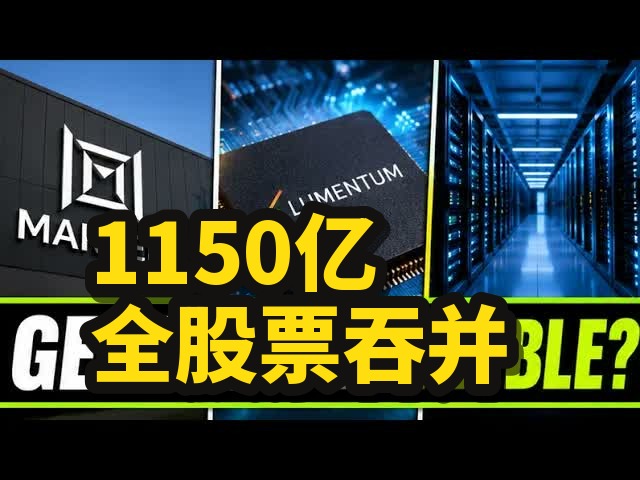
迈威尔拟1150亿美元全股票收购鲁门特姆对标博通 股价重挫25%
浑水摸鱼清源
全股票换股让标的估值随买方股价缩水,漫长的审批整合与套利做空使迈威尔短期恐沦为横盘资产,其多头逻辑完全押注于未来18个月AI资本支出不衰退。
AI-assisted summary of 【The Motley Fool】千亿并购落地 光模块要变天 — original source. Check the original for full context.
Source published:
Key ideas
- 迈威尔科技宣布以1150亿美元全股票收购鲁门特姆,换股比例为1股换4.5股,交易对价随迈威尔股价联动浮动,完成后鲁门特姆股东将持有合并公司约33%股份。 (0:00)
- 鲁门特姆最新季度营收同比大增137%,激光器产能已排产至2029年初;迈威尔意在整合其磷化铟晶圆制造能力,构建端到端光电合封方案以正面对抗博通。 (2:04)
- 该交易面临反垄断审批长跑且商业模式差异显著(无晶圆厂设计融合重资产制造),预计最早于2028年上半年交割,在此期间套利做空压力或导致迈威尔股价持续横盘。 (10:00)
- 针对10月半导体ETF暴跌17%及年轻投资者遭遇50%深度回撤,分析师强调必须严格区分行业外部逆风与企业基本面损坏,并依靠定投增量资金拉长复利周期应对波动。 (16:17)
Detailed notes
## Background 该内容由Bilibili频道“浑水摸鱼清源”于2026年11月3日发布。视频简介聚焦于迈威尔科技(Marvell)拟以1150亿美元全股票收购光器件巨头鲁门特姆(Lumentum)的重磅并购案,剖析了全股票交易机制、直面博通的产业逻辑及市场套利打折效应,并针对10月半导体板块急跌探讨了年轻投资者面对50%回撤时的复盘逻辑与定投复利策略。
## TL;DR 节目深度剖析了迈威尔科技以1150亿美元全股票收购鲁门特姆的里程碑式交易,指出该交易旨在将迈威尔的定制ASIC与DSP芯片同鲁门特姆紧俏的磷化铟光器件代工产能相结合,打造直接抗衡博通的端到端光电互连巨头。由于采取固定换股比例,迈威尔股价下跌约25%致使收购对价浮动缩水,且面临对冲基金套利做空、长达数年的反垄断审批与轻重资产整合阵痛。针对10月半导体ETF暴跌17%及20岁年轻听众遭遇持仓腰斩50%的痛点,分析师结合2008年金融危机等历史教训,阐述了区分“公司底层逻辑破坏”与“行业周期逆风”的评估框架。最终节目倡导年轻投资者切忌在少数高风险成长股上过度暴露,应借助长达数十年的时间优势,通过定期定额投入新资金来享受指数与优质公司的长期复利回报。
## Atmosphere & style 整期节目的氛围兼具深度产业研究的冷静锐利与面向散户投资者的温情抚慰。在分析千亿并购时,嘉宾们语调严密专业,毫不遮掩并购套利、商誉稀释以及宏观AI资本支出可能降温的残酷现实;当转向遭遇腰斩的年轻听众来信时,对话转变为坦诚、共情且富有启迪性的长辈经验谈,分析师毫无包袱地分享自己早年经历2008年暴跌与疫情泡沫时的惊慌失措,让听众在直面冰冷市场波动的焦虑中获得坚定的心理支撑与长期主义视角。
## Bulletin - [00:00](https://www.bilibili.com/video/BV1xz4g66EGM?t=0s) 迈威尔科技宣布以1150亿美元全股票收购鲁门特姆,换股比例为1股换4.5股,交易对价随迈威尔股价联动浮动,完成后鲁门特姆股东将持有合并公司约33%股份。 - [02:04](https://www.bilibili.com/video/BV1xz4g66EGM?t=124s) 鲁门特姆最新季度营收同比大增137%,激光器产能已排产至2029年初;迈威尔意在整合其磷化铟晶圆制造能力,构建端到端光电合封方案以正面对抗博通。 - [10:00](https://www.bilibili.com/video/BV1xz4g66EGM?t=600s) 该交易面临反垄断审批长跑且商业模式差异显著(无晶圆厂设计融合重资产制造),预计最早于2028年上半年交割,在此期间套利做空压力或导致迈威尔股价持续横盘。 - [16:17](https://www.bilibili.com/video/BV1xz4g66EGM?t=977s) 针对10月半导体ETF暴跌17%及年轻投资者遭遇50%深度回撤,分析师强调必须严格区分行业外部逆风与企业基本面损坏,并依靠定投增量资金拉长复利周期应对波动。
## Key takeaways - [00:00](https://www.bilibili.com/video/BV1xz4g66EGM?t=0s) 迈威尔科技提议以1150亿美元全股票收购鲁门特姆,规模远超微软收购动视暴雪及博通收购VMware等历史级并购案。 - [00:35](https://www.bilibili.com/video/BV1xz4g66EGM?t=35s) AI集群数据传输正在逼近铜线物理极限,鲁门特姆的激光器与光器件业务成为数据中心算力扩展的关键物理基础设施。 - [02:44](https://www.bilibili.com/video/BV1xz4g66EGM?t=164s) 迈威尔擅长定制ASIC与数字信号处理器(DSP),吞并鲁门特姆有助于掌握稀缺的磷化铟(InP)晶圆产能并整合光收发模块。 - [05:00](https://www.bilibili.com/video/BV1xz4g66EGM?t=300s) 博通是当前唯一能把定制芯片、激光器和光模块合封打包交付的厂商,迈威尔收购鲁门特姆正是为了打破博通的单点垄断。 - [05:32](https://www.bilibili.com/video/BV1xz4g66EGM?t=332s) AI产业的扩张瓶颈已从芯片架构设计转移至物理制造产能,鲁门特姆至2029年初售罄的产能可帮助云巨头压缩交付等待期。 - [07:13](https://www.bilibili.com/video/BV1xz4g66EGM?t=433s) 交易采用全股票支付方式,每股鲁门特姆换4.5股迈威尔,导致收购实际价值随迈威尔股价下挫25%而大幅缩水至约857美元。 - [10:00](https://www.bilibili.com/video/BV1xz4g66EGM?t=600s) 对冲基金采用典型的风险套利策略——做空收购方迈威尔并买入目标方鲁门特姆,对迈威尔股价形成了持续的下行压制。 - [10:35](https://www.bilibili.com/video/BV1xz4g66EGM?t=635s) 轻资产的无晶圆厂芯片设计商(迈威尔)与重资产的晶圆制造代工厂(鲁门特姆)在业务模式上整合难度巨大且资本开支沉重。 - [12:13](https://www.bilibili.com/video/BV1xz4g66EGM?t=733s) 并购审批最早要到2028年上半年交割,长期监管审查可能使迈威尔股价在未来18个月沦为横盘波动的“死钱”。 - [13:40](https://www.bilibili.com/video/BV1xz4g66EGM?t=820s) 当前折价吸筹迈威尔的核心风险在于对宏观AI资本支出的依赖,一旦云巨头削减支出,其多头估值逻辑将遭受实质打击。 - [16:17](https://www.bilibili.com/video/BV1xz4g66EGM?t=977s) 10月标普500仅微调1%,但半导体ETF暴跌17%,持仓高度集中的成长型投资者往往会经历远超大盘的剧烈回撤。 - [17:38](https://www.bilibili.com/video/BV1xz4g66EGM?t=1058s) 面对50%的深度回撤,首要复盘标准是区分“企业底层逻辑损坏”还是“估值随行业周期受挫”,避免在恐慌中盲目割肉优质资产。 - [20:00](https://www.bilibili.com/video/BV1xz4g66EGM?t=1200s) 从2008年次贷危机(标普跌57%、AIG跌约95%)可知,宽基指数最终能走出约5倍的修复行情,但缺乏护城河的个股可能永久失去本金。 - [20:45](https://www.bilibili.com/video/BV1xz4g66EGM?t=1245s) 亏损50%需要上涨100%才能回本的不对称数学特征,决定了投资者应在年轻阶段坚持以定期定额定投新资金来平滑持仓成本。 - [22:21](https://www.bilibili.com/video/BV1xz4g66EGM?t=1341s) 对于20岁左右的年轻投资者而言,未来40年持续投入增量资本带来的时间复利,远比当前账面承受的浮亏更具决定性意义。
## Detailed walkthrough ### [00:00](https://www.bilibili.com/video/BV1xz4g66EGM?t=0s) Marvell's $115 Billion Mega-Bid for Lumentum
Host John Quas opens *Motley Fool Hidden Gems Investing* alongside analysts Matt Frankel and Rachel Warren, acknowledging that October was a brutal month for tech investors before turning to breaking news that dwarfed recent historic mergers. In tech acquisition history, Microsoft bought Activision Blizzard for $69 billion and Broadcom acquired VMware for $61 billion in 2023. Marvell Technology’s newly announced bid to acquire Lumentum Holdings stands at an eye-popping $115 billion—nearly double the size of those prior benchmark transactions. John notes that despite their massive enterprise scale, both Marvell and Lumentum often fly somewhat under the radar in broader public consciousness.
Matt Frankel shares his perspective, having tracked Lumentum long before it evolved into a pivotal data center infrastructure titan. He explains that traditional electronic data transfer relies on copper wire, but AI workloads are running headfirst into the hard physical limits of electrical signaling. Lumentum engineers and manufactures advanced optical components and lasers that convert electrical signals directly into pulses of light, enabling data to move through server clusters with vastly higher bandwidth, lower latency, and greater energy efficiency. Alongside the merger announcement, Lumentum posted quarterly earnings that underscored why demand has exploded: revenue surged 137% year-over-year in the latest quarter, sequential revenue growth for the fourth quarter is projected at 27%, and the company commands immense pricing power and expanding profit margins.
“And the fact that you even use the phrase $115 billion deal when it comes to Lumentum is still kind of wild to me, because this is one of those stocks that's 10x or more in the AI infrastructure boom,” Matt Frankel observed.
- **Transaction Headline Value**: $115 billion proposed buyout of Lumentum by Marvell. - **Historical Comparison**: Microsoft / Activision Blizzard closed at $69 billion; Broadcom / VMware closed at $61 billion. - **Lumentum Latest Revenue Growth**: 137% year-over-year. - **Lumentum Next Quarter Guidance**: 27% sequential (quarter-over-quarter) growth. - **Core Technology**: Optical lasers and components replacing copper transmission within AI data centers.
---
[02:44](https://www.bilibili.com/video/BV1xz4g66EGM?t=164s) The Hardware Marriage: Custom Silicon Meets Indium Phosphide Fabs
John jokes that Silicon Valley executives are echoing Tom Cruise's Maverick in *Top Gun* with a desperate "need for speed" that only optics can satisfy. Rachel Warren details why Marvell is executing such an aggressive move. Earlier in the year, NVIDIA CEO Jensen Huang publicly remarked that Marvell could become the next trillion-dollar company. Marvell specializes in designing custom Application-Specific Integrated Circuits (ASICs) alongside its crown jewel: Digital Signal Processors (DSPs). These DSPs are specialized silicon chips responsible for translating raw data into pristine electrical pulses before those signals ever hit a laser for optical transmission. Marvell is a primary designer of bespoke AI accelerators for cloud hyperscalers like Amazon Web Services (AWS) and Alphabet's Google.
```mermaid flowchart TD accTitle: Marvell and Lumentum Combined Technology Stack accDescr: Diagram showing how Marvell digital signal processors and ASICs pair with Lumentum indium phosphide laser fabs into integrated optical transceivers.
subgraph MRVL["Marvell Capabilities"] A["Custom AI ASICs<br/>(Tailored for AWS & Alphabet)"] B["Digital Signal Processors (DSPs)<br/>(Clean electrical pulse shaping)"] end
subgraph LITE["Lumentum Manufacturing"] C["Indium Phosphide (InP) Fabs<br/>(Rare specialized wafer material)"] D["Hyperfast Lasers & Optical Transceivers<br/>(Server rack hardware modules)"] end
subgraph Combined["Integrated End-to-End Solution"] E["Single Packaged Optical Engine<br/>(Silicon + Lasers + Modules)"] end
A --> E B --> E C --> D D --> E ```
Lumentum supplies the physical light source that Marvell's processors need. The company operates specialized wafer fabrication plants (fabs) that grow indium phosphide, an exotic and critical semiconductor material essential for producing hyperfast AI lasers. Lumentum packages these lasers into optical transceivers—the physical module boxes lining massive AI server racks. Rachel points out that Lumentum's historical revenue came largely from traditional telecommunications carriers, but management has engineered a complete operational pivot toward cloud hyperscalers. By acquiring Lumentum, Marvell gains captive high-speed optical hardware, positioning itself as an end-to-end alternative for cloud giants looking to avoid single-vendor lock-in.
“So Marvell is the company that earlier this year, NVIDIA CEO Jensen Huang famously said could be the next trillion dollar company,” Rachel Warren highlighted when explaining the scale of Marvell's ambition.
- **Marvell Key Products**: Custom ASICs and Digital Signal Processors (DSPs). - **Marvell Custom Chip Clients**: Alphabet (Google), Amazon Web Services (AWS). - **Lumentum Key Material**: Indium phosphide (InP) grown in dedicated fabrication facilities. - **End Product**: Optical transceivers that slot directly into hyperscale AI server racks. - **Client Base Shift**: Lumentum moved from telecom carrier dependence to cloud hyperscaler dominance.
---
[05:00](https://www.bilibili.com/video/BV1xz4g66EGM?t=300s) Taking on Broadcom and Overcoming Physical Bottlenecks
Broadcom has long held the dominant position in custom AI silicon, boasting deep in-house engineering and packaging capabilities. Matt Frankel notes that in the current market, Broadcom stands alone as the only vendor capable of integrating custom chips, lasers, and optical modules into a single unified package. Furthermore, laser manufacturing capacity is suffering severe shortages across the entire semiconductor supply chain. Lumentum's production lines are already virtually sold out through early 2029. By swallowing Lumentum, Marvell directly secures that captive output, creating a legitimate direct challenger to Broadcom's ecosystem.
Rachel Warren emphasizes that the primary constraint on artificial intelligence infrastructure expansion has shifted away from design architecture toward physical manufacturing output. Cloud hyperscalers are facing lengthy queues to receive hardware. Bringing Lumentum's wafer fabs directly into Marvell's corporate fold allows Marvell to streamline manufacturing, bypass external supply pinches, and drastically compress lead times for hyperscale customers. The analysts also highlight how unusual it is to see a record-breaking acquisition announced during a sharp market drawdown in AI equities.
“It lets Marvell do that, too. So it creates a true alternative to Broadcom. And that's kind of the simple English way of discussing what this does for him,” Matt Frankel explained regarding the strategic consolidation of chip and laser design.
“I mean, one of the things we continue to see is the way that AI growth is really bottlenecked by physical manufacturing capacity, not necessarily design specifications,” Rachel Warren added.
- **Competitive Benchmark**: Broadcom is the sole player currently shipping co-packaged chips, lasers, and optical modules together. - **Lumentum Capacity Backlog**: Manufacturing capacity is essentially fully booked through early 2029. - **Industry Constraint**: AI expansion is throttled by wafer fab manufacturing capacity rather than chip design capabilities. - **Market Dynamics**: Mega-merger announced in the middle of a sharp retreat across speculative AI infrastructure stocks.
---
[07:13](https://www.bilibili.com/video/BV1xz4g66EGM?t=433s) The Mechanics and Risks of an All-Stock Acquisition
Because Marvell does not possess $115 billion in cash reserves, the deal is structured entirely as an all-stock transaction funded through the issuance of new Marvell equity. Under the agreed-upon exchange ratio, Lumentum shareholders will receive 4.5 shares of Marvell common stock for every share of Lumentum they hold. Matt Frankel breaks down how headline takeover numbers can be deceiving: the $115 billion valuation was calculated using Marvell’s pre-rumor share price of $252, which imputed an acquisition price of $1,132 per Lumentum share.
Following the announcement, Marvell's stock suffered a steep sell-off of approximately 25%. With Marvell trading significantly lower, those 4.5 shares are currently worth around $857 rather than $1,132. Matt underscores that an all-stock deal ties the target company's realized buyout value entirely to the acquirer's fluctuating market valuation. Because the payout is fixed in shares rather than nominal dollars, Lumentum shareholders bear the downside risk if market skepticism or arbitrageurs continue to pressure Marvell's equity.
“If Marvell shares, not that I think it will, if they get cut in half from here, the effective acquisition price gets cut in half,” Matt Frankel stated to illustrate the inherent floating price risk in all-stock transactions.
- **Deal Structure**: 100% all-stock transaction; no cash component. - **Exchange Ratio**: 4.5 Marvell shares for each 1 Lumentum share. - **Baseline Terms**: At Marvell's pre-announcement price of $252, Lumentum was valued at $1,132 per share ($115 billion total). - **Current Value Realization**: With Marvell down ~25%, the 4.5 shares equal roughly $857 per Lumentum share. - **Equity Dilution & Floating Risk**: The final buyout value floats directly with Marvell's share price until closing.
[10:00](https://www.bilibili.com/video/BV1xz4g66EGM?t=600s) 全股票收购的架构风险与套利博弈
```mermaid flowchart TD accTitle: 迈威尔全股票收购鲁门特姆交易机制与市场博弈 accDescr: 展示全股票收购中换股稀释、套利交易压力及两类模式整合的复杂流程
subgraph DealStructure["交易架构 (All-Stock Transaction)"] MRVL["迈威尔科技 (Marvell)\n(买方 / 无晶圆厂 Fabless)"] LITE["鲁门特姆 (Lumentum)\n(目标方 / 重资产制造 Foundry)"] MRVL -->|"发行新股 (稀释)"| Combined["合并后新公司"] LITE -->|"换取 33% 股权"| Combined end
subgraph Arbitrage["套利机构博弈 (Merger Arbitrage)"] HedgeFunds["套利对冲基金"] HedgeFunds -->|"做空 (Short)"| MRVL HedgeFunds -->|"买入 (Long)"| LITE MRVL -.->|"压制股价形成阻力"| StockPressure["股价承压 / 估值折价"] end
subgraph IntegrationRisk["长期整合与审批壁垒"] Regulatory["监管审批 (预计持续至 2028 上半年)"] CultureFit["轻资产芯片设计 vs 重资产晶圆代工"] Combined --> Regulatory Regulatory --> CultureFit end ```
在讨论迈威尔(Marvell)收购鲁门特姆(Lumentum)的交易结构时,主持人 Matt 指出,鲁门特姆的股价在交易挂牌待决期间将紧密跟随迈威尔联动。全股票收购虽然是唯一现实可行的方案,但它带来了一种持续性风险——鲁门特姆的股东绝不可能开香槟庆祝拿到所谓每股 1100 美元的现金,全股票交易根本不是这么运作的。分析师补充分析,100% 换股能让迈威尔完好保留其现金储备,避免背负高昂的债务负担(全现金支付在数学上几乎不可能实现),但也意味着两家公司的股东被彻底绑在同一条船上。如果科技板块遭遇全面下跌,双方股东将一同承受资产缩水的下行风险。
此外,迈威尔必须发行巨量新股,导致现有股权严重稀释:若交易顺利通过,鲁门特姆股东将获得合并后新公司整整 33% 的股份。迈威尔此次支付了极高的溢价,而这一溢价完全建立在对未来 AI 爆发性增长的预期之上。尽管鲁门特姆拥有极为充沛的在手订单(Backlog),且对迈威尔的长远扩张至关重要,但两家公司商业模式的碰撞不容忽视——迈威尔一直是一家轻资产的芯片设计公司(Fabless),无须负担庞大的实体厂房开支;鲁门特姆则运营着极其重资产的制造晶圆厂(Foundries),将这种高资本开支模式缝合进迈威尔的生态体系中会带来十分复杂的动态挑战。
在交易公布后,二级市场迅速出现了经典的并购套利(Risk Arbitrage)操作:套利对冲基金通过同时“做空收购方(迈威尔)并买入目标方(鲁门特姆)”来锁定两者的交易价差,这直接对迈威尔的股价构成了持续的压制阻力。同时,这起交易也可能迫使赛道内的次级芯片设计公司为免被边缘化而寻求其他并购标的。更为关键的是时间窗口,该交易预计最早要到 2028 年上半年才能完成交割,横亘在眼前的是复杂的反垄断监管审批,以及漫长的整合消化期,投资者必须做好迈威尔股价长期横盘整固的心理准备。
- 交易方式:100% 股票置换,迈威尔保留现金流并避免高额负债。 - 股权稀释比例:鲁门特姆原股东在合并后公司中将持有高达 33% 的股份。 - 业务模式冲突:无晶圆厂芯片设计(迈威尔)整合重资产制造代工厂(鲁门特姆)。 - 市场套利行为:对冲基金“空买方、多标的”的套利压单导致迈威尔股价持续承压。 - 预期完成时间:最早预计在 2028 年上半年交割。
---
[12:13](https://www.bilibili.com/video/BV1xz4g66EGM?t=733s) 整合期横盘还是“估值打折”买入良机
面对主持人提出的假设——如果监管机构一路开绿灯迅速放行,迈威尔现阶段究竟算不算一个值得买入的投资机会?分析师 Rachel 坦言,即便审批迅速通关,在随后的业务整合期内,该股短期内也很可能横盘整理,甚至表现得如同“死钱”(Dead money)。Rachel 明确肯定迈威尔是一家经营极其出色、资产负债表坚实的优质企业,收购本身也具备战略意义,但整合过程的内在复杂性短期内将持续压制股价表现。不过放眼长期,若一切整合顺利,迈威尔在 2030 年及以后的市场地位将演变为极具威慑力的行业巨擘,其竞争优势将远超今日,进而驱动收入与利润的双重飞跃。
Matt 随后给出了不同维度的评判。他认为“监管秒过”的假设过于乐观,通常企业给出的完成时间表都偏向理想化,即便按 2028 年上半年来看,距离实际交割最理想也有整整 18 个月。迈威尔的股价在交易宣布后已被市场实质性“惩罚”,回撤幅度达到约 25%,然而其底层基本面并未发生任何恶化。从多头逻辑来看,两家公司因换股挂钩而同步交易,投资者现在实际上是在以七五折的优惠价格,同时把两家 AI 基础设施狂潮的核心受益企业收入囊中。
然而,做多逻辑的致命短板在于对宏观环境的依赖:两家公司未来 18 个月的表现高度押注于科技巨头的 AI 资本支出(AI Capex)必须保持高位增长,而企业削减开支的风险始终存在。Matt 据此总结道:“If you liked Marvell two weeks ago, you should like it more today is kind of my takeaway.”(如果两周前你看好迈威尔,那么今天的它对你来说应该更具吸引力,这就是我的结论。)但鉴于交割时间过于漫长,当前将其草率列为强力买入评级仍需保持谨慎。
- 整合期预期:短期内股价或沦为“死钱”并处于横盘阶段,长期(2030年及以后)竞争壁垒大幅提升。 - 估值回撤幅度:消息公布后迈威尔股价下挫约 25%,提供了低位吸筹两家 AI 龙头资产的潜在打折窗口。 - 核心变量依赖:该交易多头逻辑成立的前提是未来 18 个月内全行业 AI 资本支出绝不能出现退潮。
---
[16:17](https://www.bilibili.com/video/BV1xz4g66EGM?t=977s) 听众来信:20岁遭遇50%深度回撤的应对之道
节目的问答互动环节(Mailbag)引入了一组强烈的市场反差数据:在刚刚过去的 10 月份中,标普 500 指数表现稳健,仅微幅回调了约 1%;然而,重仓了诸多顶尖 AI 领头羊的半导体行业 ETF(iShares Semiconductor ETF)单月暴跌达 17%。这种剧烈分化让重仓科技股的普通投资者承受了极其剧烈的净值冲击。
20 岁的年轻听众 Ben 发来邮件倒苦水:他采用无杠杆、不碰期权的纯多头策略,重仓持有一组高风险的成长型个股,但目前的投资组合已经从历史最高点腰斩回撤了约 50%。Ben 向两位嘉宾求助:回想你们人生中第一次遭遇组合腰斩的大回撤时,当时有何反应?事后如何复盘当初的决策?这段经历又怎样彻底重塑了你们如今面对波动与回撤的投资理念?
```mermaid flowchart LR accTitle: 投资组合深度回撤时的决策复盘路径 accDescr: 对比企业基本面与行业外部逆风,决定持股或止损的分流逻辑
Drawdown["遭遇 50% 投资组合深度回撤"] --> CheckCore{"审视底层核心资产\n(Is the business broken?)"}
CheckCore -->|"逻辑未变 / 基本面稳健"| Healthy["收入持续扩张\n利润率提升\n负债水平极低"] Healthy --> HoldAction["克服恐慌、忽略纸面浮亏\n坚定持有熬过波动"]
CheckCore -->|"估值泡沫破裂 / 逻辑损坏"| Broken["纯属超买泡沫\n缺乏内生盈利\n高估值被抹平"] Broken --> SellAction["认清现实、杜绝盲目死扛\n优化配置与仓位结构"] ```
分析师 Rachel 回忆起自己在 COVID 疫情泡沫破裂时遭遇的第一次资产重创。作为一个新手,她当时充满了恐慌与逃避心理,强迫症般地频繁刷新手机行情软件,眼睁睁看着账面资金蒸发,彼时根本无法厘清“账面浮亏(Paper losses)”与“实际割肉亏损(Realized losses)”在本质上的天壤之别。事后复盘,她总结出两个关键教训:第一,她曾将“极度亢奋的投机牛市”误当成了自己的“选股投资能力”,以至于在极端高位买入并无视估值,导致很多即便执行力无可挑剔的好公司也难逃估值腰斩的宿命。
更重要的是对亏损根源的诊断。Rachel 强调:“Was the business broken or was it just that shares were under pressure due to either industry headwinds or other reasons?”(究竟是这家公司的商业底层逻辑坏掉了,还是股价仅仅因为行业逆风或外部因素而承压?)如果一家企业营收依然在稳健增长、盈利能力持续扩张、账面负债极低,且你当初买入的核心逻辑依然完好,那么最佳策略往往是忽略纸面波动坚定持有。针对 Ben 过于集中的投资偏好,Rachel 告诫称,将所有筹码压在少数几只成长股上会带来毁灭性的下行暴露,她现在倾向于用稳健低速的防御性价值股、医疗保健标的以及全行业的高分红股作为压舱石,以此来对冲高成长投资的高波动风险。
- 市场宏观分化:10 月标普 500 指数仅微跌约 1%,但半导体 ETF 深度重挫 17%。 - 听众持仓境况:20 岁年轻投资者 Ben 集中持仓成长股,无杠杆无期权,组合自高位回撤达 50%。 - 心理误区警示:切忌混淆“被大水漫灌推高的牛市”与“真正的价值投资能力”,必须分清账面浮亏与永久性亏损。 - 核心复盘标准:依据“增长、盈利、负债率、买入初衷”四要素判断企业是逻辑损坏还是随大盘受挫。 - 风险控制策略:告别单一重仓极客风格,引入低波动分红股与防御性行业板块建立底层分散机制。
[20:00](https://www.bilibili.com/video/BV1xz4g66EGM?t=1200s) Lessons from the 2008 Financial Crisis: Math of Drawdowns and Index vs. Individual Stocks
Reflecting on Ben’s painful 50% portfolio drawdown, Matt jokes about showing his age by looking back to his own first major market collapse during the 2008 global financial crisis, which hit when he was roughly Rachel’s age. Contextualizing severe market downturns with a historical baseline, Matt notes that between its peak in October 2007 and its ultimate bottom in March 2009, the S&P 500 plummeted 57%. At that time, Matt held shares in major companies that suffered devastating destructions of capital, including insurance giant AIG, which crashed roughly 95%. While he held onto his shares rather than panic selling, he admits to committing a classic novice investor error: remaining entirely on the sidelines throughout the remainder of the downturn instead of continuing to invest. Because his portfolio was small and he was in his late twenties, the financial price tag of that mistake was manageable, but the conceptual lessons proved foundational.
First, Matt unpacks the brutal asymmetry of market mathematics: while a portfolio can drop 50% very quickly, it subsequently requires a 100% gain just to break even. Though that arithmetic works against an investor who holds onto deteriorating businesses, it simultaneously represents enormous forward-looking upside if applied to fundamentally sound companies whose share prices have been battered alongside broader market sentiment. Crucially, Matt highlights the structural divergence between broad market indexes and individual stock pickings. While the S&P 500 has proven resilient over time—eventually recovering and surging approximately 5x since the depths of the 2008 crash—individual equities carry no such guarantees. Certain individual names were wiped out entirely, and legacy institutions such as Citigroup have struggled to ever fully recapture their pre-crisis highs. For a 20-year-old investor like Ben, the primary takeaway is maintaining perspective on capital horizon and differentiating market-wide sector compression from fundamental operational failure.
Matt emphasized the long-term arithmetic of beginning early: “At 20, the money you add and invest over the next 40 years is going to matter far more than what your portfolio is doing today.”
Evaluating the nature of drawdowns, Matt argued: “And one, an index drawdown and an individual stock drawdown are not the same thing.”
- **2007–2009 S&P 500 Historical Drawdown**: Peaked in October 2007 and troughed in March 2009, registering a peak-to-trough decline of 57%. - **S&P 500 Long-Term Recovery**: The broad index has compounded roughly fivefold (~5x) from its March 2009 low. - **AIG 2008 Performance**: Matt held pre-crash shares that collapsed by approximately 95%. - **Mathematical Recovery Rule**: A 50% decline requires a 100% subsequent advance merely to restore initial principal. - **Citigroup Case Study**: Illustrates that unlike diversified market indexes, individual component companies may fail to ever fully reclaim previous historical highs.
```mermaid flowchart TD accTitle: Investor Drawdown Assessment Framework accDescr: Flowchart illustrating how an investor should evaluate a deep portfolio drawdown by differentiating between index recovery, broken businesses, and deploying fresh capital over time.
subgraph Evaluation ["Portfolio Diagnosis"] A["50% Portfolio Drawdown"] --> B{"Evaluate Asset Structure"} B -->|"Broad Index / ETF"| C["Index Historical Precedent<br/>(S&P 500 recovered ~5x from 2008)"] B -->|"Individual Equities"| D{"Fundamental Reality Check"} end
subgraph Action ["Business Health vs. Action"] D -->|"Broken Business / High Debt"| E["Permanent Capital Loss<br/>(e.g., 2008 AIG -95%, Citigroup)"] D -->|"Sound Operations / Growing Cash Flow"| F["Opportunity for 100% Rebound"] C --> G["Deploy Fresh Capital"] F --> G end
subgraph Horizon ["Long-Term Resolution"] G --> H["Decades of Compounding<br/>(40-year horizon eclipses short-term noise)"] end ```
[22:21](https://www.bilibili.com/video/BV1xz4g66EGM?t=1341s) The Motley Fool Principle: Regular Inflows, Compounding, and Long-Term Perspective
The host steps in to reinforce Matt’s advice by underscoring one of the core tenets of The Motley Fool’s investment philosophy: consistently investing new money on a regular schedule. For younger and newer market participants, systematically adding fresh capital achieves two critical objectives. First, it naturally diversifies portfolio holdings across varying price points and market environments without requiring the impossible feat of timing the exact market bottom. Second, it shortens the cash drag by putting capital into productive assets as soon as possible, expanding the runway over which compounding interest can work. Over a multi-decade span—such as 20 or 40 years—the sharp volatility and erratic downswings experienced early on gradually transform into an unmistakable upward and rightward trajectory on the portfolio chart.
Addressing Ben directly with an encouraging “hang in there,” the host emphasizes that navigating through painful market selloffs is an unavoidable part of the lifelong compounding journey. The segment concludes with the program’s standard operational and compliance disclosures: contributors on the broadcast may hold personal financial stakes in the specific stocks discussed, and The Motley Fool may issue formal recommendations for or against individual securities, meaning listeners should never execute investment decisions based exclusively on audio broadcasts. With a word of gratitude directed to producer Dan Boyd and the production crew behind the control-room glass, the hosts sign off until the next broadcast.
The host underlined the central operational habit for surviving bear markets: “One of my favorite things from the Motley Fool investing philosophy is invest new money regularly.”
Highlighting the mechanics of early asset accumulation, the host noted: “The sooner you can get it in there, the longer it has to compound.”
- **The Regular Contribution Advantage**: Regularly channeling fresh savings into equity positions smooths entry prices and accelerates multi-decade compounding. - **Time Horizon Realities**: Early portfolio volatility subsides over 20- to 40-year horizons into a sustained upward trend. - **Compliance and Disclosure**: Hosts and guests may hold active positions in mentioned securities; listener discretion is required rather than trading solely off podcast commentary. - **Production Credits**: Show produced by Dan Boyd alongside the broader Motley Fool studio engineering team.
## Notable quotes > [05:00](https://www.bilibili.com/video/BV1xz4g66EGM?t=300s) AI growth is really bottlenecked by physical manufacturing capacity, not necessarily design specifications — Rachel Warren
> [20:00](https://www.bilibili.com/video/BV1xz4g66EGM?t=1200s) At 20, the money you add and invest over the next 40 years is going to matter far more than what your portfolio is doing today. — Matt Frankel
## Mentioned Marvell Technology, Lumentum Holdings, Broadcom, Microsoft, Activision Blizzard, VMware, NVIDIA, Jensen Huang, Amazon Web Services (AWS), Alphabet (Google), AIG, Citigroup, iShares Semiconductor ETF (SOXX), S&P 500, John Quas, Matt Frankel, Rachel Warren, Dan Boyd, The Motley Fool
## Video description 【The Motley Fool】 千亿并购落地 光模块要变天 Marvell’s Trillion-Dollar Target
|1150亿全股票吞并 迈威尔科技宣布收购鲁门特姆,交易作价1150亿美元,全部用股票支付:每股鲁门特姆换4.5股迈威尔。按迈威尔消息前252美元股价算,对应鲁门特姆每股1132美元;但迈威尔股价已跌到消息前的七五折,4.5股实际只值857美元。也就是说,这笔交易的价码不是固定的,迈威尔跌一半,收购价也跟着腰斩。鲁门特姆股东拿不到现金,只能跟着迈威尔一起涨跌。
|为什么非要买它 鲁门特姆做激光器和光器件,把电信号转成光,让数据中心里的数据跑得更快。铜线传输已到物理极限,AI集群离不开光。它上季度营收同比增137%,下季度指引环比再增27%,产能排到2029年初基本售罄。迈威尔有定制芯片和数字信号处理器,缺的正是激光器这一环。买下它,迈威尔就能像博通一样把芯片、激光器、模块打包交付,给不想被博通绑定的云巨头多一个选择。
|博通才是真对手 博通是眼下唯一能把芯片、激光器和模块设计在一个封装里的玩家,迈威尔这笔交易就是冲着它去的。AI扩张的瓶颈不在设计,在制造产能,鲁门特姆的晶圆厂能缩短 hyperscaler 的等待时间。但整合难度不小:迈威尔是无晶圆厂设计公司,鲁门特姆是重资产制造,两种模式捏在一起需要时间。交易预计最早2028年上半年完成,监管审批路还长,期间迈威尔股价可能横盘甚至拖后腿。
|股价已先跌25% 消息公布后迈威尔跌了约25%,基本面没变,市场先给了惩罚。全股票交易还带来套利盘:做空买方、买入目标方,进一步压价。迈威尔要发行大量新股,交易完成后鲁门特姆股东将持有合并公司33%股份。买贵了没有?按消息前价格算是溢价,按现在价格算是打折买两家AI基础设施受益者。前提是未来18个月AI支出不缩水,这个前提并不牢靠。
|10月半导体跌17% 10月标普500只回调约1%,半导体ETF却跌了17%,持有AI股的散户回撤感更强。一位20岁听众来信:集中持仓成长股,不用杠杆不用期权,从高点回撤约50%,问第一次大回撤该怎么面对。回答很直接:先分清公司出问题还是行业被砸。利润还在增长、负债低、买入逻辑没坏,就熬过去;逻辑坏了,跌一半后要涨100%才回本。分散持仓、别把身家押在一只票上,是更实际的教训。
|定投比抄底靠谱 2008年标普500从2007年10月高点跌57%,2009年3月见底,美国国际集团跌约95%。指数最终涨了约五倍回来,个股却未必,花旗至今没完全恢复。对20岁的人来说,未来40年持续投入的新钱,比今天账户的浮亏重要得多。定期定额买,拉长复利时间,比猜底更有效。
接下来建议的操作指引: 1. 迈威尔科技(MRVL)现价较消息前252美元折约25%,若跌至200美元下方且AI资本开支未下修,可分批建仓,观察2028年上半年交易完成前的监管进展。 2. 鲁门特姆(LITE)股价将跟随迈威尔联动,4.5股换股价值约857美元,溢价收窄至10%以内时套利空间有限,不宜追高。 3. 半导体ETF(SOXX)10月跌17%,若继续回调超20%且成分股营收指引未下调,可用定投方式分批买入,每月固定金额,不猜底。
[0:03] 迈威尔1150亿收购鲁门特姆消息公布 [2:04] 鲁门特姆光器件业务与137%营收增速 [4:05] 迈威尔定制芯片与鲁门特姆晶圆厂整合逻辑 [6:08] 博通是唯一全打包对手 产能售罄至2029年 [8:09] 全股票交易条款 每股换4.5股 [10:10] 换股价随迈威尔下跌缩水 套利盘压价 [12:13] 交易最早2028年上半年完成 监管路长 [14:15] 迈威尔跌25%后是否值得买 [16:17] 10月半导体ETF跌17% 20岁听众回撤50% [18:19] 分清公司出问题还是行业被砸 [20:20] 2008年标普跌57% 美国国际集团跌95% [22:21] 定投新钱 拉长复利时间
[Source](https://www.bilibili.com/video/BV1xz4g66EGM)