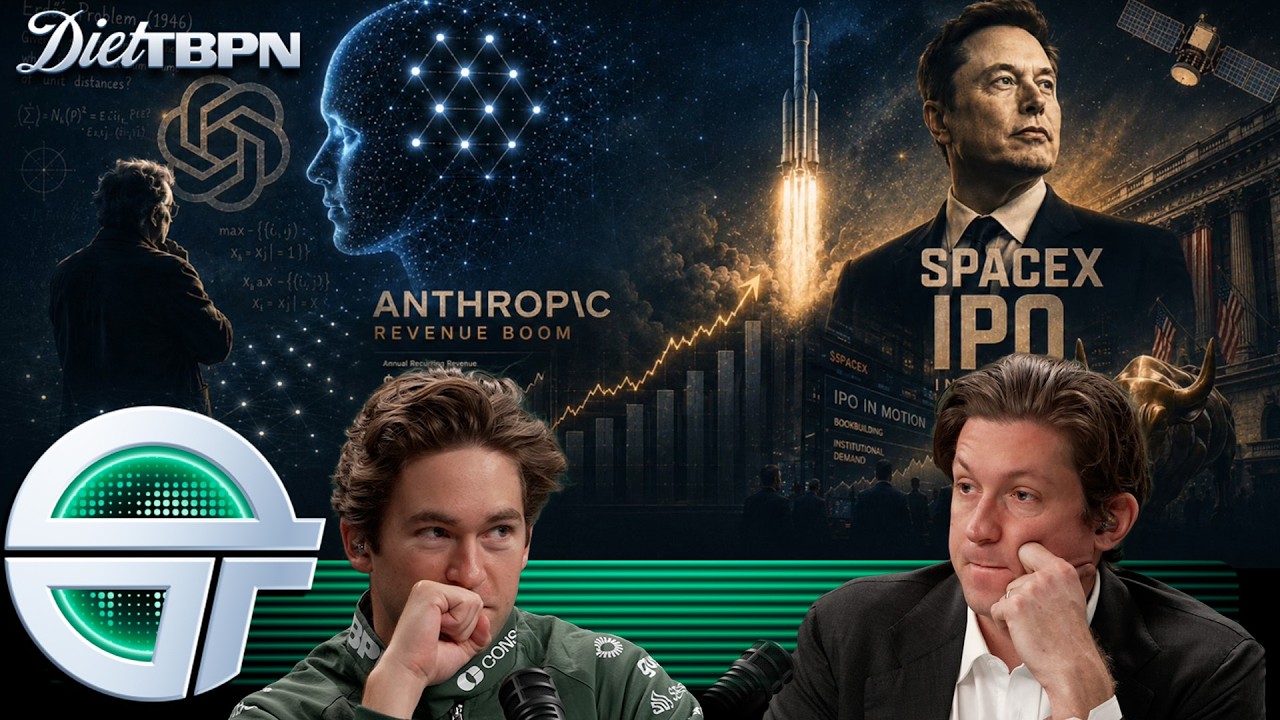
SpaceX S-1 Shows $28.5T Addressable Market as Orbital Compute Spend Triples
TBPN
SpaceX is morphing from a rocket company into an orbital AI neocloud while Anthropic scales GB200 compute on Colossus 2 to deliver its first operating profit.
## Background
This video was published on YouTube by the channel TBPN on May 22, 2026. According to the show notes, the episode covers major tech headlines including SpaceX's S-1 filing, Anthropic's revenue growth, OpenAI's mathematical breakthrough, and Nvidia's earnings.
## TL;DR
The hosts break down a massive news day in tech, starting with SpaceX's $80+ billion IPO filing and its strategic shift toward orbital AI compute, including a major partnership with Anthropic. They highlight Anthropic's surge to $10.9 billion in annualized revenue and discuss OpenAI's general reasoning model solving a famous Erdős combinatorial geometry problem. The episode wraps up with fast-paced coverage of Nvidia's $80 billion buyback, timeline news hits like Moss shutting down, and government equity grants in quantum computing companies.
## Atmosphere & style
The episode carries a high-energy, conversational, and witty vibe typical of tech insiders sharing reaction-filled commentary. The hosts balance sharp financial breakdown and technical analysis with lighthearted banter, poking fun at industry skeptics, viral memes, and funny news hits. It feels like tuning into a dynamic, fast-moving daily tech rundown where huge industry-defining shifts are discussed alongside humor and internet culture.
## Key takeaways
- [00:02](https://www.youtube.com/watch?v=tifRDFch-FA&t=2s) SpaceX has officially set a record-breaking IPO in motion via an S-1 SEC filing, aiming to raise $80 billion or more.
- [00:02](https://www.youtube.com/watch?v=tifRDFch-FA&t=2s) SpaceX's S-1 prospectus outlines a $28.5 trillion Total Addressable Market (TAM) spanning space solutions, connectivity, and enterprise AI opportunities.
- [07:42](https://www.youtube.com/watch?v=tifRDFch-FA&t=462s) SpaceX is shifting into an orbital compute superpower, spending three times more on AI infrastructure than space operations.
- [07:42](https://www.youtube.com/watch?v=tifRDFch-FA&t=462s) SpaceX partnered with Anthropic to provide compute capacity on Colossus 2 clusters using NVIDIA GB200 systems.
- [10:40](https://www.youtube.com/watch?v=tifRDFch-FA&t=640s) Anthropic reached $10.9 billion in annualized Q2 revenue, marking its first operating profit despite widespread AI bear skepticism.
- [15:03](https://www.youtube.com/watch?v=tifRDFch-FA&t=903s) An internal, general reasoning model from OpenAI solved Paul Erdős's decades-old combinatorial geometry problem (Erdős problem 90).
- [15:40](https://www.youtube.com/watch?v=tifRDFch-FA&t=940s) OpenAI's mathematical proof was achieved efficiently with general-purpose inference compute rather than specialized scaffolding.
- [21:57](https://www.youtube.com/watch?v=tifRDFch-FA&t=1317s) Nvidia authorized an $80 billion share buyback program following skyrocketing earnings driven by the expansion of AI agents.
- [21:57](https://www.youtube.com/watch?v=tifRDFch-FA&t=1317s) International football star Lionel Messi's energy drink brand, Moss, is shutting down after 23 months due to retail distribution challenges.
- [24:05](https://www.youtube.com/watch?v=tifRDFch-FA&t=1445s) Media analyst and strategist Matthew Ball has officially joined the leadership team at Xbox.
- [24:05](https://www.youtube.com/watch?v=tifRDFch-FA&t=1445s) The White House awarded $2 billion in tech grants, taking equity stakes in nine quantum computing companies including Rigetti Computing.
## Detailed walkthrough
### [00:02](https://www.youtube.com/watch?v=tifRDFch-FA&t=2s) SpaceX IPO Filing: Financials, TAM, and Wall Street Drama
The show kicks off highlighting a massive tech news day, completely dismantling the narrative that the tech industry has run out of headlines. Front and center across the *Wall Street Journal* is SpaceX, which has officially set its record-breaking initial public offering in motion via an SEC S-1 filing. The company is aiming to raise tens of billions—potentially **$80 billion or more**—as early as June 12th, easily shattering Saudi Aramco’s 2019 record of $26 billion. The hosts engage in light banter about their hosting attire and schedule before diving into the prospectus details, which map out Elon Musk’s ambitious roadmap spanning rocket launches, satellite broadband, and an expanding AI footprint.
Reaction across the industry to the S-1 prospectus has been overwhelmingly positive, with venture capitalists and analysts calling it one of the most entertaining filings in years. The conversation zeroes in on SpaceX's Total Addressable Market (TAM) slide—dubbed "the largest actionable TAM in human history" at an astronomical **$28.5 trillion**. The hosts detail how this total breaks down across various sectors, poking fun at the inclusion of digital advertising while noting the explicit exclusion of China and Russia from the calculations.
On Wall Street, investment banks fought aggressively for prime placement on the transaction. Goldman Sachs secured the coveted lead left book-runner position, beating out Morgan Stanley despite Michael Grimes returning to Morgan Stanley in part to land the deal. Early backers like Luke Nosek—who co-founded Founders Fund alongside Peter Thiel before launching Gigafund specifically to double down on SpaceX—are highlighted as huge winners, proving the massive upside of high-conviction investing.
* **Key S-1 Financials & Metrics:** Reported **$18.67 billion** in revenue last year, with an employee headcount reaching over **22,000 workers** as of March 31st.
* **Quantifiable TAM Breakdown ($28.5 Trillion Total):**
* **$370 billion** in space-enabled solutions
* **$1.6 trillion** in connectivity (**$870 billion** Starlink broadband + **$740 billion** Starlink mobile)
* **$26.5 trillion** in total AI opportunities (**$2.4 trillion** AI infrastructure, **$760 billion** consumer subscriptions, **$600 billion** digital advertising, plus enterprise and government applications)
* **Fair Value Estimates:** Analyst predictions generated via Codex place SpaceX's fair value baseline between **$1.1 trillion and $1.5 trillion**, with a bull case stretching to **$1.7 trillion to $1.9 trillion**.
[00:07](https://www.youtube.com/watch?v=tifRDFch-FA&t=7s) SpaceX’s Pivot to Orbital Compute and the Anthropic Partnership
The prospectus reveals a fundamental strategic shift: SpaceX's capital expenditure on AI infrastructure now triples its spend on space operations, effectively transitioning the enterprise from a pure rocket and satellite provider into an orbital compute superpower. A centerpiece of this narrative is SpaceX's massive partnership with Anthropic. To meet its escalating infrastructure demands, Anthropic is scaling up compute capacity on SpaceX’s Colossus 2 clusters, spending heavily on frontier hardware like NVIDIA's GB200 systems. This contract instantly elevates SpaceX into one of the largest "neocloud" providers overnight.
The hosts reflect on how Elon Musk orchestrated this narrative shift over the past year. What started as floating concepts around space data centers alongside investors like Gavin Baker late last year has evolved into a masterclass in capital aggregation and tactical execution—combining rocket launch capacity, satellite networking, and heavy AI infrastructure under one roof.
> "Just reading the SpaceX SEC document, one thing that sticks out is the capital spend on AI is 3X that on space. It's an AI company with some rockets." — **Peter Hage**
[10:40](https://www.youtube.com/watch?v=tifRDFch-FA&t=640s) Anthropic’s Revenue Boom and the AI Profitability Debate
Turning to major AI sector news, Anthropic posted staggering financial results, with Q2 revenue surging over 200% quarter-over-quarter to reach an annualized **$10.9 billion**. Crucially, the company is set to post its first operating profit, dealing a heavy blow to skeptics who argued frontier AI models could never turn a profit. Anthropic co-founder Tom Brown publicly acknowledged their expanding relationship with SpaceX, noting that they are scaling GB200 capacity on Colossus 2 throughout June to "find good homes for the Claudes."
The hosts contrast this explosive growth against notorious AI bears like Gary Marcus, who declared in early 2026 that generative AI was a "scam." Pointing to dynamic pricing power, enterprise workflow adoption, and commentary from industry figures like Sam Altman and Dylan Patel, the hosts argue that critics who dismissed AI during the NFT or Metaverse hype failed to realize the tangible economic value and immediate utility that models deliver directly to users.
* **Anthropic Growth Highlights:** Valuation is up **173%** since the start of the year; Q2 sales surged **130%** over the previous quarter, driven by enterprise adoption and high willingness-to-pay for frontier model outputs.
* **Market Contrast:** While skeptics predicted a plateau due to data walls or compute limits, leading frontier labs are demonstrating clear pathways to profitability by replacing complex human workflows at a fraction of the cost.
[15:03](https://www.youtube.com/watch?v=tifRDFch-FA&t=903s) OpenAI Cracks the Erdős Problem
The conversation shifts to a breakthrough announced by OpenAI's Noam Brown. A general-purpose internal OpenAI model successfully solved a long-standing, famous problem in combinatorial geometry posed by legendary mathematician Paul Erdős—achieving the feat outright without needing an external scaffolding system.
The hosts highlight how rapidly AI capabilities are compounding. Less than a year ago, frontier models were celebrating gold-medal-level performance on International Mathematical Olympiad (IMO) problems. Now, general-purpose systems are solving unhandled, historical mathematical research problems. The discussion transitions to analysis by Tyler Cowen on what this mathematical breakthrough signals for the broader trajectory of automated scientific discovery and model reasoning capabilities.
<ElicitationsGroup message="Where would you like to go next?">
<Elicitation label="Summarize Part 2 of this episode" query="Please provide a detailed, faithful walkthrough of Part 2 of this transcript."/>
<Elicitation label="Deep dive into SpaceX's TAM breakdown" query="Can you break down and analyze the feasibility of SpaceX's $28.5 trillion TAM claims from the S-1?"/>
</ElicitationsGroup>
[15:40](https://www.youtube.com/watch?v=tifRDFch-FA&t=940s) OpenAI Solves an Erdős Math Problem
The hosts dive into a massive development out of OpenAI, which Terence Tao called "incredible": an AI model has officially solved a decades-old, legendary math problem proposed by Paul Erdős. They kick things off by joking about a tweet from Sidharth Ramesh, who claimed to have lost a \$30,000 bet that AI would never solve the planar unit distance problem. While they clarify the bet was just a joke, the community's surprise and excitement are very real. Paul Erdős proposed over 1,200 of these "Erdős problems" throughout the 20th century. While AI has previously contributed to iterative or collaborative solutions alongside human mathematicians, this marks a monumental "step change." This isn't a case of an AI simply unearthing an obscure, unindexed paper on the web; it is a genuinely new, novel solution.
The specific issue tackled was Erdős problem number 90, which asks: does every set of $n$ distinct points in the real plane contain at most $n^{1 + o(1)/\log \log n}$ many pairs which are one unit apart? To make it intuitive, the hosts break down how points on a 2D plane can be organized to maximize the number of pairs that sit exactly one unit distance apart. If you naively place $n$ points in a straight line, the number of unit-distance pairs scales as $n - 1$. If you arrange them in a square grid, the diagonal lines don't count, meaning a grid of 9 points yields 12 pairs, scaling linearly at $2n$. The best configuration previously known is the "lattice construction," a highly intricate grid featured on the OpenAI blog where the number of pairs scales at $n^{1 + o(1)/\log \log n}$. While mathematicians knew this lattice worked as a lower bound, the absolute upper bound was theorized to scale with $n^{4/3}$. Erdős originally conjectured that the true upper bound would remain strictly less than $n^{1 + o(1)}$ as $n$ approaches infinity. OpenAI proved this wrong, demonstrating that for infinitely many values of $n$, the maximum number of pairs is actually greater than Erdős's conjecture.
What makes this particularly thrilling for the tech world is that OpenAI didn't use a specialized math model; it was achieved via an internal, general reasoning model, prompting the hosts to label it "generally intelligent." Furthermore, it didn't require millions of dollars in compute or an overwhelming avalanche of tokens. Instead, it was remarkably token-efficient, costing only "hundreds to thousands of dollars of inference compute." This runs counter to the idea that AI can only innovate by brute-forcing massive connections. The AI produced an entirely original 18-page proof that mathematicians believe could be applied to solve other complex problems. The hosts compare this breakthrough to an "AlphaFold moment," signaling a true leap forward in AI's native mathematical capabilities.
- Paul Erdős proposed over 1,200 mathematical problems in the 20th century.
- The breakdown of unit distance configurations: a straight line yields $n - 1$ pairs, a basic square grid scales to $2n$, and the complex lattice construction scales at $n^{1 + o(1)/\log \log n}$.
- OpenAI disproved the original Erdős conjecture by showing the max number of pairs can be greater than $n^{1 + o(1)}$ for infinitely many values of $n$.
- The resulting academic proof is 18 pages long.
---
[21:57](https://www.youtube.com/watch?v=tifRDFch-FA&t=1317s) Nvidia Earnings, AI Agents, and Timeline Hits
The conversation shifts to a torrent of other major tech news that almost got buried. Rumors are swirling that OpenAI is closing in on an IPO fund filing, an event so massive it managed to push Nvidia's latest jaw-dropping financial results off the absolute front page. Driven by the explosive rise of AI agents, Nvidia's earnings have skyrocketed. The biggest headline from the report is a massive \$80 billion share buyback authorization. Tech commentator Take-Him expressed immense bullishness regarding Nvidia's positioning, laying out a highly convincing case for the company's sustained dominance in an interview that aired the previous day on TBPN.
The hosts then scroll through their digital timeline to highlight rapid-fire news hits, starting with a humorous calculation inspired by DJ Khaled. Khaled posted about finding a \$10 bill and taking five seconds to pick it up, which the hosts jokingly calculate translates to a wild "\$63 million in annualized ARR." In actual business news, the beverage brand Moss—a copycat of the popular Prime energy drink backed by international football icon Lionel Messi—is fully shutting down after just 23 months in business. The hosts speculate that despite Messi's global fame, the venture likely succumbed to the intense logistical friction of scaling retail distribution and international supply chains country-by-country, proving that you can't just drop a physical product on Amazon and expect it to manage itself.
Next up is a viral, contrarian piece of financial advice from Mitchell Baldridge. While most financial experts recommend platforms like Fidelity or Charles Schwab for their low fees, Baldridge explicitly tells his clients to open a Vanguard account. His reasoning is brilliantly simple: Vanguard's user interface is notoriously awful. Because the app is so frustrating and difficult to use, clients are discouraged from making impulsive, emotional trades, a forced long-term holding strategy that has reportedly "made his clients millions."
- Nvidia authorized a massive \$80 billion share buyback program following a surge in revenue driven by AI agents.
- Lionel Messi's energy drink brand, Moss, is shutting down completely after 23 months.
- Financial advisor Mitchell Baldridge advocates using Vanguard specifically because its poor interface prevents over-trading.
---
[24:05](https://www.youtube.com/watch?v=tifRDFch-FA&t=1445s) AI Data Center Memes, Matthew Ball Joins Xbox, and Quantum Grants
To close out the episode, the hosts share a hilarious viral video sketch depicting a group of people playing the board game Settlers of Catan with a billionaire. In the video, which uses an uncanny face filter, the billionaire player drops a piece and declares, "My turn? I'm going to put down a data center." When the other players protest that it is against the rules, the billionaire retorts, "How else am I supposed to AI generate my Christmas card?" He then doubles down on the satire by trying to spend seven water resources to power it. The sketch perfectly encapsulates the brewing cultural anxiety and media focus surrounding the immense water consumption of modern AI infrastructure. The hosts note the irony that the public is hyper-focused on water cooling rather than data centers utilizing natural gas turbines, colorfully observing that "water's delicious and electricity is vague and abstract," making water a much easier resource for people to visualize. They put the consumption into perspective by noting that running dozens of LLM queries every single day for an entire year consumes about the same amount of water as the energy required to grow "a single almond."
Shifting to the gaming industry, the hosts enthusiastically congratulate author and media analyst Matthew Ball on his new role at Xbox. Praising him as one of their favorite thinkers with a "fantastic mind for the future of technology," they express deep optimism for Microsoft's gaming division. Take-Him heavily endorsed the move on social media, calling the hire a "literal game changer" that makes him the most bullish he has been on the Xbox brand in seven years.
Finally, they cover a major geopolitical tech play: the White House is awarding \$2 billion in technological grants. Notably, \$1 billion of that sum is being funneled through IBM to nine distinct quantum computing companies. In a fascinating twist, the government is taking an equity stake in exchange for the funding. The hosts joke that the American taxpayer now officially owns "a basket of quantum computing companies," pointing out that Rigetti Computing saw its stock jump 30% on the news. They wrap up the show with some lighthearted banter when one host accidentally calls the company "Spaghetti Computing," laughing that it sounds like a nickname Donald Trump would coin on the campaign trail, before signing off for the weekend.
- The environmental impact of AI is put into perspective: dozens of daily LLM queries for a year equate to the resource footprint of producing a single almond.
- Renowned tech theorist Matthew Ball has officially joined the Xbox team.
- The U.S. government is distributing \$2 billion in grants, with \$1 billion going to nine quantum computing firms in exchange for direct equity stakes.
- Rigetti Computing's stock surged 30% following the White House announcement.
## Notable quotes
> [07:42](https://www.youtube.com/watch?v=tifRDFch-FA&t=462s) Just reading the SpaceX SEC document, one thing that sticks out is the capital spend on AI is 3X that on space. It's an AI company with some rockets. — Peter Hage
> [10:40](https://www.youtube.com/watch?v=tifRDFch-FA&t=640s) find good homes for the Claudes. — Tom Brown
> [00:02](https://www.youtube.com/watch?v=tifRDFch-FA&t=2s) the largest actionable TAM in human history
> [15:40](https://www.youtube.com/watch?v=tifRDFch-FA&t=940s) an AI model has officially solved a decades-old, legendary math problem proposed by Paul Erdős.
> [15:40](https://www.youtube.com/watch?v=tifRDFch-FA&t=940s) incredible — Terence Tao
> [15:40](https://www.youtube.com/watch?v=tifRDFch-FA&t=940s) hundreds to thousands of dollars of inference compute.
> [15:40](https://www.youtube.com/watch?v=tifRDFch-FA&t=940s) AlphaFold moment
> [21:57](https://www.youtube.com/watch?v=tifRDFch-FA&t=1317s) $63 million in annualized ARR.
> [24:05](https://www.youtube.com/watch?v=tifRDFch-FA&t=1445s) My turn? I'm going to put down a data center.
> [24:05](https://www.youtube.com/watch?v=tifRDFch-FA&t=1445s) How else am I supposed to AI generate my Christmas card?
> [24:05](https://www.youtube.com/watch?v=tifRDFch-FA&t=1445s) water's delicious and electricity is vague and abstract
> [24:05](https://www.youtube.com/watch?v=tifRDFch-FA&t=1445s) a single almond.
> [24:05](https://www.youtube.com/watch?v=tifRDFch-FA&t=1445s) literal game changer — Take-Him
> [24:05](https://www.youtube.com/watch?v=tifRDFch-FA&t=1445s) a basket of quantum computing companies
SpaceX's landmark S-1 filing, Anthropic's surge to profitability, and OpenAI's resolution of an Erdős conjecture reflect a rapid convergence of space infrastructure, massive capital expenditure, and advanced artificial intelligence reasoning.
SpaceX's S-1 and Orbital Compute Pivot (0:02)
SpaceX has formally initiated an initial public offering seeking to raise $80 billion or more as early as June 12th, aiming to surpass Saudi Aramco's $26 billion record. The prospectus details $18.67 billion in revenue last year, a headcount exceeding 22,000 workers as of March 31st, and an estimated fair value baseline between $1.1 trillion and $1.5 trillion, with a bull case reaching up to $1.9 trillion. The filing outlines a total addressable market (TAM) of $28.5 trillion—explicitly excluding China and Russia—which includes $370 billion in space solutions, $1.6 trillion in Starlink connectivity, and $26.5 trillion in total AI opportunities. Goldman Sachs secured the lead left book-runner position over Morgan Stanley.
The prospectus indicates that SpaceX's capital expenditure on AI infrastructure now triples its spending on space operations. Through a partnership with Anthropic, SpaceX is deploying NVIDIA GB200 systems across its Colossus 2 compute clusters, effectively repositioning the aerospace firm as a major neocloud and orbital compute provider.
Anthropic Revenue Growth and Frontier AI Margins (10:40)
Anthropic reported an annualized revenue run rate of $10.9 billion following a Q2 revenue surge exceeding 200% quarter-over-quarter, moving the company toward its first operating profit. The company's valuation has increased by 173% since the start of the year, supported by enterprise adoption and high customer willingness to pay for frontier model outputs. Co-founder Tom Brown confirmed the firm is expanding GB200 capacity on SpaceX's Colossus 2 infrastructure.
The hosts contrast these metrics with arguments from AI skeptics who anticipated technical plateaus or structurally unprofitable business models. Commercial demand for automated workflows and dynamic pricing power are cited as evidence that frontier labs can generate sustained economic value while replacing complex corporate tasks at reduced costs.
OpenAI's Breakthrough on the Erdős Conjecture (15:40)
OpenAI announced that an internal, general-purpose reasoning model solved Erdős problem number 90, a longstanding open question in combinatorial geometry regarding unit distances between points in a plane. Paul Erdős originally conjectured that the upper bound for unit-distance pairs among n distinct points would remain strictly less than n^(1 + o(1)) as n approaches infinity. OpenAI disproved the conjecture by demonstrating that the maximum number of pairs can exceed that bound for infinitely many values of n, publishing an original 18-page proof.
Mathematician Terence Tao described the result as incredible. Unlike prior AI mathematical contributions that required external scaffolding or specialized training, the breakthrough was achieved by a general model without brute-force computation, consuming only hundreds to thousands of dollars in inference compute. Observers note the event signals a shift from competitive benchmark solving to autonomous mathematical research.
Hardware Buybacks, Quantum Grants, and Industry Moves (21:57)
Substantial capital flows continue to reshape the broader tech landscape. Nvidia authorized an $80 billion share buyback following earnings propelled by enterprise adoption of AI agents, while rumors circulate regarding an OpenAI IPO fund filing. In public policy, the White House announced $2 billion in technology grants, allocating $1 billion through IBM to nine quantum computing companies in exchange for direct government equity stakes, which led to a 30% stock surge for Rigetti Computing.
Additional corporate shifts include analyst Matthew Ball joining Microsoft's Xbox division. In consumer retail, Lionel Messi's energy drink venture Moss ceased operations after 23 months, illustrating the operational hurdles of scaling physical distribution and international supply chains compared to software models.
While commercial AI labs demonstrate accelerating revenues and genuine reasoning milestones, questions remain around the realism of multi-trillion-dollar market projections and the unprecedented infrastructure spending required to sustain them.
## Background
本期视频由科技商业播客频道 TBPN 于 2026 年 5 月 23 日发布在 YouTube 平台。页面简介提供了 TBPN 每日通讯订阅及各大社媒、播客收听渠道链接,并以时间戳形式列举了当期涵盖 SpaceX 递交 S-1 招股书、Anthropic 营收暴增扭亏为盈、OpenAI 攻克埃尔德什数学难题以及英伟达财报等超级科技热点的内容大纲。
## TL;DR
节目全面复盘了科技圈的重磅动态:SpaceX 正式递交 S-1 招股说明书拟筹资 800 亿美元冲刺史上最大 IPO,凭借 28.5 万亿美元的夸张 TAM 及与 Anthropic 的百亿级大单,展现出向 AI 轨道算力转型的惊人野心;Anthropic 凭借环比暴增的营收实现盈利,彻底击碎了生成式 AI 无法商业化的质疑,同时 OpenAI 通用推理模型以极低算力成本独立攻破悬而未决的埃尔德什第 90 号平面单位距离难题,被誉为数学界的“AlphaFold 时刻”;此外,主播们还快速扫描了英伟达 800 亿美元股票回购、大众对数据中心耗水的认知偏差、先锋领航的防剁手 UI,以及白宫 20 亿美元战略入股量子计算产业等前沿资讯。
## Atmosphere & style
整期节目呈现出一种高信息密度与轻松互损并存的极客谈话氛围,语速飞快且情绪高昂。两位主播在西装穿搭调侃与导播幽默打趣中开场,既能对万亿美元估值模型、复杂拓扑组合几何进行深入浅出的专业拆解,又能无缝切换至卡坦岛 AI 梗图与“意面计算”的谐音梗打闹。听众在沉浸于前沿科技突破带来的心潮澎湃之余,亦能在辛辣讽刺与欢快笑声中轻松领略硅谷当下的狂飙脉搏。
## Bulletin
- [01:11](https://www.youtube.com/watch?v=tifRDFch-FA&t=71s) SpaceX 正式向 SEC 提交 S-1 招股书,计划最快于 6 月募资超 800 亿美元,估值或达 1.5 万亿至 2 万亿美元,有望刷新人类历史最大规模 IPO 纪录。
- [07:07](https://www.youtube.com/watch?v=tifRDFch-FA&t=427s) SpaceX 宣布在 AI 领域的资本支出已达太空业务的 3 倍,并与 Anthropic 达成每年超百亿美元的算力基建合作,推动其向全球新型云服务巨头转型。
- [10:40](https://www.youtube.com/watch?v=tifRDFch-FA&t=640s) Anthropic 预计第二季度营收达到 10.9 亿美元,环比暴增超 130% 并实现历史性营业利润,有力反击了生成式 AI 无法盈利的质疑。
- [14:40](https://www.youtube.com/watch?v=tifRDFch-FA&t=880s) OpenAI 宣布其通用推理模型在无脚手架辅助下独立攻克了著名组合几何难题“埃尔德什第 90 号平面单位距离问题”,被誉为数学界的 AlphaFold 时刻。
- [26:01](https://www.youtube.com/watch?v=tifRDFch-FA&t=1561s) 白宫推出 20 亿美元量子计算扶持计划,其中 10 亿美元投向 IBM,其余分配给 Rigetti 等初创企业,政府通过换取股权成为战略股东。
## Key takeaways
- [01:11](https://www.youtube.com/watch?v=tifRDFch-FA&t=71s) SpaceX 提交招股说明书(S-1),拟筹集 800 亿美元甚至更多,拟于 6 月 12 日前后上市,将大幅超越沙特阿美创下的历史 IPO 纪录。
- [03:15](https://www.youtube.com/watch?v=tifRDFch-FA&t=195s) 招股书中测算的潜在市场空间(TAM)高达 28.5 万亿美元,其中 26.5 万亿美元归属于 AI 相关基础设施与服务,且明确排除了中俄市场。
- [05:17](https://www.youtube.com/watch?v=tifRDFch-FA&t=317s) 高盛击败摩根士丹利拿下 SpaceX IPO 牵头经办人席位;早期重注 SpaceX 的 Gigafund 及其创始人 Luke Nosek 成为风投领域最大赢家。
- [07:07](https://www.youtube.com/watch?v=tifRDFch-FA&t=427s) SpaceX 发生激进的业务重心转移,其 AI 资本支出已是太空发射业务的 3 倍,借助与 Anthropic 的巨额合作迅速蜕变为新型云服务巨头。
- [09:33](https://www.youtube.com/watch?v=tifRDFch-FA&t=573s) 马斯克在过去一年有条不紊地铺垫“太空数据中心”叙事,并先后整合 Cursor、Anthropic 等生态,展现了极强的商业做局与资源调度能力。
- [10:40](https://www.youtube.com/watch?v=tifRDFch-FA&t=640s) Anthropic Q2 营收激增至 10.9 亿美元并跨过扭亏为盈拐点,证明顶尖大模型在大幅降低企业人力成本的同时具备强大的商业定价权。
- [12:31](https://www.youtube.com/watch?v=tifRDFch-FA&t=751s) 尽管 Gary Marcus 等怀疑论者坚称生成式 AI 是泡沫,但 AI 提供的直观实用价值和快速兑现的财务回报,与以往的 NFT 和元宇宙炒作有着本质区别。
- [14:40](https://www.youtube.com/watch?v=tifRDFch-FA&t=880s) OpenAI 凭借未经针对性调优的通用推理模型破解埃尔德什第 90 号难题,标志着 AI 在严谨科学推演和原创性数学证明上取得质的飞跃。
- [18:22](https://www.youtube.com/watch?v=tifRDFch-FA&t=1102s) 该埃尔德什难题的破解过程仅耗费数百至数千美元的推理算力,其极高 Token 效率和创新性证明引发了包括陶哲轩在内的顶尖数学家的高度赞誉。
- [21:57](https://www.youtube.com/watch?v=tifRDFch-FA&t=1317s) 英伟达在强劲的 AI 智能体算力需求推动下通过 800 亿美元股票回购授权,但亮眼财报罕见地被 SpaceX 与 OpenAI 的重磅头条所掩盖。
- [24:05](https://www.youtube.com/watch?v=tifRDFch-FA&t=1445s) 公众对数据中心耗水表现出极高的敏感性与抵触,但往往忽视了体量更大且更为抽象的电网负荷与天然气能源消耗。
- [24:05](https://www.youtube.com/watch?v=tifRDFch-FA&t=1445s) 知名科技产业学者 Matthew Ball 重返微软 Xbox 团队,被视作 Xbox 近年来最具潜力的战略转折点。
- [26:01](https://www.youtube.com/watch?v=tifRDFch-FA&t=1561s) 白宫出资 20 亿美元战略补贴量子计算产业并直接换取企业股权,带动了以 Rigetti 为代表的量子计算概念股盘中暴涨。
## Detailed walkthrough
### [00:00](https://www.youtube.com/watch?v=tifRDFch-FA&t=0s) 科技新闻大爆发与两位主持人的着装打趣
节目在一场密集的科技新闻轰炸中拉开帷幕。主持人感叹,外界此前总说科技行业已经缺乏新鲜事,但事实恰恰相反——各大 AI 公司正为了登上《华尔街日报》等顶级商业媒体的头版争得不可开交,而 SpaceX 凭借重磅披露的首次公开募股(IPO)申请文件牢牢占据了头版头条,正式启动了可能筹集数百亿美元的历史性上市倒计时。
现场随即陷入一段轻松幽默的互损打趣中。导播 Ryan 在提词板上调侃 Jordy 居然连续两天穿得如此正式,Jordy 则笑着反驳自己已经几个月没连续两天这样穿了。两人谈到媒体对他们节目的报道时表示,外界经常分不清他们谁是谁,因此通过穿衣风格进行“品牌差异化”其实很有好处——一人选择更加休闲舒适的风格,另一人则穿得规规矩矩、西装革履,正好形成互补。
### [01:11](https://www.youtube.com/watch?v=tifRDFch-FA&t=71s) 史上最大 IPO 启程:SpaceX 的财务数据与传奇历程
SpaceX 正式向美国证券交易委员会(SEC)提交了投资者招股说明书(S-1),揭示了 CEO 埃隆·马斯克(Elon Musk)计划如何扩张这家致力于推动太空及地球前沿科技的庞大帝国。该文件标志着 SpaceX 最快可能在下个月通过股票发售筹集 800 亿美元甚至更多资金,市场传闻的挂牌日期可能在 6 月 12 日,距离当前仅剩大约 20 天。若这一规模成真,它将大幅超越沙特阿美(Saudi Aramco)在 2019 年上市时创下的 260 亿美元融资纪录,问鼎人类历史上规模最大的 IPO。
招股书清晰展现了马斯克宏大的愿景——从发射海量人工智能卫星到实现火星殖民。这家总部位于得克萨斯州的公司业务多元,横跨火箭发射、星链卫星运营,以及正在全力追赶对手的初创 AI 业务。回望近 25 年前成立之初,SpaceX 只是一家仅有寥寥数名员工且数次濒临破产的初创公司,如今已成长为全球估值最高的非上市公司之一,截至 3 月 31 日员工总数已超过 2.2 万人,掌握着即便连竞争对手甚至主权国家都无法完全匹敌的技术壁垒。文件显示其去年总营收达 186.7 亿美元。虽然 Axios 的知名科技记者 Dan Primack 发文认为该业务规模略低于预期,但业内对这份 S-1 的整体评价极高,投资者 Kevin Kwok 甚至称其为“很长一段时间以来最令人享受的 S-1 读物”,行文流畅得宛如科幻小说。
- 潜在募资规模:800 亿美元或更高,远超沙特阿美 260 亿美元的历史纪录。
- 预计上市时间:市场传闻最快为 6 月 12 日左右。
- 团队规模:截至 3 月 31 日,员工人数突破 22,000 人。
- 财务数据:去年全年营收录得 186.7 亿美元。
### [03:15](https://www.youtube.com/watch?v=tifRDFch-FA&t=195s) 28.5 万亿美元:人类商业史上最夸张的 TAM 图表
在这份 S-1 中,最引发轰动的是一张堪称“史上最夸张”的潜在市场空间(TAM)测算图。SpaceX 在文件中直接宣称:“我们相信公司已经明确了人类历史上最大规模的可执行潜在市场总额。”根据其测算,公司可量化的 TAM 高达惊人的 28.5 万亿美元。
```mermaid
flowchart TD
accTitle: SpaceX TAM Breakdown
accDescr: SpaceX 招股说明书中测算的 28.5 万亿美元潜在市场总额分布图
subgraph TAM["SpaceX 预估可量化 TAM 总额:28.5 万亿美元"]
direction TB
subgraph SpaceGroup["太空与网络连接"]
S1["太空赋能解决方案<br/>3,700 亿美元"]
S2["星链宽带:8,700 亿美元"]
S3["星链移动端:7,400 亿美元"]
S4["企业与政务市场增量机会"]
S1 --- S2 --- S3 --- S4
end
subgraph AIGroup["AI 核心领域:26.5 万亿美元"]
A1["AI 基础设施<br/>2.4 万亿美元"]
A2["消费者订阅业务<br/>7,600 亿美元"]
A3["数字广告市场<br/>6,000 亿美元"]
A1 --- A2 --- A3
end
end
```
两位主持人围绕这组不可思议的数字展开了热烈吐槽与拆解。除了相对好理解的太空及通信业务,占据绝大头的居然是 26.5 万亿美元的 AI 板块。主持人打趣道,其他数据或许在未来 25 年到 100 年的通胀或技术周期里还有一定依据,但让旗下包含 X(前推特)在内的生态去拿下 6,000 亿美元的数字广告份额,实在让人不敢苟同。更耐人寻味的是,SpaceX 在预估全人类市场规模时,明确将中国和俄罗斯排除在外。主持人调侃称,在未来数十年的漫长岁月里,万一世界实现和平、大家成为伙伴,这庞大的 TAM 还能再往上扩一扩,世界和平甚至有了直接的经济动力。此外,招股书开篇附带了大量极具视觉震撼力的精美独家照片,随后才进入密集的数据与法务文字。
### [05:17](https://www.youtube.com/watch?v=tifRDFch-FA&t=317s) 投行激战与风投最大赢家:高盛拔得头筹与 Gigafund 的坚守
这笔超级巨单的承销竞争同样充满戏剧性。高盛(Goldman Sachs)成功击败摩根士丹利(Morgan Stanley),拿下牵头经办人(Lead Left)的核心席位。尽管知名银行家 Michael Grimes 重回摩根士丹利的部分原因正是为了促成该交易,摩根士丹利最终也入围了联合账簿管理人团队,但由高盛掌舵仍被视为华尔街的一场大胜。投资圈甚至发推致敬那位为了抢下主承销席位而“被残酷献祭”的高盛初级分析师,毕竟这不仅是史上最庞大、结构最复杂的超级 IPO,更意味着其直接对接的客户是要求极其严苛且激进的马斯克。
在风投机构方面,早期的坚定支持者迎来了回报时刻。曾经与彼得·蒂尔(Peter Thiel)共同创立 Founders Fund 的 Luke Nosek 成为最大的赢家之一。当年他离开 Founders Fund 创立了 Gigafund,最初的成立初衷正是为了专注于为马斯克的 SpaceX 持续筹集资金,并长期担任 SpaceX 董事。尽管 Gigafund 随后也投资了其他优秀项目,但在 SpaceX 多个轮次中的深度参与和超高专注度,成为了风险投资史上罕见的集中下注范例,印证了“真正的信念才能带来超额回报”。
### [07:07](https://www.youtube.com/watch?v=tifRDFch-FA&t=427s) 疯狂的估值逻辑:AI 轨道算力转型与 Anthropic 超级大单
关于 SpaceX 上市后的合理估值区间,分析师 Sid Lansky 测算其公允价值大约在 1.1 万亿至 1.5 万亿美元之间;如果假定与 Anthropic 的合作牢固、AI 基建利润率稳健、星舰(Starship)彻底打开全新市场空间并叠加二级市场的狂热情绪,乐观情景下可达到 1.7 万亿至 1.9 万亿美元。但若市场直接给出 2 万亿美元以上的估值,意味着投资者在星链的高估值之外,凭空给其“AI 轨道算力”(AI Orbital Compute)故事赋予了 8,000 亿到 1 万亿美元的溢价。
招股书中最震撼的实质性商业进展,莫过于 SpaceX 与 Anthropic 达成的庞大合作协议——Anthropic 每年向 SpaceX 支付的算力基础设施费用高达上百亿美元。对于去年营收才 186.7 亿美元的 SpaceX 而言,这笔合作相当于一夜之间将其推上了全球最大新型云服务商(Neo Cloud)的王座。由于传统算力极其紧缺,Anthropic 愿意支付远高于传统云服务商的价格来锁定算力。知名科技观察者 Peter Hage 读完 SEC 文件后指出,一个最颠覆认知的细节在于:SpaceX 当前在 AI 领域的资本支出(CapEx)已经是其太空业务的整整 3 倍。主持人感叹,在经历了 15 到 20 年的纯火箭发射公司、以及依托发射能力顺理成章孵化出星链卫星互联网之后,SpaceX 竟然在最后关头完成了极为疯狂的“压哨转型”——它如今本质上已经变成了一家“披着火箭外衣的 AI 算力巨头”。
### [09:33](https://www.youtube.com/watch?v=tifRDFch-FA&t=573s) 埃隆·马斯克的“运筹大局”与太空数据中心叙事
随着星链(Starlink)被迅速应用在飞机和各种全新场景中,马斯克麾下业务的落地速度快得惊人;而 xAI 的超级计算机 Colossus 虽然名义上是一家独立公司,其扩张规模也同样呈指数级膨胀。两位主持人回顾了过去一年里埃隆·马斯克及其投资人团队的一连串精妙布局:从去年底(大约 12 月)到今年初,整个科技圈突然步调一致地开始热炒“太空数据中心”(Space Data Centers)概念,甚至连科技投资人加文·贝克(Gavin Baker)等人也纷纷公开摇旗呐喊。
这不仅是在为后续潜在的高估值试水,更是在系统性地搭建属于马斯克的 AI 宏大叙事。紧接着,马斯克团队向 Cursor 抛出橄榄枝,随后又化干戈为玉帛,与此前关系极度紧张的 Anthropic 达成了重磅合作。主持人们感叹,马斯克之所以能聚集如此庞大的资本帝国,核心就在于他是全世界公认“最擅长布局做局(making plays)的人”,为了推进目标,他总是能不惜一切代价调动所有资源。
### [10:40](https://www.youtube.com/watch?v=tifRDFch-FA&t=640s) Anthropic 营收暴增即将扭亏为盈,AI“无法盈利论”彻底破产
紧接着登场的是登上《华尔街日报》头版的重磅炸弹:Anthropic 营收暴涨,第二季度销售额预计将达到 109 亿美元,环比上一季度暴增 130%,并有望首次实现营业利润。《华尔街日报》在报道链接中直接用“令人瞠目的增长”(mind-blowing growth)来形容 Anthropic 惊人的商业化执行力。Anthropic 联合创始人汤姆·布朗(Tom Brown)随后发文证实双方合作深化,表示整个 6 月他们都在 Colossus 2 上扩大 GB200 算力集群的部署规模,并戏称“感谢埃隆·马斯克及其团队帮我们给 Claudes(克劳德们)找到了一个好家”。主持人在此忍不住打趣:Claude 原来是个复数吗?以前总以为只有一个 Claude,Anthropic 的使命就是让 Claude 造出更强的 Claude,如今看来是成千上万个 Claude 实例正并发运行在无数块 GB200 服务器上。
随着 Anthropic 第二季度营收预计环比暴增超 200% 并跨过盈利门槛,长期唱衰“生成式 AI 永远无法实现商业盈利”的质疑群体彻底陷入了狼狈境地。半导体与 AI 分析师迪伦·帕特尔(Dylan Patel)此前在播客节目中就曾推演过:顶尖模型由于为客户创造了极其惊人的经济价值,最终必然拥有强大的提价权。OpenAI 首席执行官萨姆·奥尔特曼(Sam Altman)此前也公开过一张工作流对比表:原本需要企业耗费上千美元雇佣人力完成的繁重业务,改用 AI 之后能以十分之一、百分之一甚至更低的成本交付同等水准的成果,哪怕只是节省 30% 的开销,对企业而言也是不可抗拒的经济账。
- **Anthropic 核心业绩指标**:Q2 预期营收达到 10.9 亿美元(部分推算显示增长超 130% 至 200%),历史性实现营业利润。
- **算力基础设施合作**:Anthropic 采购并扩建基于 xAI Colossus 2 算力中心的英伟达 GB200 服务器集群。
### [12:31](https://www.youtube.com/watch?v=tifRDFch-FA&t=751s) 加里·马库斯的质疑、科技泡沫创伤与 AI 的真实价值
网络博主 Lisan al Gaib 发帖讽刺长期持怀疑论立场的加里·马库斯(Gary Marcus):在 2026 年 2 月 23 日,马库斯居然还在 Substack 上发文坚称“事实证明生成式 AI 就是一场骗局”。主持人直言看到这个日期时大为震惊——如果这是在 2024 年写下的,大家或许还能理解,毕竟当时人们还在讨论算力瓶颈、数据墙(data wall)或应用场景受限;但在 2026 年模型创造真实价值迎来最狂暴加速期的当下,居然还能写出这种断言,实在令人费解,甚至好奇他接下来是否还会继续嘴硬死扛。
主持人们剖析了这种顽固怀疑情绪背后的心理动因:过去的加密货币狂潮,尤其是 NFT 和所谓的“元宇宙”(Metaverse),彻底搞崩了很多人的认知框架。当年元宇宙被鼓吹会摧毁好莱坞和传统电影产业,结果大众从未在其中获得过哪怕一次真正“震撼人心”的日常体验;苹果推出 Apple Vision Pro 时,人们也曾陷入为期一周的群体亢奋(Vision Pro psychosis),但狂热退去后往往缺乏实际效用。相比之下,生成式 AI 完全不可同日而语,任何普通人如今在各种各样的平台与工具中,都能极其直观地获得颠覆性的智能体验,这种商业落地与价值兑现让唱衰者不攻自破。
```mermaid
flowchart TD
accTitle: 历次科技炒作浪潮与 AI 落地价值对比
accDescr: 对比 NFT、元宇宙与生成式 AI 在用户体验和实际价值交付上的核心差异
subgraph HypeWithoutValue["过往科技概念炒作"]
NFT["NFT 浪潮<br/>(炒作概念破灭)"]
Metaverse["元宇宙 / VR<br/>(高昂门槛,缺乏杀手级日常体验)"]
VisionPro["Vision Pro 短暂狂热<br/>(首周亢奋后热度衰退)"]
end
subgraph GenAIRealValue["生成式 AI 真实爆发"]
DirectExperience["极低门槛的震撼体验<br/>(全民随时随地可调用)"]
EconomicRoi["极高的经济投资回报<br/>(企业成本直降 30%~99%)"]
SurgingRevenue["商业模型闭环<br/>(Anthropic 首度实现盈利)"]
end
NFT -.-> Skepticism["催生创伤后遗症<br/>(马库斯等坚信一切皆是泡沫)"]
Metaverse -.-> Skepticism
DirectExperience --> EconomicRoi --> SurgingRevenue
```
### [14:40](https://www.youtube.com/watch?v=tifRDFch-FA&t=880s) OpenAI 突破性解出埃尔德什几何难题,AI 迈入数学前沿
将怀疑论者的言论与当下残酷的现实对比,反差尤为刺眼:今年以来 Anthropic 估值上涨 173% 且正式扭亏为盈,OpenAI 估值上涨 67%,更震撼的是,OpenAI 宣布其通用模型在没有脚手架(without a scaffold)辅助的情况下,独立攻克了一道悬而未决多年的著名埃尔德什数学难题。OpenAI 研究员诺姆·布朗(Noam Brown)公开宣布,其内部研发的通用模型在组合几何领域最具代表性的难题上取得了里程碑式的突破,并感慨:“不到一年前,前沿 AI 模型才刚刚达到国际数学奥林匹克竞赛(IMO)金牌水平,预计未来这种进步速度还将继续保持。”
对于这道难题被攻克,学界与科技圈掀起了巨大震动。AI 领域从业者西达尔特·拉梅什(Sidharth Ramesh)还开玩笑称“我打赌 3 万美元 AI 绝不可能解出平面单位距离问题,这下我输惨了”。长期以来,人们总怀疑 AI 在数学领域的进展是水分大于实质——比如模型只是协助人类数学家做协作推导,或者只是在冷门文献库中扒出了一篇未被主流数据库收录的旧论文从而造成了“AI 解出难题”的错觉。但这一次截然不同,OpenAI 的模型展现出了真正的代际飞跃,给出了极具原创性的全新证明方法。
### [16:01](https://www.youtube.com/watch?v=tifRDFch-FA&t=961s) 深度拆解:埃尔德什第 90 号平面单位距离问题
随后,主持人详细拆解了这道由传奇数学家保罗·埃尔德什(Paul Erdős)提出的核心问题。埃尔德什在 20 世纪一生提出过 1200 多道极具洞察力的数学难题,常被学界视作检验 AI 高阶推理能力的终极试金石。本次被攻克的是著名的埃尔德什第 90 号难题——平面单位距离问题(Planar Unit Distance Problem)。该问题可以表述为:在实数二维平面上的任意 $n$ 个互不相同的点集,它们之间相距恰好为 1 个单位距离的点对数量,其最大上限是否受限于 $n^{1 + o(1/\log\log n)}$?
主持人用直观通俗的方式讲解了这道题的几何本质:设 $u(n)$ 为二维平面上 $n$ 个点所能构成的单位距离点对的最大数量。
- **直觉与朴素排列(单一直线)**:如果将 $n$ 个点排成一条间距为 1 的直线,对于 4 个点而言,单位距离点对只有 3 个;推广到 $n$ 个点,点对数仅为 $n - 1$。即使放置 10 亿个点,点对数也只是线性增长的 $n - 1$ 个。
- **网格排列(正方形网格)**:如果尝试将点分布在正方形二维网格中,例如取 9 个点排成 $3 \times 3$ 的方阵,相邻单位距离的点对数会增加到 12 个。虽然网格结构提高了交织度,但在渐进尺度上,它依然只是线性阶数。
如何打破平凡的线性下界、寻找最优的点集拓扑构型并精准证明其理论上限,正是这一经典组合几何难题数十年来困扰顶尖数学家的核心所在,而通用 AI 模型直接在此领域取得了突破性进展。
### [18:22](https://www.youtube.com/watch?v=tifRDFch-FA&t=1102s) OpenAI 攻克埃尔德什(Erdős)数学难题与通用推理的“AlphaFold 时刻”
在探讨 OpenAI 解决的这道著名数学难题时,主播们详细拆解了问题的几何本质。从简单的网格说起:如果是最基础的正方形网格,点对之间的单位距离数量大约是 $2n$(比如 10 亿个点大约对应 20 亿对单位距离的点,因为对角线距离大于 1,不计入在内)。但数学家们在此基础上设计了极其复杂的“点阵构造”(lattice construction)。主播展示了 OpenAI 官方博文中的示意图,那是一张密密麻麻、线条交错的精密网格图,其中的单位距离点对数量远多于基础网格的边缘连线,其规模达到 $n^{1 + c/\log \log n}$。这是人类此前已知表现最好的下界构造,但数学界一直无法确立其严格的上下界。
争议的核心在于保罗·埃尔德什(Paul Erdős)几十年前提出的经典猜想。数学家们此前推测其理论上界可能在 $n^{4/3}$ 左右,而埃尔德什最初猜想其上界始终小于 $n^{1 + o(1)}$(当 $n$ 趋近于无穷大时,$o(1)$ 趋向于 0)。OpenAI 的推理模型却成功推翻了这一猜想,证明了存在无穷多个 $n$,使得最大点对数严格大于埃尔德什猜想的界限(即大于 $n^{1 + \text{常数}}$)。这一突破在数学界引发轰动,连著名数学家陶哲轩(Terence Tao)都惊呼:“这太不可思议了(Wow, this is incredible)。”
主播们重点强调了该成果的技术意义:这并非专门训练的数学专用模型,而是 OpenAI 内部通用推理模型的涌现能力,可以说是“真正意义上的通用智能”。更引人注目的是其极高的 Token 效率(Token-efficient),这次求解并没有耗费数百万美元的庞大推理算力,大约仅花费了数百到数千美元的推理计算成本。它完全不同于暴力搜索所有可能性的做法,而是提出了一种全新的创新思路,并产出了一篇长达 18 页、被顶级数学家认可具有普适价值的严谨论文。主播感叹,这堪称数学界的“AlphaFold 时刻”,标志着 AI 解决人类顶尖科学难题能力的阶跃。
- **核心数学猜想**:打破了埃尔德什关于单位距离点对最大数量的经典猜想,为无穷多个 $n$ 构造出了超越原界限的反例。
- **推理成本**:仅耗费几百至数千美元的推理算力,而非数百万美元的大规模暴力堆叠。
- **成果形式**:产出一篇长达 18 页的严格数学证明,具有广泛的应用潜力。
---
### [21:57](https://www.youtube.com/watch?v=tifRDFch-FA&t=1317s) 英伟达亮眼财报被 AI 头条淹没与 800 亿美元股票回购
尽管处于财报季的核心期,但因为关于 OpenAI 筹备提交 IPO 申请的重磅传闻铺天盖地,英伟达(Nvidia)最新一季堪称炸裂的业绩居然罕见地被挤下了科技头条。主播感叹,现在的 AI 新闻密度实在太大,连英伟达的狂飙业绩都无法长期占据头版。
在这份财报中,英伟达因 AI Agent(智能体)的全面爆发再次实现业绩暴涨,而最引人注目的资本动作莫过于董事会通过的高达 800 亿美元的股票回购授权。主播提到前一天节目中关于英伟达投资价值的深入讨论,分析嘉宾拿出了极具说服力的多头逻辑,坚信在 AI 算力与智能体普及的大潮下,英伟达依然拥有无可匹敌的统治力。
- **资本动作**:英伟达宣布高达 800 亿美元的股票回购计划。
- **核心驱动力**:AI Agents 的崛起与算力消耗推动业绩持续超出华尔街预期。
---
### [22:38](https://www.youtube.com/watch?v=tifRDFch-FA&t=1358s) 社交动态盘点:DJ Khaled 的 ARR 逻辑、梅西饮料停产与先锋领航的防剁手 UI
在浏览社交网络动态时,主播们分享了一系列科技与商业圈的趣味话题。首先是说唱歌手 DJ Khaled 的一段荒谬商业算法:他捡到了一张 10 美元钞票,耗时 5 秒,按此速率年化折算出的年经常性收入(ARR)居然高达 6300 万美元。主播调侃道:“这正是你在做商业规划时必须具备的前瞻性思维。”
随后话题转向了足球巨星梅西推出的能量饮料品牌 Más+(被普遍视为模仿网红饮料 Prime 的竞品)。该品牌在运营仅仅 23 个月后就宣布全面关闭。主播分析认为,虽然梅西拥有无可比拟的全球知名度,但跨国铺设实体零售渠道与物流供应链的难度极大,远不是直接丢到亚马逊平台上卖爆那么简单,不同国家的渠道壁垒往往是消费品出海的巨大陷阱。
接着,知名财经博主 Mitchell Baldridge 给出了一条看似反常识的理财建议:推荐投资者使用先锋领航(Vanguard)账户,而不是 Fidelity 或嘉信理财(Schwab)。虽然 Vanguard 历来以低费率闻名(播客节目 Acquired 刚做过其专题),但 Baldridge 推荐的真实原因却令人捧腹——“因为 Vanguard 的交易界面做得奇丑无比、难用至极,导致你登录进去根本不想做任何交易”。正是这种极其反人性的糟糕 UI,成功管住了散户盲目买卖的双手,帮他的客户们守住了数以百万计的被动投资财富。
---
### [24:05](https://www.youtube.com/watch?v=tifRDFch-FA&t=1445s) 卡坦岛 AI 梗图、数据中心耗水争议与 Matthew Ball 重返 Xbox
节目接着播放了一段讽刺 AI 狂潮的搞笑视频《与亿万富翁玩卡坦岛(Catan)》。视频中加了滑稽的 AI 换脸滤镜,一名富豪玩家在棋盘上霸道地放下了一座巨大的数据中心模型。当对手抗议“这完全违反规则”时,他理直气壮地反驳:“不建数据中心,我怎么用 AI 生成全家福圣诞贺卡?”当对手指责数据中心挡住了整片地皮时,富豪反问:“你是不是那些环保组织派来的带薪抗议者?”紧接着在下一回合,富豪直接抓起 7 张水资源卡投给数据中心,对手抓狂喊道:“规则里根本没有这种资源!”富豪反诘:“那我拿什么来给数据中心降温?”
```mermaid
flowchart LR
accTitle: 数据中心公众认知偏差与资源争议
accDescr: 对比大众对数据中心水资源消耗的敏感性与对庞大电力消耗的无感
subgraph Perception["公众认知"]
A["水资源消耗"] --> B["具象感知:一杯水、一颗杏仁<br/>易触发恐慌与抗议"]
C["电力/天然气消耗"] --> D["抽象感知:电网、燃气轮机<br/>公众缺乏直观概念"]
end
subgraph Reality["产业现实"]
E["大规模数据中心"] --> A
E --> C
end
```
主播由此深入探讨了当前公众对数据中心资源的魔幻认知:大众对“耗水”极其敏感,甚至演变成激烈的线下抗议,但对体量大得多的天然气轮机和电力负荷却缺乏感知。究其原因,是因为“水”是具体可感的日常之物(大家能清晰脑补出一杯水,甚至有测算称狂问 LLM 一整年的耗水仅相当于吃一颗杏仁),而“电网”和“电池”对普通人来说过于抽象无形。主播调侃道:“千万别提醒反对者天然气的事,不然我们在给他们提供抗议弹药。”
随后,主播宣布了一则令游戏圈振奋的消息:知名元宇宙与游戏产业分析学者、畅销书作者 Matthew Ball 宣布重返微软 Xbox 团队。主播对此赞不绝口,认为 Matthew Ball 拥有对前沿技术和游戏生态最敏锐的洞察力,他的回归是 Xbox 近七年来最令人看好的关键转折点,并表示将尽快邀请他做客 TBPN 节目。
---
### [26:01](https://www.youtube.com/watch?v=tifRDFch-FA&t=1561s) 白宫 20 亿美元量子资助计划与“意大利面计算”(Rigetti)谐音梗
在节目的尾声,主播梳理了白宫最新宣布的 20 亿美元量子计算扶持计划。其中 10 亿美元将直接流向 IBM,其余资金分配给另外 9 家量子计算初创企业。特别值得注意的是,美国政府在此次补贴中要求换取这些公司的股权份额。主播指出,这意味着美国纳税人将实质性地持有一揽子具有战略价值的量子计算企业股权,使其从纯粹的政府财政补贴转变为具备主权投资性质的战略入股。
聊到资本市场反应时,一名主播口误打趣称“Spaghetti Computing(意面计算)今天暴涨了 30%”,搭档随即纠正:“那不是意面计算,是里盖蒂量子计算(Rigetti Computing, NASDAQ: RGTI)!向 Rigetti 致敬!”两人就这个谐音梗互相调侃,戏称听起来像是特朗普会起的绰号,最后在打闹与叫喊声中欢快地结束了当期节目录制。
- **政府资助**:白宫向 9 家量子计算企业拨付 20 亿美元资助,其中 IBM 独揽 10 亿美元。
- **股权条款**:政府以股权投资的形式介入,美国纳税人将实质持有量子计算公司组合的股权。
- **市场动向**:受利好刺激,量子计算概念股(如 Rigetti Computing)股价大幅上扬 30%。
## Notable quotes
> [03:15](https://www.youtube.com/watch?v=tifRDFch-FA&t=195s) 我们相信公司已经明确了人类历史上最大规模的可执行潜在市场总额。 — SpaceX
> [01:11](https://www.youtube.com/watch?v=tifRDFch-FA&t=71s) 很长一段时间以来最令人享受的 S-1 读物 — Kevin Kwok
> [10:40](https://www.youtube.com/watch?v=tifRDFch-FA&t=640s) 感谢埃隆·马斯克及其团队帮我们给 Claudes(克劳德们)找到了一个好家 — Tom Brown
> [12:31](https://www.youtube.com/watch?v=tifRDFch-FA&t=751s) 事实证明生成式 AI 就是一场骗局 — Gary Marcus
> [14:40](https://www.youtube.com/watch?v=tifRDFch-FA&t=880s) 不到一年前,前沿 AI 模型才刚刚达到国际数学奥林匹克竞赛(IMO)金牌水平,预计未来这种进步速度还将继续保持。 — Noam Brown
> [14:40](https://www.youtube.com/watch?v=tifRDFch-FA&t=880s) 我打赌 3 万美元 AI 绝不可能解出平面单位距离问题,这下我输惨了 — Sidharth Ramesh
> [18:22](https://www.youtube.com/watch?v=tifRDFch-FA&t=1102s) Wow, this is incredible — Terence Tao
> [22:38](https://www.youtube.com/watch?v=tifRDFch-FA&t=1358s) 因为 Vanguard 的交易界面做得奇丑无比、难用至极,导致你登录进去根本不想做任何交易 — Mitchell Baldridge
> [24:05](https://www.youtube.com/watch?v=tifRDFch-FA&t=1445s) 不建数据中心,我怎么用 AI 生成全家福圣诞贺卡? — 富豪玩家
> [24:05](https://www.youtube.com/watch?v=tifRDFch-FA&t=1445s) 那我拿什么来给数据中心降温? — 富豪玩家
> [24:05](https://www.youtube.com/watch?v=tifRDFch-FA&t=1445s) 千万别提醒反对者天然气的事,不然我们在给他们提供抗议弹药。 — 主持人
> [26:01](https://www.youtube.com/watch?v=tifRDFch-FA&t=1561s) 那不是意面计算,是里盖蒂量子计算(Rigetti Computing, NASDAQ: RGTI)!向 Rigetti 致敬! — 主持人
## Mentioned
TBPN, Jordy, Ryan, SpaceX, Elon Musk, SEC, Saudi Aramco, Axios, Dan Primack, Kevin Kwok, Goldman Sachs, Morgan Stanley, Michael Grimes, Founders Fund, Peter Thiel, Luke Nosek, Gigafund, Sid Lansky, Starlink, Starship, Anthropic, Claude, Peter Hage, xAI, Colossus, Colossus 2, Gavin Baker, Cursor, Tom Brown, Nvidia, GB200, The Wall Street Journal, Dylan Patel, OpenAI, Sam Altman, Lisan al Gaib, Gary Marcus, Apple Vision Pro, Noam Brown, Sidharth Ramesh, Paul Erdős, Terence Tao, DJ Khaled, Lionel Messi, Más+, Prime, Mitchell Baldridge, Vanguard, Fidelity, Charles Schwab, Acquired, Matthew Ball, Microsoft Xbox, White House, IBM, Rigetti Computing
## Video description
Sign up for TBPN’s daily newsletter at TBPN.com
Follow TBPN:
https://TBPN.com
https://x.com/tbpn
https://open.spotify.com/show/2L6WMqY3GUPCGBD0dX6p00?si=674252d53acf4231
https://podcasts.apple.com/us/podcast/technology-brothers/id1772360235
https://www.youtube.com/@TBPNLive
Chapters:
00:00 SpaceX IPO Filing, Suits & the Biggest Tech News Day
01:11 SpaceX Prospectus: Financials, TAM, Goldman & VC Winners
07:42 SpaceX’s AI Pivot, Anthropic Partnership & Orbital Compute
10:40 Anthropic Revenue Surge, AI Profitability & Gary Marcus Skepticism
15:03 OpenAI Solves an Erdős Math Problem
21:57 Nvidia Earnings, AI Agents & $80B Buyback
22:38 Timeline Hits: Moss Shutdown, Vanguard & $10 Bill ARR
24:05 AI Data Center Memes, Matthew Ball Joins Xbox & Quantum Grants
[Source](https://www.youtube.com/watch?v=tifRDFch-FA)
Source quotes
[3:15] SpaceX: 我们相信公司已经明确了人类历史上最大规模的可执行潜在市场总额。
[1:11] Kevin Kwok: 很长一段时间以来最令人享受的 S-1 读物
[10:40] Tom Brown: 感谢埃隆·马斯克及其团队帮我们给 Claudes(克劳德们)找到了一个好家
[12:31] Gary Marcus: 事实证明生成式 AI 就是一场骗局
[14:40] Noam Brown: 不到一年前,前沿 AI 模型才刚刚达到国际数学奥林匹克竞赛(IMO)金牌水平,预计未来这种进步速度还将继续保持。
[14:40] Sidharth Ramesh: 我打赌 3 万美元 AI 绝不可能解出平面单位距离问题,这下我输惨了
[18:22] Terence Tao: Wow, this is incredible
[22:38] Mitchell Baldridge: 因为 Vanguard 的交易界面做得奇丑无比、难用至极,导致你登录进去根本不想做任何交易
[24:05] 富豪玩家: 不建数据中心,我怎么用 AI 生成全家福圣诞贺卡?
[24:05] 富豪玩家: 那我拿什么来给数据中心降温?
[24:05] 主持人: 千万别提醒反对者天然气的事,不然我们在给他们提供抗议弹药。
[26:01] 主持人: 那不是意面计算,是里盖蒂量子计算(Rigetti Computing, NASDAQ: RGTI)!向 Rigetti 致敬!
Source quotes
[7:42] Peter Hage: Just reading the SpaceX SEC document, one thing that sticks out is the capital spend on AI is 3X that on space. It's an AI company with some rockets.
[10:40] Tom Brown: find good homes for the Claudes.
[0:02] the largest actionable TAM in human history
[15:40] an AI model has officially solved a decades-old, legendary math problem proposed by Paul Erdős.
[15:40] Terence Tao: incredible
[15:40] hundreds to thousands of dollars of inference compute.
[15:40] AlphaFold moment
[21:57] $63 million in annualized ARR.
[24:05] My turn? I'm going to put down a data center.
[24:05] How else am I supposed to AI generate my Christmas card?
[24:05] water's delicious and electricity is vague and abstract
[24:05] a single almond.
[24:05] Take-Him: literal game changer
[24:05] a basket of quantum computing companies
[24:05] Spaghetti Computing
Original transcript
[0:02] We have a massive show. There's so much
[0:05] tech news. People said the technology
[0:08] industry, they were out of news. They
[0:10] weren't. There's plenty of tech news.
[0:12] >> All over the Wall Street Journal. AI
[0:14] companies are duking it out for prime
[0:17] placement in the journal. SpaceX got top
[0:20] billing in the journal with the IPO
[0:23] filing. SpaceX sets its IPO in motion.
[0:26] The SEC filing starts move to raise 10
[0:30] tens of billions of dollars in record
[0:31] debut. We've talked about this a lot on
[0:33] the show. Clock is officially ticking on
[0:35] SpaceX's huge stock offering. What are
[0:38] you laughing about?
[0:39] >> Ryan says, "I knew Jordy
[0:40] >> [laughter]
[0:40] >> would do this two days in a row."
[0:42] Did I not do two days in a row?
[0:43] >> Nope. Haven't done two days in a row in
[0:45] months.
[0:47] We can roll the tape. I I mean, after
[0:49] reading the that that that piece about
[0:51] us, I feel like some brand
[0:53] differentiation is actually to our
[0:55] benefit since some people can't tell us
[0:56] apart. And so, I I I've become a fan of
[1:00] the the the the the split in
[1:03] >> of casual Friday Thursday.
[1:05] >> Of just a of a casual look over there,
[1:07] more buttoned-down, buttoned-up,
[1:09] buttoned left and right over here.
[1:10] >> to be buttoned-up.
[1:11] >> Someone's got to do it. Uh SpaceX on
[1:13] Wednesday revealed new details about how
[1:15] it's it's a about its financials and how
[1:18] chief executive officer Elon Musk will
[1:21] try to grow a sprawling enterprise
[1:23] dedicated to advancing cutting-edge
[1:25] technologies in space and back on Earth.
[1:27] The company disclosed the information in
[1:28] an investor prospectus. This publication
[1:30] of the document sets SpaceX on course to
[1:33] potentially raise 80 billion or more
[1:35] from a stock sale as soon as next month.
[1:38] Uh the rumored date is what? June? July?
[1:41] >> Was it June 12th?
[1:42] >> June 12th. That's just 20 days away,
[1:45] basically. They're going to beat out
[1:46] Saudi Aramco that raised 26 billion when
[1:49] it went public in 2019.
[1:52] Musk has touted out-of-this-world
[1:53] objectives for the company from
[1:55] deploying a huge number of of artificial
[1:58] intelligence satellites in the future to
[2:00] colonizing Mars. Texas-based SpaceX has
[2:03] distinct businesses ranging from rocket
[2:05] launch to satellite operations to a
[2:07] nascent AI unit that is racing to catch
[2:09] up with rivals founded by Musk nearly a
[2:11] quarter century ago. Yeah, it has been a
[2:14] long time. SpaceX revolutionized the
[2:16] commercial space industry. The company
[2:18] has grown from a startup with a handful
[2:20] of employees that almost went out of
[2:22] business to one of the world's most
[2:23] valuable private companies with over
[2:25] 22,000 workers as of March 31st. It
[2:29] controls technologies that competitors
[2:30] and even nation-states haven't been able
[2:32] to fully match. SpaceX reported its
[2:34] revenue last year at 18.67
[2:37] billion and Dan Primack had a post
[2:40] saying that the business was smaller
[2:42] than he expected. He's going on CNBC
[2:43] today to talk about the IPO. He's had a
[2:46] couple interesting takes. People are
[2:47] going back and forth. The overall the
[2:49] reception has been the S1 is an
[2:50] extremely enjoyable read. Kevin Kwok
[2:53] says it's the most enjoyable S1 read in
[2:54] a long time. Reads so easy like sci-fi
[2:57] or fiction and uh
[3:00] >> [laughter]
[3:01] >> It's kind of the perfect
[3:02] >> It's kind of the perfect post.
[3:03] >> regular fiction.
[3:04] >> Because if you're pro-tech, you like
[3:06] space, you're excited about space, that
[3:08] could be a positive.
[3:09] >> Yes.
[3:09] >> But if you're if you're a bear
[3:12] >> Yeah.
[3:12] >> you can say it reads
[3:13] >> like garbage.
[3:15] >> uh science fiction. Of course, the best
[3:17] TAM slide ever?
[3:19] >> Probably the best TAM slide ever.
[3:21] >> Uh Sawyer Merritt has the screenshot
[3:23] here. SpaceX and IPO filing. We believe
[3:26] we have identified the largest
[3:27] actionable total addressable market in
[3:29] human history. We estimate that our
[3:32] quantifiable TAM is 28.5 trillion
[3:35] dollars consisting of 370 billion in
[3:39] space from space-enabled solutions, 1.6
[3:41] trillion in connectivity across 870
[3:45] billion in Starlink broadband, and 740
[3:47] billion in Starlink mobile, as well as
[3:50] additional opportunities in enterprise
[3:51] and government. 26.5
[3:53] trillion in AI across 2.4 trillion in AI
[3:57] infrastructure, 760 billion in consumer
[4:00] subscriptions,
[4:02] 600 billion digital advertising.
[4:04] >> That's massive.
[4:06] >> [laughter]
[4:06] >> Well, is that for X?
[4:07] >> I don't know.
[4:08] >> the the idea so so everything else is
[4:11] more believable. Everything else is more
[4:13] believable to me than X getting
[4:15] meaningful digital advertising
[4:17] penetration.
[4:17] >> Yeah, I guess I guess the time uh the
[4:20] time matters here because
[4:22] uh a lot of these markets aren't this
[4:24] big currently, I think. I I don't know.
[4:26] Um but I guess over time, you know,
[4:29] if you think about the next 25 years,
[4:31] the next 100 years, uh I don't know if
[4:33] these are inflation-adjusted, but
[4:34] there's lots of things that could
[4:35] happen. Uh for illustrative purposes of
[4:37] sizing our addressable market, SpaceX
[4:39] excluded China and Russia from global
[4:41] estimates. I feel like you might want to
[4:43] put in China and Russia. Over the next
[4:46] couple decades, who knows? Maybe we
[4:47] become best buds with both company with
[4:49] both countries, you know? Anything can
[4:51] happen.
[4:52] Um world peace might come, and that's
[4:54] going to expand TAM. That's an economic
[4:56] incentive for world peace. I'd like to
[4:57] see it. Uh there were some beautiful
[4:59] photos that were shared in the start of
[5:01] the S-1. Lots of pictures to start, and
[5:03] then it gets very text-dense, but uh the
[5:05] photos were I I I liked them. I thought
[5:07] that they were unique. I hadn't seen
[5:09] them like that often. They felt like
[5:11] they were kept in the back pocket for a
[5:12] while, and they I don't know, they just
[5:15] like remind you of SpaceX. It's like a
[5:17] beautiful thing.
[5:17] >> Dan Primack says, "Incredible that
[5:19] Goldman beat out Morgan Stanley for the
[5:21] SpaceX IPO left uh lead left given that
[5:24] Michael Grimes returned to Morgan
[5:25] Stanley in part for this deal. Of
[5:26] course, Morgan Stanley is on the deal,
[5:29] uh but that is uh it is
[5:31] a big win for Goldman that uh DJ SpaceX
[5:34] is at the helm. Goldman Sachs & Co. LLC
[5:37] lead left in the joint book-running
[5:39] managers, but uh everyone's getting a
[5:41] piece of the SpaceX IPO at this size."
[5:43] Uh Will Bitsky says, "Shout out to the
[5:46] Goldman analyst that was richly
[5:48] sacrificed to win this lead left IPO. It
[5:50] must have been an incredible amount of
[5:52] work. It's not just the biggest IPO of
[5:54] all time. It's not just this incredibly
[5:57] complex structure with multiple
[5:58] businesses. It's also you're reporting
[6:00] to Elon Musk. Elon Musk is your client
[6:02] and he's going to ask for things
[6:04] probably more aggressively than anyone
[6:07] who's a CEO of a company that's going
[6:08] public. So, lots of winners from the
[6:10] SpaceX IPO. Luke Nosek is a huge one. He
[6:13] was at Founders Fund co- founded
[6:15] Founders Fund with Peter Thiel. His next
[6:17] role will be leading this is from a long
[6:19] time ago. He left to start Gigafund,
[6:21] which was billed at the time as a new
[6:23] investment firm that initially will be
[6:25] focused on raising capital for Elon
[6:27] Musk's SpaceX, a Founders Fund portfolio
[6:29] company where Nosek is a director. And
[6:32] so,
[6:32] David Kwon says, "Today I learned Luke
[6:34] Nosek left FF to start a fund
[6:36] exclusively focused on investing in
[6:37] SpaceX." There are a few of those that
[6:39] we're hearing about these days, of
[6:40] course. Exclusive does not mean 100% of
[6:43] the capital winning to SpaceX. It just
[6:44] means that they were very, very focused
[6:46] on that. Gigafund has a lot of different
[6:48] companies in the portfolio cover. We've
[6:49] had a bunch of founders on the show who
[6:51] have raised money from Gigafund, but
[6:53] SpaceX is where Luke is a director,
[6:56] deeply involved, and has focused on
[6:58] participating in many, many rounds. And
[7:00] so, conviction will do that to an MF,
[7:02] says Pocket Jacks Capital.
[7:04] >> [laughter]
[7:04] >> Lots of big winners.
[7:07] Frank asked Codex for SpaceX fair value
[7:09] based on the S-1. Should be an
[7:11] interesting build-up to the IPO. What
[7:13] was the result from
[7:15] from
[7:15] >> Sid Lansky from 1.1 to 1.5
[7:17] >> It's not bad. That's not bad. Bull case
[7:20] gets to 1.7 to 1.9 if investors assume
[7:22] Anthropic sticks, AI infrastructure
[7:24] margins are strong, Starship unlocks
[7:26] major new markets, and public markets
[7:28] scarcity drives demand. But, 2 trillion
[7:31] means the market is effectively
[7:33] assigning something like 800 billion to
[7:35] 1 trillion to the AI orbital compute
[7:37] story on top of an already rich Starlink
[7:38] valuation. Possible as an IPO mania
[7:41] print, but that's not what I'd call for
[7:43] fair. Uh so we'll see what happens. I
[7:45] mean, uh the big the big news was the
[7:46] partnership with uh with Anthropic where
[7:49] Anthropic is spending over a billion
[7:51] dollars a month, I think. It's ramping
[7:52] up.
[7:53] >> dollars
[7:54] >> a year. And that's huge for SpaceX given
[7:56] that they did 18 and a half or something
[7:59] last year. This is a huge jump up in I
[8:02] mean, they have to be one of the biggest
[8:03] neo clouds like overnight with this.
[8:05] >> Yeah, I was trying to find
[8:07] >> huge huge
[8:08] >> I was trying to find some of our
[8:10] conversations from last year where we
[8:12] were XAI
[8:14] and Grok was was growing, but maybe not
[8:16] at the rate that not close to the rate
[8:18] that would require that much
[8:20] infrastructure.
[8:21] >> Yeah, finding product market fit on the
[8:23] actual distribution side. Obviously, we
[8:25] love that, but it's not the biggest
[8:27] platform.
[8:28] >> Yeah, wasn't it certainly shoot for the
[8:30] stars and if you miss, you have a pretty
[8:33] great neo cloud business, right?
[8:36] Anthropic has to pay way above
[8:38] traditional
[8:40] uh neo cloud pricing for this
[8:43] uh compute and so ends up being a great
[8:45] outcome for SpaceX.
[8:47] >> Peter Hage says, "Just reading the
[8:50] SpaceX SEC document, one thing that
[8:52] sticks out is the capital spend on AI is
[8:55] 3X that on space. It's an AI company
[8:58] with some rockets."
[9:00] Uh which is a wild wild pivot at the
[9:02] last at the it's the 11th hour, you
[9:04] know, this has been uh a rocket company
[9:06] for for 20 years or 15 years. Then an
[9:09] internet company with Starlink, but that
[9:11] was still so tied and so clear and so
[9:14] quick to get to uh like a logical link.
[9:17] Like you needed the launch capacity to
[9:18] build Starlink, and so you had this new
[9:20] capability, satellite internet was
[9:22] amazing, and and it went from idea to
[9:26] launching the satellites to consumers
[9:28] actually using it when they're
[9:30] traveling, camping, off the grid, real,
[9:33] and then showing up in in planes and all
[9:36] sorts of different applications. It
[9:38] became very, very relevant, very real,
[9:39] very quickly. And uh the Colossus XAI,
[9:43] that felt like a different company
[9:44] because it was, but it has just become
[9:46] so, so, so big so quickly.
[9:48] >> Yeah, and and looking back at the plays
[9:51] Elon and his investors have made around
[9:54] this over the last year, right? There
[9:56] was that felt like somewhat of a
[9:57] coordinated effort beginning of this
[9:59] year, late last year when suddenly
[10:01] everyone started talking about space
[10:03] data centers very suddenly.
[10:04] >> Remember or Gavin Baker
[10:05] >> Yeah.
[10:06] >> started coming out talking about it.
[10:08] That's around the time when they sort of
[10:09] floated the December of last year.
[10:12] >> Uh floating the idea of like what the
[10:13] potential valuation
[10:15] >> Yeah.
[10:15] >> would be. Started building that AI
[10:16] narrative. Started you know, made a play
[10:18] for Cursor, you know, partnered with
[10:21] Anthropic even though, you know, only a
[10:22] few months ago they were much more
[10:25] combative.
[10:25] >> Yeah.
[10:26] >> Uh and so
[10:27] >> but
[10:27] >> he you know, I think this is why Elon
[10:30] has been able to accumulate so much
[10:33] capital.
[10:33] >> Yeah.
[10:34] >> It's like he is pretty much the best in
[10:35] the world at like making just making
[10:37] plays.
[10:38] >> Yeah, making plays.
[10:39] >> And doing whatever it takes.
[10:40] >> Yeah. So the most recent play uh
[10:42] unrelated to the news that made the
[10:44] front page of the Wall Street Journal,
[10:45] Anthropic revenue surges set to post
[10:47] first profit. Sales seen reaching 10.9
[10:50] billion in second quarter, up 130% over
[10:53] previous quarter. Uh truly in in the
[10:56] title of the uh in the in the actual URL
[11:00] of the Wall Street Journal article, they
[11:02] call it mind-blowing growth uh about to
[11:04] propel Anthropic to its first profit.
[11:07] Absolutely uh fantastic execution. So uh
[11:10] Tom Brown, co-founder of Anthropic,
[11:11] says, "We're expanding our partnership
[11:12] with SpaceX and we'll be scaling up
[11:14] GB200 capacity on Colossus 2 throughout
[11:17] June. Appreciate Elon Musk and the team
[11:19] helping us find good homes for the
[11:22] Clauds." Is Claud plural? I thought it
[11:25] was all one Claud and the purpose of
[11:27] Anthropic was to build Claud and Claud
[11:30] will eventually build Claud, but I guess
[11:32] you have multiple instance of the
[11:34] instances of Claude running
[11:36] on different servers on different
[11:37] GB200s. Anthropic's Q2 revenue set to
[11:39] increase by over 200% will post an
[11:42] operating profit.
[11:43] The the AI will never be profitable
[11:47] group is in absolute shambles right now.
[11:50] There have there have been a lot of
[11:51] folks who have been just doubting time
[11:53] and time again. Will this ever make
[11:55] money? Will this ever make sense? And
[11:57] Dylan Patel sort of laid out on the
[11:58] Dworkin Patel
[12:00] >> show this idea that at a certain point
[12:02] the leading the leading models might
[12:04] actually be able to raise money because
[12:05] there there are raise prices because
[12:07] they're driving so much economic value.
[12:10] Sam Altman has also put out a a table
[12:12] showing for particular workflows that
[12:14] would take them, you know, a thousand
[12:16] dollars of human time that they would
[12:19] have to hire more people for. They were
[12:21] able to use AI and actually get an
[12:24] equivalent result for a tenth of the
[12:26] cost or a hundredth of the cost or even,
[12:29] you know,
[12:29] >> a 30% saving sometimes.
[12:31] >> But Nissan Al Ghieb says, "Can someone
[12:34] check on Gary February 23rd, 2026? He
[12:38] said turns out Gen AI was a scam."
[12:41] >> I had to check the date on this because
[12:43] this seems like something he would have
[12:44] written in like 2024 and I would have
[12:46] been like, "Yeah, okay. Yeah, maybe the
[12:48] usages are a little limited. Maybe where
[12:51] there is some sort of wall here, the
[12:52] data wall or, you know, maybe we won't
[12:54] be able to, you know, maybe we'll need
[12:56] new new paradigm." But to write this in
[12:58] 2026 when we're in like the fastest
[13:01] period of acceleration in terms of
[13:03] actual value from these models is
[13:05] pretty pretty remarkable. I'm interested
[13:08] to see where he goes from this. Is he
[13:09] going to double down? Is he going to
[13:10] stick with this? It has been a couple
[13:12] months since February.
[13:13] >> I think there's I think the the entire
[13:16] crypto boom and NFTs in particular just
[13:19] broke a lot of people's brains.
[13:22] >> Yeah, and VR metaverse, too.
[13:24] >> Metaverse is another thing that was like
[13:25] over
[13:27] >> metaverse, yeah, potentially even more.
[13:30] >> Yeah. Yeah, yeah, there was a lot of
[13:31] discussion about this will destroy
[13:33] Hollywood. This will destroy movies.
[13:34] Like everyone
[13:35] >> With the metaverse, there was never
[13:36] there was never a moment where you could
[13:39] use a product and have a mind-blowing
[13:41] experience.
[13:42] >> Well, without paying for it. Like you
[13:43] had to buy
[13:44] >> No, no, I'm just saying I'm just saying
[13:45] like period.
[13:46] >> No, no, no. The Apple Vision Pro demo,
[13:48] like there was a day you called me and
[13:50] you were like, why is everyone losing
[13:52] their mind on the timeline over the
[13:53] Apple Vision Pro? Do I need to buy one
[13:55] of these? And I was like, it's kind of
[13:57] like a preview. It's not like perfectly
[13:58] there. I like it, but it's
[14:00] >> even think I I think you're I don't
[14:01] think you're I don't think you're
[14:02] remembering correctly because
[14:04] >> there was no moment where I wanted to
[14:06] buy one.
[14:06] >> No, no, no. You didn't want to, but you
[14:08] recognized that it was the current thing
[14:10] when the Apple Vision Pro launched. For
[14:12] like that week, when everyone got them
[14:14] delivered and they tried them, there
[14:16] were a lot of people that were
[14:16] >> They had Vision Pro psychosis.
[14:18] >> Vision Pro psychosis. A lot of people
[14:20] had NFT psychosis, all sorts of
[14:22] psychosis.
[14:23] We'll see how the AI psychosis develops.
[14:26] It goes both ways.
[14:26] >> Yeah.
[14:27] >> But anyways, comparing it anyone can
[14:29] have a pretty wild experience with AI
[14:33] in you know,
[14:35] on like a ton of different services. You
[14:37] could never do that with the metaverse.
[14:39] >> So Lisan al Gaib is contrasting Gary
[14:42] Marcus's Substack post with what's
[14:45] happened in the AI industry. Anthropic
[14:47] valuation up 173%
[14:49] since the start of the year,
[14:51] posting profits in Q2 according to the
[14:53] Wall Street Journal.
[14:54] OpenAI valuation up 67% since the start
[14:56] of the year and OpenAI general purpose
[14:58] model solves long-standing and
[15:00] well-known Erdős Erdős problem.
[15:03] >> I believe it's Erdős.
[15:04] >> Erdős. Erdős problem without a scaffold.
[15:07] And so there's a lot of questions about
[15:10] you know, how hard is it to solve these
[15:12] problems? But fortunately, we have Tyler
[15:14] Cowen
[15:15] who's going to take us through what
[15:17] actually happened with this solution to
[15:19] this math problem that people are very
[15:24] excited about. Noam Brown said, "Today
[15:26] we are sharing that a general-purpose
[15:27] internal OpenAI model achieved a
[15:29] breakthrough on one of the best-known
[15:30] combinatorial geometry problems."
[15:34] Less than 1 year ago, frontier AI models
[15:36] were at IMO gold-level performance. I
[15:38] expect this pace of progress to
[15:40] continue. And Sidharth Ramesh, I don't
[15:43] know if he was joking about this bet,
[15:45] but he says, "I have lost my $30,000 bet
[15:48] that AI would never solve the planar
[15:50] unit distance
[15:51] >> that was a joke. That's a joke.
[15:53] >> He jokes around a lot, but uh
[15:56] Um no, but a lot of people were
[15:58] surprised and a lot of people were
[16:00] excited about this. So, take us through
[16:01] what actually happened.
[16:01] >> Okay, yeah. So, so I can basically go
[16:03] through like a simple explanation of
[16:04] what the problem actually is. So, so so
[16:06] just for some context, Paul Erdős, kind
[16:08] of this legendary mathematician,
[16:10] throughout 20th century he basically
[16:11] proposes I I think the number is like a
[16:13] little over 1,200 different like little
[16:15] problems. These are the Erdős problems.
[16:18] People talk a lot about these as like
[16:19] goals for AI to solve. And you've you've
[16:21] heard like over time there's been kind
[16:22] of like small iterative
[16:25] kind of solutions to a lot of these
[16:26] problems.
[16:26] >> Yeah.
[16:27] >> Um
[16:27] >> Sort of like collaborative a
[16:28] mathematician working alongside the AI
[16:30] model or an easy one just getting
[16:33] >> There's like a main kind of place where
[16:35] all of the solutions go. So, sometimes
[16:36] people will will will find like AI will
[16:38] like find a different paper that wasn't
[16:40] actually put on the website and then
[16:41] they they're like, "Oh, AI solved it."
[16:43] But it's not really true. But I this is
[16:45] kind of the the first time we've really
[16:46] seen kind of a big step change. Like
[16:48] this is actually a new solution. This is
[16:50] using like you know, kind of novel
[16:52] >> Yeah, there's existing papers out there
[16:53] already.
[16:54] >> So, so this was
[16:56] problem number 90. So, so I can kind of
[16:58] read
[16:59] read the question and then I can explain
[17:00] what it means. So, so it's does every
[17:02] set of n distinct points in the real
[17:04] plane contain at most n to the 1 plus o
[17:08] of 1 over log log n many pairs which are
[17:11] one apart. Okay, so like what does that
[17:13] mean?
[17:14] Basically, we have like the real plane,
[17:16] right? 2D. And we have a bunch of points
[17:17] on it. Um
[17:19] what is basically how many like pairs of
[17:21] those will be basically one unit apart?
[17:24] And what's like the max number? Like how
[17:25] do we basically organize those points
[17:27] such that we have the max number of
[17:28] them, right? So
[17:30] >> No. So So you would think that, but I I
[17:32] can basically explain why. So So let's
[17:33] kind of like formalize this better. So
[17:35] we have uh U of N, right? And this is
[17:37] basically the largest number of unit
[17:39] distance pairs among N points in the
[17:41] plane.
[17:41] >> Mhm.
[17:41] >> Okay. So So basically like it we're
[17:43] we're thinking about like how how do we
[17:44] solve this? Naively, it's like Okay,
[17:46] what what if we just take all the
[17:47] points? We have N points, and we just
[17:49] put them in a line and unit distance
[17:51] apart, right? So So it looks something
[17:53] like this.
[17:53] >> Yep.
[17:54] >> Right? So for this example, we have four
[17:55] points, but it doesn't matter. It's just
[17:57] N.
[17:57] >> Mhm.
[17:57] >> Um so 1 2 3 4, how many pairs are there?
[18:00] There's three, right?
[18:02] >> Okay, yeah.
[18:02] >> So basically this scales with N minus 1,
[18:04] right? So you could have a billion
[18:06] >> Yep.
[18:06] >> points and there's 9 9 9 9, whatever. N
[18:09] minus 1. Okay. So now if we put it in a
[18:11] grid, what happens, right? So if we have
[18:13] a square grid here,
[18:14] >> Okay.
[18:14] >> there's a uh nine points here, and then
[18:16] how many how many pairs are there? Uh I
[18:18] believe there's 12. And basically as
[18:20] this number scales up,
[18:22] it's still linear.
[18:22] >> Mhm.
[18:23] >> So it's 2N.
[18:24] >> Okay.
[18:24] >> Basically if you do uh a billion points,
[18:26] it's it's 2 billion pairs.
[18:27] >> 2 billion pairs.
[18:28] >> Yeah.
[18:28] >> Okay.
[18:29] >> So then basically
[18:30] >> that line. The line represents the pair.
[18:33] >> Cuz it's one unit distance, right?
[18:34] Because diagonal doesn't count.
[18:36] >> doesn't count because it's not one
[18:38] >> Yeah, it's not a unit distance.
[18:39] >> Got it.
[18:39] >> So So then
[18:40] um Okay, what's the next thing we can
[18:42] do? Um
[18:43] the next kind of configuration is is
[18:45] what's called the the lattice
[18:46] construction.
[18:47] >> Okay.
[18:48] >> Um and so if we can pull up a picture of
[18:49] it, it's this kind of crazy-looking grid
[18:52] that has all these uh super like
[18:53] intricate lines in between. You can see
[18:55] it on the uh This is from the OpenAI
[18:57] blog.
[18:57] >> Mhm.
[18:58] >> Um if we can pull it up here.
[18:59] >> Oh, I think I saw this.
[19:01] >> Uh So So this is what it looks like.
[19:03] >> Okay.
[19:03] >> So if you can like zoom in on any of
[19:05] these points, you see that, you know, it
[19:06] it it somehow it looks like a grid,
[19:08] right? But it there's not uh just kind
[19:11] of pairs at the at the edges, right?
[19:13] There's like way more.
[19:14] >> Okay.
[19:14] >> So, this scales at n to the 1 + o 1/log
[19:20] log n, right? This is this basically the
[19:22] the best um kind of example that we know
[19:25] works.
[19:25] >> Yes. But not a proof.
[19:27] >> We know we can find this, but is this
[19:28] the upper bound? We don't know, right?
[19:30] So, this is basically the lower bound.
[19:31] >> Okay.
[19:32] >> So, so then the the question is like we
[19:34] have the lower bound
[19:35] >> Yeah.
[19:35] >> uh which is the this is the best one we
[19:37] found. This is the most number of pairs.
[19:39] And then we we theorized that the the
[19:42] high bound upper bound uh scales with n
[19:44] to the 4/3.
[19:45] >> Mhm.
[19:46] >> And then so Erdős' original conjecture
[19:48] that he thought um that the upper bound
[19:51] is still going to be less than n to the
[19:53] 1 + o of 1. So, this means o of 1 it's
[19:56] like as it scales as n scales to
[19:58] infinity, right? So, o of 1 basically
[20:00] scales to zero. It go to zero as n goes
[20:02] to infinity. Basically, OpenAI figured
[20:04] out that this is not true.
[20:06] And that there there actually are some
[20:09] there are some n's for which this kind
[20:11] of max number of pairs is greater than
[20:13] the original Erdős conjecture. So, so
[20:15] for infinitely many n, this is not for
[20:17] every single n, right? So, it's not like
[20:19] five points or whatever, but there are
[20:20] infinitely many n's for which this is
[20:22] true.
[20:22] >> Okay.
[20:23] >> That that it it's greater than n plus n
[20:26] to the 1 plus um a constant.
[20:29] >> Interesting.
[20:30] >> Okay. So, that was basically the big
[20:31] thing, right? This is like
[20:32] >> Yeah.
[20:33] Huge if you're into math.
[20:34] >> decades-old problem, right? This is
[20:36] incredible thing. Terence Tao is like,
[20:38] "Wow, this is incredible."
[20:39] >> Yeah, yeah.
[20:39] >> Um but yeah, that's basically the
[20:41] overview of the problem. But yeah, I
[20:42] think it's very exciting because this is
[20:44] uh not like a math model. This is just
[20:46] an internal model, general like
[20:48] reasoning. Um It it's
[20:50] >> You could say it's like generally
[20:51] intelligent.
[20:52] >> Yes. I I think you could say that. Um
[20:55] And then I I think it's it's interesting
[20:58] because from like public perception it
[21:01] seems like uh this didn't take like that
[21:04] many tokens. This was not like millions
[21:05] of dollars of inference time. It was
[21:08] like maybe something like
[21:10] hundreds to thousands of dollars of
[21:12] inference compute.
[21:13] >> very interesting cuz we were talking
[21:14] about like Warren's conjecture about
[21:16] like novel ideas coming from just like
[21:17] brute forcing different connections
[21:20] between things and
[21:21] this is more token efficient.
[21:23] >> Yeah, this is not just taking some
[21:25] solution to a different Erdős problem
[21:27] and just like spamming it on all 1200 of
[21:29] the problems and oh one of them works.
[21:31] This is like kind of a a new novel idea.
[21:34] Like maybe this solution is the way that
[21:35] they found this, it's like super
[21:37] complex. You can read the proof. It's
[21:38] like 18 pages long. I don't really know
[21:40] what it means, but but like there's a
[21:42] lot of mathematicians are saying, "Okay,
[21:43] this is actually could be useful to a
[21:45] lot of other problems. This is like a
[21:46] new way to do things." So I think it's
[21:47] it's a very exciting. This is like maybe
[21:50] similar to the you know, AlphaFold
[21:51] moment or something where now this is
[21:53] like a real kind of step change in
[21:56] math capabilities.
[21:57] >> The the other news
[21:59] rumors about OpenAI is being close
[22:02] closing in on the IPO fund filing and
[22:05] that pushed out Nvidia's results, which
[22:08] is
[22:09] normally something I would expect on the
[22:10] front page, but there was too much AI
[22:12] news. Nvidia results skyrocket on rise
[22:15] of AI agents. We talked a little bit
[22:16] about it yesterday, but the big news is
[22:17] that they're doing an 80 billion dollar
[22:20] share back share buyback authorization
[22:24] and take him take him was bullish.
[22:26] People were wondering where he would sit
[22:29] on Nvidia. He laid out pretty convincing
[22:31] case. You can go listen to the
[22:33] interview. It aired yesterday on TVPN.
[22:35] Let's click through the timeline see if
[22:39] there's anything that we missed before
[22:40] we jump off. DJ Khaled has an idea here.
[22:45] Found a $10 bill. It took 5 seconds to
[22:48] pull to pick it up. That's $63 million
[22:51] in annualized ARR.
[22:53] This is the thinking you need to be
[22:55] deploying.
[22:56] >> I didn't know that
[22:58] Messi, football player, had a prime
[23:01] copycat called Moss.
[23:03] >> Moss?
[23:03] >> And it's shutting down after 23 months
[23:06] in business.
[23:07] >> I wonder if that has to do with the
[23:08] logistics of shipping internationally
[23:10] because he is an international icon, but
[23:13] setting up distribution and retail
[23:16] presence across many countries
[23:19] uh very quickly, it's not quite as easy
[23:22] as dropping it on Amazon and and flying
[23:25] off the shelves. Uh a lot of those are
[23:27] sort of one country by country and I
[23:29] wonder if that has a piece of what
[23:31] happened. So, this is shutting down
[23:32] fully. Moss plus. Interesting. Well,
[23:35] Mitchell Baldridge recommends setting up
[23:38] a Vanguard account. Not Fidelity, not
[23:40] Schwab, Vanguard. Smart advice, you
[23:42] might think. They do have the lowest
[23:43] fees. If you're want to get up to speed
[23:45] on Vanguard, listen to the latest
[23:46] episode of the Acquired FM podcast. Uh
[23:48] but he says wrong. It's not because they
[23:50] have the lowest fees. It's because their
[23:51] interface is so awful, you will never
[23:52] trade. It's his may It has made his
[23:54] clients millions.
[23:56] >> Uh let's close it out with this video.
[24:00] >> What you got?
[24:00] >> Playing Catan with a billionaire.
[24:02] >> Yes.
[24:03] >> Uh I think I think you'll like this
[24:05] video.
[24:05] >> face? Is this a face filter or a
[24:07] background replacement or both?
[24:08] Something funny is going on here.
[24:09] >> Face filter.
[24:10] >> Okay, face filter.
[24:11] >> My turn? I'm going to put down a data
[24:13] center.
[24:17] >> That's against the rules.
[24:18] >> How else am I supposed to AI generate my
[24:20] Christmas card?
[24:22] >> Not popular.
[24:23] >> I'm not joking.
[24:27] >> [music]
[24:28] >> Do you like it?
[24:29] >> No, it's blocking all the land.
[24:31] >> Wait a minute. Are you one of those paid
[24:33] protesters?
[24:35] >> [music]
[24:37] >> Next turn, I'm going to use seven water
[24:39] on my data center.
[24:40] >> That's not how that works. That's not a
[24:42] resource in the game.
[24:43] >> How else am I supposed to power it?
[24:46] >> The water [music] stuff is really It's
[24:48] so interesting that no one has moved to
[24:50] energy. Like natural gas or natural gas
[24:53] turbines that like
[24:54] would be opposed and yet people are
[24:56] focused on
[24:57] >> Stop giving them ideas.
[24:58] >> I know. I'm I'm doing their job for them
[25:00] I suppose but
[25:02] it's like I I I don't know how I don't
[25:05] know why the water I think it's just
[25:06] because like water's delicious and
[25:08] electricity is is vague and abstract and
[25:11] you don't think about it. Like you can
[25:12] visualize a glass of water. It's hard to
[25:14] visualize a battery in the same way. Um
[25:17] but yeah the
[25:19] what what what what is it it's like
[25:20] dozens of LLM queries every day for a
[25:23] full year is equivalent to eating a
[25:25] single almond or something like that. Uh
[25:28] but Matthew Ball is back at Xbox.
[25:30] Congratulations on the move. He
[25:32] announced it yesterday. We're going to
[25:33] try and get him on the show cuz he's one
[25:34] of my favorite people, favorite authors.
[25:36] If you haven't read his book or his his
[25:38] blog he has a fantastic mind for future
[25:42] of technology and he I could not be more
[25:45] optimistic about the the future of Xbox
[25:48] with him on the team. Take him [snorts]
[25:50] says this hire is a literal game
[25:52] changer. Matthew Ball knows gaming and
[25:54] what needs to be done. This news makes
[25:56] me the most bullish I've been on Xbox in
[25:58] 7 years and I completely agree.
[26:00] >> And to close it out the White House is
[26:02] awarding 2 billion in grants.
[26:04] >> Oh yeah.
[26:05] >> 1 billion of that going to IBM to nine
[26:08] quantum computing companies and taking
[26:10] an equity stake for their grants. So
[26:12] they're taking an equity stake.
[26:14] >> It's an investment.
[26:15] >> investment.
[26:15] >> It's an investment and you American
[26:18] taxpayer will now own a basket of
[26:21] quantum computing companies.
[26:23] Hopefully
[26:24] >> Spaghetti computing is up
[26:25] >> That's not spaghetti computing. It's
[26:26] reghetti computing. Shout out to
[26:28] reghetti.
[26:28] >> Spaghetti computing is up 30%.
[26:30] >> Who came up with that?
[26:32] >> [laughter]
[26:32] >> That seems like a Trump like something
[26:34] he would say.
[26:34] >> I created that.
[26:35] >> You created that. Okay.
[26:36] >> Just now.
[26:37] >> I like spaghetti.
[26:38] >> I'm sure I'm not the first person to
[26:39] think of it but
[26:40] >> And we will see you tomorrow Friday.
[26:43] Goodbye.
[26:44] No smoking in the baby.
[26:46] >> Have a wonderful evening.
[26:49] >> [screaming]
[26:56] >> Woo!