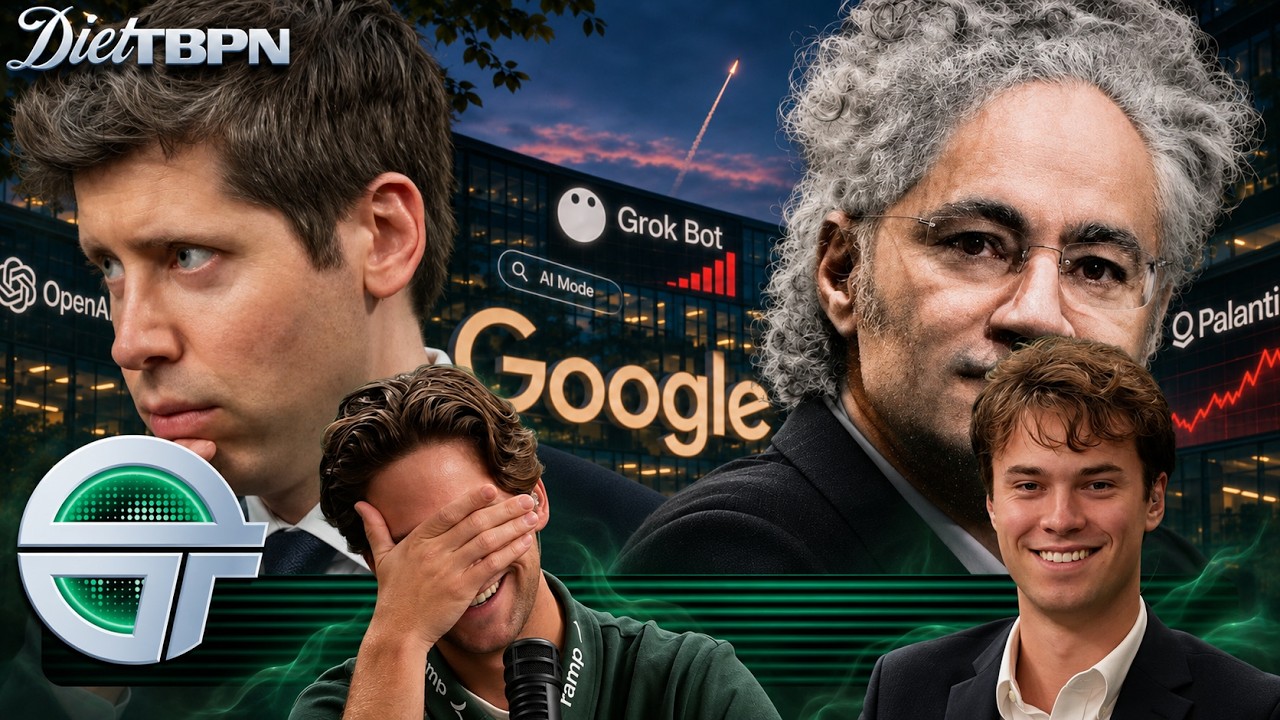
SpaceX Enters Orbital Manufacturing With Starfall to Challenge Varda
TBPN
Elon Musk's launch giant validates the commercial microgravity market by taking on its own customer Varda in pharmaceutical and semiconductor production.
Palantir's Q3 revenue reached $2.3 billion, with US commercial revenue hitting $984 million and surpassing US government revenue for the first time. (0:11)
Elon Musk capped Grok bot usage due to unsustainable inference costs relative to revenue, underscoring the massive cost of subsidizing AI digital labor. (11:27)
SpaceX unveiled Starfall to compete directly in microgravity research and manufacturing, validating the market opportunity pioneered by Varda Space Industries. (23:28)
CrowdStrike acquired AI security firms Fiddler AI and Dreadnode for $495 million and announced plans to develop an enterprise AI emergency kill switch. (20:43)
Shopify acquired the domain shop.com for a record-breaking $99 million to strengthen its consumer-facing brand presence. (28:11)
Detailed notes
## Background
This episode of Diet TBPN was published on YouTube by TBPN on November 3, 2026. Hosted by John Coogan and Jordi Hays, the show condenses daily tech news and analysis into a 30-minute format, covering major earnings, corporate moves, and startup announcements across Silicon Valley.
## TL;DR
John Coogan and Jordi Hays break down quarterly earnings from Apple and Palantir, noting market anxiety over rising memory chip costs and AI inference expenses despite strong top-line numbers. They analyze how Google's AI Mode threatens publisher traffic and inbound SaaS models, followed by Elon Musk's sudden compute usage caps on Grok bot. The hosts also cover CrowdStrike's $495 million dual cybersecurity acquisition, SpaceX's entrance into orbital manufacturing with Starfall, and Shopify's record-breaking $99 million purchase of shop.com.
## Atmosphere & style
The broadcast carries an upbeat, rapid-fire morning show vibe blending irreverent Silicon Valley inside jokes with substantive financial analysis. Despite Coogan joining remotely from a sun-drenched hotel room alongside an empty studio chair, the hosts maintain an easygoing, conversational rapport full of playful banter about Halloween costumes, Doritos, and niche tech figures. The energy shifts seamlessly from comedic, dry skepticism about dark design patterns and political noise to serious strategic dissection of enterprise software moats and frontier AI security.
## Bulletin
- [00:11](https://www.youtube.com/watch?v=-t0HrohTWus&t=11s) Palantir's Q3 revenue reached $2.3 billion, with US commercial revenue hitting $984 million and surpassing US government revenue for the first time.
- [11:27](https://www.youtube.com/watch?v=-t0HrohTWus&t=687s) Elon Musk capped Grok bot usage due to unsustainable inference costs relative to revenue, underscoring the massive cost of subsidizing AI digital labor.
- [23:28](https://www.youtube.com/watch?v=-t0HrohTWus&t=1408s) SpaceX unveiled Starfall to compete directly in microgravity research and manufacturing, validating the market opportunity pioneered by Varda Space Industries.
- [20:43](https://www.youtube.com/watch?v=-t0HrohTWus&t=1243s) CrowdStrike acquired AI security firms Fiddler AI and Dreadnode for $495 million and announced plans to develop an enterprise AI emergency kill switch.
- [28:11](https://www.youtube.com/watch?v=-t0HrohTWus&t=1691s) Shopify acquired the domain shop.com for a record-breaking $99 million to strengthen its consumer-facing brand presence.
## Key takeaways
- [00:11](https://www.youtube.com/watch?v=-t0HrohTWus&t=11s) Apple warned investors of potential gross margin compression stemming from rising memory chip component costs and expensive AI inference hosting.
- [00:11](https://www.youtube.com/watch?v=-t0HrohTWus&t=11s) Palantir achieved a critical milestone as US commercial revenue crossed US government revenue, reflecting enterprise adoption of diffusion-layer AI tools.
- [04:32](https://www.youtube.com/watch?v=-t0HrohTWus&t=272s) Google's rollout of conversational AI Overviews threatens organic traffic referral funnels for content-driven businesses and inbound marketing SaaS platforms.
- [07:07](https://www.youtube.com/watch?v=-t0HrohTWus&t=427s) Despite OpenAI and Anthropic taking 86% of enterprise developer API spend, Google maintains a durable moat through cloud infrastructure, TPUs, and equity investments.
- [09:56](https://www.youtube.com/watch?v=-t0HrohTWus&t=596s) Google Search has integrated Gemini so deeply into its core architecture that standard search can no longer operate independently of underlying AI models.
- [11:27](https://www.youtube.com/watch?v=-t0HrohTWus&t=687s) xAI's sudden usage limits on Grok highlight the intense economic pressure of hosting power-user compute workloads without proven monetization models.
- [15:29](https://www.youtube.com/watch?v=-t0HrohTWus&t=929s) Ambient audio intelligence can mathematically triangulate an individual's physical coordinates by analyzing acoustic Doppler signatures from overhead aircraft.
- [17:21](https://www.youtube.com/watch?v=-t0HrohTWus&t=1041s) Mobile application growth tactics on platforms like X increasingly rely on subtle UI dark patterns to nudge users into enabling notifications.
- [19:58](https://www.youtube.com/watch?v=-t0HrohTWus&t=1198s) Bloom Energy paid an estimated $30 million for the Philadelphia 76ers jersey patch sponsorship, showcasing how AI power infrastructure is entering mainstream visibility.
- [20:43](https://www.youtube.com/watch?v=-t0HrohTWus&t=1243s) CrowdStrike's dual acquisition of Fiddler AI and Dreadnode positions the cybersecurity giant to offer integrated AI governance, testing, and kill switch controls.
- [22:04](https://www.youtube.com/watch?v=-t0HrohTWus&t=1324s) OpenAI appointed Dan Driscoll, former Secretary of the Army and previous TBPN guest, reflecting growing overlaps between frontier AI labs and defense leadership.
- [23:28](https://www.youtube.com/watch?v=-t0HrohTWus&t=1408s) SpaceX's Starfall initiative expands the launch provider into orbital microgravity manufacturing across pharmaceuticals, biomedicine, and semiconductor materials.
- [26:51](https://www.youtube.com/watch?v=-t0HrohTWus&t=1611s) Securing AI agent credentials has become as vital as protecting model weights, since autonomous agents often hold master-key access to emails, files, and bank accounts.
- [28:11](https://www.youtube.com/watch?v=-t0HrohTWus&t=1691s) Shopify's $99 million purchase of shop.com marks the largest reported domain acquisition in history, cementing its consumer platform strategy.
## Detailed walkthrough
### [00:11](https://www.youtube.com/watch?v=-t0HrohTWus&t=11s) Halloween Costumes, Show Banter, and Tech Earnings Season
The show kicks off with John Coogan and Jordi Hays reacting to a fan video featuring a TBPN-themed Halloween costume that includes a full parody ad read for sponsor Ramp ("Ramp.com. Time is money. Save both."), complete with running jokes about "the temple of technology," "the fortress of finance," and "the capital of capital." Coogan praises it as a complete vibe reel rather than a low-effort costume, noting the creator has earned a pack of official show merchandise. After sorting through an audio delay check following late flights home, the hosts pivot directly into tech earnings season. Both Apple and Palantir beat expectations, yet both saw their stocks slip around 2% in morning trading. Coogan observes that despite the strong beats, the broader market remains jittery, with analysts projecting future margin compression.
Apple delivered record revenue for its September quarter, but the Financial Times reported that the company is cautioning investors about rising memory chip costs and the steep operational expenses of running its artificial intelligence tools, both of which threaten gross margins. Coogan points out that Apple has historically maintained steady device pricing for several quarters or years at a stretch rather than shifting prices dynamically mid-cycle, leaving them vulnerable when component costs spike.
Meanwhile, Palantir put up a monster Q3, with revenue reaching $2.3 billion ($9.25 billion annualized) on a $400 billion market valuation. CEO Alex Karp marked a major milestone on the call: Palantir's US commercial revenue officially overtook its US government revenue for the first time ever, coming in at $984 million compared to $953 million. Coogan frames this as part of the broader bifurcation in enterprise AI between pure foundation model builders (OpenAI, Anthropic) and the "diffusion" layer enablers (Microsoft, Palantir, Cognition) who package tools directly for enterprise workflows.
- **Apple Q3 results**: Record September quarter revenue, but warned of margin pressure due to rising memory chip prices and AI inference/tool hosting costs.
- **Palantir Q3 results**: $2.3 billion quarterly revenue ($9.25 billion annualized); overall company valuation around $400 billion.
- **Milestone shift**: US commercial revenue hit $984 million, crossing US government revenue ($953 million) for the first time.
- **TBPN Merch Store**: Officially launching on November 12th, premiering exclusively in the YouTube livestream chat for the first 10 minutes before dropping on X and other platforms.
---
[04:32](https://www.youtube.com/watch?v=-t0HrohTWus&t=272s) Reddit, Google AI Mode, and the Zero-Click Traffic War
The discussion shifts to an analysis of Reddit's earnings call highlighted by Buco Capital, which frames Reddit's dynamic with Google as a bellwether for the entire web ecosystem. Google's rollout of AI Overviews (AI Mode) provides answers and inline data directly on the search results page, removing user incentive to click through to origin sites. Furthermore, AI Mode turns search into an interactive conversational dialogue, designed to keep users on-page so Google can serve ads throughout the back-and-forth exchange. The analysis warns that this shift turns Google adversarial to publishing destinations and content-led go-to-market motions—pressuring inbound marketing software companies like HubSpot and Monday.com as organic search funnels dry up.
Reddit CEO Steve Huffman pointed out on their earnings call that while user demand for Reddit remains massive, Google is simply directing far less traffic out to Reddit than in the past. Coogan recalls Nilay Patel at *The Verge* discussing "Google Zero" years ago, along with similar warnings shared on TBPN by Roger Dickey from Made by Gather (and formerly Curology/Kite). Coogan also notes the strange user psychology playing out in public: users complain about the clunky friction of conversational search funnels, ironically wanting the old link-and-ad-heavy search engine back because it broke up information more cleanly.
> “People still want Reddit. It's just Google's not sending them to Reddit the way they used to.” — John Coogan (quoting Reddit CEO Steve Huffman)
```mermaid
flowchart TD
accTitle: The Search Traffic Funnel Shift
accDescr: Diagram illustrating how Google AI Mode replaces organic referral clicks with zero-click conversational ad loops.
subgraph Legacy["Traditional Search Funnel"]
A["User Query"] --> B["SERP Links & Ads"]
B --> C["Referral Outlink Traffic"]
C --> D["Websites & Publishers (Reddit, Media, SaaS)"]
end
subgraph AIMode["Google AI Mode Funnel"]
E["User Query"] --> F["Inline LLM Synthesis"]
F --> G["Multi-Turn Dialogue"]
G --> H["Native Ad Serving within Chat"]
G -.->|"Depleted Outlinks"| D
end
```
---
[07:07](https://www.youtube.com/watch?v=-t0HrohTWus&t=427s) Google's Moat, Enterprise API Share, and the "Founder Mode" Question
Despite the structural decline of organic search traffic, the hosts remain broadly skeptical of the ultimate Google bear case. Hays argues that even if search revenue tops out, Google generates around $200 billion in extraordinarily high-margin revenue that can subsidize massive capital expenditures, M&A, custom silicon, and infrastructure buildouts. While recent data shows Anthropic and OpenAI expanding their enterprise grip—growing from 67% to 86% of enterprise LLM API spend while Google's developer API share dropped by more than half—Google still captures immense downstream value through Google Cloud Platform (GCP) hosting, TPUs, and equity stakes in companies like Anthropic and SpaceX.
The conversation turns to Google's leadership structure and whether the company can operate in true "founder mode." Coogan notes that while co-founders Larry Page and Sergey Brin periodically surface in headlines—reporting back to work on code or strategy before buying another Florida property—they maintain ultimate voting control and could theoretically execute a sweeping Mark Zuckerberg-style restructuring at will. However, because day-to-day operations remain with Sundar Pichai, Hays argues the corporate posture feels vastly different from Meta's founder-led aggression, especially following the heavy talent departures from Google's AI units over recent months.
> “I think if you think that AI is real and going to be big, like it's very, very hard to make a super coherent bear case, right?” — Jordi Hays
- **Enterprise LLM market share**: Anthropic and OpenAI together account for 86% of enterprise developer API spend, up from 67%, cutting Google's direct developer LLM share by over 50%.
- **Infrastructure capture**: Even when third-party models win developer workloads, compute spend routinely routes through GCP infrastructure and Google TPU clusters.
- **Governance dynamic**: Larry Page and Sergey Brin retain voting control, but the hosts see the operational execution as corporate management rather than Meta-style founder mode.
[09:56](https://www.youtube.com/watch?v=-t0HrohTWus&t=596s) Google Search and the Mandatory Gemini Era
The hosts discuss a controversial headline reporting that Google plans to turn off search for schools refusing to adopt AI features. Andrew Curran pushed back on social media to clarify the narrative, emphasizing that the move is not intended as punishment. Instead, Google's modern search infrastructure is now entirely intertwined with Gemini under the hood, making standard search impossible to separate from AI models.
Even if a user chooses not to toggle on "AI mode," the query still interfaces directly with Gemini in the background. The hosts note that the classic version of Google Search effectively no longer exists. For educational institutions looking to preserve an AI-free research environment, the alternatives might be switching to options like DuckDuckGo or simply returning to old-school library research methods like the Dewey Decimal Classification.
> "Even if you don't turn AI mode on, you're still talking to Gemini in the search box. The old Google search is gone." — Andrew Curran (quoted by the hosts)
[11:27](https://www.youtube.com/watch?v=-t0HrohTWus&t=687s) Grok Bot Usage Caps and the Cost of Compute
The conversation shifts to Elon Musk’s surprising announcement on November 1st stating that the cost of serving Grok bot had become unsustainably high relative to the revenue it brings in. Tech commentator Sheel Mohnot reacted to the news by noting that digital labor is currently being subsidized by venture capital and AI firms in a race to gain scale. The hosts express bewilderment at the move, theorizing that xAI might be relying heavily on Anthropic's Claude 3.5 Sonnet under the hood, leading to massive inference bills as power users pushed the service to capacity.
```mermaid
flowchart LR
accTitle: Grok Bot Compute Pipeline and Cost Friction
accDescr: Diagram showing how user queries to Grok trigger heavy API costs that prompted sudden usage caps.
subgraph User["User Base"]
U["Power Users & Slack Integrations"]
end
subgraph xAI["xAI / Grok Infrastructure"]
G["Grok Interface"]
M["Underlying Model Compute (e.g., Anthropic Claude)"]
end
subgraph ElonAction["Elon's Intervention"]
C["Sudden Usage Caps / Tokenomics Right-sizing"]
end
U -->|"High-volume queries"| G
G -->|"Costly inference"| M
M -->|"Unsustainable burn vs. revenue"| C
```
Rather than a permanent shutdown, the service appears to have clamped down on reset limits after users maxed out their allocations. The hosts debate Musk's enterprise strategy for Grok, observing that while embedding Grok as an in-line summary tool inside X works well for social discourse and Community Notes, transitioning the product into a workspace tool like Slack faces intense competition from established enterprise vendors like Palantir and Microsoft. The segment wraps up with a nod to rapper Wiz Khalifa, who reacted to exhausting his Grok limits by posting philosophical reflections on social media.
> "Computer use is expensive but AI companies are racing to make it cheaper while giving it away for free. Thank capitalism. We get free digital labor before they figured out how to profit for it." — Sheel Mohnot (quoted by the hosts)
> "The work is the reward." — Wiz Khalifa (quoted by the hosts)
- Musk previously stated Grok would eventually command the vast majority of the company's internal compute capacity.
- Grok’s active user base is estimated around 1 million weekly actives, leading the hosts to question why xAI would not simply absorb the API run-rate losses temporarily.
[15:29](https://www.youtube.com/watch?v=-t0HrohTWus&t=929s) Audio Triangulation and Physical OSINT
The hosts examine a demonstration of AI-powered surveillance techniques where an individual's physical location can be pinpointed using ambient audio. By analyzing the Doppler curve signatures of overhead aircraft picked up on an unedited microphone stream, analysts can mathematically triangulate a creator's exact geographic coordinates. The hosts joke about triggering soundboard effects to break the audio continuity and keep their location masked.
While real-time noise cancellation tools (such as Zoom’s built-in filtering) introduce artifacts that complicate automated tracking, long-form unedited outdoor vlogs present a genuine privacy risk. The hosts compare this algorithmic triangulation to analog open-source intelligence practitioners like GeoGuessr player Trevor Rainbolt, who famously identifies global locations purely from background visual clues.
> "Everyone is going to have access to super intelligence. So, you get to do things like this."
[17:21](https://www.youtube.com/watch?v=-t0HrohTWus&t=1041s) Ad Formats and Growth Hacks on X
Turning to social media user experience patterns, the hosts review a sponsored post from Oval Capital that simply features a static headshot of a founder alongside a "Learn More" call to action. They compare Meta’s frictionless ad-buying tools with the interface tactics on X, including prominent placement of promotion prompts aimed at boosting creator spend.
The hosts critique mobile design patterns developed by Nikita Bier on X, particularly the notification permission workflow. When a user toggles the notification slider to "off," the UI intentionally snaps into an awkward, broken-looking visual state. This subtle dark pattern prompts users to toggle it back on under the impression that they are fixing an application error.
> "If you don't enable notifications, it has this like this the slider bar that's like notifications on or off. And if you say no, I don't want notifications. It slides into a state that looks like it's broken and looks like you have an error in the app."
[18:35](https://www.youtube.com/watch?v=-t0HrohTWus&t=1115s) Peter Rahal’s Rowdy and the Doritos Market
The segment concludes with the debut of Rowdy, a new savory snack brand launched by RXBAR co-founder Peter Rahal through his holding company, The Rossi Medici Group. Positioned directly against mainstream consumer brands like Frito-Lay, Rowdy’s debut "Tangy Ranch" flavor is described as an exact reverse-engineered take on Cool Ranch Doritos.
The hosts discuss the commercial viability of high-protein or cleaner-label consumer packaged goods entering categories dominated by legacy junk food giants. One host jokingly admits to living a completely "Doritos-coded lifestyle" before previewing an upcoming segment on LeBron James’s newest endorsement deal.
> "Their tangy ranch is the closest thing to reverse engineering Doritos Cool Ranch. It's going to be interesting to see how Frito-Lay reacts."
[19:58](https://www.youtube.com/watch?v=-t0HrohTWus&t=1198s) Bloom Energy and the 76ers Sponsorship Mix-Up
The hosts open the segment with a humorous mix-up involving NBA jersey sponsorships. The Philadelphia 76ers announced a new corporate jersey patch sponsor, which led to immediate confusion among friends and followers who mistook the sponsor for an eponymous guest or host. In reality, Bloom Energy—the publicly traded energy technology and fuel cell company servicing AI data centers—reportedly paid around $30 million for the 76ers sponsorship rights.
The coincidence sparked an influx of amused direct messages from people wondering if their friend had somehow personally sponsored an NBA franchise. The hosts reflect on how obscure enterprise energy infrastructure remains to general audiences outside the financial and tech bubbles, laughing that it is always better to be lucky than good. As one host summarizes the serendipitous branding alignment, “Bandaid of heaven moment for sure.”
- **Sponsorship Deal:** Bloom Energy secured the Philadelphia 76ers jersey patch sponsorship for an estimated $30 million.
- **Audience Reaction:** Outside of Wall Street and tech circles, Bloom Energy was virtually unknown, leading acquaintances to confuse the public company with an individual.
---
[20:43](https://www.youtube.com/watch?v=-t0HrohTWus&t=1243s) CrowdStrike Acquisitions and the AI Kill Switch
John Coogan rejoins the stream remotely from his hotel room after a dramatic shift in sunlight turns his camera into a veritable "flashbang," prompting the crew to switch to a three-up view and dive into enterprise cybersecurity news. CrowdStrike announced the joint acquisition of two artificial intelligence security startups—Fiddler AI and Dreadnode—for a combined total of $495 million. The hosts note the sheer contrast in branding between the two targets: Fiddler AI evokes a lighthearted, whimsical image of someone playing country or bluegrass violin music, while Dreadnode sounds decidedly ominous and militaristic.
Beyond the startup shopping spree, CrowdStrike CEO George Kurtz posted about building an enterprise emergency stop mechanism for autonomous systems. The hosts point out that politicians like Bernie Sanders and various tech critics have repeatedly demanded a universal emergency cutoff mechanism for frontier models. As one host notes regarding Kurtz's tactical move, “I think every company wants an AI kill switch so good good market positioning good branding.”
```mermaid
flowchart TD
accTitle: CrowdStrike AI Security Strategy
accDescr: Diagram illustrating CrowdStrike's $495 million dual acquisition and the launch of the AI kill switch.
subgraph Acquisitions ["$495M Dual Acquisition"]
A["Fiddler AI<br/>(AI Observability & Governance)"]
B["Dreadnode<br/>(Adversarial AI Attack Emulation)"]
end
subgraph Integration ["CrowdStrike Falcon Platform"]
C["Unified Enterprise AI Security Suite"]
D["AI 'Kill Switch' / Emergency Button"]
end
Acquisitions --> Integration
```
---
[22:04](https://www.youtube.com/watch?v=-t0HrohTWus&t=1324s) Data Center Naming Debates and OpenAI Hires Dan Driscoll
The conversation turns to the evolving vocabulary surrounding artificial intelligence infrastructure. Commentator Mike Isaac, formerly at *The New York Times* and now at *The Atlantic*, has publicly pushed to discard conventional labels like "data centers" or "compute campuses" in favor of calling them "data bases"—literally the geographic base where the data resides. The TBPN hosts push back on the rebranding trend, arguing that decades of computing history already established the ultimate moniker. As John Coogan remarks, “we we we've had the perfect name for decades, the supercomputer.”
The hosts also highlight that OpenAI hired Dan Driscoll, the former Secretary of the Army and an early guest on TBPN. They reminisce about his initial appearance on the show, which marked a surreal transition point for TBPN from a casual chat show between friends into a broadcast attracting cabinet-level defense leaders. The hosts joke that their comedic tech banter suddenly took a serious geopolitical turn, prompting external commentary questioning how the show managed to land the head of the Army.
---
[23:28](https://www.youtube.com/watch?v=-t0HrohTWus&t=1408s) SpaceX Introduces Starfall and Enters Space Manufacturing
SpaceX revealed Starfall, a specialized initiative aimed at delivering affordable, routine microgravity access in Low Earth Orbit (LEO) tailored for industrial and scientific workflows. The Starfall platform focuses on four primary disciplines: biomedical research (including biomaterials, implants, stem cell organoids, and replacement tissues), pharmaceutical crystallization (growing uniform drug and protein crystals impossible under terrestrial gravity), advanced materials synthesis, and semiconductor manufacturing utilizing space's natural vacuum.
The announcement represents a direct challenge to pioneering space-manufacturing startup Varda Space Industries. Early on, critics questioned Varda's target market, doubting whether off-planet manufacturing could evolve beyond high-concept science fiction. While many assumed SpaceX would gladly serve as Varda's non-competitive launch provider, Starfall proves SpaceX intends to compete in orbit-based R&D directly. Nevertheless, the hosts interpret SpaceX's entry as total validation of the market thesis, pointing out that SpaceX only invests in sectors with massive commercial potential. They also highlight that customers will inevitably want to dual-source rather than rely solely on SpaceX, drawing a parallel to Rocket Lab's strong public market performance driven by customers seeking alternatives to SpaceX's orbital monopoly.
> “So although Varda now has some real competition, again this just feels like a huge like vote of confidence in the business and the and the overall market opportunity.”
- **Starfall Focus Areas:**
- *Biomedicine:* Developing advanced biomaterials, orthopedic implants, replacement tissues, and stem cell organoids.
- *Pharma R&D:* Precipitating uniform protein crystals and drug compounds without gravitational convection.
- *Advanced Materials:* Fabricating next-generation semiconductors and novel materials using microgravity and orbital vacuum.
- **Market Dynamics:** Enterprise customers and defense entities consistently avoid single-sourcing critical space access, preserving a distinct market opening for independent specialists like Varda and alternative launch platforms like Rocket Lab.
---
[26:51](https://www.youtube.com/watch?v=-t0HrohTWus&t=1611s) Election Day Quips, Cathedral Systems, and Agent Security
The hosts briefly make passing, tongue-in-cheek jokes about the political noise and election coverage flooding their feeds, feigning total ignorance about what the word "politics" even means and proposing a detached TBPN deep-dive tracing the ancient concept of politics rather than commenting on candidates.
Returning to cybersecurity, OpenAI announced a partnership with Cathedral Systems, a specialized security firm that gained notoriety after conducting authorized penetration tests that breached Anthropic's internal Slack. The hosts emphasize that protecting agentic AI models has become as critical as guarding raw model weights. With consumers and enterprises handing autonomous agents full browser access and Master-key credentials—including access to Slack, email, internal documents, and financial accounts—a compromised AI agent represents an existential security breach.
> “Everyone's giving Muse all their passwords, Claude all their passwords, chatb all their passwords. And if you break into that, you're kind of in the email. you're in all the services, you're in the bank accounts pretty quickly and you can imagine wreaking havoc pretty quickly.”
---
[28:11](https://www.youtube.com/watch?v=-t0HrohTWus&t=1691s) Shopify Acquires Shop.com and Episode Sign-Off
The final news item focuses on Shopify purchasing the premium domain name `shop.com` for an astronomical $99 million, setting the record for the largest publicly reported domain acquisition in history. Despite the eye-watering nominal sum, the hosts view it as a brilliant strategic acquisition that will pay compounding brand dividends for Shopify's consumer-facing ecosystem. As one host flatly evaluates the transaction, “They spent $99 million on shop.com and I think they stole I think they stole it.”
Wrapping up the broadcast, the hosts reflect on pulling off the show despite John Coogan traveling and appearing on screen alongside an awkward empty studio chair. Noting that remote episodes never quite match the chemistry of sitting together in person, they thank their sponsors, remind listeners to rate the podcast five stars on Apple Podcasts, and sign off for the day.
## Notable quotes
> [11:27](https://www.youtube.com/watch?v=-t0HrohTWus&t=687s) Computer use is expensive but AI companies are racing to make it cheaper while giving it away for free. Thank capitalism. We get free digital labor before they figured out how to profit for it. — Sheel Mohnot
> [09:56](https://www.youtube.com/watch?v=-t0HrohTWus&t=596s) Even if you don't turn AI mode on, you're still talking to Gemini in the search box. The old Google search is gone. — Andrew Curran
> [04:32](https://www.youtube.com/watch?v=-t0HrohTWus&t=272s) People still want Reddit. It's just Google's not sending them to Reddit the way they used to. — Steve Huffman
## Mentioned
TBPN, John Coogan, Jordi Hays, Ramp, Apple, Palantir, Alex Karp, Financial Times, OpenAI, Anthropic, Microsoft, Cognition, Reddit, Steve Huffman, Buco Capital, Google, HubSpot, Monday.com, Nilay Patel, The Verge, Roger Dickey, Made by Gather, Curology, Kite, Google Cloud Platform, SpaceX, Larry Page, Sergey Brin, Sundar Pichai, Meta, Mark Zuckerberg, Gemini, Andrew Curran, DuckDuckGo, Dewey Decimal Classification, Elon Musk, Grok, xAI, Sheel Mohnot, Claude 3.5 Sonnet, Slack, Wiz Khalifa, Zoom, Trevor Rainbolt, GeoGuessr, Oval Capital, X, Nikita Bier, Peter Rahal, Rowdy, The Rossi Medici Group, RXBAR, Doritos, Frito-Lay, LeBron James, Bloom Energy, Philadelphia 76ers, CrowdStrike, George Kurtz, Fiddler AI, Dreadnode, Falcon Platform, Bernie Sanders, Mike Isaac, The New York Times, The Atlantic, Dan Driscoll, Starfall, Varda Space Industries, Rocket Lab, Cathedral Systems, Shopify, Shop.com
## Video description
Sign up for TBPN’s daily newsletter at TBPN.com
Diet TBPN delivers the best of today’s TBPN episode in 30 minutes. TBPN is a live tech talk show hosted by John Coogan and Jordi Hays, streaming weekdays 11–2 PT on X and YouTube, with each episode posted to podcast platforms right after.
Described by The New York Times as “Silicon Valley’s newest obsession,” the show has recently featured Mark Zuckerberg, Sam Altman, Mark Cuban, and Satya Nadella.
TBPN is made possible by:
Ramp - https://ramp.com
Public - https://public.com
Cisco - https://www.cisco.com
Console - https://www.console.com
CrowdStrike - https://www.crowdstrike.com
Figma - https://www.figma.com
MongoDB - https://www.mongodb.com
NYSE - https://www.nyse.com
Railway - https://railway.com
Shopify - https://www.shopify.com/
SpaceX推出Starfall进军轨道制造,正面迎战Varda
埃隆·马斯克旗下的发射巨头在制药和半导体生产领域挑战自身客户Varda,印证了商业微重力市场的价值。
John Coogan和Jordi Hays详细剖析了苹果与Palantir的季度财报,指出尽管营收数据强劲,但市场仍对不断上涨的存储芯片成本和AI推理开支感到担忧。他们分析了谷歌的AI Mode如何对出版商流量及入站SaaS模式构成威胁,随后讨论了埃隆·马斯克突然对Grok机器人实施算力使用限制。此外,两位主持人还报道了CrowdStrike斥资4.95亿美元实施的双重网络安全收购、SpaceX凭借Starfall进军轨道制造领域,以及Shopify创纪录斥资9900万美元收购shop.com。
Palantir第三季度营收达23亿美元,其中美国商业营收达9.84亿美元,首次超过美国政府业务营收。 (0:11)
由于相对于收入而言推理成本不可持续,埃隆·马斯克对Grok机器人的使用量设置了上限,这凸显了补贴AI数字劳动力的巨大成本。 (11:27)
SpaceX公布了Starfall以直接参与微重力研发与制造的竞争,印证了Varda Space Industries开创的市场机遇。 (23:28)
CrowdStrike斥资4.95亿美元收购了AI安全公司Fiddler AI和Dreadnode,并宣布计划开发企业级AI紧急制动开关(kill switch)。 (20:43)
Shopify以创纪录的9900万美元收购了域名shop.com,以增强其面向消费者的品牌影响力。 (28:11)
Detailed notes — zh
## Background
本期视频由科技商业播客频道 TBPN 于 2026 年 11 月 3 日发布在 YouTube 平台。作为其 30 分钟精炼版节目《Diet TBPN》,内容由 John Coogan 和 Jordi Hays 主持,聚焦科技圈每日焦点事件,涵盖科技巨头最新财报、AI 商业化与算力成本、以及太空制造等前沿行业动态。
## TL;DR
节目首先分析了苹果与 Palantir 亮眼却令市场担忧利润率的财报,并借 Reddit 财报与 Google AI Mode 探讨了公网自然流量坍塌的严峻现实。随后,主持人们深入剖析了 Elon Musk 限制 GrokBot 用量背后的高昂 Token 算力账本,以及 Google 全面转向 AI 底层架构引发的教育争议。此外,节目还梳理了声学 AI 多普勒定位、CrowdStrike 斥资并购打造 AI 紧急切断开关等安全趋势,并探讨了 SpaceX 全新发布的 Starfall 微重力制造平台对 Varda 及太空经济的影响,最后以 Shopify 斥资 9900 万美元收购 shop.com 的重磅交易收尾。
## Atmosphere & style
整期节目的氛围极其明快、犀利且充满硅谷式的幽默与行话。两位主持人配合默契,在深入拆解硬核商业逻辑与财报数据的同时,穿插着大量对网络热梗、万圣节装扮以及名人趣闻的调侃与自嘲。快节奏的对话与即兴插科打诨让繁杂沉重的硬科技与金融话题变得极具现场感与观赏趣味。
## Bulletin
- [01:23](https://www.youtube.com/watch?v=-t0HrohTWus&t=83s) 苹果创下9月季度历史营收纪录,但预警内存芯片价格上涨及AI运行成本可能挤压利润率;Palantir第三季度营收达23亿美元,美国商业营收首次反超政府业务。
- [04:32](https://www.youtube.com/watch?v=-t0HrohTWus&t=272s) Google全面推行AI Mode并将Gemini深度融入搜索底层,导致公网自然跳出流量骤降,对依赖传统搜索漏斗的非目的地型媒体及SaaS企业构成毁灭性冲击。
- [11:24](https://www.youtube.com/watch?v=-t0HrohTWus&t=684s) Elon Musk公开表示GrokBot的高昂服务成本相对收入而言难以持续,已开始对高频用户实施用量配额以重调代币经济学。
- [23:28](https://www.youtube.com/watch?v=-t0HrohTWus&t=1408s) SpaceX正式推出Starfall微重力制造与科研平台,进军生物医学与半导体太空制造,直接验证并激活了此前由Varda开拓的万亿美元级太空经济赛道。
- [27:14](https://www.youtube.com/watch?v=-t0HrohTWus&t=1634s) Shopify以9900万美元的创纪录天价收购顶级域名shop.com,创下有史以来公开域名交易金额之最。
## Key takeaways
- [01:23](https://www.youtube.com/watch?v=-t0HrohTWus&t=83s) 苹果尽管季度业绩超出市场预期,但在产品周期中期遭遇内存成本激增和AI推断开销,因其极少频繁调整硬件定价的传统而面临利润率被压缩的被动局面。
- [01:23](https://www.youtube.com/watch?v=-t0HrohTWus&t=83s) Palantir美国商业业务营收达9.84亿美元并首次超越政府业务(9.53亿美元),其主打掌控数据与企业落地的策略正与微软趋同并获得市场高度认可。
- [04:32](https://www.youtube.com/watch?v=-t0HrohTWus&t=272s) Google AI Mode使搜索转变为鼓励连续对话的站内闭环体验,削弱用户跳出动力,导致HubSpot、Monday.com及Reddit等依赖公网集客流量的商业模式遭遇流量漏斗崩塌。
- [07:07](https://www.youtube.com/watch?v=-t0HrohTWus&t=427s) 尽管Anthropic与OpenAI吃下了86%的企业LLM API支出导致Google开发者底层模型份额大跌,但凭借TPU算力抽成与云基础设施(GCP),Google依然握有极高防御壁垒。
- [07:07](https://www.youtube.com/watch?v=-t0HrohTWus&t=427s) 与Meta鲜明的创始人深度执掌模式不同,Google两位创始人虽持有绝对控制权却退居二线,由职业经理人团队掌舵使得组织在应对AI军备竞赛时显得缺乏野性。
- [09:56](https://www.youtube.com/watch?v=-t0HrohTWus&t=596s) Google在教育领域遭遇反弹但本质是底层架构全面Gemini化,传统无AI参与的经典搜索已不复存在,学校若拒绝AI只能选择DuckDuckGo或回归纸质书。
- [11:24](https://www.youtube.com/watch?v=-t0HrohTWus&t=684s) GrokBot因调用高成本底层大模型(如Claude系列)陷入代币经济学困境,面对巨大算力开销与赔本赚吆喝的现状,马斯克被迫对高频用量进行封顶限制。
- [15:29](https://www.youtube.com/watch?v=-t0HrohTWus&t=929s) AI物理声学分析新突破:通过截取15分钟户外讲话音频并提取背景飞机噪音的多普勒频移曲线,结合公开飞行雷达轨迹即可对目标进行精准物理三角定位。
- [17:21](https://www.youtube.com/watch?v=-t0HrohTWus&t=1041s) 互联网增长黑客设计愈发极端,从Meta极度拉低信用卡投流门槛,到X平台将关闭推送滑块伪装成系统报错来诱导强迫症用户修复,行为操纵无处不在。
- [20:59](https://www.youtube.com/watch?v=-t0HrohTWus&t=1259s) CrowdStrike以4.95亿美元收购Fiddler AI与Dreadnode两家初创企业,通过抢占AI物理“紧急切断开关”(kill switch)进行深度的品牌营销与安全卡位。
- [22:36](https://www.youtube.com/watch?v=-t0HrohTWus&t=1356s) OpenAI吸纳前陆军副部长并联手曾攻破Anthropic的 Cathedral Systems,反映出前沿实验室正将防护重心提升至防止智能体被渗透后危及用户全域密码与金融账户的安全级别。
- [23:28](https://www.youtube.com/watch?v=-t0HrohTWus&t=1408s) SpaceX推出Starfall平台亲自涉足微重力生物与材料制造,消除了市场对Varda商业模式的质疑,并驱动太空产业形成追求“双货源”以防垄断的良性竞争格局。
- [27:14](https://www.youtube.com/watch?v=-t0HrohTWus&t=1634s) Shopify斥资9900万美元收购顶级域名shop.com,成为史上最贵的公开域名交易,为主流电商独立站业务构筑起极高的品牌认知门面。
## Detailed walkthrough
### [00:11](https://www.youtube.com/watch?v=-t0HrohTWus&t=11s) 节目开场与万圣节趣事
节目伊始,主持人展示了一段观众身穿万圣节装扮的趣味视频。该装扮结合了赞助商 Ramp 的口号(“Ramp.com. Time is money. Save both.”)以及纽约证券交易所的标语“技术的殿堂、金融的堡垒、资本的首都”(The temple of technology, the fortress of finance, the capital of capital),将万圣节服装与氛围感短片(vibe reel)完美结合,主持人盛赞其不仅是穿出来拍照,而是“真正发挥了整套服装的全部体验”,并表示该粉丝将获得一套正品周边作为奖励。随后,两位主持人讨论起长途飞行后的时差与疲惫:一人在飞机上睡了 5 个小时,另一人同样在飞机上补觉,导致回家后作息彻底被打乱。
### [01:23](https://www.youtube.com/watch?v=-t0HrohTWus&t=83s) 财报季聚焦:苹果与 Palantir 的业绩与利润率担忧
主持人将焦点转向科技财报季的核心主角——Apple(苹果)与 Palantir。尽管两家公司的业绩均超出市场预期(苹果创下 9 月季度营收纪录,Palantir 营收同比几乎翻倍),但次日早盘两家公司的股价均下跌约 2%。主持人指出,当前市场处于高度焦虑与动荡之中,即便财报数据喜人,分析师也会过度解读未来可能出现的利润率挤压(margin compression),从而导致股价抛售。
《金融时报》(Financial Times)报道称,虽然苹果业绩亮眼,但公司发出预警:内存芯片价格上涨以及运行 AI 工具的高昂成本可能会侵蚀利润率。主持人评论道,硬件和算力正变得越来越昂贵,而苹果历来有尽量“坚守定价底线”(hold the line on pricing)的传统,习惯给出一个干净整齐的价格并维持一到三年不调价,极少按月或按季度频繁调整。因此,在产品周期中期遭遇内存成本激增时,苹果很可能陷入定价两难的被动境地。
与此相对,Palantir 展现出了强劲的商业化势头:第三季度营收达到 23 亿美元,年化运行率(ARR)达 92.5 亿美元,市值攀升至 4000 亿美元。在财报电话会议上,首席执行官 Alex Karp 迎来了一个历史性转折点:**美国商业营收首次超越美国政府业务营收**,达到 9.84 亿美元,而政府业务营收为 9.53 亿美元。主持人分析指出,当前 AI 市场形成了两大阵营的分野:一方是押注于基础大模型实验室(OpenAI 与 Anthropic 的组合),另一方则是押注于微软与 Palantir 这类“扩散者、赋能者与落地执行者”(diffusion, the enablers, the cognitions)。Palantir 现在的对外叙事风格与微软高度趋同,主打“掌控你自己的数据”、“与我们合作落地 AI”、“帮助重塑企业组织”,这种企业级商业化策略赢得了市场的热烈反响。
- 苹果创下 9 月季度的历史营收纪录,但警告内存成本上升及 AI 运行费用将对利润率造成压力。
- Palantir Q3 营收为 23 亿美元,年化营收达到 92.5 亿美元,总市值约 4000 亿美元。
- Palantir 美国商业营收达到 9.84 亿美元,首次超越美国政府业务的 9.53 亿美元。
- 两位主持人宣布 TBPN 官方周边商城将于 11 月 12 日上线,首先向 YouTube 直播间观众开放购买通道约 10 分钟,随后全网公开发布。
### [04:32](https://www.youtube.com/watch?v=-t0HrohTWus&t=272s) Reddit 财报与 Google AI Mode:流量漏斗塌陷与互联网终局
讨论转向投资机构 Buco Capital 对 Reddit 财报电话会议的深度拆解。该分析将 Reddit 的财报视为“整个互联网发展方向的风向标”。其核心观点在于:Google 正日益将“AI Mode”(AI 搜索模式)作为默认体验,直接在搜索结果内展示详尽的内联信息,导致用户离开搜索页面的动力大幅削弱。AI 模式鼓励连续对话,而 Google 希望借此将用户留在自己的页面内,以便在对话的每一个轮次插入更多广告,从而榨取最大化收入。随着来自人类的公网自然流量日渐稀缺,Google 正在从一家纯搜索公司转型为云服务与芯片供应商,这导致 Google 与互联网其余内容生态之间转变为越来越尖锐的敌对对立关系。
这种模式转变给所有依赖搜索导流、非用户第一直达目的地(destination)的媒体及内容驱动型 GTM(Go-To-Market)模式带来了毁灭性打击。中小企业(SMB)软件服务商如 HubSpot 和 Monday.com 均因流量漏斗的崩塌(funnel collapse)而遭受重创。主持人直言,互联网正进入存量残局:“一场争夺互联网上仅存且不断缩水的人类流量的短兵相接的白刃战。”Reddit 首席执行官 Steve Huffman 在电话会上无奈表示:“人们仍然想要 Reddit,只是 Google 不再像以前那样把流量引导到 Reddit 了。”
主持人谈到,这种所谓“Google Zero”(零点击搜索)的概念早在五到十年前就由 Nilay Patel 在 The Verge 上提出,此前 Conde Nast 高管 Roger 登上节目时也承认搜索导流不再是增长引擎。对 Google 而言,这同样是一场典型的“创新者的窘境”:虽然必须用新技术满足用户习惯,但用户体验却饱受争议。过去用户对 Google 在搜索页狂塞广告无动于衷,如今却公开抱怨讨厌 AI Mode,陷入了被迫跳转对话、极难点击出站的糟糕体验。
```mermaid
flowchart TD
accTitle: Google AI 模式对互联网流量生态的影响
accDescr: 展示 Google 默认采用 AI 模式后对用户、广告及外部内容提供商造成的结构性冲击
subgraph GoogleEcosystem ["Google 搜索闭环"]
A["默认采用 AI Mode 体验"] --> B["在内联界面提供丰富信息与答案"]
B --> C["鼓励连续对话交互"]
C --> D["在各交互轮次增加广告展示曝光"]
end
subgraph InternetImpact ["外部互联网生态冲击"]
B -.->|"削弱跳出点击动力"| E["公网自然人类流量剧烈缩水"]
E --> F["非目的地型媒体遭遇生存危机"]
E --> G["HubSpot / Monday.com 等内容集客模式崩塌"]
E --> H["Reddit 等社区平台的转入流量断崖式下跌"]
end
subgraph GoogleTransition ["Google 商业重心迁移"]
E --> I["转型为云服务 (GCP) 与自研芯片 (TPU) 基础设施"]
end
```
### [07:07](https://www.youtube.com/watch?v=-t0HrohTWus&t=427s) Google 的 AI 韧性与“创始人模式”之辨
针对 Google 的未来前景,主持人探讨了看空与看多两派力量的拉锯。尽管 SemiAnalysis 的 Dylan Patel 等分析师提供的数据显示,在面向企业开发者的模型竞争中,Anthropic 和 OpenAI 两家已经吃下了 86% 的企业 LLM API 支出(此前为 67%),导致 Google 在面向开发者的底层模型市场份额下滑超过 50%,但看空 Google 依然十分困难。
主持人指出,Google 拥有高达 2000 亿美元级别的高毛利现金流,可以源源不断地输送给基础设施建设与资本并购。更重要的是,像 Anthropic 这样的竞争对手,其背后的算力消耗依然大量运行在 Google Cloud Platform (GCP) 上,采购并支付 Google 的自研 TPU 算力芯片费用:“Google 依然能从中抽成。”从控股 SpaceX、参投 Anthropic 到蓬勃发展的云和芯片业务,Google 的资产储备依然是商业史上最强大的巨无霸之一。
关于 Google 是否处于“创始人模式”(Founder Mode)的讨论,主持人认为 Google 的现状与 Meta 形成了鲜明对比。尽管媒体偶尔会爆出 Larry Page 和 Sergey Brin 重返园区参与研发的新闻,但转眼他们又在佛罗里达购置豪宅;两位创始人虽握有绝对投票权,足以随时发起巨额并购或如 Mark Zuckerberg 般对组织架构进行血洗式重组,但 Google 依然由职业经理人团队掌舵。Jordi Hays 评价道:
> “从感知上来看,这家公司完全没有 Meta 那种处于创始人模式的状态。”
主持人们指出,数月前的大规模顶级人才外流确实给公司带来了巨大逆风,但只要 Google 能在云基础设施和 TPU 芯片军备竞赛中保持核心竞争力,其向上发展空间依然非常庞大。
- Anthropic 和 OpenAI 目前占据了 86% 的企业级大模型 API 采购支出,此前该比例为 67%。
- Google 在面向企业开发者的 LLM 市场份额缩水超 50%,但通过 GCP 托管和 TPU 芯片销售依然持续获取丰厚收入。
- 主持人将 Meta 鲜明的创始人掌舵模式与 Google 由职业经理人日常管理、创始人隐退的组织架构进行了鲜明对比。
### [09:56](https://www.youtube.com/watch?v=-t0HrohTWus&t=596s) Google 全面普及 AI:学校禁用 AI 则无法使用 Google 搜索
《纽约时报》的一则头条引发了广泛争议,标题赫然写着“Google 将对拒绝 AI 的学校关闭搜索功能”(Google will turn off search for schools that reject AI)。节目的主持人们指出,这种做法听起来极其强硬,宛如“大棒与胡萝卜”式的最后通牒。Google 的实际逻辑在于其全线产品都已经深度融入了 AI——如果你要求完全不使用 AI,那么整个产品矩阵自然都无法提供。这种表述虽然在外界看来像是“剥夺学校使用搜索的权利”,但实际上反映的是 AI 已经无所不在、深植于每个产品表面,根本无法被单独剥离。
Andrew Curran 对此发帖澄清,指出外界将此决策误读为惩罚性措施,但事实是底层架构发生了不可逆的变化。主持人也对此表示赞同,指出过去的经典搜索已经成为历史,如果学校坚持提供传统无 LLM 的检索体验,或许只能转向 DuckDuckGo 等替代搜索引擎,或者干脆重回图书馆学习杜威十进制图书分类法(Dewey Decimal System)。
> “There's no such thing as search without Gemini. Even if you don't turn AI mode on, you're still talking to Gemini in the search box. The old Google search is gone.” —— Andrew Curran
- **核心争议点**:外界视其为对教育机构的惩罚,但本质上是底层架构已完全重构为 Gemini 驱动。
- **替代方案探讨**:拒绝 AI 驱动搜索的学校只能选择未接入 LLM 的小众搜索引擎(如 DuckDuckGo)或回归传统纸质书。
### [11:24](https://www.youtube.com/watch?v=-t0HrohTWus&t=684s) Elon 限制 GrokBot 用量与 AI 代价的代币经济学
11 月 1 日,Elon Musk 公开表示 GrokBot 的服务成本相对于其收入而言过高,已经到了“不可持续”的程度。这一表态让行业内外大为震惊,因为投资者通常认为以这类体量的巨头而言,应当为了圈地而承担初期的亏损。风投人 Sahil 也点评称,计算机操作模型(Computer Use)成本极其高昂,然而 AI 公司却在赔本赚吆喝,用户在企业找到盈利模式之前享受着廉价甚至免费的数字劳动力。主持人们推测 GrokBot 底层很可能调用了 Anthropic 的 Claude 3.5 Sonnet(或 Opus 系列),其 Token 成本极其巨大。
主持人们讨论了 Elon 这一决策的矛盾之处:他一方面向公众描绘未来 GrokBot 将消耗公司绝大部分算力的愿景,另一方面却又在当下抱怨服务成本难以承受。虽然算力成本在持续下降,但 GrokBot 的使用量激增让服务器不堪重负,迫使团队在内部调整其代币经济学(Tokenomics)并强行对高频用户实施用量配额。不仅如此,主持人们还对比了 GrokBot 的商业化路径——它原本作为 X 平台的内置助手,帮助总结推文和辅助 Community Notes 非常自然,但若想跨界进入企业级办公环境(如打通 Slack),相比微软或 Palantir 等拥有成熟 To B 销售团队的公司而言,路径显得十分牵强。
> “The cost of serving Grockbot was unsustainably high relative to revenue.” —— Elon Musk
- **背后的算力账本**:即使仅占 Anthropic 营收的 10%,对应的开销也接近数亿美元;面对每周约百万级的活跃用户,巨额的算力消耗难以靠现有的订阅费打平。
- **Wiz Khalifa 的趣味插曲**:著名说唱歌手 Wiz Khalifa 在用光了 GrokBot 额度后,发了一条充满禅意的推文:“工作本身就是奖励”(The work is the reward),被主持人调侃为“AI 额度耗尽后只能亲自挽起袖子干活”,连平时活跃的 Naval 面对这番言论都陷入了沉默。
### [15:29](https://www.youtube.com/watch?v=-t0HrohTWus&t=929s) 声音多普勒效应与 AI 时代的新型声学追踪
节目中谈及了一个令人不寒而栗的最新技术演示:通过截取一个人在户外讲话的 15 分钟连续音频,AI 可以分析背景噪音中飞过的飞机所产生的多普勒频移曲线(Doppler signatures),并与公开的飞行雷达轨迹进行比对,从而精准三角定位出说话者的实际地理位置。这种极度硬核的物理声学分析与现代计算能力的结合,展示了超前的人工智能监控形态。
主持人们打趣道,现在录节目必须在音效板上疯狂按按键制造猫叫等杂音,或者依靠 Zoom 内置的降噪算法来破坏连续音轨,否则在后院录制未剪辑的长视频博主将面临直接被“人肉搜索”(Doxx)的风险。这种技术类似于知名地理侦探 Georainbolt 纯靠一张街景照片里的树木和泥土推断位置的模拟时代玩法,但在算力与 AI 加持下,安全防御的维度已经被彻底重塑。
```mermaid
flowchart LR
accTitle: 音频多普勒定位流程
accDescr: 展示从连续未剪辑音频中提取飞机噪音并通过多普勒曲线比对航班轨迹从而定位地理坐标的过程。
subgraph AudioCapture["音频采集与解析"]
A["15 分钟连续未剪辑音频"] --> B["声学滤波与信号分离"]
B --> C["提取飞机多普勒频移特征"]
end
subgraph DataMatching["多维数据比对"]
C --> D["匹配实时/历史航班雷达航线"]
D --> E["计算相对飞行轨迹与距离"]
end
subgraph Result["结果输出"]
E --> F["精准三角定位目标地理坐标"]
end
```
### [17:21](https://www.youtube.com/watch?v=-t0HrohTWus&t=1041s) 增长黑客手段与 Peter Rahal 的新零食品牌 Rowdy
在聊到互联网产品的增长机制时,主持人们提到了 Meta 和 X 平台五花八门的推广引导手段。Meta 极力降低投流门槛,用户绑张信用卡就能把任何内容变成广告;而 Nikita Bier 主导下的 X 平台客户端更是将这种行为设计发挥到了极致——在引导开启系统通知的滑块上,如果用户选择“关闭”,滑块会停留在一个看起来像是 App 报错损坏的视觉状态,从而诱导强迫症用户忍不住点击“修复”并开启推送。
随后话题转向消费品领域(CPG),RXBAR 的联合创始人 Peter Rahal 通过其控股公司 Medici 推出了全新零食品牌“Rowdy”,正面宣战百事旗下的零食巨头 Doritos(多力多滋)。Rowdy 主打的“浓郁牧场味”(Tangy Ranch)被评价为对 Doritos 经典 Cool Ranch 口味的完美逆向工程。Cool Ranch 曾被誉为食品实验室中设计出的最具成瘾性的味道,而主持人们更笑称自己的生活方式完完全全就是“Doritos 风格”(Doritos coded),对这款新产品的市场前景与传统大厂的反应寄予厚望。
> “I would go further. I would say I live sort of a Doritos coded lifestyle. My entire life is Doritos coded.” —— 节目主持人
### [19:58](https://www.youtube.com/watch?v=-t0HrohTWus&t=1198s) 费城 76 人队的新赞助商趣闻与数据中心命名之争
节目开场由一段关于 NBA 费城 76 人队赞助商的趣事切入。现场主播们打趣说,有人看到勒布朗·詹姆斯左胸附近或者 76 人队球衣上的新赞助标,甚至有人误以为是主播或同名实体投资了球队。实际上,那是一家耗资约 3000 万美元赞助 76 人队的 AI 相关公司 Bloom Energy。主播调侃道:“除了你们这些金融死宅,根本没人知道 Bloom Energy 是什么。”由于名字巧合,主播收到了大量恭喜他赞助 76 人队的信息,直呼这是遇到过最搞笑的事,并戏称这是“天命所归”(mandate of heaven)。
随后,主持人 John Coogan 从光线突变的酒店房间切回连线。话题转向算力基础设施的叫法演变:
- 科技媒体《The Atlantic》的记者 Mike Isaac 提出,不想再使用陈旧的“数据中心”(data centers)或“算力园区”(compute campuses),而是想创造一个新词“数据基地”(data bases)。
- 主播们则坚持认为,几十年来最完美的词汇依然是“超算”(supercomputer),它不仅听起来极具力量感,也完美契合了当下行业对“超级智能”(superintelligence)的狂热追逐。
---
### [20:59](https://www.youtube.com/watch?v=-t0HrohTWus&t=1259s) CrowdStrike 巨资并购与 AI“紧急刹车键”
网络安全巨头 CrowdStrike 宣布以合计 4.95 亿美元收购两家 AI 安全初创公司:Fiddler AI 与 Dreadnode。主播们调侃这两家公司的起名风格反差极大——一个是田园牧歌式的“小提琴手”(Fiddler),另一个则是充满冷酷科幻感的 Dreadnode。这一动作体现了 CrowdStrike 在 AI 安全防护上的大规模扫货策略。
伴随这一收购,CrowdStrike 首席执行官 George Kurtz 公开提到了打造“紧急终止开关”(kill switch)。主播们指出,从伯尼·桑德斯等政界人士到普通企业,所有人都在呼吁给 AI 安装物理切断装置,这不仅是一种核心安全机制,更是一次极其成功的市场卡位与品牌营销。正如一位主播精辟总结道:“我想每家公司都想要一个 AI 紧急切断开关,所以这是很好的市场定位,很好的品牌宣传。”
---
### [22:36](https://www.youtube.com/watch?v=-t0HrohTWus&t=1356s) OpenAI 的军方人脉与安全红队 Cathedral Systems
主播们梳理了 OpenAI 近期的重磅动向:
1. **吸纳军方高层:** OpenAI 聘请了前美国陆军副部长、也是 TBPN 前嘉宾 Dan Driscoll。主播们回忆起他当时上节目的趣事——原本只是主播与朋友们插科打诨的轻松低门槛访谈,突然间画风一变,变成了“TBPN 正在专访陆军领袖”,让节目的分量瞬间提升。
2. **联手 Cathedral Systems:** OpenAI 达成了与网络安全机构 Cathedral Systems 的合作。Cathedral 此前曾成功攻破 Anthropic 的 Slack 内部系统而声名大噪。主播们强调,目前大模型与智能体(Agents)已经成为掌控一切的“万能钥匙”(master key),用户正把几乎所有服务、邮箱甚至银行账户的密码授权给 ChatGPT、Claude 或各类智能体,一旦被渗透将造成灾难性破坏。因此前沿实验室的安全性不仅仅关乎模型权重资产的防盗,更关乎实际终端用户的生死存亡。
```mermaid
flowchart TD
accTitle: AI 智能体安全风险链路图
accDescr: 展示黑客攻破 AI 智能体后如何直接渗透到终端用户的邮箱和银行等核心服务。
subgraph User["用户授权层"]
U["终端用户"] -->|"授予全部账号与密码权限"| Agent["AI 智能体 / 前沿大模型 (ChatGPT / Claude)"]
end
subgraph Security["渗透威胁层"]
Attacker["黑客 / 恶意攻击者"] -.->|"漏洞渗透 / 越狱"| Agent
end
subgraph Assets["受控核心服务"]
Agent --> S1["企业与个人邮箱"]
Agent --> S2["金融与银行账户"]
Agent --> S3["企业内部协作平台 (如 Slack)"]
end
```
---
### [23:28](https://www.youtube.com/watch?v=-t0HrohTWus&t=1408s) SpaceX 发布 Starfall:微重力制造与对标 Varda 的太空经济战
SpaceX 正式推出了名为“Starfall”的全新平台,旨在为微重力环境提供低成本、高频次的常规访问途径,支持近地轨道的尖端制造与科研测试。SpaceX 官方公布的 Starfall 赋能领域涵盖:
- **生物医学研究:** 研发高级生物材料、医疗植入物、干细胞类器官(stem cell organoids)及替代人体组织。
- **药物发现:** 利用微重力环境培养结构更均匀的蛋白质与药物晶体,大幅加速新药研发周期。
- **材料科学与半导体:** 借助太空的超高真空与微重力条件,制造下一代先进材料与半导体。
这一消息在创投圈引发震动。此前,由知名投资人与工程师创立的太空制造初创公司 Varda Space Industries 一直是该赛道的拓荒者。早先市场对 Varda 充满质疑,认为其商业模式过于科幻,无法像传统制造业那样给出明确的年度部件销量预期,且大家普遍认为 SpaceX 只做火箭运载,不会涉足制造端。然而 SpaceX 推出 Starfall 亲自下场,主播们认为这绝非坏事:“如果说有什么影响的话,这感觉是对 Varda 极其强烈的认可,因为除非 SpaceX 认为这是一个巨大的机会,否则他们根本不会做这件事。”
主播进一步分析,微重力市场正迎来繁荣局面:
- **互补与合作可能:** SpaceX 或许专注于天地往返的发射弹道与运载能力,而 Varda 已在生物研究专用返回舱及制药巨头合作上构建了深厚壁垒,双方仍有合作空间。
- **“双货源”(Dual-sourcing)诉求利好竞争者:** 正如发射市场上客户因不愿被单一垄断而推高 Rocket Lab 估值一样,太空制造领域的企业同样不希望将命脉全押在 Starlink 或 SpaceX 身上,竞争与替代方案的存在将彻底激活这一万亿美元级的太空经济体。
---
### [27:14](https://www.youtube.com/watch?v=-t0HrohTWus&t=1634s) 史上最大域名交易:Shopify 拿下 shop.com 与节目收尾
在简短调侃了当日充斥“红蓝阵营”的政治新闻后,主播们公布了当日的重磅商业交易:电商独立站巨头 Shopify 豪掷 9900 万美元收购顶级域名 **shop.com**,创下有史以来金额最高公开域名交易纪录。主播们一致赞赏这笔交易,认为以这个价格买下顶级门面简直是“血赚”(stole it),非常期待 Shopify 围绕该超级域名的后续商业布局。
节目尾声,身处异地的 John 与录播室的主播开启了经典的跨时空互拆台模式。主播笑称虽然演得好像 John 就坐在旁边空椅子上一样,但“空椅子看起来实在太违和、太残忍了”。尽管技术能支撑每天远程录制,但团队依然坚持同台线下录制以保持无与伦比的现场感。最后,主播呼吁听众前往 Apple Podcasts 留下五星好评,全期节目在热烈的插科打诨中收尾。
## Notable quotes
> [04:32](https://www.youtube.com/watch?v=-t0HrohTWus&t=272s) 人们仍然想要 Reddit,只是 Google 不再像以前那样把流量引导到 Reddit 了。 — Steve Huffman
> [09:56](https://www.youtube.com/watch?v=-t0HrohTWus&t=596s) There's no such thing as search without Gemini. Even if you don't turn AI mode on, you're still talking to Gemini in the search box. The old Google search is gone. — Andrew Curran
## Mentioned
Apple, Palantir, Google, Google Cloud Platform (GCP), Reddit, Elon Musk, GrokBot, SpaceX, Starfall, Varda Space Industries, Shopify, CrowdStrike, Fiddler AI, Dreadnode, OpenAI, Cathedral Systems, Anthropic, Claude 3.5 Sonnet, Meta, John Coogan, Jordi Hays, Alex Karp, Steve Huffman, Andrew Curran, Peter Rahal, Medici, Rowdy, Doritos, Bloom Energy, Dan Driscoll, George Kurtz, Wiz Khalifa, Rocket Lab, Ramp, HubSpot, Monday.com, Nilay Patel, Dylan Patel
## Video description
Sign up for TBPN’s daily newsletter at TBPN.com
Diet TBPN delivers the best of today’s TBPN episode in 30 minutes. TBPN is a live tech talk show hosted by John Coogan and Jordi Hays, streaming weekdays 11–2 PT on X and YouTube, with each episode posted to podcast platforms right after.
Described by The New York Times as “Silicon Valley’s newest obsession,” the show has recently featured Mark Zuckerberg, Sam Altman, Mark Cuban, and Satya Nadella.
TBPN is made possible by:
Ramp - https://ramp.com
Public - https://public.com
Cisco - https://www.cisco.com
Console - https://www.console.com
CrowdStrike - https://www.crowdstrike.com
Figma - https://www.figma.com
MongoDB - https://www.mongodb.com
NYSE - https://www.nyse.com
Railway - https://railway.com
Shopify - https://www.shopify.com/
Follow TBPN:
https://TBPN.com
https://x.com/tbpn
https://open.spotify.com/show/2L6WMqY3GUPCGBD0dX6p00?si=674252d53acf4231
https://podcasts.apple.com/us/podcast/technology-brothers/id1772360235
https://www.youtube.com/@TBPNLive
[Source](https://www.youtube.com/watch?v=-t0HrohTWus)
Source quotes
[4:32] Steve Huffman: 人们仍然想要 Reddit,只是 Google 不再像以前那样把流量引导到 Reddit 了。
[9:56] Andrew Curran: There's no such thing as search without Gemini. Even if you don't turn AI mode on, you're still talking to Gemini in the search box. The old Google search is gone.
Source quotes
[11:27] Sheel Mohnot: Computer use is expensive but AI companies are racing to make it cheaper while giving it away for free. Thank capitalism. We get free digital labor before they figured out how to profit for it.
[9:56] Andrew Curran: Even if you don't turn AI mode on, you're still talking to Gemini in the search box. The old Google search is gone.
[4:32] Steve Huffman: People still want Reddit. It's just Google's not sending them to Reddit the way they used to.
Original transcript
[0:11] Let's pull up this video of someone with
[0:14] their Halloween costume.
[0:17] >> Ramp.com. Time is money. Say both.
[0:21] >> I like the ST.
[0:23] >> The temple of technology.
[0:24] >> The fortress of finance.
[0:25] >> The capital of capital.
[0:30] The last thing
[0:31] >> great some sort of combination Halloween
[0:35] costume plus vibe reel. Really got the
[0:37] full experience out of that costume. Not
[0:40] just showing up hoping somebody else
[0:41] takes a picture.
[0:42] >> So good. He's getting he's getting a
[0:45] pack of real merch. Uh John, how do you
[0:46] think the delay is right now? Can you
[0:49] think you think it's like 5 seconds, 10
[0:51] seconds? Probably hard to say.
[0:54] >> Couple seconds. I'm talking right after
[0:56] you end. How does it feel on your side?
[0:58] >> It feels okay.
[0:59] >> Okay. Okay.
[1:00] >> Would you look at that?
[1:01] >> Yeah. How How was How was your trip
[1:03] home? You got home late last night?
[1:06] >> Uh I I I slept uh 5 hours
[1:10] >> on the plane.
[1:10] >> On the plane.
[1:11] >> Yeah.
[1:11] >> Wow. Very nice. I slept on the plane,
[1:13] too. And then that kind of threw me off
[1:15] when I got home. I couldn't sleep and
[1:16] then I woke up and a little bit
[1:20] >> sku. Okay. Well,
[1:22] >> um
[1:23] >> let's let's move on to the news. the the
[1:25] the big news, Apple and Palanteer had
[1:27] earnings. We are in the midst of tech
[1:29] earnings season. Apple and Palanteer,
[1:32] they both beat on earnings. There's a
[1:33] lot of this happening where uh the
[1:35] market is in such in such turmoil that
[1:38] even though uh earnings are coming back
[1:40] positive, uh analysts are reading into
[1:43] uh margin compression that may or may
[1:45] not happen in the future and that's
[1:47] driving stocks uh to be a little bit
[1:50] weaker, sometimes sell off. kind of
[1:51] depends on the stock, but Apple reported
[1:53] record September quarter revenue, while
[1:55] Palanteer nearly doubled its revenue
[1:57] from a year ago. Both stocks are down
[1:59] around 2% this morning. The Financial
[2:01] Times reported today that even though
[2:03] Applebe earnings, the company is warning
[2:05] that rising memory chip prices and the
[2:07] cost of running its AI tools could cut
[2:10] profit margins. Did you what?
[2:13] >> You don't say. Yeah, I mean stuff's
[2:16] going to get expensive and Apple's had a
[2:17] long history of holding the line on
[2:19] pricing as much as they can. Like they
[2:22] love to put up a big clean number and
[2:24] then stick to it for a little bit. And
[2:26] so it can be they're going to be in a
[2:29] jam as uh as memory prices go up
[2:32] >> midcycle when they don't want to change
[2:34] prices. There's never been a company
[2:36] where they change prices every month,
[2:38] every quarter. it's been, you know,
[2:40] every every year or two or or even even
[2:42] every three years, they'll they'll hold
[2:44] the price, hold the line in the price
[2:45] for a really long time. Palunteer uh Q3
[2:48] revenue came in at 2.3 billion
[2:50] annualized at 9.25 billion. It's a $400
[2:53] billion company. Uh and Karp had a had a
[2:56] uh he he he had a big moment on the
[2:58] earnings call. Uh US commercial revenue
[3:00] surpassed its US government revenue for
[3:02] the first time, reaching 984 million
[3:06] versus 953 million. This is sort of the
[3:09] the the the dual buckets of are you
[3:11] betting on the foundation labs the
[3:14] openthropic combination or the Microsoft
[3:18] Palunteer the diffusion the enablers the
[3:20] cognitions and uh Palunteer has has
[3:24] certainly been growing like they their
[3:26] messaging is very similar to Microsoft
[3:28] now around uh you know own your data
[3:31] let's work with you to implement AI
[3:33] we'll help you transform your
[3:34] organization uh and so uh I mean it's
[3:37] been receptive and that's why their uh
[3:39] that's why their commercial revenue is
[3:40] growing. What are you laughing at, Dory?
[3:42] >> Uh just you just laughing at you. Um no
[3:45] uh no no I was I was sort of smiling
[3:47] because it's like you know put putting
[3:49] putting Karp and Satia in the same
[3:51] bucket. It's like you know uh very
[3:54] different personalities but ultimately
[3:56] have a very uh similar sort of you know
[3:58] sort of pitch. Uh which is cool.
[4:00] >> Yeah.
[4:01] >> Chat is asking about merch timing merch
[4:04] store. wanted to jump in quickly because
[4:05] we do have a date. Uh November 12th, the
[4:08] TVPN merch store is going to be going
[4:10] live. Uh it will be released first into
[4:14] the YouTube chat. Uh and it will sit
[4:17] there. I'm I'm assuming we'll we'll
[4:19] we'll leave it there for like 10 minutes
[4:21] so the chat can uh can feast and then
[4:24] we'll post it uh publicly over on X and
[4:27] everywhere else.
[4:29] >> Yeah, a lot of work a lot of work went
[4:30] into that. Um, let's go over to Buco
[4:32] Capital Bloke breaking down Reddit. Uh,
[4:35] it says, "Redic call was absolutely
[4:37] fascinating. Everyone should listen to
[4:38] it as it's a bellweather for where the
[4:40] internet is going. AI mode is
[4:42] increasingly the default Google
[4:44] experience. AI mode provides rich info
[4:47] and data in line. Less insensitive to
[4:50] leave search or less incentive to leave
[4:52] search. AI mode incentivizes dialogue.
[4:54] Google wants to keep wants to keep you
[4:56] engaged to serve more ads at each turn
[4:58] of the conversation. Google will milk
[5:01] that for as much revenue as they
[5:02] possibly can and transition from a
[5:04] search company to a cloud service and
[5:05] chip company as traffic from humans
[5:08] becomes more scarce. This will put
[5:09] Google in an increasingly adversarial
[5:11] position to the rest of the internet.
[5:13] That's interesting. This is a massive
[5:14] headwind to all media type companies who
[5:16] are not destinations. This is a massive
[5:18] headwind to all content driven gotom
[5:20] market motions especially in the SMB.
[5:23] You have seen companies like HubSpot and
[5:24] Monday.com get crushed by this funnel
[5:26] collapse. We are entering the endgame. a
[5:29] knife fight for the remaining and
[5:30] dwindling volume of human traffic on the
[5:32] internet. Interesting. Um, they say
[5:35] people still want Reddit. This is from
[5:36] Steve Huffman, the CEO on the call.
[5:38] People still want Reddit. It's just
[5:39] Google's not sending them to Reddit the
[5:40] way they used to. What's interesting is
[5:42] like Google Zero has been, you know,
[5:45] coined by Neil Patel at the Burge,
[5:47] >> like years ago, I don't know, five years
[5:50] ago, 10 years ago, something. He's been
[5:51] talking about that for a long time. uh
[5:53] when Roger from Kadas came on the show,
[5:54] he talked about how they had embraced it
[5:56] there and that was sort of a a bombshell
[5:59] to hear uh you know someone in that
[6:01] position kind of admit it publicly that
[6:04] that's no longer a growth engine for
[6:06] them. It's interesting to hear that it's
[6:08] spreading to Reddit, but uh it's
[6:10] certainly it's certainly uh uh crazy
[6:13] times for Google because they they it's
[6:15] the innovator's dilemma. they have to
[6:18] meet the customer where they want to be
[6:20] with the new product. But at the same
[6:22] time, a lot of people sort of hate AI
[6:25] mode or at least publicly hate on AI
[6:28] mode. Like the long history of just
[6:29] Google stuffing more and more ads in the
[6:32] search results, never really broke
[6:34] through, but now people are publicly
[6:38] saying, "Oh, I don't like the AI mode. I
[6:40] want to go back to the the one that
[6:42] monetizes better." which is kind of this
[6:43] funny dichotomy of people um
[6:46] >> for the first time just like just
[6:48] randomly anecdotally if you talk to
[6:49] people they'll they'll be like oh I'm
[6:50] like frustrated and it can be kind of an
[6:52] annoying funnel because you you wind up
[6:55] in AI mode and then you're like kind of
[6:56] trying to click somewhere and it can be
[6:58] sort of jarring it just requires like a
[7:00] new a new flow to like get into I don't
[7:03] know what's your overall thinking on
[7:04] Google these days
[7:07] >> uh Dylan Patel
[7:09] >> I just think I just think if if you
[7:10] think AI I think if you think that AI is
[7:13] real and going to be big. Like it's it's
[7:15] very very hard to make a super coherent
[7:19] >> bare case, right? Even if search
[7:21] revenues even if search revenues
[7:23] >> decline
[7:25] um you know every year and and we're
[7:27] sort of at peak search, they just have
[7:28] so many other assets and they can use
[7:30] that you know search cash flow to
[7:32] finance so much other infrastructure and
[7:34] M&A and things like that. So
[7:37] >> um I mean people are nervous about it
[7:38] but it's still $200 billion effectively.
[7:42] I mean that's revenue but it's high
[7:43] margin revenue that they can deploy
[7:45] elsewhere. And uh I mean the take him uh
[7:48] take is that in the race to win AI
[7:51] builders anthropic and open AAI now
[7:53] account for 86% of enterprise LLM API
[7:56] spend up from 67%. So the duopoly is
[7:59] consolidating around the frontier
[8:01] leaders and Google's market share went
[8:03] down more than 50% in terms of not in
[8:06] terms of LLM usage for consumer but but
[8:09] for builders in the enterprise. Yeah.
[8:11] And
[8:13] that revenue is flowing through GCP.
[8:15] It's it's it's paying for TPUs, right?
[8:18] And so it's like
[8:19] >> Google's getting their Google's getting
[8:21] their cut, right?
[8:22] >> 100%.
[8:23] >> Um when you look at the sort of
[8:25] collective, you know, the collection of
[8:27] assets, the exposure to everything from,
[8:30] you know, SpaceX to to Anthropic to the
[8:33] TPU business to the cloud business. It's
[8:35] like, you know, this is still one of the
[8:38] greatest businesses
[8:40] >> uh in history.
[8:40] >> Where do you sit on the question of
[8:42] like, is Google in founder mode or not?
[8:44] Because like we always get these
[8:46] headlines of like, oh, Larry and Sergey
[8:48] came back in. They're they're digging in
[8:50] and then you'll see like they bought
[8:52] another estate in Florida and and it's
[8:55] like going back and forth on like who's
[8:57] actually and I know they have the voting
[8:59] control so they could at any point come
[9:01] in and be like we're doing some huge M&A
[9:04] deal or we're completely reorganing this
[9:06] organization. We're going to completely
[9:08] we're going to go Mark Zuckerberg mode
[9:10] and completely rework the organization.
[9:13] Um, but at the same time they have been
[9:15] out and had a real CEO in place unlike
[9:18] Meta. So they're kind of this hybrid
[9:20] like they're not quite
[9:21] >> it doesn't feel like it doesn't it it
[9:22] certainly doesn't come across like the
[9:25] company is in founder mode in the way
[9:26] that you in in the way that you feel it
[9:28] with uh a meta.
[9:30] >> Yeah.
[9:31] >> And so and I and I think that's what
[9:33] matters right. I think um the big
[9:35] obviously you know the headwinds for
[9:37] Google is like losing you know people
[9:39] almost forget about the massive talent
[9:41] exodus from like what a few months ago
[9:44] right
[9:45] >> um
[9:45] >> and um but but again it's like as long
[9:48] as they can stay competitive around the
[9:50] cloud and and chip business you know
[9:52] there's a lot of upside
[9:54] >> what is going on with this New York
[9:56] Times headline Google will turn off
[9:58] search for schools that reject AI
[10:01] Curran is sort of correcting the record
[10:03] here But uh it it sounds really
[10:06] aggressive. It's like the carrot of the
[10:08] stick.
[10:09] >> Yeah. Yeah. Yeah. Um they're effectively
[10:12] saying like if you we are every all of
[10:14] our products are AI. So if you tell us
[10:16] not to use AI then none of you can't use
[10:17] any of our products, right? But it
[10:19] sounds much more aggressive to be like
[10:21] you can no longer Google search. But I
[10:23] think their point is that AI is
[10:25] everywhere across every product surface
[10:28] area and so it's unavoidable.
[10:29] >> So Andrew Kern says this article is
[10:31] getting posted everywhere this morning.
[10:32] I can see why very very controversial
[10:35] does. But this decision is being
[10:36] incorrectly framed as punitive. There's
[10:39] no such thing as search without Gemini.
[10:41] Even if you don't turn AI mode on,
[10:43] you're still talking to Gemini in the
[10:45] search box. The old Google search is
[10:47] gone. Yeah, that's it's a good point.
[10:50] Like I I I'll give Google some points
[10:53] for, you know, this is just the way
[10:55] things are now. But it does sort of
[10:57] Yeah. necessitate like a Google search
[10:59] classic or something. I mean, I guess
[11:00] schools can do duck.go. go or some
[11:02] search engine that hasn't embraced, you
[11:04] know, LLM search if they want to offer
[11:07] that that more classic uh old school
[11:09] experience. But I don't know. Might be
[11:12] time to learn the Dewey Desimma system.
[11:13] Hit the library. What do you think?
[11:15] >> I think I think so. I think so.
[11:17] >> Google is not going to save you at this
[11:19] point. If you're trying to learn, you
[11:20] gota you got to hit the books. Uh I
[11:23] don't think you're going to doing that.
[11:24] What What's going on with Grockbot?
[11:27] >> The Grockbot thing was very weird. So
[11:29] Elon chimes in on November 1st which was
[11:32] what Sunday morning I guess or Sunday
[11:36] afternoon says the cost of serving
[11:37] Grockbot was unsustainably high relative
[11:40] to revenue. Shiel says Elon says
[11:42] Grockbot costs are unsustainable rel
[11:44] relative to revenue. Computer use is
[11:46] expensive but AI companies are racing to
[11:48] make it cheaper while giving it away for
[11:49] free. Thank capitalism. We get free
[11:51] digital labor before they figured out
[11:52] how to profit for it. Um I'm I'm I was
[11:55] so surprised by this. I think everyone
[11:56] was surprised by this. What was your
[11:57] take? I think the current read is that
[11:59] they were using Opus 55 under the hood.
[12:03] >> Oh yeah. Yeah. They're a big customer
[12:06] too.
[12:06] >> And so um but still like you would think
[12:10] that they would just eat the losses for
[12:12] some amount of time given that uh given
[12:14] that they you know they're a $2 trillion
[12:16] company. They're like I think somewhere
[12:19] around a million you know uh weekly
[12:23] activives. Like it's not a
[12:24] >> it's not a massive product at this
[12:26] point. And so this whole thing was just
[12:28] like very I I still don't know what the
[12:31] read is. Like I'm just very confused.
[12:33] >> I mean I'm just doing a back of the
[12:34] envelope like like
[12:36] >> like he's he's going and publicly saying
[12:38] that I believe that in the future
[12:40] Grockbot will consume the majority of
[12:43] our compute. Now you're saying like the
[12:45] cost of serving our product is
[12:46] unsustainably high relative to revenue.
[12:49] Like
[12:49] >> I mean I guess the steelman would be
[12:51] like the next version of Grockbot people
[12:53] will be paying more for. So even though
[12:55] it's consuming all the new data center
[12:58] compute capacity.
[12:59] >> No, but but but like assume assume the
[13:01] sort of continuous decline in the actual
[13:05] cost
[13:06] >> to serve your users. Why are you what?
[13:08] Like maybe he was having a big night
[13:10] out.
[13:11] >> I don't know. Also, it seems like I mean
[13:13] it's not like he turned Grockbot off. He
[13:15] just This is just he just denied someone
[13:18] a reset, right? Wasn't that what
[13:20] happened?
[13:22] >> I know. I think people were complaining
[13:23] that um
[13:25] >> their usage just like rocketed to 100%
[13:27] and then
[13:28] >> sure it doesn't
[13:30] >> so they kind of rightsize the the the
[13:32] tokconomics internally. Yeah, it it is
[13:34] odd because even if they're like 10% of
[13:37] Anthropic's revenue, that's less than a
[13:40] billion dollars of cost. And if they
[13:43] have, you know, a million people paying
[13:46] a hundred a month, that's 100 like
[13:48] they're they're lo they'd be losing a
[13:50] lot, but they have a lot of money. But I
[13:52] guess uh they just, you know, Elon's
[13:55] definitely one to rip the band-aid off
[13:57] and kind of rightsize things and maybe
[13:59] just wait. Also, I I've just been
[14:01] surprised at the uh the level of
[14:03] adoption at least the level of uh maybe
[14:04] it's just on X, but people talking about
[14:06] actually using it. Uh it it it precursor
[14:10] the enterprise the power user go to
[14:12] market motion was a little confusing. It
[14:15] made a lot of sense to stuff Grock in X
[14:17] as like this helpful little answer bot
[14:20] for community notes and questions on
[14:22] facts and stuff like that when you're
[14:24] see when you're reading a news article
[14:26] having Grock summarize it. That that
[14:27] seemed like a good use case. Um the idea
[14:30] of like bridging that bridging from that
[14:32] like the X the everything app that's
[14:33] like mostly for fun and mostly for like
[14:36] gossip to like it's in my Slack now uh
[14:39] was always a little bit of a stretch uh
[14:41] versus like a Palunteer or Microsoft or
[14:44] you know any of these other enterprise
[14:46] products that have more mature go to
[14:48] market motions. Anyway,
[14:49] >> how's Whiz Khalifa responding to the
[14:52] situation?
[14:52] >> Whiz Khalifa had some insight some he
[14:54] had some wisdom.
[14:56] >> He sort of fired back. going. Is that
[15:00] >> the work is the the work is the reward.
[15:02] >> The work is the reward.
[15:04] >> I think that's because he he he ran out
[15:06] of usage.
[15:07] >> He hit his usage limit on Grockbot. And
[15:09] so he's sort of reminding himself the
[15:11] work is
[15:11] >> I got to do the work now. Yeah. My
[15:13] Grockpot can't handle it,
[15:14] >> but the work but it should feel
[15:17] rewarding.
[15:18] >> I like I like a pathy quote every once
[15:20] in a while. I I haven't seen him take
[15:22] over the timeline for a while, but
[15:25] >> Nal's been awfully silent since Whiz
[15:27] Khalifa posted this.
[15:29] >> True. Uh here's an exercise for the
[15:32] viewer. figure out where I am because
[15:36] apparently you can listen to my audio
[15:40] and you can run it through some analysis
[15:43] and and hear the various planes with
[15:47] their Doppler signatures, their Doppler
[15:49] curves of nearby airplanes and you can
[15:51] triangulate where I am. I already gave
[15:54] you a clue. Um but but I I do wonder how
[15:58] detailed this needs to be. I've heard
[15:59] that it's like 15 minutes of of of clean
[16:03] audio. If we're passing this through
[16:05] this call and there's noise on your side
[16:07] a little bit
[16:08] >> and I'm assuming you're on a Zoom call
[16:10] so there's some noise cancelling
[16:11] happening naturally.
[16:12] >> Exactly. Yeah. Yeah. It's not like a
[16:15] clean like file that's continuous on my
[16:18] side coming through to you.
[16:20] >> Yeah. Yeah. We're going to need a lot of
[16:21] soundboard to keep me anonymous. This is
[16:24] the new cyber.
[16:24] >> I'll just keep spamming it. Just spam
[16:27] that cat because we got to confuse the
[16:29] people that are trying to track me down
[16:32] using the latest. No, this is this is a
[16:34] crazy example of like uh AI enabled
[16:36] surveillance.
[16:37] >> This is like Yeah. Everyone is going to
[16:39] have access to super intelligence. So,
[16:42] you get to do things like this.
[16:43] >> Yeah. Yeah.
[16:45] >> You know,
[16:46] >> Yeah. I mean they genuinely for for
[16:48] people that have recorded like long form
[16:50] vlogs outside at their house unedited
[16:55] there's no cuts in the audio like this
[16:57] definitely could dox your location but
[17:00] geogesser g rainbolt has been able to
[17:03] guess locations for the the old way
[17:05] analog way just by looking at the photos
[17:07] and looking at Google maps for a long
[17:09] time. So, uh, security was always a
[17:12] layered a layered problem, but, uh, this
[17:15] is this is a fascinating just
[17:17] mathematical,
[17:18] uh, breakthrough or or or situation.
[17:21] >> Let's check out this uh ad from Ool
[17:25] Capital.
[17:26] >> It's just um just a picture of this guy.
[17:29] >> I love it.
[17:30] >> Then learn more. Learn more.
[17:33] >> I'm curious now. I'm curious. Um, Thomas
[17:36] says, "Hey, Meta, waste my money."
[17:37] because they'll, you know, they'll, of
[17:39] course, offer you
[17:40] >> the ability to kind of just promote any
[17:42] any kind of content.
[17:44] >> They make it really, really easy. You
[17:46] can do it with a credit card in the app.
[17:48] >> Not as easy as X. X has a finger.
[17:51] >> They have the guy that Yeah.
[17:53] >> and points to the promote button, which
[17:56] is going to be bigger than the post
[17:57] button soon. The I I had to set up X
[18:01] again, and the Nikita
[18:03] app is remarkable. Like if you don't
[18:07] enable notifications, it has this like
[18:10] this the slider bar that's like
[18:12] notifications on or off. And if you say
[18:14] no, I don't want notifications. It
[18:16] slides into a state that looks like it's
[18:19] broken and looks like you have an error
[18:21] in the app. Like it's it's genius to get
[18:23] you to like be like, "Oh, I got to
[18:25] correct this." It really there's so many
[18:28] different patterns to get the uh the the
[18:30] the retention up for sure. They're
[18:32] they're working on it. Peter Rahal.
[18:35] >> Yes.
[18:35] >> Back with a new brand called Rowdy.
[18:38] >> It's a absolutely fantastic name. He's
[18:41] coming after
[18:42] >> Doritos. Uh it's his holding company's
[18:45] uh Andrea shares. It's his holding
[18:47] company. Medici's first savory EPG snack
[18:50] and it's pretty addictive. Their tangy
[18:53] ranch is the closest thing to reverse
[18:54] engineering Doritos Cool Ranch. It's
[18:57] going to be interesting to see how
[18:59] Fritole reacts. Really, really good
[19:01] execution on this. Um, you can just tell
[19:04] already that it's going to be a hit. I
[19:06] mean, this is Doritos. A cool ranch
[19:09] >> was literally created in a lab to be the
[19:12] most
[19:14] >> uh the most addictive uh product uh
[19:17] snack in the world. And uh I'm I'm
[19:20] almost certain that that Peter would
[19:21] have replicated it pretty perfectly.
[19:23] >> Yeah, you are you are you you're you are
[19:26] a Doritos guy. This is this is things
[19:29] that you know something that people
[19:30] don't really know about you, but um
[19:32] clearly we'll be in a situation where
[19:34] like the only food available is Doritos
[19:37] and you're like, "Twist my arm. Twist my
[19:39] armist." But you'll grab like three bags
[19:41] and then you'll just grab
[19:42] >> I would go further. I I would say I live
[19:44] sort of a Doritos coded lifestyle.
[19:48] >> I I would say that I My entire life is
[19:50] Doritos coded.
[19:51] >> Absolutely. Let's pull up this video of
[19:55] uh LeBron's newest sponsor. This is
[19:58] huge.
[19:58] >> To the 76ers in Philadelphia. Did you
[20:00] see the new sponsors of the 76ers?
[20:02] >> Wait,
[20:02] >> it's on LeBron left breast.
[20:04] >> No, it's you. Is it you or Bloom Energy?
[20:06] >> I am Bloom Energy, but that is a
[20:08] different Bloom Energy. There is an AI
[20:10] company. I think they paid like $30
[20:12] million to sponsor the 76ers. No one
[20:15] other than you finance nerds know what
[20:17] Bloom Energy is. The amount of messages
[20:19] I got that thought I just signed the
[20:21] 76ers is the funniest thing that's ever
[20:23] happened to me.
[20:24] >> So good.
[20:26] >> So good.
[20:26] >> So lucky. Yeah. It's better to be lucky
[20:28] than good. I don't know. Greg is very
[20:30] good as well. But it's just like
[20:33] >> mandate of heaven.
[20:34] >> Bandaid of heaven moment for sure. For
[20:36] sure.
[20:37] >> Let's see if there's anything else we
[20:41] want to cover. I think we got John
[20:43] coming back on. Oh, bring me back. I got
[20:45] the flashbang. the the the weather
[20:48] changed outside my hotel room, so it's
[20:50] full much brighter than before, but you
[20:53] can do a three-up if you want. We got to
[20:55] go through a couple uh a couple more
[20:57] news items. We got to talk Crowd Strike.
[20:59] Uh no, I like this. So, Crowd Strike's
[21:00] acquiring two AI security startups for a
[21:03] combined uh $495 million. Fiddler AI and
[21:07] Dread Node. Such different names. One is
[21:11] like the most whimsical. Oh, we're just
[21:14] Fiddler. person who plays the violin
[21:16] particularly in folk bluegrass country
[21:19] or traditional rural dance music. The
[21:21] fiddler
[21:22] >> I love it. I love it. Yeah, it's it's
[21:24] it's funny. They're uh they're taking
[21:26] security so seriously that they're just
[21:28] doing bulk acquisitions, announcing them
[21:30] simultaneously. But George Curts had a
[21:31] great post as well saying that uh he's
[21:34] creating the the the emergency button.
[21:37] Uh what I forget I forget exactly how it
[21:40] >> the kill switch which is something like
[21:42] every I think like Bernie Sanders has
[21:44] literally asked for that and like many
[21:46] other people have been like we need an
[21:47] AI kill switch and and the labs have
[21:49] said that there is like effectively a
[21:51] nuclear football that there's a device
[21:53] that can you know take everything
[21:55] offline but uh I think every company
[21:57] wants an AI kill switch so good good
[22:00] market positioning good branding you
[22:02] know people are rebranding uh comput
[22:05] data centers to compute campuses is our
[22:07] buddy over at now the Atlantic. Mike
[22:10] Isaac wants to use the term doesn't want
[22:12] to use data centers. He doesn't want to
[22:15] use compute campuses. He wants to call
[22:17] them data bases. The base for all the
[22:20] data. I like that. I'm still
[22:23] supercomput.
[22:24] But
[22:25] >> yeah, we we we've had the perfect name
[22:28] for decades, the supercomputer.
[22:29] >> I know the supercomputer. It just sounds
[22:32] so good. And it even fits with like the
[22:34] new the new super intelligence push.
[22:36] There's a bunch of open AI news here.
[22:38] They hired Dan Driscoll, former TVPN
[22:41] guest.
[22:42] >> We got him. US Army Secretary. This goes
[22:44] deeper than I thought.
[22:45] >> I really enjoyed talking to Dan Driscoll
[22:47] when he came on the show. Uh it was a
[22:49] very funny moment for us because it was
[22:51] like we were just having fun on our
[22:53] show. There was like now we're talking
[22:54] to the Secretary of the Navy or the Army
[22:57] of the Army. And uh yeah, the reactions
[23:00] that day there were some quotes being
[23:01] like TBBN's talking to the head of the
[23:04] army
[23:06] because it it had turned from like us
[23:08] just purely joking around to like us
[23:11] joking around with like our friends and
[23:12] obviously we had some very successful
[23:14] founders and venture capitalists on, but
[23:15] it was still like very uh very very
[23:18] light-hearted and pretty low stakes
[23:20] interviews just people yapping about
[23:22] their their takes on the market
[23:23] business. And then this one was like so
[23:26] so good to see him hopping in.
[23:28] >> Uh SpaceX has introduced Starfall which
[23:31] enables affordable routine access to a
[23:33] microgravity environment providing
[23:34] unique opportunities for manufacturing
[23:36] scientific research and testing in low
[23:38] Earth orbit. Um SpaceX says Starfalls
[23:42] for biomedical research developing
[23:44] advanced biioaterials medical implants
[23:46] stem cell organoids and replacement
[23:49] tissues. Tyler, you would want to you
[23:51] were looking at um developing some stem
[23:54] cell organoids. Um
[23:57] um so I'm sure that's exciting for you.
[23:59] Pharmaceutical discovery, growing more
[24:00] uniform protein and drug crystals and
[24:02] microgravity to accelerate drug
[24:04] development and materials science
[24:06] manufacturing nextgen materials and
[24:08] semiconductors using the vacuum and
[24:10] microgravity environment of space. So I
[24:12] always thought with Varta like the the
[24:15] the the the sort of like debate around
[24:17] Varta since the very beginning was that
[24:19] like okay incredible incredible team
[24:22] like very very unique
[24:24] >> sort of like market that they're going
[24:26] after always questions it was like so
[24:28] difficult for people to even believe
[24:30] that like this was super necessary and
[24:34] and next like what would the end market
[24:36] even be? It just it seemed so like
[24:39] experimental and sci-fi that it was
[24:41] almost it was much harder to get behind
[24:43] than like the typical like
[24:44] >> manufacturing startup which is just like
[24:46] we make widgets and we're going to sell
[24:48] this many this year and we're going to
[24:50] hopefully sell more next year and many
[24:51] many more in you know a decade right and
[24:55] I always in the back of my mind was like
[24:57] well I don't know what this market turns
[24:59] into but at least like this feels like
[25:02] very complimentary to SpaceX and it
[25:03] doesn't seem like something SpaceX is
[25:05] going to do. Um, and turns out uh turns
[25:08] out they are gonna go compete in this
[25:11] category. Um, but if anything, it just
[25:13] feels like incredibly validating to
[25:16] >> Varta because SpaceX just wouldn't do
[25:19] this unless it was like they saw it as
[25:21] like a a massive, you know, opportunity,
[25:24] right? That was going to be a very
[25:26] important part of the overall space
[25:28] economy. So although Varta now has some
[25:31] real competition, again this just feels
[25:33] like a huge like vote of confidence in
[25:36] the business and the and the overall
[25:37] market opportunity. So pretty cool
[25:40] things that come out of it like one is
[25:42] uh is this something that can be
[25:44] somewhat complimentary to Varta in the
[25:46] sense that I I it's unclear if SpaceX is
[25:48] building just the launch trajectory, the
[25:51] launch capacity to send something up and
[25:54] bring it back like that is a different
[25:55] workflow that Vartis had to build. And
[25:57] then Vard has also had to build a
[25:58] capsule for doing the biomedical
[26:00] research and has a bunch of deep
[26:02] partnerships with bio companies. So
[26:04] there is a world where they wind up
[26:05] working together in some capacity. And
[26:07] then also we've just seen time and time
[26:10] again uh companies not wanting to dual
[26:12] source from or single source
[26:14] intelligence frontier labs or uh launch
[26:16] capacity. And so Rocket Rocket Lab's
[26:18] going and as
[26:21] you know trading really high um because
[26:24] uh there's just this expectation that
[26:25] not not everyone is going to be signing
[26:27] up for Starlink because some of them are
[26:29] going to say I want an alternative. I
[26:31] want to be able to dual source. I want
[26:32] to have some negotiating leverage. So,
[26:35] um overall, uh exciting to see it, uh
[26:38] the whole market like really heat up and
[26:39] and yeah, total validation that the
[26:42] thesis uh was something that that was uh
[26:45] interesting and viable and that there
[26:46] would be real demand behind because uh
[26:48] SpaceX wouldn't be going after it unless
[26:49] there was serious demand. Uh
[26:51] >> something going on in um in politics
[26:54] today, John,
[26:56] >> what's that?
[26:58] >> I don't know. I just I keep seeing
[26:59] random posts about I don't know a lot of
[27:02] lot of blue and red.
[27:04] >> No, I I meant what what's politics.
[27:07] >> Oh, yeah. Yeah.
[27:08] >> I mean that that might we might need to
[27:10] save that for another episode. The TBPN
[27:12] deep dive.
[27:14] >> Yeah. Explain history.
[27:15] >> Not not on any policy or politicians,
[27:19] but just the history of politics. The
[27:22] >> concept.
[27:22] >> Where does it come from? Uh oh, yeah.
[27:24] Open AI also partner with Cathedral
[27:25] Systems. everyone's ramping up cyber
[27:27] security stuff, but this was cool
[27:29] because uh Cathedral was the one that
[27:31] was able to break into the anthropic
[27:32] slack and there was a lot of debate over
[27:34] that. But um in general, it seems like
[27:37] the folks at Cathedral are are good at
[27:40] penetration testing and have and
[27:42] everyone wants the agents to be ultra
[27:44] secure since they be they are quickly
[27:46] becoming like the master key. Everyone's
[27:48] giving Muse all their passwords, Claude
[27:51] all their passwords, chatb all their
[27:52] passwords. And if you break into that,
[27:54] you're kind of in the email. you're in
[27:56] all the services, you're in the bank
[27:57] accounts pretty quickly and you can
[27:59] imagine wreaking havoc pretty quickly.
[28:01] So, uh, cyber security is of the utmost
[28:04] importance at Frontier Labs, not just
[28:06] because people want to steal the
[28:07] weights, but also uh the actual uh user
[28:10] experience for sure.
[28:11] >> We'll close out with uh the largest
[28:14] domain sale ever
[28:17] >> from our friends at Shopify. They spent
[28:19] $99 million on shop.com and I think they
[28:24] stole I think they stole it.
[28:25] >> Yeah,
[28:26] >> I think they stole it.
[28:27] >> That's a great deal for that money.
[28:30] >> Amazing uh amazing domain
[28:33] >> and I'm sure they have big plans for it.
[28:36] Anyways, folks,
[28:38] >> that is our show.
[28:41] >> Um John, let's uh we made this work. We
[28:45] made this work. I thought you were here
[28:47] right next to me the whole time. You
[28:49] tricked me.
[28:49] >> No one noticed.
[28:50] >> No one know. No one.
[28:52] >> The empty chair is so bad.
[28:54] >> Oh, it's so brutal. There's a reason
[28:56] that we could do remote shows every day
[28:58] and we don't because it's not the same.
[29:00] But uh we still had fun.
[29:03] >> We're getting out of here.
[29:04] >> Leave us five stars at Apple
[29:05] Podcast.com.
[29:07] Goodbye. We'll eat them.