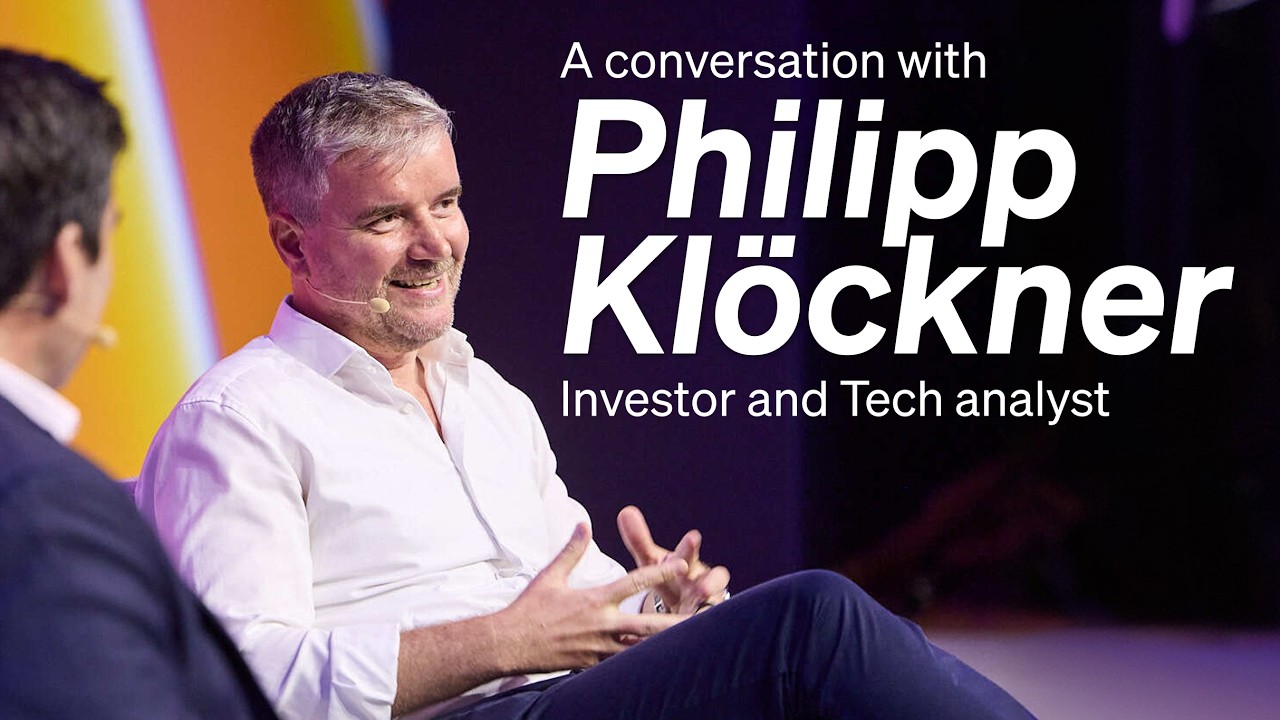
Philipp Kloeckner Urges Germany to Pivot to Biotech and Open Source AI
Stripe
Germany must bypass legacy corporate modernization to build a parallel startup economy focused on biotech and open-source models as AI changes software economics.
## Background
This video was published on YouTube by Stripe on June 30, 2026. It features a fireside chat at Tour Berlin between investor and tech analyst Philipp Klöckner and Stripe EMEA CRO Conor McNamara.
## TL;DR
Philipp Klöckner and Conor McNamara discuss the profound impact of AI velocity on software development, SaaS metrics, and the global economy, declaring 2026 a pivotal turning point. They explore the divergence between AI-native startups and legacy enterprise systems, noting how AI transforms operational models while traditional core software like SAP remains protected by regulatory moats. Looking at European competitiveness, Klöckner addresses workforce demographics, the slower-than-expected pace of B2C agentic commerce compared to rapid B2B adoption, and Germany's need to pivot toward biotech, open-source technology, and venture creation rather than relying solely on legacy industrial structures.
## Atmosphere & style
The conversation is intellectually energetic, pragmatic, and candid, driven by the comfortable rapport between two experienced tech insiders. Klöckner brings a sharp, witty, and grounded analysis—blending macro-level economic insights with self-deprecating personal anecdotes—while McNamara serves as an engaging, well-informed foil grounding the discussion in real-world platform data. The tone shifts seamlessly from lighthearted banter about investment regrets and transactional data to a focused, urgent assessment of European innovation, creating an articulate and intellectually stimulating dialogue.
## Key takeaways
- [00:00](https://www.youtube.com/watch?v=5bjkprj4lpU&t=0s) Software development and operational metrics are undergoing a massive paradigm shift in 2026, driven by compounding AI model velocity, as seen in Anthropic's net revenue retention exceeding 500%.
- [01:24](https://www.youtube.com/watch?v=5bjkprj4lpU&t=84s) A growing gap is emerging between AI-native startups and legacy incumbents, with developers becoming 3 to 4 times more effective through AI tools.
- [05:10](https://www.youtube.com/watch?v=5bjkprj4lpU&t=310s) While AI democratizes access to information and coaching, market dynamics will simultaneously concentrate massive corporate value into a few trillion-dollar winners.
- [07:41](https://www.youtube.com/watch?v=5bjkprj4lpU&t=461s) Fears of a 'SaaS apocalypse' are overblown; core systems of record (like SAP, Oracle, and Salesforce) remain protected by deep domain knowledge and complex compliance requirements.
- [11:43](https://www.youtube.com/watch?v=5bjkprj4lpU&t=703s) AI-native startups will operate with lean, 12-person teams without traditional administrative middle management, causing a K-shaped divergence in enterprise SaaS spending.
- [13:26](https://www.youtube.com/watch?v=5bjkprj4lpU&t=806s) Workforce displacement will occur slowly due to organizational inertia, and AI automation is vital for Germany to offset its annual structural deficit of 500,000 workers.
- [17:45](https://www.youtube.com/watch?v=5bjkprj4lpU&t=1065s) The labor bottleneck for junior talent is shifting to the supply side as youth opt out of computer science careers, reflected in a drop of 60,000 US CS enrollments over two years.
- [18:21](https://www.youtube.com/watch?v=5bjkprj4lpU&t=1101s) Agentic B2C commerce will scale slowly due to human shopping preferences and visual decision-making, while near-term agentic value lies in automated administrative hassle.
- [22:52](https://www.youtube.com/watch?v=5bjkprj4lpU&t=1372s) B2B AI adoption and agentic procurement will outpace B2C, significantly reducing the administrative overhead associated with corporate onboarding and tactical spend.
- [24:40](https://www.youtube.com/watch?v=5bjkprj4lpU&t=1480s) Germany suffers from a structural mindset gap where business graduates focus on 5-10% efficiency tweaks rather than engineering entirely new products and stack architectures.
- [29:32](https://www.youtube.com/watch?v=5bjkprj4lpU&t=1772s) European market expansion is limited by structural single-market fragmentation and rigid immigration rules; visa processes for technical talent need fast-tracking.
- [33:35](https://www.youtube.com/watch?v=5bjkprj4lpU&t=2015s) In a future dominated by AI and robotics, economic power will bottleneck around cheap energy and raw materials, where China dominates hardware and robotics supply chains.
- [35:14](https://www.youtube.com/watch?v=5bjkprj4lpU&t=2114s) Germany's best strategic opportunity lies in life sciences and biotech (building the 'next 10 BioNTechs'), leveraging world-class university research and AI-driven drug discovery.
- [36:51](https://www.youtube.com/watch?v=5bjkprj4lpU&t=2211s) German fintech Taktile serves as an under-the-radar success story, achieving unicorn status by providing AI infrastructure for regulated financial services and KYC processes.
- [38:14](https://www.youtube.com/watch?v=5bjkprj4lpU&t=2294s) To win by 2030, Germany must foster an open-source AI ecosystem, reform its pension system to unlock private venture capital, and build a high-growth startup economy in parallel.
## Detailed walkthrough
Here is a detailed, faithful walkthrough of the transcript:
[00:00](https://www.youtube.com/watch?v=5bjkprj4lpU&t=0s) Paradigm Shifts, AI Velocity, and Expansive Growth
Investor and tech analyst Philipp Klöckner opens the discussion with Stripe EMEA CRO Conor McNamara, weighing in on whether the technology landscape has reached the "singularity." While Klöckner hesitates to say AI is fully independent yet, he emphasizes that we are in the middle of a massive paradigm shift. Software velocity is compounding internally as AI models build subsequent versions of themselves, accelerating product cycles for companies like OpenAI and Anthropic. Pointing to Anthropic's unprecedented revenue expansion, Klöckner recalls predicting on his podcast that Anthropic would achieve a net revenue retention rate above 200%, only for the actual metric to surpass 500%—meaning the average customer spends five times more year-over-year. Traditional software metrics and legacy benchmarks are rendered obsolete by these shifts, cementing 2026 as a pivotal turning point.
* **Anthropic's Expansion:** Achieved a revenue expansion rate exceeding 500%, far surpassing initial industry predictions of 200%.
* **The Year 2026:** Cited explicitly as the moment when software economics and operational benchmarks changed fundamentally.
[01:24](https://www.youtube.com/watch?v=5bjkprj4lpU&t=84s) Software Development and the "AI Haves and Have-Nots"
Turning to software development, McNamara asks whether the broader world has grasped how fast software is being built compared to just 24 months prior. Klöckner notes a growing divide between startup founders making maximum use of AI possibilities and incumbents—particularly within the German *Mittelstand*—who still search for excuses why AI cannot replace their software or workflows. He compares this dynamic to the early days of the internet, contrasting older skeptics with "AI natives" who are graduating university having taken their exams alongside AI models.
Although autonomous AI agents building software still require human oversight ("human in the loop") for review and iteration, Klöckner asserts that developers are easily 3 to 4 times more effective today. Dismissing claims that AI is merely a bubble, he warns against "fighting gravity." Evaluating product-market fit using the core metric of loss aversion, Klöckner remarks:
> "If you would take AI away from me again, I would be mad. I would be crazy crazily mad, and I would be begging to pay you €2,000 per month to let me continue to use it."
McNamara confirms this through internal Stripe transaction data, observing that while software users constantly hop between competing AI tools, they almost never revert to non-AI workflows. Inspired by the insights, Klöckner jokes that he would "give my firstborn to get that kind of data," relying otherwise on Ramp data for B2B spend indicators.
[05:10](https://www.youtube.com/watch?v=5bjkprj4lpU&t=310s) Economic Equalizer vs. Wealth Concentration
McNamara raises the question of whether technology serves as a democratizing force or deepens economic divides. Klöckner believes both perspectives hold true simultaneously. On one hand, basic AI access is a low-barrier technology; free or cheap offerings like Google Gemini and Meta grant the public unprecedented access to information, personal executive coaching, and therapy. On the other hand, monopolies will inevitably form, concentrating massive financial value into a handful of trillion-dollar enterprise winners.
Even if capital accrues to a elite few, the consumer surplus remains wide and evenly distributed. Klöckner frames this dual reality as an offset where broad operational and personal benefits are realized universally, even as concentrated market power mints a new class of mega-corporations.
[07:41](https://www.youtube.com/watch?v=5bjkprj4lpU&t=461s) The "SaaS Apocalypse" and System of Record Moats
Addressing widespread industry debates—and referencing Stripe CEO Patrick Collison's analogy that software might become single-use disposable "pizza"—McNamara asks whether the "SaaS apocalypse" is real. Klöckner considers the recent stock market sell-off of software companies (such as Monday.com losing up to 75% of their value in short order) an emotional overreaction. While building custom tools via "vibe coding" is cheaper than ever, enterprise software purchasing obeys rigid realities around maintenance, security, compliance, and tax law updates.
A custom-coded tool does not need to be cheaper than Monday.com's entire R&D budget; it merely needs to be cheaper than a single user seat license plus ongoing maintenance costs. Furthermore, citing Nvidia CEO Jensen Wang's perspective, billions of deployed AI agents will actually increase SaaS consumption because agents must tap into APIs and existing software infrastructure to execute tasks.
* **System of Record Moats:** Enterprise systems like SAP, Oracle, and Salesforce remain heavily protected. In Germany, replacing an SAP core is a 2-to-4-year enterprise endeavor that typically costs executive careers along the way.
* **Core Legacy Value:** The true defense of platforms like SAP lies not in user interfaces, but in deep domain knowledge—such as navigating tax regimes across 210 countries.
[11:43](https://www.youtube.com/watch?v=5bjkprj4lpU&t=703s) AI-Native Startups and Lean Organizational Structures
Despite defending legacy enterprise software, Klöckner outlines a sharp K-shaped divergence for new ventures. Emerging startups will likely never grow to purchase enterprise platforms like SAP SuccessFactors because their workforce will top out at 12 people instead of 1,200. These AI-first organizations operate without administrative overhead designed solely to manage human workflows, eliminating redundant reporting, manual measurement, and middle-management tracking.
Illustrating this shift, Klöckner shares an anecdote about a friend who used AI to automate a weekly bidding report—a task created purely for a human checker that would not even exist inside an AI-native operating model. Although these lean companies will bypass traditional SaaS packages, foundational infrastructure vendors like Twilio and Cloudflare remain indispensable.
[13:26](https://www.youtube.com/watch?v=5bjkprj4lpU&t=806s) Workforce Displacement and Demographics
When asked about workforce displacement, Klöckner argues that overall job losses will occur far slower than predicted due to organizational inertia (*Beharrenskraft*) among large enterprises and public entities, drawing a parallel to the multi-decade timeline of digital transformation. Crucially, in countries like Germany, AI automation arrives during a critical demographic crunch:
* **Structural Labor Deficit:** Germany faces a structural labor gap where it lacks 500,000 workers annually due to aging demographics, making 1% annual job automation vital for maintaining productivity.
* **Workforce Solutions:** The deficit can only be bridged through increased immigration, higher birth rates (which take decades to impact the labor market), or widespread AI automation.
Addressing specific roles, Klöckner notes that catalog modeling (e.g., for Otto) has already plunged by 63%, with customer support and photography facing similar downward pressures. Conversely, sectors like legal services exhibit counterintuitive trends: despite Goldman Sachs estimates indicating 44% of legal work could be automated in the short term, lawyer hiring remains at absolute record highs.
Discounting fears that entry-level junior roles are being eliminated permanently, Klöckner attributes those claims to data selection biases drawn from narrow, early-adopter SMB samples.
[17:45](https://www.youtube.com/watch?v=5bjkprj4lpU&t=1065s) The Changing Dynamics of the Tech Labor Market
Philipp Klöckner challenges the common assumption that companies are simply refusing to hire junior talent. Instead, he argues the bottleneck is shifting to the supply side. Young people are opting out of pursuing software engineering or customer service roles altogether because they perceive these paths as lacking a long-term future due to generative AI. This shift in mindset is already showing up in macro data, such as US computer science enrollments, which declined from 660,000 to 600,000 over the course of two years.
- US computer science enrollments fell by 60,000 students (from 660,000 to 600,000) over a two-year period.
---
[18:21](https://www.youtube.com/watch?v=5bjkprj4lpU&t=1101s) The Reality and Pace of Agentic Commerce
When evaluating non-human AI agents making purchases on behalf of consumers, Klöckner remains skeptical of rapid adoption. He emphasizes that major technology shifts happen far slower than keynote speakers suggest. For example, mobile usage grows by only about 1% to 1.5% annually, driven largely by generational demographics—older non-users passing away while younger digital natives enter the market—rather than sudden behavioral changes among existing users. While hyper-viral tools like WhatsApp penetrate quickly across generations, consumer adoption of new behaviors is generally slow, and distribution remains king.
Klöckner argues that consumer demand for window shopping cannot be replaced by text-to-buy agents. People want to see the luxury items they cannot afford and the cheap items they feel above to validate their decisions. As a result, chat interfaces like ChatGPT end up live-crafting comparison pages rather than removing visual choice. While voice commerce like Alexa failed to revolutionize standard consumer staple orders (such as toilet paper), Klöckner sees real near-term agentic potential in automated administrative tasks—such as filing Deutsche Bahn delayed-train claims, handling consumer rights, or booking appointments with doctors, massage parlors, and hairdressers.
> "People don't want to shop that way... To make a decision what you want to buy, you need to see the options that you don't want. You want the luxury stuff that you can't afford, you want the cheap stuff that you say, 'I'm better than that,' and then you decide for the option that you love."
- Mobile adoption only shifts market share from desktop by 1%–1.5% per year, primarily driven by generational turnover.
- Consumer claims (e.g., flight or train delay compensation) represent a key early agentic use case where users would gladly give up a percentage (e.g., 10%) to automate the hassle.
---
[22:52](https://www.youtube.com/watch?v=5bjkprj4lpU&t=1372s) B2B Agentic Transactions and Autonomous Procurement
Conor McNamara brings up Stripe's focus on stablecoins as a complementary rail for agent-to-agent transactions. Klöckner agrees that B2B adoption will move significantly faster than B2C because businesses naturally adopt AI at higher rates to overcome human inefficiencies and compliance burdens.
Tactical spend and corporate procurement are prime areas for AI agents. Klöckner shares a personal example: as a keynote speaker, delivering a 30-minute talk for large corporations like Deutsche Bank, SAP, or Robert Bosch often requires undergoing a tedious four-hour procurement process. Delegating these low-touch or repetitive procurement processes to autonomous software agents eliminates unnecessary friction. Though profit margins on automated high-volume B2B transactions may be lower due to repeat execution, the total gross margin opportunity is substantial.
- B2B AI adoption is currently outpacing consumer AI adoption.
- Onboarding and procurement for short engagements (e.g., a 30-minute keynote) currently incur disproportionate administrative burdens (e.g., 4 hours of paperwork).
---
[24:40](https://www.youtube.com/watch?v=5bjkprj4lpU&t=1480s) The Structural Mindset Gap in the German Economy
Comparing the current state of the German economy to the national football team, Klöckner notes that Germany has lost its historical edge. While the country once led in life sciences, engineering, and automotive manufacturing, it has failed to transition to next-generation tech industries. Part of this stems from comfortable economic conditions: high-performing university graduates can easily secure starting salaries of €80,000 to €90,000 at established corporations like Porsche, Mercedes-Benz, or Google, giving them little incentive to take on the financial risks of founding a startup.
Furthermore, Klöckner identifies a deep-seated educational and cultural issue in Germany's business landscape. Business administration (BVL) graduates are trained to extract incremental 5% to 10% process efficiencies, whereas engineers are built to create entirely new products and industries. Historical German giants (Siemens, carmakers) were founded by engineers, and today's dominant global figures—from the wealthiest US founders to LVMH's Bernard Arnault—share an engineering background. Klöckner insists that Germany cannot save its economy by using AI to incrementally optimize legacy corporate structures; it must pivot towards new company formation built on fresh technology stacks.
> "If you study business administration... you are trained to improve some process by 5 to 10% and extract 5 to 10% more productivity... but engineers are trained to build something entirely new. We need more of these engineers who don't think 'How can I extract 10% more efficiency,' but 'How can I rebuild this process entirely?'"
- High corporate starting salaries in Germany (€80,000–€90,000) disincentivize top talent from starting high-risk entrepreneurial ventures.
---
[29:32](https://www.youtube.com/watch?v=5bjkprj4lpU&t=1772s) Overcoming Growth Inhibitors: Single Market, Capital, and Talent
Discussing the Draghi report and European policy, Klöckner outlines the top structural barriers holding back innovation in Germany and the wider EU. While the EU offers a massive combined market of 350 to 400 million citizens, fragmentation across dozens of distinct tax regimes, languages, and corporate registration frameworks prevents startups from scaling seamlessly compared to their US counterparts. McNamara adds that platforms like Stripe Atlas see large numbers of European founders registering US entities in Delaware just to gain instant access to a unified domestic market.
Klöckner believes blaming a lack of local venture capital is an excuse, noting that global capital rapidly flows to high-quality European companies like Revolut or Stripe. Instead, the true bottleneck is a shortage of breakthrough startups and an excessively rigid immigration system. European founders struggle with long visa wait times (often taking months or years) when trying to hire top technical talent from India, the Philippines, or Eastern Europe. To remain competitive, Germany needs streamlined immigration processes that allow companies to onboard international experts within four weeks if the employer guarantees sponsorship.
- The European Union represents a potential domestic consumer market of 350M–400M people, but remains functionally fragmented by separate legal and tax structures.
- Visas for foreign technical talent currently take months or years in Germany; Klöckner advocates for a 4-week fast-track process for sponsored hires.
---
[33:35](https://www.youtube.com/watch?v=5bjkprj4lpU&t=2015s) Resource Constraints and Germany's Future Strategic Advantages
Looking 10 to 15 years into a future where AI handles white-collar tasks and robotics executes blue-collar labor, Klöckner argues that the ultimate economic bottlenecks will reduce to two fundamental resources: cheap energy and raw materials (such as iron and copper). Because China and Russia possess vast natural resources and cheap energy—with China already controlling 80% of robot manufacturing supply chains and producing sub-$10,000 industrial units—Germany cannot expect to win in mass robotics, hardware manufacturing, or foundational software models.
To secure future economic growth, Germany must focus on high-value sectors that do not depend on massive energy consumption or raw material extractions, specifically highlighting industries like biotechnology and life sciences.
- China currently produces 80% of components used in robotics and can manufacture functional robots for under $10,000 (€10,000).
- Key strategic drivers in an automated future will be cheap energy and raw natural resources (e.g., copper, iron, coal).
[35:14](https://www.youtube.com/watch?v=5bjkprj4lpU&t=2114s) The Promise and Threats in Life Sciences and Biotech
When considering which industries Germany can realistically dominate in the future, Philipp Klöckner points directly to life sciences and pharmaceuticals. This sector thrives primarily on "great science" and top-tier human capital, areas where Germany still maintains a massive competitive edge. The country boasts world-class universities, and many of the leading international AI and life science researchers were originally trained in Germany. Klöckner reminds the audience that Germany was literally the "pharmacy of the world" at the end of the 19th and beginning of the 20th century, when industrial giants like Bayer, BASF, and the predecessors of Hoechst were founded. While traditional chemical manufacturing is now too energy-intensive to make a full comeback in Europe, biotech and pharmaceuticals present a massive opportunity.
To secure its economic future, Germany needs to focus on building "the next 10 BioNTechs." Klöckner notes that Germany briefly boasted a $100 billion company in BioNTech—a success story notably built by immigrants. Leveraging AI for drug discovery and pharmaceutical research opens up endless possibilities. However, Klöckner warns against putting all eggs in one basket, emphasizing the need for diversification. Furthermore, the sector faces intense global competition, including from tech giants like Google DeepMind, which operates its own life sciences division aiming to discover the next generation of cancer drugs.
* **Historical Context:** Germany dominated world chemical and pharmaceutical production during the late 1800s and early 1900s.
* **Key Challenge:** Chemical manufacturing is currently too energy-intensive to regain global dominance, making biotech the primary alternative.
* **Target:** Germany must cultivate a dozen new high-value biotech firms leveraging AI technology for pharmaceutical research.
---
[36:51](https://www.youtube.com/watch?v=5bjkprj4lpU&t=2211s) Under-the-Radar German Startups: The Case of Taktile
As Conor McNamara shifts toward wrapping up the chat so attendees can head downstairs for drinks in the expo hall, he asks Klöckner to highlight a German startup that might be under the radar but is quietly "setting the world alight." Klöckner admits that staying truly under the radar is difficult, but singles out **Taktile**, an AI-driven platform operating in the heavily regulated financial services industry to streamline processes like Know Your Customer (KYC). Taktile recently announced a substantial funding round led by Tiger Global, raising between $130 million and $160 million, effectively making it a fresh unicorn that many outside the fintech space might not know about yet.
Klöckner believes Taktile has the momentum to grow from a unicorn into a decacorn if it continues serving its niche effectively. He confesses with a laugh that he made a small personal investment in the company early on through a friend, but ended up selling part of his stake in a secondary sale prior to their latest round. Seeing Tiger Global jump in made him decide to "cash in on a few of my shares," a decision he now deeply regrets—though McNamara quips that at least he "still got some skin in the game."
* **Company Highlight:** Taktile (AI for regulated financial industries and KYC workflows).
* **Funding & Valuation:** Raised $130M–$160M in a round led by Tiger Global, achieving unicorn status with potential for decacorn growth.
* **Personal Tangent:** Klöckner took early secondary profits on his investment when Tiger entered, calling it a move he "regretted a lot."
---
[38:14](https://www.youtube.com/watch?v=5bjkprj4lpU&t=2294s) What Germany Needs to Win by 2030
To close the conversation on a high note, McNamara asks Klöckner to imagine sitting in a much larger auditorium of 9,000 people at Stripe Tour Berlin in the year 2030. He asks what must happen between now and then for Germany to return to the forefront of the global economy. Klöckner emphasizes that achieving this vision will require concerted effort across several key pillars, starting with a flourishing **open-source ecosystem**. Pointing out that foundational digital infrastructure—from web servers and CMSs to cell phone towers and Android—is built on open source, he argues that the LLM and foundation model layer must follow the same path. Because Germany lacks a dominant sovereign LLM player, it must rely on freely accessible open-source models to integrate AI into its core traditional industries. Without this, Europe risks becoming entirely dependent on US tech monopolies, repeating the value extraction seen in digital advertising.
Secondly, Klöckner stresses the necessity of reforming the pension system toward a capital-based, private model. Mobilizing domestic capital through pensions allows ordinary citizens to share in corporate wealth creation while providing venture funding for local businesses—an area where Germany has historically lagged but is beginning to make progress. Finally, he argues that Germany must expend just as much energy fostering a new generation of high-growth startups as it does trying to protect legacy corporate incumbents.
> "I don't believe in transforming large companies. I think you have to build a faster startup economy in parallel, like it happened in the last years in the US over and over... We still have the manpower, and we just have to get going and start building stuff again."
* **Open-Source Imperative:** Prevents over-dependence on US AI monoliths and enables local industries to build value on shared foundation models.
* **Capital Markets:** Modernizing the pension system to funnel local capital into high-growth domestic ventures.
* **Parallel Economy:** Creating new, fast-moving technology companies rather than attempting to slow-transform legacy industrial incumbents.
* **Human Capital:** Europe continues to supply top AI talent globally; the challenge is retaining and empowering researchers to build locally.
## Notable quotes
> [01:24](https://www.youtube.com/watch?v=5bjkprj4lpU&t=84s) If you would take AI away from me again, I would be mad. I would be crazy crazily mad, and I would be begging to pay you €2,000 per month to let me continue to use it. — Philipp Klöckner
> [18:21](https://www.youtube.com/watch?v=5bjkprj4lpU&t=1101s) People don't want to shop that way... To make a decision what you want to buy, you need to see the options that you don't want. You want the luxury stuff that you can't afford, you want the cheap stuff that you say, 'I'm better than that,' and then you decide for the option that you love. — Philipp Klöckner
> [24:40](https://www.youtube.com/watch?v=5bjkprj4lpU&t=1480s) If you study business administration... you are trained to improve some process by 5 to 10% and extract 5 to 10% more productivity... but engineers are trained to build something entirely new. We need more of these engineers who don't think 'How can I extract 10% more efficiency,' but 'How can I rebuild this process entirely?' — Philipp Klöckner
> [38:14](https://www.youtube.com/watch?v=5bjkprj4lpU&t=2294s) I don't believe in transforming large companies. I think you have to build a faster startup economy in parallel, like it happened in the last years in the US over and over... We still have the manpower, and we just have to get going and start building stuff again. — Philipp Klöckner
## Mentioned
Philipp Klöckner, Conor McNamara, Stripe, OpenAI, Anthropic, German Mittelstand, Google Gemini, Meta, Patrick Collison, Monday.com, Nvidia, Jensen Wang, SAP, Oracle, Salesforce, Twilio, Cloudflare, Otto, Goldman Sachs, WhatsApp, Alexa, ChatGPT, Deutsche Bahn, Deutsche Bank, Robert Bosch, Porsche, Mercedes-Benz, Google, Siemens, LVMH, Bernard Arnault, Mario Draghi, Stripe Atlas, Revolut, China, Russia, BASF, Bayer, Hoechst, BioNTech, Google DeepMind, Taktile, Tiger Global, Android
Philipp Klöckner敦促德国转向生物技术与开源AI
随着AI改变软件经济模式,德国必须绕过传统企业现代化改造,建立一个专注于生物技术和开源模型的平行初创经济。
Philipp Klöckner与Conor McNamara探讨了AI迭代速度对软件开发、SaaS关键指标以及全球经济的深远影响,并认为2026年将是一个关键转折点。他们分析了AI原生初创企业与传统企业系统之间的分化,指出AI虽在重塑运营模式,但SAP等传统核心软件依然受到监管护城河的保护。在审视欧洲竞争力时,Klöckner分析了劳动力人口结构、B2C Agent商业化进展慢于预期而B2B应用迅速落地的反差,以及德国转向生物技术、开源技术与初创企业孵化的必要性,而非单纯依赖传统工业结构。
软件开发与运营指标正在经历深远的范式转变,AI模型的复合迭代显著加速了产品周期,Anthropic的净收入留存率(NRR)已突破500%。 (0:00)
针对“SaaS末日”的市场恐慌被严重夸大,SAP和Oracle等核心记录系统(System of Record)凭借复杂的跨国合规与深厚领域知识构筑了难以撼动的护城河。 (7:41)
原生AI初创公司将以仅约12人的极精简团队运作并剔除传统中层管理结构,进而引发企业SaaS软件支出的K型分化。 (11:43)
受制于大企业的组织惯性,AI带来的岗位替代将缓慢推进;而在德国等老龄化严重的经济体,AI自动化是弥补每年50万劳动力结构性缺口的关键。 (13:26)
由于人类需要直观的视觉比较与逛街体验,面向消费者的Agent电商渗透将较为缓慢,近期的智能体红利将主要集中在自动化繁琐行政事务与B2B自主采购环节。 (18:21)
Reading summary
Tech analyst Philipp Klöckner argues that artificial intelligence represents an irreversible economic shift that will favor agile, ultra-lean startups over legacy corporations, while cautioning that Europe must dismantle regulatory and mindset barriers to prevent falling permanently behind.
Enterprise Software Moats and Lean AI Startups (7:41)
Klöckner characterizes recent software stock sell-offs—such as Monday.com losing up to 75% of its market value—as an emotional overreaction rather than a true SaaS apocalypse. While lightweight custom tools and vibe coding reduce initial development barriers, enterprise core systems of record like SAP, Oracle, and Salesforce remain insulated by regulatory compliance, security demands, and complex international tax rules spanning over 200 jurisdictions. In addition, software consumption may increase rather than decline, as deploying autonomous agents requires access to underlying enterprise APIs.
Concurrently, Klöckner foresees a sharp divergence for new ventures. AI-first startups are likely to scale revenue with workforces capping around a dozen people rather than expanding to over a thousand. These lean operations eliminate the middle-management and internal reporting layers designed strictly to oversee human tasks, bypassing traditional enterprise HR and management software suites while depending heavily on core infrastructure providers like Cloudflare and Twilio.
Demographic Deficits Buffer Workforce Automation (13:26)
Addressing fears of sudden mass unemployment, Klöckner argues that institutional inertia will slow corporate workforce displacement. In aging economies such as Germany, which faces an annual structural deficit of 500,000 workers, automating roughly 1% of jobs annually serves as a necessary buffer to preserve economic output rather than a disruption that sparks structural unemployment.
Displacement pressures are distributing unevenly across sectors. Klöckner notes that catalog modeling has plunged by 63% and customer service faces heavy contraction, yet lawyer hiring remains at record highs despite Goldman Sachs estimates suggesting 44% of legal tasks could be automated. Furthermore, Klöckner identifies a bottleneck on the labor supply side, citing a decline in US computer science enrollments from 660,000 to 600,000 over two years as students question the long-term viability of junior engineering roles.
Sluggish Consumer Agents Versus Fast B2B Adoption (18:21)
Klöckner doubts consumer commerce will rapidly pivot to autonomous buying agents, noting that behavioral shifts historically mirror gradual generational turnover rather than sudden user migration. Consumer purchasing relies on visual comparison and browsing to validate trade-offs, which chat interfaces struggle to replace. Near-term consumer agent utility will instead concentrate on low-friction administrative chores, such as automating train delay claims or booking appointments.
In contrast, Klöckner projects that B2B agentic transactions will scale rapidly due to high administrative overhead. Routine business interactions—such as onboarding speakers through four-hour corporate procurement processes for 30-minute presentations—create clear incentives for automation. Delegating tactical spend and corporate onboarding to software agents operating over programmable financial rails offers immediate gross margin gains for enterprises.
Strategic Pivots for European and German Innovation (24:40)
Klöckner diagnoses Germany's technological lag as a consequence of comfortable economic conditions, where corporate starting salaries of €80,000 to €90,000 discourage risk-taking, paired with business curricula focused on 5% to 10% process optimizations rather than engineering-led invention. Compounding this, the European Union's internal market of 350 to 400 million consumers remains fragmented by divergent tax and legal frameworks, while visa processes for foreign technical talent take months or years instead of the four-week expedited timeframe Klöckner recommends.
Looking ahead, Klöckner argues that rising global automation will leave cheap energy and raw materials as the primary manufacturing bottlenecks—areas where China dominates by controlling 80% of robot components and manufacturing sub-$10,000 industrial units. Consequently, Germany cannot lead in mass hardware or foundational models. Instead, it must concentrate on capital-efficient, high-knowledge domains like biotechnology and life sciences, support open-source foundation models to avoid US tech monopolization, and construct a parallel startup ecosystem rather than relying on the slow transformation of legacy corporations.
Klöckner concludes that Europe must prioritize creating new, high-growth technology companies in parallel with existing industries rather than attempting to incrementally modernize legacy incumbents. However, the timeline for achieving this turnaround by 2030 remains contingent on unresolved structural reforms, including streamlining technical immigration and modernizing private pension systems to mobilize domestic venture capital.
精炼阅读摘要
投资分析师 Philipp Klöckner 与 Stripe 首席营收官 Conor McNamara 探讨指出,人工智能虽然显著加速了软件开发并重塑组织规模,但传统企业软件凭借深厚业务壁垒并未消亡;面对全球技术竞争与严峻的资源约束,欧洲及德国必须放弃对传统存量企业的微调幻想,转而通过开源技术底座、生命科学突破以及平行的创业生态重建竞争力。
软件范式跃迁与企业记录系统护城河 (7:41)
Klöckner 认为技术领域正处于深刻的范式转换中,AI 模型的自我迭代加速了软件开发速度,使开发者效率提升 3 至 4 倍。以 Anthropic 为例,其净收入留存率超过 500%,远高于行业预期的 200%,标志着传统软件商业指标在 2026 年面临根本性重构。Klöckner 表示自己极度依赖 AI,若被剥夺宁愿每月支付 2000 欧元以维持使用;McNamara 亦通过 Stripe 交易数据证实,用户在不同 AI 工具间切换频繁,但极少退回非 AI 工作流程。
尽管二级市场出现抛售潮(例如 Monday.com 估值短期下挫达 75%),Klöckner 将所谓的“SaaS 灭顶之灾”定性为情绪化过度反应。他分析指出,SAP、Oracle 和 Salesforce 等“记录系统”拥有严密的合规、安全与税法壁垒,例如在德国替换 SAP 核心系统需要耗费 2 至 4 年并可能危及高管职业生涯,其核心价值在于支撑 210 个国家复杂税制的业务知识积累。与此同时,新型 AI 原生初创公司呈现组织极简态势,团队规模可能仅需 12 人而非 1200 人,将直接绕开 SAP SuccessFactors 这类传统管理软件,但仍须依赖 Twilio 与 Cloudflare 等底层基础设施。
劳动力重组:供给侧收缩与人口结构缓冲 (13:26)
针对 AI 导致技术失业的普遍担忧,Klöckner 指出大型企业与公共部门的组织惰性会使裁员速度远慢于外界预期。特别是在德国,人口老龄化导致每年面临 50 万劳动人口的结构性缺口,每年实现 1% 的工作岗位自动化已成为维持现有生产力的必要手段,其补充途径仅有人口出生率、移民或 AI 自动化。
虽然局部细分岗位受到立竿见影的冲击——例如 Otto 目录模特业务量骤降 63%,摄影与客户支持面临类似下行压力——但某些领域的就业需求反而出现反直觉增长。例如高盛估计法律行业短期内可自动化 44% 的工作,但律师招聘规模却创下历史新高。Klöckner 进一步指出,当前初级岗位的瓶颈更多转移至供给侧:由于担忧生成式 AI 剥夺长期职业前景,年轻一代主动放弃软件工程与客服类方向,过去两年间美国计算机科学专业的入学人数已从 66 万人滑落至 60 万人。
智能体落地节奏:B2B采购快于消费端变革 (18:21)
在智能体电商领域,Klöckner 对消费端的快速普及持审慎态度。他指出重大技术行为转变通常极为缓慢,例如移动端蚕食桌面端份额的年增长率仅为 1% 至 1.5%,主要由代际更替驱动。此外,纯文本代理下单无法满足消费者的逛街心理——消费者需要通过浏览买不起的奢侈品或不屑于购买的廉价品来验证自己的选择,因此 ChatGPT 等对话界面目前更多演变为动态生成对比网页。Klöckner 认为,面向消费者的智能体短期突破点在于低附加值行政维权事务,例如代办德铁延误索赔(用户愿让渡 10% 佣金)或预约理发与就医。
相较之下,面向企业端(B2B)的智能体交易与自主采购推进速度将显著加快。企业出于削减低效人力成本与合规负担的强烈动机,对 AI 技术的采纳率更高。Klöckner 举例说明,作为主题演讲嘉宾在德意志银行、SAP 或博世进行 30 分钟演讲,往往需要耗费 4 小时走完繁琐的采购建档流程;利用自主软件智能体接管此类小额日常采购,可大幅减少行政摩擦。Stripe 正探索以稳定币作为智能体间交易的互补轨道,即便高频交易单笔利润较低,整体毛利空间依然广阔。
地缘资源约束与构建平行创业生态 (24:40)
着眼未来 10 至 15 年,Klöckner 预测当认知任务与体力劳动分别被 AI 与机器人接管后,终极经济瓶颈将归结于廉价能源与铁、铜等核心原材料。目前中国已控制了 80% 的机器人制造供应链,并能生产单价低于 1 万美元的工业单元,这导致德国在硬件制造、大规模机器人和基础大模型层面已无竞争优势。德国的战略重心必须转向高附加值、低能耗的生命科学与生物技术领域,重拾 19 世纪末世界药房的人才底蕴,利用 AI 药物研发培育“下十个 BioNTech”,并关注像获得 Tiger Global 领投 1.3 亿至 1.6 亿美元融资的合规金融初创公司 Taktile 这类高潜力独角兽。
为了扭转当前德国顶尖毕业生更倾向于在保时捷、奔驰或 Google 获取 8 万至 9 万欧元起薪而不愿承担创业风险的现状,Klöckner 呼吁打破思维藩篱。他强调,德国必须建立以开源为基础的基础模型生态以避免对美国科技巨头的单一依赖,同时推动养老金私有化改革以引导本土资本进入风投,并在 4 周内快速审批技术人才移民签证。面对欧盟 3.5 亿至 4 亿人口单一市场被多国税制割裂的现状,德国不应继续消耗资源试图改造大型传统企业,而必须像美国一样并行构建高敏捷度的全新科技创业经济。
总体而言,对话揭示了 AI 浪潮在技术理想主义与现实经济惯性之间的深层张力。尽管软件开发范式与智能体技术快速迭代,但旧有系统的记录壁垒、物理世界的能源与原材料短缺以及地缘政策阻碍依然对技术红利的释放节奏构成刚性约束。欧洲能否在过度依赖外国底层技术与硬件之前,通过开源生态与体制改革孕育出足够强大的本土生命科学与创新企业,仍是一个悬而未决的严峻考验。
Detailed notes — zh
## Background
该视频由 Stripe 官方频道于 2026 年 7 月 7 日发布在 YouTube 平台。视频记录了在 Stripe 柏林巡回峰会(Tour Berlin)现场,投资人兼科技分析师菲利普·克洛克纳(Philipp Klöckner)与 Stripe EMEA 首席营收官康纳·麦克纳马拉(Conor McNamara)展开的一场深度炉边谈话。
## TL;DR
对谈首先剖析了前沿 AI 技术的自我迭代飞轮以及 Anthropic 突破 500% 净收入扩张率所代表的商业剧变,并结合企业采购逻辑理性驳斥了过度情绪化的“SaaS 末日论”。随后,双方深入探讨了就业市场的深层演变,指出大企业组织惰性与老龄化断崖能有效对冲失业冲击,并从人类天生的逛街心理与痛点维度辨析了消费级与 B2B 智能体交易的落地节奏。针对欧洲与德国当前的经济沉沦,Klöckner 尖锐直指其偏安一隅的安逸陷阱与商科思维局限,呼吁德国摆脱能源与硬件劣势、转向高智力密度的生物医药研发。最后,对谈提出了以开源大模型、养老金资本化改革及双轨并行孵化新一代工程师创业阶层为核心的 2030 重振三大支柱。
## Atmosphere & style
现场对话节奏紧凑明快,在严谨硬核的宏观经济剖析与幽默风趣的即兴调侃之间自如穿梭。McNamara 凭借 Stripe 一手商业数据与敏锐提问巧妙引控全场,而 Klöckner 则以反共识、讲真话的犀利风格著称,对传统企业惰性、商科咨询式自嗨乃至自身错失的股权交易展开毫不留情的剖析与自嘲。整场对谈既有对欧洲沉溺于舒适圈的当头棒喝与清醒审视,又在后半程对欧洲顶尖科研脑力的坚定信心中,散发出一种召唤创业者撕掉官僚束缚、撸起袖子重构产业的务实感染力。
## Bulletin
- [00:00](https://www.youtube.com/watch?v=5bjkprj4lpU&t=0s) 前沿模型厂商展现出前所未有的商业扩张力,Anthropic 客户净收入扩张率突破 500%,存量客户年均支出增加至前一年的 5 倍以上,彻底打破了传统 SaaS 财务基准。
- [01:24](https://www.youtube.com/watch?v=5bjkprj4lpU&t=84s) Stripe 内部数据显示,用户在各大 AI 工具之间频繁迁移极为普遍,但从采纳 AI 倒退回无 AI 传统工作流的逆向流失率为零。
- [07:40](https://www.youtube.com/watch?v=5bjkprj4lpU&t=460s) “SaaS 灭顶之灾”论调被严重夸大,自研软件综合 TCO 必须低于采购单套商业 License 的边际成本,企业才具有自研动力,且智能体爆发将反哺软件 API 调用需求。
- [13:19](https://www.youtube.com/watch?v=5bjkprj4lpU&t=799s) 德国面临每年净减少 50 万劳动力的老龄化冲击,AI 年均替代 1% 的工作岗位不仅不会引发失业潮,反而恰好填补了退休人群的缺口。
- [33:10](https://www.youtube.com/watch?v=5bjkprj4lpU&t=1990s) 在廉价能源与自然资源匮乏的背景下,德国难以在机器人与重工业制造领域与中国竞争,其真正的破局机会在于高智力密度的生物技术与制药工程。
## Key takeaways
- [00:00](https://www.youtube.com/watch?v=5bjkprj4lpU&t=0s) AI 研发正进入“软件构建更强 AI、更强 AI 再反哺软件”的指数级自我迭代飞轮,促使前沿大模型厂商的产品迭代与商业变现彻底脱离旧有轨迹。
- [01:24](https://www.youtube.com/watch?v=5bjkprj4lpU&t=84s) 当前软件开发呈现出极端断层:初创团队已实现 3 至 4 倍的效能提升,而以德国中型企业为代表的传统守旧派仍因惯性拒绝正视 AI 的颠覆力量。
- [05:10](https://www.youtube.com/watch?v=5bjkprj4lpU&t=310s) AI 正在制造“使用层面的全民平权”与“财富层面的超级垄断”双轨并存的平等悖论:个人能零成本获取高端咨询服务,而绝大部分经济价值仍将汇聚于极少数科技巨头。
- [07:40](https://www.youtube.com/watch?v=5bjkprj4lpU&t=460s) 由于安全审查、税收合规及系统长期维护的高昂隐性成本,只要企业采购商业 SaaS 单账号的授权费低于自研维护的综合 TCO,传统严肃企业软件就不会被轻易取代。
- [10:28](https://www.youtube.com/watch?v=5bjkprj4lpU&t=628s) 作为核心事实数据支撑的“记录系统”(如 SAP、Oracle)拥有深厚护城河,但未来的 AI 原生初创公司依靠极度精简的团队即可闭环运作,可能永远不会采购传统重型 ERP。
- [13:19](https://www.youtube.com/watch?v=5bjkprj4lpU&t=799s) 大型企业和公共部门强大的组织惰性(Beharrungskraft)会显著拉长 AI 替代进程,加上老龄化社会的劳动力供给断崖,宏观失业恐慌被过度放大。
- [17:11](https://www.youtube.com/watch?v=5bjkprj4lpU&t=1031s) 初级技术岗位的缩减本质上是“供给端意愿”驱动而非“需求端裁撤”:年轻一代看清职业前景后在择业端用脚投票,主动掉头离场导致计算机等专业招生与应聘人数下滑。
- [18:21](https://www.youtube.com/watch?v=5bjkprj4lpU&t=1101s) 智能体电商的普及受制于人类根深蒂固的“逛街漫游”(Window Shopping)心理诉求,单纯追求效率的机器代采无法提供通过对比与挑选确立自我价值的情感体验。
- [20:59](https://www.youtube.com/watch?v=5bjkprj4lpU&t=1259s) 消费级 AI Agent 将率先在德铁/航司延误自动索赔、餐饮及生活医疗服务预约等高痛点、规则明确的场景中完成落地。
- [22:52](https://www.youtube.com/watch?v=5bjkprj4lpU&t=1372s) B2B 场景中的战术性采购与供应商核验充斥着大量繁文缛节,结合稳定币等微额清算网络的 Agent-to-Agent 自主交易将成为最具效率爆发点的落地形态。
- [24:37](https://www.youtube.com/watch?v=5bjkprj4lpU&t=1477s) 德国经济陷入“舒适陷阱”,社会过度依赖商科思维在存量流程上做 5% 到 10% 的边际微调,亟须重构崇尚从零颠覆与创造的工程师文化。
- [29:32](https://www.youtube.com/watch?v=5bjkprj4lpU&t=1772s) 欧洲科技生态的核心痛点在于缺乏统一的数字单一市场以及高壁垒的跨国人才引进流程,而非真正缺乏资本。
- [33:10](https://www.youtube.com/watch?v=5bjkprj4lpU&t=1990s) 未来由算法与机器人主导的全球格局终极竞争在于廉价能源与自然资源储备,德国应扬长避短,聚焦于依赖基础科研与顶尖人力资本的生物科技与新药研发。
- [38:14](https://www.youtube.com/watch?v=5bjkprj4lpU&t=2294s) 德国重返全球科技前沿的三大支柱包括:坚定押注开源基础模型生态、推进养老金资本市场化以激活长期创投资金,以及通过双轨并行大力培育新兴创业企业阶层。
## Detailed walkthrough
### [00:00](https://www.youtube.com/watch?v=5bjkprj4lpU&t=0s) 奇点与范式转变:Anthropic 惊人的 500% 收入扩张
对谈伊始,Stripe EMEA 首席营收官 Conor McNamara 询问投资人兼科技分析师 Philipp Klöckner 对开场演讲视频的看法。Klöckner 直言,是否认同视频观点取决于对“技术奇点”(Singularity)的定义:如果奇点指的是 AI 彻底脱离人类掌控、实现完全自主起飞,他认为目前尚未走到那一步。然而,眼下所展现的正是巨大“范式转变”(Paradigm Shift)的先行风向标。最直观的体现莫过于新商业形态的诞生以及 AI 自身的指数级加速循环——软件正在编写下一代 AI,而新一代 AI 又紧接着构建下下代系统,OpenAI 与 Anthropic 等领跑者的产品迭代速率已经彻底脱离了旧有轨迹。
```mermaid
flowchart LR
accTitle: AI Self-Acceleration Engine
accDescr: Software creates newer AI models which in turn develop subsequent generations at accelerating velocity.
subgraph Iteration["自我迭代加速循环"]
A["现有软件基础设施"] --> B["构建下一代 AI 模型"]
B --> C["更高阶的代码与推理能力"]
C --> D["加速产出下下一代 AI"]
D --> B
end
subgraph Market["商业端突破"]
E["Anthropic 等前沿厂商"] --> F["突破 500% 净收入扩张率"]
F --> G["颠覆传统 SaaS 商业基准"]
end
C -.-> E
```
在商业数据上,这种变革同样带来了前所未有的冲击。Klöckner 提到,他此前在播客中曾大胆预言 Anthropic 会成为首家净收入扩张率(Revenue Expansion Rate / NRR)突破 200% 的企业,而实际公布的数据更是直接冲破了 500%。这意味着 Anthropic 的老客户在第二年平均花费的金额达到了去年的 5 倍以上。对于任何传统企业级软件供应商而言,这种扩张速度都是不可思议的奇迹,传统 SaaS 赖以生存的财务基准和评估指标在 2026 年面临着彻底的重构。
- Anthropic 的客户净收入扩张率超过 500%,意味着存量客户年均支出增加至前一年的五倍以上。
- AI 的研发正进入“软件构建更强 AI、更强 AI 再反哺软件”的自我增强飞轮。
- 传统软件行业的增长指标在新一代前沿大模型厂商面前彻底失效。
---
### [01:24](https://www.youtube.com/watch?v=5bjkprj4lpU&t=84s) 软件开发重构与“AI 拥有者”的鸿沟:不要对抗重力
谈及过去 24 个月软件研发模式的巨变,Klöckner 认为整个社会在很大程度上仍未真正消化其深远影响。当前行业呈现出极端的认知断层:创业者和初创团队正在最大化榨取 AI 的每一分潜力,而以德国中型企业(Mittelstand)为代表的传统守旧派,却依然在挖空心思找借口,论证为什么自家业务的软件不能由 AI 生成、为什么自己的岗位不会被替代。这种“拥有 AI 者与缺乏 AI 者”(AI haves and have-nots)的二元鸿沟在未来几年仍将持续存在。
如同互联网普及初期诞生的“数字原住民”(Digital Natives),当今刚走出大学校门的年轻人已经成为彻底的“AI 原住民”(AI Natives)——他们所有的考试、作业都在与 AI 协同中完成。在开发端,Anthropic 凭借出色的产品定位精准切入了软件工程这一最具价值的落地市场。虽然自主智能体(Autonomous Agents)构建系统仍需要“人类在回路”(Human-in-the-loop)进行审查与修正,但开发效率提升 3 到 4 倍已经是不可否认的事实,“否认这一点只能说明你用法不对”。
对于那些声称“AI 是随时会破裂的泡沫、迟早会消失”的质疑者,Klöckner 警告道:“不要对抗重力”(Don't fight gravity)。检验优质产品的终极法则极为简单:“如果把它从你手中夺走,你会感到痛苦吗?”Klöckner 感叹,如果现在剥夺他的 AI 使用权,他会彻底发狂,甚至心甘情愿每月掏出 2,000 欧元只求保留访问权。
Conor McNamara 随之分享了 Stripe 平台的一手支付数据:用户在各大 AI 工具之间频繁迁移(tool hopping)十分常见,但从未有任何一个用户在采纳 AI 之后,倒退回两年前无 AI 的传统工作流中。Klöckner 听闻后打趣称,身为分析师,自己愿意“奉献出第一个孩子”来换取 Stripe 手中掌握的这套 B2B 支付与真实续约流失数据。
- 效率倍增标杆:在软件开发场景下,结合 AI Agent 辅助已能普遍实现 3 至 4 倍的效能提升。
- Stripe 内部数据验证:用户可能在不同 AI 厂商之间流转切换,但“从 AI 工具回归非 AI 传统工具”的逆向流失率为零。
- Klöckner 极度推崇的痛点价值测试:愿为保留现有 AI 辅助工作流每月支付高达 2,000 欧元。
---
### [05:10](https://www.youtube.com/watch?v=5bjkprj4lpU&t=310s) 财富集中还是全民红利?双轨并存的平等悖论
Conor McNamara 提出,云计算早期曾被描绘为普及数字生产力的平权力量,但从实际经济结果看,科技在短期内往往拉大群体差距。面对“AI 究竟是拉大全球繁荣差距的推手,还是会让水涨船高(lift all boats)的普惠力量”这一议题,Klöckner 认为答案是“两者同时成立”。
一方面,AI 是使用门槛极低的技术。用户几乎零成本即可通过 Google Gemini 或 Meta 的开源生态调用顶尖知识和推理能力,信息与顶层智慧的获取成本已被抹平至趋近于零。然而在财富创造的分配端,垄断很可能会在核心 AI 市场再度成型,绝大多数经济价值最终仍会汇聚到极少数科技巨头和创始人手中。
即便未来可能再次涌现出数家市值数万亿美元的超级帝国,普通消费者所享受到的实质福利分配却前所未有地广泛。Klöckner 举例道,无论身在何处,如今每个人都能在口袋里随时唤出一个私人顶级高管教练(Executive Coach)、心理咨询师、健身私教或财务顾问。在德国本土,这类专业服务此前极度匮乏且收费昂贵,而如今高质量的 AI 顾问唾手可得且能力仍在高速进化。因此,财富层面的高度垄断与使用层面的全民平权正在同步发生。
| 维度 | 现实表现 | 影响结果 |
|:--- |:--- |:--- |
| **准入门槛与触达能力** | 接近零边际成本,免费大模型与开源生态普及 | 全民享有专属高管教练、心理咨询、学习辅导等高端服务 |
| **经济价值与资本回报** | 算力与基础模型生态高度集中 | 催生万亿美元量级的超级垄断企业,资金流向少数头部巨头 |
---
### [07:40](https://www.youtube.com/watch?v=5bjkprj4lpU&t=460s) 拆解“SaaS 末日论”:单套许可成本、Vibe Coding 与 Agent 新生态
对话随后转向了近期热议的“SaaS 末日论”(SaaS Apocalypse)。Stripe 联合创始人 Patrick Collison 此前曾提出“软件正在变得像披萨一样——按需现做、一次性消费即可丢弃”的隐喻。近期资本市场上 Monday.com、ServiceNow 等 SaaS 标的遭遇暴跌,部分市值蒸发高达 75%。Klöckner 认为这种抛售狂潮充斥着过度情绪化,对绝大多数严肃企业级软件而言,所谓“SaaS 灭顶之灾”被严重夸大了。
Klöckner 剖析了企业采购的底层逻辑:虽然当下任何人都可以凭借“Vibe Coding”(氛围编码/自然语言交互编程)在极短时间内拼凑出一个自用的 Monday.com 甚至轻量版 ServiceNow,但企业软件的核心成本从来不在最初的代码编写,而在长期的系统维护、代码安全性、数据合规以及随税收与监管法规变化进行的持续升级。自研软件不是要比开发一家 Monday.com 公司的初始投资便宜,而是自研维护的总持有成本必须击倒“购买单套 Monday.com 商业许可”(one license)的费用。只要单套授权费依然低于内部维护自研工具的开销,企业就不会轻易放弃成熟的商用 SaaS。
```mermaid
flowchart TD
accTitle: Enterprise Build vs Buy Decision with AI
accDescr: Comparison between vibe coding bespoke software and purchasing a single SaaS license taking total cost of ownership into account.
subgraph Build["自研路线 (Vibe Coding)"]
B1["低门槛快速成型"] --> B2["持续维护与运维负担"]
B2 --> B3["安全审查与合规风控"]
B3 --> B4["财税与监管法规持续适配"]
B4 --> B5["企业总体自研 TCO"]
end
subgraph Buy["采购路线 (商用 SaaS)"]
P1["单账号商业授权费用 (One License)"]
P2["厂商全包底层维护与更新"]
P1 --> P3["低风险、极低单体边际成本"]
end
B5 -.对比判定.-> P3
```
此外,Klöckner 赞同英伟达 CEO 黄仁勋(Jensen Huang)的理论:未来活跃在网络中的数十亿自主 Agent 自身同样是软件的深度消费者。Agent 代替人类执行复杂的比价、采购和日常流程时,需要大规模调用各类 API 并依托成熟后台服务。智能体的爆发不仅不会摧毁软件生态,反而会呈指数级拉动软件调用总量。Klöckner 总结道,在短期内将“传统 SaaS 软件”与“AI”割裂看待或许便于分类讨论,但从长远来看,这种人为界定毫无意义,因为“所有的 AI 归根结底都是软件”。
- 市场非理性回调:部分头部企业级软件公司(如 Monday.com、ServiceNow)股价在数周内暴跌 25% 至 75%,脱离了真实的采购替代逻辑。
- 经济可行性红线:自建软件的综合 TCO 必须低于企业采购单一账号 License 的边际成本,否则纯自研在商业上根本无法成立。
- 智能体驱动软件需求:数十亿 Agent 进入商业网络将催生海量 API 调用需求,反哺企业软件的消费频率。
### [10:28](https://www.youtube.com/watch?v=5bjkprj4lpU&t=628s) SaaS 的两极分化:记录系统护城河与 AI 原生公司的颠覆
软件市场的所谓“SaaS 大浩劫”(SaaSocalypse)其实被严重夸大了,对真正优质的软件企业而言,这反而是一个难得的买入良机。那些为客户保存核心事实数据的“记录系统”(Systems of Record)——比如 SAP、Oracle、Salesforce——构筑了极其坚固的防御壁垒。以德国企业为例,要想彻底替换一套现有的 SAP 系统,通常是一项耗时两到四年的浩大工程,而且伴随着极高的高管政治风险,往往“会有一位 C 级别的高管在此过程中丢掉饭碗”。Conor 随即开玩笑地接话:“仅仅才一位吗?”Philipp 强调,SAP 的核心价值绝不在于它那丑陋粗糙的前端界面,而在于它深度沉淀并掌握了全球 210 个国家和地区繁琐晦涩的税收体系与合规机制。即便有人认为利用 AI 去维护这套庞杂的税收逻辑正变得稍显容易,这些底层业务极其复杂的重度企业软件依然坐拥稳固的市场。
然而,在当前的 K 型经济格局中,“拥有者”与“匮乏者”之间的鸿沟正在急剧拉大。未来的初创公司可能永远不会购买 SAP,甚至永远不会发展到需要采购传统 ERP 的规模。AI 原生企业从诞生起就由算法驱动,其团队规模可能仅有 12 个人,而不是 1200 个人,因此像 SAP SuccessFactors 这样庞大的人力资源管理系统对它们而言毫无意义。传统 ERP 系统中充斥着专为协调人类层级汇报而设的繁冗流程,而新一代 AI 优先(AI-first)的公司完全不必为这些“让人类参与其中”的机制买单。
```mermaid
flowchart TD
accTitle: 传统企业与 AI 原生企业的组织与软件架构对比
accDescr: 对比传统大企业依赖庞大人力与重型ERP,与AI原生小团队通过自动化闭环运作的差异。
subgraph Traditional["传统企业架构 (1200+ 员工)"]
A["复杂层级与人工报表"] --> B["重型记录系统 (SAP / Oracle)"]
B --> C["高额维护与换代成本"]
end
subgraph AINative["AI 原生企业架构 (约 12 员工)"]
D["算法自主运作回路"] --> E["精炼自研流 / 无须传统ERP"]
E --> F["底层基建 (Cloudflare / Twilio)"]
end
```
这种差异在日常运营中体现得淋漓尽致。Philipp 分享了一个身边朋友的真实案例:一位朋友兴奋地向他展示自己的首个 AI 落地场景——自动化生成一份原本每周一都需要人工统计的竞标数据报告。然而 Philipp 敏锐地指出,这份报告之所以存在,仅仅是因为这个朋友需要看它;而在一家纯粹的 AI 原生公司里,根本不会有人去设计这种中间环节的报表或流程。AI 原生组织从第一天起就以极低的人力开销运转,剥离了大量从事测量、统计与汇报的冗员,直接建立能够自我闭环的生态系统。虽然它们可能永远不会为传统 ERP 掏钱,但对 Twilio 通信平台或 Cloudflare 这类底层云基建的需求却依然不可或缺。
---
### [13:19](https://www.youtube.com/watch?v=5bjkprj4lpU&t=799s) 劳动力替代悖论:企业组织惯性与老龄化缓冲带
针对 Conor 提出的“企业人员规模是否会持续缩减以及 AI 将如何重塑未来就业格局”的疑问,Philipp 直言大众对于“工作岗位被大规模替代”的恐慌被过度放大了,现实中的替代进程会远比人们预想的缓慢。核心原因在于,外界总是习惯性地低估大型企业与公共部门内部那股顽固的组织惰性(德语中的 *Beharrungskraft*)。这就像过去的数字化转型浪潮一样,整整历经了二十多年至今仍在推行,大企业消化和吸纳 AI 的步伐同样会慢条斯理,除非新兴初创公司能以不可思议的速度抢占整个市场,但现实中这种情况并不会大面积发生。
更关键的是,这场 AI、自动化与机器人浪潮的到来“时机恰到好处”,正好迎头撞上了发达国家的劳动力断崖。以德国本土为例,受人口结构老龄化的影响,劳动力市场正面临每年新增 50 万人的战略性供给缺口——这并非指累计短缺 50 万,而是劳动力每年都在净减少 50 万人。解决这一缺口的方法无非三种:靠自然生育(需要等待十几年才能形成劳动力)、引入海量新移民,或者推行全面自动化。因此,如果 AI 每年能够自动化替换掉 1% 的工作岗位,非但不会引发社会动荡或失业狂潮,反而恰好无缝填补了退休人群留下的岗位空缺。
- **特定技能岗位剧烈缩减**:以德国电商巨头 Otto 的画册目录模特为例,近几年该细分工种的需求已经断崖式暴跌了 63%;客服与商业摄影等职业同样首当其冲。Philipp 打趣说,自己绝不会建议女儿去当模特,毕竟“基因上可能就不太具备这种优势”。
- **高暴露度职业的逆势增长**:高盛曾发表研究称,短期内律师有 44% 的工作内容可被 AI 自动化,使其成为受 AI 冲击第二严重的领域。然而现实数据却截然相反——当前法律从业者的招聘需求正处于历史最高位,市面上几乎找不到任何支持“高技能岗位出现实质性失业”的硬核科学依据。
---
### [17:11](https://www.youtube.com/watch?v=5bjkprj4lpU&t=1031s) 初级岗位缩减的真相:供给端意愿而非需求端裁撤
针对斯坦福大学教授埃里克·布林约尔松(Erik Brynjolfsson)等人提出的“初级与入门级岗位(Junior roles)正加速消失”的学术研究,Philipp 认为背后的归因存在偏差。此类学术数据往往受限于样本选择偏误(Selection Bias),主要采纳了极早期激进采用 AI 的中小企业样本,忽略了宏观经济的全面图景。在顺便为自己次日上线的播客幽默打了个广告后(Conor 笑称这个植入“非常低调、做得漂亮”),Philipp 提出了一个反直觉的根本洞察:初级岗位看似萎缩的核心驱动力,不在于用人单位单方面拒绝雇佣年轻人,而在于新一代年轻人在主动抛弃这些职业。
这是一场典型的“供给端变革”而非“需求端削减”。过去两年间,全美大学计算机科学(Computer Science)专业的在读人数已经从 66 万人迅速滑落至 60 万人。走出校园的年轻人每天都在深度使用前沿 AI 工具,他们清晰地见证了技术的进化速度,进而得出结论:软件工程师或基层客服专员是一条没有长远发展前途的死胡同。正是青年人才主动在择业端用脚投票、掉头离场,才直接造成了入门级技术岗位应聘与录取数字的收缩。
---
### [18:21](https://www.youtube.com/watch?v=5bjkprj4lpU&t=1101s) 智能体电商(Agentic Commerce)的迷思与人类逛街心理
谈及让 AI 智能体代替人类进行自主采购与支付的“智能体电商”(Agentic Commerce),Philipp 给出了相当克制的冷思考,认为该领域尚处于极端早期,落地步伐会极其缓慢。他自嘲是“全天下最糟糕的主题演讲嘉宾”,因为他从来不兜售那些声称“两三年内就会发生地壳级剧变”的宏大叙事。纵观技术演化史,即便是移动互联网替代 PC 的大潮,至今每年也仅以 1% 到 1.5% 的渗透率极其缓慢地前行。这种转变之所以发生,并非因为既有用户彻底改变了操作习惯,而是因为那些只习惯 PC 的老年人随着岁月离世,而数字原住民年轻一代成长并进入了市场。
| 商业维度 | 语音助手 / 智能体代理模式 | 人性化逛街模式(Window Shopping) |
|:--- |:--- |:--- |
| **交互形态** | 机器代劳、黑盒下单、直奔结果 | 街头橱窗漫步、页面浏览比价、探索未知 |
| **决策依据** | 预设偏好匹配、精准指令执行 | 通过排除“不想要的选项”来确立自我认同 |
| **心理动因** | 追求效率、机械完成任务 | 渴望看到买不起的奢品,以及自认看不上的廉价品 |
| **现实映射** | 如同沿街商铺只有门铃与提货口 | 商业街布满明亮透光的展示橱窗与展陈 |
尽管历史上也有像 WhatsApp 这种凭借极高实用性与网络效应在极短时间内横扫全年龄段的特例,但绝大多数技术的扩散受制于极高的人类习惯阻力。更深层的问题在于,智能体电商并未击中人类与生俱来的消费心理诉求:
> “如果智能体电商真能满足人类的天性需求,那么亚马逊的 Alexa 早就大获全胜了。”
用语音让 Alexa 自动订购卫生纸等生活日用品的链路早在多年前就已经非常成熟,如今的大语言模型(LLM)在这一使用场景下并没有带来颠覆性的质变。虽然当前的支付基建设施变得更加完善,但人类本质上并不希望以这种冰冷的方式去消费。如果人类只图效率,城市中心繁华的商业街就应该只有门铃和取货窗口,而不是摆满琳琅满目的橱窗。消费者天生迷恋“逛街漫游”(Window Shopping)的过程——人们需要通过对比那些自己最终不买的东西来做出决断:既要仰望那些自己买不起的奢侈品,又要俯视那些让自己产生“我比这高一个档次”优越感的廉价地摊货,并在这种心理坐标系中确立自我价值与购买决策,而这恰恰是智能体自主代采永远无法赋予的情感体验。
### [20:59](https://www.youtube.com/watch?v=5bjkprj4lpU&t=1259s) 消费级 AI Agent 的落地场景:从比价订座到权益索赔
在消费端交互形态的演进上,对话式界面正在重塑人们的决策路径。当前的各类对话界面(如 ChatGPT)实际上是在即时生成一个动态的比价网站,因为横向比价恰恰符合消费者的直觉诉求。随着技术成熟,消费者未来可能不再需要一步步操作购物车,而是直接授权自主智能体(Agent)代劳完成最终交易。然而,自主智能体在消费端的渗透速度会因具体场景的痛点程度而大相径庭。
最先落地的场景必然是那些人类极度厌烦但规则明确的日常琐事,例如消费者权益维权与索赔。以德国铁路(Deutsche Bahn)频繁晚点或航班延误为例,普通消费者往往懒得去走繁琐的申诉程序;如果有一个后台运行的智能体能自动追踪所有的火车与飞机行程并在延误发生时自动索赔,消费者甚至愿意让出 10% 的赔偿金来甩掉这个包袱。事实上,用户如今通过轻量级代码就能实现这一闭环,完全无需再依赖 Flightright 等传统中介服务。
同样具有高度可行性的是本地生活与医疗服务领域的预约排期。无论是预订心仪意大利餐厅靠窗的座位,还是预约理发师、按摩理疗、牙医或专科医生,都非常契合智能体的运作模式。在理疗等涉及支付的场景中,交易履约也将一并完成。诊所前台不再需要雇佣专人整天坐在那里接听电话。相比之下,全自动预订复杂长途旅行或大额商品消费,短期内仍只会局限于极少数尝鲜人群。
- **高潜力高频自动化场景**:交通延误索赔(德铁、航空公司)、本地餐饮靠窗定位、生活护理(理发/按摩)及医疗挂号预约。
- **现阶段低渗透场景**:高客单价商品购买、复杂多程旅游行程全权自主代订。
---
### [22:52](https://www.youtube.com/watch?v=5bjkprj4lpU&t=1372s) B2B 场景与 Agent-to-Agent 交易:繁琐采购流程的终结者
探讨完消费端后,Conor McNamara 将话题转向企业级(B2B)市场。Stripe 内部坚信稳定币(Stablecoins)将成为传统金融网络的有力补充,赋能过去在传统支付管道下经济上不可行的高频微额交易,进而支撑未来网络上爆发的“智能体对智能体”(Agent-to-Agent)自主交易生态。对于 B2B 智能体交易的前景,Philipp Klöckner 表达了更为乐观的态度,指出企业端在采纳前沿技术上的速度历来远快于大众消费者。
```mermaid
flowchart TD
accTitle: B2B 企业采购与智能体交易演进
accDescr: 展示传统采购流程因合规繁琐而低效,转变为 Agent-to-Agent 自主采购的高效闭环。
subgraph Legacy["传统人工采购流程"]
A["业务需求产生<br/>(如演讲/零星物资)"] --> B["合规与资质审查<br/>(人工填表校验)"]
B --> C["漫长审批流<br/>(平均耗时数小时)"]
C --> D["传统发票与银行结算"]
end
subgraph Agentic["Agent-to-Agent 智能交易"]
E["企业采购 Agent 识别缺口"] --> F["协议化比价与合规自检"]
F --> G["智能体自主撮合与签约"]
G --> H["可编程支付 / 稳定币即时清算"]
end
Legacy -.->|"降本增效转型"| Agentic
```
企业内部的战术性支出(Tactical Spend)和常规采购流程,本质上是一整套为了应对人类执行局限性和防范合规风险而设计的防线,这类死板而重复的工作极其适合交由智能体接管。Philipp 分享了自己作为演讲嘉宾的亲身痛点:有时受德意志银行(Deutsche Bank)、SAP 或博世(Robert Bosch)等大型德企邀请,在舞台上仅仅发表 30 分钟的主旨演讲,却不得不配合对方历经长达 4 个小时的企业采购与供应商建档流程。若由采购智能体端到端自动接管这类琐碎的零星采购乃至更高维度的采购品类,效率将出现质的飞跃。虽然在 B2B 领域由于高复购率和大交易量,中介抽成比例可能更薄,但依托庞大的总交易额(GMV),其绝对利润规模将极其可观。
---
### [24:37](https://www.youtube.com/watch?v=5bjkprj4lpU&t=1477s) 德国经济的“舒适陷阱”:为何我们需要工程师文化而非商科思维
访谈切入德国宏观经济的困局。爱尔兰出身的 Conor 幽默地打破僵局,调侃探讨德国足球国家队的低迷与德国经济现状之间是否存在某种隐喻,并自我解嘲称爱尔兰自 2002 年韩日世界杯后就再未入围,因此自己毫无居高临下的资格,唯一的慰藉大概是荷兰队也输了球。Philipp 欣然接梗,并提到早晨女友还困惑地问他:“德国队以前不一直是最强的队伍之一吗?小时候我们总是跟顶尖强队交锋并赢得胜利,怎么现在连决赛圈都进不去了?”
德国经济的发展轨迹与足球队如出一辙。德国曾先后在生命科学、精密工程、汽车制造及工业机械等核心产业傲视全球,但近年来却未能成功跨越到下一代底层技术与全新新兴产业中。陷入这种滞后状态的核心根源在于“过于优渥的生活造就了舒适陷阱”(Too well off):在德国,名校毕业生只要考取优异成绩,就能顺理成章进入保时捷(Porsche)、梅赛德斯-奔驰(Mercedes-Benz)或谷歌(Google)拿到 8 万至 9 万欧元的年薪,工作五年便能规划买地盖房,导致整个社会承担风险的意愿极其低下。真正愿意押上一切冒险的人群,往往是背水一战的移民——正如同塑造了美国科技奇迹的移民先锋一样。
更深层次的问题出在思维范式上。Philipp 坦言自己也是商科(BWL,工商管理)科班出身,但传统的商科教育是在训练学生如何把既有流程优化 5% 到 10%,从中压榨出微薄的效率;然而工程师的思维训练是“从零构建全新事物”,或是重塑整个底层逻辑来让旧流程彻底过时。纵观历史,西门子(Siemens)和各大汽车巨头无一不是由工程师白手起家奠定的基业;美国富豪榜前十名清一色具备工程技术教育背景,欧洲首富、LVMH 掌门人伯纳德·阿诺特(Bernard Arnault)也是正统工科出身。德国如果一味任由商科背景的咨询顾问在边缘缝缝补补,试图用 AI 每年为传统燃油车企提升一点点效益,根本不可能扭转国运;德国需要倾注与保护传统车企同等甚至更大的资源,去扶持具有全新技术栈的新一代工程师型创始人。
- **薪资与风险不对称**:工科与商科精英毕业后极易在奔驰、保时捷等巨头斩获 80,000–90,000 欧元起薪,安逸的生活预期严重抑制了创业冒险冲动。
- **思维模式差异**:商科(BWL)聚焦于存量流程的 5%–10% 渐进式效率优化;工程师基因追求的是颠覆式架构重塑与“让原有模式归零”的原型创造。
---
### [29:32](https://www.youtube.com/watch?v=5bjkprj4lpU&t=1772s) 破除欧洲创业枷锁:统一数字市场与“资本匮乏”的借口
针对如何唤醒德国的创新活力,Conor 提及后台讨论过的“EU Inc”(欧盟统一公司构想)、第 28 种公司法制度(28th regime)以及在布鲁塞尔流传已久的马里奥·德拉吉报告(Mario Draghi's report)。布鲁塞尔政界往往陷于对“问题定义”的反复倒嚼,却迟迟缺乏面向未来的解决方案。面对“阻碍德国重返创新型、创始人主导型国家的最关键阻碍是什么”这一追问,Philipp 指出了制度与认知上的两大核心要害。
首先是建立真正的“泛欧数字单一市场”(Digital Single Market)。美国科技生态之所以极难被撼动,在于其拥有 3.5 亿至 4 亿高购买力人口构成的庞大统一国内市场;而欧洲整体体量虽不相上下甚至更大,现实中却依然被分割在 20 多套完全不同的税制体系、语言隔阂与公司注册法规模制之中。若能建立一种机制,让创业者在比荷卢联盟(Benelux)、瑞士或丹麦设立公司时,自第一天起就能无摩擦服务全欧各国客户,将极大释放创业势能。
其次是对于欧洲风投环境的清醒反思。尽管调动更多本土资本至关重要,但欧洲创投圈常年将“资本匮乏”当作遮羞布。事实证明,只要欧洲本土真正诞生了具备划时代意义的硬核项目(以 Stripe 的全球资本号召力为例),国际顶尖资本在数毫秒之内就会汹涌而至。欧洲必须直面残酷的真相:融不到钱的本质原因不是市场上缺乏资金,而是欧洲在过去很长一段时间里,根本没有孵化出足够多令人兴奋的高质量创新企业。
### [31:44](https://www.youtube.com/watch?v=5bjkprj4lpU&t=1904s) 人才引进壁垒与跨境创业痛点
谈及欧洲在全球科技竞争中的困境,Philipp Klöckner 直言像 Revolut 或 Stripe 这样的领军企业恐怕只是例外。他特别强调,德国当前迫切需要大幅简化海外优秀人才的引进流程。许多由他投资的创业者向他大吐苦水:他们渴望能轻松引入来自印度、菲律宾或前苏联地区的顶尖工程师,但现行的签证与审批流程耗时长达数月甚至数年。
```mermaid
flowchart LR
accTitle: Talent and Incorporation Bottlenecks vs US Alternatives
accDescr: Comparison between German immigration friction and US corporate agility.
subgraph GermanFriction["德国本地壁垒"]
A["签证与居留审批<br/>(耗时数月至数年)"] --> B["海外顶尖人才流失"]
end
subgraph USAgility["美国高效生态"]
C["Stripe Atlas 快速注册<br/>(数小时即可接入统一大市场)"] --> D["吸纳全球与欧洲创业团队"]
end
```
在 Klöckner 看来,全球最拔尖的精英往往首选美国;如果德国连剩余的优秀技术人才都拒之门外,将极大抑制国家经济与科技的增长步伐。他呼吁政策制定者应当建立“公司担保机制”——如果企业愿意为某位候选人背书并承担风险,官方就应当在四周之内完成审批入职。
Conor McNamara 对此表示高度赞同,并结合 Stripe 自身业务指出:Stripe Atlas(面向美国特拉华州等地的公司注册服务)吸引了大量来自美国境外的创业者,其中相当一部分正是欧洲本土创始人。他们之所以涌入美国注册体系,正是因为那里能在几小时内搞定注册并无缝接入单一庞大市场,而无需在欧洲忍受数天乃至数周的官僚拖延。
- 德国当前的境外技术劳工引入流程繁琐,耗时短则数月,长则数年。
- Klöckner 提议:引入企业担保制(Company Voucher),由雇主承担担保风险,将聘用海外核心人才的审核周期压缩至 4 周以内。
- Stripe Atlas 平台上大量国际创业者来自欧洲,凸显欧洲本土在营商环境与市场统一性上的滞后。
---
### [33:10](https://www.youtube.com/watch?v=5bjkprj4lpU&t=1990s) 未来终极竞争要素与德国的生物医药突破口
Conor McNamara 随即抛出核心问题:放眼未来,德国应在哪些优势赛道发力?是否存在曾辉煌但近年沉寂、未来有望借助 AI 重新领跑全球的传统领域?
Klöckner 从宏观底层逻辑切入分析:未来 10 至 15 年内,AI 将接管越来越多的白领工作,机器人技术则会替代蓝领体力劳动。在那个由算法与自动化自发迭代的时代,决定胜负的终极底牌只剩下两个——廉价能源与自然资源(如铁、铜等核心矿产)。然而,德国在这两项上毫无优势,不仅能源成本高昂,关键矿产更是匮乏;反观中国和俄罗斯,无论在廉价能源供应还是自然资源储备上均极具统治力,在 AI 与机器人主导的全球新格局下天然占据上风。
```mermaid
flowchart TD
accTitle: Strategic Differentiation for Germany
accDescr: How Germany must shift from energy-heavy industries to high human-capital biotech.
A["未来终极核心资源<br/>廉价能源 + 关键自然资源"] --> B{"德国现状分析"}
B -->|"高能耗/重资产制造"| C["机器人制造与化工重工业<br/>(中国等具不可逆成本优势)"]
B -->|"低能耗/高智力密度"| D["生物医药与生命科学<br/>(Biotech / Pharma)"]
D --> E["依靠顶尖学术机构与人才资本"]
D --> F["利用 AI 驱动药物研发,复制下一个 BioNTech"]
```
Klöckner 断言,德国很难在机器人制造和大规模硬件制造上重夺优势。中国不仅掌握机器人产业链 80% 以上的核心零部件供应,更具备将机器人单台造价打下 1 万美元/欧元的极致成本能力,“就像他们赢得电动汽车竞争一样,他们也会在机器人领域胜出”。传统高能耗的化学工业也已不可逆转地失去优势。
德国唯一的生机,在于寻找**不重度依赖能源和自然资源、而是极度依赖顶尖基础科学与高端人力资本的赛道**——即生物技术、生命科学与制药工程(Biotech & Pharmaceuticals)。
- **历史底蕴**:德国在 19 世纪末至 20 世纪初曾被称为“世界药房”(Pharmacy of the World),诞生了拜耳(Bayer)、巴斯夫(BASF)等奠基性化工与制药巨头。
- **科研优势**:德国至今仍拥有顶尖的大学体系,为全球输送了大量生命科学研究人员以及 AI 前沿科学家。
- **产业样板**:市值曾冲破千亿美元的冠状病毒疫苗开拓者 BioNTech,正是由移民学者在德国创办的最佳例证。
- **战略目标**:德国需要借助 AI 赋能新药研发与生命科学试验,孵化出“接下来的 10 家 BioNTech”,尽管 Google DeepMind 等巨头跨界布局抗癌药物研发让这一领域同样竞争残酷。
---
### [36:51](https://www.youtube.com/watch?v=5bjkprj4lpU&t=2211s) 德国低调独角兽:Tactile 与反思次级交易
面对 Conor 提出的“哪一家目前低调潜行(Under the radar)的德国初创公司最令你兴奋”这一问题,Klöckner 坦言在当下的资本市场要真正“隐形”并不容易。但他特意点名了近期刚刚完成新一轮融资的 Tacto(录音提及 Tactile / Tacto)。
该公司专注于高度监管的金融科技行业,运用 AI 技术赋能 KYC(了解你的客户)等繁复的合规核验流程。Klöckner 透露,该公司近期刚由 Tiger Global 领投完成了 1.3 亿至 1.6 亿美元规模的大额融资,已经是一家具备独角兽估值潜力的标的。如果能继续深耕特定垂直行业的合规场景,它完全有希望成长为估值突破百亿美元的“超级独角兽(Decacorn)”。
Klöckner 还风趣地分享了一段令自己懊悔不已的个人投资轶事:他曾通过朋友以小额资金参与了该公司的早期轮次。在 Tiger Global 领投上一轮融资后,他觉得“既然 Tiger 都进场了,我也许该套现一部分”,于是通过二级市场(Secondaries)卖掉了一小部分老股。他苦笑着说:“虽然我还留在牌桌上(Skin in the game),但我现在真的后悔得要命。”
---
### [38:14](https://www.youtube.com/watch?v=5bjkprj4lpU&t=2294s) 展望 2030:德国重回全球之巅的三大支柱
在炉边谈话的收尾环节,Conor 展望未来:若 2030 年双方在容纳 9,000 人的更大规模 Stripe 柏林峰会上相聚,德国要重夺全球经济与 AI 强国地位,必须满足哪些先决条件?
Klöckner 提出了重振德国科技与经济命脉的三大支柱:
```mermaid
flowchart TD
accTitle: Three Pillars for German Tech Resurgence by 2030
accDescr: The three necessary pillars for Germany to regain tech leadership.
subgraph Pillars["德国重返全球前沿的三大支柱"]
P1["拥抱开源 AI 生态<br/>避免底层模型被美企单一垄断"]
P2["养老金资本市场化改革<br/>激活民间储蓄投资本土创业生态"]
P3["双轨并行:孵化新一代科技势力<br/>而非单向补贴守旧的既得利益集团"]
end
```
1. **坚定押注开源基础模型(Open-Source Ecosystem)**
现代互联网绝大部分基石(Web 服务器、CMS、数据库、基站、Android、浏览器等)均建立在开源之上。Klöckner 认为,在德国或欧洲缺乏自主闭源 LLM 巨头的情况下,欧洲决不能重蹈数字广告时代的覆辙——过度依赖美国科技巨头,导致技术受制于人且本土税收流失。欧洲必须全力借助开源大模型赋能既有优势实体产业。
2. **养老金资本化与金融市场深化**
德国必须彻底推进养老金体系改革,摆脱过去的保守体制,转向资本市场驱动。引导普通国民的退休资金参与本土实体企业与新兴科技创投,一方面让民众分享到经济创新成长的红利,另一方面为寻求风险投资的本土创业企业输送源源不断的长期资本。
3. **双轨并行孵化新型企业阶层(Build in Parallel)**
政策与社会资源不应倾注于无休止地补贴和维护那些僵化落后的既有巨头企业。Klöckner 尖锐地指出,他根本不相信能够自上而下地成功改造庞大的传统旧企业。德国必须像美国过去几十年那样,通过“双轨并行”的方式培育全新的创业公司阶级,让新老势力竞逐。
Klöckner 在全场热烈的掌声中总结道,翻开美国顶尖的 AI 学术论文,作者名单里到处都是欧洲名字,全球科技前沿并不缺欧洲的高素质脑力储备与优秀人力资本,“我们拥有足够的人才,现在只需要甩开包袱,重新撸起袖子把东西造出来!”
## Notable quotes
> [01:24](https://www.youtube.com/watch?v=5bjkprj4lpU&t=84s) 不要对抗重力 — Philipp Klöckner
> [01:24](https://www.youtube.com/watch?v=5bjkprj4lpU&t=84s) 如果把它从你手中夺走,你会感到痛苦吗? — Philipp Klöckner
> [07:40](https://www.youtube.com/watch?v=5bjkprj4lpU&t=460s) 软件正在变得像披萨一样——按需现做、一次性消费即可丢弃 — Patrick Collison
> [07:40](https://www.youtube.com/watch?v=5bjkprj4lpU&t=460s) 所有的 AI 归根结底都是软件 — Philipp Klöckner
> [18:21](https://www.youtube.com/watch?v=5bjkprj4lpU&t=1101s) 如果智能体电商真能满足人类的天性需求,那么亚马逊的 Alexa 早就大获全胜了。 — Philipp Klöckner
> [10:28](https://www.youtube.com/watch?v=5bjkprj4lpU&t=628s) 仅仅才一位吗? — Conor McNamara
> [24:37](https://www.youtube.com/watch?v=5bjkprj4lpU&t=1477s) 德国队以前不一直是最强的队伍之一吗?小时候我们总是跟顶尖强队交锋并赢得胜利,怎么现在连决赛圈都进不去了? — Philipp Klöckner
> [36:51](https://www.youtube.com/watch?v=5bjkprj4lpU&t=2211s) 虽然我还留在牌桌上,但我现在真的后悔得要命。 — Philipp Klöckner
> [38:14](https://www.youtube.com/watch?v=5bjkprj4lpU&t=2294s) 我们拥有足够的人才,现在只需要甩开包袱,重新撸起袖子把东西造出来! — Philipp Klöckner
## Mentioned
Philipp Klöckner, Conor McNamara, Stripe, Anthropic, OpenAI, Google Gemini, Meta, Patrick Collison, Monday.com, ServiceNow, Jensen Huang, Nvidia, SAP, Oracle, Salesforce, SAP SuccessFactors, Twilio, Cloudflare, Otto, Goldman Sachs, Erik Brynjolfsson, Amazon Alexa, Deutsche Bahn, Flightright, ChatGPT, Deutsche Bank, Robert Bosch, Porsche, Mercedes-Benz, Siemens, Bernard Arnault, LVMH, Mario Draghi, Revolut, Stripe Atlas, BioNTech, Bayer, BASF, Google DeepMind, Tacto, Tiger Global
## Video description
Investor and tech analyst Philipp Klöckner joins Stripe EMEA CRO Conor McNamara for a fireside chat at Tour Berlin.
[Source](https://www.youtube.com/watch?v=5bjkprj4lpU)
Source quotes
[1:24] Philipp Klöckner: 不要对抗重力
[1:24] Philipp Klöckner: 如果把它从你手中夺走,你会感到痛苦吗?
[7:40] Patrick Collison: 软件正在变得像披萨一样——按需现做、一次性消费即可丢弃
[7:40] Philipp Klöckner: 所有的 AI 归根结底都是软件
[18:21] Philipp Klöckner: 如果智能体电商真能满足人类的天性需求,那么亚马逊的 Alexa 早就大获全胜了。
[10:28] Conor McNamara: 仅仅才一位吗?
[24:37] Philipp Klöckner: 德国队以前不一直是最强的队伍之一吗?小时候我们总是跟顶尖强队交锋并赢得胜利,怎么现在连决赛圈都进不去了?
[36:51] Philipp Klöckner: 虽然我还留在牌桌上,但我现在真的后悔得要命。
[38:14] Philipp Klöckner: 我们拥有足够的人才,现在只需要甩开包袱,重新撸起袖子把东西造出来!
Source quotes
[1:24] Philipp Klöckner: If you would take AI away from me again, I would be mad. I would be crazy crazily mad, and I would be begging to pay you €2,000 per month to let me continue to use it.
[18:21] Philipp Klöckner: People don't want to shop that way... To make a decision what you want to buy, you need to see the options that you don't want. You want the luxury stuff that you can't afford, you want the cheap stuff that you say, 'I'm better than that,' and then you decide for the option that you love.
[24:40] Philipp Klöckner: If you study business administration... you are trained to improve some process by 5 to 10% and extract 5 to 10% more productivity... but engineers are trained to build something entirely new. We need more of these engineers who don't think 'How can I extract 10% more efficiency,' but 'How can I rebuild this process entirely?'
[38:14] Philipp Klöckner: I don't believe in transforming large companies. I think you have to build a faster startup economy in parallel, like it happened in the last years in the US over and over... We still have the manpower, and we just have to get going and start building stuff again.
Original transcript
[0:00] Philip, welcome.
[0:01] >> My pleasure. Thank you.
[0:02] >> Awesome to have you here for having me.
[0:03] >> What do you think of that video?
[0:05] >> Um,
[0:07] I would I would agree that um I mean it
[0:10] depends on how you define singularity.
[0:12] So, is AI taking off uh becoming totally
[0:15] independent? I don't think we're there
[0:17] yet. But what I do see are the hints or
[0:20] the bellweathers of a huge paradigm
[0:22] shift? If you if you look at new
[0:24] business formation, if you look
[0:26] especially at how AI accelerates itself,
[0:29] how software builds the next version of
[0:31] the AI and that version builds the next
[0:33] uh version and the the production
[0:36] velocity that companies like OpenAI or
[0:38] Entropic have. If you look at the
[0:40] revenue expansion uh that is unheard of
[0:43] of entropic like uh in our podcast I
[0:46] said Entropic will be the first company
[0:48] who will have a revenue expansion rate
[0:51] for uh north of 200%. And it turned out
[0:53] it's north of 500%. That means the
[0:56] average entropic customer spends five
[0:58] times more compared to last year with
[1:01] them which is which is completely
[1:02] unheard of like every software vendor
[1:04] would kill for such a revenue expansion.
[1:07] Um, and that's what I mean with paradigm
[1:09] shifts. Like stuff that was true before
[1:11] needs completely new benchmarks and and
[1:14] metrics. Um, so so I do this I I do see
[1:17] this moment in time that 2026 is a year
[1:21] that changes a lot of things for sure.
[1:24] >> For sure. Um, 500%. Wow. Uh, so on maybe
[1:28] just like we could go many ways with
[1:30] this conversation. So we'll stick to
[1:31] maybe software development to start
[1:33] with. Um, we see it at Stripe a lot.
[1:35] What's your perspective on software
[1:37] development and the changes that have
[1:39] happened as a result of AI? Um, and do
[1:42] you think that the world as a whole has
[1:46] digested the implications of the pace at
[1:49] which software is getting built today
[1:51] versus 24 months ago?
[1:54] I think most people don't have um I
[1:58] think there are a few people like mostly
[2:00] working in startups or founding startups
[2:01] building new businesses who are well
[2:03] aware of the possibilities and make
[2:05] maximum use of it. Uh
[2:08] and then there are also people who maybe
[2:10] work in incumbent companies in the
[2:12] German middleund who still try to find
[2:15] excuses why not to you why why their
[2:18] piece of software couldn't be built by
[2:20] AI or their job um couldn't be done
[2:22] partly um by AI and I think that will
[2:26] continue to exist this dicho dichotomy
[2:29] or this yeah you could say that a word
[2:32] of AI have and have nots um
[2:35] >> we going going to stick with that for
[2:37] for at least uh a few more years. So we
[2:39] we saw the same with the digitalization
[2:41] and the internet for some people mo
[2:43] usually the j younger generation um it
[2:47] became completely normal they were
[2:48] digital natives they were internet
[2:50] natives you will have AI natives people
[2:52] leaving university right now are AI
[2:54] native they have done their examines
[2:56] with AI and there then there are people
[2:58] who still try to find excuses not to use
[3:01] AI which is stupid yeah
[3:03] >> I think
[3:04] >> and um like especially with like
[3:06] software development is probably Um and
[3:09] that makes entropic such a good company
[3:10] that they focused on the kind of perfect
[3:14] entry market from a goto market
[3:16] perspective. Um and software development
[3:18] is for sure the the stuff where you will
[3:20] have autonomous agents building pieces
[3:22] of stuff. Doesn't mean it's perfect yet
[3:25] of course um you still need a human in
[3:28] the loop. Um you still need uh to check
[3:31] stuff, redo it, etc. But you can't deny
[3:35] you are three or four times more
[3:37] effective or um efficient building
[3:40] software. If so, you're just doing it
[3:42] wrong. And I mean just if you look at
[3:44] your how how people personally use AI um
[3:48] or the people there are few skeptics now
[3:51] that say
[3:53] >> that AI is a is a bubble that will burst
[3:56] uh and almost act like it's going to go
[3:58] away again. Um we had the same with the
[4:00] internet and digitalization. Don't fight
[4:02] gravity. Ex
[4:04] >> Exactly. My It's not going to go away.
[4:06] People who have started using AI,
[4:08] >> if you I mean a good good test for what
[4:11] a good product is is would you take it
[4:13] away from me? Would I regret it? And if
[4:17] you would take AI away from me again, I
[4:19] would be mad. I would be crazy crazily
[4:22] mad. Um and I would be begging to pay
[4:25] you €2,000 per month uh to to to let me
[4:28] continue to use it. And we see that
[4:30] actually in our data at Stripe. So we
[4:32] see quite a lot of users moving from one
[4:35] AI tool to another. Yeah. But we don't
[4:37] see people who start on one AI tool
[4:39] never go back to nonAI tools. So there's
[4:42] a lot of like tool hopping happening but
[4:45] not necessarily like I'm going back to
[4:46] the way I used to do it two years ago.
[4:47] Like that's just not happening at all.
[4:49] Which I think reinforced your point.
[4:50] >> That's what I envy you for like that
[4:52] data. I would obviously give my first
[4:54] born to get that kind of data. uh like
[4:58] I'm I'm very happy for for the ramp data
[5:00] which gives us some indication uh about
[5:03] uh B2B usage but obviously I would love
[5:05] to see who who's caning their contract.
[5:07] >> Go for a point later on. I'll tell you
[5:09] some more.
[5:10] >> Yeah. Uh awesome. Um just to go back to
[5:13] your point around you know this we often
[5:16] talk about like technology being a
[5:18] democratizing force in the world you
[5:19] know I mean I worked in cloud for 10
[5:21] years before uh joining stripe and that
[5:24] was a big story but actually when you
[5:25] look at a lot of the data in some cases
[5:27] like technology can cannot necessarily
[5:29] be an economic equalizer in some ways
[5:32] like at least in the short term it can
[5:33] create you know for dichotomy between
[5:35] the halves and the have nots what's your
[5:37] view where are you on the whole stance
[5:39] of AI as you know Is it going to create
[5:42] further
[5:44] um you know divergence in the world in
[5:46] terms of economic prosperity or do you
[5:47] see it the future is where it's going to
[5:49] lift all boats? Excellent question. So I
[5:52] would say both. So I would always argue
[5:54] it's probably a very low barrier
[5:57] technology. So almost everyone
[5:59] potentially has access to free AI. If
[6:02] you use Google Gemini or something or
[6:04] Meta, you can basically access it for
[6:06] free. uh and access to information and
[6:08] to to knowledge was never so readily
[6:12] available for for people at almost zero
[6:14] cost. Um so that should be a huge
[6:17] equalizer and at least of a chance for
[6:20] everyone and then still I think that uh
[6:23] there might be monopolies in some of the
[6:26] AI markets um again and lots of the
[6:29] value will acrue at uh very few people
[6:32] um potentially unless uh we find ways to
[6:35] to distribute the value more evenly. But
[6:38] what you can say for sure is that even
[6:40] if the economic value um might acrue
[6:44] basically the money that is earned
[6:45] acrrues at very few people um the kind
[6:49] of consumer benefit that you have um is
[6:52] very even evenly distributed because
[6:54] everyone can use it. Most people will be
[6:55] able to use it uh for free and everyone
[6:58] who wants to can reap enormous benefits
[7:00] personally from it. you basically have
[7:02] everyone has access to an executive
[7:04] coach now, to a therapist. Stuff that's
[7:07] really hard to get uh at least here in
[7:09] Germany um is in your pocket now at a
[7:12] decent quality by now and it's getting
[7:14] only better um over time and even if a
[7:19] few another trillion dollar company will
[7:22] be minted uh by this everyone of us is
[7:24] able to benefit from it a lot. So the
[7:27] these things can be true at the same
[7:28] time I think. Agree. Agree. No, it don't
[7:31] make sense. Um, yes, like therapists,
[7:35] fitness coaches, financial coaches, who
[7:39] knows? Uh, awesome. I want to talk to
[7:41] you a bit about like again, I don't I
[7:42] think Patrick has said this before. He's
[7:44] like we the SAS apocalypse. It's a
[7:47] discussion like you know AI is
[7:50] software at the world now almost AI is
[7:53] eating software in some ways. And so you
[7:54] you see this and then Patrick has used
[7:56] this analogy of a pizza recently. where
[7:58] you saying like software should now
[7:59] almost like a pizza you know make it
[8:00] once use it once and move on to the next
[8:02] thing where are you in this whole SAS
[8:04] apocalypse thing is it overdone is it
[8:07] reality like where where are you on that
[8:09] so for some pieces of software it will
[8:11] be a reality but uh on average generally
[8:14] I think it's an over exaggeration like
[8:17] the sell off of uh software companies um
[8:20] I don't think certain companies are
[8:22] worth half or only 25% of what they have
[8:24] been worth before stuff like Monday.com
[8:27] more service. Now I I think
[8:30] it's always overdoing some emotional
[8:33] reaction if if you sell off a company by
[8:35] 75% in a few weeks or a few months. Um
[8:38] and I think people are not aware how
[8:41] software purchasing in corporates
[8:43] actually works. Um because of course I
[8:47] could wipe code my own service now or
[8:49] now or service now is a bit harder.
[8:51] Let's take money.com or Asana. You could
[8:54] vibe code that even a bit tailored to
[8:56] what your own needs. Uh which would be
[8:59] good. However, you still need someone
[9:01] maintaining it. You need someone to care
[9:03] for the security and safety of the
[9:05] product. Uh you need to continue to
[9:07] develop it. So it will take still take
[9:10] some cost and of course that will be
[9:13] with AI and VIP coding it will be much
[9:15] cheaper than it has been to to build the
[9:18] first Monday.com.
[9:20] But you don't need to be cheaper than
[9:21] monday.com. you need to be cheaper than
[9:23] one license of monday.com
[9:25] >> um to to make it economically feasible
[9:28] basically if not it doesn't make sense
[9:29] to build your own piece of software so
[9:31] as long as one license of service now or
[9:34] monday.com is cheaper than VIP coding it
[9:37] which it will be for a long time because
[9:39] again you have the maintenance that you
[9:41] need to maintain the software and uh
[9:42] continue to improve it you have to adapt
[9:45] to tax regulation to compliance etc um
[9:49] so so I don't think most companies will
[9:51] stick with their existing software
[9:53] products. Then there's the thing that
[9:56] agents why wouldn't agents use software
[9:59] as well, right? And an agent that tries
[10:02] to shop something needs to connect to
[10:03] APIs uh use other services uh then etc.
[10:07] So Jensen Wang that's Jensen Wang theory
[10:09] that um as we have billions of agents
[10:12] they will actually increase the use of
[10:13] software. Um and that brings me to the
[10:15] last point which is ultimately this
[10:18] separation between SAS software and AI
[10:21] that doesn't make sense might make sense
[10:23] in the short run but ultimately all AI
[10:26] is software obviously
[10:28] >> um and all software will include some
[10:30] kind of AI so um I think the so-called
[10:34] SAS sascopal I find the word yeah I just
[10:38] gonna mumble through it you know
[10:39] hopefully no one to see it um so I think
[10:42] um
[10:44] that's a rather buy buying opportunity
[10:46] for the good pieces of SE for for
[10:48] example those that that uh basically
[10:50] store the data for the clients that the
[10:52] SAP SAPs the oracles the sales forces
[10:56] >> um the systems of records um it will be
[10:59] really hard to get those out of
[11:00] companies if in Germany if you want to
[11:02] change your SAP system you know that
[11:04] better than me probably that's a two to
[11:06] four year project and usually one sea
[11:08] level person loses their job uh doing
[11:10] that
[11:11] only one
[11:12] >> I yeah I want to see the company
[11:14] switching from SAP to a VIP coded ERP
[11:17] now and obviously the the value of SAP
[11:19] isn't the the the ugly front end but
[11:22] it's knowing the tax regimes of 210
[11:25] countries in the world um you might
[11:27] argue that as well has become a bit
[11:29] easier with AI to maintain that um but I
[11:33] think especially the more complex parts
[11:35] of software um have a good market
[11:38] however and that's a big difference and
[11:39] we there we are with have and have nots
[11:41] in the K-shaped economy. Um, I think
[11:44] there will be less startups ever
[11:46] purchasing an SAP or growing into that
[11:49] stage where they would typically use an
[11:51] SAP and they might never need one
[11:53] because they will never had have such a
[11:55] large HR so SAP success factors they
[11:59] probably not use because their
[12:00] organization will be 12 people and not
[12:02] 1200 people. Um, so these companies that
[12:05] have built AI first from scratch, they
[12:08] won't need all the processes that are
[12:10] only built for humans to exist in these
[12:13] processes.
[12:14] >> Uh, and then you might never need an
[12:15] ERP. Um,
[12:17] >> like a friend of mine uh she she
[12:20] reported me about her first AI use case
[12:24] and I said, "What did what did you
[12:26] build?" And she automated a report that
[12:28] she would get every Monday to check on a
[12:30] certain on bidding or something. But the
[12:33] thing is like that report only exists
[12:35] for her. So in a in a AI native company,
[12:38] no one would ever build that uh report
[12:40] or process basically. Um and that's
[12:43] what's going to be the the huge
[12:44] advantage of companies that are being
[12:46] built right now that they will use the
[12:48] technology to build companies in an
[12:51] entirely different way with less
[12:54] overhead, less people just doing
[12:56] measuring, counting, um more
[12:58] automatization from the very beginning.
[13:00] you don't need to constantly uh think of
[13:03] the human in the loop. You can just
[13:05] build an ecosystem that that works in
[13:07] itself. Um and for those companies, they
[13:11] might never buy certain software
[13:13] products,
[13:13] >> but they still need a Twilio or a Cloud
[13:15] Flare to host the stuff. So even those
[13:18] will continue.
[13:19] >> Maybe just I mean completely gone off
[13:21] topic here, but that's always kind sign
[13:22] of a good fire set, right? We we go all
[13:24] over the place, but um maybe just
[13:26] workforce displacement in general,
[13:28] right? So just on the topic of that like
[13:30] it sounds like you see like the average
[13:32] size of a business headcount wise
[13:36] getting smaller over time as a result of
[13:38] AI. We again we certainly see that in
[13:39] our data. Um what do you think when you
[13:43] look at the future of the workforce and
[13:45] you know there again bare cases and bull
[13:47] cases around what AI will do for the
[13:50] future of work like what's your view on
[13:52] it and what what are going to be the
[13:54] emerging areas of growth for people that
[13:56] that will require you know more human um
[13:59] workforce etc.
[14:00] >> Yeah a few theories. So first um it will
[14:04] like workplace displacement or workforce
[14:06] displacement will be much slower than
[14:08] expected because there are these young
[14:10] companies that would never uh hire
[14:13] certain people. However the we always
[14:17] underestimate the inertia the bahcraft
[14:19] German word uh of the large enterprises
[14:22] basically and the public enterprises. Um
[14:24] so and again you the the analog is again
[14:28] uh digitalization where you had 20 years
[14:31] and it's still ongoing um until people
[14:33] were fully transformed or something and
[14:35] the same will be true for AI. So um the
[14:38] the big companies will be so relatively
[14:41] slow in adopting AI. So the job
[14:44] displacement can't happen that fast
[14:46] unless the startups would actually take
[14:48] away huge parts of the markets from them
[14:50] which then won't happen um again as
[14:53] well. The other thing is this AI and
[14:57] automation robotics era couldn't hit us
[15:00] at a nicer time basically because we
[15:02] have this strategic gap in the German uh
[15:06] job market of 500,000 people which not
[15:08] means we're lacking 500,000 workers that
[15:10] means we're lacking 500,000 workers more
[15:13] every year because uh basically the de
[15:16] demography of Germany. Um, so we need
[15:18] 500,000 new either immigrants. Um,
[15:22] there's if if you try to to try
[15:24] reproduction, that takes a few years
[15:26] obviously to to build workforce. Um, so
[15:29] either we need to automate stuff or we
[15:31] need to let in a lot more immigrants. So
[15:34] um, in that regard, if we if AI
[15:36] automates 1% of jobs per year, that's
[15:39] perfectly fine because that's exactly um
[15:41] the people we need to replace anyway. Um
[15:44] so I'm quite optimistic for that that we
[15:46] at least in the beginning won't have uh
[15:49] riots or huge displacements. Um and the
[15:53] other thing there's apart from a very
[15:55] few key industries like I wouldn't
[15:58] become like I wouldn't tell my daughter
[16:00] to become a fashion model anymore
[16:02] because probably she doesn't have the
[16:03] genes uh for it. And on the other hand
[16:06] um um basically the um if if you look at
[16:12] jobs for catalog models at auto or
[16:15] whatever basically that is down 63%
[16:18] already in a few years um customer
[16:20] service maybe uh the same photographs
[16:23] may be the same but especially stuff
[16:25] like um developers for example there's
[16:28] or lawyers um lawyers uh Goldman Sachs
[16:32] said lawyers would be 44 44% % of uh
[16:35] work could be automated in the short
[16:37] term which makes them the second most
[16:39] exposed uh branch uh for AI basically.
[16:43] However, lawyer hirings at an absolute
[16:46] high and you won't find a lot of
[16:48] scientific data that supports job
[16:50] displacement um right now and that data
[16:53] like the studies that you can see from
[16:55] Brinson from Stanford basically only
[16:58] show that um this is this early you can
[17:01] listen to it in the podcast tomorrow
[17:03] they will explain in more detail um but
[17:06] this that was the plug for the podcast
[17:09] >> very subtle very well done
[17:11] >> um no but but In short, um there is this
[17:14] narrative that early um the the job
[17:17] entry jobs, the junior jobs, uh the
[17:19] early career steps that those are
[17:21] falling away faster or they are falling
[17:23] away when the others the seniors are
[17:24] still hired. Um and I think this misses
[17:28] several points like the data there's a
[17:30] data selection bias because it's only
[17:32] small and mediumsiz companies where the
[17:34] data is pulled from. um it's mostly
[17:37] about the companies that embrace AI very
[17:41] early etc. And I think what actually
[17:43] happens to get to the point what
[17:45] actually happens is not that companies
[17:47] don't choose to employ young people
[17:48] anymore but that young people are not
[17:50] choosing these jobs anymore. You can see
[17:52] the computer science enrollments in in
[17:55] the US is already going down from 660 to
[17:58] 600,000 uh in the last two years. So I
[18:01] think the actual problem is not company
[18:03] not wanting to hire junior people but
[18:06] people coming from university using a
[18:08] lot of AI and deciding I will never
[18:11] become a software engineer or a customer
[18:13] service agent because that doesn't have
[18:15] a future. So that's I think what's
[18:17] actually happening.
[18:18] >> Interesting. Yeah. Okay. So it's on the
[18:19] supply side rather side.
[18:21] >> Okay. Switching gears. Agentic commerce.
[18:23] Um what's your view? you know, agents
[18:27] becoming actors,
[18:29] trusted ecosystem on the on the web
[18:31] where people are, you know, nonhumans
[18:34] are purchasing in our behalf. Where
[18:36] where are we on that curve? How bullish
[18:38] or bearish are you in terms of the
[18:40] future outlook for it? And what use
[18:41] cases, if any, will be the ones that
[18:44] will emerge first or earlier?
[18:45] >> Yeah, I I think we're in the very early
[18:48] um days. And this will also move much
[18:52] slower uh than you would think. I'm the
[18:55] worst keynote speaker of the world
[18:56] because usually people try to make these
[18:58] paradigm shifts and tectonic shifts uh
[19:01] look like they would happen within two
[19:03] or three years. But if you look at data,
[19:05] the truth is every big shift, the mobile
[19:07] shift is still going on. 1% of people
[19:09] shift from desktop to mobile every year.
[19:12] And that's not because they shift their
[19:13] behavior. But that's because old people
[19:15] who would never use a smartphone for
[19:17] certain things basically die. And young
[19:20] people who use a smartphone for
[19:22] everything get into the market. And
[19:23] that's why it shifts by 1% or one and a
[19:25] half% every year, right? And this is how
[19:28] usage shifts happen usually. And that's
[19:30] why I think it all will be much slower.
[19:33] So I'm
[19:34] >> change doesn't happen. people just it it
[19:36] does happen but there are you will find
[19:38] very few technologies that we where
[19:42] really fast in a fast manner penetrate a
[19:45] whole market like WhatsApp is a good
[19:47] example like our grandparents are using
[19:49] it our kids are using it kind of um so
[19:51] that has really quickly penetrated lots
[19:53] of people um but people are not good at
[19:56] adoption um distribution is much more
[19:59] important maybe um coming back to
[20:01] agentic commerce um I think If that
[20:05] would address a natural need of humans,
[20:08] then first Alexa would would have been
[20:10] much more um successful like the use
[20:14] cases you hear now sometimes like
[20:16] ordering your consumer staples, toilet
[20:18] paper, whatever. That was well possible
[20:20] with Alexa already. Um the new LLMs are
[20:23] not a game changer in terms of talking
[20:25] uh to Alexa. Um the payment
[20:28] infrastructure has become uh better. I
[20:30] admit that. But I don't I think people
[20:33] just don't want to shop that way. If
[20:35] they want to shop that way, then our our
[20:37] down high street areas in our cities
[20:40] would be they have bells and not
[20:42] windows. People want window shopping.
[20:44] They don't want to talk to someone and
[20:45] say, "I want to order something." They
[20:47] want to window shop. They want to
[20:48] compare. They to meet a decision what
[20:51] you want to buy. You need to see the
[20:53] options that you don't want. You want
[20:54] the luxury stuff that you can't afford.
[20:56] You want the cheap stuff that you say,
[20:58] "I'm better than that." and then you
[20:59] decide for the option um that you love.
[21:02] Uh that's why these chat interfaces
[21:04] right now rebuild exact exactly that
[21:06] they basically live craft you a
[21:10] comparison website in chat GBT to
[21:13] rebuild a price comparison or comparison
[21:15] shopping website because that's how
[21:16] people want to shop. And if that has
[21:19] been done, people at some point might
[21:21] continue to then use an automatic way to
[21:24] not not go through the shopping basket
[21:26] anymore, but then have an agent do the
[21:27] rest. That I believe in. I think the
[21:31] really pesky um stuff like consumer
[21:35] claims. Uh imagine your your train is
[21:37] delayed. You have a claim against the
[21:39] Deutschan. I don't want to do that
[21:41] myself. I want an agent who just
[21:42] automatically checks every plane and uh
[21:45] train travel that I have and get my
[21:48] claims automatically. I'm happy to share
[21:49] 10% of the results just to get rid of
[21:52] it. But today I can bite code it myself.
[21:54] I don't even need to share with Flight
[21:55] Right or something. So I think consumer
[21:58] rights might be something where it will
[22:00] enter rather early. and the whole um
[22:03] services and appointment uh stuff like
[22:07] having the table on the window with your
[22:09] favorite Italian restaurant, um booking
[22:12] a treatment with a massage parlor, um
[22:14] hairdresser, stuff like that, a dentist,
[22:18] um doctors,
[22:20] that makes a lot of sense to to do that
[22:22] in an agentic way. And sometimes it
[22:24] invol involves commerce. So if it's
[22:26] treatments, uh there there is a payment
[22:29] included. um if it's if it's doctors
[22:31] maybe not but we shouldn't have people
[22:33] sitting in doctor's offices that are
[22:36] just there to answer the phone. uh that
[22:38] yeah that that is the stuff that I see
[22:40] first um booking travel or doing larger
[22:45] purchases I don't see that yet and if so
[22:48] even for uh small fraction of the
[22:52] consumers
[22:52] >> how do you think about so is helpful how
[22:54] do you think about um B2B so like you
[22:57] know we obviously were very stable coin
[22:59] pill at stripe we see stable coins as
[23:02] this you know complimentary rail to
[23:04] existing rails in terms of promoting
[23:05] maybe economy that
[23:07] wasn't financially viable in traditional
[23:10] rails and we believe that there's whole
[23:12] sorts of agentic agentto agent
[23:15] transactions that will happen online in
[23:18] the future again small small percentage
[23:20] today. Uh what's your view on on that
[23:23] and the degree to which that will happen
[23:24] in the future?
[23:25] >> I see that as much more likely um to I
[23:29] mean generally businesses are faster in
[23:31] adopting new technologies. You can see
[23:33] that with AI consumer adoption is much
[23:35] lower compared to uh business adoption
[23:37] right now. Um so tactical spend
[23:40] procurement uh I think that makes a lot
[23:43] of sense. It's basically uh cohort of
[23:46] processes that are made to
[23:50] deal with certain human limitations um
[23:52] and compliance requirements and that is
[23:55] much better done by by Asians. If I if I
[23:59] want to like I'm a keynote speaker. If I
[24:01] speak at a conference of Deutsche Bank
[24:03] or SAR or Robert Bosch um to be 30
[24:06] minutes on stage, I have to go through
[24:08] through a 4hour procurement process.
[24:10] That obviously does doesn't make sense
[24:12] um just so they can procure my uh
[24:14] solution. Yeah. But all the small stuff
[24:16] that a company um buys again tactical
[24:20] spend but even larger stuff um I think
[24:23] that might well be agentic um in the
[24:26] future. Maybe the margins will be uh a
[24:30] bit smaller uh there given high repeat
[24:32] rate and large large volumes. Um but the
[24:35] total gross margin is much bigger. So
[24:37] for sure okay let's keep going. Um let's
[24:40] talk about Germany the German economy.
[24:43] Um, I was debating, I know I'm on
[24:46] dangerous ground here, asking you if
[24:47] there's any like, you know, similarities
[24:50] between the state of the German football
[24:52] team and the state of the German
[24:53] economy, but I wasn't, you know, I
[24:56] wasn't sure if that's the right way to
[24:58] go or not, but like let's go there and
[25:00] see. Um, the only consolation I was told
[25:03] on mentioning the German football team
[25:05] was that at least the Dutch also lost.
[25:07] So, like that's at least some and I
[25:09] speak I'm an Irish man, so like I know
[25:11] I'm not higher ground here. We haven't
[25:12] been in the World Cup since 2002, I
[25:15] think. Um, anyway, what's what's your
[25:17] perspective on the German economy? Um,
[25:20] where we are right now, the the role AI
[25:23] can play, you already alluded to a
[25:25] little bit when you talked about in
[25:26] terms of supporting what is a a gap in
[25:29] terms of the workforce availability to
[25:30] support economic growth, but broad
[25:32] perspectives on where Germany is and
[25:34] the, you know, upside uh slash downside
[25:38] case for Germany.
[25:39] >> Yeah, where to start? Um so there is I
[25:42] mean the example with the with the
[25:43] national team uh might hold up quite
[25:46] well. Um this morning my my girlfriend
[25:49] asked me like haven't we been one of the
[25:51] best teams like when I was a child we
[25:53] were someone like we would be playing
[25:55] the best teams and sometimes we would
[25:57] win and now we are not participating in
[25:59] the in the final rounds um anymore and I
[26:02] mean the same is true for Germany um if
[26:04] you will we've been leading in a few
[26:07] industries uh very early on life science
[26:10] engineering stuff uh then car
[26:12] manufacturing um and um Yeah, machines
[26:17] in general, if you will. Um, but we
[26:20] haven't made the transition basically to
[26:22] the next technologies in certain
[26:24] industries or to to new industries. Um,
[26:27] at all and I think maybe it's because we
[26:29] are too well off. Uh, like we are still
[26:31] in a very or most of us are still in a
[26:33] very comfortable manner. Um, I think the
[26:36] incentive to build something new is
[26:38] really small in Germany because um, if
[26:41] you if you study at a good university,
[26:43] you you did a good exam, you can get 80
[26:46] 90,000 euros working for Porsche, former
[26:49] Mercedes-Benz, for Google. Um, so why
[26:51] would you build something on your own?
[26:53] You can plan already when you uh want to
[26:56] build your your own home um after five
[26:59] years of working. So why take the risk?
[27:01] And we don't take enough risk. uh I
[27:03] think uh the few people who really take
[27:05] enormous risks are uh often times uh
[27:08] immigrants. You can see that much more
[27:10] in the US. Uh actually where almost all
[27:13] of the pivotal companies I mean
[27:15] ultimately everyone in the US is
[27:16] immigrant kind of or uh child of
[27:19] immigrant generations. Um but yeah these
[27:22] are the people who changed the world and
[27:25] uh we have another mindset problem in
[27:27] Germany I think. Um
[27:30] we are trained like I studied um um
[27:32] business administration as well. So I'm
[27:34] one of these guys and I may say that but
[27:36] uh if you if you study BVL business
[27:39] administration you basically you are
[27:41] trained to improve some process by 5 to
[27:43] 10% and extract 5 to 10% more
[27:46] productivity or efficiency on some
[27:48] process but engineers are trained to
[27:53] build something entirely new and we need
[27:55] more of these engineers who who don't
[27:57] think how how can I extract 10% more
[28:00] efficiency from a from a existing
[28:02] process but how can How can I rebuild
[28:04] this process entirely? Um or how can I
[28:06] build a completely new business um that
[28:09] makes this uh process redundant after
[28:12] all? And if you look at the past in
[28:14] Germany, it has always been like that.
[28:16] All the big German companies, the car
[28:18] manufacturers, the Zemens, um they have
[28:20] all built by been built by engineers. Um
[28:23] all the US, the 10 richest people in the
[28:25] US are all engineers by the way. They're
[28:27] not business um people, but engineers by
[28:29] training. And the same was true for
[28:31] Europe. We had that before the the
[28:33] engineering DNA. Even Bernard No, the
[28:36] the um owner of LVM, which is the
[28:39] richest person of Europe, is an engineer
[28:41] by training, not a business. He's a very
[28:43] good business person, but um he's an
[28:45] engineer by training. And I think we
[28:47] need to stop having business guys like
[28:49] me building um and consulting and
[28:53] advising and optimizing stuff. We have
[28:56] people who build stuff from the ground
[28:58] up, who build it smarter using the
[29:00] newest technology. If we now use AI to
[29:03] transform companies bit by bit every
[29:06] year, that's not going to change the
[29:07] fate of Germany. I think we need to
[29:09] spend as much effort as we spend in
[29:12] preserving our incumbent car industry
[29:16] etc. on new business formation on
[29:18] building the next chapter or the next
[29:20] wave of companies um that will use
[29:23] entirely different tech stacks will use
[29:26] a different breed of people um I think
[29:30] that's the only way how you can can
[29:31] reignite growth
[29:32] >> but if you look if you look at I mean we
[29:34] talked about this backstage like EU Inc
[29:36] or the 28 regime and
[29:38] >> um you know Draggy's report which has
[29:40] been doing around for a couple of years
[29:42] now
[29:44] >> um and I was in Brussels recently as
[29:45] well and I see a lot of um
[29:48] rearticulation of the problem statement,
[29:50] not necessarily like solutioning towards
[29:52] the future. So when you look at I mean
[29:54] you you referenced engineering talent
[29:56] and that DNA as being one area but you
[29:58] had to rank the most critical inhibitors
[30:01] to like Germany getting back on track in
[30:03] terms of being an innovationled founder
[30:08] DNAled country as opposed to like some
[30:11] of the professional class you and I in
[30:14] um what what what needs to happen first.
[30:18] So I think we would benefit from a
[30:20] larger digital single market. Um the EU
[30:23] tries to kind of uh build a digital
[30:27] single market. Um but we still have I
[30:30] don't know 20 tax regimes uh languages
[30:33] um company formation forms etc. Um so
[30:36] that makes it harder if we one of the
[30:38] biggest advantages of the US is that
[30:41] they have this huge domestic market of
[30:43] 350 400 million um people uh with strong
[30:47] purchasing power and if we put whole of
[30:50] Europe together we had the same uh or
[30:52] even more um but we're basically still
[30:55] very separated um yeah small states if
[30:59] you will um so so that would be good if
[31:01] we have it would be much if it would be
[31:03] easier to found a company in I don't
[31:06] know Benelux or in Switzerland or in
[31:08] Denmark and you could from day one
[31:11] service every European country. Um that
[31:14] would help a lot. Uh I think then
[31:18] it would help to mobilize more capital.
[31:20] Um however I also think uh always saying
[31:23] we don't have enough capital in Europe
[31:25] is a bit of an excuse as well because if
[31:27] something meaningful is built in Europe
[31:29] see Stripe capital is here within
[31:32] milliseconds right? If someone builds a
[31:34] really meaningful company, there are
[31:36] enough national uh international and
[31:38] national investors who want to be a part
[31:39] of it. So the hard truth is we're also
[31:42] not building a lot of exciting
[31:44] companies. Uh Revolute, Stripe might be
[31:46] um the exemptions from from the rule.
[31:49] I'm I'm afraid. Um I think getting
[31:52] talent into Germany needs to be much
[31:54] easier. That's what actually founders
[31:55] who I invest in tell me that it they
[31:58] would like it to be much easier to get
[32:00] some um from from India or from the
[32:02] Philippines um or from from former uh
[32:06] from a Soviet Union into Europe to work
[32:09] here. Um so that's a process that still
[32:11] takes months sometimes years. Um and and
[32:14] we need the best talent obviously um the
[32:17] the very best people already go to the
[32:19] US and if we can't even let the the best
[32:22] people from the rest of the world in um
[32:25] that's a big inhabitor of growth I think
[32:27] because we don't have all these people
[32:29] in German we Germany we need talents
[32:32] from abroad and we need to make it much
[32:34] more easy if a company kind of
[32:36] >> u vouchers for someone um they should be
[32:40] able to hire people within four weeks um
[32:42] if they basically you take the risk on
[32:44] on their side.
[32:45] >> Yeah. No, agree. Um again, another
[32:47] Stripe, Stripe Atlas, which is our
[32:49] incorporation um service for businesses
[32:52] in Delaware and the US um we see a large
[32:55] percentage of that base of founders
[32:58] actually coming from outside of the US
[33:00] and a big chunk of them coming from
[33:01] Europe. So to your point, because they
[33:03] know they can get access to the single
[33:04] market overnight and it's it's a couple
[33:06] of hours as opposed to days or weeks
[33:08] here. uh if you more like if we look at
[33:11] which which sectors of the economy if
[33:14] you're in in Germany you think Germany
[33:17] has the best position to lead on in
[33:21] looking into the future or maybe areas
[33:22] of historic strength that have since
[33:25] lapsed that you think like if if Germany
[33:27] gets sacked together can return with the
[33:29] support of AI to being a global leader
[33:31] like are there any particular industry
[33:33] segments that stand out? Yeah, maybe to
[33:35] to lay the groundwork. So what we need
[33:37] to understand is that in a world maybe
[33:40] in 10 15 years times where AI has or is
[33:44] taking over more and more of the white
[33:46] color jobs and robotics are take taking
[33:48] over more and more of the blue color
[33:49] jobs. Then there are two ultimate
[33:51] resources which is energy and natural
[33:54] resources like iron, copper etc. Because
[33:57] basically robots will build themselves
[33:58] AI will build itself over time. I'm not
[34:01] speaking of tomorrow, but 10, 15 years
[34:03] out maybe. Um, so the only thing that
[34:06] matters is who has the cheapest energy
[34:08] and who has access to natural resources,
[34:10] iron, copper, coal, stuff like that. Um,
[34:13] and as you might know, we're not in the
[34:15] best position in Germany. We don't have
[34:17] the cheapest energy prices and we don't
[34:18] have a lot of natural resources. Um and
[34:21] even worse, the two countries with the
[34:22] most the cheapest energy prices and or
[34:25] the yeah most access to energy and the
[34:28] most natural resources are China and
[34:30] Russia. So um these are predestined
[34:33] basically um to to thrive in a world
[34:37] where business is mainly done by AI and
[34:41] uh robotics. So we have to find a way
[34:44] basically I mean we won't win robotics
[34:46] we won't win man manufacturing that for
[34:49] sure is going to China's already
[34:52] producing 80% of of the stuff that is in
[34:54] robots they are able to build robots for
[34:57] less than 10k euros or dollars um so
[35:00] they will win that just like they won
[35:02] electric cars um basically and software
[35:05] AI will be hard as well so we need to
[35:08] find something where we don't need a lot
[35:09] of energy and don't need natural
[35:11] resources and I I think biotech, life
[35:14] science, pharmaceuticals uh would be a
[35:16] great industry because that lives mostly
[35:18] from great science uh great human
[35:21] capital. We do have that. We still have
[35:23] excellent universities. Uh lots of the
[35:26] leading AI researchers are actually
[35:29] trained in in in Germany. Um and the
[35:32] same is true for for life science
[35:34] researchers and Germany has been the
[35:36] pharmacy of the world in the end of the
[35:39] 19th beginning 20th century. the times
[35:42] when Bayer, BSF etc um and the
[35:46] predecessors of Eagle Farm etc um h etc
[35:50] um have been created we have we have
[35:54] been doing most of the pharmaceuticals
[35:55] and chemical production um of the world
[35:58] chemicals too energy intensive uh so we
[36:02] won't get that back um but
[36:04] pharmaceuticals biotech life science we
[36:06] need to build the next 10 biotechs yeah
[36:10] we had a hundred billion company in in
[36:12] uh Germany for a few weeks which was um
[36:15] biion techch and we need also built by
[36:18] immigrants by the way. Um so we need
[36:21] another 10 uh biion techs and I think we
[36:24] can do that because there are so many
[36:26] new possibilities uh leveraging AI for
[36:30] pharmaceutical development and research.
[36:32] Um and I think that's the best chance we
[36:34] have. We should also diversify. We
[36:36] shouldn't bet everything on that one
[36:38] card. Um, but I think that's the most
[36:40] promising um, industry, but it's also
[36:43] one that's threatened because Google
[36:45] DeepMind has their own life science uh,
[36:47] department and tries to build the next
[36:49] cancer drug as well.
[36:51] >> Yeah. Yeah. Yeah. Okay. Um, getting
[36:54] close to wrapping up here. I know drinks
[36:56] are waiting downstairs
[36:58] in the exo hall for everyone. May one
[37:00] two last questions. one one startup in
[37:03] Germany that is potentially under the
[37:06] radar right now that you're personally
[37:08] excited about that uh is setting
[37:11] is going to set the world al light or is
[37:13] uh is going about it the right way
[37:16] under the radar under the radar is hard
[37:19] um uh tactile just announced a new round
[37:23] uh led by Tiger I think they raised 130
[37:26] 160 million something so likely a
[37:28] unicorn that not a lot of people know
[37:30] know about um it's yeah from the
[37:33] regulated financial industry AI for KYC
[37:36] process etc. I think that can be very
[37:39] impactful and could well become a
[37:42] billion dollar maybe is a billion dollar
[37:44] company could become a decacorn at some
[37:46] point if you continue to serve that
[37:48] specific industry very well. Uh that
[37:51] would likely be and I via a friend I did
[37:55] a tiny investment with them which
[37:56] unfortunately I sold part of in
[37:58] secondaries already because the pre
[38:01] previous before the previous round was
[38:03] done by Tiger as well and I thought if
[38:05] Tiger is investing I I might cash in on
[38:09] a few of my shares but I regretted it a
[38:11] lot.
[38:11] >> You still got you still got some skin in
[38:12] the game it sounds like.
[38:14] >> Uh awesome. Okay. Uh very last question
[38:16] and we'll try and um always leave people
[38:20] on a high note, right? That's what
[38:21] you're told in these in these uh in
[38:23] these far side conversations. So if
[38:25] we're if we're sitting here in Stripe
[38:27] Tour Berlin in a much much much much
[38:29] bigger auditorium in 2030 uh with like
[38:32] 9,000 people in around something like
[38:34] that. uh what needs to be true if
[38:38] Germany is back at the forefront of the
[38:40] global economy both from an AI
[38:42] standpoint but also just from a you know
[38:43] German powerhouse traditional industry
[38:45] standpoint like what needs to be true.
[38:47] >> Yeah, it it takes a lot uh to do it. Um
[38:50] but I think what will be essential is I
[38:53] hope for a very strong open-source
[38:55] ecosystem. Um so lots of the technology
[38:58] we're using today is open source. Web
[39:00] servers, CMSs, um databases, not all
[39:04] software is commercial use. There's the
[39:07] self uh cell phone towers are open
[39:09] source. Android browsers, all that is
[39:12] open source and I hope AI the LLM layer
[39:14] at least the foundation model layer will
[39:17] become open source. Right now most of
[39:18] the open source models models are from
[39:20] China. Um however I think as we don't
[39:23] have a sovereign or German player in in
[39:27] LLMs we need to hope that there will be
[39:31] freely publicly openly available models
[39:33] uh that we can employ and then we will
[39:36] create the the value basically from
[39:38] employing open source source models in
[39:40] our existing industry. I think that will
[39:42] be super important. If not, if we become
[39:45] more and more dependent on US companies,
[39:47] I I'm afraid the same will repeat like
[39:50] the history will repeat itself and the
[39:52] same that happened in the digital
[39:54] advertising market will happen. Uh which
[39:56] is not good for the tech situation in
[39:58] Europe, the tech and tax situation in
[40:01] Europe. Um so open source is important.
[40:04] Um I hope we continue to shift our
[40:08] pension system towards capitalbased uh
[40:12] privatize it more so that people invest
[40:14] more to our own um economy. um that's
[40:19] good for people because they participate
[40:20] more in uh business formation or in in
[40:23] uh in capital but also for the
[40:25] businesses that seek new capital that
[40:27] would be important especially in Germany
[40:29] we're really terrible at that uh until
[40:31] now but a lot has been done now uh to do
[40:34] that which is good um and as I said
[40:37] before like I hope we invest almost as
[40:40] much effort in fostering a new class of
[40:45] startups of companies that are just
[40:47] about to emerge effort um as much effort
[40:50] as we put into
[40:52] maintaining preserving our existing
[40:55] incumbent um industry if we get that
[40:58] right if we let people build the next
[41:01] next version of this economy in parallel
[41:04] because I don't believe in transforming
[41:05] large companies I think you have to
[41:06] build a faster startup economy in
[41:08] parallel like it happened in the last
[41:10] years in the US over and over um then we
[41:14] still have a chance we still have
[41:15] excellent human capital we have the
[41:17] smartest people. If you look into the AI
[41:19] papers in the US, these are all European
[41:22] names. Everyone in the US at some point
[41:24] came came from here. Um, so we have the
[41:27] manpower. Um, and we just have to to get
[41:30] going and start building stuff again.
[41:32] >> Grass the opportunity. Okay. Awesome.
[41:34] All right, Philip, with that, thank you
[41:36] very much again for sharing your
[41:37] insights. We really appreciate it. What
[41:39] a great way to to round out Stripe Tour.
[41:41] But thank you very much. Thank you very
[41:42] much. [applause] Thank you.