Replit Targets $1B Revenue as AI Agent Replaces Low-End SaaS
Stripe
Replit expects to reach $1 billion in annual recurring revenue by the end of 2026 as autonomous AI coding agents replace traditional niche SaaS software and accelerate product development cycles by an order of magnitude.
## Background
Published by Stripe on YouTube on July 9, 2026, this video features a conversation with Replit's President and Head of AI, Michele Catasta. According to the page description, the session provides an inside look at the key decisions that defined Replit's path, what it takes to grow to 50 million users, and how to lead a company-wide shift toward AI.
## TL;DR
Michele Catasta details Replit's transition from an educational cloud IDE to an AI-driven platform powered by Replit Agent. He discusses the company's internal restructuring, high-stakes crunch periods, and product philosophy, including rejecting user personas in favor of universal software primitives. Catasta also outlines Replit's financial trajectory toward a $1B ARR goal, its use of usage-based pricing, and how the company builds its own internal tools and UI live with its own AI platform.
## Atmosphere & style
The conversation carries a pragmatic, high-energy founder vibe, blending candid reflections on near-existential company crises with ambitious technological optimism. Catasta speaks with intense, unvarnished directness about hard choices like downsizing, high-stress all-nighters, and discarding legacy code, while the interaction with the host remains collaborative and engaged. Watching the discussion feels like an insider look into a fast-paced hypergrowth company actively reshaping its own tools and business models in real time.
## Key takeaways
- [00:04](https://www.youtube.com/watch?v=26aV9GTeoSo&t=4s) Replit started as a cloud IDE in 2016, establishing the execution environment and developer primitives that later enabled Replit Agent.
- [02:29](https://www.youtube.com/watch?v=26aV9GTeoSo&t=149s) Michele Catasta joined Replit in 2022 to build its AI team and authored an internal manifesto that laid the exact roadmap for Replit Agent V1.
- [03:43](https://www.youtube.com/watch?v=26aV9GTeoSo&t=223s) Facing commercial resistance from enterprises in early 2024, Replit downsized non-technical teams and pivoted the company entirely to focus on Replit Agent.
- [08:04](https://www.youtube.com/watch?v=26aV9GTeoSo&t=484s) After overcoming critical launch-blocking bugs during a 36-hour crunch, Replit launched its agent to embrace rapid, real-world user iteration.
- [13:01](https://www.youtube.com/watch?v=26aV9GTeoSo&t=781s) Replit iterates aggressively across agent versions, choosing to discard outdated architecture and prioritize active user engagement over extreme autonomy.
- [17:26](https://www.youtube.com/watch?v=26aV9GTeoSo&t=1046s) Serving over 50 million total users, Replit intentionally avoids rigid user personas to build universal software creation primitives for all knowledge workers.
- [22:34](https://www.youtube.com/watch?v=26aV9GTeoSo&t=1354s) Replit's enterprise sales strategy relies on technical power users and authentic storytellers rather than traditional enterprise sales representatives.
- [24:07](https://www.youtube.com/watch?v=26aV9GTeoSo&t=1447s) To align AI compute costs with user value, Replit pioneered usage-based agent pricing and offers distinct operational execution modes.
- [28:03](https://www.youtube.com/watch?v=26aV9GTeoSo&t=1683s) An integration with Stripe empowers Replit creators to monetize software directly, enabling lean founders to build one-person unicorn businesses.
- [28:03](https://www.youtube.com/watch?v=26aV9GTeoSo&t=1683s) As software creation becomes highly automated, human taste and business strategy become the primary scarce resources in building products.
- [34:56](https://www.youtube.com/watch?v=26aV9GTeoSo&t=2096s) User interfaces are shifting away from traditional point-and-click models toward prompt-driven and voice-dictated AI agents.
- [36:39](https://www.youtube.com/watch?v=26aV9GTeoSo&t=2199s) Over 40% of Replit's engineering team consists of former founders, reflecting a culture that heavily prioritizes high agency and intensity over traditional technical interviews.
- [38:44](https://www.youtube.com/watch?v=26aV9GTeoSo&t=2324s) Replit scaled from $2.5 million ARR in early 2024 toward a target of $1 billion ARR by late 2026, using active deployments as its primary signal of user value.
- [41:33](https://www.youtube.com/watch?v=26aV9GTeoSo&t=2493s) Using an internal team of vibe coders, Replit builds its own niche operational tools, displacing small SaaS vendors while recognizing the persistence of major enterprise software.
- [43:36](https://www.youtube.com/watch?v=26aV9GTeoSo&t=2616s) Replit builds its own product on top of Replit, using real-time agent prompting during design syncs to accelerate development cycles by an order of magnitude.
## Detailed walkthrough
### [00:04](https://www.youtube.com/watch?v=26aV9GTeoSo&t=4s) Replit’s Roots and the Vision for Replit Agent
The conversation begins with Michele Catasta—Replit’s President and Head of AI—reflecting on his journey with the company since joining in 2022. Up through 2023, Replit was primarily known as a cloud-based development environment (IDE) designed to make kickstarting code as frictionless as possible. Although it achieved massive popularity in educational markets and grew its user base rapidly across global schools, the original cloud platform proved difficult to monetize at a scale that justified the company’s valuation. However, that early infrastructure quietly laid the necessary technical foundation for what would later become Replit Agent.
The concept behind Replit Agent was built into the company's DNA long before its official release. Replit CEO and co-founder Amjad Masad featured early versions of this concept in initial fundraising pitch decks, envisioning a future where AI would handle the heavy lifting of code generation while users focused on core business ideas. Around 2020, as open-source language models like OpenAI's GPT-2 emerged, the underlying technology began catching up to that dream. While Catasta was conducting AI research at Stanford on applying LLMs to source code, Replit was approaching the same problem from a product perspective. When Catasta and Masad met in 2021, Catasta demonstrated an early, primitive prototype of an AI agent, revealing a shared mission that ultimately brought them together.
* Replit was founded in 2016 as an all-in-one cloud development environment.
* The company's underlying mission is focused on empowering the next million software creators.
* Catasta met Amjad Masad in 2021 after demonstrating a primitive early prototype of an AI coding agent.
[02:29](https://www.youtube.com/watch?v=26aV9GTeoSo&t=149s) The AI Manifesto and Building from Existing Tools
Catasta joined Replit to build its AI team from scratch with a single fixation: making Replit Agent a reality. Just two weeks into his tenure, he authored an internal AI manifesto outlining the product direction that would eventually culminate in the launch of Replit Agent V1 in September 2024. He chose to join Replit over raising money for a new startup because Replit had already built the exact toolsets—cloud environments, execution contexts, and developer tooling—that an agent needed to orchestrate code like a human developer.
> "If you think about it, what an AI agent does... is to use the same tools that we built for developers in the past, and it just learns how to orchestrate them correctly as if it was a human developer."
* The decision to join Replit was driven by its mature engineering culture and existing developer primitives, avoiding the early-stage risks of starting from scratch.
* Catasta’s AI manifesto written in 2022 directly predicted the exact feature set delivered in the September 2024 release of Replit Agent V1.
[03:43](https://www.youtube.com/watch?v=26aV9GTeoSo&t=223s) Dark Times, Strategic Pivots, and Company Restructuring
Building Replit Agent was not merely an exploratory project; it was an existential necessity. In early 2024, Replit attempted to sell its core developer platform to enterprise clients. While enterprises praised the unified, idea-to-deployment philosophy, they resisted adopting it because it required replacing the bespoke toolchains that their developers were attached to. Facing a commercial dead end, the company had to make painful strategic trade-offs to survive and execute on its AI vision.
To extend their runway and focus completely on the agent, Replit executed a major transition: relocating its office from San Francisco down to Foster City, reducing team headcount through layoffs—particularly across sales and marketing—and stripping operations down to a hyper-focused skeleton team. For six months leading up to launch, over 80% of the company was technical, with non-technical functions managed part-time by core staff. Roughly 30 people were dedicated to bringing Replit Agent across the finish line under an absolute deadline set on everyone's calendar.
> "I would love to tell you that it was just one of the many bets... The truth is pretty much the opposite. I think we're almost at the finish line of the company... We had to find strong product market fit that allowed us to grow to where we are today."
* Replit pivoted away from enterprise sales in early 2024 after realizing enterprise developers resisted replacing their existing tools.
* The company relocated from San Francisco to Foster City and downsized non-technical teams to focus entirely on the agent.
* At the peak of development during the final two months, a core team of roughly 30 people—representing more than half the company—worked full-time on Replit Agent V1.
[08:04](https://www.youtube.com/watch?v=26aV9GTeoSo&t=484s) The 36-Hour Crunch and Internal Breakthroughs
The tension peaked just days before the scheduled public launch. Thirty-six hours out, Replit held an all-hands dogfooding session, only for the product to fail completely due to unexplained alignment bugs. Catasta admits he was on the verge of pulling the launch entirely. Rallying the core team, they pulled an all-nighter to debug the system. Sixteen hours later, a second dogfooding session yielded a dramatic breakthrough: non-technical employees with zero coding experience typed natural language prompts and watched fully functioning software applications build right in front of their eyes.
This moment highlighted Replit’s unique position compared to traditional research labs like OpenAI or Anthropic. Unbound by academic research standards or corporate risk aversion, Catasta approached the project as applied research—willing to release an unpolished, "ugly" product directly to the market in order to learn quickly from real user feedback. That willingness to ship early proved decisive in establishing Replit's category leadership before competitors could react.
* 36 hours before launch, critical bugs caused internal prototypes to fail during company-wide testing.
* Following a high-stakes all-nighter, non-technical Replit staff successfully built working web apps using purely natural language prompts.
* Catasta notes that being first to market with a dedicated "vibe coding" product was essential for the company's survival and growth trajectory.
[13:01](https://www.youtube.com/watch?v=26aV9GTeoSo&t=781s) Iterative Development and Embracing Ephemeral Architecture
Replit's product development philosophy relies on aggressive iteration and detachment from past codebases. Catasta shares an example from Replit Agent 3, where the team over-indexed on autonomous execution, allowing the agent to run continuously for up to 200 minutes (3.5 hours). While technically impressive, it hurt user engagement because users felt disconnected during long autonomous runs. For Replit Agent 4, they course-corrected to keep users continuously engaged and in the loop.
This willingness to discard old code stems from Catasta’s background in research, where the state of the art is recognized as inherently temporary. Both he and Amjad Masad actively foster an engineering culture where failing fast and abandoning outdated assumptions is celebrated rather than punished. Because natural language remains the constant underlying interface, users can smoothly transition across major underlying architecture shifts without losing their mental model of how to build software.
* **Replit Agent 3:** Optimized for extreme autonomy, running up to 200 minutes sequentially, but revealed a tradeoff in user engagement.
* **Replit Agent 4:** Course-corrected toward interactive feedback loops to keep users engaged during the build process.
* **Cultural Pillar:** Engineering and product teams are explicitly instructed not to get emotionally attached to any backend architecture or UI surface they build.
[17:26](https://www.youtube.com/watch?v=26aV9GTeoSo&t=1046s) Building a Product for Everyone: Feedback, Philosophy, and Non-Persona UXR
Building a product for over 50 million total users—including 500,000 professional developers, enterprise customers, and a massive core of "vibe coders"—is an impossible balancing act that would normally be considered product sabotage. Managing this scale requires growing a thick skin to process overwhelming amounts of user feedback without becoming defensively or emotionally attached. Users frequently cycle from hating a product change to loving it within a few hours once guided through the intended workflow. Rather than viewing AI as a tool to replace people, Replit designs for humans who deeply care about what they build, taking comfort in the clear direction that active user feedback provides.
When Replit launched Replit Agent 4 in March 2026, the company doubled down on its positioning as a general-purpose agent. Beyond traditional web apps and automations, users rely on Replit to inspect datasets, generate slide decks, and create animated videos. To support such varied workflows, Replit adheres strictly to a minimalist product design philosophy and explicitly rejects optimizing for rigid user personas like "product manager" or "designer." Because every knowledge worker now has a fundamental need to create software, product development focuses on universal primitives that benefit all builders.
Replit's user research process bypasses traditional persona frameworks in favor of direct, open-ended conversations with power users, early adopters, and churned accounts. By referring to users by their first names rather than titles (e.g., evaluating specific feedback from "Luis" rather than "Luis the PM"), the team extracts universal pain points to fix—such as streamlining publishing workflows, adjusting agent tone, or uncluttering busy interfaces.
* **User Base Scale:** Over 50 million total users, including 500,000 professional developers and enterprise clients.
* **Product Philosophy:** Explicitly bans designing around personas; treats software creation as a core necessity for every knowledge worker.
* **UX Research Method:** Conducts qualitative, open-ended feedback interviews focused on specific user pain points rather than job titles.
---
[22:34](https://www.youtube.com/watch?v=26aV9GTeoSo&t=1354s) Reinterpreting Enterprise Sales for AI
Replit’s approach to enterprise sales deviates sharply from traditional SaaS playbooks. When Replit Agent first launched, the company operated with just a single sales representative—eventually expanding to two—yet both achieved extraordinary sales performance. Rather than recruiting seasoned enterprise sales reps, Replit hires non-traditional candidates, many of whom have never worked in sales before.
The ideal sales rep at Replit is a technical storyteller who uses and loves the product, often having built impactful applications with Replit in prior roles. Because modern buyers already test AI tools hands-on, traditional sales pitches are obsolete. Buyers want deeply technical explanations of *why* Replit Agent is effective, making authentic power users the most persuasive advocates.
---
[24:07](https://www.youtube.com/watch?v=26aV9GTeoSo&t=1447s) Pricing AI Agents: From Token Usage to Outcome-Based Models
Monetizing AI applications introduces structural challenges due to unpredictable compute costs. While standard SaaS seat tiers work for core access—such as Replit's $20/month Core seat, higher-tier Pro seats with premium SLAs, and custom Enterprise plans—AI agents fundamentally require usage-based billing tied to compute and token consumption. Replit was an early pioneer in shifting to usage-based pricing for agents; despite initial community pushback, the model has since become the industry standard because fixed subscriptions cannot absorb variable execution times.
Looking ahead, Replit views **outcome-based pricing** as the ultimate goal, though it presents significant research challenges. Unlike fixed tiers or token-based usage, outcome-based models eliminate the non-deterministic feeling where users write a prompt without knowing the final cost. However, defining a universal rate sheet for the near-infinite variety of tasks completed on Replit requires further step-function improvements in underlying AI models.
To give users predictability today, Replit structures agent execution into three distinct modes:
* **Light Mode:** Restricts the agent to a narrow, tightly constrained scope to resolve simple tasks quickly without running up costs.
* **Economy Mode:** Provides a balanced level of autonomy for mid-complexity tasks.
* **Power Mode:** Allows the agent to run autonomously for several hours to execute long PRDs and deliver complete end-to-end builds.
---
[28:03](https://www.youtube.com/watch?v=26aV9GTeoSo&t=1683s) Enabling Monetization and the Rise of One-Person Unicorns
Beyond internal monetization, Replit actively builds infrastructure to help creators monetize their own applications. Through an integration with Stripe launched in Q4 2025, Replit users can seamlessly add payment workflows to their software. This native integration enables builders to launch independent businesses, turn side projects into revenue streams, and build viable companies directly within the environment.
This ecosystem underpins the belief in the **one-person billion-dollar company**. While critics argue competitive dynamics naturally force growing startups to hire more humans, modern AI agents allow single founders to orchestrate complex operations at unprecedented speed and efficiency. Entrepreneurs on Replit are already on track to reach massive scale with minimal headcount.
In an era of abundant code, the scarce commodity shifts from technical execution to **high-quality business ideas and human taste**. While agents can streamline early market research—and even execute moonshot automation pipelines that generate ideas, build MVPs, register LLCs via Stripe Atlas, and run marketing campaigns—human judgment remains essential to identify problems worth solving for other real people.
* **Stripe Integration:** Rolled out in Q4 2025 to enable instant end-to-end app monetization.
* **The One-Person Unicorn:** Leverages autonomous agents to scale revenue rapidly while keeping team size lean.
* **Automated Business Prototyping:** Explores end-to-end workflows where AI handles zero-to-one product builds, entity incorporation, and initial ad campaigns.
<ElicitationsGroup message="Explore related topics from this conversation:">
<Elicitation label="Review the history and evolution of Replit Agent" query="Summarize the key milestones and technical evolution of Replit Agent from its inception to Version 4."/>
<Elicitation label="Analyze AI agent pricing models" query="Compare usage-based, seat-based, and outcome-based pricing models for AI developer tools."/>
</ElicitationsGroup>
Here is a detailed, faithful walkthrough based on the transcript provided:
[34:56](https://www.youtube.com/watch?v=26aV9GTeoSo&t=2096s) The Shift to AI Agents and the Future of User Interfaces
Michele Catasta shares his vision for the future of human-computer interaction, arguing that point-and-click user interfaces have only dominated the last few decades because we lacked a better way for humans to interact with machines. Today, AI agents have become powerful enough that everyday interactions are moving away from traditional physical hardware. Instead of using keyboards and mice, people are dictating prompts into their phones that run background jobs through agents and deliver the exact desired results. Catasta believes this agentic pattern will replace traditional UI interactions for most computing tasks in the near future. While this shift will lead to even more conventional applications being built in the short term, Catasta notes that Replit is already seeing exponential growth in agent development. Within Replit itself, work has shifted away from building static dashboards and fixed workflows; instead, agents scour the entire company to execute complex jobs while human employees assess the final output. Going forward, Replit’s ultimate goal is not just enabling software creation, but empowering anyone to build highly advanced agents with the same ease of use offered by the Replit Agent.
- Point-and-click interfaces are being replaced by voice dictation and prompt-driven background AI agents.
- Short-term market trend: Continued surge in application creation, followed by exponential growth in agent creation.
- Replit’s internal workflows are shifting away from manual dashboards toward autonomous company-wide agents evaluated by human workers.
[36:39](https://www.youtube.com/watch?v=26aV9GTeoSo&t=2199s) Hiring for High Intensity and Agency at Replit
When asked how Replit hires for its notoriously high-intensity, mission-driven culture, Catasta explains that he uses pattern matching based on top internal performers. A major indicator of high intensity is whether a candidate is a former founder. Over 40% of Replit's current engineering team—including Catasta himself—are former founders who proved they were "crazy enough" to take extreme ownership and drive something from zero to one. Catasta also measures intensity by asking candidates to go deep into technical projects they personally cared about, probing the hard choices and interpersonal confrontations they faced. He places less emphasis on standard technical interview performance—which he notes can yield faulty signal—and focuses instead on identifying intrinsic drive and agency. Because Replit grants individual contributors immense scope and responsibility from day one, hires must thrive under high expectations rather than feel overwhelmed.
- Over 40% of Replit’s engineering team consists of former founders.
- Interview strategy focuses on evaluating a candidate's personal care for past projects, agency, and conflict resolution over standard tech interview performance.
- Replit provides high individual contributor (IC) autonomy and immediate scope from day one.
[38:44](https://www.youtube.com/watch?v=26aV9GTeoSo&t=2324s) Financial Trajectory, Hypergrowth, and Value-Based Metrics
Reflecting on Replit's rapid financial scaling, Catasta confirms that after starting 2024 at roughly $2.5 million in revenue and finishing the year near $10 million, the company is now on track to hit $1 billion ARR by the end of 2026. He notes that he is actively telling the team he would be disappointed if they don't achieve the $1 billion milestone earlier than December. In tracking this exponential growth, Catasta obsessively monitors daily and weekly active user engagement metrics (such as "2D7") to ensure users consistently derive real value from the product. Because Replit manages the end-to-end software creation lifecycle—including hosting and auto-scaling—the metric Catasta focuses on most closely is deployment conversion. When users choose to spend money to publish an internal tool, a shared side project, or a viral app online, it serves as the ultimate signal of user satisfaction. As Catasta puts it, "thumbs up, thumbs down, feedback, everything is valuable, but nothing speaks as loud as money." When debugging or optimizing the Replit Agent, the engineering team prioritizes agent execution traces that successfully ended in a deployment.
- Revenue trajectory: $2.5M at start of 2024 $\rightarrow$ ~$10M at end of 2024 $\rightarrow$ on track for $1B ARR by end of 2026.
- Engagement focus: Daily and weekly active users (DAU/WAU, 2D7 metric) and publishing/deployment rates.
- Agent optimization strategy: Replit prioritizes reviewing execution traces that culminate in active deployments because they represent completed, high-value user work.
[41:33](https://www.youtube.com/watch?v=26aV9GTeoSo&t=2493s) Vibe Coding Internal Tools and "SaaS-pocalypse" Realities
Catasta highlights how Replit eats its own dog food through a team of dedicated "vibe coders" led by his "AI Chief of Staff." This chief of staff embeds with various internal teams for a couple of weeks to identify missing tooling, then uses Replit to quickly build tailored internal applications. Examples include a futuristic customer support dashboard tracking user sentiment and response rates across tiers (Enterprise, Pro, and Core), as well as a centralized HR intranet tool managing org charts, desk positioning, and onboarding. These operational tools work so effectively that Replit frequently turns around and sells them to enterprise customers. When asked about buying third-party software, Catasta distance himself from full "SaaS-pocalypse" doomsayers, acknowledging that major SaaS vendors hold real value through domain expertise, system-of-record status, and refined business processes. However, he asserts that the long tail of generic, small SaaS vendors is being replaced; Replit builds almost all its niche administrative software in-house using its own platform, including their custom order-form system.
- Internal structure: Features a team of full-time "vibe coders" and an "AI Chief of Staff" who builds tailored tools for internal departments.
- Custom internal tools created on Replit: A sentiment/metrics support dashboard, an HR onboarding/intranet tool, and a custom order-form system.
- Perspective on SaaS: Large enterprise software survives due to domain expertise and process knowledge, but smaller niche SaaS products are easily replaced by custom AI-built tools.
[43:36](https://www.youtube.com/watch?v=26aV9GTeoSo&t=2616s) Building Replit with Replit and Real-Time Design Iteration
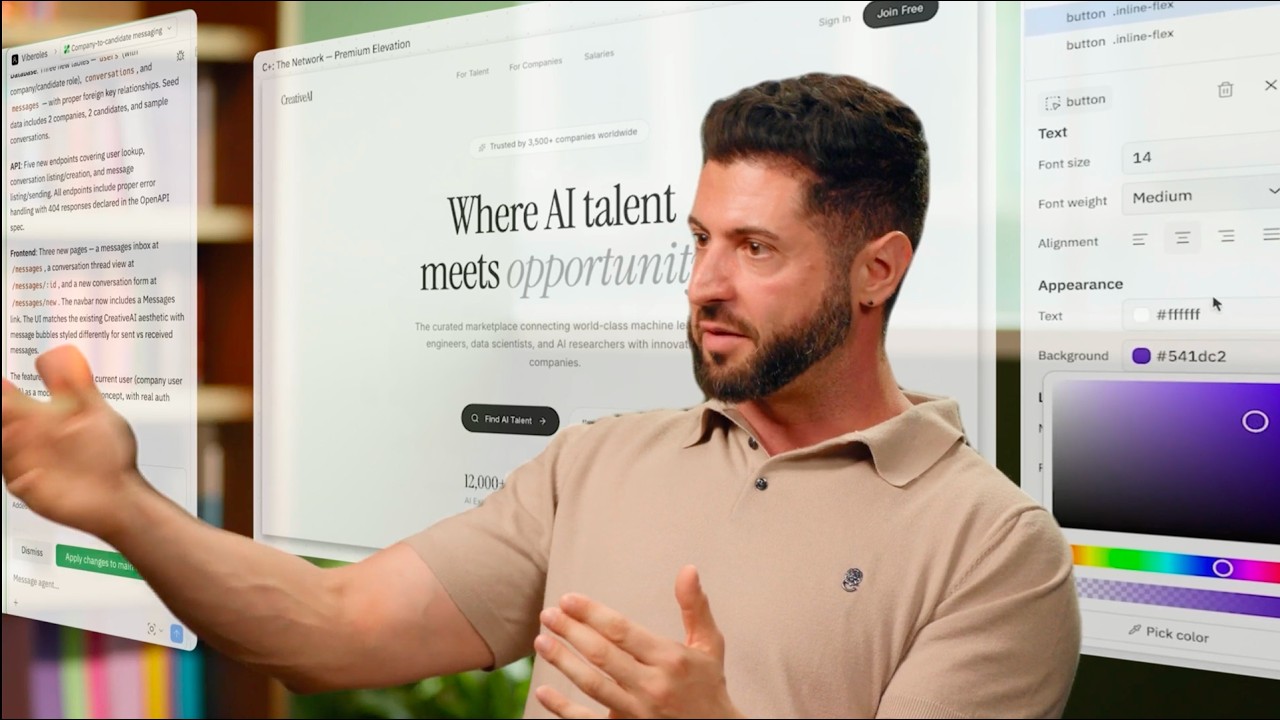
Catasta reveals that a massive portion of Replit’s user-facing product is built directly on Replit itself. The company’s design team spends 80% to 90% of their time building within the platform, maintaining design guidelines and branding in one place while testing live design variations. During product and design syncs, designers prompt the agent to update interfaces live in response to executive feedback, allowing decisions to be made on the spot. Catasta emphasizes that this real-time feedback loop has reduced product iteration cycles by easily an order of magnitude. The host and Catasta share a moment of enthusiasm over how this hands-on, instant malleability makes software creation fun and dynamic again, bringing the conversation to a warm conclusion.
- Designers spend 80%–90% of their time building Replit inside Replit.
- Design and product syncs utilize real-time agent prompting to adjust UI during meetings.
- Product development cycles have been accelerated by an order of magnitude.
## Notable quotes
> [02:29](https://www.youtube.com/watch?v=26aV9GTeoSo&t=149s) If you think about it, what an AI agent does... is to use the same tools that we built for developers in the past, and it just learns how to orchestrate them correctly as if it was a human developer. — Michele Catasta
> [03:43](https://www.youtube.com/watch?v=26aV9GTeoSo&t=223s) I would love to tell you that it was just one of the many bets... The truth is pretty much the opposite. I think we're almost at the finish line of the company... We had to find strong product market fit that allowed us to grow to where we are today. — Michele Catasta
> [38:44](https://www.youtube.com/watch?v=26aV9GTeoSo&t=2324s) thumbs up, thumbs down, feedback, everything is valuable, but nothing speaks as loud as money. — Michele Catasta
Replit transformed from a struggling cloud development environment into an autonomous agent platform by repurposing its pre-existing cloud execution infrastructure. Replit President and Head of AI Michele Catasta outlines how this existential pivot and operational restructuring moved the company toward rapid revenue growth and a post-GUI software paradigm.
The Existential Pivot to AI Agents (3:43)
Founded in 2016, Replit achieved widespread adoption in education but struggled to monetize its cloud IDE at a scale that justified its valuation. In early 2024, an attempt to sell its unified environment to enterprise customers stalled because corporate developers refused to abandon their existing toolchains. Facing severe runway limits, Replit relocated from San Francisco to Foster City, downsized non-technical staff through layoffs, and tasked a skeleton team of roughly 30 people with shipping Replit Agent V1.
Catasta explains that he joined Replit because its pre-built cloud environments and execution primitives provided the exact tools an AI agent needed to orchestrate code like a human developer, avoiding the need to build developer tooling from scratch. Following a high-stakes crunch 36 hours before launch to resolve critical alignment bugs, the company released Agent V1 in September 2024 as an applied research product designed to capture early market feedback.
Universal Primitives and Interactive Agent Workflows (17:26)
Replit supports over 50 million total users—including 500,000 professional developers and non-technical creators—by deliberately avoiding rigid user personas such as product managers or designers. Catasta argues that because every knowledge worker now requires software creation capabilities, product development focuses on universal pain points identified through qualitative user interviews rather than role-specific features. He anticipates that traditional point-and-click graphical interfaces will increasingly be replaced by voice dictation and prompt-driven background agents.
This product philosophy also demands architectural detachment. For example, Replit Agent 3 was optimized for extreme autonomy and ran uninterrupted for up to 200 minutes, but this created user disengagement. With Replit Agent 4, released in March 2026, the team course-corrected toward interactive feedback loops to keep users involved during the build process.
Monetization Models and One-Person Unicorns (24:07)
Monetizing autonomous agents required Replit to introduce usage-based billing alongside standard subscription tiers ($20 per month for Core, plus Pro and custom Enterprise plans) to cover variable compute and token consumption. To balance autonomy and expense, Replit implemented three execution modes: Light, Economy, and Power. Catasta considers outcome-based pricing the ultimate goal, though it requires further step-function improvements in underlying AI models to establish predictable rate sheets for diverse tasks.
To facilitate commercial adoption, Replit relies on technical power users rather than conventional sales representatives to explain the product. Externally, a Q4 2025 integration with Stripe enables users to embed payments directly into their applications. Catasta asserts that these capabilities support the rise of one-person billion-dollar startups, where solo operators use agents for end-to-end execution while human input concentrates primarily on taste and problem selection.
Internal Dogfooding and Financial Hypergrowth Metrics (38:44)
Replit maintains a high-intensity culture where over 40% of the engineering staff are former startup founders. The company relies heavily on internal dogfooding: designers spend 80% to 90% of their time inside Replit, prompting live UI changes during review meetings. In addition, an internal "AI Chief of Staff" builds custom internal tooling—such as HR intranets, support dashboards, and order systems—which Catasta claims routinely replaces the long tail of niche SaaS vendors.
According to Catasta, Replit's revenue expanded from approximately $2.5 million at the start of 2024 to roughly $10 million by year-end, with the company aiming to reach $1 billion in ARR by the end of 2026. To steer product optimization, engineering prioritizes execution traces that terminate in paid deployments, treating monetized publishing as the definitive signal of delivered value.
Catasta's forecast of reaching $1 billion in ARR by late 2026 hinges on continued transition toward fully autonomous agents, yet key structural challenges persist. Fully realizing outcome-based pricing remains constrained by the unpredictable nature of complex model executions, and the durability of one-person enterprises without scaling headcount remains an unproven industry hypothesis.
[2:29] Michele Catasta: If you think about it, what an AI agent does... is to use the same tools that we built for developers in the past, and it just learns how to orchestrate them correctly as if it was a human developer.
[3:43] Michele Catasta: I would love to tell you that it was just one of the many bets... The truth is pretty much the opposite. I think we're almost at the finish line of the company... We had to find strong product market fit that allowed us to grow to where we are today.
[38:44] Michele Catasta: thumbs up, thumbs down, feedback, everything is valuable, but nothing speaks as loud as money.
Original transcript
[0:04] Michele, it is so fantastic
to have you here today.
[0:07] Thanks for having me.
[0:08] So, you started working
with Replit in 2022?
[0:12] -Correct.
-A lot has happened since then.
[0:15] Can you walk me through
what the product was in 2022?
[0:20] Who was it for?
[0:21] What did the product look like?
[0:23] Then, I want to get to 2024,
but what was it like 4 years ago?
[0:28] Replit started in 2016.
[0:30] Up to 2023, it was a cloud
development environment.
[0:35] We made it as easy as possible
for developers
[0:38] to kickstart their code on our platform.
[0:42] In reality, though,
we were building an amazing platform
[0:45] that eventually allowed
us to build Replit Agent.
[0:48] Tell me about Replit Agent.
Where did that idea come from?
[0:51] When did you guys start
working on Replit Agent?
[0:54] I would say there was always
the vision in a sense.
[0:56] If you go back and check
the slide decks that Amjad,
[0:59] the CEO and co-founder of Replit
was using to raise money,
[1:03] he always had in mind
something that looked like Replit Agent,
[1:06] where AI would have generated
the code for our users,
[1:10] and in turn our users
would have focused on business ideas,
[1:13] and literally what is crucial
about running a business
[1:17] rather than the code required
to create products.
[1:20] It took a while to get there,
[1:22] and not only because
it took a while to build Replit,
[1:25] but because the entire field of AI
was growing really fast at the time,
[1:30] but maybe we were not expecting
that to happen in a sense so quickly.
[1:36] That build-up, I would say,
started around 2020
[1:40] when we got access to the first open
source models like GPT-2 from OpenAI.
[1:45] Back in those days,
I was a researcher at Stanford,
[1:47] so I was very early
on LLMs applied to source code,
[1:51] and it was exactly the same bet
that basically Replit was making.
[1:55] I did it from a research point of view,
[1:57] Replit was doing that
from a product point of view.
[2:00] We met halfway.
I met Amjad in 2021.
[2:04] I showed him a demo of something
that looked like Replit Agent,
[2:07] but way more primitive
compared to what we launched,
[2:09] and we realized we had
exactly the same life mission.
[2:12] Wow, okay, so you were
doing research in this space,
[2:16] and Amjad had this very similar
[2:19] vision of what the future
should look like.
[2:21] You guys came together like,
wow, this is just a match made in heaven.
[2:25] Then you joined immediately
as President and Head of AI,
[2:29] or what was the journey there?
[2:31] The journey was I joined to build
the AI team zero to one, basically,
[2:36] and my only fixation
was to create something like Replit Agent.
[2:41] I recall, I think maybe
2 weeks after I officially joined,
[2:45] I wrote a manifesto,
like an AI manifesto for the company,
[2:48] and if you go back and read it today,
it basically describes
[2:51] what not only we launched
with Replit Agent V1
[2:54] back in September 2024.
[2:56] The reason why I wrote it is because
[2:58] I realized, and also the reason why
I joined the company, to be honest,
[3:01] because I realized
they've built an amazing platform
[3:04] where all the tools necessary
to actually build an agent
[3:07] were already in place.
[3:09] If you think about it,
what an AI agent does,
[3:11] especially for coding,
[3:12] is to use the same tools that we built
for developers in the past,
[3:16] and it just learns how to orchestrate them
correctly as if it was a human developer.
[3:21] Everything was there,
and I told myself,
[3:25] I'd rather join a team
that knows exactly how to build that.
[3:27] It's already very advanced
in terms of engineering culture,
[3:30] and loves exactly
the same problem I want to work on,
[3:33] rather than trying
to raise money once again
[3:35] and build the right team,
and make mistakes
[3:37] because early stage
is very probable to make mistakes
[3:41] in creating the right team.
[3:43] I want to talk about what it was like
to launch Replit Agent
[3:45] because I'm sure
that was a magical moment.
[3:47] But before we do that, I'm so curious.
[3:50] I think it's always very interesting
how companies think about
[3:53] when to invest in a bet,
and structure their teams around
[3:57] a bet or something
that they don't know is going to work
[3:58] versus when to continue investing
[4:01] in the thing that's maybe
it's not full product market fit,
[4:04] but it seems to be working in some sense.
[4:06] What was the structure of the team?
[4:08] How many people
were working on Replit Agent?
[4:11] How did you guys make that happen?
[4:13] I would love to tell you
that it was just one of the many bets,
[4:16] and if it didn't pan out,
everything would have been all right.
[4:19] The truth is pretty much the opposite.
[4:21] I think we're almost
not at the finish line of the company
[4:24] because we had money in the bank,
[4:25] but the product we built
up to there was not easy to monetize.
[4:31] It was amazing
for the educational markets.
[4:35] Schools across the globe used us.
[4:37] That's why our user base
was growing so fast,
[4:39] but it was hard for us to justify
the growth of the company, our valuation,
[4:44] and basically becoming what we are today.
[4:47] Replit Agent was both
a bet that matched our company mission,
[4:52] which is empowering the next
million software creators,
[4:54] but also a necessity.
[4:56] We had to find strong product market fit
[4:58] that allowed us to grow
to where we are today.
[5:02] It started as a small group of misfits.
[5:06] I created a very small AI team,
and I told them,
[5:10] regardless of where this goes,
let's try to build this.
[5:13] Let's try to show the world
[5:14] how this new technology
is going to look like.
[5:16] Let's build something for non-developers
[5:19] because it's going to
be highly differentiated,
[5:21] and it's a much harder
technical problem, to be honest.
[5:24] I think the last 2 months
before launching,
[5:28] more than half of the company
was working on Replit Agent full-time.
[5:31] How many people?
That was maybe 60 people, 30 people?
[5:34] It was 30 people, roughly.
[5:35] We were down to a skeleton team.
[5:38] I would say more than 80%
of the company was technical.
[5:41] All the other functions
were run part-time by some of us.
[5:46] Then once we hit product market fit,
[5:49] and we sat on that for a while
when we realized,
[5:51] okay, this is actually working well,
[5:53] then we started to grow the account again.
[5:54] Wow, right before launch,
it seems like it was probably a hard time
[5:58] for the company then,
you scaled down.
[6:01] Darkest possible times.
Yes.
[6:03] Describe that for me.
[6:05] What did that feel like
coming into work every day?
[6:08] Early 2024,
[6:09] we attempted to sell the product
to the enterprise,
[6:14] the previous one,
not Replit Agent,
[6:16] and we found a lot of interest
in terms of the philosophy of our product.
[6:20] Everything integrated one single place
[6:23] where you can go
from idea to creating your software,
[6:26] but very hard to actually
have companies embrace it
[6:30] because it would have displaced
a lot of different tools,
[6:33] and as you know,
every developer has a love
[6:35] for their own specific tools,
[6:37] and it would have been
really hard to tell them,
[6:39] drop everything,
just embrace Replit.
[6:42] We hit that dead end,
and then we went in quick order.
[6:48] We relocated away from San Francisco,
down in Foster City.
[6:51] Brand new, much a much bigger office.
[6:54] We had to go through a layoff
[6:56] because our sales
and marketing team was not,
[6:58] first of all,
not required at that point in time
[7:00] because we didn't have anything to sell.
[7:02] Also, they were there
with a different product in mind,
[7:06] and 6 months ahead of us
where we just knew we had a deadline
[7:10] that I dropped on everyone's calendar,
[7:12] said, "This is the day where we're going
to be launching Replit Agent V1."
[7:17] Everything else was just us showing up
at the office every single day,
[7:21] heads down, knowing that we had
this bet that must have worked by then.
[7:26] It required a lot of grit
and determination
[7:29] to actually go through all of that.
[7:31] But I think it gave us
an opportunity to be extremely focused.
[7:34] I never experienced that again
because since the launch,
[7:38] when we actually hit product-market fit,
my life changed completely.
[7:41] I don't spend every single second of my
life thinking about the technical problem.
[7:45] Now I have way more duties.
[7:47] I don't regret that.
I think it's a lot of fun.
[7:49] I'm learning
a lot of new skills with that,
[7:52] but it will never come back again.
[7:53] Those 6 months were both
peak productivity,
[7:57] and also maybe peak determination for us
because we had to make it.
[8:01] Oh, man, that sounds like just
[8:04] both an incredible time
and an incredibly hard time.
[8:06] Incredibly stressful, for sure.
[8:09] You set this deadline.
[8:11] The night before
you're ready to launch Replit Agent,
[8:17] what are you thinking?
[8:19] What are you feeling?
[8:20] Are you confident it's going to work?
[8:22] What's going through your head?
[8:24] I'll have to give you
all the shameful details
[8:27] about what happened
in the couple of days before the launch.
[8:32] I planned for two different dogfooding
sessions with the entire company.
[8:37] Thirty-six hours before launch,
literally nothing was working,
[8:40] where we had prototypes
in the previous days,
[8:43] where the product was pretty okay,
[8:45] and it was still very rough on the edges,
but was working most of the times,
[8:49] and then we hit the worst possible
point of alignment
[8:53] where we had a few bugs that we
couldn't understand where they were,
[8:57] and it felt very disheartening
[9:00] because I brought in the few people
who were not working on the project,
[9:04] including non-technical
employees of the company,
[9:07] and I told them,
[9:08] "Just give this a try,
it's going to be amazing,"
[9:11] and the experience was awful.
[9:13] I was this close to deciding
I'm just not going to launch,
[9:16] and then I told to the core team
that was working on agent,
[9:20] and we said, "Guys, we're going to
pull another all-nighter."
[9:23] We're going to get to the bottom of this.
[9:24] We're going to find out what happened,
and we have another 36 hours to do it.
[9:30] Fast forward,
I think 16 hours from that moment,
[9:32] we did another dogfooding session.
[9:35] The product was finally working.
[9:37] To the surprise
of everyone at the company,
[9:40] and we said, "Okay, tomorrow morning."
[9:42] What does finally working mean?
What was it doing?
[9:45] I think especially
for the non-technical employees at Replit,
[9:50] it was the first time that they went
from a prompt in natural language
[9:54] to a very basic application
showing up in front of their eyes
[9:58] without doing anything different,
[10:00] and those are folks that never wrote
a single line of code in their lives,
[10:03] even though they were working at Replit.
[10:05] Because the truth is,
no matter how much we ask them,
[10:07] please, you should dog food the product,
[10:09] learning how to write code
is not an easy endeavor.
[10:12] A lot of them have very busy lives.
They work, they have families.
[10:15] They're not going to learn
how to write code as a side activity.
[10:19] Suddenly, everyone became
a software creator at Replit,
[10:22] and then we realized,
[10:23] imagine what's going to happen
if this is across the entire world.
[10:27] What did you guys see that
even the most AGI-pilled
[10:32] deepest research teams had not seen yet?
[10:36] What was it that got you guys to this
point sooner than anyone else?
[10:41] Personally, when I decided to
[10:45] break from my research career,
and focus on product,
[10:49] I felt I removed shackles from my wrists
on how to think of technical problems.
[10:56] I think I can put myself
in the shoes of researchers
[10:59] that were at OpenAI
and Anthropic in those days,
[11:01] where you always have a certain
expectations in terms of
[11:05] how good your model has to be,
[11:06] how good is the product
experience that you want to launch.
[11:10] There was way more skepticism about AI
back in those days compared to now.
[11:16] Suddenly, I felt free.
[11:17] I said, "We're going to create a new
product experience from the ground up."
[11:21] Even if it's something
that I'm almost ashamed of,
[11:24] it's totally fine to bring it out there.
[11:26] I want to learn from users,
what's their feedback,
[11:29] what's their reaction,
what do they love,
[11:31] what are they disappointed about?
[11:34] It was literally like a mandate for me
internally to be the first on the market.
[11:39] Every single day before launch,
[11:41] I was panicking
that someone else would have done it.
[11:44] I think if we were not
first on the market,
[11:46] we probably wouldn't
be where we are today as a company.
[11:49] What you're describing,
[11:50] it strikes me as you were treating it
like an applied research project,
[11:55] where you're like,
"It's okay if it's not great."
[11:57] "It's okay if it's not commercializable."
[12:00] I'm just curious
about how it's going to go.
[12:02] Yeah, let's see what happens.
[12:03] Is that how you run
product development now?
[12:06] -Tell me a little bit about that.
-Pretty much.
[12:10] That specific launch,
internally, we said,
[12:13] "This is going to be a low-key launch."
[12:14] We're just going to do a very basic video.
[12:16] We're going to put it out there.
Let's see what happens.
[12:18] Then it went insanely viral.
[12:21] The same formula
that we used for Agent 1,
[12:24] I keep applying
for our engineering and product teams,
[12:27] where, first of all, I tell everyone,
[12:30] let's not get emotionally attached
on anything that we built,
[12:34] both under the hood on the back-end
as well on the product surface.
[12:38] There are assumptions
we made back in the days
[12:41] that were already
successful from day one,
[12:43] and I think they really influence also
[12:46] what people expect
from a vibe coding product today,
[12:48] because many of them
basically got inspired by Replit,
[12:52] and some assumptions that were wrong,
[12:53] and many of them,
luckily, came from me,
[12:55] and admitted in front of the company,
[12:57] I think it's time for us to change.
[12:58] I think it's time for us
to do something different.
[13:01] What was a wrong assumption?
[13:03] Let me think.
[13:05] I can give you one about Agent 3,
[13:07] where we put a lot
of emphasis on autonomy.
[13:11] I wouldn't call it
a wrong assumption per se,
[13:13] but we thought most of our users
want to go from point A to point B
[13:18] with just a single prompt,
and they just care about the agent
[13:20] doing the entire work themselves.
[13:22] In principle, that is true.
[13:24] In practice,
you end up hurting engagement in product
[13:27] because we are the first one to market.
[13:28] Replit Agent 3 can run
for 200 minutes in a row.
[13:31] That's amazing.
[13:32] But what are you going to do
in those 3 hours and a half of your life?
[13:35] You need some feedback, some interaction.
[13:37] You need to keep them
on the platform, engaged.
[13:39] It's something that we fixed with Agent 4,
[13:41] and now we have
way more engagement than we had before.
[13:44] We make some bets,
and then we have to correct course
[13:47] depending on how our users
react to our launches.
[13:51] But I always try to think
about what we build
[13:54] as partially a very
structured engineering project,
[13:59] but at the same time also
as a research project
[14:02] where we're trying to find out exactly
what is the right product to build.
[14:05] Because the truth is, no one knows
the playbook or how to build agents.
[14:09] Not only coding agents, but in general,
[14:11] agents are something that we are
shaping as the field improves.
[14:17] If you have a very prescriptive approach,
[14:19] you're just lagging behind
compared to anyone else,
[14:21] so it's not worth it to play that way.
[14:24] Replit strikes me as particularly good
at not getting emotionally attached
[14:28] to the last thing that you built.
[14:30] You're just reinventing, reinventing,
evolving, evolving,
[14:33] and just willing
to burn down the last thing
[14:36] in favor of the next new thing.
[14:39] Is that a cultural value?
[14:41] Is that something that comes
from you and Amjad?
[14:45] Do you look for that
in the people you hire?
[14:47] How do you create that?
[14:48] Everything you said.
[14:50] Definitely the fact that I spent several
years of my career in research
[14:53] means that I'm used to thinking
about the state of the art
[14:57] as something that is ephemeral
[14:59] and eventually will be replaced
by something much better.
[15:02] The truth is it doesn't
only happen in AI research,
[15:04] it happens as well as in engineering.
[15:06] There are new abstractions,
new libraries, new frameworks,
[15:10] and if you want to stay up to date,
[15:11] you don't fossilize
on something that lasts for a decade.
[15:15] You're always looking to improve yourself,
to improve your product,
[15:18] so Amjad and I both really
embrace that philosophy.
[15:23] Myself, now, by running the entire
engineering and product roadmap,
[15:28] everyone knows how I like to work.
[15:30] Everyone has seen what made us successful.
[15:33] I think at this point,
it permeates the entire company.
[15:36] I don't even have to remind it anymore.
[15:38] I recall, for instance,
when I changed my role,
[15:41] and I tried to address the entire company,
[15:43] telling them
what I wanted us to accomplish,
[15:45] I said this explicitly.
[15:47] I talked about not being
emotionally attached.
[15:49] I talked about accepting
the fact that some projects will fail.
[15:53] Now, I don't even have to say it anymore.
[15:55] I think everyone embraces it,
and I think everyone loves it.
[15:59] It's way more exciting.
[16:01] Every day, you know
they are going to be shaping something
[16:04] that will really determine
our future as a company.
[16:07] It's also hard, though,
[16:08] because you have users
[16:09] -using your old products.
-Of course, yeah.
[16:12] How do you manage
the now many millions of users
[16:16] that are using your existing product
with the next version of agent?
[16:21] Where do you think about that balance?
[16:23] Luckily, we have one common
denominator with agents,
[16:26] which is the fact
that you interact in natural language.
[16:29] Regardless of how much
you revolutionize the product surface,
[16:33] of how many new features you add,
[16:37] the transition from one version
to another is never completely...
[16:42] It's never something that gets you
completely lost in the process.
[16:44] The primitives aren't
completely changing anymore.
[16:46] Primitives are there.
The expectation of you
[16:48] creating software is there.
[16:50] The fact that the agent will reply back
to you in more or less advanced ways
[16:54] has just kept evolving
gradually over time.
[16:57] We're not going from an interface
that is based on natural language
[17:01] to something where
we just point and click.
[17:03] But absolutely, it requires sometimes
to do these transitions,
[17:07] and every single time
we go through a big launch,
[17:11] I have to ask myself,
[17:13] "Shall we keep around both experiences
and then allow for a smooth transition,
[17:18] or shall we just have a clear-cut?"
[17:20] It's a muscle
that you have to train in a company,
[17:23] and you always have
to balance between innovation,
[17:26] and smooth transitions.
[17:28] I tend to be more of a fan of innovation,
as you can imagine.
[17:32] You have an impossible product job,
[17:34] which is that you're building a product
for now 50 million users,
[17:37] 500,000 of them are professional users,
[17:40] but your median
user is the vibe coder type user.
[17:44] You have enterprises
that are using your product.
[17:47] Any other company,
this range would be product sabotage.
[17:51] You're trying to build a product
for basically everyone.
[17:55] How do you do that?
[17:56] Just walk me through your
product development process.
[17:59] First of all,
you need to grow a very thick skin
[18:02] because the amount
of feedback you will be getting
[18:06] is honestly overwhelming in a good way.
[18:09] I keep telling everyone in the company,
it's great that people care about it,
[18:15] even if, of course,
[18:16] we are biased
on reading just the negative feedback
[18:20] because the positive
feedback doesn't last long.
[18:22] You feel supported if you feel loved,
[18:24] and then you go back
to the things that are actually broken.
[18:26] But similar to changing
the mindset of the company,
[18:29] being very innovation-focused
and not getting emotionally attached,
[18:33] I don't think we get offended
anymore by feedback,
[18:36] because we have seen oftentimes users
literally like, flipping in a few hours,
[18:40] between, I hate this product,
it has become trash
[18:43] because I've done these wrong choices,
[18:45] and then maybe we actually
[18:47] guide them through the different
user journey that we had in mind,
[18:50] and then suddenly they love it.
[18:53] It's necessary to be able
to digest feedback correctly
[18:58] and react in the right way.
[19:00] It's also a blessing
because we're building
[19:03] a product for humans.
[19:04] We're not building a product
that tries to replace humans with AI,
[19:07] which I think
is a very dystopian view of the future.
[19:11] If we didn't have people
who care so deeply about it,
[19:14] our product would be strictly worse today.
[19:17] Yes. It's hard,
but we are in a place where
[19:21] I never feel lost
about what we should be doing next.
[19:24] If anything, if I could 10X
the size of the company overnight
[19:28] and make it run
as smooth as it does today,
[19:30] I will absolutely do it.
[19:31] That's as much work
as we have on our hands today,
[19:34] that we could potentially accomplish.
[19:35] Do you find that
your different types of users
[19:38] all love the same things about Replit,
or is it different things?
[19:42] Different things,
especially now that we launched
[19:45] Replit Agent 4 back in March this year,
we put a lot of emphasis on the fact that
[19:50] it's a general purpose agent.
[19:52] Yes. Building applications,
building automations
[19:55] is the reason why most of the users
know and love Replit.
[19:59] But the truth is you also come to Replit
to interact with data sets
[20:03] and extract insights, to generate slides,
to generate animation videos.
[20:08] This list of additional features
and skills will keep growing over time.
[20:13] It forces us, though, to really have
as minimalistic as possible approach
[20:17] to how the product should look like.
[20:20] We don't try to tailor it
towards a specific type of persona.
[20:25] One of the principles
we follow internally is to,
[20:29] I don't want to hear the word persona
during a meeting, basically.
[20:31] I don't want to say
we should optimize this for PMs,
[20:34] or we should optimize this for designers,
[20:36] not because
I don't want them as a user base.
[20:38] I think I actually mentioned
two early adopters
[20:41] among all the other types
of employees in a company
[20:44] that really embrace Replit
as early as possible,
[20:47] but rather because everyone out there,
every single knowledge worker,
[20:52] has a need to actually create software.
[20:54] Why would we only make it a bespoke
just for PMs or designers, let's say?
[20:59] It served us well until now
because that's the reason
[21:02] why we keep growing so fast.
[21:04] In your product development process,
are you looking for the things
[21:08] that every knowledge worker needs
across every persona
[21:12] versus like,
"Hey, here's the thing specifically
[21:14] that a PM needs
or specifically that a designer needs?"
[21:16] Are you trying to look
for those foundational primitives?
[21:19] I think many would be curious
to understand
[21:21] how you even follow that process?
[21:23] What does your UXR look like?
[21:25] Our UXR, we go straight
to both our power users,
[21:29] to the new adopters, early adopters,
[21:32] especially seeing
how they evolved on the platform.
[21:35] We almost learn open-ended interviews.
[21:38] We ask them, "Why do you love Replit?
[21:40] Why have you been building
for several months?
[21:43] Why did you leave Replit?
[21:44] What made you move away somewhere else?"
[21:47] Based on all the signal that we collect,
[21:50] then we simply try to make
their life easier on the product,
[21:55] scrubbing away what they do for a living.
[21:58] We talk about them in first name.
[22:00] I don't say, like Luis PM.
[22:03] I say, "This person told us X, Y, and Z,
and their concerns are valid.
[22:08] We should be fixing our publishing pain.
[22:11] The tone of the agent should be different.
[22:13] This interface is too overwhelming."
[22:16] We keep making steady progress
based on all the feedback
[22:18] that we believe to be useful.
[22:20] You'd be surprised.
[22:21] There are always a universal theme
across the feedback that we receive.
[22:26] A good product is good
across a very large user base in our case.
[22:31] A good product is good
across a large user base.
[22:33] I love that.
[22:34] I heard you had one sales rep
when you shipped Replit Agent?
[22:38] Yeah, for quite a while.
[22:40] Then we had two and both of them
had amazing performance during that year.
[22:44] What is the profile of the sales reps
that you hire today?
[22:47] Are they traditional enterprise reps?
[22:49] Are they product-minded folks?
[22:51] The vast majority are not.
[22:53] Many of them
have never done sales in their lives.
[22:56] We try to find people
that love the product,
[23:00] can resonate with it,
have used it, have fallen in love with it,
[23:04] perhaps have built something useful
in their past job,
[23:08] or some of them are reaching out to us
[23:10] because they realize,
I want to sell Replit.
[23:12] It's so amazing
that I want to be part of the journey.
[23:15] Those folks end up being
our top performers.
[23:19] I think what a buyer wants to hear
on the other side,
[23:22] especially today,
where testing AI products
[23:24] is not that hard.
[23:26] All of them already
got in their hands dirty with Replit.
[23:28] They don't want to hear the basics.
[23:30] They want to hear, "Why should I buy it?"
[23:32] There's no better person to tell you why
[23:35] than someone who has actually
been impacted positively by it.
[23:39] Those are our best sales reps.
[23:41] I think we're going to
keep using this philosophy
[23:43] because they need to have
a good combination of storytelling
[23:48] and being technical to an extent.
[23:50] They need to really know
the nitty-gritty details
[23:52] of why Replit agent is so powerful.
[23:54] The nice thing about sales is
its such a meritocratic thing.
[23:57] You can literally measure
whether someone's good or not.
[23:59] Even if that goes against
traditional sales knowledge, I'd say,
[24:03] of hiring your traditional sales folks,
the proof is in the pudding.
[24:07] Everyone's trying to figure out pricing
in the time of AI.
[24:10] I talk to a ton of users
who are actually thinking
[24:12] of turning off their free trials,
for example,
[24:14] because it costs too much to compute
to serve these users
[24:18] who may not ever convert.
[24:19] You all have a free tier.
[24:21] You have your…
I guess,
[24:23] somewhat standard SaaS tiers right now,
SaaS pricing tiers.
[24:26] How well is that
pricing model working for you?
[24:29] The tiers that we have are,
I would say, fairly standard, as you said.
[24:32] We have our core seat,
which is running $20 a month,
[24:36] and then we have a pro seat
that has a few more features
[24:39] that are very important,
including premium support,
[24:42] better SLAs of the infrastructure,
[24:44] and then from there,
you step over to the enterprise plan.
[24:47] I would say that only describes,
though the part of our pricing philosophy,
[24:51] because the truth is,
[24:53] agents fundamentally
have to be charged by usage.
[24:58] By something proportional
to the amount of compute
[25:00] that they are using,
or in the AI jargon,
[25:02] the amount of tokens
that they are burning.
[25:07] We embrace
usage-based billing very, very early.
[25:11] I think by being like trailblazers
in this space,
[25:13] also when we launched
the first version of the product,
[25:16] we were also trailblazers
on when we changed the pricing model.
[25:19] As you can expect,
the backlash from the community
[25:23] during those couple of months
was fairly substantial.
[25:27] But I think over time,
they realized why now
[25:30] you look around the industry,
everyone is doing exactly the same.
[25:34] We had to do it
because by means of how agents work,
[25:38] it is relatively impossible to predict
how much they're going to be
[25:42] literally running for a specific task.
[25:44] Any level of fixed pricing
or even purely based on subscription
[25:48] wouldn't scale for a company like ours.
[25:51] The fact that agents
are more and more widespread
[25:54] means that there is better acceptance
of us having to charge in that way.
[25:58] That said, if I had a magic wand,
[26:01] I would love to figure out
outcome-based pricing for the model,
[26:06] for our product.
[26:08] The reason why it's going to be,
practically, a research project for us
[26:13] is because the variety of tasks
that you can accomplish on Replit
[26:17] is such that
how can you even come up with a rate list
[26:21] of the different outcomes
that you can have on Replit?
[26:24] Yes. I know that we want to get there.
[26:26] I do know that it will come
with a certain amount of goodwill
[26:30] from the community
when we actually accomplish it.
[26:32] But I also know that
it's not a short-term goal
[26:34] that we can crack very easily.
[26:36] I think we need to see
some step function improvement
[26:40] on how the entire AI models
are working today
[26:42] in order to make that happen.
[26:44] Outcome-based pricing
has somewhat similar issues
[26:47] with just normal tier pricing
[26:49] because you wouldn't be pricing it
based off of usage, right?
[26:51] You'd be basing it off of outcome.
[26:53] It's based on outcomes,
but at least it doesn't have
[26:55] that perception of non-determinism
where you just write a prompt,
[26:59] and you don't know how much
you're going to be charged.
[27:01] Now, we try to put some more guardrails
on our product experience today.
[27:05] We have three different agent modes:
light, economy, and power.
[27:09] Respectively, each one of them
comes with certain expectations
[27:12] on how autonomously
the agent will be running.
[27:15] In light mode, we do our best
to have a very narrowly scoped task.
[27:19] Even if you write way too much,
we carve out the core of your request
[27:23] and we don't allow the agent
to roll out for long.
[27:26] If you're in power mode,
and you write a very long PRD,
[27:31] off to the races,
the agent will run
[27:33] literally for several hours
[27:35] and put in front
of the entire work being done.
[27:37] Expert users are amazed by that,
[27:39] and a lot of them are using our agent
exactly in that way.
[27:43] But if that's
one of your first experiences in product,
[27:45] of course, it can be confusing
why you spend so much money
[27:49] and why the agent
did maybe more than ever expected.
[27:53] The alignment between user expectations
and what the agent accomplishes
[27:57] is one of the hardest AI problems
that not only us, but the entire field.
[28:01] No. I was going to have
to figure that out.
[28:03] You guys are thinking not only,
[28:04] obviously,
about monetizing your own product,
[28:07] but you also want to help users
monetize their applications
[28:10] that they build on Replit.
[28:12] When did that become
a part of the product?
[28:15] How do you guys think
about building that infrastructure?
[28:17] We always wanted to do it
because the goal ultimately
[28:21] is to have our users come into Replit
to get work done
[28:26] and then being able to create products
that they can monetize,
[28:29] create new sources of income,
start a new company.
[28:32] That is what
we are really passionate about.
[28:34] Those are the success stories for us.
[28:36] Now, in order to make payments easier,
[28:39] of course,
the first avenue that we explored
[28:42] was the Stripe integration
that we worked on together
[28:45] in the last few months.
[28:46] We launched that in Q4 last year,
[28:49] and it has been growing
at an exceptional rate,
[28:51] which makes me both proud
for how easy we made it together
[28:56] in our product,
as well as proud of our users
[28:59] that are really crushing it.
[29:02] Those numbers going up
really make me understand
[29:04] that the vision
we always had for our product
[29:07] is going to be something
I'm going to be passionate about
[29:10] for my entire lifetime.
[29:11] It's not just building our company.
[29:13] We are actually going to become
enablers for an ecosystem of companies.
[29:17] You're a big proponent
of the one-person billion-dollar company,
[29:21] -the one-person unicorn.
-Yes.
[29:24] I would love to talk to you about this
[29:25] because I've always
found this framing confusing
[29:28] because wouldn't you assume
for as long as adding a human
[29:32] incrementally improves your company,
competitive forces will always require
[29:37] a company to want to add more humans.
[29:39] It seems hard to just stay
[29:41] with the one-person
billion-dollar company.
[29:43] If everyone can start a one-person
billion-dollar company,
[29:45] but a 10-person, $10 billion company.
[29:47] Where does this sit with you?
[29:49] No. I see your point.
[29:50] I don't think this should be a reward
for someone who carries the burden
[29:55] of creating a massive company
just on their shoulders.
[29:58] Our point is more about
you can scale a business
[30:02] really fast on your own,
orchestrating a lot of agents
[30:05] way better than you could even imagine
6 months ago.
[30:08] Because the truth is,
even if you are a researcher
[30:11] on the bleeding edge,
and you really understand exponentials,
[30:14] and you're predicting
what the future is going to be.
[30:17] Mid last year, I don't think many people
would have thought
[30:20] a $1 billion single-person company
will actually exist.
[30:25] Here we are.
[30:26] We're starting to see a few entrepreneurs
that are on track to make that happen.
[30:30] -On Replit?
-On Replit, yes.
[30:33] It's going to happen.
[30:34] Of course,
they will be maybe hiring more people,
[30:37] and maybe it's going to stop at, say,
250 million ARR instead of one billion.
[30:41] But it's still very exciting to know
[30:43] that if you have the entire product vision
in your mind,
[30:46] and you want
to be as effective as possible
[30:49] with little resources at the beginning,
you can actually do it.
[30:53] What matters is that
we're removing the friction
[30:55] and the inertia to make that happen.
[30:57] Then, of course,
more people will be hired,
[31:00] and these businesses will become bigger.
[31:01] But what I think will generate wealth
in the era that we're creating with AI
[31:07] is the fact that way more people
will become entrepreneurs.
[31:10] Way more companies
will be born for that reason.
[31:13] What is going to be
the scarce good in that new era?
[31:18] If there's an abundance of software
and coding and entrepreneurs,
[31:21] where are the bottlenecks going to be?
[31:23] I think it's more and more
real good business ideas.
[31:27] Like, what should we be working on?
[31:29] It's easy to test them.
[31:31] If anything,
it's never been as easy to test ideas.
[31:35] But if you go and see,
maybe through the long tail
[31:38] of unsuccessful business ideas,
[31:40] tried on Replit
and other similar coding agents,
[31:43] most of them, you wouldn't be shocked
why they don't work out.
[31:47] Maybe they target a very small niche.
[31:49] Maybe they were just focusing
on a technical problem
[31:52] rather than something the users need.
[31:55] It's very similar to what we were facing
[31:57] before launching
the first version of our agent.
[32:00] You're left wondering,
do people really care about this?
[32:03] Should we build it
or is it a waste of time?
[32:06] By far, that is always going to be
the hardest question
[32:10] that you're going to be asking yourself.
[32:12] The fact that way more ideas
can be tested,
[32:15] on one hand, will even perhaps
lower the value
[32:19] of the average good business idea.
[32:21] On the other hand, if you strike gold,
you're going to get there much faster
[32:25] than you ever did in your life.
[32:28] Even more than in the past,
I think I will encourage people
[32:32] to not stop at the first failure attempt.
[32:36] It's something very common
people say about startups.
[32:39] You shouldn't maybe wear it
as a badge of honor,
[32:41] but it's fine to fail
as long as you stand up again and try.
[32:45] Now, probably the frequency
which you have to do that
[32:47] is going to be even more than before.
[32:49] A lot of folks
growing a lot of thick skin, seriously.
[32:51] Oh, yeah.
[32:53] Will agents be able to tell us
whether a business idea is a bad idea?
[32:57] That's a great question.
[32:58] I think to a first approximation, yes.
Why not?
[33:01] Especially if it's a business
that has some data aspects
[33:05] where you can go out
and do some level marketing analysis,
[33:09] and then you can run user studies
on Listen Labs,
[33:13] and you can completely automate that.
[33:16] I do believe that
at least moving the first steps
[33:18] can be completely automated with agents.
[33:20] Then I love to think that humans and taste
they will still play an important role.
[33:27] But one of the moonshot projects
that we have at Replit
[33:31] that Amjad and I
talk about all the time is,
[33:34] can we go from a prompt to an agent
that basically on every single day,
[33:39] it tries to craft
a business idea at zero to one
[33:43] and then puts in front of the MVP
that is already running,
[33:46] is already looking for customers,
[33:47] is already shooting emails
and running ads on social media
[33:51] and see,
"Okay, how fast is this idea taking off?"
[33:54] Is it worth pursuing or not?
[33:56] The zero to MVP and the basic steps
required to run a business,
[34:01] including incorporating
an LLC with Stripe Atlas,
[34:04] all of that can be easily automated.
[34:06] From there to understanding
where should I bet?
[34:09] Where should I be putting my energies?
[34:11] I do think that we as humans
will still play a key role
[34:15] because ultimately,
a lot of products will still be tailored
[34:18] towards being sold to other humans.
[34:21] I love to believe that
we understand each other
[34:22] much better than machines do.
[34:24] What was in this manifesto that you wrote
[34:29] where you wrote out Replit Agent V0 or V1
[34:35] and what it looks like now?
[34:36] What does it look like
in 3, 4, or 5 years?
[34:41] We have been creating
basically applications
[34:43] since the first time
we launched our agent.
[34:46] Website, web apps, automations,
always software that often requires
[34:52] a human on the other end
to interact with it.
[34:55] If you think about it,
[34:56] user interfaces
existed in the last decades
[35:00] just because we haven't found a better way
to have humans interacting with machines
[35:05] until literally a few months ago
where agents became powerful enough
[35:09] where perhaps
even yourself in your daily job today,
[35:12] you probably do
quite a lot of interactions
[35:14] that are not point-and-click
based on your keyboard.
[35:17] You're dictating your phone,
[35:19] and that prompt ends up somewhere
in an agent,
[35:21] and then that runs some job
in the background
[35:23] and then gives you back
some results that you care about.
[35:27] I believe that most of the interactions
we're going to be having with computers
[35:30] in the near future
will be based on that pattern,
[35:33] not anymore interacting with the UI.
[35:36] What does it mean?
[35:37] In the short term,
we're probably going to see
[35:39] even more applications being created.
Good for us.
[35:42] We're amazing app builders,
so more of them will be born,
[35:45] especially because Replit exists.
[35:47] In parallel, though,
I think we're already experiencing
[35:51] an exponential growth of how many agents
are being built on the market?
[35:55] I even see it today inside Replit,
a lot of the work that we do
[35:58] is not anymore about, say,
creating dashboards or creating workflows.
[36:02] We have agents
that scour our entire company
[36:06] and get the job done.
[36:07] Then there is a human assessing
the results that they obtain.
[36:11] I expect more and more people
wanting to build that.
[36:15] The future that I see for us as a product
is not just building applications,
[36:20] but it's allowing everyone to create
very powerful and advanced agents
[36:24] with the same ease of use
that we got everyone used to
[36:27] with Replit agent
when it comes to creating software.
[36:31] Amazing.
I am excited for that future.
[36:35] Likewise.
[36:39] Replit is known as a very high-intensity,
mission-driven culture.
[36:43] How do you hire for intensity?
[36:46] Wow, that's a good one.
[36:48] I've been asked by my talent team
several times, how to do that.
[36:53] On one hand,
I think I learned to recognize
[36:57] some patterns from the people
that we have internally
[37:00] that are amazing performers.
[37:02] Then I go and look for...
[37:03] I do some pattern matching,
basically with the new candidates
[37:07] that I get to meet
during the interview process.
[37:10] Definitely something that helps
is to find out
[37:12] if they were former founders.
[37:14] I would say maybe today
in our engineering team,
[37:17] more than 40% of the members are actually
former founders, including myself.
[37:21] That always tells you something
about the person.
[37:23] They've been crazy enough,
[37:24] at least for a window of time
in their career,
[37:27] to believe so much in themselves
and have a lot of agency and ownership
[37:31] to try to do zero to one on something.
[37:33] It doesn't really matter if they've been
extremely successful or not,
[37:36] but that trait,
the level of intensity is there.
[37:42] Then a lot of other folks that I know
are partially of the team,
[37:46] I want to see that
they work on projects
[37:49] that they care about.
[37:51] You'd be surprised.
[37:52] If during an interview,
you ask someone to tell you,
[37:56] "Go in-depth about a technical project
that you work on,
[38:00] what are the hard choices that you made,
[38:01] what confrontation you have to have
with your colleagues?"
[38:04] You immediately realize
if they cared about it or not.
[38:08] I want to see more of that
than how good they actually are today.
[38:15] On the one hand,
because interviews are always faulty
[38:18] in terms of the signal you collect,
[38:20] not everyone is amazing
at doing interviews.
[38:22] Then they show up,
and they are
[38:23] absolutely incredible engineers.
[38:25] I only partially rely
on the tech interviews,
[38:29] but also because
I want to see exactly that behavior
[38:32] once they come at Replit.
[38:33] We give an incredible amount
of agency scope to every single IC.
[38:38] From day one.
[38:39] They need to love
that level of responsibility
[38:42] and not be overwhelmed about it.
[38:44] Going back to the 2024 launch,
[38:47] I think 2024 revenue
at the beginning of the year was,
[38:49] what, two and a half million?
[38:54] At the end of the year, I think
we were roughly 10, if I recall correctly.
[38:58] -Okay.
-somewhere in the ballpark, yes.
[39:00] If you can share,
what are you guys at now?
[39:03] Or what's your run rate for 2026?
[39:06] Let's say we're on track
for 1 billion at the end of this year,
[39:10] and I'm starting to tell
the company I'd be disappointed
[39:14] if we hit that in December
and not earlier.
[39:17] -Congrats.
-Thank you.
[39:19] What are the metrics
that you obsess over
[39:22] at this point
with this an exponential growth?
[39:26] I care a lot about engagement.
[39:28] Engagement tells me if users
[39:31] are actually finding value
in our product or not.
[39:36] Yes, of course, we care
about how many subscribers we have.
[39:40] If they are staying with…
[39:42] They keep using the product
on a monthly basis,
[39:45] I care about how many
applications they build,
[39:48] how many of them
they also publish online.
[39:51] But ultimately, knowing that they find
Replit more and more useful,
[39:53] and they come back several times a week,
[39:56] that's what tells me
that we build something magic for them
[39:59] and something
that makes them more productive.
[40:00] You're looking at daily active users,
weekly active users?
[40:04] Correct.
2D7, this matrix.
[40:07] Are you looking
at any surprising engagement metrics
[40:11] or metrics that other companies
might not look at?
[40:14] What parts of the product
they're spending time on?
[40:17] I think something is very peculiar
to Replit because, again,
[40:19] we care about the software
creation life cycle end-to-end.
[40:24] It's the fact that we
also have deployment products.
[40:26] You can take whatever you create
on Replit and then publish it.
[40:29] It could be within your company,
so like an internal tool.
[40:33] It could be a link
that you share only with a few friends.
[40:35] It could be something that you put online
for everyone, and it goes viral.
[40:39] The beauty is you don't even realize
because everything auto-scales
[40:42] magically for the users.
[40:45] That, for me, is one of the most exciting
metrics to take a look at
[40:50] on a daily basis because it tells me,
[40:52] "Did they build
something that they care so much about
[40:56] that they're willing to spend
more money to actually publish it?"
[41:00] Thumbs up, thumbs down,
feedback, everything is valuable,
[41:05] but nothing speaks as loud as money.
[41:07] If you're willing to invest
more of your money
[41:09] because you're proud
of something that you built,
[41:11] then I know
that we actually made something right.
[41:14] If I need to dig deeper on
[41:17] what our agent is doing correctly
or some of the bugs that we have,
[41:21] I always put more emphasis
on the agent traces
[41:24] that brought us to a deployment
rather than those who didn't,
[41:27] because I know that that's what a user
considers, end-to-end work.
[41:31] It's a unit of valuable
work for them to be done.
[41:33] Yeah, amazing.
Favorite Replit app?
[41:36] I have to mention
things that we built internally
[41:38] because they're absolutely amazing.
[41:41] I hired a very small team
of literally full-time vibe coders,
[41:46] and I call the leader
of the team my AI Chief of Staff.
[41:50] The reason is, he's someone
who has to embed himself
[41:53] across every single team of the company,
[41:55] spending a couple of weeks with them,
understanding what they need to build,
[41:59] and they don't have bandwidth
[42:00] because they're already working
full steam on their current project,
[42:04] goes back to his desk
and builds with Replit
[42:06] exactly the internal tool
that makes a difference for them.
[42:10] My support team
has a very standard ticketing system
[42:14] that we always use for many years.
[42:16] Then on top of that,
we built a very futuristic dashboard
[42:21] that tells us pretty much
everything about trends
[42:24] in terms of sentiment of our user base,
[42:26] and what is our response rate,
[42:28] if we're doing well on enterprise
versus our pro plan versus our core plan.
[42:33] We have all these dashboards
scattered across the company,
[42:35] so you know exactly if we're doing well
or not among all the different teams.
[42:40] We have another tool for our HR team
[42:41] where we have our entire
intranet data index,
[42:45] our org chart, our desk positioning.
[42:48] The moment you're onboard,
you just go on this tool,
[42:50] and you can get everything done
in one place.
[42:53] I love to talk about them
because, oftentimes,
[42:55] people think that vibe coding
is just creating a small side project.
[42:59] You can run a company with these tools,
literally, and then we do it.
[43:03] We believe so much in it that first
we build them, and then we realize
[43:07] we have to sell this to enterprises.
[43:08] It actually works extremely well.
[43:11] Do you buy any external software
at this point, or is it…
[43:15] Very little.
[43:17] I don't want to be part of this, maybe…
[43:20] The SaaSpocalypse doomsayers.
[43:22] I think it's like psychosis.
[43:23] Also, we have seen the public market
readjusting after the drop,
[43:27] and I'm not surprised that it happened.
[43:30] Of course, there are very large SaaS
vendors that do have a reason to exist.
[43:36] I would dare to say most of their value
is not in the software that they built.
[43:39] It's in the business processes
that they refined over many years.
[43:43] Domain expertise.
[43:45] Domain expertise,
the system of records that they own.
[43:48] There is a lot of value
that is not in the lines of code.
[43:51] But conversely, there's a very long tail
of small SaaS vendors where,
[43:56] by definition, they can't really customize
what you need to your needs
[44:00] because they need to build a generic tool.
[44:02] All of them, we built
ourselves, or we didn't even buy.
[44:06] As the company grew,
and we realized that we needed something.
[44:10] I didn't even have to ask
most of the time.
[44:12] The specific team
that needed something to be built
[44:15] already created that on Replit.
[44:17] We never built a single
software to do order forms.
[44:20] It was built on Replit from day one
with a much older version of the agent.
[44:24] If you see it today,
it's a very professional tool.
[44:26] Sometimes we wonder, maybe we should start
to sell it as a side project.
[44:31] Your next vertical.
[44:32] Exactly.
Who knows?
[44:34] How much of Replit, the user-facing
product, are you building with Replit?
[44:38] At this point, it's quite a lot.
[44:40] Our designers probably spend 80%, 90%
of their time building Replit on Replit.
[44:46] They do all the different
design variations.
[44:49] We have the entire design
guidelines of our product, the branding,
[44:52] everything in one place,
[44:54] and they just iterate there.
[44:56] Which is amazing because when I show up
at the product sync or a design sync,
[45:01] I see them updating based on the feedback
you give them in real time.
[45:06] They write their prompts,
and we see the interface changing,
[45:09] and then we make decisions on the spot.
[45:11] The cycle that it takes
to make product improvements,
[45:15] probably went down
by an order of magnitude easily.
[45:18] Much more satisfying, right?
[45:19] -100%
-The software is fun again.
[45:21] Yeah, it's malleable.
[45:24] You can change it on the spot.
It's amazing.
[45:26] Michele, thank you so much.
This was fantastic.
[45:28] Congrats on everything
you guys are building.
[45:30] -Thank you.
-This was great.
[45:31] Thanks for having me.