Cities Spend Billions on Climate Adaptation as Disaster Costs Surge
Bloomberg Originals
Building massive flood tunnels and seawalls offers critical protection for sinking megacities, but relying on physical engineering creates a moral hazard that threatens to derail essential carbon emission cuts.
## Background
Published on YouTube by Bloomberg Originals on May 20, 2026, this video from the Bloomberg Primer series explores how global cities are investing billions into massive engineering projects and innovative local initiatives to adapt to increasingly frequent and costly flood disasters.
## TL;DR
Floods now represent nearly half of all global natural disasters, turning climate adaptation into a projected $1.3 trillion market as cities struggle to safeguard populations and assets. Japan is leading large-scale engineering defenses with its $2 billion underground discharge channel in Tokyo and a broader $110 billion resilience framework, while Indonesia faces sinking urban land through an $80 billion seawall proposal and a $29 billion capital relocation to Nusantara. Meanwhile, grassroots models like Nairobi's $78,000 black soldier fly farming project offer low-cost circular solutions to clear clogged drainages in informal settlements. However, experts emphasize that while adaptation is economically essential, it cannot replace aggressive emission cuts, warning against the moral hazard of assuming technology alone can solve the climate crisis.
## Atmosphere & style
The video carries a sleek, analytical, and cinematic tone, blending high-stakes investigative journalism with data-driven economic insights. It balances awe-inspiring views of mega-engineering marvels—such as Tokyo's cavernous 'Underground Temple'—with grounded, humanizing field reports from the fragile shorelines of Jakarta and the informal settlements of Nairobi. The overall narrative creates an urgent yet pragmatic mood, oscillating between the staggering financial reality of global disaster losses and the creative resilience of communities fighting to stay dry.
## Key takeaways
- [00:01](https://www.youtube.com/watch?v=R341JzbpC5k&t=1s) Floods account for nearly half of all global natural disasters, driving a growing shift toward climate adaptation and engineering solutions.
- [00:01](https://www.youtube.com/watch?v=R341JzbpC5k&t=1s) Wall Street and institutional investors view climate resilience as a viable, revenue-generating $1.3 trillion global market.
- [02:11](https://www.youtube.com/watch?v=R341JzbpC5k&t=131s) Tokyo built the $2 billion Metropolitan Area Outer Underground Discharge Channel, an subterranean system that reduced targeted flood damage by 90%.
- [04:35](https://www.youtube.com/watch?v=R341JzbpC5k&t=275s) Under the Tokyo Resilience Project, Japan plans to spend $110 billion by the 2040s to safeguard its capital against climate threats and natural disasters.
- [06:10](https://www.youtube.com/watch?v=R341JzbpC5k&t=370s) Global natural disasters caused $320 billion in economic losses in 2024, with roughly 90% linked to extreme weather events.
- [06:10](https://www.youtube.com/watch?v=R341JzbpC5k&t=370s) Adaptation is increasingly recognized as a proactive investment that prevents costly post-disaster rebuilding and protects valuable real estate assets.
- [08:37](https://www.youtube.com/watch?v=R341JzbpC5k&t=517s) Dutch flood defenses demonstrate strong returns on investment, with projections estimating up to $21 billion in prevented coastal flood losses by 2100.
- [08:37](https://www.youtube.com/watch?v=R341JzbpC5k&t=517s) As the world's fastest-sinking megacity, Jakarta faces massive coastal flooding challenges caused by soft soils and unchecked groundwater extraction.
- [10:31](https://www.youtube.com/watch?v=R341JzbpC5k&t=631s) Indonesia expanded its coastal defense plans into an $80 billion, 20-year mega-seawall program spanning 310 miles along Java.
- [10:31](https://www.youtube.com/watch?v=R341JzbpC5k&t=631s) Indonesia is relocating its capital to Nusantara at an official baseline estimate of $29 billion to escape Jakarta's severe environmental vulnerabilities.
- [17:10](https://www.youtube.com/watch?v=R341JzbpC5k&t=1030s) Community-led, low-cost projects like black soldier fly farming in Nairobi clear organic waste from drainage channels to prevent flash flooding.
- [17:10](https://www.youtube.com/watch?v=R341JzbpC5k&t=1030s) Decentralized circular economy models priced at under $80,000 offer scalable flood mitigation for the 1 billion people living in informal settlements.
- [22:12](https://www.youtube.com/watch?v=R341JzbpC5k&t=1332s) Catastrophic events like Category 5 Hurricane Melissa demonstrate the physical limits of adaptation and highlight an estimated $300 billion funding shortfall.
- [22:12](https://www.youtube.com/watch?v=R341JzbpC5k&t=1332s) Over-relying on engineering adaptation poses a moral hazard if it reduces the urgency to aggressively cut greenhouse gas emissions.
## Detailed walkthrough
### [00:01](https://www.youtube.com/watch?v=R341JzbpC5k&t=1s) Taming the Monster: The Shift to Climate Adaptation
Throughout human history, those who have mastered water have prospered. As early as 8,000 BCE, irrigation systems in the Fertile Crescent earned the region its title as the "Cradle of Civilization." Centuries later, the construction of the 40-mile Panama Canal connected the Atlantic and Pacific oceans, revolutionizing global trade by cutting dangerous sea journeys down to just 10 hours. In China, the Three Gorges Dam emerged as the world's largest single source of green power. However, humanity no longer operates under the stable climate that supported most of human evolution. Today, gentle rivers can transform overnight into destructive monsters, releasing vast deluges that destroy homes and cost human lives.
Floods now account for nearly half of all natural disasters globally, and their frequency has soared compared to previous decades. In response, cities across the globe are turning toward massive engineering feats and creative urban initiatives—ranging from underground flood tunnels in Japan and massive seawalls in Indonesia to insect farms in Kenya. With a projected global adaptation market reaching $1.3 trillion, Wall Street and institutional investors are increasingly viewing climate resilience not merely as a high-cost precaution, but as a viable, revenue-generating business sector.
- **Historical Milestones**: Fertile Crescent irrigation (~8,000 BCE), Panama Canal (40-mile connection; 10-hour transit), Three Gorges Dam.
- **Market Size**: The climate adaptation sector is projected to reach $1.3 trillion.
- **Disaster Prevalence**: Floods make up almost 50% of all natural disasters worldwide.
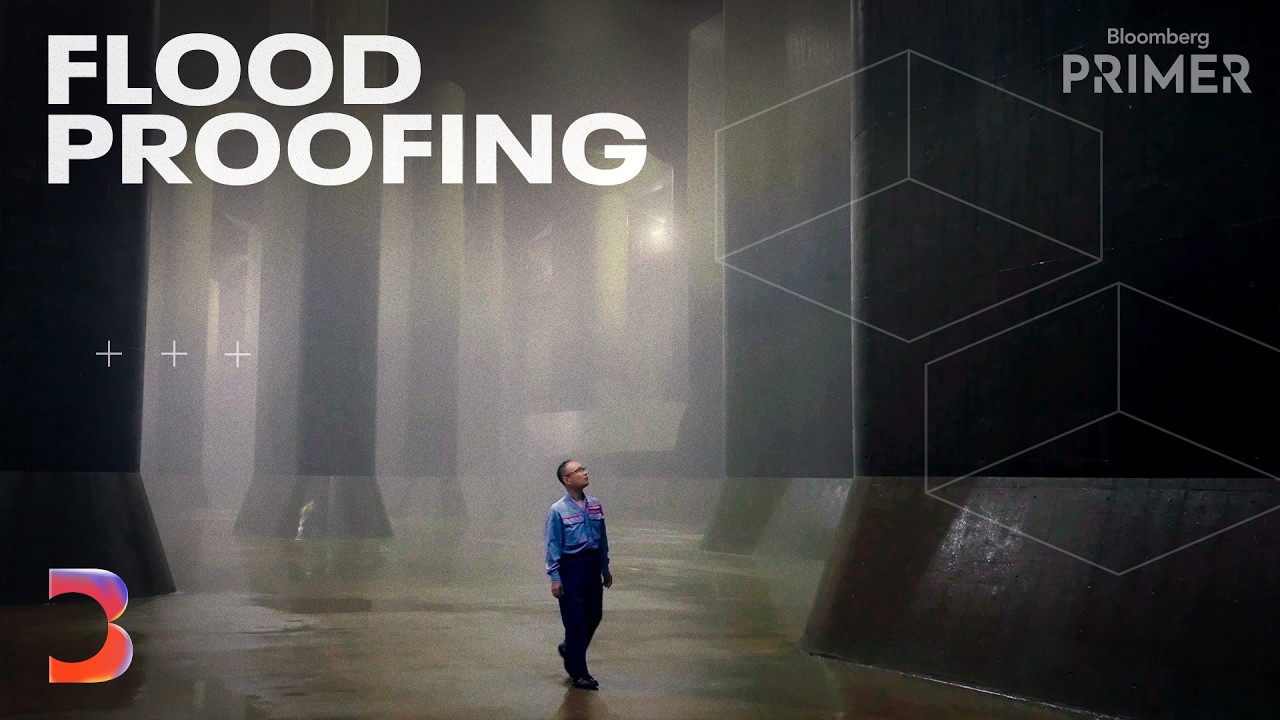
Deep beneath an unassuming exterior in Japan lies the Metropolitan Area Outer Underground Discharge Channel, the world's largest underground flood tunnel system. Built over 13 years at a cost of roughly $2 billion, this massive subterranean complex protects Saitama Prefecture and the greater Tokyo region. When torrential rains hit, five colossal vertical concrete silos—each 70 meters deep and spacious enough "for a space shuttle to take a bath"—capture overflowing water from surrounding rivers. The water is funneled through a 6.3-kilometer underground storage tunnel situated 50 meters below the surface before flowing into a giant pressure control tank known as the "Underground Temple."
Supervised by engineers like Yoshio Miyazaki, high-powered pumps force the accumulated water out into the Edo River. By keeping this entire infrastructure hidden underground, Japan preserves valuable surface land for residential and commercial development. Since its completion, the facility has reduced local residential flood damage by an astounding 90%.
- **Facility**: Metropolitan Area Outer Underground Discharge Channel (Saitama Prefecture, Japan).
- **Construction Details**: Took 13 years to build at a cost of approximately $2 billion.
- **Key Dimensions**: 5 vertical silos (70 meters deep each), 6.3-kilometer storage tunnel (50 meters underground), pressure control tank ("Underground Temple").
- **Efficacy**: Has reduced home flooding damage in the targeted zone by 90%.
---
[04:35](https://www.youtube.com/watch?v=R341JzbpC5k&t=275s) Japan’s $110 Billion Plan for the Next Century
Japan's proactive approach to disaster management stems from its precarious position along the "Ring of Fire," a Pacific zone prone to frequent earthquakes and volcanic eruptions. Historically, Japan's structured preparedness traces back over a century to the Great Kantō Earthquake of 1923, which devastated Tokyo and killed tens of thousands. Today, every segment of Japanese society—from national government agencies and private businesses to schools and local community groups—practices systematic disaster preparedness.
As a metro economy second only to New York in size, Tokyo alone generates roughly 20% of Japan's national GDP and houses 37 million residents. To safeguard this economic engine against long-term climate threats, officials launched the Tokyo Resilience Project in 2022. This flagship initiative aims to protect the capital over the next century against floods, earthquakes, and volcanic eruptions through extensive physical upgrades, including raising seawalls, constructing additional levees, and elevating key infrastructure.
- **Economic Weight**: Tokyo's metropolitan area houses 37 million people and accounts for ~20% of Japan's total GDP.
- **Historical Catalyst**: The Great Kantō Earthquake of 1923.
- **Tokyo Resilience Project**: Launched in 2022; targets a $110 billion investment by the 2040s to fortify infrastructure against natural disasters.
---
[06:10](https://www.youtube.com/watch?v=R341JzbpC5k&t=370s) The Economics of Adaptation: From Risk to Revenue
Climate economist Gernot Wagner—playfully introduced as "juggernaut without the jug"—challenges the common misconception that adaptation is merely a charitable cause championed by environmentalists. While market failures created the climate crisis, economic incentives and capital deployment are essential to solving it. According to reinsurer Munich Re, global natural disasters caused approximately $320 billion in total economic damage in 2024, up from $268 billion in 2023, with roughly 90% of those losses linked to weather events like hurricanes, typhoons, and flooding.
Prominent figures like Bill Gates have championed adaptation investments because disasters carry massive hidden costs. Traditional mindsets tend to react to destruction after the fact—paying heavily for debris removal and rebuilding—rather than investing upfront. However, forward-thinking investors and financial markets are beginning to view resilience as a proactive strategy that preserves valuable real estate assets and generates new revenue streams through construction, engineering, and technology services.
- **Disaster Costs (Munich Re Data)**: $320 billion in global natural disaster losses in 2024 (up from $268 billion in 2023).
- **Weather Share**: Weather-related events account for ~90% of total financial disaster losses.
- **Economic Insight**: Adaptation functions like a business taking early bets to diversify and build reserves ahead of a market downturn.
---
[08:37](https://www.youtube.com/watch?v=R341JzbpC5k&t=517s) Dutch Expertise and Jakarta’s Sinking Crisis
The economic return on adaptation is well demonstrated in the Netherlands, where extensive dike construction along the coastline yields benefits that far outweigh the costs. Analyses project that Dutch flood defenses could prevent up to $21 billion in cumulative coastal flooding losses by the year 2100. Renowned globally for their water management expertise, Dutch engineering firms now export their skills worldwide. One prominent firm, Witteveen+Bos—which operates 23 offices across nine countries and executed the reconstruction of the iconic Afsluitdijk dam—is currently tackling the critical flooding crisis in Jakarta, Indonesia.
Jakarta holds the title of the fastest-sinking megacity in the world, primarily because it was built on soft soils that compress under urban weight. Victor Coenen, a lead engineer at Witteveen+Bos who is affectionately known as "Mr. Seawall," emphasizes that while simple seawalls can cost around $100 million per kilometer, they are not a universal fix. High, basic walls block communities from accessing the ocean and disrupt local fishing industries, whereas wider, sloped designs or offshore land reclamation allow for recreational spaces and real estate development—though at significantly higher financial and time costs.
- **Dutch Projections**: Avoided coastal flood losses in the Netherlands estimated up to $21 billion by 2100.
- **Engineering Firm**: Witteveen+Bos (23 offices in 9 countries; projects include the Afsluitdijk dike reconstruction).
- **Seawall Economics**: Standard simple seawall builds cost approximately $100 million per kilometer.
---
[10:31](https://www.youtube.com/watch?v=R341JzbpC5k&t=631s) Indonesia’s Mega-Seawall and the Move to Nusantara
Under President Prabowo Subianto, Indonesia has dramatically escalated its coastal protection strategy. While a giant seawall project had been discussed since at least 1995 as a $10 billion concept, President Subianto proposed an ambitious $80 billion program spanning 20 years to construct a 310-mile seawall along Java's coast. Past designs have varied widely; over three decades, engineers developed at least 25 different iterations, including an extravagant design shaped like the mythic eagle-like demigod Garuda that was intended to host presidential palaces and government ministries before being deemed too complex and expensive.
Coastal engineer Tiara Salsabila from Witteveen+Bos illustrates the stark contrast between different coastal structures in Jakarta. In her childhood neighborhood of Kalibaru, a wide, modern seawall was built that doubled as a vibrant public space for community leisure. Conversely, in areas like Luar Batang, the existing seawalls remain alarmingly thin, fragile, and space-restricted, offering minimal defense against encroaching waters.
To escape these persistent vulnerabilities, Indonesia is simultaneously pursuing an alternative route: relocating its capital entirely. The nation is constructing a brand-new city called Nusantara, with initial official cost estimates set at $29 billion—a figure expected to rise significantly. Current leadership must balance this dual burden of funding both Nusantara and the mega-seawall while managing high youth unemployment and broader economic development goals.
- **Indonesia’s Giant Seawall Plan**: Expanded from a $10 billion concept to an $80 billion, 20-year program covering ~310 miles.
- **Capital Relocation**: Capital city movement to Nusantara carrying an official baseline estimate of $29 billion.
- **Root Cause**: In addition to rising sea levels, Jakarta suffers from severe "land subsidence" caused by widespread, un-piped groundwater extraction by residents and businesses.
---
[17:10](https://www.youtube.com/watch?v=R341JzbpC5k&t=1030s) Fly Farms and Circular Economies in Nairobi
High-cost infrastructure projects are not the only answer to climate adaptation; smaller, natural, and community-driven solutions can be equally effective. Concepts like "sponge cities"—which use urban green spaces to absorb and store rainwater—originated in China and have spread globally as low-cost, highly replicable alternatives to concrete walls. In Nairobi, Kenya, an even more unusual adaptation strategy is taking root to tackle localized urban flooding.
Nairobi's population of 5 million is expected to double by 2050, with over half of its residents living in informal settlements like Mukuru where municipal infrastructure is virtually non-existent. In these areas, heavy rains trigger severe flash floods because open drainage ditches become clogged with uncollected household garbage. To solve this, a youth-led initiative introduced black soldier fly farming. Workers collect waste door-to-door, sort out recyclables, and feed the remaining organic waste to black soldier fly larvae. The voracious larvae rapidly consume the decaying matter before it can block drainage channels.
Organizers can then sell the nutrient-rich larvae as alternative animal feed—offsetting the rising cost of traditional agricultural protein—or allow them to mature into adult flies to lay more eggs. At a total project setup cost of roughly 10 million Kenyan shillings (about $78,000 USD), this low-tech approach turns an environmental hazard into a self-sustaining circular economy. With over 1 billion people worldwide living in informal settlements, such decentralized waste and flood management models offer a scalable blueprint for vulnerable urban centers.
- **Demographics**: Nairobi's 5 million population projected to double by 2050; >50% reside in informal settlements.
- **Project Economics**: Black soldier fly waste management unit in Mukuru cost ~10 million Kenyan shillings (~$78,000 USD).
- **Mechanism**: Larvae consume organic waste that would otherwise clog urban drainage, transforming potential flood hazards into protein-dense animal feed.
- **Global Context**: Over 1 billion people globally live in informal settlements facing similar infrastructure challenges.
[22:12](https://www.youtube.com/watch?v=R341JzbpC5k&t=1332s) The Limits of Adaptation and the Threat of Moral Hazard
As the reality of accelerating global warming sets in, there is a growing realization that engineering and local adaptation efforts alone will not be enough to save every community. Small and highly vulnerable island nations face the brunt of this crisis, illustrated by the devastation wrought on Jamaica by Hurricane Melissa. The severe Category 5 storm served as a brutal reminder of the limits of physical defenses and highlighted an immense funding shortfall, with estimates suggesting that an additional $300 billion in climate finance is urgently needed. The sheer scale of damage caused by extreme weather events demonstrates that even massive infrastructure projects cannot completely shield vulnerable populations from the escalating climate threat.
The fundamental relationship between climate mitigation and adaptation requires a dual approach. Even if all global greenhouse gas emissions were to cease immediately, the planet is already locked into substantial future warming, meaning humanity will have to live with—and adapt to—the ongoing consequences. However, experts warn against falling into the trap of "moral hazard." In the same way that wearing a seatbelt might entice someone to drive faster, or putting on a bike helmet might encourage a cyclist to ride recklessly due to a false sense of security, relying too heavily on adaptation creates a dangerous illusion. Promoting the idea that society can simply build giant seawalls and engineer its way out of trouble risks signaling that cutting carbon dioxide emissions isn't urgent. Ultimately, the crucial challenge is to leverage the pressing, visible need for adaptation as a catalyst to aggressively accelerate global emission reductions.
- **Devastating Impact:** Hurricane Melissa struck Jamaica as a Category 5 storm, illustrating the vulnerability of small island nations.
- **Financial Gap:** An estimated **$300 billion** more in funding is required to adequately address climate adaptation and resilience needs.
- **Core Dilemma:** Over-reliance on adaptation measures creates a "moral hazard" by risking the postponement of necessary CO₂ emission cuts.
## Notable quotes
> [02:11](https://www.youtube.com/watch?v=R341JzbpC5k&t=131s) space shuttle to take a bath
> [06:10](https://www.youtube.com/watch?v=R341JzbpC5k&t=370s) juggernaut without the jug
> [08:37](https://www.youtube.com/watch?v=R341JzbpC5k&t=517s) Mr. Seawall
> The $100 Billion Builds That Are Keeping Cities Dry
> [22:12](https://www.youtube.com/watch?v=R341JzbpC5k&t=1332s) moral hazard
## Mentioned
Bloomberg Originals, Bloomberg Primer, Tokyo, Jakarta, Nairobi, Saitama Prefecture, Metropolitan Area Outer Underground Discharge Channel, Edo River, Yoshio Miyazaki, Tokyo Resilience Project, Gernot Wagner, Munich Re, Bill Gates, Netherlands, Witteveen+Bos, Victor Coenen, Prabowo Subianto, Kalibaru, Luar Batang, Nusantara, Mukuru, Jamaica, Panama Canal, Three Gorges Dam, Tiara Salsabila
As climate disasters generate hundreds of billions in annual losses, urban adaptation is shifting from reactive emergency relief into a projected $1.3 trillion commercial market. While massive engineering builds and decentralized community projects safeguard vital economic centers, analysts emphasize that local adaptation cannot substitute for reducing global greenhouse gas emissions.
Capitalizing on Resilience: The $1.3 Trillion Market (6:10)
Floods account for roughly 50% of natural disasters globally. According to reinsurer Munich Re, global natural disasters inflicted $320 billion in economic losses in 2024, an increase from $268 billion in 2023, with weather-related events responsible for approximately 90% of the damage. Climate economist Gernot Wagner and investors like Bill Gates argue that the historical approach—absorbing the steep costs of post-disaster cleanup and rebuilding—is economically inefficient compared to upfront investment.
Consequently, institutional capital is beginning to view climate resilience as a viable commercial sector projected to reach $1.3 trillion. Rather than treating flood mitigation solely as a public expenditure or charitable effort, investors and engineering firms are pursuing proactive infrastructure projects that protect valuable real estate assets while generating recurring revenue through specialized technology, construction, and water management services.
Subterranean Defense: Japan’s Mega-Engineering Strategy (2:11)
To safeguard the Tokyo metropolitan area—home to 37 million people and generator of roughly 20% of Japan's GDP—authorities have invested heavily in large-scale civil protection. The Metropolitan Area Outer Underground Discharge Channel in Saitama Prefecture was constructed over 13 years for approximately $2 billion. Featuring five 70-meter-deep silos and a 6.3-kilometer tunnel 50 meters underground, the facility directs excess floodwaters into a massive pressure control tank before pumping them into the Edo River, reducing residential flood damage in its target zone by 90% while preserving surface land for commercial use.
In response to long-term risks rooted in Japan's location along the Pacific Ring of Fire—a historical preparedness priority dating to the 1923 Great Kantō Earthquake—the government launched the Tokyo Resilience Project in 2022. The initiative plans $110 billion in investments through the 2040s to fortify the capital against floods, earthquakes, and volcanic disruptions by elevating key infrastructure and building higher seawalls and levees.
Jakarta's Dual Burden: Coastal Seawalls and Relocation (8:37)
The economic return of flood defenses is illustrated by the Netherlands, where dike networks are projected to avert up to $21 billion in coastal flood losses by 2100, enabling Dutch engineering firms like Witteveen+Bos to export expertise globally. However, deploying these solutions abroad entails steep trade-offs. In Jakarta, the world's fastest-sinking megacity due to soft soils and un-piped groundwater extraction, standard simple seawalls cost roughly $100 million per kilometer and block fishing access, while wider multipurpose dikes require significantly more capital and time.
Under President Prabowo Subianto, Indonesia has proposed an $80 billion, 20-year program to construct a 310-mile seawall along the coast of Java, abandoning earlier ornate designs like the Garuda-shaped offshore city as overly complex. Simultaneously, the government is pursuing capital relocation to Nusantara, an initiative carrying an initial baseline estimate of $29 billion. This dual track forces policymakers to balance substantial adaptation financing against pressing economic priorities, such as youth unemployment.
Decentralized Adaptation: Waste Management in Informal Settlements (17:10)
High-capital infrastructure is not the sole viable adaptation method. While China's 'sponge city' model uses green space to absorb stormwater, low-income urban districts are deploying low-cost circular solutions. In Nairobi, Kenya, where the population of 5 million is expected to double by 2050 and over half live in informal settlements like Mukuru, flash floods are routinely triggered because uncollected domestic waste clogs open drainage channels.
To address this infrastructure gap, a local youth initiative established a black soldier fly farming facility for roughly 10 million Kenyan shillings (approximately $78,000 USD). Workers collect organic waste to feed the fly larvae, which consume the refuse before it can obstruct stormwater drains. The harvested larvae are then sold as protein-dense animal feed, generating revenue while mitigating flood hazards. With over 1 billion people living in informal settlements worldwide, this decentralized model provides an affordable blueprint for under-resourced cities.
Physical defenses and local adaptation have clear boundaries. The destruction inflicted on Jamaica by Category 5 Hurricane Melissa highlighted a severe $300 billion global financing gap for vulnerable nations facing extreme weather. Furthermore, experts warn that relying heavily on engineered defenses introduces a moral hazard: the perception that cities can simply engineer their way out of danger risks creating a false sense of security that delays urgent, necessary reductions in global greenhouse gas emissions.
[2:11] space shuttle to take a bath
[6:10] juggernaut without the jug
[8:37] Mr. Seawall
The $100 Billion Builds That Are Keeping Cities Dry
[2:11] Yoshio Miyazaki: Underground Temple
[4:35] Ring of Fire
[17:10] sponge cities
[22:12] moral hazard
Original transcript
[0:01] - Those who master water prosper.
[0:05] We've seen this all the
way back to 8,000 BCE
[0:08] when the irrigation system
in the Fertile Crescent
[0:10] earned at the title
"Cradle of Civilization."
[0:14] Jump forward a bit in
time to the Panama Canal,
[0:18] a 40-mile artificial waterway
that connects the Atlantic
[0:21] and Pacific oceans, making
it crucial to global trade
[0:25] by cutting long, dangerous
sea journeys to just 10 hours
[0:29] on the other side of the planet.
[0:31] The three gorgeous dam in China
[0:33] became the world's biggest
single source of green power.
[0:37] Today, the potency of water
is to be reckoned with
[0:39] more so than ever.
[0:41] - We used to have a stable
climate on this earth
[0:44] for most of human evolution.
[0:46] Right now, we do not.
[0:49] - If you look at a river in
a dry period, it's gentle,
[0:53] it's nice, but then overnight
it becomes like this monster,
[0:57] this huge deluge of water
destroying houses, killing people.
[1:03] How do you control this? How
do you tame this monster?
[1:07] - Floods account for nearly
half of natural disasters,
[1:10] and compared to previous decades,
their numbers have soared.
[1:14] But ideas around the world have emerged
[1:16] to disaster-proof cities
[1:18] with mega projects from
Japan's flood tunnels
[1:29] to massive sea walls and... fly farms?
[1:34] And with a projected
market of $1.3 trillion,
[1:38] the business of adaptation
is on Wall Street's radar.
[1:41] - Adaptation is still worth it.
[1:44] It's still eminently possible,
[1:46] and plenty of us will be able
[1:48] to adapt given we spend the money wisely.
[2:11] - Behind and below this unasuming door
[2:14] is the world's largest
underground flood tunnel system.
[2:18] The Metropolitan Area Outer
Underground Discharge Channel.
[2:23] Tall enough for a space
shuttle to take a bath.
[2:25] This structure helps protect
the Saitama Prefecture just
[2:29] outside Tokyo from floods by
diverting rainwater underground
[2:33] and spitting it back
out into the Edo River.
[2:37] It took 13 years to construct
and cost roughly $2 billion.
[2:42] Since completion, it has been estimated
[2:43] to reduce flood damage
to homes by, hold on,
[2:46] let me check my notes here...
[2:49] 90%.
[2:52] This is Yoshio Miyazaki.
[2:56] He supervises ongoing construction
[2:58] that keeps the facility maintained so
[3:00] that it can accommodate
torrents of rainwater.
[3:10] During heavy rains, five
colossal vertical concrete silos,
[3:15] each 70 meters deep, capture overflow
[3:18] from surrounding rivers.
[3:30] The river is then funneled
into a 6.3-kilometer-long
[3:34] underground water storage tunnel
[3:36] about 50 meters below ground.
[3:38] From there, water flows into a
[3:40] massive pressure control tank.
[3:42] Aptly-nicknamed as the
"Underground Temple."
[3:46] Makes sense to maintain
some reverence when dealing
[3:49] with forces in nature, after all.
[4:04] - Large pumps are able to push
water through these tanks.
[4:07] By keeping this underground,
[4:09] the space above remains functional
for homes and businesses.
[4:25] Japan has invested
heavily in mega projects
[4:29] to protect their citizens from
catastrophes something many
[4:32] other nations have not done.
[4:35] Because sitting atop the
foreboding named "Ring of Fire,"
[4:39] a zone of frequent earthquakes
[4:40] and volcanic eruptions along
the Pacific Rim can come
[4:43] with terrifying and
unpredictable consequences.
[4:47] - Japan is one of the most advanced,
[4:49] if not the most advanced country
in the world when it comes
[4:53] to preparing for disasters.
[4:55] Every sector of society,
governments, businesses,
[4:59] community groups, even schools,
[5:01] prepare for disaster in a way
that we don't see elsewhere.
[5:05] This is something that's gone
on for more than a century,
[5:08] really, since a enormous
earthquake in 1923 killed tens
[5:13] of thousands of people and
really devastated Tokyo.
[5:19] - Japan's capital is one
[5:20] of the most popular cities in the world
[5:22] with 37 million people
in the metropolitan area.
[5:28] - When we think about
Tokyo, it really is one
[5:30] of the most important
city economies globally,
[5:34] probably second only to New
York in terms of its size,
[5:38] and it accounts for
about 20% of Japan's GDP
[5:42] - 2022 saw the launch of the
Tokyo Resilience Project.
[5:46] - This is a flagship effort
[5:48] and it's aimed at helping Tokyo
be more resilient over the
[5:51] next hundred years to
flooding earthquakes,
[5:55] volcanic eruptions,
[5:56] and it's on a range of things
like raising the height
[5:59] of sea walls, moving some
infrastructure to higher ground,
[6:02] adding more levees,
[6:04] and it's an effort that
should see spending
[6:06] of about $110 billion by the 2040s.
[6:10] - One big misconception
about adaptation is that
[6:14] it's some do-gooder thing
[6:16] that the greens would want us to do,
[6:19] but the serious people of
energy here just shouldn't.
[6:27] Gernot, "juggernaut
without the jug" Wagner.
[6:29] I'm a climate economist at
Columbia Business School
[6:37] - Climate economists don't
just think about economic
[6:40] losses from disasters.
[6:42] They consider the opportunities as well.
[6:44] - We basically know that
the problem are misguided.
[6:48] market forces are not guiding
things in the right direction.
[6:52] And while the problems are
economic, the solutions are two.
[6:56] - One of those solutions
[6:58] is what's called "climate adaptation."
[7:00] - What is adaptation? It
is resilience investments,
[7:04] it's making sure that
those desirable locations,
[7:08] these valuable properties,
maintain their value.
[7:12] - There's a growing
recognition even on Wall Street
[7:15] that spending on
adaptation isn't just about
[7:18] preventing losses.
[7:20] This is an activity
[7:21] that could potentially
also generate revenue.
[7:24] - Figures like Bill
Gates have publicly urged
[7:26] for investment in adaptation projects
[7:28] for climate resilience.
[7:32] - Disasters are a hidden
cost and they're huge.
[7:39] We see when a disaster comes
in that there's billions
[7:42] of dollars in damage,
but we don't understand
[7:45] the economic activity,
[7:46] everyone who's gonna make money from that.
[7:49] That includes clearing debris,
[7:51] the construction costs of rebuilding.
[7:53] And I think human beings are
still more in the response
[7:58] that is, they're more reactive
[7:59] to disasters than they
are getting ahead of them.
[8:03] - The reinsurer, Munich Re,
calculated that in 2024,
[8:08] the cost of natural disasters
was about $320 billion.
[8:12] That was up from the year
[8:14] before when it was around $268 billion.
[8:18] About 90% of losses are
related to weather risks:
[8:23] typhoons, hurricanes, flooding.
[8:26] - Adaptation is like a
business anticipating a market
[8:29] downturn by taking an early
bet to diversify, reinvest,
[8:33] or build cash reserves to
weather future disruptions.
[8:37] - Mega projects are really high stakes.
[8:40] They're often changing a geography,
[8:43] potentially displacing communities
[8:46] and having an enormous impact
on a local environment.
[8:50] But there's evidence
[8:51] that adaptation projects
have helped reduce losses.
[8:55] The Netherlands is a
really striking example
[8:59] - Here, some studies indicate the benefit
[9:00] of activities like dike
construction along the nation's
[9:03] coastline already
greatly exceeds the cost,
[9:06] and one analysis forecasts
avoided losses from coastal
[9:09] flooding could be as much
as $21 billion by 2100.
[9:14] The Dutch are such experts
on flood mitigation,
[9:17] they've even started exporting it.
[9:19] Witteveen+Bos is one
Dutch engineering firm
[9:22] with 23 offices across nine countries,
[9:26] including one in Jakarta, Indonesia,
[9:28] the fastest sinking mega city in the world
[9:31] where the decisions around adaptation
[9:33] and resilience are playing
out in real time.
[9:36] - This is the old
seawall when I was a kid.
[9:38] So we had the structure to protect us,
[9:40] but the seawater kept
coming, coming and coming.
[9:44] - Jakarta is the worst
possible place to build a city.
[9:48] It's built on very, very soft soils,
[9:51] and if you build anything
on top of those soils,
[9:54] the city will start sinking.
[9:56] This means we have to keep
the sea out of the city and
[9:59] therefore, think about seawalls.
[10:02] My name is Victor Coenen,
sometimes called "Mr. Seawall."
[10:08] I would warn against building
seawalls everywhere.
[10:11] But yeah, this is the reputation I have.
[10:16] - One notable Witteveen+Bos
mega project is a reconstruction
[10:20] of the iconic Afsluitdijk,
[10:23] a dam and causeway that protects the
[10:25] Netherlands from the North Sea.
[10:27] Here in Jakarta, they're
bringing their expertise
[10:29] to build a new seawall.
[10:31] - Indonesia's giant
seawall is a, is a project
[10:34] that's been talked about
since at least 1995.
[10:38] But what we've seen from
President Prabobo Subianto
[10:41] is a massive escalation.
[10:43] Previously, this had been considered
[10:45] as maybe a $10 billion project.
[10:48] Now he's talking about an $80
billion program over 20 years
[10:53] to build a sea wall as
long as about 310 miles.
[10:58] - Victor Coenen has been working
[11:00] on Indonesia's flood projects since 2012.
[11:03] - A seawall, if you look at
examples all over the world,
[11:06] will cost you about 100 million US dollar
[11:10] for a very simple one per kilometer,
[11:13] and that's a lot of money.
[11:16] - Seawalls are pretty straightforward.
[11:18] They're walls in the sea.
[11:20] They absorb and deflect waves,
[11:23] but they can also cause erosion
and harm people and ecology.
[11:27] - Big seawalls create big problems.
[11:29] You will close off ports,
[11:31] you will close off fishing communities,
[11:34] they will lose access to
their fishing grounds.
[11:37] Also, what does the
regional communities want?
[11:41] What are the needs?
What are the ambitions?
[11:44] So if you design a sea
wall, it probably starts not
[11:48] with the technical side of things.
[11:51] - A simple high wall is
inexpensive and stops the waves,
[11:55] but blocks access to the ocean.
[11:57] A wider sloped wall creates
more coastline for communities
[12:01] to use, build it offshore and
you keep coastlines intact.
[12:06] Options that include land
reclamation allow for other uses,
[12:10] which creates more value,
[12:12] but to do so takes more time and money.
[12:15] - In most of the designs on
seawalls, you see some form
[12:19] of shape of a land reclamation,
[12:21] because land is scarce in Java,
[12:23] it's a densely-populated island.
[12:25] So if you can add a little bit of land
[12:27] behind the sea wall, that's a good idea.
[12:29] So many designs include
those land reclamations.
[12:34] - Building sea walls
isn't new in Indonesia.
[12:37] It's it's a place where those kind
[12:39] of programs have happened previously.
[12:42] What's different here with
President Subianto's plan
[12:45] is its scale and what he would
hope is a definitive defense
[12:50] to protect that island.
[12:56] - So this place we're standing
now is a reclaimed land.
[13:00] - This is Tiara Salsabila.
[13:03] She's a coastal engineer
at Witteveen+Bos, and she's
[13:06] showing us different seawalls
along Jakarta's coast.
[13:10] Here in Kalibaru, where
she was born and raised
[13:12] is a newer sea wall that
allows for recreational use.
[13:17] - So, when I was a little girl, this dyke
[13:20] where we're standing now
was not available yet.
[13:23] With this huge space, everything changed
[13:26] and I could see the change
clearly from no space
[13:29] to a huge space for
people to use for leisure.
[13:35] - But as we learned earlier,
not all sea walls are the same.
[13:41] - So we are currently at Luar Batang area,
[13:43] and now I'm standing on the sea wall,
[13:46] the very thin sea wall.
[13:48] Here it is even not safe
and there's no space.
[13:51] So yeah, it is very different.
[13:53] And then compared to the
existing seawall in Kalibaru
[13:56] this seawall is not strong at all.
[13:59] - When we think about Indonesia
[14:00] and its really unique
geography, this collection
[14:03] of islands, you can
understand why infrastructure
[14:06] projects are necessary.
[14:07] It needs bridges, ports, roads.
[14:12] But those projects have often
also had another purpose.
[14:17] We've seen successive leaders
promise lavish projects,
[14:20] big spending on major pieces
of infrastructure as a way
[14:24] of commanding voter attention.
[14:27] - Of course, you could also simply
[14:29] relocate the entire capitol.
[14:32] No big deal.
[14:34] - What we've seen more
recently is an acceleration
[14:37] of efforts to develop a new capitol city.
[14:39] Nusantara is intended
to provide a new capitol
[14:43] for Indonesia that's free
from those challenges
[14:46] that Jakarta faces.
[14:47] - Nusantara would be an
entirely new city built from
[14:50] scratch meant to avoid the threat
[14:52] of coastal flooding altogether.
[14:55] Former Indonesian president,
Joko Widodo struggled
[14:58] to finance this project in
the final years of his term.
[15:01] An effort that current
president, Prabowo Subianto,
[15:04] has taken on in addition
to the new seawall.
[15:08] - The Nusantara project right now,
[15:10] the official estimate is for $29 billion.
[15:13] The expectation though, is
[15:15] that it'll cost a lot more than that.
[15:18] - Sounds a lot like another
mega project hampered
[15:21] by high expenses, doesn't it?
[15:25] - There are still many options
on the table for a seawall,
[15:29] and I wouldn't be able
[15:31] to put a bet on which
design at this moment
[15:34] is a preferred design.
[15:36] - Over the past three decades,
[15:37] there's been at least 25
iterations of this new seawall like
[15:41] this one in the shape of the
eagle-like demigod Goruda.
[15:45] - The idea was this would be
the new capitol of Indonesia
[15:50] with the presidential palaces
and the ministerial offices.
[15:55] - But in the end, this design
was considered too ambitious.
[16:02] But even if Jakarta manages
[16:04] to complete its never-ending
sea wall project,
[16:06] the island capitol will continue to sink.
[16:09] Jakarta's problem isn't
just the rising sea,
[16:12] it's also the extraction of groundwater.
[16:15] - Traditionally, Jakarta's
would pump up their own water
[16:18] from the underground.
[16:20] It was clean, it was
available, and it was for free.
[16:24] - But over time,
[16:25] more and more pumping
has meant that the ground
[16:27] above sinks a process
called "land subsidence"
[16:31] and as long as the government
doesn't efficiently address
[16:34] the issue by providing reliable,
fresh water alternatives,
[16:37] sinking will continue.
[16:39] - Indonesia simply can't spend
on climate-proofing projects
[16:43] in the same way that
we'd see in a developed
[16:46] economy like Japan.
[16:47] It's trying to boost growth, trying
[16:49] to handle things like
high youth unemployment.
[16:52] It's in a very different
position to be able
[16:54] to fund climate proofing projects.
[16:58] - When it comes to
adaptation, governments have
[17:00] to take many economic and social
factors into consideration,
[17:07] and the cost can be hard to swallow.
[17:10] - It's not always the case
[17:12] that the big expensive
infrastructure projects deliver
[17:15] the best results.
[17:16] There are certainly instances
where smaller projects,
[17:20] restoring wetlands, for example,
[17:22] can help mitigate the impacts
[17:24] of floods even better than
maybe a huge seawall project.
[17:28] - Take "sponge cities," green
spaces within urban landscapes
[17:32] that absorb water by capturing
and storing rainwater
[17:36] and reducing runoff.
[17:38] They began in China and have
popped up across the globe.
[17:42] Inexpensive solutions like
this are not only effective,
[17:45] but easily replicable across
cities around the world.
[17:49] But affordable flood
solutions don't stop there.
[17:55] Sometimes what it takes is
really thinking outside the box,
[18:00] like in Nairobi, Kenya, where
there's something new buzzing.
[18:08] - That is a pupa.
[18:10] Pupa. Little pupa.
[18:13] When I first learned about
black soldier fly farming,
[18:16] I thought it was a godsend
for the waste problems
[18:20] that urban areas have.
[18:23] - Godsend might not be the
first thing that comes to mind,
[18:26] but stay with me here.
[18:30] Nairobi is a global hub.
Driven by migration,
[18:34] it's expected to double its
population of 5 million by 2050.
[18:39] And more than half the
residents live in informal
[18:41] settlements where
infrastructure lags far behind
[18:45] that rapid growth.
[18:47] Mukuru is among the largest
[18:49] - Flash floods are a common
occurrence in this region.
[18:53] A major cause is we do
not have proper channels
[18:57] for drainage, and often the few drains
[19:00] that are available are blocked by garbage.
[19:03] - Like many informal
settlements in Nairobi,
[19:05] Mukuru has no regular waste collection.
[19:11] Enter... the flies.
[19:16] So the project begins with
young people moving from door
[19:20] to door to collect household waste so
[19:23] that it does not end up on the street.
[19:26] They then segregate this waste
[19:29] and the recyclables are then sold.
[19:33] What remains mostly is the organic waste,
[19:36] which they then bring to
their black soldier fly unit.
[19:41] They shred it and they put it in crates.
[19:44] They then inoculate the
crates with the eggs
[19:47] of the black soldier fly.
[19:50] - Larvae break down organic waste rapidly,
[19:53] preventing it from piling
up in dumps or drains.
[19:56] Black soldier flies are great decomposers.
[19:59] They're detritivores,
meaning they consume dead
[20:03] and decaying organic material.
[20:09] - So they have two options.
[20:11] They can either take the larva
[20:14] and sell it as animal feed,
[20:17] or keep it a little longer,
[20:19] and then it grows into adulthood.
[20:21] It becomes a black soldier
fly, and then it lays new eggs
[20:26] and the cycle begins.
[20:30] The total cost of this project
[20:32] is around 10 million shillings.
[20:34] - That's about 78,000 U.S. dollars.
[20:38] Over 1 billion people worldwide
live in informal settlements
[20:42] similar to Mukuru.
[20:44] The results of this
project could lead the way
[20:47] in raising armies of insects elsewhere.
[20:50] - The protein that is used
[20:51] for animal feeds has
become very expensive.
[20:54] So the black soldier fly
provides an alternative
[20:57] source of protein.
[20:59] So through this, we are able
to create a circular economy
[21:03] that turns a problem into a solution.
[21:10] - So sometimes adapting
to floods doesn't take
[21:14] a giant wall or tunnel or tunnel,
[21:18] just... the right bug in the right place.
[21:25] The black soldier fly project,
[21:26] just like Jakarta's mega seawall,
[21:29] won't stop flooding in the region alone,
[21:32] but it may help keep communities
on firm enough economic
[21:35] ground to plan for the next adaptation.
[21:39] - Throughout history, humans have tried
[21:41] to master water change,
river flows, irrigate fields
[21:46] to build up economies
and develop societies.
[21:49] The challenge now is to tame water flows
[21:53] to help protect cities,
[21:54] to help protect the planet from the
[21:56] impacts of climate change.
[21:59] - But adaptation is not mitigation.
[22:03] While these projects can help
protect cities from disasters,
[22:07] they don't actually stop the
ongoing environmental crisis.
[22:12] And sometimes, adaptation is not enough,
[22:16] especially for small and
vulnerable nations like Jamaica,
[22:19] which was devastated by Hurricane Melissa.
[22:22] A Category 5 reminder
that more needs to be done.
[22:26] About $300 billion more.
[22:29] - Adaptation is what people
are saying we're gonna have
[22:32] to do as a result
[22:33] of all those greenhouse
gases going into the air.
[22:37] And to be clear, even if
we stop today, we are going
[22:40] to warm substantially and
live with the consequences.
[22:43] So we need to do both
mitigation and adaptation.
[22:50] - When you wear a
seatbelt, you drive faster
[22:53] or you're encouraged to bike
faster than you should
[22:55] by the false security of the bike helmet.
[22:57] That's moral hazard.
[22:59] Okay, back to climate...
[23:00] When we introduce this specter
of weight, we can just adapt.
[23:05] We can just build seawalls.
[23:07] We may not need to cut CO2 emissions
[23:10] that much that quickly after all.
[23:14] Not true.
[23:15] So the trick, of course,
is to use the need to adapt
[23:21] to then also motivate
us to cut emissions more.