YC Partner Chaubard Tells PhD Founders Academic Rigor Kills Startups
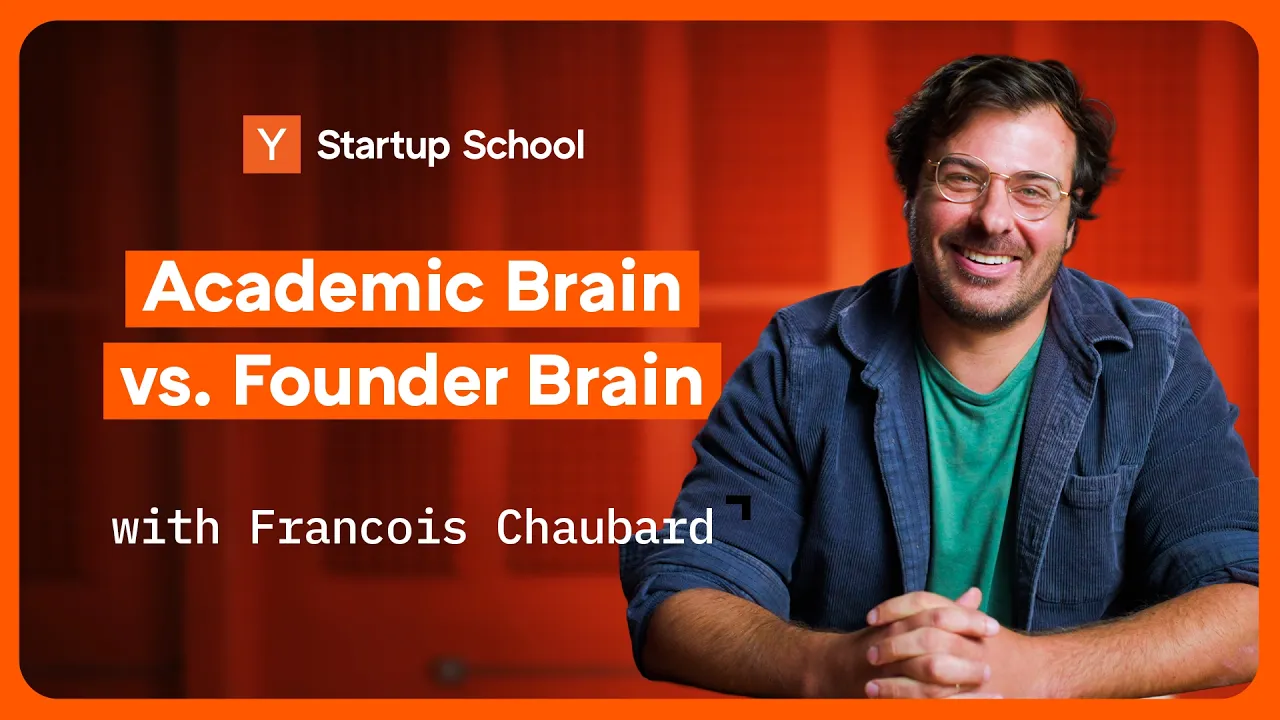
Y Combinator
Academic spinouts routinely fail because incentives that drive citations and peer review penalize the speed, commercial aggression, and empirical customer validation required to survive.
AI-assisted summary of How To Go From Researcher to Founder | Startup School — original source. Check the original for full context.
Source published:
Key ideas
- Academic founders frequently fail because behaviors rewarded in research—chasing novelty, seeking perfection, and qualifying statements—directly conflict with building a commercial startup. (0:09)
- Commercial execution beats technical novelty: fast followers like Instacart and Oracle routinely win massive markets by solving mundane operational problems faster than pioneers with patented inventions. (2:26)
- AI founders must validate customer willingness to pay using human-in-the-loop tests before spending significant capital and time training models. (4:29)
- Founders must embrace Jeff Bezos's 70% certainty rule, avoid outsourcing customer-facing operations, and adopt aggressive commercial instincts to survive competitor threats. (6:28)
Detailed notes
## Background Published on YouTube by Y Combinator on November 4, 2026, this Startup School video features YC visiting partner, PhD student, and former Focal CEO Francois Chaubard. Drawing on his experience transitioning from Fei-Fei Li's lab at Stanford to running a company, Chaubard breaks down the critical mindset shifts researchers must make to avoid startup failure and become formidable founders.
## TL;DR While academic researchers frequently possess exceptional intellect, their training in chasing citation metrics, theoretical novelty, and perfectionism actively undermines their success as entrepreneurs. To build a viable company, founders must abandon academic vanity and embrace extreme empiricism, prioritizing practical customer pain points and rapid execution over technical complexity. Founders cannot delegate sales or stay insulated in research labs; they must leave their desks, validate whether users will actually pay before burning capital, and adopt an aggressive capitalist mindset where speed consistently beats pure academic elegance.
## Atmosphere & style The presentation functions as a direct, tough-love masterclass that systematically dismantles the intellectual vanity and comfort zones of academia. Chaubard speaks with pragmatic, battle-tested conviction, using his own painful mistakes and sharp historical contrasts to deliver an urgent wake-up call. The delivery feels unpretentious yet intense, transforming from a sobering reality check into an energizing, high-stakes challenge that demands grit and commercial hunger over scientific pedigree.
## Bulletin - [00:09](https://www.youtube.com/watch?v=u-8KpXcPYCw&t=9s) Academic founders frequently fail because behaviors rewarded in research—chasing novelty, seeking perfection, and qualifying statements—directly conflict with building a commercial startup. - [02:26](https://www.youtube.com/watch?v=u-8KpXcPYCw&t=146s) Commercial execution beats technical novelty: fast followers like Instacart and Oracle routinely win massive markets by solving mundane operational problems faster than pioneers with patented inventions. - [04:29](https://www.youtube.com/watch?v=u-8KpXcPYCw&t=269s) AI founders must validate customer willingness to pay using human-in-the-loop tests before spending significant capital and time training models. - [06:28](https://www.youtube.com/watch?v=u-8KpXcPYCw&t=388s) Founders must embrace Jeff Bezos's 70% certainty rule, avoid outsourcing customer-facing operations, and adopt aggressive commercial instincts to survive competitor threats.
## Key takeaways - [00:09](https://www.youtube.com/watch?v=u-8KpXcPYCw&t=9s) Breakout companies like Google, Anthropic, and Databricks are rare exceptions among academic spinouts; most fail due to misaligned instincts. - [00:53](https://www.youtube.com/watch?v=u-8KpXcPYCw&t=53s) Researchers must kill their academic identity and abandon vanity metrics like citations, GPAs, and conference invites in favor of product-market fit and paid customer demand. - [01:45](https://www.youtube.com/watch?v=u-8KpXcPYCw&t=105s) Startups require prioritizing what is commercially important over what is intellectually interesting, accepting that code that 'just works' should ship without needing theoretical explanations. - [02:26](https://www.youtube.com/watch?v=u-8KpXcPYCw&t=146s) Academic peer review requires novelty, but startups succeed by unashamedly copying and executing established business models better than pioneers. - [03:54](https://www.youtube.com/watch?v=u-8KpXcPYCw&t=234s) Startups have no semester deadlines or finish lines, requiring relentless, single-minded focus on a single operational problem for years rather than hedging across multiple speculative projects. - [04:29](https://www.youtube.com/watch?v=u-8KpXcPYCw&t=269s) Product validation cannot occur in an academic office or through venture capitalists; founders must speak directly to prospective buyers. - [04:58](https://www.youtube.com/watch?v=u-8KpXcPYCw&t=298s) Focal wasted three months training retail tracking models that customers refused to pay for, an insight that could have been uncovered in a day using manual video review. - [05:53](https://www.youtube.com/watch?v=u-8KpXcPYCw&t=353s) Scientific pedantry and qualified claims ruin commercial messaging; effective marketing requires punchy, simplified statements rather than academic rigor. - [06:28](https://www.youtube.com/watch?v=u-8KpXcPYCw&t=388s) Under Jeff Bezos's 70% rule, founders must make decisions with incomplete information, as waiting for complete certainty allows faster competitors to capture the market. - [06:52](https://www.youtube.com/watch?v=u-8KpXcPYCw&t=412s) Larry Ellison's commercialization of SQL over Michael Stonebraker's technically superior QUEL demonstrates that market velocity consistently beats academic elegance. - [07:11](https://www.youtube.com/watch?v=u-8KpXcPYCw&t=431s) Founders cannot delegate messy tasks like sales and marketing to MBAs, as doing so prevents the direct customer empathy necessary to build a viable product. - [07:52](https://www.youtube.com/watch?v=u-8KpXcPYCw&t=472s) Academics must adopt an unapologetic capitalist mindset that embraces high gross margins, customer acquisition, and aggressive competition. - [08:16](https://www.youtube.com/watch?v=u-8KpXcPYCw&t=496s) Prospective clients and procurement officers do not care about a founder's raw intellect; successful sales require genuine curiosity about the customer's specific problems. - [08:52](https://www.youtube.com/watch?v=u-8KpXcPYCw&t=532s) Founders must physically travel into the field to meet users in their work environments, testing demand before competitors seize the opportunity. - [09:20](https://www.youtube.com/watch?v=u-8KpXcPYCw&t=560s) Raw brainpower is not the limiting factor for academic founders; the decisive bottleneck is personal willpower and the willingness to leave one's comfort zone.
## Detailed walkthrough ### [00:09](https://www.youtube.com/watch?v=u-8KpXcPYCw&t=9s) Killing the Academic Identity: Vanity Metrics and User Importance
Some of the most valuable technology companies in modern history—including Google, Anthropic, Databricks, and Together AI—were founded by researchers with PhDs. Yet these breakout successes remain the exceptions. In reality, academic startups fail at an alarming rate because the exact behaviors that win accolades in research are often orthogonal, or directly antithetical, to what it takes to succeed as an entrepreneur. Francois Chaubard experienced this tension firsthand: before launching his startup Focal, he worked as a researcher in Fei-Fei Li’s lab at Stanford, only to realize later that the instincts drilled into him during those late, coffee-fueled nights in the lab actively held him back as a CEO. Bridging this chasm demands more than learning a few business terms; as Francois Chaubard argues, “To become a formidable founder, you will literally have to kill part of your academic identity, which is quite difficult to do.”
```mermaid flowchart TD accTitle: Academic Mindset vs. Founder Mindset accDescr: Contrasting academic research metrics with founder operational priorities. subgraph Acad["Academic Mindset"] direction TB A1["Vanity Metrics: Citations, talks, grades"] --> A2["Interesting Research: Uncover deep mechanisms"] A2 --> A3["Theoretical perfection before publication"] end subgraph Found["Founder Mindset"] direction TB F1["Commercial Value: What people pay for"] --> F2["Important Solutions: Solve real user pain"] F2 --> F3["Empiricism: 'It just works, ship it'"] end ```
The first major hurdle is abandoning vanity metrics in favor of genuine demand. In university environments, researchers spend years chasing proxies for prestige: GPAs, citation counts, accepted submissions, and invitations to give talks. Reflecting on this institutional conditioning, Francois Chaubard quotes Paul Graham: “The most damaging thing you learned in school wasn't something you learn in any specific class. It was learning to get good grades.” Founders must abandon these artificial scorecards and obsess over commercial reality: what do people actually want, what will they open their wallets to purchase today versus merely claiming they would buy, and will users genuinely adopt a new algorithm into their daily workflows?
This distinction flows directly into the second shift: prioritizing what is important over what is merely interesting. Researchers are trained to dissect mechanisms and probe theoretical nuances to earn publications, even when those findings have zero tangible impact on a single human life. Startups cannot afford intellectual indulgence; founders must care exclusively about product-market fit and working backward from user pain points. As Francois Chaubard points out, founders have to embrace pure empiricism: “In founder mode, you have to be okay with saying it just works. We don't know exactly why, but that's good enough. Ship it.”
- PhD-led giants like Google, Anthropic, Databricks, and Together AI are rare outliers among academic spinouts. - Academic success optimizes for proxy credentials—citations, grades, and prestige—rather than market adoption. - Marc Andreessen’s core principle holds that the only thing that matters is getting to product-market fit, meaning theoretical explanations matter far less than whether a product reliably solves a user's problem.
---
[02:26](https://www.youtube.com/watch?v=u-8KpXcPYCw&t=146s) Novelty, Plagiarism, and Working Without a Finish Line
In academic research, novelty is the sole currency. Peer reviewers reflexively reject any paper that lacks fundamentally original work. In entrepreneurship, however, an obsession with originality is often lethal, and shameless plagiarism of working models is a proven path to victory. Pioneers routinely end up with arrows in their backs while fast followers capture the market. Francois Chaubard references Joe Lonsdale's distinction between "MIT-style" startups—which revolve around an unprecedented, patented black-box invention that few customers actually want—and "Stanford-style" startups, which anchor on a simple, often mundane operational problem and iterate on it relentlessly. Companies like Instacart have spent fifteen years focusing on the unglamorous problem of grocery delivery, an idea attempted by dozens of companies before them; their victory came from execution, not pioneering the concept.
```mermaid flowchart LR accTitle: MIT-Style vs. Stanford-Style Startups accDescr: Comparing technology-push startups to customer-pull startups. subgraph MIT["MIT-Style: Technology Push"] M1["Patented Invention / Black Box"] --> M2["Search for Applications"] --> M3["Low Customer Demand"] end subgraph Stanford["Stanford-Style: Customer Pull"] S1["Boring Customer Problem"] --> S2["Iterative Execution"] --> S3["Massive Market Scale"] end ```
Copying and refining existing market dynamics is entirely legitimate: Lyft versus Uber, Anthropic versus OpenAI, and Rappi versus Instacart all demonstrate that solving an unaddressed customer friction matters far more than novelty. Channeling Steve Jobs, Francois Chaubard emphasizes that founders must always start with the customer experience and walk backward to the technology, rather than building a technical marvel and hunting for a use case.
Compounding this challenge is the fact that startups have no finish line. Academia operates on a structured cadence of finals, paper submission deadlines, and conference dates that offer cathartic moments of completion and rest. Startups offer no such relief. Academic training encourages a "breadth-first search" where researchers balance five speculative projects at once to hedge their bets. Applying this "smearing the peanut butter too thin" approach to a company divides team focus and leads to failure. As Francois Chaubard explains, “However, in founder mode, you have to wake up every single day and crank on that exact problem without getting sidetracked for decades.” Academics quickly grow bored of doing the same operational task every day, and that boredom frequently derails their ventures.
- Academic peer review mandates novel mechanisms, whereas commercial markets reward superior execution of established ideas. - Instacart did not invent online grocery delivery, just as Lyft, Anthropic, and Rappi did not invent their respective product categories. - Academics naturally default to spreading attention across multiple research threads, but building an enduring startup requires relentless, single-minded focus on one problem for years or decades.
---
[04:29](https://www.youtube.com/watch?v=u-8KpXcPYCw&t=269s) Customer Validation and Punchy Pitches over Academic Rigor
Discovering product-market fit cannot happen in the sterile isolation of an academic office; it is a brute-force exercise in talking to real people. Researchers frequently make the fatal mistake of staying behind closed doors, projecting their own assumptions onto user problems, and burning through years of runway building something nobody wants. Talking to venture capitalists does not solve this problem, because most investors have no idea whether a product will succeed. Founders must speak directly with the prospective buyers suffering from the pain point.
Francois Chaubard illustrates this through a costly mistake he made at his retail AI company, Focal. The team spent three months gathering computer vision data and training models to solve people-tracking for retail stores, accurately pinpointing shopper traffic. Retail executives had insisted this was a major problem, but when Focal delivered the finished models showing heavy foot traffic at checkout lanes and the deli counter during lunchtime, the retailers flatly refused to pay. The insight provided no actionable commercial value. Francois Chaubard realized he could have manually reviewed a few video feeds by hand in a single day, handed the retailers the exact same data, and discovered their unwillingness to pay without wasting three months of engineering time. This leads directly to his golden rule for AI founders: “Validate that your customers actually want what you're serving before you spend millions on compute training a model.”
```mermaid flowchart TD accTitle: Customer Validation Loop for AI Startups accDescr: Validating real willingness to pay before training expensive models. A["Identify Stated Customer Problem"] --> B["Build Human-in-the-Loop MVP"] B --> C["Present Results to Real Buyers"] C --> D{"Will they actually pay?"} D -- "No" --> E["Pivot / Discard without wasted runway"] D -- "Yes" --> F["Invest Capital in Scaled Model Training"] ```
Academic training also cripples founders when crafting commercial messaging. Researchers are trained to be pedantic, qualifying every claim with error bounds, ablation studies, and double-blind verification. Marketing, by contrast, relies on compelling, punchy statements. Consider Geico’s famous slogan: "15 minutes could save you 15% or more on your car insurance." The statement is scientifically inexact, unsupported by formal ablation studies, and utterly unverified by academic peers, yet it became one of the most effective advertising campaigns in history. While founders must never lie, attempting to bring peer-reviewed scientific precision into sales collateral will suffocate a startup's momentum: “If you obsess over rigor in your marketing, it will destroy you.”
- Validating customer willingness to pay must happen before writing complex code or buying GPU hours. - Focal lost three months training tracking models that retailers refused to buy, an outcome that could have been uncovered in twenty-four hours using manual video labeling. - Hyperbole and simplified marketing narratives are vital communication tools; burying prospects in scientific caveats destroys sales conversions.
---
[06:28](https://www.youtube.com/watch?v=u-8KpXcPYCw&t=388s) Speed, Responsibility, and the Capitalist Mindset
Perfectionism in decision-making is another classic academic pitfall. While submitting a paper to NeurIPS with only 70% confidence in the data would lead to swift rejection, operating with complete information in a startup is impossible. Jeff Bezos codified this reality by pointing out that most decisions should be made with around 70% of the information one wishes they had. Waiting for 100% certainty guarantees that competitors will beat you to market. During the early database wars, Michael Stonebraker developed QUEL at UC Berkeley, an engine widely considered technically superior to SQL. Yet Larry Ellison pushed SQL into commercial production at Oracle far faster. Larry Ellison famously declared: “QUEL might be better than SQL. I don't care. SQL is going to win.” Speed consistently triumphs over technical elegance.
Founders must also recognize that they cannot outsource the messy, unglamorous parts of building a business. Many academic founders nurture a fantasy where they raise venture capital, retreat to their desks to run fascinating algorithms on the investors' dime, and hire an MBA to handle sales, marketing, hiring, and firing. Francois Chaubard warns that this separation of duties is lethal: “If you abstract yourself away from sales and marketing, you will never develop empathy for your customers.” Without customer empathy, building a viable product is impossible.
Finally, researchers must shed their intellectual detachment and adopt what Francois Chaubard terms "outdoor animal psychology"—becoming unapologetic capitalists. Academics often feel squeamish about business realities like demanding 80% gross margins, charging customers aggressively, recruiting top performers, and fighting competitors. Paraphrasing Larry Ellison, Francois Chaubard reminds founders that competitors are actively trying to destroy their business and strip the food from their children's mouths.
When stepping into this arena, intellectual vanity becomes a massive liability. Academics frequently lecture prospects unprompted about finite automata or their theories on P versus NP, but customers, procurement officers, and investors do not care how smart a founder is. Building a business requires listening with genuine curiosity and understanding the user's specific world, echoing Dale Carnegie's maxim that one can win more friends in two months by showing interest in others than in two years of trying to get others interested in them.
- Jeff Bezos's 70% rule dictates moving forward without waiting for full certainty; waiting for complete data forfeits the market. - Oracle beat Michael Stonebraker's technically superior QUEL database purely on market velocity and aggressive distribution. - Delegating commercial operations to business hires isolates founders from customer friction and prevents product-market fit. - Founders must embrace commercial aggression, high margins, and active competition rather than relying on intellectual credentials to win respect.
[08:52](https://www.youtube.com/watch?v=u-8KpXcPYCw&t=532s) Get Out of the Office and Validate Demand
Understanding and caring about other people's problems is the fundamental engine behind both sales and product development. Too many academics fall into the trap of trying to impress others with their intelligence rather than focusing on the user. To succeed as a founder, you have to invert that dynamic entirely. The single most frequent piece of advice offered to researchers transitioning into the startup world is to physically leave the building, fly out, and spend real time in the environments where prospective customers live and work.
The primary objective of these visits is rigorous, unfiltered assumption testing. Founders must determine whether people actually have the problem being solved and, crucially, whether they are willing to pay cold, hard cash for a solution. Sitting inside a comfortable research lab or office leaves an open flank, because more aggressive competitors are already out in the field doing exactly this ground work. Facing prospective users directly can feel awkward and unnatural for those conditioned by the academy, but avoiding it is fatal. As Francois Chaubard puts it: “Get out of your office, get on a flight, and go meet with your users where they live and work.” He cautions that founders cannot afford to skip this step: “Because that is exactly what your competition is doing. And if you don't do it, they will beat you to it. It will be uncomfortable, but is entirely necessary.”
- **Field validation**: Travel directly to your prospective customers' workplaces to verify firsthand if they will pay for what you are building. - **Competitive reality**: If you refuse to engage directly with users in the real world, competing founders will do it and win the market before you.
[09:20](https://www.youtube.com/watch?v=u-8KpXcPYCw&t=560s) Rewiring the Mindset: Essential Reading and Willpower
For researchers who want to quiet their academic instincts and cultivate an operational founder mindset, structured reading outside the scientific literature is essential. Rather than reviewing academic journals, founders need frameworks for persuasion, people management, and personal efficacy. Francois Chaubard highlights a core reading list designed to dismantle academic hesitation and replace it with practical business instincts: Neil Rackham's *SPIN Selling*, Andy Grove's *High Output Management*, Stephen Covey's *The 7 Habits of Highly Effective People*, and Dale Carnegie's *How to Win Friends and Influence People*.
Ultimately, intellect is not the bottleneck for academic founders—determination is. Bringing the discussion to a close with a reflection attributed to Mahatma Gandhi—"If you want to change the world, start with yourself"—Francois emphasizes that academic founders already possess more than enough cognitive ability to succeed. The true test lies in whether they possess the grit and willingness to step out of their comfort zones and execute. As Francois Chaubard concludes: “You already have the intelligence. The only question left is, do you have the will?”
- **Recommended reading list**: - *SPIN Selling* by Neil Rackham - *High Output Management* by Andrew S. Grove - *The 7 Habits of Highly Effective People* by Stephen R. Covey - *How to Win Friends and Influence People* by Dale Carnegie - **The decisive factor**: Raw brainpower is already established; the deciding variable for whether a researcher succeeds as a founder is sheer personal will.
## Notable quotes > [00:09](https://www.youtube.com/watch?v=u-8KpXcPYCw&t=9s) To become a formidable founder, you will literally have to kill part of your academic identity, which is quite difficult to do. — Francois Chaubard
> [00:09](https://www.youtube.com/watch?v=u-8KpXcPYCw&t=9s) The most damaging thing you learned in school wasn't something you learn in any specific class. It was learning to get good grades. — Paul Graham
> [04:29](https://www.youtube.com/watch?v=u-8KpXcPYCw&t=269s) Validate that your customers actually want what you're serving before you spend millions on compute training a model. — Francois Chaubard
> [06:28](https://www.youtube.com/watch?v=u-8KpXcPYCw&t=388s) If you abstract yourself away from sales and marketing, you will never develop empathy for your customers. — Francois Chaubard
> [04:29](https://www.youtube.com/watch?v=u-8KpXcPYCw&t=269s) If you obsess over rigor in your marketing, it will destroy you. — Francois Chaubard
> [00:09](https://www.youtube.com/watch?v=u-8KpXcPYCw&t=9s) In founder mode, you have to be okay with saying it just works. We don't know exactly why, but that's good enough. Ship it. — Francois Chaubard
> [09:20](https://www.youtube.com/watch?v=u-8KpXcPYCw&t=560s) You already have the intelligence. The only question left is, do you have the will? — Francois Chaubard
## Mentioned Francois Chaubard, Google, Anthropic, Databricks, Together AI, Focal, Fei-Fei Li, Stanford University, Paul Graham, Marc Andreessen, Joe Lonsdale, MIT, Instacart, Lyft, Uber, OpenAI, Rappi, Steve Jobs, Geico, Jeff Bezos, Michael Stonebraker, QUEL, SQL, Oracle, Larry Ellison, Dale Carnegie, Neil Rackham, Andy Grove, Stephen Covey, Mahatma Gandhi, SPIN Selling, High Output Management, The 7 Habits of Highly Effective People, How to Win Friends and Influence People
## Video description Google, Anthropic, and Databricks were all started by founders with PhDs. But they’re the exceptions. Most academic founders fail, because the instincts that get you published are the ones that can get you killed in a startup. Francois Chaubard knows both sides. He’s a visiting partner at YC and a current PhD student, and before that he was a researcher in Fei-Fei Li’s lab and the founder and CEO of Focal. In this episode of Startup School, Francois breaks down the ten mindset shifts you have to make to go from researcher to formidable founder. He'll cover how to thrive without deadlines or grades, the difference between an interesting idea and an important one, and why being the first to an idea can actually be a disadvantage.
Chapters: 00:00 - Why academics struggle as founders 00:53 - Vanity metrics vs. what people want 01:45 - Interesting vs. important 02:27 - Novelty vs. plagiarism 03:54 - There is no finish line 04:32 - Get on a plane and talk to people 05:53 - Hyperbole is okay 06:28 - The 70% rule 07:11 - You can't delegate the hard stuff 07:52 - Become a capitalist 08:16 - Nobody cares how smart you are 09:04 - Get out of your office
Apply to Y Combinator: https://www.ycombinator.com/apply Work at a startup: https://www.ycombinator.com/jobs
[Source](https://www.youtube.com/watch?v=u-8KpXcPYCw)