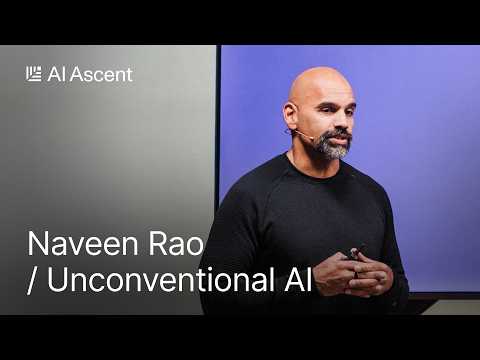
Unconventional AI Designs Non-Silicon Chip to Prevent Global Energy Wall
Sequoia Capital
The company is replacing matrix math with nonlinear dynamics to bypass von Neumann architecture limits, aiming for a three-orders-of-magnitude leap in energy efficiency as AI training demands outpace global power capacities.
## Background
Published by Sequoia Capital on YouTube on May 6, 2026, this video features Naveen Rao, founder and CEO of Unconventional AI, at AI Ascent 2026. The page description outlines his argument that digital computers are the wrong substrate for the future of AI, offering instead a physics-first approach that replaces traditional matrix math with nonlinear dynamics to drastically improve energy efficiency and avoid an impending global energy wall.
## TL;DR
Naveen Rao explains that current AI scaling is bound to hit a major energy crisis within two to four years because our 80-year-old digital and von Neumann computing architectures are highly inefficient compared to biological brains. To overcome this, Unconventional AI is rebuilding computing from physics first principles, utilizing non-linear dynamics and time-varying interactions instead of standard matrix math and floating-point operations. By eliminating the energy-wasting separation between memory and computation, the company has successfully prototyped a non-von Neumann chip designed to push toward the true thermodynamic limits of intelligence per watt.
## Atmosphere & style
The presentation carries an exciting, forward-looking, and intellectually stimulating vibe as Rao confidently challenges decades of computing orthodoxy with a smile. It feels like a high-stakes yet accessible masterclass, blending deep academic insights from neuroscience with the agile, fast-paced energy of a modern tech startup. The narrative arc moves from a stark warning about real-world physical limits to a triumphant showcase of rapid innovation, leaving the audience feeling inspired by the tangible dawn of a completely new computing paradigm.
## Key takeaways
- [00:02](https://www.youtube.com/watch?v=Zw1J5pJJMGw&t=2s) Naveen Rao introduced Unconventional AI with the mission to redefine the future of computing by bringing neuroscience concepts back to AI hardware development.
- [00:56](https://www.youtube.com/watch?v=Zw1J5pJJMGw&t=56s) Startups currently possess a significant competitive advantage over legacy companies because they lack old baggage, allowing them to iterate and tape out chips in months rather than years.
- [01:21](https://www.youtube.com/watch?v=Zw1J5pJJMGw&t=81s) AI hardware scaling is about to hit a hard energy wall within the next two to four years, as global power capacity cannot sustain the rapid growth of traditional computing architecture.
- [01:21](https://www.youtube.com/watch?v=Zw1J5pJJMGw&t=81s) Current digital computer abstractions, such as floating-point numbers, date back 80 years and are fundamentally inefficient physical substrates for developing machine intelligence.
- [02:00](https://www.youtube.com/watch?v=Zw1J5pJJMGw&t=120s) Human intelligence is vastly more power-efficient than machine intelligence, with all 8 billion human brains running on a combined 160 gigawatts, while machines require megawatt to gigawatt scales.
- [04:51](https://www.youtube.com/watch?v=Zw1J5pJJMGw&t=291s) Biology operates merely one to two orders of magnitude away from the absolute physical asymptote defined by the Landauer principle, while modern digital computers sit far below it.
- [04:51](https://www.youtube.com/watch?v=Zw1J5pJJMGw&t=291s) Modern GPU cost reductions have primarily come from improved manufacturing and packaging rather than fundamental breakthroughs in energy efficiency per FLOP when factoring in memory access.
- [04:51](https://www.youtube.com/watch?v=Zw1J5pJJMGw&t=291s) Natural biological systems demonstrate immense computational efficiency, with a squirrel performing complex physical and visual calculations on under 10 milliwatts of power.
- [08:27](https://www.youtube.com/watch?v=Zw1J5pJJMGw&t=507s) True power efficiency requires abandoning matrix math and binary systems in favor of biological non-linear dynamics, which are highly resilient to noise and operate in the time-varying domain.
- [08:27](https://www.youtube.com/watch?v=Zw1J5pJJMGw&t=507s) Traditional von Neumann architectures waste immense energy moving states between memory and processors, whereas dynamical systems perform computation implicitly via physics after an initial state kick.
- [08:27](https://www.youtube.com/watch?v=Zw1J5pJJMGw&t=507s) By utilizing AI tools and operating without legacy constraints, Unconventional AI designed a prototype chip within six months and scheduled a physical chip tape-out for the summer.
- [08:27](https://www.youtube.com/watch?v=Zw1J5pJJMGw&t=507s) The development team successfully demonstrated that dynamical systems can be trained and steered into arbitrary trajectories within their state space.
- [11:44](https://www.youtube.com/watch?v=Zw1J5pJJMGw&t=704s) A generative model demonstration showed that the dynamical system can naturally converge from random pixels into specific image classes and smoothly morph between them.
- [11:44](https://www.youtube.com/watch?v=Zw1J5pJJMGw&t=704s) Unconventional AI is building a completely non-von Neumann architecture where state and function overlap entirely within the device physics, eliminating the separation between state and computation.
## Detailed walkthrough
### [00:02](https://www.youtube.com/watch?v=Zw1J5pJJMGw&t=2s) Introduction of Naveen Rao
Naveen Rao is introduced as a true pioneer in the artificial intelligence space. With a PhD in neuroscience, Rao has a long history of pushing boundaries, having started one of the very first AI chip companies long before the sector became popular. He went on to run Mosaic ML, a pioneering AI training company, and subsequently built out all of Databricks' AI capabilities. Now, he has left that role to embark on a new venture aimed at redefining the future of computing by "bringing cool back to neuroscience."
Rao, now the CEO of Unconventional AI, takes the stage and expresses his excitement. He jokes that "unconventional" might actually be the wrong word, suggesting they might eventually change the name to "Conventional AI." He echoes earlier sentiments that it is a fantastic time to be a startup because having no legacy baggage is a massive competitive advantage. Free from the constraints of traditional, slow-moving chip and full-stack companies, his team can move incredibly fast, aiming for chip tape-outs in months rather than years.
### [01:21](https://www.youtube.com/watch?v=Zw1J5pJJMGw&t=81s) The Impending Energy Wall in AI
Rao begins his presentation with a provocative slide, noting with a smile that he can practically hear the gears turning in the audience as people try to prove him wrong. His core argument centers on the urgent need for a massive leap in computer efficiency. Crucially, he is not talking about algorithmic or data efficiency—which many others are already working on—but rather the fundamental physical substrate of how we process information at the level of physics.
He points out that our current digital abstraction and floating-point numbers date back 80 years to the 1940s. These concepts were designed for entirely different machines built on different substrates for completely different purposes, yet we are still using them to build machines for intelligence. While AI makes us more efficient in tasks like coding or running agents on our phones, we are rapidly budding up against the physical limitations of the real world. Today, AI inference and training consume multiple gigawatts of power. Rao warns that within the next two to four years, we will hit a hard wall where "we just don't have any more energy in the world for AI." While ideas like space-based solar or fusion reactors are great, the fundamental physics of our current computing paradigm remain highly inefficient.
- **Global Power Capacity:** The world has about 9,000 gigawatts of total power capacity, with the US accounting for roughly 1,000 gigawatts to run everything from heating to electric cars.
- **Human Brain Efficiency:** The 8 billion people on Earth have brains that run on just about 20 watts each, meaning the entirety of human intelligence runs on a mere 160 gigawatts.
- **The Efficiency Gap:** While a human operates on 20 watts, running, training, and fully loading equivalent machine intelligence operates in the megawatt to gigawatt range.
### [04:51](https://www.youtube.com/watch?v=Zw1J5pJJMGw&t=291s) Pushing the Thermodynamic Limits of Compute
Rao presents a curve illustrating the thermodynamic limit of intelligence per watt, governed by the Landauer principle, which defines the physical limit of how much computation can occur within a given amount of energy. While biology is highly efficient—sitting about one to two orders of magnitude away from this absolute physical asymptote—our current digital computing paradigm is sitting far below it.
Current chips are constrained by the limits of 2D lithography. Rao believes that with focused effort, we can push past these limitations and achieve a three-orders-of-magnitude increase in energy efficiency from where we are today. To get there, we cannot simply keep building machines that run matrix math. While Nvidia has successfully dominated and pushed the envelope of that market, the actual energy efficiency of delivering an FP8 flop (when factoring in memory access) has only improved incrementally; the cost reductions have primarily come from better manufacturing and packaging, not fundamental energy breakthroughs.
- **The Landauer Principle:** The physical law defining the minimum energy required to change a bit of information.
- **The Biological Benchmark:** A squirrel jumping 10 feet between branches in the wind performs complex physical and visual calculations on less than 10 milliwatts of power—1/100th of the power used by a common smartphone (1 watt).
- **The Mammalian Scale:** A macaque monkey's brain operates on less than a single watt, demonstrating highly complex behavior on milliwatts across the animal kingdom.
### [08:27](https://www.youtube.com/watch?v=Zw1J5pJJMGw&t=507s) Non-Linear Dynamics and the Unconventional Chip
To build a truly power-efficient computer, Rao looks to neuroscience. The brain does not use matrix math or floating-point operations; instead, it utilizes "non-linear dynamics" to compute. This means computation arises from the time-varying interactions between neurons. Furthermore, biological computation is stochastic rather than strictly binary. In a digital computer, a single bit error can cause the entire system to collapse, whereas the brain is highly resilient to noise.
To demonstrate this, Rao shares a visualization of Kuramoto synchronization, where a series of physical oscillators rigidly coupled to a plank eventually synchronize over time regardless of their starting states. By generalizing this concept to electronic circuits with flexible, trainable coupling, they can build a system that mimics the non-linear dynamics of the brain. This allows them to use the time axis of physics itself to perform computation. In a traditional von Neumann architecture, energy is wasted constantly moving state back and forth between memory, cache, and the processor. In a dynamical system, you simply set an initial state, "kick it and let it run," allowing the physics to implicitly perform the computation.
- **Rapid Prototyping:** Unconventional AI went from having no team in January to a full prototype chip design in just six months, a speed Rao attributes to using AI tools and having no legacy baggage.
- **Chip Tape-Out:** The company is on track to build and tape out this physical chip over the summer.
- **Training Trajectories:** The team has proven they can train and steer these dynamical systems into arbitrary trajectories, even tracing out the "Unconventional" company logo in state space.
### [11:44](https://www.youtube.com/watch?v=Zw1J5pJJMGw&t=704s) Generative Demos and the Non-von Neumann Future
Rao showcases a quick demo of a generative model trained on their dynamical system. In a nod to Andrew Ng, who is in the audience, he uses images of cats and other animals. The system starts with random pixels, and at a designated time step ($t=1$), they backpropagate an error from randomness to a specific image class. The system is then left to run naturally, and it successfully converges into meaningful representations (such as horses) and smoothly morphs between different classes in state space.
Rao concludes by framing this as the emergence of a completely new computing paradigm. While CPUs excel at fast, single-threaded von Neumann operations, and GPUs parallelize this by moving large blocks of operands in and out of memory, Unconventional AI is building a system where state and function overlap entirely within the physics of the device. This represents a truly non-von Neumann architecture where there is no separation between state and computation, sending computer efficiency and "galaxy braininess" off the charts. Rao closes with a personal reflection, noting that after 30 years of thinking about this problem, we are finally at a point where we can truly understand how brains work because we can finally build them.
## Notable quotes
> [00:02](https://www.youtube.com/watch?v=Zw1J5pJJMGw&t=2s) bringing cool back to neuroscience. — Naveen Rao
Unconventional AI 设计非硅芯片以应对全球能源墙
随着 AI 训练需求超出全球供电能力,该公司正利用非线性动力学替代矩阵数学以绕过冯·诺依曼架构限制,力求将能效提升三个数量级。
Naveen Rao 解释称,与生物大脑相比,拥有 80 年历史的数字及冯·诺依曼计算架构极其低效,因此当前的 AI 扩展势必会在两到四年内遭遇重大能源危机。为克服这一难题,Unconventional AI 正在从物理学第一性原理出发重构计算,利用非线性动力学和随时间变化的相互作用,来取代标准的矩阵数学与浮点运算。通过消除存储与计算分离所带来的能量浪费,该公司已成功研制出一款非冯·诺依曼芯片原型,旨在逼近每瓦智能的真正热力学极限。
前 MosaicML 创始人 Naveen Rao 成立 Unconventional AI,致力于将神经科学原理引入底层芯片设计;依托无历史包袱的初创团队与 AI 工具加速,团队仅用 6 个月就完成了原型芯片设计并计划在夏季流片。 (0:02)
Rao 警告称传统 AI 硬件将在 2 至 4 年内撞上硬性“能源之墙”;全球总电网容量约 9,000 GW,而全人类 80 亿个大脑总耗电仅 160 GW,继续依赖 80 年前的传统数字计算机与浮点抽象将面临能源枯竭瓶颈。 (1:21)
生物系统的计算效率距离兰道尔原理(Landauer principle)的热力学极限仅差 1 到 2 个数量级(如松鼠实现复杂视觉与运动控制功耗低于 10 毫瓦),Rao 认为跳出矩阵乘法限制可将当前计算能效提升 3 个数量级。 (4:51)
Unconventional AI 采用非线性动力学与振荡器同步机制,利用物理连续时间本身替代冯·诺依曼架构中昂贵的数据搬运,成功在实验中训练并演示了从随机像素平滑收敛的生成模型。 (8:27)
Reading summary
Naveen Rao, CEO of Unconventional AI, argues that artificial intelligence faces a hard energy ceiling within two to four years because digital, matrix-based computing cannot match the thermodynamic efficiency of biology. He proposes bypassing traditional von Neumann architectures with physical electronic chips that compute directly through non-linear dynamics.
The Impending Global Energy Wall (1:21)
Rao asserts that artificial intelligence is rapidly colliding with the physical limits of global power generation. AI training and inference clusters already consume multiple gigawatts, and Rao forecasts that within two to four years, the world will lack the energy required to support continued scaling. Total global power capacity stands at approximately 9,000 gigawatts, with the United States accounting for about 1,000 gigawatts across all municipal, heating, and industrial needs. In contrast, the collective intelligence of Earth's eight billion humans runs on only 160 gigawatts, with individual brains operating at roughly 20 watts.
Rao contends that alternative generation methods like fusion or space-based solar fail to address the core problem: modern computing remains chained to 1940s-era digital and floating-point abstractions that were never intended for intelligence workloads.
Thermodynamic Benchmarks and Biological Limits (4:51)
Computing efficiency is bounded by the Landauer principle, which dictates the minimum energy required to alter a bit of information. According to Rao, biological systems function within one to two orders of magnitude of this absolute physical asymptote, whereas current 2D lithography digital chips operate far below it. For example, a squirrel calculating a ten-foot leap in windy conditions consumes less than 10 milliwatts—one-hundredth the power of a standard smartphone—while a macaque monkey operates on under one watt.
While market leaders have scaled matrix-math hardware, Rao argues that gains in FP8 efficiency (accounting for memory access) have been incremental. Cost reductions have largely stemmed from manufacturing and packaging improvements rather than fundamental thermodynamic breakthroughs, leaving room for a three-order-of-magnitude leap through new physical architectures.
Non-Linear Dynamics Replacing Von Neumann Computing (8:27)
To escape digital bottlenecks, Rao models hardware on biological computation, which relies on noise-resilient, non-linear dynamical interactions rather than rigid floating-point matrix operations. Traditional von Neumann machines waste substantial energy shuttling data back and forth between processors, caches, and memory. In contrast, Unconventional AI leverages the physical time axis for computation by applying generalized Kuramoto synchronization—the physical principle where coupled oscillators synchronize over time—to electronic circuits with trainable coupling.
In this dynamical paradigm, operators establish an initial state and allow physical laws to execute the computation autonomously, eliminating the energetic overhead of continuous state transfer.
Silicon Prototyping and Continuous Generative Modeling (11:44)
Unconventional AI developed a prototype chip design within six months and scheduled a physical silicon tape-out for the summer. The team verified that their dynamical systems can be steered along arbitrary state-space trajectories, demonstrating generative capabilities using animal image models. By initializing the system with random noise and backpropagating error at a specific time step, the hardware naturally converged into distinct image classes and smoothly transitioned between states.
Rao describes this design as a true non-von Neumann architecture where state and computational function overlap completely within the device's physical substrate.
Rao envisions that building non-von Neumann systems where physics performs the computation will circumvent the power grid constraints threatening AI development. However, proving that these dynamical electronic prototypes can match the versatility, programming models, and manufacturing scale of conventional GPUs remains an essential hurdle as the company moves toward physical silicon.
[0:02] Naveen Rao: bringing cool back to neuroscience.
[0:02] Naveen Rao: unconventional
[0:02] Naveen Rao: Conventional AI.
[1:21] Naveen Rao: we just don't have any more energy in the world for AI.
[8:27] Naveen Rao: non-linear dynamics
[8:27] Naveen Rao: kick it and let it run,
[8:27] Naveen Rao: Unconventional
[11:44] Naveen Rao: galaxy braininess
Original transcript
[0:02] We're going to jump into our next set of
[0:04] frontier talks. The first is which from
[0:07] Naveen Rao. Naveen is a pioneer in the
[0:10] AI space. He did his PhD in
[0:12] neuroscience. Then he started one of the
[0:15] first ever AI chip companies way before
[0:18] it was cool. He's actually the person
[0:21] who ran Mosaic ML, one of the first AI
[0:24] training companies, and then built all
[0:27] of Data Bricks AI. He left that amazing
[0:29] role to do something new and redefine
[0:32] the future of computing bringing cool
[0:34] back to neuroscience. Naveen, come on
[0:36] up.
[0:38] >> [applause]
[0:44] >> All right. Afternoon everyone. Yeah,
[0:46] super excited to be here. I'm Naveen Rao
[0:49] and CEO of Unconventional AI. So we are
[0:51] unconventional because maybe it's
[0:53] actually the wrong word to use cuz I
[0:54] think we're going to change the name to
[0:55] conventional. It's a actually a great
[0:57] time to be a startup as as Boris alluded
[1:00] Boris alluded to, right? Like having no
[1:01] baggage actually I think is a true
[1:03] competitive advantage. We can do things
[1:06] so much faster than traditional
[1:09] you know, sort of chip companies and
[1:10] full stack companies can do. And I think
[1:12] that's what's very exciting. We can get
[1:14] to tape outs in months instead of years,
[1:16] things like this. So anyway, let's get
[1:19] get started.
[1:21] I put that up there. I can guarantee you
[1:23] some of you are like trying to prove me
[1:24] wrong. All of a sudden you're like, oh
[1:26] my god, what's you know, I can hear the
[1:28] I can hear the gears turning like that
[1:29] that that can't be true. Well, let me
[1:31] let me explain my logic a little bit and
[1:33] uh and and maybe the definition of what
[1:35] I call ASI. So
[1:37] really I think we need to get to much
[1:40] greater amount of computer efficiency.
[1:42] And when I say computer efficiency, I
[1:43] don't mean algorithmic computer
[1:45] efficiency or data efficiency. There's
[1:47] lots of people working on these
[1:48] problems. I actually mean the
[1:50] fundamental substrate. Actually how I do
[1:53] information processing at the like
[1:55] physics level.
[1:57] We chose a path of making computers work
[2:00] the way they did for a lot of reasons
[2:01] about 80 years ago. If you think about
[2:03] it, like in the tech industry, how many
[2:05] things have existed for 80 years? Like
[2:07] not a lot. The digital abstraction sort
[2:10] of floating point numbers, those were
[2:11] around from from the 1940s. And for
[2:14] machine that was built from a
[2:15] completely different substrate and for a
[2:18] machine that was built for completely
[2:19] different purpose. And now we're
[2:20] building machines for intelligence. So
[2:22] let's think through this a little bit.
[2:24] So part of this is that AI will make us
[2:27] more efficient. I mean, we've talked
[2:29] about coding and you know, running a
[2:31] thousand agents on your phone, all this
[2:33] kind of stuff, right? It does make us
[2:34] more efficient. But at some point we
[2:36] start to get to a place where what what
[2:38] what is efficiency really mean? If you
[2:40] think about energy, actual energy, maybe
[2:43] we're actually not more efficient. And
[2:44] we're kind of budding up against those
[2:46] limitations of the physical world now.
[2:48] Um you know, already today we're we're
[2:52] using many gigawatts for AI inference
[2:54] and training. And we're going to get to
[2:56] a point within the next couple of years.
[2:58] This is not 10 years away. This is two,
[3:00] three, four years where we just don't
[3:02] have any more energy in the world for
[3:03] AI. Then this topic starts to become
[3:06] very very important. Right now you can
[3:08] kind of look at it like, well
[3:09] electrical energy versus like food.
[3:11] These are two energy sources for
[3:12] intelligence.
[3:14] Um and you know, there's no real
[3:16] limitation on the on the electrical
[3:17] side, but that's going to hit a pretty
[3:19] solid wall very soon. And you know,
[3:21] we're talking about going to space,
[3:22] we're talking about building fusion
[3:23] reactors. Great. Let's do all those
[3:24] things, but still these fundamental
[3:26] physics apply.
[3:28] So
[3:29] if we think through this a little bit,
[3:30] we have about 8 billion people in the
[3:31] world. Our brains use about 20 watts
[3:33] each. That's only 160 gigawatts. So the
[3:36] entirety of humanity is 160 gigawatts.
[3:39] So just put that into comparison, we
[3:41] have about 9,000 gigawatts of capacity
[3:44] in the world today. The US has about a
[3:45] thousand.
[3:46] And you know, this runs everything. This
[3:47] is like heating in your home and you
[3:49] know, all the things, electric cars, all
[3:51] that kind of stuff. But if we said we
[3:53] you know, maybe you got 50% more of this
[3:56] and we say okay, great. Now we got like,
[3:58] you know, 4,000 plus gigawatts. But the
[4:01] problem is our current [clears throat]
[4:03] paradigm of compute is just vastly more
[4:05] inefficient. So a computer I'm I'm
[4:07] making some numbers up here. I mean, I
[4:09] can say like if I'm running inference
[4:11] per token, I can come up with numbers,
[4:12] but you know, fully loaded like the
[4:14] amount of energy that goes into
[4:15] inference, building the model, running
[4:17] the model, all of that. Let's call it a
[4:19] gigawatt, something like that or you
[4:21] know, definitely in the megawatt range.
[4:23] But humans are on the order of of 20
[4:25] watts. And you could also argue that
[4:27] evolution over 4 billion years has
[4:28] created what we are. But the reality is
[4:31] today our constraint becomes how quickly
[4:33] can we get learnings happen? How quickly
[4:36] can we build intelligence on a given
[4:38] amount of energy?
[4:39] So
[4:40] if we want to build this future where we
[4:41] have lots of intelligence in the world
[4:43] and we're automating all kinds of things
[4:45] that we want to really be more efficient
[4:47] from an energy standpoint, we're we're
[4:48] going to need a lot more we're going to
[4:49] need a lot more watts.
[4:51] Or we can think about building a vastly
[4:53] more power efficient computer. And
[4:55] that's where we come in.
[4:57] So I love this curve here and I think
[5:00] most people really haven't really
[5:01] haven't thought about this cuz you just
[5:02] sort of assume the computer is a
[5:03] computer. And we haven't really
[5:05] questioned that. Again, this is the
[5:06] unconventional part is like, let's break
[5:08] that apart. The
[5:09] the assumptions we made 80 years ago are
[5:11] actually not quite valid anymore. We
[5:13] just choose to keep building on them
[5:14] because I can build a product in two
[5:16] years. I can make something that I can
[5:17] sell in two years. But we're kind of
[5:19] taking a different tax like, let's go
[5:20] back to those first principles and see
[5:22] if we can build something much much
[5:23] better.
[5:25] So there is a thermodynamic limit to
[5:27] intelligence per watt. Okay, that means
[5:29] you just can't do any better. There's
[5:31] there's something called the Landauer
[5:32] principle which some of you may know,
[5:34] which basically suggests how much
[5:35] compute could happen within a certain
[5:37] amount of energy. So there is a physical
[5:40] reality that we can't we can't get past
[5:42] and that's sort of this asymptote here.
[5:44] Now biology is somewhere up here. It's
[5:47] actually pretty darn efficient.
[5:49] 4 billion years of evolution have
[5:51] created something that is actually very
[5:52] efficient. However, it's not at the
[5:54] asymptote yet. There's probably an order
[5:56] of two of magnitude between those two.
[5:59] We're actually here by the way. We're
[6:02] we're down here. And I think limits of
[6:04] 2D lithography, that's what chips are
[6:05] built on today is call it somewhere down
[6:07] here.
[6:08] And I think with focused effort we can
[6:10] get to the point where we're pushing the
[6:12] limit of that.
[6:13] And so we'll have something that's this
[6:15] is this by the way is something like
[6:16] three orders of magnitude from where we
[6:17] are. It is very far away from where we
[6:20] where we could be in terms of energy
[6:21] efficiency. And so really that's what
[6:22] we're focused on today.
[6:24] So how do we do it? I mean, yeah, this
[6:26] is great. Make something more power
[6:28] efficient and wonderful, right? But the
[6:29] reality is we it's not so simple. We
[6:31] can't be thinking about the computer in
[6:33] exactly the same way as we have been.
[6:34] It's not about a machine that runs off
[6:36] of runs matrix math. That's been the
[6:38] simple way to move forward. Nvidia of
[6:40] course has owned that market and
[6:42] continue to push the envelope. But if
[6:43] you look at the power efficiency
[6:45] numbers, actual power efficiency of
[6:46] delivering an FP8 flop for instance,
[6:50] it's not that much better. Costs have
[6:52] gotten better cuz manufacturing's gotten
[6:54] better, our ability to package has
[6:55] gotten better, but actual energy per
[6:58] flop with memory access has not gotten
[7:00] better. It's very very incremental now.
[7:04] So I am a
[7:06] a neuroscientist. I was a computer
[7:07] architect for 10 years before that. So
[7:09] I've been thinking about this problem
[7:11] for a long time, actually on the order
[7:12] of 30 years. So it's a very exciting
[7:14] time for me personally. And you know
[7:16] biology really does provide an existence
[7:18] proof. I mean, you can argue that okay,
[7:20] the tokens per second out of a human are
[7:21] lower than a machine, but the
[7:23] intelligence is higher. We still haven't
[7:25] gotten to the point with these gigawatts
[7:27] that we're throwing at it that we're
[7:28] we're rivaling a human's intelligence in
[7:30] terms of discovery. We'll get there.
[7:32] We're going to get there in a very short
[7:33] amount of time. But it's going to come
[7:34] at the cost of a lot of energy.
[7:36] So what I think is most interesting here
[7:38] is actually not just
[7:40] that brains are human brains are 20
[7:42] watts, but that the watt is kind of
[7:44] scales with the with the weight. A
[7:46] macaque monkey's brain is probably less
[7:48] than a watt. And actually you see this
[7:50] all through the mammalian world and I've
[7:51] also the insect world. Like you have
[7:53] very complex behavior for milliwatts.
[7:56] Just for reference, your phone in your
[7:57] pocket is about one watt. So you know, a
[8:00] squirrel jumping from branch to branch
[8:03] is running on a less than 10 milliwatts.
[8:05] That's 1/100 of your phone. We can't
[8:08] actually do this perfectly. Like
[8:10] a squirrel's jumping 10 feet across from
[8:12] branch to branch within wind and all
[8:13] that stuff. We can't do that with a much
[8:15] much larger computer. So biology still
[8:17] created something quite amazing. And I
[8:20] just I just don't feel like there's been
[8:21] an appreciation for that. So I'm just
[8:23] you know, just just just a little
[8:24] reminder there. So now
[8:27] great. We we see this kind of
[8:29] phenomenologically like
[8:32] biology is efficient can do can do
[8:33] amazing things, but how does it actually
[8:35] work? We don't really know. I will be
[8:37] honest as a computer scientist and a
[8:40] neuroscientist, but there are some ideas
[8:42] that we can harvest from neuroscience.
[8:44] And one of them is that the brain is
[8:46] dynamic. It does not use matrix math to
[8:49] do compute. It uses what's called
[8:50] non-linear dynamics to do compute. What
[8:53] this means is that there's a time
[8:54] varying
[8:55] interaction between neurons and that's
[8:57] actually where the compute lies. So can
[8:59] we extract that and actually apply it to
[9:01] to synthetic circuits? Maybe.
[9:04] They don't do floating point math. They
[9:05] don't do matrix math. They do something
[9:07] that can be characterized as such, but
[9:09] it's actually much richer than that
[9:11] because of these non-linear dynamics.
[9:14] And they're stochastic. Brain's compute
[9:16] is not a strict one and zero. In a
[9:18] digital computer, if we're off by a one
[9:20] or zero, the whole system falls apart.
[9:23] So they're really not computers. So I'm
[9:26] going to try to go through this quickly.
[9:28] This is a thing called a Kuramoto
[9:30] synchronization. So if you look at a
[9:31] bunch of oscillators here and they're
[9:33] kind of rigidly
[9:34] coupled to each other on this plank, you
[9:36] know, you'll see over time that
[9:38] they start off in any state and then
[9:42] they actually synchronize. This is an
[9:44] example of a of a of a contracting or or
[9:46] or converging dynamical system. So no
[9:49] matter how you start it, it converges
[9:51] and it's only based upon the coupling
[9:52] between them. We can generalize this to
[9:54] something that has kind of a flexible
[9:56] coupling, call it a trainable coupling
[9:57] between those those things. And then it
[9:59] can have all kinds of interesting
[10:01] dynamics. It can move through the state
[10:02] space of dynamics in many, many
[10:04] different ways.
[10:05] So, if you generalize this, you can
[10:06] actually think about an electrified
[10:07] electronic circuit. You can say I have a
[10:09] bunch of oscillators and they have a
[10:10] fabric on which they're coupled. And now
[10:13] when I when I make this fabric
[10:14] trainable, I can actually see something
[10:16] that's it starts to look a little little
[10:18] bit more like the dynamics of the brain.
[10:20] It actually has nonlinearities and they
[10:22] interact with each other in very
[10:23] interesting ways. It's actually very
[10:24] rich represent a lot of information.
[10:27] This is actual uh chip that we're going
[10:30] to be building this summer. So, we went
[10:31] from basically no team in January to a
[10:34] to a full prototype in 6 months and
[10:36] that's because of AI. So, this is what's
[10:39] really cool about not having baggage is
[10:40] you can do things in completely
[10:41] different ways.
[10:42] And the way you compute with something
[10:44] like this is the traditional way would
[10:45] be basically loop over some sort of
[10:48] linearized time. This is how we do
[10:49] things in a in a von Neumann machine. We
[10:52] write state out, we retrieve it, we
[10:54] operate on it, we write it back. So, we
[10:55] keep going back and forth. Turns out
[10:57] that's what burns most of the energy in
[10:58] an existing computing system.
[11:00] With something with nonlinear dynamics,
[11:02] I actually just say, "Here's the initial
[11:04] state, kick it and let it run." So, the
[11:07] the physics themselves basically do this
[11:09] computation and it does it sort of the
[11:11] the state is an implicit. It's not an
[11:13] explicit right.
[11:16] So, in some ways you can think about it
[11:17] if you take anything from this talk that
[11:19] we use the time the time access of the
[11:21] physics to do computing and existing
[11:24] computing constructs do not.
[11:27] And so, the question then is, "Can I
[11:28] train this?" And the answer is yes. Um I
[11:30] can actually steer the system into
[11:31] multiple multiple different things. In
[11:32] fact, we've sort of traced out in state
[11:34] space a unconventional logo. That's the
[11:36] idea here and we can train it in a few
[11:38] different ways. So, yes, we can train
[11:39] these systems and steer them into
[11:40] basically any arbitrary set of
[11:42] trajectories.
[11:44] And can we compute uh can we connect it
[11:46] to AI problems like uh image generation?
[11:49] So, actually I have a better version of
[11:50] this I can go to in a just a really
[11:52] quick demo here.
[11:54] Uh let's go to the next one.
[11:56] We'll go to the demo.
[11:59] Yeah, so basically what you see here is
[12:02] uh something that's running on a on a
[12:04] model of dynamics that was trained on
[12:06] these different images. So, basically I
[12:08] can say, "Okay, I have to use cats." I
[12:09] think Andrew Ng is here. So,
[12:12] >> [laughter]
[12:13] >> homage to him, but we can do anything.
[12:14] But basically this is a pretty simple
[12:15] generative model. And I can basically
[12:18] say like, "Okay, at time t equals 1, I'm
[12:20] going to I'm going to backprop an error
[12:23] um from randomness to to a particular
[12:25] image class." And after that point, we
[12:27] let the we let the system just run
[12:29] naturally. And you what you'll find is
[12:30] that it actually has clumped its
[12:33] representation into places that are
[12:35] meaningful. They're no longer just
[12:36] random
[12:38] pixels, but they're actually pixel
[12:39] pixels that make different kind of
[12:40] machine or different kind of animals or
[12:41] whatever. So, for horses, I start off as
[12:44] random and at t equals 1, you should see
[12:46] it kind of converge into horse-like
[12:47] things.
[12:49] And then over time you'll actually see
[12:51] it sort of morph between those. So, it's
[12:53] already learned in the state space that
[12:55] I can move between these different
[12:56] things.
[12:58] So, let's go ahead and move out of this.
[13:02] So, this is really the emergence of
[13:03] something new. So, CPUs actually do um
[13:06] very fast single-threaded things the
[13:08] best. Even today, uh it's faster than a
[13:10] GPU. And really what you're doing is
[13:12] this kind of von Neumann machine where
[13:14] you're moving in and out of uh memory
[13:16] and cache and doing operations. GPU
[13:18] basically do this with multiple operands
[13:20] at once. So, you move a bunch of
[13:21] operands from memory, do some stuff to
[13:23] it, write it back.
[13:25] Compute in memory like Groq sort of did
[13:27] the same thing, but just did it on chip.
[13:28] It's kind of a a more fine-grained
[13:30] version of this.
[13:31] Now, what we're talking about is doing
[13:32] something in a dynamical system. The
[13:34] state and the the function are
[13:36] overlapped with the physics themselves.
[13:38] So, you now have no separation between
[13:41] state and computation.
[13:43] And you know, compute efficiency goes
[13:45] goes up, of course, galaxy braininess
[13:47] goes up. And uh this is truly non-von
[13:50] Neumann.
[13:52] So, with that, I'm just going to leave
[13:53] you with this quote. It's been something
[13:55] I've guided my entire life by and I'm
[13:57] I'm really excited about this time
[13:58] because I've been thinking about this
[13:59] problem for 30 years. And we're at this
[14:01] point where I think we can actually
[14:02] start to understand how brains work cuz
[14:04] now we can build them. Thank you.
[14:07] >> [applause]