VEIR, Statkraft Build Next-Gen Power Hardware to Avoid Grid Collapse
Bloomberg Originals
Surging electricity consumption from AI and transport threatens aging electrical grids, forcing a global overhaul using advanced hardware and localized energy networks to maintain economic growth.
## Background
Published by Bloomberg Originals on YouTube on May 27, 2026, this Bloomberg Primer episode investigates the massive transformation of the global electrical grid. The video explores how explosive energy demands from artificial intelligence and electric vehicles are forcing world power networks to double their capacity by 2050, highlighting innovations and challenges across China, the U.S., Spain, and Nigeria.
## TL;DR
The global electrical grid is reaching a critical tipping point as AI workloads, data centers, and electric vehicles strain decades-old, stagnant infrastructure. To prevent catastrophic blackouts like the one experienced in Spain due to a loss of renewable grid inertia, companies are pioneering high-tech solutions like VEIR's high-temperature superconducting cables and Statkraft's massive synchronous compensators. Meanwhile, China's sustained manufacturing edge positions it strongly in grid equipment production, and off-grid solar mini-grids in Nigeria are providing foundational power to underserved rural communities. Ultimately, modernizing and expanding transmission infrastructure remains the essential prerequisite for unlocking future economic growth.
## Atmosphere & style
The video carries a sleek, authoritative, and fast-paced documentary feel characteristic of high-production financial news. It balances serious systemic urgency—evoked by real-world blackout fallouts and complex engineering hurdles—with a forward-looking, techno-optimistic tone focused on global innovation. Expert commentary and vivid historical parallels create a grounded, highly analytical experience that feels both globally ambitious and deeply educational.
## Key takeaways
- [00:00](https://www.youtube.com/watch?v=8KOYyfZbPzo&t=0s) The rise of artificial intelligence, data centers, and electric vehicles is ending a two-decade period of stagnant electricity demand and forcing power grids worldwide to double delivery by 2050.
- [00:00](https://www.youtube.com/watch?v=8KOYyfZbPzo&t=0s) AI infrastructure investments exceed $300 billion annually, with AI energy demand projected to rival Japan's total power consumption by 2030.
- [02:20](https://www.youtube.com/watch?v=8KOYyfZbPzo&t=140s) A standard electrical grid requires continuous real-time balance between power generation and consumption, making sudden disruptions a threat to entire networks.
- [03:52](https://www.youtube.com/watch?v=8KOYyfZbPzo&t=232s) Historically, GDP growth and energy consumption were tightly linked until the 1970s energy crisis prompted efficiency gains and shifted Western economies toward service industries.
- [05:30](https://www.youtube.com/watch?v=8KOYyfZbPzo&t=330s) Western power demand is reaccelerating through three drivers: transportation electrification, building decarbonization, and hyperscale AI computing.
- [06:52](https://www.youtube.com/watch?v=8KOYyfZbPzo&t=412s) China holds a significant grid advantage over Western nations due to continuous, high-volume infrastructure manufacturing and skilled labor deployment since the 1990s.
- [08:40](https://www.youtube.com/watch?v=8KOYyfZbPzo&t=520s) Startups like VEIR are developing high-temperature superconducting cables that lose zero electrical resistance when cooled to 77 Kelvin, transmitting vast power through compact footprints.
- [08:40](https://www.youtube.com/watch?v=8KOYyfZbPzo&t=520s) Deploying superconducting lines faces steep technical hurdles, including complex liquid nitrogen cryogenic cooling, slow tape manufacturing, and risk-averse electric utilities.
- [13:30](https://www.youtube.com/watch?v=8KOYyfZbPzo&t=810s) A major blackout in Spain and Portugal highlighted how solar energy lacks the physical rotating inertia that traditional thermal plant turbines use to cushion grid power drops.
- [13:30](https://www.youtube.com/watch?v=8KOYyfZbPzo&t=810s) Companies like Statkraft deploy 100-ton synchronous compensators—fuel-free spinning flywheels—to provide pure mechanical inertia and stabilize renewable-heavy grids.
- [19:48](https://www.youtube.com/watch?v=8KOYyfZbPzo&t=1188s) Sub-Saharan Africa experiences the world's highest energy deficit, leaving approximately 565 million people without electricity as central urban grids fail to reach rural areas.
- [20:46](https://www.youtube.com/watch?v=8KOYyfZbPzo&t=1246s) Solar mini-grids in rural Nigeria provide 24/7 localized power, enabling economic development through agricultural machinery and improved educational outcomes for children.
- [22:02](https://www.youtube.com/watch?v=8KOYyfZbPzo&t=1322s) The World Bank's 'Mission 300' aims to bring electricity to 300 million Africans by 2030 through mini-grids that may eventually interconnect into unified regional networks.
## Detailed walkthrough
### [00:00](https://www.youtube.com/watch?v=8KOYyfZbPzo&t=0s) The Battle to Win the Future
The world’s power delivery infrastructure is often described as the largest and most complex machine ever constructed—so massive that its footprint spans entire continents. Yet despite being the backbone of modern civilization, it has remained largely invisible to the public eye. For decades, developed nations operated under flat electricity demand, leaving energy grids off the primary list of technological priorities. That period of stagnation is abruptly ending as artificial intelligence, data centers, and electric vehicles (EVs) trigger a massive surge in global energy consumption.
The scale of this shift is staggering: the top tech giants are pouring over $300 billion annually into AI infrastructure, driving forecasts that predict global electricity consumption will double by 2050. To meet this demand, the world must effectively add the equivalent of a new U.S. power grid every five years. Upgrading this aging system will require hundreds of billions of dollars in capital investment, drawing direct parallels to the massive buildout of broadband internet, which ultimately unlocked trillions of dollars in downstream economic value.
* The global electricity grid features approximately 42 million miles of transmission lines—a total length reaching nearly halfway to the Sun.
* Power generation in China has expanded sevenfold since 2000, powered by a mature industrial supply chain and a deep, active pool of skilled labor.
* AI’s energy appetite is projected to scale so dramatically that it could consume as much electricity as the entire nation of Japan by 2030, while potentially boosting global GDP by up to 15%.
---
[02:20](https://www.youtube.com/watch?v=8KOYyfZbPzo&t=140s) How the Grid Works
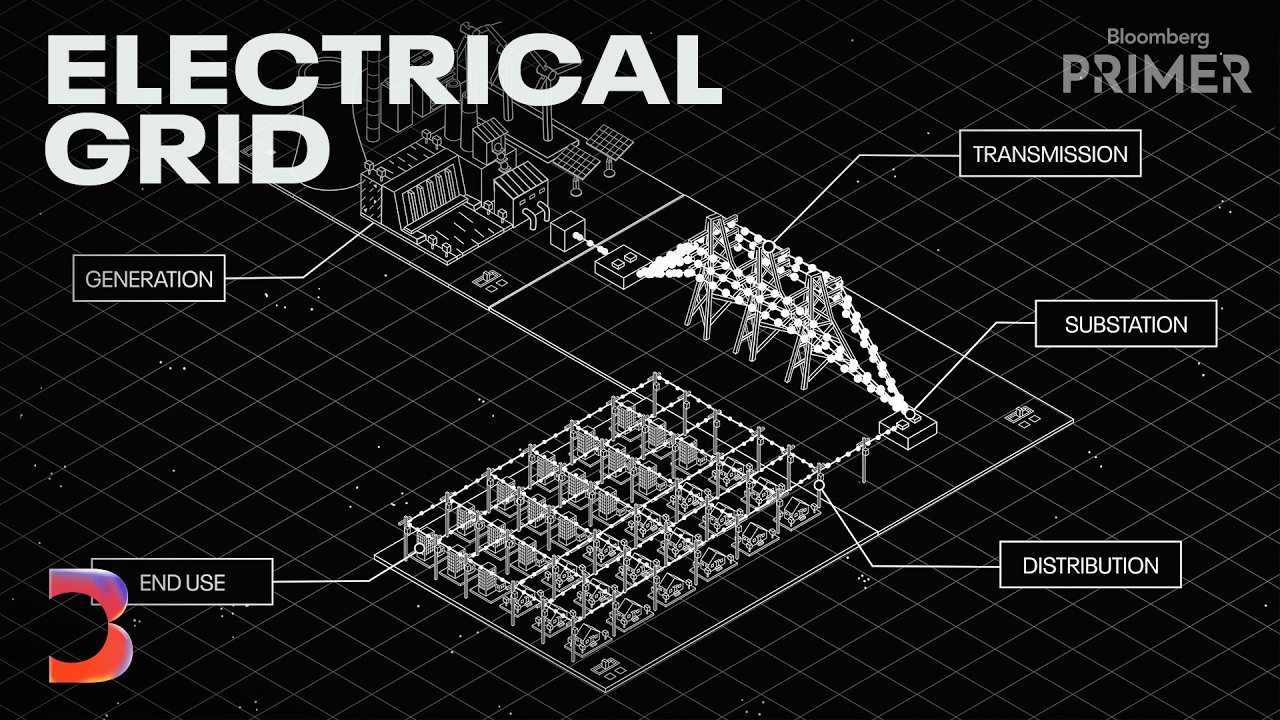
At its core, a conventional electrical grid functions as an instantaneous supply-and-demand chain. Electricity is generated at centralized power stations—whether through traditional gas, nuclear, and hydro plants, or modern utility-scale solar farms—and stepped up to high voltages for long-distance transmission. High-voltage transmission lines carry this energy across vast distances to regional substations, where transformers step down the power into usable voltages distributed directly to residential homes, commercial properties, and industrial facilities.
Because large-scale grid storage remains limited, generation and consumption must remain in exact, real-time balance. A sudden disruption—such as a major generation facility unexpectedly dropping offline—can create a severe frequency and voltage imbalance that threatens the stability of the entire network.
---
[03:52](https://www.youtube.com/watch?v=8KOYyfZbPzo&t=232s) History of the Economy and the Grid
Historically, a nation’s economic expansion has been tightly coupled with its energy consumption. In 1910, only 14% of American households were connected to the electrical grid; by 1930, that number soared to 70% as appliance manufacturing exploded. This dynamic established a powerful feedback loop: higher electricity consumption enabled greater economic output, which in turn funded further grid expansion and industrial growth.
This trajectory altered dramatically during the 1970s energy crisis. Surging oil prices forced a structural pivot toward energy efficiency. Electric utilities rebranded their consumer identity—such as Consolidated Edison (Con Edison) in New York City shifting its corporate tagline from "Dig, We Must" to "Save a Watt." Over the subsequent decades, structural economic transitions away from heavy manufacturing toward service-oriented industries caused Western energy consumption to flatten, leading to two decades of negligible grid demand growth.
---
[05:30](https://www.youtube.com/watch?v=8KOYyfZbPzo&t=330s) The New Power Boom
After two decades of flatline demand, Western power consumption is rapidly reaccelerating. Rich Miller, former Vice President at Con Edison, breaks down this resurgence into a three-part structural convergence:
1. **Transportation Electrification:** The rapid migration from internal combustion vehicles to electric vehicles.
2. **Building Decarbonization:** The widespread adoption of high-efficiency electric heat pumps replacing natural gas and oil heating systems.
3. **Hyperscale Computing:** The massive energy draw required to run the data centers driving artificial intelligence workloads.
This sudden surge has caught Western utilities in a difficult spot. Having spent thirty years operating in a low-growth environment, Western grid infrastructure has suffered from supply chain atrophy, an aging physical asset base, and a declining, retiring workforce.
While Western markets struggle with supply chain bottlenecks and workforce shortages, China has maintained continuous, high-volume grid construction since the 1990s. Driven by heavy manufacturing demands and sustained GDP expansion—where even a "slow" economic year brings 5% growth—China has expanded its national power generation capabilities sevenfold since 2000.
This multi-decade infrastructure commitment leaves China with a massive advantage: an active manufacturing base for high-voltage grid equipment and an experienced workforce ready to deploy next-generation energy networks in real time. As experts point out, "energy is destiny"—nations that fail to expand their transmission networks risk losing out on key 21st-century industries like AI, robotics, and advanced manufacturing.
To keep up with exploding demand without spending decades on traditional grid buildouts, technology companies are turning to high-density transmission hardware. At VEIR, a startup backed by over $100 million in venture funding—including investments from Microsoft—CEO Tim Heidel is commercializing high-temperature superconducting (HTS) power lines.
Unlike standard power lines made of copper or aluminum—which suffer from electrical resistance that dissipates energy as waste heat—superconducting materials lose all electrical resistance under extremely cold operating conditions. This enables a single superconducting line to transmit vast amounts of power through a very compact footprint, potentially eliminating the need to construct wide rights-of-way with multiple traditional cables.
```
+-----------------------------------------------------------------------------------+
| CONDUCTOR PERFORMANCE COMPARISON |
+----------------------+--------------------------+---------------------------------+
| Conductor Type | Resistance Level | Transmission Capacity / Notes |
+----------------------+--------------------------+---------------------------------+
| Plastic | Extremely High | Insulator; prevents current flow |
| Copper / Aluminum | Low (Standard) | Subject to line loss & heat |
| VEIR Superconductor | Zero (at ~77 Kelvin) | High power density in tiny footprint|
+----------------------+--------------------------+---------------------------------+
```
However, deploying superconducting hardware introduces complex engineering challenges:
* **Cryogenic Cooling:** Lines must be encased in vacuum-insulated tubes and continuously chilled by liquid nitrogen down to 77 Kelvin (-321°F / -196°C)—a temperature range sitting between deep space and the dark side of the Moon.
* **Manufacturing Pace:** Fabricating HTS tape is currently a meticulous, slow process. In early production runs, a single 10-meter cable assembly required up to two weeks of manufacturing time, though full automation aims to drastically increase output speed.
* **Utility Risk Aversion:** Electric utilities are inherently conservative entities legally obligated to deliver high uptime. They remain hesitant to replace time-tested copper and aluminum lines with complex cryogenic systems.
> "When you're worried about providing power a hundred percent of the time, you're gonna be very cautious about trying something new." — Rich Miller, former VP at Con Edison
---
[13:30](https://www.youtube.com/watch?v=8KOYyfZbPzo&t=810s) Spain’s Blackout & a Spinning Solution
Even if high-capacity cables successfully deliver power to tech hubs, keeping the modern grid stable remains a major hurdle. This vulnerability was made clear during Europe’s worst modern blackout, when large portions of Spain and Portugal suffered a sudden power outage.
The economic fallout was immediate: hundreds of citizens were trapped in underground metro systems, retail payment processors went offline, and Spain’s largest bank, La Caixa, estimated that 400 million euros were wiped out of the Spanish economy during the 18-hour outage.
The root cause stemmed from a sudden loss of "grid inertia." Traditional thermal power plants (coal, natural gas, nuclear, and hydro) utilize heavy, 100-ton spinning turbines. Thanks to Newton's first law of motion, these heavy rotating masses continue spinning during a sudden fault, using their kinetic energy to instantly inject power into the grid and cushion voltage drops.
In contrast, solar panels convert sunlight directly into electricity via solid-state electronics, offering zero physical rotating mass or inherent mechanical inertia. In Spain, where solar adoption had tripled over a five-year period, a sudden drop in solar generation triggered a rapid domino effect because there was insufficient physical inertia on the grid to absorb the shock.
To solve this issue, energy companies like Statkraft are installing **synchronous compensators**. As Statkraft engineer Guy Nicholson demonstrates, a synchronous compensator is a massive, 100-ton mechanical flywheel spinning at 1,500 RPM. It consumes no fossil fuels and generates no direct electricity; instead, it acts as a mechanical buffer for the grid, providing pure physical inertia so clean power networks can handle solar and wind generation without risking wide-scale blackouts.
<ElicitationsGroup message="Explore the next part of the transcript or dive deeper into grid technology:">
<Elicitation label="Summarize Part 2 of this transcript" query="Summarize Part 2 of the video transcript for 'How the Electrical Grid Is Being Rebuilt for AI', maintaining the same detailed walkthrough format with timestamps."/>
<Elicitation label="Deep dive into synchronous compensator engineering" query="Explain how synchronous compensators work technically, including grid inertia physics, reactive power support, and real-world deployment examples."/>
</ElicitationsGroup>
[019:48] Grid Upgrades and the Rural Energy Gap in Sub-Saharan Africa
Following Spain's massive blackout, the nation took immediate legislative action to prevent future failures. Parliament swiftly passed regulations allowing advanced grid-stabilizing devices, such as synchronous compensators, to participate in balancing and securing the electrical network. While making these high-tech upgrades is undeniably expensive, it promises a far more reliable and abundant supply of electricity—precisely what wealthy nations require to support the exponential growth of energy-hungry technologies like AI data centers.
However, a stark global divide remains: not all countries possess the financial capital necessary to undertake such massive infrastructure investments. Consequently, power grids in developing regions have severely lagged behind. Sub-Saharan Africa faces the starkest energy deficit on the planet, with roughly 565 million people living completely without electricity. Traditional electrical grids in these nations are typically confined to dense urban centers, leaving vast rural communities stranded in the dark.
- **Regulatory Response:** Spain's Parliament passed new regulations immediately after the blackout to incorporate equipment like synchronous compensators for grid stability.
- **Global Energy Inequality:** Sub-Saharan Africa has the world's highest off-grid population, totaling approximately 565 million people without power.
- **Traditional Grid Limitations:** Existing centralized grids in the region generally only extend to major cities, missing remote rural populations.
---
[020:46] The Rise of Mini-Grids and Local Empowerment in Nigeria
To bridge this massive infrastructure gap, a practical and cost-effective alternative is taking root: local mini-grids. Unlike traditional utility networks that span thousands of square miles, a mini-grid operates on a localized scale, serving focused areas such as a single village or island. In rural Nigeria, far beyond the physical reach of the main power grid, private energy companies have stepped in to supply electricity piecemeal. Companies like Husk Power have deployed dozens of solar-powered mini-grids across the country, fundamentally transforming daily life for local communities.
These mini-grids provide reliable 24-hour electricity, enabling families to power basic appliances like fans and televisions, while allowing children to finally complete their homework after dark. The economic impact is equally profound; access to electricity powers machinery like local rice milling equipment, directly boosting residents' incomes and fostering entrepreneurship. While a rural solar system is a far cry from a multi-billion-dollar AI data center, history shows that every grid network must start somewhere.
- **Mini-Grid Scope:** A typical local mini-grid serves an average of about 400 community members.
- **Deployment:** Husk Power has installed dozens of solar mini-grids in off-grid Nigerian villages to deliver continuous 24/7 power.
- **Socioeconomic Impact:** Power enables late-night studying for children and drives commerce through productive agricultural machinery like rice mills.
---
[022:02] Mission 300 and the Future of the Global Grid
The bottom-up electrification happening in Africa mirrors the historical development of power networks in major economies. During the 1930s, the U.S. government spent billions of dollars to electrify its own rural regions, interconnecting the continent and laying the foundation for unprecedented economic growth. Today, a similar effort is unfolding across Africa through "Mission 300"—an initiative backed by the World Bank aiming to invest billions of dollars to deliver electricity to 300 million Africans by 2030. Over time, these isolated mini-grids could gradually interconnect into unified regional power networks. As one local representative noted, providing universal energy access creates a powerful ripple effect: "businesses will prosper, the unemployment rate in the nation will reduce... and life as a whole will be better."
Ultimately, the world has arrived at a critical inflection point in energy demand driven by technological shifts and economic growth. While managing and modernizing the grid is rarely seen as glamorous work, history demonstrates a clear rule of thumb: where there is a grid, economic growth inevitably follows. Whether through high-tech superconducting lines in developed nations or solar mini-grids in rural villages, the global power grid will continue to evolve and expand to fuel modern life.
- **Historical Parallel:** The U.S. New Deal-era rural electrification program in the 1930s serves as the historical model for modern rural grid development.
- **Mission 300 Target:** Backed by the World Bank, the program targets bringing power to 300 million people across Africa by 2030.
- **Long-term Vision:** Isolated village mini-grids are designed to eventually interconnect, mirroring the growth trajectory of modern developed grids.
## Notable quotes
> [12:00](https://www.youtube.com/watch?v=8KOYyfZbPzo&t=720s) When you're worried about providing power a hundred percent of the time, you're gonna be very cautious about trying something new. — Rich Miller
> [03:52](https://www.youtube.com/watch?v=8KOYyfZbPzo&t=232s) Save a Watt
> [03:52](https://www.youtube.com/watch?v=8KOYyfZbPzo&t=232s) Dig, We Must
> [06:52](https://www.youtube.com/watch?v=8KOYyfZbPzo&t=412s) energy is destiny
> [22:02](https://www.youtube.com/watch?v=8KOYyfZbPzo&t=1322s) businesses will prosper, the unemployment rate in the nation will reduce... and life as a whole will be better.
## Mentioned
Bloomberg Originals, Bloomberg Primer, Con Edison, Rich Miller, VEIR, Tim Heidel, Microsoft, La Caixa, Statkraft, Guy Nicholson, Husk Power, World Bank, Mission 300
According to Bloomberg Originals, surging power demand from artificial intelligence, electric vehicles, and building decarbonization is abruptly ending decades of flat energy consumption and straining aging infrastructure. Meeting this growth requires massive capital investment and novel engineering solutions, even as a stark infrastructure gap persists between advanced economies and underserved regions.
AI and Electrification Drive Massive Demand (5:30)
Following the 1970s energy crisis and the transition toward service economies, Western electricity demand remained largely flat for decades. Former Con Edison Vice President Rich Miller attributes the sudden resurgence to a structural convergence of three forces: electric vehicle adoption, building heating electrification through heat pumps, and hyperscale computing for artificial intelligence workloads.
Tech giants are investing over $300 billion annually in AI infrastructure. Forecasts project that global electricity consumption will double by 2050—requiring the equivalent of adding a new U.S. power grid every five years—while AI alone is projected to consume as much electricity as Japan by 2030. However, decades of low growth have left Western utilities with atrophied supply chains, an aging physical asset base, and a declining, retiring workforce.
Industrial Capacity and China's Transmission Advantage (6:52)
While Western utilities struggle to ramp up physical construction, China has sustained continuous, high-volume grid expansion since the 1990s. Driven by heavy manufacturing and sustained GDP expansion, China has expanded its national power generation capacity sevenfold since 2000.
This prolonged buildout provides China with an active equipment supply chain and an experienced workforce capable of rapid high-voltage grid deployment. Observers note that 'energy is destiny,' warning that nations unable to expand their transmission networks risk forfeiting leadership in power-intensive industries like AI, robotics, and advanced manufacturing.
Superconducting Hardware and Renewable Grid Stability (8:40)
To deliver dense power without expansive land rights-of-way, startups like VEIR are commercializing high-temperature superconducting lines that achieve zero resistance when cooled by liquid nitrogen to 77 Kelvin (-196°C). However, widespread deployment faces practical friction: cryogenic cooling systems are complex, tape manufacturing remains slow, and utilities are inherently risk-averse regarding untried technology that could impact service uptime.
Simultaneously, the transition to renewable energy introduces stability challenges. An 18-hour blackout across Spain and Portugal—which La Caixa estimated cost the Spanish economy 400 million euros—demonstrated that solid-state solar panels lack the mechanical 'grid inertia' of heavy spinning turbines. In response, energy firms like Statkraft are deploying synchronous compensators: 100-ton, fuel-free flywheels that spin at 1,500 RPM purely to provide physical inertia and cushion voltage disturbances.
Decentralized Mini-Grids and Global Energy Access
While wealthy nations modernize grids for AI data centers, severe energy inequality persists. In Sub-Saharan Africa, approximately 565 million people lack electricity, as centralized grids rarely reach beyond major urban hubs.
To bypass centralized infrastructure barriers, private operators such as Husk Power are deploying local solar-powered mini-grids in rural Nigeria. Typically serving roughly 400 residents, these systems provide 24-hour electricity for education and productive machinery like rice mills. This bottom-up approach parallels the 1930s U.S. rural electrification push and aligns with the World Bank's 'Mission 300' initiative, which aims to electrify 300 million people across Africa by 2030 with the long-term potential to interconnect into unified networks.
Modernizing the global grid to accommodate exponential technological growth requires overcoming significant engineering friction, conservative regulatory practices, and supply chain constraints, while bridging the vast divide between cutting-edge computing hubs and completely off-grid populations.
[12:00] Rich Miller: When you're worried about providing power a hundred percent of the time, you're gonna be very cautious about trying something new.
[3:52] Save a Watt
[3:52] Dig, We Must
[6:52] energy is destiny
[22:02] businesses will prosper, the unemployment rate in the nation will reduce... and life as a whole will be better.
Original transcript
[0:00] - The world's largest machine is so big,
[0:03] it can be seen from space.
[0:06] In fact, it covers huge areas
[0:09] of the Earth's... surface.
[0:11] Oh wait, sorry. Hold on. Gimme
the other side.
[0:16] There we go.
[0:19] - Our lives depend on electricity,
[0:22] if you haven't noticed already,
[0:24] and all of that electricity
in almost all parts
[0:26] of the world is delivered
to you by the grid.
[0:30] The world's biggest, most
complicated machine ever built.
[0:34] And if you start to notice the grid,
[0:36] you'll see it everywhere.
[0:38] But it is so everywhere that
people just kind of forget it.
[0:44] - For a long time, rich
countries haven't had
[0:46] to think about their grids all that much.
[0:48] Their electricity demand
has been pretty much flat
[0:51] since the 2000s.
[0:53] But times are changing.
[0:55] - The explosive growth of AI...
[0:58] - The rapid build out of data centers...
[1:00] - They're consuming
enormous amounts of energy.
[1:02] - You have four companies
now that are intending
[1:05] to spend over $300 billion this year.
[1:08] - With industries like
AI and EVs growing fast,
[1:11] the world has predicted to use twice
[1:13] as much electricity by 2050.
[1:16] That's roughly a whole new USA's worth
[1:18] of electricity every five years.
[1:21] To make all that power
[1:22] and get it to where it needs to go,
[1:24] the world's grids need to evolve.
[1:27] All that new infrastructure
will cost billions of dollars,
[1:30] but so did broadband internet,
[1:32] and that's ended up creating
trillions of dollars of value.
[1:36] And some countries' grids are
evolving faster than others.
[1:40] - In China, power generation has gone up
[1:43] seven times since 2000.
[1:44] The battle to build the best grid
[1:46] is a battle to win the future.
[1:48] - And with more power
comes more opportunities.
[1:51] New ideas and technologies
are in the works
[1:54] to massively upgrade the world's wiring.
[1:56] - It's spinning round at 1500 rpm.
[1:59] - Can it all happen fast
enough to power the future?
[2:02] The answer is going to get
a bit nerdy and technical.
[2:06] But we are all nerds here, right?
[2:09] Okay, good.
[2:20] Right. The show's called "Primer."
[2:21] So here's a quick primer on the grid.
[2:26] - So a typical grid structure
looks like a large power plant
[2:30] somewhere typically far
away from where you are.
[2:33] That is generating power.
[2:34] Could be nuclear, could
be gas, could be hydro,
[2:37] could be solar these days.
[2:39] And then a long series
of transmission lines,
[2:44] a substation that makes
sure that the electricity
[2:47] is distributed to you in just
the exact form as you need it.
[2:51] And then it is consumed
as charging a laptop
[2:54] or running a motor inside a factory.
[2:58] - These days, the grid is
pretty much everywhere,
[3:01] string out all the world's
transmission cables end to end,
[3:04] and they'd stretch 42 million miles.
[3:08] That's almost halfway to the sun.
[3:10] And all the parts of
this massive system have
[3:13] to work together in perfect harmony.
[3:15] A sudden imbalance,
[3:17] say a large power plant
switching off without warning
[3:20] can easily throw the
whole system outta whack.
[3:22] Or even...
[3:27] Well more on that later.
[3:30] But most of the time the grid
works just fine
[3:33] powering our lives and
helping our economies grow.
[3:37] - So there is a direct
relationship between
[3:39] how much energy an economy consumes
[3:42] and how much economic output results.
[3:45] The richer you are, the more
electricity you consume,
[3:47] the bigger your grid
[3:49] and the bigger your grid,
[3:50] the more electricity you
consume, the richer you become.
[3:54] - That feedback loop has
been going strong since the
[3:57] early 20th century.
[3:58] When electricity started to
become a major energy source.
[4:02] Suddenly all you needed to
bring energy into your home
[4:05] or business was a wire.
[4:07] In 1910, just 14% of US
homes had electricity.
[4:11] By 1930, it was 70%.
[4:14] Companies like GE sold
millions of fridges and TVs
[4:18] and the grid grew fast.
[4:20] But things started to change
in the 1970s when,
[4:25] thanks to the oil crisis,
[4:26] energy started getting more expensive.
[4:29] - So that's when the first big movements
[4:31] in energy efficiency began
[4:33] with major energy
efficiency programmes run
[4:36] by electric utilities.
[4:38] - That's Rich Miller, a
former VP of Con Edison.
[4:40] New York City's power company,
[4:42] - Con Edison changed its slogan
as a company in the 1970s
[4:46] from "Dig, We Must" to "Save a Watt."
[4:48] So you know a great example of
how everything changed during
[4:53] that time period.
[4:54] - At the same time, rich
countries started doing less
[4:57] manufacturing and more office
work, which used less energy.
[5:01] - By the early 2000s, we really began
[5:05] to see some flattening of electric growth.
[5:09] - In fact, in western economies
for the last two decades,
[5:13] electricity demand was
either flat or declining.
[5:17] - So the grid, which
had been growing nonstop
[5:19] for a hundred years, suddenly
didn't have to grow anymore.
[5:23] And that was kind of nice while it lasted.
[5:25] GDP kept growing while we used the same
[5:27] amount of electricity.
[5:30] But lately, energy demand
isn't looking so flat anymore.
[5:34] - Now we're actually beginning
to see a growth in demand
[5:38] and consumption again.
[5:40] It really is a three-part contributor.
[5:44] - It's moving from gasoline
cars to electric cars,
[5:48] moving from oil furnaces and
gas boilers to heat pumps,
[5:52] and of course the growth
of artificial intelligence,
[5:55] which is powered by data centers
[5:57] that consume a lot of electricity.
[6:00] - Those industries could add
a lot of economic growth,
[6:04] but they absolutely guzzle electricity.
[6:07] According to one estimate, AI
could boost the global economy
[6:10] as much as 15% over the next decade,
[6:13] but it could also use as much
power as the entire country
[6:16] of Japan by 2030.
[6:19] - So meeting all that new
electricity demand requires the
[6:22] entire grid to become bigger.
[6:24] And because it is the first
time it's happening in three
[6:27] decades, the industry has been caught...
[6:31] I don't want to say it
with its pants down.
[6:34] - If an industry doesn't
build something for a while,
[6:37] it tends to have a hard
time starting up again.
[6:39] Supply chains, atrophy,
infrastructure becomes outdated
[6:43] and run down and workforces dwindle
[6:46] and age out, that's what's happening
[6:48] with electric grids in
many Western countries.
[6:52] But elsewhere in the world,
[6:53] some countries have
their pants very much on.
[6:58] - China's been building
its grid in real time.
[7:00] It's basically gone
nonstop since the 1990s.
[7:03] So they still have a a heavily, you know,
[7:05] employed skilled labour pool
that they can pull from.
[7:09] And they have a supply chain that's mature
[7:11] and ready to grow as
the needs are growing.
[7:15] - All that's been happening
because it's had to.
[7:18] China does a lot of the manufacturing
[7:21] that western countries mostly stop doing,
[7:23] and the grid has had to keep up.
[7:26] - In China, you still have
pretty rapid economic growth.
[7:29] A bad year here is 5%
growth, which is, you know,
[7:32] much higher than you normally see
[7:33] in developed economies
like in the U.S. and Europe.
[7:36] And so whereas, you know,
the U.S. has barely seen
[7:39] an uptick in power generation in China,
[7:41] power generation has gone
up seven times since 2000.
[7:46] I moved to China 29 years ago.
[7:48] And the difference between
now and then is just palpable.
[7:51] You know, I used to
drive on my way to school
[7:53] and we'd pass, you know, people
living in huts and hovels.
[7:57] Now, you know, in a city like Shanghai
[7:59] or Beijing, there's
brightly lit skyscrapers.
[8:03] - Energy is destiny.
[8:05] It decides whether your
country has enough capability
[8:10] to do the things it wants.
[8:12] - And the countries that can't
power new industries like AI
[8:15] and EVs just won't have as
much of those new industries.
[8:20] - And so if as a country you're not able
[8:23] to build out the grid,
[8:25] you lose out on being a
competitive economy in
[8:28] the 21st century.
[8:30] - For the rest of the world, keeping pace
[8:32] with China's fast growing
grid isn't going to be easy,
[8:36] but the grid of the future
isn't necessarily going
[8:38] to look like the grid of the past.
[8:41] A new technologies to move
electricity could be the key
[8:45] to getting ahead, especially for CEOs
[8:49] who can nail the photo shoot.
[8:52] - All right, gimme a real casual
lean. Gimme the elbow lean.
[8:56] Nice.
[8:57] - My name is Tim Heidel.
[8:58] I'm the chief executive officer at Veir.
[9:04] Veir's building a new generation
[9:06] of superconducting
power delivery hardware.
[9:10] - Here at Veir, liquid
nitrogen is steaming,
[9:14] machinists are machining,
[9:15] and a whole new way
[9:17] of moving electrons is
being commercialized.
[9:20] - Expanding the grid is far
too slow to meet the challenge
[9:23] that we're gonna see in
the decades that come.
[9:25] We need new technologies
and new approaches.
[9:29] We think superconducting
transmission lines can
[9:30] play an enormous role.
[9:32] We can build lines that have
a lot more capacity than
[9:35] what you've been able
to build in the past.
[9:38] - So what is a superconducting cable?
[9:42] See, your typical power cable
is made of a good conductor.
[9:45] A material that electric current can pass
[9:47] through without a lot of resistance.
[9:49] The more resistance,
[9:50] the more energy gets lost along the way.
[9:53] Plastic has a lot of resistance,
making it a bad conductor.
[9:58] That's why it's used for insulation.
[10:00] Copper and aluminium have low resistance,
[10:03] making them pretty good conductors.
[10:05] So we use them for most
power cables today.
[10:09] Veir's cables on the other
hand, are made of this stuff.
[10:12] - So I'm holding here a sample
[10:14] of the superconducting material.
[10:16] It's a really special class of materials
[10:18] that in certain operating conditions,
[10:21] no longer have resistance.
[10:24] So when you can operate a material
[10:26] that doesn't have resistance,
[10:27] we can carry a lot more power
in a very, very compact space.
[10:32] - Cables that can carry more
power could be a big upgrade
[10:35] for the grid, helping
move a lot of electricity
[10:38] to the data centers, homes
and EV chargers that need it.
[10:42] They could also mean
we don't have to build
[10:44] as much new infrastructure
since one superconducting cable
[10:48] could carry as much power as
several conventional cables.
[10:52] But first Veir needs to
figure some things out,
[10:56] like how to keep its
cables extremely cold.
[10:59] - Yeah, so the cable, we have it in this
[11:03] test bed full of liquid nitrogen.
[11:05] The liquid nitrogen is like 77 kelvin,
[11:08] which is very cold.
[11:12] - In fact, it's somewhere
between the temperature of space
[11:14] and the dark side of the moon.
[11:16] The cables got to be that cold
[11:18] to get into its superconducting state,
[11:21] so it can carry insane amounts of power.
[11:24] - Essentially, we use these
large power supplies to put
[11:26] a lot of current into our
superconducting cables.
[11:29] We're in like a pretty large building
[11:30] and that draws almost all
the power from the building.
[11:33] We have to like watch
that the machine shop
[11:35] isn't using something
powerful at the same time,
[11:37] so we don't overload the grid.
[11:41] Yeah.
[11:43] - When we visited Veir in
2025, the company was starting
[11:46] to produce 10-meter long sections
[11:48] of its cables on this assembly line.
[11:51] Uh, is this thing on?
[11:54] - We're going extremely slow.
[11:56] Typically takes about two
weeks to make a cable.
[11:58] In normal cable manufacturing,
[12:00] you can't even see the the real spinning.
[12:02] It's spinning so fast.
[12:03] A lot of the manual things
we're doing right now
[12:07] are gonna be automated
[12:08] and yeah, it'll be a much faster process.
[12:11] - Do you think about a future
[12:13] of these cables stretching across America,
[12:15] stretching across the world?
[12:18] - Um, I hope so. I really hope so.
[12:22] - Veir has raised a little
over a hundred million dollars
[12:24] so far from investors,
including Microsoft,
[12:27] and it says it aims to
have its first cables
[12:30] on the grid within a couple of years.
[12:33] But none of this is easy or cheap.
[12:36] The system needs vacuum tubes
[12:38] and a continuous supply
of liquid nitrogen,
[12:40] which could add a price premium
over conventional cables.
[12:44] And there's another issue,
Veir's potential customers,
[12:47] electric utilities, aren't known
[12:49] for their high-tech risk-taking
[12:52] - It just can't be denied that
[12:54] utilities are conservative businesses.
[12:58] When you're worried about
providing power a hundred percent
[13:01] of the time, you're gonna be
very cautious about trying
[13:04] something new.
[13:06] - I don't know we'll ever
seesuperconductors be the only
[13:09] choice in this field,
[13:11] but I expect that the power
density that they can achieve
[13:14] will allow them to increasingly
dominate conversations
[13:17] around future transmission systems.
[13:21] - So will better cables
moving more energy be
[13:24] enough to power the future?
[13:27] Well, even with better
hardware, we still have
[13:30] to keep the grid stable.
[13:32] And lately that's been getting harder.
[13:51] - Large parts of Spain
[13:53] and Portugal have been
hit by a power outage.
[13:56] Tens of millions of people now
[13:58] who are experiencing a total blackout.
[14:12] - It was the worst blackout
in Europe's modern history,
[14:15] and it left millions
of people in the dark.
[14:19] There were hundreds of people
stuck in metros in trains,
[14:23] shops, and supermarkets couldn't operate
[14:25] because payment systems were down.
[14:28] Spain's largest bank La Caixa, calculated
[14:31] that 400 million euros were
wiped out of the Spanish economy
[14:37] - For most life without
electricity was merely inconvenient
[14:41] or an excuse to party.
[14:45] And within about 18
hours, the power was back.
[14:51] But a blackout of this
scale usually points
[14:54] to a larger problem.
[14:56] And this one has raised
concerns about the very
[14:58] structure of the modern grid.
[15:01] - For now, what we know is
[15:03] that there was instability
coming from some solar farms
[15:06] in southern Spain.
[15:09] - Spain has added a lot of
solar power in recent years
[15:12] because, well, solar has a
lot of advantages for a grid.
[15:16] It's clean, cheap, and versatile,
[15:18] and as a result, it's
growing exponentially,
[15:21] helping grids to keep up
with rising power demand.
[15:24] But solar does seem
[15:26] to have played some role
in the Spanish blackout.
[15:30] Not the sheep, though.
The sheep are innocent.
[15:34] - A lot of people blamed renewables
[15:35] for the Spanish situation,
[15:37] but renewables did exactly
what they were told to do,
[15:40] exactly what it said on the tin.
[15:42] You know, when you look
back, it was a perfectly
[15:44] foreseeable car crash.
[15:46] - Guy Nicholson works for
European power company, Statkraft
[15:50] and inside this building,
guy's got a machine
[15:53] that he says could help
prevent Spain-style blackouts.
[15:57] - So this is a synchronous compensator.
[16:00] - Sorry, sinuous coffee maker?
[16:02] - Synchronous compensator.
[16:04] - What was it?
[16:05] Syllabus commentator?
[16:06] - A synchronous compensator,
an electrical machine.
[16:09] It weighs a hundred tons.
[16:12] It's spinning round at
1500 rpm as you can see.
[16:17] - To understand why
renewables can make problems
[16:20] for the grid and how
this big spinny thing can
[16:23] help solve them, we need
to dive a little deeper
[16:26] into the grid's, inner workings.
[16:29] For the grid to work properly,
[16:31] it has to be in perfect balance.
[16:33] The amount of electricity being made has
[16:35] to match the amount being
consumed second by second.
[16:39] If so, the voltage remains
stable and everybody's happy.
[16:43] If not, the voltage can spike
[16:45] and the different parts of the grid start
[16:46] to disconnect to avoid being damaged.
[16:49] - It starts with something falling over
[16:51] that causes the next thing
[16:52] to fall over that causes the next thing.
[16:54] And you get this kind of domino effect
[16:55] where the whole grid goes down.
[16:58] - Now, if the system failed
every time there was a slightest
[17:01] imbalance, but have blackouts every day.
[17:04] Fortunately the grid has
a saving grace: inertia.
[17:09] - And goes right the way
back to Isaac Newton
[17:12] and the first laws of motion.
[17:15] A thing that is in motion,
[17:17] will remain in motion
[17:18] unless there is a force
that acts against it.
[17:22] That property, which I am sure
even if you've forgotten you
[17:26] all studied in high
school, is called inertia.
[17:30] So when you have an object
like a hundred tons spinning
[17:33] turbine, it'll continue spinning at
[17:36] that same rotation regardless
[17:38] of what's happening on the grid.
[17:40] - And these spinning devices can be found
[17:43] in any traditional power plant.
[17:44] They're the machines that
actually make the electricity.
[17:48] - Coal, gas, nuclear, hydro,
[17:51] all these have big spinning
rotating generators,
[17:54] and those machines have
a lot of inertia, a lot
[17:56] of spinning mass.
[17:58] - That inertia is like
a little extra energy
[18:01] that the grid can tap
in case of emergency.
[18:04] - So say suddenly a power plant goes down
[18:07] so you don't have supply
and demand imbalance.
[18:11] The spinning device notices
[18:12] that something's gone wrong on the grid
[18:15] and uses the inertia that's been built up
[18:18] to inject just the right amount of power
[18:20] to keep the grid stable.
[18:22] In that instant, it loses a little bit
[18:25] of its rotational speed
[18:26] and turns that energy into the
[18:29] electricity that the grid needs.
[18:31] And for most of the grid's
history, this worked just fine.
[18:35] - But what's happening now
on the modern grid is
[18:37] that you're adding things like solar
[18:40] that have no spinning devices in them.
[18:43] - Solar panels convert sunlight
directly into electricity,
[18:47] meaning no spinning
generator and no inertia.
[18:51] - And in the past five years,
Spain has tripled the amount
[18:54] of solar it has added on the grid.
[18:56] - So when a couple of solar
plants suddenly went offline,
[18:59] there wasn't enough inertia
to restore the balance and...
[19:05] lights out.
[19:09] - As we get more renewables on the grid,
[19:10] we are gonna need inertia.
[19:13] We at Statkraft, were
[19:15] very much thinking about this problem.
[19:18] - Which brings us back to
this silly mush cogitater.
[19:21] Synchronous compensator.
[19:22] - Sorry, synchronous compensator.
[19:25] It's just like a spinning
device you'd find in a coal
[19:28] or gas plant, but without the coal
[19:30] or gas, add enough of these
[19:32] and your grid will have
all the inertia it needs.
[19:35] Even with no fossil fuel power.
[19:38] - It's providing inertia to
the grid, enabling the grid
[19:41] to run with more renewables.
[19:44] While we hear on the
grapevine is Spain is possibly
[19:46] gonna do similar things.
[19:48] - Almost immediately
[19:50] after the blackout happened,
[19:51] the Parliament passed
regulations that would allow
[19:55] for more types of devices
like synchronous compensators
[19:59] to participate in stabilising the grid,
[20:01] - Making the necessary upgrades
won't be cheap for Spain,
[20:06] but they'll probably
result in more reliable
[20:08] and abundant electricity.
[20:10] Exactly what rich
countries need to keep up
[20:13] with rising demand.
[20:17] But of course, not all
countries have the money
[20:20] to make these kinds of investments,
[20:22] and as a result, their
grids have lagged behind.
[20:26] Sub-Saharan Africa has more
people without electricity than
[20:29] any other region on
earth, about 565 million.
[20:33] Grids are often limited
[20:36] to urban areas leaving large
rural areas in the dark.
[20:41] But grids are growing here too.
[20:43] Just a different kind of grid.
[20:46] - It's just cheaper these days
[20:47] to build out a local mini grid.
[20:51] They're called mini because
they are really much smaller
[20:54] than what typical grids are.
[20:57] - Where a traditional grid can cover
[20:58] thousands of square miles.
[21:00] A mini grid typically serves
a much smaller area like a
[21:03] small island or a village.
[21:06] This Nigerian village is beyond
the reach of the main grid,
[21:09] creating an opportunity
for private companies
[21:12] to bring electricity piecemeal.
[21:15] - Averagely mini grid serves
about 400 community members.
[21:20] - Husk Power has installed dozens
[21:23] of solar mini grid across Nigeria.
[21:26] - Our mini grids runs for 24 hours as
[21:29] who use our electricity to
power up their appliances.
[21:32] like fans, TVs.
[21:36] Children cannot come back home
[21:38] and do their homework at night.
[21:42] - Electricity helps local businesses too
[21:45] by powering all manner of machines
[21:47] that help residents earn more income.
[21:49] Like this rice milling machine.
[21:52] Alright, it might be a far cry
from a multi-billion dollar
[21:54] data center but every grid has
[21:57] to start somewhere.
[22:02] In the U.S. in the 1930s,
[22:04] the government spent billions
electrifying rural areas
[22:07] extending the grid across the continent
[22:09] and helping the U.S. to become
the richest country on earth.
[22:13] In Africa, a similar project
is starting a programme called
[22:17] Mission 300, backed by the World Bank aims
[22:19] to invest billions of
dollars to get electricity
[22:22] to 300 million Africans by 2030.
[22:26] If all goes to plan in a few decades,
[22:28] Africa's grids might
not be so mini anymore.
[22:32] - So you may start with a bunch
[22:34] of mini grids in Nigerian villages,
[22:37] which are then slowly
interconnected into a grid.
[22:41] - If every citizen has
access to electricity, right,
[22:46] businesses will prosper, the
unemployment rate in the
[22:49] nation will reduce.
[22:51] People will come up and
do things for themselves,
[22:54] and life as a whole will be better.
[22:59] - As technologies change
[23:01] and economies grow,
[23:02] the world's grids are
evolving in different ways
[23:05] and it's not yet clear
which approach will lead
[23:07] to the greatest returns.
[23:09] But there's little question
that the grid will keep growing,
[23:12] empowering modern life
for a long time to come.
[23:16] - It's always hard to tell
[23:17] and predict what those next
big steps are going to be,
[23:22] but the grid is never gonna go away.
[23:26] - The world has clearly hit an inflexion
[23:28] point when it comes to energy.
[23:30] All these new demand
sources are gonna require
[23:33] more and more power.
[23:35] - The grid isn't particularly glamorous
[23:37] and it's a big job keeping it going,
[23:39] but where there's grid,
there's often growth.
[23:42] And that's a pretty good
incentive to make the
[23:45] of the future the best that it can be.