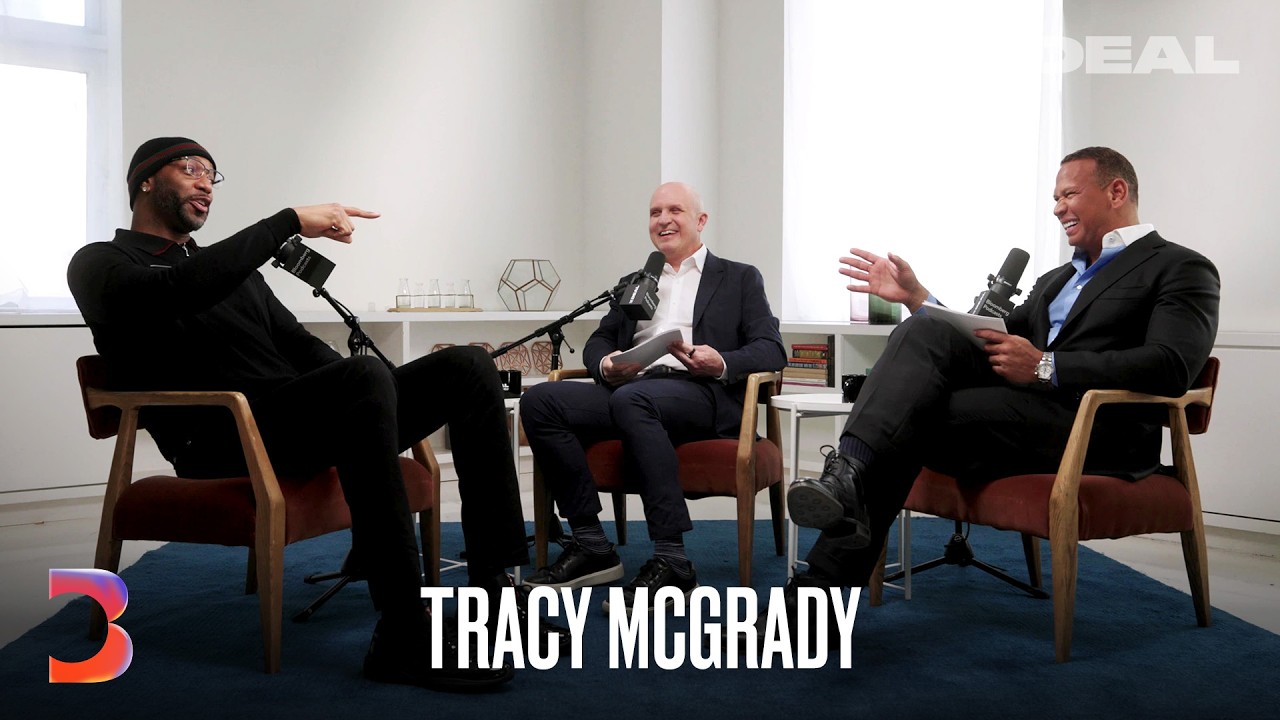
McGrady Pivots OBL to Team Model, Secures Bills Stake
Bloomberg Originals
NBA Hall of Famer Tracy McGrady leverages his international network and NFL ownership experience to revamp the Ones Basketball League into a city-versus-city team concept backed by NexGen Sports.
## Background
Published on YouTube by Bloomberg Originals on May 28, 2026, this episode of 'The Deal' features hosts Alex Rodriguez and Jason Kelly interviewing NBA Hall of Famer Tracy McGrady. According to the page description, the episode covers McGrady's journey to becoming an NFL owner, the way the 1990s revolutionized basketball, and his return to NBA coverage as an analyst for NBC.
## TL;DR
Tracy McGrady details his transition from jumping straight out of high school into NBA stardom to becoming a savvy global businessman and sports team owner. He reflects on learning international business at Davos, securing a minority ownership stake in the Buffalo Bills alongside Vince Carter, and analyzing the game for NBC's basketball coverage. McGrady also highlights how Michael Jordan and China transformed basketball into a global industry, shares stories of mentorship with Kobe Bryant, and outlines the expansion of his own venture, the Ones Basketball League (OBL).
## Atmosphere & style
The conversation is warm, collegial, and deeply grounded in mutual respect between high school-to-pro athletic icons. Hosted in a relaxed yet insightful talk-show setting, the dynamic balances candid storytelling about money, business, and failure with lighthearted banter about rivalry, baseball, and brotherhood. It carries an inspirational, reflective mood that feels less like a corporate interview and more like a high-level peer exchange among elite athletes navigating the worlds of media and sports ownership.
## Key takeaways
- [00:00](https://www.youtube.com/watch?v=IqNctH10Ub4&t=0s) Tracy McGrady, who jumped straight from high school into the NBA, learned personal finance and global business through continuous self-awareness, desire to grow, and real-world networking opportunities.
- [01:09](https://www.youtube.com/watch?v=IqNctH10Ub4&t=69s) Attending the World Economic Forum in Davos helped McGrady broaden his perspective on international business and leverage his long-standing business ties in Asian markets.
- [03:13](https://www.youtube.com/watch?v=IqNctH10Ub4&t=193s) McGrady achieved his goal of professional sports team ownership by acquiring a minority stake in the NFL's Buffalo Bills alongside his cousin and former teammate Vince Carter.
- [05:29](https://www.youtube.com/watch?v=IqNctH10Ub4&t=329s) Sports team ownership provides value beyond asset appreciation by opening exclusive, high-level business circles and strategic networking opportunities with other influential investors.
- [10:40](https://www.youtube.com/watch?v=IqNctH10Ub4&t=640s) McGrady and Vince Carter turned their long-standing personal dynamic and natural conversations into business ventures, including a shared podcast and joining the 'NBA on NBC' broadcast panel.
- [13:18](https://www.youtube.com/watch?v=IqNctH10Ub4&t=798s) Basketball's expansion into a global business was paved by 1990s icons, leading to massive international fandom and economic opportunities in markets like China.
- [15:00](https://www.youtube.com/watch?v=IqNctH10Ub4&t=900s) Mentorship from Kobe Bryant provided crucial emotional and mental support during McGrady's difficult rookie season, helping him navigate the transition from high school to the pros.
- [17:00](https://www.youtube.com/watch?v=IqNctH10Ub4&t=1020s) McGrady founded the Ones Basketball League (OBL) to create a platform for undiscovered talent, inspired by how his own breakout performance at the ABCD Camp launched his professional career.
- [19:34](https://www.youtube.com/watch?v=IqNctH10Ub4&t=1174s) After facing early rejections from traditional capital sources, McGrady pivoted to creating in-house content, which attracted NexGen Sports as a strategic capital and operational partner.
- [19:34](https://www.youtube.com/watch?v=IqNctH10Ub4&t=1174s) OBL structured its growth by shifting to a city-versus-city team concept and bringing on notable cultural figures, celebrities, and peers as minority owners and general managers.
## Detailed walkthrough
Here is a detailed, faithful walkthrough of Part 1 of the interview:
[00:00](https://www.youtube.com/watch?v=IqNctH10Ub4&t=0s) Introduction to Tracy McGrady: From High School Phenom to Sports Owner
The episode opens with NBA Hall of Famer Tracy McGrady reflecting on his early years, recalling that at just 18 years old, he suddenly found himself a millionaire with zero formal education in personal finance or the realities of being a professional athlete. Everything he has learned from that tender age to the present has been driven by self-awareness, an understanding of his origins, and a continuous desire to grow. Hosts Jason Kelly and Alex Rodriguez welcome McGrady to *The Deal*, highlighting the strong parallels between Rodriguez and McGrady: both grew up in Florida under humble circumstances, both skipped college to jump straight from high school into professional sports, and both eventually transitioned into team ownership—Rodriguez in the NBA and McGrady as a minority investor in the NFL's Buffalo Bills.
Beyond his presence in corporate owner suites, McGrady is also making waves on television as an analyst for NBC's NBA coverage. Rodriguez expresses his admiration, calling McGrady one of his all-time favorite players and an incredible talent.
[01:09](https://www.youtube.com/watch?v=IqNctH10Ub4&t=69s) The Journey to Davos and Learning International Business
Kelly hands the floor to Rodriguez, who brings up their recent time together in Davos, Switzerland, asking McGrady what he learned from the experience and whether he would return. McGrady admits that as a massive "baseball head" who considers baseball his first love, sitting across from Rodriguez is an absolute honor. Turning to the topic of the World Economic Forum, McGrady candidly admits he had never even heard of Davos when first invited, jokingly asking, "What the hell is Davos?" However, once he researched the event, he realized it was a high-level environment where he needed to be.
Describing his arrival, McGrady recalls driving through Switzerland for the first time, struck by the breathtaking mountain scenery. Stuck in a bit of traffic, he looked out his car window to see Rodriguez himself walking down the street—the very first person he recognized in town. During the forum, McGrady spoke on a sports panel focused on bridging the gap between the U.S. and Asian markets, leveraging the extensive international relationships and business ventures he has built over the years in China. For McGrady, the experience was an eye-opener in his ongoing journey of learning global business.
[03:13](https://www.youtube.com/watch?v=IqNctH10Ub4&t=193s) The Origin Story of Buying Into the Buffalo Bills
Kelly shifts the discussion to one of McGrady's signature business moves: securing a minority ownership stake in the Buffalo Bills. McGrady explains that he had long harbored a desire to own a piece of a professional sports team across baseball, basketball, or football. He initially targeted his hometown team, the Tampa Bay Buccaneers, but that path didn't materialize. He then received a call regarding an ownership stake in the Atlanta Falcons, but that deal was already too far along in the process, involving figureheads like Dominique Dawes and film producer Will Packer.
That was when the opportunity with the Buffalo Bills emerged. Addressing why Buffalo appealed to him, McGrady points to his early NBA career, having played his first three seasons (1997–2000) for the Toronto Raptors right across the Canadian border. During those years, Buffalo Bills legends like Bruce Smith and Thurman Thomas frequently attended Raptors games in Toronto, creating a long-standing personal connection. Deciding it was time to move away from simply backing other people's ideas and instead invest in his own vision, McGrady called his cousin, NBA legend Vince Carter.
- Vince Carter was immediately on board, eagerly asking what steps they needed to take next.
- The pair attended a Bills game and later sat down in the office of team owner Terry Pegula for an hour-long meeting.
- Expecting a high-pressure "audition" where he would have to sell himself, McGrady was pleasantly surprised by the casual, authentic conversation, which ended with Pegula directly inviting them into the ownership group.
[05:29](https://www.youtube.com/watch?v=IqNctH10Ub4&t=329s) Writing the Check and the Power of the Ownership Suite
Rodriguez asks McGrady about the sheer reality check of having to sign a massive check to finalize the deal, recalling that the first time he wrote a check of that magnitude, he couldn't sleep for a week. McGrady shares that he surprisingly wasn't nervous because he knew he had put in the requisite work, and his pure excitement completely overshadowed the monetary size of the check. He realized that becoming an NFL owner wasn't just about writing a check and passively watching the franchise value appreciate; it opened direct lines of communication with influential business figures who could help diversify and strengthen his overall investment portfolio.
Addressing whether people treat him differently as an owner, McGrady asserts that while he doesn't personally care how others view him, ownership indisputably opens doors that remain closed to most. He emphasizes that no matter how legendary an athlete was on the field or court, non-owners simply do not get access to those exclusive rooms. Rodriguez concurs, noting that team ownership unlocks opportunities like "wildfire."
- **Lessons from the Boardroom:** McGrady recounts meeting a fellow female co-owner during All-Star Weekend who offered genuine, generous support for his business ventures.
- **What NOT to Do:** McGrady recalls watching an overly loud, obnoxious prospective investor in an owner's suite during a game, correctly predicting the group would reject him despite his wealth.
- McGrady notes this taught him a vital lesson: money alone isn't enough—you have to be a solid, humble, and grounded person to belong in those circles.
[10:40](https://www.youtube.com/watch?v=IqNctH10Ub4&t=640s) Partnering with Vince Carter and the Nostalgia of "NBA on NBC"
Kelly asks about the deep personal and professional dynamic between McGrady and Vince Carter. McGrady reveals they only discovered they were cousins around the time McGrady was drafted out of high school. After spending two years together as teammates in Toronto, they forged a tight bond that has lasted decades. Today, they speak on the phone roughly twice a week—often requiring McGrady to clear two-hour blocks of time or set strict 15-minute limits. That ongoing, natural dialogue ultimately led them to launch a podcast together so they could monetize their lengthy conversations.
This entrepreneurial drive also paved the way for their broadcast deal with NBC. Joining the network was a full-circle moment for McGrady, who grew up during the 1990s golden era watching NBC coverage that inspired his dream of playing in the NBA. Being able to return to the network he once played on and analyze the game that raised him was a complete "no-brainer."
- The *NBA on NBC* studio panel features McGrady, Vince Carter, Carmelo Anthony, and host Maria Taylor.
- Rodriguez praises the show's chemistry, high production value, and on-location broadcasts.
[13:18](https://www.youtube.com/watch?v=IqNctH10Ub4&t=798s) How the '90s Transformed Basketball into a Global Business
Kelly asks what the 1990s era did for the overall business of basketball. McGrady highlights how icons like Michael Jordan revolutionized what players could accomplish off the court, particularly through sneaker culture and global branding. Following in those footsteps, McGrady signed with Adidas and sold millions of signature shoes worldwide. He credits Magic Johnson, Larry Bird, and Jordan with opening an international portal that allowed future generations to thrive globally.
McGrady shares that his first trip to China occurred around 1998 or 1999, a time when basketball was not yet widely played there. Over the decades, he witnessed an explosive trajectory, culminating in an estimated 350 to 400 million people playing basketball in China today. In 2004, as a member of the Houston Rockets alongside Chinese superstar Yao Ming, McGrady played in the very first official NBA China Games against the Sacramento Kings. He reflects on the unique weight and economic opportunity of carrying the basketball fandom of an entire continent on his back—an opportunity he continues to capitalize on to this day.
[15:00](https://www.youtube.com/watch?v=IqNctH10Ub4&t=900s) Brotherly Mentorship with Kobe Bryant
Rodriguez steers the conversation toward McGrady's relationships with basketball legends, asking if he ever had pivotal advice from Michael Jordan or Kobe Bryant. McGrady explains that Kobe was like a brother to him, having entered the NBA directly out of high school just one year before McGrady did. During his rookie season, McGrady struggled with court time under his head coach—a frustration Kobe had experienced the previous year under head coach Del Harris, who pushed high school rookies exceptionally hard.
McGrady reached out to Kobe for guidance, and extensive phone calls ensued. Kobe offered crucial reassurance, telling him to "trust the work" and stay confident in his identity, which carried McGrady through a dark rookie year. Later, as McGrady rose to stardom in Orlando and entered conversations alongside Kobe as the best wing player in the league, their competitive relationship evolved. While Kobe notoriously disliked being compared to anyone, McGrady was built with the same fierce, competitive mentality to challenge him on the court.
Rodriguez interrupts with a humorous story of his own about Kobe: during a baseball slump, Rodriguez was driving to the Bronx when Kobe called to offer encouragement, telling him not to read the press. However, Kobe then mentioned he had been studying Rodriguez's baseball film, pointing out that Rodriguez was "bailing out" with his front foot on a 1-for-15 streak. Flabbergasted that Kobe was breaking down his hitting mechanics, Rodriguez jokingly ended the call with, "Kobe, I got to go!"
<ElicitationsGroup message="Where would you like to go next with this transcript?">
<Elicitation label="Get Part 2 Walkthrough" query="Please provide the detailed walkthrough for Part 2 of this transcript."/>
<Elicitation label="Summarize Key Takeaways" query="Summarize the core business and career takeaways from Tracy McGrady in this episode."/>
</ElicitationsGroup>
[17:00](https://www.youtube.com/watch?v=IqNctH10Ub4&t=1020s) The Origins and Evolution of the Ones Basketball League (OBL)
The discussion shifts to Tracy McGrady’s enterprise, the Ones Basketball League (OBL). McGrady reflects on how the concept for the one-on-one league grew out of his personal journey. As an unknown high school junior in Florida, McGrady was the last player invited to Sonny Vaccaro’s legendary ABCD Camp in Teaneck, New Jersey—a camp famous for showcasing future legends like Kevin Garnett, Kobe Bryant, Tim Thomas, and LeBron James. After holding his own against top prospects like Lamar Odom, McGrady shot up from absolute obscurity to become the number one high school player in the country within a single month. That transformative platform ultimately launched him into being drafted straight out of high school in the 1997 NBA Draft, right on the heels of Garnett and Bryant. McGrady built OBL to create a similar, high-stakes exposure platform for basketball players who still possess an intense passion for the game.
Initially, McGrady launched a proof-of-concept trial across six cities, inviting 32 players per location and taking the top eight to a Sunday championship for a winner-take-all one-on-one showdown. However, when he went on a capital run to scale the business, he struck out with prospective investors. Rather than giving up, he viewed the rejection as a vital learning experience. He shifted strategy by leveraging his private gym at home to bring players in and produce high-quality content to keep the OBL brand active.
- **Key Players & Names Mentioned:** Sonny Vaccaro, Lamar Odom, Kevin Garnett, Kobe Bryant, Tim Thomas, LeBron James, and Tracy McGrady.
- **ABCD Camp Location:** Teaneck, New Jersey.
- **Draft Year:** 1997 (straight out of high school).
- **Original OBL Trial Format:** 6 cities, 32 players per city, top 8 advancing to a Sunday winner-take-all championship.
---
[19:34](https://www.youtube.com/watch?v=IqNctH10Ub4&t=1174s) Strategic Partnerships, Team Ownership, and Global Ambitions
McGrady's strategy of producing original content at his home gym paid off when it caught the attention of NexGen Sports, an investment group that recognized the magic of the vision and stepped in as a capital partner. NexGen brought deep operational expertise in alternative sports leagues, having launched the AVP volleyball league and managing the 305 team that won a championship in the BIG3. Together, they revamped the OBL model away from individual pop-ups and toward a city-versus-city team concept to build long-term enterprise value.
To drive local fan engagement and authentic culture, McGrady established an eight-team structure and awarded 15% ownership and general manager roles to prominent celebrities, cultural figures, and basketball peers:
* **New York:** Rapper Jadakiss (from Yonkers)
* **Chicago:** Actor Larenz Tate
* **Raleigh, North Carolina:** Former NBA All-Star John Wall
* **Miami:** NBA legend Tim Hardaway Sr.
McGrady stresses that OBL is a legitimate, professionally run league rather than a gimmick. The business model has already generated strong international demand, drawing inbound expansion inquiries from partners in China and Australia. McGrady points out that international youth are actively studying and copying American skill sets on social media—such as kids in China replicating Shai Gilgeous-Alexander's (SGA) game—making global expansion the natural trajectory for the league.
---
[21:45](https://www.youtube.com/watch?v=IqNctH10Ub4&t=1305s) Rapid-Fire Round and Closing Reflections
Host Jason Kelly and co-host Alex Rodriguez transition into a rapid-fire Q&A segment with McGrady, uncovering his ultimate preferences and dream matchups:
* **One-on-One vs. Five-on-Five for life:** One-on-one.
* **Dream All-Era OBL Roster:** Tracy McGrady, Kobe Bryant, and Kevin Durant.
* **Current NBA Player Most Likely to Win a League-Wide 1-on-1 Tournament:** Kevin Durant.
* **Best One-on-One Basketball City:** New York.
* **Dream OBL Investment Partner:** NexGen Sports (already secured).
* **The Franchise He Wants to See Win a Championship Most:** After initial hesitation due to playing for multiple beloved franchises, McGrady named the Orlando Magic for basketball, but clarified his absolute top choice across *all* sports is the **Buffalo Bills** (which prompts jokes about the team choice and following his financial investment in the NFL franchise).
Closing the interview, Alex Rodriguez reflects on the shared brotherhood between high school-to-pro athletes like himself, McGrady, Garnett, and Kobe. A-Rod praises McGrady not just for his Hall of Fame career and broadcasting work on NBC, but for the classy, dignified manner in which he conducts his business and leads his family alongside his wife and four children.
## Notable quotes
> [01:09](https://www.youtube.com/watch?v=IqNctH10Ub4&t=69s) What the hell is Davos? — Tracy McGrady
> [15:00](https://www.youtube.com/watch?v=IqNctH10Ub4&t=900s) trust the work — Kobe Bryant
> [15:00](https://www.youtube.com/watch?v=IqNctH10Ub4&t=900s) Kobe, I got to go! — Alex Rodriguez
## Mentioned
Tracy McGrady, Alex Rodriguez, Jason Kelly, Bloomberg Originals, The Deal, World Economic Forum, Davos, Switzerland, Buffalo Bills, Tampa Bay Buccaneers, Atlanta Falcons, Dominique Dawes, Will Packer, Toronto Raptors, Bruce Smith, Thurman Thomas, Vince Carter, Terry Pegula, NBA on NBC, Carmelo Anthony, Maria Taylor, Adidas, Michael Jordan, Magic Johnson, Larry Bird, Yao Ming, Houston Rockets, Sacramento Kings, Kobe Bryant, Del Harris, Ones Basketball League, Sonny Vaccaro, ABCD Camp, Kevin Garnett, Tim Thomas, LeBron James, Lamar Odom, NexGen Sports, AVP, BIG3, Jadakiss, Larenz Tate, John Wall, Tim Hardaway Sr., Shai Gilgeous-Alexander, Kevin Durant, Orlando Magic
In an interview on The Deal, NBA Hall of Famer Tracy McGrady outlines his transition from an unprepared high-school draftee to an active sports investor, arguing that team equity, media monetization, and global grassroots ventures offer far greater strategic leverage than athletic fame alone.
Equity and Access in Sports Franchise Ownership (3:13)
McGrady details acquiring a minority ownership stake in the NFL's Buffalo Bills alongside his cousin and former Toronto Raptors teammate Vince Carter. After initial efforts to buy into the Tampa Bay Buccaneers stalled and an Atlanta Falcons group moved forward with other figures, an hour-long meeting with Bills owner Terry Pegula secured their entry. McGrady noted his affinity for Buffalo traced back to his Raptors tenure (1997–2000), when Bills icons Bruce Smith and Thurman Thomas frequently attended games across the border.
Writing the equity check, McGrady emphasized, was driven not merely by prospective asset appreciation, but by the exclusive access ownership confers. Both he and co-host Alex Rodriguez observed that franchise ownership unlocks executive rooms unavailable to athletes regardless of their career accolades. However, McGrady noted that capital alone is insufficient: maintaining humility and emotional stability is required to gain respect and build lasting partnerships among fellow team owners.
Scaling Basketball's Global Reach from China to Davos (13:18)
Reflecting on the commercialization of basketball since the 1990s, McGrady highlighted how icons like Michael Jordan, Magic Johnson, and Larry Bird opened international commercial pathways that enabled subsequent players to secure lucrative global footwear contracts, such as his own signature line with Adidas. Having first visited China around 1998 or 1999, McGrady witnessed the sport expand into an estimated 350 to 400 million active participants, later playing in the inaugural 2004 NBA China Games as Yao Ming's teammate on the Houston Rockets.
That commercial longevity in Asia led to an invitation to the World Economic Forum in Davos, Switzerland, where McGrady participated in a panel focused on commercial bridges between the United States and Asian markets. McGrady highlighted that international youth increasingly emulate American basketball moves through digital media, underscoring an expanding cross-border commercial pipeline.
Monetizing Personal Networks and Peer Mentorship (10:40)
McGrady illustrated how enduring professional relationships can be systematically converted into media and enterprise assets. He and Carter, who discovered they were cousins around the time of the 1997 draft, formalized their routine twice-weekly telephone calls into a monetized podcast. That established dynamic subsequently paved the way for their broadcast roles alongside Carmelo Anthony and host Maria Taylor on NBC's studio coverage.
McGrady also credited peer mentorship with surviving the steep learning curve of entering the NBA straight out of high school at age 18. During a difficult rookie season in Toronto, he sought counsel from Kobe Bryant, who had navigated similar playing-time frustrations under Los Angeles Lakers coach Del Harris the previous season. Bryant's advice to trust his daily work provided the psychological baseline that helped McGrady weather his early career challenges.
Structuring the Ones Basketball League Enterprise (17:00)
Drawing inspiration from his own breakthrough at Sonny Vaccaro's ABCD Camp in Teaneck, New Jersey—where he rose from relative obscurity to the nation's top high school recruit within a month—McGrady established the Ones Basketball League (OBL) to showcase elite one-on-one talent. After an initial six-city trial of 32-player tournaments failed to secure follow-on capital from institutional investors, McGrady pivoted by funding high-end video production in his private home gym to sustain brand traction.
That content caught the attention of NexGen Sports, an alternative league operator that joined as a capital and operational partner. McGrady and NexGen restructured OBL into an eight-team, city-based franchise system, awarding 15% equity and general manager roles to culturally prominent figures, including Jadakiss in New York, Larenz Tate in Chicago, John Wall in Raleigh, and Tim Hardaway Sr. in Miami. The restructured format has attracted inbound expansion inquiries from prospective operators in China and Australia.
While McGrady has assembled a multi-asset portfolio spanning an NFL minority holding, television broadcasting, and the Ones Basketball League, OBL's long-term commercial success hinges on whether its city-franchise model can successfully translate digital engagement into sustained media-rights agreements and overseas market expansions.
[1:09] Tracy McGrady: What the hell is Davos?
[15:00] Kobe Bryant: trust the work
[15:00] Alex Rodriguez: Kobe, I got to go!
Original transcript
[0:00] - 18 years old,
[0:01] I'm a millionaire. I've
never learned anything about
[0:04] finances, didn't know anything
about being a professional
[0:07] basketball player.
[0:08] Everything that I've been
learning at 18 years old to
[0:11] where I am to now is just
me being aware of who I am,
[0:15] where I come from, and wanting
to learn more about me.
[0:24] - Welcome back to the
Deal. I'm Jason Kelly.
[0:25] - And I'm Alex Rodriguez.
[0:26] - And coming up on today's
show, Tracy McGrady.
[0:29] This is a legendary Hall
of fame basketball player,
[0:33] but a guy who has a
lot in common with you.
[0:37] - First of all, he's one
of my favorite players
[0:38] of all time in the NBA.
[0:39] Just an incredible talent.
[0:41] As far as what we have in similarities,
[0:43] we're both from Florida, we both
come from humble beginnings
[0:46] and we're one of the few
that went straight from high
[0:48] school into the pros.
[0:50] And now we're both part of team ownership.
[0:52] - That's right. Owners in your
case, obviously in the NBA,
[0:54] in his case, the NFL, he came in
[0:57] as a minority investor
in the Buffalo Bills.
[0:59] So we're seeing a lot
of him in owner suites,
[1:03] but also seeing a lot of him on TV.
[1:05] We're going to get into that a lot more
[1:07] with T-Mac here on The Deal.
[1:09] Tracy, what a treat to
have you here in New York.
[1:11] We're going to get into everything
you've done throughout your
[1:15] career, but I wanted to
defer to my partner here
[1:18] for the first question,
[1:19] because you guys have a lot in common.
[1:20] - Yeah. T-Mac, great
to have you here.
[1:22] - Yes sir.
[1:23] - Now, who would've thought that?
[1:24] Two kids from Florida, right?
[1:25] Humble beginnings, straight
out of high school to the pros
[1:28] and just a few months ago we
were just kicking it in Davos.
[1:31] Yes. First of all, what'd you think of it?
[1:33] What'd you learn and would you go back?
[1:36] - So first off, it's a pleasure
to be here with you guys.
[1:39] I'm a baseball head.
Baseball is my first love.
[1:42] And this guy right here is
one of my, one of my faves.
[1:44] So this is an honor for me. Davos.
[1:47] I didn't know anything about
it. I've never heard about it.
[1:50] And when it was brought to
my attention it was like, yo,
[1:53] you got invited to go to Davos.
[1:54] I'm like, what the hell is
Davos? Like, what is that?
[1:58] But I looked it up and
I was like, oh, this is,
[2:00] this is big time.
[2:01] Like this is where I need to be.
[2:04] And I'm driving in, man, I've
never been to Switzerland.
[2:07] I'm driving in and I'm just
amazed of the scenic route,
[2:11] amazing scenery.
[2:12] Driving in, traffic is a little,
[2:15] you know, backed up a little bit.
[2:17] And I looked to my left.
[2:18] It's like, yo, that's A-Rod right there,
[2:21] walking on the street right there.
[2:23] So he was the first person I saw and
[2:25] - Sliding around.
[2:27] - So the reason why I was there,
I spoke on this sports panel
[2:30] and of course, you know, I have a, a lot
[2:33] of international relationships.
[2:35] I do a lot of traveling to
China, a lot of business
[2:38] that I, I do over there.
[2:39] But just having conversation
with a lot of powers that be,
[2:42] it was how do we, you know,
bridge that gap between,
[2:46] you know, US and Asian market
is what I was talking about.
[2:50] But it was, it was an eye opener.
[2:53] I'm in the stage of like really
learning business, right?
[2:57] He said, we come from humble beginnings
[2:59] and that is very true for me.
[3:00] Everything that I've been
learning at 18 years old to
[3:03] where I am to now is just
me being aware of who I am,
[3:07] where I come from,
[3:08] and wanting to learn more about me,
[3:11] you know, every single day.
[3:13] - So it's interesting, one of
you, I think, signature deals
[3:16] of late is going in as minority
owner of the Buffalo Bills.
[3:20] We talk about the NFL a lot on this show.
[3:23] Give us the origin story.
How, how does that happen?
[3:25] And, and and what are you
thinking as you get into that?
[3:28] - So I wanted to always, whether
it was baseball, basketball
[3:31] or football, I wanted to be
an owner of, of some sort.
[3:34] That opportunity presented itself.
[3:36] Because I wanted to have some
ownership in the Tampa Bay
[3:39] Buccaneers, because it's hometown team.
[3:41] Yeah. Right there. Got to the table,
[3:43] got a call about Atlanta
Falcons, they were too far along.
[3:47] I think that was like Dominique Dawes
[3:49] and Will Packer I think was in that deal.
[3:52] So there was too far along the line.
[3:55] And then Buffalo Bills came up
[3:58] and you probably asked why Buffalo?
[3:59] Well, I played three years
in Toronto. Yeah, right.
[4:03] The Toronto border is right there.
[4:04] And when I was playing in 97
to 2000, you know, Bruce Smith,
[4:08] Thurman Thomas, all those
boys used to show up
[4:11] to our games in Toronto.
[4:13] So going back, like over the years,
[4:18] I've always invested in other
people's ideas and ideologies
[4:22] and things that, that,
that they wanted to do.
[4:25] This is a time where I was like, yo, let,
[4:28] let me call my cousin
[4:29] and see if he has any
interest in, you know,
[4:31] going in this deal with me.
[4:33] So I called Vince and like, yo,
[4:34] - This is Vince Carter.
[4:36] - This is Vince Carter, my cousin.
[4:37] So I called him, I was like,
yo, you have any interest in,
[4:40] you know, being a NFL owner?
[4:42] What, like, what, what? Yeah.
[4:45] So right away he was like, I'm in,
[4:48] you know, what we got to do?
[4:50] So we made some calls,
we went to a game and
[4:53] after the game we sat with Terry.
[4:55] Right? Terry Pegula. And this is like,
[4:59] I'm thinking we auditioning
[5:02] and I got to be on my best behavior
[5:05] and really sell this guy that
I really want to be a part
[5:09] of this, this ownership group.
[5:11] But we just casually
had a conversation, man,
[5:13] after the game sitting in his office
[5:15] and just chopping it up for about an hour.
[5:17] And from that conversation
[5:19] he was like,
you want to be a part of this?
[5:23] What? Of course. Yeah, absolutely.
[5:25] - That's why you're here.
[5:27] - Right, and, and it
happened just like that.
[5:29] - So let's take it right from
there. So I love the story.
[5:32] I love how you were proactive
and called your cousin Vince.
[5:36] I loved how you went to a Bills game.
[5:37] That's really how deals
are are done. Right?
[5:39] My question is, once you
finish that conversation
[5:41] and you get home and reality hits
[5:43] and you know, you got to
write a big, big check
[5:46] because the first time, T,
[5:48] that I wrote a big check, I
couldn't sleep for a week.
[5:50] - Right?
- Right. We're not
[5:50] used to writing those type of checks.
[5:52] Yeah. Walk me a little bit
through that conversation
[5:53] and how nervous were you when
you had to write that check
[5:55] and actually release your bank account?
[5:57] - So I would say this, I,
[6:00] I wasn't nervous about it
[6:02] because I had put in the work, right?
[6:05] I think my excitement
was just overshadow of
[6:09] what the check was that I was writing.
[6:11] I'm, I'm part owner of this franchise
[6:14] and like my mind went to, it's not just,
[6:19] you know, I write this
check and then I sit back
[6:21] and the Bills do their thing
[6:23] and the value of it is this,
this franchise goes up.
[6:26] No, there are people that involved in this
[6:28] that I actually can have
some conversations with
[6:31] and actually prolong or, or
further and improve my portfolio
[6:35] because of what these
guys have. The check?
[6:37] Mm. It was big,
[6:39] but I wasn't like, I was too
excited A-Rod, I really was.
[6:43] I was like, man, I cannot
believe this is happening.
[6:46] Because there's not a lot of
guys look like me that
[6:49] is part of those groups.
[6:51] - And so to that point, do you think
[6:54] people look at you differently?
Because you're an owner?
[6:56] - I don't give a damn. I
mean, I, I I don't know.
[6:59] I don't care.
[7:00] - Yeah.
- Whether they do or they don't.
[7:02] - I guess maybe ask in a different way.
[7:04] Do, has that come to fruition
[7:06] that you feel like you are able
[7:09] to go into different rooms
because you're an owner?
[7:11] - For sure.
[7:13] Yeah, for sure. For for sure.
[7:16] I mean, it's, it gives you it. Yeah.
[7:21] Because everyone knows how
difficult that is. Right?
[7:26] And just anybody, I don't care
[7:28] how great you were on the basketball court
[7:30] or how great you are on the field.
[7:32] Like just anybody can't get
that opportunity. Yeah. Right.
[7:36] So yeah, I'm, I'm looked at differently,
[7:38] can walk in different doors
[7:41] and those doors are steady opening it up.
[7:43] - I mean, you've seen that.
- Yeah. There's no question.
[7:45] I mean, everything that T says,
[7:47] I've said it some in
some interview are like,
[7:49] I feel the same gratitude
[7:52] and the doors open up like, like wildfire.
[7:54] I guess my follow up question on that is,
[7:56] you talked about some of the
benefits from being an owner
[8:00] and for being an LP to the Buffalo Bills.
[8:02] What are some of the lessons you've
[8:03] learned from being in that room?
[8:05] - That's a good question. I,
I guess certain individuals
[8:09] that's involved in this, you
know, some certain people are,
[8:12] are difficult to deal with.
[8:14] But then you run into those people.
[8:16] Like I ran into one of our
owners All Star Weekend.
[8:20] She was actually one of
the owners that went in
[8:23] with the group that, you
know, we went in with.
[8:25] And I was having some
conversations with her
[8:27] and I could not believe
[8:29] how generous this lady
was in terms of wanting
[8:34] to help me right in,
[8:36] in my business endeavors in any capacity.
[8:40] If, which I needed her.
[8:43] Like, she was like, here,
whatever you need from me.
[8:47] And that was just so refreshing.
[8:48] And I, I just felt the,
the genuineness of that.
[8:52] But then you run into some
people like, why you like that?
[8:55] And I'll tell you another thing
too, I won't say any name,
[8:59] but I was at the game where
there was another group
[9:04] that he brought several
groups that were trying to,
[9:07] to come in and be the minority partners.
[9:10] So we're in the suite
[9:13] and I'm quiet as a
mouse watching the game,
[9:16] but there's the, another
partner there just loud
[9:18] and obnoxious and just going crazy.
[9:22] And I'm sitting back, I was
like, yo, I know damn well
[9:27] they're not going to allow this guy.
[9:28] No way. No way. Because yeah, no way.
[9:32] Because of what he was
portraying in that moment,
[9:38] right there, there wasn't a
person of like being humble
[9:42] and just really
understanding the situation.
[9:45] So he ended up not getting in,
[9:48] being part of that group.
[9:50] And I saw that and I was
like, damn, it don't matter
[9:52] how much money you have.
[9:54] Like you got to be solid, a
solid dude, a solid person to,
[9:59] to be a part of this group.
[10:00] - Jason, I find that to be really
[10:01] interesting what T-Mac just said.
[10:03] Because one of the lessons
[10:04] that I've learned sometimes
from being in those rooms in
[10:07] those boardrooms that you're
just like, look around,
[10:09] you're like, what am I doing here?
[10:11] Right. I cannot believe.
Right. But sometimes more than
[10:14] learning what to do is sometimes
you learn what not to do.
[10:18] That's it. And those lessons, like, stay
[10:20] with us. That's it forever.
[10:21] - That's it. Yeah. And
that was that lesson for me
[10:24] because that was that night
[10:26] when I don't even know if I'm
going to be a part of this group,
[10:30] but I know I can't be acting like that.
[10:33] And when we got the call that we got in
[10:36] and that person then I was like, okay,
[10:38] that was the lesson for me.
[10:40] - So tell us about Vince,
[10:41] what a relationship you guys
have had playing together now.
[10:45] Business partners.
What's the dynamic there?
[10:48] Help us. Help us understand that.
[10:49] - Yeah. So we discovered,
[10:50] we was cousin when I got
drafted in high school.
[10:53] Two years we played together in Toronto.
[10:56] You know, formed a, a great bond.
[10:59] And then just over the years,
[11:01] just having those conversations,
just really picking up.
[11:04] We both have families,
we talk about everything.
[11:08] When he calls me, I have
to carve out two hours
[11:10] or I have to let him know, hey cuz,
[11:12] I only got 15 minutes.
[11:14] Get it in.
[11:16] - And how often does he call you?
[11:17] - We would talk probably about
twice a week like that. Wow.
[11:20] Seriously. Wow. And that's
why we started a podcast.
[11:23] Because I'm like, bruh, we
doing all this talking. Yeah.
[11:26] - Might as well get paid.
[11:29] - That is how this tends to
happen. Exactly. - There you go.
[11:30] - It's how it tends to happen.
- There you go.
[11:32] So like I said, me, I'm
always business driven.
[11:36] What's the next challenge?
[11:37] I'm always looking for the next challenge.
[11:39] Never thought I would be doing
TV. NBC opportunity comes up.
[11:43] Right? So we we're both on NBC. Yeah.
[11:46] And I'm like, because this,
like, this is for us to,
[11:51] you know, capitalize off of this
[11:53] and everything that's happening for us.
[11:55] So it's like Buffalo Bills, I call him,
[11:59] I told you I invested in a
lot of people, others ideas,
[12:02] but it's now it's like I'm
taking my own chances and,
[12:06] and being, doing this with my family.
[12:07] So it's, it's been man that
one of the greatest things,
[12:10] decisions that I've made
to actually just, you know,
[12:13] be involved with my cousin
and take this ride with him.
[12:16] - Yeah, T you're lucky 'cause
you found a cousin like Vince.
[12:19] - Yeah.
- I'm Dominican.
[12:21] I find cousins all the time
[12:23] that I never want to
invite to Thanksgiving.
[12:25] - I'm just telling you about
one, I got a million of them.
[12:29] - I saw you guys this past Sunday
[12:32] and I'm such a big fan of that show.
[12:34] You guys are killing it. Appreciate it.
[12:35] First of all, you guys look good.
[12:36] - Appreciate it. - You sound
good. Carmelo's great. - Yeah.
[12:38] - Maria's a star, you
know? Yeah. - Yes she is.
[12:40] - That's this, this is NBA on
NBC. Yeah.
[12:41] - Pre and post game.
[12:42] Right? Yeah. And I love how you guys go on
[12:44] location, which is kind of cool.
[12:45] What, first of all, you enjoying it?
[12:47] - I never thought I would do TV
[12:50] and with the NBC it was like, man,
[12:53] this is like the golden era.
[12:55] This is what I grew up
on right in the nineties,
[12:58] right when I fell in love with basketball.
[13:00] This like watching NBC back
in the day, what made me want
[13:03] to be a basketball player
and I played on NBC.
[13:08] So that nostalgia feeling just coming back
[13:10] and now I get to talk about the game
[13:12] that actually raised me.
[13:14] Oh, that it was just, it was awesome.
[13:15] It was a no brainer for
me to be on that show.
[13:18] - I'm the oldest here, but we, we all
[13:21] loved basketball in that era.
[13:24] What did that era do for the business
[13:26] of basketball in your estimation?
[13:28] - Well, I would say
[13:31] when you look at Michael
Jordan, what he was able to do
[13:34] for the sport, for us players in terms of
[13:37] what he did off the court, right?
[13:39] With Jordan brand selling sneakers,
[13:42] I became an Adidas athlete.
[13:44] I was able to sell millions of sneakers.
[13:46] The global imprint
[13:48] that he has selling
sneakers over in China,
[13:51] like Magic, Bird and,
[13:53] and Mike like opened up this
whole global portal for us
[13:57] to be able to, to walk through and,
[13:59] and capitalize off of that.
[14:00] I'm going to tell you what it did for it.
[14:01] Because I was going to
China back in like 19-
[14:05] my first trip to China was
probably like 1998, 1999.
[14:09] - Whoa.
- Yeah, I started early
[14:12] and there wasn't a lot
[14:14] of basketball being played
in China at that time.
[14:18] You know, I just seen the trajectory of
[14:20] that sport just trending up.
[14:23] And now you're talking about over 350,
[14:26] 400 million people are playing
basketball in China, right?
[14:29] So that's the evolution of basketball.
[14:30] And I was one of the, I was
part of the team, a group
[14:33] that played with the Houston Rockets
[14:35] and the Sacramento Kings
opened up the China games.
[14:37] So we was part of the first
global China games in 2004.
[14:41] - Because you were teammates with-
[14:42] - Yeah, yeah, yeah. I
was teammates.
[14:44] - That must have been
incredibly eye-opening from an
[14:47] economic opportunity perspective.
[14:49] - I'm still capitalizing off
of it really to this day.
[14:52] Absolutely, man. Yeah. Yeah.
[14:54] I was, you know, I mean when
you talk about having a,
[14:57] a whole freaking consonant on
your back and carrying that.
[15:00] - Yeah. T, I want to go back to,
[15:01] you mentioned Michael Jordan.
[15:03] Kobe Bryant. Did you ever have
conversations with Michael
[15:07] or Kobe that helped you out?
[15:09] And if so, what did they tell you?
[15:11] - So I had conversations with Kobe.
[15:12] Kobe was like my brother
because he came out a year early
[15:16] before me out of high school like us.
[15:18] And I was struggling.
[15:20] My rookie year, Kobe struggled
his year, rookie year
[15:22] because Del Harris, for
some reason, they wanted
[15:25] to make it hard on the
high school kid, right?
[15:28] So he went through it.
Then I go through it
[15:31] and there was a time where I
was like, man, I got, I, I have
[15:33] to talk to someone that
actually has been through this.
[15:35] Let me call my brother Kobe.
[15:37] So we had extensive conversations,
you know, just stand,
[15:41] you know, trust the work Mac,
[15:42] trust the work, it's going to pay off.
[15:44] You know, who you are.
[15:45] And just having those
conversations got me through
[15:49] a really challenging rookie year.
[15:51] I can remember, man, I, I
get to Orlando, Kobe is,
[15:56] is winning championships at this time.
[15:58] I'm coming up now in the league.
[16:00] So they're talking, you
know, trying to compare it
[16:03] to who's the best wing and,
and my name is coming in that
[16:06] and you know, if you
know anything about Kobe,
[16:08] Kobe doesn't want anybody-
- No, no, no, no, no.
[16:12] - Being compared to him at this time.
[16:14] So that, that right there,
I know him, I get it.
[16:19] But that's where I come in is
like, I'm built that way too.
[16:23] Just a different way.
- Yeah, you turned it on.
[16:25] - Absolutely. Yeah, absolutely.
[16:26] - Jason, can I give you my Kobe story?
[16:28] - Please.
[16:29] - There was a time I was struggling
[16:30] and I remember driving to
the Bronx from my West side
[16:32] apartment and phone rang as Kobe
[16:35] and Kobe's like, Hey man, don't,
[16:37] don't read the press,
don't let them get to you.
[16:39] Stay with your game. Same kind of advice.
[16:42] And then he ends a
conversation by saying like,
[16:44] I see you're one for 15,
I've been studying your film.
[16:46] I'm like, okay, wait,
where's this going to go?
[16:49] He goes, your front
foot, you know, you, you,
[16:51] you're bailing a little
bit and you're back.
[16:53] I said, Kobe, I got to go.
[16:54] I got, alright, alright,
I'll see you next week.
[16:58] - All right. Let's talk
about The Ones. The,
[17:00] the OBL, Ones Basketball League.
[17:02] It, it's back.
[17:03] My understanding is you sort
[17:05] of convened a group at your house
[17:06] and were like over dinner, it's not dead.
[17:09] We're doing it. Give us
the, give us the state of play
[17:12] for for OBL
[17:13] and then we're going to do a little,
[17:15] a little pitch session here. Go ahead.
[17:18] - So OBL came from, it was all a dream.
[17:21] Sonny Vaccaro started a ABCD
camp in Teaneck, New Jersey.
[17:26] - Yeah.
- Kevin Garnett, Kobe Bryant, Tim Thomas,
[17:31] Trace McGrady, LeBron
James, like all the greats.
[17:35] And I was a unknown basketball
player, like my junior year,
[17:38] only known within my region in Florida.
[17:42] Outside of that, no one knew who I was.
[17:44] After my junior year, I
get invited to this camp.
[17:47] I'm the last guy invited. I
keep hearing about Lamar Odom.
[17:50] So I go to this camp and I,
he's the first player I play
[17:55] and I held my own.
[17:56] So throughout this camp,
[17:58] I'm holding my own right
unknown basketball player.
[18:00] Who's this kid from Florida.
[18:02] Well, I leave that camp
[18:04] and a month later I'm the number
one player in the country.
[18:06] Mm. So I went from unknown-
- Yeah.
[18:08] - to the number one player in the country.
[18:10] Now it talks about, damn,
this kid is actually good.
[18:13] He, Kobe Bryant just came
out the year before him.
[18:15] Kevin Garnett came out
the year before him.
[18:18] So now that talk about
being a draftee in the 1997
[18:22] draft straight out of high school.
[18:24] That platform did it for me.
[18:27] I'm creating this OBL
platform for those guys
[18:29] that still have a, a deep love
[18:32] and passion for the game of basketball.
[18:34] And my proof of concept trial
was I went to six cities,
[18:38] I'll invite 32 players
[18:40] and I'll take eight players,
the best players to Sunday
[18:44] for the championship
[18:46] and have them play one
on one. Winner takes all.
[18:49] So now after that season, I'm,
[18:51] I'm going on a capital run trying
[18:53] to raise money for my league
[18:54] because I'm getting good feedback
[18:56] and I think I've created
something magical.
[18:59] Well I struck out, I struck out
[19:03] and the one thing, and I'm
glad that it went that way
[19:06] because I've learned
a lot on that journey.
[19:08] Right. Everybody's not
going to believe in your vision.
[19:12] Right. Everybody is not going to
be able to see your vision
[19:14] and what you're trying to create.
[19:16] I get that. So I believe in me,
[19:20] let me do it something different.
[19:22] Let me take a pivot and do it different.
[19:24] Like, yo, I I have a gym at my house,
[19:27] I'm going to bring everybody in.
[19:28] Let's capture this content.
Let's keep OBL fresh.
[19:31] And from that point, man, I, I think
[19:33] that was probably the best decision
[19:34] because I had NexGen sports.
[19:36] It was an investment group.
They saw what I was doing.
[19:39] They came in and loved the vision.
[19:42] They started AVP, which
is a volleyball league.
[19:45] Right, right. Yeah.
[19:46] And they know how to run a
league, alternative league.
[19:51] And also they're part of
the big three team. Yeah.
[19:54] 305 that won the championship.
[19:56] So they know how to manage a team.
[19:58] So for me, it was just like the
perfect partner that came in
[20:01] and when he came in, we talked,
[20:04] or when they came in, we
talked about doing something
[20:07] different than what I
did at my house versus
[20:10] what I did back in '22.
[20:11] Let me start cities, let me
start battle of the cities,
[20:16] let me create teams so where
I could build some value up
[20:21] and create opportunities
for some of my friends
[20:26] or influencers in these respectful cities.
[20:28] Yeah. And give the, give them
ownership of these teams.
[20:32] So I have Jadakiss, right?
We all know who Jadakiss is.
[20:35] He's from Yonkers. So I
gave him the New York team.
[20:38] He has 15 percent in
his New York team. Mm.
[20:41] Larenz Tate is my good buddy
who's a big time actor,
[20:44] is from Chicago.
[20:45] He has the Chicago team.
[20:47] John Wall is from Raleigh, North Carolina.
[20:48] I gave him the Raleigh team.
[20:50] Tim Hardaway Sr. has the Miami team.
[20:53] So I, I have, I started, I'm
starting out with eight teams
[20:55] and giving these respectful
GM slash owners, you know,
[20:59] 15 percent in ownership
[21:01] and also allowing them
to manage their teams.
[21:04] And you know, we having
trials like this is, I'm,
[21:06] we're building a real league.
[21:08] Like this is not a gimmick.
This is a real thing.
[21:10] So I'm, I'm pretty, you know,
[21:14] excited about the opportunity
and where this is going.
[21:16] And I'm already getting calls
from my partners in China.
[21:19] They want me to bring it over
there. Australia has called.
[21:21] And so global is where we want to take it
[21:25] because there's a lot of talent
when you look around now,
[21:27] I mean you have, you know,
all of these, you know, kids
[21:30] around the world are trying to mimic us.
[21:32] You look on social media now,
[21:33] you'll see a Chinese kid
looking like, you know,
[21:36] SGA out there playing basketball.
[21:38] Yeah. So I, I just think
[21:39] globally is where we want
to go with it. And it
[21:41] - Sounds like content was the real unlock.
[21:43] - Yes sir.
- Yes sir. Yeah. Interesting.
[21:45] Alright, so we're going to wrap
this up with our rapid fire.
[21:48] This is going to be a good
one. Let, let's do it.
[21:49] These some really good
questions. All right.
[21:51] So just, you know, first
thing that comes to your mind,
[21:54] if you had to pick one
to play for the rest
[21:55] of your life, one-on-one or five-on-five?
[21:58] - For the rest of my life?
[21:59] - Yeah.
- One-on-one.
[22:01] - Build your dream.
[22:02] OBL roster with NBA players from any
[22:05] era. Who would you pick?
[22:06] - Oh, that's easy. Myself, Kobe and KD.
[22:10] - Wow. That's, yeah.
[22:11] I, I would not want to play
against that team. All right.
[22:15] Which current NBA player
would win a league
[22:17] wide one-on-one tournament?
[22:18] - KD.
[22:19] - KD.
[22:20] - Best one-on-one basketball city?
[22:23] - New York.
[22:24] - Who's your dream OBL investment partner?
[22:27] - I have him. Gen, NexGen
Sports.
[22:30] - All right.
- And Arod,
[22:33] - What team do you want to see
[22:35] win a championship more than anything?
[22:38] - It's supposed to be rapid fire,
[22:39] but he stuck me on that one.
[22:41] - Should be easy for you. Nah, not really.
[22:43] because I played for three franchises
[22:45] that I I, that are dear to my heart.
[22:46] But I'll say Orlando Magic. Yeah.
[22:48] - Any sport.
[22:49] - Oh, any sport.
- Yes sir.
[22:50] - Oh, Buffalo Bills. There you go.
[22:51] - There you go. Okay.
[22:55] - Follow the money baby.
[22:57] - Buffalo Bills that it is
probably a better bet than the
[23:00] Orlando Magic, unfortunately.
[23:01] - I was confused why he
wasn't saying it.
[23:04] - I didn't hear "any sport."
- Any sport.
[23:07] Well, T-Mac, this has been amazing.
[23:10] I I really, I, you know, as
we got into this even more,
[23:14] the parallels between you guys are are,
[23:16] are really incredible.
[23:17] - Yeah.
- Especially the move from, you know,
[23:19] Florida, going pro, ownership,
all of those things.
[23:23] - And T, let me tell you like,
[23:24] I founded your career from day one,
[23:26] just like Kevin Garnett, right?
[23:27] Because it was very rare for guys
[23:29] to basically go from high
school to the pros, right?
[23:31] And we, we were part
of a small fraternity.
[23:33] Kobe being another one.
[23:34] But you mentioned, comport
yourself in a classy way.
[23:37] That's what I've admired the
most. Obviously your world is
[23:39] Hall of Fame and one of
the elites of all time.
[23:42] But the way you comport
yourself with your wife,
[23:43] your four kids, the way you run
[23:45] your business, you're killing it
[23:46] on NBC, so just keep killing it.
[23:48] - God bless man.
Man, I appreciate it.
[23:49] That means a lot, man. Thank you.