China Blends 19 Megaregions to Evade Middle-Income Trap
Bloomberg Originals
Beijing bets its future economic growth on dense, borderless urban clusters like the $2 trillion Greater Bay Area to force the massive productivity spikes needed for high-value innovation.
AI-assisted summary of Why China Is Building the World’s First $2 Trillion Megacity — original source. Check the original for full context.
Source published:
Detailed notes
## Background Published by Bloomberg Originals on YouTube on June 1, 2026, this video explores the ambitious Northern Metropolis project, a multi-billion-dollar development occupying one-third of Hong Kong's territory. The project aims to convert rural borderlands into a high-tech hub that physically and economically links Hong Kong to Mainland China and ten other cities within the broader Greater Bay Area. Ultimately, the piece positions this development as part of Beijing's broader national strategy to engineer 19 massive urban clusters across China.
## TL;DR China is shifting its urban development strategy away from isolated cities toward a network of 19 massive megaregions, anchored primarily by the $2 trillion Greater Bay Area. A critical component of this integration is Hong Kong's Northern Metropolis, a massive tech and innovation hub being constructed on rural land along the Shenzhen border. While the initiative aims to boost economic productivity to help China escape the middle-income trap, it faces steep hurdles due to conflicting legal and financial systems between regions. Furthermore, the aggressive state-led expansion is permanently displacing long-standing farming communities and erasing natural ecosystems.
## Atmosphere & style The documentary possesses a serious, analytical, and cinematic tone, pairing sweeping panoramic vistas of soaring megacity skylines with the quiet, bittersweet reality of rural farmlands being actively paved over. It creates a striking emotional contrast between the hyper-efficient, clinical vision of state planners and the profound nostalgia of displaced local villagers who are resigned to the loss of their heritage. Watching the piece feels like witnessing a high-stakes, real-time geopolitical shift, leaving viewers caught in a compelling philosophical tension between futuristic economic utopia and hyper-engineered dystopia.
## Key takeaways - [00:01](https://www.youtube.com/watch?v=4fuChQxpStE&t=1s) China is consolidating 11 neighboring cities in the Greater Bay Area into a single $2 trillion economic region with 86 million residents. - [00:01](https://www.youtube.com/watch?v=4fuChQxpStE&t=1s) Under its latest Five-Year Plan, Beijing aims to create 19 mega-regional urban clusters across China to drive national economic growth. - [01:50](https://www.youtube.com/watch?v=4fuChQxpStE&t=110s) Humanity is transitioning into an era of super-sized urbanism, where hundreds of millions of people are integrated into unified labor and trade markets. - [02:47](https://www.youtube.com/watch?v=4fuChQxpStE&t=167s) Hong Kong's multi-billion-dollar Northern Metropolis project is transforming rural borderlands into a high-tech lab and startup hub connecting to Mainland China. - [02:47](https://www.youtube.com/watch?v=4fuChQxpStE&t=167s) The Beijing-imposed National Security Law largely neutralized local activist opposition to massive land redevelopment in Hong Kong. - [03:59](https://www.youtube.com/watch?v=4fuChQxpStE&t=239s) Local farmers and villagers face forced displacement, receiving financial payouts and housing while losing ancestral lands and natural wetland ecosystems. - [05:35](https://www.youtube.com/watch?v=4fuChQxpStE&t=335s) Top-down urban developments risk becoming vacant 'ghost cities,' though past Chinese projects have eventually filled with residents and businesses over time. - [06:16](https://www.youtube.com/watch?v=4fuChQxpStE&t=376s) Shenzhen serves as the primary model for successful state planning, growing from a collection of fishing villages into a megacity of 18 million tech-focused residents. - [07:35](https://www.youtube.com/watch?v=4fuChQxpStE&t=455s) Integrating the Greater Bay Area faces practical hurdles due to conflicting administrative, legal, tax, and currency systems between Hong Kong, Macau, and Mainland China. - [08:58](https://www.youtube.com/watch?v=4fuChQxpStE&t=538s) As traditional manufacturing and real estate engines slow, China is leveraging dense mega-regions to boost productivity and escape the middle-income trap. - [10:06](https://www.youtube.com/watch?v=4fuChQxpStE&t=606s) The rise of megaregions reflects a global trend—seen also in West Africa and the U.S.—highlighting a tension between environmental/cultural loss and hyper-efficient economic growth.
## Detailed walkthrough ### [00:01](https://www.youtube.com/watch?v=4fuChQxpStE&t=1s) China’s Megalopolis Project
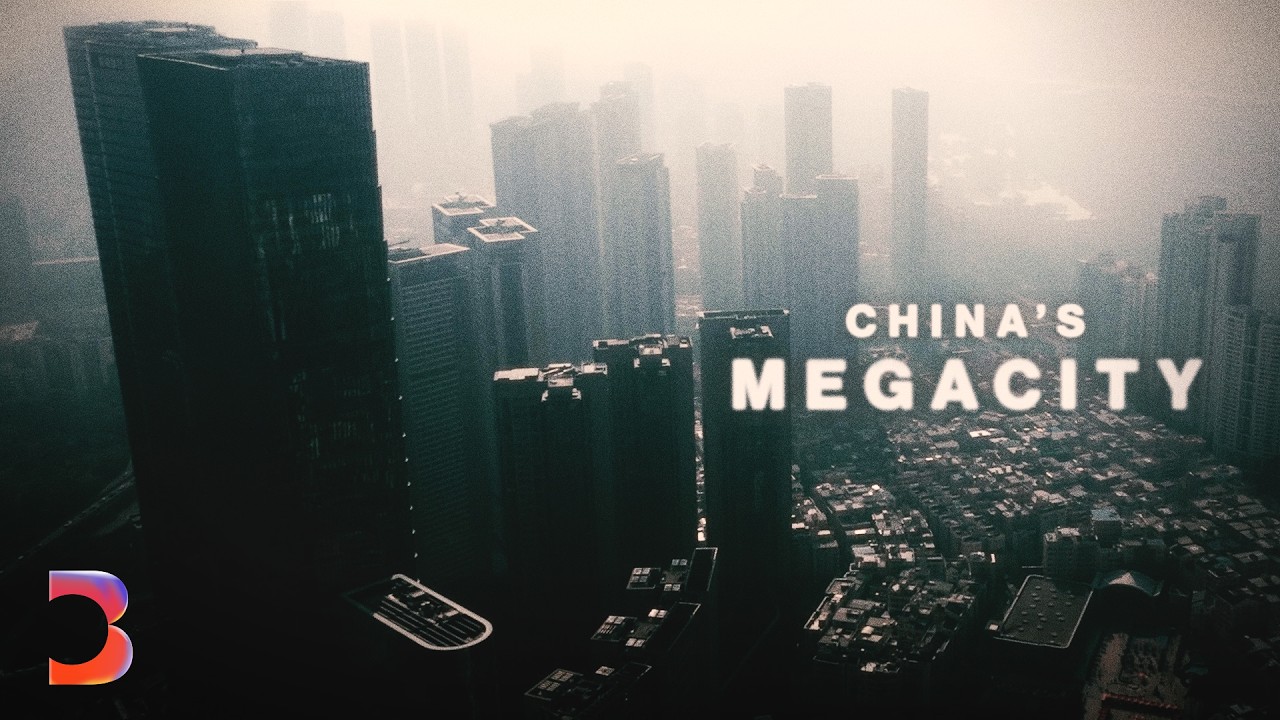
The video opens on a panoramic perspective of what is described as the largest continuous urban area the world has ever seen: China's Greater Bay Area (GBA). Home to 86 million people fused into a single $2 trillion economic engine, the GBA represents a bold, ambitious attempt by the Chinese government to integrate 11 neighboring cities into a cohesive mega-region. However, for China, this massive undertaking is merely the baseline. Beijing’s latest Five-Year Plan pivots away from treating cities as isolated units, redirecting focus toward a mega-regional network composed of 19 massive urban clusters, with the Greater Bay Area serving as the primary growth engine.
While smaller cities connecting to form larger trade networks is an idea dating back millennia, the scale of today's effort is unprecedented. Rather than a few thousand merchants traveling along historic trade routes, hundreds of millions of people are being consolidated into a single unified labor market. Physical gaps that once took centuries to bridge are being closed rapidly as high-speed rail lines and relentless paving swallow the landscape at a rate of kilometers per day. After 6,000 years of urban history, humanity is entering an era of super-sized urbanism, where cities draw in an ever-growing population seeking unique educational, career, and economic opportunities. Economists suggest that unifying these massive urban centers could redefine global growth rules, making China’s experiment a potential "blueprint for the future of humanity."
- **Total Population:** 86 million people in the Greater Bay Area. - **Economic Output:** $2 trillion combined economy across 11 integrated cities. - **National Strategy:** 19 total megaregional clusters planned across China under its latest Five-Year Plan.
---
[01:50](https://www.youtube.com/watch?v=4fuChQxpStE&t=110s) Cities Are Getting Bigger
For 99% of human existence, people lived as nomadic hunters and gatherers in small, scattered bands before settling into permanent agricultural communities. The earliest cities emerged roughly 6,000 years ago, creating hubs where people clustered to access centralized employment, schooling, and social life. That core promise of urban living remains intact today: cities drive technological innovation and afford individuals greater economic choice.
However, rapid urbanization comes with built-in drawbacks. Cities are frequently crowded and polluted, and high density allows infectious diseases to spread quickly. Yet despite these objective disadvantages, human migration toward urban centers continues unabated. The 11 cities constituting China's Greater Bay Area are already among the most productive—and densely populated—economic centers on earth, and they are slated to become even more densely packed in the coming years.
---
[02:47](https://www.youtube.com/watch?v=4fuChQxpStE&t=167s) Northern Metropolis Project
To physically bridge Hong Kong with the broader Greater Bay Area, a new metropolis named the "Northern Metropolis" is being built across a rural strip of land in northern Hong Kong. Standing on the border reveals a striking contrast: on the north side in Shenzhen, skyline skyscrapers tower over the horizon, while directly across a narrow border river on the Hong Kong side lie peaceful fish ponds, quiet farmland, and green hills.
The Northern Metropolis is branded as a multi-billion-dollar government plan to transform this quiet frontier into an advanced technology hub, housing cutting-edge research laboratories and high-growth startups. Historically, large-scale land development projects in Hong Kong sparked fierce public protests and environmental pushback. However, following the Beijing-imposed National Security Law and the subsequent crackdown on democracy protests, local opposition has largely been silenced. Observers note that local residents now exist in a "state of resignation or acceptance," realizing that state-led development will proceed regardless of pushback.
- **Geographic Focus:** Rural Northern Territory of Hong Kong along the Shenzhen border. - **Planned Facilities:** Advanced technology research labs, innovation hubs, and startup incubators. - **Political Context:** Implementation of the National Security Law effectively removed local activist opposition to massive land reclamation and construction.
---
[03:59](https://www.youtube.com/watch?v=4fuChQxpStE&t=239s) Farmers Upended
The human cost of this mega-development is felt keenly by local villagers and farmers whose families have inhabited the rural borderlands for generations. One local villager, standing on his ancestral land, recalls being born in a wooden hut on the property and learning farm skills like building bonfires with his uncles and cousins. Expressing deep nostalgia, he contrasts the irreplaceable qualities of genuine, untamed hilly wildlife with artificial public parks, noting somberly that "road is changing every day" and acknowledging, "we won't be here for too long."
To clear the land for the Northern Metropolis, the Hong Kong government is offering cash compensation and public housing placement to eligible relocated villagers. Beyond individual displacement, critics lament the permanent destruction of untouched wildlife ecosystems and the disruption of traditional rural communities.
- **Relocation Package:** Financial compensation payouts and public housing allocations for displaced farmers. - **Community Impact:** Loss of historic agricultural villages and natural wetland ecosystems.
---
[05:35](https://www.youtube.com/watch?v=4fuChQxpStE&t=335s) If You Build It...
Despite the government's grand vision, local property developers and economic analysts express skepticism about whether the Northern Metropolis will succeed seamlessly. Shenzhen's tech giants remain separated from Hong Kong by a physical border checkpoint, distinct customs regimes, and conflicting financial and legal systems. Experts point out that governments cannot simply declare an area a city center and expect people and businesses to move automatically—a top-down approach that has failed in numerous international contexts.
In Mainland China, aggressive government-led construction previously produced infamous "ghost cities"—sprawling urban infrastructure and high-rise developments that sat largely vacant for years. However, over time, many of those empty developments eventually filled with residents and businesses, proving that under the right conditions, the "if you build it, they will come" philosophy can ultimately bear fruit.
> "I don't think the government can just say, 'Oh, this will become the center of a city,' and people will move there. We've seen that fail so many times all over the world."
---
[06:16](https://www.youtube.com/watch?v=4fuChQxpStE&t=376s) Shenzhen Miracle
To evaluate what makes a planned city succeed, urban planners look to Shenzhen, situated strategically between Hong Kong and Guangzhou (the capital and cultural core of Guangdong province). Historically a modest collection of fishing villages and market towns, Shenzhen became a Special Economic Zone and grew at a rate unprecedented in human history.
In the late 20th century, demographers projected that Shenzhen’s population might reach 1 million people by the year 2000; in reality, its population surged past 7 million by that deadline. Today, Shenzhen is a thriving megacity of 18 million residents, willed into existence by state planning and strategic proximity to Hong Kong’s capital markets. It has evolved into a global center for advanced technology, driving progress in artificial intelligence, robotics, semiconductors, clean tech, and autonomous driving.
- **Historical Projections vs. Reality:** Expected 1 million residents by 2000; achieved 7 million actual residents by 2000. - **Current Population:** Over 18 million residents. - **Key Industrial Clusters:** AI, robotics, semiconductors, clean energy technologies, and autonomous vehicles.
---
[07:35](https://www.youtube.com/watch?v=4fuChQxpStE&t=455s) Megaregional China
Beijing now seeks to replicate and scale Shenzhen's success across the entire Greater Bay Area by leveraging the specialized advantages of each surrounding city. In theory, this creates an integrated high-tech supply chain: a startup based in Shenzhen can cross into Hong Kong to secure international capital, build product prototypes back in Shenzhen, manufacture the hardware at scale in Guangzhou, and launch commercial operations in Macau.
However, turning this theoretical synergy into a seamless reality presents severe practical hurdles due to deeply contrasting administrative frameworks.
- **Hong Kong:** Offers international common law legal systems, distinct currency (HKD), separate tax regimes, independent visa/passport systems, and global financial markets. - **Mainland Cities (Shenzhen/Guangzhou):** Operate under mainland administrative governance and a socialist market economy. - **Macau:** Operates as a gaming, tourism, and service-oriented special administrative region with its own monetary and border system.
---
[08:58](https://www.youtube.com/watch?v=4fuChQxpStE&t=538s) China's Middle Income Trap
The push to integrate the Greater Bay Area comes at a critical juncture for China's broader economy. Traditional growth drivers—such as low-cost textile manufacturing, basic consumer electronics assembly, and an explosive real estate boom—are faltering. Economic growth has slowed, signaling that China is confronting the "middle-income trap," a barrier where developing nations struggle to transition into high-income economies due to stagnating productivity.
Escaping this trap requires a steep increase in labor and firm productivity over the next decade. Urban economists stress that high-value innovation requires dense, borderless environments where researchers, entrepreneurs, and financiers can interact face-to-face during casual meetings and luncheons within a 30- to 60-minute transit radius. Consequently, connecting Hong Kong directly to Shenzhen’s tech ecosystem has become a paramount economic and political goal.
> "Moving from middle to high income requires a very steep increase in productivity... Cities thrive when they don't have borders. Innovation succeeds through more integration."
---
[10:06](https://www.youtube.com/watch?v=4fuChQxpStE&t=606s) Utopia or Dystopia?
While Hong Kong’s integration involves a unique shifting of political and legal boundaries, its transformation reflects a global migration toward megaregions, seen everywhere from the Abidjan-Lagos Corridor in West Africa to the Northeast Corridor in the United States.
This rapid expansion exposes a fundamental philosophical tension. For displaced local residents, watching natural farmlands and fish ponds paved over for high-rises represents a loss of human connection to nature and heritage. For state planners and economists, however, concentrating populations into dense, hyper-efficient urban corridors is an absolute prerequisite for future economic viability and technological advancement. Ultimately, China is not merely observing the global trend toward mega-cities—it is actively engineering it.
- **Global Megaregion Examples Mentioned:** - Abidjan-Lagos Corridor (West Africa) - Northeast Corridor (United States) - Greater Bay Area (China)
> "When people say, 'Can we be economically successful and not be a concentrated urban or regional center?' The answer is, 'You cannot be.' People move to where the jobs are."
## Notable quotes > [03:59](https://www.youtube.com/watch?v=4fuChQxpStE&t=239s) road is changing every day
> [03:59](https://www.youtube.com/watch?v=4fuChQxpStE&t=239s) we won't be here for too long.
> [05:35](https://www.youtube.com/watch?v=4fuChQxpStE&t=335s) I don't think the government can just say, 'Oh, this will become the center of a city,' and people will move there. We've seen that fail so many times all over the world.
> [08:58](https://www.youtube.com/watch?v=4fuChQxpStE&t=538s) Moving from middle to high income requires a very steep increase in productivity... Cities thrive when they don't have borders. Innovation succeeds through more integration.
> [10:06](https://www.youtube.com/watch?v=4fuChQxpStE&t=606s) When people say, 'Can we be economically successful and not be a concentrated urban or regional center?' The answer is, 'You cannot be.' People move to where the jobs are.
## Mentioned Abidjan-Lagos Corridor, Beijing, China, Five-Year Plan, Greater Bay Area, Guangdong, Guangzhou, Hong Kong, Macau, National Security Law, Northeast Corridor, Northern Metropolis, Shenzhen, United States
[Source](https://www.youtube.com/watch?v=4fuChQxpStE)