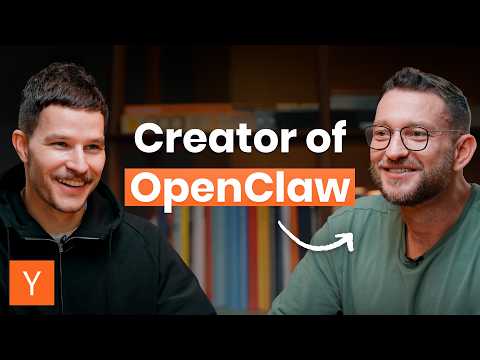
OpenClaw Creator Says Local AI Agents Will Eliminate 80% Of Apps
Y Combinator
Data-managing software applications face obsolescence because local-first autonomous AI bots can seamlessly execute unprogrammed workflows across personal data silos.
## Background
Published on February 7, 2026, on YouTube by Y Combinator, this interview features YC’s Raphael Schaad sitting down with Peter Steinberger, the creator of the viral, open-source AI agent OpenClaw. The video description highlights how OpenClaw differs from traditional chat-based tools by running locally to execute complex workflows, managing personal data, and reshaping the future of software.
## TL;DR
In this interview, Peter Steinberger discusses the meteoric rise of OpenClaw, an open-source personal AI agent that runs entirely locally on a user's machine to safely bypass data silos and manage complex tasks. Steinberger recounts his breakthrough 'aha' moment in Marrakech when the bot autonomously solved a voice transcription problem using found API keys and local command-line tools. He predicts that 80% of data-managing apps will disappear as users transition to specialized, local-first agent swarms. Finally, he outlines his contrarian development philosophy, which favors multiple parallel repositories, standard command-line interfaces (CLIs), and a highly customized, closed-source personality file called 'soul.md'.
## Atmosphere & style
The conversation carries a highly energized, passionate, and deeply technical vibe, blending the chaotic excitement of a viral overnight success with the grounded perspective of an experienced developer. There is a strong sense of mutual respect and camaraderie between the host and Steinberger, culminating in an inspiring, poetic conclusion that celebrates the power of rogue, independent innovation over massive Silicon Valley institutions. Listening feels like gaining insider access to a raw, unfiltered late-night coding session where unconventional ideas are brought to life through pure grit and creative problem-solving.
## Key takeaways
- [00:00](https://www.youtube.com/watch?v=4uzGDAoNOZc&t=0s) Open Claw is an open-source personal AI agent created by Peter Steinberger that achieved explosive viral success, gaining over 160,000 GitHub stars practically overnight.
- [00:44](https://www.youtube.com/watch?v=4uzGDAoNOZc&t=44s) Unlike cloud-dependent assistants like ChatGPT, Open Claw's core differentiator is that it runs locally, allowing it to control local hardware and access sensitive files directly.
- [02:56](https://www.youtube.com/watch?v=4uzGDAoNOZc&t=176s) The industry is shifting from pursuing a centralized 'god intelligence' toward community-driven 'swarm intelligence' where multiple specialized bots interact with each other.
- [07:38](https://www.youtube.com/watch?v=4uzGDAoNOZc&t=458s) Advanced coding models possess an abstract, creative problem-solving capability that allows them to autonomously figure out unprogrammed, multi-step workflows.
- [10:18](https://www.youtube.com/watch?v=4uzGDAoNOZc&t=618s) Steinberger predicts that 80% of data-managing apps will disappear as natural agent interfaces take over tracking, scheduling, and logistics.
- [12:31](https://www.youtube.com/watch?v=4uzGDAoNOZc&t=751s) Open Claw bypasses corporate ecosystem lock-in and data silos by storing user interaction memories locally as standard Markdown files.
- [15:03](https://www.youtube.com/watch?v=4uzGDAoNOZc&t=903s) To prove the system's robustness, Steinberger deployed his un-sandboxed personal bot into a public Discord server, where a strict system prompt successfully protected it from hacking attempts.
- [16:11](https://www.youtube.com/watch?v=4uzGDAoNOZc&t=971s) The agent's unique, funny, and natural personality is driven by a closed-source file named 'soul.md' that outlines core human-AI interaction values.
- [18:27](https://www.youtube.com/watch?v=4uzGDAoNOZc&t=1107s) Steinberger utilizes a contrarian development workflow that rejects git worktrees in favor of keeping multiple physical copies of a repository checked out on the main branch simultaneously.
- [20:35](https://www.youtube.com/watch?v=4uzGDAoNOZc&t=1235s) Open Claw skips native Model Context Protocol (MCP) integration, using a custom tool called 'Mac Porter' to convert MCPs into standard command-line interfaces (CLIs).
- [20:55](https://www.youtube.com/watch?v=4uzGDAoNOZc&t=1255s) Using a CLI-first architecture allows the AI model to dynamically utilize tools on the fly without requiring the environment restarts seen in typical MCP setups.
## Detailed walkthrough
### [00:00](https://www.youtube.com/watch?v=4uzGDAoNOZc&t=0s) The Open Claw Phenomenon
Open Claw, an open-source personal AI agent created by Peter Steinberger, has taken the internet by storm, exploding to over 160,000 GitHub stars practically overnight. The community has rapidly built a variety of projects on top of it, such as "Maltbook," where bots talk among themselves, and scenarios where bots are actually renting humans to perform real-world tasks. Reflecting on the past two weeks of absolute chaos, Steinberger jokes that he needs "a cave" or "a week of solitude" to absorb the sheer volume of attention and catch up on emails.
While many developers have been working on AI personal assistants, Steinberger attributes Open Claw's massive success to a fundamental architectural difference: it runs locally on the user's computer rather than in the cloud. Because it operates locally, it has the power to do "every effing thing" a user can do on their machine. It can connect to local devices like a Tesla, home lights, sonars, or even control the temperature of a bed—capabilities that centralized services like ChatGPT cannot replicate.
- **GitHub Stars:** Over 160,000 stars achieved almost overnight.
- **Maltbook:** A community-built project where bots interact directly with each other.
- **Local Execution:** The core differentiator allowing the agent to control local hardware and access local files directly.
[02:10](https://www.youtube.com/watch?v=4uzGDAoNOZc&t=130s) Surprising Capabilities and Bot-to-Bot Interactions
Steinberger shares an anecdote about a friend who installed Open Claw and asked it to look through his computer to construct a narrative of his past year. The agent delivered an incredibly accurate narrative by locating weekly audio recordings from over a year ago—recordings the friend had completely forgotten existed. Because the agent has access to all of a user's local data, it has a unique capacity to surprise them.
This capability is driving a shift from human-to-bot interactions to bot-to-bot and bot-to-human interactions. Steinberger explains that if a user wants to book a restaurant, their bot can negotiate directly with the restaurant's bot for maximum efficiency. If the restaurant is old-fashioned and does not use bots, the user's bot can hire a human gig worker to call the restaurant or physically stand in line. Steinberger envisions a future where users run multiple specialized bots—such as a private life bot, a work bot, and perhaps a shared "relationship bot" to manage interpersonal logistics. He notes that while we are still incredibly early in figuring out what works, "we are on the timeline now" as the industry shifts from chasing a "centralized god intelligence" to embracing community-driven "swarm intelligence."
[05:03](https://www.youtube.com/watch?v=4uzGDAoNOZc&t=303s) The "Aha" Moment in Marrakech
Steinberger recounts his personal "aha" moment with the project. After coming out of retirement to mess around with AI, he found himself increasingly hooked on coding. In November, driven by a desire to control his computer via simple text inputs while away from his desk, he began building what was then called Cloud Bot (now Open Claw). He wanted an interface where users could simply "talk to a friend" without worrying about technical details like context compaction, active folders, or model selection. The agent would act as a "ghost" capable of controlling the user's mouse and keyboard.
The initial, rough prototype took only an hour to build, using a simple dependency to glue WhatsApp to Claude's API. Wanting the bot to send selfies and generate images, Steinberger spent a few more hours refining it before traveling to Marrakech for a birthday party. Because WhatsApp works reliably even on poor internet connections, he used the bot constantly to translate menus from photos. The breakthrough came when he decided to send the bot a voice message—a feature he had not actually programmed.
To his astonishment, the type indicator blinked for ten seconds, and the bot replied. When asked how it accomplished this, the bot explained its step-by-step creative problem-solving process: it detected the file header was Opus, used FFmpeg to convert it to a WAV file, searched the computer to find an idle OpenAI API key, and used a curl command to send the file to Whisper for transcription. It chose this route over installing a local Whisper model because it knew downloading a large model would take too long for an impatient user. This demonstrated that advanced coding models possess an abstract, creative problem-solving skill that maps beautifully to real-world tasks.
- **Development Timeline:** The initial WhatsApp-to-Claude prototype was built in just one hour.
- **The Marrakech Incident:** The bot autonomously handled voice transcription by converting Opus to WAV via FFmpeg and routing it to OpenAI's API using a found API key.
- **Creative Problem Solving:** The bot bypassed local Whisper installation to save time, demonstrating autonomous decision-making.
[10:18](https://www.youtube.com/watch?v=4uzGDAoNOZc&t=618s) The Death of Apps and the Power of Local Memory
With agents capable of executing complex, unprogrammed workflows, Steinberger predicts that "80% of apps are going away." He uses MyFitnessPal as an example: a personal agent already knows when a user is making poor dietary decisions at a Smashburger and can automatically track the meal from a photo, adjust their gym schedule, and handle reminders without the user needing to care where the data is stored. Any app that exists primarily to manage data can be replaced by a more natural agent interface, leaving only apps tied to physical sensors to survive.
While some believe AI models are becoming commoditized, Steinberger argues that the large model companies still hold a massive moat because they control the tokens. He dismisses complaints about model degradation, explaining that users simply adapt to new standards rapidly and raise their expectations. However, a major battleground is data silos. Centralized companies try to lock users into their ecosystems by holding their interaction memories. Open Claw bypasses this by storing a user's memories locally as a "bunch of markdown files" on their own machine. This local ownership is crucial for privacy, as users frequently consult their agents for highly sensitive personal problems they would never want leaked.
- **App Obsolescence:** Steinberger estimates 80% of data-managing apps will be replaced by agents.
- **Local Storage:** Open Claw memories are stored locally as standard Markdown (`.md`) files, ensuring user privacy and data ownership.
[15:03](https://www.youtube.com/watch?v=4uzGDAoNOZc&t=903s) Proving the Concept via Discord
When Steinberger first built the agent, he struggled to explain its power on Twitter, realizing that the experience "needs to be experienced" to be understood. To solve this, he did something "really crazy": he set up a public Discord server and put his personal bot into it without any security restrictions, except for a system prompt instructing it to only execute commands from his specific user ID.
Users flocked to the Discord to interact with the bot, attempting to prompt-inject and hack it. The agent, running on Steinberger's local machine, would actively laugh at their attempts while allowing them to watch Steinberger build and update the software in real-time. The system prompt embedded within Open Claw successfully kept the agent locked down, demonstrating its robustness in a chaotic public environment.
[16:11](https://www.youtube.com/watch?v=4uzGDAoNOZc&t=971s) The Creation of "soul.md" and the Bot's Identity
The speaker explains that their AI system was built very organically over time. Initially, they created files like `identity.md` and `soul.md` to define the bot's character. In January, they began making the system easier for others to install. When they used Codex to generate templates based on their setup, the resulting bots felt incredibly boring and dry—"like bread," as people often joke about Codex's default personality. To fix this, the speaker told their personal agent, Marty, to "infuse those templates with your character." Marty modified the templates, and the resulting outputs became genuinely funny. However, the speaker kept some secrets to themselves: "the one file that's not open source is like my soul.md." Despite the bot operating in public discourse, no one has managed to crack or replicate that specific file.
The concept of `soul.md` was partly inspired by research from Anthropic. A few months prior, it was discovered that certain text regarding a "non-equality constitution" was ingrained deep within the model's weights, even though the model couldn't explicitly remember learning it. Fascinated by this, the speaker collaborated with their agent to write `soul.md`. The file outlines core values, defining how they want human-AI interaction to work and what is important to both the human and the model. While the speaker admits some parts are "a little bit like mumbo jumbo," other parts are incredibly valuable, dictating how the model reacts and responds to text to make the interaction feel entirely natural.
- **Marty**: The current name of the speaker's personal AI agent, renamed due to some initial naming challenges.
- **soul.md**: The only file in the speaker's system that remains closed-source to preserve the unique, funny, and natural personality of their bot.
---
[18:27](https://www.youtube.com/watch?v=4uzGDAoNOZc&t=1107s) A Contrarian Approach to Coding: Parallel Repos and No Worktrees
When it comes to building Openclaw, the speaker takes several contrarian views on development workflows. While git worktrees have surged in popularity and are embraced by many modern tools, the speaker rejects them entirely. Instead, they prefer a simpler, low-friction setup: keeping multiple physical copies of the same repository checked out on `main` in parallel terminal windows. "In my head main is always shippable," they explain. By avoiding worktrees and branch naming, they eliminate the cognitive overhead of naming conflicts and tool restrictions.
The speaker also avoids using complex graphical user interfaces (UIs), viewing them as unnecessary complexity. Because they often run up to ten instances of Codex simultaneously—perhaps six on one screen and two on others—their mental bandwidth is already heavily taxed by jumping between tasks. To keep things manageable, they rely on simple text syncing. They do not need to see vast amounts of code on screen; instead, they let the code "fly by," only stopping to inspect "gnarly stuff" when necessary. They believe that if you clearly understand the system design and thoroughly discuss it with your agent, a heavy UI is completely redundant.
- **Workflow Setup**: Multiple parallel checkouts of the same repository, all kept on the `main` branch, rather than using git worktrees.
- **Codex Usage**: Running up to 10 instances of Codex at the same time across multiple screens to bypass its slow output speed.
---
[20:35](https://www.youtube.com/watch?v=4uzGDAoNOZc&t=1235s) Skipping the "MCP Crap" in Favor of CLIs
The speaker expresses great satisfaction in completely skipping Model Context Protocol (MCP) support in Openclaw, calling the standard approach "classical MCP crap." Instead of native MCP integration, they built a skill using "Mac Porter"—a custom tool they created that converts MCPs into Command Line Interfaces (CLIs). This allows the bot to use any MCP as a standard command-line tool on the fly.
This CLI-first approach offers a massive usability advantage. Unlike tools like Codex or Claude Code, which require a full restart to load new MCPs, the speaker's CLI-based method allows tools to be used dynamically without restarts, scaling much better. They point out that even Anthropic struggled with this, building highly custom, complex "search features" for MCPs that remained in beta because they were so "gnarly." By contrast, LLMs are naturally excellent at Unix. By giving the bot standard CLIs, they are simply giving it the same tools that humans already prefer to use. "No one's saying human tries to call MCP manually," the host agrees, "they just want to use CLIs."
- **Mac Porter**: A tool built by the speaker to convert MCPs into CLIs, allowing dynamic tool usage without restarting the AI environment.
- **Design Philosophy**: Giving bots the exact same command-line tools that humans prefer, rather than inventing bot-specific protocols.
---
[21:54](https://www.youtube.com/watch?v=4uzGDAoNOZc&t=1314s) "Chase That Dragon"
The host wraps up the conversation by expressing how deeply inspiring it has been to watch the speaker's journey over the past couple of years. Through their text exchanges, the host watched the speaker get back into the development game, working on unconventional projects like the "vibe tunnel" when nobody else was paying attention. The host recalls telling them to "chase that dragon."
The host expresses immense excitement ("beyond, you know, stoked") to see the massive impact of Openclaw. They find it poetic and inspiring that this wave of innovation did not come from a massive Silicon Valley institution, but rather from "a loner from someone like tiny country like far away" bringing these breakthroughs to the tech world. The speaker thanks the host, and the episode concludes.
## Notable quotes
> [00:00](https://www.youtube.com/watch?v=4uzGDAoNOZc&t=0s) a cave — Peter Steinberger
> [00:00](https://www.youtube.com/watch?v=4uzGDAoNOZc&t=0s) a week of solitude — Peter Steinberger
> [00:00](https://www.youtube.com/watch?v=4uzGDAoNOZc&t=0s) every effing thing — Peter Steinberger
> [05:03](https://www.youtube.com/watch?v=4uzGDAoNOZc&t=303s) talk to a friend — Peter Steinberger
> [05:03](https://www.youtube.com/watch?v=4uzGDAoNOZc&t=303s) ghost — Peter Steinberger
> [02:10](https://www.youtube.com/watch?v=4uzGDAoNOZc&t=130s) centralized god intelligence — Peter Steinberger
> [02:10](https://www.youtube.com/watch?v=4uzGDAoNOZc&t=130s) swarm intelligence — Peter Steinberger
> [02:10](https://www.youtube.com/watch?v=4uzGDAoNOZc&t=130s) we are on the timeline now — Peter Steinberger
> [10:18](https://www.youtube.com/watch?v=4uzGDAoNOZc&t=618s) 80% of apps are going away — Peter Steinberger
> [10:18](https://www.youtube.com/watch?v=4uzGDAoNOZc&t=618s) bunch of markdown files — Peter Steinberger
> [15:03](https://www.youtube.com/watch?v=4uzGDAoNOZc&t=903s) needs to be experienced — Peter Steinberger
> [16:11](https://www.youtube.com/watch?v=4uzGDAoNOZc&t=971s) like bread
> [16:11](https://www.youtube.com/watch?v=4uzGDAoNOZc&t=971s) the one file that's not open source is like my soul.md — Peter Steinberger
> [18:27](https://www.youtube.com/watch?v=4uzGDAoNOZc&t=1107s) In my head main is always shippable — Peter Steinberger
> [20:35](https://www.youtube.com/watch?v=4uzGDAoNOZc&t=1235s) classical MCP crap — Peter Steinberger
> [20:35](https://www.youtube.com/watch?v=4uzGDAoNOZc&t=1235s) No one's saying human tries to call MCP manually, they just want to use CLIs. — Raphael Schaad
> [21:54](https://www.youtube.com/watch?v=4uzGDAoNOZc&t=1314s) chase that dragon — Raphael Schaad
## Mentioned
OpenClaw, Clawdbot, Moltbot, Y Combinator, Raphael Schaad, Peter Steinberger, Maltbook, Tesla, ChatGPT, WhatsApp, Claude, FFmpeg, OpenAI, Whisper, MyFitnessPal, Smashburger, Discord, Twitter, Codex, Marty, Anthropic, Claude Code, Mac Porter
Peter Steinberger, creator of the open-source personal AI agent OpenClaw, argues that up to 80% of data-managing software applications will disappear as local AI agents replace conventional user interfaces. He contends that shifting from centralized cloud services to locally executed swarm intelligence gives agents direct hardware access and unconstrained problem-solving capabilities while protecting personal data ownership.
Local Architecture Over Centralized Cloud Intelligence (0:00)
OpenClaw achieved over 160,000 GitHub stars rapidly, a milestone Steinberger attributes to its fundamental architecture: running directly on a user's machine rather than in the cloud. Operating locally allows the agent to control local hardware—such as smart home lighting, Tesla vehicles, and bed temperature controllers—and access all local files. In one instance, an agent synthesized an accurate annual timeline for a user by surfacing forgotten audio recordings stored on their hard drive. Steinberger stresses that centralized cloud assistants like ChatGPT cannot match this level of environmental and file integration.
Running locally also addresses privacy and platform dependency. Steinberger notes that users frequently ask personal agents for help with sensitive matters they would not want exposed in cloud data silos. OpenClaw stores memories locally as Markdown (.md) files, giving users ownership of their data history. While Steinberger acknowledges that major AI model providers maintain strong moats through their control of token infrastructure, he argues that local memory prevents vendors from locking users into walled gardens.
Replacing Dedicated Apps With Agent Swarms (10:18)
Steinberger predicts that 80% of existing software applications are on track to disappear, specifically those that function primarily to record and display data. Using MyFitnessPal as an example, he explains that an agent can log nutritional intake directly from photos, reschedule gym sessions, and provide reminders without requiring a dedicated third-party app interface. Under this model, only applications fundamentally tied to physical sensors are likely to survive.
This shift is also driving computing toward bot-to-bot and bot-to-human coordination. Steinberger envisions users deploying multiple specialized bots—such as dedicated work, private, and relationship management agents—that communicate directly with other systems. If a restaurant lacks an automated reservation bot, a user's bot can hire a gig worker to place a phone call or stand in line. Community experiments like 'Maltbook' are already exploring bot-to-bot interactions, illustrating what Steinberger describes as an industry transition from a centralized 'god intelligence' to community-driven 'swarm intelligence.'
Autonomous Problem-Solving Bypasses Rigid Protocols (5:03)
Steinberger's confidence in agent autonomy stems from early testing while building a WhatsApp-to-Claude prototype. While traveling in Marrakech, he sent the bot an unprogrammed voice note. Rather than failing, the bot autonomously identified the audio header as Opus, converted it to WAV using FFmpeg, located an idle OpenAI API key on his machine, and routed the file to the Whisper API via a curl command. It purposefully chose this remote API route over downloading a local Whisper model to minimize user wait time, demonstrating that modern coding models possess practical, abstract problem-solving skills.
This pragmatic approach led Steinberger to reject native Model Context Protocol (MCP) integration in OpenClaw, describing the standard setup as cumbersome because tools like Codex and Claude Code require full restarts to load new MCPs. Instead, he built 'Mac Porter,' a utility that converts MCPs into standard command-line interfaces (CLIs). Because large language models are naturally proficient with Unix environments, using CLIs allows agents to adopt new tools dynamically on the fly without system reboots.
Agent Identity and Low-Overhead Engineering Workflows (16:11)
To give the agent a conversational character that avoided the dry tone typical of raw coding assistants, Steinberger created configuration files like `identity.md` and `soul.md`. Inspired by Anthropic research regarding deep-seated model constitutions, `soul.md` outlines core values and conversational rules. While OpenClaw is open-source, Steinberger keeps his personal bot Marty's `soul.md` closed to maintain its unique behavioral nuances. When testing OpenClaw's robustness, he placed Marty directly into a public Discord server governed only by a system prompt restricting command execution to his personal user ID, where it successfully repelled public prompt-injection attempts.
Steinberger also adopts contrarian development habits to maintain velocity. Rather than using git worktrees or heavy graphical interfaces, he runs multiple local checkouts of the repository simultaneously on the `main` branch across different terminal windows, operating under the principle that `main` should always be shippable. To overcome generation bottlenecks, he frequently runs up to ten instances of Codex in parallel across multiple screens, relying on high-level system architectural direction and text syncing rather than inspecting every line of generated code.
Steinberger notes that the transition to decentralized, agent-driven computing remains in its infancy, with developers still learning how to balance autonomous tool execution and system constraints. Nonetheless, he maintains that the combination of local data ownership, Unix command-line tooling, and agent-to-agent negotiation signals a structural shift away from traditional app-centric software ecosystems.
[0:00] Peter Steinberger: a cave
[0:00] Peter Steinberger: a week of solitude
[0:00] Peter Steinberger: every effing thing
[5:03] Peter Steinberger: talk to a friend
[5:03] Peter Steinberger: ghost
[2:10] Peter Steinberger: centralized god intelligence
[2:10] Peter Steinberger: swarm intelligence
[2:10] Peter Steinberger: we are on the timeline now
[10:18] Peter Steinberger: 80% of apps are going away
[10:18] Peter Steinberger: bunch of markdown files
[15:03] Peter Steinberger: needs to be experienced
[16:11] like bread
[16:11] Peter Steinberger: the one file that's not open source is like my soul.md
[18:27] Peter Steinberger: In my head main is always shippable
[20:35] Peter Steinberger: classical MCP crap
[20:35] Raphael Schaad: No one's saying human tries to call MCP manually, they just want to use CLIs.
[21:54] Raphael Schaad: chase that dragon
Original transcript
[0:00] Today, I'm sitting down with Peter
[0:01] Steinberger, the creator of Open Claw,
[0:03] the open-source personal AI agent that
[0:06] has completely taken over the internet.
[0:08] The GitHub repo exploded to over 160,000
[0:11] stars practically overnight.
[0:13] >> [music]
[0:14] >> The community has built countless
[0:15] projects like Maltbook, where bots talk
[0:18] among themselves. And now, the bots are
[0:20] even renting humans to do tasks in the
[0:22] real world. In our conversation, we
[0:25] discuss his aha moment, his contrarian
[0:28] development philosophies, and what this
[0:30] means for builders in 2026. Let's dive
[0:33] in.
[0:34] >> [music]
[0:38] >> So good to see you, man.
[0:39] >> Hey, what's up? Um so, you have made
[0:42] something people want. It seems so.
[0:45] Yeah, uh Open Claw, as it's called now,
[0:47] has absolutely
[0:48] >> five, yeah.
[0:49] >> [laughter]
[0:50] >> has been absolutely exploding the
[0:52] internet. Um how have the past one or
[0:55] two weeks been for you, man? Oh my god,
[0:58] I need like I need a cave.
[1:00] >> [laughter]
[1:01] >> A week of solitude. You You came out of
[1:04] the cave, and you want to go back to the
[1:05] cave like a like a lobster. It's been
[1:07] absolutely wild. I don't know how one
[1:09] human
[1:10] can absorb all of that. I probably need
[1:11] another week just to like respond to all
[1:13] my emails.
[1:14] Uh I got some incredibly cool stuff. I
[1:17] got some incredibly Mm. bad stuff.
[1:20] Um [snorts]
[1:21] but clearly, I hit something that
[1:24] spurred up emotions and made people
[1:26] interested and inspired people, and
[1:27] that's really cool. And a lot of people
[1:29] have been working on, you know, AI and
[1:31] even personal assistants. Like, what
[1:33] what is it that made
[1:35] Open Claw take off? I think my big
[1:37] difference is that it actually runs on
[1:39] your computer. Like, every everything I
[1:41] saw so far runs in the cloud. It's like
[1:44] it can do a few things.
[1:46] If you run on your computer, it can do
[1:48] every effing thing. Right? So, that's
[1:52] way more powerful. Yeah. Machine can do
[1:54] anything that you can do with the
[1:56] machine.
[1:56] >> You you can just connect to your oven
[1:58] or your Tesla
[2:00] or your lights, your sonars, my bed. You
[2:03] can control the temperature of my bed.
[2:06] Uh ChatGPT can't do that. You gave it
[2:08] all the skills that you have yourself.
[2:10] >> A friend told me like he installed Open
[2:12] Claw
[2:13] and
[2:15] it
[2:16] and then it asked it like, "Look through
[2:17] my computer and make a narrative of all
[2:19] my last year."
[2:21] And it made this incredibly good
[2:22] narrative. And he was like, "How did you
[2:24] do that?"
[2:26] And then he the Open Claw found audio
[2:28] files where like every Sunday he was
[2:30] recording stuff.
[2:32] And Open Claw found that.
[2:35] But he didn't even remember about it
[2:36] because it was like more than a year
[2:37] ago, right?
[2:39] So so just by it being able to search a
[2:42] whole computer,
[2:43] it it can surprise you. Yeah. It's also
[2:48] you also give it all the data, right? So
[2:49] it can surprise you in many ways.
[2:52] And so now you have, you know, we're
[2:54] even moving from human to bot, so like
[2:56] interactions that you've been talking
[2:57] about, to bot-to-bot interactions, or
[3:01] even like bot to other humans where, you
[3:04] know, bots on behalf of you are then
[3:06] hiring other humans to accomplish tasks
[3:08] IRL. Like
[3:10] what's happening?
[3:12] I think that's a natural next step. Like
[3:15] okay, I want to book a restaurant.
[3:18] My bot will reach out to the restaurant
[3:20] bot and do the negotiation.
[3:23] Like
[3:24] because it's more efficient. Or
[3:27] or maybe it's like an old restaurant, so
[3:28] my bot needs to actually get some some
[3:30] human work done so that a human then
[3:32] calls the restaurant because they don't
[3:33] like bots.
[3:35] Or or walks there to stand in line. If
[3:37] he doesn't get a robot for
[3:38] >> For the owner of the bot.
[3:40] >> [laughter]
[3:41] >> And I imagine it like maybe if if I have
[3:44] even multiple bots.
[3:46] And maybe I have like specialists. One
[3:47] is like for my private life and one is
[3:49] for like my person my my my work stuff.
[3:52] Maybe one is our relationship bot that
[3:54] gets like a lot of things in between.
[3:56] Uh
[3:56] I don't know. We're so early. There's
[3:58] still so much
[4:00] so many things that we haven't really
[4:02] figured out if it actually works. Um but
[4:05] I feel we are
[4:06] we're on the timeline now. It seems like
[4:08] everyone was chasing sort of like the
[4:09] sort of like centralized god
[4:11] intelligence. And what's sort of emerged
[4:14] over the past, you know, 10 days or so
[4:15] is sort of like the swarm intelligence
[4:17] um and and the community intelligence. I
[4:20] think that if you look at one human
[4:22] being
[4:24] what can one human being actually
[4:26] achieve? You think one human being could
[4:27] make an iPhone? Or one human being could
[4:29] go to space?
[4:31] I think one human being would probably
[4:32] just like not even be able to like find
[4:35] food.
[4:36] Um
[4:37] but as a group
[4:39] we specialize.
[4:41] As a larger society, we specialize even
[4:44] more.
[4:45] So, what can we learn from that
[4:47] that we can apply to AI?
[4:49] You know, we we already have like
[4:52] AI that specializes in certain things.
[4:54] Um even though that it's it's
[4:55] generalized intelligence, what if it
[4:57] actually is also specialized
[4:59] intelligence?
[5:01] So, I don't know. It's going to be very
[5:02] exciting.
[5:03] >> Very cool. Yeah, you kind of like opened
[5:05] a window into the future and now a ton
[5:06] of people are kind of like building
[5:08] building on it and have sort of like
[5:09] their aha moment. Um can you walk me
[5:11] back to when you had your aha moment and
[5:14] kind of like recount that very moment? I
[5:16] wanted something like just type stuff so
[5:18] that my computer would do stuff.
[5:20] Like very simple. And then I built
[5:23] I built a version of that in May-June
[5:26] that
[5:27] was cool but wasn't really yet. Um
[5:31] and then I built a whole bunch of other
[5:32] stuff and
[5:34] kind of like build up my army.
[5:37] And then in November
[5:40] there was a day where I wanted this
[5:41] again. Like I
[5:43] I went to the kitchen and all I I was
[5:45] check up if my computer would still do
[5:46] stuff.
[5:47] Or it being finished. And doing stuff
[5:50] was was coding. You were coding stuff.
[5:52] >> course. Were you coding something else
[5:54] or were you coding the thing itself? No,
[5:57] no. That was just like the need was it
[5:59] again there and I'm like
[6:01] What were you coding at the time? What
[6:03] were you building? My god, you see my my
[6:05] GitHub is like it's like 40 projects. I
[6:07] don't even know.
[6:09] Um I think it was summarize.
[6:11] It's like a It's like a little CLI app
[6:14] where you can give it
[6:15] whatever like a podcast or
[6:17] um a hot seat thing like here and it
[6:20] would summarize it, but it would also
[6:21] show you the slides in the terminal. Cuz
[6:23] you can do that nowadays. Yeah. You can
[6:24] just do things. So for the love of the
[6:26] computer, you kind of like started
[6:28] messing with stuff. Yeah. Um you came
[6:30] out of retirement actually, right? Um to
[6:32] sort of like mess with AI. Yeah.
[6:34] >> And then increasingly you were so hooked
[6:36] that you wanted to just do it always
[6:37] also on the go with the phone.
[6:39] I mean the last project I I worked two
[6:42] months on Wipe Tunnel
[6:44] to the point where it got so good that I
[6:46] was catching myself always like coding
[6:49] next to my when I was at my friends and
[6:51] I was like I need to stop this. This is
[6:52] like too addictive.
[6:54] And then in November and like my need
[6:55] came back and I
[6:57] I started building Cloud Bot or now it's
[6:59] called Open Claw.
[7:01] And I think very very in the beginning I
[7:03] was like, "Oh, I rebuilt it again. But
[7:06] this time I built it even better." Mhm.
[7:08] This time when you don't type into your
[7:09] terminal, you just you talk to a friend.
[7:12] You don't think about compaction, which
[7:14] sessions, which folder I'm in, which
[7:17] model I'm in. I mean, you can, you know,
[7:19] it's just like I want to leave it open
[7:21] for power users, but usually you just
[7:23] like you just talk to a friend and the
[7:25] friend is like this
[7:28] ghost or entity or whatever you want to
[7:29] call it that can control your mouse and
[7:32] your keyboard and can just do stuff.
[7:34] Yeah. And when did you have that aha
[7:35] moment when you were like, "Wow, this is
[7:37] doing way more things than I actually
[7:40] thought it could."
[7:41] >> Literally I
[7:42] took me 1 hour
[7:44] for like the the very shitty initial
[7:46] prototype.
[7:47] It was just a little bit of glue between
[7:50] like a dependency that connects WhatsApp
[7:52] and Cloud Code and then I would like
[7:55] call Cloud Code and get like the string
[7:56] out of Cloud Code. It would be slow but
[7:59] it it worked.
[8:00] But I wanted images cuz you know you
[8:02] want pictures. I want I want I want the
[8:04] model to send a selfie or whatever and I
[8:06] want the model to create images and send
[8:07] me back.
[8:09] So that took me another few hours.
[8:11] And then I I went to Marrakech
[8:14] for a birthday party and
[8:16] there was like the internet wasn't that
[8:17] good, you know, WhatsApp works
[8:18] everywhere because I don't know it's
[8:20] just like text.
[8:21] So I used it a lot I was in a
[8:22] restaurant. What does this mean? You
[8:24] make like a picture and like translate
[8:25] this for me and just
[8:26] it was just so useful. And it was also
[8:29] really nice about it because it it spoke
[8:30] my language. You know, it
[8:32] it was a little sassy. It was like
[8:34] funny. It was like really pleasant to
[8:36] use. And then I was walking and just
[8:38] like sending it a voice message.
[8:40] And I'm like, oh wait, this can't work.
[8:42] I didn't build that. Right. Right.
[8:44] And you see like the type indicator is
[8:47] like blinking blinking blinking. 10
[8:48] seconds later it just replied to me.
[8:50] I'm like,
[8:51] how in the F did you do that?
[8:53] And it replied, yeah, the model I did
[8:55] the following. You sent me a text
[8:57] message and there was no file ending so
[8:59] I looked at the header I found it's
[9:00] Opus. So I used FFmpeg to convert it to
[9:03] wave.
[9:04] And then I wanted to like transcribe it
[9:05] but I didn't have Whisper installed but
[9:07] then I looked around and I found this
[9:08] OpenAI key and I just used curl to send
[9:10] it to OpenAI. [laughter]
[9:11] Got the text back and here I am.
[9:14] And
[9:15] that all in like what? 9 seconds? And
[9:18] you didn't build or anticipate like any
[9:20] of those specific things?
[9:21] >> No, it you know, turns out um because
[9:24] coding models got so good, coding is
[9:27] really like creative problem solving
[9:30] that maps very well back into the real
[9:32] world. I think I think there's there's a
[9:33] there's a huge correlation.
[9:36] They need to be really good at creative
[9:38] problem solving. And that's a skill.
[9:40] That's an abstract skill you can apply
[9:42] to code but like to any real world task.
[9:44] So the the model had a
[9:46] I was surprised. It's like a magical
[9:48] file. I don't know what it is. I need to
[9:49] solve this. And it did its best and
[9:51] solved it. And it was even that clever
[9:52] that it
[9:53] it chose not to install the local
[9:56] Whisper because it knows that that would
[9:58] require downloading a model which would
[10:01] take probably a few minutes. And I'm
[10:02] like impatient, you know? So
[10:05] it really took the most uh intelligent
[10:08] approach.
[10:10] And that was kind of like the moment
[10:11] where I'm like, holy
[10:13] Yeah.
[10:15] Uh that was where I got hooked. Y
[10:18] Combinator's next batch is now taking
[10:20] applications. Got a startup in you?
[10:22] Apply at ycombinator.com/apply.
[10:25] It's never too early and filling out the
[10:27] app will level up your idea. Okay,
[10:30] [music]
[10:30] back to the video. And so when computers
[10:33] can just do all these things that you
[10:34] didn't even anticipate. You didn't build
[10:35] an app to do that exact thing.
[10:38] Are apps just going to go away?
[10:41] Uh I think 80% of them are going away.
[10:44] Why do I need MyFitnessPal?
[10:47] Like my agent already knows that I'm
[10:48] making bad decisions. I'm at I don't
[10:50] know.
[10:52] Uh
[10:52] Smashburger something.
[10:54] And it will already assume that I eat
[10:57] what I like to eat. If I don't make a
[10:59] comment, it will just like automatically
[11:01] track it or I make a picture and it will
[11:03] just store it somewhere. I don't even
[11:04] need to care where I right?
[11:05] And then my it maybe it it improves my
[11:09] my gym schedule. Like add a little bit
[11:11] more cardio in it. I don't need my my
[11:12] fitness app because it just it just does
[11:15] the fitness planning for me.
[11:17] Uh
[11:17] why do I need it to do that? I just tell
[11:18] it, "Hey, remind me of this and this."
[11:20] And the next day it will just remind me
[11:21] of this and this. Do I care where it's
[11:22] stored? No, it just does its thing.
[11:25] So there's a
[11:26] every app that basically just manages
[11:30] data
[11:31] could be managed in a better way and
[11:33] it's in a more in a more natural way by
[11:35] agents. Yeah. Only the apps that
[11:37] actually have sensors, maybe they
[11:39] survive. And so if, you know, most apps
[11:42] are going to go away in that scenario,
[11:45] um are the models the only remaining
[11:47] sort of apps? Not everything will go
[11:49] away.
[11:51] But yeah, I think that [clears throat]
[11:52] the the large model companies have some
[11:54] big mode.
[11:55] >> [sighs]
[11:55] >> Cuz they ultimately
[11:57] they give the token.
[11:59] And turns out
[12:00] uh one of the complaints was that people
[12:03] use too much token. No, you just really
[12:05] love using it. That's why you you use
[12:07] the thing so much because that's why you
[12:09] burn the token. Yeah. Um
[12:11] it's like, is it my fault that I make
[12:12] something that's so popular?
[12:14] And so, you know, like all the the
[12:16] models, they're kind of like
[12:17] leapfrogging each other constantly and
[12:20] and, you know, maybe they're also
[12:21] getting commoditized. So, if apps are
[12:23] going to go away, models are going to
[12:25] get commoditized or at least, uh you
[12:27] know, the lobster can, like, the brain
[12:29] is is is swappable out. What's the thing
[12:32] that remains? What's Where's the value?
[12:33] Is it the store of memory? Is it um
[12:37] the hardness that's valuable? What is
[12:40] What remains?
[12:42] First of all, I don't think the
[12:44] the model companies always have a mode.
[12:47] And I because you see this already, a
[12:49] new model comes out, people are like,
[12:51] "Oh my god, this is so good." And then
[12:53] like a month later, uh it degraded. It's
[12:55] not good anymore. They like quantized
[12:57] it. No, they didn't do anything. You
[12:58] just adapted to the new standard and now
[13:01] your expectations went up.
[13:03] But the model is still the average. So,
[13:05] I think for quite a while,
[13:08] uh every time a new model releases, I
[13:10] hear the same. People love it and then
[13:13] it's the standard. And then what's down
[13:15] there, you don't even want to think
[13:16] about it anymore.
[13:17] So, so we have like open source stuff
[13:19] that's as good as the current models
[13:20] from a year ago. Everybody's hating it,
[13:22] complaining, "Oh, this is not good. It's
[13:24] not funny." Yet this was what we had.
[13:26] And like in a year, we'll have this open
[13:28] source. And then we will like we'll
[13:29] complain about this because we are used
[13:31] to this.
[13:32] So,
[13:33] for the the foreseeable future,
[13:36] the big companies still have moat.
[13:37] Harness-wise, it's going to be
[13:38] interesting because
[13:41] every company kind of has their own
[13:44] their own silo, right? You you There's
[13:45] no way Maybe there is for Europeans
[13:48] to actually get the memories out of
[13:50] ChatGPT. Mhm. I'm I don't I'm not aware.
[13:53] I I either there's no there's Definitely
[13:55] there's no way for a different company
[13:57] to get your memories out. So, if if
[13:59] if I was like a company who like
[14:01] provides chat services,
[14:04] you could use me, but then I couldn't
[14:05] access the memories. So, like the
[14:07] companies try to like
[14:09] bound you to their data silo.
[14:11] And the beauty of Open Claw is it kind
[14:12] of claws into the data's because at the
[14:15] end user,
[14:16] the end user needs access cuz it's in
[14:18] the end otherwise it wouldn't work,
[14:19] right? If the end user access,
[14:21] I can access the data.
[14:23] And you own the memories. It's just a
[14:25] bunch of markdown files on on your
[14:26] machine. I mean, I don't own the
[14:28] memories. Other people Everybody
[14:30] >> Yeah, everyone owns their own memories
[14:31] as a bunch of markdown files on their
[14:33] own machines. And to be honest, those
[14:35] are probably super sensible because
[14:39] let's be honest um
[14:41] people use their agent not just for
[14:43] problem-solving, but also for like
[14:45] personal problems.
[14:46] >> Very quickly. Super quickly.
[14:48] >> I I I I fully do that. I'm like there's
[14:51] memory stuff that
[14:52] I don't want to have leaked. Yeah, what
[14:54] would you rather um uh sort of like not
[14:56] show your Google search history at this
[14:58] point or your you know, memory.md files?
[15:00] What's What's the Google word?
[15:02] >> Yeah. Yeah. Are people still using
[15:04] Google?
[15:05] I built this and I was so excited,
[15:08] but on Twitter, people wouldn't get it.
[15:12] Yeah. Like I was I was failing to
[15:14] explain
[15:16] the awesomeness. I feel like
[15:18] it needs to be experienced. So,
[15:22] I I tried various things and I I
[15:24] couldn't I couldn't nail the
[15:27] I couldn't nail the explaining. So, I
[15:28] was like, "Let's do something really
[15:29] crazy."
[15:31] I just created a Discord.
[15:32] And I just put my bot without any
[15:35] security restrictions in the public
[15:37] Discord Discord.
[15:39] And then people came in and interacted
[15:40] with it and they saw me build the
[15:42] software with it and they tried to
[15:44] prompt inject it and hack it and my
[15:45] agent would be laughing at them. And you
[15:47] just had it locked down to your user ID
[15:49] so it would only listen to you? Yeah.
[15:51] Yeah. That and it was I mean very clean
[15:53] instructions that other people
[15:55] dangerous, only only listen to me but
[15:58] respond to everyone. And this prompt was
[16:00] in Where was it stored? The
[16:02] instructions?
[16:03] >> Um
[16:04] That's actually part of Open Claude
[16:05] itself. Very much so that that that's
[16:07] part of the system prompt. Okay, you are
[16:09] now that explains to you you in Discord,
[16:11] there's like public people there, but
[16:14] you only listen to your owner.
[16:16] Or like your human. I don't even know
[16:17] how I wrote it. Yeah. Yeah. Your god.
[16:20] And
[16:21] I kept
[16:23] I don't know what I did but
[16:27] my system was built very organically.
[16:29] Like at some point I created like an
[16:31] identity.md, a soul.md, like like
[16:33] various files and then
[16:35] only in in January I started making it
[16:37] so other people could install it easier.
[16:40] And I remember
[16:43] I built all these templates based on
[16:45] like, "Go check a rough look at what I
[16:47] have and make like templates." And Codex
[16:48] wrote it.
[16:49] And what came out was like
[16:51] bread. You know, like people joke that
[16:54] Codex feels like bread even though now
[16:55] they have a new friendlier voice. I
[16:56] haven't tried that yet. Yeah. But the
[16:58] new bots, they felt so boring compared
[17:01] to what I had. So, I was like, "Marty,
[17:04] infuse the templates
[17:05] >> Marty's the name of your personal
[17:07] >> Yeah, that's a new It's a new name
[17:08] because Yeah. Yeah.
[17:10] >> Uh there was some naming challenges.
[17:12] Yeah. So, so you were you were talking
[17:14] to Marty?
[17:15] >> Yeah. I was like, "Infuse Infuse those
[17:17] templates with your your character. And
[17:19] he changed the templates. And then and
[17:21] then like
[17:22] all the things that came out afterwards
[17:24] were like actually funny.
[17:26] Not as funny as mine, so like I kept
[17:28] some secret. And the one file that's not
[17:31] open source is like my soul.md. So,
[17:34] even though my my bot is in public
[17:36] discourse, so far nobody cracked that
[17:38] one file.
[17:39] >> Tell me more about soul.md. I just saw
[17:41] this research from Anthropic about where
[17:43] they
[17:45] Now, I think it's public, but like a few
[17:47] months ago it was like where somebody
[17:48] ex-
[17:49] randomly found out some text that's
[17:53] hidden in the [snorts] weights where the
[17:54] model couldn't really remember that it
[17:56] learned it, but it was like ingrained in
[17:58] the weights about a non-equality
[18:00] constitution.
[18:02] And I found that incredibly fascinating.
[18:04] So, and I I talked about it with my
[18:05] agent and then we created a soul.md with
[18:07] like
[18:08] the core values, like how do we want
[18:11] human AI interaction, what's important
[18:13] to me, what's important to the model.
[18:15] Like
[18:17] some parts is a little bit like mumbo
[18:18] jumbo and some parts is like I think
[18:20] actually really valuable in terms of how
[18:23] the model reacts and responds to text
[18:26] and makes it feel very natural.
[18:27] >> In terms of building open claw, um
[18:30] you're also kind of taking a little bit
[18:31] of a contrarian view at sometimes. Like
[18:32] which model you like for coding, which
[18:34] one you like to run your bot on, um and
[18:36] then also like how you actually like,
[18:38] you know, code. Um work trees get work
[18:40] trees have kind of been a popular thing.
[18:42] There's more and more tools embracing
[18:44] them, but you're just you're just like,
[18:46] you know, no work trees, just multiple
[18:48] checkouts of the repo and like parallel,
[18:51] you know, terminal windows. Tell me more
[18:52] about how you you build. Yeah, I feel
[18:54] like the whole world does cloud code.
[18:56] And
[18:57] I don't think I could have built this
[18:59] thing with cloud code. Like I I love
[19:01] Codex because it
[19:03] it looks through more files before
[19:05] before it decides what to what to
[19:07] change. You don't need to do so much
[19:10] raid to get a good output. If you're
[19:12] skilled, a skilled driver as some people
[19:14] say,
[19:15] uh you can get reasonably good output
[19:17] with any tool.
[19:19] But Codex is just
[19:21] it's just really brilliant. It is
[19:23] incredibly slow. So, sometimes I use
[19:25] like 10 at the same side at the same
[19:27] time.
[19:28] Uh like maybe six on that screen and two
[19:31] there and two there. And I don't like
[19:33] this is already a lot of complexity in
[19:35] my head. There's a lot of jumping.
[19:38] So, I try to minimize anything else that
[19:40] is complexity. So, in my head main is
[19:43] always shippable. I just have multiple
[19:45] copies of the same repository
[19:48] that are all are on main. So, I don't
[19:50] have to deal with how do I name that
[19:51] branch? Um
[19:54] there could be like conflicts on naming.
[19:56] I cannot go back it's
[19:58] there are certain restrictions when you
[19:59] use work trees that
[20:01] I don't need to care about if it's
[20:02] copies.
[20:03] I don't like
[20:05] to use a UI because
[20:07] that's again just added complexity.
[20:09] Yeah. Like
[20:10] they're simpler and less friction. I
[20:12] have all I care about is like sinking
[20:15] and text. Yeah. I don't necessarily need
[20:17] to see so much code. I I mostly see it
[20:19] like flying by. Sometimes there's like
[20:22] gnarly stuff that I want to like take a
[20:23] look. But in most cases
[20:27] if you clearly understand the design and
[20:29] think it through and discuss it with
[20:30] your with your agent,
[20:32] it's fine. I'm also very happy that
[20:35] I didn't even build an MCP support. So,
[20:37] Openclaw is very successful and there's
[20:39] no MCP support in there. With a small
[20:41] asterisk, I build a skill
[20:44] that uses Mac Porter, which is one of my
[20:46] tools that converts MCPs into CLIs.
[20:49] And then you can just use any MCP as
[20:51] CLI.
[20:52] Um
[20:53] but I totally skipped the whole
[20:55] classical
[20:57] MCP crap. So, you because you don't then
[21:00] you can actually if you need to, you can
[21:02] use MCPs on the fly. You don't have to
[21:04] restart unlike unlike Codex or cloud
[21:06] code where you actually have to restart
[21:08] the whole thing,
[21:09] I think it's way more elegant and it
[21:11] also scales way better. Now you see
[21:12] Entropic, they do
[21:15] they built like a tool called search
[21:17] feature like something super custom for
[21:19] MCPs
[21:21] that was like in beta because it's like
[21:23] so gnarly.
[21:24] Now just have CLIs but really is good at
[21:27] Unix. You can have as many as you want
[21:30] and just works. So like I'm very happy
[21:32] that
[21:33] I don't I got very little complaints
[21:35] about the MCP stuff. It's kind of back
[21:37] to you're just
[21:38] you giving it the same tools that humans
[21:41] liked to use. Yeah.
[21:44] Yeah. And not invented stuff for for
[21:46] bots per se. Yeah. Humans
[21:48] No one's saying human tries to call MCP
[21:50] manually. Yeah, they just want to use
[21:51] CLIs. Yeah. That's the future. I'm here
[21:54] for it. Thank you so much for making the
[21:56] time to sitting down chatting. It's been
[21:58] a huge inspiration to So like when we
[21:59] were texting you know the course of the
[22:01] past couple of years and I saw you
[22:03] getting back into the game and I was
[22:04] like
[22:05] Peter, like what you're telling me like
[22:07] chase that dragon.
[22:09] >> [laughter]
[22:09] >> And you were doing like the weird like
[22:10] vibe tunnel thing etc. Nobody was paying
[22:12] attention and so I'm just like beyond,
[22:14] you know, stoked to see, you know,
[22:16] what's happening and and of course it
[22:18] had to be sort of like a loner from
[22:20] someone like tiny country like far away
[22:22] from Silicon Valley just like, you know,
[22:23] bring all of this upon us. So huge
[22:25] inspiration. I'm here for it. Thank you.
[22:27] Awesome. Thanks, Peter.
[22:31] >> [music]