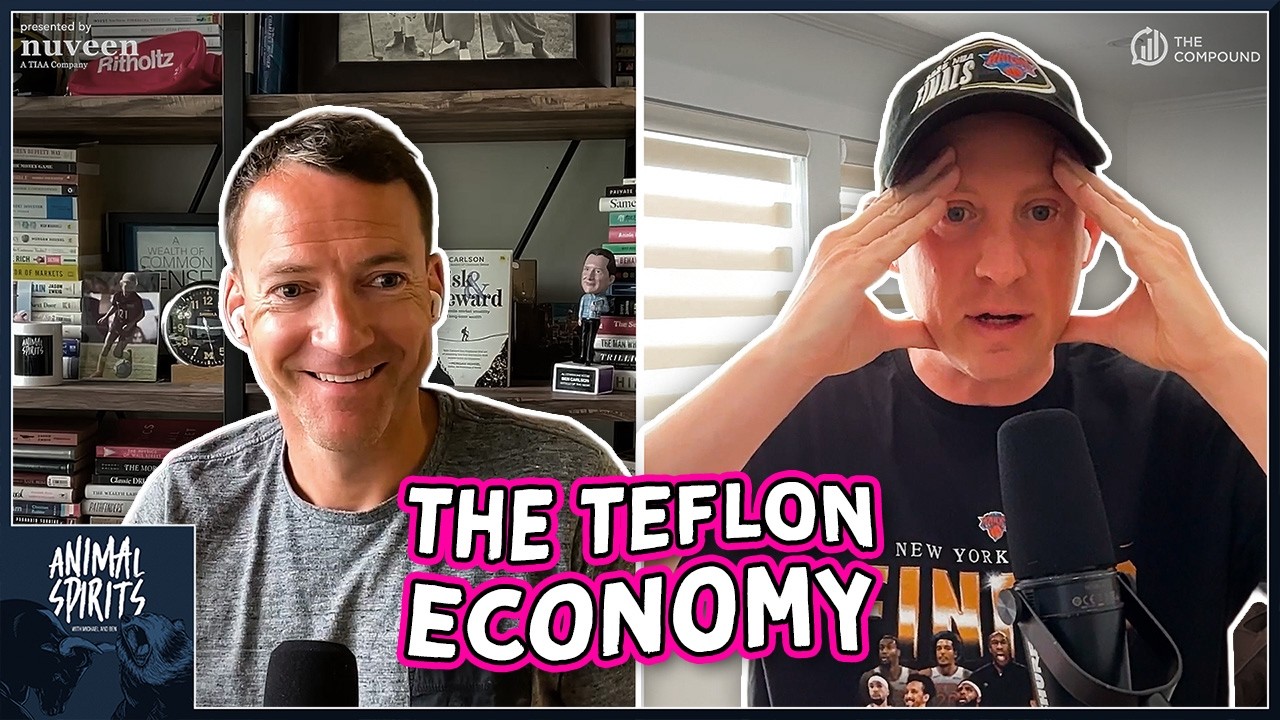
Batnick, Carlson See S&P 500 Concentration Risk Shift To AI From Mag 7
The Compound
Strong labor market data trigger panic sales in high-flying semiconductor stocks as tech and communications sectors expand to comprise nearly half of the S&P 500.
## Background
The Compound published this episode of Animal Spirits (Episode 468) on YouTube on June 10, 2026. The episode features hosts Michael Batnick and Ben Carlson discussing a wide range of topics, including NBA Finals ticket pricing, AI's impact on employment, market selloffs, the Mag 7's performance, the SpaceX IPO, retail trading trends, and general economic dynamics.
## TL;DR
Hosts Michael Batnick and Ben Carlson break down recent market fluctuations, examining why a strong jobs report triggered a stock selloff and debating whether AI is actually threatening the labor market. They explore housing affordability, auto market sticker shock, the resurgence of retail trading, and private credit liquidity gates, contrasting current economic sentiment with historical periods like the 1970s. Interspersed with personal anecdotes about scalping NBA Finals tickets and contractor interactions, the episode provides a grounded look at broader macroeconomic trends and everyday personal finance.
## Atmosphere & style
The podcast maintains a relaxed, conversational, and lighthearted tone, blending analytical market commentary with candid personal storytelling. The dynamic between Batnick and Carlson feels like a friendly, informal bantering session between two seasoned finance professionals who readily poke fun at each other's past market predictions. The emotional arc smoothly transitions from sharp economic debate to humorously self-deprecating personal debacles and thoughtful moments of empathy, creating an accessible, engaging, and unpretentious listening experience.
## Key takeaways
- [00:04](https://www.youtube.com/watch?v=M5makEwHLZk&t=4s) Friday's stock market selloff was triggered by a stronger-than-expected labor market report, illustrating an ongoing dynamic where strong economic news creates investor fear around persistent inflation and delayed Fed rate cuts.
- [03:23](https://www.youtube.com/watch?v=M5makEwHLZk&t=203s) The hosts describe the U.S. economy as the "Teflon Economy" due to its persistent resilience against narrative walls of worry like high inflation, interest rate hikes, commercial real estate stress, and AI displacement fears.
- [03:23](https://www.youtube.com/watch?v=M5makEwHLZk&t=203s) Ben Carlson argues that AI-driven labor market disruption will not happen immediately in a strong economy, but rather during an actual recession when companies use layoffs as cover not to rehire.
- [12:30](https://www.youtube.com/watch?v=M5makEwHLZk&t=750s) Market concentration metrics show that the S&P 493 has been outperforming the Magnificent Seven, while Technology and Communication Services combined now represent nearly 50% of the S&P 500 index.
- [17:11](https://www.youtube.com/watch?v=M5makEwHLZk&t=1031s) The S&P 500 index committee is holding back from fast-tracking SpaceX's inclusion following pushback from pension funds and institutional asset managers.
- [17:11](https://www.youtube.com/watch?v=M5makEwHLZk&t=1031s) Analysis shows that even if SpaceX priced at $1.8 trillion and fell 30%, the drag on broad index products like Vanguard Total Stock Market (VTI) would be a minor 3 basis points.
- [27:05](https://www.youtube.com/watch?v=M5makEwHLZk&t=1625s) Sky-high secondary pricing for events like the NBA Finals at Madison Square Garden reflects fixed supply (19,000 seats) meeting unconstrained demand rather than systemic economy-wide inflation.
- [40:39](https://www.youtube.com/watch?v=M5makEwHLZk&t=2439s) Gen Z is adopting retirement savings faster than previous generations, with their share of IRA ownership doubling to 10% over the past decade and equity ownership among Americans under 40 tripling since 2020.
- [40:39](https://www.youtube.com/watch?v=M5makEwHLZk&t=2439s) Vanguard's S&P 500 ETF (VOO) became the first ETF to reach $1 trillion in assets under management, driven by roughly $70 billion in year-to-date inflows.
- [46:20](https://www.youtube.com/watch?v=M5makEwHLZk&t=2780s) A comparison of current inflation to the 1970s shows the 1970s was objectively far worse, marked by 7.5% average annual inflation, double-digit interest rates up to 18%, and recessions spanning one-third of the era.
- [49:00](https://www.youtube.com/watch?v=M5makEwHLZk&t=2940s) While US tech hyperscalers spend nearly ten times more on AI infrastructure than China, Chinese AI models operate at roughly 90% of US performance levels.
- [52:56](https://www.youtube.com/watch?v=M5makEwHLZk&t=3176s) The current "crypto winter" stems from exhausted early-stage narratives, direct competition with AI for electrical power and tech talent, and crypto's failure to join the tech stock rally.
- [56:22](https://www.youtube.com/watch?v=M5makEwHLZk&t=3382s) Resort and vacation towns like Petoskey, Michigan are facing housing affordability crises where median prices tripled since 2020, causing severe staffing shortages for local essential workers.
- [59:41](https://www.youtube.com/watch?v=M5makEwHLZk&t=3581s) Blackstone's BCRED private credit fund capped quarterly redemptions at 5% after receiving 10% in withdrawal requests, demonstrating how structural liquidity gates manage capital outflows during market stress.
- [01:00:56](https://www.youtube.com/watch?v=M5makEwHLZk&t=3656s) Car shoppers are experiencing severe sticker shock as baseline non-luxury three-row family SUVs now carry ~$54,000 price tags with full-size models reaching $1,500 to $2,500 monthly payments.
- [01:03:43](https://www.youtube.com/watch?v=M5makEwHLZk&t=3823s) The IRS "Rule of 55" permits workers who leave or lose their job in or after the calendar year they turn 55 to withdraw 401(k) or 403(b) funds without the standard 10% early distribution penalty.
Michael Batnick opens the episode by reflecting on the previous Friday’s brutal stock market selloff, admitting with a touch of humor that despite hosting three market podcasts a week—*Animal Spirits*, *What Are Your Thoughts?* with Josh Brown, and *The Compound and Friends*—he did not bring a single specific data point to open the show. Ben Carlson steps in as the designated "stat guy."
```
Nuveen Sponsor Note: The episode opens with a brief message from Nuveen, emphasizing their private market solutions across real estate, credit, infrastructure, and natural capital designed to build resilient portfolios beyond public markets.
```
The hosts dive into the central irony of Friday's market tumble: the drop was triggered by a significantly stronger-than-expected labor market report. Investors quickly spun the good economic news into a reason to panic, questioning whether strong job growth meant AI is not actually boosting productivity or taking jobs as predicted, whether the economy is running too hot, or if the Federal Reserve will be forced to hold back on rate cuts.
Michael pushes back against overly simplistic explanations, arguing that investors were simply looking for an excuse to take profits after an extended run. He notes that the immediate, aggressive selloff shows a lingering layer of fear beneath the surface, which he views as a healthy sign that the market has not reached an unbridled euphoric top.
- **Friday Market Selloff Catalysts:** A stronger-than-expected jobs report raised concerns about persistent inflation, higher interest rates, and the true effectiveness/impact of AI.
- **Market Sentiment:** VIX was at 17 leading into the drop, showing that despite strong overall performance, investors remain jumpy and quick to take profits at any sign of macro danger.
[03:23](https://www.youtube.com/watch?v=M5makEwHLZk&t=203s) The "Teflon Economy" and the AI Labor Debate
Michael and Ben marvel at the resilience of the U.S. economy, labeling it the "Teflon Economy" for its ability to shrug off every major threat thrown at it over the past several years. They recount the long list of narrative "walls of worry" that investors feared would trigger a recession: soaring inflation, aggressive Fed rate hikes, a commercial real estate collapse, the corporate debt maturity wall, spiking tariffs, and elevated gas prices. Now, even the fear of AI-driven mass job displacement is failing to slow down job growth.
```
"We keep saying like, 'No, this economy is Teflon.'... First it was soaring inflation accompanied by higher interest rates... then a commercial real estate collapse... an absolute frozen housing sector... tariffs... higher gasoline prices... and now it's the threat of AI, and you just can't kill this economy."
```
Ben points to economic charts showing non-farm payrolls, job openings, and the three-month moving average of employment growth all breaking out upward. Continuing unemployment claims have remained steady for roughly three years.
A friendly debate emerges over AI's timeline and impact on employment:
* **Ben's Take:** Argues that tech proponents claiming AI will instantly destroy millions of jobs are fundamentally wrong. He contends that if AI causes widespread labor displacement, it will only happen during an actual economic recession when companies use layoffs as cover not to rehire.
* **Michael's Take:** Maintains his stance (held firmly since March) that AI will begin disrupting the labor market much sooner, though he clarifies he isn't in the extreme "10% unemployment" camp.
- **Unemployment Rate:** Held steady at 4.3% alongside rising job openings nationwide.
- **Jobs Data Trend:** The three-month moving average for job creation is trending upward rather than slowing down.
[07:30](https://www.youtube.com/watch?v=M5makEwHLZk&t=450s) Friday's Single-Day Losses and the "Mini-1987" Moment
Ben brings the hard data on Friday's carnage, highlighting single-day double-digit drops across key semiconductor and tech names. He compares the sharp, sudden drop to a localized "mini-1987 situation," where stocks that had experienced massive year-to-date gains suddenly crashed in a single session.
Michael brings up a data point from Blue Kordic Market Insights regarding investor behavior during this bull run: buying the dip on 2% S&P 500 down days has been overwhelmingly profitable. Prior to Friday, there had been 13 other 2% daily drops during the current bull market; four days later, the S&P 500 was higher in 11 out of those 13 instances.
- **1% Down Days:** The S&P 500 averages roughly 31 days per year with a 1% decline; 2026 had only logged 11 such days up to this point.
- **Price Drives Narrative:** The hosts note how falling prices instantly bring out bearish media narratives (e.g., Ray Dalio calling the AI craze a volatile bubble driven by "unsophisticated investors"), whereas rising prices make the exact same market look invincible.
- **Michael's Punch Card Proposal:** Joking about permanent market doom-sayers, Michael suggests financial commentators should get a 5-punch card for calling market crashes—once you use up your 5 calls, you aren't allowed to call for a crash ever again.
[12:30](https://www.youtube.com/watch?v=M5makEwHLZk&t=750s) Market Concentration: Tech Eating the S&P 500
The conversation shifts to market concentration and index performance. Citing data from Exhibit A and Bespoke Investment Group, Ben highlights a surprising trend regarding the "Magnificent Seven" versus the rest of the market:
- **S&P 493 vs. Mag 7:** The S&P 493 (the index excluding the Mag 7) has actually been outperforming both the broader S&P 500 and the Magnificent Seven. The Mag 7 as a collective group has been underperforming the broader index, surprising many who assumed Mag 7 concentration was driving all the gains.
- **Sector Goalposts:** Critics have shifted the narrative from "Mag 7 concentration" to "AI concentration," since memory and chipmakers sitting inside the S&P 493 have seen massive runs.
- **Tech + Comm Services Weight:** Combined, the Technology and Communication Services sectors (which was split off from tech years ago and includes Alphabet and Meta) now account for over **49%** of the entire S&P 500 index—effectively making tech half of the market.
Michael and Ben discuss how hard it is to diversify away from this exposure, noting that even traditional value havens like Berkshire Hathaway have been heavily lagging the broader market indexes during AI-driven rallies.
[14:52](https://www.youtube.com/watch?v=M5makEwHLZk&t=892s) Sector Diversification and the Anti-AI Trade
Michael Batnick and Ben Carlson examine the challenges of market timing versus true portfolio diversification, particularly when trying to move away from mega-cap tech. While investors often seek safety in dividend or value strategies, global markets show extreme volatility under the surface. For example, according to Ed Yardeni, South Korea trades at just eight times forward earnings due to its highly cyclical earnings backdrop. The iShares MSCI South Korea ETF (EWI) surged 240% at its peak before settling back to a 190% gain over the trailing year. Looking closer to home, even broad value indices are dominated by technology companies; Micron Technology ranks as the number one holding in the Russell 1000 Value Index due to massive forward earnings expectations, alongside names like Alphabet and Amazon. Because tech represents roughly 50% of the broader market, completely avoiding it is almost impossible without taking a massive sector bet.
To illustrate what a true "anti-AI" or "X-tech" portfolio looks like, Batnick highlights the Invesco S&P 500 Low Volatility ETF (SPLV). Its multi-year price chart eerily mirrors 1999–2000, having gone essentially nowhere while tech soared. SPLV holds less than 2% combined exposure to technology and communication services, allocation heavily instead to traditional sectors like utilities, financials, and real estate. However, both hosts agree that taking such an extreme stance is effectively an aggressive market-timing call that requires absolute precision to execute successfully.
- South Korea trades at 8x forward earnings due to extreme earnings volatility.
- iShares MSCI South Korea ETF (EWI) was up 240% at its peak and remains up 190% over the past year.
- Tech makes up roughly 50% of broad market indices, making true value tilt hard to achieve without tech heavyweights like Micron, Alphabet, and Amazon.
- SPLV holds 25% utilities, 21% financials, and 18% real estate, serving as a rare vehicle with under 2% combined tech and communications exposure.
---
[17:11](https://www.youtube.com/watch?v=M5makEwHLZk&t=1031s) S&P Index Committee and the SpaceX Inclusion Debate
The conversation turns to index mechanics following insights from ETF analyst Eric Balchunas regarding SpaceX's potential inclusion in the S&P 500. Contrary to expectations that S&P Dow Jones Indices would fast-track Elon Musk's space enterprise, Balchunas reported that the index committee will not fast-track SpaceX, estimating it will take at least a year—if not longer—for inclusion. This stands in stark contrast to other major index providers that typically incorporate mega-cap additions within 5 to 15 days. Reflecting on a recent interview with Aaron Levitt, Batnick notes that committee-based indexers actively gather feedback from massive institutional clients. The delay suggests significant pushback from pension funds and institutional asset managers who voiced a clear preference: "Please don't shove this down our throat."
```
SpaceX Estimated Market Impact (via Nick Maggiulli / Dollars and Data)
┌───────────────────────────┬───────────────────────────────────────────┐
| Index / Portfolio | SpaceX Exposure |
├───────────────────────────┼───────────────────────────────────────────┤
| NASDAQ 100 Weight | ~70 basis points (at 3x float) |
| Vanguard Total Stock (VTI)| $110 for every $100,000 invested |
| Invesco QQQ Trust (QQQ) | $680 for every $100,000 invested |
└───────────────────────────┴───────────────────────────────────────────┘
```
Addressing broader market fears about SpaceX being overvalued, Carlson cites an analysis by colleague Nick Maggiulli (of *Dollars and Data*). Maggiulli calculated that even if SpaceX prices at $1.8 trillion and instantly plummets 30% to its perceived fair valuation of $1.2 trillion, the damage to broad index holders would be negligible. QQQ investors would lose roughly 21 basis points, while total market index (VTI) holders would lose a mere 3 basis points. Batnick argues that the vocal outrage isn't really about a three-basis-point loss—it stems from frustration over how supply is being tightly throttled to artificially inflate the valuation.
- Eric Balchunas noted S&P 500 fast-tracking takes 5–15 days for standard major indices, but SpaceX will take 1–2+ years.
- S&P selection committee responded to pushback from pension funds and large institutional investors.
- A 30% drop in SpaceX upon index inclusion would drag NASDAQ 100 (QQQ) down by 21 bps and Vanguard Total Stock Market (VTI) by just 3 bps.
---
[20:28](https://www.youtube.com/watch?v=M5makEwHLZk&t=1228s) Long-Term Valuation Forecasts and Local Wealth Unlocks
The hosts debate the wild discrepancy between Wall Street finance models and Silicon Valley tech optimism. While finance traditionalists like Aswath Damodaran view the company as overvalued, long-term institutional forecasts tell a different story—such as a Morgan Stanley projection modeling SpaceX revenue to hit an astonishing $3.4 trillion by 2040. Batnick quips that if the tech cycle eventually crashes, quotes predicting multi-trillion-dollar annual revenues will be remembered as the textbook top-of-the-bubble moment: "This will be the quote that we point back to... 'What were you people thinking?'" Meanwhile, secondary news continues to raise eyebrows, including reports of Google agreeing to pay $920 million a month for compute capacity at xAI data centers.
```
+-----------------------------------------------------------------------+
| SpaceX Liquidity & Secondary Market |
+-----------------------------------------------------------------------+
| Morgan Stanley 2040 Revenue Projection: $3.4 Trillion |
| Hyperliquid Pre-IPO Share Price: $158 / share (vs $120 IPO) |
| Hyperliquid 24-Hour Volume: $118 Million |
| Early Employee Windfall Example: $28+ Million (ex-employee) |
+-----------------------------------------------------------------------+
```
Regardless of macro implications, the liquidity unlock will create life-changing individual wealth and localized economic spillover. The *Wall Street Journal* highlighted former employees becoming overnight multi-millionaires—including one early employee who left in 2015, moved to Northern Italy, and is using his $28 million stake to renovate a hotel in Pontebba, declaring, "I don't want to just die with a pile of money in the bank." On the crypto-based decentralized exchange Hyperliquid, pre-IPO SpaceX shares—originally priced at $120—were actively trading at $158 per share with $118 million in 24-hour volume. Carlson and Batnick note how rapidly financial media attention shifts; hyper-focused narratives like silver's massive early-year surge (up 64% in January before giving back all gains to drop -4% YTD) or private credit redemption waves (where Cliffwater reported 14% Q1 and 17% Q2 redemption requests) quickly fade from the spotlight as shiny new objects take over.
- Morgan Stanley projected SpaceX revenue could reach $3.4 trillion by the year 2040.
- Google reported to pay SpaceX/xAI $920 million monthly for data center compute capacity.
- Former SpaceX employee holding early shares saw his stake grow to over $28 million, funding a hotel purchase in Pontebba, Italy.
- Hyperliquid traded pre-IPO SpaceX shares at $158 (up from a $120 reference price) on $118 million in 24-hour trading volume.
- Silver surged 64% by late January 2026 before dropping to -4% YTD; Gold was up 25% early before flattening out.
- Cliffwater logged private credit redemption requests of 14% in Q1 and 17% in Q2.
---
[26:08](https://www.youtube.com/watch?v=M5makEwHLZk&t=1568s) The Micron Hindsight Lesson
Batnick reads a reader email illustrating the pain of paper-trading errors and hindsight bias. The listener described a personal discipline of writing down his fundamental thesis whenever considering a trade. Back in April and May 2025, he analyzed Micron Technology when the stock was trading in the $70s and $80s. Ultimately, he decided against buying, writing in his notebook that memory chips were a commoditized market prone to intense competition. Fast forward to mid-2026, and Micron has skyrocketed to $970 per share. To keep himself grounded, the listener framed the original notebook page and hung it above his desk in his office as a reminder of how wrong fundamental assumptions can be. "Everything is so clear in hindsight," the email read, "and sometimes all you can do is laugh." Carlson jokes that selling good assets early is a shared tradition, ribbing Batnick's team for selling Nvidia stock back in 2018.
- Reader analyzed Micron Technology in mid-2025 at $70–$80 per share and passed due to commodity concerns.
- Micron subsequently rallied to $970 per share by mid-2026.
- The investor framed his original bear thesis notes to hang in his office as a lesson on market efficiency and humility.
---
[27:05](https://www.youtube.com/watch?v=M5makEwHLZk&t=1625s) Michael's Knicks Story: Supply, Demand, and Ticket Market Realities
Batnick dives into a personal story regarding the sky-high market for NBA Finals tickets, framing the outrage over ticket costs through basic economic principles. After a lifelong friend and season-ticket partner sent him a screenshot showing they had sold off their playoff tickets early, Batnick realized they had missed out on historic upside. He explains that Madison Square Garden (MSG) season tickets in section 109, row 20 (lower bowl) have step-up face-value pricing per round: $225 during the regular season, $380 for Round 1, $550 for Round 2, $750 for Round 3, and $1,350 for the NBA Finals.
```
Madison Square Garden Season Ticket Face-Value Escalation (Sec 109, Row 20)
┌───────────────────────────┬───────────────────────────────────────────┐
| Playoff Stage | Face Value Per Ticket |
├───────────────────────────┼───────────────────────────────────────────┤
| Regular Season | $225 |
| Round 1 | $380 |
| Round 2 | $550 |
| Round 3 (Conf. Finals) | $750 |
| NBA Finals | $1,350 |
└───────────────────────────┴───────────────────────────────────────────┘
```
Addressing widespread fan anger over secondary tickets listing for $9,000 or more, Batnick argues that critics are confusing asking prices with actual cleared trades, while ignoring fixed capacity. MSG holds only 19,000 seats, functioning like a central bank that sets primary supply while an unyielding free market sets real-time secondary clearing prices. If the arena artificially capped ticket prices at $2,000, 3 million fans would compete for 19,000 spots, creating immediate shortages. Batnick emphasizes that while pricing out lifelong fans feels harsh, it isn't an economy-wide inflation breakdown—it is simply fixed supply meeting unconstrained demand for a singular, non-reproducible asset.
- MSG Lower Bowl (Section 109, Row 20) ticket costs escalated from $225 base to $1,350 face value for the NBA Finals.
- Secondary market asking prices spiked above $9,000 per ticket due to fixed venue capacity (19,000 seats).
- MSG released small surprise batches of 500 tickets on Sunday (10 a.m. and 2 p.m.) and right before game time to alleviate primary demand.
Michael finishes describing his high-stakes saga attempting to trade Knicks playoff tickets. His broker thought prices would drop back down into the \$200 range, essentially paying them \$500 to attend the game by shorting the market. However, the broker "got caught naked." Michael and his partner compounded their errors: selling their original tickets too early, buying back in too early, and then waiting too long to re-sell when the market turned against them—a sequence Michael calls a "jab, jab, knockout punch."
They had sold their Section 109 tickets for Game 4 at \$4,400 each, only to buy Section 111 tickets for \$7,500 each and Section 200 seats for \$8,000 each. To get back to financial break-even (meaning no worse off than their original \$1,350 cost basis), they needed to sell their original Game 3 tickets for \$12,000 apiece. Though listed at \$18,000 based on asking prices, no real transactions occurred at that level. After a nerve-wracking weekend of lowering prices and text updates, Michael gave his broker a deadline of 10:00 AM on Monday, refusing to be the last one holding the bag.
```
Ticket Transaction Summary (per ticket):
├── Original Cost: $1,350
├── Game 4 Sale: $4,400 (Sold too early)
├── Re-entry Cost (Sec 111): $7,500
├── Re-entry Cost (Sec 200): $8,000
├── Break-even Target: $12,000
└── Final Sale Price: $9,000
```
Just 20 minutes later, the broker sold the tickets for \$9,000 each and waived his commission, providing immense relief. Michael ended up paying \$2,800 per ticket overall rather than \$1,400. Ben points out that someone paid more than the annual Roth IRA contribution limit for a single game ticket. Michael reflects on a bizarre coincidence from the ordeal: while at Rubirosa, a pizza restaurant across from Madison Square Garden, he discovered that Matt Middleton's brother-in-law was the buyer who ultimately purchased his original seats.
- Section 109 tickets for Game 4 were sold at \$4,400 each.
- Worse seats in Section 111 were bought back for \$7,500 each.
- Upper-level Section 200 tickets were purchased for \$8,000 each.
- Break-even required an asking price of \$12,000 per ticket on the original pair; they were initially listed at \$18,000.
- Tickets ultimately cleared at \$9,000 per ticket; the broker waived his fee.
- Net final cost to Michael was \$2,800 per ticket (up from his original \$1,400 basis).
---
[36:07](https://www.youtube.com/watch?v=M5makEwHLZk&t=2167s) Story Time: The Contractor Invoice & A Lesson in Perspective
Michael shares a personal anecdote about grace, gratitude, and unexpected life lessons. A year after moving into his home, he tried to pay a contractor who came as a personal referral. Michael texted him on September 2nd asking how to pay, but received no reply. He texted again on October 30th, saying "As much as I would love to not pay you, I owe you money," but was ghosted again. Out of nowhere, the contractor's office texted him months later with a blunt request for his email to send an invoice.
Feeling irritated by the lack of acknowledgment after trying twice to pay a non-trivial amount of money, Michael requested a call from the contractor. During the phone conversation, Michael voiced his frustration, noting that he had essentially received an "interest-free loan" but found the business practice bizarre. The contractor responded with emotional news: he had spent the last six months taking his six-year-old child to an oncologist.
> "I've been running around for the last six months taking my six-year-old to the oncologist."
Hearing the man's quivering voice gave Michael an immediate "gut punch." He stresses that while 99 times out of 100 people are just being unhelpful or rude, occasionally someone is going through genuine tragedy. It served as an enduring reminder to give people the benefit of the doubt, as you never know what someone else is enduring behind closed doors.
- First payment attempt made on September 2nd; second follow-up on October 30th.
- Over a year passed before the contractor's office texted asking for an email address to send the bill.
- The contractor explained his absence was due to his six-year-old child undergoing cancer treatment.
---
[40:39](https://www.youtube.com/watch?v=M5makEwHLZk&t=2439s) Investor Behavior: Gen Z Roth IRAs, Vanguard VO $1 Trillion, & The Retail Boom
Ben highlights recent data from the Wall Street Journal showing that Gen Z is adopting retirement savings at an unprecedented pace. Over the last decade, the share of total Individual Retirement Account (IRA) owners under age 30 has doubled from 5% to 10%. Furthermore, total IRA contributions from Gen Z jumped 65% in the first quarter of 2026. Data from the Federal Reserve shows corporate equities and mutual fund shares owned by Americans under 40 have tripled since 2020.
Michael pushes back against perpetual market doomers who warn about a 1937-style crash or a 60% drawdown every time young people enter the stock market, calling that cynicism exhausting. Ben points out that market corrections are normal and allow young investors to acquire shares at lower valuations over time.
| Metric / Milestone | Statistic |
|:--- |:--- |
| **Gen Z IRA Share (Last 10 Years)** | Doubled from 5% to 10% |
| **Gen Z IRA Contribution Growth (Q1 2026)** | +65% year-over-year |
| **Equity Ownership (Under 40, Since 2020)** | Increased 3x |
| **Vanguard S&P 500 ETF (VOO) Assets** | Reached $1 Trillion milestone |
| **VOO Year-to-Date Inflows** | ~$70 Billion |
| **SPDR S&P 500 ETF (SPY) Assets** | $770 Billion |
| **Retail Share of Stock Trading (Since 2010)** | Doubled from 10% to 20% |
In milestone ETF news, Vanguard's S&P 500 ETF (VOO) became the first ETF to reach \$1 trillion in assets under management, bolstered by nearly \$70 billion in inflows in 2026 alone. By comparison, SPY holds \$770 billion. Simultaneously, retail investors' share of total stock trading has doubled from 10% in 2010 to 20% today.
Ben notes the juxtaposition in investor behavior: millions of people responsibly dollar-cost averaging into index funds and Roth IRAs, while leveraged products (like 3x single-stock ETFs for SpaceX, Anthropic, or OpenAI) attract speculative activity. Michael observes that high-frequency "degenerate" trading distracts observers from the massive, steady capital flows driving funds like SPY and VOO.
- Gen Z IRA ownership share doubled from 5% to 10% over the past decade.
- Gen Z IRA contributions surged 65% in Q1 2026.
- Stock and mutual fund ownership among investors under 40 has tripled since 2020.
- Vanguard S&P 500 ETF (VOO) became the first ETF to hit \$1 trillion in AUM, drawing \$70B in YTD inflows.
- SPDR S&P 500 ETF (SPY) stands at \$770 billion in AUM.
- Retail trading expanded from 10% of total stock market volume in 2010 to 20% today.
---
[43:54](https://www.youtube.com/watch?v=M5makEwHLZk&t=2634s) The Economy & Wealth Inequality Dynamics
Ben introduces wealth distribution statistics from the Federal Reserve and The New York Times, analyzing how middle-class wealth shares have shifted over recent decades. The traditional middle class has shrunk not because families are sliding into poverty, but because many have moved into upper-middle and upper-class brackets. Between 1979 and recent years, the percentage of middle-class families shrank from 36% to 31%, while the upper-middle class expanded from 10% to 31%.
```
Middle Class Family Distribution (1979 vs. Present)
├── 1979 Middle Class Share: 36%
├── Present Middle Class Share: 31%
└── Upper-Middle Class Share: Grew from 10% to 31%
```
However, relative pie slices reveal stark concentration at the top:
- The middle class share of total aggregate wealth fell from 24% in 1989 to 8% in 2022.
- The upper-middle class wealth share fell from 39% to 30%.
- The top 3% of families saw their share of total wealth more than double, soaring from 26% to 53%.
Ben notes that while living standards and absolute wealth have improved across the board, the concentration of capital among mega-billionaires like Elon Musk, Jeff Bezos, and Bill Gates skews macro statistics. Michael argues that wealth inequality is primarily a political issue rather than a functional economic breakdown: when the top fraction of a percent accumulates massive capital, it creates a perception that resources are being withheld, leading to social friction.
The segment transitions as an audience email challenges Ben's defense of the current economy compared to the 1970s, claiming that real numbers show today's economy is objectively worse on major cost items like homeownership and consumer goods.
- Middle-class family representation changed from 36% (1979) to 31%, while upper-middle class representation grew from 10% to 31%.
- Middle-class share of overall net worth fell from 24% (1989) to 8% (2022).
- Upper-middle class share of total wealth dropped from 39% to 30%.
- The top 3% of American households expanded their share of total national wealth from 26% to 53%.
<ElicitationsGroup message="Explore related discussions from this episode:">
<Elicitation label="Review the discussion on home affordability and 1970s comparisons" query="What points did Ben and Michael make regarding 1970s inflation versus today's cost of living and housing?"/>
<Elicitation label="Examine the impact of AI on the labor market" query="What were the main takeaways from Animal Spirits 468 regarding AI's impact on employment?"/>
</ElicitationsGroup>
[46:20](https://www.youtube.com/watch?v=M5makEwHLZk&t=2780s) Debating Economic Sentiment: The 1970s vs. Today
Ben Carlson and Michael Batnick dive into a sharp pushback from a 54-year-old listener (a Philadelphia 76ers fan born in 1972) who challenged their recent assessment of the current economy versus the 1970s. The listener argued that while consumer electronics like televisions have certainly gotten cheaper, essential expenses—specifically housing, healthcare, and education—have skyrocketed to the point where young people are forced to live in their parents' basements. Crucially, the listener noted that despite the high inflation of the 1970s, a family could generally be supported on a single income, whereas today's young couples typically require two incomes just to get by.
Ben dismisses the listener's personal recollection of the 1970s economy, noting that someone born in 1972 was only a young child at the time and couldn't have firsthand economic awareness. Citing research and a chapter titled "The Great Inflation" from his own book, Ben lays out the objective economic reality of that era to prove that the 1970s economy was vastly worse than today's:
* **Relentless Inflation:** Between 1968 and 1981, US inflation averaged 7.5% annually, with double-digit inflation hitting in three separate years (1974, 1979, and 1980). Not a single year in that decade saw inflation drop below 3%, and in eight out of ten years, it exceeded 5%.
* **Chronic Recessions & High Unemployment:** Between 1961 and 1982, the United States was in a recession for fully one-third of the entire 13-year span. Unemployment spiked to 10%, and three distinct recessions occurred between 1973 and 1982 alone.
* **Prohibitive Mortgage Rates:** By the end of that period, home buyers were facing mortgage interest rates as high as 18%.
While acknowledging that housing affordability and big-ticket items are severe pain points today, Ben and Michael emphasize that claiming overall economic sentiment should be worse today than during the stagflationary 1970s is historically untenable. Jokingly, Ben offers to mail the listener a signed copy of his book so he can read the actual history.
---
[49:00](https://www.youtube.com/watch?v=M5makEwHLZk&t=2940s) AI Efficiency, the US-China Tech Race, and App Saturation
Michael brings up a question posed by a reader regarding the massive capital expenditure surrounding artificial intelligence. While major US hyperscalers (such as AWS, Microsoft, Alphabet, and Meta) spend nearly ten times more on AI infrastructure than China, top Chinese AI models operate at roughly 90% of US performance levels while spending 82% less. The listener questioned how such massive US spending can be justified if American models are only a "nose ahead" and closed-source, asserting that the US should logically be three to four years ahead.
Ben and Michael discuss whether the huge investments by US tech giants will yield adequate returns or whether China is simply piggybacking on US open-source code and research. Michael humorously catches himself about to make an uninformed comment regarding Chinese social media monetization before quickly pointing out China's creation of TikTok.
Moving beyond hardware spend, they examine the real-world utility and adoption of generative AI:
* **App Store Saturation:** Data from the *Financial Times* shows that while generative AI tools have sparked a massive surge in new app releases, user reviews have remained stagnant and the number of apps achieving significant daily usage has actually declined.
* **Content Explosion Without Quality:** Citing analysis from Bob Elliott, Ben notes that AI has caused a massive spike in self-published e-books, scientific paper submissions, and legal filings, but much of it represents low-quality "spaghetti being thrown at the wall."
* **Humorous AI Personalization:** Ben shares a lighthearted personal story about feeding his historical reading list into ChatGPT to get fiction recommendations. ChatGPT recommended Richard Russo's *Straight Man*, adding the conversational comment, "One of the funniest novels I've ever read"—leaving Ben bemused by how naturally AI now emulates human commentary.
---
[52:56](https://www.youtube.com/watch?v=M5makEwHLZk&t=3176s) The "Crypto Winter" and the Arrival of Institutional Banking Rails
The hosts examine the persistent weakness in the cryptocurrency market, referencing a Bloomberg article by Joe Weisenthal outlining twelve reasons why the current "crypto winter" feels uniquely challenging. Among the key structural headwinds:
* **Exhausted Narratives:** Arguments like "we're early" no longer hold water; institutional adoption has largely already taken place, "Crypto Twitter" engagement has waned, and the regulatory backdrop under the current administration is as favorable as it is likely to get.
* **Competition for Resources & Attention:** The AI boom is actively crowding out crypto for both electricity supply and intellectual market share among top tech talent.
* **Risk-On Disconnect:** Most concerningly to Ben, crypto has failed to keep pace during an unprecedented tech equity boom. Despite historically trading as a high-beta "risk-on" asset, it is lagging while stocks hit new highs, signaling widespread market apathy.
Michael points out additional market oddities, such as MicroStrategy's Michael Saylor—who famously urged investors never to sell their Bitcoin—selling a portion of MicroStrategy's holdings to cover preferred stock obligations before turning around and buying $100 million more.
Concurrently, traditional finance is moving into blockchain technology without impacting coin prices. The *Wall Street Journal* reports that the largest US commercial banks—operating through The Clearing House (jointly owned by JPMorgan Chase, Bank of America, Citigroup, Wells Fargo, and others)—plan to launch a tokenized deposit network next year. Designed to allow 24/7 instant settlement of bank deposits across blockchain rails, this represents a major convergence of traditional banking and digital assets. However, as Michael and Ben observe, retail crypto investors remain largely indifferent because such infrastructural milestones no longer drive token prices upward.
---
[56:22](https://www.youtube.com/watch?v=M5makEwHLZk&t=3382s) Real Estate Sticker Shock in Northern Michigan and Vacation Towns
Ben shares reflections from recent trips back to his hometown of Traverse City in Northern Michigan for his children's soccer tournaments. Reflecting on how eager he was to leave his small town at age 18, Ben admits that returning as an adult makes him appreciate its natural beauty—particularly the summer months from June through October along the East Bay. However, the region has undergone a massive transformation as old waterfront homes have been demolished to build luxury mansions.
This local shift mirrors a broader crisis across desirable vacation destinations where remote work and pandemic migrations have priced out local workforces:
* **Tripling Housing Costs:** In Petoskey, Michigan (an hour and a half north of Traverse City), median available home prices skyrocketed from $310,000 in 2020 to $1.1 million—a more than threefold increase in just a few years.
* **Displacement of Local Workers:** Out-of-town seasonal residents have bought up over half of the homes in Petoskey (a city of 5,800 residents), leaving local employers unable to staff essential services. Schools are forced to ask job applicants if they already have secured housing before interviewing them, with many candidates turning down job offers due to the lack of affordable shelter.
* **Service Bottlenecks:** Ben recalls visiting local restaurants on weekday evenings only to find them closed due to severe staffing shortages.
Michael and Ben conclude that there is no easy solution to the housing crisis in newly "discovered" scenic towns. Without aggressive new housing construction, local working-class residents—including teachers, police officers, and hospitality staff—are continuously priced out with no structural incentive for local government bodies to fix the problem.
Briefly touching on private markets, the hosts review recent liquidity developments at Blackstone's flagship private credit fund, BCRED.
* During the second quarter, investors requested redemptions equal to 10% of the fund's net asset value, up from 8% in the first quarter (representing roughly $4.4 billion in redemption requests).
* In accordance with its structural terms, Blackstone is capping quarterly redemptions at the standard 5% limit.
Ben and Michael briefly note that despite market commentary surrounding these redemption gates, the broader market has largely absorbed the news with little panic or disruption.
---
<ElicitationsGroup message="Where would you like to go next?">
{/* Reason: Path A chosen - prompt is broad (walkthrough of a multi-topic transcript excerpt). Providing clear, actionable next steps to explore specific topics mentioned in the text. */}
<Elicitation label="Analyze 1970s stagflation vs. current inflation" query="Deep dive into the economic data comparing 1970s stagflation with current US inflation and interest rates."/>
<Elicitation label="Explore BCRED and private credit redemption gates" query="Explain how private credit redemption gates work, using Blackstone's BCRED fund as an example."/>
</ElicitationsGroup>
[01:00:00](https://www.youtube.com/watch?v=M5makEwHLZk&t=3600s) Private Credit Redemption Gates and Bank Runs
Michael Batnick and Ben Carlson continue their discussion on private credit funds and liquidity gates, evaluating how the industry will handle persistent quarterly redemptions. Batnick questions whether these funds might face redemptions of around 5% per quarter over the next year or two, but Carlson notes that the reality isn't quite that straightforward because incoming capital and existing credit facilities help offset outgoing cash. They discuss how the current gated redemption structures are designed precisely to manage this friction and prevent panic selling. If private credit markets avoid a major blowup over the next few quarters and returns stay respectable, the intense media scrutiny and panic headlines should dissipate, leading investors to realize the scare was largely "much ado about nothing."
Drawing a historical parallel to the Panic of 1907, Carlson highlights the famous story of J.P. Morgan instructing bank tellers to count cash as slowly as possible to delay withdrawals and halt a classic bank run. Batnick and Carlson see private credit liquidity gates as the modern equivalent—a mechanism designed to slow down capital outflows and maintain market stability during periods of stress.
---
* **Historical Analogy:** During the Panic of 1907, J.P. Morgan famously curbed a bank run by ordering tellers to count out cash physically slowly, reducing the total amount paid out each day.
[01:00:56](https://www.youtube.com/watch?v=M5makEwHLZk&t=3656s) Auto Sticker Shock and "Trader-Down" Vehicles
Ben Carlson pivots the conversation to his personal car-buying experience, contrasting it with Batnick's practice of using a car broker. Self-identifying as a "man of the people" who still does his own car shopping, Carlson details how he has been using AI models like ChatGPT heavily to research vehicles, analyze option packages, and draft negotiation strategies. Returning to the market three years after his last lease expired, he reports experiencing intense sticker shock because his prior lease had benefited from significant equity built up during the pandemic-era used car boom.
Looking across common SUV models on the road—such as Jeeps, Wagoneers, Suburbans, Tahoes, Expeditions, and Lincoln Navigators—Carlson expresses astonishment that typical monthly lease or finance payments now run between $1,500 and $2,500 per month. Even mid-market non-luxury three-row vehicles like the Honda Pilot or Volvo XC90 command monthly payments well over $1,000. Surprised by the sheer density of these high-cost vehicles in everyday suburban settings like youth soccer games, Carlson questions how average families afford them. Because his young kids inevitably clutter and wear down his vehicles, Carlson decided to "trade down" to a Kia Telluride—only to discover that even a basic, affordable family car now carries a price tag around $54,000, with dealers reporting they still cannot keep them on the lot.
---
* **Monthly Payment Range:** Standard full-size SUVs (Wagoneer, Tahoe, Suburban, Navigator) currently cost $1,500 to $2,500 per month.
* **Mid-Size & Luxury Crossovers:** Models like the Honda Pilot or Volvo XC90 routinely cost well over $1,000 per month.
* **Baseline Family Vehicle Price:** A standard Kia Telluride carries an MSRP of around $54,000, which Batnick notes used to be the price tag of a high-performance luxury car like a BMW M3 in earlier decades.
[01:03:43](https://www.youtube.com/watch?v=M5makEwHLZk&t=3823s) Personal Finance, Rule of 55, and AI Tools
Batnick reads a listener letter from a 53-year-old viewer planning for early retirement at age 55, who pushed back against Carlson's past comments questioning why 55 is such a common benchmark. The listener points out the IRS "Rule of 55," which allows workers who leave their employer in or after the calendar year they turn 55 to take penalty-free distributions from their current 401(k) or 403(b) account. Carlson clarifies that he frequently sees 30-somethings planning around age 55 without realizing the nuances of the rule, though he notes they have covered the Rule of 55 extensively on *Ask The Compound*.
Batnick notes that he cross-checked the rule using AI tools like Claude and ChatGPT, receiving instant, accurate answers that were subsequently confirmed by Ritholtz Wealth colleague Bill Sweet. The hosts reflect on how generative AI is turning everyday consumers into far better-informed financial clients. While some see AI as a competitive threat to financial advisors, Carlson and Batnick argue that advisors actually prefer working with informed clients, as it eliminates the tedious groundwork of basic financial education and allows them to dive directly into complex planning strategies.
---
* **IRS Rule of 55:** Allows individuals who leave or lose their job in the year they turn 55 (or older) to withdraw funds from their current employer's 401(k) or 403(b) without incurring the standard 10% early withdrawal penalty.
* **Advisor Efficiency:** Carlson notes that the hardest prospective clients to advise are those with zero financial knowledge, whereas educated clients make for far more productive planning discussions.
[01:05:54](https://www.youtube.com/watch?v=M5makEwHLZk&t=3954s) Loving the Game: Working into Your 80s
Carlson shares insights from his recent media tour for his book, highlighting two impactful interviews with financial veterans over age 80. He appeared on Jeremy Schwartz's SiriusXM show *Behind the Markets* alongside Wharton professor Jeremy Siegel (age 80), and on Robin Farzad's podcast with long-time index investing advocate Paul Merriman (age 83). Carlson was struck by their unflagging enthusiasm—noting how Siegel still gets as wide-eyed and excited discussing market trends as a child, while Merriman continues actively producing podcasts, writing newsletters, and educating investors on low-cost index allocation.
While many in the personal finance world obsess over the FIRE (Financial Independence, Retire Early) movement to escape jobs they dislike, Carlson and Batnick agree that finding work you genuinely love enough to pursue into your 80s represents the ultimate financial dream. They emphasize that everyone's personal definition of financial freedom varies, but remaining engaged in passion-driven work late in life is a top-tier outcome.
---
* **Jeremy Siegel:** Wharton professor and author, still actively broadcasting and analyzing financial markets at age 80.
* **Paul Merriman:** Financial educator, author, and foundation founder, continuing to publish market newsletters and host podcasts at age 83.
[01:07:35](https://www.youtube.com/watch?v=M5makEwHLZk&t=4055s) Movie Theater Revival and Media Recommendations
The hosts wrap up the episode discussing current entertainment trends, beginning with Batnick's recent trip to a packed movie theater on a Friday night to see *Obsession*, a horror film directed by Curry Barker. Batnick praises Barker's trajectory from posting viral short horror films on YouTube (such as *The Chair* and *Milk & Cereal*) to directing a low-budget feature made for under $700,000 that is filling theaters weeks into its release run. Batnick explains the plot premise: a young man uses a novel prop called "One Wish Willow" to wish that the girl he likes would love him more than anyone else in the world, leading to chaotic, extreme consequences.
Batnick compares the film's tone to A24's hit *Talk to Me*, categorizing it as "elevated horror." Both hosts celebrate the resurgence of moviegoing culture among younger audiences, noting that theaters are packed despite minor box-office missteps like *Masters of the Universe*. Batnick recounts an incident during the screening where a father took his 11- or 12-year-old child to see the movie; after a particularly graphic scene, the parent walked out with the kid in tow. Batnick jokes about the stark contrast between modern parenting standards and his own childhood, recalling how his father took him to see R-rated thrillers like *8mm* at age 13, and referencing Quentin Tarantino's anecdote that his mother preferred him watching violent cinema over the real-world news.
To close out the section, Carlson shares his television recommendation: the second season of *The Four Seasons* on Netflix, starring Tina Fey, Will Forte, and Colman Domingo. Carlson praises the series' unique structural format—which divides each season into two-episode blocks centered around specific holidays or family vacations—and lauds its relatable, witty depiction of middle-aged friendship and marriage dynamics.
---
* **Film Industry Insights:**
* *Obsession:* Micro-budget horror movie directed by YouTube creator Curry Barker, produced for approximately $700,000.
* *Box Office Performance:* Strong theatrical runs for indie horror contrast with high-profile studio flops like *Masters of the Universe*.
* **Television Recommendation:**
* *The Four Seasons* (Netflix): Created by and starring Tina Fey alongside Will Forte and Colman Domingo. Features a unique structure where every two episodes cover a distinct season and vacation.
[01:13:34](https://www.youtube.com/watch?v=M5makEwHLZk&t=4414s) TV Show Catch-Ups and '90s Rom-Com Nostalgia
The hosts wrap up their media recommendations, touching on television shows before diving into a detailed reflection on 1990s romantic comedies. After briefly chatting about a show that occasionally goes "a little off the rails" but succeeds because of its strong family dynamics, they reflect on *The Sympathizer* (referred to as *Half Man*), which they both agree was exceptionally well-acted despite being thoroughly "depraved" and sticking in the back of your brain for days.
The conversation then shifts to a wholesome streak of '90s romantic comedies that Ben Carlson has been watching with his 12-year-old daughter. Over the past ten days, they have marathons of *Notting Hill*, *My Best Friend's Wedding*, and *You've Got Mail*. Ben admits he is milking the experience for all it's worth, fully aware that in a couple of years, she will likely tell him to scram. They joke about how the central premise of many '90s rom-coms wouldn't work or be believable today because gorgeous, ridiculously charming leads are placed in absurdly low-level positions.
* In *Notting Hill*, Hugh Grant plays a strikingly handsome, charming man who works at a niche travel bookstore that exclusively sells travel books.
* In *While You Were Sleeping*, Sandra Bullock plays a subway token collector in Chicago.
* Ben had to explain the mechanics of 1990s America Online (AOL) and dial-up email notifications to his daughter while watching *You've Got Mail*.
* They marvel at how movie stars like Julia Roberts and Tom Hanks peaked so massively in the '90s and early 2000s, noting how difficult it is to sustain that level of box-office dominant stardom into one's 50s.
---
[01:15:30](https://www.youtube.com/watch?v=M5makEwHLZk&t=4530s) Michael Jackson, Kid Quirks, and Listener Mail Callout
The discussion takes a brief, funny detour into family life as they touch on a Michael Jackson documentary and their kids' recent, perplexing fixations. Ben mentions his kids—including his son Logan—asking him to print out Michael Jackson color pages, leaving him wondering what parental obligation he even has to navigate strange pop-culture rabbit holes with young kids.
To wrap up the episode, the hosts invite listeners to send in their feedback and critiques, specifically mocking hot takes comparing the current economy to the 1970s. Michael Batnick welcomes the pushback, noting that he loves when listeners write in with playfully sarcastic or "dickish" emails, like recurring feedback from "the '70s Philly guy" or "the 55-year-old guy," knowing it all comes from a place of love and fandom.
* Listeners are encouraged to send feedback and '70s economic takes to `animalspirits@thecompoundnews.com`.
## Notable quotes
> [03:23](https://www.youtube.com/watch?v=M5makEwHLZk&t=203s) We keep saying like, 'No, this economy is Teflon.'... First it was soaring inflation accompanied by higher interest rates... then a commercial real estate collapse... an absolute frozen housing sector... tariffs... higher gasoline prices... and now it's the threat of AI, and you just can't kill this economy.
> [20:28](https://www.youtube.com/watch?v=M5makEwHLZk&t=1228s) I don't want to just die with a pile of money in the bank. — Former SpaceX Employee
> [26:08](https://www.youtube.com/watch?v=M5makEwHLZk&t=1568s) Everything is so clear in hindsight, and sometimes all you can do is laugh. — Listener Email
> [36:07](https://www.youtube.com/watch?v=M5makEwHLZk&t=2167s) As much as I would love to not pay you, I owe you money — Michael Batnick
> [36:07](https://www.youtube.com/watch?v=M5makEwHLZk&t=2167s) I've been running around for the last six months taking my six-year-old to the oncologist. — Contractor
> [46:20](https://www.youtube.com/watch?v=M5makEwHLZk&t=2780s) The Great Inflation — Ben Carlson
> [49:00](https://www.youtube.com/watch?v=M5makEwHLZk&t=2940s) One of the funniest novels I've ever read — ChatGPT
## Mentioned
Michael Batnick, Ben Carlson, Nuveen, Micron, SanDisk, Western Digital, THNQ, iShares MSCI South Korea ETF, Invesco S&P 500 Low Volatility ETF, S&P 500, SpaceX, Eric Balchunas, Aaron Levitt, Nick Maggiulli, Aswath Damodaran, Morgan Stanley, Google, xAI, Hyperliquid, Cliffwater, Nvidia, Madison Square Garden, Rubirosa, Matt Middleton, Vanguard S&P 500 ETF, SPDR S&P 500 ETF, Elon Musk, Jeff Bezos, Bill Gates, Bob Elliott, ChatGPT, Richard Russo, Joe Weisenthal, MicroStrategy, Michael Saylor, The Clearing House, JPMorgan Chase, Bank of America, Citigroup, Wells Fargo, Blackstone, J.P. Morgan, Kia Telluride, Claude, Bill Sweet, Jeremy Schwartz, Jeremy Siegel, Robin Farzad, Paul Merriman, Curry Barker, Tina Fey, Will Forte, Colman Domingo, Quentin Tarantino, Hugh Grant, Sandra Bullock, Julia Roberts, Tom Hanks, Michael Jackson
Michael Batnick and Ben Carlson argue that the U.S. economy remains resilient against recurrent recession narratives, even as heavy index concentration, localized affordability pressures, and private liquidity constraints challenge investors.
Labor Strength and the Teflon Economy Debate (3:23)
The hosts characterize the U.S. macroeconomic backdrop as a 'Teflon Economy' that has continually shrugged off threats, including aggressive Federal Reserve rate hikes, commercial real estate stress, corporate debt maturity walls, tariffs, and high energy prices. A paradox emerged when a stronger-than-expected labor report catalyzed a sharp stock selloff, as investors worried about prolonged interest rate pressures and questioned AI's near-term productivity gains. Despite these fears, underlying labor metrics remain durable, with unemployment holding at 4.3%, three-year continuing claims remaining flat, and the three-month moving average of payrolls breaking higher.
A central disagreement between the hosts centers on AI's potential to displace workers. Carlson contends that technological disruption will not immediately generate mass unemployment, arguing that significant job reductions will only materialize during a broader recession when firms use economic cover to freeze hiring. Batnick maintains that AI will begin disrupting labor markets far sooner, though he dismisses extreme projections of double-digit unemployment.
Tech Concentration and Market Structure Distortions (12:30)
Sudden single-day plunges in semiconductor names—including Micron (-13%), Western Digital (-11%), and the SMH ETF (-9.2%)—highlight underlying market fragility despite steady dip-buying behavior. While the S&P 493 has recently outperformed the Magnificent Seven, Technology and Communication Services combined now account for over 49% of the S&P 500 index. This heavy weighting prevents conventional value indices from providing clean diversification; for instance, Micron is the largest holding in the Russell 1000 Value Index, and avoiding tech entirely requires extreme allocations toward utilities and real estate via vehicles like SPLV.
Market structure debates also extend to mega-cap private additions like SpaceX. While traditional index providers often integrate additions within 5 to 15 days, ETF analyst Eric Balchunas reports the S&P Index Committee will delay inclusion for at least a year following pushback from institutional asset managers and pension funds. Addressing concerns over inflated private valuations, Nick Maggiulli's data indicates that even a 30% drop in SpaceX's valuation upon inclusion would drag the Nasdaq 100 down by just 21 basis points and the Vanguard Total Stock Market Index by only 3 basis points.
Generational Accumulation and Shifting Wealth Distribution (40:39)
Retail engagement shows a structural shift toward disciplined long-term investing among younger generations. Data from the Wall Street Journal and the Federal Reserve shows that Gen Z's share of total IRA ownership doubled from 5% to 10% over the past decade, with Gen Z contributions surging 65% year-over-year in the first quarter of 2026. Simultaneously, equity and mutual fund ownership among Americans under 40 has tripled since 2020. This systemic accumulation has propelled the Vanguard S&P 500 ETF (VOO) past $1 trillion in assets under management on $70 billion in year-to-date inflows, even as retail trading volume expanded to 20% of total equity transactions.
This expansion of young retail capital contrasts with longer-term wealth distribution shifts. Federal Reserve data indicates the middle-class share of families contracted from 36% in 1979 to 31% today, driven primarily by households advancing into the upper-middle class (which rose from 10% to 31%). However, aggregate wealth concentration tells a different story: the middle class's share of total wealth dropped from 24% in 1989 to 8% in 2022, while the top 3% of households expanded their share from 26% to 53%.
Historical Stagflation vs. Modern Cost Pressures (46:20)
Addressing listener feedback comparing today's economy unfavorably to the 1970s, Carlson cites historical data showing the 1970s economy was fundamentally more punitive. Between 1968 and 1981, U.S. inflation averaged 7.5% annually, unemployment reached 10%, the nation spent one-third of a 13-year period in recession, and mortgage rates eventually touched 18%. While confirming that modern essentials like housing, healthcare, and higher education present genuine hurdles, Carlson rejects the view that current macroeconomic sentiment should match the stagflation era.
Nevertheless, severe cost pressures are acute in specific sectors and local markets. In vacation hubs like Petoskey, Michigan, median home prices surged from $310,000 in 2020 to $1.1 million, pricing out municipal workers and school staff. In the automotive market, monthly financing and lease payments on standard full-size SUVs have risen to between $1,500 and $2,500, with mass-market family vehicles like the Kia Telluride reaching a baseline price of roughly $54,000.
Structural Liquidity in Private Credit and Crypto (59:41)
In private markets, liquidity gates are operating as originally designed to curb rapid capital flight. Blackstone's private credit vehicle, BCRED, capped redemptions at 5% after second-quarter withdrawal requests climbed to 10% ($4.4 billion). Carlson compares these redemption restrictions to J.P. Morgan's tactics during the Panic of 1907—ordering tellers to count physical cash slowly to slow a bank run—and Batnick notes that incoming capital and existing facilities mitigate panic if fund performance remains steady.
Meanwhile, the cryptocurrency sector faces an apathy-driven downturn despite record highs across tech equities. As outlined by Bloomberg's Joe Weisenthal, digital assets are struggling against narrative exhaustion, competition from AI for capital and power resources, and a decoupling from general risk-on equity rallies. Although traditional finance is advancing into blockchain rails—exemplified by commercial banks developing a 24/7 tokenized deposit network through The Clearing House—these institutional developments have not spurred speculative retail coin appreciation.
While aggregate employment figures and steady index inflows affirm the durability of the U.S. macro expansion, Batnick and Carlson point out that index concentration, structural liquidity limits, and localized cost pressures continue to complicate the financial reality for both market participants and consumers.
## Background
本期视频由 YouTube 频道 The Compound 于 2026 年 6 月 13 日发布,是其旗下播客节目《Animal Spirits》的第 468 期。根据简介,主播迈克尔·巴特尼克(Michael Batnick)与本·卡尔森(Ben Carlson)围绕强劲非农引发的美股单日抛售、特氟龙经济、AI 对就业的实际影响、SpaceX 估值与 IPO 争议、先锋首只万亿 ETF、尼克斯总决赛门票炒作、新车标价冲击及文化消费推荐等话题展开了全面探讨。
## TL;DR
节目首先从超预期非农就业数据引发科技股单日大跌切入,剖析了‘好消息即坏消息’的宏观悖论与‘价格塑造叙事’的投资者心理,指出大盘在‘特氟龙经济’韧性下的集中度隐忧与 SpaceX 等标的引发的狂热投机。随后,迈克尔通过自己倒腾尼克斯总决赛门票惨遭‘做空踩踏’的荒诞经历,生动映射出市场流动性与追高杀跌的残酷人性,并借一段催款插曲反思了生活中同理心的重量。最后,两人结合扎实的历史通胀数据有力反驳了‘70年代好过当下’的听众质疑,并延伸探讨了生成式 AI 泡沫、加密货币叙事危机、私募信贷赎回门、SUV 高额车贷以及 80 岁金融学者展现的终身热爱。
## Atmosphere & style
整期播客充满生动幽默与坦诚自嘲的‘老友互损’氛围,迈克尔的感性叙事、直率吐槽与本的理性数据、历史引经据典形成了极佳的化学反应。从吐槽达利欧‘崩盘预警打孔卡’时的犀利捧哏,到复盘尼克斯门票亏损时的抓狂与失眠,再到得知失联师傅家事变故时的当头一棒与情感沉淀,对话在荒诞戏谑与深刻反思间收放自如。听感就像坐在咖啡馆旁听两位饱经沧桑却热爱生活的华尔街老友闲聊,既有扎实的宏观理财干货,又流淌着接地气的人情冷暖与中年生活洞察。
## Bulletin
- [41:48](https://www.youtube.com/watch?v=M5makEwHLZk&t=2508s) 先锋领航(Vanguard)旗下标普 500 ETF(VOO)资产管理规模正式突破 1 万亿美元,成为历史上首只触及该里程碑的 ETF,今年单年净流入已达约 700 亿美元。
- [01:35](https://www.youtube.com/watch?v=M5makEwHLZk&t=95s) 超预期非农就业报告破除了 AI 摧毁就业的短期叙事,但薪资过热与通胀担忧打压降息预期,触发美光科技跌 13%、半导体 ETF 跌 9.2% 的科技股单日大跌。
- [12:30](https://www.youtube.com/watch?v=M5makEwHLZk&t=750s) 信息技术板块与通信服务板块合计占标普 500 指数权重已突破 49%,相当于大盘其余九大板块的总和,若剔除科技七巨头的标普 493 实际上近期跑赢了整体指数及七巨头组合。
- [59:41](https://www.youtube.com/watch?v=M5makEwHLZk&t=3581s) 黑石旗下旗舰私募信贷基金 BCRED 在第二季度遭遇占总份额 10%(约 44 亿美元)的赎回申请,黑石依法启用季度 5% 赎回闸门限额以时间换空间平复挤兑预期。
## Key takeaways
- [01:35](https://www.youtube.com/watch?v=M5makEwHLZk&t=95s) 强劲非农数据打破了“AI 替代就业”的悲观叙事,但反而因过热引发推迟降息的担忧,导致科技股估值遭遇剧烈回撤。
- [03:26](https://www.youtube.com/watch?v=M5makEwHLZk&t=206s) 宏观经济展现出“特氟龙经济”的强劲韧性,先后经受住了暴力加息、商业地产困境、再融资到期墙等多轮危机预言的考验。
- [09:06](https://www.youtube.com/watch?v=M5makEwHLZk&t=546s) 市场价格往往决定舆论叙事:上涨时 AI 革命被视为永恒繁荣,单日重挫时看空与泡沫怀疑论迅速占据主流。
- [12:30](https://www.youtube.com/watch?v=M5makEwHLZk&t=750s) 信息技术与通信服务板块合计已吞噬标普 500 权重接近半壁江山(超 49%),导致传统价值指数也被美光、谷歌等科技股变相渗透。
- [17:09](https://www.youtube.com/watch?v=M5makEwHLZk&t=1029s) 标普 500 指数委员会拒绝为 SpaceX 上市开通破格快速纳入通道,反映出机构投资者对人为限制流通盘拉高估值的普遍抵触。
- [17:56](https://www.youtube.com/watch?v=M5makEwHLZk&t=1076s) 即便考虑 SpaceX 达 1.8 万亿美元的高估值,其在主流被动指数(如 VTI、QQQ)中的实际敞口极小,对大盘指数整体安全性影响有限。
- [23:12](https://www.youtube.com/watch?v=M5makEwHLZk&t=1392s) 金融市场呈现单线程关注特征,热点由年初贵金属暴涨与私贷流动性挤兑,迅速轮动至未上市资产及 SpaceX 的二级投机。
- [27:24](https://www.youtube.com/watch?v=M5makEwHLZk&t=1644s) 迈克尔高位倒腾尼克斯总决赛球票惨遭做空踩踏,揭示了流动性不足与贪恋价差在极端供需市场中引发的连环亏损教训。
- [37:12](https://www.youtube.com/watch?v=M5makEwHLZk&t=2232s) 生活中的冲突与误解往往源于信息盲区,在对待延期收款等摩擦时保持同理心是理解他人生活沉重负担的关键。
- [40:39](https://www.youtube.com/watch?v=M5makEwHLZk&t=2439s) Z 世代正加速参与长期理财,近十年年轻一代 IRA 账户占比翻倍,一季度对 IRA 缴费额同比激增 65%。
- [41:48](https://www.youtube.com/watch?v=M5makEwHLZk&t=2508s) 当前资本市场兼具“教堂”与“赌场”特征:低成本宽基指数基金迎来万亿里程碑,同时高杠杆衍生品与个股投机盛行。
- [46:16](https://www.youtube.com/watch?v=M5makEwHLZk&t=2776s) 以恶性滞胀和两位数通胀为标志的 1970 年代在客观经济数据上远比当下恶劣,所谓“过去更好”多是缺乏历史参照的怀旧滤镜。
- [49:03](https://www.youtube.com/watch?v=M5makEwHLZk&t=2943s) 中美 AI 产业呈现巨额 Capex 与模型性能的不对称竞争,千亿美元资本支出能否构筑真正的商业化护城河成为核心疑虑。
- [52:57](https://www.youtube.com/watch?v=M5makEwHLZk&t=3177s) 加密货币在美股牛市中陷入冷清,资产属性更贴近高风险偏好资产而非抗跌避险工具,且缺乏下一代爆发性叙事催化剂。
- [54:48](https://www.youtube.com/watch?v=M5makEwHLZk&t=3288s) 主流银行拟推出 24/7 全天候代币化存款清算网络,但市场在币价低迷时对底层结算技术的重大升级表现出极度冷漠。
- [56:22](https://www.youtube.com/watch?v=M5makEwHLZk&t=3382s) 风景胜地小城镇遭遇外来度假资本洗牌,房价数年暴涨数倍,将教师与警察等基础服务劳动力挤出,导致社区公共运转受阻。
- [01:00:56](https://www.youtube.com/watch?v=M5makEwHLZk&t=3656s) 家用新车与中大型 SUV 售价普遍突破 5 万至 10 万美元,车贷月供跨过千元门槛,普通家庭正面临巨大的车价标价冲击。
- [01:03:43](https://www.youtube.com/watch?v=M5makEwHLZk&t=3823s) 生成式 AI 在个人财务规划普及上效率卓越,促使理财客户更趋理性,也减轻了传统财务顾问在基础教育上的沟通成本。
- [01:05:58](https://www.youtube.com/watch?v=M5makEwHLZk&t=3958s) 与其为了逃避厌烦的工作而执着于 55 岁极速早退,像八旬学者那样寻得可终身投入热爱的长期事业是更高维度的财富体验。
## Detailed walkthrough
### [00:00](https://www.youtube.com/watch?v=M5makEwHLZk&t=0s) Nuveen 赞助与节目开场
节目由专注于私募市场的资产管理机构 Nuveen 赞助播出。Nuveen 强调私募市场正在重塑现代投资组合的构建方式,其投资策略涵盖房地产、信贷、基础设施以及自然资本等领域,旨在帮助投资者在当今复杂的市场环境中获取超越传统公开市场的韧性。
节目正式开场,主播迈克尔·巴特尼克(Michael Batnick)与本·卡尔森(Ben Carlson)打完招呼后,迈克尔便直奔主题,谈及刚刚过去的周五是近期美股“极其惨烈的一天”。他自我调侃道,开场时自己手头竟然连一个具体的数据点都没准备好;作为每周主持三档播客(《Animal Spirits》、《What Are Your Thoughts?》以及《The Compound and Friends》)的创作者,他一直尽量避免内容自我重复,但今天开场确实把统计数据留了白。本随即笑着接话,表示自己来充当本期的“数据狂人”(stat guy)。
### [01:35](https://www.youtube.com/watch?v=M5makEwHLZk&t=95s) 强劲非农数据引发的股市暴跌与讽刺叙事
引发周五股市大跌的直接导火索,是一份表现远超预期的强劲非农就业报告。这随即形成了一种极为讽刺的市场叙事:原本被渲染得神乎其神的“AI 正在毁灭就业市场”论调被现实数据打破;既然劳动力市场依然滚烫、经济增长过强,那么美联储不仅不需要紧急降息,反而可能因通胀担忧而维持紧缩。投资者面对“就业好反而股市跌”(good jobs market equals bad stock market)的局面,产生了一种戏剧性的混乱。
迈克尔对周五的暴跌进行了两层维度的解读。首先,他乐见市场在察觉到一丝潜在风险时依然会迅速给投资者“一记耳光”。人们依然在极力寻找卖出理由,而非闭眼买入,这种充满警惕的情绪恰恰说明市场尚未见顶。哪怕波动率指数(VIX)只有 17,哪怕指数屡创新高,只要有一点“行情过热、周期尾声”的风吹草动,看跌情绪就会瞬间蔓延。本调侃这种心态就像密歇根雨天里的中年父亲,看着窗外的瓢泼大雨感叹:“草坪确实需要这场雨浇灌一下。”
```mermaid
flowchart TD
accTitle: 劳动力市场数据与市场负反馈链条
accDescr: 展示强劲就业数据如何引发降息预期破灭及芯片科技股抛售
A["超预期强劲的非农就业数据"] --> B["就业市场过热 / 薪资与通胀担忧"]
B --> C["降息预期推迟或降温"]
A --> D["AI摧毁就业论证被证伪"]
D --> E["科技股估值逻辑与溢价受质疑"]
C & E --> F["高估值科技股集体暴跌 (周五惨烈抛售)"]
```
### [03:26](https://www.youtube.com/watch?v=M5makEwHLZk&t=206s) 坚不可摧的“特氟龙经济”
两名主持人深入回顾了所谓“特氟龙经济”(Teflon Economy,意指刀枪不入、不粘锅式的经济)的坚韧表现。回顾近几年的宏观经济历程,市场几乎经历了轮番的“末日预言”,但没有一个真正击垮经济:
- **恶性通胀与暴力加息**:美联储展开了数十年罕见的激进加息周期;
- **商业地产暴雷**:市场曾断言商业地产(CRE)全面崩溃将拖垮全美银行业与整体经济;
- **住房市场冰冻**:房贷利率暴涨导致二手房交易彻底陷入停滞;
- **债务到期墙(Maturity Wall)**:市场早在2011年就反复恐吓的再融资断崖,后来甚至被推迟到2028年;
- **其他冲击**:关税政策的扰动、油价反复飙升;
- **AI 替代威胁**:最新被担忧的劳动力被 AI 大规模取代并未发生。
本指出,华尔街日报的图表直观展示了新增非农就业的月度变动,三个月移动平均值不仅没有放缓,反而在向上突破。持续申领失业救济金的人数连续三年保持平稳,没有丝毫异常抬头的迹象,且全美职位空缺数(Job Openings)甚至在按月上升。在最理想的“金发女孩”(Goldilocks)情景下,AI 并不会摧毁所有工作,而是显著提升打工人的生产率。
### [05:11](https://www.youtube.com/watch?v=M5makEwHLZk&t=311s) AI 与就业大辩论:不可逆的冲击还是科技界炒作?
在 AI 对劳动力市场的真实冲击上,两人展开了激烈的意见交锋。本坚定地认为,科技圈宣称的“AI 将取代所有工作”纯属夸大其词与无稽之谈。他坚信只要经济没有陷入实质性衰退,企业就不会发生由于 AI 替代而大规模不招人的现象;只有当衰退真正迫使企业裁员、且在复苏期不重新雇佣时,AI 对岗位的削减效应才可能显现。
迈克尔则持有不同立场,他自 3 月以来便持续强调 AI 对就业市场的破坏性重构是不可阻挡的趋势。虽然本嘲讽迈克尔的预测并未得到任何现实数据的支持(失业率维持在 4.3%,每月新增大量岗位),迈克尔也承认当前数据确实没有反映出冲击,但坚称 AI 的颠覆性正在酝酿之中。两人都同意,当前就业数据的过热与油价回升,彻底打破了市场对于无风险降息的幻想。
### [07:22](https://www.youtube.com/watch?v=M5makEwHLZk&t=442s) 单日科技股大屠杀与“迷你1987”时刻
本详细列举了周五单日惨烈下跌中的具体个股与行业 ETF 数据。前期涨势最为凶猛的领头羊瞬间沦为了重灾区:
- **美光科技(Micron, MU)**:单日暴跌 13%;
- **闪迪 / 西部数据(SanDisk / Western Digital, WDC)**:分别下挫 12% 与 11%;
- **存储相关主题 ETF(如 DRAM 等)**:单日下跌 15%;
- **韩国股市(EWY)**:重挫 14%;
- **半导体 ETF(SMH)**:单日大跌 9.2%;
- **纳斯达克 100 指数 ETF(QQQ)**:单日下跌接近 5%。
媒体 Sherwood News 的图表清晰记录了此前年度大赢家在一天之内变成大输家的景象。本将此形容为一场“微缩版的1987年股灾”(mini 1987 moment)——正如1987年崩盘前美股曾累积了近45%的巨大涨幅,这些前期暴涨的热门芯片股也在极度拥挤的仓位下经历了单日闪崩。尽管周五出现标普500指数单日下跌 2% 的惨状,迈克尔仍引用市场分析指出,在这轮牛市中,“逢低买入”(dip buyers)的行为模式一直屡试不爽,人性的周期依然在左右盘面。
### [09:06](https://www.youtube.com/watch?v=M5makEwHLZk&t=546s) 价格决定叙事:跌幅反弹与市场心理的奇妙反转
本·卡尔森(Ben Carlson)指出,根据 Exhibit A 团队(Matt 及团队)的数据统计,在此之前标普 500 指数曾出现过 13 次单日下跌 2% 的情况,而在随后的 4 个交易日内,标普有 11 次都实现了上涨。这意味着每当市场遭遇这种“打手板”式的短期回调时,场外资金往往会迅速进场抄底,很多投资者一看到优质个股暴跌 10%,第一反应就是“我要买入”。从全年波动频率来看,标普平均每年约有 31 个交易日跌幅达到 1%,而今年截至目前仅出现过 11 次,说明在之前的轻微回调之外,整年并没有太多的大幅暴跌行情。
迈克尔·巴特尼克(Michael Batnick)和本深度探讨了一个极其真实的投资心理现象:“价格永远在塑造叙事(price always sets the narrative)”。当周五市场大跌、个股崩溃时,舆论风向瞬间逆转,所有人都在猜测“AI 是不是根本行不通了”;而当股价一路上扬、不断突破新高时,大家又深信“这轮 AI 繁荣将天长地久”。一旦价格回调,看空的怀疑论就显得无比深刻而合理;而一旦大盘反弹,空头又立刻被嘲笑为傻瓜。迈克尔感叹,市场的心理博弈永远是终极的思维陷阱,即使他们看尽了散户的不理性行为,自己在面对价格的大幅波动时也同样无法完全免俗。
- **标普 2% 单日暴跌后的表现**:在过去 13 次单日跌超 2% 的行情中,指数在 4 天后实现上涨的概率高达 11 次。
- **1% 波动日统计**:标普 500 历史平均每年约有 31 天跌幅达 1%,今年截至目前仅录得 11 天。
---
### [11:18](https://www.youtube.com/watch?v=M5makEwHLZk&t=678s) 达利欧的“泡沫预警”与末日预言者的打孔卡
随着周五的短期市场抛售,《华尔街日报》等媒体迅速刊登了以《市场重挫令华尔街严阵以待动荡期》为题的报道,列举了通胀数据和 SpaceX IPO 预期等各种宏观挑战。著名对冲基金创始人瑞·达利欧(Ray Dalio)再次现身警告称,周五的下挫极其关键,它凸显了全球对人工智能及相关股票的狂热在创纪录行情中的核心推动作用。达利欧宣称,当前市场和经济过度集中在一个高波动、高风险的全新板块,而且这个板块在非专业投资者中异常受欢迎,“这是最经典的泡沫特征”。
面对达利欧周而复始的警告,迈克尔毫不客气地吐槽道:“他就不能闭嘴吗?真的够了。”迈克尔甚至提出了一个“打孔卡”构想:就像在熟食店买三明治攒印章一样,每位专家一生只给 5 次预测市场崩盘的机会,用完 5 次额度就必须终生禁言,而达利欧的卡上恐怕已经被打了 36 个孔了。本也补充表示,这种看空言论至少应该设立时效限制,因为早在 2015 年达利欧就曾宣称市场正重演 1937 年的大萧条周期。迈克尔直言,与其连续 10 年不断高喊泡沫,不如大大方方承认自己脱离了市场、低估了行情的复杂性,或者承认自己在用过时的一套旧剧本。
```mermaid
flowchart TD
accTitle: Dalio's Bubble Call and Market Sentiment Feedback Loop
accDescr: 达利欧泡沫警告与市场叙事受价格摆布的反馈回路
subgraph PriceDrivesNarrative["价格与叙事机制"]
P1["大盘单日下挫 / 科技股杀跌"] --> N1["怀疑论盛行:AI 见顶论、基本面质疑"]
N1 --> D1["宏观空头背书:达利欧高呼'经典泡沫特征'"]
P2["市场迅速抄底反弹"] --> N2["乐观叙事回归:AI 革命不可阻挡"]
end
subgraph HostCritique["主持人的打孔卡假说"]
D1 -.-> C1["批评:达利欧用 1937 年旧剧本看空已达十年"]
C1 -.-> C2["建议:设立 5 次看空打孔卡,额度用光即剥夺发言权"]
end
```
---
### [12:30](https://www.youtube.com/watch?v=M5makEwHLZk&t=750s) 科技股吞噬指数:标普 493 逆袭与“科技+通信”占比过半
根据 Exhibit A 的跟踪,一个出人意料的数据事实浮出水面:标普 493(即剔除“七巨头”后的其余 493 只成分股)近期的表现实际上同时跑赢了标普 500 指数和“科技七巨头”(Mag 7),而七巨头反而在落后于标普大盘。迈克尔和本坦言,绝大多数投资者并没有意识到七巨头其实在跑输,当华尔街意识到这一点后,便又开始“移动球门柱”,改口称 493 之所以跑赢是因为里面包含了一众芯片存储股,因此归根结底依然是“AI 集中度”的问题。
Bespoke 的研究则揭示了更震撼的权重分布:如果将信息技术板块与数年前强行拆分出来的通信服务板块(Communication Services,主要由谷歌 Alphabet 和 Meta 等组成,同时也包含迪士尼、奈飞)合并计算,两者在标普 500 指数中的合计占比已经突破 49%,实际上吃掉了整个大盘的半壁江山。换言之,这两大科技相关板块的权重,已经完全等同于其余九大核心板块的总和。迈克尔认为,如果 AI 交易突然崩溃,几乎所有股票都会被拖下水;而在指数里表现落寞、无人问津的伯克希尔·哈撒韦(Berkshire Hathaway)虽然最近也买入了谷歌,但其与大盘脱节的冷清走势,已经隐隐有了 1999 年网络泡沫顶峰时期的影子。
- **493 逆袭**:标普 493 的阶段性表现超越了标普 500 指数本身以及科技七巨头组合。
- **权重霸权**:信息技术板块加通信服务板块在标普 500 指数中的合计权重超过 49%,相当于其余 9 个行业板块权重的总和。
---
### [14:38](https://www.youtube.com/watch?v=M5makEwHLZk&t=878s) 价值股的伪装与反向避险工具(SPLV)的代价
本在宣传自己的新书期间,在多档播客节目中反复被问及“如何规避 AI 泡沫与集中度风险”。本解释说,规避特定板块与彻底空仓择时有着本质区别,但试图在美股中寻找纯粹的“非科技”避风港却异常艰难。以海外市场为例,埃德·亚德尼(Ed Yardeni)指出韩国股市的远期市盈率仅有 8 倍,但其极度低廉的估值本质上源于盈利的超高波动率,追踪韩国市场的 ETF(EWY)过去一年一度上涨 240% 后又大幅回撤。
更具讽刺意味的是美股内部的价值指数构建:
- 当本查看罗素 1000 价值指数(Russell 1000 Value)时,发现由于美光科技(Micron)的远期盈利预期极高,其前瞻估值极具吸引力,导致美光竟赫然位列罗素 1000 价值指数的**第一大重仓股**。
- 谷歌和亚马逊等科技巨头同样深嵌在各类价值指数之中。
迈克尔指出,如果投资者真的想彻底剥离科技股、寻找 1999 年式的纯粹避风港,景顺标普 500 低波动 ETF(SPLV)呈现出的走势完全就和 1999 年一样在原地横盘。SPLV 在科技和通信板块的配置均不足 1%(合计暴露不到 2%),其资产主要集中在公用事业(25%)、金融(21%)和房地产(18%)。不过本也提醒,如今连公用事业也因为电力需求被绑上了 AI 交易的战车;并且在科技股占全市场 50% 的环境下,选择彻底做空或完全剔除科技股(Ex-Tech),本身就是一场极度激进、容错率极低的市场择时豪赌。
---
### [17:09](https://www.youtube.com/watch?v=M5makEwHLZk&t=1029s) 标普拒绝为 SpaceX 开绿灯:指数委员会的反弹考量
彭博行业研究的 ETF 分析师埃里克·巴尔楚纳斯(Eric Balchunas)透露了一个让市场颇感意外的动态:标普 500 指数委员会明确表示不会为埃隆·马斯克的 SpaceX 打开快速通道(fast-track),其纳入程序至少需要耗时一年以上。巴尔楚纳斯感叹这一决定相当罕见,因为几乎所有其他主流大型指数机构(如 MSCI 等)对于这类超大型巨头,往往在上市后 5 到 15 天内就会火速完成纳入。
此前很多市场人士曾理所当然地认为,面对 SpaceX 这样万众瞩目的标的,标普委员会一定会主动放宽规则迎合热度。本提到,他近期收听了亚伦·狄伦(Aaron Dylan)在《Talking Wealth》节目中对指数运作机制的深入剖析:指数委员会并非完全闭门造车或为所欲为,他们会广泛听取机构客户和业界的反馈意见。标普之所以踩下刹车,核心原因正是在于业内对破格快速纳入特批产生的大量反对与抵触情绪,最终促使委员会顶住压力,选择按部就班恪守既定审核周期。迈克尔对此表示完全赞同,认为这正是理解当前指数化治理逻辑最关键的一个信号。
### [17:56](https://www.youtube.com/watch?v=M5makEwHLZk&t=1076s) SpaceX 的指数权重与争议:金融圈看空与科技圈看多
标普 500 指数纳入新成分股并非单纯依据市值大小,而是由指数委员会主观挑选。尽管存在规则基准,但特斯拉(Tesla)和 SpaceX 显然都属于特例。许多大型养老金和机构投资人其实私下向标普委员会表达过强烈的抗拒,恳求他们“千万别把这只股票强行塞进我们的投资组合里”。目前市场对 SpaceX 的看法呈现出极其鲜明的两极分化:金融圈普遍偏向看空(bearish),而科技圈则极度看多(bullish)。
对于投资者担心被动指数基金被高估值 SpaceX 绑架的问题,来自 Of Dollars and Data 的 Nick 算了一笔清晰的账:假设 SpaceX 以当前三倍的流通盘(float)规模被纳入纳斯达克 100 指数(QQQ),其在指数中的权重约为 70 个基点(0.7%)。换算成实际持仓:
- 在先锋全市场 ETF(VTI)中,每投资 10 万美元,对应持有 SpaceX 的金额仅为 110 美元;
- 在跟踪纳指 100 的 QQQ 中,每投资 10 万美元,对应的 SpaceX 持仓也仅为 680 美元。
即使如同知名估值专家达摩达兰(Aswath Damodaran)所测算的那样——市场定价 1.8 万亿美元,而内在合理价值仅为 1.2 万亿美元(即高估约 30%)——一旦股价暴跌回归基本面,QQQ 的净值回撤也仅为 21 个基点左右,VTI 更是只有区区 3 个基点,影响微乎其微。因此,华尔街真正的愤怒并非害怕损失几个基点的收益,而是反感马斯克(Elon Musk)在发行机制上的操作手法:通过极度限制流通盘来人为制造供给稀缺,从而推高上市估值。
### [20:28](https://www.youtube.com/watch?v=M5makEwHLZk&t=1228s) 摩根士丹利的 3.4 万亿营收预测与员工财富狂欢
市场上针对 SpaceX 的夸张传闻与研报接连不断。有消息称谷歌(Google)每月将向 SpaceX 支付 9.2 亿美元,用于购买其旗下 xAI 数据中心的算力,虽然合同细节略显宽松且时间点耐人寻味,但更惊人的是摩根士丹利(Morgan Stanley)发布的远期预测报告:他们预计到 2040 年,SpaceX 的年营收将达到惊人的 3.4 万亿美元。
面对如此离谱的数字,如果这一预测哪怕稍微接近事实,金融分析师们就会显得保守且缺乏想象力,因为“金融圈的人对科技往往一无所知”;但反过来说,如果当前正处于一场由 IPO、供给操纵和泡沫共同催生的“世代大顶”,那么摩根士丹利这份预测必将成为后世反复鞭尸的标志性言论——人们回过头来看时一定会嘲讽:“你们当年到底在想什么?难道真的有人相信它年营收能做到 3.4 万亿美元吗?”
尽管这笔财富释放未必会冲击宏观经济,但在旧金山或奥斯汀等局部地区,房地产市场已经感受到了压力,普通买家不得不面对手握几乎“无限预算”的 SpaceX 新晋富豪。据《华尔街日报》报道,许多早期员工正迎来一夜暴富:
- 一位名为 Jay André Lavoie 的前员工早早在 2015 年便离职,其持股价值如今已突破 2800 万美元;
- 他在五年前搬到了意大利北部,并在蓬泰巴(Pontebba)买下了一家酒店进行翻新;
- 他留下一句洒脱的名言:“我可不想人死了,银行账户里还堆着一辈子没花完的钱。”
### [23:12](https://www.youtube.com/watch?v=M5makEwHLZk&t=1392s) Hyperliquid 盘前爆炒与市场的单线程注意力
在链上衍生品交易平台 Hyperliquid 上,SpaceX 的未上市股权已经形成了全天候交易市场。市场传闻其官方 IPO 发行定价约为每股 120 美元,但在 Hyperliquid 上,其代币化合约已被炒至 158 美元。该标的在过去 24 小时内的交易量达到 1.18 亿美元。尽管正规美股开盘后的成交量可能会是其 20 倍以上,但单日超 1 亿美元的链上换手率已经足够形成极具参考价值的定价发现。
这种狂热印证了一个经典的资本市场规律:“金融市场永远是单线程的,同一时间只能聚焦并担忧一件事”,无论那是一场繁荣还是一次危机。回顾不久前的市场热点:
- 黄金与白银在 1 月底曾是全网最热门的交易,当时白银年内暴涨 64%,黄金涨幅也达到 25%;而如今白银年内转跌约 4%,黄金涨幅基本抹平回吐,几乎无人再提;
- 紧接着私贷市场(Private Credit)引发全网恐慌,某大型机构(如 Cliff / Blue Owl 等)一季度与二季度分别面临 14% 和 17% 的大额赎回申请,但在 SpaceX 等新叙事的掩盖下,市场注意力迅速转移,早已抛诸脑后。
```mermaid
flowchart LR
accTitle: 市场叙事快速轮动示意图
accDescr: 展示贵金属暴涨、私贷流动性危机到SpaceX盘前狂热的市场单线程注意力切换
subgraph Phase1 ["年初热点:贵金属狂欢"]
A["白银暴涨64% / 黄金涨25%"] --> B["动能衰退,年内转平或下跌"]
end
subgraph Phase2 ["春季焦点:私贷风波"]
C["机构赎回潮:单季达14%-17%"] --> D["注意力被转移,市场遗忘"]
end
subgraph Phase3 ["当前狂热:SpaceX流动性"]
E["IPO定价120美元 vs 盘前炒至158美元"]
end
B --> C
D --> E
```
### [26:09](https://www.youtube.com/watch?v=M5makEwHLZk&t=1569s) 投资日志的反面教材:错过暴涨的 Micron 与尼克斯球票故事前奏
有听众发来邮件呼应此前关于“在买卖股票时务必写下逻辑备忘录”的讨论。该听众虽然交易不频繁,但习惯对所有研究过的资产记录买入与放弃的理由。他在 2025 年 4、5 月期间曾深入研究美光科技(Micron),当时其股价还在 70 至 80 美元区间徘徊。经过反复斟酌,他最终决定放弃买入,理由是:美光生产的产品属于大宗商品型芯片(commodity),护城河浅且极易面临激烈竞争。
如今,美光科技的股价已经一路飙升至每股 970 美元。为了时刻警醒自己“当年能有多么愚蠢”,该听众特意买了一个相框,将写有那段分析笔记的纸页装裱起来挂在办公室墙上。这种事后诸葛亮(hindsight)的反思虽然令人扎心,但在投资领域,越早对自己保持诚实,就越能成为更出色的投资者。
这一话题随即引出了本期节目的保留曲目——迈克尔卖掉纽约尼克斯队(Knicks)季后赛门票的惨痛经历。本顺势调侃道,这就像迈克尔当年的球票合伙人在 2018 年过早卖掉英伟达(Nvidia)股票一样,过早套现的懊悔永远是投资与生活中最生动的一课。
### [27:24](https://www.youtube.com/watch?v=M5makEwHLZk&t=1644s) 尼克斯总决赛门票的“做空”惨案与供需现实
在二级市场中择时极其困难,无论是在股票市场还是在体育门票市场都是如此。Michael Batnick 详细讲述了自己围绕纽约尼克斯队(New York Knicks)总决赛门票经历的一场极其折磨人心的折腾。作为尼克斯队的季票持有者,他的座位位于麦迪逊花园广场(Madison Square Garden)的下层看台 109 区第 20 排,视野相当不错。在常规赛期间,单张球票的票面价值大约在 225 美元左右;季后赛第一轮票面价升至 380 美元,第二轮涨到 550 美元,东部决赛达到 750 美元,而进入总决赛后票面价飙升至 1,350 美元。
总决赛门票迅速成为全美乃至全球最炙手可热的资产,甚至被很多人当作类似比特币的稀缺标的进行疯狂炒作。整个球馆只有 19,000 个座位,即便球馆偶尔神秘地在赛前加推几百张门票,也无法满足数以百万计狂热球迷的需求。针对外界对于高昂票价的不满,Michael 强调这纯粹是极端供需关系导致的市场出清结果,绝非整体宏观经济的缩影;同时,网上流传的成千上万美元的截图标价往往只是虚高的“挂牌价”,并非实际的成交出清价。
然而,Michael 的一位多年好友兼季票合伙人却在背后打起了“小算盘”。在未经过充分沟通的情况下,好友擅自卖掉了他们原有的门票,试图通过“做空高位、逢低买回”来赚取差价——他计划先卖掉好位置赚取 3,000 美元利润,然后换到 200 区的廉价位置,算下来相当于每人还能净赚 500 美元白看比赛。结果,这一算盘直接演变成了一场灾难性的“裸做空”踩踏事故。
```mermaid
flowchart TD
accTitle: 尼克斯门票交易倒腾流程
accDescr: 展示 Michael 与合伙人在门票买卖操作中连续失误导致被套并最终割肉解套的流程。
subgraph Step1["阶段一:擅自做空"]
A["持有 109 区优质季票<br>(总决赛面值 $1,350)"] --> B["合伙人以 $4,400 提前卖出 G4<br>(试图降级座位套利 $3,000)"]
end
subgraph Step2["阶段二:追高补仓与被套"]
B --> C["以 $7,500 买入 111 区更差位置"]
C --> D["以 $8,000 买入 200 区位置看比赛"]
D --> E["被迫需要将原 G3 球票卖到 $12,000 才能回本"]
end
subgraph Step3["阶段三:降价出清与结算"]
E --> F["虚高挂牌 $18,000 无人问津"]
F --> G["恐慌不断降价,最终以 $9,000 压线成交"]
G --> H["最终核算:单票实际成本升至 $2,800"]
end
```
### [30:44](https://www.youtube.com/watch?v=M5makEwHLZk&t=1844s) 连续失误与心理煎熬:从18,000美元挂牌到清仓解套
这次交易彻底陷入了“卖早了、买早了、又卖迟了”的连环打击。他们先是以 4,400 美元过早卖掉了第四场的 109 区门票;随后为了能进场,他们不得不以每张 7,500 美元的高价买入位置更偏的 111 区门票;紧接着,为了看前一晚的比赛,他们又为 200 区的普通座位支付了每张 8,000 美元的真金白银。经过这番连续追高操作,账户瞬间出现了巨大亏损。
为了在财务上“打平”(仅仅指持平于原本每张 1,350 美元的初始成本),他们必须把手中原本持有的第三场球票以每张 12,000 美元的天价卖出。
- **虚幻的盘口**:他们最初跟风把票挂到 18,000 美元,但那个价格完全没有真实的流动性,根本没有买家接盘。
- **心理的折磨**:整个周日,两人陷入了极度焦虑,生怕价格崩盘导致血本无归,每隔一会儿就忍不住给票务经纪人发信息,生怕变成最后砸在手里的倒霉蛋。
- **失眠的清晨**:周一凌晨 4 点 45 分,Michael 惊醒发现门票依然未成交,与同样失眠的好友面面相觑。最终 Michael 设定底线:等到上午 10 点,不行就彻底降价割肉。
- **幸运的出清**:在截止时间前 20 分钟,经纪人传来好消息,球票最终以每张 9,000 美元的价格成功售出,而且厚道的经纪人甚至免收了佣金。
最终测算下来,折腾了一大圈后,Michael 观看这两场比赛的实际综合单票成本变成了 2,800 美元,相比最初的 1,400 美元成本直接翻倍。Ben 打趣道,有买家竟然愿意为一张门票支付 9,000 美元,这已经远超美国个人退休账户(Roth IRA)每年的法定最高存入额度。
### [34:44](https://www.youtube.com/watch?v=M5makEwHLZk&t=2084s) 奇妙巧合与比赛展望:谁买走了我的球票?
在这场混乱的球票风波中,还发生了一桩戏剧性的巧合。在第二场比赛的观赛聚会上,Michael 正与来自 Future Proof 的 Matt Middleton 以及 Chris Cherry 在麦迪逊花园广场对面的 Roberta's 披萨店二楼用餐。闲聊时 Matt 询问 Michael 的季票位置,当得知是“109 区第 20 排”时,Matt 当场惊呆并掏出手机核对——最终发现买走 Michael 那对门票的买家正是 Matt 的妹夫。
谈及总决赛的战况,Michael 原本渴望尼克斯队能够横扫对手从而免去奔波之苦,但对手圣安东尼奥马刺队展现出了极强的韧性,系列赛注定将前往圣安东尼奥进行第五场对决。虽然过程一波三折,但作为中立球迷的 Ben 认为比赛精彩纷呈,如果能打满七场将是球迷的盛宴。
### [36:07](https://www.youtube.com/watch?v=M5makEwHLZk&t=2167s) 故事时间:心怀感恩与宇宙的奇妙回响
聊完球票的荒诞经历后,Michael 将话题引向了一段关于人生因果的心灵感悟。他在前一周曾公开发表过一番关于感恩的言论,坦言尽管生活中许多人都在经历困境,而自己在经历了过去几年个人生活的灰暗期后,如今终于走出了阴霾,因此时刻提醒自己保持感激之心。尽管他自认不是一个具有宗教信仰或迷信玄学的人,但随后发生的一件小事却让他感叹“宇宙的运行方式有时真奇妙”。
原来,在大约一年前 Michael 刚搬进新家时,曾通过朋友推荐找了一位师傅来家里施工修缮。施工完成后整体效果非常出色,Michael 便在当年的 9 月 2 日给对方发送短信表达感谢,并询问该如何结算支付工钱。然而自那之后整整一年时间,这位工人从未回复过短信,也完全没有寄送任何账单。就在 Michael 发出关于感恩的感慨后不久,这段尘封已久的陈年旧账忽然迎来了后续。
### [37:12](https://www.youtube.com/watch?v=M5makEwHLZk&t=2232s) 催款短信与猝不及防的情感暴击:你永远不知道别人在经历什么
Michael 继续讲述他与那位承包商之间的离奇欠款风波。此前承包商在完成工作后就彻底失联,Michael 甚至问了一位朋友,朋友也表示“这家伙对我也是这样,过了几个月才突然冒出来”。到了 10 月 30 日,工作结束已经整整两个月,Michael 主动发短信:“嘿,虽然我很想白嫖,但我确实欠你钱。你活干完了,我怎么把钱给你?”结果再次被已读不回(Ghosted)。直到上周二录完播客后,Michael 突然收到一条来自该承包商办公室的陌生短信:“你好,我是某某办公室的某某。你的邮箱是什么?我们要给你发账单。”
Michael 当时有些被激怒了,直接回复:“这太奇怪了,有人这么做生意的吗?我整整一年没收到你们的消息,结果你突然发短信问我要邮箱说我欠钱。”对方回应称只是想收回应得的款项,Michael 依然觉得不可思议,要求承包商老板 Tom 本人给他打电话。Michael 解释道,如果对方哪怕解释一句“抱歉事情被耽搁了,我们最近在整顿账务”,他都会大度地表示“没关系,常有的事”;但对方那种毫无铺垫、直奔要钱的态度让他难以接受,毕竟自己曾两次主动求着付钱,而且这笔开销“绝非 400 美元的小钱,而是一笔相当可观的数目”。
随后 Tom 打来电话,语气严肃地表示对 Michael 的激烈反应感到吃惊。Michael 也毫不退让,直言自己在当地生活多年,从未见过主动付钱还被晾着不管的事情。然而,Tom 接下来的一句话瞬间击溃了 Michael 的所有防线:“你知道吗?过去的六个月里,我一直在四处奔波,带着我 6 岁的孩子去看肿瘤科医生。我都快哭出来了。”听到这句话,Michael 整个人犹如遭受了当头一棒(gut punch),电话那头 Tom 颤抖的声音和极度痛苦的情绪让他深感懊悔与震动。Ben 也感叹:“你永远不知道别人正在经历着什么。”这次经历给 Michael 上了深刻的一课:尽管日常生活中 99% 的摩擦可能只是因为对方粗鲁或琐事缠身,但确实有人正在承受着难以想象的生命之重,保持善意与同理心是应该永远铭记的处世之道。
---
### [40:39](https://www.youtube.com/watch?v=M5makEwHLZk&t=2439s) Z 世代拥抱 Roth IRA:长期责任感与末日论者的噪音
在一段沉重的情感共鸣后,Ben 将话题转回财经领域,分享了《华尔街日报》关于年轻一代投资行为的积极数据:Z 世代正疯狂涌入 Roth IRA。在过去十年中,30 岁以下的个人退休账户(IRA)持有者占比从 5% 翻倍至 10%;而在 2026 年第一季度,Z 世代对 IRA 的总缴费额更是同比激增了 65%。此外,美联储的数据显示,40 岁以下人群持有的公司股票和共同基金份额自 2020 年以来增长了整整两倍。
```mermaid
flowchart TD
accTitle: Z 世代与年轻投资者市场参与度增长
accDescr: 展示年轻人群体在 IRA 账户份额、出资额以及股票资产上的显著增幅
subgraph IRA["个人退休账户 (IRA)"]
A["30 岁以下 IRA 持有者占比<br/>5% 翻倍至 10% (近十年)"]
B["Z 世代 IRA 季度缴费额<br/>2026 Q1 同比增长 65%"]
end
subgraph Equity["股票与基金资产"]
C["40 岁以下人群持股规模<br/>自 2020 年起增长达 3 倍"]
end
IRA --> D["低费率环境与市场繁荣推动长期投资习惯建立"]
Equity --> D
```
Ben 和 Michael 称赞这是近年来年轻一代建立财富最健康的趋势之一,这得益于交易费率的大幅降低和市场参与度的提高。但两人也对市场上无休止的悲观论调感到厌烦:总有人跳出来警告“等到 1937 年式的崩盘重演怎么办?”或者“要是大跌 60% 怎么办?”Michael 驳斥道,熊市本就是市场运行的常态,年轻人在早期遭遇下跌不过是亏点小钱、汲取教训,并且能以更便宜的价格买入资产,市场悲观主义者实在不必将每一个好消息都扭曲为灾难前兆。
- 30 岁以下 IRA 账户持有者占所有 IRA 业主的比例:从十年前的 5% 翻倍至 10%。
- Z 世代在 2026 年第一季度的 IRA 缴费总额:同比大幅攀升 65%。
- 40 岁以下人群持有的公司股权及共同基金份额:自 2020 年以来膨胀了三倍。
---
### [41:48](https://www.youtube.com/watch?v=M5makEwHLZk&t=2508s) 万亿先锋 ETF、投机狂潮与市场“教堂与赌场”之辩
Bloomberg 记者 Katie Greifeld 报道,先锋集团(Vanguard)旗下的标准普尔 500 ETF(VOO)资产管理规模正式突破 1 万亿美元,成为历史上首只达到万亿里程碑的 ETF。光是在今年,VOO 就录得了约 700 亿美元的惊人资金流入。Ben 指出,在标普 500 指数基金林立(例如 SPY 的规模也高达 7,700 亿美元)的市场环境中,VOO 能率先登顶万亿美元在几年前看来还是天方夜谭。
然而,Bloomberg 的另一组数据却呈现出剧烈的割裂感:自 2010 年以来,散户在美股总成交量中的占比从 10% 翻倍到了 20%。一方面,大批投资者极其理性地将资金定投进 Vanguard 的低成本指数基金或 Roth IRA;另一方面,市场上充斥着投机狂热——目前市场上已经有 20 多只挂钩 SpaceX 的相关概念 ETF 申请上市,针对 Anthropic、OpenAI 的各种 3 倍杠杆衍生产品也层出不穷,且无一例外受到散户追捧。Ben 认为,很多人难以接受这种“同一群人既极端理性又极端不负责任”的并存现实。Michael 借用了巴菲特关于市场“既是教堂又是赌场”的比喻,直言大众往往被舞池里喝得酩酊大醉的赌徒所吸引,反而忽视了真正庞大、持续流向 VOO 和 SPY 的稳健长线资本。
| ETF / 交易指标 | 数据与现状 | 市场意义 |
|:--- |:--- |:--- |
| **Vanguard VOO** | 资产管理规模正式触及 **1 万亿美元**(年内净流入约 **700 亿美元**) | 历史上首只突破 1 万亿美元的 ETF,指数化被动投资的新丰碑 |
| **SPDR SPY** | 资产管理规模约 **7,700 亿美元** | 依然是机构与短线高流动性交易的核心工具 |
| **散户交易占比** | 从 2010 年的 **10%** 翻倍至目前的 **20%** | 散户在个股及杠杆投机衍生工具中的定价权显著提升 |
| **投机型概念产品** | 超过 **20 只**挂钩 SpaceX、Anthropic、OpenAI 的多倍杠杆 ETF 扎堆报批 | “赌场”属性凸显,极端风险偏好与长期指数投资形成巨大反差 |
---
### [43:56](https://www.youtube.com/watch?v=M5makEwHLZk&t=2636s) 财富蛋糕扩大下的中产阶级分化与不平等之争
随后两人探讨了《纽约时报》讨论的财富不平等问题。Ben 指出,中产阶级占比下降的真实驱动力往往被大众误读:中产阶级家庭占比从 1979 年的 36% 降至 31%,并不是因为他们变穷滑落到了底层,而是因为大量中产跃升到了中上阶层和富裕阶层(中上阶层占比从 10% 暴增至 31%)。然而,从“财富蛋糕所占份额”来看,情况却非常尖锐:
- 中产阶级持有的社会总财富份额从 1989 年的 24% 断崖式下滑至 2022 年的 8%;
- 中上阶层持有的财富份额也同样从 39% 降至 15%;
- 与此同时,仅占全美家庭 3% 的超级富豪阶层,其财富占比从 26% 翻倍飙升至 53%。
Ben 解释称,这并非意味着中产阶级和中上阶层的实际财富总量在缩水,而是因为整体财富蛋糕被急剧做大,而顶层分走了绝大部分新增财富。Michael 补充说,像马斯克(Elon Musk)、比尔·盖茨(Bill Gates)和杰夫·贝佐斯(Jeff Bezos)这类超级富豪个人的财富膨胀(如马斯克未来身价可能迈向万亿美元),就足以彻底扭曲整个统计图表。尽管从绝对经济水平看普通人的生活改善了,但在政治和心理层面上,当极少数人掌握了绝大多数财富与权力时,普通大众必然会产生“属于自己的东西被夺走”的被剥夺感,这也是不平等问题无法被单纯的“做大蛋糕”逻辑所消解的根本原因。
最后,两人准备进入听众来信环节。一位听众前几周给 Ben 发来尖锐批评,称“Ben 对当今经济优于 1970 年代的辩护彻底激怒了我,任何真实数据都会证明今天的经济更加糟糕”。Ben 和 Michael 准备拿出扎实的经济学数据,正面迎战这一质疑。
### [46:16](https://www.youtube.com/watch?v=M5makEwHLZk&t=2776s) 1970年代 vs 当下:听众回信与通胀大历史
节目一开场,迈克尔·巴特尼克(Michael Batnick)念了一封听众邮件。这位听众直言不讳地指出,当下在住房、医疗和教育等重大开销项目(big-ticket items)上的负担,客观上绝对比过去糟糕得多,“如果否定这一点就是反逻辑”。信中调侃道,虽然现在的电视确实便宜了,但问题是“你得窝在父母的地下室里看电视”,而且在充满挑战的1970年代,绝大多数家庭仅凭一份工资就能过活,而现在的年轻夫妇即便挣两份薪水也难以维系。该听众最后甚至犀利吐槽本·卡尔森(Ben Carlson)此前的观点是“令人震惊的婴儿潮一代分析(shocking boomer analysis)”。迈克尔原本以为写信的是个初出茅庐的年轻人,没想到对方回信自曝已经54岁(生于1972年),并且是费城76人队的铁杆球迷,“抗压能力极强”。
本·卡尔森对此哑然失笑,直言一个1972年出生、在1970年代末只有几岁大的人,对当年的经济现实根本不可能有切身记忆。为了彻底回应“现在的经济比70年代更糟”的论调,本翻出了自己在书中专门撰写的一章——《大通胀》(The Great Inflation),用无可辩驳的历史数据反驳所谓“70年代更好过”的复古滤镜。当时在政府过度支出、越战泥潭、供应链受阻和石油危机等多重打击下,美国遭遇了史无前例的滞胀风暴。本甚至向这位54岁的听众喊话:“把你的地址发给我,我自掏腰包寄你一本我的书,让你好好补补历史课。”
- **持续恶性通胀**:从1968年到1981年,美国年均通胀率高达7.5%;整个70年代没有一年的通胀率低于3%,在10年中更有8年通胀率超过5%,并分别在1974年、1979年和1980年三次飙升至两位数。
- **衰退与失业常态化**:从1961年到1982年的漫长岁月里,美国有三分之一的时间处于经济衰退中;仅在1973年至1982年间就爆发了3次严重衰退,失业率一路冲上10%。
- **借贷成本高企**:即便当年房价名义数字较低,但到了周期尾声,购房者面临的是高达18%的房贷利率。
---
### [49:03](https://www.youtube.com/watch?v=M5makEwHLZk&t=2943s) AI 资本开支竞赛:中美差距与巨头的护城河之争
话题随后转向前沿科技与资本市场。本提到有人就他近期的一篇博客提出了尖锐质问:本此前写道 AI 正在抚平国际股市的差异,韩国、中国台湾等市场的表现甚至跑赢了纳斯达克。对此,有读者引述杰富瑞(Jefferies)的研究报告指出,美国科技巨头(AWS、微软、谷歌、Meta 等超大规模云厂商)在 AI 资本开支(Capex)上的投入几乎是中国同行的近10倍(中国支出低了约82%),但中国顶尖模型的性能却已经达到了美国基准水平的90%,并且开源生态极为活跃。读者质疑:耗费了数倍资金,美国闭源模型却只领先一个身位,巨额的 Capex 投资回报率(ROI)到底在哪里?按理说美国至少应该拉开3到4年的代际差距。
迈克尔和本就此展开推演。有人认为中国模型能够在低投入下紧跟,很大程度上是站在美国开源技术与成果的基础之上进行快速追赶与复制。这就引出了业内的一个核心困惑:如果底层代码并不是真正的护城河,这些投入千亿美元巨资的超大规模云厂商未来究竟靠什么构筑壁垒?迈克尔最初猜测美国企业在商业化变现(如短视频 Reels 式的广告商业生态)上拥有更成熟的市场机制,但他随即幽默地承认自己是在“信口开河”,因为短视频巨头 TikTok 本身就诞生自中国,他笑着举手投降承认自己并非该领域的全知专家,但巨头 Capex 与护城河不对称的矛盾确实值得警惕。
```mermaid
flowchart TD
accTitle: AI投资与模型差距对比
accDescr: 对比中美在AI资本开支投入与模型产出能力上的悬殊差异与商业化困惑
subgraph US["美国超大规模云巨头 (Hyperscalers)"]
US_Cap["极高资本开支 (Capex)"]
US_Model["顶尖闭源前沿模型 (100% 基准)"]
US_Cap --> US_Model
end
subgraph CN["中国 AI 产业生态"]
CN_Cap["资本开支低约 82%"]
CN_Model["追赶至 90% 性能水平"]
CN_Cap --> CN_Model
end
US_Model -.->|"追赶/借鉴与低成本复制"| CN_Model
US_Cap -.->|"巨大投入能否换回商业护城河?"| ROI{"商业化回报疑问"}
```
---
### [51:15](https://www.youtube.com/watch?v=M5makEwHLZk&t=3075s) 生成式 AI 的泡沫泛滥:应用激增但无人问津
本引述了《金融时报》(Financial Times)与宏观投资者鲍勃·埃利奥特(Bob Elliott)发布的多份图表,探讨生成式 AI 爆发后引发的“垃圾信息泛滥”与供给过剩现象。数据显示,虽然借助 AI 编写代码大幅降低了建站和开发门槛,导致移动应用(App)的新发布数量直冲云霄,但用户的实际评论活跃度和拥有显著使用量的高质量应用比例反而双双下滑。这证明虽然每个人都能靠 AI 快速落地一个点子,但大部分点子毫无价值。类似的泛滥还出现在各个领域:自 ChatGPT 问世以来,每周电子书出版量出现井喷,学术论文提交量与法律诉讼文书的数量也如火箭般蹿升,然而内容品质却全面缩水,陷入了疯狂“向墙上扔意大利面看哪根能粘住”的低效内耗。
为了说明 AI 带来的这种奇妙与违和感,本分享了一段亲身经历。他每年都会在博客上盘点年度最喜爱的虚构与非虚构书单。近期书荒的他把历年书单全部喂给了 ChatGPT,让它分析自己的阅读品味并推荐新的虚构小说。ChatGPT 随后推荐了理查德·鲁索(Richard Russo)的知名小说《正人君子》(*Straight Man*),但在推荐语里,ChatGPT 竟然一本正经地写道:“这是**我读过**最搞笑的小说之一(One of the funniest novels I've ever read)。”迈克尔和本听罢哄堂大笑,本直言自己至今还没适应 AI 这种完全拟人化的表达口吻——一个没有生命的算法模型,竟然面不改色地声称某本书是它“读过”最搞笑的作品。
---
### [52:57](https://www.youtube.com/watch?v=M5makEwHLZk&t=3177s) 加密寒冬的真正危机:牛市缺席与催化剂耗尽
节目的尾声切入了加密货币市场的疲软态势。彭博社记者乔·魏森塔尔(Joe Weisenthal)近日撰写了一篇专题文章,列举了“为何这次加密寒冬比以往任何时候都更糟糕的12个理由”。本梳理了其中的核心逻辑:过去币圈赖以生存的叙事已经全盘瓦解——人们再也无法用“我们还处于早期(we're early)”来自我安慰;加密推特(Crypto Twitter)社群活力衰退;现货 ETF 上市标志着机构资金准入已经彻底落地;华盛顿当下的监管环境也几乎达到了历史最友善的程度;与此同时,AI 算力爆发正在电力资源和技术精英的“心智份额(mental market share)”上全面挤压加密领域,几年前投身加密被视作前沿极客,而如今聚光灯早已被 AI 夺走。
迈克尔和本指出,对加密货币而言最致命、最令人心寒的问题在于其**资产属性的背离**。事实反复证明,比特币根本无法充当避险资产(risk-off asset),它本质上是一种高风险偏好的风险资产(risk-on asset)。然而在当前美股科技股高歌猛进、市场处于极度风险偏好的牛市环境中,加密货币却完全跟不上节奏,陷入了普遍的冷漠与停滞。在现货 ETF 这张王牌打出之后,市场已经彻底找不到下一个能力挽狂澜的超级催化剂。雪上加霜的是,市场原本最坚定的信仰图腾也出现了裂痕:微策略(MicroStrategy)的迈克尔·塞勒(Michael Saylor)——那个曾高喊“就算卖孩子也绝不要卖比特币”的头号多头,近期为了筹措资金也首度减持了比特币(尽管公司随后又购入了上亿美元),这种言行反差无疑让低迷的市场雪上加霜。
### [54:48](https://www.youtube.com/watch?v=M5makEwHLZk&t=3288s) 加密货币与银行代币化存款网络
两人由加密货币持仓(如 MicroStrategy 深度浮亏、但以“一比特币仍等于一比特币”自嘲的梗)切入,探讨了一则原本极具里程碑意义但市场反应冷淡的新闻:《华尔街日报》报道,美国各大主流银行计划在明年推出一个代币化存款网络(tokenized deposit network),以抵御在特朗普政府可能放松监管的环境下、试图进一步渗透银行业腹地的加密货币公司。该网络将由实时支付网络运营商 The Clearing House 运营,其股东包括摩根大通(JPMorgan Chase)、美国银行(Bank of America)、花旗集团(Citigroup)以及富国银行(Wells Fargo)等大型商业银行。
这一举措旨在连接传统支付轨道与数字资产底层基础设施,使代币化存款能够基于区块链技术实现全天候 24/7 的即时结算。主持人感叹,多年来大家一直在抱怨为什么从摩根大通转账到外部托管机构或平台往往需要耗费长达七天才能完成结算,其核心症结就在于各方轨道互不相通、缺乏统一语言。然而,即便这一有望彻底重构结算体验的颠覆性基础设施落地,加密社区与大众似乎依然漠不关心,因为市场如今的目光完全只锁定在币价的涨跌上,而根本不在乎实际应用是否更便利。
- **代币化存款网络**:由 JPMorgan Chase、BofA、Citi、Wells Fargo 等联合持有的 The Clearing House 运营,计划于明年正式上线。
- **痛点解决**:实现跨链 24/7 即时资金清算,消弭传统银行体系之间动辄 7 天的资金在途结算滞后。
- **市场情绪**:尽管技术与基建实现飞跃,但在缺乏币价刺激的背景下,投资者普遍反应冷淡。
---
### [56:22](https://www.youtube.com/watch?v=M5makEwHLZk&t=3382s) 密歇根北部“天堂之境”与被发现后的住房困局
Ben Carlson 分享了自己近期重返密歇根北部特拉弗斯城(Traverse City)的经历。在过去的三四周内,他因为孩子的两场足球比赛回到了密歇根州那片形如手套(the mitten)的故乡半岛。最近有听众发邮件向他咨询搬迁建议(妻子在此找到工作),Ben 常常充当非官方的“密歇根旅游代理人”,给出的评价是:从 6 月到 10 月的五个月里,特拉弗斯城是全球最美丽宜居的地方之一,湖水清澈蔚蓝如同加勒比海;但余下的七个月,严酷的天气令人难耐。18 岁高中毕业时,年轻气盛的他急于逃离这个犹如金鱼缸般的旅游小镇,无法理解留在当地成家立业的同伴;然而人到中年再回去,沿着延伸 18 英里的东湾公路慢跑时,才惊觉故乡之美无与伦比,当年急着离开纯属年少轻狂。
然而,美丽风光被大众“重新发现”后带来了沉重的现实问题。昔日的简朴木屋纷纷被推倒重建为巨型豪宅,季节性度假客大举涌入,当地住房成本呈灾难性暴涨。以特拉弗斯城以北仅一个半小时车程的水滨城镇佩托斯基(Petoskey)为例:
```mermaid
flowchart TD
accTitle: 小镇被外部资本发现后的挤出效应
accDescr: 展示度假购房需求导致房价暴涨,并引发本地公共职能与服务人员短缺的因果循环。
subgraph CapitalInflow["资本涌入与资产重估"]
A["疫情后被外来客发现<br>(半数房产为夏季度假客所有)"]
B["房价三年多暴涨超 3 倍<br>(31 万美元飙升至 110 万美元)"]
A --> B
end
subgraph SqueezeOut["劳动力挤出与社区瘫痪"]
C["本地住房供给耗尽<br>租购成本远超本地工资水平"]
D["教师、警察、消防员及店员<br>因无法解决住房而拒绝入职"]
E["餐饮店因严重缺工<br>周三工作日被迫关停停业"]
B --> C
C --> D
D --> E
end
```
针对这种“非本土居民挤压本地基础劳动力”的恶性循环,两人指出,这种现象与旧金山等科技新贵扎堆区域如出一辙。学校面试教师时必须首要确认候选人能否在当地租到房子,许多人因此婉拒聘书。对于这一难题,两人坦言除了最终大规模增建住房外,短期内几乎看不到真正的政治解决途径,因为政策制定层既缺乏足够强烈的动力,也无人能轻易扭转这一残酷的资本外溢现状。
- **房价涨幅**:佩托斯基(人口约 5,800 人)可售房产价格自 2020 年以来的短短几年内从 31 万美元暴涨至 110 万美元,翻了三倍以上。
- **居住生态**:全城近半数住房被主要在夏季居住的候鸟型外地客买走。
- **公共服务危机**:教师、消防员、警察与服务业劳动力流失严重,出现餐厅在工作日因人手短缺直接关门停业的荒唐局面。
---
### [59:41](https://www.youtube.com/watch?v=M5makEwHLZk&t=3581s) 私募信贷赎回门:黑石 BCRED 与“数慢钱”策略
话题转向私募资产流动性管理。黑石旗下的百亿美元级私募信贷旗舰基金 BCRED 在今年第二季度遭遇了占其总份额 10% 的赎回申请,相较于第一季度的 8% 进一步上升,对应赎回诉求规模达到 44 亿美元。黑石动用了基金合同中的季度赎回限额闸门(gate),将其实际赎回比例严格限制在 5% 的上限。
两人讨论了这种赎回限额机制对基金实际存续的意义:
- 按照目前的撤资申请,表面看基金在未来一年甚至两年内可能以每季度 5% 的速度不断缩水流血。
- 但实际运作并非简单的线性流出,因为新资金的募集入场、信贷利息回流以及各类信贷融资工具的存在,能够对冲一部分净赎回敞口。
- 赎回闸门(gate)的核心目的在于以时间换空间。只要接下来的几个季度内私募信贷领域没有发生连环暴雷,媒体头条关注度下降,底层投资回报依旧稳健,投资者的恐慌心理便可能平复,进而逆转撤资潮。
- 主持人将这种机制与 1907 年美国大恐慌时期 J.P. 摩根的经典应对作类比:当年摩根让柜台出纳人员故意极度缓慢地清点并支付现金,每天减少实际给付量,以此拖延节奏、瓦解排队储户的挤兑心理,今天的信贷赎回闸门在本质逻辑上如出一辙。
---
### [01:00:56](https://www.youtube.com/watch?v=M5makEwHLZk&t=3656s) 新车“标价休克”:家庭 SUV 的月供泡沫
Ben Carlson 分享了自己最新的购车纠结与“标价休克(sticker price shock)”。三年前续租旧车时,二手车市场极其坚挺,旧车折抵具有非常可观的净资产(equity),因此切换新租赁合约成本相对低廉。如今重返购车市场,高昂的售价让他目瞪口呆。这次他没有聘用专业汽车经纪人(car broker),而是作为“平民百姓”利用 ChatGPT 等大型语言模型作为买车顾问,对各个车型的配置与合理报价进行全方位研究。
在道路与孩子足球场停车场上,Ben 发现大批动辄令人瞠目的大型或中型家庭 SUV 随处可见:
- 即便排除极致奢华超跑,普通的美系全尺寸家庭 SUV 如雪佛兰 Suburban、Tahoe、福特 Expedition、Jeep Wagoneer 或林肯领航员(Lincoln Navigator),只要选配稍好一些的配置包,每月的租赁或贷款月供就普遍高达 1,500 美元至 2,500 美元。
- 哪怕是更低一级的本田 Pilot(Honda Pilot)或沃尔沃 XC90(Volvo XC90),现在的每月付款水平也已轻松突破 1,000 美元大关。
- 两人困惑于普通家庭究竟如何承担这般沉重的每月车贷支出,毕竟每到周末儿童球赛,整个停车场几乎停满了售价近十万美元、月供上千乃至两千美元的大型车辆;而只要公开讨论准备买什么车,社交圈总会充斥着各种“别买那个垃圾、买这款才对”的评头论足。
### [01:02:39](https://www.youtube.com/watch?v=M5makEwHLZk&t=3759s) 令人咂舌的新车标价与家用 SUV 的现实妥协
在新车选购的经历中,车价的飙升带来了极大的“标价冲击”(Sticker Price Shock)。原本考虑入手更加高端的车型,但一想到家里的孩子们极具破坏力,最终只能打消念头,决定退而求其次,等孩子长大后再换好车。目前的选择是降档换一辆起亚特柳赖德(Kia Telluride)。虽然这算是一款外观大气、表现相当不错的 SUV,但销售人员直言展厅里根本留不住现车,到货就被抢购一空。
令人哭笑不得的是,如今一辆售价高达 54,000 美元的车,在市场上居然被定义为“经济实惠”的选择。回想当年读高中时,55,000 美元足以买下一辆令人惊叹的宝马 M3,而现在却只能买一辆普通的家用代步车。即便内心深处更渴望开轿车,但现实中为了接送孩子参加体育比赛、容纳大尺寸折叠长凳和椅子以及日常拼车接送,大空间的 SUV 成了无法妥协的刚需。
- 选购车型:起亚特柳赖德(Kia Telluride),作为豪华车型的降级替代品,目前终端销售异常火爆。
- 价格反差:54,000 至 55,000 美元如今被视作平价家用车的门槛,而在过去这笔预算足以购买一辆高性能的宝马 M3。
---
### [01:03:43](https://www.youtube.com/watch?v=M5makEwHLZk&t=3823s) 55岁提前退休争议、55岁规则与 AI 赋能的理财客户
话题转向个人理财领域,一封听众来信引发了热烈探讨。这位 53 岁的听众抱怨 Ben Carlson 总在节目里奇怪为什么大家张口闭口都要在 55 岁退休。来信者反驳称,对拥有 401(k) 账户的人来说道理显而易见——税法中的“55岁规则”(Rule of 55)允许符合条件的雇员在 55 岁离职后提取该账户资金而免受 10% 的提前支取罚款。Ben 则解释称,很多咨询提前退休问题的听众其实只有 30 多岁,大众对该规则的细节认知往往并不深入。
为了验证该规则,Michael Batnick 特意向 AI 助手 Claude 进行了详细求证,并把生成的长篇解析发给财税规划专家 Bill Sweet 确认,得到了肯定的答复。这展现了生成式 AI 的强大潜力:ChatGPT 和 Claude 在个人理财基础知识方面已经能给出极其扎实可靠的答案。虽然这对传统财务顾问构成了潜在威胁,但它同时造就了一批认知水平更高的消费者。对于从业者而言,最棘手、最耗时的往往是跟毫无金融基础的客户从头科普基础概念,而与已经具备清晰认知、只需要专业人士查漏补缺的客户沟通,过程反而要轻松得多。
- **55岁规则(Rule of 55)**:美国 IRS 规定,若员工在年满 55 岁或之后的自然年内离开工作岗位,可从当前雇主的 401(k) 账户中提取资金而免除 10% 的早退惩罚税。
- **AI 对咨询业的影响**:Claude 与 ChatGPT 等工具能够高效解答复杂理财条规,促使金融消费者更加理性与专业,减轻了顾问在基础教育上的沟通成本。
---
### [01:05:58](https://www.youtube.com/watch?v=M5makEwHLZk&t=3958s) 80岁的终身热爱 vs. 逃避工作的早退梦想
在宣传新书的播客巡回采访中,两场与年过八旬的资深金融学者的对话让人深受触动。一场是参与 Jeremy Schwartz 在 SiriusXM 电台主持的《Behind the Markets》节目,与近 80 岁高龄的 Jeremy Siegel 教授同台交流。老教授对金融市场的热爱纯粹得像个孩子,只要抛出一个话题,他就能两眼放光、不知疲倦地深入探讨市场与宏观经济。另一场则是做客 Robin Farzad 的播客,与 83 岁的投资教育先驱 Paul Merriman 对谈。这位八旬老人至今依然笔耕不辍,通过播客、时事通讯持续指导普通人储蓄与稳健投资。
看到这些老前辈在 80 多岁的高龄依然全情投入于自己热爱的事业,这才是真正的人生理想境界。当下许多执着于 FIRE(财务独立、提前退休)运动的年轻人,往往只是因为极度厌恶手头的工作而渴望逃离。然而,如果能找到一项真正热爱并能相伴一生的事业,即便到了 80 岁依然在工作岗位上发光发热,这种充实感远非盲目早退所能比拟。当然,每个人对理想人生的定义各不相同,但这正是多元化市场的魅力所在。
- 对话嘉宾一:Jeremy Siegel(近 80 岁),宾夕法尼亚大学沃顿商学院知名教授,畅销书《股市长线法宝》作者。
- 对话嘉宾二:Paul Merriman(约 83 岁),资深投资人与教育家,高龄仍活跃于理财播客与投资普及领域。
- 核心思考:相比于为了逃避工作而追求 55 岁极速退休,找到能够终身耕耘的热爱才是更高维度的追求。
---
### [01:07:37](https://www.youtube.com/watch?v=M5makEwHLZk&t=4057s) 线下观影潮回归与低成本恐怖佳作《Obsession》
线下院线近期迎来了强烈的复苏势头。周五晚上 7 点的场次中,低成本恐怖电影《Obsession》的放映厅几乎座无虚席。该片由新锐导演 Curry Barker 执导,他此前曾在 YouTube 上凭借自制恐怖短片《The Chair》以及长片《Milk & Serial》积累了相当高的人气,拥有极强的网络受众基础。这部院线长片制作成本极为严苛,仅在 70 万美元左右,上映两至三周后依然保持着惊人的上座率。
影片的设定巧妙而抓人:一个性格略带自卑的男生暗恋女同事,因胆怯错失表白良机后懊悔不已,随后在杂货店买到了名为“许愿柳”(One Wish Willow)的小玩意。他折断道具许愿“希望她爱我胜过世界上任何人”,愿望成真后,过度的痴迷导致事态彻底失控、走向狂乱。这种高概念低成本的叙事风格与此前的黑马惊悚片《Talk to Me》颇为相似。尽管部分大制作如《宇宙巨人希曼》(Masters of the Universe)票房惨败,但惊悚类型片与小成本佳作正持续吸引年轻观众重回影院,重现了过去年轻人每周五固定约朋友去影院聚会的盛况。
- 导演与前作:Curry Barker,代表作包括 YouTube 现象级悬疑短片《The Chair》及《Milk & Serial》。
- 成本效益:《Obsession》制作预算仅约 70 万美元,上映多周后依然在周五黄金档实现满座。
- 核心设定:借助一件名为“One Wish Willow”的许愿道具展开,主角许下了让心仪对象极度爱慕自己的愿望,最终演变为不可收拾的惊悚噩梦。
### [01:10:42](https://www.youtube.com/watch?v=M5makEwHLZk&t=4242s) 影院里的“高级恐怖片”与离谱的带娃现场
迈克尔·巴特尼克(Michael Batnick)聊起自己去电影院看恐怖片的经历。过去他连《电锯惊魂》(Saw)系列的每一部都会去影院追,而这次看的是一部制作精良、发人深省的“高级恐怖片”(elevated horror)。放映厅里坐满了年轻观众,但大家出奇地专注,几乎没有人低头看手机,完全沉浸在电影的氛围当中。然而,坐在迈克尔前排的一个男人却一直在低头刷手机,迈克尔当时心里忍不住吐槽:“兄弟,你到底在干什么?这片子这么带劲,你居然在这刷手机。”
电影整体虽然偏向心理悬疑,但中途包含了一到两处极度血腥暴力的场景,其中有一幕尤其令人震撼。就在那场极其暴力的戏份刚刚结束时,那个一直玩手机的男人突然站起身往外走,紧接着他的孩子也站起来跟了出去——迈克尔定睛一看,那孩子不过才十一二岁。迈克尔站在一个 41 岁父亲的角度直呼不可思议:“从我的角度来看,这家伙简直该被直接逮捕。这绝对会给孩子留下一辈子的心理阴影,带这么小的孩子看这种镜头太不合适了。”
本·卡尔森(Ben Carlson)对此深有感触,并笑着调侃起老一辈父母的作风。本提到自己 13 岁时,父亲就带他去电影院看了极其阴暗压抑的《8毫米》(8MM),小时候各种少儿不宜的恐怖片也基本看遍了。本还引述了导演昆汀·塔伦蒂诺(Quentin Tarantino)在书里写过的童年轶事:昆汀大概 5 岁时就被母亲带去电影院看限制级电影,当时昆汀的母亲甚至直言:“我宁愿让你在电影院看这些,也不愿意让你在家里看电视新闻。”
### [01:12:16](https://www.youtube.com/watch?v=M5makEwHLZk&t=4336s) 剧集推荐:中年婚姻生活的写照与令人回味的争议之作
谈到最近追的剧,本·卡尔森提到了在 Netflix 上线的《四季》(The Four Seasons)第二季。这部剧最初是迈克尔推荐给他的,由蒂娜·菲(Tina Fey)、威尔·福特(Will Forte)以及科尔曼·多明戈(Colman Domingo)等联袂主演。本对威尔·福特极具冷幽默的喜感赞不绝口,同时也十分推崇人到中年才大放异彩的科尔曼·多明戈。本坦言,从制作质感上讲,这或许不是一部达到 HBO 顶级水准的大剧,但它对中年友谊、婚姻以及中年危机的刻画入木三分。剧集每季仅有六到八集,每集约半小时,其结构非常巧妙——每两集对应一个季节或一次假期度假,这种短小精悍的单元式结构非常引人入胜。
随后,本提到自己刚看完了另一部剧《你的亲朋好友》(Your Friends and Neighbors)第二季。尽管后半段剧情走向有些“脱轨”(a little off the rails),设定稍显夸张狗血,但编剧总能在关键时刻把故事拉回正轨,其对家庭关系的展现依然非常扎实,本表示自己肯定会继续追第三季。
两人还顺带聊到了一部让人心理极度不适但又印象深刻的作品。迈克尔形容那部剧的内容简直是“堕落与扭曲”(depraved),本也赞同这个评价,但指出剧中的演员表演确实极为出色。那种作品就像是卡在脑海深处的一根刺,看完之后很久都会忍不住倒吸一口凉气,心想“我的天,我刚才到底看了个什么东西”。
### [01:14:02](https://www.youtube.com/watch?v=M5makEwHLZk&t=4442s) 与女儿重温90年代经典爱情喜剧与好莱坞巨星的轨迹
本·卡尔森分享了他最近与 12 岁女儿的一项温馨日常:两人在过去十天里集中重温了多部 90 年代的经典浪漫喜剧(rom-com),包括《诺丁山》(Notting Hill)、《我最好朋友的婚礼》(My Best Friend's Wedding)以及《电子情书》(You've Got Mail)。本感叹自己必须趁现在尽量享受这种亲子时光,因为只要再过两三年,步入青春期的女儿恐怕就会嫌弃老爹,直接甩出一句“走开啦,老爸”。迈克尔对此深表赞同,表示自家的孩子也已经开始出现这种苗头了。
聊到 90 年代爱情喜剧的套路,本指出这类电影的气质放到今天完全无法成立,甚至会被现代观众的审视彻底拆解:
- **脱离现实的角色设定**:男女主角往往拥有逆天神颜,却在做着极其平庸甚至难以维持生计的工作。例如《诺丁山》里休·格兰特(Hugh Grant)帅气儒雅、魅力四射,却在开一家只卖旅游指南的惨淡小书店;在《二见钟情》(While You Were Sleeping)里,桑德拉·布洛克(Sandra Bullock)则是在芝加哥地铁当收票员。
- **时代代沟的趣味**:本在陪女儿看《电子情书》时,不得不从头向女儿科普当年拨号上网、美国在线(AOL)以及听到系统提示“You've got mail”代表着什么。
本与迈克尔还由衷赞叹了茱莉亚·罗伯茨(Julia Roberts)和汤姆·汉克斯(Tom Hanks)在当年的银幕魅力。他们感慨两位巨星在 90 年代和 2000 年代初达到了难以企及的巅峰,但这种超高水准的产出却没能一路延续到他们五六十岁的阶段。本表示,当年要是有人打赌说这两位巨星直到今天依然能稳定输出顶级佳作,他甚至愿意下注一百万美元,但现实证明在好莱坞长期维持巅峰实在太难。随后他们还提到了迈克尔·杰克逊(Michael Jackson)的纪录片,迈克尔笑称自家孩子最近也陷入了 MJ 狂热,成天缠着父母要彩色打印迈克尔·杰克逊的照片,让人忍俊不禁。
### [01:16:00](https://www.youtube.com/watch?v=M5makEwHLZk&t=4560s) 听众互动与节目收尾
节目进入尾声,本向听众发起征集,欢迎大家继续发邮件讨论他们对 70 年代经济的各种观点,并开玩笑说自己会像拍苍蝇一样把这些观点一一拍回去。迈克尔则由衷表示,他们非常喜欢听众发来的各路反馈,哪怕是像“70年代费城老哥”或是那位 55 岁听众那样,在字里行间带着点“开玩笑式的刻薄”(playfully dickish),主持人们也完全不介意。这种带着善意的交锋和互怼,恰恰体现了忠实粉丝对节目的深厚感情。最后,两位主持人感谢了所有听众的批评与支持,并预告下周同一时间再见。
- **官方互动邮箱**:animalspirits@thecompoundnews.com
## Notable quotes
> [09:06](https://www.youtube.com/watch?v=M5makEwHLZk&t=546s) price always sets the narrative — Michael Batnick
> [11:18](https://www.youtube.com/watch?v=M5makEwHLZk&t=678s) 他就不能闭嘴吗?真的够了。 — Michael Batnick
> [20:28](https://www.youtube.com/watch?v=M5makEwHLZk&t=1228s) 我可不想人死了,银行账户里还堆着一辈子没花完的钱。 — Jay André Lavoie
> [23:12](https://www.youtube.com/watch?v=M5makEwHLZk&t=1392s) 金融市场永远是单线程的,同一时间只能聚焦并担忧一件事 — Ben Carlson
> [37:12](https://www.youtube.com/watch?v=M5makEwHLZk&t=2232s) 你知道吗?过去的六个月里,我一直在四处奔波,带着我 6 岁的孩子去看肿瘤科医生。我都快哭出来了。 — Tom
> [37:12](https://www.youtube.com/watch?v=M5makEwHLZk&t=2232s) 你永远不知道别人正在经历着什么。 — Ben Carlson
> [46:16](https://www.youtube.com/watch?v=M5makEwHLZk&t=2776s) 令人震惊的婴儿潮一代分析 — Michael Batnick
> [46:16](https://www.youtube.com/watch?v=M5makEwHLZk&t=2776s) 把你的地址发给我,我自掏腰包寄你一本我的书,让你好好补补历史课。 — Ben Carlson
> [51:15](https://www.youtube.com/watch?v=M5makEwHLZk&t=3075s) 这是我读过最搞笑的小说之一 — ChatGPT
> [01:10:42](https://www.youtube.com/watch?v=M5makEwHLZk&t=4242s) 从我的角度来看,这家伙简直该被直接逮捕。这绝对会给孩子留下一辈子的心理阴影,带这么小的孩子看这种镜头太不合适了。 — Michael Batnick
> [01:10:42](https://www.youtube.com/watch?v=M5makEwHLZk&t=4242s) 我宁愿让你在电影院看这些,也不愿意让你在家里看电视新闻。 — 昆汀·塔伦蒂诺的母亲
## Mentioned
Michael Batnick, Ben Carlson, Nuveen, Ray Dalio, Elon Musk, Aswath Damodaran, Eric Balchunas, Ed Yardeni, Nick Maggiulli, Katie Greifeld, Bob Elliott, Joe Weisenthal, Michael Saylor, Jeremy Siegel, Paul Merriman, Bill Sweet, Curry Barker, Tina Fey, Will Forte, Colman Domingo, Quentin Tarantino, Hugh Grant, Sandra Bullock, Julia Roberts, Tom Hanks, Michael Jackson, Micron (MU), SanDisk, Western Digital (WDC), SpaceX, Tesla, Google (Alphabet), Meta, Amazon, Berkshire Hathaway, Anthropic, OpenAI, Blackstone (BCRED), The Clearing House, JPMorgan Chase, Bank of America, Citigroup, Wells Fargo, S&P 500 (SPY / VOO), Invesco S&P 500 Low Volatility ETF (SPLV), Vanguard Total Stock Market ETF (VTI), Invesco QQQ Trust (QQQ), iShares MSCI South Korea ETF (EWY), VanEck Semiconductor ETF (SMH), Hyperliquid, New York Knicks, San Antonio Spurs, Madison Square Garden, Obsession, The Four Seasons, Your Friends and Neighbors, 8MM, Notting Hill, My Best Friend's Wedding, You've Got Mail, While You Were Sleeping, Straight Man, Kia Telluride
## Video description
On episode 468 of Animal Spirits, Michael Batnick and Ben Carlson discuss: NBA Finals ticket prices, AI's lack of impact on the labor market, one day of carnage in the stock market, prices drive the narrative, the Mag 7 is underperforming, tech is eating the stock market, the SpaceX IPO, the first $1 trillion ETF, the retail trading boom, the crypto winter, sticker shock on new car prices and more.
This episode is sponsored by Nuveen. Learn more about Nuveen’s comprehensive private markets platform at https://www.nuveen.com/en-us/insights/alternatives.
► 00:00 - Nuveen Ad
► 00:38 - Stock Market
► 27:05 - Michael’s Knicks Story
► 36:07 - Story Time
► 40:39 - Investor Behavior
► 43:54 - The Economy
► 49:00 - AI
► 52:56 - Crypto
► 56:22 - Real Estate
► 59:41 - Private Markets
► 1:00:52 - Personal Finance
► 1:05:54 - Story Time
► 1:07:35 - Recommendations
👕 Check out The Compound shop: https://idontshop.com
🎙️Listen to our podcasts:
TCAF: https://podcasts.thecompoundnews.com/show/TCAF/
Animal Spirits: https://podcasts.thecompoundnews.com/show/animalspirits/
Ask The Compound: https://podcasts.thecompoundnews.com/show/ATC/
The Compound Newsletter: https://www.thecompoundnews.com/subscribe
Linkedin: https://www.linkedin.com/company/the-compound-media/
Instagram: https://instagram.com/thecompoundnews
Twitter: https://twitter.com/thecompoundnews
Tik Tok: https://www.tiktok.com/@thecompoundnews
Investing involves the risk of loss. This podcast is for informational purposes only and should not be or regarded as personalized investment advice or relied upon for investment decisions. Michael Batnick and Ben Carlson are employees of Ritholtz Wealth Management and may maintain positions in the securities discussed in this video. All opinions expressed by them are solely their own opinion and do not reflect the opinion of Ritholtz Wealth Management. See our disclosures here:
https://ritholtzwealth.com/podcast-youtube-disclosures/
The Compound Media, Incorporated, an affiliate of Ritholtz Wealth Management, receives payment from various entities for advertisements in affiliated podcasts, blogs and emails. Inclusion of such advertisements does not constitute or imply endorsement, sponsorship or recommendation thereof, or any affiliation therewith, by the Content Creator or by Ritholtz Wealth Management or any of its employees. For additional advertisement disclaimers see here https://ritholtzwealth.com/advertising-disclaimers.
#thecompound #investing #stockmarket
[Source](https://www.youtube.com/watch?v=M5makEwHLZk)
Source quotes
[9:06] Michael Batnick: price always sets the narrative
[11:18] Michael Batnick: 他就不能闭嘴吗?真的够了。
[20:28] Jay André Lavoie: 我可不想人死了,银行账户里还堆着一辈子没花完的钱。
[23:12] Ben Carlson: 金融市场永远是单线程的,同一时间只能聚焦并担忧一件事
[37:12] Tom: 你知道吗?过去的六个月里,我一直在四处奔波,带着我 6 岁的孩子去看肿瘤科医生。我都快哭出来了。
[37:12] Ben Carlson: 你永远不知道别人正在经历着什么。
[46:16] Michael Batnick: 令人震惊的婴儿潮一代分析
[46:16] Ben Carlson: 把你的地址发给我,我自掏腰包寄你一本我的书,让你好好补补历史课。
[51:15] ChatGPT: 这是我读过最搞笑的小说之一
[70:42] Michael Batnick: 从我的角度来看,这家伙简直该被直接逮捕。这绝对会给孩子留下一辈子的心理阴影,带这么小的孩子看这种镜头太不合适了。
[70:42] 昆汀·塔伦蒂诺的母亲: 我宁愿让你在电影院看这些,也不愿意让你在家里看电视新闻。
Source quotes
[3:23] We keep saying like, 'No, this economy is Teflon.'... First it was soaring inflation accompanied by higher interest rates... then a commercial real estate collapse... an absolute frozen housing sector... tariffs... higher gasoline prices... and now it's the threat of AI, and you just can't kill this economy.
[20:28] Former SpaceX Employee: I don't want to just die with a pile of money in the bank.
[26:08] Listener Email: Everything is so clear in hindsight, and sometimes all you can do is laugh.
[36:07] Michael Batnick: As much as I would love to not pay you, I owe you money
[36:07] Contractor: I've been running around for the last six months taking my six-year-old to the oncologist.
[46:20] Ben Carlson: The Great Inflation
[49:00] ChatGPT: One of the funniest novels I've ever read
Original transcript
[0:04] This message is brought to you by
[0:06] Naveen. Private markets are reshaping
[0:07] the way modern portfolios are built.
[0:09] Grounded and experienced and focused on
[0:11] the future, Naveen delivers private
[0:13] market solutions designed to stand the
[0:14] test of time. With innovative strategies
[0:16] across real estate, credit,
[0:18] infrastructure, and natural capital,
[0:19] Naveen helps investors reach beyond
[0:21] traditional public market exposure to
[0:23] pursue resilient portfolios amidst the
[0:25] demands of today's complex environment.
[0:27] New unlocking opportunity in private
[0:29] markets. Visit newvenen.com to learn
[0:31] more. Investing involves risk. Principal
[0:33] loss is possible. Private market
[0:34] investments may not be suitable for all
[0:36] investors.
[0:38] >> Welcome to Animal Spirits with Michael
[0:40] and Ben. [music]
[0:41] Um Ben, Friday was a really ugly day in
[0:45] the stock [music] market. Uh
[0:49] one of the ugliest that we've seen. Hey,
[0:51] see what I just did there? I don't even
[0:52] have a I don't even have a data point
[0:53] for you. And you could say, "Come on,
[0:55] Michael. That's lazy. you're hosting a
[0:56] podcast. You don't you can't even tell
[0:57] us it was the ex worst day or whatever.
[0:59] [music]
[1:00] I do three podcasts a week, three Mark
[1:03] related podcasts a week. One with you,
[1:05] Animal Spirits. I do What are your
[1:06] thoughts tonight with Josh and I do the
[1:08] compound and friends? And credit to me,
[1:10] I've gotten pretty adept at making sure
[1:13] that there's not too much overlap in
[1:14] what I'm saying, which is harder than it
[1:16] sounds because I have stats at the
[1:19] wazoo, but as I'm as I'm opening the
[1:21] show right now, I have no stats for you
[1:23] today. I'm sorry. I those are
[1:24] >> I'll be the stat guy for you. How's
[1:26] that?
[1:26] >> Okay, you got stats. Great. So, those
[1:28] are I got stats for What are your
[1:29] thoughts? Um about the nature of Friday
[1:32] stock market selloff. It was ugly. And
[1:35] what what precipitated it was a
[1:39] uh way better than expected
[1:41] labor market uh report. And it is just
[1:46] very rich in irony
[1:49] that the
[1:52] actually wait a minute the job market's
[1:55] good. AI is not killing the the job
[2:00] market. Wait a minute. Is AI not
[2:02] effective? Hey, wait a minute. Is growth
[2:04] too strong and the labor market is
[2:06] heating up too? Does the Fed need to
[2:07] cut? Uh it's it's just it's very funny
[2:10] that that could be the story. Now I I I
[2:13] I will push back against that that
[2:15] narrative to the extent that such a
[2:16] narrative is not just one that is born
[2:18] in
[2:18] >> good jobs market equals bad stock stock
[2:20] market. That would be kind of ironic I
[2:23] guess in some ways like hey yeah this
[2:25] means AI is not working.
[2:26] >> Yeah. So my reader Friday was um
[2:31] was twofold. Number one I love that the
[2:35] stock market will still slap investors
[2:37] down anytime there's a whiff of danger.
[2:39] I think people looking for reasons to
[2:41] sell um as opposed to reasons to buy is
[2:45] something that you don't see at a top.
[2:48] There's there's still things that happen
[2:49] inside the market where stocks will just
[2:52] get smooshed instantly. I think there's
[2:54] still a lot of fear out there. Even
[2:56] though the VIX is 17, even though the
[2:58] stock market has done so well, anytime
[3:00] there is a remote um a sniff of uh oh,
[3:03] we're getting long in the tooth, like
[3:05] investors get real bearish real quick.
[3:07] That was one of those middle-aged dads
[3:08] looking out at the rain. It's raining
[3:10] today in Michigan. Ah, we needed this.
[3:12] Law needed this. That was one of those.
[3:13] >> Yes, Ben. Yes, Ben. And also position
[3:15] positioning.
[3:17] >> Things were extended. I think investors
[3:19] were looking for a reason to sell, an
[3:21] excuse to sell. And on the e on the
[3:23] economic front, it is just freaking
[3:26] incredible. The labor market was
[3:29] softening, has been softening as part of
[3:32] part of the conversation that the that
[3:34] the econ nerds have been having for the
[3:35] better part of the last year.
[3:37] And we keep saying like, "No, this
[3:39] economy is Teflon." I don't know when we
[3:40] first said that, but first it was
[3:43] soaring inflation
[3:45] accompanied by higher interest rates, an
[3:46] aggressive Fed hiking cycle. Then it was
[3:49] a commercial real estate collapse. Okay.
[3:52] An absolute frozen housing sector.
[3:55] >> Remember when commercial real estate was
[3:57] going to take the whole economy down?
[3:58] >> Yes.
[3:59] >> I forgot about that one.
[4:00] >> Then it was Do you remember the maturity
[4:01] wall? I think we're hitting it in 2028.
[4:03] Then it was tariffs. Okay. Then it was
[4:05] higher gasoline prices.
[4:06] >> Listen, I've been worried about maturity
[4:07] walls since 2011. Okay.
[4:09] >> And now and now it's the threat of AI
[4:12] and you just can't kill this economy.
[4:16] >> It is funny because the if you look at
[4:17] the data, you have this Wall Street
[4:18] Journal chart in here. Non-farm payrolls
[4:21] changes from one month to the next. The
[4:22] labor market was slowing. We were
[4:24] getting a decrease in jobs and now it's
[4:26] coming back and it's kind of crazy. So,
[4:28] there's some exhibit A charts in here
[4:30] that shows like the three-month moving
[4:32] average of jobs growth, and it is
[4:34] trending up. If you were if you were
[4:36] doing a technical anal technical
[4:38] analysis on this, you'd say this is
[4:39] breaking out, right? Job growth is
[4:41] breaking out. Uh we have continuing
[4:43] unemployment claims have basically been
[4:46] steady for the past, I don't know, 3
[4:48] years. They have not ticked up at all.
[4:50] Job openings in the US economy are now
[4:53] rising from one month to the next. This
[4:56] is crazy to me that job openings are
[4:58] rising. And so obviously the the
[5:01] Goldilock situation would be okay fine.
[5:03] AI is not going to destroy all the jobs.
[5:04] It'll make people more productive.
[5:06] That's the best best case scenario here
[5:09] obviously, right? But
[5:11] >> I think people have been waiting. I made
[5:13] a joke on on after the Spurs lost game
[5:16] two the other night. I said is like the
[5:19] labor market. It's inevitable, but it's
[5:21] not quite happening yet. Sorry, I didn't
[5:24] mean to like throw a dig on you after
[5:25] last night. So, I think people are going
[5:28] to keep having to wait on this. I I
[5:30] honestly think if AI is going to have a
[5:32] big impact on the job market, it's not
[5:33] going to be until we have a recession. I
[5:35] think that's when people will pull the
[5:36] trigger and not rehire. But I don't
[5:38] think we're going to see a massive
[5:39] change.
[5:40] >> I'm on the other side of you.
[5:41] >> You have been for a while. And I think
[5:42] eventually you're going to have to
[5:43] finally admit you're wrong cuz the data
[5:45] is not supporting AI market at all.
[5:48] >> Hold on. It's not like I've been saying
[5:49] this for three years. What a couple
[5:51] months. You you've been pretty strong
[5:52] about AI is going to totally disrupt the
[5:54] labor market
[5:54] >> since March.
[5:59] >> I think it's been a while.
[6:00] >> Yeah, that is a while. Since March.
[6:03] >> All right. I think it's been longer than
[6:04] that. I think you were in the account
[6:05] that you think this is inevitable. And I
[6:07] don't I don't quite feel that way.
[6:09] >> Um I don't know. Inevitable seems
[6:11] strong, but I I mean because that's 100%
[6:14] chance, but I do I do feel strongly not
[6:16] in I wouldn't say inevitable, but yes, I
[6:18] do think that you're going to see AI
[6:19] impacting the labor market. We really
[6:20] do.
[6:21] >> Well, of course it'll have some impact.
[6:22] I don't think it's going to have the
[6:23] impact that
[6:23] >> Oh, there it is. The Grand Rapids hedge.
[6:26] >> I I'm the impact that the tech people
[6:28] keep saying it's going to have. I think
[6:29] they are totally completely wrong. When
[6:31] they say AI is going to take all the
[6:32] jobs, I think they are ridiculous and
[6:34] they're wrong.
[6:35] >> Yeah. I mean, I'm not don't don't don't
[6:37] put me in the 10% unemployment camp. I'm
[6:40] I'm not saying that,
[6:41] >> right? But of course, it's going to have
[6:42] but obviously it's not impacting the
[6:44] labor market yet. The numbers don't bear
[6:45] it out at all. People can worry about it
[6:46] all they want. It's not having an
[6:47] impact.
[6:48] >> So, you're obviously correct. Job
[6:49] openings are rising. The unemployment
[6:50] rate is at 4.3%. We're adding jobs every
[6:52] month.
[6:53] >> You are correct. To the extent that that
[6:55] it's showing up in the data now, it is
[6:57] clearly not. And it's clearly not to the
[7:00] extent that it caught investors by
[7:03] surprise on Friday and they said, "Wait
[7:05] a minute.
[7:07] We don't need to rehash what happened on
[7:08] Friday. We know what happened on
[7:09] Friday."
[7:09] >> Yeah. But it's a combination of, "Hey,
[7:11] oil prices are causing inflation
[7:13] expectations to rise and now if we have
[7:14] a strong job market and wages start
[7:16] rising again, too, then that's
[7:18] >> Yeah. So, do you uh this would this
[7:22] question sounds ridiculous given that
[7:23] we've we're looking to have a modest
[7:25] bounce for the second straight day. Um
[7:27] was that the top?
[7:30] >> Obviously not. Um but it was a good
[7:33] You're right. It was a slap on the
[7:34] wrist. And we slap on the wrist. We said
[7:35] this last week. Listen, these stocks are
[7:37] going to get hit. And I I have some
[7:38] numbers for you. Micron was down 13%.
[7:40] This is in one day.
[7:41] >> Sandex was down 12%. Western Digital was
[7:43] 11. Drram, which is that round ETF we
[7:46] talking about, the memory storage was
[7:47] down 15%. South Korea was down 14%. SMH
[7:51] was semiconductors, was down 9.2%. And
[7:53] then the Q's were down almost 5% in a
[7:55] day. That was a, you're right, that was
[7:57] a big and um, Sherwood News had this
[8:00] chart where they showed 2026's big
[8:01] winners became the big losers on Friday.
[8:03] And you can see there there was a lot a
[8:05] lot of stocks down double digits in a
[8:08] single day. Look at that chart.
[8:10] >> Yeah, that's that's that's good stuff.
[8:11] That's a great stuff. Intel like it's
[8:13] these stocks and they pair it with the
[8:15] year-to- date returns and these stocks
[8:17] got hammered. This is kind of a mini
[8:21] 1987 situation in a lot of ways. In
[8:23] 1987, the stock market was up like 45%
[8:25] going into 1987 and then it crashed.
[8:28] That's like these stocks had like their
[8:31] own individual mini 1987 moment.
[8:33] >> Yeah, it was too much.
[8:34] >> So, this is this type of data point is
[8:38] one that I love. There's there's a a
[8:40] pile of historical data points that
[8:42] people bring out that I throw in the
[8:43] dust bin, but the ones that I keep
[8:46] coming back to are the ones that are
[8:48] based on human behavior.
[8:51] For example, this one from Blue Kurdic
[8:53] Market Insights.
[8:55] He said, or they said, dip buyers have
[8:58] been rewarded pretty well in this bull
[8:59] run. They see a 2% down day on the S&P
[9:02] 500, like on Friday, and they buy the
[9:04] dip. Since the start of the bull market,
[9:06] there have been 13 other 2% down days.
[9:09] Four days later, the SP was higher 11 of
[9:12] 13 times.
[9:14] So along the way,
[9:17] these
[9:19] slap on the wrists have been bought up.
[9:22] >> Right? People see people saw 10% stocks
[9:24] down 10%. I'm going to buy those.
[9:26] >> By the way, that that uh that that
[9:29] introduction that I gave to that tweet
[9:31] was didn't match up. I thought I was
[9:33] going to serve up another tweet. I
[9:35] thought it was like more behavioral
[9:36] based than that. Hey, hand up. My bad.
[9:38] >> So, exhibit A, Matt and team at Exhibit
[9:40] A also had this thing that shows uh the
[9:42] total number of 1% down days on average.
[9:44] It's like 31 per year. We've had 11 this
[9:47] year so far. So, this year has been rel
[9:50] you know, we had a minor little
[9:51] correction, but there haven't been many
[9:52] big down days like that. So, that was
[9:53] kind of again, we kind of needed it. The
[9:55] thing that I think is interesting is
[9:56] that I I love one of the things I love
[9:59] about the markets is how the price
[10:01] always sets the narrative. And this is
[10:02] obvious, but on Friday when things were
[10:05] crashing, it was like, "Oh, maybe a
[10:08] maybe this AI stuff isn't working. Maybe
[10:11] it's like any and when prices are going
[10:13] crazy, you're like, okay, this AI trade
[10:16] is going to last forever." When prices
[10:17] come back in, you go, "Oh, wait a
[10:18] minute." You start, you the skeptical
[10:20] arguments make more sense. It's so funny
[10:22] how the market does that to you. You
[10:24] can't you can't help it.
[10:25] >> We are We are two piece in a pod. Ben, I
[10:28] wrote this in my notes and I forgot to
[10:30] put into the doc. I'll read you what I
[10:32] wrote. Um, but I I I wrote down to
[10:34] myself the exact same thing that you
[10:36] just said. The market and psychology is
[10:40] just the ultimate mind.
[10:42] Um, ever, forever and ever, for always
[10:46] and ever. Um, I found myself recently
[10:49] thinking, "Yeah, I guess this is just
[10:50] going to continue,
[10:52] >> right?"
[10:52] >> And the market really does twist your
[10:54] brain. It's awesome to feel like
[10:57] internalize and to watch, right? So, you
[11:00] watch other people behave and you're
[11:01] like, "Oh, you idiots." But like, of
[11:02] course, we all feel it like, and it's
[11:04] really, it just really is. Uh, it's the
[11:07] best.
[11:07] >> Yeah. You can't help it because there
[11:09] was all these anti-I stuff that came out
[11:10] on Friday. It's like, oh, that makes
[11:12] more sense now when the market is down.
[11:14] Then the market comes back, oh, those
[11:16] people are idiots to fight. So, last
[11:18] week you said the fear will come back
[11:20] soon. And it's funny because there was a
[11:22] Wall Street Journal article saying,
[11:23] "Market route leaves Wall Street bracing
[11:24] for rockier times. investors confront
[11:27] challenges from the latest inflation
[11:28] reading and SpaceX IPO in the days
[11:30] ahead. Uh, of course, Dalia was calling
[11:32] this uh another he said he said Friday's
[11:34] tumble was important. A move that
[11:36] highlights the central role that global
[11:38] craze for artificial intelligence and
[11:39] other related stocks has played in the
[11:40] record run. He said um market and
[11:42] economic concentration is in one new
[11:44] sector that is highly volatile and
[11:46] risky. It is super popular among
[11:47] unsophisticated investors. That's
[11:50] classic bubble stuff.
[11:52] >> Just stop talking. How about that? It's
[11:54] enough. I know. I would love a punch
[11:57] card. I've said this before. You get a
[11:59] you get five punches on your card like
[12:01] this. Like when you go to the your local
[12:03] deli and you get five punches, you get a
[12:04] free sub. Like if you call for a crash
[12:07] five times, sorry, no more crash calls.
[12:08] You can't do got 36 punches.
[12:11] >> There should also be a window of time.
[12:13] >> Yes.
[12:14] >> Because I'm pretty sure he said it was
[12:15] 1937 in 2015.
[12:17] >> Yeah. Yeah. I wrote
[12:19] >> just maybe say, "Hey, you know what? I'm
[12:20] just I'm out of touch with markets. You
[12:22] got me. This is harder than This is
[12:24] harder than I thought. I'm using an old
[12:25] playbook.
[12:26] >> Yes. For 10 years calling a bubble. You
[12:28] can't keep calling it a bubble. Okay. Uh
[12:30] this is interesting to me. So, this is
[12:31] another exhibit A1. A lot of plugs here
[12:33] for them. Uh they looked at the S&P 500
[12:36] versus the 493 and the MAG7. And the 493
[12:40] is outperforming both the S&P 500 and
[12:42] the Mag 7. And the MAG 7 is
[12:44] underperforming the S&P, which is
[12:46] surprising because people have talked
[12:47] about that MAG7 concentration. But now,
[12:50] now we feel like the concentration talk
[12:51] has moved to No, no, no, no. because the
[12:53] 493 includes all the memory stocks. So,
[12:55] of course, it's just AI concentration. I
[12:57] feel like people are moving the goalpost
[12:58] on this now.
[12:59] >> I agree with both things you said. Um,
[13:01] and I also do think that the the
[13:03] concentration that's happening in the
[13:04] semis is notable and fair, but
[13:08] yeah, I don't think I don't think that
[13:09] most people would would would think that
[13:12] the Mag 7 are underperforming. I don't
[13:13] think I knew that.
[13:14] >> It was surprising to me when I saw it. I
[13:16] Yeah.
[13:17] >> So, this is one from Bespoke. Speaking
[13:19] of concentration, so they put tech and
[13:21] comm services together and comm services
[13:24] essentially was a sector that was spun
[13:25] out of tech a few years ago for for
[13:26] reasons unknown. I don't know why they
[13:28] did that. They should have just kept
[13:29] them together because the biggest
[13:31] holdings are Google and Facebook.
[13:34] >> I think the other things that are in
[13:35] there though is like where do you put
[13:36] Disney and Netflix?
[13:38] >> Yeah,
[13:39] >> I I know it f weird at the time. It
[13:40] still feels weird to me, but I get it.
[13:42] >> Yeah, I don't know why they did it.
[13:43] Anyway, so if you add those two
[13:44] together, those two are now 49% in
[13:47] change of the index. It's half the
[13:49] index.
[13:49] >> So it's basically it's tech.
[13:51] >> Tech is half the index.
[13:52] >> Yeah. When you think about it that way,
[13:53] it is it is kind of
[13:54] >> with all the other nine sectors. It's
[13:56] the same as all the other nine sectors
[13:57] combined, which is it is kind of nuts to
[14:00] think about.
[14:01] >> If you want to be long stocks and you
[14:04] say, "All right, this is just
[14:08] listen, if if the AI trade ends
[14:09] abruptly, we'll probably all going to
[14:11] come tumbling down with it. Let's be
[14:12] honest. There's probably going to be
[14:13] very few places to hide. But I do think
[14:15] that like Birkshshire
[14:18] is probably a good place to hide.
[14:22] It's not quite it's it's not quite
[14:24] >> hey they just bought Google though.
[14:26] >> True. It's not quite lagging to the
[14:27] extent that it was in 1999 when it was
[14:30] down like 30% going to the top and you
[14:31] know the NASDAQ was up a billion%. But
[14:33] if you look at Bergkshire compared to
[14:34] the index like it's it's there's no bid.
[14:37] Nobody wants it.
[14:38] >> The funny thing is is I was I was
[14:40] thinking about this in terms of
[14:41] diversification. Like how do you
[14:43] diversify away from this? I've been
[14:44] getting tons of I've been doing the
[14:45] whole podcast circuit for my book and
[14:47] I've been getting a lot of questions
[14:48] about diversification and hey, you're
[14:49] worried about the AI bubble. What do you
[14:50] do? And yeah, you you put your you could
[14:52] you could diversify into not just and
[14:54] like there's a difference between going
[14:55] to cash and timing the market versus
[14:57] like diversifying away from certain
[14:59] segments of the market. And so if you
[15:01] think about dividend stocks or value
[15:02] stocks or high quality whatever, but
[15:04] it's funny the value stocks. So South
[15:06] Korea according to Edardenni trades at
[15:08] eight times forward earnings. We've
[15:10] talked about this. The reason that the
[15:12] the valuations are so low is because the
[15:14] earnings are so extremely volatile.
[15:16] And it's funny that EWI, which is a
[15:18] South Korea MSEI ETF, was up 240% at one
[15:22] point this year after the drop out. So,
[15:24] it's over the last year. It's only up
[15:26] 190% of the last year. So
[15:29] >> it's funny when you look at but anyway I
[15:32] looked at the Russell 1000 value and I
[15:34] thought wait a minute because Micron has
[15:36] the huge earnings expectations coming so
[15:38] the the the valuations probably look
[15:41] pretty good. You know what the number
[15:42] one holding in Russell 1000 value is
[15:44] >> I know it's Micron
[15:45] >> Micron.
[15:46] >> Yeah.
[15:46] >> It's kind of hilarious.
[15:47] >> Yeah it is.
[15:48] >> So it's and Google is in there as well.
[15:50] So it's Amazon is in there. It's because
[15:53] tech is 50% of the index. It's hard to
[15:56] get away from it. It's really hard.
[15:58] >> Here's here's how you get get away from
[16:00] it. This chart does look like 99. Um,
[16:04] if you compare SPLV, which is Invesco's
[16:08] S&P low volatility ETF, make a chart of
[16:11] that compared to the market and that
[16:13] looks 99ish
[16:15] >> because it's gone literally no nowhere.
[16:18] >> So, this has less than 1% each in com
[16:23] services and tech. Literally no exposure
[16:25] there. It's 25% utilities, 21%
[16:28] financials, 18% real estate, 12 are kind
[16:32] of tied to the AI trade now.
[16:33] >> True, but
[16:36] this is less than 2% in in tech and
[16:38] income services, this is the place to
[16:40] hide. I'm not saying that this is a good
[16:41] investment. I don't recommend it yet.
[16:42] But if you're really really really
[16:43] worried and you want like the anti the
[16:45] anti- AI trade, this is probably a
[16:47] decent place to hide. My point is if
[16:48] tech makes up 50% of the index and
[16:51] you're trying to hide away from it,
[16:53] you're making a huge huge bet.
[16:56] >> So it's it's part of your portfolio, but
[16:58] if you're trying to make that like that
[17:00] is essentially if you're going totally X
[17:02] tech, that's a huge market timing
[17:04] indicator.
[17:05] >> Yeah, X-Tech is nuts.
[17:06] >> It's really hard. That's my nail it. You
[17:08] have to nail it.
[17:09] >> It's really really hard to do. Um all
[17:11] right, so shocker, Eric Belchunis, we
[17:13] talked about this last week. S&P 500
[17:15] will not fasttrack SpaceX. it'll take at
[17:17] least a year, probably more. He said,
[17:20] "This is wild considering every other
[17:21] big boy index is in five to 15 days."
[17:25] So, this was surprising to people. They
[17:26] thought S&P was going to bend over. I I
[17:28] listened to your talk last week on
[17:30] Talking Wealth about the whole index
[17:33] thing. And so, I guess the what was the
[17:35] guy's name? Aaron Dylan. They talked
[17:36] about
[17:36] >> Dylan.
[17:37] >> Yeah.
[17:38] >> It was really It was worth listening to,
[17:40] but he made it sound like listen, they
[17:42] take feedback. These index committees,
[17:44] they take feedback. They're not just
[17:45] doing what they want. And so there must
[17:47] have been enough blowback
[17:49] where they said, "All right, fine.
[17:50] People don't want because it seemed like
[17:52] there was blowback."
[17:53] >> That was that was I'm glad you said
[17:54] that. That was my biggest takeaway, too.
[17:56] >> And I when he said that, I was like,
[17:58] "Oh, yeah, of course that makes sense."
[17:59] Like S&P has a committee that picks the
[18:03] members. Now, it is the rules are
[18:05] relatively straightforward. It's not
[18:07] exactly the biggest 500 stocks, but it's
[18:08] pretty damn close. Obviously, there's
[18:09] exceptions like like um like Tesla was
[18:12] an exception. SpaceX is an exception.
[18:14] And yeah, obviously enough of their
[18:18] pension funds, whatever, enough of their
[18:20] institutional clients, the giant pools
[18:23] of money said, "Guys, please, please
[18:26] don't shove this down our throat. We
[18:28] don't want it." And so great. All right,
[18:31] we'll see what happens.
[18:32] >> So my general read of SpaceX is the the
[18:34] general sentiment is finance is bearish,
[18:37] tech is bullish. That's pretty is that
[18:39] pretty fair statement to make for the
[18:40] most part?
[18:41] >> Yes.
[18:42] Um, so I last week I said, "Listen, this
[18:45] doesn't bother me that much. I don't
[18:46] think it's going to have an impact
[18:47] either way." So Nick at Dollars and Data
[18:49] we work with said, "All right, fine.
[18:51] Let's like try to put some numbers on
[18:52] this." And he looked at what it'll make
[18:55] up of the index. And we're using
[18:57] estimates still. So he's looking at the
[18:59] NASDAQ 100. He said SpaceX, if it's
[19:01] three times the float, it'll make up 70
[19:02] basis points essentially. He said, "For
[19:04] every $100 you have invested in VTI, it
[19:07] would be $110 in SpaceX. For every
[19:09] $100,000 you have invested in the Q's,
[19:11] you'd have $680 invested.
[19:13] >> You said 100. So for every $100,000 in
[19:15] VTI.
[19:16] >> Yeah. Every hundred,000, sorry, you'd
[19:18] have $110 in SpaceX.
[19:20] >> So he's saying, let's say like Demoderin
[19:22] says this thing is going to price at 1.8
[19:24] trillion, I think it's worth 1.2. Nick
[19:26] says, "All right, fine. Let's let's say
[19:27] it's 30% overvalued and it immediately
[19:28] falls back to that fundamental value
[19:30] that the finance people think it is."
[19:33] >> You'd lose like 21 basis points or
[19:35] something
[19:36] >> from the cues. three basis points of VI.
[19:39] It's not it's meaningless.
[19:40] >> It is meaningless. I think the again the
[19:42] anger is not necessarily hey I don't
[19:46] want to lose money because SpaceX is
[19:48] overvalued. I think most people that are
[19:50] thinking about it logically like you
[19:51] just laid out get that more of the anger
[19:53] is the mechanics and how Elon is
[19:57] seemingly forcing this right
[19:58] >> in limiting this the the the flow
[20:01] limiting the supply to push up the
[20:02] price. I think that's probably what
[20:03] people are more upset about because it's
[20:05] come on there's just there's more
[20:07] important things in life to worry about
[20:08] than a couple of basis points.
[20:10] >> Yes, that that's a good senior quote for
[20:12] a yearbook right there. Uh but I I the
[20:16] contrarian in me is keep keeps thinking
[20:18] like man everyone in finance thinks this
[20:20] thing is way overvalued. Is it really
[20:22] that easy that this thing is going to be
[20:23] overvalued or is it just like ah he's
[20:25] going to pull out out of out of hat
[20:26] again?
[20:28] >> What did Hold on let me just grab this.
[20:30] Aaron actually emailed this to me and I
[20:32] haven't had time to read it. Google to
[20:35] pay SpaceX $920 million a month for
[20:37] comput capacity at XAI data centers. I
[20:39] didn't read the details of that. People,
[20:41] but I did see people saying that like it
[20:43] looks the it looks a little bit um
[20:47] the timing seems a little bit funny and
[20:48] the contract seems a little bit um
[20:51] loosey goosey.
[20:53] Uh here's the one.
[20:57] Morgan Stanley sees SpaceX's revenue
[21:01] reaching $3.4 trillion in 2040. Now,
[21:05] here's what I'll say, Ben.
[21:07] Um,
[21:10] if that is even in the ballpark,
[21:13] even in the universe, in the galaxy to
[21:16] stretch the space analogy, then yeah,
[21:18] okay, [clears throat] seems cheap. The
[21:19] fin the the because you know what, the
[21:21] finance guys don't know [ __ ] about tech
[21:23] and sometimes the finance guys being
[21:24] sober, right? And sometimes they just
[21:26] their their imagination won't let them
[21:28] run wild. Okay. If this if if we are in
[21:31] even in the vicinity of a local
[21:33] generational top because of the supply,
[21:35] the IPO, the bubble blah blah blah blah
[21:37] blah. This will be the quote.
[21:39] >> Right.
[21:40] >> Right. This will be the thing that we
[21:42] point back. It's like, wait a minute.
[21:43] Did somebody really say that SpaceX was
[21:45] at $3.4 trillion in revenue or or did I
[21:48] make that up? This will be the quote
[21:49] that we look back and say, "Ding, ding,
[21:50] ding, ding, ding, ding, ding." Were
[21:52] >> you kidding me? What are you Yeah. What
[21:53] were you people thinking? Yes.
[21:54] >> Yeah. Yeah. it wasn't obvious to you.
[21:56] Were you guys were you guys even paying
[21:58] attention to anything? Um, we'll see.
[22:01] All right. There are going to be some
[22:03] very interesting
[22:05] knock on effects from this in terms of
[22:08] how local economies are impacted. I
[22:11] don't know that the SpaceX liquidity
[22:13] unlock will have an impact on the macro.
[22:15] That seems to be a bit of a stretch.
[22:17] >> Yeah. But imagine buying a house right
[22:19] now in San Francisco or Austin and
[22:21] you're competing against these people
[22:22] who have
[22:23] >> unlimited budget appar effectively.
[22:26] >> Um so the Journal did an article about
[22:28] some of the SpaceX employees who are
[22:30] about to become overnight millionaires.
[22:32] Um and they said this one guy moved to
[22:34] Northern Italy and I say this one guy I
[22:36] was about to say I'm not going to
[22:37] pronounce try to pronounce his name.
[22:38] It's uh Jay Andre Lavoy
[22:42] I think. uh moved to northern Italy 5
[22:45] years ago and bought a hotel in Ponteba
[22:48] which has been uh which he has been
[22:50] renovating.
[22:51] >> It also said this guy left the company
[22:52] like 2015
[22:54] >> so early shares and bounced.
[22:56] >> His stake is valued at more than 20 $28
[22:58] million. Um this is a great quote. I
[23:01] don't want to just die with a pile of
[23:02] money in the bank. Love it. Love that
[23:04] mentality. But this guy's buying a
[23:05] hotel. So there just be like all sorts
[23:07] of like bizarre things that happen as a
[23:09] result of like a giant windfall of
[23:10] money.
[23:12] Ben, we've spoken we've spoken uh a
[23:15] little bit about this company
[23:16] Hyperlquid. We mentioned uh Patrick
[23:19] Aony's company Colossus did an
[23:21] incredible profile on on that company.
[23:26] So you could see where SpaceX is
[23:30] trading. Um let's see. Hyperlid
[23:34] SpaceX. So, Hyperlquid is a blockchain
[23:36] based company that brings markets, 24/7
[23:41] markets, and anyone can make a market,
[23:44] and it's I mean, the company is really
[23:47] really on fire. SpaceX. So, the the the
[23:50] IPO is priced at 120, I believe, right?
[23:53] >> I don't know.
[23:54] >> Okay. Um I'm pretty sure it's 120 bucks,
[23:57] and SpaceX is now currently trading at
[23:59] $158 a share
[24:01] on this on this thing. And there's
[24:05] there's volume, dude. The 24-hour
[24:06] volume. Take a guess.
[24:07] >> I was going to ask that. What's the
[24:08] volume?
[24:08] >> Take a guess.
[24:11] >> I don't know. 5 million.
[24:13] >> 118.
[24:14] >> Okay.
[24:15] >> $118 million. So, you know what? That's
[24:19] enough for me. I mean, that's the price,
[24:22] honestly. $118 million in volume. That's
[24:24] good enough for me in 24 hours. This the
[24:28] volume when this thing trades is going
[24:29] to dwarf that by 20 times. What are you
[24:31] talking about? That's nothing. That's
[24:32] enough. $118 million worth of volume.
[24:36] >> You don't think that's enough to make a
[24:37] market? $118 million bucks.
[24:38] >> I don't know.
[24:42] >> I know.
[24:42] >> Is it? I don't I don't know. I have no
[24:43] idea. I'm not a market. I'm I'm speaking
[24:46] pretty confidently about something I
[24:47] know very little about, but I I don't
[24:48] know. It seems It seems like a lot of
[24:49] money to me.
[24:50] >> Okay.
[24:51] >> 158 bucks a share is where it's
[24:53] currently trading on Hyperlquid. So my
[24:55] my thing that I've said for a while now
[24:56] is the market only has time to worry
[24:58] about one thing at once and that that
[25:00] could be a boom and it could be a bust,
[25:02] right? We only we only have time for one
[25:03] risk or one fancy object. Do you
[25:06] remember it feels like a year ago now
[25:08] that gold and silver were like the
[25:10] biggest story. Remember silver going
[25:11] nuts at one point at the end of January
[25:14] silver was up 64% on the year. Gold is
[25:17] up 25% on the year. Now both are either
[25:20] flat or negative. Silver's down 4 and a
[25:23] half or 4% on the year. gold is
[25:25] effectively flat on the year.
[25:26] >> H
[25:27] >> does that not feel like six cycles ago
[25:28] that happened? That was like the biggest
[25:30] story and then we just kind of move on
[25:32] and forget about it.
[25:33] >> I think that's one of your best insights
[25:35] that you've been I don't know when you
[25:36] first said that but it's it's so it's so
[25:39] true. It's so true. Remember Private
[25:41] Credit,
[25:42] >> right? We moved on.
[25:43] >> So Cliff just reported that they got I
[25:48] think they had 14% redemption requests
[25:50] in the first quarter and 17 in the
[25:51] second. I think that's what the number
[25:53] was. Who cares? And I know people care,
[25:55] but like there's too much other [ __ ] to
[25:57] focus on.
[25:58] >> Yeah, people.
[25:58] >> And right now all the attention is on is
[26:01] on SpaceX. But that was that was that
[26:04] had all of our attention. And now now
[26:07] who cares? Um, all right. This is a
[26:09] great email. Um, I wanted to share a
[26:12] funny story relating to Michael
[26:13] mentioning uh he writes down the
[26:15] reasoning whenever he decides to buy or
[26:17] sell a stock. I've always done the same.
[26:19] I don't trade very much, but I do
[26:20] research on really anything and
[26:21] everything because there's a price I'd
[26:24] buy almost anything. Back in April and
[26:26] May of 2025, I was looking at Micron in
[26:28] the 70s and 80s. After some time, I
[26:30] decided not to buy it as I felt it
[26:32] product was a commodity and it would be
[26:33] easy to compete with them. Plus, blah
[26:35] blah blah blah. Okay, so anyway, last
[26:36] week I bought a picture frame and put
[26:38] that sheet of my notebook in my office
[26:41] just to remind myself how absolutely
[26:43] stupid I can be. All I can do is laugh
[26:45] at myself. Everything is so clear in
[26:47] hindsight. And sometimes all you can do
[26:49] is laugh.
[26:51] >> And the the sooner you you you be you
[26:53] you you are honest with yourself.
[26:55] >> Yeah.
[26:56] >> The better of an investor you'll be.
[26:58] Maybe now is a good time to share my
[26:59] next story.
[27:00] >> So wait. So just so this guy said he
[27:02] looked at Micron in the 70s and 80s.
[27:03] It's now $970 a share.
[27:05] >> Yeah.
[27:06] >> Just so we know. Okay.
[27:07] >> All right. So it turns out, Ben, that
[27:09] markets are efficient. [snorts]
[27:11] >> Wait a minute. I just I I wanted to say
[27:13] this. You guys sold Nvidia in like 2018,
[27:16] man. selling your Nick's tickets early.
[27:19] >> Don't say you guys. I It wasn't
[27:21] >> right. Your your ticket partner sold
[27:22] Nvidia in 2018. Okay.
[27:24] >> Uh as I was looking at all the stories,
[27:26] I'm sure. Okay, go ahead.
[27:28] >> So, time in the market is hard in in the
[27:31] stock market and uh and then the the
[27:33] sports ticket market.
[27:35] >> All right, bear with me. This is going
[27:36] to take five minutes.
[27:38] I I told the story before a week or two
[27:41] ago. my friend, a lifelong friend. Um we
[27:44] have been through many um sports battles
[27:47] together between the Giants and the
[27:49] Knicks. He sent me a screenshot of us
[27:52] selling the tickets and I said, "What is
[27:54] this?" And he said, "We spoke about
[27:55] this. I don't remember speaking about
[27:56] this. I would not have sold the
[27:57] tickets." Okay. Um so here's how here's
[27:59] how the season tickets work.
[28:02] Everybody sees everybody sees the
[28:04] prices, but all right, back up. This is
[28:07] the hottest ticket in the world. People
[28:08] are really upset. There's a lot of like
[28:10] econ spillover into what's happening.
[28:12] And this is very simple and I don't want
[28:14] to sound like a [ __ ] because it's
[28:16] easy for me to say because I'm not
[28:18] getting locked out because I do have
[28:19] tickets. All right? So, I'm not trying
[28:21] to sound insensitive, but this is supply
[28:24] and demand. Like, I don't know what
[28:26] people are so up in arms about because
[28:28] this turned into like Bitcoin
[28:29] essentially. They're not making any more
[28:31] tickets.
[28:31] >> They're not making any more tickets. So,
[28:33] The Garden did bizarrely release um 500
[28:38] tickets both on Sunday at at 10:00 a.m.
[28:41] and then at 2 p.m. And then they
[28:43] released another batch, a small batch um
[28:45] yesterday before the game. That was very
[28:47] bizarre, but there's only 19,000
[28:50] tickets. Okay. And the the the Garden is
[28:53] sort of like the Federal Reserve, maybe
[28:55] more powerful. They can set prices, but
[28:57] then there's a whole market outside of
[28:58] them, right? Like how the mark the Fed
[28:59] controls the short end of the curve. Um,
[29:03] so the problem is this. Like friends of
[29:06] mine were like, "This is [ __ ] I've
[29:07] been a lifelong fan and I can't get in
[29:09] to see my team play for less than $9,000
[29:10] a ticket." Okay, but if the tickets were
[29:13] $2,000, then there would be three
[29:15] million people that wants to buy 19,000
[29:17] tickets. Like,
[29:18] >> the the there is
[29:20] >> this is not this is not an economywide
[29:22] story.
[29:23] >> No, supply is meeting demand. Okay, but
[29:24] anyway, but all of those all of those
[29:26] prices that we saw to bring it back to
[29:28] my story, all of those prices, all those
[29:30] screenshots, they were [ __ ] I could
[29:32] list my house for $4 million. Nobody's
[29:34] going to buy it.
[29:35] >> So, you could have listed yours and you
[29:36] wouldn't have sold them for 10 grand or
[29:37] whatever. They're they're
[29:38] >> Exactly. All right. So, let me come back
[29:39] to reality. So, the way that my tickets
[29:42] work, I'm in I'm in the lower bowl,
[29:44] section 109, row 20. They're good seats.
[29:46] They're not amazing seats. They're
[29:47] they're they're certainly good enough.
[29:49] Better than good enough.
[29:49] >> Yeah, I was those those are good seats.
[29:51] >> Yeah, they're good seats. Um
[29:54] my face value for this for per ticket
[29:56] for the season is like 225 something
[29:59] like that per ticket.
[30:01] Round one was 380,
[30:04] not terrible. Round two was 550. Round
[30:08] three, it starts to get jacked up to
[30:09] 750. And the finals, it's 1350. So, you
[30:13] know, it's it's not an insignificant
[30:15] amount of money. It's a lot of money.
[30:18] Before this before the series started,
[30:20] as I've now said five times, my friend
[30:21] sent me a screenshot. What he what he
[30:24] had hoped for was that we would sell our
[30:27] tickets. um we made a $3,000 profit and
[30:30] he thought that we would trade down and
[30:32] go in the the 200s, right? And he
[30:34] thought that essentially we would get
[30:36] paid 500 bucks to go to the game,
[30:38] >> right? You you're shorting him
[30:40] essentially.
[30:40] >> Correct. He got caught naked. [snorts]
[30:44] So it and then we compounded the
[30:46] problem. So we sold our tickets too
[30:49] early and simultaneously we b we bought
[30:52] back in too early and then
[30:54] simultaneously we waited too long to
[30:55] sell. So, it was jab, jab, knockout
[30:58] punch. All right. So, we sold those
[31:00] tickets in 109 for 4,400
[31:03] for game four.
[31:06] And then we bought in 111, so even more
[31:11] diagonal, so worse seats. We bought
[31:13] those for for $7,500 a ticket. All
[31:15] right. So, now we're in the hole
[31:16] already. We're in the hole already. And
[31:19] then for last night, for last night, we
[31:22] paid $8,000 a ticket.
[31:25] $8,000 actual dollars a ticket for
[31:28] section 200. Okay. So now now we are
[31:34] working with our broker who was bless
[31:36] him. He was so patient. We were really
[31:37] being a pain in the ass because the
[31:39] amount of anxiety that we felt cuz now
[31:42] so now we need to sell these our
[31:45] original pair the seats that we own. We
[31:48] need to sell game three for $12,000 a
[31:50] piece to break even. And when I say
[31:52] break even, I just mean no worse off
[31:55] than we would have been financially.
[31:56] Meaning we spent 1350 a ticket. All
[31:58] right.
[31:58] >> So to get back to square one, albeit
[32:01] with worse seats, but to get back to
[32:02] square one financially, we need to sell
[32:04] each ticket for $12,000.
[32:06] Now, we listed them for $18,000 first
[32:10] because that's what the market was
[32:11] pricing at. That was not the clearing
[32:13] price. That's what they were listed at.
[32:14] There was no transactions there. Now,
[32:16] it's easy to say in hindsight because we
[32:18] didn't know, but we just kept lowering
[32:20] them. And my friend and I were texting
[32:22] each other back and forth like we don't
[32:24] want to like harass our broker, right?
[32:25] He's like, but we're watching it all
[32:28] day, dude. On Sunday, all day on Sunday.
[32:30] It was so stressful because now we're
[32:33] like, oh no, if we're like, if we sell
[32:36] them for like7,000, like we're going to
[32:38] take an absolute bath to be in worse
[32:41] seats. Now we're turning what should be
[32:43] like a blissful moment of like zen like
[32:45] euphoric zen um being in the finals. It
[32:49] is it is beyond stressful. So I so I go
[32:51] to sleep on Sunday night and at this
[32:54] point the tickets we wanted them to sell
[32:55] already. Obviously I wake up on Monday
[32:57] at 4:45 in the morning and I see they
[32:59] still haven't sold. And now I'm like
[33:02] it's 4:45 and I'm just staring at the
[33:04] space and my friend texted me. He's like
[33:05] are you awake? Like neither of us could
[33:07] sleep. We were so anxious about selling
[33:08] these tickets. So finally I said,
[33:11] "Jason, I'm giving it to 10 o'clock.
[33:12] That's my that's my line in the sand.
[33:14] We're not going to be the last [ __ ]
[33:15] to sell these tickets. Like I'm just
[33:16] going to just He texts me back like 20
[33:19] minutes later. Dude, we just sold your
[33:21] tickets for $9,000. Um I'm not going to
[33:23] take a commission. Thank you. This guy's
[33:24] a Mench." Uh but I felt like I was be my
[33:28] head was held underwater and I just
[33:30] caught like a gasp of air to breathe.
[33:32] The amount of like relief that I felt.
[33:34] Anyway, this was a giant cluster f the
[33:37] amount of stress. So it so ultimately
[33:40] where it shook out was we ended up
[33:43] paying
[33:44] $2,800 per ticket instead of 1,400 per
[33:48] ticket. But once it was done, I said to
[33:51] my friend, "All things considered,
[33:54] anybody that I know who's a Nick fan
[33:56] would put a knife in my throat to be
[33:58] able to go to both games for $2,800.
[34:00] Still a lot of money, but not $11,000."
[34:03] >> True. But someone someone paid more than
[34:06] the annual contribution limit for a Roth
[34:07] IRA for your tickets.
[34:10] >> Um,
[34:12] which tickets? Oh, yes. $9,000 a ticket.
[34:15] $9,000 freaking Dude, I spent I spent
[34:17] $8,000 for section 200. Now, it was sort
[34:20] of funny money because I was using the
[34:21] proceeds, right? Like I wasn't like
[34:22] coming out of my pocket, but um
[34:25] >> this is not an economywide story. This
[34:26] is a the Knicks haven't been here in
[34:28] forever and raid fan base and lots of
[34:30] money in New York. Yeah.
[34:31] >> Yeah.
[34:32] >> All right.
[34:33] So, a lesson in efficient markets.
[34:37] >> Lesson learned. Don't sell early for
[34:38] finals tickets,
[34:41] >> man. Okay. Speaking of
[34:43] >> I Oh. Oh. Oh.
[34:44] >> What?
[34:45] >> One part of the story that I omitted.
[34:48] >> So, I was with uh Matt Middleton and
[34:50] Chris Cherry from Future Proof. We went
[34:52] to the watch party for game game uh game
[34:56] two, I believe. And we're at Robera's,
[34:59] which is a a pizza joint. um a classy
[35:02] pizza joint across from the garden.
[35:03] We're upstairs having dinner and drinks
[35:05] and I'm talking to Matt and uh he's
[35:07] like, "Oh, you have season tickets?" I I
[35:08] thought, "Where are they?" So I said,
[35:10] "109." He goes, "What row are they?" I
[35:14] said, "20."
[35:16] He goes, "No way." He took out his
[35:20] phone. He goes, "What seats are they?"
[35:22] Middleton's Middleton bought my seats.
[35:26] Matt Middleton bought my seats.
[35:29] What are the freaking odds?
[35:31] >> So, he timed it good. He got another
[35:33] cherry on top. So, the the the it was
[35:36] his brother-in-law that bought the
[35:37] tickets and it wasn't me that sold. So,
[35:38] Matt and I didn't transact with each
[35:39] other. My partner, Matt's
[35:41] brother-in-law.
[35:42] >> Anyway,
[35:44] supply and demand and timing the market.
[35:47] >> Okay. I'm sure you wanted it to be a
[35:49] sweep. I'm happy if this thing goes
[35:50] seven because I'm enjoying the
[35:51] basketball. Being a a an observer from
[35:53] the outside of course, not having a dog
[35:55] in this. Of course. Yeah. So, I will be
[35:57] in San Anton for uh for game five.
[36:00] >> All right.
[36:01] >> I was hoping for a sweep. Obviously, I
[36:02] don't would rather not travel, but the
[36:03] Spurs are tough as [ __ ] They're a
[36:04] really really good team.
[36:05] >> Yeah, I think it's been a great I think
[36:07] it's been a great series so far. I'm
[36:08] enjoying
[36:08] >> one other one other I know I know I'm
[36:10] I'm grabbing the mic a lot, so forgive
[36:12] me, but one other thing. I think now is
[36:14] appropriate time to say this. Last week
[36:18] I gave grace and gratitude to the world
[36:21] just like acknowledging that like life
[36:23] sucks a lot for a lot of people. Um I
[36:26] had I had uh years of blackness in my
[36:28] personal life and I'm it's I'm enjoying
[36:32] myself, right? Like things are good and
[36:33] it's it's nice to be grateful and I'm
[36:35] not like the most spiritual religious
[36:36] person in the world. In fact, I'm not at
[36:37] all. But it is sometimes funny how the
[36:40] universe works. So,
[36:44] uh, on that day later that afternoon,
[36:48] the backstory is such, I had worked out
[36:51] of my house a year ago when I moved in,
[36:53] and the person um, that did the job was
[36:58] a referral. He got referred into me from
[37:00] a friend of mine.
[37:02] So, I texted him, "Hey, work looks
[37:04] great. Thank you so much. How do I pay
[37:06] you?" That was on September 2nd.
[37:09] I never heard back from the guy. I'm
[37:11] saying to my friend who referred him, he
[37:12] didn't get back to me. Is this weird?
[37:14] He's like, "Oh, yeah, he did the same
[37:15] thing to me. Um, he [clears throat] just
[37:17] whatever just like a few months gone by
[37:18] and he didn't, you know, he eventually
[37:20] came back to me." Like, all right,
[37:21] that's a little bit weird. Um, noted.
[37:23] So, by October 30th, it had been
[37:26] basically two months.
[37:28] I'm I I texted him again. I said, "Hey,
[37:31] as much as I would love to not pay you,
[37:33] I owe you money. Like, you did a job.
[37:34] How do I pay you?" Ghosted.
[37:38] Um, I got a text last Tuesday after we
[37:43] recorded the pod. Hey, uh, it's so and
[37:47] so from so and so's office. Um, what's
[37:49] your email address? We're going to send
[37:51] you an invoice. And I reacted.
[37:55] I reacted. I said, "This is really
[37:58] strange. Um, who does business this way?
[38:01] I I haven't heard from you for a year
[38:03] and you just text me like, "What's your
[38:04] email address? You owe us money." And
[38:07] they're like, "Oh, well, I'm sorry.
[38:08] We're just trying to get paid." I'm
[38:10] like, "I know, but this is bizarre.
[38:11] Like, who does business this way?" And
[38:14] she said, "You seem pretty upset." I
[38:16] said, "Yeah, I am upset. Tell him to
[38:17] call me." And now had had they said,
[38:21] "Hey, um, sorry this through the cracks.
[38:24] We're trying to get more organized." I'm
[38:26] pretty sure I would have just said, "No
[38:28] problem. It happens." But I just thought
[38:30] it was weird that there was no
[38:31] acknowledgement of it or anything. Just
[38:33] an, "Hey, here, what's your email
[38:34] address? You owe us money." Like I tried
[38:36] to pay you twice.
[38:37] >> Business must be flush if they're not
[38:38] seeking out people for a year. Huh?
[38:40] >> I I thought I did the right thing by
[38:42] even proactively saying I owe you money.
[38:44] It was it was uh it was like not it was
[38:47] not 400 bucks. It was like a decent
[38:49] amount of money.
[38:50] So he calls me and he said, you know, I
[38:53] was really taken aback um by the way
[38:55] that you reacted. Now I didn't curse or
[38:57] anything like that. Like I'm not I don't
[38:58] I don't treat people that way. That's
[39:00] like not my that's not my mo. Um but I
[39:03] was I was stern. I said, "Yeah, Tom,
[39:04] call me. I am upset. You know, I'm I'm a
[39:06] local guy. I've been in this community
[39:08] for years and I've just never seen
[39:09] anything like this. I I did a job for
[39:11] you and I gave you an interest free
[39:12] loan. I'm like, I know, but I'm a
[39:15] business person, too, and I just think
[39:17] it's weird that when somebody tries to
[39:18] pay you, you just you just go with them.
[39:20] I just I think that's weird behavior.
[39:21] I'm sorry. And he goes, well, you know
[39:23] what? I've been running around for the
[39:25] last six months taking my six-year-old
[39:27] to the oncologist. I'm about to cry.
[39:29] And I was just like, it was such it was
[39:33] such a gut punch.
[39:36] >> Yeah. You never know what someone else
[39:37] is going through, right?
[39:38] >> It was so obviously I'm just like
[39:43] trying to calm down and and I could hear
[39:45] how upset he was getting. You know, his
[39:46] lip was quivering and it was just it was
[39:49] rough. Um, and it was a good reminder
[39:53] like you hear people say this a lot and
[39:55] you don't really like take it to heart
[39:56] because you people go on with your life
[39:58] and whatever.
[39:59] But really just like to try to be nice
[40:01] and because you never know what
[40:02] somebody's going through,
[40:03] >> right?
[40:04] >> And you people usually don't experience
[40:05] that because 99 times out of 100, who
[40:07] cares? Everybody's going through some
[40:09] [ __ ] Um and 99 times out of 100 people
[40:11] are just being jerks and whatever.
[40:12] >> But there are some people who are going
[40:13] through real [ __ ] and you're like, "Oh
[40:15] jeez, okay, that that explains your mood
[40:17] or your reaction or Yeah. So, it just it
[40:20] was one of those things that I hope that
[40:23] I know I will I will take with me
[40:24] forever and ever because it really
[40:29] >> Yeah, it's a good reminder.
[40:30] >> Yeah,
[40:31] >> I agree.
[40:33] All right, I got no transition from
[40:34] that.
[40:36] >> I just wanted to just just
[40:38] >> That's a good story. You're right. It's
[40:39] a good That's a good way to frame life.
[40:40] Okay. From the Wall Street Journal, Jenz
[40:42] can't get enough of Roth IAS. All right.
[40:45] From the last 10 years, the share of all
[40:47] individual retirement account owners who
[40:48] are under 30 years old has doubled from
[40:50] 5% to 10%. This is great news. Total IRA
[40:55] contributions from Gen Z grew 65% in the
[40:57] first quarter of 2026.
[41:00] >> Fantastic.
[41:01] >> I looked at this from the Federal
[41:02] Reserve. This is corporate equities and
[41:05] mutual fund shares by age under 40. It's
[41:08] up threefold since 2020. The ownership
[41:11] of equities for people under 40. This
[41:13] this boom in the 2020s has been such a
[41:15] great thing for young people getting
[41:17] involved in the markets and it's because
[41:20] fees are lower.
[41:20] >> But just wait, Ben, until 1937 happens.
[41:22] >> And I heard from people, what happens
[41:24] when we have a 60% crash?
[41:25] >> It is. It is so tiring. I'm so sick of
[41:28] it.
[41:28] >> Yeah.
[41:29] >> Okay. If we have a bare market there,
[41:32] what what do you mean if we have a bare
[41:33] market? That's that's that's what
[41:35] happens in markets. You have bare
[41:37] markets,
[41:37] >> right?
[41:38] >> What? They're going to lose some money
[41:40] and learn some lessons and move on with
[41:41] their life and buy stocks at lower
[41:43] prices.
[41:45] >> Yes, exactly. I think I it's okay to
[41:47] like take good news for what it is. All
[41:48] right. From Bloomberg, Katie Graffield,
[41:52] Vanguard VO hits $1 trillion in assets
[41:54] for the first time. This is the first
[41:55] ever and and they show the the inflows
[41:58] this year. So, it's had like 70 billion
[42:00] of inflows this year, which is nuts. So,
[42:03] um, Bloomberg says this is this was un
[42:06] once thought unimaginable for the ETF
[42:08] industry, which is kind of crazy because
[42:09] there's so many different S&P 500 index
[42:11] funds, right? There's not just this. SPY
[42:14] still has a ton of assets, too. There's
[42:16] a lot of different So, it is kind of
[42:17] crazy that this is this is the one that
[42:20] did it. Yeah. SPY has 770 billion in
[42:23] assets under management. So, it's crazy,
[42:26] but you contract this with another one
[42:28] from Bloomberg. All right.
[42:31] uh retail investment trading room
[42:32] individual share of stock trading in
[42:34] stock has doubled since 2010. So from
[42:36] 10% to 20%. So it's kind of weird to
[42:39] juxtapose the fact that there's all this
[42:41] money in Vanguard. There's all this
[42:42] money going into Roth IAS for young
[42:44] people, right? That is reasonable
[42:47] investment behavior, right? These people
[42:49] are doing good stuff. And then you have
[42:51] this stuff there. It says there's 20
[42:53] already SpaceX linked ETFs that have
[42:55] been filed and those will get eaten up.
[42:56] People will invest in them. They're
[42:58] already there's already filings for
[43:00] anthropic and opening. I'm sure it's
[43:01] three times SpaceX and three times
[43:03] anthropic and all of these things. And I
[43:07] think it's hard for people to have both
[43:08] of these ideas in in their head at once.
[43:10] >> Yes.
[43:10] >> That people can be behaving responsibly
[43:12] and irresponsibly at the same time.
[43:15] >> Yeah. There's people that are drunk and
[43:19] throwing up all over the dance floor and
[43:21] there's people that are at home asleep
[43:23] on their couch. Who made who made the
[43:25] analogy
[43:27] with the market about like church and
[43:29] the casino? Was was it Buffett? I can't
[43:32] remember.
[43:34] >> Okay. Yeah, that is a Buff one, I think.
[43:35] >> Okay.
[43:36] >> Find an LM to do it for us.
[43:37] >> But I I I I've been saying this, you
[43:39] know, Josh and I have been having this
[43:40] conversation a lot that I think I think
[43:43] the degenerate behavior is really
[43:46] distracting people.
[43:48] Like they're focusing more on that than
[43:50] they are SPY flows
[43:52] >> or VO flows.
[43:53] >> Exactly. And that those are the things
[43:54] that matter.
[43:56] I agree. All right. This was interesting
[43:58] on inequality. I I had never seen this.
[43:59] So we you and I have shown this chart
[44:01] before of the fact that the middle class
[44:03] is getting hollowed out not because
[44:06] people are getting poorer, but because
[44:07] people are getting richer, right? People
[44:08] are moving from the middle class to the
[44:09] upper class in the upper upper class,
[44:11] right? And the rich. So I I think it's
[44:15] what 36% of families were middle class
[44:16] in 1979 went down to 31%. But that's
[44:19] because the upper upper middle class
[44:21] grew from 31% from 10%. So this these
[44:23] guys did this piece and they wrote about
[44:25] the New York Times. But this is
[44:26] interesting. Um the share of wealth held
[44:28] by the middle class fell 8% in 2022 from
[44:31] 24% 1989. So middle class wealth fell a
[44:34] ton. But the share by the upper middle
[44:36] class also fell from 39% to 50%. This is
[44:38] of the pie, right? So this is not that
[44:40] their aggregate wealth fell, it's that
[44:42] their share of it. That's because the
[44:44] share of wealth to the top group just 3%
[44:46] of families more than doubled rising to
[44:48] 53% from 26%. So, this is the hard part
[44:51] about wealth inequality is that everyone
[44:53] is getting better, but the pie is
[44:54] getting bigger. And the question is
[44:56] like, does it really matter that the the
[44:58] middle class is not being hauled out?
[45:00] They're moving up. They're getting
[45:01] richer. Does it really matter, I guess,
[45:03] in the grand scheme of things that like
[45:04] just the top 1% or the top 3% or
[45:06] whatever it is, is getting having so
[45:07] much more money?
[45:08] >> Yes.
[45:09] >> And my only my only answer to that is
[45:10] like politically it matters probably
[45:12] more than anything else.
[45:12] >> Yes.
[45:13] Like it's not it's not like this is
[45:15] taking away from other people in some
[45:17] way, but politically this is the problem
[45:19] where there's too much power in the
[45:20] hands of too few people like this.
[45:23] >> I think that's where
[45:24] >> feels it feels like things are being
[45:26] taken away.
[45:26] >> Yes. That just that that number was
[45:28] shocking to me that the the 3% top 3%
[45:31] has see their wealth double in class
[45:34] share fell. Think about what Elon and
[45:37] Bill Gates and Bezos, like think about
[45:40] what their wealth alone, just those
[45:41] three people does to this chart.
[45:43] >> Yes. Yeah. Exactly.
[45:45] >> You know, like because Elon's going to
[45:46] be worth a trillion.
[45:48] >> It's kind of hard to wrap your head
[45:49] around it, though, right?
[45:51] All right. Um why don't you read you
[45:53] read this email and I have a defense for
[45:55] myself.
[45:56] >> No, I I want to I want to deal with some
[45:58] data.
[45:59] >> Okay.
[46:00] >> Right. I don't want to like
[46:02] >> I have data.
[46:03] >> Okay.
[46:03] >> Yes. All right, somebody emailed Ben a
[46:07] couple weeks back. Ben's defense of
[46:09] today's economy versus the 1970s put me
[46:12] over the edge. Any review of real
[46:15] numbers show that today's economy is
[46:16] objectively worse on big ticket items
[46:20] like housing, healthcare, and education.
[46:23] To say otherwise is logic defying,
[46:25] >> which was not my point, by the way.
[46:26] >> Okay, by the way, I I read this wrong. I
[46:28] think yeah, he's right on that. Um,
[46:29] housing, healthcare, and education.
[46:30] Okay. Um, sure televisions have gotten
[46:33] cheaper, but you need to watch them
[46:35] while living in your parents basement.
[46:36] Who does? Yeah. I mean, come on.
[46:38] Everybody's living in their parents
[46:40] basement. Um, the cudigra in all this is
[46:42] that even though the 1970s were
[46:44] challenging, it was mostly afforded on
[46:46] one salary, not two, that most young
[46:49] couples knew today. Shocking boomer
[46:51] analysis from Ben XO. Longtime fan. Um,
[46:54] so I said, "You mind if I read this on
[46:56] the show?" And he said, "Please do. I
[46:57] love you guys." I said, "I assume you're
[46:58] you're a young person." And this threw
[47:00] me for a loop. Ben, the guy said, "No,
[47:02] I'm 54 years old and also a Sixers fan,
[47:03] so I could take the heat." Um, this
[47:05] person was born in 1972.
[47:08] Uh, does their perspective of the 1970s
[47:10] hold any water?
[47:12] >> No, of course not. Not when you're I
[47:13] don't remember. I don't have visions of
[47:15] the economy from when I was 6 years old
[47:16] or something.
[47:17] >> Okay. No, we have no we we have no
[47:19] visions of the economy from the 1970s
[47:20] because we weren't there. But
[47:21] >> so my my whole thing was the e- there's
[47:23] no way that you can say the sentiment
[47:24] should be worse today than it was in the
[47:25] 70s. The '7s was objectively worse as an
[47:27] economy. And he says, "No, no, no.
[47:28] wrong. So, guess what? I wrote a whole
[47:30] chapter about the 70s in my book. Okay?
[47:33] I did a chapter called the great
[47:34] inflation. I did a lot of history on
[47:36] this.
[47:37] >> Okay? I just have I just have a couple
[47:38] things I want to read from my book.
[47:40] Okay?
[47:41] >> Combination of factors including
[47:43] excessive government spending, the
[47:44] Vietnam War, supply chain issues, and
[47:45] oil play shocks contributed
[47:46] unprecedented inflation in the 1970s.
[47:49] Okay. From 1968 to 1981, the inflation
[47:51] rate averaged 7.5% per year. It ended
[47:54] the year with double digit inflation
[47:56] three times. 1974, 1979, and 1980, there
[47:59] wasn't a single year in the entire
[48:00] decade when inflation came in below 3%.
[48:02] In eight out of the 10 years, the annual
[48:04] inflation rate was above 5%. This is the
[48:07] craziest one to me. From 1961 to 1982,
[48:10] the US the USA was in a recession for
[48:13] onethird of this dreadful period. Okay.
[48:15] Onethird of the time over a
[48:19] 13-year period or something, the US was
[48:21] in a recession.
[48:22] >> What What was the unemployment rate? Was
[48:23] it? It was 10%.
[48:24] >> It got to 10% as well. Yes. There was
[48:26] three recessions between 1973 and 1982.
[48:30] It was brutal. Brutal. The economy was
[48:33] That was my whole point is that you
[48:35] can't say that the economy today is
[48:36] worse than that. You just can't.
[48:38] >> No. No. Yeah. And you're not you're not
[48:41] saying that. I don't know if he's saying
[48:42] that because it sounds like he's talking
[48:43] about big ticket items like Yeah. Maybe
[48:44] the housing situation is worse.
[48:47] >> Yeah. And you also had 18% mortgages by
[48:49] the end of that, right? So anyway,
[48:53] >> um,
[48:54] >> tell you what, 54y old guy who called me
[48:56] a shockingly boomer analysis.
[48:58] >> Send me your address. I'll send you a
[48:59] copy of the book so you can read about
[49:00] it.
[49:03] >> All right, this is a fair question
[49:04] someone posted me the other day. Okay, I
[49:06] wrote about how AI is is flattening the
[49:10] world in some ways in international
[49:12] stock markets. South Korea and Taiwan
[49:14] and China and Thailand are all
[49:15] outperforming the NASDAQ over the past
[49:17] year or so, like crushing them. And this
[49:20] guy says to me, "Okay, fine. Um,
[49:23] the US is spending close to 10 times
[49:25] more on AI capex than China is, but
[49:27] their models are only a nose ahead of
[49:28] China's models, and they are closed
[49:30] source. How can that possibly be
[49:31] justified? At a minimum, the US should
[49:33] be three to four years ahead." And I
[49:34] said, "Give me a source on this. I need
[49:35] some I need to back it up." And he said,
[49:36] "All right, fine. Uh, this is from Jeff.
[49:39] China's AI industry has reached a
[49:41] milestone where its top models
[49:42] outperform at 90% of US levels, but
[49:44] they're spending 82% lower than US peers
[49:48] such as AWS, Microsoft, Google, and
[49:49] Meta.
[49:50] >> Um,
[49:51] >> so what's so what's the question? Like
[49:53] the question is why aren't our models
[49:54] more ahead or
[49:55] >> No, the the question is like is the are
[49:58] the returns going to be there for these
[49:59] big companies, the hyperscalers, if
[50:02] China is able to do this? Now, the the
[50:03] thing you would say is well, it's kind
[50:05] of circular because China is just
[50:06] stealing from them, right? So, China
[50:09] can't really get ahead without stealing
[50:11] from them, I guess, is the point. Uh,
[50:13] the question is like are these is are
[50:15] the US investments going to pay off for
[50:17] the hyperscalers if China can just
[50:19] >> replicate stuff to 90% of what they do
[50:21] like and I guess Kyoo said listen the
[50:23] code is not the moat.
[50:25] >> I think that was his point like these
[50:26] hyperscalers are not going to have a
[50:27] mode on this stuff.
[50:28] >> So, not going to be [clears throat] like
[50:29] the other stuff.
[50:30] >> I think the opportunity said that we
[50:31] have to monetize these models is just
[50:34] way greater than China for example.
[50:37] Um, and this might be this actually
[50:39] might be a very ignored statement
[50:40] because I don't really know what the
[50:41] deal is in China. So, but what I was
[50:43] thinking
[50:45] uh is think about the monetization of
[50:49] reals for example
[50:51] like given that China is a state-run
[50:56] country. I'm guessing actually you know
[50:59] I don't need to guess totally ignorant
[51:02] here. I was
[51:03] >> they started Tik Tok.
[51:04] >> Yeah. Yeah. Yeah. Um all right. So, see,
[51:07] I caught myself.
[51:07] >> I thought it was an interesting
[51:08] question.
[51:08] >> Caught myself saying something. Hey,
[51:10] credit to me. I caught myself making
[51:11] [ __ ] up. Hand up. Yeah, I don't know the
[51:14] answer.
[51:15] >> This is interesting. Couple charts. This
[51:17] is from the Financial Times. They showed
[51:19] since a genic AI came, the number of app
[51:22] releases is through the roof, right? It
[51:24] became easier to build your own app. The
[51:26] question is like how many people
[51:27] actually have good ideas and it shows
[51:28] that the app reviews are right where
[51:31] they were and apps with significant
[51:32] usage actually dropped. So, all these
[51:34] new apps are being created. People have
[51:35] ideas and no one is using them. Bob
[51:37] Elliot had this other thing where he
[51:39] showed weekly ebook releases when Chad
[51:41] GP2 releases there's a ton ton of new
[51:44] ebooks because people guess what you can
[51:45] use AI to help you write. Um it's not
[51:49] helping there. There's so much he like
[51:50] scientific papers submitted took off
[51:52] like a rocket ship. Same for for
[51:55] lawsuits.
[51:56] The question is like where's the
[51:58] quality? If there's no quality and
[52:00] everyone just has crappy ideas that
[52:01] they're implementing like what's the
[52:02] point of it? And I think there's going
[52:04] to it's a
[52:05] >> lot of spaghetti being thrown at the
[52:07] wall.
[52:07] >> Yeah, that that's the thing. You still
[52:09] have to have some quality. All right,
[52:10] I'm still getting used to this. I asked
[52:12] I do this thing every year in my blog
[52:13] where I I do the my the best books I
[52:15] read every year. I do my favorite
[52:16] fiction books, my favorite non-fiction.
[52:18] So, I took all those blog posts and I
[52:20] uploaded them to Chad GPT. I said, "I
[52:21] need some new fiction books. I'm I'm I'm
[52:23] the wells run dry. I've got nothing to
[52:24] read right now. I need something new.
[52:25] Whatever I'm trying to read is not
[52:27] taking with me." So, I took all my books
[52:28] that I read, look at all my fiction
[52:29] books, give me some suggestions. So, it
[52:32] gave me like like a bunch of
[52:33] suggestions, but this is I'm still
[52:34] getting used to it. They recommended
[52:35] Straight Man by Richard Russo and it
[52:38] says this is Chad JBT talking. One of
[52:40] the funniest novels I've ever read.
[52:43] [laughter]
[52:43] >> I just I looked at that and I just I
[52:45] can't
[52:46] >> That's good.
[52:46] >> I I'm still getting used to this.
[52:48] >> The fact that AI is talking to us like a
[52:50] person.
[52:52] >> Did AI really read this? I guess it's I
[52:54] don't kind of I don't know. I thought I
[52:56] thought that was kind of funny.
[52:57] >> All right, let's do crypto for a second.
[52:59] >> All right. Okay. Did you read this thing
[53:00] from Joe Eisenthal?
[53:01] >> No.
[53:02] >> He wrote he wrote a piece at Bloomberg
[53:06] uh about the crypto winner and he said
[53:07] 12 reasons why this crypto winner is
[53:09] worse than ever. Okay. And he he gives
[53:12] he gives he's saying like
[53:14] basically you can no longer say we're
[53:17] early. Crypto Twitter is dead.
[53:18] Institutional adoption already happened.
[53:20] The regulatory environment is already as
[53:22] favorable as it could possibly get. AI
[53:24] boom is crowding out access to
[53:25] electricity. Um
[53:29] there's a growing concern about quantum
[53:30] computing. He he goes through all this
[53:32] stuff and he said the biggest one which
[53:34] he talked about last week is AI is
[53:35] taking up all the mental share mental
[53:36] market share. A few years ago maybe if
[53:38] you were a smart tech person crypto
[53:39] seemed like a cutting edge. That's no
[53:40] longer the case. Here's the thing that I
[53:42] think is the most disheartening for
[53:44] crypto is
[53:46] crypto was a riskon asset. Okay, we've
[53:50] shown that it's not a risk-off asset. It
[53:51] hasn't helped hedge against anything,
[53:53] but it's risk on. And that's the
[53:54] weirdest thing to me now that that we
[53:56] are fully risk on in a tech boom and
[53:59] crypto is not keeping up. That's the
[54:00] thing that would have me the most
[54:02] concerned about this.
[54:04] >> Yeah.
[54:05] Yeah. There there also does seem to be
[54:06] just a bit of apathy. Um
[54:10] because what is what's the next
[54:12] catalyst? It's it already it all
[54:14] happened.
[54:14] >> Yes. I do we do say this every time
[54:16] there's a crypto winner. They're like
[54:17] what what could pull it out of this?
[54:18] What's the next catalyst? Now, it does
[54:20] feel like there after the ETF came out,
[54:22] like what else was there? There's
[54:24] nothing.
[54:25] >> Uh, and not helping matters is the fact
[54:26] that Michael Sailor finally sold some
[54:29] Bitcoin. Um,
[54:32] I don't even know what the story is to
[54:34] to I guess they needed money for
[54:35] Stretch. They preferred. I don't, you
[54:36] know, I'm a little bit out of my depth
[54:38] here. So, but whatever. The point is the
[54:40] the person who said, "Sell a kid if you
[54:41] have to. Don't sell Bitcoin. Sold
[54:43] Bitcoin." And then they bought
[54:46] $100 million worth of Bitcoin. Like
[54:48] >> it's really weird. I don't get why they
[54:49] sold it and then bought it.
[54:50] >> I don't know. I don't know. I don't
[54:51] know.
[54:52] >> But they're really big bigly underwater
[54:54] on their Bitcoin holdings, right?
[54:55] Strategy.
[54:57] >> Well, if you price it in dollars,
[54:59] >> one Bitcoin is still one Bitcoin.
[55:01] >> Um it it is interesting that
[55:03] simultaneously this is happening. And
[55:04] this this could have been huge news, but
[55:07] nobody really cares. So, the largest US
[55:09] banks plan to launch a token, this from
[55:11] the journal, plan to launch a tokenized
[55:13] deposit network next year and attempt to
[55:15] stave off threats from crypto companies
[55:17] that are seeking to wait deeper into
[55:18] their territory under President Trump.
[55:20] The new network will connect traditional
[55:22] payment rails with the infrastructure
[55:24] that digital assets run on. It will be
[55:27] operated by a real-time payment network
[55:28] company called the Clearing House, which
[55:30] is co-owned by JP Morgan, Chase, Bank of
[55:32] America, Cityroup, Wells Fargo, and
[55:34] other large commercial banks. Here, here
[55:36] it is. The move marks one of the most
[55:38] significant efforts yet to open up the
[55:39] crypto world to the banking industry. It
[55:41] would allow tokenized deposits to move
[55:43] instantly across blockchain technology
[55:45] with 24/7 settlements. Now, we've
[55:47] complained about this over the years. I
[55:49] sure have. Why does it take why does it
[55:51] take um my money to go from JP Morgan to
[55:54] wherever
[55:56] uh a custodian whatever like why does it
[55:58] take seven days to settle, right?
[56:00] >> It's because they're not speaking the
[56:01] same language. They have their own
[56:02] rails. They have their own rails.
[56:03] If there's an integrated network to
[56:05] allow settlements to move faster, which
[56:09] I hope is inevitable, this is awesome
[56:12] and it's on blockchain, but nobody
[56:13] really cares because it's all about the
[56:14] price.
[56:16] >> True. That's the thing. Like, let's say
[56:17] they did this. Does it really help the
[56:19] price at all? That I don't know.
[56:20] >> I have no idea.
[56:22] >> Okay, this is the bottom in crypto. We
[56:24] just marked it right there. Um, okay. I
[56:26] want to talk about going home to God's
[56:27] country, Northern Michigan. Uh, I was
[56:29] I've been home the last we had two
[56:31] soccer tournaments in the last three or
[56:32] four weeks in Trevor City where I'm
[56:33] from, Michigan. It's right here. See
[56:36] right there on the mitten? That's where
[56:37] it is. And um I don't know if when I was
[56:40] I was thinking about this a lot because
[56:42] I got a question from a podcast
[56:43] listener. I said, "Hey, my wife got a
[56:44] job there. We're thinking about moving
[56:45] there. What do you think?" So, I had a
[56:47] few back and forth with this guy. I'm
[56:49] like a Michigan travel agent. People
[56:50] always ask me like, "What restaurants
[56:51] and bars should I go to in Grand
[56:52] Rapids?" But anyway, this guy wanted to
[56:53] move to Trevor City. He asked me what I
[56:55] thought and I said five months out of
[56:57] the year it's probably one of the most
[56:58] beautiful places on earth. Like from
[57:00] June to October it's beautiful. The
[57:01] other seven months out of the year it's
[57:03] brutal from the weather. But every time
[57:05] when I was 18 and I graduated high
[57:06] school I I wanted to get out of there so
[57:08] fast. I couldn't get out of there fast
[57:09] enough. Right. I'm in I feel like I'm in
[57:10] a fishbowl. It's a small like touristy
[57:12] town. Get me out of here. I I don't want
[57:14] and I had friends who like stayed in the
[57:16] area and settled down and had the
[57:18] families. I'm like you're nuts. There's
[57:19] no way I could stay in that my hometown.
[57:20] I I wanted out of there. It was too
[57:22] small. But now, every time I go back
[57:24] there, I realize like, "Oh, you idiot.
[57:26] This place was amazing. What were you
[57:27] thinking?" And every time I I I I love
[57:29] it when I go back there. And and I like
[57:31] But but now I my parents there it's a
[57:34] peninsula. Traverse City on a big
[57:35] peninsula. It's like 18 miles long. And
[57:37] each side there's a bay. And my parents
[57:38] live closer to the East Bay. And every
[57:40] time I go back there, I go for a jog
[57:41] along the bay. And this this road goes
[57:42] right along the water. It looks like
[57:43] Caribbean style water, like the bluest
[57:45] water you've ever seen. And I see all
[57:47] these old houses that used to be that
[57:48] are now torn down and built in these
[57:49] huge mansions, right? and the place has
[57:51] been discovered. And that's what I told
[57:53] a guy like, listen, it's a great place
[57:55] to live. It's probably it's not a great
[57:57] place for a job market because a lot of
[57:59] people who have homes there now, it's
[58:00] seasonal.
[58:01] >> Yeah.
[58:01] >> And it's really bad. So, there's a story
[58:03] someone sent me of Paskki, Michigan,
[58:06] which is just an hour and a half north
[58:07] of Trevor City. It's a another lovely
[58:10] town right on the water.
[58:11] >> The cost of available homes have more
[58:13] than tripled since 2020, rising from
[58:15] $310,000 to 1.1 million. Again, since
[58:17] 2020. This is like one of those places
[58:19] where people discovered it in the
[58:21] pandemic.
[58:22] And they said half the half the homes in
[58:24] the city of 5,800 have been scooped up
[58:25] by out oftowners who are typically only
[58:27] there to summer. And the question is
[58:29] like how do regular people live there?
[58:31] And they said that they've been
[58:32] interviewing people for the schools and
[58:34] they have to ask do you have housing?
[58:35] We've had a lot of people turn down jobs
[58:37] because they couldn't find housing. So
[58:39] these like beautiful places like how do
[58:41] you have people who are teachers and
[58:42] police officers and firefighters and
[58:44] working at the shops downtown. We went
[58:45] there to vacation a couple years ago and
[58:47] on a Wednesday the restaurant was closed
[58:49] and it said not enough staff
[58:52] and so when these places get discovered
[58:53] like this and this is one of the things
[58:55] where like there's no place undiscovered
[58:57] anymore like I'm sure it's like this
[58:58] like with San Francisco we talked about
[58:59] the anthropic people how do normal
[59:01] people live in these places anymore if
[59:02] you didn't how do they come there if
[59:04] they didn't already live there it's
[59:06] impossible
[59:07] >> yeah it's sad
[59:08] >> I don't know I don't know what the short
[59:10] of building more housing finally I don't
[59:11] know what the actual solution is
[59:15] like the all the beautiful places now
[59:17] have been discovered by people.
[59:18] >> Well, here's here's a pretty dark
[59:19] reality. There is no solution.
[59:22] >> Yeah, exactly.
[59:23] >> I mean, this is this is this is what it
[59:25] is. And there's there's no
[59:27] >> there's no body who would benefit from
[59:29] changing it. Like, nobody nobody is
[59:31] incentivized or powerful enough at the
[59:33] government level. It just sucks. It's
[59:35] sad.
[59:35] >> Yeah. Anyway, yeah, you're right. That
[59:37] that's kind of my takeaway.
[59:40] >> Um,
[59:41] all right. We we spoke about this
[59:43] earlier.
[59:44] So, Blackstone's private credit fund,
[59:46] BCRED,
[59:48] investors asked for 10% of their shares
[59:50] in the second quarter, up from 8% in the
[59:52] first quarter. It was 4.4 billion.
[59:54] They're going to they're going to cap it
[59:55] at 5%. Yeah, Cliff, why we did this
[59:57] already? Um, which is interesting.
[59:58] Nobody cares. Like, whatever. All right,
[60:00] it's happening. It's still bleeding.
[60:02] >> But, so they're going to they're going
[60:03] to lose 5% per quarter for the next two
[60:05] years, probably. Is that fair to say
[60:07] based on like the or at least for the
[60:09] next year or so? I don't know if it's
[60:10] quite that clean because there's money
[60:12] coming in.
[60:13] >> Oh, yeah.
[60:14] >> To to offset some of the some of the
[60:16] money going out. Um, and there's like
[60:17] all sorts of credit facilities and
[60:18] stuff. So, I think this is this is the
[60:21] point of the gate, right? Is like maybe
[60:24] I don't know how this plays out. I don't
[60:26] know if people slow it down. I I guess
[60:28] maybe if maybe if it's three more
[60:31] quarters and the private credit world
[60:33] doesn't blow up the like the headlines
[60:34] sort of slow down and the returns are
[60:37] still fine then people say like ah you
[60:39] know what all right it turns out that it
[60:40] was much to do about nothing. I'm not
[60:42] predicting that but that could slow it
[60:43] down.
[60:43] >> The big story in the panic of 1907 was
[60:45] JP Morgan the guy told his bank tellers
[60:48] to count the money out slowly so they
[60:50] could stop the bank run and like every
[60:52] day they gave out less and less money
[60:53] and that was a way to stop the bank run.
[60:55] That's like that's what this is. All
[60:56] right. You've talked about your car
[60:57] buying situation. I want to talk about
[60:59] mine. Um, you you've got a car broker.
[61:01] I'm still a man of the people, do the
[61:03] shopping m, but I'm I'm using I'm
[61:05] relying on Chad GPT heavily in the LLMs
[61:08] for looking at cars and I'm I'm I am I'm
[61:11] having enormous ticker price shock
[61:12] because the last time I got my lease 3
[61:14] years ago, I had a ton of equity in my
[61:17] old car still and like the the
[61:18] transition was easy. So, it was
[61:19] relatively cheap. Now, I can't believe
[61:22] how expensive things are. I buying a new
[61:26] car and I'm doing all these price points
[61:29] and I'm and I'm Chat GBT is really
[61:31] really good for giving you
[61:35] um
[61:36] like here's what you should get right
[61:38] they're they're giving you advice on
[61:40] like here's what you should get here's
[61:41] what you should ask for and I'm looking
[61:42] at all these cars that are on the road
[61:44] everywhere and I'm looking at these huge
[61:45] SUVs and I don't want I told you I don't
[61:46] want the big one cuz I want to be able
[61:47] to get into a parking spot but I'm
[61:49] looking at not even like high-end luxury
[61:50] cars just like Suburbans and Taho and
[61:53] Expeditions and wagers and Lincoln
[61:55] Navigators. And these cars all like if
[61:58] you get like even a decent package on
[62:00] them, we're talking like 1,500 to 25,500
[62:03] bucks a month for these. These are cars
[62:05] you see everywhere on the road. And it
[62:07] kind of boggles my mind. Even like the
[62:10] the I don't know, Honda Pilot and the
[62:14] Volvo XC90, like the we're talking like
[62:16] well over $1,000 a month for these. And
[62:19] you see these everywhere.
[62:21] >> Mhm.
[62:21] >> How are people doing this?
[62:23] >> Right. It's not like there's like it's
[62:25] not like one person in your town has a
[62:26] wagon ear.
[62:27] >> Yes. They're everywhere. You go to a
[62:29] soccer game, the whole parking lot is
[62:31] full of them. And so anytime you tell we
[62:33] talk about what kind of cars we're
[62:34] thinking about or getting, people are
[62:36] apt to say like, "Oh, you idiot. Don't
[62:38] get that. It's a piece of crap. Get this
[62:39] or this is actually the version of this
[62:41] what you should get." And so I told you
[62:42] a few weeks ago, I can't I looked at I
[62:44] went and looked at Alex and I'm like I
[62:47] just
[62:49] my kids destroy the cars. I can't do it
[62:51] yet. Maybe like when the kids are older,
[62:52] I'll get something nicer. So, I'm going
[62:54] to get like a Kia
[62:56] that I'm I'm like trading down. I'm
[62:58] getting like a Kia Tellide, which is
[62:59] pretty nice car.
[62:59] >> Those are nice.
[63:00] >> They're nice. They look nice.
[63:02] >> Uh, it's like a It's like a step down
[63:04] version of like a Hyundai essentially,
[63:06] >> but the guy told me we can't keep these
[63:07] on the lot. They're selling so fast. We
[63:09] can't keep them here. Maybe he just says
[63:11] it.
[63:11] >> That's hilarious that like $54,000 is
[63:13] like the affordable car.
[63:14] >> Yes, exactly. That's my point.
[63:18] >> I think like
[63:18] >> that was like the affordable one. When
[63:20] we were, I don't know, say in high
[63:22] school, what did $55,000 get you? Like
[63:24] an M3?
[63:26] >> A an unbelievable car. That I guess
[63:28] that's my point. And again, I don't want
[63:30] to drive an SUV anymore. I would love to
[63:32] drive a sedan, but I have to cuz we have
[63:34] kids with sports. We have big benches
[63:36] and chairs, and we have car pooling, and
[63:37] so I needed more room. Anyway, uh the
[63:40] sticker price shock was totally real for
[63:41] me, though.
[63:43] >> Um yeah, it's crazy. All right, stick
[63:45] with personal finance.
[63:49] It's funny what people get up in arms
[63:51] about. Uh guys, I am listening all the
[63:53] time. Something driving me crazy. Wanted
[63:55] to send over. I am 53 and guess what? I
[63:58] am considering early retirement. And
[64:00] guess what age? 55. Good for you. Ben
[64:02] continually says on the show, I don't
[64:04] know why everyone says says 55 early
[64:06] retirement. Do you continually say that?
[64:07] I feel like I've never heard you say
[64:08] that.
[64:08] >> I do cuz people look around. No. No.
[64:10] Because every time we get a question
[64:12] about early retirement for ask compound,
[64:13] people say they want to return 55.
[64:15] >> You said ask compound. Okay. Um well
[64:17] anyway this person is uh is up in arms
[64:20] Ben. Um but he has a point for anyone
[64:23] with a 401k. It is not that complicated.
[64:26] The rule of 55 allows you to access 401k
[64:28] money without penalty. I don't think it
[64:30] should be surprising that without that
[64:32] uh with that out there people consider
[64:35] 55 for early retirement if they can
[64:36] afford it. All right. Good for you. Um
[64:38] >> we've talked about the rule of 55 many
[64:39] times on Ask Combo by the way. And the
[64:42] thing is I'm having people in their 30s
[64:44] tell me this. So th this guy's like not
[64:46] many people know about this rule of 55.
[64:48] Come on, man. No one knows about this.
[64:51] >> Uh well anyway, I asked Claude about it
[64:53] and it gave me whatever a bunch of
[64:56] paragraphs. I copied and pasted to
[64:57] Billu. I said, "Is this true?" And he
[64:59] said, "Yes."
[65:00] >> Yeah, we tal we talked about it before.
[65:02] Bill was the one who schooled me on it.
[65:03] I didn't know about it either really.
[65:04] >> I guess my point is like just uh you
[65:06] know just just uh Chad and Claude giving
[65:09] you pretty rock solid answers on
[65:11] personal finance stuff. It's cool. It's
[65:13] obviously, you know, a potential threat
[65:15] to advisers, but it's making for a
[65:18] better better better informed consumer.
[65:20] It's good stuff. It's great.
[65:21] >> Yeah. The thing that we've been talking
[65:22] about is if you're an adviser, you're
[65:24] going to have to deal with a better
[65:25] informed consumer,
[65:27] >> which I I think I think most advisers
[65:29] are like, "Good."
[65:30] >> Yes. I [laughter] Right.
[65:31] >> Right. I like Kansas said this like I
[65:34] used to spend time educating people on a
[65:36] mutual fund. I don't want to do that.
[65:37] >> Honestly, we've had thousands of
[65:39] conversations with people over the
[65:40] years. The hardest people to have
[65:42] conversations with are the people who
[65:43] know absolutely nothing because you have
[65:45] no idea where to start sometimes.
[65:47] >> Like you feel like you're starting from
[65:48] square one. If someone is actually
[65:50] >> understands and you just have to fill in
[65:51] the details, that's an easy conversation
[65:53] for us to have. We we do that in our
[65:54] sleep.
[65:55] >> Yeah. Wait, you're right. You're right.
[65:58] >> I So I've been doing the podcast tour
[66:00] for my book. I've done a lot of them and
[66:04] it's interesting. I'm noticing like
[66:05] themes and stuff, but I had two
[66:07] conversations last week that really
[66:08] stood out to me and both of them were
[66:10] dealing with guys who are 80 years or
[66:12] older. So, I was on um Jeremy Schwarz
[66:14] has a podcast with CSX on radio called
[66:16] Behind the Markets and he brings on
[66:17] Jeremy Seagull every week to talk for
[66:18] like the first 15 minutes and have a
[66:20] podcast afterwards. And I think Seagull
[66:23] is 80 years old. I think he's 80. I
[66:26] looked and his love of the markets like
[66:30] we just had to like wind him up and let
[66:32] him go. He gets so excited to talk about
[66:34] the markets. The guy loves the freaking
[66:36] markets and talking about the economy.
[66:38] >> He's like a child. It's so great.
[66:39] >> Yes. He's so excited. Then I talked I
[66:42] was on Robert Robert uh Robin Farzad's
[66:44] podcast with Paul Marman. And Paul
[66:46] Marman is 83, I think, and he's still
[66:49] teaching people about investing and
[66:50] saving. He has a podcast. He has a
[66:52] newsletter. He teaches people how to
[66:54] like save and invest. And seeing these
[66:55] guys in their 80s still do what they
[66:57] love. That to me, that is the dream. I
[66:59] know there's a lot of people who have
[67:00] the dream of early retirement. We talked
[67:01] about the guy before. I get questions
[67:03] all the time from people about I want to
[67:04] do the fire thing cuz I hate my job.
[67:06] >> And I think if you actually do find
[67:08] something you love to do and you're
[67:10] still doing it,
[67:11] >> that is the dream to me.
[67:12] >> Yeah.
[67:12] >> And these guys still love what they're
[67:14] doing at 80 years old.
[67:16] >> And I think to me that's the dream. I
[67:18] know other people other people would say
[67:19] you're nuts.
[67:20] >> You think I'm going to keep doing keep
[67:22] working that old? But that to me
[67:24] personally that's the dream.
[67:25] >> I agree. And the thing about dreams,
[67:27] Ben, is everybody has their own dream.
[67:28] Am I right?
[67:29] >> Yes. Exactly. And it's okay. That's
[67:30] okay. That's the market.
[67:32] >> Seagull is just a phenomenal
[67:35] >> Yeah, it was really fun to talk about
[67:36] market history with them.
[67:37] >> You know what else is really fun?
[67:39] >> I went to the movies on Friday night.
[67:41] >> Okay.
[67:42] >> And I saw Obsession.
[67:45] >> Okay. That's the other YouTube movie
[67:47] like the one one last week. Back rooms
[67:49] was a YouTube movie.
[67:49] >> So Backrooms was Back Rooms is a YouTube
[67:52] uh channel whatever it's called. I guess
[67:54] I didn't realize the extent to which
[67:56] people had already been watching this as
[67:57] a show on YouTube and that so it had a
[67:59] built-in audience which is really smart.
[68:01] >> Yeah.
[68:01] >> But I didn't I didn't realize the extent
[68:02] of that.
[68:03] >> So I believe the director's name is
[68:05] Curry Barker of Obsession.
[68:07] >> He did he's done uh he did like a short
[68:11] horror movie called the stair the chair
[68:13] which was very good. I watched that. Um
[68:15] and he has another one called Milk and
[68:17] Cereal with an S that is also I believe
[68:19] he released on YouTube. So anyway he is
[68:21] a director that has put his stuff out on
[68:22] YouTube. He was a known entity. And this
[68:24] movie Obsession was was made for
[68:27] $700,000, give or take, whatever it was.
[68:30] Well, well under a million. And I sent
[68:32] this to
[68:34] um to the boys who I talk movies with.
[68:38] This was on Friday night at
[68:43] 7:00.
[68:46] This movie's been out for is it two full
[68:48] weeks? Three full weeks.
[68:52] Look how many seats were available.
[68:54] >> Full.
[68:55] >> Basically full. Um,
[68:59] now this is my type of movie. It was so
[69:02] fantastic. I'm not giving anything away.
[69:04] It's in the trailer.
[69:05] >> Is this This is a horror movie that I
[69:06] would like or not. Or is it like
[69:07] >> I don't know. I don't know. I don't No,
[69:08] it's not deranged. Well,
[69:10] >> um,
[69:11] >> there's some horror movies that I don't
[69:12] mind watching. It's not too I don't like
[69:13] the deranged stuff.
[69:15] >> I would not classify this as deranged.
[69:16] The plot is such um this uh sort of
[69:22] losery kid has a crush on a girl that he
[69:25] works with. He's afraid to tell her. He
[69:28] misses his opportunity. He's like, "I'm
[69:29] such an idiot. I had my ch." He makes a
[69:32] wish. He He finds something in a store.
[69:33] It's like a It's, you know, it's a
[69:34] chachki. It's called One Wish Willow.
[69:36] You break it. You make a wish. And his
[69:38] wish is I wish that she would love me
[69:39] more than anybody in the world.
[69:41] And his wish comes true. And it goes
[69:46] just off the rail.
[69:47] >> Wish needed some context, huh?
[69:49] >> Yes, it goes off the rails. And it was
[69:52] it was fantastic.
[69:53] >> I don't I don't mind the premise. Maybe
[69:55] I'll maybe I'll check.
[69:55] >> It was such a good movie. Did you like
[69:58] um Well,
[70:00] maybe in the same sort of like universe
[70:02] as Talk to Me. Did you like that one?
[70:05] >> Oh, yeah. I saw that one.
[70:06] >> Okay. I thought you did. Well, anyway.
[70:07] Anyway,
[70:08] >> I I just I love the fact that young
[70:09] people are going to when I grew up
[70:11] that's we did that every single Friday
[70:12] night if we didn't have a game going on
[70:14] or something. We would go to the movies.
[70:15] My friends, we would meet at the movies.
[70:16] We did it every single week and we it
[70:18] didn't matter what we were seeing. We'd
[70:19] see something. I love that young going
[70:21] to the movies again.
[70:22] >> That's what's happening because the
[70:23] theater was packed, dude. Um and it's
[70:25] just great. It's it's so He-Man came out
[70:27] at a flop. Master of the Universe, not a
[70:29] surprise. Scary movie. Had a really
[70:31] strong opening. Obsessions are back when
[70:33] we're still going strong. Uh movies are
[70:35] are having a real moment. A real moment.
[70:38] This was interesting.
[70:39] >> Okay,
[70:39] >> you guess what?
[70:41] >> I guess I did used to watch horror. I
[70:42] went and saw all the Saw movies in the
[70:44] theater, you know. I used to watch these
[70:45] back in the day.
[70:47] >> So, still going.
[70:49] >> This is elevated horror. It's like it's
[70:50] thoughtful, you know? It's it's it's
[70:51] it's well done. So, there was a guy in
[70:53] front of me in the front row and it was
[70:55] full of kids and like I said with with
[70:57] back rooms, nobody was on their phone.
[70:58] Like, people are genuinely
[71:01] um enveloped in the movie. Did I use
[71:03] that word right? I was about to say
[71:05] enveloped. Sure. [snorts]
[71:07] >> I don't know. Feel like I'm like maybe
[71:10] whatever.
[71:12] There was a guy in the front row who's
[71:14] who's had his phone out and I see him
[71:16] scrolling. I'm like, "Dude, what are you
[71:17] doing? Like this movie is rocking ass
[71:19] right now and you're scrolling on your
[71:21] phone." Um, so there's one violent scene
[71:23] in the movie. Like what? Well, there's a
[71:25] few maybe two, but there's one
[71:26] particularly whoa violent scene in the
[71:30] in the movie. So, this guy who had been
[71:32] scrolling, he gets up right after that
[71:34] scene and he walks out and I see behind
[71:37] him his child gets up and follows him
[71:41] and the kid was
[71:43] 11 or 12. Now, it is it is weird because
[71:46] from my 41-year-old vantage point, I'm
[71:49] like, "This guy should be arrested."
[71:51] Like, that was some scarring [ __ ] for
[71:53] life. Like, that was so so so
[71:55] inappropriate.
[71:57] My dad took me to see 8 millimeter when
[71:58] I was like 13 [laughter]
[72:00] and I saw all the horror movies when I
[72:02] was like I don't know.
[72:04] >> You know what Tarantino said in his
[72:05] book? He said he used to go see movies
[72:07] when he was like 5 years old and he said
[72:09] his mom one day said I would rather have
[72:11] you see it here than watch the news.
[72:15] Anyway,
[72:16] that's good. Uh so I we started the
[72:19] second season of four seasons on
[72:21] Netflix. I think that's the show you
[72:22] originally recommended me on Netflix.
[72:24] So, it's Tina Fay, Will Forte. I I'm a
[72:27] huge Will Forte fan. I think he is
[72:29] hilarious. Like, subtly funny. Coleman
[72:31] Domingo is one of my favorite newer
[72:32] actors that like he's became an actor,
[72:34] middle age. I love him. And um I it's
[72:38] this is not a show that would be on HBO
[72:40] like to from a quality perspective,
[72:42] right?
[72:42] >> But for some reason, I really enjoy this
[72:44] show. The way that they approach
[72:46] friendship and marriage and middleage, I
[72:50] just really think that they tapped into
[72:51] that perfectly. Probably because it's
[72:53] written by Tina Fay and she's so
[72:54] talented. But I really, my wife and I
[72:56] really enjoy this show. Are you watching
[72:59] season two or not?
[73:01] >> Uh, no. Robin watched season one without
[73:02] me.
[73:03] >> I thought you watched I thought you were
[73:04] the one who told me to watch this show.
[73:06] >> I think I did. I said you you would like
[73:07] it. I watched like the first episode.
[73:09] >> Okay. I I really enjoy it. Um, so it's
[73:11] on Netflix and it's each show is like
[73:13] each episode is a half hour. I think
[73:14] there's six or eight episodes. And the
[73:16] way that they do it, the show is each
[73:18] two each they have two episodes each for
[73:21] one season and one vacation. So every
[73:23] time is like either a holiday or
[73:24] vacation.
[73:25] >> Oh, that's good format,
[73:26] >> which is really Yeah. Which works. I
[73:28] finished Your Friends and Neighbors last
[73:29] night, season two. The show went a
[73:32] little bit off the rails at the end,
[73:34] like a little over the top, but then
[73:35] they always kind of bring it back. And I
[73:36] feel like that show still with the
[73:38] family stuff really works. And so I'm
[73:40] I'll I'll watch season 3.
[73:41] >> It's great.
[73:42] >> A little off the rails.
[73:43] >> Happy to hear that. Did you did you
[73:44] finish Halfman? I know I keep bringing
[73:46] it up, but
[73:47] >> what a that show [laughter] that's kind
[73:49] of show that kind of sticks with you in
[73:50] the back of your brain for a while like
[73:52] oh my god, what did I just watch?
[73:53] >> No, that was depraved.
[73:56] >> Yes. But just I the the performances in
[73:58] that show I thought it was really really
[73:59] well done. But yes, very depraved. Um
[74:02] not depraved. My my daughter and I are
[74:03] still plowing through '90s romcoms.
[74:05] Okay. So we did like Nodding Hill, My
[74:07] Best Friend's Wedding, You've Got Mail
[74:08] in the Last 10 Days. And every night I'm
[74:10] going to milk this for as much as I can
[74:12] cuz my daughter says, "Hey,
[74:13] >> can we watch another romcom tonight and
[74:15] I know in a couple years she's going to
[74:17] say cuz she's 12 years old. She's going
[74:18] to be like, "Get out of your scram,
[74:19] Dad."
[74:20] >> I'm already getting some of that. Um,
[74:22] but it's just the '90s romcom just the
[74:24] vibe of them is hilarious because they
[74:26] they wouldn't work today. The vibe of
[74:28] them wouldn't work
[74:29] >> because they would just get destroyed.
[74:31] So like Nodding Hill, Hugh Grant works
[74:33] as a guy who works at a a travel
[74:36] bookstore. All they do is sell travel
[74:37] books. He's like this beautiful charming
[74:40] man and he works at a travel bookstore.
[74:42] Um, and while you were sleeping, Sander
[74:43] Bulock takes tickets at the subway in
[74:46] Chicago or whatever. And I just think
[74:48] it's so funny that they have like these
[74:50] beautiful charming people in these like
[74:51] whatever jobs. And it's like, no, a
[74:53] beautiful charming person doesn't have
[74:54] that job.
[74:55] >> Yeah, of course. Not Naughty Hillis.
[74:57] Naughty Hill is such a good movie. I I
[75:00] I'm like, man, and I So, we watched
[75:02] You've Got Mail last night, too, and
[75:03] I've been I had to explain to my my
[75:05] daughter like how AOL worked and You've
[75:06] Got Mail and stuff, but um Julia Roberts
[75:10] was so good in that movie. I was like,
[75:11] how did she not how did that not carry
[75:13] over to her in like her 50s or
[75:14] something? Same with Tom Hanks. Like,
[75:16] they those two both peaked in the 90s
[75:18] and early 2000s and never kept it going.
[75:20] I would have bet a million dollars they
[75:22] they both would still be making like
[75:23] fantastic movies today.
[75:25] >> Yeah.
[75:26] >> Hard to keep it going. Anyway,
[75:30] >> um, watch Michael Jackson documentary.
[75:33] That was fun. [laughter]
[75:36] >> So, my my daughter went to see the movie
[75:38] and I
[75:39] >> it's getting it's getting weird. My kids
[75:41] like Logan wants to Logan is always
[75:43] asking us to print stuff. He wants us to
[75:45] print like Michael Jackson things from
[75:47] the color. I'm like, what what do we do
[75:49] with this?
[75:49] >> That's what I like what what obligation
[75:51] do you have as a parent to I don't know.
[75:56] Anyway, on that note,
[75:57] >> yeah.
[75:58] >> Okay.
[76:00] >> Email us. Um, email us all of your 70s
[76:03] economic takes. I'll swatting them away.
[76:06] Don't worry.
[76:06] >> You know what I love? I love that we get
[76:08] emails like the like um the 70s Philly
[76:12] guy and the 55-year-old guy. And people
[76:15] are like playfully dickish to us.
[76:17] >> Yeah. They don't mind.
[76:18] >> Like we don't mind either.
[76:19] >> No, they're fans and it's it's it's
[76:21] love. So I It's
[76:22] >> We love it. So thank you. We appreciate
[76:24] any push back. [music] Animal spirits at
[76:26] the compoundnews.com. We'll see you next
[76:28] week.
[76:33] [music]