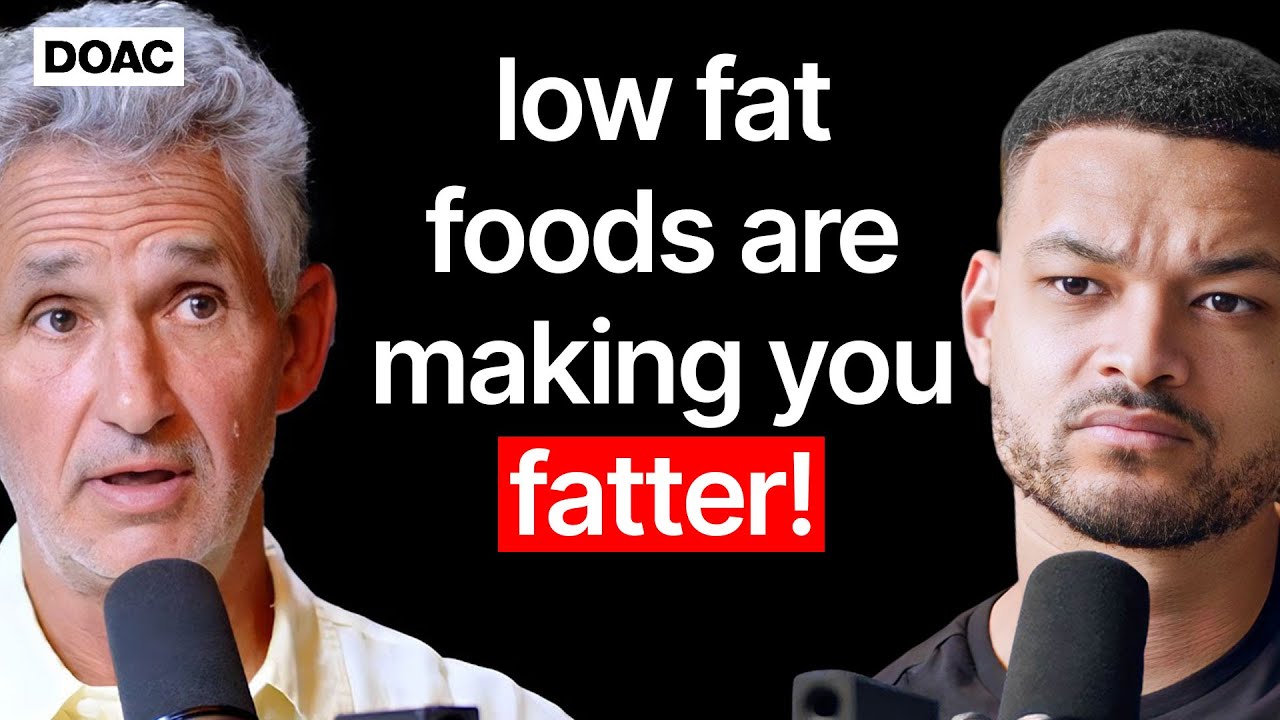
Tim Spector Warns Excess Protein Converts to Fat While Fiber Deficiency Escalates
The Diary Of A CEO
Epidemiologist Tim Spector reveals that 95% of UK adults face severe fiber deficiency while excess protein intake fails to build muscle and instead converts to body fat.
## Background
This episode of The Diary Of A CEO, hosted by Steven Bartlett and published on YouTube on October 5, 2023, features Professor Tim Spector. The show notes describe the conversation as an exploration of six major food lies and health myths, covering topics from protein overload and gut health to processed foods, sweeteners, and sleep.
## TL;DR
Epidemiologist Dr. Tim Spector joins Steven Bartlett to dismantle common nutritional misconceptions, arguing that excess protein intake is overhyped while most of the population suffers from a severe fiber deficiency. The discussion examines how ultra-processed foods, artificial sweeteners, and late-night snacking harm the gut microbiome and metabolic health. Spector advocates for a diet rich in plant diversity, fermented foods, and mindful timing over strict calorie counting or reliance on supplements. Additionally, the conversation highlights how personalized nutrition, better sleep, and proper circadian alignment play vital roles in overall long-term wellness.
## Atmosphere & style
The conversation carries an engaging, intellectually curious, and candid atmosphere, balancing scientific rigor with practical life advice. Steven Bartlett's observant, open-minded hosting style allows Dr. Tim Spector to systematically dismantle pervasive health dogmas in an accessible, grounded manner. The dialogue feels like an eye-opening and supportive masterclass, maintaining a warm, collaborative energy throughout as both host and guest share personal health discoveries.
## Key takeaways
- [05:26](https://www.youtube.com/watch?v=7XrntcEUjLM&t=326s) Over 95% of people meet daily protein requirements, while 95% suffer from a severe fiber deficiency.
- [05:26](https://www.youtube.com/watch?v=7XrntcEUjLM&t=326s) Excess protein cannot be stored as protein; once muscle synthesis capacity is reached, it converts into sugars and fat.
- [12:16](https://www.youtube.com/watch?v=7XrntcEUjLM&t=736s) Increasing daily fiber intake by just 5g to 10g significantly reduces all-cause mortality risk.
- [15:55](https://www.youtube.com/watch?v=7XrntcEUjLM&t=955s) A diverse intake of at least 30 different plant species per week is essential for optimal gut microbial health.
- [22:21](https://www.youtube.com/watch?v=7XrntcEUjLM&t=1341s) Home-fermented foods contain significantly more microbial strains and nutrients than commercial probiotic supplements.
- [36:07](https://www.youtube.com/watch?v=7XrntcEUjLM&t=2167s) Ultra-processed foods (UPFs) contain additives like emulsifiers and artificial sweeteners that harm the microbiome, drive overeating, and increase health risks.
- [45:41](https://www.youtube.com/watch?v=7XrntcEUjLM&t=2741s) Snacking late at night conflicts with circadian rhythms, raising nocturnal blood sugar and disrupting microbial repair cycles.
- [56:08](https://www.youtube.com/watch?v=7XrntcEUjLM&t=3368s) Coffee is a fermented, polyphenol-rich superfood that provides substantial dietary fiber and cardiovascular benefits.
- [59:17](https://www.youtube.com/watch?v=7XrntcEUjLM&t=3557s) The common guideline to drink 8 glasses of water daily lacks scientific support, as natural thirst mechanisms adequately regulate hydration.
- [01:07:49](https://www.youtube.com/watch?v=7XrntcEUjLM&t=4069s) Eliminating fiber, as seen in strict carnivore diets, starves gut microbes and raises long-term cardiovascular risk.
- [01:14:11](https://www.youtube.com/watch?v=7XrntcEUjLM&t=4451s) GLP-1 medications and bariatric surgery are critical for severe obesity, but lifestyle changes centered on low-UPF, plant-rich diets offer sustainable weight control.
- [01:17:48](https://www.youtube.com/watch?v=7XrntcEUjLM&t=4668s) Calorie counting fails for long-term weight loss due to metabolic compensation and individual variation in nutrient absorption.
- [01:21:01](https://www.youtube.com/watch?v=7XrntcEUjLM&t=4861s) Exercise is essential for cardiovascular and neurological longevity, but plays a minimal direct role in weight loss.
- [01:24:09](https://www.youtube.com/watch?v=7XrntcEUjLM&t=5049s) Multivitamins and calcium supplements offer little benefit for healthy individuals eating balanced diets and can sometimes carry health risks.
- [01:31:51](https://www.youtube.com/watch?v=7XrntcEUjLM&t=5511s) Consistent sleep and meal timing serve as powerful regulators for metabolic health and gut microbe balance.
Host Steven Bartlett opens the show by introducing a table loaded with common supermarket foods and supplements claiming to be "good for you." Joining him is Professor Tim Spector— award-winning scientist, bestselling author, and co-founder of the personalized nutrition company Zoe. Together, they prepare to unravel public misconceptions surrounding nutrition, highlighting how clever marketing distorts health realities.
Tim quickly previews several widespread myths: protein supplements are massively hyped, coffee is actually a legitimate health food linked to longevity, and harsh mouthwashes can disrupt oral microbiomes—making people more prone to infections and worse breath long-term. Furthermore, Tim dismisses the blanket advice to drink eight glasses of water a day as lacking hard data, notes that exercise alone is an inefficient way to shed excess body fat, and warns that society is currently facing a massive "fiber crisis."
[01:40](https://www.youtube.com/watch?v=7XrntcEUjLM&t=100s) Why Gut Health Matters to Society and the Individual
Steven asks why prioritizing gut health and personalized nutrition matters on a systemic and individual level. Tim explains that society is currently facing an epidemic of chronic conditions—cancer, heart disease, diabetes, and obesity—that heavily strain both personal well-being and national economies. In the UK alone, poor public health costs taxpayers nearly £60 billion per year in economic output and healthcare burdens. Beyond physical health, a poor diet directly correlates with rising rates of mental health struggles like depression and anxiety.
Steven reflects on a humbling conversation with a physician who pointed out that chronic disease begins growing invisibly decades before symptoms appear. Although Steven is in his early 30s, active, and physically fit, he recognizes that current nutritional choices compound over time—meaning 30-year-old Steve can actively prevent the illnesses of 50-year-old Steve. Tim acknowledges that selling long-term preventive health to young adults who feel energetic is difficult, which is why connecting nutrition to immediate benefits like mental clarity and daily wellness often resonates far better.
- **Economic Impact:** Chronic diet-related diseases cost the UK state and taxpayers roughly £60 billion annually.
- **Asymptomatic Compounding:** Internal vascular and metabolic disease accumulates invisibly long before physical symptoms or illness manifest.
[05:26](https://www.youtube.com/watch?v=7XrntcEUjLM&t=326s) Who Really Needs Extra Protein?
Steven admits to spending the last decade consuming protein powders and shakes immediately after gym sessions to build muscle. Tim straightforwardly debunks this trend, stating: "Protein is massively hyped," and labeling most users as "victims of marketing." Tim points out that fewer than 5% of the UK population is protein deficient. Because humans evolved as omnivores, standard diets easily fulfill muscle repair needs through everyday items like pasta, grains, and whole foods.
```
┌─────────────────────────────────────────────────────────────────────────┐
│ THE PROTEIN METABOLISM MYTH │
├─────────────────────────────────────────────────────────────────────────┤
│ MYTH: "Excess dietary protein goes straight to building muscle, and │
│ whatever isn't used is simply excreted harmlessly." │
│ │
│ REALITY: The body cannot store excess protein as protein. Once muscle │
│ building limits are reached, excess protein is converted into │
│ sugars and stored directly as fat. │
└─────────────────────────────────────────────────────────────────────────┘
```
The human body cannot store surplus protein in its native form. Once muscle protein synthesis limits are reached, excess amino acids are broken down: a small portion is excreted, but the vast majority is converted into sugars and stored as fat. The only populations that actually benefit from protein supplementation are:
* The frail elderly who have lost their appetite or suffer from chronic illness.
* Strict vegans or vegetarians recovering from illness or under-eating.
* Competitive bodybuilders drastically cutting calories while striving to maintain extreme muscle mass.
Tim emphasizes that obtaining protein from whole foods is vastly superior to processed powders, which frequently contain industrial additives and chemical fillers.
- **Recommended Daily Intake:** Official guidelines recommend approximately 0.8g of protein per kilogram of body weight.
- **Average Consumption:** UK adults average around 1.4g/kg (76g/day for adults aged 19–64; 67g/day for those over 65).
- **Processing Limits:** For a 90kg individual, the baseline daily requirement is ~72g–90g; intensive weightlifting only increases total utilization by roughly 10%.
[12:16](https://www.youtube.com/watch?v=7XrntcEUjLM&t=736s) The Fiber Crisis vs. Protein Hype
Tim contrasts the exaggerated protein market with the real, overlooked nutritional emergency: fiber. While 95% of people get more than enough protein, 95% of the population suffers from a severe fiber deficiency. Because raw fiber sources (like spinach, seeds, and legumes) lack the massive profit margins of branded protein supplements, commercial marketing ignores them entirely.
> "We are in a fiber crisis. We think only about 1 in 20 people are getting enough fiber for good health."
Tim defines fiber as the non-digestible structural component of carbohydrates (distinct from simple sugars and starches). It resists early enzyme breakdown in the upper stomach, traveling straight to the lower intestine where it feeds trillions of beneficial gut microbes. Once dismissed merely as "roughage" that manually scraped out internal toxins, fiber is now recognized as a critical fuel source for immunity and metabolic health.
```
┌──────────────────────────────────────────────────────────────────────────┐
│ FIBER INTAKE & MORTALITY REDUCTION │
├──────────────────────────────────────────────────────────────────────────┤
│ Current UK Average Intake: ~20 grams / day │
│ │
│ +5g Fiber / day (+¼ shift) ──► 14%–15% Reduction in All-Cause Mortality │
│ +10g Fiber / day (2 handfulls) ─► ~30% Reduction in All-Cause Mortality │
└──────────────────────────────────────────────────────────────────────────┘
```
- **Daily Intake Deficit:** The average UK adult consumes roughly 20g of fiber per day, missing recommended healthy baselines.
- **Survival Outcomes:** Adding just 5g of daily fiber (a single handful of nuts or seeds) reduces all-cause mortality risk by 14%–15%. Adding two handfuls cuts mortality risk by nearly 30%.
- **Systemic Benefits:** Proper fiber intake is clinically proven to lower the incidence of colorectal cancers, improve mental health via the gut-brain axis, and enhance overall longevity.
[15:55](https://www.youtube.com/watch?v=7XrntcEUjLM&t=955s) Gut Microbe Boosters & The "Diversity Jar" Hack
To address Steven's concern that consuming 30 distinct plants per week feels overwhelming, Tim brings out a practical tool: his personal "Diversity Jar." Filled with a blend of around 10 different species of nuts and seeds, a single sprinkle over morning yogurt, kefir, or a lunch salad immediately checks off a third of the weekly 30-plant goal.
Tim reminds listeners that "plants" extend far beyond whole green vegetables like kale and spinach; whole nuts, seeds, herbs, spices, and grains all count toward microbial diversity. These dense plant sources deliver high-quality dietary fiber and natural protein without the chemical additives found in artificial shakes. Tim encourages breaking out of repetitive eating routines—such as ordering the exact same lunch wrap daily—to continuously supply diverse fuel sources for a healthy, varied gut microbiome.
[018:24] How Close Contact and Food Diversity Expand Your Microbiome
When Steven Bartlett looks at his Zoe personalized test results, he sees a fairly narrow group of microbes in his gut. Tim Spector reassures him that expanding this collection can dramatically enhance overall health, digestion, mental health, and immune function, conferring better resistance to infection and reducing food allergies. Steven asks a fundamental question: where do new microbes actually come from? Joking that he might just kiss his girlfriend since she has plenty of them, Spector confirms that partners continuously swap microbes with one another. However, introduced microbes will quickly die off unless provided with the right "fertilizer"—a wide diversity of foods.
Microbes enter our bodies from many sources, including close contact with friends and family, touching fresh produce, interacting with pets, and spending time in nature. Furthermore, vast numbers of dormant microbes already reside within us, lying in wait in places like the appendix or in spore states. They wake up only when specific nutrients hit them. Spector explains that cultivating a rich "soil" through varied plant intake allows these microbes to flourish rather than remain dormant.
* **Microbiome benefits:** Expanding gut microbial diversity improves digestion, mental health, and immune resilience against infections and food allergies.
* **Microbe swapping:** Close physical contact, such as kissing a partner, constantly exchanges microbes between individuals.
* **Dormancy and activation:** Many microbes exist in spore formations for years and only activate when their preferred food sources are consumed.
* **Environmental sources:** Exposure to pets, soil, countryside environments, and fresh produce continuously introduces new microbial strains.
---
[022:21] Transforming Waste Food for Gut and Health Through Fermentation
Many people feel intimidated by fermentation, but Spector breaks it down into a simple, highly beneficial process: microbes modifying whole foods using salt or sugar to create probiotic-rich, nutrient-dense meals. Fermentation acts as a mini-version of the gut outside the body, effectively "pre-digesting" plants to unlock significantly higher nutrient levels. Demonstrating with a one-liter glass jar filled with leftover fridge scraps—cabbage, radishes, and odd bits of vegetables that would otherwise be discarded—Spector shows how easy it is to make homemade fermented veg and cut down on food waste.
To ferment vegetables at home, you simply chop up plant scraps, weigh them, add precisely $2\%$ salt, and pack them tightly into a jar to eliminate air pockets. Fermenting bacteria are anaerobic, meaning they thrive in oxygen-free environments where they consume natural sugars and outcompete harmful bacteria. Cover the packed vegetables with a little salted water, weigh them down below the liquid line using clean stones or outer cabbage leaves, and seal the lid. Left at room temperature for three days out of direct sunlight, carbon dioxide bubbles form as the microbes ferment the food.
```
[ Plant Scraps ]
│
▼
[ Add 2% Salt by Weight ]
│
▼
[ Pack Tightly into Jar ] ──► (Removes air/oxygen)
│
▼
[ Cover with Salt Water ] ──► (Submerges below liquid)
│
▼
[ Ferment 3+ Days at RT ] ──► (Anaerobic bugs produce CO₂)
```
* **Microbial density:** Fresh garlic can host $10\text{--}20$ distinct species of microbes natively waiting for the right salted, moist conditions to activate.
* **Preservation lifespan:** Once fermented, the mixture drops below $\text{pH } 4.5$, creating an acidic environment where bad microbes cannot survive, allowing it to keep in the fridge for months.
* **Capsules vs. fermented food:** A typical probiotic supplement might offer two or three bacterial strains, whereas a single jar of fermented vegetables provides around $30$ distinct microbial strains.
---
[029:19] Ancient Fermentation Wisdom and the Supermarket "Health Halo" Lie
Diets rich in traditional fermented foods like Korean kimchi or Japanese miso are tied to populations with superior gut microbiomes, longer lifespans, and lower rates of chronic disease. Spector highlights that these traditional cultures effectively delay age-related chronic illnesses by at least $10\text{ years}$ compared to Western populations. Comparing fermentation to the magic that transforms a simple grape into a complex vintage red wine, Spector emphasizes how microbes add chemical complexity, enhanced texture, and deep flavor to basic foods.
Transitioning to commercial food products, Steven brings out popular items marketed with high-impact health claims to see if they live up to their labels. The first item evaluated is Actimel, which boasts features like zero added sugar, $0\%$ fat, added vitamin D and B6, and immune support claims. Spector debunks these "health halos," pointing out that European advertising regulations prohibit using the word "probiotic" on packaging, forcing brands to rely on outdated health claims derived from 30-year-old science to attract buyers.
> "Fat is really important naturally to make you enjoy food. And so, it takes a lot of careful chemistry to mimic that fat. So, I would always avoid anything that said, you know, zero sugar, zero fat, rich in vitamins..."
* **Impact of low-fat foods:** Controlled laboratory studies demonstrate that individuals consuming highly processed, low-fat, high-carb foods eat substantially more calories over the subsequent 24 hours than those eating full-fat equivalents.
* **Product evaluation:** Despite containing a single strain of *Lactobacillus*, ultra-processed "zero-fat" yogurt drinks are laden with extra starches and chemical additives that actively harm gut microbes, leading Steven to throw the Actimel directly into the bin.
* **Zoe score context:** On the Zoe health rating app, the tested zero-fat probiotic drink scored a low $35$ out of $100$, confirming it is far from a true health food.
* **Ideal yogurt ingredients:** Spector advises consumers to skip heavily marketed functional yogurts and choose products containing strictly two simple ingredients: **milk and live cultures**.
---
[034:41] Deconstructing Commercial Gut Health Claims in Popular Yogurts
Steven pulls out another widely marketed supermarket staple: Activia, featuring bold promises on its packaging that it is "deliciously good for your gut health" and packed with "billions of live cultures" from five active strains fermented for up to eight hours. While the front of the tub uses emotionally resonant branding like "loving the planet to love our gut," a closer inspection of the fine-print ingredients list tells a completely different story.
Spector inspects the lengthy list on the back of the pot, uncovering a complex formulation far beyond basic milk and microbes. The product contains added flavorings, fruit juice concentrates, stabilizers, tapioca starch, added sugars, and synthetic colorings like carrot juice. Although strawberries are pictured prominently on the label, their actual presence is heavily altered by industrial processing. Spector notes that these added chemicals and emulsifiers detract from any benefit provided by the live cultures, illustrating how corporate marketing disguises ultra-processed convenience foods as everyday wellness products.
* **Active strain count:** Activia advertises five active bacterial strains fermented over an eight-hour period to deliver billions of live cultures per pot.
* **Ingredient additions:** Hidden ingredients behind the label include tapioca starch, added sugars, chemical flavorings, juice concentrates, and stabilizers.
* **Ideal criteria:** Authentic gut-healthy yogurt requires no added thickeners or sugars, relying solely on natural milk fermentation to maintain a beneficial microbial profile.
[036:07] Ultra-Processed vs. Processed Foods: The Additive Trap
The discussion opens with Dr. Tim Spector addressing the critical distinction between merely processed foods and ultra-processed foods (UPFs), noting that the term "processed" has unfairly become a blanket villain. Virtually all food undergoes some level of processing; for instance, plain yogurt or artisanal cheese is processed by combining raw milk with live microbes, oil, or salt. The real danger arises when food manufacturers enter the *ultra-processing* stage. In this realm, whole ingredients are stripped of their natural goodness and broken down into isolated components (such as dried casein extracts or refined starches). Companies then use industrial "glues," emulsifiers, stabilizers, artificial sweeteners, flavorings, and colorants to reconstruct these extracts into something resembling food. Spector argues that UPFs should not even be classified as real food, but rather as "edible food-like substances that are industrially made."
Spector highlights recent scientific findings linking common UPF additives directly to chronic disease. Ingredients like aspartame have been placed on warning lists due to links with increased cancer risks and heart disease, while emulsifiers have been shown to negatively impact mental health and cardiovascular function even when controlling for overall diet quality. In the UK, the average person unwittingly consumes about 60% of their daily calories from ultra-processed foods—four times more than healthier European nations with lower average incomes. Fueled by multi-billion-pound marketing budgets, food conglomerates trick consumers with misleading "health halos" (such as "low-fat," "no-sugar," or "added vitamins"). Crucially, these chemically altered foods disrupt satiety, causing individuals to eat up to 25% more than they would if consuming plain, whole foods.
- **UPF Caloric Share:** The average UK citizen gets ~60% of their daily intake from ultra-processed foods.
- **Overeating Metric:** Ultra-processed additives and hyper-palatable formulations increase food intake by roughly 25% (a quarter) compared to whole-food alternatives.
- **Specific Health Risks:** Emulsifiers alter the gut microbiome and increase heart disease risks; artificial sweeteners like aspartame are flagged for links to cancer and metabolic dysfunction.
[040:48] Deconstructing "Health Halos": Real Fruit, Light Cheese, and Protein Bars
Steven Bartlett presents three common retail items to dissect their label claims: an Oasis Citrus Punch drink, a tub of Philadelphia Light cream cheese, and a high-protein snack bar. Spector points out that phrases like "real fruit" or "natural flavorings" are purely marketing buzzwords with no medical or scientific backing. A breakdown of the Oasis drink reveals a cocktail of concentrated fruit extracts, sugar, citric acid, wood resins, polyphosphates, potassium sorbate, and artificial sweeteners (aspartame and acesulfame K). Rather than providing hydration or vitamins, it delivers a chemical mix engineered to destabilize gut microbes and trigger hunger spikes. Similarly, while Philadelphia Light boasts 40% less fat, the missing fat is substituted with emulsifiers and stabilizers to preserve mouthfeel—additives that ultimately harm gut bacteria and exacerbate appetite.
```
Product Label Claim The Industrial Reality
──────────────────── ─────────────────────────────────────────────────────
"Real Fruit / Natural" → Reconstituted concentrates, wood resins, preservatives,
aspartame & acesulfame K.
"Light / 40% Less Fat" → Stripped fat replaced with emulsifiers and stabilizers to
artificially maintain texture.
"High Protein Bar" → Soy protein isolates, tapioca starches, glucose syrups,
and binding gums.
```
When reading the label of a seemingly innocent "natural" protein bar, Bartlett reveals an extensive list of industrial ingredients: soy protein isolates, crispies, tapioca starch, glucose syrup, muscovado sugar, and various processing gums. Spector notes that if a snack were truly made of whole nuts and seeds, it wouldn't require ultra-processed protein isolates or chemical binders to hold it together. The reliance on these convenient, packaged snacks represents a major dietary failure in Western society compared to twenty years ago, driving an epidemic of metabolic dysfunction masked by deceptively healthy packaging.
- **Deceptive Labeling Terms:** "Natural," "Real Fruit," "Light," "No Sugar," and "High Protein" often mask severe ultra-processing.
- **Key Additives Identified:** Acesulfame K (ACE K), aspartame, potassium sorbate, potassium benzoate, polyphosphates, and glycerol esters.
- **Rule of Thumb:** Real, whole foods (like an apple or a pear) do not require nutrition or health claims on their packaging.
[045:41] The Snacking Epidemic and Late-Night Metabolism
The conversation shifts to everyday snacking habits, where over 90% of the population in the UK and US habitually snacks between meals—a cultural norm absent in Southern Europe and Asian countries. Spector references data from the ZOE Predict study, revealing that 95% of participants are snackers, and roughly a quarter of them completely undo the health benefits of their primary meals through poor snack choices. High-calorie, nutrient-poor snacks account for approximately 25% of daily energy intake in Western diets. When eaten throughout the day or late at night, these ultra-processed snacks trigger rapid glucose spikes, leaving the individual hungrier a few hours later and disrupting metabolic recovery.
> "Virtually all the snacks that people have late in the evening are bad for you... You actually end up hungrier the next day. It's counterintuitive."
Timing plays a crucial role in how the body processes energy. Consuming sugary or processed snacks late at night conflicts with circadian rhythms, preventing gut microbes from entering their required resting phase. To fix this "snack epidemic," Spector advises eliminating snacks altogether, shifting them to be part of a main meal, or opting for unrefined options such as a handful of mixed nuts, an apple, or a pear. For those who need to snack, staying within a consistent eating window and choosing whole foods ensures minimal health risks.
- **ZOE Study Findings:** 95% of surveyed adults snack; 25% negate the health benefits of their healthy main meals through poor snacking choices.
- **Caloric Impact:** Snacks account for roughly 25% of total daily calorie consumption in the UK and US.
- **Circadian Rhythm Impact:** Late-night snacking causes nocturnal glucose surges and disrupts necessary microbial repair cycles, directly increasing hunger the following morning.
[050:46] The Truth About Bread, Rice, and Healthy Grain Alternatives
Bartlett shares his personal confusion around bread and white rice, admitting he long considered white rice a healthy post-workout staple. Spector confirms that most mass-market supermarket bread is an ultra-processed food packed with hidden sugars, low fiber, and industrial additives that cause sharp blood sugar spikes. While dense rye bread or authentic long-fermented sourdough can fit into a healthy diet in moderation, standard commercial loaves offer very little nutritional value. Spector advises treating standard bread as an occasional indulgence rather than a daily staple.
Similarly, Spector labels white rice as one of the most overrated foods in the modern diet. Though frequently paired with healthy meals like vegetable curries, white rice quickly breaks down into simple sugars, causing major glycemic spikes. Bartlett recalls his personal ZOE test results, which assigned his glycemic response to white rice a dismal score of 15 out of 100 (and his girlfriend's a 5 out of 100). Spector urges swapping white rice for far more nutrient-dense options:
- **Quinoa and Barley:** High in fiber, protein, and complex micronutrients.
- **Whole Oats and Grains:** Offer stable energy release without extreme insulin spikes.
- **Lentils and Legumes:** Provide dual benefits of rich prebiotic fiber and plant-based protein.
[54:19](https://www.youtube.com/watch?v=7XrntcEUjLM&t=3259s) Daily Food Routines: The 80/20 Principle and Breakfast
Steven Bartlett asks Professor Tim Spector to walk through what a perfect "10 out of 10 day" looks like in terms of his personal eating habits: when he eats, how many meals he consumes, and what rules he follows. Spector cautions that life is unpredictable, so he aims for an **80/20 rule**—staying consistent 80% of the time while giving himself grace for the 20% when plans fall apart. Rigid adherence to strict dietary rules often leads to burning out and quitting altogether, whereas an adaptable mindset allows healthy habits to last for decades.
When working from home where he has full control over his kitchen, Spector practices time-restricted eating. He avoids food until **11:00 AM**, starting his morning instead with a cup of black coffee to stay sharp and energized. When 11:00 AM arrives, he prepares his standard breakfast bowl designed to feed both himself and his gut microbiome.
- **Full-Fat Yogurt Base:** Provides essential fats, protein, and natural satiety to prevent mid-day energy slumps.
- **The "Diversity Jar":** A custom pre-mixed container of various seeds, nuts, and chopped plant foods sprinkled generously on top.
- **Seasonal or Frozen Fruit:** Fresh seasonal berries in summer, frozen berries during winter months (e.g., March), or a freshly chopped apple.
---
[56:08](https://www.youtube.com/watch?v=7XrntcEUjLM&t=3368s) The Truth About Coffee: A Superfood in Disguise
Steven recalls that during their previous conversation, Spector seemed hesitant about coffee's overall health value. Spector clarifies his position emphatically: **coffee is definitely a health food**. While roughly 1–2% of the population tolerates caffeine poorly, switching to high-quality decaffeinated coffee offers nearly identical health perks because the benefits extend far beyond caffeine alone. Long-term population studies consistently demonstrate that drinking between **1 and 4 cups of coffee per day** reduces the risk of heart disease and promotes overall longevity.
Spector highlights that most people fail to realize coffee is actually a **fermented plant product**. The coffee cherry is harvested, split open, and left on humid floors in region of origin across Africa or Asia, where wild microbes ferment the bean. It is then dried, roasted, and ground. Beyond the microbially produced compounds and high level of polyphenols, coffee serves as an unexpected source of dietary fiber.
- **Fiber Content:** 3 cups of coffee contain approximately **5 grams of dietary fiber**, which represents about a quarter of the average daily intake in the UK and US.
- **Primary Source:** For many individuals on a standard Western diet, coffee actually ends up being their single largest daily source of dietary fiber and polyphenols.
- **Changing Scientific Consensus:** Spector humorously admits that as a medical student in the 1980s, the very first research paper he ever authored claimed coffee caused cancer—a conclusion based on flawed epidemiological studies of that era.
- **Coffee vs. Fruit Juices:** Spector argues that coffee belongs in the health store section, whereas ultra-processed, high-sugar commercial orange juice belongs in the recreational aisle.
> "Most orange juice we have is ultra-processed, high sugar, very bad for most people. Coffee is good for the vast majority of people."
---
[59:17](https://www.youtube.com/watch?v=7XrntcEUjLM&t=3557s) What Else Science Got Wrong: Saturated Fats and Hydration Myths
Reflecting on past nutritional dogmas, Spector admits to having previously avoided all fats, shunning cheese and buying low-fat products under the belief that saturated fats directly caused heart disease. This anti-fat mindset was heavily promoted throughout medical training for decades, wrongly leading healthcare professionals to encourage carbohydrates and starches at the expense of healthy whole fats.
Spector also targets the ubiquitous recommendation to drink **8 glasses of water a day** (roughly 2 liters). He notes that there is zero hard scientific data supporting this blanket requirement. Instead, the myth has been heavily propelled by beverage conglomerates like Coca-Cola and PepsiCo as they expanded into selling bottled water in single-use plastic bottles.
- **Overhydration Dangers:** Medical staff working endurance events like marathons observe significantly more emergency hospitalizations and deaths from **hyponatremia (overhydration)** than from acute dehydration.
- **Evolutionary Thirst Mechanisms:** Human evolution endows the body with tight homeostatic controls; thirst signals are reliable indicators of when hydration is necessary without needing hourly timers or tracking apps.
- **Anecdote on Water Barrels:** Steven shares that for his recent birthday, someone gifted him a massive 8-liter "barrel water bottle" labeled with time markers, telling him he needed to finish the entire barrel at his desk every single day—an extreme example of modern hydration obsession.
---
[01:02:41](https://www.youtube.com/watch?v=7XrntcEUjLM&t=3761s) Mid-Day Meals: Quick Salads, Beans, and Probiotic Dressings
When preparing lunch at home on a busy workday, Spector opts for a quick, fiber-rich salad built from varied plant foods rather than relying on standard sandwiches. He avoids monotony by rotating ingredients regularly, making sure to include cost-effective pantry staples that deliver high nutritional value.
- **Salad Base:** Grated raw cabbage or mixed green lettuce.
- **Legumes for Fiber & Protein:** A canned variety of mixed beans, chickpeas, lentils, or cannellini beans.
- **Add-ins & Cheeses:** Chopped whole-milk mozzarella or traditional hard cheeses.
- **Microbe-Boosting Dressings:** Extra virgin olive oil, balsamic vinegar, a side of fermented sauerkraut, and a unique probiotic dressing created by whisking extra virgin olive oil with **kefir** (fermented milk).
---
[01:04:32](https://www.youtube.com/watch?v=7XrntcEUjLM&t=3872s) Personalizing Fruit Choices: The Banana & Grape Sugar Spikes
Steven reveals his surprise upon discovering through the ZOE personalized nutrition app that **bananas ranked surprisingly low for his personal blood sugar response**, scoring a modest 50 out of 100. Having previously eaten bananas in large quantities believing they were unconditionally healthy, Steven shifted his staple intake to fruits that score better for his biology, such as raspberries, cherries, strawberries, pears, and apples.
Spector agrees, sharing that his own ZOE score for bananas was even lower—around **30 out of 100**. While marketed heavily for their potassium content, commercial bananas are cultivated to be high in fast-releasing sugars, leading to sharp glycemic spikes for many individuals.
- **Banana & Grape Alternatives:** Spector replaced daily banana consumption with whole pears, apples, and kiwi fruit.
- **The Grape Sugar Spike:** Spector notes that grapes produce a massive blood sugar spike and subsequent dip in his body, triggering reactive hunger later in the day, meaning he now treats grapes as an occasional indulgence.
- **Context Matters:** A lower-ranked item (like a dash of ketchup or mayonnaise) is perfectly acceptable if it enables someone to eat a large, diverse, fiber-packed salad.
---
[01:07:49](https://www.youtube.com/watch?v=7XrntcEUjLM&t=4069s) The Carnivore Diet vs. The Gut Microbiome
Addressing the polarizing debate around meat intake, Spector draws a firm distinction between low-quality processed meats and whole meats. Ultra-processed meats, reconstituted ready-meal products, and cured items filled with additives are clearly linked to poor health outcomes. Conversely, eating small quantities of unprocessed, high-quality meat within a plant-rich diet poses little harm.
Spector strongly critiques the trend of the **carnivore diet** (eating exclusively meat and animal products while avoiding all plant matter). While advocates claim dramatic health benefits, Spector stresses that living without dietary fiber starves the gut microbiome of essential prebiotics, generating long-term metabolic damage.
- **Historical & Anthropological Misconceptions:** Based on his time living directly with the **Hadza hunter-gatherers in Tanzania**, Spector notes that traditional diets rely heavily on wild tubers, berries, seeds, and seasonal vegetation. Meat is an intermittent luxury rather than a daily exclusive.
- **Water Weight Loss Trickery:** Initial rapid weight loss observed on strict keto or carnivore diets is primarily due to fluid loss (glycogen depletion) rather than long-term fat loss.
- **The Fiber Deficit:** Removing plant fiber dramatically drops intake from the recommended levels down to under 5 grams per day. Epidemiological data links every 5-gram drop in daily fiber intake to a **significant increase in cardiovascular disease risk and reduced longevity**.
> "You're starving your gut microbes if you're just on a meat-only diet. There's no evidence that that is healthy and lots of evidence that lack of fiber is really bad for you."
---
[01:11:09](https://www.youtube.com/watch?v=7XrntcEUjLM&t=4269s) Chewing Gum and Hidden Additives
Steven transitions the conversation to a personal habit: chewing gum daily. Pointing out the central console of his car, which is routinely stocked with seven different brands of chewing gum, Steven asks about the potential health implications of artificial sweeteners and ingredients found in commercial gums.
<ElicitationsGroup message="Explore further insights from Dr. Tim Spector:">
<Elicitation label="How do artificial sweeteners affect gut microbes?" query="What does Dr. Tim Spector say about artificial sweeteners and their impact on gut microbes and craving cycles?"/>
<Elicitation label="Strategies for sustainable weight loss" query="What are Dr. Tim Spector's strategies for sustainable weight loss beyond exercise?"/>
<ElicitationsGroup/>
[01:11:23](https://www.youtube.com/watch?v=7XrntcEUjLM&t=4283s) Artificial Sweeteners, Chewing Gum, and Mouthwash
Steven Bartlett opens up about a habit he recently noticed while driving home: compulsively popping piece after piece of chewing gum, chewing for a minute to get an intense burst of flavor, throwing it into the car bin, and immediately reaching for another. He asks whether the artificial sweeteners packed into modern chewing gum might actually be worse for overall health than standard sugar.
Dr. Tim Spector explains that while sugar-free chewing gum is undeniably better for preventing dental decay, artificial sweeteners present a completely different set of problems for the body. Anything that alters the microbial balance in your mouth or saliva—including artificial sweeteners and chemical mouthwashes—can disrupt your microbiome from your mouth all the way down to your gut. Steven admits to being a "prolific mouthwash user," to which Tim reacts with dismay. Tim points out that while mouthwash gives a pleasing, tangy, fresh-feeling hit to the brain, overuse actually destroys the natural defense mechanisms residing on the tongue and in saliva. By killing off beneficial bacteria, these products create room for harmful, infection-causing microbes to overgrow, which can ironically lead to worse long-term bad breath. Furthermore, the intense sweet sensation from artificial sweeteners sensitizes the brain to crave more sweetness, spiking hunger for carbohydrate-rich foods later in the day.
- **Dental vs. Gut Health:** Artificial sweeteners reduce tooth decay compared to real sugar, but they alter oral and gut microbiomes, increasing susceptibility to microbial overgrowth and infections.
- **Sweet Tooth Sensitization:** Regular consumption of hyper-sweet artificial ingredients conditions the brain to crave sweet, high-carb foods throughout the day.
- **The Mouthwash Paradox:** Overusing antiseptic or chemical mouthwashes strips away protective oral microbes, which can ultimately cause worse breath over time.
---
[01:14:11](https://www.youtube.com/watch?v=7XrntcEUjLM&t=4451s) Sustainable Weight Loss vs. Extreme Interventions
Steven shifts the conversation to weight loss, asking Tim to simplify a topic that an entire industry of "hacks, tips, and tricks" has overcomplicated. Tim cautions that there is no simple quick-fix solution. True weight management requires long-term, sustainable habits that maintain health over decades rather than drastic drops over a few weeks.
When addressing severe weight issues, Tim draws a clear line between moderate weight management and clinical interventions. For individuals suffering from extreme or morbid obesity, traditional diets often fail, making radical approaches like bariatric surgery or GLP-1 receptor agonist injections (such as Ozempic and Wegovy) necessary and life-saving. However, when Steven mentions that several of his fit, healthy friends take Ozempic to shed a few pounds, Tim calls the trend "madness." He stresses that while GLP-1 drugs provide incredible benefits for those at high risk of heart attacks or strokes, taking them for minor cosmetic tweaks exposes people to unnecessary side effects—including potential pancreatic issues, digestive disruption, and rare cancers—without knowing the long-term consequences of shutting down the brain's natural appetite signals.
- **GLP-1 Risk-Reward Balance:** Drugs like Ozempic and Wegovy are groundbreaking for morbid obesity—where health risks rival those of severe chronic diseases—but carry unwarranted risks for individuals with only minor weight to lose.
- **Long-Term Diet Strategy:** For general weight loss, the primary step is improving diet quality by reducing ultra-processed food (UPF) intake from the national average of ~60% down to under 20%.
- **30 Plants a Week:** Shifting focus away from calories toward consuming 30 distinct plants weekly naturally fills the diet with fiber and stabilizes appetite signals.
---
[01:17:48](https://www.youtube.com/watch?v=7XrntcEUjLM&t=4668s) The Flaws of Calorie Counting and the Yo-Yo Trap
Acknowledging that the fitness community often pushes back against his stance on calories, Tim reiterates that the strict "calories in, calories out" model is outdated "old science" when applied practically to humans. While restricting calories undeniably causes short-term weight loss, approximately 80% of people regain all the weight—or end up weighing more than when they started—if they do not improve the quality and structure of their diet.
Tim explains that calorie-counting ignores crucial inter-individual differences, such as blood sugar peaks, fat responses, meal timing, and gut microbiome composition. Calorie restriction inevitably fails over time because human evolution hardwires the brain to ramp up hunger signals whenever energy intake drops or physical output increases. When people continuously resist these mounting appetite signals, they eventually "crack," fall off their diet, and experience yo-yo weight fluctuations, which Tim considers far worse for long-term health than maintaining a stable weight.
- **Failure Rate:** Roughly 80% of calorie-restriction dieters regain the weight they lost, often swinging above their starting weight due to amplified evolutionary hunger mechanisms.
- **Food Quality Over Calories:** Studies show that focusing on food quality, gut health, and mindful eating leads to small, consistent weight loss without triggering aggressive hunger spikes.
- **Commercial Marketing:** Low-calorie marketing and crash gym programs sell a false simplicity that ignores food matrix and individual metabolic variations.
---
[01:21:01](https://www.youtube.com/watch?v=7XrntcEUjLM&t=4861s) Why Exercise Alone Won't Make You Lose Weight
Steven brings up another point of contention from their previous conversation: the idea that cardio and running on a treadmill are inefficient strategies for weight loss. Tim clarifies that while he exercises daily and considers physical activity vital for brain, heart, and metabolic health, people must decouple exercise from body-fat reduction.
Numerous studies comparing weight-loss groups with and without exercise regimes show very little difference in actual weight loss. When people rely on exercise alone to drop weight without fixing their diet, their baseline metabolism often slows down, their physiological hunger increases, and psychological licensing kicks in ("I ran for 30 minutes, so I can eat a donut"). While a small percentage of individuals may successfully shed weight through exercise alone, just as many end up gaining weight. Because metabolic and appetite responses to workouts vary widely, relying solely on spending extra time at the gym rather than changing one's diet is an unreliable strategy.
- **Metabolic Compensation:** The body counteracts exercise-induced calorie burn by slowing down baseline metabolic rate and ramping up appetite.
- **Psychological Licensing:** Exercising frequently leads to subconscious over-snacking under the impression that the extra calories were "earned."
- **Exercise Purpose:** Exercise should be pursued for cardiovascular, neurological, and physical longevity rather than as a primary tool for fat loss.
---
[01:24:09](https://www.youtube.com/watch?v=7XrntcEUjLM&t=5049s) Debunking the Multivitamin and Supplement Industry
Looking back at his own home, Steven confesses that his shelves used to be packed with every trendy supplement—omega-3s, vitamin D, electrolytes, and calcium—making him feel like a victim of clever marketing. Tim reaffirms his firm stance: for the average person eating a balanced diet, the vast majority of supplements are completely worthless and unnecessary.
Tim explains that specific supplements are only useful for targeted populations under specific conditions. For instance, dark-skinned or Black individuals living in low-sunlight environments like Scotland during the winter may need vitamin D supplementation because higher melanin levels slow down vitamin D synthesis. However, broad population-wide claims are misleading. Citing his background in osteoporosis research, Tim reveals that large-scale trials show routine calcium and vitamin D supplements do not prevent bone fractures in the general population. In fact, high-dose calcium pills send a sudden, concentrated spike of calcium through the gut—akin to an intravenous bolus—which studies suggest can adversely affect cardiovascular health, unlike the slow, natural absorption that occurs when eating calcium-rich leafy greens.
- **Targeted Need Only:** Supplements only benefit people with diagnosed clinical deficiencies or specific geographical/lifestyle constraints (e.g., dark skin in northern latitudes during winter).
- **Calcium Supplement Risks:** Taking calcium in pill form causes rapid systemic absorption that can negatively impact heart health, whereas plant-based calcium is absorbed safely and gradually.
- **Marketing vs. Health:** The multi-billion-dollar supplement industry encourages consumers to ignore poor diet quality under the false premise that a pill acts as a health "insurance policy."
[01:28:06](https://www.youtube.com/watch?v=7XrntcEUjLM&t=5286s) Omega-3 and Alcohol Misconceptions
Continuing their evaluation of supplements and health habits, Dr. Tim Spector addresses omega-3 supplements, noting that extensive clinical trials show they fail to reduce heart disease or other major illnesses, unless someone has recently suffered a heart attack.
The conversation then pivots to alcohol when host Steven Bartlett reveals that he quietly quit drinking about two months prior after realizing it provided no net positive in his life—not even as a social lubricant. Bartlett recounts his experience navigating a culture that treats non-drinkers with skepticism, sharing a story about an overly persistent waiter who pushed a bottle on him by declaring, "This is not alcohol, this is art!" Dr. Spector validates Bartlett’s decision, explaining that while overall alcohol consumption increases the risk of numerous diseases, red wine remains a slight exception due to its fermented plant content (polyphenols from grapes) that can reduce heart disease risk by roughly 30%. However, this benefit exists within a very narrow window, and higher intake quickly reverses any positive effects. Spector looks forward to an era of "healthy alcohols," such as nearly zero-alcohol (1%) fermented wines and ciders that retain plant skins and microbial benefits without the metabolised harm of ethanol.
* Omega-3 trials demonstrate no preventative benefit for heart disease or major illnesses except immediately post-heart attack.
* Red wine offers a roughly 30% reduction in heart disease risk due to fermented grape skin polyphenols, but the window of benefit is narrow before toxicity outweighs it.
* Ultra-low alcohol wines (e.g., 1% ABV options emerging from Canada) and traditional ciders contain beneficial polyphenols without metabolic alcohol harm.
---
[01:31:51](https://www.youtube.com/watch?v=7XrntcEUjLM&t=5511s) Quality Sleep and Circadian Rhythms
Steven Bartlett opens up about becoming a "competitive sleeper," noting how directly his sleep quality impacts his mood, performance, and brain function. Dr. Spector explains the deep metabolic link between sleep and nutrition: a single bad night's sleep disrupts metabolic regulation, causing a heightened blood sugar spike and subsequent drop to the exact same meal (such as a morning bagel). This drop triggers increased fatigue, hunger, and carbohydrate cravings the following day. Poor sleep is also associated with a less healthy gut microbiome, though researchers are still deciphering whether sleep drives the microbiome or vice versa.
Beyond total sleep duration, Dr. Spector emphasizes that internal body clocks thrive on consistency. Shifting one's sleep and wake times by even 1.5 to 2 hours on weekends throws off glucose responses and gut microbe balance. While acknowledging that social lives require flexibility and people shouldn't become overly anxious or obsessed, he warns against late-night binges (like watching an extra Netflix episode) simply because it's the weekend, as consistency is key for holistic metabolic health.
* A disrupted night's sleep leads to elevated glucose spikes, sharper sugar dips, increased ghrelin/hunger, and stronger carbohydrate cravings.
* Varying sleep and wake times by 1.5–2 hours over weekends negatively alters gut microbiota and blood sugar management.
---
[01:35:42](https://www.youtube.com/watch?v=7XrntcEUjLM&t=5742s) Meal Timing, Jet Lag, and Mindful Routines
The discussion turns to meal timing as a primary driver of circadian rhythms. Bartlett shares his previous belief that sunlight was the dominant signal for the body's internal clock, but Spector confirms that food timing exerts an exceptionally strong pull on circadian alignment. Spector describes how his own travel strategy has evolved: instead of relying solely on sunlight exposure when landing in new time zones, he prioritizes fasting on planes and aligning his meal times strictly with the destination zone to prevent jet lag and metabolic disruption.
Bartlett mentions scheduling his workout and meal times down to the minute via his assistant, prompting Spector to caution against extreme health obsession. Spector advocates for an "80/20 rule," warning that hyper-fixating on strict daily schedules creates unnecessary anxiety that undermines health benefits. Enjoying meals with friends and maintaining social connections remains just as crucial for overall well-being as optimized routines.
* Meal timing is a primary zeitgeber (synchronizer) of the circadian clock, often surpassing sunlight exposure during long-distance travel.
* Fasting during flights and aligning food intake immediately with the target time zone significantly reduces jet lag symptoms.
---
[01:37:40](https://www.youtube.com/watch?v=7XrntcEUjLM&t=5860s) Pets, Ultra-Processed Pet Food, and Microbiome Research
Bartlett asks a novel question about pet nutrition after observing that the food he serves his 8-year-old French bulldog, Pablo, is heavily processed. Dr. Spector shares that before co-founding Zoe, he considered launching a pet microbiome mapping project. He points out that commercial dry kibble and pellets marketed as convenient, vitamin-fortified food are functionally equivalent to human ultra-processed food (UPF). Consequently, household pets are suffering from the same chronic health crises as humans—including obesity, diabetes, and arthritis. Emerging evidence indicates that dogs fed real, whole-food diets live longer and enjoy better health outcomes.
Spector also reflects on the rapid growth of Zoe, which now boasts over 100,000 active members contributing daily food logging data. This massive dataset has led to breakthrough discoveries, including identifying over 4,000 new microbial species, mapping the prevalence of organisms like *Blastocystis*, and understanding how specific food choices can target individual microbes. Looking ahead, Spector envisions leveraging this data to optimize treatments, such as predicting microbial profiles that enhance the efficacy of antidepressants or hormone replacement therapy (HRT).
* Commercial dry pet kibble/pellets qualify as ultra-processed foods (UPF), contributing to pet obesity, diabetes, and arthritis.
* Zoe's database of 100,000+ members has revealed over 4,000 previously uncharacterized microbial species.
* Future microbiome research aims to tailor dietary profiles to improve drug response, including antidepressants and HRT.
---
[01:40:48](https://www.youtube.com/watch?v=7XrntcEUjLM&t=6048s) Guiding Philosophy and Closing Reflections
To summarize his nutritional philosophy, Dr. Spector offers a simple guiding rule: "You can't go wrong if you do things that are going to be good for your gut microbes." He suggests viewing the trillions of microbes living inside the gut as internal pets, constantly considering what foods nourish them and avoiding harm. When you cater to your gut microbes by prioritizing diverse whole foods and fermented plants, general metabolic health and longevity naturally follow.
Following podcast tradition, Bartlett asks Spector a question left anonymously by the previous guest: *"What is a modern, positive vision of masculinity?"* Spector, speaking as a father to a son, notes that masculinity is undergoing a major shift. He suggests a positive vision centers on flexibility, abandoning rigid gender stereotypes, and being a fully equal partner who shares domestic responsibilities "50/50." Bartlett adds context on the struggles young men currently face in education, employment, and mental health, while Spector concludes with advice for young men: "Don't be ashamed to be male, but be flexible and try to adapt to the changing world."
Bartlett closes the episode by thanking Spector, reflecting on how Spector's work and the Zoe platform illuminated his own nutritional choices, resolving lifelong struggles with chronic bloating and gut discomfort.
Here is the detailed walkthrough covering the final portion of the transcript:
[01:44:24](https://www.youtube.com/watch?v=7XrntcEUjLM&t=6264s) Personal Breakthroughs and Disrupting the Status Quo
Steven Bartlett shares a personal reflection on his health journey, admitting that for years he mistakenly believed he was simply "born broken" due to persistent digestive issues. Through hosting the podcast and engaging with guests like Dr. Tim Spector, he shifted his perspective to realize that his body was not flawed, but rather in direct misalignment with the modern diet and environment. By using ZOE and focusing on foods that complement his individual biology, he successfully eliminated a decade-long gut pain. Steven expresses deep gratitude to Dr. Spector for his work, noting that challenging traditional nutrition paradigms inevitably "ruffles feathers." He points out that positive disruption always triggers cognitive dissonance and resistance from established incumbents, but it remains the essential driver of innovation and meaningful change. Dr. Spector warmly accepts the gratitude, expressing his hope that the message continues to help people.
- Steven Bartlett suffered from chronic gut pain for over a decade before altering his diet based on personalized nutrition insights.
- The conversation highlights how disrupting established medical or nutritional conventions causes friction among incumbents experiencing cognitive dissonance.
[01:45:25](https://www.youtube.com/watch?v=7XrntcEUjLM&t=6325s) Scaling Gut Health Science: The Evolution of ZOE
Steven transitions into a closing endorsement for ZOE, reminding listeners of his dual role as both an investor in the company and a sponsor of the podcast. He emphasizes that maintaining personal health is his primary focus and praises ZOE's remarkable growth and large-scale scientific approach. Highlighting recent breakthroughs, Steven explains how ZOE has significantly upgraded its testing capabilities. Where the original gut health test was able to analyze 30 specific bacteria types in the microbiome, advanced scientific research now allows them to identify 100 bacteria types. He asserts that this depth of analysis is unmatched by any other product currently available on the market and offers an exclusive discount code for his audience.
- ZOE expanded its gut health testing capacity from analyzing 30 bacteria types to identifying 100 distinct bacteria types.
- Listeners are directed to `joinzoe.com` (or `[zoe.com/steven](https://zoe.com/steven)`) using the exclusive discount code "CEO10" for a 10% discount on membership.
## Notable quotes
> [05:26](https://www.youtube.com/watch?v=7XrntcEUjLM&t=326s) Protein is massively hyped — Tim Spector
> [12:16](https://www.youtube.com/watch?v=7XrntcEUjLM&t=736s) We are in a fiber crisis. We think only about 1 in 20 people are getting enough fiber for good health. — Tim Spector
> [29:19](https://www.youtube.com/watch?v=7XrntcEUjLM&t=1759s) Fat is really important naturally to make you enjoy food. And so, it takes a lot of careful chemistry to mimic that fat. So, I would always avoid anything that said, you know, zero sugar, zero fat, rich in vitamins... — Tim Spector
> [45:41](https://www.youtube.com/watch?v=7XrntcEUjLM&t=2741s) Virtually all the snacks that people have late in the evening are bad for you... You actually end up hungrier the next day. It's counterintuitive. — Tim Spector
> [56:08](https://www.youtube.com/watch?v=7XrntcEUjLM&t=3368s) Most orange juice we have is ultra-processed, high sugar, very bad for most people. Coffee is good for the vast majority of people. — Tim Spector
> [01:07:49](https://www.youtube.com/watch?v=7XrntcEUjLM&t=4069s) You're starving your gut microbes if you're just on a meat-only diet. There's no evidence that that is healthy and lots of evidence that lack of fiber is really bad for you. — Tim Spector
> [01:28:06](https://www.youtube.com/watch?v=7XrntcEUjLM&t=5286s) This is not alcohol, this is art!
> [01:37:40](https://www.youtube.com/watch?v=7XrntcEUjLM&t=5860s) What is a modern, positive vision of masculinity?
> [01:37:40](https://www.youtube.com/watch?v=7XrntcEUjLM&t=5860s) Don't be ashamed to be male, but be flexible and try to adapt to the changing world. — Tim Spector
> [01:37:40](https://www.youtube.com/watch?v=7XrntcEUjLM&t=5860s) You can't go wrong if you do things that are going to be good for your gut microbes. — Tim Spector
## Mentioned
Steven Bartlett, Tim Spector, Dr. Tim Spector, The Diary Of A CEO, Food for Life: The New Science of Eating Well, Actimel, Activia, Oasis Citrus Punch, Philadelphia Light, ZOE, ZOE Predict study, Coca-Cola, PepsiCo, Hadza, Tanzania, Ozempic, Wegovy, Pablo
Professor Tim Spector argues that modern nutritional advice is distorted by commercial marketing that promotes protein supplements, low-fat formulations, and calorie counting while ignoring severe population-wide fiber deficits. He contends that long-term metabolic health and disease prevention depend primarily on nourishing gut microbial diversity with varied whole plants, fermented foods, and reduced ultra-processed food consumption.
Protein Supplementation Versus the Urgent Fiber Deficit (5:26)
Protein powders and fortified snacks dominate retail health marketing, yet Professor Tim Spector notes that fewer than 5% of the UK population suffers from protein deficiency. UK adults consume an average of 1.4g of protein per kilogram of body weight daily—well above the recommended baseline of 0.8g/kg. Because the body cannot store surplus amino acids, once muscle synthesis thresholds are met, excess protein is converted into sugars and stored as body fat. Spector identifies protein powders as largely unnecessary for the general public, benefiting only specific groups such as frail elderly individuals, malnourished strict vegans, or elite bodybuilders.
In contrast, Spector warns that society faces a genuine "fiber crisis," with 95% of the population deficient and average UK adults consuming only 20g daily. Because unprocessed plant fiber offers low commercial profit margins, it receives little commercial promotion despite profound health impacts. Spector notes that adding just 5g of daily fiber—equivalent to a handful of nuts or seeds—is associated with a 14% to 15% reduction in all-cause mortality, while an additional 10g cuts mortality risk by nearly 30% by fueling beneficial gut microbes and protecting against colorectal cancers and metabolic disease.
Ultra-Processed Foods and Deceptive Supermarket Health Halos
Spector draws a sharp distinction between minimally processed foods and ultra-processed foods (UPFs), which strip natural foods down to isolated chemical extracts before reconstituting them using emulsifiers, stabilizers, colorants, and artificial sweeteners. In the UK, UPFs account for roughly 60% of average daily caloric intake. These industrially engineered formulations disrupt natural satiety signaling, causing individuals to consume approximately 25% more calories than they would from whole foods, while additives like aspartame and synthetic emulsifiers are linked to microbial disruption and heightened cardiovascular and metabolic risks.
Supermarket packaging frequently disguises ultra-processed products behind unregulated "health halos" such as "low-fat," "zero-sugar," "real fruit," or "high protein." Spector illustrates this with commercial probiotic drinks and "light" cheeses, which often remove natural dairy fat only to replace it with tapioca starches, fruit concentrates, and chemical thickeners that provoke glucose spikes and destabilize gut flora. He advises consumers to bypass commercial marketing claims and prioritize products with simple ingredient profiles, such as traditional full-fat yogurt made exclusively from milk and live cultures.
Cultivating Gut Diversity Through Plants and Fermentation (15:55)
Rather than relying on commercial probiotic pills that supply only two or three bacterial strains, Spector advocates expanding gut microbiome diversity by consuming 30 distinct plants per week. This target encompasses vegetables, fruits, seeds, nuts, spices, and whole grains, which can be integrated into daily meals via practical tools like a multi-seed "Diversity Jar." Microbes enter the digestive tract through plant consumption, environmental exposure, and close physical contact, but they remain dormant or die off without continuous prebiotic fiber to sustain them.
Spector highlights traditional fermented foods—such as kimchi, miso, kefir, and homemade salted vegetable ferments—as practical, cost-effective methods for delivering complex microbial communities. Homemade vegetable fermentation in a 2% salt solution creates an anaerobic environment that drops below pH 4.5, yielding up to 30 active bacterial strains that effectively pre-digest plant matter and enrich nutrient bioavailability. Conversely, Spector critiques the carnivore diet, warning that eliminating plant fiber starves gut microbes, reducing daily fiber below 5g and significantly elevating long-term cardiovascular risks.
Flaws in Calorie Counting, Exercise-Led Fat Loss, and Supplements (77:48)
Spector challenges standard commercial weight-loss models, asserting that strict calorie restriction fails roughly 80% of dieters over the long term. Evolutionary survival mechanisms inevitably trigger intense physiological hunger and metabolic slowdowns when energy is restricted, frequently leading to yo-yo weight regain. Furthermore, Spector clarifies that while regular physical activity is critical for cardiovascular, neurological, and metabolic longevity, exercise alone is an ineffective fat-loss mechanism due to metabolic compensation and psychological licensing that encourages overeating.
Spector also dismisses widespread supplement consumption and rigid hydration dogmas as marketing-driven practices lacking clinical justification. Large-scale trials demonstrate that routine multivitamin, omega-3, and calcium supplements do not prevent fractures or heart disease in healthy populations; high-dose calcium pills can cause rapid systemic spikes that adversely impact cardiovascular health compared to food-derived calcium. Similarly, Spector notes that the blanket rule to drink eight glasses of water daily lacks scientific grounding, as natural evolutionary thirst mechanisms adequately regulate human hydration.
Spector concludes that long-term well-being is best served by an adaptable 80/20 approach centered on nourishing gut microbes with diverse, unrefined plant foods and natural ferments rather than adhering to rigid calorie counts or commercial supplement regimens. However, his personalized nutrition paradigm relies heavily on individual metabolic variability, acknowledging that glycemic and lipemic responses to identical foods differ widely across individuals and require continued scientific investigation to translate into clinical practice.
## Background
本期视频由知名播客频道 The Diary Of A CEO(由 Steven Bartlett 主持)于 2023 年 10 月 5 日发布在 YouTube 平台。页面简介显示,本期节目再次邀请了个性化营养科学公司 ZOE 的联合创始人兼畅销书作家 Tim Spector 教授,深入拆解蛋白粉、代糖、超加工食品等让公众深陷误区的“6 大食品谎言”,并分享如何通过滋养肠道菌群来改善代谢与整体健康。
## TL;DR
知名肠道健康专家 Tim Spector 教授在对谈中彻底打破了现代营养与健身界的诸多固有迷思,指出绝大多数人摄入的蛋白质已严重超标,多余部分只会转化为糖和脂肪,而真正的危机在于全人群严重的“膳食纤维缺乏”。他犀利揭露了打着“低脂”、“零糖”、“高蛋白”旗号的超市健康食品大多是不折不扣的超加工食品(UPF),其添加剂和乳化剂正持续破坏人体的肠道屏障与代谢中枢。相反,通过每周摄入 30 种不同植物、多吃坚果种子与自制发酵蔬菜,以及顺应昼夜节律安排进食窗口,才能以符合生理进化的方式重建体内数万亿微生物生态,实现真正可持续的长期健康与体重管理。
## Atmosphere & style
整场对话节奏明快、言辞犀利且充满现场感,既有实验室级前沿数据的权威支撑,又不乏直接把伪健康酸奶扔进垃圾桶的戏剧化实操。Steven Bartlett 带着自己过去十年作为健身爱好者和现代消费者的真切困惑与挫败感,向 Spector 教授不断抛出尖锐问题,而 Spector 则以举重若轻、幽默坦诚的态度逐一拆解商业营销谎言。两位对谈者在观念碰撞与切身体验分享中形成了极佳的化学反应,让听众在摆脱“算卡路里”和“吃补剂买心安”的焦虑同时,感受到一种回归真实食物本质的通透与踏实。
## Bulletin
- [12:14](https://www.youtube.com/watch?v=7XrntcEUjLM&t=734s) 蛋白质过剩与纤维危机形成鲜明反差:现代人日常蛋白质摄入量已达生理需求的近两倍,多余蛋白无法凭空排出,绝大多数最终转化为糖和脂肪储存;与之相对,95%的人口面临严重纤维短缺,每天多吃一把坚果(增加约5克膳食纤维)即可降低14%至15%的全因死亡风险。
- [32:09](https://www.youtube.com/watch?v=7XrntcEUjLM&t=1929s) 超加工食品(UPF)与低脂标签暗藏代谢陷阱:市售所谓“0糖0脂”产品常通过工业乳化剂、稳定剂与代糖重构口感,不仅破坏肠道微生态,临床更证实其会导致随后24小时进食量增加高达25%;将超加工食品在膳食中的比例降至20%以下是健康管理的基石。
- [01:17:06](https://www.youtube.com/watch?v=7XrntcEUjLM&t=4626s) 运动与算卡路里并非理想的单纯减重策略:由于机体代谢代偿与食欲内分泌的反扑,80%依靠粗暴限制卡路里节食的人群终将遭遇反弹复胖;在人群统计中,不调整饮食而仅靠运动减重的人与体重反增者数量基本持平。
- [28:28](https://www.youtube.com/watch?v=7XrntcEUjLM&t=1708s) 天然发酵食物对商业补剂形成降维打击:利用冰箱边角蔬菜加2%食盐自制发酵菜,可获得30种以上的活菌菌株,功效远超仅含2-3种人工培育菌株的市售益生菌胶囊;而钙片补充剂已被证实无法保护骨骼,反而可能升高心血管疾病风险。
## Key takeaways
- [05:26](https://www.youtube.com/watch?v=7XrntcEUjLM&t=326s) 蛋白质神话破灭:普通人体内的蛋白质合成阈值有限,正常饮食中的全谷物和植物天然富含蛋白质,多余的蛋白质不会被直接排泄,而是转化为葡萄糖与脂肪造成代谢负担。
- [12:14](https://www.youtube.com/watch?v=7XrntcEUjLM&t=734s) 纤维危机是现代社会真正的长寿短板:仅约5%的人摄入达标膳食纤维;膳食纤维作为肠道微生物在结肠深处的食物,每天仅额外增加5克摄入就能带来14%至15%的全因死亡风险降幅。
- [15:18](https://www.youtube.com/watch?v=7XrntcEUjLM&t=918s) 常备“多样性坚果罐”是达成每周30种植物指标的便捷捷径:将核桃、南瓜籽、葵花籽等约10种坚果种子混合常备,晨间撒入酸奶即可一举完成每周多元植物摄入目标的三分之一。
- [24:25](https://www.youtube.com/watch?v=7XrntcEUjLM&t=1465s) 自制发酵蔬菜是最高效低廉的活性益生菌工厂:遵循2%重量比例加盐、揉搓压实排出空气营造厌氧环境,蔬菜表面自带的有益菌群即可在室温下启动发酵,生成30余种活性益生菌。
- [32:09](https://www.youtube.com/watch?v=7XrntcEUjLM&t=1929s) “零糖零脂”健康标签往往伴随着更严重的暴食机制:脱脂加工品为了维持顺滑口感,大量添加改性淀粉、稳定剂与甜味剂,既破坏肠道菌群,又丧失了脂肪带来的天然饱腹信号。
- [36:29](https://www.youtube.com/watch?v=7XrntcEUjLM&t=2189s) 超加工食品(UPF)本质上是工业重组的拟态物质:这类产品剥离了食物原本的细胞结构,其充斥的化学乳化剂与人造甜味剂被证实与心血管受损和心理情绪紊乱具有独立因果关联。
- [45:39](https://www.youtube.com/watch?v=7XrntcEUjLM&t=2739s) 错误零食严重抵消正餐的健康成果:英美成年人约四分之一热量来自零食;睡前进食高糖零食会引发夜间血糖激增,破坏生物节律并使次晨空腹饥饿感剧烈反扑。
- [50:46](https://www.youtube.com/watch?v=7XrntcEUjLM&t=3046s) 精制白米饭与超市工业面包属于高风险升糖主食:两者的膳食纤维几乎被完全剥离,消化后迅速转化为单糖;推荐以传统黑麦酸种面包、藜麦、大麦及整粒燕麦作为替代主食。
- [56:06](https://www.youtube.com/watch?v=7XrntcEUjLM&t=3366s) 咖啡实为富含多酚与膳食纤维的肠道超级发酵食品:采摘后的咖啡豆经历微生物发酵,每日饮用1至4杯咖啡与心血管疾病风险下降直接相关,三杯咖啡可提供约5克膳食纤维。
- [59:17](https://www.youtube.com/watch?v=7XrntcEUjLM&t=3557s) “每天必须喝八杯水”是缺乏科学依据的商业焦虑营销:人类大脑进化出了极其精密的渴觉反馈系统;在马拉松等高负荷场景中,过度补水引发的水中毒风险远高于轻度脱水。
- [01:04:55](https://www.youtube.com/watch?v=7XrntcEUjLM&t=3895s) 水果营养价值因糖分与微量元素差异分化显著:香蕉与葡萄易诱发明显的血糖震荡,而在个性化营养评估中,覆盆子、车厘子、草莓等浆果类及梨与苹果更适宜长期食用。
- [01:11:09](https://www.youtube.com/watch?v=7XrntcEUjLM&t=4269s) 甜味剂口香糖与杀菌型漱口水会破坏口腔共生微生态:代糖刺激甜味受体诱发糖瘾,频繁化学杀菌则会灭活口腔前哨益生菌屏障,反倒加剧有害菌繁殖与顽固口臭。
- [01:14:27](https://www.youtube.com/watch?v=7XrntcEUjLM&t=4467s) GLP-1减肥药仅适用于病态肥胖患者,健康人群滥用隐患极大:强行切断中枢天然食欲信号可能波及胰腺并带来未知的消化道与神经系统长期副作用。
- [01:17:06](https://www.youtube.com/watch?v=7XrntcEUjLM&t=4626s) “卡路里进出”(CICO)粗暴模型破产:单纯克制热量会触发人体进化生存警报导致食欲暴增,80%节食者终将反弹;应将精力转向提升食材质量和滋养肠道菌群。
- [01:21:02](https://www.youtube.com/watch?v=7XrntcEUjLM&t=4862s) 运动无法作为独立的减脂处方:运动后人体会自发代偿降低基础代谢,同时神经内分泌与心理补偿机制会大幅催生食欲,导致只运动不控食的人群体重极难减轻。
- [01:24:38](https://www.youtube.com/watch?v=7XrntcEUjLM&t=5078s) 大多数膳食补充剂缺乏实质防病效力:临床试验表明钙片无法预防骨质疏松且会升高心血管风险,普通大众服用欧米伽-3鱼油亦未见显著的心脏保护证据。
- [01:31:48](https://www.youtube.com/watch?v=7XrntcEUjLM&t=5508s) 睡眠剥夺会显著放大第二天的血糖动荡与暴食渴求:睡眠不足会导致人体在摄入相同餐食后血糖峰值加剧,随后断崖式血糖骤降(Sugar Dip)直接引发强烈疲劳与对精制碳水的渴求。
- [01:34:45](https://www.youtube.com/watch?v=7XrntcEUjLM&t=5685s) 进餐时机校准生理时钟的效果显著优于单纯光照:在需要倒时差或调整昼夜节律时,旅途中阶段性断食并将首餐锚定在目的地活跃餐点,能最快同步内脏代谢生物钟。
## Detailed walkthrough
### [00:00](https://www.youtube.com/watch?v=7XrntcEUjLM&t=0s) 开场快问快答:被营销包装的“健康食品”与真相
节目录制现场摆满了主持人史蒂文·巴特利特(Steven Bartlett)从超市货架上搜罗回来的各类宣称“对身体有益”的食品与补剂。享誉全球的肠道健康专家、畅销书作家、个性化营养科技公司 ZOE 联合创始人蒂姆·斯佩克特教授(Professor Tim Spector)以极其犀利、毫无保留的态度现场“打假”,直斥其中部分产品:“避开那个,太糟糕了,纯粹是垃圾。”
在开场快节奏的观念对撞中,斯佩克特教授抛出了一系列颠覆大众常规认知的科学论断:
- **蛋白质补充剂**:蛋白质概念被严重神化和过度炒作。大多数人日常饮食摄入的蛋白质几乎是实际生理需求的两倍,多余的部分并不会凭空消失,绝大部分最终都会转化为糖和脂肪。
- **咖啡**:不折不扣的健康食品,适量饮用有助于延长寿命。
- **漱口水**:长期频繁使用不仅让人更容易受到感染,反而会导致口臭加剧。
- **饮水迷思**:“每天必须喝八杯水”的说法没有任何确凿的科学数据支持。
- **维生素 D 与阳光**:晒太阳 10 分钟即可获得人体所需的全部维生素 D。
- **减重与运动**:人体若存在过量脂肪,单纯依赖运动是一种极其低效的减脂策略。
- **纤维危机**:现代社会正处于严重的“膳食纤维危机”之中,大约只有二十分之一(5%)的人摄入了足以维持良好健康水平的纤维;如果每天抓一把富含纤维的天然坚果种子,死亡风险可降低 14% 至 15%,两把则能降低 30%,实现起来极为简单。
---
### [01:40](https://www.youtube.com/watch?v=7XrntcEUjLM&t=100s) 肠道健康的深远影响:慢性病流行病学与“无形积聚的疾病之种”
当巴特利特询问,如果普通人彻底转变饮食观念,透过肠道微生物菌群的视角重新审视饮食,对个人乃至整个社会究竟能带来怎样量化的统计学效益时,斯佩克特教授指出,现代文明社会正深陷于慢性非传染性疾病的巨大漩涡。
癌症、心血管疾病、糖尿病以及肥胖症的发病率持续飙升,绝大多数人口已处于超重或肥胖状态。这不仅摧毁了无数人的生命质量,也构成了沉重的经济负担——仅在英国,每年就耗费纳税人和国家医疗系统近 600 亿英镑。如果国民身体垮掉、无法正常工作,国家就必须承担高昂的医疗兜底开支。除了生理病痛,劣质饮食还与抑郁、焦虑等心理健康疾病紧密相连。大众长期以来存在一个认知误区,以为饮食无非只关乎外在体型和体重,但体型仅是冰山一角,营养关乎的是集医学、心理、社交和经济于一体的系统工程。
```mermaid
flowchart TD
accTitle: 不良饮食与系统性健康危机的恶性循环
accDescr: 展示不良饮食如何通过代谢与微生物途径诱发全身性疾病并产生社会经济负担
subgraph Causes["核心诱因"]
A["劣质饮食模式\n(高超加工 / 低纤维)"]
B["肠道菌群失调\n(多样性丧失)"]
A --> B
end
subgraph Manifestations["多维度病理表现"]
C["生理慢性疾病\n(心血管病 / 癌症 / 糖尿病)"]
D["精神心理疾患\n(抑郁症 / 广泛性焦虑)"]
E["代谢机能受损\n(肥胖与超重蔓延)"]
B --> C
B --> D
B --> E
end
subgraph Impacts["社会与经济代价"]
F["个人生产力断崖式下跌"]
G["医疗系统超负荷\n(英国年耗费近600亿英镑)"]
C & D & E --> F
C & D & E --> G
end
```
巴特利特分享了切身的心态转变:他如今 30 岁上下,每天坚持健身,体魄强健且充满活力,过去很容易陷入一种盲目自信,觉得自己没有任何生病迹象、运动量又大,就可以随意吃喝。然而几个月前一位医生的一句话彻底击中了他——“我们能在你身上清晰看到,数十年后才会爆发的疾病如今正悄然滋长”。这种潜移默化、在体内无形复利的病灶种子,意味着即使外表看起来跑得飞快、毫无骨骼疼痛的 30 岁年轻人,也必须通过当下的营养微调,去扼杀 50 岁时可能爆发的重大疾病。
斯佩克特教授对此深表赞同,同时也坦言这一理念极难普及。他在三十岁时即便身为执业医生,也几乎不关心营养与微生物,只会刻意避开油脂、挑选一块成色稍好的牛排,完全不会去思考二十年后的衰老代价。对于清晨醒来精力充沛的二三十岁年轻人来说,“为了五十岁未雨绸缪”的说辞过于遥远抽象,相比之下,将饮食与即时的精神状态、心理情绪和专注力挂钩,往往更容易引发年轻群体的共鸣。
---
### [05:26](https://www.youtube.com/watch?v=7XrntcEUjLM&t=326s) 蛋白质神话破灭:谁才真正需要额外补充蛋白质?
巴特利特坦言,过去十年间自己始终坚信“为了长出大块肌肉,必须摄入蛋白质补充剂”,至今家里依然堆满了蛋白粉,每次去完健身房回家必定雷打不动地冲泡一大勺喝下。斯佩克特教授毫不客气地指出,这完全是商业营销制造的虚假神话,“蛋白质被严重高估了”。
```mermaid
flowchart LR
accTitle: 蛋白质补充剂营销谎言与实际生理需求对比
accDescr: 对比商业广告中的蛋白质摄入观念与基于生理进化的真实人体代谢现状
subgraph Myth["商业营销塑造的幻想"]
M1["蛋白粉 = 强壮肌肉"]
M2["多余蛋白自动排出"]
M3["热量无视 / 绝不长胖"]
M1 --> M2 --> M3
end
subgraph Reality["真实的生理代谢机制"]
R1["普通饮食蛋白质已足够\n(全谷物/意面等自带蛋白)"]
R2["合成肌肉上限受限"]
R3["多余蛋白转化为糖与脂肪储存"]
R1 --> R2 --> R3
end
```
在现代社会,蛋白质缺乏症极为罕见。英国人口中真正缺乏蛋白质、需要外源补充剂的人群占比不到 5%。人类在漫长的进化历程中演变为杂食动物,普通食物本身就天然蕴含充足的蛋白质,远古祖先从不喝蛋白奶昔,身体机能也从未因此崩溃。然而,现代食品工业将“高蛋白”包装成了畅销密码,包装盒上一旦打上蛋白质标签,消费者就仿佛听到了健康的召唤,默认蛋白质有百利而无一害、不计热量、多多益善,坚信“用得上就长肌肉,用不上就自然排掉”。
全人群中真正需要警惕蛋白质摄入不足的,仅有少数特定群体:
- **食欲不振的高龄老人**:由于衰老、进食量急剧减少、身患疾病或长期服药导致进食困难的老年人。
- **饮食结构失衡的极度严格素食者(Vegan)**:在生病、年迈或摄入热量本身不足的情况下,可能需要重点管理蛋白质来源。
- **处于极端备赛刷脂期的健美运动员**:在极低热量赤字下试图保留极致瘦体重时,可能具有特定补充需求。
除上述极少数情况外,只要处于正常进食状态,全谷物、意面等碳水化合物内部本身就含有丰富的植物蛋白,绝非只有大鱼大肉和鸡蛋才提供蛋白质。依赖高度加工的工业粉末或饮料摄入蛋白质,不仅违背了人类消化系统的进化规律,还混杂了大量未知添加剂和化学乳化成分,吸收利用效率存疑。
---
### [08:44](https://www.youtube.com/watch?v=7XrntcEUjLM&t=524s) 多余蛋白质的代谢陷阱:不会直接排出,而是转化为糖和脂肪
面对巴特利特“多吃蛋白质无所谓,身体吸收不了自然会拉出来或尿出来”的普遍认知,斯佩克特教授进行了严肃的生理学澄清:人体确实无法将多余的蛋白质以蛋白质的形式直接储存,但它绝不会被完整无害地排泄掉。
蛋白质在体内会被分解为氨基酸,当肌肉修复与生理合成的阈值达到饱和后,多余的分子骨干会进入代谢转化通道,最终转变为糖类,进而作为脂肪长久储存起来。把蛋白粉当成不计热量的“增肌神仙水”暴饮暴食,本质上是在给身体堆积隐形脂肪。
针对人体每日的蛋白质处理与需求上限,斯佩克特教授依据巴特利特的体型进行了现场测算:
- **标准生理推荐量**:国际公认的安全推荐参考摄入量通常在每天每公斤体重 0.8 克左右,这一数值足以覆盖 95% 以上健康成年人的肌肉维持与组织修复需求。
- **现实摄入现状**:以巴特利特约 90 至 91 公斤的体重计算,在英国当前的饮食环境下,大多数人的实际摄入量已达到每天每公斤体重 1.4 克以上,单日摄入蛋白质轻松突破 100 克大关。
- **边际效应递减**:普通强度的日常健身根本无法利用如此巨量的超额蛋白质,未能用于肌纤维修复的过剩营养,最终只能沦为代谢系统的转化负担。
### [10:47](https://www.youtube.com/watch?v=7XrntcEUjLM&t=647s) 蛋白质过剩的真相与人体的实际需求
许多人误以为摄入越多蛋白质就能练出越多肌肉,但这在生理学上存在严格的上限。人体即便在进行高强度举重训练时,对额外蛋白质的利用效率提升也仅有 10% 左右。如果一个人盲目摄入高达 300 克的蛋白质,身体根本无法全盘吸收利用,绝大部分多余的蛋白质要么通过代谢系统直接排出体外,要么被肝脏和代谢系统转化为糖分与脂肪储存起来。在英国,成年人的实际蛋白质摄入量其实相当充足:19 至 64 岁成年人平均每日摄入 76 克,65 岁及以上老年人平均每日摄入 67 克。换算下来,绝大多数人仅凭日常一日三餐,就能轻松达到每公斤体重 1 克以上的摄入标准,完全不需要仰仗昂贵的蛋白粉。
蒂姆·斯佩克特(Tim Spector)以自己的早餐为例:一份普通的天然健康早餐就能提供超过 30 克的蛋白质,这已经足够激活体内的肌肉修复与合成信号。如果他此时再喝下一勺含有 100 克蛋白质的蛋白粉,对身体不会产生任何额外的增肌益处,唯一的生理后果就是“稍微增加一点体重”。
- **英国成年人日均蛋白质摄入量**:19–64 岁为 76 克/天;65 岁以上为 67 克/天。
- **过量蛋白质的代谢走向**:超出人体合成极限的蛋白质,最终会被排泄或转化为葡萄糖与脂肪储存。
---
### [12:14](https://www.youtube.com/watch?v=7XrntcEUjLM&t=734s) 被商业遗忘的“纤维危机”与长寿密码
与铺天盖地的补剂广告相反,现代人真正的健康短板根本不是蛋白质。临床数据显示,高达 95% 的人完全不缺蛋白质,但却有 95% 的人严重缺乏膳食纤维——换言之,大约每 20 个人中只有 1 个人能摄入达标的纤维。造成这种巨大认知偏差的根源在于商业营销:企业无法从菠菜或天然纤维中赚取高额暴利,而蛋白粉却是一门利润惊人的大生意,因此资本铺天盖地地向大众灌输“你缺乏蛋白质”的焦虑。在医学概念上,膳食纤维属于未能在小肠早期被消化吸收的碳水化合物部分(区别于易吸收的游离糖和淀粉),它们会一路下行进入肠道深处,成为庞大肠道微生物群落的核心食粮。
在斯佩克特早年担任医学生和初级住院医生时,医学界还将纤维蔑称为“粗饲料”(roughage),误以为它仅仅像钢丝刷一样刮洗肠道管道、排出毒素。然而现代科学已经证实,膳食纤维与长寿、防癌和心理健康直接挂钩。英国人的日均纤维摄入量仅约 20 克,如果每天能额外增加仅仅 5 克纤维(仅需一小把坚果或种子的分量),全因死亡风险就能骤降 14% 至 15%;若增加两把坚果,死亡风险的降低幅度甚至可达 30%。我们正身处一场严重的“纤维危机”,而真正的长寿饮食不仅需要足够的纤维总量,更需要极其多样的纤维来源。
```mermaid
flowchart TD
accTitle: 膳食纤维的肠道代谢与健康益处
accDescr: 展示膳食纤维如何穿过上消化道并在肠道深处滋养菌群,从而产生系统性健康效益。
subgraph Digestion ["消化过程"]
A["膳食纤维摄入<br/>(坚果、种子、全谷物、果蔬)"] --> B["避开小肠快速吸收<br/>(不转化为游离糖与多余热量)"]
B --> C["抵达结肠深处<br/>(肠道菌群栖息地)"]
end
subgraph Microbes ["微生物发酵与生理反应"]
C --> D["滋养多样化肠道微生物"]
D --> E["生成有益代谢产物<br/>(短链脂肪酸等)"]
end
subgraph Benefits ["系统性健康收益"]
E --> F["降低 14%-30% 全因死亡风险"]
E --> G["增强免疫防御与抗感染能力"]
E --> H["改善情绪与心理健康"]
end
```
- **纤维摄入达标率**:仅约 5% 的人群达到维持理想健康所需的纤维标准。
- **死亡风险与纤维剂量**:每天仅增加 5 克纤维摄入(增幅约 25%),死亡风险降低 14%–15%;摄入两把坚果则可降低约 30%。
- **纤维的本质**:属于难以在小肠快速被分解吸收的复杂碳水化合物,分为可溶性与不可溶性纤维,是肠道深处共生微生物的“口粮”。
---
### [15:18](https://www.youtube.com/watch?v=7XrntcEUjLM&t=918s) 破解“每周 30 种植物”的捷径:多样性坚果罐
史蒂芬·巴特利特(Steven Bartlett)坦言,斯佩克特上次提出的“每周摄入 30 种不同植物”的目标让他望而生畏。为此,斯佩克特在录音现场带来了一个装满各类坚果和种子的玻璃罐——他称之为“多样性罐”(Diversity Jar)。斯佩克特分享了自己的日常饮食捷径:只要在超市或特色小店看到混合坚果或没吃过的新品种种子,他就会买来倒进罐里混合,罐内常年保持着大约 10 种不同的坚果与种子。
每天早晨在无糖酸奶或开菲尔发酵乳(kefir)上撒上一小把,或者午餐拌入沙拉,轻而易举就能在一天伊始打卡 10 种植物,瞬间完成每周 30 种植物指标的三分之一。大众往往对“植物”存在认知误区,认为植物必须长得像羽衣甘蓝或菠菜,但坚果和种子不仅营养密度极高,还兼备高纤维与高优质蛋白,足以让肠道内成千上万种微生物找到各自喜爱的化学成分。斯佩克特直言,如果常态化使用这种技巧,大众完全不需要依赖各种化学合成的膳食补充剂。他还告诫人们不要陷入每日点同款“鲜虾沙拉”的单调饮食陷阱,饮食多样不仅能唤醒迟钝的味蕾,更是繁育多元肠道菌群的关键。
- **多样性罐配方思路**:搜集并混合约 10 种不同的坚果与种子(如南瓜籽、葵花籽、核桃、杏仁等)。
- **食用场景**:晨间佐以酸奶或开菲尔发酵乳,或在午餐沙拉中作为脆爽顶料。
- **核心优势**:既解决了“每周 30 种植物”的达标难题,又同时提供了丰富天然的蛋白质与膳食纤维,无需额外购买营养粉或药丸。
---
### [18:32](https://www.youtube.com/watch?v=7XrntcEUjLM&t=1112s) 肠道宠物的来源、休眠机制与“施肥”法则
巴特利特谈及自己 ZOE 肠道检测报告时表示,测试显示自己肠道内的微生物多样性非常狭窄。斯佩克特指出,如果能扩充菌群生态,不仅能改善代谢、食物消化与心理状态,更能显著强化免疫系统,大幅降低食物过敏发生率并提高抗感染能力。巴特利特风趣地将肠道菌群比作“住在身体里的小宠物”,并半开玩笑地发问:既然微生物如此重要,“我能通过亲吻我那菌群丰富的女朋友,把她体内的有益菌借过来吗?”
斯佩克特笑着证实,伴侣之间在日常密切接触和亲吻时的确会频繁交换肠道菌群,但这并不意味着它们能在你体内扎根。微生物就像空投下来的种子,如果没有为其提供适宜的“肥料”(即多样化的膳食纤维),它们很快就会枯萎消亡。许多微生物在没有特定食物时会形成耐受性极强的芽孢(spore),在体内休眠潜伏数年之久;直到某天一颗花生或坚果落入肠道,它们才会苏醒并惊呼:“史蒂芬终于给我喂了口能吃的东西!我可消化不了 Nando's 烤鸡,但这坚果正合我胃口。”此外,大自然、泥土、新鲜未过度清洗的农产品、去往不同国家旅行,甚至是家里养的宠物狗,都是人体捕获外来新菌株的天然宝库,而人体的阑尾也被科学界推测为潜伏休眠菌种的“应急避难所”。
- **密切接触与菌群互换**:情侣亲吻和同住家人之间的物理接触会持续交换微生物群落。
- **微生物的潜伏与唤醒**:微生态菌株可在人体(包括阑尾等潜在储存库)以休眠状态隐匿数年,只有获得匹配的植物化学成分和纤维“肥料”才会重新激活繁殖。
- **菌群多样性的获取渠道**:接触宠物犬、步入自然乡村土壤、多国旅行饮食体验,以及食用丰富的天然生鲜食材。
*(注:对话尾声 处,主持人巴特利特插播了一则针对听众的互动呼吁:后台数据显示频道有 69.9% 的常客尚未点击订阅,他恳请喜欢内容的听众顺手点击订阅支持。)*
### [21:48](https://www.youtube.com/watch?v=7XrntcEUjLM&t=1308s) 发酵食品的本质:把厨房玻璃罐变成“体外肠道”
在上一期对谈结束后,史蒂文·巴特利特(Steven Bartlett)逛超市时常常感到困惑:到底哪些食品才算真正的“发酵食品”?发酵究竟意味着什么?为了打破公众对发酵的神秘感与畏惧心理,蒂姆·斯佩克特(Tim Spector)教授直接带着一整套自制发酵装备来到演播室,现场演示如何用最简单的方法在家里自制益生菌食品。斯佩克特指出,许多人一听到“发酵”就觉得操作复杂或存在安全隐患,但其底层逻辑其实非常纯粹:通过微生物对天然整全食物进行温和改造,不仅赋予食物全新的风味与质感,更创造出对人体极为有益的天然益生菌。
斯佩克特教授将面前的发酵罐形象地比作一个“迷你版肠道”。发酵的过程就像是预先在玻璃罐中模拟肠道菌群的工作机制——通过加入适量的盐或糖,为附着在植物表面的天然有益微生物营造繁殖的专属优势。这些微生物开始繁衍生息,吃掉植物细胞中的糖分,分泌酸性物质,从而彻底清除致病杂菌,把原本普通的食材转变为营养价值翻倍的超级食物。经过微生物初步分解的植物,相当于在进入人体前就已经被“预消化”了,其营养成分不仅更容易被人体吸收,还极大地减轻了消化负担。斯佩克特强调,每天如果能摄入几份这类别具一格的发酵食材,身体各方面的机能都会产生立竿见影的正面反馈。
### [24:25](https://www.youtube.com/watch?v=7XrntcEUjLM&t=1465s) 零成本居家发酵教学:冰箱剩菜与 2% 盐的魔法
为了向听众展示发酵有多么亲民,斯佩克特教授展示了一个一升容量的玻璃罐,里面塞满了从自家冰箱底部搜集来的边角废料——有平时做饭剩下的卷心菜硬梗、切剩的红萝卜头等平时往往会被随手扔进垃圾桶的厨余蔬菜。斯佩克特感叹道,几年前自己也习惯把这些下脚料统统扔掉,但现代人往往忘记了,冰箱普及之前我们的祖先正是依靠发酵来保存食物的。无论是德国酸菜(Sauerkraut)那纯粹的卷心菜发酵,还是韩国泡菜(Kimchi)加入了辣椒、生姜和香料的风味演变,其核心原理完全相通:几乎所有植物都可以用来发酵,而且操作成本近乎为零。
```mermaid
flowchart TD
accTitle: 居家简易蔬菜发酵操作指南
accDescr: 从处理冰箱边角蔬菜、称量2%盐分、建立厌氧环境到发酵成熟冷藏的完整步骤。
subgraph S1["准备与称量"]
A["收集切碎冰箱边角蔬菜<br/>(卷心菜/萝卜等残料)"] --> B["精准加入 2% 重量食盐<br/>(压制坏菌,筛选益生菌)"]
end
subgraph S2["厌氧压实与排气"]
B --> C["大力揉搓并死死压实<br/>挤出多余气泡制造厌氧环境"]
C --> D["加少许盐水漫过蔬菜<br/>用大菜叶/干净石头压在水线以下"]
end
subgraph S3["转化与储存"]
D --> E["盖紧避光室温静置 ≥3 天<br/>(产生CO2气泡,pH<4.5)"]
E --> F["成熟后移入冰箱冷藏<br/>酸性环境下可保鲜数月"]
end
```
斯佩克特在演播室现场进行了动手实操,并指出整个过程唯一需要严格把控的技术细节就是“2% 的盐分比例”:
- **称重控盐**:必须精准称量相当于蔬菜重量 2% 的食盐。盐不仅调节风味,更是至关重要的生态抑制剂,能为耐盐的有益微生物赋予绝对竞争优势,彻底压制并淘汰有害杂菌。
- **大力挤压排出空气**:将盐拌入蔬菜后,必须死死用力下压(scrunch down)。主导发酵的微生物大多是严格厌氧菌(anaerobic),极度惧怕氧气;挤压能把蔬菜间的空气彻底挤走,迫使微生物在无氧环境中大口啃食植物中的糖分。
- **注水隔绝与重物封顶**:加入微量盐水(如果蔬菜自身出的水不够多)刚好没过食材。许多人迷信超市用塑料膜包装的蔬菜是“无菌”的,但事实上哪怕是一瓣生大蒜,切开后表面也栖息着十到二十种天然微生物。为了确保所有蔬菜完全浸没在水线以下,斯佩克特废物利用,拿洗净的废弃外层老菜叶塞在最上层充当配重压实,最后拧紧罐盖。
- **静置与观察**:置于室温避光处至少存放三天。随着二氧化碳气泡的不断咕嘟冒出,一罐充满活性的自制益生菌发酵菜便宣告大功告成。
### [28:28](https://www.youtube.com/watch?v=7XrntcEUjLM&t=1708s) 发酵食品 vs 益生菌胶囊:日韩长寿人群的饮食启示
斯佩克特教授随后拿出了另一个前几天就做好的成熟样本,玻璃罐里已经升腾起微小的气泡。一旦发酵充分完成,液体的 pH 值会大幅跌落至 4.5 以下的强酸性区间,在这个酸度下任何腐败有害菌都绝无生还可能,整罐发酵蔬菜放入冰箱冷藏甚至能安然保存数月之久。斯佩克特一针见血地指出了天然发酵食物与市售益生菌胶囊之间的降维打击优势:
市面上昂贵的益生菌补充剂胶囊,翻开成分表往往只包含屈指可数的两到三种人工培育菌株;然而在这罐用剩菜发酵出来的混合物中,却自然共存着多达三十种以上各显神通的鲜活益生菌。对于普遍遭受超加工食品荼毒、肠道菌群极度匮乏的现代西方人而言,引入多样化的天然发酵食品是重塑菌群屏障最高效、成本最低廉的破局之道。
这种饮食习惯正是日本与韩国人群普遍更长寿、慢性疾病发病率极低的深层秘密。日韩居民几乎在日常每顿饭中都会食用大量的发酵食品(例如韩国泡菜以及日本无处不在的发酵大豆制品味噌、纳豆等),不仅肠道微生态远胜英美人群,更成功将各类中老年退行性慢性病的发病节点向后推迟了整整十年以上。斯佩克特生动地打比方说,发酵的魔力就好比“从普通葡萄蜕变为陈年佳酿顶级红酒”的跃迁——全靠微生物在果皮表面随着时间推移进行的复杂生化炼金术,创造出不可思议的复杂风味分子与有益化学物。
### [30:38](https://www.youtube.com/watch?v=7XrntcEUjLM&t=1838s) 超市“健康标签”大起底:Actimel 与营销话术背后的真相
回到现实消费场景中,货架上的商业包装又是另一番景象。史蒂文拿出了自己在超市搜刮的一大堆醒目贴着“低糖”、“零脂肪”、“高蛋白”、“促进肠道健康”标签的热门商品,希望能让专家当场验明真伪。史蒂文拿出的第一个典型代表就是风靡全球的达能爱克提麦乳饮料(Actimel),包装盒上赫然印着:“富含维生素 D 与 B6”、“强化免疫支持”、“0 添加糖”、“0% 脂肪”。史蒂文半开玩笑地发问:“蒂姆·斯佩克特,这玩意儿听起来健康得不得了,它到底是不是健康的?”
斯佩克特对此报以苦笑,并揭开了食品工业长达数十年的营销把戏。他解释道,包装盒上这些天花乱坠的健康声称,大多套用的是三十年前制定的陈旧法规漏洞;事实上,由于严格的监管限制,厂商甚至被禁止在商品外包装上直接打印“益生菌”(probiotic)一词。为了在几秒钟内抓住消费者的眼球,大企业会不惜重金展开海量的消费者心理调研,专门挑选诸如“零脂肪”、“零添加糖”以及“添加维生素 D”这类能轻易击中大众认知弱点的关键词。大众对所谓的“维生素 D 强化”早已形成了盲目崇拜,然而极具讽刺意味的是,现代人往往忽略了最基础的生理常识——只要走到户外在阳光下站上区区十分钟,身体自然合成的维生素 D 就足以满足一整天的生理需求,根本无需依赖这种工业合成、充斥着营销套路的加工饮料。
### [32:09](https://www.youtube.com/watch?v=7XrntcEUjLM&t=1929s) “零糖零脂”的健康光环陷阱与低脂饮食引发的暴食
谈及许多宣称“添加维生素 D”以及打着“0% 添加糖、0% 脂肪”标签的酸奶与健康食品时,蒂姆·斯佩克特(Tim Spector)医生直言不讳地指出,这正是典型的“健康光环”(Health Halos)骗局。公众早已不需要在这些加工品中额外补充随处可见的维生素 D;而“零脂肪等于健康”更是早已被现代营养学彻底推翻的陈旧认知。实验室的严格对照实验显示,当受试者摄入热量与营养配比相似的餐食时,食用低脂肪、高碳水且深度加工食品的人群,在接下来的 24 小时内会出现显著的过度进食行为。脂肪本身是带来饱腹感和享受美食的关键,食品工业为了在剥离天然脂肪的同时维持口感,不得不动用大量精密的化学配方,强行塞入额外的糖分、改性淀粉以及人工调味剂。
斯佩克特医生警告称,即使这类产品往往标榜含有对肠道有益的益生菌(如单一的乳酸杆菌),其微弱的益处也会被配方中充斥的大量化学添加剂彻底抵消。那些化学成分会直接破坏肠道微生物组的平衡,对健康百害而无一利。他给出了一个极其纯粹的选购标准:优质酸奶的配料表应当只有两样东西——牛奶和微生物菌种。在录制现场,斯蒂芬·巴特利特(Steven Bartlett)提到自己在 ZOE 应用程序上扫描了手中这款所谓的健康食品,系统给出的健康评分仅有惨淡的 35 分,根本算不上健康食品。斯佩克特医生甚至直接向工作人员要来垃圾桶,毫不留情地将这罐酸奶扔进了垃圾桶。
- **低脂加工食品与暴食机制**:实验室数据证实,低脂且高度加工的食品无法提供持久的饱腹感,反而会刺激食欲,导致人在随后一天内明显摄入过量卡路里。
- **酸奶的黄金标准**:真正的天然酸奶只需通过温度调控让牛奶与活性菌种自然发酵,配料表中仅应包含“牛奶”与“发酵菌”。
- **ZOE 健康评分**:该款被打着健康旗号推销的酸奶在 ZOE 算法评估下仅得 35 分,属于不推荐食用的低质加工品。
---
### [34:32](https://www.youtube.com/watch?v=7XrntcEUjLM&t=2072s) 达能碧悠(Activia)拆解:伪装在益生菌与环保口号下的添加剂集合
随后,巴特利特拿出了另一款市场上极具代表性的产品——达能碧悠(Activia)草莓风味酸奶。包装上写满了极具煽动性的营销文案:“美味呵护肠道健康”、“快乐的肠道成就快乐的你”、“当你爱护肠道,肠道也会回馈你”,甚至宣称采用了“5 种活性菌株独特配比,经过长达 8 小时的发酵,每小罐富含数十亿活性益生菌”,并高调宣扬“关爱地球,守护肠道”。巴特利特打趣道,这些宣传语听上去简直就像斯佩克特医生亲自写的科普文案一样充满说服力。
然而,当翻到背面那行需要“放大镜”才能看清的微型配料表时,华丽的包装谎言瞬间崩塌。斯佩克特医生逐一核对成分:除了基本的乳原料,里面赫然充斥着人工香精、果汁浓缩物、莫名其妙加入的胡萝卜成分、柠檬汁、稳定剂、木薯淀粉以及额外添加的糖分;虽然声称含有草莓,但天知道那些草莓是何时从土地里采摘并经过了怎样的深度加工。斯佩克特医生总结道,虽然它的表现比上一款略强,但本质上依然属于超加工食品(Ultra-Processed Foods, UPF),其内含的大量化学物质不仅抵消了活性益生菌的微弱益处,更会对肠道微生态产生不可忽视的负面扰动,自己绝对不会吃这种东西。
---
### [36:29](https://www.youtube.com/watch?v=7XrntcEUjLM&t=2189s) 重新定义“食物”:从常规加工到超加工(UPF)的本质鸿沟
针对大众常有的困惑——“只要是加工过的食品就一定有害吗?”,斯佩克特医生做出了严格的界定。人类食用的绝大部分食物其实都经过加工:将牛奶与发酵菌混合制成原味酸奶是加工;将牛奶发酵沉淀制成天然奶酪是加工;烹饪时添加食盐或植物油同样属于加工,这些对人体并无危害。然而,当食品工业迈入下一阶段——将纯牛奶替换为廉价的脱脂乳粉或酪蛋白提取物,将整粒小麦剥离只取胚乳并高温熔融变性,随后再为了模拟真实食物的质感,依赖化学乳化剂、稳定剂、浓缩物、人造甜味剂和人工色素像“胶水”一样将其拼凑重组时,它就彻底沦为了“超加工食品”。
```mermaid
flowchart TD
accTitle: 加工食品与超加工食品的演变对比
accDescr: 展示从天然食材经过简单物理加工到超加工工业重组食品的质变过程与健康后果
subgraph Natural ["第一阶段:天然与传统加工食品"]
A["天然原材料<br/>(鲜牛奶、全麦)"] --> B["传统加工工艺<br/>(添加菌种发酵、加盐/油)"]
B --> C["天然原味酸奶 / 传统奶酪<br/>(保留完整食物基质与营养)"]
end
subgraph Ultra ["第二阶段:工业化超加工(UPF)"]
D["高度提炼与变性成分<br/>(奶粉、酪蛋白提取物、脱脂麦粉)"] --> E["添加工业化学胶水<br/>(乳化剂、稳定剂、代糖、香精)"]
E --> F["工业重组拟态物<br/>(超加工风味酸奶 / 伪健康零食)"]
end
C --> G["维护肠道微生态与正常饱腹感"]
F --> H["破坏肠道菌群与黏膜"]
H --> I["过度进食增加25% & 慢性病风险上升"]
```
斯佩克特医生尖锐地指出,超加工食品根本不配被称为“食物”,它们更准确的定义应该是“工业化制造的仿食物可食用物质”(Edible food-like substances)。科学界近年来的研究揭示了这类物质的巨大破坏力:
- **阿斯巴甜(Aspartame)**:被世界卫生组织(WHO)列入潜在致癌和健康警示清单,且与心血管疾病风险上升紧密相关。
- **化学乳化剂**:多项最新研究证实,乳化剂不仅损害心血管健康,甚至在排除整体膳食差异后,依然能独立引发心理健康问题,直接冲击情绪调节中枢。
- **全英饮食危机**:英国普通人日常摄入的食物中,平均有高达 60% 属于超加工食品,这一比例是许多健康欧洲国家的四倍之多。这并非单纯的贫困问题,而是普通消费者在面对每年砸下数十亿英镑进行虚假健康营销的食品巨头时,所陷入的信息不对等困局。
- **食欲失控与暴食机制**:无论是单纯标榜“低脂”,还是充斥着化学合成物,这类超加工食品都会直接破坏人体的饥饿反馈中枢,使人的饥饿感增加,导致整体进食量比吃纯正原味食物高出整整四分之一(25%)。
---
### [40:45](https://www.youtube.com/watch?v=7XrntcEUjLM&t=2445s) 伪健康饮品与低脂奶酪的成分解剖:绿洲果汁与 Philadelphia Light
为了进一步展示超加工食品如何在日常饮食中暗度陈仓,两人现场检验了另外两款畅销产品:
巴特利特首先展示了绿洲(Oasis)柑橘果汁饮料(Citrus Punch),其包装醒目地标注着“天然香精”(Natural flavorings)和“真水果”(Real fruit)。斯佩克特医生警告称,只要包装上刻意强调“真水果”或“纯天然”,消费者就应当立刻拉响警报。“天然”在医学和科学上毫无实际定义,纯粹是诱导购买的营销热词。翻看其成分表,这款饮料实则是工业提取的混合果汁浓缩物、大量游离糖以及人工代糖的杂糅体,其中包含柠檬酸、橙味香精、多聚磷酸盐、脂肪酸甘油酯、木松香甘油酯、酸度调节剂、防腐剂(山梨酸钾、苯甲酸钾)以及阿斯巴甜和安赛蜜(Acesulfame K / Ace-K)等大量人工甜味剂。它根本不是新鲜果汁,而是一杯精密调配的化学药剂,其代价就是紊乱肠道菌群并引发后续更强烈的饥饿感。
随后,巴特利特拿出了卡夫费城轻度奶油奶酪(Philadelphia Light),包装标榜“100% 醇厚风味,减少 40% 脂肪”。斯佩克特医生指出,虽然其底料含有部分奶酪和微生物,但为了在削减 40% 脂肪的同时维持原本顺滑的“口腔触感”(Mouth feel),厂商不可避免地在其中强行掺入了一整套稳定剂和乳化剂系统。这些添加剂正是引发肠道微生态失衡、干扰心脏机能并诱发食欲暴控的罪魁祸首。在准备拿起下一款标有“少量加工”字样的代餐能量棒时,两人继续深入探讨起如何识别包装背后更隐蔽的成分暗礁。
### [43:46](https://www.youtube.com/watch?v=7XrntcEUjLM&t=2626s) 揭穿“纯天然”蛋白棒的伪装与零食陷阱
史蒂文·巴特利特(Steven Bartlett)拿着一款市售蛋白棒,念出包装上颇具说服力的营销文案:“如果声称本产品完全天然、直接从树上长出来,那显然是不诚实的。为了保证品质,部分原料必须经过清洗、烘干与烘烤,因此在一定程度上经历过加工。但我们坚信,加工越少,风味越佳。正因如此,我们绝不添加任何人造香精、色素或防腐剂。”
然而,当两人翻开背面的配料表时,所谓的“天然”光环瞬间破灭。配料清单赫然列着:葡萄糖浆、大豆分离蛋白脆片、木薯淀粉、食盐、椰枣、扁桃仁、海盐焦糖、黑糖(muscovado sugar)、酪乳粉、天然食用香精、稀奶油粉、牛奶、大米粉、角豆粉以及更多的食盐。蒂姆·斯佩克特(Tim Spector)教授指出,这类能量棒为了将松散的原料黏合成型,大量依赖胶质与糖浆;表中有一半以上的工业提取物是普通人厨房里根本找不到的。为了贴上“富含蛋白质”的营销标签,厂商硬塞进工业提纯的大豆分离蛋白。斯佩克特直言,如果只是为了摄入坚果和种子,根本无需掺杂这些超加工豆类萃取物,这类产品本质上依然属于超加工食品(UPF)。
- **工业重构的原料**:大豆分离蛋白、木薯淀粉与葡萄糖浆等成分抽离了食物原本的细胞基质结构,使消化吸收曲线急剧失真。
- **热量结构变迁**:斯佩克特特别强调,在英国和美国,如今人们有相当大一部分日常能量直接来自包装零食,而这种情况在二十年前根本不存在。
### [45:39](https://www.youtube.com/watch?v=7XrntcEUjLM&t=2739s) 零食大流行:为什么 25% 的健康饮食被零食彻底毁掉
谈及零食对机体的影响,斯佩克特指出,英美两国已经形成了根深蒂固的“全天候吃零食文化”,超过 90% 的人习惯性吃零食,但这在南欧以及多数亚洲国家绝非普遍现象。来自 ZOE 大规模营养健康研究的数据更是揭示了一个惊人的现状:受试者中 95% 都有吃零食的习惯,其中高达 25% 的人仅仅因为吃错了零食,就将正餐辛辛苦苦建立的所有健康收益抵消殆尽。
在英国和美国,平均约有四分之一的每日卡路里直接摄入自各类零食。很多人午餐或晚餐极为自律,盘中盛满各种新鲜蔬菜与全植物性食物,但在餐后两三小时随手抓起一份超加工零食,不仅额外注入了空洞的热量,更导致血糖和代谢状态剧烈动荡。斯佩克特提出,如果无法彻底戒除,至少应将吃零食的时间挪到正餐刚刚结束时——此时人体的消化系统已经全盘激活、处于高速处理食物的做功状态,同一份点心带来的代谢损伤会显著减小。
```mermaid
flowchart TD
accTitle: 深夜高糖零食对代谢与饥饿循环的破坏
accDescr: 展示睡前食用零食如何通过血糖波动和肠道节律紊乱导致次日更饥饿的恶性循环。
subgraph Evening ["深夜进食阶段"]
A["睡前进食高糖/超加工零食"] --> B["睡前血糖骤升 (Sugar Spike)"]
B --> C["破坏昼夜节律与肠道菌群休息"]
end
subgraph Night ["夜间恢复受阻"]
C --> D["身体代谢无法正常复原修护"]
end
subgraph Morning ["次日恶性循环"]
D --> E["清晨醒来空腹饥饿感加剧"]
E --> F["对高热量/高糖食物产生更强渴望"]
F -.-> A
end
```
深夜零食的危害尤为严重。很多人误以为睡前垫点东西能保证第二天早上不饿,事实却恰好相反:睡前摄入会导致血糖峰值(sugar spike),不仅打乱了人体的昼夜节律(circadian rhythms),更剥夺了肠道微生物自我清理与休整的窗口期,导致机体隔天醒来时胰岛素与饥饿素紊乱,产生更加强烈的饥饿感。
- **替代方案**:如果属于代谢上无法耐受两三小时不进食的“天生零食爱好者”,应选择未经超加工的真正食物,如一小把混合坚果(核桃、扁桃仁等)、一个苹果或一颗梨。
- **无额外风险的零食摄入**:ZOE 最新发表的研究证实,只要将零食限制在正常的进食窗口内,且选择坚果、种子和新鲜水果等优质天然食物,其健康风险与完全不吃零食的人群几乎无异。
### [49:51](https://www.youtube.com/watch?v=7XrntcEUjLM&t=2991s) 警惕“健康光环”:真正的食物不需要贴标签
斯佩克特和巴特利特系统梳理了食品工业中最具欺骗性的“健康光环”(Health Halos)。当一件工业包装食品迫不及待地将各种健康益处印在正面时,往往是该产品经过高度加工的“红色警报”:
- **常见健康光环说辞**:“低脂”(Low Fat)、“无添加糖”(No Sugar)、“真果肉制成”(Real Fruit)、“添加额外维生素”(Extra Vitamins)、“纯天然香精”(Natural Flavorings)、“高蛋白”(High Protein)以及“有益肠道健康”(Gut Friendly)。
斯佩克特一针见血地指出,真正的食物从不需要健康声明来证明自己。你在菜市场绝不会看到一颗苹果上贴着“富含膳食纤维与多种维生素”的营销标签,它本身就是营养完备的天然载体;相反,那些高呼“吃我能长肌肉”的高蛋白零食,往往只会让人越吃越胖。
### [50:46](https://www.youtube.com/watch?v=7XrntcEUjLM&t=3046s) 面包与白米饭的迷思:最被高估的主食陷阱
谈到日常主食,巴特利特坦言自己长期对面包心存疑虑,甚至觉得只要吃面包就是在背叛自己的肠道微生态。斯佩克特证实了这一担忧:绝大多数超市工业化货架上的面包都是不折不扣的超加工产品,充满了糖分、乳化剂和各类化学调味改良剂,纤维含量极低,吃下后会造成剧烈的血糖波动并加速饥饿感的降临。斯佩克特提到,他在佩戴连续血糖监测仪(CGM)测试时发现,即便是被大众视为健康象征的市售全麦褐色面包(brown bread),也会引发严重的血糖震荡。
如果确实喜欢吃面包,斯佩克特建议将其视作偶尔去餐馆时的奖励,或选择正统发酵的黑麦酸种面包(rye sourdough),酸种发酵过程会显著改善淀粉结构并降低升糖指数。
紧接着,巴特利特分享了自己在白米饭上的观念颠覆。作为健身爱好者,他过去深信健身后吃一碗白米饭配鸡胸肉是增肌减脂的黄金标准。直到他在 ZOE 进行了个人代谢耐受性测试,结果令他震惊:他对白米饭的代谢耐受评分仅有 15/100,而他的伴侣更是只有极低的 5/100。为此,他彻底告别了白米饭,转而以藜麦(quinoa)作为主要主食替代品。
| 主食类型 | 代谢与营养特性 | 专家建议与评价 |
|:--- |:--- |:--- |
| **超市工业面包** | 充斥添加糖与化学防腐剂,膳食纤维匮乏,极易导致血糖飙升与餐后反弹饥饿。 | 属于高风险超加工食品,仅建议偶作调剂;优先选择小份传统黑麦酸种面包。 |
| **精制白米饭** | 营养与纤维在加工中几乎被完全剥离,消化后迅速转化为单糖,营养价值单薄。 | “甚至比面包更被严重高估的食物”;虽然常伴随健康的咖喱蔬菜一起食用,但米饭本身无异于纯糖。 |
| **推荐健康谷物/杂豆** | 藜麦、大麦(barley)、整粒燕麦(oats)、小扁豆(lentils)及各类豆类(legumes)。 | 保留完整的植物纤维、植物蛋白和微量营养素,是稳定血糖和滋养肠道菌群的理想选择。 |
### [53:14](https://www.youtube.com/watch?v=7XrntcEUjLM&t=3194s) 混乱的日常作息与进食窗口的崩塌
在节目间歇,巴特利特插播了一则赞助商智能控温床垫 Eight Sleep 的推广,介绍该产品如何通过入睡时降温、深睡期维持低温、清晨微温唤醒的动态温控逻辑来顺应人体自然的昼夜生理节律,帮助使用者获得更深层次的恢复性睡眠。
插播结束后,对话重心重新回到进食规律与生活习惯对机体的深远影响。巴特利特向斯佩克特倾诉了自己当下混乱的饮食模式:由于全天频繁录制播客节目的工作节奏,他常常直接略过早间和中午,直到下午四五点才吃上当天的第一顿饭。这种进食窗口的极端推迟与生活习惯的错乱,引发了两人关于进食时机与生物钟代谢的进一步深入讨论。
### [54:18](https://www.youtube.com/watch?v=7XrntcEUjLM&t=3258s) 蒂姆·斯佩克特的完美一天:80/20 法则与上午 11 点的第一餐
在被问及在掌控日程的“完美一天”(满分 10 分的状态)里会如何安排饮食习惯时,蒂姆·斯佩克特(Tim Spector)教授首先打破了对严苛自律的执念。他强调,生活中每个人都会遇到事务繁琐、节奏失控的日子,因此最重要的是践行“80/20 法则”:在 80% 的时间里坚守健康的生活模式,接受剩下 20% 的时间生活无法全权受控。只要能保持这种心态,健康饮食就能持续几十年;相反,那些因某一天没能严格遵循计划就认定“完美实验彻底破产”并直接放弃的人,做法极其愚蠢。
在斯佩克特自主可控的居家工作日,他通常在上午 11 点之前完全不摄入任何固体食物,仅喝一杯能提神醒脑的黑咖啡。直到上午 11 点左右,他才会下楼准备自己的第一餐:一碗全脂酸奶,撒上自己特制的“多样性坚果籽类罐”(diversity jar),并搭配冰箱里的应季水果。如果是浆果旺季就吃新鲜浆果,冬春季节(如三月)则使用冷冻浆果,或者切入一整颗苹果。这一餐为他提供了充足的优质蛋白质与健康脂肪,能提供持久的饱腹感,从而彻底避免了如果不吃东西而在中午经常出现的精力暴跌。
- **可持续饮食原则**:坚持 80/20 法则,不必因偶然失误而产生自责或全盘放弃。
- **晨间断食窗口**:上午 11 点前不进食,仅摄入黑咖啡。
- **经典早餐配置**:全脂酸奶 + 多元植物种子混合罐(Diversity Jar)+ 新鲜/冷冻浆果或苹果。
---
### [56:06](https://www.youtube.com/watch?v=7XrntcEUjLM&t=3366s) 咖啡平反:从“致癌物”到富含膳食纤维的肠道超级发酵食品
史蒂文·巴特利特(Steven Bartlett)敏锐地指出,斯佩克特过去对咖啡的态度似乎摇摆不定,而如今却毫不犹豫地将其视作健康食品。斯佩克特纠正了这一误解,明确肯定“咖啡绝对是一种健康食品”。最新的人群研究一致表明,每天饮用 1 到 4 杯咖啡是黄金平衡点,不仅能显著降低心血管疾病的发病率,还能延长寿命。即便对于少数对咖啡因不耐受的人群,只要脱咖啡因工艺得当,优质的无因咖啡同样具备极佳的健康益处。
斯佩克特特别强调,大众往往忽略了咖啡实际上是一种“发酵植物”。咖啡豆从树上采摘脱壳后,会在非洲或亚洲产地湿热的环境中平铺在地面上,经历微生物发酵分解的过程,随后才进行干燥与烘焙。不仅如此,咖啡还是重要的膳食纤维来源——每天喝三杯咖啡就能提供大约 5 克的膳食纤维,这相当于英美两国成年人日均膳食纤维摄入量的整整四分之一,在美国它甚至是许多人日常最重要的膳食纤维与多酚来源。
斯佩克特还幽默地分享了自己的黑历史:他作为医学生发表的第一篇科研论文,结论居然是“咖啡会致癌”。如今回看,那完全是基于 20 世纪 80 年代极其劣质的研究数据得出的荒谬结论。他感慨医学界终于彻底扭转了这一认知,并指出当前消费市场最讽刺的错位:超市常把高糖、超加工且极度有害的橙汁摆在“健康食品区”,却把天然发酵、富含抗氧化多酚与纤维的咖啡打上“休闲刺激饮品”的标签,这两者的位置理应彻底对调。
```mermaid
flowchart LR
accTitle: 咖啡的生产转化与健康机制
accDescr: 展示咖啡从果实采摘、微生物发酵到富含纤维与多酚并带来心血管益处的全流程
subgraph Origin["原料与微生物加工"]
A["采摘咖啡鲜果与脱壳"] --> B["地面湿热环境微生物发酵"]
B --> C["干燥与烘焙加工"]
end
subgraph Nutrients["关键营养成分"]
C --> D["3杯含约 5g 膳食纤维"]
C --> E["高浓度植物多酚与抗氧化物"]
end
subgraph Benefits["人体健康益处"]
D --> F["滋养肠道菌群"]
E --> G["心血管疾病风险下降 & 延长寿命"]
end
```
---
### [59:17](https://www.youtube.com/watch?v=7XrntcEUjLM&t=3557s) 破除“每天八杯水”的伪科学与过度补水陷阱
当被问及过去几年还推翻了哪些固有认知时,斯佩克特坦言自己曾和许多传统医生一样,长期视脂肪与奶酪如毒蝎,盲目迷信脱脂产品,坚信“脂肪有害、碳水和淀粉有利”的陈旧教条。而另一个被他彻底打破的巨大误区,便是官方指南四处宣扬的“每天必须喝 8 杯水”的教条。
斯佩克特揭露,所谓普遍缺水的恐慌完全缺乏扎实的数据支持,其背后是跨国饮料巨头(如可口可乐、百事等大举进军瓶装水行业)出于商业利益推波助澜的结果。人类经历了数百万年的进化,大脑早已有极其精密成熟的渴觉感知机制,根本不需要闹钟或 App 每小时提醒喝水。马拉松赛事的医疗数据显示,因盲目过量饮水导致水中毒乃至死亡的案例,远多于真正因脱水出现生命危险的人数。市面上大肆宣扬的电解质饮料和强化补水概念,本质上与人造蛋白粉狂潮一样,都是精准收割现代人“渴望速效解决方案”心理的营销产物。
- **商业营销与环保代价**:饮料巨头通过制造缺水焦虑推销瓶装塑料水,给地球环境造成沉重负担。
- **进化的渴觉本能**:身体自身拥有精准的口渴反馈机制,无需刻意遵循固定饮水量。
- **马拉松赛场现实**:过度补水(水中毒)引发的伤亡风险往往大于轻度脱水。
- **史蒂文的荒唐礼物**:史蒂文提到自己生日时曾收到一个标有 8 升刻度的“汽油桶级”巨型水壶,被告知上班前必须喝完,斯佩克特对此类过度饮水现象付之一笑。
---
### [01:02:41](https://www.youtube.com/watch?v=7XrntcEUjLM&t=3761s) 极简午餐配方:罐头豆类、发酵蔬菜与开菲尔沙拉酱
谈及忙碌工作日里快速解决的午餐方案,斯佩克特表示自己通常会做一份极其快捷却营养密度极高的沙拉。他绝不将午餐固定在单一食谱上,但核心框架始终围绕着高纤维、植物多样性与天然发酵食品展开。
制作时,他会以生菜或切丝的甘蓝(卷心菜)为基底,倾倒进冰箱里现存的各种蔬菜。为了补充优质植物蛋白和高额纤维,他常年在厨房常备廉价的豆类罐头——无论是小扁豆(lentils)、鹰嘴豆(chickpeas)还是混合杂豆,开罐即投。随后加入切碎的奶酪(如新鲜马苏里拉奶酪),淋上特级初榨橄榄油与意大利香醋。为了融入益生元与益生菌,他不仅会搭配自制的酸菜(sauerkraut),最近还根据最新科研灵感开发出新型沙拉酱:在橄榄油和黑醋中直接兑入开菲尔发酵乳(kefir),在拌匀沙拉的瞬间直接赋予其丰富的活性益生菌。餐后,他通常还会搭配应季水果作为收尾。
此时史蒂文抛出了自己在日常饮食中的新困惑:他原本像猴子一样顿顿不离香蕉,坚信香蕉是毫无争议的健康水果,直到他在 Zoe 营养测试软件上看到自己的个性化食物评分中,香蕉的得分竟然低至 50/100,这令他不得不开始重新审视原本被神化的日常食物。
### [01:04:55](https://www.youtube.com/watch?v=7XrntcEUjLM&t=3895s) 水果评分机制与打破香蕉的“健康神话”
Steven 谈到自己根据 ZOE 营养测试调整了水果选择,大幅减少香蕉摄入,转而吃更多浆果,尤其是红浆果对他的身体反应特别好。根据 ZOE 给出的水果排名,覆盆子高居榜首,车厘子位列第二,第三是草莓,随后依次是梨、桃子、苹果、猕猴桃、蓝莓、葡萄,而香蕉仅排在第十位,满分 100 分里只拿到 50 分。
Tim Spector 教授笑着回应道,自己香蕉的分数甚至比 Steven 还要低,只有大概 30 分。Tim 回忆自己以前也经常吃香蕉,出门就往背包里塞一根,因为香蕉自带天然“包装皮”,想吃就吃非常方便。过去大家都觉得香蕉极其健康,甚至像罗杰·费德勒(Roger Federer)这样的顶级网球运动员也在赛场上大口吃香蕉,让人产生“香蕉富含钾元素、能让人打球更棒”的营销认知。但实际上,香蕉含有极高的糖分,对很多人的血糖反应并不友好。Tim 现在虽然偶尔还会吃,但绝不再像以前那样天天吃,而是换成了梨、苹果、猕猴桃和浆果。此外,Tim 也戒掉了原本酷爱的葡萄,因为葡萄会带来剧烈的血糖飙升,导致随后的时间里饥饿感大增。Tim 强调,关键不在于彻底将某种食物打入冷宫发誓“永远不吃”,而是审视什么是日常主食,把高糖低效的水果换成同样美味且富含营养的多样化水果,摆脱被营销灌输的固有思维。
- **ZOE 水果健康评分梯队(针对 Steven)**:
1. 覆盆子(Raspberries)
2. 车厘子(Cherries)
3. 草莓(Strawberries)
4. 梨(Pears)
5. 桃子(Peaches)
6. 苹果(Apples)
7. 猕猴桃(Kiwis)
8. 蓝莓(Blueberries)
9. 葡萄(Grapes)
10. 香蕉(Bananas,仅得 50 分)
### [01:06:56](https://www.youtube.com/watch?v=7XrntcEUjLM&t=4016s) 整体餐盘平衡观与肉类摄入的真相
Steven 提到 ZOE 营养总监 Federica 曾向他解释过“餐盘综合得分”的概念:单一食材孤立来看可能评分不佳,但如果餐盘里搭配了其他富含膳食纤维、对肠道菌群极其有益的高分食材,整盘食物的综合表现就会被拉升上去,关键在于全盘的平均质量。Tim Spector 对此深表赞同,强调不要过分妖魔化单一食物。比如一个人非常迷恋蛋黄酱,只要加一点蛋黄酱能让他把一大碗富含膳食纤维、草本配料的高营养沙拉吃下去,那就完全没问题,不要为了几克酱料而产生心理负担。
谈到肉类争议,Tim 表示公众往往陷入“吃肉致癌/不吃肉才健康”的两极化极端。随着科学证据的更新,他的观点是:必须坚决反对深加工肉类和超加工肉类(如低质预制肉制品),但对于少量高品质的新鲜纯肉,只要盘子里留足了给蔬菜、菌菇和豆类的空间,吃一点完全无伤大雅。针对当下流行的“纯肉饮食”(Carnivore Diet),Tim 明确予以反驳。虽然有人声称自己吃两年纯肉感觉良好,但这可能只是万分之一的特例(比如极地原住民等特殊演化群体)。绝大多数人长期不吃植物和零纤维,会导致肠道菌群被极度剥夺与破坏。Tim 结合自己在坦桑尼亚哈扎(Hadza)部落生活一周的亲身经历指出,狩猎采集者日常吃大量蔬菜、浆果、坚果与种子,肉类只是难得的美味,一年中有三个月由于狩猎困难甚至完全无肉可吃。那种认为“原始人只吃肉”的说法在人类学上站不住脚。此外,生酮高脂纯肉饮食初期的快速掉秤,绝大多数只是身体脱水;长期来看,缺乏纤维会让肠道菌群处于“饥饿哀鸣”状态。摄入纤维每减少 5 克,心血管疾病风险将增加,预期寿命也会缩短,数据完全不支持纯肉饮食的长期健康性。
```mermaid
flowchart TD
accTitle: 膳食平衡与肠道菌群关系
accDescr: 对比多样化高纤餐盘与纯肉无纤饮食对肠道微生态和健康结局的不同影响
subgraph Balanced["高品质综合餐盘"]
A["高纤维蔬菜/豆类/浆果"] --> C["微生态多样繁荣"]
B["少量优质原切肉类/调料"] --> C
C --> D["血糖平稳 / 降低心血管风险 / 寿命延长"]
end
subgraph Carnivore["纯肉饮食(零膳食纤维)"]
E["高脂肪/超高蛋白"] --> F["初期失水性掉秤(假性减脂)"]
E --> G["肠道菌群因断粮而枯竭"]
G --> H["心血管疾病风险上升 / 长期健康恶化"]
end
```
### [01:11:09](https://www.youtube.com/watch?v=7XrntcEUjLM&t=4269s) 甜味剂口香糖的成瘾机制与漱口水的隐形危害
话题转到日常微小习惯。Steven 坦白自己对口香糖有些轻微强迫症成瘾,他的保姆车中控台放着七种不同的口香糖,他在乘车时会不断抓起一颗放嘴里,嚼出甜味后吐掉,紧接着又抓一颗,完全是被那一阵爆发式的甜味驱动。他向 Tim 请教:口香糖里的代糖(人工甜味剂)是否比普通的真糖危害更大?
Tim 解释,代糖口香糖虽然不会滋生蛀牙,但对肠道微生态乃至口腔微生物群都具有破坏性:
- **口腔微生态破坏**:甜味剂和人工化学物会改变唾液环境,杀死舌头和口腔黏膜上的有益共生菌。而这些共生菌正是抵御外来病原体、抑制有害杂菌过度繁殖的天然屏障。
- **加重口臭隐患**:益生菌被消灭后,有害细菌反而容易疯长,长期下来不仅无法清新口气,反而可能导致更顽固的口臭。
- **刺激糖瘾与食欲**:强烈的甜味感知会持续刺激大脑受体,使人对甜味更加脱敏,从而在当天晚些时候产生更强烈的碳水化合物与甜食渴求。
Steven 随即惊呼自己也是漱口水(Mouthwash)的重度使用者。Tim 叹息着指出,现代消费者十分迷恋漱口水带来的瞬间清凉、刺痛与洁净感,但多项临床研究已经证实,频繁使用杀菌型漱口水会毁灭性破坏口腔天然防御屏障。口腔内的菌群本是身体微生态系统的重要前哨,过度化学杀菌会导致微生态失调,反倒诱发更严重的口腔与全身代谢问题。对话最后,Steven 准备抛出一系列更复杂、更被健康产业过度包装的热门话题,期待 Tim 继续以严谨科学的视角拨开迷雾。
### [01:14:27](https://www.youtube.com/watch?v=7XrntcEUjLM&t=4467s) 减重的长期本质与 GLP-1 药物的滥用警示
Steven 希望 Tim 能针对一系列常见困扰给出简单直接的解决招数,率先抛出的问题便是“如何减肥”。Tim 对此直接打破了幻想,明确指出减重根本没有捷径可走。人们必须摒弃那种“在几周内快速掉秤”的速成执念,建立一种能够跨越数十年、长期维持健康体重的可持续生活方式。对于极度肥胖、病态肥胖(morbidly obese)的人群,常规节食通常无济于事,此时往往需要借助激进的医学手段,例如近来大热的 GLP-1 受体激动剂注射剂(如 Ozempic、Wegovy)或是减重代谢手术(bariatric surgery),才能真正带来转机。
当 Steven 提到身边许多身材看起来相当不错、并无严重健康问题的朋友也在纷纷跟风注射这类新型减重药物时,Tim 直言不讳地评价他们“简直是疯了(They're mad)”。Tim 强调,这类药物伴随着不容忽视的副作用,对于仅仅是轻度超重、腰间有点“游泳圈”的普通人来说,其潜在风险远远大于所谓的体型收益。只有当重度肥胖患者面临着“未来五年内心脏病发作或中风概率高达 50%”、生存预期甚至比某些癌症患者更恶劣的危急关头,承受药物副作用去换取生存希望才是合情合理的医疗选择。
滥用这些药物会直接阻断大脑向身体发出的所有天然食欲信号。Tim 警告称,科学界目前根本不清楚长期强行切断食欲信号会对大脑产生何种深远后果;已知的是,它可能波及胰腺功能、诱发某些罕见癌症,并对整个消化系统造成尚未完全探明的负面影响。这类强效药物本是用来应对现代超加工食品泛滥引发的极端肥胖和严重糖尿病的重磅武器,绝不应该被健康普罗大众当作随意的塑形工具。
- **病态肥胖的极端风险**:重度肥胖患者在五年内发生心脑血管意外的几率可达 50%,其长期预后甚至比部分癌症更为严峻,因此需要激进的医学干预。
- **健康人群用药的隐患**:长期人为切断食欲信号的安全未知,已观测到胰腺受损风险、罕见恶性肿瘤倾向及未知的消化系统副反应。
```mermaid
flowchart TD
accTitle: 肥胖严重程度与干预手段分层
accDescr: 区分病态肥胖与轻度超重在药物治疗和生活方式干预上的合理选择路径
subgraph Morbid["病态肥胖 / 严重代谢障碍"]
M1["心脑血管疾病高危 (5年风险近50%)"] --> M2["激进医学干预"]
M2 --> M3["GLP-1 注射药物 (Ozempic/Wegovy)"]
M2 --> M4["减重代谢手术"]
M3 & M4 --> M5["承担已知副作用以保全生命"]
end
subgraph Mild["轻度超重 / 追求体型者"]
L1["轻度脂肪堆积 / 仅有局部赘肉"] --> L2["切勿滥用强效药物"]
L2 --> L3["药物可能损伤胰腺与消化系统"]
L2 --> L4["长期脑神经食欲抑制风险未知"]
L1 --> L5["优先改善饮食质量与微生物组"]
end
```
### [01:17:06](https://www.youtube.com/watch?v=7XrntcEUjLM&t=4626s) 破除“卡路里进出”迷思:食物质量重于热量计算
对于广大的普通人群而言,可持续减重的首要任务是彻底改善日常膳食的结构与品质。首要目标是将超加工食品在膳食中的占比从当下平均的 60% 坚决压降至 20% 以下。其次必须重塑心态,彻底从对卡路里的狂热痴迷中解脱出来,把注意力转向“每周摄入 30 种不同植物性食物”的目标,通过富含多样化膳食纤维的天然食材,以自然规律重新校准肠道与大脑之间的食欲调节回路。
Steven 笑着指出,Tim 每次抨击热量假说都会惹毛健身圈,因为许多健身爱好者与教练依然将“热量摄入与消耗(Calories In, Calories Out / CICO)”奉为减重的金科玉律。Tim 回应道,现代肥胖医学的顶级专家早已不再采信这套粗糙的旧理论;健身房里推崇的不过是过时几十年的陈旧观念。从临床实践角度看,纯粹的卡路里模型已经彻底破产,因为它完全抹杀了食物的物理结构、生物学品质以及人体间巨大的个体特异性差异。对绝大多数人来说,算卡路里不仅极难精准执行,而且从生物学机制上看毫无意义。这种粗暴理论之所以根深蒂固,很大程度上源于商业营销和食品企业的合谋推波助澜,它们不断炮制低卡代餐和速成课程,向大众兜售“只要执行 X、Y、Z 算式就能轻松掉秤”的童话。
科学证据极其明确地证实:严格限制卡路里确实能在短期内带来体重数字的下降,但高达 80% 的人在不久后就会彻底反弹复胖,甚至因为新陈代谢遭到破坏而反弹到比节食前更沉重的状态。相比之下,那些不纠结于热量卡数、转而专注于食材品质的人,通过监控餐后血糖峰值、血脂反应、滋养肠道菌群、规范就餐窗口并用心感知食物,能够实现稳定而持续的温和减重。这种稳健减重不会触发强烈的饥饿代偿;人类漫长进化所形成的生存机制决定了,一旦摄入热量被强行压制,大脑就会暴风骤雨般调高饥饿信号,绝大多数人凭借意志力死扛几周后终究会崩溃失控,陷入痛苦且极具健康危害的“溜溜球式复胖(yo-yo dieting)”。
- **超加工食品控制指标**:将超加工食品在日常摄入中的比例由大众普遍的 60% 削减至 20% 以下。
- **复胖高发率**:单纯依靠热量限制减重的人群中,有 80% 会在短期内迅速复胖并往往超越原有体重。
- **食欲开关的机制差异**:节食会直接拉响进化遗留的饥饿警报;而 GLP-1 药物之所以能产生效果,正是因为它是从肠道向大脑发出信号直接关闭了食欲中枢。
### [01:21:02](https://www.youtube.com/watch?v=7XrntcEUjLM&t=4862s) 为什么运动不能作为减重策略:代谢补偿与食欲反扑
针对大众普遍依靠有氧运动、在跑步机上挥汗如雨来减重的现象,Steven 指出许多专业人士都认为这并不是一个好的策略。Tim 对此给出了极其肯定的赞同,并援引大量对照临床试验说明:在控制了饮食方案的前提下,将受试者分为运动组与不运动组,其最终的减重效果并没有显著差异;如果仅仅依赖增加运动量而不干预饮食,在人群统计中,变胖的人数与变瘦的人数几乎平分秋色。
Tim 特别澄清自己绝不是在否定运动的价值——他本人每天都坚持运动,并且深爱运动给大脑认知、心血管系统以及降低各类慢性疾病风险带来的巨大裨益。但他极力呼吁大众必须将“运动”与“减重”彻底脱钩。如果一个人体脂超标,试图绕过饮食问题、单纯指望在健身房里多跑几公里把多余热量“消耗掉”,是一种极具误导性的做法。人体在运动之后,生理上基础代谢率会自发出现代偿性降低,体内的饥饿激素信号会剧烈飙升;在心理层面上,人们常常会产生“我今天跑步消耗了热量,理应奖励自己吃个甜甜圈”的补偿心理,从而在潜意识里摄入了更多零食。
对于健身圈常有人跳出来反驳“我就是靠跑步减掉了 10 公斤”,Tim 解释道,人类基因与个体代谢对运动引起的食欲反馈存在显著的个体差异,确实存在极少数幸运儿能凭借运动成功减重,但统计数据同样表明有等量的人因为剧烈运动后食欲暴增而净增了 10 公斤体重。在人群层面上,纯靠运动减重完全是不可靠的轮盘赌。相比于去赌自己是否属于那极小部分的幸运群体,调整饮食是每个人随时随地都能自主掌控的清晰路径,无需将宝押在跑步机上。
- **运动与减重的脱节现象**:大样本试验表明,仅靠运动干预,体重增加者的人数与体重减少者的人数几乎持平。
- **运动导致减重失效的三重阻力**:
1. **代谢代偿**:机体自发降低非运动消耗以保留能量;
2. **食欲暴增**:神经内分泌系统在消耗后强烈调高饥饿感受;
3. **心理补偿**:产生“已消耗热量”的认知偏差,导致餐后或零食过量摄入。
### [01:24:09](https://www.youtube.com/watch?v=7XrntcEUjLM&t=5049s) 满屋子的补剂:我们是否沦为了健康营销的受害者?
在探讨完饮食与运动的界限之后,话题自然延伸到了日常生活中随处可见的健康补品。Steven 坦陈,在与 Tim 进行上一次深入对话之前,自己的家里堆满了各种维生素与营养补充剂——从 Omega-3 鱼油、维生素 D,到各类电解质冲剂与钙片,几乎应有尽有。但在真正了解了人体营养与微生态的科学真相后,他再看着家里那些瓶瓶罐罐,强烈感觉到自己就像是精致健康营销话术下的牺牲品与受害者,被灌输了一种只要吞下胶囊就能买来健康的虚假安全感。带着这种强烈的幻灭感与好奇,Steven 抛出了核心疑问,请 Tim 彻底拆解这些充斥现代家庭橱柜的各类维生素与补充剂到底有无实质功效。
### [01:24:38](https://www.youtube.com/watch?v=7XrntcEUjLM&t=5078s) 膳食补充剂的迷思:钙片伤心、维生素D的局限与欧米伽-3的真相
蒂姆·斯佩克特(Tim Spector)教授直截了当地重申了自己的核心观点:绝大多数膳食补充剂“完全毫无价值”,只有极少数在特定时间对特定人群才有用。例如,生活在苏格兰等高纬度、少阳光地区的深肤色人群,在冬季且饮食中维生素D摄入不足时,可能需要适当补充。人类在走出非洲的过程中进化出浅色皮肤突变,正是为了在低日照环境下更高效地合成维生素D;而深肤色人群不仅天然合成较慢,还可能因为文化习俗将身体包裹严实、极少晒太阳,从而更容易面临缺乏问题。然而,斯佩克特强调,将这种局部需求推论成“人人都要吃维生素”纯属荒谬。
更颠覆公众认知的是骨骼健康领域。作为骨质疏松症专家,斯佩克特指出,过去医学界深信补充维生素D和钙片能预防骨质疏松和骨骼疾病,但如今所有大规模临床研究均推翻了这一结论。研究不仅证实钙片对骨骼和肌肉没有任何保护益处,反而可能损害心脏健康。日常通过绿叶蔬菜摄入的钙质会在肠道中缓慢分解并随全天自然吸收;而口服钙片则是将大剂量的钙一次性砸进消化道,那种血液浓度的急剧波动“就如同直接往静脉里注射钙一样”,违背了自然的吸收规律。
当史蒂芬提出“大多数人饮食质量很差,补充剂能否当作健康保险”时,斯佩克特揭露了营养品行业与超加工食品背后的营销默契:商家巴不得消费者继续吃米黄色的垃圾食品,然后再掏钱买维生素求心安。但实际流行病学证据表明,服用补充剂的人群在健康状况上并不优于不吃的人;所谓买份保险的心态,不仅掏空了消费者的钱包,其带来的健康隐患甚至与微弱的心理安慰一样大。就连史蒂芬日常服用的欧米伽-3(Omega-3)鱼油补充剂,多项大型试验也早已证实其无法降低普通人的心脏病或重大疾病风险——除非该患者刚刚经历过一次急性心脏病发作。
- **维生素D的特例群体**:仅生活在高纬度少日照地区、冬季光照极低且饮食缺乏的深色皮肤人群,才确有必要在特定季节补充。
- **钙片的心血管风险**:高剂量单次吸收的钙补充剂无法强健骨骼,反而与心血管疾病风险上升直接相关;钙质应通过蔬菜全食物随时间缓慢代谢获取。
- **欧米伽-3(Omega-3)补充剂证据**:临床试验表明其对普通大众的心脏保护或疾病预防毫无显著效果,医学上仅对刚发生过心脏病的心梗康复期患者具有针对性指征。
---
### [01:28:33](https://www.youtube.com/watch?v=7XrntcEUjLM&t=5313s) 戒酒实验与酒精真相:发酵葡萄的益处与无酒精红酒的前景
史蒂芬分享了他最近长达两个月的戒酒实验。他自认原本饮酒就不频繁、对酒精也谈不上依赖或上瘾,但回顾生活后发现酒精“完全没有任何净正面价值”,甚至称不上什么社交润滑剂,于是决定彻底戒除。在这个过程中,他深刻体会到了社会环境对饮酒的绑架与预设:外出就餐时,服务员甚至会违背他的意愿软磨硬泡,强行把酒瓶留在桌上劝说“这不是酒,这是艺术!万一你改变主意了呢?”
斯佩克特教授对史蒂芬的决定表示完全赞同,明确指出人体根本不需要酒精,几乎所有研究都一致证明,饮酒量越大,各类疾病与健康风险越高。虽然地中海饮食研究中常提到“每天饮用一两杯红酒与心脏病风险下降约30%相关”,但这并不意味着饮酒能延长总体寿命,红酒消费者同样无法免受癌症、中风等其他疾病的威胁。红酒唯一的健康亮点在于其原料是“发酵的葡萄”——带来益处的是植物中的多酚类物质与发酵产物,而乙醇本身依然是有害毒素。
```mermaid
flowchart TD
accTitle: 红酒健康效益的成分解构
accDescr: 展示红酒中发酵多酚的正面效果与乙醇毒性的负面效果,并推导出低醇无醇酒的发展前景
subgraph Component["红酒成分解构"]
Alcohol["乙醇 / 酒精<br/>(神经毒素,致癌,增高中风风险)"]
FermentedGrape["发酵葡萄多酚<br/>(肠道益生元,心血管保护 ~30%)"]
end
subgraph Outcome["生理与健康结果"]
BadImpact["全因死亡与癌症风险上升"]
GoodImpact["心血管保护狭窄窗口"]
end
subgraph Future["未来替代方案"]
LowAlc["1% 或接近 0% 酒精葡萄酒 / 苹果酒<br/>(保留完整植物多酚,代谢负担极低)"]
end
Alcohol --> BadImpact
FermentedGrape --> GoodImpact
FermentedGrape -.-> LowAlc
```
因此,斯佩克特绝不会劝说不喝酒的人为了“心脏健康”而破戒。他展望了健康酒精替代品的未来:如同发酵茶(Kombucha)一样,市面上正在出现加拿大等地产出的1%度数或接近无醇的红酒与保留苹果皮抗氧化物的精酿果酒。这种极低度数葡萄酒既能保留发酵水果多酚对肠道与心血管的滋养,又无需人体去代谢有毒的酒精分子;而除此之外的绝大多数蒸馏烈酒和清爽酒精饮料,在健康层面完全没有任何价值。
---
### [01:31:48](https://www.youtube.com/watch?v=7XrntcEUjLM&t=5508s) 睡眠、血糖与肠道微生态:为什么睡不好会让你对同一种食物“过度反应”
史蒂芬谈到自己如今已变成了“竞技型睡眠选手”,极度沉迷于优化睡眠质量,并敏锐地察觉到睡眠好坏对情绪、认知表现和体能状态的剧烈影响。斯佩克特对此给出了严谨的生物学解释:睡眠、营养反应与肠道微生态之间存在着极其紧密的生理联锁闭环。
最直观的研究发现体现在血糖波动上。如果一个人经历了一整夜的糟糕睡眠,第二天即便吃下与平日完全一模一样的百吉饼或早餐,身体产生的血糖峰值(Sugar Spike)也会显著高于睡饱的状态。这是因为睡眠匮乏彻底打乱了代谢系统的调节机能,导致机体对糖分过度反应;而在高耸的血糖激增之后,往往紧接着剧烈的血糖骤降(Sugar Dip),这会直接引发午后的极度疲劳,并迫使大脑产生对精制碳水化合物的强烈饥饿与食欲渴求。
```mermaid
flowchart LR
accTitle: 睡眠剥夺对代谢与肠道菌群的级联恶化链条
accDescr: 展示睡眠质量下降如何导致第二天血糖暴增暴跌、食欲渴求以及肠道微生态失调的循环
A["睡眠质量差 / 节律紊乱"] --> B["胰岛素敏感性受损<br/>对相同食物血糖峰值加剧"]
B --> C["血糖断崖式暴跌 (Sugar Dip)<br/>伴随疲劳与情绪低落"]
C --> D["强烈渴求精制碳水化合物<br/>加剧不良饮食摄入"]
D --> E["肠道菌群多样性受损"]
E --> A
```
除了急性代谢混乱,长期睡眠不良者的肠道菌群多样性也明显更差(两者互为因果)。斯佩克特强调,人体生理系统极度偏好“昼夜节律的一致性”。如果人们在工作日和周末之间的作息时间相差1.5至2小时(例如周末熬夜追剧、白天补觉),即便总睡眠时间看似达标,这种节律的剧烈变动也会在微观层面重创血糖代谢与肠道微生物群落。保持规律的就寝与起床节奏,是稳定营养吸收与维护微生物系统最基石的生物钟法则。
### [01:34:45](https://www.youtube.com/watch?v=7XrntcEUjLM&t=5685s) 进食时间与昼夜节律:比阳光更有力的生物钟校准器
Steven 提到一个刷新他认知的观点:过去大家都以为阳光是调控人体生物钟(circadian rhythm)的最核心信号,但事实上,进餐的时间点对生物钟的影响力可能远超想象。Tim Spector 教授对此完全赞同,并指出最新科学研究都在指向同一个结论。过去人们跨时区飞行(例如从英国飞往美国)倒时差时,往往盲目依赖跑出去晒太阳,同时任由自己随性吃喝,特别是倒时差时人体极易感到饥饿,从而胡吃海塞。
然而,现代节律科学表明,通过短暂断食并将进食时间严格与目的地时区对齐,是重置体内生理时钟最有效的手段。Tim 强调,身体的“休息期”与“活跃期”必须分明,在身体本该休眠代谢的窗口期进食会彻底打乱生理节奏。如今经常长途飞行的专业人士大多选择在飞机上全程禁食,拒绝机上提供的多余餐食,等到抵达目的地后再用一顿正餐作为开启新时钟的“发令枪”。
面对 Steven 打算让助理为自己每天严格排定锻炼与用餐时刻表的想法,Tim 笑着给予肯定,但也提出了审慎的提醒:千万不要让健康计划演变成精神强迫症。他提倡“80/20 原则”,人们常因过度执迷于训练、睡眠或饮食的严苛规划而产生巨大焦虑;实际上,与朋友聚会、享受当下、把食物当作纯粹的快乐,这些社会情感连接往往比刻板的日程表更重要。“食物是用来享受的,我们绝不能把它降级为死板的数学公式。”
```mermaid
flowchart TD
accTitle: 跨时区与昼夜节律调控逻辑
accDescr: 对比传统仅依赖阳光与现代依托饮食断食来重置体内生物钟的生理机制流程
subgraph 传统观念["传统认知方式"]
A["依赖外部阳光照射"] --> B["忽视进食时间点"]
B --> C["疲惫饥饿时随性进食"]
C --> D["消化系统与代谢节律混乱"]
end
subgraph 现代节律科学["现代科学策略"]
E["飞行途中科学断食"] --> F["将首餐锚定在目的地饭点"]
F --> G["同步重置外周器官时钟"]
G --> H["快速平稳适应新时区"]
end
```
- **节律调控重心转移**:食物摄入所激活的内脏代谢节律,在校准生物钟方面比单纯的光照输入更快、更直接。
- **健康生活的 80/20 法则**:在 80% 的时间里保持规律与优质饮食,留下 20% 的空间给社交、即兴放松和偶尔的放纵,避免因追求完美而诱发正畸性饮食焦虑(Orthorexia)。
---
### [01:37:10](https://www.youtube.com/watch?v=7XrntcEUjLM&t=5830s) 宠物的饮食隐患:干粮颗粒是否也是“超加工食品”?
Steven 提出了一个许多养宠人士都会忽略的问题:他养了一只 8 岁大的法国斗牛犬 Pablo,在给狗狗倒狗粮时,他突然意识到那些干燥硬脆的挤压颗粒本质上就是高度加工的产物。Tim 对此深有感触,他透露在创立 ZOE 之前,自己曾认真考虑过启动一个名为“Map My Pet”的宠物肠道微生物测序项目。
Tim 指出,过去商业营销让主人们误以为那些添加了各种合成维生素的浓缩干粮颗粒是全面均衡的黄金标准,但实际上,这些狗粮颗粒在工艺和成分结构上与人类的超加工食品(Ultra-Processed Foods, UPF)如出一辙。高热量、缺乏天然纤维及高度糊化的淀粉,使得现代宠物面临与人类完全相同的健康危机:前所未有的肥胖症、2型糖尿病、慢性退行性关节炎和全身性炎症。
研究表明,喂食天然全食物(Whole Foods)、未经深度工业变性的新鲜肉类以及适量天然边角料的犬类,其肠道微生物丰富度明显更高,患慢性病的概率显著降低,平均寿命也更长。虽然宠物食品科学仍在发展,但 Tim 直言,适用于人类肠道健康的“减少工业超加工物、回归完整天然形态”的底层逻辑,对猫狗等伴侣动物同样完全适用。
- **宠物干粮的本质**:经过高温高压膨化挤压成型、添加合成营养素涂层的颗粒干粮,等同于人类食物中的超加工食品。
- **宠物现代病诱因**:家养宠物的关节炎、肥胖与糖尿病高发,与长期单一摄入高升糖、低纤维的工业成品粮密切相关。
---
### [01:38:58](https://www.youtube.com/watch?v=7XrntcEUjLM&t=5938s) ZOE 的海量数据与微生态前沿:解码 4,000 种全新微生物
谈及精准营养机构 ZOE 迅速突破 10 万付费会员的规模,Steven 感叹这种拥有数十万持续记录饮食日记人群的“上帝视角”数据库,必定带来了许多震撼的发现。Tim 证实了这一点,并兴奋地表示,科学团队目前正处于洞察层出不穷的爆发期。
仅在过去短短几个月内,ZOE 的高通量基因测序技术就在人类肠道中发现了大约 4,000 种此前科学界从未记录过的全新微生物物种。这些未知的微生物不仅可能具有极高的诊断价值,更蕴藏着开发新型生物疗法的巨大潜力。与此同时,团队还在深入追踪诸如人芽囊原虫(*Blastocystis*)等过去被误诊为纯有害寄生虫、实则在优质代谢中扮演特定角色的微生物。
未来的个性化营养正在从简单的“吃什么更健康”演变为极其精密的预测干预:
- **菌群靶向食谱**:精准预测哪一种特定食物能定向喂养或增殖个体缺失的某类有益菌。
- **疾病预防靶标**:识别能够有效降低心血管疾病或癌症风险的特定微生物组合特征。
- **药物交互增效**:通过调节肠道微生态,增强抗抑郁药物的生物利用度,或大幅提升激素替代疗法(HRT)的治疗响应率。
Tim 满怀信心地展望,随着平台参与人数迈向百万量级,由公民科学(Citizen Science)驱动的大数据不仅在撕下营养学的黑盒标签,更在全方位改写预防医学与药理学的未来边界。
---
### [01:40:48](https://www.youtube.com/watch?v=7XrntcEUjLM&t=6048s) 贯穿一切的健康哲学:为体内的几万亿“微型宠物”负责
在节目的尾声,Steven 请 Tim 总结一条能指导所有人日常生活的核心哲学。面对纷繁复杂的营养建议、热量计算与补剂流行趋势,Tim 给出了极为纯粹的建议:“只要你所做的事情有利于你的肠道微生物,你就绝不会走上错路。”
Tim 形象地建议人们把肠道内的微生物群落看作自己身体里寄养的数万亿只“微型宠物”。在面对每一口食物、每一次熬夜或每一种生活决策时,不妨先设身处地问一句:“它们想吃这个吗?它们会喜欢我当下的生活方式吗?”
- **与菌群同频**:超加工食品、人造甜味剂和过度精炼油脂正是让它们窒息的荒漠,而丰富多样的全谷物、蔬菜、坚果与发酵食物则是它们赖以生存的盛宴。
- **告别孤独视角**:认识到人类并不是孤立运作的单一实体,体内寄宿的几万亿微生物正在实时响应我们的每一次咀嚼与选择。只要顾全了这些微生物盟友的福祉,体重管理、代谢平衡与免疫防御等外在健康诉求自然会水到渠成。
---
### [01:41:51](https://www.youtube.com/watch?v=7XrntcEUjLM&t=6111s) 终极提问与现代男性气质:在变革时代保持弹性与适应力
按照播客的传统,上一位匿名嘉宾给 Tim 留下了一个出人意料的人生议题:“现代社会中,积极而健康的男性气质(Masculinity)应当是什么样的?”
Tim 笑着反问 Steven 是否刻意为自己留了这道难题。谈及自己的儿子与年轻一代男性的处境,Tim 认为,现代男性气质正在经历一场深刻的观念重构与阵痛。当传统的男性标签逐渐瓦解,年轻男性往往在身份认同、职业期望与情感表达中感到迷茫,这直观体现在飙升的心理健康问题、自杀率以及学业就业压力上。
对此,Tim 给出的积极解法是“灵活性与去刻板化”:
- **放下固有包袱**:积极主动地分担现实生活中的一切细碎事务(例如在家庭中坦然承担 50% 的家务琐事)。
- **学会顺应变化**:不以身为男性而感到羞愧自责,但坚决摒弃陈腐僵化的性别优越与传统定式,以极高的心理弹性融入快速变化的平等社会。
访谈在 Steven 的由衷致谢中画上句点。Steven 分享道,Tim 的著作与 ZOE 的科学理念不仅改变了全球数百万听众的生活方式,也切实终结了他本人长期受困的肠道健康顽疾,为个体重新照亮了认知自我代谢的黑夜。
### [01:44:15](https://www.youtube.com/watch?v=7XrntcEUjLM&t=6255s) 破除“天生有缺陷”的迷思:通过科学饮食摆脱长达十年的肠胃困扰
史蒂文·巴特利特(Steven Bartlett)在对谈尾声动情地分享了自己的切身转变。在很长一段时间里,他总觉得自己的肠胃常常胀气、隐痛,但他从未深究原因,甚至一度彻底认命,像许多普通人一样自暴自弃地认为自己“在某些方面天生有缺陷”(born broken),觉得这幅躯壳生来如此。然而,正是通过主持这档播客节目并深入接触前沿营养学,他逐渐意识到绝不能全盘接受“生来残缺”的宿命论,而是要反思自身机体需求与现代工业化环境提供给身体的食物之间是否存在着严重的“错位”。
借助 ZOE 的个性化指导,史蒂文找到了真正适合自身肠道的天然食物,从而彻底摆脱了折磨他长达十余年的慢性肠胃疼痛。他对蒂姆·斯pector 博士表达了由衷的感谢,不仅感谢对方带给自己的健康蜕变,更敬佩蒂姆在传播这些科学事实时展现的勇气。史蒂文指出,蒂姆提出的许多颠覆性观点难免会“激怒某些人”(ruffle feathers),但这种良性颠覆正是推动变革的必经之路——当旧秩序的既得利益者遭遇认知失调、感到自身权威受到威胁或挑战时,创新与真正的进步才会真正发生。蒂姆对此欣然回应:“这是我的荣幸,希望它能持续起效。”
- 现代人常将慢性肠胃不适或机体失调误认为是无法改变的个人体质,本质上是现代饮食环境与肠道原始需求之间的严重失配。
- 史蒂文通过挑选与自身身体建立“良性关系”的食物,完全消除了长达十年的肠道疼痛问题。
### [01:45:25](https://www.youtube.com/watch?v=7XrntcEUjLM&t=6325s) ZOE 的科学突破与检测技术升级
在节目的赞助推介与尾声部分,史蒂文进一步谈到了他作为投资人和合作伙伴的 ZOE 平台。他重申健康是自己人生的第一要务,并对 ZOE 展现出的科研爆发力表示惊叹,称其正在以前所未有的庞大规模开展营养学与肠道科学研究。
得益于庞大的会员网络参与以及最新的科研突破,ZOE 推出了目前市面上技术领先的肠道健康检测。过去该检测能够深度分析肠道内的 30 种关键细菌菌群,而如今这项前沿研究将其全面提升至能够精准识别 100 种细菌类型。史蒂文强调,这一质的飞跃在现有健康消费市场上无可比拟,并在最后以半开玩笑的轻松口吻,向听众提供了专属的 9 折专属优惠码。
- **菌群检测跨越式升级**:ZOE 最新的科学突破将肠道菌群的分析范围从原先的 30 种细菌大幅扩展至 100 种细菌类型。
- **专属听众福利**:前往 `zoe.com/steven`,使用独家优惠代码 `CEO10` 可获取 10% 的折扣优惠。
## Notable quotes
> [00:00](https://www.youtube.com/watch?v=7XrntcEUjLM&t=0s) 避开那个,太糟糕了,纯粹是垃圾。 — Tim Spector
> [01:40](https://www.youtube.com/watch?v=7XrntcEUjLM&t=100s) 我们能在你身上清晰看到,数十年后才会爆发的疾病如今正悄然滋长 — Steven Bartlett
> [05:26](https://www.youtube.com/watch?v=7XrntcEUjLM&t=326s) 蛋白质被严重高估了 — Tim Spector
> [18:32](https://www.youtube.com/watch?v=7XrntcEUjLM&t=1112s) 史蒂芬终于给我喂了口能吃的东西!我可消化不了 Nando's 烤鸡,但这坚果正合我胃口。 — Tim Spector
> [36:29](https://www.youtube.com/watch?v=7XrntcEUjLM&t=2189s) 工业化制造的仿食物可食用物质 — Tim Spector
> [56:06](https://www.youtube.com/watch?v=7XrntcEUjLM&t=3366s) 咖啡绝对是一种健康食品 — Tim Spector
> [50:46](https://www.youtube.com/watch?v=7XrntcEUjLM&t=3046s) 甚至比面包更被严重高估的食物 — Tim Spector
> [01:14:27](https://www.youtube.com/watch?v=7XrntcEUjLM&t=4467s) 简直是疯了(They're mad) — Tim Spector
> [01:24:38](https://www.youtube.com/watch?v=7XrntcEUjLM&t=5078s) 就如同直接往静脉里注射钙一样 — Tim Spector
> [01:34:45](https://www.youtube.com/watch?v=7XrntcEUjLM&t=5685s) 食物是用来享受的,我们绝不能把它降级为死板的数学公式。 — Tim Spector
> [01:40:48](https://www.youtube.com/watch?v=7XrntcEUjLM&t=6048s) 只要你所做的事情有利于你的肠道微生物,你就绝不会走上错路。 — Tim Spector
> [01:44:15](https://www.youtube.com/watch?v=7XrntcEUjLM&t=6255s) 在某些方面天生有缺陷 — Steven Bartlett
## Mentioned
Steven Bartlett, Tim Spector, ZOE, Actimel, Activia, Oasis, Philadelphia Light, Eight Sleep, Huel, Ozempic, Wegovy, Roger Federer, Hadza Tribe, Nando's, Blastocystis
## Video description
If you enjoyed this episode, I recommend you listen to my first conversation with Dr Tim Spector, here: https://www.youtube.com/watch?v=66hWntvp0_4
0:00 Intro
05:26 💪🏻 Who Really Needs Extra Protein?
15:55 🥗 Gut Microbe Boosters for Overall Well-being!
19:25 💏 How Close Contact Enhances Gut Immunity!
22:21 🍅 Transforming Waste Food for Gut and Health!
29:19 🍣 Kimchi and Miso Magic: Ancient Wisdom for Modern Gut Health!
37:03 🍩 Processed vs. Ultra-Processed: Understanding Harmful Additives For Each!
42:45 🍫 Smart Snacking
46:15 🕰️ Healthier Habits: Transforming Snacking for Overall Wellness!
50:26 🍞 Is Bread Really That Bad For Me?
57:11 ☕ Coffee On Our Health
01:01:53 🚰 The "8 glasses of water a day" myth
01:09:55 🥩 Protein Diets: Finding the Right Balance with Fibre!
01:12:29 🍬 Sweeteners Impact: Gut Health and Craving Cycles!
01:15:35 🏋️ Sustainable Weight Loss: Strategies Beyond Exercise!
01:22:13 🏃 Holistic Weight Management: Diet Quality and Mindful Eating!
01:25:25 💊 Supplements or Balanced Diet: Debunking Common Myths!
01:32:52 🛌 Quality Sleep: Crucial for Gut Microbes and Metabolism!
01:35:42 🍽️ Meal Timing: Circadian Rhythms and Optimal Nutrition!
01:38:29 🐾 Pets and Nutrition: Applying Healthy Principles!
01:40:20 🧫 Microbe Discoveries: Revolutionising Food and Health Links!
01:42:12 🍽️ Gut Health and Nutrition: Aligning Choices for Well-being!
You can purchase Tim’s most recent book, ‘Food for Life: The New Science of Eating Well’, here: https://amzn.to/3QT9AVW
Follow Tim:
Instagram: https://bit.ly/46vt340
Twitter: https://bit.ly/3VG0zil
You can listen to Zoe's podcast here: https://link.chtbl.com/RYf17sA7
Listen on:
Apple podcast - https://podcasts.apple.com/gb/podcast...
Spotify - https://open.spotify.com/show/7iQXmUT...
Join my exclusive Telegram Community: https://g2ul0.app.link/SBExclusiveCom...
FOLLOW ►
Instagram: https://www.instagram.com/steven/
Twitter: https://twitter.com/SteveBartlettSC
Linkedin: https://www.linkedin.com/in/steven-ba...
Sponsors:
https://www.eightsleep.com/uk/steven/
CODE: STEVEN (save $150 on the Pod Cover)
Huel: https://g2ul0.app.link/G4RjcdKNKsb
http://joinzoe.com with an exclusive code CEO10 for 10% off
[Source](https://www.youtube.com/watch?v=7XrntcEUjLM)
Source quotes
[0:00] Tim Spector: 避开那个,太糟糕了,纯粹是垃圾。
[1:40] Steven Bartlett: 我们能在你身上清晰看到,数十年后才会爆发的疾病如今正悄然滋长
[5:26] Tim Spector: 蛋白质被严重高估了
[18:32] Tim Spector: 史蒂芬终于给我喂了口能吃的东西!我可消化不了 Nando's 烤鸡,但这坚果正合我胃口。
[36:29] Tim Spector: 工业化制造的仿食物可食用物质
[56:06] Tim Spector: 咖啡绝对是一种健康食品
[50:46] Tim Spector: 甚至比面包更被严重高估的食物
[74:27] Tim Spector: 简直是疯了(They're mad)
[84:38] Tim Spector: 就如同直接往静脉里注射钙一样
[94:45] Tim Spector: 食物是用来享受的,我们绝不能把它降级为死板的数学公式。
[100:48] Tim Spector: 只要你所做的事情有利于你的肠道微生物,你就绝不会走上错路。
[104:15] Steven Bartlett: 在某些方面天生有缺陷
Source quotes
[5:26] Tim Spector: Protein is massively hyped
[12:16] Tim Spector: We are in a fiber crisis. We think only about 1 in 20 people are getting enough fiber for good health.
[29:19] Tim Spector: Fat is really important naturally to make you enjoy food. And so, it takes a lot of careful chemistry to mimic that fat. So, I would always avoid anything that said, you know, zero sugar, zero fat, rich in vitamins...
[45:41] Tim Spector: Virtually all the snacks that people have late in the evening are bad for you... You actually end up hungrier the next day. It's counterintuitive.
[56:08] Tim Spector: Most orange juice we have is ultra-processed, high sugar, very bad for most people. Coffee is good for the vast majority of people.
[67:49] Tim Spector: You're starving your gut microbes if you're just on a meat-only diet. There's no evidence that that is healthy and lots of evidence that lack of fiber is really bad for you.
[88:06] This is not alcohol, this is art!
[97:40] What is a modern, positive vision of masculinity?
[97:40] Tim Spector: Don't be ashamed to be male, but be flexible and try to adapt to the changing world.
[97:40] Tim Spector: You can't go wrong if you do things that are going to be good for your gut microbes.
Original transcript
[0:00] I brought everything that I could find
[0:01] in the supermarket that was making a
[0:03] claim that it was good for me. And I
[0:05] want you to take a look at it. That Tim
[0:07] Spectre is definitely healthy or not.
[0:11] Avoid that one. Terrible. Complete
[0:13] rubbish. Not as bad as the other one,
[0:15] but we're going to unravel all these
[0:17] secrets. The return of the world's
[0:20] biggest
[0:20] gut health expert, Professor Tim
[0:22] Spectre.
[0:23] He's an award-winning scientist,
[0:24] bestselling author,
[0:25] and he's co-founder of the company Zoey,
[0:27] the home kit for personalized nutrition.
[0:29] Everything I'm about to throw at you has
[0:31] a whole industry of people behind it.
[0:33] The first one is protein supplements.
[0:36] Protein is massively hyped. Most people
[0:38] are having nearly twice as much protein
[0:40] in their diets as they need and most of
[0:42] it will be converted to sugars and fat.
[0:44] Coffee. It's definitely a health food
[0:46] and you'll live longer.
[0:47] Mouthwash. You're more prone to
[0:48] infections and actually worse smelling
[0:50] breath long term.
[0:51] Really?
[0:52] Yes. No hard data that you should be
[0:54] drinking eight glasses of water a day.
[0:56] 10 minutes in the sun will get you all
[0:58] the vitamin D you need. And there's some
[0:59] actual data showing that if you got too
[1:01] much excess fat on your body, exercise
[1:03] alone is a terrible way to deal with it.
[1:05] You need something radical. You and many
[1:07] others like you are a victim of
[1:08] marketing. But we are in a fiber crisis.
[1:11] We think only about one in 20 people are
[1:13] getting enough fiber for good health.
[1:15] Has a dramatic effect on avoiding
[1:17] cancers, mental health, and your
[1:19] longevity. So you brought this. Yep.
[1:21] That's the magic potion. A handful of
[1:23] that. You reduce your risk of death by
[1:26] 14 15%. Two handfuls at 30%. And it's
[1:29] incredibly easy to do. So
[1:34] [Music]
[1:40] Tim, what is the um benefit to me if I
[1:47] change the way that I'm eating and start
[1:48] thinking through the lens of my gut
[1:50] microbiome and start taking the advice
[1:52] that you talk about in your books? What
[1:54] is the benefit to both me and society in
[1:56] terms of statistical like outcomes? Like
[1:58] why does it matter?
[2:01] It matters because we are suffering an
[2:02] epidemic of common chronic diseases. So
[2:06] we're getting increases in cancer, heart
[2:08] disease, diabetes, obesity.
[2:12] We you know uh majority of the
[2:14] population are overweight or obese. That
[2:16] has enormous consequences also on our
[2:19] economic output. Um it costs the country
[2:23] and the taxpayer nearly 60 billion
[2:26] pounds a year. As a country, we don't
[2:29] want someone like you to become
[2:31] unhealthy and so that it's difficult for
[2:34] you to work. You're not functioning
[2:35] properly. The state then has to provide
[2:36] for you extra health care etc. There's
[2:38] that individual level, but also we don't
[2:42] want you to get mental health diseases,
[2:45] depression,
[2:46] u anxiety, all these things that we know
[2:49] are also linked to poor diet as well as
[2:52] increased cancers and and other elements
[2:55] of it. So, it's it's a combination of
[2:57] the medical uh the mental, the social,
[3:00] the economic, all these things are
[3:03] related to having good nutrition. And I
[3:07] think we've taken it for granted that it
[3:09] doesn't really matter what we eat. It's
[3:11] all about weight and these things. But
[3:13] that's maybe only the small side of it.
[3:15] I think there's much more to it than
[3:16] that.
[3:16] Someone like me, I'm, you know, 30-ish
[3:18] years old and I'm I like to think that
[3:22] I'm in good shape. I exercise every day.
[3:24] Um, very active. So sometimes I think I
[3:28] can fall into the trap of thinking
[3:29] because there's no obvious sign of
[3:32] disease in me that I can eat what I want
[3:35] because I'm working out. And then I I
[3:38] sat here with a doctor a couple of
[3:40] couple of months ago and he said a
[3:42] sentence to me that sounded something
[3:43] like we can see disease growing in you
[3:46] decades out. That really made me change
[3:49] my thinking on health. Because if it is
[3:52] like a seed of health or a seed of
[3:55] disease that's growing in me
[3:56] irrespective of my current physical
[3:58] abilities in my, you know, think I'm in
[4:00] good shape,
[4:02] it's kind of like compounding invisibly
[4:04] inside of me disease for better or for
[4:06] worse. And that means that even someone
[4:08] like me, I can I can stop 50-year-old
[4:10] Steve's disease now at 30 by making
[4:14] nudging my health in a slightly
[4:15] different direction in terms of
[4:16] nutrition. Is that an accurate
[4:18] assessment of because there'll be people
[4:20] that are listening that are so healthy,
[4:21] apparently healthy on the outside
[4:23] because they can run fast or because
[4:24] they haven't got any problems with their
[4:26] bones or back.
[4:28] Yeah. Well, when I was your age, I
[4:29] didn't think at all about my nutrition
[4:32] really. Um, you know, although I was
[4:35] trained doctor, etc. I said, I don't
[4:37] want too much fat. I want this and, you
[4:39] know, I'll try and get a nice looking
[4:41] steak rather than the cheapest one. Um
[4:44] but I I I didn't think in that way that
[4:46] I wanted to look after my health in 20
[4:50] years time. It's a tough concept for
[4:52] people who are you know doing so much
[4:54] else and still feeling good that you
[4:57] know still getting out of bed fresh in
[4:58] the morning energized and not really
[5:01] feeling the effects of of aging. So I
[5:04] think it's true but it's it's quite a
[5:05] tough concept to sell to the whole
[5:08] population particularly people in their
[5:10] 20s and 30s about the future
[5:13] and that's why I think uh focusing on
[5:17] things like mental health do resonate
[5:20] perhaps more than saying um think about
[5:23] what you're going to be like when you're
[5:24] 50 to most people. I've spent definitely
[5:26] the last 10 years of my life believing
[5:29] that in order to grow big muscles, which
[5:32] has been an aim of throughout my life, I
[5:34] need to have protein supplements.
[5:38] What do you think about that? I still
[5:39] have protein supplements in my house.
[5:41] Protein powders, come home from the gym,
[5:44] big scoop of protein, drink it. What do
[5:48] you think of that?
[5:49] Protein is massively hyped.
[5:51] There are very few people who are
[5:54] protein deficient in this country and
[5:56] need supplements. There are a few, but I
[5:59] would say it's less than 5% of the
[6:02] population are not getting sufficient
[6:05] protein to perform either their normal
[6:08] activities or like you build muscle
[6:12] because it's so inherent in our normal
[6:14] food. We we evolved, you know, to be
[6:17] omnivores and to get enough protein and
[6:20] our ancestors didn't fall apart because
[6:23] we didn't get protein shakes. And I
[6:26] think the the fact that we're focusing
[6:29] on protein is you're you and many others
[6:32] like you are a victim of marketing that
[6:35] everywhere you look at the moment
[6:38] protein is the thing that sells
[6:39] products. If it's got protein on the
[6:41] pack, it's you know that's ringing. Oh,
[6:43] I need extra protein. And protein has
[6:46] this uh ring of only good about it.
[6:50] There's nothing bad about protein. It's
[6:52] like just going to get me big and
[6:54] strong. And I don't worry about calories
[6:57] or getting fat. You know, I use it or
[7:00] lose it and that's fine. And it's
[7:03] completely wrong.
[7:05] All the evidence is that um most people
[7:09] are having nearly twice as much protein
[7:12] in their in their diets as they need for
[7:15] normal uh protein balance. And the only
[7:19] people that really need to worry are if
[7:22] you're um elderly and you're not eating
[7:26] very much. Okay? So young people
[7:27] generally like yourself will be getting
[7:29] enough food that a percentage of all
[7:31] that food is going to contain protein.
[7:33] There's very few foods that don't
[7:34] contain protein. Uh people don't think
[7:37] about it, but every time you're eating
[7:38] pasta or grains, you're eating protein.
[7:41] Um it doesn't have to be steak or eggs.
[7:44] And but the elderly, if you're not
[7:47] eating, you're gone off your food,
[7:48] you're sick, you've got, you know,
[7:50] you're on some medication,
[7:52] uh might need some extra protein sources
[7:55] or to focus on it. or if you're a strict
[7:58] vegetarian or vegan in that position
[8:01] where you're not eating much or you're
[8:02] sick or you're elderly, then those
[8:04] people do need something. Now, if you
[8:06] are a bodybuilder
[8:08] and again, you're you're trying to lose
[8:11] weight at the same time,
[8:13] then you might need some protein
[8:15] supplements. But if you're eating a
[8:17] normal diet, there's no evidence that
[8:19] the vast majority of of people need any
[8:22] extra protein. They can get it all from
[8:24] normal food. And normal food, in my
[8:26] opinion, is a much better way of getting
[8:27] it because that's how our bodies have
[8:30] evolved rather than getting it in a
[8:31] drink or a supplement or a powder where
[8:33] it's often mixed with other chemicals.
[8:36] It's not in its natural form. We're not
[8:38] sure that it's all used and the excess
[8:41] protein you have isn't for free.
[8:45] protein gets broken down and it either
[8:48] gets eliminated in your body or it's
[8:51] stored as fat um as it gets converted to
[8:55] uh sugars and then to fats. So people
[8:57] think of protein as only in muscle and
[9:00] if it's not going to my muscle I just
[9:02] pee it out. It doesn't matter. Not the
[9:04] case. If you're having lots of protein
[9:06] that you you can't use up in your
[9:08] muscles because you already got so much
[9:10] on board, you can't store it anywhere.
[9:13] it uh some of it gets eliminated but
[9:17] most of it will be converted to sugars
[9:18] and fat.
[9:20] This goes against everything they told
[9:21] me
[9:22] because I thought that you could have as
[9:24] much protein as you like. Your body
[9:26] can't store it. So I must just be like
[9:28] pooping it out or something. I don't
[9:30] know. Um
[9:31] can't store it as protein.
[9:32] Okay.
[9:32] But it gets converted. It's broken down
[9:35] into small pieces and that gets stored
[9:37] in your body uh for the future. So, how
[9:40] much protein can I process in like a
[9:42] day? How how many grams of protein?
[9:46] How many kilos roughly you about?
[9:47] Oh, 90. Say 911 because there's people
[9:50] listening.
[9:53] It's all muscle though.
[9:55] Um, so around roughly that amount of
[9:58] protein. Um,
[10:01] uh, because it goes with weight. The the
[10:03] more your weight is, the more protein
[10:05] you need to to repair your muscles and
[10:08] and keep it going. So uh the official
[10:11] amount is normally around you know 0.8
[10:14] uh gram per kilogram. Okay.
[10:17] Okay.
[10:17] So but if we think you know we want to
[10:21] be on the safe side. So most people are
[10:22] 95% of people that's the uh a safe level
[10:26] but most people uh in this country are
[10:30] having like 1.4
[10:32] um grams per kilogram. So they'd be
[10:35] having uh for you over a 100 grams of
[10:39] protein and
[10:42] basically if you don't anything extra so
[10:45] you might do a little workout that might
[10:47] increase it a little bit maybe 10%. So
[10:50] you might be able to use uh 10% of that
[10:53] if you're doing a lot of weightlifting
[10:54] etc.
[10:55] Um but not huge amounts. So, if you took
[10:59] 300
[11:01] uh grams of protein, most of it is just
[11:04] going to be either you you'd be getting
[11:06] rid of it, excreting it in some way, or
[11:09] it would be uh converted into uh sugars
[11:11] and fats.
[11:12] Stat I found here, the average daily
[11:14] intake of protein in the UK is 76 gram
[11:18] per day for adults aged 19 to 64
[11:22] and 67 grams a day for adults aged 65
[11:26] years and over. So that's how much on
[11:28] average people are consuming with their
[11:31] normal diets.
[11:32] Yeah. So it's just roughly depending on
[11:34] the size of people, it's just over a a
[11:36] gram per kilo. And they're getting that
[11:39] without protein. Most of them without
[11:40] protein powders just from their normal
[11:42] diets. I mean, as an example, my, you
[11:47] know, my normal breakfast gives me, I
[11:50] worked out, you know, over 30 grams of
[11:53] protein,
[11:54] um, which is sort of what you want to
[11:57] kickstart the day, uh, in order to get
[12:01] muscles repairing things. But if I took,
[12:04] you know, an extra protein powder to
[12:05] give me an extra 100 gram, that really
[12:07] wouldn't have any effect at all other
[12:11] than slightly increasing my weight.
[12:14] What about fiber? I've got two questions
[12:16] here. What is fiber in the most simple
[12:19] terms? And
[12:22] is it why is it important? And are we
[12:25] consuming enough fiber in our natural
[12:27] diets in the UK?
[12:30] So unlike protein where 95% of people
[12:33] are absolutely fine and not deficient in
[12:36] protein
[12:38] 95% of people are deficient in fiber. We
[12:42] think only about one in 20 people are
[12:43] getting enough fiber for for good
[12:46] health. So this is this is the imbalance
[12:49] between the marketing. People just don't
[12:51] make money on fiber like they do on
[12:54] protein. So all the commerce is going to
[12:56] everyone's protein deficient. You got to
[12:58] have protein, protein, protein, protein.
[13:00] You know who's supporting the spinach or
[13:02] the you the um the fiber people? Hardly
[13:05] anybody. We're massively deficient in
[13:09] it. It is the bits of carbohydrates. So
[13:12] carbohydrates are made up of sugars,
[13:15] starches, and fibers. So fibers are the
[13:18] parts of carbohydrates that are not
[13:22] broken down and absorbed early on in the
[13:24] system. So they go through to the deeper
[13:26] parts of the intestine. They meet the
[13:29] microbes and they have to be digested
[13:31] much slower, much lower down your
[13:34] system. And they're food for your gut
[13:35] microbes. And it could be soluble ones.
[13:38] They could be insoluble ones. They're
[13:40] just different degrees of how hard it is
[13:42] to break it down. And we used to think
[13:44] of it as ruffage. It used to be called
[13:46] roughage when I was a a medical student
[13:49] and a junior doctor. You used to eat
[13:51] this stuff and it was just to like clear
[13:53] out the toxins. It was just like you
[13:55] have this stuff, it scrapes your pipes
[13:57] and cleans it up and that's all it was
[14:00] thought to do. But now we we know it's
[14:02] absolutely crucial for health. The
[14:04] average in the UK is about 20 grams of
[14:06] fiber. So if you just increase that by a
[14:09] quarter,
[14:10] not very much, five grams, that's uh uh
[14:14] you know a handful of nuts or seeds or
[14:17] something a day. you will increase uh or
[14:22] you reduce your risk of death by 14 15%.
[14:26] And if you did two handfuls of nuts 30%.
[14:29] It each one it goes up. So has a
[14:31] dramatic effect on your uh longevity and
[14:35] it's also important for avoiding cancers
[14:39] and mental health and nearly everything
[14:41] that we've looked at. So, it's really
[14:44] the forgotten element of our of our diet
[14:47] that I think at the moment we're, you
[14:50] know, in a fiber crisis. We're certainly
[14:52] not in a protein crisis and yet
[14:54] everyone's talking about protein. It's
[14:56] really it's really a fascinating
[14:59] interplay between, you know, what the
[15:00] real problems are and what the marketing
[15:02] and and the commerce of this whole field
[15:04] is. So, we need to improve everybody's
[15:07] fiber amounts. All the healthy countries
[15:09] in the world are eating much more fiber
[15:11] and it's also diverse fiber. It's lots
[15:13] of different things. It's not just
[15:16] having kale. When you came on the
[15:18] podcast last time, you said something
[15:20] which I found to be quite daunting,
[15:22] which was this idea of trying to get 30
[15:25] plants into my diet a week. You've
[15:28] brought some food with you today for me
[15:31] that you say can help me with this.
[15:33] Jack, could you grab the food that Tim
[15:36] brought with him today? So, you brought
[15:40] this jar of what looks like a bunch of
[15:43] nuts and seeds.
[15:45] Yep. That's the magic potion.
[15:46] Magic potion. Tell me more.
[15:48] So, this is what I call my diversity
[15:50] jar. So, um, do have a nibble, but
[15:54] basically there's about 10 different
[15:57] types of nut and seed in there that each
[16:01] time I see some packet of mixed nuts or
[16:05] I find something new in a in a shop, I
[16:07] add it to that jar and I keep it full,
[16:10] mix it around, and that's what I throw
[16:13] on my yogurt and keir in the morning or
[16:17] I will put on my salad at lunch And that
[16:22] basically is a a hack that instantly
[16:25] gets me 10 plants for my week. So you're
[16:29] saying how hard it is to get to 30
[16:32] plants. Well, just by doing that, you've
[16:35] got uh you've only got 20 to go. I say
[16:39] you're a third of the way just by having
[16:41] a few hacks like that, which
[16:43] incidentally also gives you your
[16:44] protein. Okay. So rather than your
[16:46] protein shakes and your whatever handful
[16:49] of that um you've got you know
[16:53] significant amounts of of protein but
[16:55] the important thing for this is the 30
[16:56] plants people forget that a plant
[16:59] doesn't have to be doesn't look like
[17:00] spinach or kale. It can be a nut and a
[17:03] seed which are so nutrientdense and so
[17:05] useful that they will keep whole
[17:08] colonies of hundreds or thou thousands
[17:11] of different microbes happy in your gut
[17:13] munching on the different chemicals in
[17:15] there and they're very high in fiber
[17:17] very high in protein. I
[17:18] was going to say about the fiber thing.
[17:20] This is a this is a way to get the fiber
[17:22] as well.
[17:23] Absolutely. Yes. So they're high high
[17:25] fiber and high protein and that's why
[17:28] they are are so nutritious and why if
[17:31] you're having this sort of stuff you
[17:33] really don't need uh chemical
[17:35] supplements. And so that that's a that's
[17:38] just one of several hacks about how you
[17:41] can add these to your foods very easily
[17:44] as well as you know mentally just
[17:46] thinking I want to try and find
[17:49] add different things to my my meal. I
[17:51] don't want to have the same meal every
[17:53] single day. People get stuck going to,
[17:56] you know, their local sandwich shop and
[17:59] saying, "I'm only having that prawn
[18:00] salad, prawn salad, prawn salad." You
[18:03] know, just think every day, go something
[18:04] different. And if people start thinking
[18:07] differently about food, not only does it
[18:10] excite the taste buds a bit more and
[18:12] gets you out of your rut, but it's also
[18:14] going to generate many more microbes.
[18:17] So, you know, if you're going to beat
[18:19] me,
[18:20] you need to be getting more diversity in
[18:21] there to to grow more species so that
[18:24] you can uh, you know, keep them all
[18:27] happy. And they they live, you know,
[18:29] they live off diversity and variety just
[18:31] as we humans do.
[18:32] So, when I got my Zoey results back, I
[18:36] one of the the PDF shows all the bugs in
[18:38] my stomach. Is that what you call them,
[18:40] bugs? We have a more technical
[18:42] bugs or mic microbes.
[18:43] Let's call them microbes then. uh just
[18:45] because it makes me sound smarter. So
[18:47] all the microbes in my in my belly and I
[18:49] had a very narrow group of microbes. Now
[18:52] if I you're telling me that if I expand
[18:54] that collection of microbes, my overall
[18:57] health will be better. I'll process my
[18:59] food better. My mental health will be
[19:00] better. Is there anything I'm I'm
[19:01] missing from that list?
[19:03] Your immune health would be better. So
[19:05] okay,
[19:05] immunity would be better. So you'd get
[19:07] less food allergies. You'd get um uh
[19:10] resistance to infection would be better.
[19:13] So, how do I bring I know this sounds
[19:15] like super stupid question to ask, but I
[19:17] looked at that list and thought, okay,
[19:18] so I almost thought of it like little
[19:20] pets living inside me.
[19:22] Um, the where do these where do I get
[19:25] the new pets from? Like the new animals
[19:28] from to put inside my body cuz I I was
[19:30] thinking my girlfriend's got loads of
[19:31] them. I'll just kiss her.
[19:33] Yes. Well, well, you could kiss your
[19:36] girlfriend. And there is quite a lot of
[19:38] swapping between partners, by the way,
[19:40] in microbes. So, you're not wrong there.
[19:42] Mhm. But unless they had something to
[19:45] eat, they'd die off. Okay. So, what
[19:48] you're doing is um you know, we are
[19:51] continually surrounded by many of these
[19:52] microbes, we are swapping uh microbes
[19:56] with all our close friends and family
[19:58] all the time. But, uh unless you've got
[20:01] the fertilizer in you, they're not going
[20:03] to survive.
[20:04] And the fertilizer is diversity of
[20:06] foods.
[20:06] Yes. And you may have and you know
[20:09] you've kissed your girlfriend, you've
[20:10] got some of her microbes and they're
[20:12] just sitting there waiting for to be
[20:16] fed, right? They might be in a very
[20:17] dormant state. Many of these microbes
[20:18] can go into spore formation and stay
[20:20] there for years doing nothing in tiny
[20:22] amounts. They only wake up when, you
[20:24] know, a peanut hits them on the head or
[20:25] something and says, "Oh, you know,
[20:27] Steven's given me some food at last. You
[20:29] know, this I can eat this. I couldn't
[20:30] eat the other. I can't eat Nando. I'm
[20:33] going for this." So that's the concept
[20:35] that you want to give them this rich
[20:38] soil so that they can flourish and you
[20:43] can gain microbes from going to other
[20:45] countries you know eating a variety of
[20:48] foods and there are microbes that live
[20:50] on a lot of fresh produce uh that you
[20:53] can get you get them from dogs uh
[20:56] animals um just by having a pet around
[20:59] the house or going to the countryside
[21:01] you can get more microbes in you but
[21:03] it's It's a lot of them are actually
[21:04] inside us waiting and places like our
[21:07] appendix may may be sources of tiny
[21:10] amounts of these microbes that are just
[21:12] waiting, you know, for the right signal
[21:14] to wake up. I think this is fascinating.
[21:17] I looked at the back end of our YouTube
[21:19] channel and it says that since this
[21:21] channel started, 69.9%
[21:23] of you that watch it frequently haven't
[21:26] yet hit the subscribe button. So, I have
[21:28] a favor to ask you. If you've ever
[21:30] watched this channel and enjoyed the
[21:31] content, if you're enjoying this episode
[21:32] right now, please could I ask a small
[21:34] favor? Please hit the subscribe button.
[21:35] Helps this channel more than I can
[21:36] explain. And I promise if you do that to
[21:39] return the favor, we will make this show
[21:42] better and better and better and better
[21:44] and better. That's the promise I'm
[21:45] willing to make you if you hit the
[21:46] subscribe button. Do we have a deal? I,
[21:48] after our last conversation, was always
[21:50] going through the supermarket trying to
[21:52] figure out what's fermented and what's
[21:53] not. How do I know what's fermented?
[21:55] What does fermented even mean? Um, and
[21:57] you brought this array of things with
[22:00] you to show me how easy it is to ferment
[22:03] things in your own home, I guess.
[22:05] Yeah. I think people are frightened by
[22:08] fermentation,
[22:10] and it's important to know what it is
[22:12] and what it isn't. So fermentation is a
[22:15] word lots of different meanings but it's
[22:18] when food is modified by microbes to
[22:21] produce something that is tastes
[22:23] different, tastes better and is also
[22:25] healthy for you. And in a way it's a
[22:29] probiotic food because what we're doing
[22:32] is we're taking basic whole foods and we
[22:36] are adding something like salt or sugar
[22:40] and that then allows natural
[22:44] uh microbes on those plants to flourish
[22:47] and change the composition of that for
[22:50] that food. So they make it acidic, they
[22:52] get rid of all the bad bugs, and they
[22:53] make it into something super healthy,
[22:55] and all the microbes are growing just
[22:57] like they would be in your gut if you
[22:59] fed them. So it's like a a mini version
[23:02] of your gut is what we're seeing here.
[23:04] Um, and it's incredibly easy to do. So
[23:07] that's why I brought this stuff along so
[23:10] that we I can demonstrate not only how
[23:13] to get extra plants into your 30 a week,
[23:17] but also if those plants are fermented,
[23:20] they have many more times more nutrients
[23:23] in them. And the fact that those bugs
[23:25] have been working on them, it means
[23:26] they've been in a way predigested before
[23:28] they get into your gut. And all these
[23:31] studies are showing these are super good
[23:34] for all aspects of your health. And if
[23:38] you can have uh several portions these a
[23:41] day, you'll really notice the
[23:43] difference.
[23:44] So for people that are just listening on
[23:45] audio and can't see what have we got in
[23:47] front of you here. So, we've got uh a
[23:51] jar like a like a one liter jar of which
[23:56] is full of uh chopped veg from uh the
[23:59] bottom of my fridge. All of us would
[24:01] have fridges like this where you got
[24:05] odds and ends left behind. And the idea
[24:08] is that you rather than throwing it
[24:10] away, you can actually just chop it up
[24:13] and ferment it and
[24:15] stick it in a jar. And there is I can
[24:17] see cabbage. I can see a radish in
[24:20] there. It's just like the the waste veg
[24:23] that most people would probably chuck in
[24:24] the bin.
[24:25] Exactly. So, a few years ago, I'd have
[24:28] just thrown this in the bin. I wouldn't
[24:29] have thought about doing it. So, you you
[24:31] throw it out. People have heard about
[24:32] sauerkraut, which is basically just um
[24:35] fermented cabbage.
[24:37] And you might have heard of kimchi,
[24:39] which is the Korean version, which has
[24:41] just got a few more things in it, like
[24:43] chilies and ginger and spices.
[24:46] uh and this is a sort of mixture of all
[24:48] of them. But it's just to illustrate the
[24:49] fact that you can ferment virtually all
[24:52] plants and avoid the waste. And that's
[24:55] what our ancestors did before fridges
[24:57] because all you need to do is uh put
[25:00] them in a jar and squash them down and
[25:03] add 2% salt and a little bit of water to
[25:06] cover it. And that's all you do. And I
[25:08] can I can just demonstrate that now for
[25:09] you if you like.
[25:10] So we've got all these in here. And the
[25:15] idea is you um add some add the salt.
[25:18] So, we're adding 2% salt. This is really
[25:20] important to measure it. So, this that's
[25:21] the only thing really tricky is to make
[25:24] sure that you've got uh 2% salt and that
[25:27] gets poured in there. And you you would
[25:29] mix it around. Uh I would normally put
[25:31] it in a big bowl and do it, but uh you
[25:33] you get the idea here. You you you put
[25:36] the salt in, you mix it around, and you
[25:38] scrunch it down really hard. So, you
[25:40] know, like um really getting rid of any
[25:45] space for air cuz the microbes don't
[25:48] like air.
[25:48] The ones that ferment they call
[25:51] anorobic. They don't like oxygen and so
[25:53] they grow really well when you cut out
[25:56] the oxygen and they can just um live off
[26:00] start eating the sugars in in the in
[26:03] these plants and the salt gives them a
[26:06] competitive advantage against nasty
[26:08] microbes.
[26:09] Okay. So that means that they can out
[26:11] compete the other guys cuz it's suddenly
[26:13] a different environment and that's what
[26:15] we're doing. So you squash it down and
[26:18] um I'm going to add a little bit of
[26:19] water here. Sometimes you don't need to
[26:21] add hardly any water and if you add more
[26:23] than a bit just add a little bit of salt
[26:25] to that water, just enough to cover it
[26:28] because the microbes are naturally in
[26:29] all these plants. People don't realize
[26:31] that. They think, "Oh, it must be
[26:32] sterile. I've got it from a nice
[26:34] supermarket in a plastic wrapper." Um
[26:36] it's full of microbes and that's normal.
[26:38] And we know that even in garlic for
[26:41] example, even when you cut it, there are
[26:43] perhaps uh 10 20 different types of
[26:46] micro living in that garlic. And once
[26:49] they they sense the water and the salt,
[26:52] they will suddenly say, "Oh, it's good
[26:54] to come out. I can out compete. I can
[26:56] grow and I can start munching the the
[26:59] sugar." And then to pack it down, you
[27:01] either use you can use some stones, some
[27:04] clean stones. What I like to do is use
[27:05] some leftover waste. Um, so I get some
[27:08] outside cabbage leaves or something else
[27:11] from a plant and just put it down in
[27:13] there, squash it. And so you can see
[27:16] that it's now below the water line.
[27:18] Mhm.
[27:19] And I close the lid
[27:24] and that's basically it. And I would
[27:27] leave that for a minimum of 3 days
[27:30] somewhere room temperature out of the
[27:32] sun. And you'll start to see bubbles
[27:34] forming. And that's CO2. The microbes
[27:38] are producing that. They're fermenting
[27:39] it. That's it. And you've got suddenly
[27:41] your own probiotic fermented food made
[27:44] from your scraps rather than throwing it
[27:46] out. And that's that's a great example
[27:47] of what you can do um to really improve
[27:52] your health for something that costs
[27:54] nothing uh apart from the price of salt.
[27:57] And that's one you made earlier.
[27:59] Yeah, this is a nicer looking one that's
[28:00] uh one I I did earlier. And I'm just
[28:02] going to see. You can see a few bubbles
[28:04] there. Uh it's it's just starting to to
[28:07] get going. Um and uh you can open it up
[28:12] uh every day or so to give it a smell
[28:14] and see what's happening. Making sure
[28:16] that it's packed down so that it's all
[28:18] below the water line. Once you've done
[28:20] this, once it's fermented after a week,
[28:23] uh you can put in the fridge for months.
[28:25] Oh, really? So you could put that in the
[28:26] fridge fridge for months.
[28:28] Yeah. Once it's fermented, the it's
[28:30] become acidic
[28:32] and the pH has dropped below 4.5. No
[28:35] other microbes can live there. Only the
[28:38] ones you want, you've selected
[28:39] personally. These are your probiotic
[28:41] microbes that we know are good for your
[28:43] health. And the difference between this
[28:45] and your probiotic capsule is that
[28:48] you'll probably get 30 different
[28:50] microbes here, whereas you take your
[28:52] capsule, you might get two or three.
[28:55] So this is why fermented foods I think
[28:58] are a real answer to many of our
[29:01] problems. You know, the fact that we've
[29:04] got a rather western deprived
[29:07] microbiome, these could really help um
[29:11] people like you want to boost your gut
[29:12] microbiome and just introducing these
[29:15] fermented foods into your regular diet.
[29:18] And this is what the Koreans do. For
[29:19] example, you know, the Japanese do by
[29:23] using fermented soybeans in nearly all
[29:25] their foods. So many of the healthiest
[29:27] populations have large amounts of
[29:29] fermented food in their diets.
[29:31] When you look at the Japanese and the
[29:32] Koreans, do they have better gut
[29:34] microbiomes than the people in the UK
[29:36] and the US?
[29:37] Yes, they do. And they but importantly,
[29:39] they live much longer and have you much
[29:41] less of our uh chronic diseases or they
[29:44] delay those problems by at least 10
[29:47] years. So I think we need to learn from
[29:49] the the populations that are doing it
[29:51] right and this is a really easy
[29:55] uh thing to do and I think it's it's a
[29:56] great exercise in in teaching because if
[29:59] you think what's going on it's this is
[30:01] mirroring what's going on inside your
[30:02] gut. If you had that rich diversity of
[30:06] of plants in there you can get many
[30:08] microbes to um to to proliferate. And
[30:12] once you start seeing the bubbles
[30:14] forming and the the the amazing change
[30:16] in taste and texture that you're
[30:18] getting, you got to remember this is the
[30:20] difference between a grape and an
[30:23] amazing uh vintage red wine. It's just
[30:26] the effect of those microbes in the
[30:29] effect, you know, on on that grape skin
[30:32] just changing over time, increasing that
[30:34] complexity and producing chemicals. It
[30:36] all it's basically a sort of chemistry
[30:38] lesson. When I'm in the supermarket,
[30:40] there are lots of things that now have
[30:43] labels on them saying that they're great
[30:44] for gut health or they're low sugar or
[30:46] they're low fat. I brought everything
[30:49] that I could find in the supermarket
[30:51] that was making a claim that it was good
[30:54] for me. And I want you to take a look
[30:55] look at it. These are some of the most
[30:56] popular things that people pick up in
[30:58] the supermarket that make these claims
[30:59] that they're low sugar, low fat, low
[31:01] high protein, great for gut health. So,
[31:03] the first one I've got here is Actimal,
[31:06] which had says it's got vitamin D, B6.
[31:09] It's great for immune support, zero
[31:12] added sugar, 0% fat,
[31:16] rich in vitamin D. That Tim Spectre is
[31:20] definitely healthy
[31:23] or not.
[31:26] So, um, yeah, these these claims, uh,
[31:31] some of these claims they're allowed to
[31:32] put on the packet. There is very
[31:33] restricted what they can actually say in
[31:35] terms of health it can do are date back,
[31:39] you know, 30 years and no longer really
[31:41] valid, but they they have to do it
[31:42] because they're not allowed to even
[31:44] mention the word probiotic on a on a
[31:46] packet, interestingly. So, they're
[31:48] trying to attract you in with things
[31:50] that would resonate with the consumer.
[31:52] So they do these massive surveys to
[31:54] saying what's going to resonate with you
[31:55] Steve when you go into oh and you say oh
[31:58] what's going to what's going to make me
[31:59] buy this rather than one of the other
[32:01] ones and so vitamin D we've been
[32:04] flogging vitamin D for forever you know
[32:08] 10 minutes in the sun will get you all
[32:09] the vitamin D you need um and it's in
[32:13] most foods anyway you don't really need
[32:14] it in addition in these things uh 0%
[32:17] added sugar and 0% added fat mean that
[32:21] it's highly processed. So, the
[32:23] combination of health, what we call
[32:25] health halos,
[32:27] um saying it's super healthy
[32:30] with uh rich in this vitamin, le no
[32:33] sugar, no fat, um is very old-fashioned
[32:37] science. No one believes that that zero
[32:39] fat is any good for you anymore. And
[32:41] there's some actual data showing that
[32:43] low-fat foods actually uh make you
[32:47] overeat.
[32:49] Really?
[32:49] Yes. What does the data say?
[32:51] So when they've compi compared sort of
[32:53] identical uh meals to people in lab
[32:57] conditions, those eating the lowfat
[32:59] foods, the um high carb but high
[33:03] processed foods like this will actually
[33:06] overeat substantially over the next uh
[33:09] day or so. So it's actually making you
[33:12] overeat uh quite significantly. So, and
[33:15] there's no advantage to your body in
[33:17] terms of heart health by having this
[33:18] because to get zero fat and make it
[33:21] taste good, it's got to have lots of
[33:23] extra sugars and starches in there.
[33:26] Otherwise, you you you just couldn't eat
[33:27] it. Fat is really important naturally to
[33:31] make you enjoy food.
[33:32] And so, it takes a lot of careful
[33:35] chemistry to mimic that fat. So, I would
[33:38] always avoid anything that said, you
[33:40] know, zero sugar, zero fat, uh, rich in
[33:44] vitamins, despite the fact that this
[33:46] probably has something good probiotics
[33:48] in it.
[33:49] So, you get in a good probiotics, um,
[33:52] it's only one lactobacillus, but that's
[33:56] counteracted by all this negative stuff,
[33:58] all these chemicals which we know are
[34:00] bad for your gut microbiome. So, that's
[34:03] not uh going to be good for you or it's
[34:05] not going to be good for me either.
[34:07] So, I would avoid that one. Always go
[34:09] for any yogurt that really has minimum
[34:11] contents. Just milk and microbes. That's
[34:15] all you need. Can you bring me the bin?
[34:18] This is going in the bin. I'm going to
[34:20] just drop that
[34:22] in the bin. I did scan on the Zoey app
[34:25] as well. And my relationship to it was
[34:26] about 35,
[34:28] which is not which is not a health food.
[34:31] Which is not a health food. What about
[34:32] this? This is definitely healthy. Dr.
[34:34] Inspector
[34:36] Activia,
[34:37] deliciously good for your gut health.
[34:41] Okay, so I know this one's going to be
[34:42] good. Um,
[34:45] what else does it say? We believe that a
[34:48] happy gut is a happy you. When you love
[34:52] your gut, it loves you back. It sounds
[34:53] like you wrote it.
[34:57] What else? What other claims does it
[34:58] make? We ferment our unique blend of
[35:00] five active strain strains for up to
[35:03] eight hours. So every little pot is
[35:06] packed with billions of live cultures.
[35:10] Loving the planet to love our gut.
[35:15] Activia great for the gut. Healthy.
[35:19] Well, so far, you know, everything looks
[35:22] everything looks good, doesn't it? Um,
[35:24] but let's have a look and see what extra
[35:27] things they've added to it. Um, which is
[35:30] always hard to find in packets. You you
[35:32] often need a microscope to see them. Um,
[35:35] so for for it to be good, it just needs
[35:37] microbes and milk and that makes yogurt.
[35:42] You just change the temperature. That's
[35:43] what you get. So here we've got um lots
[35:47] of we've got lots of ingredients. We've
[35:50] got flavorings. We've got concentrates.
[35:53] We've got bit of carrot for some reason.
[35:55] We've got lemon juice. We've got
[35:57] stabilizers. Uh we've got tapioca
[35:59] starch. We've got sugars. And it claims
[36:03] to have strawberries, although when they
[36:05] last were picked from the earth, I'm not
[36:07] quite sure. So, um, it's not as bad as
[36:11] the other one, but basically we're we're
[36:13] looking at a a highly processed product
[36:16] that has many chemicals you don't really
[36:18] want in your gut because they will
[36:19] counteract the good effect of the gut
[36:22] microbes. Slightly better than the other
[36:23] one, but I would still not eat it
[36:26] myself.
[36:27] Okay.
[36:29] And the fact that it's processed, does
[36:30] the fact that it's processed alone make
[36:32] it a bad food? Or is it because the
[36:36] process of processing
[36:38] causes a loss in the good stuff and
[36:42] addition of a lot of bad stuff? When we
[36:44] say pro because this word processed
[36:46] foods has become just like a blanket
[36:48] term. So in my brain I go if it's
[36:49] processed it has to be bad.
[36:52] But is that accurate? Well, we need to
[36:53] separate virtually all the food that we
[36:56] eat and I eat as well is processed.
[36:58] Yeah.
[36:59] But um we need to separate that from
[37:03] ultrarocessed. So plain yogurt, nothing
[37:06] added, nothing you know changed is
[37:08] processed because you're mixing a basic
[37:11] ingredient milk with microbes. You're
[37:15] actually creating something that's
[37:16] processing. But it's when you take it to
[37:18] the next stage and you would make that
[37:20] same product from say milk powder
[37:24] uh and then you would add various
[37:26] starches and stabilizers, emulsifiers,
[37:31] concentrates, artificial sweeteners,
[37:33] flavorings, that same yogurt becomes
[37:36] ultrarocessed.
[37:37] And it's that extra step that is the
[37:41] main problem.
[37:43] Nothing wrong with processed food. You
[37:45] know, cheese is processed. There's
[37:48] nothing wrong with that. Most of the
[37:50] foods we we eat are some have had salt
[37:53] added or oil added or something like
[37:54] that. But it's when it's chemicals that
[37:57] you don't find in your kitchen being
[37:58] added to to foods that have been
[38:02] stripped of all their goodness. So, they
[38:04] wouldn't just use cow's milk. It would
[38:06] be, you know, dried extract of casein or
[38:12] um you wouldn't take wheat. It would be
[38:14] the uh stripped out inner part of that
[38:17] wheat and then that's temperature
[38:20] treated to melt it and and change its
[38:22] composition. And to put these things
[38:24] back together, you need all these glues
[38:27] like these emulsifiers. Uh you need
[38:29] stabilizers, you need um uh flavorings,
[38:33] sweeteners, colorants, all these extra
[38:35] things to make it look like food again.
[38:37] So I think we shouldn't be calling
[38:39] ultrarocessed food food. That's a
[38:41] misnomer.
[38:42] uh we should call them, you know, edible
[38:44] food-like substances that are
[38:47] industrially made. And if we start to
[38:50] realize the difference between these, we
[38:52] can start to make smart food choices. We
[38:55] now know that many of these ingredients
[38:57] there's been lots of even research since
[38:59] we last talked about um first things
[39:03] like aspartame has come out as which is
[39:06] an artificial sweetener has been linked
[39:09] to many health problems including
[39:11] increased risk of cancers and uh heart
[39:14] disease. We've got emulsifiers have come
[39:17] out uh recently in a number of studies
[39:20] to show that they affect mental health
[39:22] and they also affect heart disease even
[39:25] when you adjust for the whole diet and
[39:28] you take just that component of the
[39:30] food. So we know that ultrarocessed
[39:32] foods are you probably the worst things
[39:36] we're doing for our diets and then in
[39:38] the UK
[39:40] uh the average person is saying about
[39:41] 60% of all their food is ultrarocessed
[39:43] without knowing about it. We're eating
[39:45] four times more than uh healthy European
[39:49] countries who are often poorer than us.
[39:51] So it's not just a question of money.
[39:54] It's just become this battle of us poor
[39:57] consumers against these massive
[40:00] companies with billions of pounds to
[40:03] spend on marketing that have told us
[40:05] this stuff is healthy because of these
[40:07] fake health halos, vitamins, you know,
[40:10] no sugar, no this, no fat, confusing the
[40:13] consumer and all the time giving us
[40:15] foods that not only make give us disease
[40:18] but importantly make us overeat.
[40:21] So we we pick that stuff. Doesn't matter
[40:23] it's says just whether even if it's just
[40:25] low fat or it's got lots of other
[40:27] chemicals, both make you overeat by a
[40:31] quarter. So you will be hungrier after
[40:34] eating that than you would be if you had
[40:38] a completely plain yogurt with none of
[40:41] those extra chemicals in it. Okay,
[40:45] so I've got three different drinks here.
[40:48] I've got my Oasis citrus punch. Um, on
[40:52] this one it says natural flavorings
[40:55] and real fruit. So that must be healthy.
[41:00] Real fruit. If it says real fruit on it,
[41:02] you should be very suspicious.
[41:05] Okay, that's the first thing to to look
[41:07] at it. Uh, and natural flavors. That
[41:10] really means nothing. And this is
[41:12] uh natural is a great word. means
[41:14] nothing uh medically, scientifically,
[41:17] but it's been a a buzz word for me
[41:19] getting people to buy stuff. So,
[41:22] basically, this is a a mixed blend of
[41:26] citrus fruits, which means the mixtures
[41:29] of all kinds of different uh fruit
[41:31] extracts
[41:33] that's combined with sugar and
[41:34] artificial sweeteners. They're again
[41:36] highly processed fruits. They're not
[41:39] fresh fruits. And it's got a mixture of
[41:41] those. Uh, it's got citric acid. It's
[41:44] got sugar, orange flavorings, uh, it's
[41:47] got stabilizers, uh, polyphosphates,
[41:51] glycerol esters, uh, it's got, um,
[41:55] looks like wood resins, um, acidity
[41:59] regulators, uh, preservatives. It's got
[42:03] some potassium sorbate, potassium
[42:06] benzoate. It's got the sweeteners
[42:08] aspartame and uh ACE K.
[42:12] Espartain is what you're just talking
[42:13] about, right?
[42:14] Yes, that's the one that WHO have just
[42:16] put on their uh warning list. Um so yes,
[42:21] it's it's packed with things that you
[42:23] wouldn't expect if you just squeezed a
[42:25] bit of juice uh in and thought it was
[42:28] healthy. So, this is a good example of
[42:31] um a totally fake ultrarocessed food
[42:35] that makes it look like it's real fruit
[42:37] and is going to be healthy for you and
[42:39] it is just a mix of chemicals that's
[42:42] just going to mess up your gut microbes
[42:44] and make you feel hungrier.
[42:46] Okay, but this one here, this
[42:48] Philadelphia says light. So, it says
[42:52] 100% of the taste but 40% less fat. So,
[42:56] Philadelphia Light.
[42:59] Surely that's
[43:01] good. Well, it's it's got cheese in it.
[43:04] It's often have this. We did do some
[43:05] tests on this a while ago. It does does
[43:07] have microbes in it. If it's low in fat,
[43:09] they've generally added something else
[43:11] to increase the mouth feel. And indeed
[43:14] we see here it's got stabilizers. It's
[43:18] got emulsifiers. Uh all these things
[43:20] that we know uh have effects on your gut
[43:22] microbes, make you hungrier and can
[43:25] affect your heart as well. So yeah, I I
[43:27] would uh avoid that one.
[43:28] What do we have to I've got a few last
[43:30] things for you there. What do we have to
[43:32] look out for on the packaging of these
[43:33] products? Because interestingly, the one
[43:35] you have in your hand, the bar there,
[43:36] the snack bar, on the back of it, they
[43:38] do admit that it's a little bit
[43:39] processed. They actually there's a
[43:41] sentence on the back of it. I'll read
[43:42] read out says um I was reading it as you
[43:46] said it says well um well clearly it
[43:49] would be wrong for us to claim that
[43:50] everything in this bar is 100% natural
[43:52] and simply grows on trees obviously some
[43:55] ingredients need to be cleaned dried and
[43:57] roasted too and therefore to some extent
[43:59] processed. It's just that we believe the
[44:02] less we mess with it the better it
[44:03] tastes. That's why we never add any
[44:05] artificial flavors or colors or any
[44:08] preservatives.
[44:10] Yeah,
[44:11] natural bar. I mean, ingredients,
[44:13] you know, that's a good thing to say.
[44:16] It's quite hard to produce some of these
[44:18] snack bars without having things to
[44:21] stick it together or gums. Glucose
[44:23] syrup, soya protein,
[44:27] crispies,
[44:29] isolate, tapioca starch, salt, dates,
[44:32] almonds, salt, salted caramel, muscoido,
[44:36] sugar, buttermilk powder, natural
[44:38] flavorings, cream powder, milk, rice
[44:40] flour, carbo flour, and salt.
[44:43] Yeah, it doesn't when you read it out
[44:45] like that, it doesn't sound quite as
[44:46] natural as the uh label suggests, does
[44:48] it? because you've just got all these
[44:51] ingredients that are, you know, again,
[44:54] half of them you wouldn't find in your
[44:55] in your kitchen. Um, you know, and it's
[44:58] partly to to, you know, protein packed.
[45:02] Um, you know, if it was if you just need
[45:05] the nuts and the seeds, you wouldn't
[45:07] have to add in all this uh other stuff
[45:10] from soy and and other beans and things
[45:13] which are ultrarocessed. They're just
[45:15] taking that bit of it, combining it
[45:16] together. So some of these are better
[45:18] than others. Um but um again this is
[45:22] ultrarocessed and you know the these all
[45:25] these snacks interestingly are really
[45:29] often the downfall in in in place like
[45:31] the US and the UK where we're just
[45:32] eating so many so much our our energy is
[45:36] coming from these snacks which wasn't
[45:37] the case 20 years ago. So on that point
[45:39] of snacking,
[45:41] is snacking good or bad? And what impact
[45:43] does that have on the overall
[45:45] nutritional um profile of an individual?
[45:48] Because a lot of people snack, right?
[45:50] Nearly everybody snacks.
[45:51] I think that's right. Over 90% of people
[45:53] snack. So it's become normal to snack in
[45:57] this in this country, in the US, it is
[46:00] the norm. It's not the norm in other
[46:02] countries. So you see much less snacking
[46:04] habits in southern Europe uh than you do
[46:08] here. much less in many Asian countries
[46:10] as well.
[46:11] A Zoey study found that 95% of people
[46:13] were snackers.
[46:16] Yes.
[46:16] And 25% of people are undoing the
[46:19] benefits of healthy meals by unhealthy
[46:22] snacking.
[46:23] Yeah. So 95% of people we found in that
[46:26] Zoey study are snackers and most of them
[46:30] are unhealthy. So just by reaching for a
[46:33] snack, unless you're really careful,
[46:35] you're going to be having not only extra
[46:39] calories, but unhealthy calories that's
[46:42] going to undo many of the good things
[46:44] you you're eating. So we found in the
[46:46] Zoey survey that people would be really
[46:50] focusing on their main meal, saying,
[46:51] "This is a really healthy meal. I'm
[46:53] having plenty of plants and veget, but
[46:55] oh well, I've got to have my snack." And
[46:56] so they'd be undoing all that good by
[46:59] having something that would then
[47:02] a couple of hours later really upset um
[47:05] their metabolism and make them hungrier
[47:08] and so mess up the the idea and make
[47:11] them hungrier. So we in the UK and the
[47:13] US it's around a quarter of our calories
[47:16] come from snacks. if we were able to
[47:19] even to reduce that a bit or just change
[47:22] that snack to a healthy one or ideally
[47:25] move that snacking time to the meal
[47:28] itself. Most of these would be much less
[47:31] harmful if you had them at the end of
[47:32] your meal
[47:34] when your body is, you know, starting to
[47:37] do all this work breaking down the food
[47:39] is gearing up for this high activity.
[47:42] Virtually all the snacks that people
[47:44] have late in the evening are bad for
[47:46] you. And that's because you're getting a
[47:49] sugar spike just before going to bed.
[47:52] Your body's not ready for it. Your gut
[47:54] microbes are not ready for it. It
[47:55] doesn't give them a rest. And so you
[47:58] actually end up hungrier the next day.
[48:00] So we're starting to realize that it's
[48:03] not just the food. And we've seen that
[48:05] most of these snacks are very unhealthy,
[48:07] going to make you hungrier, but the
[48:08] timing of it also messes up your
[48:10] circadian rhythms. So you're not
[48:12] recovering. And the next day you're
[48:14] going to feel hungrier than you were if
[48:16] you didn't snack. So it's like
[48:17] counterintuitive. You think, oh, if I
[48:19] have something before I go to bed, I'm
[48:21] not going to be as hungry tomorrow. And
[48:22] this is what many people get into this
[48:24] this common mistake. So we need to start
[48:27] changing people's attitude uh in in this
[48:32] snack epidemic about snacks and say, you
[48:35] know, you don't need them. Um
[48:39] and if you do, have healthy ones. And
[48:42] you know, nuts and seeds and fruit are
[48:46] perfectly healthy ones. And we showed in
[48:48] our in our study which we published
[48:49] recently that people who do have those
[48:52] healthy snacks are really hardly any
[48:55] extra risk of health problems um
[49:00] compared to those that people don't
[49:02] snack as long as it's not late at night.
[49:04] So if you eat within that sort of normal
[49:06] eating window and you you know some
[49:09] people are natural snackers. I don't
[49:10] know if I'm not, but I know many of my
[49:13] colleagues at Zoey uh can't go two or
[49:16] three hours without eating. They really
[49:19] find it hard. And but just by thinking
[49:22] more about that snack and saying, "Well,
[49:24] I'm going to I I know I've got this
[49:25] tendency. I'm going to eat something
[49:27] that's healthy."
[49:28] Nuts or something.
[49:29] Yeah. just a handful of mixed nuts, an
[49:32] apple, a pear, um something that's not
[49:36] super sugary or super fat, but
[49:38] importantly not ultrarocessed. Not
[49:40] something that's got this health halo
[49:42] that says, "Eat me. I've got high in
[49:44] protein. I'm going to, you know, eat me
[49:47] and you'll get bigger muscles." Uh, no.
[49:49] Eat me and you'll get fatter. those
[49:51] health halos then what are just so we've
[49:53] summarized them low fat is a health halo
[49:56] you're saying no sugar real fruit trying
[50:00] to remember all the ones um
[50:01] extra vitamins
[50:03] vitamin labeling on on products um
[50:05] natural flavorings I think it said yes
[50:07] one of the products those are those the
[50:09] main ones have I missed any there
[50:11] I think we've covered yeah so claims
[50:13] about low fat low sugar uh nothing
[50:17] artificial
[50:18] high protein I guess
[50:19] natural right?
[50:20] Uh high protein. Um some would be gut
[50:24] friendly. Um generally they're warning
[50:27] signs that this food is to be avoided.
[50:30] Find something that doesn't need that
[50:32] health claim. You never see a whole a
[50:35] real food with a health claim. They
[50:38] don't need it. You got an apple doesn't
[50:40] need a claim, you know, contains
[50:41] vitamins, contains uh fiber. Real foods
[50:45] don't need health labels.
[50:46] I've had a confused relationship with
[50:48] bread.
[50:50] I I look at bread, all bread, I think
[50:52] that's bad. This is cheating on my gut
[50:54] microbiome. Is that the truth? Is bread
[50:57] bad?
[50:59] Most bread is bad. Most supermarket
[51:03] bread is ultrarocessed sugar and
[51:07] contains many other chemicals you don't
[51:08] really want in you. Makes you hungrier.
[51:11] And the general perception of the public
[51:13] is it's a healthy food. I found this
[51:16] myself when I started doing my glucose
[51:18] levels. Even brown breads were all over
[51:21] the place. There are some breads that I
[51:23] can eat in small amounts that are still
[51:25] healthy. Things like rye breads. And if
[51:28] it's sourdough, that also improves it.
[51:30] But I think in general, we're eating far
[51:32] too much bread for most people. There
[51:34] might be some people who can support it.
[51:36] And that's why it's good to test your
[51:39] glucose responses to it. But most bread
[51:41] has too much sugar, not enough fiber,
[51:44] too many uh chemicals in it. And uh we
[51:47] should be looking to other things for
[51:49] our nutrition. Have it as a rare treat.
[51:51] Have it just when you go to a restaurant
[51:53] or whatever. But for most people, you
[51:57] know, it's it's a real red flag for me.
[51:59] The other red flag that shocked me was
[52:01] my relationship with white rice because
[52:03] I'd grown up eating white rice and I
[52:05] thought white rice was a great thing to
[52:07] have after I'd been to the gym with some
[52:08] chicken. So I I used to whenever I saw
[52:11] white rice I thought it was great. And
[52:13] then I looked on Zoe and I had a 15 out
[52:15] of 100 relationship with white rice and
[52:17] I think my girlfriend had a five out of
[52:20] 100 relationship with white rice. So I
[52:22] no longer have white rice. I've swapped
[52:24] it out for I think quinoa is usually
[52:26] what we have in the house now. Nearly
[52:28] any grain is better than right white
[52:30] rice. It's got more fiber. It's got more
[52:32] protein in it. It's got more nutrients
[52:34] in it. And rice is the most overrated
[52:36] food I think even more so than bread
[52:38] because yeah, people think it's
[52:40] healthier than you know having potatoes
[52:43] or pasta. They associate it with healthy
[52:45] things because often sometimes the rest
[52:47] of the meal is actually quite good
[52:49] and you know vegetable curries or
[52:51] whatever it is often quite healthy. But
[52:54] the rice itself is really just sugar and
[52:58] there's there's no have it as a rare
[53:00] treat. But so many other grains you can
[53:03] have instead. Quinoas, barley, oats, um
[53:07] uh you know, or even putting in lentils
[53:09] or legumes, you know, beans instead of
[53:11] that rice just makes it so much
[53:13] healthier.
[53:14] Quick one. I discovered a product which
[53:16] has changed my life called eight sleep.
[53:18] This product, eight, which are a sponsor
[53:20] of this podcast, has been a revelation
[53:22] in my life because the EightLe pod
[53:24] cover, which is basically a fitted sheet
[53:26] that goes over your mattress, controls
[53:27] the temperature of your bed throughout
[53:30] the night and it follows nature's
[53:32] natural rhythm. It starts cool, gets
[53:34] colder while you go into different
[53:35] phases of sleep and then heats up
[53:37] slightly as you wake up in the morning,
[53:38] which is effectively guiding you to have
[53:40] a deeper, more restorative sleep. Go to
[53:43] 8leep.com, which is ei.com/stephven.
[53:50] And if you do that, you'll save $150 on
[53:53] the pod cover that I have on my bed, the
[53:55] one I'm talking about. Grab your pod
[53:57] cover, send me a DM, and let me know how
[54:00] you get on. When you talk about your
[54:02] habits being so important, I when you're
[54:05] eating and what you're eating and making
[54:07] sure that you carve out time to have
[54:08] your meals, because I was telling you
[54:10] earlier, I think before we started
[54:11] recording, that I'm in a bit of a
[54:12] pattern at the moment of eating my first
[54:14] meal of the day at like 400 p.m. or 5:00
[54:16] p.m. because if I'm recording podcast or
[54:18] I'm doing something in the media or on
[54:19] TV, I don't like to eat before then. Um,
[54:22] what is an example of great food habits?
[54:25] I want to know what what your food
[54:26] habits are on a perfect day. Say you
[54:29] know this was your 10 out of 10 day.
[54:32] When would you eat? How many meals would
[54:34] you eat? And what times would would and
[54:36] wouldn't you eat?
[54:38] Okay. So like you I have very busy days
[54:41] where sometimes it goes out the window.
[54:43] And I think we got to realize that you
[54:45] got to try this sort of 8020 ideal. You
[54:48] know you're trying to stick to something
[54:50] 80% of the time knowing that 20% it's
[54:53] out of your control. Don't worry about
[54:55] it. And if you do that, you can do that
[54:57] sustainably for decades, right? It's the
[55:00] people who are obsessed and say, "I
[55:01] mustn't break it." And if you broken it
[55:03] one day, okay, end of my brilliant
[55:06] experiment. That's dafted. So if I'm at
[55:09] home, for example, working at home, I'm
[55:11] in control of things. I will not eat
[55:15] anything before 11:00. I will have a
[55:17] black coffee because I know um that
[55:21] wakes me up and I like it and it's also
[55:23] good for me. But I won't have anything
[55:25] else until 11:00. I'll go down and I fix
[55:28] myself my bowl of uh full fat uh yogurt
[55:34] and I'd put my diversity jar sprinkled
[55:37] in there and I'd see what else is in the
[55:39] fridge. So I might have some berries if
[55:41] they're around at the moment. Plenty of
[55:43] seasonal berries. might get some from
[55:45] the freezer if uh we're in the m, you
[55:47] know, we're in March or something.
[55:49] There's no no fresh berries. Uh or I
[55:51] might just chop up an apple and put it
[55:53] in there. I'm getting my protein. I'm
[55:56] getting uh fat. You know, I I'm not
[55:58] feeling hungry. Uh and having a dip in
[56:01] energy in the middle of the day that I I
[56:04] would probably have if I hadn't eat
[56:05] anything.
[56:06] You said coffee. I have my coffee
[56:08] because I know it's good for me. Last
[56:10] time we spoke, you were kind of on the
[56:12] fence about coffee. You were two trains
[56:14] of thought about whether it's good for
[56:15] us or not. You're now saying you think
[56:17] it's good for us.
[56:19] Yeah. Well, I must have given the wrong
[56:20] impression to you, but coffee is
[56:23] definitely a health food.
[56:25] Interesting.
[56:25] Okay. Um there are some people who don't
[56:27] tolerate it very well. They don't
[56:29] tolerate the caffeine. A few percent of
[56:31] people, but even if you have decaf
[56:33] coffee, it's decent quality because
[56:35] there's different ways of taking the the
[56:37] caffeine out. All the studies are now
[56:40] showing consistently that uh you will
[56:43] have less heart disease and you'll live
[56:45] longer if you uh drink coffee and are
[56:50] having sort of between one and four cups
[56:53] of coffee a day. That seems to be the
[56:55] sweet spot. Bit more than that, you've
[56:57] probably got some problem. You know that
[57:00] coffee is actually a fermented plant.
[57:03] So people don't think of it that way.
[57:04] They think, "Oh, it just comes in a jar.
[57:06] You know, I don't need to worry about
[57:07] it." But actually, you know, it comes
[57:09] off a a tree. You get this pod, this
[57:12] bean. Um, you take it off, you break it
[57:16] up, it then gets fermented on the floor
[57:18] of usually, you know, wherever it is in
[57:21] Africa or Asia, where wherever it is,
[57:23] and it's humid. The microbes are working
[57:25] on it, breaking it down. Then you go and
[57:27] dry it and uh roast it and that ends up
[57:32] being the coffee we have. So, the
[57:34] microbes are playing a role in that.
[57:35] It's also a source of fiber. So, three
[57:39] cups of coffee gives you around five
[57:42] grams of fiber, which is about a quarter
[57:44] of your uh the average UK or US amount.
[57:50] So, you know, it's not the main source
[57:52] of fiber, but it all helps. And in the
[57:54] US, it's often the main source of fiber
[57:57] uh that they get. So polyphenols the
[58:01] fiber um also for many people it gets
[58:05] them awake and alert has that effect of
[58:07] stopping tiredness. So if you if you're
[58:10] careful with it you don't overdose on it
[58:12] and you know it doesn't give you heart
[58:14] fluctuations it's going to be actually
[58:16] beneficial for you long term. So this is
[58:19] a great example of a food that we've
[58:21] totally changed our minds on over the
[58:23] years. I initially my first research
[58:26] paper I ever wrote was that um coffee
[58:29] causes cancer.
[58:32] Okay. So when I was a I was actually a
[58:34] medical student and I was very proud of
[58:36] my paper and this is great and it was
[58:39] based on very poor studies done in the
[58:42] 1980s and it was complete rubbish. Um so
[58:46] I'm very happy that to go and correct
[58:48] that mistake and tell people that you
[58:51] know you should much better to drink
[58:54] coffee than say orange juice
[58:57] and orange juice is tends to be in the
[58:59] health section and coffee definitely in
[59:02] the sort of recreational
[59:04] uh section and they really should be
[59:07] changed over. Most orange juice we have
[59:09] is ultrarocessed high sugar very bad for
[59:12] most people. coffee is good for the vast
[59:16] majority of people.
[59:17] What else have you been wrong about?
[59:19] What else have you changed your mind
[59:20] about over the last couple of years
[59:22] because of the research that you now
[59:24] have? You know, the data you now have
[59:26] access to and the research that you've
[59:27] done.
[59:28] Uh well, I was keen to avoid fats for a
[59:32] long time. Um I cut back on cheese
[59:35] because I thought that's high in
[59:37] saturated fats, that can't be good for
[59:39] you. I would have bought low-fat
[59:42] products before. Um, and so that most
[59:46] doctors were indoctrinated with that and
[59:48] many doctors are still in that mindset
[59:50] that fat is bad and car, you know, carbs
[59:53] and starch are good. um drinking lots of
[59:56] water was good for you.
[59:59] And I now having researched it for the
[60:01] book know there's no hard data that you
[60:05] should be drinking eight um glasses of
[60:08] water for example a day which is what
[60:12] most of the um recommended government
[60:15] sites tell you. And obviously the drinks
[60:18] industry is very keen to support that
[60:20] because you know the big companies the
[60:24] the Cokes the Pepsis have moved into the
[60:26] water business and they're trying to
[60:27] sell everyone plastic bottled water
[60:29] which is terrible for the planet. The
[60:31] idea that uh we're all deprived of
[60:34] hydration and having all kinds of
[60:37] problems with it is is really made up.
[60:38] There's no hard evidence at all. And if
[60:42] you look at um doctors who work on
[60:45] marathons, they see that far more people
[60:47] die or have health problems from
[60:50] overhydrating
[60:52] in uh the marathon race than than
[60:54] dehydrating. So the human body is really
[60:57] good at some things. You know, you think
[60:59] about our ancestors, they kind of knew
[61:01] when you were thirsty, right? It's like,
[61:03] hang on, this is quite a, you know, and
[61:05] the idea that, oh, we've got no idea if
[61:07] we're thirsty or not. um we need to be
[61:10] eating, you know, have a stopwatch to
[61:12] tell us to drink every hour on the hour
[61:15] is obviously nonsense when you think
[61:17] about it. That's so true. My um for my
[61:20] birthday just gone, someone brought me
[61:21] this massive
[61:23] like what's a way to describe it? Barrel
[61:28] water bottle and it has like eight
[61:30] liters marked on the side of it. And
[61:31] they said to me when they gave it to me,
[61:33] you need to drink that every day. And so
[61:35] the idea was that I put it on my desk as
[61:37] a reminder that I need to drink that
[61:39] whole barrel before I finish work.
[61:43] Oh, I mean, you just think about it.
[61:44] Well, you know, we've been evolving for
[61:47] millions of years, and you know, you
[61:50] can't live long without water.
[61:53] Um, so clearly we a pretty good
[61:56] mechanism we've inherited to tell us
[61:59] when we need to drink water and when we
[62:01] don't. And I I I just think that's uh
[62:04] again marketing uh concept. All the soft
[62:08] drink the you know all this rehydration
[62:10] these electrolytes all this stuff it's
[62:13] it's largely nonsense and it's just you
[62:15] know again like the protein marketing
[62:18] idea is that uh and we're very
[62:20] susceptible to it because we like a a
[62:22] quick fix or and there'll be a few
[62:24] people that say I feel better when I
[62:26] drink lots of water. Sure, you know, but
[62:28] the idea that uh we're so out of control
[62:32] that, you know, someone needs to bring
[62:34] us water every hour uh is madness and
[62:38] that there is, you know, there isn't
[62:39] this variation.
[62:41] We got up to your lunch, so we did your
[62:44] breakfast sounded nice. Your lunch, what
[62:46] time do you typically eat lunch and what
[62:47] do you typically have on a 10 out of 10
[62:49] day where everything's going to plan?
[62:53] I mean, it all varies and you know, I
[62:55] think I don't want to give the idea I'm
[62:57] always having the same lunch because I I
[62:58] do try and vary it. Um, but if I'm on my
[63:02] own working, I'm not with friends or
[63:04] whatever. Um, it would be a fairly quick
[63:07] affair and it would probably be a salad.
[63:10] Um, and I would
[63:14] get a lettuce or um a grated cabbage. I
[63:19] would throw whatever I have in the
[63:21] fridge in there and I would add some
[63:23] protein to it. So, I would add some
[63:26] beans. I always keep cans of beans
[63:29] around. They cost nothing. They're huge
[63:32] source of fiber and protein. Tip those
[63:34] in. They might be lentils. They might be
[63:36] um chickpeas. Might be standard mixed
[63:39] beans. And um I'd put them in. If I had
[63:44] some cheese, I might chop that up. might
[63:46] put a bit of mozzarella in there, olive
[63:48] oil, um balsamic vinegar. Um that' be
[63:52] it. And if I'd had some sauerkraut or
[63:55] something, I might have that on the
[63:57] side, bit of ferment. And I've
[64:00] increasingly recently since my I've been
[64:02] doing more research on this, I might
[64:04] make my salad dressing actually with
[64:05] some fermented milk, some keier.
[64:08] And you just mix up the oil in vinegar
[64:11] and you just at the last minute add in
[64:14] your uh ferment. So you're actually
[64:15] getting probiotics added to that that if
[64:19] I'm on my own
[64:21] and a hurry that's that's probably what
[64:24] yeah reason but it would vary depending
[64:27] on what I was taking what fruits what
[64:29] vegetables and yeah I would have fruit
[64:31] afterwards.
[64:32] What kind of fruit do you do you like? I
[64:34] am I noticed on my Zoey app that bananas
[64:37] rank incredibly low for me. I think my
[64:40] ranking on a banana out of 100 is 50.
[64:43] Now, I've been eating bananas like a
[64:44] monkey. I've always thought bananas were
[64:46] just fantastic. So, I thought unlimited
[64:49] bananas were a great idea until I saw
[64:52] the Zoey app and it said my score is 50
[64:53] out of 100. Now, I've used up on the
[64:55] bananas and I'm having much more berries
[64:57] because I do really well for red berries
[64:59] in particular. In fact, the order that I
[65:02] the Zoey had um fruits in is raspberries
[65:06] were number one, cherries were number
[65:08] two, strawberries were third, then
[65:10] pears, then peaches, then apples, then
[65:12] kiwis, then blueberries, then grapes,
[65:13] and then bananas were like 10th, 50 out
[65:17] of 100.
[65:18] Well, I scored him worse than you. You'd
[65:20] be pleased to know. Um I used to eat
[65:22] lots of bananas and it was a thing you
[65:24] just put in your backpack. Comes in its
[65:26] own packaging. You know, you can have it
[65:28] when you want. I thought this is super
[65:30] healthy because I've seen, you know,
[65:33] Roger Federer um ate lots of bananas,
[65:35] you know, he seemed pretty fit. Um and
[65:38] that's way we associated with with a
[65:40] marketing thing. Oh, lots of potassium,
[65:42] you know, must be good for us really.
[65:44] Lots of sugar and they're not they're
[65:47] not great for us. Uh my score was about
[65:49] 30 or something. So, it so I I still
[65:53] have them occasionally because I, you
[65:54] know, enjoy them occasionally, but I
[65:55] don't have them every day like I used
[65:56] to. So, I now swapped them out for
[65:58] pears. We have some great pears in this
[66:01] country, and they're always good. Uh,
[66:04] apples and again, I'll have my my
[66:08] berries if if I've if I've got them. So,
[66:10] um, and and, uh, kiwi fruits. I had to
[66:14] also give up grapes. I used to eat lots
[66:16] of grapes and I used to love them, but
[66:20] get huge sugar spike with grapes, which
[66:22] I know then, you know, would make me
[66:23] hungrier for the rest of the day. So,
[66:26] um, and I have them as a a treat. You
[66:29] know, you might have some grapes once a
[66:31] month. They're still fine. So, I think
[66:33] we shouldn't ever say, "I'll never have
[66:34] those again." It's just like, what's
[66:36] your staple?
[66:37] Mhm.
[66:37] Uh, what do you have? Most of the time,
[66:39] should you be swapping that for
[66:40] something just as tasty or nice or a
[66:43] mixture of things? But
[66:44] get out of that rut just because someone
[66:46] told you that, you know, bananas good
[66:49] has potassium in it and make you play
[66:50] tennis better. You know, it was it's
[66:53] that kind of mindset that we we really
[66:55] need to change. And um
[66:56] and I guess it depends what else is on
[66:57] the plate. I remember Fria, who's the
[66:59] head of nutrition at Zoey, um her
[67:02] telling me that
[67:04] the plate itself has its overall score.
[67:06] So if I had, you know, maybe something
[67:08] that wasn't so good in isolation, but
[67:10] with a couple of other things that are
[67:12] really high ranking in terms of health
[67:14] in gut microbiome, then the overall
[67:16] score comes up and it's really the
[67:18] average of the whole plate.
[67:19] Yeah, it's exactly. I don't we the idea
[67:22] is we don't want to demonize one little
[67:23] thing. So, you might be obsessed with
[67:26] mayonnaise, for example, you know, and I
[67:28] say to you, well, you can have a small
[67:30] amount of mayonnaise if it's going to
[67:32] make you eat a salad.
[67:33] Mhm.
[67:33] And if that salad is high fiber,
[67:36] nutritious, it's got plenty of good
[67:37] things in it, herbs and etc, etc., etc.,
[67:40] or you know, a tiny bit of ketchup or
[67:42] whatever, you know, I'd still be saying,
[67:43] yeah, you can try something else instead
[67:45] of those, but don't get hung up about
[67:47] it. And I think it's absolutely true
[67:50] that you know nutrition has gone into
[67:52] this idea of this this is wrong this
[67:54] gives you cancer this is this is bad and
[67:57] meat is a great example of that debate
[68:00] you know people ask me are you you know
[68:02] are you for meat are you against meat um
[68:05] and I I've sort of changed I flipped on
[68:08] this as the evidence has changed I'm
[68:10] definitely against processed meats
[68:12] ultrarocessed meats which are lowquality
[68:15] stuff put together in ready meal s, etc.
[68:19] You know, you'd be much better off just
[68:21] having mushrooms or or beans instead of
[68:23] that mixed with it, a vegetarian version
[68:25] of it. But real high quality meat in
[68:28] small amounts,
[68:30] nothing really wrong with it as long as
[68:32] you have enough space on the rest of the
[68:34] plate to make up for it.
[68:35] What about the carnivore diet?
[68:39] Well, I keep getting probably like you,
[68:42] you know, people come and say, you know,
[68:44] I heard you talking about um, you know,
[68:48] not eating plants is bad, but I've been
[68:49] living for two years on the carnivore
[68:51] diet. I feel great, you know. And I say,
[68:53] fine, there might be one in 10,000
[68:56] people uh, that can exist with zero
[69:00] fiber and zero plants and, you know, uh,
[69:03] you know, in uh, in the near the North
[69:06] Pole, etc., Sure, there are people who
[69:08] exist on highfat and high protein diets.
[69:10] They've evolved for it. But vast
[69:12] majority of people will suffer greatly
[69:16] by having
[69:17] a denuded gut microbiome. And
[69:22] just eating meat is not what our
[69:24] ancestors did anyway. Um, I've lived
[69:27] with the Hadza tribe for a week and they
[69:30] eat a lot of vegetables and and and
[69:33] fruits and berries and nuts and seeds
[69:37] and they still meat is a treat and three
[69:40] months of the year they have no meat
[69:41] because it's hard to catch, but they've
[69:42] got all this other stuff. So, the idea
[69:45] that it's natural, that's what we did is
[69:47] is really wrong. And some people might
[69:50] feel better briefly. You know, there's a
[69:52] difference between how people respond to
[69:54] uh fats particularly uh and carbs. So,
[69:58] you might lose a bit of weight. A lot of
[70:00] that's actually uh they've done some
[70:02] studies showing people on high keto,
[70:04] highfat protein diets, they lose weight
[70:07] quicker,
[70:08] but a lot of it is water.
[70:09] Oh, okay.
[70:11] So, they're sort of drying out. And in a
[70:12] way, sometimes bodybuilders do that to
[70:15] make them look more toned. But actually,
[70:18] long term, they don't lose that. uh and
[70:21] it comes back and the main problem is
[70:23] their gut microbes are really crying out
[70:26] for food. So you're starving your gut
[70:28] microbes if you're just on a meatonly
[70:31] diet. So there's no evidence that that
[70:34] is healthy and lots of evidence that
[70:36] lack of fiber is really bad for you. So
[70:39] remember that statistic we went back to
[70:41] just a five gram change in fiber. So if
[70:45] these people, you know, so if the
[70:47] average uh is 20 grams a day and a
[70:50] carnivore diet person is on five or
[70:54] less, then you we're talking, you know,
[70:57] 50% increases in heart disease and
[71:01] reduced longevity. So, you know, people
[71:04] do what they want, but the the data
[71:06] absolutely doesn't support it. Another
[71:09] thing that I have every day is chewing
[71:11] gum. And I was in the car because it's
[71:12] in the center console of of the car that
[71:14] I that I'm driven around in the Dio car
[71:17] we call it. And there's like seven
[71:18] different types of chewing gum. Now when
[71:20] I eat this chewing gum, it's there's
[71:23] this explosion of sweetness in my in the
[71:25] first couple of bites. And I I I was
[71:27] thinking the other day as I was driving
[71:28] home, I was thinking I think I'm
[71:29] becoming a little bit compulsive. Like I
[71:31] didn't need the chewing gum for any
[71:32] other reason than I think there's this.
[71:34] It's doing something in my brain. I grab
[71:36] it. I put one in. I throw it in the bed.
[71:38] I grab another I threw it in the bin and
[71:40] I think I'm just doing it for that sugar
[71:41] burst. My question is broadly about
[71:43] chewing gum, but are these artificial
[71:46] sweeteners that exist in the chewing
[71:47] gums that I'm probably eating
[71:50] worse than just normal sugar.
[71:54] They're better for your teeth.
[71:56] Okay.
[71:56] So, you will get less tooth decay.
[71:59] Yeah.
[71:59] By having the artificial sweeteners, but
[72:02] most of them will be causing problems to
[72:04] your gut microbes.
[72:05] Okay. and not your mouth microbes as
[72:08] well. So, anything you mess with in your
[72:12] mouth and your saliva, things like mouth
[72:14] washes as well, these artificial ones,
[72:17] they're all shown to reduce your natural
[72:20] gut microbes and actually cause more
[72:22] problems so that you're more prone to
[72:24] infections and actually more prone to
[72:27] get overgrowth of bad microbes giving
[72:29] you bad breath. So,
[72:32] you know, you have this initial hit
[72:34] which, you know, often the mouthwashes
[72:36] are similar in a way to that sort of
[72:39] instant gratification of the chewing gum
[72:41] because it feels fresh and tangy in your
[72:44] in your mouth, but you're often killing
[72:46] off the good guys that are protecting
[72:49] your your your mouth. And the worry I
[72:52] have is about this sweetness is it's
[72:53] it's sensitizing you to want more sweet
[72:55] foods. So it probably make you hungrier
[72:58] for more carb foods later in the day.
[73:01] Mhm.
[73:01] So I don't think there's anything
[73:02] particularly bad about chewing gum per
[73:05] se. Um other than if people chew a lot
[73:08] of it sugary, you know, it will give you
[73:10] more uh uh dental decay.
[73:14] But the artificial sweeteners are
[73:15] probably worse because they're having a
[73:18] negative effect on the gut micro on the
[73:21] all the microbes from your mouth down to
[73:22] your gut.
[73:23] Mouthwash. I am a prolific mouthwash
[73:25] user. Oh dear.
[73:26] I know. And
[73:28] they've done actual studies on this to
[73:30] show that um you know, yes, customer
[73:34] consumers like it, you know, so like you
[73:36] probably like that feel of being fresh
[73:38] and doing something and having a tang in
[73:40] the mouth a bit like a you know, a tangy
[73:42] chewing gum as well. Um a mint or, you
[73:45] know, there's something nice in the
[73:47] brain that that says this is good. But
[73:50] if you do it too much, you start to
[73:52] deform, you know, destroy your natural
[73:54] defense mechanism and microbes in your
[73:57] tongue and your saliva are there to
[73:59] fight off other bugs and you're more
[74:00] likely to get um overgrowth of the wrong
[74:03] ones and you may actually end up having
[74:06] worse smelling breath long term uh than
[74:09] if you weren't using these chemicals.
[74:11] The topics I'm about to throw at you are
[74:13] very complicated and you're very good at
[74:15] simplifying things. So everything I'm
[74:18] about to throw at you typically has a
[74:21] whole industry of people behind it that
[74:23] have over complicated it and are selling
[74:25] courses about it and different hacks and
[74:27] tr tips and tricks. If you could I would
[74:31] ask you just to give me a simple
[74:32] solution to the things that I'm going to
[74:35] throw at you. The first one is weight
[74:38] loss.
[74:40] There's not a simple solution. You have
[74:42] to
[74:44] do something that's sustainable for long
[74:46] periods of time. So, forget the idea
[74:48] that it's really important to lose
[74:50] weight over a few weeks. You want
[74:52] something that can maintain your weight
[74:54] at a good level for decades. And if you
[74:59] are have a problem with
[75:02] really excess weight, you're uh
[75:05] extremely obese, morbidly obese, um you
[75:09] need something radical.
[75:11] diets are not going to do it. You need
[75:13] one of these new drugs um the uh GLP1s,
[75:18] these injections, thempics, the
[75:20] wiggoies, or you need beriatric surgery
[75:23] to get you down to that level. Something
[75:25] dramatic for most people.
[75:27] What do you think of those new drugs,
[75:28] thempics? And
[75:29] I think they're amazing
[75:31] really
[75:31] for people that really need it.
[75:33] What about for
[75:34] Not for you. Not for you. Well, I've got
[75:35] lots of friends that are in seemingly
[75:38] great shape that are taking these new
[75:41] weight loss drugs and all that stuff.
[75:43] Well, they're mad.
[75:44] Why?
[75:46] There are lots of side effects that um
[75:51] aren't worth the benefits.
[75:53] Not the benefits if you have any minor
[75:56] weight problems. the the benefits
[75:58] outweigh the risks if you are so obese
[76:02] that your chance, you know, your 50/50
[76:04] chance of having a heart dise heart
[76:06] heart attack in the next or a stroke in
[76:08] the next five years. So people with
[76:10] morbid obesity have a worse prognosis
[76:12] than people with cancer. So it's, you
[76:14] know, like I've got cancer. What do I
[76:16] do? I'll take a drug. I'll accept that
[76:18] it's got some side effects, but you
[76:20] know, I want to live. And they do work
[76:22] for vast majority of people. for people
[76:24] who have only minor uh levels of uh
[76:29] obesity just you know some love handles
[76:31] or whatever
[76:33] to cut out your all your appetite
[76:35] signals in your brain. We don't know
[76:36] what that does long term and we don't we
[76:40] do know that it it has can affect your
[76:42] pancreas. It can uh cause some rare
[76:44] cancers. It can do other stuff to your
[76:47] digestive system that we're still you
[76:50] know a long way away from knowing. So
[76:54] it's it's a drug for extreme obese
[76:56] problems that we've created through our
[76:58] ultrarocessed foods and people with
[77:00] terrible diabetes etc. It is not
[77:03] something for uh the general population.
[77:06] So for for those people
[77:09] it's firstly improving the quality of
[77:11] your your diet is number one. So get
[77:16] down from an average of 60%
[77:19] ultrarocessed food to something less
[77:21] than 20%.
[77:24] find a consistent way to
[77:28] that's that's the first thing to do. And
[77:31] then the next thing is to change your
[77:33] mindset about
[77:35] things. Don't get obsessed with with
[77:37] calories. Start thinking about eating
[77:39] your 30 plants a week because that will
[77:41] naturally give you all the fiber and uh
[77:46] change your appetite signals as well.
[77:48] The fitness community were quite
[77:50] disgruntled last time. I probably
[77:52] disgruntled again now
[77:54] when you said what you said about
[77:55] calories because a lot of people do rely
[77:57] on the calories in calories out
[78:00] system for weight loss.
[78:02] Yeah. Well, obesity experts don't. So,
[78:06] it may be fine in gyms to talk about
[78:09] that. That's old science. We now know
[78:11] that that this calorie model from a
[78:15] practical point of view is completely
[78:16] broken because we've been not talking
[78:21] about the quality of food, the structure
[78:22] of food, all these different effects,
[78:24] these interindividual effects that we're
[78:26] talking about. Meaning that counting
[78:28] calories is for vast majority of people
[78:32] impossible or meaningless. So it it's
[78:36] and it's the the marketing and the
[78:38] companies who are selling us these low
[78:40] calorie products. This idea that it's
[78:42] really simple. All you got to do is X,
[78:43] Y, and Zed. You'll lose weight. That's
[78:46] what we're fighting here. And they may
[78:47] have influenced, you know, the gyms with
[78:50] their uh special drinks and programs and
[78:53] people wanting the crash course of come
[78:55] in here, you'll lose all this. You
[78:57] you'll gain muscle, you'll lose weight.
[78:59] You know, it's easy.
[79:02] The evidence is very clear that if you
[79:04] restrict calories, you will lose weight,
[79:06] but 80% of people regain it pretty
[79:09] quickly and will actually go over the
[79:13] other end if they haven't changed their
[79:14] diet in terms of quality and taken care
[79:17] of what they're eating. And there's good
[79:20] evidence that people that follow uh a
[79:24] program where they are not focusing on
[79:26] calories, but they are focusing on food
[79:28] quality. Um they're looking at their
[79:30] sugar peaks, they're looking at their
[79:32] fat levels, they're looking at their gut
[79:33] microbes, they are looking at the time
[79:36] of day they're eating, they're looking
[79:37] at the how to eat just thoughtfully
[79:41] and not talking about fat levels and you
[79:43] know
[79:45] avoiding all these foods that we've been
[79:47] talking about. they will consistently
[79:49] lose small amounts of weight. Not large
[79:52] amounts, but small consistent amounts
[79:54] that don't make them more hungry. And
[79:55] the key is do things that don't make you
[79:57] hungrier. The reason calorie restriction
[79:59] doesn't work is our evolution tells us
[80:02] to ramp up the appetite uh the hunger
[80:05] signal. Obvious, you know, uh it's the
[80:08] same way if you do exercise, it makes
[80:10] you hungrier. We have this inbuilt
[80:13] mechanism. That's why the only drugs
[80:15] that
[80:17] methods that work are these drugs like
[80:20] um
[80:21] ampic wiggoi that act on the appetite.
[80:25] They act on the brain. They from the gut
[80:27] sends a signal to the brain switches off
[80:30] the appetite signal. Otherwise
[80:33] you you just reduce calories or you
[80:35] increase exercise. That appetite signal
[80:37] is just going right up there and you can
[80:39] carry on resisting it for a while. Most
[80:41] people have tried this. They know and it
[80:43] gets harder and harder every week and
[80:45] then suddenly you crack and then you
[80:47] say, "Oh, I've I've given up now. I'm
[80:50] I'm back." And often you swing above it.
[80:52] Yo-yo.
[80:53] Yeah. And that and that yo-yoing is
[80:56] probably the worst thing you can do
[80:57] because it just makes your you know,
[80:59] you've got no consistency. On that point
[81:02] of exercise, there was a lot of
[81:03] contention last time we spoke around the
[81:04] subject matter of exercise because a lot
[81:07] of people go out and do cardiovascular
[81:10] exercise. is they run on a running
[81:11] machine in order to try and lose weight.
[81:13] But you and many other people that I've
[81:14] spoken to have said that that's not a
[81:16] great strategy for weight loss.
[81:19] Yes. The lots of studies have done and
[81:22] said people are trying, you know, to
[81:25] lose weight conventional by conventional
[81:27] means. We're not talking the Zoey
[81:28] method, but the oldfashioned ways of
[81:30] calorie restriction or, you know,
[81:33] changing to keto diets or whatever it
[81:35] is. And if those people are put on
[81:38] exercise or no exercise at the same
[81:40] time, does it help them? And uh
[81:44] generally it doesn't. Okay. So um and if
[81:49] you do exercise alone
[81:51] um then there's no evidence as many
[81:55] people gain weight as lose weight on
[81:57] exercise. So you think why is that?
[82:00] Well,
[82:02] if you think it through, exercise
[82:06] uh is a and I'm not knocky XI. I
[82:09] exercise every day. I love it. It's
[82:11] great for my brain and my heart and
[82:12] everything else and reduces lots of
[82:14] diseases. But people have got to
[82:16] separate that from weight loss if we're
[82:18] going to make any progress here. And if
[82:20] you got too much, you know, excess fat
[82:23] on your body, exercise alone is a
[82:26] terrible way to deal with it because
[82:27] you're like saying, "I'm not going to
[82:28] deal with my diet. I'm just going to run
[82:29] it off in the gym and keep taking my
[82:31] supplements and do everything else. And
[82:34] what happens for most people is that
[82:37] their metabolism slows down. The signals
[82:41] of hunger increase
[82:44] after exercise. And
[82:47] psychologically people think, "Oh, well,
[82:49] I've done some exercise. I've burnt off
[82:50] those calories. You know, I can have
[82:52] that donut or whatever." And so
[82:54] subconsciously they're also maybe
[82:57] snacking slightly more
[82:58] than they would be. And that's why for
[83:02] most people it doesn't work. Now I know
[83:04] people got upset last year but some
[83:06] people it does work.
[83:08] And this is probably there's a different
[83:11] response. We don't all respond to
[83:13] exercise with appetite signals exactly
[83:16] the same way. But for as many people it
[83:19] did work. There are people that made
[83:21] them actually put on weight. Do you see
[83:24] what I mean? That's why the studies show
[83:26] no difference. So you always find
[83:28] someone who writes to you say, "Stephen,
[83:29] this guy's an idiot because I, you know,
[83:31] I did this and I lost uh, you know, 10
[83:33] kilos." But this, you know, exactly
[83:37] someone else will say, "I did this and I
[83:38] gained 10 kilos and I thought I was
[83:40] doing the right thing." So the point is,
[83:44] you can't rely on it. And it's when
[83:47] there's something obviously modifiable
[83:50] like your diet, it's so easy. We've got
[83:51] so much choice now and what to eat.
[83:53] We're not forced to eat ultrarocessed
[83:56] foods or lowfat this or or whatever. You
[83:59] know, we can make those choices. We
[84:01] should be doing that. Not trying to
[84:03] saying am I lucky? Am I that small
[84:04] percentage of person that can do this
[84:06] purely from working out more in the gym?
[84:09] Supplements you mentioned there. That's
[84:11] the next thing I wanted to ask you about
[84:12] supplements, vitamins. My
[84:15] house used to be stacked with
[84:18] supplements. And then after our
[84:19] conversation last time round, I look at
[84:21] them, most of them, like they've lied to
[84:23] me. Like I've been a victim of marketing
[84:25] of sorts. And I've got every bloody
[84:27] supplement. I've got your omega-3,
[84:29] vitamin D, electrolytes, calcium, you
[84:32] name it, it's still in my house.
[84:35] Mhm.
[84:35] What is your view on these supplements?
[84:38] Well, in general, my view hasn't changed
[84:40] at all. that the vast majority of
[84:42] supplements are completely worthless.
[84:46] But there are some that are useful for
[84:49] some people some of the time
[84:52] like
[84:53] um like there are some people who have
[84:55] vitamin D deficiency who
[84:58] black people
[84:59] um yes uh some black people black
[85:03] darkkinned people living in places with
[85:05] very low you know if they're living in
[85:07] Scotland uh and they might have poor
[85:11] diets that don't have much vitamin D in
[85:12] it those people could probably do with
[85:15] do with some supple suppmentation over
[85:17] winter
[85:18] because they produce less vitamin D than
[85:20] people with lighter skin.
[85:22] Yes. The
[85:23] lighter skin evolved as a mutation uh as
[85:28] uh humans came out of Africa in order in
[85:31] order to survive in lower sunlight
[85:33] areas. So naturally uh whiter skinned
[85:37] people have a they're less protected
[85:40] against the sun but they have a better
[85:42] vitamin D production system. So
[85:44] generally darker skin have more
[85:46] problems. So I used to see many patients
[85:49] uh and often they don't go in the sun
[85:51] either because culturally uh you know
[85:54] they cover themselves up and so that
[85:56] that's a problem. So there definitely
[85:57] are people who can take benefit from
[86:01] taking some of these vitamin. I'm not
[86:02] saying that at all but the idea that
[86:04] everybody should be taking them is just
[86:06] madness. uh there's no evidence that in
[86:10] my field of osteoporosis that taking
[86:13] vitamin D and calcium actually prevents
[86:16] uh osteoporosis or bone disease.
[86:18] Although for years and years and years
[86:20] we thought it did, but all the big
[86:21] studies now show that's not true. If you
[86:24] take calcium, uh all the studies are
[86:26] suggesting that not only does it not
[86:28] have any benefit in terms of uh bone or
[86:31] muscle health, but it can adversely
[86:35] affect your heart. So, because the
[86:38] calcium you get in in capsules or
[86:40] supplements, you're taking one big lump
[86:43] of it at a time rather than getting it
[86:46] in your green vegetables, which would be
[86:47] slowly broken down and absorbed in your
[86:50] gut in ways that your body can deal
[86:52] with. So, you're getting this, it's like
[86:53] someone injecting it into your vein,
[86:56] is very different to being slowly given
[86:58] it uh throughout 24 hours as the way
[87:01] nature intended. What what supplements
[87:03] then could most of us benefit from
[87:05] taking?
[87:09] If you have a good diet, you won't need
[87:12] any supplements.
[87:14] But most of us don't have a good diet.
[87:16] So, so what do you do? Do you promote
[87:18] supplements and say, "Don't worry about
[87:20] your diet," which is what the marketing
[87:22] companies want and the vitamin companies
[87:23] want. They want us to forget the diet.
[87:25] Keep the ultrarocessed food stuff
[87:26] coming. Keep it all coming, guys. this
[87:28] junk food, no real whole foods, no
[87:31] plants, no fruits. That's fine. You guys
[87:33] are going to need some vitamins. And
[87:37] that may be true for people on very poor
[87:39] diets, you know, only eat beige food.
[87:42] Maybe they do need some uh supplements,
[87:45] but I think there's no evidence.
[87:49] However, there is very little evidence
[87:50] that people who do take supplements are
[87:52] any healthier than people that don't
[87:54] take supplements. So it's not so you
[87:56] could say people say oh it's like an
[87:58] insurance policy I'm taking this
[88:00] insurance policy therefore that's a
[88:02] really good reason to take multivitamins
[88:04] etc. And I've heard that said even from
[88:06] some epidemiologists and doctors but to
[88:11] my mind uh just as likely to do you harm
[88:14] as it is to do you any good and it
[88:16] definitely is affecting your wallet.
[88:18] What about omega-3? I take that as well.
[88:21] The trials of that have shown it doesn't
[88:24] work uh for reducing heart disease or um
[88:29] any other major disease unless you've
[88:31] just had a heart attack.
[88:33] Alcohol. I've just given up alcohol. Not
[88:36] really told anybody this, but about two
[88:38] months ago now, I decided that I could
[88:41] see no net positive in my life. There
[88:43] wasn't any sort of social lubricant,
[88:44] which sometimes people site as being the
[88:48] reason to drink alcohol. So, I gave it
[88:50] up entirely and and it's been really an
[88:52] interesting experiment in giving up
[88:53] alcohol. I was one of the people that
[88:54] sat right on the fence. Didn't think I
[88:56] had a bad relationship with it. Um,
[88:58] didn't have a huge reason to drink it.
[89:00] Didn't drink it that often anyway. And
[89:02] then I decided one day I'll run the
[89:04] experiment of just quitting and see what
[89:05] it's like. And there's been multiple
[89:07] situations where just out and about
[89:09] waiters who are maybe a little bit
[89:12] poorly trained have literally tried to
[89:13] force me to drink alcohol. Like one
[89:15] particular waiter was like, "Go on. This
[89:17] is not alcohol. this is art. I'm just
[89:19] going to leave the bottle here right in
[89:21] front of you if you change your mind.
[89:24] That one particular waiter. Um and then
[89:26] all the other social context where
[89:27] you're just like for it's just assumed
[89:29] that you drink. What is your stance on
[89:31] alcohol?
[89:33] Well, you certainly don't need it. Okay.
[89:36] So um
[89:39] most the studies are pretty consistent
[89:42] say that the more alcohol you drink the
[89:44] more your chances of all kinds of
[89:46] diseases and problems.
[89:49] There are some exceptions to that that
[89:54] comes down often to Mediterranean
[89:56] effect. People who drink a glass or two
[89:59] of red wine do seem to have less heart
[90:01] disease,
[90:03] but they won't be protected from other
[90:05] conditions. So, they won't be protected,
[90:07] you know, from cancers or um uh some
[90:12] strokes etc. and lifespan is sort of
[90:16] unclear in that particular group. So, in
[90:18] general, alcohol is bad for you. There's
[90:20] no no doubt. But and so if you don't
[90:24] drink, I don't think I would say to you,
[90:26] Stephen, you're wrong. You need to be
[90:28] start drinking uh red wine.
[90:32] But for those people who who do drink or
[90:35] drink occasionally small amounts, what I
[90:38] would say to you is do
[90:40] there are some drinks that are healthier
[90:42] than others. And red wine is one that's
[90:45] been shown to reduce by about 30% your
[90:49] risk of a heart disease in most studies.
[90:51] And it's not clear absolutely clearcut,
[90:54] but if you drink too much, it's actually
[90:56] goes bad again for you. So, it's really
[90:58] quite a small window. Um, and there
[91:01] might be some other drinks in the future
[91:03] that might be healthy. And this comes
[91:05] back to plants because when you're
[91:07] drinking wine, you're drinking fermented
[91:08] grapes, right? So, the alcohol is bad.
[91:11] Fermented grapes are good.
[91:14] So, in the future, I'd like to see us
[91:16] getting nearly zero alcohol wines. And
[91:19] they they are coming. And I I I tasted
[91:22] some from Canada etc. where you can get
[91:24] like a 1% wine that you can't 1% by the
[91:28] way is someone seen kombuchas you can't
[91:30] metabolize it you don't notice it and if
[91:33] they have all those benefits they could
[91:34] be that new era of actually healthy
[91:37] alcohols and there might be some ciders
[91:40] as well because they've got the skin of
[91:41] the apple but virtually all the other
[91:44] alcohols uh have no real uh health
[91:47] benefit. What about sleep and the gut
[91:49] microbiome?
[91:51] I've I've wondered if there was a
[91:52] connection between how well I sleep.
[91:54] Sleep has become this obsession in my
[91:55] life. I I feel like I'm a competitive
[91:58] sleeper now. Uh I really enjoy the
[92:00] process. I've seen the variance in a
[92:02] well-slept night and a poorly slept
[92:03] night on how on my mood um how I
[92:06] perform, how I'm how my brain works.
[92:08] What does the research say about the
[92:10] role that sleep plays on our gut
[92:12] microbiome and on our nutrition?
[92:17] They're all interlin. So, a bad night's
[92:20] sleep means that the next day you're
[92:22] going to have a bigger sugar spike to
[92:25] the same bagel or uh breakfast that you
[92:29] had.
[92:30] Sorry. Sorry. If I have a bad night's
[92:32] sleep, the same food will give me a
[92:33] bigger sugar spike.
[92:34] Yes. So,
[92:38] it upsets all of your metabolism, right?
[92:40] So, as you were saying, I feel better
[92:42] after a good night's sleep. Your body's
[92:44] metabolism is also different. So, a
[92:47] disrupted night's sleep means that uh
[92:49] your body will overreact to sugar.
[92:52] You're more likely to have a sugar dip
[92:54] after it and feel tired. And you're more
[92:57] likely to feel hungry and crave more
[93:00] carbohydrates after a bad night. And I
[93:02] think most people listening will think
[93:04] of that. said, "Yeah, I've had a really
[93:05] rotten night's sleep." You sort of get
[93:07] up and you your body craves something to
[93:09] to help you through this, you know, and
[93:13] everything is is out of a sink. And
[93:16] people who are sleeping poorly
[93:19] will have uh less healthy gut microbes
[93:22] than those that don't. We we don't yet
[93:24] know which way round that relationship
[93:26] goes, whether sleep is driving the
[93:29] microbiome or the microbiome is is
[93:31] affecting sleep, but we know they're
[93:33] interrelated. So the other thing we've
[93:35] shown is that generally as you found our
[93:38] body likes to a consistent pattern of
[93:42] activity and rest. So going to sleep at
[93:44] the same time, waking up the same time
[93:46] is really good for your body. You feel
[93:48] better and nourished. Now if people are
[93:52] say changing by a couple of hours, hour
[93:55] and a half, two hours at the weekends,
[93:58] they're sleeping later and waking up
[94:02] later. This affects also their sugar
[94:05] responses and their gut microbes. So we
[94:09] know that this consistency of approach
[94:11] is really important for everything in
[94:13] your body. Now, it doesn't mean I don't
[94:16] want to tell people they should never go
[94:17] out or party because, you know, social
[94:20] networking is great fun. But just think
[94:23] of that in mind, particularly if it's in
[94:24] your control and it's just, you know,
[94:26] watching another Netflix movie, you
[94:27] know, because it's the weekend may not
[94:30] be the smartest thing to do if you want
[94:31] to feel really good long term. And it's
[94:34] this consistency is coming out again um
[94:38] linking this this idea of nutrition, how
[94:40] we respond to food, but also involving
[94:43] our gut microbes. So yeah, sleep is
[94:45] incredibly important. It's all part of
[94:46] the holistic message.
[94:48] Someone told me that the the time when
[94:50] we eat is setting our circadian rhythm
[94:52] more than
[94:54] many other things that we do. I used to
[94:56] think that light was the thing that was
[94:57] had the greatest influence over my
[94:59] circadian rhythm, my like internal
[95:01] body's clock, what time my body thinks
[95:03] it is, but food has a big impact on that
[95:07] circadian rhythm. So,
[95:08] absolutely. Yeah. All the studies are
[95:09] pointing to that. So, I used to think
[95:11] like you that yeah, you know, when I was
[95:13] going to the US or whatever, the most
[95:15] important thing was to get out there and
[95:17] get in the sunlight and whatever and not
[95:19] worry about my meals and just eat
[95:20] because when I'm jetlagged, I was always
[95:22] hungry anyway. M
[95:24] but now you know really focusing on
[95:27] fasting and trying to eat at the time of
[95:30] where you're the time zone you're trying
[95:31] to fit into is much more important than
[95:34] than sunlight. So yeah, meal timings are
[95:38] increasingly important in science and I
[95:41] think this is one of the really new
[95:42] exciting areas and it all fits in with
[95:44] this idea of, you know, getting your
[95:47] your rest periods really well worked
[95:49] out, your activity periods, not messing
[95:51] them up, not eating when you're supposed
[95:52] to be resting and uh not doing things
[95:56] out of sync. And so the people that do
[95:59] deal with uh time changes and jet lag,
[96:02] generally they're often fasting on
[96:04] planes now, not eating all the food
[96:06] that's offered and and thinking about
[96:09] what how they want to kickstart their
[96:11] new clock when they when they get to
[96:13] their destination.
[96:14] So this idea that I had of getting my
[96:16] assistant to schedule what time I work
[96:18] out every day and what time I eat every
[96:20] day is a good idea.
[96:22] Yes. As long as it doesn't become
[96:23] obsessional,
[96:24] I would say because some people of that
[96:27] with me.
[96:29] So, you know, people listening, I think
[96:31] these are often good ideas, but again,
[96:32] if you go for the 8020 rule because you
[96:35] can get obsessed about anything, whether
[96:37] it's exercise, it's training, it's
[96:38] sleeping, and then you get anxious about
[96:40] it if you don't do it every day. So,
[96:43] realize it's important, but realize some
[96:45] things are more important than your
[96:46] schedule. Okay? And things like friends
[96:49] and having fun and and you know,
[96:52] absolutely crucial. And this is all part
[96:54] of our, you know, philosophy we've been
[96:55] trying to build with Zoe is about food
[96:58] is about enjoyment. And we we mustn't
[97:00] break it down to mathematical formulas
[97:02] all the time. Got to realize that life
[97:04] is important to do everything. Uh, and
[97:08] you know, we can all have a day off.
[97:10] My last question, I think, is maybe one
[97:12] that
[97:14] nobody's asked you before.
[97:16] I'm sure a lot of people have probably
[97:18] asked you it. Um,
[97:20] I'm a dog owner. I've got a little
[97:23] French bulldog who's 8 years old now
[97:24] called Pablo.
[97:27] When I was pouring his food out today,
[97:28] it dawned on me that his food is
[97:29] heavily, heavily, heavily processed. Do
[97:32] you have any advice on what we should be
[97:34] feeding our pets, our dogs, our cats?
[97:40] Before we started Zoe, I did think of
[97:43] doing a gut dog dog microbiome u map my
[97:48] pet uh project. And I did look into
[97:50] this, but so I'm not up to date on it,
[97:52] but there's lots of evidence that the
[97:55] the food the pellets uh I used to give
[97:58] our dogs, which I thought were great,
[98:00] are the equivalent of ultrarocessed
[98:02] foods, just like you said, and that dogs
[98:05] who are given whole foods live longer
[98:08] and have less diabetes, put on weight
[98:10] less, and are much healthier. So I
[98:13] believe that the same thing that applies
[98:16] to humans applies to dogs. the canned
[98:19] stuff that smelled horrible as is they
[98:21] still use that, but we were told that
[98:23] the pellets were healthier and because
[98:25] they contained all these extra vitamins
[98:27] and it was this concentrated source that
[98:30] was perfect for them. And if you look at
[98:31] it, it's exactly the same as
[98:33] ultrarocessed food. And that's probably
[98:35] why our pets are getting as obese as we
[98:38] are. They're getting diabetes, they're
[98:40] getting chronic diseases, they're
[98:41] getting arthritis. And I think there is
[98:44] some evidence, I'm not sure how good it
[98:46] is, that if you convert them to whole
[98:48] food diets, whole meats, just eating the
[98:52] same that uh we would might be eating or
[98:54] eating our our scraps, they will do
[98:56] better. So maybe you should try that.
[98:58] I I I do I was thinking this when I saw
[99:00] the numbers. I heard that Zoe now has
[99:02] more than 100,000 members and I thought,
[99:05] you know, getting to look at the data of
[99:07] 100,000 people. I'm not saying that you
[99:08] look at the data, but just having access
[99:10] to the patterns and the insights that
[99:13] you get from such a huge amount of
[99:15] people, many of which tens of thousands
[99:17] of which are inputting food diaries
[99:19] every day. You must have had so many
[99:21] like Eureka moments or incredible
[99:24] insights from that bird's eye view that
[99:28] like there must be some things that are
[99:29] just you you've grown in conviction and
[99:31] passion about because of that
[99:33] perspective.
[99:34] Well, we're seeing things that we've
[99:36] never seen before. We've discovered
[99:38] 4,000 new species of micro just, you
[99:41] know, in the last few months. Uh each of
[99:44] these could be totally novel or useful
[99:47] for therapeutics um or diagnostics. Uh
[99:50] we found things like this this parasite,
[99:53] the blastoystus.
[99:55] Um we're finding links with new foods
[99:57] that we could start to give people
[100:00] advice on about which which foods to eat
[100:02] to improve which microbe. And you know,
[100:04] as we go forward in the future, we'll be
[100:06] able to perhaps predict micro uh
[100:09] combinations that look like they might
[100:10] prevent cancer and uh heart disease or
[100:13] interact with your medications to make
[100:16] anti-depressants more effective or
[100:18] hormone replacement treatment more
[100:20] effective. So I think it's all happened
[100:23] so fast and it uh and it's just
[100:25] incredible that the response that we've
[100:27] had Zoe and the people are all
[100:29] contributing their data to this
[100:30] community that I you know very soon
[100:33] we're going to be a million people and
[100:35] it's such an exciting time for
[100:37] scientists like myself knowing that uh
[100:40] you know we're going to unravel all
[100:41] these secrets and uh who knows where
[100:44] it's going to lead.
[100:48] last time I asked you a question because
[100:50] because when we share so much advice on
[100:52] food, I think it's it's nice to close on
[100:56] an overarching principle,
[100:59] nice overarching philosophy for
[101:01] everybody to take away from this
[101:02] conversation and everything we've
[101:03] discussed. What in your words would that
[101:05] overarching principle or philosophy be
[101:07] towards our health and our nutrition and
[101:09] our diets?
[101:11] You can't go wrong if you do things that
[101:14] are going to be good for your gut
[101:16] microbes.
[101:18] And so thinking on behalf of your gut
[101:21] microbes or your pets as you call them,
[101:24] think what would they want to eat? How
[101:26] would they want you to behave? And if
[101:28] you do that, you're going to be eating
[101:30] all the right things and avoiding all
[101:32] the bad things. And all the rest
[101:34] generally follows. I think that's the
[101:36] simplest advice I can. you know, if and
[101:40] realizing that when you eat food, you
[101:42] know, you're not alone. You've got these
[101:44] trillions of microbes there waiting for
[101:47] your every move and your choice.
[101:51] The closing tradition on this podcast is
[101:53] that the last guest leaves a question
[101:54] for the next guest, not knowing who
[101:55] they're going to leave it for. And I
[101:56] love this because it changes direction a
[101:58] little bit. The question that's been
[101:59] left for you is, what is a modern
[102:03] positive vision of masculinity?
[102:12] Did you save that one especially for me
[102:14] other
[102:15] [Laughter]
[102:18] um
[102:20] have you got sons?
[102:21] I've got a son. Yes.
[102:24] Um so I got to think like him. Have I?
[102:26] Um
[102:26] what's a positive vision for his
[102:28] masculinity and a modern one?
[102:36] It's probably someone who's prepared to
[102:39] go 50/50 on all the chores in the house
[102:42] at the moment. I think that's the uh uh
[102:46] I think masculinity is going through a
[102:47] tough time at the moment
[102:49] and um I think uh realize there is a
[102:53] revolution going on. So, I think it's
[102:56] it's definitely about being flexible.
[102:57] Mhm.
[102:58] And losing a lot of those those
[103:01] stereotypes and uh going with the flow.
[103:04] That's what I would advise him.
[103:06] Too late for me, but um
[103:07] it's a confusing thing. That's what the
[103:09] guest was talking about how young men
[103:10] are very confused in their masculinity,
[103:12] what it means, what it is to be a man,
[103:14] what it's not to be a man these days and
[103:16] really trying to give he was that guest
[103:18] was really trying to give men an answer
[103:19] for that question of like young you know
[103:22] masculinity because the data shows young
[103:24] men are suffering um tremendously if you
[103:26] look at the suicide rates or if you look
[103:27] at the you know um employment rates or
[103:30] the education rates or uh dating all
[103:33] those in those areas. So there's a bit
[103:35] of a, as you say, a revolution going on
[103:37] in masculinity and what it means to be a
[103:38] man.
[103:38] Yeah. Don't be ashamed to be male, but
[103:40] be flexible and try to adapt to the the
[103:43] changing world. I think that's that's
[103:44] it.
[103:46] Tim, thank you so much. Thank you for
[103:47] your wisdom. You've definitely changed
[103:48] my life. And I know from all the
[103:50] feedback I got in our last conversation,
[103:52] you've changed the lives of many, many
[103:54] people through your work, but also more
[103:55] broadly through what Zoe's doing. I can
[103:58] only speak for myself. Obviously, I'm I
[104:00] have a relationship with Zo. I'm an
[104:01] investor in the company and I they
[104:02] sponsor the podcast. But in my life, the
[104:04] key the significant changes that I've
[104:06] seen because of the insight and the the
[104:09] fact that Zoe has turned the lights onto
[104:10] my nutrition have been I for pretty much
[104:13] my whole life I had gut problems and I
[104:15] didn't really know why and I just
[104:16] accepted it. I had was always bloated,
[104:19] had pains in my um my gut and I just
[104:21] thought it was normal, you know? I
[104:24] thought, as a lot of people probably
[104:26] think, I thought I was broken in some
[104:28] way and this was just the way that my
[104:29] body was born. And then as I've done
[104:31] this podcast, I've realized to not
[104:32] accept this idea that I was born broken
[104:35] in any area of my life and to to look a
[104:37] little bit more about how there might be
[104:38] a misalignment between what my body
[104:40] wants and what the modern world is
[104:42] giving it. And through Zoe, I was able
[104:44] to completely remove that um decadel
[104:48] long pain in my gut by focusing on foods
[104:50] that had a good relationship with me.
[104:52] So, I thank Zoe for that and I thank you
[104:54] for that and the work that you do in
[104:55] spreading the message because a lot of
[104:57] the things you say, you know,
[105:01] they ruffle feathers and they and I
[105:04] think I think when things are positively
[105:06] disruptive, it's an inevitability that
[105:09] they ruffle feathers because there is an
[105:10] incumbent that has experienced cognitive
[105:12] dissonance. There's an incumbent that
[105:14] feels threatened or challenged in such a
[105:15] way. But I think that's how innovation
[105:17] and positive change occurs. So, thank
[105:19] you.
[105:20] Pleasure. Hope it works.
[105:23] [Music]
[105:25] Let's talk about Zoey, who you may know
[105:28] because they're a sponsor of this
[105:29] podcast and I'm an investor in the
[105:31] company. You guys know health is my
[105:33] number one priority. Zoe's growth story
[105:35] has been absolutely incredible so far.
[105:37] They're doing science at a scale that
[105:38] I've never seen before. Because of their
[105:40] members and recent breakthroughs and
[105:42] research, they can now continue to offer
[105:44] the most scientifically advanced gut
[105:46] health test on the market. Previously,
[105:49] the test allowed them to analyze 30
[105:52] bacteria types in your gut. But now,
[105:54] thanks to new science, they've
[105:56] identified a hundred bacteria types.
[105:58] This is a huge step forward, and there's
[106:00] nothing else that's available, even
[106:02] close to it, on the market at all. So,
[106:05] to find out more and to get started on
[106:06] your Zoey journey, visit
[106:07] zoey.com/stephven.
[106:10] You can use my exclusive code CEO10
[106:13] for 10% off. Don't tell anybody about
[106:16] that, okay? Just for you guys.
[106:20] [Music]
[106:27] a
[106:29] [Music]
[106:31] oh
[106:33] a
[106:34] [Music]