Jada Pinkett Smith Traces Public Crises to Childhood Trauma
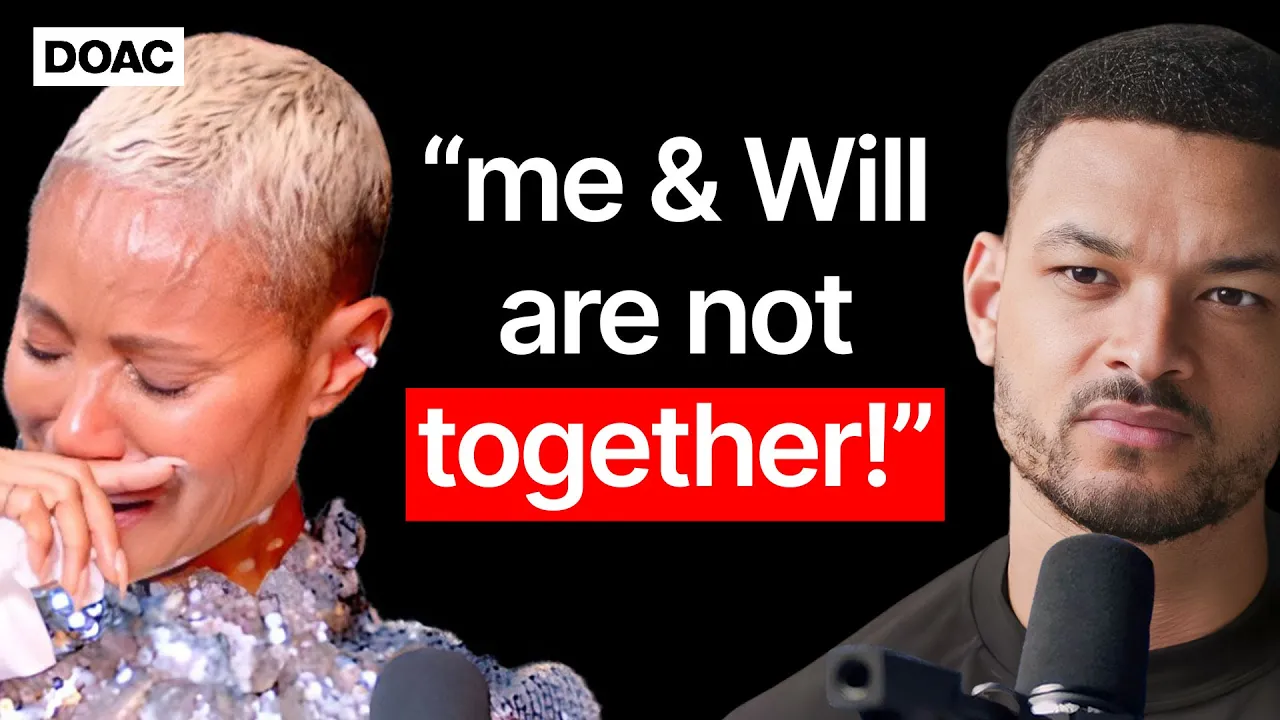
The Diary Of A CEO
The actress reveals that decades of unaddressed trauma and self-hatred drove her marital strain, suicidal ideation, and public controversies before she found healing through psychedelic therapy.
AI-assisted summary of Jada Pinkett Smith: “I Just wanted to stay alive until 4pm!” — original source. Check the original for full context.
Source published:
Detailed notes
## Background This episode of "The Diary Of A CEO," hosted and published by Steven Bartlett on YouTube on October 16, 2023, features an in-depth conversation with Jada Pinkett Smith. The page description highlights her memoir, 'Worthy', and notes that the discussion explores the hidden side of Hollywood and her personal journey of self-discovery and healing.
## TL;DR Jada Pinkett Smith reflects on her life's trajectory, moving from an unstable childhood marked by parental addiction and dealing drugs on the streets of Baltimore to navigating fame in Hollywood. She details her deep platonic bond with Tupac Shakur, the emotional complexities and misperceptions surrounding her marriage to Will Smith, and her intense battles with severe mental health crises and suicidal ideation. Ultimately, she discusses how inner work, sacred plant medicine, and radical self-acceptance helped her dismantle defensive mechanisms, overcome profound grief, and reclaim her sense of personal worth.
## Atmosphere & style The interview carries an extraordinarily raw, introspective, and emotionally charged atmosphere, balancing painful vulnerability with grounded wisdom. Host Steven Bartlett creates a compassionate, safe space—which Jada warmly likens to a "gray table"—allowing her to open up with unfiltered candor and shed tears over past losses. The narrative arc moves fluidly from gritty survival mode to deep spiritual reflection, offering listeners an intimate, evocative experience of healing through shared truth.
## Key takeaways - [02:45](https://www.youtube.com/watch?v=vwFxptz77II&t=165s) Growing up with parents struggling with addiction left Jada feeling unprioritized, shaping her foundational sense of self-worth. - [09:29](https://www.youtube.com/watch?v=vwFxptz77II&t=569s) Acting served as a vital psychological outlet for Jada to express suppressed trauma, pain, and rage from her unstable childhood. - [15:02](https://www.youtube.com/watch?v=vwFxptz77II&t=902s) Jada turned to drug dealing in Baltimore as a pragmatic strategy for financial independence and survival, normalization of ambient street violence. - [21:07](https://www.youtube.com/watch?v=vwFxptz77II&t=1267s) Surviving extreme street violence and being held at gunpoint desensitized Jada to intimidation, making Hollywood power dynamics feel manageable. - [25:51](https://www.youtube.com/watch?v=vwFxptz77II&t=1551s) Advice from Warren Beatty helped Jada learn to lower her defensive street posture and allow people to see her warmth and charm. - [32:13](https://www.youtube.com/watch?v=vwFxptz77II&t=1933s) Jada and Tupac Shakur shared a deep, rare emotional and spiritual bond, while their lack of physical chemistry kept their relationship purely platonic. - [35:17](https://www.youtube.com/watch?v=vwFxptz77II&t=2117s) Tupac's cultural impact stemmed from his authentic ability to meet people inside their grief, pain, and multidimensional human experience. - [39:40](https://www.youtube.com/watch?v=vwFxptz77II&t=2380s) Jada's initial dismissal of Will Smith as superficial changed when she realized that true depth and resilience can manifest as grounded happiness and ambition. - [45:39](https://www.youtube.com/watch?v=vwFxptz77II&t=2739s) In her early twenties, Jada suffered a severe mental health crisis, highlighting the isolation caused by stigma around depression in the Black community. - [58:27](https://www.youtube.com/watch?v=vwFxptz77II&t=3507s) A unresolved fight fueled by pride ended up being Jada and Tupac's last conversation before his death, teaching her to never let ego hinder reconciliation. - [01:04:29](https://www.youtube.com/watch?v=vwFxptz77II&t=3869s) The consecutive losses of her close friends Tupac and Maxine forced Jada through deep grief and an existential reconciliation with her faith. - [01:13:08](https://www.youtube.com/watch?v=vwFxptz77II&t=4388s) Mismatched love languages between Will's focus on material/career success and Jada's desire for emotional presence contributed to marital friction. - [01:18:18](https://www.youtube.com/watch?v=vwFxptz77II&t=4698s) Jada realized that sacrificing her own identity to fulfill a partner's vision breeds resentment, and true happiness must be cultivated internally. - [01:26:20](https://www.youtube.com/watch?v=vwFxptz77II&t=5180s) At age 39-40, Jada experienced severe, chronic suicidal ideation despite her external success, planning her death to appear accidental to protect her children. - [01:31:08](https://www.youtube.com/watch?v=vwFxptz77II&t=5468s) Participating in an Ayahuasca ceremony helped Jada confront her internal cycle of self-hatred and embrace the practice of daily surrender. - [01:33:35](https://www.youtube.com/watch?v=vwFxptz77II&t=5615s) During her separation from Will, Jada took the public blame regarding the 'entanglement' out of a pattern of martyrdom and codependency. - [01:36:08](https://www.youtube.com/watch?v=vwFxptz77II&t=5768s) Jada clarifies that the Oscar slap was not prompted by her, reflecting complex internal pressures on Will and a long personal history with Chris Rock.
## Detailed walkthrough ### [00:00](https://www.youtube.com/watch?v=vwFxptz77II&t=0s) Teaser & Host's Welcome
The episode begins with a dramatic preview of Jada Pinkett Smith reflecting on a dark period in her life, admitting she was trapped in a self-destructive cycle of self-hatred. She confesses that when she contemplated ending her life, her primary concern was making it look like an accident so her children would not know she committed suicide. The opening montage pivots to her early life—from growing up as the daughter of two drug-addicted parents in Baltimore to becoming a teenage drug dealer herself. She shares how she felt fearless, believing she was going to become the next big female drug kingpin, until she faced a terrifying moment with two 9mm guns pointed at her head. The preview touches upon key moments in her memoir *Worthy*: her defense mechanisms, the public backlash over the 2022 Oscars slap, the "entanglement" discussion, and her bond with Tupac Shakur.
Following the intro, host Steven Bartlett addresses the audience directly to express his gratitude. He thanks the listeners for supporting the podcast, noting that their engagement allows him and his team to pursue their dream jobs. Steven makes a candid request, urging viewers to hit the subscribe button as it directly impacts the show's ability to invite high-profile guests and expand its reach.
---
[02:45](https://www.youtube.com/watch?v=vwFxptz77II&t=165s) Childhood Context & The Broken First Mirror
Steven opens the interview by emphasizing that understanding a person requires understanding their context. Reading from Jada’s memoir, he highlights a key line: *"When I go in search of the origins of my broken heart, it is the sense of not being the priority to the two people who gave me life that creates a fracture in my feeling of worth."* Jada explains that parents serve as a child's initial mirror. Because her mother was pregnant at 17 and had her at 18 while actively struggling with addiction alongside her father, drugs remained their primary focus. Consequently, Jada lacked the fundamental reflection of feeling prioritized by her creators.
She credits her grandmother, Marion Martin, with stepping into her life to serve as a vital, loving mirror. Her grandmother reflected her inner beauty, talents, and gifts, providing a foundation of self-worth that Jada still draws upon today. Despite her grandmother's warmth, Steven notes an underlying sense of pervasive loneliness in her childhood narrative—a young girl constantly searching for a place to call home. Jada agrees, stating that once her grandmother passed away, she took to the streets to find her tribe, power, identity, and sense of purpose.
* **Mother's Age:** Jada's mother, Adrienne Banfield-Norris, was 17 when she became pregnant and 18 when Jada was born. * **The "First Mirror" Concept:** Jada views parents as a child's primary mirror; when addiction takes precedence, the child fails to develop an innate sense of personal value.
---
[05:52](https://www.youtube.com/watch?v=vwFxptz77II&t=352s) Her Father's Departure & The Search for Safety
Jada recounts a defining memory from when she was seven years old. Her father, Robsol Pinkett Jr., took her for a walk and plainly explained that due to his addictions and criminal lifestyle, he could not be her father. Although he had never been consistently present, the young Jada appreciated his blunt honesty over false promises. At seven, she did not realize how this abandonment would shape her future relationships with men, but the moment validated her intuition that something was deeply wrong in her home life.
Steven brings up Gabor Maté’s psychological framework regarding how infants and young children internalize trauma, noting that children often blame themselves for their parents' instability. Jada acknowledges that she subconsciously interpreted her father's choice as evidence that she was not worthy enough to make him change. She compares her father's choice to abandon his parental role to her mother's struggle with heroin, realizing that a drug's power often eclipsed their commitment to her.
She also recalls her mother’s first husband after Robsol, a man named Tony. Tony provided a stable, fatherly presence for a brief period, but ultimately left because he could not remain in a relationship with someone deeply involved in heroin addiction. Tony's departure was another devastating blow for young Jada, destroying her remaining belief that she could rely on adults for safety.
* **Father's Conversation:** Robsol Pinkett Jr. explicitly told 7-year-old Jada that his addiction and criminal lifestyle prevented him from being a father. * **Mother's Partner:** Tony was Adrienne's first husband after Robsol; he provided temporary stability before leaving due to Adrienne's severe heroin addiction.
---
[09:29](https://www.youtube.com/watch?v=vwFxptz77II&t=569s) Acting as an Outlet for Unexpressed Trauma
Jada discusses her early entry into the performing arts, which began with community theater and summer arts programs. Her first professional acting role was at age seven as one of Madame Bon Bon's children in a local production of *The Nutcracker*. She later attended TWIGS (To Work in Gaining Skills), an after-school program designed to prepare young talent for the audition process at the prestigious Baltimore School for the Arts.
For Jada, acting was not merely a career ambition or a path to fame; it served as an essential psychological outlet. On stage, she felt safe expressing extreme emotional states—pain, rage, and grief—that were strictly off-limits in her unstable home environment. Her theater teachers repeatedly attempted to push her toward lighthearted or comedic monologues, but Jada instinctively gravitated toward heavy, high-stakes dramatic roles to process her internal turmoil.
Steven draws a connection between her story and the trauma research presented in Bessel van der Kolk's *The Body Keeps the Score*, pointing out how many actors from violent or traumatic backgrounds use performance as a therapeutic mechanism to escape their reality and embody a different identity. Jada confirms this assessment, acknowledging that childhood exposure to domestic violence—including witnessing and hearing about severe physical altercations between her parents—left deep emotional imprints on her life.
* **First Professional Role:** Played one of Madame Bon Bon's children in *The Nutcracker* at age 7. * **Arts Training:** Participated in TWIGS to prepare for the Baltimore School for the Arts. * **Role Choices:** Constantly chose dramatic, highly emotional monologues over comedy as an outlet for repressed feelings.
---
[15:02](https://www.youtube.com/watch?v=vwFxptz77II&t=902s) Turning to the Streets of Baltimore
Following the loss of her grandmother and the ongoing instability caused by her mother's heroin addiction, Jada made a conscious decision to turn to street life for protection and financial independence. In her neighborhood, there were no visible examples of traditional success like doctors or lawyers; the only people displaying wealth, status, and control were street hustlers. They drove luxury cars, carried large rolls of cash, and commanded respect and security.
Refusing to be reliant on anyone else—and explicitly refusing to be merely "a hustler's girlfriend"—Jada resolved to become a major player herself. She viewed dealing drugs not as a thrill-seeking adventure, but as a pragmatic method to build an impenetrable fortress around herself and her mother, ensuring their survival even if her mother's addiction proved fatal.
Living in late-1980s Baltimore exposed her to a war-zone environment where high levels of ambient violence were normalized. Hyper-vigilance became second nature. Situations that outsiders would consider extreme or terrifying were simply part of everyday life, leading her to develop a tough exterior to conceal her vulnerabilities.
---
[19:08](https://www.youtube.com/watch?v=vwFxptz77II&t=1148s) Held at Gunpoint in a Robbery Setup
Jada describes a horrifying incident that occurred during her senior year of high school, around the age of 17. She had been operating out of a ground-floor apartment in a local housing project, selling drugs directly through a door fitted with a security chain or out of a window. One afternoon, someone set her up during a transaction.
While looking through the door's peephole to make a trade, two men ambushed her from the blind sides of the entryway. They kicked the door off its frame and ambushed her at gunpoint, forcing two 9mm handguns directly against her head. The assailants robbed her of all her cash, jewelry, and drug stash.
Jada notes how fortunate she was to escape with her life, as the leader of that specific robbery went on to commit a double homicide just a few weeks later. The perpetrator stuffed two rival drug dealers into the trunk of a car, shot the vehicle full of bullets, and was subsequently sentenced to life in prison. Despite the terrifying nature of the ordeal, the incident was just one of several dangerous events that forced Jada to reevaluate her path on the streets.
* **Age during the Armed Robbery:** 17 years old (senior year of high school). * **Location:** Ground-floor apartment in a Baltimore housing project. * **Details of the Event:** Ambushed by two men who kicked in the door and pointed two 9mm handguns at her head, taking her money, jewelry, and drug supply. * **Fate of the Assailant:** The ringleader murdered two men in a car trunk weeks later and received a life sentence.
---
<ElicitationsGroup message="Where would you like to go next with this transcript analysis?"> <Elicitation label="Summarize Part 2 of the transcript" query="Please provide a detailed, faithful walkthrough of Part 2 of this transcript using the same structure and guidelines."/> <Elicitation label="Extract key themes and insights from Part 1" query="What are the central psychological themes and turning points discussed in Part 1 of Jada Pinkett Smith's interview?"/> </ElicitationsGroup>
[21:07](https://www.youtube.com/watch?v=vwFxptz77II&t=1267s) Surviving a Robbery and Transcending the Streets
Recalling a terrifying moment on the streets, Jada Pinkett Smith describes looking straight into the eyes of an armed mugger as he decided whether to let her live. By the grace of God, he left her alive after taking her belongings. Driven by sheer audacity and the protective umbrella she operated under at the time, Jada immediately called her connection in the street world to report that she had been robbed. The boss knew precisely who had done it and set up a meeting a couple of days later in the same area. Though her money and drugs were gone forever, the man managed to return some of her un-pawned jewelry. When Jada asked the stone-cold killer why he hadn't killed her, he admitted it was because she was "too pretty"—marking the very first time Jada allowed herself to entertain the idea that she might actually be attractive.
Looking back, Jada recognizes that she was living in an altered reality, completely fearless and convinced she was destined to become the next "queenpin" drug dealer. Running with "wolves" made her feel invincible, an reckless period that now shocks her when she considers her own daughter, Willow. Yet, surviving that environment unknowingly prepared her for the predatory nature of Hollywood. When high-powered men in show business tried to intimidate her or flex their authority, Jada viewed their posturing as mere "puppy play" compared to the genuine killers she had previously dealt with.
- **Key Takeaway**: Surviving extreme street violence desensitized Jada to intimidation, making Hollywood's power plays feel insignificant by comparison. - **Quote**: "I was running with killers, so the Hollywood flex... it just didn't resonate that way for me. I looked at all of that as just kind of like puppy play."
[25:11](https://www.youtube.com/watch?v=vwFxptz77II&t=1511s) The Transition to Hollywood and Unlearning Survival Defenses
Jada arrived in Hollywood with an intense, "rough, rugged, and rambunctious" demeanor that set her apart. While some found her edge refreshing, it also made her come across as standoffish and confrontational. She operated under a strict policy of having "no [expletive] to give," demanding that people take her as she was or miss out on what she had to offer. However, this defensive posture was a relic of a life spent in survival mode rather than an offensive stance.
The turning point came during an interaction with veteran actor Warren Beatty, who offered gentle, non-judgmental guidance. He advised her to lower the chip on her shoulder and let people see her warmth, charm, and natural smile. Because Beatty validated her background without making her feel wrong for who she was, Jada finally listened. His advice sparked a lifelong process of learning how to lower her guard and feel safe enough to form real connections without losing her core identity.
- **Warren Beatty's Advice**: He encouraged Jada to show her softer, charming side rather than leading exclusively with a defensive, street-hardened exterior. - **Internal Struggle**: Jada notes that her tough defense mechanism was built into her DNA, requiring continuous conscious effort to manage so it doesn't isolate her or cause her to be misunderstood.
[28:46](https://www.youtube.com/watch?v=vwFxptz77II&t=1726s) The Burden of Feeling "Unlovable" and Meeting Tupac Shakur
Host Steven Bartlett highlights a poignant passage from Jada's memoir, *Worthy*, regarding the traumatic impact of her stepfather Tony's sudden departure from her life. The brutal rejection left her feeling deeply broken, leading her to file her grief away under a mental shelf labeled "unlovable." Steven observes how feeling unlovable drives people to erect walls that ultimately self-fulfill their isolation. Jada agrees, noting that her tough exterior was always a defense mechanism designed to protect her vulnerable core.
This emotional backdrop frames Jada's legendary relationship with Tupac Shakur, whom she met on her first day at the Baltimore School for the Arts. Sporting a rat tail and fresh clothes, Jada walked in only to see Tupac holding court in the room. Unfazed by her swagger, Tupac walked straight up to her with immense charisma, introducing himself with a name she had never heard before. The two bonded instantly, becoming inseparable best friends as if they had known each other in a past life.
- **First Impression**: Jada initially poked fun at Tupac, calling him a "peanut head," but was instantly won over by his magnetic presence and bold confidence. - **Emotional Mechanism**: The conviction that she was "unlovable" caused Jada to put up severe barriers, making her prone to being misunderstood throughout her life.
[32:13](https://www.youtube.com/watch?v=vwFxptz77II&t=1933s) The Unique Intimacy Between Jada and Tupac
Despite widespread assumptions that their deep bond was romantic, Jada explains that the physical dynamic simply wasn't there. She recalls a specific moment on her back porch where they decided to test their physical connection by kissing. The kiss was so entirely devoid of romantic chemistry that both recoiled in disgust. A second attempt years later when visiting him at Clinton Correctional Facility (Clinton/Dannemora) yielded the exact same result.
Instead, their connection was defined by an extraordinarily rare emotional and intellectual intimacy. Both possessed fierce, powerhouse personalities and explosive defense mechanisms that could lead to intense, passionate arguments. However, coming from the same background meant they implicitly understood each other's emotional language and could bypass one another's walls without taking offense. Jada believes that keeping physical intimacy out of their relationship was divine timing, preserving a unique bond that allowed them to truly see each other.
- **Physical Chemistry**: A mutual, non-romantic kiss on Jada's porch confirmed to both of them that their connection was purely platonic and spiritual. - **Deep Understanding**: Their shared origins allowed them to navigate each other's fierce tempers and defensive walls without fracturing their core trust.
[35:17](https://www.youtube.com/watch?v=vwFxptz77II&t=2117s) Tupac's Authenticity, Heart, and Legacy
Reflecting on what made Tupac an iconic cultural figure, Jada explains that he possessed an innate ability to "join" people emotionally. Rather than talking down to his audience, he met them directly inside their own grief, rage, or brokenness because he had lived through those exact struggles himself. He brought an unapologetic authenticity to everything he did, offering his intelligence, pain, fear, and sympathy without filter or gimmick.
Tupac refused to conform to the narrow expectations placed on rap artists of that era. He seamlessly transitioned from fierce anthems like *"Ambitionz Az a Ridah"* and *"A Soldier's Story"* to deeply vulnerable tracks like *"Dear Mama"* and *"Shed So Many Tears"*. Jada notes that his willingness to lay bare his entire multidimensional self came at a heavy personal cost, as true authenticity inherently clashes with societal conformity.
- **Versatility**: Tupac gave voice to the full spectrum of the human experience, spanning raw aggression, political consciousness, and tender vulnerability. - **Quote**: "He's not talking at you, he's talking with you. He had a way of being able to speak about subject matters that he's going to sit with you in your broken heart and speak to you from there."
[39:40](https://www.youtube.com/watch?v=vwFxptz77II&t=2380s) First Impressions of Will Smith and Redefining "Depth"
After moving to Los Angeles and juggling three jobs while trying to break into Hollywood, Jada met Will Smith—then the mega-star of *The Fresh Prince of Bel-Air*. Initially, Jada was entirely unimpressed by him, viewing him as cool but far from the type of man she was drawn to. At that stage in her life, Jada equated "depth" with emotional baggage, mistakenly assuming that a man had to be troubled to be complex or interesting. Because Will didn't project trauma or street edge, she dismissed him as superficial.
Her perspective shifted dramatically when they shared a meal at Jerry's Famous Deli alongside mutual friend Duane Martin. Away from the Hollywood glare over baked potatoes, Jada discovered a completely different side of Will. She was struck by his massive, world-conquering ambition, his genuine joy, and a deep, grounded nature that she had previously overlooked. Through Will, Jada learned not to judge a book by its cover, realizing that grounded happiness and ambition required their own form of deep resilience.
- **Initial Misconception**: Jada originally associated depth with emotional turmoil, leading her to dismiss the jovial, untroubled Will Smith. - **The Turnaround**: A casual meal with friend Duane Martin at Jerry's Famous Deli revealed Will's grounded nature and intense drive. - **Quote**: "Don't judge a book by its cover—that's what Will Smith taught me."
Here is the detailed, faithful walkthrough covering Part 3 of the transcript:
[42:20](https://www.youtube.com/watch?v=vwFxptz77II&t=2540s) First Encounters with Will Smith and Auditioning for *The Fresh Prince of Bel-Air*
Jada describes Will Smith as someone possessing immense intelligence and a vast range—a person who can seamlessly transition "from the hood to the White House and everywhere in between." She admires people with that level of adaptability, noting that no matter where Will is dropped, he will figure things out and fit in.
She recounts her early meetings with him, starting when she auditioned during the second season of *The Fresh Prince of Bel-Air* to play one of his onscreen girlfriends. Casting directors turned her down on the spot, telling her she was too short. As she walked out of the casting office around age 20, she crossed paths with Will. When he greeted her, she brushed it off playfully, telling him there was no point in talking because they said she was too short. Later, Will flew to North Carolina specifically to ask her to play his series-regular girlfriend on the show. However, Jada turned him down because she was determined to transition into movies after having just finished her run on *A Different World*.
She explains that on *A Different World*, she had the mentorship and protection of Debbie Allen, whereas joining *The Fresh Prince* would have locked her into a strict six-year television contract. Actor Duane Martin berated her for turning down the gig, arguing that it offered immediate financial security. Looking back, Jada remains positive that rejecting the role was the right decision; had she accepted it, she and Will would have dated under different circumstances, they would not have ended up married, and her children—Jaden, Willow, and bonus son Trey—would not exist in the same way.
- **Audition Details:** Auditioned for *The Fresh Prince of Bel-Air* in its second season; rejected by casting due to height. - **Will Smith's Offer:** Will flew to North Carolina to pitch her on joining the show as his recurring/regular onscreen girlfriend. - **Reason for Rejection:** Desired creative freedom to do feature films rather than being locked into a 6-year TV contract. - **Industry Mentor:** Debbi Allen protected and helped her navigate her career choices during *A Different World*. - **Peer Reaction:** Duane Martin criticized her decision, citing the loss of guaranteed financial stability.
[45:39](https://www.youtube.com/watch?v=vwFxptz77II&t=2739s) Navigating a Mental Health Crisis and Breakdown in Her Early Twenties
In her early twenties, Jada experienced what she describes in her memoir *Worthy* as her first major personal "earthquake" or mental health breakdown. While driving down the street to greet a friend on the corner, an overwhelming wave of physical and emotional distress hit her instantly. Her body began shaking uncontrollably, accompanied by a sudden "waterfall" and "volcano" of intense emotions—primarily fear, anger, and despair.
Unable to drive safely, she pulled over as her mind struggled to process the physical crisis. Terrified, she broke down in tears, overwhelmed by a strong desire to die. After managing to drive back home, her immediate instinct was to call her mother, Adrienne Banfield-Norris, sobbing and telling her she was going to kill herself. At the time, her mother was only about a year into her own sobriety and working a new job at a hospital. Desperate not to be alone, Jada also called her friend, the rapper MC Lyte, who immediately flew out to stay with her and hold her down until her mother could arrive.
Reflecting on the event, Jada realizes her mind and body were forcing her to stop ignoring her deep-seated emotional trauma instead of just pushing forward. She notes that during that era, mental health and suicide were rarely discussed in Black communities and were often stereotyped as "white people issues." This cultural stigma made her feel profoundly isolated, as though she were uniquely going crazy.
- **Onset of Breakdown:** Happened instantly while pulling her car around to say hello to a friend on a street corner. - **Emotional Symptoms:** Severe body shaking, uncontrollable crying, intense fear, anger, despair, and sudden suicidal ideation. - **Support System:** Called her mother (who was ~1 year sober at the time) and her close friend MC Lyte, who flew out immediately to sit with her. - **Cultural Context:** Mental health issues and suicide were heavily stigmatized and rarely acknowledged within Black families during that era.
[50:40](https://www.youtube.com/watch?v=vwFxptz77II&t=3040s) Psychiatric Care, Prozac, and Returning to Baltimore
Following the breakdown, Jada sought professional medical help. She was evaluated by a psychiatrist, prescribed Prozac, and began attending therapy. Despite entering treatment, she felt compelled to maintain her outward facade of strength and keep working. She hid her struggles from everyone outside her innermost circle because the prevailing mindset in her environment was to "keep it moving" and plaster over emotional cracks. Taking a public career break due to depression was completely unthinkable to her at the time.
To distance herself from the pressures of Los Angeles while continuing her acting career, Jada decided to relocate back home to Baltimore. She purchased a small farmhouse on roughly six to nine acres of land, intending to build a quiet life for herself away from the Hollywood noise. Her plan was to reside in Maryland and fly out to New York or Los Angeles strictly for film auditions and work commitments.
- **Medical Treatment:** Diagnosed by a psychiatrist, prescribed the antidepressant Prozac, and started psychotherapy. - **Mindset:** Concealed her mental health struggles from the public and industry peers due to social pressure to remain tough. - **Property Purchase:** Bought a farmhouse on 6 to 9 acres in Baltimore as a refuge from Los Angeles.
[54:49](https://www.youtube.com/watch?v=vwFxptz77II&t=3289s) Reconnecting with Will Smith and Tupac Shakur's Proposal from Prison
While Jada was in Baltimore renovating her home, Will Smith called her out of the blue. His wife, Sheree Zampino, had recently served him with divorce papers. Unaware of the complexities of marriage at the time, Jada assumed a divorce was no different than a standard breakup. Will asked where she was and if she was seeing anyone; when she replied that she was single, he boldly declared, "Good, you're seeing me now," and instructed her to call him when she returned to Los Angeles. Shortly after returning to L.A., they went out on their first official date.
Around this same period, Tupac Shakur was incarcerated. After initially being held at Rikers Island, he was transferred to Clinton Correctional Facility in Dannemora, New York—a maximum-security facility known for harsh conditions where high-profile inmates and terrorists were detained. Jada visited him at Rikers Island, an experience that left her deeply shaken due to the grim environment and Tupac's deteriorated emotional state. While incarcerated, Tupac sent Jada a long letter containing a marriage proposal. In the letter, he expressed that after deep reflection and spiritual awakening, he realized the soulmate and loyal love he had been searching for was Jada all along, and he wished to commit his life to her.
Jada becomes visibly moved discussing this period, explaining that she remains in a very raw state of "thawing out" and dismantling the emotional defenses she built up over decades.
- **Will's Reconnection:** Will reached out immediately after Sheree Zampino served divorce papers, initiating their courtship. - **Tupac's Incarceration:** Held at Rikers Island before transfer to Clinton Correctional Facility in Dannemora. - **Tupac's Letter:** Sent a detailed written marriage proposal to Jada from prison, citing her unmatched loyalty and love. - **Emotional Impact:** Visiting Tupac in Rikers left a lasting emotional wound that she still feels vividly when reflecting on it.
[58:27](https://www.youtube.com/watch?v=vwFxptz77II&t=3507s) The Falling Out with Tupac, His Passing, and Lessons on Pride
Addressing recent news, Jada acknowledges the arrest of Duane "Keffe D" Davis in connection with Tupac's 1996 murder, expressing relief that an arrest was finally made while hoping it leads to answers regarding the broader circumstances of his death.
She then addresses the painful rift that occurred between her and Tupac prior to his death. They had a massive, explosive argument concerning his lifestyle and the dangerous path he was taking following his release from prison. Jada confronted him fiercely, warning him that his choices would end in tragedy. Following the fight, pride and ego took over; believing Tupac was "invincible" after surviving so many life-threatening situations, Jada dug her heels in and refused to reach out first, insisting that he needed to make the initial call to apologize.
Tragically, that argument was the final conversation they ever had. Nearly a year later, while on a film set, Jada received a phone call from Tupac's mother, Afeni Shakur, informing her that Tupac had been shot in Las Vegas and was in a coma. Afeni advised Jada not to rush, as Tupac's family and his fiancée (Kidada Jones) were at his bedside. While Jada was en route to visit him following a scheduled trip to New York, her close friend Fawn came to her door; the look on Fawn's face instantly signaled that Tupac had passed away.
Reflecting on the painful regret of letting their fight linger, Jada shares a vital life lesson: never let pride or ego prevent reconciliation with loved ones. She now uses a personal rule—asking herself if a conflict will matter on her deathbed—to ensure she resolves disagreements immediately.
- **The Final Dispute:** A major confrontation regarding Tupac's risky post-prison lifestyle and associates. - **The Fallout:** Both held firm in their pride; Jada assumed he would live forever because he had survived previous shootings and trauma. - **Shooting & Death:** Shot in Las Vegas in September 1996; Jada was notified by Afeni Shakur while he was in a coma and learned of his passing from her friend Fawn before she could reach his bedside. - **Personal Lesson:** Uses the "deathbed test" to immediately let go of petty arguments and prioritize relationships over ego. - **Grief:** Admits she is still actively processing and working through her complex relationship with grief.
<ElicitationsGroup message="Where would you like to go next with this transcript analysis?"> <Elicitation label="Analyze Jada's relationship dynamics with Will Smith vs. Tupac" query="Based on the transcript so far, analyze the key differences in how Jada describes her dynamic with Will Smith versus her bond with Tupac Shakur."/> <Elicitation label="Summarize Jada's mental health journey and coping mechanisms" query="Provide a detailed summary of Jada Pinkett Smith's mental health struggles, her breakdown, and the mechanisms she used to cope as discussed in this transcript section."/> </ElicitationsGroup>
Here is a detailed, faithful walkthrough of the provided transcript segment.
[01:04:29](https://www.youtube.com/watch?v=vwFxptz77II&t=3869s) Tragic Losses: The Deaths of Maxine and Tupac
Steven Bartlett shows Jada Pinkett Smith a photograph featuring both her close friend Maxine and Tupac Shakur. The visual immediately triggers immense grief, causing Jada to break down in tears and ask for a tissue. She shares the unbearable weight of losing both Maxine and Tupac "back to back." She explains that while Tupac was like her brother, Maxine was her sister. The two women met on the set of the 1994 film *Jason's Lyric* and grew inseparable. When Maxine wanted to move from Canada to Hollywood to pursue her career, Jada welcomed her into her home.
However, the period quickly turned tragic due to what Jada believes was a misdiagnosis of a severe thyroid disorder. The condition profoundly disrupted Maxine's mental state, leading to a mental health crisis that culminated in her dying by suicide after jumping off her mother's balcony. Steven notes the overwhelming complexity of this season in Jada's life, observing how survivors of suicide are often haunted by "what ifs" and memories of setting hard boundaries in their final interactions. Jada reflects on the existential disappointment of watching a once-happy friend unravel, noting that coping with such losses forces her to reconcile directly with God.
- **Maxine's Background:** Met Jada on *Jason's Lyric*, moved from Canada to live with Jada in Los Angeles to pursue acting. - **Medical & Psychological Factors:** A likely misdiagnosed thyroid disorder severely affected Maxine's psyche prior to her suicide. - **Shared Grief:** Steven references interviewing other guests who faced similar guilt after setting necessary boundaries before a loved one's suicide.
---
[01:10:01](https://www.youtube.com/watch?v=vwFxptz77II&t=4201s) Finding Purpose Through Pain and Connecting with Lauren London
Steven ponders the paradox of Jada's life, suggesting that the extreme heights of her success and the profound depths of her losses stem from the same origins. Jada agrees that while her traumas have been painful, they granted her the unique capacity to connect deeply with others in their darkest moments. She highlights her close bond with actress Lauren London, the partner of the late rapper Nipsey Hussle.
Drawing from her own experience of losing Tupac, Jada reached out to offer support. Although Lauren initially held up emotional defenses similar to Jada's own, Jada persisted in offering a safe space until a profound connection formed. Jada describes heartbreak as a force that "breaks you open," leaving only two paths: descending into darkness or seeking the light. Having visited both places, she actively uses her pain as a compass to guide her toward light and deeper human connection.
- **Peer Connection:** Jada leveraged her grief over Tupac to support Lauren London following Nipsey Hussle's death in 2019. - **The Dual Paths of Heartbreak:** Jada describes grief as an opening that forces a choice between endless darkness or pursuing spiritual light.
---
[01:13:08](https://www.youtube.com/watch?v=vwFxptz77II&t=4388s) Relational Conflict, Love Languages, and the Illusion of "Later"
The conversation shifts to Jada's memoir, *Worthy*, particularly the period before her 40th birthday when she appeared to have it all—a massive career, a superstar husband in Will Smith, beautiful children, and financial abundance—while being "spiritually bankrupt" inside. Steven brings up relationship expert Dr. John Gottman's research, which identifies contempt arising from poor conflict resolution as the primary predictor of divorce.
Steven candidly admits that he sees himself in Will's style of love: focusing on hard work, financial provision, and material security, whereas his own partner—like Jada—craves emotional presence and intimacy. Jada confirms that Will's drive was to "make a masterpiece out of life itself," while her deepest wish was to "make a masterpiece out of our connection." When Steven mentions telling his girlfriend that they can focus on emotional connection "later" after he secures his career goals, Jada calls this mindset "foolishness." She reminds him that on one's deathbed, no one reminisces about achievements; all that matters is how one loved and was loved.
- **Dr. John Gottman's Research:** Contempt and unresolved conflict patterns are the leading causes of relationship breakdown. - **Divergent Love Languages:** * **Will's approach:** Expressing love through career ambition, safety, and material abundance. * **Jada's approach:** Expressing love through deep emotional eye contact, presence, and shared inner processing. - **The Deathbed Reality Check:** Jada warns against deferring intimacy, pointing out that life's unpredictability makes "later" a dangerous illusion.
---
[01:18:18](https://www.youtube.com/watch?v=vwFxptz77II&t=4698s) Overcoming Resentment and Reclaiming the Self
Addressing a quote from her book where Jada expressed feeling "resentful and angry" while watching her own identity slip away, she explains the mechanics of her marital frustration. For years, she abandoned her own desires to pour entirely into Will's grand vision, mistakenly believing that sacrificing herself for his dream would eventually yield the emotional intimacy she craved.
She eventually realized this dynamic was flawed on two fronts: first, no partner can fulfill a void if a person is disconnected from themselves; second, expecting another person to be responsible for one's happiness is impossible. When she and Will separated and he advised her to "go make yourself happy," Jada initially received the comment with bitterness, feeling cast aside after helping build his success. However, she came to accept that self-fulfillment is strictly an inside job. This realization launched her into what she calls the "exiled lands"—a period of stripping away Hollywood's demands for perfectionism, releasing marital expectations, and confronting her deepest internal fears to rebuild her authentic self.
- **The Self-Abandonment Trap:** Sacrificing one's personal identity in hopes of earning connection from a partner inevitably breeds resentment. - **The Limits of External Fulfillments:** Realizing that a spouse, family, or successful career cannot fix internal spiritual bankruptcy. - **The "Exiled Lands":** Jada's term for the painful inner journey of dismantling perfectionism and confronting raw fears to achieve personal freedom.
---
[01:25:03](https://www.youtube.com/watch?v=vwFxptz77II&t=5103s) Approaching 40: A Chronic State of Discontent
As Jada approached her 39th birthday and prepared to turn 40, her internal turmoil reached a crisis point. Steven recalls reading Chapter 17 of her memoir (*No Soccer Mom Here*) and having to pause because the depth of her suffering was so hard to digest. Despite living in a world that glorified surface perfection, Jada was trapped in a heavy, chronic state of discontentment with no visible path forward. She emphasizes that behind the pristine Hollywood image, she was inhabiting an extremely dark mental space.
- **Internal vs. External Reality:** Despite external fame and prosperity, Jada entered her late 30s experiencing severe emotional distress. - **Memoir Context:** Chapter 17 (*No Soccer Mom Here*) details the breaking point of her internal struggle leading up to her 40th birthday.
[01:26:20](https://www.youtube.com/watch?v=vwFxptz77II&t=5180s) Suicidal Ideation and the Illusion of Success
Jada Pinkett Smith opens up about one of the darkest periods in her life around ages 39 and 40, when she was in a constant state of suicidal ideation. She recalls that every day felt like an agonizing battle just to make it to 4:00 p.m. Her mother, having recently read Jada's memoir *Worthy*, expressed shock and disbelief upon learning that Jada used to wake up crying every single day. Jada felt that admitting she was actively looking for a cliff to drive off of was already enough to convey her agony. The issue was not that people close to her did not notice her deep unhappiness, but rather that everyone around her shared the same disbelief: how could someone who seemingly "has everything" be so profoundly miserable?
This stark disconnect between her external life and her inner anguish created intense shame. During that time, conversations surrounding mental health were far less common, leaving Jada feeling utterly isolated and convinced that she was simply "born broken." When searching for a way to end her life, she scouted dangerous routes like Mulholland Drive and Big Sur, looking for a sheer drop with low visibility and heavy fog so that her death would look like a tragic driving accident rather than a suicide, sparing her children from the devastating truth.
Reflecting on this dark chapter, Jada frames her experience not as a true desire to die, but as a psychological cry for help. She explains that in deep states of distress, "something is asking to die, but not you." Her mind was trapped in an unrecognized, unconscious loop of deep self-hatred.
* Jada's daily benchmark for surviving her deep depression was surviving until 4:00 p.m. each day. * She specifically scouted dangerous cliffs along Big Sur and Mulholland Drive to ensure a fall would be fatal without leaving her disfigured or surviving. * She meticulously planned her death to appear accidental so her children would not believe she had committed suicide.
[01:31:08](https://www.youtube.com/watch?v=vwFxptz77II&t=5468s) Healing Through Ayahuasca and Surrender
The turning point in Jada's struggle with self-hatred came when her son, Jaden, introduced her to the concept of Ayahuasca. Jaden came into the kitchen one day and urged her to talk to his friends, Moises and Mateo, about a transformative experience their father had with the sacred plant medicine. Knowing his mother was a natural "seeker," Jaden brought them together, leading Jada to invite their father over for a conversation. Instantly recognizing that this was the path she needed, Jada partook in a four-day, intense Ayahuasca ceremony.
During the ceremony, the medicine exposed the hidden "pit of self-hatred" she had been trapped in, allowing her to observe her toxic thought patterns clearly and begin her journey toward deep emotional healing. This experience highlighted the importance of "surrender"—a concept Jada titles Chapter 20 of her memoir. For her, surrender means relinquishing everything one thinks they know about themselves and continuously submitting to a higher power on a daily basis.
* Jaden Smith initiated his mother's healing journey by introducing her to his friends Moises and Mateo, whose father had undergone an Ayahuasca experience. * Jada completed a rigorous four-day Ayahuasca ceremony that exposed her internal cycles of self-hatred. * Chapter 20 of her memoir *Worthy* is titled "Surrender," emphasizing daily submission to a higher power and letting go of ego-driven narratives.
[01:33:15](https://www.youtube.com/watch?v=vwFxptz77II&t=5595s) The "Entanglement" and the Pattern of Martyrdom
Steven Bartlett segues into Chapter 19 of the memoir, which addresses the public conversation around Jada's "entanglement." He points out that when the *Red Table Talk* episode aired, isolated clips made it appear as though Jada had cheated on Will Smith while he looked tired and hurt. In reality, Jada and Will were separated and living completely separate lives at the time. Despite knowing the public narrative would paint her in a negative light, Jada chose to release the conversation anyway.
When asked if she regrets releasing it, Jada firmly answers no, explaining that the severe backlash forced her to confront a dynamic of "martyrdom" within herself. Because Will was not ready to reveal to the public that they were separated, Jada willingly took the blame just to bring the speculation to an end. It was only when her loved ones—including her mother, kids, and close friends—reacted with distress, urging her to get into therapy for severe codependency, that Jada realized how deep her sacrificial tendencies ran. She notes that while public opinion does not bother her due to its inherent absurdity, the reactions of those who truly love her served as a necessary mirror for her healing.
* Jada and Will Smith were completely separated and living apart at the time of her relationship during the "entanglement" period. * Will was not ready to publicly announce their separation, leading Jada to take the public fall to end the speculation. * Jada's mother confronted her following the public fallout, telling her she was "codependent as hell" and needed therapy. * Jada identified her pattern of taking on public blame as a form of "martyrdom."
[01:36:08](https://www.youtube.com/watch?v=vwFxptz77II&t=5768s) The Oscar "Holy Slap" and Historical Context
Jada addresses the infamous moment at the Academy Awards referred to in Chapter 21 as the "holy slap." She reveals that in the immediate moment, she did not realize Will had physically struck Chris Rock, assuming instead that it was a pre-planned comedy skit and that Chris had ducked. When social media seized upon her visible eye roll, critics claimed she was signaling for Will to attack Chris. Jada dismisses this narrative, emphasizing that she could never force Will to do anything and clarifying that she attended the Oscars with Will strictly as family, as they were not together at the time.
While she anticipated taking the blame for the incident, Jada admits the sheer scale of the public outrage was "insane." When asked if she viewed Will's action as an act of love or protection, Jada characterizes the moment as deeply complex. She explains that his outburst was far less about her and much more about internal pressures he was carrying at the time, including his intense work on the movie *Emancipation*, as well as personal history between Will and Chris Rock that dates all the way back to the 1980s.
* Jada initially believed the stage encounter between Will Smith and Chris Rock was a staged comedic skit and did not realize contact was made. * Social media interpreted Jada's eye roll as an instruction for Will to intervene, which she denies. * Will and Jada attended the ceremony as family, despite not being together as a couple. * Jada notes that Will's reaction was tied to external stressors, such as his film *Emancipation*, and a long, complex history with Chris Rock dating back to the 1980s.
[01:38:21](https://www.youtube.com/watch?v=vwFxptz77II&t=5901s) Reflections on Wisdom, Vulnerability, and Closing Remarks
Steven expresses deep gratitude to Jada for writing *Worthy*, noting that reading her memoir felt like receiving guidance from an elder. He shares that her stories provided clear "breadcrumbs" and actionable wisdom, helping him recognize subtle behaviors and emotional wounds within himself that could lead to self-sabotage. He praises the vivid detail of her prose—from descriptions of her grandmother's garden to panic attacks on the highway—and commends her radical vulnerability in pursuing truth rather than presenting a self-serving narrative.
Jada thanks Steven for providing a safe space on his podcast, affectionately referring to his setup as a "gray table" where she felt comfortable sharing her tears and truth. Following the interview, Steven transitions into a closing advertisement for the podcast's sponsor, Huel, highlighting its Ready-to-Drink (RTD) complete nutritional meals that contain 26 vitamins, minerals, and 20 grams of protein.
* Steven describes Jada's memoir *Worthy* as a set of "breadcrumbs" and human wisdom that acts as a guide for readers' self-discovery. * Jada thanks Steven for creating a safe space at his "gray table" (a nod to her show *Red Table Talk*). * Sponsor note: Huel Ready-to-Drink (RTD) meal bottles contain 26 essential vitamins and minerals, as well as 20 grams of protein.
## Notable quotes > [02:45](https://www.youtube.com/watch?v=vwFxptz77II&t=165s) When I go in search of the origins of my broken heart, it is the sense of not being the priority to the two people who gave me life that creates a fracture in my feeling of worth. — Steven Bartlett
> [21:07](https://www.youtube.com/watch?v=vwFxptz77II&t=1267s) I was running with killers, so the Hollywood flex... it just didn't resonate that way for me. I looked at all of that as just kind of like puppy play. — Jada Pinkett Smith
> [35:17](https://www.youtube.com/watch?v=vwFxptz77II&t=2117s) He's not talking at you, he's talking with you. He had a way of being able to speak about subject matters that he's going to sit with you in your broken heart and speak to you from there. — Jada Pinkett Smith
> [39:40](https://www.youtube.com/watch?v=vwFxptz77II&t=2380s) Don't judge a book by its cover—that's what Will Smith taught me. — Jada Pinkett Smith
> [54:49](https://www.youtube.com/watch?v=vwFxptz77II&t=3289s) Good, you're seeing me now — Will Smith
> [01:13:08](https://www.youtube.com/watch?v=vwFxptz77II&t=4388s) make a masterpiece out of life itself — Will Smith
> [01:13:08](https://www.youtube.com/watch?v=vwFxptz77II&t=4388s) make a masterpiece out of our connection — Jada Pinkett Smith
> [01:18:18](https://www.youtube.com/watch?v=vwFxptz77II&t=4698s) go make yourself happy — Will Smith
> [01:26:00](https://www.youtube.com/watch?v=vwFxptz77II&t=5160s) something is asking to die, but not you — Jada Pinkett Smith
> [01:33:29](https://www.youtube.com/watch?v=vwFxptz77II&t=5609s) codependent as hell — Adrienne Banfield-Norris
## Mentioned Jada Pinkett Smith, Steven Bartlett, Cole Sprouse, Worthy, The Diary Of A CEO, Baltimore, Hollywood, Tupac Shakur, Will Smith, Eight Sleep, Zoe, Huel, Marion Martin, Adrienne Banfield-Norris, Robsol Pinkett Jr., Gabor Maté, Tony, Madame Bon Bon, The Nutcracker, TWIGS, Baltimore School for the Arts, Bessel van der Kolk, The Body Keeps the Score, Willow Smith, Warren Beatty, Clinton Correctional Facility, Ambitionz Az a Ridah, A Soldier's Story, Dear Mama, Shed So Many Tears, The Fresh Prince of Bel-Air, Duane Martin, Jerry's Famous Deli, Los Angeles, North Carolina, A Different World, Debbie Allen, Jaden Smith, Trey Smith, MC Lyte, Prozac, New York, Sheree Zampino, Rikers Island, Duane "Keffe D" Davis, Las Vegas, Afeni Shakur, Kidada Jones, Fawn, Maxine, Jason's Lyric, Canada, Lauren London, Nipsey Hussle, Dr. John Gottman, Mulholland Drive, Big Sur, Moises, Mateo, Red Table Talk, Academy Awards, Chris Rock, Emancipation
[Source](https://www.youtube.com/watch?v=vwFxptz77II)